by Jared Riddick
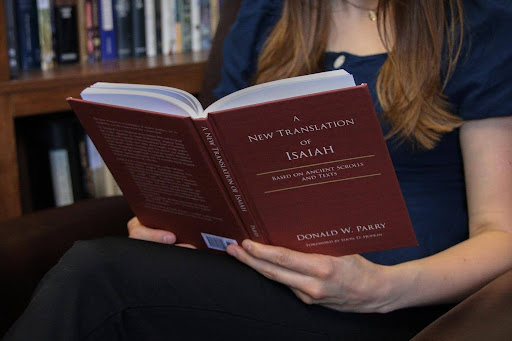
In May 2026, FAIR published two new volumes, the first of which was A New Translation of Isaiah: Based on Ancient Scrolls and Texts, edited and translated by Donald W. Parry, an established and well-published Isaiah scholar and professor of the Hebrew Bible and the Dead Sea Scrolls at Brigham Young University.
I met with Don in January of this year, when he was recording an episode of his podcast “Jesus Christ in Scripture” produced by our friends at the Ancient America Foundation. As we chatted, and I told him about FAIR’s publishing goals, he mentioned the manuscript for this translation, which he had been working on for some time. I offered FAIR’s help in publishing it, and he accepted.
Over the next several months, we worked together closely, going over the minutiae of editing and typesetting, and we became increasingly excited for the book that was emerging, and the resource it would be for Latter-day Saints in their Isaiah study during the “Come, Follow Me” Old Testament curriculum this year. The result is the volume that you can see and order today, with which we are very pleased.
Shortly after copies arrived, I sent Dr. Parry a series of questions about his background and new translation, which I think you will enjoy and get you excited to take a look at the book yourself!
Get your copy at the FAIR Bookstore or Amazon today!
Question
You served on the International Team of Translators of the Dead Sea Scrolls, giving you direct access to the oldest surviving biblical manuscripts in the world. How did working specifically with the Great Isaiah Scroll allow you to clarify passages in this translation that have been obscured or confused in later versions?
Response: It has been a distinctive opportunity to serve as a member of the International Team of Translators of the Dead Sea Scrolls since January 1994. I was first assigned to work on the Samuel scrolls; later I worked on the 21 Isaiah scrolls. Additionally, for several years I served as a member of the directors of Dead Sea Scrolls Foundation. To your question, having access to primary texts (the actual scrolls) versus secondary images (e.g., photos or digital images) is vital to scholars. Although there are advantages to viewing high quality photos, there is no substitute to working with ancient leather scrolls! Reading the Great Isaiah Scroll in the Scrollery of the Shrine of the Book Museum, Jerusalem, was a crucial course of action in the process of translating Isaiah’s text from ancient Hebrew to English. This enhanced my entire experience as I engaged with a scroll that is 2,100 years old. I viewed several minuscule properties on the leather—creases, folds, guide and separation dots, horizontal and vertical rulings; and a multitude of scribal marks and features. Most significantly, the leather exhibited scores of paleographic elements that may be indiscernible on photographs; this is vital because a correct reading of letters and words is vital as one conducts his/her translational work.
Question
You’ve made a deliberate effort to update the archaic language of the King James Version—like changing “durable clothing” or “mean man” to their actual modern meanings—while retaining important ancient Hebraisms. How did you balance the need for modern readability with preserving the ancient, sacred feel of the Hebrew?
Response: The King James Version sets forth hundreds of English archaic words, e.g., astonied, beseech, besom, cauls, mirth, mufflers, rereward, stomacher, tabret, tow, wimples (see A New Translation of Isaiah Based on Ancient Scrolls and Texts, pages 15-16); inasmuch as archaic phrases may confuse readers as they seek to comprehend Isaiah, I avoided such archaisms in my translation.
In my translation of Isaiah, I have attempted to retain many of the Hebraisms and Hebrew-like expressions, including the following: “and it came to pass,” the many “ands,” the construct form “House of the Lord” instead of “Lord’s House” (there are hundreds of these), idea-amplifying plurals, ancient idiomatic expressions (even when they are rather difficult to comprehend), and so forth.
Question
One of the most striking visual features of this book is your identification of approximately sixty different speakers in the left-hand margins. Why is knowing who is speaking—whether it’s the Lord, Lady Zion, or the Assyrian king—so crucial for unlocking Isaiah’s closed book?
Response: Three chief obstacles to comprehending Isaiah are: (1) Isaiah’s poetry, (2) his usage of symbols (figures of speech and literary devices), and (3) his complex utilization of speakers. In the book of Isaiah, there are many different speakers, or individuals who express words.
Time after time, Isaiah (as God’s prophet, spokesman, and messenger) served as the speaker, narrator, and relater of history (see, for example, Isaiah 36–39); Isaiah also had the important role of introducing other speakers. In my translation, I offer suggestions (throughout, in the left-hand column, in bold letters) regarding who the speakers are, but my suggestions are tentative and provisional, because we are not always certain who the speaker is. Identifying Isaiah’s speakers removes one of the three obstacles.
Question
Most readers don’t realize that Isaiah is almost entirely ancient poetry. You’ve painstakingly formatted the text into over a thousand poetic parallelisms. How does seeing these “rhymes of thought” visually laid out on the page change the way a reader comprehends the prophet’s logic and message?
Response: Most of Isaiah’s book is composed of ancient poetry, which consists of parallelisms and other blocks of scripture. Like numerous examples of modern poetry, Isaiah’s poetry displays qualities of beauty as well as a power to influence our emotions and sensibilities. In total, there are more than 1,100 parallelisms in Isaiah. As we gain an appreciation of the concept of parallelism in Isaiah’s writings, we will better understand his message and prophecies. A New Translation of Isaiah Based on Ancient Scrolls and Texts does indeed visually lay out the poetic parallelisms, thus making Isaiah’s poetry more readable and understandable.
Question
This translation offers something truly unique by placing the Hebrew text side-by-side with bracketed insights from the Joseph Smith Translation and the Book of Mormon. Can you share a specific example where reading the Hebrew through this lens of the Restoration profoundly expands our understanding of the ancient record?
Response: There are dozens of variant readings in the Joseph Smith Translation (JST) of Isaiah. Major readings (and many minor readings) are incorporated into this volume. I have utilized brackets ([ ]) to indicate readings from the JST and Book of Mormon. Here are two examples: (1) In the dialogue between the Lord and Lady Zion (see Isaiah 49:13-21), the words [“O house of Israel”] (see 1 Nephi 21:18) make it evident that Lady Zion is none other than the house of Israel. This Book of Mormon reading greatly enhances our understanding of this dialogue; (2) Isaiah’s prayer to the Lord is made explicit with the words [“O Lord”] in Isaiah 2:6 (from the JST, 2 Nephi 12:6). Again, this reading magnifies our comprehension of the text.
Question
You point out that Jehovah (translated as LORD) speaks over two-hundred times in Isaiah. You’ve also chosen to capitalize all pronouns referring to Him. How does reading Isaiah with the explicit, constant visual reminder that Jehovah is the premortal Jesus Christ completely reframe the emotional impact of the book?
Response: The fact that Isaiah presents the direct speech (the actual words) of the LORD more than two-hundred times is evidence that Isaiah’s text is indeed about Him. In this New Translation, I have capitalized all pronouns that refer to God (Me, My, You, Your, He, Him) in order to (a) reverence Him with the highest regard, by separating Him from all other characters in the text, and (b) to help the reader know when God is the speaker, thus making the text easier to comprehend.
Question
If someone is still feeling intimidated by diving into Isaiah this summer, what is the single most important piece of advice you would give them before they open to chapter one?
Response: Take your time, enjoy every word and every verse of Isaiah! Don’t rush through Isaiah as if it is a fictional work, a news article, or a common writing. Here is an analogy—according to one study—“museum goers spend an average of just 17 seconds looking at an individual painting—and that statistic might be generous.” Perhaps for this reason, in 2009, Phil Terry started “Slow Art Day,” an initiative that encourages museum goers to examine a painting for several minutes before moving on to the next painting. Let’s compare one’s viewing a classic painting (think Vincent Van Gogh) to reading Isaiah—rather than read a single verse in a few seconds, and then moving on to the next verse, I recommend that we search diligently (see 3 Ne. 23:1) every single verse of Isaiah before moving on. Take your time, carefully study Isaiah, and find joy in every verse!
Question
This volume represents the capstone of a trilogy, building upon your comprehensive commentary Understanding Isaiah and your guide Search Diligently the Words of Isaiah. How does having this dedicated, modernized translation complete the “toolkit” for a student trying to truly master these complex writings?
Response: To return to the Dead Sea Scrolls Isaiah scrolls—I began searching the Great Isaiah Scroll with considerable intensity in 1996. The three volumes identified in your Question cover many significant aspects of studying Isaiah: Understanding Isaiah (authored with Jay Parry and Tina Peterson) is a verse-by-verse commentary (imagine that, a work that seeks to explain every verse in Isaiah!); Search Diligently the Words of Isaiah presents a multitude of tools and keys to comprehending Isaiah (including his complex parallelisms, figures of speech, and literary techniques); and A New Translation of Isaiah Based on Ancient Scrolls and Texts, derived from ancient scrolls, which is formatted into parallelistic lines together with the identification of speakers.
Do you like what you read here? Be sure to grab your copy of A New Translation of Isaiah: Based on Ancient Scrolls and Texts, linked at the top of the article, and check out this recent review of it, written by Chad Nielsen on the Times & Seasons blog.
We have been thrilled with the interest in FAIR Books so far, and we cannot wait to show you what we have in store for publications for the rest of the year and going forward.
Stay tuned! And Happy Reading!
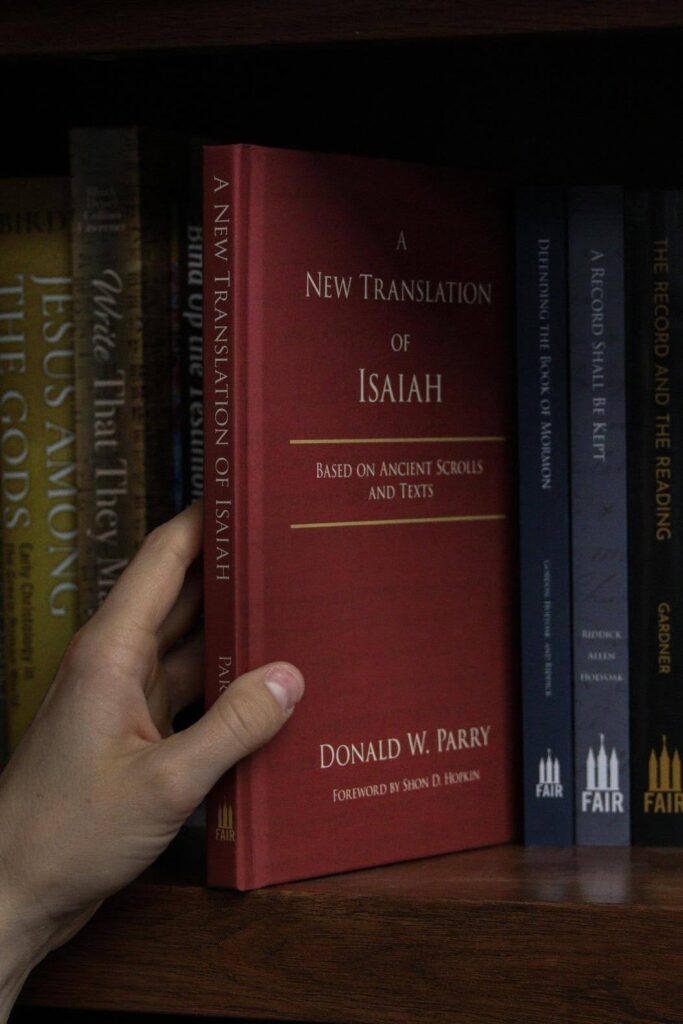
 Donald W. Parry, Professor of Hebrew Bible and Dead Sea Scrolls at Brigham Young University, is married to Camille Mills, from Las Vegas, Nevada; they have six children. He has served as a member of the International Team of Translators of the Dead Sea Scrolls since 1994. He has authored or edited thirty-three books, ten of which pertain to the scrolls and five deal with the writings of Isaiah. Parry has also published articles in journals, festschrifts, conference proceedings, and encyclopedias. He is also a member of several other professional organizations, including the International Organization for the Study of the Old Testament, Groningen, The Netherlands, Society for Biblical Literature, Atlanta, Georgia, and the National Association of Professors of Hebrew, Madison, Wisconsin. Parry presently serves as a member of the Dead Sea Scrolls Foundation Board of Trustees.
 Jared Riddick is the Managing Editor for FAIR. From 2015 to 2025, he was the research librarian and archivist for Scripture Central, where he established, built, and curated their digital library of over 14,000 items. He graduated from the University of North Texas with a Masters in Library Science with two graduate academic certificates in Archival Management and Digital Curation and Data Management. He received a Bachelor of Arts in History Education from Brigham Young University-Idaho. He was also an editorial consultant for Interpreter: A Journal of Latter-day Saint Faith Scholarship from 2012 to 2017.
