Summary
Brant Gardner explores how Joseph Smith’s seer stone translation process aligns with his cultural background and addresses common criticisms of the Book of Mormon, including issues of archaeology, history, and presentism.
This talk was given at the 2017 FAIR Annual Conference at the Utah Valley Convention Center in Provo, Utah on August 4, 2017.

Brant A. Gardner holds a master’s degree in anthropology from the State University of New York at Albany, specializing in Mesoamerican ethnohistory. He is the author of multiple books on the Book of Mormon and has published widely.
Transcript
Introduction
Scott Gordon:
We are pleased to have Brant Gardner, a frequent speaker at Fair Mormon conferences and a friend of Fair Mormon for a long time.
Brant Gardner holds a master’s in anthropology from the State University of New York Albany, specializing in Mesoamerican ethnohistory. He’s the author of some excellent books, and I’m not going to read anymore because I can never pronounce what the things are that he writes about.
But with that, I’ll turn the time over to Brant Gardner.
Observations on Joseph and the Plates
Brant Gardner:
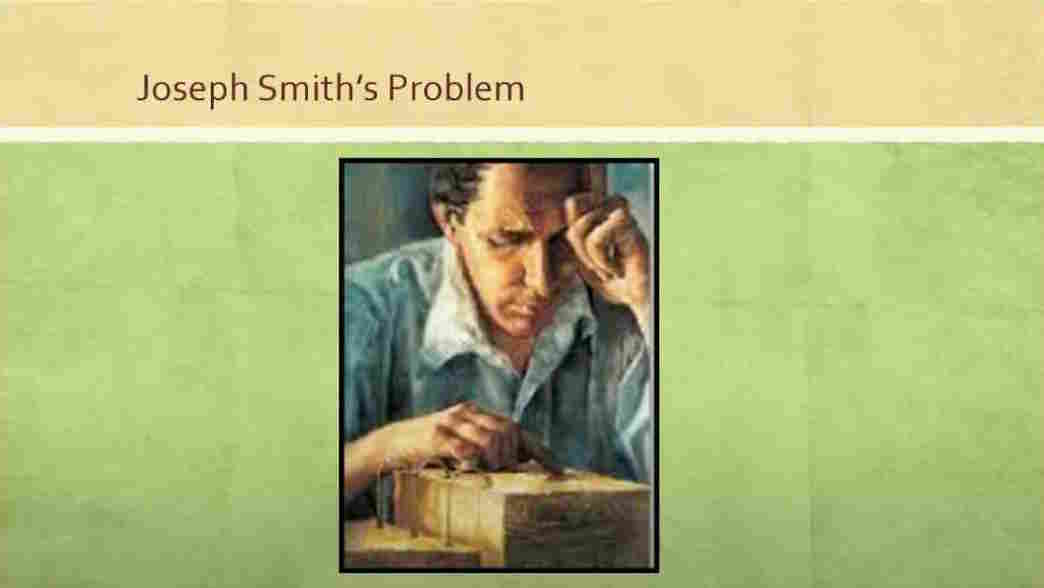
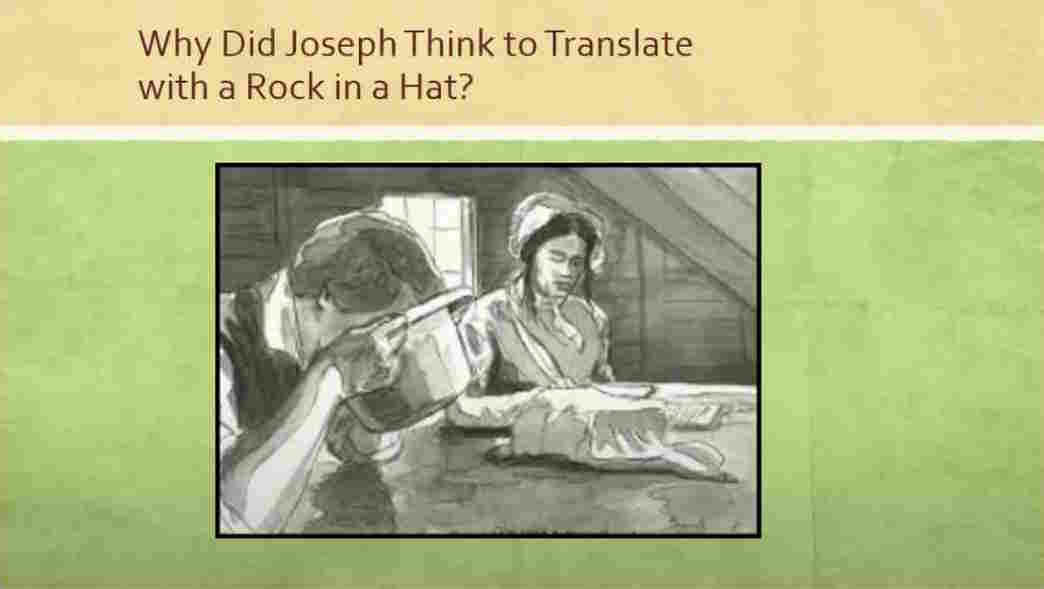
I want you all to notice the ‘photograph’ that we have here of Joseph right after he received the plates. I want you to think about what’s happening.
Finally, Joseph has the plates
Joseph spent four years waiting to do this, right? He had all kinds of people who were trying to get the plates away from him.
So imagine what happens when he finally gets to the point where he’s got the plates and he gets to a table someplace and he puts them on the table. Maybe it’s alone, maybe it’s later at night, everybody else has gone to bed, and he sits down.
What is the next step?
And he probably does exactly what you’re seeing here. He probably moves one of the plates over, he probably runs his fingers across the engravings and feels what it’s like, and he looks at it and says, “I got no clue. What now?”
So now he’s got these plates. Now what?
Translation Challenges
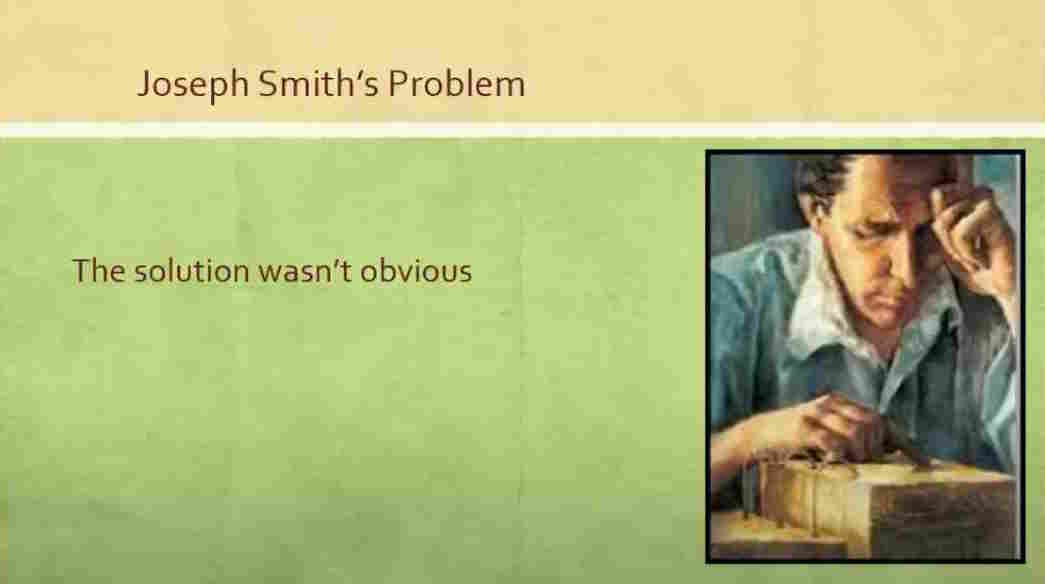
The real problem that we have with what happens to Joseph is that the solution to this problem really isn’t obvious. He’s got a problem but he doesn’t quite know what to do with it.
So here is the information you need to know: this is from an excellent book put out a year ago, a little bit longer than that maybe.
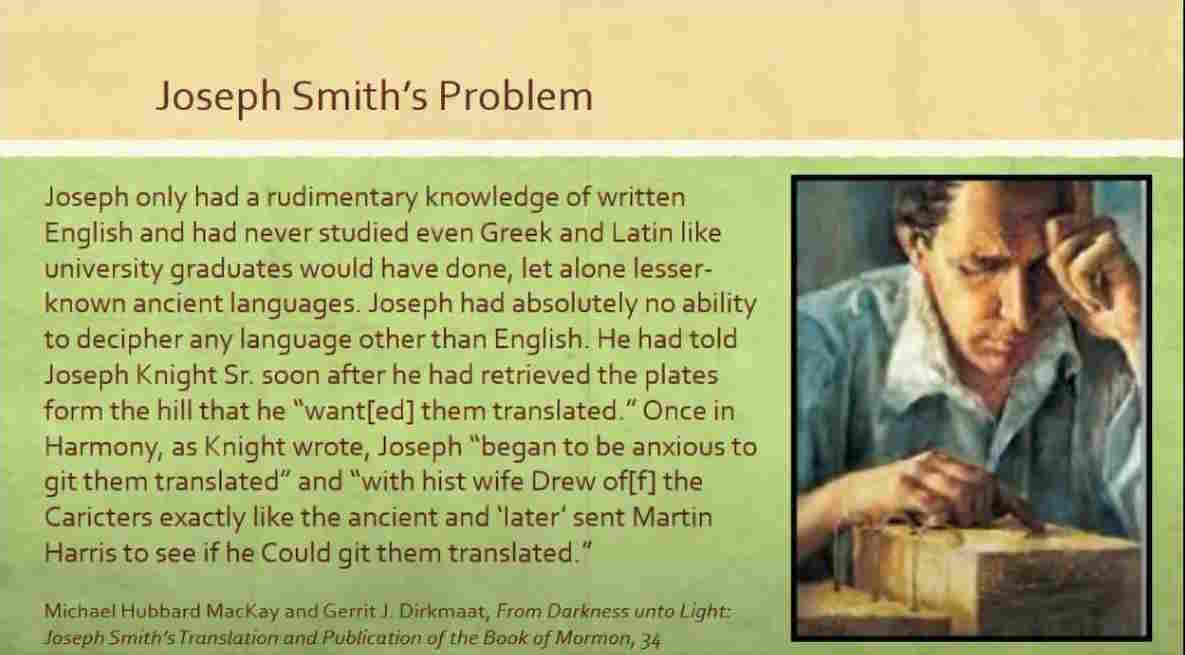
Joseph only had a rudimentary knowledge of written English and had never studied even Greek and Latin like university graduates would have done, let alone the lesser-known ancient languages. Joseph had absolutely no ability to decipher any language other than English.”
Joseph Couldn’t Translate
Let that one sink in there for a second because it remained true. Joseph couldn’t translate. That is not going to change.
He had told Joseph Knight Senior soon after that he had retrieved the plates from the hill, that he ‘want[ed] to get them translated.’ Once in Harmony, as Knight wrote, Joseph ‘began to be anxious to git them translated,’ and ‘with hist wife Drew off the caricters exactly like the ancient and later sent Martin Harris to see if he could git them translated.’”
Think about that for a second.
Joseph now has these plates, he’s pulled them in, he’s been told that rather than the gold and the plates, the value was what was written on the plates, and they were to be translated, and he was to get them translated.
Joseph’s Dilemna
And he sits down, he looks and he said, “Well, ain’t gonna be me.” He said, “I wonder if somebody else can do it.” And he sends Martin off and he says, “Maybe some scholar somewhere can figure this out.” How well did that work out?
So now we’ve got a problem. Joseph is supposed to get the plates translated. Joseph cannot translate the plates. Now what?
The Unconventional Solution
Here is the next big question that we have, which is in this problem that Joseph has of looking at the plates and saying:
“I got to get them translated. Nobody knows how to translate them. I still got to get them translated, something has to happen.”
He’s going through and wracking his mind. The question then becomes, why in the world would he have ever thought of sticking a rock in a hat as a good idea of how to do it?
Looking for your keys?
Okay, all of you out there who have wondered, you know, where you put your keys the last time, how many of you have said, “I got a great idea how to find them. I think I’ll take a rock and stick it in a hat, and I’ll look at the rock and it’ll tell me where my keys are.” Anybody done that?
Okay, you know, if somebody asked me what is the very last thing you would think of as a way to translate the Book of Mormon, do you know what I would come up with? As the very last thing I would think of?
I have no idea but it wouldn’t be putting a rock in a hat. That wouldn’t even occur to me. There is no way in the world that I would think that I could do anything with a rock let alone a rock in a hat.
Why Would Joseph Use a Seer Stone?
So now we’ve got a problem. We’ve got to translate the Book of Mormon, we’ve got to find a way to do it. Joseph had to find a way to do it.
Why does it occur to Joseph that he might use that method? I will submit to you that the reason that it occurs to him is the same reason that lots of things occur to us.
We think on the world in which we live and the things that we’re familiar with, and based on the things that we’re familiar with, we try to figure out how to get the job done.
So what kinds of things are available in the world that Joseph lived in?
Joseph’s Historical Context
And this is one of the times when we have to remember that Joseph didn’t live just a little while ago. We can count the years and two hundred — for those of us who deal with any kind of history, two hundred just doesn’t sound like a lot.
With the kind of history I get interested in, you know, by the time you have newspapers I figure that’s modern, you know, two hundred is nothing.
A Story to Illustrate the point
If you go to somebody — and I’ll tell you this story very quickly — I worked with somebody once who came over from England and we were talking about problems of housing and getting insurance.
And they said in insurance in England they have a couple of categories. They have old houses and new houses, and they said the insurance rates you pay on an old house is different than what you pay on a new house.
And I said, “Yeah, yeah, kind of makes sense.” And she says, “And the definition of a new house is anything that’s been built after 300 AD. That’s the new house.”
Avoiding Presentism
So, this concept of ‘how long ago did Joseph live’ — think about what happened in the last 100 years and how rapidly the world has changed.
Joseph did not live just a little while ago — he lived in a completely different world.
What makes his world even more different for us is that his world was living at the tail end of yet another world that was rapidly changing and shifting, and a lot of things that had been current prior to that time were starting to fade.
And he was in a place and at a time period that were in the tail end of a lot of different kinds of things that were on the verge of dying out.
Persistence of Beliefs: Water Witching and Seer Stones
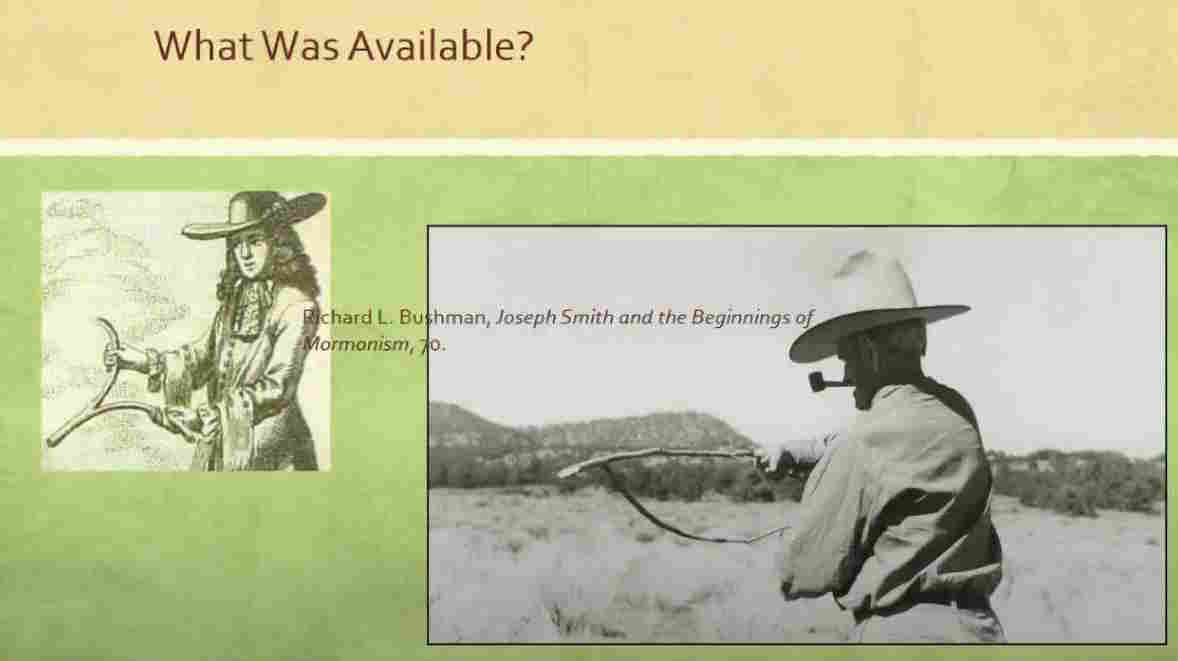
Now, one of the things that was very current at the time that his father was involved in, and that Joseph as a youth would have been involved in, was water divining. And that’s something that’s carried on.
How many people have you at least heard of water witches? People using divining sticks? Anybody who knows someone who has? Yeah, a few more. Okay, there you go.
Is there Science behind it?
We live in a modern world, and if you ask any scientist, “Is there any scientific reason behind this?” they’ll say, “No, not that I’m aware of.” And even though we live in a scientific world, we’ve still got people here who know someone who has done something, and maybe it worked and maybe it didn’t.
That isn’t even the reason why I bring the thing up.
The Persistence of ‘Water-witching’
The reason for talking about it is this is something that people believed in, so much so that by the 1940s, almost every well in the Ozarks that had been found had been found through a water witch. That’s up through the 1940s.
We still have people with this idea that persist. And so if you were to talk to a neighbor and the neighbor said, “We’ve been having problems. We’ve had a couple of scientists out here, and they can’t figure out where to get the well water from my land. And so I had this guy with a witching stick come by, and I thought I’d try that.” If they said that to you, you’d say, “Weird, but okay,” right?
Because we’ve heard of it. It hasn’t totally gone away.
Function of Seer Stones
There are things from that same time period that participated in the same world that generated this idea that have persisted up to that time but have since died out. And that’s the whole idea of a seer stone.
Now we’ll talk a little bit more about seer stones and what you do with them in a few minutes, but the very first thing that I want to do is make sure that you understand that they had a function. There was a place in the world for them.
This place in the world had begun at least as far back as England.
Scottish Second Sight
If you have ever read the story of someone talking about the Scottish second sight, that was something that described people who were using stones as ways to see things that could not normally be seen.
Supernatural vs the occult
And one of the things that happened in this world of tapping what they would have thought was, and we call it the supernatural — it’s a mistake to call it the occult because that kind of sounds like it’s awful and weird and maybe dangerous and not religious — these were extremely religious people, and they thought they were tapping into some part of divine power to do this.
These were just special powers that were given to different people. So they would say, “Yeah, let’s look at rocks.” And you know what would they do?
Divining Sticks vs. Seer Stones
Well, this heritage that came over from England said that what you do with the rock is different than what you do with a stick.
Divining Rods were to find things underground
With the stick, you’re going to find things that are underground — you tend to find principally water — but you might find something else, perhaps you’d find a mineral or something else that’s hidden.
But the idea that it was supposed to be underground, that’s what you’re using the stick for.
Stones Were Used to find things that were lost
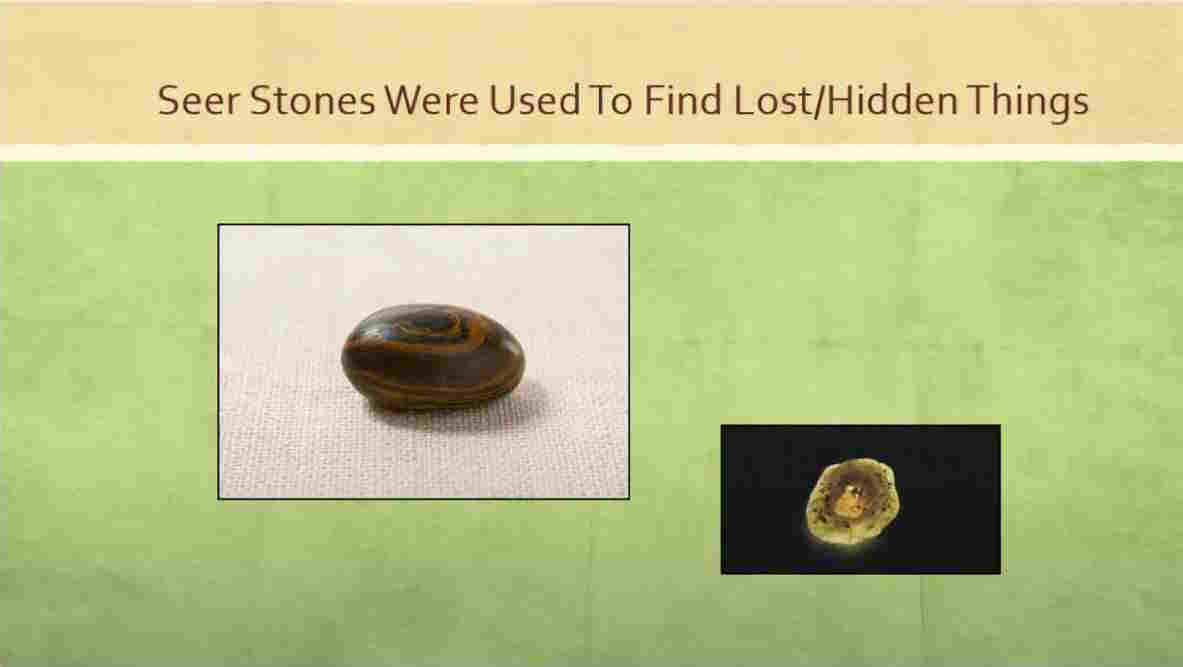
The stones were used to find things that were lost, and they may not be underground. And so the realm of operation where you get seer stones was people who thought that somebody could find something that was lost.
Seer Stones in Joseph Smith’s Time
Here are some statements that will let you know that the seer stones that were being used in Joseph Smith’s time were precisely those that did the kind of thing that they’d been doing forever.
Richard Bushman notes that Chauncy Hart and an unnamed man in Susquehanna County both had seer stones, which they used to find lost objects.
Carolyn Rockwell Smith confirms:
Sally Chase, a Methodist, had one [a peepstone], and people would go for her to find lost or hidden or stolen things.”
Seer Stones are for finding things hidden or lost
And that was the realm of a seer stone. When you went to a seer what you were looking for was a lost or hidden item, and that’s principally the way these things were being used.
So just like somebody would use a divining stick to find something underground, these people were using a seer stone. That’s the realm of operation.
Joseph Smith and Seer Stones
Now what about Joseph and seer stones?
A couple of stories about Joseph and seer stone, and what I want to notice is that the story starts off exactly the same way as what we expect, and we’ll talk a little bit about how history got morphed over time.
But in this case what we’re looking at is Joseph finding lost things.
The Story of Judge Clark
And I’ve abbreviated this story but it’s still on two slides.
Judge Clark, the judge in the area, went to Canandaigua and got money from the bank. He wore, as was the fashion at the time, a large overcoat with pockets in each side, where a large pocket-book and handkerchief found a deposit.
Judge Clark, when he got to my house, found his pocket-book and money missing, and he was extremely troubled about it.
Someone said, “Why don’t you ask Joe Smith to look into his stones to tell you where you lost it and where it can be found?”
Using the Seer Stone to Find Lost Objects
Now think about this for a second.
They’re actually assuming that everybody knows that there’s this guy Joe Smith and that he has stones and that if you’ve lost something, you can go ask him and see if he can find it.
You remember this story we heard about Martin Harris and the pin. How many of you remember the story of Martin Harris and the pin? What is Joseph doing?
1
He’s finding something that’s lost. So what’s expected of you is to find something that’s lost.
Smith says in a moment:
“I see it. You stooped over to let your horse’s head down, and your pocketbook fell out of your pocket and fell into the creek, and it floated down the stream, and I can see it lodged against a limb fallen into the creek.”
The judge went back to Honeyough and down the creek, but no pocketbook was to be seen.
He returned to the place where he rode into the creek, which was a muddy place, and upon the bank, he saw the object of his search.
It seemed, as his horse plunged out of the mud, the pocketbook was thrown out upon the bank. The judge returned much elated.
Perceptions of the Times
And that’s the kind of thing you’re going to see about stories of finding things. They kind of work but sometimes yes and sometimes no and it’s sometimes a little bit off, but people are thinking that these kinds of things worked.
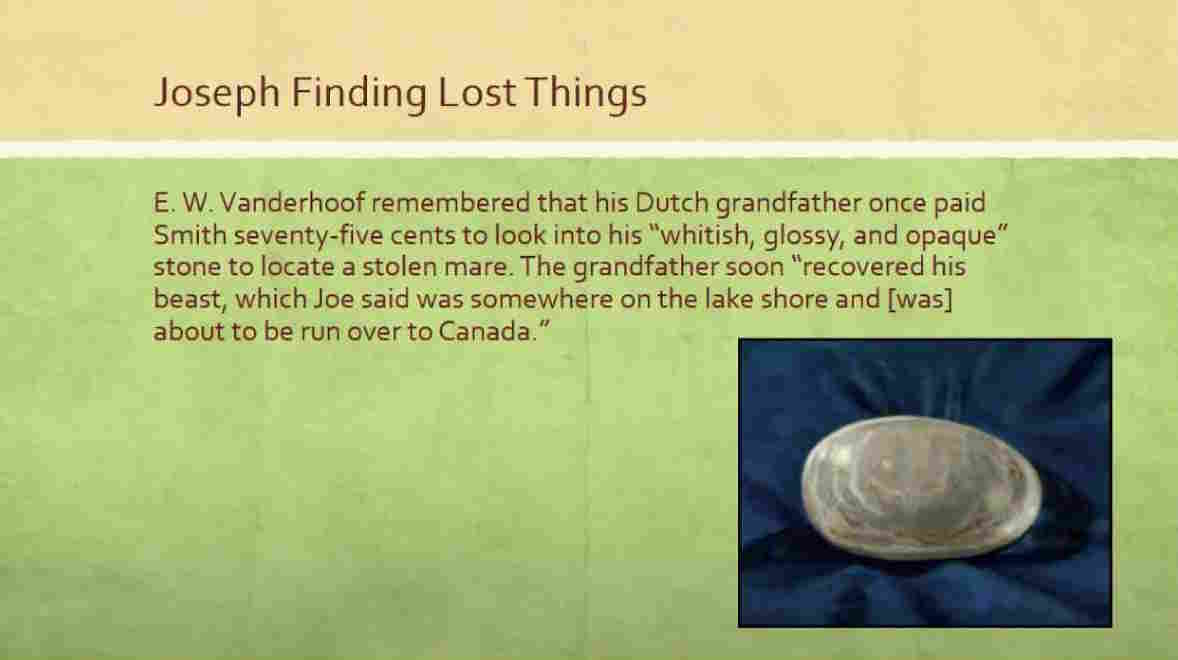
E. W. Vanderhoof remembered that his Dutch grandfather once paid Smith seventy-five cents to look into his “whitish glossy and opaque” stone to locate a stolen mare.
The grandfather soon: “recovered his beast, which Joe said [was] somewhere on the lake shore and was about to be run over to Canada.”
And so they went and found the horse.
Joseph’s Role Before He Was a Prophet
Now again, I’m not going to tell these stories to suggest that Joseph was a prophet long before he was a prophet. That isn’t the function of this.
This is to show that prior to the time that he becomes a prophet he is functioning the same way that Sally Chase did, that some of these other people did, and that he was familiar with — not a divining rod but another tool of folk knowledge — which was a stone.
And what you did with those stones was to find things that were lost.
The Transition to Translation
Now we take that information and we take that information into the Book of Mormon and we say okay, here’s the Book of Mormon, and we have the plates, and with the plates he gets the interpreters, and the interpreters are what? Stones, right?
Joseph is getting these stones and they’re in a bow, and he looks at them and he says, “Shoot I know what to do with these,” right?
“I’m gonna translate with these,” right?
No, because that wasn’t his experience.
Using the Interpreters
Again from MacKay and Dirkmaat:
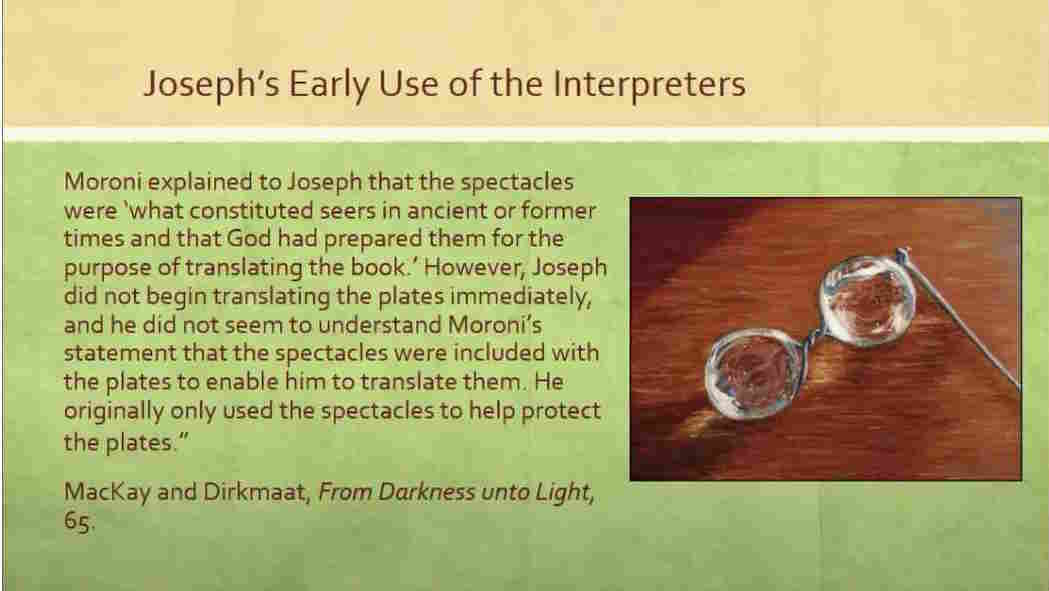
Moroni explained to Joseph that the spectacles were what constituted seers in ancient or former times and that God had prepared them for the purpose of translating the book. However Joseph did not begin translating the plates immediately, and he did not seem to understand Moroni’s statement that the spectacles were included with the plates to enable him to translate them.
He originally only used the spectacles to help protect the plates, to find out — to kind of peek on them to see where they were and see if they were still safe.
Joseph viewed the interpreters in the context of seer stones
In other words, his initial reaction to using the interpreters was to use them for the same function that he had used before with the stone: to see things that were hidden.
So in his world, he took the things that he knew and he translated them, and at some point in time even with divine interpreters in hand, what he thought of was:
“I’ll just use them to do what I’ve always done.”
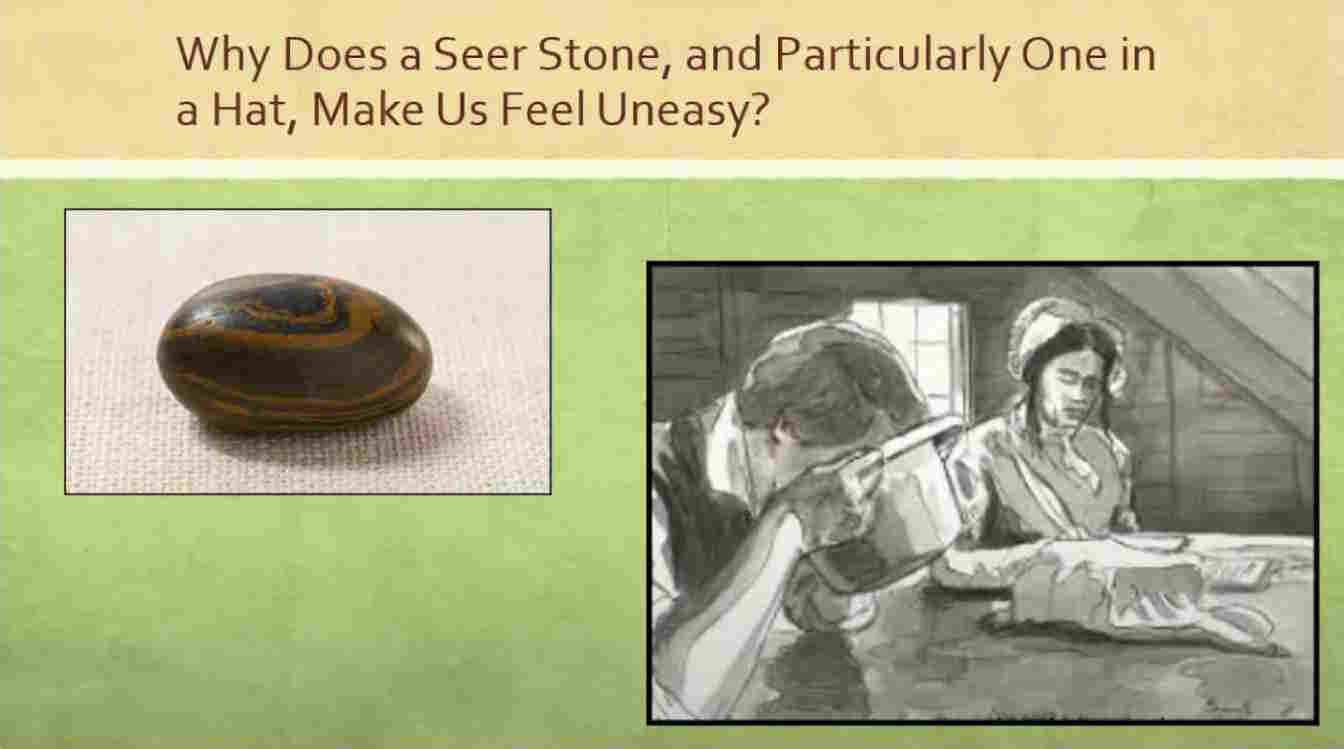
Seer Stone Translation Methods Seemed Strange
Now the next piece. Before we get into anything else about it, these things are weird. There is no way that you can talk to someone and say:
“You know I’ve got this great idea, I think we should translate this recently found document with a stone in a hat.”
Don’t like that. Seems weird.
Let’s do a couple of things.
First, why the hat?
I guess I’ll tell that one later. I’ll tell you now there’s a quotation that comes up later to show it to you, but it’s just the way it was done.
A Seer’s Abilities were considered Supernatural
One of the important things that everybody who watched a seer work had to know is that the seer wasn’t doing anything normal. It had to be known to be Supernatural so that you knew to trust it.
You know, when you get the magician and it’s “nothing up my sleeve,” there’s a reason they do that — because if it’s too easy and it’s up the sleeve, you know that it’s not real.
If somebody puts their head in a hat and they block out all of the light, you’re reasonably certain they’re not seeing anything.
So when they tell you what they see when you know they cannot see, you know it’s something different.
Presentism
We heard about presentism yesterday. You hear about it again today in a slightly different way.
Here’s the part that I think is interesting — not just the definition that in presentism we take our assumptions and push them back on antiquity, and Ben Spackman talked about how we do that with scripture this morning.
So we’ve heard a lot about that idea — that what we think today gets passed back on to history. It’s a problem, but here’s the one I want to spend time with.
Interpreting the Past With Present Standards
So, here’s what Lynn Hunt said:
Presentism, at its worst, encourages a kind of moral complacency and self-congratulation. Interpreting the past in terms of present concerns usually leads us to find ourselves morally superior…Our forebears constantly fail to measure up to our present-day standards.
We more easily accept the existence and tolerate the moral ambiguities of eunuchs and harems… than of witches. Because they found a place in a non-Western society, eunuchs and harems seem strange to us but they do not reflect badly on our past. Witches, in contrast, seem to challenge the very basis of modern historical understanding and have therefore provoked immense controversy as well as many fine historical studies.”
Why Seer Stones Feel Strange
Now, let’s unpack that one for a second.
Here is the really important thing: no matter what we do when we take our stuff and push it back on history, the things that bother us the most are when we find weird things about people who should be like us but aren’t.
If they should not be like us — if I talk about the Trobriand Islanders a thousand years ago and I tell you some weird thing that the Trobriand Islanders believe — you’re gonna go okay.
‘It has nothing to do with me’
Doesn’t matter how weird or strange it is, it doesn’t bother you because you know that it has nothing to do with you whatsoever and it’s not part of our history.
And I can just say, “Yeah, that’s curious, they were strange.”
But if I say Joseph Smith used a seer stone — he wasn’t very long ago, and by golly, you lived in the same country we have and I live not that far away from Palmyra, I was in New York and I visited those places, I mean, I know where they are — that’s why it’s weird.
Comparing Joseph Smith to Joseph of Egypt
It’s strange because it belongs to us and doesn’t belong to us at the same time. If it had been anybody else and any other time, it would not have seemed so strange.
How am I so sure? Here’s one: Joseph of Egypt used a divining cup, and I think it’s just wonderfully ironic that I get to use a Joseph as the example.
Joseph of Egypt had a divining cup — so we’re talking about Genesis 44:5 — and this is the story where he puts the cup in Benjamin’s pack and then they go find it.
Well, that wasn’t because it was a flowery royal cup and, you know, it was fancy and it was valuable — that wasn’t the reason.
What it was was a really, really important and sacred cup because this was Joseph’s divining cup.
Understanding Ancient Divination
Well, what is a divining cup?
E. A. Speiser comments:
Divination by means of liquids is well-attested, especially in Mesopotamia. Oil or water was poured into a bowl or cup and omens were then based on the appearance of the liquids inside the container; thence the importance of the receptacle was likely to exceed its intrinsic value.”
Now, you can read that, and you go, “Yeah, okay.” Because this is Joseph of Egypt, this is a very long time ago, and it’s over in Egypt, and it’s the old world, and besides, it’s the Old Testament, which is a little strange anyway.
But all of that says, “I don’t have to worry about that.”
But we have Joseph of Egypt divining using oil and water in a cup.
I submit to you that if Joseph Smith had used a divining cup with oil and water, we would find that equally as strange as seer stones.
Proximity of time and place make it strange
It’s a different method of doing the same thing, and therefore, because it’s Joseph and because it’s close to us and because of the time period, we would find it just as strange. The problem isn’t what happened — it’s our distance from it and our closeness to it. We’re far enough away that it’s different; it doesn’t belong to us anymore.
Because we have divining rods, we do not feel about divining rods exactly the same way as we feel about seer stones — because they’ve gone out of use and we don’t know anybody who does them. Now, divining rods, not so much, because we do know something about them.
Analyzing Presentism and Historical Context
The ‘problem’ of Money-digging
Alright, next thing, problem of presentism: Joseph Smith is a treasure digger.
Now I had talked about him as somebody who found things, and one of the things that everybody wanted to find was lost treasure. So there were a lot of weird people who were digging it up.
When you’d look at Joseph Smith and you look at the historical things, his history is distorted through treasure-seeking because that is salacious — that is just really interesting stuff.
And so if you read the histories, you’re not going to read Joseph Smith was somebody who found wallets and found lost horses or anything. He’s going to be a money digger. That’s what everybody cares about, because that’s just really weird.
How Common Was Treasure Digging?
Well, how weird was it at the time?
Fawn Brodie quotes out of the Wayne Sentinel from February 16th of 1825:
We could name, if we pleased, at least five hundred respectable men who do in the simplicity and sincerity of their hearts believe that immense treasures lie concealed upon our green mountains, many of whom have been for a number of years industriously and perseveringly engaged in digging it up.”
It wasn’t all that unusual at that time.
Poverty and Folk Belief
Now, why would they do that?
Remember the stories about Joseph Smith and poverty — how they didn’t have very much money, how things were always hard, and they were always trying to scrape out a living and things were just plain difficult. You’ve heard those stories, right?
So when you have people who are in a society where things are tough, you’re gonna try and find whatever you can do to see if you can get out of it.
And if somebody says, “You know, I think there’s a treasure buried over there,” you might say, “Well, wouldn’t hurt me to dig it up. I got to work anyway, I might as well try to dig it up and see if I get lucky,” right?
Yeah, we don’t do anything like that at all.
Modern Treasure Hunts and the Lottery
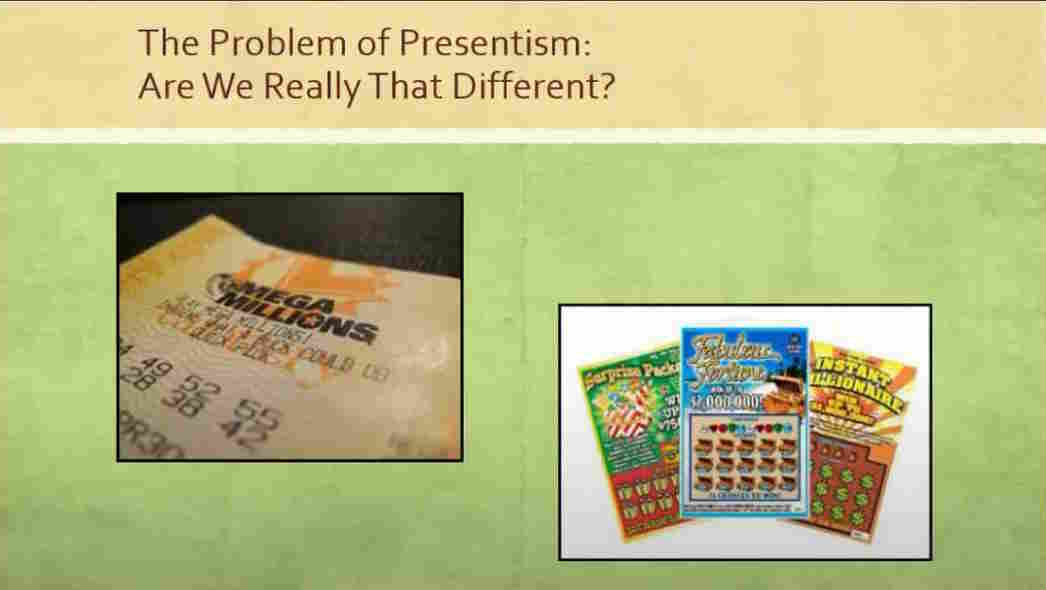
Have you heard of Ambrose Bierce’s definition of the lottery? “The tax on people who can’t do math”? Why do people buy lottery tickets? For the same reason.
Is it any stranger that people who are in desperate circumstances want to dig for a buried treasure that everybody has heard is there and buying a lottery ticket?
How many of you have heard of these people who are on a treasure hunt? 2
Now, we’ve had a couple of deaths related to the treasure hunt recently. Why are people going on this treasure hunt?
How many people do you think are gonna find this treasure? I don’t know, but a lot of them haven’t apparently. Now, a couple of people have died looking for it, and so we hear that on the news.
People are still interested in Hidden treasure
But why would they go do that? Well, you know, if somehow digging around in my backyard I happened to find a box with a lot of old gold coins in it, I would be thrilled.
Now, I happen to know that nobody ever buried one there so I’m not gonna go dig them up. But if the rumor had been that there had been one there, I might have dug a hole or two to test just to make sure.
Joseph’s Context, Not Ours
So it wasn’t all that strange what Joseph Smith was doing. The difference is, again, he’s too far away, too close.
It’s a different world. But we think it should be our world, and so we judge him by what we do. And it’s strange to us, and therefore it’s hard to understand what he’s doing.
The Translation Process
So we get to the next problem. Joseph is looking at plates saying, “I can’t translate.” You remember I said that never changes. Joseph can’t translate.
You will never find a single statement from Joseph Smith who said, “I translated the plates,” unless he adds: “by the gift and power of God,” because he knew he couldn’t do it himself. It’s got to be through the gift and power of God.
There was no way this was gonna happen normally and naturally. We still don’t have a grammar and dictionary of reformed Egyptian. Still not there.
Seer Stone Translation Method
So when he finally makes this connection and says, “Interpreters help me translate — I can’t do it any other way,” maybe somehow he thinks of it and then he makes the connection and he says, “Let me try it.”
And so again, same book:
Joseph used the spectacles in ways that seemed natural to him and were based upon his past experiences since 1822, when he was initially introduced to the duties of the seer.”
Now, how did he use them? Here is a more contemporaneous account.
Jonathan Hadley, editor of the Palmyra Freeman wrote:
By placing the spectacles in a hat and looking into it Smith, (he said, so at least) could interpret the characters.”
Common Knowledge: a Seer Stone in a Hat
Okay, now think about what that says.
First of all, think about the guy who wrote the sentence. He made sure that he said, “I don’t think Joseph could do it,” because you know he had to say that, right?
But it never seems to be a surprise to him that Joseph put the rock in a hat. That’s not weird. He doesn’t say, “You cannot believe what this Joseph just said he did — he just stuck a rock in a hat.” No, because everybody knew that’s how you did it.
Applying a familiar method to a new instrument
So what did Joseph do? He took the interpreters and adapted what he knew how to do to these interpreters. Maybe at some point in time he’d taken them and looked at them as spectacles and said, “Can’t see a dang thing.” Maybe he took them and rubbed them over the top of the plates and said, “Nope, that isn’t working either.”
And he says, “You know, the only thing I know how to do is I know how to see when I shouldn’t be able to see, and I see with a stone — a seer stone — in the hat. Let me put the interpreters into a hat.”
So he did it the way he would have been used to doing things.
Things That We’re Comfortable With
Maybe today, since we don’t have seer stones, we’d come up with a different method, right? So what method might I come up with if I were thinking of the very last thing that I could think of?
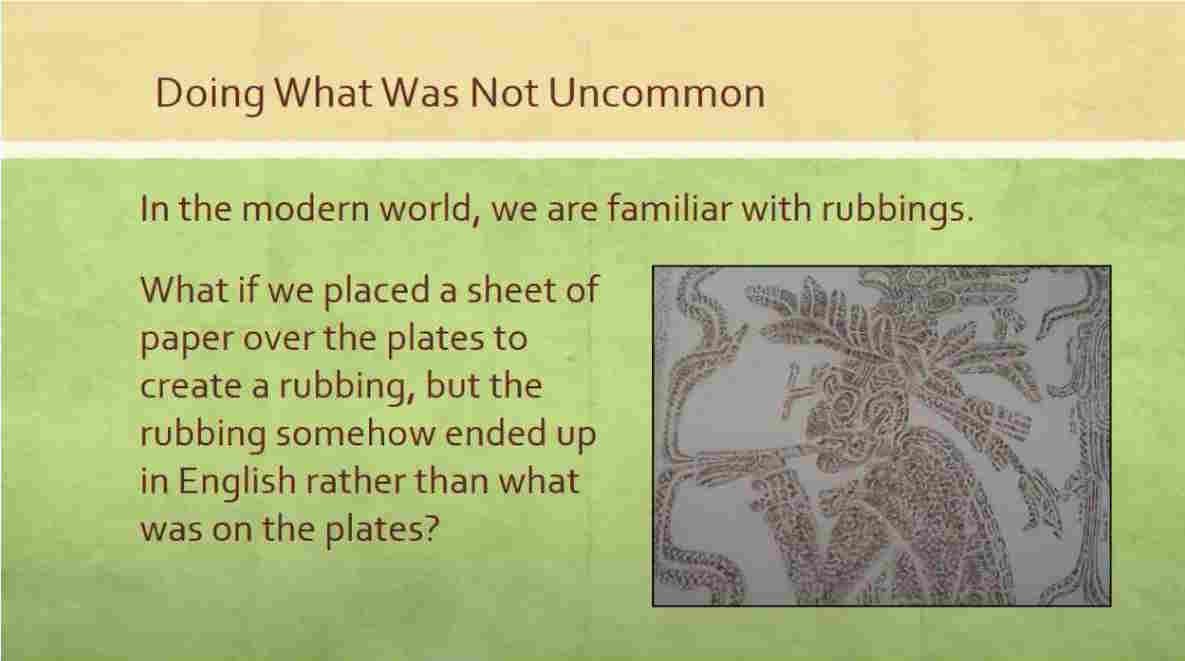
Maybe I might think of rubbings. And, you know, I’m familiar with what a rubbing is — it will reproduce something — and so I’ll put a piece of paper on this and I’ll do a rubbing, and then miraculously, instead of the characters that I’m rubbing, it’ll turn into English.
Yeah, I have no idea if that would work, but that would occur to me faster than putting a stone in the hat because that’s closer to my world.
Why Do We Feel So Uncomfortable?
Let’s go back to another question. The question I asked is: why do we feel so uncomfortable?
I’ve talked about that. It’s the idea of presentism, and we push our ideas of what it was like on to Joseph. One of the questions I saw on the internet even recently, someone said: “Well, do you think it’s true that Joseph used the very same stone for treasure hunting as he did for translating? Did he really use the very same stone?”
Think about that question for a minute. This is a serious question, and the serious question makes the assumption that this is so strange — to have used the same stone — that it should never have happened.
And the first question is: why? Why would that have been a difference?
Seer Stone Use: Then and Now
Because we’re thinking of the difference between real miracles and occult things. And the stone’s occult, and this is a miracle — a division which did not exist for Joseph.
If I said to you that I used the exact same computer to write chapters about a commentary on the Book of Mormon as I did to watch cat videos on YouTube, would you think that’s strange about my computer?
It’s a computer. We all know that computers do these things, right? So it’s not going to be strange to what use I put it. The result is what’s really important, and the use to which I put that particular item.
The Book of Mormon as a Seer Stone
That brings us finally — at long last — to the title.
One of the ways that the Book of Mormon is similar to a seer stone is that we have some parallels in the way it’s perceived.
The Paralells of Perspective
Anachronisms
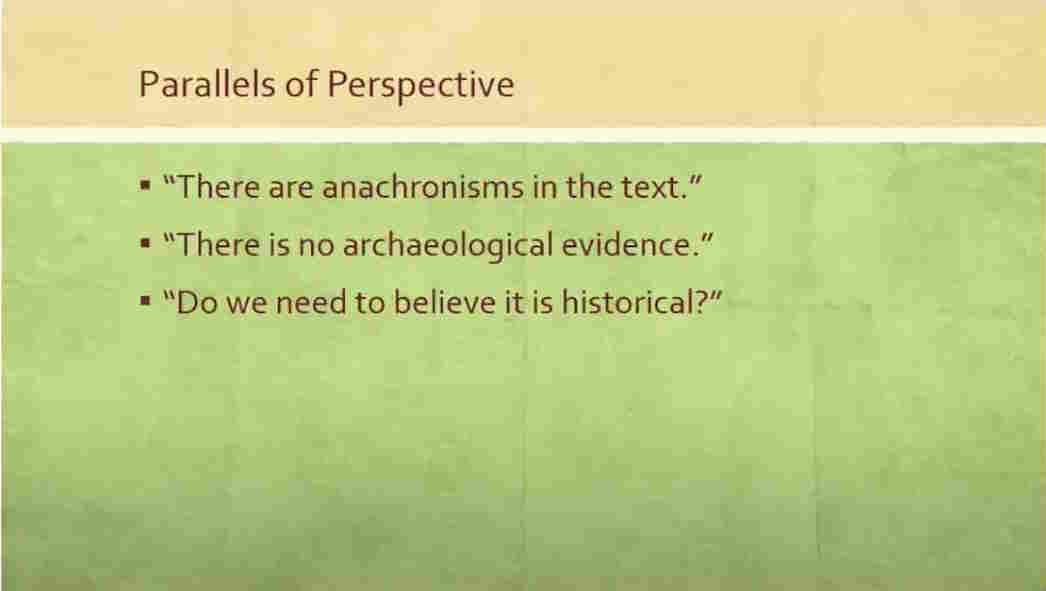
So, one of them is: we have perceptions about the text that we will push back onto it. One of those is anachronisms3. Neil talked about them yesterday, so I’m not going to say too much about them — refer to what Neil said.
But the reason we worry about them is because we know anachronisms are a problem. We just kind of invent the fact that they’re there because we make some important misassumptions about the text.
Because we speak English, and the original Book of Mormon was printed in English, we forget that it was not originally written in English and that what we are reading is a translation. It is equally as possible that the anachronisms that show up occur because of the translation.
Expectations of a Perfect Translation
Why would we think that’s a bad idea and that might not work? Well, because sometimes we have another presentism that we push back on the text, which is:
I assume that God is perfect, that a prophet is perfect, and therefore, anything that God and the Prophet get together to do is perfect.
And therefore, the translation of the Book of Mormon was absolutely word-for-word, absolutely perfect.
It could have been.
It could be that there were some things in the text of the Book of Mormon that were very difficult to translate and they came out according to the way Joseph understood them. Those are questions of our understanding about the text; they’re not questions necessarily about the text.
So, the idea of what the anachronism is — those are things we can study, things we can understand; they’re not things that are really inherent problems in the text.
No Archaeological Evidence?
Next one, and I certainly get this one all the time: There’s no archaeological evidence for the Book of Mormon.
I hear this frequently. This has now become a statement that somebody somewhere wrote on something on the internet, and whether people know it or not, they’re just copying and pasting it either mentally or physically, and we just get this all the time.
What’s wrong with the Book of Mormon?
There is no archaeological evidence of the Book of Mormon.
Baloney! There’s all kinds of archaeological evidence of the Book of Mormon.
Misunderstanding Archaeology
(I was just talking to Scott, and I said it’s really unusual that we would have Taylor up here talking about the Book of Mormon, and I’m not talking about the Book of Mormon. I should be — usually am — and usually it’s about either geography or archaeology. There’s all kinds of it.)
Why do we say there’s no archaeological evidence? Well again, it’s that presentism. It’s taking a misunderstanding of archaeology and pushing it back onto the past and on the wrong thing. We assume that archaeology can prove something.
Talk to an archaeologist sometime about what archaeology proves.
What Archaeology Actually Does
Archaeology digs up artifacts, and the archaeologists interpret them and help us understand them. Very, very little gets proven. If you want to talk about proving things, you get much better when you have a text — and you can do that in the Old World.
You have a real hard time in the New World. I don’t care where you are in the New World — very, very few texts.
So one of the major things that we have that could even begin to give us any kind of proof doesn’t even exist in the New World.
So it’s the wrong question to ask, and it just indicates again the presentism of asking the wrong question because of perceptions we have that are incorrect.
Do We Need to Believe It Is Historical?
Next one: Do we believe that it has to be historical?
Two points to make:
- The Church certainly believes that it is.
- I certainly believe that it is.
If anybody here isn’t sure but still believes that the Book of Mormon changes your life — welcome, brother and sister. I still love you, and we can still have all kinds of conversations.
The Church loves you, and you got the right thing.
Belief vs. Historical Awareness
The vast majority of people who read the Book of Mormon may or may not know anything about its historicity. They may make an idea about it, but they really have no clue about what the history of the Book of Mormon is.
Most people who read and believe in the New Testament and the Old Testament believe them, but really have very little clue about the history.
And that tells me that as long as what we’re doing is getting the spiritual meaning out of the text, that we’re getting the most valuable piece of the text.
Should We Still Study the History?
Should we, therefore, decide that because I don’t need to know history to get the message that, therefore, it wasn’t historical?
No. That doesn’t follow at all.
Is there any reason to learn about history?
Boy, there’s a lot of it.
Because if you want to deepen your understanding of the people who were there — if you want to better know how it applies to your life because you understand better how it applied to someone else’s life — you must understand that person’s life to really understand it and really get the feel for it.
So there’s a lot of value in understanding the Book of Mormon as history and to understanding the history behind it.
But if you don’t, make sure you get the point of the book.
Parallels of Purpose
How is it parallel to a seer stone?
Parallel purpose.
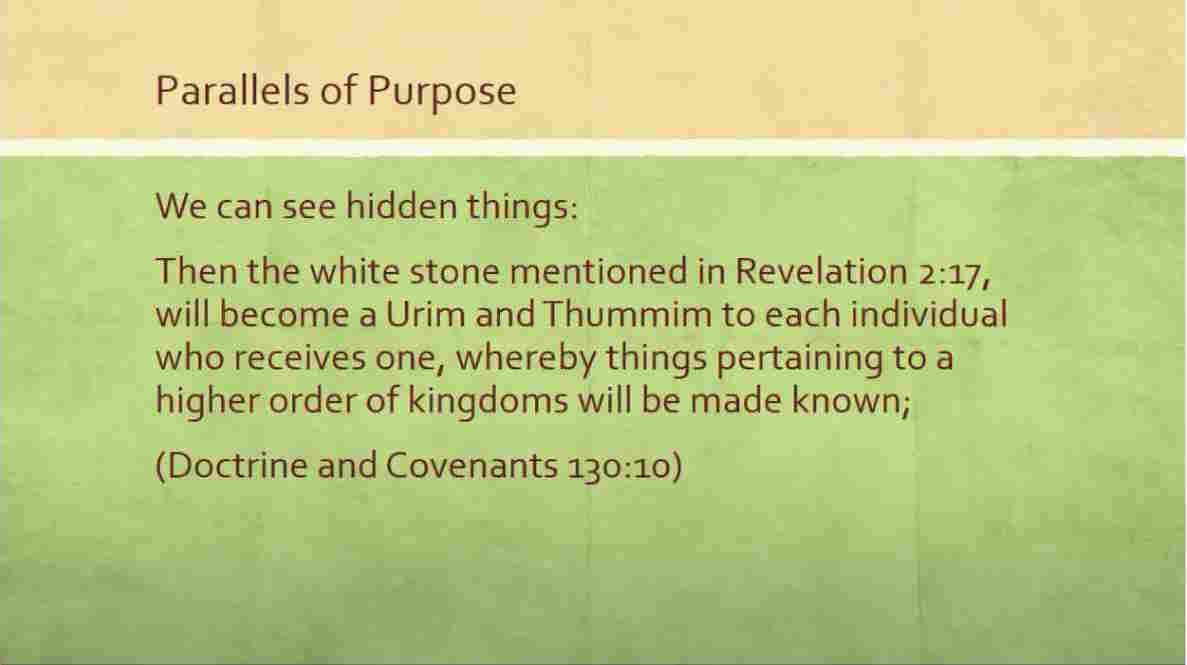
The white stone revelation says that we can see hidden things.
We can, by reading the Book of Mormon, see hidden spiritual things that can enrich our lives. It can do that for us because it has that power in the text to change us.
Primary Purpose of the Book of Mormon
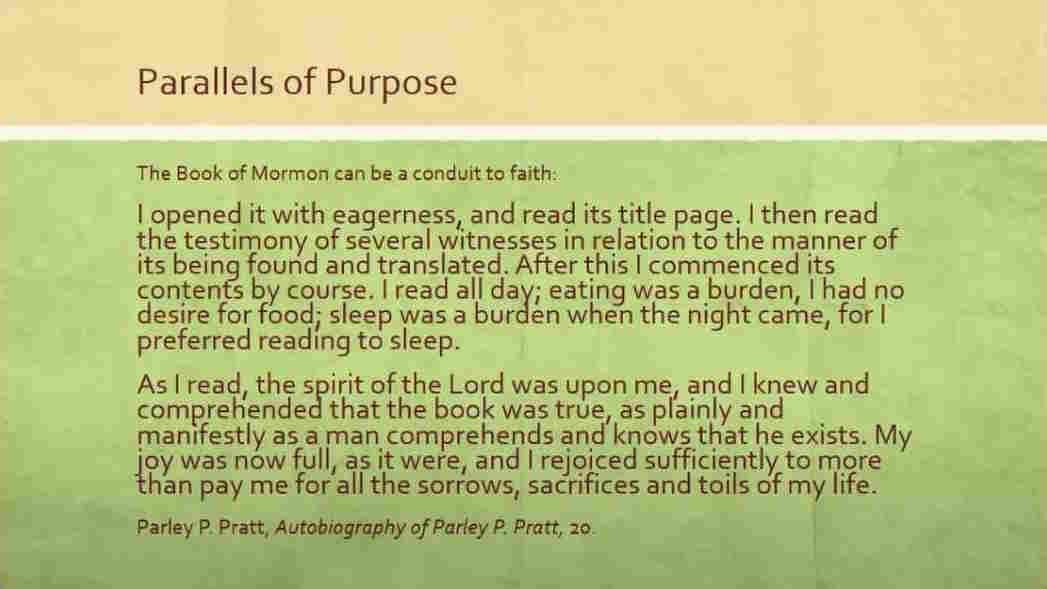
Let me give you an example of somebody who did not know anything about history, didn’t know where the Book of Mormon took place, and here’s what Parley P. Pratt said when he first encountered it:
I opened it with eagerness and read its title page, I then read the testimony of the several witnesses in relation to the manner of its being found and translated.
After this, I commenced its contents by course, I read all day; eating was a burden, I had no desire for food, sleep was a burden when the night came for I preferred reading to sleep.
As I read, the Spirit of the Lord was upon me, and I knew and comprehended that the book was true, as plainly and manifestly as a man comprehends and knows that he exists.
My joy was now full, as it were, and I rejoiced sufficiently to more than pay me for all the sorrows, sacrifices and toils of my life.”
The Book of Mormon as a Source of Fullness of Joy
If you never know history, if you never understand seer stones, if all you understand is what Parley P. Pratt understood about the Book of Mormon — his joy was full.
Your joy will be full with that same knowledge.
Now, you can know more, but if you know nothing less than that, you’ve got the point of the Book of Mormon.
Thank you.
Audience Q&A
Q&A
Q: By naming Simon Barjona “Peter–Petrus” for ‘little stone,’ was the Lord leading us to the President of the Church being a seer and maybe using a stone for that purpose?
A: That requires a New Testament scholar. From what I know of the New Testament, I suspect not. I suspect that that is happening at a very different time period and the culture was not exactly the same one. So, I don’t think the connotation would have been there for them as it is for us.
Q: Does the Church have a position on members using seer stones today?
A: I am unaware. The Church does not communicate with me all of its policies. I get them about the same time you do. I know that the policy it has is the same one it had for Hyrum Page, which is: there is a prophet for the Church to receive revelation. So, whatever else somebody might do with a seer stone, I don’t know.
I know that during the time in Utah, there were people using seer stones to find lost things and they were never excommunicated as far as I know. So, at least at one point in time, they didn’t mind it — as long as it didn’t conflict with revelation given to the Church.
Q: How would I ask the Lord for help translating the plates in my modern context instead of using a seer stone?
I would pray for an email with a PDF file on a translation of the plates.
A: Amen! Failing that, you come to this conference, find out who knows something about it, and go read books, okay?
Q: How do you account for Carmack and Skousen’s work on grammar and vocabulary dating to the 1500s with your theory of translation?
A: Carmack and Skousen are really, really good linguists, and they have really good descriptive work about what the text means. Where they and I disagree is on how you interpret the data that they’ve come up with. So, I have no qualms about their data whatsoever. There’s no way I could have come up with that.
They know way better than I do what the data are. The question is what does it mean — and we have a difference of opinion of what it means — and maybe at some point in time we’ll have a big long paper on how to resolve that dilemma.
Q: So Joseph Smith had more than one seer stone, right?
A: Yes, two or three of them. Small anecdote I didn’t toss into the presentation, but I remember being about 12, 13, 14 going to Temple Square. They used to have your little museum there and I swear in one of the little glass cases they had a seer stone. And I remember looking in and saying, “I’m about Joseph’s age, maybe I could see something.” I didn’t see anything. I saw a rock in a glass case. I wasn’t very good.
Q: I think a modern seer stone that we use in the Church today would be our use of oil vials to cure the sick. There’s nothing magical about the oil itself, yet we know that it brings results. Any thoughts on why this use doesn’t seem as strange?
A: Yeah, I can tell you why it doesn’t seem as strange. It’s in the New Testament. Since it’s in the New Testament — that you know the elders are to bring the oil — that history goes with it and because it’s imbued with the sacred idea of what coming from the New Testament it just feels better.
Now is there anything magical about the oil? No. Is there anything magical about the priesthood? Not magical — powerful, yes. Okay, last little bit: why the oil?
It is olive oil, you will remember, and one of the ancient symbols for and associations with the Tree of Life was the olive tree. And the oil from the olive tree was historically symbolically related to the Tree of Life. So the reason why it’s olive oil is there is this old connection to the healing in the Tree of Life. So that’s the sort of long religious history of why it’s olive oil.
Q: Why did the seer stones fall out of use if they were so helpful, and where can I get one?
A: I looked up seer stones on the internet because I was looking for pictures, and I saw several people selling them. So go on the internet — as you know, the internet has everything! I didn’t check Amazon, which has pretty much everything else, but maybe they have seer stones too. But somebody is selling seer stones out there — you can buy them. So if you want one, go ahead.
Q: How Did Seer Stones Fall Out of Use?
A: How did they fall out of use? All kinds of things fall out of use over time. Up through, I think it was again the 1940s, there was a shift in the understanding between the science and the farmers who had been using almanacs and all of these other signs to figure out how to plant and when. And when the scientific farming started getting more effective, some of these other things faded away. But they were still being used up into the 1940s.
Now they’re going to use other methods. So in some cases, the progress of time has changed our perceptions and I think in this particular case that’s more what’s happening than anything else. The number of people that do it fell away — as you can tell when you read any of the historical accounts.
People were ridiculing seers very close to the time of Joseph, so it was a time when people were predisposed to not believe and the pockets of belief were smaller. And so, as urbanization took over, it just killed that old tradition.
Thank you.
Endnotes & Summary
In this insightful and candid presentation, Brant Gardner examines the historical and cultural context behind Joseph Smith’s use of a seer stone in the translation of the Book of Mormon. Drawing on folklore, anthropology, and apologetics, Gardner explains how common 19th-century beliefs—such as treasure seeking, divining, and seer stones—shaped Joseph’s approach to revelation. He addresses modern discomfort with the translation method, the persistence of presentism, and the critique that there is “no archaeological evidence” for the Book of Mormon. Gardner argues that the Book of Mormon functions as a kind of spiritual seer stone, revealing hidden truths and transforming lives.
Footnotes:
Joseph had a stone which was dug from the well of Mason Chase, twenty-four feet from the surface. In this stone he could see many things to my certain knowledge. It was by means of this stone he first discovered these plates. In the first place, he told me of this stone, and proposed to bind it on his eyes, and run a race with me in the woods.
A few days after this, I was at the house of his father in Manchester, two miles south of Palmyra village, and was picking my teeth with a pin while sitting on the bars. The pin caught in my teeth, and dropped from my fingers into shavings and straw.
I jumped from the bars and looked for it. Joseph and Northrop Sweet also did the same. We could not find it. I then took Joseph on surprise, and said to him–I said, “Take your stone,” I had never seen it, and did not know that he had it with him.
An Impromptu Test for Joseph
He had it in his pocket. He took it [out] and placed it in his hat–the old white hat–and placed his face in his hat. I watched him closely to see that he did not look [to] one side; he reached out his hand beyond me on the right, and moved a little stick, and there I saw the pin, which he picked up and gave to me.
I know he did not look out of the hat until after he had picked up the pin. Joseph had had this stone for some time.
What is the Forest Fenn Treasure Hunt?
In 2010, Forrest Fenn, a retired art dealer from Santa Fe, New Mexico, hid a chest filled with gold, jewels, and artifacts—valued at over $1 million—somewhere in the Rocky Mountains. He published a 24-line poem in his memoir, The Thrill of the Chase, containing clues to the treasure’s location. The hunt attracted over 300,000 participants, including many from Utah and surrounding states.
By 2017, several searchers had died while seeking the treasure:
- Randy Bilyeu: Disappeared in January 2016; his remains were found along the Rio Grande in July 2016.
- Jeff Murphy: Fell to his death in Yellowstone National Park in June 2017.
- Paris Wallace: A pastor from Colorado, found dead near the Rio Grande in June 2017.
- Eric Ashby: Drowned in Colorado’s Arkansas River in July 2017.
These incidents garnered national attention and sparked debates about the safety and ethics of the treasure hunt. This contemporary example draws parallels with 19th-century treasure-seeking behaviors, emphasizing that such pursuits, driven by hope and desperation, are not unique to the past.
All Talks by This Speaker
coming soon…
Talk Details
- Date Presented: August 4, 2017
- Duration: 47:24 minutes
- Event/Conference: 2017 FAIR Annual Conference
- Topics Covered:
- seer stone translation
- Joseph Smith and folk magic
- Book of Mormon archaeology
- treasure digging
- presentism
- interpreters and translation
- anachronisms in scripture
- spiritual revelation
- Brant Gardner FAIR
- LDS apologetics
Common Concerns Addressed
Concern: Joseph Smith’s use of a seer stone undermines his prophetic authority.
Clarification: This talk shows that Joseph’s use of a seer stone was not occult or fraudulent, but rooted in the religious folk practices of his time. Brant Gardner explains how Joseph’s method of seeking divine guidance aligned with his cultural and experiential framework and was viewed as sincere and spiritually oriented within his community.
Concern: The use of a “rock in a hat” seems bizarre and discredits the translation process.
Clarification: Gardner demonstrates that what appears strange today was consistent with how people expected seers to operate in Joseph’s era. By explaining the historical rationale behind blocking out light and using objects like seer stones to “see hidden things,” he reframes the method as culturally familiar and spiritually sincere, not absurd.
Concern: There is no archaeological evidence for the Book of Mormon.
Clarification: Gardner refutes this claim by clarifying what archaeology can and cannot prove, especially in Mesoamerican contexts with limited textual records. He emphasizes that expecting direct archaeological “proof” of the Book of Mormon misunderstands both archaeology and the nature of faith-driven scripture.
Concern: Joseph Smith’s treasure digging discredits his spiritual credibility.
Clarification: This talk contextualizes treasure digging as a widespread and normalized practice among impoverished communities in the early 1800s. Rather than disqualifying Joseph, it highlights the environment in which he was prepared to later receive divine revelation and fulfill a prophetic calling.
Concern: The same stone used for treasure seeking was used to translate scripture—how can that be?
Clarification: Gardner challenges the assumption that an object can only be used for either sacred or profane purposes. He uses a modern analogy (writing scripture and watching cat videos on the same computer) to dismantle the false dichotomy between divine tools and everyday use, asserting that what matters is how the instrument is used, not its past context.
Concern: Anachronisms in the Book of Mormon suggest it is not ancient.
Clarification: This talk addresses the expectation of a flawless, word-for-word divine translation and suggests that some apparent anachronisms may reflect the cultural lens of the translator. Gardner proposes that understanding the Book of Mormon as both divine and human allows for a faithful view that accepts translation as a divinely guided but culturally contextual process.
Concern: I struggle to believe in the historicity of the Book of Mormon—can I still have faith?
Clarification: Gardner affirms that spiritual transformation, not historical precision, is the core value of the Book of Mormon. While he personally supports its historicity, he makes room for faithful belief centered on the text’s power to change lives—even for those who are unsure about the historical details.
Apologetic Focus
Topic: Seer stones and folk religious practices
Concern: Critics claim that Joseph Smith’s use of folk magic practices invalidates his prophetic role.
Clarification: Gardner shows that seer stones were a legitimate religious tool within Joseph’s cultural world, not deceptive or occult. Rather than hiding or minimizing this history, the talk reframes it as a meaningful part of how God may work within cultural norms to bring about revelation.
Topic: Seer stone translation method
Concern: Using a stone in a hat seems incompatible with divine revelation.
Clarification: This talk explores how Joseph’s method was consistent with how people expected spiritual insight to occur in his time. Gardner explains that the process of revelation often adapts to the cultural and mental tools of the individual receiving it—demonstrating divine condescension rather than inconsistency.
Topic: Archaeological evidence for the Book of Mormon
Concern: The Book of Mormon is false because there is no archaeological proof.
Clarification: Gardner clarifies that archaeology rarely “proves” texts, especially in regions lacking extensive written records like the Americas. He highlights how archaeological interpretations are complex and that absence of proof is not proof of absence—encouraging faith grounded in spiritual conviction over scientific validation.
Topic: Translation and prophetic authority
Concern: If Joseph Smith couldn’t translate by natural means, is the Book of Mormon really from God?
Clarification: This talk emphasizes that Joseph consistently testified he translated only “by the gift and power of God.” Gardner illustrates how Joseph’s reliance on divine tools—whether interpreters or seer stones—supports rather than undermines his prophetic claim.
Topic: Presentism and misjudging the past
Concern: Joseph Smith’s actions seem irrational or fraudulent when judged by today’s standards.
Clarification: Gardner introduces the concept of presentism to explain why modern audiences misread Joseph’s behavior. By restoring historical context, he shows that many concerns arise not from what Joseph did, but from our failure to see his world as it was.
Topic: Spiritual value vs. historical certainty
Concern: Can the Book of Mormon be valuable if I doubt its historical claims?
Clarification: Gardner powerfully affirms that the Book of Mormon’s transformative power does not depend on academic certainty. He encourages readers to focus on what the text does—change hearts, bring people to Christ, and offer spiritual insight—while still allowing space for historical study.
Explore Further
- Me, My Shelf, & I – Episode 1 – Seer Stones: Questions & Criticisms
- Me, My Shelf, & I – Episode 2 – Seer Stones: Ancient Use
- Me, My Shelf, & I – Episode 3 – Seer Stones: Post-Biblical Folk Magic
- Me, My Shelf, & I – Episode 4 – Seer Stones: How did Joseph use the Seer Stone?
- Gospel Topics: “As Joseph grew to understand his prophetic calling, he learned that he could use this stone for the higher purpose of translating scripture”
- Question: Why would Joseph Smith use the same stone for translating the Book of Mormon that he used for “money digging”?
- Question: What role did Joseph fill in the community as a youth?
- Question: Didn’t Joseph’s 1826 Bainbridge appearance before a judge prove that he had previously been using his stone for nefarious purposes?
- Question: Why would Joseph Smith not continue to use the sacred interpreters provided with the Nephite record?
- Question: Did Joseph use his seer stone to view the location of the gold plates in the Hill Cumorah?
- Question: Did Joseph Smith use his own seer stone to translate the Book of Mormon?
- Question: Did Joseph Smith use the Nephite interpreters to translate? Or did he use his own seer stone?
- Question: Did Joseph Fielding Smith say that it was not reasonable for Joseph Smith to use a seer stone to translate the Book of Mormon?
- Question: Why is the “white stone” that we are to receive upon entry to the Celestial kingdom not discussed extensively in Sunday School?
- Brant A. Gardner, “Joseph the Seer—or Why Did He Translate With a Rock in His Hat?”
Share this article
