Violence in the Scriptures and the Goodness of God
Today I’m going to be talking about the book of Joshua, particularly the conquest narrative within the book of Joshua. Critics of Christianity and the Bible typically point to Joshua and the violent narrative as a way to condemn God and question his goodness, as well as to question the goodness of the Bible and Christianity.
And while Latter-day Saints will make similar arguments to many other Christian groups in defending Joshua as scripture, I argue that restoration doctrine gives us additional arguments we can make. They are, in many ways, more effective than arguments made by other Christians. That can help us reconcile the difficulties of the book of Joshua with the goodness of God.
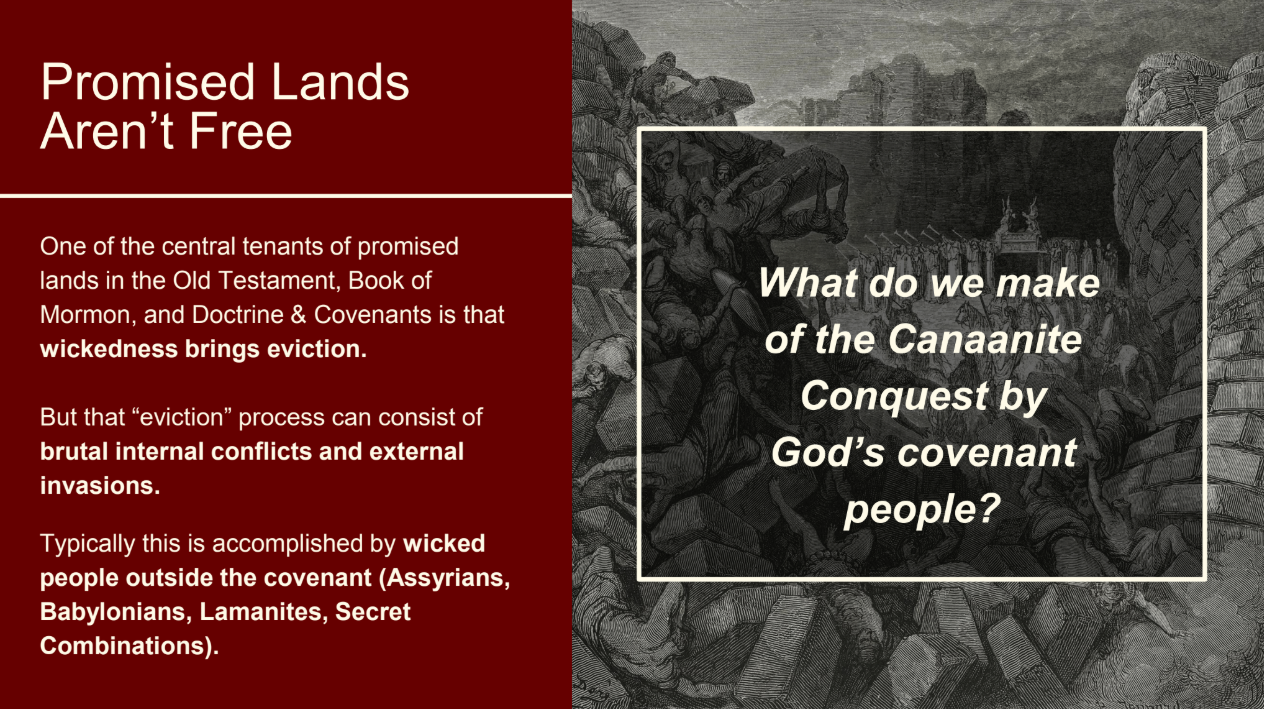
Promised Lands and the Eviction of the Wicked
We’re pretty familiar with the concept of a promised land as Latter-day Saints. It is not only in the Bible. It’s also in the Book of Mormon and even the Doctrine and Covenants, and the Pearl of Great Price.
There’s an underlying notion that any promised land has a conditional residency. You can only stay in the land if you abide by the covenant. And this is a familiar pattern.
Wicked nations are evicted from the land that they’re staying in. But this eviction process is pretty brutal, often. Sometimes they’re outside groups who come in and perform this function. Other times it’s an internal conflict, like with the Jaredites.
But what’s difficult about the Joshua narrative (and what raises a lot of questions, I think) is that it’s God’s covenant people who are commanded to do this ‘ousting’. And in particular, the violent manner of it is disconcerting to a lot of Christians and is frequently criticized.
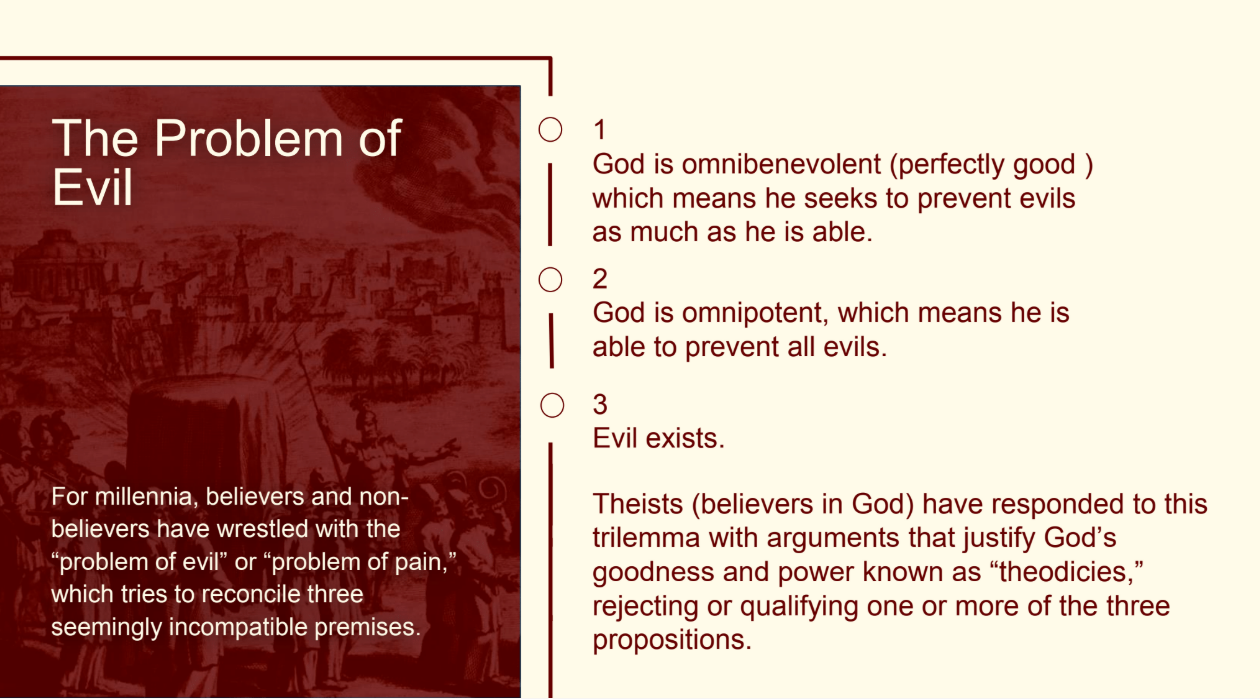
The Problem of Evil
As I studied the book of Joshua, it occurred to me that, in many ways, the critiques that critics bring against the book of Joshua are simply a subset of the philosophical “Problem of Evil.”
This is a dilemma—or trilemma, rather—that dates back thousands of years that tries to reconcile God’s perfect goodness with his ability to do anything, his omnipotence, and the existence of evil. Christians and other believers have wrestled with this for millennia. And they have made arguments known as theodicies that reject or qualify one of these premises in order to maintain theological truths, to hold that God is still good.
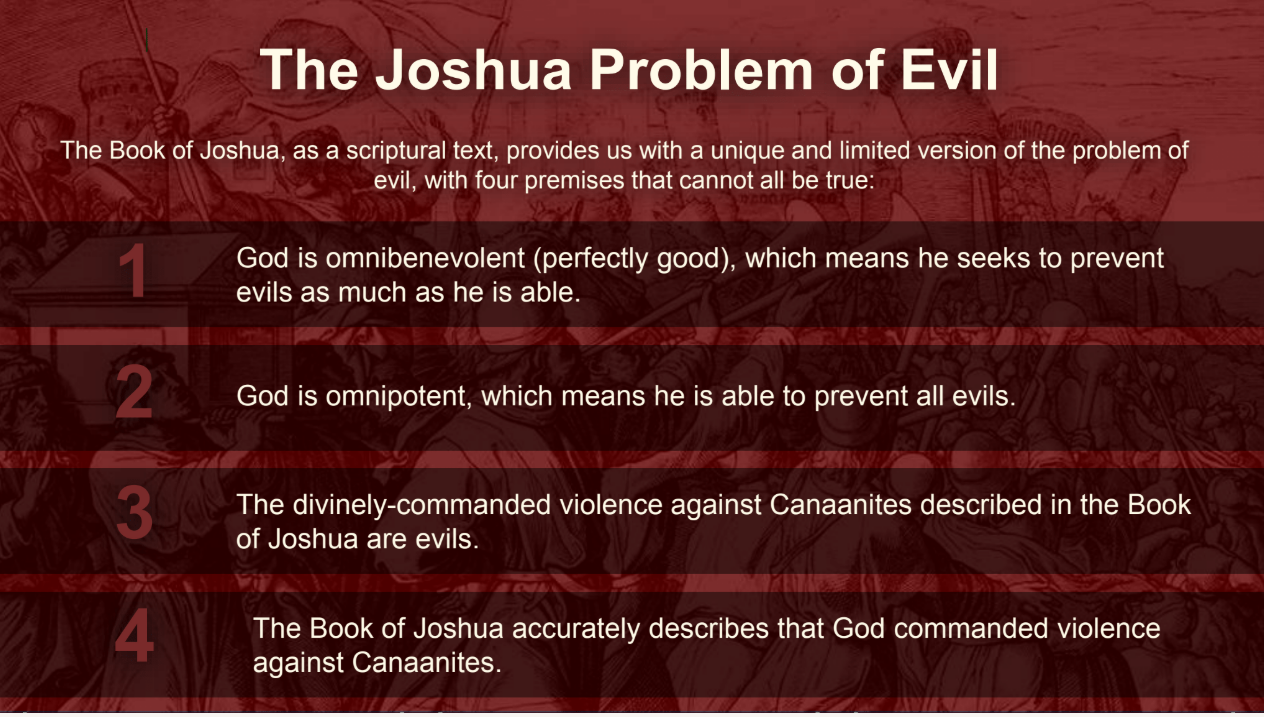
The Joshua Problem of Evil
Looking at the book of Joshua, I think we can take these same premises and narrow them in. We can add an additional premise of scripture being accurate. And we have what I would call “The Joshua Problem of Evil.”
These premises, like the others, cannot all be true together. One or more of these would need to be qualified or rejected.
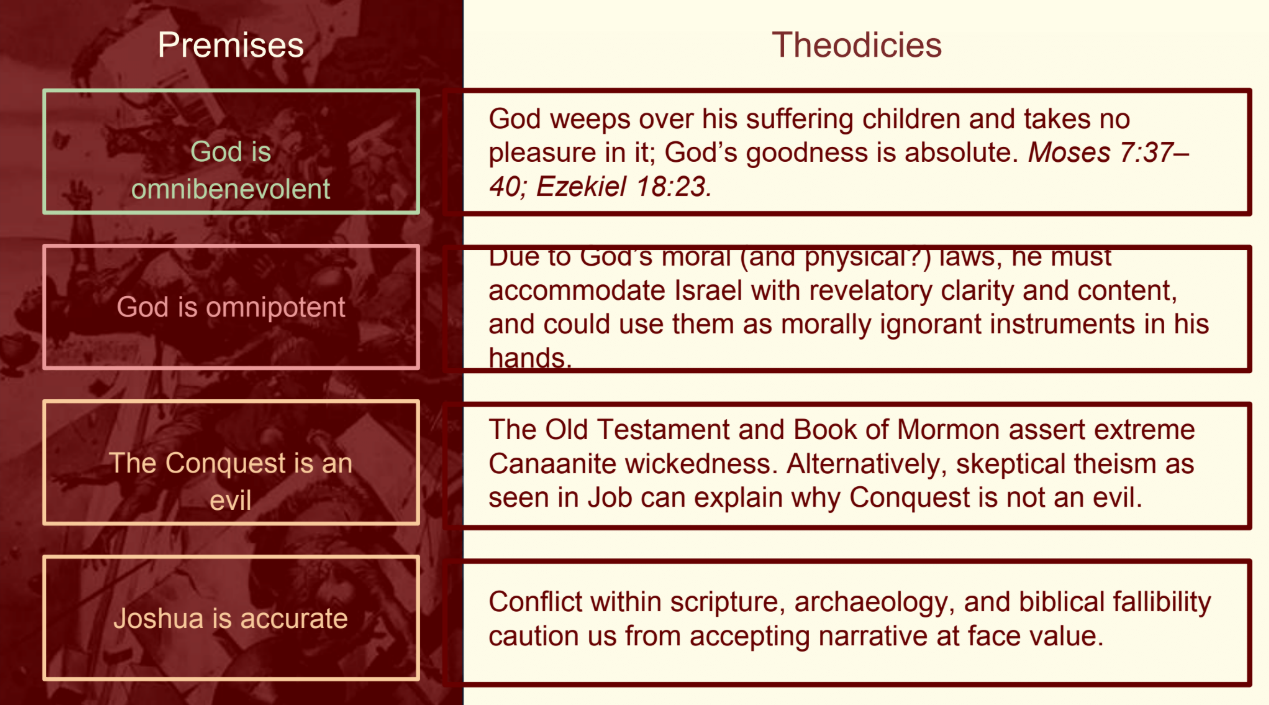
Premises and Theodicies
I argue that Latter-day Saints ought to still hold that God is perfectly good, or omnibenevolent. Scripture seems to make that clear. God doesn’t take any joy in our suffering.
But I would argue that these other three premises can all be rejected. Latter-day Saints need not reject all of them, but can. And knowing all the available arguments that can be made within scripture helps Latter-day Saints to have a very strong defense to critiques of the Bible and the Joshua story.
I’d say that each rejection of one of these premises could be its own theodicy. So I’m going to organize my lecture today around these three theodicies that I think Latter-day Saints can bring to help us justify the book of Joshua.
Old Testament Inaccuracies
So our first theodicy, in the order I’d like to take it, would be that the Old Testament—or how we read the Old Testament, rather—may inaccurately portray:
- the Israelite conquest,
- the nature of it, and
- the violence of it.
In order to make such a claim, I think we ought to analyze the narrative itself and what we see going on.
The Concept of Herem
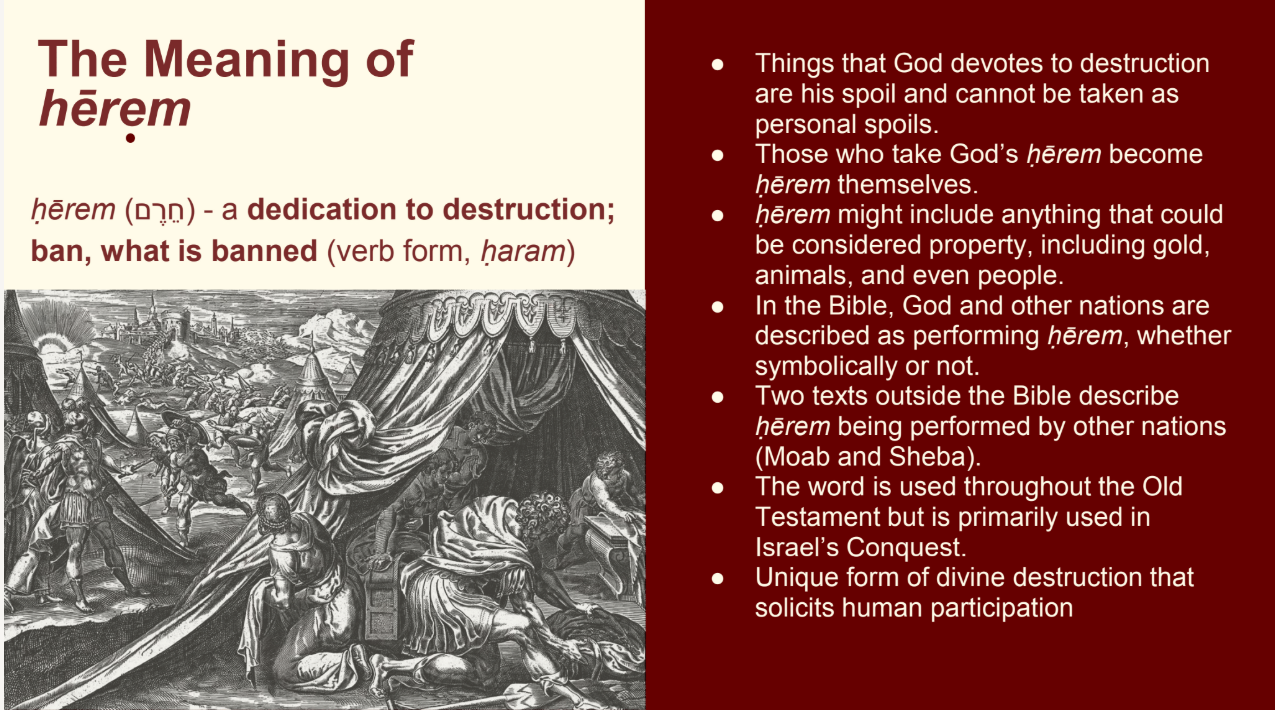
The critical term that the narrative revolves around (and that makes the conquest so difficult) is the concept of herem. You may have heard this term, perhaps not. It’s the Hebrew term within the Joshua narrative that describes what the Israelites do to the Canaanites in specific passages.
At its root, this Hebrew root means to ‘set something aside from regular human use’. Latter-day Saints are familiar with a concept of consecration, such as Edward Partridge in Jackson County, where individuals can consecrate something to God and still use it. But herem, conceptually, is a consecration to God where something is not used. It’s banned from human use.
And to permanently ban something from human use, it would be destroyed. So there’s often an implication of destruction with the verb. Some scholars, like John Walton, have contested whether that’s actually occurring, but the evidence and the fact that herem often occurs with the use of a sword seems to indicate that destruction is occurring.
In the Joshua narrative, God tells the Israelites that many of these cities that they’re to take over—these Canaanite cities—ought to be herem. The entire city is banned from human use and thus must be destroyed. For goods or animals, this would mean simply not using them or killing the animals.
This is a much darker concept when applied to humans, and especially performed by other humans.
Herem in the Old Testament
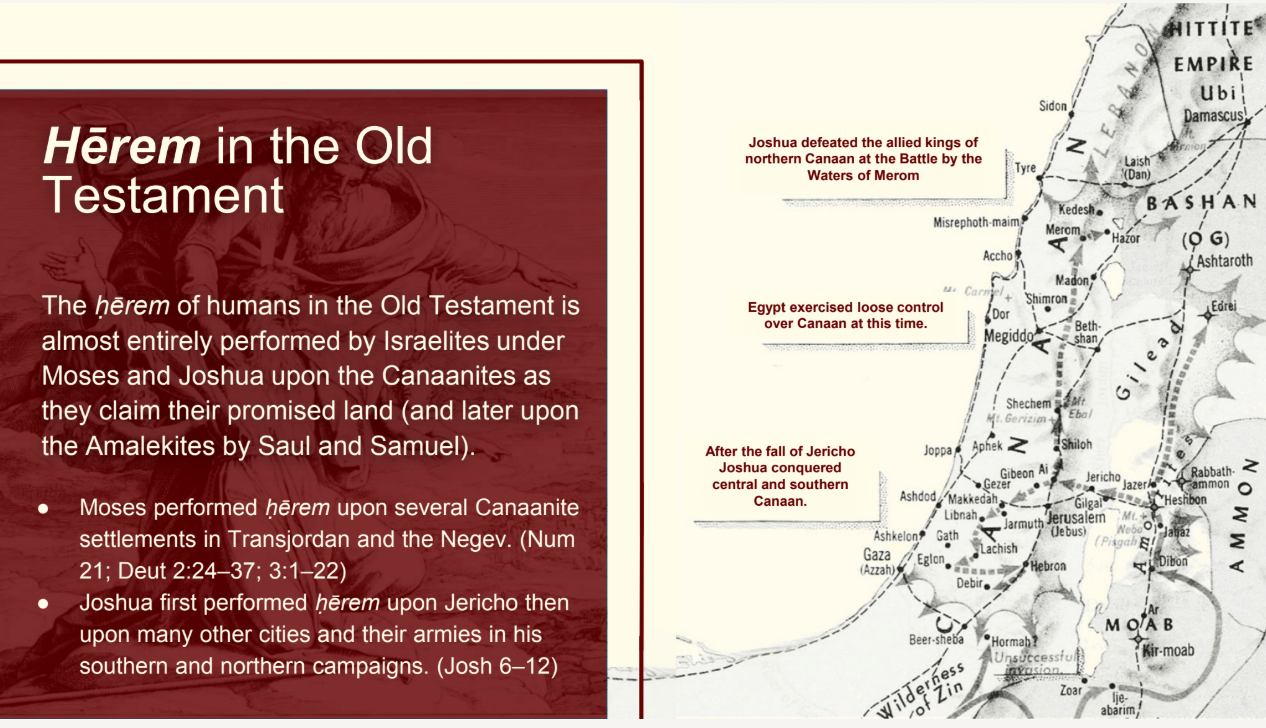
So where do we see herem in the Old Testament? The use of herem is particularly limited to the conquest narrative. It does occur in other places, but the use of herem upon other humans is especially involved in the story of Israel coming into the promised land.
It’s not all found in the book of Joshua per se. Moses, in some initial battles, commands the Israelites to perform herem on Canaanite cities in very southern Canaan, like Arad. And Joshua leads the Israelites into Canaan and performs herem on many cities there.
It does happen in other places, but really the bulk of it is this conquest narrative.
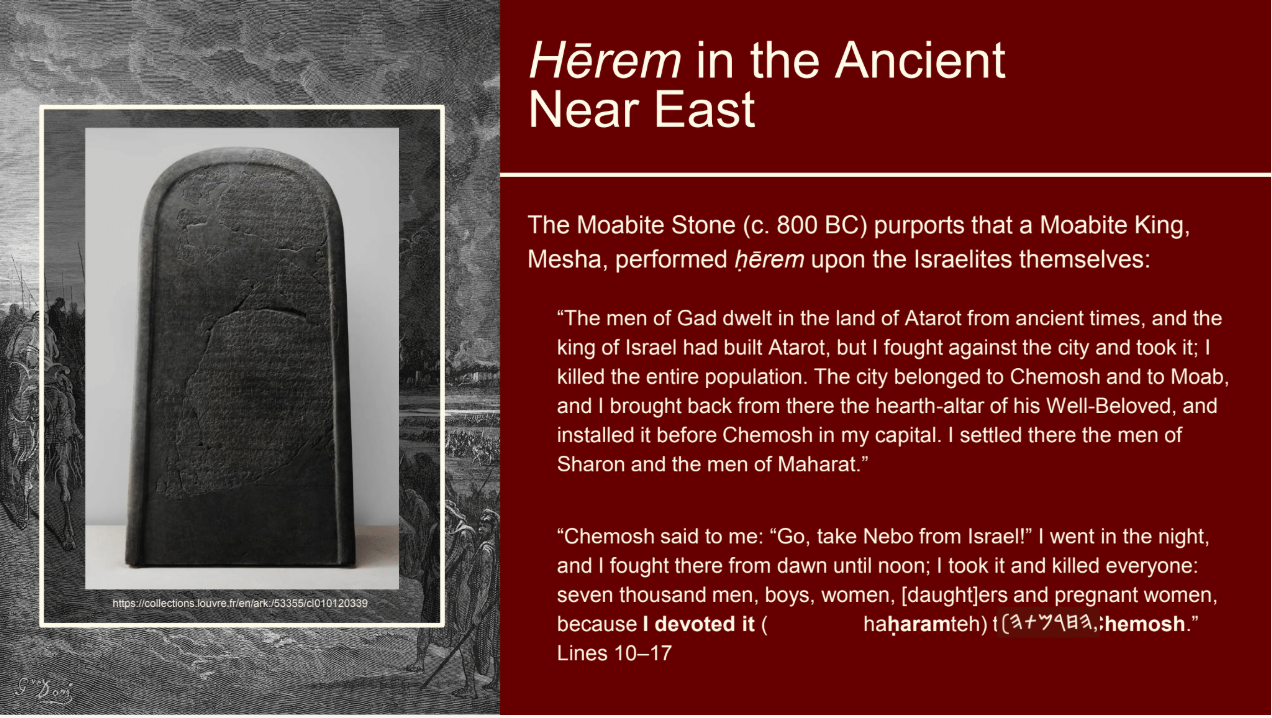
Herem in the Ancient Near East
Herem, however, is not an exclusively Israelite concept. We find inscriptions by Israel’s neighbors a few centuries later that use the same term to describe a total destruction of a city as part of a military conquest.
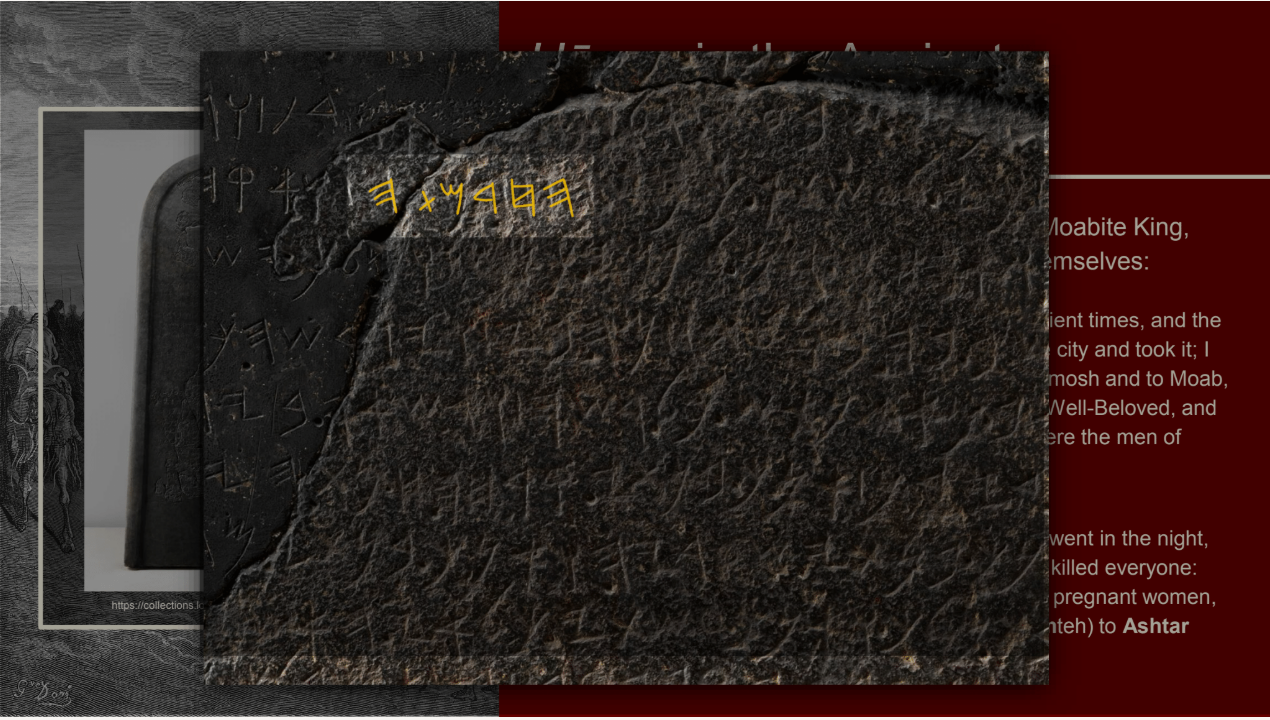
This is a Moabite inscription here, and we can see that they use the root herem, meaning they are performing herem on individuals.
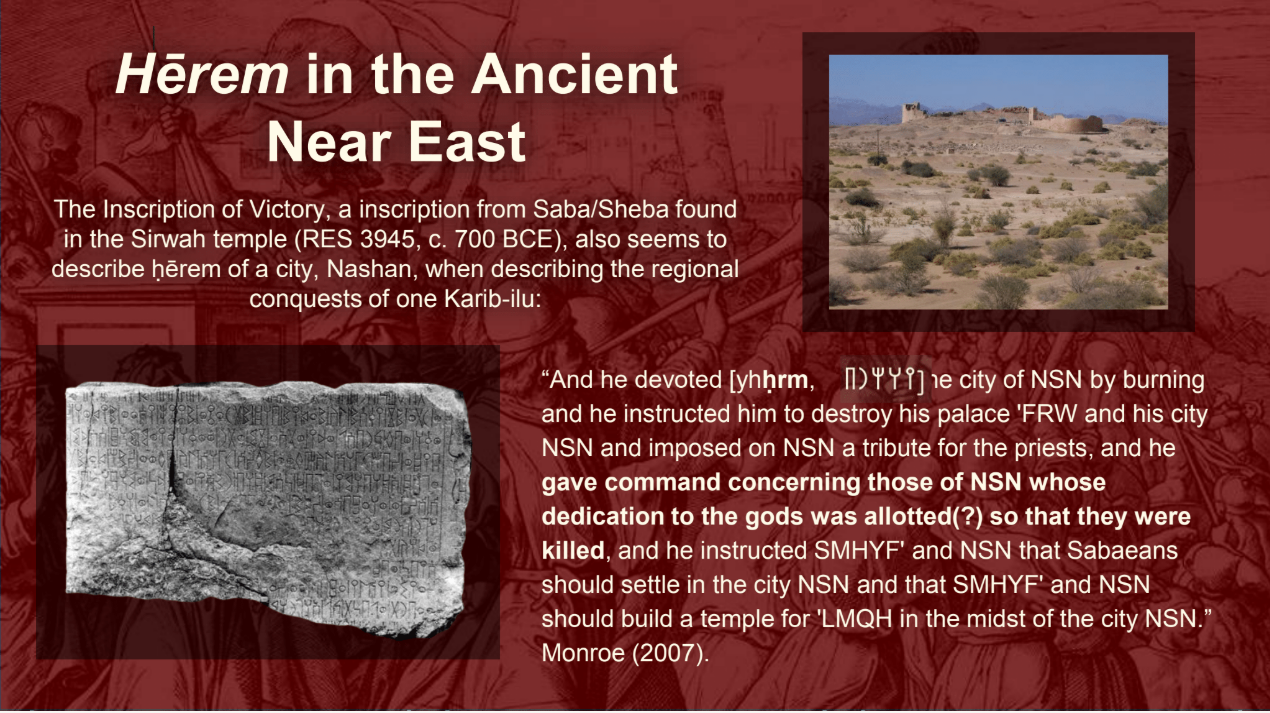
We also see it in an ancient Sheba inscription as well. So it’s not exclusively Israelite.
Textual Conflict in Joshua
To explore why the text of Joshua might not correctly portray the conquest, I think we have to look at some real or perceived conflicts we see in Joshua between how facts are reported.
In particular, we’ll look first at the scope and the speed of the conquest.
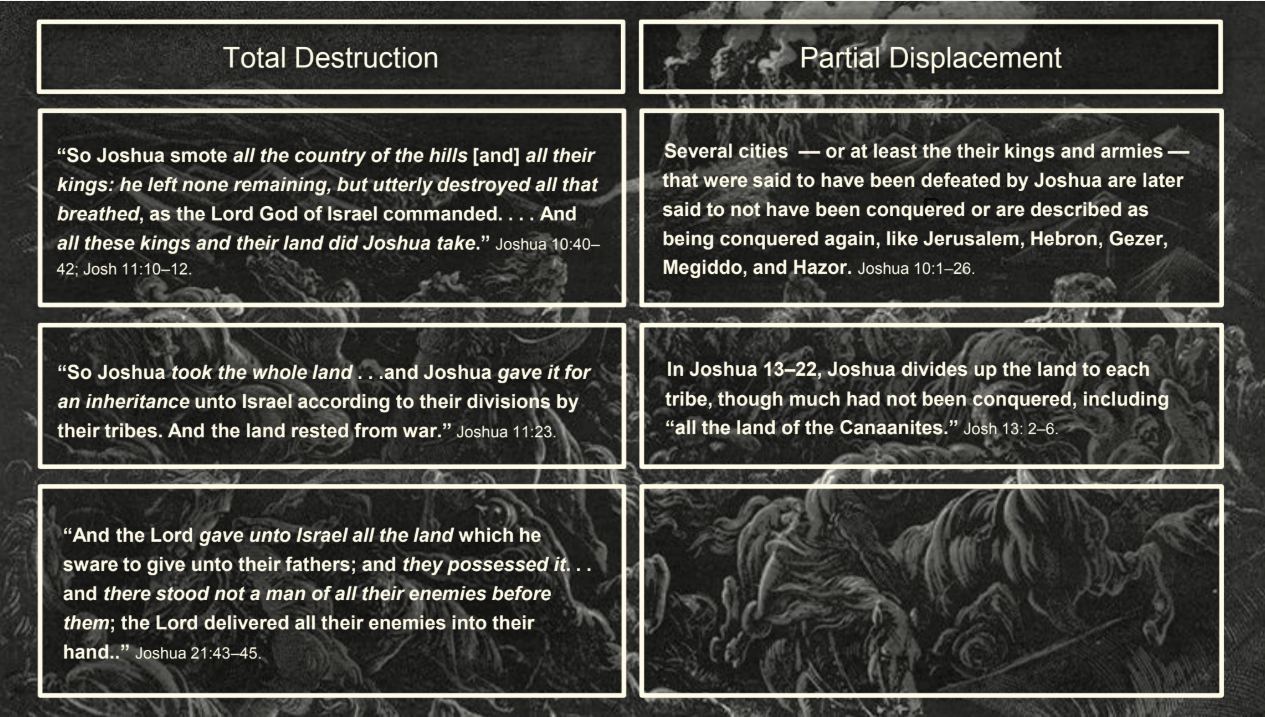
Total vs. Partial Destruction
We see some passages that seem to indicate that Joshua and the Israelites following him have a very complete and total conquest of Canaan, where everything is destroyed, there are no enemies who are not defeated.
And other passages, especially in the book of Judges, seem to indicate that it wasn’t a total destruction. Many cities remained undefeated. And so there’s some tension there.
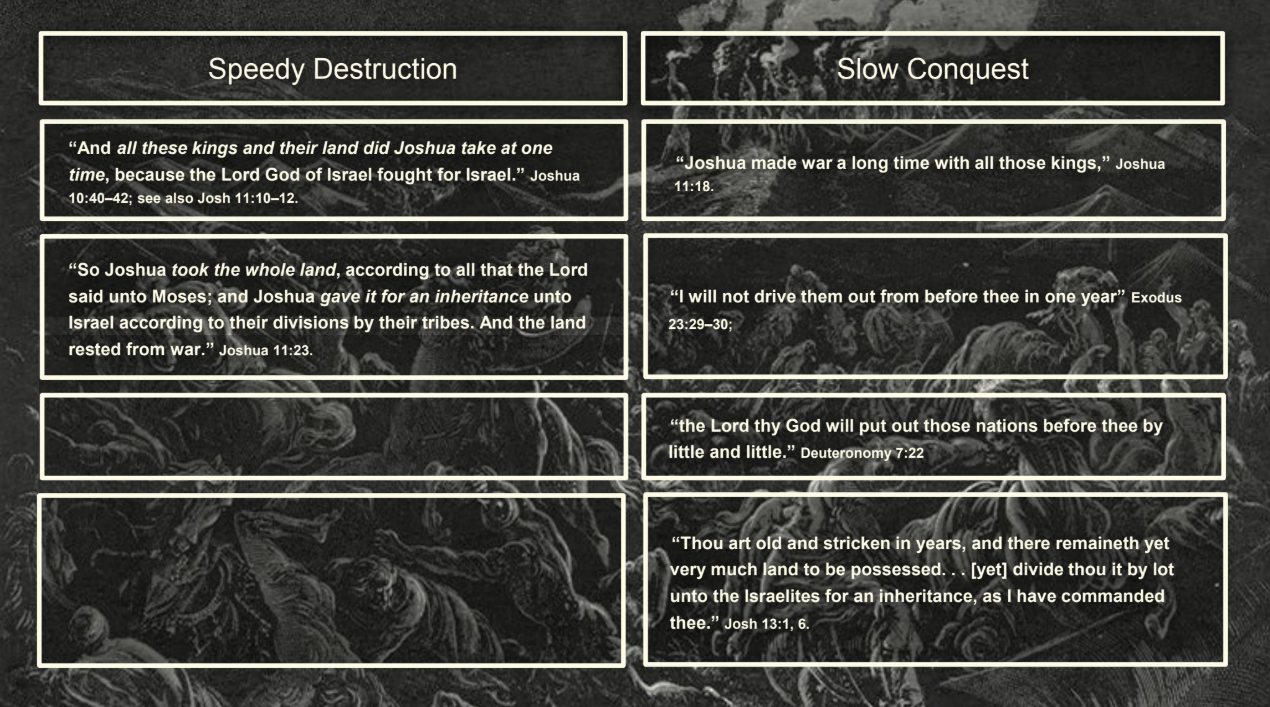
Speedy vs. Slow Conquest
The speed is also somewhat disputed, you might say, or internally conflicted. We see prophecies by Moses that the conquest process will take years and will come little by little. However, passages like this say that Joshua took the whole land immediately, at one time.
What’s the preferable narrative? What do we lean on?
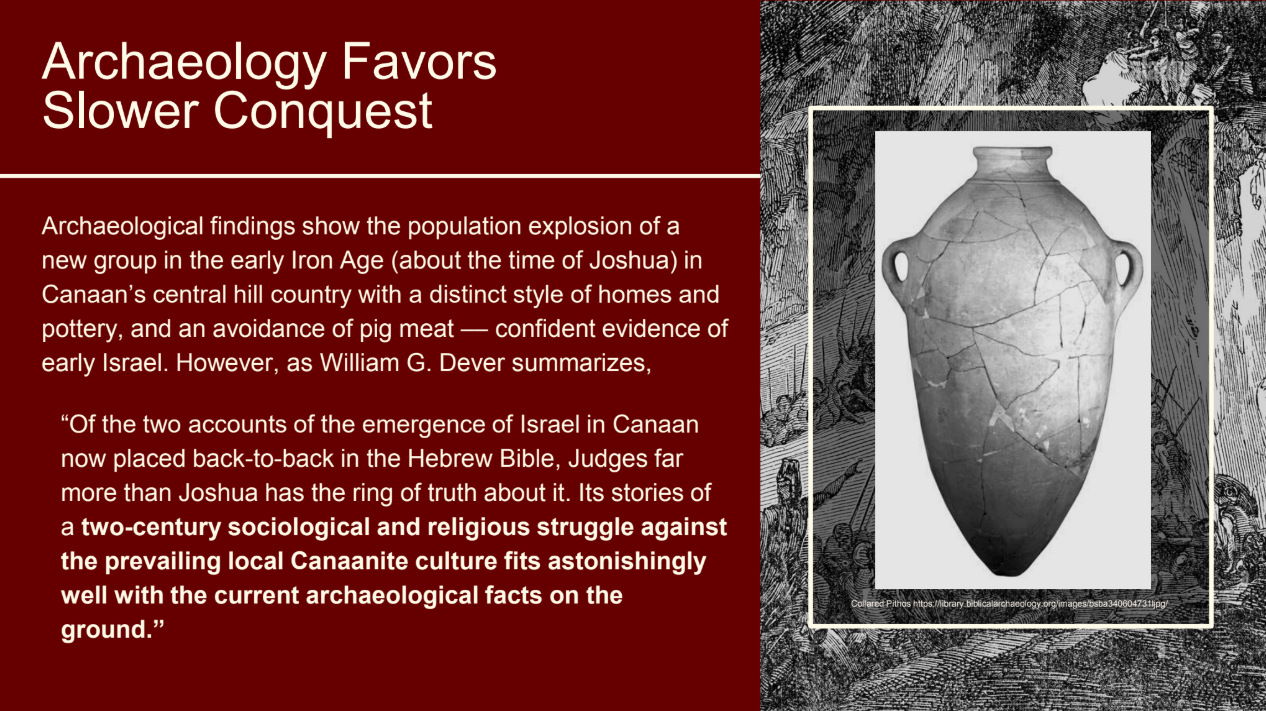
Archaeology does support the Judges narrative more than the Joshua narrative of a slow conquest, and in fact indicates that much of Israelite settlement of the Holy Land may have been peaceful, especially in the highlands of Ephraim and Manasseh.
We see some distinctive pottery emerging at that time and settlements that seem to be clearly Israelite. There’s no pig bones, which is quite notable, and we know that Israel does emerge there.
However, many of the sites noted in Joshua as having been defeated by Joshua continue to have Canaanite material culture.
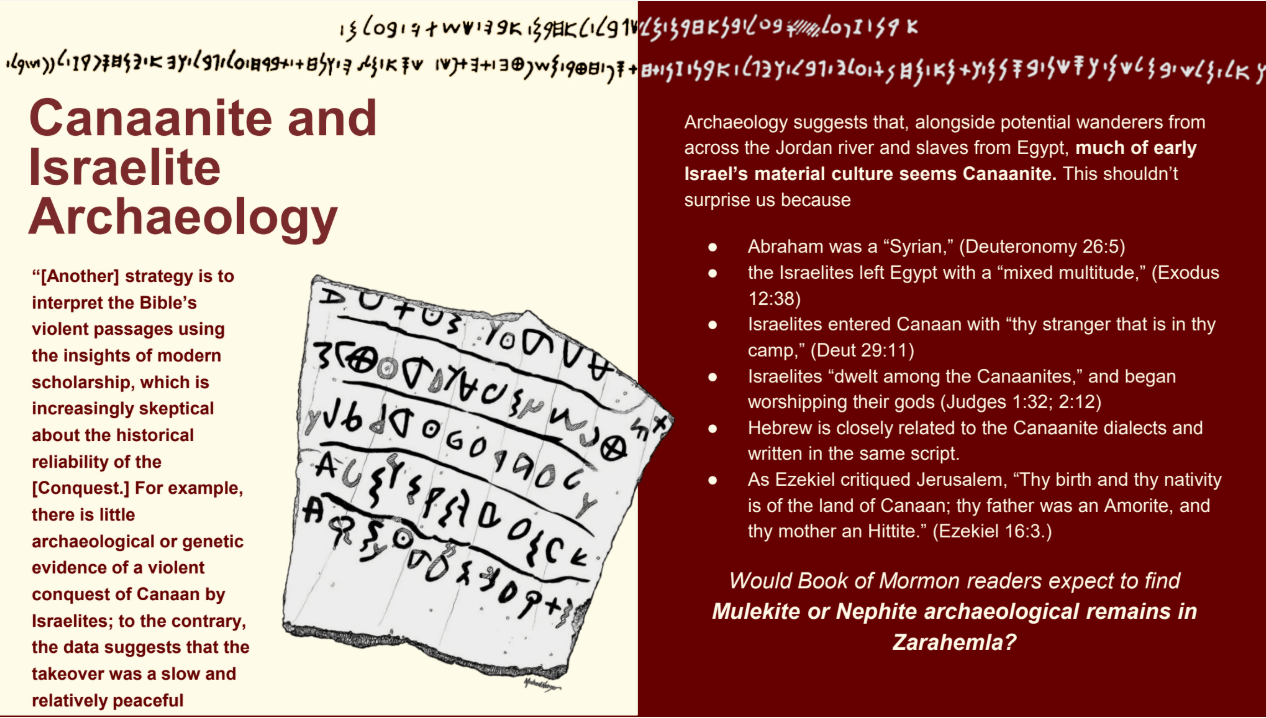
Archeological Findings
In fact, secular scholars would probably assert that Israel is actually an outgrowth of Canaan. We would probably beg to differ as Latter-day Saints and say that these are distinct cultures, but it shouldn’t surprise us that much of the material culture we find on the ground between Israel and Canaan is very similar.
Abraham, for example, seems to come from this West Semitic background. And Israel leaves Egypt with Canaanites, enters the Holy Land with strangers, and they very rapidly adopt Canaanite culture.
In fact, the scripts are very similar. You could see the similarity of this Israelite ostracon from Khirbet Qeiyafa with this Phoenician inscription up here. The language is mutually intelligible. And so this really shouldn’t surprise us.
We might ask Book of Mormon readers: would you expect the remains of the city of Zarahemla to seem more Mulekite or Nephite when Mulekites are the dominant population—even if Nephites are the ruling class?
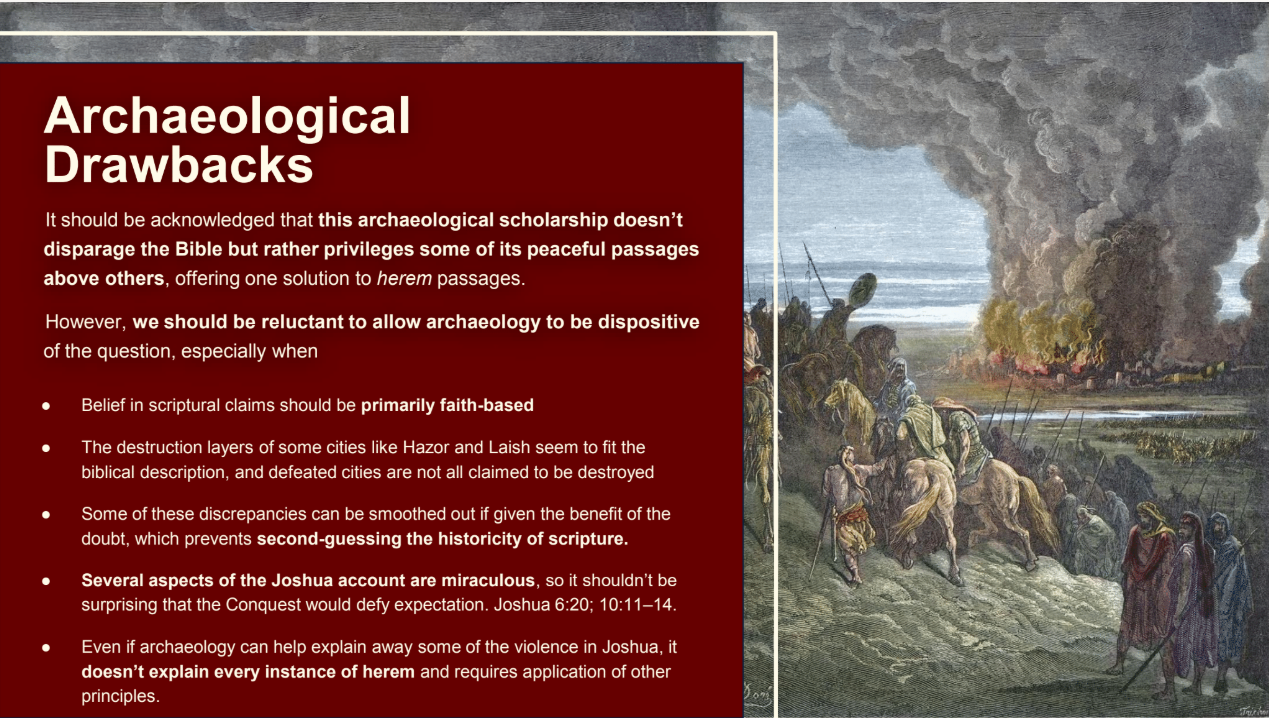
Why might we not want to rely on archaeology too much? Well, we’re making a faith claim here, and we shouldn’t allow science and findings that are definitionally tenuous to control our faith-based conclusions.
Some evidence does seem to fit the Joshua narrative, like the burning of Hazor, and we see a lot of miracles in the Joshua narrative as well. We as believers in miracles shouldn’t totally discount them. It also doesn’t explain away every instance of herem.
Explaining Discrepancies in Joshua
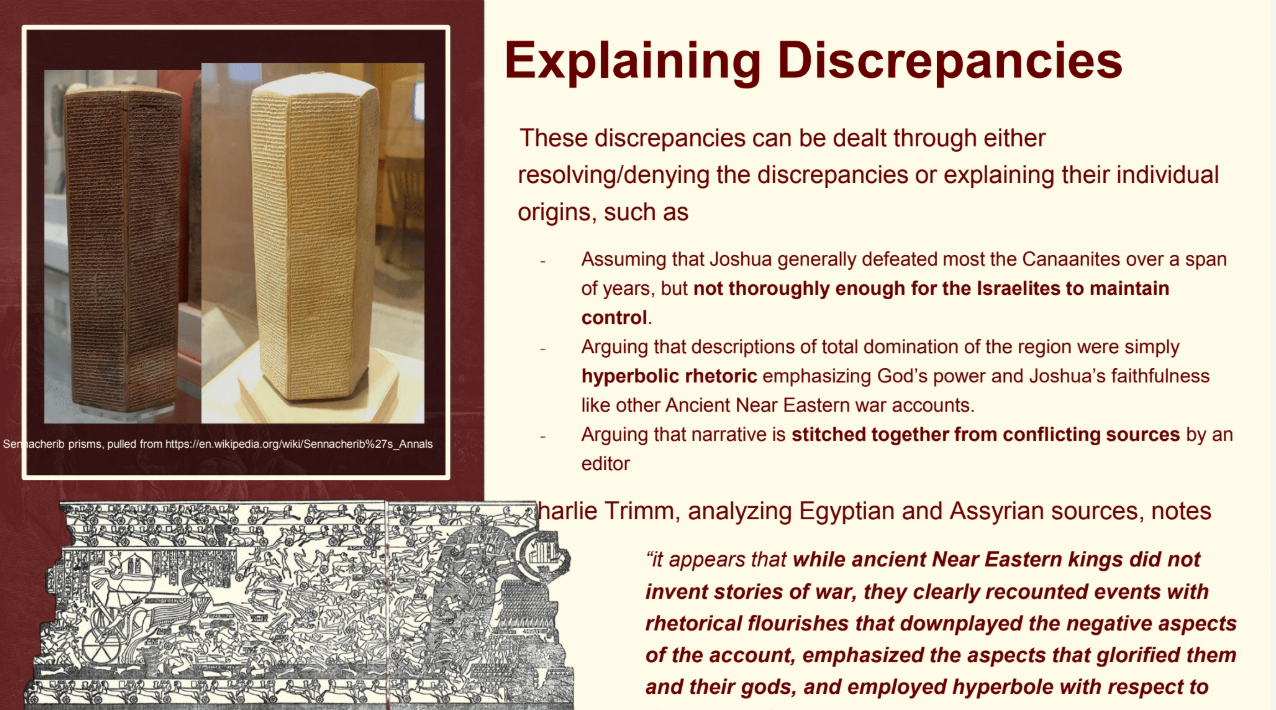
So what do we do with these two conflicting trends or ideas in the conquest narrative? It may be that they aren’t conflicting at all necessarily, and that the more complete conquest and faster conquest is mere hyperbolic rhetoric.
We see things like this in a lot of contemporary inscriptions in the Near East. It’s common for kings, when they recount battles that they had, to inflate their success. This helps the name of the king and their deity.
For example, Sennacherib, the Assyrian king, seems to inflate his successes far beyond what we see in Second Kings. And it’s no wonder. Who wants to emphasize having a miraculous loss?
This appears in Egyptian sources as well. This is Ramesses’ relief of the battle of Kadesh, where he vastly overexaggerates his own role in the battle and the success of the Egyptians.
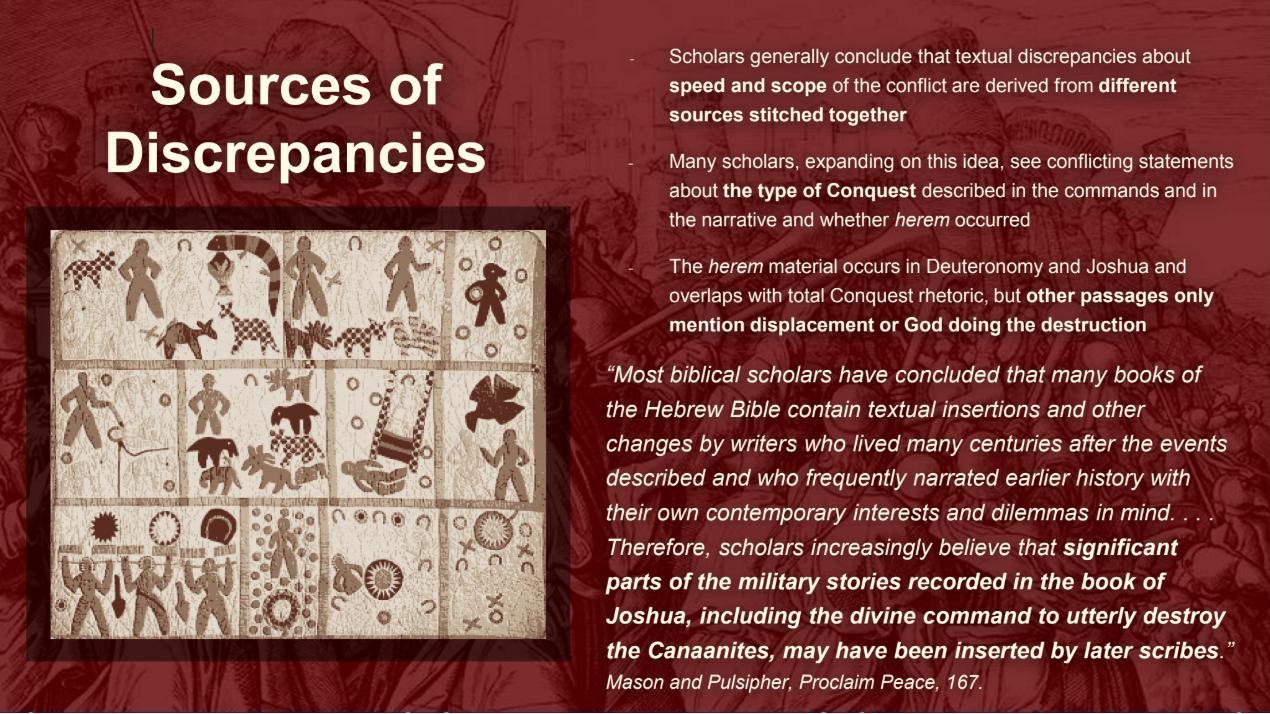
So, where else might these come from if it’s not just a rhetorical flare in part of the text?
I think a more convincing argument is that we have separate traditions that have been weaved together within the conquest narrative. One of a complete and rapid conquest, and another that’s longer and more partial.
And this seems to be the scholarly consensus—that we have these separate sources that have been stitched here.
And it’s notable that between these two sources, the one that mentions a complete and speedy conquest tends to also favor the use of herem—the violent death or execution of all Canaanites, including women and children.
Maybe that’s rhetorical as well. Maybe it’s not. But we might have these two separate textual traditions here.
Divine Commands Regarding Conquest
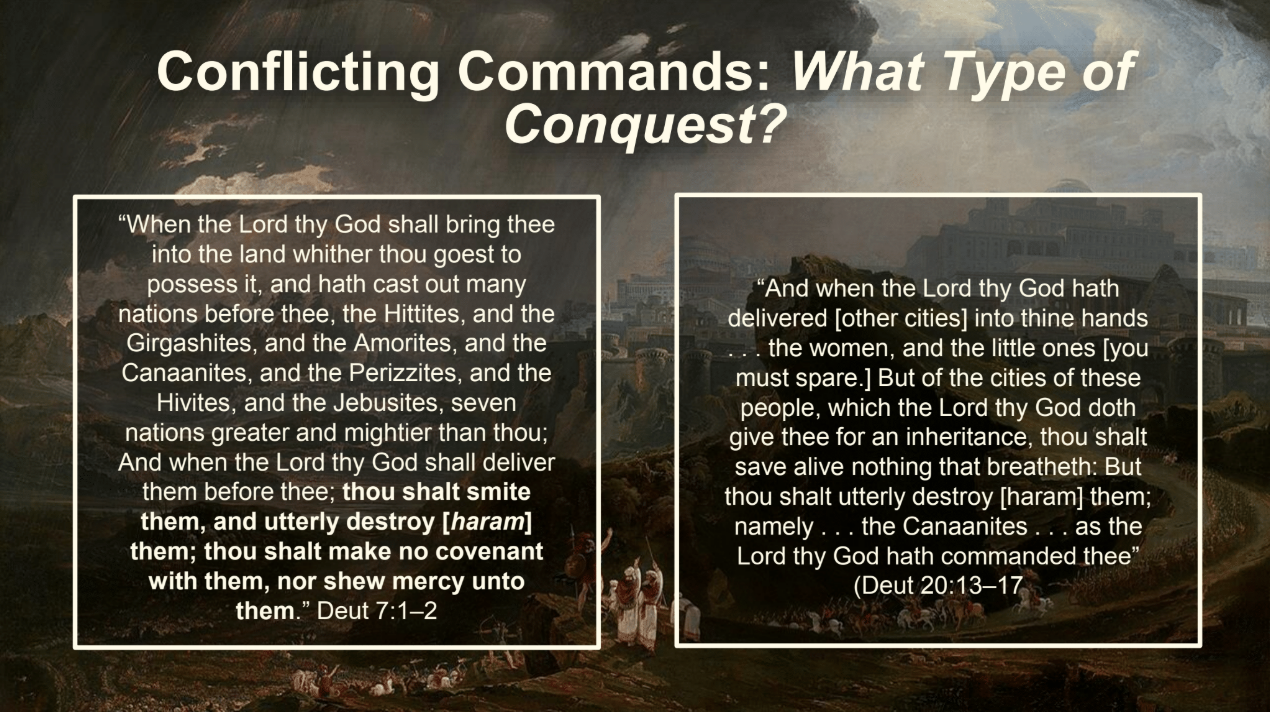
We also see this with commands. I mentioned the herem passages seem to go with a complete destruction. These are the herem commands given by Moses. We can see here that Moses tells the Israelites to cast out these seven Canaanite nations and to herem them, to have no mercy on them, and to save nothing alive that lives.
These are pretty dark and are cannon fodder for attacks on the Bible, often, and portraying God in an extremely negative light.
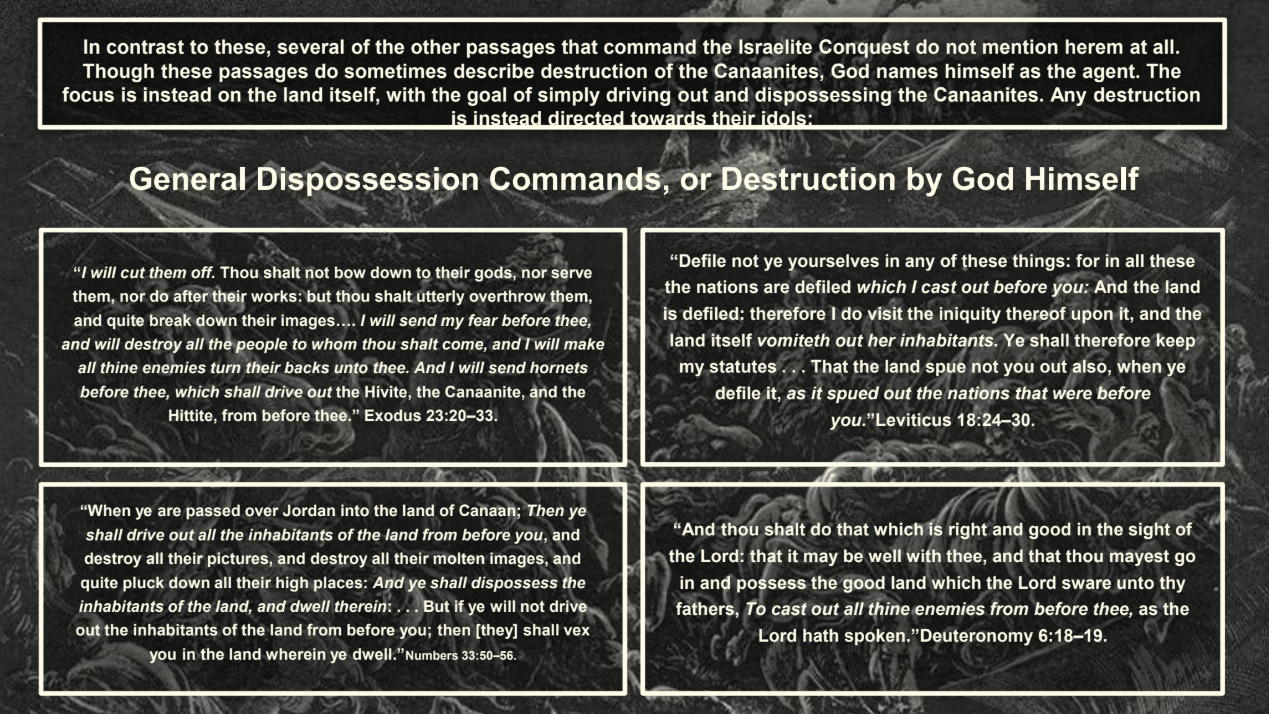
However, these aren’t the only commands regarding the conquest. I put a few other verses up where we can see that the focus, rather than on destruction of the Canaanites, is on the land itself.
God notes that He is the agent doing this, and any destruction that occurs is either done by God or directed towards the idolatry and the idols of the Canaanites. And this seems to indicate that there might be a tradition of a more peaceful conquest.
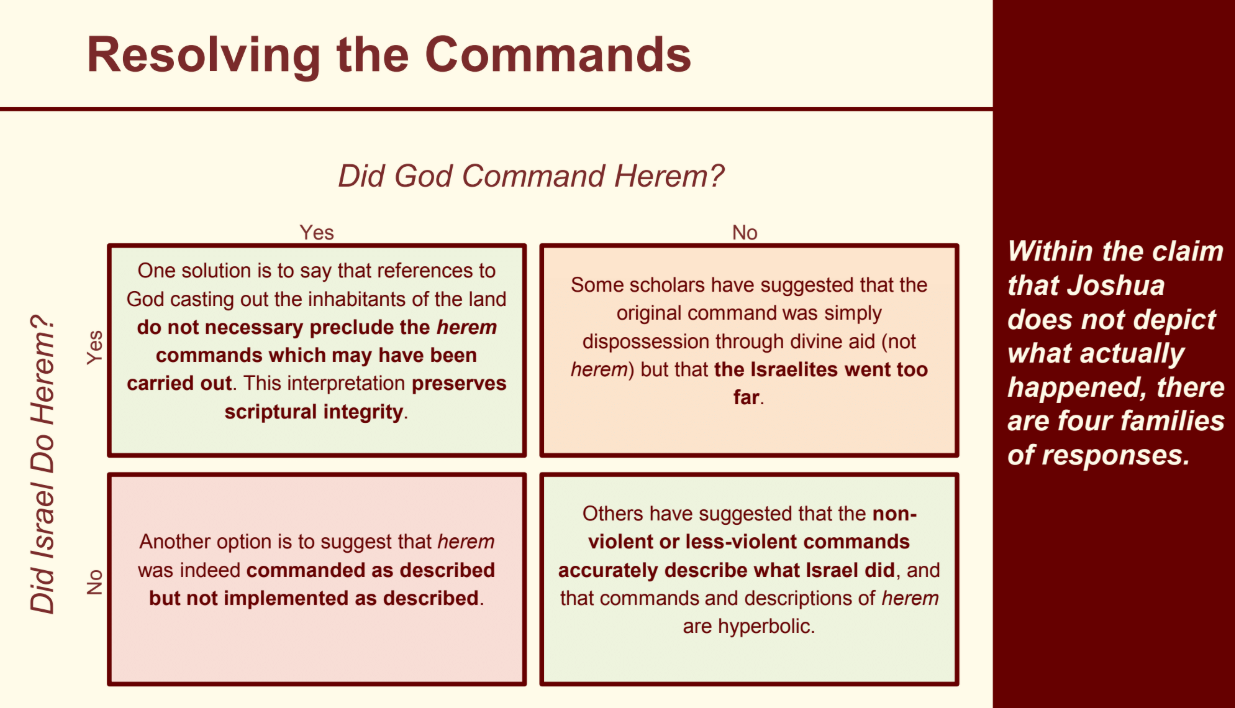
Resolving Command Conflicts
Looking at these separate trends of whether God commanded herem or not, and whether Israel did it, leaves a few possible families of responses, all of which can be effective in answering what happened in the conquest.
Though if Israel did not get commanded to do the conquest and did not do it, then these difficult herem passages about the execution of children wouldn’t have bearing on us.
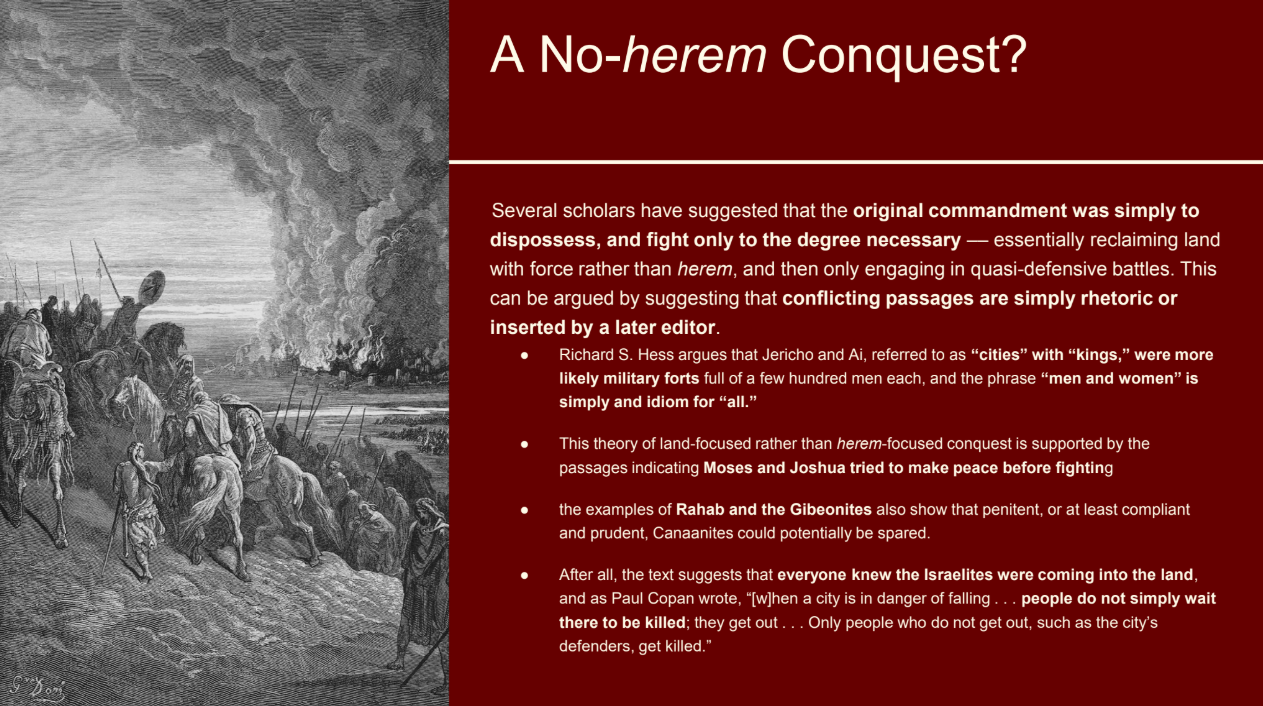
Following that train of thought, several scholars have suggested that maybe this was the original real tradition—that God simply commanded them to dispossess the land and fight however much they might need to, which is still violent and uncomfortable, but much less so than the execution of women and children, or herem.
Additionally, Israel has a reputation as they enter Canaan. Rahab notes that everyone’s heard they’re coming. So those who remain in each of these cities are presumably there because they intend to fight. That’s probably mostly men and military leaders.
Some have suggested that maybe these ‘cities’ referrins to “military forts,” which also makes things a little better.
And Moses and Joshua seem to offer peace to at least some Canaanite cities before the destruction occurs. Rahab and the Gibeonites are also individuals who managed to escape these violent commands by seeking mercy. And perhaps that was available to everyone.
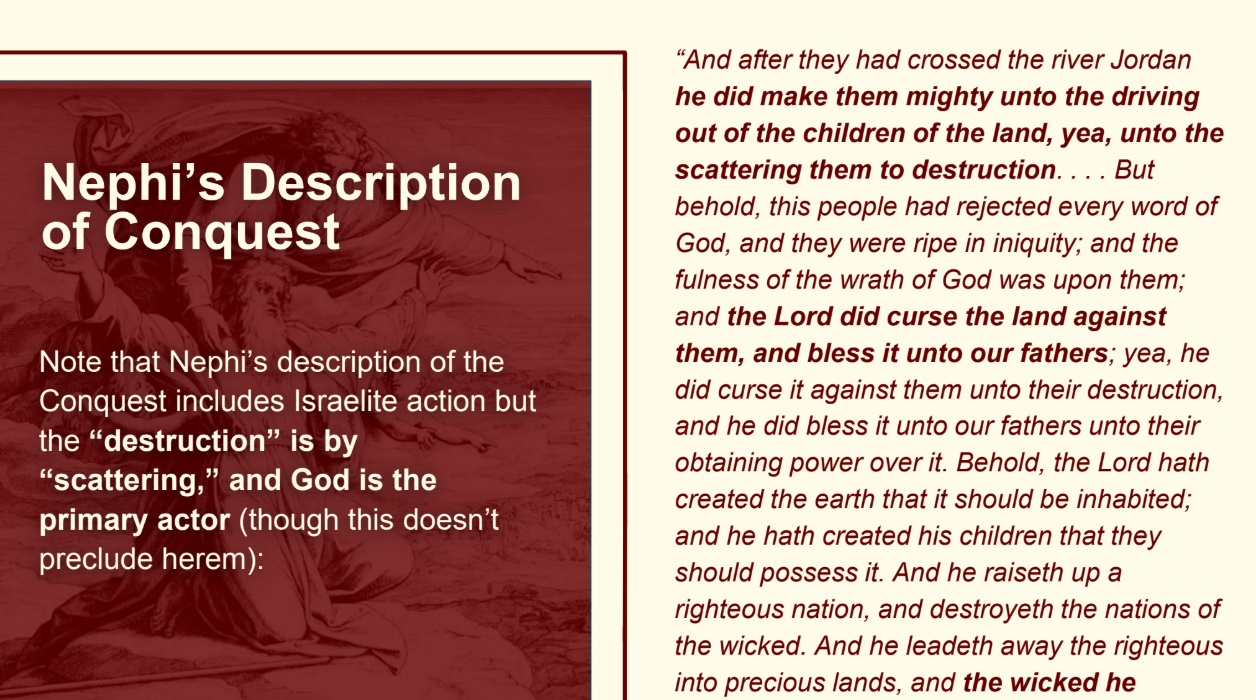
Nephi’s Description of Conquest
Nephi’s description of the conquest is interesting. It would be nice if the Book of Mormon could resolve this one way or the other and tell us whether this complete destruction with herem is more accurate or this alternative one.
It seems to me that Nephi’s description leaves either tradition open. He notes that destruction occurs, but the destruction is done by scattering rather than by herem. And the focus seems to be on the land.
So both of these seem to be viable original traditions that Latter-day Saints could assume is what actually occurred.
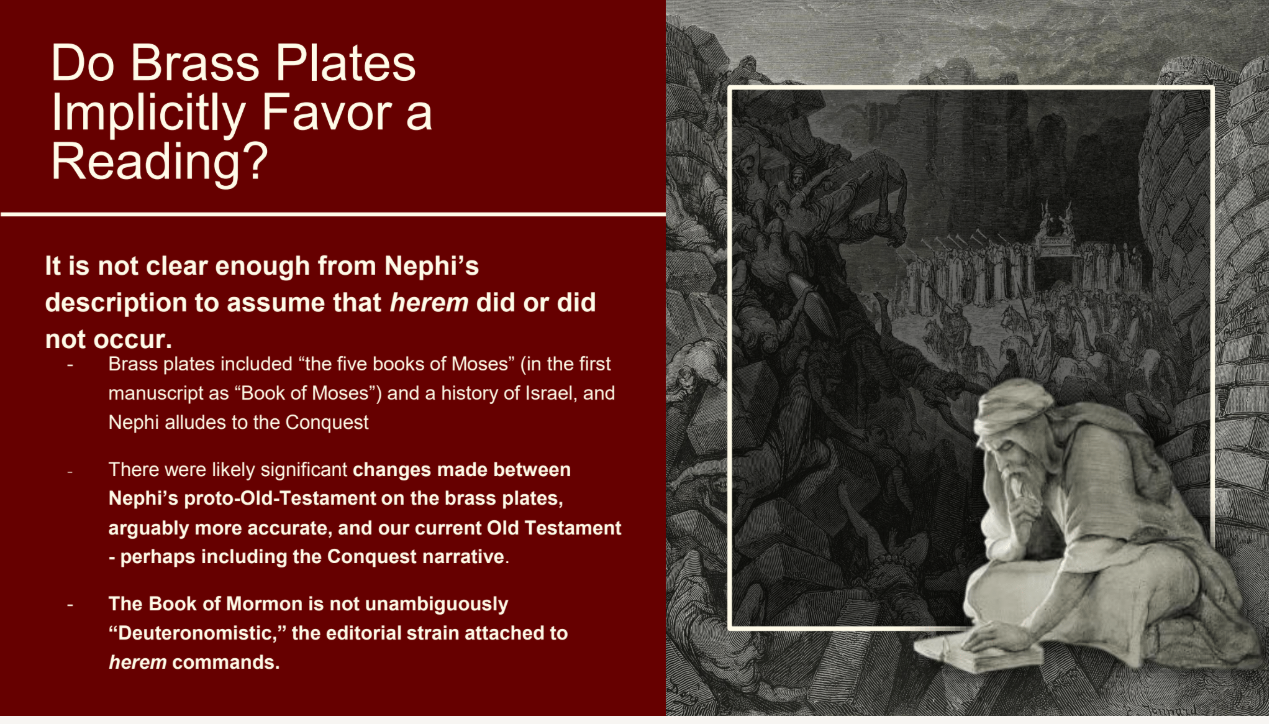
It would also be nice if we could tell from other sections of the Book of Mormon whether the brass plates that Nephi had (which are presumably more accurate) favor one of these traditions or another.
There’s some exciting research on this by LDS scholars. John Welch, for example, has several articles where he sees the book of Deuteronomy being used within the Book of Mormon. Which might suggest that this herem tradition, which is primarily in Deuteronomy and Joshua, may have been well known and understood among the Nephites.
However, others 1 have argued that Laman and Lemuel, in other ways, seem to be:
- more aligned with the ideas in Deuteronomy, and
- to be Deuteronomists.
So it’s unclear which narrative is favored.
Mormon is aware of this miracle of the sun seeming to stand still in Helaman 12:15. That happens in the conquest narrative. And he could be referring to that, but we can’t conclude simply from that verse that this is a peaceful process.
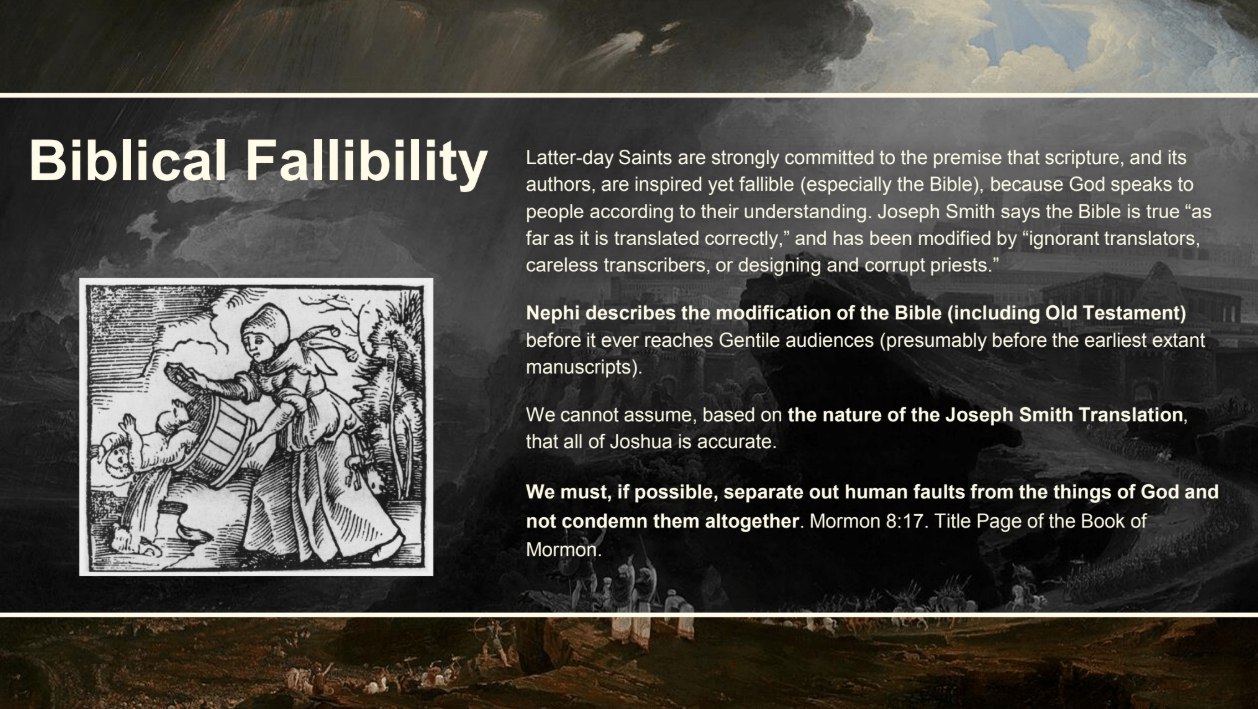
Biblical Fallibility
We should also note that Latter-day Saints doctrinally are very firm on the concept of scripture being fallible and yet inspired.
It would be really nice if the Joseph Smith Translation cleared this up for us, but scholarship on the Joseph Smith Translation makes it clear that this isn’t necessarily a total return to an original or a condoning of everything that exists in the text.
And so we always have the option of:
- saying that things in the text, especially those which have very little theological relevance to us (unlike the resurrection of Christ) can be dispensed with, can be understood as an error. However:
- we’re warned not to condemn the things of God with the things of man. Don’t throw out the baby with the bathwater.
How do we do that?
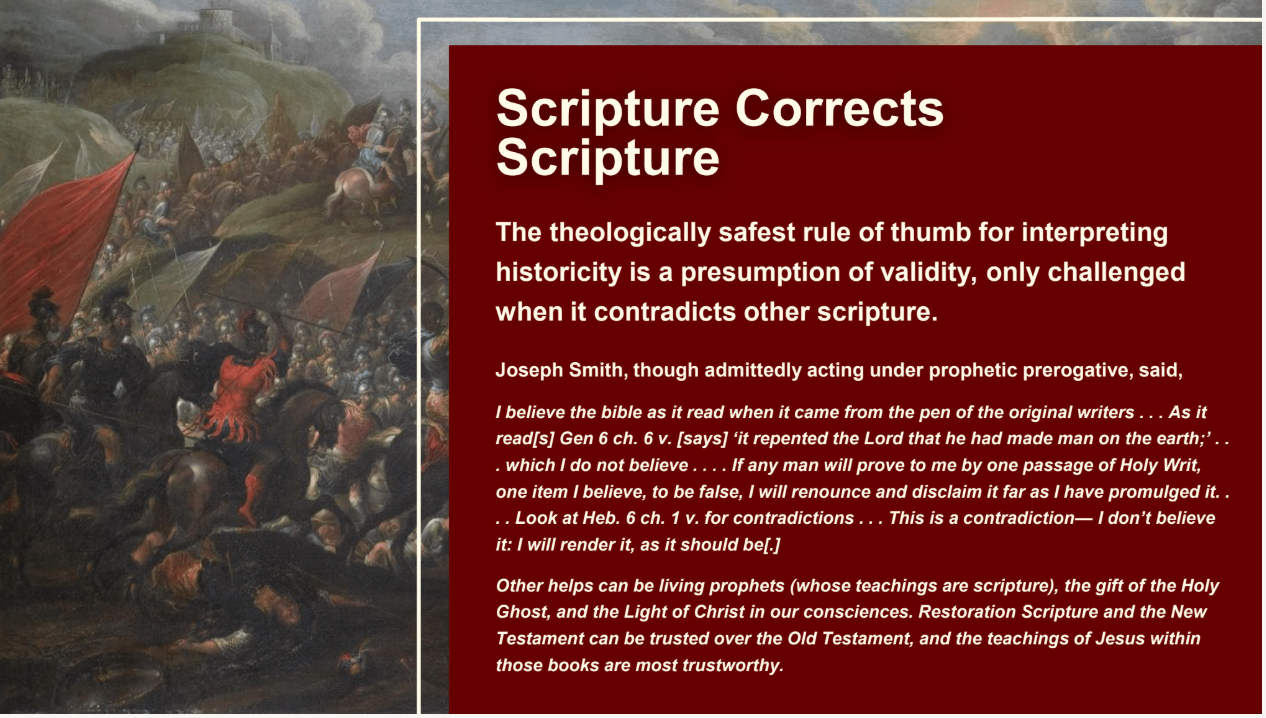
Scripture Corrects Scripture
How do we do that? I think there’s a lot of different ways we can go about it. But here I would say that if a scripture seems to be contradicting scripture, we are probably and confidently justified in questioning which passage should take priority.
That’s not rejecting scripture. That’s trying to understand it.
Joseph Smith, commenting on his translation process, notes that he sees contradictions in the text and he doesn’t feel compelled to believe it. And so he renders it as it should be.
And we have teachings of living prophets and a hierarchy of truths that we can use to know which conflicting passage should win out.
I think that with these two traditions in Joshua seeming to compete, we are justified in accepting either one as viable. We’re not condemning scripture, we’re prioritizing a passage.
God Accommodates Human Shortcomings
On to the second theodicy. I would argue that because God is compelled by His character to act in certain ways, He must accommodate human shortcomings as part of His character.
And because of this, the revelation that He gives to mankind must be tailored to:
- their understanding and
- their moral readiness for that knowledge.
Ben Spackman’s done a lot of great work on the concept of accommodation in creation.
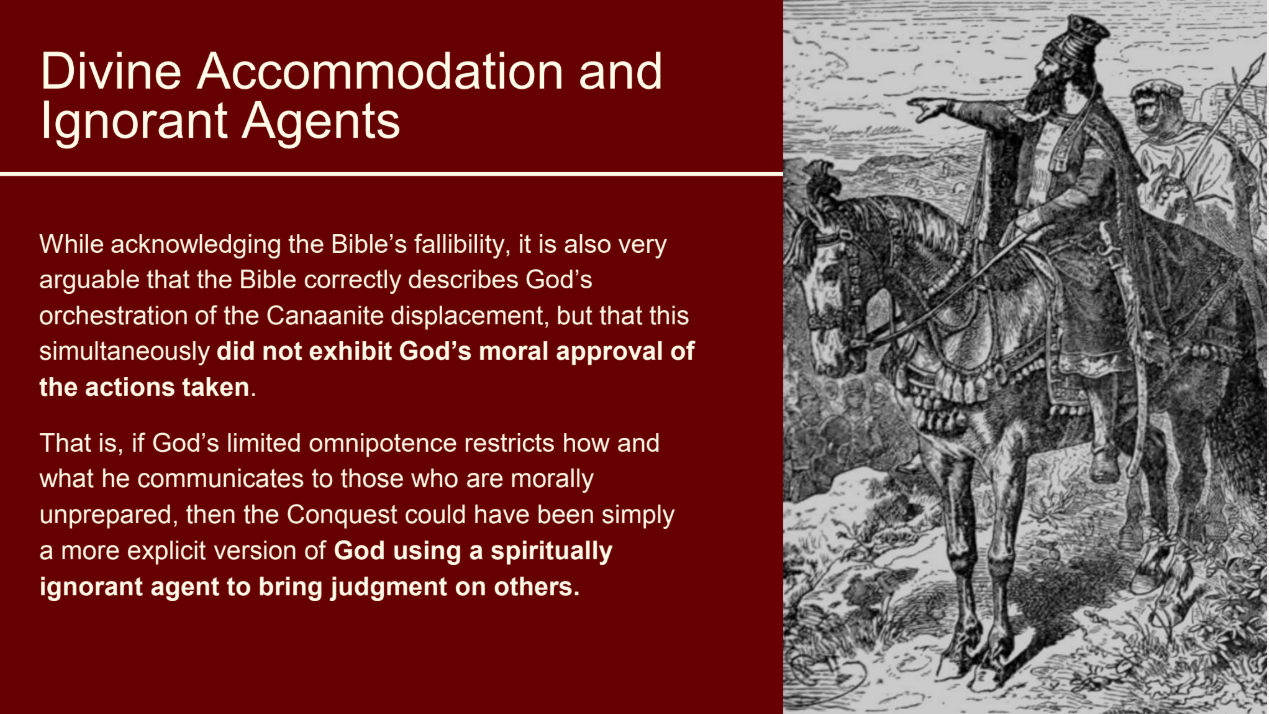
Divine Accommodation and Ignorant Agents
I would also argue that this accommodation process requires God to share things that people are ready to hear. Which means that:
- the revelation He gives may not be a complete showing of His will.
- God can use human agents and give them messages that aren’t necessarily what He would like to give them if they were prepared to have it.
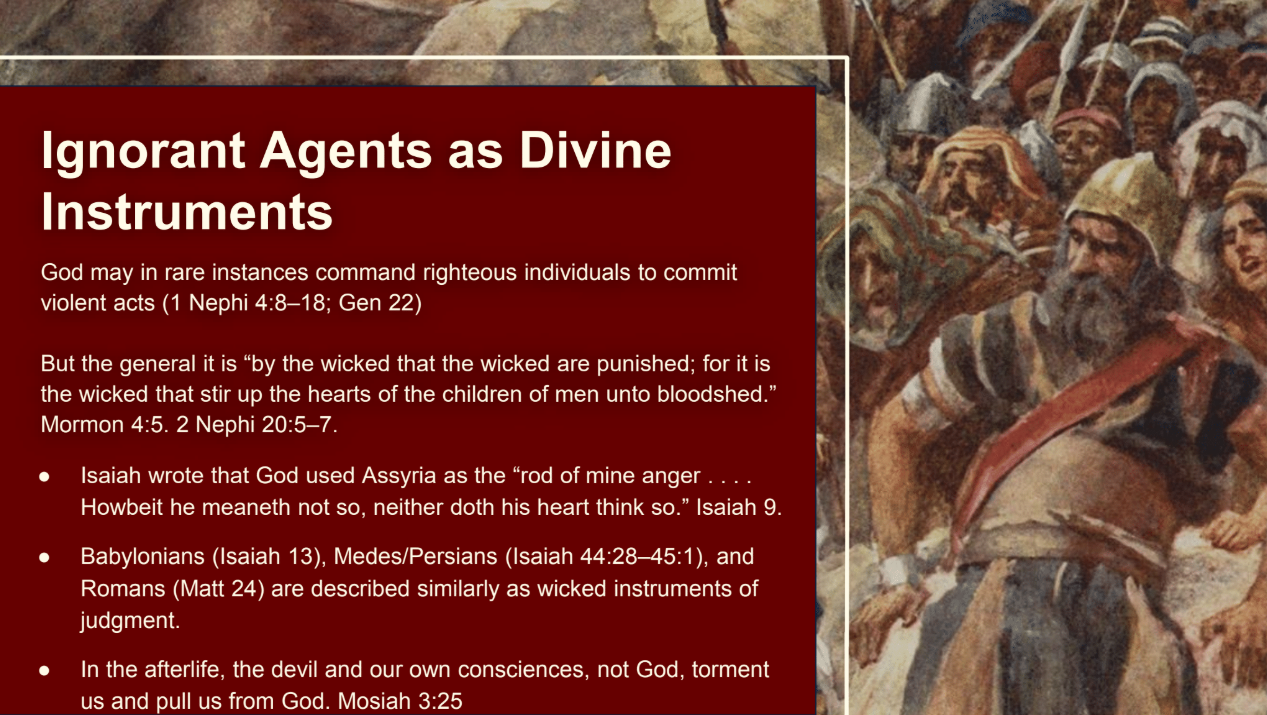
Because of this, God can use ignorant agents as divine instruments. And I would argue that God can accomplish His purposes on the earth, and orchestrate large-scale political things or judgments upon nations, using other wicked individuals.
And they may be somewhat aware (or may not be aware) that this is occurring. At the same time, the fact that God is orchestrating these things through them does not indicate that God approves of the behavior that they’re using to accomplish this.
An Example From Isaiah
I think we see this clearly in the book of Isaiah describing the nation of Assyria. Isaiah says that God is using Assyria as the rod of His anger to punish His covenant people. But Assyria doesn’t necessarily know that He is doing so.
And the manner in which it does it is displeasing to God and brings judgment. That’s a great example.
Mormon also teaches us that, in general, it is by the wicked that the wicked are punished.
There are instances when righteous individuals commit violent acts. Nephi might be an example. I think Patrick Mason in his book might dispute whether Nephi ought to have executed Laban. I think I disagree, but it’s a compelling argument.
But this seems to be the exception.
- The Babylonians
- The Persians
- The Romans
These are biblical nations that bring judgment upon God’s covenant people despite their being Gentiles (who are living a lower law than even Israel is).
We see this with the Lamanites, too.
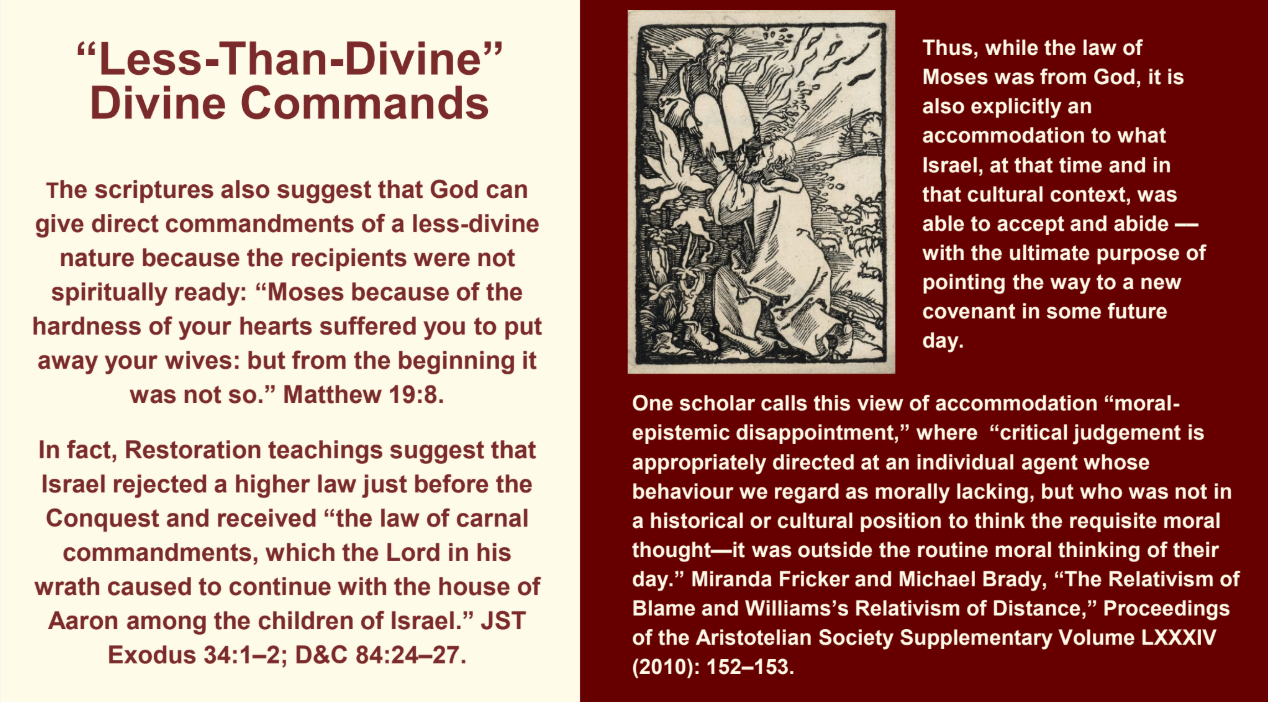
“Less-Than-Divine” Divine Commands
In case you’re not convinced that God can share something less than divine–that that’s actually contrary to what He would give us–Jesus seems to say that this occurred with Moses’s divorce laws.
When asked about it, Jesus says that Moses, because of the hardness of the hearts of Israel at the time, gave the law. (He) allowed this very free system of divorce. But that it’s not what God would have intended.
Restoration scripture paints this picture much more clearly. It says that Israel almost received a higher law. Then they became unworthy of it and received this lower law just before the conquest.
God explicitly accommodated them with a lower law of carnal commandments.
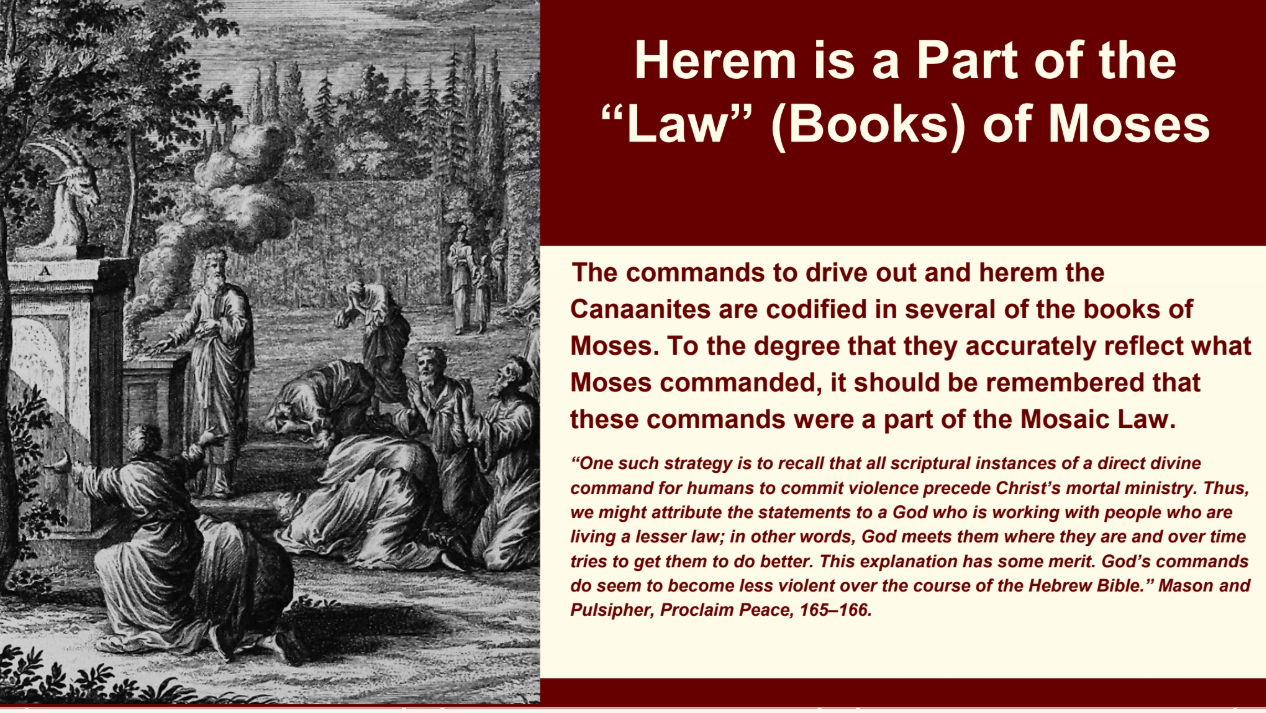
Herem in the “Law”
I would also argue that herem is a part of the Law of Moses. It’s certainly in the books of Moses. It is a commandment given by Moses to the Israelites in this spiritual state where they needed to be accommodated.
It’s found in the books that the rest of the commandments are given in. And in that sense, herem seems to be an explicit accommodation of Israel’s sinful state.
We know that this is a concept that Israel’s neighbors know about. Maybe they are familiar with this idea, and God allows them to accommodate it.
In the spiritual state they’re in, He couldn’t give them a higher law and let them abide by it. And so, He used them as ignorant agents to bring judgment upon the Canaanites.
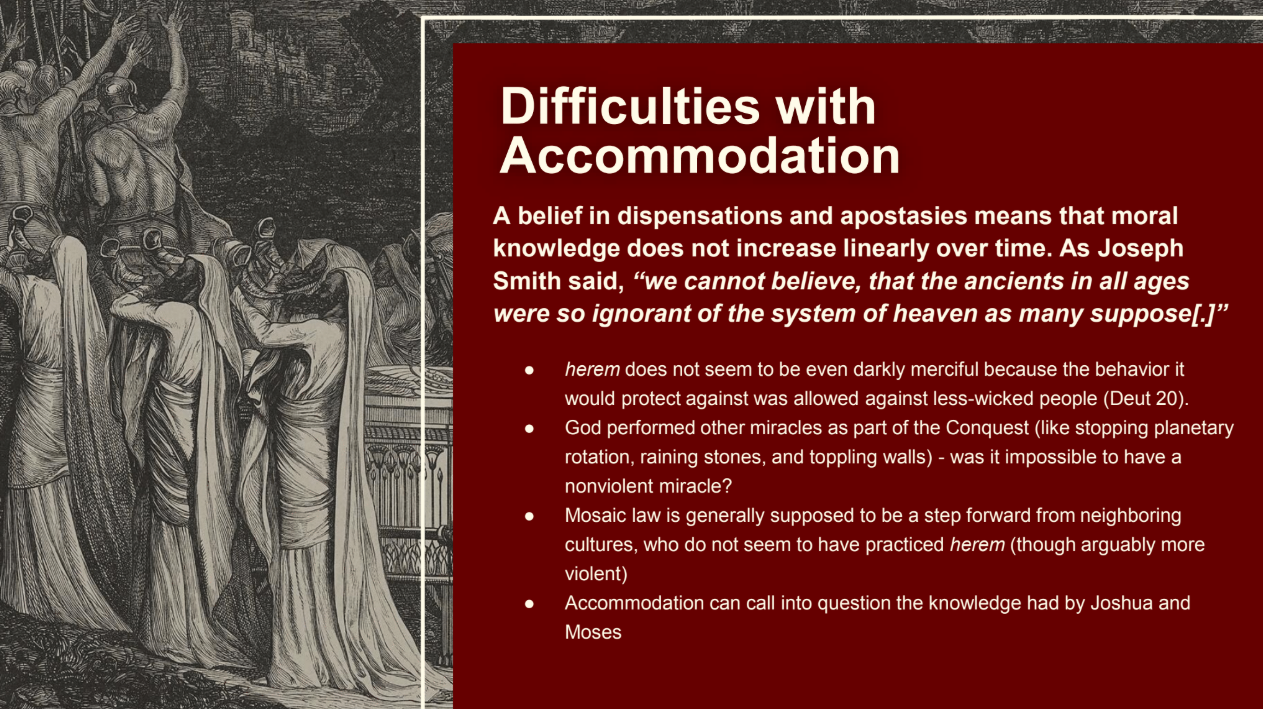
Difficulties with Divine Accommodation
Why might we not want to lean too far on accommodation?
Joseph Smith indicates that the ancients may have known God’s ways better than we assume. (Though I think the passages talking about the wickedness of Israel might negate that to a degree.)
We also wouldn’t want to malign Moses or Joshua. Especially when Joshua is the namesake of Jesus and is a type of Christ as well.
Also we see miracles in the conquest even though Israel seems to be wicked at the onset of the conquest, right? The walls of Jericho tumble. Stones come from the sky.2 The sun seems to stop in the sky.
Why wasn’t this all just done miraculously? It’s unclear. Maybe that’s a separate tradition.
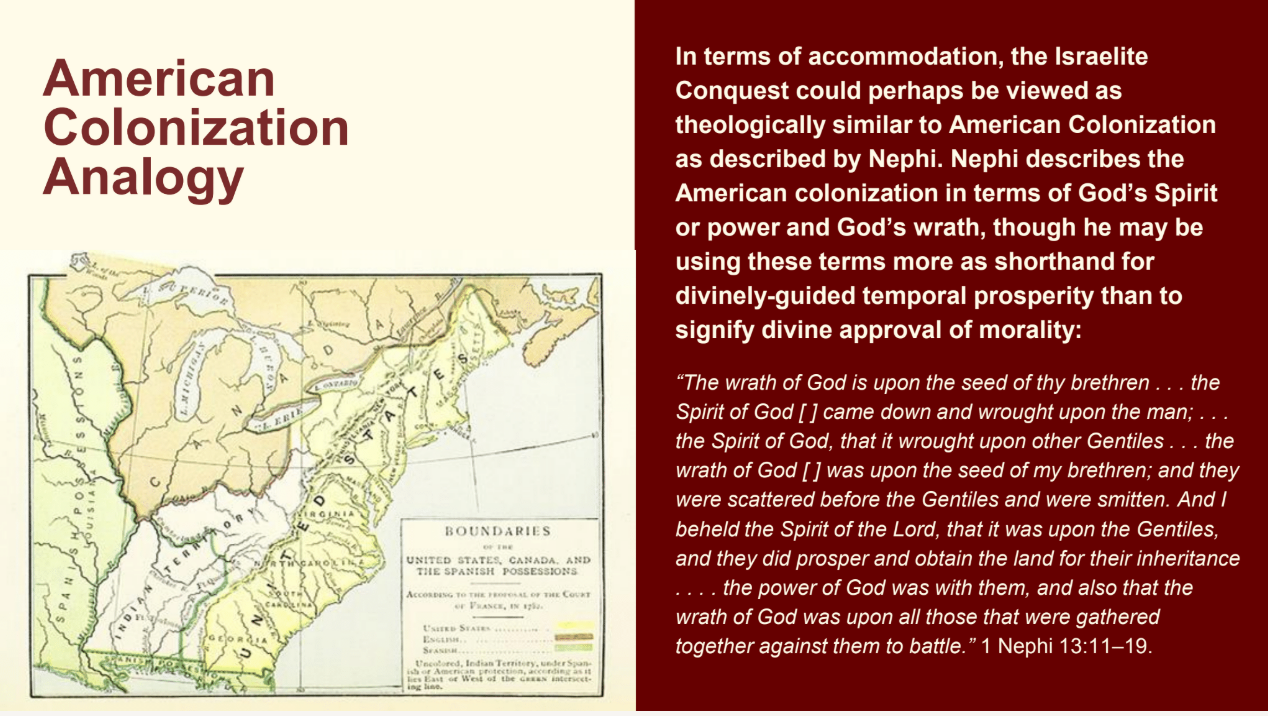
America Colonization Analogy
A lot of the criticisms that I’ve read of the book of Joshua attacking the Bible compare this conquest of Canaan to other events in history to try and paint it as horrific.
But I think that comparing the Israelite conquest to the American colonization can actually be really insightful because we have scripture about the American colonization from Nephi.
When Nephi describes the colonization process in the Americas, he seems to use these broad terms to describe prosperity and lack of success. He says that the Spirit of God and the power of God are upon these Gentiles who come over, and that’s why they prosper.
And the wrath of God is upon the individuals who are already there, and they begin to not prosper. He seems to use it as a shorthand for prosperity.
And the question is: does this indicate that these individuals, on the one hand, were totally wicked and that these other individuals were totally righteous, were perfectly aligned with God’s will?
Nephi calls that into question.
God Uses Imperfect Individuals
He says that even though these individuals are humble and are empowered by God, because of missing passages in the Bible, they stumble exceedingly. Satan has great power over them.
And he seems to be saying that God is using these individuals to accomplish a purpose that He intends, while He doesn’t necessarily approve of all the methods by which it is being done upon the ground.
This may be the same with the conquest of Canaan. Perhaps there’s a difference because God is directly commanding, but that difference seems to be slight to me.
Other Gentile individuals claim to be commanded by God or said to be directed, like Cyrus. And that doesn’t necessarily mean that he lived God’s covenant completely.
Furthermore, the book of Judges, when describing how God empowered political champions of Israel, uses the phrase “the Spirit of the Lord came upon them” to describe Samson, Ehud, Jephthah, Gideon, even though these individuals were involved in behavior that we would probably find offensive.
Samson most of all—his behavior with Delilah and his violence. But also the potential child sacrifice by Jephthah, assassination, Gideon turning to idolatry.
And so perhaps this notion of divine power or spirit doesn’t map on entirely to understanding God’s ways.
And similarly, God can intend for consequences in the world broadly without approving how they are done.
In that sense, anything evil that occurs is not on the heads of the Israelites. It passes to God, and we have a general Problem of Evil question that goes beyond the scope of this.
If God Commands, He Has a Reason
Finally, the third theodicy. If God had commanded the conquest, if we agree with the text, then He had a reason for doing so.
To explore this question and whether the Canaanites deserve it, we have to look at who the Canaanites are.
The Canaanites and Their Wickedness
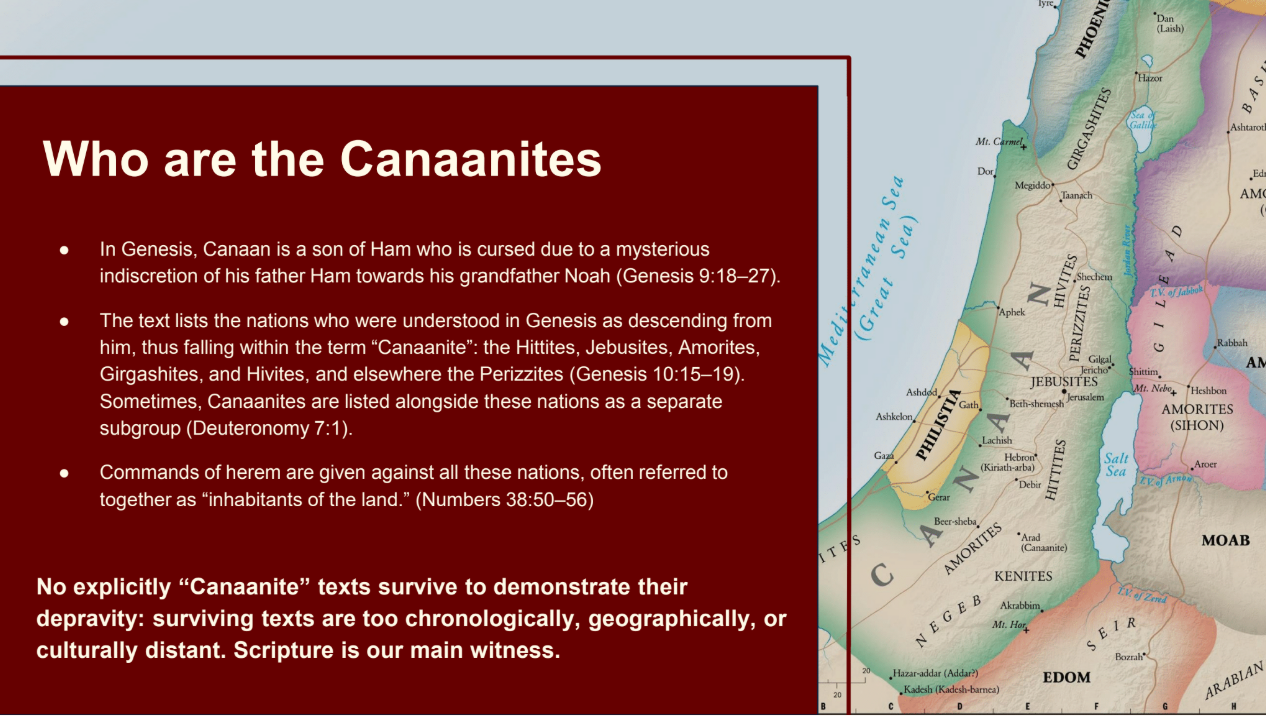
In the book of Genesis, Canaan is one of Noah’s grandsons. He’s cursed for these mistakes that his dad makes, and this seems to pass down to his lineage.
There are these seven Canaanite nations. (though sometimes Canaanite is considered to be a sub-nation. The terminology is unclear sometimes. The phrase “inhabitants of the land” is more common.)
The difficulty is that we don’t have texts that claim to be Canaanite that tell us about their culture or who they were necessarily.
We have texts from up in Ugarit that seem to be too far away to be explicitly Canaanite, even though their ideas and concepts of deity seem similar.
So we have to rely on scripture, for the most part, for our conclusions about Canaanite culture.
What does the Bible say?
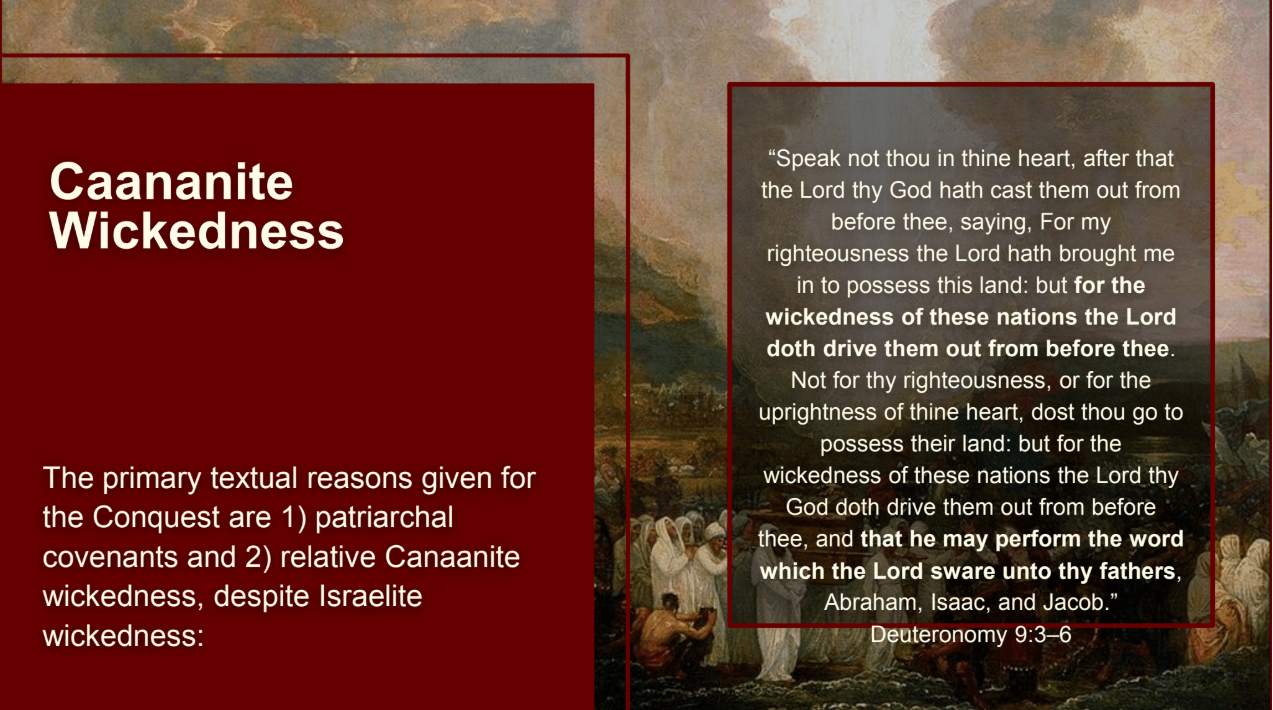
The Bible says that the reasons for the conquest are:
- The wickedness of the Canaanites and their infectious idolatry. But also,
- The promises made to the patriarchs.
And Moses explicitly says that it’s not because Israel’s righteous. It’s because they’re more righteous. That’s what Nephi says too.
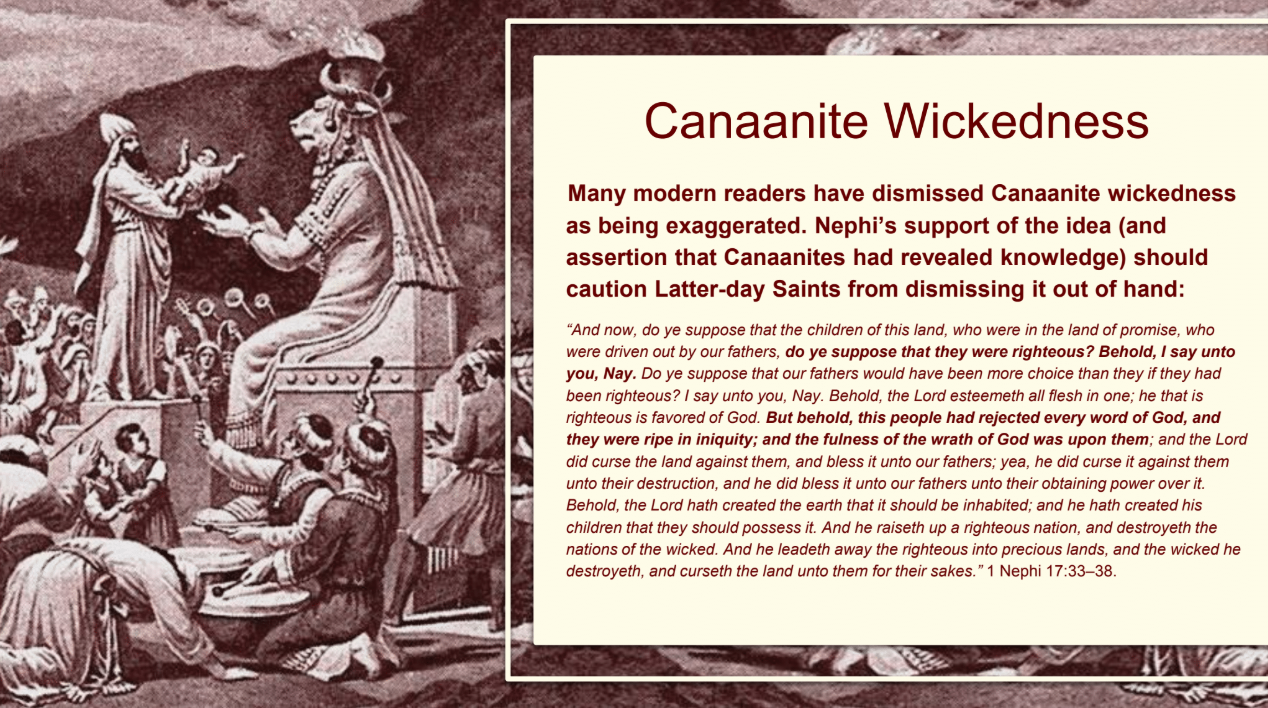
In our day, Canaanite sinfulness is kind of laughed at. Many of the passages describing Canaanite sin are sexual in nature. With the way that sexual ethics have changed over time, many moderns are skeptical of the fact that the Canaanites were really wicked.
Even some Christian scholars, like John Walton, seem to contend that the Canaanites were not really wicked.
But Nephi tells us that “they rejected every word of God”. Presumably he has more knowledge on that.
He suggests that they had prophets of their own and explicitly argues that they were not righteous.
The Sins of the Canaanites
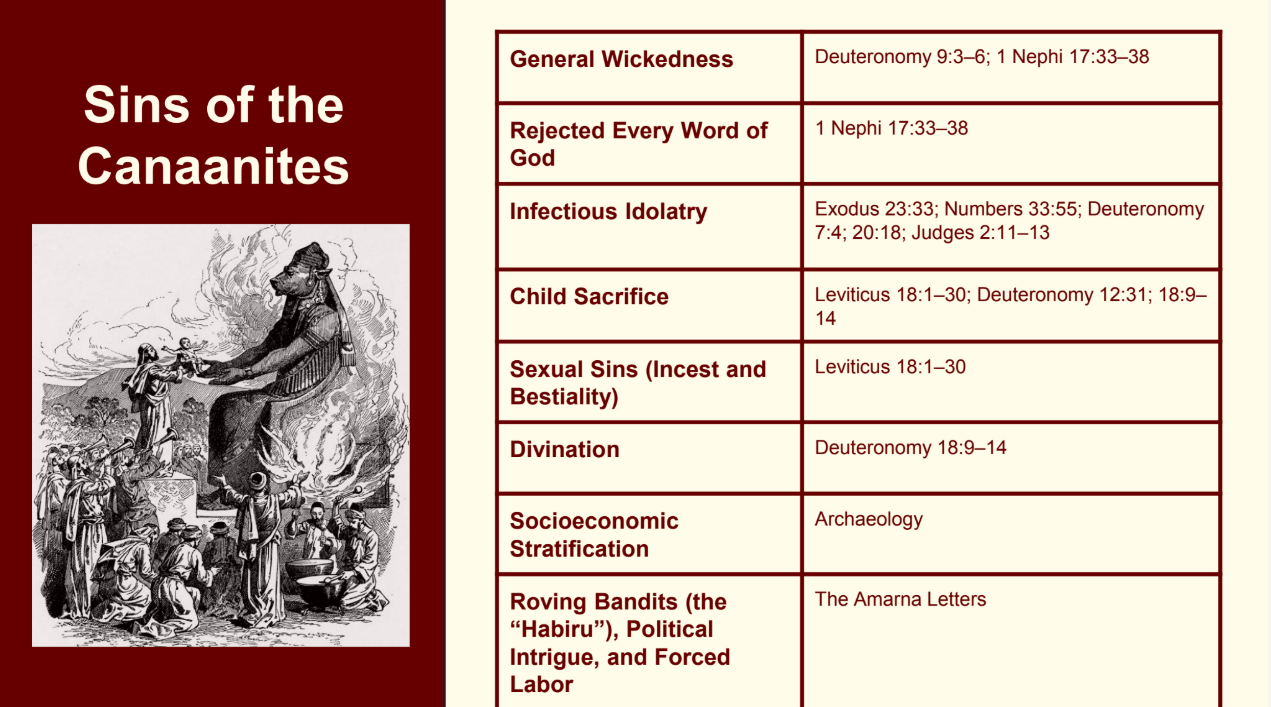
What are the sins of the Canaanites? If we put them together, we might have a list something like this.
- They’re generally wicked and denying God’s prophets, and their idolatry is especially dangerous. That’s mentioned the most.
- But they also sacrifice children or offer them in the fire to Molech.
- They have these unsavory sexual sins.
- They have improper divination.
And that’s what we get in scripture.
Outside of that, archaeology seems to suggest that these Canaanite cities are extremely stratified. 3 And some have said that there are economic sins going on as well. 4
If we read the Amarna letters into Canaan, if those count, then we see that we have forced labor and roving bandits and these competing, sneaky city-states.
And putting all this together, we see that perhaps society wasn’t so good.
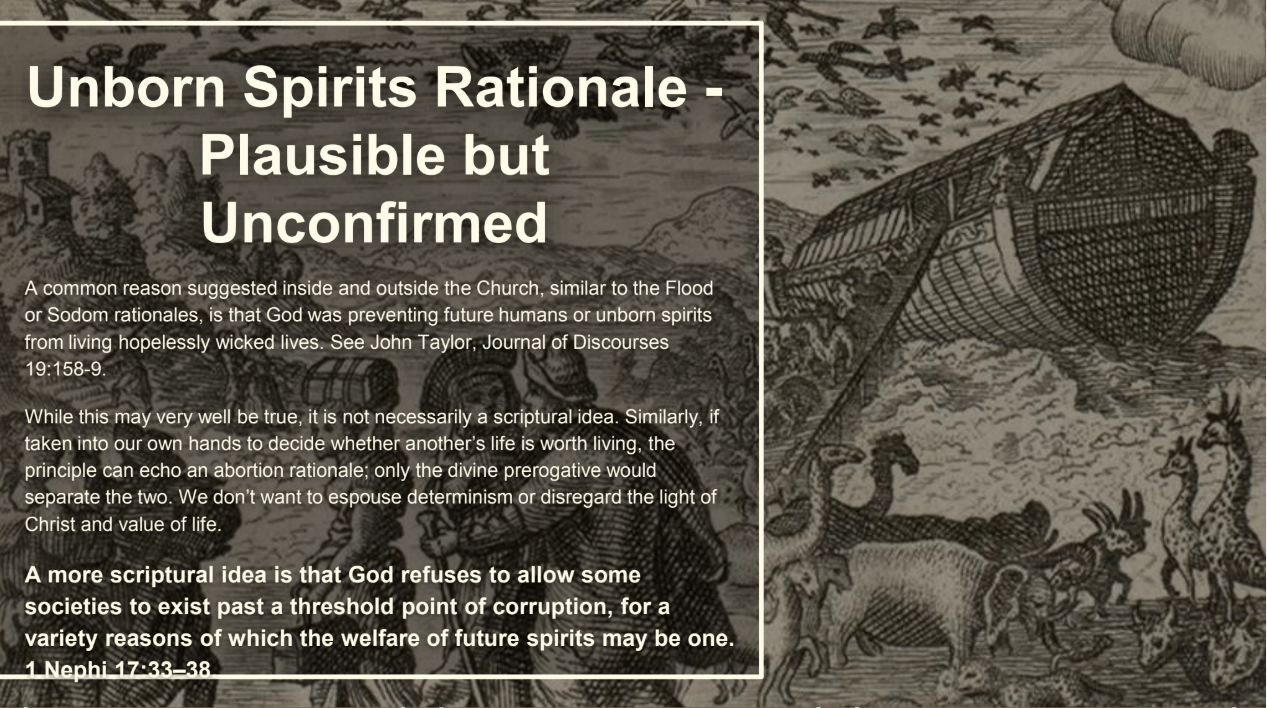
Saving Unborn Spirits from Wickedness
Maybe the conquest occurred because God didn’t want unborn spirits to come to earth and live a life where they would almost certainly become wicked.
I lean away from this justification that comes up often in the flood. John Taylor seems to suggest that that may have been why the flood occurred.
I think that a more scriptural answer is to say that:
For a variety of reasons, God caps a society at a certain threshold point of corruption when He won’t allow it to exist further.
And maybe the welfare of future spirits is one of those. But there are other reasons that we might want to lean on more.
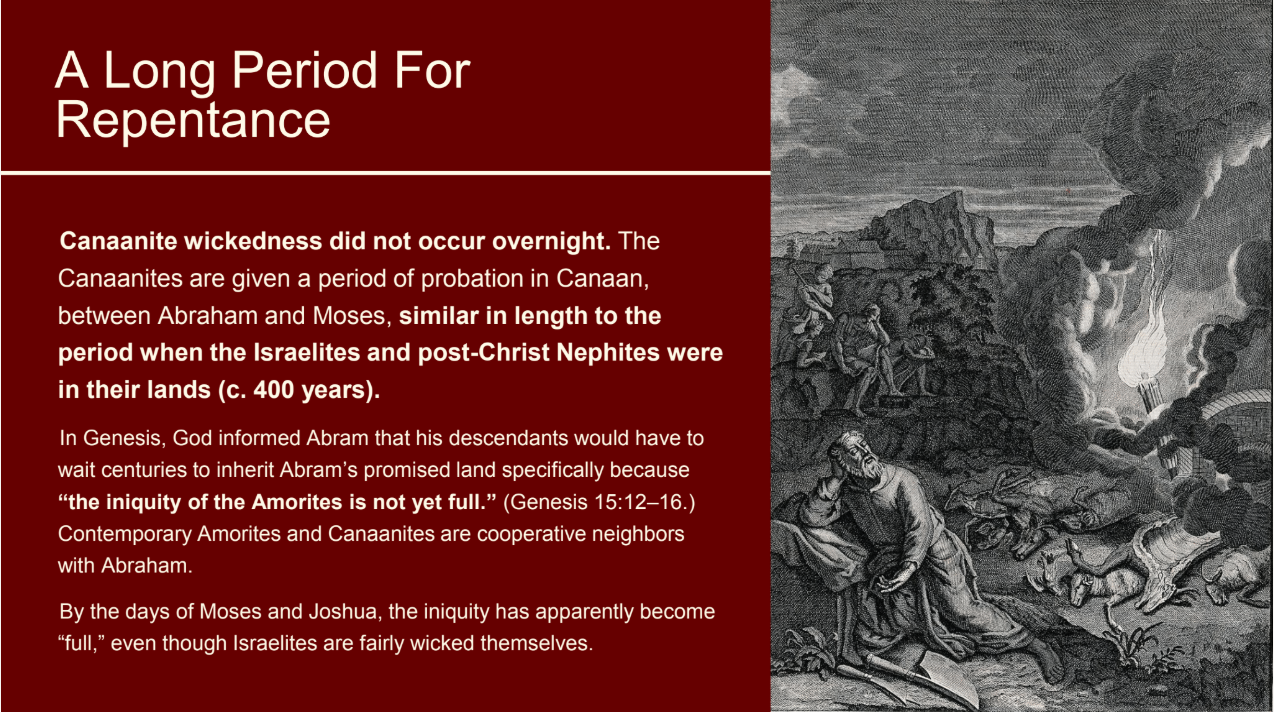
Long Canaanite Repentance Period Granted
We might also note that the Canaanites had a long time to repent.
Abraham has a nightmare where God tells him that his descendants will be in slavery for centuries while they wait for this land to be ready, while they wait for the Canaanites to be wicked. Which is a high price to pay.
But they’re in the land a similar amount of time to the Nephites being in the land after Christ visits or the Israelites being in their promised land. So they seem to have a long time.
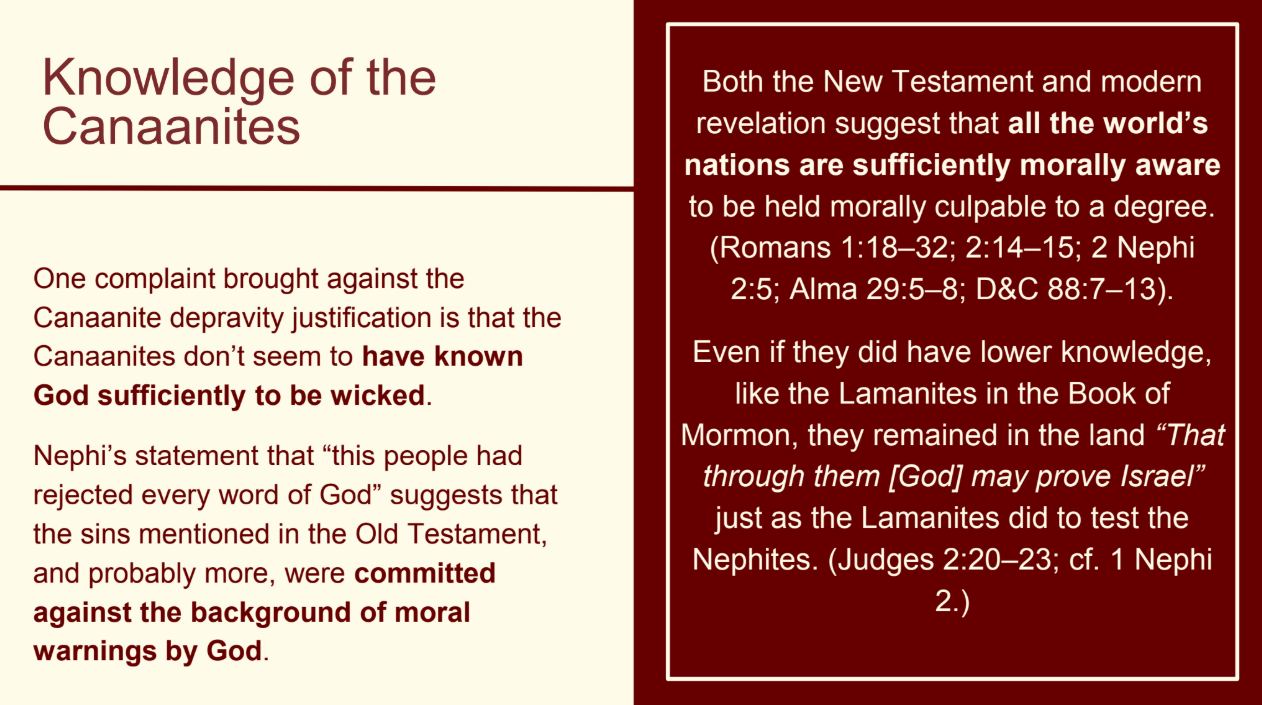
Nephi tells us that they knew about God, and other scripture tells us that there’s a general moral awareness among all mankind that lets us be held accountable to a degree.
Even if they didn’t know that much, they are kept in the land according to Judges as a scourge upon Israel. Just like the Lamanites are in the Book of Mormon, who also knew less.
So either way, I think we could say that they’re treated according to the amount of knowledge that they had.
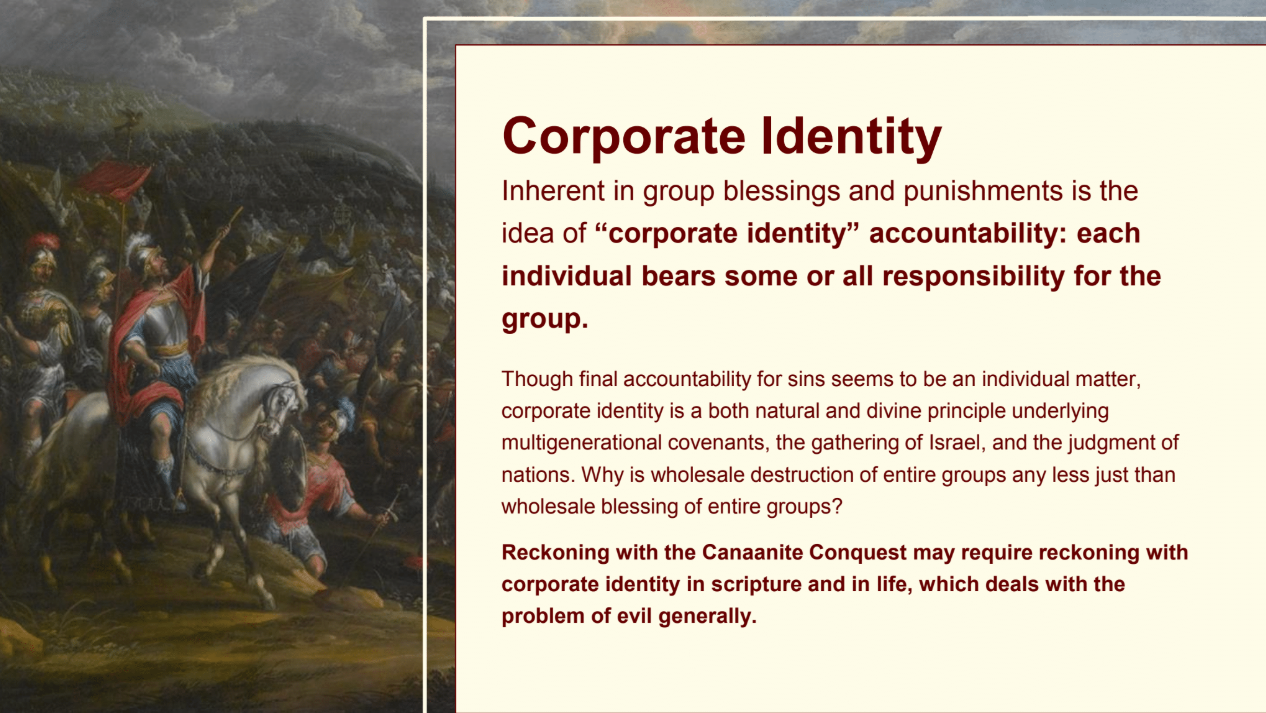
Whole Group Blessing or Destruction
We won’t get into this too much here. But ultimately, any group punishment concept or group blessing concept—we might call corporate identity—must be addressed when looking at these macro-scale actions of God.
Why is it justified? It’s not always clear, but this is something that plays into this. It ought to be treated separately and is worth acknowledging.
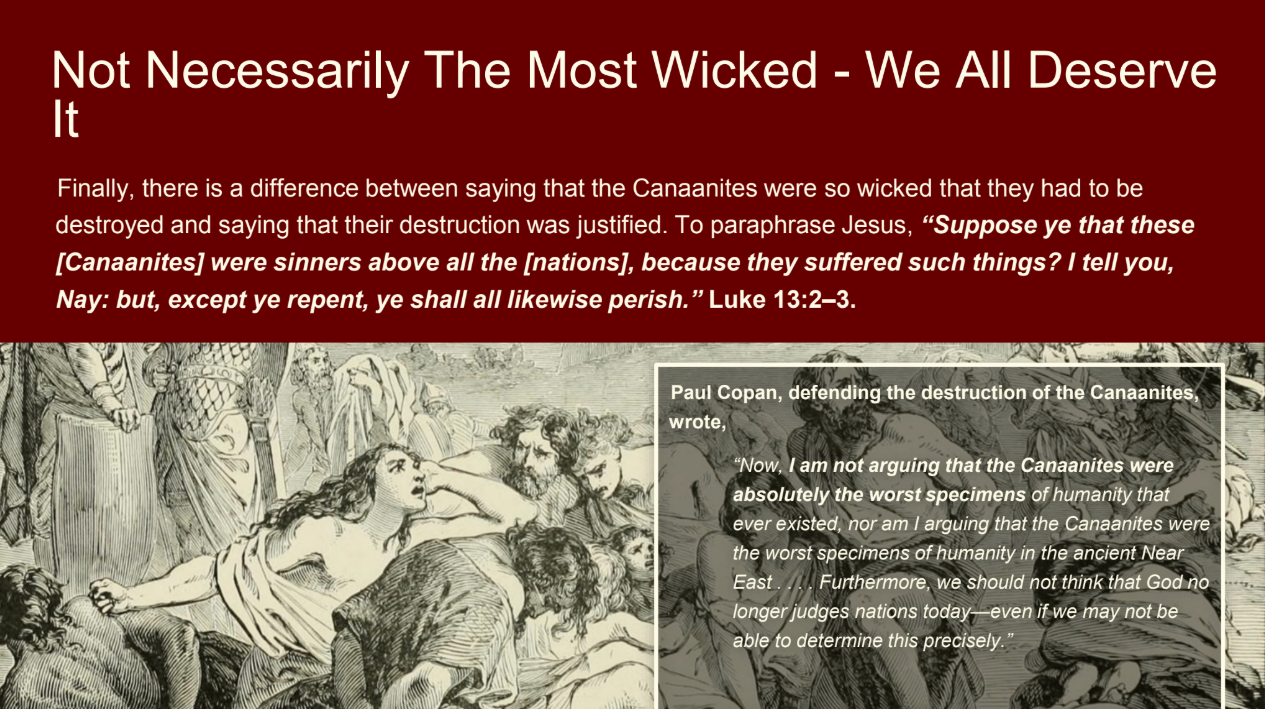
The Most Wicked
Finally, despite all these Canaanite sins that we see, we don’t have to necessarily argue that they were the most wicked.
When certain Galileans died, Jesus tells His disciples not to assume that because these individuals suffered horrible things that they were the most wicked.
He says, “You might be just as wicked,” and ultimately we all perish if we don’t repent.
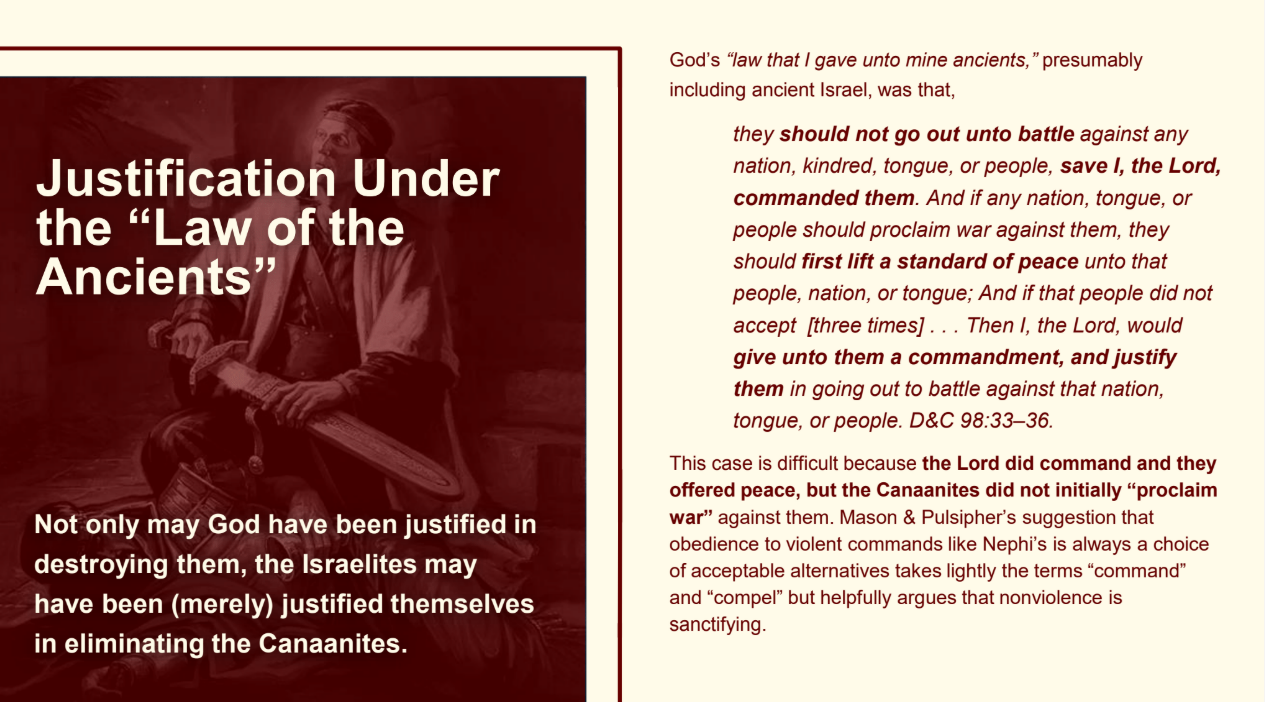
Justification of Violence
The Doctrine and Covenants gives us some additional insights on when violence is justified.
God says that the law He gave to His ancients is that they shouldn’t go to battle unless God commands it. But He also says that they should first lift a standard of peace. And then He will command or justify.
This seems to be the case in the Canaanite narrative.
However, the Doctrine and Covenants also seems to assume that God’s people are lifting a standard of peace in response to an aggression, up to three times. Whereas the Israelites seem to be the aggressors in this case. It’s not as clear that this lines up perfectly.
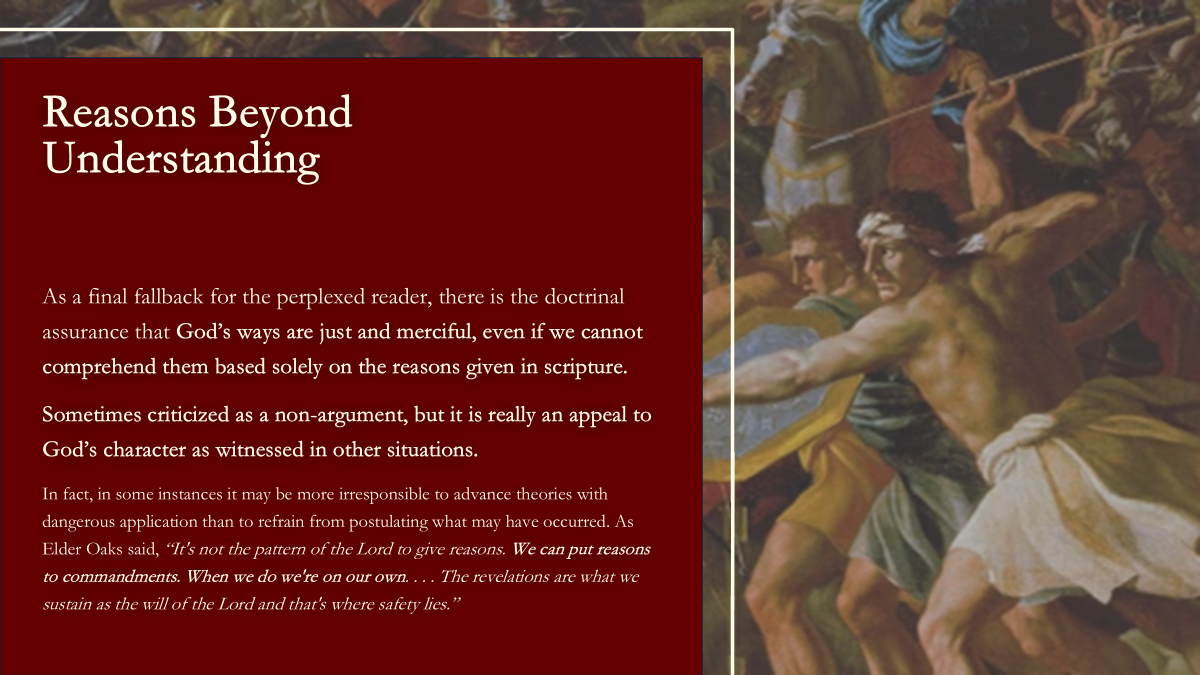
Reasons Beyond Our Understanding
Finally, if we don’t like the textual reasons, we can always note that God has a reason for everything He does.
If He did command this, then He has a perfectly rational and just reason for doing so.
This is frequently criticized by critics of Christianity as a non-argument. But really, it’s trusting God’s ethos.
In fact, we’ve been warned by our leaders that in some cases, putting forward arguments and explanations when we don’t know what’s going on can be harmful. If we lean on it too much, it causes harm to others.
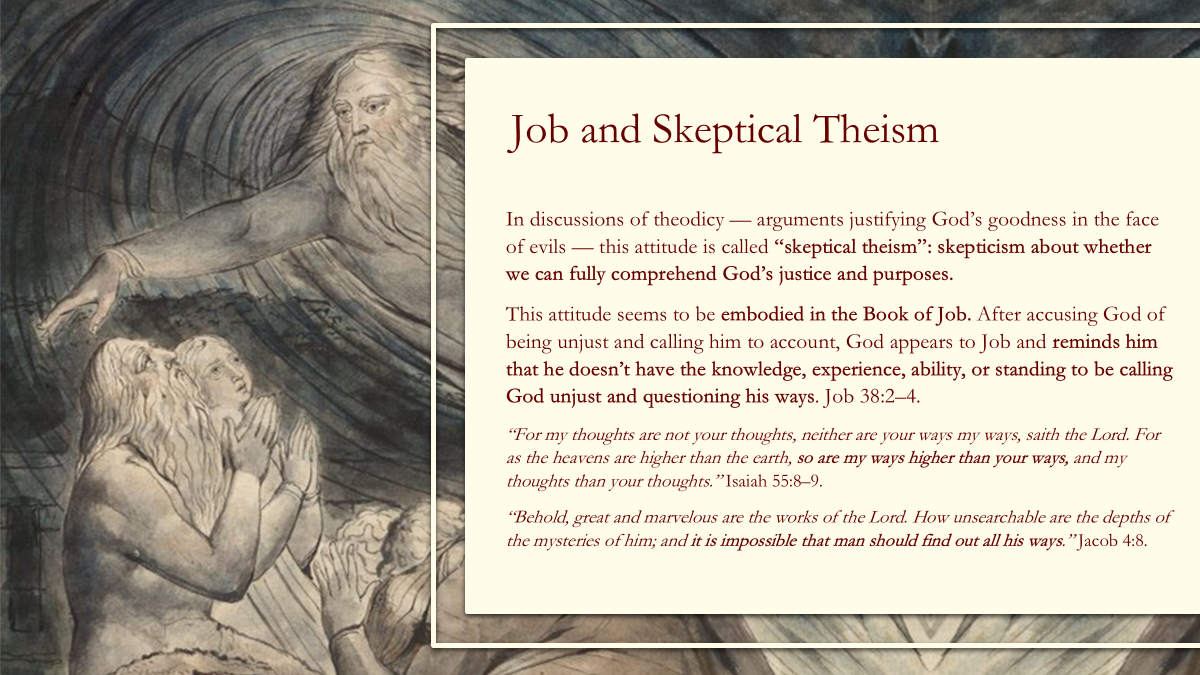
Job and Skeptical Theism
I think we see this philosophy of trusting that God has a reason most in the book of Job.
Philosophers might call this “skeptical theism”. You’re a believer in God who is skeptical about whether we can understand God all the way.
In the Book of Job, Job questions God while he’s suffering. Job takes Him to task and asks Him to appear.
And when God does appear, He reminds him that Job wasn’t there when the world was created. God was. God has knowledge for what He does. And Job doesn’t have the status to be questioning God.
Maybe it’s more friendly how Isaiah says it:
God’s ways are higher than our ways.
And Jacob says it’s actually impossible that we can find out all His ways.
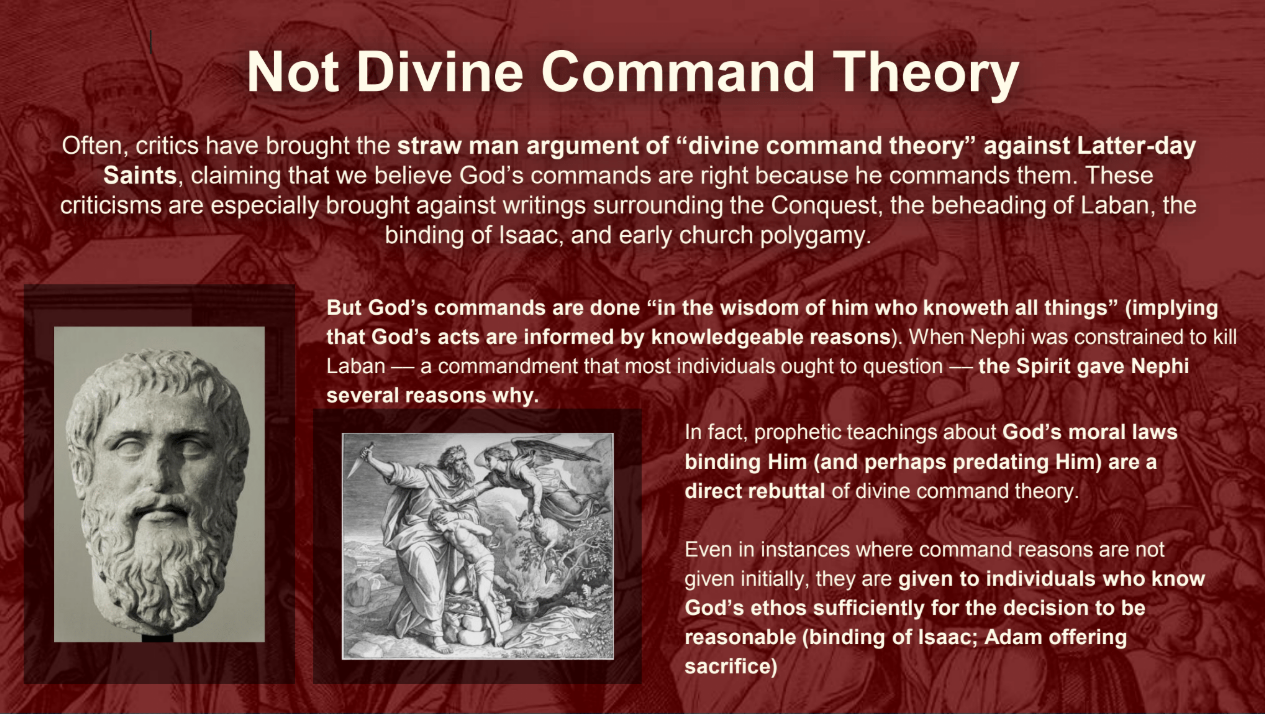
Not Divine Command Theory
We would do well to differentiate this, I think, from Divine Command Theory.
Socrates, talking to Euthyphro, talks about how it’s philosophically problematic to believe that something is good because a divine being commands it, rather than having it be a set principle.
Sometimes critics make a straw man argument that we believe in Divine Command Theory. Especially with instances like early Church polygamy and the discredited Happiness Letter.
But this also comes up in the conquest story, the beheading of Laban, the binding of Isaac.
However, we see reasons given consistently. We also know that God does everything He does in wisdom. He has reasons for doing so.
And where an explicit reason isn’t given initially, it’s often because someone knows God enough already that they have a reason.
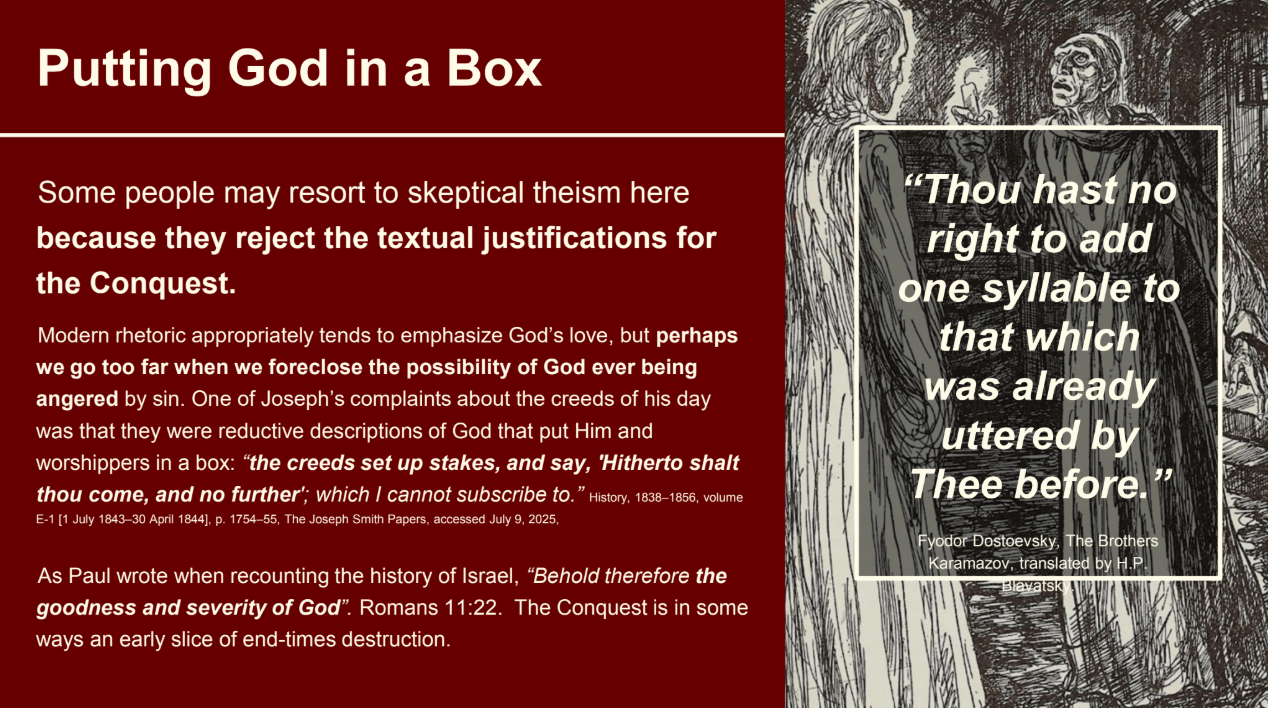
Perhaps the danger for believers in putting skeptical theism forward too quickly is that we are doing so because we’re rejecting the textual justifications.
We’re saying that the Canaanites couldn’t have been that wicked. God could not have been that angry.
I think that’s theologically dangerous as well.
One thing Joseph Smith didn’t like about the creeds of his day was that they set up stakes or boundaries for God and worshippers. They said, “This is the definition—you can’t go outside this.”
It prevented people from understanding God better.
Paul, writing about the history of Israel, seems to be convinced of both the goodness and severity of God.
And this is certainly the most intense passage in the Old Testament. But I would suggest that maybe we shouldn’t rule it out.
Modern-Day Applications
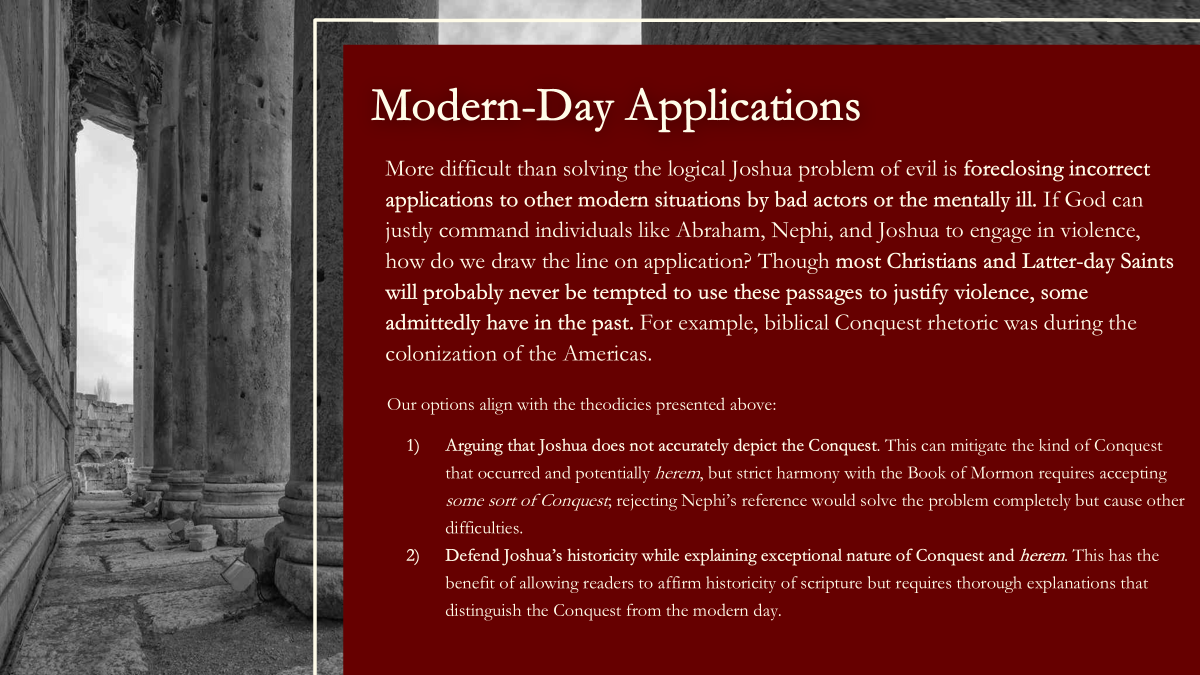
Finally, I think the danger of this passage (and what’s critiqued most often by critics) is the fact that this could create dangerous precedent.
How do you take instances where God commands or allows violence in scripture and foreclose that from improper applications by people who are going to claim it or who are mentally ill?
We’ve had the Laffertys and the Daybells in the past few decades, but the book of Joshua is on a massive scale.
We saw a lot of conquest rhetoric involved in the colonization of the Americas, for example. And there’s some scary stuff there.
How do we prevent that from being improperly done?
One thing that we can do is to argue that perhaps the book of Joshua doesn’t accurately depict the conquest. Maybe herem didn’t actually occur.
If so, there’s still a displacement. If we believe Nephi, there’s some kind of conquest, but maybe not the extremeness that we see in the book of Joshua.
But either way, we’re defending some kind of conquest. We need to acknowledge that God has a reason, whether or not that’s the reason in the text.
I think these are valuable principles that can help us not go too far.
Problem-Preventing Principles
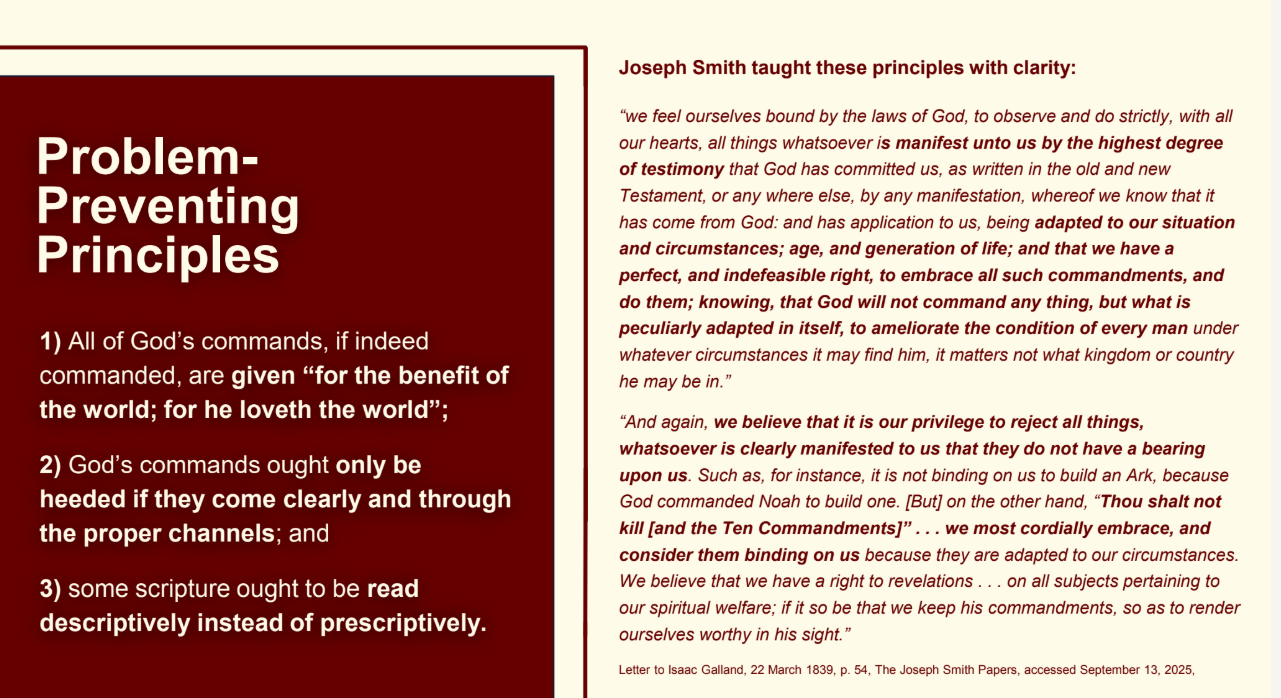
Joseph Smith teaches us that any command God gives is to ameliorate the condition of man. He gives commands because He loves them.
He also notes that only those things that are manifest unto us by the highest degree of testimony are binding upon us.
If it:
- doesn’t come through prophetic channels, and
- if it’s not certain and clear
we don’t have to do that thing.
He also notes:
- that we have a privilege to reject all things,
- that not everything we read in scripture is meant to be taken prescriptively,
- especially when it’s not clearly binding upon us.
And he notes that the command not to kill is binding upon us.
I think with principles like this, we’re not going to overextend the Joshua narrative.
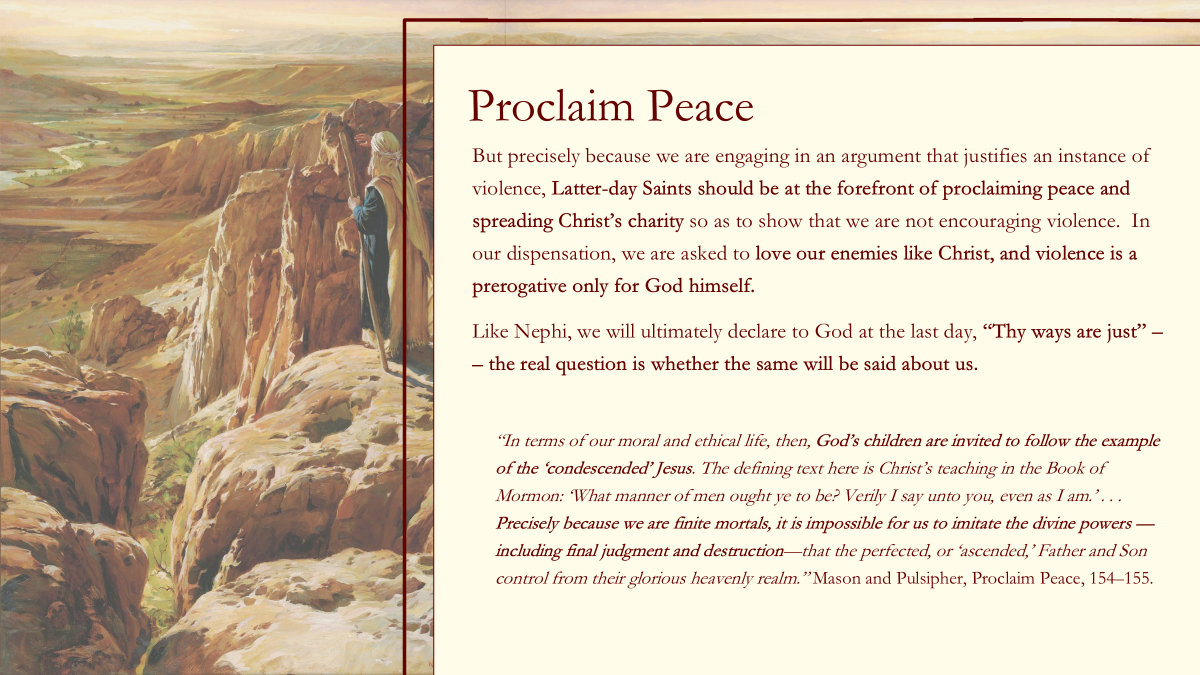
Proclaim Peace
Finally, I would just encourage us as Latter-day Saints, as we make arguments to defend violence, to also be at the forefront of spreading charity in the world so that
- no one gets confused about what we stand for and
- to make sure to love others like Christ.
God the Father is perfect, and Jesus is now too. They can justly use violence.
But here on the earth, I think Patrick Mason and David Pulsipher say it well when they say that we ought to follow the condescended-Christ example.
We should submit. And we should always choose nonviolence when possible.
Thank you.
