History of FAIR
In 1997, I logged in to America Online Mormonism message board 1 expecting to find friends. Instead, I found critics. I was quickly surprised by the sheer volume of vitriol and criticism of The Church of Jesus Christ of Latter-day Saints.
Common claims included:
- You can’t add to the Bible (referencing, of course, the Book of Revelation)
- You preach a different gospel (quoting from Galatians),
- You believe Jesus is the brother of Satan (I’m not sure where that comes from in the scriptures, but it was there)
- You’re getting your own planets; and
- Mormon women will be eternally pregnant.
Even baptism was weaponized, declaring that it was a work that can’t save you.
These arguments, of course, were unfair, misrepresentative, or flat out wrong. And yet, this year, some seminary students in my ward in Redding, California, reported hearing these same arguments at school.
Early Online Opposition
Occasionally on America Online, I encountered the truly bizarre – like the claim that the Salt Lake Temple has six spires pointed toward heaven to impale Jesus at His Second Coming. (Yes, really. It’s really sad.)
I eventually learned that this message board was hosted by a group called Christianity Online, which wasn’t intended to engage Latter-day Saints in dialogue, but to talk about us—and not kindly.
A few of us Latter-day Saints started responding, offering what I like to call a different perspective. We were effective—so effective that some of our evangelical posters lobbied America Online to restrict our participation, and they were partially successful. Eventually, we were told as Latter-day Saints, we could only post on the Mormonism board and not on any of the other religion forums.
The Birth of FAIR
So we started our own message board on that early World Wide Web, and drew many participants away from the AOL Mormonism board.
A few of those early defenders—Julian Reynolds, Tom Hickey, John Lynch, and others—formed a corporation to provide structure and legal protection for the website. On December 19th, 1997, the Foundation for Apologetic Information and Research was born, a 501(c)(3) nonprofit corporation in New York State.
Well, I observed this happening. I wasn’t actually part of FAIR’s creation. (You can know that’s true because I would never have picked that pretentious name.) I was busy being a bishop, a school board member, a husband, and a father. But I was invited to join the FAIR board one month later, in January 1998. Someone thought having a bishop involved might lend some credibility.
Critics on the message board would often claim we weren’t high enough up in the Church to know the “real truth” that had supposedly been hidden from the membership. Having a bishop involved made that argument harder to sustain, especially among people who didn’t know our structure.
First FAIR Conference
In 1999, we hosted our first FAIR conference in Ben Lomond, California. I think the scholars came more for the redwoods than for us, but they gave fantastic talks. The speakers also made up most of the audience.
Since then, we’ve hosted a conference every year. This conference marks our 26th. I became president in 2001, and with the help of professional editor Allen Wyatt, we set standards and improved our professionalism.
Our message board exploded in popularity—so much so that our internet provider called me on the phone and asked why we were so popular.
Shifting Away from Message Boards
Now, we have to remember this was before Reddit, before YouTube, before Twitter, and before Facebook. The popularity brought problems. Reporters looking for quotes on Church-related issues began citing posts from our message boards as if they represented FAIR.
Often they quoted critics by mistake, saying, “Well, the FAIR board says this” or “FAIR says this.” To prevent this, we divested ourselves from our message boards in 2006 and instead focused on building our Answers Wiki, led by volunteers like Roger Nicholson and Greg Smith.
The Sandra Tanner Lawsuit
A little before that time, in 2004, one volunteer created a parody of the Utah Lighthouse Ministry website, a well-known anti-Mormon outlet run by Jerald and Sandra Tanner. It was a private joke, shared only among a few close friends and volunteers.
In 2005, Sandra Tanner sued—personally naming me, of course, even though I had nothing to do with it. She demanded $50,000 and control of the FAIR website.
Our total assets at the time: $4,000. With pro bono help from attorneys Ron Dunn and Lance Starr, the case was dismissed in 2007. Two years later, Sandra Tanner appealed, and in 2008, the 10th Circuit Court of Appeals—where future Supreme Court Justice Neil Gorsuch sat—again ruled unanimously in our favor.
The case was important because it set guidelines on differentiating free speech and commercial speech on the internet.
Two additional attorneys, Steve Miles Holman and Ron Walker, helped us with the appeal. I mention these attorneys because I appreciate the time they donated to us for the case. During the appeal, Ron Walker leaned over to me and pointed to Dr. Miles Holman, saying, “You are lucky to have him. Even I can’t afford him.”
Increased Media Presence
Around this time, Mitt Romney ran for president. The Church likes to avoid politics, so the reporters came to us often. The suggestion was then known as Church Public Affairs.
We were quoted in The New York Times, The Los Angeles Times, The National Post of Canada, The Wall Street Journal, and other newspapers. I was also on several radio shows, including radio shows talking about the Church.
And I even appeared on the Fox News Alan Colmes radio show. I once had my college president (because I work at a community college. FAIR doesn’t pay me; I have a “real” job, I guess.) stop me in the hall and say, “Scott, was that you quoted in The New York Times?” and I just mumbled back, “Yeah, that was me.”
We even met with a few foreign consulates who wanted to understand what it meant to have a Latter-day Saint in the White House. We built a news feed service at that time that many news agencies subscribed to around the world. Though it is now retired, we were a central resource during a pivotal time.
Growth and Rebranding in the History of FAIR
In 2013, we rebranded as FairMormon. That is a much more searchable term. Then in 2021, following President Russell M. Nelson’s counsel, we once again became simply “FAIR” with a new tagline (Faithful Answers, Informed Response) and adopted the new website fairlatterdaysaints.org.
Current Reach and Activities
Today, we host an annual conference, maintain a website with over 12,000 pages, run a YouTube channel with more than 3,000 videos, publish blogs, respond to the latest television productions, produce Come, Follow Me activities, and have a growing international reach.
As the world moves towards AI, our material is one of the sources that feeds the AI models. So yes, ChatGPT, Grok, Copilot, and Perplexity all know who we are, and they use us as a resource for faith material on difficult questions.
We’re currently digitizing and transcribing past conference talks, updating old videos, creating shorts, and translating talks into other languages. We have even started publishing books based on our virtual conferences.
Funding and Support
But here’s the reality: much of this work requires more than volunteer time. We’ve had to hire a few workers, and with that modest investment, our output has been greatly increased. We’ve also been given some website technical help donations.
At one point, one of the probable alternatives we had ahead of us was to simply shut down FAIR because our website had so many problems. But thankfully, one donor gave us some significant technical help to update some of our old website infrastructure. Again, that was a significant donation.
For years, FAIR has operated on a shoestring budget—less than what one particular critical podcaster earns as his personal salary. Yet we provide the resources many current podcasters rely on.
We get calls and emails from people who say, “I stayed in the Church because of what I found on FAIR.” Others have told us, “I didn’t always agree, but you made me think.” And that’s a win in today’s noisy world.
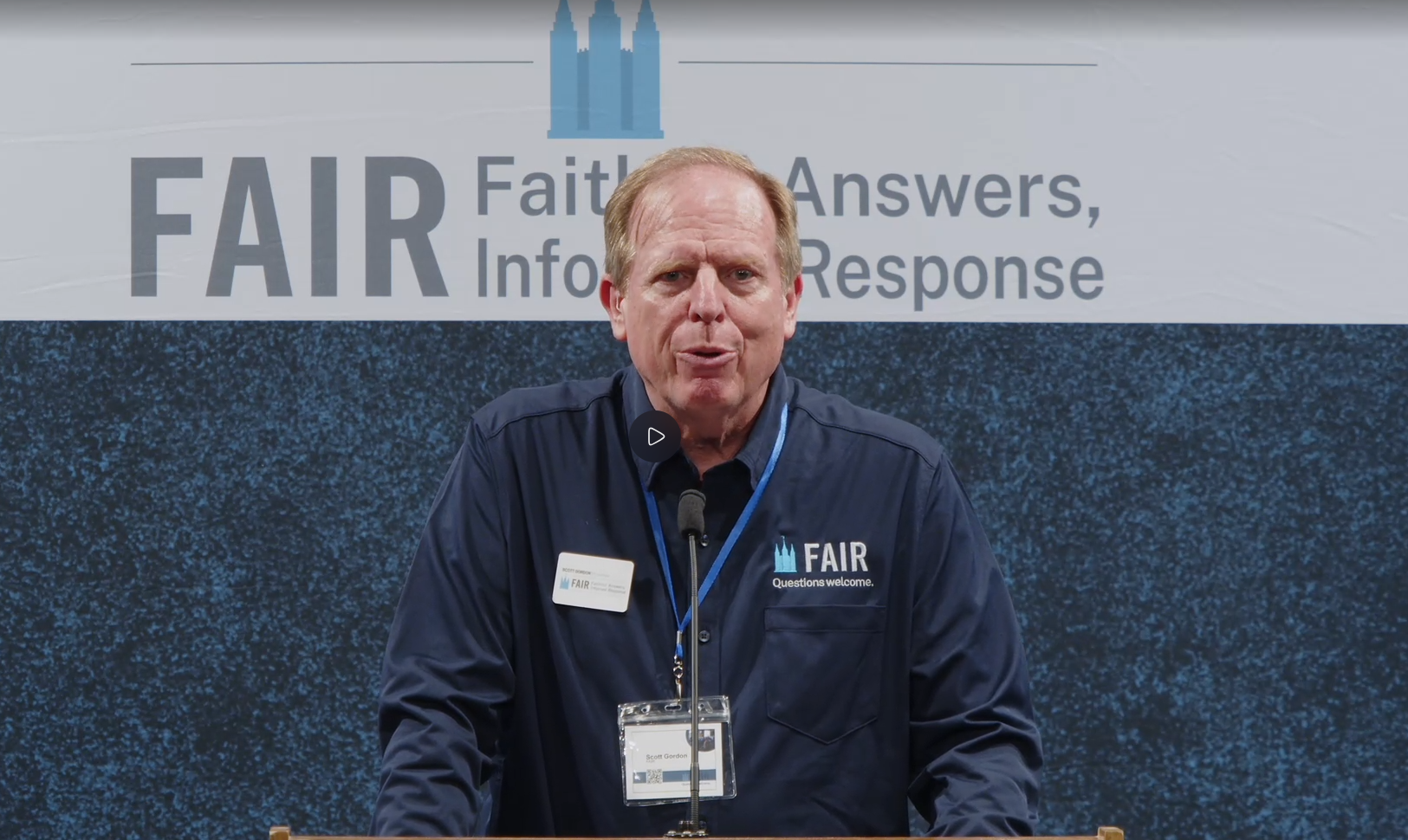
Personal Encounters and the Call to Support FAIR
I was seated at the Sacramento airport waiting for a plane. A man walked up to me and asked, “Are you Scott Gordon?”. When I said yes, he said, “I want to thank you for helping me regain my testimony and come back to Church.”
So let me ask you: do we want…
- a trusted place where faithful scholars and thinkers can talk about gospel issues?
- AI to reflect faithful, informed answers?
- Our children to find reliable content when they Google their questions?
If so, I invite you to support FAIR. I live in an outdoor recreation area, so I’d like to close with the comparison of FAIR with a canoe. We’ve been paddling this canoe through the rapids for over 25 years. With your help, we can keep paddling and help others stay afloat. Thank you.
