Introduction
Our next speaker is Zachary Wright. He was born in American Fork, Utah, so he had to commute a long way to get here. Zach served his mission speaking Spanish in North Carolina and the Dominican Republic. He currently attends BYU studying psychology, but loves writing and studying LDS theology and history.
His desire is to help other people, bring them closer to each other, and ultimately bring people closer to God. So with that short introduction, here is Zachary Wright.

Opening Remarks
Brothers and sisters, my friends, I’m grateful to be here today. I hope to gain your trust and share some things on my mind. 
So if you’re a long-time watcher, FAIR, you’ve probably seen me around recently. I started in 2023. They had me do a series on critical thinking skills.
I was a host for the 2023 Defending the Book of Mormon Conference, and more recently, I’ve been a part of the new series Me, My Shelf and I, and some other content. I’m deeply grateful for FAIR allowing me to use their platform.
You’ll also notice an interview I had with another Christian up there. I’ll note that I tried to discuss various historical and theological topics with current Latter-day Saints and the Latter-day Saints, including former members of the Church.
Some of my observations in that process pertain to what I’ll discuss today, but perhaps it’s best for me to take a step back for a minute.

Mission Experience and Early Encounters with Contention
I served a mission during the Covid-19 pandemic, having initially been assigned to the Dominican Republic. The pandemic redirected me to North Carolina. I loved my time there and made friends and served the people, and did what I could to strengthen my relationship with God.
However, in the heart of the South, it felt like many people had strong opinions about the Church, its history, and whether or not they felt like our Church counted as a true Christian church.
Having studied substantial amounts of LDS theology and history prior and during my mission, I was able to correct many misconceptions associated with those strong opinions, whether they had genuine questions or had already made up their mind about the Church.
I was willing to meet people where they were and help who I could by providing accurate information about the Church and its history and theology. I viewed it as part of my missionary service.
Still, while many were happy with my contributions, many were less enthusiastic about my study and willingness to “Bible-bash”, as I called it. This confused me at the time.
After all, I would appeal to peer-reviewed scholarship both inside and outside the Church, seek to expound the scriptures, and engage and encourage critical thinking skills. I would think that’s not bashing and move on.
But I found that their concerns seemed to go beyond my methods and sources, and more into the principle of contention as a whole.
The Pushback Against Contention
At first, I thought the pushback was just a concern these well-meaning members had with me not spending my time as a missionary the way they thought I should. That may be a fair criticism, but when I returned from my mission, I was exposed to the same rhetoric:
Avoid contention. Avoid contention. Avoid contention.
This issue goes beyond what I did with my black and white nametag, and as I discussed the topic with others, I found plenty of people who had similar experience.
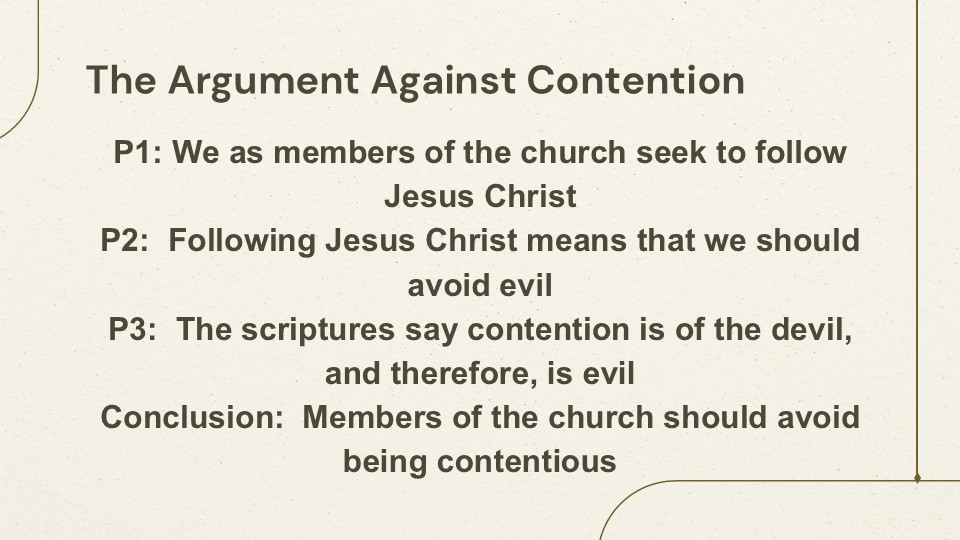
I think the argument against contention is based on the following argument:
- Premise one: We as members of the Church seek to follow Jesus Christ.
- Premise two: Following Jesus Christ means we should avoid evil.
- Premise three: The scriptures may say that contention is of the devil, therefore is evil.
- Conclusion: Being members of the Church, we should avoid being contentious.
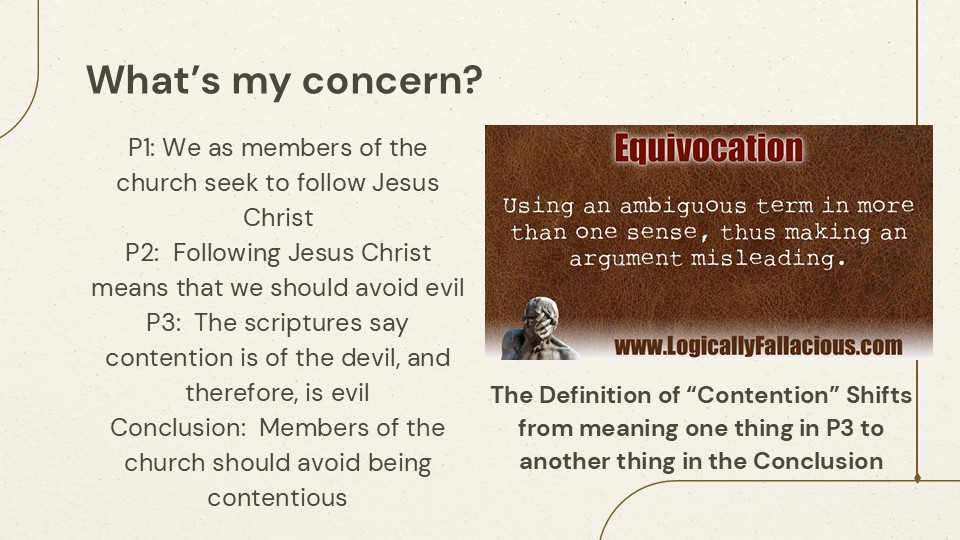
At first glance, this seems like a pretty cogent argument. But I would argue that the conclusion is predicated on what many call the equivocation fallacy, which occurs when a key term or phrase in an argument is used ambiguously, with one meaning in one portion of the argument, and then a different meaning in another portion of the argument.
I went a little far ahead, but the problem is that the term contention in the third premise differs from the definition of contention in the conclusion.
So this is me critiquing that argument. And I posit that the term contention for us as members of The Church of Jesus Christ of Latter-day Saints can easily be conflated into something that it is not.
Defining Contention
Namely, contention is confused with any kind of conflict, when I would argue that it’s more complicated than that.
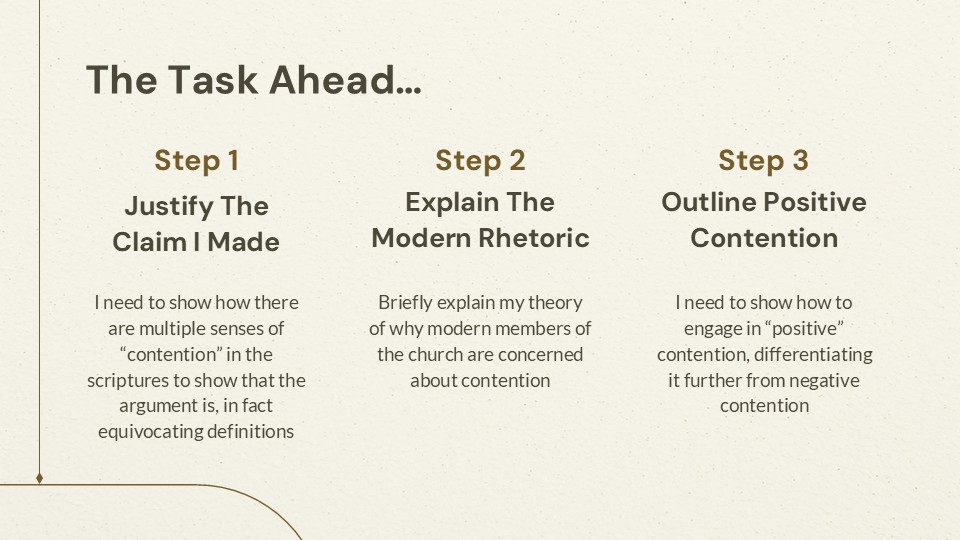
Admittedly, this is a tall order. To justify my criticism of this argument, I not only need to show that the scriptures use the term contention in both positive and negative ways, thus validating my accusation of equivocation. But then I need to show how modern leaders have explored this topic to show that I’m not undermining them.
And then on top of that, outline how we, as normal regular members of the Church, can engage in this good contention all within about 40 minutes, preferably.
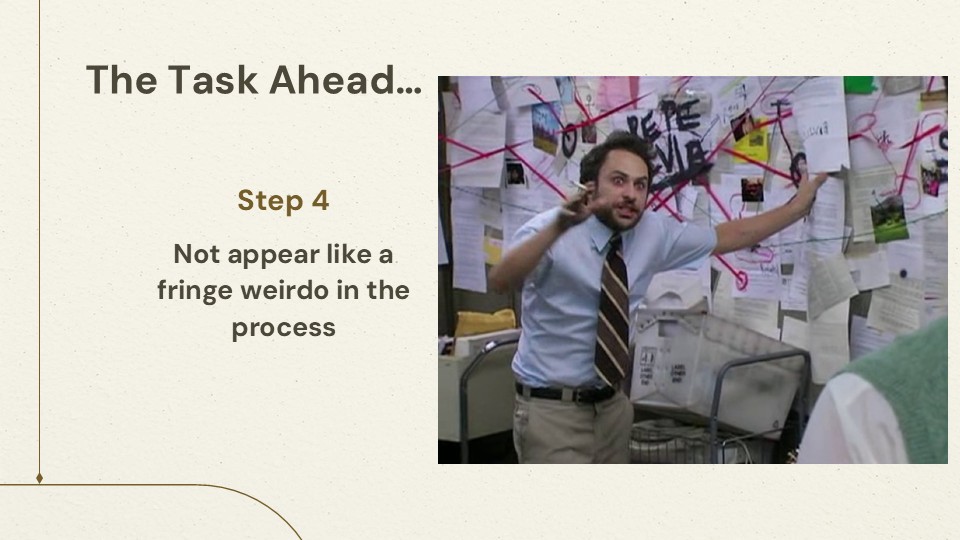
And mind you, this last part is technically optional. I also have to do this while making it so that people don’t think I’m a fringe, crazy person, rationalizing desire to argue with people.
So I have my work set out for me.
That aside, I think there is a good case for what I’m saying, and you’ll see me make jokes throughout this presentation, because I recognize that we as Latter-day Saints tend to get nervous when we hear about things like contention, and rightfully so.
As a believer in Jesus Christ, I want to avoid doing things that Christ tells me to avoid.
FAIR’s Mission and Why Contention Matters
This gets to the heart of what FAIR is trying to do. We want to share the gospel, and we want to motivate people to defend the truths of the Restoration with boldness, but not over balance.
I wanted to show you my thought process as I explore this topic, and by doing so, to help show some good principles of how to research and demonstrate how the term contention is conflated to mean something that it doesn’t mean.
Scriptural Usage of Contention
So let’s get into it.
First things first, let’s talk about the scriptures. I took the liberty of parsing through instances where we see the words content and contention in the standard works.
It was a valuable exercise, and I picked out a few patterns about how that word was used.
The first sense that I found was that contention was used in the context of war and physical violence.
In the Old Testament, we read in the book of Deuteronomy that the children of Israel were commanded to distress not the Moabites, nor contend with them in battle.
Abinadom, the grandson of Omni, wrote that he saw much war and contention between my people, the Nephites, and the Lamanites.
Ammon, when protecting the sheep of King Lamoni, tells the servants of the king that he will “contend with these men who do scatter our flocks”.
Contention in War and Scripture
Examples, especially in the Book of Mormon, can be multiplied in this regard. Remember, as per the scriptural accounts, war is not necessarily bad.
In this presentation, I don’t have time to go over the concept of just war theory or the details of wars described in the Book of Mormon, but it suffices to say there is a plethora of work on this point.
Captain Moroni, one of the great war heroes of the Book of Mormon, fought for the people and righteous principles, but was also described as someone who did not delight in bloodshed.
Nephites were taught to defend themselves with the faith that as they were righteous, the Lord would prosper them. In more modern scripture, we read that rebellion and sedition are not becoming of citizens that are protected in their inherent right and inherent inalienable rights, implying that if those rights were not protected, such war and contention would be justified.
President Hinckley taught that there are times and circumstances when nations are justified, in fact have an obligation, to fight for family, for liberty, and against tyranny, threat, and oppression.
These are examples of how contentions in this sense can be viewed as either positive or negative forces.
It would be great if I could end the talk right here, but as you can imagine, there’s more to discuss when discussing contention.
Beyond Battlefields
We’re not talking about meeting people in physical battlefields. We’re talking about destroying people with facts and logic. There’s a huge difference there, and I wholeheartedly agree.
However, the above shows some instances where the scriptures describe contention neutrally or positively, which warrants further exploration of the term.
We only hear of the miracles, the 2000 stripling warriors being blessed and protected in their work because they were contending—not just contending, but specifically contending for the right reasons and in the right way.
More on that in a minute.
Condemnations of Contention
War is certainly not the only context wherein contention is described. Several scriptural passages condemn contention, and that’s the meaty part of our discussion today.
In the Old Testament, there are a plethora of proverbs that criticize contention quite explicitly. Proverbs 18:6 states that a fool’s lips enter into contention, and we read similar counsel later, when the reader is encouraged to cast out the scorner so that contention shall go out.
The New Testament is seemingly more vocal in its condemnation of contention. In the Sermon on the Mount, the Savior noted that we should resist not evil, but whosoever shall smite thee on thy right cheek, turn to him the other also.
Repeatedly, Paul has to write to resolve contentions among specific churches in different cities. And in Titus, we read that we are to avoid, among other things, contention.
The Book of Mormon echoes similar sentiments when we read about Alma the Elder repeatedly commanding that there be no contention among the believers in his group.
The Nephite people, as described in Fourth Nephi, are positively regarded as being without contentions and disputations.
Even the Doctrine and Covenants go so far as to say that one of the reasons that Christ is delivering the gospel is to reduce contention.
We, of course, also can’t forget the first and foremost scripture on contention, uttered by our Savior when he first appeared to the Nephites, where he states that he that hath the spirit of contention is not of me, but is of the devil.
And don’t even get me started on how many modern leaders have denounced contention. We’ll get to that here in a minute.
Reconciling Positive and Negative Uses
Simply, there’s absolutely a reason that Latter-day Saints have an initial aversion to the term contention, seeing as it is seemingly denounced in just about every scriptural standard work we have.
So is that game over? Well, not yet, because, as we’ve already established, we have at least some examples of contention being represented as a positive thing.
I wondered if there was more to the puzzle that I wasn’t seeing.
And to be thorough, I continued my search. I figured the best way to proceed was to look at the terms in use to describe contention in the scriptures.
The Hebrew word for contention is rib, and the Greek word for contention, or one of them, is eris. Both of these words are used in a variety of contexts, but for the most part they’re defined as being strife, controversy, dispute, quarrel, dispute, controversy, case of law, strife, wrangling.
There’s some commonalities here, but I wanted to keep looking.
In the 1828 dictionary, I found something that was really helpful to me. This dictionary describes contention as being strife, struggle, quarrel, strife in words, strife or endeavor.
So do you see a commonality between these definitions?
Three of the four definitions had the term strife in it. This piqued my interest, so I decided to look at the term strife in the same dictionary.
And what I found was really interesting. Strife was described as exertion or contention for superiority, contest of emulation, either by intellectual or physical efforts, contention and anger, or enmity, contest, struggle for victory, quarrel or war, opposition, tragedy, contrast, etc.
Contention and Pride
Wait a minute, I thought, do you know what this definition sounds very similar to?
It sounded like pride described by President Ezra Taft Benson in his talk Beware of Pride, given in the April 1989 General Conference.
President Benson wrote:
The central feature of pride is enmity toward God and enmity toward our fellow men. Enmity means hatred toward, hostility to, or state of opposition.
It is the power by which sin wishes to reign over us.
That’s an uncanny similarity.
With these details in mind, I would propose two ways of reconciling the conflict between these differing ideas about contention.
On one hand, we may need to consider the possibility that these authors merely contradict one another, and that different prophets have had different takes on the morality of things like contention according to their time and inspiration.
If nothing else, it’s a possibility, seeing as we reject the concept of scriptural infallibility, but also acknowledge that God commands different things at different times.
However, I also see immense value in looking at this negative contention in the context of pride. I would propose that applying this connection to our analysis here can help us understand this concept—negative contention.
More practically, the proverbs, for example, describe the scorner—that person described previously who brings this negative contention—in terms like proud and haughty.
This comparison fits perfectly.
And in Fourth Nephi we read that there was neither disputation nor contention. But on top of that, Fourth Nephi also describes those early generations after Christ’s death as having no social or economic classes.
In other words, they had eliminated pride.
Only later do we see division into classes, and pride and dissension creep back in.
Turning the Other Cheek
The Savior’s admonition to turn the other cheek is a bit trickier to analyze. Many understand the saying as just deal with whatever people give you.
Another interesting interpretation has to do with subversively asking for respect in light of abuse.
Here’s how one theologian put it:
To be struck on the right cheek in that world almost certainly meant to be hit with the back of the right hand. That’s not just violence, but an insult, and implies that you’re an inferior—perhaps a slave, a child, or in that world, and sometimes even today, a woman.
What’s the answer? Hitting back only keeps evil in circulation.
Offering the other cheek implies: hit me again if you’d like. But now as an equal, not an inferior.
So, in an unexpected twist, some scholars indicate that turning the other cheek is a way of saying, let’s deal with this as equals instead of accepting the inherently prideful sentiment of one person being superior to another.
It’s tricky, though, because other scholars disagree, sometimes even indicating that most other scholars reject this interpretation.
We’ll cover more on how Jesus dealt with groups who opposed him later, but you could also look at this verse and understand it as relating more to physically violent contention.
And of course, I recommend not slapping people in today’s culture. As Brad said, we’ll likely go to jail. I’m sure that Jesus would agree with that, by and large.
But again, keep in mind what I said before. Either way, I don’t think that this passage causes a problem. There’s some messiness here, but turning the other cheek and standing up for your basic rights in my mind aren’t mutually exclusive.
Doctrinal Disputes in Scripture
In the New Testament, both Titus 3:9 and First Corinthians 1:11, and the passages referenced in Mosiah 18 and 23, refer primarily to contentions about doctrine, basically orbiting around the whole “my understanding is better than yours” kind of disputes in the realm of apologetics.
That’s something that we see a lot of.
But this is where we, as members of the Church, have an advantage in the sense that we believe in the concept of modern revelation and LDS theology.
And I would argue the scriptures as well.
When it comes to directing the believers on scriptural interpretation or even instituting policy, the prophets and apostles seem to have authority, and that seems to be the underlying premise in these letters.
Leaders provide interpretation and clarification of doctrines so that these kinds of contentions between believers would cease. This is one aspect of their essential inspired and prophetic character.
Christ’s Condemnation in 3 Nephi
Christ’s condemnation in Third Nephi fits a similar model.
Because this is a more prominent passage when discussing contention, it’s worth exploring more thoroughly for context.
After the massive destruction in the New World following Christ’s death, the remaining Nephites are gathered in the land Bountiful, where the now resurrected Jesus appeared to them.
The Savior asked them to feel the wounds in their hands and feet, and the Nephites rejoice at their long-prophesied Messiah.
Afterward, Jesus calls upon the prophet Nephi, giving him the power to baptize. He then gives the power to baptize unto others, instructing them in the manner of baptism, so that there would be no disputations among the people regarding their points of doctrine.
This clarification matters. Seeing as our Savior’s condemnation of what he calls the spirit of contention is made in the context of doctrinal disagreement among the believers, or, put another way, a lack of unity among them.
Therefore, the resolution of this contention is found not in avoiding any disagreement, but by heeding the inspired, authorized leaders of Christ’s Church to direct the believers regarding doctrine, policy, and practice.
In their case, that was Jesus, while in our case those would be our modern-day prophets and apostles.
Counsel from Prophets and Apostles
Gordon B. Hinckley, then an apostle, said:
The Lord has given us counsel and commandment on so many things, that no member of the Church, this Church, need ever equivocate. He has established our guidelines concerning personal virtue, neighborliness, obedience to law, loyalty to government, observance of the Sabbath day, sobriety and abstinence from liquor and tobacco, the payment of tithes and offerings, the care of the poor, the cultivation of home and family, the sharing of the gospel to mention only a few. There need be nothing of argument or contention in any of them.
If we will pursue a steady course in the implementation of our religion and in our own lives, we shall advance the cause more effectively than by any other means.
These doctrines provided by prophets, seers, and revelators are topics we do not need to contend over.
While we must avoid the trap of believing that prophets are infallible, we must not think of ourselves as being more authorized to ultimately direct the Church and our leaders.
Authority, Anger, and Contention
And we must avoid pride in what the Savior calls contending with anger. I’ll add in here, too, that this doesn’t mean that we can’t discuss different doctrines. There are consequences and, you know, follow priesthood chain if we have questions and that sort of thing. But what I am noting is that we, as members of the church, have the benefit of modern prophets and apostles who can guide us along the way.
This angry, negative contention being condemned is what I think Elder Updraft is referring to when he says conflict is inevitable, but contention is a choice. I think I’ve made my point regarding how contention in the context of pride, anger in rejecting God’s authorized messengers seems to be the problem in a lot of these scriptures.
This model seems to fit almost every instance I found wherein contention is condemned, suggesting that contention has far less to do with disagreeing with people and more with how and why we disagree.
All right, we’re back on track. I demonstrated that the context of scriptural condemnation of contention is related to unjustified warfare of pride and rejecting the council of prophets. However, I have yet to explore if there are any positive examples of contention in the scriptures. In my studies, I found several.
Positive Scriptural Uses of “Contend”
First, we have a couple of instances where the Lord is described as contending with and for his people. And Isaiah 4925. The word states that he will contend to strive for or oppose those who oppose Zion. We see examples of the Lord saying he will contend with Zion until it is pure. And both examples seem to pertain to positive representations of contention.
We also read in Jude one three that the saints are to contend for the faith delivered to them. That is, to correct falsehoods that were creeping in among the believers. Similar examples are found repeatedly in the Doctrine of Covenants, for instance, and DNC 1005. We read that the apostles are instructed to contend daily spreading the gospel.
Historical Precedents
Additional examples are found in church history, one of which is found with Joseph Smith and Oliver Granger and Kirtland. The Saints were being driven out and Joseph Smith was forced to flee, leading to accusations that he was cheating his creditors and abandoning his debts and DNC. One 1713 Oliver Granger is sent to contend with debtors in Kirtland to exonerate the prophet.
Again contending for a good cause even before that point, as were Booth, a church critic, attacking the church through several letters. When this occurred, both Sidney Rigdon and Joseph Smith were instructed by the Lord to confound their enemies, calling upon them to meet in both public and private. Shortly after this, Sidney Rigdon sent a letter challenging Ezra Booth and his associates.
Simons writer, to a public debate. Neither of the critics were willing to accept this challenge. Still, many meetings were held afterward to dispel the falsehoods. There’s at least some kind of precedent for at least some kind of contention in these passages.
Why We Often Assume “Contention = Evil”
All right, so if there are these many examples in Scripture talking about positive contention, why do so many people think that contention as a whole is a bad thing? This is the part where I validate the people who grew up hearing the contention is associated with evil. The answer is probably more complicated, but it’s worth noting that members have associated a contention with evil simply by the fact the majority of General Conference talks of the past 200 years has spent a significant amount of time condemning the negative, prideful contention and connecting the term contention with other vices of the world.
Here’s a pie chart, where a lot of these findings are summarized. As. We can see about 93% of the talks with the term contention in them, either directly condemn the negative contention, or reference a talk or Scripture that directly condemns negative contention. Talks I examined looked forward with hope for when wars and contentions would cease.
Many more connect the term contention with terms like fault finding, discord, corruption, bickering, quarreling, murmuring, pride, verbal abuse, seeking, worldly honor, sin, and other unrighteous behavior, just to name a few.
“Contention” can have different meanings
I agree with our inspired leaders. Contention–in the context of these ideas–is rightfully called a violation of everything the Savior stood for and taught.
Granted, we also see contention being used to describe things we as latter day Saints would see as positive. Then-Elder Harold Bailey once described Alma’s contention with the Antichrist Korihor. I also saw an elder making a similar comment about how we are supposed to contend against temptation and strive for truth.
And certainly that’s not seen as a bad thing. However, such examples are certainly the minority. This drastic shift in rhetoric makes sense, seeing as I can think of at least a few things in the church and the world history that would prompt people and prophets alike to think about war, persecution, pride, and disharmony among the nations and their respective populations.
A Call to Speak Up
Brothers and sisters, alongside both ancient and modern prophets, I, too, look forward to the day when prideful contentions cease. Even so, I would have you consider the following questions. Should alma have just let Corriher keep preaching unchallenged? Did he sin in challenging for hoarse preaching? Should we, as latter day Saints, allow falsehoods about our theology and history to be propagated without challenge?
Are we silently holding our peace when opportunities to share or defend our beliefs arise because we’re afraid of causing a fuss? Brothers and sisters, make no mistake. I believe in the same manner that we will be held accountable for what we choose to say. We will be held accountable and responsible for what we choose. Not to say. President Oaks says this better than I ever could.
Even as we seek to be meek and avoid contention, we must not compromise or dilute our commitment to the truths we understand. We must not surrender our positions or our values. The gospel of Jesus Christ and the covenants we have made inevitably cast us as combatants, and the eternal contest between truth and error. There is no middle ground in that contest.
Conference Talks Encouraging Positive Contention
I can reference several talks encouraging us to speak up for what we believe and share and defend truth. Sister Sheryl Esplin and said that the gift of the Holy Ghost comes with the responsibility to seek truth, to live the truth we know, and to share and defend the truth. We’ve been asked by Elder Christofferson to defend the truth against people propagating ideas, like ideas about morality that run contrary to the gospel.
In a talk by Elder Holland, he encouraged the faculty at BYU, hoping to hear a little musket fire not in any physically violent sense, but in the sense that they and we are to defend truth. Even Joseph Smith used the power of debate and discussion to discover the best ideas when establishing the Council of 50. So discussion and disagreement with the intent of finding truth was certainly on his radar.
I’ve already referenced several scriptures that ask us, the common believer, to contend for the faith, and I think that mandate still stands. So long as we contend in the right way. This does not mean we have permission to shoot our mouths off when if someone says something that we perceive to be wrong, when we presuppose that everything we believe is right, and are inclined to generously bestow that information upon the common folk at all times, that causes all kinds of problems, and certainly represents the pride we are counseled to avoid.
The LITTLE Model (Overview)
Still, I have yet to show how we can positively contend with others. I hope now to outline some principles that can be helpful, so that we can contend with both charitable and constructive ways to help with this. I developed an acronym for you to minimize contention. Accordingly, I call it the little model because we’re supposed to have little contention and I thought it was funny.
Let’s see. It’s based on counsel that our standard General Conference talks to, so you can take it for what it’s worth. I hope you find it helpful.
L — Love
So the first letter is for love. Love should be the front and center of every interaction with members and with all members of the church. When I speak of love, I speak of Jesus Christ’s words in the sermon on the Mount, saying that we should not only love our neighbors, but that we should love our enemies.
And such love is asked for in light of us being asked to be perfect. Thomas Aquinas used the use of the term notes that the act of love is foundational to any Christian ethics is an operation of will. That is to say, we must will the good of others. This love is active. Whenever we talk with people, we should do so with the desire to meet their needs.
And we should view them as the children of God that they are. Again, Brad gave a really good talk about focusing on that.
There is a night and day difference between conversations rooted in love versus conversations rooted in a selfish desire to win. I can even put it this way. The more you understand the gospel, the more you want to share it. And that’s because of love. We are called to love freely and to do good continually. And sharing the gospel is one of the most effective tools to share that love with others.
I — Inquisitiveness
The second letter represents inquisitiveness. So many people, in terms of just so many problems in terms of discourse, could be solved by forgetting our assumption that we know more than the other person does about a given topic. I’ve witnessed firsthand, both members and nonmembers of the church commit the crime of assuming they know more than others, or perhaps worse yet, that others are working with bad intentions.
While we certainly should avoid naively assuming that everyone is acting honestly and in good faith, we should avoid walking into situations, assuming the bad intentions of others, or assuming that they only believe what they do because the other person is stupid or intentionally misleading. Other people. When talking with people, I found it to be helpful to approach this from a place of curiosity.
Questions that outline this approach include. Why do you believe that? Or what sources are you getting your information from? Such actions can mitigate the inherent defensive tendencies inherent in these often difficult and divisive dialogs.
T — Tact (Tone)
This blends well with the third letter of which represents tact or tone. This part of our acronym warrants a deeper exploration. When discussing these controversial topics, we must understand that we reap what we sow.
If we engage people using inflammatory language, we risk pushing people away unnecessarily. However, if our tone is too soft, we risk running into the problem Enos describes, where people will only listen with harsh language. Seeing as the New Testament gospels represent Jesus as being harsh towards groups such as the Pharisees, but less harsh against other groups. This is probably the messiest of our letters to analyze.
I cannot dictate the terms by which any conversation is had, and how you choose to conduct yourself, as ultimately that a choice.
I can’t make those choices for you, and your behavior will be judged between you and God. We should be willing to accept the consequences of our actions. If you use harsher rhetoric, don’t be surprised when people think you’re a jerk and you alienate parts of your audience by bringing them into a defensive state of mind.
The Connection Between Harsh Rhetoric and Violence
In restoration history, scholars have noted how harsh rhetoric at times contributed to the religious violence in the 19th century, perpetuated by both by and against latter day Saints.
That’s an extreme example, but avoiding those significant pitfalls seems practical. Necessary. There are additional consequences that need to be considered implicit in the use of harsher rhetoric.
I’d like to pair the comments of someone born around the same time as Joseph Smith, an English philosopher by the name of John Stuart Mill. Now had an interesting life, and while he was no friend of the church and had a complicated relationship with religion, General, I’m in an interesting twist.
He defended the rights of latter day Saints to practice plural marriage, which was a rare phenomenon for someone of his station and time. I think he has a point when discussing tone and its potential ramifications.
On one hand, he notes that experience testifies that offense is given whenever the attack is telling and powerful, and that every opponent who pushes them hard and whom they find it difficult to answer appears to them.
If he shows any strong feelings on the subject, an intemperate opponent. Which is to say, if you hold someone’s feet to the fire, then it’s very easy for them to interpret your tone as being aggressive or rude, regardless of what you’re actually trying to communicate.
Harsh Rhetoric Prevents Sharing
On the other hand, he notes, the very real phenomena that unmeasured vituperation employed on the side of the prevailing opinion really does deter people from professing contrary opinions and from listening to those who profess them.
Which is to say that a sarcastic, disdainful, and harsh rhetoric often discourages people from sharing what they believe, which causes problems for us to long term, making us more susceptible to things like confirmation bias. From a psychological perspective, this is a real thing.
Researchers at the University of Washington noted that even toddlers will modify their behavior when exposed to mood shifts that come with employing harsh rhetoric.
So these tendencies are instilled in the vast majority of people from a very young age. Neil talks a lot about how these tools are used by more popular opinions of the world to discredit other opinions. And it probably doesn’t take this audience very long to think of instances where this vitriolic rhetoric is used against latter day Saints.
We should be aware of when this rhetoric is being used against us, and how we are coming across to other people.
Choosing Not to Be Offended
We are counseled to avoid choosing to feel offended. And that goes for everyone we talk to as well. But we should be especially mindful of how our goal to invite others to come into Christ is being affected by our rhetoric. I urge you to consider how this balance, or lack thereof, affects your life and discussions. As you can probably guess, I lean more toward agreeing with mill when I say it’s better to usually avoid the harsh rhetoric than it is to employ it.
There are certainly conference talks suggesting something similar. That said, it makes sense that soft rhetoric has its consequences as well. If you use softer rhetoric, don’t be surprised when some people don’t listen to you, think you’re too soft or interrupt you, and you alienate a part of your audience as a result.
Having talked to people in many settings about latter day Saints theology and history, I’ve been yelled at, muted, mocked, belittled, and blocked as a direct result of where I am and the styles I employ in my softer rhetoric.
Appearing Confident
I can appear less confident and informed based on my body language and tone, which causes problems too. If I’m not careful. In many instances, I prefer dealing with the issues associated with softer rhetoric over harsher rhetoric. I would likewise promote a climate where people are willing to act civilly, hoping to form and maintain relationships with people. After everything is said and done.
I also know that I cannot discern people’s hearts like the Savior, so I try to keep that in mind as I interact with people too. Other people may decide differently as dictated by the spirit. I’ll remind you that one of the uses of contention in the Book of Mormon is when the prophet Amulek urges us to not contend with the spirit.
Even so, I remind everyone here that we will all be held accountable for our actions. That includes what we choose to say, and I would argue how and why we say it. As long as you let the knowledge guide your actions. I think that you’ll be on the right track. Take responsibility and make changes where necessary.
T — Time (Timing)
Every fourth letter, time or timing, there’s a time and place for many of these discussions, discussions, conversations. Certainly, we should honor our covenant to stand as a witness of God at all times, in all things and in all places. But perhaps bringing up the controversial history of plural marriage in the church with your recently excommunicated relative at Thanksgiving dinner may not be the best call.
Timing contributes to what kind of responses you will receive in these discussions. They may or may not be willing to or ready to discuss these topics with you. If you want to teach others about the gospel, seek to bring these issues up with those genuinely interested in learning when the timing is right.
I would even encourage people to be proactive about finding instances to share the gospel and combat misinformation, but do so when the person is ready and the timing is appropriate.
L — Listening
The fifth letter refers to listening. This goes hand in hand with the second letter mentioned earlier. Still, when my use of inquisitiveness has more to do with our approach and our desires as a whole. This letter focuses more specifically on acting and reacting in ways to gain more understanding about the other person.
It does us no good to have any discussion if we don’t understand, or if we don’t understand more about the other person we’re talking to. And that understanding stems from listening, and I mean really listening. Sometimes in our fervor, it can be easy for us to talk too much, or perhaps assume that we know what’s going on when we don’t.
If I had a nickel for the amount of times that I have given a right answer to the wrong questions, I’ve had more nickels. I have more nickels than I care to admit. Listening helps form valuable connections with others, helping them feel understood. It helps us avoid common traps that make us talk past one another.
Consider trying to repeat back the point to them in a way that satisfies them before responding. If you can do that, you can avoid a lot of unnecessary heartache later on. Who knows, maybe you learned something you didn’t know before.
E — Evaluation
The final letter represents an evaluation held personally and periodically throughout the discussion. This phase is characterized by you asking yourself pertinent questions about your state of mind, the state of mind of the person you’re talking to, and your goals in evaluating whether or not it’s expedient for you to continue discussing this issue.
For example, if I’m talking with somebody about a controversial topic and I can tell the person is discussing this from a more emotional place, then during the evaluation. I may judge it to be more important to meet them on a more empathetic level, instead of impersonally throwing a bunch of studies at them.
If during another scenario, I can tell that the other person either lacks the desire or the ability to continue making or maintaining respectful dialog, I don’t find any reason to keep discussing. I may excuse myself from the discussion.
An Example of Evaluation
A scriptural example of this is relevant to mention is Alma 21 five through 11. We read about Aaron teaching the Nephite city of Jerusalem. While he was there, the Amalekite and Amalekite began to contend with them. Instead of leaving, Aaron asked questions and expanded the scriptures to him. The amalekite and people around him didn’t like that very much, and so they began to mock him.
Upon evaluating the situation, Aaron found the best to leave the city. The principles gleaned from the story are probably pretty apparent to you. We can follow his example by evaluating the situations and our discussions and understanding our goals. Pondering whether those goals are tenable in a given scenario and acting accordingly.
We should especially flip that evaluation back on ourselves, where, for instance, if I feel myself becoming inappropriately frustrated with someone, I may decide to excuse myself from the discussion. This is perhaps one of the most important steps I would encourage us to engage more consciously in that step. As we discuss topics regarding the church, history and scriptures and whatever else we may be talking about.
Agreeing to Disagree
Sometimes we must be willing to agree to disagree. Charles W Penrose taught that there should be a distinction between honest difference in stubbornness and contention. And it would be unwise to dismiss his counsel. While we should never use the phrase to dismiss valid concerns or objections. There’s truth in the statement that equally intelligent people can come to different conclusions about a topic.
Members of the church do this, and it should be allowed between discussions between members and nonmembers. Rehashing the same information repeatedly may not be wise. We may just need to accept that nothing we say will ever change someone’s mind.
Mind you, in many instances, a perfectly valid option is to incorporate the elements article of faith, which states that we claim the privilege of worshiping the Almighty God according to the dictates of our own conscience, and allow all men the same privilege.
Personal Interpretation
Those of us who study the recesses of church history know several instances where we are left with ambiguous or conflicting information, that we are left to interpret different people, even within the church, come to different conclusions about those topics. There’s often more room for intellectual diversity within the church than people recognize.
I encourage you to avoid dismissing or avoiding information that we dislike. And certainly I would encourage everyone to refrain from carelessly motivated reasoning. We must decide on a microscopic and macroscopic level what we believe. Again, I can’t tell you every individual instance of when to back off or when to stand firm.
But we must recognize that not all historical and theological issues are as black and white as we think. And picking fights over fundamentally pointless arguments, as we read in Titus three nine, is the antithesis of what the restored gospel stands for.
Interfaith Cooperation
To this point, I like one of my favorite interactions of the gospel of Mark. When the apostle speaks to Jesus about a man casting out devils. The verses read in the following way.
And John answered him, saying, master, we saw one casting out devils in thy name, and he follow with us not so. And we forbade him, because he followeth not us.
And Jesus said, forbid him not, for there is no man which shall do a miracle my name that can lightly speak evil of me. For he that is not against us is on our part.
I’m deeply grateful for the Savior’s example here. I love to apply this passage to things such as interfaith work, where even if we disagree about doctrinal issues, we can work together to accomplish the work of Christ.
While we should never shrink from explaining our beliefs, the mere fact that someone does not follow after us should not inhibit us from genuinely befriending and working with others to do good.
Follow President Nelson’s Advice
Some may recall President Nelson’s admonition to never take counsel from those who do not believe. How does that relate to what I’m saying? I’m. Remember that this talk refers to people. Sorry, refers to the belief in Christ and our spiritual journey to return to our Heavenly Father’s presence.
We should avoid heeding those who would undermine our attempts to think celestial. That is, we should avoid having the adversary’s deceptions affect faith in the Lord Jesus Christ, and avoid having those deceptions affect how we understand reality. What the prophet is asking us is far and away from claiming that we should avoid associating with people who believe differently from us.
We see our leaders associate and work with nonmembers of the church to do good in the world all the time. If you don’t believe me, just go watch the most recent world report of the church over the you know, over general conference. And you know, I’m and you’ll see what I’m referring to in this, the dispensation of the fullness of times.
We should not allow our love for others and our desire to serve them, to be conditional on their agreeing with us theologically.
Critics and Forgiveness
Last thing, it can be easy for us to feel frustrated with people who attack the church. Renowned scholar Hugh Nibley spoke of critics who still feel morally and intellectually obligated never to admit, even for the sake of argument, that Joseph Smith could have been right in the sense in which he claimed to be right.
No matter how long the game goes on or how many matches are played, Smith’s score must always be zero. Talking with such people can be difficult and heart wrenching. Especially when we find those people in our friend groups and families.
I know I’ve gotten frustrated with people spreading misinformation about the church, and I talk about forgiveness. C. Terry Warner notes that forgiveness has more to do with giving our pain to God instead of allowing ourselves to respond to whatever offense we receive.
When we allow love to be at the forefront of our discussions. We can avoid falling into the trap of anger, anger that Warner notes to be an empty sacrifice. I implore you to forgive others and to forgive yourselves upon falling short. Positive contention takes practice. Don’t expect to do it perfectly all the time. Let the Holy Spirit guide you, helping you to improve.
Conclusion
In conclusion, brothers and sisters, I’d like to call upon the words of our prophet, President Russell Nelson. President Nelson gave a talk in April 1999 General conference called The Canker of Contention.</em> There he outlined several instances and condemnations of negative contention, drawing the connection between Ezra Taft Benson’s description of pride and this negative contention.
With this in mind, President Nelson likewise mentioned that we should avoid a mentality of peace at any price. He noted in the footnotes that being a peacemaker does not require us to agree with the ideas or the beliefs of others.
I recommend reading his talk Peacemakers Needed, as did Brad. He hits home the message I’m trying to share. In D&C 18:10, the apostles are instructed to contend against no church but the church of the devil. Such council is more prudent now than it has ever been in the history of this dispensation.
However, we must also ensure that we share the truth and condemned falsehoods where we see them. We must ensure our contention is positive. That contentions should happen only with the example of the Savior at the forefront of our minds.
Let us:
- Stand as examples of people renowned for our peaceable walk among the children of men.
- While also holding on to the principles outlined previously about contending constructively
- Do the work that is necessary to receive personal revelation in our lives today, and
- Do the work that is needed so that we may give the spirit something to work with
So we all may know how to give a reason for the hope within us. And giving that reason in the right way. Thank you.
Q&A with Scott Gordon and Zachary Wright
It’s not about winning arguments
Scott Gordon:
We have time for Q&A, as I have a couple of questions here. The first one is probably my favorite of the whole conference. Zach, how can I use this information to win more arguments?
Zachary Wright:
Did you listen to the talk? I don’t think it’s about winning arguments. It’s about meeting people where they are and trying to meet their needs. That’s what I like about FAIR—that’s what they try to do.
What’s the answer to nervousness?
Scott Gordon:
How can you encourage those of us who get tongue-tied or nervous. When we’re trying to share the gospel and contention arises?
Zachary Wright:
I go back to the first letter of the acronym—love. If people can feel that love coming from you, they’re more patient. If you get flustered or feel like you’re not communicating well, take a step back. Say, “I’m sorry, let me try saying that again.” People are usually responsive to that.
How to approach public vs one on one?
Scott Gordon
Sometimes we talk in public settings, with people around us or online where many are watching. Other times it’s private, one-on-one. Should we approach those situations differently?
Zachary Wright
In my opinion, no. I use the same principles in both cases. The LITTLE model works whether I’m speaking to a group or one-on-one. Love, inquisitiveness, tact, timing, listening, and evaluation. Those principles help minimize contention in every setting.
Scott Gordon:
Online, people often debate politics, family issues, and religion. Should we treat all those conversations the same, or differently?
Zachary Wright:
There are different ways of studying different things. With religion, we can accept sources like intuition as valid for our beliefs. So we should be patient with that even if we disagree. With other issues, it’s important to understand where people get their information. Still, the LITTLE model applies. Consider your goals, manage your tone and timing, listen well, and evaluate both their intent and your own. Those steps keep us from falling into negative contention, whatever the topic.
BYU Apologetics Club
Scott Gordon:
Finally, could you tell us a little about the BYU Apologetics Club?
Zachary Wright:
Sure. Many students my age are here at the conference because they love studying the topics FAIR and other organizations address. Interpreter has a booth here, for example. One clarification. It won’t be a club. Rather, it will be a student association managed by BYU’s religion department, with oversight there. The goal is to provide a community at BYU. There people can come, ask questions, and discuss these topics in an understandable setting. We’re all trying to figure things out, and the ultimate goal is to foster a community.
Scott Gordon:
Thank you very much. We appreciate your time.
