• Skip to primary navigation
  • Skip to main content
  • Skip to primary sidebar
  • Skip to footer

FAIR

  • Find Answers
  • Blog
  • Media & Apps
  • Conference
  • Bookstore
  • Archive
  • About
  • Get Involved
  • Search

Abrahamic Covenant

If “All Are Alike Unto God,” Why Were Special Promises Reserved for Abraham’s Seed? (Gospel Doctrine Old Testament Lesson 7A)

February 14, 2018 by Jeffrey M. Bradshaw

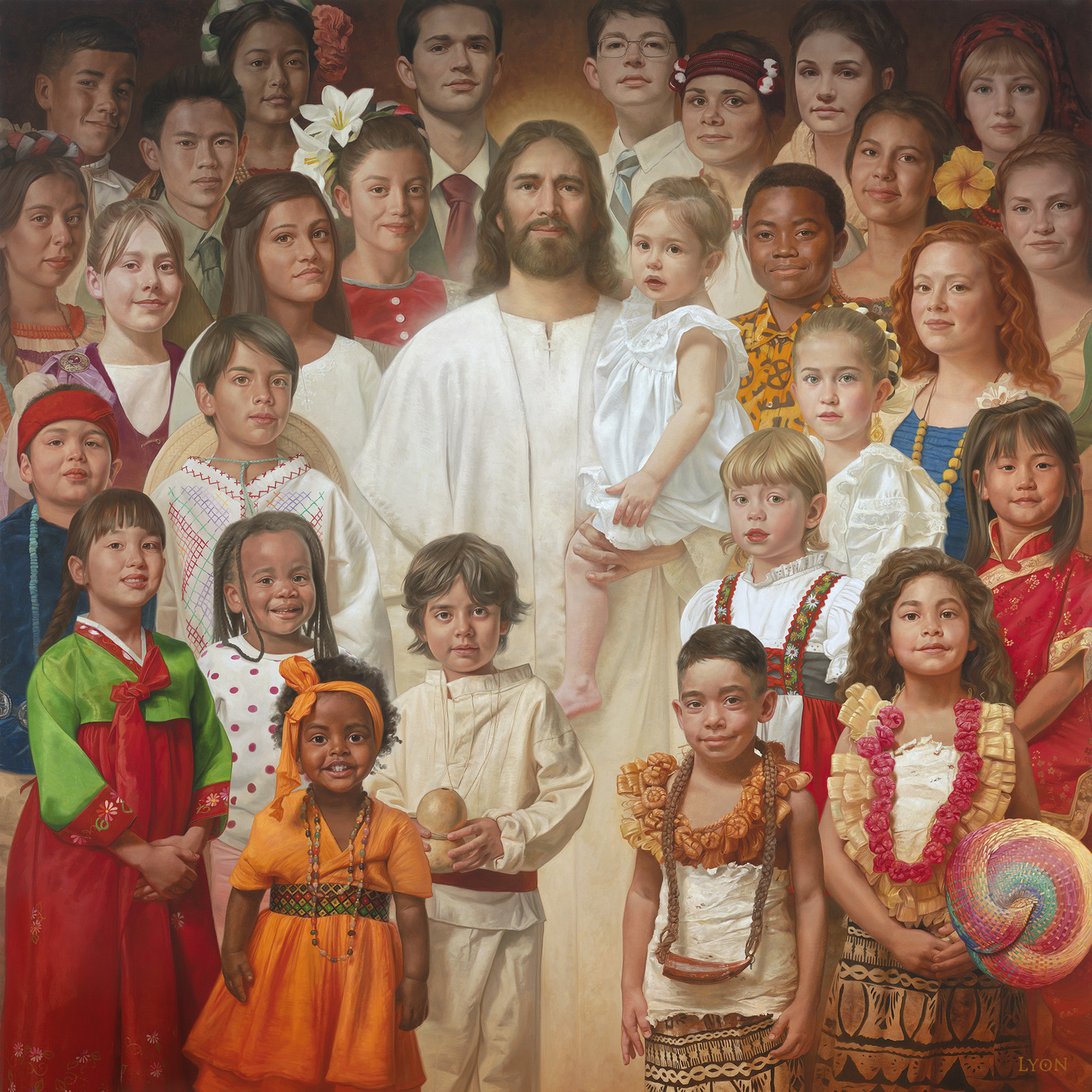
Howard Lyon: I Am a Child of God. Children from many cultures “stand with Christ, bearing witness with him that they are children of God. [The children] look directly at the viewer confident in the joy they feel in the presence of their Savior.”
An Old Testament KnoWhy for Gospel Doctrine Lesson 7: The Abrahamic Covenant (Abraham 1:1-4; 2:1–11; Genesis 12:1-8; 17:1-9) (JBOTL07A).

Question: The Book of Mormon teaches that “all are alike unto God.” Yet “Abraham received promises concerning his seed” that continue to this day. How do we reconcile the idea of the “chosenness” of the family of Abraham with the idea that “God is no respecter of persons”?

Summary: There is no conflict between the “chosenness” of Abraham’s family and the universality of the Father’s love. Every one who receives the Gospel becomes Abraham’s seed and will bless him as their father. In the beginning, God organized the human family according to a divine plan and timetable. “All … alike” would have the opportunity to “come unto him and partake of his goodness,” but to achieve that end God invited each willing soul to participate with Him in the effort. We made premortal covenants that put us in a partnership with our Heavenly Father. Individuals were to play their unique parts faithfully at the appointed time. Jesus Christ was chosen to become our Savior. Abraham and others — both men and women — also received specific assignments. Abraham’s seed was given the responsibility to bear a “ministry and Priesthood unto all nations.” Through the ministry and Priesthood of Abraham’s seed, “all mankind may be saved,” “through the Atonement of Christ” and “by obedience to the laws and ordinances of the Gospel.” The disorganization and confusion of the human family will come to an end; “it must be joined together, so that there [will] be a perfect chain from Father Adam to his latest posterity.”

The full article may be found at the Interpreter Foundation website: KnoWhy OTL07A — If “All Are Alike Unto God,” Why Were Special Promises Reserved for Abraham’s Seed?

For a video supplement to this lesson explaining, among other interesting topics, why virtually everyone in our day is a descendant of Abraham, see the presentation by Ugo A. Perego “All Abraham’s Children: A Genetic Perspective,” given at the 2016 Science & Mormonism Symposium: Body, Brain, Mind & Spirit, which took place on 12 March 2016 in Orem, Utah. (http://interpreterfoundation.org/ugo-a-perego-all-abrahams-children-a-genetic-perspective-2/).

Filed Under: Bible, Book of Mormon, Doctrine, Lesson Aids, Questions, Racial Issues, Temples, Women Tagged With: Abraham, Abrahamic Covenant, Chosen People

RiseUp Podcast – Israel’s Faith Crisis

December 17, 2014 by NickGalieti

https://media.blubrry.com/mormonfaircast/www.fairlatterdaysaints.org/wp-content/uploads/2014/12/RiseUp-IsraelsFaithCrisis.mp3

Podcast: Download (11.2MB)

Subscribe: RSS

From time to time we may hear the term Faith Crisis. Some may even talk about it as if it a new thing. But, there have been others, good men and women, even in ancient scriptures, who have experienced and made it through challenges to their faith. Some stories come from all the way back in the Old Testament.

Israel of the Old Testament, also known as Jacob, was one that was keenly aware of the value and implications of a birthright. Having traded his brother Esau for the birthright, Jacob or Israel, would have been well acquainted with the promises of the Abrahamic Covenant that were attached to the patriarchal order and birthright concept of the time.

Part of the promised blessings of the Abrahamic Covenant is that one would receive a promised land, a place that is set apart from the world by the divine hand of God to be a place of protection, both spiritually and temporally. One LDS Scholar, LeGrand L. Baker, talks about another aspect of the Abrahamic Covenant that articulates the blessing of invulnerability or protection as found in Abraham 2:11 which reads.

11 And I will bless them that bless thee, and curse them that curse thee; and in thee (that is, in thy Priesthood) and in thy seed (that is, thy Priesthood), for I give unto thee a promise that this right shall continue in thee, and in thy seed after thee (that is to say, the literal seed, or the seed of the body) shall all the families of the earth be blessed, even with the blessings of the Gospel, which are the blessings of salvation, even of life eternal

There is a promise that one will be preserved, and that their righteous posterity will be preserved as well. From the time of Abrahamic, to Issac, down to Israel, this has been the case. Generations of righteous posterity had been preserved and protected. For Israel, circumstances were such, that he favored his 11th son, Joseph. Joseph was to inehrit the birthright after Ruben had forfeited it. Joseph was the first son of his second wife, and tradition called for him to be the heir of that birthright. Israel felt that perhaps that promised lineage of the protections and blessings of the Abrahamic Covenant would continue through Joseph.

In consideration of these factors, after Joseph’s brother’s sell him as a slave and bring a bloodied coat back to their father Israel implying that Joseph had been killed, we can see another layer to the suffering Israel must have faced.

It is a sad thing to experience the death of a child. The scripture in Genesis 37:34-35 states that Israel, upon the realization of his son Joseph’s death:

“rent his clothes, and put sackcloth upon his loins, and mourned for his son many days.

And all his sons and all his daughters rose up to comfort him; but he refused to be comforted; and he said, For I will go down into the grave unto my son mourning. Thus his father wept for him.”

Not only had his son died, but it would appear that by all that was in front of Jacob, that the Lord’s promises of protection and for a righteous posterity were broken. This child of promise had died. How else could Israel see what had taken place. In his old age, a son that showed promise had been taken from him. Israel may have even felt some sense of guilt as it was he who sent Joseph out to his brothers, some 45 miles away.

Israel may have lost his son, but to a certain extent, he probably experienced a loss of faith as a result of what he felt took place.

As the story continued, we find that even years later after Joseph had been preserved multiple times by the hand of the Lord while living in Egypt, Israel was still hurting from the loss of his son Joseph. In fact, it was something like 20 years later before Israel was told that Joseph was alive and was then reunited with his father.

How that must have felt to Israel to see his initial faith in the Lord’s promise sustained after all those years. After years of pain from what he perceived as a great and terrible loss, the Lord was able to show his Hand in the keeping of his covenants. To Israel it would appear to be as if his son had been risen from the dead, a miracle explainable by either extreme coincidence or improbable odds, or the divine hand of the Lord.

How then can we see more from Israel’s story of redemption and salvation?

On the LDS Church’s website, LDS.org is found the statement under the topic of Abrahamic Covenant:

A person can receive all the blessings of the Abrahamic covenant—even if he or she is not a literal descendant of Abraham—by obeying the laws and ordinances of the gospel

As one completes the ordinances of the gospel, including and up to being sealed in the temple, families become under the abrahamic covenant. These are individuals taught by faithful leaders to come to love the Lord and his promises. While there is nothing in the covenant that says that trials and hard times will be kept at bay, some will see these hard times as a sign that God has forgotten them, or is punishing them, or is breaking his word.

Much like Israel, there might seem to be overwhelming evidence that God’s promise was of no value or was broken. But, like Israel, we can see that God’s hand is watching over all his Children. The ways in which God answers our prayers or keeps his promises may seem allusive, or impossible. Even if we see how God’s promises may be fulfilled, it may not be the way He has chosen to fulfill his promises. However, similar to Israel and his son Joseph, the Lord does keep his promises. Sometimes it may take 20 years, sometimes it may take a week; but the Lord will keep his promises.

FairMormon-Rise-Up-iTunes-logo

Filed Under: Faith Crisis, Podcast, RiseUp, Youth Tagged With: Abrahamic Covenant

Primary Sidebar

Faithful Study Resources for Come, Follow Me

Subscribe to Blog

Enter your email address:

Subscribe to Podcast

Podcast icon
Subscribe to podcast in iTunes
Subscribe to podcast elsewhere
Listen with FAIR app
Android app on Google Play Download on the App Store

Pages

  • Blog Guidelines

FAIR Latest

  • Come, Follow Me with FAIR – Doctrine and Covenants 137–138 – Part 2 – Autumn Dickson
  • Come, Follow Me with FAIR – Doctrine and Covenants 137–138 – Mike Parker
  • FAIR December Newsletter
  • Come, Follow Me with FAIR – Doctrine and Covenants 137–138 – Part 1 – Autumn Dickson
  • Prophets of God 

Blog Categories

Recent Comments

  • LHL on Come, Follow Me with FAIR – Doctrine and Covenants 132 – Mike Parker
  • Stephen Johnsen on Come, Follow Me with FAIR – Doctrine and Covenants 132 – Mike Parker
  • Bruce B Hill on Come, Follow Me with FAIR – Doctrine and Covenants 124 – Part 1 – Autumn Dickson
  • Gabriel Hess on Join us Oct 9–11 for our FREE virtual conference on the Old Testament
  • JC on When the Gospel “Doesn’t Work”

Archives

Follow Us

  • Facebook
  • Twitter
  • iTunes
  • YouTube
Android app on Google Play Download on the App Store

Footer

FairMormon Logo

FAIR is a non-profit organization dedicated to providing well-documented answers to criticisms of the doctrine, practice, and history of The Church of Jesus Christ of Latter-day Saints.

Donate to FAIR

We are a volunteer organization. We invite you to give back.

Donate Now

Site Footer