• Skip to primary navigation
  • Skip to main content
  • Skip to primary sidebar
  • Skip to footer

FAIR

  • Find Answers
  • Blog
  • Media & Apps
  • Conference
  • Bookstore
  • Archive
  • About
  • Get Involved
  • Search

Deuteronomy

Defending Josiah

Start Here

Question
Did King Josiah invent Israelite religion, or was he restoring ancient covenant worship?

Short Answer
Some modern scholars argue that King Josiah created or radically reshaped Israelite religion during the seventh century BC, using newly written scriptures to support religious and political reforms. In this presentation, Allen Hansen examines these claims and argues that the historical, biblical, and Jewish evidence better supports the traditional view that Josiah was restoring covenant worship that had been neglected during periods of apostasy.
Rather than presenting Josiah as a religious innovator, the Bible consistently portrays him as one of Judah’s most faithful kings. Hansen explores the historical context, the discovery of the Book of the Law, archaeological evidence, and scholarly theories to explain why Josiah’s reforms are better understood as a return to earlier covenant traditions than the invention of a new religion.
Key Takeaways
  • King Josiah is praised throughout scripture as a righteous king who renewed Judah’s covenant with God.
  • Some modern scholars claim Josiah’s reforms fundamentally changed Israelite religion, but those conclusions depend on debated historical reconstructions.
  • The discovery of the Book of the Law prompted Josiah to eliminate idolatry and restore temple-centered worship.
  • Biblical, historical, and Jewish sources consistently portray Josiah as restoring ancient covenant faithfulness rather than inventing a new religious system.
  • Understanding the scholarly debate helps readers thoughtfully engage with questions about biblical history while maintaining confidence in the scriptural record.

Summary

Summary

King Josiah’s reforms have become a focal point in debates over the origins of biblical religion. Many contemporary scholars argue that Josiah’s court created or substantially reshaped Israel’s scriptures in order to centralize worship in Jerusalem and establish a new theological program known as the Deuteronomistic movement. Hansen carefully explains these scholarly theories before evaluating the evidence on which they rest.

The presentation argues that this modern reconstruction fails to account for the broader historical context, the biblical narrative, and the remarkable consistency of Jewish memory regarding Josiah. Hansen examines the discovery of the “Book of the Law,” the political circumstances of seventh-century Judah, changes in religious symbols over time, and post-biblical literature to show that Josiah’s reforms are better understood as a restoration of ancient covenant worship than as the invention of a new religion.

TL;DR

TL;DR (Too Long; Didn’t Read)

King Josiah has become a central figure in debates about the origins of biblical religion. While some scholars argue that he invented or reshaped Israelite worship, Allen Hansen demonstrates that the biblical record, Jewish tradition, and historical evidence more naturally support the traditional understanding of Josiah as a faithful king who restored covenant worship after generations of apostasy. The presentation offers a balanced examination of modern scholarship while defending the reliability of the biblical account.

Download Allen's Paper

You can download Allen’s entire paper here.

Introduction

Introduction

Allen Hansen is an independent researcher. He was born and raised in northern Israel. He served a mission in Russia and married Katarina from Ukraine. They’re parents to a daughter. His research interests include the Bible, ancient, medieval, and early modern Jewish literature, Book of Mormon translation, and the meeting points between the Church, Judaism, and the history of Israel. Allen’s paper is titled “Defending Josiah.” So we’ll turn the time over to him.

So my paper today is on defending Josiah.

Perception of King Josiah
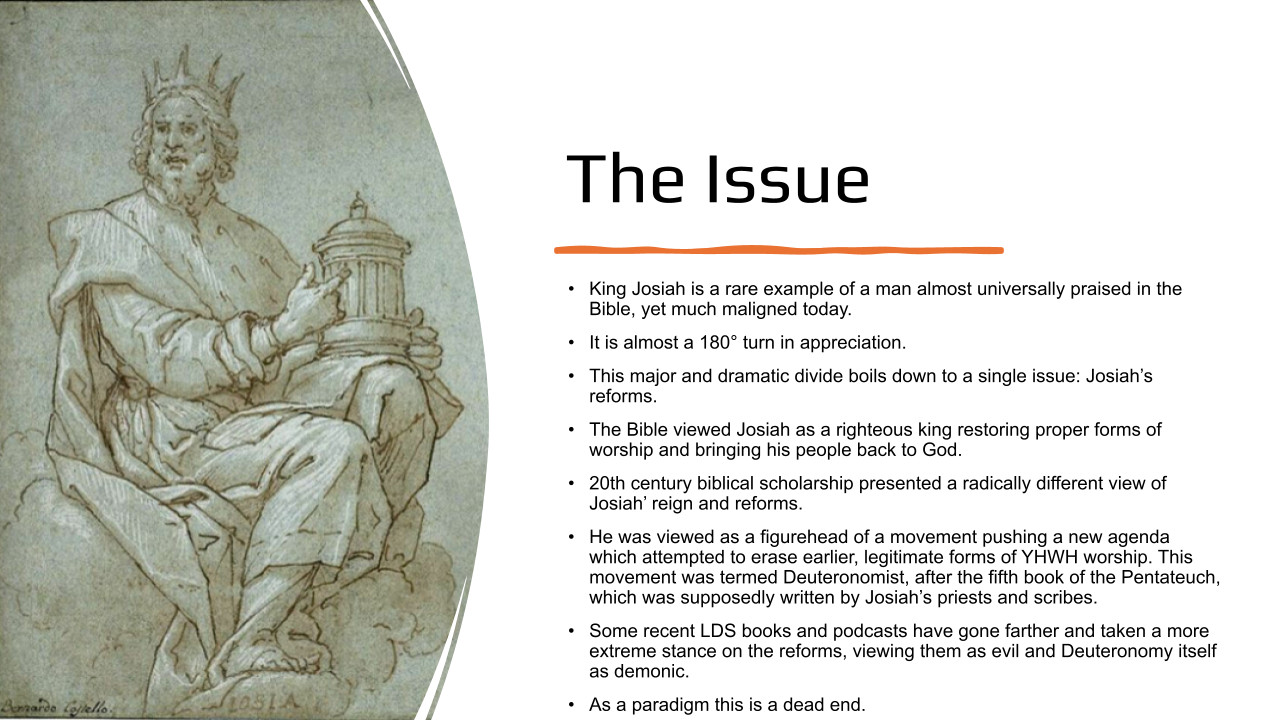
King Josiah is a rare example of a man almost universally praised in the Bible, yet much maligned today. It is almost 180° turn in appreciation. This major and dramatic divide boils down to a single issue and that is Josiah’s reforms. How one perceives the reforms tends to decide one’s view of Josiah. The Bible views Josiah as a righteous king restoring proper forms of worship and bringing his people back to God.

Deuteronomistic View

Modern scholarship, on the other hand, presents a radically different view of Josiah’s reigns and reforms. He became viewed as a figurehead of a movement pushing a new agenda which attempted to erase earlier legitimate forms of Yahweh worship.

This movement was termed “Deuteronomist” after the fifth book of the Pentateuch, which was supposedly written by Josiah’s priests and scribes.1

Studies of Margaret Barker, contributed to an LDS view that sees the reforms as a form of apostasy. Some recent LDS books and podcasts have gone even farther and taken a very extreme stance on the reforms, viewing them as evil and Deuteronomy itself as demonic. As a paradigm, this is a dead end. This puts us in a place we do not want to be. And the Bible is our scripture–among others–but it is one of our scriptures. Deuteronomy is important to the Book of Mormon, Doctrine of Covenants, New Testament. We don’t want to dismiss it over an issue we don’t quite understand.

Josiah’s Reforms as Positive and Necessary

I’m going to argue that overall, even if there were excesses, Josiah’s reforms were a good thing and a much needed thing. And if we learn that, we can learn to better understand all of our scriptures.

Time and Place
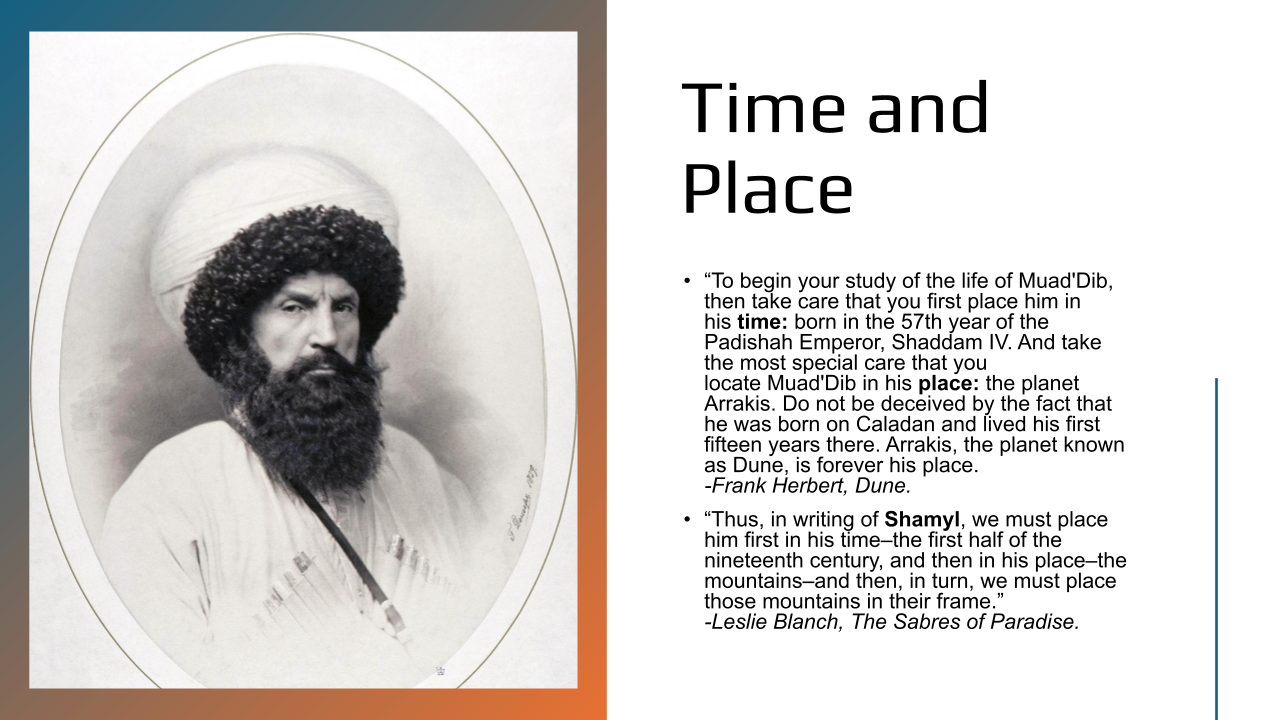
There’s a wonderful Frank Herbert quote in Dune.

“To begin your study of the life of Muad’Dib, then take care that you first place him in his time. Take the most special care that you locate Muad’Dib in his place.” 2

This is a wonderful explanation for historical context because historical context is time and place. Herbert adapted this from an insight in Lesley Blanch’s almost forgotten book, The Sabers of Paradise, and it’s a study of the 19th century conflict between the Caucuses and the Russian conquest.

She wrote that

“We must place him [Shamyl] first in his time and then in his place. . . and in turn we must place those mountains in their frame.”

Napoleon said that a nation’s geography determines its foreign policy or its fate. And this is very true.
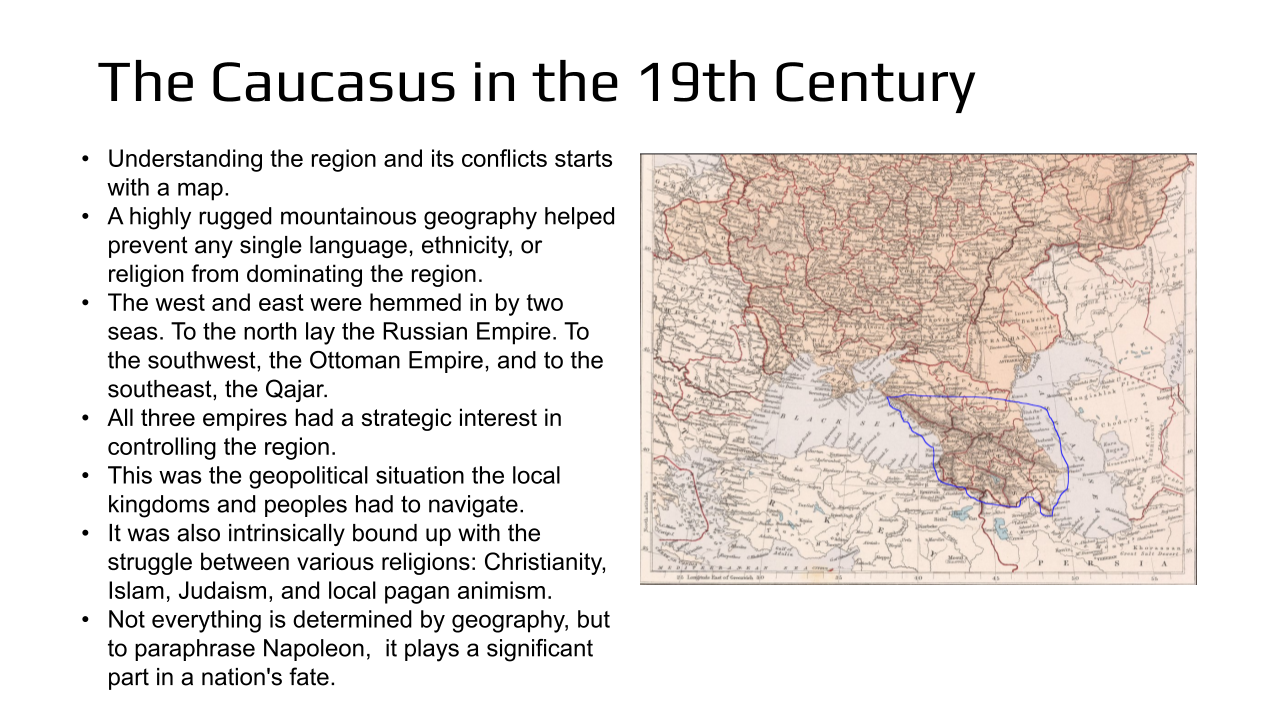
If we look at a map, it becomes obvious that you’ve got Russia to the north. You had the Ottoman Empire, Persian Kavad Empire to the south, and seas on either side. And when all of these empires wanted to expand, they ran up against this place. So you cannot understand a thing about it without understanding the geography and the time.
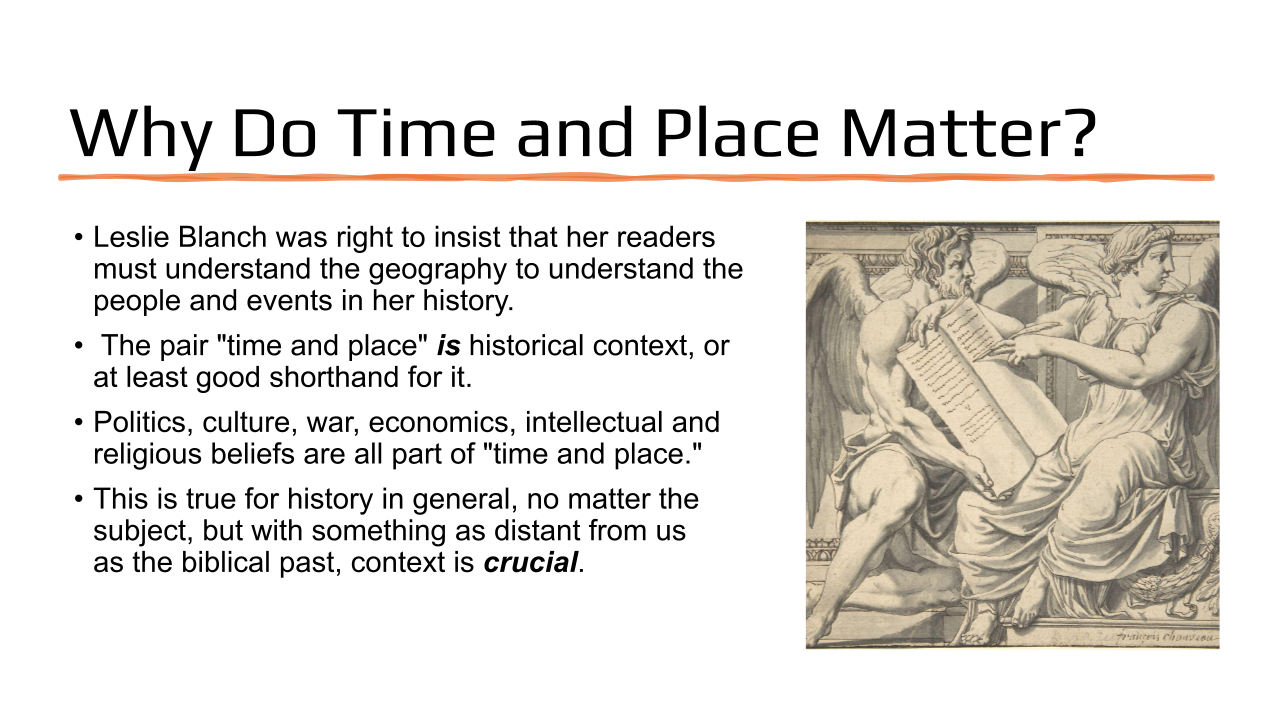
The pair of time and place, that is historical context, or at least good shorthand for it. So whether it’s politics, culture, war, economics, intellectual or religious beliefs, they all fit into that concept of time and place. This is true for doing history in general, but when the Bible is so distant to us, context is crucial.

Josiah’s Time and Place
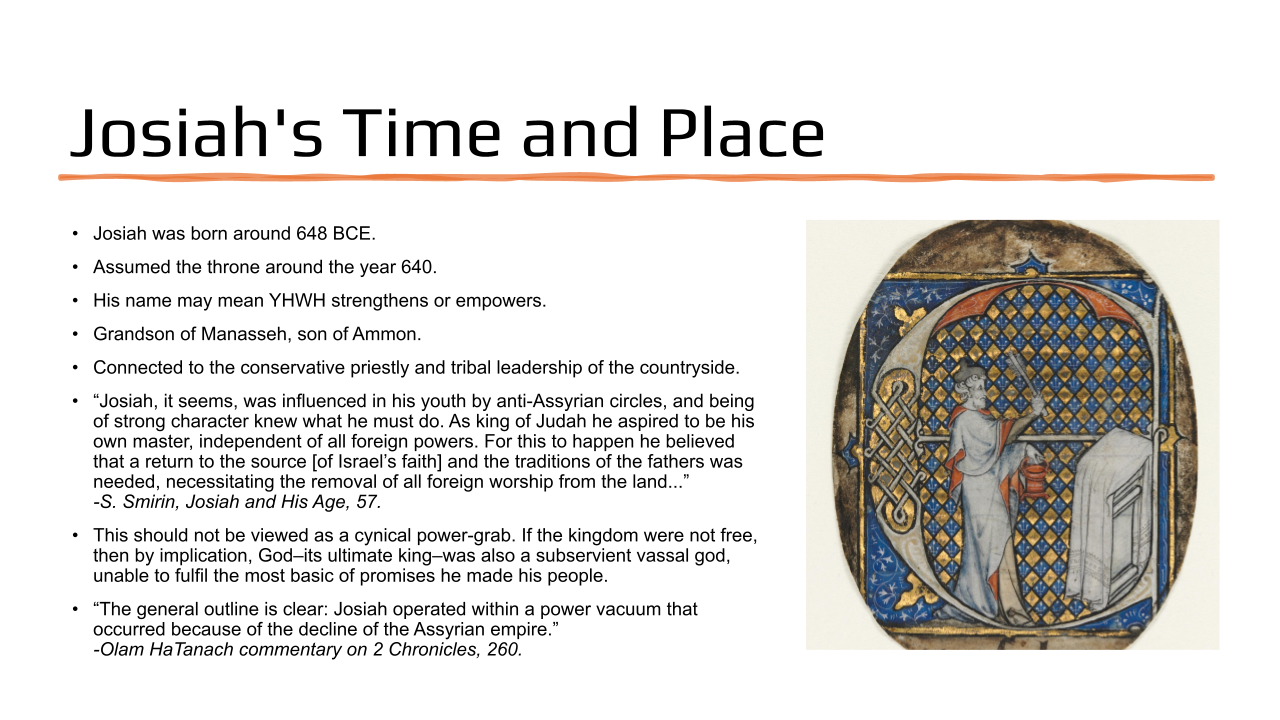
So let’s look at Josiah’s time and place. He was likely born around 648 BC and he assumed the throne about 8 years later after his father was assassinated. This is really important because this coincides with the downfall of the Assyrian Empire.

Now Josiah is also connected to conservative priestly and tribal leadership of the countryside. He marries into them and he likely absorbed that world view. And the Israeli scholar Shalom Smirin wrote that Josiah, it seems, was influenced in his youth by anti-Syrian circles. And as king, he aspired to be his own master, independent of all foreign powers. So for that to happen, as Smirin notes, Israel had to return to its source and show faith in God. Okay, this is not a cynical power grab.

If the kingdom were not free, then by implication, God, its ultimate King, was also a subservient vassal-God. Unable to fulfill the most basic of promises he made to his people. Okay? And he operates within this vacuum of the Assyrian Empire losing power. And we’ll get to that in a moment.

Judah’s Location and Significance
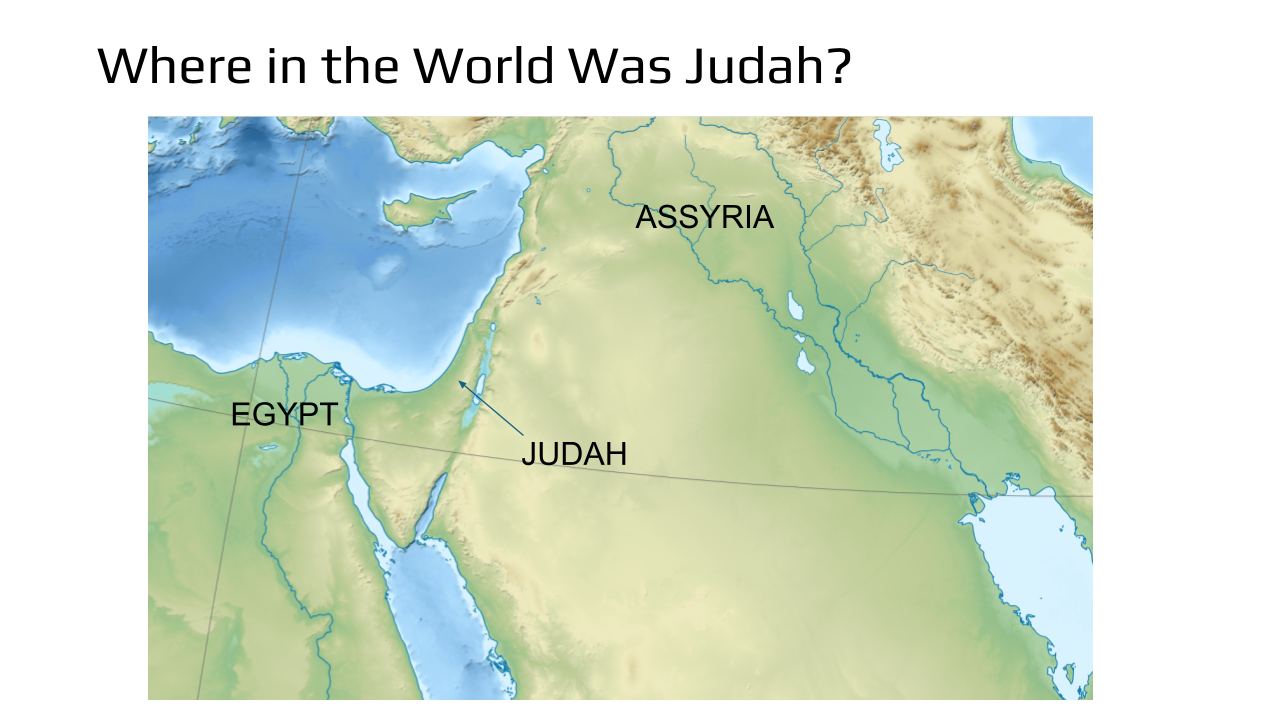
But I want us to look at this map. Okay, forgive it. It’s a little crude with the drawing and everything, but it gives a general picture. So, to the south and the west, you have Egypt. To the north, you have Assyria. And Judah is this tiny little country nestled in between them. But to get through for trade or war, you have to pass through the kingdom of Judah, the tiny kingdom of Judah. So, the great empires, they always had an interest in the fortunes of Judah.
In Josiah’s day, the kingdom of Israel had been destroyed by Assyria. It was over a hundred years ago, and it served as a physical reminder of broken covenants and exile, which ancient Israel conceptualized as spiritual death. Judah itself had barely escaped and was thrown into political, demographic, and economic upheaval. And religion ties into all of that.

So after Syria came in, the territory of the kingdom was vastly reduced. It lost prestige and power under Manasseh who was very close to Assyria. The kingdom regained much territory but it sunk deeper into spiritual morass.

The Assyrian Empire
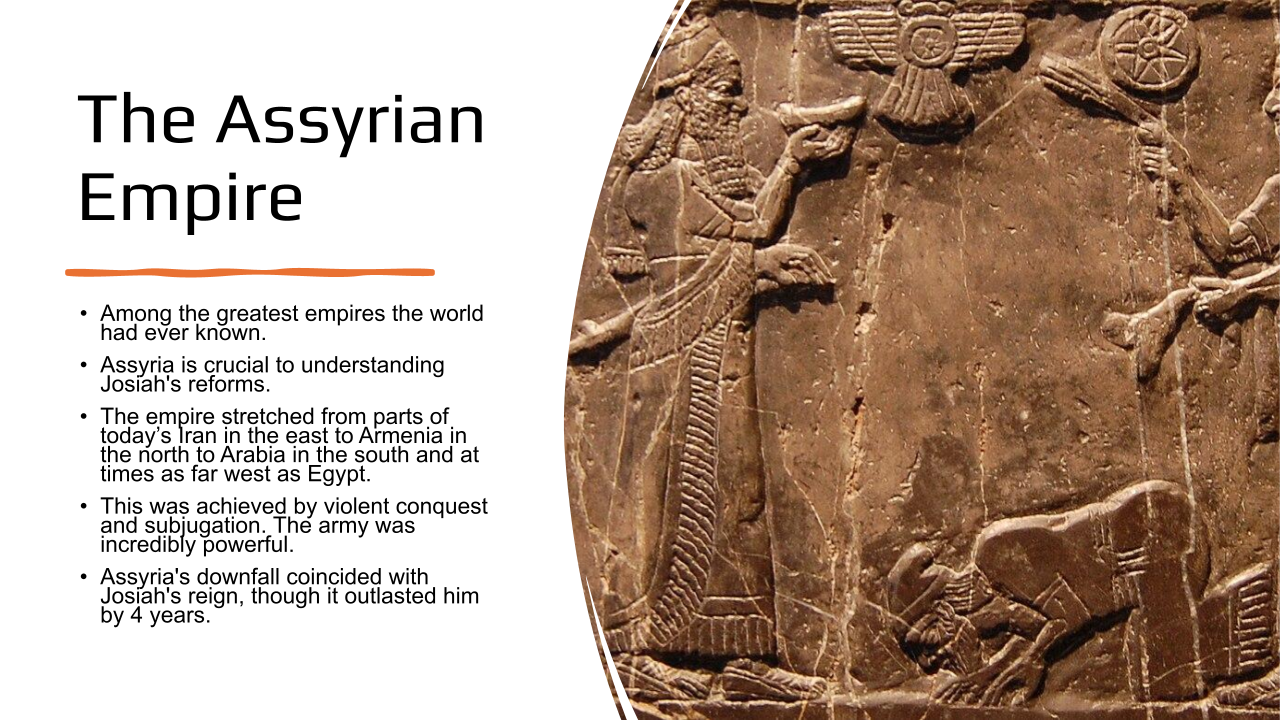
And with that, let’s look at the Assyrian Empire because without understanding it, we’re going to struggle with understanding what happened with the reforms.

So this was among the greatest empires the world had ever known. It stretches as far east as Iran, as far north as Armenia and Arabia in the south, and it went even as far as Egypt in the west. Naturally, these kingdoms weren’t lining up to join Assyria. The army, the military was incredibly powerful, and it violently conquered and subjected the kingdoms of the region.

Now, Syria’s downfall, it was pretty dramatic and it happened throughout Josiah’s reign. Not only was the army powerful, so was the ideology.
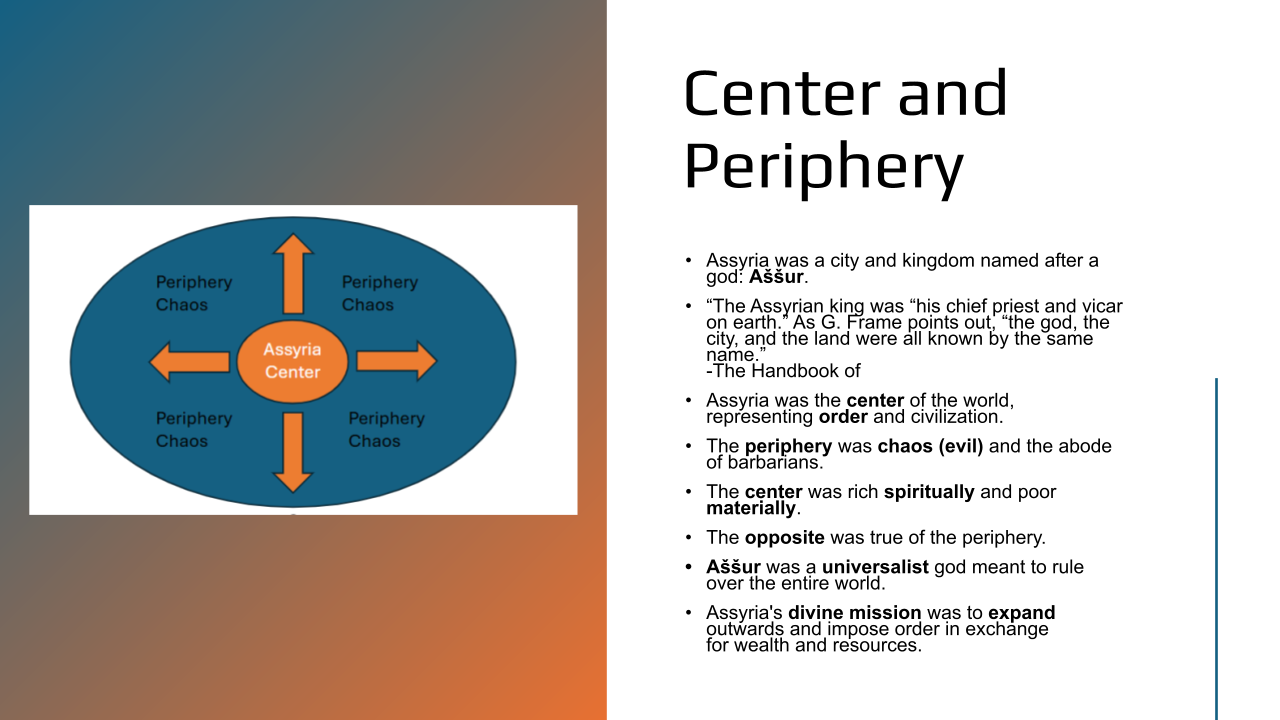
Assyria was a city first, then a kingdom, and it was named after a god, Ashur. The Assyrian king was his chief priest and vicar on earth. The god, the city, the land, they’re all known by the same name. They’re identified with each other.

Ashur was a universalist god who was meant to rule over the entire world by conquest. So you see, Assyria is the center. It’s where the order is, civilization, the gods, and it’s surrounded on the four corners by the periphery, which is where chaos, evil, the demonic, the barbaric, the center. It was rich spiritually, but impoverished materially.

The exact opposite was true of the periphery. So Assyria’s divine mission was to expand outward and impose order in exchange for wealth and resources. So a very extractive venture.
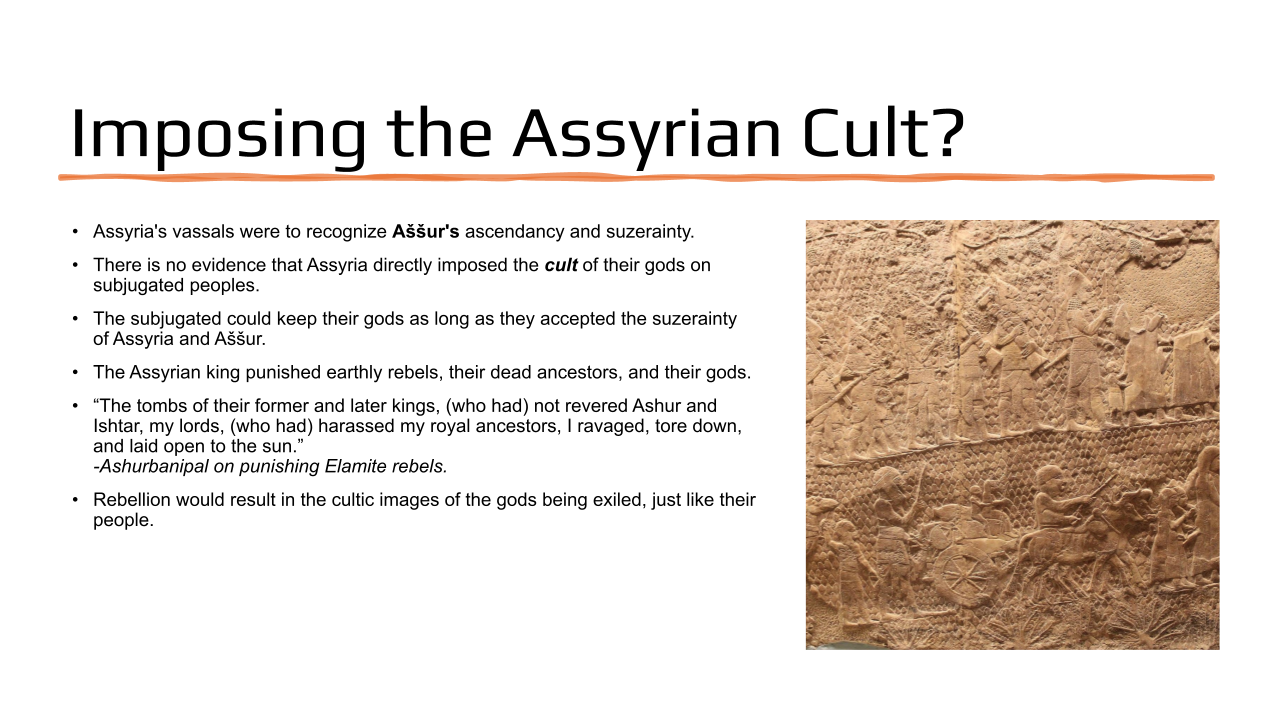
Acknowledging Ashur

Now Syria’s vassals, they not only recognize the king, they’re also to recognize Ashur’s ascendancy and suzerainty, as in he’s the head god of all the gods. We don’t have evidence that Assyria directly imposed the cult of their gods on subjugated people, and they didn’t have to. The subjugated could keep their gods as long as they accepted the suzerainty of Assyria and Ashur. 3

Political rebellion was always a religious affair in the ancient near east. The Assyrian king would punish earthly rebels, their dead ancestors, and their gods. Rebellion was a highstakes game. If you lost, it would result in the cultic images of the gods being exiled just like their people.
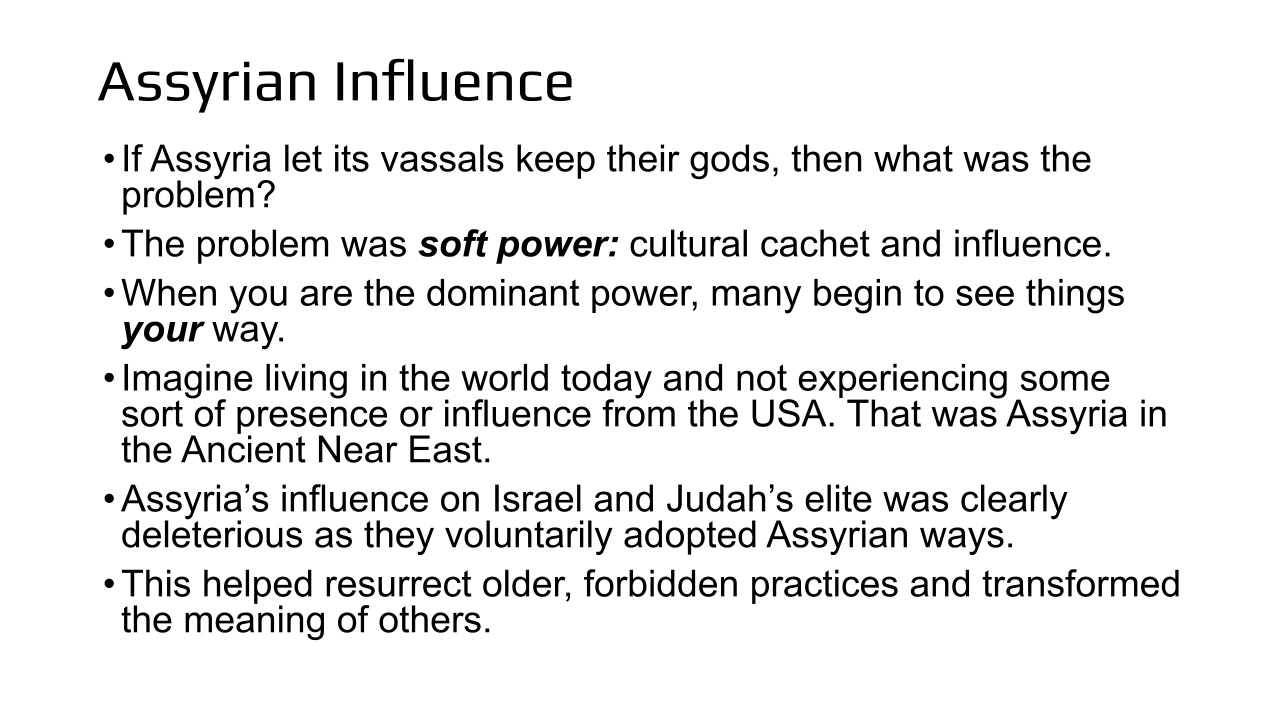
Assyrian Influence

So if Assyria let its vassals keep their gods, then what was the big problem? That problem was soft power, cultural cache and influence. When you are the dominant power, many begin to see things your way and do what you do.

Can you imagine living in the world today and not experiencing some sort of presence or influence from the United States? That was Assyria in the ancient near east. The influence on Israel and Judah’s elite was clearly deleterious, as they voluntarily adopted Assyrian ways. And these were always idolatrous.They resurrected older, forbidden practices and transformed the meaning of others.
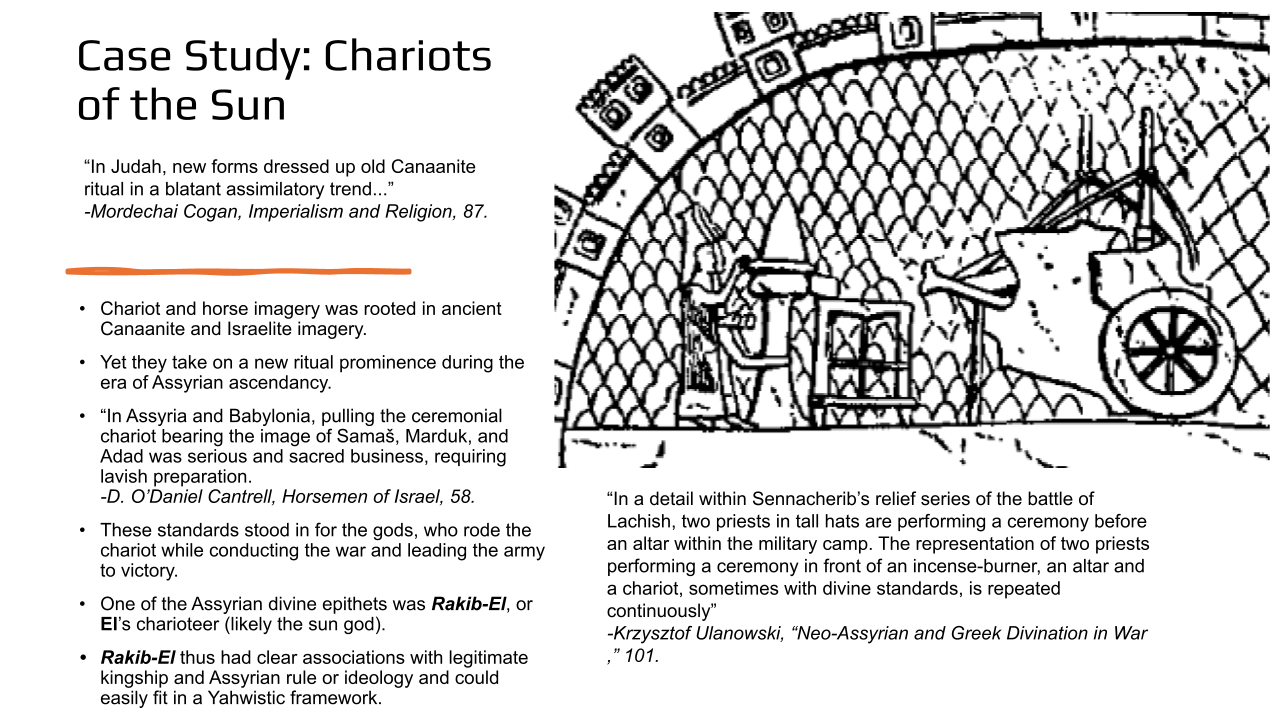
Chariots of the Sun

We have a little case study. If you look at this picture, this is from the Assyrian palace reliefs depicting the war against the kingdom of Judah in Lachish, as we read in Isaiah. So in Judah, new forms dressed up old Canaanite ritual in a blatant assimilatory trend, as Mordechai Cogan said.

Chariot and horse imagery was rooted in ancient Canaanite and Israel imagery. And in the Bible, we find plenty of references to God and to horses and things like that and chariots. Yet, we find that these take on a new ritual prominence during an era of Assyrian ascendancy.

The standards that we see in this chariot in the picture, they stood in for the gods who rode the chariot while conducting the war and leading the army to victory. One of the Assyrian divine epithets was Rakib-El, or El’s charioteer, and this likely meant the sun god’s chariot. So Rakib-El had clear associations with legitimate kingship in Assyrian rule or ideology and it could easily fit in a Yahwistic framework. And that was the problem.

Egypt
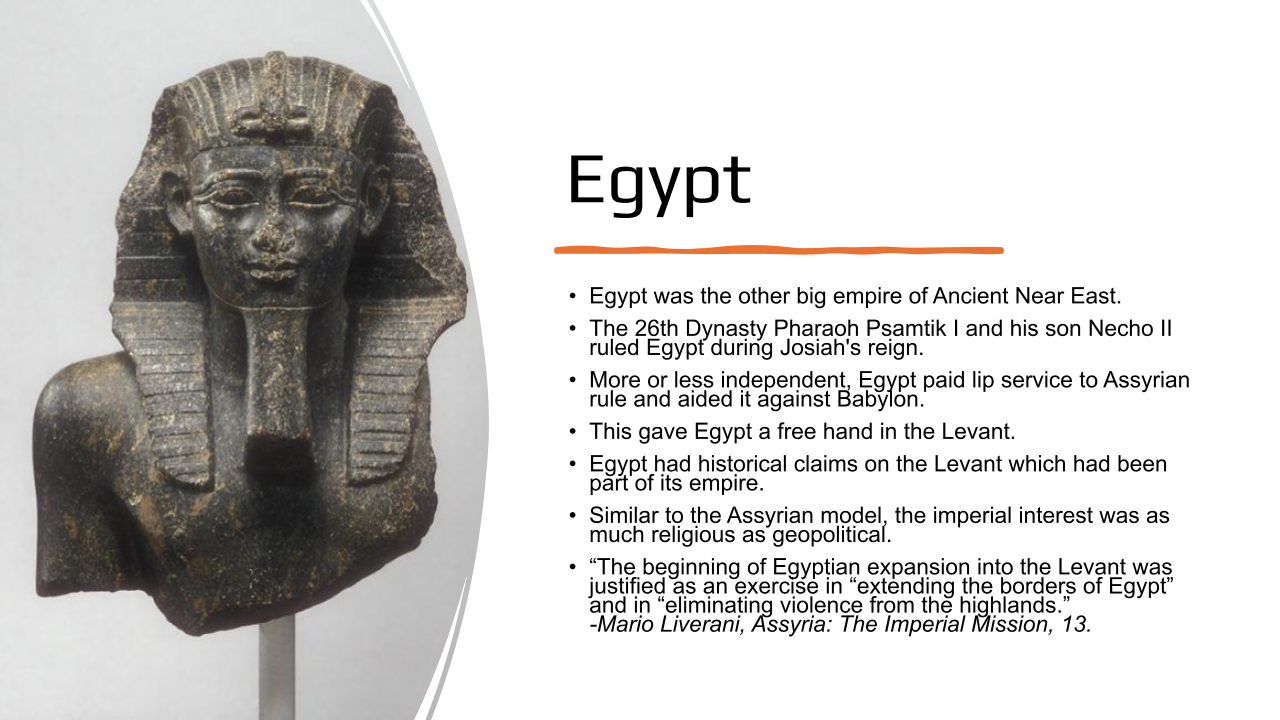
Now before we move on to the reforms we need to understand a little bit about Egypt. It was the other big empire of the ancient Near East.

During Josiah’s day it was the 26th dynasty, so Psamtik I and his son Necho II. They’d basically thrown off Assyria’s yoke. They were more or less independent. They paid lip service to Assyria and they came to its aid against Babylon, the new kingdom on the rise.

Egypt had historical claims on the Levant which had been part of its empire. The imperial interest was as much religious as geopolitical. They extended the borders of Egypt and civilization and eliminated violence from the highlands. They aided Syria against Babylon because they could get concessions from Assyria and regain much of their empire.
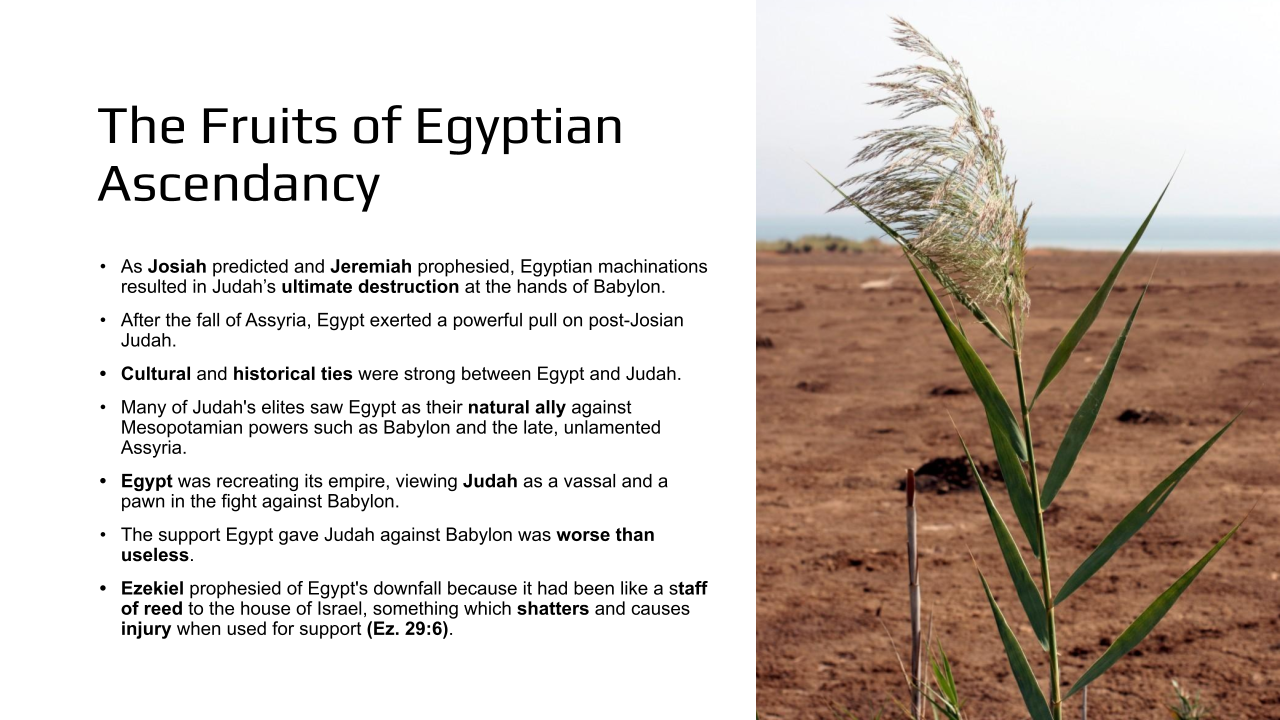
Egyptian Ascendancy

Now, as Josiah predicted and Jeremiah prophesied, Egyptian machinations resulted in Judah’s ultimate destruction at the hand of Babylon. Egypt exerted a powerful pull in post-Josiahan Judah.

They had really old cultural and historical ties. They were strong and many of Judah’s elite saw Egypt as their natural ally against anyone in Mesopotamia; be it Babylon, be it Assyria. Egypt viewed Judah as a vassal and a pawn in their fight against Babylon. The support Egypt gave Judah against Babylon was worse than useless.

So Ezekiel prophesies of Egypt’s downfall because it had been like a staff of reed to the house of Israel. And if you lean on a reed, it’s going to shatter, splinter, cause you terrible injuries. And that’s what happened with Egypt.

King and Kingship
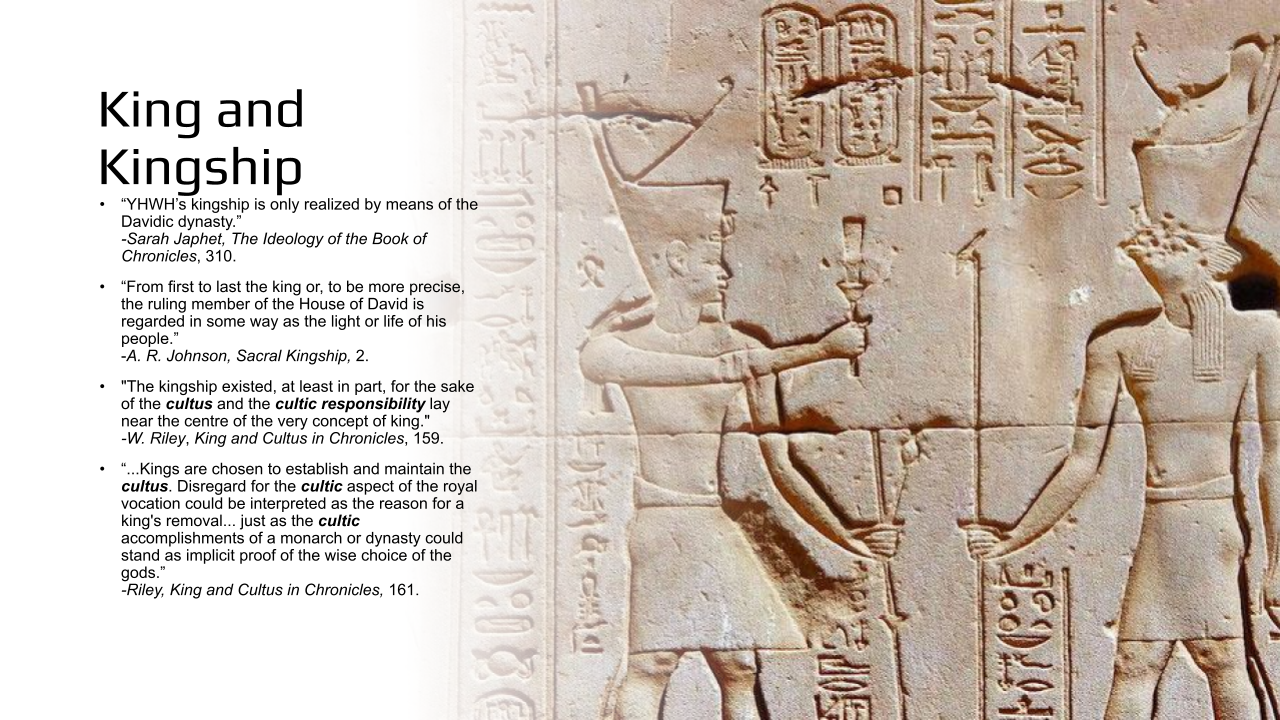
You know, the king is something we got to talk about because while we think we might know it, it’s too familiar a concept. We’ve got to think about it a little bit more to make sense.
Israelite Kings

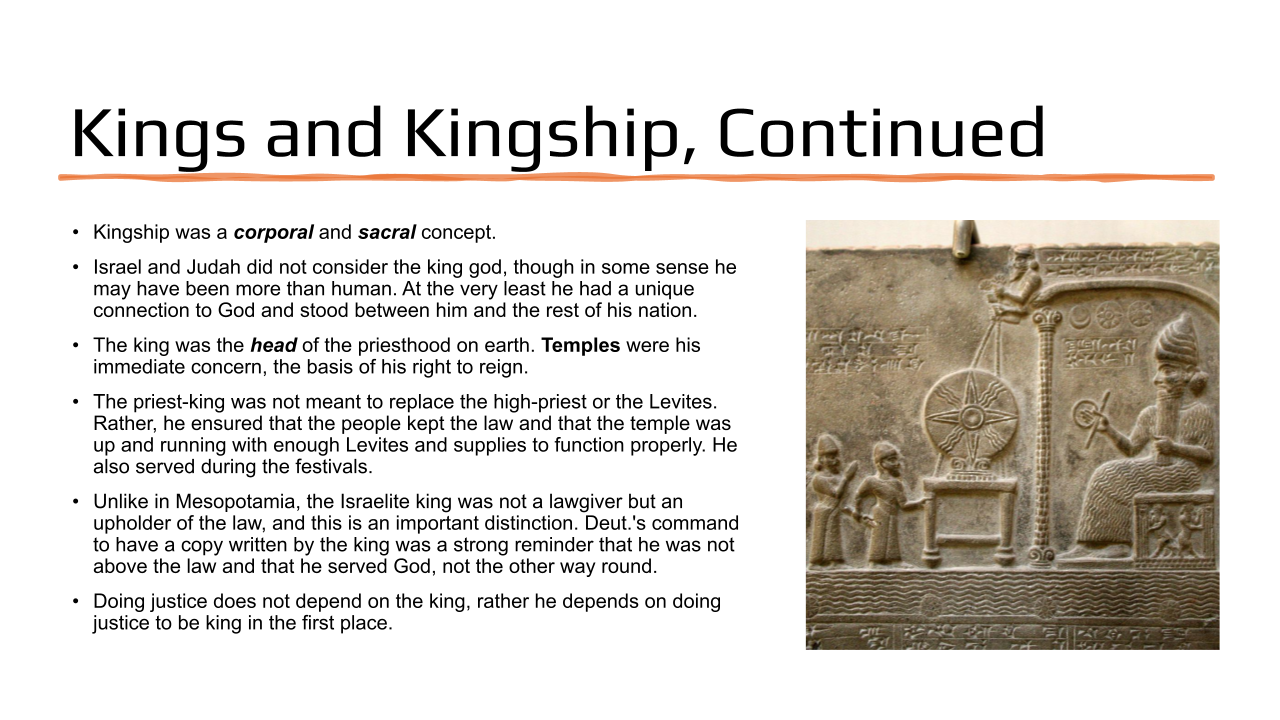
Kingship was a corporal and sacral concept. Israel and Judah did not consider the king God. Although in some sense he may have been more than human. At the very least, there’s this unique connection to God and he stands between God and the rest of his nation. He goes back and forth between them.

The king was also the head of the priesthood on earth. Temples were his immediate concern, the basis of his right to reign. He does not replace the high priest or the Levites, but he ensures that people keep the law and that the temple is up and running, has enough Levites to function there, and it has enough supplies for them to do what they need. Festivals were when the king was needed the most.

Mesopotamian Kings

Now, in Mesopotamia, the king gives the law, like Hammurabi; the king decides what’s wrong and what’s right to an extent. Deuteronomy and Israelite kingship do not really have that concept. Deuteronomy makes the king write a copy of the law to remind him that he was not above the law. That he served God, not the other way around. So, doing justice does not depend on the king, rather he depends on doing justice to be king in the first place.

Medieval Kings
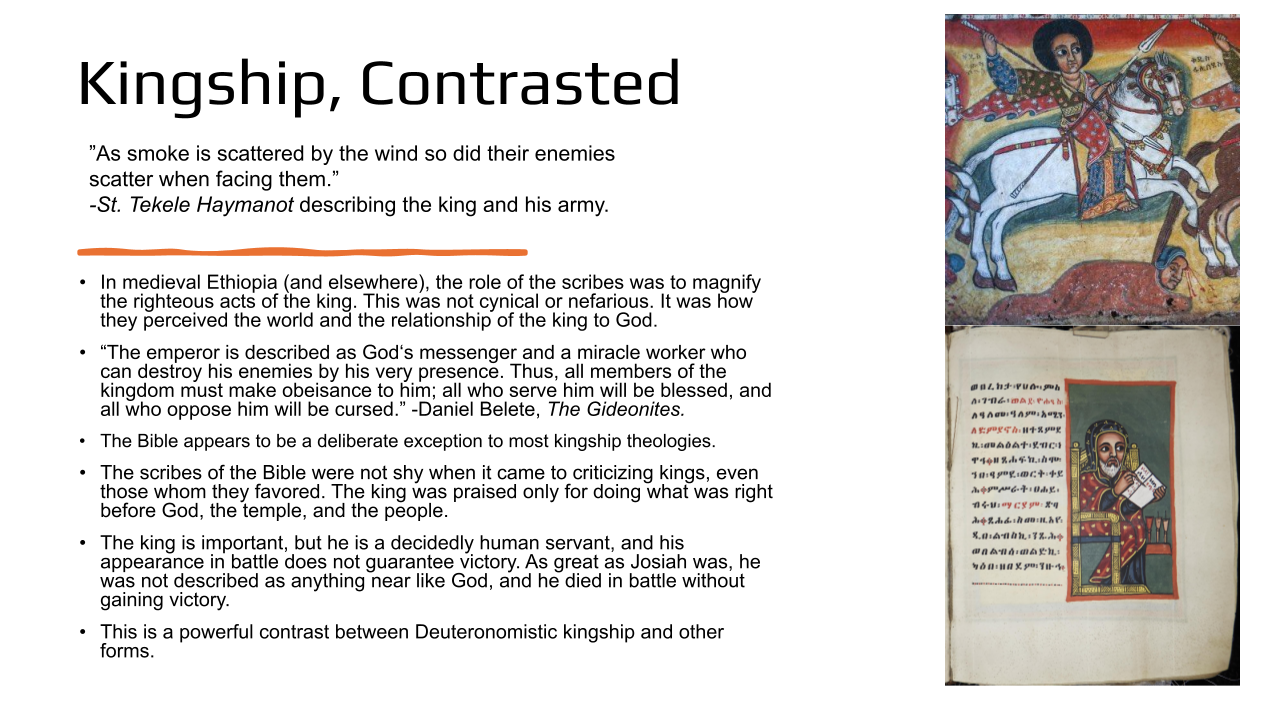
Now a little bit of comparative material is always helpful. In medieval Ethiopia and elsewhere, the role of the scribes was to magnify the righteous acts of the king. This was not cynical. It was not nefarious. It was how they perceived the world and the relationship of the king to God. So he’s God’s messenger. He does miracles. His enemies flee at his very presence.

And as Daniel Belete wrote,

“Thus all members of the kingdom must make obeisance to him. All who serve him will be blessed and all who oppose him will be cursed.”

The Bible, on the other hand, is a deliberate exception to most kingship theologies. Scribes of the Bible were never shy when it came to criticizing kings, even those whom they favored. The king was praised only for doing what was right before God, the temple, and the people. As important as the king is, he is a decidedly human servant. His appearance in battle does not guarantee victory. Josiah was slain in battle and lost.

Josiah was not described as anything near like God. This is a powerful contrast between Deuteronomistic kingship and other forms.

The Reforms of Josiah
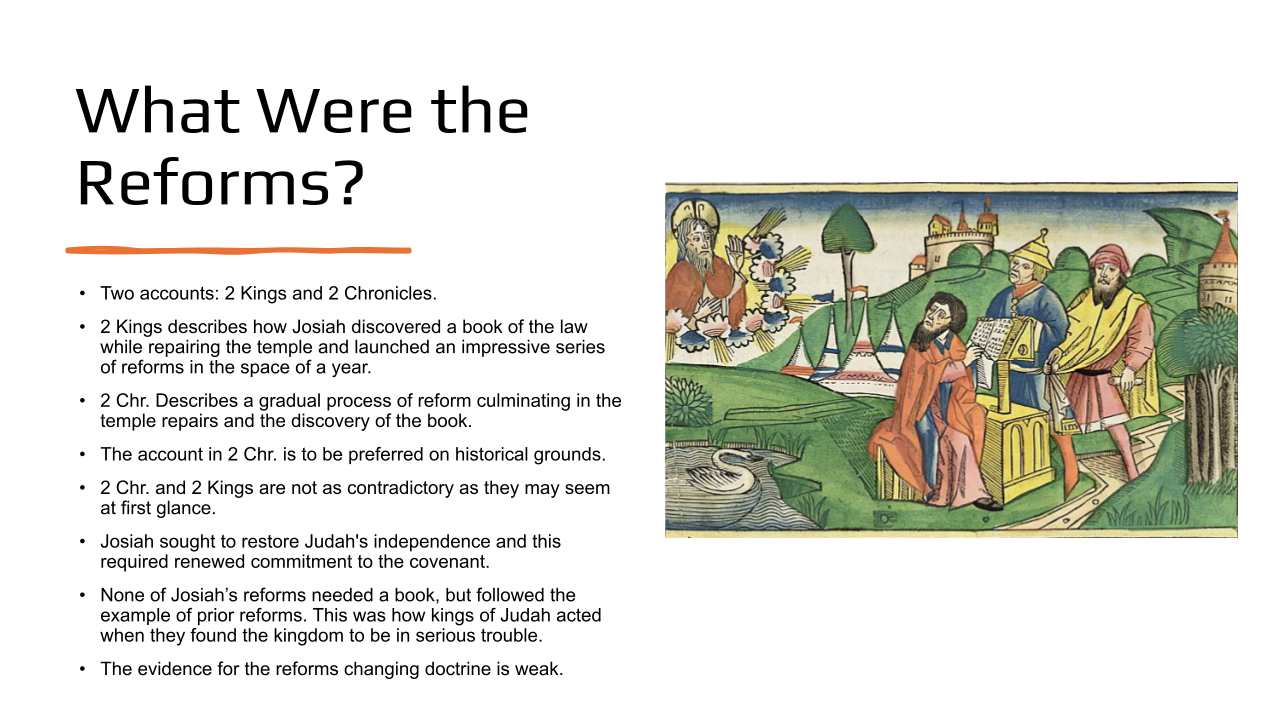
And with the idea of kingship in mind, let’s look at the reforms. We have two accounts in the Bible. There’s 2 Kings and 2 Chronicles. Second Kings describes how Josiah discovered a book of the law while repairing the temple. He launched an impressive series of reforms in the unlikely space of a year.

2 Chronicles, on the other hand, describes a gradual process of reform culminating in the temple repairs and the discovery of the book. The 2 Chronicles account is to be preferred on historical grounds. It doesn’t contradict Kings like you may think on the surface. My paper is going to have a description of why that is. But for now, let’s look at what happened.

Josiah sought to restore Judah’s independence, and this required renewed commitment to the covenant. None of Josiah’s reforms needed a book. They followed the example of prior reforms. This was how kings of Judah acted when they found the kingdom to be in serious trouble. And the evidence for the reform’s changing doctrine is weak.
Why Reforms Were Needed

Now the reason he needed a reform in the first place, kings such as Manasseh and others had made aggressive changes to Judah’s worship, installing the cult of other gods, and that had a corrupting influence.

The king, as we saw, was the head of the priesthood on earth. He was responsible to God for the people because they were God’s people. And overseeing the call so it functioned properly was another part of the king’s duties. Just as today the President of the Church is responsible for the temple and the endowment ceremony and making any required changes; that’s what the kings were supposed to do.

We can also think of this as the renewal of wedding vows. Israel was described in the Bible as God’s wife. Apostasy and covenant breaking was akin to adultery. So what the kings did was to remove all markers of favor or devotion to other lovers, those foreign deities and their worship. That’s why they had to go.

‘Mormon’ Reformation

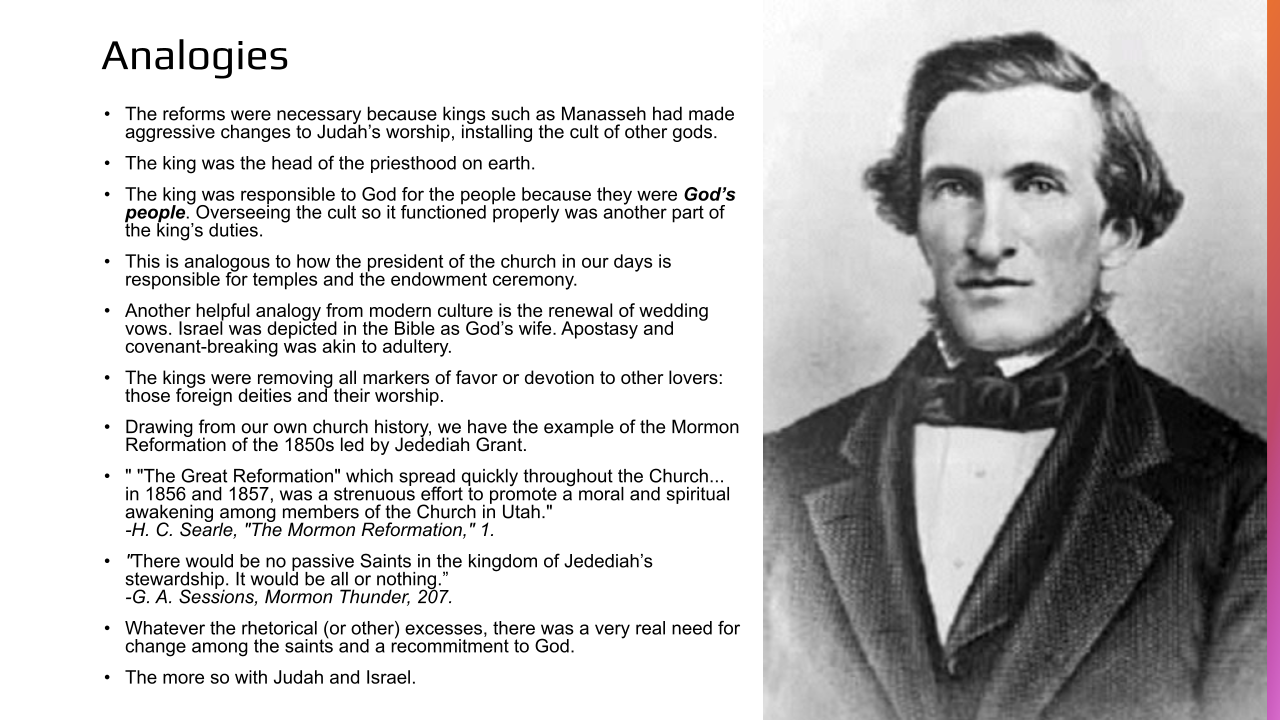
Drawing from our own Church history, we have the example of the Mormon Reformation of the 1850s led by Jedidiah Grant. And this was a strenuous effort to promote a moral and spiritual awakening among members of the Church in Utah.

As Gene Sessions wrote, I love this turn of phrase,

“There would be no passive saints in the kingdom of Jedidiah’s stewardship. It would be all or nothing.”

Whatever the rhetorical or other excesses of this reformation, there was a very real need for change among the saints and a recommitment to God. The more so with Judah and Israel who had sunk into idolatry.
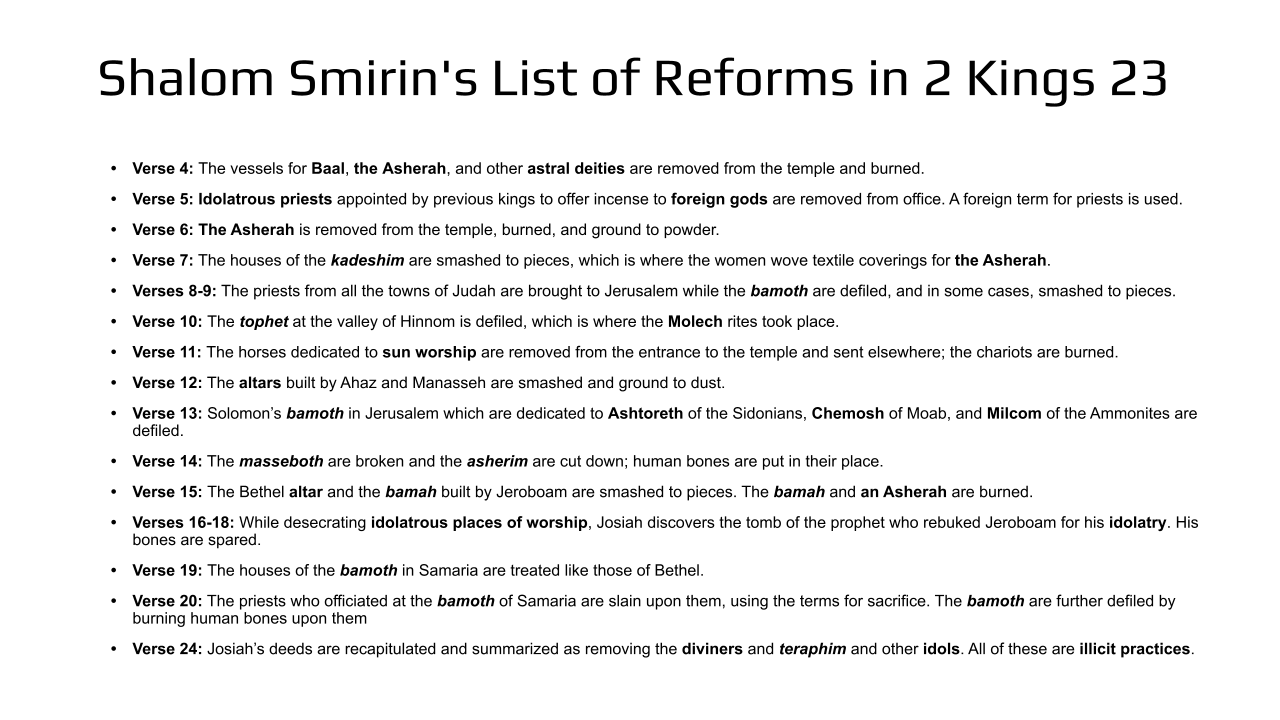
Shalom Smirin compiled an excellent list of what the reforms were about. As we can see, all of them dealt with idolatry. There is one exception and we will get to that. But otherwise, this is all about what Israel or Judah was doing in its worship.

Josiah’s Passover
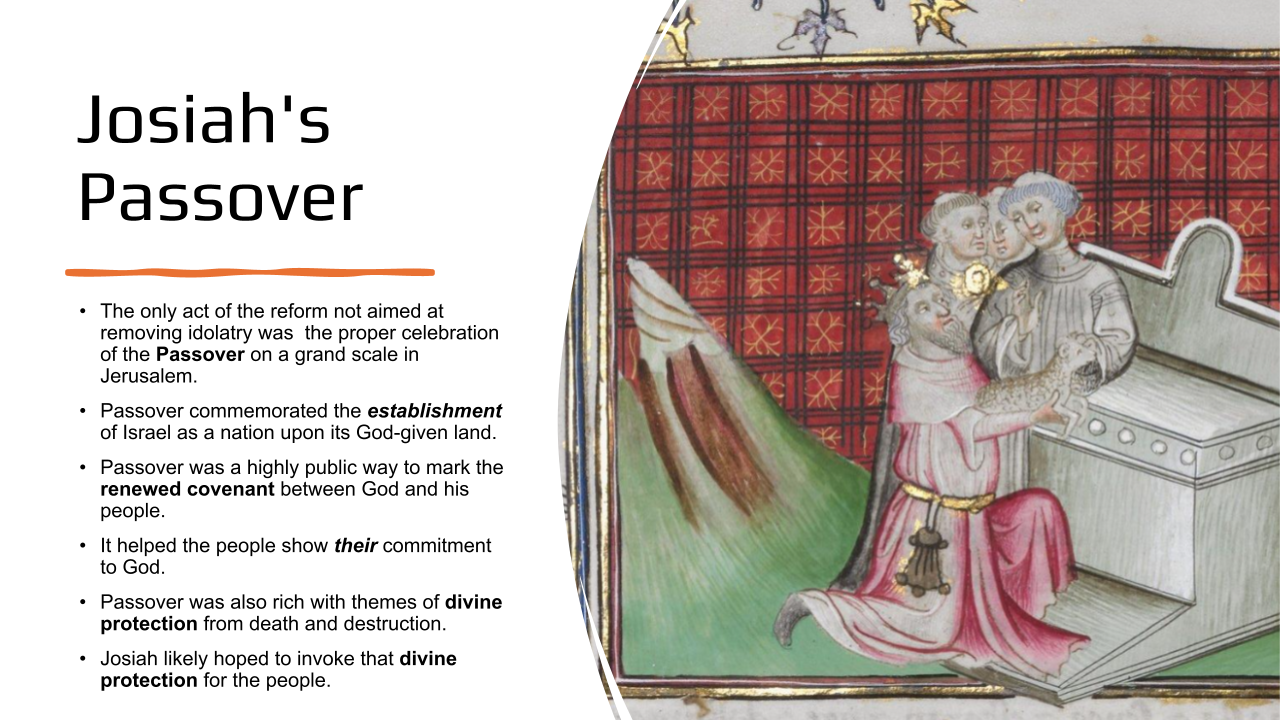
The only act of the reform not aimed at removing idolatry was proper celebration of the Passover on a grand scale in Jerusalem. The Passover, as you may recall, commemorates the establishment of Israel as a nation upon its God-given land. God takes Israel out of Egypt and brings it to the Promised Land.

Passover was a highly public way to mark the renewed covenant between God and his people. It helped the people show their commitment to God, and it was rich with themes of divine protection from death and destruction. That’s in the name, the destroying angel passing over the children of Israel. Josiah likely hoped to invoke that divine protection for the people. Failed, but he tried.

Claims of Changing Doctrine
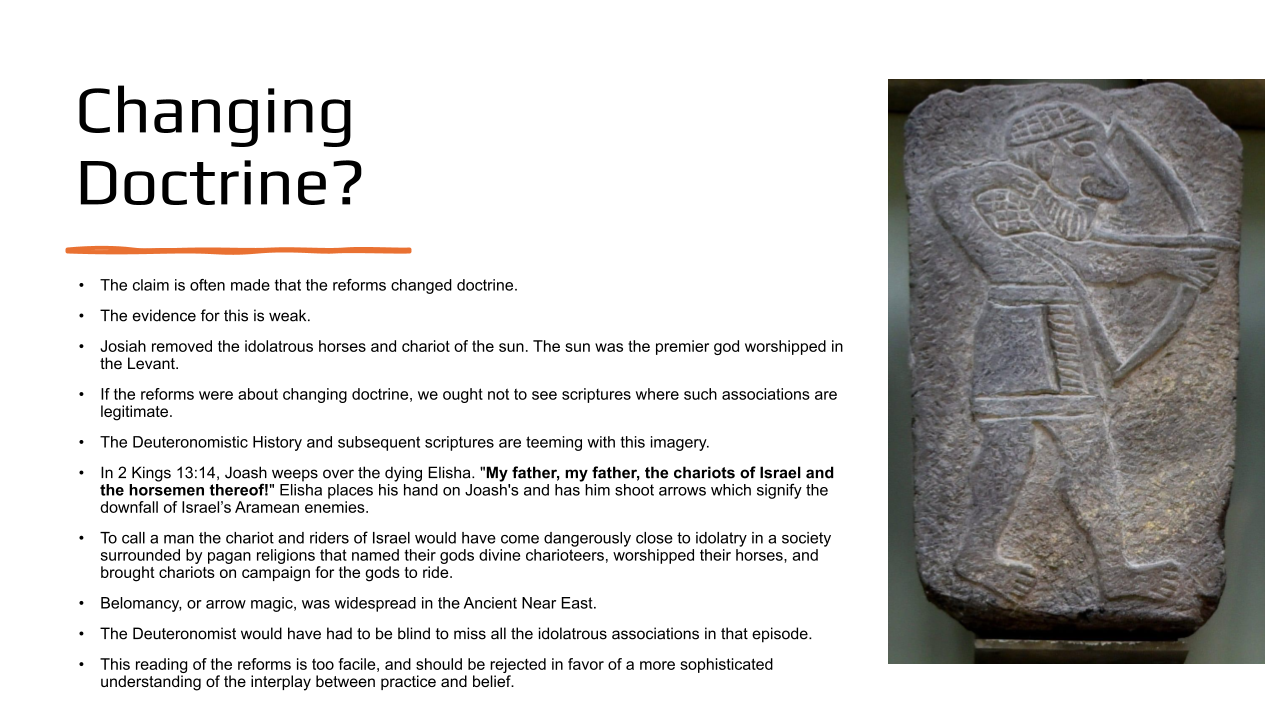
Now, the claim is often made that the reforms changed doctrine. The evidence is weak at best. If you recall, he removed the horses and the chariots of the Sun. The Sun was the premier god worshiped in the Levant. And if the reforms were about changing doctrine, we ought not to see any scriptures where such associations are legitimate, especially not Deuteronomistic history. But Deuteronomistic history and subsequent scriptures are teeming with this imagery.

In 2 Kings chapter 13, the king Joash weeps over the dying Elisha and he says, “My father, my father, the chariots of Israel and the horsemen thereof.” He then instructs the king to take a bow. Elisha places his hand on Joash’s hands and has him shoot arrows which signify the downfall of Israel’s Aramean enemies.

So to call a man the chariot and riders of Israel would have come dangerously close to idolatry in a society surrounded by pagan religions that named their gods divine charioteers, worshiped their horses, and brought chariots on campaign for the gods to ride. And arrow magic was widespread in the ancient Near East and Assyrian kings offered up offerings of arrows to the god while on campaign.

The Deuteronomist would have had to be blind to miss all the idolatrous associations in that episode. And whatever we think of him, we know he wasn’t an idiot. He would have recognized problematic associations.

So because of that, this reading of the reforms is too facile and should be rejected in favor of a more sophisticated understanding of the interplay between practice and belief.

Symbols Change
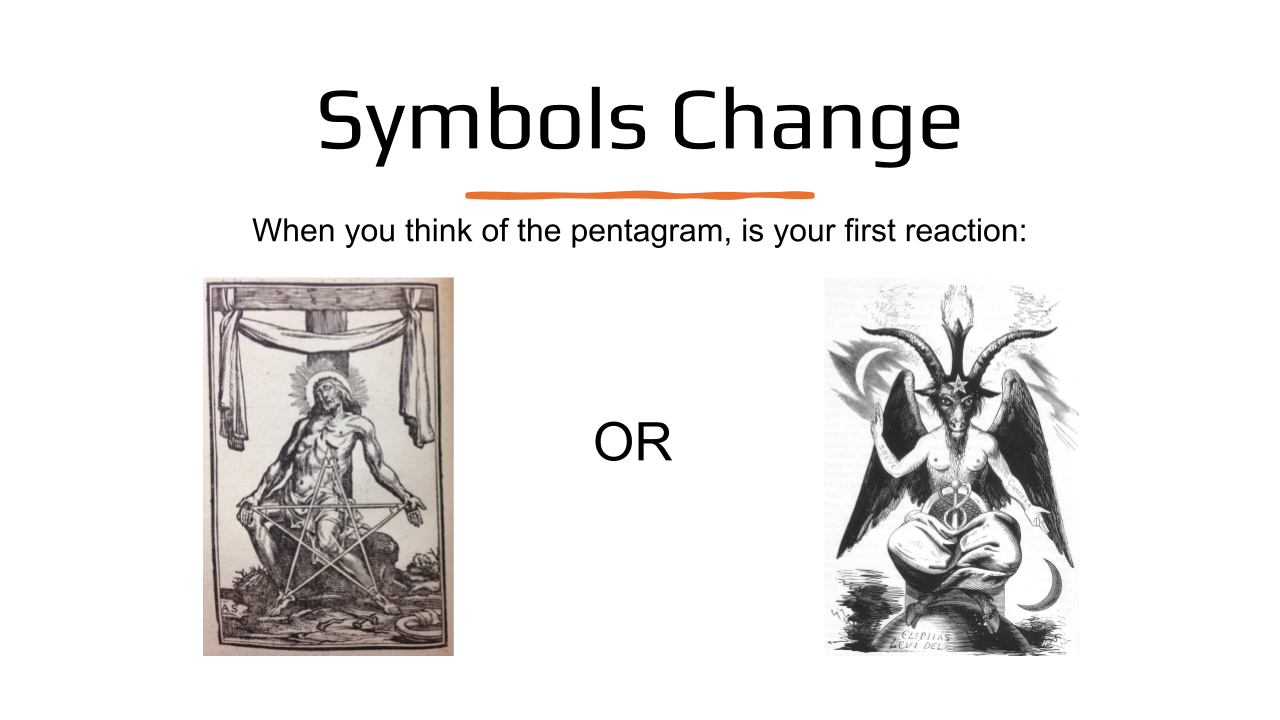
Now, symbols change. When you think of the pentagram, is your first reaction, the image of Jesus, or is it the other one? Symbols, they’re not static. Their meaning can change and it does change.
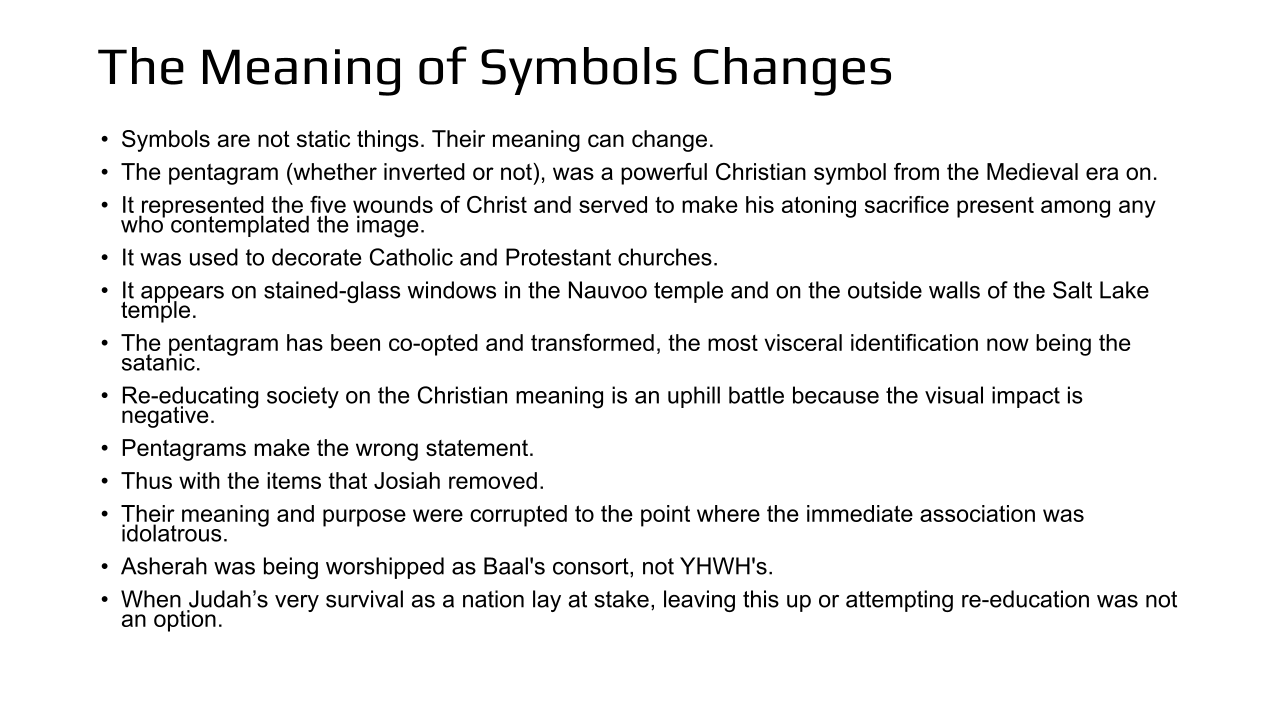
The Pentagram

The pentagram used to be a powerful Christian symbol from the medieval era onwards. Among others, it represented the five wounds of Christ and they served to make his atoning sacrifice present among any who contemplated that image. If you read Sir Gawain and the Green Knight, it’s a major part of that plot.

It was used to decorate Catholic churches and Protestant ones. And we have it on stained glass windows in the Nauvoo Temple and on the outside walls of the Salt Lake Temple. But the pentagram has been co-opted and transformed. The most visceral identification now being the satanic.

Now, if you want to re-educate society on the Christian meaning, that’s a long uphill battle because the immediate visual impact is negative. These pentagrams make the wrong statement.

Josiah Removed Corrupted Symbols

And thus it is with items that Josiah removed. Their meaning and their purpose were corrupted to the point where the immediate association was idolatrous. Asherah was being worshiped as Baal’s consort, not Yahweh’s. So when Judah’s very survival as a nation lay at stake because of their idolatry, leaving this up or attempting re-education was not an option.

Josiah and Violence
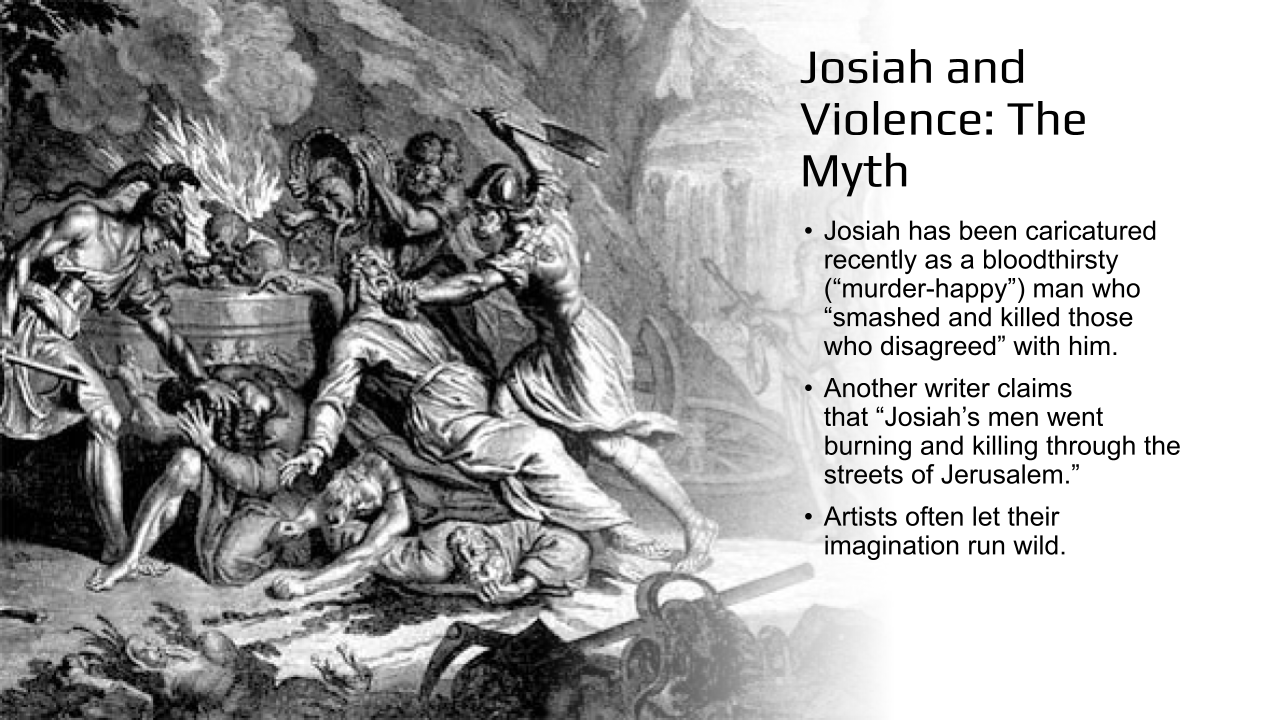
The Myth

People have been disturbed by some of the violence in this narrative, but it also gets caricatured quite a lot. Recently, someone wrote that he was a “murder-happy” man who smashed and killed those who disagreed with him. And another writer claimed that “Josiah’s men went burning and killing through the streets of Jerusalem.” And this 17th century illustration is quite lurid, as you can see. Artists let their imaginations run wild.
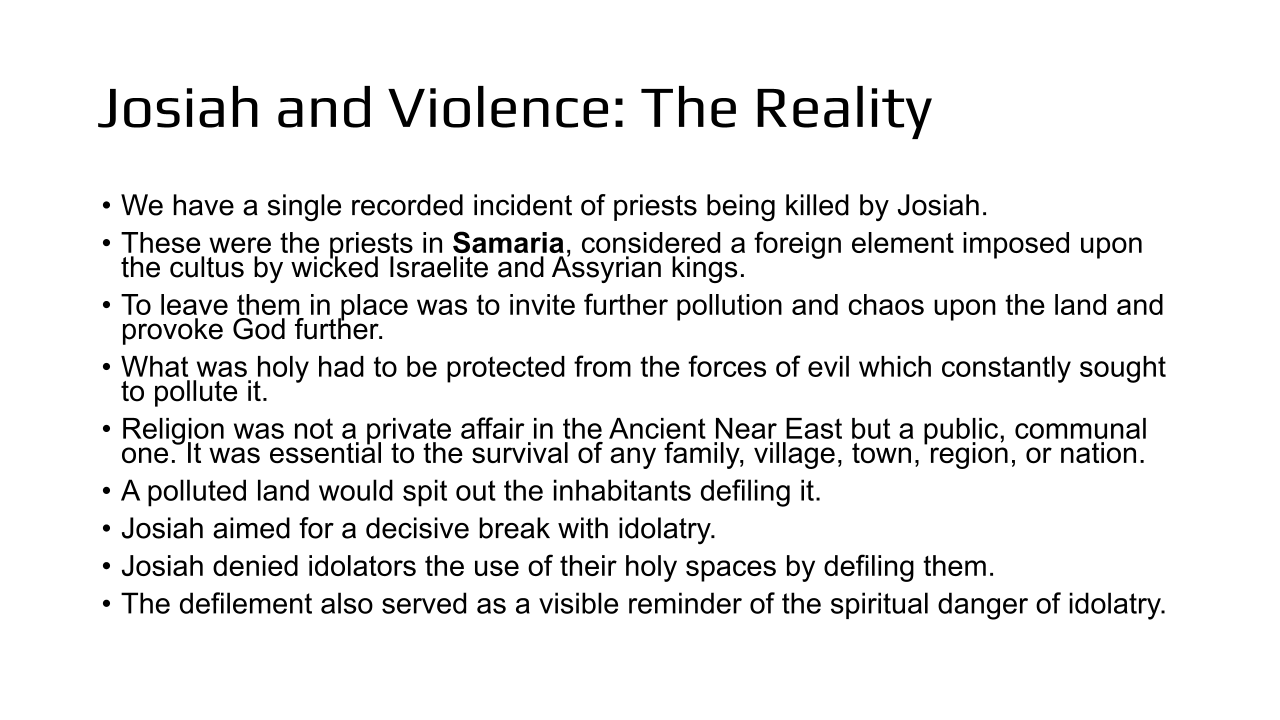
The Reality

The reality though was different. We have a single recorded incident of priests being killed by Josiah. Otherwise, even those involved in idolatrous rites in the kingdom of Judah, he treated them gently and kindly. The ones killed were the priests in Samaria, considered a foreign element imposed upon the cultists by wicked Israelite and Assyrian kings. To leave them in place was to invite further pollution and chaos upon the land and provoke God further.

What was holy had to be protected from the forces of evil which constantly sought to pollute it. And religion was not a private affair. What you did mattered for your community. The religion was essential to the survival of any family, any village, town, region, or nation. Polluted land spits out the inhabitants defiling it. And if Josiah aimed for a decisive break with idolatry, he had to deny the idolaters the use of their holy spaces by defiling them with the bones. And this defilement also served as a visible reminder of the spiritual danger of idolatry. Think warning labels with skull and crossbones.

The Discovered Book
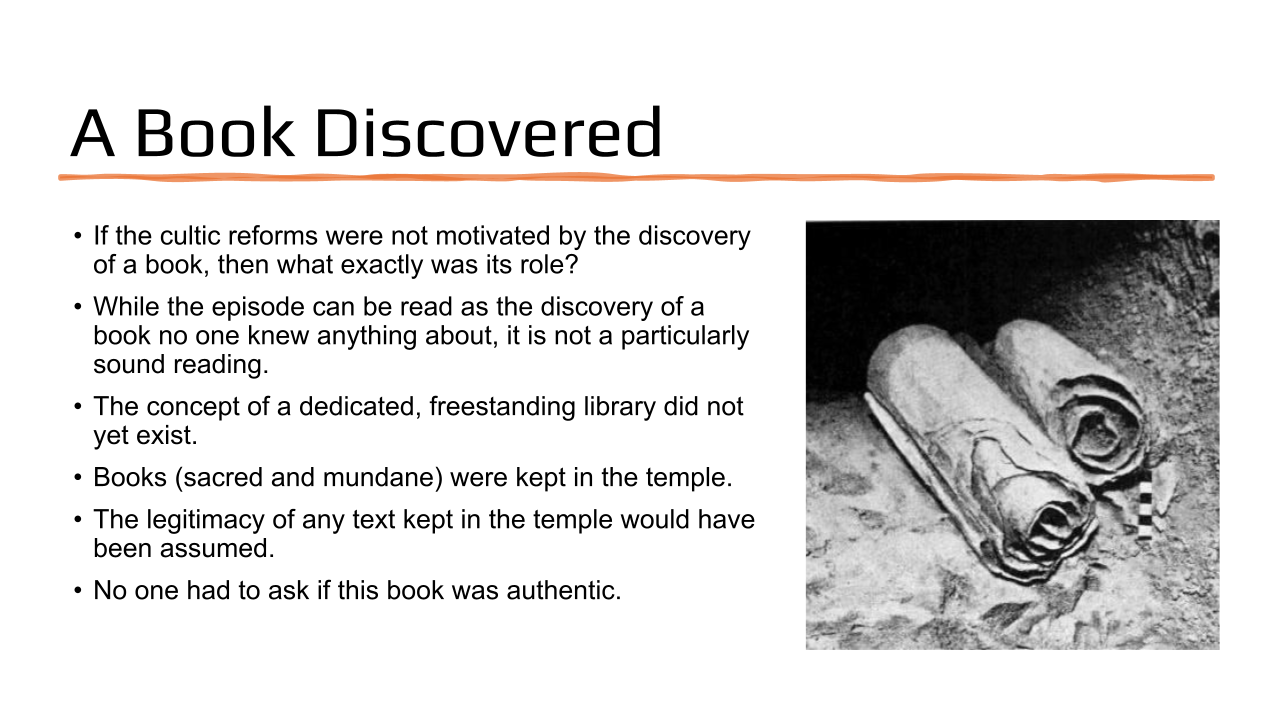
Okay. Now if the book was not what influenced the reforms or caused them, what exactly was its role? Books were kept in the temple. There weren’t dedicated freestanding libraries and the legitimacy of any texts kept there would have been assumed. No one at court had to ask if this book was authentic. And that’s not the question they posed to Huldah the prophetess.
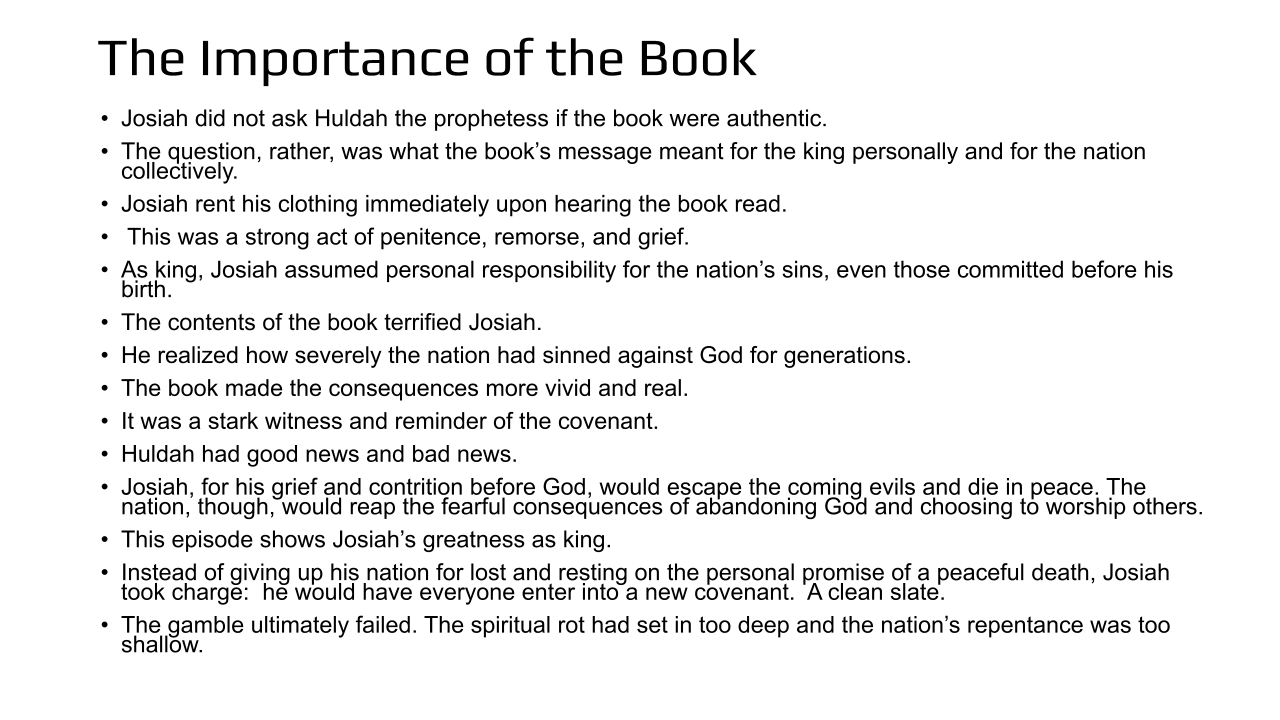
The question rather was what the book’s message meant for the king personally and for the nation collectively.

Recall Josiah rent his clothing immediately upon hearing the book read. This is an act of penitence, remorse, and grief. And as king, Josiah assumed personal responsibility for the nation, even sins committed before his birth. And what he read terrified him.

He realized how severely the nation had sinned against God for generations. Huldah had good news and bad news. Josiah, for his grief and contrition before God, would escape the coming evils. He’d die in peace. The nation though would reap the fearful consequences of abandoning God and choosing to worship others.

And we see how great Josiah was as a king. He didn’t give up his nation for lost, but he took charge. He decided to have everyone enter into a new covenant, a clean slate. But the gambit ultimately failed. Spiritual rot had sent in too deep and the nation’s repentance was too shallow.

Deuteronomy and the Deuteronomist
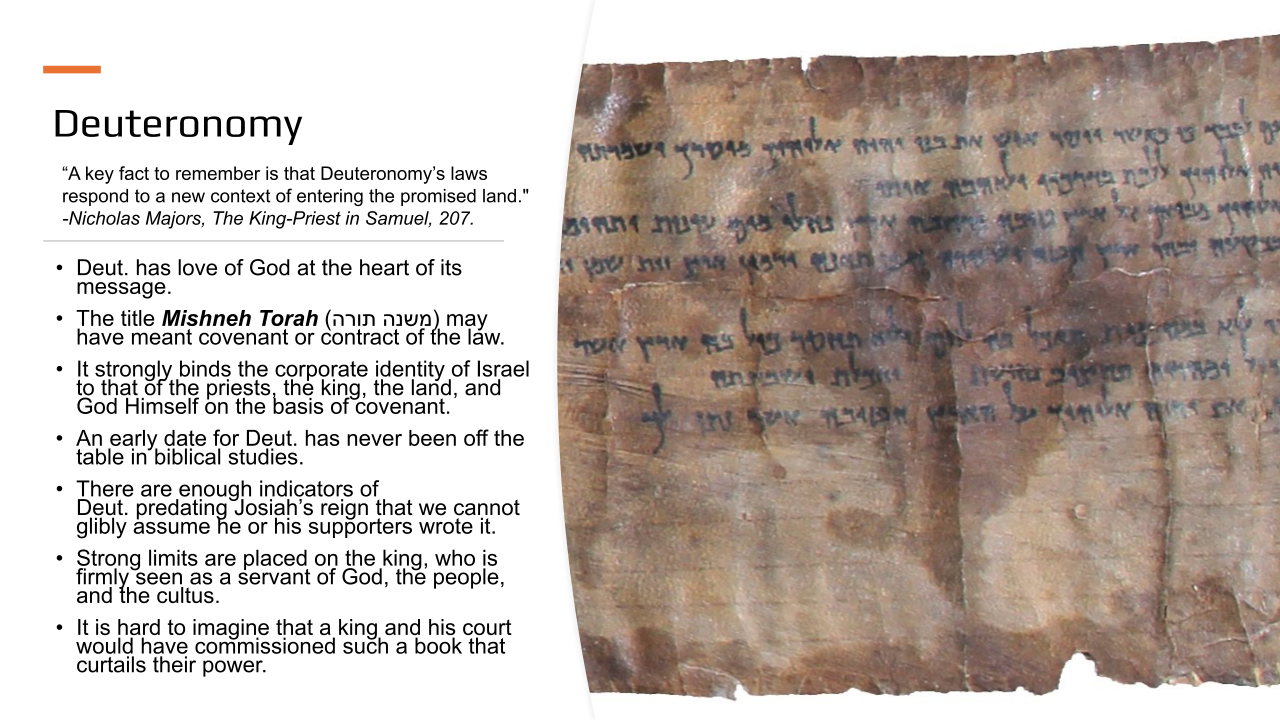
My paper is going to cover more on Deuteronomy. But for now, let’s talk about who the Deuteronomist is.
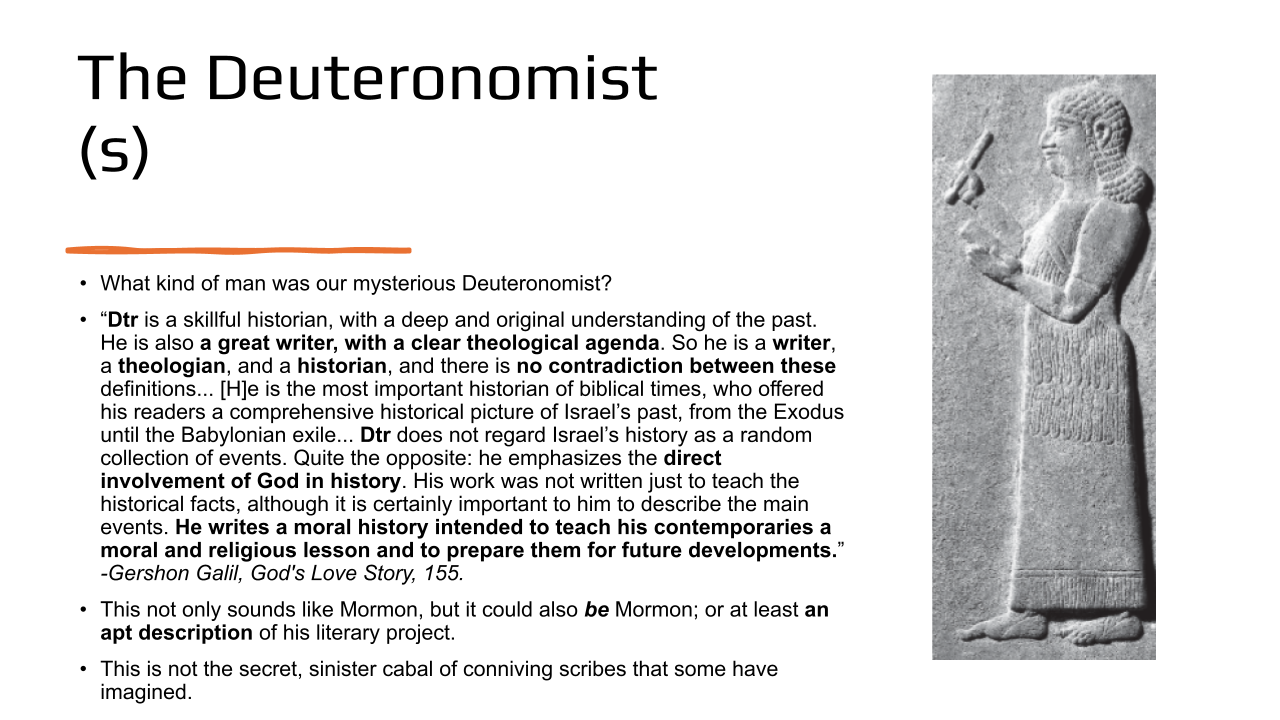
What kind of man was he? Gershon Galil said he would have been a great writer with a clear theological agenda, a writer, theologian, historian. And there’s no contradiction between these. He emphasizes God’s direct involvement in history. His book was not written to teach historical facts, though it’s certainly important to him. He writes a moral history, tended to teach his contemporaries a moral and religious lesson and prepare them for future developments. So this not only sounds like Mormon, but it could be Mormon or at least an app description of his literary project. We’re not dealing with this secret sinister cabal of conniving scribes. That goes beyond what any evidence says.

The Prophet Jeremiah
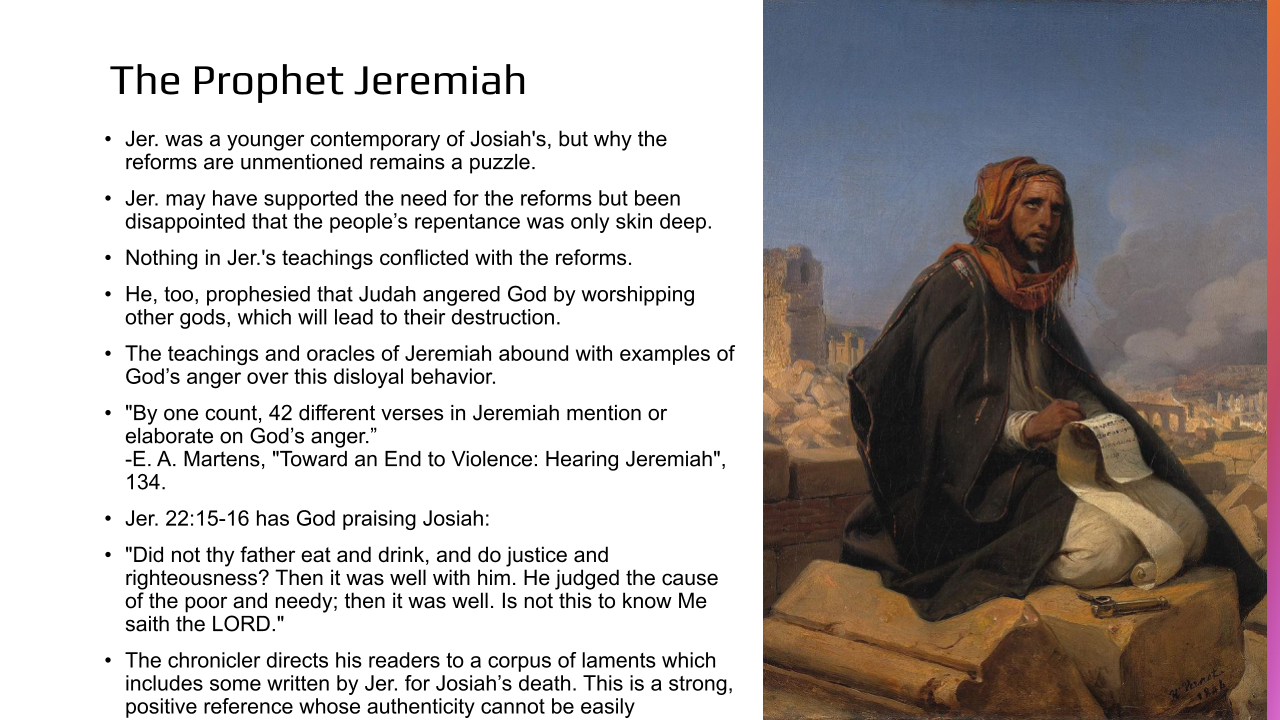
An important piece of the puzzle is Jeremiah. He was a younger contemporary of Josiah’s, but we don’t know why he doesn’t mention the reforms. Maybe he was disappointed that people’s repentance was only skin deep. That’s suggested by Talmudic traditions. But there’s a better way. We can look at what he taught and see if any of it conflicts with the reforms.

Nothing did. Jeremiah prophesied that Judah angered God. They worshiped other gods and that will lead to their destruction. He was full of anger towards the conduct of the people and we have him present an oracle from God praising Josiah. It was well with him, and his behavior is to know God according to the prophecy of Jeremiah.

Now the chronicler also directs his readers to a corpus of laments which includes some that Jeremiah wrote for Josiah’s death. This is a strong positive reference and we cannot easily dismiss the authenticity of it.

Death of Josiah
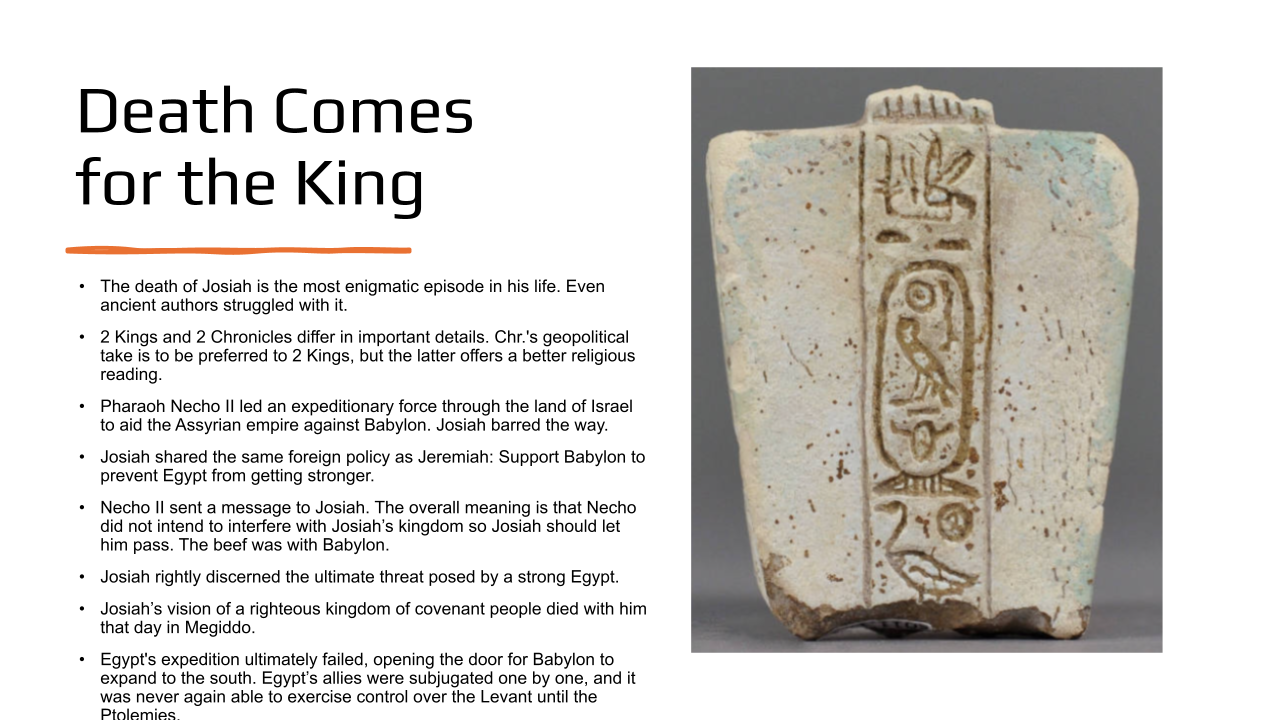
Now the death of Josiah is the most enigmatic episode in his life. Even ancient authors struggled with it, and we have two accounts. Kings and Chronicles differ in important details. Chronicles’ geopolitical take is to be preferred to second Kings, but the latter offers a better religious reading, and we’ll look at both.

So, what happens is that Pharaoh leads an expeditionary force through the land of Israel to aid the Assyrian Empire against Babylon. Assyria is on its last legs. Josiah bars the way, and he shared the same foreign policy as Jeremiah: support Babylon to prevent Egypt from getting stronger.

But Necho sent a message to Josiah. The overall meaning is that Pharaoh did not intend to interfere with Josiah’s kingdom, so Josiah should let him pass. The beef was with Babylon. Josiah rightly discerned the ultimate threat posed by a strong Egypt. It was not going to leave his kingdom alone. Sadly, his vision of a righteous kingdom of covenant people died with him that day in Megiddo.

Egypt failed. It opened the door for Babylon to expand to the south. Egypt’s allies, including Judah, were subjugated one by one, and it was never again able to exercise control over the Levant until the Ptolemies.

Josiah and the Shema
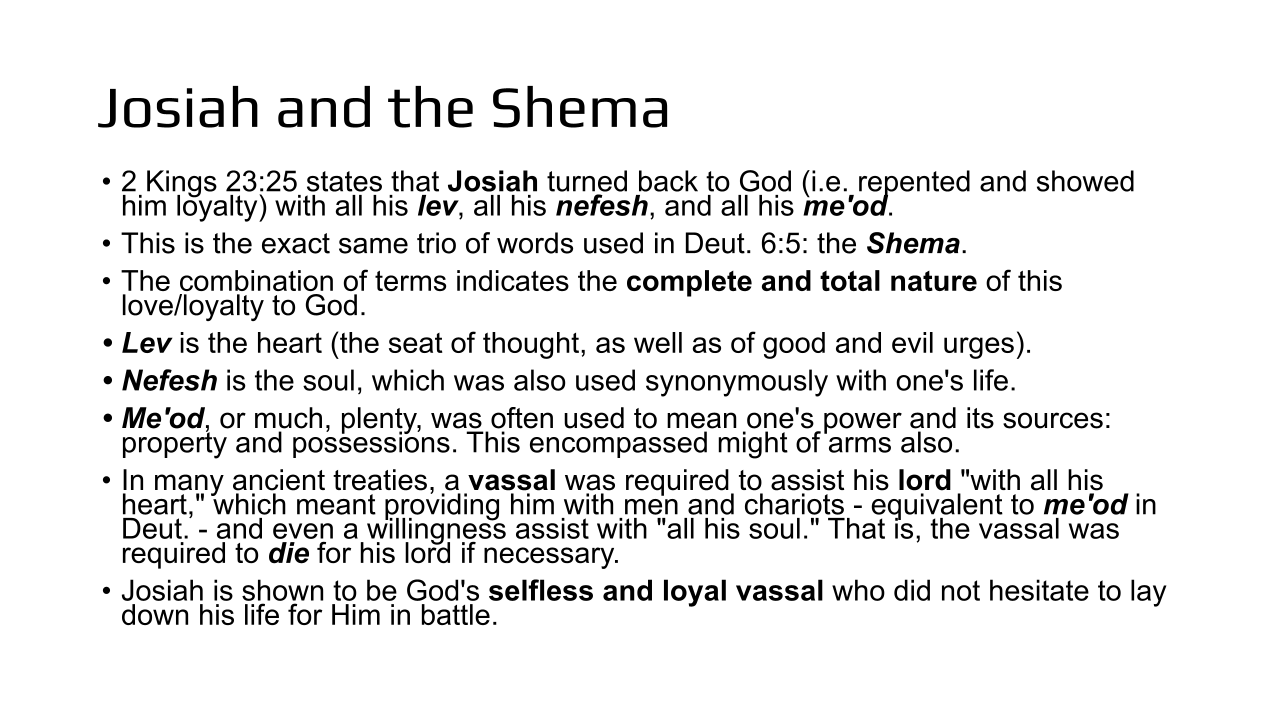
Now, in Second Kings, Josiah turned back to God. He repented. He showed him loyalty with all of his Lev, of his Nefesh, and all of his Me’od. And we’ll get to that. But this is the exact same trio of words used in the Shema, which Jesus calls the first great commandment. Combination of terms indicates the complete and total nature of this love-loyalty to God. Lev is the heart. Nefesh is the soul or life. And Me’od is much plenty and might.

Ancient treaties required a vassal to assist the Lord with all his heart. So it provides him with men and chariots and even a willingness to assist with all his soul. That is, the vassal was required to die for his lord if necessary. Josiah is shown to be God’s selfless and loyal vassal who did not hesitate to lay down his life for him in battle.

Josiah in Apocryphal and Post-Biblical Texts
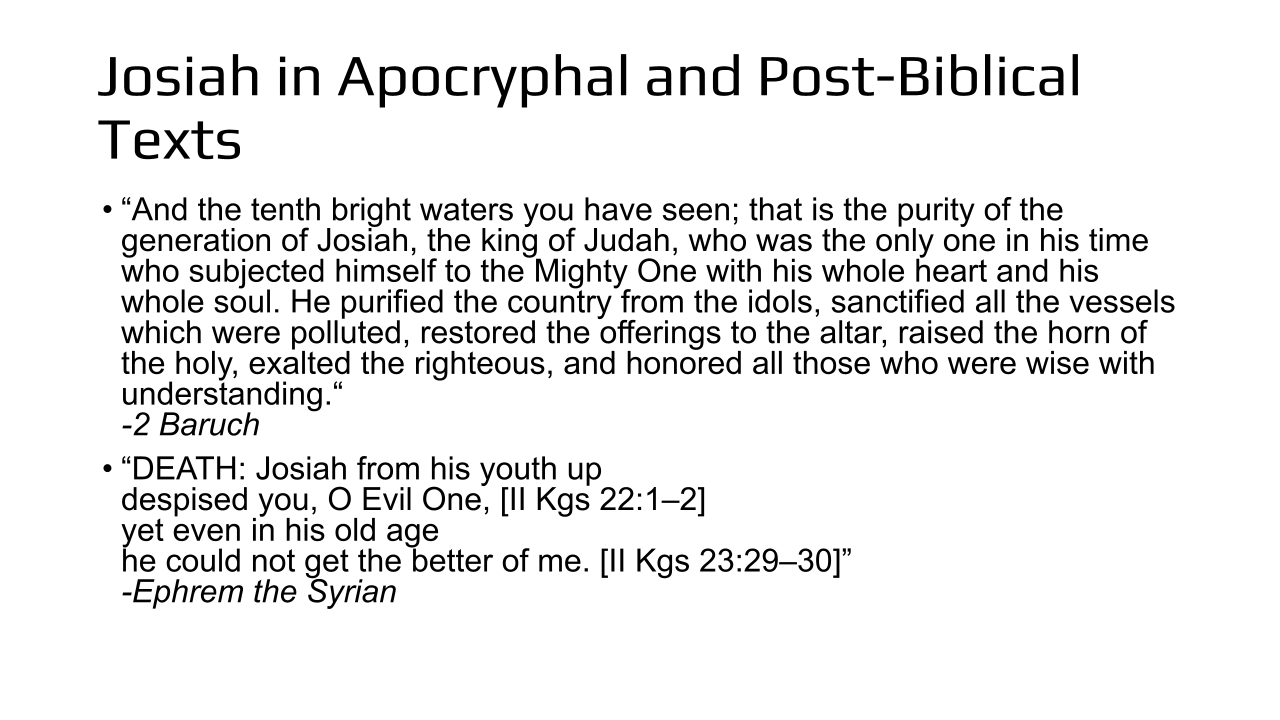
And I think it is only fair to look at what apocryphal and post-biblical texts have to say because they tell us a lot about popular memory, what people were thinking, how they interpreted the scriptures.
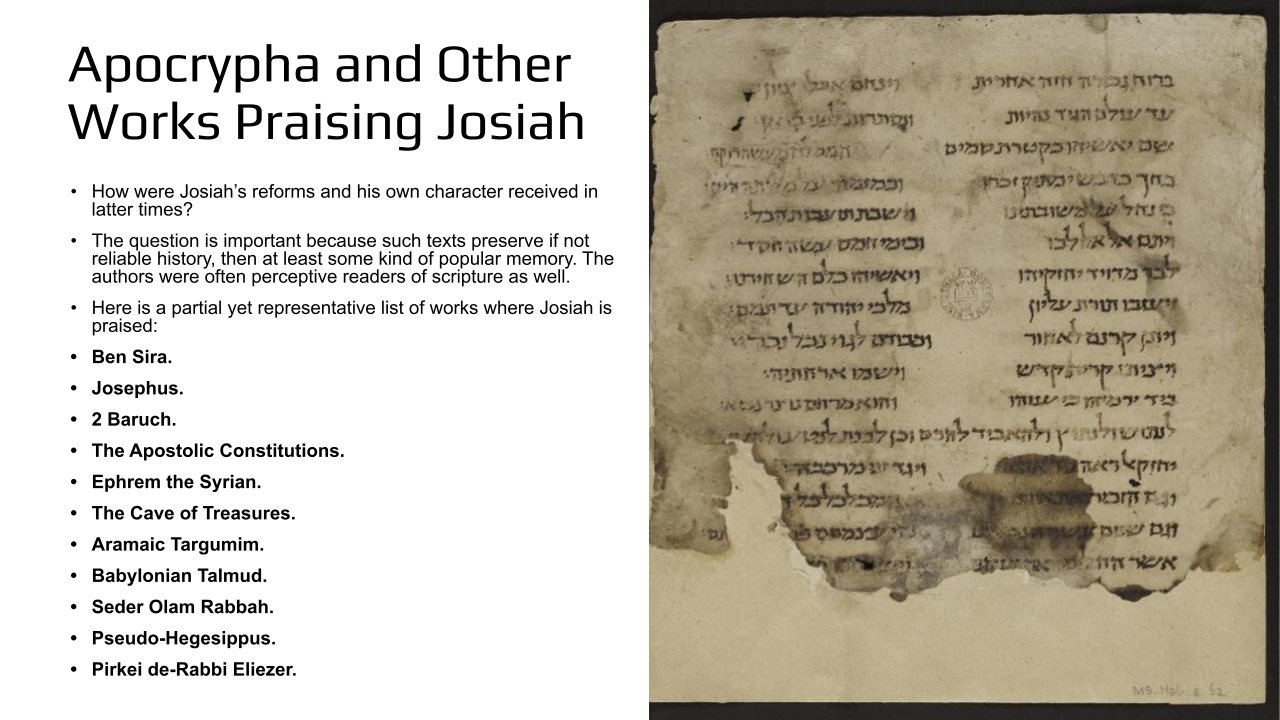
And so this is a list, quite a lot of works, that all praise Josiah. Ben Sira especially goes well beyond any praise in the Bible. We find Josiah’s reputation is good in the Bible and outside it, until in modern times it takes a hit.

Witness of the Restoration
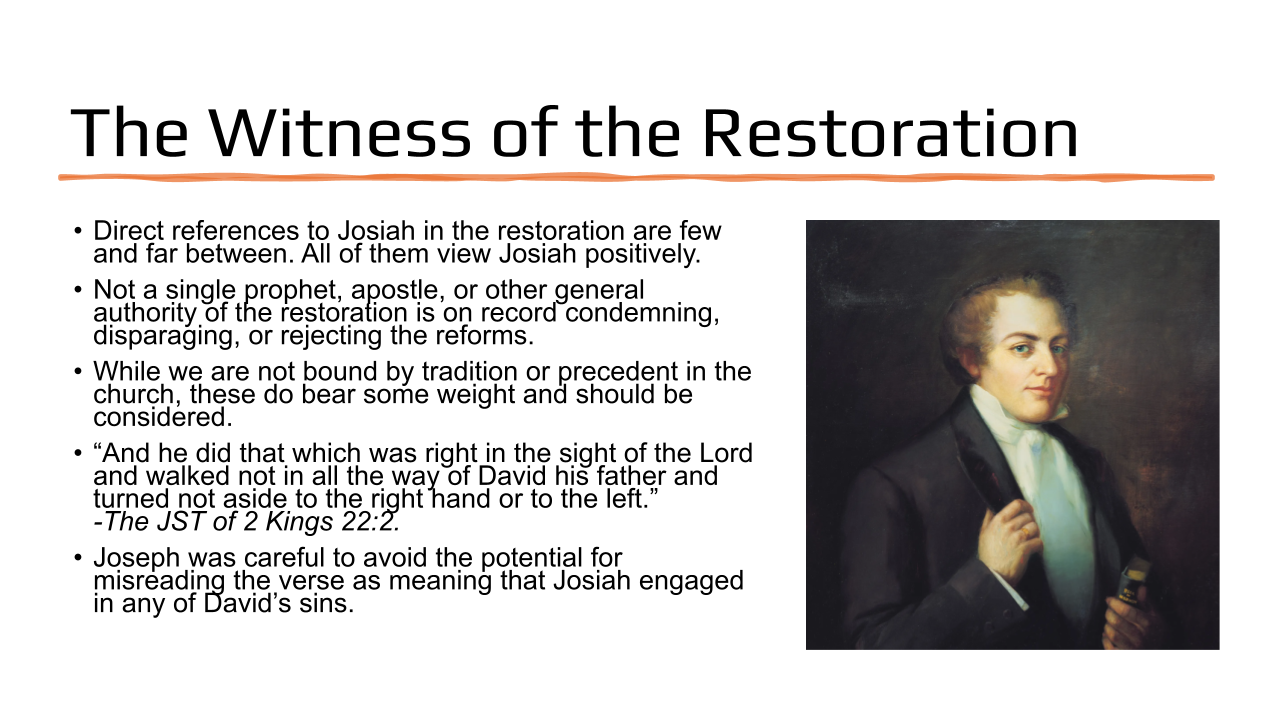
Now direct references to Josiah and the restoration are few and far between. All of them view Josiah positively. Not a single prophet, apostle, or other general authority of the restoration is on record condemning, disparaging, or rejecting the reforms. We’re not bound by tradition or precedent, but these do bear some weight in the Church and they should be considered as part of our overall picture.

And we see that Joseph makes very few changes. But one of them is this. He takes 2 Kings 22:2 and he re-words it so you avoid the potential for misreading the verse as meaning that Josiah engaged in any of David’s sins. And that’s why he says, “Walk not in all the way of David his father.” That means he did not do the wicked things there. He did what was right in the sight of the Lord.
More Witnessess

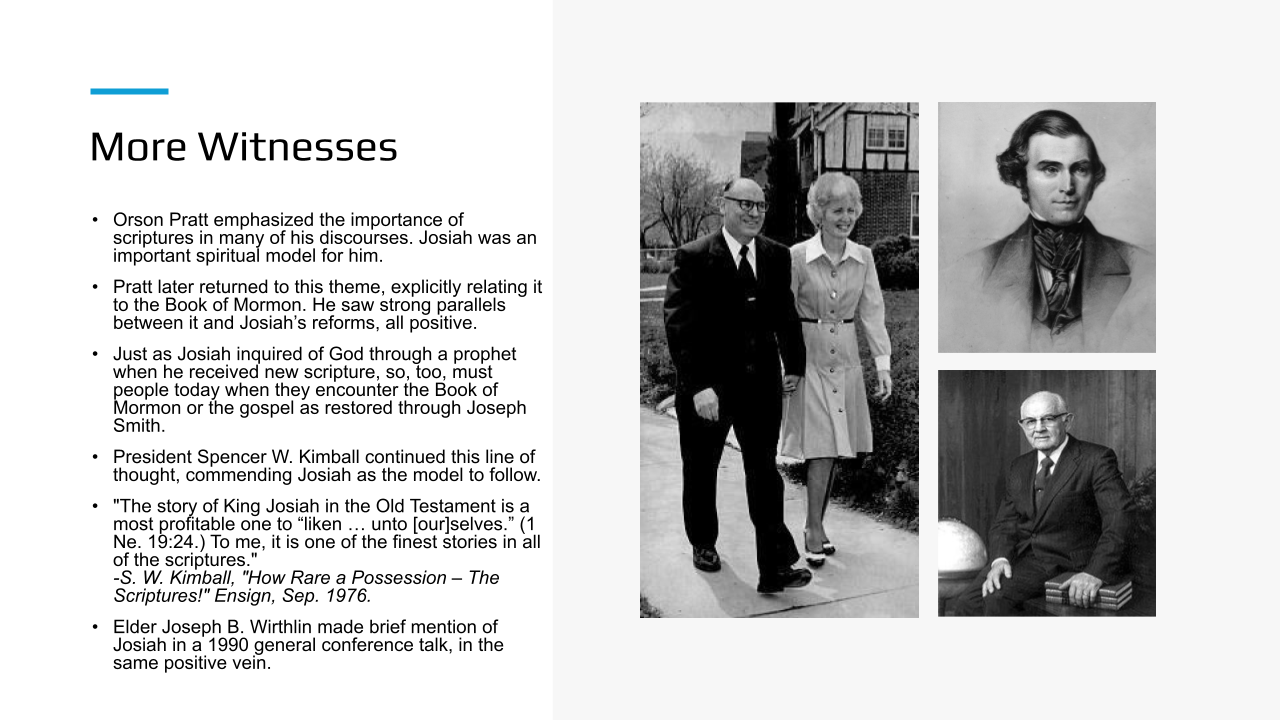
Now in the mouth of two to three witnesses, right? We’ll give you four. Orson Pratt actually spoke quite a bit on Josiah, relatively. Scripture was important to him. Josiah was a spiritual model. And Pratt relates to the Book of Mormon. He saw strong parallels between it and Josiah’s reforms, and all of them were positive. Just as Josiah inquires of God through a prophet when he receives new scripture, so too must people today when they encounter the Book of Mormon or the Gospel as restored through Joseph Smith.

And President Spencer W. Kimbell continued this line of thought and he commended Josiah as the model to follow in the First Presidency Message.

The story of King Josiah in the Old Testament is a most profitable one to liken unto ourselves. To me, it is one of the finest stories in all of the scriptures.

And in 1990, Elder Wirthlin made brief mention of Josiah in general conference in the same positive vein. So we don’t have a lot of references, but they are all positive.
Conclusion

So when all is said and done, Josiah was no villain. He was a king. He sought to do God’s will and save his people, followed God, did right by him. And he succeeded on a personal level, but he failed to save his nation. Josiah took his royal and priesthood duties seriously. This is the best reading of all the evidence we have. If we look at it together, that’s what we get.

Josiah as a Positive Example

My hope is that I’ve raised enough points in favor of Josiah and his reforms that we reclaim him as a positive example. That’s what we should do as scholars and students of the gospel is seek to understand. Most arguments against him are not as solid as they may have seemed. Some are entirely baseless. And I close in the hope that some of the insights in this paper will lead to a better understanding of the Book of Mormon and other restoration scripture. Thank you.
Search topics

King Josiah; Josiah’s reforms; Defending Josiah; Josiah and Deuteronomy; Deuteronomistic History; Deuteronomist theory; Book of the Law; discovery of the Book of the Law; 2 Kings 22–23; 2 Chronicles 34–35; Josiah’s Passover; covenant renewal in ancient Israel; ancient Israelite religion; worship in ancient Judah; temple worship in Jerusalem; centralization of worship; idolatry in Judah; high places in ancient Israel; Asherah worship; Baal worship; chariots of the sun; Assyrian influence on Judah; Assyrian religion and ideology; Ashur and Assyrian kingship; Egyptian influence on Judah; Necho II and Josiah; fall of the Assyrian Empire; ancient Near Eastern kingship; biblical kingship; Jeremiah and Josiah; Huldah the prophetess; biblical reform movements; historical context of Josiah; Jewish views of Josiah; Margaret Barker and Josiah; Deuteronomy in the Book of Mormon; Deuteronomy in Latter-day Saint scripture; covenant faithfulness; apostasy and restoration in the Old Testament; symbolism and religious change; pentagram as a Christian symbol; Old Testament higher criticism; biblical historical criticism

CES Letter; Bible criticism; Old Testament criticism; Mormon Bible beliefs; Latter-day Saint views of the Bible; LDS scripture reliability; Mormon apologetics; Latter-day Saint apologetics; Mormonism and biblical scholarship; LDS response to higher criticism; Mormon views of Deuteronomy; Mormon views of King Josiah; Mormon temple worship and ancient Israel; Mormon covenant theology; Mormon Church scripture claims; Mormon Church criticism; Mormon faith crisis and the Bible; anti-Mormon claims about scripture; biblical corruption claims; reliability of the Old Testament; development of biblical texts; authorship of Deuteronomy; religion invented by Josiah; did Josiah create Judaism; did priests write Deuteronomy; was Josiah an apostate; was Josiah a righteous king; faithful responses to biblical criticism

Frequently Asked Questions

Did King Josiah invent a new religion?

No. While some modern scholars argue that Josiah’s reforms fundamentally reshaped Israelite religion, this presentation contends that the biblical and historical evidence better supports the traditional understanding that Josiah sought to restore covenant worship already established in Israel’s history.


What is the Deuteronomistic History?

The Deuteronomistic History is a scholarly theory proposing that Deuteronomy through 2 Kings were edited into a unified historical narrative during or after King Josiah’s reign. Many scholars view this as a literary explanation for similarities across these books, though the extent and dating of this editorial work remain debated. Hansen examines this theory and its assumptions throughout the presentation.


Why is the discovery of the Book of the Law significant?

According to 2 Kings 22, the Book of the Law was discovered during renovations to the Jerusalem Temple. Josiah responded by renewing the covenant, removing idolatry, and restoring proper worship. Critics sometimes argue the book was newly written, while defenders maintain it was an authentic ancient text that had been neglected during previous reigns.


Why do many scholars criticize King Josiah?

Some historians believe Josiah’s reforms centralized political and religious authority in Jerusalem and that biblical writers portrayed him more favorably than history warrants. Hansen argues these conclusions often depend upon speculative historical reconstructions rather than direct evidence.


Why does Josiah matter to Latter-day Saints?

Questions surrounding Josiah influence how readers understand the reliability of the Old Testament, the development of scripture, and the preservation of covenant worship. Understanding these debates can strengthen confidence in scripture while encouraging thoughtful engagement with biblical scholarship.


Criticism & Faithful Response

CriticismFaithful Response
Josiah invented Israelite monotheism.The biblical record presents Josiah as restoring earlier covenant worship rather than creating something new.
The Book of Deuteronomy was written during Josiah’s reign to justify political reforms.While this theory is influential, it remains a scholarly hypothesis rather than an established historical fact. Hansen examines alternative explanations consistent with both scripture and historical evidence.
The biblical writers idealized Josiah for theological reasons.Ancient authors certainly wrote with theological purposes, but theological intent does not automatically negate historical reliability.
Josiah centralized worship for political control.The biblical narrative presents centralized worship as obedience to longstanding covenant law rather than political innovation.

Key Definitions

King Josiah

King of Judah (ca. 640–609 BC) remembered in the Bible for renewing the covenant, restoring Temple worship, and removing idolatry.


Deuteronomistic History

A scholarly model proposing that the books of Deuteronomy through Kings were compiled or substantially edited into a unified theological history during the late monarchic or exilic periods.


Book of the Law

The sacred text discovered during Temple repairs in 2 Kings 22 that prompted Josiah’s sweeping religious reforms.


Covenant Renewal

A formal recommitment of Israel to worship Jehovah and obey His commandments, often following periods of apostasy.


High Places

Local worship sites frequently condemned by biblical prophets because they often became associated with idolatry or unauthorized worship.

Come, Follow Me with FAIR – 2 Kings 16–25 – Jennifer Roach Lees

July 14, 2026 by FAIR Staff

https://media.blubrry.com/mormonfaircast/www.fairlatterdaysaints.org/wp-content/uploads/2026/07/Come-Follow-Me-with-FAIR-2-Kings-2-7-Jennifer-Roach-Lees-1.mp3

Podcast: Download (21.8MB)

Subscribe: RSS

Start Here

Question

Why did King Josiah remove objects from the temple?

Short Answer

King Josiah removed temple objects because many had become closely associated with pagan worship and Assyrian religious practices. Rather than rejecting the temple itself, he sought to restore covenant worship by removing symbols that no longer pointed people toward God. According to this episode, these reforms represented spiritual cleansing and covenant renewal rather than political power or religious innovation.

Key Takeaways
  • King Josiah inherited Judah during a period of political, economic, and spiritual collapse.

  • The rediscovery of the Book of the Law sparked a national covenant renewal rather than the creation of a new religion.

  • Many temple objects Josiah removed had become symbols of idolatry under Assyrian influence.

  • Jeremiah praised Josiah for defending the poor, seeking justice, and remaining faithful to God’s covenant.

  • Josiah’s death at Megiddo marked the end of Judah’s last righteous king before the Babylonian captivity.

Continue reading

Filed Under: Bible, Come Follow Me, Come Follow Me with FAIR, Jennifer Roach, Old Testament, Podcast, Temples Tagged With: 2 Kings, Book of the Law, Come Follow Me, Covenant Renewal, Deuteronomy, Isaiah, Jeremiah, King Josiah, Old Testament, temple worship

What Are the Most Cited, Recited, and Misunderstood Verses in Deuteronomy? (Gospel Doctrine Lesson 17A)

May 1, 2018 by Jeffrey M. Bradshaw

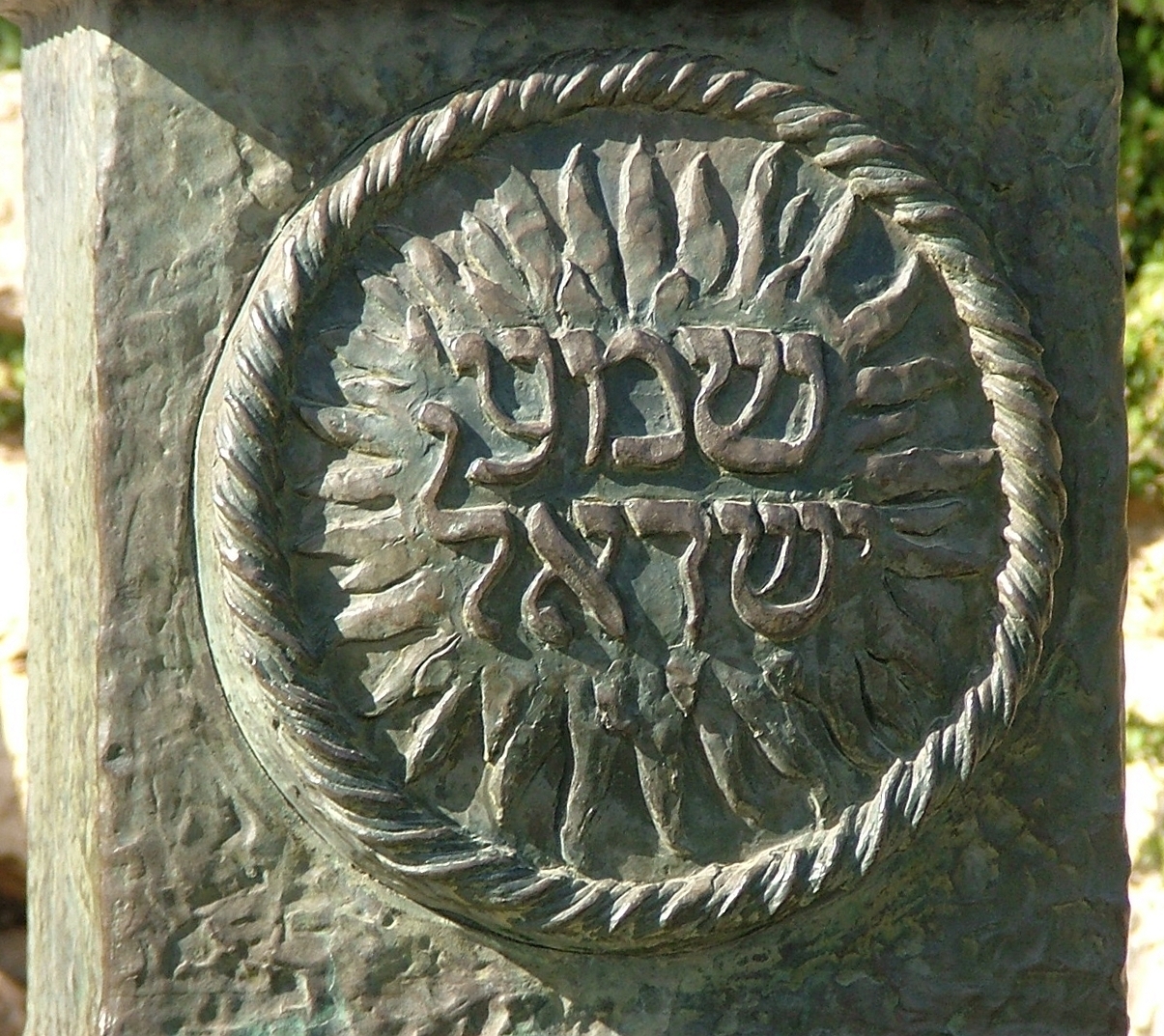
“Shema‘ Yisrael” (“Hear, [O] Israel”) at the Knesset Menorah in Jerusalem

An Old Testament KnoWhyrelating to the reading assignment for Gospel Doctrine Lesson 17: “Beware Lest Thou Forget” (Deuteronomy 6; 8; 11; 32) (JBOTL17A)

Question: What are the most cited, recited, and misunderstood verses in Deuteronomy?

Summary: Without any doubt Deuteronomy 6:4-5 best fits this description:

  1. Hear, O Israel: The Lord our God is one Lord:
  2. And thou shalt love the Lord thy God with all thine heart, and with all thy soul, and with all thy might.

The wording of Deuteronomy 6:5 is echoed frequently in the Old and New Testaments, the Book of Mormon, and the Doctrine and Covenants It is recited twice daily by observant Jews. And, sadly, commentaries on this and related scriptural verses rarely explore in any depth the long history of Jewish interpretation of the Hebrew terms that lie behind the key English words: “one,” “heart,” “soul,” “might.” A solid understanding of what Jesus Christ called the “first and great commandment” will illuminate the meaning of the law of consecration, “the last and hardest requirement made of men in this life.”


The full article may be found at the Interpreter Foundation website: KnoWhy OTL17A — What Are the Most Cited, Recited, and Misunderstood Verses in Deuteronomy?

Filed Under: Bible, Doctrine, Lesson Aids, Questions, Resources, Temples Tagged With: Commandments, Deuteronomy, Gospel Doctrine: Old Testament, Law of Consecration, Moses, Shema

Monotheism, Messiah, and Mormon’s Book

Brant Gardner
August 2003

In 1837 Joseph Smith made several editorial changes in the Book of Mormon. Many are relatively innocuous, but one of them is much more substantial. In the 1830 edition of the Book of Mormon, the verse we know as 1 Nephi 11:18 reads:

And he said unto me: Behold, the virgin whom thou seest is the mother of God, after the manner of the flesh.

For the 1837 edition, Joseph inserted “the Son of,” so that the verse has read ever since:

And he said unto me: Behold, the virgin whom thou seest is the mother of the Son of God, after the manner of the flesh.

There is no way to know just what was on Joseph Smith’s mind when he made that change, but that hasn’t stopped a lot of people from trying.

However, when we focus on the fact of the change, we inherently begin to ask the wrong questions. Several authors have discussed this change as evidence of an evolving LDS theology of God. That very question implicitly supposes Joseph Smith as the author of the Book of Mormon by assuming that the Book of Mormon is evidence of Joseph’s early thought. If we believe the Book of Mormon, it isn’t. The Book of Mormon doesn’t represent Joseph’s theology–it represents Nephite theology. To understand Nephite theology, our focus should be on explaining why the verse is there in the first place, not on what happened to it later. For the Book of Mormon, understanding theological evolution will in fact be the key to our understanding of this text, but it will not be the evolution of LDS theology that will explain it. It will be the evolution of Israelite theology.

The Book of Mormon begins its history in the first year of the reign of Zedekiah in Jerusalem, or 597 B.C. While this is our first dated event, the figures in the story are obviously alive at that time, and as the text opens, Lehi has four sons and some daughters. Lehi is clearly old enough to have experienced certain events that took place before 597 B.C., but which were not recorded. The invasion of Jerusalem by Babylon is certainly the most obviously catalytic event for the Book of Mormon as it sets the stage for Lehi’s call as a prophet and the command for his family to flee the coming destruction. However, another earlier event may prove to have been the most lasting influence on Book of Mormon history. Lehi lived through the time of the Deuteronomic reform.

In a forum presentation at BYU in 2003, Margaret Barker noted:

King Josiah changed the religion of Israel in 623 B.C. According to the Old Testament account in 2 Kings 23 he removed all manner of idolatrous items from the temple and purified his kingdom of Canaanite practices. Temple vessels made for Baal, Asherah and the host of heaven were removed, idolatrous priests were deposed, the Asherah itself was taken from the temple and burned, and much more besides. An old law book had been discovered in the temple, and this had prompted the king to bring the religion of his kingdom into line with the requirements of that book. There could only be one temple, it stated, and so all other places of sacrificial worship had to be destroyed. The law book is easily recognizable as Deuteronomy, and so King Josiah’s purge is usually known as the Deuteronomic reform of the temple.1

The serendipity of finding a lost book right at the beginning of series of reforms has raised the question of the authenticity of that book. Even though the timing is still suspicious, we need not dismiss the entire work as a politically exigent construction. Norman Gottwald writes of this in his introduction to Deuteronomy for the Interpreter’s One-Volume Commentary on the Bible:

The one hard date is the year of Josiah’s reform, 622. But the origins of Deuteronomy are older than the reform. Levitical reading and preaching of the law did not begin in 622; considering the allusions to Shechem the practice must have extended back at least a century into Northern Israel. The shock of the discovery of the law in 622 does not mean that such traditions were unknown in Israel previously; it means rather that the Judean monarchy had lost touch with them for as much as 50 or 75 years (assuming that Hezekiah knew of them and used them in his reforms)…

Was the law written specifically for the purpose of “planting” it in the temple? Perhaps-if we assume that only in this way could its claims be brought to the king convincingly and without danger of the law’s advocates. Yet it is striking that even with the written law before him Josiah was unconvinced until specific supporters of the law had assured him of its validity (2 Kings 22:8-20)…

It is more likely that the writing and rewriting of Deuteronomic laws and admonitions was going on under-ground throughout the reign of Manasseh (ca. 687-642). If we visualize the Yahwistic cultic calendar as lapsing or at least suffering from neglect, the old patterns of cultic renewal of covenant and law would be strained and even threatened with extinction. Oral materials remembered from year to year would no longer he recited, and authoritative texts of the laws inscribed at cult sites would become defaced or even destroyed. Thus both oral and written records of [Deuteronomic] traditions were driven underground and fostered there until they broke to the surface in 622.

This interpretation does away with the view that the planted Deuteronomy was a “pious fraud.” No one needed to concoct a book purporting to be by Moses; all he had to do was collect materials long attributed to Moses, through the device of the cult functionary speaking on behalf of Moses, and to assert that these traditions should once again be binding in Israel.2

Beyond understanding how Deuteronomy might be both new and old and the same time, Gottwald’s explanation highlights the idea that there were multiple strands of religious understanding in Israel for at least one hundred years prior to Lehi. Very clearly the Deuteronomic reform operated against a previously acceptable tradition. In doing so, it did not invent something new, but elevated an available, if not then dominant, tradition. This multiplicity of traditions within the same culture is absolutely essential to our understanding of the religious climate that produced Lehi, and influenced Nephi.

As we attempt to understand the multiple lines of thought that were present in Jerusalem on the eve of the Deuteronomic reform, the figure of Asherah becomes an important gauge of both theological change, and the time reference for that change. In the Bible, the term Asherah may refer simultaneously to the mother-goddess of that name, or to her image (such as was removed from the temple). 3

What was the image of the mother-goddess Asherah doing in the temple in Jerusalem? She was there because she was the wife, or consort, of Yahweh. Several inscriptions have been discovered that specifically speak of “Yahweh and his Asherah.” Scholars accept this as an indication that Asherah was the consort of Yahweh.4 Some seventy years before the Deuteronomic reform, King Hezekiah initiated a similar reform that removed Asherah from the temple. Unlike the Deuteronomic reform, that of Hezekiah did not last. If fact, it did not survive even to his son. Speaking of Manasseh’s reversal of his father’s reform, Raphael Patai conjectures:

If Manasseh did not bother to replace the Brazen Serpent, the other image removed from the Temple by his father, this was probably due to the fact that with the passage of time the worship of a deity symbolized or represented by a serpent figure had become obsolete. Not so Asherah, whose motherly figure must have been dear to many worshipers and whose restoration to her traditional place in the Temple was therefore considered a religious act of great importance. It is tempting to conjecture that the mythical motivation behind Manasseh’s act was the conviction that Yahweh’s consort, the great mother-goddess Asherah, must be restored to her old and lawful place at the side of her husband.5

What makes Asherah such a key in understanding the threads of Israelite thought about deity is the discovery of a set Ugaritic (or Canaanite) texts in 1928. Among these texts is a treasure trove of information about religion in the time period of about 1350-1150 B.C. C.L. Seow notes: “the value of the Ugaritic texts goes beyond the horizons of Canaanite faith. The evidence suggests that Israelite theology was not as radically discontinuous with Canaanite religions as was once thought.”6

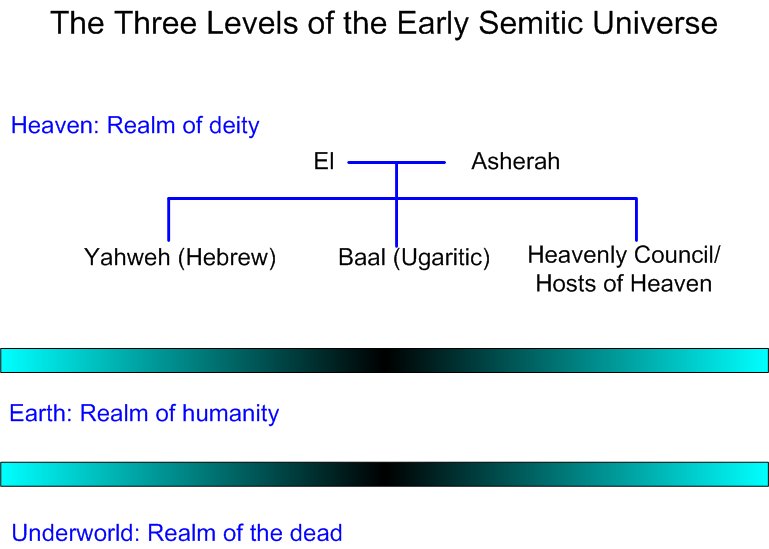
What those texts make clear is that the early Semitic religion worshipped a pantheon structured as a divine family, with a Father god, El and his consort, this very Asherah.7 These two are at the head of a heavenly council. Daniel C. Peterson synopsizes the relevant information:

The council is known by various names in the Ugaritic materials, including “the assembly of the gods” and “the assembly of the sons of ‘El.” According to Canaanite belief, ‘El was the creator-god. Evidence strongly suggests that he was the original chief god of the Semites generally. As creator, however, he also stood at the head of the pantheon as the “father of the gods” or the “father of the sons of God” and was called the “ancient one,” the “patriarch,” and the “eternal one.” Consequently, the gods as his sons, were designated collectively as “the sons of ‘El.”8

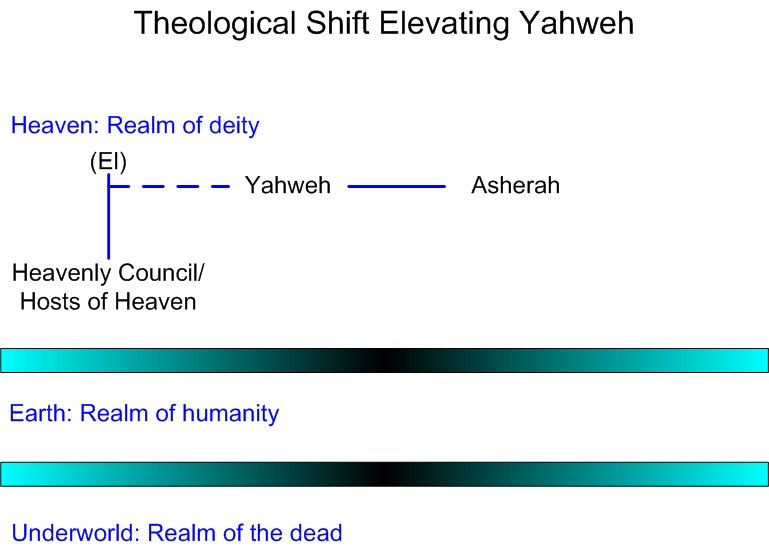
Yahweh was preeminent among the sons of El in the Israelite conception. The gods of this heavenly council were assigned to be the gods of various nations (Deuteronomy 32:8), and Yahweh was the god of Israel. As Israelite thought developed, El as the Father receded into the background, and Yahweh continued to gain in prominence. This process of the elevation of Yahweh was in full force by the eighth century B.C. when Asherah appears as Yahweh’s consort, not El’s. Mark S. Smith suggests:

Asherah, having been the consort of El, would have become Yahweh’s consort only if these two gods were identified by this time. Indeed, it is evident from texts such as Isaiah’s vision of Yahweh surrounded by the Seraphim (Isaiah 6), and especially the prophetic vision of the divine council scene in 1 Kings 22:19 that Yahweh assumed the position of presider by this time.9

This gives us both an evolutionary trajectory and a timeframe. The heavenly council with El as the father, and Yahweh as preeminent son, plausibly dates to the same timeframe as the Ugaritic texts, that is, 1350 – 1150 B.C. After that time, there is a developing theology in Israel that increases the importance of Yahweh and elevates him to a position where he begins to take over the functions previously assigned to his celestial father, El. This process is in nearing its completion around 700 B.C. when we find that Yahweh has not only taken over El’s place in the council, he has taken El’s consort as his own.

In spite of this elevation to prominence and proto-monotheism, Yahweh’s relationship to the council and to his father was not entirely severed by this process. Parallel strands, perhaps reinforced by other Semitic religions, maintained the stories of El and the heavenly council. Dr. Peterson continues:

The Canaanite terminology of “the assembly of the gods” and “the assembly of the sons of ‘El” finds its parallels in the Hebrew Bible. In Psalm 29:1, which has long been recognized by scholars as an Israelite adaptation of an older Canaanite hymn, members of the council are referred to as bene ‘elim. The King James translation renders this phrase as “the mighty.” The same Hebrew phrase occurs at Psalm 89:6, where the King James Version has “the sons of the mighty.” Neither rendition is adequate. In both passages, the New Jerusalem Bible, to choose one of the best of the modern translations, gets things precisely right by translating bene ‘elim as “sons of God.”10

Equally as important to our understanding of Yahweh in the council is the identification of Yahweh as the one who would atone as the Messiah. Margaret Barker’s The Great Angel examines at length hundreds of passages from texts ranging from Jewish to Christian to Gnostic that, as she interprets them, identify Yahweh as the future Messiah and Jesus, in his Messianic role, as equated with Yahweh. As she describes the heavenly council, headed by the Father-God:

Yahweh was one of the sons of El Elyon; and Jesus in the Gospels was described as a Son of El Elyon, God Most High. In other words he was described as a heavenly being. Thus the annunciation narrative has the term “son of the Most High” (Luke 1.32) and the demoniac recognized his exorcist as “son of the Most High God” (Mark 5.7). Jesus is not called the son of Yahweh nor the son of the Lord, but he is called Lord. We also know that whoever wrote the New Testament translated the name Yahweh by Kyrios, Lord. (See, for example, the quotation from Deuteronomy 6.5: “You shall love Yahweh your God…” which is rendered in Luke 10.27 “You shall love the Lord [Kyrios] your God.”) This suggests that the Gospel writers, in using the terms “Lord” and “son of God Most High”, saw Jesus as an angel figure, and gave him their version of the sacred name Yahweh.11

Of course this particular connection comes from New Testament usage. Dr. Barker suggests that it was nevertheless a continuation of an old strand of thought that became obscured through the Deuteronomic reforms. Barker examines an interesting Old Testament passage about this Messianic expectation that appears to have suffered some obfuscation:

The clearest evidence for its survival [the anthropomorphism of the God/Messiah], however, is in the widespread tradition of interpreting words of “man” as references to the Messiah, or of designating the Messiah simply as “the man.” This can best be seen by examining the various translations of the Balaam oracles, which were believed to predict the Messiah (Numbers 24.3-9; 15-24). Thus Numbers 24.7a, where the Hebrew has the curious lines: “Water shall flow from his buckets and he shall rule over many nations” became in the LXX [the Septuagint]: “And there shall come a man out of his seed and he shall rule over many nations,” while both the Fragment and Pseudo-Jonathan Targums have: “Their king shall rise from among them and their saviour shall be from out of them.”

Philo quotes the lines as messianic prophecy: “There shall come forth from you one day a man and he shall rule over many nations” (Life of Moses 1.290). The unanimity of both translation and Targums suggests strongly that the Hebrew may once have said something other than “water shall flow from his buckets.”12

Could an old strand that expected Yahweh-as-Messiah have survived the Deuteronomic reforms to form the basis of Christian understanding of Jesus as Messiah and Yahweh? This is at least suggested by an Aramaic text from Qumran Cave 4 (4Q246 – translated by Joseph A. Fitzmyer):

Col. 1 lines 7-9

7 [then shall arise a king, and he shall be] great upon the earth.

8 [All peoples sh]all make [peace with him]; they shall all serve

9 [him. For] he shall be called [the holy one of] the [G]reat [God], and by His name shall he be named.

Col 2 line 1

1 He shall be hailed Son of God, and they shall call him Son of the Most High.13

This text is dated to around 25 B.C.14 At that time it appears that there is arguably a continuation of the definition of the Messiah as the Son of God, particularly, the Son of the Most High.

When we reconstruct the religious climate at the time of Lehi we find that there is no single, unified theology. In fact, what we find is multiple strands of theological thought that are in conflict, with the Deuteronomic reform elevating a particular strand of thought in contradiction to what had been acceptable though much of Israel’s history.

The theology of the Book of Mormon suggests that Lehi is not only a product of this time period, but that his theology, and therefore Nephi’s, is mostly likely an attempt to preserve some of the theology of God that was being denied in the Deuteronomic reforms. The following are elements of the pre-reform religion that we will see in the Book of Mormon text:

  • A Father god, ‘El who is also called el elyon or “Most High God.”
  • Yahweh as the son of God (El).
  • Yahweh as preeminent God of Israel.
  • Yahweh as Messiah.

I suggest that the particular prominence of God as Messiah in the Book of Mormon is a reaction to the reduction of that strand of Israelite religion. What Lehi and Nephi believed to have been removed in the Deuteronomic reform receives compensatory emphasis in Nephi’s foundational theology for his people, and continues through to the end of the Book of Mormon. This is the reason that the Book of Mormon is so consistently and adamantly a witness for the Messiah.

We begin our examination of God in the Book of Mormon just a few verses before 1 Nephi 11:18 with which we began this discussion. In 1 Nephi 11:6 we find:

And when I had spoken these words, the Spirit cried with a loud voice, saying: Hosanna to the Lord, the most high God; for he is God over all the earth, yea, even above all. And blessed art thou, Nephi, because thou believest in the Son of the most high God. . .

Placed in the context of the possible theologies in Jerusalem at the time of the family’s departure, this verse is quite understandable. We can perhaps understand it a little better if we “retranslate” the text to highlight the parallels.

Hosanna to El Elyon; for he is God over all the earth, yea, even above all. And blessed art thou, Nephi, because thou believest in [Yahweh] the Son of El Elyon…

Because the understanding of El as Father and Yahweh as son was still an available concept in Hebrew thought when the Book of Mormon begins, this particular description of the Father and the Son finds its best explanation as a continuation of that particular strand of Hebrew theology. While there is even less of the heavenly council remaining in the Book of Mormon than in the Old Testament, nevertheless it is plausible that such an idea continued with the Book of Mormon prophets. Note the interesting language with which Alma describes the Messiah in Alma 36:17:

…I remembered also to have heard my father prophesy unto the people concerning the coming of one Jesus Christ, a Son of God, to atone for the sins of the world.

Jesus is not the Son of God, he is a Son of God. Assuming that this is translated correctly, we have Alma placing Jesus Christ in the same divine company as did the New Testament authors cited by Margaret Barker–in the heavenly council as a Son of the Most High God. Thus Alma appears to confirm Nephi’s distinction between the Most High God and the Son of God. That brings us forcibly back to 1 Nephi 11:18. In our modern versification, 12 verses after declaring the Messiah to be the Son of God, the spirit shows that same Messiah who is declared to be God. What happened in 12 verses? Absolutely nothing. Nephi has not changed his understanding. The problem we might see as a conflict between verses 6 and 18 lies in our modern imperative of monotheism, a problem Nephi did not have.

In the Jerusalem that Lehi’s family left, Yahweh had been elevated to the position of pre-eminent God. This proto-monotheism, if I may call it that, did not eliminate the strand of thought that understood El as the Most High God. It did, however, proclaim that Yahweh was God. Not Most High God, but God. Based upon Nephi’s plausible worldview, let’s perform our exercise of retranslation again for verse 18:

And he said unto me: Behold, the virgin whom thou seest is the mother of [Yahweh], after the manner of the flesh.

Not only does this “retranslation” return the text more clearly to its appropriate 600 B.C. cultural context, it is absolutely essential to understanding the theology of the Messiah in the Book of Mormon. From the perspective of Nephite theology, the 1837 change in this text might have helped the Latter-day Saints with their understanding of God, but it did violence to an essential part of the Nephite understanding of God. For the Nephites, it is absolutely essential that they understand that Yahweh was the Messiah who would come. Nephi himself notes:

For the things which some men esteem to be of great worth, both to the body and soul, others set at naught and trample under their feet. Yea, even the very God of Israel do men trample under their feet; I say, trample under their feet but I would speak in other words–they set him at naught, and hearken not to the voice of his counsels.

And behold he cometh, according to the words of the angel, in six hundred years from the time my father left Jerusalem.

And the world, because of their iniquity, shall judge him to be a thing of naught; wherefore they scourge him, and he suffereth it; and they smite him, and he suffereth it. Yea, they spit upon him, and he suffereth it, because of his loving kindness and his long-suffering towards the children of men.15

There can be no doubt nor confusion that the person referred to here is Jesus Christ, and this Christ is the person that Nephi declares to be “the very God of Israel.” This meaning is also essential to Abinadi’s argument in Mosiah 15:1:

And now Abinadi said unto them: I would that ye should understand that God himself shall come down among the children of men, and shall redeem his people.

For the entire Book of Mormon, Yahweh is the God of Israel, and Yahweh is the Messiah. Those equivalencies are absolute and important to Nephite theology. However, there is still an understanding that Yahweh was the Son of God, in the context of El Elyon, or the Most High God.

We now have one remaining explanatory task. If the Nephites understood the separate nature of El Elyon and Yahweh, why is it also true that the text frequently equates the Messiah and the Father? While this is the stuff that led to the Christian arguments about trinitarianism and modalism, there is a much different process at work in the Book of Mormon. The problem begins with our good friend Nephi, who seems to personally present us with every possible confusing statement about God:

And the angel said unto me: Behold the Lamb of God, yea, even the Eternal Father!16

If you haven’t noticed, we are only a couple of verses later than verse 18 where the virgin is the mother of God. Now we have a new identification. The Lamb of God is a title that is particularly symbolic of the atoning function of the Messiah, and here we have the Messiah declared to be the Eternal Father. This is not the only location where this happens. In other texts, the Messiah is not only Father, he is also Son. Mormon writes a thousand years after Nephi:

…And because of the fall of man came Jesus Christ, even the Father and the Son; and because of Jesus Christ came the redemption of man.17

The explanation for this conflation of Father and Son is not to be found in post-Christian theology, because that perspective cannot explain all of the various references to God in the Book of Mormon. Returning to our historical perspective, however, we can replace the cultural contexts that allowed Nephi to hold what appear, to modern readers, to be contradictory beliefs about God.

When Margaret Barker describes the nature of the heavenly council, she also notes the key that resolves our problems in understanding Nephi and the subsequent Nephite theology.

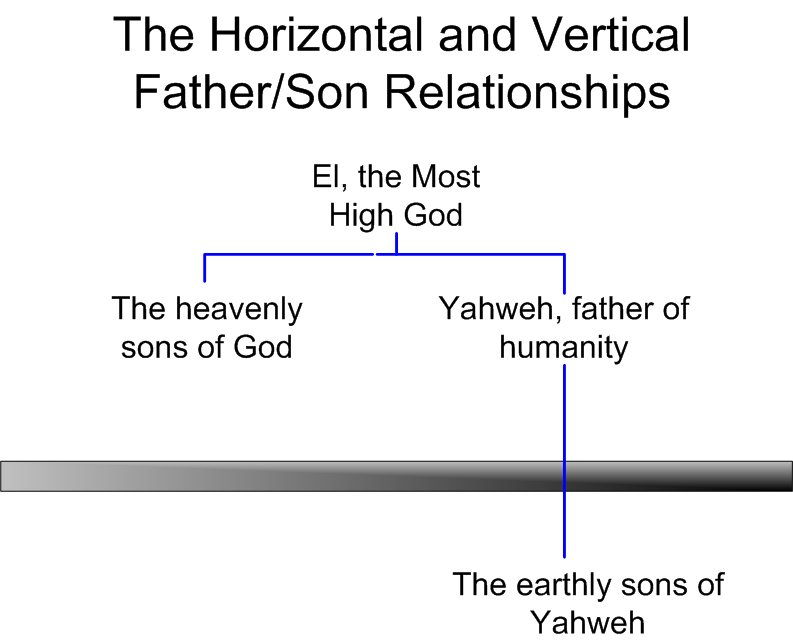
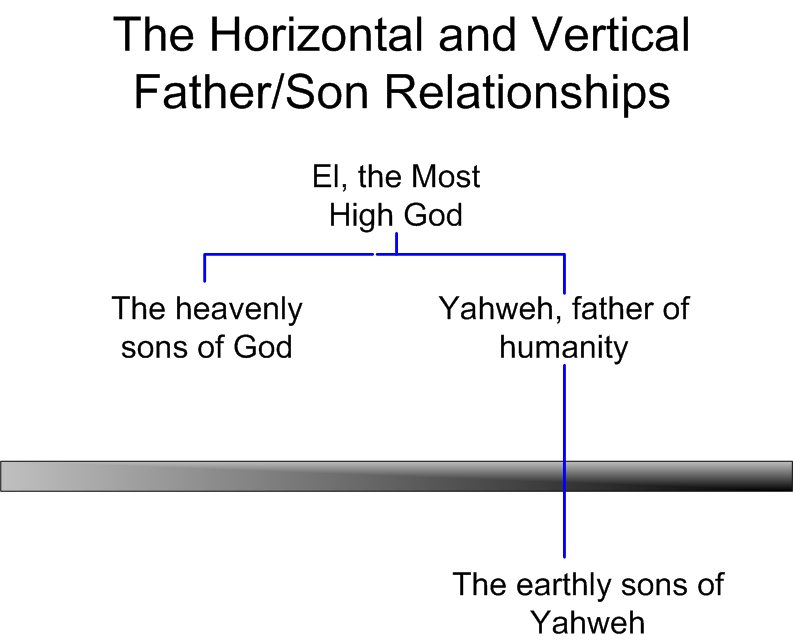
There are those called sons of El Elyon, sons of El or Elohim, all clearly heavenly beings, and there are those called sons of Yahweh or the Holy One who are human.18

There are two “fathers” here, and the difference is that in the stories, or myths–to use the anthropological term–the sons of one father are heavenly, and the sons of the other are human. This creates a distinction in the realm of operation of the two fathers, a conceptual space that might be described as either horizontal or vertical. In the horizontal conception, we are in the heavens, and the heavenly father begets heavenly sons. In the vertical conception, we now have a heavenly being focusing on earth, a vertical relationship that crosses the boundaries that separate heaven and earth. This second “father” is defined by this vertical deity-to-human sphere.

This is precisely how we can disentangle the various “son of God” references in the Old Testament. Joseph A. Fitzmyer points out that: “the plural expressions in Hebrew, bene ha elohim, “sons of God” (Genesis 6:2, 4; Job 1:6; 2:1; 38:7) bene ‘elim, “sons of God” (Psalms 29:1; 89:6), and bene ‘elyon, “sons of the Most High” (Psalms 82:6) are found in the Old Testament as names for angelic beings in the heavenly court of Yahweh.”19 These members of the heavenly court are literary descendants of the earlier Israelite layer that was more similar to the Ugaritic mythology. In this context we have horizontal relationships, and therefore heavenly sons of a heavenly father.

Fitzmyer also notes that there are several times when God indicates a relationship to Israel where Israel is considered as a “son” (Hosea 1:10; Deuteronomy 14:1; Isaiah 30:1). In these cases we have declared “sons,” with an implied father. What Fitzmyer does not ask, is whose sons are whose? The angelic beings harken back to an earlier conception, and the frame of reference is always celestial, and always horizontal. They are sons of the Most High God.

In the other references Fitzmyer notes, various humans are declared to be in a relationship to God where they are “sons.” If the humans are sons, God is therefore father. Most prominent and powerful is the declaration in Psalms 2:6-7:

Yet have I set my king upon my holy hill of Zion. I will declare the decree: the LORD hath said unto me, Thou art my Son; this day have I begotten thee.

In this verse the Lord declares that he as begotten the king as his son. The question that we must ask is: who is the Lord? This is a special relationship between the king in heaven and the king on earth, but it still crosses the bounds from heaven to earth. It is a vertical relationship, and therefore “the Lord” is Yahweh.

The historical conflation of Yahweh with El leads to some untidiness in the Hebrew words used to label these positions, but the horizontal and vertical contexts will always predict the appropriate father. In horizontal references, the phrase is typically spelled out as “sons of God” and that phrase functions as a label for the relationship. In the vertical relationships, the term is frequently only “son” or “sons,” and the relationship is implied rather than declared. When humans are involved, their sonship is a relation to the father-God of Israel, Yahweh. When heavenly beings are the reference, the relationship is to the Most High God, or El, the father of the gods.

The Book of Mormon is a precise parallel to this usage. In the Book of Mormon as in the Old Testament, the heavenly or earthly context serves as the defining field of operation which clues the reader (or listener) to the appropriate meanings of father and son. This variation works for all the texts we have examined so far in the Book of Mormon.

We are now left with the most curious texts, however–those that declare that the Father and Son are the same. So far there have been clear distinctions between father and son. How, then, is the same person Father and Son? Genealogy should tell us that this is not a foreign concept. A man is father to his own son, yet he is a son in the context of his father’s family. We understand the two roles of the man based upon his conceptual presence in either of the two possible families. For Yahweh as Father and Son, however, genealogy is not the explanation. Nevertheless, the same concept of a shift in frame of reference is.

The premortal Messiah declares to the brother of Jared:

Behold, I am he who was prepared from the foundation of the world to redeem my people. Behold, I am Jesus Christ. I am the Father and the Son.20

Here we have the self-identification of the premortal Messiah. This is the declaration of Yahweh, similar to the self-declaration of I Am from the burning bush (Exodus 3:14). Notice, that while Jesus Christ makes it very clear that he is both Father and Son, the context of this relationship is explicitly vertical. This tells us that the “father” designation indicates a relationship between Jesus Christ-as-God and man. Yahweh-as-father is precisely the relationship that Benjamin declares for his people when they covenant to take upon themselves the name of the Christ (or Messiah, or Yahweh):

And now, because of the covenant which ye have made ye shall be called the children of Christ, his sons, and his daughters; for behold, this day he hath spiritually begotten you.21

The language of Benjamin’s Christian covenant is similar to the anointing covenant the Lord makes with the King in Psalms. “This day” God has begotten the king or the covenanters. Note, however, that while the context alters the way we should understand the term “Father,” there is a parallel change in the way we must understand “Son.” In Ether Yahweh is “Son,” not “Son of God.” The difference is intentional. “Son of God” is a reference to a horizontal relationship. The presence of the simple term “son” in a vertical context, defines the appropriate understanding of “son,” just as the term father is defined by that context. Only with this understanding of how the terms shift their context when the reference the cross-plane relationship between heaven and earth, can we make sense of Yahweh’s other self-declaration, found in 3 Nephi 1:14:

Behold, I come unto my own, to fulfil all things which I have made known unto the children of men from the foundation of the world, and to do the will, both of the Father and of the Son–of the Father because of me, and of the Son because of my flesh.

The phrase “the Father because of me” is the declaration of Yahweh’s heavenly relationship to humanity. He is Yahweh, and is our father in the sense of his guardianship over all of the natural and adopted branches of Israel. He is our father in the same way that he is the Father of heaven and earth, a term exclusively applied to Yahweh in the Book of Mormon.

Because the context is now very clearly vertical, and crossing the bounds between heaven and earth, Christ explains that he is also the Son, “because of my flesh.” This somewhat cryptic phrase is actually a very apt definition of this contextual shift in meaning.

The essential Nephite revelation of the Messiah was that he was Yahweh, and that “God himself shall come down among the children of men, and shall redeem his people” (Mosiah 15:1). When Jesus declares that he is Father and Son in 3 Nephi, he is not only on earth, he is in a physical body that he allows to be touched. He declares that he has made that vertical transition from heaven to earth. Thus he is Father to us while he is in heaven, and in the essence of his being. However, when he came down, he became as we are, and therefore a son, as we are sons. The change in place creates a change in symbolic relationship. It is his flesh, or his mortality, that makes him the son. Jesus Christ is Father and Son because he is the God who came down among the children of men. Alone of sons of God, he was also a son of man.

When we approach the Book of Mormon text from the viewpoint of the historical context that it declares to be its origin, we find an absolutely consistent theology of God. The Nephites knew of and believed in a Most High God, known as El in Biblical and Ugaritic literature, but unnamed in the Book of Mormon. That Most High God is father to Yahweh, and the relationship between Yahweh and the Most High God is indicated by the title Son of God.

Yahweh is the God of Israel, and therefore the God of the Nephites. In Yahweh’s relationship to humans, he is our Father, and we are sons of Yahweh. When Yahweh descends to live on earth, he is in that part of the vertical relationship that is appropriate for mortals. He is–Son. Yet he can never cease to be who he is. He is “the Father because of me,” as he declares in 3 Nephi 1:14. He is, therefore, Father and Son. For the Nephites, any possible confusion in the similarity of terms used for deity was clarified by the horizontal or vertical contexts in which they were used.

Notes

1 Margaret Barker, “What Did King Josiah Reform?” Brigham Young University Forum address, May 2003, 1. Photocopy of typescript in my possession.

2 Norman K. Gottwald, “Deuteronomy,” The Interpreter’s One-Volume Commentary on the Bible (Nashville, Tennessee: Abingdon Press, 1971), 102-103.

3 Raphael Patai, The Hebrew Goddess (Detroit, Michigan: Wayne State University Press, 1990), 38.

4 Ibid., 53.

5 Ibid., 48-49.

6 C.L. Seow, “Ugaritic,” The Oxford Companion to the Bible, edited by Bruce M. Metzger and Michael D. Coogan (New York: Oxford University Press, 1993), 785.

7 Mark S. Smith, The Origins of Biblical Monotheism: Israel’s Polytheistic Background and the Ugaritic Texts (New York: Oxford University Press, 2001), 49.

8 Daniel C. Peterson, “‘Ye Are Gods:’ Psalm 82 and John 10 as Witnesses to the Divine Nature of Humankind,” The Disciple as Scholar. Essays on Scripture and the Ancient World in Honor of Richard Lloyd Anderson, edited by Stephen D. Ricks, Donald W. Parry, and Andrew H. Hedges (Provo, Utah: Foundation for Ancient Research and Mormon Studies, 2000), 487.

9 Smith, The Origins of Biblical Monotheism, 49.

10 Peterson, “Yea are Gods,” 490.

11 Margaret Barker, The Great Angel, 5.

12 Ibid., 100-101; emphasis in original.

13 Joseph A. Fitzmyer, The Dead Sea Scrolls and Christian Origins: Studies in the Dead Sea Scrolls and Related Literature, general editors Peter W. Flint and Martin G. Abegg Jr. (Grand Rapids, Michigan: Eerdmans Publishing Company, 2000), 54.

14 Ibid., 45.

15 1 Nephi 19:7-9.

16 1 Nephi 11:21.

17 Mormon 9:12.

18 Barker, The Great Angel, 5.

19 Fitzmyer, The Dead Sea Scrolls and Christian Origins, 65.

20 Ether 3:14.

21 Mosiah 5:7.

Primary Sidebar

Faithful Study Resources for Come, Follow Me

Subscribe to Blog

Enter your email address:

Subscribe to Podcast

Podcast icon
Subscribe to podcast in iTunes
Subscribe to podcast elsewhere
Listen with FAIR app
Android app on Google Play Download on the App Store

Pages

  • Blog Guidelines

FAIR Latest

  • Come, Follow Me with FAIR – Isaiah 1–12 – Part 1 – Autumn Dickson
  • Because of Jesus Christ
  • Come, Follow Me with FAIR – Proverbs 1–4; 15–16; 22; 31; Ecclesiastes 1–3; 11–12 – Part 2 – Autumn Dickson
  • Come, Follow Me with FAIR – Proverbs 1–4; 15–16; 22; 31; Ecclesiastes 1–3; 11–12 – Jennifer Roach Lees
  • Come, Follow Me with FAIR – Proverbs 1–4; 15–16; 22; 31; Ecclesiastes 1–3; 11–12 – Part 1 – Autumn Dickson

Blog Categories

Recent Comments

  • Willie Louise Truitt on The Joy of a Covenant Relationship with God
  • Katrina on In memory of Chandler “Chuck” Hendry
  • Nancy Farmer on Come, Follow Me with FAIR – Psalms 49–51; 61–66; 69–72; 77–78; 85–86 – Part 1 – Autumn Dickson
  • Nicko De Leon on In memory of Chandler “Chuck” Hendry
  • Becky Matson on In memory of Chandler “Chuck” Hendry

Archives

Follow Us

  • Facebook
  • Twitter
  • iTunes
  • YouTube
Android app on Google Play Download on the App Store

Footer

FairMormon Logo

FAIR is a non-profit organization dedicated to providing well-documented answers to criticisms of the doctrine, practice, and history of The Church of Jesus Christ of Latter-day Saints.

Donate to FAIR

We are a volunteer organization. We invite you to give back.

Donate Now

Site Footer

The use of the temple in past and current logos and the name "Mormon" are licensed for use by The Church of Jesus Christ of Latter-day Saints.