• Skip to primary navigation
  • Skip to main content
  • Skip to primary sidebar
  • Skip to footer

FAIR

  • Find Answers
  • Blog
  • Media & Apps
  • Conference
  • Bookstore
  • Archive
  • About
  • Get Involved
  • Search

Hebron

Abraham’s Hebron: Then and Now, Part 5: Mamre (Old Testament Gospel Doctrine Lesson 8E)

February 20, 2018 by Jeffrey M. Bradshaw

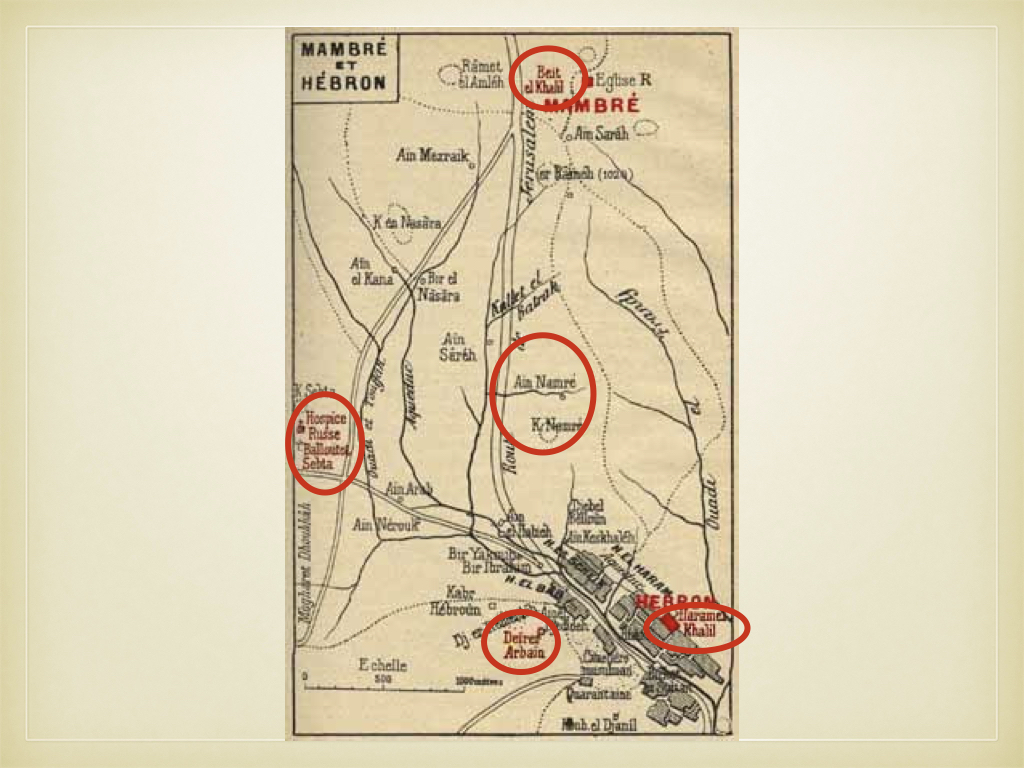
Meisterman’s 1906 map of the holy places of Hebron

An Old Testament KnoWhy for Gospel Doctrine Lesson 8: Living Righteously in a Wicked World (Genesis 13–14; 18–19) (JBOTL08E)

The purpose of this five-part series of videos is to provide a brief introduction to some of the places linked in tradition to the lives of the family of Abraham and Sarah. Many, though not all, of the sites we will visit are in or near the city of Hebron. Hebron and surrounding areas served as somewhat of a hub for Abraham in his many journeys.

Although archaeology cannot directly substantiate the scriptural stories of Abraham, Isaac, and Jacob, it can tell us something about the geography, settlements, and daily life of their contemporaries. Learning more about these places helps us get a more realistic sense of the setting in which the patriarchs lived. It is hoped that this series of presentations will increase exposure to these lesser-known sites, so rich in biblical history and tradition.

In this last of five video presentations, we will visit traditional sites associated with Mamre, the home of Abraham and Sarah after they separated from Lot. Mamre became the site of some of Abram’s most sacred experiences. After his return to Mamre from the rescue of Lot we read in Genesis 14 that he welcomed Melchizedek, “king of Salem” and “the priest of the most high God” (Genesis 14:18). Abraham sat in the door of his tent near the oak of Mamre when he received the visit of the three messengers who announced that he would have a son, Isaac, through Sarah.

As a first stop, we visit the St. George Church in Madaba, Jordan, where a floor mosaic of more than two million tiny pieces lays out the geography, buildings, and religious sites of ancient Palestine in the last half of the sixth century. The map of Hebron and Mamre provides useful clues to researchers about details of the ancient sites as well as to their location today.

Pinpointing the most likely sites for ancient Mamre is an almost impossible task. Five candidates have been identified, of which we will visit two of the most famous: the Oak of Sibta and Ramet al-Khalil/Elonei Mamre.

Though almost certainly not the tree of Abraham, the oak of Sibta has been venerated since the beginning of the Middle Ages. Its age has been variously estimated from 1000 to 5000 years old. The girth of its trunk is about ten meters. In former times, it grew undisturbed in the middle of a field surrounded by a small rock wall. Now it has declined in fulfillment of a tradition that it must die before the coming of the Antichrist. Anwar Zablah, the caretaker of the tree, has lived at the site of the Russian Orthodox monastery of the Holy Trinity for sixty years.

Two thousand years ago, at the same time he was building the Jerusalem Temple and the Tomb of the Patriarchs, Herod the Great erected a similar third monument at Ramet al-Khalil/Elonei Mamre, a traditional site of Abraham’s oak and well. Archaeologists have since discovered the remains of a church built by Constantine in 330 AD, constructed when he became disturbed by the pagan practices there.


The video may be found on the Interpreter Foundation website: KnoWhy OTL08E — Abraham’s Hebron: Then and Now, Part 5: Mamre

It can also be found on the FairMormon YouTube channel: https://www.youtube.com/watch?v=MNvHd5MzIoc

Filed Under: Bible, Lesson Aids, Questions, Resources Tagged With: Abraham, Constantine, Genesis, Gospel Doctrine: Old Testament, Hebron, Historicity, Mamre, Sarah

Abraham’s Hebron: Then and Now, Part 2: The Tomb of the Patriarchs (Old Testament Gospel Doctrine Lesson 8B)

February 14, 2018 by Jeffrey M. Bradshaw

Jeffrey M. Bradshaw: Market Scene in Hebron

An Old Testament KnoWhy for Gospel Doctrine Lesson 8: Living Righteously in a Wicked World (Genesis 13–14; 18–19) (JBOTL08B)

The purpose of this five-part series of videos is to provide a brief introduction to some of the places linked in tradition to the lives of the family of Abraham and Sarah. Many, though not all, of the sites we will visit are in or near the city of Hebron. Hebron and surrounding areas served as somewhat of a hub for Abraham in his many journeys.

Although archaeology cannot directly substantiate the scriptural stories of Abraham, Isaac, and Jacob, it can tell us something about the geography, settlements, and daily life of their contemporaries. Learning more about these places helps us get a more realistic sense of the setting in which the patriarchs lived. It is hoped that this series of presentations will increase exposure to these lesser-known sites, so rich in biblical history.

This second presentation will take us to the most well-known site connected with Abraham, the Tomb of the Patriarchs located in modern Hebron. In the Bible, this site is connected with the place names of Machpelah and Kiryat Arba. Here Abraham purchased a cave for the burial of Sarah from local residents.

The cave of Machpelah has been a site of pilgrimage for thousands of years. Machpelah has been under the control of Jews, Christians and Muslims at various times in its history. It was enclosed two thousand years ago within a roofless structure whose imposing walls were built by Herod the Great. It was later the site of Byzantine and Crusader Christian churches. In 1267, minaret towers were added by Muslim rulers and the structure was transformed into a large mosque, al-Haram al-Khalil, the al-Khalil referring to Abraham as “the friend,” meaning the friend of God. Jews call it Me’arat HaMachpelah.

The most important features of the structure are its six cenotaphs, monuments to Abraham and Sarah, Isaac and Rebekah, and Jacob and Leah. The bodies themselves are thought to be buried in the cave beneath the building. Currently sealed off to access, this cave previously has been eamined by ancient and modern explorers, and interesting artifacts have been found.

The video may be found at the Interpreter Foundation website: KnoWhy OTL08B — Abraham’s Hebron: Then and Now, Part 2: The Tomb of the Patriarchs

This video can also be seen on the FairMormon YouTube channel (https://www.youtube.com/watch?v=9DW8khMf78E).

Filed Under: Bible, Lesson Aids, Questions Tagged With: Abraham, Genesis, Gospel Doctrine: Old Testament, Hebron, Historicity, Kiryat Arba, Machpelah, Sarah, Tomb of the Patriarchs

Abraham’s Hebron: Then and Now, Part 1: Introduction (Old Testament Gospel Doctrine Lesson 8A)

February 14, 2018 by Jeffrey M. Bradshaw

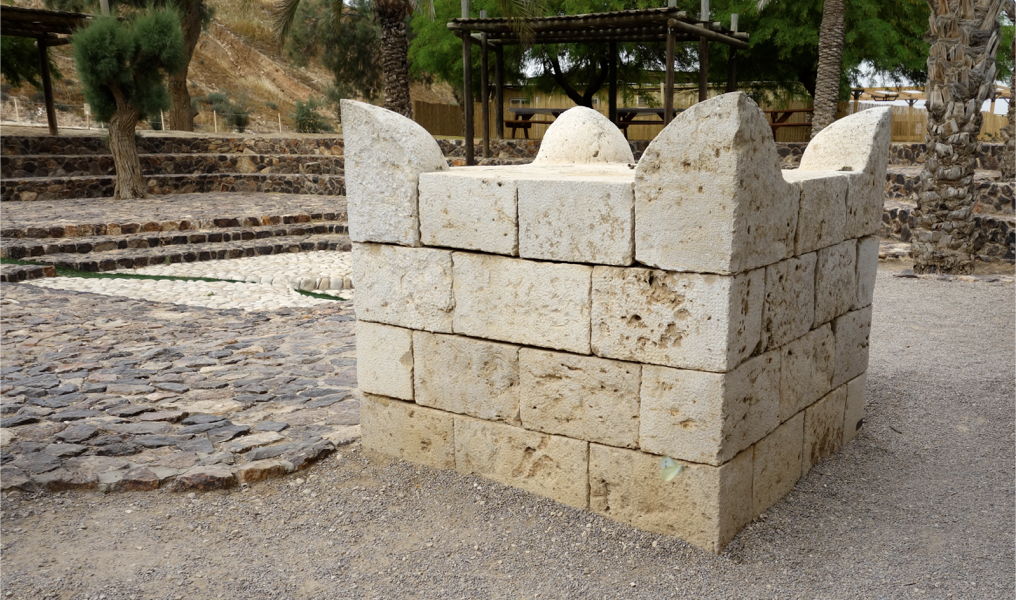
Jeffrey M. Bradshaw: Four-Horned Altar at Beersheba, 2014

An Old Testament KnoWhy for Gospel Doctrine Lesson 8: Living Righteously in a Wicked World (Genesis 13–14; 18–19) (JBOTL08A)

The purpose of this five-part series of videos is to provide a brief introduction to some of the places linked in tradition to the lives of the family of Abraham and Sarah. Many, though not all, of the sites we will visit are in or near the city of Hebron. Hebron and surrounding areas served as somewhat of a hub for Abraham in his many journeys.

Although archaeology cannot directly substantiate the scriptural stories of Abraham, Isaac, and Jacob, it can tell us something about the geography, settlements, and daily life of their contemporaries. Learning more about these places helps us get a more realistic sense of the setting in which the patriarchs lived.

Because the area surrounding Hebron is located in a part of the Palestinian-controlled West Bank that often has been the scene of violent dispute, it is not visited by tourists as frequently as some other places in Israel. Other sites such as Rachel’s tomb (near Bethlehem), as well as Jacob’s well and Joseph’s tomb further north are also in areas of the West Bank to which travel is sometimes complicated. It is hoped that this series of presentations will increase exposure to these lesser-known sites, so rich in biblical history.

Following this introduction, a second presentation will take us to the most well-known site connected with Abraham, the Tomb of the Patriarchs located in modern Hebron. In the Bible, this site is connected with the place names of Machpelah and Kiryat Arba. Here Abraham purchased a cave for the burial of Sarah from local residents. In the third presentation we will visit other areas in the West Bank: the traditional sites of Jacob’s well and Joseph’s tomb to the north, and the tomb of Rachel near Bethlehem. In the fourth presentation, we will return to Hebron to see excavations of ancient Hebron at Tel Rumeida, also known as Tel Hebron. Tradition associates this area not only with Abraham but also with David, Ruth, and Jesse. Finally, the fifth presentation will bring us to two sites associated with the tree on the plains of Mamre where Abraham welcomed heavenly visitors who promised him a child through Sarah and announced the impending destruction of Sodom.

The video may be found at the Interpreter Foundation website: KnoWhy OTL08A — Abraham’s Hebron: Then and Now, Part 1: Introduction

This video can also be seen on the FairMormon YouTube channel (https://www.youtube.com/watch?v=dL7BipxVcbA).

Submit a Comment

Your email address will not be published. Required fields are marked *

Filed Under: Bible, Lesson Aids, Questions Tagged With: Abraham, Genesis, Gospel Doctrine: Old Testament, Hebron, Historicity

Primary Sidebar

Faithful Study Resources for Come, Follow Me

Subscribe to Blog

Enter your email address:

Subscribe to Podcast

Podcast icon
Subscribe to podcast in iTunes
Subscribe to podcast elsewhere
Listen with FAIR app
Android app on Google Play Download on the App Store

Pages

  • Blog Guidelines

FAIR Latest

  • Come, Follow Me with FAIR – Doctrine and Covenants 137–138 – Part 2 – Autumn Dickson
  • Come, Follow Me with FAIR – Doctrine and Covenants 137–138 – Mike Parker
  • FAIR December Newsletter
  • Come, Follow Me with FAIR – Doctrine and Covenants 137–138 – Part 1 – Autumn Dickson
  • Prophets of God 

Blog Categories

Recent Comments

  • LHL on Come, Follow Me with FAIR – Doctrine and Covenants 132 – Mike Parker
  • Stephen Johnsen on Come, Follow Me with FAIR – Doctrine and Covenants 132 – Mike Parker
  • Bruce B Hill on Come, Follow Me with FAIR – Doctrine and Covenants 124 – Part 1 – Autumn Dickson
  • Gabriel Hess on Join us Oct 9–11 for our FREE virtual conference on the Old Testament
  • JC on When the Gospel “Doesn’t Work”

Archives

Follow Us

  • Facebook
  • Twitter
  • iTunes
  • YouTube
Android app on Google Play Download on the App Store

Footer

FairMormon Logo

FAIR is a non-profit organization dedicated to providing well-documented answers to criticisms of the doctrine, practice, and history of The Church of Jesus Christ of Latter-day Saints.

Donate to FAIR

We are a volunteer organization. We invite you to give back.

Donate Now

Site Footer