The Internet and Anti-Mormon Material
Prior to the Internet, how many members owned or read anti-Mormon books or literature? Comparatively, how many members have encountered anti-Mormon literature on the web?
Nowadays, some members stumble across anti material on the web while doing research for a lesson or talk. Sometimes they are drawn in by curiosity. 
It reminds me of the story of the man who was walking down the sidewalk when he came past an insane asylum. The courtyard of the asylum was fenced off by a tall wooden fence so no one could see in or out.
As the man walked along the fence he could hear voices on the other side chanting: “13, 13, 13, 13.”
“What in the world was going on,” the man wondered. Spotting a knot hole in one of the boards of the fence he leaned closer to see what was happening in the courtyard.
As his eye approached the hole, however, a finger suddenly shot out and poked him in the eye. The man recoiled in pain and shock.
Suddenly the voices chanted, “14, 14, 14, 14.”
I think that’s sometimes how it happens with some of the anti-Mormon literature. You wonder, “what is all this about?” And you get kind of drawn into it.
Shaken Faith Syndrome
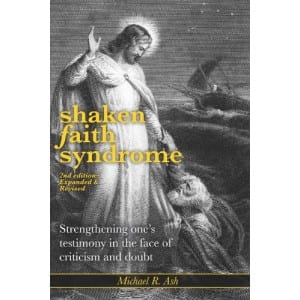
The title of the book that I’ve written of course, is Shaken Faith Syndrome. I culled the information for this book for many years from so many of you, from the things you’ve presented, and even unknowing comments that you’ve made. It’s kind of a FAIR production, I guess you could say.
While there are many reasons that people leave the Church, a shaken faith typically arises from two scenarios:
- Someone loses their faith because of a disaster in their life (such as a death, divorce, or other tragedy.)
- Someone’s faith is shaken because they are exposed to information that seems to question the truth claims of the Church.
This second category is the one I address in my book.
The Real Definition of “Syndrome”
Let’s briefly talk about the title of my book: Shaken Faith Syndrome. Some critics have taken exception to my use of “syndrome.” They claim that most English speaking Americans would understand the word to mean an illness or disease.
Therefore (they suggest) I must believe that critics are mentally ill, or that they have something wrong with them for not accepting the restored gospel.
In medicine, “syndrome” typically refers to a disease or illness—such as Auto Immune Deficiency Syndrome (AIDS) or Downs Syndrome.
In psychology and modern vernacular the term can refer to a response to extenuating circumstances such as the Stockholm Syndrome. (Captives in hostage situations show signs of loyalty to their captor. Elizabeth Smart may have been a victim of Stockholm Syndrome.) Alternatively, to a series of related events, such as the China Syndrome. (“the title of a 1979 movie which refers to the concept, mentioned only jokingly in the film, that if an American nuclear plant melts down, it will melt through the Earth until it reaches China”.)
From Dictionary.com we find the following definition of “syndrome”:
Pathology, Psychiatry:
- A group of symptoms that together are characteristic of a specific disorder, disease, or the like.
- A group of related or coincident things, events, actions, etc.
- The pattern of symptoms that characterize or indicate a particular social condition.
- A predictable, characteristic pattern of behavior, action, etc., that tends to occur under certain circumstances: the retirement syndrome of endless golf and bridge games; the feast-or-famine syndrome of big business.
While the first definition certainly refers to a disorder or illness, the three remaining definitions all could apply to my usage of the term and are obviously used in common English vernacular. (As indicated in the examples given in #4.)
Shaken Baby Syndrome
The title, “Shaken Faith Syndrome,” is clearly a play on the problem of “Shaken Baby Syndrome” (which seems obvious).
Shaken Baby Syndrome is neither a disease or illness but is a problem caused by shaking an infant. The resulting damage can be death as well as mental or physical disorders caused by damage to the brain.
The damage is caused by someone else—someone that either intentionally or unintentionally hurts or kills the child.
So likewise, LDS critical material can (and has) shaken the faith of active Latter-day Saints. It has killed testimonies or has damaged testimonies to the point of near death.
So I hope you can see why I think the term is an appropriate description of actual events or issues that contribute to deconversion. (Plus, I think the title is catchy).
What About Doubt?
Having doubt isn’t a sin and it isn’t abnormal. About 95% of Americans believe in God but nearly half— including those who consider themselves to be religiously devout—seriously question their faith from time to time.
The Church umbrella, thankfully, is large enough to include those who struggle with sporadic or chronic doubt.
“To some,” revealed the Lord, “it is given to know that Jesus Christ is the Son of God. To others it is given to believe on their words, that they also might have eternal life if they continue faithful” (D&C 46:13-14).
Joseph F. Smith once said that Latter-day Saints,
“…are given the largest possible latitude for their convictions, and if a man rejects a message that I may give to him but is still moral and believes in the main principles of the gospel and desires to continue in his membership in the Church, he is permitted to remain.
“…so long as a man believes in God and has a little faith in the Church organization, we nurture and aid that person to continue faithfully as a member of the Church though he may not believe all that is revealed.” 1
Why Does Doubt Lead Some to Abandon Faith?
Why does doubt cause some to abandon their convictions?
It seems that those who are prone to fundamentalist, dogmatic, or closed-minded perspectives about the gospel or early LDS historical events, are more likely to apostatize when they encounter challenging issues.
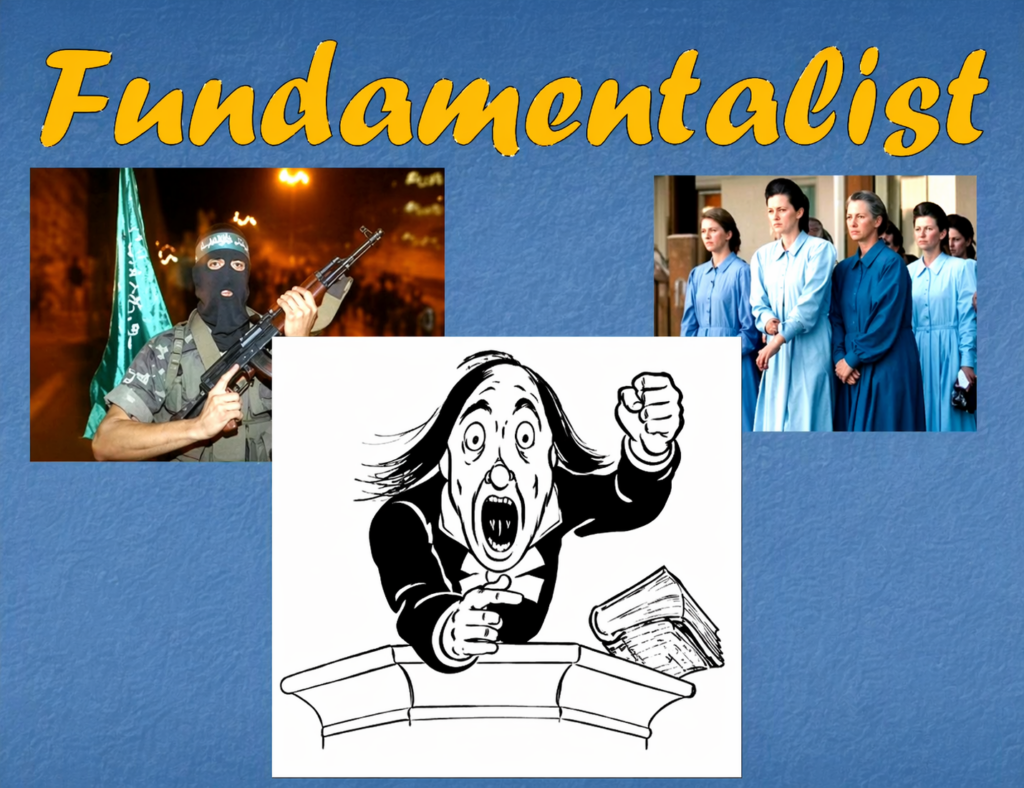 I use the term “fundamentalist” in a way that may differ from other usages of the term. I’m not referring to Islamic terrorists, and I’m not referring to modern-day polygamists.
In Christianity, the term often refers to conservative evangelicals who actively affirm what they see as fundamental Christian beliefs. An example is an inerrant Bible: a Bible that is literally interpreted and historically accurate despite any conflicting claims from science and modern scholarship.
By association, the term fundamentalist is also used to describe all those (of various religious beliefs) who take a very rigid, uncompromising, and unchanging approach to their ideologies (or belief systems). This definition more accurately depicts the way the term is used within this book.
Everyone, however—not just “fundamentalists”—have at least some rigid beliefs hidden in the background of their ideological stage.
This can present a problem when our unexamined assumptions are based on sandy foundations rather than on reality.
Conflicting Information and Uneasy Feelings
What happens when we encounter information that conflicts with existing thoughts or actions? You get an uneasy feeling.
Ever had Buyer’s remorse? Do you continue to live with buyer’s remorse? Typically you either return the product or make yourself feel good about your purchase.
Cognitive Dissonance
In psychology there is a phenomenon referred to as cognitive dissonance. Cognitions are “thoughts” and “dissonance” means disharmony.
When thoughts conflict, they are out of harmony. Sometimes we can have conflicting thoughts and not realize it, or we may realize it but we are not troubled by it.
When we recognize that we have competing cognitions and when we are troubled by the conflict, we enter a state of cognitive dissonance.
Cognitive dissonance creates a degree of intellectual, emotional, and even physical discomfort. We naturally take steps to alleviate the discomfort. This typically comes from talking ourselves out of the uneasiness.
 For example, most of us have been guilty at some point of speeding. If we are aware that we’re speeding it can create cognitive dissonance.
How do we reduce the uneasiness? We make up excuses.
- “I’m short on time” and
- “this appointment is more important than the minor law I’m breaking.”
- “The chances of being caught out are minimal;”
- “the road is very quiet;”
- “I am a very experienced driver;”
- etc.
 How about if you’re on a diet but your boss springs for pizza—and you love pizza.
You might say to yourself:
- “Veggies are good;”
- “I work out 3 times a week;”
- “I already blew my diet earlier;”
- “I’ll restart my diet on Monday.”
The level of discomfort we feel is directly related to how important we perceive the issue to be.
In the pizza example, we may not feel much uneasiness at all and we may quickly resolve the cognitive dissonance. Let’s suppose, however, that you’re addicted to alcohol, drugs, cigarettes, or pornography.
You know it’s wrong and you may face more serious heartburn when you engage in the addictive activity.
 Weight of Beliefs and Experiences
What if you discovered that your assumptions about Joseph Smith’s clothing styles, hair color, or pitch of voice, were incorrect?
These aren’t important issues—they don’t carry a lot of weight. It’s doubtful that discovering competing cognitions on these issues would create emotional turmoil.
It would likely matter, however, if we discovered information implying that Joseph was a fraud or delusional or that the Book of Mormon was merely fiction.
Each person assigns different levels of importance (or “weight”) to their various beliefs (or “cognitions”) and the weight is typically influenced by a variety of factors.
What we personally experience generally carries a lot of weight with our beliefs.
If, for example, you had a stomach ache after every time you drank milk, your belief that milk wasn’t good for you would carry a lot of weight.
Likewise, if you’ve noticed blessings when paying your tithing your belief in the correct principle of tithing would carry a lot of weight.
 The Role of Trusted Sources
The source of a competing cognition also carries a lot of weight.
If your doctor, for instance, told you to eat more popcorn for your digestive tract, you would more likely believe her than if the same advice came from the snack vendor at the movie theater.
Likewise, active members of the Church would be more likely to give credence to the counsel of Church leaders on spiritual issues than they might give to pop-psychologists or TV talk show hosts.
Responses to Religious Cognitive Dissonance
When we encounter cognitive dissonance with weighty issues—such as religious beliefs—we can experience a very uncomfortable and emotional state of mind.
This discomfort has been called a “negative drive state” because it causes psychological tension almost like hunger or thirst and requires immediate attention and resolution.
Reducing this distress may require a change in belief or behavior.
There are at least four ways in which this is generally accomplished, and we are not often consciously aware of doing so.
We will either:
- reject the new information—the competing cognition—as false;
- reject the new information as unimportant;
- reject old beliefs in favor of the new information; or
- add information (additional cognitions) to validate the original belief.
Illustration: The Red Ball Example
Ben McGuire offers the following example (and I use this example in my book):
Suppose you are playing with a red ball. The fact that you know the ball is red is a cognition.
Then, I come along and comment on how nice your green ball looks. You now have a second cognition—that I believe that the ball is green.
These two cognitions stem from contradictory states—that is, the ball is not both green and red.
If the two cognitions are weighted equally, this might create cognitive dissonance.
Which is to say, that if you valued my opinion as much as your own on determining the way you view reality, you would experience cognitive dissonance.
Assuming that we perceive this issue as important, let’s look at how we might relieve the discomfort of cognitive dissonance, and let’s compare this to a similar scenario wherein we might encounter LDS-critical information.
Four Common Responses
Option 1: Reject New Information as False
Reject the New Information as “False” (decide that I am wrong when I claim that the red ball is actually green—I’m either lying or colorblind).
We may reject the anti-LDS information as false—believing instead that critics invented the claim or pulled the information out of context.
By brushing aside the offending information as anti-Mormon propaganda, we could resolve any emotional discomfort or ward off future psychological vexation.
This approach is generally effective because, in reality, many anti-Mormon claims are complete fabrications or are taken out of context.
Option 2: New Information is Unimportant
Reject the New Information as “Unimportant” (decide that the color of the ball is unimportant compared to the enjoyment you get by playing with it).
We may decide that the faith-shaking discovery is unimportant or irrelevant to more important religious beliefs.
We may rightly feel that our acceptance of the gospel is based on a spiritual testimony—which carries more weight with our spiritual convictions than sources we don’t fully trust.
Most of us don’t have the time, energy, or resources to search out answers to every accusation, and so it often seems natural to set aside conflicting information as unimportant when we already have a conviction that the Church is true.
Options 1 & 2 are often coupled with avoidance of LDS-critical literature.
Both options are also typically compelled by emotion—possibly fueled by spiritual evidence— rather than a serious examination of the issues.
While our conclusions may be correct (in this case, that the Church is true despite anti-Mormon claims), the first two options usually reinforce the original belief without a rigorous and open-minded investigation of competing cognitions.
Cognitive Dissonance Beyond Religion
Latter-day Saints aren’t the only ones that resolve issues in this matter. And such an option for resolving cognitive dissonances isn’t limited to religious issues.
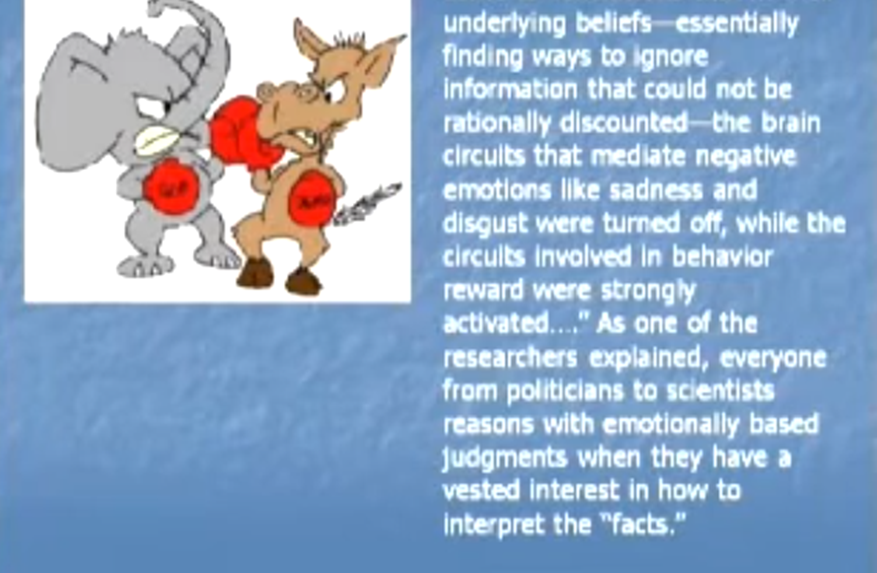 According to a recent study at Emory University, for instance, committed Democrats and Republicans both generally rely on emotion rather than reason when evaluating information that challenges their political views.
When brain activity was measured from test-subjects who were asked to evaluate negative information, the circuits involved in reasoning were not particularly engaged.
Instead, the researchers recorded brain activity in the emotional centers of the brain—especially those areas known to be involved in resolving conflicts.
Once the test subjects “had come to conclusions that fit their underlying beliefs—essentially finding ways to ignore information that could not be rationally discounted—the brain circuits that mediate negative emotions like sadness and disgust were turned off, while the circuits involved in behavior reward were strongly activated….”
As one of the researchers explained, everyone from politicians to scientists reasons with emotionally based judgments when they have a vested interest in how to interpret the “facts.”
Change Is Possible
Although we tend to defend and rationalize our beliefs, many people do change their views.
- Some Democrats become Republicans and vice versa.
- Some believers become atheists and some atheists become believers.
- Some Mormons become Baptists and some Baptists become Mormons.
- Some Mormons become critics and some critics become converts.
Critics, however, generally believe that all Mormons take the emotional, less-rational, or irrational approach to cognitive dissonance. Why?
According to many critics, no rational person could study the disconfirming evidence and remain a believer unless they were duped or in denial.
The critics, of course, are just as likely to opt for emotional and less-rational approaches for maintaining their disbelief when confronted with evidence that supports Mormonism. (As will be shown later.)
While it’s certainly possible that some Mormons manage their dissonance in less rational ways, other theories suggest that religious people often have rational reasons for remaining believers despite conflicting evidence.
 Commitment, Religion, and Perceived Benefits
All of us, for example, are involved in relationships (with spouses, parents, siblings, or offspring) to which we maintain commitments despite unsettling information.
We tend to recognize that there are long term benefits to sticking with committed relationships, in spite of the short-term costs, which are sometimes quite high.
People committed to their religion accrue benefits such as answers to the meaning of life, or a relationship with the divine.
Rational people will sacrifice for their religious beliefs when they get more in return.
They will even rationalize their behavior and beliefs for some time without a payback, but most of us will not rationalize indefinitely unless our beliefs produce the payback we expect—and many people find that religion does deliver the expected payback.
Some members may choose to live with doubt. They might continue to question the truth claims of Mormonism, but put aside the unsettling issues in favor of the rewards they find in assembling with the Saints.
Those, however, who don’t put their doubts aside—who don’t consciously or unconsciously avoid LDS-critical material and continue to suffer from cognitive dissonance—may eventually move to one of two alternative options: changing cognitions, or adding cognitions.
 Option 3: Change Cognitions or Beliefs
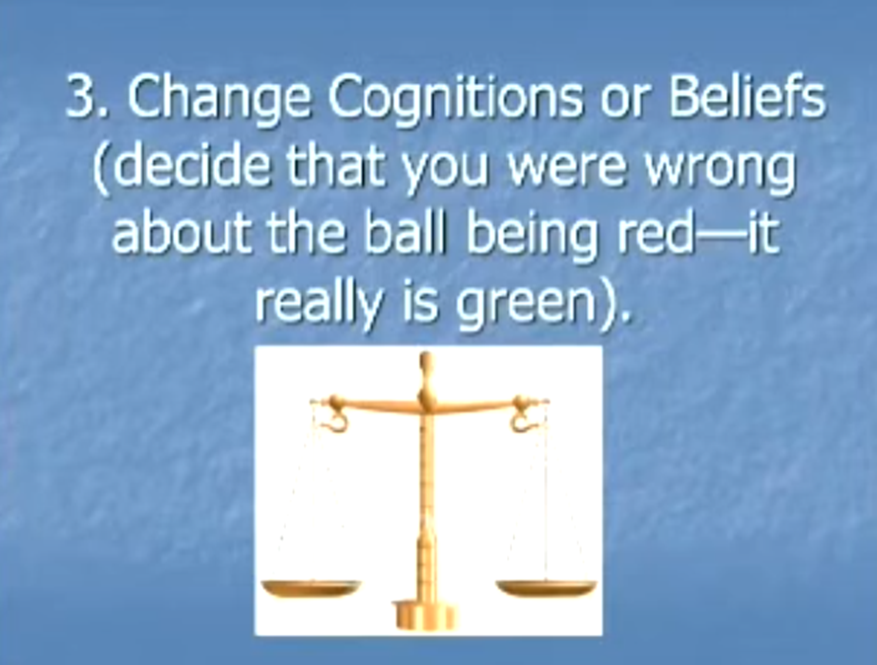
3. Change Cognitions or Beliefs (decide that you were wrong about the ball being red—it really is green).
Some people are unable to dismiss doubt-generating discoveries as false or unimportant.
The new competing information may sound persuasive or it may appear to come from a credible source—which, in turn, adds weight to the competing cognition.
We get anxiety when both cognitions seem evenly balanced. This anxiety can build, causing a lot of discomfort, until we seek to restore cognitive consonance (“thought harmony”).
When the tension is reduced, we feel better. Indeed, many ex-Mormons claim that they went through a range of emotions before leaving Mormonism but eventually felt relief once they finally left the Church.
Of course, if cognitive dissonance is at play the same relief is also generally felt by those who come to grips with difficult issues and remain in the Church.
In either scenario, the turmoil caused by cognitive dissonance is resolved.
Avoiding Future Dissonance
Once the discomfort is resolved and their minds are made up to exit the Church, many ex-members avoid future cognitive dissonance that could come from evidence that favors Church claims.
To alleviate this tension they generally explain away pro-LDS arguments in the same two less-rational ways as many members explain away antiMormon literature—they conclude that their former LDS testimony was either false (perhaps a result of feelings, hope, desire, or confirmation bias), or the testimony is rejected as unimportant (no amount of spiritual testimony can compete with the newly perceived “truth” of the secular or historical conflicting evidence).
Like some of their believing counterparts, they often avoid literature that runs contrary to their belief or in this case, their unbelief. In other words, they avoid those evidences that strengthen LDS arguments.
They often decide from the start that LDS scholarly studies are biased, unreliable, or ineffectual before even reading such material.
By disregarding all LDS scholarly studies that challenge their unbelief, they avoid repeating their experience of psychological anxiety.
Who is Really Close-minded?
It’s fairly common, for instance, to encounter critics who are completely unaware of LDS scholarly and defensive studies, yet who claim that anti-LDS arguments prove Mormonism to be fraudulent.
One anonymous Internet-posting critic, for example, claimed that evidence proved that the Book of Abraham was a fraud, while simultaneously admitting that he was completely unfamiliar with the latest scholarly rebuttals to the anti-Mormon accusations.
Another on-line critic claimed that he had no intention of reading LDS scholarly arguments because doing so “would be an incredible waste of time.”
He was satisfied, he bragged, that the truth is not found in Mormonism, and he had no need to see counter arguments.
They’ve already concluded that the Church isn’t true, they believe that anti-Mormon claims provide evidence for their conclusions, and they don’t want answers when their minds are already made up (actually examining pro-LDS rebuttals might recreate cognitive dissonance).
Ironically, the critics are usually the ones who claim to be open-minded in contrast to closed-minded Mormons.
 Entrenched Positions and Resistance to Change
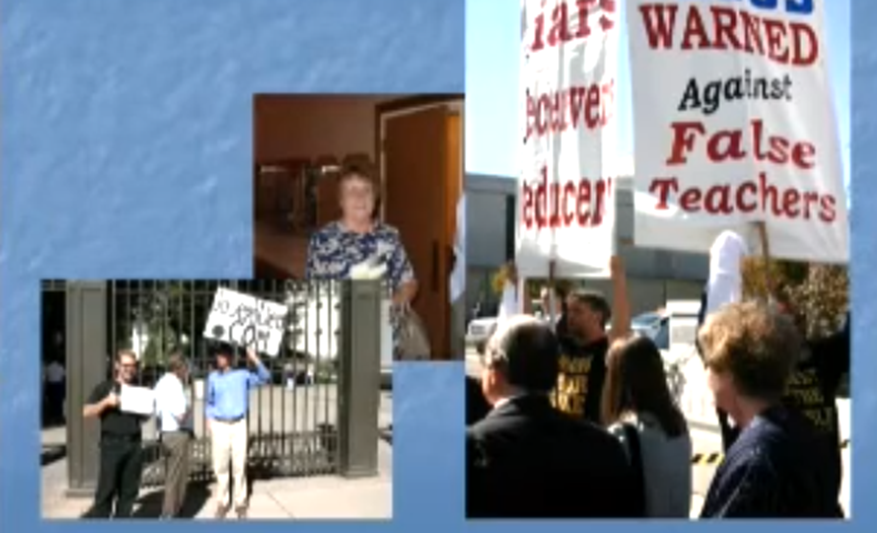
Several ex-Mormons, for instance, have said that their opposition to the Church is so strong that they would be unwilling to return regardless of any new information that might come forth.
According to a 2001 informal poll of nearly 400 ex-members, for example, over half said that “nothing” could open the door for their return to Mormonism.
It’s ironic to see that some ex-members, who claim to leave for purely intellectual reasons, actually refuse to examine LDS intellectual arguments for nonintellectual reasons.
Option 4: Adding Cognitions or Information
4. Adding Cognitions or Information to Validate the Original Belief (get another opinion on the color of the ball).
Additional supporting information can shift the weight of evidence to tilt in favor of our original beliefs.
For instance, in the example of the red or green ball, if you discovered that I was color-blind, your personal belief would, once again, carry more weight making it easier to choose between the competing cognitions.
 As one Book of Mormon example, we’ll explore the anti-Mormon argument that the Book of Mormon plates could not be made of gold because they would have been too heavy for Joseph to carry when he ran through the forest from would-be ambushers.
When we add the cognition, however, that the plates were said to be gold in appearance and that early Mesoamericans used gold-appearing metals which weighed less than solid gold, we find that the anti-Mormon cognition does not equal or outweigh the pro-Mormon cognition.
Adding cognitions typically calls for a paradigm shift.
We would have to recognize, for example, that the “golden” plates need not be made of pure gold to be called gold (most wedding rings are 14kt gold which is about 58% gold and 42% other alloys).
An overall paradigm shift for Latter-day Saints may require a more nuanced understanding of the role of prophets, scripture, and personal revelation, as well as the limitations of science and scholarship.
Foundations of Testimony
As I noted earlier, a fundamentalist mindset seems to make believers more vulnerable to testimony damage.
Some testimonies, quite frankly, are built on sandy foundations such as folklore, tradition, the admiration of a Church leader, the enjoyment of the LDS social organizations, or memberships based on family pressure.
When there is no true conversion of the spirit, it’s often more difficult to accept those things that must be known by faith alone.
Members who do have spiritual testimonies, however, are not immune to personal apostasy.
Sadly, we know from history that even some formerly stalwart members with significant spiritual experiences—such as Sidney Rigdon and the Three Witnesses—have apostatized.
We learn from Lehi’s vision that some of those who had tasted of the fruit (God’s love), abandon the fruit when pressured from outside influences (see 1 Nephi 8:25, 28).
Contributing Factors for Belief or Disbelief
There are numerous—and oftentimes complex—factors that contribute to each person’s reasons for belief or disbelief.
I’ve noticed, however, a few common elements among many of those who leave the Church over supposedly intellectual reasons.
Many former-Mormons who once had testimonies of the Church also had fundamentalist views about scripture as well as the nature and role of prophets.
These perceptions present themselves as stumbling blocks when they are faced with intellectually challenging issues.
 Confusing Rumors or Traditions with Doctrine
Most of us embrace concepts, beliefs, or positions primarily because we’ve never thought of questioning them.
Unfortunately, we occasionally confuse beliefs on peripheral teachings—such as rumors, traditions, or personal opinions—with LDS doctrines.
Sometimes we are unaware of how to think outside the box of conventional LDS interpretations. (Even if those interpretations are based on tradition rather than revelation.) Or we may not know how to handle complex issues.


If we build our house of straw on non-doctrinal ideologies, and the structure collapses on the sandy foundation of misunderstanding, our entire belief system may crumble as well.
- We might assume, for example, that all prophets of all ages understood all gospel doctrines, principles, and practices in the same way.
- We may—perhaps unconsciously—embrace a fundamentalist and rigid approach to the categorization of people and principles.
- We may, for example, believe that a prophet is always spiritual, knowledgeable, kind, and disciplined; he could never err on religious matters nor hold false beliefs.
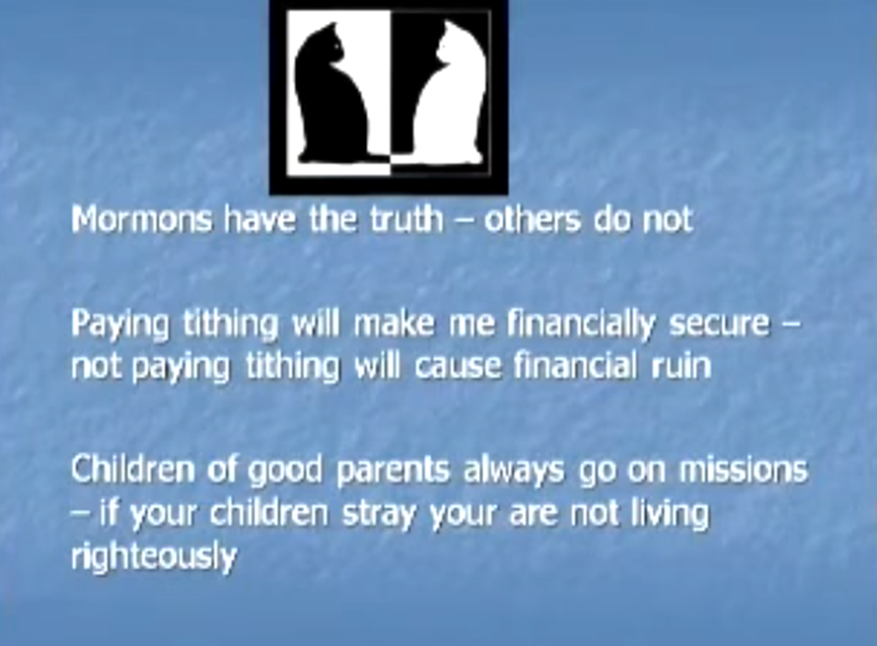 Seeing Things in Black and White
Sometimes we may, unintentionally, see things in unambiguous black and white.
- “Mormons have the truth, others do not,” we may conclude.
- Or, “Paying tithing assures financial stability or prosperity; not paying tithing will lead to financial ruin.”
- “The Spirit speaks to Mormons and not to non-Mormons.”
- “If you live righteously your children will all go on missions and be sealed in the temple. If your children go astray or your life is full of problems, you are not living righteously.”
Such a black and white fundamentalist mindset can set us up for problems.
- There either were horses in the ancient Americas, the fundamentalist mind may think, or the Book of Mormon is false.
- There either was a world-wide flood that wiped out virtually all life, or the Bible is false.
To the fundamentalist, there is no middle ground.
If they discover what they believe to be persuasive information that there was no world-wide flood, or that actual horses were absent from ancient America, then their entire ideology crumbles beneath them.
And when some people become disaffected—even over false assumptions—further enlightenment or counter-evidences may fail to resuscitate the testimony.
Too Quick to Accept Things We Hear or Read—Unrealistic Expectations
Not infrequently, we are too quick to uncritically accept the things we hear or read—even from sources such as Church leaders or in Church magazines.
It’s not that their words aren’t usually true, but we should use our brains as well as our spirits when we study the gospel.
President N. Eldon Tanner reportedly complained about “the tendency of Church members to read the official magazines with …uncritical acceptance, without engaging in the process of thought, judgment, and inspired confirmation that genuine internal dialogue with the written or spoken word makes possible.”
Too often, we uncritically accept rumors (including faith-promoting rumors) in lieu of facts; traditions, speculation and opinion in lieu of revelation; and unrealistic expectations and illusions of prophets and scripture in lieu of mature and realistic perspectives.
In short, we must recognize the need to open our minds and potentially understand gospel topics in ways we may not have seen them before.
“Disillusionment,” observes psychologist Dr. Wendy Ulrich, “is a very good thing. I do not want to live a life based on illusions, and being disillusioned is very valuable to me.”
Illusions and misconceptions are straw men—they are easily destroyed by accurate information.
Sometimes, part of our testimony—as evidenced by the claims of many ex-Mormons—may, unknowingly, be grounded on illusions and misconceptions.
When critical information destroys conclusions based on straw men or false assumptions, some members will lose their entire testimonies.
The most common misconceptions that seem to factor into personal apostasy include:
- Unrealistic Expectations of Prophets
- Confusing Tradition With Doctrine
- Imposing Our View on Others
- Unrealistic Expectations of Science and Scholarship
A. Unrealistic Expectations of Prophets
Prophets are not infallible.
“I make no claim of infallibility,” said President Spencer W. Kimball.
President Harold B. Lee indicated that not every word spoken or written by a General Authority need be considered as inspired. And Elder J. Reuben Clark said that “‘even the President of the Church has not always spoken under the direction of the Holy Ghost.’”
The purpose and mission of the Church is to “invite all to come unto Christ” (D&C 20:59).
Prophets stand as leaders in this invitation and the things they do and say (as prophets) are intended to accomplish this goal.
How do we come unto Christ? The Book of Mormon gives us the six-point pattern:
- belief in Christ,
- repentance,
- baptism,
- gift of the Holy Spirit,
- enduring to the end, and
- being found guiltless at the final judgment.
This list entails personal commitments, attitudes, and relationships with Heavenly Father and Christ. We must make personal commitments and interactions with the Lord.
Prophets help guide us to the waters of truth, but they cannot drink for us.
Guiding us does not mean that all their comments are inerrant.
 Expectations vs. Reality
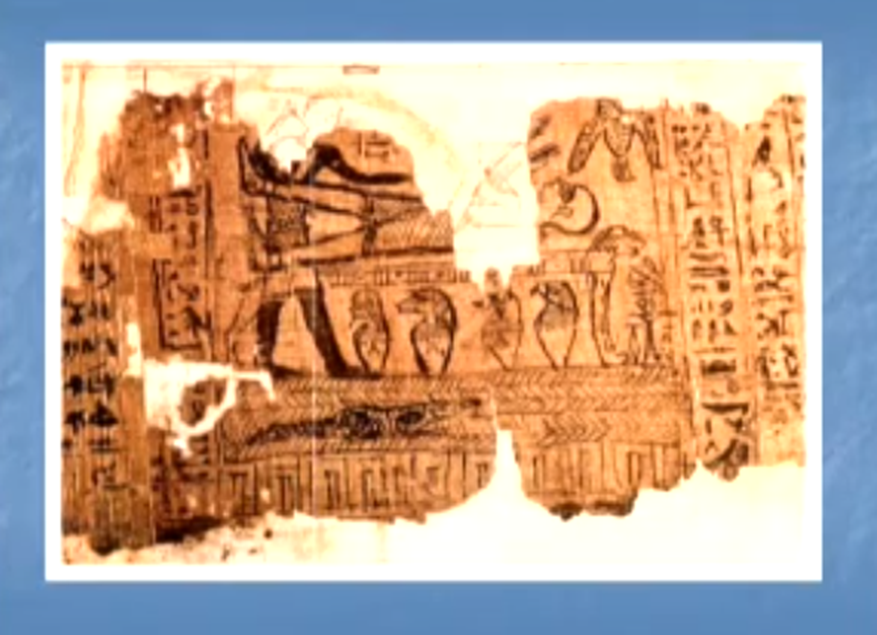
Ex-members generally claim that issues such as polygamy, the translation of the Book of Abraham, or Brigham Young’s racial views created cognitive dissonance that eventually caused them to leave the Church.
Usually, however, the actual competing cognitions are generally a set of assumptions or perceptions of “what a prophet is and how a prophet should behave—compared with evidence about what the prophet was and how the prophet behaved.”
One critic, for example, noted his bewilderment at how the Book of Mormon could be a very poorly written text, if it “were truly dictated from the mouth of an omniscient god….”
Likewise, he seems perplexed as to how Brigham Young, who claimed “to speak for the same omniscient god,” could have fallible thoughts about the cosmos.
Another ex-Mormon recently claimed that “every last thing that came from Joseph’s mouth and/or pen should have been Universal truth.”
Unfortunately, sometimes believing members seem to share this fundamentalist assumption.
Prophets as Mortal Leaders
Prophets are not born as prophets and they are not raised in social and cultural vacuums. When they are called as prophets they don’t suddenly become divine—they are still men.
Prophets have, and are entitled to, their own opinions, their own misconceptions, their own biases, and their own mistakes.
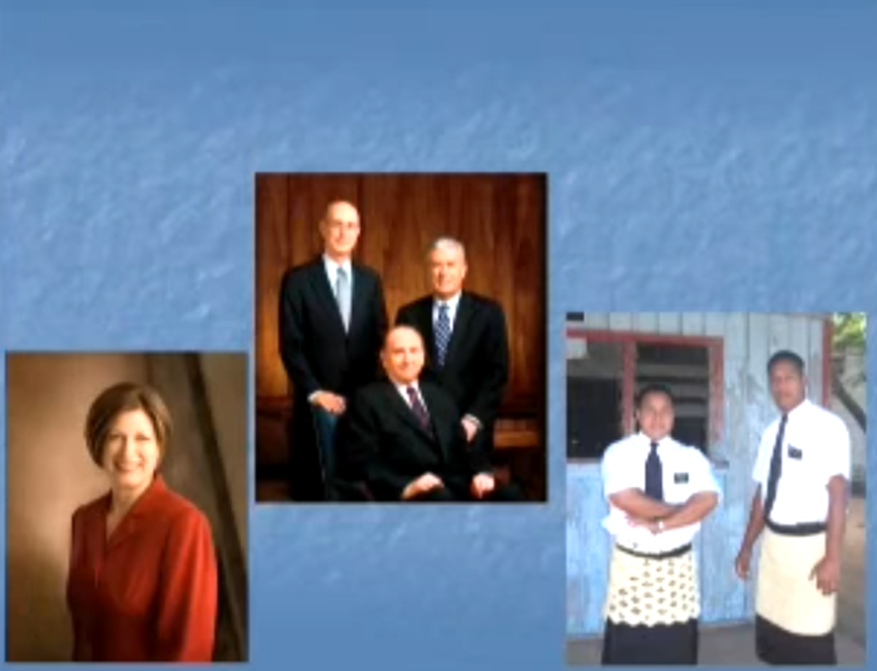 When a Latter-day Saint is called to be:
- a Relief Society president,
- an elder’s quorum president, or
- a bishop or
- stake president
they bring to their calling many of those things which make up their personalities and worldview, including their strengths, weaknesses, and preconceived ideas.
The same can be said for prophets.
Gospel education, for the prophets and the masses, is an evolutionary process—the same as any other type of education.
Hence the need for continuing revelation. Neither complete doctrines nor specific doctrinal details are always revealed all at once.
As Joseph Smith once said, “It is not wisdom that we should have all knowledge at once presented before us; but that we should have a little at a time; then we can comprehend it.”
 The Nature of Revelation
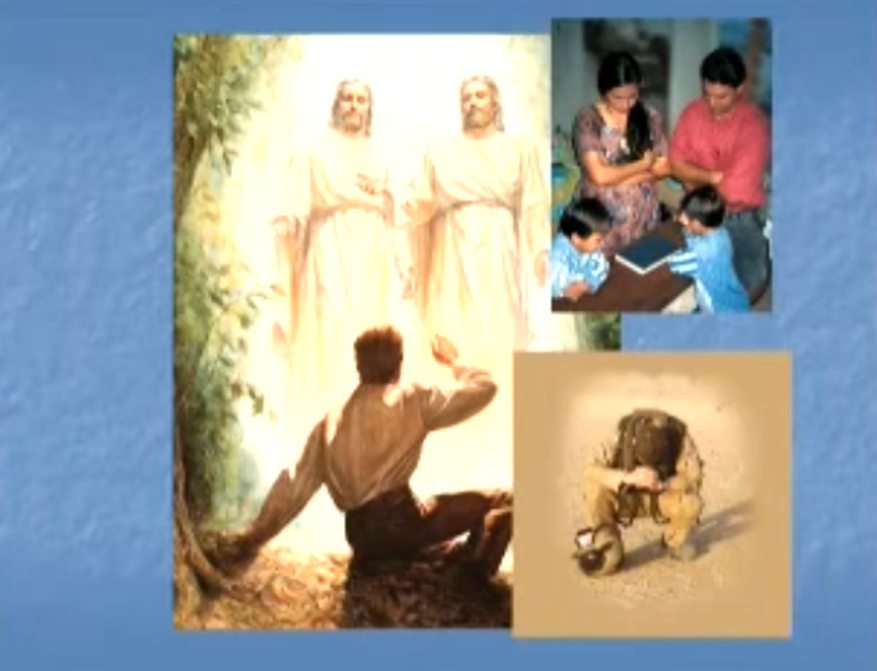
As evidenced by the scriptures and Restoration accounts, revelation is typically not dispensed as an unsolicited gift but is given, instead, in answer to petitioning God.
The First Vision, the Joseph Smith Translation, the Word of Wisdom, and more, all came in answer to prayer.
If the questions aren’t asked, the answers are rarely given.
In the gospel, all of us are novices at various levels of understanding; as learning increases, we are better able to comprehend and express advanced ideas.
Just because a prophet has the keys to the priesthood and the authority to receive revelation from God for the direction of the Church, doesn’t mean that every word spoken by a prophet is infallible, inspired, or factually accurate.
 B. Confusing Tradition with Doctrine
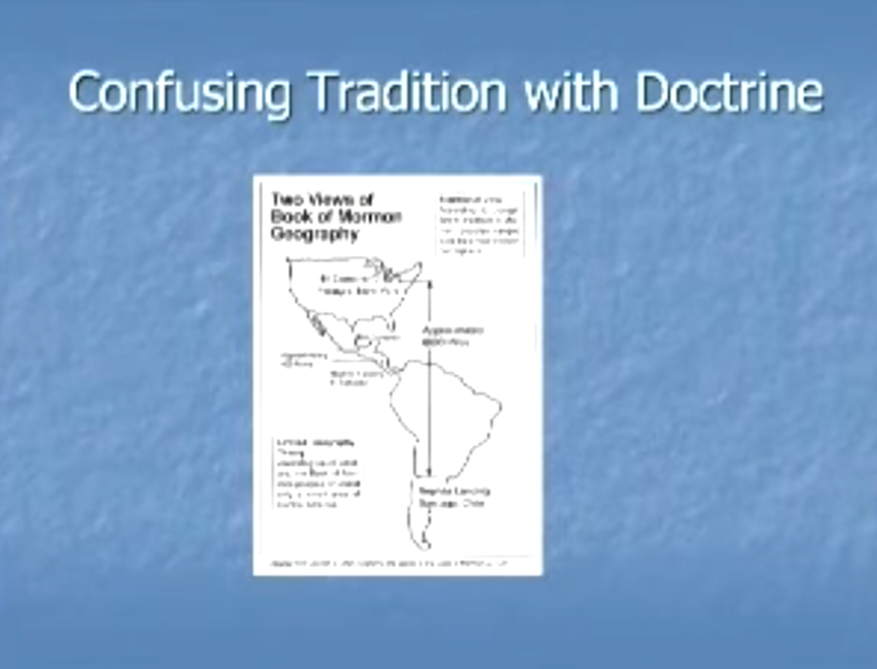
Unfortunately, but unavoidably, we—and even prophets—sometimes confuse tradition-based interpretations with doctrines or official positions. Of the many possible examples, I’ll choose Book of Mormon geography as an illustration.
Most members have believed (and perhaps still believe) that Book of Mormon events took place over the entire hemisphere of North and South America.
A cursory reading of the Book of Mormon suggests that North America was the land northward and that South America was the land southward. Present-day Panama naturally comes to mind as the “narrow neck” of land connecting the north and the south.
It’s likely that Joseph Smith, most of his contemporaries, and probably most modern day prophets assumed and even embraced this hemispheric view.
It also seems likely that Joseph and his contemporaries believed that the Indian remnants of his local vicinity furnished evidence of the lives and wars of the Nephites and Lamanites.
Where Did This Tradition Come From?
From where did such beliefs arise?
A superficial reading of the Book of Mormon—in the context of cultural beliefs about the Indians in Joseph’s day—plausibly suggests such a scenario.
Some early nineteenth-century frontiersmen, for example, believed that the Indians were originally white settlers from the lost tribes of Israel.
In the weakness of early LDS understanding it would have made logical sense to envision Book of Mormon geography in context of what they believed about the existence of Indians in North America.
Early LDS leader and writer, Orson Pratt, became a primary promoter of the hemispheric Book of Mormon geography and some of his thoughts were eventually incorporated as footnotes to geographical events in the 1879 edition of the Book of Mormon.
These notes were removed in the 1920 edition, but the influence had already made its impact on many Latter-day Saints.
The hemispheric model was born from supposition in the context of nineteenth-century American speculation and achieved quasi-official status among many members because of tradition rather than revelation.
For most members, there was no need to question a hemispheric geography—it appeared to be the obvious interpretation of the Book of Mormon text.
 Shifting Understanding Over Time
Through the years, however, there were a few Latter-day Saints (both lay members and leaders) who questioned a hemispheric geography.
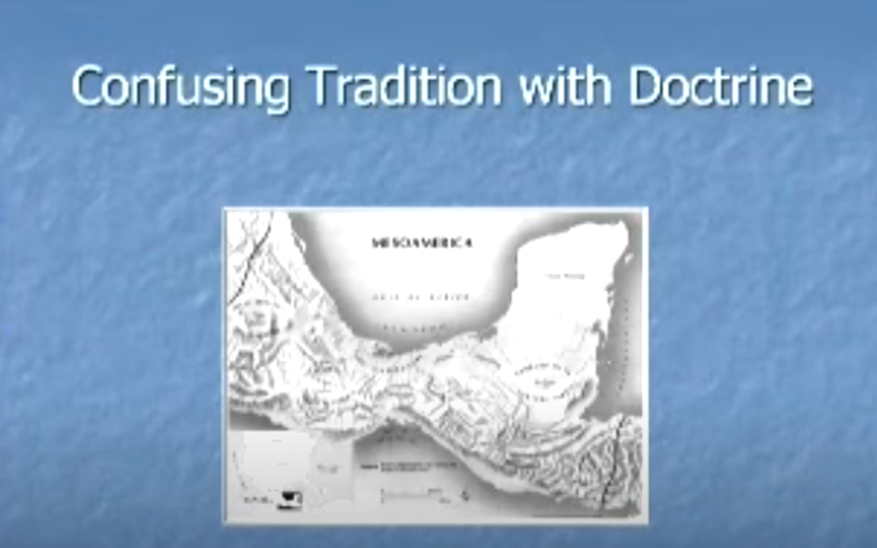
Book of Mormon travel distances suggest a limited geography, and several scholarly studies propose a Mesoamerican location for Book of Mormon events. Today, most LDS scholars and an increasing number of members and leaders believe that Book of Mormon events transpired in Mesoamerica.
It was the traditional view of a hemispheric geography, however, that was passed from generation to generation of Latter-day Saints as an unarguable truth. This “truth” was spoken from the pulpit, integrated into manuals, taught in classes, and casually implied as LDS doctrine for nearly two hundred years among most Church members.
If we assume that Book of Mormon events actually took place in a limited geography, how do we reconcile the fact that past prophets were wrong about the location of Book of Mormon events or the makeup of pre-Columbian peoples?
(It should be remembered that some LDS members—including some early LDS leaders—did not unquestioningly accept the traditional interpretations.)
 Tradition and Resistance to Change
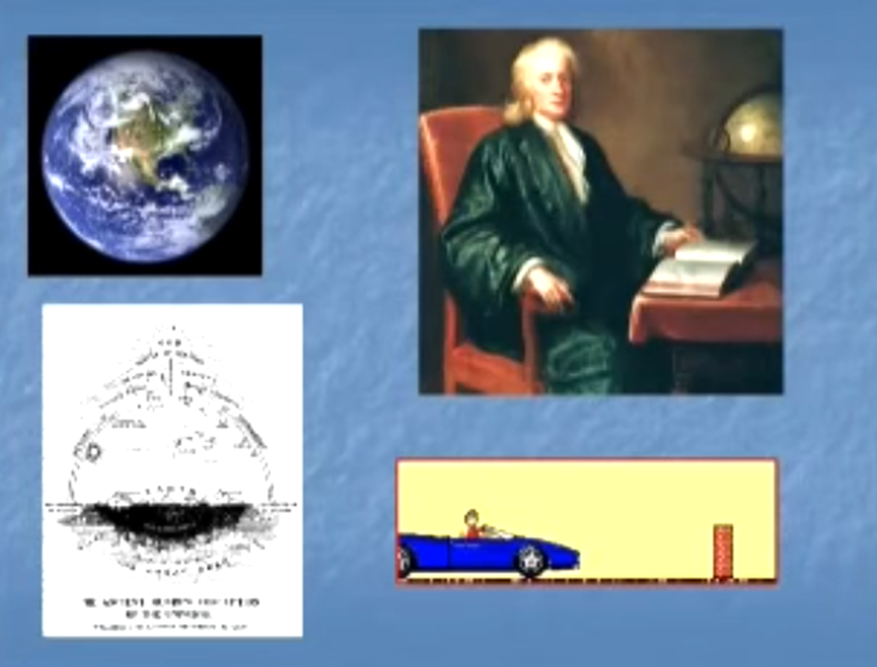
We might similarly ask how Old Testament prophets could be wrong about the shape of the earth.
In some ways, traditions seem to follow Newton’s first law of motion which states (in part) that an object in motion tends to stay in motion unless acted upon by extraneous forces.
Until some new information unbalances our traditional views and makes us critically examine those views, we generally tend to uncritically accept most traditions—even when they are wrong.
Prophets, like other mortals, accept traditions that may be in error simply because they’ve never thought about challenging such traditions.
Sometimes when new light is given we resist. Most of us are averse to change; after all, we are creatures of habit.
“I have tried for a number of years,” said Joseph Smith, “to get the minds of the Saints prepared to receive the things of God; but we frequently see some of them, after suffering all they have for the work of God, will fly to pieces like glass as soon as anything comes that is contrary to their traditions.”
It really doesn’t matter how long or how many people (including prophets) believed an erroneous non doctrinal idea.
Doctrine is not determined by how long something is believed, or by the belief’s popularity.
As English author, Gilbert Keith Chesterton, once observed,
“Fallacies do not cease to be fallacies because they become fashions.”
When we recognize that both members and non-members sometimes mistake official LDS doctrines with traditions, procedures, policies, and the presentation of doctrine, many anti-LDS arguments lose what potency they might have had.
C. Imposing Our Views on Others
Our personal worldviews (what Germans refer to as Weltanschauungs) are a composite of many complex factors.
Our worldviews are as lenses that color the way we analyze our environment and the environment of others.
Often, we can’t understand how other societies could think, say, or do some of the things they do.
Not infrequently we impose our interpretations, understandings, worldviews and ideologies on foreign cultures or different social constructs.
This phenomenon is found in all cultures and in all time periods. It is not limited to Americans, modern people, or Mormons.
 Language, Culture, and Interpretation
Our assumptions cause us to interpret words and events in ways that are sometimes at odds with what actually was meant or what actually happened.
- While virtually all people see the same colors, for example, different people may conceptualize colors differently or divide the color continuum into discrete colors at different points. Russians and Americans, for instance, put the dividing line between green and blue at different points. Some hues that we call green, Russians would call blue.
- Hair color in Arabic is categorized differently than it is in English. What they term “blonde” we often call brown or red.
- In England, French fries are called “chips,” whereas our “wheat” is their “corn.”
- The King James Bible’s “corn” doesn’t refer to American maize but instead refers to a variety of Old World grains—most commonly wheat and barley.
Sometimes a word can mean something different depending on context.
- We can catch a nap, for instance, or we can catch a fish.
- Likewise the term “gay,” for instance, generally means something completely different to twenty-first century Americans than it did to eighteenth-century Americans.
If someone were to translate the word into another language, they would need to understand how—or perhaps when—the term was used in English in order to make a correct translation.
Understanding Context in Interpretation
Non-LDS Bible scholars Malina and Rohrbaugh, explain that all readers “must interact with the writing and ‘complete’ it if it is to make sense.”
“Every written document invites immediate participation on the part of the reader. Thus writings provide what is necessary, but cannot provide everything.”
Because reading has strong social elements, readers who share an author’s social environment are more likely to fill in the blanks with instinctively correct mental pictures culled from their own experiences and culture.
Reasonable clarity is enjoyed because of the common social system.
 Understanding Different Social Contexts
When the social system between reader and writer is dissimilar—which is often the case with texts written in different times or from different cultures—the mental pictures that a reader unconsciously conjures may be drastically different from the images the writer intended to portray.
When the reader or writer comes from a different social system, then
“as a rule, non understanding—or at best misunderstanding—will be the result.”
Generally a reader’s mental image—especially the image conjured by an uninformed reader—will be influenced by his own culture (a phenomenon known as “recontextualization”).
This problem helps us recognize the importance of understanding different cultures in their own context.
Examples from Scripture
In the Bible, for example, we frequently find references to the “whole earth.” When we hear this phrase as twenty-first century Americans, we think of the entire planet.
Ancient people, however—those for whom the scriptures were initially written—did not envision the earth as a planet in the same sense we do today.
To the people of the Bible, whole earth generally referred to the inhabited lands of which they knew—this was their world.
In Exodus 10:12, for instance, we read that the Lord caused the “land of Egypt” to be swarmed by locusts. Yet in verse 15 we read that the locusts covered “the face of the whole earth.” Obviously the whole earth still referred to Egypt.
Similarly, in Luke 2:1 we read that Caesar Augustus sent a decree to tax “all the world.” I seriously doubt that Augustus was trying to extract tax from all the nations in Europe, Asia, and the Americas.
Understanding the ancient use of “earth” in the Bible helps us understand the use of terms “earth” and “land” in the Book of Mormon—both of which generally refer to localized areas.
Understanding this difference is important when we endeavor to comprehend what Book of Mormon authors were saying in relation to geography and the possibility of other inhabitants.
Context and Interpretation
When we try to understand nineteenth century LDS events, as well as the events in the Book of Mormon, as real events that happened to real people within the context that they lived and reacted to their environment, we find that many of the critics’ objections become less problematic or may disappear altogether.
In fact, when we analyze the Book of Mormon through a lens that assumes an ancient Mesoamerica production culture, details in the book make more sense than if we assume a modern production culture.
D. Unrealistic Expectations of Science & Scholarship
Science and scholarship encompass rigorous disciplines that enable us to know more about the world of today as well as the world of the past.
As Latter-day Saints, we should recognize that truth is truth – regardless the source.
As Joseph Smith said,
“One of the grand fundamental principles of Mormonism is to receive truth, let it come from whence it may…. We should gather all the good and true principles in the world and treasure them up, or we shall not come out true Mormons.”
Many educated members acknowledge that the facts uncovered by science, and the theories formulated by scholars and historians are generally true and accurate or at least reasonably plausible.
Nevertheless, there are some things that science cannot currently answer.
 Limits of Scientific and Historical Inquiry
Despite the claims of the critics, for instance, DNA science and archaeology are too limited to damage the historicity of the Book of Mormon. I don’t have the time to get into the details here, but I discuss both in greater depth in my book.
Likewise, Historical scholarship can’t tell us that God created the earth, that Jesus rose from the grave, or that the Father & Son visited Joseph Smith.
All Observation is Biased
It’s also important to understand that there is no such thing as a truly unbiased observer.
Historians try to reconstruct past events. Many critics claim that Mormons are biased and therefore put a “spin” on their historical narratives.
These same critics claim that since they are not Mormon—they are therefore unbiased.
This, in turn (they imply) offers a reason to trust their account over LDS accounts because they are just “letting the facts speak for themselves”.
The Reality of Bias
Regardless of one’s education or intelligence, all of us have limited knowledge that is, at times, fragmentary, flawed, and in at least some instances, distorted.
What we can’t know or do not fully understand we support with what we perceive as understanding.
No one can completely divest themselves of bias, ideologies, or presuppositions.
These biases are generally at the heart of how we approach an issue. They are the hinge for many crucial arguments that we accept. And a major factor in what we consider to be confirming or supporting evidence.
Our perceptions—or how we understand things—are always colored by a variety of factors including:
- our education,
- ambitions,
- desires,
- personal history,
- emotional health, etc.
Bias in Scholarship and Science
Lest we suppose that bias and ideology are weaknesses limited strictly to the unlearned or to those who believe in the supernatural, it’s noteworthy that the philosophies of science and history point out the same weakness in even the most rigorous disciplines.
Pure objectivity is a myth.
No scholarship is completely (or even substantially) free from agenda, preference, ambition, or bias.
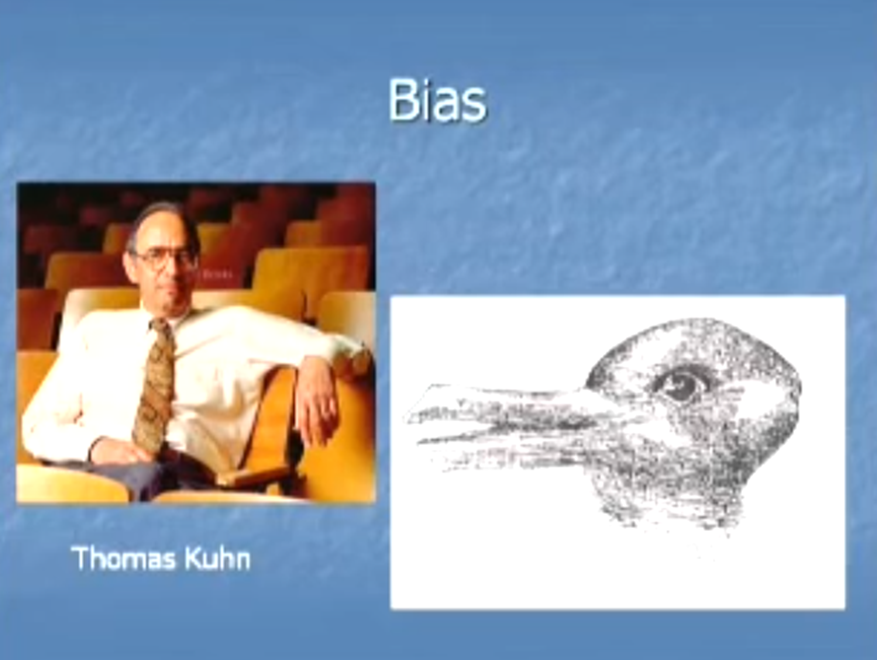 The late scientist and philosopher Thomas Kuhn, for example, taught that scientific communities share a “constellation of beliefs” known as paradigms.
These paradigms—which denote a group’s bias and ideology—include
- a shared set of standards,
- rules, and
- underlying assumptions,
- that unify a scientific community around a “group-licensed way of seeing.”
As another researcher explains, these underlying assumptions dictate
“what scholars view as established fact, what kind of new data they look for, the relative significance they assign to different data, …and the interpretive lenses they prefer.”
Dr. David Hacket Fischer, non-Mormon history professor at Brandeis University, notes,
“the Baconian fallacy consists in the idea that a historian can operate without the aid of preconceived questions, hypotheses, ideas, assumptions, or general presuppositions of any kind.”
“‘Every vision of history,’” writes non-LDS historian Steven Best, “‘functions as a specific lens or optic that a theorist employs to illuminate some facet of human reality. Each perspective is both enabling, allowing a strongly focused study, and limiting, preventing consideration of other perspectives.’”
Dan Vogel—a critic who has authored numerous publications questioning traditional interpretations of LDS history—claims that once an historian decides that traditional LDS accounts have “no historical basis, then Smith’s claims about the angel and gold plates cannot be taken at face value.”
Bias and Paradigms in Historical Interpretation
Elsewhere he acknowledged his “inclination [is] …to interpret any claim of the paranormal… as delusion or fraud.”
For him, there can be no communication from God; there can be no authentic scripture.
Because all revelatory experiences are dismissed from the start, all explanations for the claims of revelation must come from environmental and natural sources. Despite any evidence to the contrary.
In a public forum Vogel wrote that to take
“Joseph at his word, I would have to believe the [Book of Mormon] is historical…but I don’t. If the [Book of Mormon] is not historical, then what was [Joseph Smith] about?”
For those (like himself) who do not believe in an historical Book of Mormon or the existence of Nephites,
“then one is obliged to explain the plates and witnesses” with a theory “consistent with that conclusion” “no matter how difficult it seems.”
A decade ago, Richard Bushman astutely observed that
“believing historians are more inclined to be true to the basic sources than unbelieving ones” and that “secular historians are… more inclined than Mormons to suppress source material from Joseph’s closest associates.”
With the foregone conclusion that the Book of Mormon is not historical the question is not,
“Did Joseph actually translate an ancient text?” but rather,
“What factors influenced Joseph in writing his fictional Book of Mormon?”
These examples provide excellent illustrations of the way paradigms
- drive research,
- affect the way evidence is presented,
- determine which evidences are presented and
- which anomalies are ignored as well as
- the conclusions that are formulated.
In areas such as history, we are faced with competing paradigms that are influenced by the ideology of the historian.
Claims of Objectivity
Some critics claim or imply that unlike Mormon apologists (those who defend LDS beliefs) they (the critics) are free from bias. They simply let the facts speak for themselves.
Such critics claim to be “dedicated to pursuing the truth regardless of where it leads”. Whereas apologists supposedly know the “conclusions at the start” and sift “the facts and evidence to find support.”
Such a claim is absurd, however. In light of the fact that no mortal is able to completely divest oneself of bias.
Inoculation Against Shaken Faith
While adding cognitions may salvage damaged testimonies, a change in paradigms before encountering challenging issues often serves as an inoculation against shaken faith syndrome.
When you think about inoculation, it protects people against diseases. But there’s always a few people that it can hurt. And we run into that problem even with trying to inoculate members against some of these anti-Mormon claims.
Dan Peterson, writing in a public forum, offered this example. It’s based on a lecture he attended by the late Stanley Kimball regarding the complexity of LDS history. 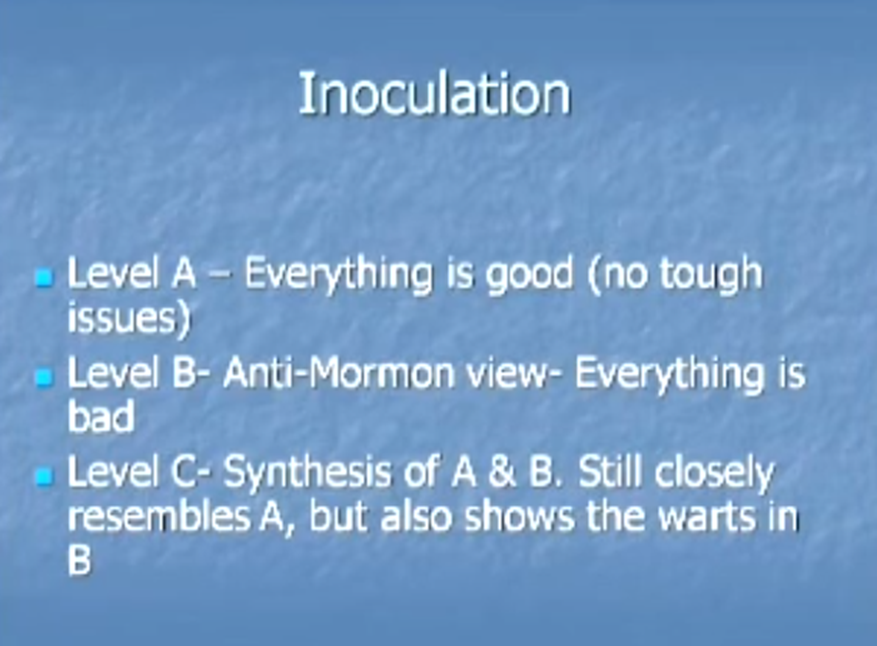
He [Stanley Kimball] spoke of three levels of Mormon history.
Level A, he said, is the Sunday School version. Everything on Level A is obviously good and true and harmonious.
Level B, however, is the anti-Mormon version of the same story. On this level, everything that you thought was good and true and harmonious actually turns out to be evil and false and chaotic.
Well, there is a level C that is a synthesis of the two.
It’s both. It’s pretty much like A, but it exposes people to B.
He noted that the Church typically seeks to keep its members on Level A. Or, at least, feels no institutional obligation to bring them to a deeper level. Why? Because souls are sometimes lost on Level B.
Moving to a Mature Understanding (Level C)
The problem is that for somebody to move to C, they have to be exposed to B.
And for some people, that can cause testimony damage.
So it’s a challenging issue. How to teach people about the rest of the nuances out there without hurting a testimony.
Once members of the Church have been exposed to Level B, though, he said, their only hope is to press on to the richer, more complicated version of history that is to be found on Level C. Which, he contended and I agree, turns out to be essentially, and profoundly, like Level A.
- The only cure for bad historiography is better historiography.
- The only remedy for bad anti-Mormon arguments is better counterarguments.
- Not everybody needs Level C.
But some do. Whether because they are troubled by Level B or because they find Level A insufficiently nourishing in some way.
Many good Saints will live their entire lives on Level A, and they will be saved.
Interestingly, people that move to C usually keep their testimonies intact. And have a richer understanding of their beliefs, as well.
To reach Level C we must:
- be willing to become more mature in our beliefs, attitudes, and perspectives;
- we must be willing to let go of idealistic fantasies, myths, and folklore;
- we must be willing to add cognitions (or beliefs) to our worldviews; and
- we must be open-minded enough to synthesize competing cognitions.
The Role of Scholarship
Fortunately for those who are struggling with challenging questions, we have the benefit of living in a day when LDS and non-LDS scholars have made substantial contributions to our understanding of scriptural histories as well as LDS history.
We live in a day when additional insights can ameliorate concerns over challenging issues. This, in turn, can soften our hearts to the whisperings of the Spirit allowing us to receive a spiritual witness. 
Uninformed Members
The biggest problem with adding cognitions is that most members remain ignorant of LDS scholarship and apologetic responses. Many members have never heard of FARMS or FAIR.
Many of the older generation have heard of Hugh Nibley, but how many have actually read his works?
When some members encounter persuasive sounding anti-LDS information they accept it as accurate. Because they’re unaware of pro-LDS rebuttals, these new arguments win by default.
It may suddenly seem obvious that Joseph Smith was a charlatan and that his scriptures were fictional creations.
There are, however, cogent, scholarly, and logical responses to anti-Mormon accusations. And when struggling members do find additional evidences to support their beliefs, testimonies generally remain intact.
I hope that our efforts see an increase in recognition. And that more and more members will be made aware of:
- FAIR,
- FARMS,
- the scholarly evidence in favor of Joseph’s prophetic abilities, as well as
- the apologetic answers to challenging questions.
As Sir Francis Bacon said, ipsa scientia potestas est (knowledge is power).
May more members strengthen their testimonies by embracing the knowledge of LDS apologetics and scholarship.
Thank you.
Q&A
Question:
When encountering critics of the Church:
- how do you determine whether or not it is worth your while to defend the faith, and
- where do you draw the line?
Most critics, in my experience, are closed-minded to begin with.
Answer: And that’s really true. Years ago, I used to get more on the message boards and try to debate the critics. I found that pointless.
Basically, it’s a matter of determining: does this person really have questions, or are they just wanting to argue? And if there’s really questions, then I’m willing to engage in a discussion.
If they just are trying to score points, then it’s not worth my time. I have more important things to do.
Question:
Thus far education on how to respond to anti-Mormon literature is not a part of the CES system or missionary training. With increased use of the internet, how do you expect this to change?
Answer: Richard Bushman gave a seminar on apologetics to several people from the CES system. Scott Gordon was there, and I think some other FAIR members shared some ideas. I think there’s some effort from the Church to teach the members about some of these more difficult issues.
Question:
When will your talk be available?
Answer: It’s available in book form in the back of the conference right now.
Question:
When should we begin to inoculate a member? When and under what circumstances?
Answer: That’s a tough one. I think that, you know, the saying is that sunshine is the best disinfectant.
The problem is that some people like to throw out these interesting things for shock value—even members do.
I’ve seen that sometimes in elders quorum or Sunday School. It’s like, “Hey, do you know that Joseph Smith had so many wives,” etc.
And they do it just to, you know, make themselves look good or as a shock value.
We need to be sensitive that we cannot be participants in damaging anybody’s testimony.
If we present anything controversial, we really should try to expose those things in a faithful context.
And so, it’s rewarding and enriching rather than damaging.
Question:
So what is the true color of the ball?
Answer: Purple, I guess.
Question:
When the prophet speaks, the debate is done?
Answer: That’s from an old era thing—“When the president speaks, the thinking has been done.”
It’s been repudiated by… I can’t even remember now, my mind’s gone blank. But there’s a Dialogue article about it. That’s not the position of the Church.
There’s several quotes in my book that talk about this. The Brethren expect us to think for ourselves, and the Lord expects us to think for ourself.
You think of Lehi’s vision. Okay, he had his vision, and then his sons asked what happened.
But what did Nephi do? He didn’t just ask about the vision.
What did he do? He went to the Lord himself and said, “Help me understand this.”
Okay, that should be our example. We get stuff from General Conference and from the Brethren. Then we’re supposed to go to the Lord and receive our own confirmation and understand ourselves.
Thank you.