• Skip to primary navigation
  • Skip to main content
  • Skip to primary sidebar
  • Skip to footer

FAIR

My Account Search
  • Start Here
  • Find Answers
  • Scripture Study
  • Blog
  • Events
    • FAIR Conference
    • Virtual Conferences
    • Special Events
  • All Presentations
  • FAIR Books
  • About
    • Media & Apps
  • Get Involved

Book of Mormon

Tangible Restoration: The Witnesses and What They Experienced – Daniel C. Peterson (2006)

Start Here

Question

Were the Book of Mormon witnesses describing physical experiences with the gold plates?

Short Answer

Daniel C. Peterson argues that the historical accounts of the Book of Mormon witnesses describe experiences with strongly tangible elements. The Three Witnesses described seeing the plates in a miraculous setting, while the Eight Witnesses reported physically seeing, handling, turning, and “hefting” the plates.

Key Takeaways
  • The Three Witnesses described seeing the plates in the presence of an angel.

  • Their experience included miraculous light and the voice of God.

  • The Eight Witnesses described a separate, much more ordinary encounter.

  • They said they handled and “hefted” the plates themselves.

  • Peterson argues that the contrasting character of the two experiences strengthens their combined testimony.

Summary

Summary

Daniel C. Peterson examines the testimonies of the Three and Eight Witnesses to the Book of Mormon, emphasizing the strikingly tangible nature of their accounts. Their differing experiences—one miraculous, the other deliberately ordinary and physical—provide complementary testimony concerning the gold plates.

TL;DR

TL;DR (Too Long; Didn’t Read)

Daniel C. Peterson argues that the Book of Mormon witnesses described experiences that were not merely inward or mystical. The Three Witnesses reported a miraculous encounter involving an angel and divine testimony, while the Eight described seeing, handling, and “hefting” the plates in an ordinary physical setting.

Tangible Restoration: The Witnesses and What They Experienced By Daniel C. Peterson

2006 FAIR Conference

Joseph Smith’s claims regarding the Book of Mormon seem, at least on the surface, to be very detailed and utterly tangible. They are not mystical claims, but, at least in principle, can be tested in the real world of everyday, physical objects.

And critics have not been reluctant to meet the claim head on. “As for the golden plates,” wrote the evangelical Protestant polemicist G.H. Fraser, “we will say simply that there were not any.”

But the historical evidence suggests—no, it shouts—the contrary.

A representative statement is that given by David Whitmer during an 1878 interview with Orson Pratt and Joseph F. Smith:

It was in June, 1829, the latter part of the month . . . Martin Harris was not with us at this time; he obtained a view of [the plates] afterwards (the same day). Joseph, Oliver, and myself were together when I saw them. We not only saw the plates of the Book of Mormon, but also the brass plates [a set of records mentioned early in the Book of Mormon has having been carried by Lehi from Jerusalem to the New World], the plates of the book of Ether, the plates containing the record of the wickedness and secret combinations of the people of the world down to the time of their being engraved, and many other plates. The fact is, it was just as though Joseph, Oliver and I were sitting just here on a log, when we were overshadowed by a light. It was not like the light of the sun nor like that of a fire, but more glorious and beautiful. It extended away round us, I cannot tell how far, but in the midst of this light about as far off as he sits (pointing to John C. Whitmer, sitting a few feet from him), there appeared, as it were, a table with many records or plates upon it, besides the plates of the Book of Mormon, also the sword of Laban, the directors [i.e. the ball with spindles which Lehi had, and the interpreters].

Lucy Mack Smith, who had seen the chosen witnesses leave for their encounter with the angel and the plates, recalled, many years later, the scene that ensued at their return:

When they returned to the house, it was between three and four o’clock P. M. Mrs. Whitmer, Mr. Smith, and myself, were sitting in a bedroom at the time. On coming in, Joseph threw himself down beside me, and exclaimed, “Father, mother, you do not know how happy I am: the Lord has now caused the plates to be shown to three more besides myself. They have seen an angel, who has testified to them, and they will have to bear witness to the truth of what I have said, for now they now for themselves, that I do not go about to deceive the people, and I feel as if I was relieved of a burden which was almost too heavy for me to bear, and it rejoices my soul, that I am not any longer to be entirely alone in the world.” Upon this, Martin Harris came in: he seemed almost overcome with joy, and testified boldly to what he had both seen and heard. And so did David and Oliver, adding, that no tongue could express the joy of their hearts, and the greatness of the things which they had both seen and heard.

Ultimately, each of the Three Witnesses—Martin Harris, Oliver Cowdery, and David Whitmer—signed his name to a statement that has appeared in every edition of the Book of Mormon from the beginning.

Be it known unto all nations, kindreds, tongues, and people, unto whom this work shall come: That we, through the grace of God the Father, and our Lord Jesus Christ, have seen the plates which contain this record, which is a record of the people of Nephi, and also of the Lamanites, their brethren, and also of the people of Jared, who came from the tower of which hath been spoken. And we also know that they have been translated by the gift and power of God, for his voice hath declared it unto us; wherefore we know of a surety that the work is true. And we also testify that we have seen the engravings which are upon the plates; and they have been shown unto us by the power of God, and not of man. And we declare with words of soberness, than an angel of God came down from heaven, and he brought and laid before our eyes, that we beheld and saw the plates, and the engravings thereon; and we know that it is by the grace of God the Father, and our Lord Jesus Christ, that we beheld and bear record that these things are true. And it is marvelous in our eyes. Nevertheless, the voice of the Lord commanded us that we should bear record of it; wherefore, to be obedient unto the commandments of God, we bear testimony of these things. And we know that if we are faithful in Christ, we shall rid our garments of the blood of all men, and be found spotless before the judgment-seat of Christ, and shall dwell with him eternally in the heavens. And the honor be to the Father, and to the Son, and to the Holy Ghost, which is one God. Amen.

According to David Whitmer, the quite distinct experience of the Eight Witnesses to the Book of Mormon occurred one or two days after the experience of the Three.

Soon thereafter, all of the Eight signed their names to a statement that has accompanied the testimony of the Three in every printed version of the Book of Mormon.

Be it known unto all nations, kindreds, tongues, and people, unto whom this work shall come; That Joseph Smith, Jun., the translator of this work, has shown unto us the plates of which hath been spoken, which have the appearance of gold; and as many of the leaves as the said Smith has translated we did handle with our hands; and we also saw the engravings thereon, all of which has the appearance of ancient work, and of curious workmanship. And this we bear record with words of soberness, that the said Smith has shown unto us, for we have seen and hefted, and know of a surety that the said Smith has got the plates of which we have spoken. And we give our names unto the world, to witness unto the world that which we have seen. And we lie not, God bearing witness of it.

It is worth examining the contrasting character of the experiences reported by the Three Witnesses and the Eight, since, I believe, their very difference reinforces them. First of all, the experience of the Three, as they report it, was suffused with the glory and power of God. In a brilliant light, an angel came down and showed them the plates. They heard the voice of God testifying that the translation had been accomplished “by the gift and power of God.” Their written testimony is characterized by a marked religious or spiritual tone. It might be termed a supernatural or miraculous testimony.

By contrast, the experience of the Eight involves no glory, nothing miraculous. It is as mundane as anything can be. No angel shows the plates to them; Joseph Smith does. There is no miraculous light. Unlike the Three, who seem simply to have observed the plates in the hands of the angel, the Eight handled the plates and turned their pages. They “hefted” them. The language of their official account is cool and even formal or legalistic to the point of emotional distance (“the said Smith”). God figures in their testimony only as witness to their concluding oath. His voice does not testify to the correctness of the translation.

The Eight Witnesses are manifestly in full possession of their senses and mental faculties. Theirs might be labeled an ordinary or natural testimony.

Why the differences? In order, I think, for the task of skeptics to be rendered more difficult. One might be tempted to dismiss the testimony of the Three, with its spectacular divine accompaniments, as hallucinatory (however untenable that dismissal would be) or mere superstition. By contrast, there is absolutely nothing in the testimony of the Eight that points to superstition or hallucination. It is the most matter-of-fact kind of experience—nine men in the woods in the early afternoon—except for the object at the center of it.

On the other hand, if one were to approach the Witnesses first by way of the Eight and one were inclined to skepticism, one might be tempted to write their experience off as deception by Joseph Smith or by some other conspirator or group of conspirators. There must really have been plates—fabricated to deceive. But this doesn’t account for the testimony of the Three, which goes beyond fabrication and involves a number of additional objects. In other words, a single explanation seems unable to account for the two very different kinds of experience.

This means that skeptics who wish to explain the two testimonies away must resort to some unlikely combination of sincere hallucination, already unlikely in and of itself, and deliberate, insincere fabrication. Or, as we shall see, they must attempt to collapse the difference between the two.

Let us examine a case that critics often cite as a parallel to Joseph Smith and his Witnesses:

Forgery is the virtually certain explanation for the two sets of inscribed metal plates that James Jesse Strang said he had found in Wisconsin and Michigan (between 1845 and 1849) and translated. Strang, who claimed to have a letter of appointment from Joseph Smith, announced himself as Joseph Smith’s successor and was clearly seeking to imitate the Prophet. That his plates really existed is beyond serious dispute. The first set, the three “Voree” or “Rajah Manchou” plates, were dug up by four “witnesses” whom Strang had brought to the appropriate site. Inscribed on both sides with illustrations and “writing,” the Rajah Manchou plates were roughly 1.5 by 2.75 inches in size—small enough to fit in the palm of a hand or to carry in a pocket. Among the many who saw them was Stephen Post, who reported that they were brass and, indeed, that they resembled the French brass used in familiar kitchen kettles.

“With all the faith & confidence that I could exercise,” he wrote, “all that I could realize was that Strang made the plates himself, or at least that it was possible that he made them.”

One not altogether reliable source reports that most of the four witnesses to the Rajah Manchou plates ultimately repudiated their testimonies.

The eighteen “Plates of Laban,” likewise of brass and each about 7 3/8 by 9 inches, were first mentioned in 1849 and, in 1851, were seen by seven witnesses. Their testimony appeared at the front of The Book of the Law of the Lord, which Strang said he translated from the “Plates of Laban.” (Work on the translation seems to have begun at least as early as April 1849. An 84-page version appeared in 1851; by 1856, it had reached 350 pages.)

The statement of Strang’s witnesses speaks of seeing the plates, but mentions nothing of any miraculous character. Nor did Strang supply any second set of corroborating testimony comparable to that of the Three Witnesses to the Book of Mormon. One of the witnesses to the “Plates of Laban,” Samuel P. Bacon, eventually denied the inspiration of Strang’s movement and denounced it as mere “human invention.” Another, Samuel Graham, later claimed that he had assisted Strang in the fabrication of the “Plates of Laban.” The well-read Strang had

been an editor and lawyer before his brief affiliation with the Church of Jesus Christ of Latter-day Saints and his subsequent career as a schismatic leader.1 Thus, Strang’s plates were much less numerous than those associated with Joseph Smith, his witnesses saw nothing supernatural, his translation required the better part of a decade rather than a little more than two months, and, unlike the Witnesses to the Book of Mormon, Strang’s witnesses did not remain faithful to their testimonies. Milo Quaife, in his early, standard biography of Strang, reflected that

“It is quite conceivable that Strang’s angelic visitations may have had only a subjective existence in the brain of the man who reported them. But the metallic plates possessed a very material objective reality.” If we are unwilling to accept The Book of the Law of the Lord as authentically divine, he says, “we can hardly escape the conclusion . . . that Strang knowingly fabricated and ‘planted’ them for the purpose of duping his credulous followers” and, accordingly, that “Strang’s prophetic career was a false and impudent imposture.”2

Roger Van Noord, Strang’s most recent biographer, concludes that,

“Based on the evidence, it is probable that Strang—or someone under his direction—manufactured the letter of appointment and the brass plates to support his claim to be a prophet and to sell land at Voree. If this scenario is correct, Strang’s advocacy of himself as a prophet was more than suspect, but no psychological delusion.”3

1 See Roger Van Noord, King of Beaver Island: The Life and Assassination of James Jesse Strang (Urbana: University of Illinois Press, 1988), 33-35, 97, 102, 163, 219; Doyle C. Fitzpatrick, The King Strang Story: A Vindication of James J. Strang, the Beaver Island Mormon [sic] King (Lansing, MI: National Heritage, 1970), 34-38; Milo M. Quaife, The Kingdom of Saint James: A Narrative of the Mormons [sic] (New Haven: Yale University Press, 1930), 2-8, 16-19, 92-93, 185-189.

2 Quaife, The Kingdom of Saint James, 17-18.

3 Van Noord, King of Beaver Island, 274.

It seems that virtually every reputable writer on the subject now grants the sincerity and honesty of all or most of the Book of Mormon Witnesses. A few critics argue that the printed testimonies don’t really represent what the Witnesses said. “I want Non-LDS to know,” wrote one recent poster on an internet message board,

that regardless of the three witnesses of the Book of Mormon and the eight witnesses of the Book of Mormon—not a single witness ever touched the plates with their own hands and never saw the plates with their own eyes. When Martin Harris and Oliver Cowdrey supposedly had visions of the Book of Mormon for their testimony – only Joseph Smith wrote their testimony down in the Book of Mormon.

But the testimonies of have been published with the Book of Mormon ever since that first edition in 1830, which, since it was prepared under the careful supervision of Oliver Cowdery (one of the Three) and Hyrum Smith (one of the Eight), seems to imply their endorsement of those statements. Consistent with this, a correspondent for the Salem [Massachusetts] Advertiser and Argus reported in 1843 having heard Hyrum “declare, in this city in public, that what is recorded about the plates, &c. &c. is God’s solemn truth.”4 Moreover, there are far too many recorded testimonies from the other Witnesses for

this to be a plausible escape. For example, E. C. Brand visited John Whitmer, one of the Eight, in 1875, and recorded that Whitmer “declared that his testimony, as found in the ‘Testimony of Eight Witnesses,” in the Book of Mormon, is strictly true.”5 In 1876, Whitmer told Mark Forscutt, “I have never heard that any one of the three, or eight witnesses ever denied the testimony that they have borne to the Book as published in the first edition of the Book of Mormon.”6 And, later that same year, referring to the published testimony, he told Heman C. Smith, “That testimony was, is, and will be true, henceforth and forever.” 7 And, finally, in 1877, the year prior to his death, he wrote “concerning my testimony as recorded in the Book of Mormon” that “It is the Same as it was from the beginning, and it is true.” 8

Today’s attack on the Witnesses focuses, instead, on the alleged non-literalness of their experience. Dan Vogel is the principal source for this newly popular way of dismissing their testimony. For example, in his 2002 essay on “The Validity of the Witnesses’ Testimonies,” he attempts to discredit the witnesses by portraying them as alienated from empirical reality and as having merely imagined the plates of the Book of Mormon, or seen them in a subjective hallucination.

I’ve commented elsewhere on how bizarre it is to me that the witnesses, a group of early nineteenth-century farmers who spent their lives rising at sunrise, pulling up stumps, clearing rocks, plowing fields, sowing seeds, carefully nurturing crops, raising livestock, milking cows, digging wells, building cabins, raising barns, harvesting their own food, bartering (in an often cashless economy) for what they could not produce themselves, wearing clothes made from plant fibers and skins, anxiously watching the seasons, and walking or riding animals out under the weather until they retired to their beds shortly after sunset in “a world lit only by fire,” are being portrayed as estranged from everyday empirical reality by people whose lives, like mine, consist to a large extent of staring at computer and television screens in artificially air-conditioned and artificially lit homes and offices, clothed in synthetic fibers, commuting between the two in enclosed and air-conditioned mechanical vehicles while they listen to the radio, chat on their cell phones, and fiddle with their iPods—all of whose inner workings are largely mysterious to them—who buy their prepackaged food (with little or no regard for the time or the season) by means of plastic cards and electronic financial transfers from artificially illuminated and air-conditioned supermarkets enmeshed in international distribution networks of which they know virtually nothing, the rhythms of whose daily lives are largely unaffected by the rising and setting of the sun.

Yet Dan Vogel’s view of the Witnesses has recently been given wider currency in an article published by the non-Mormon biblical scholar Lester Grabbe, who commendably seeks to show that Joseph Smith’s story can illuminate ancient Hebrew prophecy. Unfortunately, Professor Grabbe’s discussion is totally dependent upon Vogel and wholly uninformed by any exposure to the work of the leading authority on the Witnesses, Richard Lloyd Anderson. Grabbe readily grants the sincerity of Martin Harris and David Whitmer, but also declares that “it seems that no one saw the plates uncovered except Smith himself.”9 “Both Martin Harris and David Whitmer of the Three Witnesses,” he writes,

while continuing to affirm their belief in the Book of Mormon, also stated that they had seen the plates “in spirit” or with “spiritual eyes” or in vision. As far as they were concerned, this was no less real than seeing them with ordinary eyes, but to non-Mormons this distinction is likely to be important. 10

Professor Grabbe cites the Rev. John A. Clark’s recollection of an unnamed attorney’s alleged recollection of an alleged statement from Martin Harris:

A gentleman in Palmyra, bred to the law, a professor of religion, and of undoubted veracity told me that on one occasion, he appealed to Harris and asked him directly,–“Did you see those plates?” Harris replied, he did. “Did you see the plates, and the engraving on them with your bodily eyes?” Harris replied, “Yes, I saw them with my eyes,–they were shown unto me by the power of God and not of man.” “But did you see them with your natural,–your bodily eyes, just as you see this pencil-case in my hand? Now say no or yes to this.” Harris replied,–“Why I did not see them as I do that pencil- case, yet I saw them with the eye of faith; I saw them just as distinctly as I see any thing around me,–though at the time they were covered over with a cloth. 11

And yet, Professor Grabbe acknowledges,

The situation with the Eight Witnesses is more complex, and some continue to assert that these members of the Whitmer family and others saw and handled the plates in a purely physical context. Some of the testimony certainly gives this impression, but we have a few later interviews with most of the Eight Witnesses. There is some evidence that their experience was also “spiritual” or “visionary” or whatever one might wish to call it. 12

How did the Witnesses come to “see” the plates? Thomas Ford, the former governor of Illinois, “who,” Grabbe assures us, actually “knew many Mormons,” explains it all by means an account of the experience of the Eight Witnesses. “Unfortunately,” as Grabbe concedes “he does not give his sources and he has some of the names slightly wrong.” 13

He [Joseph Smith] set them to continual prayer, and other spiritual exercises, to acquire this lively faith by means of which the hidden things of God could be spiritually discerned; and, at last, when he could delay them no longer, he assembled them in a room [Lucy Mack Smith says it was a grove near their house], and produced a box, which he said contained the precious treasure. The lid was opened; the witnesses peeped into it, but making no discovery, for the box was empty, they said, “Brother Joseph, we do not see the plates.” The prophet answered them, “O ye of little faith! how long will God bear with this wicked and perverse generation? down on your knees, brethren, every one of you, and pray God for the forgiveness of your sins, and for a holy and living faith which cometh down from heaven.” The disciples dropped to their knees, and began to pray in the fervency of their spirit, supplicating God for more than two hours with fanatical earnestness, at the end of which time, looking again into the box, they were now persuaded that they saw the plates. I leave it to philosophers to determine whether the fumes of an enthusiastic and fanatical imagination are thus capable of blinding the mind and deceiving the senses by so absurd a delusion.14

An even more entertaining version of this theory appeared on an ex-Mormon message board just a few days ago:

I used to tease my kids………………..

I would take my coat or a towel or a blanket and gather it up in the crook of my arm. Then I would stick my face down into it and make a whimpering sound like a puppy. Then I would make a petting motion. My little kids would see what was going on and GUESS what? they wanted to see the puppy! Of course I refused to let them see the puppy because there was not one. Then I would walk into another room and the kids would follow demanding to see the puppy. I would run into another room, the kids would follow, but by then the puppy was gone! I would claim to have hidden the puppy.

The kids would go crazy trying to find the puppy. it was great fun, but as my kids got a little older they finally caught on. The trick no longer worked. When I tried it on their younger cousins my kids would scoff and give away the secret right off to any youngster who would listen!

Why was it a puppy? because A. I said so B. Because I could make the sound of a puppy, C. Kids like puppies. D. A puppy would fit under the cover.

I never claimed to have a rabid grizzly bear or adult crocodle under the wrap for the inverse of all the reasons stated above How convenient that THE Gold plates were “Gold” instead of wood or zinc or stone. How convenient that they were a certain size and that they dissappeared and that only Joe could read them! How convenient for the blood sucking scum that currently runs the Mormon corporation today that so many TBM adults are dumb as preschoolers about certian things . . .

Professor Grabbe cites a passage from Vogel that cites an account of an encounter between Theodore Turley and John Whitmer:

Whitmer asked, “do you hint at me?” [Turley replied], “if the caps fits you, wear it.” all I know, you have published to the world that an angel did present those plates to Joseph Smith.” [Whitmer replied] “I now say I handled those plates. there was fine engravings on both sides. I handled them.” and he described how they were hung, “and they were shown to me by a supernatural power.” he acknowledged all.15

Then he cites Vogel’s introduction to that account, which declares that “it seem [sic] to imply that while Whitmer’s handling of the plaes [sic] (perhaps in a box or through a covering) was physical, his seeing the plates was visionary.” 16

But I am a loss to understand how Whitmer’s alleged statement that the plates were “shown to [him] by a supernatural power” (which, incidentally, is difficult to reconcile with the numerous other accounts from John Whitmer), even if taken at face value, can be translated so easily into the idea that “his seeing of the plates was visionary.”

Grabbe also cites the notorious testimony of the disaffected nineteenth century Mormon Stephen Burnett, which makes an even bigger leap:

I have reflected long and deliberately upon the history of this church & weighed the evidence for & against it—loth to give it up—but when I came to hear Martin Harris state in a public [sic] that he never saw the plates with his natural eyes only in vision or imagination, neither Oliver [Cowdery] nor David [Whitmer] & also that the eight witnesses never saw them & hesitated to sign that instrument for that reason, but were persuaded to do it, the last pedestal gave way, in my view our foundations was sapped & the entire superstructure fell a heap of ruins.17

Professor Grabbe swallows Dan Vogel’s line without no reservation whatever. “In the end,” he says, “it appears that the only one who saw the plates directly was Joseph Smith himself. Even this situation could be doubted.”18

My wife fears that I have nothing original to say today, and she’s probably right.

Richard Lloyd Anderson, the foremost authority on this subject and the author of, among other things, the classic Investigating the Book of Mormon Witnesses, has addressed this topic in an important recent article in the FARMS Journal of Book of Mormon Studies entitled, straightforwardly enough, “Attempts to Redefine the Experience of the Eight Witnesses.” But, frankly, originality doesn’t much matter to me on this matter. I wish, at the least, to register a vigorous protest against what seems to me to have become unquestioned but baseless orthodoxy, in certain quarters, about the Witnesses.

They are often portrayed, now, by critics, as gullible fools, unable to distinguish reality from fantasy, easily duped. And Martin Harris is their parade example.

But this falsifies and misrepresents the facts.

True to his reputation as a careful, prudent man, Martin Harris initially approached the claims of Joseph Smith with hope but also with cautious skepticism. It was Harris who took a transcript of characters from the plates to New York City, for the evaluation of Professor Charles Anthon of Columbia University, and others. And, while he was serving as Joseph’s first scribe for the translation, he once surreptitiously substituted a similar-looking stone for the seerstone that the Prophet was using, in order to see if it made any difference. (It did.) At one point, he lifted the box in which the plates were allegedly concealed, to see what he could determine. “I knew from the heft,” he recalled, “that they were lead or gold, and I knew that Joseph had not credit enough to buy so much lead.” He cross-examined “Joseph, his wife, brothers, sisters, his father and mother. I talked with them separately, that I might get the truth of the matter.” One day, he arrived when Joseph was away from home. “I was glad he was absent,” Harris reminisced, “for that gave me an opportunity of talking with his wife and the family about the plates. I talked with them separately, to see if their stories agreed, and I found they did agree.”

Did Martin Harris think his experience as a Witness was real?

The twenty-five-year old Edward Moroni Thurman ran into Martin Harris at a blacksmith shop, and asked him whether the Book of Mormon was true. Harris responded by asking whether the young man could see an apple tree nearby. His vision of the angel, the plates, and the other objects, he told Thurman, had been as real and factual as the sight of the apple tree. When a group of teenagers posed the same question to him, he pointed to a chopping block and asked if they could see it. “Well, just as plain as you see that chopping block, I saw the plates; and sooner than I would deny it I would lay my head upon that chopping block and let you chop it off.”

To William Pilkington, he said,

Just as sure as You see the Sunshining. Just as sure am I that I stood in The presence of an Angel of God, with Joseph Smith and saw him hold the Gold Plates in his Hands. I also saw the Urim and Thummin [sic], The Breastplate and the Sword of Laban I saw the Angel descend from Heaven. The Heavens were then opened and I heard the voice of God declare, that every thing the Angel had told us was True, and that the Book of Mormon was Translated correct. I was commanded by God’s Voice to testify to the whole world what I had seen and heard.

Joseph Homer Snow recalled the time that Martin Harris came to have dinner with his family:

Mother asked him these questions: “Did you actually see an angel and hear him speak?”

He said, “Just as much so as I see you and hear you speak.” “Will you describe how he stood?” Mother asked.

He said, “He stood at least twenty inches off the ground, and he had records in his hand—The Book of Mormon. He turned the leaves and declared that it was the work of the Lord and that it was true. He commanded us to bear that testimony to the world.”

Stephen Burnett plainly misrepresented Martin Harris’s testimony about his own experience: Harris would never have gone along with Burnett’s “only in vision,” let alone with the notion that his experience was merely “imaginary.” So why should we trust Burnett’s account of Harris’s alleged account of the experience of the other Witnesses? After all, Harris’s supposed claim that the other Witnesses were reluctant to endorse their published testimony is, on the basis of evidence to which we’ve already alluded, extremely suspect.

In a notarized statement dated 29 October 1921, George Godfrey, who prepared Martin Harris’s grave in Clarkston, Utah, summarized his lengthy acquaintance with the Witness. Then he offered this interesting statement:

Prior to his death and in his last sickness I sat up nights with him upon many an occasion, in connection with my Brothers, John E. Godfrey and Thomas Godfrey, both of whom now reside at Clarkston, aforesaid, and who can make affidavit to the things I am herein stating: that many times I have heard the said Martin Harris bear witness to the truthfulness and genuineness of the Book of Mormon, at times when he was enjoying good health and spirits and when he was on his deathbed; that his testimony never varied; that I have seen others and that I myself have tried to entrap him relative to the testimony which he bore, by cros [sic] questioning him relative to the scenes and events which are Church History in connection with the bringing forth of the Book of Mormon; that upon all of these questions his mind was clear as it is possible for the human mind to be, and that his testimonies have left no tract [sic] in my mind that he actually converse with an angel who bore testimony to him of the truthfulness of the records contained in the Book of Mormon; that he saw and handled the gold plates from which the said records were taken; that a few hours before his death, and when he was so weak and enfeebled that he was unable to recognize me or anyone, and knew not to whom he was speaking, I asked him if he did not feel that there was an element, at least, of fraudulence and deception in the things that were written and told of the coming forth of the Book of Mormon, and he replied as he had always done, and many, many times in my hearing, and with the same spirit that he always manifested when enjoying health and vigor: “The Book of Mormon is no fake. I know what I know. I have seen what I have seen, and I have heard what I have heard. I have seen and handled the gold plates from which the Book of Mormon is written. An angel appeared to me and others and testified to the truthfulness of the record, and had I been willing to have perjured myself and sworn falsely to the testimony I now bear, I could have been a rich man, but I could not have testified other than I have done and am now doing, for these things are true.”

Martin Harris was buried with a copy of the Book of Mormon in his right hand, and a copy of the Doctrine and Covenants in his left. In a patriarchal blessing given to him by Joseph Smith, Sr., Harris was promised that thy testimony shall yet convince its thousands and its tens of thousands; yea it shall shine like the sun, and though the wicked seek to overthrow it, it shall be in vain, for the Lord God shall bear it off victorious.

In 1848, the year before he died, Oliver Cowdery received rebaptism into the Church of Jesus Christ of Latter-day Saints at Kanesville, Iowa. Before an audience of approximately two thousand, including non-members of the Church, Cowdery bore witness of the coming forth of the Book of Mormon, the restoration of the Aaronic and Melchizedek priesthoods, and the divine calling of Joseph Smith. “I beheld with my eye and handled with my hands the gold plates from which it was translated. I also beheld the Interpreters. That book is true.”

Cowdery was bedridden for most of 1849, probably as a result of chronic pulmonary tuberculosis, and died at Richmond, Missouri, on 3 March 1850. A few months before his death, Cowdery was visited by Jacob Gates, a Latter-day Saint traveling eastward on a mission to England who had been a friend since before Cowdery’s 1838 excommunication. In the course of conversation, Gates asked him about his experience as one of the Witnesses to the Book of Mormon. Had it been a dream? Was it imagination, or illusion, or mere mythology? Cowdery rose from the place where he was resting, retrieved a first edition copy of the Book of Mormon, and read aloud the Testimony of the Three Witnesses. Then, turning to face Gates, he said,

Jacob, I want you to remember what I say to you. I am a dying man, and what would it profit me to tell you a lie? I know . . . that this Book

of Mormon was translated by the gift and power of God. My eyes saw, my ears heard, and my understanding was touched, and I know that whereof I testified is true. It was no dream, no vain imagination of the mind—it was real.

David Whitmer lived until 1888, the last of the Witnesses to the Book of Mormon.

Consequently, he was the most interviewed of all of them.

“Each witness of the Book of Mormon,” Richard Lloyd Anderson justly observes, was an individualist. In David Whitmer, this quality verged on the stubborn. Whether in Mormon society or not, he stood like a rock for his principles. This outspoken and utterly honest personality would have been the first to detect fraud and expose it.

Whitmer was excommunicated from the Church on 13 April 1838 after a period of doctrinal disagreement, financial stress, persecution, and upheaval. Yet when, in 1886, the Omaha Herald asked him whether he “still believed that Joseph Smith was a divinely inspired prophet,” David Whitmer replied, “I know he was, it is not a matter of belief.”

The young James Henry Moyle, who had just received his law degree from the University of Michigan and was returning home to Utah, took a detour to Richmond, Missouri, for the sole purpose of interviewing David Whitmer. When he saw the Witness, he implored him to tell the truth. He told Whitmer of the sacrifices that his family had made for the gospel’s sake, driven from state to state and finally pulling a handcart all the way to the arid desert of the Great Basin.

I said to him: “I was born and reared in the Church and I do pray of you to let me know if there is any possibility of your having been deceived. I am just commencing life as you are preparing to lay it down, and I beg of you to tell me if there is anything connected with the testimony which you have borne to the world that could possibly have been deceptive or misunderstood.” I further said, in an earnest youthful appeal, that I didn’t want to go through life believing in a falsehood, that it was in his power to make known the truth to me. His answer was unequivocal. There was no question about its truthfulness. The angel had stood in a little clear place in the woods with nothing between them but a fallen log—the angel on one side and the witnesses on the other. It had all occurred in broad, clear daylight. He saw the plates and heard the angel with unmistakable clearness.

“He was the first witness I ever attempted to cross examine,” Moyle wrote many years later, “and I did so with all the intensity of my impelling desire to know the truth. The interview lasted two and one-half hours.” The young lawyer, who subsequently served as assistant secretary of the treasury in two federal administrations, came away utterly convinced of David Whitmer’s sincerity.

Throughout his life, Whitmer insisted that the experience was literal, and physical, not merely imaginary or “spiritual.” Joseph Smith III, for example, recalled an 1884 exchange between the Witness and a non-Mormon identified as Colonel Giles:

Rather suggestively he asked if it might not have been possible that he, Mr. Whitmer, had been mistaken and had simply been moved upon by some mental disturbance, or hallucination, which had deceived them into thinking he saw the Personage, the Angel, the plates, the Urim and Thummim, and the sword of Laban. How well and distinctly I remember the manner in which Elder Whitmer arose and drew himself up to his full height — a little over six feet — and said, in solemn and impressive tones: “No, sir! I was not under any hallucination, nor was I deceived! I saw with these eyes and I heard with these ears! I know whereof I speak!’”

In a letter to Anthony Metcalf dated 2 April 1887, Whitmer again insisted on the literal reality of what he had seen: “Of course we were in the spirit when we had the view, for no man can behold the face of an angel, except in a spiritual view, but we were in the body also, and everything was as natural to us, as it is at any time.” To Orson Pratt and Joseph F. Smith, nearly a decade earlier, he testified:

I saw [the plates, the Sword of Laban, the Urim and Thummim, and other artifacts] just as plain as I see this bed (striking his hand upon the bed beside him), and I heard the voice of the Lord, as distinctly as I ever heard anything in my life, declaring that the records of the plates of the Book of Mormon were translated by the gift and power of God.”

“I saw them as plain as I see you now,” he told a reporter from the Kansas City Journal in 1881. He frequently emphasized that the angel and the table on which the plates and other objects rested was very close to him and the other Witnesses, within about three to six feet. “Mr. Whitmer describes every detail of the ‘vision’ with great precision,” reported the Omaha Herald in 1886, “and much fervency.”

P. Wilhelm Poulson interviewed David Whitmer in 1878. When Poulson asked him if the Eight Witnesses did not “handle the plates,” Whitmer replied, “We did not, but they did.”19

The 26 January 1888 issue of the Richmond Conservator reported on the last days of David Whitmer in memorable detail:

On Sunday evening before his death he called the family and his attending physician, Dr. George W. Buchanan, to his bedside, and said “Doctor do you consider that I am in my right mind?” to which the Doctor replied, “Yes, you are in your right mind, I have just had a conversation with you.” He then addressed himself to all present and said: “I want to give my dying testimony. You must be faithful in Christ. I want to say to you all that the Bible and the record of the Nephites, (The Book of Mormon) are true, so you can say that you have heard me bear my testimony on my death bed. All be faithful in Christ and your reward will be according to your works. God bless you all. My trust is in Christ forever, worlds without end. Amen.

“I have been visited by thousands of people,” David Whitmer told James H. Hart in 1883, believers and unbelievers, men and ladies of all degrees, sometimes as many as 15 in one day, and have never failed in my testimony. And they will know some day that my testimony is true.

As Richard Anderson points out, ten of the forty-two surviving testimonies from the Eight Witnesses mention handling the plates. Lucy Mack Smith, who knew the Witnesses well and was there that day, says that they “looked upon the plates and handled them.”20 William Smith, son and brother to several of the Eight, said that all of them testified “that they not only Saw with their eyes but handled with their hands the said record.” 21

Perhaps already responding to suggestions that the experience of the Eight Witnesses was merely “spiritual” and visionary, Hyrum Smith insisted during an 1838 speech that it was entirely real. “He said that he had but two hands and two eyes,” Sally Parker remembered in a letter written in August of that year. “He said he had seen the plates with his eyes and handled them with his hands.” The year previously, Hyrum married Mary Fielding. Shortly thereafter, her brother, Joseph Fielding, wrote, “My sister bears testimony that her husband has seen and handled the plates.”22 And Hyrum himself wrote, in December 1839, of his sufferings in Missouri, where he had been arrested in the fall of 1838 and then imprisoned in the ironically named Liberty Jail from the beginning of December to the beginning of April:

I had been abused and thrust into a dungeon, and confined for months on account of my faith, and the “testimony of Jesus Christ.” However I thank God that I felt a determination to die rather than deny the things which my eyes had seen, which my hands had handled, and which I had borne testimony to, wherever my lot had been cast. And I can assure my beloved brethren that I was enabled to bear as strong a testimony, when nothing but death presented itself, as ever I did in my life.

Samuel Smith, Hyrum’s brother and another of the Eight Witnesses, bore his testimony in the presence of fifteen-year-old Daniel Tyler, who summarized it as simply “He knew his brother Joseph had the plates, for the prophet had shown them to him, and he had handled them and seen the engravings thereon.”23

In an 1836 editorial in the Church newspaper, John Whitmer bore strong testimony of his experience as one of the Witnesses:

I desire to testify to all that will come to the knowledge of this address, that I have most assuredly seen the plates from whence the Book of Mormon is translated, and that I have handled these plates, and know of a surety that Joseph Smith, Jr., has translated the Book of Mormon by the gift and power of God. . . Therefore, know ye, O ye inhabitants of the earth, wherever this address may come, that I have in this thing freed my garments of your blood, whether you believe or disbelieve.

But John Whitmer was excommunicated on 10 March 1838, one month before his brother David, and never returned to the Church.

For a brief period, it even appears that John’s spiritual confidence in the Book of Mormon had been shaken by his separation from his former associates and by his bitterness over economic and other issues raised by the Church’s sojourn in Missouri. He was sorrowful and dejected about his excommunication, but also, for at least a time, quite angry at the Church in general and Joseph Smith in particular. Of all the Witnesses, he comes the closest, in a sense, to denying his testimony. During the 1839 exchange with Theodore Turley that we’ve already mentioned, Whitmer confessed to doubts about whether the Book of Mormon was true. Speaking of the original text on the plates, he said, “I cannot read it, and I do not know whether it is true or not.” Nonetheless, he insisted, “I handled those plates; there were fine engravings on both sides. I handled them.”

This is highly impressive. Unlike the Three Witnesses, who heard a divine voice testify to the truth of the translation of the plates, the Eight Witnesses simply saw the plates under quite matter-of-fact conditions. Yet, even in the depths of his alienation and bitterness, even when he was most inclined to doubt what he could not see for himself, even living, as he did, in the area of the worst anti-Mormon persecutions, John Whitmer could not deny that he had “lifted and handled a metal object of substantial weight.”

Moreover, the bitterness, or at least the skepticism, was short-lived. After 1856, John Whitmer was the last survivor of the Eight Witnesses. In 1861, Jacob Gates spoke

with him for more than four hours. Gates then wrote of John Whitmer in his journal: “[H]e still testified that the Book of Mormon is true and that Joseph Smith was a Prophet of the Lord.”

Myron Bond reported in 1878 that old Father John Whitmer told me last winter, with tears in his eyes, that he knew as well as he knew he had an existence that Joseph translated the ancient writing which was upon the plates, which he “saw and handled,” and which, as one of the scribes, he helped to copy, as the words fell from Joseph’s lips, by supernatural or almighty power.

P. Wilhelm Poulson interviewed him that same year:

I said: I am aware that your name is affixed to the testimony in the Book of Mormon, that you saw the plates? He—It is so, and that testimony is true. I—Did you handle the plates with your hands? He—I did so! I—Then they were a material substance? He—Yes, as material as anything can be. I—They were heavy to lift? He—Yes, and you know gold is a heavy metal, they were very heavy. I—How big were the leaves? He—So far as I recollect, 8 by 6 or 7 inches. I— Were the leaves thick? He—Yes, just so thick, that characters could be engraven on both sides. I—How were the leaves joined together? He—In three rings, each one in the shape of a D with the straight line towards the centre I—Did you see them covered with a cloth?

He—No. He handed them uncovered into our hands, and we turned the leaves sufficient to satisfy us.24

Finally, six months before his death, John Whitmer spoke at a public Sunday service. His remarks were reported in the Kingston Sentinel, as follows:

Mr. Whitmer is considered a truthful, honest and law abiding citizen by this community, and consequently, his appointment drew out a large audience. Mr. Whitmer stated that he had often handled the identical golden plates which Mr. Smith received from the hand of the angel. He said it was of pure gold; part of the book was sealed up solid, the other part was open, and it was this part which was translated.”

Were there real plates? Yes, there were. If anything in early Mormon history is well established, surely the existence of the plates is. Let’s consider the testimonies of several unofficial witnesses.

The sixteen-year-old William Smith always remembered the night when his older brother, Joseph, outran pursues and brought the plates into the Smith home. William lifted the plates that night, and estimated their weight at about sixty pounds.25 Joseph Smith’s sister Katharine hefted the covered plates on several different occasions. She too recalled his arrival home with the plates and remembered that they were “wrapped . . . up in his frock”:

When he got to the door he said:

“Father, I have been followed; look and see if you can see any one.” He then threw himself on the bed and fainted, and when he came to he told us the circumstances; he had his thumb put out of place and his arm was very lame.

Her grandson, Herbert Salisbury, remembered Katharine relating that “When [Joseph] came in the house . . . he was completely out of breath. She took the plates from him and laid them on the table temporarily, and helped revive him until he got breathing properly, and also examined his hand, and treated it for the bruises on his knuckles.”

She said he entered the house running and threw himself on a couch, panting from his extraordinary exertion. She told me Joseph allowed her to “heft” the package but not to see the gold plates, as the angel had forbidden him to show them at that period. She said they were very heavy.

Martin Harris says that he and his family lifted the plates in a box when they were first looking into Joseph’s claims, and that he held the plates on his knee for a time while he and Joseph were preparing to hide them in the woods. He said that “he had hefted the plates repeatedly.” 26 Harris put their weight at between forty and fifty, or forty and sixty, pounds.27 Like his fellow Witness David Whitmer, Harris gave the dimensions of the plates as seven by eight inches.28

William could feel the shape of the plates through the cloth that covered them. “They were not quite as large as this Bible,” he said. “Could tell whether they were round or square. Could raise the leaves this way (raising a few leaves of the Bible before him). One could easily tell that they were not stone, hewn out to deceive, or even a block of wood. Being a mixture of gold and copper, they were much heavier than stone, and very much heavier than wood.” 29

28 Joseph Smith recalled them as being six by eight inches; Orson Pratt, who had spoken with all of the principal figures, agreed with Harris and Whitmer that they were seven by eight inches. See Henrichsen, JBMS, 18.

“I could tell,” said William Smith, “they were plates of some kind and that they were fastened together by rings running through the back.”30 The rings are a striking feature. We’ve already heard John Whitmer’s testimony that there were three of them, shaped like a capital D. Based on his interviews with two of the Three Witnesses and especially with Hyrum Smith, William McClellin also knew of connecting “rings in the shape of the letter D, which,” he says, “facilitated the opening and shutting of the book” (in the manner of modern three-ring binders).31 David Whitmer also described the three D- shaped rings. It’s difficult to imagine this degree of consensus regarding such an unusual detail if the plates were only imaginary or never uncovered. A brief article by Warren Aston, forthcoming in the FARMS Insights newsletter, will examine the significance of these rings and (this is still under discussion) may point out a striking ancient parallel to them.

Emma Smith, two months before her death, told her eldest son that

The plates often lay on the table without any attempt at concealment, wrapped in a small linen table cloth, which I had given him to fold them in. I once felt of the plates as they thus lay on the table, tracing their outline and shape. They seemed to be pliable like thick paper, and would rustle with a metallic sound when the edges were moved by the thumb, as one sometimes thumb the edges of a book. [I] moved them from place to place on the table as it was necessary on doing my housework.”

One striking and often unnoticed aspect of the experience of the Three Witnesses is the fact that they did not see only the golden plates. The vision was considerably more complex than that, making deception (via the fabrication of fake ancient artifacts) an even more remote possibility. According to repeated testimony, besides the plates of the Book of Mormon and the angel, both the sealed and the unsealed portion, they saw the Urim and Thummim and the accompanying breastplate, the “Ball” or “Director” (called the “Liahona” in the Book of Mormon), the Sword of Laban, the brass plates, and “many other plates.”

“The Urim and Thummim were two white stones,” David Whitmer told P. Wilhelm Poulson in 1878, “each of them cased in as spectacles are, in a kind of silver casing, but the bow between the stones was more heavy, and longer apart between the stones, than we usually find it in spectacles.”

Lucy Mack Smith “examined” the Urim and Thummim and “found that it consisted of two smooth three-cornered diamonds set in glass, and the glasses were set in silver bows, which were connected with each other in much the same way as old fashioned spectacles.”

Lucy Mack Smith on the breastplate

It was wrapped in a thin muslin handkerchief, so thin that I could see the glistening metal, and ascertain its proportions without any difficulty.

It was concave on one side and convex on the other, and extended from the neck downwards, as far as the centre of the stomach of a man of extraordinary size. It had four straps of the same material, for the purpose of fastening it to the breast, two of which ran back to go over the shoulders, and the other two were designed to fasten to the hips. They were just the width of two of my fingers, (for I measured them,) and they had holes in the ends of them, to be convenient in fastening.

David Whitmer, saw the receptacle in which the plates had lain in the Hill Cumorah. “It was a stone box,” he told P. Wilhelm Poulson in 1878, “and the stones looked to me as if they were cemented together. That was on the side of the hill, and a little down from the top.” According to a reporter for the Chicago Times, who interviewed Whitmer in August 1875, “Three times has he been at the hill Cumorah and seen the casket that contained the tablets, and the seer-stone. Eventually the casket had been washed down to the foot of the hill, but it was to be seen when he last visited the historic place.” Both the Chicago Tribune in December 1885 and the Chicago Times in January 1888 reported his testimony that he and Oliver Cowdery had been guided to the Hill Cumorah by Joseph Smith on one occasion, during which they had seen the receptacle together.

Accordingly, in order to save his unbelief, Vogel must invent elaborate metallurgical fraud as well as invoke complex collective hallucination. He suddenly suggests, without even a trace of supporting evidence, that Joseph Smith might perhaps, conceivably, have faked a set of tin plates in order to deceive his friends. This unevidenced and rather implausible pseudofact is, however, a topic for another occasion, when we will also need to consider how the poor farmboy Joseph Smith also managed, it seems, to create a forged sword of Laban, a bogus Liahona, a fake breastplate, and a stage-prop Urim and Thummim, and then somehow lost them without a trace.

“Secular historians are . . . more inclined than Mormons to suppress source material from Joseph’s closest associates,” remarks the distinguished Columbia University historian Richard L. Bushman. Since, he says, quoting extensively from the reminiscences of those closest to the events would tend to suffuse a modern narrative with their own faith, and would turn readers’ attention to Joseph’s transparently sincere desire to obey God, “believing historians are more inclined to be true to the basic sources than unbelieving ones.”32

Watch this lecture on our Youtube site at:

Pt. 1- http://www.youtube.com/watch?v=5acjjXygMJg

Pt. 2- http://www.youtube.com/watch?v=eO0nqle7NEo

Pt. 3- http://www.youtube.com/watch?v=9yQqc2CL4YE

Pt. 4- http://www.youtube.com/watch?v=_k6HwbyGcwE

Pt. 5- http://www.youtube.com/watch?v=G1YfhW_NTc8

32 Bushman, “The Recovery of the Book of Mormon,” 24, 26.
 

Search topics Book of Mormon witnesses; Three Witnesses; Eight Witnesses; gold plates; physical evidence for the Book of Mormon; David Whitmer testimony; Martin Harris testimony; Oliver Cowdery testimony; witnesses handling the gold plates; tangible evidence for the Restoration CES Letter Book of Mormon witnesses; criticism of the Book of Mormon witnesses; were the Book of Mormon witnesses reliable; did the witnesses really see the gold plates; Book of Mormon witness testimony; Joseph Smith gold plates criticism

Book of Mormon Evidence in Mesoamerica

Start Here

Question

Is there historical and cultural evidence for the Book of Mormon in Mesoamerica?

Short Answer

Brant Gardner argues that no single archaeological or cultural parallel proves the Book of Mormon. Instead, he identifies multiple geographic, chronological, cultural, political, and textual convergences that he believes collectively support reading the Book of Mormon as an ancient text situated in Mesoamerica.

Key Takeaways
  • Gardner distinguishes isolated parallels from multiple independent lines of converging evidence.

  • Proposed Mesoamerican geography must match not only locations but also chronology, populations, cultural patterns, and relationships between places.

  • Gardner identifies potential convergences involving warfare, political organization, kinship, social change, literacy, and material culture.

  • Ancient cultural context can sometimes help explain Book of Mormon narratives that seem strange from a modern perspective.

  • Gardner does not equate the Jaredites directly with the Olmec or the Nephites and Lamanites directly with the Maya.

Summary

Summary

Brant Gardner proposes convergence as a more rigorous way to evaluate evidence for Book of Mormon historicity than simply identifying parallels. Using his image of a Dalmatian hidden among apparently random spots—“seeing the dog”—he argues that no individual point of correspondence is sufficient, but multiple independent pieces of evidence can combine to reveal a coherent historical pattern.

Gardner surveys proposed convergences involving Book of Mormon geography, Mesoamerican chronology, population movements, political organization, kinship, warfare, material culture, and literary conventions. He also examines passages that can seem puzzling to modern readers—including Limhi’s expedition and the Anti-Nephi-Lehies—and argues that a Mesoamerican cultural context may help explain them. Gardner distinguishes this historical argument from spiritual confirmation, maintaining that prayer and revelation remain the means of knowing the Book of Mormon is true.

TL;DR

TL;DR (Too Long; Didn’t Read)

Brant Gardner argues that the strongest historical case for the Book of Mormon does not depend on one archaeological discovery or isolated parallel. Instead, geographic, chronological, cultural, political, and textual evidence can converge like individual dots forming a recognizable picture—what Gardner calls “seeing the dog.”

 From Quetzalcoatl to Mesoamerican Studies

When I was on my mission and even before that time, I was very fascinated with archaeology, particularly with Mesoamerica. I had read some of the LDS scholars who had correlated things in the Book of Mormon to things in history and particularly in Mesoamerica, and I believed it—so on my mission I’m telling everybody—and I had one advantage when I got back from my mission that I had not had before: I went to Spain, and when I was in Spain, oddly enough, I learned Spanish!

It just so happens that a very large number of the documents that come out of Mesoamerica are written by Spanish-speaking people, and knowing that I actually had the language to be able to read some of the documents in their original, I decided that it was my duty to read some of them.

So that when someone says to me, for instance, this particular question that I was really interested in, “When you tell me that the Book of Mormon talks about Jesus Christ coming to the Americas, and you say that that’s related to the Aztec Great White God,” I can say to them, “Yes, I know that’s true because I’ve read it.” I thought this was a good idea.

What the Documentary Evidence Showed

And so, I started reading the information, and I read every LDS author on the subject. I read every document I could find on the subject.

I eventually became addicted to the subject and probably spent way too long on it, although it did foster my love for the anthropology and ethnohistory of that area of the world, and it kind of took me in a completely different direction. But the end result of that particular study was that I found out that what we as LDS had written on that topic was simply wrong—we just got it wrong. 1

From the documentary evidence, there was no way that I could say that the legendary information from Quetzalcoatl had anything at all to do with the appearance of Jesus Christ in the Book of Mormon.

I published an article on that, and thereafter, became probably one of the darlings of the anti-Mormon community. In fact, I suspect that I am probably one of the most often quoted pro-Mormons that is favorably cited in anti-Mormon literature because I wrote this article.

It just so happens that if you look at the comments about the various things that I have written and talked about, it turns out that at that particular point in my life, I was probably very open minded, quite intellectual, very astute and very logical, because I looked at the evidence and found out it didn’t support something that was supposed to support the Book of Mormon.

Following the Evidence in Both Directions

Now, since that time, I’ve looked at the Book of Mormon and I’ve compared it to Mesoamerica, and I’ve found all kinds of reasons why I believe that the Book of Mormon took place in that area of the world. I have gone from darling to dunce.

All of a sudden, everything that I used to know that made me so good when I talked about Quetzalcoatl, all of the sudden seems to have flown out the window, and I really know absolutely nothing at all, what I’m talk about, and certainly my methodology must have changed dramatically—this is all a surprise to me because it hasn’t.

In part of the time that I spent learning about Mesoamerican topics, I have probably spent as much time complaining about the quality of the correlations that we as LDS have made to a particular area of the world as I’ve ever done doing anything else, but nobody is interested in hearing that.

My Role as a Curmudgeon

I had at one point in time decided that I was destined to be the curmudgeon in the LDS community and my sole function would be to try to keep other people on the right track by telling them when they had gone off.

I was reasonably certain from looking at all of the materials that had been published through probably the 1970s that the typical way that the LDS would approach Mesoamerica is to go through and say, “If this is a pretty ruin, it was Nephite. If it’s an ugly ruin it was Lamanite.” (Laughter)

You will find wonderful pictures, gorgeous photographs of Palenque, which was way too late and had absolutely nothing to do with the Book of Mormon. When you get to the places where the Book of Mormon probably took place, you will probably find out that they are really ugly. It turns out they’re really probably backwards—but the fact is that they are there.

Understanding Rather Than Simply Proving the Book of Mormon

Now what we’d like to do is spend some time talking about the New World, the kind of information that is out there, and why the information that is there is starting to tell us more about the Book of Mormon.

Now I do have to kind of give you one other little piece of background, this is a very strange kind of thing for me because I have been forced into this position: My interest in the Book of Mormon is to explain it—I love the Book of Mormon and I want to learn more about it, I want to learn what it is telling me, I want to learn what the people think, I want to learn how they act, I want to learn why they did the things that they did. I really want to comprehend them.

I already believe, I really don’t need to prove it to myself—been there done that, had the inspiration that tells me, even when I didn’t have some of the rest of the information that I’ve got, that this is a true book. But that isn’t what people want to hear.

Mormons want to hear proof of the Book of Mormon. So anytime I’ve ever said anything about it, the basic question has been, “How can you prove the Book of Mormon, how can you show me that it is true?” We’re going to try to talk a little about that.

Moving Beyond Simple Parallels

Now there is a paper being passed around; most of what I’d like to do today is talk about bits and pieces that are on there, but I want to tell you why you’ve got the whole list.

You have the whole list because it’s absolutely impossible for me in a 40-minute presentation to talk about everything that is on there, but everything that’s on there makes a difference, and here is the reason that it makes a difference:

What we are looking at when we’re trying to find a way to explain the Book of Mormon, is we are trying to find a methodological process that is going to help us to understand when we have actually found something that makes sense, as opposed to the time when we are simply making wishful guesses, and we have made a lot of wishful guesses in the past. We need to know the difference between the two of them.

A Parallel Doesn’t Equal a Connection

One of the problems we’ve had in the way we present information is it will create something that’s called a parallel. We’ll say, “Okay, there is a piece of information in the Old World, there is a piece of information in the New World, those two things are parallel, therefore there must be some connection.” That isn’t enough.

One of the wonderful parallels that I remembered was that in the Old World they had adobe bricks, and in the New World, they had adobe bricks. Well okay, that’s true.

Sun-dried mud is probably something that can come about by independent invention. I really don’t see a lot of reason why someone has to import the idea of making something out of sun-dried mud. It’s going to happen, people are going to understand that, people are going to find it. The fact that those two things are parallel is virtually meaningless.

When a Parallel Looks Better Than It Really Is

The other problem with parallels is that when you create a parallel, very frequently you will make the thing that you are talking about appear to be more parallel than it really is simply by the way that you state it.

Going through some of the material on Quetzalcoatl and knowing the legends behind it, I would look at people putting the parallels down, and I’d look at them and say, “Well yes, if you just read that, that is really comparable, but if you actually talk about what the information is that lies behind the way they said it, it doesn’t say that. And the parallel really is not there.”

So parallels are really not going to help us, but there is something that does, and the problem is we need a vocabulary to do it and what I’m to do is borrow a vocabulary term that William Dever, a biblical archaeologist in Old World Israel, that he came up with to try to solve the same kind of riddle, to be able to say that there is something that helps us create a point of evidence that is better than a parallel even though it seems to be similar.

Convergence

He calls it a convergence so rather than a parallel, we are going to talk about a convergence. 2

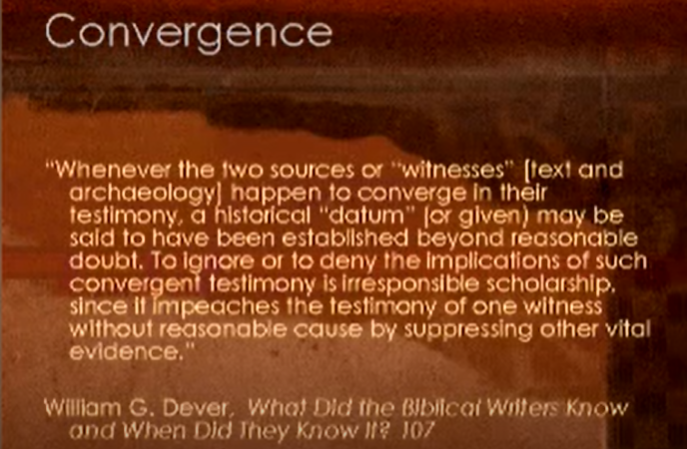
His comment, “Whenever the two sources or ‘witnesses’ [text and archaeology] happen to converge in their testimony, a historical ‘datum’ (or given) may be said to have been established beyond reasonable doubt. To ignore or to deny the implications of such convergent testimony is irresponsible scholarship, since it impeaches the testimony of one witness without reasonable cause by suppressing other vital evidence.” (William G. Dever, What Did the Biblical Writers Know and When Did They Know it? 107)

What he is talking about in that case is the text of the Bible and the dirt archaeology to which it is being compared. The difference is, when he is creating a convergence rather than a parallel, he is taking a large quantity of material and he is saying, “Here are things that come together in a similar description.”

And we have to have location, we have to have time, we have to have the content of the information and in essence what he is saying is the more pieces of information that interrelate with each other and all depend upon the same location, same place, same time, same people, same concept; the more of those you get, the more you are converging the two types of testimonies of information, and the more chance then you have that one of these datums is now going to be something you can establish.

Seeing the Dog: How Convergence Works

So that is what I want to talk about: a convergence. To give you an idea of how a convergence works, here is my favorite example.

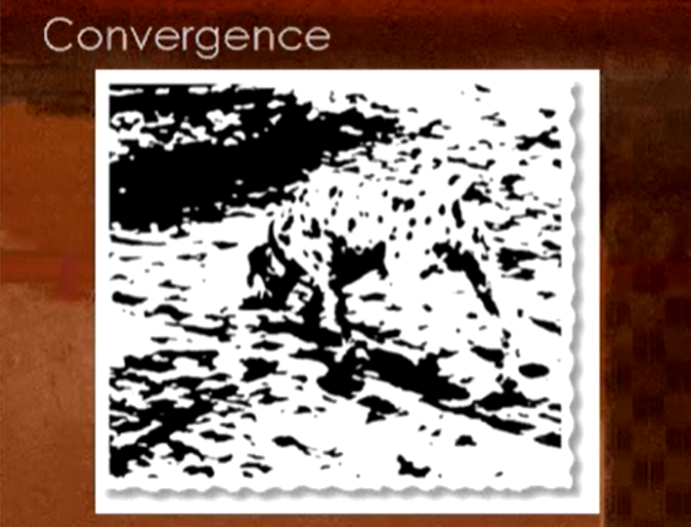
First impression, you look at this, and what you really should see is just a bunch of dots. Okay. Your first impression should be a bunch of dots. Now, after that you should see something. What are you seeing? You’re seeing a dog. I can actually see a few hands out here, so how many people don’t see a dog? That happens every once in a while because there are so many dots on there that you don’t see it.

That’s an important piece of information to remember because even though there is a whole bunch of us that see a dog there, it isn’t as absolutely clear as it might be if it were cleanly defined lines. Nevertheless, the location, the placement of the spots, all of the information, there is a dog standing over there. So for those of you who aren’t seeing it—that’s the head of the dog. You’re looking at a Dalmatian that’s drinking something from the ground. Foreleg, left hind leg, right hind leg, body—there’s even kind of a tail hooked around here.

When the Mind Creates Patterns

We, as human beings, have minds that are capable of creating cohesive patterns out of incoherent information. How many of you have stared at a tree, a cloud, a carpet and seen a face in it? Is the face there? Absolutely not. The reason that we see it is because we have a mind that creates things and it tends to create faces because we are so chemically wired to see the face. It is so important for us that we tend to create faces.

The difference is, if you blink two or three times, sometimes you look back and you can’t find it. Once you’ve seen the dog, you cannot “unsee the dog.” It actually is there. It may be difficult; we may not have all the data that we need to be able to clearly define it. But once you see the dog, that dog is there and you cannot “unsee the dog.”

That is the kind of evidence that we’re going to be talking about. We will not have a complete picture. We will not have a jigsaw puzzle where every single piece of the puzzle is there and there will not be any gaps, but what we will have is a sufficient picture that we can “see the dog.”

And I will tell you that having been through the Book of Mormon in detail over the last several years that it is now impossible for me to “unsee the dog.” This is a text that took place with real people in a real time and there is no way I can see it any other way, because I have “seen the dog” and I understand that it’s there.

Why One Piece of Evidence Is Not Enough

Now here is the next problem we have with seeing the dog, we will start talking about the evidence for the dog and someone will say,

“That spot. There is no reason why that spot is unique to this dog. I’ve seen things that have had a spot like that that weren’t a dog.”

Well, yes.

Which is why when you look at all this kind of evidence, you can’t take one piece and say, well this one thing is going to prove it. It isn’t a single thing. In any good historical argument, you are not going to find the one single thing where you say, okay here is the smoking gun; this is the one thing that does it.

We only have one way of coming up with a single action that we could take that will prove the Book of Mormon and that is prayer and revelation. You pray and get revelation. That is the only single thing that will demonstrate it.

If you are looking at an historical argument, you need to have an argument that has a lot of pieces together, not worrying about the single thing. Now, we do have to make sure that that really is a dot and not something that we’re not looking at. It really does have to be real information. So that’s where we are: trying to move on from that.

Surveying the New World Evidence for Book of Mormon Historicity

So here is the kind of thing that we would like to take a look at, I’m going to run through a lot of this stuff pretty quick. Some of the stuff I’m not even going to mention hardly at all and then I’ll try to end up with some of the things that I kind of find most fascinating about “seeing the dog” in the Book of Mormon.

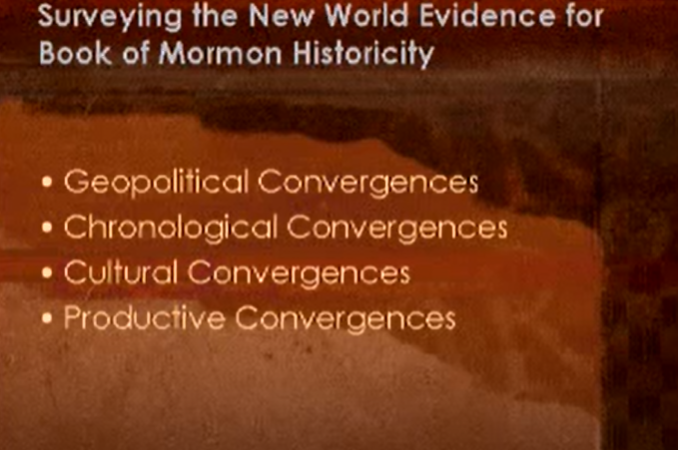
Geopolitical Convergences

Geopolitical Convergences: This is where we are talking about the fact that we have to have it on the map somewhere and then even more complicated than putting it on the map is we need to know something about the peoples that were there so converging that type of information.

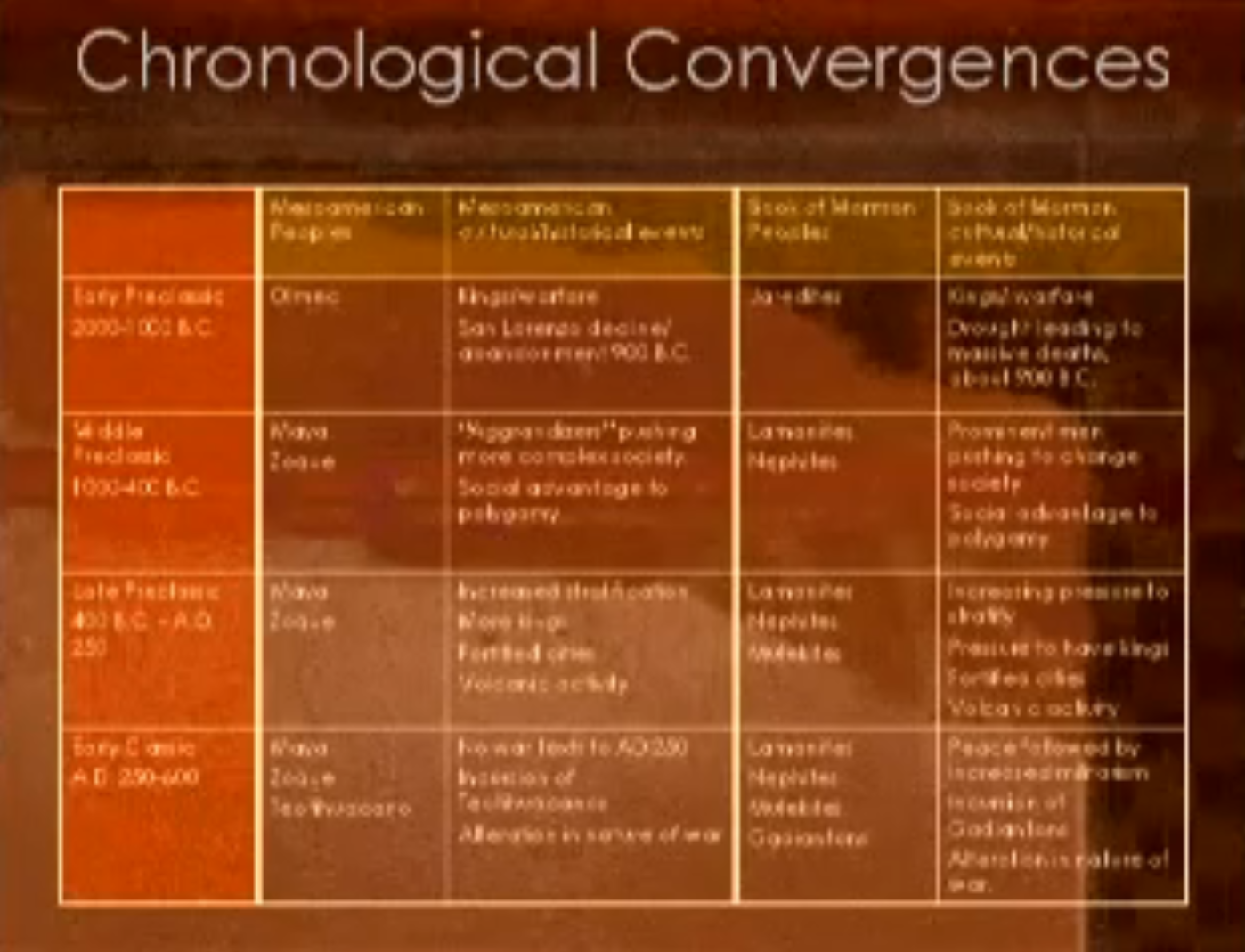
Chronological Convergences

Chronological Convergences: One of the best arguments that I’ve heard for understanding that the Book of Mormon could not have taken place in the Great Lakes area is because people did not live there at the right time. Anytime you see a theory that is positing people that don’t live somewhere, that are supposed to be there and they are not there—it’s not a real strong theory.

Anytime one of the theories of Book of Mormon geography posits that you must have an area of the world under water at a time when people were living there, probably not a very good thing, even if they were under water some other time in geological history. Chronology makes the difference; you have to match the right time periods. You can have absolutely the right thing happening, and if it’s a thousand years too late, it doesn’t count, it isn’t a convergence, and it isn’t even close.

Cultural and Productive Convergences

Cultural Convergences: Once we get those first two done, then we need to look at the culture of the area and whether or not that converges and the descriptions match the kinds of things we find in the Book of Mormon.

Productive Convergences: Which is where understanding the context of the Book of Mormon, or the place where it would have taken place, actually teaches us something about the Book of Mormon that we would not understand otherwise. In other words, it becomes a way to elucidate the text, particularly in places where the text might be a little bit confusing or a little strange.

Geopolitical Convergences

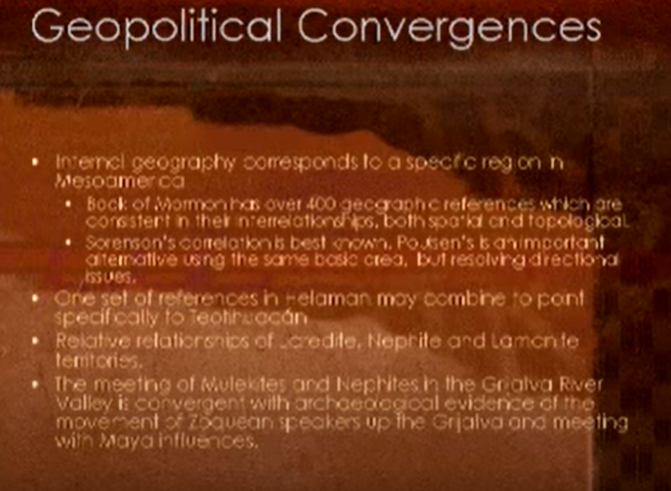
  • Internal geography corresponds to a specific region in Mesoamerica
  • Book of Mormon has over 400 geographic references that are consistent in their interrelationships, both spatial and topological.
  • Sorenson’s correlation is best known. Poulsen’s is an important alternative using the same basic area, but resolving directional issues.
  • One set of references in Helaman may combine to point specifically to Teotihuacán. 3
  • Relative relationships of Jaredite, Nephite and Lamanite territories.
  • The meeting of Mulekites and Nephites in the Grijalva River Valley is convergent with archaeological evidence of the movement of Zoquean speakers up to the Grijalva and meeting with Maya influences.

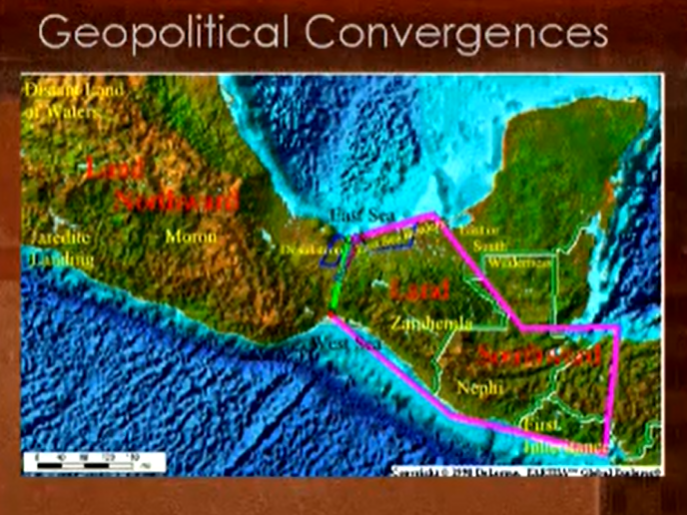
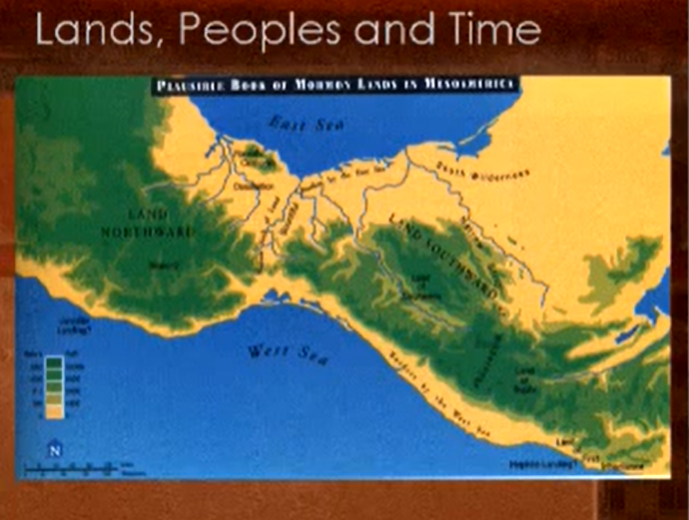
There are two correlations I’d like to put up here.

  • I am not a geographer.
  • I cannot tell for what reason, I simply don’t comprehend this stuff.
  • I understand people and
  • I understand archaeology and ethnohistory

But I just don’t seem to do geography very well, so I will rely on other people for geography.

But here is the problem that you have in geography—what you must do is you must create a convergence between the descriptions in the text and a place in the world. There are two of them I’m going to show you. Both of these are converging in the same general area of the world, they simply interpret the data slightly differently and I don’t know how to distinguish between the two as of yet. But, for the purposes I have, they agree in the places where I need them to agree, so I’m not too worried about it—the rest of it will work out.

Matching the Text to a Real Geography

But here is the problem you have, you have to take the text and the descriptions of geography in the text and you have to find a way to match it up in the real world. This is an incredibly difficult proposition.

John Sorenson has discovered at least 400 different kinds of textual correlations in the Book of Mormon, which, if you were going to have a convergence between the text of the Book of Mormon and a geography in the real world, you’ve got 400 things that have to match. This is not an easy process. If you are matching 400 locations in relative distance from each other, in topography where you go up and down and it’s consistent in the right way, you know this is simply difficult to do.

There is a recent article that attempted to say that Book of Mormon geography is so vague that you could probably put it anywhere including the Malaysian Peninsula. It was an interesting idea. Some of the things actually worked out.

One of the problems, however, is that based on that particular geography, all of the Lamanites had to be in the very, very bottom tip. And the problem is:

  • you have all this area that’s Nephite and based on the Nephite geography
  • but all of the Lamanites (that the text tells us are more numerous than the Nephites) are in this little tiny area

And it just doesn’t work, you just don’t have that kind of population distribution.

On top of that, the next thing I’ll talk about is the other reason why the Malaysian geography (model) won’t work, but to start off, we’ve got to get a geography.

Mesoamerican Models of Book of Mormon Geography

You are looking at the Yucatan Peninsula, Isthmus of Tehuantepec. And basically, this is the correlation of how John Sorenson would lay out the Book of Mormon in this land. Larry Paulsen, who is a member of FAIR, has another idea of how to do it, slightly different. What he does is kind of fascinating because in one way we have to make sure that we understand it.

What you’ll see at the top is this North-South axis. And that really looks familiar to us because as modern Americans we conceptualize directions and cardinal directions as a plus sign. What we miss is that Mesoamerica did not. Mesoamerica did not use the concept of a plus sign whenever they described the world and the four quarters of the world. They used an “X”.

So for them this is North, not that single line that we think of, but that pie, that whole piece of direction is North. It changes concepts dramatically when we have a quadrant that is Northwest, and they kind of tilt it and say ‘that whole thing is North’. So the concept of what “North” is was probably very different in the Mesoamerican world.

Adding People and Chronology to the Map

Now, here is why that doesn’t bother me that there are two different ones, and secondly, why when you take the next layer of information and you put it on the map that things like the Malaysian hypothesis fall to pieces.

In addition to being able to take the text and have some sort of a convergence with a geography we now have to put people on and in addition to putting people on the map, the Book of Mormon very clearly tells us that there is a chronological relationship among these people; and we need to find that same chronological correlation.

For instance, the Book of Mormon tells us that in the North, we are supposed to find the oldest culture and we’re supposed to find people who would have been there, let’s say, 2,000 BC. We are supposed to be able to find maybe a newer culture down along here and there better be people there around 600 BC.

We are also told in the Book of Mormon that people move out of this lower area and start moving towards the North, end up in the city of Zarahemla, where they meet up with some people who have come down from the North, the Mulekites, and they all meet in this area of Zarahemla along the river Sidon. That’s a lot of information. That is very difficult to guess.

Matching Book of Mormon Peoples to Mesoamerican Chronology

What would happen if we look at this map of Mesoamerica and the oldest people were down here and the youngest people were up there? It would be disqualified. But it isn’t. That’s where the old people are. That’s the Olmec culture up in that area; had been in that area for an awful long time.

This is the Maya region. Interestingly enough one of the things that happens is if you look at the linguistics of the area, the Olmec are—the best evidence anyway—is that they’re speaking a language that has been reconstructed and labelled Mixe-Zoque. 4

The Mixe-Zoquean speakers, which is kind of a combination of two languages, later Mixe, and later Zoque. What happened was the Zoquean group moved up that river. And this area has a connection to the people up there, and they were Zoquean speakers that moved out and historical data tell us that there is this movement of people from the North to the South along that river.

It also indicates that there is information about some of these speakers that move up this area, and meet up there, and some of the cultural data from here is starting to come into here somewhere around 200 BC. Now that just so happens to be a time period when the Book of Mormon is saying that something is happening.

Jaredites, Olmec Culture, Nephites, and Maya Culture

The Book of Mormon says that we have to have Jaredites in the North that happen to have a time depth and geographical correlation that match up very nicely with the Jaredites. Now please understand that I will not, and do not ever say that the Olmec and the Jaredites were exactly the same. I think that the most logical thing that you can say is that the Jaredites participated in Olmec culture.

Similarly, when we talk about the Maya, I do not think that either Nephites or Lamanites were Maya, but that they participated in that culture and may or may not have learned to speak that language. But there were Olmec who were not Jaredites, there were Maya who were not referenced in the Book of Mormon.

But what’s fascinating is that the history of this area tells us that there is a people who is coming from this area and merging here; ending up with a cultural influence from people this way going in that direction and that just so happens to be what the Book of Mormon tells us is supposed to happen at the same time.

Population Movement around 200 BC

There is another piece of information about this area down in here which is the area of the Land of Nephi, one of the cities that Dr. Sorenson suggests might have been the city of Nephi, Kaminaljuyu, in Guatemala. 5 I have just recently read that there is documented evidence of Cholun speakers moving into that area in about 200 BC.

Think of what that means for Book of Mormon history. Right in 200 BC we don’t know exactly what is happening, but according to the text, all of the pressures on the Nephite people are increasing right around this particular period of time, and increasing so severely that Mosiah has to take all the people who will go with him and flee and leave.

What is changing things so dramatically that all of a sudden at this point somewhere around 200 BC, they have to leave this area? Well, history tells us that there is a new People that is moving in. Perhaps that is creating some pressure.

Chronological Convergences

Again, if we have the wrong people in the wrong place it doesn’t really help us. One of the ways in which you get a convergence with the Book of Mormon and things that are happening in Mesoamerica is not just in this gross location of where the people are, but the kinds of things that are happening at the same time. For instance, having kings and warfare. It’s nice to say that they are there, but that is a piece of the puzzle rather than one that’s particularly interesting.

One of the things I did when I was looking at the Jaredite chronology, is I tried to rebuild the chronology in the Book of Mormon based on king lists and run backwards from times rather than make up an assumption of when I thought it might start, and based on this Jaredite king list chronology, I started laying out when these things might possibly have taken place.

One of the things that happened after that was put together is I find that in the city of San Lorenzo, they’ve got a decline and the city is being abandoned right at a time when the Book of Mormon is talking about a severe drought in the land.

San Lorenzo and the Jaredite Drought

Now, are those two exactly the same? Don’t know. But it is kind of fascinating that you’re going to have in the historical record, a decline of a population that in many cases and other instances have been tied to droughts happening at the time when the Book of Mormon is indicating that there is a severe drought in the area.

Then we get into this next time period where we have changes occurring down in the Maya world and what’s happening is you are moving from smaller populations to larger populations, you are moving from villages to cities, and the political structures are beginning to change.

So the social pressure in Mesoamerica is one that is developing this push towards what will become the classic Maya model of kingship. Those pressures are happening quite early and there are several mechanisms that have been used to try to describe how people moved from the small village into the situation where they are getting more social stratification.

Aggrandizers, Trade, and Social Inequality

One of the two people who wrote the article that I think makes the most sense on this was John Clark and he talked about a process of aggrandizers where one of the things that they would do is you’d get some ambitious people who would start trading and then they would get more trade goods, and this was going to increase their status in the community, and because they are increasing their status in the community it’s going to get some differential in what they have and what somebody else has, the kind of trade goods you have. You will get some sort of social inequality there.

One of the things that absolutely struck me is that this is first of all an economic argument in that you’ve got people who are looking to better themselves through trade and look at wealth, money, etc. And the second thing is the mechanism that they used was that they would have plural wives.

The reason? They’d have more people to work. You get more wives, so you get a bigger family, you have a cottage industry and now you’ve got more workers, you’ve got a built-in workforce, you create more items, you get more trade.

Costly Apparel and Multiple Wives

It has always been fascinating to me that this is the exactly the time period where Jacob is complaining about something that is happening in his community, and he complains about two things that you would not suspect are connected which are costly apparel and multiple wives. He is telling people why this is terrible.

Why is it those two things? How do those go together? Why are they related? Because that’s what is happening at that time period.

Next kinds of things happen, you get these increasing pressures to have kings; you get fortified cities; the Book of Mormon talks about the time of Christ. The best information about what’s happening when Christ comes is that there is this massive volcanic activity.

There are lots of indications that at least around this time period, within 100 years before and after, there are a lot of very active volcanoes. We are not at the point where we can say this is the volcano that erupted and is being described in the Book of Mormon. But what you can say is that around that time period, it is pretty obvious that there was some heavy volcanic activity. So again you are getting a convergence in time and place and in description.

Warfare and Chronological Convergence

This one is brand new—Mark where are you? Stand up and say hello to everybody. This is Mark Wright he’s a Mesoamericanist getting his Ph.D at UC Irvine. It’s been a heck of a lot of fun talking to him because we actually talk shop and I can say things and he knows what I’m talking about.

This is one that he pointed out to me, this is from David Stewart in a recent discussion at the Texas Maya meetings where he was just happening to mention that there are no Maya text dealing with warfare prior to 200-250 AD, and then after that we get it all the time. Why? There is a really kind of odd convergence and frankly one that I wasn’t expecting to see.

Next kind of thing that we’re getting, militarily, we know that down in the area where the Book of Mormon would have taken place, around the time that the closing events are occurring in the Book of Mormon, the people of Teotihuacán are coming down, they are bringing with them a new style of warfare, they change the rules.

There are all kinds of indications that things are dramatically different when all these Teotihuacános come down, and then you read the Book of Mormon text and right at the same time that historical documents are talking about the Teotihuacános coming down and changing the nature of warfare, we have Mormon who is first of all complaining about the Gadiantons, and secondly complaining that the nature of warfare has changed and complaining it just isn’t the way it used to be.

So the Book of Mormon is one more time, chronologically reflecting the same kinds of pressures that we know to have been occurring at that time period.

How Many Correlations Can Happen by Accident?

To this point in time, we are still at one of those things where you look at it and you say, how can this kind of a correlation happen by accident? How do you hit that many things and that carefully?

Somewhere along the line we should have the chronology getting mixed up if we were in the wrong place. If we were in the Great Lakes region this would have blown up a long time ago. If we were in Malaysia it would have blown up a long time ago at the time when we’re looking for just the older populations—there are not populations and peoples in the right places at the right time in Malaysia. There is a good reason why that doesn’t work. Way past geography the rest of the geopolitical situation does not work.

But the Book of Mormon just keeps getting better, and including things that I found out yesterday, make it look better than I’d seen.

The Israelite Background of the Book of Mormon

Another one that is fascinating and I’ll just mention it, because it’s not my research but I find it absolutely amazing. People have really complained about the Book of Mormon because it is the wrong kind of document. You are talking about Christianity way too early. There are just all kinds of things that are supposed to be wrong against an Israelite background.

The problem is, they are wrong against an Israelite background only (inaudible) pre-exilic Israel. The more that Israelite religion is being reconstructed prior to the time that Lehi took off, the more the Book of Mormon’s theology and the things that it’s concerned with fit right in. It’s not nearly as problematic as they thought.

What’s wrong are the expectations that were brought to the text—not the text itself.

Cultural Convergences

  • Anthropological
  • 1 and 2 Nephi parallel established patterns of ethnogenesis 6
  • “Getting the right things wrong” – when the text makes a “mistake,” it make the “correct” mistake
  • Insider/outsider vocabulary
  • Pejorative stereotyping
  • White/dark as metaphor rather than skin color
  • Mormon’s presentism
  • Mormon’s description of wealth in Alma 1
  • Lamanites learning literacy from the Nephites
  • Literate society
  • Monument stones – stelae and Coriantumr’s story-stone 7
  • Annals format
  • Book of Mormon literary parallelism including chiasmus, Mesoamerican emphasis on parallelism and evidence of chiasmus in the Popol Vuh.
  • Dynasty emphasis – Book of Mormon book-name changes
  • Indications of vigesimal system 8
  • 400-year prophecies
  • Suggestive structures in counts and estimates.

“Getting the Right Things Wrong”

There are things that people will say about the Book of Mormon, they will say, “You know they got this wrong, this is wrong, you shouldn’t do it this way”. The problem is, you really don’t want and should not find a historical text that is perfect according to our modern perceptions what a history ought to be.

The Book of Mormon should not look like a modern history; if it does, it’s a forgery. It should look like an ancient text, that’s where it came from.

In ancient texts there are lots of things that people get wrong and the Book of Mormon happens to get a whole bunch of things wrong. For instance, it uses insider/outsider terminology. It tends to say, as most people do when they are first creating their societies, there is “us” and “them.” There is this big wall around us, and anybody who is not us is them and we don’t like them. It’s wrong for modern history but it’s exactly right for ancient history.

When the Book of Mormon Gets Things “Wrong”

Mormon makes a mistake when he is talking about some of the historical conditions of Teotihuacán 250 years earlier. Well, is that wrong? For an ancient historian no, actually it’s exactly right. He should not have known what happened in a city that is that far away 250 years earlier.

What he should have done is what he did. He assumed that what he knew about the city at that time had always existed. That’s the way people thought at that point in time. So oddly enough, in a lot of cases some of the things that the Book of Mormon gets wrong—from an anthropological standpoint—it is getting exactly right.

Kinship

  • Kinship
  • Emphasis on kin as organizational principle
  • Declarations of genealogy upon meeting a stranger
  • Consistent use of kin inheritance in both political and religious leadership roles
  • Amulek’s description of his household fits a Mesoamerican home compound, including multi-generations and collateral kin

This is actually very important—the kinship structure inside the Book of Mormon and the way kin function in the Book of Mormon matches a kin-based society. By the time of Joseph Smith we had lost a lot of that and certainly by our time we’ve lost even more of it. But the Book of Mormon tends to operate like a kin society would have, which again is something that it ought to do. Contrary to what our expectation would be from somebody who is writing in the 1830s.

Political Convergences

  • Political
  • Description of site visits in Lamanite cities (part of the story of Ammon) converge with descriptions of site visits from the epigraphy. 9
  • The Book of Mormon description of a “King over kings” in Ammon’s story converges with the political organization described in the epigraphy.
  • Relationships of cities in a hegemony parallel the loose confederation of Zarahamla. 10
  • Fraternal succession of rulers
  • Alam 60:6–7 – multiple people on “thrones” corresponds to the use of the Mesoamerican “seat,” or “throne.”
  • Judges and regional authority.
  • The desire of the Kingmen to allow Lamanite conquerors has parallels in Maya politics.
  • “Voice of the people” and the Popol Nah (council house). 11

Is the Book of Mormon Describing Democracy?

In general, one of the things that people will say about the Book of Mormon is that it’s got to be modern because it talks about voting. The voice of the people has to be a vote. Anybody who has said that has not examined the text on the voice of the people.

Anybody who thinks

  • that the Book of Mormon is a democracy and
  • that the Book of Mormon promotes democracy

has not studied it. It does not. It is a very complicated system. I am sure that somewhere in the world there is another system that’s just like that. But the only one I happen to know of is in the Maya world where down at the bottom here in the Popol Nah, or the community house, where the elders gather together to hear the cases and discuss them.

The “voice of the people” being literally that. And if you read one of the sections in the Book of Mormon where it is talking about it, you can actually see in your mind’s eye these people just talking. And somewhere in talking it out, changing their minds and coming to whatever the consensus opinion is. It has nothing to do with votes.

The political system in the Book of Mormon simply doesn’t look modern at all. What it does look like is the things that I’ve seen in Mesoamerica.

Warfare

  • Warfare
  • The seasons of warfare match with the types of seasonality in Mesoamerica
  • Relationship of timing of war and famines
  • Militia style – no standing army
  • Defensive armament is correctly described
  • helmets
  • slings
  • breastplates
  • shields
  • “thick clothing” as armor
  • wounds on the legs – ie. no greaves 12
  • Descriptions of the deployment and types of weapons
  • Tactics
  • Rarity and surprise of right movements
  • Scouting a walled city, using ladders if not other way
  • Hiding in foxholes
  • Battle between champions
  • Defeat of the king is the defeat of the army
  • Battle by appointment
  • War on a tribute model rather than a conquest model
  • Fortifications described that fit with developing Mesoamerican fortifications – appearing at approximately the same time period.
  • Lineage succession of the general

What is fascinating about this is that not only does he mention certain weapons, but the Book of Mormon is very accurate in the way those weapons are used in an attack. I am not a military man, but there is a certain way that you would do things and I’ve consulted with a couple of military men—the Book of Mormon actually makes military sense.

People who do war for a living can look at the text and say, they’re doing the right kinds of things with the right weapons the right way.

None of these are the way war was fought when Joseph Smith was thinking of things and the tactics are entirely different.

Aztec Warfare and Book of Mormon Tactics

One of the ones that I found very fascinating, Ross Hassig has book out called “Aztec Warfare” and the longer I read that, and the more I read the Book of Mormon, the more I start seeing the same tactics being used in several occasions.

There are textual witnesses of the Aztecs doing some of the very same things that we have seen in the Book of Mormon. So obviously they are effective tactics. We don’t know who came up with them, but it is kind of curious that that area of the world knew about them and used them including hiding in foxholes, popping up and attacking your enemy as they come by.

Productive Convergences

  • Productive Convergences
  • Geography as explanation
  • Limhi’s expedition gets lost because they follow the wrong river.
  • Tactics depending upon topographic relationships.
  • Culture as explanation
  • Jacob’s use of Isaiah
  • Ammon and Lamoni
  • Why Lamoni thought Ammon was “more than a man”
  • Clan struggles as background for Ammon at Waters of Sebus
  • Anti-Nephi-Lehies
  • Mesoamerican caches and the Book of Mormon burying of weapons 13
  • Captive sacrifice and the seating of kings
  • Seating of kings and the raid on Ammonihah

If the text of the Book of Mormon is an authentic text it should be written by someone who assumed that we knew as much about his world as he did; that’s the way the ancient people tend to write. That’s the way the Biblical writers wrote.

They simply assumed that they did not have to explain a lot of things to us because they assumed that we were part of the culture and that we would understand things. So, the only things that you get told are the things that you need to know because you’re supposed to know everything else.

That works really well until:

  • the world has changed and
  • we don’t know everything else and
  • all of a sudden things become kind of confusing and
  • they look strange and
  • you get these odd questions about the Book of Mormon text where it tells a story
  • where in our hearts of faith we know that it’s a darn good story but
  • as soon as we step back from the view of faith and we look at it kind of cold and calculated it becomes a stupid story

I’ve got two of them for you. One of them is thanks to Larry Poulsen.

How Do You Lose a City?

How do you lose a city?

Zarahemla might not have been the biggest city around and frankly was not, should not have been. When they get to Zarahemla they’re actually very homesick for where they came from probably because they’ve now gone to the backwater 14 after coming out of a real nice place which is probably why the people of Limhi want to go back and inherit that land—so they do—and they go down and after a long period of time with King Noah and everybody else they get dominated by the Lamanites, things really aren’t very good and so they’re hoping for Zarahemla to come help them out and somehow rescue them.

So they send a party to go back to Zarahemla—and they can’t find it! This is only a generation later. I’m not even that bad with directions. How do you lose a city when the instructions are ‘go to these mountains, find the river and follow the river until you hit the city’?

Follow…Which River?

There are two rivers. This is the Grijalva and the Usumacinta. It doesn’t quite show you there but one of the things that Larry Poulsen noted when he was doing some research on this is that the headwaters of those two rivers are only a mile apart in the same mountains.

They followed the wrong river. They did exactly what their parents told them to do—go to the river, follow it. Wrong river. How did they lose Zarahemla? It wasn’t on that river.

However, when you get up here, what’s up there? Jaredites. It’s exactly what they were supposed to find.

How do you do that if you don’t know this geography? How do you make that mistake so right? That is a convergence. If it were the only convergence it would be a curiosity but it isn’t.

The Strange Anti-Nephi-Lehies

Two years ago I was here and I talked about the strange case of Ammon at the Waters of Sebus and talked about that being a weird story. I’ve told that a couple of times and people really get nervous when I talk about weird stories in the Book of Mormon and they think I’m basically disrespectful or don’t like it.

That, first of all is not true, I love the Book of Mormon. Secondly, this is really a weird story! This one’s probably the strangest story in the Book of Mormon because it makes absolutely no sense whatsoever so forget about the fact that this is a faith-promoting story, take your faith hat off and listen to the stupid story!

First of all the people of Anti-Nephi decide that they are going to lay down their weapons and not fight because they claim they were all murderers. Now think about that—when did the women and children murder anybody?

Even if the men were off murdering in war, and by the way you never define murder in war—soldiers never murder. We would have to redefine it differently so that we could go ahead and do it. But when did the women and children do it? And they’re saying they’re all “murderers” and this is a terrible thing. (Alma 24:11–12)

Burying the “Weapons of Rebellion”

Next one. They bury their “weapons of rebellion.” (Alma 23:7, Alma 24:15–18)

That sounds interesting—they’re going to bury their weapons. Now, how many of you out there if you had a million dollars and you buried it in your background and you thought you needed some of it might go dig it up? You know if I buried the darn thing I know where it is.

That doesn’t really prevent me from doing much with it. Why is burying this thing—first of all why do it in the first place and secondly, why do I think that’s going to do anything? If I want my sword I’ll go dig the darn thing up.

Extreme Pacifism and the Anti-Nephi-Lehies

Now, they are extreme pacifists, they are so pacifistic that they are not going to take up a weapon in their own defense and they are going to allow someone to kill them rather than to fight back. That’s pacifism. That’s really remarkable and these same people sent their 12 to 14-year-old sons off to war and said, see you later I’m not going. I’m not going to fight. But you, good luck. That’s weird. That’s a dumb story. It just doesn’t happen.

We’ve got the next two: the Lamanites when they finish killing all these people they decide that they still want to kill someone. They’ve got this bloodlust so they take a two or three-day hike off to a city and go attack them. You know somewhere along the second day of marching I would probably say, I don’t feel like killing anybody anymore. Can I go home? Can I have a hot meal? Why do you go that far away to go kill somebody? You had people right there.

Next, this is the only story in the Book of Mormon where we talk about a Lamanite attack where the Lamanites don’t try to dominate the city and set up a tribute relationship so that they can get an economic benefit from having conquered that city. These guys go in, they just kill people and leave but it’s the only time we ever get a mention in the Book of Mormon that they take prisoners. Why toss that odd little piece in?

Solving the Riddle with Cultural Information: The Cult of War

Human sacrifice

This is where Mesoamerica comes to our help to tell us why this particular story sounds so dumb to us but works in the context of this part of the world. The religion of most Mesoamericans can be summed into the cult of war—where war is a sacred thing and war is part and parcel of your religion.

Part of this is not only killing people in warfare but bringing people back and then sacrificing them. Now think about the people who have claimed that they are murderers. When do they murder? Well, they probably didn’t. But if:

  1. they have been converted to the gospel and
  2. they have learned that human sacrifice is probably not something that they ought to do

Those people who have participated in, condoned and experienced the religion that did condone human sacrifice might have a different view of how their participation would be viewed.

Caches

Secondly, if their participation in the human sacrifices were distinctly related to war, and all of the feelings about that ancient religion were stirred up when they went to war, that will tell you:

  • why they didn’t want to go to war;
  • why they did not want to pick up any weapons;
  • why that was, for them, the hardest thing that they were going to do.

There were so many connections that were made between those actions and what they were trying to do.

In Mesoamerica it is a known procedure that people at the beginnings of new things and at the endings of certain things would cache objects—which means they would bury them. They would dig a pit and they would drop them in.

The Book of Mormon does not tell us this particular detail (probably, again, because it doesn’t need to), but most of the things that were cached were ritually broken. It is highly likely, given the context and the culture of that area, that we are talking about a cache. The reason they couldn’t go dig it up again is because they ritually broke, as an offering to God, all of their weapons as they offered their weapons to God in the earth. Which was a standard practice in that area.

War to obtain captives

Next, we have a war and part of the idea of war is to obtain captives so that’s, again, part of what we’re doing, we’re going off to Ammonihah to get prisoners.

Accession of the king linked to captives in battle and their sacrifice 15

Then the very last thing that we have to know is how do you seat a new king? Well I’ll pop the slide up. I won’t read it. (Just so you get at least one Mayan picture while we’re here!) The people who are coming into the city of Anti-Nephi-Lehi to take it over were doing so with the express purpose of:

  1. capturing the city,
  2. removing the previous king, Anti-Nephi-Lehi,
  3. and setting up their own king.

They succeeded. They did not have any opposition therefore they must have been able to take over the city and set up their new rule.

When you have a new king how do you install that new king? And in the Mayan world, you seat them on their throne. But one of the things that you must do in order to properly seat a Maya king is you must sacrifice a prisoner captured in battle.

The Anti-Nephi-Lehies didn’t fight back, didn’t count. So you had to do what other texts have told us that other kings did, you go off to some unsuspecting city that’s probably going to be easy pickings 16 but who will fight back, fight them, get your captives, come back, install your king.

When the “Stupid” Story Makes Sense

In the context of Mesoamerica, this “stupid” story all of a sudden makes perfect sense. Of course it happened that way. But the only way we know why it happened the way the text tells us that it happened is by:

  • knowing where the Book of Mormon took place;
  • having a convergence not only of the geography into a place, but of the time, of the location, of the people, of all of these events and cultures where the text of the Book of Mormon converges with the information that we get out of Mesoamerica.

And not only tells us that the Book of Mormon took place there, but knowing that tells us more about the Book of Mormon than we might possibly have known otherwise.

We Can’t Unsee the Dog

Having been through the Book of Mormon for a long time, this is the “dog”. We are still in the process of

  • putting pieces together,
  • drawing in the outlines,
  • making sure that we have the details right.

Someday, perhaps, we’ll get to draw in the hair! But the “dog” is there.

Having been through the text, having looked as carefully as I possibly can—and, believe it or not, with the exact same rigor that I used in the paper where I came up with the idea that I didn’t like the Quetzalcoatl correlation, using those same tools, those same rigors—the “dog” is there, and I cannot for the life of me “unsee the dog.”

This is a different book than I read 20-30 years ago. But boy is it fascinating, and is it interesting! I get more and more interested in it the more I learn and the more I see. And it’s a much better book than I’d ever thought it was going to be. Though, it is still the one thing that I thought it was – which is *true*. And I bear you that testimony in Jesus’ name, Amen.

Questions and Answers

Have there been any cities, ruins, etc. believed to be the Book of Mormon peoples rather than Mesoamerican peoples?

Q: Have there been any cities, ruins, etc. believed to be the Book of Mormon peoples rather than Mesoamerican peoples?

GARDNER: Let me give you the real quick answer to that, my answer is no because I can’t tell you the difference between Book of Mormon peoples and Mesoamerican peoples. We’re in the wrong state to ask this question but if I were in New Mexico I would actually ask you how many of you had a neighbor who wasn’t a Mormon?

Up here that’s a little bit more difficult to do, but I suppose that you’ve all been to a state where there isn’t one. What does a Mormon car look like? I realize it looks like a minivan! (Laughter) But you know, there are actually other people who drive them. What does a Mormon house look like that’s different?

The material culture that we have is the material culture that everybody else has. 17 In my neighborhood you go up and down the street and there is no way from looking at the outside of the house, from looking at the cars, if you went inside from looking at my pots and pans and plates—there’s no way you could tell what my religion was.

Material culture does not tend to do that. So, as John Clark has said, we’ve probably found Nephite ruins and Nephite artifacts. We just can’t tell the difference because they look like everybody else’s.

Does the Book of Mormon ever suggest or imply mingling with indigenous peoples? Or why would the Book of Mormon peoples choose to include that?

Q: Does the Book of Mormon ever suggest or imply mingling with indigenous peoples, or why would the Book of Mormon peoples choose to include that?

GARDNER: I do believe that it certainly implies that. There’s only one text I know of where the implication is as explicit as we’re going to get it. Which is when Nephi and his brothers are leaving after the split.

And Nephi is taking all the people to go up to the Land of Nephi. He goes through and he names names, and he says

  • this person went with me, and
  • this person went me and
  • this person went with me and t
  • his person . . .

And he doesn’t name Laman or Lemuel. We’re pretty sure we know why they didn’t go with Nephi—since they were trying to kill him. We’re reasonably certain that Laman and Lemuel’s wives and children would remain with them. But other than that, Nephi seems to have named everybody we’ve ever known about that we’re not pretty sure has died by the time you get to this separation of people. And yet at the end of this time, when he’s named just about everybody there is to name he says, “and all others who would go with me.” Well, who the heck were these others?

The Others Nephi Talks About

The next thing that happens, if you’re looking at the text, as you go through and you say, well if there were others there does the text give us that hint? And I won’t go into the reasons but there’s several reasons to believe that the text simply doesn’t work without others there.

There’s also a speech that Jacob gives at Nephi’s behest specifically talking about a passage in Isaiah that makes absolutely no sense whatsoever unless there are others with the group at the time. So then the next question is, why don’t they mention that?

A complicated issue and if you remember what Matthew Brown was talking about in texts, what you have as a text may or may not represent all of the rest of the information that you might have had. You’ve got a text and you have to do deal with.

But we have a text to and we don’t have either the text that Nephi wrote about the more mundane things nor do we have what Mormon abridged to that text; all we have is the secondary text Nephi explicitly tells us that he’s writing it for entirely different reasons and if you look at 1st Nephi it is an incredibly well crafted document. 2nd Nephi falls apart frankly, we are like disappointed in my boy Nephi because 1 Nephi is great and 2 Nephi kind of fades but he planned it.

Ethnogenesis and the “Others”

Now, one of the things that I’ve just learned recently is that there some patterns of ethnogenesis when you’re trying to explain how you get a new people and there are several things that happen there but one of them is that you create these dichotomies between the insider and the outsider.

Why doesn’t he mention the others? They’re not relevant to his story of ethnogenesis. What’s relevant is that there’s a split and he’s trying to define who the Nephites. These others are now part of the Nephites, he doesn’t need to define them as separate—it is his intent to define them as part of the group and is opposed to everybody else.

Since the whole face of the land was altered at Christ’s death why should today’s geography correspond to pre-Christ geography?

Q: Since the whole face of the land was altered at Christ’s death why should today’s geography correspond to pre-Christ geography?

GARDNER: How many of you remember Mount St. Helens? I have a little bottle of ash that somebody collected for me. Mount St. Helens really looks different. The whole face of Mount St. Helens is really quite different but I know where Mount St. Helens is. It hasn’t moved.

Although the face of the land changed, that is a literary reference to the degree of change in the land. It’s not a change that says,

“by golly I could not find my way home because all the roads were backwards.”

That simply doesn’t happen.

If you are going to look at the Book of Mormon and say that it happened as a real text, you have to assume that there’s a real world behind it. And the real world simply doesn’t change so dramatically that we would not be able to recognize it. Certain things are going to change, but not that many.

Answers in this Presentation

What does Brant Gardner mean by “convergence” in Book of Mormon studies?
He means multiple independent pieces of historical evidence that fit together rather than a single similarity or parallel being treated as proof.

Does Brant Gardner claim the Nephites were Maya?
No. Gardner explicitly says he does not believe the Nephites or Lamanites were simply “Maya,” but proposes that Book of Mormon peoples participated in broader Mesoamerican cultures.

Does Gardner identify the Jaredites as the Olmec?
No. He specifically cautions against equating them, suggesting instead that the Jaredites may have participated in Olmec culture.

Why does Gardner compare Book of Mormon evidence to “seeing the dog”?
He uses an image of a Dalmatian formed by scattered spots to illustrate cumulative evidence: individual dots may mean little, but together they can form a recognizable pattern.

How does Mesoamerican culture help explain the Anti-Nephi-Lehies?
Gardner proposes that Mesoamerican practices involving ritual caches, warfare, captives, sacrifice, and royal accession provide a cultural context for details in the Anti-Nephi-Lehi narrative that can otherwise seem puzzling.

Search topics

Book of Mormon evidence in Mesoamerica; Book of Mormon historicity; Book of Mormon archaeology; Book of Mormon geography; Mesoamerican geography; archaeological evidence for the Book of Mormon; Brant Gardner convergence; Book of Mormon cultural convergence; Book of Mormon chronological convergence; Book of Mormon warfare; Nephites and Maya; Jaredites and Olmec; Mulekites; Zarahemla; Anti-Nephi-Lehies; Waters of Sebus; Mesoamerican political systems; Mesoamerican kinship; ancient American cultures

Book of Mormon anachronisms; archaeological criticism of the Book of Mormon; Book of Mormon geography criticism; Book of Mormon historicity criticism; CES Letter Book of Mormon archaeology; CES Letter Book of Mormon evidence; Book of Mormon evidence criticism; Joseph Smith and Book of Mormon authorship; Book of Mormon ancient origins

Tangible Restoration: The Witnesses and What They Experienced

Opening Remarks

It’s a privilege to be here again. I’m really impressed with what Scott and the other leaders of FAIR have been able to do—for example, to get the previous speaker here. I’m astonished at their influence with the parole board.

Brian told a joke that reminded me of another joke, and probably you’ve heard this one, about the dyslexic, insomniac atheist who stays awake all night wondering if there’s a dog.

I’d like to welcome Claudia Bushman to the ranks of the apologists.

Do Apologists Ever Make Mistakes?

Brian raised the question of whether or not apologists ever make mistakes. I would have disagreed with him until about a week ago, when I made my first. I mistakenly used the obsolete term brontosaurus instead of apatosaurus and was promptly jumped on for it. But I can take it.

Now, I lead off with some jokes because this is going to be an incredibly boring presentation. There are no jokes in it, no insults. But the question you have to ask yourself as you listen is: Is there an acrostic?

So listen very, very carefully.

Reading the Paper

I’d like to thank Mike Ash for helping me out with the PowerPoint. I wasn’t planning to have any, but he decided that I needed it, which is probably true. And so I’m able to look technically—or technologically—literate with his help just today.

I’m going to read this paper, which I normally don’t do, and I apologize for that. I was intimidated by the performance earlier today, so I set about at first to memorize it. And then I thought that I would try to go one better by reciting it to you backwards. But I think I’ll just do it in the orthodox fashion.

There’s just a lot of stuff here, and I want to make sure I don’t leave it out. I feel very strongly about the topic I’m going to be talking about, so please bear with me. I’ll try to make it lively.

My wife said, “Keep me awake,” which may suggest an impossible standard, but I will try.

The Tangible Claims of the Book of Mormon

Joseph Smith’s claims regarding the Book of Mormon seem, at least on the surface, to be very detailed and utterly tangible. They are not mystical claims, but, at least in principle, can be tested in the real world of everyday, physical objects.

And critics have not been reluctant to meet the claim head on. “As for the golden plates,” wrote the evangelical Protestant polemicist G.H. Fraser, “we will say simply that there were not any.”

But the historical evidence suggests—no, it shouts—the contrary.

David Whitmer’s Account of Seeing the Plates

A representative statement is that given by David Whitmer during an 1878 interview with Orson Pratt and Joseph F. Smith:

It was in June, 1829, the latter part of the month . . . Martin Harris was not with us at this time; he obtained a view of [the plates] afterwards (the same day). Joseph, Oliver, and myself were together when I saw them. We not only saw the plates of the Book of Mormon, but also the brass plates [a set of records mentioned early in the Book of Mormon as having been carried by Lehi from Jerusalem to the New World], the plates of the book of Ether, the plates containing the record of the wickedness and secret combinations of the people of the world down to the time of their being engraved, and many other plates.

The fact is, it was just as though Joseph, Oliver and I were sitting just here on a log, when we were overshadowed by a light. It was not like the light of the sun nor like that of a fire, but more glorious and beautiful. It extended away round us, I cannot tell how far, but in the midst of this light about as far off as he sits (pointing to John C. Whitmer, sitting a few feet from him), there appeared, as it were, a table with many records or plates upon it, besides the plates of the Book of Mormon, also the sword of Laban, the directors [i.e. the ball with spindles which Lehi had, and the interpreters].

Joseph Smith’s Reaction to the Three Witnesses

Lucy Mack Smith, who had seen the chosen witnesses leave for their encounter with the angel and the plates, recalled, many years later, the scene that ensued at their return:

When they returned to the house, it was between three and four o’clock P. M. Mrs. Whitmer, Mr. Smith, and myself, were sitting in a bedroom at the time. On coming in, Joseph threw himself down beside me, and exclaimed, “Father, mother, you do not know how happy I am: the Lord has now caused the plates to be shown to three more besides myself. They have seen an angel, who has testified to them, and they will have to bear witness to the truth of what I have said, for now they know for themselves, that I do not go about to deceive the people, and I feel as if I was relieved of a burden which was almost too heavy for me to bear, and it rejoices my soul, that I am not any longer to be entirely alone in the world.”

Upon this, Martin Harris came in: he seemed almost overcome with joy, and testified boldly to what he had both seen and heard. And so did David and Oliver, adding, that no tongue could express the joy of their hearts, and the greatness of the things which they had both seen and heard.

Ultimately, each of the Three Witnesses—Martin Harris, Oliver Cowdery, and David Whitmer—signed his name to a statement that has appeared in every edition of the Book of Mormon from the beginning.

The Testimony of the Three Witnesses

Be it known unto all nations, kindreds, tongues, and people, unto whom this work shall come: That we, through the grace of God the Father, and our Lord Jesus Christ, have seen the plates which contain this record, which is a record of the people of Nephi, and also of the Lamanites, their brethren, and also of the people of Jared, who came from the tower of which hath been spoken.

And we also know that they have been translated by the gift and power of God, for his voice hath declared it unto us; wherefore we know of a surety that the work is true. And we also testify that we have seen the engravings which are upon the plates; and they have been shown unto us by the power of God, and not of man.

And we declare with words of soberness, that an angel of God came down from heaven, and he brought and laid before our eyes, that we beheld and saw the plates, and the engravings thereon; and we know that it is by the grace of God the Father, and our Lord Jesus Christ, that we beheld and bear record that these things are true. And it is marvelous in our eyes.

Nevertheless, the voice of the Lord commanded us that we should bear record of it; wherefore, to be obedient unto the commandments of God, we bear testimony of these things. And we know that if we are faithful in Christ, we shall rid our garments of the blood of all men, and be found spotless before the judgment-seat of Christ, and shall dwell with him eternally in the heavens.

And the honor be to the Father, and to the Son, and to the Holy Ghost, which is one God. Amen.

The Testimony of the Eight Witnesses

According to David Whitmer, the quite distinct experience of the Eight Witnesses to the Book of Mormon occurred one or two days after the experience of the Three. Soon thereafter, all of the Eight signed their names to a statement that has accompanied the testimony of the Three in every printed version of the Book of Mormon.

Be it known unto all nations, kindreds, tongues, and people, unto whom this work shall come; That Joseph Smith, Jun., the translator of this work, has shown unto us the plates of which hath been spoken, which have the appearance of gold; and as many of the leaves as the said Smith has translated we did handle with our hands; and we also saw the engravings thereon, all of which has the appearance of ancient work, and of curious workmanship.

And this we bear record with words of soberness, that the said Smith has shown unto us, for we have seen and hefted, and know of a surety that the said Smith has got the plates of which we have spoken.

And we give our names unto the world, to witness unto the world that which we have seen. And we lie not, God bearing witness of it.

The Contrasting Experiences of the Witnesses

It is worth examining the contrasting character of the experiences reported by the Three Witnesses and the Eight, since, I believe, their very difference reinforces them.

First of all, the experience of the Three, as they report it, was suffused with the glory and power of God. In a brilliant light, an angel came down and showed them the plates. They heard the voice of God testifying that the translation had been accomplished “by the gift and power of God.”

Their written testimony is characterized by a marked religious or spiritual tone. It might be termed a supernatural or miraculous testimony.

The Ordinary Testimony of the Eight Witnesses

By contrast, the experience of the Eight involves no glory, nothing miraculous. It is as mundane as anything can be. No angel shows the plates to them; Joseph Smith does.

There is no miraculous light. Unlike the Three, who seem simply to have observed the plates in the hands of the angel, the Eight handled the plates and turned their pages. They “hefted” them.

The language of their official account is cool and even formal or legalistic to the point of emotional distance (“the said Smith”). God figures in their testimony only as witness to their concluding oath. His voice does not testify to the correctness of the translation.

The Eight Witnesses are manifestly in full possession of their senses and mental faculties. Theirs might be labeled an ordinary or natural testimony.

Why the Differences?

Why the differences? In order, I think, for the task of skeptics to be rendered more difficult.

One might be tempted to dismiss the testimony of the Three, with its spectacular divine accompaniments, as hallucinatory (however untenable that dismissal would be) or mere superstition. By contrast, there is absolutely nothing in the testimony of the Eight that points to superstition or hallucination. It is the most matter-of-fact kind of experience—nine men in the woods in the early afternoon—except for the object at the center of it.

On the other hand, if one were to approach the Witnesses first by way of the Eight and one were inclined to skepticism, one might be tempted to write their experience off as deception by Joseph Smith or by some other conspirator or group of conspirators. There must really have been plates—fabricated to deceive.

But this doesn’t account for the testimony of the Three, which goes beyond fabrication and involves a number of additional objects.

In other words, a single explanation seems unable to account for the two very different kinds of experience. This means that skeptics who wish to explain the two testimonies away must resort to some unlikely combination of sincere hallucination, already unlikely in and of itself, and deliberate, insincere fabrication. Or, as we shall see, they must attempt to collapse the difference between the two.

James Jesse Strang and His Witnesses

Let us examine a case that critics often cite as a parallel to Joseph Smith and his Witnesses:

Forgery is the virtually certain explanation for the two sets of inscribed metal plates that James Jesse Strang said he had found in Wisconsin and Michigan (between 1845 and 1849) and translated. Strang, who claimed to have a letter of appointment from Joseph Smith, announced himself as Joseph Smith’s successor and was clearly seeking to imitate the Prophet.

That his plates really existed is beyond serious dispute. The first set, the three “Voree” or “Rajah Manchou” plates, were dug up by four “witnesses” whom Strang had brought to the appropriate site. Inscribed on both sides with illustrations and “writing,” the Rajah Manchou plates were roughly 1.5 by 2.75 inches in size—small enough to fit in the palm of a hand or to carry in a pocket.

Among the many who saw them was Stephen Post, who reported that they were brass and, indeed, that they resembled the French brass used in familiar kitchen kettles.

“With all the faith & confidence that I could exercise,” he wrote, “all that I could realize was that Strang made the plates himself, or at least that it was possible that he made them.”

One not altogether reliable source reports that most of the four witnesses to the Rajah Manchou plates ultimately repudiated their testimonies.

The “Plates of Laban”

The eighteen “Plates of Laban,” likewise of brass and each about 7 3/8 by 9 inches, were first mentioned in 1849 and, in 1851, were seen by seven witnesses.

Their testimony appeared at the front of The Book of the Law of the Lord, which Strang said he translated from the “Plates of Laban.” (Work on the translation seems to have begun at least as early as April 1849. An 84-page version appeared in 1851; by 1856, it had reached 350 pages.)

The statement of Strang’s witnesses speaks of seeing the plates, but mentions nothing of any miraculous character. Nor did Strang supply any second set of corroborating testimony comparable to that of the Three Witnesses to the Book of Mormon.

One of the witnesses to the “Plates of Laban,” Samuel P. Bacon, eventually denied the inspiration of Strang’s movement and denounced it as mere “human invention.” Another, Samuel Graham, later claimed that he had assisted Strang in the fabrication of the “Plates of Laban.”

The well-read Strang had been an editor and lawyer before his brief affiliation with the Church of Jesus Christ of Latter-day Saints and his subsequent career as a schismatic leader.¹

Strang’s Plates Compared with the Book of Mormon Witnesses

Thus, Strang’s plates were much less numerous than those associated with Joseph Smith, his witnesses saw nothing supernatural, his translation required the better part of a decade rather than a little more than two months, and, unlike the Witnesses to the Book of Mormon, Strang’s witnesses did not remain faithful to their testimonies.

Milo Quaife, in his early, standard biography of Strang, reflected that “It is quite conceivable that Strang’s angelic visitations may have had only a subjective existence in the brain of the man who reported them. But the metallic plates possessed a very material objective reality.”

If we are unwilling to accept The Book of the Law of the Lord as authentically divine, he says, “we can hardly escape the conclusion . . . that Strang knowingly fabricated and ‘planted’ them for the purpose of duping his credulous followers” and, accordingly, that “Strang’s prophetic career was a false and impudent imposture.”²

Roger Van Noord, Strang’s most recent biographer, concludes that, “Based on the evidence, it is probable that Strang—or someone under his direction—manufactured the letter of appointment and the brass plates to support his claim to be a prophet and to sell land at Voree. If this scenario is correct, Strang’s advocacy of himself as a prophet was more than suspect, but no psychological delusion.”

The Sincerity of the Book of Mormon Witnesses

It seems that virtually every reputable writer on the subject now grants the sincerity and honesty of all or most of the Book of Mormon Witnesses.

A few critics argue that the printed testimonies don’t really represent what the Witnesses said. “I want Non-LDS to know,” wrote one recent poster on an internet message board,

that regardless of the three witnesses of the Book of Mormon and the eight witnesses of the Book of Mormon—not a single witness ever touched the plates with their own hands and never saw the plates with their own eyes. When Martin Harris and Oliver Cowdrey supposedly had visions of the Book of Mormon for their testimony – only Joseph Smith wrote their testimony down in the Book of Mormon.

But the testimonies have been published with the Book of Mormon ever since that first edition in 1830, which, since it was prepared under the careful supervision of Oliver Cowdery (one of the Three) and Hyrum Smith (one of the Eight), seems to imply their endorsement of those statements.

Consistent with this, a correspondent for the Salem [Massachusetts] Advertiser and Argus reported in 1843 having heard Hyrum “declare, in this city in public, that what is recorded about the plates, &c. &c. is God’s solemn truth.”⁴

The Witnesses Reaffirm Their Published Testimonies

Moreover, there are far too many recorded testimonies from the other Witnesses for this to be a plausible escape.

For example, E. C. Brand visited John Whitmer, one of the Eight, in 1875, and recorded that Whitmer “declared that his testimony, as found in the ‘Testimony of Eight Witnesses,’ in the Book of Mormon, is strictly true.”⁵

In 1876, Whitmer told Mark Forscutt, “I have never heard that any one of the three, or eight witnesses ever denied the testimony that they have borne to the Book as published in the first edition of the Book of Mormon.”⁶

And, later that same year, referring to the published testimony, he told Heman C. Smith, “That testimony was, is, and will be true, henceforth and forever.”⁷

And, finally, in 1877, the year prior to his death, he wrote “concerning my testimony as recorded in the Book of Mormon” that “It is the Same as it was from the beginning, and it is true.”⁸

Were the Witnesses’ Experiences Non-Literal?

Today’s attack on the Witnesses focuses, instead, on the alleged non-literalness of their experience. Dan Vogel is the principal source for this newly popular way of dismissing their testimony.

For example, in his 2002 essay on “The Validity of the Witnesses’ Testimonies,” he attempts to discredit the witnesses by portraying them as alienated from empirical reality and as having merely imagined the plates of the Book of Mormon, or seen them in a subjective hallucination.

The ‘Literal’ Nature of the Lives of the Witnesses

I’ve commented elsewhere on how bizarre it is to me that the witnesses, a group of early nineteenth-century farmers who spent their lives:

  • rising at sunrise,
  • pulling up stumps,
  • clearing rocks,
  • plowing fields,
  • sowing seeds,
  • carefully nurturing crops,
  • raising livestock,
  • milking cows,
  • digging wells,
  • building cabins,
  • raising barns,
  • harvesting their own food,
  • bartering (in an often cashless economy) for what they could not produce themselves,
  • wearing clothes made from plant fibers and skins,
  • anxiously watching the seasons, and
  • walking or riding animals out under the weather until they retired to their beds shortly after sunset in “a world lit only by fire,”

The Disconnect of Modern People to ‘Reality’

are being portrayed as estranged from everyday empirical reality by people whose lives, like mine, consist to a large extent of:

  • staring at computer and television screens in artificially air-conditioned and artificially lit homes and offices,
  • clothed in synthetic fibers,
  • commuting between the two in enclosed and air-conditioned mechanical vehicles
  • while they listen to the radio,
  • chat on their cell phones, and
  • fiddle with their iPods—all of whose inner workings are largely mysterious to them—
  • who buy their prepackaged food (with little or no regard for the time or the season)
  • by means of plastic cards and electronic financial transfers
  • from artificially illuminated and air-conditioned supermarkets
  • enmeshed in international distribution networks of which they know virtually nothing,

the rhythms of whose daily lives are largely unaffected by the rising and setting of the sun.

Lester Grabbe and the “Spiritual Eyes” Argument

Yet Dan Vogel’s view of the Witnesses has recently been given wider currency in an article published by the non-Mormon biblical scholar Lester Grabbe, who commendably seeks to show that Joseph Smith’s story can illuminate ancient Hebrew prophecy.

Unfortunately, Professor Grabbe’s discussion is totally dependent upon Vogel and wholly uninformed by any exposure to the work of the leading authority on the Witnesses, Richard Lloyd Anderson.

Grabbe readily grants the sincerity of Martin Harris and David Whitmer, but also declares that “it seems that no one saw the plates uncovered except Smith himself.”⁹

“Both Martin Harris and David Whitmer of the Three Witnesses,” he writes,

while continuing to affirm their belief in the Book of Mormon, also stated that they had seen the plates “in spirit” or with “spiritual eyes” or in vision. As far as they were concerned, this was no less real than seeing them with ordinary eyes, but to non-Mormons this distinction is likely to be important.¹⁰

Did Martin Harris See the Plates With His Bodily Eyes?

Professor Grabbe cites the Rev. John A. Clark’s recollection of an unnamed attorney’s alleged recollection of an alleged statement from Martin Harris:

A gentleman in Palmyra, bred to the law, a professor of religion, and of undoubted veracity told me that on one occasion, he appealed to Harris and asked him directly,–“Did you see those plates?” Harris replied, he did.

“Did you see the plates, and the engraving on them with your bodily eyes?” Harris replied, “Yes, I saw them with my eyes,–they were shown unto me by the power of God and not of man.”

“But did you see them with your natural,–your bodily eyes, just as you see this pencil-case in my hand? Now say no or yes to this.”

Harris replied,–“Why I did not see them as I do that pencilcase, yet I saw them with the eye of faith; I saw them just as distinctly as I see any thing around me,–though at the time they were covered over with a cloth.

The Eight Witnesses and a “Spiritual” Experience

And yet, Professor Grabbe acknowledges,

The situation with the Eight Witnesses is more complex, and some continue to assert that these members of the Whitmer family and others saw and handled the plates in a purely physical context. Some of the testimony certainly gives this impression, but we have a few later interviews with most of the Eight Witnesses. There is some evidence that their experience was also “spiritual” or “visionary” or whatever one might wish to call it.¹²

How did the Witnesses come to “see” the plates?

Thomas Ford, the former governor of Illinois, “who,” Grabbe assures us, actually “knew many Mormons,” explains it all by means of an account of the experience of the Eight Witnesses. “Unfortunately,” as Grabbe concedes, “he does not give his sources and he has some of the names slightly wrong.”¹³

He [Joseph Smith] set them to continual prayer, and other spiritual exercises, to acquire this lively faith by means of which the hidden things of God could be spiritually discerned; and, at last, when he could delay them no longer, he assembled them in a room [Lucy Mack Smith says it was a grove near their house], and produced a box, which he said contained the precious treasure.

The lid was opened; the witnesses peeped into it, but making no discovery, for the box was empty, they said, “Brother Joseph, we do not see the plates.”

The prophet answered them, “O ye of little faith! how long will God bear with this wicked and perverse generation? down on your knees, brethren, every one of you, and pray God for the forgiveness of your sins, and for a holy and living faith which cometh down from heaven.”

The disciples dropped to their knees, and began to pray in the fervency of their spirit, supplicating God for more than two hours with fanatical earnestness, at the end of which time, looking again into the box, they were now persuaded that they saw the plates.

I leave it to philosophers to determine whether the fumes of an enthusiastic and fanatical imagination are thus capable of blinding the mind and deceiving the senses by so absurd a delusion.¹⁴

An Ex-Mormon Message Board Explanation

An even more entertaining version of this theory appeared on an ex-Mormon message board just a few days ago:

I used to tease my kids……………….. I would take my coat or a towel or a blanket and gather it up in the crook of my arm. Then I would stick my face down into it and make a whimpering sound like a puppy. Then I would make a petting motion. My little kids would see what was going on and GUESS what? they wanted to see the puppy!

Of course I refused to let them see the puppy because there was not one. Then I would walk into another room and the kids would follow demanding to see the puppy. I would run into another room, the kids would follow, but by then the puppy was gone! I would claim to have hidden the puppy.

The kids would go crazy trying to find the puppy. it was great fun, but as my kids got a little older they finally caught on. The trick no longer worked. When I tried it on their younger cousins my kids would scoff and give away the secret right off……. to any youngster who would listen!

Why was it a puppy? Because

  • A. I said so
  • B. Because I could make the sound of a puppy,
  • C. Kids like puppies.
  • D. A puppy would fit under the cover.

I never claimed to have a rabid grizzly bear or adult crocodle under the wrap for the inverse of all the reasons stated above.

…………How convenient that THE Gold plates were “Gold” instead of wood or zinc or stone. How convenient that they were a certain size and that they dissappeared and that only Joe could read them! How convenient for the blood sucking scum that currently runs the Mormon corporation today that so many TBM adults are dumb as preschoolers about certian things . . .

John Whitmer and the Physical Plates

Professor Grabbe cites a passage from Vogel that cites an account of an encounter between Theodore Turley and John Whitmer:

Whitmer asked, “do you hint at me?” [Turley replied], “if the caps fits you, wear it.” all I know, you have published to the world that an angel did present those plates to Joseph Smith.”

[Whitmer replied] “I now say I handled those plates. there was fine engravings on both sides. I handled them.” and he described how they were hung, “and they were shown to me by a supernatural power.” he acknowledged all.¹⁵

Then he cites Vogel’s introduction to that account, which declares that “it seem [sic] to imply that while Whitmer’s handling of the plaes [sic] (perhaps in a box or through a covering) was physical, his seeing the plates was visionary.”¹⁶

But I am at a loss to understand how Whitmer’s alleged statement that the plates were “shown to [him] by a supernatural power” (which, incidentally, is difficult to reconcile with the numerous other accounts from John Whitmer), even if taken at face value, can be translated so easily into the idea that “his seeing of the plates was visionary.”

Stephen Burnett’s Account

Grabbe also cites the notorious testimony of the disaffected nineteenth-century Mormon Stephen Burnett, which makes an even bigger leap:

I have reflected long and deliberately upon the history of this church & weighed the evidence for & against it—loth to give it up—but when I came to hear Martin Harris state in a public [sic] that he never saw the plates with his natural eyes only in vision or imagination, neither Oliver [Cowdery] nor David [Whitmer] & also that the eight witnesses never saw them & hesitated to sign that instrument for that reason, but were persuaded to do it, the last pedestal gave way, in my view our foundations was sapped & the entire superstructure fell a heap of ruins.

Professor Grabbe’s Conclusion

Professor Grabbe swallows Dan Vogel’s line without no reservation whatever. “In the end,” he says, “it appears that the only one who saw the plates directly was Joseph Smith himself. Even this situation could be doubted.”¹⁸

My wife fears that I have nothing original to say today, and she’s probably right. Richard Lloyd Anderson, the foremost authority on this subject and the author of, among other things, the classic Investigating the Book of Mormon Witnesses, has addressed this topic in an important recent article in the FARMS Journal of Book of Mormon Studies entitled, straightforwardly enough, “Attempts to Redefine the Experience of the Eight Witnesses.”

But, frankly, originality doesn’t much matter to me on this matter. I wish, at the least, to register a vigorous protest against what seems to me to have become unquestioned but baseless orthodoxy, in certain quarters, about the Witnesses.

Were the Witnesses Gullible?

They are often portrayed, now, by critics, as gullible fools, unable to distinguish reality from fantasy, easily duped. And Martin Harris is their parade example. But this falsifies and misrepresents the facts.

True to his reputation as a careful, prudent man, Martin Harris initially approached the claims of Joseph Smith with hope but also with cautious skepticism. It was Harris who took a transcript of characters from the plates to New York City, for the evaluation of Professor Charles Anthon of Columbia University, and others.

And, while he was serving as Joseph’s first scribe for the translation, he once surreptitiously substituted a similar-looking stone for the seerstone that the Prophet was using, in order to see if it made any difference. (It did.)

At one point, he lifted the box in which the plates were allegedly concealed, to see what he could determine. “I knew from the heft,” he recalled, “that they were lead or gold, and I knew that Joseph had not credit enough to buy so much lead.”

Martin Harris Investigates Joseph Smith’s Claims

He cross-examined “Joseph, his wife, brothers, sisters, his father and mother. I talked with them separately, that I might get the truth of the matter.”

One day, he arrived when Joseph was away from home.

“I was glad he was absent,” Harris reminisced, “for that gave me an opportunity of talking with his wife and the family about the plates. I talked with them separately, to see if their stories agreed, and I found they did agree.”

Did Martin Harris think his experience as a Witness was real?

The twenty-five-year old Edward Moroni Thurman ran into Martin Harris at a blacksmith shop, and asked him whether the Book of Mormon was true. Harris responded by asking whether the young man could see an apple tree nearby. His vision of the angel, the plates, and the other objects, he told Thurman, had been as real and factual as the sight of the apple tree.

“Just as Plain as You See That Chopping Block”

When a group of teenagers posed the same question to him, he pointed to a chopping block and asked if they could see it.

“Well, just as plain as you see that chopping block, I saw the plates; and sooner than I would deny it I would lay my head upon that chopping block and let you chop it off.”

To William Pilkington, he said,

Just as sure as You see the Sunshining. Just as sure am I that I stood in The presence of an Angel of God, with Joseph Smith and saw him hold the Gold Plates in his Hands. I also saw the Urim and Thummin [sic], The Breastplate and the Sword of Laban I saw the Angel descend from Heaven. The Heavens were then opened and I heard the voice of God declare, that every thing the Angel had told us was True, and that the Book of Mormon was Translated correct. I was commanded by God’s Voice to testify to the whole world what I had seen and heard.

“Just as Much So as I See You”

Joseph Homer Snow recalled the time that Martin Harris came to have dinner with his family:

Mother asked him these questions: “Did you actually see an angel and hear him speak?”

He said, “Just as much so as I see you and hear you speak.”

“Will you describe how he stood?” Mother asked.

He said, “He stood at least twenty inches off the ground, and he had records in his hand—The Book of Mormon. He turned the leaves and declared that it was the work of the Lord and that it was true. He commanded us to bear that testimony to the world.”

Stephen Burnett plainly misrepresented Martin Harris’s testimony about his own experience: Harris would never have gone along with Burnett’s “only in vision,” let alone with the notion that his experience was merely “imaginary.”

So why should we trust Burnett’s account of Harris’s alleged account of the experience of the other Witnesses? After all, Harris’s supposed claim that the other Witnesses were reluctant to endorse their published testimony is, on the basis of evidence to which we’ve already alluded, extremely suspect.

Martin Harris’s Final Testimony

In a notarized statement dated 29 October 1921, George Godfrey, who prepared Martin Harris’s grave in Clarkston, Utah, summarized his lengthy acquaintance with the Witness. Then he offered this interesting statement:

Prior to his death and in his last sickness I sat up nights with him upon many an occasion, in connection with my Brothers, John E. Godfrey and Thomas Godfrey, both of whom now reside at Clarkston, aforesaid, and who can make affidavit to the things I am herein stating: that many times I have heard the said Martin Harris bear witness to the truthfulness and genuineness of the Book of Mormon, at times when he was enjoying good health and spirits and when he was on his deathbed; that his testimony never varied;

that I have seen others and that I myself have tried to entrap him relative to the testimony which he bore, by cros [sic] questioning him relative to the scenes and events which are Church History in connection with the bringing forth of the Book of Mormon; that upon all of these questions his mind was clear as it is possible for the human mind to be, and that his testimonies have left no tract [sic] in my mind that he actually converse with an angel who bore testimony to him of the truthfulness of the records contained in the Book of Mormon;

that he saw and handled the gold plates from which the said records were taken; that a few hours before his death, and when he was so weak and enfeebled that he was unable to recognize me or anyone, and knew not to whom he was speaking, I asked him if he did not feel that there was an element, at least, of fraudulence and deception in the things that were written and told of the coming forth of the Book of Mormon, and he replied as he had always done, and many, many times in my hearing, and with the same spirit that he always manifested when enjoying health and vigor:

“The Book of Mormon is no fake. I know what I know. I have seen what I have seen, and I have heard what I have heard. I have seen and handled the gold plates from which the Book of Mormon is written. An angel appeared to me and others and testified to the truthfulness of the record, and had I been willing to have perjured myself and sworn falsely to the testimony I now bear, I could have been a rich man, but I could not have testified other than I have done and am now doing, for these things are true.”

Martin Harris’s Testimony

Martin Harris was buried with a copy of the Book of Mormon in his right hand, and a copy of the Doctrine and Covenants in his left.

In a patriarchal blessing given to him by Joseph Smith, Sr., Harris was promised that

thy testimony shall yet convince its thousands and its tens of thousands; yea it shall shine like the sun, and though the wicked seek to overthrow it, it shall be in vain, for the Lord God shall bear it off victorious.

Oliver Cowdery’s Testimony

In 1848, the year before he died, Oliver Cowdery received rebaptism into the Church of Jesus Christ of Latter-day Saints at Kanesville, Iowa.

Before an audience of approximately two thousand, including non-members of the Church, Cowdery bore witness of the coming forth of the Book of Mormon, the restoration of the Aaronic and Melchizedek priesthoods, and the divine calling of Joseph Smith.

“I beheld with my eye and handled with my hands the gold plates from which it was translated. I also beheld the Interpreters. That book is true.”

Cowdery was bedridden for most of 1849, probably as a result of chronic pulmonary tuberculosis, and died at Richmond, Missouri, on 3 March 1850.

“It Was No Dream”

A few months before his death, Cowdery was visited by Jacob Gates, a Latter-day Saint traveling eastward on a mission to England who had been a friend since before Cowdery’s 1838 excommunication.

In the course of conversation, Gates asked him about his experience as one of the Witnesses to the Book of Mormon. Had it been a dream? Was it imagination, or illusion, or mere mythology?

Cowdery rose from the place where he was resting, retrieved a first edition copy of the Book of Mormon, and read aloud the Testimony of the Three Witnesses. Then, turning to face Gates, he said,

Jacob, I want you to remember what I say to you. I am a dying man, and what would it profit me to tell you a lie? I know . . . that this Book of Mormon was translated by the gift and power of God. My eyes saw, my ears heard, and my understanding was touched, and I know that whereof I testified is true. It was no dream, no vain imagination of the mind—it was real.

David Whitmer’s Testimony

David Whitmer lived until 1888, the last of the Witnesses to the Book of Mormon. Consequently, he was the most interviewed of all of them.

“Each witness of the Book of Mormon,” Richard Lloyd Anderson justly observes,

was an individualist. In David Whitmer, this quality verged on the stubborn. Whether in Mormon society or not, he stood like a rock for his principles. This outspoken and utterly honest personality would have been the first to detect fraud and expose it.

Whitmer was excommunicated from the Church on 13 April 1838 after a period of doctrinal disagreement, financial stress, persecution, and upheaval.

Yet when, in 1886, the Omaha Herald asked him whether he “still believed that Joseph Smith was a divinely inspired prophet,” David Whitmer replied, “I know he was, it is not a matter of belief.”

James Henry Moyle Cross-Examines David Whitmer

The young James Henry Moyle, who had just received his law degree from the University of Michigan and was returning home to Utah, took a detour to Richmond, Missouri, for the sole purpose of interviewing David Whitmer.

When he saw the Witness, he implored him to tell the truth. He told Whitmer of the sacrifices that his family had made for the gospel’s sake, driven from state to state and finally pulling a handcart all the way to the arid desert of the Great Basin.

I said to him: “I was born and reared in the Church and I do pray of you to let me know if there is any possibility of your having been deceived. I am just commencing life as you are preparing to lay it down, and I beg of you to tell me if there is anything connected with the testimony which you have borne to the world that could possibly have been deceptive or misunderstood.”

I further said, in an earnest youthful appeal, that I didn’t want to go through life believing in a falsehood, that it was in his power to make known the truth to me.

His answer was unequivocal. There was no question about its truthfulness.

The angel had stood in a little clear place in the woods with nothing between them but a fallen log—the angel on one side and the witnesses on the other. It had all occurred in broad, clear daylight. He saw the plates and heard the angel with unmistakable clearness.

“He was the first witness I ever attempted to cross examine,” Moyle wrote many years later, “and I did so with all the intensity of my impelling desire to know the truth. The interview lasted two and one-half hours.”

The young lawyer, who subsequently served as assistant secretary of the treasury in two federal administrations, came away utterly convinced of David Whitmer’s sincerity.

“I Saw With These Eyes”

Throughout his life, Whitmer insisted that the experience was literal, and physical, not merely imaginary or “spiritual.”

Joseph Smith III, for example, recalled an 1884 exchange between the Witness and a non-Mormon identified as Colonel Giles:

Rather suggestively he asked if it might not have been possible that he, Mr. Whitmer, had been mistaken and had simply been moved upon by some mental disturbance, or hallucination, which had deceived them into thinking he saw the Personage, the Angel, the plates, the Urim and Thummim, and the sword of Laban.

How well and distinctly I remember the manner in which Elder Whitmer arose and drew himself up to his full height — a little over six feet — and said, in solemn and impressive tones: “No, sir! I was not under any hallucination, nor was I deceived! I saw with these eyes and I heard with these ears! I know whereof I speak!’”

“Everything Was as Natural to Us”

In a letter to Anthony Metcalf dated 2 April 1887, Whitmer again insisted on the literal reality of what he had seen:

“Of course we were in the spirit when we had the view, for no man can behold the face of an angel, except in a spiritual view, but we were in the body also, and everything was as natural to us, as it is at any time.”

To Orson Pratt and Joseph F. Smith, nearly a decade earlier, he testified:

I saw [the plates, the Sword of Laban, the Urim and Thummim, and other artifacts] just as plain as I see this bed (striking his hand upon the bed beside him), and I heard the voice of the Lord, as distinctly as I ever heard anything in my life, declaring that the records of the plates of the Book of Mormon were translated by the gift and power of God.”

“I saw them as plain as I see you now,” he told a reporter from the Kansas City Journal in 1881.

He frequently emphasized that the angel and the table on which the plates and other objects rested was very close to him and the other Witnesses, within about three to six feet.

“Mr. Whitmer describes every detail of the ‘vision’ with great precision,” reported the Omaha Herald in 1886, “and much fervency.”

  1. Wilhelm Poulson interviewed David Whitmer in 1878. When Poulson asked him if the Eight Witnesses did not “handle the plates,” Whitmer replied, **“We did not, but they did.”**¹⁹

David Whitmer’s Dying Testimony

The 26 January 1888 issue of the Richmond Conservator reported on the last days of David Whitmer in memorable detail:

On Sunday evening before his death he called the family and his attending physician, Dr. George W. Buchanan, to his bedside, and said “Doctor do you consider that I am in my right mind?” to which the Doctor replied, “Yes, you are in your right mind, I have just had a conversation with you.”

He then addressed himself to all present and said: “I want to give my dying testimony. You must be faithful in Christ. I want to say to you all that the Bible and the record of the Nephites, (The Book of Mormon) are true, so you can say that you have heard me bear my testimony on my death bed. All be faithful in Christ and your reward will be according to your works. God bless you all. My trust is in Christ forever, worlds without end. Amen.”

David Whitmer’s Unwavering Testimony

“I have been visited by thousands of people,” David Whitmer told James H. Hart in 1883,

believers and unbelievers, men and ladies of all degrees, sometimes as many as 15 in one day, and have never failed in my testimony. And they will know some day that my testimony is true.

As Richard Anderson points out, ten of the forty-two surviving testimonies from the Eight Witnesses mention handling the plates.

Lucy Mack Smith, who knew the Witnesses well and was there that day, says that they “looked upon the plates and handled them.”²⁰

William Smith, son and brother to several of the Eight, said that all of them testified “that they not only Saw with their eyes but handled with their hands the said record.”²¹

Hyrum Smith: “Seen the Plates With His Eyes”

Perhaps already responding to suggestions that the experience of the Eight Witnesses was merely “spiritual” and visionary, Hyrum Smith insisted during an 1838 speech that it was entirely real.

“He said that he had but two hands and two eyes,” Sally Parker remembered in a letter written in August of that year. “He said he had seen the plates with his eyes and handled them with his hands.”

The year previously, Hyrum married Mary Fielding. Shortly thereafter, her brother, Joseph Fielding, wrote, “My sister bears testimony that her husband has seen and handled the plates.”²²

And Hyrum himself wrote, in December 1839, of his sufferings in Missouri, where he had been arrested in the fall of 1838 and then imprisoned in the ironically named Liberty Jail from the beginning of December to the beginning of April:

I had been abused and thrust into a dungeon, and confined for months on account of my faith, and the “testimony of Jesus Christ.” However I thank God that I felt a determination to die rather than deny the things which my eyes had seen, which my hands had handled, and which I had borne testimony to, wherever my lot had been cast.

And I can assure my beloved brethren that I was enabled to bear as strong a testimony, when nothing but death presented itself, as ever I did in my life.

Samuel Smith’s Testimony

Samuel Smith, Hyrum’s brother and another of the Eight Witnesses, bore his testimony in the presence of fifteen-year-old Daniel Tyler, who summarized it as simply “He knew his brother Joseph had the plates, for the prophet had shown them to him, and he had handled them and seen the engravings thereon.”²³

In an 1836 editorial in the Church newspaper, John Whitmer bore strong testimony of his experience as one of the Witnesses:

I desire to testify to all that will come to the knowledge of this address, that I have most assuredly seen the plates from whence the Book of Mormon is translated, and that I have handled these plates, and know of a surety that Joseph Smith, Jr., has translated the Book of Mormon by the gift and power of God. . .

Therefore, know ye, O ye inhabitants of the earth, wherever this address may come, that I have in this thing freed my garments of your blood, whether you believe or disbelieve.

John Whitmer After His Excommunication

But John Whitmer was excommunicated on 10 March 1838, one month before his brother David, and never returned to the Church.

For a brief period, it even appears that John’s spiritual confidence in the Book of Mormon had been shaken by his separation from his former associates and by his bitterness over economic and other issues raised by the Church’s sojourn in Missouri. He was sorrowful and dejected about his excommunication, but also, for at least a time, quite angry at the Church in general and Joseph Smith in particular.

Of all the Witnesses, he comes the closest, in a sense, to denying his testimony.

During the 1839 exchange with Theodore Turley that we’ve already mentioned, Whitmer confessed to doubts about whether the Book of Mormon was true. Speaking of the original text on the plates, he said, “I cannot read it, and I do not know whether it is true or not.”

Nonetheless, he insisted, “I handled those plates; there were fine engravings on both sides. I handled them.”

What John Whitmer Could Not Deny

This is highly impressive. Unlike the Three Witnesses, who heard a divine voice testify to the truth of the translation of the plates, the Eight Witnesses simply saw the plates under quite matter-of-fact conditions.

Yet, even in the depths of his alienation and bitterness, even when he was most inclined to doubt what he could not see for himself, even living, as he did, in the area of the worst anti-Mormon persecutions, John Whitmer could not deny that he had “lifted and handled a metal object of substantial weight.”

Moreover, the bitterness, or at least the skepticism, was short-lived.

After 1856, John Whitmer was the last survivor of the Eight Witnesses. In 1861, Jacob Gates spoke with him for more than four hours. Gates then wrote of John Whitmer in his journal: “[H]e still testified that the Book of Mormon is true and that Joseph Smith was a Prophet of the Lord.”

“As Material as Anything Can Be”

Myron Bond reported in 1878 that

old Father John Whitmer told me last winter, with tears in his eyes, that he knew as well as he knew he had an existence that Joseph translated the ancient writing which was upon the plates, which he “saw and handled,” and which, as one of the scribes, he helped to copy, as the words fell from Joseph’s lips, by supernatural or almighty power.

P. Wilhelm Poulson interviewed him that same year:

I said: I am aware that your name is affixed to the testimony in the Book of Mormon, that you saw the plates?

He—It is so, and that testimony is true.

I—Did you handle the plates with your hands?

He—I did so!

I—Then they were a material substance?

He—Yes, as material as anything can be.

I—They were heavy to lift?

He—Yes, and you know gold is a heavy metal, they were very heavy.

I—How big were the leaves?

He—So far as I recollect, 8 by 6 or 7 inches.

I— Were the leaves thick?

He—Yes, just so thick, that characters could be engraven on both sides.

I—How were the leaves joined together?

He—In three rings, each one in the shape of a D with the straight line towards the centre. . . .

I—Did you see them covered with a cloth?

He—No. He handed them uncovered into our hands, and we turned the leaves sufficient to satisfy us.²⁴

John Whitmer’s Final Public Testimony

Finally, six months before his death, John Whitmer spoke at a public Sunday service. His remarks were reported in the Kingston Sentinel, as follows:

Mr. Whitmer is considered a truthful, honest and law abiding citizen by this community, and consequently, his appointment drew out a large audience.

Mr. Whitmer stated that he had often handled the identical golden plates which Mr. Smith received from the hand of the angel. He said it was of pure gold; part of the book was sealed up solid, the other part was open, and it was this part which was translated.”

Were There Real Plates?

Were there real plates? Yes, there were. If anything in early Mormon history is well established, surely the existence of the plates is.

Let’s consider the testimonies of several unofficial witnesses.

The sixteen-year-old William Smith always remembered the night when his older brother, Joseph, outran pursuers and brought the plates into the Smith home. William lifted the plates that night, and estimated their weight at about sixty pounds.²⁵

Joseph Smith’s sister Katharine hefted the covered plates on several different occasions. She too recalled his arrival home with the plates and remembered that they were “wrapped . . . up in his frock”:

When he got to the door he said: “Father, I have been followed; look and see if you can see any one.”

He then threw himself on the bed and fainted, and when he came to he told us the circumstances; he had his thumb put out of place and his arm was very lame.

Katharine Smith’s Experience With the Plates

Her grandson, Herbert Salisbury, remembered Katharine relating that “When [Joseph] came in the house . . . he was completely out of breath. She took the plates from him and laid them on the table temporarily, and helped revive him until he got breathing properly, and also examined his hand, and treated it for the bruises on his knuckles.”

She said he entered the house running and threw himself on a couch, panting from his extraordinary exertion.

She told me Joseph allowed her to “heft” the package but not to see the gold plates, as the angel had forbidden him to show them at that period. She said they were very heavy.

The Weight and Dimensions of the Plates

Martin Harris says that he and his family lifted the plates in a box when they were first looking into Joseph’s claims, and that he held the plates on his knee for a time while he and Joseph were preparing to hide them in the woods. He said that “he had hefted the plates repeatedly.”²⁶

Harris put their weight at between forty and fifty, or forty and sixty, pounds.²⁷ Like his fellow Witness David Whitmer, Harris gave the dimensions of the plates as seven by eight inches.²⁸

William could feel the shape of the plates through the cloth that covered them.

“They were not quite as large as this Bible,” he said. “Could tell whether they were round or square. Could raise the leaves this way (raising a few leaves of the Bible before him). One could easily tell that they were not stone, hewn out to deceive, or even a block of wood. Being a mixture of gold and copper, they were much heavier than stone, and very much heavier than wood.”²⁹

“I could tell,” said William Smith, “they were plates of some kind and that they were fastened together by rings running through the back.”³⁰

The Rings That Fastened the Plates

The rings are a striking feature. We’ve already heard John Whitmer’s testimony that there were three of them, shaped like a capital D.

Based on his interviews with two of the Three Witnesses and especially with Hyrum Smith, William McClellin also knew of connecting “rings in the shape of the letter D, which,” he says, “facilitated the opening and shutting of the book” (in the manner of modern three-ring binders).³¹

David Whitmer also described the three D-shaped rings. It’s difficult to imagine this degree of consensus regarding such an unusual detail if the plates were only imaginary or never uncovered.

A brief article by Warren Aston, forthcoming in the FARMS Insights newsletter, will examine the significance of these rings and (this is still under discussion) may point out a striking ancient parallel to them.

Emma Smith and the Physical Plates

Emma Smith, two months before her death, told her eldest son that

The plates often lay on the table without any attempt at concealment, wrapped in a small linen table cloth, which I had given him to fold them in. I once felt of the plates as they thus lay on the table, tracing their outline and shape.

They seemed to be pliable like thick paper, and would rustle with a metallic sound when the edges were moved by the thumb, as one sometimes thumb the edges of a book. [I] moved them from place to place on the table as it was necessary on doing my housework.”

The Other Objects Seen by the Three Witnesses

One striking and often unnoticed aspect of the experience of the Three Witnesses is the fact that they did not see only the golden plates. The vision was considerably more complex than that, making deception (via the fabrication of fake ancient artifacts) an even more remote possibility.

According to repeated testimony, besides the plates of the Book of Mormon and the angel, both the sealed and the unsealed portion, they saw

  • the Urim and Thummim and
  • the accompanying breastplate,
  • the “Ball” or “Director” (called the “Liahona” in the Book of Mormon),
  • the Sword of Laban,
  • the brass plates, and
  • “many other plates.”

“The Urim and Thummim were two white stones,” David Whitmer told P. Wilhelm Poulson in 1878.

“Each of them cased in as spectacles are, in a kind of silver casing, but the bow between the stones was more heavy, and longer apart between the stones, than we usually find it in spectacles.”

Lucy Mack Smith “examined” the Urim and Thummim and

“found that it consisted of two smooth three-cornered diamonds set in glass, and the glasses were set in silver bows, which were connected with each other in much the same way as old fashioned spectacles.”

Lucy Mack Smith on the Breastplate

It was wrapped in a thin muslin handkerchief, so thin that I could see the glistening metal, and ascertain its proportions without any difficulty.

It was concave on one side and convex on the other, and extended from the neck downwards, as far as the centre of the stomach of a man of extraordinary size.

It had four straps of the same material, for the purpose of fastening it to the breast, two of which ran back to go over the shoulders, and the other two were designed to fasten to the hips. They were just the width of two of my fingers, (for I measured them,) and they had holes in the ends of them, to be convenient in fastening.

The Stone Box at the Hill Cumorah

David Whitmer, saw the receptacle in which the plates had lain in the Hill Cumorah.

“It was a stone box,” he told P. Wilhelm Poulson in 1878, “and the stones looked to me as if they were cemented together. That was on the side of the hill, and a little down from the top.”

According to a reporter for the Chicago Times, who interviewed Whitmer in August 1875,

“Three times has he been at the hill Cumorah and seen the casket that contained the tablets, and the seer-stone. Eventually the casket had been washed down to the foot of the hill, but it was to be seen when he last visited the historic place.”

Both the Chicago Tribune in December 1885 and the Chicago Times in January 1888 reported his testimony. That he and Oliver Cowdery had been guided to the Hill Cumorah by Joseph Smith on one occasion, during which they had seen the receptacle together.

The Problem of Explaining the Physical Evidence Away

Accordingly, in order to save his unbelief, Vogel must invent elaborate metallurgical fraud as well as invoke complex collective hallucination.

He suddenly suggests, without even a trace of supporting evidence, that Joseph Smith might perhaps, conceivably, have faked a set of tin plates in order to deceive his friends.

This unevidenced and rather implausible pseudofact is, however, a topic for another occasion. Then we will also need to consider how the poor farmboy Joseph Smith also managed, it seems:

  • to create a forged sword of Laban,
  • a bogus Liahona,
  • a fake breastplate, and
  • a stage-prop Urim and Thummim,

and then somehow lost them without a trace.

“True to the Basic Sources”

“Secular historians are . . . more inclined than Mormons to suppress source material from Joseph’s closest associates,” remarks the distinguished Columbia University historian Richard L. Bushman.

Since, he says, quoting extensively from the reminiscences of those closest to the events would tend to suffuse a modern narrative with their own faith, and would turn readers’ attention to Joseph’s transparently sincere desire to obey God, “believing historians are more inclined to be true to the basic sources than unbelieving ones.”

Conclusion

Those who wish to redefine the experiences of the Witnesses clearly illustrate Professor Bushman’s point. They

  • quarrel with,
  • disbelieve, and
  • seek to explain away the principal sources for the very story they claim to illuminate,

without compelling evidentiary reason to do so.

It’s an exceedingly odd approach to history.

Thank you.


DNA vs the Book of Mormon

Summary

Mike Ash and Ugo Perego address claims that DNA evidence disproves the Book of Mormon’s historical authenticity by not finding Israelite DNA among Indigenous Americans. They propose that Lehite groups, described in the Book of Mormon, would likely have mixed with a larger existing population in the Americas, explaining why no identifiable Israelite DNA may be traceable today. They further argue that DNA analysis on this issue is limited by factors like genetic drift and admixture, which can obscure small groups’ DNA over generations, and advocate for a nuanced approach to scripture and science.

This talk was given at the 2023 FAIR Annual Conference at the Experience Event Center, Provo, Utah on August 2, 2023.

Transcript

Introduction by Scott Gordon

Our next speaker is Mike Ash. Mike Ash is a veteran member of FAIR. He’s been with us forever—at least as long as I can remember. He is a former weekly columnist for the Mormon Times in Salt Lake City’s Deseret News and has presented several papers at LDS-related symposiums. He is the author of Of Faith and Reason: 80 Evidences Supporting the Prophet Joseph Smith, Shaken Faith Syndrome: Strengthening One’s Testimony in the Face of Criticism and Doubt, Bamboozled by the CES Letter, and Rethinking Revelation. He has written hundreds of articles defending the faith, which have been published by FAIR, FARMS, Sunstone, Dialogue, and the Ensign.

His co-author on this talk is Ugo Perego. Ugo Perego is a native of Italy. He received a BS and MS in Science from BYU Provo and a PhD in Genetics and Biomolecular Sciences from the University of Pavia, Italy, under the mentorship of Professor Antonio Torroni. His PhD dissertation focused largely on the original migrations of Native American populations using different genetic markers. Ugo is currently a full-time biology instructor at Southwestern Community College in Iowa. He lives with his family in Nauvoo, Illinois.

So, with that, we’ll have Mike Ash come forward.


Presentation

Mike Ash:

Good morning. It’s exciting to be here today. Yes, I co-wrote this with Ugo, and it’s a topic that he obviously has all the technical background in. He’ll be here for the Q&A to answer any questions that go way over my head. But this is a paper we worked on together because I have an interest in assumptions and the human element that makes this a faith challenge for some people.

Theories Regarding Early Population of the Americas

When the Book of Mormon first came forth, there were several theories regarding how the Americas were first populated. The Book of Mormon seemed to provide some support to a common early American theory that the New World was originally populated by people from Old Testament days, perhaps even from the Lost Tribes.

Over time, however, newer scientific studies indicated that the ancient Americas were mostly, if not wholly, populated by Asiatic groups that came to the New World thousands of years before any Book of Mormon peoples might have arrived.

DNA studies, for instance, are among the scientific fields of research that have contributed to answering the question of New World population origins.

Members of the Church see mortality as a testing ground where we must live by faith. Deep down inside, however, most of us think it would be comforting to find secular evidence that would prove to the world that Joseph Smith was a prophet.

Individuals hostile to our theology, on the other hand, are typically convinced that Joseph Smith was a fraud and they are confident that science will eventually find a “silver bullet” to end his prophetic pretense.

DNA Studies and The Book of Mormon

DNA studies appeared to be the kind of scientific weapon that would either vindicate the Church or substantiate the critics’ attacks. This idea sounds good on the surface, but does not really hold up under scrutiny. As one vocal critic explained, even if modern DNA studies exhibited an Israelite presence in the ancient Americas, it would not in the slightest lend some credence to Mormon truth claims.

All such a find would do, he argued, was confirm what many people in Joseph Smith’s day already accepted—the common belief in the United States 175 years ago that the “Red Man” was a descendant of the Israelites.

This consideration, of course, is mostly accurate. While the discovery of Israelite DNA from ancient America would be consistent with the Book of Mormon story, it would not prove that the Book of Mormon was true or that the DNA belonged to Lehi and his descendants.

If, on the other hand, no Israelite DNA could be found in modern indigenous peoples of the Americas, it might again appear to be a victory for those arguing against the historicity of the Book of Mormon. And that is exactly what happened.

There is strong DNA support for the Asiatic origin of the indigenous peoples of the New World. This creates an apparent discrepancy between the Book of Mormon narrative and modern science. According to DNA data, the New World was not first populated by people from the Tower of Babel or Lehites from Jerusalem.

The scientific evidence regarding the origin of the Amerindians has been used by some critics as a favorite weapon with which to bludgeon Joseph’s prophetic abilities. The Book of Mormon, they argue, is of fictional nature and simply repeats a common 19th-century myth regarding the population of the Americas.

The Church of Jesus Christ of Latter-day Saints, as an institution, is a large canopy. It embraces a diversity of family members, some of whom have slightly different viewpoints on certain beliefs. The Book of Mormon has often been the topic of both under the canopy family disagreements as well as food fights.

Although some members believe that the Book of Mormon can be both sacred scripture as well as a fictional tale dictated by Joseph Smith, orthodox members traditionally accept the book as a record written by real ancient prophets about ancient New World Christians and pre-Christians.

Ugo and I accept the traditional narrative of Joseph Smith and the translation of the Golden Plates. We believe that Joseph Smith received real metal plates that contained records of real people who once lived in the ancient New World.

This record-keeping people, whom we know as the Nephites, recorded not only their religious history, but also their interactions with God and a visitation from the Savior.

For those of us who accept the traditional narrative, the DNA data—unless more closely examined—could present a stumbling block to faith. In the paper which Ugo and I wrote, we discussed the limitations of a generalized, all-or-none approach to the relationship between the Book of Mormon in its proper religious context and the genetic history of the ancestors of the Amerindians.

We also restate fundamental basic principles governing the field of population genetics within the proper historical context of the Book of Mormon narrative.

As we will show, the critics’ assumption that DNA studies prove the Book of Mormon to be fictional is erroneous because the DNA/Book of Mormon issue is more complex than simply looking for the presence or absence of Old World DNA in modern or even ancient Amerindians. It’s important, however, that we first examine common assumptions and expectations to determine if genetics can provide a reliable testing hypothesis for the truthfulness of the Book of Mormon record.

What does the Book of Mormon say, and what doesn’t it say? What should it say, and what shouldn’t it say?

The Book of Mormon’s Say About the Native American Population

The traditional folk interpretation of the Book of Mormon suggested that the Jaredites were the first people to come to the Americas and as their civilization was coming to an end, the Lehites and the Mulekites arrived in the New World.

These three groups, according to the traditional interpretation, were responsible for populating virtually all of the Americas. Such was the conclusion of most, if not all, early Latter-day Saints. This reading has been perpetuated as a tradition among members of the Church, although an official statement on this matter has never been made.

While the Church said little about the issue until recently, the hemispheric geographic model has been rejected by virtually all Latter-day Saint scholars.

The Church recently published two articles titled The Book of Mormon and DNA Studies and Book of Mormon Geography, assuming a limited rather than hemispheric geographic model. While the articles in question do not declare the issue to be doctrinally relevant, the fact that they are posted on the official Church website does suggest a quasi-official endorsement of the best current academic perspective regarding Book of Mormon geography.

In recent years, renewed emphasis on this subject sparked for a change the Church made in the introduction of the Book of Mormon.

The 1981 text read, “After thousands of years, all were destroyed except the Lamanites, and they are the principal ancestors of the American Indians.” (Emphasis added.)

In 2006, a minor change was introduced: “After thousands of years, all were destroyed except the Lamanites, and they are among the ancestors of the American Indians.” (Emphasis added.)

Since this introduction was not part of the original Book of Mormon manuscript, it was a modern addition to help prospective readers understand the book’s claims. This change seems intended to clarify, not modify, the Book of Mormon‘s narrative pertaining to population dynamics.

In fact, both terms implicitly acknowledge the existence of other populations at the same time as the Book of Mormon peoples. 

The logic of the early Latter-day Saints’ interpretation derives from the following assumptions, which were prevalent in Joseph Smith’s day:

  1. The Noachian flood wiped out all but a handful of humans who ended up in the Middle East.
  2. The peopling of the Americas had to come after the universal flood and was likely initiated by a group or groups of individuals who came to the Americas from the Middle East.
  3. The Ten Lost Tribes of Israel had been dispersed to remote regions of the world, including quite possibly the Americas.

While the Book of Mormon does not teach the Jaredites, Lehites, and Mulekites were part of the Lost Tribes, the story of the three Middle Eastern migrations meshed quite well with the popular early American view that the native peoples of the Americas were descendants of Israel.

Revelation vs Assumption

Without revelatory course corrections, Latter-day Saints—like all humans do—believed, defended, and promoted the ideas that made the most sense from their own paradigms. And this dynamic applies to prophets as much as it does to any other person. In the absence of revelation, every prophet—from Adam to Moses to Paul to Joseph Smith to Russell M. Nelson—has the freedom to voice their opinions and come to their own conclusions, even if those opinions and conclusions are incorrect.

Based on a 19th-century American paradigm, the plain reading of the Book of Mormon text generated an interpretation that, while blending comfortably with the assumptions of an earlier generation, did not accurately (from today’s academic perspective) account for how the text should read if it truly came from the ancient past. As most scholars understand today, there is no such thing as the “plain reading” of the text.

As Bruce Malina, a social scientist and American biblical scholar, explains, “Meaning does not come from the words; meaning invariably derives from the general social system of the speakers of a language.”

Malina’s colleague New Testament Richard Rohrbaugh, noted, because all readers “must interact with writings and ‘complete’ it if it is to make sense, every written document invites immediate participation on the part of the reader. Thus writings provide what is necessary, but cannot provide everything.” Everything we read is filtered through our thoughts, perspectives, and assumptions.

“The facts of the world,” notes science writer and historian of science Michael Shermer, “are filtered by our brains through the colored lenses of worldviews, paradigms, theories, hypotheses, conjectures, hunches, biases, and prejudices [which] we have accumulated through living. We then sort through the facts and select those that confirm what we already believe and ignore or rationalize away those that contradict our beliefs.”

For example, in 1963, more than a decade before Black Latter-day Saints were allowed to receive the blessings of the priesthood, the late Latter-day Saint scholar Eugene England met with the Apostle Joseph Fielding Smith (who later would become President of the Church) and discussed the common Latter-day Saint belief that Black members were less valiant in the premortal existence. 

England recalled,

I got an appointment with Joseph Fielding Smith and asked him directly if I must believe in the pre-existence hypothesis to have good Church standing. He replied, ‘Yes, because that is the teaching of the scriptures.’ I asked him to show me the teaching in the scriptures since I had not been able to find it there. President Smith patiently went through the sources with me, particularly the Pearl of Great Price, and then he said something quite remarkable: ‘You do not have to believe that Negroes are denied the priesthood because of the pre-existence. I have always assumed that because it was what I was taught, and it made sense, but you don’t have to believe it to be in good standing, because it is definitely not stated in the scriptures. And I have received no revelation on the matter.’” 

Assumptions drive our inferences about the things we encounter. Sometimes they’re right, sometimes they’re wrong. This gets more complicated when we try to interpret the writings of authors who lived in a time and culture far removed from our own.

As historian Sam Wineburg explains,

Because we more or less know what we are looking for before we enter this past, our encounter is unlikely to change us or cause us to rethink who we are. The past becomes clay in our hands. We are not called upon to stretch our understanding to learn from the past. Instead, we contort the past to fit the predetermined meanings we have already assigned it.”

Modern prophets have not received revelatory details needed to clarify our historical and geographical understanding of the Book of Mormon. Instead, they receive revelation on how the Book of Mormon works as a spiritual instrument.

Our human nature, however, leads us to demand responses for all unanswered questions. Therefore, assumptions about the earliest American populations and how they’re related to the Nephite scripture have emerged from supposition, as well as from the informed and uninformed opinions of both Latter-day Saint leaders and the general membership.

These speculations and opinions were shared—and are still shared—from the pulpit, as well as in religious classroom settings. The things one hears casually mentioned in Sunday School often acquire quasi-official status, and these unofficial “truths” become culturally entrenched until someone questions whether such interpretations are truly official, as was expressed in the story of Eugene England and Joseph Fielding Smith.

Science vs Religion

An analogist case is the apparent discrepancy between biological evolution and the biblical account of the Creation. Scientific evidence abounds when it comes to the evolutionary processes involved with the formation of the Earth and everything within and upon it.

Evolutionary theories, however, are often rejected by those who adopt what they believe is a plain, literal reading of the biblical text. So who is right—science or scripture?

As evangelical biologist Jeff Hardin explained to writer William Saletan,

when the two… don’t seem to match, the error might be in his own understanding of the Bible. Rather than reject what science has discovered, [Hardin] asks how scripture can be understood better so that it fits the scientific evidence.”

Even the Church recently suggested a more nuanced approach to the biblical account of the Creation, reminding us that many of the details surrounding this event have not yet been revealed. We should learn to take a similarly nuanced approach with the Book of Mormon text.

Just because most past and current members believe that the Lehites populated the entire New World does not mean that such a view is taught in the text.

In fact, thanks to science, we cannot deny the existence of perhaps millions of people in the Americas prior to the purported arrival of Book of Mormon immigrants, and this must be taken into consideration as we read and interpret the Nephite records, regardless of what anyone has said in the past about the contribution of Lehi’s party to the population.

So, to quick- I’m going to put in a shameless plug here to a book that FAIR published of mine a couple of years ago called Rethinking Revelation: The Human Element in Scripture/The Prophet’s Role as Creative Co-Author, ‘cause this ties to this topic that I’ve discussed so far, in how God speaks to all of us, including prophets, through the manner of our own language, and how cultural biases, and opinions, and so forth still affect the language in which revelation is given—it’s the “manner of our language.”

LDS Scholars’ Studies of Peoples in the Book of Mormon

Long before James Watson, Francis Crick, and Rosalind Franklin discovered the double helix structure of DNA, a number of Latter-day Saints were coming to realize that the Book of Mormon peoples might not have been the sole parties responsible for populating the entire Western Hemisphere.

Based on a close reading of what the text did and didn’t say about itself, these Latter-day Saints scholars concluded that the Lehites represented a small incursion into a larger existing American indigenous population.

This reminds us that this perspective is not a recent development cobbled together to save a “floundering Book of Mormon” from the threat of DNA science, but that it arose long before DNA science became a tool to criticize the Book of Mormon’s historicity.

Scholarly views of the Book of Mormon changed not because of DNA studies but because a growing number of Book of Mormon students were attempting to understand the text from within a larger framework.

This expanded view approaches the Nephite text not only with an acceptance of what modern science tells us but also with the understanding that the original text was written by ancient Old World and New World authors who had pre-scientific worldviews.

Because Latter-day Saint scholars have changed some of the ways we look at the Book of Mormon as history, some critics have accused believing scholars of making ad hoc alterations to salvage the book’s historicity.

Modifying paradigms, however, is a legitimate scientific approach for dealing with anomalies and should not simply be brushed aside.

For example, Daniel Little, a philosophy professor and chancellor at the University of Michigan-Dearborn, claims that when scientists encounter anomalies in their theories, they

must choose whether to abandon the theory altogether or to modify it to make it consistent with the contrary observations. If the theory has a wide range of supporting evidence (aside from the contrary experience), there is a powerful incentive in favor of salvaging the theory”

by modifying the original paradigm. These progressive modifications are integral to paradigm maintenance, and anomaly management is typical in science.

In line with these principles, Guy Consolmagno, director of the Vatican Observatory, summarized a similar concept for stating that science is not meant to prove anything but to describe what we humans observe. In his experience, what humans have seen for centuries needs continual reevaluation based on better technology and understanding.

The Book of Mormon text has changed very little over time. What has changed is our capability to understand its narrative from with an ever-growing body of evidence regarding the origins of America’s first inhabitants. 

John Charles Duffy, a former Latter-day Saint and current visiting assistant professor of religion at Miami University, carefully reviewed the arguments of Latter-day Saint critics and apologists.

Observing that the critics’ accusation that Latter-day Saint scholars resort to the ad hoc fallacy by modifying their Book of Mormon paradigm to accommodate non-Lehites in the New World, he wrote,

“I am not moved by revisionist complaints that the apologists invent ad hoc hypotheses to protect and maintain a crumbling central hypothesis.”

I am not moved by these complaints because the majority of tone aside,

they accurately describe what all scholars do. In the face of contrary evidence, all scholars invent hypotheses that will preserve the paradigm to which they are committed…”

unless extra-scientific forces prompt them to convert to a different paradigm.

“All scholars assign the greatest relevance to those facts for which their paradigm accounts. Facts they cannot explain, they set aside as problems for which solutions will later have to be found.”

Scholarship is a strenuous and devoted attempt to force nature into the conceptual boxes supplied by one’s paradigm.

“This is as true for orthodox scholars as it is for the revisionists.”

While Latter-day Saint scholars’ modifications directly impact the DNA argument, it should be pointed out that this reframing preceded the Book of Mormon DNA issue. Greater understanding of the Book of Mormon came and continues to come from more careful textual analysis, efforts to interpret the text from an ancient perspective, and other scientific and historical discoveries. 

Most Latter-day Saint scholars believe—and have believed for a while—that the Americas were inhabited thousands of years before any Book of Mormon civilizations arrived. Various clues from when the Book of Mormon itself, the text, as well as recognition that the text was written by a tribal dynasty in ancient times, suggest that the Lehites not only would have encountered these native populations but also would have been absorbed into these larger populations.

Unfortunately, we are not privy to the details regarding the text of these assimilations—how soon after the arrival of Lehi’s group the admixture took place, or even when this admixture happened.

Most of these events would have taken place during the first few generations after the arrival of the Book of Mormon migrants to the promised land. If these events were mentioned at all, details, encounters with local indigenous groups, degrees and timing of admixture (if any), and all related population events would have been contained in the 116 pages of the lost manuscript, which covered a period of nearly 450 years.

These difficulties play a fundamental role in determining what a valid hypothesis that could be tested through genetic evidence would look like. We simply do not know enough about the early population dynamics of Book of Mormon people to confidently infer what we should realistically expect to find (or not find).

In the DNA of modern and ancient Native Americans we will not here recite the many Book of Mormon textual evidences that suggest the presence of others in the New World or how the Book of Mormon groups retained the apparent dominant tribal identity even when they mixed with populations larger than themselves.

These issues have already been answered by many others. The resolution of most objections to historicity on genetic grounds hinges on setting realistic expectations about what genetic evidence could possibly be found to validate such arguments.

Cultural Identification vs Genealogical Identification

 First, however, we must address a few common questions that are asked by many critics and some members. If the Lamanites were a small group who left no DNA trace because they were absorbed into a larger population, then who are the Lamanites today? Why did Joseph Smith call Native Americans Lamanites? And to whom was the Book of Mormon written?

While DNA tests may be able to determine biological affiliation to past individuals, it is not the only way to recognize tribal descent. The other two major indicators for tribal pedigree are cultural and genealogical factors.

In most cultures, including ancient cultures, people use exonyms to refer to anyone outside of their group. An exonym is a foreign-applied label rather than the name that people give themselves.

Germans, for instance, do not typically call themselves Germans; they refer to themselves as “Deutsch.” Italians call Germans “Tedeschi,” while the French refer to the Germans as “Allemands.” The Hawaiians were known to others as “Kanakas,” and the Greeks referred to one of their neighbors, known as “Mizraim” to the Hebrews, as “Egyptians.” During the Old Kingdom, Egyptians referred to themselves as the “Remtju ni Kemet,” which meant “people of the black land.”

Likewise, many tribal groups in the Americas are known today by the names that have been given to them by European colonizers or other enemy tribes, and not by how they identified themselves culturally and traditionally through the centuries.

For example, the Navajo people call themselves “Diné,” which means “The People.” The name “Navajo” was introduced by the Spaniards in the 18th century. Similarly, while the term “Native American” is the current label for all groups whose ancestors lived in pre-Columbian America, these people were labeled in the near past with the term “Indian.” These native groups, however, were not known as either “Indians” or “Native Americans” to themselves until they were labeled as such by outside cultures.

We find in the Book of Mormon that the Nephite and Lamanite were also socio-political names. Book of Mormon writers and their followers were called Nephites, and virtually everyone else was called Lamanites. While Laman’s brother Lemuel was not a descendant of Laman, nevertheless, he and his children were called Lamanites because they joined with Laman. Any other Lehite or Nephite who joined the Lamanites would also have been called Lamanite.

People can join and leave cultural groups and their attached labels. Someone of any descent or ethnic background can be an American, African, Asian, or Latter-day Saint.

Jews in Utah can be termed as “Gentiles” because they are not Latter-day Saints. Even outside of Utah, the term “Jew” is applied to someone descended from Judah, as well as someone who adopts Jewish culture and religious life. Someone can be born a Jew or become a Jew through conversion.

Likewise, in 1 Nephi 14:2, we read that righteous Gentiles would be numbered among the House of Israel, as well as the seed of Lehi.

From Latter-day Saint point of view, whenever a dispensation of the fullness of the gospel has been on the earth, missionary work was priority to bring repentant souls back into the flock. These teachings were regularly found in the Book of Mormon narrative.

The term “Lamanite” meant different things to Nephi, Alma, Mormon, and even Joseph Smith. Like someone adopting the label “Jewish” or “Latter-day Saint,” we read in the Book of Mormon that someone could become a Lamanite.

After Christ’s visit to the New World, the Book of Mormon peoples lived in harmony for many decades. During this time, there were no Lamanites nor any manner of -ites, but they were all in one, children of Christ. We read of a small revolt several decades later by the people who had taken upon themselves the name of Lamanites. Therefore, there began to be Lamanites again in the land.

Genetic vs Genealogical Ancestry

Finally, it is important to differentiate between genetic ancestry and genealogical ancestry. As we fill the slots of a family tree, we find that as we go further back—from parents to grandparents to great-grandparents, and so forth—some of our ancestors will show up in more than one ancestral slot. Every person has two parents, four grandparents, eight great-grandparents, and so on.

As researcher Scott Heschberger explained, the number of slots grows exponentially. By the 33rd generation (about 800 to 1,000 years ago), we have more than eight billion of ancestral slots. That’s more than the number of people alive today and certainly a much larger figure than the world population a millennia ago. The reason this happens is that many of your ancestors occupy multiple slots in the family tree.

If we follow our ancestral tree back far enough, and as our ancestors appear in more slots, we eventually come to the “genetic isopoint”—the point in time at which every member of the entire historical population of a geographical area was an ancestor of the entire current population of that area.

The genetic isopoint for living Europeans, for instance, occurred just over 1,000 years ago. If there was a real Laman that had children and grandchildren in the New World, the chances are extremely likely that all modern Native Americans would be able to claim Laman on their family tree, assuming such a tree could be compiled, even if they did not retain any of his DNA. Let’s now see why.

Mathematical models of pedigree charts have shown how quickly these ancestral charts coalesce, thus supporting a much closer relationship between all humans than normally thought.

To start, every living individual has 1,024 ancestors at the 10th generation level. Each of these ancestors is essential for that one descendant to exist 10 generations later.

However, statistically, approximately 10 to 12 percent of these 1,024 ancestors would have contributed any DNA to the present time, 10 to 12 percent, with the rest of the ancestors’ DNA being lost due to chance. Therefore, while all 1,024 genealogical ancestors are absolutely needed for their one descendant to be alive, genetically, only a small fraction of them share any DNA with their posterity. As Heschberger points out, research indicates that we carry genes from fewer than half of our forebears from 11 generations back.

The process of genome inheritance is totally random, but plays a drastic role in the amount of genetic material that would be expected to survive to the present time—particularly if, in this case, admixture with local populations took place shortly after the Lehites’ arrival in the Americas, and if, as seems likely, the host population was millions of times larger than the Book of Mormon party.

Moreover, to add to the implausibility of any Lehite DNA surviving, let us consider that every Native American living today would have had more than 1 billion potential ancestors 30 generations back, or even 750 years ago, if we assume an average of 25 years per generation. Going back to the time of Lehi’s landing, that number would be in the range of 2 to the 100th power, or more than a nonillion (which is one followed by 30 zeros).

Of course, the actual number of Native Americans that lived approximately 2,500 years ago would have been a tiny fraction of that—perhaps in the order of a few tens of millions. What this means is that someone could genealogically be a descendant of an ancestor who lived hundreds or even thousands of years ago without carrying a single genetic marker from that progenitor.

While Native Americans may not retain DNA markers that tie them to the Book of Mormon Lamanites, it can certainly be argued that they have Lamanite ancestry based on genealogical and cultural affinity. In fact, from the Nephite perspective, it could be proper to refer to anyone in the Americas that lacked the knowledge of Christ from the time of Moroni to the days of Joseph Smith as a Lamanite.

If we read the Book of Mormon as an ancient text written by real ancient people with ancient perspectives and assumptions, we find evidence that merges with what we also learn from science—that Lehites were a small incursion of Israelites who joined the existing native population while continuing to write a book that tied them to their ancestral Israelite heritage. The DNA question then becomes not “Why do modern Native Americans not have Israelite DNA if ancient Middle Easterners were responsible for populating the Western Hemisphere?” but rather, “Is it possible to find Israelite DNA from a minor tribe who interbred with a larger existing population more than 2,500 years ago?”

When asked that question, several non-Latter-day Saint geneticists have confidently answered that it would be very difficult to find.

Quotes from those non-LDS scientists can be found in our paper, but to cite just one of these non-LDS geneticists, Daniel Hartl says, (and this is a paraphrase of a quote),

“If a number of Semitic-speaking people from the Middle East settled in North America about 2,500 years ago, and the indigenous population was large, ‘the probability’ that the DNA markers of the Semitic-speaking group would be lost ‘…is reasonably high.’”


DNA and Population Studies

Although some critics might view the arguments we present as apologetic dodges manufactured by believing Latter-day Saint scholars, the field of population genetics is rooted in the very principles we’ve described, and these stand at the very base of the DNA research discipline. Even when two populations have an equal start—same population size, same chance of survival, equal mating opportunities, and so forth—from the time of their admixture and onward, it’s expected that the genetic variation will inevitably change over time. The future gene pool resulting from the merging of these two different populations will include a greater genetic presentation from one group and less from the other. This natural process is called genetic drift and has been observed among many organisms, not just humans.

Simply stated, it is the probability of DNA to be selected and propagated when new offspring are conceived, generation after generation. There are several factors that can play a crucial role in the process of selection, and they have already been addressed elsewhere in light of the Book of Mormon and DNA studies. Obviously, if one of these two populations is disproportionately larger than the other—as in the case of the indigenous people of the Americas versus the colonizing group from Jerusalem—genetic drift will unsurprisingly work in favor of the host population’s gene pool and at a much faster rate.

Moreover, as Native American author Kim TallBear clearly and emphatically elaborated, outsiders should be very careful and particularly sensitive when defining individuals by their “blood” when describing Native American heritage. To Native Americans, their blood link is not as important as their cultural and traditional ties to the indigenous past.

Likewise, although the Book of Mormon peoples purportedly came from the Old World, their main objective was not to genetically colonize the Americas, but to find a haven in which to live their religious and cultural traditions. These were the values that they used to identify themselves. It was either acceptance or rejection of this system of beliefs that determined who was a Nephite and who was a Lamanite, regardless of biological issues.


We can look at similar issues to a similar issue; the lack of Roman DNA in the modern population of the United Kingdom as a model for our research of Lehite DNA. Population geneticist Jennifer Raff, for example, provided the following three postulates as explain of the lack of ancient Roman DNA in the modern population of the United Kingdom:

  1. Genetic drift may have erased their traces from the population.
  2. They may not have left numerous, or any, descendants in the population.
  3. They may simply not have been sampled yet.

Her article rings familiar if we attempt to discover genetic evidence for or against the Book of Mormon.


To be sure, DNA is a remarkable tool to answer questions about an individual population’s past. Through DNA testing, criminal cases are resolved, paternity is ascertained, and thousands of people are discovering their genealogical connections to their genetic cousins. DNA, however, is not the golden key that opens all doors. Certain questions will have conclusive answers, while others will provide diverse degrees of certainty.

Through DNA, we cannot prove, for example, the absolute existence or non-existence of famous historical figures unless we are able to find their remains and definitively recognize them as such. This does not mean that such people did not exist, and neither can we say that DNA is an inaccurate instrument. As one of the authors of this essay, Ugo, recently reported, “Uncertain tools work well for certain questions, and matching the tools to the proper question is both wise and productive, while applying a tool to a question it is not designed to address, brings confusion and dissatisfaction.” This also applies to the inability of using DNA testing to conclusively identify Israelite migrants potentially arriving to the American continent two and a half millennia ago.

Thank you.

Back to top
Audience Q&A

Q&A

Scott: I think we’re going to have Ugo with us in just a moment. I believe he’ll be on the screen at some point. So, I have a couple of questions here for you:

Q: In Third Nephi 5:20, Mormon declares, “I am Mormon, and a pure descendant of Lehi.” The fact that he claims to be a pure descendant of Lehi implies that there are people who are not descendants of Lehi; otherwise, everyone would be a pure descendant of Lehi. What other parts of the text of the Book of Mormon imply the presence of other peoples?

A (Mike): Boy, right off the top of my head, I’m not able to think of several verses. There have been several articles written on this. Brandt Gardner has written some, if I’m not mistaken. There’s some at the Interpreter Foundation, and even some earlier articles — this has been going on for a while. John Sorenson wrote about it. So, there are several verses that basically suggest the presence of others. And again, we have to remember these were pre-scientific people, so they’re not looking at bloodlines. It’s cultural affinity that’s important to them.

And, like I said in my book Rethinking Revelation, I have a large section that talks about the cultural aspects of how that’s really what being Latter-day Saints is all about — it’s what being a child of God is all about, what being a covenant people is all about. And that’s how it’s understood today in a gospel aspect, and it was, of course, understood even more so in a cultural aspect before people understood DNA or any kind of genetics.

So, off the top of my head, I can’t think of the verses immediately, but if you even go to FAIR’s website or Interpreter’s website, you’ll find several articles that give better information on that.

Scott: We’d also like to welcome Ugo Perego here, our DNA geneticist.

Ugo: Can I add something to that question?

Scott: Yes, please.

Ugo: One concept that we need to remember is that the Book of Mormon is a summary, and it’s not a full story, okay? We forget it is an abridgment. And that, Mormon, when he wrote it, made a selection of what he was going to include in those writings. We often forget that part, and that tells us that we don’t have the full narrative.

Second, the first 450 years of the history of the Nephites is the one that was found in the 116 pages that were lost in the manuscript. We think that the small plates replace their history, but they don’t. Nephi is very clear that he’s not going to include historical factors in the small plates. And so, we’re missing from the summary, from the narrative that Mormon made, we’re missing 450 years of history, which are the first 450 years where all the dynamics would have taken place. They would establish the interactions and the changes and the mixture that we’re trying to infer from the Book of Mormon, so we are missing the story. We’re recreating a story without having the story.

Adding to that, even with the huge gap — and it’s a huge gap — number one: The Book of Mormon does not tell us that there were no other people, first of all, okay? So, we might say, “Well, it doesn’t say that there are people,” but it also doesn’t say that there are no other people.

Second, there are verses that actually can be interpreted if you want in that direction. We have Second Nephi Chapter 5, which is basically the only chapter in the small plates that Nephi tells us anything about their arrival in the Americas and their interactions in the Americas. Nephi, in 2 Nephi Chapter 5, lists every single group of people that are going to be divided. It says, “Everyone, every Laman and Lemuel not following me,” and the family, and it says, “You know, Zoram is following me, and my brother Sam is following me, and my sister.” It lists every single one of them. And at the end of this list, which is a comprehensive list based on what we understand were the people on the boat that came with him, at the end of the list, it says, “And all others that wanted to follow me.” He had this thing about “all others” after he had exhausted the list of people that we know were with him. So, who else is “all others”?

And Sherem, in Jacob Chapter 7, looks like he’s an outsider. He’s familiar with the language; he’s familiar with the culture. Why do you have to say that about this individual when that individual should be part of your ethnic and language group? Why do you have to stress or emphasize or highlight that he knows about you guys, and that it took a long time for him to meet Jacob’s among the Nephites? How long would it take to meet someone in a group of 200–300 people, you know? So, he must have heard of him and found an opportunity to meet with him.

And there are plenty of others, you know, the concubine issues described by Jacob. The plural marriage, like how they were taking multiple wives and concubines. We know from the Bible that concubines are usually somebody not from your own family, tribe, or ethnic group. So, there are little hints here and there. I mean, we cannot, for sure, say, “Here it is, the evidence,” but it’s definitely not completely silent about this matter.

Scott: Thank you very much. That’s good. So, here’s the next question:

Q: Would the mixing of native populations account for the Lamanite curse of darker skin from Jacob 3:9?

A (Mike): Well, again, taking a scientific approach to what ancient people would have written, I mean, we understand the curse a lot differently today than the early Latter-day Saints did. Skins are represented, not skins like we see today. In fact, we actually see it even today. I mean, there are things that we learn as Latter-Day Saints — covenant Latter-Day Saints — that tie to skins and from Adam and Eve, that don’t necessarily apply to the physical touch skin. It has to do with a change of character, and that’s actually what’s been the case throughout ancient cultures. In most ancient cultures — and we still see it today — it’s always an “us and them” mentality. I mean, we’re the good guys, they’re the bad guys. The Book of Mormon is written by a group of people. We don’t have a book written by the Lamanites from their perspective, right? But, they’re the bad guys; they’re the outsiders. So, it was viewed culturally as that — a “skin of blackness” means that these people are loathsome. In fact, it’s mentioned in the Book of Mormon: “loathsome.” It’s because they’re the outsiders; they’re the bad people.

So, the curse is not anything to do with a physical change, but it has to do with being part of the covenant people. So, there’s a change in nature. When we’re baptized, we’re changed. We, in a sense, acquire a new skin as well. We become new creatures in Christ. Well, that’s, again, symbolically described many times as skins. This is a common theme throughout history and in the scriptures.

Scott: Thank you. Can you briefly describe the differing paradigms between DNA analysis that is used as evidence in a court of law versus DNA evidence that critics use to try to discredit the Book of Mormon? I’m not sure who that’s for.

Ugo: I can take that question. I do several courses for a forensic department at the University in New Haven, so I have come to learn very well about what constitutes genetic evidence versus what is maybe a genetic hint, or something that might point you in the right direction.

For something to be considered as an incriminating factor, you need to have an exact match with an individual or a relative, like the one you use for genealogical purposes, like ancestry, for example. They’re using that nowadays to actually find potential criminals in cold cases, but the reality is that’s only going to point to a suspect. Then, when you have the suspect, you need to collect an additional DNA sample from the suspect that exactly matches the DNA collected in the crime scene, and that’s what constitutes the evidence — not the fact that you’ve been able to reconstruct a potential link to the individual through DNA. You need the final DNA sample. 

So, in our case, if we find a grave that says “Lehi” on it and we test the bones of that person, you know, then we can probably see how well that DNA fits with the Israelite model of what the DNA looks like. But until we have the exact match or the exact identification, what we’re going to do is gonna be a statistical analysis. You know, you’re going to get some sort of idea, a general idea, but not enough to create and constitute incriminating evidence. You know, does that make sense, with it? So, we have to be very careful. They will not take in a court setting something that you think could be, but it has to be an absolute match.

Scott: Thank you. To go along with that, how would you answer the critics stating the Book of Mormon has large populations — 23,000 Nephites is a common number tossed around — and thusly challenge the idea that Nephites were just a small tribe?

Mike: Well, they would have started off as a small tribe, but we know, you know, the whole point is that it was a small incursion into a larger population. That’s just it. How these numbers expand exponentially it’s because there were other populations there, so there was intermingling, there was admixture. And I mean, that’s actually, you know, a point in favor of the LDS scholarly approach — that they were a small incursion into this population. And again, if you become a Latter-day Saint and you were something else before, now you’re a Latter-day Saint; you’re part of that cultural population. You become a Nephite, you’re part of that. And so they can correctly claim thousands, or millions, or whatever numbers. You know, and even numbers, sometimes in ancient cultures — there were, you know, exaggerations and stuff. But nevertheless, the populations grew as people joined.

Ugo: Can I add one thing really quick?

I want to go back to the interpretation of skin color that was in the previous question. We as Europeans, with our classical model of understanding, which is what we inherited from the Greeks, we tend to interpret everything literally. When we say 1,000, we mean 1,000, one-to-one. When we refer to “skin,” we mean the skin, the organ of our body that we identify as skin. But that is a literal interpretation of writings. In the Semitic model those things had different meanings. There are several books that help you understand this. My good friend, sitting there in the audience, once gave me a book called Misreading Scripture with Western Eyes. It explains that, in reality, skin meant something different.

So skin, as Mike explained, is a symbol of the soul. You know, we still use words nowadays like “dark countenance” or “I have a bright idea.” These things identify positive and negative by using the imagery of light and shadows. The same thing goes with numbers, you know — “a thousand people” or “a million people” just means a lot of people to them. It was such a large number that it was hard to define or count. We tend to take that very literal, but that’s our problem interpreting the scriptures, not a problem with them writing these concepts.

Scott: Thank you. So, we’re out of time. I have one last question I’m going to blindside you with. Ready?

Has your uncle, Dieter Uchtdorf, read any of your books? [Laughter]

Mike: I know he’s read at least some of them.

Scott: Okay, thank you very much for your time, and Ugo, thank you for your time.

Endnotes & Summary

Summary: Genetic vs. Genealogical Ancestry and the Limits of DNA Evidence

In the concluding section, Ash and Perego explain the difference between genetic and genealogical ancestry, showing that one can be a descendant of a historical figure like Lehi without retaining any of that person’s DNA. Using concepts like the genetic isopoint and pedigree collapse, they demonstrate how DNA from small groups can disappear over time—especially when assimilated into much larger populations.

They emphasize that cultural identity, not genetic purity, defined who was considered a Nephite or Lamanite in the Book of Mormon. Just as terms like “Jew” or “Lamanite” can reflect affiliation more than biology, so too can ancestral claims in scripture be understood through a sociocultural lens.

The authors caution against misapplying modern forensic DNA standards to ancient population studies. Unlike courtroom evidence, ancient DNA research often deals in probabilities, not certainties. Citing scientists like Daniel Hartl and Jennifer Raff, they affirm that it would be statistically unlikely for Lehite DNA to survive detectably, and they stress that absence of evidence is not evidence of absence.

Ultimately, they advocate for a nuanced, informed approach to both science and scripture, reminding us that revelation operates within human language and understanding—and that the Book of Mormon should be read in light of both its ancient worldview and our modern scientific insights.

All Talks by This Speaker

coming soon…

Talk Details
  • Date Presented: August 2, 2023
  • Duration: 50:34 minutes
  • Event/Conference: 2023 FAIR Annual Conference
  • Topics Covered: DNA evidence, Book of Mormon historicity, population genetics, genetic drift, admixture, Israelite ancestry, Native American DNA, cultural identity, genealogical ancestry, scriptural interpretation, prophetic fallibility, revelation and assumption, ancient migration, lost 116 pages, Lehite assimilation, Lamanite identity, skin of blackness, forensic DNA standards, small vs. large population dynamics, limited geography model, paradigm shifts, scientific literacy, genetic isopoint, Nephite and Lamanite labels, ancient worldviews, cultural exonyms, Church statements on DNA and geography
Back to top

Share this article

Facebook
X
Email
Reddit

The Gift and Power: Translating the Book of Mormon

Brant Gardner

I confess that I have been more afraid of doing this than I have any other presentation I have done and that’s because we’re talking about topics where you tend not to talk about we get someone embarrassed about the church we can talk about seer stones today. We don’t like to talk about seer stones. We like to talk about the Urim and Thummim and there is a good reason of why we talk about the Urim and Thummim but we try not to call the Urim and Thummim a seer stone it can sound so much more elegant if we call it the Urim and Thummim. So that’s kind of the problem and the basis that we are looking at.

What I want to talk about is the process of translating the Book of Mormon. Brother Brown started that process for us this morning and I was kind of encouraged by some of the questions because some of the questions that were asked of him are some of the ones that I really like to try and answer and that of course makes me nervous because what we really want to see if we can do is talk about how seer stones work and how you would translate with one and believe it or not we’re going to come up with the theory of how that’s going to work.

First what I am not talking about. Kind of have to being with that because as Scott had mentioned we had for a little while a book for sale out there and it’s becoming again at some point in time so this is a topic that I have written book about and there is no way that in this amount of time we’re going to be able to talk about everything that we try to cover in the book, so there is certain things that you can’t cover, one of the things that I didn’t put on the slide that is however very important. One of the things that I couldn’t cover the book and I am not going to cover now is a very important preliminary question to this entire issue of how was the Book of Mormon translated and that is that the question of how the Book of Mormon was translated is completely moot unless it was translated.

So the very first issue that we really ought to know about is can we say that the Book of Mormon was translated and neither here nor there in the book, well I actually address that. I start off in the book and I said no we’re just going to take that as given, so you have to take that as given right now. Now I will also tell you that it’s a given based on information that I have already researched and I have my reasons for having the security of knowing that the Book of Mormon is a translated ancient document. So I have seen the evidence it just not what we are going to talk about now. Now that we have a book that’s a translation what do we do with it? Well the kinds of things we are not going to do with it is I am not going to talk about the stories of translation. There is a lot of interesting things there, how is it that the seer stones became a Urim and Thummim, those are things that I am looking at in the book but again we are in a short period of time, we got to get to the fun stuff.

The next one I don’t want to spend too much time on but I do have to mention a little bit is what kind of translation was it. So we have the question of is it a translation that we are going to table for the moment but then the question becomes what kind of translation. For those of you read anything that people have talked about the nature of the translation of the Book of Mormon, there is all kinds of theories of what the relationship of our English text might have been to the text on the gold plates. One of the concepts is that it’s a literal word for word, very, very close translation.

For those of you familiar with work the Royal Skousen’s done, this is probably closest to what he would call an ironclad type, well actually it’s kind of back from that. He has this concept of an “ironclad translation” this is just absolutely dictated and absolutely controlled and he said that the evidence shows that’s not there. I would call that an inerrant translation and totally agree with him that the evidence is that we don’t have an inerrant, perfect, God-breathed translation, something else happened. What I found is as I was looking through the definitions of what kind of translation it might be I found that the scheme of that Skousen that come up with wasn’t particularly useful because what he defined as a “tight translation” that I would probably say is literal. His actual definition talked about the dictation not the translation and we really want to get to the translation. I want to talk about the relationship between the text in English to the text on the plates, not the text that Joseph spoke.

So what I am looking at is three different ways of translating that are all legitimately used modes of translation, each of which moves slightly farther away from its sourced text. So the literal one is the one that comes the closet to the source text. The functional translation is one that says I am following the text but the vocabulary will be slightly different and modify, the syntax might be modified so that somebody else would understand it. But in general that’s going to follow very closely without being a word for word literal translation.

And the last one a conceptual translation is one where you say, for instance, an idiom. I have to translate this idiom. What does it mean to be in hot water? If I translate that literally I am going to get it wrong. So I have to translate it in some way that conveys the information even though I am getting farther away from the words. And in some areas of a conceptual translation that might even drift a little bit farther away.

When I first started looking at the evidence to try and tell me what kind of translation we had in the Book of Mormon. My operating assumption based on everything that I had seen before was that I was pretty convinced from what I had seen that it was a functional translation. I started looking back through the data again and I started finding some things that told me it just wasn’t that simple. And you’ve heard brother Ricks talk about the names and the fact the names are authentic ancient names.  You know I have to agree with him. He is right. Not because I did the research, they did it and they showed it to me and I said “you guys are right”, those are authentic ancient names. That is not a functional translation. That one is pretty literal. And it’s literal and the connections are such that it’s non random so it’s not one where I could say you know it just so happened you came up with a word that was similar.

Linguists will tell you that there are about a 5% similarity between any two languages that are totally unrelated, where you could find a word in one language and a word in another language that really look the same and might even have the same meaning and the languages aren’t related at all. It just pure happen stance. There is only so many syllables we can pronounce and every once in a while somebody is going to put them together if you get enough languages together.

So one of the options might have been to say that some of these names were pure happenstance there is too many of them, the correlations are too tight. So for names there really is evidence, there is a literal translation. However it’s still the majority of the translation that the evidence that I have seen tells me that it’s more functional rather than literal. What that means is it’s going to follow the plate text but the vocabulary will be different. And one of the things we have to do as we start looking at how the book was translated is to come up with some sort of a theory that will say here is how was translated and here is why names are translated literally. Other things are functional and I’ve got at least two incidences where I think there is some conceptual translation of the Book of Mormon and I think we can talk about what triggered those and how those occurred as well.

All right. Let’s go into the more interesting stuff. What we really do want to talk about are those two questions. How do seer stones work and how do you translate with one? I have been in several conversations with people and I am sure you’ve asked yourself the same kind of thing. Do seer stones work? Really hard question to answer because unfortunately it’s the wrong question. Okay. Do seer stones work? If I really have to answer that question I have to say no, seer stones don’t work.

A seer stone is a rock. We have seer stones. The church still has them, I’ve seen them. At one point in time I remember going on the temple square and going through the museum there and I saw one and I looked at it and I saw a rock. I didn’t see the translation, I didn’t see anything else I saw a rock. I can pretty much guarantee you that the vast majority of us as we would look at that rock would see, a rock. That does not mean that something isn’t working because they were looking at the rock and that’s what we have to look at. What we will be looking at is the idea that this whole concept of the seer stone working “It’s the seer that’s working,” and it’s stone that becomes the trigger that allows the seer to do what the seer does. So that’s kind of step one and we will talk about how that happens.

Step two is once you know how a seer stone works, that isn’t necessarily telling us how you translate with one and so that’s the next question is how do you translate with the seer stone. All right. How do you see in a stone? I won’t read this one, you can read it. This is from a modern seer, a modern scryer. This is from a guy who actually wrote a book on how to see, how to scrye. That’s the word the people use for people who look in crystal balls or seer stones or any number of things. And as you can see there is a number of places where this particular quotation corresponds a lot to what we get for the descriptions of how Joseph Smith used the seer stone. He put them at the crown of his hat and stuck his head down in there.

Now for those people who think that he might have been reading something like a manuscript that he was hiding in the crown of his hat, how much light did he need? If you are putting your head down in the hat the purpose of that is to cut out light. I am going to have a real hard time seeing anything and the older I get the harder it’s getting for me to see if there isn’t enough light. So I am not getting light into my eyes, I am not seeing something and here is the secret of seer stones. Seer stones are used in ways that make it so you should not be able to see a thing. They create a contradiction in that the person explains what they are seeing at a time when they should not be able to see. And that happens with all of the instruments that they use for Scrying. So what you do with the seer stone? You stick in the hat. That wasn’t only way Joseph used it.

Another way that Joseph used it that we have a record he held it up to a candle. Think about what happens when you hold a seer stone up to a candle. You have this black dot in the middle and the corona of the light on the outside and you’re disrupting your vision. The Romans used to have a sword and they take the sword, the polished blade of the sword and they glint the sun of it and stare at the glint of the sun. Okay that blinds you. So you are not going to see correctly.

The ancient Americans used polished obsidian. They would have concave mirrors and would use polished obsidian. First of all you would see something in it but if it’s concave again something is disrupted there and so all though they were used as mirrors there is something else going on with the reflection that they are seeing. In the Salem witch trial they all began because there were girls who were trying to find out who they were going to marry and one of the ways is to do that was to see them by dropping an egg white into a glass of water. You stare through it and now that’s going to mess up your vision, so everything about seer stones says you are messing up your vision. Okay. Everything about seer stones also tells you that the seer saw. So now we’ve got a problem how do you see when you can’t see.

If we’re going to understand how seer stones work we have to understand a little bit about how the brain operates because these things are happening in a very human brain. Every prophet that I am aware of has been human no matter how divinely touched, no matter how extra and extraordinarily human they might have been. They had a brain and that brain functions in certain ways and in certain cases probably in ways that are slightly different but very similar to our own. One of the important things about vision is that we have to understand that vision does not occur in the eyes, vision occurs in the brain. Although light comes into the eyes we only see what is transmitted to the brain, and is only a very small part of the data that actually comes in through the eyes. Not only that but the brain is creating vision.

For those of you who know something about the optic nerve, at the very back of the eye you have an optic nerve and that optic bundle comes in and attaches to the back of the retina and it creates a blind spot where we cannot see anything. How many of you know exactly where your blind spot is and see it all the time? Nobody. That’s because the brain fills it in, the brain knows how to generate vision so that we see in a place in the brain where technically we can’t see. So the brain is capable of generating the image. We do not see because light takes a picture and somebody inside our brain looks at the picture. The brain creates the vision, sometimes we see less than what’s there.

There is a wonderful story about a group of psychologists that got together and they went in and took this test and they are all competing with each other to see who is going to do the best and so real simple one. They said what we want you to do is I want this group of people to account these three players in black as they pass the basketball around and I want you guys to watch the guys in white as they pass this basketball around and I want you to count how many times they pass the basketball.

So they go through this whole process and they finish it up and everybody is comparing and somebody is one off and they said at the end of this okay now “how many of you saw the gorilla?” And they said “what you mean.” Nobody saw a gorilla. So they played back the tape and in the middle of it the guy walks out in the gorilla suit stands there for one second, beats on his chest and walks off and nobody saw him. Because our brain interprets the information coming in and it saw that irrelevance that “you don’t need that I won’t show it to you.” How does that happen when you are seeing in the brain?

There are certain people that have a brain structure that sees a little bit differently than many of us do. They can see in pictures, I am not one of them. They have what they call an eidetic memory, some people have called a photographic memory and that’s not correct, that’s not what it means. But it does mean that people are able to have and hold in their mind a very detailed picture of something so that when they recall it they can bring up the picture and describe it. And they talk about these people saying when they describe this mental picture that they are seeing that their eyes will move like they are scanning the picture but it’s not there. One of the descriptions of one the man who had this capability, who had this fantastic memory and I am not suggesting the memory part but I am talking about the visual part.

Years able he was able to tell people, out of this grid of numbers, he could give the list down, across, diagonally. Somebody had written it down and tested them a couple of years later. Except for a number or two that were poorly written he got them all right and they said well how did you do that and he said simple I just call up the blackboard, I can see it and I read it off.  Now most of us can’t do that, but there are some people whose visual memory is sufficient that they can see a picture and they can read it. What I am suggesting is that when Joseph Smith uses a seer stone his vision is occluded but he sees in his brain a picture that allows him to describe it in detail that is much more vivid than the rest of us could. Anytime in the pre scientific world when they don’t know how he does this would say that the seer stones made it happen.

Close your eyes and I think you’ve had a pet cat or a pet dog, take a look at the back of your eyeballs and kind of figure out where the spots are, what kind of shape the ears were. Can you do that? The answer is, sure we all can. We can call up an image that we can look at and it’s not particularly vivid in many cases but if somebody says “what shape beagles ears?” You call up the picture of a beagle and start looking at it and then describe it. Okay. So we take this memory of things that we have seen and we store it and we can reverse the process and create a picture when there is nothing coming into our eyes, so the brain can generate an image.

How many of you dreamed last night? Yeah we all do but remembered it or not, right. In your dreams how many of you actually saw action happening. Now some people are good they can dream in color. I have no idea whether I dream in color or not because I am partially color blind, I don’t even seen in color but what happens is you see things happening, I see stories occurring. My eyes are pretty closed about that time but I am seeing something because vision occurs in the brain. So once we know that you can you reverse that process and instead of light coming into the eyes to generate vision we can have something in the brain that will generate vision that we can see when we cannot see, that’s how seer stones work. They all work on the principle that everybody knows who sees that process that you can’t see through your eyes. So what you are describing and seeing has to come through some other means and depending on what culture you are in and when you are there they’ll have different explanation for how that happens. It was the gods, the spirits, it’s something extra and that mechanism is what starts the process for understanding how Joseph is going to use the seer stone.

Now we have had people who have been scrying and using these methods for thousands of years in every culture around the world. This idea that you would see in a stone or see in a blade or see in a blot of ink or a polished thumbnail, all of those things are recorded and they happen in multiple cultures and people know they see these things. It’s not going to be that widespread if it doesn’t happen. This is human nature we’re talking about.

Now we can also know that it’s not normal because people see these and they know that they can’t do it but somebody else does. So that process is there. Regardless of that, none of them have translated the Book of Mormon, just one. If you take away Mosiah translating the plates we have only Joseph Smith whoever translated with that method. Go to Mosiah we got two. So if nobody else has translated how do you translate?

Now we have to talk about language. Where does language come from? One of the questions that was asked earlier of Brother Brown is can you think without language? Amazingly we have a hard time understanding that we can think without language. The problem is we all do, we all think prior to language. One of the things that Steven Pinker that I am quoting up here mention he said “everyone of us have had the experience of saying oh that wasn’t what I meant to say, we’ve said something but whatever came out of mouth wasn’t what we intended.” Which means that there has to be a meant to say before it meant and it just come out of our mouth and I would suggest that in many cases there is meaning that occurs prior to the time that we can express it.

Think of the number of times that people have had spiritual experiences and they know they’ve had them and the burning has been there and it’s been filling their soul and they try to explain it and words fail. That doesn’t mean they didn’t experience it, that doesn’t mean it wasn’t real. It means that there is comprehension and understanding that surpasses language and they haven’t been able to translate it. So we have something that occurs before language is generated and in his terms Pinker calls it “mentalese” say this is how we think, we think in this pre language subset.

Now one of the other things that’s fascinating is that as you see how the brain works that a lot of what we think occurs below the level of consciousness. So that what will happen is somebody will say, “what was the word for that?” And you go “if you hadn’t asked, I would have known. I know the answer to that, come back at about an hour or two and it will come.” And then what happens as you forget about it and a hour or two later all of a sudden you remember. Everybody has done this. That’s because the brain keeps working on this thing in the background and doesn’t tell us about it. It just keeps going, figures it out, puts everything together and goes up to the top and it says Eureka I’ve got it! Because there are all kinds of things that occur prior to the level that we are conscious of them and one of things he is talking about here is this idea of priming and they found out that there are people that will actually recognize sentences that they have not read because they contain words or concepts that they have read.

So we have a brain that is designed to interact with language and produces language but language is not its native storage mechanism, it generates language. Put those things together, how is Joseph Smith ever going to translate? How many of you have been reasonably fluent in more than one language? We should get a whole bunch of foreign missionaries here and a whole bunch of other people that have done it. Now how many of you who are not reasonably fluent with another language have struggled with the dictionary to translate. Okay. For those of you who are reasonably fluent and have trouble struggle with the dictionary you know the difference between those two.

If I am struggling with the dictionary I really don’t know that language and I am dealing with it on a word by word basis, if I know the language I am not even thinking about. I remember one time when I was on a mission they asked me to translate for this one sister we had she was French and our zone conference were in English. And so I was supposed to translate the English into Spanish so that she could hear it in Spanish so that if she needed it she might translate in French which she knew Spanish well enough so she didn’t have to go through that process. But you know when you are translating something live you don’t have a time to think and so that word is this word and I should do it this way and you are concentrating on getting the information across. That’s called translation, but it isn’t translation where you say this word is that word.

Something occurs in your brain that is located in the concept of meaning and you take that meaning and express it in language. How did Joseph Smith translate? First of all did he translate? That’s the question I say we had to pause it because there is no way to demonstrate that other than to take The Book of Mormon and go through it and say is that an authentic ancient record? The answer, I believe, is yes. So therefore he translated. How did he do it? Where do all this information come from.

The only explanation I can give you is the God gave it to him in pure understanding, and that pure understanding goes into his brain in the way that we store pure understanding. It goes into the brain in “mentalese.” How is it then expressed in language? It is expressed in language in the same way that we express “mentalese” is. Into our language through the vocabulary, the sentence structures, the idioms to which we have access, based on our education. So how is it that the Book of Mormon contains revival language? It’s part and parcel of Joseph’s brain, part of his language. As soon as that’s the meaning he is looking for those words come out.

How many of you have ever used a cliché? How many of know that you shouldn’t and do it anyway? Because I come out of your mouth whether you care about it or not? Even if you don’t want to use them they pop out because we have these phrases burned in our brain. They are part of our language and we hit the meaning and we pop them out we don’t even know what the heck we said. Because that language, that meaning triggers that string and we are going to pop out that whole strings. So how does Joseph get that language? It is part and parcel of his brain. Of course he is going to do it that way. But the understanding comes from that which God gave him.

We need to start pulling whole bunch of things together here. Andrew Lang was kind of an interesting anthropologist at the end of the 1800, 1900s. He got interested in this whole idea of scrying and people seeing and stones and crystal balls and all of that. So he bought a crystal ball and in a very unscientific experiment he took his crystal ball and he handed a bunch of his friends and asked them what they saw. A whole bunch of them looked at the crystal ball and didn’t see a darn thing. One of the things he said is you know if you look into a crystal ball he said if you try three or four times and you never see pictures you never going to sorry it just isn’t going to work for you.

He said however several of his friends without any prompting, without being told what was supposed to happen would look into this thing and they would see pictures, so it was working. The one that was really fascinating was the young girl. He gave it to this young girl, the young girl looked at it and what she saw was a paper with writing on it that was so real to her that she turned the ball over to see the paper on the other side. Okay. Now how did she see the paper? Brain created it. What is that have to do with Joseph Smith? Well in the discussion that Brother Brown was doing this morning we were talking about Joseph’s translation the papyrus of John. Several of the descriptions that we have of how Joseph translated talk about him seeing words on Parchment. Where did they come from? Same places the girl saw the paper. How does he see something on paper? The brain generates it. Where do the words come from? Well the “mentalese” translates them, he gets language, the language is translated into something that he reads and he sees the words that he dictates to the scribe.

So people say well did Joseph Smith read the translation? All the evidence says yes. Absolutely he saw it. The question then is if he saw it did he translate? Absolutely the same way I translate from two different languages if I know them well, I understand it and I say it. He understood it and he gave it to us and we have it in his language therefore in his translation. So yes he saw a translation, yes he translated.

Here is the last thing that I was trying to do. What we’ve just been talking about and how does the seer stone work and how do you translate with seer stone. I actually toyed with the idea of reading two chapters and I figured that will put you all to asleep after dinner. So we didn’t do that, but that’s the information and there is a final chapter that says now that we have a theory for how Joseph Smith translated is that a productive theory? Can we use that theory to begin to explain the facets of the Book of Mormon that we see? Can we answer questions and let me do two of them for you?

Let’s start with the hypothesis that the majority of the translation is a functional translation. One that, although it is an authentic translation of an ancient document may not have the precise words that were on the document. I am guessing that there is a very large majority of people here who have not read Allen Christenson translation to the Popol Vuh. I don’t know why you haven’t. The Popol Vuh for those who might not know is a Quiché document. Quiché is sufficiently different language that they use language in ways that don’t translate very neatly into English and so what Allen Christenson did was something absolutely wonderful for people like me that really want to get into this he gave us two translations. He gave us a functional translation, he gave us a literal translation. You read the literal translation you go what and then you read his other translation in nice smooth English and if you go between the two you can tell that he is telling the same story and getting the same information but the sentences are dramatically different.

The Quiché sentences are much smaller, tighter and demonstrate a completely different understanding of literature and how would you turn a phrase, what the meaning might be and they are both translations. The majority of the Book of Mormon reads like a functional translation. It’s nice and it’s smooth. Let’s say that it was some language like Quiché, doesn’t read like that at all, it reads like English. It reads like the King James Bible. Why does it read like King James Bible? The native language to Joseph of course that’s what he is going to produce, it was scripture. Any time he produced scripture and it sounded like King James Bible because that’s a scripture was supposed to sound like.

Again information comes into the brain, comes out. Why functional? Because the “mentalese” that we use to store information is designed to handle the gist and not the words. It comes into a brain that is created in such a way that what we understand is meaning, not specific vocabulary. So of course he’s got meaning and of course in the translation of that meaning it’s going to come out and whatever words Joseph Smith has to be able to communicate that meaning. I suspect that a scholar of a different language might translate it different way. Brigham Young said that if someone other than Joseph  were to translate the Book of Mormon he has no doubt that it would be materially different than the translations we have. Of course it was in Joseph’s words, it was what he knew.

Now that tells us why the majority of it was that way and I will confess that when I first started working on the project I was pretty convinced that Joseph only translated one way and I had to come up with an answer to how he translated. Then I started looking at the data and the data proved me wrong, data are funny things like that. And we have the names well if everything is functional how do you get a name? A name is a very different kind of animal and is stored in different structures in the brain. Names are not nouns, they are proper nouns and we remember them that way. In fact they are just finding out that there is now a cluster of things that all fire together and if we think of a particular person we think of this whole set of things. But still the name is a specific thing so when that fires it is qualitatively different in the brain storage mechanism than these meanings because it is a name not a description. And so why is it that we get this literal translation of names that we can go from that name back to the subject? It’s the way names are stored. It’s not surprising at all that’s how we’re going to get that information.

So far I have been able to go through questions about the translation and apply that theory in concept in ways that begin to answer facets of the text. That doesn’t say that it’s proof. When we were talking about someone in the message boards one of the brilliant anti Mormons said “you mean you’ve got these great theory that you can’t prove.” Yeah, you just can’t prove historical theory, it just doesn’t work. You can find out if it’s productive and if it does something, if it answers the questions, but there is no way to prove this. The only person who really could have told us how he did it was Joseph Smith and I suspect that he did not understand fully how he did it either. But he did know one very, very important thing. He knew that he did not do it alone. So that when he was asked how he did it, the only competent answer he could give was that it was through the gift and power of God and that is what we really need to know. Thank you.

What Does the Book of Mormon Mean by “Skin of Blackness”?

PUBLICATIONS

Brant A. Gardner

What Does the Book of Mormon Mean by “Skin of Blackness”?

The following is an excerpt from Brant A. Gardner, Second Witness: Analytical and Contextual Commentary on the Book of Mormon, 6 vols. (Salt Lake City: Greg Kofford Books, 2007–2008): 2:108–. It represents the commentary following the text introducing the phrase “skin of blackness” and analyzes the textual data to answer the question of meaning.

2 Nephi 5:21:

21 And he had caused the cursing to come upon them, yea, even a sore cursing, because of their iniquity. For behold, they had hardened their hearts against him, that they had become like unto a flint; wherefore, as they were white, and exceedingly fair and delightsome, that they might not be enticing unto my people the Lord God did cause a skin of blackness to come upon them.

Two things happen to the Lamanites as a result of their “harden[ing] their hearts against him.” The first is that they are cursed. The second is that Yahweh caused a skin of blackness to come upon them. The curse is a fulfillment of Lehi’s prophecy about the land: “If iniquity shall abound cursed shall be the land for their sakes” (2 Ne. 1:7). That cursing was pronounced upon the land, but the iniquity must come from people, not land. The cursing follows the people who work iniquity. Thus, Nephi can claim that the Lamanites are cursed because they fall under that foundational prophecy of the land which included both a blessing and a curse, according to righteousness.

The second part of this verse indicates that, after the curse, another sign was placed upon the Lamanites that allowed for a separation between the Lamanites and Nephites. This barrier is very clearly a religio-political one, because it specifically forbids intermarriage. There are two important aspects to this declaration. One is this establishment of rules concerning potential marriage partners, and the second is the nature of the skin of blackness.

Exogamy (marriage outside of the group) and the Lamanite Curse: There is not only a geographic division between the brothers and their families, but a moral and religious chasm as well. The question of marriage is an important one, because Yahweh has now excluded a number of the potential marriage partners who might be seen as more desirable than the native populations because they are both racially and culturally similar to the Old World peoples among the Nephites. The early division of the Old World peoples into two mutually exclusive marriage groups would have caused a difficulty for the marriage patterns inherited from the Old World, where the preferred marriage partner was someone within the same tribe (Num. 36:5–9). However, there were also provisions for marriage outside of the tribe. Such unions were considered somewhat dangerous to tribal identity, and were frequently subject to either direct prohibitions or to regulations concerning inheritance. William Smith, a Bible scholar, notes:

The prohibitions relating to foreigners were based on that instinctive feeling of exclusiveness, which forms one of the bonds of every social body, and which prevails with peculiar strength in a rude state of society. The only distinct prohibition in the Mosaic law refers to the Canaanites, with whom the Israelites were not to marry, on the grounds that it would lead them into idolatry (Ex. 24:16, Deut 7: 3–4). But beyond this, the legal disabilities to which the Ammonites and Moabites were subjected (Deut. 23: 3) acted as a virtual bar to intermarriage with them, totally preventing the marriage of Israelitish women with Moabites, but permitting that of Israelites with Moabite women, such as that of Mahlon with Ruth. The prohibition against marriages with the Edomites or Egyptians was less stringent, as a male of those nations received the right of marriage on his admission to the full citizenship in the third generation of proselytism (Deut. 23:7–8).1

Because marriage dictated the flow of rights and properties, the legal problems of exogamy included regulations designed to keep land and goods inside the group. For this reason, it was much less of a problem for men to marry “outsider” women than for women to marry outsider men. The patriarchal laws of inheritance preserved lands and goods. The Nephite situation says nothing about inheritance rights, but only about avoiding the curse that was upon the Lamanites. This barrier is similar to the explicit prohibition against marrying Canaanites. The Canaanites were not only the people who lived in the land before Israel conquered it, but they were also a people with a similar religion. Hence, both from proximity and from familiarity of customs, they might make attractive marriage partners except that their religion was not Yahweh’s. The only explicit prohibition of marriage partners in the Old Testament thus precluded an attractive marriage pool, but did so on religious grounds. This is the same type of prohibition we see with the Lamanites. Nephites had to be explicitly prohibited from marrying Lamanites because they would otherwise be an attractive choice.

While the term “Lamanite” became a political designation for all non-Nephites (Jacob 1:13–4), it included lineal Lamanites and the specific location where they settled. The Nephites could not have survived without a wider range of marriage partners than the very small number of lineal Lehites who were in the city. Therefore, we should see this prohibition as similar to that against the Canaanites. It prohibited a particular city or land, based on the location of the other descendants of Lehi. It would be seen as a prevention of apostasy, exactly like the prohibition against marrying Canaanites in the Old World.

Reading the Text or Reading into the Text: When 2 Nephi 5:21 says, “The Lord God did cause a skin of blackness to come upon them,” the phrase has been interpreted quite literally as a change in skin pigmentation.2 Indeed, it is much easier to compile a list of writers who take the phrase literally than of those who suggest an alternate reading.

The most typical reading is that there was some type of dramatic change that turned white skin into black skin. A representative of this school of thought is Milton R. Hunter of the Council of the Seventy:

As is well-known, two peoples—a white race and those of a darker color—inhabited ancient America for approximately one thousand years’ time. The white race was called Nephites and the darker race Lamanites. . . . The reader may say: “Yes, we understand that there were a white race and a dark race in ancient America from approximately 600 BC until approximately 400 AD, but we have understood also that by the latter date all the white people (Nephites), except Moroni, had been killed in a war with the darker people or Lamanites.”

It is true that the Nephite nation ended toward the close of the fifth century AD, but probably many of the white Nephites were saved from death by joining the Lamanites. These then would not be followers of Christ and would be unfaithful ones. The last great war was not fought entirely on the lines of race, but probably the determining factor was that one group allied itself with the Lamanite traditions, and the other group followed the Nephite traditions, including a belief in Jesus Christ. Thus there probably were dark and white people in each army.3

For Elder Hunter, the change in the skin color is absolutely physical and remains a distinction throughout Book of Mormon history. He provides no explanation for how this alteration occurs, other than to note that it comes through God. Rodney Turner, LDS professor of religion, attributes this pigmentation change to God’s direct and miraculous action:

Symbolic of the withdrawal of the Spirit from their lives, a “skin of blackness” came upon the rebellious Laman, Lemuel, their families, and those sons and daughters of Ishmael who chose to affiliate with them (2 Ne. 5:21). There can be no question but that their altered skin color was a miraculous act of God; it cannot be understood in purely metaphoric terms, nor as being nothing more than the natural consequence of prolonged exposure to the sun.4 (emphasis mine)

Along with the assumption that the skin pigmentation was darkened as part of the curse, there were many who also believed that the conversion of dark-skinned “Lamanites” to the gospel would lead to a physically whiter skin.5

A contrasting reading is that the changed skin color does not involve a physical change in the pigmentation. John L. Sorenson suggested:

What about the “dark skin” of the Lamanites and the “fair skin” of the Nephites? In the first place, the terms are relative. How dark is dark? How white is fair? An early Spaniard, Tomas Medel, noted around AD 1560 that the Indians in the Pacific coastal areas of Guatemala, where I place the earliest Lamanites, were darker than those in the cooler, higher areas, where the first Nephites lived. The highlanders, Medel said, “appeared but little different from the Spaniards.” That observation is underlined by a historical incident that took place at the other end of Mesoamerica during Cortez’s conquest of the Aztecs. Faced by a rebellion at his base on the Gulf of Mexico, the commander sent spies from Central Mexico to assess the situation. Among a party of his Indian allies he sent along two Spaniards of relatively dark complexion, clothed like the natives. They succeeded in being in the camp of the rebel Spaniards for a lengthy period, then returned to report the state of affairs, their own Spanish identity never being detected by their countrymen. Padre Thomas Gage called the Indian people of central Chiapas “fair of complexion” and the natives of Nicaragua “indifferent white.” On the other hand, the color of other Indians approached what could be called “a skin of blackness” (2 Ne. 5:21; this metaphor was used only once in the text—all other references are only to “darkness”).

The skin shades of surviving peoples in Book of Mormon lands include a substantial range, from dark brown to virtual white. These colors cover nearly the same range as were found anciently around the Mediterranean coast and in the Near East. It is likely that the objective distinction in skin hue between Nephites and Lamanites was less marked than the subjective difference. The scripture is clear that the Nephites were prejudiced against the Lamanites (Jacob 3:5, Mosiah 9:1–2, Alma 26:23–25). That must have influenced how they perceived their enemies. The Nephite description of the Lamanites falls into a pattern known in the Near East. The Sumerian city dwellers in Mesopotamia of the third millennium BC viewed the Amorites, Abraham’s desert-dwelling relatives, as “dark” savages who lived in tents, ate their food raw, left the dead unburied, and cultivated no crops. Urban Syrians still call the Bedouin nomads “the wild beasts.” The Nephite picture of their relatives, in Jarom 1:6 and Enos 1:20, sounds so similar to the Near Eastern epithets that this language probably should be considered a literary formula rather than an objective description, labeling applied to any feared, despised, “backward” people. But all this does not exclude a cultural and biological difference between the two groups. The question is how great the difference was; we may doubt that it was as dramatic as the Nephite recordkeepers made out.6

Where Rodney Turner clearly believes that the change is not metaphorical, Sorenson just as clearly declares it to be precisely metaphorical. Nibley stands on the metaphorical side of the issue, though he still suggests that exposure to the sun could create the “blackness.”7 With this much disagreement on a single phrase in the text, how can we know how it should be read? There are some keys that we should use, and the very first is to remember the dangers of reading ourselves into a text in ways that the text did not intend.8 As Bruce Malina (professor of theology at Creighton University) and Richard Rohrbaugh (professor of religious studies at Lewis and Clark College) point out:

Readers and writers always participate in a social system that provides the clues for filing in between the lines. Meanings are embedded in a social system that is shared and understood by all participants in any communication process. Although meanings not rooted in a shared social system can sometimes be communicated, such communication inevitably requires extended explanation because a writer cannot depend on the reader to conjure up the proper sets of related images or concepts needed to complete the text.9

The problem of social context is exacerbated when a reader from one culture reads a text written in and for a different culture, and when the text includes none of the necessary explanations:

Each time a text is read by a new reader, the fields of reference tend to shift and multiply because of the reader’s cultural location. Among some literary theorists this latter phenomenon is called “recontextualization.” This term refers to the multiple ways different readers may “complete” a text as a result of reading it over against their different social contexts. . . . Our thesis is that this particular recontextualization, this modernization of the text, is profoundly social in character, and that readers socialized in the industrial world are unlikely to complete the text—in ways the ancient authors could have imagined.10

What we need to know is what that phrase means in the context of the people and times in which it was written. That is a not a simple task as we don’t have a wealth of information. It is not, however, an impossible task.

Before beginning with the text itself, it is important to clarify some facts that will help us sort the textual usage from our modern assumptions. The first is the notion of a particular color associated with skin. All human populations have variations in color, and there are pigmentation differences in all populations. While there is a set of people whose skin can be very black, they are not native to the western hemisphere. Saying that any Amerindian has a black skin is incorrect even in modern skin color nomenclature. They are called “red.” It should be recognized, however, that they are not “red.” Those whose skin is called “white” are also not white. Asians are termed “yellow,” although they certainly do not have yellow skin. Skin color designations are cultural descriptions, not scientific ones. They are based on some visual perception, but coalesce into large categories that reflect the human tendency to categorize people.

Even though skin color has come to be associated with race, the value of relative skin color was social, not racial. In Elizabethan England and in earlier Roman culture, the dark skin was the sign of a common laborer, and the lighter, whiter skin the sign of nobility. This perceived difference was simply related to sun exposure, indicating whether the person was required to work outside for a living. The Romans used a chalk-based compound to lighten their skins to further this perceived difference.11 Humans have certainly placed values on the color of one’s skin, but for most of history the value is social. The association of the presence of skin color with race is purely descriptive. The use of that skin color to make cultural assumptions about race is social.

Colors also have social meanings that are quite separate from describing the eye’s perception of light waves. Humans tend to make binary-opposed sets, of which black and white form a classic set. The two “colors” are considered to be opposites of each other. To each of them a social value is attached, with white representing good and black representing bad (with good/bad being similar binary oppositions). Thus, someone may have a “black heart,” but this descriptor is of a quality, not a pigment.

Armand L. Mauss, professor emeritus of sociology at Washington State University, discusses this very issue:

In modern colloquial English (or American) we sometimes speak of people as having “thick” or “thin” skins, without intending any literal dermatological meaning. Attributions of “white” versus “black” or “dark” skins could be read in a similarly figurative manner, as they might have been by Joseph Smith himself (or by his Nephite authors). The reader therefore need not attribute racist intentions when the Book of Mormon uses such terms as dark or filthy versus white or pure, especially when “racial traits,” such as skin color, are not even explicitly mentioned—which is the case most of the time.12

There are many ways in which color may be associated with a person. The Book of Mormon makes those associations, and the question is what the text means when it makes those associations. The possibilities range from simple description to metaphorical value judgments. We should not presume that their meanings are our meanings. We must understand how the text sees those statements.

Racism in the Book of Mormon: The Book of Mormon is, in fact, racist, although not at all in the usual sense of the term.13 It represents a particular culture with a distinctive worldview. Even though it was written for a future audience, it was written in a time and manner that reflected the social constructions of the authors, not those of modern readers. This referential gulf between intent and interpretation explains our tendency to read “skin of blackness” with modern racial overtones. The ancient world was actually quite prejudiced but did not necessarily base such prejudices upon skin color. Their prejudices ran deeper and broader, as Malina and Neyrey explain: “In their assessment of their fellow human beings, elite ancients utilized a set of fixed categories, each with a limited range of descriptive, distinct features. . . . It is important to note that these categories were regularly presented. Invariably, the usual way of thinking was in terms of A/not-A, either/or, for/against, true/false, in/out, heaven/earth—with no middle term. This so-called principle of excluded middle was the prevailing logic.”14

Each ancient culture usually saw itself as the center of the universe—the norm, the standard, the “good.” Using the logic of the excluded middle, “others” must be bad. This is the origin of the term “barbarian,” which the Greeks frequently used as a generic term for anyone who was not Greek and who was, therefore, inferior.15 Israelites also shared this widespread prejudice against “others,” as Malina and Neyrey point out: “First-century members of the house of Israel felt concerning all other peoples the way the Greeks felt about barbarians.”16

This cultural background contrasts the ancient collectivist personality with the modern individualist personality. Modern society prefers to see differences as individualized and therefore prejudicial when applied to a group. In contrast, ancient society saw reality as communally related. The group was the meaning, and individuals who did not conform were considered deviant. According to this model, the Book of Mormon would predictably follow a model of a collective, excluded-middle, conception of others as “bad,” opposed to themselves as “good.” If it did not, it would not accurately represent the culture that produced it.

The Book of Mormon is indeed prejudiced against the Lamanites. However, that prejudice always arises along the insider/outsider boundary, not the white/dark boundary. Descriptions of Lamanites repeat the same stock phrases over time:

1. (ca. 587 BC, written ca. 540–550 BC) 1 Nephi 12:23: And it came to pass that I beheld, after they had dwindled in unbelief they became a dark, and loathsome, and a filthy people, full of idleness and all manner of abominations.

2. (ca. 575 BC, written ca. 540–550 BC) 2 Nephi 5:24: “And because of their cursing . . . they did become an idle people, full of mischief and subtlety, and did seek in the wilderness for beasts of prey.”

3. (ca. 350–360 BC) Enos 1:20: “The Lamanites . . . were led by their evil nature that they became wild, and ferocious, and a blood-thirsty people, full of idolatry and filthiness; feeding upon beasts of prey; dwelling in tents, and wandering about in the wilderness with a short skin girdle about their loins and their heads shaven; and their skill was in the bow, and in the cimeter, and the ax. And many of them did eat nothing save it was raw meat; and they were continually seeking to destroy us.

4. (ca. 120 BC) Mosiah 10:12: They were a wild, and ferocious, and a blood-thirsty people, believing in the tradition of their fathers. . . .

5. (ca. 82 BC) Alma 17:13–14: And it came to pass when they had arrived in the borders of the land of the Lamanites, that they separated themselves and departed one from another, trusting in the Lord that they should meet again at the close of their harvest; for they supposed that great was the work which they had undertaken. And assuredly it was great, for they had undertaken to preach the word of God to a wild and a hardened and a ferocious people; a people who delighted in murdering the Nephites, and robbing and plundering them; and their hearts were set upon riches, or upon gold and silver, and precious stones; yet they sought to obtain these things by murdering and plundering, that they might not labor for them with their own hands.

6. (ca. 49 BC) Helaman 3:16: And they have been handed down from one generation to another by the Nephites, even until they have fallen into transgression and have been murdered, plundered, and hunted, and driven forth, and slain, and scattered upon the face of the earth, and mixed with the Lamanites until they are no more called the Nephites, becoming wicked, and wild, and ferocious, yea, even becoming Lamanites.
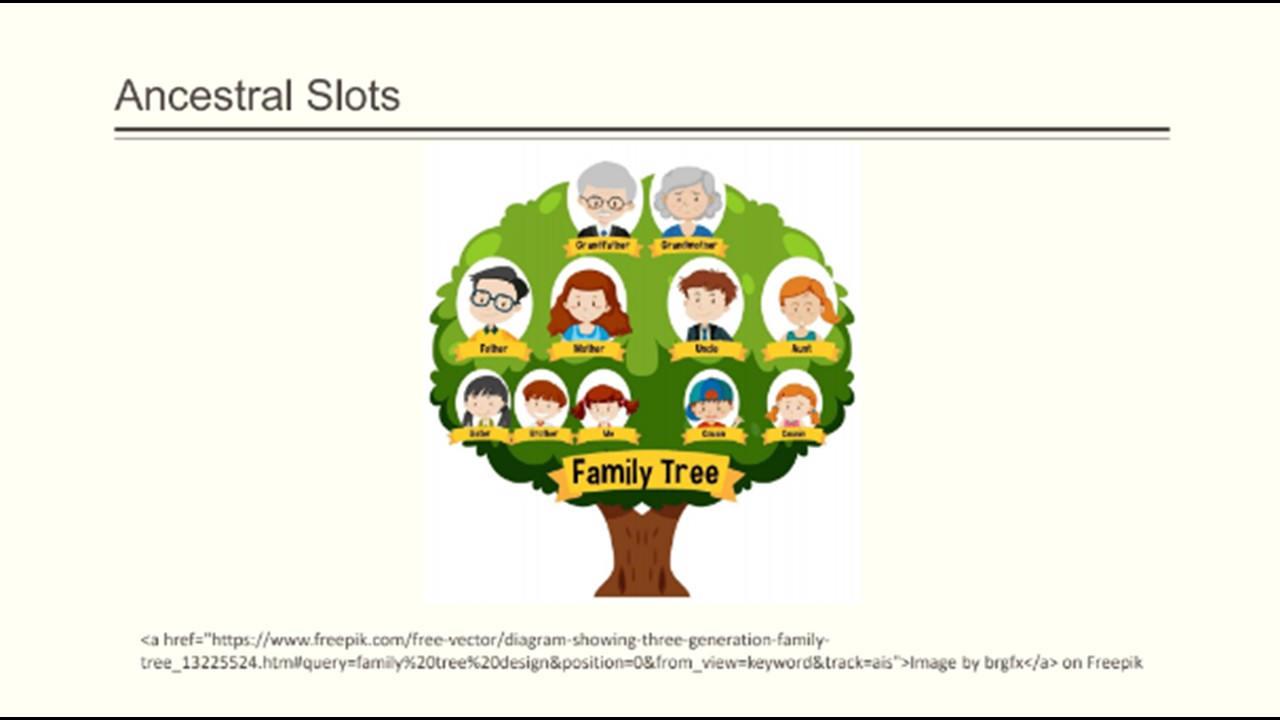
7. (ca. AD 372) Mormon 5:15: And also that the seed of this people may more fully believe his gospel, which shall go forth unto them from the Gentiles; for this people shall be scattered, and shall become a dark, a filthy, and a loathsome people, beyond the description of that which ever hath been amongst us, yea, even that which hath been among the Lamanites, and this because of their unbelief and idolatry.

Each quotation describes “how the Lamanites are.” While there is at least a possibility that the description was true when Nephi began this traditional stereotyping of the Lamanites, it was untrue by the time of Enos if not earlier. It is conclusively untrue in Alma where the story of the Anti-Nephi-Lehies discusses the many cities of the Lamanites (Alma 23:9–15).

Furthermore, these descriptions of the Lamanites as the opposite of the Nephites vanish as soon as the Lamanites cross the outsider/insider boundary. Once they are Nephites, they are fully and wholly Nephites, incorporating all of the “good” qualities of Nephites. Separation occurs with the label “Lamanite,” not because of skin color.

Note how Jacob uses the “filthy” label that accompanies “dark” in 1 Nephi 12:23 Mormon 5:15: “But, wo, wo, unto you that are not pure in heart, that are filthy this day before God; for except ye repent the land is cursed for your sakes; and the Lamanites, which are not filthy like unto you, nevertheless they are cursed with a sore cursing, shall scourge you even unto destruction” (Jacob 3:3). In normal reference, the Lamanites are “dark” and “filthy.” However, that “filthiness” is obviously a moral quality. At the point Jacob addresses his people, he applies this outsider label to them directly to highlight their adoption of outsider practices. (See commentary accompanying Jacob 3:3.)

Textual Evidence for Actual Skin Pigmentation: Does the Book of Mormon text contain events where distinguishing race by skin color becomes important? In order to remove the possibility that our assumptions are coloring our reading of the text, it is important to find locations in the text where the action of the text would create circumstances where a difference in pigmentation would be obvious. There is only one clear example.

Captain Moroni, working to free Nephite prisoners, sends wine to their Lamanite guards, hoping to intoxicate them (Alma 55). Because they would not accept such a gift from a Nephite, Moroni finds a Lamanite in his own troops, a former guard of the Lamanite king. Accompanied by other Nephites, this soldier takes the wine to the guards, and Moroni’s plan is successful. Of significance is the fact that Moroni had to “search” for a Lamanite soldier. Had he been “black” in contrast to the “white” of the Nephites, his identity should have been readily apparent. Furthermore, on his mission to the guards, Nephites accompany him. A color difference should have immediately been apparent to the guards, but they do not notice the discrepancy. The best explanation for needing an authentic Lamanite is that Moroni needed his language skills, not his skin color, for the ruse.

Book of Mormon Language about Skin Color: The curse is expressed in two antithetically parallel phrases: “as they were white, and exceedingly fair and delightsome the Lord God did cause a skin of blackness to come upon them” (2 Ne. 5:21). The phrases describe a previous condition and its succeeding condition, pivoting upon causation. Yahweh changed the Lamanites from what they had been to what they had become.

The before/after relationship is “fair and delightsome”/”skin of blackness.” Both conditions are structural opposites. “Fair and delightsome” contains no reference to either “skin” or “white.” It would be a mistake, however, to assume that their absence means they are not part of the oppositional pairing since they do appear in other contexts. For example, 3 Nephi 2:14–15 reads: “And it came to pass that those Lamanites who had united with the Nephites were numbered among the Nephites; And their curse was taken from them, and their skin became white like unto the Nephites.”

This reversal of the curse (not repeated here but “skin of blackness”) implies its opposite (articulated here): “skin became white.” The Lamanites have crossed the insider/outsider boundary, becoming those who were “united with the Nephites” and “numbered among” them. Because they have become Nephites, they therefore “became white like unto the Nephites.” This shift in skin of blackness to skin became white on the basis of a change from outsider to insider explains why the first appearance of the idea of the curse on the Lamanites has a different inception than this mention in 2 Nephi 5:21. In 1 Nephi 12:23, Nephi prophesies: “And I beheld, after they had dwindled in unbelief they became a dark, and loathsome, and a filthy people.” This is a reference to the Lamanites who survive the wars that destroy the Nephites (1 Ne. 12:19–20). In prophecy, Nephi places the darkness of the Lamanites over 1,000 years later than we find it in 2 Nephi 5:21. Why the discrepancy in time? There is no discrepancy. The condition of darkness comes with dwindling in unbelief. When that occurs, darkness falls—on their hearts and metaphorically on their skins. It is not a physical change and therefore does not have a specific point of inception. It is as accurate when described in 2 Nephi as it is prophetically at the end of Nephite culture.

Another example is the dark/white pairing from the 1830 first edition of 2 Nephi 30:6: “Their scales of darkness shall begin to fall from their eyes; and many generations shall not pass away among them, save they shall be a white and a delightsome people.”17 This verse parallels “fair and delightsome,” since “fair” and “white” are structural equivalents. Although the fair/delightsome pair occurs twice (2 Ne. 5:21, 4 Ne. 1:10) and white/delightsome occurs only once, nevertheless these phrases are repeating the same concept.

Fair/white is paired with dark/black in the antithetical parallel. The opposite of “delightsome” is “loathsome.” The term “loathsome is paired with “dark” in 1 Nephi 12:23 and is the reason for the cursing in 2 Nephi 5:22.18 The curse’s purpose is to set a social barrier between the two peoples. When the curse is operating and the Lamanites are outsiders, they are “loathsome” (the opposite of “delightsome”)—not desirable marriage partners. When they are insiders, they are “delightsome,” available as marriage partners. Just as the white/black or fair/dark terms function along the insider/outsider boundary, so too does the delightsome/loathsome dichotomy describe social repercussions.

Are these social functions metaphors or do they actually denote pigmentation? Alma 3:6 is the closest thing in the text to evidence for pigmentation change: “And the skins of the Lamanites were dark, according to the mark which was set upon their fathers, which was a curse upon them because of their transgression and their rebellion against their brethren, who consisted of Nephi, Jacob, and Joseph, and Sam, who were just and holy men.” This verse clearly indicates that Lamanite skin was dark and that it “mark[ed]” them, thus denoting some visible indication. The use of “mark” quotes Genesis 4:15, stating that God set a mark on Cain. E. A. Speiser, an archaeologist and Old Testament scholar, suggests that Cain’s mark was like other protective marks in the Old Testament, all of which were signs on the forehead.19 Ezekiel 9:4–6 describes literally marking the forehead as a protection: “And the Lord said unto him, Go through the midst of the city, through the midst of Jerusalem, and set a mark upon the foreheads of the men that sigh and that cry for all the abominations that be done in the midst thereof. And to the others he said in mine hearing, Go ye after him through the city, and smite: let not your eye spare, neither have ye pity: Slay utterly old and young, both maids, and little children, and women: but come not near any man upon whom is the mark; and begin at my sanctuary. Then they began at the ancient men which were before the house.”

According to Speiser, this mark is the letter taw, and none of the examples he cites refer to skin color. All refer to identifying letters.

What is the “mark” in the Book of Mormon? Alma 3:6 tells us that the mark was the curse (according to the mark which was set upon their fathers, which was a curse upon them), so the reference is circular. However, in the context of the Old Testament mark on the forehead we find:

Thus the word of God is fulfilled, for these are the words which he said to Nephi: Behold, the Lamanites have I cursed, and I will set a mark on them that they and their seed may be separated from thee and thy seed, from this time henceforth and forever, except they repent of their wickedness and turn to me that I may have mercy upon them.

And again: I will set a mark upon him that mingleth his seed with thy brethren, that they may be cursed also.

And again: I will set a mark upon him that fighteth against thee and thy seed. (Alma 3:14–16)

The mark is pigmentation if and only if the curse is pigmentation. Marking the forehead with paint appears to be sufficient to create an identifying “mark” that falls significantly short of altering body pigmentation. Possessing the mark cannot prove that the curse is skin color, because that would beg the very question that needs to be proved. The function of the mark is social separation, but it is the same insider/outsider barrier already discussed. Since the mark/curse can be removed by simply traversing that boundary, I conclude that it is unlikely that the mark or curse had anything to do with pigmentation.

Reinforcing the insider/outsider // white/black concept is Jacob 3:8, comparing the Nephites unfavorably to the Lamanites: “Unless ye shall repent of your sins . . . their skins will be whiter than yours, when ye shall be brought with them before the throne of God.” This passage associates skin with color, in this case, white. However, Jacob compares white/whiter, not white/black. How can Lamanites be whiter than the Nephites? Nephites cannot be Nephites and not be “white.” “White” defines the insider. Therefore, the Nephites do not become black. They are white by cultural definition. Nevertheless, in terms of righteousness, the Lamanites would be whiter. There is no change in the Lamanite skin color here. The Lamanites do not become righteous, they become comparatively righteous because of Nephite wickedness. That situation creates the need for a comparison, but since the Nephites cannot be “dark” the Lamanites by default become “whiter” than the Nephites. The logic of the passage relies upon the metaphorical use of the insider/outsider terminology to mean unrighteous/righteous. This is a marvelous rhetorical device because the collectivist perspective of this ancient culture would consider such a condition unthinkable.

3 Nephi 19:24–25 records another similar white/whiter occurrence during Jesus’s visit to the New World:

When Jesus had thus prayed unto the Father, he came unto his disciples, and behold, they did still continue, without ceasing, to pray unto him. . . .

And it came to pass that Jesus blessed them as they did pray unto him; and his countenance did smile upon them, and the light of his countenance did shine upon them, and behold they were as white as the countenance and also the garments of Jesus; and behold the whiteness thereof did exceed all the whiteness, yea, even there could be nothing upon earth so white as the whiteness thereof.

The disciples’ transforming spiritual experience makes them become “as white as the countenance and also the garments of Jesus.” This shade is not a natural skin color nor does anything in this passage encourage a “natural” interpretation. Its very point is the episode’s uniqueness. Nevertheless, “white” Nephites become even whiter. Obviously, the writer is not describing their skin color, but their spiritual state.

This comparison of white/whiteness also occurs in Nephi’s description of the tree: “I looked and beheld a tree; and it was like unto the tree which my father had seen; and the beauty thereof was far beyond, yea, exceeding of all beauty; and the whiteness thereof did exceed the whiteness of the driven snow” (1 Ne. 11:8).

The tree’s whiteness symbolizes righteousness or heavenliness. It is not intended to be a physical description. Similarly, I conclude that the association between skin and white/black is metaphoric, not intended to indicate pigmentation. Douglas Campbell, a professor of computer science at Brigham Young University, examined the textual uses of “white” in the Book of Mormon and concludes that the term is used metaphorically for purity and/or cleanliness.20 The metaphorical use of color terms echoes that of the Bible. Lamentations 4:7–8 (Revised English Version), ascribes metaphorical color to capture the before/after conditions of the Babylonian captivity:

Her crowned princes were once purer than snow, whiter than milk; they were ruddier than branching coral; their limbs were lapis lazuli.

But their faces turned blacker than soot, and no one knew them in the streets; the skin was shriveled tight over their bones, dry as touchwood.

Obviously no pigmentation change occurred as the “white” faces of the princes became “blacker than soot.” Here are two other examples:

Before their face the people shall be much pained: all faces shall gather blackness. (Joel 2:6)

She is empty, and void, and waste: and the heart melteth, and the knees smite together, and much pain is in all loins, and the faces of them all gather blackness. (Nahum 2:10)

The metaphor can also use “skin”: “When I looked for good, then evil came unto me: and when I waited for light, there came darkness. My bowels boiled, and rested not: the days of affliction prevented me. I went mourning without the sun: I stood up, and I cried in the congregation. I am a brother to dragons, and a companion to owls. My skin is black upon me, and my bones are burned with heat” (Job 30:26–30).

Even the reversal, becoming white, is a metaphor: “And some of them of understanding shall fall, to try them, and to purge, and to make them white, even to the time of the end: because it is yet for a time appointed” (Dan. 11:35).

Nibley observes: “This amazing coincidentia oppositorum is the clash of black and white. With the Arabs, to be white of countenance is to be blessed and to be black of countenance is to be cursed; there are parallel expressions in Hebrew and Egyptian.”21

Why should a metaphor of color describe the skin or face if it does not refer to pigmentation? Why should metaphorical righteousness/unrighteousness be manifest in a “color” of skin? It is not significantly different from ascribing emotion to the heart, which is an organ having no biological relevance to emotions at all. Underlying these biblical and Book of Mormon metaphors are the assumptions of the collectivist social world. Malina and Neyrey describe this mentality for the ancient Mediterranean cultures: “Human beings are distinctive in that they exhibit a considerable range of physical shapes, hues, and structures. Yet as in the case with other animate beings, the shape of the individual human more than adequately reveals the type of personality he or she can be and explains his or her ‘nature.’ For humans, too, anatomical form determines behavior and reveals the nature of the human being in question.”22

In the Mediterranean world the understanding of personality through physical characteristics was called physiognomics. Malina and Neyrey note:

Physiognomics, then, is the study of human character on the basis of how people look and act. . . . A succinct definition of “physiognomics” can be found in Pseudo-Aristotle’s Physiognomics, a work dating to before the first century BC. This treatise offers a set of stereotypes of human character based on: “the natural and acquired character traits that affect the signs studied by physiognomists . . . a person’s movements, postures, colors, facial expressions, hair, type of skin, voice, flesh-tone, parts of the body and overall physique.” (Pseudo-Aristotle, Physiognomics 806a, our translation). . . .

The task, then, is pragmatically to observe the dispositions (dianoiai), that invariably correlate with specific forms. This gives salience to the old sayings, “Birds of a feather flock together” and “A man is known by the clothes he wears” or “the company he keeps.”23

Such an idea runs counter to modern constructions of human beings as individuals, but it reflects accurately, I believe, the different social view of Nephi’s world. Malina and Neyrey continue: “When considering a person, the ancients thought that there was really nothing inside that did not register on the outside.”24 In this conception of humanity, the skin or face would be the logical location for spiritual characteristics to register. Even metaphorically, the skin and face were legitimate locations for the “display” of these spiritual characteristics.

What can we say about how the “skin of blackness” was perceived by those who wrote our Book of Mormon? Armand Mauss, a professor emeritus of sociology and religion at Washington State University, discusses the assumption of those who are critical of the Book of Mormon:

Although Joseph Smith presented the Book of Mormon to the world as his translation of an ancient document, it is generally regarded by non-Mormons as a nineteeth-century product, whether or not it was divinely inspired. Accordingly, passages like those excerpted above [concerning dark skin] are taken as simply reflections of nineteenth-century American racist understandings about the origins of various peoples of color. Such conventional wisdom seems justified both by the mysterious provenance of the Book of Mormon itself and by the meanings that Mormons themselves have traditionally attributed to such passages. Yet it is not entirely certain that Joseph Smith himself or even most others of his immediate family and contemporaries would have understood these passages in quite the same literal sense that modern readers have.

As one consideration, the Book of Mormon does not use the term race at all. In an 1842 letter (known in Mormon history as the Wentworth letter), the one recorded case in which Smith used the term in reference to the Book of Mormon, he was distinguishing not between Lamanites and Nephites but between them and the Jaredites, all of which parties he obviously considered to be peoples of the same Semitic origin. Furthermore, Smith, before his death, had begun replacing the seeming skin-color references with terms that clearly referred instead to spiritual quality. Finally, a comprehensive review of the Book of Mormon text as a whole shows that it uses white almost always as a figurative synonym for pure, clean, luminous, and similar concepts, not in reference to such “racial” traits as skin color.25 (emphasis his)

The “skin of blackness” was certainly intended to be a pejorative term, but it was not a physical description. Modern readers may be uncomfortable with Nephite racial prejudices, but they existed. They were not, however, based on skin color as has been part of the more modern U.S. culture. Nephite prejudices were developed on distinctions more common to the ancient world and used reasons other than pigmentation.

Notes

1William Smith, Smith’s Bible Dictionary (Old Tappan, N.J.: Fleming H. Revell, 1970), 376–77.

2Skousen, Analysis of Textual Variants, 4–2:897, appears to follow the suggestion that there was a physical change in skin color. Discussing the change of white to pure in 2 Nephi 6:30 for the 1840 edition, he notes: “Of course, the 1840 change of white to pure avoids . . . the need to interpret the remnant of the Nephites as being dark skinned. In other words, the editing change to pure may represent a conscious attempt at avoiding what was perceived as a difficult reading (the Nephites as being dark skinned), which therefore explains why the change from white to pure was made here—and only here—in 2 Nephi 30:6. There has never been any attempt to emend any of the passages that directly comment on the dark skin of the Lamanites.”
Skousen’s argument for the reason for the editorial change is persuasive. It persuades, however, that the reader’s understanding of the text related to a change in pigmentation. It does not discuss the point made in this commentary of the text’s use of skin as a metaphor rather than as a literal description.

3Milton R. Hunter, Archaeology and the Book of Mormon (Salt Lake City: Deseret Book, 1956), 191.

4Rodney Turner, “The Lamanite Mark,” in Second Nephi: The Doctrinal Structure, edited by Monte S. Nyman and Charles D. Tate Jr. (Provo, Utah: BYU Religious Studies Center, 1989), 138. While Turner reads the statement of pigmentation change literally, he does not read the word “blackness” literally: “The expression ‘skin of blackness’ does not necessarily, or even probably, mean a black skin, only a darker skin. The pre-flood people of Canaan (Cain’s posterity) had a ‘blackness’ come upon them after the Lord cursed their land ‘with much heat’ (Moses 7:8). After Enoch’s city was translated from the earth Enoch beheld that ‘the seed of Cain were black’ and were separate from all other peoples (Moses 7:22). I believe that ‘blackness’ and ‘black’ are not synonyms and that the Lamanite mark was only a relatively darker pigmentation, not a literally black skin. By the same token, a ‘white’ skin is only relatively so (Jacob 3:8).” Ibid., footnote 2.

5Armand L. Mauss, All Abraham’s Children: Changing Mormon Conceptions of Race and Lineage (Urbana: University of Illinois Press, 2003), 30.

6Sorenson, An Ancient American Setting for the Book of Mormon, 90.
This same assertion is found in Daniel Ludlow: “This is the only reference in the entire Book of Mormon where a definite color adjective is used to refer to this mark. All other references call it, a ‘skin of darkness’ or a ‘dark skin.'” Daniel H. Ludlow, A Companion to Your Study of the Book of Mormon (Salt Lake City: Deseret Book, 1976), 132. The assertion about “all other references” is the same as Sorenson’s, but Ludlow adds the assertion that there is a reference to “dark skin.” Only Alma 3:6 suggests that Lamanite skins were dark. There are other indications that the Lamanites were dark (1 Ne. 12:23; Morm. 5:15). These two references to the Lamanites (as opposed to their skin), both indicate a trilogy of attributes: “dark, filthy, loathsome.” The repetition of that specific trilogy suggests that it is a formulaic epithet.

7For the color change relating to sun exposure, see: Hugh Nibley, Teachings of the Book of Mormon—Semester 1: Transcripts of Lectures Presented to an Honors Book of Mormon Class at Brigham Young University, 1988—1990 (Provo, Utah: Foundation for Ancient Research and Mormon Studies, 1993), 244. For the metaphorical meaning of “blackness,” see ibid., 287, and Hugh Nibley, Lehi in the Desert and The World of the Jaredites (Salt Lake City: Bookcraft, 1952), 84–85.

8Bruce J. Malina and Richard L. Rohrbaugh, Social-Science Commentary on the Synoptic Gospels (Minneapolis, Minn.: Fortress Press, 1992), 3, 18–19.

9Ibid., 10.

10Ibid., 13–14.

11“Sun and Clouds: The Sun in History,” http://www.chemheritage.org/EducationalServices/pharm/ chemo/readings/tsih.htm (accessed January 2004).

12Mauss, All Abraham’s Children, 128.

13John A. Tvedtnes, “The Charge of ‘Racism’ in the Book of Mormon,” FARMS Review 15, no. 2 (2003): 183–197, argues against the common allegation of racism in the modern pejorative sense rather than the more ancient sense for which I argue here.

14Malina and Neyrey, Portraits of Paul, 102.

15Ibid., 106.

16Ibid. Malina and Neyrey described Israelite culture about six hundred years after Nephi. Nevertheless, Malina, writing with another coauthor, feels that this cultural phenomenon has endured for the intervening two thousand years and would, hence, probably agree that it was in place at Nephi’s time as well: “In the circum-Mediterranean region, five millennia of common participation in conquest, colonialism, connubium, and trade, along with a mixed, small-scale farming and herding village economy embedded in a series of larger agrarian empires, created a set of common cultural institutions that have likewise persisted over time. The resulting ‘Mediterranean culture-continent’ exists yet today.” Malina and Rohrbaugh, Social-Science Commentary on the Synoptic Gospels, 4.

17The 1981 (current) edition of the Book of Mormon changed “white” to “pure,” following the 1840 edition. The constructions examined here suggest that “white” would actually be a better translation but that the meaning is essentially equivalent to “pure.”

18The parallel in the phrasing indicates the parallel in the intent, even though the 1 Nephi 12:23 passage refers to an event over 1,000 years in the future to the discussion in 2 Nephi 5:21.

19E. A. Speiser, Genesis, Anchor Bible (New York: Doubleday, 1981), 31, citing Exodus 13:16; Deuteronomy 6:8, 11:18; Ezekiel 9:4, 6. In Exodus 28:36–38, Aaron has a mark meaning “Holiness to the Lord” on his “mitre,” or headdress, worn over the forehead.

20Douglas Campbell, “‘White’ or ‘Pure’: Five Vignettes,” Dialogue: A Journal of Mormon Thought 29, no. 4 (Winter 1996): 132–134.

21Nibley, Lehi in the Desert, 71.

22Malina and Neyrey, Portraits of Paul, 100.

23Ibid., 109.

24Ibid., 108.

25Mauss, All Abraham’s Children, 117–18.

The Tempest in a Teapot: DNA Studies and the Book of Mormon


PUBLICATIONS
Brant A. Gardner

The Tempest in a Teapot
DNA Studies and the Book of Mormon

There has been a tremendous flurry of media attention over the scientific study of human genetic inheritance and the Book of Mormon. That attention has swirled around declarations made by Thomas W. Murphy, a doctoral candidate in anthropology, and current chair of the anthropology department at Edmonds Community College in Washington. The storm clouds can be seen in a news article in the Los Angeles Times that says of Mr. Murphy:

His conclusion is that “the Book of Mormon is a piece of 19th century fiction,” said Murphy, a lifelong Mormon who calls himself a Latter-day skeptic. “And that means that we have to acknowledge sometimes Joseph Smith lied.”1

It is no wonder that with such conclusions it would appear that dark clouds are forming on the horizon of the Book of Mormon. The clouds appear especially dark when Murphy asserts that his conclusions are supported by modern science. Could it really be that science is proving the Book of Mormon wrong? This is Murphy’s conclusion, but it is a conclusion that does not flow from the evidence examined. Critics of the Book of Mormon have come to the same conclusion as Murphy since the book was first published. The difference is that Murphy is claiming a new basis for his conclusion.

It is important to remember that Mr. Murphy is not citing his own original research in genetics, but rather library research into the work of others. He is synthesizing conclusions from his reading. This is a critical difference, for it helps us understand why the researchers can be right, but Mr. Murphy can be mistaken in his reading of those researchers. It will help us explain why Dr. Michael Whiting, an Evolutionary Biologist at Brigham Young University and “an authority on DNA”2 does not believe that Mr. Murphy has his science right.3 This is not a statement of fault in scientific method, because Murphy is not engaged in this type of work. It is rather a statement that his conclusions are not consonant with the science. When we examine the nature of the data available, we find that Murphy’s particular conclusion does not flow from those data. He has asked the wrong questions of his data, and by asking the wrong questions, returns the wrong answers.

It should be understood by the reader that this article is not intended to be a review of Murphy’s media-attention-grabbing essay, but an assessment of the available genetic data and it’s implications relative to the Book of Mormon, in light of claims made by Murphy and other critics of the Book of Mormon.

To understand why Murphy’s conclusions do not derive from the data, it is important that we understand what the DNA research can and cannot do. After we understand the science, we must correctly understand the Book of Mormon. Only with this foundation established, will we be able to make correct conclusions based on the data.

What can historical genetics do?

There are large numbers of different types of studies concerning DNA. To keep them straight, we will confine ourselves to discussing those aspects of DNA research that look at the historical ties of biology, or “historical genetics” as a shorthand description. The short response to the question of what historical genetics and DNA research can do is that it can do wonderful things. The uniqueness of various aspects of human DNA has led to the ability of DNA tests to positively identify the physical remains of unknown victims of accidents. Since we inherit our DNA from our parents (and they from theirs), DNA can be used to trace biological family ties.4 One of the more fascinating family connections came from the examination of a nine-thousand-year-old skeleton in England (known as Cheddar Man), whose direct genetic descendant was found living in that very vicinity.5 It is important to remember with this study, however, that it took a specific skeleton and matched it to a specific person through the use of multiple genetic “markers.” It did not find the relationship by beginning with the modern man and tracing him back to the skeleton.

Scientists have used the biological chemistry of genetic inheritance to trace certain sets of genetic materials that are shared widely through related populations. By examining particular pieces of DNA (markers) that are common, scientists may reconstruct the line of descent, or “umbilical line” that shows how that inherited marker traveled through time back to an early common ancestor.6 One study has traced mitochondrial DNA, which is inherited only from females, all the way back to a “genetic Eve.” It is this type of research that Murphy is citing in his survey of the current research. These are remarkable new tools in our historical kit, and they do wondrous work. The real issue is to understand what they cannot do.

What can historical genetics not do?

Perhaps the most important caution about historical genetics is that it cannot yet say that all of the data have been collected and examined. For instance, in a recent radio interview, Dr. Scott Woodward, a professor of microbiology and head of the Molecular Genealogy Research Group at BYU,7 was asked about a study that indicated that the Ojibwa Indians possessed a genetic marker that was of unusual origin and appeared to indicate a possible European connection that was pre-Columbian. The study was published in 2001. That should be current science, shouldn’t it? Dr. Woodward noted that more recent work has found that marker in Asia,8 highlighting the rapidly advancing and changing state of this particular science, and highlighting the difficulty of stating any conclusion as dramatically final as Murphy has. This is important not only because we should understand that our information is not complete, but because it also illustrates an important difference between researchers in a field and those who simply report on the research of others. Those who actually do the work typically show much more restraint in the types of conclusions they draw from the data. As witness to this caution, Dr. Woodward notes (speaking specifically of tracing back tot he Book of Mormon’s Old World immigrants):

Have we made an adequate survey of the ancient population from which these individuals derived? No, we haven’t. We’ve been very limited in our observation of the population structure based on mitochondrial DNA because there have been a number that have gone extinct. Perhaps the sampling isn’t large enough; it doesn’t contain all of the mitochondrial DNA types in a population. So, there are some real challenges in trying to reconstruct the past genetic patterns based on modern, present day DNAs that are collected.9

Equally important, however, is that we must understand correctly what science is telling us. In the case of the “genetic Eve,” the popular understanding of the science was that mankind had been traced back to a single woman, hence the “Eve.” Similar to Murphy’s work, that conclusion was not made by those doing original research, but by people reading that research and making spectacular (and unwarranted) conclusions. The reality of the science is slightly different. Rather than the image of this single progenitor of humanity, we have a single progenitor of a surviving line of mitochondrial DNA. It is a difference that is easy for the non-professional to miss. Dr. Stephen Oppenheimer discussed this misperception of what this line of genetic research could do in the context of the “genetic Eve:”

The confusion is to see genetic lines too literally as representing individual humans. The so-called “genetic Eve” was the ancestral mitochondrial genetic line for all modern living humans. Obviously it was carried ultimately by one real woman over 150,000 years ago. But she was only the common ancestor for mitochondrial DNA. She did not carry all the rest of our ancestral genes. We have 30,000 functioning genes and they could each have had a different individual ancestor living at different times in different places.

The mitochondrial Eve was therefore one woman among thousands living over 150,000 years ago. Our other genes derive from our members of that ancestral population. The real importance of the mitochondrial genetic tree is that it gives a clear line of descent that can be used as a trail marker of our spread round the world. But it is only one particular tiny part of our huge human genome.10

The scientific use of historical genetics is tracing the spread of humanity throughout the world. It can be used to discuss the flow of populations, but not the complete definition of populations. The “genetic Eve” can be used to discuss the direction of human migrations, but cannot be used to posit a single female ancestor. As Dr. Oppenheimer notes, there were thousands of other women living at the same time as this “Eve,” whose mitochondrial line is the only one that survived to the present. The inherent problem with tracing historical lines is that they can only trace the information that survives. Dr. Woodward highlighted this very point in his discussion at the FAIR Conference in August of 2001:

If you see a traditional genealogy chart as you would construct it, often we have the males on top and the females going down the bottom. You can see the Y chromosome line going across the top. We can identify the males in that line based on your Y chromosome because it will all be the same. Likewise, we can identify all of the females on the mitochondrial line that comes down across the bottom because they will all be the same. But at this level of, 16 individuals, we’ve only identified two of the 16 and we’ve only analyzed the contribution of 1/8 of the ancestors of that individual by looking at the Y chromosome and the mitochondrial DNA. You need to keep that in mind when you read and see a lot of the DNA studies that have been done, out there on mitochondrial DNA or on Y chromosomal DNA. Understand that the picture that you are getting with that alone, is a very small part of the picture. Because at the next generation … it’s 1/16. At the next generation it’s 1/32 of the information that you have.11

The nature of the genetic research is necessarily reductive. To trace something back into the past one can match only the information that survives, and the information that reconstructs into the past becomes smaller and smaller. There is a parallel in the world of historical linguistics, which similarly works with present data to reconstruct historical information. Linguists can reconstruct some of the vocabulary of ancient populations based upon the survival of various words into the modern languages descended from that earlier language and population. However, the reconstructed vocabulary is in the hundreds of words if they are lucky. The actual vocabulary of that people would have been in the tens of thousands of words. Those other words existed, just as did all of the other women at the time of the “genetic Eve.” The problem is that the traces of the other words and the other women have died out.

Another aspect of the analogy to historical linguistics is that data are reconstructed to particular time levels. While reconstructions exist for many different times, it is inappropriate to make comparisons from widely different time depths without carefully correlating the data. Collapsing time periods leads to inaccurate conclusions. This type of interpretive error in reading the data is not unusual in the readers and second-hand interpreters of the data, not the original researchers. This same problem of “time depth” exists in the science of historical genetics. Dr. Woodward specifically cautions:

I noticed in the conference last week that was referenced that there were some papers and some discussion on DNA. I think there were some very good things that were said there but I also have some concerns in that there was some mixing of the data across time scales that may not be appropriate. There is a lot of mitochondrial evidence that has to do with population structure very deep in the past; ten-, fifteen-, twenty-, thirty-, one hundred thousand years ago. The experiments that were set up to look at those were set up correctly to be able to answer those questions in those time frames. If we then extrapolate those to the very recent past, the last two- or three- or four thousand years, I think we have to be very careful in extrapolating some of those results.12

The science on which Mr. Murphy is basing his conclusions is valid in the same way that Dr. Woodward discussed the underlying data of the papers in the referenced conference. The problem is not the science that produced the data. The problem is in the way one uses the disparate data to come to conclusions. With this background we can now turn to the application of historical genetics to the Book of Mormon.

What does historical genetics say about the Book of Mormon?

At this point we should carefully examine Mr. Murphy’s conclusions in the published article that provides the support for those conclusions. He says:

Now that quantitative scientific methods can indeed test for an Israelite genetic presence in ancient America, we learn …that virtually all Native Americans can trace their lineages to the Asian mi-grations between 7,000 and 50,000 years ago. While molecular an-thropologists have the technological capability to identify descen-dants of ancient Hebrews, no traces of such DNA markers have appeared in Central America or elsewhere among Native Americans…

From a scientific perspective, the Book of Mormon’s origin is best situated in early nineteenth-century America, and Lamanite gen-esis can only be traced historically to ca. 1828. The term Lamanite is a modern social and political designation that lacks a verifiable bio-logical or historical underpinning linking it to ancient American In-dians. The Book of Mormon emerged from an antebellum perspec-tive, out of a frontier American people’s struggle with their god, and not from an authentic American Indian perspective.13

The problems begin with the very first phrase. He says, “Now that quantitative scientific methods can indeed test for an Israelite genetic presence in ancient America…” Murphy poses this as a given, a fact. It is a “fact” that Dr. Woodward, a researcher in the field, does not accept:

What did the genes of Lehi look like? How do we find out today what the genes of Lehi look like? I think that’s a valid question to ask. Second is, who would you compare them with in living populations today? Where would you go to make the comparison? Would you go to modern day Israel today? What is the genetic composition of Israeli Jews today? Is it the same as it was two thousand years ago? Three thousand years ago? I would argue that it’s not. Do we understand the population dynamics? What kinds of selection factors have been involved?14

For his part, Murphy bases part of his “fact” on the kind of popular thinking that created a single “Eve” instead of the more accurate population of which that ancestor was one representative. In discussing one of the genetic markers used to identify “Israelites,” he notes: “Researchers have uncovered distinctive genetic markers on the Y-chromosome that are useful in establishing linkages between ancient and contemporary Hebrew populations.”15 The science was done correctly, but Murphy gives a dramatic reading of that science that suggests that we may now identify any possible remnant of an ancient Israelite population. That conclusion overreaches the data. What Murphy fails to make clear is that these are reconstructed markers. They go from the present to the past. They are not like the example of the Cheddar Man where the historical is compared to the present. Reconstructions are reductive. Finding one does not indicate that we have an ability to discern any Israelite heritage, hence the difference in the statements made by Murphy and Dr. Woodward. In this case, it should be clear that given the choice we should accept the caution of someone who does professional original research in the field over one who is simply extracting conclusions from written studies.

Disproving the Book of Mormon or Mythology?

Murphy’s next statement in his conclusion is “that virtually all Native Americans can trace their lineages to the Asian mi-grations between 7,000 and 50,000 years ago.” The implication is that since we are able to trace Asian migrations, and we haven’t found distinctive Hebrew DNA, that therefore the Book of Mormon cannot be true. In this, Murphy comes close to a correct conclusion, but not quite. It is very common among long-time Latter-day Saints who were born into the Church to assume that the Book of Mormon describes the origin of all of the American Indians. That it is common, however, does not mean that it squares with what the Book of Mormon actually says. In fact, it does not.

Additionally, this understanding among long-time Latter-day Saints does not indicate that this is a doctrine of the Church. Nevertheless, it provides an easy target for Murphy and anyone else who would attempt to apply “science” to the Book of Mormon. As opposed to Murphy disproving the foundation of the Book of Mormon claims, he has simply identified a mistaken assumption of some lay-members about the Book of Mormon, which is not a new discovery. LDS Book of Mormon scholars have held such a view for years, long before Murphy was even born.

Is it true that, as Murphy writes, “…virtually all Native Americans can trace their lineages to the Asian mi-grations between 7,000 and 50,000 years ago.” It is true enough. What does this tell us? We may correctly conclude from the evidence that the popular opinion long held among Latter-day Saints that the Book of Mormon explains the origins of all Native American populations is mistaken. We may not conclude from that same evidence, however, that the Book of Mormon is incorrect. What is the difference?

Again, Mr. Murphy seems to present the results of his research as though this information about the hemispheric interpretation of the Book of Mormon is somehow new. The information about the Asian migrations into the New World is hardly new, and the faithful LDS scholars of the Book of Mormon have had that very understanding for a minimum of fifty years.16 The use of DNA evidence is new, but it doesn’t tell us anything that was not already known about the Book of Mormon. In fact, a good result of this public attention will be that the general population of LDS will more rapidly come to understand the actual historical foundations of their sacred text rather than the mythology that has grown up around it.

It is not surprising that the popular understanding of the Book of Mormon should come more from what people thought about it than what it said about itself. As Terryl L. Givens notes concerning the early use of the Book of Mormon in the Church:

Looking at the Book of Mormon in terms of its early uses and reception, it becomes clear that this American scripture has exerted influence within the church and reaction outside the church not primarily by virtue of its substance, but rather its manner of appearing, not on the merits of what it says, but what it enacts. Put slightly differently, the history of the Book of Mormon’s place in Mormonism and American religion generally has always been more connected to its status as signifier than signified, or its role as a sacred sign rather than its function as persuasive theology. The Book of Mormon is preeminently a concrete manifestation of sacred utterance, and thus an evidence of divine presence, before it is a repository of theological claims.17

This tendency of Church members, in general, to use the fact of the book rather than the text of the book has finally given way to an intense study of the text as a text. One of the earliest results of that research into what the book says about itself led to a reassessment of the relationship of the Book of Mormon to the geography, and therefore history, of the New World. That we should learn more through a concerted study of the Book of Mormon should be no surprise. The Church has never proclaimed that it possessed all truth, all at once. In the case of the Book of Mormon, recent research is anchored in the text itself.

Dr. John E. Clark, an anthropologist at BYU, noted:

From textual evidence, one can approximate some spatial relationships of various natural features and cities. Distances in the Book of Mormon are recorded in terms of the time required to travel from place to place.18

The results of careful study of what the Book of Mormon actually says about itself tells us that it covers an area dramatically smaller than the western hemisphere. John L. Sorenson notes:

We can now be certain that the Book of Mormon story took place in a limited portion of the western hemisphere shaped roughly like an hourglass. The size of that territory was measured in hundreds, not thousands, of miles. The movements of peoples, the individual journeys, and the times involved in travels recorded in the scripture fit reasonably in a land southward around 350 miles long and not much more than half that wide at one point north of Zarahemla. The land northward is less well specified but seems not so long.19

That this more accurate understanding of the Book of Mormon may be seen as the more “official” understanding of the Church may be seen from both the publication of this information about the Book of Mormon in the Ensign in 198420 as well as in the article on “Book of Mormon Geography” in the Encyclopedia of Mormonism.

This deeper understanding of the internal geography of the Book of Mormon tells us that when we learn that the traditional hemispheric interpretation of the text is incorrect, it has no relevance to the Book of Mormon itself, because the text never says that. Part of Murphy’s conclusion is incorrect simply due to his mistaken assumption that the data contradict the Book of Mormon, when they really speak only to the mythology we have created around the Book of Mormon. Science does not prove the Book of Mormon wrong, because the science is not addressing the particular history of the Book of Mormon.

Is the Lack of Evidence…Evidence?

There is, of course, more to the story. Murphy’s next error in his conclusion is to assume that the absence of evidence equates to the impossibility of existence of peoples described in the Book of Mormon. There are two important points to understand concerning this erroneous assumption. The first is the probable nature of the mixing of early populations in the Book of Mormon, and the second is that the reductive nature of the evidence cannot dismiss the possible presence of valid genetic lines that have been lost.

It has been understood from the beginning of this serious study of the Book of Mormon that there were people here when the Lehites arrived; lots of people. When we remember the small numbers of people mentioned in any of the Book of Mormon immigrations into the New World,21 we have a picture of a much smaller population entering an existing population that is significantly larger.22 This more accurate picture of what the Book of Mormon says must now be compared to the correct understanding of the scientific data so that we can understand just what historical genetics does and does not say about the Book of Mormon.

The first complication comes from the simple facts of inheritance. Steve Olson, a science journalist, reports the following:

In a 1999 paper titled “Recent Common Ancestors of All Present-Day Individuals,” Chang showed how to reconcile the potentially huge number of our ancestors with the quantities of people who actually lived in the past. His model is a mathematical proof that relies on such abstractions as Poisson distributions and Markov chains, but it can readily be applied to the real world. Under the conditions laid out in his paper, the most recent common ancestor of every European today (except for recent immigrants to the Continent) was someone who lived in Europe in the surprisingly recent past–only about 600 years ago. In other words, all Europeans alive today have among their ancestors the same man or woman who lived around 1400. Before that date, according to Chang’s model, the number of ancestors common to all Europeans today increased, until, about a thousand years ago, a peculiar situation prevailed: 20 percent of the adult Europeans alive in 1000 would turn out to be the ancestors of no one living today (that is, they had no children or all their descendants eventually died childless); each of the remaining 80 percent would turn out to be a direct ancestor of every European living today.23

The mathematics of descent and mixing populations tell us two things. The first is that we seem to be related to virtually everyone else if we go back only 600 to 800 years. The second is that even though we are related, we can only trace a portion of that line of descent. The reductive nature of the research lops off huge branches of our ancestral tree and creates a simple ancestry out of what was, in reality, a tangled one. This should indicate the need for great caution in the way we understand historical genetics, particularly making conclusions on the absence of an “umbilical line.”

This caution becomes more relevant to the types of studies upon which Murphy is basing his conclusions because they also represent this streamlined view of genetic ancestry. When Murphy adamantly proposes the lack of non-Asian immigration before European contact, he is drawing a conclusion not supported by the data. The data actually say that the traceable origin is Asia. This flow of migration is the proper conclusion from the data, as Dr. Oppenheimer noted above. The data do not, and cannot, say anything about any peoples who did not come from Asia, but whose genetic lines cannot be traced because of the vicissitudes of genetic survival.

The most important indication that there is important genetic material that has been lost comes from the recent analysis of skeletal remains from Mexico. Tests indicate that the remains are nearly 13,000 years old. What is most important is what they tell us about migration pattern:

The two oldest skulls were “dolichocephalic” – that is, long and narrow-headed.

Other, more recent skulls were a different shape – short and broad, like those from native American remains.

This suggests that humans dispersed within Mexico in two distinct waves, and that a race of long and narrow-headed humans may have lived in North America prior to the American Indians.

Traditionally, American Indians were thought to have been the first to arrive on the continent, crossing from Asia on a land bridge.

Dr Gonzalez told BBC News Online: “We believe that the older race may have come from what is now Japan, via the Pacific islands and perhaps the California coast.24

The skull shapes tell us that there is a different genetic type making its migration into the New World. One of these types is more Caucasoid than Asian, as witnessed by the Kennewick Man.25 Similarly, a very Caucasian population existed in part of Asia where their well-preserved mummies clearly declare them distinct from the Asian populations that later inhabited that area.26 These findings complicate the genetic inheritance, as they either demonstrate how much genetic information may be lost, or that our definitions of Asian may have to be re-written to include populations that are not typically thought of as Asian. They also highlight that there is a difference in describing an Asian location and declaring “Asian” as a genetic type. The archaeological evidence tells us that these peoples existed in these places, but we appear to have lost their genetic inheritance.

Conclusion

The applicability to the Book of Mormon should be evident. The current state of historical genetics tells us what we already knew: the Book of Mormon does not explain the origins of all of the natives of the western hemisphere. However, it is no contradiction to the Book of Mormon, because that isn’t what the Book of Mormon says. It is no contradiction of official Church doctrine, because the Church never had an official doctrine on Book of Mormon geography (or genetics), in spite of the rather obvious popular beliefs.27 Historical genetics cannot say anything about the current understanding of the text because the limited contributions of Book of Mormon Old World genetic material was both small and long enough ago that there are any number of reasons why it could have disappeared from the traceable genetic lines that have currently been discovered.

There certainly are media storm clouds on the horizon, but they are more threat than real tempest. This media attention is really no more than a tempest in a teapot, and what rain comes from it may have the beneficial effect of washing away some traditional assumptions Mormons have held about their sacred volume that really do need to be replaced with a more solid understanding of what that text really says.

Notes

1 William Lobdell and Larry B. Stammer, “Mormon Scientist, Church Clash Over DNA Test,” Los Angeles Times (December 8, 2002), A21.

2 Ibid.

3 Ibid. Dr. Whiting responded to a statement by Maxine Hanks that Murphy was like Galileo. Dr. Whiting stated: “It’s an inappropriate comparison. The difference is Galileo got the science right. I don’t think Murphy has.” It should also be noted that Whiting’s DNA research has been featured in the weekly science journal, Nature (cover story, January 16, 2003).

4 The most powerful uses of DNA are to show biological relationships between an unknown and a known person. The issue of tracing biological families is the issue that will be discussed as we understand what DNA studies cannot do.

5 http://www.chattanooga.net/cita/mtdna.html

6 Thomas H. Roderick, PhD, uses the term “umbilical line,” http://genealogy.about.com/library/blchattrans-roderick.htm.

7 Dr. Woodward is a professor of microbiology and faculty member of the Molecular Biology Program at Brigham Young University. He is also head of the Molecular Genealogy Research Group at BYU. While completing his postdoctoral work in molecular genetics at the Howard Hughes Medical Institute at the University of Utah, he discovered a genetic marker used for the identification of carriers and the eventual discovery of the gene for cystic fibrosis. He was also involved with the identification of other gene markers for colon cancer and neurofibromatosis. He joined the faculty at BYU in 1989 and has been involved with several excavation teams in Seila, Egypt. While in Egypt, he directed the genetic and molecular analysis of Egyptian mummies, both from a commoners’ cemetery and from Egyptian Royal tombs. Dr. Woodward has been the Scholar in Residence at the BYU Center for Near Eastern Studies in Jerusalem and a visiting professor at Hebrew University. His work has been featured both nationally and internationally on numerous programs including Good Morning America and both the Discovery and Learning Channels.

8 KUER: Radio West. “Science & Foundations of the Book of Mormon.” Interview: Terryl L. Givens, Thomas Murphy and Scott Woodward. Host: Doug Fabrizio. Salt Lake City, December 19, 2002.

9 Scott Woodward. “DNA and the Book of Mormon.” Presented at the FAIR Conference, August 2001. Dr. Woodward continues: “There are some ways that we may be able to approach that. And this is one of the approaches that we have taken in our laboratory at BYU. I wish that I could say that this was the magic bullet, and that it was going to be able to answer all our questions concerning ancient populations, but it turns out that the ability to recover ancient DNA and get useful information out of it is extremely difficult. It can be done. We have been able to do that in a number of limited situations. But for the most part, its going to be very difficult to go back in the past a thousand years, two thousand, four, five, ten, twelve, and recover DNA from individuals and say something about their ancient population structures.”

10 “The Real Eve.” Answers to questions by Dr. Stephen Oppenheimer. DiscoveryChannel.com http://dsc.discovery.com/convergence/realeve/ask/ask.html.

11 Woodward, “DNA and the Book of Mormon.”

12 Ibid.

13 Thomas W. Murphy, “Lamanite Genesis, Genealogy, and Genetics,” American Apocrypha, edited by Brent Metcalfe and Dan Vogel (Salt Lake City: Signature Books, 2002), 68.

14 Scott Woodward, “DNA and the Book of Mormon.” It is worth noting that when Woodward asks about Lehi’s genetics, he is clearly referring to Lehi and his group (i.e. his wife, sons, daughters, their spouses and children) and not Lehi, the individual, only. Certainly, identifying Lehi’s mitochondrial DNA would be useless, as it would not be passed down to his posterity. The mitochondrial DNA of his wife, daughters, and his son’s wives would indeed be important. Dr. Woodward makes that distinction in his presentation. Dr. Woodward continues: “How much of Lehi’s mitochondrial DNA would you expect to see in Native Americans? That’s a trick question but you should know the answer because we just talked about it. Zero-right? It would be Sariah. Is that true? Why? Why is that true? Who were Sariah’s children? Sariah’s children were Laman, Lemuel, Nephi, Sam, Jacob, and Joseph. Do you see any mitochondrial carriers there? No, although in 2 Nephi, Chapter 5, Nephi mentions his sisters, so perhaps there were a couple of Sariah’s daughters that survived and that then would produce a possibility but who would that be? Who would then be mitochondrial donors for these people who came from the Middle East? The wife of Ishmael, right? Who was the wife of Ishmael…So in reality, one of the questions we have to ask is, “What would we expect to see?” So how can we know whether or not we have Lehite DNA in Native Americans if we’re not exactly sure what exactly it is that we’re supposed to be looking for or if we could recognize it when we saw it?”

15 Murphy, “Lamanite Genesis, Genealogy, and Genetics,” 60.

16 An introduction to some of this history from the perspective of John L. Sorenson’s involvement in it may be read in a biographical review. Davis Bitton, “Introduction,” Mormon, Scripture, and the Ancient World. Studies in Honor of John L. Sorenson (Provo, Utah: FARMS, Provo, 1998), xxxiii-xxxviii.

17 Terryl L. Givens, By the Hand of Mormon (New York: Oxford University Press, 2002), 63-64.

18 John E. Clark, “Book of Mormon Geography,” Encyclopedia of Mormonism, edited by Daniel H. Ludlow (New York: Macmillan Publishing Company, 1992), 1:177.

19 John L. Sorenson, An Ancient American Setting for the Book of Mormon (Salt Lake City: Deseret Book Company, 1985), 22.

20 John L. Sorenson, “Digging into the Book of Mormon: Our Changing Understanding of Ancient America and Its Scripture,” Parts 1 and 2. Ensign (September 1984): 26-37; (October 1984): 12-23.

21 Even being generous, it is difficult to identify more than thirty people in Lehi’s party. Soon after their arrival they split into two groups, both of which would have been integrated into the larger populations in different regions of the country. Thus Murphy is suggesting that testing modern populations from all over the western hemisphere proves that these thirty people did not exist. There is no logic in such an assumption.

22 Dr. Woodward specifically notes that the smaller population would have an impact in the study of Lehite genetics, assuming that we knew what that meant. Continuing his list of important factors: “…The reduction of size…and the dynamics of the demographics of the population of America and what’s happened to it; The huge bottlenecks that have happened; The selection factors that have been involved.”

23 Steve Olson. “The Royal We,” The Atlantic Monthly (May 2002), http://www.theatlantic.com/issues/2002/05/olson.htm.

24 “Human skulls are ‘oldest Americans” Tuesday, 3 December 2002, 15:22 GMT. http://news.bbc.co.uk/1/hi/sci/tech/2538323.stm

25 http://www.archaeology.org/found.php?page=/online/features/native/kennewick.html

26 http://sln.fi.edu/inquirer/mummy.html

27 See the discussion in Clark, “Book of Mormon Geography,” 1:178.

Joseph the Seer—or Why Did He Translate With a Rock in His Hat?

Brant A. Gardner

Two pictures:

[To the left] The manner of translation was as wonderful as the discovery. By putting his finger on one of the characters and imploring divine aid, then looking through the Urim and Thummim, he would see the import written in plain English on a screen placed before him. After delivering this to his emanuensi,[sic] he would again proceed in the same manner and obtain the meaning of the next character, and so on till he came to the part of the plates which were sealed up.1

Truman Coe, Presbyterian Minister living among the Saints in Kirtland, 1836

[To the right] I cheerfully certify that I was familiar with the manner of Joseph Smith’s translating the book of Mormon. He translated the most of it at my Father’s house. And I often sat by and saw and heard them translate and write for hours together. Joseph never had a curtain drawn between him and his scribe while he was translating. He would place the director in his hat, and then place his [face in his] hat, so as to exclude the light, and then [read] to his scribe the words as they appeared before him.2

Elizabeth Ann Whitmer Cowdery, Oliver Cowdery’s wife, 1870

These two descriptions of Joseph Smith translating the golden plates paint radically different pictures of the same event. It easy to accept the finger-on-the-plates translation, but the rock-in-the-hat feels completely foreign. Nevertheless, it is a much better attested description of the process than the first.

Why do we have both of these pictures if the second better fits the majority of descriptions? To answer that question, there are two stories that must be told: first–why would anyone think of translating with a rock in a hat?–and second–why we are so surprised at that?

Why Do You Look At Rocks in Your Hat?

When the English left their villages and emigrated to the New World, they brought their customs and beliefs with them. Along with the hopeful, the adventurers, and the farmers,-—cunning men and wise women disembarked in the New World.3 To be a cunning man or a wise woman was to play a well defined and important role in pre-industrial villages. Keith Thomas, retired Professor of Modern History at Oxford University, wrote what has become the principle history of folk magic in England from the sixteenth to the nineteenth centuries. He tells how, in the villages, contemporary medicine drove people to the cunning men and wise women who understood herbs. The lack of local police forces made the community depend on cunning folk to find lost or stolen goods.4 These village specialists performed such important functions that Thomas notes that the community was “likely to believe that the cunning folk were taught by God, or that they were helped by angels, or even that they possessed some divinity of their own. The common people, wrote Thomas Cooper, assumed that the power of these wizards came by ‘some extraordinary gift of God’.”5

The cunning men and women exhibited their extraordinary talents in many ways, but there is one that provides the backdrop against which young Joseph Smith is more clearly defined. He belonged to a class of cunning men whose specialty was scrying, or seeing the hidden. It was a specialty with a very long and almost universal history.6 Anthropologist Andrew Lang, writing in 1905, describes the tools of their trade:

Not only is the plain crystal, or its congener the black stone, used, together with its first cousin the mirror, and the primitive substitute of water, but almost any bright object seems to have been employed at one time or another. Thus we find the sword among the Romans; and in mediaeval Europe polished iron . . . lamp-black is sometimes smeared on the hand, or. . . a pool of ink poured into it; visions are seen in smoke and flame, in black boxes, in jugs, and on white paper. . . .7

All of these methods sound strange to our modern ears, but they were not only accepted but revered for most of human history. By the time we find scryers or seers in England between the seventeenth and nineteenth centuries, their tools were often stones and their functions had evolved into two general forms; seeing a hidden future, and seeing the hidden location of things that were lost (or the thief who made them get “lost”). The conservative nature of such practices dictated that when the traditions of the cunning men and wise women are found in the Palmyra area of the 1820s they still performed their traditional functions of telling fortunes and seeing things that were lost, hidden, or stolen.8

Young Joseph Smith was a member of a specialized sub-community with ties to these very old and very respected practices, though by the early 1800s they were respected only by a marginalized segment of society. He exhibited a talent parallel to others in similar communities. Even in Palmyra he was not unique. In D. Michael Quinn’s words: “Until the Book of Mormon thrust young Smith into prominence, Palmyra’s most notable seer was Sally Chase, who used a greenish-colored stone. William Stafford also had a seer stone, and Joshua Stafford had a ‘peepstone which looked like white marble and had a hole through the center.'”9 Richard Bushman adds Chauncy Hart, and an unnamed man in Susquehanna County, both of whom had stones with which they found lost objects.10

There are some reminiscences that tell us how the village seers operated before modern history either forgot or dismissed them.. Lorenzo and Benjamin Saunders gave interviews in 1884 remembering their dealings with the Palmyra seer, Sally Chase. Lorenzo reported:

I tell you when a man willme that anyone can get a stone, & see knowledge of futurity, I say that he is a liar & the truth is not in him. Steve Mungou lost his pocket book in the road with some $50 in money in it. He went right to Sally Chase to get her to look & see where it was; She went & looked. He was drawing wood out of the woods. She said that pocket book lays right at the side off a log in the woods where you loaded that wood. It lays right at the side of the log well we went & hunted & raked the ground over where she said but could not find it. It past along & finally one night got a paper from Canadagua [Canandaigua, New York], & in it was that a pocket book was found & taken to an old Ontario Bank[.] Took it there & the owner could come & describe his book. And he went & found his pocket book at the bank. I lost [a] drag tooth out of my drag, dragging on my brothers premises there; I says: Sally, tell me where is that drag tooth? She told me “it lays in a log heap.” She says I think it lays a little past you will find it.

I went & hunted & hunted but could not find it there. I afterwards found it away over in one corner of the field.11

Benjamin provided a similar story: “My oldest Brother had some Cattle stray away. She claimed she could see them but they were found right in the opposite direction from where she said they were.”12 These accounts portray the way Sally Chase functioned in the community. When things were lost, you went to the seer who consulted her seer stone and described how to find the lost item. The Saunders brothers could have been describing events from an English village of over a hundred years earlier. In the brief descriptions that have survived, we know that Lorenzo consulted her at least twice himself, once to find the drag tooth and once to find lost cattle. He also tells us of another client, Steve Mungou. Both brothers, however, found it necessary to append that, of course, Sally was mistaken in the location she gave, a qualification that apparently didn’t stop them from consulting her again.

Joseph Smith, long before golden plates complicated his position as a local seer, appears to have functioned just as Sally Chase did. Quinn reports that: “E. W. Vanderhoof [writing in 1905] remembered that his Dutch grandfather once paid Smith seventy-five cents to look into his ‘whitish, glossy, and opaque’ stone to locate a stolen mare. The grandfather soon ‘recovered his beast, which Joe said was somewhere on the lake shore and [was] about to be run over to Canada.’ Vanderhoof groused that ‘anybody could have told him that, as it was invariably the way a horse thief would take to dispose of a stolen animal in those days.'”13 While Vanderhoof reported a positive result of the consultation, it is interesting that his statement includes a qualifier that has the same intent as those added by the Saunders’ brothers. By the end of the century, one wouldn’t want to actually credit a village seer when describing their activities. Nevertheless, it isn’t the effectiveness that is important—it is the nature of the consultation. Sally Chase’s clients consulted her to find things which were lost, and Joseph Smith had at least one client who did the same.

The social expectations of the village seer also explain two contradictory statements about what Joseph Smith did as a village seer. The first statement comes from Henry Harris in 1833: “Joseph Smith, Jr. the pretended Prophet, used to pretend to tell fortunes; he had a stone which he used to put in his hat, by means of which he professed to tell people’s fortunes.”14 Compare that statement to a story Lorenzo Saunders told to Edmund L. Kelley during his 1884 interview:

We went to Smiths one day, it was a rainy day; We went into the old mans shop, he was a cooper, and the old man had a shirt on it was the raggedest & dirtyest shirt, and all full of holes. & we got Jo. Smith to look & tell us what color our Girls hair was. well you see by & by some of them says go to Jo. says he Jo. come look into futurity & tell us how it is there? Jo. says I can not do that, I can not look into futurity I can not look into anything that is holy. The old man stood there and says: “I guess he can not look into my shirt then.15

Both Henry Harris and Lorenzo Saunders expected that Joseph Smith told fortunes. Of course they would have that expectation, because everyone knew that was one of the typical functions of the seer. However, where Harris may simply be repeating the assumption, Saunders describes what happened when he asked Joseph to act on that assumption. At least in this case, Joseph refused. The fact that the joke in the account depends upon young Joseph’s comment about not looking at that which is Holy and his father’s holey shirt suggests that this was a remembered incident and that Joseph Smith, Jr. actually had refused. I suspect that the refusal tells us about the spheres in which Joseph believed that particular talent operated. That refusal suggests Joseph made a distinction between that which was holy (which I believe he classified as religion) and his other functions (which I believe he classified as a talent).

What the modern world tends to know about the village seers is the result of only one of the ways in which their talents were put to use. Since they could see that which was hidden, local seers became involved in the mania of digging for lost treasure. As with the other functions of the cunning men and wise women, the idea of digging for treasure traced its roots to England, including much of the accompanying lore. In England, the semi-scientific root of treasure seeking was the habit of the wealthy burying their goods for safe-keeping in the absence of a deposit banking system.16 In the New World, the plausible explanation was based on the riches reputedly buried by Spaniards or pirates. It is probable that everyone could cite cases of people who had struck it rich through their digging, though none of them had, nor anyone they personally knew.17

In English tradition, seers were invited to assist the diggers in locating the buried goods. As Thomas explains: “There was not necessarily anything magical about the search for treasure as such, but in practice the assistance of a conjurer or wizard was very frequently invoked. This was partly because it was thought that special divining tools might help, such as the ‘Mosaical Rods’ for which many contemporary formulae survive.”18

It is therefore no surprise that we see the Palmyra seers engaged in the local mania for treasure digging. As with the English practice, however, it is important to note that money-digging didn’t require the seer. They were simply seen as useful. Note the relationship of the diggers to their guides in this series of descriptions Ronald W. Walker compiled:

The adepts often played a major role in money digging. The two men who in 1827 sought neatly boxed Spanish dollars below the old pier at New London, Connecticut, were directed by an elderly wise woman. Seeking pirate treasure in Maine, three men imported from Connecticut, a “far-famed and wonderfully skillful rodsman” to assist them. In turn, treasure-hungry farmers of Rose, New York, sought the help of a “medium,” while the 1825 expedition to the Susquehanna hills began with a “peeper” named Odle, whose power of “seeing underground” piqued William Hale’s interest. Moreover, the longtime diggers around Bristol, Vermont, made use of expert advice. They consulted a series of “prophets,” including two women, an “old Frenchman” east of the mountains, and finally a conjuror who promised that by removing a few rocks and “shunning the solid ledge” the long-sought cave might be entered.19

This places an important context around the best-known case of Joseph Smith, Junior’s participation in treasure-digging. Josiah Stowell, Sr., believed that he had found a lost Spanish silver mine and had his hired hands dig for it in 1825. When they were unable to find it, he hired Joseph Smith, Jr. to help them find what they had dug for and missed.20 This incident was the reason that in 1826, Stowell’s wife’s nephew took Joseph to court as a “disorderly person,” a term that was then defined in such a way that we might consider it a case of fraud.21 Presumably, Peter Bridgeman believed that Joseph had defrauded his uncle because he used a seer stone. This would not be the last time that Joseph’s activities with a seer stone were described as fraud. In terms coined only later, Joseph would be accused of being a “confidence man.”22 One of Joseph Smith’s biographers, Dan Vogel, picks up and continues this theme. As Vogel describes the reason why one might see Joseph as a con man, he also provides the information that allows us to see the important ways in which that label is a distortion of the actual historical situation:

A typical confidence scheme in Smith’s time involved a transient who entered an area that was known for its tales of lost treasures and the charlatan’s magical powers could be put to good advantage. Using a “peep” stone or mineral rod, he would lead the credulous to a remote spot where he had previously deposited a few coins and was able to impress them by “finding” the coins. In the ensuing excitement, he would ask to be paid for his services or, more boldly, suggest that a company be established and that shares be sold. Thereupon, he would disappear with the money. On the other hand, he might string the people along by leading them to subsequent spots, then offer magical explanations for the failure to locate or secure the treasure. For instance, he might tell them that the treasure was protected by an evil spirit or that they had not precisely followed the magical formula he had given them. Eventually he would suggest that the undertaking be abandoned, whereupon he would slip out of town with the money.23

The implication is that since Joseph used a peep stone, he must be seen in the same category as those who ran a scam with one. Clearly the 1826 court appearance tells us that some contemporaries considered him in that category. However, although the evidence is complex, it appears that Joseph was acquitted of the charge at that time.24 Should he also be redeemed from the continuing charges?

Undoubtedly there were those who preyed upon the folk beliefs of the too-trusting rural communities. However, the fact that the communities would be willing to follow the confidence scheme simply tells us that there was an existing belief system in which seer stones were considered effective and acceptable. The confidence men played off inherited traditions. Nevertheless, the fact that there are dishonest pretenders in any profession does not suggest that the entire profession is designed for dishonesty. Scams were run concerning seer stones not because seer stones were novel, but precisely because they were a traditional and respected method of finding that which was hidden.

There are two critical differences between the con men and the village seers. First, the charlatans were transients and the village seers were residential. The second is that the con man elicited money for his talents, and the village seers were consulted. We have at least three descriptions of how Joseph related to his clients, including Josiah Stowell, and in each case the client came to him with their problem.25 The con men created the scam for money and left so they would not have to deal with the consequences. The true village seers were part of the community, and remained so through success and failure. Their clients came to them because of a cumulative reputation. Against the records of a few scam artists we have the long tradition of village seers stretching back to England and covering hundreds of years of respectable service in their communities.

It is this traditional context of a finder of lost things, a see-er of the unseen, that explains how rocks in the hat figure in to the story of Joseph Smith and the translation of the Book of Mormon. The plates were accompanied by the Nephite Interpreters, which were two stones set in a silver bow.26 These stones appear to have functioned in a way Joseph understood from his experience with a seer stone. Although he began translation with the Nephite Interpreters, the record indicates that he changed to using his own seer stone. Why put the stone in a hat to translate? That part of the picture is easy. That was how such a stone was used. For Joseph’s community, that aspect was not unusual at all.27

Why translate with a stone? The conceptual link in Joseph’s mind would have been that he had been able to see that which was hidden, and the meaning of the script on the plates was certainly hidden to understanding. Nevertheless, this wasn’t a simple transition from seer to translator, even for Joseph. Joseph’s talent was for the mundane, but his gift was for the Holy. Joseph understood the difference between the two when Benjamin Saunders wanted him to see into futurity. Joseph understood that when he was asked to translate, he was being asked to do something very different from what village seers did. He was being asked to do something very different from what learned men did (2 Ne. 27:15-18).

Joseph learned from his community how to operate as a village seer, but he didn’t begin to understand how to be God’s seer until Moroni appeared to him. He did not fully make that transition until the sacred interpreters helped him move from finding lost objects to finding a lost people and lost gospel. Then, having learned to see that which was Holy, Joseph never returned to the mundane functions of the village seer. Eventually, he learned that he could use a seer stone just as well as the Interpreters. Only when he learned to see that which was Holy could he translate–and then it didn’t matter the lens through which he saw.

It is at this point that some might wonder if I believe that all seers saw things in their seer stones. I believe that seers believed that that they saw things in their seer stones. Do I believe that the seer stone prepared Joseph to translate?28 Only in that it allowed him to believe that he had a God-given talent that could be used for the purpose. Nothing in the world view of the seers prepared him for translating. He didn’t originally believe that his secular stones could translate, only the sacred interpreters. Even later when he learned that he could also translate through his own seer stone, he consistently said that the translation was done through the gift and power of God, not through any kind of rock. He knew that no other village seer could do it; he knew that he could not do it, save God alone intervened. Translating the plates was beyond the realm of the village seer and firmly and exclusively in the realm of God’s Seer.

Why Are We Surprised that Joseph Used a Rock in His Hat to Translate?

If we can find a context in which Joseph translating with a seer stone makes sense, why do we have to look so hard to find it? Why isn’t it as natural for us as it was for Joseph? That story also requires that we delve into history; in this case, the history of the interconnections between what we understand to be religion and what we understand to be magic.

Judeo-Christian religion shared the cultural cradle of the ancient Middle East. Dr. Shawna Dolansky, Assistant Professor of Religious Studies at Northeastern University, notes: “Evidence from ancient Egypt and Mesopotamia suggests that the dichotomy between magic and religion that is the starting point for many discussions of magic by contemporary scholars was not necessarily evident in biblical times. The fact is, in these civilizations that were contemporary with biblical Israel, magic and religion were only beginning to be differentiated. Evidence especially from Mesopotamia shows that this dichotomy is not an inherent one, but one that gradually develops over a period of time and is intimately tied to increasing social complexity.”29

Many of the Old Testament stories that we accept as religion have much in common with magical practices. They are difficult to separate because their differentiation depended not upon the things that were done, but the way those things were perceived. Sarah Iles Johnston, professor of Greek and Latin at Ohio State University explains:

The modern scholarly quest to establish a division between magic and religion does have some roots in antiquity, insofar as both ancient and modern discussions hinge on terminology: what one chooses to call any particular activity (and, it follows, who is doing the choosing) determines whether the activity is understood as acceptable or discredited, pious or blasphemous, religion or magic. In antiquity, magic (a term that I use as a shorthand way of referring to a variety of ancient Mediterranean words) almost always referred to someone else’s religious practices; it was a term that distanced those practices from the norm–that is, from one’s own practices, which constituted religion.30

Stated simply, “what I do is religion, what you do is magic.”31

Although it is difficult to see without close examination, the Old Testament exhibits this internal/external dichotomy between religion and magic. On the one hand, it is clearly antagonistic to people who perform certain acts. For example, we find in Exodus 22:18 the verse that underlay so many later tragedies: “Thou shalt not suffer a witch to live.” Deuteronomy 18:10-12 provides a list of magical practices that should be avoided: “There shall not be found among you any one that maketh his son or his daughter to pass through the fire, or that useth divination, or an observer of times, or an enchanter, or a witch, or a charmer, or a consulter with familiar spirits, or a wizard, or a necromancer. For all that do these things are an abomination unto the Lord.”

In spite of these obvious prohibitions, Dolansky notes that when you examine the nature of the practices, it isn’t the magic but the magician that is the problem. She concludes that “magic in the Hebrew Bible refers to the mediation of divine power; and in the hands of priests and prophets it is perfectly legal.”32 It is not the act, but the actor that creates the separation between religion and magic.33 David Frankfurter, Professor of Religious Studies and History at the University of New Hampshire, notes that: “people in their own cultural systems use such descriptive labels for political, sectarian, or simply taxonomic reasons, even with little reality behind the labels. Practically any practice, that is, might be labeled ‘magical’ or ‘sorcery’ under certain conditions.”34

Because these terms and concepts were socially constructed, they played an important role when social relationships changed. The division between religion and magic that affected Joseph Smith’s world (and which is perpetuated in ours), followed the tremendous social disruption of the Protestant Reformation and the Age of Enlightenment. As the Western world emerged from the Middle Ages, the Catholic Church had become the sole repository of answers to questions about how the world worked. As the Church had grown and conquered new territories, it often incorporated local religious practices into its own doctrines and understandings. In particular, local concepts of sacred space and sacred ritual often retained their sacrality while nominally moving from pagan to Christian spheres.35 The Protestant Reformation changed the definition of what was to be considered religion and what was deemed magic, and with that change, triggered massive social realignments—first in England and later in the Americas.

Where the Catholic tradition had accepted all types of sacred place and practice, the Reformation severely limited both. In redefining religion, it labeled as magic many of the aspects of Catholic sacred space and ritual.36 Richard Bushman has noted that “The Enlightenment drained Christianity of its belief in the miraculous, except for Bible miracles. Everything else was attributed to ignorant credulity.”37 Nevertheless, Jon Butler of the Department of History at Yale University points out:

By traditional accounts, magic and occultism died out in the eighteenth century: the rise of enlightenment philosophy, skepticism, and experimental science, the spread of evangelical Christianity, the continuing opposition from English Protestant denominations, the rise in literacy associated with Christian catechizing, and the cultural, economic, and political maturation of the colonies simply destroyed the occult practice and belief of the previous century in both Europe and America. Yet significant evidence suggests that the folklorization of magic occurred as much in America as in England. As in England, colonial magic and occultism did not so much disappear everywhere as they disappeared among certain social classes and became confined to poorer, more marginal segments of early American society.38

It is precisely this folklorization that created the social dichotomy in practices that were accepted by, in Butler’s terms, the more marginal segments of early American society. This separation with parallel persistence is what anthropologist Robert Redfield of the University of Chicago called a Little and Great Tradition. He explained:

Let us begin with a recognition, long present in discussions of civilizations, of the difference between a great tradition and a little tradition. . . In a civilization there is a great tradition of the reflective few, and there is a little tradition of the largely unreflective many. The great tradition is cultivated in schools or temples; the little tradition works itself out and keeps itself going in the lives of the unlettered in their village communities. The tradition of the philosopher, theologian, and literary man is a tradition consciously cultivated and handed down; that of the little people is for the most part taken for granted and not submitted to much scrutiny or considered refinement and improvement.39

Although some aspects of Redfield’s separation of the traditions have been criticized,40 the basic idea of the two separate but interrelated aspects of religion in a culture has great explanatory power. Irving Hexham, professor of Religion at the University of Calgary, describes the complex modern religious history of Korea in terms of the intertwining of a Little and Great Tradition:

When a Great Tradition is in decline its Little Tradition can continue with a vigorous religious life until another Great Tradition seeks to impose its beliefs as the religion of the people. This situation of religious change is well illustrated by the course of religious history in Korea, where the shamanism of the Silla kings was officially replaced by Buddhism. But with the decline of Buddhism and the imposition of Confucian rituals by the Yi Dynasty shamanism once more emerged as the enduring Little Tradition. Later in the nineteenth century when Confucianism declined, Christianity entered Korea and shamanism once more reasserted its traditional role.41

It is this ability to persist parallel to and intertwined with the Great Tradition that tells us how the social complex of the cunning men and wise women not only crossed the ocean from England, but formed a vibrant part of a defined segment of American society. The duality of traditions also explains the mutual antagonism between them. As competing explanations of reality, the two are uneasy bedfellows at best and feuding relatives at worst. D. Michael Quinn noted this division in approaches to the Little and Great Traditions: “Early Americans who did not share the magic world view condemned such beliefs and practices as irrational and anti-religious, but intelligent and religious Americans who perceived reality from a magic view regarded such beliefs and practices as both rational and religious.”42

Almost by definition, we perceive history through the eyes of the Great Tradition; the tradition with the greater social and economic standing and the tradition with greater ability to create a written legacy through the Enlightenment’s association with education. The Great Tradition writes the history that colors our perception of the Little Tradition. In the case of what we call magic, the anti-magical stance of the Great Tradition makes the folk magic Little Tradition an embarrassment. Andrew Lang, a British anthropologist of the last generation, provides a fascinating example of what happens when the Great Tradition expectation meets the Little Tradition reality: “‘I am glad to say my people are not superstitious,’ said a worthy Welsh clergyman to a friend of mine, a good folklorist, now, alas, no more, and went on to explain that there were no ghosts in the parish. His joy was damped, it is true, half-an-hour later, when his guest inquired of the school children which of them could tell him where a bwggan was to be seen, and found there was not a child in the school but could put him on the track of one.”43

The disdain of the Great Tradition for the Little Tradition is evident in an account of a trial for fraud, held in Kent, England, in 1850: “The defendant, who had the appearance of an agricultural labourer, resided at Rolvenden, where he enjoyed the reputation of being ‘a cunning man’, able to cure diseases, to explain dreams, to foretell events, to tell fortunes, and to recover lost property. He was resorted to as a wizard by the people of miles around, principally by the ignorant, but also by parties who might have been expected to know better.”44 The facts of the case are that many in the community consulted this cunning man. Of course, they had to have been ignorant folk. Nevertheless, there were some who didn’t appear so ignorant, although even they–should have known better.

Alan Taylor, a fellow at the Institute of Early American History and Culture, Williamsburg, Virginia, and an assistant professor at the College of William and Mary, explains the chasm between the Great and Little Tradition by focusing on Martin Harris:

[Martin Harris] was an honest, hard-working, astute man honored by his townsmen with substantial posts as fence-viewer and overseer of highways but never with the most prestigious offices: selectman, moderator, or assemblyman. In the previous generation in rural towns like Palmyra substantial farmers like Harris would have reaped the highest status and most prestigious offices. But Harris lived in the midst of explosive cultural change as the capitalist market and its social relationships rode improved internal transportation into the most remote corners of the American countryside. The agents of that change were the newly arrived lawyers, printers, merchants, and respectable ministers who clustered in villages and formed a new elite committed to “improving” their towns and their humbler neighbors. The village elites belonged to a new self-conscious “middle class,” simultaneously committed to commercial expansion and moral reform. Because of their superior contacts with and knowledge of the wider world, the new village elites reaped higher standing and prestigious posts from their awed neighbors.

Utterly self-confident in their superior rationality and access to urban ideas, the village elites disdained rural folk notions as ignorant, if not vicious, superstitions that obstructed commercial and moral “improvement.” Through ridicule and denunciation, the village middle class aggressively practiced a sort of cultural imperialism that challenged the folk beliefs held by farmers like Martin Harris. Harris’s material prosperity was comparable to the village elite’s but, because of his hard physical labor and limited education, culturally he shared more with hardscrabble families like the Smiths. A village lawyer needed only scan Harris’s gray homespun attire and large stiff hat to conclude that a farmer had come to town.45

We should not expect that because the Little Tradition is associated with the less educated that they were therefore simple or naÔve. Martin Harris might have been a participant and believer in the Little Tradition, but that doesn’t mean that he threw caution to the wind. The new elite might have seen Martin Harris as an ignorant and credulous farmer, but he would have seen himself as a cautious believer. His credulity allowed for true seers, but his caution told him that there were charlatans abroad. He pointedly told Joseph: “I said, Joseph, you know my doctrine, that cursed is every one that putteth his trust in man, and maketh flesh his arm; and we know that the devil is to have great power in the latter days to deceive if possible the very elect; and I don’t know that you are one of the elect. Now you must not blame me for not taking your word.”46

To resolve his question of whether or not he should support the Book of Mormon, Martin tested Joseph. When a pin Martin was using to pick his teeth fell into straw around his feet, he first attempted to find it. Not succeeding, he asked Joseph to use his seer stone to find the pin. Joseph did, bolstering Martin’s confidence that Joseph had the talent he professed.47 I find it particularly apt that the nature of the test was to find something lost. That is, of course, what a seer did.

Nevertheless, believing in Joseph as a true prophet and true seer had Martin straddling two traditions. The village seer belonged to the Little Tradition and a true prophet belonged the Great Tradition. Those in the Little Tradition understood that their quotidian practices were not religion (though they certainly didn’t consider them un-Christian). They even understood that their village practices were not respected by the Great Tradition. This is the reason that so many of those who participated in the Little Tradition attempted to separate themselves from it when they were later part of the Great Tradition, or when an interviewer from the Great Tradition asked about the old days. Richard Bushman demonstrates how this pressure affected the reminiscences of some of Joseph Smith’s neighbors:

The forces of eighteenth-century rationalism were never quite powerful enough to suppress the belief in supernatural powers aiding and opposing human enterprise. The educated representatives of enlightened thought, newspaper editors and ministers particularly, scoffed at the superstitions of common people without completely purging them. The scorn of the polite world put the Palmyra and Manchester money diggers in a dilemma. They dared not openly describe their resort to magic for fear of ridicule from the fashionably educated, and yet they could not overcome their fascination with the lore that seeped through to them from the past. Their embarrassment shows in the affidavits Hurlbut collected. William Stafford, who admitted participation in two “nocturnal excursions,” claimed he thought the idea visionary all along, but “being prompted by curiosity, I at length accepted of their invitations.” Peter Ingersoll made much more elaborate excuses. One time he went along became it was lunchtime, his oxen were eating, and he was at leisure. Secretly, though he claimed to be laughing up his sleeve: “This was rare sport for me.”48

Not only does understanding the Great and Little Traditions explain the antagonism we see in the Great Tradition histories, but the dual traditions also help explain one of the features or a Little Tradition religion when it is transformed into a Great Tradition religion. That shift in social acceptance and expectation triggers a responsive shift in the way the new religion sees itself and its history.

Morton Smith, a professor of History at Columbia University, examined this tendency in early Christianity, which began as a Little Tradition religion, but became a Great Tradition religion. Smith notes that the earliest forms of Christianity had a strong affinity with magical practices—practices that remain in descriptions of the healing miracles and turning water to wine. By the time of the gospels, however, that history was being written to remove references to magic. He concludes:

What evidence did the Christian tradition, as presented in the gospels, have in common with the picture of Jesus the magician? Since the authors of the gospels wished to defend Jesus against the charge of magic, we should expect them to minimize those elements of the tradition that ancient opinion. . . would take to be evidence for it, and to maximize those that could be used against it.

This expectation is, in the main, confirmed. The evangelists could not eliminate Jesus’ miracles because those were essential to their case, but John cut down the number of them, and Matthew and Luke got rid of the traces of physical means that Mark had incautiously preserved.49

The New Testament presented its message to, and participated in, a Great Tradition that Morton Smith notes was: “hostile to magic.”50 So also did the modern Saints tell their story within and to a Great Tradition that was hostile to magic.

As the early saints transitioned from a collection of believers into a formal religion, they began to see themselves within the Great Tradition. As with early Christianity, the stories they told of themselves naturally were recast to distance themselves from their Little Tradition heritage and provide an acceptable Great Tradition history. One of the obvious places to see this process in action is with the tools of the translation. We all know that Joseph used the Urim and Thummim to translate the Book of Mormon—except he didn’t. The Book of Mormon mentions interpreters, but not the Urim and Thummim. It was the Book of Mormon interpreters which were given to Joseph with the plates. When Moroni took back the interpreters after the loss of the 116 manuscript pages, Joseph completed the translation with one of his seer stones. Until after the translation of the Book of Mormon, the Urim and Thummim belonged to the Bible and the Bible only.51 The Urim and Thummim became part of the story when it was presented within and to the Great Tradition. Eventually, even Joseph Smith used Urim and Thummim indiscriminately as labels generically representing either the Book of Mormon interpreters or the seer stone used during translation.52

The Urim and Thummim were traditionally divinatory rocks, but most importantly, they were biblically acceptable divinatory rocks.53 From the Great Tradition perspective, their presence in the Bible made them religion, not magic. I suspect that the two interpreters made a natural comparison to the two stones, one Urim and one Thummim, from the Bible. Calling the biblical divinatory tools “rocks” instead of Urim and Thummim seems to demean them. The reverse process, calling the interpreters and seer stones Urim and Thummim, places them in a more appropriate religious category where they belong because of the sacred use to which they were put in translating the Book of Mormon.

This recasting of history was a story the Saints told themselves as much as what they presented to the world. I doubt that there was any conscious attempt to reconcile their history with Great Tradition expectations, let alone any attempt at deception. It was simply the natural response to their self-definition as a religion rather than a folk belief. It was a story told in a way that they subliminally knew was appropriate for a Great Tradition religion. The new history did not deny the past or alter the facts, but recolored them with a new vocabulary.54

Why, then, are we so surprised to learn that Joseph translated with a rock in his hat? That is a Little Tradition description and we are now firmly in the Great Tradition. We share the Great Tradition antipathy to those elements of the Little Tradition. Time has made the gap even greater than it was in Joseph’s day. Why do we have the two pictures with which we began? The more accurate, but more uncomfortable picture is a Little Tradition image. The other is a Great Tradition image. We have both because we can tell the story from two different perspectives.

Regardless of the perspective from which we tell the story, the essential fact of the translation is unchanged. How was the Book of Mormon translated? As Joseph continually insisted, the only real answer, from any perspective, is that it was translated by the gift and power of God.

Notes

1 Truman Coe to Mr. Editor, Hudson Ohio Observer, August 11, 1836 cited in Dan Vogel, Early Mormon Documents, 5 vols. (Salt Lake City: Signature Books, 1998), 1:47.

2 Elizabeth Ann Whitmer Cowdery, “Elizabeth Ann Whitmer Cowdery Affidavit, 15 February 1870,” in Early Mormon Documents, ed. Dan Vogel, 5 vols. (Salt Lake City, UT: Signature Books, 1870), 5:260.

3 Catherine L. Albanese, A Republic of Mind and Spirit: A Cultural History of American Metaphysical Religion (New Haven, CT: Yale University Press, 2007), 68. Also Jon Butler, Awash in a Sea of Faith: Christianizing the American People (Cambridge, Mass.: Harvard University Press, 1992), 67.

4 Keith Thomas, Religion and the Decline of Magic (New York: Charles Scribner’s Sons, 1971), 649-50.

5 Ibid., 266.

6 Deanna J. Conway, Crystal Enchantments: A Complete Guide to Stones and Their Magical Properties (Berkeley. Calif.: The Crossing Press, 1999), 291-3.

7 Andrew Lang, Crystal Gazing: Its History and Practice, with a Discussion of the Evidence for Telepathic Scrying (New York: Dodge Publishing Company, 1905), 32.

8 For the practices, see Thomas, Religion and the Decline of Magic, 656. Herbert Passin and John W. Bennett, “Changing Agricultural Magic in Southern Illinois: A Systematic Analysis of Folk-Urban Transition,” (reprint of a 1943 article) in The Study of Folklore, edited by Alan Dunces (Englewood Cliffs, New Jersey, 1965), 316-17, discuss agricultural magic in an Illinois town as collected in 1939, when the practices were beginning to fade. They note that they were practices that followed the Old English pattern.

9 D. Michael Quinn, Early Mormonism and the Magic World View (Salt Lake City: Signature Books, 1987), 38.

10 Richard L. Bushman, Joseph Smith and the Beginnings of Mormonism (Urbana and Chicago: University of Illinois Press, 1984), 70.

11 Lorenzo Saunders, “Lorenzo Saunders Interview, 12 November 1884,” in Early Mormon Documents, ed. Dan Vogel, 5 vols. (Salt Lake City, UT: Signature Books, 1884), 2:154-55.

12 Benjamin Saunders, “Benjamin Saunders Interview, Circa September 1884,” in Early Mormon Documents, ed. Dan Vogel, 5 vols. (Salt Lake City, UT: Signature Books, 1884), 2:139.

13 Quinn, Early Mormonism and the Magic World View, 39.

14 Henry Harris, “Henry Harris Statement, Circa 1833,” in Early Mormon Documents, ed. Dan Vogel, 5 vols. (Salt Lake City, UT: Signature Books, 1833), 2:75.

15 Lorenzo Saunders, interviewed by E. L Kelley, 12 November 1884, “Miscellany,” E. L. Kelley Papers, RLDS Church Library-Archives, Independence, Missouri, p. 11, in Early Mormon Documents, ed. Dan Vogel, 5 vols. (Salt Lake City, UT: Signature Books, 1833), 2:155.

16 Keith Thomas, Religion and the Decline of Magic, 234.

17 Ronald W. Walker, “The Persisting Idea of American Treasure Digging,” BYU Studies, 24, no. 4 (Fall 1984):433, notes: “The reality of actual treasure finds hardly explains the power and tenacity of the reassure myth “Finds’ were never commensurate with actual digging and were more a matter of accidental discovery than conscious magical enterprise. Even the discovery of mines, allegedly the most successful of the diggers’ pursuits, evoked skepticism and lacked documented results.”

18 Thomas, Religion and the Decline of Magic, 236.

19 Walker, “The Persisting Idea of American Treasure Hunting,” 439-40.

20 Richard L. Bushman, Joseph Smith: Rough Stone Rolling (New York: Alfred A. Knopf, 2005), 48.

21 Bruce A. Van Orden, “Joseph Smith’s Developmental Years, 1823-29 (JS ñ H 50-67),” In Studies in Scripture, Vol. 2: The Pearl of Great Price, edited by Robert L. Millet and Kent P. Jackson, (Salt Lake City: Randall Book, 1985),373.

22 Dale R. Broadhurst, “Joseph Smith: Nineteenth Century Con Man?” accessed July 2009 from http://sidneyrigdon.com/criddle/Smith-ConMan.htm, provides a long and nicely documented piece that clearly argues that Joseph Smith was precisely a con man, and was described as one. That he would have been seen as a con man by the writers from the Great Tradition is certainly understandable (see later in this paper). However, seem from inside his own social and economic class, the term is unwarranted and inaccurate. It is a historically accurate misrepresentation, but a misrepresentation nonetheless.

23 Vogel, Joseph Smith: The Making of a Prophet, xiv.

24 Previous records of what happened at the hearing have been supplemented by the discovery of court documents that have allowed a more complete legal analysis of the conclusions. The discussion of what happened at this hearing is beyond the scope of this papers. Sources to be consulted are: Marvin S. Hill, “Joseph Smith and the 1826 Trial: New Evidence and New Difficulties,” BYU Studies 12, no. 2 (1972):223-33, Gordon A. Madsen, “Joseph Smith’s 1826 Trial: The Legal Setting,” BYU Studies 30, no. 2 (1990):91-108, “Just the Facts: The 1826 Trial (Hearing) of Joseph Smith,” Accessed July 2009 from http://www.lightplanet.com/response/1826Trial/facts.html.

25 Vanderhoof’s grandfather came to Joseph to ask about the lost mare. Josiah Stowell came to Joseph to hire him to help find the silver mine. Martin Harris asks Joseph to find the pin he dropped in the straw (discussed below).

26 J. W. Peterson, “William Smith Interview with J W. Peterson and W. S.Pender, 1890,” in Early Mormon Documents, ed. Dan Vogel, 5 Vols., vol. 1 (Salt Lake City, UT: Signature Books, 09/03/23 1890), 508. A. W. Benton, “Mormonites,” Evangelical Magazine and Gospel Advocate 2:15 (April 9, 1840), 201, as quoted in Stephen D. Ricks, Joseph Smith’s Means and Methods of Translating the Book of Mormon (Provo, UT: Foundation for Ancient Research and Mormon Studies, 1986), 3.

27 “Palmyra Reflector, 1 February 1831,” in Early Mormon Documents, ed. Dan Vogel, 5 vols., (Salt Lake City, UT: Signature Books), 2:243, “‘Peep stones’ or pebbles, taken promiscuously from the brook or field, were placed in a hat or other situation excluded from light, when some wizzard or witch (for these performances were not confined to either sex) applied their eyes, and nearly starting [staring?] their [eye] balls from their sockets, declared they saw all the wonders of nature, including of course, ample stores of silver and gold.” Bracketed text retained from Vogel.

28 Mark Ashurst-McGee appears to see a developmental path from Joseph’s use of folk magic into his abilities as a prophet. Clearly there is a connection, but I seem to see a greater separation than he does. Mark Ashurst-McGee, A Pathway To Prophethood: Joseph Smith Junior As Rodsman, Village Seer, And Judeo-Christian Prophet, Master’s Thesis (Logan, Utah: Utah State University, 2000), iii, “For the most part, I present Joseph Smith’s divinatory development as he himself experienced it. Dowsing with a rod, seeing things in stones, and receiving heavenly revelations were as real to Smith as harvesting wheat. In order to understand his progression from rodsman to seer to prophet, one must first understand his worldview. The mental universe of early American water witches and village seers forms one of the historical and cultural contexts in which Joseph Smith developed his divinatory abilities.” Reacting specifically to this statement, my objection would be that Joseph Smith did not “develop his divinatory abilities,” but rather that they were bestowed upon him a s a gift from God, leveraging a talent he already had into the confidence to do what otherwise he would never have believed he could have done.
Alan Taylor also indicates a developmental path: Taylor, “Rediscovering the Context of Joseph Smith’s Treasure Seeking,” 21, “Indeed, I would argue that Joseph Smith, Jr.’s transition from treasure-seeker to Mormon prophet was natural, easy, and incremental and that it resulted from the dynamic interaction of two simultaneous struggles: first, of seekers grappling with supernatural beings after midnight in the hillsides, and, second, of seekers grappling with hostile rationalists in the village streets during the day.” Although these factors certainly contributed to the development of Joseph Smith the person, I do not see them as foundational for Joseph the Prophet. I see Moroni’s visit as creating a fundamental shift in his worldview, requiring that he relearn his place and reassign his talent to the Lord. It may not have been world-wrenching, but it still was dramatically different from the context of his daily life prior to that event.

29 Shawna Dolansky, Now You See It, Now You Don’t: Biblical Perspectives on the Relationship Between Magic and Religion (Winona Lake, Indiana: Eisenbrauns, 2008), 21.

30 Sarah Iles Johnston, “Magic,” in Religions of the Ancient World: A Guide, ed. Sarah Iles Johnston (Cambridge, Mass.: Harvard University Press, 2004), 140. Dolansky, Now You See It, Now You Don’t, 15, “In the case of the ancient world, it is difficult to find firm divisions between magical and religious activities until the time of classical Greece, and then those categories refer to social rather than substantive distinctions.”

31 Dolansky, Now You See It, Now You Don’t, 4: “The problem of differentiating between actions that are magical and those that are religious is important in the fields of anthropology and religious studies. Both magic and religion claim access to realms outside of ordinary reality and attempt to manipulate supernatural forces for desired outcomes in the natural world. Scholars have approached the categories of magic and religion from a variety of perspectives, distinguishing them on the basis of their techniques, social effects, and the status of their chief proponents. Some have suggested that there is no real difference, that the categories merely denote social conventions (“what I do is religion, what you do is magic”) and that the terms themselves should be dissolved altogether.

“The problem of defining magic has been a major portion of most LDS responses to the accusation that Joseph Smith participates in magic or the occult. In all cases, the problem is not with the facts, but with the connotations of the labels. See the following discussions of the use of the term “magic,” and to what it might apply: John Gee, “Abracadabra, Isaac and Jacob,” A review of “The Use of Egyptian Magical Papyri to Authenticate the Book of Abraham: A Critical Review” by Edward H. Ashment, FARMS Review, 7, no. 1, (1995): 47-67, John Gee, “Early Mormonism and the Magic World View, revised and enlarged edition,” A review of “Early Mormonism and the Magic World View, revised and enlarged edition” by D. Michael Quinn, FARMS Review, 12, no. 2, (2000):2-6, William J. Hamblin, “That Old Black Magic,” A review of “Early Mormonism and the Magic World View, revised and enlarged edition” by D. Michael Quinn, FARMS Review, : 12,no. 2 (2000 ): 3-9, Rhett S. James, “Writing History Must Not Be an Act of ‘Magic,'” A review of “Early Mormonism and the Magic World View, revised and enlarged edition” by D. Michael Quinn, FARMS Review, 12, no. 2 (2000):2-4.

32Dolansky, Now You See It, Now You Don’t, 99.

33 Ibid., 99-100.

34 David Frankfurter, “Dynamics of Ritual Expertise in Antiquity and Beyond: Towards a New Taxonomy of “Magicians”,” in Magic and Ritual in the Ancient World, ed. Paul Mirecki and Marvin Meyer (Leiden, The Netherlands: Brill, 2001), 159.

35 Karen Louise Jolly, “Magic, Miracle, and Popular Practice in the Early Medieval West: Anglo-Saxon England,” in Religion, Science, and Magic: In Concert and in Conflict, ed. Jacob Neusner, Ernest S. Fredrichs and Paul Virgil McCracken Flesher (New York and Oxford: Oxford University Press, 1989), 176, “Although there was conflict in early medieval society between the extremes of magic and religion–a product of the Christianizing process in which the converted and the church hierarchy redefined the acceptable and unacceptable–there were also gray areas of assimilation in which practices stemming from a similar outlook were transformed into something acceptable. The Christian Church, though openly countering magic with miracle, was not blind to this assimilation process as another means of conversion.

“The extremes of magic and religion or science, although well defined in most cultures, would necessarily have such gray areas between them, a product of the influences of change over time, as the acceptable and the unacceptable were redefined.”

36 Keith Thomas, Religion and the Decline of Magic, chapter 3, “The Impact of the Reformation,” provides extensive examples of the way in which this process moved through the Protestant rejection of Roman Catholicism. He concludes (75-76): “Protestantism thus presented itself as a deliberate attempt to take the magical elements out of religion, to eliminate the idea that the rituals of the church had about them a mechanical efficacy, and to abandon the effort to endow physical objects with supernatural qualities by special formulae of consecration and exorcism.”

37 Richard L. Bushman, Joseph Smith and the Beginnings of Mormonism, 7.

38 Butler, Awash in a Sea of Faith, 83

39 Robert Redfield, The Little Community and Peasant Society and Culture (Chicago: University of Chicago Press, 1960, rpt 1989.), 41-42.

40 Edith Badone, “Introduction,” in Religious Orthodoxy and Popular Faith in European Society, ed. Edith Badone (Princeton: Princeton University Press, 1990), 6: “Redfield’s work is in the tradition of the “two-tiered” models of religion that Brown seeks to escape. Like the term popular religion itself, the great tradition-little tradition distinction has helped to perpetuate the misconception that popular religion is always rural, primitive, unreflective, and traditional, as opposed to the urban, civilized, intellectual, and modern religion of the elite.” Stanley Brandes, “Conclusion: Reflections on the Study of Religious Orthodoxy and Popular Faith in Europe,” in Religious Orthodoxy and Popular Faith in European Society, ed. Edith Badone (Princeton, NJ: Princeton University Press, 1990), 187: “Despite these theoretical advances, Redfield and his followers–like the evolutionists before them–implicitly denigrated the religion of the masses. Not only did they view popular religion as less reflective and creative–in other words, more reactive–than that of the elite but they also believed that popular religion lagged behind elite religion temporally; elite beliefs and practices of one century might be discovered among the peasantry of the next.”

41 Irving Hexham, “Modernity or Reaction in South Africa: The Case of Afrikaner Religion,” in Modernity and Religion: Papers Presented at the Consultation on Modernity and Religion Held at the University of British Columbia, Dec. 15-18, 1981, ed. William Nicholls (Waterloo, Ontario: Wilfrid Laurier University Press, 1988), 81.

42 Quinn, Early Mormonism and the Magic World View, 225.

43 Lang, Crystal Gazing, 1.

44 David Vincent, Literacy and Popular Culture: England 1750-1914, Cambridge Studies in Oral and Literate Culture, ed. Peter Burke and Ruth Finnegan, vol. 19 (Cambridge, England: Cambridge University Press, 1993), 172.

45 Alan Taylor, “Rediscovering the Context of Joseph Smith’s Treasure Seeking,” Dialogue: A Journal of Mormon Thought, 19, no. 4 (Winter 1986):21. Internal references silently removed.

46 Martin Harris interview with Joel Tiffany, Tiffany’s Monthly, V , 169.

47 Ibid., 164.

48 Bushman, Joseph Smith and the Beginnings of Mormonism, 71-72.

49 Morton Smith, Jesus the Magician (New York: Barnes & Noble, 1978), 92.

50 Ibid., 146. As might be expected, Morton Smith’s presentation of Jesus as a magician is even more controversial than calling Joseph Smith a magician. John Gee, “‘An Obstacle to Deeper Understanding’.” Review of D. Michael Quinn, Early Mormonism and the Magic World View, revised and enlarged edition, in FARMS Review of Books, 12 no. 2 (2000):188 notes that Morton Smith’s idea that there were itinerant Greek magicians has been discredited. Gee does note (p. 186), “If Jesus can be seen in such a context [as a magician], why not Joseph Smith?”

51 J. V. Coombs, Religious Delusions: Studies of the False Faiths of To-Day (Cincinnati: The Standard Publishing Company, 1904), 61-62, “Dr. Wyl says that the name Urim and Thummim was first used by W. W. Phelps about the time of the publication of the Book of Commandments. This is ten years after Moroni’s visit. In the interim the work of translating is done by seer stones and stone spectacles! What a blessed thing it is that the more dignified instrument came soon enough to get into the second edition of the revelations, at the same time belated Moroni makes his advent!”

52 Richard Van Wagoner and Steve Walker, “Joseph Smith: ‘The Gift of Seeing'”, Dialogue: A Journal of Mormon Thought vol. 15, no. 2 (Summer 1982):62, “These stones could not have been the Nephite interpreters, yet Joseph specifically calls them ‘Urim and Thummim.’ The most obvious explanation for such wording is that he used the term generically to include any device with the potential for ‘communicating light perfectly, and intelligence perfectly, through a principle that God has ordained for that purpose,’ as John Taylor would later put it.” See also Mark Ashurst-McGee, “Moroni as Angel and as Treasure Guardian,” FARMS Review 18, no. 1 (2006):42.

53 This is an intentional distillation of the tradition, which would never have accepted the crude designation of “rocks” for the tradition stones the Urim and Thummim represented. There is a long tradition that they were associated with the gems on the ephod. See Cornelis Van Dam, The Urim and Thummim: A Means of Revelation in Ancient Israel (Winona Lake, Indiana: Eisenbruans, 1997), 16-23, 27-31.

54 The saints themselves would not have perceived a great division in their participation in the two cultural spheres. For them, the transition was likely imperceptible, even though they began to see themselves from the perspective of the religion they had joined. Bill Hamblin notes that they never did label themselves with any of the terms that the Great Tradition would have used to describe their Little Tradition practices. William J. Hamblin, “That Old Black Magic,” Review of D. Michael Quinn, Early Mormonism and the Magic World View, revised and enlarged edition, in FARMS Review of Books 12 no. 2 (2000): 233, makes this point in reference to Quinn’s association of the terms with Joseph Smith and his peers: “Joseph Smith never called himself a magician, sorcerer, occultist, mystic, alchemist, kabbalist, necromancer, or wizard. He did not ’embrace’ this ‘self-definition.’ Nor did any of his followers.”

Mormon’s Editorial Method and Meta-Message

Brant A. Gardner

Mormon was charged with the task of keeping the plates of Nephi when he was 10 years old. He did not receive the records until he was 24, but he spent the next 50 to 60 years of his life writing on them, thinking about them, and eventually writing a book that condensed what he understood to be their most essential message. We cannot know when Mormon changed from chronicler to author, but we can reconstruct a plausible timeline.

In the 345th year after the birth of the Savior, Mormon removed at least some of the plates of Nephi from the hill Shim (Morm. 2:16-17). Mormon doesn’t tell us the extent of the plates he removed at this time, but it is improbable that they were the full set of the “plates of Nephi,” although he explicitly tells us that these were the very plates on which other record-keepers had written (see Morm. 2:18). At this time, he records that “upon [these] plates of Nephi I did make a full account of all the wickedness and abominations.” On these plates, Mormon is fulfilling his duties as national scribe. He has not yet begun what we know as the Book of Mormon.

We next see the full collection of plates in the 367th year1 when Mormon was 46. At that time he again retrieves plates from the hill Shim because the land is being overrun by the Lamanites (Morm. 4:23). The plausible scenario, then, has Mormon writing as a chronicler or regular record-keeper for twenty-two years on the large plates of Nephi. He could not compose his own book without access to the complete records from Shim–and he apparently did not acquire them until the 367th year.

For the next thirteen years, I suggest that he read and digested them, possibly taking notes and certainly preparing an outline or rough draft. He then began writing the work we have as our Book of Mormon at least by 379 (Morm. 5:5,9), when he was 58 years old, and continuing through early 385. He died somewhere after early AD 385 and before AD 391, by which time Moroni was writing.

Mormon’s Outline

Several clues in Mormon’s text bear evidence that he had at least created a full outline of his work before he began the task of committing it to the plates. Perhaps the most obvious evidence is the chapter headnotes which were physically written on the plates prior to the chapters they synopsize. The extant portion of the original manuscript preserves synoptic headnotes for Helaman and 3 Nephi,2 confirming that the 1830 edition’s headnotes were part of the translation and were not added in the preparation of the Printer’s manuscript when Joseph or Oliver could have created them from their reading of the original. As a representation of information from the plates, they indicate that Mormon wrote them prior to the chapters and therefore had to know the contents of the coming chapter before he began to write it.3

The majority of the headnotes are at the beginning of named books. In the small plates, they appear only at the beginning of 1 Nephi, 2 Nephi and Jacob. In Mormon’s editing of the large plates, they appear at the beginning of every book but Mosiah. A headnote’s absence there is understandable because the lost 116 pages apparently included at least the first chapter of Mosiah. I feel fairly safe in concluding that Mosiah would have had such a headnote, given Mormon’s consistency in the remainder of the books he edited.

In contrast, there are no headnotes for Mormon, Ether, or Moroni–three books he did not edit. Mormon’s consistency in adding these introductory headnotes to the books that he is editing suggests (and is corroborated by other types of internal evidence) that he had some clear plan of what he was going to include in each book he edited. When Mormon switches to his own record, it is no longer a part of the planned text and therefore does not have the synopsis in a headnote.

Although there is evidence for an outline, there is also evidence that Mormon did not simply copy a previously written text onto the plates. While he certainly copied the various sermons from his source material, in his own text he allowed himself to interact with the information he was writing. We often see Mormon divert from his outline on a tangent occasioned by thinking about the material he was writing. The evidence both for the asides and for the outline from which they diverged comes in the way he returns to his task. In order to reset his narrative to the outline, Mormon repeated at least the idea, and often much of the language, of the last part of the outline before the departure.

I had noticed this process in the text well before I had a name to identify it, which (thanks to David Bokovoy) I now have. Bokovoy relates the technique as it is known from the Old Testament: “Repetitive resumption refers to an editor’s return to an original narrative following a deliberate interlude. Old Testament writers accomplished this by repeating a key word or phrase that immediately preceded the textual interruption.”4

One example from Mormon is found in Alma chapter 17. In verse 13, Mormon tells us that when the sons of Mosiah came to the “borders of the land of the Lamanites, that they separated themselves and departed one from another.” Then Mormon diverts into a diatribe against the Lamanites and why the sons of Mosiah really needed to preach to them. When Mormon returns to his outlined narrative in verse 17, he says “Therefore they separated themselves one from another, and went forth among them. . .”

Also in Alma, we find a repetition that is much closer together:

56 And it came to pass that the curse was not taken off of Korihor; but he was cast out, and went about from house to house begging for his food.

57 Now the knowledge of what had happened unto Korihor was immediately published throughout all the land; yea, the proclamation was sent forth by the chief judge to all the people in the land, declaring unto those who had believed in the words of Korihor that they must speedily repent, lest the same judgments would come unto them. 58 And it came to pass that they were all convinced of the wickedness of Korihor; therefore they were all converted again unto the Lord; and this put an end to the iniquity after the manner of Korihor.

And Korihor did go about from house to house, begging food for his support. (Alma 30:56 – 58)

I intentionally recut the verses so the process would be clearer. Mormon followed his outline, which requires that we understand that Korihor is begging for food. This is the textual idea that will move the narrative from the story of Korihor to the story of the Zoramites. Mormon then decides to cover the repentance which follows the cursing, which is apparently an aside written during the transcription/writing on the plates. In order to return to his planned narrative, Mormon repeats the information about Korihor begging for his food, even though the original phrase wasn’t that far away in the text.

Where the Old Testament editors used this method to return to an original narrative after a deliberate interruption, Mormon used the technique to return to his outline after a spontaneous interruption.

Mormon’s Sources and the Construction of his Text

Book Names

How much of Mormon’s sources are preserved in his outline and text? Although based on indirect evidence, we can make some tentative suggestions of what features came from the source plates and which are Mormon’s own contributions. Mormon tells us that his main source is the “plates of Nephi.” The most obvious feature of the Book of Mormon is the text’s division into books carrying a man’s name. It is those book names themselves that tell us that they were original to the plates and were not the result of Mormon’s editing.

It doesn’t seem very difficult or interesting to see why book names change in the Book of Mormon. Nephi writes the book of Nephi. Jacob writes Jacob. Enos writes Enos. The book names change when there is a new prophet, right? Yes and no. Yes when we are speaking of most of the books that were part of the small plates of Nephi. No for the Book of Mormon that Mormon actually conceived and edited.

Our Book of Mormon is wonderful but it isn’t the book Mormon intended that we have. The material we have from Nephi to Words of Mormon were added to replace what we lost of Mormon’s work. Joseph Smith indicated that the lost 116 pages comprised the book of Lehi.5 Mormon’s work, as originally conceived, would have been:

  • Lehi
  • Mosiah
  • Alma
  • Helaman
  • Nephi (our 3 Nephi)6
  • Nephi (our 4 Nephi)
  • Mormon7

As with the holographic small plates, Mormon’s book clearly still has names of people associated with the books, but they don’t fit the pattern of name-of-author equals book-name. Many books contain the records of several important people:

  • Lehi: Contains the record of Lehi, Nephi, and unknown rulers until the reign of Mosiah. This covers a period of nearly 400 years.
  • Mosiah: Contains the record of Mosiah the first, Benjamin, Mosiah the second and Alma the Elder
  • Alma: Alma the Younger and Helaman the Elder
  • Helaman: Helaman the Younger and Nephi, son of Helaman the Younger

Clearly the book names do not change based on the writer or prophet associated with the book. On what principle do they change?

Important information comes from the transition between the book of Alma and the book of Helaman. The book of Alma contains the writings of Alma the Younger (but not his father) and Helaman. The book of Helaman starts with Helaman, son of Helaman. In Alma 63:11 we learn that the plates have been given to Helaman the Younger. In Helaman 2:2 we learn that Helaman the Younger is appointed to sit as chief judge. His father was not a sitting chief judge, although his grandfather (Alma the Younger) had been. Alma the Younger had relinquished the judge seat to devote his efforts to preaching the gospel. He had the records and took them with him. When his son, Helaman the Elder, received the plates, they were outside of the political line. When the new book begins with Helaman the Younger, it is a new book in the hands of a new lineage of sitting judges. This suggests the hypothesis that the change in book names is related to the shift in the ruling lines. Does the theory hold up?

The first book of the large plates was the book of Lehi. Nephi indicated that those plates contained “an account of the reign of the kings” (1 Nephi 9:4). After Nephi there were other kings who received the throne name of “Nephi” (Jacob 1:11), so we must suppose that the large plates contained the records of these “Nephies.” Even though we don’t have the 116 lost pages, we do know that the book of Lehi continued until the next named book, which is Mosiah. What happens between the book of Lehi and Mosiah? Omni 1:12-14 tells us that Mosiah flees the City of Nephi with the plates and becomes king in Zarahemla. He is a new king in a new place. He is the founder of a new dynasty and therefore begins a new book in his name.

The transition from the book of Mosiah to the book of Alma is another change in political lineage. The sons of Mosiah (son of Benjamin) refused the kingship and the monarchy is replaced by a system of judges. The book of Alma begins not with the first Alma, but with the first of the new line of rulers as Alma the Younger becomes the first chief judge. The political line doesn’t last long as Alma the Younger gives up the chief judge seat and dedicates himself to preaching (Alma 5:15-17). He took the record with him. His son, Helaman the Elder, continues to write in his father’s book.

The transition from the book of Alma to Helaman has already been noted as a change of political line as the records re-entered the hands of the sitting judge.

In the book of Helaman, the Gadianton robbers seize the government and the sitting Nephite chief judge, Nephi, the son of Helaman the Younger, flees and takes the record with him. As with Alma the Younger and Helaman the Elder, the record has moved out of the political line. By the time we arrive at 4 Nephi the record and the rulership have been reunited in the person of Nephi, son of Nephi. This is a change of both location and dynasty after the Gadianton usurpation and therefore represents a new book.

This leaves us with the shift from Helaman to 3 Nephi. The record is already out of the hands of ruling line and is kept by Nephi, son of Helaman. There is no indication that Nephi’s position in the government changes at the beginning of this record. This book change is an exception to the rule of changing dynasties. However, this book does not come from the large plates of Nephi, but takes its name from a different record. Mormon indicates that he takes this account from a separate, personal record of Nephi, son of Helaman (3 Nephi 5:8-10). Therefore, it is not named according to the rules governing names on the plates of Nephi.

The book names change because they change in Mormon’s source. When that source is the large plates of Nephi, which was the more political record, they change according to the possession of those plates by a newly seated ruler.

Chapter Divisions

Royal Skousen, a professor of linguistics and English language at Brigham Young University, studied the original dictated manuscript of the Book of Mormon and tells us: “Evidence suggests that as Joseph Smith was translating, he apparently saw some mark (or perhaps extra spacing) whenever a section ended, but was unable to see the text that followed. At such junctures, Joseph decided to refer to these endings as chapter breaks and told the scribe to write the word “chapter” at these places, but without specifying any number for the chapter since Joseph saw neither a number nor the word ‘chapter.'”8 Therefore, in the 1830 edition of the Book of Mormon, the chapters represented Mormon’s choices of where a break should occur in the text. We can examine those divisions to attempt to understand what textual events triggered a conceptual break in the Mormon’s mind. Of course, one of the important caveats of researching Mormon’s textual breaks is that we must return to the original 1830 chapters which represent those present on the plates. The 1879-1981 editions of the Book of Mormon follow new chapters assigned by Orson Pratt and do not represent Mormon’s original construction.9 Although elsewhere I have discussed the full set of reasons for changing chapters,10 I would like to highlight one that tells us more than just a reason for changing chapters.

Mormon makes a new chapter at the beginning of a newly inserted sermon from the source plates, or when an inserted sermon ends.11 Often, the text which ends the chapter will be marked with “Amen”. This process creates situations where the logic of the 1830 chapter divisions differs from modern expectations. In order to break at the switch from inserted speech to narrative, Mormon finds that he must place concluding narrative material at the beginning of the next chapter, or (in the case of a text that begins a chapter) introductory narrative material at the end of the previous chapter. For example, Alma 7 ends with a sermon. As Alma 8 opens we find text that a modern reader would consider a conclusion to the previous chapter.

For the modern reader, there is nothing about a sermon that particularly dictates a chapter change. In fact, when Orson Pratt recut the chapters in 1879, he often recut along the lines of modern understanding so that these tag-on narratives were reassigned to what a modern reader would consider an ending or beginning.

When Mormon breaks the chapters at the sermon boundaries rather than the event boundaries, it tells us two things. First, that he considers the sermon unit to be more important than the narrative. Second, it tells us that he is quoting (presumably faithfully) from his sources rather than creating the sermons. A modern novelist would be inventing both the linking narratives and the included sermons. Such a writer would see only a minimal distinction between event and sermon. Both are part of the “history,” and both are part of the same creative process.

Mormon’s process was different. He created the linking narratives based on his source texts; but the sermons are direct quotations. In a very real sense, Mormon is shifting sources, which he also marks by changing chapters. Inserted quotations tend to open and close chapters because he must consult the plates for that material; he can write the narrative from memory, perhaps checking an event or two. The sermons come directly from the plates. The history comes from Mormon’s understanding and interpretation of the plates.

Textual Flow Indicators

When Joseph Smith dictated the Book of Mormon he provided the words and indications for breaks between chapters and books. He did not provide any information for breaks between paragraphs and sentences. All of those important aspects of a modern text were added by John H. Gilbert, the compositor.12 When Gilbert read the text he clearly fixed on two verbal markers to begin new paragraphs.

It doesn’t take long looking through a facsimile of the 1830 edition of the Book of Mormon to see that “and it came to pass” is visually even more prevalent than in our modern version.13 We see “and it came to pass” (or a variant) at the beginning of 37 out of the 49 paragraphs in the 1830 edition’s chapter 1 of 1 Nephi (comprising chapters 1-5 in our current edition). However, the reason that it so frequently appears at the beginning of paragraphs is the very reason it exists at all. Intuitively, Gilbert recognized “and it came to pass,” and a companion, “and now,” as two verbal markers that govern textual flow. In an original without the modern conventions of punctuation, those functions were filled by other parts of the text. In this case, two verbal phrases.

“And now” serves as a ligature in event lists or simply a tool to move the narrative from topic to topic. The companion phrase “and it came to pass” is related to movement in time rather than concept. Where “and now” marks movement of ideas, “and it came to pass” describes sequences. The distinction between conceptual movement and movement in time is the reason that “and it came to pass,” a phrase that is used so often in the Book of Mormon, appears only thirteen times in 2 Nephi. Those thirteen occurrences are concentrated in chapters 4 and 5.

In contrast to its relatively sparse use in 2 Nephi, 1 Nephi uses the phrase 109 times.14 This difference results from the different nature of 1 Nephi and 2 Nephi, with 1 Nephi being more historical in focus. The two chapters of 2 Nephi with high concentrations of “and it came to pass” are precisely those that contain the historical data. Nephi also uses the combined phrase “and now it came to pass” (1 Ne. 16:1; 17:19, 48; 22:1; 2 Ne. 1:1) to mark the combination of a major change in topic as well as a different time.

While it is possible that Joseph Smith invented these two structural markers to substitute for his missing punctuation, it would be rather unusual in a world that was well accustomed to punctuation in written texts. Perhaps Joseph Smith rather randomly inserted the phrases based on his familiarity with the Bible. Although I am certain that the specific forms come from the Bible, I find it most interesting that this isn’t just a case of using words but rather correctly using the phrases for their function of controlling textual flow. The same Joseph Smith who regularly confused the grammar of the biblical Jacobean language he imitated, used these two markers flawlessly.

This proposed system of verbal markers as punctuation has a historical precedent in the New World. The recent translation of Maya glyphic writing provides corroboration of a very similar paired set of verbal markers. Maya texts use these two verbs to create sense on their written monuments. As described in the glyph dictionary put together by Michael D. Coe and Mark Van Stone, we have direct parallels to the Book of Mormon’s “and now” (or “and thus”) and “and it came to pass.”15

The Maya texts also use these verbs to indicate the flow of action. The glyph reading “it happens” corresponds in function to “and now” or “and thus” in the Book of Mormon text, with “it happened” being the functional equivalent of “and it came to pass.” Of course, I am not suggesting that the Maya influenced the Book of Mormon writing or that the Book of Mormon influenced the Maya. It does, however, provide a solid comparative foundation indicating that in a text without punctuation, textual flow may be directed with verbal markers. The Book of Mormon employs a function that is known from the appropriate antiquity and region.

Mormon’s Interaction with his Material

Apart from the structural information that tells us about how he created his masterwork, what evidence do we have that tells us what kind of historian he was? How faithful was Mormon to his sources? Gently laying aside the issue of his obvious inspiration, how careful was he when he related history?

The way Mormon treats inserted speeches suggests a great respect for them. The conceptual breaks after inserted sermons strongly suggests that they are copied from the plates, and we must assume that he intended to reproduce them faithfully. When Mormon is not quoting, but creating his own linking narrative, how faithful is he then to his sources? How much like a modern historian was he?

The answer is that he is hardly like a modern historian at all, but much more like the historians of antiquity in his relationship to his source material. Mormon’s purposes were didactive, not reconstructive. He told a moral story, where the moral was more important that the facts. Mormon often manipulated his facts into the moral story he was telling, and at times (he or perhaps the original plate author) simply invented “history” when the story required it and neither he, nor the original plate author, could not have known it.

When Mormon tells the story of the people of Zeniff, he begins by quoting King Zeniff’s entire record. Then, when he begins Noah’s story, he switches from quotation to narration. I hypothesize that this was a necessary shift because the source material for Noah’s reign could not have been as pejorative as Mormon painted Noah.

From the beginning, Noah is a nasty fellow. Mormon’s descriptions of Noah are so effective that modern readers immediately dislike him. While Mormon certainly had reasons for his dislike, they came from his reading of the sources and do not reflect the attitude of the sources themselves. The court record of the sitting king Noah could not have been so negative. If we read between the lines of Mormon’s description, it is easy to see that Noah presided over a period of economic growth and expansion. His people probably thought they were quite well off under Noah. They were probably not complaining, at least not much. It is Mormon who saw a larger picture and repainted his Noah to be rotten from the beginning of the story, even though Mormon’s sources could not have said that directly. In this case, Mormon is interpreting history rather than staying faithful to his sources.

Mormon’s manipulation of his material is also probable in the first book of Alma where we have the story of Nehor. As with Noah, Mormon makes sure that we do not like Nehor. Of course, again there is reason. However, as with Noah, some people were quite enamored with Nehor. Mormon never tells that part of the story.

Even more than Mormon’s coloration of Nehor, however, is the fact that Mormon names an entire religious movement after him. The evidence indicates that the facets of the religion that Nehor preached were precisely those found in the court of Noah long before we see Nehor on the scene. Nehor was not the earliest practitioner nor even the most infamous. The text’s very next story emphasizes the rift create by the Nehorite Amlici; clearly a much more serious social disruption.

I suggest that Mormon intentionally named that religion for a murderer because he wanted to clearly link it with an unsavory connotation. I strongly suspect that it was called by some other name in the source plates and that the identification of “order of the Nehors” is Mormon’s label written long after the fact.

At times, Mormon must tell us “history” that no one could have known. For example, Mormon tells the story of Limhi’s people escaping from the Lamanites and moving people and animals into the wilderness. Although they were pursued, Mosiah 22: 16 confidently tells us: “And after they had pursued the two days, they could no longer follow their tracks; therefore they were lost in the wilderness.” Peering back through time to what can be known of this situation, it is likely that Limhi’s people would be aware that they were being followed for two days and that thereafter they were not. However, when Mormon tells us that it was because the Lamanites could no longer find their tracks, he is telling us something that his sources could not know. The Limhites would not have known whether or not their tracks were visible, and certainly wouldn’t have known what was in the Lamanite mind when they cut off pursuit. It is equally likely that the Lamanites realized that it simply wasn’t worth the effort, as the Lamanites were in possession of a fully functioning city into which they could easily move their own people and begin to be productive.

Similarly, early in the book of Alma the Nephites beat back an invasion by Lamanites which supported Amlici’s internal rebellion. Mormon describes the aftermath of the battle:

36 And they fled before the Nephites towards the wilderness which was west and north, away beyond the borders of the land; and the Nephites did pursue them with their might, and did slay them.

37 Yea, they were met on every hand, and slain and driven, until they were scattered on the west, and on the north, until they had reached the wilderness, which was called Hermounts; and it was that part of the wilderness which was infested by wild and ravenous beasts.

38 And it came to pass that many died in the wilderness of their wounds, and were devoured by those beasts and also the vultures of the air; and their bones have been found, and have been heaped up on the earth. (Alma 2:36 – 38)

We can comfortably accept the historical information that the Nephites were victorious and drove the Lamanites out of their land. However, the final description is the interesting one. Mormon suggests that the Lamanites were lost in the wilderness and had been attached by wild animals. His evidence is that “their bones have been found.” The fact that they found bones and not bodies is also probable history. However, that the bones were of those particular Lamanites is most likely an invention after the fact, a historical “just-so” story made to fit the available facts.

Does any of this mean that Mormon was less than a prophet? Absolutely not. What it means is that his understanding of his task was appropriately ancient. He wrote with the historical sensibilities of the ancient world, which necessarily saw all events as they fit into and supported their religious understanding.

Mormon’s meta-message

Mormon’s recasting of events into a moral history is the most important key to understanding why he thought that the text he wrote would convince “the Jew and the Gentile that Jesus is the [Messiah], the Eternal God.” (Yes, I know I exchanged Messiah for Christ, but it important to Mormon’s argument). While it is true that Mormon copied great sermons explicating the Messiah’s doctrine, doctrine was not the reason he thought that his book would be convincing. Mormon did not write to convince us that the Messiah’s doctrine is true, but rather that Jesus is the Messiah.

The best place to see how Mormon used his whole text to convince us that Jesus is the Messiah is in 4 Nephi. The book of 4 Nephi has become one of my favorite books because it is so absolutely unique in Mormon’s work. I call it the “Seinfeld book,” because it is a book about nothing. Every other book we have received from Mormon’s hand was filled with important events and long speeches clarifying important gospel principles. 4 Nephi has none of this. Where Mormon’s typical editorial method was to string together large quotations from his source material with a minimalist linking text, 4 Nephi has no identifiable quotations from his source plates. 4 Nephi is Mormon’s intentional book about nothing. In the very absence of content, it reveals how Mormon expected that the entire structure of his opus would convince us that Jesus is the Messiah.

Mormon’s use of his sources in 4 Nephi

Mormon begins 4 Nephi with historical description that has very little information.

And it came to pass in the thirty and sixth year, the people were all converted unto the Lord, upon all the face of the land, both Nephites and Lamanites, and there were no contentions and disputations among them, and every man did deal justly one with another. (4 Ne. 1:2)

This verse says something very important, but notice how. Only two years after the Messiah’s visit to the people assembled in Bountiful, “the people were all converted to the Lord.” This conversion is so complete that it included both Nephites and Lamanites. It was so effective that there was no enemy against whom to have wars and even inside this new Nephite society there were “no contentions and disputations. . . and every man did deal justly one with another.”

We would love to know how they did that. We would love to know what kinds of sermons were given to a people this righteous. Mormon tells us nothing. He gives us the gross outlines that are as historically satisfying as “they lived happily ever after.”

Was it true that everyone was converted? We must take Mormon at his word, but must also understand that when Mormon indicated “all the land,” that it must have been a significantly limited geography. This description of absolute unity and harmony in “all the land” is accomplished in only two years. Beginning with the surviving population of a single city, this new socio-political order had to spread from person to person from that center point to other locations. How far could this new understanding have traveled in two years? Without attempting to answer, it is sufficient to know that in two years it had to have been a limited area. Mormon gives us no indication of how limited it was. In fact, Mormon really doesn’t care. In 4 Nephi it is the generalization that is important, not the historical fact.

This can be seen as Mormon moves to what appears to be more historical description of the new order in the very next verse:

And they had all things common among them; therefore there were not rich and poor, bond and free, but they were all made free, and partakers of the heavenly gift. (4 Ne. 1:3)

Mormon reprises information from the end of 3 Nephi, where he had noted: “And they [the twelve] taught, and did minister one to another; and they had all things common among them, every man dealing justly, one with another” (3 Ne. 26:19). The similarity of language suggests intentional repetition. It provides reassurance that cultural values continued but provides no other new information. It is certainly information, but structural repetition serves notice that it is empty information. It links the new order with its cause, the appearance of the Messiah, but it says nothing new.

Now we examine another place where Mormon appears to give us details that are really more empty information:

And they were married, and given in marriage, and were blessed according to the multitude of the promises which the Lord had made unto them. (4 Ne. 1:11)

Nephites had been marrying and being given in marriage since the beginning of their society. There was nothing unusual in marriage. In fact, Mormon puts the statement here precisely because it is normal–a continuation of normal life during these pseudo-millennialistic years.

The next verse continues this display of empty information:

And they did not walk any more after the performances and ordinances of the law of Moses; but they did walk after the commandments which they had received from their Lord and their God, continuing in fasting and prayer, and in meeting together oft both to pray and to hear the word of the Lord. (4 Ne. 1:12)

Like the passage about marriage, these verses are nearly non-information. Mormon has already recorded Jesus’s explanation that he had fulfilled the law of Moses (3 Ne. 9:17, 15:4-6) and that Nephite religious observances now came from his gospel (3 Ne. 15:9-10). Thus, this passage is not only repetitious but inconsequential. It tells us nothing new. This event is not specific to the time period, reinforcing the hypothesis that, in 4 Nephi, Mormon is only marking empty time; the few events he mentions are non-specific. Structure, not episodes, carries the message.

Mormon’s use of time in 4 Nephi

Mormon even structures time in 4 Nephi to communicate his message rather than to relate history. In the following two verses we have obvious time, and obviously little else:

And thus did the thirty and eighth year pass away, and also the thirty and ninth, and forty and first, and the forty and second, yea, even until forty and nine years had passed away, and also the fifty and first, and the fifty and second; yea, and even until fifty and nine years had passed away. (4 Ne. 1:6)

And it came to pass that the seventy and first year passed away, and also the seventy and second year, yea, and in fine, till the seventy and ninth year had passed away; yea, even an hundred years had passed away, and the disciples of Jesus, whom he had chosen, had all gone to the paradise of God, save it were the three who should tarry; and there were other disciples ordained in their stead; and also many of that generation had passed away. (4 Ne. 1:14)

In each verse Mormon has repeated a series of years where nothing happens. Even with the information tagged on to the end of verse 14, the only information is that everyone connected to the appearance of the Messiah has died save the three disciples. As with the earlier statements, this is empty information. Nevertheless, what is interesting isn’t the empty information but the empty years. Mormon has had marked empty years before, but never so many in sequence. What is most fascinating is that these sets of empty years repeat the very same sequence of non-information.

  • 41, 42, 49
  • 51, 52, 59
  • 71, 72, 79

This repeating pattern occurs 3 times in 4 Nephi and never anywhere else in the Book of Mormon. The triple repetition confirms that it is not random and not associated with Mormon’s source text. Mormon is telling us something. Actually, he is telling us nothing. Intentionally and markedly.

I hypothesize that he names years for which there are no events to signal that these empty years are placeholders in a pattern. He has moved from “real time” into “symbolic time,” or from history into story. The repetition of seven-year gaps (42-49, 52-59) suggests that he is deliberately using the spacing symbolically, likely to mark a “week of years.”

In addition to this overt marking of time, Mormon divides his entire 4 Nephi “history” into four blocks of approximately one hundred years. Although events constrain that pattern, he molds that history into his pattern. Four hundred years is a very significant number in the Mesoamerican calendar. Just as we accumulate years into decades and centuries, the Mesoamericans accumulated their years into larger groupings. One of the most important was a grouping of four hundred years, known as a baktun. Because Mesoamerica based its mathematics and calendar on twenty as the basic unit (rather than our system of ten), the salient division of the baktun that Mormon would be using was the culturally significant four, not the modern preference for one hundred. He would not have had a collective unit of years that equaled one hundred but would have spoken of the fourth part of a baktun.

Mormon summarized the first one hundred years in verses 1-13 and the second in verses 14-21. Verse 22 begins precisely with the two hundredth year. Mormon does not deal with specific history in these first two hundred years, so the correspondences are close. Nothing datable happens in the first two hundred years. Each of the hundred-year sections is treated as a block, and the “events” are generic. In fact, the “events” of the second hundred years nearly repeat the “events” of the idyllic first hundred years. It is important to Mormon that the effects of the Messiah’s visit last for a complete two hundred years. No degeneration occurs until the 201st year (v. 22).

It is the very anomaly of this book about nothing that tells us that Mormon had an important purpose for it. Rather, there is little purpose in this book except to highlight his overall purpose, which is to “convince… the Jew and Gentile that Jesus is the [Messiah], the Eternal God.” (Title Page).

When we look as how Mormon has handled time in his overall text, we find the following:

  • The book of Lehi covered about four hundred years of Nephite history.
  • The book of Mosiah covers about a hundred years, a drastic slowing of narrative time.
  • The book of Alma covers even less time–about thirty-five years–while Helaman covers approximately forty-eight years.
  • The next book, 3 Nephi, describes the Messiah’s coming, and covers about thirty-five years with 57 percent of its fifty-six pages detailing two days of Christ’s visit.
  • Then the book of 4 Nephi speeds through four hundred years in forty-nine verses.

Mormon structurally uses time to emphasize the important part of his text. After the Messiah’s visitation, Mormon greatly accelerates the narrative pace, using summary, overview, and generalization much more extensively. The next time he provides details corresponding to those in his other books is in his eponymous book. All of 4 Nephi is simply a placeholder between the appearance of the Messiah and Mormon’s own story.

In my opinion, the contrast between 4 Nephi and Mormon’s entire pre-4 Nephi text is the strongest evidence of Mormon’s editorial intention: to declare the pattern of history that led to the Messiah’s climactic appearance. Mormon was the Messiah’s apostle–his witness. As an apostolic witness, he describes not just his people’s history leading to the appearance of the Messiah, but the pattern that history shows precedes his appearance. Mormon’s conception of history was cyclical. His historical consciousness assumed that what went before predicted what will come.

Mormon recorded the events that led to the Messiah’s visit and obviously recorded that most important occasion. After the Messiah’s first visit, preparation for his second coming begins. Mormon, however, need not spell it out in detail. He simply reports that the pattern is repeating itself. Before the Messiah came to Bountiful, the faithful struggled between righteousness and nearly universal apostasy. Mormon witnessed his own people struggling with righteousness and leaving faith for worldliness. Before the Messiah came to Bountiful, the Gadiantons had destroyed the government of the Nephites and they (as a people) were not more. Mormon was witnessing the Gadianton supported Lamanites destroy the Nephite government and people. Before the Messiah came to Bountiful, there were terrible wars with the Nephites. Mormon lived to see the end of the most terrible of all wars, one that destroyed almost all he loved.

Mormon’s book ends with an apparent pessimism. There is apostasy. There are Gadianton combinations. There is war and his people are destroyed. Nevertheless, this isn’t Mormon’s message. His message is the cycle of history. He told us that story to prepare us for the new one. The pattern shows great darkness before the glorious light. Mormon highlighted the pattern, and highlighted the occurrence of part of the pattern. He did so that we too might know that the pattern will end with the appearance of the Messiah. As assuredly has history proved that he came, Mormon expected that is explication of the patterned history will prove that he assuredly will come. That was Mormon’s optimistic message. That is how he expected to convince us that Jesus, the Messiah who came, is the Eternal God, the Messiah who will come.

Notes

1 The years are based on my calculations of the correlation of Nephite years to the modern calendar. See Brant A. Gardner Second Witness Analytical and Contextual Commentary on the Book of Mormon, 6 vols. (Salt Lake City: Greg Kofford Books, 2007) 1: 188-189.

2 Royal Skousen, editor, The Original Manuscript of the Book of Mormon, (Provo, Utah: Foundation for Ancient Research and Mormon Studies, 2001), Vol. 1, 487, 512, based on my examination of the text.

3 The best confirmation that the headnotes really did preceed the chapter comes in Nephi’s writings, not Mormon’s. Nephi’s headnote for our 2 Nephi covers material only up to our chapter 5. The rest of the material contained in 2 Nephi is not represented in the headnote and my analysis is that it is after that chapter that Nephi begins a more stream-of-consciousness approach to the plates, leaving behind the outline that he used to create his text.

4 David E. Bokovoy, “Repetitive Resumption in the Book of Mormon,” Insights: A Window on the Ancient World 27, no. 1 (2007): 2.

5 Book of Mormon (reprint 1830, Independence, Missouri: Herald Heritage Reprint, 1970), 1.

6 Mormon certainly would not have named this “3 Nephi” simply because our books of 1 and 2 Nephi were not included. What we have as the third book of Nephi would have been the first to appear in Mormon’s text. The evidence from the 1830 edition tells us that none of the Nephis were identified by a number. In Mormon’s work, they are identified by genealogy: “The book of Nephi, the son of Nephi which was the son of Helaman,” and “The book of Nephi, which is the son of Nephi, one of the disciples of Jesus Christ.”

7 The book of Moroni is clearly an addition to Mormon’s record. Moroni finishes his father’s work by completing the book of Mormon. His pseudonymous book is his own addition and not one his father conceived.

8 Royal Skousen, “Critical Methodology and the Text of the Book of Mormon,” Review of Books on the Book of Mormon 6, no. 1 (1994): 137.

9 Pratt used very different criteria in assigning his chapters. In cases where the text followed scriptures from the King James Version of the Bible, Pratt attempted to construct chapter and verse designations that followed that scripture as it appeared in the King James Version. While Pratt usually left chapter ending in the places Mormon had created them, there are cases where Pratt pulled in material from the next chapter and made the break later. For this reason the analysis in this book is based solely on the chapter breaks as found in the 1830 edition.

10 Gardner, Second Witness, 3:95-98.

11 In the following set of data, the indication of the chapter break is given by listing the two chapters between which the break has occurred. In each example there will be two sets of numbers. The first two numbers are from the 1830 edition, and the numbers in parentheses are the modern chapter breaks that correspond to the original divisions (following the excellent chart found in Mackay, “Mormon as Editor,” 104ñ109). Mosiah 1/2 (3/4); Mosiah 2/3 (4/5); Mosiah 3/4 (5/6); Mosiah 6/7 (10/11); Mosiah 8/9 (16/17); Alma 2/3 (4/5); Alma 3/4 (5/6); Alma 4/5 (6/7); Alma 5/6 (7/8); Alma 6/7 (8/9); Alma 8/9 (11/12); Alma 14/15 (26/27); Alma 15/16 (29/30); Alma 19/20 (42/43); Alma 26/27 (58/59); Helaman 2/3 (6/7); 3 Nephi 2/3 (5/6); 3 Nephi 4/5 (10/11) [End of Mormon’s interjection, resuming the account]; 3 Nephi 11/12 (26:5/26:6); 3 Nephi 12/13 (27:22/27:23); Mormon 3/4 (7/8) [shift between Mormon’s testimony, closed with Amen, and the return to narrative]; Ether 1/2 (4/5); Ether 2/3 (5/6); Ether 3/4 (8/9) [Moroni’s interjection closes 3, narrative returns in 4]; Moroni 1/2 (1/2); Moroni 6/7 (6/7); Moroni 9/10 (9/10).

12 Royal Skousen, “Book of Mormon Editions 1830-1981,” Encyclopedia of Mormonism, edited by Daniel H. Ludlow (New York: Macmillan Publishing Company, 1992), 1:175.

13 Over time, some of the “and it came to pass” phrases have been removed from our modern text.

14 I tallied these occurrences using the search function of GospeLink 2001, CD-ROM (Salt Lake City: Deseret Book, 2000).

15 Michael D. Coe and Mark Van Stone, Reading the Maya Glyphs (London: Thames & Hudson, 2001), 33.

DNA and the Book of Mormon – Ryan Parr (2005)

Summary

Summary

Ryan Parr examines claims that DNA evidence contradicts the Book of Mormon, introducing mitochondrial DNA, Y-chromosome inheritance, and population genetics. He explains why drawing conclusions about ancient populations from modern genetic data can be far more complicated than it first appears.

TL;DR

TL;DR (Too Long; Didn’t Read)

Modern Native American DNA largely reflects Asian ancestry, but Ryan Parr argues that this alone cannot determine whether small ancient Near Eastern populations contributed to the ancestry of people in the Americas. Genetic lineages can disappear over generations, and mitochondrial DNA and Y-chromosome evidence represent only narrow portions of a population’s ancestry.

Start Here

Question

Did DNA disprove the Book of Mormon?

Short Answer

DNA studies show that most identifiable Native American maternal and paternal lineages are closely related to Asian populations. Ryan Parr argues, however, that this does not by itself rule out the presence of a small ancient Near Eastern population because genetic lineages can disappear over many generations and modern population data cannot necessarily reconstruct every ancestral contribution.

Key Takeaways
  • Modern DNA evidence strongly supports substantial Asian ancestry among Native American populations.
  • Mitochondrial DNA traces only maternal lines, while Y-chromosome DNA traces paternal lines.
  • Individual genetic lineages can disappear from a population over many generations.
  • The genetic descendants of an ancient person need not retain that person’s detectable mitochondrial or Y-chromosome lineage.
  • Conclusions about Book of Mormon populations therefore depend partly on assumptions about population size, ancestry, migration, and intermarriage.

[Editor’s Note: This was a graphics-rich presentation. This transcript does not include slides from the presentation.]

I would like to thank the organizers of the conference for being invited to talk about two really great subjects and that is the Book of Mormon and DNA which, when you look at its structure and its design, is no less of a divine inspired molecule!

We live in a very exciting age. Now, by the time you finish watching CNN you may not think that, but there is a lot of good that is going on in the world today and actually we call- so this is sort of a public service announcement on DNA—you’ll often hear the word “genome” and genome refers to the entire complement of genes that each one of us has and for humans that’s between 30-80,000 genes and this is really going to be the basis of an economic revolution in countries that will take note. In fact Bill Gates has said that if he had the opportunity to do it over again he would be in biotechnology because with the early days of this type of research, it was pre-1995 (they call the ancient days), and now since we’ve actually looked at and deciphered the entire human genome there are many things that we think we can now do. We can use DNA as a biosensor to detect what we’re thinking; all types of diseases; cancers that now we treat after their clinical manifestations; long before there are clinical manifestations; so we really stand on a cusp and a threshold of a revolution much like the antibiotic revolution of the last century.

So, they are exciting times. In fact if you work in biotechnology and DNA everybody’s really excited to get work, to see the progress that’s going to move forward and all this is really because of this molecule—DNA.

DNA is really quite amazing because it just has four simple letters to convey its message: G, A, T, and C. With these four letters everything about the human body is written in what we call the blueprints of life. Now that’s pretty amazing because, of course, we have to use 26 letters to speak but all of the information content held within a human body, and really responsible for the variation we see in this room when we look around us, is written in that simple genetic alphabet.

Now as we have deciphered the human genome there’s been quite a few surprises along the way. If you notice there’s all types of genes that we’ve found, there’s the reality-based TV fixation; delusions of stock market savvy; and one I’m actually convinced is that fixation in my family—and fixation means that everybody has the gene you can’t escape—and this is just late-breaking news but I think right here there’s a Wal-Mart gene. (Laughter) And this was affirmed by Business Week about a year ago who said that, ‘Eighty percent of Americans made at least one visit to Wal-Mart in that particular year.’ And it also comes in handy because, remember we used to- what was it? In the 70s we used to blame our environment and then we used to blame our parents for things that we didn’t do that we should do and now you can blame your genome so this really comes in handy. It’s no longer, ‘My parents made me do it’ but ‘My genes made me do it.’ Kind of like it’s not your fault that mom married your dad.

But along with this comes other challenges as well and that is that there are DNA claims against the Book of Mormon and most of these are based on modern population data. Number one, the genetic evidence of Native American characterizations does not support an Ancient Near Eastern descent for Native Americans. Population genetics are consistent with Asian origins for aboriginal groups and I don’t know if we should really be too concerned about this. It all lies in your expectation. And this is mostly based on mitochondrial DNA (mtDNA) and Y chromosome because in each one of us there is actually a paternal name that’s written in your Y chromosome that you get exclusively from your dad and in the mitochondrial genome that you get exclusively from your mother. So these actually turn out to be fairly great genealogical tools, that is if you’re just thinking in terms of a couple of generations. The more generations are received the more difficult it gets and I’ll show you why.

Let’s look at the claims behind this and to do that we have to look at just a few basics to begin with and that is there are two great archives of DNA in the human body, or in the cell, there’s this master library that is held in the nucleus and this has billions of letters of information. If you take the information that you got from mom and you got from dad there is 6.6 billion pieces of information and the more we learn about this I think the more astounded we are. We used to think that there were just genes and then long islands of nothing. But recently, within the last year, one of the big—you probably heard the word microarrays—a group that makes microarrays has done a lot of research and found out that these islands of nothing may not be nothing but they are important for coding, they are important for turning genes on and off.

And then we have out here what I like to term branch libraries, out away from the central nucleus are these mitochondria and mitochondria are very important. I think when most of us went to school, if you paid attention in biology class, they just said, ‘Oh it’s just the battery. It powers the cell and don’t worry about it.’ However that’s changing quickly.

Now for the mitochondrial aspect, it’s interesting because it has its own complement of DNA but it’s extremely modest in comparison to its nuclear cellmate. It only has 17,000 pieces of information but these branch libraries are numerous—there’s thousands, maybe 10,000 in a particular cell.

So important is this molecule that the nucleus actually pays the tithing of 10 percent of its total complement to speak to the mitochondria. So these two speak back and forth and they’re in communication, actually in just microseconds- nanoseconds and that will become apparent as to why that’s so important.

Just for a rough comparison here, nuclear DNA of course sits in a nucleus; and it’s the equivalent of amount of 50 sets of encyclopedias so a lot of information. MtDNA resides out away but it’s still in communication, there are still phone lines, still e-mail, going back and forth in a chemical sense. There’s about ten pages of information but these ten pages of information are the same in every mitochondria that’s in the cell and so there’s a certain number of volumes here that’s important to make sure that mitochondria work.

And the reason why that is is because mitochondria are vital. I can tell everyone in this room your mitochondria is working otherwise you wouldn’t be here because it’s responsible for generating 80 percent of the cellular fuel at a molecular level. In fact we’re now moving into a new phase where they’re beginning to recognize that there are mitochondrial diseases and many a-typical diseases that we see now are going to end up being mitochondrial diseases. Estimates go as high as- incredibly high, that as many out one out of every five people may have a mitochondrial disorder and that’s because mitochondria, they code for actually 37 genes. Now 13 of those genes- they’re important because they make sure, or (let’s see- it’s hard to do math when you’re in front of a group!) but anyway there’s 13 genes there that are very important for energy production. They work in concert with signals that are sent down from the nucleus and the other genes just simply make sure that these get made.

So I think what I’m trying to say here that maybe I should have said at the beginning, is that just simply looking at the population genetics and making a judgment as to what it means to a group of people from 2600 years ago is very precarious because this just isn’t simply a genetic marker. It’s vital for energy metabolism. So this is just a gee-whiz figure and you’re not supposed to be able to figure it out because it’s supposed to overwhelm you. (Laughter)

With all of the metabolic pathways that’s actually driven by mtDNA so actually we found that when a cell develops pathology, for example cancer develops, in some cases it shows up early in the mtDNA in the form of alterations in this simple genetic alphabet.

So now the claims are made against the Y chromosome and mtDNA. So let’s first of all take a look at the Y chromosome.

So these have unique patterns of inheritance and that is that they stay steady through a line. In fact it’s not surprising that some Jewish groups have a specific Y chromosome marker at a high frequency of about 50 percent. If you read the heavy, heavy paternal lineages, for example in Chronicles, or if you’ve seen “The Home Teachers” and where they put that tape in and they go on Jehosophat, Jehu… and whoever, that’s literally true. Long histories of paternal chromosomes and those can actually get fixed but what happens is that dad has to have a son, the son has to have another son that has to be passed on. Now if this dad here had a daughter, he doesn’t pass on his paternal Y chromosome. That doesn’t mean that he doesn’t have a brother out here that doesn’t pass it on.

But this comes into a very important point called “coalescence” where, over time, most of these genetic signals can and do disappear—it’s been proven from a statistical viewpoint.

We also have mtDNA which we get from our moms. So actually in mtDNA there is in the same paternal, or Y chromosome, there’s a maternal name written in these four simple letters: the G, A, T, and C and this occurs in a subset of the entire genome. So where the maternal name is written is usually very small, we call that the hypervariable region and same game, so if mom has daughters then this is passed on. If mom had a son right here, this isn’t passed on.

So I want you to keep this in mind because this is very important when you start to talk about really small groups like Lehi’s family and you consider the eight years that they were in the wilderness. Statistically you start to get problems with the frequencies that have been suggested.

So how did these look? How do we actually read these? It’s actually quite dull! (Laughter) So this is (and I just said that this was exciting didn’t I?)- So, each one of these lines actually represents, you could say, a maternal name. This is actually, sequencing data what we call, you can see there’s the Gs, the As, the Ts and the Cs and then down here the software—and I should say that without the advent of computers this would be impossible and now many large companies like IBM are trying to get interested into these types of biosciences because there’s so much information that needs to be decoded and because of the coming revolution in health care they see these as tremendous revenue generators.

So one thing I forgot to mention, sort of the blue sky of all this, is that in the not too distant future you’ll go in to your physician and you’ll swipe a card and it will say: ‘Okay, well Scott Gordon back there he doesn’t respond very well to ibuprofen because he has this particular gene but we know aspirin works for him.’ ‘Ampicillin may not work for you but we’ll give you tetracycline.’ So all these things will become a very highly practiced type of science and things will be treated long before they show up clinically because they’ll be anticipated at the DNA level.

So all this information is interestingly once again written in this code but for our purposes here, so what happens, if you look at this little dot right here, the software gives us this heads up and says, ‘Well there’s somebody here that doesn’t match.’ So if you run up all these Ts we say ‘Aha, there’s a C right here!’ So this person actually has a different name simply because this differs by one letter of the genetic alphabet and the same here. So you can imagine the problem with trying to handle all of this data when you’re looking at populations of people that have billions of pieces of information.

But what’s important, I think, here is that most of the lineages can actually be the same and most of them probably swamp this particular individual here and this is a sampling of a large population of people from Thunder Bay, Ontario, Canada. And this information, this maternal information also the Y chromosome, has been used to come up with various ideas and this is really quite ingenious and very exciting.

There’s been multiple migrations out of Africa, you’ve probably all heard of the seven daughters of Eve and you can send in your DNA and they’ll tell you which Eve you came from and Adam and all that type of thing which are interesting commercial ideas. But so, from this, and the caveat is these are once again modern populations. So we can see that Native Americans really- scientists aren’t very inventive because they have four(sic) maternal names: A, B, C, D and X—that’s not very exciting is it? But it looks like, really from areas here in Siberia that many of the modern-day signatures actually- but they do match these people coming out of Siberia and to a lesser extent there are some haplotypes in Asia that match as well but it’s these major four(sic?) and I think that here’s where the claims come that, ‘Well sheesh, Native Americans have these haplotypes and where are the Ancient Near Eastern haplotypes when we look at modern DNA?’

But another important thing to notice is that there are different distributions of these haplotypes and that’s another thing that comes into play. So there are limitations to this approach, and this is never really brought out, but the huge limitation is this is based on contemporary data and we’ll look at some population histories later on here and you’ll actually see that there are many population histories that are written in Native Americans and simply because all these names don’t appear at this particular period in, for example the Cherokee, doesn’t mean that they weren’t there sometime in the past; it doesn’t mean that there aren’t names that have gone to extinction because there are a lot of variants. We’re just seeing, this is much like reading a Sherlock Holmes book, well, not reading a Sherlock Holmes book but reading the last chapter and then from what is written there trying to reconstruct all the nuances of the plot of a Sherlock Holmes book. That would be difficult. And mitochondria are much more than population markers, they’re actually very, very dynamic. Sometimes we get the idea that genes don’t move, that it’s just what we get (inaudible) but they can be dynamic, as we’ve seen with pathology, that you can get mutations—but that probably doesn’t apply here.

So let’s go back to the beginning, the guy that’s really responsible for all this and that is father Abraham. Just to illustrate some points of groups that move. So father Abraham here started out from Ur, he came across the Fertile Crescent and he ended up somewhere in Palestine. Now what’s interesting about this, and I think this comes into play with the Promised Land, is that when father Abraham went to Canaan he didn’t go to Promised Land ‘Retirement Villa’, there were people there, there was opposition. So when you go to a Promised Land it’s just not like, you know, go there and play golf until the Second Coming—that’s not how it works.

But from a population perspective let’s go back to the city of Ur. So this maybe what the city of Ur looked like when Abraham was there, people are at the market, they’re shopping for leeks and maybe they’re going to go hear a reading of the Epic of Gilgamesh that evening! (Laughter)

But what I’ve done with Abraham is I’ve taken some of these people, I pulled them out, so if you think of the gene pool of all these people I’ve taken a very restricted number, a kin-associated group, they’ve gone somewhere else. Now just because you’re Abraham and you’ve left your population doesn’t mean that God hits you over the head with a wand and says, ‘Oh I’m going to change your genetics so you’re unique.’ No we’re all pretty much, like for example in this room, we all look very much European. We would probably all be X- mitochondrial type X.

This is what happens to Abraham, so he lives the area. And this is what we call a genetic bottleneck—there’s just no getting around it. So if you think of a genetic bottleneck, think of—and I think I better thank FARMS for this because this is one of their articles and I just chopped it up—so you have an old fashioned pop bottle and you have a variation in here that represents all the people and then Abraham is going to leave so you just pour a couple of these guys out. So you don’t have what’s represented any more, you have a sub-set of this. So we have a genetic bottleneck already.

But now let’s step ahead 1200 years to Jerusalem and to the outskirts where we have a small kin-associated group, such as Lehi and his family who’ve left. Who’ve left for a Promised Land and, once again, this is a kin-associated group. So we’ve had Abraham in the Land of Canaan, I mean there’s been population histories for that 1200 years. We just don’t know, so even probably the signal from Abraham is lost once again in the intermarriages that may happen. Maybe they all looked very consistently the same. This the problem you run into if I was to run over to the Ancient Near East today and say, ‘Let me look at these Israeli and Palestinian populations. This is what they looked 2600 years ago.’ It just doesn’t work that way, and the literature actually is very cautious about that and says, you know, we have to be very careful how we reconstruct these ancient lineages.

So we have this kin-associated group, Lehi and friends, and they leave. So we have another bottleneck and they’re out here wandering around in the wilderness and of interest there is that they’re out there for eight years. Now there are things called infant mortality rates and that type of thing because you don’t have modern medicine, and you don’t have physicians, you just can’t drive into an emergency ward and if you’re going to die you generally die. So there’s probably again a genetic reduction that occurs naturally in the small kin-associated group—not everybody lives, not everybody has sons and daughters and it’s more acute in a small group like that. So they can tend to go to what again we call ‘fixation’ rapidly but probably it shouldn’t have happened here because it was only eight years.

So when we travel to new lands, the things that we always take with us are our genes. We take our nuclear DNA, we take our mtDNA, and it’s all a certain amount of variation that comes along in a little cup. In fact if you looked really close Sariah is holding this cup. (Laughter) But anyways- you are alive out there!

I just want to say a couple of things about the Promised Land. We believe that they sailed over to Mesoamerica and landed somewhere in this area and this wonderful graphic is courtesy of Blake and Joseph Allen. Let’s talk just a minute about the Book of Mormon and what it has as the Promised Land.

I know that we all believe that they went to a land where there never was before man. At least that’s our traditional understanding of what that means but if you look really close at 2 Nephi, I mean I think it seems like sometimes we tend to get carried away. It’s sort of written in covenant of Abraham language that says those brought out of the land of Jerusalem. It’s a very specific group of people, they’ll prosper, they’ll be kept from all other nations, they’ll possess this land unto themselves, but the conditions always are that the laws and statutes are respected and lived. So the Promised Land idea is really associated with the covenant of Abraham and does not cover some of God’s other children that are living in this New World. In fact you can almost think of Lehi’s group as a boat of missionaries. Why not? Bringing the covenant of Abraham to a new land.

And also if you want to think in terms of, like, the Saints that came into the Valley in 1847, they certainly didn’t come to a Promised Land ‘Retirement Area’. In fact it was just the opposite. There were things that they had to do that built character that let them become all that they were to become. In fact Elder Maxwell always makes the point that these trials and tribulations that we are given are very specific for each one of us so that we can tutor, we can learn, we can become all that’s intended for us in the divine sense.

So we also look at Joshua and the children of Israel. They had a literal war on their hands but nevertheless God told Joshua to be not afraid, neither be dismayed but be of a strong courage and I’ll be with you in these ventures.

So it seems like in the terms of Promised Land there is opposition in all things. So they come into Mesoamerica, and according to Michael Crawford, at the beginning of the 15th century, and see now again here we’re having to rely on modern data because that’s all we have, he says that there were 25 million inhabitants in Central America—those are a lot of people.

Let’s just sort of look at what John Sorensen calls Lehi’s neighbors. I call this (I was going to call this shadows of the empire but it had already been used) shadows of existing people and when we read in the Book of Mormon—it was never intended as a population history—but if you read it as that, there are really interesting clues and nuances.

First of all, we find out—it’s repeated over and over—this is only a hundredth part of the record so those things that we think are important today, the genetics and so on and so forth, weren’t even an issue and if you’ve read the Book of Mormon you can understand why. I mean Mendel is still in the future; he’s sort of the father of genetics. James Watson and Francis Crick, the discoverers of the double helix in 1953, aren’t even a thought. In fact, the bacterial theory of disease isn’t even a thought.

These people have other issues and the issues seem to be social and political. What’s really fascinating I think is some of the language that’s used. So the sibling rivalry becomes very dangerous, Lehi is told by revelation to leave. Well, he says, I’m going to take my relatives and then he says, and those who would go with me. Well who were these people? I mean there are so many people who came over on the boat and he should know everybody. Temple construction takes a lot of manpower so it’s going to cause these people to be industrious. So the shadows continued.

What I tried to do is look early on in the Book of Mormon for these clues and these nuances. This is what Jacob says, and you can’t- it just turns out that Lamanites and Nephites isn’t even a genetic term and it’s not anyway because they all share the same genetic background. Jacob says this, he says, “But I, Jacob, shall not hereafter distinguish them by these names, but I shall call them Lamanites that seek to destroy the people of Nephi, and those who are friendly to Nephi I shall call Nephites, or the people of Nephi.” (Jacob 1:14)

Interestingly polygamy is no longer an accepted practice so you’re not going to have these huge Y chromosome incursions and even if it was there are not enough women from the Ancient Near East to drive that genetic agenda.

And this one is I think is very interesting, it was pointed out by John Sorensen, he talks about Sherem. So Sherem comes to see Jacob and he says, “Brother Jacob, I have sought much opportunity that I might speak unto you; for I have heard and also know that thou goest about much, preaching that which ye call the gospel, or the doctrine of Christ. And ye have led away much of this people.” (Jacob 7:6-7) Well c’mon when I go to my- I know where my relatives live, don’t you?

So it seems like there were these collisions and these interjections with the populations fairly early.

And if we continue, some of these shadows, interestingly Jarom, who is the son of Enos, who is the son of Jacob, says, “And they were exceedingly more numerous than were they of the Nephites.” (Jarom 1:6)

And then there’s always this missionary effort, “And it came to pass that many means were devised to reclaim and restore the Lamanites to the knowledge of the truth.” ( Jacob 7:24) The Lamanites, or, those who do not believe. Alma the Younger and the four sons of Mosiah, for example, set off on a long missionary effort.

And finally when you go to 4 Nephi 1:17 “Neither were there Lamanites, nor any manner of -ites.”

So these divisions that we see in the Book of Mormon really have nothing to do with genetics but they seem to be one large group.

Let’s look at our genes coming from Jerusalem. So you have these four- you have these kin-associated groups; you have, let’s be generous and say there were four mitochondrial lineages and there were three Y chromosome lineages. So you dump these guys into the gumball machine, we’ll make A, B, C, D, and X all the same and then you dump these guys in and one of the things that we find right off is that if you brought some of these genes from Jerusalem you’re not going to fare very well in this new environment. It’s like wanting to be a basketball star but not being able to dribble or shoot or run. And that is that the way mitochondrial DNA is distributed in populations has to do with what we call ‘selection’ so if you can’t run, jump or shoot the Jazz are not going to ask you to come and try out. And the same thing again- natural selection shaped regional mitochondrial DNA variation in humans and it’s very, I think, instructive that in these migrations that we see we only see a select number of mitochondrial DNA names: A, B, C, D and X.

In ancient history I think we have to suspect that there were many of these that just went out of existence and there’s this other issue that’s called ‘coalescence’ or ‘lineage sorting’. So let’s look at this.

So these- note at the top, these are 18 women and we’re looking at the first generation. It doesn’t matter if these are actually women or men but what happens is you look at the lineage scenario through the generations and this is 20 generations—or 500 years. This person- this women had no daughters and we’re supposed to assume that all these are unique mitochondrial lineages and so it’s even worse if this is strung out across the room where many people have the same lineage and then there’s just a couple that have these lineages that are probably at a selective disadvantage. What happens is that through time things coalesce; there’s this lineage sorting process so that when you get down to the bottom there’s only two of the 18 that made it—eleven percent.

Now, these are just population facts, whether or not you’re God’s people or whether or not you’re Nephite, Lamanite or whatever -ite you may be, there is a sorting process and that’s based on the idea that these molecules here are the same. Well you have some, you’re outnumbered, you’re at a disadvantage because you can’t run, jump and shoot like everybody else. And so there is actually this funnel, this sieve sort of, process that takes place.

And if we look at the current people that live in Mesoamerica you can see this very well. So you have your A, B, C and D and various populations here but you can see for example, like, this group has A, it has B, it has C but where’s D? It doesn’t mean that 300 years ago they didn’t have D here. So what I’m trying to say is that, and it’s the same for all these, you see a population history written in everyone of these people and we’re seeing the buds on the tips of the trees, we’re not seeing the branches, we’re not seeing the trunks.

So everyone, I mean for example, this one- this group of people, they’re missing three of these. This one probably is not fair(?), this is Caribbean so they’re probably islanders, which means there’s more of a reduction yet. I think this also speaks of selection once again, so why wouldn’t all these be at the same frequency?

Now if we want to look at the way we do genealogy, say I’m right here and I want to look back a couple of generations, we can see that every generation—and now I should say I’m talking about nuclear DNA I’m not talking about mitochondrial or Y chromosome—but at every generation receding, your number of ancestors doubles. Now when you get back so many generations a lot of people, I mean I have people tell me, you know in my ward at home, ‘Well I’m related to so-and-so- the King of France back in 1400.’ Well you may be related to the King of France because there’s one of these lines that comes your way but you’re also related to everybody else. You may be related to Siegfried here that was thrown in jail, you may be related to so-and-so here that was a bank robber. And so, there’s a lot of people that you become related to and the chances that their DNA is in you is very, very small—it’s like winning the lottery. And once again that’s just the population genetics so this is really called the ‘law of increasingly remote and genetically irrelevant ancestors.’ (Laughter) I don’t make this stuff up.

Then another interesting note that I think has been forgotten, and this comes from the Dakhleh Oasis, there is a Romano-Coptic Christian site in the Dakhleh Oasis and it looks like the people were proselyted (Coptic Christian just means Egypt and there was a time when the early Christian movement moved throughout Egypt and proselyted people in their native tongue) and these oases exist as big footprints out in the sand on the west side of the Nile which is kind of interesting in and of itself if you’re Egyptian why would you live out in the West Desert because that’s the Land of the Dead—who wants to live out in the Land of the Dead? Anyway, they did and here’s a view of the ancient town of Kellis and if you can look off to- I believe this is the east, there’s the desert escarpment that moves up- these are sand dunes and then here’s the town of ancient Kellis.

Well in Kellis there’s a cemetery called Kellis 2. Kellis 2 is very interesting because they buried everything. They buried stillborn, they buried children that had died, they buried fetuses. And so we really get a look at ancient population demographics and what’s interesting when you want to think about the Book of Mormon and trying to push these genetics in the Ancient Near East up through this population is that the pre-reproductive mortality rate is 63 percent—so over half of your children don’t make it to have more children and a lot of these, they were Christian, they believed in God as well. So God isn’t selective among His people, we’re sent here, we have to put up with the physical facts. So there you go there is another genetic (inaudible).

So I think from all of this I would like to conclude that these small kin-associated groups that we see in the Book of Mormon are at genetic disadvantages. There were large indigenous populations in Mesoamerica 600 BC and the Book of Mormon populations assimilated into the ancient genetic topography of Mesoamerica with these mitochondrial haplotypes A, B, C, D and X.

So do Book of Mormon people have the same mitochondrial haplotypes as Native Americans? Yes. They were assimilated in but they were a small part that were participating in a specific geographical area and once again I think the really important, and sort of our- you know, science always thinks that it has all of the answers right now but we always live in an age of ignorance and that is, assuming that these current population data are adequate for this test, they’re just simply not I think if you were to be intellectually honest with yourself it just isn’t possible to really reconstruct these. What you’d have to do is you would have to find a cemetery where Nephi and everybody was buried and then do ancient DNA analysis on those individuals. But it looks like fairly quickly this population was eclipsed and this story wouldn’t be different for any of us that would move into a large foreign population. I mean, pretty soon our kids start talking like so-and-so, start acting like so-and-so. There’s only a certain number of people you can pick to be married to and if they did stay together then you have a lot of problems with recessive alleles starting to pair up and there is a lot of genetic problems with that.

And finally I like this particular quote from Elder Maxwell, he says, “Because the editing of the Book of Mormon, with its witnessing gospel of hope, occurred under divine direction, it has a focus which is essentially spiritual. Yet some still criticize the book for not being what it was never intended to be, as if one could justifiably criticize a phone directory for lack of a plot.”2 And, for all intents and purposes, that’s what we’ve been doing. (Laughter)

I guess from a personal note am I saying that we won’t ever find Ancient Near Eastern genetics? No. I think there are some tantalizing papers now that suggest that there may be European input, I would say at this time, into these ancient populations; but I’m not that familiar with that information so that’s a subject for future study. And overall, the genetic differences in the human family is pretty slight and so when we all say and speak of God’s children we are all very, very closely related at a genetic level and here we’re talking about very, very small nuances and differences when we talk about A, B, C, D and X.

I think that- well I mean we need to see in sacred scriptures its full intent and its possibilities and not really look for its limitations.

Mercifully the blessings of God and the Atonement, they don’t have genetic constrictions and how could they with an all-loving God? We’re all His children operating under the principle of free agency and the whole idea is whether or not we accept or deny that fact.

One final item is that I think that we as Latter-day Saints are too willing to accept what science or what critics have to say. We really need to be thoroughly skeptical of skeptics and critical of critics. Sometimes we are very gullible in our faith. If the boy Joseph saw Jesus Christ and God the Father in the grove what do these criticisms really matter? That is the major fact and so I would like to leave that with you and thank you once again.

(Applause)

Q: Can you comment on the DNA research done by Simon Southerton?

PARR: Simon Southerton has written a book called “Losing a Lost Tribe: DNA, the LDS Church” and so on and so forth.

For the reasons that I outlined here that book is very problematic because once again it looks at population frequencies. In fact the one graphic that I did show showing current population frequencies, if you noticed the note at the bottom was actually from his book but that’s a compilation of all the data that’s out there in the literature it suffers from this same- I hate to use the word ‘myopic’ but you just can’t look at modern populations and say, ‘This is how it was 2600 years ago.’

Population histories are really complex and many of the experts in this field say we can only hope to understand the very outlines of what happened and what went forth.

Q: In other words could I be a descendant of Lehi and yet have none of his DNA?

PARR: That’s a very good question. I think we all have this same sort of problem when we do our genealogy and again on a DNA basis we’re all very closely related; and I think we’re making Mt Everests out of speed bumps—and I mean I didn’t mean that in a rude way.

“… and yet have none of his DNA?” I don’t think God cares about DNA. If, once again, you consider the covenant of Abraham, he says that all of the nations of the world will be blessed. How could that be genetic? If we’re all created in His image and, if you look at DNA, it’s this divine sculpted molecule that’s incredible. We are His children. If you want to have to claim that you’re from Lehi or so on and so forth, to me, from my perspective, that’s not- I don’t know. I mean, my ancestors could’ve fought at the Battle of Hastings in 1066; I would be very thrilled if they did. Well sheesh they would’ve had to have made it didn’t they? They couldn’t have got killed! (Laughter) But, I still probably have none of their DNA in me.

SCOTT GORDON (President of FAIR): So it’s possible to have none of his DNA?

PARR: It’s possible to have none of his DNA but you could have one of these lines coming down showing that you are a direct descendant. But remember you’re related to all the other people in line as well.

Q: The African tribe, the Lemba, have been easily shown to be descendants of Hebrew migration. They also heavily intermarried with the locals. What is different with Lehi’s migration?

PARR: That’s a very good question and first of all, once again, we don’t know the nuances behind that genetic migration and that’s based on Y chromosomes and there were heavy, heavy Y chromosome populations.

Once again if you read in 2 Chronicles these men had multiple wives and all they list are the sons and so, what’s interesting about the Lemba is they have those chromosomes but they also have African chromosomes so the time schedule there may be different. Say they had 50 percent had Y chromosomes that were Jewish and 50 percent didn’t that says to me that these groups are going to fixation in another direction and if you look at them, they look African. So, I mean you can’t say that there isn’t this integration taking place and once again we don’t know. I mean if there were multiple migrations into this area, and I’m not an expert on this, then you get this genetic reinforcement. Sort of like, you know, at the beginning of the last century we always hear the story of the Titanic and the White Star Lines, those ships were actually built to carry immigrants to the New World and that’s what I’m saying. Here, we have this reinforcement from Europe and we simply don’t know what happened to the Lemba. Was there a trail where people continued to go there? So yes, they do have this Hebrew look but physically they don’t look that way and half of them genetically aren’t.

So are you going to say that those half that don’t have those markers are not Abraham’s children? So this is where we really run into problems.

And the difference with Lehi’s migration is that Lehi’s is a small kin-associated group and they left, they’re there. They’re in collision with the large population. And so those are the sorts of things you have to consider.

Notes

1 See also “Losing a Lost Tribe: Native Americans, DNA, and the Mormon Church: Missing the Boat to Ancient America . . . Just Plain Missing the Boat” by Ryan Parr in The FARMS Review, vol. 17, 2005. pp 83-106. < http://farms.byu.edu/publications/reviewvolume.php?volume=17&number=1 > (accessed on 6 March 2006).

2 Not My Will, But Thine by Neal A. Maxwell, p. 29.

Search topics

DNA and the Book of Mormon; Ryan Parr DNA research; Book of Mormon DNA evidence; Native American DNA ancestry; mitochondrial DNA and the Book of Mormon; Y chromosome inheritance; population genetics and ancient populations; genetic lineage loss; DNA coalescence; Lamanite DNA; Native American Asian ancestry

Did DNA disprove the Book of Mormon?; are Native Americans descended from Israelites?; Book of Mormon historical evidence; Book of Mormon criticism; CES Letter DNA claims; Latter-day Saint responses to DNA criticism

  • Page 1
  • Page 2
  • Go to Next Page »

Primary Sidebar

Faithful Study Resources for Come, Follow Me

Subscribe to Blog

Enter your email address:

Subscribe to Podcast

Podcast icon
Subscribe to podcast in iTunes
Subscribe to podcast elsewhere
Listen with FAIR app
Android app on Google Play Download on the App Store

Pages

  • Blog Guidelines

FAIR Latest

  • Come, Follow Me with FAIR – Isaiah 58–66 – Jennifer Roach Lees
  • Come, Follow Me with FAIR – Isaiah 58–66 – Part 1 – Autumn Dickson
  • Jesus Lives to Lift
  • Come, Follow Me with FAIR – Isaiah 50–57 – Part 2 – Autumn Dickson
  • Come, Follow Me with FAIR – Isaiah 50–57 – Jennifer Roach Lees

Blog Categories

Recent Comments

  • Willie Louise Truitt on The Joy of a Covenant Relationship with God
  • Katrina on In memory of Chandler “Chuck” Hendry
  • Nancy Farmer on Come, Follow Me with FAIR – Psalms 49–51; 61–66; 69–72; 77–78; 85–86 – Part 1 – Autumn Dickson
  • Nicko De Leon on In memory of Chandler “Chuck” Hendry
  • Becky Matson on In memory of Chandler “Chuck” Hendry

Archives

Follow Us

  • Facebook
  • Twitter
  • iTunes
  • YouTube
Android app on Google Play Download on the App Store

Footer

FairMormon Logo

FAIR is a non-profit organization dedicated to providing well-documented answers to criticisms of the doctrine, practice, and history of The Church of Jesus Christ of Latter-day Saints.

Donate to FAIR

We are a volunteer organization. We invite you to give back.

Donate Now

Site Footer

The use of the temple in past and current logos and the name "Mormon" are licensed for use by The Church of Jesus Christ of Latter-day Saints.