• Skip to primary navigation
  • Skip to main content
  • Skip to primary sidebar
  • Skip to footer

FAIR

My Account Search
  • Start Here
  • Find Answers
  • Scripture Study
  • Blog
  • Events
    • FAIR Conference
    • Virtual Conferences
    • Special Events
  • All Presentations
  • FAIR Books
  • About
    • Media & Apps
  • Get Involved

Book of Mormon

The Case for Historicity: Discerning the Book of Mormon’s Production Culture


As an article of faith, Latter-day Saints affirm that “We…believe the Book of Mormon to be the word of God.” (8th Article of Faith). The book itself declares that it is “it is an abridgment of the record of the people of Nephi, and also of the Lamanites.” (Title Page of the Book of Mormon). While it is possible for the word of God to not be a history, most Latter-day Saints understand that it is not possible for this book to be the word of God if it is not the history it claims to be. As Kent P. Jackson declared: “[The] historicity [of the Book of Mormon] is fundamental to what it is and what it intends to accomplish.”1 The acceptance or rejection of the Book of Mormon as scripture often hinges on the acceptance or rejection of the Book of Mormon as history.

Lou Midgley described the basic lines of the historical debate: “There is nothing in the Book of Mormon…that suggests that it should be read as anything other than historical fact. On the other hand, critics of the Book of Mormon have always insisted that it is a product of the nineteenth century–that it reflects the thinking and the world of Joseph Smith (or one of his contemporaries) immediately prior to its publication.”2 In keeping with the dichotomous appraisal of the prophet Joseph Smith by believer and critic, both believers and critics tend to approach the question of when the text was written as an either/or proposition. For the critics this is essential, for any indication of authentic antiquity would appear to validate its historicity and therefore Joseph Smith’s claim that it represents a translation of an ancient document. For the believer, however, the faithful declaration of antiquity has led to such a focus on the ancient world that the rather obvious aspects of modern production receive little attention.

Believers seldom recognize that it really is undeniable that the conditions of the American Northeast left their imprint on the text. For instance, it was published in English, not French. Had Joseph Smith lived not too much farther northeast, “adieu” would never have been controversial.3 A slightly different set of political pressures in England in the 1600s would have kept the Geneva Bible as the standard for the English language, and the Book of Mormon would never have so clearly imitated the style of the King James Bible.4

The problem for the historian is that the Book of Mormon declares a dual creation. The plate text is declared to be ancient. The translation, however, in inextricably associated with Joseph Smith. This dual production complicates the issue, but not beyond similar efforts to understand the historicity of the Bible. The Bible, in English, is also a translation. It also faces a difference between a known history and a textually asserted history. It proposes similar issues about whether the textually asserted history might reflect actual events or only literature or myth. Historian Baruch Halpern provides an interesting analogy that he created to describe approaches to the Bible. It is appropriate to our discussion of the historicity of the Book of Mormon:

The image of the map clarifies [the various approaches to the Bible as history]. The map, say of Europe, includes cities and highways of the tenth century, of the eleventh century and so on, continuing into our own time. In effect the confessionalist maintains that all those cities were on the map from the start, that God created Europe, and the map, in the tenth century. Critical study divulges that this is not so, that some of the cities and highways appeared later, and it is the job of the historian to determine when each town, highway, and so on, was added. Negative fundamentalists, however, date the whole map by its latest elements. Because the map reflects a view from the twentieth century, they argue, it cannot be used to get at earlier times.5

Just as does the Bible, the Book of Mormon has its confessionalists who accept the text uncritically. It is also susceptible to what Halpern calls “negative fundamentalists” precisely because it has a history that is demonstrably related to the nineteenth century American Northeast. The historian’s task for the Book of Mormon is one of analyzing the various roads in its map and discerning the time period in which they were created.

Our task would be infinitely easier if we had (and could read) the original plates of Mormon. Lacking those plates makes our task more difficult, but not impossible. There are ways that we can use the modern text to examine its possible relationship to a different and ancient culture. In archaeology, contextual clues can help date the various roads of the European map to determine when they were laid down. Textual archaeology similarly requires contextual clues to determine the time and culture that created the text. We are looking for what may be termed the production culture of each “road” in the text; that is, the conditions and assumptions prevalent when the text was produced.

It is virtually impossible for a text to be without some trace of its production culture. Orson Scott Card described the problem this way: “[Joseph Smith’s] work should proclaim itself to be a phony on every page today. This is because every storyteller, no matter how careful he is, will inadvertently confess his own character and the society he lives in. He can make every conscious effort, he can be the best educated scholar you could possibly find, but if he tries to write something that is not of his own culture he will give himself away with every unconscious choice he makes. Yet he’ll never know he’s doing it because it won’t occur to him that it could be any other way.”6

A similar explanation from a social-historian’s perspective comes from Bruce J. Malina, professor of theology at Creighton University, and Richard L. Rohrbaugh, professor of religious studies at Lewis and Clark College: “Readers and writers always participate in a social system that provides the clues for filing in between the lines. Meanings are embedded in a social system that is shared and understood by all participants in any communication process.”7 When both the reader and the writer share the same social system, meaning may be communicated with reasonable clarity because the shared social system provides common ground for understanding. When the writer leaves spaces between the lines, the shared social system fills them in. The problem with historical texts is that what was written anciently was written not only in a different time, but for a different time. The production culture is different from the reading culture.

Malina and Rohrbaugh explain the resulting problem: “Although meanings not rooted in a shared social system can sometimes be communicated, such communication inevitably requires extended explanation because a writer cannot depend on the reader to conjure up the proper sets of related images or concepts needed to complete the text.”8

In Orson Scott Card’s world there is a great deal of extended explanation. This is not simply the nature of the literary effort. It is the nature of an attempt to explain the unusual–that which is not shared with the contemporary reader. Science fiction as a genre frequently demands both the creation of the unusual and extended descriptions that make the unusual understandable. One of the differences between the Book of Mormon and imaginative literature is precisely in this missing level of detail. It claims to be a representative of the unusual, but it rarely explains why or how it is unusual. The historical question is whether this lack of explanation is because there are no unusual features, or because the text was written in a time and place when they were not unusual and therefore did not need explanation.

The Reader vs. the Writer

As we begin to dig into the Book of Mormon’s historical layers there is an important distinction that should be made in the type of data we analyze. Malina and Rohrbaugh reminded us that there are two participants in the text; both writer and reader. There is great danger that a reader’s culture will influence the perception of the writer’s culture. They explain: “We have…suggested that each time a text is read by a new reader, the fields of reference tend to shift and multiply because of the reader’s cultural location. Among some literary theorists this latter phenomenon is called ‘recontextualization.’ This term refers to the multiple ways different readers may ‘complete’ a text as a result of reading it over against their different social contexts.”9

They describe this process using the Lukan story of the inn at Bethlehem:

Consciously or unconsciously we have often used mental images or scenarios drawn from modern American experience to fill in the unwritten pictures that complete the text. Thus, when Luke tells us that the family of Jesus could find no room in the inn at Bethlehem, it is not difficult for most Americans to construct the scene. We do it from our modern experience of overbooked hotels or motels in crowded locations. That such a “scenario” is completely inappropriate, however, never dawns on many American readers. They simply do not know that ancient Bethlehem had no hotels, that advance reservations were an unknown phenomenon and, more important, that room in any village lodging was based on kinship or social rank rather than offered on a first-come-first-served basis.10

The result is that: “Meanings realized in reading texts inevitably derive from a social system. Reading is always a social act. If both reader and writer share the same social system and the same experience, adequate communication is highly probable. But if either reader or writer comes from a different social system, then, as a rule, nonunderstanding–or at best misunderstanding–will be the result.”11

The problem of misunderstanding based on the reader’s culture is immediately applicable to understanding the Book of Mormon. The text does not explicitly declare its geographic location and so the reader must supply some external understanding in order to locate the action in time and place. With no other available context, the original response to the Book of Mormon was built from the reader’s environment. Books such as Ethan Smith’s View of the Hebrews and Josiah Priest’s American Antiquities12 were influential in their own right, but probably represented a codification and expansion of popular opinion that formed part of the information environment of the early Saints. Not surprisingly, those Saints read the Book of Mormon against that background.13

It has proven overwhelmingly tempting, for some, to assume that this reader’s context necessarily informs the text’s production culture. Doing so, however, creates the possibility that the analysis demonstrates the recontextualization rather than the original text. We must be careful to examine the writer’s production culture, not the reader’s. Fortunately, scholarship both in and outside of the Church has developed to the point where we no longer need supply a nebulous nineteenth-century understanding to our reading of the Book of Mormon. Examination of the textual clues to geography has led to a new context in which it may be placed. The current best Latter-day Saint scholarship suggests that the Book of Mormon took place in a limited area of the region known as Mesoamerica.14

The explosion of secular scholarship concerning Mesoamerican cultures in the last fifty years has created a newly available historical picture. The Book of Mormon may now be compared to two different and reasonably well-known potential production cultures: the American Northeast of the nineteenth century and Mesoamerica from the times claimed by the Book of Mormon.

The Nineteenth Century Production Culture and the Translation Layer

Apart from the obvious nineteenth-century elements of language and imitative style, other features strongly suggest that the nineteenth century Northeast was their production culture. Mark Thomas discusses the similarity of certain phrases in the Book of Mormon to the evangelical vocabulary recorded in documents contemporary to Joseph Smith: “In addition to biblical phrases, evangelicals had their own conventional phrases or formulas for describing conversion: ‘redeeming love,’ ‘to taste redeeming love,’ ‘to hear the shouts of redeeming love,’ and ‘to sing the song of redeeming love,’ a phrase that also appears in the Book of Mormon (Alma 5:26).”15

Both the specificity of the phrase and the theological context in which it appears locate this phrase in Joseph Smith’s cultural background. Although not proof, it is strong evidence suggesting that the phrase “to sing the song of redeeming love,” as found in Alma 5:26, comes from a nineteenth-century production culture.

If our English text were claimed to be an original ancient document, the presence of this phrase (and others like it), which may be localized in both time and space to Joseph Smith’s era, would be strong evidence that the production culture of the entire work was modern, not ancient. Similarly, phrases that obviously copy or echo the King James Version New Testament would be strong indications of anachronism–if the English text were considered to be the original text.

Such anachronisms of vocabulary, however, may be indictments of the translation and not necessarily the underlying text. For instance, the King James Bible speaks of candles. In the ancient Mediterranean, candles would be an anachronism as oil lamps provided most light. Although technically incorrect, the anachronistic term “candle” may be confidently ascribed to the translator, not the original text. The textual road itself was laid down much earlier. It is the translation “road” that was laid down at a later time and reflects concepts appropriate to the time of translation rather than the time of the original.

Of course the Book of Mormon presents a problem because we do not have the original text in the original language. We do not have the ability to consult the original language to confidently separate vocabulary issues into text or translation. Nevertheless, because it claims to be a translation, we must treat the English text as the translation layer, not the original. When we find phrases or vocabulary that reflect a nineteenth-century production culture, we cannot tell immediately whether they are artifacts of the underlying text or of the translation.

William Clements, a professor in the Department of English, Philosophy, and Languages at Arkansas State University, points out this very problem in a nineteenth-century translation of a Native American document. Rufus Sage translated a BrulÈ narrative into English in 1846. Similar to the Book of Mormon, the original is no longer available. Similar to the Book of Mormon, aspects of the translation indicate the time period in which that translation was made:

Several elements of this text probably derive more from Sage than from the oral narrator. For instance, the scenic description (the “silvery spring overhung by drags and shaded by cottonwoods”) must reflect the romantic literary esthetic of Sage’s time. The careful pacing of the narrative with each phase of its progress fully explained and related to earlier phrases suggests the hand of the textmaker, as does the attention to detail in the dialogue, especially the story-within-the-story. Throughout the text, the language strikes twentieth-century ears as too formal for a story of this sort–a personal anecdote devoid of apparent ritual associations. And one must wonder to what extent the English words Sage has employed in his text represent what the narrator actually said. For example, Sage uses the English terms “conflict,” then “fray,” and then “fight.” Are these translations of the same Lakota word? If Sage’s three words in fact reflect real variations in the narrator’s diction, do they catch the different shadings of the original Lakota vocabulary? The mixture of somewhat formal, “literary” English usages (for instance, “a face suffused in blood”) with stereotypical “Indianisms” (“Three moons sped”) also raises questions about the tonal level of the text. Yet Sage did not see himself as being unfaithful to his originals.

Regarding another text he made from a BrulÈ story, he wrote, “In penning the above I was guided solely by the leading incidents as related in my hearing.” In truth, though, he was also guided by his sense of the literary–of what was necessary to make a good tale in a written European language.16

Sage’s attempt at a faithful translation of a Native American document shows evidence of its production culture, just as we would expect. There are phrases and themes that almost certainly derive from the translator’s culture rather than the culture of the original narrator. Quite apart from the text being translated, the English version places the translation’s production culture in the 1800s.

This is precisely the problem with have with the Book of Mormon. We have evidence of the modern production culture precisely at the level of the vocabulary of the English text. When we see parallels of phrases that are similar to other documents we may suspect that the translation layer is contaminated with the culture that produced those phrases. What we cannot say for certain, however, is whether or not such contaminations that make the Book of Mormon read as “a good tale in a written European language” have any relationship to the underlying text.

Assessing the Production Culture of Structural Elements

In order to more accurately assess the production culture of the Book of Mormon, we must move beyond items that are based on vocabulary. One place where the subconscious production culture should be most evident is in the event structures: those places where we see a concept being employed in the text rather than being explained in the text.

A feature that is often argued to point toward a modern production culture for the Book of Mormon is the text’s description of political sentiment. Richard L. Bushman describes one such claim: “The late Thomas O’Dea, a sympathetic but critical scholar, thought that ‘American sentiments permeate the work.’ ‘In it are found the democratic, the republican, the anti-monarchial, and the egalitarian doctrines that pervaded the climate of opinion in which it was conceived and that enter into the expressions and the concerns of its Nephite kings, prophets, and priests as naturally as they later come from the mouths of Mormon leaders preaching to the people in Utah.'”17

Evidence for O’Dea’s position would come from seeing the text’s insistence on the “voice of the people” as evidence of a democratic urge and Mosiah’s condemnation of monarchies as reflective of republican sentiment. Those features certainly reflect a modern vocabulary. The question is whether they behave in modern ways when we see those principles operating in the text.

Bushman elsewhere described his attempt to discover the democratic and republican features of the Book of Mormon:

When I was asked to give some talks in Utah during the bicentennial of the American Revolution, I decided to examine the political principles embodied in the Book of Mormon and make some application to our Revolution and Constitution. I thought this would be simple enough because of the switch from monarchy to a republic during the reign of Mosiah. I was sure that somewhere in Mosiah’s statements I would find ideas relevant to the modern world. With that in mind, I accepted the invitation to talk, but not until a few months before I was to appear did I get down to work. To my dismay I could not find what I was looking for. Everything seemed just off the point, confused and baffling. I could not find the directions for a sound republic that I had expected.18

Along with O’Dea, Bushman apparently believed that the democratic vocabulary of the translation layer would be reproduced in the event structures of the text. He continues, describing the result of his confrontation with the evidence of actions rather than vocabulary:

I long ago learned that it is better to flow with the evidence than to compel compliance with one’s preformed ideas. So I asked, instead, what does the Book of Mormon say about politics? To my surprise, I discovered it was quite an unrepublican book. Not only was Nephi a king, and monarchy presented as the ideal government in an ideal world, but the supposedly republican government instituted under Mosiah did not function that way at all. There was no elected legislature, and the chief judges usually inherited their office rather than being chosen for it.19

At this point in our analysis we have a connection to nineteenth-century politics that can be seen on the translation layer, but which cannot be confirmed on the event-structure layer. The lack of textual confirmation of vocabulary cautions us against positing a nineteenth-century production culture but it does not necessarily exclude it. Perhaps the differences were related to Joseph’s imagination, although it seems unlikely that he would use obvious terms for the inobvious structures–and leave them unexplained.

Until relatively recently, this was the end of the question. Doubt could be cast on the nineteenth-century production culture, but lacking a non-nineteenth-century culture against which comparisons could be made, there was no clear way to develop a more compelling argument. In the terms Malina and Rohrbaugh used, we had only the modern recontextualization, and not necessarily the original context.

The recognition of Mesoamerica as a plausible location for the Book of Mormon, however, gives us the opportunity to compare the text’s political structures against a different culture. The ability to read Maya texts yields a reasonable picture of Maya politics. While it has long been understood that kings reigned over the Maya cities, it is now apparent that those kings did not rule autocratically. They ruled with the assistance of a council formed from leaders of important lineages.20 Political power was held by balancing the tensions among these lineages. This is most dramatically attested in the reign of Yax Pasaj near the final years of Cop·n where he acts on monumental sculpture in company with important nobles, rather than majestically alone as most kings are represented on the monuments.21 These lineages or councils operated in buildings designated as popol nah or ‘mat houses.” The mat was the symbol of ruling power, and these buildings are therefore locations associated with the political system. They might be attached to the state, but also were present in some smaller communities. The various popol nah functioned for the debate of policy as well as centers for instruction in ritual dance.22

The great houses, or lineages, formed a governmental layer that functioned just below the monarchy and which was integral to the political process. Even under the monarchy there were political structures similar to the Nephite judges. In fact, John Pohl notes that in one of the later Mixtec codices: “The four priests…specifically conform to descriptions in the RelaciÛn de Tilantongo and elsewhere of a body of judges who administered the realm for the king.”23

In the course of history, some Mesoamerican communities appear to have followed the same political path as did the Nephites. They disposed of the position of the king. When they did so, these previous structures remained in place but were elevated to perform the centralized ruling function. There is some evidence that this took place at Teotihuac·n.24 It is much more certain that a council of lineage heads ruled in ChichÈn Itz·.25 While all of these examples post-date the Book of Mormon, there is no reason to believe that the essential political structures were significantly different in earlier times.

The Book of Mormon describes the “voice of the people” as a function of monarchy as well as of the later reign of the judges. When Mosiah declares eligible sons to become king, he seeks the voice of the people concerning which son might become king. (Mosiah 29:1-2) When Limhi becomes king, he does so according to the voice of the people. (Mosiah 7:9) The Book of Mormon represents this political feature as a continuation from the days of the monarchy, but applied to the new conditions. That continuity is evidenced in the Mesoamerican examples where the monarch has been eliminated. Descriptions of the ways the voice of the people functioned are rare, but fit better with discussions in the popol nah than as a democratic vote. (See Alma 2:3-7)

When the Book of Mormon describes a reign of judges that retains features of the monarchy, it is completely at home in a Mesoamerican setting. The shift from a king to judges is not only understandable in Mesoamerican politics, Mesoamerican political structures show us how the Nephite system plausibly moved from monarchy to judgeship. The change declared by Mosiah was not a wholesale alteration of political systems, but rather a modification of a system that elevated existing structures to new functions.

What do Book of Mormon political structures tell us about the production culture of the Book of Mormon? They tell us that the strongest evidence for a nineteenth-century production environment is limited to the translation layer; it is vocabulary based. When we attempt to see that vocabulary enacted in the text, it behaves differently from modern expectations, but in ways consonant with the plausible historical production culture. As Orson Scott Card suggested, it is in the unconscious and inobvious aspects that the text ought to show its true production culture. That is precisely the level at which the antiquity of the text’s political descriptions are most strongly attested.

The Test of Productivity

Of course an examination of political structures is only one element. The ultimate case for the historicity of the Book of Mormon will depend upon multiple similar examples. However, we have not yet finished with the ways in which the political data in the Book of Mormon may be related to a particular production environment.

Malina and Rohrbaugh pointed out that modern readers frequently recontextualize an ancient document because their social referents differ from those of the text. When the correct context is restored for the modern reader, the text takes on new vistas of meaning. For example, the book of Judges contains the story of the murder of the Moabite king Eglon by Ehud. The story begins: “But when the children of Israel cried unto the Lord, the Lord raised them up a deliverer, Ehud the son of Gera, a Benjamite, a man lefthanded.” (Judges 3:15) The text tosses in a description of Ehud as “a man lefthanded” without any explanation or reason for telling us why this might have been important to the story. As Baruch Halpern explains:

Ehud is not “lefthanded” rather, “his right hand was ‘itter.” This adjective comes from a root meaning “to bind,” and suggests that the use of the hand was somehow impeded (v. 15; cf. Ps. 69:16)… In all three texts [using “his right hand was ‘itter”] the lefthanders are Benjamites. In no other text does handedness figure. The logical inference is that Benjamin was known for producing southpaws. They could have done so as, until recently, the Maori did, by binding the right arms of young children–hence ‘bound as to his right hand”–and inculcating dexterity with the left. On this supposition Ehud was not, as the translations have it, “a man lefthanded.” He was one of a breed of men schooled in the use of the left hand for war.26

In this example, cultural data is packed into a term that is left unexplained. Read from a modern perspective, being lefthanded is a bit of non-essential data. In the cultural context that produced the description, however, it was a very important clue to Ehud’s deadly nature.

Such information is not simply nice to know. It is essential to the correct understanding of the motivations and events of the text. Given a text without context, as the Book of Mormon has been, events float unrelated and unexplained on an unknown ocean. If, however, we find the correct production culture, we should be able to supply the missing context and retrieve sense from near nonsense. If we find the correct environment, it should improve our comprehension of the text.

As a final test of the production environment for Book of Mormon politics, I will examine one of the popular stories from the Book of Mormon. The account of Ammon at the waters of Sebus is both well-known and entirely misunderstood. If we strip the story of its faith-inspiring aspects it becomes nearly nonsensical. Allow me to retell the story in a way that highlights its anomalous aspects.

  • Ammon, a traditional enemy, volunteers to be a servant for a Lamanite king. Instead of killing or jailing this enemy, the king immediately offers one of his daughters in marriage.
  • The Lamanite king has an ongoing problem with his flocks at the waters of Sebus. Several times a band of men has scattered the flocks. (See Alma 17:28.) In spite of the repeated scatterings, it never occurs to the king to send armed guards to protect them. He could have done so, because in the aftermath of these events, he suggests that armies could protect Ammon (Alma 18:21). Strangely enough, however, they couldn’t protect the flocks.
  • Mormon indicates that it is thieves who are after the flocks, but they pick a particularly difficult target. The text specifically mentions that the flocks “scattered…insomuch that they fled many ways” (Alma 17:27).
  • Ammon suggests that the he and servants round up the flocks. It does not appear that this has ever occurred to anyone before. That they were successful (Alma 17:32) confirms that the so-called thieves did not get anything for their effort. We must assume that other servants could have gathered the flocks. However, they preferred to lose their lives rather than track down the errant animals.
  • Apparently only after the flocks are scattered do the servants give Ammon the bad news: “Now the king will slay us, as he has our brethren because their flocks were scattered by the wickedness of these men.” (Alma 17:28). First the king offers him a daughter, then he sends Ammon into a situation where it is virtually certain he will be executed.
  • Ammon seems to be the only one to whom it occurred to fight back. Just as the king never supplied armed guards, there is no record of any other servant resisting. None of Ammmon’s companion servants joined in the fight.
  • In the spiritual aftermath, the king and queen are lying as though dead. When the servant Abish gathers people to see the miracle, several of those who come are relatives of those who scattered the flocks, including the brother of a man who was slain. (Alma 19:21-22) The text doesn’t tell us why the king lives among thieves.

Of course the spiritual message is the same in spite of all of these oddities. However, in a historical document we expect that the actions of the participants in the events would make some kind of sense. This is where the lack of cultural context for this tale becomes dramatically obvious. Everything that we ought to know to fill in these blanks of nonsense is missing. The motivations and reasons are not clearly explained as they would be in a science fiction story that attempted to create an unusual situation. This story is either the result of a very poor writer, or of unexplained cultural context.

Mesoamerican political tensions supply the missing content. Maya kings balanced their own power base against competing lineages. The translated texts tell of some instances that appear to indicate a change in the power balance, with a new lineage assuming the throne and creating a new dynasty. Historian David Drew describes the problem for the Maya kings:

Increasingly recognized today…is the likelihood of a constant, dynamic tension between the ruler, along with the family group, the royal lineage that surrounded him, and other powerful and long-established lineages within a city state. The centralizing success of royal dynasties almost certainly obscures the extent to which kings depended upon and negotiated with other political factions. For each dynasty of the Classic period had in earlier centuries been merely one among many such patrilineages or kin-groups. It is impossible to know with any precision how ruling lines established themselves at the end of the Preclassic period–as war-leaders, perhaps, or as mediators in local disputes. However they came by their authority, they could only have maintained it through consent and co-operation, despite the impression of absolute power that their monuments create. From the eighth century, at Cop·n in particular, there is some evidence of the negotiation that must have gone on behind the scenes. There is little reason to believe that this kind of jostling was not seen in earlier centuries too.27

All aspects of the story of Ammon at the waters of Sebus make perfect sense against the backdrop of a Mesoamerican king struggling with competition from a powerful rival lineage. Note that when the king is discussing the incident with Ammon he asks: “tell me by what power ye slew and smote off the arms of my brethren that scattered my flocks” (Alma 18:20, emphasis added). While it is possible that the phrase “my brethren” is extremely generic, it would be very unusual to presume robbers as “brothers” of a king, and equally as unusual to include anyone outside of the city as one’s “brothers.” These thieves really are “brethren,” and that is the whole reason for the trouble. Now let me retell the story against the backdrop of political tensions with Lamoni’s “brethren.”

Ammon comes before the king and asks to be a servant. Ammon is a Nephite and therefore not only an outsider but an enemy. The king offers to make him family by marrying one of his daughters. If Ammon had accepted, he would also have accepted rule by the new family and therefore be under the king’s control. By refusing, Ammon continues to be an outsider and therefore potentially uncontrollable. The king decides to place Ammon in a position where this condition of being outside the city’s political intrigues might be advantageous: He sends him to water the flocks at Sebus.

The dumb thieves who don’t get much from their raids are actually getting everything they want. Key to understanding the story is that whatever ruse was employed to allow the fiction that they were robbers, the reality was that they were well-known to the servants and to the king. They were members of the rival lineage who were attempting to alter the balance of power. By scattering the king’s flocks they were embarrassing the king and therefore diminishing his appearance of total control. Because the rival lineage was sufficiently powerful, the king could not move against them directly without creating civil war. Therefore, the king could not send armed guards. If he killed the members of the competing lineage it would break whatever illusion of cooperation there was and instigate civil disorder. The guards cannot defend themselves for the same reason that the king could not send troops.

The king could not, however, allow the situation to completely embarrass him. Therefore the fiction of thievery is either created or allowed to remain. Because something had to be done to restore the king’s honor in the situation, the guards are punished for their “failure.” The king places the failure on the guards and executes them to demonstrate that he is still controlling the situation.

Along comes Ammon, who is an outsider to the political intrigue. Ammon is not a member of either lineage and as an outsider would be unaware of the identities of these “brethren” thieves or the delicate political situation; he is a wildcard in a high-stakes game. The king deliberately puts him into a situation where it is possible–even probable–that he will use his sword, where all other servants have held theirs. It is quite possible that the king expected Ammon to do some damage, but ultimately fail to protect the flocks. From the king’s perspective, any damage that Ammon did would improve the king’s standing in the political impasse by gaining more revenge without the political cost–because it was done by an outsider.

When Abish finds many relatives of the robbers as well as the brother of the slain “thief” close by, we have our confirmation that this is a delicate political dance. Only if the family is part of the royal court would so many relatives of outlaws be that close to the home compound of a king. That a family of a thief is that close to the king tells us that the thieves were also that close. The thieves at the waters of Sebus were not from another city. They were not miscreants ostracized from this city. They were of a family that was sufficiently prestigious that it spent time in close proximity to the king. It had to be a competing royal lineage.

This reinterpretation of the events against a Mesoamerican cultural background creates sense from the near nonsense of the contextless account. Our analysis of Book of Mormon politics tells us that not only do the structural elements trace more firmly to a Mesoamerican context, but that the Mesoamerican context provides needed information that fills in the gaps between the assumed understanding of the writer and the reader.

Conclusions

Because the Book of Mormon specifically claims to be a translation, we are obliged to examine it as a translated text. The examination of political data from the Book of Mormon highlights both the necessity and the functionality of making such an analytical separation in the way we understand our evidentiary task.

There are political terms that have an obvious similarity to the nineteenth-century production culture. However, since those similarities only exist on the level of vocabulary and cannot be seen in the way political concepts are worked out in the text, we may confidently ascribe the nineteenth-century similarities to the translation layer. It is really very easy to demonstrate that the translation layer was the result of a nineteenth-century production culture. Of course, that has never really been in question at all.

When we dive below the surface of the vocabulary of the translation and attempt to deal with the event structures of the text, the situation is dramatically different. Where the translation layer fits comfortably into the nineteenth century, the event structures are discordant with it. In the case of political structures, we find that they do not match with the expectations of vocabulary. They do, however, fit into the context of time and place that best fits the geographic features described in the text. This last type of evidence is particularly important because it comes directly from the unconscious and unwritten portions of the text.

The Book of Mormon makes complete sense as a historical document, but does so only when we place it in the correct historical context. Without the correct production culture, the text is anomalous and sometimes foreign to human experience–as in the contextless reading of Ammon at the waters of Sebus. Placed in the correct production culture where the unstated assumptions writer become explicit for the reader, the text authentically describes human motivations appropriate to that historical time and place.

Bibliography

Allen, Joseph L. Exploring the Lands of the Book of Mormon. Orem, UT: SA Publishers, 1989.

Bushman, Richard L. “The Book of Mormon and the American Revolution.” BYU Studies 17, no. 1 (Autumn 1978): 3-20.

——. “My Belief.” BYU Studies 25, no. 2 (Spring 1985): 23-30.

Card, Orson Scott. The Book of Mormon, Artifact or Artifice? Adapted from a Speech Given at the BYU Symposium on Life, the Universe, and Everything, February 1993. June 2004 (http://www.nauvoo.com/library/card-bookofmormon.html).

Clements, William M. “”Tokens of Literary Faculty”: Native American Literature and Euroamerican Translation in the Early Nineteenth Century.” In On the Translation of Native American Literatures, edited by Brian Swann, 33-50. Washington and London: Smithsonian Institution Press, 04/06/23, 1992.

Cowgill, George L. “State and Society at Teotihucan, Mexico.” 1997. In The Ancient Civilizations of Mesoamerica: A Reader, edited by Michael E. Smith and Marilyn A. Masson, 300-23. Malden, Massachusetts: Blackwell Publishers, 04/06/23, 2000.

Drew, David. The Lost Chronicles of the Maya Kings. Berkeley: University of California Press, 1999.

Halpern, Baruch. The First Historians: The Hebrew Bible and History. San Francisco: Harper & Row Publishers, 1988.

Hauck, F. Richard. Deciphering the Geography of the Book of Mormon: Settlements and Routes in Ancient America. Salt Lake City: Deseret Book Company, 1989.

How is It That the Book of Mormon Prophet Jacob Ends His Account with the French Word ‘Adieu?’ June 2004 (http://farms.byu.edu/questionday.php?id=1).

Jackson, Kent P. “Joseph Smith and the Historicity of the Book of Mormon.” In Historicity and the Latter-Day Saint Scriptures, edited by Paul Y. Hoskisson, 123-140. Salt Lake City: Religious Studies Center, Brigham Young University, 2001.

Malina, Bruce J., and Richard L. Rohrbaugh. Social-Science Commentary on the Synoptic Gospels. Minneapolis, Minnesota: Fortress Press, 04/06/24, 1992.

Martin, Simon, and Nikolai Grube. Chronicle of the Maya Kings and Queens. London: Thames and Hudson, 2000.

McGrath, Alister. In the Beginning: The Story of the King James Bible and How It Changed a Nation, a Language, and a Culture. New York: Anchor Books, 2001.

Midgley, Louis. “No Middle Ground: The Debate Over the Authenticity of the Book of Mormon.” In Historicity and the Latter-Day Saint Scriptures, edited by Paul Y. Hoskisson, 149-70. Salt Lake City: Religious Studies Center, Brigham Young University, 2001.

Olive, Phyllis Carol. The Lost Tribes of the Book of Mormon. Springville, Utah: Bonneville Books, 2001.

Pohl, John M. D. “The Four Priests: Political Stability.” 1994. In The Ancient Civilizations of Mesoamerica: A Reader, edited by Michael E. Smith and Marilyn A. Masson, 342-59. Malden, Massachusetts: Blackwell Publishers, 2000.

Priest, Josiah. American Antiquities and Discoveries in the West. 1834. 4th ed. Colfax: Ancient American Archaeology Foundation, N.D.

Schele, Linda, and Peter Mathews. The Code of Kings: The Language of Seven Sacred Maya Temples and Tombs. New York: Scribner, 04/06/24, 1998.

Smtih, Ethan. View of the Hebrews or the Tribes of Israel in America. 1825. 2d ed. Colfax, Wisconsin: Ancient American Archaeology Foundation, 2002.

Sorenson, John L. An Ancient American Setting for the Book of Mormon. Provo/Salt Lake City: Foundation for Ancient Research and Mormon Studies/Deseret Book Company, 1985.

Thomas, Mark D. Digging in Cumorah: Reclaiming Book of Mormon Narratives. Salt Lake City: Signature Books, 1999.

Notes

1 Kent P. Jackson, “Joseph Smith and the Historicity of the Book of Mormon,” in Historicity and the Latter-Day Saint Scriptures, ed. Paul Y. Hoskisson (Salt Lake City: Religious Studies Center, Brigham Young University, 2001), 124.

2 Louis Midgley, “No Middle Ground: The Debate Over the Authenticity of the Book of Mormon,” in Historicity and the Latter-Day Saint Scriptures, ed. Paul Y. Hoskisson (Salt Lake City: Religious Studies Center, Brigham Young University, 2001), 149-150.

3 How is It That the Book of Mormon Prophet Jacob Ends His Account with the French Word ‘Adieu?’. June 2004 (http://farms.byu.edu/questionday.php?id=1).

4 Alister McGrath, In the Beginning: The Story of the King James Bible and How It Changed a Nation, a Language, and a Culture (New York: Anchor Books, 2001). See especially chapters 5-7.

5 Baruch Halpern, The First Historians: The Hebrew Bible and History (San Francisco: Harper & Row Publishers, 1988), 4.

6 Orson Scott Card, The Book of Mormon, Artifact or Artifice? Adapted from a Speech Given at the BYU Symposium on Life, the Universe, and Everything, February 1993, June 2004 (http://www.nauvoo.com/library/card-bookofmormon.html).

7 Bruce J. Malina and Richard L. Rohrbaugh, Social-Science Commentary on the Synoptic Gospels (Minneapolis, Minnesota: Fortress Press, 04/06/24 1992), 10.

8 Ibid.

9 Ibid., 13.

10 Ibid., 11.

11 Ibid., 14.

12 Ethan Smtih, View of the Hebrews or the Tribes of Israel in America, 1825, 2d ed. (Colfax, Wisconsin: Ancient American Archaeology Foundation, 2002) Josiah Priest, American Antiquities and Discoveries in the West, 1834, 4th ed. (Colfax, Wisconsin: Ancient American Archaeology Foundation, N.D.);

13 An interesting text is Phyllis Carol Olive, The Lost Tribes of the Book of Mormon (Springville, Utah: Bonneville Books, 2001). Olive presents her evidence for a North American geography of the Book of Mormon by using the type of evidence that the early Saints would have used. While not convincing with modern data available, it is nevertheless an interesting example of the type of evidence that would have led the early Saints to their interpretation of the text.

14 See John L. Sorenson, An Ancient American Setting for the Book of Mormon (Provo/Salt Lake City: Foundation for Ancient Research and Mormon Studies/Deseret Book, 1985) Joseph L. Allen, Exploring the Lands of the Book of Mormon (Orem, Utah: SA Publishers, 1989); F. Richard Hauck, Deciphering the Geography of the Book of Mormon: Settlements and Routes in Ancient America (Salt Lake City: Deseret Book Company, 1989).

15 Mark D. Thomas, Digging in Cumorah: Reclaiming Book of Mormon Narratives (Salt Lake City: Signature Books, 1999), 134.

16 William M. Clements, “‘Tokens of Literary Faculty’: Native American Literature and Euroamerican Translation in the Early Nineteenth Century,” On the Translation of Native American Literatures, ed. Brian Swann (Washington and London: Smithsonian Institution Press, 04/06/23 1992), 41-42.

17 Richard L. Bushman, “The Book of Mormon and the American Revolution,” BYU Studies 17, no. 1 (Autumn 1978): 2-3.

18 Richard L. Bushman, “My Belief,” BYU Studies 25, no. 2 (Spring 1985): 27.

19 Ibid.

20 David Drew, The Lost Chronicles of the Maya Kings (Berkeley: University of California Press, 1999), 243.

21 Simon Martin and Nikolai Grube, Chronicle of the Maya Kings and Queens (London: Thames and Hudson, 2000).

22 Drew, The Lost Chronicles of the Maya Kings, 243. Linda Schele and Peter Mathews, The Code of Kings: The Language of Seven Sacred Maya Temples and Tombs (New York: Scribner, 04/06/24 1998), 44.

23 John M. D. Pohl, “The Four Priests: Political Stability,” 1994, in The Ancient Civilizations of Mesoamerica: A Reader, ed. Michael E. Smith and Marilyn A. Masson (Malden, MA: Blackwell Publishers, 2000), 355-356.

24 “Supreme Teo political authority may not always have been strongly concentrated in a single person or lineage. R. Millon suggested that Teo might have been an oligarchic republic. The case now seems stronger, though not yet overwhelming.” George L. Cowgill, “State and Society at Teotihucan, Mexico,” 1997, in The Ancient Civilizations of Mesoamerica: A Reader, edited by Michael E. Smith and Marilyn A. Masson (Malden, Massachusetts: Blackwell Publishers, 04/06/23 2000), 315.

25 The inscriptions amongst the buildings to the south of the city center help to explain how the political system at ChichÈn Itz· worked. They do not talk of dynastic rulers and their great deeds, as in previous centuries. Instead they mention a number of individuals, with names such as ‘Kakupakal’ or ‘Kokom’, in connection with the dedication of buildings and other ceremonies, often concerned with the maintenance of sacred fires and the drilling of ‘new fire’ on important occasions in the calendar. The glyph for sibling, y-itah is used to describe the relationship between these people, suggesting rule by “brothers.” Some may indeed have been related in this way and Diego de Landa also talks of the tradition of “brothers” ruling at ChichÈn Itz·. But the phrase may best be interpreted to mean “companions” or individuals each of roughly equivalent status. They are accorded the title ahaw, but significantly none is termed k’ul ahaw or supreme, “divine lord.” What this would seem to represent is rule by council, by the heads of different lineages. At the time of the Spanish Conquest some small city states still used the term multepal, best rendered as “group rule,” to describe what was probably a very similar system Drew, The Lost Chronicles of the Maya Kings, 372.

26 Halpern, The First Historians, 40-41.

27 Drew, The Lost Chronicles of the Maya Kings, 324.

Monotheism, Messiah, and Mormon’s Book

Brant Gardner
August 2003

In 1837 Joseph Smith made several editorial changes in the Book of Mormon. Many are relatively innocuous, but one of them is much more substantial. In the 1830 edition of the Book of Mormon, the verse we know as 1 Nephi 11:18 reads:

And he said unto me: Behold, the virgin whom thou seest is the mother of God, after the manner of the flesh.

For the 1837 edition, Joseph inserted “the Son of,” so that the verse has read ever since:

And he said unto me: Behold, the virgin whom thou seest is the mother of the Son of God, after the manner of the flesh.

There is no way to know just what was on Joseph Smith’s mind when he made that change, but that hasn’t stopped a lot of people from trying.

However, when we focus on the fact of the change, we inherently begin to ask the wrong questions. Several authors have discussed this change as evidence of an evolving LDS theology of God. That very question implicitly supposes Joseph Smith as the author of the Book of Mormon by assuming that the Book of Mormon is evidence of Joseph’s early thought. If we believe the Book of Mormon, it isn’t. The Book of Mormon doesn’t represent Joseph’s theology–it represents Nephite theology. To understand Nephite theology, our focus should be on explaining why the verse is there in the first place, not on what happened to it later. For the Book of Mormon, understanding theological evolution will in fact be the key to our understanding of this text, but it will not be the evolution of LDS theology that will explain it. It will be the evolution of Israelite theology.

The Book of Mormon begins its history in the first year of the reign of Zedekiah in Jerusalem, or 597 B.C. While this is our first dated event, the figures in the story are obviously alive at that time, and as the text opens, Lehi has four sons and some daughters. Lehi is clearly old enough to have experienced certain events that took place before 597 B.C., but which were not recorded. The invasion of Jerusalem by Babylon is certainly the most obviously catalytic event for the Book of Mormon as it sets the stage for Lehi’s call as a prophet and the command for his family to flee the coming destruction. However, another earlier event may prove to have been the most lasting influence on Book of Mormon history. Lehi lived through the time of the Deuteronomic reform.

In a forum presentation at BYU in 2003, Margaret Barker noted:

King Josiah changed the religion of Israel in 623 B.C. According to the Old Testament account in 2 Kings 23 he removed all manner of idolatrous items from the temple and purified his kingdom of Canaanite practices. Temple vessels made for Baal, Asherah and the host of heaven were removed, idolatrous priests were deposed, the Asherah itself was taken from the temple and burned, and much more besides. An old law book had been discovered in the temple, and this had prompted the king to bring the religion of his kingdom into line with the requirements of that book. There could only be one temple, it stated, and so all other places of sacrificial worship had to be destroyed. The law book is easily recognizable as Deuteronomy, and so King Josiah’s purge is usually known as the Deuteronomic reform of the temple.1

The serendipity of finding a lost book right at the beginning of series of reforms has raised the question of the authenticity of that book. Even though the timing is still suspicious, we need not dismiss the entire work as a politically exigent construction. Norman Gottwald writes of this in his introduction to Deuteronomy for the Interpreter’s One-Volume Commentary on the Bible:

The one hard date is the year of Josiah’s reform, 622. But the origins of Deuteronomy are older than the reform. Levitical reading and preaching of the law did not begin in 622; considering the allusions to Shechem the practice must have extended back at least a century into Northern Israel. The shock of the discovery of the law in 622 does not mean that such traditions were unknown in Israel previously; it means rather that the Judean monarchy had lost touch with them for as much as 50 or 75 years (assuming that Hezekiah knew of them and used them in his reforms)…

Was the law written specifically for the purpose of “planting” it in the temple? Perhaps-if we assume that only in this way could its claims be brought to the king convincingly and without danger of the law’s advocates. Yet it is striking that even with the written law before him Josiah was unconvinced until specific supporters of the law had assured him of its validity (2 Kings 22:8-20)…

It is more likely that the writing and rewriting of Deuteronomic laws and admonitions was going on under-ground throughout the reign of Manasseh (ca. 687-642). If we visualize the Yahwistic cultic calendar as lapsing or at least suffering from neglect, the old patterns of cultic renewal of covenant and law would be strained and even threatened with extinction. Oral materials remembered from year to year would no longer he recited, and authoritative texts of the laws inscribed at cult sites would become defaced or even destroyed. Thus both oral and written records of [Deuteronomic] traditions were driven underground and fostered there until they broke to the surface in 622.

This interpretation does away with the view that the planted Deuteronomy was a “pious fraud.” No one needed to concoct a book purporting to be by Moses; all he had to do was collect materials long attributed to Moses, through the device of the cult functionary speaking on behalf of Moses, and to assert that these traditions should once again be binding in Israel.2

Beyond understanding how Deuteronomy might be both new and old and the same time, Gottwald’s explanation highlights the idea that there were multiple strands of religious understanding in Israel for at least one hundred years prior to Lehi. Very clearly the Deuteronomic reform operated against a previously acceptable tradition. In doing so, it did not invent something new, but elevated an available, if not then dominant, tradition. This multiplicity of traditions within the same culture is absolutely essential to our understanding of the religious climate that produced Lehi, and influenced Nephi.

As we attempt to understand the multiple lines of thought that were present in Jerusalem on the eve of the Deuteronomic reform, the figure of Asherah becomes an important gauge of both theological change, and the time reference for that change. In the Bible, the term Asherah may refer simultaneously to the mother-goddess of that name, or to her image (such as was removed from the temple). 3

What was the image of the mother-goddess Asherah doing in the temple in Jerusalem? She was there because she was the wife, or consort, of Yahweh. Several inscriptions have been discovered that specifically speak of “Yahweh and his Asherah.” Scholars accept this as an indication that Asherah was the consort of Yahweh.4 Some seventy years before the Deuteronomic reform, King Hezekiah initiated a similar reform that removed Asherah from the temple. Unlike the Deuteronomic reform, that of Hezekiah did not last. If fact, it did not survive even to his son. Speaking of Manasseh’s reversal of his father’s reform, Raphael Patai conjectures:

If Manasseh did not bother to replace the Brazen Serpent, the other image removed from the Temple by his father, this was probably due to the fact that with the passage of time the worship of a deity symbolized or represented by a serpent figure had become obsolete. Not so Asherah, whose motherly figure must have been dear to many worshipers and whose restoration to her traditional place in the Temple was therefore considered a religious act of great importance. It is tempting to conjecture that the mythical motivation behind Manasseh’s act was the conviction that Yahweh’s consort, the great mother-goddess Asherah, must be restored to her old and lawful place at the side of her husband.5

What makes Asherah such a key in understanding the threads of Israelite thought about deity is the discovery of a set Ugaritic (or Canaanite) texts in 1928. Among these texts is a treasure trove of information about religion in the time period of about 1350-1150 B.C. C.L. Seow notes: “the value of the Ugaritic texts goes beyond the horizons of Canaanite faith. The evidence suggests that Israelite theology was not as radically discontinuous with Canaanite religions as was once thought.”6

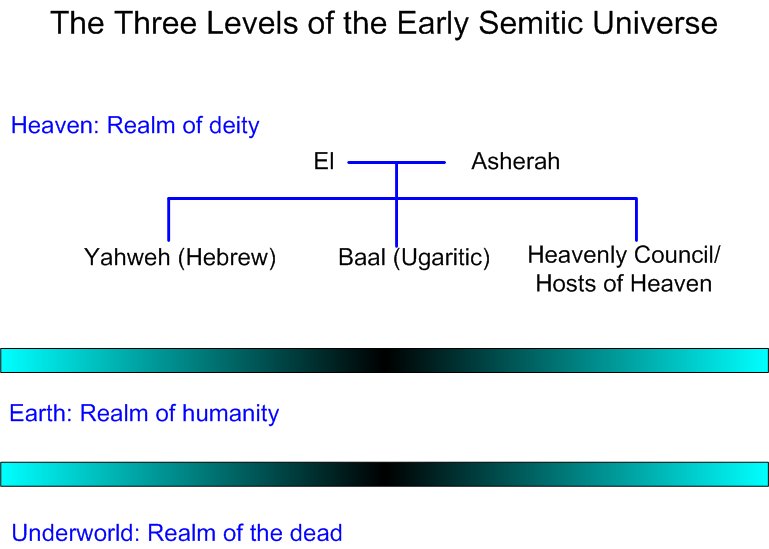
What those texts make clear is that the early Semitic religion worshipped a pantheon structured as a divine family, with a Father god, El and his consort, this very Asherah.7 These two are at the head of a heavenly council. Daniel C. Peterson synopsizes the relevant information:

The council is known by various names in the Ugaritic materials, including “the assembly of the gods” and “the assembly of the sons of ‘El.” According to Canaanite belief, ‘El was the creator-god. Evidence strongly suggests that he was the original chief god of the Semites generally. As creator, however, he also stood at the head of the pantheon as the “father of the gods” or the “father of the sons of God” and was called the “ancient one,” the “patriarch,” and the “eternal one.” Consequently, the gods as his sons, were designated collectively as “the sons of ‘El.”8

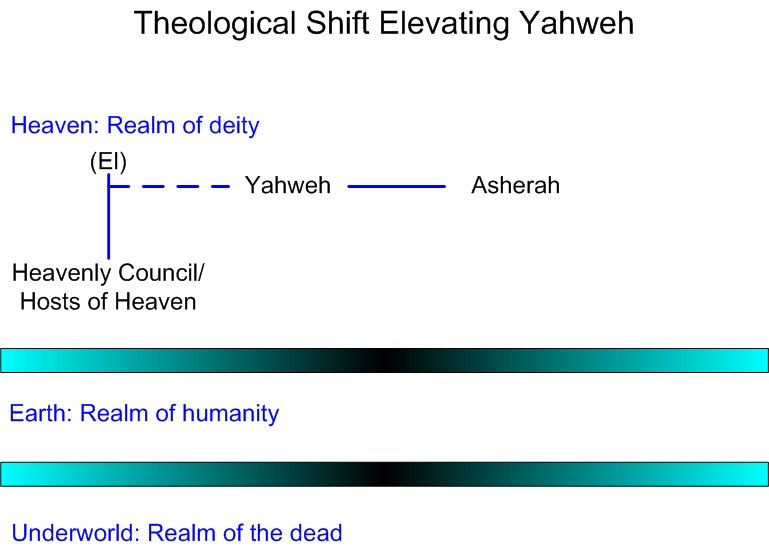
Yahweh was preeminent among the sons of El in the Israelite conception. The gods of this heavenly council were assigned to be the gods of various nations (Deuteronomy 32:8), and Yahweh was the god of Israel. As Israelite thought developed, El as the Father receded into the background, and Yahweh continued to gain in prominence. This process of the elevation of Yahweh was in full force by the eighth century B.C. when Asherah appears as Yahweh’s consort, not El’s. Mark S. Smith suggests:

Asherah, having been the consort of El, would have become Yahweh’s consort only if these two gods were identified by this time. Indeed, it is evident from texts such as Isaiah’s vision of Yahweh surrounded by the Seraphim (Isaiah 6), and especially the prophetic vision of the divine council scene in 1 Kings 22:19 that Yahweh assumed the position of presider by this time.9

This gives us both an evolutionary trajectory and a timeframe. The heavenly council with El as the father, and Yahweh as preeminent son, plausibly dates to the same timeframe as the Ugaritic texts, that is, 1350 – 1150 B.C. After that time, there is a developing theology in Israel that increases the importance of Yahweh and elevates him to a position where he begins to take over the functions previously assigned to his celestial father, El. This process is in nearing its completion around 700 B.C. when we find that Yahweh has not only taken over El’s place in the council, he has taken El’s consort as his own.

In spite of this elevation to prominence and proto-monotheism, Yahweh’s relationship to the council and to his father was not entirely severed by this process. Parallel strands, perhaps reinforced by other Semitic religions, maintained the stories of El and the heavenly council. Dr. Peterson continues:

The Canaanite terminology of “the assembly of the gods” and “the assembly of the sons of ‘El” finds its parallels in the Hebrew Bible. In Psalm 29:1, which has long been recognized by scholars as an Israelite adaptation of an older Canaanite hymn, members of the council are referred to as bene ‘elim. The King James translation renders this phrase as “the mighty.” The same Hebrew phrase occurs at Psalm 89:6, where the King James Version has “the sons of the mighty.” Neither rendition is adequate. In both passages, the New Jerusalem Bible, to choose one of the best of the modern translations, gets things precisely right by translating bene ‘elim as “sons of God.”10

Equally as important to our understanding of Yahweh in the council is the identification of Yahweh as the one who would atone as the Messiah. Margaret Barker’s The Great Angel examines at length hundreds of passages from texts ranging from Jewish to Christian to Gnostic that, as she interprets them, identify Yahweh as the future Messiah and Jesus, in his Messianic role, as equated with Yahweh. As she describes the heavenly council, headed by the Father-God:

Yahweh was one of the sons of El Elyon; and Jesus in the Gospels was described as a Son of El Elyon, God Most High. In other words he was described as a heavenly being. Thus the annunciation narrative has the term “son of the Most High” (Luke 1.32) and the demoniac recognized his exorcist as “son of the Most High God” (Mark 5.7). Jesus is not called the son of Yahweh nor the son of the Lord, but he is called Lord. We also know that whoever wrote the New Testament translated the name Yahweh by Kyrios, Lord. (See, for example, the quotation from Deuteronomy 6.5: “You shall love Yahweh your God…” which is rendered in Luke 10.27 “You shall love the Lord [Kyrios] your God.”) This suggests that the Gospel writers, in using the terms “Lord” and “son of God Most High”, saw Jesus as an angel figure, and gave him their version of the sacred name Yahweh.11

Of course this particular connection comes from New Testament usage. Dr. Barker suggests that it was nevertheless a continuation of an old strand of thought that became obscured through the Deuteronomic reforms. Barker examines an interesting Old Testament passage about this Messianic expectation that appears to have suffered some obfuscation:

The clearest evidence for its survival [the anthropomorphism of the God/Messiah], however, is in the widespread tradition of interpreting words of “man” as references to the Messiah, or of designating the Messiah simply as “the man.” This can best be seen by examining the various translations of the Balaam oracles, which were believed to predict the Messiah (Numbers 24.3-9; 15-24). Thus Numbers 24.7a, where the Hebrew has the curious lines: “Water shall flow from his buckets and he shall rule over many nations” became in the LXX [the Septuagint]: “And there shall come a man out of his seed and he shall rule over many nations,” while both the Fragment and Pseudo-Jonathan Targums have: “Their king shall rise from among them and their saviour shall be from out of them.”

Philo quotes the lines as messianic prophecy: “There shall come forth from you one day a man and he shall rule over many nations” (Life of Moses 1.290). The unanimity of both translation and Targums suggests strongly that the Hebrew may once have said something other than “water shall flow from his buckets.”12

Could an old strand that expected Yahweh-as-Messiah have survived the Deuteronomic reforms to form the basis of Christian understanding of Jesus as Messiah and Yahweh? This is at least suggested by an Aramaic text from Qumran Cave 4 (4Q246 – translated by Joseph A. Fitzmyer):

Col. 1 lines 7-9

7 [then shall arise a king, and he shall be] great upon the earth.

8 [All peoples sh]all make [peace with him]; they shall all serve

9 [him. For] he shall be called [the holy one of] the [G]reat [God], and by His name shall he be named.

Col 2 line 1

1 He shall be hailed Son of God, and they shall call him Son of the Most High.13

This text is dated to around 25 B.C.14 At that time it appears that there is arguably a continuation of the definition of the Messiah as the Son of God, particularly, the Son of the Most High.

When we reconstruct the religious climate at the time of Lehi we find that there is no single, unified theology. In fact, what we find is multiple strands of theological thought that are in conflict, with the Deuteronomic reform elevating a particular strand of thought in contradiction to what had been acceptable though much of Israel’s history.

The theology of the Book of Mormon suggests that Lehi is not only a product of this time period, but that his theology, and therefore Nephi’s, is mostly likely an attempt to preserve some of the theology of God that was being denied in the Deuteronomic reforms. The following are elements of the pre-reform religion that we will see in the Book of Mormon text:

  • A Father god, ‘El who is also called el elyon or “Most High God.”
  • Yahweh as the son of God (El).
  • Yahweh as preeminent God of Israel.
  • Yahweh as Messiah.

I suggest that the particular prominence of God as Messiah in the Book of Mormon is a reaction to the reduction of that strand of Israelite religion. What Lehi and Nephi believed to have been removed in the Deuteronomic reform receives compensatory emphasis in Nephi’s foundational theology for his people, and continues through to the end of the Book of Mormon. This is the reason that the Book of Mormon is so consistently and adamantly a witness for the Messiah.

We begin our examination of God in the Book of Mormon just a few verses before 1 Nephi 11:18 with which we began this discussion. In 1 Nephi 11:6 we find:

And when I had spoken these words, the Spirit cried with a loud voice, saying: Hosanna to the Lord, the most high God; for he is God over all the earth, yea, even above all. And blessed art thou, Nephi, because thou believest in the Son of the most high God. . .

Placed in the context of the possible theologies in Jerusalem at the time of the family’s departure, this verse is quite understandable. We can perhaps understand it a little better if we “retranslate” the text to highlight the parallels.

Hosanna to El Elyon; for he is God over all the earth, yea, even above all. And blessed art thou, Nephi, because thou believest in [Yahweh] the Son of El Elyon…

Because the understanding of El as Father and Yahweh as son was still an available concept in Hebrew thought when the Book of Mormon begins, this particular description of the Father and the Son finds its best explanation as a continuation of that particular strand of Hebrew theology. While there is even less of the heavenly council remaining in the Book of Mormon than in the Old Testament, nevertheless it is plausible that such an idea continued with the Book of Mormon prophets. Note the interesting language with which Alma describes the Messiah in Alma 36:17:

…I remembered also to have heard my father prophesy unto the people concerning the coming of one Jesus Christ, a Son of God, to atone for the sins of the world.

Jesus is not the Son of God, he is a Son of God. Assuming that this is translated correctly, we have Alma placing Jesus Christ in the same divine company as did the New Testament authors cited by Margaret Barker–in the heavenly council as a Son of the Most High God. Thus Alma appears to confirm Nephi’s distinction between the Most High God and the Son of God. That brings us forcibly back to 1 Nephi 11:18. In our modern versification, 12 verses after declaring the Messiah to be the Son of God, the spirit shows that same Messiah who is declared to be God. What happened in 12 verses? Absolutely nothing. Nephi has not changed his understanding. The problem we might see as a conflict between verses 6 and 18 lies in our modern imperative of monotheism, a problem Nephi did not have.

In the Jerusalem that Lehi’s family left, Yahweh had been elevated to the position of pre-eminent God. This proto-monotheism, if I may call it that, did not eliminate the strand of thought that understood El as the Most High God. It did, however, proclaim that Yahweh was God. Not Most High God, but God. Based upon Nephi’s plausible worldview, let’s perform our exercise of retranslation again for verse 18:

And he said unto me: Behold, the virgin whom thou seest is the mother of [Yahweh], after the manner of the flesh.

Not only does this “retranslation” return the text more clearly to its appropriate 600 B.C. cultural context, it is absolutely essential to understanding the theology of the Messiah in the Book of Mormon. From the perspective of Nephite theology, the 1837 change in this text might have helped the Latter-day Saints with their understanding of God, but it did violence to an essential part of the Nephite understanding of God. For the Nephites, it is absolutely essential that they understand that Yahweh was the Messiah who would come. Nephi himself notes:

For the things which some men esteem to be of great worth, both to the body and soul, others set at naught and trample under their feet. Yea, even the very God of Israel do men trample under their feet; I say, trample under their feet but I would speak in other words–they set him at naught, and hearken not to the voice of his counsels.

And behold he cometh, according to the words of the angel, in six hundred years from the time my father left Jerusalem.

And the world, because of their iniquity, shall judge him to be a thing of naught; wherefore they scourge him, and he suffereth it; and they smite him, and he suffereth it. Yea, they spit upon him, and he suffereth it, because of his loving kindness and his long-suffering towards the children of men.15

There can be no doubt nor confusion that the person referred to here is Jesus Christ, and this Christ is the person that Nephi declares to be “the very God of Israel.” This meaning is also essential to Abinadi’s argument in Mosiah 15:1:

And now Abinadi said unto them: I would that ye should understand that God himself shall come down among the children of men, and shall redeem his people.

For the entire Book of Mormon, Yahweh is the God of Israel, and Yahweh is the Messiah. Those equivalencies are absolute and important to Nephite theology. However, there is still an understanding that Yahweh was the Son of God, in the context of El Elyon, or the Most High God.

We now have one remaining explanatory task. If the Nephites understood the separate nature of El Elyon and Yahweh, why is it also true that the text frequently equates the Messiah and the Father? While this is the stuff that led to the Christian arguments about trinitarianism and modalism, there is a much different process at work in the Book of Mormon. The problem begins with our good friend Nephi, who seems to personally present us with every possible confusing statement about God:

And the angel said unto me: Behold the Lamb of God, yea, even the Eternal Father!16

If you haven’t noticed, we are only a couple of verses later than verse 18 where the virgin is the mother of God. Now we have a new identification. The Lamb of God is a title that is particularly symbolic of the atoning function of the Messiah, and here we have the Messiah declared to be the Eternal Father. This is not the only location where this happens. In other texts, the Messiah is not only Father, he is also Son. Mormon writes a thousand years after Nephi:

…And because of the fall of man came Jesus Christ, even the Father and the Son; and because of Jesus Christ came the redemption of man.17

The explanation for this conflation of Father and Son is not to be found in post-Christian theology, because that perspective cannot explain all of the various references to God in the Book of Mormon. Returning to our historical perspective, however, we can replace the cultural contexts that allowed Nephi to hold what appear, to modern readers, to be contradictory beliefs about God.

When Margaret Barker describes the nature of the heavenly council, she also notes the key that resolves our problems in understanding Nephi and the subsequent Nephite theology.

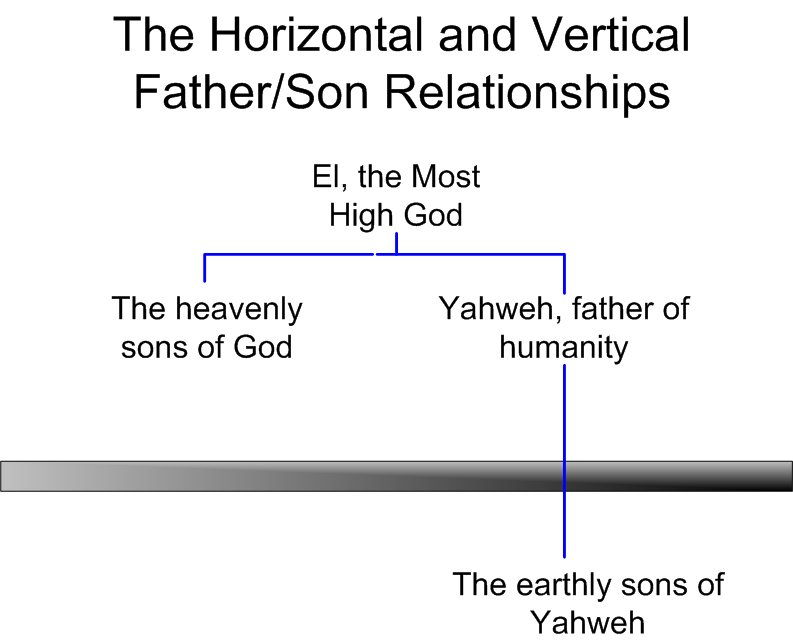
There are those called sons of El Elyon, sons of El or Elohim, all clearly heavenly beings, and there are those called sons of Yahweh or the Holy One who are human.18

There are two “fathers” here, and the difference is that in the stories, or myths–to use the anthropological term–the sons of one father are heavenly, and the sons of the other are human. This creates a distinction in the realm of operation of the two fathers, a conceptual space that might be described as either horizontal or vertical. In the horizontal conception, we are in the heavens, and the heavenly father begets heavenly sons. In the vertical conception, we now have a heavenly being focusing on earth, a vertical relationship that crosses the boundaries that separate heaven and earth. This second “father” is defined by this vertical deity-to-human sphere.

This is precisely how we can disentangle the various “son of God” references in the Old Testament. Joseph A. Fitzmyer points out that: “the plural expressions in Hebrew, bene ha elohim, “sons of God” (Genesis 6:2, 4; Job 1:6; 2:1; 38:7) bene ‘elim, “sons of God” (Psalms 29:1; 89:6), and bene ‘elyon, “sons of the Most High” (Psalms 82:6) are found in the Old Testament as names for angelic beings in the heavenly court of Yahweh.”19 These members of the heavenly court are literary descendants of the earlier Israelite layer that was more similar to the Ugaritic mythology. In this context we have horizontal relationships, and therefore heavenly sons of a heavenly father.

Fitzmyer also notes that there are several times when God indicates a relationship to Israel where Israel is considered as a “son” (Hosea 1:10; Deuteronomy 14:1; Isaiah 30:1). In these cases we have declared “sons,” with an implied father. What Fitzmyer does not ask, is whose sons are whose? The angelic beings harken back to an earlier conception, and the frame of reference is always celestial, and always horizontal. They are sons of the Most High God.

In the other references Fitzmyer notes, various humans are declared to be in a relationship to God where they are “sons.” If the humans are sons, God is therefore father. Most prominent and powerful is the declaration in Psalms 2:6-7:

Yet have I set my king upon my holy hill of Zion. I will declare the decree: the LORD hath said unto me, Thou art my Son; this day have I begotten thee.

In this verse the Lord declares that he as begotten the king as his son. The question that we must ask is: who is the Lord? This is a special relationship between the king in heaven and the king on earth, but it still crosses the bounds from heaven to earth. It is a vertical relationship, and therefore “the Lord” is Yahweh.

The historical conflation of Yahweh with El leads to some untidiness in the Hebrew words used to label these positions, but the horizontal and vertical contexts will always predict the appropriate father. In horizontal references, the phrase is typically spelled out as “sons of God” and that phrase functions as a label for the relationship. In the vertical relationships, the term is frequently only “son” or “sons,” and the relationship is implied rather than declared. When humans are involved, their sonship is a relation to the father-God of Israel, Yahweh. When heavenly beings are the reference, the relationship is to the Most High God, or El, the father of the gods.

The Book of Mormon is a precise parallel to this usage. In the Book of Mormon as in the Old Testament, the heavenly or earthly context serves as the defining field of operation which clues the reader (or listener) to the appropriate meanings of father and son. This variation works for all the texts we have examined so far in the Book of Mormon.

We are now left with the most curious texts, however–those that declare that the Father and Son are the same. So far there have been clear distinctions between father and son. How, then, is the same person Father and Son? Genealogy should tell us that this is not a foreign concept. A man is father to his own son, yet he is a son in the context of his father’s family. We understand the two roles of the man based upon his conceptual presence in either of the two possible families. For Yahweh as Father and Son, however, genealogy is not the explanation. Nevertheless, the same concept of a shift in frame of reference is.

The premortal Messiah declares to the brother of Jared:

Behold, I am he who was prepared from the foundation of the world to redeem my people. Behold, I am Jesus Christ. I am the Father and the Son.20

Here we have the self-identification of the premortal Messiah. This is the declaration of Yahweh, similar to the self-declaration of I Am from the burning bush (Exodus 3:14). Notice, that while Jesus Christ makes it very clear that he is both Father and Son, the context of this relationship is explicitly vertical. This tells us that the “father” designation indicates a relationship between Jesus Christ-as-God and man. Yahweh-as-father is precisely the relationship that Benjamin declares for his people when they covenant to take upon themselves the name of the Christ (or Messiah, or Yahweh):

And now, because of the covenant which ye have made ye shall be called the children of Christ, his sons, and his daughters; for behold, this day he hath spiritually begotten you.21

The language of Benjamin’s Christian covenant is similar to the anointing covenant the Lord makes with the King in Psalms. “This day” God has begotten the king or the covenanters. Note, however, that while the context alters the way we should understand the term “Father,” there is a parallel change in the way we must understand “Son.” In Ether Yahweh is “Son,” not “Son of God.” The difference is intentional. “Son of God” is a reference to a horizontal relationship. The presence of the simple term “son” in a vertical context, defines the appropriate understanding of “son,” just as the term father is defined by that context. Only with this understanding of how the terms shift their context when the reference the cross-plane relationship between heaven and earth, can we make sense of Yahweh’s other self-declaration, found in 3 Nephi 1:14:

Behold, I come unto my own, to fulfil all things which I have made known unto the children of men from the foundation of the world, and to do the will, both of the Father and of the Son–of the Father because of me, and of the Son because of my flesh.

The phrase “the Father because of me” is the declaration of Yahweh’s heavenly relationship to humanity. He is Yahweh, and is our father in the sense of his guardianship over all of the natural and adopted branches of Israel. He is our father in the same way that he is the Father of heaven and earth, a term exclusively applied to Yahweh in the Book of Mormon.

Because the context is now very clearly vertical, and crossing the bounds between heaven and earth, Christ explains that he is also the Son, “because of my flesh.” This somewhat cryptic phrase is actually a very apt definition of this contextual shift in meaning.

The essential Nephite revelation of the Messiah was that he was Yahweh, and that “God himself shall come down among the children of men, and shall redeem his people” (Mosiah 15:1). When Jesus declares that he is Father and Son in 3 Nephi, he is not only on earth, he is in a physical body that he allows to be touched. He declares that he has made that vertical transition from heaven to earth. Thus he is Father to us while he is in heaven, and in the essence of his being. However, when he came down, he became as we are, and therefore a son, as we are sons. The change in place creates a change in symbolic relationship. It is his flesh, or his mortality, that makes him the son. Jesus Christ is Father and Son because he is the God who came down among the children of men. Alone of sons of God, he was also a son of man.

When we approach the Book of Mormon text from the viewpoint of the historical context that it declares to be its origin, we find an absolutely consistent theology of God. The Nephites knew of and believed in a Most High God, known as El in Biblical and Ugaritic literature, but unnamed in the Book of Mormon. That Most High God is father to Yahweh, and the relationship between Yahweh and the Most High God is indicated by the title Son of God.

Yahweh is the God of Israel, and therefore the God of the Nephites. In Yahweh’s relationship to humans, he is our Father, and we are sons of Yahweh. When Yahweh descends to live on earth, he is in that part of the vertical relationship that is appropriate for mortals. He is–Son. Yet he can never cease to be who he is. He is “the Father because of me,” as he declares in 3 Nephi 1:14. He is, therefore, Father and Son. For the Nephites, any possible confusion in the similarity of terms used for deity was clarified by the horizontal or vertical contexts in which they were used.

Notes

1 Margaret Barker, “What Did King Josiah Reform?” Brigham Young University Forum address, May 2003, 1. Photocopy of typescript in my possession.

2 Norman K. Gottwald, “Deuteronomy,” The Interpreter’s One-Volume Commentary on the Bible (Nashville, Tennessee: Abingdon Press, 1971), 102-103.

3 Raphael Patai, The Hebrew Goddess (Detroit, Michigan: Wayne State University Press, 1990), 38.

4 Ibid., 53.

5 Ibid., 48-49.

6 C.L. Seow, “Ugaritic,” The Oxford Companion to the Bible, edited by Bruce M. Metzger and Michael D. Coogan (New York: Oxford University Press, 1993), 785.

7 Mark S. Smith, The Origins of Biblical Monotheism: Israel’s Polytheistic Background and the Ugaritic Texts (New York: Oxford University Press, 2001), 49.

8 Daniel C. Peterson, “‘Ye Are Gods:’ Psalm 82 and John 10 as Witnesses to the Divine Nature of Humankind,” The Disciple as Scholar. Essays on Scripture and the Ancient World in Honor of Richard Lloyd Anderson, edited by Stephen D. Ricks, Donald W. Parry, and Andrew H. Hedges (Provo, Utah: Foundation for Ancient Research and Mormon Studies, 2000), 487.

9 Smith, The Origins of Biblical Monotheism, 49.

10 Peterson, “Yea are Gods,” 490.

11 Margaret Barker, The Great Angel, 5.

12 Ibid., 100-101; emphasis in original.

13 Joseph A. Fitzmyer, The Dead Sea Scrolls and Christian Origins: Studies in the Dead Sea Scrolls and Related Literature, general editors Peter W. Flint and Martin G. Abegg Jr. (Grand Rapids, Michigan: Eerdmans Publishing Company, 2000), 54.

14 Ibid., 45.

15 1 Nephi 19:7-9.

16 1 Nephi 11:21.

17 Mormon 9:12.

18 Barker, The Great Angel, 5.

19 Fitzmyer, The Dead Sea Scrolls and Christian Origins, 65.

20 Ether 3:14.

21 Mosiah 5:7.

The Gadianton Robbers in Mormon’s Theological History: Their Structural Role and Plausible Identification

The Gadianton robbers are a specific instance of the larger set of events and concepts revolving around what the Book of Mormon calls secret combinations. These secret combinations show up in connection with the Jaredites, then they disappear. They reappear scant years prior to the arrival of the Savior in the New World, and then disappear for over two hundred years. Finally, they reappear to play a role in the final denouement of the Nephites. While the majority of the conflicts in the Book of Mormon occur with the Lamanites, the most destructive conflicts are those that come at the hands of the secret combinations, and specifically the Gadianton robbers. The Lamanites might be the Nephites’ most common enemy, but the Gadianton robbers are the most dangerous. This combination of longevity, sporadic appearance, and ultimate danger, make the Gadianton robbers and secret combinations an important study in understanding the message of the Book of Mormon. The elucidation of this complex interaction of time, text, and meaning must necessarily center on both Mormon’s text and the ancient cultural environment of that text.

The first question we will examine is the role of secret combinations in the narrative of the Book of Mormon. The second issue is the plausible identification of the secret combinations with some historical event or group. This phase of the investigation is complicated not only by known history, but also because this history must also integrate with the narrative purpose of the secret combinations in the text. What is told must also conform to how it is told.

Finally we must test the identification against the disparate appearances of the secret combinations in the text. Secret combinations make an appearance over nearly two thousand years of Book of Mormon history, but they have no consistent presence. They all seem to be related, but they are separated by hundreds, or perhaps thousands of years. They have similar characteristics, but they are associated with different cultures. The text ties them all together. We are looking for that binding thread.

The Narrative Role of Secret Combinations.

It is popular to describe Mormon as an abridger; some early predecessor of the editors of Reader’s Digest who take large texts and distill them into shorter versions. This is a seriously misleading conception. It is true that Mormon is an author with a stylistic penchant for including large citations from his source material, but we do him extreme discredit when we forget his very active role in selecting and structuring his account. Mormon is an historian, but he is unlike a modern historian in the way he perceives his task. Mormon does not write secular history, but rather sacred history. It is this overriding concern that absolutely dictates everything he includes and excludes from his text.

As we approach the Gadianton robbers from the perspective of Mormon’s construction of his text, we find that they and secret combinations are perhaps the most complex example of Mormon’s authorial art. Secret combinations are a meta-theme that function as both an organizational principle and historical moral. The meta-theme of the secret combinations is not present because history happened in just such a way and Mormon dispassionately recorded that history. Secret combinations are an interpretive layer that Mormon spreads over the events in order for those events to have a greater meaning. In creating this meta-theme, Mormon is following an Old World literary vision that sees history in a larger context of types and patterns.1 Robinson describes the effect of this conception on the way history was written:

The unifying principle [acted] like a magnet in evoking a pattern amongst iron filings. It created a pattern of history out of all its complexities, a pattern which disclosed the previously hidden purpose of God.2

Mormon is dealing in patterns. This patterning of history becomes evident when disparate events at widely separated times are described in ways that make those events obviously parallel. The repetition of the pattern is a marker of authorial formulation. For the secret combinations in the Book of Mormon, the patterning consists in a set of events and characteristics that always accompany the presence of a secret combination. The essential features are the presence of murders, a desire for wealth (frequently described as “robbings and plunderings”), and the destruction of political order. Mormon orders three historical periods with the presence of this set of events and traits of secret combinations:

  1. The earliest manifestation of the pattern in Book of Mormon history is in Jaredite times. The destruction of the Jaredites is explicitly laid at the feet of secret combinations, and all of the elements of the secret combinations are present.3
  2. The second occurrence in time is actually the first in the text, and it is the most textually complex. It occurs within a period of only about eighty years. In that eighty-year time period the Gadiantons make four separate appearances and four separate disappearances. The appearances and disappearances of this particular set of Gadianton robbers serve as a micro example of the general patterning of the larger meta-theme. In spite of the four phases, however, this set is textually treated as a virtual single appearance. The result of the rise of the Gadiantons is the fall of the Nephite government just before the arrival of the Savior in the New World.
  3. The final appearance of the Gadianton secret combination leads to the final demise of the Nephites.4

We have three instances that repeat this pattern, and we may be certain that it is no coincidence that all three appear to be so similar, a similarity that is even more apparent in the specific details than it appears in this brief summary. Of this intentional repetition in the Book of Mormon, Richard Rust notes:

Repetition appears purposefully within Book of Mormon narratives as a principle of reinforcement and confirmation. It seems that every important action, event, or character is repeated in the Book of Mormon. These repetitions emphasize the law of witnesses at work within the book … They link narratives together with what Robert Alter calls “type-scenes.” …Larger repeated narratives treat escape and travel to a promised land; repentance; and the nature, rise, and effect of secret combinations.5

Mormon creates a meta-narrative by the tight repetition of the structures of secret societies in relation to the end of political entities. The triple repetition creates a firm connection for the obvious reason that the pattern, the “type-scene,” is not a coincidence. The narrative sophistication of the use of secret combinations in the Book of Mormon suggests purposeful inclusion and careful planning; planning that is intended to point to the greater pattern that reveals the purposes of God.

The Gadiantons in Plausible History

The repetition of the patterns clearly shows the hand of the author. Now we must determine whether the author is inventing the patterns, or truly being the magnet that evokes the patterns in the historical iron filings.

We find our textual linkage between type-scene and historical event precisely where Mormon put it, in perhaps the most anomalous narrative sequence in all of his text. When Mormon introduces his historical Gadiantons, he is telling a fairly simple tale but elects to tell it in a most unusual and convoluted way.

Mormon’s history of the Gadiantons begins at the forty-second year of the reign of the judges, or about 50 BC. After the initial introduction to the Gadianton robbers in the body of Helaman 2, Mormon adds these comments to the end of the chapter:

And behold, in the end of this book ye shall see that this Gadianton did prove the overthrow, yea, almost the entire destruction of the people of Nephi. Behold I do not mean the end of the book of Helaman, but I mean the end of the book of Nephi, from which I have taken all the account which I have written.6

Notice that Mormon has been speaking of an historical event, and at this point makes a shift in narrative time to Mormon’s present. It is at this point that we have what must be the most confusing narrative interruption in the Book of Mormon. After this look forward in time, Mormon abruptly changes the subject. He has been talking about the Gadianton robbers. He has even created a foreshadowing link between those Gadiantons and his own time. Now he stops, makes a full chapter break, and begins the next chapter with what appears to be a completely unrelated topic.

Mormon inserts a discussion of migrations to the lands northward. Even more surprisingly, Mormon brackets this migration narrative on both ends with a shift in narrative time to his own day. After this recent shift in narrative time, even Mormon understands that he has interrupted his narrative, for at the end of this sequence he states: “And now I return again to mine account….”7 The account to which he returns is the Gadiantons, the very subject he interrupted.

As if understanding the now-you-see-them-now-you-don’t-Gadiantons were not sufficiently difficult, Mormon introduces these enigmatic figures with a narrative sequence that is equally enigmatic. However, none of this is in error. Each of these anomalies are intentionally placed by Mormon the author for his own narrative purposes. This sequence, awkward though it might appear, was carefully constructed to elaborate the meta-message of the secret combinations. In this anomalous text we have Mormon’s intentional identification of the historical Gadiantons as he sees them.

Mormon’s clue to historical events is this very text of the northward migration that is framed by references to the future. Both before he begins this narrative sequence, and immediately afterward, Mormon references his own time. This shift in narrative time is important because it tells us that the narrative in between is the focal point on which the time-shift is made. Mormon is doing more than denoting place; he is connecting time.

The inserted, out-of-place narrative describes a northward migration of the Nephites. Of course, Mormon has discussed northern migrations before, but this description is unique. For example, the northward migration of Hagoth received some notice, but the narrative emphasis was on the departure, not for the ultimate destination.8 In contrast, this inserted section emphasizes the land to which the people are presumed to travel. This textually unusual fixation on the land of destination is even more curious because there is no indication that any of these people came back to tell about the land northward. As historians, we must ask the serious question of how Mormon arrived at his description of the land northward, since he does not record any of these people coming back to describe where it was or its characteristics. Nevertheless, Mormon describes it in some detail:

And they did travel to an exceedingly great distance, insomuch that they came to large bodies of water and many rivers. Yea, and even they did spread forth into all parts of the land, into whatever parts it had not been rendered desolate and without timber, because of the many inhabitants who had before inherited the land. And now no part of the land was desolate, save it were for timber; but because of the greatness of the destruction of the people who had before inhabited the land it was called desolate. And there being but little timber upon the face of the land, nevertheless the people who went forth became exceedingly expert in the working of cement; therefore they did build houses of cement, in the which they did dwell.9

The detail of the description of the land northward is given in such a way that Mormon likely supposed that we should easily understand what he was describing. The passage of time has made this description a little less obvious than it would have been to Mormon, but still he gives us enough information to make an identification of the location to which he is referring. The essential elements that allow us to identify this area are:

  • It is northward of the Nephite lands
  • There are many waters
  • It is nearly desolate of trees
  • There are cement buildings

From perhaps 100 BC to 600 AD there is only one area in Mesoamerica that fits all of these descriptions, and that is the city known as Teotihuac·n. It is north of the Nephite lands. It is near the lake that at that time occupied the current site of Mexico City. It has buildings made of high quality cement.10 The lack of trees and the environmental imbalance created by denuding the land of trees is hypothesized as a major factor in creating the downfall of Teotihuac·n.11 We have several very specific requirements that must all converge at one point to fit Mormon’s description and there is only one area in Mesoamerica that fits this description well in the time period described. Mormon the author is pointing his finger at a specific location at a specific time because that location serves as the historical fulcrum on which his meta-narrative is leveraged.

In spite of the accuracy of this description of Teotihuac·n, there is nevertheless a major problem with the fit. That problem is one of timing. The particular conditions that require the area to be devoid of trees and dominated by buildings of cement, do not belong to the Teotihuac·n of 49 BC when the northward migration is described by Mormon, but rather the Teotihuac·n of 250AD and later.

It is at this point that we understand the nature of the references to the future that frame the northward migration narrative. Mormon does not have historical records that tell of the land to which these people went, but Mormon nevertheless gives us a particular location for them, a location they may or may not have reached. His understanding of that land is based upon his own current time period. What we have is Mormon describing the Teotihuac·n that he knows in his own time, and pushing that description earlier into history. This is not unusual for ancient historians.

However, it also doesn’t matter. It really is the Teotihuac·n of his own time that is his concern. Mormon intentionally links this migration northward to the land of Teotihuac·n, not because of historical accuracy, but precisely because he desires to tie the Gadiantons of Helaman’s time to the Gadiantons of his own day. Remember that both before and after the narrative insertion of the migration to the land northward Mormon has shifted the narrative focus to his own time period. Whether consciously or unconsciously, Mormon is notifying us that the concern for the land northward pertains to his own day, and that it has a link to the previous time. For Mormon, this migration northward is the bridge over which Helaman’s Gadiantons will walk through time and space to become Mormon’s Gadiantons.12 It is those newer Gadiantons who are causing the destruction of Mormon’s people that he uses as the historical backbone that will link all of the secret combinations together, a set of destructive combinations that are culminating in the final demise of the Nephites.

It is important that we recognize that this tie between the first Gadiantons and the last Gadiantons that Mormon makes through this bridge in time and space is an artificial construction. It is at this point that we see the author describing the patterns rather than the iron filings. There is very little chance that the iron filings are the same, even though Mormon makes a pattern of them.

A brief note on the narrative history of the Gadiantons should suffice to show the artificiality of this tie between the two Gadianton bands. After the first Gadianton secret combination accomplishes its fatalistic task of destroying the Nephite government just before the arrival of the Savior, they disappear from the land for over two hundred and sixty years.13 When they reappear they grow in power and importance until they can be said to have spread “over all the face of the land.”14 When Mormon reintroduces the secret combination, he does so by calling them Gadianton robbers. This is a different group in a different land and with a gap of two hundred and sixty years between them and their earlier namesakes. Seen with the dispassionate eye of modern historiography, it is highly unlikely that this latter group that appears to be prominent throughout most of the land would have remembered and honored an otherwise short-lived and obscure band of robbers from inside the Nephite polity.

Is there any history behind this narrative artifice? If there is, we will find it by looking where Mormon tells us to look. We must look at the land northward that has many waters, is devoid of trees, is made of cement, and is on his mind in his own day. We must look at how Teotihuac·n might explain the Gadianton robbers, because Mormon is telling us that they do. It is in Teotihuac·n that we must look to see if we can find the “iron filing-events” that underlay Mormon’s patterned history.

Finding a lot of documentation on a secret society in ancient history is almost a fool’s errand, since their very nature was to be secret. In Mesoamerica, this problem is exacerbated by the nature of the available sources. Very few pre-Conquest texts are available, and the vast majority of our information comes from post-Conquest sources. This means that we must do what has been termed “upstreaming.” That is, we must begin with the known and move “upstream” in time to the earlier period with which we are interested. In Mesoamerica, this virtually forces us to the world as it was at the time of the Conquest.

One of the most valuable sources of pre-contact cultural information is the Florentine Codex, which is the Nahuatl text written by the native informants of Fray Bernardino de Sahagun. From these Nahuatl texts father Sahagun created his Spanish-language opus on the history and culture of the Aztecs. The Nahuatl text has been translated into English, and there is a passage that is important to our understanding of pre-contact secret societies. This passage is cited as translated with the exception of one word that I have intentionally left in Nahuatl:

The [nonotzaleque] went about carrying its hide [jaguar]–the hide of its forehead and of its chest, and its tail, its nose, and its claws, and its heart, and its fangs, and its snout. It is said that when they went about their tasks with them–that they did daring deeds, that because of them they were feared; that with them they were daring. Truly they went about restored. The names of these are [nonotzaleque], guardians of tradition, debasers of people.15

The passage paints an unfavorable picture of these people, but we can sense a duality in the presentation of the information. Sahagun’s informants were trained in the religious schools, and they certainly understood the Spanish prejudices. It is therefore not surprising that these nonotzaleque should be called “debasers of people.” However, this pejorative description comes right after the indication that they were “guardians of tradition,” a trait that many would have considered admirable–many, that is, who were not Spanish, nor Spanish influenced. It would seem that these nonotzaleque were some kind of group that dealt with pre-Conquest ideas and traditions.

Anderson and Dibble had translated nonotzaleque as “conjurers,” no doubt because of the connection to the magically powerful jaguar pelt. The reason for leaving the word untranslated is that it is this very word that is important to our discussion, and “conjurers” is not an adequate translation of the concept.

The ending of the word, “-eque” indicates a collection of people who do something. It is analogous to the “-ers” ending we add to verbs in English. We take the verb work and get workers. The important information about the people who all do this thing is communicated by the meaning of the verb to which this stem is attached. In this case, we have the Nahuatl word nonotza, which has various meanings revolving around the idea of speaking together, consulting, or agreeing.16 Thus the nonotzaleque are “those who agree or consult among themselves” or, in a more sinister and contextually appropriate context, “conspirators.”

When Sahagun translated his native source into Spanish, he rendered nonotzaleque as “assassins.” The connection of this term to the ancient sect is appropriate, for there are two aspects of the conspiracy that are important: the secret agreement, and the intent on disruption of government through murder. Significantly, Sahagun notes that this is a group “accustomed to and daring to kill.”17

Sahagun presents these conspirators as a pre-Conquest group. Miguel Covarrubias links these nonotzaleque to the nahaulista movement after the Conquest. Covarrubias specifically uses the passage from Sahagun identifying them as “assassins”18 and applies that definition to the nahualistas. Perhaps even more important is the connection the original group had to the jaguar. That connection allowed Anderson and Dibble to translate nonotzaleque as “conjurors,” and it probably led directly to the name Covarrubias associated with them. Nahualista is a combination word that takes a Nahuatl noun and adds a Spanish ending. The Spanish ending denotes a group of people who hold in common whatever the root of the word would be. In this case, the root word is the Nahuatl word for a shaman.

The persistence of a group attempting to retain the old ways after the Conquest is aptly named for those practitioners of the old religion, and the association between the jaguar and the shaman provides another touchpoint between the description of the nonotzalque and the nahualistas. The nahualistas were a subversive organization after the conquest, and one may suppose that they intended to keep their identities secret. Similarly, the nonotzaleque appear to represent a group. Both groups have internal structure, and both are linked to the disruption of political entities. Both of these are at least grossly similar to the Book of Mormon descriptions of secret combinations.

We have a complex of information that we may use as a native set of characteristics of these “conspirators.” When we attempt to upstream this set of characteristics from the immediate post-Conquest to the immediate pre-Conquest, the connection between a group of people ready and willing to kill who wore the pelt of the jaguar at least suggests that we look at the various orders of the Aztec military. One of the Aztec military orders was the ocelomeh, or the “jaguar warriors,” whose battle attire consisted of pelts of the jaguar.19 The wearing of the pelts or other representations of the jaguar marked this particular military order from others. It was not the only identifiable order, but each was marked by particular clothing.

Of course wearing distinctive clothing is hardly the way to keep one’s group affiliation a secret, but it can keep a specific identity secret, as the Ku Klux Klan learned. In this case, however, it is not specifically the secrecy, but rather the conspiracy that links these groups. It is not the secret, but the combination. They have an internal allegiance and code, and may operate as a group outside of other structural influences.

So far we have a very tenuous description of a pre-Conquest conspiracy that might be described as a secret combination. We can identify some of the characteristics of that group that include the readiness to kill as well as sorcery in the use of the jaguar pelt. The task is now one of “upstreaming” to Mormon’s time. Is there any reason to connect this tenuous later military order from Central Mexico to the secret combinations that Mormon reports in the lands farther to the south?

In the greater context of Mesoamerican history, there is every reason to suppose that Mormon was concerned with militaristic influences coming from Teotihuac·n. The time period ascribed to Mormon’s last Gadianton robbers directly parallels the timeframe for the expansion of Teotihuac·n and their particular brand of militarism throughout the Mesoamerican region. The rise of the Gadianton influence beginning after 200 AD in the Book of Mormon is a direct parallel to the rise of Teotihuac·n’s expanding influence, and the time period that saw the construction of many of the cement buildings in that city, including the temple of the feathered serpent which is now understood as dedicated to the cult of war.20 This influence increased in geographic spread and physical presence from about this time until the time of Mormon, and continued after the close of the Book of Mormon.

The epigraphic record of Tikal records the installation of a new ruler, Siyaj K’ak’, who founds a new dynasty in 378 AD. By iconographic and epigraphic representation, it is absolutely certain that he came from Teotihuac·n, and his descendants thereafter ruled in Tikal.21 Many sites of the time witness either a change in ruling dynasties or an increase in militarism that is represented in new ways that clearly point to Teotihuac·n influence.22 When we place known Mesoamerican history side by side with Mormon’s spiritual history, we find in both accounts a militarism exacerbated by a small contingent of a foreign element from the lands northward. The Book of Mormon timing for this description corresponds directly to the secular history of the expansion of Teotihuac·n throughout all of Mesoamerica, but particularly the Maya region to their south.

In addition to the importation of militarism and political leadership from Central Mexico, the Teotihuac·n influence extended to the transmission of religious ideals that accompanied the political power structure from Central Mexico. Here we recall our touchpoint for a Mesoamerican secret combination, the nonotzaleque. The nonotzaleque were an association that was willing to advance their political ideas through murder, but were also associated with the powerful shamanic symbol of the jaguar. The modern world tends to forget that politics and religion were virtually inseparable in the ancient world. Where politics were involved, religion was involved. The incursion of Teotihuac·n into the Maya area also brought in new powerful symbols and a new religious perspective. It is in this connection that we see another of Mormon’s descriptions of the Gadiantons:

And these Gadianton robbers, who were among the Lamanites, did infest the land, insomuch that the inhabitants thereof began to hide up their treasures in the earth; and they became slippery, because the Lord had cursed the land, that they could not hold them, nor retain them again. And it came to pass that there were sorceries, and witchcrafts, and magics; and the power of the evil one was wrought upon all the face of the land, even unto the fulfilling of all the words of Abinadi, and also Samuel the Lamanite.23

While Mormon never describes the Gadiantons as a military caste, he does specifically note that they were “among the Lamanites,” implying that they were not the Lamanites. He also notes that at this time there is an increase in “sorceries, and witchcrafts, and magics.”

Another of the characteristic traits of Mormon’s secret societies parallels the invasion from Teotihuac·n:

And it came to pass that the robbers of Gadianton did spread over all the face of the land; and there were none that were righteous save it were the disciples of Jesus. And gold and silver did they lay up in store in abundance, and did traffic in all manner of traffic.24

Mormon’s particular experience with these Central Mexican invaders would have come near the height of their power when they were literally “spread over all the face of the land.” These Gadiantons, who are not Lamanites, but who are “among” the Lamanites, are actively interested in commerce and gain. While little is known of the specifics of tribute from the Maya area into the city-state of Teotihuac·n, we may readily assume that it existed. Thus we have a foreign presence, likely part of a military caste and bringing new religious ideas, who are “robbing” the land of goods to send to their foreign city–for their own gain, and not for the gain of those in the Lamanite or Nephite area. Assuming a Mesoamerican context, there is no better candidate for the Gadianton robbers who are contemporary with Mormon. A military association from Teotihuac·n that brought a new militaristic philosophy tied to a new emphasis on “sorceries, withcrafts, and magics” is a remarkably apt description of Mormon’s contemporary Gadiantons as well as the Teotihuacanos. The known history of that time period completely supports the nature of the description that Mormon gives for the Gadianton robbers with which he is personally familiar.

To this point in our process of historical upstreaming, we have a very likely candidate for the Gadiantons of Mormon’s day. Of course our problem, as was noted earlier, is that this Teotihuac·n influence is not known for the earlier periods. How do we continue upstream if we know that the stream wasn’t there?

Interestingly enough, we return to Mormon the author and his artificial patterning of secular history. We are not looking for the presence of Teotihuac·n in an earlier instance of the Gadianton robbers, we are looking for the thread that Mormon uses to draw them to the earlier period. As Mormon moves his understanding of the Gadiantons as a Central Mexican influence earlier in time, he brings with the concept some of the set of meanings associated with the Teotihuac·n Gadiantons. In particular, we have murder and plunder for gain. When we are introduced to the Gadiantons who gain control over the Nephite government in Helaman, we see them as a similarly separate entity carrying with them these traits of greed and murder:

For behold, the Lord had blessed them so long with the riches of the world that they had not been stirred up to anger, to wars, nor to bloodshed; therefore they began to set their hearts upon their riches; yea, they began to seek to get gain that they might be lifted up one above another; therefore they began to commit secret murders, and to rob and to plunder, that they might get gain. And now behold, those murderers and plunderers were a band who had been formed by Kishkumen and Gadianton. And now it had come to pass that there were many, even among the Nephites, of Gadianton’s band. But behold, they were more numerous among the more wicked part of the Lamanites. And they were called Gadianton’s robbers and murderers.25

We have a parallel description of a group of people who are among the Nephites, but are not Nephites. That same group is among the Lamanites, but they are not Lamanites. They are intent on seeking gain, and therefore they murder, rob and plunder. They are Gadiantons. These are the traits of the Central Mexicans of Mormon’s time, and Mormon clearly links the Gadiantons of his own time to this earlier time period, both by name and attributes. Of course the characteristics described, that of murder for political gain and robbings and plunderings, could easily fit with the developing cultural pressures among the Maya at this time period. There is no particular need to see this group as foreign, except in the construction of Mormon’s meta-theme. For Mormon, there is a characteristic of secret combinations that ties together all of the thousands of years of history, and that is a connection to the Jaredites.

A Millennium of Disappearing and Reappearing Secret Combinations

The final piece of the puzzle of Mormon’s Gadianton robbers is in the nature of this conceptual thread with which Mormon ties together nearly two thousand years of New World history. Both textually and conceptually, Mormon ties the secret combinations together based on the underlying inheritance from the Jaredites. Although Mormon takes pains to show that the secret combinations were not learned from the records of the Jaredites that the Nephite record-keepers preserved, he nevertheless takes equal pains to state that they had the same source as the Jaredite secret combinations: “that same being who did plot with Cain.”26

The connection between the Jaredites and the Gadianton robbers of Helaman’s time would have been an easy correlation. Jaredite names frequently appear in the Nephite faction that is associated with the pro-king separatists.27 Gadianton might be a name of Jaredite origin, but Kishkumen almost certainly comes from the Jaredite heritage among the Mulekites.

Mormon’s “problem” is the making the connection between the Gadianton’s of his own day and the Jaredites. If, as is proposed here, Mormon is seeing a Central Mexican, or Teotihuac·n influence and describing it as “the Gadiantons,” then he must have some reason to connect this completely foreign culture to the Jaredites.

Mormon makes his connection explicit by his insertion of the northward migration text. Since there were Nephites who went North, Mormon can conceptually have them “carry” the secret combinations with them. That is the mechanism Mormon uses, but what was there about the Teotihuac·n invasion that allowed him to justify it as being connected to the Jaredites? For this answer, we need more historical information about the Mesoamerican culture area.

The Olmec is the name used for the people who occupied the territory that the Book of Mormon knows as Jaredite.28 We should resist the temptation to equate the Olmec with the Jaredites, because that would imply that the Olmec began with the Jaredites. This is known to be incorrect. However, just as the Lehites entered a world with other people in it, so did the Jaredites. They happened to enter the precise area of the most highly evolved culture of their day. It would be accurate to say that they participated in Olmec culture. This participation would have extended to the language of the Olmec, and to the entire Olmec cultural catalog.

One of the mysteries about the Olmec that found its resolution in the late 70’s, was the reconstruction of their language. Kauffman and Campbell presented a ground-breaking paper that noted the large number of loan words coming from the Mixe-Zoque language. They also noted that Mixe-Zoque would have existed in precisely the location of the archaeological Olmec, and at the same time. Thus they suggested, and their suggestion has been widely accepted, that Mixe-Zoque was the language of the Olmec, a culture so influential that they lent both culture and vocabulary to many other groups in Mesoamerica. As the language of the Olmec, Mixe-Zoque would also have been the eventual language of the Jaredites.

The Mulekites would have participated in that cultural zone, and their historical move up the valley of the Grijalva parallels the movement of a daughter language of Mixe-Zoque into that same region. Based on the connection to the Olmec and the geographic distribution of Zoque, this daughter language would have been the language of the Mulekites, and likely the lingua franca of the Nephites. Thus the connection between the Jaredites and Mulekites was evidenced by language as well as historical and cultural ties.

Until recently, a similar understanding of the linguistic affiliation of Teotihuac·n has been among the greatest of Mesoamerican mysteries. This city might be called a Mesoamerican Rome because of its size and regional importance, but there was absolutely no trace of the language they spoke. It was a situation analogous to knowing about the Romans from their architecture and engineering feats, but never finding even a scrap of Latin, nor any Romance language.

This situation has recently been resolved. Although the results are currently unpublished, John Justeson has indicated the time-depth of many Mixe-Zoque loan words suggests that the language of Teotihuac·n was Mixe-Zoquean.29 This linguistic affiliation gives us the last tie that Mormon would have needed to connect the secret combination of his day to the Jaredite combination of old. For Mormon, Teotihuac·n would have come from the same source!

Mormon certainly knew the linguistic affiliation of the Mulekites, and knowing that same language affiliation for Teotihuac·n, a language different from the Maya languages that are spoken my most of the peoples Mormon would identify as Lamanite, Mormon would understand Teotihuac·n as having ties to the ancient Olmec, or to the Jaredites as Mormon knew them. To Mormon, these were yet another branch of the old Jaredites. For Mormon, the Gadianton secret combination continued to rise from its ancient Jaredite roots.

The Gadianton End Game

Mormon uses the literary concept of the type-scene to reinforce a spiritual pattern that emerges from historical events. This historical pattern consists of an internal secret combination that is interested in power, gain, and political ascendancy through murder. The moral of the type-scene is that the secret combination causes the destruction of a people, as defined by their religio-political structure. The quintessential type-scene to which all others refer is that of the Jaredites. Mormon links each of his parallel type-scenes back to this Jaredite level.

The second type-scene in historical order is that of the Gadiantons of Helaman’s time and just prior to the arrival of the Messiah in the New World. This secret society is the one that is most elaborately described, with multiple internal parallels that highlight the same characteristics as the secret combinations of the Jaredites. Mormon explicitly connects these Gadiantons to the Jaredites, and the correlation may have been heightened by the Jaredite names associated with the movement. This tie to the Jaredites would have come through the historical connection between the Mulekites and the remainder of the Jaredite civilization, a connection that not only lent ideas such as secret combinations, but also a language that was derived from that of the Jaredites. The result of this named secret combination is the destruction of the Nephite polity.

The third and final type-scene occurs in Mormon’s day. The secret combination is called the Gadianton robbers, and Mormon links the secret combination of his day to that of Helaman’s time by the northward migration narrative as well as the linguistic ties to the Jaredites or Olmecs.

Each of these type-scenes is built upon historical data, but the data are related in such a way to tell us more than history. They also tell us the future, for they form a predictable pattern. As complex as this meta-theme is in the Book of Mormon, it is expanded by yet one more meta-theme that Mormon saw, or at least hoped for. Not only is the presence of secret societies repetitive and predictive, Mormon likely saw the aftermath of the secret societies as repetitive and predictive.

Mormon’s text shows us that the Gadiantons of Helaman’s day ushered in the destruction of the Nephite polity. After that terrible end came a marvelous beginning. The Atoning Messiah came, and altered the world. To appreciate this fundamental alteration, we must understand the Book of Mormon conception of this Messiah. Even though the Book of Mormon prophets clearly understood the difference between the mortal mission of the Messiah and the final mission of the Messiah at the end of this world, they primarily preached the mortal Messiah and the mission of Atonement. Nevertheless, we give the Book of Mormon prophets little credit if we therefore presume that they did not also understand the Messiah of the end times–the Triumphant Messiah.

Mormon certainly understands that these two “comings” of the Messiah are the same person, but two different times. The Triumphant Messiah is he who will transform the world into a single political/religious entity, and who will usher in a complete and final peace. When the Atoning Messiah came, even though his mission was in mortality, he could not help but bring with him the influence of who he truly was. In different circumstances he was the one who would usher in a permanent peace. However, the mortal mission and the timing were different. So there are similarities, and there are differences. For Mormon, the difference is one of permanence.

The Messiah who appeared at Bountiful brought peace, just as he will at the end of the world. However, since this first time was related to a mortal ministry, it was not a permanent peace–it was a peace that lasted for two hundred years before it began to fade. Nevertheless, this peace was directly related, inexorably related, to the appearance of the person of the Messiah. His essence required that he bring peace, even though the particular mission did not yet allow that peace to be permanent.

Mormon would have seen the arrival of the Savior in Bountiful as connected to the future arrival of that same Messiah in new circumstances. We may suppose that Mormon’s naming of the Gadiantons in the two time periods tells us of his expectations of the parallels. Mormon is facing the decimation of his own people, yet he retains his optimism in the future. Mormon is saying that in the time of Helaman the destruction of the Nephites by Gadiantons was followed by the coming of the Messiah, a miracle that restored the Nephites. Mormon is expecting that after the destruction of his own people by the new Gadiantons, that the Messiah will come again, and will similarly restore the Nephites. His record will be the guide for that restoration. His optimism lives in his text, even though its fulfillment is taking longer than he would have hoped

.

Notes

1 Louis I.J. Stadelman, The Hebrew Conception of the World (Rome: Biblical Institute Press, 1970), 26.

2 H. Wheeler Robinson, Inspiration and Revelation in the Old Testament (Oxford: Clarendon Press, 1946), 129.

3 Alma 37:21; Ether 14:8-9 sets up the destruction of the Jaredites because of secret combinations.

4 Helaman 2:12-14.

5 Richard Dilworth Rust, “Recurrence in Book of Mormon Narratives,” FARMS Journal of Book of Mormon Studies, vol. 3, no. 1 (Spring 1994), 39.

6 Helaman 2:13-14.

7 Helaman 3:17

8 Alma 63:5-8.

9 Helaman 3:4-7.

10 “Concrete Evidence for the Book of Mormon,” Reexploring the Book of Mormon, edited by John W. Welch (Provo, Utah: FARMS, 1992), 213. Citation is to David S. Hyman, A Study of the Calcareous Cements in Prehispanic Mesoamerican Building Construction (Baltimore, Maryland: Johns Hopkins University, 1970), ii, sect. 6, p. 7.

11 George C. Vaillant. Aztecs of Mexico (New York: Penguin Books, 1966), 78-90.

12 Not only does this bridge occur in the passage describing the northward migration, but it is reinforced by an explicitly named migration of Gadiantons just prior to the destructions at the time of the death of the Jesus. See 3 Nephi 7:12-13.

13 4 Nephi 1:41-42.

14 4 Nephi 1:46.

15 Bernardino de Sahagun, Florentine Codex (Salt Lake City: The School of American Research and the University of Utah, 1963), 11:3.

16 Molina and Simeon.

17 Bernardino de Sahagun, Historia General de las Cosas de Nueva Espana, vol. 3 (Editorial Porrua, 1969), 222.

18 Miguel Covarrubias, Mexico South: The Isthmus of Tehuantepec (New York: Knopf, 1967), 77-78. Covarrubias is cited in both Sorenson (1985, 303) and Bruce W. Warren, “Secret Combinations, Warfare, and Sacrifice,” Warfare in the Book of Mormon (Provo, Utah: FARMS, 1990), 229.

19 Ross Hassig, Aztec Warfare (Norman, Oklahoma: University of Oklahoma Press, 1988), 45.

20 It may be one of the greatest ironies in LDS attempts to link the Book of Mormon to historical Mesoamerica that the feathered serpent symbol that has seen so much print as a representation of Christ may actually have been a representation of the Gadianton robbers.

21 Simon Martin and Nikolai Grube, Chronicle of the Maya Kings and Queens (London: Thames & Hudson, 2000), 29.

22 Rene Millon, “The Place Where Time Began: An Archaeologist’s Interpretation of What Happened in Teotihuacan History,” Teotihuacan: City Of The Gods, edited by Kathleen Berrin and Esther Pasztory (London: Thames & Hudson, 1993), 26.

23 Mormon 1:18-19, italics added.

24 4 Nephi 1:46.

25 Helaman 6:17-18.

26 Helaman 6: 25-29.

27 Sorenson has noted the Jaredite connection to the kingmen, see Sorenson (1985, 265).

28 The application of the designation Olmec to these people is actually the result of historical error. The Olmec were known historically, and their name was first associated with the archaeological finds before they were understood to be as old as they are. The name stuck. The group that lent their name to this ancient people is now referred to as the historical Olmec. We do not know what the ancient Olmec called themselves.

29 John Justeson, personal communication.

Changes in the Book of Mormon

I want to do several things today. I’m first going to describe the critical text project, some of its major findings. Then I would like to turn to the issue of changes in the text to the Book of Mormon.

Critical texts have previously been prepared for important historical and literary works but until fairly recently not for the Book of Mormon. The first critical text of the Book of Mormon was published by the Foundation for Ancient Research and Mormon Studies, or FARMS, in 1984-86. That first version, although preliminary helped to establish criteria for the current project, especially the need for direct access to the original and printer’s manuscripts as well as the clearest photographs of those manuscripts. A critical text shows all the substantive changes that a written work has undergone from its original version to its present editions.

The word critical is derived from the Greek word krites meaning judge. When referring to a critical text, the term means that notes accompany the text so that the reader can see how the work has changed over time and thus judge between alternative readings.

There are two main goals for a critical text to the Book of Mormon. The first is to determine to the extent possible the original English language text of the book, that is, the text that Joseph Smith received by means of the interpreters and the seer stone. The second purpose is to establish the history of the text, including both accidental errors and editorial changes that the book has undergone as it has been transmitted down through time in its many editions.

The current critical text project of the Book of Mormon began in 1988 with major support from FARMS. Initial work concentrated on studying the two manuscripts of the Book of Mormon, namely the original manuscript and the printer’s manuscript. The original manuscript, as we have it, was produced in the spring and early summer of 1829 by scribes who wrote down Joseph Smith’s dictation of the text. In 1841 the original manuscript was placed in the cornerstone of the Nauvoo house. When removed in 1882 most of the manuscript had been destroyed by mold and water seepage. Today only 28% of the original manuscript is extant. Most of the surviving leaves and fragments–25% of the 28%–are held by The Church of Jesus Christ of Latter-day Saints. The remaining 3% are fragments owned by the Wilford Wood Foundation, the University of Utah and various individuals.

The printer’s manuscript is the copy of the original manuscript that scribes produced from August 1829 to the early part of 1830. For the most part, the 1830 printer set the type from the printer’s manuscript. Although for 1/6 of the text–from Helaman 13 through the end of Mormon–the type was set from the original manuscript.

The printer’s manuscript is virtually 100% extant and is held by the Reorganized Church of Jesus Christ of Latter-day Saints, now renamed the Community of Christ.

As a part of the critical text project, a typographical facsimile has been prepared for each of the two manuscripts. This kind of transcription represents an exact reproduction of the text in typescript. The text is transcribed line for line and without any corrections or expansions. Original spellings and miswritings are retained, all scribal changes in the manuscripts whether cross outs, erasures, overwriting or insertions are reproduced.

In May 2001, the transcripts of the two manuscripts were officially published by FARMS, now a part of Brigham Young University. They are the original manuscript of the Book of Mormon typographical facsimile of the extant text. Out there, there are copies of it, they’re in shrink wrap, I brought some open ones if some of you wish later to look at a copy. This is the original manuscript, 28% of it is extant.

The second one is the printer’s manuscript of the Book of Mormon typographical facsimile of the entire text in two parts, so there are two volumes for that. These are fairly heavy, you don’t want to lug them to Church. (Laughter)

Both volumes contain introductions that present a brief history of the manuscripts, the symbols used in the transcription system and a physical description of the manuscripts. These two volumes present the earliest textual sources for the Book of Mormon; all known fragments of the original manuscript have been identified, interpreted and pieced together to the extent possible. A continuously running text for the extant portions has been provided with conjectured text placed sub linearly, or below the line.

The transcript of the original manuscript includes numerous fragments from the Wilford Wood Collection; these fragments from 58 pages of the original manuscript were discovered in 1991 and were conserved and photographed for the critical text project. In addition, minor fragments now held by others were also discovered as a part of this project. A number of forgeries were also identified and thus avoided in the transcript of the original manuscript.

With the publication of these two volumes all the legitimate manuscript sources for the Book of Mormon text are now accessible. Using the first three editions of the Book of Mormon along with these transcripts, scholars now have all the available information for studying the text of the Book of Mormon. This publication is intended for scholars of all faiths and persuasions, LDS, RLDS and all others interested in the text. Both LDS and RLDS versifications have been provided in the identification of manuscript pages and photographs.

The critical text project is a scholarly one; it has not involved any ecclesiastical approval or endorsement. The transcripts and the textual interpretations represent the editor’s own scholarly work but have involved peer review from other scholars.

The design and typesetting is the work of typographer Jonathan Saltzman, presents the text in an appealing form, one appropriate to the importance of the Book of Mormon.

Ultimately there will be four printed volumes and one electronic collation in the complete critical text. In addition to the two now published volumes there will be 3) The History of the Text of the Book of Mormon; 4) Analysis of Textual Variance of the Book of Mormon; 5) a complete electronic collation of the Book of Mormon.

The third volume will discuss the transmission of the text, from the manuscripts through the major editions. The fourth volume will discuss cases of textual variance and will attempt to determine the original English language reading of the text. The electronic collation will be a lined-up comparison of the important textual sources and will specify every textual variant in the Book of Mormon including punctuation, capitalization and spelling. The collation will include the readings of the two manuscripts and twenty editions of the Book of Mormon. The editor’s plan is to have volumes three and four and the electronic collation available within the next three years.

Now let us consider some of the more important findings of the project.

1. In copying from the original manuscript to the printer’s manuscript, Oliver Cowdery and other scribes made an average of two to three textual changes per manuscript page. The term textual change means an alteration in the wording, however minor, or a consistent change in the spelling of a name. In general these transmission errors have not been caught by later editors of the text except by reference to the manuscripts themselves.

2. As a part of this project the editor has completed a preliminary analysis of variation in the text of the Book of Mormon. This analysis provides evidence for about 1,500 potential changes to the current text. The large majority of these textual changes involve minor variation in phraseology. For instance (in the next overhead) in more than a few cases the indefinite article ‘a’ has accidentally been omitted, especially when the article is repeated in a coordinate construction.

In the following list we have eight examples involving a pair of coordinated adjectives followed by a noun. For each case, the addition in which the repeated ‘a’ was first dropped is listed in parentheses. So for example in the first one, Omni 1:28, the original text reads “…a strong and a mighty man,” the ‘a’ is repeated. This is not normal for English, it’s much more natural just to delete the second ‘a’ and this happens; it’s rather persistently occurring but randomly and occasionally. So in 1852 this was set by the typesetter as “…a strong and mighty man.”

In the next one we have one where ‘a’ dropped out in the 1840 edition, the next one 1837. And so currently in the text there are eight of these, in the LDS text there are a few more different ones in the RLDS where this repeated ‘a’ has accidentally dropped out. And this is… this represents eight of the 1,500. Most of the changes are like this.

In contrast to cases of minor variation, about 100 newly discovered changes are semantically significant. These proposed changes lead to differences in meaning, ones that would show up when translating the text.

3. Scribal corrections in the original manuscript supports statements made by witnesses of the translation that Joseph Smith sometimes spelled out the unfamiliar Book of Mormon names, at least on their first occurrence.

4. The original text is more consistent in phraseology and word usage. Many errors have led to various wrinkles in the text. One example is the phrase “…the word of the justice of the eternal God,” and if we could have the next one (overhead). This is found in 1 Nephi 12:18 which in the original manuscript read “…the sword of the justice of the eternal God,” and here (overhead) we have the two manuscripts in the writing as the scribes wrote them and the original has “And a great and a terrible gulf divideth them, yea, even the sword of the justice of the Eternal God”. When Oliver copied this, he accidentally misread the ‘s,’ it was difficult to actually read and he ended up replacing it by ‘word.’ Elsewhere the Book of Mormon refers only to the ‘sword’ of God’s justice never to the ‘word’ of God’s justice; and here we have eight examples… no seven, and the last one is particularly interesting. In Ether 8:23 it has the exact same phraseology as the original one in 1 Nephi 12:18: “the sword of the justice of the Eternal God.”

5. The original text that is the English language text that Joseph Smith saw is not fully recoverable by human effort. Textual errors are generally not found except by discovering the correct reading in the manuscripts. Unfortunately most of the original manuscript is not extant. Conjecture based on internal analysis of the Book of Mormon text has largely been unsuccessful in recovering the correct reading. Still some conjectures are probably correct as in the next (overhead)… maybe I don’t have that example, let me see… (pause) Okay.

6. Even if we had the entire original manuscript there could still be errors in the text namely because the original manuscript itself has some errors. For instance… in the next one (overhead), in 1 Nephi 7:5 the original manuscript reads “…Ishmael, and also his hole hole” an impossible reading. The correct reading must be something else, when copying into the printer’s manuscript Oliver Cowdery amended this phrase to “…Ishmael, and also his household,” and here (overhead) you have the two manuscripts as they were written. The original manuscript is not Oliver Cowdery, an unknown scribe; printer’s manuscript is Oliver Cowdery copying it.

Usage elsewhere in the text suggests the word household always occurs with a universal quantifier, either ‘all’ or ‘whole’ or ‘none at all’ in negative sentences and here (overhead) I give some examples. Note the last one Ether 13:22 is a universal quantifier which means that the whole family goes along: “…Coriantumr repented not, neither his household.” If you had written there neither ‘all’ of his household then it might imply that some of them maybe did but by the negative sentences you can’t have a quantifier to get the universal meaning.

The really interesting one here is the use of “…his whole household” in Alma 22:23, the fourth one down (overhead). This suggests that the original text for 1 Nephi 7:5 probably read “Ishmael, and also his whole household” where the first ‘hole’ in the original manuscript is a homophone for ‘whole’ and the second ‘hole’ stands for the ‘hold’ of ‘household’ with the loss of the final ‘d’ in pronunciation.

7. The systematic nature of the original text and the spelling out of Book of Mormon names support the theory that the text was revealed to Joseph Smith word for word and even letter for letter. On the other hand all subsequent transmissions of the text appeared to be subject to human error. At each stage the accuracy of the transmission is dependent upon the carefulness of the transmitter, whether Joseph Smith, his scribes or later editors and typesetters. This caveat of course equally applies to the critical text itself, although all have tried to do their best, every transmission of the text appears to have led to some mistakes, yet none of these errors significantly interfere with either the message of the book or its doctrine.

These textual errors have never prevented readers of the book from receiving their own personal witness of its truth.

Let me give one other point that… I might point out this just appeared… published this week by FARMS, it’s a history and the major findings of the critical text project and I’ve brought a few here and they’re available out here. FAIR is selling… I only brought a few copies but if they run out you can get them from FARMS next week.

But in this I want to read one other statement and this deals with the changes in the text. The editing of the text, including Joseph Smith’s for the 1837 edition, should in nearly all instances be viewed as translating the text into a more standard variety of English. Moreover, in his editing of the text Joseph acted as human editor, his 1837 and 1840 revisions do not represent any kind of final authorial intent since Joseph Smith is first of all not the author of the Book of Mormon. Nor is there any evidence that his editorial revisions represent inspired corrections to the text, especially since he left unchanged dozens of substantive errors that the scribes originally made when they copied from the original manuscript to the printer’s manuscript.

The main point that I’m making is there is only one revealed stage in the transmission of the text and that’s what Joseph Smith received from the Lord. All other transmissions show human transmission and apparently, as far as we can tell, no intervention from the Lord. My conclusion here, there has been a spiritual dimension also to my work although my own testimony of the Book of Mormon is not based on this work on the Critical Text Project but rather on my own personal witness of over twenty years ago that this book records events which really happened. Nonetheless, it has been a delight to have discovered evidence in the original manuscript to support what witnesses said about how Joseph Smith translated.

The Book of Mormon is truly a marvelous work and a wonder and there’s considerable textual evidence that it was a word for word revelation to Joseph Smith from the Lord. With that I would like to turn to, I think, one of the most astounding findings of the Critical Text Project. When I first worked on reading the manuscripts, there’s always this thrill when you find the occasional error. (Laughter) You know, textual critics have to prove their value and the way they do it is by finding errors, but as I studied these errors I discovered something much more important and ultimately I realized that by human means I wasn’t going to find all the errors, 28% of the text is extant, what about the rest of it? And there are even errors in the original manuscript. One of the really surprising things is that in many cases, over 100 I’ve discovered, the original text was without exception in its phraseology; that over time we’d had occasional errors, one or two in a given phrase, so that the current text has what I call wrinkles in it. They don’t prevent you from understanding and reading but if you look at these phrases you discover the original was astoundingly systematic. And I wanted to give a few examples of these.

In a sense this is… we have to be grateful for the mistakes people have been making because these mistakes then allow us to discover how systematic the text originally was. The next twelve or so (overheads) will just be examples that I’ll go over briefly.

In referring to the present time the Book of Mormon always says ‘this time,’ it’s in the singular, it is never in the plural, even though we say in these times: original text is 61 to 0, however the current text is 60 to 1. The one mistake in 1 Nephi 10:19 “as well in this time as in times of old, and as well in times of old as in times to come” notice the past and the future are in the plural and because of those occurrences of the plural nearby the 1830 printer accidentally set the present in the plural but the Book of Mormon never does this.

The next one, the word ‘whatever’ never occurs in the original text, it’s only ‘whatsoever’: original text 74 to 0, current text 72 to 2. We have them both; the 1830 printer put in ‘whatever,’ once in Jacob and elsewhere in Helaman. These are just accidental errors; notice he didn’t replace all 74, he just accidentally replaced two.

The next one, people in the Book of Mormon do ‘iniquity’ they never do ‘iniquities’ in the plural: the original text 22 to 0, now it’s 21 to 1. Jacob 2:35 “ye have done greater iniquity than the Lamanites” accidentally changed to the plural by the 1830 printer.

The next one, to have hope, the Book of Mormon in the original text has the main verb ‘have’ followed by the direct object ‘hope’–18 to 0, there is one occasion where this is actually due to editing by Joseph Smith, he changed it to ‘to have hoped’ he made the ‘have’ into what we call an auxiliary verb, the perfect, and he basically made the noun into a verb. He did this in Jacob 5:46 he left all the other examples. This is an example of his own editing showing that he is not the author of the text. He himself did not realize how systematic the original text was.

The next one, ‘if it so be that’: 38 to 0. Changed in two cases to ‘if it be so that’ mixing up the order, occurs in the 1852 and the 1849 editions.

The Nephites and the Lamanites, the ‘the’ is always repeated: 15 to 0. But, in the 1830 edition, in one place the additional ‘the’ was dropped so the current text reads “and I saw wars between the Nephites and Lamanites”. This is the kind of expression which we might expect.

The Book of Mormon only has, originally, ‘to observe to keep the commandments’ never ‘to observe the commandments’: 11 to 0. But, in the 1837 edition the words ‘to keep’ were accidentally dropped out in one case.

‘To set a mark upon’ someone, never ‘to set a mark on’ someone, that’s what we really expect in modern day English: 9 to 0 in the original, it’s now 8 to 1, an 1837 change.

‘Thus ended a period of time’, they are all in the past tense. We have four places now where it’s in the present ‘Thus endeth a period of time’ and these are in the accounts in Alma–one in the 1830, 1837 for another one, two of them in 1849. It gives a sort of immediate presence in the accounting but the actual text never does this.

In the Book of Mormon you only ‘meet’ people, you never ‘meet with,’ meeting with people sounds like a modern-day bureaucratic system. In any event this one accidentally occurred–1830 edition–Alma is traveling and he… the sons of Mosiah are coming back from their missionary labors with this difficult problem that the… their converts are being murdered. In any event he ‘met’ the sons of Mosiah on the road he didn’t ‘meet with’ them.

‘Conditions’ never ‘condition’, there is no singular condition in the original text, it’s always plural: 14 to 0. We have two in the current text: “and we will guard them from their enemies by our armies on conditions that they will give us a portion of their substance” this was changed in the 1920 edition, it was a conscious change, it is marked in the Committee copy. The other one in the 1830 is an accident. We in English expect the singular; it’s actually a tribute to the typesetters that they have kept 12 of them because it’s so unusual in English to have this plural use for us at least today.

And finally, ‘into’ one’s hands never ‘unto’ one’s hands: the original text was 56 to 0, the current one is 55 to 1. This is one that the 1920 Committee copy isn’t marked, it is a typo by the typesetters in Chicago. “Therefore they yielded up the city into our hands” is the original and it was misread as ‘unto’ so “therefore they yielded up the city unto our hands”. When you think about it, it is a little strange it’s just a misreading.

Well, these are twelve examples. There are over 90 more, probably over a hundred. I haven’t really counted them but it’s amazing to me how systematic the text was. And even Joseph Smith couldn’t understand how systematic it was.

Now we come to the big topic that so many people are exercised over: how many changes are there in the Book of Mormon text? I don’t know and I’ll tell you why it’s hard to count them. In my computerized collation of the two manuscripts and 20 significant editions of the Book of Mormon, I can count the number of places of variation. These are places where in some place in the text there’s a variant, whether it’s spelling, punctuation, words missing, added, grammatical change. There are 105,000 places of variation.

For your information there are 270,000 words or so in the Book of Mormon, but even this number of 105,000 is misleading. If you take an example… let’s see what we have (overhead)…

Suppose you have an example where the manuscripts have no punctuation and the 1830 put in a semi-colon and a later edition made it a colon and then it’s been made a period but later it was changed back to a semi-colon, this is all one variant, it’s a place of variation but maybe within it there could be 4-5 changes.

So the real issue, borrowing from Proverbs, is “with all thy counting get understanding.” (Laughter) Let us begin with the kinds of variants there are. The first one is with bookkeeping or referencing: chapters and verses. The chapters are actually… the word chapter and the numbers are not original to the text of the Book of Mormon. As Joseph Smith was dictating he apparently could see the end of a section and he would tell the scribe, ‘write the word chapter,’ which the scribe did. The ink level is the same. The numbers added are added later in heavier ink, sometimes the wrong number and in many places the word chapter is in the wrong place. It belongs where something ended but it may be the beginning of a new book and yet the word chapter is written at the beginning of a new book, right before the name of the book and these had to be corrected. So there are variations of course in chapters, the numbers assigned to them and there are five versification chapter systems in the text. The RLDS have three of them in their first, second and third editions. They kept… they had long ones and they broke up their verses more and broke them more even more.

In 1852, Franklin Richards and his brother Samuel numbered the paragraphs, they were long, it’s a kind of versification.

In 1879, Orson Pratt changed the chapter system and broke up the chapters, they were much longer originally and we have more than twice as many chapters than the original text had and then he put verses… verse numbers in. All of these are variants. Well, we won’t count those, okay?

Then there are accidentals. The term accidental is one that comes from Aristotle; it refers to distinctions which do not change the essence of something. In other words, they change the form but not the substance. Well what are some of these?

Paragraphing: Paragraphing was added in the 1830 edition. Paragraphs you can think of have been replaced by versification but even verses are little paragraphs, every one of them is a little paragraph and breaks up the ability to read the text in a flowing manner.

Punctuation: For the most part punctuation is an accidental. You can basically read the Book of Mormon text without punctuation. In the original manuscript we only find evidence for a few dashes in the book summaries, otherwise there is no punctuation. The original text itself probably had no punctuation at all. Most of it was added by the 1830 printer, it has been changed to… in some places it was probably wrong… in only a few places is there really any debate over whether the punctuation makes a difference in meaning. Those would not count as accidentals. If the punctuation makes a real difference in meaning then we put it under a different category, but the vast majority, and I would like to say those who wish to count punctuation changes as changes need to realize that every punctuation mark is a change because the original manuscript didn’t have any except for a few dashes and those have all been changed so every punctuation mark is a change. We are way beyond 4,000 and yet we haven’t got to one of any substance yet.

Spelling of common words: We have variant spellings in the editions and the manuscripts, labor versus labour. The ampersand, you use the ampersand that’s a change if you write it out. Etc. was always written as ‘ampersand s.’ Misspellings, these (overhead) are a couple of Oliver’s: ‘intrigue’ and ‘kept’. Slips of the pen: Nephi and pass, where the vowel just acts… these are generally found, and then of course there are lots of typos.

Capitalization: Most capitalizations, many of the names were not even capitalized in the manuscripts, depending on the scribe. So here we have ‘river sidon’ versus ‘river Sidon’ this was in the 1830 edition. Deseret, editors have debated whether this should be capitalized or not. And ‘i’ even ‘i’, one scribe just doesn’t like capitalizing his ‘i’s. Should something be in all caps or in regular capitalization? Jehovah is sometimes put in all capitalization in some editions.

These all clearly show that the transmission of the text is occurring through humans. It has all the signs of human transmission but the original revelation to Joseph Smith I would submit, because he could see the spellings… he could produce specific phraseology over and over, suggests that that is indeed what he received.

Well, in contrast to accidental changes we have substantive changes and here are a few. Changes in the words, forms of the words, phrases and sentences, spellings that make a difference in meaning, this includes names, here are four of them that the manuscripts are very clear should be: Gaddianton with two d’s, someone will have to change their talk, Morionton with all o’s, Zenock is ‘ch’ like Enoch it is not ‘ck’ this is Oliver Cowdery’s scribal error that he just has the darndest time trying to avoid and ultimately the editions have ended up with ‘ck’, however the list by the way at the back has ‘ch’. Don’t know what this means but the pronunciation list has the correct one for some reason and Kishkumen has a ‘c.’ Remember the city of ‘Cumeni’ or however it’s pronounced; it’s got a ‘c,’ sort of interesting.

Then there’s also spellings that deal with homophones, you have to figure out what word was intended. Is the word right ‘rite’, the ‘rites’ of their religion, the current text has it ‘rites’ is that correct? ‘Straight’ is one that’s caused considerable debate is it the one with the ‘gh’ or the one without? Does it mean narrow or not crooked? And ‘travel’ versus ‘travail,’ Oliver Cowdery apparently pronounced them ‘travel’ both, this is the common pronunciation for both words and we have to figure out which ones are ‘travel’ – the ‘travels’ of the Jews? Or the ‘travails’ of the Jews? And you can’t tell by the spellings of the scribes.

Okay, grammatical usage. The Book of Mormon has been edited basically from dialectal English into standard English, from Geneva-Rhodes English into BYU English. (Laughter) Yeah! Some of this editing is accidental, it occurred accidentally in… going between the manuscripts and into the 1830 edition, it wasn’t intended, but beginning with the 1837 edition this was consciously done, attempting to remove dialectal things that would be considered non-standard such as ‘they was’ to ‘they were,’ ‘them days’ to ‘those days.’

The most significant kind of grammatical change though, in the Book of Mormon text, has been to remove King James Version language. The most prominent is changing ‘which’ to ‘who’, “Our Father which art in heaven” was the original reading for the Lord’s prayer in 3 Nephi edited to “Our Father who art in heaven” which is what we would expect at least with respect to that relative pronoun. ‘Because that’ changed to ‘because’ “because that he came” this is not Standard English but it’s in the King James Bible and ‘he sayeth.’ In lots of narratives in the Bible, especially in the New Testament, it’s in the present, this gives an immediacy to it and these have been edited basically to ‘said’ and so when Amulek and Zeezrom are going at each other the original text says “and he sayeth, he sayeth, he sayeth” and these have been edited to “he said.”

There are examples of phraseology and these are more accidental and I gave some examples of the repeated ‘a.’ Note that the examples that we’ve… these examples, virtually all of these that I’ve been talking… well some of them, the grammatical at least, thus far would not show up in a translation for the most part. Most of these grammatical things, whether you use ‘which’ or ‘who’ if you’re translating another language that language will tell you which relative pronoun to use, so these things really aren’t that significant from a meaning point of view. But there are meaning ones and we saw some examples like ‘the sword of the justice of God’ being accidentally changed to ‘the word‘ and these clearly would show up in translating and these are about the highest level we’re going to get though in terms of meaning changes.

Finally, we have a group of items that we could call clarifications. Joseph Smith, in his editing, for the first 100 pages, every time he did it, 1837, 1840, we also know he was doing it a third time in about 1842. He works very assiduously and pretty carefully for about the first 100 pages and then the demands on his time make it so that he apparently cannot continue doing the editing at that level of detail and so he doesn’t continue. He does a more rapid and getting only the essential changes that he wanted, the grammatical ones that would be clearly non standard.

For example, in these two (overhead), these are 1837 changes made by Joseph Smith in his own hand and notice they’re really clarifications, perhaps, I mean we can… ‘he pitched his tent in a valley beside a river of water’, and he changed it to ‘by the side of a river of water’ even though ‘beside’ does mean ‘by the side of’ historically. Or in the account of the dream ‘methought I saw a dark and dreary wilderness’ and Joseph added ‘in my dream’. It’s really not necessary but it’s a clarification just in case you didn’t remember that he was describing the dream.

Finally we come to the five chestnuts, the ones that everyone seems to be exercised over. The point is there… first of all, aren’t too many and when you compare with other texts and people debating over what the text should read. The first one is one that was discussed yesterday… the example… the first one ‘the mother of God’ changed in the 1830 edition to ‘the mother of the Son of God.’ I view these myself as in the clarification mode. These kinds of changes are found only in the first part of the text. There are later ones that Joseph Smith could have changed, ‘God’ to ‘Son of God’ but he did not. I also added in the extra one here of ‘Jesus Christ’ being changed to the ‘Messiah.’ These are, I think, clarifications.

We can’t be really absolutely sure what was in Joseph Smith’s mind. A lot of people are speculating as to the theological reasons, or the attempts to make the text more consistent or something. Joseph Smith made the changes; he didn’t leave any notes or explanation. Maybe for example, he didn’t like the Catholic sounding ‘mother of God?’ In any event, these in my mind are clarifications.

The next one is one that’s probably a scribal error, the ‘Son of the Only Begotten of the Father.’ I suppose one could say if they really believed this that somehow this must mean Jesus had offspring. Well it is probably a scribal error, it occurs in the… we don’t have the original manuscript; it is in the hand of scribe two of the printer’s manuscript. Apparently, the scribe, hearing a lot of ‘ofs’ put in too many, put in an extra one ‘the Son of the Only Begotten of the Father’ ‘after the order of the Son of the Only Begotten of the Father’, we have these extra ‘ofs’ Joseph Smith removed them in the second edition and quite correctly. These probably are just simple scribal errors.

The third one is this ‘white and delightsome’ changed to ‘pure and delightsome.’ There has been more ink on this one than any one and it’s all about modes and it’s really, I think, an embarrassment. First of all the textual evidence, this change appears in the 1840 edition, we presume that it was made by Joseph Smith but we can’t be sure, it just appears. It is probably not a typo, a misreading, because ‘white’ and ‘pure’ look so different, it probably was consciously done.

In preparing the 1981 edition, the Committee at the Church considered this reading in the 1840 edition and they made the change based on the 1840 edition. It is in my mind quite clear that there was no political motivation; they were not trying to remove racism from the Book of Mormon text. The reason this is very clear is there are eight other passages they did not touch which quite clearly could be identified as making the same preference for white skin and those are not removed. The brethren, I presume, and they’ve never said why, but… looked at the actual text of the 1840, decided that it was Joseph Smith’s change–I think it probably was–and decided to follow that. It was a very conservative change and could not have really been motivated by political considerations. As far… we don’t have the original manuscript here, the internal evidence suggests that ‘white’ is the original reading and it is because the word ‘white’ co-occurs with ‘fair and delightsome’ and refers with reference to skin color six times in the text. ‘White’ co-occurs with ‘pure,’ but only when referring to a state of heavenly perfection like in the resurrection; that’s four times. So we don’t know why the change was made by Joseph Smith. The 1981 was probably made out of deference to that change that they assumed that Joseph had made.

We had some discussion yesterday about Benjamin in Mosiah… I will not repeat that I think John Tvedtnes really gave much of the evidence for what the slight problem might be in the chronology.

The last one, is was the brother of Jared a polygamist? This is one that is still in our current text, the original text reads basically that the brother of Jared had a family, Jared his brother had a family and they had… brother of Jared had his friends, more than one and each of them have a family, and Jared has friends and each of them have a family. The 1830 printer in reading one of the families apparently let his eye glance down to the next line and he caught one of the plurals and accidentally set it as ‘families’ this is just a typo by the 1830 editor. The really sort of sad thing about this is that when the Church changes this back to the singular there will be this outrage, this claim quite… absolutely falsely that the brethren are doing it to hide polygamy in the text. This is perhaps one advantage for having an independent scholarly approach, the evidence is very clear that it is in the singular.

Errors have crept into the text but no errors… I’m concluding… errors have crept into the text but no errors significantly interfere with either the message of the book or its doctrine. These textual errors have never prevented readers of the book from receiving their own personal witness of its truth–every sincere reader. In fact, as I pointed out, errors have been helpful in studying the Book of Mormon text. We have discovered the systematic nature of the text because of the occasional errors. How many other cases of systematic phraseology have not yet been discovered because the transmission has been error free? The errors in transmission help us find them… these systematic readings.

All of this worry over the number of changes is specious. There are many more variants per word in the New Testament text and many more highly debated variants. Does this variation mean that the New Testament is false? That it is not God’s word because humans have made errors in its transmission? The word of God still comes through both the New Testament and the Book of Mormon despite the occasional errors in transmission. Thank you.

A Real People, Time, and Place: Contextualizing the Book of Mormon

Brant Gardner

Perhaps the best illustration of a popular tactic in the on-going polemic against the Book of Mormon was encapsulated in a question Abraham Lincoln reportedly asked of some in the crowd who were disputing him. He asked, “If you call a sheep’s tail a leg, how many legs does a sheep have?” After many answers of “five,” he replied, “A sheep has four legs. Calling a tail a leg doesn’t make it one.”

It is precisely this process, with an interesting twist, that underlies many attacks on the Book of Mormon. A tail is called a leg, and then declared with great flourish to be no leg at all. The Book of Mormon is declared to have failed the test because of something it never said it was in the first place. Perhaps the simplest example of this process is the contention that the Book of Mormon must explain all of the Native Americans on the Western Hemisphere throughout all time. While many Latter-day Saints have believed this, the text does not require it, and the best research on the text itself denies that claim. Nevertheless, the claim is made, and then easily refuted. The saddest part of this process is not that it occurs, but that so many Latter-day Saints enjoin the discussion by attempting to prove that the tail really was a leg–perhaps in Hebrew, or Egyptian, or in pure unabashed speculation. The problem will always remain, however, that the tail will never be a leg for as much as we try to call it one.

With such an abstract beginning, it is time to begin to identify some of these mislabeled tails. The LDS community frequently has one of the same problems with the Book of Mormon that the rest of the word does, and that is that it is like a fish out of water. It is a history bereft of history, a chronology bereft of time, a world bereft of topography. In such an artificial context, it is no wonder that the tails are not recognized as tails from inside the church community nearly as often as they are mistaken from the outside. What we shall attempt in this brief discussion is a contextualization of the Book of Mormon, a reinstatement of time, place, and community that can provide for us the context in which the tails can be most clearly seen as tails.

With some minor calendric adjustments, the Book of Mormon resolves our question of time, and the real questions are place and community. Those last two questions receive their best answer in the geographic hypothesis most often called the Limited Tehuantepec Theory. This geographic correlation is most clearly and cogently argued in John L. Sorenson’s An Ancient American Setting for the Book of Mormon. It is not my intent to discuss that possible correlation, nor to quibble with any of the points Sorenson makes. Rather, what I propose is that the Mesoamerican location proposed provides for us the requisite place and community into which our text may be placed. Against that reasonably known backdrop we may place the text of the Book of Mormon to attempt to find the hits or misses in the text.

First, it is important to provide some foundation for this discussion. While archaeology is one of those sciences heavily infused with the art of interpretation, there are, nevertheless, some very solid data that describe the Mesoamerican world known to exist during Book of Mormon times in the geography argued to plausibly contain Book of Mormon peoples. In that context there are some realities of the time and place that must inform our picture of the Book of Mormon. The first and most important backdrop to the Book of Mormon is that Lehi and his family entered a world that contained other peoples. Rather than argue the evidence of that point from inside the text, I propose to simply accept it for now as one of the realities of that time, topography, and now most importantly, community.

The second important consideration is that there are regionalized and recognized artistic trends that nevertheless fit into a large continuum of Mesoamerican material culture. There is no evidence of a transported Jerusalem. There is no clear and obvious material culture that reflects the Old World rather than the New. Once again, rather than argue this particular point, I suggest for this discussion that we accept that Lehi and his descendents adopted the material culture of the peoples who were native to the land into which these Old World people had immigrated. Just as the early Israelite material culture is indistinguishable from the existing Canaanite material culture during the time of the Israelite conquest of Canaan, our heroes of the Book of Mormon appear to have adopted the patterns that had already been developed in their new homeland.

What I am suggesting first and foremost is that the Book of Mormon is an ancient document that was created by ancient people who behaved (and thought) as ancient people did. They would have lived in an area that had to have dealt with the same climatic challenges as their neighbors, and it would be very surprising if the gross trends of Mesoamerican history completely passed by the smaller enclave of Nephites located in the midst of those larger cultural and historical patterns. When we admit that the sheep’s tail may not necessarily be Hebrew, what does a Book of Mormon tail begin to look like?

A culture and context can shine a bright light into the smaller corners of the Book of Mormon where few have attempted to critically examine the text. One of the earliest places where the assumptions of the text have been unexamined, and where potentially important conflicts exist, comes relatively early in the history of the Nephites in the New World. Jacob is a brother of Nephi, and had been with Nephi throughout the creation of their new community. In his own eponymous book he records a powerful sermon he gave dealing with some of the problems that were developing in that community only 55 to 70 years (we are not told the year of the discourse) after the departure of Lehi and his family from Jerusalem.

Jacob proclaims that he is weighted down by the burden from the Lord to discuss their sins, although he tells them that:

For behold, as yet, ye have been obedient unto the word of the Lord, which I have given unto you. But behold, hearken ye unto me, and know that by the help of the all-powerful Creator of heaven and earth I can tell you concerning your thoughts, how that ye are beginning to labor in sin, which sin appeareth very abominable unto me, yea, and abominable unto God.1

They are just beginning to sin. Modern readers tend to spend most of their time on Jacob’s discourse on polygamy among the Nephites, but what is most relevant to our current discussion is his very first point:

And now behold, my brethren, this is the word which I declare unto you, that many of you have begun to search for gold, and for silver, and for all manner of precious ores, in the which this land, which is a land of promise unto you and to your seed, doth abound most plentifully. And the hand of providence hath smiled upon you most pleasingly, that you have obtained many riches; and because some of you have obtained more abundantly than that of your brethren ye are lifted up in the pride of your hearts, and wear stiff necks and high heads because of the costliness of your apparel, and persecute your brethren because ye suppose that ye are better than they. And now, my brethren, do ye suppose that God justifieth you in this thing? Behold, I say unto you, Nay. But he condemneth you, and if ye persist in these things his judgments must speedily come unto you. O that he would show you that he can pierce you, and with one glance of his eye he can smite you to the dust! O that he would rid you from this iniquity and abomination. And, O that ye would listen unto the word of his commands, and let not this pride of your hearts destroy your souls! Think of your brethren like unto yourselves, and be familiar with all and free with your substance, that they may be rich like unto you.2

From a socio-historical perspective, the problem in these verses is not precisely in what Jacob says, but in the assumptions that we bring to his text. Modern readers can easily make this mistake in reading these verses: we may suppose that the finding of the precious ores is the very thing that has made them wealthy. While it is certainly related, it is not the possession of the precious ores that Jacob complains about, but rather the “costliness of [their] apparel.” In order to understand why the “costliness of [their] apparel” is the problem rather than obtaining gold and silver, we need to understand more of the economics of the New World.

As a first step, we need to understand the value of gold and silver to the Mesoamericans. Perhaps most intriguing is the word for both gold and silver in the language of the Aztecs: teocuitlatl “god excrement.”3 To a people like the Aztecs who used night-soil as a fertilizer, certainly there is some value to excrement that is much greater than for many a modern society. However, the very fact that there is a collective label for the two metals suggests that neither was of sufficient importance to warrant a specific name (much as many males would assume that “brown” and “purple” are sufficient, while their wives insist upon further distinctions into “taupe” and “mauve”).

Mesoamerica was not a money economy: it was a barter economy. The closest thing to a universally accepted token of exchange was cacao beans. For anything else, the value of something depended entirely upon whether or not someone else wanted it. In this context, it is interesting to examine the Codex Mendoza, a tribute book for the Mexica (commonly called Aztec) empire. The price of Mexica conquest over a city or village was an annual tribute. The types of items recorded in the tribute book show the types of goods valued by the empire. Most common are blankets, warrior uniforms, and shields. Other items might include some foodstuffs, and large wooden beams. Incense was required as tribute. In most cases, the tribute is processed goods of a fairly pragmatic nature.

To be sure, there are some inclusions of what might be termed luxury items–jade beads and bars of gold. However, since the Codex Mendoza was created after the Spanish conquest, it is not absolutely clear whether or not the gold was included for the Spaniards or for the Mexica. In any case, the emphasis of the tribute is on things other than gold, and the gold occurs in bars much like the large wooden beams appear as raw materials. The wood and the gold are raw materials to be worked later, not items of manufacture.

Two exceptions to this occur for a list of several pueblos on plate 98 where a worked head band of gold and a breastplate of gold are listed.4 This worked form of gold fits better into the categories of worked goods that fit the majority of the tribute items, and is more representative of the types of tribute that would have been required prior to the conquest.

All of this simply points to a lesser value for gold and silver among the Mesoamericans than among the Europeans. The Lehites would have brought a tradition of value for gold and silver from the Old World. The question is whether the Mesoamerican or Old World value for gold and silver is driving Jacob’s discourse.

I suggest that it must be the New World’s relative value of the metals rather than the Old World intrinsic value. In the first place, Jacob notes in verse 12 that these ores are “abundant.” Economic value is usually associated with scarcity. Consider the joke about the man who receives special permission to take something of value with him into the next life. As he approaches Peter at the Gates, Peter notices a suitcase, and asks the man what is in it. The man proudly announces that he had special permission to bring it, and opens the suitcase to show off bars of gold. Peter then asks him why he wanted to bring paving bricks. In much the same concept, the ease of finding the ores suggests, again, that the metal does not have an intrinsic value.

If we remember that part of the value of gold [do you mean “part of value in the Old World” or “part of the value of gold in the Old World”?] in the Old World is as a medium of measurement for the value of a monetary economy, which was absent in the New World, we understand a little more of the nature of gold and silver in the New World. They were abundant ores, and as something relatively abundant, they held no intrinsic value. This may be contrasted with jade, which in addition to an esthetic attraction, appears to have had a religious significance, and certainly an intrinsic value greater than either gold or silver for the Mesoamerican cultures.

We should also note that while Jacob is going to chastise the men, he does not chastise them for looking for gold and silver. What he says is: “that many of you have begun to search for gold, and for silver, and for all manner of precious ores, in the which this land, which is a land of promise unto you and to your seed, doth abound most plentifully.” This appears to indicate that the presence of the gold and silver are simply part of the land of promise.

It is the next phrase that is the most important. Jacob notes that after the search for gold and silver, “the hand of providence hath smiled upon you most pleasingly, that you have obtained many riches.” The finding of the ore leads to “many riches.” So far, even the “many riches” are part of “the hand of providence” smiling on them. The very first point that Jacob makes is that the riches are not in and of themselves bad.

We now must answer the question of how the discovery of the relatively unvalued ore has been transformed into “many riches.” Of course we are once again in speculative territory, but understanding the nature of Mesoamerican economies in general can supply some important information. The Nephites have found ore that is abundant. [Bring next paragraph up here]In addition to refining the metals, Nephi also understands something of metalworking, having made tools to build a boat.5 Certainly once in the New World, Nephi again demonstrated both the ability to extract and work metal with the creation of the two sets of plates. Thus, Nephi brings with him the ability to both extract the metal from its naturally occurring state, and to work that metal into something that is useful. We may therefore presume, without much of a leap of imagination, that the Nephites refined their gold and silver, and then made something from the metals. In a labor-intensive society, finished goods are of much greater value than raw materials, and so it is most likely that the Nephites went as far as the creation of some type of object from the gold and silver they refined.

With artisans in the Nephite colony making metal goods, does that make them wealthy? No; as Jacob specifically notes, wealth occurs only when there is a relative difference in the accumulation of valued goods. Since the Nephites had fairly easy access to the raw materials, and presumably each artisan would create more objects that could be used it is also quite likely that objects of gold and silver would be very common among the Nephites, and with easy availability comes depreciation in value.

Jacob’s distress is not over the accumulation of goods, but the social segregation that it is costing. Notice the particulars of his complaint in verse 13: “and because some of you have obtained more abundantly than that of your brethren ye are lifted up in the pride of your hearts, and wear stiff necks and high heads because of the costliness of your apparel, and persecute your brethren because ye suppose that ye are better than they.”

Jacob’s problem is in their pride and the supposition of superiority held by those who are wealthy. Jacob’s indicator of that wealth is costliness of apparel. This gives us yet another economic problem. How do we get costly apparel in a relatively small village? Indeed, in an economy with no money, and no stores, how can we even determine what “costly” means?

In an ancient village, we must suppose that the village would need to be as self-sustaining as possible. In addition to raising sufficient food to feed their own population, they will need to make their own dwellings (as well as cooperate on public edifices). In addition, one would suspect that they would make their own clothing. Once again we enter the realm of raw materials. What is available to one is available to all. If all are making their own clothes, and all have access to the same raw materials, how could some garments be more costly than others?

The only answer in ancient Mesoamerica is trade. Only in the exchange of goods between communities can we begin to make sense of Jacob’s evidences. The scenario would be that the worked gold and silver pieces become trade items with other communities. It is very likely that many different types of goods were traded, as trade creates social networks and extended bonds that are as important as the trade goods themselves.6 However, in this case we are interested in the worked gold and silver.

Worked gold and silver are luxury items, not because of the metal, but because any functional use can be replicated in other means. They might be made into cups, but many other substances may also be used for cups. They might be used to write on (as did Nephi and Jacob), but other materials were available, and perhaps easier to work with than the metal. Because the metals themselves held no intrinsic value, whatever was made of them was not a necessity but an item of surplus and luxury. This excess among the Nephites would be traded for similar excess items from another village. In this case, the evidence is that the trade was made for apparel. Being from another location, this apparel would have a different appearance and perhaps be of different materials entirely. In any case, the necessity of having worked to produce an exchange good, travel to the trade community, and make the exchange, all increases the value of the apparel brought back to the land of the Nephites.

Anthropologists have long known that clothing serves a social function, with different types of clothing being appropriate to different classes. For instance, Jesus tells of a story about a rich man and a beggar. In the introduction to the story we learn: “There was a certain rich man, which was clothed in purple and fine linen, and fared sumptuously every day.”7

We are told that he is a rich man, but the rest of the verse answers the question, “How rich was he?” Perhaps no modifier is more telling than that he was “clothed in purple.” The purple dye was very difficult to come by and, therefore, extremely expensive. Only those of great wealth could afford to wear purple. Indeed it was restricted to royalty in certain ages of England, hence the term “royal purple.” Clothing is an immediate outward sign of a social segregation of class.

Jacob’s complaint is precisely this division into classes, that those who are wearing the costly apparel deem themselves better than others. Jacob had been with the Nephites from their formation, from a time when there were no such social divisions, from the time when Nephi would have fought with the sword of Laban in their defense. This unified society was now fragmenting through trade connections that inevitably brought in differences in material goods but just as inevitably outside ideas as well. As a final confirmation that it is the social stratification that is Jacob’s concern, we have only to look to Jacob’s solution to the problem. He does not suggest abandonment of gold and silver nor of any type of wealth. What he advocates is, “Think of your brethren like unto yourselves, and be familiar with all and free with your substance, that they may be rich like unto you.”8 Rather than vertical stratification, Jacob suggests horizontal distribution of goods.

This early pressure to social stratification only increased over the life of the Nephite colony. As time went on, the pressures of an impinging outside world continued to increase in Nephite society, and these eventually become associated with a particular form of competing politico-religious ideal (an ideal eventually given the label “order of the Nehors”). The complex of associated traits that are universally condemned become wearing costly apparel, not laboring with one’s own hands, and, after the initiation of the reign of the Judges, a return to kings. The theological issue of this competing politico-religious movement is the denial of the atoning Messiah.

Notice how these themes interweave through the description of Nehor, the man whose name will become shorthand for this type of competing culture:

And he had gone about among the people, preaching to them that which he termed to be the word of God, bearing down against the church; declaring unto the people that every priest and teacher ought to become popular; and they ought not to labor with their hands, but that they ought to be supported by the people. And he also testified unto the people that all mankind should be saved at the last day, and that they need not fear nor tremble, but that they might lift up their heads and rejoice; for the Lord had created all men, and had also redeemed all men; and, in the end, all men should have eternal life. And it came to pass that he did teach these things so much that many did believe on his words, even so many that they began to support him and give him money. And he began to be lifted up in the pride of his heart, and to wear very costly apparel, yea, and even began to establish a church after the manner of his preaching.9

Right away in verse 3 we have the issue of laboring with one’s own hands. In verse 4 Nehor denies the need for a Redeeming/Atoning Messiah, and the entire condemnation of Nehor and his kind is capped by that very unique Book of Mormon condemnation that they began to wear costly apparel. Why does costly apparel become so intimately associated with all of the evils that beset Nephite society? What is so significant about what one wears that it becomes the focus of a major sign of apostasy?

The answer lies not inside the Book of Mormon but in the cultural context in which the Book of Mormon may be plausibly set. To understand better the pressures on Nephite society, we need to back away from the Book of Mormon for a moment and examine the general trend of culture in the Mesoamerican setting most plausible for the Book of Mormon events. Remember that the Nephites were participants in this larger world, and not creators of it.

Mesoamerican archaeology divides the time periods of Maya culture into various stages, which do not precisely overlap with the major events in Book of Mormon history since the periods are described by general cultural developments. The particular time period of the events at the end of the reign of Mosiah II and the beginning of the reign of the Judges falls into the Late Preclassic Period, roughly dated from 400 BC to 250 AD. John S. Henderson provides a general picture of the overall world into which the Book of Mormon might plausibly be placed at this point in time:

Although some parts of the Maya world–mostly in the highlands–were firmly tied into the economic networks and related patterns of interaction of the Olmec world, centered to the west on the Gulf Coast, most early Maya communities, especially in the lowlands, were small, simple, egalitarian vil-lages. By the end of the Middle Preclassic period, after 500 B.C., communities like Mirador were be-ginning to reflect a new developmental trajectory. Jewelry and other goods made from exotic raw ma-terials indicate increasing prosperity, expanded eco-nomic ties to distant regions, and sharper differences in wealth and social status; large-scale, elaborately decorated public buildings reflect the emergence of powerful permanent leaders, chiefs or kings. These trends continued and intensified during the Late Preclassic period, setting the fundamental patterns of Classic-period Maya city-states.

The most distinctive features of political art and propaganda that would typify Maya states of the Classic period appeared first at Abaj Takalik and other towns in the highlands, the adjacent piedmont and coastal zones, and throughout the Intermediate Zone. Stelae with relief carvings that depicted rulers in elaborate dress, studded with emblems of their office, also bore hieroglyphic texts recording their names, biographical details, and great deeds in the context of the Long Count calendar (Fig. 5-4). Standing before public buildings, often paired with altars, these monuments reinforced the power of the lords both by highlighting their genealogical and su-pernatural connections and by celebrating the fact of their offices. Some aspects of this dynastic politi-cal art can be found in towns scattered across the Maya lowlands, where it would reach its full elabora-tion, in the Late Preclassic period. But there is no evidence of the full pattern–notably, monuments with texts that include Long Count dates–until the Classic period.10

Notice in Henderson’s description of the developing kingdoms of the Maya the undercurrents that flow parallel to the issues we have just analyzed in the Book of Mormon. The kingdoms are increasing in power and influence–and wealth. Note that the wealth was described as jewelry of exotic raw materials. In the monumental art of these people, one thing that stands out is the elaborate dress of the kings. Our final cultural tie to this larger Mesoamerican trend comes in the nature of displays of wealth:

The Maya used commodities both in their raw state and as worked objects for money. These currencies included jade and other green stones; flint and obsidian, in both worked and unworked forms; other precious stones and minerals; spondylus (spiny oyster) shells; cacao beans; lengths of cotton cloth, both in plain weave and made into clothes; spices; measures of sea salt; birds and their feathers; animal pelts; forest products such as dyes, resins, incense, and rubber; wood in both worked and unworked form; and ceramics, especially beautifully painted elite wares. People at all levels of society used these currencies within their communities as well as in the markets and fairs. Farmers and villagers could use their crops and handicrafts to barter for or buy other goods for use in their daily lives or in special rituals, such as marriages, funerals, and house dedications.

People throughout Mesoamerica wore these currencies as jewelry and clothing to display the wealth and enterprise of their families.11

Here is the final key to the puzzle. In this world where there were no banks, no stores, and no universally accepted currency, value was in trade, and the way one could show their wealth was by wearing it–precisely the issue that Jacob had with some of his people only a relatively few short years into their Mesoamerican experience. Costly apparel becomes, in the Book of Mormon, a part of a complex of cultural items that indicate the adoption of the culture and values of the outside Mesoamerican world. Among those values are social stratification and separation. In the Mesoamerican world around the Nephites, social class was maintained through the visual displays of relative wealth, as well as the differentiation by class where the upper class need not labor with their own hands for food, but were supplied by right.

For the Book of Mormon, assuming that gold and silver and fine clothing have modern meanings is the equivalent of calling a tail a leg. It leads to tremendous misunderstandings of the way the economic world of an ancient society would work. What is most amazing, and completely gratifying, is that when the Book of Mormon is critically examined for these details, it emerges as an even stronger document contemporary with an ancient world, not New England in 1830.

Another place where the cultural background of a Mesoamerican setting helps deal with some anomalies in the Book of Mormon text occurs with the setting for King Benjamin’s speech recorded in the Book of Mosiah. To understand the undercurrents in King Benjamin’s speech, we need to understand both Book of Mormon history and Mesoamerican material culture.

It is impossible to properly understand King Benjamin’s speech without reference to the historical events that led up to that speech. Those events are, at times, easy to miss because they are only briefly discussed in Mormon’s transitional book, Words of Mormon. In verses 12-18, Mormon quickly summarizes a series of events. Because he does talk about wars with the Lamanites, it is easy to assume that all of the contentions were with the Lamanites. A closer reading of those verses makes it clear that even more serious were “contentions,” a word that the Book of Mormon uses fairly consistently to indicate internal strife, not external conflict. Externally there are wars; internally there are contentions. These internal contentions are so serious that there are defections to the Lamanites.12 Since the current point of this discussion is not on those contentions but upon the aftermath of their resolution, we won’t dwell on the evidence for their nature. However, it must be noted that the principle important background to Benjamin’s speech is a tremendous internal division that must have caused significant upheaval in the society. With a people torn by civil and religious contention so great as to cause physical separations and the departure of many of their community, Benjamin gathers his people. It is essential that we understand that his motive in doing so was to heal rifts and put his society back together again. He intends to do this by formally discarding the Nephite/Zarahemlaite distinctions, and making them a new unified people with only one name–a new name of “Christian.”

Benjamin will do two things during this ceremony that may require some extra explanation. First, he will abdicate three years before he dies. This is unusual in the Book of Mormon. Second, he will build a tower. Both of these events are fairly mundane, but may be loaded with much greater meaning than previously assumed.

In a recent article describing the probably Jewish festival behind Benjamin’s setting, Terrence Szink and John Welch suggest:

Of the three annual festival times in ancient Israel, the autumn festival complex was the most important and certainly the most popular in ancient Israel. In early times apparently it was called the Feast of Ingathering. According to many scholars, the various components of the autumn festival were celebrated as a single season of celebration in the earliest periods of Israelite history. Its many elements were not sharply differentiated until later times, when the first day of the seventh month became Rosh ha-Shanah (New Year), followed by eight days of penitence, then followed on the tenth day of the month by Yom Kippur (Day of Atonement) and on the fifteenth day by Sukkot (Festival of the Tabernacles), concluding with a full holy week…13

The authors discuss their reasons for relating King Benjamin’s situation to the historical Israelite festivities, and there are important correlations. There are also, however, some indications that not all of what is going on resonates to a uniquely Old World chord. Given the 476 years that have passed since the departure from Jerusalem,14 we should expect that there would be some changes to the nature of the festivals. In particular we should expect some type of interaction with customary festivals of the New World which would surely have been known and probably practiced by the Zarahemlaites prior to their union with the immigrant Nephites.

One point of conjunction between the Israelite and New World practices occurs in the New Year celebration. Allen Christenson has examined the correlation between the Maya November harvest festival and rituals of coronation and renewal performed by the ruler:

Throughout the history of the Maya, who dominated southern Mesoamerica, the most important public festival of the year was timed to coincide with the main corn harvest in mid-November. For the most part, this also served as the New Year’s day of the solar calendar, when kingship was renewed…15

As noted, the Hebrew autumn festivals included the New Year celebration. Indeed, this particular speech may have been given in the context of a special type of New Year celebration. For a possible background, we can examine the Mesoamerican background for New Year’s celebrations. The changing to a new year was also heralded with great ceremony. However, there is another very important type of New Year celebration that may enter into Benjamin’s New World accounting. To understand the possible Mesoamerican context, we must take a short side trip into the Mesoamerican calendar, with which the Zarahemlaites were most certainly familiar, and the Nephites would have had difficulty avoiding:

The 260-day cycle, already in use during Preclassic times, formed a basic part of all Mesoamerican calculations. Among the Mexica, this cycle was known as the Tonalpohualli…; the Maya called it the Tzolkin. This cycle was composed of 20 day signs, which ran consecutively, combined with a number from 1 to 13 as a pre-fix. A day would be designated, for example, as 5 Atl (water) or 8 Tochtli (rabbit) in the Tonalpohualli. In order for the exact day 5 Atl to come around again, 260 days would have to elapse (or 20 x 13, since there is no common denominator). This 260-day cycle is not based on any natural phenomenon and we do not know how to account for its invention.

In addition to the Tonalpohualli or Tzolkin, another cycle ran con-currently, resembling our solar year of 365 days. This was made up of 18 months of 20 days each (18 x 20 = 360), plus 5 additional days of appre-hension and bad luck at the end of the year. Days were numbered from 0 to 19. The Mexica called the 360-day year the Xihuitl, and the 5-day period of bad luck the Nemontemi. The equivalent Maya periods were named the Haab (360 days) and Uayeb (5 days).16

These two independently running calendars both began again every 260 and 360+5 days. However, every 52 years they both coincided:

The Tzolkin and the Haab ran concurrently, like intermeshed cog-wheels, and to return to any given date, 52 years, or 18,980 days, would have to elapse (because both 365 x 52 and 260 x 73 = 18,980). In other words, the Tzolkin would make 73 revolutions and the Haab 52, so that every 52 calendar years of 365 days one would return to the same date. A complete date in this 52-year cycle might be, for example, 2 1k 0 Pop (2 1k being the position of the day in the Tzolkin, 0 Pop the position in the Haab). Fifty-two years would pass before another 2 1k 0 Pop date returned.

One cannot overemphasize the significance of this 52-year cycle for Mesoamerican peoples. It is called the Calendar Round or Sacred Round. Aside from the Maya and Mexica we know it was in use by the Mixtecs, Otomis, Huastecs, Totonacs, Matlazinca, Tarascans, and many other groups…. The cycles of time are believed to have been pri-marily divinatory in purpose. When these coincided, it was an event of great importance, marked by special ceremonies and perhaps by the en-largement of architectural structures.

It was expected that the world would end at the completion of a 52-year cycle. At this time, among the Mexica in the Valley of Mexico, all fires were extinguished, pregnant women were locked up lest they be turned into wild animals, children were pinched to keep them awake so that they would not turn into mice, and all pottery was broken in prepara-tion for the end of the world. In the event the gods decided to grant man another 52 years of life on earth, however, a nighttime ceremony was held in which the populace followed the priests through the darkness over a causeway to the top of an old extinct volcano that rises abruptly from the floor of the basin of Mexico, known today as the Hill of the Star, the hill above Ixtapalapa. There, with all eyes on the stars, they awaited the passage of the Pleiades across the center of the heavens, which would announce the continuation of the world for another 52 years. When the precise moment came, a victim was quickly sacrificed by making a single gash in his chest and extracting the still palpitating heart. In the gory cavity the priests, with a fire drill, kindled a new flame that was quickly carried by torches across the lake to the temple in Tenochititlan, and from there to all temples and villages around the lake. This was known as the New Fire Ceremony among the Mexica, and in some way this same completion and renewal of each 52-year cycle was recognized by all Mesoamericans. It was probably rare for a person to witness more than one of these celebrations in his lifetime, so un-doubtedly it was an event approached with great anticipation and relived many times after its passing.17

For our purposes, we note that the 52-year cycle is not only extremely significant, but also the occasion at times marked by the “enlargement of architectural structures.”18 This piece of information will be significant during our discussion of Benjamin’s tower. For now, the possible occurrence of a Mesoamerican century coinciding with the time normal festivals and Benjamin’s intent provides us an excellent hypothesis for Benjamin’s abdication. Rather than step down because of infirmity, he was choosing a time to step down and make a change at a time when that change would most likely be seen as a renewal and a fresh start. Thus the new king and the new covenant would coincide with a new year and a new century–a conversion of events that would not be available again in Benjamin’s lifetime.

Our second problem with the setting of Benjamin’s speech is his tower. In the context of Mesoamerican ceremonial centers, this description of the building of a tower is somewhat out of place. Mormons have usually appealed to the tower at the site of Palenque, but that site is much later than the close of the Book of Mormon and, therefore, very much too late to be an example for Benjamin’s speech. Additionally, it is quite clear that this is a temporary tower, not a permanent one. It is built because he “could not teach them all within the walls of the temple.”19 Combined with the apparent arrival of larger numbers of people, it would appear that the original plan called for the teaching within the walls of the temple, and only when it was apparent that they would not all fit was the tower erected. Since the information that a tower would be necessary came only upon the gathering of the people, a tower to meet that exigency would necessarily be built of easily obtainable building materials, and just as reasonably be temporary rather than permanent.

The tower is also interesting because it should not be necessary. A tower elevates Benjamin so that he may see over the crowd, and so that his voice might be isolated from the hum of the crowd. However, temples in Mesoamerica were used for that precise purpose, with some excellent acoustics in some of the ceremonial centers where speaking from a temple would be heard on other temples or within the ceremonial courtyard. In the Mesoamerican context, then, the gathering at the temple should have already provided the benefits of a tower. Why did Benjamin build one? This issue is further complicated by the apparent difference between this occasion when Benjamin had to build a tower and a later occasion when his son, Mosiah, was able to speak with a presumably larger group of people (the people of Zarahemla should have increased, plus the later occasion included the people of Limhi and Alma) but did not need to build a tower.20

If we return to the conception of building or expansion of the temples as part of the Mesoamerican new century ceremony, it becomes a tantalizing prospect to suggest that Benjamin had to build the temporary tower because the real “tower” (or temple) was not yet built. His son, Mosiah, would be able to use that temple in later years, and therefore would have had no need for the temporary tower.

At this point, another fascinating possibility enters the picture, this time from the dirt rather from the printed page. John L. Sorenson has suggested that the archaeological site of Santa Rosa is a good candidate for the Book of Mormon city of Zarahemla. During the excavations at that site, one temple (and one temple only) exhibited a very unique feature. Under the plaster floor was found a distinct division between two types of gravel. In the words of one archaeologist:

To the north the gravel was broken and to the south it was rounded. I supervised that excavation and, upon noting the difference, carefully searched the gravel, finding no mixture whatever. Not only does the difference suggest two sources of materials but it may be taken to imply two separate groups, each working on its section. Further, the medial line runs roughly east-west.21

As a further backdrop to how unusual this find was, it should be remembered that most Mesoamerican temples cared much more for the exterior than the interior. The exterior would have the nice facing stones and art, but typical rubble would provide the volume to fill the inside of the beautiful veneer. Here we have in a location that not only was not intended to ever be seen again, but was usually the location of a haphazard fill that might include broken pots, we have a very careful and intentional ordering of different types of gravel. The dating of this particular floor cannot be made with precision, but the original excavating archaeologist indicates that the structures above that floor date to the Classic, with the substructures being earlier. This at least leaves open the probability that the floor is also pre-Classic (or the time period of the Book of Mormon) as the caches of later pottery found under the floor were found in pits dug through the floor. Thus the flooring already existed with the later pottery was cached.22

It is impossible to provide more than sheer speculation, but given Benjamin’s desire to unify a people torn by internal dissention, here is a plausible scenario that might lie behind Benjamin’s speech and the preparations that went in to it. Benjamin may have decided that his people would need to have a new start, and that the occasion of a century renewal would give him the perfect opportunity. He therefore initiates a special event on top of the normal ceremonies. He would abdicate, and he would create a new people by providing them with a new name and therefore, perhaps, a new identity. To mark this new unification under a single name, he commissions a new temple, and has the people gather in the courtyard of the new temple. As the temple is not yet built, he erects a temporary tower to allow him to address the crowd. After the crowd has declared their acceptance of the new name, he asks them to symbolically represent themselves as Nephites and Zarahemlaites by carefully placing different types of gravel in the floor of this new temple. He would then ask them to plaster it over, indicating that what was once two is now the foundation of one new thing–a new thing that is quite fittingly a temple to the God to whom they have just made a special covenant.

Returning to the issue of tails and legs with which this discussion began, the types of small details that have been discussed cannot in and of themselves prove that a tail is a tail, nor a leg a leg. What such information does, however, is present a major conundrum to those who would disparage the Book of Mormon. If one were to create a work of fiction claiming to be history, one would expect that the gross features of history would match, but that the details would betray the fiction in the account. Many people know the gross details, but typically only a few who are well versed in history know the fine-grained details. The Book of Mormon tosses that logic on its ear. There are some large points in the Book of Mormon that remain subjects of continued controversy, and it will likely be years before we hear the end of horses and elephants, chariots and wheat. Against those more obvious rough spots, we have in the Book of Mormon a confluence with known history down in the fine spots. Right at the very place where one expects fiction to fall apart entirely, the Book of Mormon appears at its strongest. This suggests that some of the controversies about the more obvious issues may eventually succumb to the discovery that we have been calling a tail a leg again.

Notes

1 Jacob 2:4-5.

2 Jacob 2:12-17.

3 Both Molina and Simeon agree on the basic meaning. There are extensions in Simeon that appear to give regional value to gold, but since one of these uses the Spanish word corona (crown) all such references are suspect as later alterations of the value system through European contact.

4 (Author, )”Codex Mendoza,” Antiguedades de Mexico 1 (1964): 100.

5 See 1 Nephi 17:9-11.

6 Paul Radin, The World of Primitive Man (London: Abelard-Schuman, 1953), 130.

7 Luke 16:19.

8 Jacob 2:17.

9 Alma 1:3-6.

10 John S. Henderson, The World of the Ancient Maya (City, State: Cornell University Press, 1997), 87-88.

11 Linda Schele and Peter Matthews, The Code of Kings (City, State: Scribner, 1998), 19.

12 Words of Mormon 1:16.

13 Terrence L. Szink and John W. Welch, “An Ancient Israelite Festival Context,” King Benjamin’s Speech (Provo, UT: Foundation for Ancient Research and Mormon Studies, 1998), 159.

14 Mosiah 6:5.

15 Allen J. Christenson, “Maya Harvest Festivals and the Book of Mormon,” Review of Books on the Book of Mormon 3 (1991): 1.

16 Muriel Porter Weaver, The Aztecs, Maya, and their Predecessors (City, State: Seminar Press, 1972), 103.

17 Ibid., 103-104.

18 Ibid., 103.

19 Mosiah 2:7.

20 See Mosiah 25: 1-4.

21 Donald L. Brockington, The Ceramic History of Santa Rosa, Chiapas, Mexico (Provo, UT: New World Archaeological Foundation, 1967), 60-61.

22 See: Augustin Delgado, Archaeological Research at Santa Rosa, Chiapas, and in the Region of Tehuantepec (Provo, UT: New World Archaeological Foundation, 1965), 29.

  • « Go to Previous Page
  • Page 1
  • Page 2

Primary Sidebar

Faithful Study Resources for Come, Follow Me

Subscribe to Blog

Enter your email address:

Subscribe to Podcast

Podcast icon
Subscribe to podcast in iTunes
Subscribe to podcast elsewhere
Listen with FAIR app
Android app on Google Play Download on the App Store

Pages

  • Blog Guidelines

FAIR Latest

  • Come, Follow Me with FAIR – Isaiah 58–66 – Jennifer Roach Lees
  • Come, Follow Me with FAIR – Isaiah 58–66 – Part 1 – Autumn Dickson
  • Jesus Lives to Lift
  • Come, Follow Me with FAIR – Isaiah 50–57 – Part 2 – Autumn Dickson
  • Come, Follow Me with FAIR – Isaiah 50–57 – Jennifer Roach Lees

Blog Categories

Recent Comments

  • Willie Louise Truitt on The Joy of a Covenant Relationship with God
  • Katrina on In memory of Chandler “Chuck” Hendry
  • Nancy Farmer on Come, Follow Me with FAIR – Psalms 49–51; 61–66; 69–72; 77–78; 85–86 – Part 1 – Autumn Dickson
  • Nicko De Leon on In memory of Chandler “Chuck” Hendry
  • Becky Matson on In memory of Chandler “Chuck” Hendry

Archives

Follow Us

  • Facebook
  • Twitter
  • iTunes
  • YouTube
Android app on Google Play Download on the App Store

Footer

FairMormon Logo

FAIR is a non-profit organization dedicated to providing well-documented answers to criticisms of the doctrine, practice, and history of The Church of Jesus Christ of Latter-day Saints.

Donate to FAIR

We are a volunteer organization. We invite you to give back.

Donate Now

Site Footer

The use of the temple in past and current logos and the name "Mormon" are licensed for use by The Church of Jesus Christ of Latter-day Saints.