
In his April 2026 General Conference address, Elder Eduardo F. Ortega taught that becoming a lifelong disciple of Jesus Christ requires more than inheriting the faith and traditions of those who came before us. Faithful parents, grandparents, and generations of disciples can point us toward Christ; but eventually, each of us must choose to follow Him for ourselves.
As Elder Ortega taught:
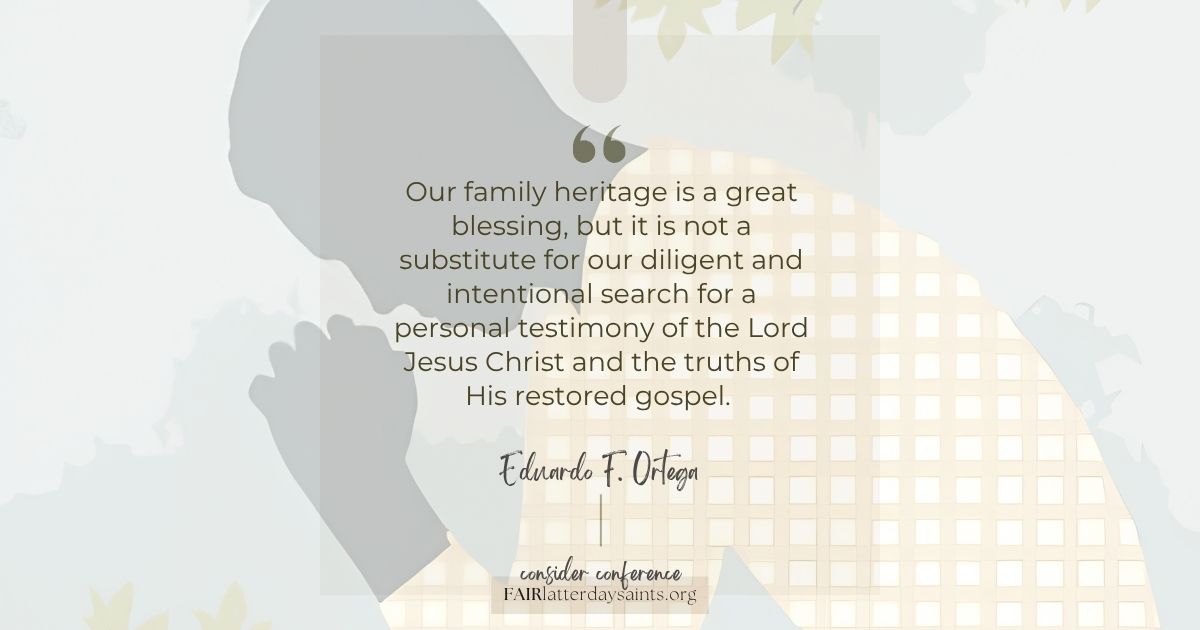
Our family heritage is a great blessing, but it is not a substitute for our diligent and intentional search for a personal testimony of the Lord Jesus Christ and the truths of His restored gospel.
This distinction matters when considering a common criticism of religious belief: You only believe that because you were raised that way.
Our upbringing certainly influences us. Elder Ortega does not deny that influence—he celebrates the tremendous blessing of a faithful heritage. But he also teaches that inherited belief is not enough. No one gets a testimony secondhand.
Common Criticism: You Only Believe Because You Were Raised in the Church
It is sometimes assumed that people raised in The Church of Jesus Christ of Latter-day Saints believe simply because their parents taught them to believe. If faith was introduced through family traditions, Primary lessons, family prayer, or regular Church attendance, some may conclude that a testimony is merely the product of upbringing rather than sincere conviction.
Elder Ortega’s own experience challenges that assumption. He grew up in a home where his family actively lived the Savior’s teachings and participated in the Church. Yet he makes an important admission: “But that was not enough—I needed to know for myself.”
Fallacy at Work: Genetic Fallacy
The Genetic Fallacy occurs when we judge whether a belief is true or false primarily because of where that belief originated rather than evaluating the belief itself.
Our upbringing unquestionably influences which ideas we encounter first. But explaining where someone first learned a belief does not establish whether that belief is true or false. A person can inherit a belief and later examine, question, experience, and deliberately choose it—or reject it.
Doctrine: Revelation Is Personal
When Peter testified that Jesus was “the Christ, the Son of the living God,” the Savior did not attribute Peter’s testimony merely to what others had taught him. Instead, He declared, “Flesh and blood hath not revealed it unto thee, but my Father which is in heaven” (Matthew 16:16–17).
The restored gospel teaches the same pattern. Parents can teach. Teachers can testify. Missionaries can invite. Prophets can proclaim. But ultimately, God invites individuals to seek their own spiritual confirmation.
Elder Ortega explained:
A personal testimony comes in response to our sincere and dedicated quest to want to know for ourselves and then to act upon the impressions and the knowledge received.
Elder Ortega’s Correction: Faith Must Become Personal
Elder Ortega’s answer is not that family influence does not matter. His own story demonstrates how much it does.
His grandmother Mercedes joined the Church in Argentina in 1957. Her decision to follow Jesus Christ blessed generations of her family. Elder Ortega grew up benefiting from the faith and courage she chose decades earlier.
But Mercedes’s testimony could not become her grandson’s testimony simply because he inherited her family name or traditions. Eventually, Elder Ortega needed his own experiences with Christ.
And that means the answer to the criticism “You only believe because your family believes” is not to deny the blessing of family influence. It is to recognize the difference between being introduced to faith and choosing faith for yourself.
Solution: Family heritage can show us where the path is, but it cannot walk the path for us. Each disciple must seek, come to know, act, and continue following Jesus Christ personally.
And the same principle works in the other direction. A new convert does not need generations of Latter-day Saint ancestors to possess genuine faith. As Elder Ortega taught, the invitation “to seek, to come to know and to do, and then to endure on the covenant path” is the same whether the gospel has been in our families for generations or we were baptized last week.
Living Apologetics: From Inherited Faith to Chosen Discipleship
Sometimes questions about our religious upbringing can actually be useful invitations to examine our discipleship.
Instead of becoming defensive when someone asks whether we believe simply because our parents did, we can ask ourselves: Why do I believe? What have I learned for myself? How has following Jesus Christ changed me? Where have I recognized His hand in my life?
Elder Ortega reminds us that testimony is not merely something we possess. Becoming a disciple of Christ is “a process, the sum of multiple small, daily, personal and spiritual events.”
That means personal conversion doesn’t require us to reject everything we inherited. It means taking what we have received and bringing it personally before the Lord.
Practical Apologetic Use
- If someone says: “You’re only a member of the Church because that’s how your family raised you.”
- You can respond: “My family absolutely influenced my faith, and I’m grateful for that. But being taught something and personally choosing it aren’t the same thing. The gospel itself teaches me to seek God and develop my own testimony rather than relying solely on someone else’s.”
 Ways to Apply Today
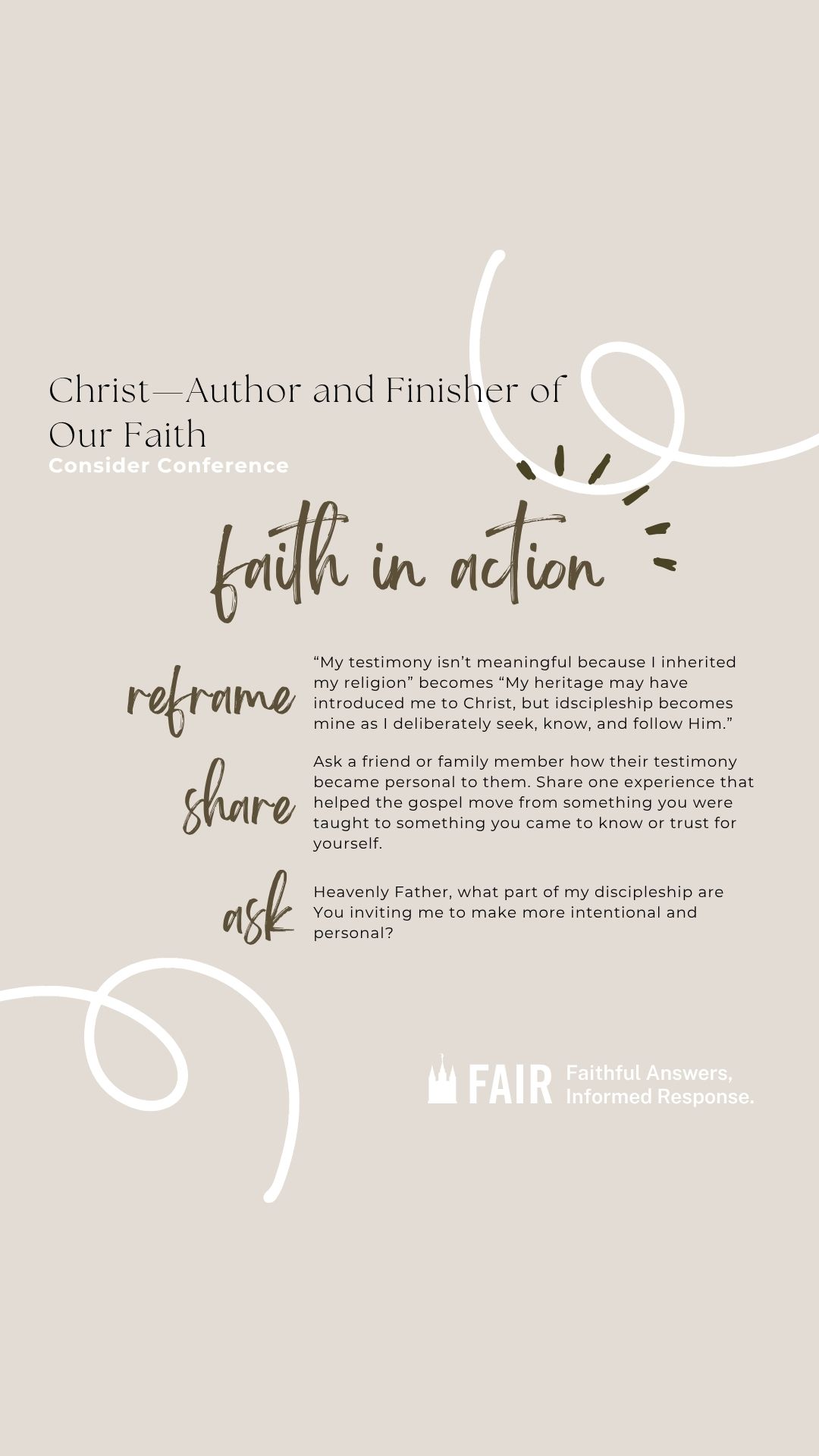
1️⃣ Identify what you know for yourself. Think beyond what your parents, leaders, or teachers have told you. Write down one truth about Jesus Christ that you feel you have personally come to know.
2️⃣ Seek instead of assuming. Choose one gospel principle you have largely taken for granted and study, pray, and act on it more intentionally. Give the Lord room to teach you personally.
3️⃣ Honor someone else’s journey. Don’t measure another person’s testimony by how long they—or their family—have been in the Church. A first-generation convert and a sixth-generation member receive the same invitation to come unto Christ.
Keep This Talk With You
Elder Ortega compares lifelong discipleship to climbing a mountain. The shortest route to the summit is not necessarily the safest one. Sometimes the secure path is longer, slower, and more demanding.
So it is with testimony.
We may wish spiritual certainty could simply be handed down from one generation to another. We may wish one powerful experience could eliminate every future question. But Elder Ortega describes something more patient and personal: a Savior who refines us over time as we repeatedly choose to trust Him.
Sometimes, as Elder Ortega acknowledges, we need “the perspective that time gives” before we recognize the refining and perfecting hand of Jesus Christ in our lives and families.
Our parents cannot make that journey for us. Neither can our grandparents, our bishop, our missionaries, or even a prophet. They can testify of the path. They can walk beside us. They can leave footprints worth following.
But ultimately, Jesus Christ and His restored gospel constitute the safe path that leads to the true summit.
This week, try one small step:
- Ask what has become yours. Consider one gospel truth you once accepted because someone you trusted taught it to you. How has experience, study, prayer, or revelation made that truth more personally meaningful?
- Create another small spiritual experience. Study a scripture, act on a prompting, offer a more intentional prayer, or serve someone. Lifelong discipleship is built through small encounters with Christ.
- Look backward with perspective. Identify one experience that was difficult while you were living through it but in which you can now recognize Christ’s refining hand.
Faithful families can give us an extraordinary inheritance. But perhaps one of the greatest ways to honor that inheritance is not merely to preserve it—it is to personally choose the Savior who gave it meaning in the first place.
What small choice can you make this week to move from simply knowing what others believe about Jesus Christ to knowing Him more deeply for yourself?
The Consider Conference series by FAIR offers an in-depth look at recent General Conference talks to help members of the Church of Jesus Christ of Latter-day Saints navigate common questions, misunderstandings, and criticisms. Each post provides doctrinal insights, historical context, and practical ways to apply gospel principles in everyday conversations. Through this series, we hope to equip readers with faith-promoting resources that encourage thoughtful reflection, respectful dialogue, and a stronger foundation in gospel truths, fostering both personal conviction and meaningful discussions with others.

Leave a Reply