
In his October 2026 General Conference address, Elder Ronald A. Rasband spoke to those whose hearts ache for loved ones who have stepped away from the gospel, distanced themselves from the Church, or made choices contrary to their covenants. His message was one of compassion, hope, and profound trust in Jesus Christ. At the heart of his counsel was a reminder of a fundamental principle of God’s plan:
By divine design, brothers and sisters, everyone must choose for themselves to follow Jesus Christ.

For those who deeply cherish their faith and eternal family relationships, respecting another person’s agency can be painful. We naturally want those we love to experience the blessings and peace we have found in the gospel. But when their choices lead them in another direction, how do we balance our commitment to eternal truths with our responsibility to love unconditionally?
Elder Rasband’s answer reminds us that genuine Christlike love does not require us to abandon our convictions, nor does faithfulness to those convictions justify withdrawing our love. Instead, discipleship asks us to trust the Savior, honor agency, and extend the same patience, mercy, and compassion He offers each of us.
Common Criticism: Is Love Conditional on Religious Obedience?
One criticism of Latter-day Saint beliefs is that the Church’s emphasis on covenants, commandments, and eternal families can create conditional relationships. When a family member leaves the Church or chooses a different spiritual path, they may feel that their acceptance within the family depends on returning to religious observance.
This concern is not always unfounded. Some individuals have experienced judgment, strained relationships, or pressure from well-meaning loved ones who struggle to reconcile their religious hopes with another person’s choices.
Yet these experiences do not necessarily reflect what the restored gospel teaches about agency and love.
Fallacy at Work: False Dilemma
A false dilemma occurs when two choices are presented as the only possibilities, overlooking other reasonable alternatives.
In this case, the assumption may be that faithful Church members must either affirm every decision their loved ones make or distance themselves from choices that conflict with their religious beliefs.
Elder Rasband offers another way. We can remain committed to our covenants while respecting the agency of others and loving them without reservation. Agreement is not a prerequisite for compassion, and disagreement need not diminish someone’s divine worth.
Doctrine: Agency and the Redeeming Love of Jesus Christ
Moral agency is fundamental to Heavenly Father’s plan. In 2 Nephi 2:27, Lehi teaches that God’s children are free to choose liberty and eternal life through Jesus Christ or captivity and death through the adversary.
This freedom is not merely permission to make the choices God prefers. It includes the genuine ability to choose differently, even when those decisions bring sorrow to ourselves or others.
Because agency is essential to God’s plan, we cannot compel another person’s faith or repentance. Even Heavenly Father, who loves His children perfectly, allows them to make their own decisions.
But agency does not place anyone beyond the reach of the Savior’s love.
Elder Rasband testified:
“By the power of Jesus Christ’s Atonement, there is always a way back!”
The Atonement of Jesus Christ provides the possibility of repentance, healing, and reconciliation. It does not eliminate agency or guarantee that every individual will choose to return. Rather, it assures us that no one is beyond the Savior’s invitation to come unto Him.
Our responsibility is not to control another person’s journey but to love them as children of God and trust in the infinite reach of Christ’s redeeming power.
Elder Rasband’s Correction: Love Without Control
Elder Rasband acknowledges the anguish that can accompany a loved one’s departure from the faith. Parents, spouses, siblings, and friends may question what they could have done differently. They may revisit past conversations, wonder whether they failed, or feel compelled to persuade someone to return.
Yet even sincere efforts to change another person’s mind can unintentionally create greater distance.
Elder Rasband offers a different invitation:
“I ask you to turn over to Jesus Christ your despair for those wayward souls.”
This counsel is not an invitation to stop caring. It is an invitation to recognize the difference between what we can offer and what only the Savior can accomplish.
We can pray, encourage, listen, serve, and love. We can share our testimonies when appropriate and remain examples of faithful discipleship. But we cannot manufacture another person’s testimony or compel a change of heart.
Elder Rasband reminds us that our loved ones belong first to Heavenly Father, who knows and loves them even more perfectly than we do.
He also teaches that Christlike love is active rather than indifferent. It means remaining interested in another person’s life, celebrating their successes, supporting them through challenges, and keeping our hearts open.
As Elder Rasband explains:
“That holiness comes when we are peacemakers, when we are charitable, patient, forgiving, and kind.”
Such love is not dependent upon shared religious observance. It reflects the Savior’s character and our commitment to follow Him.
Solution: Love Is Not the Opposite of Faithfulness
The gospel does not require us to choose between honoring our covenants and loving those who make different choices.
In fact, our covenants should deepen our capacity for Christlike love.
Elder Rasband points to the parable of the prodigal son, whose father continued to love him despite his departure and poor decisions. When the son returned, the father did not respond with resentment or a demand for explanations. He ran to meet him with compassion.
The father’s love was not created by his son’s return. It was already there.
This distinction matters. We should not treat love as a reward for religious conformity or make affection dependent upon someone’s willingness to return to Church activity.
Neither should we assume that every strained relationship will be healed in the same way or on the same timeline as the parable.
The father’s example teaches us to keep our hearts open, respect another person’s journey, and make our love unmistakable.
Elder Rasband reminds us:
“Jesus Christ pulls more than His weight. His Atonement is witness of His all-encompassing love for each one of us.”
We are not responsible for accomplishing another person’s salvation. We are responsible for following the Savior, loving His children, and trusting Him with the things beyond our control.
Living Apologetics: Loving Across Differences in Faith
For families navigating differences in religious belief, the challenge is often not a lack of love but uncertainty about how to express it.
A parent may worry that accepting an adult child’s choices communicates approval of decisions they believe are spiritually harmful. A child who has left the Church may interpret repeated invitations to return as evidence that their family cannot accept them as they are.
Both may feel misunderstood.
Elder Rasband’s teachings invite us to move beyond these assumptions and prioritize the relationship itself.
Christlike love allows us to listen without immediately correcting, express concern without condemnation, and maintain meaningful relationships without making every interaction about religious differences.
This approach does not erase doctrinal disagreements. It creates room for mutual respect and genuine connection despite them.
Practical Apologetic Use:
- If someone says: “Latter-day Saints only love their family members when they stay in the Church.”
- You can respond: “Some families have struggled with this, and those experiences deserve compassion. But the gospel teaches that everyone has the God-given right to choose their own path. Elder Rasband reminds us that our responsibility is to love as Jesus Christ loves—not to control another person’s choices. Our faith should make us more patient, forgiving, and compassionate, not less.”
Ways to Apply Today: 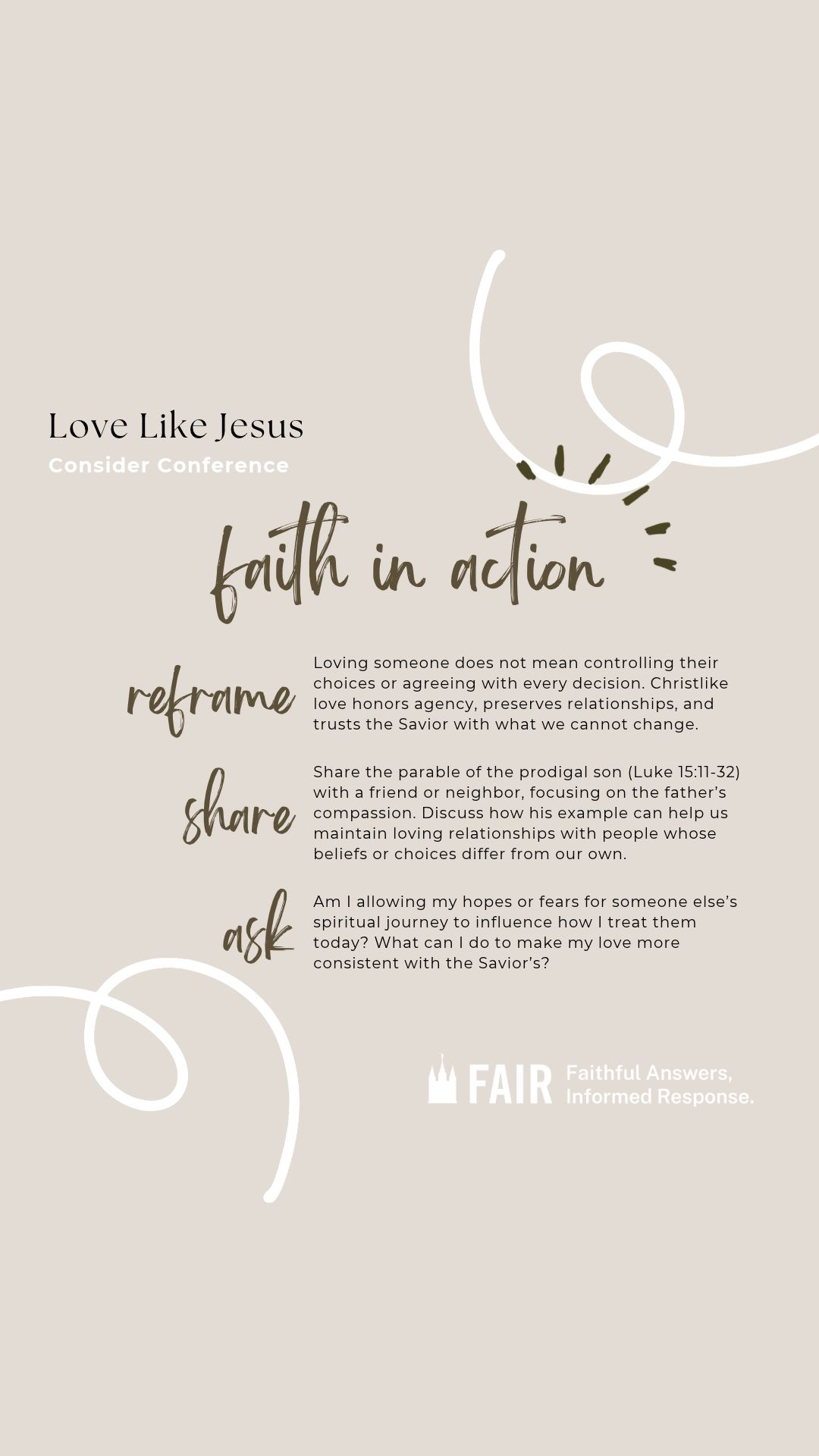
1️⃣Listen before responding. When someone shares doubts, frustrations, or different beliefs, resist the urge to immediately correct or persuade. Seek to understand their experience and communicate that the relationship matters more than winning an argument.
2️⃣Nurture relationships beyond religious discussions. Show interest in your loved ones’ accomplishments, challenges, interests, and everyday lives. Celebrate meaningful moments together and demonstrate that your love is not dependent upon Church participation.
3️⃣Pray with trust rather than fear. Follow the example of Alma the Elder, whose prayers for his son were heard by the Lord (Mosiah 27:14). Pray for your loved ones’ well-being and for the wisdom to love them as the Savior would, while respecting their agency and God’s timing.
Keep This Talk With You
Elder Rasband’s message reminds us that the Savior’s love is greater than our fears, our disappointments, and our limited understanding of another person’s spiritual journey.
When someone we love chooses a different path, it can be tempting to measure our success as parents, family members, or friends by their decisions. But another person’s exercise of agency is not necessarily evidence of our failure.
The Savior asks us to remain faithful, extend compassion, and trust in His power to redeem.
The story of the prodigal son offers a powerful reminder that love does not have to wait for agreement or repentance. The father did not stop being a father when his son left home. His compassion remained, and his arms were open when his son returned.
We can follow that example by becoming people whose love is unmistakable, whose relationships are not dependent upon religious conformity, and whose confidence rests in Jesus Christ.
This week, consider three small invitations:
- Reach out without an agenda. Contact someone whose beliefs or choices differ from yours simply to express love, friendship, or appreciation. Let the interaction be about the person, not their religious decisions.
- Examine your expectations. Ask whether your words or actions might unintentionally communicate that your affection depends upon someone making the choices you hope they will make.
- Entrust your worries to the Savior. In prayer, acknowledge what you cannot control and ask for greater patience, peace, and confidence in Christ’s ability to work in the lives of those you love.
Elder Rasband closes with a reminder that places our hope where it belongs:
“Remember Jesus Christ is the answer. He is, always has been, and always will be.”
When we cannot see the outcome of another person’s journey, we can still choose to trust the One who sees it perfectly.
Our task is to love as He loves, honor the agency He has given, and remember that His redeeming power reaches farther than our own.
How can I make sure the people I love feel the Savior’s love through me, regardless of where they are on their journey of faith?

The Consider Conference series by FAIR offers an in-depth look at recent General Conference talks to help members of the Church of Jesus Christ of Latter-day Saints navigate common questions, misunderstandings, and criticisms. Each post provides doctrinal insights, historical context, and practical ways to apply gospel principles in everyday conversations. Through this series, we hope to equip readers with faith-promoting resources that encourage thoughtful reflection, respectful dialogue, and a stronger foundation in gospel truths, fostering both personal conviction and meaningful discussions with others.

Leave a Reply