Note: This is the second in a two-part series about solemn assemblies to sustain a President of the Church. The first part addressed current procedures and the principles of solemn assemblies and sustaining Church Presidents.
Since October 1880 when John Taylor was first sustained as the President of the Church, a solemn assembly is held “for the body of the Church to express the voice of the Church in a first sustaining vote for a new President of the Church.”1J. Reuben Clark Jr., Conference Report, October 1945, 3. Although the exact procedures have varied over time, the fundamentals have remain unchanged.
Joseph Smith and Brigham Young
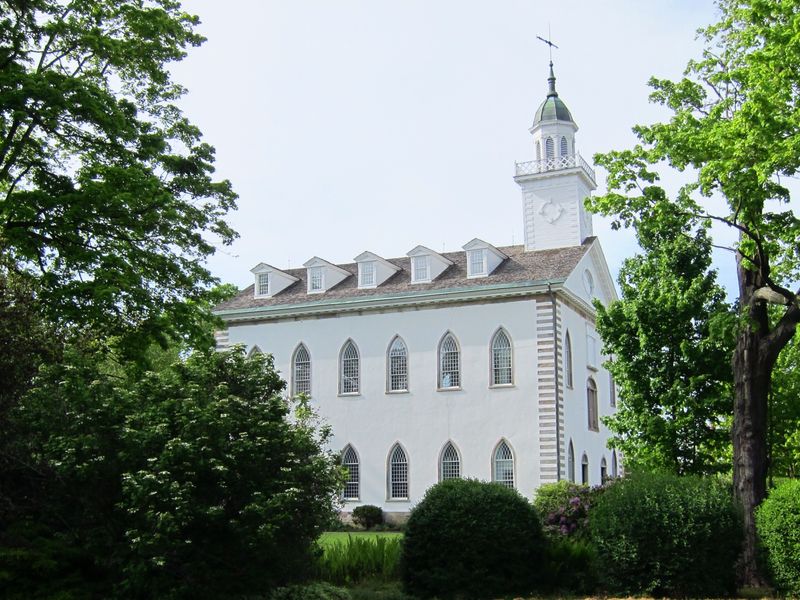
Joseph Smith introduced the special pattern of voting that is now followed in our solemn assemblies. During the dedicatory services of the Kirtland Temple on March 27, 1836, Sidney Rigdon:
The first special voting for Church leaders in this dispensation took place in the Kirtland Temple.
Presented Joseph Smith jr. to the church as a Prophet and Seer. The Presidents of the Church then all in their seats, acknowledged him as such by rising. The vote was unanimous in the affirmative. The question was then put, and carried without a manifest dissenting sentiment to each of the different grades or quorums of church officers respectively and then to the congregation.2“Minutes and Prayer of Dedication, 27 March 1836 [D&C 109],” p. 276, josephsmithpapers.org.
Later in the service, Joseph Smith then presented the other Church officers in the same manner: each officer was presented to the several priesthood quorums in order, and then to the congregation as a whole.3See entry for 27 March 1836 in “Journal, 1835-1836,” p. 175-176, josephsmithpapers.org Naturally, this procedure took a long time, as each group of leaders was presented to each quorum and the congregation, then the next group was presented to each quorum and the congregation, and so forth.
In this special procedure, a person voted affirmatively by rising when that person’s quorum was called upon, if he assented to the proposal; if he disagreed with the proposal, he remained seated.
After Joseph Smith was killed, Brigham Young called for a solemn assembly for the Saints to vote on who should lead the Church—Sidney Rigdon or the Quorum of the Twelve. He asked the Saints to assemble at the meeting seated by priesthood quorums, to vote in the same way as was done in the Kirtland Temple. However, as the meeting progressed in which the vote was to be taken, developments in the meeting precluded voting by quorums.4For a summary, see Ronald W. Walker, “Six Days in August: Brigham Young and the Succession,” in A Firm Foundation: Church Organization and Administration, ed. David J. Whittaker and Arnold K. Garr (Provo, UT: Religious Studies Center, Brigham Young University; Salt Lake City: Deseret Book, 2011). For an easy-to-read summary from notes of the time period, see entries for August 7 and 8, 1844, in History of the Church 7:230-231, 240. For original sources, see “Nauvoo, Illinois, stand, 1844 August 8,” in Historians Office general church minutes, 1839-1877, Church History Library; entry for 8 August 1844, in Wilford Woodruff Journal (January 1, 1843 – December 31, 1844), The Wilford Woodruff Papers.
John Taylor, Wilford Woodruff, and Lorenzo Snow
In August of 1877, Brigham Young died after leading the Church for 30 years. In the first general conference after he passed, a solemn assembly was convened for the purpose of sustaining the Quorum of the Twelve as the presiding quorum of the Church. (At the time, it was called a general assembly.) This assembly followed the same pattern as the assembly in the Kirtland Temple: attendees were seated by priesthood quorum, and each group of leaders was presented to each quorum in succession (meaning the first group of leaders was presented to each quorum in order, then the next group was presented, and so forth). One change that was made (and has continued ever since) is that voting was done by standing and raising the right hand (instead of just standing).5See “General Conference,” The Deseret News 26, no. 36 (10 October 1877): 569.
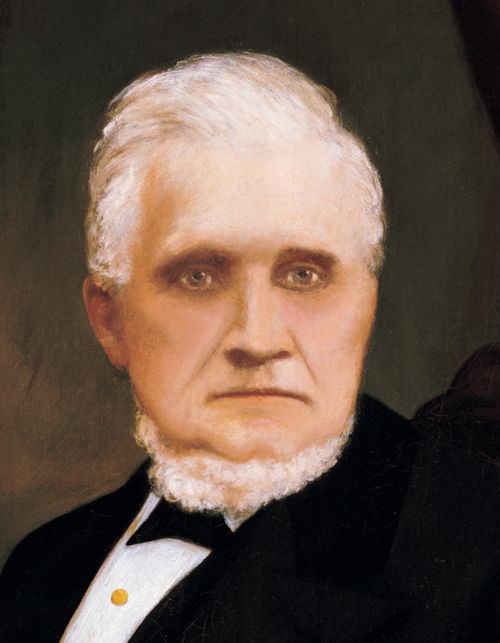
The current process of voting on a new Church President started with John Taylor.
In 1880, the Quorum of the Twelve was ready to reorganize the First Presidency, and so in the October 1880 general conference, another solemn assembly was convened in order to sustain the new First Presidency. Again, attendees were seated by priesthood quorum and voted in the same manner as the 1877 conference. (During this voting, presidents of all priesthood quorums also voted as an additional separate group.) One major difference this time is that only the newly formed First Presidency, the Quorum of the Twelve Apostles, and the counselors to the Apostles6John W. Young was serving as First Counselor in the First Presidency and Daniel H. Wells as Second Counselor in the First Presidency when Brigham Young died. These two men had not been sustained to the Quorum of the Twelve prior to their service in the First Presidency, and it was decided that they thus be called to serve as “counselors to the Twelve” after Brigham Young died. were sustained using the special voting procedure. The vote on the counselors in the First Presidency and the Twelve Apostles as prophets, seers, and revelators, as well as the voting on all other Church officers, was done in the non-special manner (of the entire congregation voting at once while staying in their seats).7See “Fiftieth Semi-annual Conference,” The Deseret News 29, no. 37 (13 October 1880): 588. This 1880 assembly effectively became the first solemn assembly for sustaining a new First Presidency.
The people who voted as a group were as follows:
Members of the Quorum of the Twelve Apostles and their counselors
Patriarchs and members of stake presidencies and high councils
High priests
Seventies
Elders
Members of bishoprics
All Aaronic Priesthood holders (priests, teachers, and deacons)
Presidents of the quorums
The entire congregation, including non-priesthood holders
The procedures in the 1889 assembly for Wilford Woodruff were virtually identical as those of the 1880 assembly, with the exception that quorum presidents did not vote as a separate group (what had been group 8).8See “General Conference,” The Deseret Weekly 38, no. 16 (13 April 1889): 486–487. The procedures in the 1898 assembly for Lorenzo Snow were virtually identical to those of the 1889 assembly.9See Conference Report, October 1898, 51–53.
Joseph F. Smith and Heber J. Grant
The 1901 assembly for Joseph F. Smith is unique in that it has been the only assembly conducted during a special general conference. Lorenzo Snow died just a few days after the October 1901 general conference had concluded, and it was decided to hold a special conference immediately for the sole purpose of sustaining the new First Presidency. So in November of 1901, the Saints assembled for this special conference. Unlike the previous three assemblies, during this one all the General Authorities were sustained using the special voting method. As for the groups voting, because the First Presidency had already been organized, the First Presidency became the first group to vote. Also, the patriarchs of the Church now voted as their own group, before members of stake presidencies and high councils. Lastly, Joseph F. Smith himself, as President of the Church, conducted the sustaining vote.10See Conference Report, October 1901, 80–81. This report included the proceedings of the special November 1901 conference that was convened for the solemn assembly.
The 1945 assembly to sustain George Albert Smith reverted back to the principle followed in the 1880 assembly of using the special voting procedure only for the top leaders. Thus, in the assemblies from 1945 to 1975, the special voting procedure was used only for the First Presidency, Quorum of the Twelve Apostles, and Patriarch to the Church, as well as sustaining these officers as prophets, seers, and revelators. The most notable change from the 1919 pattern was the involvement of those not in the Tabernacle. Seating in the Tabernacle was still by quorum, and when each quorum was called upon to vote, only those in the Tabernacle participated. However, when the voting on each proposal reached the last group (the entire congregation), everyone listening by radio, wherever they were, was invited to stand and vote. The last notable change was that all high priests now voted together as one group. (Previously, members of stake presidents and high councils voted as a group, members of bishoprics voted as a group, and other high priests voted as yet a third group.)12See Conference Report, October 1945, 3–15.
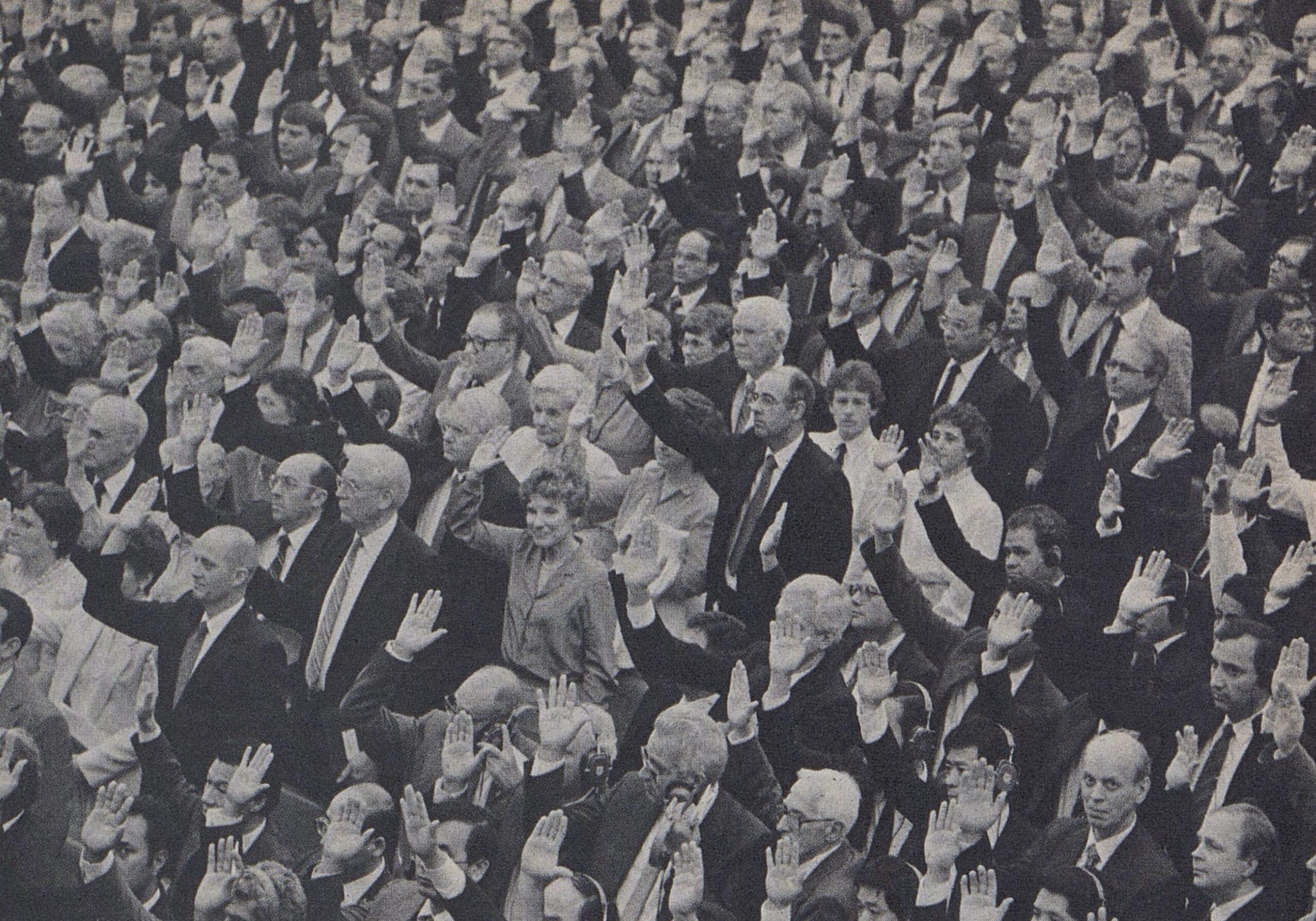
The entire congregation arises and votes to sustain Ezra Taft Benson as Church President.
The 1986 assembly for Ezra Taft Benson14Gordon B. Hinckley, “Solemn Assembly and Sustaining of Church Officers,” April 1986 general conference. saw the greatest changes to the procedure since it was introduced by Joseph Smith:
Standing for all proposals at once. Up to this point, each quorum would vote on one set of leaders (for example, the First Presidency), cycling through all the quorums voting for that group of leaders. Then the quorums would vote again on the next set of leaders (for example, the Quorum of the Twelve), and so on. This obviously took a considerable amount of time, and required a lot of up and down for everyone involved. Beginning with the 1986 assembly, each quorum stood only once to vote, and all the proposals were given at once for each quorum.
Proposals consolidated for everyone after the First Presidency voted. Previously, when each quorum stood, the person conducting would read through all the names of the group being presented, every time. Starting with the 1986 assembly, the person conducting would read through each proposal when the First Presidency voted. After that, for each quorum voting, the person conducting would simply say something like “It is proposed that [insert group voting] sustain the proposals as previously presented and voted upon by the First Presidency.”
Everyone everywhere participated for everything. Though starting in 1945 people not in the Tabernacle were invited to participate when the whole congregation was invited to stand, before 1986 only those in the Tabernacle could participate when each quorum was called upon. Beginning in 1986, everyone everywhere was invited to stand then their quorum was called upon.
Melchizedek Priesthood groups. All Melchizedek Priesthood holders outside of the First Presidency and Quorum of the Twelve voted together as one group (instead of the voting being separated by priesthood offices).
Seating in the Tabernacle. Seating in the Tabernacle was no longer done by quorums.
These changes greatly reduced the amount of time required to conduct the special voting. Whereas the 1945 pattern took almost 30 minutes to conduct the voting, the 1986 pattern took less than 10 minutes.15Compare the videos of the 1974 and 1986 assemblies on Gospel Library.
The only main difference between the 1986 assembly and the 1994 assembly for Howard W. Hunter was that the Seventies and the Presiding Bishopric voted as their own group. (They had been included with all other Melchizedek Priesthood holders in the 1986 assembly.)16See Gordon B. Hinckley, “The Solemn Assembly [and] Sustaining of Church Officers,” October 1994 general conference.
Gordon B. Hinckley through Russell M. Nelson
Beginning in the 1995 assembly for Gordon B. Hinckley, two groups were added to the voting. Previously, once the Aaronic Priesthood had voted, the entire congregation was then invited to vote together. Beginning in 1995, the Relief Society and also the Young Women voted as separate groups before the entire congregation was invited to vote.17See Thomas S. Monson, “The Solemn Assembly [and] Sustaining of Church Officers,” April 1995 general conference.
The 2008 assembly for Thomas S. Monson was virtually identical to the 1995 assembly.18See Dieter F. Uchtdorf, “The Sustaining of Church Officers,” April 2008 general conference.
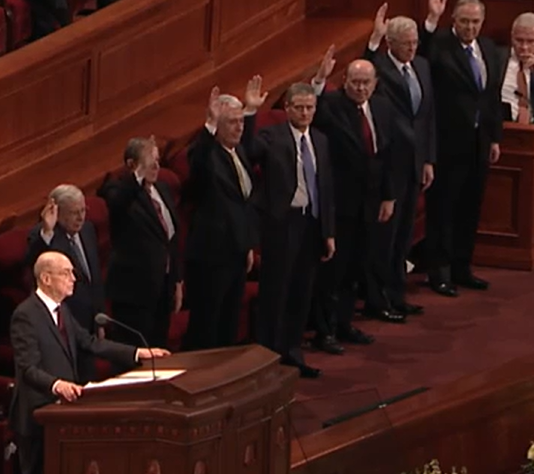
Members of the Quorum of the Twelve Apostles vote to sustain Russell M. Nelson as Church President.
The only major difference for the 2018 assembly for Russell M. Nelson was the Relief Society group voted after the Melchizedek Priesthood group and before the Aaronic Priesthood group.19See Henry B. Eyring, “Solemn Assembly,” April 2018 general conference.
Conclusion
Though the procedures have changed significantly since the pattern was first introduced by Joseph Smith in 1836, the special voting during a solemn assembly remains an important opportunity for Church members to join with their own quorums or groups, and then as an entire Church, to sustain a new President of the Church. For those who approach the proceedings with a reverential attitude, they can witness what has been described as “one of the most thrilling, inspiring, and humbling experiences in Church government.”20Jay M. Todd, “The Solemn Assembly,” Improvement Era 73, no. 6 (June 1970): 20.
David W. Smith has volunteered with FAIR since August 2019, and was the recipient of the John Taylor Defender of the Faith Award in 2020. He has had an article published in BYU Studies, and he presented at the Joseph Smith Papers Conference in 2019. He has a bachelor’s degree in philosophy and a master’s degree in public administration, both from Brigham Young University.
 David W. Smith has volunteered with FAIR since August 2019, and was the recipient of the John Taylor Defender of the Faith Award in 2020. He has had an article published in BYU Studies, and he presented at the Joseph Smith Papers Conference in 2019. He has a bachelor’s degree in philosophy and a master’s degree in public administration, both from Brigham Young University.