• Skip to primary navigation
  • Skip to main content
  • Skip to primary sidebar
  • Skip to footer

FAIR

  • Find Answers
  • Blog
  • Media & Apps
  • Conference
  • Bookstore
  • Archive
  • About
  • Get Involved
  • Search

FAIR Conference

Mormon FAIR-Cast 73: Purpose, history and offerings of FAIR

February 8, 2012 by SteveDensleyJr

https://media.blubrry.com/mormonfaircast/www.fairlatterdaysaints.org/wp-content/uploads/2012/01/FAIR-Conference-Interview.mp3

Podcast: Download (9.2MB)

Subscribe: RSS

Mike Ash and Martin Tanner discuss the purpose of FAIR, the history of FAIR, various FAIR publications and the topics covered in the 2011 FAIR Conference in this episode of Religion Today that originally aired on July 31, 2011.

This recording was used by permission of KSL Radio and does not necessarily represent the views of The Church of Jesus Christ of Latter-day Saints or of FAIR.

Filed Under: Apologetics, FAIR Conference, News from FAIR, Podcast

Best of FAIR 13: “Uh oh!” to “Ah ha!” in Apologetics: 20/20 Foresight for a Faithful Future in Defending the Church

November 16, 2011 by SteveDensleyJr

https://media.blubrry.com/mormonfaircast/www.fairlatterdaysaints.org/wp-content/uploads/2011/11/Uh-oh_-to-_Ah-ha_-in-Apologetics_.mp3

Podcast: Download (26.2MB)

Subscribe: RSS

In this address from the 2009 FAIR Conference, John Lynch provides practical advise on how to help those who are struggling with their faith. “What we’re about at FAIR is the idea of tending the gardens of the heart. . . . Our real objective is the preservation of faith and not the presentation of definitive answers. To that end, it’s not enough to answer the arguments of the critics any more than it is enough to weed the flowers in our garden. We must also nourish them and water them and give them ongoing light to reach towards. This means several things need to occur.

  • Answers need to include not only refutation of false ideas, but affirmations of true concepts.
  • We need to not only respond with evidences against the arguments of our critics but arguments in favor of the hope that is in us.
  • We need to help members interpret their religious world in the light of true principles including those that allow for mistakes.”

The text of Brother Lynch’s address can be found here.

John Lynch is a Silicon Valley sales and marketing executive specializing in high-tech startup ventures. He is a member of the Board of Directors of FAIR and serves as its Chairman. Having served in many missionary callings, including twice as a Stake Mission President, multiple times as a Ward Mission Leader, and having worked at the Provo Missionary Training Center as a teacher and trainer, John has seen the impact of both well-prepared and poorly prepared defenders of the faith. John is currently the Young Men’s President for the Los Gatos Ward, Saratoga California Stake.

Filed Under: Anti-Mormon critics, Apologetics, FAIR Conference, Podcast

Best of FAIR 11: “Believest thou…?”: Faith, Cognitive Dissonance, and the Psychology of Religious Experience

September 28, 2011 by SteveDensleyJr

https://media.blubrry.com/mormonfaircast/www.fairlatterdaysaints.org/wp-content/uploads/2011/09/Believest-thou-Faith-Cognitive-Diss.mp3

Podcast: Download (24.5MB)

Subscribe: RSS


In this episode of Best of FAIR, Wendy Ulrich, Ph.D., observes: “In my experience, neither critics nor apologists for the Church do much to convince me whether or not to believe. Debates, analysis, and scientific evidence may alternately undermine or support my beliefs, but belief itself is a choice I wrestle God for, somewhere in a dark swampland of my inner landscape, where not only God’s credibility but my own are at stake.

….

“I have noticed that many of the people I have known who have left the Church did not do so because they believed too little, but because they believed too much. In their excessive idealism, they have held Church leaders or God to expectations which were inevitably disappointed, and they have felt betrayed. They have not believed God when He told them that ours is a lonely, dreary world where we will surely die, and they have chosen instead to believe another version of reality, one which claims that they can be protected from being molested, disappointed, or made afraid. They have been angry at God or other Church leaders for not keeping promises which God has not, in fact, made. I note with interest that of all the names for the Savior in holy writ, He is never called the Preventer. Agency is the plan, and this means that all of us, including Church leaders, learn by our mistakes and are subject to misinformation, blindness, hubris, and error. The old joke is too often true: In the Catholic church everyone says the pope is infallible but nobody believes it; and in the Mormon church everybody says the prophet is fallible but nobody believes it.

“When Christ asks the question of His remaining disciples, ‘will ye also go away?’ it seems to be in recognition that they may be feeling betrayed or disillusioned by His words and requirements, as others were. Their response is not brimming with irrational enthusiasm. They seem to say, somewhat wistfully, as if recognizing that perhaps leaving would be an easier choice, ‘to whom, Lord, shall we go? Thou hast the words of eternal life.’ We do not leave because we are blind to the challenges or brainwashed into commitment, but because we will have more cognitive dissonance, more to explain to ourselves, if we leave. We have found here things that we hold dear, that support and enrich our lives. We, like the reluctant disciples of old, have found here words of eternal life, which is to say that we have found knowledge of God and Jesus Christ, whom He has sent. These relationships, these pearls of great price, are worth the sacrifices and the disappointments and the askance looks of our friends who wonder what we could be thinking.”

Wendy Ulrich, Ph.D., was a psychologist in Ann Arbor, Michigan for 20 years before moving to Montreal, Quebec for a three-year mission. She has served as president of the Association of Mormon Counselors and Psychotherapists, has authored numerous professional articles in both psychology and business, and has done consulting and training for such corporations as Marriott, Johnson & Johnson, University of Michigan, General Electric, and United Way. Dr. Ulrich is founder of Sixteen Stones Center for Growth in Alpine, Utah, providing seminar-retreats for LDS members seeking personal and spiritual growth and development. She and her husband have three children.

Dr. Ulrich is the author of the book Weakness is Not a Sin. The full text of Dr. Ulrich’s talk can be found at Fairlds.org.

Filed Under: FAIR Conference, Philosophy, Podcast

Best of FAIR 10: On Being An Apologist: Imperatives, Predicaments, Perils, and Blessings.

September 4, 2011 by SteveDensleyJr

https://media.blubrry.com/mormonfaircast/www.fairlatterdaysaints.org/wp-content/uploads/2011/08/On-Being-An-Apologist.mp3

Podcast: Download (28.2MB)

Subscribe: RSS

Robert White discusses his experience as a church leader and as an apologist. He explains why apologetics is important and cautions against some pitfalls of apologetics. As C.S. Lewis said, “nothing is more dangerous to one’s own faith than the work of an apologist. Because no doctrine of that Faith seems to me so spectral, so unreal as one that I have just successfully defended. . . . That is why we apologists take our lives in our hands and can be saved only by falling back continually from the web of our own arguments … from Christian apologetics [in]to Christ himself.  That is also why we need one another’s continual help — oremus pro invincem (let us pray for one another).”

He shares his thoughts on the idea of inoculating the saints against anti-Mormon arguments. In providing an inoculation, can we be sure we know what disease, or argument, each individual will be exposed to? Is it possible that we may do more harm than good in administering the wrong inoculation? He contrasted inoculations with transfusions. The Gospel Principles manual is designed “not [to] inoculate but transfuse into the lives of the Latter-day Saints the fundamental faith in the fundamental gospel restored through the Prophet.” If people know the Church is true, then they will be strengthened against the attacks of anti-Mormon arguments when encountered.

The full text of this address can be found here.

Robert B. White, Q.C., served a mission in Eastern Canada after which he returned to Edmonton and received degrees in finance (with distinction) and law (with distinction and the Silver Medal) at the University of Alberta. He is a senior partner and litigation practice group leader in a large, multi-national law firm with offices across Canada and in Japan. Robert works exclusively in trials and appeals and loves the law. He is listed in each of the three published, peer reviewed “Best Lawyers in Canada” lists. He was hired as an adjunct professor in law while in my third year of law school, and while practicing he taught for 18 years. He has written four law books, all published by Canada Law Book, with a second edition of one under way. Robert has served in many Church positions, including bishop, stake president, and area seventy. He is married to Lonni. They have six children and twenty grandchildren.

Filed Under: Apologetics, FAIR Conference, Podcast

Best of FAIR 10: Mormon Defense League Announcement

August 6, 2011 by SteveDensleyJr

https://media.blubrry.com/mormonfaircast/www.fairlatterdaysaints.org/wp-content/uploads/2011/08/Mormon-Defense-League-Announcement.mp3

Podcast: Download (12.9MB)

Subscribe: RSS

Scott Gordon and John Lynch report from the 2011 FAIR Conference on the announcement of the Mormon Defense League, its purpose, and the way in which it has been received. Scott also reviews the various websites associated with FAIR.

Filed Under: FAIR Conference, Mormon Defense League, News from FAIR, Podcast

Best of FAIR 9: The Lives of Mormon Women

August 3, 2011 by SteveDensleyJr

https://media.blubrry.com/mormonfaircast/www.fairlatterdaysaints.org/wp-content/uploads/2011/08/The-Lives-of-Mormon-Women.mp3

Podcast: Download (37.4MB)

Subscribe: RSS

Claudia Bushman asks, is the self sacrifice motif for women in the Church so strong that no interest and care should be taken about their own lives? She observes that “too many women in the church live passive lives. We cannot afford to do that. We have talents to multiply.”

She also addresses the role of feminism in the Church. Only a few years ago, she told a Salt Lake Tribune writer that feminism was dead and that the word itself had become so frightening that the movement was now moribund and extinguished. She nevertheless, acknowledges that there are still “many old self-described LDS feminists around.” In fact, she considers herself to be a feminist and said “I doubt that many people would disagree with my definition of feminism, that the talents of women should be developed for the benefit of their communities, their church, their families and themselves.” By this definition, the Relief Society organization itself is a feminist organization. “Mormon women find emotional support and personal and spiritual growth there. The Relief Society, even in its curtailed form, provides a network for us to know, teach, and befriend each other. In Relief Society we are encouraged to exercise that most important feminist strategy, reaching beyond our patriarchal structure to a personal relationship with deity through which we can discover our own personal revelation and destinies.”

She adds: “Without autonomy, women would seem to have little power in this religion. But what is power in religion? Leadership seems important, but many religions, certainly ours, have stressed the humble vineyard worker as the powerful position. The greatest of all is the servant of all.”

She concludes by asking, what can women hope for from the Church? She states: “Women should realize that the Church is a great enabler, not a hindrance. The Church provides a wonderfully welcoming arena for working out our own ideas and building our talents as we seek for and follow our own revelation.”

The full text of Sister’ Bushman’s address can be found here.

Claudia L. Bushman holds degrees in literature and American Studies from Wellesley College, Brigham Young University, and Boston University and now teaches history and American studies at Columbia University in the City of New York. Dr. Bushman is the author and editor of ten books including Mormon Sisters: Women in Early Utah, Building the Kingdom (with Richard Bushman), and Contemporary Mormonism: Latter-day Saints in Modern America, as well as a variety of other American history books. She was the founding editor of Exponent II. Dr. Bushman is married to Richard Lyman Bushman and is the mother of six. Having held all the usual Church positions, she now finds most of her Church work off the books in such areas as chairman of the Harlem Bridge Builders committee, producer of the Manhattan Temple Jubilee at Radio City Music Hall, and chairman of the committee to install a statue of Joseph Smith near Wall Street in New York in honor of his 200th birthday.

Filed Under: FAIR Conference, Podcast, Women

Nephi and Goliath: A Reappraisal of the Use of the Old Testament in First Nephi

Start Here

Question
Did Nephi intentionally model parts of First Nephi on Old Testament narratives?

Short Answer
In this 2001 FAIR Conference presentation, Ben McGuire argues that Nephi deliberately drew upon Old Testament literary patterns when writing his record. He suggests that the account of obtaining the brass plates (1 Nephi 3–4) contains intentional parallels to both the story of David and Goliath and the Exodus narrative, inviting readers to recognize these scriptural connections.
Key Takeaways
  • McGuire argues that Nephi consciously used Old Testament literary patterns rather than accidentally echoing biblical stories.
  • The account of Nephi and Laban contains a sequence of parallels to David and Goliath, including:
    • A powerful adversary feared by others.
    • A faithful hero willing to act.
    • Divine deliverance into the hero’s hands.
    • The enemy being slain with his own sword.
  • Nephi’s narrative also reflects Exodus themes, portraying Lehi’s family as a covenant people journeying toward a promised land.
  • These parallels suggest that Nephi expected readers familiar with scripture to recognize and interpret these connections.
  • McGuire proposes that Nephi’s use of biblical patterns reinforces both his prophetic authority and his legitimacy as a ruler.
  • While literary parallels do not by themselves prove historicity, McGuire argues they demonstrate sophisticated scriptural awareness and intentional composition within the Book of Mormon text.

Summary

Summary

Ben McGuire explores how Nephi’s account of obtaining the brass plates may have been deliberately modeled after the biblical story of David and Goliath. By comparing narrative structure, language, and recurring themes, he identifies numerous parallels between the two stories, including the introduction of a powerful adversary, expressions of fear by others, divine deliverance, and the hero’s use of the enemy’s own sword.

The presentation also broadens the discussion to include Exodus imagery throughout First Nephi. McGuire argues that Nephi understood his family’s journey as part of a larger scriptural pattern and intentionally incorporated Old Testament motifs into his writings. These literary connections, he suggests, help explain Nephi’s emphasis on prophetic legitimacy, covenant identity, and kingship, while offering readers a deeper appreciation for the Book of Mormon’s engagement with biblical traditions.

TL;DR

TL;DR (Too Long; Didn’t Read)

Ben McGuire argues that Nephi intentionally patterned portions of First Nephi after Old Testament narratives, particularly David and Goliath and the Exodus. By comparing the account of obtaining the brass plates with biblical stories, McGuire identifies literary parallels that suggest Nephi expected readers to recognize and interpret these scriptural connections. The presentation explores how these patterns reinforce Nephi’s prophetic authority, kingship claims, and theological message.

Note About the Slides in this Presentation

Note on Visuals:

The original slides from Ben McGuire’s presentation were not available. The visuals included here were created with every effort to accurately reflect the speaker’s intent. However, any errors or oversimplifications are our own.

Download Ben McGuire's Paper

Download PDF

Introduction

Well, it’s a pleasure to be here. I’m actually a little bit nervous. There’s something different about talking in front of lots of people than there is about carefully crafting a response on the internet.

I actually started my foray into apologetics five or six years ago on the AOL discussion boards. 1

I don’t know how many of you participate in that. And I have done some stuff on the FAIR message boards. But not too much in the last year or so. I’ve been involved in a lot of other things which have taken a great deal of my time.

I kind of like to think of myself, not so much as going out finding lots of answers, but I do like to point out what I call “stupidity”. And sometimes people take offense. I’m not always wanting to jump into a discussion and pick a side. But when somebody comes up and says something that clearly is definitely wrong, I like to jump in.

Where This Topic Started

What I want to talk about today is some stuff that I’ve been working on for probably about two years now. And it came about in a funny kind of way. My dad and I were discussing some questions that he had about the death of Laban; in 1 Nephi, when Nephi kills him. Part of that was also because my mother is a big fan of Rene Girard. I don’t know how many of you have heard of him. He’s a philosopher who talks a lot about violence and social structures.

But my dad was asking me (about) when Nephi’s got Laban’s armor on. Nobody ever questions the fact that there probably should be a lot of blood because, you know, he’s just had his head chopped off. And then Nephi takes his armor off and puts it on.

So I got to thinking about it and I came up with just some unique ideas. And this has changed a lot. In my 50 minutes today I’m not going to have time to even get close to finishing all my notes in detail.

So for those of you who find this interesting, you know, I’ll put in a plug right now. You want to sign a sheet back there to receive your conference proceedings because the full paper will be in there.

Literary Forms in the Book of Mormon

Let me dig in. This is going to be something new for some of you. And if you do have questions, I don’t really have a problem with you getting up, even in the middle of my presentation, and asking them. A lot of times I’m going to make some leaps perhaps. So if you can’t follow it and you have some questions, just let me know.

This paper is about some of the literary forms of the Book of Mormon and about the Book of Mormon as literature. So I’m going to be talking about it in two perspectives. I don’t want you to take this to say that I don’t believe there isn’t a lot of historical detail and fact in the Book of Mormon. What I’m going to tell you is that these facts are being presented in a very specific way.

A number of years ago—well over the last, say, 20 years—we’ve got a number of new people writing about the literary aspects of the Book of Mormon. One of the big things that’s been a fun topic to read is this idea that we’re seeing all these very detailed parallels between the Exodus pattern in the Book of Mormon and the Exodus of ancient Israel out of Egypt.

As a base—and I’m not going to get too much into the works—I’m using as a foundation for this some of the writings of

  • S. Kent Brown,
  • George Tate,
  • Terry Szink, and
  • Noel Reynolds,

for those of you who read some of those. If you haven’t, look up some of their essays and stuff on the authorship of the Book of Mormon. They’re very fascinating.

The Exodus Pattern and Nephi

To begin with, Brown published an article entitled The Exodus Pattern of the Book of Mormon. In it he makes the following comment. He says:

“There is no fair statement indicating that the members of Lehi’s immediate family understood that their departure from Jerusalem was a reenactment of Israel’s flight for freedom. It is necessary, therefore, to sift through the evidence piece by piece.”

And a little bit later he continues and says:

“It was not Nephi or Jacob, members of Lehi’s immediate family, who made this connection explicitly, it was others who came 500 years later.”

I’m not sure whether he still stands by this viewpoint.

And I’m certain that he’s correct that the Exodus itself, that Lehi takes from Jerusalem, is not a conscious reenactment. However, I believe that his other assumption is incorrect.

My Goals for this Presentation

This first part of this paper is going to demonstrate that:

  1. Not only was Nephi aware of the parallels that existed between his exodus and that of Moses and the Israelites, but that
  2. He intentionally patterns his writings on the Old Testament text.

And this isn’t to say that he makes an explicit reference, because he doesn’t. But rather, that he expects us as his audience to draw these connections. Part of this is due to the fact of the revelation that he’s received about the nature of the Book of Mormon coming forth in the last days. And there can be no doubt that for us to see this connection was in his mind when he wrote it.

Tate similarly makes the determination that Nephi comes to realization on the Exodus pattern. He wrote this in his article, The Typology of the Exodus Pattern in the Book of Mormon:

“But at this point he cannot have known how apt the allusion really is. This is Nephi before he has the text in hand as a means of glossing his experience, before he realizes in what detail his own family will replicate the Exodus. As his awareness grows, he alludes with increasing frequency to the Exodus.”

And to that I respond that by focusing exclusively on these Exodus narratives in the Book of Mormon, Tate leaves behind a number of other indicators which demonstrate conclusively that there is not a growing awareness.

Extra-Exodus Parallels

In fact, Nephi begins his record by pulling heavily from the Old Testament as if he is assuming his work and the Old Testament will be read side by side. Because of this there are a number of earlier parallels in the Nephi material which Tate does not identify, particularly because they do not deal with the Exodus at all.

And once we see them for what they are in these passages, we see that Nephi was consistently relying on the brass plates.

The Brass Plates and Literary Dependence

I also want to make a quick mention of Szink’s work. He wrote To the Land of Promise, and it was really one of the first studies on the literary issues of the Book of Mormon that delved into language as an issue. Particularly, he talks about the use of the term murmuring and how the many times it is used in First and Second Nephi go back to the way that the Israelites murmured for Moses while traveling from Egypt to their promised land.

I’ve had to make a couple of the same assumptions that Szink makes when he does this. And clearly my paper here is not extensive enough—large enough in scope—to defend these assumptions. And I’ll mention this again in just a minute. But regardless, Szink adds to this growing evidence of text reliance.

One of the things, though, that he deals with is he speaks a lot of this verse in First Nephi 6:3–4. And he does it when he writes this. He says:

“The result does not represent a day-to-day or even a year-to-year account, but rather a highlight of main events with special emphasis on the things of God and a desire to persuade men to come to the God of Abraham, the God of Isaac, and the God of Jacob and be saved.”

Kingship and the Message of the Book of Mormon

One of the things that I’m going to point out is that for Nephi, there is no distinction between this concept that Jesus is the Christ and this concept that Nephi is a king and than Lehi is a prophet. All these things are represented as the same truth.

And so following Noel Reynolds in his Political Nephi, Nehi’s text has a number of very political elements and secular elements that don’t reflect the ministry at all, but instead deal with these issues of kingship and the right rule. He ties these together in such a way that the gospel then becomes the same message.

In fact, Noel Reynolds wrote this. He said:

“The two messages of the book are tied in such a way that whoever accepts the teachings of Christ accepts that Nephi was a legitimate ruler, and vice versa. Nephi carefully constructed what he wrote to convince his own later generations the Lord had selected him over his older brothers to be Lehi’s successor. Thus one interesting way to read the account is as a political tract produced to show that his rule was authoritative. What we tend to read as a story of flight from Jerusalem is really a carefully designed account showing to the successors why the religious faith of Christ and their political tradition—the kingship of Nephi—are both truly legitimate.”

And I think that some of the ideas I’m going to share may validate Brother Reynolds’ approach.

An Assumption About the King James Bible

Now before I jump into the text here in the Book of Mormon, I wanted to explore that one assumption that I mentioned is beyond the scope of this paper to defend.

Although I think that as this growing body of literature develops over the literary nature of the Book of Mormon, it’s going to have to be dealt with, and it will be invaluable to us when it does.

And that is just this: we all recognize that the language of the King James Version of the Bible is used extensively throughout the Book of Mormon.

The assumption that I make is that when the Book of Mormon uses similar phrases to the King James language of the Bible, that these passages are based on a language which is similar or identical in their original texts.

Now I admit that this assumption is pivotal to my work, but more than that it’s also very difficult if not impossible to prove conclusively simply because we don’t have the original text of the Book of Mormon to deal with.

The Four Elements of Scripture

I’m going to put some of the scripture references here. If you can’t read them, I’m sorry. I’m going to give you the references so that way you can look them up. The first one’s in 1 Nephi 5:11 through 1 Nephi 6:6.

And actually, we’re just going to read 5:11 to 5:14.

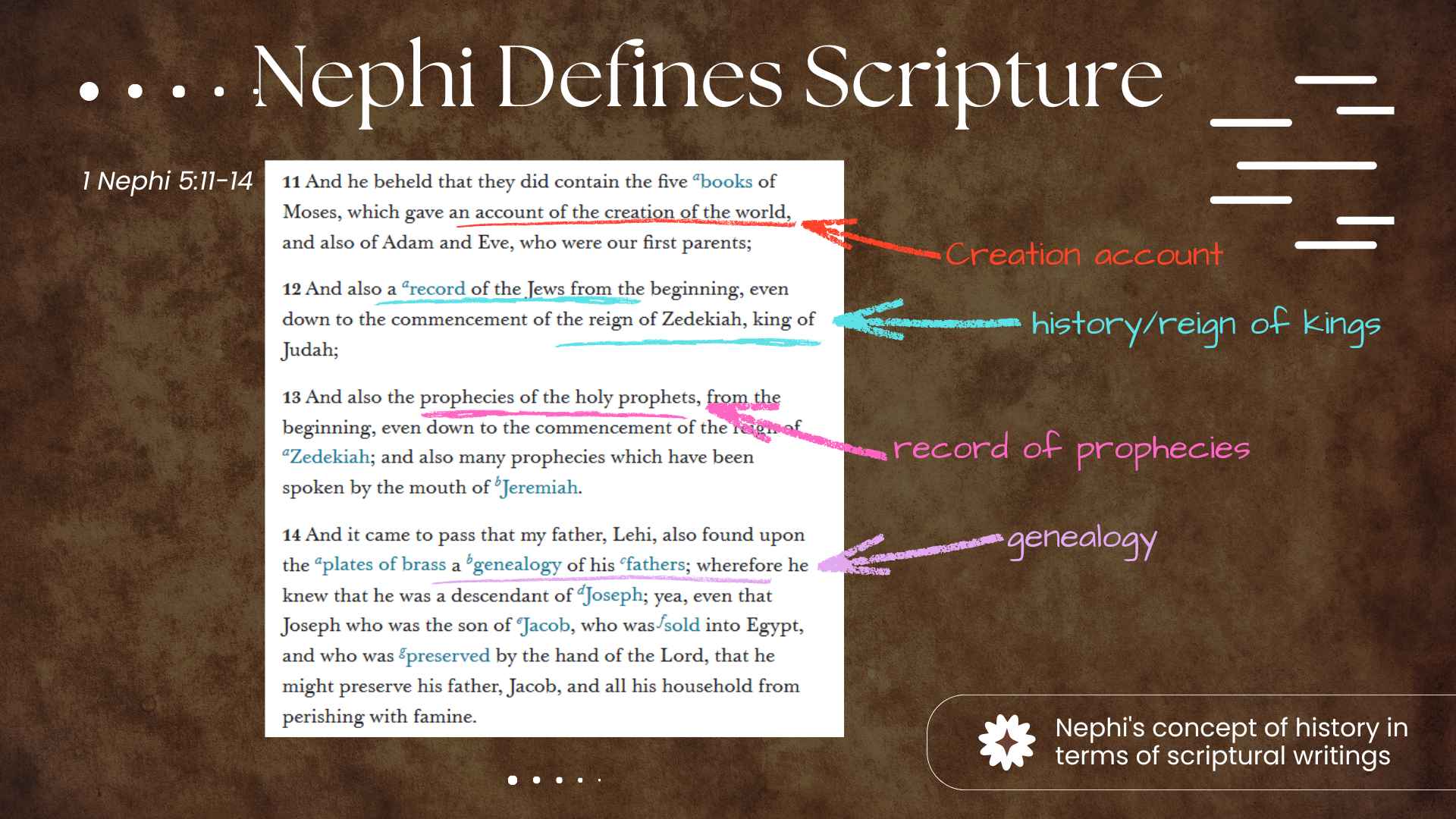
This deals with Nephi’s concept of history in terms of scriptural writings, and he tells us this. And you’re going to see as we continue that he’s very consistent in this viewpoint.

They get the brass plates back and Lehi goes through and reads them. And Lehi comes back and he tells his family what he found in them, and he covers four distinct areas.

The first, he says—and we’re going to start reading here in verse 11:

“And he beheld that it contained the five books of Moses, which gave an account of the creation of the world, and also of Adam and Eve, who were our first parents; and also a record of the Jews from the beginning even down to the commencement of the reign of Zedekiah, king of Judah; and also the prophecies of the holy prophets from the beginning even down to the commencement of the reign of Zedekiah; and also many prophecies which have been spoken by the mouth of Jeremiah.

And it came to pass that my father Lehi also found upon the plates of brass a genealogy of his fathers; wherefore he knew that he was a descendant of Joseph; yea, that Joseph who was the son of Jacob, who was sold into Egypt and who was preserved by the hand of the Lord, that he might preserve his father Jacob and all his household from perishing with famine.”

The Four Elements Explained

So now we’re going to notice that there are really four main elements that he discusses here.

  1. The first one is a creation account.
  2. The second one is a record of the people, which is a history—and more particularly a history of kings and the reign of people.
  3. The third part is a record of the prophecies, or as Nephi calls them in his own work, ‘the ministries’.
  4. And then fourth, we have a genealogy.

Nephi’s Own Record

Now it’s validated, this viewpoint, where Nephi discusses his own writings, which he clearly understands are going to be read as scripture.

All four of these parts are not included in the small plates of Nephi. And Nephi states specifically that he’s going to choose to include some of these components and not others.

Now let’s go ahead and move on. This is 1 Nephi 6:1.

And Nephi says this:

“And now I, Nephi, do not give the genealogy of my fathers in this part of my record; neither at any time shall I give it after upon these plates which I am writing, for it is given in the record which has been kept by my father; wherefore, I do not write it in this work.”

The Small Plates and the Large Plates

The Purpose of the Small Plates

The next one here is in 1 Nephi 9:2–4 and 10:1, and on this I’ll skip to the relevant verses there.

2 And now, as I have spoken concerning these plates, behold they are not the plates upon which I make a full account of the history of my people; for the plates upon which I make a full account of my people I have given the name of Nephi; wherefore, they are called the plates of Nephi, after mine own name; and these plates also are called the plates of Nephi.

3 Nevertheless, I have received a commandment of the Lord that I should make these plates, for the special purpose that there should be an account engraven of the ministry of my people.

4 Upon the other plates should be engraven an account of the reign of the kings, and the wars and contentions of my people; wherefore these plates are for the more part of the ministry; and the other plates are for the more part of the reign of the kings and the wars and contentions of my people.

1 And now I, Nephi, proceed to give an account upon these plates of my proceedings, and my reign and ministry; wherefore, to proceed with mine account, I must speak somewhat of the things of my father, and also of my brethren.

And then again in 1 Nephi 19:1–5:

1 And it came to pass that the Lord commanded me, wherefore I did make plates of ore that I might engraven upon them the record of my people. And upon the plates which I made I did engraven the record of my father, and also our journeyings in the wilderness, and the prophecies of my father; and also many of mine own prophecies have I engraven upon them.

2 And I knew not at the time when I made them that I should be commanded of the Lord to make these plates; wherefore, the record of my father, and the genealogy of his fathers, and the more part of all our proceedings in the wilderness are engraven upon those first plates of which I have spoken; wherefore, the things which transpired before I made these plates are, of a truth, more particularly made mention upon the first plates.

3 And after I had made these plates by way of commandment, I, Nephi, received a commandment that the ministry and the prophecies, the more plain and precious parts of them, should be written upon these plates; and that the things which were written should be kept for the instruction of my people, who should possess the land, and also for other wise purposes, which purposes are known unto the Lord.

The Purpose of the Large Plates

And then:

4 Wherefore, I, Nephi, did make a record upon the other plates, which gives an account, or which gives a greater account of the wars and contentions and destructions of my people.

Then finally in 2 Nephi 5:33 he goes over that again:

33 And if my people desire to know the more particular part of the history of my people they must search mine other plates.

Now if you take a look at this, with the exception of the first item in my list of four things—which is the creation account—the other three items are discussed a number of times relative to whether to include or exclude them in this record.

The Four Categories Revisited

The creation is a little different. It is referred to a number of times, and we are told that this narrative was included in the brass plates, that it was also recorded in the writings of the Jaredites and the twenty-four gold plates found by the people of King Limhi.

Nephi does not include it specifically, nor does any other writer in the Book of Mormon, but it is mentioned numerous times.

The second item, the history, Nephi tells us is recorded for the most part on his larger plates, but some parts are included in the small plates—specifically items that deal with the reign of Nephi, when he says that he wants to include things about his reign.

And I’m going to be getting into this quite a bit more in a few minutes because it has special relevance to the major passage that I’m presenting.

The third item listed is the ministry and revelations of the prophets, and this takes special consideration as the primary purpose of the small plates. This was by direct commandment and revelation.

And then finally, the fourth item: genealogy. He tells us consistently that he’s not going to include it because it’s already contained in the other scriptural records that are available to him.

Nephi’s Writings Alongside the Old Testament

I believe that clearly this is, in the case of the large plates, the objective: to make them “like unto the engravings which are on the plates of brass”. He’s kind of following the same pattern.

And here what I think you find is that on the small plates particularly, the historical pieces of information that he provides us to some extent deal with his reign and his ministry. And this is very significant.

I think it’s also true that Nephi, after his vision that he has very early in his life, sees his writings as being read alongside the writings which make up the Old Testament.

Nephi receives specific revelations to that effect, in 1 Nephi 13:41, where Nephi is told:

41 And they must come according to the words which shall be established by the mouth of the Lamb; and the words of the Lamb shall be made known in the records of thy seed, as well as in the records of the twelve apostles of the Lamb; wherefore they both shall be established in one; for there is one God and one Shepherd over all the earth.

And then a little later he says of John the Revelator:

21 Behold, he shall see and write the remainder of these things; yea, and also many things which have been.

Then, he also refers to the Old Testament that we have as being similar to the arrangement of the brass plates. As you recall, he also says “except that there are not so many”.

I think this idea—that the Book of Mormon writings that Nephi is preparing would stand alongside scripture—certainly affected their contents.

Nephi and the Old Testament

Now the historical narratives within the books of First and Second Nephi, I believe, contain elements which deal with these two themes that he discusses: his reign and his ministry, as I pointed out.

My objective is to show that the narratives presented by Nephi are often rooted in the stories of the Old Testament as found in the brass plates.

  1. We can identify specific parallels of the biblical texts.
  2. We have to use our traditional Bible to an extent because we don’t have a copy of the brass plates.
  3. We can then see that Nephi borrowed extensively, which would only be natural – but only from texts within his possession.

Introducing “Nephi and Goliath”

By now you’re probably wondering why I titled this paper Nephi and Goliath.

And my objective here is to show that Nephi, in writing this literary unit—that is, the story of his encounter with Laban and killing Laban—was actually patterned in very detailed fashion on the story of David killing Goliath in the Old Testament.

I’m going to start by using the story in the Book of Mormon as a primary source material, along with the King James Version. And I want to show that:

  • the form of the story,
  • the language,
  • the events that occur, and
  • the fact that these parallels occur in chronological order—

I’m going to build a case that there’s a great deal of literary reliance between the two texts.

Introducing the Parallel: Nephi and Goliath

And then when I get done, I want to point out some interesting details in relation to the text that Nephi used. Assuming that he’s using the brass plates, how it’s different from the traditional text that we have, and how this reflects back on the authenticity of the Book of Mormon.

Now, my paper here—I’ve actually got the entire stories printed out. So you’ll have to come and look at it. We’re not going to have time to read through it all, but I’m going to provide a summary of two stories.

Nephi Arranging the Narrative How He Wants Us to See It

Nephi and his brothers, of course, are sent back to Jerusalem to get these brass plates. The first couple of attempts fail. That’s very interesting. You know, sometimes we look at this and we get this perception the way that Nephi wants us to see it.

For all we know, the first time back they might have gone and taken Laban out to the bar and sat down, given him a few earrings and then asked, you know, for brass plates: “Hey, can you help us out here?”

So really we are going to get very much a first-person perspective—or a third-person perspective—depending on which part of the story we’re dealing with.

But after the first couple of attempts fail, including trying to trade all their wealth for the brass plates, we get to the point where Laman and Lemuel are basically beating their brothers into submission.

And then the angel shows up and tells them that God’s going to take care of it all. Then after the angel disappears, Laman and Lemuel begin their normal murmuring cycle. And Nephi says, “Well, let’s go do it.”

So Nephi heads back on his own, and he finds, of course, Laban laying there on the ground, passed out. (Nephi) chops off his head, takes his armor, and goes and retrieves the brass plates using Laban’s identity.

The Story of David and Goliath

We’re all probably also familiar with the story of David and Goliath, which is a pretty lengthy thing. We have this Goliath of Gath that gets up every morning and they’re in the middle of this war. He comes out to the field of battle and says, “If you send somebody out to fight me one-on-one, let’s decide this battle and we’ll be all set. Whoever wins, they’ll win the war.”

Of course everybody’s terrified of Goliath, who is a giant of a man, clearly very well trained in military arts.

“All of Israel” they say, “is afraid.” David shows up and says, “I’ll go and face down the Philistine.” He ends up going out there and killing him.

Now what we’re going to do is I’m going to be putting up here on the overhead projection a series of scriptural passages I’m going to talk about, and these are going to be my sequence of parallels. So we’ll quickly flip to the next one.

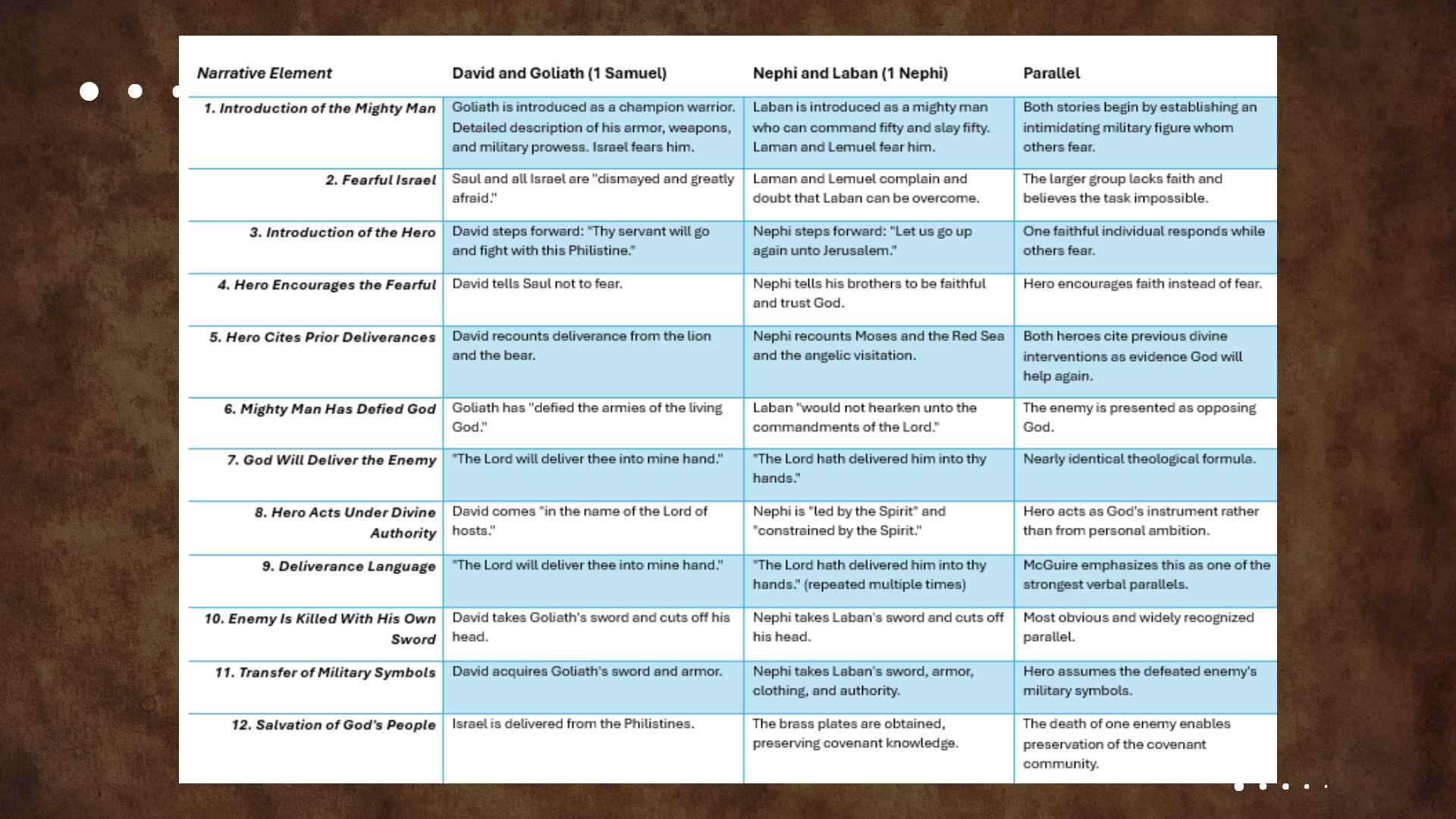
Parallel #1: The Mighty Man

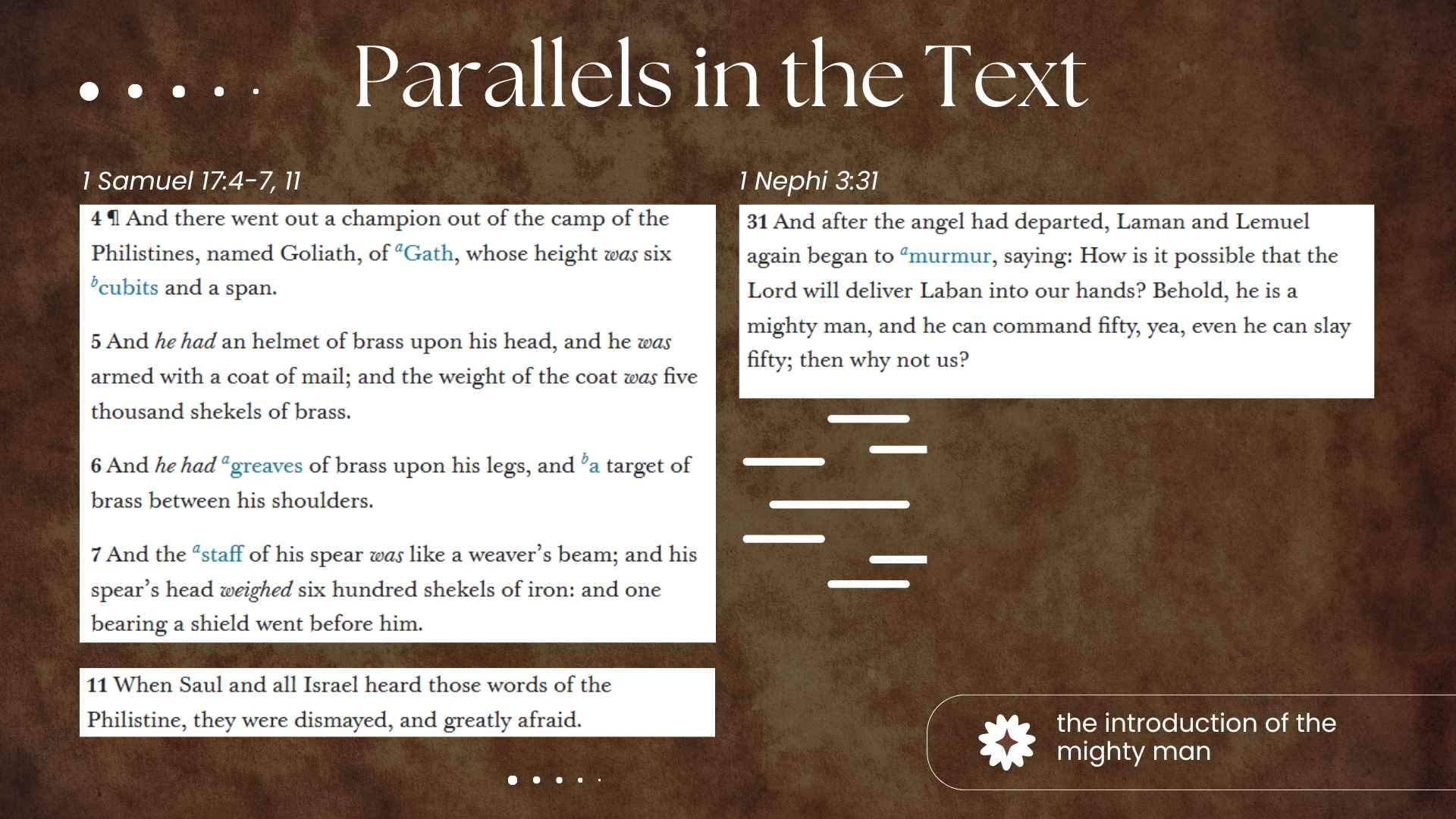
The first parallel I want to talk about is the very beginning. I want to say that Nephi’s use of this Old Testament storyline begins in 1 Samuel 17.

In verses 4–11 (1 Samuel 17) talks really about the military might of Goliath. And I’m going to read it. I’m going to be skipping verses 8, 9 and 10.

“And there went out a champion out of the camp of the Philistines, named Goliath of Gath, whose height was six cubits and a span. And he had a helmet of brass upon his head, and he was armed with a coat of mail; and the weight of the coat was five thousand shekels of brass. And he had greaves of brass upon his legs, and a target of brass between his shoulders.

And the staff of his spear was like a weaver’s beam; and his spear’s head weighed six hundred shekels of iron: and one bearing a shield went before him.”

“When Saul and all Israel heard the words of the Philistine, they were dismayed, and greatly afraid.”

Then I’m putting that against 1 Nephi 3:31, the last verse of chapter 3:

“And after the angel had departed, Laman began to murmur, saying: How is it possible that the Lord will deliver Laban into our hands? Behold, he is a mighty man, and he can command fifty; yea, even he can slay fifty; then why not us?”

For lack of a better term, I’m going to use Nephi’s term here throughout the rest of this storyline. I call this the introduction of the mighty man.

In the Old Testament story, it’s Goliath. In 1 Nephi, it’s Laban.

Of course, we have the second set of cast members. In the Old Testament, we have Saul and all Israel. In the Book of Mormon, we have Laman and Lemuel.

And I think there’s a distinct parallel Nephi will continue to reinforce later on. We have this concept of faithless Israel, and we see it on both sides.

We have, on one hand, the Israelites who are ready to run at the drop of a hat. And here’s Laman and Lemuel, who don’t really want to be there in the first place, who are convinced that they’re all going to end up dead if they continue to pursue this course of action.

It’s also worthy of note that both of these mighty men are described in terms of military might and prowess:

  • Laban in terms of how many men he commands in the field;
  • Goliath in terms of his equipment. And it’s been pointed out often that this detailed description of his armor and weaponry really just serves to show that he was an experienced warrior.

Parallel #2: The Hero Appears

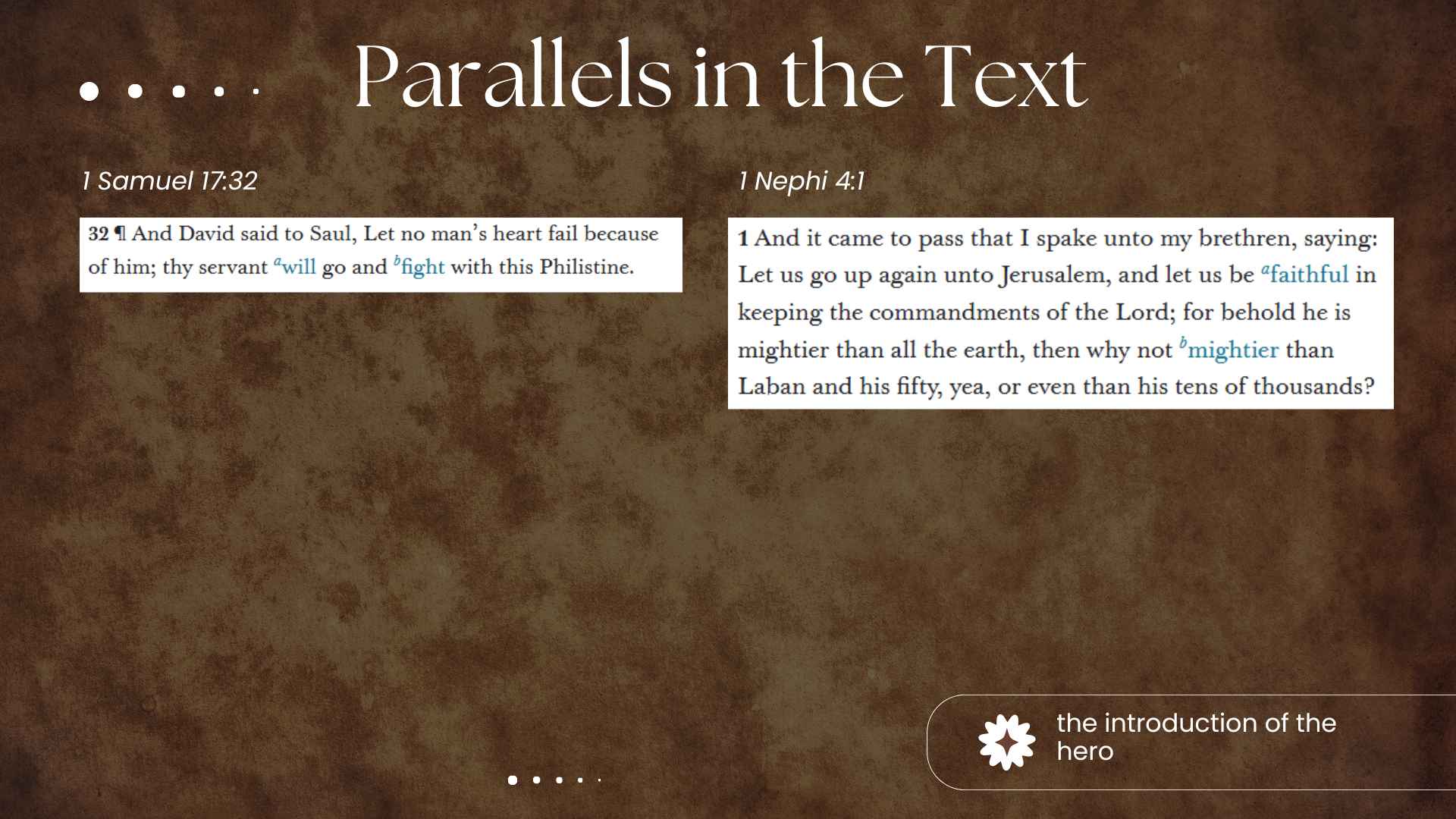
Let’s go ahead and continue now and we’re going to move to 1 Samuel 17:32 and 1 Nephi 4:1.

And David said to Saul:

“Let no man’s heart fail because of him; thy servant will go and fight with this Philistine.”

And then Nephi says:

“And it came to pass that I spake unto my brethren, saying: Let us go up again unto Jerusalem, and let us be faithful in keeping the commandments of the Lord; for behold he is mightier than all the earth, then why not mightier than Laban and his fifty, yea, or even than his tens of thousands?”

Now, this is the introduction of the hero.

David, of course, is the hero in the Old Testament text, while Nephi fills that role in his own account. And in his first appearance, the hero goes to faithless Israel and encourages them in their task, saying that there’s nothing to fear. The hero is willing to challenge the mighty man.

Parallel #3: Miracles as the Basis of Faith

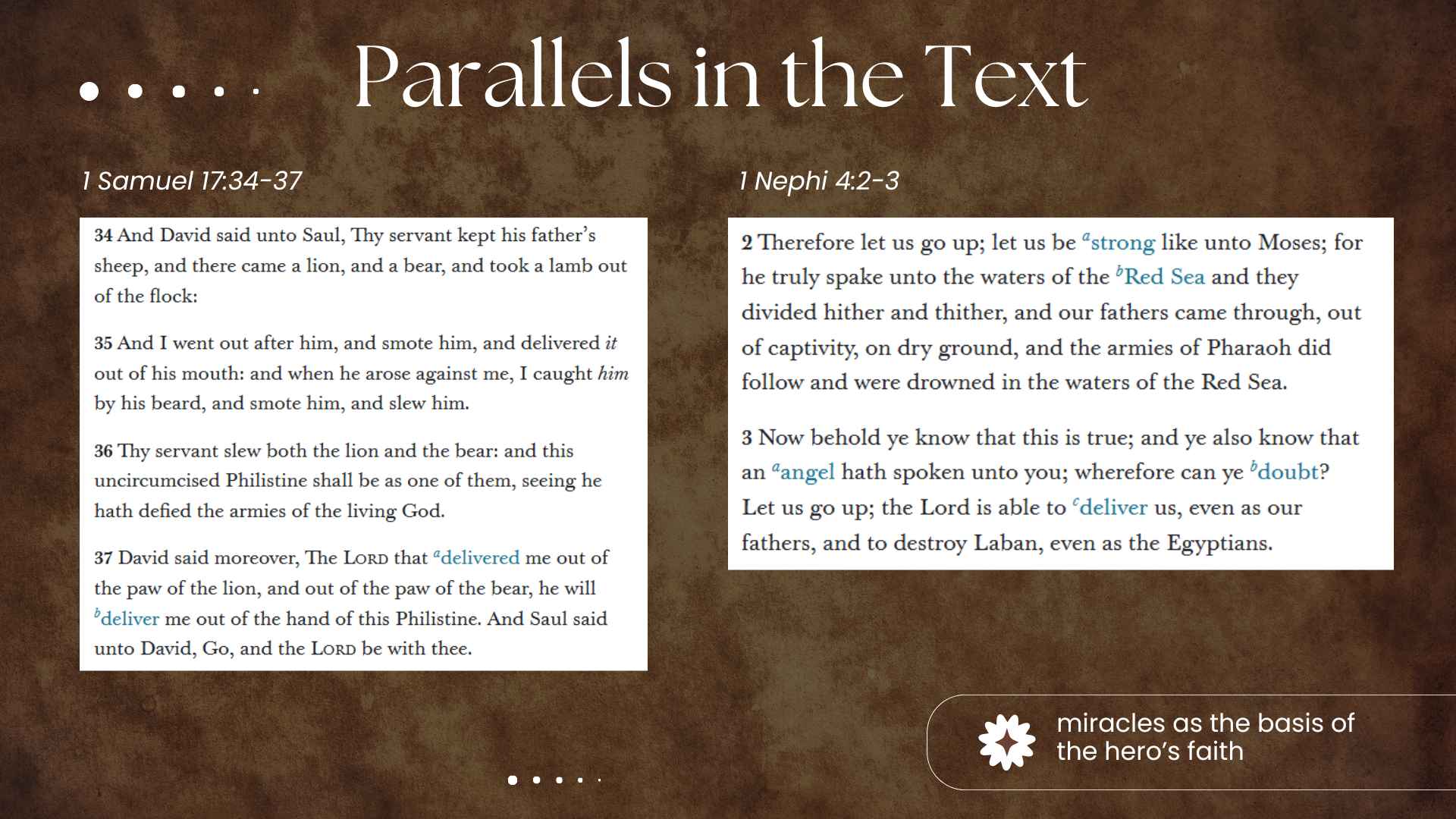
Now let’s go ahead. Both heroes then cite, as the basis for their faith in their course of action, two miracles.

David cites two instances from his own life. Nephi cites one from the history of Israel and one from his own life.

Both of these miracles are significant from the hero’s point of view.

In both cases, the hero concludes by remarking that just as God performed these two miracles, God will then deliver them from the hands of the mighty man.

Miracles Revealed in the Narrative

So we read now from the Old Testament.

34 And David said unto Saul, Thy servant kept his father’s sheep, and there came a lion, and a bear, and took a lamb out of the flock:

35 And I went out after him, and smote him, and delivered it out of his mouth: and when he arose against me, I caught him by his beard, and smote him, and slew him.

36 Thy servant slew both the lion and the bear: and this uncircumcised Philistine shall be as one of them, seeing he hath defied the armies of the living God.

37 David said moreover, The Lord that delivered me out of the paw of the lion, and out of the paw of the bear, he will deliver me out of the hand of this Philistine. And Saul said unto David, Go, and the Lord be with thee.

And this is what Nephi says to his brothers. He says:

2 Therefore let us go up; let us be strong like unto Moses; for he truly spake unto the waters of the Red Sea and they divided hither and thither, and our fathers came through, out of captivity, on dry ground, and the armies of Pharaoh did follow and were drowned in the waters of the Red Sea.

3 Now behold ye know that this is true; and ye also know that an angel hath spoken unto you; wherefore can ye doubt? Let us go up; the Lord is able to deliver us, even as our fathers, and to destroy Laban, even as the Egyptians.

Now, David’s two miracles were being saved from two animals bent on killing him. Likewise he claims God would treat Goliath as merely one of these animals.

The two miracles for Nephi are:

  1. first, the destruction of the Egyptians when Moses parts the Red Sea; and
  2. second, the visitation of an angel. An angel, among other things, mentions that they will overcome Laban.

We’ll come back to the angel in a little bit, as he plays a larger role in explaining why Nephi includes this particular episode.

Exodus Imagery

The part you see is also significant as it serves to show God destroying the enemies of Israel while they’re leaving for their promised land. It’s coming back to the same Exodus topic that Nephi continues to use over and over again, particularly the further we go into the text.

And the other thing that we see is that the brothers have just mentioned Laban and his tens of thousands.

This is being subtly compared to by Nephi as the armies of the Egyptians. So now Laban becomes representative not necessarily only of the Philistines, but also this concept of the Egyptians and their armies chasing after Israel in the wilderness.

The idea that Laban is an obstacle that stands between Israel and their promised land—between Nephi and Lehi and their promised land—is quite clear. And just as in the Exodus, Nephi is claiming that God will fight the battles.

Parallel #4: God Delivers the Mighty Man

Now next we have remarks where the hero comes according to the will of God and that God delivers into the hero’s hands the mighty man.

So let’s move ahead. (I think this is the previous one. So let’s jump one more.)

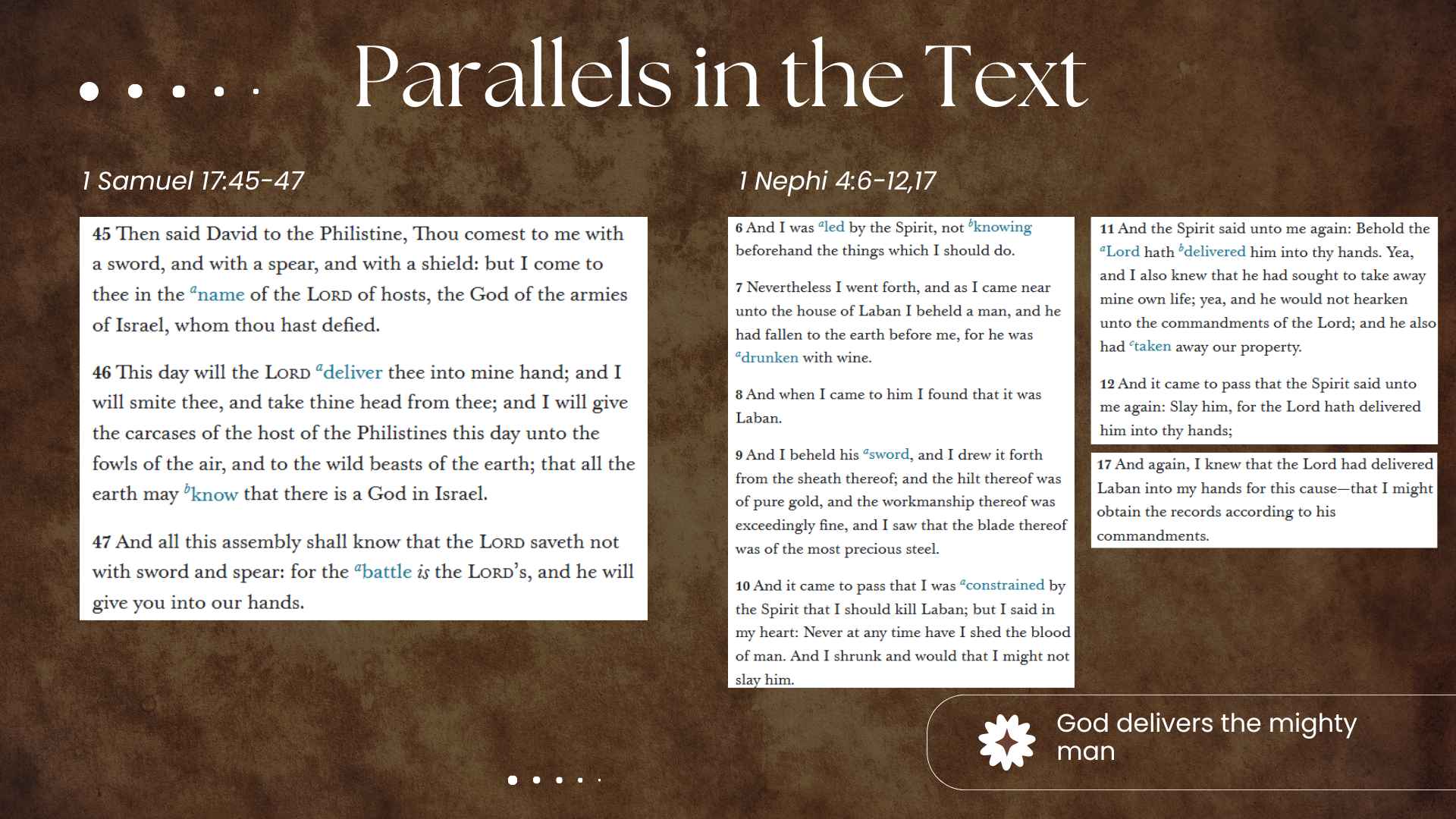
Now I’m going to read through the First Samuel account, then we’ll jump into the First Nephi one. This is 1 Samuel 17:45–47.

45 Then said David to the Philistine, Thou comest to me with a sword, and with a spear, and with a shield: but I come to thee in the name of the Lord of hosts, the God of the armies of Israel, whom thou hast defied.

46 This day will the Lord deliver thee into mine hand; and I will smite thee, and take thine head from thee; and I will give the carcases of the host of the Philistines this day unto the fowls of the air, and to the wild beasts of the earth; that all the earth may know that there is a God in Israel.

47 And all this assembly shall know that the Lord saveth not with sword and spear: for the battle is the Lord’s, and he will give you into our hands.

And then in 1 Nephi—this is from chapter 4, verses 6–12 and 17:

6 And I was led by the Spirit, not knowing beforehand the things which I should do.

7 Nevertheless I went forth, and as I came near unto the house of Laban I beheld a man, and he had fallen to the earth before me, for he was drunken with wine.

8 And when I came to him I found that it was Laban.

9 And I beheld his sword, and I drew it forth from the sheath thereof; and the hilt thereof was of pure gold, and the workmanship thereof was exceedingly fine, and I saw that the blade thereof was of the most precious steel.

10 And it came to pass that I was constrained by the Spirit that I should kill Laban; but I said in my heart: Never at any time have I shed the blood of man. And I shrunk and would that I might not slay him.

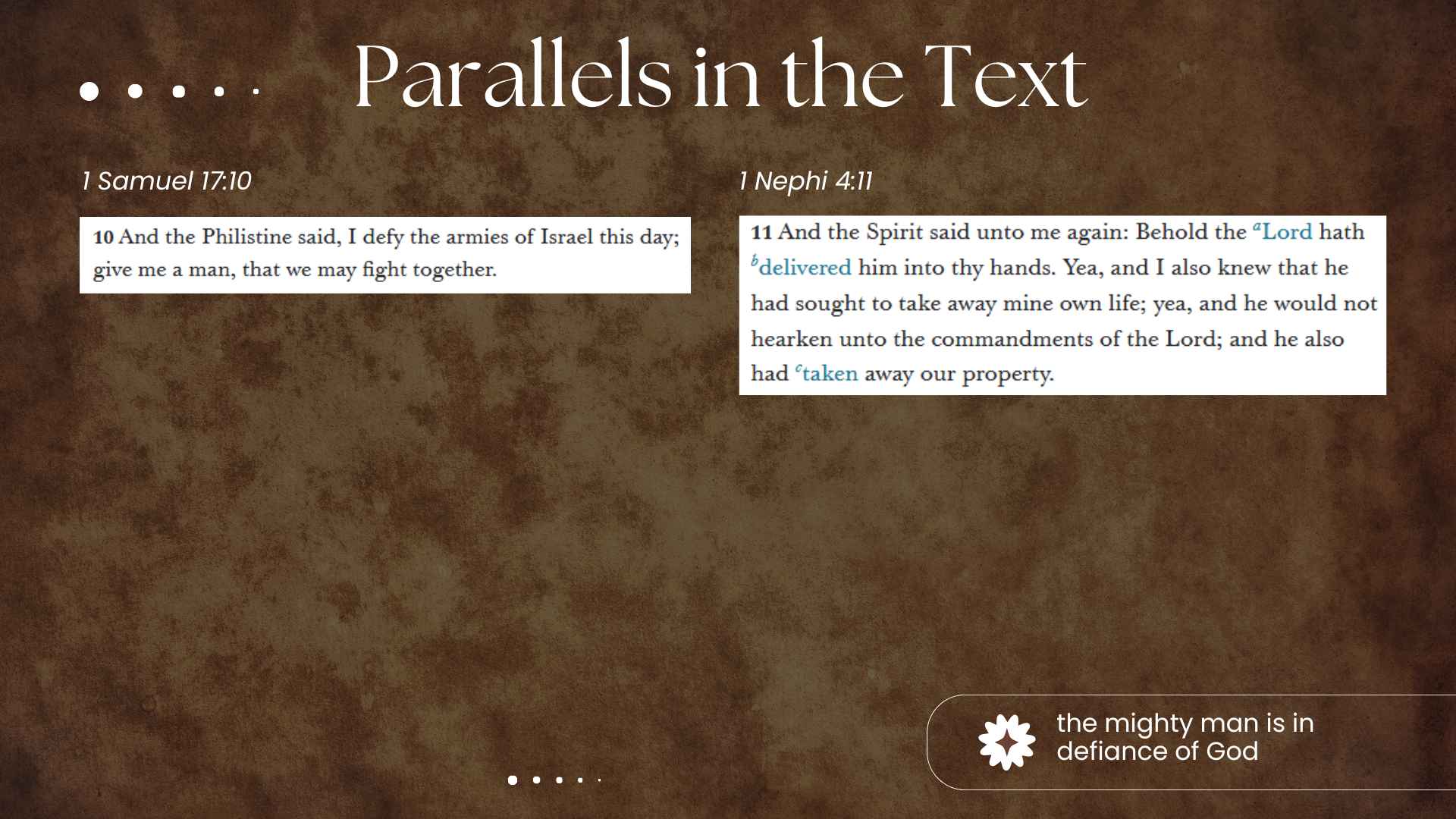
11 And the Spirit said unto me again: Behold the Lord hath delivered him into thy hands. Yea, and I also knew that he had sought to take away mine own life; yea, and he would not hearken unto the commandments of the Lord; and he also had taken away our property.

12 And it came to pass that the Spirit said unto me again: Slay him, for the Lord hath delivered him into thy hands;

17 And again, I knew that the Lord had delivered Laban into my hands for this cause—that I might obtain the records according to his commandments.

Now, I find this especially significant.

Delivering the ‘Mighty’ Into the Hands of the Hero

This type of language is not uncommon in the Old Testament. It’s used rather regularly, actually. However, this is the only place in the Book of Mormon where this concept occurs.

Whenever we use this idea of deliverance in the Book of Mormon, it’s always that you’re being delivered from evil, or delivered from the grave, or from the hands of your enemy.

Here, in both stories, we have God delivering the mighty man into the hands of the hero.

It is possible, of course, that the phrasing in First Nephi is based somewhat in Exodus 21:13, especially given the context.

Exodus 21:13 deals with accidental death—the laws regarding revenge in dealing with accidental death, as you recall. It actually says:

“And if a man lie not in wait, but God deliver him into his hands; then I will appoint thee a place whither he shall flee.”

There is some appropriateness to this context here.

However, I believe that just as Szink pointed out phraseology and other parts of the Book of Mormon show this literary dependence on the Old Testament, that here it has a stronger argument and textual basis, especially given this list of parallel similarities.

Parallel #5: The Mighty Man Defies God

Lastly, in that last section—which we won’t have up, and I probably can’t go back to, but that’s okay—

You’ll notice that in both cases we have this concept that the mighty man has defied the will of God.

We have, in the one case, Goliath, who is standing in defiance of the armies of the God of Israel. And in First Nephi’s account, there in verse 11, it says that Laban “would not hearken unto the commandments of the Lord.”

So we also have this recognition that the mighty man is not a man of righteousness. There’s some deserving – this is divine retribution for his activities in his life.

Okay, we’re going to continue on to the last step here.

Parallel #6: The Hero Kills the Mighty Man with His Own Sword

First Samuel 17:51:

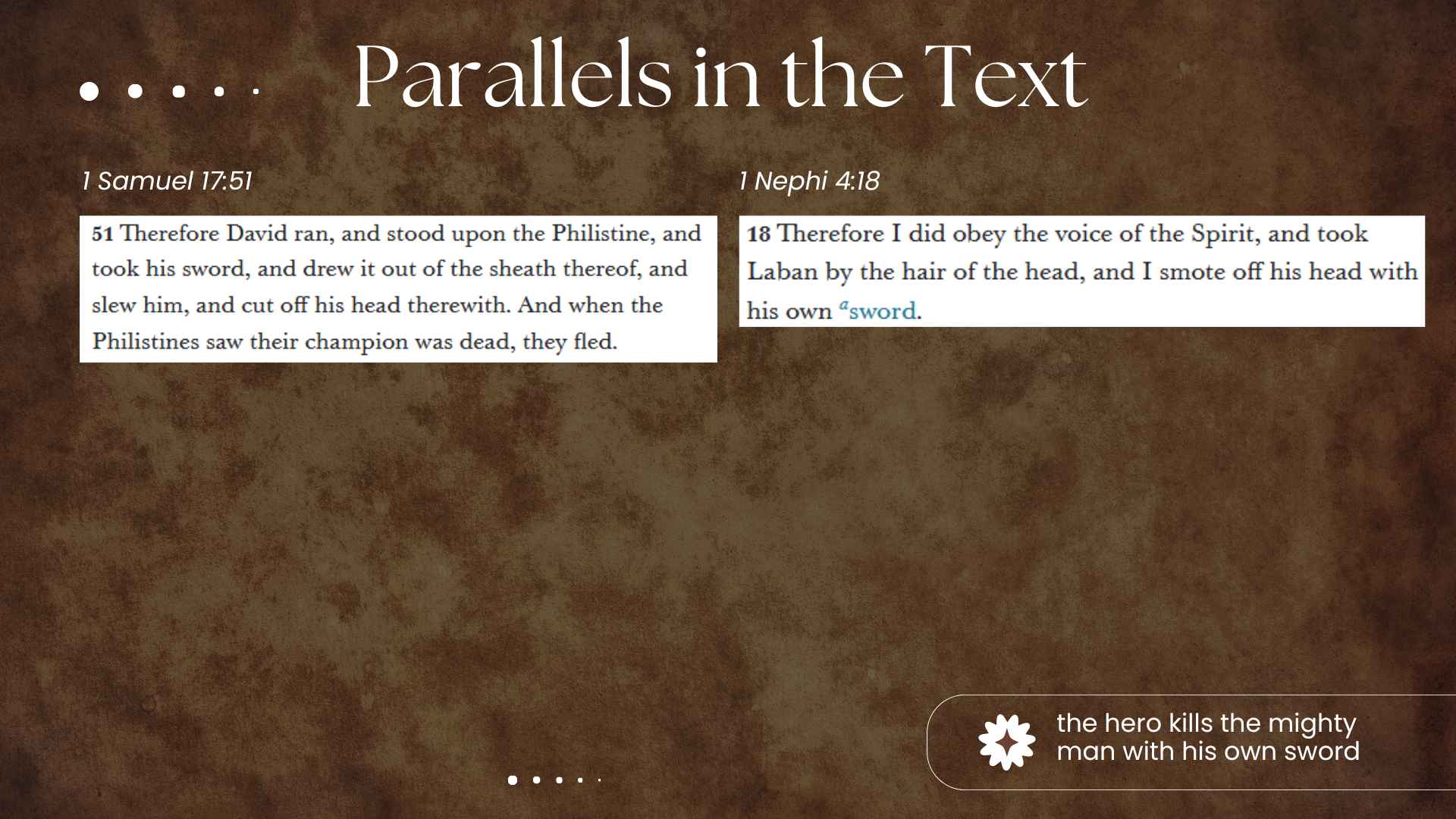
“Therefore David ran, and stood upon the Philistine, and took his sword, and drew it out of the sheath thereof, and slew him, and cut off his head therewith.”

And in 1 Nephi 4:18:

“Therefore I did obey the voice of the Spirit, and took Laban by the hair of the head, and I smote off his head with his own sword.”

These parallels in those two verses have been widely recognized. And a really neat additional comment is that the hero kills the mighty man with his own sword. He decapitates him in both cases.

Why Does Nephi Include This Story?

Now, the next direction I want to take this is this question of why Nephi includes this in the Book of Mormon. It seems kind of an odd scene.

This deals largely with Nephi’s authority as ruler and king of the Nephite peoples. And as was pointed out earlier—and any other groups that they’re with—clearly there’s something to be said for putting yourself in the role of King David as the preeminent king of all Israel, going through the same steps.

First, he’s chosen by a heavenly messenger in much the same way. You know, who cares about your brothers? You’re the chosen guy.

And then he’s following through in some of these similar actions.

The Question of Kingship

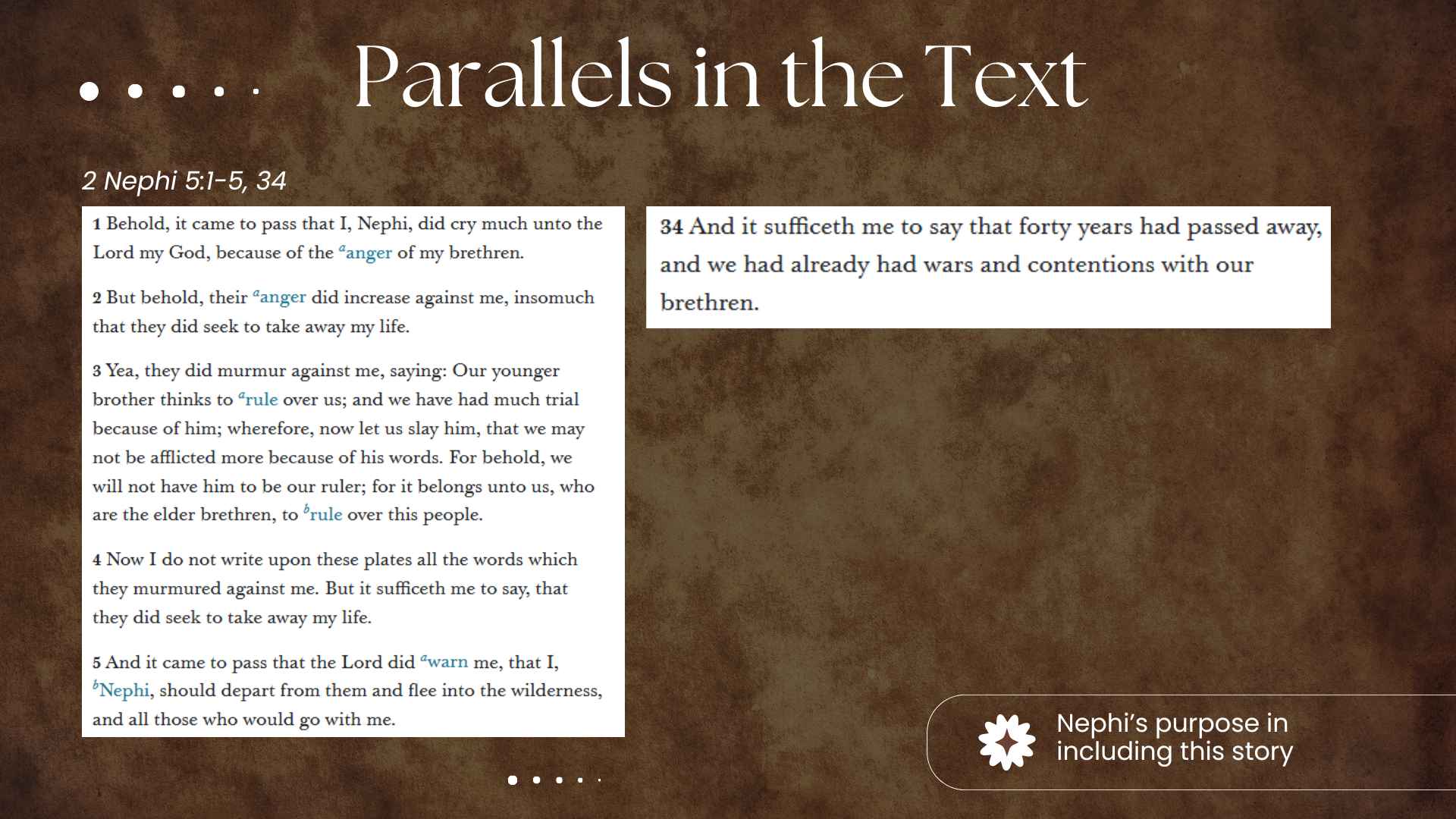
And I especially wanted to point out that, as recorded in 2 Nephi 5 (2 Nephi 5:1-5, 34), this whole issue of who has the right to rule is critical to Nephi at this point in time.

In verse 34 there he says:

“And it sufficeth me to say that forty years had passed away, and we had already had wars and contentions with our brethren.”

Over this right of rulership.

The third point I want to make here is that, following the second aspect of this inclusion, we realize that the story, rather than dealing with the ministry, deals with this reign and kingship.

I wanted to add this point: the stories of David and Solomon and other early Israelite leaders were well known to the Lehite peoples as part of the brass plates.

And I think this is significant. They often use examples. I mean, there’s that famous thing in Jacob where they’re dealing with the whole polygamy issue, where they justify it based on the activities of Solomon and David.

They are aware of the lives of these men, and so we can assume they have some familiarity.

Early and Late Sources in David and Goliath

Now let’s jump to something really fascinating here.

If we take a look at some of the higher criticism of the story of David and Goliath in the Old Testament, I believe it’s fair to say there is a scholarly consensus that there are, in fact, two different source materials: an early source and a later source.

The composite early source consists of:

  • 1 Samuel 16:14–23
  • 1 Samuel 17:1–11
  • 1 Samuel 17:32–40
  • 1 Samuel 17:42–48a
  • 1 Samuel 17:49
  • 1 Samuel 17:51–54

With the later source containing all the rest of the material.

This identification actually was not very difficult for scholars because the Septuagint actually omits most of that material, representing the former tradition.

If we go back to my list of sources that I use for the parallels, what you’re going to notice is that Nephi quotes chapter 17:4–11, which is the first part there.

He then jumps immediately to a parallel in 17:32, and then 17:34–37, and so on and so forth. And what you’ll notice is that every one of the references that he parallels is from that early source material. In fact, he doesn’t seem to recognize that any of the later source material exists, which is highly fascinating.

Structural Similarities Between the Texts

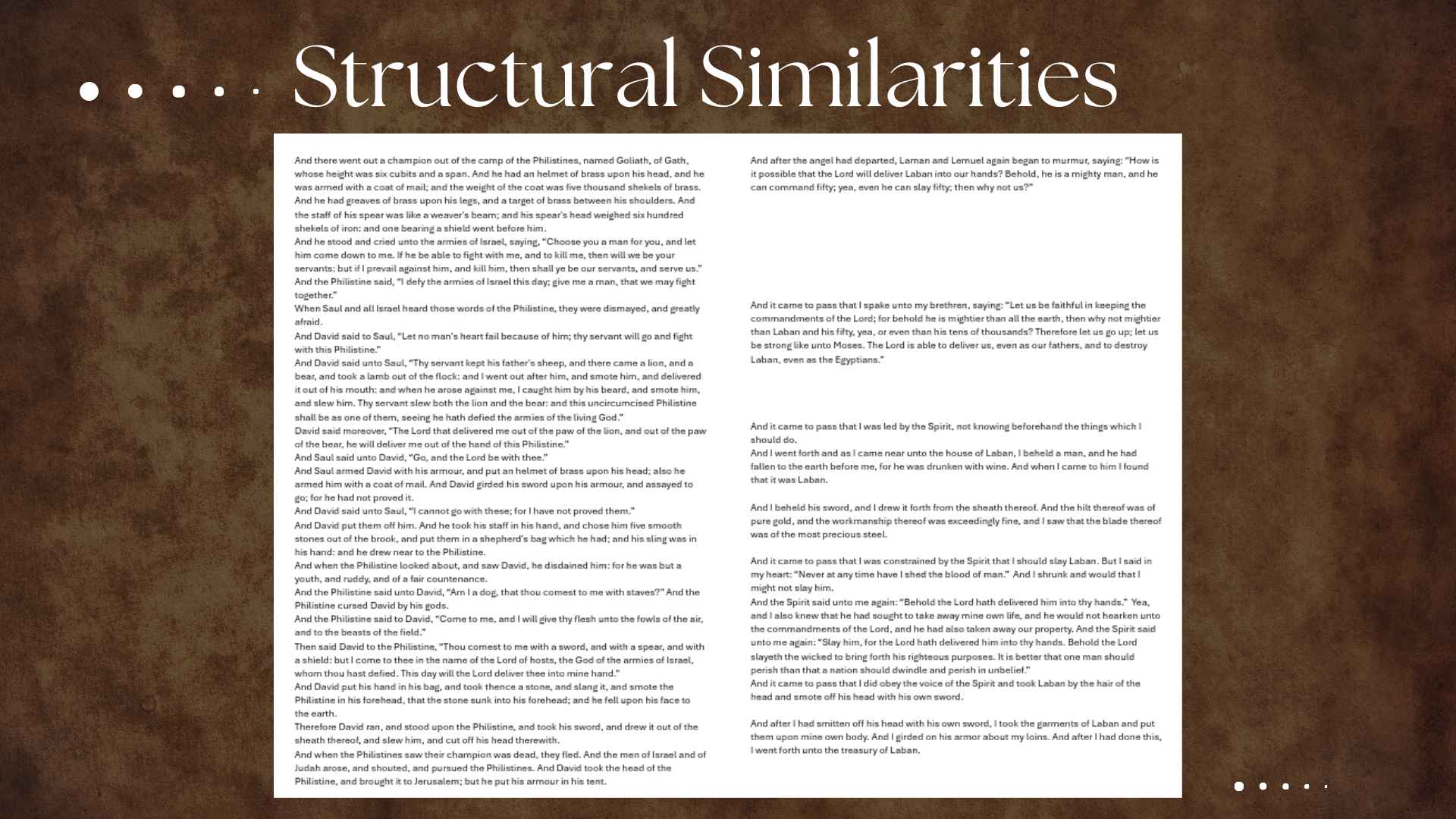
I put this here because I wanted to put something into perspective. And that is this. On the left side is the David and Goliath story of the Old Testament once the later source material is removed.

And you’ll notice that the stuff in the Book of Mormon is very similar in structure, both in length and item following item. He actually seems to be following this story in a very detailed fashion, as if he’s got one open in front of him while he’s writing the other.

And following that, going back to what I told you about Brother Brown, when he said that he sees this increasing frequency of parallels in the Exodus material, I believe it’s because Nephi is borrowing from other sources.

It gets into the Exodus as they really get into their journey. Before that, he doesn’t. I have a lot more material here that deals with some of the earlier stuff, and so I’m going to cover just one or two points. And then for the rest of it you’ll have to go out and buy the proceedings of this conference.

The Caiaphas Parallel

Going back to this, it does a couple of interesting things though.

One of the things I want to point out is this: there’s a long-standing anachronism claim in the Book of Mormon where we have this quote, apparently by Nephi when he’s getting ready to kill Laban:

“It is better that one man should perish than that a nation should dwindle and perish in unbelief.”

We’re all familiar with that.

And then that same passage is more or less quoted verbatim by Caiaphas regarding Jesus Christ in the New Testament.

If Nephi is borrowing here from an Old Testament tradition of David and Goliath, it stands to reason that there is the possibility that, in fact, Caiaphas is also borrowing from a tradition of David and Goliath in an environment in which a quote like this stands to make absolute sense.

How many people expected David to go out there and kill Goliath?

There was only one, as I recall, and that was David himself.

And so, in a sense, Israel is sending out one man to perish that the nation would not.

It’s an interesting tie-in.

Additional Implications of Textual Reliance

Second—and this is something else that’s interesting here, and I’m just going to make an aside. Here we have another evidence that the brass plates were slightly different.

Moses speaks, of course, to the Red Sea, he parts it. In the Old Testament, he doesn’t speak at all; he just waves his arms and the water goes through.

The point is that if we can assume textual reliance here, we can probably assume it elsewhere.

Lehi and the Call of Moses

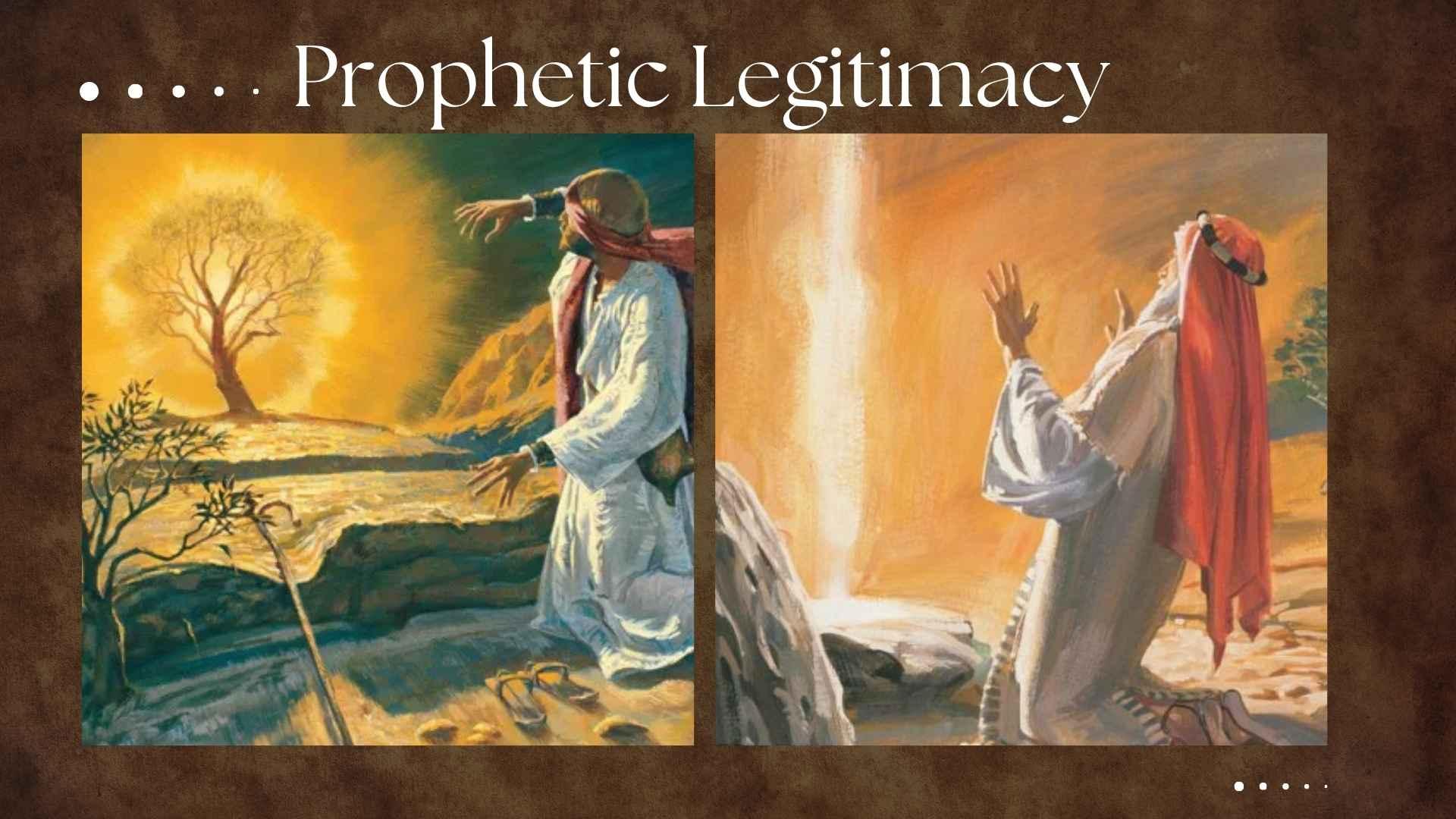
So, we go back to the beginning of Lehi’s calling. I call this literary section “the call of Moses and the trip to Sinai” at the very beginning of First Nephi chapters 1 and 2.

It’s kind of funny. There’s this footnote in First Nephi dealing with a pillar of fire that comes before Lehi on a rock. Do you remember that? This pillar shows up on a rock. We have this little footnote at the bottom. It was added some years ago in our scriptures. It points us back to the pillar of fire that led the Israelites out of Egypt.

Well, the truth is that, according to my understanding, Lehi is in fact going through the same process that Moses went through when he became a prophet.

Remember, this goes back to recognizing Nephi and Lehi as legitimate prophets. He’s following the steps of Moses. And so this pillar of fire is actually the burning bush.

Numbers 12 and Prophetic Legitimacy

Now what’s interesting about this is that Nephi seems to be basing this part of the text on a passage in Numbers 12:6.

At one moment we have Moses, whose wife has passed, and he goes out and marries a new wife. It’s this Ethiopian woman, and his family—his brother and sister—immediately get all upset and offended at what he’s done.

And they come out and they say, “Well, clearly he’s not a prophet anymore. We’re all prophets, too. We can lead the people.”

And the Lord calls all three of them out from the tribes of Israel and chooses out Miriam and Aaron and says to them this. This is Numbers 12:6:

“Hear now my words: If there be a prophet among you, I the Lord will make myself known unto him in a vision, and will speak unto him in a dream.”

The Relevance of Lehi’s Vision

Of course, in First Nephi we have this passage, right?

Lehi goes home after seeing a pillar of fire on a rock. It says:

“And it came to pass that as he prayed unto the Lord, there came a pillar of fire and dwelt upon a rock before him; and he saw and heard much; and because of the things which he saw and heard he did quake and tremble exceedingly.”

He goes home and throws himself on his bed. And it says:

“And thus being overcome with the Spirit, he was carried away in a vision, even that he saw the heavens open, and he thought he saw God sitting upon his throne, surrounded with numberless concourses of angels in the attitude of singing and praising their God.”

Then I’m going to jump forward to 1 Nephi 2:1:

“For behold, it came to pass that the Lord spake unto my father, yea, even in a dream, and said unto him: Blessed art thou, Lehi, because of the things which thou hast done; and because thou hast been faithful and declared unto this people the things which I commanded thee, behold, they seek to take away thy life.”

Nephi here is following some very distinct Old Testament patterns to prove the legitimacy of his father’s prophetic calling.

The Three-Day Journey into the Wilderness

The last thing I want to mention just briefly is this—and this is kind of funny because this has come up a couple of times in this conference—and that is this three-day trip that they take into the wilderness.

It’s interesting. Eugene England—the quote that I had here—says this:

The route and times were quite specific, even somewhat mysteriously so: (and he quotes:) “He came down by the borders which are nearer the Red Sea and he traveled in the wilderness in the borders which are nearer the Red Sea; and he did travel in the wilderness with his family, which consisted of my mother, Sariah, and my elder brothers.” and then “when he had traveled three days in the wilderness, he pitched his tent in a valley by the side of a river of water …”.

This literal interpretation of three days has long been accepted and understood in LDS circles as being a helpful tidbit in determining the geography of Lehi’s trek to the coast of the sea, where they then sail to the New World.

Instead of viewing this as a literal approach, what I like to look at is this three-day trip in Exodus 3:18 where, after Moses has been called as a prophet, his first command is to go back to Egypt, to the Israelites, and then to tell Pharaoh:

“The Lord God of the Hebrews hath met with us: and now let us go, we beseech thee, three days’ journey into the wilderness, that we may sacrifice to the Lord our God.”

Now, this is mentioned over and over again in the next several chapters in the Old Testament.

Egypt to Marah

This three-day journey actually occurred. It was a trip between Egypt and Marah, which is interesting—the fact that they have this body of water there, by which the place is named because the water was bitter. So they called the place bitterness.

And there were a number of other issues there.

Among them was the fact that when Pharaoh says, “Why do you have to go so far?” Moses responds, “Well, if we stay here and offer burnt offerings—which are an abomination to you Egyptians—you’ll kill us all because we’re inside your cultic holiness area.”

The same could be true of Lehi and Nephi.

For them to go out and offer burnt offerings and renew this new covenant they’re making with the Lord in downtown Jerusalem would certainly cause some significant difficulties for them.

Other Types Nephi Draws On

I’m going to close since I’ve pretty much expended my time.

The truth is I haven’t had enough time to take these ideas to a logical conclusion. And I think we can find dozens of additional details and parallels. It could be that these things all fall into that nebulous category of “typing” the Book of Mormon.

I think, however, that when Nephi tells us that he likens all scriptures unto himself, he actually is doing that. Not only with the scriptures he’s reading, but the scriptures he’s writing.

And we can find these parallels. We have several very distinct Noah parallels as he builds his boat.

There’s even more with the story of Joseph going into Egypt. We have the binding in the wilderness, the slaying of beasts. We have this whole concept of Nephi as an interpreter of dreams, which is very interesting.

He starts with his father’s dream. It’s just bits and pieces. “Whoops, we’re all done with this. Now, let’s talk about this.” And the first thing that happens: his brothers come up and say to him, “What’s the meaning of this?” And he explains it to them.

Concluding Reflections

I think perhaps that it may be difficult to reconstruct various textual reliance between the brass plates and the Book of Mormon. Because we don’t really have the brass plates to compare.

But the Book of Mormon can give us additional insight into the scriptures they carried with them. We can see that not only do they have more in some areas and less in others. But it can also give us a better understanding of the Bible. And where it’s at in terms of how it’s been preserved in that picture.

I’d like to close just by stating that this apologetics work that I’ve been involved in through FAIR has been a great source of joy and personal satisfaction. In dealing with the gospel in new ways and learning new ideas and ways of looking at things.

And I think that this is the type of stuff that we as Saints need to be doing. Building our own personal testimonies of the gospel and answering these questions for ourselves.

And I’ll close in the name of Jesus Christ, amen.

Question and Answer Session

We do have time for maybe one or two questions. If you want to ask me, then we’ll take our break.

Question: What About Blood on Laban’s Armor?

Question

Earlier you alluded to the fact that, yeah, there’d be blood all over Laban’s armor and so forth. But you never did explain that.

Answer

My personal ideas about that are quite a bit off the beaten track.

Based on the fact that he’s writing the story to prove a point. That means that he probably got some of the details out of chronological order as they actually occurred historically.

And that maybe it’s much more likely that

  1. Nephi finds Laban laying there, passed out drunk in the middle of the road,
  2. takes off his armor,
  3. gets ready to go back to the brass plates
  4. and that’s when the Spirit says, “No, wait a minute—you better go back and finish the job here.”

So I believe that that’s not really an issue. It only becomes an issue because these parts of the stories are right next to each other when in fact it’s not necessarily a chronological series.

That’s my own personal feeling. I’ll stop there.

Question: If Nephi Is Alluding to David and Goliath, Why Does He Do It This Way?

Question

If Nephi is alluding to the story of David and Goliath, why [indistinguishable]?

Answer

Well, it’s a good question.

I think that for starters, Nephi says that they’ve got the brass plates. The only time he ever really directly uses them is when he quotes all this Isaiah material.

And that’s another oddity. You would think that he and his descendants would have the brass plates right there. He wouldn’t need to put it all down.

I think there’s two reasons why he doesn’t directly allude to it.

Nephi’s Audience is Not 100% Israelites

One of them goes back to one of the other papers that was presented at this conference. Nephi’s audience is not 100% Israelites at the time that he’s writing.

  • There’s been some cultural merging.
  • There’s a larger group of people that they’re dealing with.
  • There’s no way that just Nephi and his family could split into two groups. Large enough to have had a number of wars and contentions over this rulership issue.

So I think rather than:

  • going back and
  • having to retell the story to everybody and
  • then saying, “And just like David and Goliath.”

He’s putting his story out in a way that shows that there’s some stuff going on here.

Some of the group is going to immediately recognize these parallels, and some isn’t. It just depends on who you’re talking to.

The Brass Plates as a Type for the Spoils of Egypt

Another interesting thing that I didn’t bring up, that I think might also go along with this. Is this whole concept of the brass plates being worth more than all of their wealth.

Going back to the Exodus. It’s quite possible that Nephi saw his taking the brass plates as the spoiling of Egypt.

When they leave Egypt they take all this wealth with them. Though he’s leaving Jerusalem, he’s taking something that’s worth far more than anything he had. But he doesn’t see it as stealing. He’s taking the stuff that the Lord wants him to take.

Thank you.

FAQ / Common Questions

What is the main argument of this presentation?

Ben McGuire argues that Nephi intentionally incorporated Old Testament literary patterns into his record, especially parallels to David and Goliath and the Exodus.

Why does McGuire compare Nephi and Laban to David and Goliath?

He identifies a sequence of narrative similarities, including a powerful enemy, a faithful hero, divine deliverance, and the use of the enemy’s own sword.

Does the presentation claim Nephi copied the Bible?

No. McGuire argues that Nephi consciously drew upon scriptural traditions preserved on the brass plates and expected readers to recognize those connections.

How does the Exodus relate to First Nephi?

McGuire suggests that Lehi’s departure from Jerusalem and journey into the wilderness mirrors Israel’s Exodus from Egypt and that Nephi intentionally emphasizes these parallels.

Why is the brass plates narrative important?

According to McGuire, it serves multiple purposes: preserving sacred records, establishing Nephi’s legitimacy as a leader, and connecting his story to familiar scriptural patterns.

Search topics

Nephi and Goliath; Ben McGuire FAIR Conference 2001; First Nephi literary analysis; David and Goliath parallels; Nephi and Laban comparison; brass plates narrative; Old Testament in the Book of Mormon; Exodus typology in First Nephi; Lehi exodus from Jerusalem; literary patterns in scripture; Book of Mormon narrative structure; Nephi as king and prophet; brass plates traditions; biblical typology; scriptural allusions in the Book of Mormon; Nephi's authorship; prophetic legitimacy in First Nephi; kingship in the Book of Mormon; Davidic themes in Nephite writings; Lehi prophetic call; Book of Mormon literary studies; covenant themes in First Nephi; Moses and Nephi parallels; scriptural interpretation; Book of Mormon and Old Testament connections

CES Letter; Book of Mormon criticism; Book of Mormon historicity; Mormon apologetics; LDS apologetics; Mormon scripture origins; Book of Mormon evidence; Mormon truth claims; Mormon Church criticism; Joseph Smith and the Book of Mormon; Book of Mormon authorship; Book of Mormon literary complexity; criticism of Nephi and Laban; Mormon historical claims; LDS faith questions; evidence for the Book of Mormon; Mormon intellectual tradition; Book of Mormon scholarship; anti-Mormon claims; Restoration truth claims

Best of FAIR 8: DNA and the Book of Mormon

July 20, 2011 by SteveDensleyJr

https://media.blubrry.com/mormonfaircast/www.fairlatterdaysaints.org/wp-content/uploads/2011/07/DNA-and-the-Book-of-Mormon.mp3

Podcast: Download (28.1MB)

Subscribe: RSS

Dr. David Stewart examines the issues surrounding DNA studies used to condemn the Book of Mormon.  He concludes: “The recent explosion of molecular DNA data has led to a considerable increase in knowledge about our roots. However, some individuals have drawn and widely publicized conclusions far beyond those validated by existing data. The claims of critics that DNA evidence disproves traditional LDS teachings about Native American ancestry are based in a misunderstanding or misrepresentation of science and ignorance of history and scripture. There is still much we do not know about the genetics of ancient and modern populations, but careful study demonstrates that the teachings of LDS prophets are fully consistent with existing DNA data.”

The full text of this address can be found at FAIR LDS.

David Stewart, M.D., was raised in Massachusetts and Maryland. He was a presidential scholar at Brigham Young University, graduating with summa cum laude honors in molecular biology in just two years. He received his medical degree from the University of Colorado School of Medicine in 1999. He completed surgical internship and orthopedic surgery residency at the University of Texas Medical Branch and completed fellowship training in pediatric orthopedic and scoliosis surgery at Children’s Hospital Los Angeles. Dr. Stewart is a member of the Alpha Omega Alpha medical honor society and has received numerous awards for excellence in clinical practice and medical research and for his contributions to international health. He is fluent in several Eastern European languages and is active in international medical charity and education work in Eastern Europe and Asia. He served a full-time LDS mission in Russia and has written on LDS topics including church growth, missionary work, and DNA and the Book of Mormon. He lives in Las Vegas with his wife and young children.

Filed Under: Book of Mormon, FAIR Conference, Podcast

Best of FAIR, 5: A Black Man in Zion: Reflections on Race in the Restored Gospel

May 31, 2011 by SteveDensleyJr

http://media.blubrry.com/mormonfaircast/www.fairblog.org/wp-content/uploads/2011/05/A-Black-Man-in-Zion.mp3

Podcast: Download (22.3MB)

Subscribe: RSS

Marcus H. Martins was the first Black man to serve a full-time mission after the revelation that extended the priesthood to worthy men with Black African ancestry in 1978. He was also among the first to be ordained a high priest in 1981 and quite possibly–at least outside of Africa–may have been among the first to be ordained a bishop in 1987. Since 1994, he has been the first Black man to work as a religion professor in the Church’s universities: Brigham Young University; then Rick’s College; BYU-Idaho and BYU-Hawaii. In this 2006 FAIR Conference address, he speaks of the burden carried by Latter-day Saints with Black African ancestry, and how he has been able to reconcile the pain he has experienced with his faith in the Church.

Brother Martins is the author of the book Setting the Record Straight – Blacks and the Mormon Priesthood, which can be purchased at the FAIR Bookstore.

The full text of this address can be found at FAIR LDS.

Filed Under: FAIR Conference, LDS History, Podcast, Racial Issues

Best of FAIR, Episode 4: Shaken Faith Syndrome

May 18, 2011 by SteveDensleyJr

http://media.blubrry.com/mormonfaircast/www.fairblog.org/wp-content/uploads/2011/05/Shaken-Faith-Syndrome.mp3

Podcast: Download (24.4MB)

Subscribe: RSS

In this address from the 2008 FAIR Conference, Michael R. Ash discusses “shaken faith syndrome.” He explains that “a shaken faith typically arises from two scenarios—1) Someone loses their faith because of a disaster in their life (such as a death, divorce, or other tragedy.) 2) Someone’s faith is shaken because they are exposed to information that seems to question the truth claims of the Church.” His address focuses on the second category.

Confronting information that seems to question the truth claims of the Church can create cognitive dissonance. “When we encounter cognitive dissonance with weighty issues—such as religious beliefs—we can experience a very uncomfortable and emotional state of mind. This discomfort has been called a “negative drive state” because it causes psychological tension almost like hunger or thirst and requires immediate attention and resolution. Reducing this distress may require a change in belief or behavior. There are at least four ways in which this is generally accomplished, and we are not often consciously aware of doing so. We will either: (1) reject the new information—the competing cognition—as false; (2) reject the new information as unimportant; (3) reject old beliefs in favor of the new information; or (4) add information (additional cognitions) to validate the original belief.”

Ash goes on to explain, “When critical information destroys conclusions based on straw men or false assumptions, some members will lose their entire testimonies. The most common misconceptions that seem to factor into personal apostasy include: (A) Unrealistic Expectations of Prophets (B) Confusing Tradition With Doctrine (C) Imposing Our View on Others (D) Unrealistic Expectations of Science and Scholarship”

He concludes with some thoughts on inoculation against shaken faith syndrome: “While adding cognitions may salvage damaged testimonies, a change in paradigms before encountering challenging issues often serves as an inoculation against shaken faith syndrome. Inoculation, however, can also cause damage on its own.”

The full text of this address can be found at FAIR LDS. You can also watch the video of this presentation on YouTube.

Brother Ash is author of the book Shaken Faith Syndrome: Strengthening One’s Testimony in the Face of Criticism and Doubt, as well as the book, of Faith and Reason: 80 Evidences Supporting the Prophet Joseph Smith. Both books are available for purchase online through the FAIR Bookstore.

Filed Under: Apologetics, FAIR Conference, Podcast

  • « Go to Previous Page
  • Page 1
  • Interim pages omitted …
  • Page 16
  • Page 17
  • Page 18
  • Page 19
  • Go to Next Page »

Primary Sidebar

Faithful Study Resources for Come, Follow Me

Subscribe to Blog

Enter your email address:

Subscribe to Podcast

Podcast icon
Subscribe to podcast in iTunes
Subscribe to podcast elsewhere
Listen with FAIR app
Android app on Google Play Download on the App Store

Pages

  • Blog Guidelines

FAIR Latest

  • Come, Follow Me with FAIR – 2 Samuel 11–12; 1 Kings 3; 6–9; 11 – Jennifer Roach Lees
  • Come, Follow Me with FAIR – 2 Samuel 11–12; 1 Kings 3; 6–9; 11 – Part 1 – Autumn Dickson
  • No One Walks Alone 
  • Come, Follow Me with FAIR – 1 Samuel 17–18; 24–26; 2 Samuel 5–7 – Part 2 – Autumn Dickson
  • Come, Follow Me with FAIR – 1 Samuel 17–18; 24–26; 2 Samuel 5–7 – Jennifer Roach Lees

Blog Categories

Recent Comments

  • Trevor Holyoak on Tithing—Putting God First 
  • Marisol on Tithing—Putting God First 
  • Kaylyn Dastrup on Come, Follow Me with FAIR – 1 Samuel 8–10; 13; 15–16 – Part 1 – Autumn Dickson
  • Guerry Green on Come, Follow Me with FAIR – Exodus 7–13 – Part 1 – Autumn Dickson
  • Antonio Moreno on Taking on the Name of Jesus Christ

Archives

Follow Us

  • Facebook
  • Twitter
  • iTunes
  • YouTube
Android app on Google Play Download on the App Store

Footer

FairMormon Logo

FAIR is a non-profit organization dedicated to providing well-documented answers to criticisms of the doctrine, practice, and history of The Church of Jesus Christ of Latter-day Saints.

Donate to FAIR

We are a volunteer organization. We invite you to give back.

Donate Now

Site Footer