Who Here Loves Fiction?
Okay, so I want to start out with a question. By a raise of hands, who out there in the audience loves to read fiction? Where are my fiction readers?
Okay, you are like my people. I want to be like you, and I am like you in the fact that I too really love to read fiction. But when I get involved in a good fiction story, my whole life tends to disappear except what’s on the page.
And so I have a hard time focusing on any kind of work. My house is a wreck. Do I even have children? I can’t remember. And if I do, I really hope they don’t need anything because I am unavailable for consults until I find out what happens to my new fictional friends.
The Problem with Loving Stories Too Much
And as you might imagine, this can become a little bit of a problem. My productivity, my availability for the people in my life that might need me, just kind of goes in the tank.
And so I can’t allow myself to read fiction very often. But when I do allow myself that luxury, I almost always choose World War II historical fiction. I don’t know—there’s something about that genre that just grabs me and pulls me in.
And that is ironic, because I also really hate sad stories. If somebody’s going to die in this book, I’m out. I don’t want any part of that. That’s not entertainment that I want to partake of.
Why I Keep Coming Back Anyway
And yet, World War II historical fiction—I know before I ever crack open the cover of one of these books that there are going to be parts in this story that are going to tear my heart out and smash it into a million pieces. And I’m not going to like that.
But as I’ve thought about this whole dichotomy in my life—why do I keep coming back to this genre? The best thing that I can come up with is because of the resilience of the human spirit that emerges in the face of these really challenging circumstances.
And the way people step up and have courage in the face of nearly impossible odds, and goodness transcends even the darkest of circumstances. That is so inspiring to me that I’m willing to put up with a few tears.
Imagining Myself in Their Story
So I keep coming back. But oftentimes when I’m involved in one of these stories, I put myself in the story. Their story becomes my story.
And so I think, what would it have been like for me to be living in these times? Maybe raising children in these times where the whole world is at war and millions of people are dying, and every family is touched in a really personal way by the tragedy and hardship of war.
And there are great, unprecedented moral questions like, what will happen if I stand up for what I believe and I help a neighbor or a friend, and that could very well cost me my life?
Grateful for My Life Today
These were some of the real struggles that real people were wrestling with during that time. And when I put that side by side with what my life is like today, I will choose my life every time, because I feel like in comparison I have it better in so many ways.
I was not cut out for war. I cannot handle tears, you guys.
A Different Kind of War Today
But the reality is that we are living in a time of war today. It might look different. The battles might be different than they were back in World War II and the physical battles that happened then.
Although there are physical battles happening at different places in the world today, the kind of battles that I’m talking about are battles of words and ideas and confusion and chaos that are pulling even the very elect away from the light of Jesus Christ.
And they might be different, but these kinds of battles are no less dangerous.
The Fear Parents Feel Today
And what makes it even more scary, at least for me, is that a lot of these ideas that are causing so much confusion are directed toward children. And that, as a parent, can be terrifying.
Those of us who are raising kids today feel the weight of that.
But the reality is that the Lord has called each one of us. If we are here today, if we are an adult today, whether or not we are currently raising children, he has called us to help guide and bear and rear and lead a chosen generation of youth who were born into a world that is corrupted every whit.
A Foreordained Generation
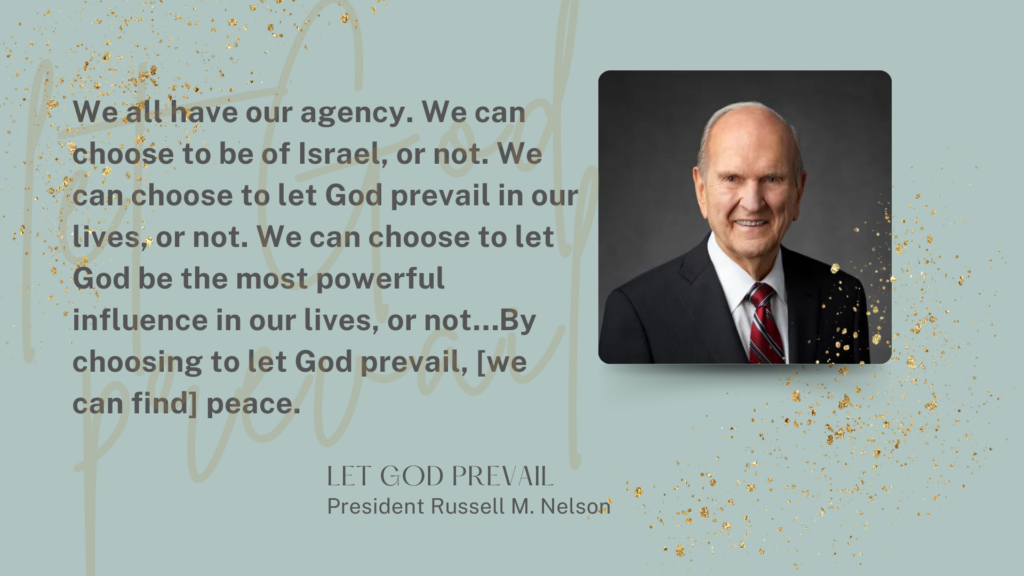
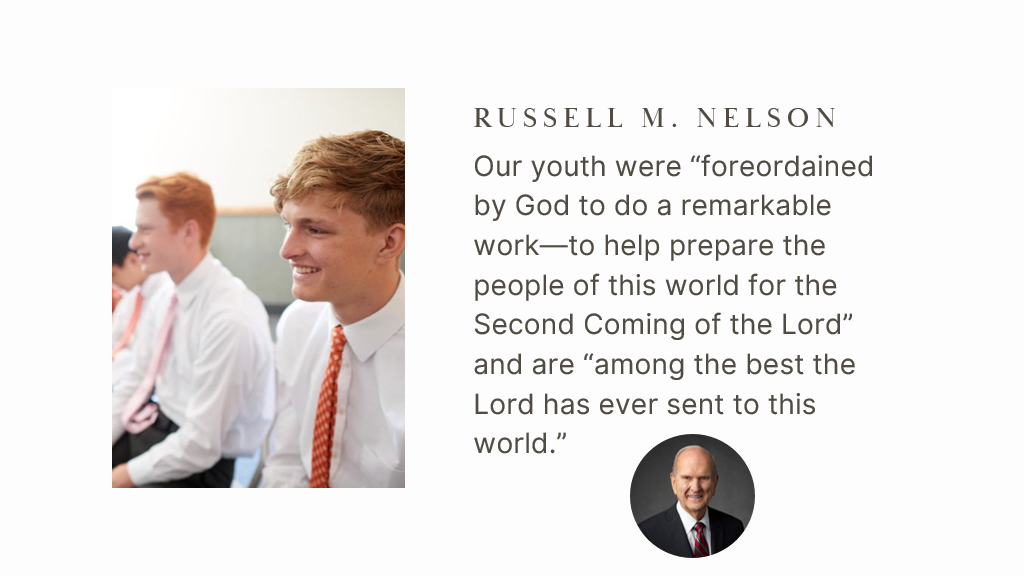
President Russell M. Nelson said our youth were “foreordained by God to do a remarkable work to help prepare the people of this world for the Second Coming of the Lord and are among the best the Lord has ever sent to this world.”
We have often heard our prophet say similar things about the young people who are growing up today. And prophets before him, for generations, have been saying similar things about the youth of their day.
The Honest Reality of Raising Kids
And I will be honest, sometimes I hear something like this and I wonder if the Lord sees the same kids that I do. (The ones who maybe forget to brush their teeth sometimes, even though their dad, in this case, happens to be a dentist.)
Or the kids who seem incapable of speaking above a mumble or answering a question with more than a barely audible grunt.
Sometimes I’m tempted to look heavenward, throw my hands in the air, and say, “Did this one slip through the heavenly cracks? Because I’m pretty sure she belongs on the remedial squad, and I can do nothing for her. So please fix her, Jesus.”
Maybe you can relate. If we’re raising children today, I think we can all relate to that.
Our Role in Their Divine Mission
But if we believe that our prophet speaks for God and our youth were indeed foreordained by God himself to help prepare the people of this world for the Second Coming of his Son, then what does that tell us about how God feels about you and me, and this generation of parents and leaders and adults, who must prepare them for that great work?
Because they are here to do a great thing according to this prophet. We are here to do a great thing, because they will not be able to do their great work unless we do ours first.
It is our job to prepare them.
Chosen for This Time
And the Lord knows exactly what we are up against. He’s not blind to the challenges of our day. Nothing that is happening in the world now or that will happen in the future is or will be a surprise for him.
And yet, he handpicked each one of us to come to earth in this time of great spiritual turmoil and to raise his elite set of latter-day warriors.
And that says something about his trust in us.
The Lord Trusts Us and Our Children
God Trusts Us with This Work
He trusts us a lot, and he knows us personally. And I know that feels daunting—this is a big work we have to do and I don’t really know how to do it.
But I hope it also feels empowering that the Lord does believe in us.
But let’s just lay all our cards out on the table right here, because I bet there are some of you out there thinking things like I have thought in the past:
“Okay, the Lord’s trusting me to do this really great, important thing so that my kids can do this really great and important thing, but maybe they are making choices that are not in line with that great and important thing.”
When We Feel Like We’re Failing
“And if I can’t teach them well enough for them to do their great work, then I am failing. I’m failing my kids. I am failing the Lord. I’m just a hot mess, and I don’t know what I’m going to do about that.”
If you have felt this, you are in really good company. I think we have probably all felt this at some time.
But I find comfort in knowing that faithful parents have been in this same boat since the dawn of time. Since Adam and Eve.
Agency Has Always Been Part of the Plan
Think back—Adam and Eve, first mortal parents on the earth, walked and talked face to face with God. One of their children killed his brother.
If we don’t have children who are physically killing each other, we are winning. We’re doing all right.
But I have no doubt that Adam and Eve did their best to teach their children about covenants and commandments and God. And still, they used their agency—some of them—to walk far away from them and from God.
Why Agency Matters So Much
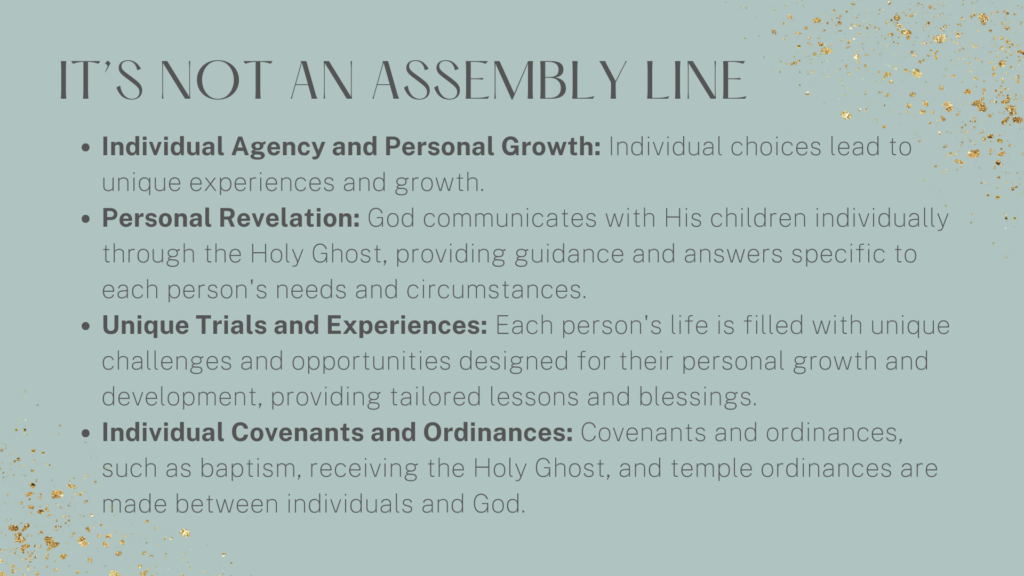
The same thing might happen for you and for me, because agency is real.
It is so important to the Lord’s plan that there was a war in heaven fought over it. Lucifer was cast down because he sought to destroy the agency of man. That is one of the big reasons why he was cast down.
So when our kids use that agency to do things that are not in line with what we have taught them, we can find comfort again in knowing that God knew this is how it was going to be.
God Understands Wayward Children
If anyone knows what it is like for children to walk away from them, it is our Heavenly Father, because a third of his children didn’t even make it to earth.
They chose not to follow him even in the days before. And how many children since coming to earth have been in that same boat?
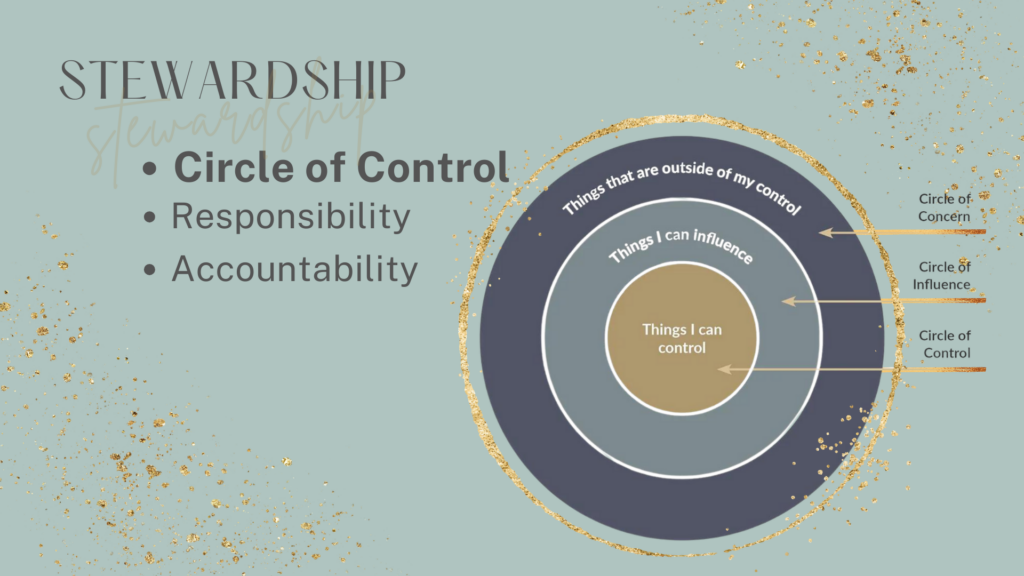
He knows we can’t control our kids’ agency any more than we can control the weather. We don’t have control over that.
“Let Not Your Hearts Be Troubled”
He did not give us control over that for a good purpose, because agency is critical to his plan.
Yet he still says: “Let not your hearts be troubled, neither let them be afraid.”
That brings me comfort, because when I hear those words in regard to this big important task of raising and preparing children, what I hear is: “Hey, Lynette.”
“You Cannot Save Your Children, But I Can”
Because sometimes that’s how the Lord sounds in my mind. It’s not formal. It’s,
“Hey, you listen up. Hey, Lynette. You cannot save your children, but I can.
So do the very best that you can. Teach them about me. Teach them how to find me. Teach them how to develop a relationship with me.
Do your best with your work. And then trust that my grace is sufficient to cover you—to cover all of the mistakes that you make as a parent, to cover your children and all of the mistakes that they will make on their way back to me, to cover all of the things that you do not now understand or that don’t seem to make sense for you.”
Trusting in His Grace
“My grace is sufficient. So trust me to do my work.”
To me, that brings great peace, because I know that I’m not doing this work alone.
He’s on my team, and he’s reaching out to my kids in ways that I cannot. So I can trust him with that.
What We Can Still Do as Parents
But just because we can’t guarantee any outcomes of how our kids will turn out in the end, and whether or not they will choose God, that does not mean we should throw up our hands and say, “Well, they’re going to do what they’re going to do, so I guess I just won’t try.”
That’s not going to get any of us anywhere.
And there is a lot we can do.
Finding a Blueprint for Raising Children
So we’re going to talk about what we can do to prepare our kids in the best way that we know how to do the great work that God is counting on them to do.
Now, what I have learned about this—as I have thought about it and studied about it and prayed about it as I’ve raised my five kids. (I just have one 16-year-old left at home—so we’ve spent a lot of time on our knees praying about these children.)
And not until relatively recently did I find what I believe is a blueprint that we can follow as parents as we’re trying to raise righteous children.
A Blueprint Worth Sharing
This would have been helpful information 25 years ago, but hey, I’m sharing it with you so hopefully you can take it and run with it.
A Blueprint for Parents
This blueprint I discovered was from a group of women who all went from lives of sin to lives of covenants and commandments and faith.
And once they were converted unto the Lord, not a single one of them ever fell away. That is how converted they were.
And not only that, but they were able to raise a generation of young people—their children—who were strong and firm and courageous and undaunted and perfectly obedient in the face of really challenging circumstances.
Who Were These Women?
Now, who were these women and what can we learn from them about raising modern children today? You might recognize them from this verse:
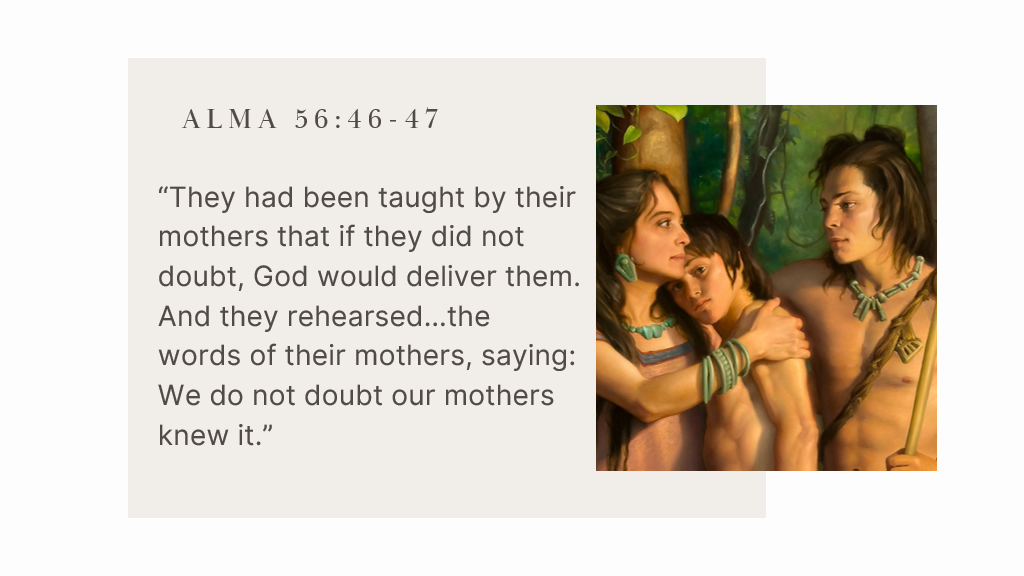
“They had been taught by their mothers that if they did not doubt, God would deliver them. And they rehearsed the words of their mothers, saying, ‘We do not doubt our mothers knew it.’”
You probably recognize this if you’ve been in the Church for any period of time—that this scripture comes from the story of the stripling warriors.
Why Did Mormon Include This Detail?
And we all know this story. We’ve read it a million times. We’ve taught it a million times. And we all know what happens.
But have you ever thought about why Mormon, when he was compiling the plates and abridging and leaving some things in and taking others out and adding his commentary here and there—why did he choose to include this little detail about their mothers?
I cannot speak for Mormon, but I know that he saw our day.
A Message for Parents Today
He told us that he saw the widespread wickedness and commotion that would be happening in our day.
And I like to think that he also saw faithful parents like me and you doing our best to raise faithful children and struggling to know how to do that.
And I wonder if he thought, Well, maybe if I include this little detail about their mothers, that might pique their interest and make them think: How did these women do it?
The Faith of the Stripling Mothers
Because these mothers of these stripling warriors—or as I like to call them, stripling mothers—were somehow able to raise their children to walk off to war at a moment’s notice, with no prior experience, even though they were all very young.
And they did so with courage and faith and hope in God.
Some experts believe these boys could have been as young as 12 to 15 years old.
Can You Imagine It Today?
So imagine with me, if you will, modern-day deacons, teachers, maybe some really young priests—2,000 of them—marching off to war with courage and faith, singing the praises of their mothers.
Can you picture it? Because I have a 16-year-old and I can’t.
It’s a little bit hard to imagine. But these women were somehow able to do it.
Looking for Clues in the Scriptures
So who were they? What do we know about them?
Now, there’s a lot that we do not know about them.
But a friend recently taught me that success leaves clues.
Putting on Our Detective Hat
And so, for the next few minutes, I invite you to put on your detective hat with me and we’re going to look for clues in the scriptures about these women—about these mothers—about how they were able to do the things that they did in preparing their kids.
So let’s talk about some of the things that we know.
A Past Marked by Sin and Conversion
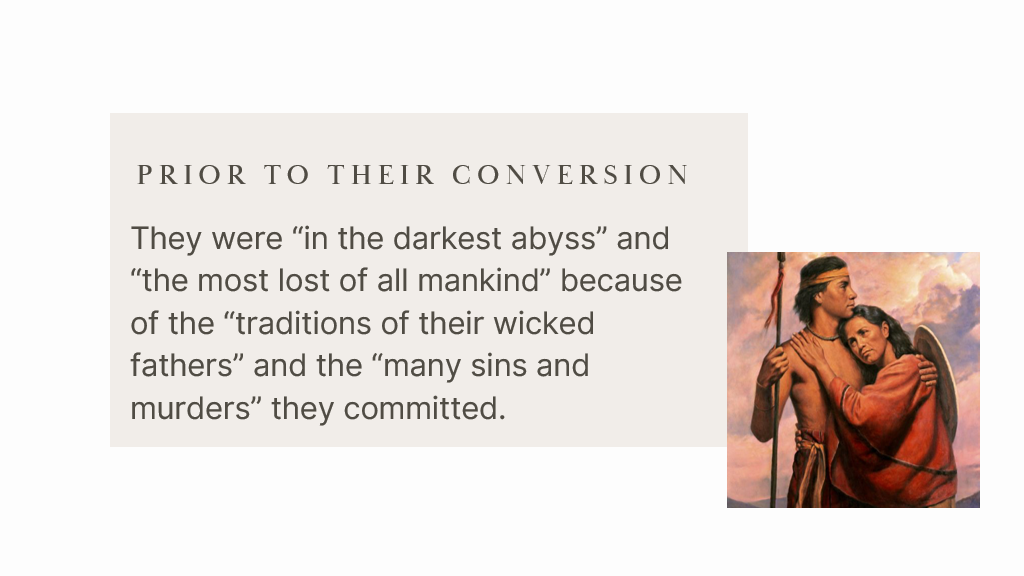
We know that these were Lamanite women who were converted by the missionary efforts of Ammon and the sons of Mosiah.
And prior to their conversion, they were in the darkest abyss and the most lost of all mankind because of the traditions of their wicked fathers and the many sins and murders they committed.
So they had a past. They had a colorful past.
Leaving the Past Behind Completely
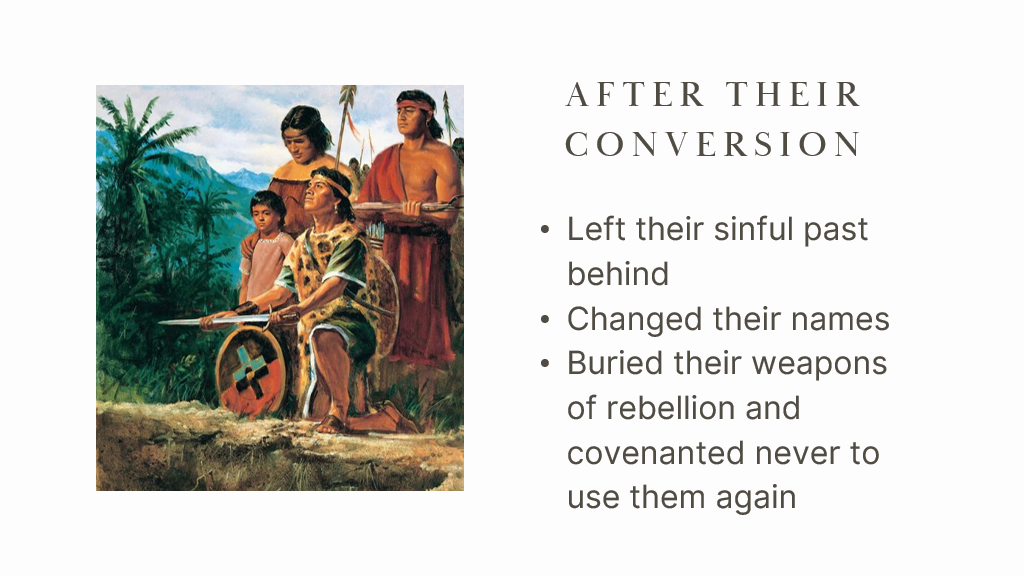
And after their conversion, they left that sinful past behind, completely removed themselves physically from it. They changed their names. They didn’t want to be known as Lamanites anymore. That brought a lot of baggage that they didn’t want to carry.
So they changed their names to Anti-Nephi-Lehies. Now, that’s kind of a mouthful. So sometimes I call them the Ammonites or the people of Ammon.
And I may use those three terms interchangeably here today.
Burying Their Weapons at the Moment of Crisis
We know that they buried their weapons of rebellion, and they covenanted never to dig them up again lest they lose their souls.
Again, this is one of those iconic stories. We know about them burying their weapons.
But I didn’t know, until I really went back and studied the timeline and the context of this decision, that they made that choice when war was upon them.
Choosing Faith When War Was Imminent
This was not an arbitrary decision because they had already decided that they didn’t want to fight anymore.
But they had heard that some of their old friends—the Lamanites who didn’t convert with them—weren’t happy with these new converts.
And so, rather than accepting their former friends’ decision, they decided that they were going to destroy them.
A Defining Moment of Commitment
And so they were making preparations to come to war against these Ammonite converts.
That is when they had to decide: We already said we weren’t going to fight, but are we really going to stick with that? Are we really going to do it?
And so the king called everyone together into this big meeting, and he gave a rousing speech where he thanked God for allowing them to repent of their many sins and murders, for taking away their guilt, and helping them to feel light and peace and turn their lives around.
A Covenant of Complete Transformation
And then he pled with everyone in attendance that day to keep their swords bright by burying them as a testimony to the Lord that they would never again shed blood.
And with that testimony, they would make a three-part covenant: that they would die before they killed anyone else, that they would give rather than take, and that they would labor abundantly with their hands rather than spend their days in idleness.
No killing, no stealing, no idleness.
Guarding Against Returning to Old Ways
These three things must have been the three things that they were most worried about going back to.
Maybe they were even as much as addictions—that if they had a little bit, they might totally turn back.
And they didn’t want any part of that.
Faith in the Face of Death
So everyone there that day—all these Ammonite converts—made this covenant.
They buried their weapons deep in the earth. And they did so with war knocking on their doorstep.
An Unimaginable Sacrifice
Pretty soon the Lamanites did come upon them in battle.
All these Ammonite men marched onto the battlefield, unarmed, and laid down upon the ground and prayed to God and praised God, while their former friends killed 1,005 of them with no resistance.
This courageous demonstration of faith inspired some of these Lamanites to throw down their weapons and join them on the ground.
A Legacy of Faithfulness
And they became, from that point forward, part of this group that was forever faithful.
And this was eleven years prior to Helaman’s march with his stripling warriors.
So the men who were on the battlefield that day—these were the fathers, the grandfathers, perhaps some of the older brothers of the stripling warriors.
The Mothers Who Carried On
And those women— their mothers– they probably weren’t in battle that day. But they were there to pick up the pieces.
They had to decide what they were going to do from that point forward.
Did they go back and dig up those weapons and say, “We didn’t realize how much this covenant would cost us. I think maybe we can defend ourselves. Is that okay?”
Choosing Faith Over Fear
They didn’t do that. They turned their faces to the future and they marched forward with faith.
And they were, from that point forward, forever faithful.
What the Children Learned
They didn’t question God.
They believed in his ability to deliver them, even if they had to sacrifice everything in the process.
Now, what do you think these future stripling warriors, who were children at that time, learned about faith from their parents from this one scenario alone?
The Power of Their Example
They knew that their fathers were martyrs—that they gave up everything for their faith.
And they knew that their mothers were forever faithful after that—that they did not question their faith, that they picked things up and moved forward.
And not only that, but remember these more than 1,005 Lamanites—we don’t have an exact number—who joined them that day after participating in the slaughter of their loved ones, they joined them.
Radical Forgiveness and Faith
And these Ammonite women welcomed them, along with any men who were left.
I don’t know how many there were in total. But they welcomed these repentant sinners into their midst.
- even though they had participated in the murders of their husbands,
- their sons,
- their brothers.
Compassion as a Mark of True Discipleship
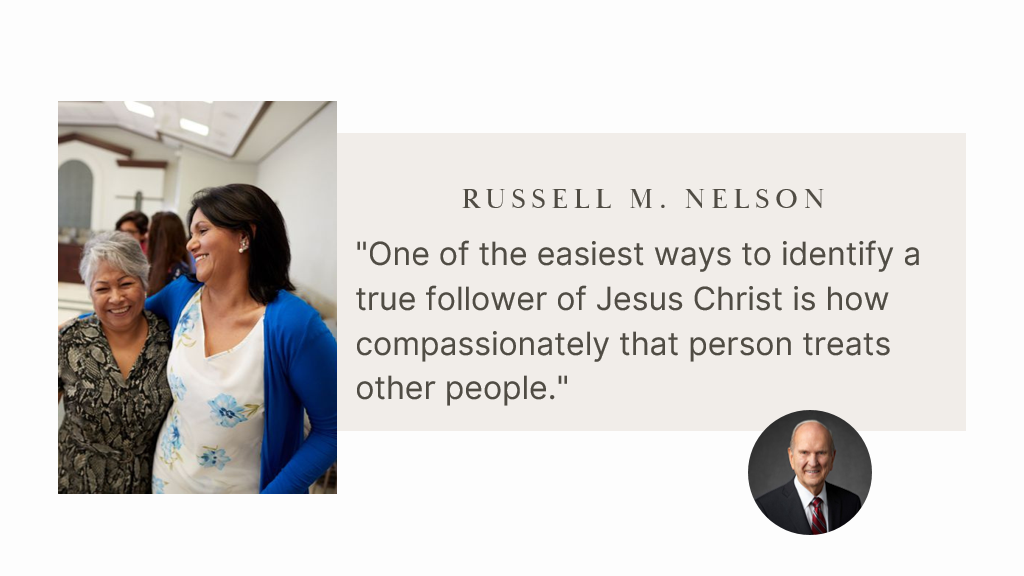
And I think about that in the context of this quote from President Nelson: “One of the easiest ways to identify a true follower of Jesus Christ is how compassionately that person treats other people.”
So what did these stripling warriors learn about being a true follower of Jesus Christ by watching how their mothers treated these people who participated in this horrible act?
They had a past too, though, remember, because they also had sins and murders on their conscience.
Understanding Through Shared Experience
And they knew what it was like to repent and change their lives.
And they told these Lamanites who joined them that day: You are welcome here. We will welcome you in.
And they treated them with compassion.
Continuing the Search for Clues
So what else do we know? What else do we know about these Ammonite women?
What We Know About These Women
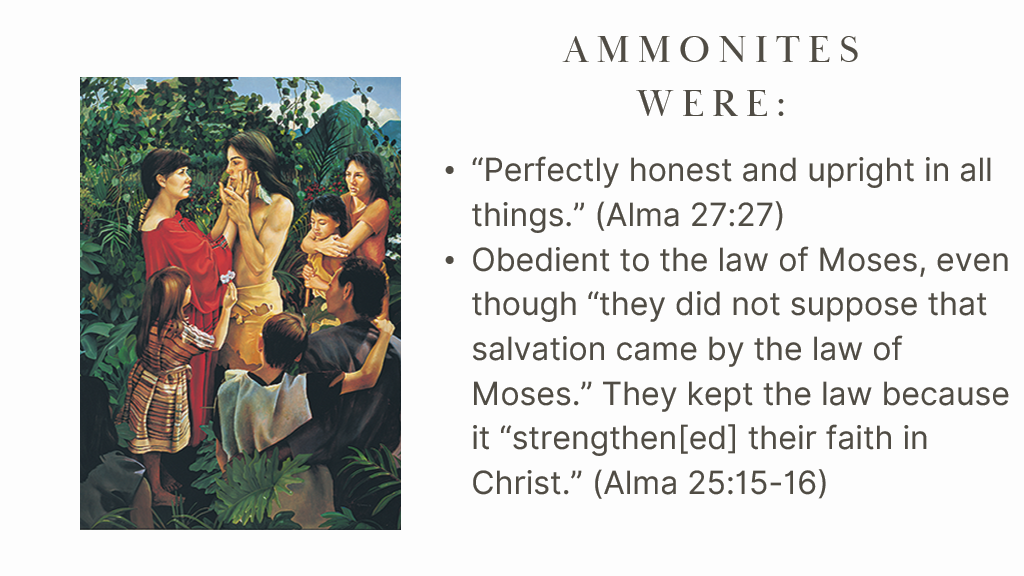
- We know that they were perfectly honest and upright in all things. Those are some pretty strong descriptors.
- We know that they were obedient to the law of Moses. Even though they did not suppose that salvation came by the law of Moses, they kept the law because it strengthened their faith in Christ.
So they were obedient. They were honest. They were upright.
Teaching Exact Obedience
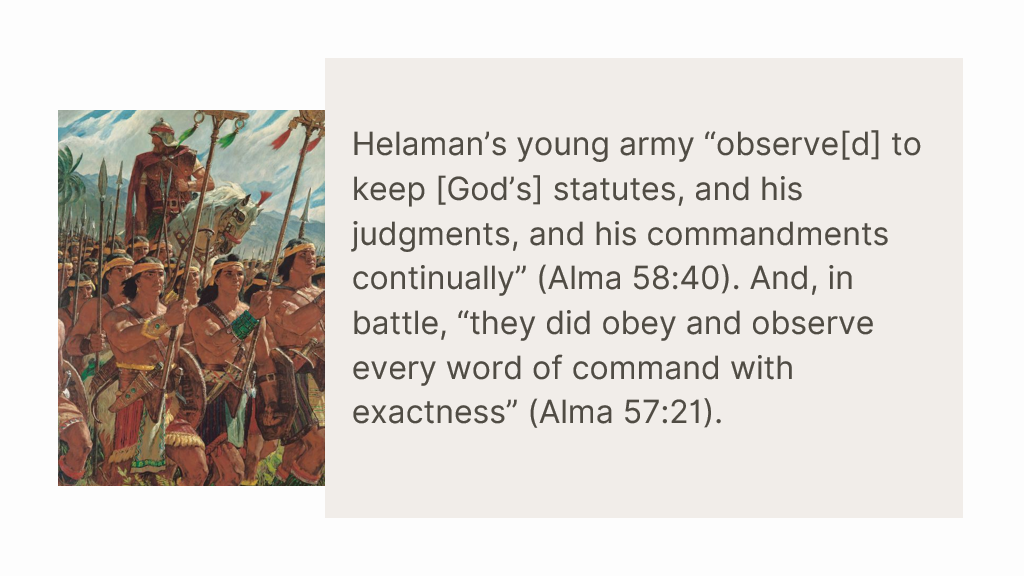
This concept of obedience shows up again later when Helaman’s young army—Helaman observed that they “observed to keep God’s statutes and his judgments and his commandments continually.”
So they were obedient to God, these young warriors.
And in battle, they did obey and observe every word of command with exactness.
Helaman Credits Their Mothers
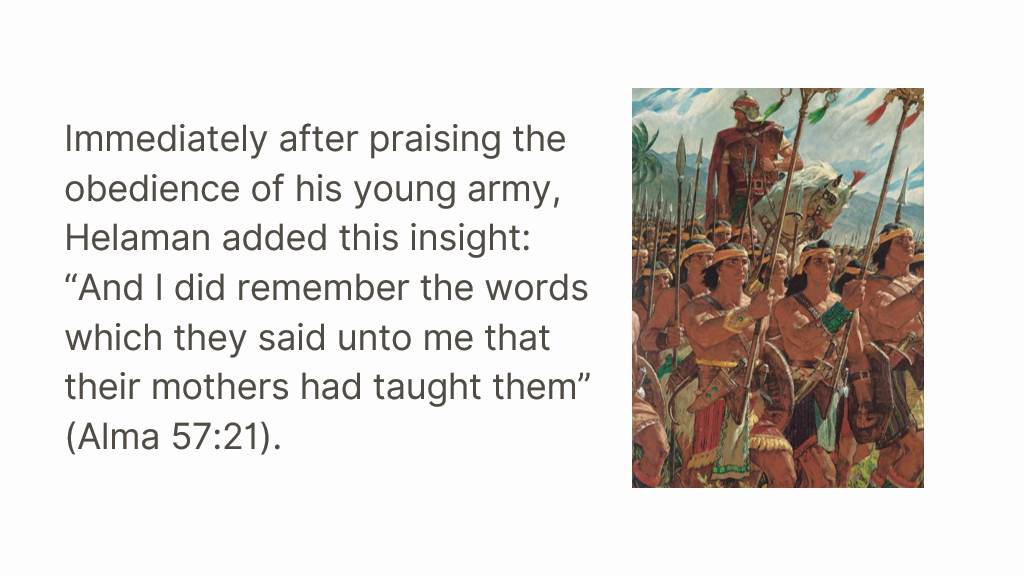
It is also interesting to note that right after Helaman praises their obedience, he says this: “And I did remember the words which they said unto me—that their mothers had taught them.”
So who did Helaman credit for the perfect obedience of these young warriors? Their mothers.
I invite you to imagine an alternate scenario for just a minute.
What If They Had Not Been Obedient?
Imagine that Helaman took command of these 2,000 young men. It’s not like he was a military commander before that—he was a prophet.
He was out preaching the word, and they wanted him to be their leader. And so he agreed to be their leader—of these 2,000, again, deacons, teachers, priests who had no prior experience.
And it was his responsibility to make sure that they were as safe as possible.
The Potential for Chaos
He was leading them into battle. So there were some risks, and they knew that.
I imagine that Helaman felt a little overwhelmed. I think I would have in that instance.
But what if these young men had decided, “Well, I am just going to do whatever I want because I don’t need Helaman telling me what to do. He’s not the boss of me. I can do whatever I want”?
Obedience vs. Destruction
It’s not hard to imagine the scene of chaos and carnage and likely bloodshed that would have ensued had these young men decided to be stubborn instead of obedient and compliant.
And in looking back with the lens of history, and the words that Mormon has given us about them, it’s clear that their obedience is what saved them—their obedience to Helaman’s every word of command and their obedience to God, who then stepped in and orchestrated this miracle.
Saved Through Obedience
So it’s not hard for me to connect those dots and say they were saved because of their obedience, right?
That’s how they were able to successfully get through those battles—not without wounds, but without death.
Raising Latter-day Spiritual Warriors
And I think about that in the context of what we’re trying to do today, in raising latter-day spiritual warriors in a culture where obedience is not really glorified at all.
Right? It’s like my personal authority is king over everything else, and I can do what I want, and I can discover my own truth, and this is what is prized in society.
But we’re trying to raise children who can be obedient.
Why Obedience Matters
Because if we want latter-day spiritual warriors, is it hard to connect the dots to say, “Well, Helaman’s army was saved because of their obedience. Will our kids be saved in the battles for their faith because of their obedience?”
I don’t think it’s hard to make that connection, for me.
If we want our kids to be saved spiritually, they have to learn to be obedient, because obedience is the first law of heaven.
Where Obedience Is Learned
But kids learn obedience at home.
And so if we’re not emphasizing that, if they don’t learn to be obedient to us as their parents, they’re likely going to struggle to be obedient to prophets, to be obedient to commandments and covenants, and to God.
Again, obedience is the first law of heaven.
Preparing Children for What’s Ahead
So that’s something to think about as you’re preparing your kids for what’s coming.
Obedience is a vital piece of that.
Our Personal Conversion
As I have thought about all that I have learned from these incredible women—which I don’t even have time today to scratch the surface, there’s so much—I invite you to go home and study the story on your own and try to find those pieces that are relevant to your life.
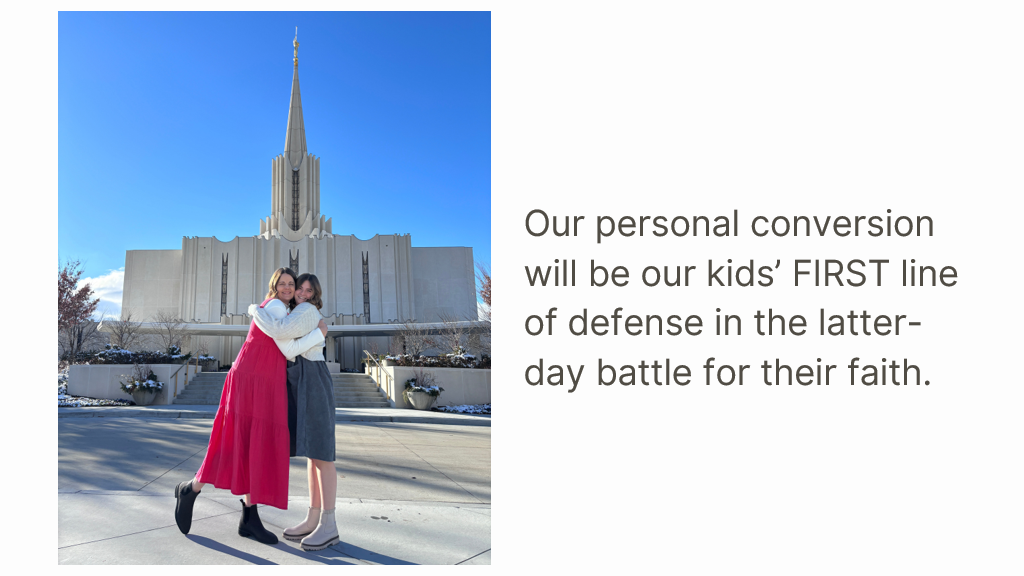
But what I have learned, I think, that transcends everything, is that if we want to raise modern-day spiritual warriors, we first have to be converted.
Because our personal conversion is going to be our kids’ first line of defense in the latter-day battles for their faith.
The First Line of Defense
It’s not going to be their only line of defense, but it’s going to be their first line of defense.
Because who do they learn about conversion from? Who do they learn what faith looks like in action from?
They’re first going to learn that at home.
What Do Our Children See in Us?
Like these Ammonite women, who never gave their kids a reason to doubt where their loyalties lay, I think we have to think about that in our own homes.
Do our kids know what we believe? Do they know because of what we say?
Do they know because of what we do? Do they know because those things are congruent?
What Are We Teaching Through Our Example?
How do they know? What do they learn from us about conversion?
I love these words from Elder Jeffrey R. Holland:
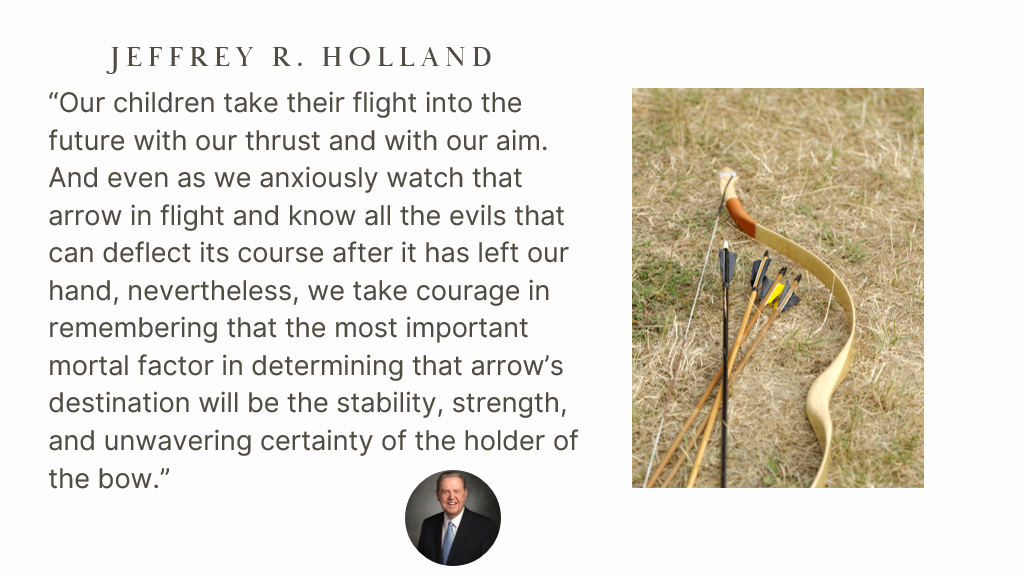
“Our children take their flight into the future with our thrust and with our aim. And even as we anxiously watch that arrow in flight and know all the evils that can deflect its course after it has left our hand, nevertheless, we take courage in remembering that the most important mortal factor in determining that arrow’s destination will be the stability, strength, and unwavering certainty of the holder of the bow.”
As latter-day parents and leaders and grandparents in Zion, we are the holders of the bow for the rising generation. The significance and importance of our work cannot be understated.
Doubt
And because of that, I want to go back to the stripling mothers and their parting counsel to their sons as they were going off to battle.
This is the counsel: If you do not doubt, God will deliver you.
I think about that in the context of this is the last thing their mothers had taught them.
Faith That Withstands Battle
And this is the counsel that gave them courage to walk into battle when they were so young, and to believe that God would deliver them if they did not doubt.
Because their mothers had never given them any reason to doubt that they knew what they were talking about.
And so in today’s world, I think a lot about doubt.
A Culture That Elevates Doubt
It’s kind of on the forefront of a lot of the work that I do on social media and online.
It almost feels like doubt is elevated above faith in importance or significance, like a badge of honor.
If you’re doubting your faith, it’s like this gateway to personal authority and freedom.
Navigating Faith in a Doubting World
And it’s hard to navigate that world and hold on to your faith without falling into that pit of doubt.
So how can we do that? That’s a big thing we’re trying to do.
Many years ago—like 20 years ago—I came to a crossroads in my faith that I was not expecting, that I didn’t know how to navigate.
A Personal Crisis of Faith
It threw me for a major loop.
I was in my young 20s at this point.
Prior to this, I had always just believed.
A Sudden Shift in Perspective
I had had experiences that reinforced that belief and that testimony, and I never had any reason to doubt that all the things I had been taught by my parents and at church were true and real and good.
When my husband graduated from BYU, we moved our two young kids across the country to Ohio.
Prior to that point, I grew up mostly in Gilbert, Arizona, which is like “mini Utah.”
Culture Shock and New Questions
Then I went to BYU, which is a culture in and of itself.
And then I moved to Ohio, where a lot of the people that I interacted with hadn’t even heard of our Church.
And if they had, they had some interesting misconceptions about what we believed or how we lived our lives.
A New Religious Perspective
They lived their lives very differently than I did.
So it was – almost–culture shock for me.
It threw me for a major loop that I was not expecting.
Encounters That Challenged Belief
Shortly thereafter, my husband was called to serve as the ward mission leader in our ward.
And so we often had missionaries in our home, and they would bring their investigators—or as they call them now, their friends.
They would bring their friends over, and we would have missionary lessons in our home.
A Moment That Changed Everything
There was this one time where they were teaching a Muslim man.
He was not interested in joining the Church, but he was curious enough to listen to the lessons and to see what it is that we believed.
During one of these lessons, he was talking about his belief of Jesus Christ—what he believed as a Muslim.
Questioning What I Knew
He believed that Jesus was a good man and a prophet, but not the Son of God, not the Savior of the world.
And as this young twenty-something, I listened to him talk about his view of Jesus Christ.
It hit me, maybe for the first time, that I was part of this tiny religious minority.
The Weight of Doubt
Who was I to claim that I had the truth?
There were so many people in the world that didn’t even believe in Jesus Christ, let alone in the Book of Mormon.
So how did I know that it was true? Who was I to say that?
Struggling Through Uncertainty
For months after that, I wrestled with some really difficult questions about my faith.
Where everything had once felt so clear, now everything was muddy.
I didn’t know what I believed.
Holding On While Feeling Lost
I questioned everything—down to the reality of Jesus Christ as my Savior. I couldn’t even claim that anymore.
And I didn’t really know how to navigate this.
Going Through the Motions
Thankfully, it was in the days before social media, because I think that would have complicated it a million times.
But I continued to go through the motions—to go to church, to say my prayers, to do the things.
But this cloud was heavy in the air.
A Quiet Answer
One night I was praying. I honestly don’t remember what I said—probably just praying for clarity, to know the truth.
And then I heard these simple words, with such clarity in my mind: You already know it’s true.
Remembering What I Already Knew
And with those words, peace rushed over me. It brought warmth to my heart and tears to my eyes.
I thought back to everything that I had experienced up to that point in my young life.
Faith Restored Through Memory
The ways that God had shown up for me and testified to me again and again that the gospel was true—that Joseph Smith was a prophet, and that, because Joseph Smith was a prophet, the Book of Mormon was the work of God and the word of God.
I had miraculous answers to prayers while studying the revelations found in the Doctrine and Covenants.
And as I thought back on all of those things in the context of all of this doubt that I was trying to navigate, it just became clear in a second.
God has testified to me all throughout my life that this Church is true.
When Doubt Replaces Faith
And I just forgot about that for a minute because doubts came up and just kind of took the place of all of that experience and that faith that I had had up to that point.
Trust God With What We Don’t Understand
And so I learned a lot. I learned a lot from that experience.
One of the things being that our questions, our doubts, the things that feel challenging to us right now, they do not throw a wrench in God’s plan.
They do invite us to trust him with all of the things that we do not understand.
Wanting to See the Whole Path
And as I’ve thought about this trust, this building of faith, I’m kind of a person who likes to know the end from the beginning.
I want to know how this path is going to end up before I ever take one step on it.
I want to see the whole path.
Learning How God Works
And that’s not how God usually works with me, unfortunately.
But I want to know all that God knows. I want to see all that God sees. And I’ve thought about that—can I do that? Can I know all that God knows?
Why We Don’t Know Everything
In thinking about that, and thinking about the reason why we’re here in mortality, I asked myself: what would it have been like if we already knew everything that God knows?
We could still have our agency to choose, but would we want to choose anything other than eternal life with our Father if we knew that that was the reward at the end of the path?
And it just kind of made it clear to me that agency, as we know it, would be different.
The Role of Opposition
It would eliminate all or most of the opposition that we face, because we’d already know everything.
It would already be clear.
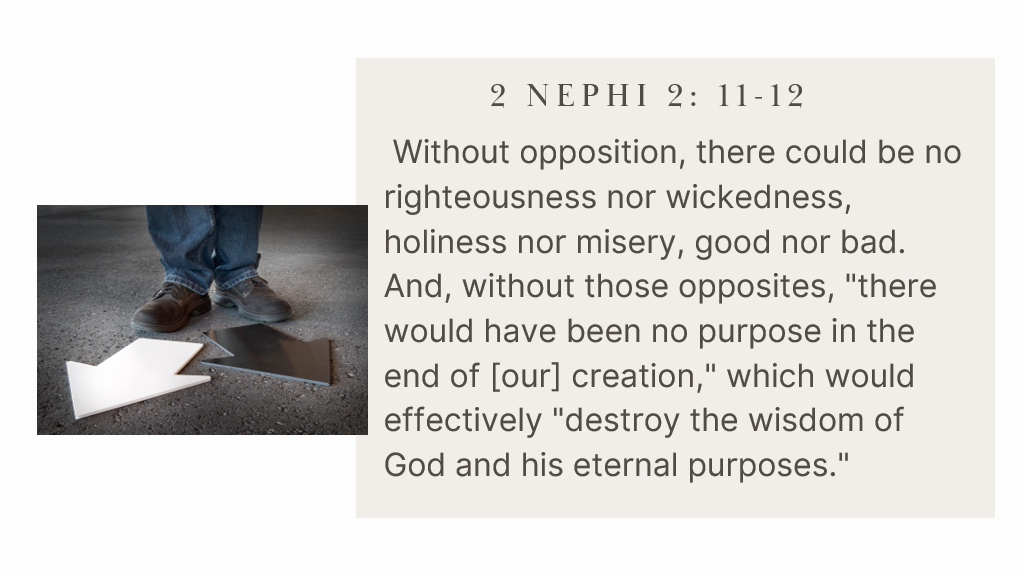
In 2 Nephi, in Lehi’s beautiful discourse about the plan of salvation, we learn that without opposition, there could be no righteousness nor wickedness, holiness nor misery, good nor bad.
Why Opposition Is Essential
And without those opposites, “there would have been no purpose in the end of [our] creation,” which would effectively “destroy the wisdom of God and his eternal purposes.”
So without opposition, there would be no purpose to our creation.
And that would destroy the whole plan of God and his purpose.
God’s Purpose and Our Growth
His work and his glory is to save each one of us—to bring about the immortality and eternal life of man.
That is his whole goal, and everything that he does supports that singular goal.
And if that’s the case, then we can’t know all that he knows, because in order for him to save us, we have to experience opposition.
Why Faith Comes First
And that is where faith comes in.
And that’s perhaps why faith is the first principle of the gospel—because everything else hinges upon our ability to have faith.
But that doesn’t make it easy.
When Answers Don’t Come
That doesn’t mean that we’re going to be here in mortality, especially now, when there are huge questions that don’t seem to have good, clear answers.
And we pray for those answers.
And sometimes those answers don’t come, because maybe that’s just not something that God has revealed quite yet.
Choosing to Trust God
And so it invites us to trust him—to trust in his omniscience, and to trust that he’s got it all under control.
Because if his plan is to save me, then can I trust him with all the parts of that plan that I don’t now understand?
Because I have to learn to walk by faith.
A Personal Decision to Trust
For me, that answer has been yes. I can trust him. And I don’t know all the things and I don’t have all the answers.
And I imagine that I probably won’t in this life have all the answers or know all the things.
When We Face Our Own Questions
But I know that he does.
And that is enough for me.
But each one of us is going to come to some point in our lives where we have to wrestle with some of these big questions.
Different Struggles, Same Savior
Maybe it’s that we’re having a hard time aligning our personal experiences with the doctrine of the restored gospel of Jesus Christ.
Or maybe we’re having a hard time navigating a really challenging relationship with one of our kids, and we don’t know how that’s all going to work out.
For all of us, it’s going to be different.
The Only Way Forward
We’re all going to be asked to wrestle with different things. But the only way that we will be saved is through Jesus Christ.
He is the way, the truth, and the life.
Do You Trust God?
And so, I invite you to consider, as you’re wrestling with whatever it is that you’re wrestling: do you trust God?
Do you trust him enough to anchor yourself to him no matter how hard the wind blows, no matter how many people you know and love decide to walk away from the Church?
Will you anchor yourself to him?
Choosing to Believe
Will you choose to believe that he’s got it all under control?
That he’s going to cross every “t” and dot every “i” and make every person who turns to him whole?
That’s his goal.
Belief Is a Choice
Will you do that? Will you choose to believe?
Because belief is a choice.
This isn’t something that just happens or it doesn’t.
Teaching Our Children to Believe
We can choose to believe even if we don’t have all the answers.
Will you choose to believe that if you do not doubt, God will deliver you?
Will you choose to teach that to your kids with all the energy of your heart—that if they do not doubt, God will deliver them?
“We Do Not Doubt Our Mothers Knew It”
And if we do that, if we have that unwavering certainty, as Elder Holland said, then our kids will always be able to say:
- no matter what happens,
- no matter where they end up on the path,
- no matter what choices they make, they will always be able to say:
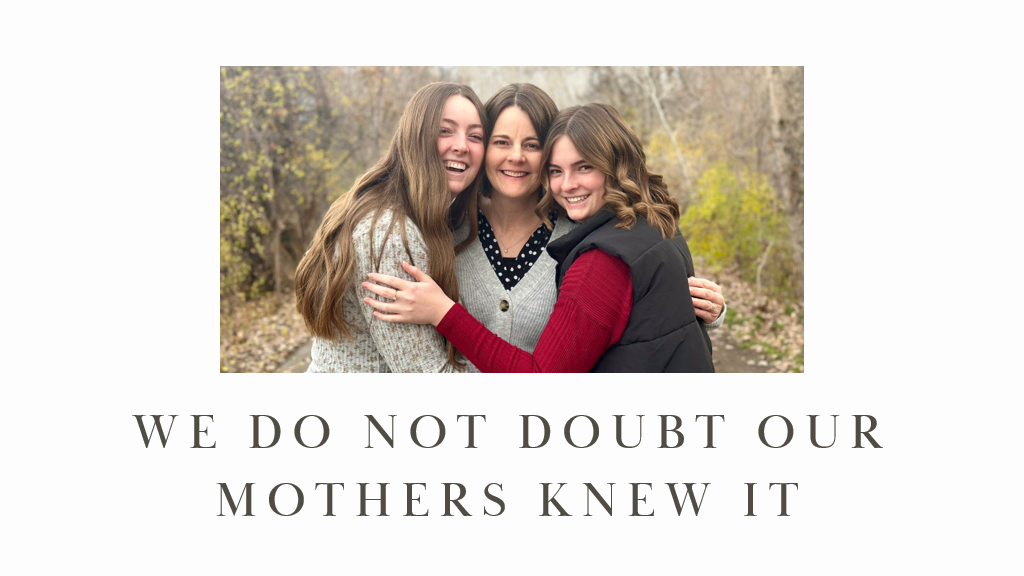
We do not doubt our mothers knew it.
And I leave that with you in the name of Jesus Christ, Amen.