• Skip to primary navigation
  • Skip to main content
  • Skip to primary sidebar
  • Skip to footer

FAIR

  • Find Answers
  • Blog
  • Media & Apps
  • Conference
  • Bookstore
  • Archive
  • About
  • Get Involved
  • Search

LDS Scriptures

Investigating the Kirtland Egyptian Papers

Summary

Summary

Brian Hauglid examines the complex collection commonly known as the Kirtland Egyptian Papers, distinguishing the Abraham manuscripts from the Egyptian manuscripts and tracing their scribes, dates, and documentary history.

TL;DR

TL;DR (Too Long; Didn’t Read)

Brian Hauglid examines the complex collection known as the Kirtland Egyptian Papers, distinguishing between manuscripts containing Book of Abraham text and documents dealing with Egyptian characters, alphabets, and grammar. He focuses on the manuscripts’ scribes, dating, organization, and relationships, emphasizing that the documents are more complicated—and less easily categorized—than the traditional name suggests.

Start Here

Question

What are the Kirtland Egyptian Papers, and how do they relate to the Book of Abraham?

Short Answer

The Kirtland Egyptian Papers are a collection of nineteenth-century manuscripts associated with Joseph Smith and his associates, including copies of Book of Abraham text and documents dealing with Egyptian characters, alphabets, and grammar. In this 2006 FAIR Conference presentation, Brian Hauglid examines the manuscripts as a complex documentary collection, focusing on their dating, scribes, organization, and relationships rather than treating them as a single uniform document.

Key Takeaways
  • The “Kirtland Egyptian Papers” are actually several different manuscripts rather than one document.

  • Hauglid distinguishes Abraham manuscripts containing Book of Abraham text from Egyptian manuscripts containing alphabet, counting, and grammar material.

  • The documents were produced by several scribes, including W. W. Phelps, Warren Parrish, Frederick G. Williams, and Willard Richards.

  • Some of the documents date outside the Kirtland period, making the traditional name somewhat misleading.

  • Hauglid emphasizes the complexity of establishing the manuscripts’ dates, handwriting, relationships, and sequence.

Editorial Note: This presentation reflects Brian Hauglid’s scholarship and views at the time it was delivered in 2006. His personal religious views have since changed. FAIR preserves this presentation as part of its historical conference archive and for the scholarly value of the material presented.

Investigating the Kirtland Egyptian Papers—by Brian Hauglid FAIR Conference 2006

I have to admit I was a little—I had a disturbing event yesterday. I met our cameraman—I don’t know if you met Will Schryver yet and he kept telling me, he thought he had seen me somewhere and finally right around lunch time he came up and he said, “I finally figured out where I’ve seen you.”

I said, “Where?”

He said, “You look like Mark Hofmann.”

I would rather be Dan Peterson with the Krispy Kremes than Mark Hofmann!

You know I have to tell you one more little thing here. You know I have been kind of messing around little bit on the FAIR boards, and we keep getting this elephant in the room thing—some of you know it what I am talking about. You know, the Book of Abraham controversy. “The elephant in the room” is, “It’s so obvious; why doesn’t everybody just see that and leave the church?”

Bias and Belief

It reminded me of this cartoon thing that I saw one time. It was a two fleas on a Cocker Spaniel, looking up into the stars, and one flea says to the other, “Do you really believe in a dog?” [Laughter] It’s just that obvious, isn’t it? Things are just that obvious.

Well it’s a pleasure to be with you today. I think this is my first FAIR conference, I believe, and I’ve watched your work, I’ve been an admirer from afar and so I am kind of glad that I finally broke the ice and got to know you a little bit more, and I am with you now. I hope that I can become among you as we move along here.

For many years I’ve had a really deep interest in the Book of Abraham. I’ve researched it, I’ve written about it, as you know. And the main thing that I guess I want to start out with: I am totally biased that the Book of Abraham is the word of God, totally biased. I believe with all my heart that this is the word of God.

Now, if that offends anybody, good—because that’s the way it is. Because that it’s the Holy Spirit that’s totally that is true.

So everything that I tell you today—whether it’s all those evidence and all those technical stuff—really doesn’t convince me one way or the other because if its what the critics say I still believe the Book of Abraham is true. That’s not ever going to change, because I have that witness. And I think I have some people on here that feel that too—I know I do—that it doesn’t matter what they say, we still know what’s true all the way.

Now if keeping my solemn covenant—and I say solemn covenant—to sustain and defend the kingdom of God upon this earth makes me an “apologist,” so be it. Then you can call me an apologist all day long because I am going to keep that covenant.

The Kirtland Egyptian Papers (KEP)

Well the KEP, Kirtland Egyptian Papers. It’s not uncommon for academics—in my field anyway—to run up against questions and problems that have tough solutions to them or even no solutions. You run into conundrums and paradoxes all the time and with the KEP they are around every turn—every turn there is a question looming there, a question mark for this, a question mark for that, and you are just about pulling your hair out trying to figure things out.

And so, for the past couple of years I have devoted my life to try to figure out the Kirtland Egyptian Papers and I am happy to tell you that I’ve got it all figured out now. Okay? Somebody will give you the word today.

What did I have to do to learn about the KEP? Well I did have to kind of figure out that since I am a Islamist and I can’t be an expert in this, I decided that I would draw on some other people like Royal Skousen Kent Jackson. People have done some textual study and I’ve actually learnt some things along the way. So I’ve gotten out of my Islamic barrier there and I have learned new things, isn’t that amazing that we can do that? We don’t have to be I mean Kevin Barney sitting right here. He is a lawyer plus he is a great scholar, okay. And I think those two are mutually exclusive sometimes, but I am just kidding Kevin. All right.

So I spend a lot of time trying to figure out what I need to know in order to evaluate these documents and so I am not going to be able to give you all of the answers. I am not going to able to talk about all of the Abraham and Egyptian manuscripts but I am going to give it a try at least to give you some things to think about here.

Now you know that they are called Kirkland Egyptian Papers, and as I have worked with some of the church historians as I’ve had an opportunity to look at the originals they just have a very basic identification system (we have them catalogued) so they made me memorize these numbers here: they said, “Well you go by is those numbers there, okay? Manuscript 1294 Folders one through five,” and I said, “Okay.” “And now the Egyptian stuff Manuscript 1295, Folders one through nine.” “Okay.”

And it’s really interesting because they keep them in a box, the top flips up, and then there are all these folders in there and they are marked just like what it says here—you just open it up and there are all your folders and they try to keep it between these nice plastic sheets, of course, that stop any deterioration, I suppose.

I suppose they will do some conservation in the future to seal them in Mylar, like they did with the papyri, which is all nicely taken care about this time.

So what I would like to do is to help all of us look at these papers a little bit differently. First of all, they are not really Kirtland Egyptian Papers because not all of them are from Kirtland. And so, I am going to refer to them as either Abraham Manuscripts or Egyptian Manuscripts. Now the Abraham Manuscripts are the ones that have the Book of Abraham text on them. The Egyptian Manuscripts are different. They have the alphabet and they have the counting, and they have the grammar.

But I want to give you a little background of these manuscripts first before we talk about them, because I would assume that not everybody here knows all these manuscripts and so let me see if I can show this—I know it’s a big chart here.

There is something like this on the FAIR Wiki, or something like this, this is just for the Abraham Manuscripts and I’ll show you the Egyptian one in a minute.

Abraham Manuscript #1

Going across it’s dated sometime in 1835, it has five leaves: that means there is writing on both sides. And so there are ten pages to it, and the first part of it on page one and that would be Abraham one through three—it’s in the hand of W. W. Phelps. And then the next part in all the way to the end of the manuscript is in the hand of Warren Parrish and Warren’s a very nice writer. Easy, pretty easy to read. So that’s manuscript number one.

Now this one here was discovered by Wilford Wood, who lived around the turn of the century. I think he died in 1950-something or 1960-something. He was a furrier. He made fur coats and (I think it was in 1916) he kind of had a spiritual calling to spend his life trying to find everything that he could, all the artifacts that he could: papers, documents, things that belonged to Joseph Smith. He tried to collect as much of these materials as he could. And in 1936–37 especially he was in touch with the man named Charles Bidaman.

Now Charles Bidaman is the son of Lewis Bidaman, who was the second husband of Emma Smith, and that’s where that manuscript comes from. Wilford Wood bought it from him for $100 and a fur coat for Charles’ wife. That’s how we got the manuscript and that was in 1937. Then Brother Wood was very concerned that manuscript papers be given to the Church, so he donated it to the Church and it’s been with the Church Historical Department ever since.

Abraham Manuscript #2

Now, manuscript number two. That’s another 1835 document I think. It is two leaves—that means it’s two sheets of paper written on both sides. It’s in the hand of Frederick G. Williams.

Now, Dean Jesse, had originally assigned W. W. Phelps to that but we’ve figured out in recent months that it’s in the handwriting of Frederick G. Williams. There is just pretty much no question about it, and that covers the Book of Abraham chapter one starting at verse four and then goes to Abraham 2:6.

Abraham Manuscript #3

Manuscript number three is dated sometime after October 29th, and it has three leaves. Again three pages or three sheets on each side in the handwriting of Warren Parrish and that goes from Abraham 1:4 to 2:6.

Abraham Manuscript #4

Then I had to kind of split up manuscript four okay because it’s all in the same folder but they are three things. So the first one here is 13 leaves, it’s written only on one side in the handwriting of Willard Richards, probably in 1841, and that’s Abraham 1:1 to 2:18.

And then 4a are two separate sheets, pages 7 and 8—they are in the handwriting of Willard Richards and contains Abraham 3:18–26.

And, finally, 4b is after 1841, and again it’s only one page, written by Willard Richards and it’s the Facsimile one interpretation, but that’s on the reverse of page two of this one. Is it getting complicated yet? You know, these actually are quite complicated!

Abraham Manuscript #5

Then manuscript number five is three leaves okay and that’s Facsimile two explanation.

There is a man name Stephen Emmel, a Coptic papyrologist from Harvard, I believe, who looked at these materials, their relationship to each other, and said, “The Mormons don’t realize how complex these documents are.”

So these are all very complicated things, but I am a simple guy so I tried to simplify as best as I can for myself, anyway.

Now two of the manuscripts, manuscript two and manuscript three, have the strange phrase at the very top of the manuscript, “sign of the fifth degree of the first” is crossed out, second is put up there and it says “part.” And then the next one says the same thing and it’s crossed out the same way and they are identical that way.

Now that has caused no small stir among both apologists and critics, as both try to figure out what in the world that is about.

And so of course I’ll tell you exactly what it’s about in just a few minutes, right? Not.

Egyptian Manuscripts

Now here’s the Egyptian ones. We talk about getting more complicated here. And this stuff is not easy to figure out: first of all you have nine folders or manuscripts here and we’ve got some dates that we have tentatively figured out and the handwriting and these are the names over here: “grammar and alphabet” and “Egyptian counting.”

Three “Egyptian alphabet” manuscripts—one in the handwriting of Joseph Smith. There’s also one notebook that says “valuable discovery” on it, with Joseph Smith’s signature and a couple columns of the Book of Tchemmin, which Michael Rhodes identified.

Now that’s a lot of stuff. This is a lot of material here. It’s not going to be easy to figure out what all this is about. But I am going to give you some things to think about here as we go along. Let me give you what I call the Book of Abraham stemma—now what this means is the kind of the genealogical relationship between these manuscripts.

Manuscript two would be the earliest. Then manuscript three could have been copied from manuscript two, but it’s later. Manuscript one is definitely copied from manuscript three and manuscript four is probably copied from manuscript one. That’s what that means it’s just kind of a stemma here to help us understand what the relationship is between these particular manuscripts.

The critics and their approaches

Now interestingly, manuscripts one through three have hieratic characters lined up on the left hand margin with English text on the right. And these characters are taken from the Joseph Smith papyri number 11. If you don’t know what that is, it’s the papyri that supposedly comes right after Facsimile number one in the papyri collection.

So manuscripts two and three obviously connect to some of this Egyptian material okay but manuscript one doesn’t have the “sign of the fifth degree” and all that on there but it still has those characters on there and so the critics have concluded (with the sound of a slamming iron door by the way) that these characters represent the translation process of the Book of Abraham. That’s kind of the long and the short of it.

Of course the characters themselves come from the Hor “Book of Breathings” as I said, and they immediately follow Facsimile number one, and so the way the critics think about the matter is they look at Abraham 1:12 and it reads “I will refer you to the representation [meaning Facsimile Number one] at the commencement of this record.” And they say, “Well that means that the Book of Abraham ought to come right after Facsimile number one.” I am just summarizing the critics’ point here.

And we know that the Book of Abraham does not come from the Hor Book of Breathings. In fact, it is not even close. How do we know that? Because it’s been translated a number of times. The most recent is

by Mike Rhodes. He translated all that material and you cannot find any Book of Abraham material in there.1

Now here’s just a thought—and I appreciate Kevin Barney on this one on his adaptation thesis that J Red, a Jewish redactor may have put that particular statement in to help the reader refer back to a picture. Or it could have been Joseph Smith himself putting in that particular explanation. We don’t know for sure. It almost doesn’t sound like Abraham, but such things are called glosses or explanations. I’ve found those in the Book of Moses, even—there are glosses in which things are being explained [by the translator or a redactor]. It’s still part of the scriptures, but it’s a kind of explanation to help us move through the text.

And so the critics really do have some good questions about this, if they would be a little bit more open, but what I think really it’s going to take to at least start to answer these questions is to really carefully analyze these manuscripts, manuscript by manuscript, page by page, line by line, and even word by word in some instances. And when we investigate these manuscripts that closely we may come to some conclusions that the critics come to, and we may (and likely will) come to other conclusions that they do not.

The only one I know so far that has studied the manuscripts as much as or maybe more than me is Brent Metcalfe. He is the only one that I know of, and why is that? Because nobody else has the pictures.

Some others of the critics do, of course, but they don’t know how to interpret them. I have to talked to Brent and actually we have come to the same conclusions on some things, we’ve already determined that. And, yeah, we depart radically on some other things. So just understand that when I say that he is one that I know has studied the manuscripts quite carefully.

So now on the FAIR Wiki—which I was very impressed to learn about—there is a discussion of the critics’ approach to the Book of Abraham and the Egyptian Manuscripts. So, let’s just review that really quickly here because this is going to help us figure out where we are going.

Translation documents for the Book of Abraham?

The critics argue that the Book of Abraham Manuscripts represent the translation working papers for the Book of Abraham. So those characters over on the left side are being translated on the right side with the text. That’s what the critics say is going on.

And then they go to this one—the Egyptian Manuscripts—demonstrate that Joseph did not understand Egyptian. [They insist that] number three of the Book of Abraham Manuscripts demonstrates that the Sensen papyrus (the Papyrus the Book of Hor) was believed to be the source for the Book of Abraham. The Sensen Papyrus—since it’s in fact not the Book of Abraham, but an Egyptian Book of Breathings, whatever else the Book of Abraham may be, it is not an accurate translation of an ancient Egyptian text. [This is the basis of the critics’ case.]

1 Michael D. Rhodes, The Hor Book of Breathings: A Translation and Commentary (Foundation for Ancient Research and Mormon Studies, Provo, Utah, 2002).

So this last one now is the final damming piece of incontrovertible evidence, and it has to be founded on those first three assumptions, of course—and if you accept number four, then that is supposed to lead us to the inescapable conclusion that this whole Book of Abraham thing is a gigantic fiasco for Joseph Smith and the Latter-day Saints. [It is supposed to] bring into question the very veracity and legitimacy of the church and shakes it to its very foundation, right? And so we all leave the church, go home and watch TV and something like that, but it’s over. Not so easily though, no.

No, if it was that easy we wouldn’t be easy. It be a nice package if everything on there were true, but the one part that’s on there that is absolute true is number four (the Sensen Papyru is not the text of the Book of Abraham). We all accept that.

Challenging the critics’ assumptions

What I want to work on today is [assumption] number one. I can’t prove whether Joseph Smith knew Egyptian or not. I can do some dabbling there. I can’t prove what the early brethren believed about the translation process because there is not really anything written about it that much.

But I can work on number one—if those are translation working papers then the manuscripts are going to give us clues that they are translation working papers.

So let me give the bottom line here before we even start. The portion of the Book of Abraham represented in these manuscripts was translated as early as July of 1835. We know that because there is a reference to it that there was a translation actually going on in July of 1835 and if you know anything about Joseph Smith’s translation abilities with the Book of Mormon or the JST you know he can do a lot in a little time with his translations. Okay, so keep that in mind.

Secondly, manuscripts one, two and three do not show the marks of a dictated text. Now why is that important? Because if they were dictated then that would say again that they are part of the translation process—you would conclude that Joseph Smith is right there dictating these documents, and then you’d have to explain those hieratic characters on the margin.

Well, now, when you define an hieratic character over here with 100 English words, it doesn’t make any sense. Can you get a hundred words out of one little character? Of course not. And so, [if these are translation documents,] it makes Joseph and the brethren look like idiots. It’s okay to say that, because we know that’s not what those hieratic characters mean.

And so what we have to determine is whether or not the manuscripts were dictated: was Joseph right there getting the inspiration or telling them what to do with those characters there? If so, the manuscripts will, I think, tell us that’s the case.

Now the third thing we need to keep in mind here. Joseph Smith in my view was a seer and a scholar. He was a seer and a scholar. And I believe that Joseph Smith worked with his scribes to bring about the revelatory Book of Abraham that we have, the divine Book of Abraham. But I also believe that they— including Joseph Smith and his scribes or whoever else—made serious intellectual attempts to understand things, to learn things, languages and such, and I think we need to keep those [ideas or

roles] separate: Joseph the seer and Joseph the scholar. He is both, [but they are a separate roles], I think.

And we can’t pigeonhole Joseph into just saying that he is a seer, therefore this stuff doesn’t make sense. If he is a scholar, oh now we’ve got him working, trying to figure things out just like the rest of us. “Oh, he wasn’t given everything,” we might say. “Okay. That’s fair, that’s all right.”

Myths and realities of the manuscripts

So let me give you a few what I think anyway are myths and realities here about the Abraham manuscripts and also about the photos. I want to talk about the photos too. When I talk about the photos I should let you know that Steven Christiansen is the man who was killed, by Mark Hofmann, not by me. I am not Mark Hofmann, or any incarnation of him, but Steve worked with the church to produce some high resolution photographs. And after Christiansen was murdered Mr. Metcalfe was able to get negatives from, you’ll have to help me out here, but I think it was from Steve Christiansen.

And so he got the negatives and he’s had those negatives for quite a few years and he’s done lots of studies on those and shared them with some folks and on the internet as well. And so these are photos I will be talking about.

Myth #1: High resolution photos provide an accurate portrayal of the manuscripts So let’s start with myth number one. Not everybody believes these myths so I am just saying a kind of myth because I have seen this as I monitored the discussion boards and as I have heard from different people these kinds of things here. So myth number one is the high resolution photos provide an accurate portrayal of the Book of Abraham manuscripts—that’s a myth to me. And we’ll talk about that. Now I don’t know how well you can see this. This is a photo of the Book of Abraham manuscript one, page one. And this is the one that comes from the Christiansen collection. And so this is something like what Mr. Metcalfe would have.

You know here’s another one that I procured more recently. This is a digital image of the same page. Now you see a difference there. There are differences that you can’t really see it on this too well but there is a lot more red at least—this color correction is actually beautiful. I’ve seen the originals enough to know that this one here looks a lot more like the original than this one over here [the Metcalfe version]. Now let me just run you through a couple more here.

Here is Book of Abraham manuscript two page three okay and this is one of the ones I have to pull my hair out on a little bit, with the Christiansen photos, and here is the new one—a lot nicer. A nice digitized image there. Another one: this is the Book of Abraham manuscripts three page five. By the way this one here is used quite a bit on the web, there may be some be recognize that. And here is the newer one here. Again you can’t see quite as clearly on this [older] one compared to this [newly digitzed] one?

This is manuscript number four, page two—this is a Willard Richards one and here is the new [digitized image] right here. So you can see that there is some differences between the digitized images and the

earlier photos that were done over two decades ago. And it’s been more helpful for me even with these nice digitized images to go up to the church and look at the originals, because with your eyes you have more of the 3D viewpoint of things and it’s a lot better even that way. And so I just want you to know that there is progress being made on trying to make these kinds of things more accessible to scholars, to understand these manuscripts better.

Myth #2a: Ink analysis can give us complete and accurate information Now myth number two—this one here I’ve seen a lot on the discussion board (and by the way this is not Mr. Metcalfe). Mr. Metcalfe agrees that this is an absolute myth: that ink analysis on photos can give complete and accurate information. Okay well that can’t be true. Why? Because how can you do ink analysis on a photo? It’s kind of hard to do that, isn’t it? And I haven’t tried it, and I don’t want to, because if you go to the originals and use a binocular microscope or if you need to some day do a chemical analysis it would have to be on the originals, wouldn’t it? In order to see the right ink and to see things magnified or whatever you’d use the proper tools.

So the reality is you have to use the originals on this [type of analysis] with the microscope or chemical analysis and that’s just the way it is folks. You cannot come to a real, solid conclusion about ink with photos, you just can’t, it doesn’t work. All right.

Now here’s the most over-used one I’ve seen on the web.

Myth #2b: There are two kinds of ink on manuscript three This the one I have seen on the web. Book of Abraham manuscript three, page five, and here is the new digitized image there. Well it does look the same, doesn’t it? It does look the same and I bet you’re waiting for me to say it’s different but it’s not. I did look at this under magnification and made sure that these two inks with the same thing. Now let me just throw out something to you here that John Gee wants me to tell you, and he wants you to spread it around, all right, and that is that he was arguing for a two ink analysis, two ink theory, that many of you know about.

And the two ink theory says that the characters were in a different ink than the text therefore the characters put on the paper after the text was already there, that was the way kind of John was thinking about that. And when he was thinking through that he did not have access to the originals. He did not have access to the newly digitized images he only had what basically everybody else has. And so he just made judgment call there.

Well John and I have been working together on some of this and he is totally convinced now that the two ink theory on manuscript three is dead. There are no two inks, aren’t you sad?

You shouldn’t be sad, because this particular manuscript here is used as an example to shoot down the two ink theory when in reality there is other three manuscripts still, two others with hieratic characters on them that are not analyzed on the web with these critiques here.

And when we get to manuscript two, you’ll see that the two ink theory is not dead all the way yet. If somebody will try to kill it, I am sure, but here is Book of Abraham manuscript two so you see the characters over here you’ll notice there is no margin line on this one and there is lots of space between the text and the characters there. And we have to figure out why that is. There are several conclusions one could come to about that—and here is the newly digitized image.

Now I have done enough looking at this under a microscope to determine with absolute certainty that these characters here are in a different ink than the text. I know that. I can magnify things from 6 times to 50 times and look at the fibers even and I can see that there are different inks there and you can see a correction rate here with the same ink as this over here. And I’ll show you some more of that. And so yeah the two ink theory is dead with manuscript three, but manuscript two is yet to be dead. I guess the critics will have a go, which I am sure they’ll do somehow. So let’s go on myth number [four].

Myth #3: Manuscript one contains Phelps’ transcription of Joseph Smith’s dictation Book of Abraham manuscript number one, page one, and I want to focus just on the Phelps section—that’s that top section there. And many of the critics argue that this is dictated text: that is, Joseph Smith is standing there dedicating this to W. W. Phelps. [This is important to the critics,] of course, because they’re “translation papers”— remember they don’t want us to lose that thought.

And here’s the text straight here, and you can see there are some characters over here and some numbers here that will talk about in just a minute. It’s in a darker ink than the Parrish writing. The reality here is that this is not dictated text—I am going to show you why. Here are some reasons”

#1) First of all, with these number characters here okay we got number one that goes with this one and this one and we have number two that goes with this one so and by the way you can find these in the grammar book of the Egyptian manuscripts here. Some of this kind of material looks just a bit too deliberate for me for dictated text. Okay to put numbers on there, Joseph Smith would have to be saying, “Okay, now put number one….” He is dictating number one, and then you write there so can I put number two and then dictate it—doesn’t make sense to me. And so it appears very deliberate, but if that were the only evidence I had, I probably wouldn’t told you this one.

#2) How about punctuation? This one here Will Schryver actually got the message board going on this one a little bit. You can see a lot of semicolons in here and colons and commas. And generally speaking with dictated text you almost have zero punctuation. You go to the Book of Mormon manuscripts or the JST manuscripts—there’s very little punctuation on those dictated manuscripts.

Well so what do you? You look at Phelps’ contemporary letters to his wife Sally and lo and behold, the punctuation that he uses here is very similar to the punctuation that he is using in these letters, which were composed right along that same time period. He punctuates it more. And so to me that tells us that this particular part, anyway, is not dictated—it’s too clean there.

#3) There is a phenomenon called dittography where a scribe will be coping something from another manuscript and accidentally write a word twice. You see it all the time in scribal errors.

And so you can see “be” over here and he’s got little equal sign and then he writes beginning again, the whole thing. Okay. We’re supposed to just write beginning there not beginning and so his eye is moving back and forth between two manuscripts there. And so let’s see.

#4) Now this I know this is a big word it’s called homeoteleuton. I’ll tell you what that is. So you walk up to the room here and I think I am swearing at you or something—I am not!

You can read there “a high priest holding the right belonging to the fathers” and that’s where we are ending right here from the beginning of time. So that’s Abraham one, two, and three. But notice what’s missing here. Well we have the error right here this is what we have now. “It was conferred upon me from the fathers it came down from the fathers.” Now you notice you got fathers here and fathers there. This was a very common type of mistake made by scribes from Old Testament, New Testament times, all the way up to the 19th century scribes. Even today, when you see two words like this, you see fathers all over the place it’s so easy to take this “fathers,” this “fathers” and just omit what’s in between. It’s simple to do that and you see it all the time; it’s a common scribal error.

And that is just to say that Phelps’ eye was looking at “fathers” and just missed it up to the next “fathers.” Phelps also has seven omissions in the Phelps section here which are puzzling.

When you think about dictation, to me you need to realize that when Joseph Smith did dictation, he did go back with his scribes and fixed things, of course he did, but this is a lot of stuff that that’s different from our manuscripts. So I don’t know what Phelps was copying from, how accurate the manuscript was or how hurried he was or whatever it was, but he is missing a lot of things in this particular passage or this part here.

So my conclusions: the reality, for me anyway, is that he is copying from an earlier manuscript. Perhaps it’s an unrevised one that the prophet is letting him copy from, I don’t know. Or he is just in a rush, but the point in my view is that this could not have been dictated.

So what am I doing, I am separating the manuscript from the translation here. I am separating it from the translation saying it’s not a working translation paper, that’s what I am saying.

Myth #4: Manuscripts two and three were simultaneously dictated So, now myth number [five]: manuscripts two and three were simultaneously dictated. Now, Mr. Metcalfe already knows that he and I part ways on this one, majorly—we do not agree on this one. And I get to hear his evidence, but here we go

What is normally used on this particular point—for the critics anyway, and I am not lumping Brent [Metcalfe] into that, by the way, yet. But we’ve got this strange sense here at the beginning and because it’s so exact on both manuscripts. It looks like Joseph Smith just dictated that to them and then told them to correct that and they both made the exact same corrections on it because this correction up here is in the handwriting of Williams just like it’s supposed to be and this correction here is in the handwriting of Parrish just like it’s supposed to be. You can even just tell by the s here—it’s very easy.

But number one, why would Joseph Smith dictate such a strange sentence that’s not even in our scriptures? It doesn’t make any sense. That part doesn’t, to me anyway.

What we have in our scriptures is what we have in our scriptures. I just don’t see where he is coming from on this. So the reality for me is that if you put the two manuscripts together (manuscript two and manuscript three) those are the two earliest ones, you are going to notice some big differences there and I would want to have these explained to me. If I were going to be swayed over to the dictation side [of the debate.]

Problem #1: Unusual names will not be the same with dictation And so, first of all the copying of names that should not be as consistent with dictation. Dittography is in these manuscripts again. You got another homeoteleuton in there, you’ve got way too much punctuation again, probably, for dictation purposes. They didn’t waste time on punctuation when things were dictated, they just wrote down what Joseph Smith told them to write down and then they went back later and punctuated things—that was the practice with the Book of Mormon and JST, and so why would we see it any differently here?

If you put these two manuscripts together again you get exact cross outs (the individual letters separated by hyphens are cross outs here; I couldn’t figure out how to do them on PowerPoint, so those are cross outs).

Problem #2: Errors characteristic of copying, not dictation And this is an addition here, and so again that is exact between the two. If you want to go along with the dictation simultaneous dictation theory but notice some of the differences here. You’ve got “their dumb idols” from Williams (#2, left side), while Parrish (#3, right side) has “these dumb idols.”

William’s here is Elk-Keenah, Parrish has Elkkener. Williams adds “that is,” Parrish removes “that is lying before you.” Now for a dictation you’d think Joseph Smith would keep them straight on that.

Again on the names here you have “is called by the Chaldeans, Rahleenos” and here Parrish has “was called by the Egyptians Chaldeans.” Now Williams didn’t hear “Egyptians” but Parrish did. Do you see where I’m going with this? The ears aren’t the same. Okay I am growing old, and I know I have selective hearing, but this isn’t in that category here. Williams hears unrightly, and Parrish does not.

And so to me it’s strange. This would have to be explained to me—why are there these big differences between these manuscripts? And then the dittography here again this is a perfect dittography for copying from another manuscript. You can’t see it very well from where you are sitting, I know, because this isn’t great but “the gods of the land” is right up here and here I try to get it out there a little bit, but it was really tough to do it and then you’ll notice that this underlined portion here is “gods of the land” and it crosses it out.

So again his eye is overlooking [text in copying] this parent manuscript, he sees “gods of the land,” he writes it down, he puts his eyes back there again, sees “gods of the land” again, writes it down. It’s a common thing that occurs and he crosses it out when he sees that he has done it twice. That’s a common scribal error.

Here’s another one with manuscript three “and my”. This is at the bottom of the page and the next page starts with “any my” again. So, he crosses this one out because he goes back and realizes that he had put it twice. Another homeoteleuton. Now this one here I will grant could have been added later by Joseph Smith but it also could be an easy homeoteleuton because when you reading “the god of,” “the god of,” “the god of,” “the god of,” it’s easy to miss one of the “god of,” okay?

And when you’re copying things over but it is weird that they both would miss it. It is weird with that, but if this manuscript is copied from this one that means he is just perpetuating his mistake. Does that make sense?

So we’re just talking about scribal errors here.

Problem #3: Over-punctuation for a dictated text Now let’s go to the dictation question for just a minute here, with Robert J. Matthews on OT1. Now OT1 is the Old Testament manuscript for the JST. He says there is little punctuation. Old Testament two which is the revised one has practically no punctuation. And then New Testament one manuscript, likewise has very little punctuation. New Testament Two has some punctuation added much later—the ink is much darker.

And so what you are seeing there is that Matthews thinks that there was a lot more punctuation after the dictation and somebody went back and put it in, in a different ink. And then of course Royal Skousen, in his book on the original manuscripts, says it without any punctuation at all. Okay. So punctuations is an important issue with this question about whether these are working translation papers or not. And so here is manuscript three and you have look at all the punctuation. This is a lot more than you would see in a dictated text.

I would have to have that explained to me why is there so much punctuation going on there. Same thing with manuscript two. You get some that look like it had already been punctuated, but notice how dark these punctuation marks are—that means that somebody went back later and punctuated this. If there is going to be any argument for a dictated text, it would have be based on manuscript two, because manuscript three fails the test and manuscript one fails the test completely. Number two is the only one you could possibly argue for it.

But notice here the ink is very dark and it matches the characters. Now what that tells me —and again I had to look at this under a microscope to figure this out— is that somebody went back and put these marks in here and at the same time put in some characters because the inks match; it’s a later ink. Okay. And that’s why to me the two ink theory is not totally dead yet.

Myth #5: Hugh Nibley was always wrong, or always right. And myth number [six]. Did Nibley ever make any errors? Of course not. Or was he completely wrong? Of course not. By the way, Nibley gets hammered a lot on the discussion boards— it’s just sad to see that because he did so much good work and just to throw it out completely (and by the way John Gee has totally been discredited, by the same reasoning, because of his little mistake which he admits to now on the two ink thing and <00:07:03> manuscript number three—he has, in the critics’ telling, been totally discredited because of that one mistake. He doesn’t know what he is doing anymore because he made a mistake? So we can’t make any mistakes as apologist, is that it? What a cry and shame to be looked at that way, Of course we are going to make mistakes.

We are not perfect apologists, we are just trying to do the best that we can with the material that we have, and so Nibley was no different. He made mistakes as well. He wasn’t perfect and he wasn’t an idiot either. I think he was very good. In fact, he believed also that these were all copies that we don’t have the original dictated manuscripts of the Book of Abraham, period—that’s what he said. We don’t have them and I am inclined to agree with him about that.

He believed that manuscript one was the parent copy to manuscript two and three, which we know now is not right, but that’s not a huge error. We know that because Warren Parrish copied manuscript one from manuscript three. What we find with these manuscripts is that the earlier manuscripts generally will have a lot more problems to it. These will be more problematic, to try to figure out. There is a lot more variance in there, and lot more mistakes and these kinds of things, and then the next manuscript will be a little bit more fleshed out, a little bit smoother. The next manuscript will be a little bit smoother until finally you get to the manuscript four which is a lot smoother and looks pretty much like the Times and Seasons [published version of the Book of Abraham text]. It’s very smoothed out.

And manuscript two, being the earliest, has the hardest readings in it, with the most variance in it, and so by the time you get to manuscript one it is working out a lot of things like you get this “regulus” in these two manuscripts that gets taken out—”regulus” whatever that is. And you get out “that is lying before you” out of these manuscripts.

By the way, John Gee is going to have something kind of new out on this called the Egyptianisms in the Book of Abraham manuscripts where he has found, and this is one of them here “their hearts are turned”—he’s found that the part that’s crossed out, “the hearts are turned” is the passive Egyptian of the Ptolemaic time period. And he feels that that’s pretty good evidence that Joseph Smith knew what he is talking about. He was seeing something Egyptian going on, and that still needs to be kind of explained I guess.

External evidence for the Book of Abraham manuscripts

Myth #6: The external evidence for the claim that the Book of Abraham manuscripts are copies is not very strong. Well we know that the scribes’ external evidence certainly describes the historical atmosphere in the early nineteenth-century Church.

We know that W. W. Phelps was called as a scribe in July 1835. We know Frederick G. Williams was acting as scribe as early as October 3rd, and we know that Warren Parrish is called as scribe on October 29th. So we know that the manuscripts that we have don’t predate these dates. They are later than that, anyway, and maybe much later—we don’t know for sure.

We also want to taking this consideration some historical matters here: what’s going on between 1835 and 1842? Tons of things are going on in the Church. How busy is Joseph Smith? It’s amazing he has time to breathe. Literally there is so much happening with him. Joseph Smith during this time period gives more rein to the leaders of the Church, gives them more independence to do things. There is an increase in secular learning, learning languages, history, ancient things—the members are very interested in that kind of thing during this time period.

I don’t want to read all of this, but look at some of the things going on in those 7 years: with the preparation and acceptance of the doctrine covenants 1835 edition, I need to give you a little clue here on the how far along the translation was by August 17th, 1835. You know the term “Shinehah” it’s in Abraham 3:13—remember that it got some saviors with “Olea.” Well that word gets adopted into the heading of an March 1833 revelations in the 1835 D&C in August.

And how was it adopted into the Doctrine and Covenants? Well it’s put in there as a code name. Remember the code names that were used by the prophet? Some of you are too young maybe. Our scriptures used to have those in there; they don’t any more. But Shinehah was in the 1835 edition of the Doctrine and Covenants. It was accepted in August 17th, 1835 which seems to suggest that the translation was at least up to Abraham 3:13 by August of 1835—does that make sense to you? I mean if he is pulling out that word.

There is also more going on with the Kirtland Safety Society, the bank closes, there is <00:02:45>, the Far West problems, the extermination order, the Liberty Jail experiences and all that, building Nauvoo, all of this, there is so much going on. So it’s no wonder really why between 1835 and 1842 Joseph Smith was not able to publish the Book of Abraham at that time.

Well I like this one. Joseph loosens the reins, he really does. He goes to Michigan and lets the brethren go ahead and hold a major conference for the Church. He lets the Missouri and Kirtland leaders just go ahead and run things, for years really. Richard Bushman’s book Rough Stone Rolling makes it pretty clear that Joseph had allowed a lot of autonomy to these leaders and D&C 134 was credited to W. W. Phelps. Some think it’s Oliver Cowdery, but should also be W. W. Phelps as well.

And so there is a lot going on—the reins are loosened, and what I am trying to do is help you see that it’s not out of the realm of reason to expect that these brethren may have been doing some things on their own. From Bushman’s book:

Joseph was not always in charge of the councils he attended—the group itself chose the moderator, shifting the responsibility from one to another of the more experienced men like Sidney Rigdon or Oliver Cowdery, but sometimes turning to new converts like William E. McLellin….Joseph could absent himself from these meetings without crippling business. He left Kirtland for months at a time and the councils carried on in his absence. The men in the Missouri managed their affairs without him for years.2

And so he is not tightly reined there to the brethren. There is also that interest in secular learning I mentioned and as you know Oliver Cowdery goes to New York I believe, it is, and a rabbi Joshua Seixas is found, and he comes back and he begins the school in January of 1836 for the brethren to learn Hebrew.

And Joseph was interested in that, and so were some of the early brethren—they were in an AP class. I don’t have any problem with that but they had to learn from the teacher and Joseph says on Wednesday the 17th February 1836:

2 Richard L. Bushman with Jed Woodruff, Joseph Smith: Rough Stone Rolling (New York, Alfred A. Knopf, 2005), 252.

“attend[ed] the school and read and translated with my class as usual, and my soul delights in the reading and reading of the word of the Lord in the original, and I am determined to pursue the study of languages untill I shall become master of them.”3

And I was talking to Alexander Baugh who is on the Joseph Smith Papers Project and he shared this with me. He has a letter from Joshua Seixas to Joseph Smith. And it reads,

3 Dean C. Jessee, The Personal Writings of Joseph Smith (Salt Lake City: Deseret Book, 1984), 161.

“Mr. Joseph Smith Jun has attended a full course of Hebrew under my tuition and has been indefatigable in acquiring the principals of the sacred language of the Old Testament Scriptures in the original tongue. He has so far accomplished a knowledge of that he is able to translate to my entire satisfaction and by prosecuting the study he will be able to become a proficient in Hebrew. I take this opportunity of thanking him for his industry and his marked kindness toward me.”

And this was in Kirtland in March of 1836 and that tells me two things:

Number one: Joseph Smith is not bad at Hebrew. Number two, he had to work at it. Why didn’t the Lord just give it to him, you know, with all his revelations? Because Joseph is a seer and he is a scholar. He has to work through the books just like you and me. And I think this to me this is just another indication that he is trying to do the best that he can to become the scholar that he wants to be.

I have a couple quotes here, let’s see here we go. The Lord and Joseph Smith were open to allowing some of the early brethren to participate in the bringing forth of scripture. As early as 1829, Oliver Cowdery was given the opportunity to translate the Book of Mormon and failed (see D&C 8–9).

On November 14th, 1835 Warren Parrish was told he “shall see much of my ancient records and shall know of the hidden things and shall be endowed with a knowledge of hidden languages and if he desires and shall seek it out my hand he shall be privileged with writing much of my word as a scribe un to me for the benefit of my people.”4 W. W. Phelps was promised in a blessing, “behold he shall have understanding in all sciences, even languages and with his brother Oliver shall write and arrange many good books for the good of the church with the young may grow up in wisdom.”5

Now I don’t know about you, but it appears to me that it was put into the minds of these early brethren that they could learn some things on their own. Even the Lord in March of 1833 encouraged Joseph Smith and the early brethren to study and learn and become acquainted with all good books and with languages, tongues and people as a revelation March 1833 [D&C 90:10].

Now that would put a thought in my mind to see what I could do to learn some languages.

And so I am just trying to help build an idea of what the climate was at this time when these papers come out. Okay. It’s not unreasonable to suggest that these papers were study papers, not translation papers but study papers. And as I read these papers more and as I go over and over them it just becomes clear to me that that’s exactly what we’re talking about here.

Well this investigation has led me to believe that the Book of Abraham manuscripts and the translation process are two very different things. As far as the translation process goes, we really know little about

4 Joseph Smith blessing to Warren Parrish, given 14 November 1835; see History of the Church 2:311.

5 Blessing given by Joseph Smith on 22 September 1835, recorded 3 October 1835 on page 14 of Church record; presumed to be from the W.W. Phelps diary, 30–34.

how it worked. How much do we know about the Book of Mormon translation process, really, when you get right down to it? What is Joseph Smith experiencing? Or the JST experience?

From Joseph Smith’s previous experience with the Book of Mormon and JST, it is not likely that he used his intellect alone as suggested by these Book of Abraham manuscripts. Now that’s an important point. Just because there are a lot of characters over there, and you’ve got the English on the text on the right side, does not mean that that’s the translation process that he used. And it’s not borne out in the Book of Abraham or Book of Mormon anyway, or in the JST manuscripts, that he would put characters on one side and text on the other side. We don’t have any evidence of him using that process for anything else that he was translating, and if something comes out I sure like to see it.

This would put Joseph Smith more in the realm of an [academic] translator as we would now define it if these are translation papers trying to match the characters [to English equivalents] but when we are referring to Joseph as a translator and a seer it is an entirely different thing. This is the area of revelation about which we know very little.

Conclusion

I do not believe that the Book of Abraham manuscripts represent a goofing around approach. Warren Parrish, Frederick G Williams and W. W. Phelps knew no more about how Joseph Smith received the Book of Abraham than all of do concerning the Book of Mormon when it comes to the divine revelation part.

I think they may have made a serious attempt to try and understand how or if Joseph Smith’s translation matched the hieratic characters. As Nibley first suggested, they may perhaps also have attempted to use Joseph Smith’s translation to learn the Egyptian language. They may also have used the characters simply as paragraph markers, because if you go to manuscripts then you have one for each paragraph, just about. Maybe they are illustrations, maybe they are markers for the paper, I don’t know—but I do know it’s not translation going on there.

What is clear is that the translation process of the Book of Abraham is not represented in these manuscripts. These are two very separate events. The revelatory process is as enigmatic here as Joseph’s other revelation experiences with the Book of Mormon, JST and D&C—however these manuscripts do represent a desire that fits the climate of 1835–1836 to study and learn languages. Thus this demonstrates that Joseph Smith was both a seer and a scholar and that the early brethren were interested in learning languages as well.

Now despite all the evidence that I suggested to you, I believe that the Book of Abraham carries within itself the divine stamp of its own authenticity. I believe that with all my heart that we don’t need this. We don’t need to have this as some sort of supporting evidence. Just as the Savior told his critics that they would not “be persuaded though one rose from the dead” (Luke 16:31), so the Lord in Joseph’s time warns, “Behold, if they will not believe my words, they would not believe you, my servant Joseph, if it were possible that you should show them all things which I have committed unto you” (D&C 5:7). Isn’t that the truth? It’s exactly the way it is.

So I testify that the Book of Abraham is the word of God. I don’t need this evidence to prove that, but if that’s not how it works it’s because the Holy Spirit of God has witnessed to me the truthfulness of the prophetic calling of Joseph Smith and all he brought forth by the gift and power of God. This I know, and testify, in the name of the Lord Jesus Christ, amen.

Search topics Kirtland Egyptian Papers; Book of Abraham manuscripts; Abraham manuscripts; Egyptian manuscripts; Book of Abraham translation; Joseph Smith Egyptian papers; Kirtland Egyptian Alphabet; Egyptian grammar documents; Book of Abraham scribes; W. W. Phelps; Warren Parrish; Frederick G. Williams; Willard Richards; Book of Abraham papyri Book of Abraham criticism; Joseph Smith translation criticism; Book of Abraham authenticity; Joseph Smith papyri; CES Letter Book of Abraham; Mormon Book of Abraham; LDS Egyptology; Book of Abraham apologetics

Come, Follow Me with FAIR – Genesis 12–17; Abraham 1–2 – Part 2 – Autumn Dickson

February 20, 2026 by Trevor Holyoak

https://media.blubrry.com/mormonfaircast/www.fairlatterdaysaints.org/wp-content/uploads/2026/02/Come-Follow-Me-with-FAIR-Genesis-12-17-Abraham-1-2-Video-2-Autumn-Dickson.mp3

Podcast: Download (11.6MB)

Subscribe: RSS

Do You See the Angels?

by Autumn Dickson

The beginning of Abraham’s story is a well-known one in our church. He was almost sacrificed on an altar because he believed in the one true God. The priests “laid violence” upon him, and then this happened. [Read more…] about Come, Follow Me with FAIR – Genesis 12–17; Abraham 1–2 – Part 2 – Autumn Dickson

Filed Under: Autumn Dickson, Bible, Book of Abraham, Come Follow Me, Come Follow Me with FAIR, Old Testament, Podcast

Come, Follow Me with FAIR – Genesis 12–17; Abraham 1–2 – Jennifer Roach Lees

February 17, 2026 by Trevor Holyoak

https://media.blubrry.com/mormonfaircast/www.fairlatterdaysaints.org/wp-content/uploads/2026/02/Come-Follow-Me-with-FAIR-Genesis-12-17-Abraham-1-2-Jennifer-Roach-Lees.mp3

Podcast: Download (17.1MB)

Subscribe: RSS


Jennifer Roach Lees holds a Master in Divinity as well as a Masters in Counseling Psychology. She is a licensed mental health therapist and lives in Utah.
Filed Under: Bible, Book of Abraham, Come Follow Me, Come Follow Me with FAIR, Jennifer Roach, Old Testament, Podcast

Come, Follow Me with FAIR – Genesis 12–17; Abraham 1–2 – Part 1 – Autumn Dickson

February 16, 2026 by Trevor Holyoak

https://media.blubrry.com/mormonfaircast/www.fairlatterdaysaints.org/wp-content/uploads/2026/02/Come-Follow-Me-with-FAIR-Genesis-12-17-Abraham-1-2-Video-1-Autumn-Dickson.mp3

Podcast: Download (10.2MB)

Subscribe: RSS

What True Worship Looks Like

by Autumn Dickson

I have been thinking a lot about what it means to worship God lately. It keeps popping up through random little avenues in my life. We’ve had the opportunity to have the missionaries in our home who taught about the ten commandments and only worshipping the one and true God. I’ve engaged in a couple of conversations about our beliefs of exaltation and what it means to become like our Heavenly Parents. I also recently saw a post about how celebrating Halloween is worshipping the occult, and so I asked myself, is that the truth? I love Halloween, and so I wanted to speak with the Lord and make sure I wasn’t doing anything He didn’t want me to do. [Read more…] about Come, Follow Me with FAIR – Genesis 12–17; Abraham 1–2 – Part 1 – Autumn Dickson

Filed Under: Autumn Dickson, Bible, Book of Abraham, Come Follow Me, Come Follow Me with FAIR, Jesus Christ, Old Testament, Plan of Salvation, Podcast

Come, Follow Me with FAIR – Genesis 6–11; Moses 8 – Part 2 – Autumn Dickson

February 13, 2026 by Trevor Holyoak

https://media.blubrry.com/mormonfaircast/www.fairlatterdaysaints.org/wp-content/uploads/2026/02/Come-Follow-Me-with-FAIR-Genesis-6-11-Moses-8-Video-2-Autumn-Dickson.mp3

Podcast: Download (7.5MB)

Subscribe: RSS

Was the Flood an Act of Mercy?

by Autumn Dickson

Noah’s ark is one of the most classic bible stories. Even when you’re not Christian, many people are aware of the story and what it means. I read these verses in the last post for this week, and I’m going to read them again with a new angle. [Read more…] about Come, Follow Me with FAIR – Genesis 6–11; Moses 8 – Part 2 – Autumn Dickson

Filed Under: Autumn Dickson, Bible, Book of Mormon, Book of Moses, Come Follow Me with FAIR, Jesus Christ, Nature of God, New Testament, Old Testament, Plan of Salvation, Podcast

Come, Follow Me with FAIR – Genesis 6–11; Moses 8 – Jennifer Roach Lees

February 10, 2026 by Trevor Holyoak

https://media.blubrry.com/mormonfaircast/www.fairlatterdaysaints.org/wp-content/uploads/2026/02/Come-Follow-Me-with-FAIR-Genesis-6-11-Moses-8-Jennifer-Roach-Lees.mp3

Podcast: Download (18.9MB)

Subscribe: RSS


Jennifer Roach Lees holds a Master in Divinity as well as a Masters in Counseling Psychology. She is a licensed mental health therapist and lives in Utah.
Filed Under: Bible, Book of Moses, Come Follow Me, Come Follow Me with FAIR, Jennifer Roach, Old Testament, Podcast, Prophets, Revelation

Come, Follow Me with FAIR – Genesis 6–11; Moses 8 – Part 1 – Autumn Dickson

February 9, 2026 by Trevor Holyoak

https://media.blubrry.com/mormonfaircast/www.fairlatterdaysaints.org/wp-content/uploads/2026/02/Come-Follow-Me-with-FAIR-Genesis-6-11-Moses-8-Video-1-Autumn-Dickson.mp3

Podcast: Download (7.3MB)

Subscribe: RSS

A Flood and a Fresh Start

by Autumn Dickson

This week we read about a couple of classic Bible stories, one of which is Noah and the ark. Let’s read a couple of verses. [Read more…] about Come, Follow Me with FAIR – Genesis 6–11; Moses 8 – Part 1 – Autumn Dickson

Filed Under: Autumn Dickson, Bible, Book of Moses, Come Follow Me, Come Follow Me with FAIR, Jesus Christ, Old Testament, Podcast

Come, Follow Me with FAIR – Moses 7 – Part 2 – Autumn Dickson

February 6, 2026 by Trevor Holyoak

https://media.blubrry.com/mormonfaircast/www.fairlatterdaysaints.org/wp-content/uploads/2026/02/Come-Follow-Me-with-FAIR-Moses-7-Video-2-Autumn-Dickson.mp3

Podcast: Download (6.9MB)

Subscribe: RSS

It’s Okay to Not Be Okay

by Autumn Dickson

In Moses 7, Enoch watched some of the most devastating events in human history. He watched the earth be traumatized. He watched violence and the consequent justice of God. There was death and abundant evil. I’m not sure I want to see the vision that Enoch saw.

And as Enoch watched these traumatic events, he also observed this. [Read more…] about Come, Follow Me with FAIR – Moses 7 – Part 2 – Autumn Dickson

Filed Under: Autumn Dickson, Bible, Book of Moses, Come Follow Me, Come Follow Me with FAIR, Old Testament, Plan of Salvation, Podcast

The Book of Abraham: Dealing with the Critics

Summary

TL:DR

Michael D. Rhodes responds to The Lost Book of Abraham by addressing key critical assumptions about the Joseph Smith papyri rather than the text of the Book of Abraham itself. He

  • explains why dating the surviving papyri to the second century B.C. does not disprove Abrahamic authorship,
  • clarifies Joseph Smith’s broader use of the word “translation,” and
  • shows that multiple texts on a single papyrus were common in antiquity.

Drawing on ancient Egyptian papyri and Jewish pseudepigraphical texts, Rhodes demonstrates that the Book of Abraham’s facsimiles were anciently associated with Abraham in ways unknown in Joseph Smith’s time. He concludes that the Book of Abraham’s doctrines:

  • preexistence,
  • eternal identity,
  • the council in heaven,
  • priesthood lineage, and
  • creation

remain powerful evidence of Joseph Smith’s prophetic calling.

Responding to The Lost Book of Abraham

Michael Rhodes: What we are going to be talking about is a response to the recent video, “The Lost Book of Abraham: Investigating a Remarkable Mormon Claim,” and my evaluation of the basic flaws in the scholarship in that.

This was a video that was produced in 2002 by the Institute for Religious Research in Grand Rapids, Michigan.

This is the same group who, back in 1985, published the book on the Joseph Smith Papyri, “By His Own Hand Upon Papyrus: A New Look at the Joseph Smith Papyri,” Charles M. Larson’s book.

Focus of Book of Abraham Critics

It’s interesting that critics of the Book of Abraham very rarely, if ever, deal with the text itself.

They deal with the perceived method by which it was produced, and try to prove it false on that basis, rather than looking at the text itself. That’s certainly what happens here.

In only one tiny instance at all do they even talk about the text itself in this video.

The test of Joseph Smith’s prophetic calling ought to be the fruit itself—“Wherefore by their fruits ye shall know them,” it says in Matthew (Matt. 7:15–16, 20)—and not the methodology he used in producing that text, which we indeed don’t know anyway.

So that’s just an observation to begin with here.

Book of Breathings Papyri Is the One Joseph Smith Translated From

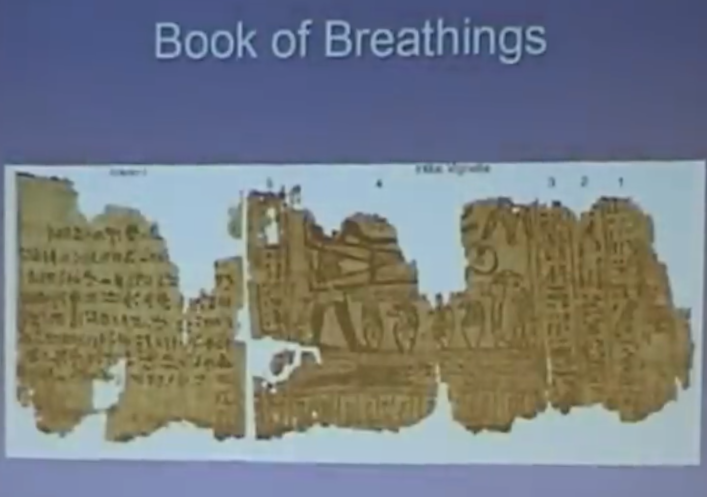
The basic argument put forward by this DVD, and by that previous book, and ever since the papyri fragments became available, is that the Book of Breathings papyrus that forms part of these papyri is the papyrus that Joseph Smith used in translating the Book of Abraham.

  • Scholars have now translated this book. It is a Book of Breathings. It isn’t the Book of Abraham.
  • Moreover, it can be reliably dated to around the second century B.C.—nearly 2,000 years after Abraham.

Ergo, Joseph Smith was a false prophet.

Book of Breathings Papyrus Contains Facsimile 1

Let’s look at the flaws in that reasoning. I’m taking each of these arguments step by step.

The Book of Breathings papyrus that the Church now owns is the actual document that Joseph Smith had.

The reason they say that is because, first and foremost, facsimile number one is part of it.

It certainly is part of the collection of papyri that Joseph Smith had.

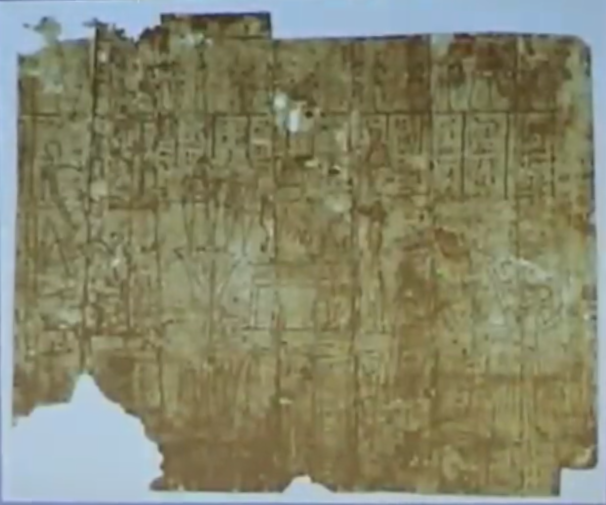
Here we have that particular portion from which facsimile number one was taken, and it’s beyond any shadow of doubt that’s exactly what it is.

Obviously, portions are missing, and were filled in by the engraver, but it’s obvious that this is the actual facsimile, and it does form the beginning of the Book of Breathings.

You can match up the papyri fragments quite nicely, and there is no doubt that this forms the beginning of the Book of Breathings.

The name of the author of the Book of Breathings is in the hieroglyphic text to the right of the facsimile, and that name is also found in hieratic text of the Book of Breathings.

Joseph Translated from the Kirtland Egyptian Papers

The video claims that some of the Kirtland Egyptian Papers are the actual documents that Joseph Smith used in the translation process.

This is on the basis of the fact that you have passages from the Book of Abraham and hieroglyphic characters that are demonstrably from the Book of Breathings there.

The problem with that is, as Hugh Nibley and others have definitely shown:

  • The English text was written in first, in a different ink.
  • The characters were copied afterwards.
  • In many cases, the characters actually overlap the original English text.

So what we have here is not the process of translation, but clearly someone trying to match up Joseph Smith’s translation with some characters on the papyri.

It seems to be the unsuccessful attempt of some of the brethren to figure out how Joseph Smith did what he did, so that it’s not the translation process at all.

No Mention of Abraham in the Papyrus Fragments

We translated the text. My most recent book is a translation and commentary of that text.

It doesn’t mention Abraham; there is no Book of Abraham in there.

How do we reconcile that with the fact that Facsimile 1 is right there at the beginning of it?

In fact, Facsimile 3, although we don’t have the original of that, would have come at the end of the text of the Book of Breathings.

Indeed, the fragments we do have contain no mention of Abraham, but they are only fragments, and that’s a key point here.

We only have a tiny bit of all of the papyri that Joseph Smith had. (We can come up with percentages if we want.)

The key point is, we only have fragments of the actual Book of Breathings.

There are probably 40 to 50 percent of the total text of the Book of Breathings found on the papyri.

Whether there were other texts on the papyri we don’t know, because we don’t have all of the papyrus.

There is no reason why a copy of the Book of Abraham couldn’t have been on there.

To say that there couldn’t have been is simply an argument from silence, and not good scholarship.

Two Texts on One Papyrus

In the video, Robert Ritner, who is a professor of Egyptology at Chicago, maintains that it is totally unprecedented to find two different texts on an Egyptian papyrus like that.

There are, in fact, numerous examples of just that.

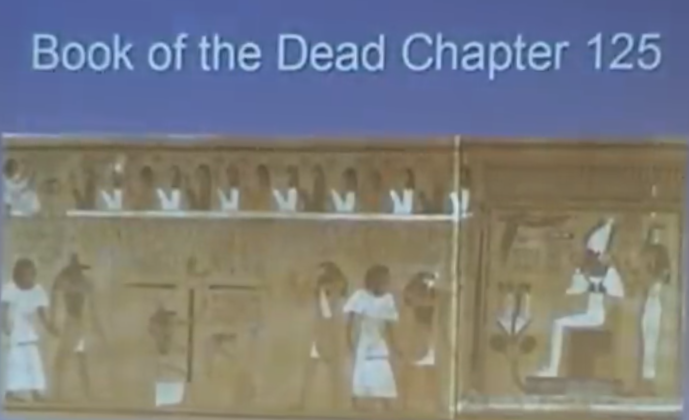
Probably the one that has the greatest similarity is the Papyrus Vandier, which has a Book of the Dead, an Egyptian religious text like the Book of Breathings on one side, and a tale on the other about a man who was sacrificed—remarkable parallels with the Book of Abraham.

So there are, in fact, examples of ancient Egyptian papyri with multiple texts on them.

We simply don’t know what’s on the rest of the papyrus.

Papyrus Dated to the Second Century B.C.

How about the fact that it can be reliably dated to the second century B.C., rather than 2,000 B.C., the assumed date of Abraham?

“Written by His Own Hand”

They made a big deal about the fact that, in the introduction there, it says, “written by his own hand” upon papyrus.

That’s simply indicating the authorship of the original book, you know, like I can take a copy of Harry Potter and say, “This is written by J. K. Rowling.”

That doesn’t mean she wrote that one I am holding in my hand.

It is simply a copy of an original text.

All this says is that it was originally authored by Abraham, and what we have is a copy, and not the original one penned by him previously.

“Translation”

“Translation” is another important term for me to define here.

Joseph Smith used that term in a somewhat broader sense than we do today.

The thing that comes closest to what we think of as a translation is the translation of the Book of Mormon, where he had an ancient text in front of him, and translated into a modern language: English.

He did it a little bit differently, with the Urim and Thummim rather than with a knowledge of the grammar, a textbook, a dictionary, and so on, but that comes closest to our concept of the process of translation.

Translation of the Bible

The translation of the Bible proceeded totally differently.

He simply had a text of the King James Version of the Bible in front of him, and through direct revelation obtained divine commentary, corrections, and additions to that text in English without ever seeing the original documents.

D&C Section 7 as Translation

In D&C Section 7 is another example of a translation.

Here is a translation of an ancient parchment done by John, that Joseph Smith clearly did not have direct access to, but via revelation obtained a translation into modern English.

What Kind of Translation Was the Book of Abraham?

So what kind of translation was the Book of Abraham?

Which of those three does it fit into?

Well, two possibilities occur to me.

(The middle possibility is not possible, because he didn’t have an English translation of the Book of Abraham, which he then corrected.)

So the first and the third are the two possibilities:

  1. a translation of an ancient text just like the Book of Mormon, or
  2. a translation by direct revelation like the parchment of John.

Let’s look at each of those.

Translation from an Ancient Text

This seems to be supported, the idea of translation from an ancient text, by references in the diary of Joseph Smith translating ancient Egyptian records, and statements of some of his associates.

It is undeniably possible that a copy of the ancient Book of Abraham could have been somewhere on that papyrus.

To me, that is the most likely explanation, but I don’t eliminate the possibility of the second one, although it doesn’t feel as good to me—the idea that the Egyptian papyri simply stimulated Joseph Smith to thinking about Joseph in Egypt, and Abraham, and thus received by direct revelation.

If you adopt that stance, then you have to assume that the statements in Abraham 1:12 and 14 referring to the illustrations, are parenthetical remarks by Joseph Smith, inserted into the actual text of Abraham.

Either way, it works, but I prefer the first, and that is, for the moment, what I believe at this point.

The Facsimiles Problem

That brings us to what I call the “facsimiles problem.”

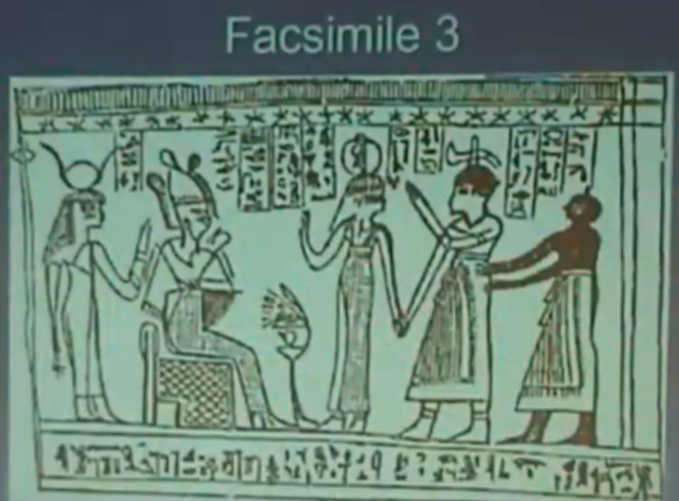
Facsimiles one and three, that are now associated with the Book of Abraham, are the beginning and ending of the text of the Book of Breathings on this particular papyrus.

Facsimile number two was totally elsewhere, and had no relationship even with the Book of Breathings, but was a separate document.

Why are they associated with this ancient pagan text?

Was somehow there a relationship with Abraham?

Ancient Origins of the Facsimiles

The answer, to me, is simply that these illustrations ultimately derive through a 2,000-year period from illustrations done by Abraham in that intervening period, and adapted for other uses.

What Joseph Smith simply did was to give the original interpretation of the illustrations as they had been done by Abraham, although they are in a very distorted form as they appear now.

The key to that is, is there evidence, then, that anciently, these illustrations were associated with Abraham?

That’s the real pivotal question, and the answer is, “Yes.”

This is really, to me, the bulk of the evidence that supports Joseph Smith’s association of these scenes with the Book of Abraham.

Facsimile #1

Let’s start with facsimile number one.

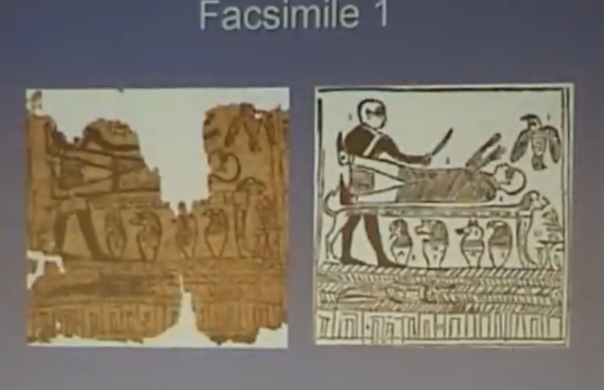
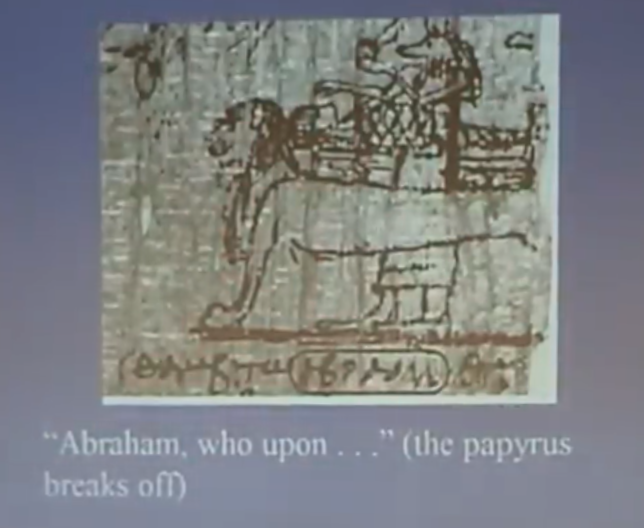
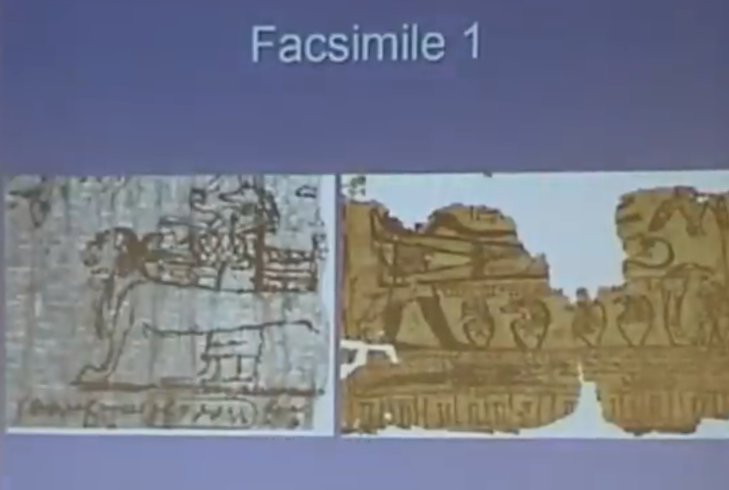
An ancient Egyptian papyrus dating roughly to the 1st or 2nd century A.D. (within a few hundred years of the Joseph Smith papyri) has a lion couch scene similar to that which we find in the Book of Abraham.

Let’s look at that.

Underneath there, in the circled portion, is the name Abraham, and it says, “Abraham, who upon,” and then the papyrus, as you can see, breaks off.

The key point here is that an ancient Egyptian papyrus that Joseph Smith didn’t know about, associates this scene with Abraham.

Comparing the Lion Couch Scenes

Let’s put these side by side.

Note that there are some similarities, and there are some differences.

First of all, the person is not actually lying on the lion couch. Right?

They are on another bier, reclining, with the standing figure; but the general similarity is obvious, and again, the association with the name Abraham is pivotal.

Facsimile #2

Let’s turn to facsimile two.

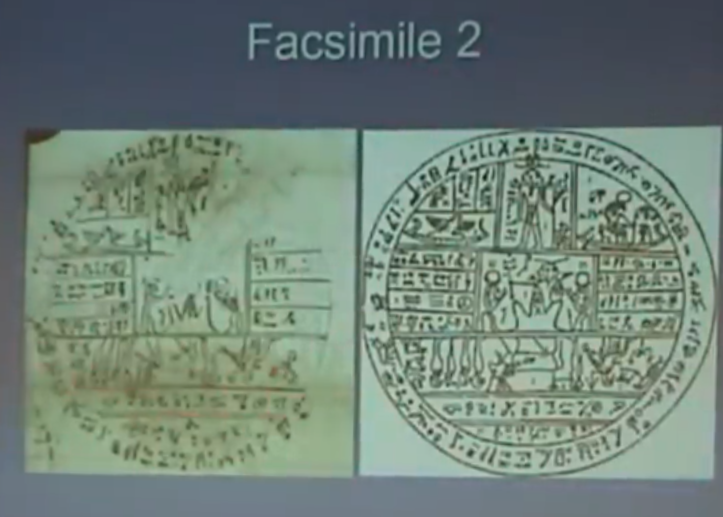
On the left is a copy from the Church historian’s office of facsimile number two, illustrating that apparently, at least when that drawing was made, there was a considerable amount of damage.

In fact, the areas that are shown damaged have text that has been taken from other papyri and placed into the drawing, which don’t belong there, are upside down, or have other problems.

That helps to understand some of the seeming incongruities with the facsimile drawing as we now have it.

Abraham and the Wedjat Eye

In an ancient Egyptian papyrus of roughly the 1st or 2nd century A.D., again, there is a phrase, “Abraham, the pupil of the eye of the Wedjat.”

The Wedjat was the special eye of Osiris.

Osiris was killed by his brother, chopped into pieces, and thrown all over the earth.

His wife’s sister, Isis, gathered them all together, and couldn’t find the other eye, and so that other eye was miraculously restored, and then he was resurrected.

So the eye, the Wedjat eye, the perfect whole eye, was symbolic of resurrection and eternal life.

And there it says that Abraham was that Wedjat eye.

The Hypocephalus and the Book of the Dead

In the 162nd chapter of the Book of the Dead, it contains the instructions for the making of what facsimile number two is, a hypocephalus.

It talks about the Wedjat eye, and then says that it represents another eye.

It’s a pupil, is what it is.

That’s one of the representations.

And so here we have Abraham called the Wedjat eye, and the text that talks about making hypocephali associated with Abraham.

Pseudepigraphical Texts

Pseudepigraphical texts are ancient texts that are of religious content, but never made into the Bible for various reasons, some of them fairly obvious.

When you look at the Gospel of Thomas, for example, at the end, Peter comes up to Christ and asks, “Are women going to be in the Celestial Kingdom?”

Pointing at Mary Jesus replies, “Don’t worry, Peter; their sex is going to be changed, we’ll all be men, and everything will work out.”

It’s fairly obvious why that one didn’t make it into the canon.

The Apocalypse of Abraham

Pseudepigraphical texts, though, clearly have some ancient roots that go back to traditions associated with the people that they claim to be talking about.

In the ancient pseudepigraphical text, the Apocalypse of Abraham, Abraham sees a vision, and in his vision he describes what is in the heavens, on the earth, in the sea, in the abyss, and in the lower depths.

In facsimile number two, these words are found: “O mighty God, Lord of heaven and earth, of the netherworld and of his great waters.”

Very similar terminology!

So we are finding even wording in these ancient texts associated with Abraham that are similar to wording found on this particular hypocephalus.

Creation Imagery and the Hypocephalus

Also in the Apocalypse of Abraham, Abraham sees “the fullness of the universe and its circles in all.”

He sees “a picture of creation” with two sides.

That is the hypocephalus.

To the Egyptians, besides being the eye, it was the world, that which the sun encompassed.

As you look at it, there is an upper and a lower portion.

The lower portion is inverted to the upper.

This is a description in this book about, purporting to come from Abraham, of the hypocephalus, where he’s seeing the creation portrayed, if you will, in this manner.

The Four Figures in Facsimile #2

Abraham sees what are clearly the four figures labeled number six in facsimile number two.

He describes these four beasts, one with the head of a man, one with the head of a hawk, one with head of a jackal, and so on, that are the same as those that are portrayed there in facsimile two.

He sees, and again, where it’s quoted, this is a direct translation from the original, “the host of stars and the orders they were commanded to carry out, and the elements of the earth obeying them.”

That resonates with the language we find in Abraham 4, verses 1, 12, 18, 21, and 25, where it talks about the elements of the earth “obeying.”

So we’re finding even that same language being used in this ancient text that purports to come from Abraham, and the Book of Abraham, and again, the association with the hypocephalus, and facsimile two.

Abraham and the Priesthood Promise

Abraham, in this document, is also promised the priesthood, and that his priesthood would continue in his posterity, an element of the Abrahamic covenant that is totally missing in the Bible.

But it’s the central truth of the Book of Abraham.

And that promise is associated with the temple (interesting again).

Facsimile #3

Let’s turn to facsimile three.

Again, facsimile three we don’t have the original of.

It clearly belongs with the Book of Breathings.

The name of the owner of that papyrus, Hor, is found there.

As it now stands, it is a portrayal of the man, Hor, who is right there [points to the slide] with the god Anubis, who leads the dead, standing behind him.

And the goddess of Truth, identified by the feather on her head, leading him into the presence of the god Osiris, whose wife, Isis, is standing behind him.

He has passed the judgment, and is worthy to enter into the presence of god, and in fact, become one of the gods.

That’s the essence of what that scene portrays from the Book of Breathings standpoint.

The Testament of Abraham and Judgment Imagery

The Testament of Abraham, another ancient pseudepigraphical text, describes Abraham seeing a vision of the Last Judgment.

In his vision of last judgment, he sees an angel with scales weighing the souls of men.

Scholars all agree that this is clearly a reference to the 125th chapter of the Book of the Dead.

The guy must have had this before his eyes as he was describing it.

This is an admixture, if you will, of Christian doctrine with ancient Egyptian concepts of the judgment of the dead.

The Judgment Scene and Facsimile #3

One of the Joseph Smith papyri fragments is, in fact, this 125th chapter.

I’ll show you that in a moment.

Facsimile three portrays, simply, the next step in that process.

After the weighing of the soul, or the heart in the case of Egyptians, you are brought into the presence of Osiris.

The Papyrus of Neferirnub

Let’s look at some illustrations.

You’re probably not going to see it all.

This is horrible.

This is an indication of the state of preservation of these papyri.

The god Osiris is seated there, the scales are down below, and the young lady is being brought into the presence of Osiris by the goddess, Truth.

Her name is Neferirnub.

This is one tiny fragment of a Book of the Dead that is among the Joseph Smith papyri.

A Better-Preserved Judgment Scene

Here is that actual scene from a better-preserved Egyptian papyrus.

Here we have the man Hunefer, being brought by the god Anubis before the scales.

His heart is being weighed against a feather, which has beautiful symbology in Egyptian because your heart is the center of your thoughts and your desires, and the feather is the Egyptian hieroglyph for truth and justice.

And so we have the balance with truth and justice.

The god Thoth is recording the results of that, and if you pass, then you are introduced into the presence of Osiris.

That’s the scene on the right that forms basically the similar scene that is facsimile number three.

Judgment and Outer Darkness

The animal standing underneath the scales there, with the head of a crocodile, the front body of a leopard, and the rear body of a hippopotamus, is a monster that, if your heart doesn’t balance, gobbles your heart up.

And then you are cast into outer darkness, where there is mud and snakes and sewage, which I think is a good personification of outer darkness.

Reversing the Hunefer Papyrus

What I’ve done here is reverse-mirrored the Hunefer papyrus so that it matches the same direction as the Joseph Smith one.

You can see that it’s simply portraying that final scene of that total judgment scene, and hence just such a scene in the Testament of the Abraham is being described.

Joseph Couldn’t Have Known These Things

Several ancient Near Eastern documents associate the scenes that we understand as being facsimile one, two, and three with Abraham. They are roughly contemporary with the Book of Abraham papyri.

Secondly, none of these documents were available at the time of Joseph Smith. He couldn’t have somehow sneaked into the library in Kirtland and seen these, and come up with this. They weren’t available anywhere in the world.

He couldn’t have known about them.

Not Lucky Guessing

You can’t dismiss this as just lucky guessing.

When I give exams, I give a lot of multiple choice, and if the students don’t know, they don’t do well on the exam. You flip a coin, with one out of four, you are not going to do well on the exam.

Joseph Smith hit the nail on the head three times with these representations being associated with Abraham anciently. How can that be just lucky guessing? I mean if so, he is the best guesser in the world, and we ought to listen to him anyway!

Are the Doctrines Worth Betting Our Lives On?

At the end of this video, Richard Mouw (head of the Fuller Theological Seminary in California) says:

“Are the doctrines taught in the Book of Abraham credible? Are they the sort of things we should bet our lives on?”

With the implicit answer, “Heck no!” because of all of this mountain of evidence they’ve shown us that it’s not true.

Well, yes they are!

They are certainly worth betting our lives on!

The Doctrines of the Book of Abraham

The Book of Abraham contains some of the most beautiful and poignant doctrines of the Restoration:

  • the preexistence,
  • our eternal nature as human beings,
  • the council in heaven,
  • a much better portrayal of the creation.

There is beautiful and wonderful doctrine there.

We might respond, “Do we want to bet our eternal lives on the opinions of scholars?”

I think that would be an apt question, and I would wonder what their response would be.

Closing Statement from Hugh Nibley

Let me close with this statement from Hugh Nibley. Which sums up nicely what I’ve been trying to put across here.

The words of the prophets cannot be held to the tentative and defective tests that men have devised for them. Science, philosophy, and common sense all have a right to their day in court. But the last word does not lie with them.

Every time men in their wisdom have come forth with the last word, other words have promptly followed. The last word is a testimony of the Gospel that comes only by direct revelation. Our Father in heaven speaks it, and if it were in perfect agreement with the science of today, it would surely be out of line with the science of tomorrow. [You might say scholarship, too.]

Let us not, therefore, seek to hold God to the learned opinions of the moment when he speaks the language of eternity.

Thank you.

Q&A

Q&A

Question on Symbolism and Worldviews

Q. So, it seems part of what we’re learning here is that we have to be open to different worldviews in the way that symbols may have been interpreted at different times.

And I was interested by what you just mentioned parenthetically about the Gospel of Thomas, that dialogue at the end.

My thought was, because we’ve had preceding lectures about, you know, it’s not just biological, it’s inheritance. And possibly, could that text be related to, when saying women become men, is that they would have the inheritance in heaven that men have in relation to those blessings?

A. Michael: I suppose you could interpret it that way symbolically.

It certainly strikes against, you know, our belief in the eternal nature of gender.

Question on Layers of Meaning in Egyptian Symbols

Q. There’s apparently a concept in looking at Egyptian writings as layers of meaning. Particularly when you look at something like the hypocephalus. That you can interpret at one level and another level, and even maybe a third level.

Could you comment on that?

A. Michael: Well, first of all, I don’t know that I would call it levels.

I would simply say that Egyptian symbols have multiple ways of being interpreted. But not necessarily multiple levels, like, you know, there’s deeper levels or higher levels.

It’s simply, one thing can mean—let’s take for example the lotus flower.

The lotus flower:

  • can be symbolic of eternal life,
  • it can be symbolic of healing,
  • it can be symbolic of truth.

So, there are multiple meanings, but I don’t think that there’s the idea of multiple levels. Where you see kind of an outer level and then sink down deeper into a deeper level that you didn’t catch before.

That’s not, to my understanding, typical of Egyptian documents at all.

Question on the Hugh Nibley Quote

Q. A lot of people probably could this in the room, but what was the source on that Nibley quote?

A. Michael: Worldly Prophets is where that’s found.

Question on Facsimile #1 and the Book of Breathings

Q. Facsimile number one, as being part of the front of the Book of Breathings. Is it also not possible that a second facsimile one on a Book of Abraham scroll could have been there?

There could be two, where the one is extensively damaged and the other one was not?

A. The drawing matches up so perfectly that I don’t think there is any question that the facsimile number one that we have in the Pearl of Great Price came from the surviving portion of the papyrus.

I can’t imagine that another one would have matched up so perfectly. That just happened to be one from Abraham.

So, no, I don’t think so.

Question on Astronomy in Facsimile #2 and Abraham 3

Q. I have heard that a year or two ago, some of you were working on the matter of the astronomical depiction in facsimile number two in the third chapter. And that those were more representative of the Egyptian view of things.

And that, therefore, this was then a support for the inspiration given to Joseph.  Joseph might have tried to put in some modern astronomy or something, whereas this was a typical Egyptian view.

Would you comment on that?

A. Michael: Actually, I don’t espouse that view.

My colleague, John Gee, does think that the view portrayed in Abraham 3 is ancient geocentric point of view.

In a paper I gave a couple of years ago, and which will be published soon. I adopt a view that it, in fact, portrays a more modern point of view.

So, I almost suspect that it’s possible to look at it from both points of view, to some extent.

But to me, it more clearly portrays a modern point of view than an ancient one.

Follow-Up: How Modern?

Q. How modern?

A. Michael: Well, modern to the extent that it sees other stars as simply suns like our own.

That there are multiple planets.

That the Earth certainly isn’t the center of the universe.

It’s rather just one of a myriad of planets and stars that are part of God’s creation.

You know, look at the latest Hubble Space Telescope, and the galaxies, and whatnot.

To me, that’s the kind of thing that’s portrayed.

Closing

Scott Gordon: Thank you very much.

Search topics

Book of Abraham; Book of Abraham apologetics; Book of Abraham critics; Joseph Smith papyri; Book of Breathings; Egyptian papyri; translation by revelation; meaning of translation; Pearl of Great Price; Abraham facsimiles; Facsimile 1; Facsimile 2; hypocephalus; Facsimile 3; ancient Egyptian religion; pseudepigrapha; Apocalypse of Abraham; Testament of Abraham; preexistence; council in heaven; creation; priesthood lineage; prophetic calling; continuing revelation

CES Letter; Mormon Book of Abraham; is the Book of Abraham true; Mormon Church history; LDS scripture; Joseph Smith translation; Mormon apologetics; are Mormons Christian; Pearl of Great Price controversy

Come, Follow Me with FAIR – Moses 7 – Jennifer Roach Lees

February 3, 2026 by Trevor Holyoak

https://media.blubrry.com/mormonfaircast/www.fairlatterdaysaints.org/wp-content/uploads/2026/02/Come-Follow-Me-with-FAIR-Moses-7-Jennifer-Roach-Lees.mp3

Podcast: Download (24.2MB)

Subscribe: RSS

Moses 7: Enoch’s Vision (Jennifer Roach Lees)

The vision of Enoch in Moses 7 bridges the gap between ancient scripture and modern discipleship. We can absolutely see ourselves in it.

On the one hand, it’s a text of great scholarly interest. Go read Jeff Bradshaw’s paper. It’s very long, very dense and very scholarly. Moses 7 expands the kind of sparse biblical account of Enoch into this big sweeping narrative.

And on the other hand, it’s a profoundly practical guide for Latter-day Saints seeking to live faithfully in the present, not in some future idealized world on the actual street that you live on.

[Read more…] about Come, Follow Me with FAIR – Moses 7 – Jennifer Roach Lees

Filed Under: Bible, Book of Moses, Come Follow Me with FAIR, Conversion, Jennifer Roach, Joseph Smith, LDS History, Old Testament, Podcast, Prophets, Revelation

  • Page 1
  • Page 2
  • Page 3
  • Interim pages omitted …
  • Page 36
  • Go to Next Page »

Primary Sidebar

Faithful Study Resources for Come, Follow Me

Subscribe to Blog

Enter your email address:

Subscribe to Podcast

Podcast icon
Subscribe to podcast in iTunes
Subscribe to podcast elsewhere
Listen with FAIR app
Android app on Google Play Download on the App Store

Pages

  • Blog Guidelines

FAIR Latest

  • Come, Follow Me with FAIR – Isaiah 1–12 – Part 1 – Autumn Dickson
  • Because of Jesus Christ
  • Come, Follow Me with FAIR – Proverbs 1–4; 15–16; 22; 31; Ecclesiastes 1–3; 11–12 – Part 2 – Autumn Dickson
  • Come, Follow Me with FAIR – Proverbs 1–4; 15–16; 22; 31; Ecclesiastes 1–3; 11–12 – Jennifer Roach Lees
  • Come, Follow Me with FAIR – Proverbs 1–4; 15–16; 22; 31; Ecclesiastes 1–3; 11–12 – Part 1 – Autumn Dickson

Blog Categories

Recent Comments

  • Willie Louise Truitt on The Joy of a Covenant Relationship with God
  • Katrina on In memory of Chandler “Chuck” Hendry
  • Nancy Farmer on Come, Follow Me with FAIR – Psalms 49–51; 61–66; 69–72; 77–78; 85–86 – Part 1 – Autumn Dickson
  • Nicko De Leon on In memory of Chandler “Chuck” Hendry
  • Becky Matson on In memory of Chandler “Chuck” Hendry

Archives

Follow Us

  • Facebook
  • Twitter
  • iTunes
  • YouTube
Android app on Google Play Download on the App Store

Footer

FairMormon Logo

FAIR is a non-profit organization dedicated to providing well-documented answers to criticisms of the doctrine, practice, and history of The Church of Jesus Christ of Latter-day Saints.

Donate to FAIR

We are a volunteer organization. We invite you to give back.

Donate Now

Site Footer

The use of the temple in past and current logos and the name "Mormon" are licensed for use by The Church of Jesus Christ of Latter-day Saints.