• Skip to primary navigation
  • Skip to main content
  • Skip to primary sidebar
  • Skip to footer

FAIR

My Account Search
  • Start Here
  • Find Answers
  • Scripture Study
  • Blog
  • Events
    • FAIR Conference
    • Virtual Conferences
    • Special Events
  • All Presentations
  • FAIR Books
  • About
    • Media & Apps
  • Get Involved

Latter-day Saint Apologetics

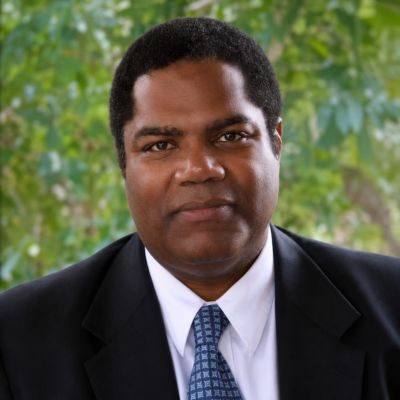
René Krywult

Media Literacy • Comparative Theology • Early Christianity

René Krywult, FAIR speaker and organizer of European apologetics conferences

René Alexander Krywult is a native of Vienna, Austria, and has been involved with FAIR for more than two decades. He played an instrumental role in establishing FAIR’s German-speaking outreach and has contributed to the organization’s efforts to provide thoughtful, well-documented responses to questions about The Church of Jesus Christ of Latter-day Saints.

A software developer and project manager by profession, René has a longstanding interest in religious apologetics, particularly comparisons between Latter-day Saint beliefs, traditional Christianity, and the teachings of early Christians. His interest in responding to criticism of the Church began when he encountered anti-Latter-day Saint literature as a teenager. Since then, he has focused on evaluating the reliability of religious information and helping others strengthen their faith while engaging with challenging questions.

René’s published work includes “Mormon Deification Compared to Orthodox Christian Theosis,” which appeared in Spirituality in East and West. He has also written for FAIR and organized four FAIR conferences in Germany between 2009 and 2015, speaking at each of them. He presented at the 2019 FAIR Conference in the United States and at FAIR’s 2024 European lecture series in Salzburg.

He has served in numerous Church callings, including ward Sunday School president, ward mission leader, elders quorum president, seminary and institute teacher, and counselor in a bishopric.

René and his wife, Gabriele, have four children and, as reported in his 2024 FAIR biography, five grandchildren.

Bio last reviewed:

Contributions at FAIR

Statement of Faith

Statement of faith coming soon.

Date of Statement of Faith

Scott A. Gordon

FAIR President • Apologist • Educator

Scott Gordon, president of FAIR

Scott Gordon has served as president of FAIR since 2001. He earned both his bachelor’s degree and MBA from Brigham Young University.

Professionally, Scott teaches business at Shasta College in Redding, California, and has taught online business courses through BYU–Idaho and BYU–Pathway Worldwide.

He has served in numerous callings in The Church of Jesus Christ of Latter-day Saints, including bishop, ward mission leader, seminary teacher, member of an elders quorum presidency, and ward temple and family history leader.

Scott and his wife have five children and 15 grandchildren.

Bio last reviewed:

Contributions at FAIR

Statement of Faith

Statement of faith coming soon.
Date of Statement of Faith

Call for Papers | 2027 FAIR Virtual Conference

FAIR VIRTUAL CONFERENCE · 2027
Call for Papers

A Light in the Wilderness

The Book of Mormon and Other Scripture
October 7–9, 2027 · Online

Submit a Proposal↓

Call for Papers

FAIR invites proposals for its fifth virtual conference, exploring the wilderness in the Book of Mormon and other scripture through historical, literary, theological, comparative, and apologetic inquiry.

Submit a Proposal ↓

View Submission Guidelines ↓

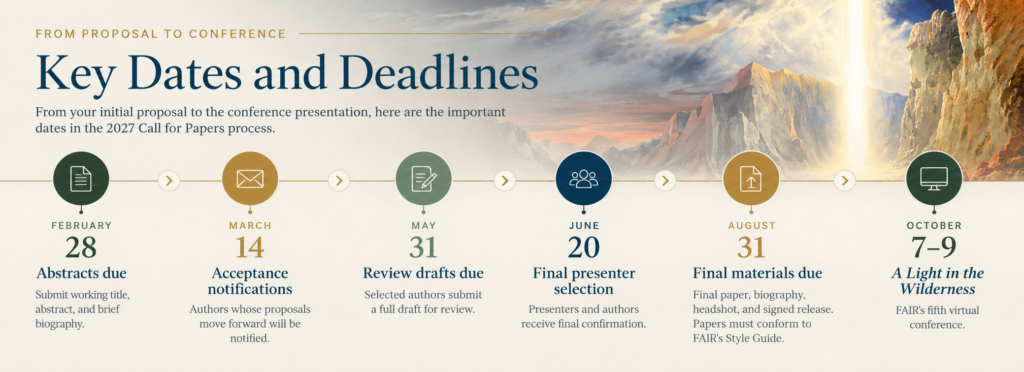
- Abstracts due February 28, 2027 -

THE 2027 THEME

The wilderness is more than a setting.

The Book of Mormon and Other Scripture

Across scripture, the wilderness is a place of testing and conflict, revelation and covenant, encounter and deliverance. It can be landscape, symbol, memory, literary structure, theological image, and sacred space.

A Light in the Wilderness invites scholars and researchers to explore these dimensions in the Book of Mormon and other scripture—individually, comparatively, and within the larger traditions through which scripture has been received and understood.

Proposals may focus on the Book of Mormon, the Bible, Restoration scripture, or relationships among them. Studies of ancient contexts, reception and interpretation, and the influence of wilderness traditions on Latter-day Saint thought and experience are also welcome.

We welcome original research, fresh perspectives, and questions

that expand the possibilities of the theme.

SCHOLARSHIP IN THE SERVICE OF FAITH

Rigorous inquiry. Faithful engagement.

In keeping with FAIR’s mission to create conditions where faith in Jesus Christ and His gospel can flourish, the conference brings scholarly inquiry into conversation with the understanding and defense of Latter-day Saint faith.

Contributions may address questions or criticisms, offer positive arguments, illuminate neglected texts, or develop interpretations that deepen appreciation of scripture and its witness of Jesus Christ.

Presentations should be accessible to an engaged general audience while maintaining scholarly rigor.

Where might the theme lead?

These suggestions are starting points, not boundaries.

Wilderness & Narrative

Book of Mormon and other scriptural wilderness narratives and imagery

Ancient Contexts

Historical, geographical, archaeological, and cultural contexts

Literary & Textual Studies

Literary, textual, intertextual, and comparative approaches

Revelation & Covenant

Prophecy, covenant, divine encounter, testing, and sacred space

Christ & Deliverance

Jesus Christ, redemption, exile, rescue, and deliverance

Apologetics

Responses to criticisms involving scriptural wilderness accounts

Ancient Traditions

Wilderness themes in ancient Jewish and Christian writings

Restoration Connections

Latter-day Saint history, doctrine, scripture, and experience

Faith Today

What wilderness narratives contribute to contemporary faith and apologetics

Have another approach? We hope you’ll propose it. Contributors are encouraged to define their own questions, methods, and arguments.

Submit your Proposal

What to include

The Book of Mormon and Other Scripture
  • Working title
    A proposed title for your presentation.
  • Abstract · 250–350 words
    Clearly identify your central question or argument, principal sources or approach, and contribution to the conference theme.
  • Presenter biography · up to 100 words
    Include your institutional or professional affiliation, if applicable, and one or two relevant publications or areas of research.
  • Email address
    Please provide the address you would like FAIR to use for all conference correspondence.

Proposal submission form coming soon.
Submission Deadline

February 28, 2027

Questions? Contact [email protected]

Submit your proposal
a timeline of due dates for the FAIR 2027 virtual conference
Preparing a FAIR paper?

Accepted papers must follow FAIR’s Style Guide. Authors are encouraged to review the guide early, particularly when preparing citations and references.

DOWNLOAD FAIR STYLE GUIDE →
FAIR VIRTUAL CONFERENCE · OCTOBER 7–9, 2027

Bring your question to the wilderness.

The Book of Mormon and Other Scripture

We welcome thoughtful scholarship that helps readers see scripture more clearly, engage difficult questions seriously, and better understand its witness of Jesus Christ.

Questions about the Call for Papers? Contact [email protected]

FAIR Special Events

FAIR SPECIAL EVENTS

Faithful scholarship. Meaningful Connections.

FAIR Special Events bring faithful scholarship, thoughtful questions, and meaningful conversation

to communities and audiences around the world.

Explore regional conferences, international gatherings, lectures, symposiums,

and other special FAIR events.

EXPLORE SPECIAL EVENTS ↓

ABOUT FAIR SPECIAL EVENTS

Bringing FAIR into communities around the world.

FAIR Special Events bring faithful scholarship and thoughtful conversation to communities beyond our annual conference. From regional and international gatherings to lectures, symposiums, and other one-of-a-kind events, each gathering is shaped by its location, audience, and purpose.

LOCAL CONNECTION

Gatherings shaped for particular communities and audiences.

FAITHFUL SCHOLARSHIP

Thoughtful perspectives grounded in Latter-day Saint faith and research.

MEANINGFUL CONVERSATION

Opportunities to learn, ask questions, and connect in person.

Featured Special Event

Join FAIR in Vienna

FAIR is bringing faithful scholarship and meaningful conversation to Vienna, Austria, for a special one-day gathering of Latter-day Saints, scholars, and friends.

FAIR Wien 2026 conference in Vienna, Austria

SPECIAL EVENT · VIENNA, AUSTRIA

FAIR Wien 2026

December 5, 2026 · 9:30 a.m.–3:30 p.m.

Join FAIR in Vienna for a day of presentations and conversation exploring Latter-day Saint faith, history, scripture, and scholarship. FAIR Wien brings together speakers and attendees for thoughtful discussion in an international setting.

EXPLORE FAIR WIEN 2026 →

Explore Special Events

FAIR Beyond the Annual Conference

FAIR Special Events take many forms, from international and regional gatherings to lectures, symposiums, and other events created for particular communities and occasions.

International Events

FAIR around the world

Gatherings that bring FAIR speakers, scholarship, and conversation to Latter-day Saint communities outside the United States.

Regional Events

FAIR closer to home

Conferences and gatherings designed for particular regions, communities, or audiences.

Lectures & Special Gatherings

Events created for the moment

Lectures, symposiums, commemorations, and other one-of-a-kind events centered on a particular subject or occasion.

WHY FAIR SPECIAL EVENTS?

Faith grows through connection.

Some conversations are especially meaningful when they happen face to face. FAIR Special Events create opportunities for faithful scholarship, thoughtful questions, and personal connection within communities around the world.

Learn together. Ask questions. Build connections.

Explore FAIR Events

More Ways to Connect With FAIR

From our annual conference to focused online gatherings and special events, FAIR offers opportunities to learn, connect, and explore faithful scholarship.

Annual FAIR Conference

FAIR’s flagship annual gathering for faithful scholarship, apologetics, and thoughtful conversation.

EXPLORE THE FAIR CONFERENCE →

Virtual Conferences

Focused online conferences exploring scripture, history, doctrine, and questions of faith.

FAIR VIRTUAL CONFERENCES →

You Are Here

Special Events

Regional, international, and one-of-a-kind FAIR gatherings for audiences around the world.

SPECIAL EVENTS 

Foundations of Faith

FOURTH ANNUAL FAIR VIRTUAL CONFERENCE

Foundations of Faith

Defending the New Testament in the Latter Days
October 8–10, 2026 · Online

EXPLORE SCHEDULE AND VIEW THE CONFERENCE ↓

About This Conference

The 2026 FAIR Virtual Conference explores the New Testament through faithful apologetic, historical, theological, and cultural perspectives. Presentations examine scripture, early Christianity, the life and teachings of Jesus Christ and His Apostles, and connections between the New Testament and Latter-day Saint doctrine.

Presentations

Explore presentations from the 2026 FAIR Virtual Conference examining the Gospels, New Testament interpretation and theology, the Epistles, the early Christian Church, and the Great Apostasy.


The Conference will be streamed on FAIR’s YouTube channel.

Opening Keynote

Lincoln Blumell
Lincoln Blumell

Lady Eclecte: Recovering a Woman in the New Testament

Description coming soon

THE GOSPELS, INTERPRETATION & THEOLOGY

Daniel N. Gullotta
Daniel Gullotta

“Cunningly Devised Fables”: The Jesus Myth Theory and Its Problems

Daniel N. Gullotta examines the Jesus myth theory—the claim that Jesus of Nazareth never existed—which has surfaced periodically since the late eighteenth century. Drawing on evidence from the Apostle Paul, the Gospels, and critics of Christianity, he argues that its central claims fail on historical grounds. He considers why the theory flourishes online without gaining acceptance among historians, with particular attention to where Latter-day Saints are likely to encounter it. Gullotta presents Jesus’s historicity as common ground for Latter-day Saints, Catholics, and Protestants, who draw on the same evidence and reach the same conclusion, making defense of the New Testament a shared undertaking.

Allen Hansen
Allen Hansen

The Midrash of Matthew: How the Passover Reveals the Messiah

Allen Hansen examines how Jewish interpretive traditions beyond the biblical text shape Matthew’s presentation of Jesus as the fulfillment of scripture. Drawing on Josephus, midrash, and the Passover Haggadah, he explores Passover parallels in Jesus’ birth, the star of the magi, Joseph’s dreams, the flight into Egypt, the wilderness temptations, and the Sermon on the Mount. Hansen argues that Passover provides the organizing logic of Matthew’s Gospel, connecting Christ’s birth, ministry, and atoning sacrifice. He considers how these traditions illuminate Matthew’s selection and interpretation of events, and how understanding Passover’s significance for Matthew and his audience can deepen readers’ appreciation of Christ.

Stephen Smoot crop
Stephen Smoot

The Olivet Discourse Restored: Approaching Joseph Smith–Matthew

Stephen Smoot examines readings of Matthew 24 that treat Jesus’s prediction of Jerusalem’s destruction in AD 70 as ex eventu prophecy—a prediction written after the event—and considers their implications for the Gospel’s dating and historical reliability. He draws on Joseph Smith’s 1832 prophecy on war, now Doctrine and Covenants 87, which he presents as accurately anticipating the Civil War’s outbreak in South Carolina. Situating this comparison within the Latter-day Saint understanding of continuing revelation, Smoot challenges the assumption that accurate prediction necessarily implies post-event authorship. He argues that the Restoration’s prophetic tradition offers a framework for reading the Olivet Discourse as genuine prophecy rather than retrospective composition.

Devon Bollin
Devon Bollin

“The Spirit of Truth”: A Latter-day Saint Reading of the Johannine Prologue

Devon Bollin reads John’s Prologue through Doctrine and Covenants 93, shifting attention from what the Word is to what the Word does in becoming flesh. Connecting Christ as “the Spirit of truth” with teachings on truth, embodiment, and a fullness of joy, he suggests that truth is personal, lived, and made complete in embodied existence. Bollin presents a Restoration framework in which growth, covenant, and relationship are basic features of reality, and God and humanity are continuous in kind while differing in degree. In dialogue with other Christian accounts of sharing in divine life, he argues for reading John’s Prologue as a story of disclosure and transformation in which flesh expresses divine life rather than obstructing truth.

David Harper
David Harper

Is It Written? Scriptural Context and Interpretive Methods

David Harper examines how ancient Israelite, Jewish, and Christian communities interpreted scripture, arguing that they gave earlier passages inspired meanings beyond those intended by their authors or understood by their original audiences. Drawing on the Old and New Testaments, Qumran writings, other Second Temple texts, and works by Philo and Josephus, he assesses how interpretive approaches such as allegory, typology, and midrash account for these patterns. Harper contends that modern criticisms of Latter-day Saint interpretations for departing from original meanings would also apply to biblical authors. He argues that Restoration prophets and apostles follow an ancient pattern of renewing scripture’s relevance by giving it new meaning for contemporary audiences.

Stephen F. Johnsen
Stephen Johnsen

The Bible and Book of Mormon: Exceptional Evidence of Christ

Stephen Johnsen examines the Book of Mormon as a source of empirical evidence beyond the Bible for central Christian claims. Drawing on Latter-day Saint and non–Latter-day Saint research, he argues that the book challenges assumptions of Joseph Smith’s time and contains information unavailable then but later confirmed. He contends that these features exceed what writers of that era—or even a century later—could have produced. Acknowledging unresolved questions and the limits of archaeology in establishing biblical miracles, Johnsen presents the accumulated research as exceptional evidence for the Book of Mormon’s truthfulness and, in turn, for a God who interacts with humanity, Jesus as the Messiah, and the reality of His resurrection.

Bryner cropped 2
Paul Bryner

“Spirits Which Ye Could Not Understand” (D&C 50:14): A Restoration Analysis of Biblical Evil Spirit Theology

Paul Bryner examines biblical accounts of evil spirits through Restoration teachings that affirm their existence while emphasizing divine sovereignty and limits on their power over nature and human agency. Drawing on the Book of Mormon, Doctrine and Covenants, and prophetic teachings, he argues that physical control by evil beings is rare and that some possession accounts may primarily describe healings of serious mental illness. He also considers how Alma 22:15, Doctrine and Covenants 50, and early Christian confirmation practices illuminate the displacement of evil spirits. Bryner advocates spiritual healing alongside medical treatment, regardless of whether evil spirits are shown to cause particular suffering, as a way to continue Christ’s healing ministry while affirming New Testament historicity and accounting for biological phenomena.

Michael DiPaolo
Michael DiPaolo

Restorationist Metaphysics and the Evidential Problem of Evil

Michael DiPaolo examines how assumptions about divine perfection, humanity’s relationship to God, and freedom in heaven shape the evidential problem of evil—the challenge posed by apparently pointless suffering. Drawing on Latter-day Saint theology and biblical accounts of Christ growing in wisdom, learning obedience, and exercising entrusted authority, he argues that wisdom and stewardship require development and cannot be instantly conferred on free agents intended to participate in the divine nature. He considers natural and nonhuman suffering within a world of moral formation, delegated stewardship, and ongoing responsibility. DiPaolo also presents heaven as continued moral and creative participation. He argues that this framework of eternal agency makes suffering intelligible without treating it as gratuitous or incompatible with divine goodness.

THE EPISTLES, EARLY CHURCH & APOSTASY

Brent J. Schmidt
Brent Schmidt

Restoring Heavenly Father as the Divine Patron in Romans

Brent Schmidt examines Paul’s use of the Greek definite article ho (“the”) before the word for God in Romans. He argues that this grammatical feature, obscured in English translations, identifies Heavenly Father as a personage separate and distinct from Jesus Christ. Drawing on the ancient patron-client system and 1 Corinthians 8:6, Schmidt interprets Romans as presenting the Father as the divine patron—the source of all blessings—and Jesus as the mediator of His gifts, including the Holy Ghost. He explores how these gifts call for a faithful response and how this understanding encourages disciples to love and trust Heavenly Father and cultivate a covenant relationship with Him through His Son.

Jonathon Riley
Jonathon Riley

Zenos, Lehi, and Paul: How the Book of Mormon Illuminates Romans 11

Jonathon Riley examines how the Book of Mormon’s grafting imagery may illuminate Paul’s declaration that “all Israel will be saved” in Romans 11. He traces how the Book of Mormon connects grafting with remnants of both the northern and southern kingdoms, then interprets Romans 11:25–32 with the northern tribes in view. Using an audience-oriented approach, Riley argues that the passage can be read as referring to both northern and southern Israel. He presents this interpretation as a more expansive understanding of Israel’s salvation, encompassing not only Jews and Gentiles but also scattered Northern Israelites.

Lynne Hilton Wilson
Lynne Hilton Wilson

Set Free and Counted: Women in the Apostolic Church

Lynne Hilton Wilson examines claims that the apostolic Church was hostile to women, drawing on forty-one New Testament passages that she identifies as affirming women’s worship and ministry. She reassesses the restrictive passages in 1 Corinthians 14:34–35 and 1 Timothy 2:9–15 through questions of translation, congregational circumstances, possible textual changes, and Restoration scripture. Her study also identifies twenty-four named female disciples in Acts and the Epistles, including Phoebe, Priscilla, and Junia. Acknowledging unresolved difficulties, Wilson argues that the broader scriptural witness affirms women praying, prophesying, teaching, serving, and leading, rather than making restrictive passages the defining theology of the apostolic Church.

Jennifer Roach Lees
Jennifer Roach Lees

From Diakonos to Relief Society: Reclaiming Biblical Precedents for Women’s Spiritual Authority

Jennifer Roach Lees examines parallels between New Testament women and contemporary Latter-day Saint women, distinguishing spiritual authority from modern conceptions of priesthood office. Drawing on Phoebe, Priscilla, Lydia, Junia, and Philip’s four daughters, she argues that women exercised gospel leadership through spiritual gifts and the direction of the Spirit, sometimes within specific callings. Lees presents these examples as a theological foundation for recognizing women’s gifts and normalizing their voices in decision-making within the Church’s revealed structure. She advocates a shift from leadership grounded in hierarchy to practical, Spirit-led initiative, arguing that this approach does not require changes to the priesthood structure revealed by modern prophets.

Christopher B. Meldrum
Christopher Meldrum

Order, Authority, and Service in 1 Timothy 2–3

Christopher Meldrum examines 1 Timothy 2–3 through ancient Jewish and Greco-Roman understandings of sacred order, mediation, and diakonia—entrusted, tested service. He argues that Paul’s instructions to women in 1 Timothy 2:9–15 address preparation for responsibility and premature or usurped authority rather than female incapacity. He reads Paul’s appeal to Genesis as a narrative about sacred order rather than a claim of gender hierarchy. Meldrum connects this interpretation with chapter 3’s emphasis on testing, blamelessness, and the inclusion of women “likewise,” presenting the passage as a coherent vision of Church order. He briefly notes a resonance with early Latter-day Saint understandings of entrusted service, without treating that parallel as proof.

Spencer Kraus
Spencer Kraus

“They Went Out From Us”: Apostasy in the Johannine Writings

Spencer Kraus examines apostasy as an internal challenge to the early Church, drawing on John’s writings, Paul’s letters, and other early Christian texts. Examples include the Judaizer movement in Galatians and Diotrephes in 3 John. He explores apostolic responses to movements labeled “gnostic,” clarifies the term’s limitations, and uses the Nag Hammadi codices to examine their differing beliefs. He also considers how some teachings may reflect authentic doctrines and ordinances, including baptism for the dead, later abandoned partly because of their association with heretical movements. Kraus argues that these movements departed from one apostolic Christianity by rejecting its teachings, while advocating discussion and defense of the doctrine of apostasy with clarity and charity.

Kerry Hull
Kerry Hull

Vocabulary of Deviation: Heresy, Schism, and the Construction of Orthodoxy, c. 1st–5th Centuries

Kerry M. Hull examines how Christian writers from the first through fifth centuries used the language of heresy, schism, error, innovation, and tradition to defend what they understood as apostolic teaching. Drawing on authors including Clement of Rome, Irenaeus, Tertullian, and Augustine, he explores competing appeals to apostolic authority and the institutional consequences of disagreement, including rebaptism controversies, the removal of bishops, and condemnations by councils. Hull places the warnings of apostasy in Acts 20:29–30, 2 Thessalonians 2, and 1 Timothy 4 alongside these doctrinal conflicts. He invites Latter-day Saints to recognize both early Christianity’s persistent doctrinal fragmentation and the sincere efforts of its leaders to preserve apostolic faith.

Bryan Habashi
Bryan Habashi

Evidence of the Apostasy? Contradictions between a 2nd Century Bishop and the New Testament on the Necessity of Apostles and Prophets in the Christian Church

Bryan Habashi compares Irenaeus of Lyon’s teachings on apostolic succession with the New Testament’s accounts of Church leadership. He examines the second-century bishop’s claims that the Apostles appointed bishops as their successors and that other churches must agree with Rome’s doctrine. Habashi argues that these claims contradict apostolic teaching and invalidate Roman Catholic claims of unbroken succession. He presents Irenaeus’s theology on this issue as evidence of an apostasy from the original Christian Church. Emphasizing apostles and prophets as essential to Church leadership, he seeks to strengthen Latter-day Saints’ faith that the Church of Jesus Christ of Latter-day Saints is the original New Testament Church restored to the earth.

John Gee
John Gee

Theologia and Apologia

John Gee examines Latter-day Saint ambivalence toward theology and how the term’s use differs from its meaning as a professional discipline in other denominations. He traces theology’s origins as a way of interpreting Homer and Hesiod, then explores how and why Christianity adopted it. Gee considers the consequences of that adoption and problems some Christians identify within Christian theology. He contrasts this history with the role of apologetics, arguing that a practice viewed unfavorably by some Latter-day Saints today was considered an imperative duty by early Christians and sanctioned by Jesus himself.

Conference Schedule

Join us online October 8–10, 2026, for three days of presentations exploring the New Testament, early Christianity, Latter-day Saint theology, and the Great Apostasy.

Thursday, October 8 — Opening Keynote

Keynote Address

7:00–7:45 p.m. — Lincoln Blumell

Friday, October 9 — The Gospels, Interpretation & Theology

Morning Session

10:00–10:35 a.m. — Daniel Gullotta, “Cunningly Devised Fables”: The Jesus Myth Theory and Its Problems

10:35–11:00 a.m. — Allen Hansen, The Midrash of Matthew: How the Passover Reveals the Messiah

11:00–11:35 a.m. — Stephen Smoot, The Olivet Discourse Restored: Approaching Joseph Smith–Matthew

11:35 a.m.–12:30 p.m. — Devon Bollin, “The Spirit of Truth”: A Latter-day Saint Reading of the Johannine Prologue

12:30–1:30 p.m. — Lunch Break

Afternoon Session

1:30–2:05 p.m. — David Harper, Is It Written? Scriptural Context and Interpretive Methods

2:05–2:40 p.m. — Stephen Johnsen, The Bible and Book of Mormon: Exceptional Evidence of Christ

2:40–2:50 p.m. — Short Break

2:50–3:25 p.m. — Paul Bryner, “Spirits Which Ye Could Not Understand” (D&C 50:14): A Restoration Analysis of Biblical Evil Spirit Theology

3:25–4:00 p.m. — Michael DiPaolo, Restorationist Metaphysics and the Evidential Problem of Evil

Saturday, October 10 — The Epistles, Early Church & Apostasy

Morning Session

10:00–10:35 a.m. — Brent Schmidt, Restoring Heavenly Father as the Divine Patron in Romans

10:35–11:10 a.m. — Jonathon Riley, Zenos, Lehi, and Paul: How the Book of Mormon Illuminates Romans 11

11:10–11:20 a.m. — Short Break

11:20–11:55 a.m. — Lynne Wilson, Set Free and Counted: Women in the Apostolic Church

11:55 a.m.–12:30 p.m. — Jennifer Lees, From Diakonos to Relief Society: Reclaiming Biblical Precedents for Women’s Spiritual Authority

12:30–1:30 p.m. — Lunch Break

Afternoon Session

1:30–2:05 p.m. — Christopher Meldrum, Order, Authority, and Service in 1 Timothy 2–3
2:05–2:40 p.m. — Spencer Kraus, “They Went Out From Us”: Apostasy in the Johannine Writings

2:40–2:50 p.m. — Short Break

2:50–3:25 p.m. — Kerry Hull, Vocabulary of Deviation: Heresy, Schism, and the Construction of Orthodoxy, c. 1st–5th Centuries
3:25–4:00 p.m. — Bryan Habashi, Evidence of the Apostasy? Contradictions between a 2nd Century Bishop and the New Testament on the Necessity of Apostles and Prophets in the Christian Church

4:00–4:35 p.m. — John Gee, Theologia and Apologia

4:35 p.m. — Closing

Explore the New Testament with FAIR

Continue exploring faithful answers, scripture study, and resources related to the New Testament and early Christianity.

New Testament

Explore FAIR resources on New Testament scripture, history, and interpretation.

Early Christianity & the Great Apostasy

Explore historical and apologetic resources on the early Christian Church and the Great Apostasy.

Come, Follow Me: New Testament

Study the New Testament with FAIR’s Come, Follow Me resources.

FAIR Virtual Conferences

FAIR VIRTUAL CONFERENCES

Faithful scholarship. Wherever you are.

FAIR Virtual Conferences bring scholars, researchers, and thoughtful Latter-day Saints together online

to explore scripture, history, doctrine, and questions of faith.


Watch upcoming conferences live or explore presentations from previous events.

EXPLORE THE CONFERENCES ↓

ABOUT FAIR VIRTUAL CONFERENCES

Thoughtful conversations. Accessible anywhere.

FAIR Virtual Conferences bring together faithful scholarship and meaningful discussion in an online format accessible to audiences around the world. Each conference explores a focused theme through presentations from scholars, researchers, educators, and other thoughtful voices.

FOCUSED THEMES

Deep exploration of a particular subject.

FAITHFUL SCHOLARSHIP

Thoughtful research from a

Latter-day Saint perspective.

ACCESSIBLE ANYWHERE

Join online or explore presentations afterward.

Featured Virtual Conference

Explore the New Testament with FAIR

As Latter-day Saints prepare to study the New Testament in Come, Follow Me in 2027, FAIR’s 2026 Virtual Conference brings together faithful scholars to explore the history, teachings, texts, and world of the New Testament.

2026 · FAIR VIRTUAL CONFERENCE

Foundations of Faith

Defending the New Testament in the Latter Days

October 8–10, 2026 · Online

The 2026 FAIR Virtual Conference explores the New Testament through faithful apologetic, historical, theological, and cultural perspectives. Presentations examine scripture, early Christianity, the life and teachings of Jesus Christ and His Apostles, and connections between the New Testament and Latter-day Saint doctrine.

EXPLORE THE CONFERENCE →

PAST VIRTUAL CONFERENCES

Explore FAIR Virtual Conferences

Explore past FAIR Virtual Conferences and discover presentations on scripture, Church history, doctrine, and other topics relevant to Latter-day Saint faith and scholarship.

2025-Virtual-Conference

2025 · FAIR VIRTUAL CONFERENCE

Ancient Truths for Modern Faith

Defending the Old Testament in Latter-day Saint Doctrine.

Explore presentations on the Old Testament through ancient context, theology, interpretation, and faithful Latter-day Saint scholarship.

EXPLORE THE CONFERENCE →

2024-Virtual-Conference

2024 · FAIR VIRTUAL CONFERENCE

Understanding and Defending Church History

Exploring Latter-day Saint History

Explore presentations examining Latter-day Saint history, Joseph Smith, scripture, historical claims, and the ways evidence and context shape our understanding of the Restoration.

EXPLORE THE CONFERENCE →

2023 Virtual Conference

2023 · FAIR VIRTUAL CONFERENCE

Defending the Book of Mormon

Faithful scholarship on the Book of Mormon

Explore presentations on Book of Mormon history, archaeology, the gold plates, translation, theology, and evidence for its ancient origins.

EXPLORE THE CONFERENCE →

WHY FAIR VIRTUAL CONFERENCES?

Scholarship Without Borders.

FAIR Virtual Conferences make faithful scholarship accessible wherever you are. Focused themes allow presenters to explore important questions in greater depth, while the online format brings scholars and audiences together across geographic boundaries.

Join live when you can—or return to the presentations whenever you’re ready to explore.

Explore FAIR Events

More Ways to Connect With FAIR

From our annual conference to focused online gatherings and special events, FAIR offers opportunities to learn, connect, and explore faithful scholarship.

Annual FAIR Conference

FAIR’s flagship annual gathering for faithful scholarship, apologetics, and thoughtful conversation.

EXPLORE THE FAIR CONFERENCE →

You Are Here

Virtual Conferences

Focused online conferences exploring scripture, history, doctrine, and questions of faith.

FAIR VIRTUAL CONFERENCES

Special Events

Regional, international, and one-of-a-kind FAIR gatherings for audiences around the world.

EXPLORE SPECIAL EVENTS →

The Book of Abraham: Dealing with the Critics

Summary

TL:DR

Michael D. Rhodes responds to The Lost Book of Abraham by addressing key critical assumptions about the Joseph Smith papyri rather than the text of the Book of Abraham itself. He

  • explains why dating the surviving papyri to the second century B.C. does not disprove Abrahamic authorship,
  • clarifies Joseph Smith’s broader use of the word “translation,” and
  • shows that multiple texts on a single papyrus were common in antiquity.

Drawing on ancient Egyptian papyri and Jewish pseudepigraphical texts, Rhodes demonstrates that the Book of Abraham’s facsimiles were anciently associated with Abraham in ways unknown in Joseph Smith’s time. He concludes that the Book of Abraham’s doctrines:

  • preexistence,
  • eternal identity,
  • the council in heaven,
  • priesthood lineage, and
  • creation

remain powerful evidence of Joseph Smith’s prophetic calling.

Responding to The Lost Book of Abraham

Michael Rhodes: What we are going to be talking about is a response to the recent video, “The Lost Book of Abraham: Investigating a Remarkable Mormon Claim,” and my evaluation of the basic flaws in the scholarship in that.

This was a video that was produced in 2002 by the Institute for Religious Research in Grand Rapids, Michigan.

This is the same group who, back in 1985, published the book on the Joseph Smith Papyri, “By His Own Hand Upon Papyrus: A New Look at the Joseph Smith Papyri,” Charles M. Larson’s book.

Focus of Book of Abraham Critics

It’s interesting that critics of the Book of Abraham very rarely, if ever, deal with the text itself.

They deal with the perceived method by which it was produced, and try to prove it false on that basis, rather than looking at the text itself. That’s certainly what happens here.

In only one tiny instance at all do they even talk about the text itself in this video.

The test of Joseph Smith’s prophetic calling ought to be the fruit itself—“Wherefore by their fruits ye shall know them,” it says in Matthew (Matt. 7:15–16, 20)—and not the methodology he used in producing that text, which we indeed don’t know anyway.

So that’s just an observation to begin with here.

Book of Breathings Papyri Is the One Joseph Smith Translated From

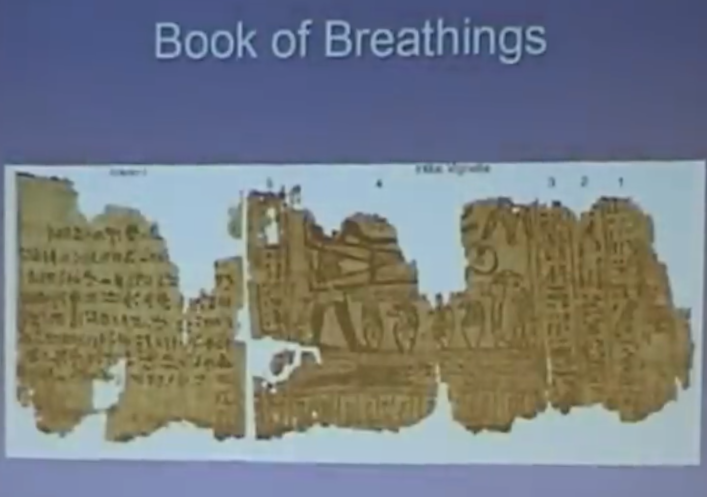
The basic argument put forward by this DVD, and by that previous book, and ever since the papyri fragments became available, is that the Book of Breathings papyrus that forms part of these papyri is the papyrus that Joseph Smith used in translating the Book of Abraham.

  • Scholars have now translated this book. It is a Book of Breathings. It isn’t the Book of Abraham.
  • Moreover, it can be reliably dated to around the second century B.C.—nearly 2,000 years after Abraham.

Ergo, Joseph Smith was a false prophet.

Book of Breathings Papyrus Contains Facsimile 1

Let’s look at the flaws in that reasoning. I’m taking each of these arguments step by step.

The Book of Breathings papyrus that the Church now owns is the actual document that Joseph Smith had.

The reason they say that is because, first and foremost, facsimile number one is part of it.

It certainly is part of the collection of papyri that Joseph Smith had.

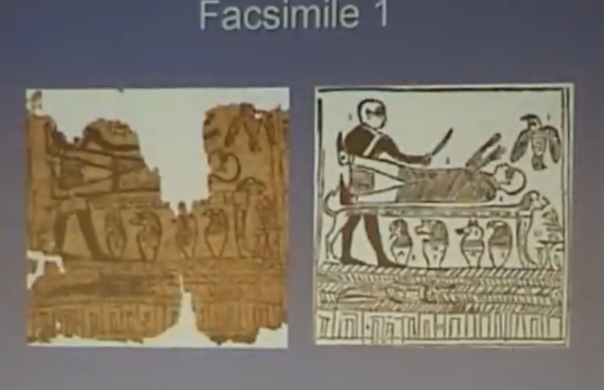
Here we have that particular portion from which facsimile number one was taken, and it’s beyond any shadow of doubt that’s exactly what it is.

Obviously, portions are missing, and were filled in by the engraver, but it’s obvious that this is the actual facsimile, and it does form the beginning of the Book of Breathings.

You can match up the papyri fragments quite nicely, and there is no doubt that this forms the beginning of the Book of Breathings.

The name of the author of the Book of Breathings is in the hieroglyphic text to the right of the facsimile, and that name is also found in hieratic text of the Book of Breathings.

Joseph Translated from the Kirtland Egyptian Papers

The video claims that some of the Kirtland Egyptian Papers are the actual documents that Joseph Smith used in the translation process.

This is on the basis of the fact that you have passages from the Book of Abraham and hieroglyphic characters that are demonstrably from the Book of Breathings there.

The problem with that is, as Hugh Nibley and others have definitely shown:

  • The English text was written in first, in a different ink.
  • The characters were copied afterwards.
  • In many cases, the characters actually overlap the original English text.

So what we have here is not the process of translation, but clearly someone trying to match up Joseph Smith’s translation with some characters on the papyri.

It seems to be the unsuccessful attempt of some of the brethren to figure out how Joseph Smith did what he did, so that it’s not the translation process at all.

No Mention of Abraham in the Papyrus Fragments

We translated the text. My most recent book is a translation and commentary of that text.

It doesn’t mention Abraham; there is no Book of Abraham in there.

How do we reconcile that with the fact that Facsimile 1 is right there at the beginning of it?

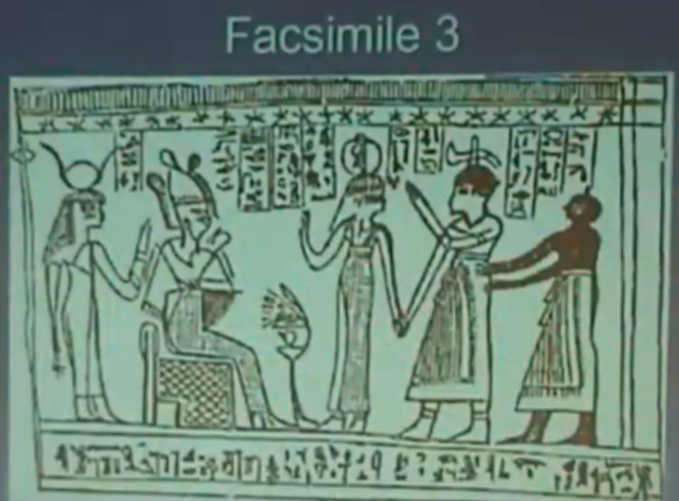
In fact, Facsimile 3, although we don’t have the original of that, would have come at the end of the text of the Book of Breathings.

Indeed, the fragments we do have contain no mention of Abraham, but they are only fragments, and that’s a key point here.

We only have a tiny bit of all of the papyri that Joseph Smith had. (We can come up with percentages if we want.)

The key point is, we only have fragments of the actual Book of Breathings.

There are probably 40 to 50 percent of the total text of the Book of Breathings found on the papyri.

Whether there were other texts on the papyri we don’t know, because we don’t have all of the papyrus.

There is no reason why a copy of the Book of Abraham couldn’t have been on there.

To say that there couldn’t have been is simply an argument from silence, and not good scholarship.

Two Texts on One Papyrus

In the video, Robert Ritner, who is a professor of Egyptology at Chicago, maintains that it is totally unprecedented to find two different texts on an Egyptian papyrus like that.

There are, in fact, numerous examples of just that.

Probably the one that has the greatest similarity is the Papyrus Vandier, which has a Book of the Dead, an Egyptian religious text like the Book of Breathings on one side, and a tale on the other about a man who was sacrificed—remarkable parallels with the Book of Abraham.

So there are, in fact, examples of ancient Egyptian papyri with multiple texts on them.

We simply don’t know what’s on the rest of the papyrus.

Papyrus Dated to the Second Century B.C.

How about the fact that it can be reliably dated to the second century B.C., rather than 2,000 B.C., the assumed date of Abraham?

“Written by His Own Hand”

They made a big deal about the fact that, in the introduction there, it says, “written by his own hand” upon papyrus.

That’s simply indicating the authorship of the original book, you know, like I can take a copy of Harry Potter and say, “This is written by J. K. Rowling.”

That doesn’t mean she wrote that one I am holding in my hand.

It is simply a copy of an original text.

All this says is that it was originally authored by Abraham, and what we have is a copy, and not the original one penned by him previously.

“Translation”

“Translation” is another important term for me to define here.

Joseph Smith used that term in a somewhat broader sense than we do today.

The thing that comes closest to what we think of as a translation is the translation of the Book of Mormon, where he had an ancient text in front of him, and translated into a modern language: English.

He did it a little bit differently, with the Urim and Thummim rather than with a knowledge of the grammar, a textbook, a dictionary, and so on, but that comes closest to our concept of the process of translation.

Translation of the Bible

The translation of the Bible proceeded totally differently.

He simply had a text of the King James Version of the Bible in front of him, and through direct revelation obtained divine commentary, corrections, and additions to that text in English without ever seeing the original documents.

D&C Section 7 as Translation

In D&C Section 7 is another example of a translation.

Here is a translation of an ancient parchment done by John, that Joseph Smith clearly did not have direct access to, but via revelation obtained a translation into modern English.

What Kind of Translation Was the Book of Abraham?

So what kind of translation was the Book of Abraham?

Which of those three does it fit into?

Well, two possibilities occur to me.

(The middle possibility is not possible, because he didn’t have an English translation of the Book of Abraham, which he then corrected.)

So the first and the third are the two possibilities:

  1. a translation of an ancient text just like the Book of Mormon, or
  2. a translation by direct revelation like the parchment of John.

Let’s look at each of those.

Translation from an Ancient Text

This seems to be supported, the idea of translation from an ancient text, by references in the diary of Joseph Smith translating ancient Egyptian records, and statements of some of his associates.

It is undeniably possible that a copy of the ancient Book of Abraham could have been somewhere on that papyrus.

To me, that is the most likely explanation, but I don’t eliminate the possibility of the second one, although it doesn’t feel as good to me—the idea that the Egyptian papyri simply stimulated Joseph Smith to thinking about Joseph in Egypt, and Abraham, and thus received by direct revelation.

If you adopt that stance, then you have to assume that the statements in Abraham 1:12 and 14 referring to the illustrations, are parenthetical remarks by Joseph Smith, inserted into the actual text of Abraham.

Either way, it works, but I prefer the first, and that is, for the moment, what I believe at this point.

The Facsimiles Problem

That brings us to what I call the “facsimiles problem.”

Facsimiles one and three, that are now associated with the Book of Abraham, are the beginning and ending of the text of the Book of Breathings on this particular papyrus.

Facsimile number two was totally elsewhere, and had no relationship even with the Book of Breathings, but was a separate document.

Why are they associated with this ancient pagan text?

Was somehow there a relationship with Abraham?

Ancient Origins of the Facsimiles

The answer, to me, is simply that these illustrations ultimately derive through a 2,000-year period from illustrations done by Abraham in that intervening period, and adapted for other uses.

What Joseph Smith simply did was to give the original interpretation of the illustrations as they had been done by Abraham, although they are in a very distorted form as they appear now.

The key to that is, is there evidence, then, that anciently, these illustrations were associated with Abraham?

That’s the real pivotal question, and the answer is, “Yes.”

This is really, to me, the bulk of the evidence that supports Joseph Smith’s association of these scenes with the Book of Abraham.

Facsimile #1

Let’s start with facsimile number one.

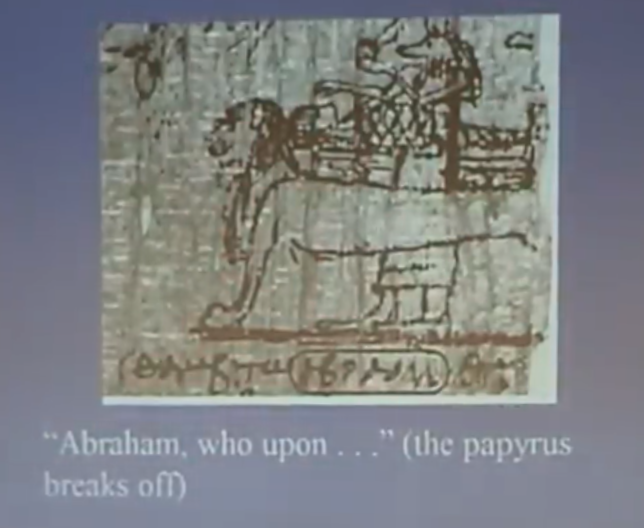
An ancient Egyptian papyrus dating roughly to the 1st or 2nd century A.D. (within a few hundred years of the Joseph Smith papyri) has a lion couch scene similar to that which we find in the Book of Abraham.

Let’s look at that.

Underneath there, in the circled portion, is the name Abraham, and it says, “Abraham, who upon,” and then the papyrus, as you can see, breaks off.

The key point here is that an ancient Egyptian papyrus that Joseph Smith didn’t know about, associates this scene with Abraham.

Comparing the Lion Couch Scenes

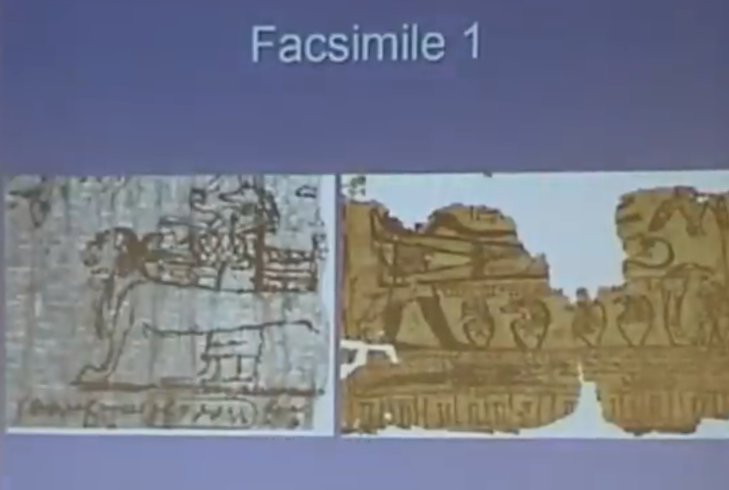
Let’s put these side by side.

Note that there are some similarities, and there are some differences.

First of all, the person is not actually lying on the lion couch. Right?

They are on another bier, reclining, with the standing figure; but the general similarity is obvious, and again, the association with the name Abraham is pivotal.

Facsimile #2

Let’s turn to facsimile two.

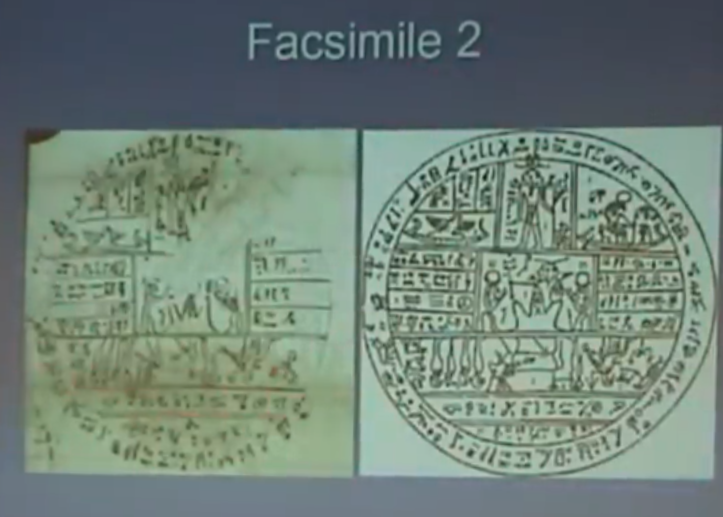
On the left is a copy from the Church historian’s office of facsimile number two, illustrating that apparently, at least when that drawing was made, there was a considerable amount of damage.

In fact, the areas that are shown damaged have text that has been taken from other papyri and placed into the drawing, which don’t belong there, are upside down, or have other problems.

That helps to understand some of the seeming incongruities with the facsimile drawing as we now have it.

Abraham and the Wedjat Eye

In an ancient Egyptian papyrus of roughly the 1st or 2nd century A.D., again, there is a phrase, “Abraham, the pupil of the eye of the Wedjat.”

The Wedjat was the special eye of Osiris.

Osiris was killed by his brother, chopped into pieces, and thrown all over the earth.

His wife’s sister, Isis, gathered them all together, and couldn’t find the other eye, and so that other eye was miraculously restored, and then he was resurrected.

So the eye, the Wedjat eye, the perfect whole eye, was symbolic of resurrection and eternal life.

And there it says that Abraham was that Wedjat eye.

The Hypocephalus and the Book of the Dead

In the 162nd chapter of the Book of the Dead, it contains the instructions for the making of what facsimile number two is, a hypocephalus.

It talks about the Wedjat eye, and then says that it represents another eye.

It’s a pupil, is what it is.

That’s one of the representations.

And so here we have Abraham called the Wedjat eye, and the text that talks about making hypocephali associated with Abraham.

Pseudepigraphical Texts

Pseudepigraphical texts are ancient texts that are of religious content, but never made into the Bible for various reasons, some of them fairly obvious.

When you look at the Gospel of Thomas, for example, at the end, Peter comes up to Christ and asks, “Are women going to be in the Celestial Kingdom?”

Pointing at Mary Jesus replies, “Don’t worry, Peter; their sex is going to be changed, we’ll all be men, and everything will work out.”

It’s fairly obvious why that one didn’t make it into the canon.

The Apocalypse of Abraham

Pseudepigraphical texts, though, clearly have some ancient roots that go back to traditions associated with the people that they claim to be talking about.

In the ancient pseudepigraphical text, the Apocalypse of Abraham, Abraham sees a vision, and in his vision he describes what is in the heavens, on the earth, in the sea, in the abyss, and in the lower depths.

In facsimile number two, these words are found: “O mighty God, Lord of heaven and earth, of the netherworld and of his great waters.”

Very similar terminology!

So we are finding even wording in these ancient texts associated with Abraham that are similar to wording found on this particular hypocephalus.

Creation Imagery and the Hypocephalus

Also in the Apocalypse of Abraham, Abraham sees “the fullness of the universe and its circles in all.”

He sees “a picture of creation” with two sides.

That is the hypocephalus.

To the Egyptians, besides being the eye, it was the world, that which the sun encompassed.

As you look at it, there is an upper and a lower portion.

The lower portion is inverted to the upper.

This is a description in this book about, purporting to come from Abraham, of the hypocephalus, where he’s seeing the creation portrayed, if you will, in this manner.

The Four Figures in Facsimile #2

Abraham sees what are clearly the four figures labeled number six in facsimile number two.

He describes these four beasts, one with the head of a man, one with the head of a hawk, one with head of a jackal, and so on, that are the same as those that are portrayed there in facsimile two.

He sees, and again, where it’s quoted, this is a direct translation from the original, “the host of stars and the orders they were commanded to carry out, and the elements of the earth obeying them.”

That resonates with the language we find in Abraham 4, verses 1, 12, 18, 21, and 25, where it talks about the elements of the earth “obeying.”

So we’re finding even that same language being used in this ancient text that purports to come from Abraham, and the Book of Abraham, and again, the association with the hypocephalus, and facsimile two.

Abraham and the Priesthood Promise

Abraham, in this document, is also promised the priesthood, and that his priesthood would continue in his posterity, an element of the Abrahamic covenant that is totally missing in the Bible.

But it’s the central truth of the Book of Abraham.

And that promise is associated with the temple (interesting again).

Facsimile #3

Let’s turn to facsimile three.

Again, facsimile three we don’t have the original of.

It clearly belongs with the Book of Breathings.

The name of the owner of that papyrus, Hor, is found there.

As it now stands, it is a portrayal of the man, Hor, who is right there [points to the slide] with the god Anubis, who leads the dead, standing behind him.

And the goddess of Truth, identified by the feather on her head, leading him into the presence of the god Osiris, whose wife, Isis, is standing behind him.

He has passed the judgment, and is worthy to enter into the presence of god, and in fact, become one of the gods.

That’s the essence of what that scene portrays from the Book of Breathings standpoint.

The Testament of Abraham and Judgment Imagery

The Testament of Abraham, another ancient pseudepigraphical text, describes Abraham seeing a vision of the Last Judgment.

In his vision of last judgment, he sees an angel with scales weighing the souls of men.

Scholars all agree that this is clearly a reference to the 125th chapter of the Book of the Dead.

The guy must have had this before his eyes as he was describing it.

This is an admixture, if you will, of Christian doctrine with ancient Egyptian concepts of the judgment of the dead.

The Judgment Scene and Facsimile #3

One of the Joseph Smith papyri fragments is, in fact, this 125th chapter.

I’ll show you that in a moment.

Facsimile three portrays, simply, the next step in that process.

After the weighing of the soul, or the heart in the case of Egyptians, you are brought into the presence of Osiris.

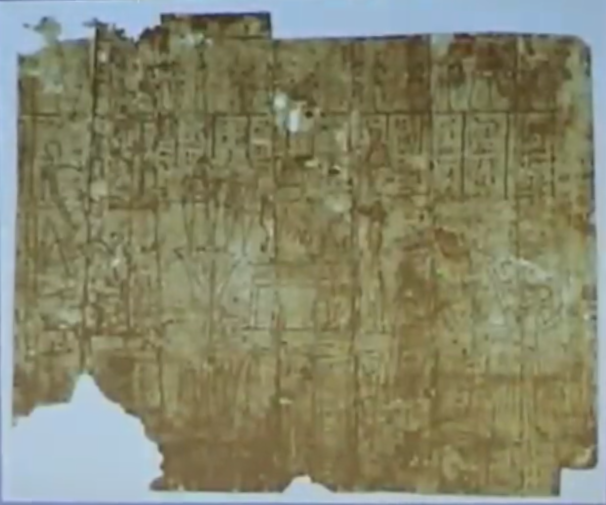
The Papyrus of Neferirnub

Let’s look at some illustrations.

You’re probably not going to see it all.

This is horrible.

This is an indication of the state of preservation of these papyri.

The god Osiris is seated there, the scales are down below, and the young lady is being brought into the presence of Osiris by the goddess, Truth.

Her name is Neferirnub.

This is one tiny fragment of a Book of the Dead that is among the Joseph Smith papyri.

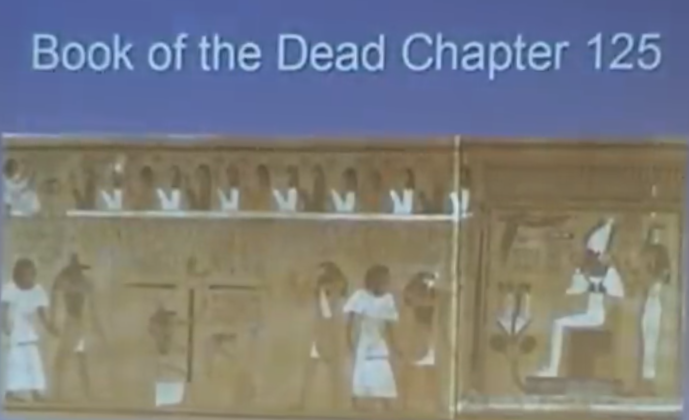
A Better-Preserved Judgment Scene

Here is that actual scene from a better-preserved Egyptian papyrus.

Here we have the man Hunefer, being brought by the god Anubis before the scales.

His heart is being weighed against a feather, which has beautiful symbology in Egyptian because your heart is the center of your thoughts and your desires, and the feather is the Egyptian hieroglyph for truth and justice.

And so we have the balance with truth and justice.

The god Thoth is recording the results of that, and if you pass, then you are introduced into the presence of Osiris.

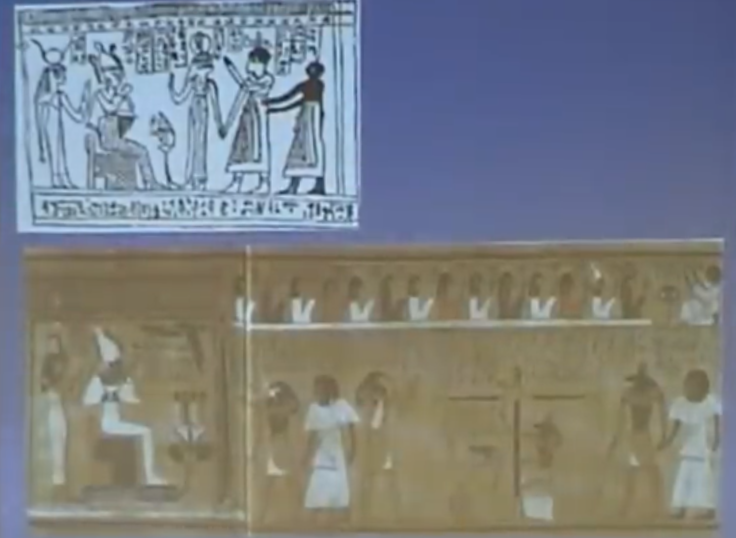
That’s the scene on the right that forms basically the similar scene that is facsimile number three.

Judgment and Outer Darkness

The animal standing underneath the scales there, with the head of a crocodile, the front body of a leopard, and the rear body of a hippopotamus, is a monster that, if your heart doesn’t balance, gobbles your heart up.

And then you are cast into outer darkness, where there is mud and snakes and sewage, which I think is a good personification of outer darkness.

Reversing the Hunefer Papyrus

What I’ve done here is reverse-mirrored the Hunefer papyrus so that it matches the same direction as the Joseph Smith one.

You can see that it’s simply portraying that final scene of that total judgment scene, and hence just such a scene in the Testament of the Abraham is being described.

Joseph Couldn’t Have Known These Things

Several ancient Near Eastern documents associate the scenes that we understand as being facsimile one, two, and three with Abraham. They are roughly contemporary with the Book of Abraham papyri.

Secondly, none of these documents were available at the time of Joseph Smith. He couldn’t have somehow sneaked into the library in Kirtland and seen these, and come up with this. They weren’t available anywhere in the world.

He couldn’t have known about them.

Not Lucky Guessing

You can’t dismiss this as just lucky guessing.

When I give exams, I give a lot of multiple choice, and if the students don’t know, they don’t do well on the exam. You flip a coin, with one out of four, you are not going to do well on the exam.

Joseph Smith hit the nail on the head three times with these representations being associated with Abraham anciently. How can that be just lucky guessing? I mean if so, he is the best guesser in the world, and we ought to listen to him anyway!

Are the Doctrines Worth Betting Our Lives On?

At the end of this video, Richard Mouw (head of the Fuller Theological Seminary in California) says:

“Are the doctrines taught in the Book of Abraham credible? Are they the sort of things we should bet our lives on?”

With the implicit answer, “Heck no!” because of all of this mountain of evidence they’ve shown us that it’s not true.

Well, yes they are!

They are certainly worth betting our lives on!

The Doctrines of the Book of Abraham

The Book of Abraham contains some of the most beautiful and poignant doctrines of the Restoration:

  • the preexistence,
  • our eternal nature as human beings,
  • the council in heaven,
  • a much better portrayal of the creation.

There is beautiful and wonderful doctrine there.

We might respond, “Do we want to bet our eternal lives on the opinions of scholars?”

I think that would be an apt question, and I would wonder what their response would be.

Closing Statement from Hugh Nibley

Let me close with this statement from Hugh Nibley. Which sums up nicely what I’ve been trying to put across here.

The words of the prophets cannot be held to the tentative and defective tests that men have devised for them. Science, philosophy, and common sense all have a right to their day in court. But the last word does not lie with them.

Every time men in their wisdom have come forth with the last word, other words have promptly followed. The last word is a testimony of the Gospel that comes only by direct revelation. Our Father in heaven speaks it, and if it were in perfect agreement with the science of today, it would surely be out of line with the science of tomorrow. [You might say scholarship, too.]

Let us not, therefore, seek to hold God to the learned opinions of the moment when he speaks the language of eternity.

Thank you.

Q&A

Q&A

Question on Symbolism and Worldviews

Q. So, it seems part of what we’re learning here is that we have to be open to different worldviews in the way that symbols may have been interpreted at different times.

And I was interested by what you just mentioned parenthetically about the Gospel of Thomas, that dialogue at the end.

My thought was, because we’ve had preceding lectures about, you know, it’s not just biological, it’s inheritance. And possibly, could that text be related to, when saying women become men, is that they would have the inheritance in heaven that men have in relation to those blessings?

A. Michael: I suppose you could interpret it that way symbolically.

It certainly strikes against, you know, our belief in the eternal nature of gender.

Question on Layers of Meaning in Egyptian Symbols

Q. There’s apparently a concept in looking at Egyptian writings as layers of meaning. Particularly when you look at something like the hypocephalus. That you can interpret at one level and another level, and even maybe a third level.

Could you comment on that?

A. Michael: Well, first of all, I don’t know that I would call it levels.

I would simply say that Egyptian symbols have multiple ways of being interpreted. But not necessarily multiple levels, like, you know, there’s deeper levels or higher levels.

It’s simply, one thing can mean—let’s take for example the lotus flower.

The lotus flower:

  • can be symbolic of eternal life,
  • it can be symbolic of healing,
  • it can be symbolic of truth.

So, there are multiple meanings, but I don’t think that there’s the idea of multiple levels. Where you see kind of an outer level and then sink down deeper into a deeper level that you didn’t catch before.

That’s not, to my understanding, typical of Egyptian documents at all.

Question on the Hugh Nibley Quote

Q. A lot of people probably could this in the room, but what was the source on that Nibley quote?

A. Michael: Worldly Prophets is where that’s found.

Question on Facsimile #1 and the Book of Breathings

Q. Facsimile number one, as being part of the front of the Book of Breathings. Is it also not possible that a second facsimile one on a Book of Abraham scroll could have been there?

There could be two, where the one is extensively damaged and the other one was not?

A. The drawing matches up so perfectly that I don’t think there is any question that the facsimile number one that we have in the Pearl of Great Price came from the surviving portion of the papyrus.

I can’t imagine that another one would have matched up so perfectly. That just happened to be one from Abraham.

So, no, I don’t think so.

Question on Astronomy in Facsimile #2 and Abraham 3

Q. I have heard that a year or two ago, some of you were working on the matter of the astronomical depiction in facsimile number two in the third chapter. And that those were more representative of the Egyptian view of things.

And that, therefore, this was then a support for the inspiration given to Joseph.  Joseph might have tried to put in some modern astronomy or something, whereas this was a typical Egyptian view.

Would you comment on that?

A. Michael: Actually, I don’t espouse that view.

My colleague, John Gee, does think that the view portrayed in Abraham 3 is ancient geocentric point of view.

In a paper I gave a couple of years ago, and which will be published soon. I adopt a view that it, in fact, portrays a more modern point of view.

So, I almost suspect that it’s possible to look at it from both points of view, to some extent.

But to me, it more clearly portrays a modern point of view than an ancient one.

Follow-Up: How Modern?

Q. How modern?

A. Michael: Well, modern to the extent that it sees other stars as simply suns like our own.

That there are multiple planets.

That the Earth certainly isn’t the center of the universe.

It’s rather just one of a myriad of planets and stars that are part of God’s creation.

You know, look at the latest Hubble Space Telescope, and the galaxies, and whatnot.

To me, that’s the kind of thing that’s portrayed.

Closing

Scott Gordon: Thank you very much.

Search topics

Book of Abraham; Book of Abraham apologetics; Book of Abraham critics; Joseph Smith papyri; Book of Breathings; Egyptian papyri; translation by revelation; meaning of translation; Pearl of Great Price; Abraham facsimiles; Facsimile 1; Facsimile 2; hypocephalus; Facsimile 3; ancient Egyptian religion; pseudepigrapha; Apocalypse of Abraham; Testament of Abraham; preexistence; council in heaven; creation; priesthood lineage; prophetic calling; continuing revelation

CES Letter; Mormon Book of Abraham; is the Book of Abraham true; Mormon Church history; LDS scripture; Joseph Smith translation; Mormon apologetics; are Mormons Christian; Pearl of Great Price controversy

August 2006 FAIR Conference

FAIR CONFERENCE ARCHIVE · 2006

2006 FAIR Conference

Annual FAIR Conference · August 2006

The 2006 FAIR Conference brought together Latter-day Saint scholars and researchers to address questions about the Book of Mormon, Book of Abraham, Joseph Smith, DNA, plural marriage, anti-Mormonism, and other topics in Latter-day Saint history and apologetics. Browse the conference presentations below, with available transcripts, speaker information, and related resources.

Conference Presentations

2006 Wayne Arnett headshot

Apologetics 101

Wayne Arnett

Wayne Arnett introduces the principles of Latter-day Saint apologetics, exploring how thoughtful, informed responses to questions and criticism can strengthen faith. Drawing on scripture and practical examples, he emphasizes defending religious beliefs with knowledge, compassion, and an understanding of available resources.

Read & Watch Presentation →

mike-ash-fair-conference-2006.jpg

Book of Abraham 201: Papyri, Revelation and Modern Egyptology

Michael R. Ash

Michael R. Ash examines criticisms of the Book of Abraham involving the Joseph Smith Papyri, the Egyptian facsimiles, and modern Egyptology. He explores the distinction between ancient texts and surviving manuscripts, considers alternative explanations for the translation process, and identifies parallels with ancient Abrahamic traditions that may support the book’s antiquity.

Read & Watch Presentation →

2006 Joseph I. Bentley headshot

Legal Trials of the Prophet: Joseph Smith’s Life in Court

Joseph I. Bentley

Joseph I. Bentley examines the numerous legal proceedings involving Joseph Smith throughout his ministry, drawing on court records and historical research. Tracing cases from New York and Ohio through Missouri and Illinois, he explores how persistent litigation, religious opposition, and failures of legal protection shaped Joseph Smith’s life and ultimately contributed to his martyrdom.

Read & Watch Presentation →

2006 Matthew Brown headshot

Revised or Unaltered? Joseph Smith’s Foundational Stories

Matthew B. Brown

Matthew B. Brown examines claims that Joseph Smith revised his accounts of the Book of Mormon’s origins and the First Vision over time. Drawing on early eyewitness testimony, historical documents, and comparisons of Joseph Smith’s narratives, he argues that differences between accounts do not necessarily indicate fabrication or evolving beliefs.

Read & Watch Presentation →

Historian Claudia Bushman, scholar of Latter-day Saint women’s history

The Lives of Mormon Women

Claudia L. Bushman

Claudia L. Bushman examines the experiences, contributions, and challenges of Latter-day Saint women, exploring their roles in Church leadership, family life, education, and community. She considers questions of gender, feminism, and institutional expectations while encouraging women to develop their talents, strengthen their relationships, and actively shape their religious lives.

Read & Watch Presentation →

2006 Brant Gardner headshot

Defenders of the Book: Surveying the New World Evidence for Book of Mormon Historicity

Brant A. Gardner

Brant A. Gardner examines geographic, chronological, cultural, and political connections between the Book of Mormon and ancient Mesoamerica. Rather than relying on isolated parallels, he advocates evaluating multiple lines of converging evidence, arguing that their combined patterns offer a stronger historical framework for understanding the Book of Mormon and its ancient setting.

Read & Watch Presentation →

2006 Brian Hauglid headshot

Investigating the Kirtland Egyptian Papers

Brian M. Hauglid

Brian M. Hauglid investigates the Kirtland Egyptian Papers, a collection of manuscripts associated with Joseph Smith and the Book of Abraham. Distinguishing between Abraham manuscripts and Egyptian language documents, he examines their scribes, dating, organization, and textual relationships, highlighting the complexities of reconstructing their origins and historical development.

Read & Watch Presentation →

marcus-martins-fair-conference-2006.jpg

A Black Man in Zion: Reflections on Race in the Restored Gospel

Marcus H. Martins

Drawing on his experiences as a Black Latter-day Saint, Marcus H. Martins reflects on race, the historical priesthood restriction, and the 1978 revelation. He distinguishes enduring gospel principles from historical policies and racial explanations, acknowledging past injustices while emphasizing faith, spiritual blessings, and the Church’s growing global inclusiveness.

Read & Watch Presentation →

steve-mayfield-fair-conference-2006.jpg

Mythmaking and the Hofmann Case – Salamander Letters

Steven L. Mayfield

Steven Mayfield examines persistent myths surrounding Mark Hofmann’s forgeries, challenging claims about Church involvement, document suppression, and the criminal investigation. Drawing on historical records and firsthand accounts, he emphasizes careful source evaluation. Forensic document examiner George Throckmorton adds insights into the investigation and the challenges of identifying Hofmann’s forgeries.

Read & Watch Presentation →

2006 Kim Östman headshot

An International Perspective: Opposition to Mormonism in Finland 1845-2006

Kim Östman

Kim Östman traces opposition to The Church of Jesus Christ of Latter-day Saints in Finland from 1845 to 2006. Drawing on historical publications, missionary experiences, and public controversies, he examines how religious criticism, political suspicion, and anticult movements shaped Finnish perceptions of Latter-day Saints across changing historical and cultural circumstances.

Read & Watch Presentation →

2006 David Stewart headshot

DNA and the Book of Mormon

David G. Stewart

David G. Stewart Jr. examines genetic research concerning Native American ancestry and its implications for the Book of Mormon. Addressing mitochondrial DNA, Y-chromosome markers, and population history, he challenges claims that genetic evidence disproves Israelite ancestry, arguing that modern DNA comparisons cannot definitively establish the origins of ancient populations.

Read & Watch Presentation →

brian-stubbs-fair-conference-2006.jpg

A Few Hundred Hints of Egyptian and Northwest Semitic in Uto-Aztecan

Brian Stubbs

Brian D. Stubbs examines proposed linguistic connections between Uto-Aztecan languages and ancient Hebrew and Egyptian. Drawing on vocabulary, grammatical structures, and recurring sound correspondences, he presents evidence he believes suggests ancient language contact in the Americas, with potential implications for the Book of Mormon’s historical setting.

Read & Watch Presentation →

george-throckmorton-fair-conference-2006.jpg

Mythmaking and the Hofmann Case – Salamander Letters

George Throckmorton

Forensic document examiner George Throckmorton shares firsthand insights from the Mark Hofmann investigation, explaining the challenges of detecting sophisticated historical forgeries. Drawing on sixteen months of investigative work, he discusses document authentication, Hofmann’s methods, and misconceptions surrounding the case, emphasizing the importance of careful forensic analysis and reliable evidence.

Read & Watch Presentation →

2006 Allen Wyatt headshot

Zina and Her Men: An Examination of the Changing Marital State of Zina Diantha Huntington Jacobs Smith Young

Allen L. Wyatt

Allen L. Wyatt examines Zina Diantha Huntington’s complex marital relationships with Henry Jacobs, Joseph Smith, and Brigham Young during the 1840s. Drawing on historical records and personal accounts, he challenges common interpretations of her marriages and sealings, emphasizing Zina’s religious convictions, personal agency, and the historical circumstances surrounding her decisions.

Read & Watch Presentation →

Original 2006 FAIR Conference Schedule & Information

The following information preserves the original 2006 FAIR Conference program, including its schedule and event details, for historical reference. Event, registration, hotel, and contact information reflects the original 2006 conference and is no longer current.

The Foundation for Apologetic Information & Research (FAIR)
is pleased to announce the
Eighth Annual Mormon Apologetics Conference
August 3–4, 2006
South Towne Exposition Center
Sandy, Utah

Description

Every day seems to bring new attempts by the Church's critics to denigrate its divine mission. From the efforts of professional anti-Mormon ministries to a whole new generation of critics, the efforts of the naysayers seem to continue unabashed. This year's FAIR Conference is geared toward providing the information and answers you need to deal with a variety of interesting topics. Don't miss this conference!

This year's speakers will address wide-ranging topics sure to please every interest. We invite you to join us for a frank, thought-provoking, faith-building, and enjoyable experience. In past years, people have traveled from as far as England, Saudi Arabia, Australia, and New Zealand just to come to the FAIR conferences. Come see what the excitement is all about!

— Scott Gordon
President of FAIR

Location

This year's conference will be held at:

South Towne Exposition Center
9575 South State Street
Sandy, Utah 84070

Speakers

Speakers slated for the conference included Wayne Arnett, Mike Ash, Joseph Bentley, Matthew Brown, Claudia Bushman, Brant Gardner, Brian Hauglid, Marcus Martins, Steve Mayfield, Kim Östman, Dan Peterson, Matt Roper, David Stewart, Brian Stubbs, George Throckmorton, and Allen Wyatt.

Topics included the Book of Abraham, Joseph Smith, linguistic evidence for the Book of Mormon, international anti-Mormonism, early polygamy and polyandry, the Mark Hofmann forgeries, DNA and the Book of Mormon, and much more.

Schedule

General conference sessions began at either 8:00 am or 9:00 am each day and ended at 5:45 pm. Registration was available before the first session each day. Dress was business casual.

Thursday, August 3, 2006

Time Speaker / Event
8:00 amRegistration
9:00 amOpening
9:10 amMike Ash
10:10 amGeorge Throckmorton and Steve Mayfield
11:10 amBrian Stubbs
12:10 pmLunch
1:30 pmMarcus Martins
2:30 pmKim Östman
3:30 pmSnack Break
3:45 pmMatt Roper
4:45 pmJoseph Bentley
5:45 pmClosing

Friday, August 4, 2006

Time Speaker / Event
7:45 amRegistration
8:00 amOpening
8:05 amWayne Arnett
9:00 amDavid Stewart
10:00 amMatthew Brown
11:00 amBrant Gardner
12:10 pmLunch
1:30 pmClaudia Bushman
2:30 pmAllen Wyatt
3:30 pmSnack Break
3:45 pmBrian Hauglid
4:45 pmDaniel Peterson
5:45 pmClosing

Publicity

FAIR is a grass-roots organization, and we need your help to spread the word about our conference. Tell your friends and neighbors to visit our Web site and learn about the conference. If you'd like, you can download and print this poster about the conference. You could then give it to friends or, with permission, post it on your ward bulletin board or have it distributed with your ward newsletter.

Hotel

The official hotel for the FAIR Conference was the Best Western Cottontree, just minutes away from the South Towne Exposition Center. Rooms were available for $72 per night, including high-speed wireless Internet access, breakfast, and free shuttle service to the conference. The special FAIR Conference room rate was available through July 21, 2006.

Best Western Cottontree
10695 South Auto Mall Drive
Sandy, UT 84070
801-523-8484

Reservations were available by calling 800-662-6886 and requesting a FAIR Conference room or using confirmation number 901249.

Important Registration Notices

Seating was "first-come, first-served," and advance reservations were recommended.

Lunch was not available for registrations made after July 31, 2006, or at the door. Attendees who wanted the catered lunches were asked to register before August 1.

Because FAIR made commitments and allocated resources based on expected attendance, refunds for conference fees were not available after July 31, 2006.

Previous Conference Presentations

FAIR has preserved presentations from previous conferences in the FAIR Conference Archive.

Primary Sidebar

Faithful Study Resources for Come, Follow Me

Subscribe to Blog

Enter your email address:

Subscribe to Podcast

Podcast icon
Subscribe to podcast in iTunes
Subscribe to podcast elsewhere
Listen with FAIR app
Android app on Google Play Download on the App Store

Pages

  • Blog Guidelines

FAIR Latest

  • Come, Follow Me with FAIR – Isaiah 58–66 – Jennifer Roach Lees
  • Come, Follow Me with FAIR – Isaiah 58–66 – Part 1 – Autumn Dickson
  • Jesus Lives to Lift
  • Come, Follow Me with FAIR – Isaiah 50–57 – Part 2 – Autumn Dickson
  • Come, Follow Me with FAIR – Isaiah 50–57 – Jennifer Roach Lees

Blog Categories

Recent Comments

  • Willie Louise Truitt on The Joy of a Covenant Relationship with God
  • Katrina on In memory of Chandler “Chuck” Hendry
  • Nancy Farmer on Come, Follow Me with FAIR – Psalms 49–51; 61–66; 69–72; 77–78; 85–86 – Part 1 – Autumn Dickson
  • Nicko De Leon on In memory of Chandler “Chuck” Hendry
  • Becky Matson on In memory of Chandler “Chuck” Hendry

Archives

Follow Us

  • Facebook
  • Twitter
  • iTunes
  • YouTube
Android app on Google Play Download on the App Store

Footer

FairMormon Logo

FAIR is a non-profit organization dedicated to providing well-documented answers to criticisms of the doctrine, practice, and history of The Church of Jesus Christ of Latter-day Saints.

Donate to FAIR

We are a volunteer organization. We invite you to give back.

Donate Now

Site Footer

The use of the temple in past and current logos and the name "Mormon" are licensed for use by The Church of Jesus Christ of Latter-day Saints.