• Skip to primary navigation
  • Skip to main content
  • Skip to primary sidebar
  • Skip to footer

FAIR

  • Find Answers
  • Blog
  • Media & Apps
  • Conference
  • Bookstore
  • Archive
  • About
  • Get Involved
  • Search

Mesoamerica

Brant A. Gardner

Brant A. Gardner

Book of Mormon Scholar • Mesoamericanist • FAIR Conference Speaker

Brant A. Gardner, Book of Mormon scholar and FAIR Conference speaker

Read Brant Gardner's statement of faith ↓

Brant A. Gardner received a master’s degree in anthropology from the State University of New York at Albany, specializing in Mesoamerican ethnohistory. His work has focused particularly on reading the Book of Mormon in its historical, cultural, and literary contexts, with special attention to ancient Mesoamerica.

Gardner is the author of Second Witness: Analytical and Contextual Commentary on the Book of Mormon, Traditions of the Fathers: The Book of Mormon as History, The Gift and Power: Translating the Book of Mormon, Engraven Upon Plates, Printed Upon Paper: Textual and Narrative Structures of the Book of Mormon, and The Plates of Mormon: A Book of Mormon Study Edition Based on Textual and Narrative Structures in the English Translation, published by Kofford Books.

Gardner has also been a longtime contributor to Latter-day Saint scholarship and apologetics and has presented multiple times at the FAIR Conference. His research brings together anthropology, Mesoamerican ethnohistory, textual analysis, and close reading of the Book of Mormon to explore questions of translation, historicity, culture, and the structure of the text.

Bio last reviewed:

Contributions at FAIR

Testimony

Brant A. Gardner’s statement of faith

Books have typically defined both my intellectual and religious life. In my very early teens a relative gave me a book surveying world archaeology, and from that time some tie to antiquity formed in my soul and brain and eventually dictated my selection of graduate studies. That fondness for archaeology and ancient history began to intermingle with my understanding and testimony of the Book of Mormon when I found Thomas S. Ferguson’s One Fold, One Shepherd among my father’s books. From the time I first picked it up, my interests in the gospel and in archaeology had fused. My father never got the book back.

I took that excitement about the Book of Mormon and archaeology with me on my mission in Spain. When I returned, the excitement still burned brightly enough that I decided that I should take my new fluency in Spanish to the chronicles that surely supported everything in the Book of Mormon. I wanted to be able to say that I knew that they were true because I had read the sources and they said just that. I did: They didn’t. I didn’t lose any faith in the Book of Mormon, but I certainly lost faith in LDS writers who opined about New World history and the Book of Mormon (including One Fold, One Shepherd). By the early 1970s, I resigned myself to the role of gadfly, poking at the obvious problems with the armchair archaeologists and their misuse of information relative to the Book of Mormon. Then I met John Sorenson.

Dr. Sorenson allowed me to vent about the problems that were obvious in the way LDS writers had attempted to use archaeology and history in support of the Book of Mormon. His response was to give me a manuscript (about a decade before it was published as An Ancient American Setting for the Book of Mormon). At that time, my mental picture of Nephites and Lamanites vacillated between movie depictions of ancient Jerusalem and the Romans-from-an-alternate-universe depictions of Arnold Friberg. Sorenson painted a picture that comfortably placed the Book of Mormon in Mesoamerica. I didn’t, and don’t, agree with all of Sorenson’s analyses, but he gave me a context in which for the first time I could see how the Book of Mormon could plausibly fit into a real place and time.

Nevertheless, the Book of Mormon took a distant back seat to the exciting world of Mesoamerican studies. However, while doing some fieldwork in Guatemala, all of the note cards I had amassed towards a dissertation were stolen. In the days of typewriters rather than computers, there were no backups. Lost was lost. Right at the point where all that remained was the final examination and the dissertation, that disheartening loss and our economic realities led my wife and me to decide that I should stop my program for a year and earn some money to get us on our feet. It has been a very, very, long year.

While concentrating on trying to find a way to support and raise a family, interests in Mesoamerica lingered in my reading. Eventually, it was the Internet that provided the impetus to reintegrate my academic interests and love for the Book of Mormon. While participating on a fascinating email list, the owner/moderator of the list asked if I would be willing to write a weekly column. I remembered James Faulconer‘s book entitled Scripture Study: Tools and Suggestions (FARMS, 1999). Faulconer suggested that one might go through the scriptures slowly and to ask lots of questions of them. Having read several scholarly commentaries on books of the Bible, I keenly felt the lack of a similarly scholarly and comprehensive commentary for the Book of Mormon. I agreed to do the article as an ongoing commentary on the Book of Mormon that would go slowly so as to be able to ask lots of questions of the text.

It has been a fascinating project and in some ways a blind leap of faith. Considering my background in Mesoamerican religious ethnohistory and Sorenson’s foundational work, I determined to read the text against a Mesoamerican historical and cultural background. When I started, I didn’t know if it would work, but I began as though it would. I soon found that whenever I attempted to look ahead I was going to be wrong. I had to plug along a verse at a time.

It was not so much a process of fitting the Book of Mormon into a Mesoamerican setting as it was the text opening my eyes to the world in which it was written. The authors had to tell me their story; I couldn’t impose one on them. Why did the people in the Book of Mormon have the specific problems they had? Why did Nephite apostasy always take a very similar form? Why was victory defined so differently from my understanding of European history? Why did some faith-promoting stories in the text make so little sense if you looked at the story carefully?

The authors seemed to patiently explain how their particular culture at their particular time provided the background that seemed to naturally answer such questions. Of course, I mean that metaphorically. The text, seen through the plodding and gradual travel through time and space, was not only a different kind of fit than I had imagined, it was a better one.

The Book of Mormon is very different from what I read as a teenager or even as a young father. The text is the same, but now I read about some of my best friends. They were real people with real lives, real problems, and, perhaps best of all, real solutions. Even after the commentary was published, the Book of Mormon keeps reminding me that there is even more to its story. I had thought I would have finished, but it seems that there is still more to understand. The Book of Mormon has become richer, more nuanced, more understandable—yet no more true.

The Book that Mormon created was written by a very human man. It was translated by a very human man. Nevertheless, both Mormon and Joseph were touched by the divine, and it is the divine that shines in and through the text. It makes so much more sense to my mind as I understand it against history. The divine in it continues to make sense to my heart.

It always did. It always will.
February 2011

Book of Mormon Evidence in Mesoamerica

Start Here

Question

Is there historical and cultural evidence for the Book of Mormon in Mesoamerica?

Short Answer

Brant Gardner argues that no single archaeological or cultural parallel proves the Book of Mormon. Instead, he identifies multiple geographic, chronological, cultural, political, and textual convergences that he believes collectively support reading the Book of Mormon as an ancient text situated in Mesoamerica.

Key Takeaways
  • Gardner distinguishes isolated parallels from multiple independent lines of converging evidence.

  • Proposed Mesoamerican geography must match not only locations but also chronology, populations, cultural patterns, and relationships between places.

  • Gardner identifies potential convergences involving warfare, political organization, kinship, social change, literacy, and material culture.

  • Ancient cultural context can sometimes help explain Book of Mormon narratives that seem strange from a modern perspective.

  • Gardner does not equate the Jaredites directly with the Olmec or the Nephites and Lamanites directly with the Maya.

Summary

Summary

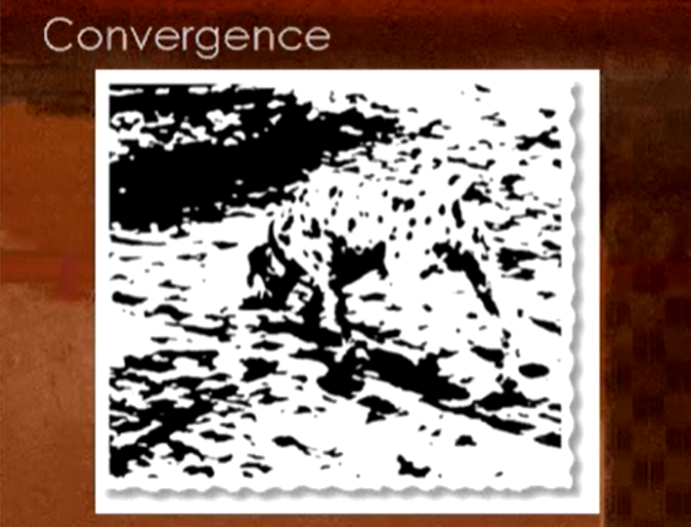
Brant Gardner proposes convergence as a more rigorous way to evaluate evidence for Book of Mormon historicity than simply identifying parallels. Using his image of a Dalmatian hidden among apparently random spots—“seeing the dog”—he argues that no individual point of correspondence is sufficient, but multiple independent pieces of evidence can combine to reveal a coherent historical pattern.

Gardner surveys proposed convergences involving Book of Mormon geography, Mesoamerican chronology, population movements, political organization, kinship, warfare, material culture, and literary conventions. He also examines passages that can seem puzzling to modern readers—including Limhi’s expedition and the Anti-Nephi-Lehies—and argues that a Mesoamerican cultural context may help explain them. Gardner distinguishes this historical argument from spiritual confirmation, maintaining that prayer and revelation remain the means of knowing the Book of Mormon is true.

TL;DR

TL;DR (Too Long; Didn’t Read)

Brant Gardner argues that the strongest historical case for the Book of Mormon does not depend on one archaeological discovery or isolated parallel. Instead, geographic, chronological, cultural, political, and textual evidence can converge like individual dots forming a recognizable picture—what Gardner calls “seeing the dog.”

 From Quetzalcoatl to Mesoamerican Studies

When I was on my mission and even before that time, I was very fascinated with archaeology, particularly with Mesoamerica. I had read some of the LDS scholars who had correlated things in the Book of Mormon to things in history and particularly in Mesoamerica, and I believed it—so on my mission I’m telling everybody—and I had one advantage when I got back from my mission that I had not had before: I went to Spain, and when I was in Spain, oddly enough, I learned Spanish!

It just so happens that a very large number of the documents that come out of Mesoamerica are written by Spanish-speaking people, and knowing that I actually had the language to be able to read some of the documents in their original, I decided that it was my duty to read some of them.

So that when someone says to me, for instance, this particular question that I was really interested in, “When you tell me that the Book of Mormon talks about Jesus Christ coming to the Americas, and you say that that’s related to the Aztec Great White God,” I can say to them, “Yes, I know that’s true because I’ve read it.” I thought this was a good idea.

What the Documentary Evidence Showed

And so, I started reading the information, and I read every LDS author on the subject. I read every document I could find on the subject.

I eventually became addicted to the subject and probably spent way too long on it, although it did foster my love for the anthropology and ethnohistory of that area of the world, and it kind of took me in a completely different direction. But the end result of that particular study was that I found out that what we as LDS had written on that topic was simply wrong—we just got it wrong. 1

From the documentary evidence, there was no way that I could say that the legendary information from Quetzalcoatl had anything at all to do with the appearance of Jesus Christ in the Book of Mormon.

I published an article on that, and thereafter, became probably one of the darlings of the anti-Mormon community. In fact, I suspect that I am probably one of the most often quoted pro-Mormons that is favorably cited in anti-Mormon literature because I wrote this article.

It just so happens that if you look at the comments about the various things that I have written and talked about, it turns out that at that particular point in my life, I was probably very open minded, quite intellectual, very astute and very logical, because I looked at the evidence and found out it didn’t support something that was supposed to support the Book of Mormon.

Following the Evidence in Both Directions

Now, since that time, I’ve looked at the Book of Mormon and I’ve compared it to Mesoamerica, and I’ve found all kinds of reasons why I believe that the Book of Mormon took place in that area of the world. I have gone from darling to dunce.

All of a sudden, everything that I used to know that made me so good when I talked about Quetzalcoatl, all of the sudden seems to have flown out the window, and I really know absolutely nothing at all, what I’m talk about, and certainly my methodology must have changed dramatically—this is all a surprise to me because it hasn’t.

In part of the time that I spent learning about Mesoamerican topics, I have probably spent as much time complaining about the quality of the correlations that we as LDS have made to a particular area of the world as I’ve ever done doing anything else, but nobody is interested in hearing that.

My Role as a Curmudgeon

I had at one point in time decided that I was destined to be the curmudgeon in the LDS community and my sole function would be to try to keep other people on the right track by telling them when they had gone off.

I was reasonably certain from looking at all of the materials that had been published through probably the 1970s that the typical way that the LDS would approach Mesoamerica is to go through and say, “If this is a pretty ruin, it was Nephite. If it’s an ugly ruin it was Lamanite.” (Laughter)

You will find wonderful pictures, gorgeous photographs of Palenque, which was way too late and had absolutely nothing to do with the Book of Mormon. When you get to the places where the Book of Mormon probably took place, you will probably find out that they are really ugly. It turns out they’re really probably backwards—but the fact is that they are there.

Understanding Rather Than Simply Proving the Book of Mormon

Now what we’d like to do is spend some time talking about the New World, the kind of information that is out there, and why the information that is there is starting to tell us more about the Book of Mormon.

Now I do have to kind of give you one other little piece of background, this is a very strange kind of thing for me because I have been forced into this position: My interest in the Book of Mormon is to explain it—I love the Book of Mormon and I want to learn more about it, I want to learn what it is telling me, I want to learn what the people think, I want to learn how they act, I want to learn why they did the things that they did. I really want to comprehend them.

I already believe, I really don’t need to prove it to myself—been there done that, had the inspiration that tells me, even when I didn’t have some of the rest of the information that I’ve got, that this is a true book. But that isn’t what people want to hear.

Mormons want to hear proof of the Book of Mormon. So anytime I’ve ever said anything about it, the basic question has been, “How can you prove the Book of Mormon, how can you show me that it is true?” We’re going to try to talk a little about that.

Moving Beyond Simple Parallels

Now there is a paper being passed around; most of what I’d like to do today is talk about bits and pieces that are on there, but I want to tell you why you’ve got the whole list.

You have the whole list because it’s absolutely impossible for me in a 40-minute presentation to talk about everything that is on there, but everything that’s on there makes a difference, and here is the reason that it makes a difference:

What we are looking at when we’re trying to find a way to explain the Book of Mormon, is we are trying to find a methodological process that is going to help us to understand when we have actually found something that makes sense, as opposed to the time when we are simply making wishful guesses, and we have made a lot of wishful guesses in the past. We need to know the difference between the two of them.

A Parallel Doesn’t Equal a Connection

One of the problems we’ve had in the way we present information is it will create something that’s called a parallel. We’ll say, “Okay, there is a piece of information in the Old World, there is a piece of information in the New World, those two things are parallel, therefore there must be some connection.” That isn’t enough.

One of the wonderful parallels that I remembered was that in the Old World they had adobe bricks, and in the New World, they had adobe bricks. Well okay, that’s true.

Sun-dried mud is probably something that can come about by independent invention. I really don’t see a lot of reason why someone has to import the idea of making something out of sun-dried mud. It’s going to happen, people are going to understand that, people are going to find it. The fact that those two things are parallel is virtually meaningless.

When a Parallel Looks Better Than It Really Is

The other problem with parallels is that when you create a parallel, very frequently you will make the thing that you are talking about appear to be more parallel than it really is simply by the way that you state it.

Going through some of the material on Quetzalcoatl and knowing the legends behind it, I would look at people putting the parallels down, and I’d look at them and say, “Well yes, if you just read that, that is really comparable, but if you actually talk about what the information is that lies behind the way they said it, it doesn’t say that. And the parallel really is not there.”

So parallels are really not going to help us, but there is something that does, and the problem is we need a vocabulary to do it and what I’m to do is borrow a vocabulary term that William Dever, a biblical archaeologist in Old World Israel, that he came up with to try to solve the same kind of riddle, to be able to say that there is something that helps us create a point of evidence that is better than a parallel even though it seems to be similar.

Convergence

He calls it a convergence so rather than a parallel, we are going to talk about a convergence. 2

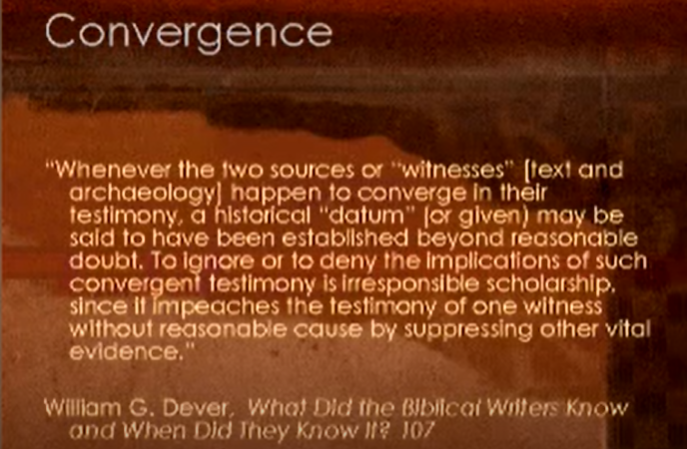
His comment, “Whenever the two sources or ‘witnesses’ [text and archaeology] happen to converge in their testimony, a historical ‘datum’ (or given) may be said to have been established beyond reasonable doubt. To ignore or to deny the implications of such convergent testimony is irresponsible scholarship, since it impeaches the testimony of one witness without reasonable cause by suppressing other vital evidence.” (William G. Dever, What Did the Biblical Writers Know and When Did They Know it? 107)

What he is talking about in that case is the text of the Bible and the dirt archaeology to which it is being compared. The difference is, when he is creating a convergence rather than a parallel, he is taking a large quantity of material and he is saying, “Here are things that come together in a similar description.”

And we have to have location, we have to have time, we have to have the content of the information and in essence what he is saying is the more pieces of information that interrelate with each other and all depend upon the same location, same place, same time, same people, same concept; the more of those you get, the more you are converging the two types of testimonies of information, and the more chance then you have that one of these datums is now going to be something you can establish.

Seeing the Dog: How Convergence Works

So that is what I want to talk about: a convergence. To give you an idea of how a convergence works, here is my favorite example.

First impression, you look at this, and what you really should see is just a bunch of dots. Okay. Your first impression should be a bunch of dots. Now, after that you should see something. What are you seeing? You’re seeing a dog. I can actually see a few hands out here, so how many people don’t see a dog? That happens every once in a while because there are so many dots on there that you don’t see it.

That’s an important piece of information to remember because even though there is a whole bunch of us that see a dog there, it isn’t as absolutely clear as it might be if it were cleanly defined lines. Nevertheless, the location, the placement of the spots, all of the information, there is a dog standing over there. So for those of you who aren’t seeing it—that’s the head of the dog. You’re looking at a Dalmatian that’s drinking something from the ground. Foreleg, left hind leg, right hind leg, body—there’s even kind of a tail hooked around here.

When the Mind Creates Patterns

We, as human beings, have minds that are capable of creating cohesive patterns out of incoherent information. How many of you have stared at a tree, a cloud, a carpet and seen a face in it? Is the face there? Absolutely not. The reason that we see it is because we have a mind that creates things and it tends to create faces because we are so chemically wired to see the face. It is so important for us that we tend to create faces.

The difference is, if you blink two or three times, sometimes you look back and you can’t find it. Once you’ve seen the dog, you cannot “unsee the dog.” It actually is there. It may be difficult; we may not have all the data that we need to be able to clearly define it. But once you see the dog, that dog is there and you cannot “unsee the dog.”

That is the kind of evidence that we’re going to be talking about. We will not have a complete picture. We will not have a jigsaw puzzle where every single piece of the puzzle is there and there will not be any gaps, but what we will have is a sufficient picture that we can “see the dog.”

And I will tell you that having been through the Book of Mormon in detail over the last several years that it is now impossible for me to “unsee the dog.” This is a text that took place with real people in a real time and there is no way I can see it any other way, because I have “seen the dog” and I understand that it’s there.

Why One Piece of Evidence Is Not Enough

Now here is the next problem we have with seeing the dog, we will start talking about the evidence for the dog and someone will say,

“That spot. There is no reason why that spot is unique to this dog. I’ve seen things that have had a spot like that that weren’t a dog.”

Well, yes.

Which is why when you look at all this kind of evidence, you can’t take one piece and say, well this one thing is going to prove it. It isn’t a single thing. In any good historical argument, you are not going to find the one single thing where you say, okay here is the smoking gun; this is the one thing that does it.

We only have one way of coming up with a single action that we could take that will prove the Book of Mormon and that is prayer and revelation. You pray and get revelation. That is the only single thing that will demonstrate it.

If you are looking at an historical argument, you need to have an argument that has a lot of pieces together, not worrying about the single thing. Now, we do have to make sure that that really is a dot and not something that we’re not looking at. It really does have to be real information. So that’s where we are: trying to move on from that.

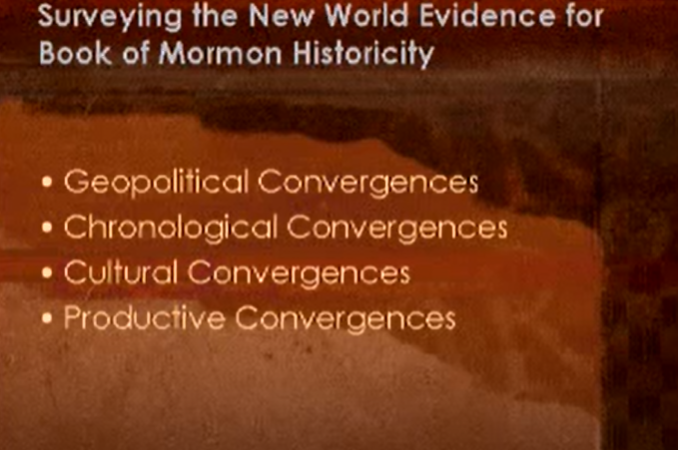
Surveying the New World Evidence for Book of Mormon Historicity

So here is the kind of thing that we would like to take a look at, I’m going to run through a lot of this stuff pretty quick. Some of the stuff I’m not even going to mention hardly at all and then I’ll try to end up with some of the things that I kind of find most fascinating about “seeing the dog” in the Book of Mormon.

Geopolitical Convergences

Geopolitical Convergences: This is where we are talking about the fact that we have to have it on the map somewhere and then even more complicated than putting it on the map is we need to know something about the peoples that were there so converging that type of information.

Chronological Convergences

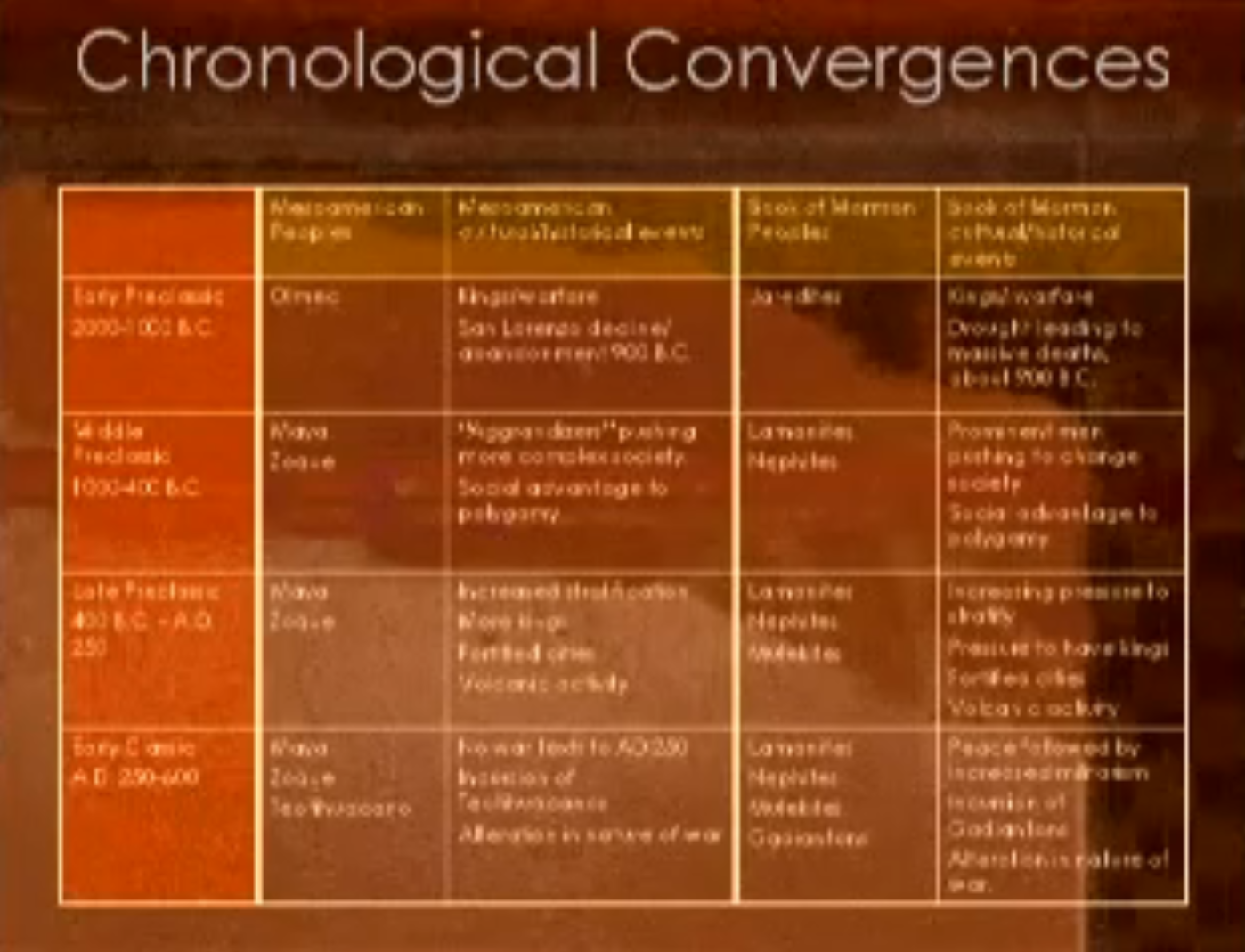
Chronological Convergences: One of the best arguments that I’ve heard for understanding that the Book of Mormon could not have taken place in the Great Lakes area is because people did not live there at the right time. Anytime you see a theory that is positing people that don’t live somewhere, that are supposed to be there and they are not there—it’s not a real strong theory.

Anytime one of the theories of Book of Mormon geography posits that you must have an area of the world under water at a time when people were living there, probably not a very good thing, even if they were under water some other time in geological history. Chronology makes the difference; you have to match the right time periods. You can have absolutely the right thing happening, and if it’s a thousand years too late, it doesn’t count, it isn’t a convergence, and it isn’t even close.

Cultural and Productive Convergences

Cultural Convergences: Once we get those first two done, then we need to look at the culture of the area and whether or not that converges and the descriptions match the kinds of things we find in the Book of Mormon.

Productive Convergences: Which is where understanding the context of the Book of Mormon, or the place where it would have taken place, actually teaches us something about the Book of Mormon that we would not understand otherwise. In other words, it becomes a way to elucidate the text, particularly in places where the text might be a little bit confusing or a little strange.

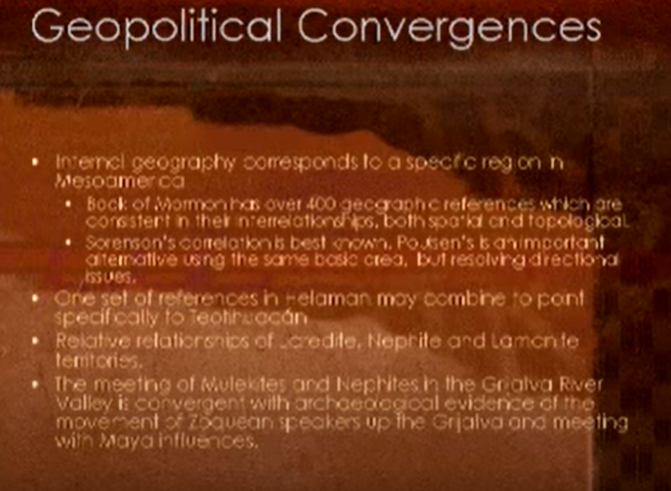
Geopolitical Convergences

  • Internal geography corresponds to a specific region in Mesoamerica
  • Book of Mormon has over 400 geographic references that are consistent in their interrelationships, both spatial and topological.
  • Sorenson’s correlation is best known. Poulsen’s is an important alternative using the same basic area, but resolving directional issues.
  • One set of references in Helaman may combine to point specifically to Teotihuacán. 3
  • Relative relationships of Jaredite, Nephite and Lamanite territories.
  • The meeting of Mulekites and Nephites in the Grijalva River Valley is convergent with archaeological evidence of the movement of Zoquean speakers up to the Grijalva and meeting with Maya influences.

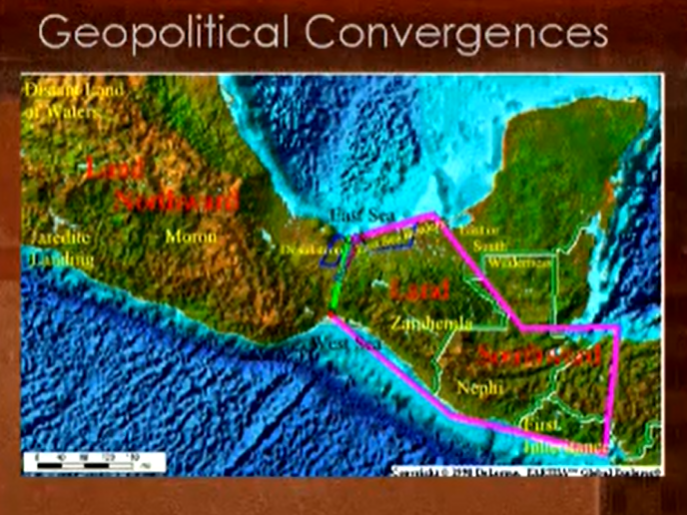
There are two correlations I’d like to put up here.

  • I am not a geographer.
  • I cannot tell for what reason, I simply don’t comprehend this stuff.
  • I understand people and
  • I understand archaeology and ethnohistory

But I just don’t seem to do geography very well, so I will rely on other people for geography.

But here is the problem that you have in geography—what you must do is you must create a convergence between the descriptions in the text and a place in the world. There are two of them I’m going to show you. Both of these are converging in the same general area of the world, they simply interpret the data slightly differently and I don’t know how to distinguish between the two as of yet. But, for the purposes I have, they agree in the places where I need them to agree, so I’m not too worried about it—the rest of it will work out.

Matching the Text to a Real Geography

But here is the problem you have, you have to take the text and the descriptions of geography in the text and you have to find a way to match it up in the real world. This is an incredibly difficult proposition.

John Sorenson has discovered at least 400 different kinds of textual correlations in the Book of Mormon, which, if you were going to have a convergence between the text of the Book of Mormon and a geography in the real world, you’ve got 400 things that have to match. This is not an easy process. If you are matching 400 locations in relative distance from each other, in topography where you go up and down and it’s consistent in the right way, you know this is simply difficult to do.

There is a recent article that attempted to say that Book of Mormon geography is so vague that you could probably put it anywhere including the Malaysian Peninsula. It was an interesting idea. Some of the things actually worked out.

One of the problems, however, is that based on that particular geography, all of the Lamanites had to be in the very, very bottom tip. And the problem is:

  • you have all this area that’s Nephite and based on the Nephite geography
  • but all of the Lamanites (that the text tells us are more numerous than the Nephites) are in this little tiny area

And it just doesn’t work, you just don’t have that kind of population distribution.

On top of that, the next thing I’ll talk about is the other reason why the Malaysian geography (model) won’t work, but to start off, we’ve got to get a geography.

Mesoamerican Models of Book of Mormon Geography

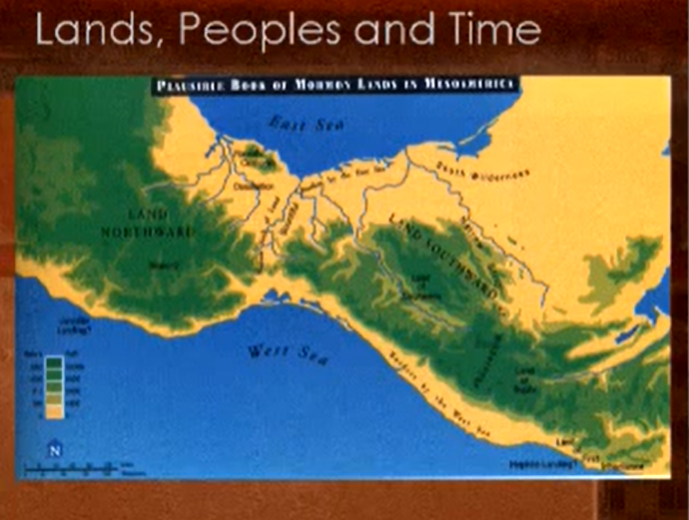
You are looking at the Yucatan Peninsula, Isthmus of Tehuantepec. And basically, this is the correlation of how John Sorenson would lay out the Book of Mormon in this land. Larry Paulsen, who is a member of FAIR, has another idea of how to do it, slightly different. What he does is kind of fascinating because in one way we have to make sure that we understand it.

What you’ll see at the top is this North-South axis. And that really looks familiar to us because as modern Americans we conceptualize directions and cardinal directions as a plus sign. What we miss is that Mesoamerica did not. Mesoamerica did not use the concept of a plus sign whenever they described the world and the four quarters of the world. They used an “X”.

So for them this is North, not that single line that we think of, but that pie, that whole piece of direction is North. It changes concepts dramatically when we have a quadrant that is Northwest, and they kind of tilt it and say ‘that whole thing is North’. So the concept of what “North” is was probably very different in the Mesoamerican world.

Adding People and Chronology to the Map

Now, here is why that doesn’t bother me that there are two different ones, and secondly, why when you take the next layer of information and you put it on the map that things like the Malaysian hypothesis fall to pieces.

In addition to being able to take the text and have some sort of a convergence with a geography we now have to put people on and in addition to putting people on the map, the Book of Mormon very clearly tells us that there is a chronological relationship among these people; and we need to find that same chronological correlation.

For instance, the Book of Mormon tells us that in the North, we are supposed to find the oldest culture and we’re supposed to find people who would have been there, let’s say, 2,000 BC. We are supposed to be able to find maybe a newer culture down along here and there better be people there around 600 BC.

We are also told in the Book of Mormon that people move out of this lower area and start moving towards the North, end up in the city of Zarahemla, where they meet up with some people who have come down from the North, the Mulekites, and they all meet in this area of Zarahemla along the river Sidon. That’s a lot of information. That is very difficult to guess.

Matching Book of Mormon Peoples to Mesoamerican Chronology

What would happen if we look at this map of Mesoamerica and the oldest people were down here and the youngest people were up there? It would be disqualified. But it isn’t. That’s where the old people are. That’s the Olmec culture up in that area; had been in that area for an awful long time.

This is the Maya region. Interestingly enough one of the things that happens is if you look at the linguistics of the area, the Olmec are—the best evidence anyway—is that they’re speaking a language that has been reconstructed and labelled Mixe-Zoque. 4

The Mixe-Zoquean speakers, which is kind of a combination of two languages, later Mixe, and later Zoque. What happened was the Zoquean group moved up that river. And this area has a connection to the people up there, and they were Zoquean speakers that moved out and historical data tell us that there is this movement of people from the North to the South along that river.

It also indicates that there is information about some of these speakers that move up this area, and meet up there, and some of the cultural data from here is starting to come into here somewhere around 200 BC. Now that just so happens to be a time period when the Book of Mormon is saying that something is happening.

Jaredites, Olmec Culture, Nephites, and Maya Culture

The Book of Mormon says that we have to have Jaredites in the North that happen to have a time depth and geographical correlation that match up very nicely with the Jaredites. Now please understand that I will not, and do not ever say that the Olmec and the Jaredites were exactly the same. I think that the most logical thing that you can say is that the Jaredites participated in Olmec culture.

Similarly, when we talk about the Maya, I do not think that either Nephites or Lamanites were Maya, but that they participated in that culture and may or may not have learned to speak that language. But there were Olmec who were not Jaredites, there were Maya who were not referenced in the Book of Mormon.

But what’s fascinating is that the history of this area tells us that there is a people who is coming from this area and merging here; ending up with a cultural influence from people this way going in that direction and that just so happens to be what the Book of Mormon tells us is supposed to happen at the same time.

Population Movement around 200 BC

There is another piece of information about this area down in here which is the area of the Land of Nephi, one of the cities that Dr. Sorenson suggests might have been the city of Nephi, Kaminaljuyu, in Guatemala. 5 I have just recently read that there is documented evidence of Cholun speakers moving into that area in about 200 BC.

Think of what that means for Book of Mormon history. Right in 200 BC we don’t know exactly what is happening, but according to the text, all of the pressures on the Nephite people are increasing right around this particular period of time, and increasing so severely that Mosiah has to take all the people who will go with him and flee and leave.

What is changing things so dramatically that all of a sudden at this point somewhere around 200 BC, they have to leave this area? Well, history tells us that there is a new People that is moving in. Perhaps that is creating some pressure.

Chronological Convergences

Again, if we have the wrong people in the wrong place it doesn’t really help us. One of the ways in which you get a convergence with the Book of Mormon and things that are happening in Mesoamerica is not just in this gross location of where the people are, but the kinds of things that are happening at the same time. For instance, having kings and warfare. It’s nice to say that they are there, but that is a piece of the puzzle rather than one that’s particularly interesting.

One of the things I did when I was looking at the Jaredite chronology, is I tried to rebuild the chronology in the Book of Mormon based on king lists and run backwards from times rather than make up an assumption of when I thought it might start, and based on this Jaredite king list chronology, I started laying out when these things might possibly have taken place.

One of the things that happened after that was put together is I find that in the city of San Lorenzo, they’ve got a decline and the city is being abandoned right at a time when the Book of Mormon is talking about a severe drought in the land.

San Lorenzo and the Jaredite Drought

Now, are those two exactly the same? Don’t know. But it is kind of fascinating that you’re going to have in the historical record, a decline of a population that in many cases and other instances have been tied to droughts happening at the time when the Book of Mormon is indicating that there is a severe drought in the area.

Then we get into this next time period where we have changes occurring down in the Maya world and what’s happening is you are moving from smaller populations to larger populations, you are moving from villages to cities, and the political structures are beginning to change.

So the social pressure in Mesoamerica is one that is developing this push towards what will become the classic Maya model of kingship. Those pressures are happening quite early and there are several mechanisms that have been used to try to describe how people moved from the small village into the situation where they are getting more social stratification.

Aggrandizers, Trade, and Social Inequality

One of the two people who wrote the article that I think makes the most sense on this was John Clark and he talked about a process of aggrandizers where one of the things that they would do is you’d get some ambitious people who would start trading and then they would get more trade goods, and this was going to increase their status in the community, and because they are increasing their status in the community it’s going to get some differential in what they have and what somebody else has, the kind of trade goods you have. You will get some sort of social inequality there.

One of the things that absolutely struck me is that this is first of all an economic argument in that you’ve got people who are looking to better themselves through trade and look at wealth, money, etc. And the second thing is the mechanism that they used was that they would have plural wives.

The reason? They’d have more people to work. You get more wives, so you get a bigger family, you have a cottage industry and now you’ve got more workers, you’ve got a built-in workforce, you create more items, you get more trade.

Costly Apparel and Multiple Wives

It has always been fascinating to me that this is the exactly the time period where Jacob is complaining about something that is happening in his community, and he complains about two things that you would not suspect are connected which are costly apparel and multiple wives. He is telling people why this is terrible.

Why is it those two things? How do those go together? Why are they related? Because that’s what is happening at that time period.

Next kinds of things happen, you get these increasing pressures to have kings; you get fortified cities; the Book of Mormon talks about the time of Christ. The best information about what’s happening when Christ comes is that there is this massive volcanic activity.

There are lots of indications that at least around this time period, within 100 years before and after, there are a lot of very active volcanoes. We are not at the point where we can say this is the volcano that erupted and is being described in the Book of Mormon. But what you can say is that around that time period, it is pretty obvious that there was some heavy volcanic activity. So again you are getting a convergence in time and place and in description.

Warfare and Chronological Convergence

This one is brand new—Mark where are you? Stand up and say hello to everybody. This is Mark Wright he’s a Mesoamericanist getting his Ph.D at UC Irvine. It’s been a heck of a lot of fun talking to him because we actually talk shop and I can say things and he knows what I’m talking about.

This is one that he pointed out to me, this is from David Stewart in a recent discussion at the Texas Maya meetings where he was just happening to mention that there are no Maya text dealing with warfare prior to 200-250 AD, and then after that we get it all the time. Why? There is a really kind of odd convergence and frankly one that I wasn’t expecting to see.

Next kind of thing that we’re getting, militarily, we know that down in the area where the Book of Mormon would have taken place, around the time that the closing events are occurring in the Book of Mormon, the people of Teotihuacán are coming down, they are bringing with them a new style of warfare, they change the rules.

There are all kinds of indications that things are dramatically different when all these Teotihuacános come down, and then you read the Book of Mormon text and right at the same time that historical documents are talking about the Teotihuacános coming down and changing the nature of warfare, we have Mormon who is first of all complaining about the Gadiantons, and secondly complaining that the nature of warfare has changed and complaining it just isn’t the way it used to be.

So the Book of Mormon is one more time, chronologically reflecting the same kinds of pressures that we know to have been occurring at that time period.

How Many Correlations Can Happen by Accident?

To this point in time, we are still at one of those things where you look at it and you say, how can this kind of a correlation happen by accident? How do you hit that many things and that carefully?

Somewhere along the line we should have the chronology getting mixed up if we were in the wrong place. If we were in the Great Lakes region this would have blown up a long time ago. If we were in Malaysia it would have blown up a long time ago at the time when we’re looking for just the older populations—there are not populations and peoples in the right places at the right time in Malaysia. There is a good reason why that doesn’t work. Way past geography the rest of the geopolitical situation does not work.

But the Book of Mormon just keeps getting better, and including things that I found out yesterday, make it look better than I’d seen.

The Israelite Background of the Book of Mormon

Another one that is fascinating and I’ll just mention it, because it’s not my research but I find it absolutely amazing. People have really complained about the Book of Mormon because it is the wrong kind of document. You are talking about Christianity way too early. There are just all kinds of things that are supposed to be wrong against an Israelite background.

The problem is, they are wrong against an Israelite background only (inaudible) pre-exilic Israel. The more that Israelite religion is being reconstructed prior to the time that Lehi took off, the more the Book of Mormon’s theology and the things that it’s concerned with fit right in. It’s not nearly as problematic as they thought.

What’s wrong are the expectations that were brought to the text—not the text itself.

Cultural Convergences

  • Anthropological
  • 1 and 2 Nephi parallel established patterns of ethnogenesis 6
  • “Getting the right things wrong” – when the text makes a “mistake,” it make the “correct” mistake
  • Insider/outsider vocabulary
  • Pejorative stereotyping
  • White/dark as metaphor rather than skin color
  • Mormon’s presentism
  • Mormon’s description of wealth in Alma 1
  • Lamanites learning literacy from the Nephites
  • Literate society
  • Monument stones – stelae and Coriantumr’s story-stone 7
  • Annals format
  • Book of Mormon literary parallelism including chiasmus, Mesoamerican emphasis on parallelism and evidence of chiasmus in the Popol Vuh.
  • Dynasty emphasis – Book of Mormon book-name changes
  • Indications of vigesimal system 8
  • 400-year prophecies
  • Suggestive structures in counts and estimates.

“Getting the Right Things Wrong”

There are things that people will say about the Book of Mormon, they will say, “You know they got this wrong, this is wrong, you shouldn’t do it this way”. The problem is, you really don’t want and should not find a historical text that is perfect according to our modern perceptions what a history ought to be.

The Book of Mormon should not look like a modern history; if it does, it’s a forgery. It should look like an ancient text, that’s where it came from.

In ancient texts there are lots of things that people get wrong and the Book of Mormon happens to get a whole bunch of things wrong. For instance, it uses insider/outsider terminology. It tends to say, as most people do when they are first creating their societies, there is “us” and “them.” There is this big wall around us, and anybody who is not us is them and we don’t like them. It’s wrong for modern history but it’s exactly right for ancient history.

When the Book of Mormon Gets Things “Wrong”

Mormon makes a mistake when he is talking about some of the historical conditions of Teotihuacán 250 years earlier. Well, is that wrong? For an ancient historian no, actually it’s exactly right. He should not have known what happened in a city that is that far away 250 years earlier.

What he should have done is what he did. He assumed that what he knew about the city at that time had always existed. That’s the way people thought at that point in time. So oddly enough, in a lot of cases some of the things that the Book of Mormon gets wrong—from an anthropological standpoint—it is getting exactly right.

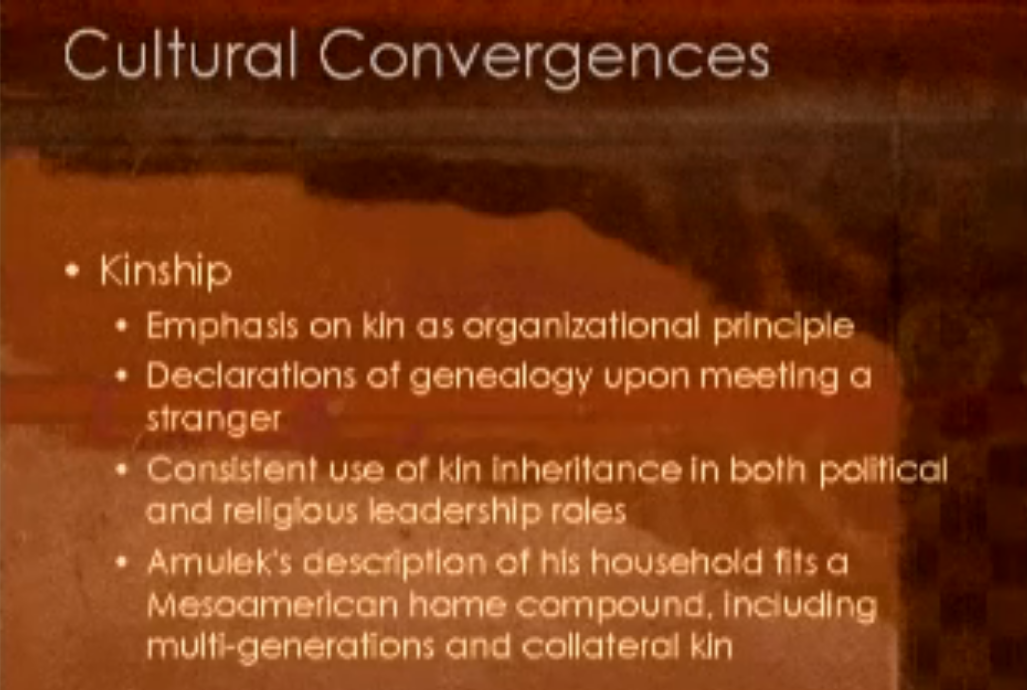
Kinship

  • Kinship
  • Emphasis on kin as organizational principle
  • Declarations of genealogy upon meeting a stranger
  • Consistent use of kin inheritance in both political and religious leadership roles
  • Amulek’s description of his household fits a Mesoamerican home compound, including multi-generations and collateral kin

This is actually very important—the kinship structure inside the Book of Mormon and the way kin function in the Book of Mormon matches a kin-based society. By the time of Joseph Smith we had lost a lot of that and certainly by our time we’ve lost even more of it. But the Book of Mormon tends to operate like a kin society would have, which again is something that it ought to do. Contrary to what our expectation would be from somebody who is writing in the 1830s.

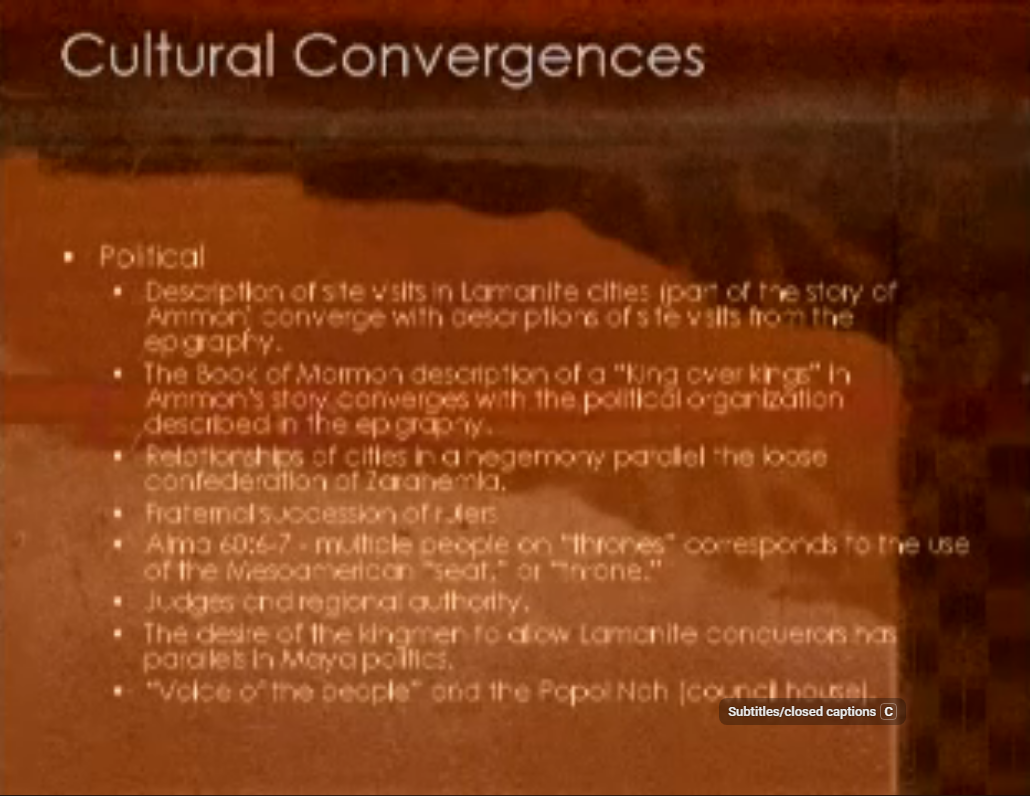
Political Convergences

  • Political
  • Description of site visits in Lamanite cities (part of the story of Ammon) converge with descriptions of site visits from the epigraphy. 9
  • The Book of Mormon description of a “King over kings” in Ammon’s story converges with the political organization described in the epigraphy.
  • Relationships of cities in a hegemony parallel the loose confederation of Zarahamla. 10
  • Fraternal succession of rulers
  • Alam 60:6–7 – multiple people on “thrones” corresponds to the use of the Mesoamerican “seat,” or “throne.”
  • Judges and regional authority.
  • The desire of the Kingmen to allow Lamanite conquerors has parallels in Maya politics.
  • “Voice of the people” and the Popol Nah (council house). 11

Is the Book of Mormon Describing Democracy?

In general, one of the things that people will say about the Book of Mormon is that it’s got to be modern because it talks about voting. The voice of the people has to be a vote. Anybody who has said that has not examined the text on the voice of the people.

Anybody who thinks

  • that the Book of Mormon is a democracy and
  • that the Book of Mormon promotes democracy

has not studied it. It does not. It is a very complicated system. I am sure that somewhere in the world there is another system that’s just like that. But the only one I happen to know of is in the Maya world where down at the bottom here in the Popol Nah, or the community house, where the elders gather together to hear the cases and discuss them.

The “voice of the people” being literally that. And if you read one of the sections in the Book of Mormon where it is talking about it, you can actually see in your mind’s eye these people just talking. And somewhere in talking it out, changing their minds and coming to whatever the consensus opinion is. It has nothing to do with votes.

The political system in the Book of Mormon simply doesn’t look modern at all. What it does look like is the things that I’ve seen in Mesoamerica.

Warfare

  • Warfare
  • The seasons of warfare match with the types of seasonality in Mesoamerica
  • Relationship of timing of war and famines
  • Militia style – no standing army
  • Defensive armament is correctly described
  • helmets
  • slings
  • breastplates
  • shields
  • “thick clothing” as armor
  • wounds on the legs – ie. no greaves 12
  • Descriptions of the deployment and types of weapons
  • Tactics
  • Rarity and surprise of right movements
  • Scouting a walled city, using ladders if not other way
  • Hiding in foxholes
  • Battle between champions
  • Defeat of the king is the defeat of the army
  • Battle by appointment
  • War on a tribute model rather than a conquest model
  • Fortifications described that fit with developing Mesoamerican fortifications – appearing at approximately the same time period.
  • Lineage succession of the general

What is fascinating about this is that not only does he mention certain weapons, but the Book of Mormon is very accurate in the way those weapons are used in an attack. I am not a military man, but there is a certain way that you would do things and I’ve consulted with a couple of military men—the Book of Mormon actually makes military sense.

People who do war for a living can look at the text and say, they’re doing the right kinds of things with the right weapons the right way.

None of these are the way war was fought when Joseph Smith was thinking of things and the tactics are entirely different.

Aztec Warfare and Book of Mormon Tactics

One of the ones that I found very fascinating, Ross Hassig has book out called “Aztec Warfare” and the longer I read that, and the more I read the Book of Mormon, the more I start seeing the same tactics being used in several occasions.

There are textual witnesses of the Aztecs doing some of the very same things that we have seen in the Book of Mormon. So obviously they are effective tactics. We don’t know who came up with them, but it is kind of curious that that area of the world knew about them and used them including hiding in foxholes, popping up and attacking your enemy as they come by.

Productive Convergences

  • Productive Convergences
  • Geography as explanation
  • Limhi’s expedition gets lost because they follow the wrong river.
  • Tactics depending upon topographic relationships.
  • Culture as explanation
  • Jacob’s use of Isaiah
  • Ammon and Lamoni
  • Why Lamoni thought Ammon was “more than a man”
  • Clan struggles as background for Ammon at Waters of Sebus
  • Anti-Nephi-Lehies
  • Mesoamerican caches and the Book of Mormon burying of weapons 13
  • Captive sacrifice and the seating of kings
  • Seating of kings and the raid on Ammonihah

If the text of the Book of Mormon is an authentic text it should be written by someone who assumed that we knew as much about his world as he did; that’s the way the ancient people tend to write. That’s the way the Biblical writers wrote.

They simply assumed that they did not have to explain a lot of things to us because they assumed that we were part of the culture and that we would understand things. So, the only things that you get told are the things that you need to know because you’re supposed to know everything else.

That works really well until:

  • the world has changed and
  • we don’t know everything else and
  • all of a sudden things become kind of confusing and
  • they look strange and
  • you get these odd questions about the Book of Mormon text where it tells a story
  • where in our hearts of faith we know that it’s a darn good story but
  • as soon as we step back from the view of faith and we look at it kind of cold and calculated it becomes a stupid story

I’ve got two of them for you. One of them is thanks to Larry Poulsen.

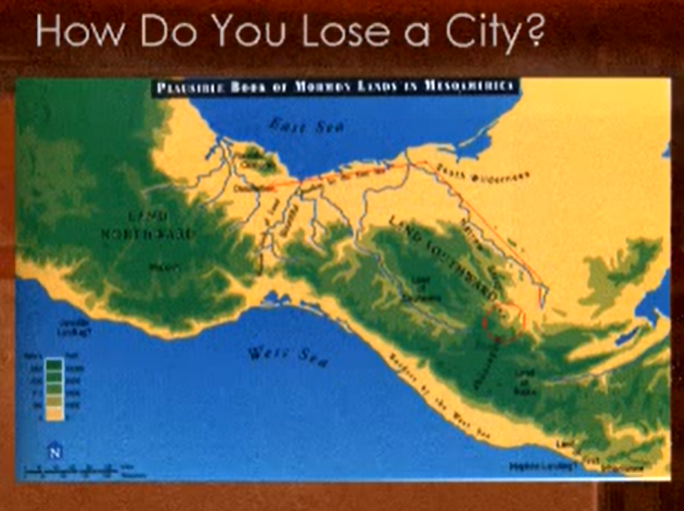
How Do You Lose a City?

How do you lose a city?

Zarahemla might not have been the biggest city around and frankly was not, should not have been. When they get to Zarahemla they’re actually very homesick for where they came from probably because they’ve now gone to the backwater 14 after coming out of a real nice place which is probably why the people of Limhi want to go back and inherit that land—so they do—and they go down and after a long period of time with King Noah and everybody else they get dominated by the Lamanites, things really aren’t very good and so they’re hoping for Zarahemla to come help them out and somehow rescue them.

So they send a party to go back to Zarahemla—and they can’t find it! This is only a generation later. I’m not even that bad with directions. How do you lose a city when the instructions are ‘go to these mountains, find the river and follow the river until you hit the city’?

Follow…Which River?

There are two rivers. This is the Grijalva and the Usumacinta. It doesn’t quite show you there but one of the things that Larry Poulsen noted when he was doing some research on this is that the headwaters of those two rivers are only a mile apart in the same mountains.

They followed the wrong river. They did exactly what their parents told them to do—go to the river, follow it. Wrong river. How did they lose Zarahemla? It wasn’t on that river.

However, when you get up here, what’s up there? Jaredites. It’s exactly what they were supposed to find.

How do you do that if you don’t know this geography? How do you make that mistake so right? That is a convergence. If it were the only convergence it would be a curiosity but it isn’t.

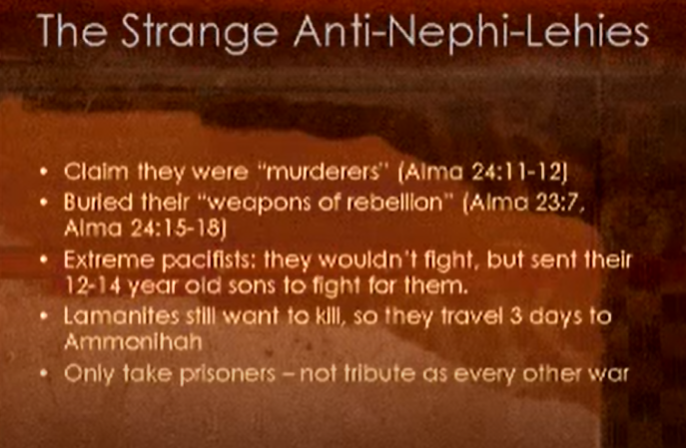
The Strange Anti-Nephi-Lehies

Two years ago I was here and I talked about the strange case of Ammon at the Waters of Sebus and talked about that being a weird story. I’ve told that a couple of times and people really get nervous when I talk about weird stories in the Book of Mormon and they think I’m basically disrespectful or don’t like it.

That, first of all is not true, I love the Book of Mormon. Secondly, this is really a weird story! This one’s probably the strangest story in the Book of Mormon because it makes absolutely no sense whatsoever so forget about the fact that this is a faith-promoting story, take your faith hat off and listen to the stupid story!

First of all the people of Anti-Nephi decide that they are going to lay down their weapons and not fight because they claim they were all murderers. Now think about that—when did the women and children murder anybody?

Even if the men were off murdering in war, and by the way you never define murder in war—soldiers never murder. We would have to redefine it differently so that we could go ahead and do it. But when did the women and children do it? And they’re saying they’re all “murderers” and this is a terrible thing. (Alma 24:11–12)

Burying the “Weapons of Rebellion”

Next one. They bury their “weapons of rebellion.” (Alma 23:7, Alma 24:15–18)

That sounds interesting—they’re going to bury their weapons. Now, how many of you out there if you had a million dollars and you buried it in your background and you thought you needed some of it might go dig it up? You know if I buried the darn thing I know where it is.

That doesn’t really prevent me from doing much with it. Why is burying this thing—first of all why do it in the first place and secondly, why do I think that’s going to do anything? If I want my sword I’ll go dig the darn thing up.

Extreme Pacifism and the Anti-Nephi-Lehies

Now, they are extreme pacifists, they are so pacifistic that they are not going to take up a weapon in their own defense and they are going to allow someone to kill them rather than to fight back. That’s pacifism. That’s really remarkable and these same people sent their 12 to 14-year-old sons off to war and said, see you later I’m not going. I’m not going to fight. But you, good luck. That’s weird. That’s a dumb story. It just doesn’t happen.

We’ve got the next two: the Lamanites when they finish killing all these people they decide that they still want to kill someone. They’ve got this bloodlust so they take a two or three-day hike off to a city and go attack them. You know somewhere along the second day of marching I would probably say, I don’t feel like killing anybody anymore. Can I go home? Can I have a hot meal? Why do you go that far away to go kill somebody? You had people right there.

Next, this is the only story in the Book of Mormon where we talk about a Lamanite attack where the Lamanites don’t try to dominate the city and set up a tribute relationship so that they can get an economic benefit from having conquered that city. These guys go in, they just kill people and leave but it’s the only time we ever get a mention in the Book of Mormon that they take prisoners. Why toss that odd little piece in?

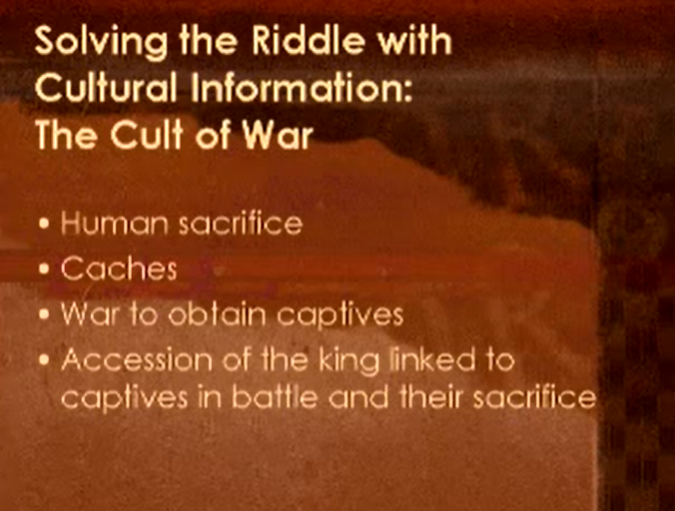
Solving the Riddle with Cultural Information: The Cult of War

Human sacrifice

This is where Mesoamerica comes to our help to tell us why this particular story sounds so dumb to us but works in the context of this part of the world. The religion of most Mesoamericans can be summed into the cult of war—where war is a sacred thing and war is part and parcel of your religion.

Part of this is not only killing people in warfare but bringing people back and then sacrificing them. Now think about the people who have claimed that they are murderers. When do they murder? Well, they probably didn’t. But if:

  1. they have been converted to the gospel and
  2. they have learned that human sacrifice is probably not something that they ought to do

Those people who have participated in, condoned and experienced the religion that did condone human sacrifice might have a different view of how their participation would be viewed.

Caches

Secondly, if their participation in the human sacrifices were distinctly related to war, and all of the feelings about that ancient religion were stirred up when they went to war, that will tell you:

  • why they didn’t want to go to war;
  • why they did not want to pick up any weapons;
  • why that was, for them, the hardest thing that they were going to do.

There were so many connections that were made between those actions and what they were trying to do.

In Mesoamerica it is a known procedure that people at the beginnings of new things and at the endings of certain things would cache objects—which means they would bury them. They would dig a pit and they would drop them in.

The Book of Mormon does not tell us this particular detail (probably, again, because it doesn’t need to), but most of the things that were cached were ritually broken. It is highly likely, given the context and the culture of that area, that we are talking about a cache. The reason they couldn’t go dig it up again is because they ritually broke, as an offering to God, all of their weapons as they offered their weapons to God in the earth. Which was a standard practice in that area.

War to obtain captives

Next, we have a war and part of the idea of war is to obtain captives so that’s, again, part of what we’re doing, we’re going off to Ammonihah to get prisoners.

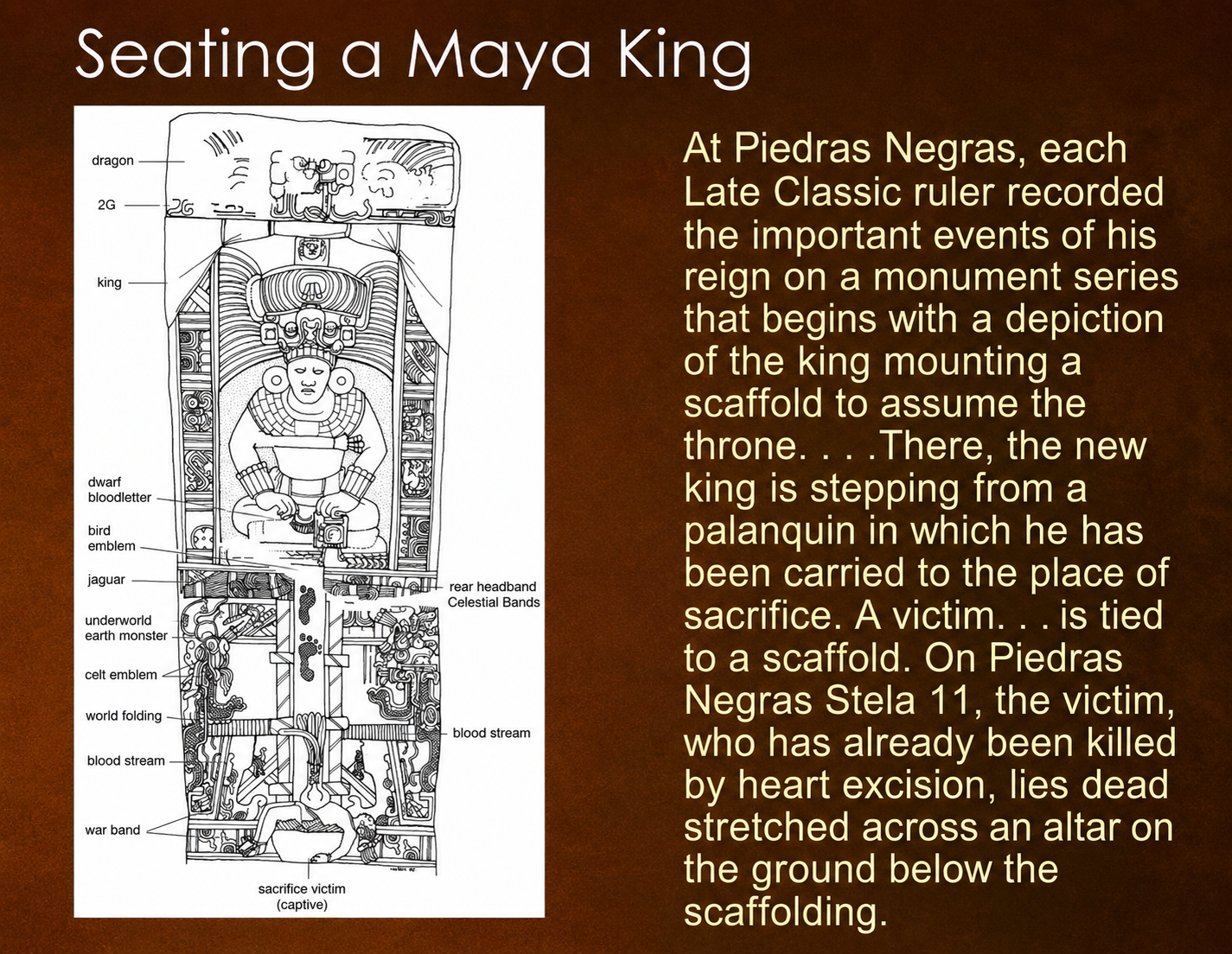
Accession of the king linked to captives in battle and their sacrifice 15

Then the very last thing that we have to know is how do you seat a new king? Well I’ll pop the slide up. I won’t read it. (Just so you get at least one Mayan picture while we’re here!) The people who are coming into the city of Anti-Nephi-Lehi to take it over were doing so with the express purpose of:

  1. capturing the city,
  2. removing the previous king, Anti-Nephi-Lehi,
  3. and setting up their own king.

They succeeded. They did not have any opposition therefore they must have been able to take over the city and set up their new rule.

When you have a new king how do you install that new king? And in the Mayan world, you seat them on their throne. But one of the things that you must do in order to properly seat a Maya king is you must sacrifice a prisoner captured in battle.

The Anti-Nephi-Lehies didn’t fight back, didn’t count. So you had to do what other texts have told us that other kings did, you go off to some unsuspecting city that’s probably going to be easy pickings 16 but who will fight back, fight them, get your captives, come back, install your king.

When the “Stupid” Story Makes Sense

In the context of Mesoamerica, this “stupid” story all of a sudden makes perfect sense. Of course it happened that way. But the only way we know why it happened the way the text tells us that it happened is by:

  • knowing where the Book of Mormon took place;
  • having a convergence not only of the geography into a place, but of the time, of the location, of the people, of all of these events and cultures where the text of the Book of Mormon converges with the information that we get out of Mesoamerica.

And not only tells us that the Book of Mormon took place there, but knowing that tells us more about the Book of Mormon than we might possibly have known otherwise.

We Can’t Unsee the Dog

Having been through the Book of Mormon for a long time, this is the “dog”. We are still in the process of

  • putting pieces together,
  • drawing in the outlines,
  • making sure that we have the details right.

Someday, perhaps, we’ll get to draw in the hair! But the “dog” is there.

Having been through the text, having looked as carefully as I possibly can—and, believe it or not, with the exact same rigor that I used in the paper where I came up with the idea that I didn’t like the Quetzalcoatl correlation, using those same tools, those same rigors—the “dog” is there, and I cannot for the life of me “unsee the dog.”

This is a different book than I read 20-30 years ago. But boy is it fascinating, and is it interesting! I get more and more interested in it the more I learn and the more I see. And it’s a much better book than I’d ever thought it was going to be. Though, it is still the one thing that I thought it was – which is *true*. And I bear you that testimony in Jesus’ name, Amen.

Questions and Answers

Have there been any cities, ruins, etc. believed to be the Book of Mormon peoples rather than Mesoamerican peoples?

Q: Have there been any cities, ruins, etc. believed to be the Book of Mormon peoples rather than Mesoamerican peoples?

GARDNER: Let me give you the real quick answer to that, my answer is no because I can’t tell you the difference between Book of Mormon peoples and Mesoamerican peoples. We’re in the wrong state to ask this question but if I were in New Mexico I would actually ask you how many of you had a neighbor who wasn’t a Mormon?

Up here that’s a little bit more difficult to do, but I suppose that you’ve all been to a state where there isn’t one. What does a Mormon car look like? I realize it looks like a minivan! (Laughter) But you know, there are actually other people who drive them. What does a Mormon house look like that’s different?

The material culture that we have is the material culture that everybody else has. 17 In my neighborhood you go up and down the street and there is no way from looking at the outside of the house, from looking at the cars, if you went inside from looking at my pots and pans and plates—there’s no way you could tell what my religion was.

Material culture does not tend to do that. So, as John Clark has said, we’ve probably found Nephite ruins and Nephite artifacts. We just can’t tell the difference because they look like everybody else’s.

Does the Book of Mormon ever suggest or imply mingling with indigenous peoples? Or why would the Book of Mormon peoples choose to include that?

Q: Does the Book of Mormon ever suggest or imply mingling with indigenous peoples, or why would the Book of Mormon peoples choose to include that?

GARDNER: I do believe that it certainly implies that. There’s only one text I know of where the implication is as explicit as we’re going to get it. Which is when Nephi and his brothers are leaving after the split.

And Nephi is taking all the people to go up to the Land of Nephi. He goes through and he names names, and he says

  • this person went with me, and
  • this person went me and
  • this person went with me and t
  • his person . . .

And he doesn’t name Laman or Lemuel. We’re pretty sure we know why they didn’t go with Nephi—since they were trying to kill him. We’re reasonably certain that Laman and Lemuel’s wives and children would remain with them. But other than that, Nephi seems to have named everybody we’ve ever known about that we’re not pretty sure has died by the time you get to this separation of people. And yet at the end of this time, when he’s named just about everybody there is to name he says, “and all others who would go with me.” Well, who the heck were these others?

The Others Nephi Talks About

The next thing that happens, if you’re looking at the text, as you go through and you say, well if there were others there does the text give us that hint? And I won’t go into the reasons but there’s several reasons to believe that the text simply doesn’t work without others there.

There’s also a speech that Jacob gives at Nephi’s behest specifically talking about a passage in Isaiah that makes absolutely no sense whatsoever unless there are others with the group at the time. So then the next question is, why don’t they mention that?

A complicated issue and if you remember what Matthew Brown was talking about in texts, what you have as a text may or may not represent all of the rest of the information that you might have had. You’ve got a text and you have to do deal with.

But we have a text to and we don’t have either the text that Nephi wrote about the more mundane things nor do we have what Mormon abridged to that text; all we have is the secondary text Nephi explicitly tells us that he’s writing it for entirely different reasons and if you look at 1st Nephi it is an incredibly well crafted document. 2nd Nephi falls apart frankly, we are like disappointed in my boy Nephi because 1 Nephi is great and 2 Nephi kind of fades but he planned it.

Ethnogenesis and the “Others”

Now, one of the things that I’ve just learned recently is that there some patterns of ethnogenesis when you’re trying to explain how you get a new people and there are several things that happen there but one of them is that you create these dichotomies between the insider and the outsider.

Why doesn’t he mention the others? They’re not relevant to his story of ethnogenesis. What’s relevant is that there’s a split and he’s trying to define who the Nephites. These others are now part of the Nephites, he doesn’t need to define them as separate—it is his intent to define them as part of the group and is opposed to everybody else.

Since the whole face of the land was altered at Christ’s death why should today’s geography correspond to pre-Christ geography?

Q: Since the whole face of the land was altered at Christ’s death why should today’s geography correspond to pre-Christ geography?

GARDNER: How many of you remember Mount St. Helens? I have a little bottle of ash that somebody collected for me. Mount St. Helens really looks different. The whole face of Mount St. Helens is really quite different but I know where Mount St. Helens is. It hasn’t moved.

Although the face of the land changed, that is a literary reference to the degree of change in the land. It’s not a change that says,

“by golly I could not find my way home because all the roads were backwards.”

That simply doesn’t happen.

If you are going to look at the Book of Mormon and say that it happened as a real text, you have to assume that there’s a real world behind it. And the real world simply doesn’t change so dramatically that we would not be able to recognize it. Certain things are going to change, but not that many.

Answers in this Presentation

What does Brant Gardner mean by “convergence” in Book of Mormon studies?
He means multiple independent pieces of historical evidence that fit together rather than a single similarity or parallel being treated as proof.

Does Brant Gardner claim the Nephites were Maya?
No. Gardner explicitly says he does not believe the Nephites or Lamanites were simply “Maya,” but proposes that Book of Mormon peoples participated in broader Mesoamerican cultures.

Does Gardner identify the Jaredites as the Olmec?
No. He specifically cautions against equating them, suggesting instead that the Jaredites may have participated in Olmec culture.

Why does Gardner compare Book of Mormon evidence to “seeing the dog”?
He uses an image of a Dalmatian formed by scattered spots to illustrate cumulative evidence: individual dots may mean little, but together they can form a recognizable pattern.

How does Mesoamerican culture help explain the Anti-Nephi-Lehies?
Gardner proposes that Mesoamerican practices involving ritual caches, warfare, captives, sacrifice, and royal accession provide a cultural context for details in the Anti-Nephi-Lehi narrative that can otherwise seem puzzling.

Search topics

Book of Mormon evidence in Mesoamerica; Book of Mormon historicity; Book of Mormon archaeology; Book of Mormon geography; Mesoamerican geography; archaeological evidence for the Book of Mormon; Brant Gardner convergence; Book of Mormon cultural convergence; Book of Mormon chronological convergence; Book of Mormon warfare; Nephites and Maya; Jaredites and Olmec; Mulekites; Zarahemla; Anti-Nephi-Lehies; Waters of Sebus; Mesoamerican political systems; Mesoamerican kinship; ancient American cultures

Book of Mormon anachronisms; archaeological criticism of the Book of Mormon; Book of Mormon geography criticism; Book of Mormon historicity criticism; CES Letter Book of Mormon archaeology; CES Letter Book of Mormon evidence; Book of Mormon evidence criticism; Joseph Smith and Book of Mormon authorship; Book of Mormon ancient origins

Mormon’s Codex: Rich Support for Book of Mormon Plausibility

April 23, 2014 by Jeff Lindsay

Mormon_s_CodexI just finished John L. Sorenson’s monumental work, Mormon’s Codex (Provo: Neal A. Maxwell Institute, 2013). The reading took longer than I expected, but it was worth it. I will have more to say about it in the near future, but here’s an initial review.

Sorenson’s work will be viewed by many as an attempt to prove and defend the Book of Mormon using numerous random parallels and weak threads. This view both fails to grasp the value of exploring many dimensions of a physical and cultural setting when trying to evaluate a fragmentary record from an allegedly ancient source. Sorenson’s work does directly support Book of Mormon plausibility, but it also helps us to better understand the Book of Mormon and its peoples. It helps us understand the region they lived in and the many dramatic as well as subtle influences on their lives from the climate, the landscape, the surrounding peoples, the cultural setting, the plants and animals, the horticulture, the religions and languages, the patterns of war, infrastructure and social economy, political practices, and so on. Sorenson explores these in terms of what we scholars have learned about Mesoamerica and what we can draw from the Book of Mormon text, and then examines the correspondences and implications. The result is increased granularity and plausibility for the Book of Mormon record, and more informed questions for the future and new hypotheses to test. Along the way, some former objections to the Book of Mormon are soundly shelved.

Those wanting a quick and easy tool to defend the Book of Mormon will be disappointed, at least initially, for Sorenson takes over a hundred pages just laying some foundation regarding ancient Mesoamerica as well as the Book of Mormon, without providing any jaw-dropping arguments to win over converts. What he does, though, is provide new ways of looking at the text, informed by the skills of a professional anthropologist. Over the 800 pages of the text, he provides extensive evidence that the Book of Mormon fits numerous aspects of ancient Mesoamerica, ranging from issues of language, political society, practices of trade and war, the impact of natural disasters, and so forth. Some of the most interesting New World evidences known to date for the authenticity of the Book of Mormon can be found in this tome (see also my Book of Mormon Evidences pages for further information).

Why the Setting Matters

One quickly learns from Sorenson how much physical geography affects a society. The physical location of a place determines climate, available raw materials, opportunities for agriculture and other economic activities, and practical modes of transportation. It shapes political boundaries and influences strategies and tactics for warfare. Geographical barriers and isolating features like the terrain of the central depression of Chiapas can allow a region to experience reduced influence from other cultures in the area and develop its own ways more easily. These factors play major roles in the story of a people, even if those details are briefly mentioned or merely implied.

Mormons limit their ability to fully grasp the Book of Mormon when they dismiss its geographical setting as something unimportant. True, the Church has no official position on geography, and it is certainly secondary to the teachings about Christ, but its authors felt physical details were important enough to riddle their text with references to them. It’s a gritty text, linked to physical details, not just theoretical platitudes and lofty doctrine. Book of Mormon authors bothered to cite specific hills, valleys, rivers, cities, and lands with names and real physical locations carefully and accurately woven into the story. There are temples, thrones, prisons, fortifications, markets, and social structures to match: priests, kings, lawyers and judges, soldiers, and merchants. In some cases, these details matter a great deal and are part of the message for our day. Such things are not the trappings of Native American life Joseph Smith could have gleaned from his upstate New York environment, but they are elements of authentic Mesoamerican culture in the only place that offers hope of plausibly locating the places built into the text of the Book of Mormon. They matter not just for validating or defending the text, but for better understanding what happened, to whom, and why, sometimes with added understanding in drawing lessons for our day and our lives.

Aligning Details

The reasons why Mesoamerica is clearly the most reasonable setting have been discussed elsewhere and are again touched upon in Mormon’s Codex: the requirement for an ancient tradition of written language, the existence of many elements of civilization found in the Book of Mormon (armies, kings, temples, taxation, and complex social structures), the narrow neck of land, and many other details with major implications such as the apparent volcanism and seismic activity described in the text. These broad issues force us to consider Mesoamerica as the most reasonable candidate for the setting of the Book of Mormon, but if so, can the details of the text correspond in any degree with the details of Mesoamerica? This is the issue tackled by Mormon’s Codex. Literally hundreds of “correspondences” between Mesoamerica and the Book of Mormon are identified that create a powerful case that the Book of Mormon really does have its origins in Mesoamerica, so much so that scholars would be wise to reconsider the Book of Mormon as the most extensive surviving document from the ancient New World, a precious ancient codex that can teach us much outside of its spiritual message.

One can accuse Sorenson of “parallelomania,” straining to find parallels that really aren’t significant. Parallelomania is often seen in attempts to find plagiarism in the Book of Mormon. Sometimes seemingly impressive parallels can be piled up that, upon closer inspection, are contrived and can be simply due to chance or situations that naturally involve common phenomena. For example, in a written description of war in texts from Joseph Smith’s day, one should not be surprised to find descriptions of battles, prisoners taken, casualties suffered, defenses built, weapons stored, and so forth. These are common to war. It is in the uncommon details where we can see elements that may be meaningful parallels. Chance can always account for some intriguing finds, so we must be careful not to make too much of any one factor. What makes Sorenson’s work so interesting is the abundance of intricate correspondences coupled with insights from the proposed physical setting that repeatedly enhance our understanding of the text.

I was continually intrigued with the way Sorensen extracts and examines numerous social and physical details from the text of the Book of Mormon and from modern knowledge regarding Mesoamerica. His analysis based on his proposed setting helps to fill in missing details in the Book of Mormon, adding to our understanding of Book of Mormon peoples while also challenging lazy assumptions and stereotypes we sometimes import into the text.

A Mix of Broad and Narrow Details

The relationship between the Olmecs and later Mesoamerican peoples is one of the broad issues that fits the Book of Mormon remarkably well, with the rise and fall of the Jaredites and the subsequent remnants of Jaredite culture found in the Book of Mormon corresponding well in numerous ways with Mesoamerica. It’s an area that challenges unwarranted assumptions we have long made about the destruction of the Jaredites. A more informed approach must recognize, however, that in the midst of the civil war and chaos the ended the Jaredites in the Book of Mormon, that many people would have fled and survived. Since the Book of Mormon itself provides abundant internal evidences of an ongoing Jaredite tradition, with Jaredite names like Corihor/Korihor (Ether 7, 13, & 14 and Alma 30) and Nehor (Ether 7:9 and Alma 1) cropping up among the Nephites, generally associated with dissenters who had not fully bought into Nephite traditions. The remnants of Jaredite society among Nephites and Lamanites fit in well with the ways Olmec culture continued to influence Mesoamerica after their fall.

The rise and fall of the Olmecs has many parallels that can relate to the record we have of the Jaredites, and the rise of Mesoamerican cultures after the Jaredites can also accommodate the information we have regarding the Nephites and Lamanites, with numerous parallels that we can extract from the limited information we have today. Even the final destruction of the Nephites in the widespread warfare (ca. AD 350) toward the end of the Nephite record coincides remarkably well with the Early Classic depopulation in the Central Depression of Chiapas that Sorensen documents in Chapter 25.

What I found especially in Mormon’s Codex were the specific details of individual sites fit with the Book of Mormon. For example, Sorenson proposes a Mesoamerican archaeological site known as Santa Rosa as the city of Zarahemla. The archaeology of that region can accommodate the text effectively. Santa Rosa was a small chiefdom in the 3rd century BC with evidence of Olmec influence in its past, similar to what we might expect if it had been occupied by the Mulekites that had taken on the Olmec influence of their region when they arrived. From 75 BC to 50 AD, Santa Rosa saw a huge burst of activity, reaching its peak of socioeconomic activity at the time Zarahemla was experiencing its peak under the reign of judges. “Like the Central Depression [of Chiapas] as a whole, Santa Rosa was abandoned from about ad 350, very near to when the Nephites at last fled from the land of Zarahemla” (p. 586).

Analysis of the terrain around Santa Rosa helps shed light on troop movements and crop destruction from battles near Zarahemla, and helps to readily explain how travelers sent from the City of Nephi seeking for Zarahemla could have missed it and wandered into the land northward instead (see pp. 581-594).

The two key centers of cultural development in southern Mesoameria in the Central Depression of Chiapas and in the Valley of Guatemala in the first century B.C. correspond well with the land of Zarahemla (Nephites) and the land of Nephi (Lamanites) in the Book of Mormon (see p. 602-604), with detailed correspondences on many fronts. In the field of warfare, for example, the correspondences are especially interesting since just a few decades ago, there was a huge gap between expert opinion about Mesoamerica and the record of warfare in the Book of Mormon. The Mayans were viewed as having been peaceful for many centuries, quite unlike the constant warfare in the Book of Mormon text. But recent scholarship has completely reversed that view, showing that Mesoamerica was a scene of armed conflict from Olmec times and beyond, consistent with the Book of Mormon record (p. 606-7).

Understanding Mesoamerican warfare helps us recognize, for example, that Onitah, the “place of arms” mentioned in Alma 47:5 where rebellious Lamanite soldiers fled, was likely an obsidian outcropping used to produce the dominant weapons in the area, near the Lamanite heartland in the land of Nephi. Remarkably, we now know that for the people of Chiapas, the vital mineral obsidian mostly came from El Chayal, a big volcanic outcrop near Guatemala City, the prime candidate for the city of Lehi-Nephi (which became a Lamanite capital after it was abandoned by the Zeniffites; see Alma 22:1), where the archaeological site known as Kaminaljuyu is largely covered by the modern city. El Chayal qualifies well as Onitah in the Book of Mormon (p. 608). Further, lines of confrontation between Mayan groups and Mixe-Zoqueans in the region, as identified by modern scholars, also may correspond with Nephite and Lamanite boundaries in the Book of Mormon (p. 609).

Many other specific locations are discussed in depth. The results to me were somewhat overwhelming, usually interesting, and occasionally quite surprising. Dr. Sorenson has put a great deal of thought into his proposals, and while some sections are speculative and one of several possibilities, some of his proposals are difficult to dismiss.

Society

Sorenson explores numerous social issues, including the role of secret societies in Mesoamerica. He finds parallels with merchant guilds among the Aztecs and others in Mesoamerica. There were also predatory secrecy-based groups in other forms (e.g., the nahualistas) that could correspond with Book of Mormon descriptions. (See pp. 274-277.)

Natural Disasters

One of the most impressive series of correspondences is the large number of natural disasters that struck parts of Mesoamerica around 50 A.D., including volcanic activity and associated fires that can be see in geological and archaeological records. These disasters may account for some of the dramatic changes in Mesoamerica at that time, including large shifts in population and also major shifts in economics and religion. The changes included an abandonment of many long-standing cultic practices, offering an abundance of correspondences with the record at the climax of the Book of Mormon beginning around 3 Nephi 8 and beyond, when there was great destruction followed by the visit of the Resurrected Messiah, ushering in widespread changes that persisted for many decades before the region fell into widespread apostasy and warfare again, culminating in the destruction of Nephite society.

Arch Support for the Book of Mormon

As an example of the many fields of knowledge touched upon in Mormon’s Codex, Sorenson also considers evidence related to architecture. In Chapter 16, he states:

Friar Torquemada observed, “It is also worth noting the division of this [Aztec] temple; because we find that it has an interior room, like that of Solomon, in Jerusalem, in which the room was not entered by anyone but the priests.” Moreover, the floor plans of various Mexican temples are shown with “two [nonstructural] pillars at the entrance, at Tenayuca, Malinalco, Tepoztlan, Tetitla, Palenque, Yaxchilan, [and] Piedras Negras,” and in Late Pre-Classic Oaxaca. Since the temple in the city of Nephi was specifically patterned after the first Israelite temple (2 Nephi 5:16), it would have incorporated the two-pillar feature discussed by, for example, Meyers. It could have in turn modeled the feature for subsequent Mesoamerican temples.
Another architectural feature of note might or might not have been incorporated in temples: the true arch. For years it was assumed that Mesoamericans lacked knowledge of the true (keystone) arch. Over the years, reported finds have demonstrated the contrary, but only very recently has a comprehensive survey of those cases definitely shown that the principle was widely known, though little used. Hohmann now states unequivocally that “the principle of the true arch was already known amongst the Maya in the preclassic period.” He adds that the principle was also used at Monte Albán by around ad 600 and still later at Chichen Itza. The arch was, of course, widely known in some Old World centers much earlier. If the concept was not imported by transoceanic migrants, we would have to accept the somewhat questionable idea that it was invented independently on opposite sides of the earth. In light of the extensive evidence of cross-oceanic voyaging presented in chapter 9, it is more plausible that knowledge of this architectural feature was imported to Mesoamerica, whether by a group reported in the Book of Mormon or by others. The arch principle may or may not have been used in Nephite sacred buildings in this hemisphere (it was not used in Solomon’s temple), but the probability that the keystone arch came to Mesoamerica from the Old World supports the Nephite record’s historical assertion about the Near Eastern origin of the founders of its tradition. (p. 327)

These architectural details are issues I had not previously considered.

Transoceanic Diffusion: Plants, Animals, Disease, Cultural Practices, Architecture, and More

One of Sorenson’s strengths is his vast body of knowledge regarding evidences for ancient contact between the New and Old Words. Primarily in Chapter 9, “Transoceanic Voyages,” and also in Chapter 12, “Human Biology,” he provides conclusive evidence that there were episodes of transoceanic contact between the Old and New World before Columbus, consistent with general Book of Mormon claims. He delves into several topics with rich examples and references, especially for plants and diseases. One of the most interesting discussions, in my opinion, involves the hookworm (pp. 159-160). The hookworm points to ancient human contact via oceanic crossing, not wandering along the Bering Strait, because the life cycle of the parasite requires warm soil. A people moving through the Bering Straight would become hookworm free by the time they reached the Americas. The pre-Columbian presence of this southeast Asian parasite in a Peruvian mummy dating to AD 900 and in much older Brazilian remains (ca. 5000 BC) seems to require one or more ancient transoceanic voyages by human hosts from the Old World to the Americas. This is one of an abundance of evidences Sorenson provides for ancient transoceanic contact between the Old and New Worlds. It is not central to his thesis relating to the Book of Mormon, but is supporting evidence for the plausibility of the kind of migrations described by the Book of Mormon.

Future Work

Sorenson repeatedly explains how little is known about many key regions and specific sites, many of which have not had extensive digs. Some, of course, cannot be explored adequately because they may be covered by modern cities or, in some cases, by lava flows. Others are in difficult terrain, often coupled with political and security risks, making exploration difficult and dangerous. But we hope much further exploration will take place. Sorenson offers many hints about regions in need of more research, and even offers what may be taken as tentative predictions of some things to look for. For example, Laguna Mecoacan is identified as a good candidate for the City of Moroni (Alma 50:13) which would sink into “the depths of sea” (3 Nephi 9:4), possibly into the lagoon. This would be an intriguing find, though the city was probably small, having been built primarily for defensive purposes in a war. But finding a sunken city there dating to around 50 A.D. would be interesting.

A more important place to investigate might be the candidate Sorenson offers for the Nephite city of Bountiful. He feels it should be at the mouth of the Tonala River, about 6 miles downstream from La Venta. The modern community of Tonala is built over a large archaeological site overlooking the mouth of the river. There is a large pyramid there, and it is in its debris where the town’s cemetery is located. Sorenson states that as far as he known no trained archaeologist has even visited the region, much less conducted detailed investigation. If future work there shows that it was inhabited during the Late Pre-Classic era, corresponding with the Book of Mormon description, this could be another interesting correspondence.

Much remains to be understood and future exploration and research is sorely needed. But what we do know does provide an abundance of evidences and insights that can be of great value to students of the Book of Mormon. I highly recommend this complex and, yes, heavy volume.

*Cross-posted from Mormanity. See also John Sorenson’s 2012 FairMormon Conference presentation “Reading Mormon’s Codex.” Mormon’s Codex can be purchased at the FairMormon Bookstore.

Filed Under: Book of Mormon, Book reviews Tagged With: Book of Mormon, Book of Mormon evidences, John Sorenson, Mesoamerica

Primary Sidebar

Faithful Study Resources for Come, Follow Me

Subscribe to Blog

Enter your email address:

Subscribe to Podcast

Podcast icon
Subscribe to podcast in iTunes
Subscribe to podcast elsewhere
Listen with FAIR app
Android app on Google Play Download on the App Store

Pages

  • Blog Guidelines

FAIR Latest

  • Jesus Christ—the True Vine
  • Come, Follow Me with FAIR – Isaiah 1–12 – Part 2 – Autumn Dickson
  • Come, Follow Me with FAIR – Isaiah 1-12 – Jennifer Roach Lees
  • Come, Follow Me with FAIR – Isaiah 1–12 – Part 1 – Autumn Dickson
  • Because of Jesus Christ

Blog Categories

Recent Comments

  • Willie Louise Truitt on The Joy of a Covenant Relationship with God
  • Katrina on In memory of Chandler “Chuck” Hendry
  • Nancy Farmer on Come, Follow Me with FAIR – Psalms 49–51; 61–66; 69–72; 77–78; 85–86 – Part 1 – Autumn Dickson
  • Nicko De Leon on In memory of Chandler “Chuck” Hendry
  • Becky Matson on In memory of Chandler “Chuck” Hendry

Archives

Follow Us

  • Facebook
  • Twitter
  • iTunes
  • YouTube
Android app on Google Play Download on the App Store

Footer

FairMormon Logo

FAIR is a non-profit organization dedicated to providing well-documented answers to criticisms of the doctrine, practice, and history of The Church of Jesus Christ of Latter-day Saints.

Donate to FAIR

We are a volunteer organization. We invite you to give back.

Donate Now

Site Footer

The use of the temple in past and current logos and the name "Mormon" are licensed for use by The Church of Jesus Christ of Latter-day Saints.