• Skip to primary navigation
  • Skip to main content
  • Skip to primary sidebar
  • Skip to footer

FAIR

  • Find Answers
  • Blog
  • Media & Apps
  • Conference
  • Bookstore
  • Archive
  • About
  • Get Involved
  • Search

translation

Learning About the Founding of Mormonism from Jon Krakauer (And Other Fallacies)

July 30, 2012 by Stephen Smoot

I like to consider myself a fairly open-minded guy. After all, I am studying history (particularly religious history) as my college major, which has exposed me a plethora of divergent world views. I know what it feels like to be an outsider of a religion looking in, so I often cut people slack when they approach Mormonism from perhaps not the greatest vantage.

That said, I have some serious misgivings when someone begins an article on the history of Mormonism like this:

And how did Mormonism come to be, anyway? Wasn’t it founded only a relatively little while ago by some dude in upstate New York? (Upstate New York?!)

I didn’t know the answer to any of these questions.

So, I’ve begun searching for answers.

My first stop, which which all the information below comes from, was John Krakauer’s 2003 book Under The Banner Of Heaven: A Story Of Violent Faith.

Yikes! There’s a big red flag right there. Allow me to explain. Jon Krakauer has penned a popular, yet highly questionable book on Mormonism. The punchline to Krakauer’s book is something along the lines of: “Mormonism, an inherently violent faith, is a shining example of how religious fundamentalism is dangerous, and will lead to killing people.”

There are so many problems with Krakauer’s book that to enumerate them here would take some considerable time. So instead I would direct the reader to this useful review of Krakauer’s book by Craig Foster. (Also don’t forget the Church’s posted review on the LDS Newsroom website.) [Read more…] about Learning About the Founding of Mormonism from Jon Krakauer (And Other Fallacies)

Filed Under: Apologetics, Book of Mormon, Joseph Smith, LDS History Tagged With: 1826 trial, Book of Mormon, Seer Stone, translation

FAIR Issues 30: Joseph’s translation shows remarkable consistency

November 25, 2011 by Mike Ash

https://media.blubrry.com/mormonfaircast/www.fairlatterdaysaints.org/wp-content/uploads/2011/11/Josephs-translation-shows-remarkable-consistency.mp3

Podcast: Download (5.9MB)

Subscribe: RSS

The entire Book of Mormon was translated in a span of 65 to 75 days. As Joseph translated, he did not have any manuscripts or books from which to read. After spending hours dictating the translation, Joseph would take a break for a meal or other interruption, then pick up the translation where he had left off, without either seeing the manuscript or having any portion of it read to him. If Joseph was dictating fiction and never had past portions read back to him, how did he keep things straight and consistent for nearly six hundred pages without forgetting at least some of the details?

We stand in awe at how this relatively uneducated young man could produce a work that not only teaches eternal doctrinal principles but also weaves many tales of war, politics, migrations, and geography. Not only are the records of these events consistent, but they often match what we now know about ancient societies in the Near East and early Americas.

The full text of this article can be found at Deseret News online.

Brother Ash is author of the book Shaken Faith Syndrome: Strengthening One’s Testimony in the Face of Criticism and Doubt, as well as the book, of Faith and Reason: 80 Evidences Supporting the Prophet Joseph Smith. Both books are available for purchase online through the FAIR Bookstore.

Tell your friends about the Mormon FAIR-Cast. Share a link on your Facebook page and help increase the popularity of the Mormon FAIR-Cast by subscribing to this podcast in iTunes, and by rating it and writing a review.

Filed Under: Book of Mormon, Joseph Smith, Podcast Tagged With: Book of Mormon, Podcast, translation

FAIR Issues 29: Some Mormons may not understand Joseph’s translation process

November 9, 2011 by Mike Ash

https://media.blubrry.com/mormonfaircast/www.fairlatterdaysaints.org/wp-content/uploads/2011/11/Some-Mormons-may-not-understand-Josephs-translation-process1.mp3

Podcast: Download (5.3MB)

Subscribe: RSS

In reviewing the history of the Book of Mormon translation, some members may be troubled that the process doesn’t match their conceptions of how they thought the process worked. For members who were unaware of the seer stone in the hat, at least two questions or concerns may arise: 1) Is it strange that Joseph used a stone in a hat? 2) Why have we have always been told that Joseph used the Urim and Thummim? 3) Why isn’t the seer stone used today? Mike Ash addresses these questions in this episode.

The full text of this article can be found at Deseret News online.

Brother Ash is author of the book Shaken Faith Syndrome: Strengthening One’s Testimony in the Face of Criticism and Doubt, as well as the book, of Faith and Reason: 80 Evidences Supporting the Prophet Joseph Smith. Both books are available for purchase online through the FAIR Bookstore.

Tell your friends about the Mormon FAIR-Cast. Share a link on your Facebook page and help increase the popularity of the Mormon FAIR-Cast by subscribing to this podcast in iTunes, and by rating it and writing a review.

Filed Under: Book of Mormon, Podcast Tagged With: Book of Mormon, Podcast, translation

FAIR Issues 28: How a seer stone helped in the Book of Mormon translation

November 2, 2011 by Mike Ash

https://media.blubrry.com/mormonfaircast/www.fairlatterdaysaints.org/wp-content/uploads/2011/10/How-a-seer-stone-helped-in-the-Book-of-Mormon-translation.mp3

Podcast: Download (5.7MB)

Subscribe: RSS

Before starting the translation of the Book of Mormon, Joseph Smith was familiar with the concept of using stones to “see” things. Like some others of his time, he actually engaged in the practice of using stones in an effort to find things. His familiarity with seer stones may have prepared him for the concept of using the Nephite interpreters to translate once he received them along with the golden plates from the angel Moroni. After the Nephite interpreters were taken from him, he was able to continue the translation process with a seer stone that he owned. Some of the history surrounding these events is discussed in this article.

The full text of this article can be found at Deseret News online.

Brother Ash is author of the book Shaken Faith Syndrome: Strengthening One’s Testimony in the Face of Criticism and Doubt, as well as the book, of Faith and Reason: 80 Evidences Supporting the Prophet Joseph Smith. Both books are available for purchase online through the FAIR Bookstore.

Tell your friends about the Mormon FAIR-Cast. Share a link on your Facebook page and help increase the popularity of the Mormon FAIR-Cast by subscribing to this podcast in iTunes, and by rating it and writing a review.

Filed Under: Book of Mormon, Joseph Smith, Podcast Tagged With: Book of Mormon, Podcast, translation

Joseph the Seer—or Why Did He Translate With a Rock in His Hat?

Brant A. Gardner

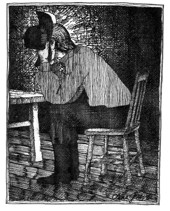
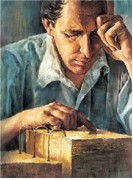
Two pictures:

[To the left] The manner of translation was as wonderful as the discovery. By putting his finger on one of the characters and imploring divine aid, then looking through the Urim and Thummim, he would see the import written in plain English on a screen placed before him. After delivering this to his emanuensi,[sic] he would again proceed in the same manner and obtain the meaning of the next character, and so on till he came to the part of the plates which were sealed up.1

Truman Coe, Presbyterian Minister living among the Saints in Kirtland, 1836

[To the right] I cheerfully certify that I was familiar with the manner of Joseph Smith’s translating the book of Mormon. He translated the most of it at my Father’s house. And I often sat by and saw and heard them translate and write for hours together. Joseph never had a curtain drawn between him and his scribe while he was translating. He would place the director in his hat, and then place his [face in his] hat, so as to exclude the light, and then [read] to his scribe the words as they appeared before him.2

Elizabeth Ann Whitmer Cowdery, Oliver Cowdery’s wife, 1870

These two descriptions of Joseph Smith translating the golden plates paint radically different pictures of the same event. It easy to accept the finger-on-the-plates translation, but the rock-in-the-hat feels completely foreign. Nevertheless, it is a much better attested description of the process than the first.

Why do we have both of these pictures if the second better fits the majority of descriptions? To answer that question, there are two stories that must be told: first–why would anyone think of translating with a rock in a hat?–and second–why we are so surprised at that?

Why Do You Look At Rocks in Your Hat?

When the English left their villages and emigrated to the New World, they brought their customs and beliefs with them. Along with the hopeful, the adventurers, and the farmers,-—cunning men and wise women disembarked in the New World.3 To be a cunning man or a wise woman was to play a well defined and important role in pre-industrial villages. Keith Thomas, retired Professor of Modern History at Oxford University, wrote what has become the principle history of folk magic in England from the sixteenth to the nineteenth centuries. He tells how, in the villages, contemporary medicine drove people to the cunning men and wise women who understood herbs. The lack of local police forces made the community depend on cunning folk to find lost or stolen goods.4 These village specialists performed such important functions that Thomas notes that the community was “likely to believe that the cunning folk were taught by God, or that they were helped by angels, or even that they possessed some divinity of their own. The common people, wrote Thomas Cooper, assumed that the power of these wizards came by ‘some extraordinary gift of God’.”5

The cunning men and women exhibited their extraordinary talents in many ways, but there is one that provides the backdrop against which young Joseph Smith is more clearly defined. He belonged to a class of cunning men whose specialty was scrying, or seeing the hidden. It was a specialty with a very long and almost universal history.6 Anthropologist Andrew Lang, writing in 1905, describes the tools of their trade:

Not only is the plain crystal, or its congener the black stone, used, together with its first cousin the mirror, and the primitive substitute of water, but almost any bright object seems to have been employed at one time or another. Thus we find the sword among the Romans; and in mediaeval Europe polished iron . . . lamp-black is sometimes smeared on the hand, or. . . a pool of ink poured into it; visions are seen in smoke and flame, in black boxes, in jugs, and on white paper. . . .7

All of these methods sound strange to our modern ears, but they were not only accepted but revered for most of human history. By the time we find scryers or seers in England between the seventeenth and nineteenth centuries, their tools were often stones and their functions had evolved into two general forms; seeing a hidden future, and seeing the hidden location of things that were lost (or the thief who made them get “lost”). The conservative nature of such practices dictated that when the traditions of the cunning men and wise women are found in the Palmyra area of the 1820s they still performed their traditional functions of telling fortunes and seeing things that were lost, hidden, or stolen.8

Young Joseph Smith was a member of a specialized sub-community with ties to these very old and very respected practices, though by the early 1800s they were respected only by a marginalized segment of society. He exhibited a talent parallel to others in similar communities. Even in Palmyra he was not unique. In D. Michael Quinn’s words: “Until the Book of Mormon thrust young Smith into prominence, Palmyra’s most notable seer was Sally Chase, who used a greenish-colored stone. William Stafford also had a seer stone, and Joshua Stafford had a ‘peepstone which looked like white marble and had a hole through the center.'”9 Richard Bushman adds Chauncy Hart, and an unnamed man in Susquehanna County, both of whom had stones with which they found lost objects.10

There are some reminiscences that tell us how the village seers operated before modern history either forgot or dismissed them.. Lorenzo and Benjamin Saunders gave interviews in 1884 remembering their dealings with the Palmyra seer, Sally Chase. Lorenzo reported:

I tell you when a man willme that anyone can get a stone, & see knowledge of futurity, I say that he is a liar & the truth is not in him. Steve Mungou lost his pocket book in the road with some $50 in money in it. He went right to Sally Chase to get her to look & see where it was; She went & looked. He was drawing wood out of the woods. She said that pocket book lays right at the side off a log in the woods where you loaded that wood. It lays right at the side of the log well we went & hunted & raked the ground over where she said but could not find it. It past along & finally one night got a paper from Canadagua [Canandaigua, New York], & in it was that a pocket book was found & taken to an old Ontario Bank[.] Took it there & the owner could come & describe his book. And he went & found his pocket book at the bank. I lost [a] drag tooth out of my drag, dragging on my brothers premises there; I says: Sally, tell me where is that drag tooth? She told me “it lays in a log heap.” She says I think it lays a little past you will find it.

I went & hunted & hunted but could not find it there. I afterwards found it away over in one corner of the field.11

Benjamin provided a similar story: “My oldest Brother had some Cattle stray away. She claimed she could see them but they were found right in the opposite direction from where she said they were.”12 These accounts portray the way Sally Chase functioned in the community. When things were lost, you went to the seer who consulted her seer stone and described how to find the lost item. The Saunders brothers could have been describing events from an English village of over a hundred years earlier. In the brief descriptions that have survived, we know that Lorenzo consulted her at least twice himself, once to find the drag tooth and once to find lost cattle. He also tells us of another client, Steve Mungou. Both brothers, however, found it necessary to append that, of course, Sally was mistaken in the location she gave, a qualification that apparently didn’t stop them from consulting her again.

Joseph Smith, long before golden plates complicated his position as a local seer, appears to have functioned just as Sally Chase did. Quinn reports that: “E. W. Vanderhoof [writing in 1905] remembered that his Dutch grandfather once paid Smith seventy-five cents to look into his ‘whitish, glossy, and opaque’ stone to locate a stolen mare. The grandfather soon ‘recovered his beast, which Joe said was somewhere on the lake shore and [was] about to be run over to Canada.’ Vanderhoof groused that ‘anybody could have told him that, as it was invariably the way a horse thief would take to dispose of a stolen animal in those days.'”13 While Vanderhoof reported a positive result of the consultation, it is interesting that his statement includes a qualifier that has the same intent as those added by the Saunders’ brothers. By the end of the century, one wouldn’t want to actually credit a village seer when describing their activities. Nevertheless, it isn’t the effectiveness that is important—it is the nature of the consultation. Sally Chase’s clients consulted her to find things which were lost, and Joseph Smith had at least one client who did the same.

The social expectations of the village seer also explain two contradictory statements about what Joseph Smith did as a village seer. The first statement comes from Henry Harris in 1833: “Joseph Smith, Jr. the pretended Prophet, used to pretend to tell fortunes; he had a stone which he used to put in his hat, by means of which he professed to tell people’s fortunes.”14 Compare that statement to a story Lorenzo Saunders told to Edmund L. Kelley during his 1884 interview:

We went to Smiths one day, it was a rainy day; We went into the old mans shop, he was a cooper, and the old man had a shirt on it was the raggedest & dirtyest shirt, and all full of holes. & we got Jo. Smith to look & tell us what color our Girls hair was. well you see by & by some of them says go to Jo. says he Jo. come look into futurity & tell us how it is there? Jo. says I can not do that, I can not look into futurity I can not look into anything that is holy. The old man stood there and says: “I guess he can not look into my shirt then.15

Both Henry Harris and Lorenzo Saunders expected that Joseph Smith told fortunes. Of course they would have that expectation, because everyone knew that was one of the typical functions of the seer. However, where Harris may simply be repeating the assumption, Saunders describes what happened when he asked Joseph to act on that assumption. At least in this case, Joseph refused. The fact that the joke in the account depends upon young Joseph’s comment about not looking at that which is Holy and his father’s holey shirt suggests that this was a remembered incident and that Joseph Smith, Jr. actually had refused. I suspect that the refusal tells us about the spheres in which Joseph believed that particular talent operated. That refusal suggests Joseph made a distinction between that which was holy (which I believe he classified as religion) and his other functions (which I believe he classified as a talent).

What the modern world tends to know about the village seers is the result of only one of the ways in which their talents were put to use. Since they could see that which was hidden, local seers became involved in the mania of digging for lost treasure. As with the other functions of the cunning men and wise women, the idea of digging for treasure traced its roots to England, including much of the accompanying lore. In England, the semi-scientific root of treasure seeking was the habit of the wealthy burying their goods for safe-keeping in the absence of a deposit banking system.16 In the New World, the plausible explanation was based on the riches reputedly buried by Spaniards or pirates. It is probable that everyone could cite cases of people who had struck it rich through their digging, though none of them had, nor anyone they personally knew.17

In English tradition, seers were invited to assist the diggers in locating the buried goods. As Thomas explains: “There was not necessarily anything magical about the search for treasure as such, but in practice the assistance of a conjurer or wizard was very frequently invoked. This was partly because it was thought that special divining tools might help, such as the ‘Mosaical Rods’ for which many contemporary formulae survive.”18

It is therefore no surprise that we see the Palmyra seers engaged in the local mania for treasure digging. As with the English practice, however, it is important to note that money-digging didn’t require the seer. They were simply seen as useful. Note the relationship of the diggers to their guides in this series of descriptions Ronald W. Walker compiled:

The adepts often played a major role in money digging. The two men who in 1827 sought neatly boxed Spanish dollars below the old pier at New London, Connecticut, were directed by an elderly wise woman. Seeking pirate treasure in Maine, three men imported from Connecticut, a “far-famed and wonderfully skillful rodsman” to assist them. In turn, treasure-hungry farmers of Rose, New York, sought the help of a “medium,” while the 1825 expedition to the Susquehanna hills began with a “peeper” named Odle, whose power of “seeing underground” piqued William Hale’s interest. Moreover, the longtime diggers around Bristol, Vermont, made use of expert advice. They consulted a series of “prophets,” including two women, an “old Frenchman” east of the mountains, and finally a conjuror who promised that by removing a few rocks and “shunning the solid ledge” the long-sought cave might be entered.19

This places an important context around the best-known case of Joseph Smith, Junior’s participation in treasure-digging. Josiah Stowell, Sr., believed that he had found a lost Spanish silver mine and had his hired hands dig for it in 1825. When they were unable to find it, he hired Joseph Smith, Jr. to help them find what they had dug for and missed.20 This incident was the reason that in 1826, Stowell’s wife’s nephew took Joseph to court as a “disorderly person,” a term that was then defined in such a way that we might consider it a case of fraud.21 Presumably, Peter Bridgeman believed that Joseph had defrauded his uncle because he used a seer stone. This would not be the last time that Joseph’s activities with a seer stone were described as fraud. In terms coined only later, Joseph would be accused of being a “confidence man.”22 One of Joseph Smith’s biographers, Dan Vogel, picks up and continues this theme. As Vogel describes the reason why one might see Joseph as a con man, he also provides the information that allows us to see the important ways in which that label is a distortion of the actual historical situation:

A typical confidence scheme in Smith’s time involved a transient who entered an area that was known for its tales of lost treasures and the charlatan’s magical powers could be put to good advantage. Using a “peep” stone or mineral rod, he would lead the credulous to a remote spot where he had previously deposited a few coins and was able to impress them by “finding” the coins. In the ensuing excitement, he would ask to be paid for his services or, more boldly, suggest that a company be established and that shares be sold. Thereupon, he would disappear with the money. On the other hand, he might string the people along by leading them to subsequent spots, then offer magical explanations for the failure to locate or secure the treasure. For instance, he might tell them that the treasure was protected by an evil spirit or that they had not precisely followed the magical formula he had given them. Eventually he would suggest that the undertaking be abandoned, whereupon he would slip out of town with the money.23

The implication is that since Joseph used a peep stone, he must be seen in the same category as those who ran a scam with one. Clearly the 1826 court appearance tells us that some contemporaries considered him in that category. However, although the evidence is complex, it appears that Joseph was acquitted of the charge at that time.24 Should he also be redeemed from the continuing charges?

Undoubtedly there were those who preyed upon the folk beliefs of the too-trusting rural communities. However, the fact that the communities would be willing to follow the confidence scheme simply tells us that there was an existing belief system in which seer stones were considered effective and acceptable. The confidence men played off inherited traditions. Nevertheless, the fact that there are dishonest pretenders in any profession does not suggest that the entire profession is designed for dishonesty. Scams were run concerning seer stones not because seer stones were novel, but precisely because they were a traditional and respected method of finding that which was hidden.

There are two critical differences between the con men and the village seers. First, the charlatans were transients and the village seers were residential. The second is that the con man elicited money for his talents, and the village seers were consulted. We have at least three descriptions of how Joseph related to his clients, including Josiah Stowell, and in each case the client came to him with their problem.25 The con men created the scam for money and left so they would not have to deal with the consequences. The true village seers were part of the community, and remained so through success and failure. Their clients came to them because of a cumulative reputation. Against the records of a few scam artists we have the long tradition of village seers stretching back to England and covering hundreds of years of respectable service in their communities.

It is this traditional context of a finder of lost things, a see-er of the unseen, that explains how rocks in the hat figure in to the story of Joseph Smith and the translation of the Book of Mormon. The plates were accompanied by the Nephite Interpreters, which were two stones set in a silver bow.26 These stones appear to have functioned in a way Joseph understood from his experience with a seer stone. Although he began translation with the Nephite Interpreters, the record indicates that he changed to using his own seer stone. Why put the stone in a hat to translate? That part of the picture is easy. That was how such a stone was used. For Joseph’s community, that aspect was not unusual at all.27

Why translate with a stone? The conceptual link in Joseph’s mind would have been that he had been able to see that which was hidden, and the meaning of the script on the plates was certainly hidden to understanding. Nevertheless, this wasn’t a simple transition from seer to translator, even for Joseph. Joseph’s talent was for the mundane, but his gift was for the Holy. Joseph understood the difference between the two when Benjamin Saunders wanted him to see into futurity. Joseph understood that when he was asked to translate, he was being asked to do something very different from what village seers did. He was being asked to do something very different from what learned men did (2 Ne. 27:15-18).

Joseph learned from his community how to operate as a village seer, but he didn’t begin to understand how to be God’s seer until Moroni appeared to him. He did not fully make that transition until the sacred interpreters helped him move from finding lost objects to finding a lost people and lost gospel. Then, having learned to see that which was Holy, Joseph never returned to the mundane functions of the village seer. Eventually, he learned that he could use a seer stone just as well as the Interpreters. Only when he learned to see that which was Holy could he translate–and then it didn’t matter the lens through which he saw.

It is at this point that some might wonder if I believe that all seers saw things in their seer stones. I believe that seers believed that that they saw things in their seer stones. Do I believe that the seer stone prepared Joseph to translate?28 Only in that it allowed him to believe that he had a God-given talent that could be used for the purpose. Nothing in the world view of the seers prepared him for translating. He didn’t originally believe that his secular stones could translate, only the sacred interpreters. Even later when he learned that he could also translate through his own seer stone, he consistently said that the translation was done through the gift and power of God, not through any kind of rock. He knew that no other village seer could do it; he knew that he could not do it, save God alone intervened. Translating the plates was beyond the realm of the village seer and firmly and exclusively in the realm of God’s Seer.

Why Are We Surprised that Joseph Used a Rock in His Hat to Translate?

If we can find a context in which Joseph translating with a seer stone makes sense, why do we have to look so hard to find it? Why isn’t it as natural for us as it was for Joseph? That story also requires that we delve into history; in this case, the history of the interconnections between what we understand to be religion and what we understand to be magic.

Judeo-Christian religion shared the cultural cradle of the ancient Middle East. Dr. Shawna Dolansky, Assistant Professor of Religious Studies at Northeastern University, notes: “Evidence from ancient Egypt and Mesopotamia suggests that the dichotomy between magic and religion that is the starting point for many discussions of magic by contemporary scholars was not necessarily evident in biblical times. The fact is, in these civilizations that were contemporary with biblical Israel, magic and religion were only beginning to be differentiated. Evidence especially from Mesopotamia shows that this dichotomy is not an inherent one, but one that gradually develops over a period of time and is intimately tied to increasing social complexity.”29

Many of the Old Testament stories that we accept as religion have much in common with magical practices. They are difficult to separate because their differentiation depended not upon the things that were done, but the way those things were perceived. Sarah Iles Johnston, professor of Greek and Latin at Ohio State University explains:

The modern scholarly quest to establish a division between magic and religion does have some roots in antiquity, insofar as both ancient and modern discussions hinge on terminology: what one chooses to call any particular activity (and, it follows, who is doing the choosing) determines whether the activity is understood as acceptable or discredited, pious or blasphemous, religion or magic. In antiquity, magic (a term that I use as a shorthand way of referring to a variety of ancient Mediterranean words) almost always referred to someone else’s religious practices; it was a term that distanced those practices from the norm–that is, from one’s own practices, which constituted religion.30

Stated simply, “what I do is religion, what you do is magic.”31

Although it is difficult to see without close examination, the Old Testament exhibits this internal/external dichotomy between religion and magic. On the one hand, it is clearly antagonistic to people who perform certain acts. For example, we find in Exodus 22:18 the verse that underlay so many later tragedies: “Thou shalt not suffer a witch to live.” Deuteronomy 18:10-12 provides a list of magical practices that should be avoided: “There shall not be found among you any one that maketh his son or his daughter to pass through the fire, or that useth divination, or an observer of times, or an enchanter, or a witch, or a charmer, or a consulter with familiar spirits, or a wizard, or a necromancer. For all that do these things are an abomination unto the Lord.”

In spite of these obvious prohibitions, Dolansky notes that when you examine the nature of the practices, it isn’t the magic but the magician that is the problem. She concludes that “magic in the Hebrew Bible refers to the mediation of divine power; and in the hands of priests and prophets it is perfectly legal.”32 It is not the act, but the actor that creates the separation between religion and magic.33 David Frankfurter, Professor of Religious Studies and History at the University of New Hampshire, notes that: “people in their own cultural systems use such descriptive labels for political, sectarian, or simply taxonomic reasons, even with little reality behind the labels. Practically any practice, that is, might be labeled ‘magical’ or ‘sorcery’ under certain conditions.”34

Because these terms and concepts were socially constructed, they played an important role when social relationships changed. The division between religion and magic that affected Joseph Smith’s world (and which is perpetuated in ours), followed the tremendous social disruption of the Protestant Reformation and the Age of Enlightenment. As the Western world emerged from the Middle Ages, the Catholic Church had become the sole repository of answers to questions about how the world worked. As the Church had grown and conquered new territories, it often incorporated local religious practices into its own doctrines and understandings. In particular, local concepts of sacred space and sacred ritual often retained their sacrality while nominally moving from pagan to Christian spheres.35 The Protestant Reformation changed the definition of what was to be considered religion and what was deemed magic, and with that change, triggered massive social realignments—first in England and later in the Americas.

Where the Catholic tradition had accepted all types of sacred place and practice, the Reformation severely limited both. In redefining religion, it labeled as magic many of the aspects of Catholic sacred space and ritual.36 Richard Bushman has noted that “The Enlightenment drained Christianity of its belief in the miraculous, except for Bible miracles. Everything else was attributed to ignorant credulity.”37 Nevertheless, Jon Butler of the Department of History at Yale University points out:

By traditional accounts, magic and occultism died out in the eighteenth century: the rise of enlightenment philosophy, skepticism, and experimental science, the spread of evangelical Christianity, the continuing opposition from English Protestant denominations, the rise in literacy associated with Christian catechizing, and the cultural, economic, and political maturation of the colonies simply destroyed the occult practice and belief of the previous century in both Europe and America. Yet significant evidence suggests that the folklorization of magic occurred as much in America as in England. As in England, colonial magic and occultism did not so much disappear everywhere as they disappeared among certain social classes and became confined to poorer, more marginal segments of early American society.38

It is precisely this folklorization that created the social dichotomy in practices that were accepted by, in Butler’s terms, the more marginal segments of early American society. This separation with parallel persistence is what anthropologist Robert Redfield of the University of Chicago called a Little and Great Tradition. He explained:

Let us begin with a recognition, long present in discussions of civilizations, of the difference between a great tradition and a little tradition. . . In a civilization there is a great tradition of the reflective few, and there is a little tradition of the largely unreflective many. The great tradition is cultivated in schools or temples; the little tradition works itself out and keeps itself going in the lives of the unlettered in their village communities. The tradition of the philosopher, theologian, and literary man is a tradition consciously cultivated and handed down; that of the little people is for the most part taken for granted and not submitted to much scrutiny or considered refinement and improvement.39

Although some aspects of Redfield’s separation of the traditions have been criticized,40 the basic idea of the two separate but interrelated aspects of religion in a culture has great explanatory power. Irving Hexham, professor of Religion at the University of Calgary, describes the complex modern religious history of Korea in terms of the intertwining of a Little and Great Tradition:

When a Great Tradition is in decline its Little Tradition can continue with a vigorous religious life until another Great Tradition seeks to impose its beliefs as the religion of the people. This situation of religious change is well illustrated by the course of religious history in Korea, where the shamanism of the Silla kings was officially replaced by Buddhism. But with the decline of Buddhism and the imposition of Confucian rituals by the Yi Dynasty shamanism once more emerged as the enduring Little Tradition. Later in the nineteenth century when Confucianism declined, Christianity entered Korea and shamanism once more reasserted its traditional role.41

It is this ability to persist parallel to and intertwined with the Great Tradition that tells us how the social complex of the cunning men and wise women not only crossed the ocean from England, but formed a vibrant part of a defined segment of American society. The duality of traditions also explains the mutual antagonism between them. As competing explanations of reality, the two are uneasy bedfellows at best and feuding relatives at worst. D. Michael Quinn noted this division in approaches to the Little and Great Traditions: “Early Americans who did not share the magic world view condemned such beliefs and practices as irrational and anti-religious, but intelligent and religious Americans who perceived reality from a magic view regarded such beliefs and practices as both rational and religious.”42

Almost by definition, we perceive history through the eyes of the Great Tradition; the tradition with the greater social and economic standing and the tradition with greater ability to create a written legacy through the Enlightenment’s association with education. The Great Tradition writes the history that colors our perception of the Little Tradition. In the case of what we call magic, the anti-magical stance of the Great Tradition makes the folk magic Little Tradition an embarrassment. Andrew Lang, a British anthropologist of the last generation, provides a fascinating example of what happens when the Great Tradition expectation meets the Little Tradition reality: “‘I am glad to say my people are not superstitious,’ said a worthy Welsh clergyman to a friend of mine, a good folklorist, now, alas, no more, and went on to explain that there were no ghosts in the parish. His joy was damped, it is true, half-an-hour later, when his guest inquired of the school children which of them could tell him where a bwggan was to be seen, and found there was not a child in the school but could put him on the track of one.”43

The disdain of the Great Tradition for the Little Tradition is evident in an account of a trial for fraud, held in Kent, England, in 1850: “The defendant, who had the appearance of an agricultural labourer, resided at Rolvenden, where he enjoyed the reputation of being ‘a cunning man’, able to cure diseases, to explain dreams, to foretell events, to tell fortunes, and to recover lost property. He was resorted to as a wizard by the people of miles around, principally by the ignorant, but also by parties who might have been expected to know better.”44 The facts of the case are that many in the community consulted this cunning man. Of course, they had to have been ignorant folk. Nevertheless, there were some who didn’t appear so ignorant, although even they–should have known better.

Alan Taylor, a fellow at the Institute of Early American History and Culture, Williamsburg, Virginia, and an assistant professor at the College of William and Mary, explains the chasm between the Great and Little Tradition by focusing on Martin Harris:

[Martin Harris] was an honest, hard-working, astute man honored by his townsmen with substantial posts as fence-viewer and overseer of highways but never with the most prestigious offices: selectman, moderator, or assemblyman. In the previous generation in rural towns like Palmyra substantial farmers like Harris would have reaped the highest status and most prestigious offices. But Harris lived in the midst of explosive cultural change as the capitalist market and its social relationships rode improved internal transportation into the most remote corners of the American countryside. The agents of that change were the newly arrived lawyers, printers, merchants, and respectable ministers who clustered in villages and formed a new elite committed to “improving” their towns and their humbler neighbors. The village elites belonged to a new self-conscious “middle class,” simultaneously committed to commercial expansion and moral reform. Because of their superior contacts with and knowledge of the wider world, the new village elites reaped higher standing and prestigious posts from their awed neighbors.

Utterly self-confident in their superior rationality and access to urban ideas, the village elites disdained rural folk notions as ignorant, if not vicious, superstitions that obstructed commercial and moral “improvement.” Through ridicule and denunciation, the village middle class aggressively practiced a sort of cultural imperialism that challenged the folk beliefs held by farmers like Martin Harris. Harris’s material prosperity was comparable to the village elite’s but, because of his hard physical labor and limited education, culturally he shared more with hardscrabble families like the Smiths. A village lawyer needed only scan Harris’s gray homespun attire and large stiff hat to conclude that a farmer had come to town.45

We should not expect that because the Little Tradition is associated with the less educated that they were therefore simple or naÔve. Martin Harris might have been a participant and believer in the Little Tradition, but that doesn’t mean that he threw caution to the wind. The new elite might have seen Martin Harris as an ignorant and credulous farmer, but he would have seen himself as a cautious believer. His credulity allowed for true seers, but his caution told him that there were charlatans abroad. He pointedly told Joseph: “I said, Joseph, you know my doctrine, that cursed is every one that putteth his trust in man, and maketh flesh his arm; and we know that the devil is to have great power in the latter days to deceive if possible the very elect; and I don’t know that you are one of the elect. Now you must not blame me for not taking your word.”46

To resolve his question of whether or not he should support the Book of Mormon, Martin tested Joseph. When a pin Martin was using to pick his teeth fell into straw around his feet, he first attempted to find it. Not succeeding, he asked Joseph to use his seer stone to find the pin. Joseph did, bolstering Martin’s confidence that Joseph had the talent he professed.47 I find it particularly apt that the nature of the test was to find something lost. That is, of course, what a seer did.

Nevertheless, believing in Joseph as a true prophet and true seer had Martin straddling two traditions. The village seer belonged to the Little Tradition and a true prophet belonged the Great Tradition. Those in the Little Tradition understood that their quotidian practices were not religion (though they certainly didn’t consider them un-Christian). They even understood that their village practices were not respected by the Great Tradition. This is the reason that so many of those who participated in the Little Tradition attempted to separate themselves from it when they were later part of the Great Tradition, or when an interviewer from the Great Tradition asked about the old days. Richard Bushman demonstrates how this pressure affected the reminiscences of some of Joseph Smith’s neighbors:

The forces of eighteenth-century rationalism were never quite powerful enough to suppress the belief in supernatural powers aiding and opposing human enterprise. The educated representatives of enlightened thought, newspaper editors and ministers particularly, scoffed at the superstitions of common people without completely purging them. The scorn of the polite world put the Palmyra and Manchester money diggers in a dilemma. They dared not openly describe their resort to magic for fear of ridicule from the fashionably educated, and yet they could not overcome their fascination with the lore that seeped through to them from the past. Their embarrassment shows in the affidavits Hurlbut collected. William Stafford, who admitted participation in two “nocturnal excursions,” claimed he thought the idea visionary all along, but “being prompted by curiosity, I at length accepted of their invitations.” Peter Ingersoll made much more elaborate excuses. One time he went along became it was lunchtime, his oxen were eating, and he was at leisure. Secretly, though he claimed to be laughing up his sleeve: “This was rare sport for me.”48

Not only does understanding the Great and Little Traditions explain the antagonism we see in the Great Tradition histories, but the dual traditions also help explain one of the features or a Little Tradition religion when it is transformed into a Great Tradition religion. That shift in social acceptance and expectation triggers a responsive shift in the way the new religion sees itself and its history.

Morton Smith, a professor of History at Columbia University, examined this tendency in early Christianity, which began as a Little Tradition religion, but became a Great Tradition religion. Smith notes that the earliest forms of Christianity had a strong affinity with magical practices—practices that remain in descriptions of the healing miracles and turning water to wine. By the time of the gospels, however, that history was being written to remove references to magic. He concludes:

What evidence did the Christian tradition, as presented in the gospels, have in common with the picture of Jesus the magician? Since the authors of the gospels wished to defend Jesus against the charge of magic, we should expect them to minimize those elements of the tradition that ancient opinion. . . would take to be evidence for it, and to maximize those that could be used against it.

This expectation is, in the main, confirmed. The evangelists could not eliminate Jesus’ miracles because those were essential to their case, but John cut down the number of them, and Matthew and Luke got rid of the traces of physical means that Mark had incautiously preserved.49

The New Testament presented its message to, and participated in, a Great Tradition that Morton Smith notes was: “hostile to magic.”50 So also did the modern Saints tell their story within and to a Great Tradition that was hostile to magic.

As the early saints transitioned from a collection of believers into a formal religion, they began to see themselves within the Great Tradition. As with early Christianity, the stories they told of themselves naturally were recast to distance themselves from their Little Tradition heritage and provide an acceptable Great Tradition history. One of the obvious places to see this process in action is with the tools of the translation. We all know that Joseph used the Urim and Thummim to translate the Book of Mormon—except he didn’t. The Book of Mormon mentions interpreters, but not the Urim and Thummim. It was the Book of Mormon interpreters which were given to Joseph with the plates. When Moroni took back the interpreters after the loss of the 116 manuscript pages, Joseph completed the translation with one of his seer stones. Until after the translation of the Book of Mormon, the Urim and Thummim belonged to the Bible and the Bible only.51 The Urim and Thummim became part of the story when it was presented within and to the Great Tradition. Eventually, even Joseph Smith used Urim and Thummim indiscriminately as labels generically representing either the Book of Mormon interpreters or the seer stone used during translation.52

The Urim and Thummim were traditionally divinatory rocks, but most importantly, they were biblically acceptable divinatory rocks.53 From the Great Tradition perspective, their presence in the Bible made them religion, not magic. I suspect that the two interpreters made a natural comparison to the two stones, one Urim and one Thummim, from the Bible. Calling the biblical divinatory tools “rocks” instead of Urim and Thummim seems to demean them. The reverse process, calling the interpreters and seer stones Urim and Thummim, places them in a more appropriate religious category where they belong because of the sacred use to which they were put in translating the Book of Mormon.

This recasting of history was a story the Saints told themselves as much as what they presented to the world. I doubt that there was any conscious attempt to reconcile their history with Great Tradition expectations, let alone any attempt at deception. It was simply the natural response to their self-definition as a religion rather than a folk belief. It was a story told in a way that they subliminally knew was appropriate for a Great Tradition religion. The new history did not deny the past or alter the facts, but recolored them with a new vocabulary.54

Why, then, are we so surprised to learn that Joseph translated with a rock in his hat? That is a Little Tradition description and we are now firmly in the Great Tradition. We share the Great Tradition antipathy to those elements of the Little Tradition. Time has made the gap even greater than it was in Joseph’s day. Why do we have the two pictures with which we began? The more accurate, but more uncomfortable picture is a Little Tradition image. The other is a Great Tradition image. We have both because we can tell the story from two different perspectives.

Regardless of the perspective from which we tell the story, the essential fact of the translation is unchanged. How was the Book of Mormon translated? As Joseph continually insisted, the only real answer, from any perspective, is that it was translated by the gift and power of God.

Notes

1 Truman Coe to Mr. Editor, Hudson Ohio Observer, August 11, 1836 cited in Dan Vogel, Early Mormon Documents, 5 vols. (Salt Lake City: Signature Books, 1998), 1:47.

2 Elizabeth Ann Whitmer Cowdery, “Elizabeth Ann Whitmer Cowdery Affidavit, 15 February 1870,” in Early Mormon Documents, ed. Dan Vogel, 5 vols. (Salt Lake City, UT: Signature Books, 1870), 5:260.

3 Catherine L. Albanese, A Republic of Mind and Spirit: A Cultural History of American Metaphysical Religion (New Haven, CT: Yale University Press, 2007), 68. Also Jon Butler, Awash in a Sea of Faith: Christianizing the American People (Cambridge, Mass.: Harvard University Press, 1992), 67.

4 Keith Thomas, Religion and the Decline of Magic (New York: Charles Scribner’s Sons, 1971), 649-50.

5 Ibid., 266.

6 Deanna J. Conway, Crystal Enchantments: A Complete Guide to Stones and Their Magical Properties (Berkeley. Calif.: The Crossing Press, 1999), 291-3.

7 Andrew Lang, Crystal Gazing: Its History and Practice, with a Discussion of the Evidence for Telepathic Scrying (New York: Dodge Publishing Company, 1905), 32.

8 For the practices, see Thomas, Religion and the Decline of Magic, 656. Herbert Passin and John W. Bennett, “Changing Agricultural Magic in Southern Illinois: A Systematic Analysis of Folk-Urban Transition,” (reprint of a 1943 article) in The Study of Folklore, edited by Alan Dunces (Englewood Cliffs, New Jersey, 1965), 316-17, discuss agricultural magic in an Illinois town as collected in 1939, when the practices were beginning to fade. They note that they were practices that followed the Old English pattern.

9 D. Michael Quinn, Early Mormonism and the Magic World View (Salt Lake City: Signature Books, 1987), 38.

10 Richard L. Bushman, Joseph Smith and the Beginnings of Mormonism (Urbana and Chicago: University of Illinois Press, 1984), 70.

11 Lorenzo Saunders, “Lorenzo Saunders Interview, 12 November 1884,” in Early Mormon Documents, ed. Dan Vogel, 5 vols. (Salt Lake City, UT: Signature Books, 1884), 2:154-55.

12 Benjamin Saunders, “Benjamin Saunders Interview, Circa September 1884,” in Early Mormon Documents, ed. Dan Vogel, 5 vols. (Salt Lake City, UT: Signature Books, 1884), 2:139.

13 Quinn, Early Mormonism and the Magic World View, 39.

14 Henry Harris, “Henry Harris Statement, Circa 1833,” in Early Mormon Documents, ed. Dan Vogel, 5 vols. (Salt Lake City, UT: Signature Books, 1833), 2:75.

15 Lorenzo Saunders, interviewed by E. L Kelley, 12 November 1884, “Miscellany,” E. L. Kelley Papers, RLDS Church Library-Archives, Independence, Missouri, p. 11, in Early Mormon Documents, ed. Dan Vogel, 5 vols. (Salt Lake City, UT: Signature Books, 1833), 2:155.

16 Keith Thomas, Religion and the Decline of Magic, 234.

17 Ronald W. Walker, “The Persisting Idea of American Treasure Digging,” BYU Studies, 24, no. 4 (Fall 1984):433, notes: “The reality of actual treasure finds hardly explains the power and tenacity of the reassure myth “Finds’ were never commensurate with actual digging and were more a matter of accidental discovery than conscious magical enterprise. Even the discovery of mines, allegedly the most successful of the diggers’ pursuits, evoked skepticism and lacked documented results.”

18 Thomas, Religion and the Decline of Magic, 236.

19 Walker, “The Persisting Idea of American Treasure Hunting,” 439-40.

20 Richard L. Bushman, Joseph Smith: Rough Stone Rolling (New York: Alfred A. Knopf, 2005), 48.

21 Bruce A. Van Orden, “Joseph Smith’s Developmental Years, 1823-29 (JS ñ H 50-67),” In Studies in Scripture, Vol. 2: The Pearl of Great Price, edited by Robert L. Millet and Kent P. Jackson, (Salt Lake City: Randall Book, 1985),373.

22 Dale R. Broadhurst, “Joseph Smith: Nineteenth Century Con Man?” accessed July 2009 from http://sidneyrigdon.com/criddle/Smith-ConMan.htm, provides a long and nicely documented piece that clearly argues that Joseph Smith was precisely a con man, and was described as one. That he would have been seen as a con man by the writers from the Great Tradition is certainly understandable (see later in this paper). However, seem from inside his own social and economic class, the term is unwarranted and inaccurate. It is a historically accurate misrepresentation, but a misrepresentation nonetheless.

23 Vogel, Joseph Smith: The Making of a Prophet, xiv.

24 Previous records of what happened at the hearing have been supplemented by the discovery of court documents that have allowed a more complete legal analysis of the conclusions. The discussion of what happened at this hearing is beyond the scope of this papers. Sources to be consulted are: Marvin S. Hill, “Joseph Smith and the 1826 Trial: New Evidence and New Difficulties,” BYU Studies 12, no. 2 (1972):223-33, Gordon A. Madsen, “Joseph Smith’s 1826 Trial: The Legal Setting,” BYU Studies 30, no. 2 (1990):91-108, “Just the Facts: The 1826 Trial (Hearing) of Joseph Smith,” Accessed July 2009 from http://www.lightplanet.com/response/1826Trial/facts.html.

25 Vanderhoof’s grandfather came to Joseph to ask about the lost mare. Josiah Stowell came to Joseph to hire him to help find the silver mine. Martin Harris asks Joseph to find the pin he dropped in the straw (discussed below).

26 J. W. Peterson, “William Smith Interview with J W. Peterson and W. S.Pender, 1890,” in Early Mormon Documents, ed. Dan Vogel, 5 Vols., vol. 1 (Salt Lake City, UT: Signature Books, 09/03/23 1890), 508. A. W. Benton, “Mormonites,” Evangelical Magazine and Gospel Advocate 2:15 (April 9, 1840), 201, as quoted in Stephen D. Ricks, Joseph Smith’s Means and Methods of Translating the Book of Mormon (Provo, UT: Foundation for Ancient Research and Mormon Studies, 1986), 3.

27 “Palmyra Reflector, 1 February 1831,” in Early Mormon Documents, ed. Dan Vogel, 5 vols., (Salt Lake City, UT: Signature Books), 2:243, “‘Peep stones’ or pebbles, taken promiscuously from the brook or field, were placed in a hat or other situation excluded from light, when some wizzard or witch (for these performances were not confined to either sex) applied their eyes, and nearly starting [staring?] their [eye] balls from their sockets, declared they saw all the wonders of nature, including of course, ample stores of silver and gold.” Bracketed text retained from Vogel.

28 Mark Ashurst-McGee appears to see a developmental path from Joseph’s use of folk magic into his abilities as a prophet. Clearly there is a connection, but I seem to see a greater separation than he does. Mark Ashurst-McGee, A Pathway To Prophethood: Joseph Smith Junior As Rodsman, Village Seer, And Judeo-Christian Prophet, Master’s Thesis (Logan, Utah: Utah State University, 2000), iii, “For the most part, I present Joseph Smith’s divinatory development as he himself experienced it. Dowsing with a rod, seeing things in stones, and receiving heavenly revelations were as real to Smith as harvesting wheat. In order to understand his progression from rodsman to seer to prophet, one must first understand his worldview. The mental universe of early American water witches and village seers forms one of the historical and cultural contexts in which Joseph Smith developed his divinatory abilities.” Reacting specifically to this statement, my objection would be that Joseph Smith did not “develop his divinatory abilities,” but rather that they were bestowed upon him a s a gift from God, leveraging a talent he already had into the confidence to do what otherwise he would never have believed he could have done.
Alan Taylor also indicates a developmental path: Taylor, “Rediscovering the Context of Joseph Smith’s Treasure Seeking,” 21, “Indeed, I would argue that Joseph Smith, Jr.’s transition from treasure-seeker to Mormon prophet was natural, easy, and incremental and that it resulted from the dynamic interaction of two simultaneous struggles: first, of seekers grappling with supernatural beings after midnight in the hillsides, and, second, of seekers grappling with hostile rationalists in the village streets during the day.” Although these factors certainly contributed to the development of Joseph Smith the person, I do not see them as foundational for Joseph the Prophet. I see Moroni’s visit as creating a fundamental shift in his worldview, requiring that he relearn his place and reassign his talent to the Lord. It may not have been world-wrenching, but it still was dramatically different from the context of his daily life prior to that event.

29 Shawna Dolansky, Now You See It, Now You Don’t: Biblical Perspectives on the Relationship Between Magic and Religion (Winona Lake, Indiana: Eisenbrauns, 2008), 21.

30 Sarah Iles Johnston, “Magic,” in Religions of the Ancient World: A Guide, ed. Sarah Iles Johnston (Cambridge, Mass.: Harvard University Press, 2004), 140. Dolansky, Now You See It, Now You Don’t, 15, “In the case of the ancient world, it is difficult to find firm divisions between magical and religious activities until the time of classical Greece, and then those categories refer to social rather than substantive distinctions.”

31 Dolansky, Now You See It, Now You Don’t, 4: “The problem of differentiating between actions that are magical and those that are religious is important in the fields of anthropology and religious studies. Both magic and religion claim access to realms outside of ordinary reality and attempt to manipulate supernatural forces for desired outcomes in the natural world. Scholars have approached the categories of magic and religion from a variety of perspectives, distinguishing them on the basis of their techniques, social effects, and the status of their chief proponents. Some have suggested that there is no real difference, that the categories merely denote social conventions (“what I do is religion, what you do is magic”) and that the terms themselves should be dissolved altogether.

“The problem of defining magic has been a major portion of most LDS responses to the accusation that Joseph Smith participates in magic or the occult. In all cases, the problem is not with the facts, but with the connotations of the labels. See the following discussions of the use of the term “magic,” and to what it might apply: John Gee, “Abracadabra, Isaac and Jacob,” A review of “The Use of Egyptian Magical Papyri to Authenticate the Book of Abraham: A Critical Review” by Edward H. Ashment, FARMS Review, 7, no. 1, (1995): 47-67, John Gee, “Early Mormonism and the Magic World View, revised and enlarged edition,” A review of “Early Mormonism and the Magic World View, revised and enlarged edition” by D. Michael Quinn, FARMS Review, 12, no. 2, (2000):2-6, William J. Hamblin, “That Old Black Magic,” A review of “Early Mormonism and the Magic World View, revised and enlarged edition” by D. Michael Quinn, FARMS Review, : 12,no. 2 (2000 ): 3-9, Rhett S. James, “Writing History Must Not Be an Act of ‘Magic,'” A review of “Early Mormonism and the Magic World View, revised and enlarged edition” by D. Michael Quinn, FARMS Review, 12, no. 2 (2000):2-4.

32Dolansky, Now You See It, Now You Don’t, 99.

33 Ibid., 99-100.

34 David Frankfurter, “Dynamics of Ritual Expertise in Antiquity and Beyond: Towards a New Taxonomy of “Magicians”,” in Magic and Ritual in the Ancient World, ed. Paul Mirecki and Marvin Meyer (Leiden, The Netherlands: Brill, 2001), 159.

35 Karen Louise Jolly, “Magic, Miracle, and Popular Practice in the Early Medieval West: Anglo-Saxon England,” in Religion, Science, and Magic: In Concert and in Conflict, ed. Jacob Neusner, Ernest S. Fredrichs and Paul Virgil McCracken Flesher (New York and Oxford: Oxford University Press, 1989), 176, “Although there was conflict in early medieval society between the extremes of magic and religion–a product of the Christianizing process in which the converted and the church hierarchy redefined the acceptable and unacceptable–there were also gray areas of assimilation in which practices stemming from a similar outlook were transformed into something acceptable. The Christian Church, though openly countering magic with miracle, was not blind to this assimilation process as another means of conversion.

“The extremes of magic and religion or science, although well defined in most cultures, would necessarily have such gray areas between them, a product of the influences of change over time, as the acceptable and the unacceptable were redefined.”

36 Keith Thomas, Religion and the Decline of Magic, chapter 3, “The Impact of the Reformation,” provides extensive examples of the way in which this process moved through the Protestant rejection of Roman Catholicism. He concludes (75-76): “Protestantism thus presented itself as a deliberate attempt to take the magical elements out of religion, to eliminate the idea that the rituals of the church had about them a mechanical efficacy, and to abandon the effort to endow physical objects with supernatural qualities by special formulae of consecration and exorcism.”

37 Richard L. Bushman, Joseph Smith and the Beginnings of Mormonism, 7.

38 Butler, Awash in a Sea of Faith, 83

39 Robert Redfield, The Little Community and Peasant Society and Culture (Chicago: University of Chicago Press, 1960, rpt 1989.), 41-42.

40 Edith Badone, “Introduction,” in Religious Orthodoxy and Popular Faith in European Society, ed. Edith Badone (Princeton: Princeton University Press, 1990), 6: “Redfield’s work is in the tradition of the “two-tiered” models of religion that Brown seeks to escape. Like the term popular religion itself, the great tradition-little tradition distinction has helped to perpetuate the misconception that popular religion is always rural, primitive, unreflective, and traditional, as opposed to the urban, civilized, intellectual, and modern religion of the elite.” Stanley Brandes, “Conclusion: Reflections on the Study of Religious Orthodoxy and Popular Faith in Europe,” in Religious Orthodoxy and Popular Faith in European Society, ed. Edith Badone (Princeton, NJ: Princeton University Press, 1990), 187: “Despite these theoretical advances, Redfield and his followers–like the evolutionists before them–implicitly denigrated the religion of the masses. Not only did they view popular religion as less reflective and creative–in other words, more reactive–than that of the elite but they also believed that popular religion lagged behind elite religion temporally; elite beliefs and practices of one century might be discovered among the peasantry of the next.”

41 Irving Hexham, “Modernity or Reaction in South Africa: The Case of Afrikaner Religion,” in Modernity and Religion: Papers Presented at the Consultation on Modernity and Religion Held at the University of British Columbia, Dec. 15-18, 1981, ed. William Nicholls (Waterloo, Ontario: Wilfrid Laurier University Press, 1988), 81.

42 Quinn, Early Mormonism and the Magic World View, 225.

43 Lang, Crystal Gazing, 1.

44 David Vincent, Literacy and Popular Culture: England 1750-1914, Cambridge Studies in Oral and Literate Culture, ed. Peter Burke and Ruth Finnegan, vol. 19 (Cambridge, England: Cambridge University Press, 1993), 172.

45 Alan Taylor, “Rediscovering the Context of Joseph Smith’s Treasure Seeking,” Dialogue: A Journal of Mormon Thought, 19, no. 4 (Winter 1986):21. Internal references silently removed.

46 Martin Harris interview with Joel Tiffany, Tiffany’s Monthly, V , 169.

47 Ibid., 164.

48 Bushman, Joseph Smith and the Beginnings of Mormonism, 71-72.

49 Morton Smith, Jesus the Magician (New York: Barnes & Noble, 1978), 92.

50 Ibid., 146. As might be expected, Morton Smith’s presentation of Jesus as a magician is even more controversial than calling Joseph Smith a magician. John Gee, “‘An Obstacle to Deeper Understanding’.” Review of D. Michael Quinn, Early Mormonism and the Magic World View, revised and enlarged edition, in FARMS Review of Books, 12 no. 2 (2000):188 notes that Morton Smith’s idea that there were itinerant Greek magicians has been discredited. Gee does note (p. 186), “If Jesus can be seen in such a context [as a magician], why not Joseph Smith?”

51 J. V. Coombs, Religious Delusions: Studies of the False Faiths of To-Day (Cincinnati: The Standard Publishing Company, 1904), 61-62, “Dr. Wyl says that the name Urim and Thummim was first used by W. W. Phelps about the time of the publication of the Book of Commandments. This is ten years after Moroni’s visit. In the interim the work of translating is done by seer stones and stone spectacles! What a blessed thing it is that the more dignified instrument came soon enough to get into the second edition of the revelations, at the same time belated Moroni makes his advent!”

52 Richard Van Wagoner and Steve Walker, “Joseph Smith: ‘The Gift of Seeing'”, Dialogue: A Journal of Mormon Thought vol. 15, no. 2 (Summer 1982):62, “These stones could not have been the Nephite interpreters, yet Joseph specifically calls them ‘Urim and Thummim.’ The most obvious explanation for such wording is that he used the term generically to include any device with the potential for ‘communicating light perfectly, and intelligence perfectly, through a principle that God has ordained for that purpose,’ as John Taylor would later put it.” See also Mark Ashurst-McGee, “Moroni as Angel and as Treasure Guardian,” FARMS Review 18, no. 1 (2006):42.

53 This is an intentional distillation of the tradition, which would never have accepted the crude designation of “rocks” for the tradition stones the Urim and Thummim represented. There is a long tradition that they were associated with the gems on the ephod. See Cornelis Van Dam, The Urim and Thummim: A Means of Revelation in Ancient Israel (Winona Lake, Indiana: Eisenbruans, 1997), 16-23, 27-31.

54 The saints themselves would not have perceived a great division in their participation in the two cultural spheres. For them, the transition was likely imperceptible, even though they began to see themselves from the perspective of the religion they had joined. Bill Hamblin notes that they never did label themselves with any of the terms that the Great Tradition would have used to describe their Little Tradition practices. William J. Hamblin, “That Old Black Magic,” Review of D. Michael Quinn, Early Mormonism and the Magic World View, revised and enlarged edition, in FARMS Review of Books 12 no. 2 (2000): 233, makes this point in reference to Quinn’s association of the terms with Joseph Smith and his peers: “Joseph Smith never called himself a magician, sorcerer, occultist, mystic, alchemist, kabbalist, necromancer, or wizard. He did not ’embrace’ this ‘self-definition.’ Nor did any of his followers.”

The Case for Historicity: Discerning the Book of Mormon’s Production Culture


As an article of faith, Latter-day Saints affirm that “We…believe the Book of Mormon to be the word of God.” (8th Article of Faith). The book itself declares that it is “it is an abridgment of the record of the people of Nephi, and also of the Lamanites.” (Title Page of the Book of Mormon). While it is possible for the word of God to not be a history, most Latter-day Saints understand that it is not possible for this book to be the word of God if it is not the history it claims to be. As Kent P. Jackson declared: “[The] historicity [of the Book of Mormon] is fundamental to what it is and what it intends to accomplish.”1 The acceptance or rejection of the Book of Mormon as scripture often hinges on the acceptance or rejection of the Book of Mormon as history.

Lou Midgley described the basic lines of the historical debate: “There is nothing in the Book of Mormon…that suggests that it should be read as anything other than historical fact. On the other hand, critics of the Book of Mormon have always insisted that it is a product of the nineteenth century–that it reflects the thinking and the world of Joseph Smith (or one of his contemporaries) immediately prior to its publication.”2 In keeping with the dichotomous appraisal of the prophet Joseph Smith by believer and critic, both believers and critics tend to approach the question of when the text was written as an either/or proposition. For the critics this is essential, for any indication of authentic antiquity would appear to validate its historicity and therefore Joseph Smith’s claim that it represents a translation of an ancient document. For the believer, however, the faithful declaration of antiquity has led to such a focus on the ancient world that the rather obvious aspects of modern production receive little attention.

Believers seldom recognize that it really is undeniable that the conditions of the American Northeast left their imprint on the text. For instance, it was published in English, not French. Had Joseph Smith lived not too much farther northeast, “adieu” would never have been controversial.3 A slightly different set of political pressures in England in the 1600s would have kept the Geneva Bible as the standard for the English language, and the Book of Mormon would never have so clearly imitated the style of the King James Bible.4

The problem for the historian is that the Book of Mormon declares a dual creation. The plate text is declared to be ancient. The translation, however, in inextricably associated with Joseph Smith. This dual production complicates the issue, but not beyond similar efforts to understand the historicity of the Bible. The Bible, in English, is also a translation. It also faces a difference between a known history and a textually asserted history. It proposes similar issues about whether the textually asserted history might reflect actual events or only literature or myth. Historian Baruch Halpern provides an interesting analogy that he created to describe approaches to the Bible. It is appropriate to our discussion of the historicity of the Book of Mormon:

The image of the map clarifies [the various approaches to the Bible as history]. The map, say of Europe, includes cities and highways of the tenth century, of the eleventh century and so on, continuing into our own time. In effect the confessionalist maintains that all those cities were on the map from the start, that God created Europe, and the map, in the tenth century. Critical study divulges that this is not so, that some of the cities and highways appeared later, and it is the job of the historian to determine when each town, highway, and so on, was added. Negative fundamentalists, however, date the whole map by its latest elements. Because the map reflects a view from the twentieth century, they argue, it cannot be used to get at earlier times.5

Just as does the Bible, the Book of Mormon has its confessionalists who accept the text uncritically. It is also susceptible to what Halpern calls “negative fundamentalists” precisely because it has a history that is demonstrably related to the nineteenth century American Northeast. The historian’s task for the Book of Mormon is one of analyzing the various roads in its map and discerning the time period in which they were created.

Our task would be infinitely easier if we had (and could read) the original plates of Mormon. Lacking those plates makes our task more difficult, but not impossible. There are ways that we can use the modern text to examine its possible relationship to a different and ancient culture. In archaeology, contextual clues can help date the various roads of the European map to determine when they were laid down. Textual archaeology similarly requires contextual clues to determine the time and culture that created the text. We are looking for what may be termed the production culture of each “road” in the text; that is, the conditions and assumptions prevalent when the text was produced.

It is virtually impossible for a text to be without some trace of its production culture. Orson Scott Card described the problem this way: “[Joseph Smith’s] work should proclaim itself to be a phony on every page today. This is because every storyteller, no matter how careful he is, will inadvertently confess his own character and the society he lives in. He can make every conscious effort, he can be the best educated scholar you could possibly find, but if he tries to write something that is not of his own culture he will give himself away with every unconscious choice he makes. Yet he’ll never know he’s doing it because it won’t occur to him that it could be any other way.”6

A similar explanation from a social-historian’s perspective comes from Bruce J. Malina, professor of theology at Creighton University, and Richard L. Rohrbaugh, professor of religious studies at Lewis and Clark College: “Readers and writers always participate in a social system that provides the clues for filing in between the lines. Meanings are embedded in a social system that is shared and understood by all participants in any communication process.”7 When both the reader and the writer share the same social system, meaning may be communicated with reasonable clarity because the shared social system provides common ground for understanding. When the writer leaves spaces between the lines, the shared social system fills them in. The problem with historical texts is that what was written anciently was written not only in a different time, but for a different time. The production culture is different from the reading culture.

Malina and Rohrbaugh explain the resulting problem: “Although meanings not rooted in a shared social system can sometimes be communicated, such communication inevitably requires extended explanation because a writer cannot depend on the reader to conjure up the proper sets of related images or concepts needed to complete the text.”8

In Orson Scott Card’s world there is a great deal of extended explanation. This is not simply the nature of the literary effort. It is the nature of an attempt to explain the unusual–that which is not shared with the contemporary reader. Science fiction as a genre frequently demands both the creation of the unusual and extended descriptions that make the unusual understandable. One of the differences between the Book of Mormon and imaginative literature is precisely in this missing level of detail. It claims to be a representative of the unusual, but it rarely explains why or how it is unusual. The historical question is whether this lack of explanation is because there are no unusual features, or because the text was written in a time and place when they were not unusual and therefore did not need explanation.

The Reader vs. the Writer

As we begin to dig into the Book of Mormon’s historical layers there is an important distinction that should be made in the type of data we analyze. Malina and Rohrbaugh reminded us that there are two participants in the text; both writer and reader. There is great danger that a reader’s culture will influence the perception of the writer’s culture. They explain: “We have…suggested that each time a text is read by a new reader, the fields of reference tend to shift and multiply because of the reader’s cultural location. Among some literary theorists this latter phenomenon is called ‘recontextualization.’ This term refers to the multiple ways different readers may ‘complete’ a text as a result of reading it over against their different social contexts.”9

They describe this process using the Lukan story of the inn at Bethlehem:

Consciously or unconsciously we have often used mental images or scenarios drawn from modern American experience to fill in the unwritten pictures that complete the text. Thus, when Luke tells us that the family of Jesus could find no room in the inn at Bethlehem, it is not difficult for most Americans to construct the scene. We do it from our modern experience of overbooked hotels or motels in crowded locations. That such a “scenario” is completely inappropriate, however, never dawns on many American readers. They simply do not know that ancient Bethlehem had no hotels, that advance reservations were an unknown phenomenon and, more important, that room in any village lodging was based on kinship or social rank rather than offered on a first-come-first-served basis.10

The result is that: “Meanings realized in reading texts inevitably derive from a social system. Reading is always a social act. If both reader and writer share the same social system and the same experience, adequate communication is highly probable. But if either reader or writer comes from a different social system, then, as a rule, nonunderstanding–or at best misunderstanding–will be the result.”11

The problem of misunderstanding based on the reader’s culture is immediately applicable to understanding the Book of Mormon. The text does not explicitly declare its geographic location and so the reader must supply some external understanding in order to locate the action in time and place. With no other available context, the original response to the Book of Mormon was built from the reader’s environment. Books such as Ethan Smith’s View of the Hebrews and Josiah Priest’s American Antiquities12 were influential in their own right, but probably represented a codification and expansion of popular opinion that formed part of the information environment of the early Saints. Not surprisingly, those Saints read the Book of Mormon against that background.13

It has proven overwhelmingly tempting, for some, to assume that this reader’s context necessarily informs the text’s production culture. Doing so, however, creates the possibility that the analysis demonstrates the recontextualization rather than the original text. We must be careful to examine the writer’s production culture, not the reader’s. Fortunately, scholarship both in and outside of the Church has developed to the point where we no longer need supply a nebulous nineteenth-century understanding to our reading of the Book of Mormon. Examination of the textual clues to geography has led to a new context in which it may be placed. The current best Latter-day Saint scholarship suggests that the Book of Mormon took place in a limited area of the region known as Mesoamerica.14

The explosion of secular scholarship concerning Mesoamerican cultures in the last fifty years has created a newly available historical picture. The Book of Mormon may now be compared to two different and reasonably well-known potential production cultures: the American Northeast of the nineteenth century and Mesoamerica from the times claimed by the Book of Mormon.

The Nineteenth Century Production Culture and the Translation Layer

Apart from the obvious nineteenth-century elements of language and imitative style, other features strongly suggest that the nineteenth century Northeast was their production culture. Mark Thomas discusses the similarity of certain phrases in the Book of Mormon to the evangelical vocabulary recorded in documents contemporary to Joseph Smith: “In addition to biblical phrases, evangelicals had their own conventional phrases or formulas for describing conversion: ‘redeeming love,’ ‘to taste redeeming love,’ ‘to hear the shouts of redeeming love,’ and ‘to sing the song of redeeming love,’ a phrase that also appears in the Book of Mormon (Alma 5:26).”15

Both the specificity of the phrase and the theological context in which it appears locate this phrase in Joseph Smith’s cultural background. Although not proof, it is strong evidence suggesting that the phrase “to sing the song of redeeming love,” as found in Alma 5:26, comes from a nineteenth-century production culture.

If our English text were claimed to be an original ancient document, the presence of this phrase (and others like it), which may be localized in both time and space to Joseph Smith’s era, would be strong evidence that the production culture of the entire work was modern, not ancient. Similarly, phrases that obviously copy or echo the King James Version New Testament would be strong indications of anachronism–if the English text were considered to be the original text.

Such anachronisms of vocabulary, however, may be indictments of the translation and not necessarily the underlying text. For instance, the King James Bible speaks of candles. In the ancient Mediterranean, candles would be an anachronism as oil lamps provided most light. Although technically incorrect, the anachronistic term “candle” may be confidently ascribed to the translator, not the original text. The textual road itself was laid down much earlier. It is the translation “road” that was laid down at a later time and reflects concepts appropriate to the time of translation rather than the time of the original.

Of course the Book of Mormon presents a problem because we do not have the original text in the original language. We do not have the ability to consult the original language to confidently separate vocabulary issues into text or translation. Nevertheless, because it claims to be a translation, we must treat the English text as the translation layer, not the original. When we find phrases or vocabulary that reflect a nineteenth-century production culture, we cannot tell immediately whether they are artifacts of the underlying text or of the translation.

William Clements, a professor in the Department of English, Philosophy, and Languages at Arkansas State University, points out this very problem in a nineteenth-century translation of a Native American document. Rufus Sage translated a BrulÈ narrative into English in 1846. Similar to the Book of Mormon, the original is no longer available. Similar to the Book of Mormon, aspects of the translation indicate the time period in which that translation was made:

Several elements of this text probably derive more from Sage than from the oral narrator. For instance, the scenic description (the “silvery spring overhung by drags and shaded by cottonwoods”) must reflect the romantic literary esthetic of Sage’s time. The careful pacing of the narrative with each phase of its progress fully explained and related to earlier phrases suggests the hand of the textmaker, as does the attention to detail in the dialogue, especially the story-within-the-story. Throughout the text, the language strikes twentieth-century ears as too formal for a story of this sort–a personal anecdote devoid of apparent ritual associations. And one must wonder to what extent the English words Sage has employed in his text represent what the narrator actually said. For example, Sage uses the English terms “conflict,” then “fray,” and then “fight.” Are these translations of the same Lakota word? If Sage’s three words in fact reflect real variations in the narrator’s diction, do they catch the different shadings of the original Lakota vocabulary? The mixture of somewhat formal, “literary” English usages (for instance, “a face suffused in blood”) with stereotypical “Indianisms” (“Three moons sped”) also raises questions about the tonal level of the text. Yet Sage did not see himself as being unfaithful to his originals.

Regarding another text he made from a BrulÈ story, he wrote, “In penning the above I was guided solely by the leading incidents as related in my hearing.” In truth, though, he was also guided by his sense of the literary–of what was necessary to make a good tale in a written European language.16

Sage’s attempt at a faithful translation of a Native American document shows evidence of its production culture, just as we would expect. There are phrases and themes that almost certainly derive from the translator’s culture rather than the culture of the original narrator. Quite apart from the text being translated, the English version places the translation’s production culture in the 1800s.

This is precisely the problem with have with the Book of Mormon. We have evidence of the modern production culture precisely at the level of the vocabulary of the English text. When we see parallels of phrases that are similar to other documents we may suspect that the translation layer is contaminated with the culture that produced those phrases. What we cannot say for certain, however, is whether or not such contaminations that make the Book of Mormon read as “a good tale in a written European language” have any relationship to the underlying text.

Assessing the Production Culture of Structural Elements

In order to more accurately assess the production culture of the Book of Mormon, we must move beyond items that are based on vocabulary. One place where the subconscious production culture should be most evident is in the event structures: those places where we see a concept being employed in the text rather than being explained in the text.

A feature that is often argued to point toward a modern production culture for the Book of Mormon is the text’s description of political sentiment. Richard L. Bushman describes one such claim: “The late Thomas O’Dea, a sympathetic but critical scholar, thought that ‘American sentiments permeate the work.’ ‘In it are found the democratic, the republican, the anti-monarchial, and the egalitarian doctrines that pervaded the climate of opinion in which it was conceived and that enter into the expressions and the concerns of its Nephite kings, prophets, and priests as naturally as they later come from the mouths of Mormon leaders preaching to the people in Utah.'”17

Evidence for O’Dea’s position would come from seeing the text’s insistence on the “voice of the people” as evidence of a democratic urge and Mosiah’s condemnation of monarchies as reflective of republican sentiment. Those features certainly reflect a modern vocabulary. The question is whether they behave in modern ways when we see those principles operating in the text.

Bushman elsewhere described his attempt to discover the democratic and republican features of the Book of Mormon:

When I was asked to give some talks in Utah during the bicentennial of the American Revolution, I decided to examine the political principles embodied in the Book of Mormon and make some application to our Revolution and Constitution. I thought this would be simple enough because of the switch from monarchy to a republic during the reign of Mosiah. I was sure that somewhere in Mosiah’s statements I would find ideas relevant to the modern world. With that in mind, I accepted the invitation to talk, but not until a few months before I was to appear did I get down to work. To my dismay I could not find what I was looking for. Everything seemed just off the point, confused and baffling. I could not find the directions for a sound republic that I had expected.18

Along with O’Dea, Bushman apparently believed that the democratic vocabulary of the translation layer would be reproduced in the event structures of the text. He continues, describing the result of his confrontation with the evidence of actions rather than vocabulary:

I long ago learned that it is better to flow with the evidence than to compel compliance with one’s preformed ideas. So I asked, instead, what does the Book of Mormon say about politics? To my surprise, I discovered it was quite an unrepublican book. Not only was Nephi a king, and monarchy presented as the ideal government in an ideal world, but the supposedly republican government instituted under Mosiah did not function that way at all. There was no elected legislature, and the chief judges usually inherited their office rather than being chosen for it.19

At this point in our analysis we have a connection to nineteenth-century politics that can be seen on the translation layer, but which cannot be confirmed on the event-structure layer. The lack of textual confirmation of vocabulary cautions us against positing a nineteenth-century production culture but it does not necessarily exclude it. Perhaps the differences were related to Joseph’s imagination, although it seems unlikely that he would use obvious terms for the inobvious structures–and leave them unexplained.

Until relatively recently, this was the end of the question. Doubt could be cast on the nineteenth-century production culture, but lacking a non-nineteenth-century culture against which comparisons could be made, there was no clear way to develop a more compelling argument. In the terms Malina and Rohrbaugh used, we had only the modern recontextualization, and not necessarily the original context.

The recognition of Mesoamerica as a plausible location for the Book of Mormon, however, gives us the opportunity to compare the text’s political structures against a different culture. The ability to read Maya texts yields a reasonable picture of Maya politics. While it has long been understood that kings reigned over the Maya cities, it is now apparent that those kings did not rule autocratically. They ruled with the assistance of a council formed from leaders of important lineages.20 Political power was held by balancing the tensions among these lineages. This is most dramatically attested in the reign of Yax Pasaj near the final years of Cop·n where he acts on monumental sculpture in company with important nobles, rather than majestically alone as most kings are represented on the monuments.21 These lineages or councils operated in buildings designated as popol nah or ‘mat houses.” The mat was the symbol of ruling power, and these buildings are therefore locations associated with the political system. They might be attached to the state, but also were present in some smaller communities. The various popol nah functioned for the debate of policy as well as centers for instruction in ritual dance.22

The great houses, or lineages, formed a governmental layer that functioned just below the monarchy and which was integral to the political process. Even under the monarchy there were political structures similar to the Nephite judges. In fact, John Pohl notes that in one of the later Mixtec codices: “The four priests…specifically conform to descriptions in the RelaciÛn de Tilantongo and elsewhere of a body of judges who administered the realm for the king.”23

In the course of history, some Mesoamerican communities appear to have followed the same political path as did the Nephites. They disposed of the position of the king. When they did so, these previous structures remained in place but were elevated to perform the centralized ruling function. There is some evidence that this took place at Teotihuac·n.24 It is much more certain that a council of lineage heads ruled in ChichÈn Itz·.25 While all of these examples post-date the Book of Mormon, there is no reason to believe that the essential political structures were significantly different in earlier times.

The Book of Mormon describes the “voice of the people” as a function of monarchy as well as of the later reign of the judges. When Mosiah declares eligible sons to become king, he seeks the voice of the people concerning which son might become king. (Mosiah 29:1-2) When Limhi becomes king, he does so according to the voice of the people. (Mosiah 7:9) The Book of Mormon represents this political feature as a continuation from the days of the monarchy, but applied to the new conditions. That continuity is evidenced in the Mesoamerican examples where the monarch has been eliminated. Descriptions of the ways the voice of the people functioned are rare, but fit better with discussions in the popol nah than as a democratic vote. (See Alma 2:3-7)

When the Book of Mormon describes a reign of judges that retains features of the monarchy, it is completely at home in a Mesoamerican setting. The shift from a king to judges is not only understandable in Mesoamerican politics, Mesoamerican political structures show us how the Nephite system plausibly moved from monarchy to judgeship. The change declared by Mosiah was not a wholesale alteration of political systems, but rather a modification of a system that elevated existing structures to new functions.

What do Book of Mormon political structures tell us about the production culture of the Book of Mormon? They tell us that the strongest evidence for a nineteenth-century production environment is limited to the translation layer; it is vocabulary based. When we attempt to see that vocabulary enacted in the text, it behaves differently from modern expectations, but in ways consonant with the plausible historical production culture. As Orson Scott Card suggested, it is in the unconscious and inobvious aspects that the text ought to show its true production culture. That is precisely the level at which the antiquity of the text’s political descriptions are most strongly attested.

The Test of Productivity

Of course an examination of political structures is only one element. The ultimate case for the historicity of the Book of Mormon will depend upon multiple similar examples. However, we have not yet finished with the ways in which the political data in the Book of Mormon may be related to a particular production environment.

Malina and Rohrbaugh pointed out that modern readers frequently recontextualize an ancient document because their social referents differ from those of the text. When the correct context is restored for the modern reader, the text takes on new vistas of meaning. For example, the book of Judges contains the story of the murder of the Moabite king Eglon by Ehud. The story begins: “But when the children of Israel cried unto the Lord, the Lord raised them up a deliverer, Ehud the son of Gera, a Benjamite, a man lefthanded.” (Judges 3:15) The text tosses in a description of Ehud as “a man lefthanded” without any explanation or reason for telling us why this might have been important to the story. As Baruch Halpern explains:

Ehud is not “lefthanded” rather, “his right hand was ‘itter.” This adjective comes from a root meaning “to bind,” and suggests that the use of the hand was somehow impeded (v. 15; cf. Ps. 69:16)… In all three texts [using “his right hand was ‘itter”] the lefthanders are Benjamites. In no other text does handedness figure. The logical inference is that Benjamin was known for producing southpaws. They could have done so as, until recently, the Maori did, by binding the right arms of young children–hence ‘bound as to his right hand”–and inculcating dexterity with the left. On this supposition Ehud was not, as the translations have it, “a man lefthanded.” He was one of a breed of men schooled in the use of the left hand for war.26

In this example, cultural data is packed into a term that is left unexplained. Read from a modern perspective, being lefthanded is a bit of non-essential data. In the cultural context that produced the description, however, it was a very important clue to Ehud’s deadly nature.

Such information is not simply nice to know. It is essential to the correct understanding of the motivations and events of the text. Given a text without context, as the Book of Mormon has been, events float unrelated and unexplained on an unknown ocean. If, however, we find the correct production culture, we should be able to supply the missing context and retrieve sense from near nonsense. If we find the correct environment, it should improve our comprehension of the text.

As a final test of the production environment for Book of Mormon politics, I will examine one of the popular stories from the Book of Mormon. The account of Ammon at the waters of Sebus is both well-known and entirely misunderstood. If we strip the story of its faith-inspiring aspects it becomes nearly nonsensical. Allow me to retell the story in a way that highlights its anomalous aspects.

  • Ammon, a traditional enemy, volunteers to be a servant for a Lamanite king. Instead of killing or jailing this enemy, the king immediately offers one of his daughters in marriage.
  • The Lamanite king has an ongoing problem with his flocks at the waters of Sebus. Several times a band of men has scattered the flocks. (See Alma 17:28.) In spite of the repeated scatterings, it never occurs to the king to send armed guards to protect them. He could have done so, because in the aftermath of these events, he suggests that armies could protect Ammon (Alma 18:21). Strangely enough, however, they couldn’t protect the flocks.
  • Mormon indicates that it is thieves who are after the flocks, but they pick a particularly difficult target. The text specifically mentions that the flocks “scattered…insomuch that they fled many ways” (Alma 17:27).
  • Ammon suggests that the he and servants round up the flocks. It does not appear that this has ever occurred to anyone before. That they were successful (Alma 17:32) confirms that the so-called thieves did not get anything for their effort. We must assume that other servants could have gathered the flocks. However, they preferred to lose their lives rather than track down the errant animals.
  • Apparently only after the flocks are scattered do the servants give Ammon the bad news: “Now the king will slay us, as he has our brethren because their flocks were scattered by the wickedness of these men.” (Alma 17:28). First the king offers him a daughter, then he sends Ammon into a situation where it is virtually certain he will be executed.
  • Ammon seems to be the only one to whom it occurred to fight back. Just as the king never supplied armed guards, there is no record of any other servant resisting. None of Ammmon’s companion servants joined in the fight.
  • In the spiritual aftermath, the king and queen are lying as though dead. When the servant Abish gathers people to see the miracle, several of those who come are relatives of those who scattered the flocks, including the brother of a man who was slain. (Alma 19:21-22) The text doesn’t tell us why the king lives among thieves.

Of course the spiritual message is the same in spite of all of these oddities. However, in a historical document we expect that the actions of the participants in the events would make some kind of sense. This is where the lack of cultural context for this tale becomes dramatically obvious. Everything that we ought to know to fill in these blanks of nonsense is missing. The motivations and reasons are not clearly explained as they would be in a science fiction story that attempted to create an unusual situation. This story is either the result of a very poor writer, or of unexplained cultural context.

Mesoamerican political tensions supply the missing content. Maya kings balanced their own power base against competing lineages. The translated texts tell of some instances that appear to indicate a change in the power balance, with a new lineage assuming the throne and creating a new dynasty. Historian David Drew describes the problem for the Maya kings:

Increasingly recognized today…is the likelihood of a constant, dynamic tension between the ruler, along with the family group, the royal lineage that surrounded him, and other powerful and long-established lineages within a city state. The centralizing success of royal dynasties almost certainly obscures the extent to which kings depended upon and negotiated with other political factions. For each dynasty of the Classic period had in earlier centuries been merely one among many such patrilineages or kin-groups. It is impossible to know with any precision how ruling lines established themselves at the end of the Preclassic period–as war-leaders, perhaps, or as mediators in local disputes. However they came by their authority, they could only have maintained it through consent and co-operation, despite the impression of absolute power that their monuments create. From the eighth century, at Cop·n in particular, there is some evidence of the negotiation that must have gone on behind the scenes. There is little reason to believe that this kind of jostling was not seen in earlier centuries too.27

All aspects of the story of Ammon at the waters of Sebus make perfect sense against the backdrop of a Mesoamerican king struggling with competition from a powerful rival lineage. Note that when the king is discussing the incident with Ammon he asks: “tell me by what power ye slew and smote off the arms of my brethren that scattered my flocks” (Alma 18:20, emphasis added). While it is possible that the phrase “my brethren” is extremely generic, it would be very unusual to presume robbers as “brothers” of a king, and equally as unusual to include anyone outside of the city as one’s “brothers.” These thieves really are “brethren,” and that is the whole reason for the trouble. Now let me retell the story against the backdrop of political tensions with Lamoni’s “brethren.”

Ammon comes before the king and asks to be a servant. Ammon is a Nephite and therefore not only an outsider but an enemy. The king offers to make him family by marrying one of his daughters. If Ammon had accepted, he would also have accepted rule by the new family and therefore be under the king’s control. By refusing, Ammon continues to be an outsider and therefore potentially uncontrollable. The king decides to place Ammon in a position where this condition of being outside the city’s political intrigues might be advantageous: He sends him to water the flocks at Sebus.

The dumb thieves who don’t get much from their raids are actually getting everything they want. Key to understanding the story is that whatever ruse was employed to allow the fiction that they were robbers, the reality was that they were well-known to the servants and to the king. They were members of the rival lineage who were attempting to alter the balance of power. By scattering the king’s flocks they were embarrassing the king and therefore diminishing his appearance of total control. Because the rival lineage was sufficiently powerful, the king could not move against them directly without creating civil war. Therefore, the king could not send armed guards. If he killed the members of the competing lineage it would break whatever illusion of cooperation there was and instigate civil disorder. The guards cannot defend themselves for the same reason that the king could not send troops.

The king could not, however, allow the situation to completely embarrass him. Therefore the fiction of thievery is either created or allowed to remain. Because something had to be done to restore the king’s honor in the situation, the guards are punished for their “failure.” The king places the failure on the guards and executes them to demonstrate that he is still controlling the situation.

Along comes Ammon, who is an outsider to the political intrigue. Ammon is not a member of either lineage and as an outsider would be unaware of the identities of these “brethren” thieves or the delicate political situation; he is a wildcard in a high-stakes game. The king deliberately puts him into a situation where it is possible–even probable–that he will use his sword, where all other servants have held theirs. It is quite possible that the king expected Ammon to do some damage, but ultimately fail to protect the flocks. From the king’s perspective, any damage that Ammon did would improve the king’s standing in the political impasse by gaining more revenge without the political cost–because it was done by an outsider.

When Abish finds many relatives of the robbers as well as the brother of the slain “thief” close by, we have our confirmation that this is a delicate political dance. Only if the family is part of the royal court would so many relatives of outlaws be that close to the home compound of a king. That a family of a thief is that close to the king tells us that the thieves were also that close. The thieves at the waters of Sebus were not from another city. They were not miscreants ostracized from this city. They were of a family that was sufficiently prestigious that it spent time in close proximity to the king. It had to be a competing royal lineage.

This reinterpretation of the events against a Mesoamerican cultural background creates sense from the near nonsense of the contextless account. Our analysis of Book of Mormon politics tells us that not only do the structural elements trace more firmly to a Mesoamerican context, but that the Mesoamerican context provides needed information that fills in the gaps between the assumed understanding of the writer and the reader.

Conclusions

Because the Book of Mormon specifically claims to be a translation, we are obliged to examine it as a translated text. The examination of political data from the Book of Mormon highlights both the necessity and the functionality of making such an analytical separation in the way we understand our evidentiary task.

There are political terms that have an obvious similarity to the nineteenth-century production culture. However, since those similarities only exist on the level of vocabulary and cannot be seen in the way political concepts are worked out in the text, we may confidently ascribe the nineteenth-century similarities to the translation layer. It is really very easy to demonstrate that the translation layer was the result of a nineteenth-century production culture. Of course, that has never really been in question at all.

When we dive below the surface of the vocabulary of the translation and attempt to deal with the event structures of the text, the situation is dramatically different. Where the translation layer fits comfortably into the nineteenth century, the event structures are discordant with it. In the case of political structures, we find that they do not match with the expectations of vocabulary. They do, however, fit into the context of time and place that best fits the geographic features described in the text. This last type of evidence is particularly important because it comes directly from the unconscious and unwritten portions of the text.

The Book of Mormon makes complete sense as a historical document, but does so only when we place it in the correct historical context. Without the correct production culture, the text is anomalous and sometimes foreign to human experience–as in the contextless reading of Ammon at the waters of Sebus. Placed in the correct production culture where the unstated assumptions writer become explicit for the reader, the text authentically describes human motivations appropriate to that historical time and place.

Bibliography

Allen, Joseph L. Exploring the Lands of the Book of Mormon. Orem, UT: SA Publishers, 1989.

Bushman, Richard L. “The Book of Mormon and the American Revolution.” BYU Studies 17, no. 1 (Autumn 1978): 3-20.

——. “My Belief.” BYU Studies 25, no. 2 (Spring 1985): 23-30.

Card, Orson Scott. The Book of Mormon, Artifact or Artifice? Adapted from a Speech Given at the BYU Symposium on Life, the Universe, and Everything, February 1993. June 2004 (http://www.nauvoo.com/library/card-bookofmormon.html).

Clements, William M. “”Tokens of Literary Faculty”: Native American Literature and Euroamerican Translation in the Early Nineteenth Century.” In On the Translation of Native American Literatures, edited by Brian Swann, 33-50. Washington and London: Smithsonian Institution Press, 04/06/23, 1992.

Cowgill, George L. “State and Society at Teotihucan, Mexico.” 1997. In The Ancient Civilizations of Mesoamerica: A Reader, edited by Michael E. Smith and Marilyn A. Masson, 300-23. Malden, Massachusetts: Blackwell Publishers, 04/06/23, 2000.

Drew, David. The Lost Chronicles of the Maya Kings. Berkeley: University of California Press, 1999.

Halpern, Baruch. The First Historians: The Hebrew Bible and History. San Francisco: Harper & Row Publishers, 1988.

Hauck, F. Richard. Deciphering the Geography of the Book of Mormon: Settlements and Routes in Ancient America. Salt Lake City: Deseret Book Company, 1989.

How is It That the Book of Mormon Prophet Jacob Ends His Account with the French Word ‘Adieu?’ June 2004 (http://farms.byu.edu/questionday.php?id=1).

Jackson, Kent P. “Joseph Smith and the Historicity of the Book of Mormon.” In Historicity and the Latter-Day Saint Scriptures, edited by Paul Y. Hoskisson, 123-140. Salt Lake City: Religious Studies Center, Brigham Young University, 2001.

Malina, Bruce J., and Richard L. Rohrbaugh. Social-Science Commentary on the Synoptic Gospels. Minneapolis, Minnesota: Fortress Press, 04/06/24, 1992.

Martin, Simon, and Nikolai Grube. Chronicle of the Maya Kings and Queens. London: Thames and Hudson, 2000.

McGrath, Alister. In the Beginning: The Story of the King James Bible and How It Changed a Nation, a Language, and a Culture. New York: Anchor Books, 2001.

Midgley, Louis. “No Middle Ground: The Debate Over the Authenticity of the Book of Mormon.” In Historicity and the Latter-Day Saint Scriptures, edited by Paul Y. Hoskisson, 149-70. Salt Lake City: Religious Studies Center, Brigham Young University, 2001.

Olive, Phyllis Carol. The Lost Tribes of the Book of Mormon. Springville, Utah: Bonneville Books, 2001.

Pohl, John M. D. “The Four Priests: Political Stability.” 1994. In The Ancient Civilizations of Mesoamerica: A Reader, edited by Michael E. Smith and Marilyn A. Masson, 342-59. Malden, Massachusetts: Blackwell Publishers, 2000.

Priest, Josiah. American Antiquities and Discoveries in the West. 1834. 4th ed. Colfax: Ancient American Archaeology Foundation, N.D.

Schele, Linda, and Peter Mathews. The Code of Kings: The Language of Seven Sacred Maya Temples and Tombs. New York: Scribner, 04/06/24, 1998.

Smtih, Ethan. View of the Hebrews or the Tribes of Israel in America. 1825. 2d ed. Colfax, Wisconsin: Ancient American Archaeology Foundation, 2002.

Sorenson, John L. An Ancient American Setting for the Book of Mormon. Provo/Salt Lake City: Foundation for Ancient Research and Mormon Studies/Deseret Book Company, 1985.

Thomas, Mark D. Digging in Cumorah: Reclaiming Book of Mormon Narratives. Salt Lake City: Signature Books, 1999.

Notes

1 Kent P. Jackson, “Joseph Smith and the Historicity of the Book of Mormon,” in Historicity and the Latter-Day Saint Scriptures, ed. Paul Y. Hoskisson (Salt Lake City: Religious Studies Center, Brigham Young University, 2001), 124.

2 Louis Midgley, “No Middle Ground: The Debate Over the Authenticity of the Book of Mormon,” in Historicity and the Latter-Day Saint Scriptures, ed. Paul Y. Hoskisson (Salt Lake City: Religious Studies Center, Brigham Young University, 2001), 149-150.

3 How is It That the Book of Mormon Prophet Jacob Ends His Account with the French Word ‘Adieu?’. June 2004 (http://farms.byu.edu/questionday.php?id=1).

4 Alister McGrath, In the Beginning: The Story of the King James Bible and How It Changed a Nation, a Language, and a Culture (New York: Anchor Books, 2001). See especially chapters 5-7.

5 Baruch Halpern, The First Historians: The Hebrew Bible and History (San Francisco: Harper & Row Publishers, 1988), 4.

6 Orson Scott Card, The Book of Mormon, Artifact or Artifice? Adapted from a Speech Given at the BYU Symposium on Life, the Universe, and Everything, February 1993, June 2004 (http://www.nauvoo.com/library/card-bookofmormon.html).

7 Bruce J. Malina and Richard L. Rohrbaugh, Social-Science Commentary on the Synoptic Gospels (Minneapolis, Minnesota: Fortress Press, 04/06/24 1992), 10.

8 Ibid.

9 Ibid., 13.

10 Ibid., 11.

11 Ibid., 14.

12 Ethan Smtih, View of the Hebrews or the Tribes of Israel in America, 1825, 2d ed. (Colfax, Wisconsin: Ancient American Archaeology Foundation, 2002) Josiah Priest, American Antiquities and Discoveries in the West, 1834, 4th ed. (Colfax, Wisconsin: Ancient American Archaeology Foundation, N.D.);

13 An interesting text is Phyllis Carol Olive, The Lost Tribes of the Book of Mormon (Springville, Utah: Bonneville Books, 2001). Olive presents her evidence for a North American geography of the Book of Mormon by using the type of evidence that the early Saints would have used. While not convincing with modern data available, it is nevertheless an interesting example of the type of evidence that would have led the early Saints to their interpretation of the text.

14 See John L. Sorenson, An Ancient American Setting for the Book of Mormon (Provo/Salt Lake City: Foundation for Ancient Research and Mormon Studies/Deseret Book, 1985) Joseph L. Allen, Exploring the Lands of the Book of Mormon (Orem, Utah: SA Publishers, 1989); F. Richard Hauck, Deciphering the Geography of the Book of Mormon: Settlements and Routes in Ancient America (Salt Lake City: Deseret Book Company, 1989).

15 Mark D. Thomas, Digging in Cumorah: Reclaiming Book of Mormon Narratives (Salt Lake City: Signature Books, 1999), 134.

16 William M. Clements, “‘Tokens of Literary Faculty’: Native American Literature and Euroamerican Translation in the Early Nineteenth Century,” On the Translation of Native American Literatures, ed. Brian Swann (Washington and London: Smithsonian Institution Press, 04/06/23 1992), 41-42.

17 Richard L. Bushman, “The Book of Mormon and the American Revolution,” BYU Studies 17, no. 1 (Autumn 1978): 2-3.

18 Richard L. Bushman, “My Belief,” BYU Studies 25, no. 2 (Spring 1985): 27.

19 Ibid.

20 David Drew, The Lost Chronicles of the Maya Kings (Berkeley: University of California Press, 1999), 243.

21 Simon Martin and Nikolai Grube, Chronicle of the Maya Kings and Queens (London: Thames and Hudson, 2000).

22 Drew, The Lost Chronicles of the Maya Kings, 243. Linda Schele and Peter Mathews, The Code of Kings: The Language of Seven Sacred Maya Temples and Tombs (New York: Scribner, 04/06/24 1998), 44.

23 John M. D. Pohl, “The Four Priests: Political Stability,” 1994, in The Ancient Civilizations of Mesoamerica: A Reader, ed. Michael E. Smith and Marilyn A. Masson (Malden, MA: Blackwell Publishers, 2000), 355-356.

24 “Supreme Teo political authority may not always have been strongly concentrated in a single person or lineage. R. Millon suggested that Teo might have been an oligarchic republic. The case now seems stronger, though not yet overwhelming.” George L. Cowgill, “State and Society at Teotihucan, Mexico,” 1997, in The Ancient Civilizations of Mesoamerica: A Reader, edited by Michael E. Smith and Marilyn A. Masson (Malden, Massachusetts: Blackwell Publishers, 04/06/23 2000), 315.

25 The inscriptions amongst the buildings to the south of the city center help to explain how the political system at ChichÈn Itz· worked. They do not talk of dynastic rulers and their great deeds, as in previous centuries. Instead they mention a number of individuals, with names such as ‘Kakupakal’ or ‘Kokom’, in connection with the dedication of buildings and other ceremonies, often concerned with the maintenance of sacred fires and the drilling of ‘new fire’ on important occasions in the calendar. The glyph for sibling, y-itah is used to describe the relationship between these people, suggesting rule by “brothers.” Some may indeed have been related in this way and Diego de Landa also talks of the tradition of “brothers” ruling at ChichÈn Itz·. But the phrase may best be interpreted to mean “companions” or individuals each of roughly equivalent status. They are accorded the title ahaw, but significantly none is termed k’ul ahaw or supreme, “divine lord.” What this would seem to represent is rule by council, by the heads of different lineages. At the time of the Spanish Conquest some small city states still used the term multepal, best rendered as “group rule,” to describe what was probably a very similar system Drew, The Lost Chronicles of the Maya Kings, 372.

26 Halpern, The First Historians, 40-41.

27 Drew, The Lost Chronicles of the Maya Kings, 324.

Primary Sidebar

Faithful Study Resources for Come, Follow Me

Subscribe to Blog

Enter your email address:

Subscribe to Podcast

Podcast icon
Subscribe to podcast in iTunes
Subscribe to podcast elsewhere
Listen with FAIR app
Android app on Google Play Download on the App Store

Pages

  • Blog Guidelines

FAIR Latest

  • Come, Follow Me with FAIR – Psalms 102–103; 110; 116–119; 127–128; 135–139; 146–150 – Part 1 – Autumn Dickson
  • All Who Have Endured Valiantly
  • Come, Follow Me with FAIR – Psalms 49–51; 61–66; 69–72; 77–78; 85–86 – Part 2 – Autumn Dickson
  • Come, Follow Me with FAIR – Psalms 49–51; 61–66; 69–72; 77–78; 85–86 – Jennifer Roach Lees
  • Come, Follow Me with FAIR – Psalms 49–51; 61–66; 69–72; 77–78; 85–86 – Part 1 – Autumn Dickson

Blog Categories

Recent Comments

  • Katrina on In memory of Chandler “Chuck” Hendry
  • Nancy Farmer on Come, Follow Me with FAIR – Psalms 49–51; 61–66; 69–72; 77–78; 85–86 – Part 1 – Autumn Dickson
  • Nicko De Leon on In memory of Chandler “Chuck” Hendry
  • Becky Matson on In memory of Chandler “Chuck” Hendry
  • Dianna Powell on No One Walks Alone 

Archives

Follow Us

  • Facebook
  • Twitter
  • iTunes
  • YouTube
Android app on Google Play Download on the App Store

Footer

FairMormon Logo

FAIR is a non-profit organization dedicated to providing well-documented answers to criticisms of the doctrine, practice, and history of The Church of Jesus Christ of Latter-day Saints.

Donate to FAIR

We are a volunteer organization. We invite you to give back.

Donate Now

Site Footer