• Skip to primary navigation
  • Skip to main content
  • Skip to primary sidebar
  • Skip to footer

FAIR

My Account Search
  • Start Here
  • Find Answers
  • Scripture Study
  • Blog
  • Events
    • FAIR Conference
    • Virtual Conferences
    • Special Events
  • All Presentations
  • FAIR Books
  • About
    • Media & Apps
  • Get Involved

Presentation

Monotheism, Messiah, and Mormon’s Book

Brant Gardner
August 2003

In 1837 Joseph Smith made several editorial changes in the Book of Mormon. Many are relatively innocuous, but one of them is much more substantial. In the 1830 edition of the Book of Mormon, the verse we know as 1 Nephi 11:18 reads:

And he said unto me: Behold, the virgin whom thou seest is the mother of God, after the manner of the flesh.

For the 1837 edition, Joseph inserted “the Son of,” so that the verse has read ever since:

And he said unto me: Behold, the virgin whom thou seest is the mother of the Son of God, after the manner of the flesh.

There is no way to know just what was on Joseph Smith’s mind when he made that change, but that hasn’t stopped a lot of people from trying.

However, when we focus on the fact of the change, we inherently begin to ask the wrong questions. Several authors have discussed this change as evidence of an evolving LDS theology of God. That very question implicitly supposes Joseph Smith as the author of the Book of Mormon by assuming that the Book of Mormon is evidence of Joseph’s early thought. If we believe the Book of Mormon, it isn’t. The Book of Mormon doesn’t represent Joseph’s theology–it represents Nephite theology. To understand Nephite theology, our focus should be on explaining why the verse is there in the first place, not on what happened to it later. For the Book of Mormon, understanding theological evolution will in fact be the key to our understanding of this text, but it will not be the evolution of LDS theology that will explain it. It will be the evolution of Israelite theology.

The Book of Mormon begins its history in the first year of the reign of Zedekiah in Jerusalem, or 597 B.C. While this is our first dated event, the figures in the story are obviously alive at that time, and as the text opens, Lehi has four sons and some daughters. Lehi is clearly old enough to have experienced certain events that took place before 597 B.C., but which were not recorded. The invasion of Jerusalem by Babylon is certainly the most obviously catalytic event for the Book of Mormon as it sets the stage for Lehi’s call as a prophet and the command for his family to flee the coming destruction. However, another earlier event may prove to have been the most lasting influence on Book of Mormon history. Lehi lived through the time of the Deuteronomic reform.

In a forum presentation at BYU in 2003, Margaret Barker noted:

King Josiah changed the religion of Israel in 623 B.C. According to the Old Testament account in 2 Kings 23 he removed all manner of idolatrous items from the temple and purified his kingdom of Canaanite practices. Temple vessels made for Baal, Asherah and the host of heaven were removed, idolatrous priests were deposed, the Asherah itself was taken from the temple and burned, and much more besides. An old law book had been discovered in the temple, and this had prompted the king to bring the religion of his kingdom into line with the requirements of that book. There could only be one temple, it stated, and so all other places of sacrificial worship had to be destroyed. The law book is easily recognizable as Deuteronomy, and so King Josiah’s purge is usually known as the Deuteronomic reform of the temple.1

The serendipity of finding a lost book right at the beginning of series of reforms has raised the question of the authenticity of that book. Even though the timing is still suspicious, we need not dismiss the entire work as a politically exigent construction. Norman Gottwald writes of this in his introduction to Deuteronomy for the Interpreter’s One-Volume Commentary on the Bible:

The one hard date is the year of Josiah’s reform, 622. But the origins of Deuteronomy are older than the reform. Levitical reading and preaching of the law did not begin in 622; considering the allusions to Shechem the practice must have extended back at least a century into Northern Israel. The shock of the discovery of the law in 622 does not mean that such traditions were unknown in Israel previously; it means rather that the Judean monarchy had lost touch with them for as much as 50 or 75 years (assuming that Hezekiah knew of them and used them in his reforms)…

Was the law written specifically for the purpose of “planting” it in the temple? Perhaps-if we assume that only in this way could its claims be brought to the king convincingly and without danger of the law’s advocates. Yet it is striking that even with the written law before him Josiah was unconvinced until specific supporters of the law had assured him of its validity (2 Kings 22:8-20)…

It is more likely that the writing and rewriting of Deuteronomic laws and admonitions was going on under-ground throughout the reign of Manasseh (ca. 687-642). If we visualize the Yahwistic cultic calendar as lapsing or at least suffering from neglect, the old patterns of cultic renewal of covenant and law would be strained and even threatened with extinction. Oral materials remembered from year to year would no longer he recited, and authoritative texts of the laws inscribed at cult sites would become defaced or even destroyed. Thus both oral and written records of [Deuteronomic] traditions were driven underground and fostered there until they broke to the surface in 622.

This interpretation does away with the view that the planted Deuteronomy was a “pious fraud.” No one needed to concoct a book purporting to be by Moses; all he had to do was collect materials long attributed to Moses, through the device of the cult functionary speaking on behalf of Moses, and to assert that these traditions should once again be binding in Israel.2

Beyond understanding how Deuteronomy might be both new and old and the same time, Gottwald’s explanation highlights the idea that there were multiple strands of religious understanding in Israel for at least one hundred years prior to Lehi. Very clearly the Deuteronomic reform operated against a previously acceptable tradition. In doing so, it did not invent something new, but elevated an available, if not then dominant, tradition. This multiplicity of traditions within the same culture is absolutely essential to our understanding of the religious climate that produced Lehi, and influenced Nephi.

As we attempt to understand the multiple lines of thought that were present in Jerusalem on the eve of the Deuteronomic reform, the figure of Asherah becomes an important gauge of both theological change, and the time reference for that change. In the Bible, the term Asherah may refer simultaneously to the mother-goddess of that name, or to her image (such as was removed from the temple). 3

What was the image of the mother-goddess Asherah doing in the temple in Jerusalem? She was there because she was the wife, or consort, of Yahweh. Several inscriptions have been discovered that specifically speak of “Yahweh and his Asherah.” Scholars accept this as an indication that Asherah was the consort of Yahweh.4 Some seventy years before the Deuteronomic reform, King Hezekiah initiated a similar reform that removed Asherah from the temple. Unlike the Deuteronomic reform, that of Hezekiah did not last. If fact, it did not survive even to his son. Speaking of Manasseh’s reversal of his father’s reform, Raphael Patai conjectures:

If Manasseh did not bother to replace the Brazen Serpent, the other image removed from the Temple by his father, this was probably due to the fact that with the passage of time the worship of a deity symbolized or represented by a serpent figure had become obsolete. Not so Asherah, whose motherly figure must have been dear to many worshipers and whose restoration to her traditional place in the Temple was therefore considered a religious act of great importance. It is tempting to conjecture that the mythical motivation behind Manasseh’s act was the conviction that Yahweh’s consort, the great mother-goddess Asherah, must be restored to her old and lawful place at the side of her husband.5

What makes Asherah such a key in understanding the threads of Israelite thought about deity is the discovery of a set Ugaritic (or Canaanite) texts in 1928. Among these texts is a treasure trove of information about religion in the time period of about 1350-1150 B.C. C.L. Seow notes: “the value of the Ugaritic texts goes beyond the horizons of Canaanite faith. The evidence suggests that Israelite theology was not as radically discontinuous with Canaanite religions as was once thought.”6
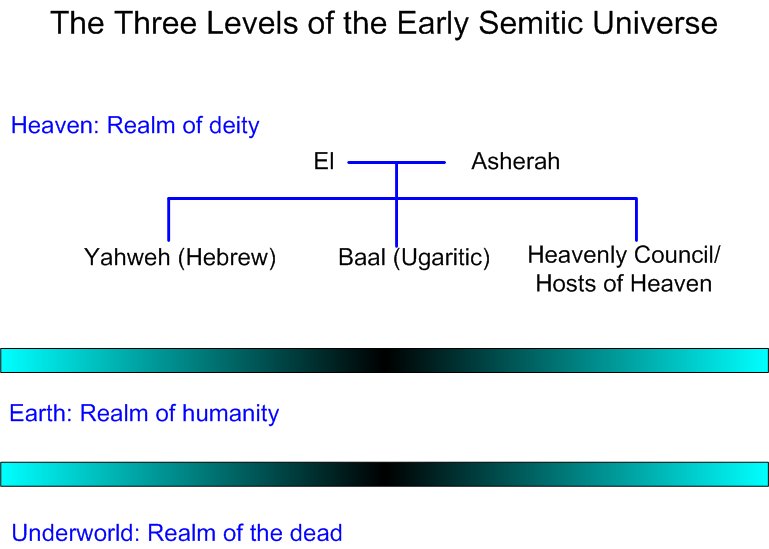
What those texts make clear is that the early Semitic religion worshipped a pantheon structured as a divine family, with a Father god, El and his consort, this very Asherah.7 These two are at the head of a heavenly council. Daniel C. Peterson synopsizes the relevant information:

The council is known by various names in the Ugaritic materials, including “the assembly of the gods” and “the assembly of the sons of ‘El.” According to Canaanite belief, ‘El was the creator-god. Evidence strongly suggests that he was the original chief god of the Semites generally. As creator, however, he also stood at the head of the pantheon as the “father of the gods” or the “father of the sons of God” and was called the “ancient one,” the “patriarch,” and the “eternal one.” Consequently, the gods as his sons, were designated collectively as “the sons of ‘El.”8

Yahweh was preeminent among the sons of El in the Israelite conception. The gods of this heavenly council were assigned to be the gods of various nations (Deuteronomy 32:8), and Yahweh was the god of Israel. As Israelite thought developed, El as the Father receded into the background, and Yahweh continued to gain in prominence. This process of the elevation of Yahweh was in full force by the eighth century B.C. when Asherah appears as Yahweh’s consort, not El’s. Mark S. Smith suggests:
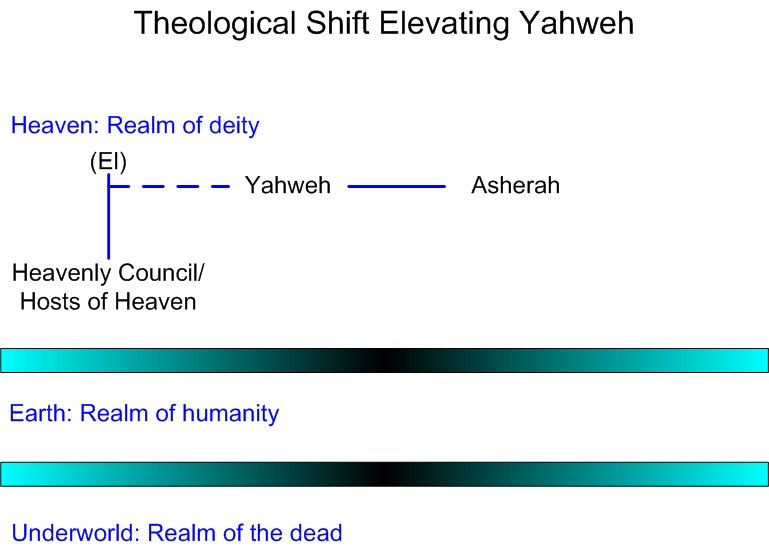
Asherah, having been the consort of El, would have become Yahweh’s consort only if these two gods were identified by this time. Indeed, it is evident from texts such as Isaiah’s vision of Yahweh surrounded by the Seraphim (Isaiah 6), and especially the prophetic vision of the divine council scene in 1 Kings 22:19 that Yahweh assumed the position of presider by this time.9

This gives us both an evolutionary trajectory and a timeframe. The heavenly council with El as the father, and Yahweh as preeminent son, plausibly dates to the same timeframe as the Ugaritic texts, that is, 1350 – 1150 B.C. After that time, there is a developing theology in Israel that increases the importance of Yahweh and elevates him to a position where he begins to take over the functions previously assigned to his celestial father, El. This process is in nearing its completion around 700 B.C. when we find that Yahweh has not only taken over El’s place in the council, he has taken El’s consort as his own.

In spite of this elevation to prominence and proto-monotheism, Yahweh’s relationship to the council and to his father was not entirely severed by this process. Parallel strands, perhaps reinforced by other Semitic religions, maintained the stories of El and the heavenly council. Dr. Peterson continues:

The Canaanite terminology of “the assembly of the gods” and “the assembly of the sons of ‘El” finds its parallels in the Hebrew Bible. In Psalm 29:1, which has long been recognized by scholars as an Israelite adaptation of an older Canaanite hymn, members of the council are referred to as bene ‘elim. The King James translation renders this phrase as “the mighty.” The same Hebrew phrase occurs at Psalm 89:6, where the King James Version has “the sons of the mighty.” Neither rendition is adequate. In both passages, the New Jerusalem Bible, to choose one of the best of the modern translations, gets things precisely right by translating bene ‘elim as “sons of God.”10

Equally as important to our understanding of Yahweh in the council is the identification of Yahweh as the one who would atone as the Messiah. Margaret Barker’s The Great Angel examines at length hundreds of passages from texts ranging from Jewish to Christian to Gnostic that, as she interprets them, identify Yahweh as the future Messiah and Jesus, in his Messianic role, as equated with Yahweh. As she describes the heavenly council, headed by the Father-God:

Yahweh was one of the sons of El Elyon; and Jesus in the Gospels was described as a Son of El Elyon, God Most High. In other words he was described as a heavenly being. Thus the annunciation narrative has the term “son of the Most High” (Luke 1.32) and the demoniac recognized his exorcist as “son of the Most High God” (Mark 5.7). Jesus is not called the son of Yahweh nor the son of the Lord, but he is called Lord. We also know that whoever wrote the New Testament translated the name Yahweh by Kyrios, Lord. (See, for example, the quotation from Deuteronomy 6.5: “You shall love Yahweh your God…” which is rendered in Luke 10.27 “You shall love the Lord [Kyrios] your God.”) This suggests that the Gospel writers, in using the terms “Lord” and “son of God Most High”, saw Jesus as an angel figure, and gave him their version of the sacred name Yahweh.11

Of course this particular connection comes from New Testament usage. Dr. Barker suggests that it was nevertheless a continuation of an old strand of thought that became obscured through the Deuteronomic reforms. Barker examines an interesting Old Testament passage about this Messianic expectation that appears to have suffered some obfuscation:

The clearest evidence for its survival [the anthropomorphism of the God/Messiah], however, is in the widespread tradition of interpreting words of “man” as references to the Messiah, or of designating the Messiah simply as “the man.” This can best be seen by examining the various translations of the Balaam oracles, which were believed to predict the Messiah (Numbers 24.3-9; 15-24). Thus Numbers 24.7a, where the Hebrew has the curious lines: “Water shall flow from his buckets and he shall rule over many nations” became in the LXX [the Septuagint]: “And there shall come a man out of his seed and he shall rule over many nations,” while both the Fragment and Pseudo-Jonathan Targums have: “Their king shall rise from among them and their saviour shall be from out of them.”

Philo quotes the lines as messianic prophecy: “There shall come forth from you one day a man and he shall rule over many nations” (Life of Moses 1.290). The unanimity of both translation and Targums suggests strongly that the Hebrew may once have said something other than “water shall flow from his buckets.”12

Could an old strand that expected Yahweh-as-Messiah have survived the Deuteronomic reforms to form the basis of Christian understanding of Jesus as Messiah and Yahweh? This is at least suggested by an Aramaic text from Qumran Cave 4 (4Q246 – translated by Joseph A. Fitzmyer):

Col. 1 lines 7-9

7 [then shall arise a king, and he shall be] great upon the earth.

8 [All peoples sh]all make [peace with him]; they shall all serve

9 [him. For] he shall be called [the holy one of] the [G]reat [God], and by His name shall he be named.

Col 2 line 1

1 He shall be hailed Son of God, and they shall call him Son of the Most High.13

This text is dated to around 25 B.C.14 At that time it appears that there is arguably a continuation of the definition of the Messiah as the Son of God, particularly, the Son of the Most High.

When we reconstruct the religious climate at the time of Lehi we find that there is no single, unified theology. In fact, what we find is multiple strands of theological thought that are in conflict, with the Deuteronomic reform elevating a particular strand of thought in contradiction to what had been acceptable though much of Israel’s history.

The theology of the Book of Mormon suggests that Lehi is not only a product of this time period, but that his theology, and therefore Nephi’s, is mostly likely an attempt to preserve some of the theology of God that was being denied in the Deuteronomic reforms. The following are elements of the pre-reform religion that we will see in the Book of Mormon text:

  • A Father god, ‘El who is also called el elyon or “Most High God.”
  • Yahweh as the son of God (El).
  • Yahweh as preeminent God of Israel.
  • Yahweh as Messiah.

I suggest that the particular prominence of God as Messiah in the Book of Mormon is a reaction to the reduction of that strand of Israelite religion. What Lehi and Nephi believed to have been removed in the Deuteronomic reform receives compensatory emphasis in Nephi’s foundational theology for his people, and continues through to the end of the Book of Mormon. This is the reason that the Book of Mormon is so consistently and adamantly a witness for the Messiah.

We begin our examination of God in the Book of Mormon just a few verses before 1 Nephi 11:18 with which we began this discussion. In 1 Nephi 11:6 we find:

And when I had spoken these words, the Spirit cried with a loud voice, saying: Hosanna to the Lord, the most high God; for he is God over all the earth, yea, even above all. And blessed art thou, Nephi, because thou believest in the Son of the most high God. . .

Placed in the context of the possible theologies in Jerusalem at the time of the family’s departure, this verse is quite understandable. We can perhaps understand it a little better if we “retranslate” the text to highlight the parallels.

Hosanna to El Elyon; for he is God over all the earth, yea, even above all. And blessed art thou, Nephi, because thou believest in [Yahweh] the Son of El Elyon…

Because the understanding of El as Father and Yahweh as son was still an available concept in Hebrew thought when the Book of Mormon begins, this particular description of the Father and the Son finds its best explanation as a continuation of that particular strand of Hebrew theology. While there is even less of the heavenly council remaining in the Book of Mormon than in the Old Testament, nevertheless it is plausible that such an idea continued with the Book of Mormon prophets. Note the interesting language with which Alma describes the Messiah in Alma 36:17:

…I remembered also to have heard my father prophesy unto the people concerning the coming of one Jesus Christ, a Son of God, to atone for the sins of the world.

Jesus is not the Son of God, he is a Son of God. Assuming that this is translated correctly, we have Alma placing Jesus Christ in the same divine company as did the New Testament authors cited by Margaret Barker–in the heavenly council as a Son of the Most High God. Thus Alma appears to confirm Nephi’s distinction between the Most High God and the Son of God. That brings us forcibly back to 1 Nephi 11:18. In our modern versification, 12 verses after declaring the Messiah to be the Son of God, the spirit shows that same Messiah who is declared to be God. What happened in 12 verses? Absolutely nothing. Nephi has not changed his understanding. The problem we might see as a conflict between verses 6 and 18 lies in our modern imperative of monotheism, a problem Nephi did not have.

In the Jerusalem that Lehi’s family left, Yahweh had been elevated to the position of pre-eminent God. This proto-monotheism, if I may call it that, did not eliminate the strand of thought that understood El as the Most High God. It did, however, proclaim that Yahweh was God. Not Most High God, but God. Based upon Nephi’s plausible worldview, let’s perform our exercise of retranslation again for verse 18:

And he said unto me: Behold, the virgin whom thou seest is the mother of [Yahweh], after the manner of the flesh.

Not only does this “retranslation” return the text more clearly to its appropriate 600 B.C. cultural context, it is absolutely essential to understanding the theology of the Messiah in the Book of Mormon. From the perspective of Nephite theology, the 1837 change in this text might have helped the Latter-day Saints with their understanding of God, but it did violence to an essential part of the Nephite understanding of God. For the Nephites, it is absolutely essential that they understand that Yahweh was the Messiah who would come. Nephi himself notes:

For the things which some men esteem to be of great worth, both to the body and soul, others set at naught and trample under their feet. Yea, even the very God of Israel do men trample under their feet; I say, trample under their feet but I would speak in other words–they set him at naught, and hearken not to the voice of his counsels.

And behold he cometh, according to the words of the angel, in six hundred years from the time my father left Jerusalem.

And the world, because of their iniquity, shall judge him to be a thing of naught; wherefore they scourge him, and he suffereth it; and they smite him, and he suffereth it. Yea, they spit upon him, and he suffereth it, because of his loving kindness and his long-suffering towards the children of men.15

There can be no doubt nor confusion that the person referred to here is Jesus Christ, and this Christ is the person that Nephi declares to be “the very God of Israel.” This meaning is also essential to Abinadi’s argument in Mosiah 15:1:

And now Abinadi said unto them: I would that ye should understand that God himself shall come down among the children of men, and shall redeem his people.

For the entire Book of Mormon, Yahweh is the God of Israel, and Yahweh is the Messiah. Those equivalencies are absolute and important to Nephite theology. However, there is still an understanding that Yahweh was the Son of God, in the context of El Elyon, or the Most High God.

We now have one remaining explanatory task. If the Nephites understood the separate nature of El Elyon and Yahweh, why is it also true that the text frequently equates the Messiah and the Father? While this is the stuff that led to the Christian arguments about trinitarianism and modalism, there is a much different process at work in the Book of Mormon. The problem begins with our good friend Nephi, who seems to personally present us with every possible confusing statement about God:

And the angel said unto me: Behold the Lamb of God, yea, even the Eternal Father!16

If you haven’t noticed, we are only a couple of verses later than verse 18 where the virgin is the mother of God. Now we have a new identification. The Lamb of God is a title that is particularly symbolic of the atoning function of the Messiah, and here we have the Messiah declared to be the Eternal Father. This is not the only location where this happens. In other texts, the Messiah is not only Father, he is also Son. Mormon writes a thousand years after Nephi:

…And because of the fall of man came Jesus Christ, even the Father and the Son; and because of Jesus Christ came the redemption of man.17

The explanation for this conflation of Father and Son is not to be found in post-Christian theology, because that perspective cannot explain all of the various references to God in the Book of Mormon. Returning to our historical perspective, however, we can replace the cultural contexts that allowed Nephi to hold what appear, to modern readers, to be contradictory beliefs about God.

When Margaret Barker describes the nature of the heavenly council, she also notes the key that resolves our problems in understanding Nephi and the subsequent Nephite theology.

There are those called sons of El Elyon, sons of El or Elohim, all clearly heavenly beings, and there are those called sons of Yahweh or the Holy One who are human.18

There are two “fathers” here, and the difference is that in the stories, or myths–to use the anthropological term–the sons of one father are heavenly, and the sons of the other are human. This creates a distinction in the realm of operation of the two fathers, a conceptual space that might be described as either horizontal or vertical. In the horizontal conception, we are in the heavens, and the heavenly father begets heavenly sons. In the vertical conception, we now have a heavenly being focusing on earth, a vertical relationship that crosses the boundaries that separate heaven and earth. This second “father” is defined by this vertical deity-to-human sphere.
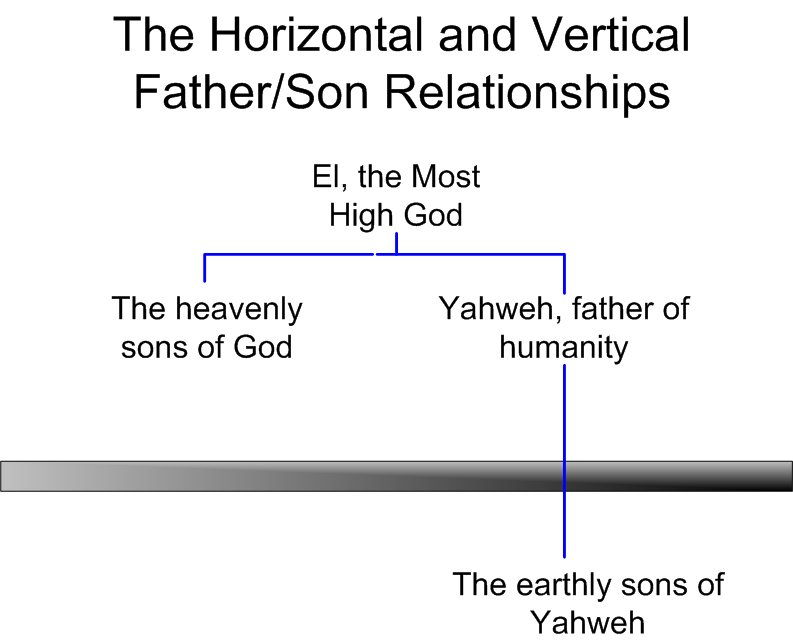
This is precisely how we can disentangle the various “son of God” references in the Old Testament. Joseph A. Fitzmyer points out that: “the plural expressions in Hebrew, bene ha elohim, “sons of God” (Genesis 6:2, 4; Job 1:6; 2:1; 38:7) bene ‘elim, “sons of God” (Psalms 29:1; 89:6), and bene ‘elyon, “sons of the Most High” (Psalms 82:6) are found in the Old Testament as names for angelic beings in the heavenly court of Yahweh.”19 These members of the heavenly court are literary descendants of the earlier Israelite layer that was more similar to the Ugaritic mythology. In this context we have horizontal relationships, and therefore heavenly sons of a heavenly father.

Fitzmyer also notes that there are several times when God indicates a relationship to Israel where Israel is considered as a “son” (Hosea 1:10; Deuteronomy 14:1; Isaiah 30:1). In these cases we have declared “sons,” with an implied father. What Fitzmyer does not ask, is whose sons are whose? The angelic beings harken back to an earlier conception, and the frame of reference is always celestial, and always horizontal. They are sons of the Most High God.

In the other references Fitzmyer notes, various humans are declared to be in a relationship to God where they are “sons.” If the humans are sons, God is therefore father. Most prominent and powerful is the declaration in Psalms 2:6-7:

Yet have I set my king upon my holy hill of Zion. I will declare the decree: the LORD hath said unto me, Thou art my Son; this day have I begotten thee.

In this verse the Lord declares that he as begotten the king as his son. The question that we must ask is: who is the Lord? This is a special relationship between the king in heaven and the king on earth, but it still crosses the bounds from heaven to earth. It is a vertical relationship, and therefore “the Lord” is Yahweh.

The historical conflation of Yahweh with El leads to some untidiness in the Hebrew words used to label these positions, but the horizontal and vertical contexts will always predict the appropriate father. In horizontal references, the phrase is typically spelled out as “sons of God” and that phrase functions as a label for the relationship. In the vertical relationships, the term is frequently only “son” or “sons,” and the relationship is implied rather than declared. When humans are involved, their sonship is a relation to the father-God of Israel, Yahweh. When heavenly beings are the reference, the relationship is to the Most High God, or El, the father of the gods.

The Book of Mormon is a precise parallel to this usage. In the Book of Mormon as in the Old Testament, the heavenly or earthly context serves as the defining field of operation which clues the reader (or listener) to the appropriate meanings of father and son. This variation works for all the texts we have examined so far in the Book of Mormon.

We are now left with the most curious texts, however–those that declare that the Father and Son are the same. So far there have been clear distinctions between father and son. How, then, is the same person Father and Son? Genealogy should tell us that this is not a foreign concept. A man is father to his own son, yet he is a son in the context of his father’s family. We understand the two roles of the man based upon his conceptual presence in either of the two possible families. For Yahweh as Father and Son, however, genealogy is not the explanation. Nevertheless, the same concept of a shift in frame of reference is.

The premortal Messiah declares to the brother of Jared:

Behold, I am he who was prepared from the foundation of the world to redeem my people. Behold, I am Jesus Christ. I am the Father and the Son.20

Here we have the self-identification of the premortal Messiah. This is the declaration of Yahweh, similar to the self-declaration of I Am from the burning bush (Exodus 3:14). Notice, that while Jesus Christ makes it very clear that he is both Father and Son, the context of this relationship is explicitly vertical. This tells us that the “father” designation indicates a relationship between Jesus Christ-as-God and man. Yahweh-as-father is precisely the relationship that Benjamin declares for his people when they covenant to take upon themselves the name of the Christ (or Messiah, or Yahweh):

And now, because of the covenant which ye have made ye shall be called the children of Christ, his sons, and his daughters; for behold, this day he hath spiritually begotten you.21

The language of Benjamin’s Christian covenant is similar to the anointing covenant the Lord makes with the King in Psalms. “This day” God has begotten the king or the covenanters. Note, however, that while the context alters the way we should understand the term “Father,” there is a parallel change in the way we must understand “Son.” In Ether Yahweh is “Son,” not “Son of God.” The difference is intentional. “Son of God” is a reference to a horizontal relationship. The presence of the simple term “son” in a vertical context, defines the appropriate understanding of “son,” just as the term father is defined by that context. Only with this understanding of how the terms shift their context when the reference the cross-plane relationship between heaven and earth, can we make sense of Yahweh’s other self-declaration, found in 3 Nephi 1:14:

Behold, I come unto my own, to fulfil all things which I have made known unto the children of men from the foundation of the world, and to do the will, both of the Father and of the Son–of the Father because of me, and of the Son because of my flesh.

The phrase “the Father because of me” is the declaration of Yahweh’s heavenly relationship to humanity. He is Yahweh, and is our father in the sense of his guardianship over all of the natural and adopted branches of Israel. He is our father in the same way that he is the Father of heaven and earth, a term exclusively applied to Yahweh in the Book of Mormon.
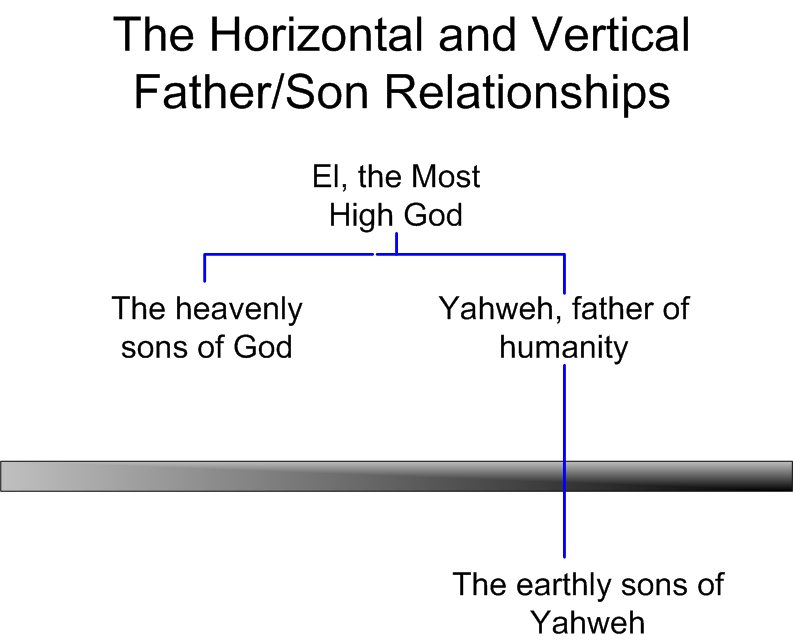
Because the context is now very clearly vertical, and crossing the bounds between heaven and earth, Christ explains that he is also the Son, “because of my flesh.” This somewhat cryptic phrase is actually a very apt definition of this contextual shift in meaning.

The essential Nephite revelation of the Messiah was that he was Yahweh, and that “God himself shall come down among the children of men, and shall redeem his people” (Mosiah 15:1). When Jesus declares that he is Father and Son in 3 Nephi, he is not only on earth, he is in a physical body that he allows to be touched. He declares that he has made that vertical transition from heaven to earth. Thus he is Father to us while he is in heaven, and in the essence of his being. However, when he came down, he became as we are, and therefore a son, as we are sons. The change in place creates a change in symbolic relationship. It is his flesh, or his mortality, that makes him the son. Jesus Christ is Father and Son because he is the God who came down among the children of men. Alone of sons of God, he was also a son of man.

When we approach the Book of Mormon text from the viewpoint of the historical context that it declares to be its origin, we find an absolutely consistent theology of God. The Nephites knew of and believed in a Most High God, known as El in Biblical and Ugaritic literature, but unnamed in the Book of Mormon. That Most High God is father to Yahweh, and the relationship between Yahweh and the Most High God is indicated by the title Son of God.

Yahweh is the God of Israel, and therefore the God of the Nephites. In Yahweh’s relationship to humans, he is our Father, and we are sons of Yahweh. When Yahweh descends to live on earth, he is in that part of the vertical relationship that is appropriate for mortals. He is–Son. Yet he can never cease to be who he is. He is “the Father because of me,” as he declares in 3 Nephi 1:14. He is, therefore, Father and Son. For the Nephites, any possible confusion in the similarity of terms used for deity was clarified by the horizontal or vertical contexts in which they were used.

Notes

1 Margaret Barker, “What Did King Josiah Reform?” Brigham Young University Forum address, May 2003, 1. Photocopy of typescript in my possession.

2 Norman K. Gottwald, “Deuteronomy,” The Interpreter’s One-Volume Commentary on the Bible (Nashville, Tennessee: Abingdon Press, 1971), 102-103.

3 Raphael Patai, The Hebrew Goddess (Detroit, Michigan: Wayne State University Press, 1990), 38.

4 Ibid., 53.

5 Ibid., 48-49.

6 C.L. Seow, “Ugaritic,” The Oxford Companion to the Bible, edited by Bruce M. Metzger and Michael D. Coogan (New York: Oxford University Press, 1993), 785.

7 Mark S. Smith, The Origins of Biblical Monotheism: Israel’s Polytheistic Background and the Ugaritic Texts (New York: Oxford University Press, 2001), 49.

8 Daniel C. Peterson, “‘Ye Are Gods:’ Psalm 82 and John 10 as Witnesses to the Divine Nature of Humankind,” The Disciple as Scholar. Essays on Scripture and the Ancient World in Honor of Richard Lloyd Anderson, edited by Stephen D. Ricks, Donald W. Parry, and Andrew H. Hedges (Provo, Utah: Foundation for Ancient Research and Mormon Studies, 2000), 487.

9 Smith, The Origins of Biblical Monotheism, 49.

10 Peterson, “Yea are Gods,” 490.

11 Margaret Barker, The Great Angel, 5.

12 Ibid., 100-101; emphasis in original.

13 Joseph A. Fitzmyer, The Dead Sea Scrolls and Christian Origins: Studies in the Dead Sea Scrolls and Related Literature, general editors Peter W. Flint and Martin G. Abegg Jr. (Grand Rapids, Michigan: Eerdmans Publishing Company, 2000), 54.

14 Ibid., 45.

15 1 Nephi 19:7-9.

16 1 Nephi 11:21.

17 Mormon 9:12.

18 Barker, The Great Angel, 5.

19 Fitzmyer, The Dead Sea Scrolls and Christian Origins, 65.

20 Ether 3:14.

21 Mosiah 5:7.

The Gadianton Robbers in Mormon’s Theological History: Their Structural Role and Plausible Identification

The Gadianton robbers are a specific instance of the larger set of events and concepts revolving around what the Book of Mormon calls secret combinations. These secret combinations show up in connection with the Jaredites, then they disappear. They reappear scant years prior to the arrival of the Savior in the New World, and then disappear for over two hundred years. Finally, they reappear to play a role in the final denouement of the Nephites. While the majority of the conflicts in the Book of Mormon occur with the Lamanites, the most destructive conflicts are those that come at the hands of the secret combinations, and specifically the Gadianton robbers. The Lamanites might be the Nephites’ most common enemy, but the Gadianton robbers are the most dangerous. This combination of longevity, sporadic appearance, and ultimate danger, make the Gadianton robbers and secret combinations an important study in understanding the message of the Book of Mormon. The elucidation of this complex interaction of time, text, and meaning must necessarily center on both Mormon’s text and the ancient cultural environment of that text.

The first question we will examine is the role of secret combinations in the narrative of the Book of Mormon. The second issue is the plausible identification of the secret combinations with some historical event or group. This phase of the investigation is complicated not only by known history, but also because this history must also integrate with the narrative purpose of the secret combinations in the text. What is told must also conform to how it is told.

Finally we must test the identification against the disparate appearances of the secret combinations in the text. Secret combinations make an appearance over nearly two thousand years of Book of Mormon history, but they have no consistent presence. They all seem to be related, but they are separated by hundreds, or perhaps thousands of years. They have similar characteristics, but they are associated with different cultures. The text ties them all together. We are looking for that binding thread.

The Narrative Role of Secret Combinations.

It is popular to describe Mormon as an abridger; some early predecessor of the editors of Reader’s Digest who take large texts and distill them into shorter versions. This is a seriously misleading conception. It is true that Mormon is an author with a stylistic penchant for including large citations from his source material, but we do him extreme discredit when we forget his very active role in selecting and structuring his account. Mormon is an historian, but he is unlike a modern historian in the way he perceives his task. Mormon does not write secular history, but rather sacred history. It is this overriding concern that absolutely dictates everything he includes and excludes from his text.

As we approach the Gadianton robbers from the perspective of Mormon’s construction of his text, we find that they and secret combinations are perhaps the most complex example of Mormon’s authorial art. Secret combinations are a meta-theme that function as both an organizational principle and historical moral. The meta-theme of the secret combinations is not present because history happened in just such a way and Mormon dispassionately recorded that history. Secret combinations are an interpretive layer that Mormon spreads over the events in order for those events to have a greater meaning. In creating this meta-theme, Mormon is following an Old World literary vision that sees history in a larger context of types and patterns.1 Robinson describes the effect of this conception on the way history was written:

The unifying principle [acted] like a magnet in evoking a pattern amongst iron filings. It created a pattern of history out of all its complexities, a pattern which disclosed the previously hidden purpose of God.2

Mormon is dealing in patterns. This patterning of history becomes evident when disparate events at widely separated times are described in ways that make those events obviously parallel. The repetition of the pattern is a marker of authorial formulation. For the secret combinations in the Book of Mormon, the patterning consists in a set of events and characteristics that always accompany the presence of a secret combination. The essential features are the presence of murders, a desire for wealth (frequently described as “robbings and plunderings”), and the destruction of political order. Mormon orders three historical periods with the presence of this set of events and traits of secret combinations:

  1. The earliest manifestation of the pattern in Book of Mormon history is in Jaredite times. The destruction of the Jaredites is explicitly laid at the feet of secret combinations, and all of the elements of the secret combinations are present.3
  2. The second occurrence in time is actually the first in the text, and it is the most textually complex. It occurs within a period of only about eighty years. In that eighty-year time period the Gadiantons make four separate appearances and four separate disappearances. The appearances and disappearances of this particular set of Gadianton robbers serve as a micro example of the general patterning of the larger meta-theme. In spite of the four phases, however, this set is textually treated as a virtual single appearance. The result of the rise of the Gadiantons is the fall of the Nephite government just before the arrival of the Savior in the New World.
  3. The final appearance of the Gadianton secret combination leads to the final demise of the Nephites.4

We have three instances that repeat this pattern, and we may be certain that it is no coincidence that all three appear to be so similar, a similarity that is even more apparent in the specific details than it appears in this brief summary. Of this intentional repetition in the Book of Mormon, Richard Rust notes:

Repetition appears purposefully within Book of Mormon narratives as a principle of reinforcement and confirmation. It seems that every important action, event, or character is repeated in the Book of Mormon. These repetitions emphasize the law of witnesses at work within the book … They link narratives together with what Robert Alter calls “type-scenes.” …Larger repeated narratives treat escape and travel to a promised land; repentance; and the nature, rise, and effect of secret combinations.5

Mormon creates a meta-narrative by the tight repetition of the structures of secret societies in relation to the end of political entities. The triple repetition creates a firm connection for the obvious reason that the pattern, the “type-scene,” is not a coincidence. The narrative sophistication of the use of secret combinations in the Book of Mormon suggests purposeful inclusion and careful planning; planning that is intended to point to the greater pattern that reveals the purposes of God.

The Gadiantons in Plausible History

The repetition of the patterns clearly shows the hand of the author. Now we must determine whether the author is inventing the patterns, or truly being the magnet that evokes the patterns in the historical iron filings.

We find our textual linkage between type-scene and historical event precisely where Mormon put it, in perhaps the most anomalous narrative sequence in all of his text. When Mormon introduces his historical Gadiantons, he is telling a fairly simple tale but elects to tell it in a most unusual and convoluted way.

Mormon’s history of the Gadiantons begins at the forty-second year of the reign of the judges, or about 50 BC. After the initial introduction to the Gadianton robbers in the body of Helaman 2, Mormon adds these comments to the end of the chapter:

And behold, in the end of this book ye shall see that this Gadianton did prove the overthrow, yea, almost the entire destruction of the people of Nephi. Behold I do not mean the end of the book of Helaman, but I mean the end of the book of Nephi, from which I have taken all the account which I have written.6

Notice that Mormon has been speaking of an historical event, and at this point makes a shift in narrative time to Mormon’s present. It is at this point that we have what must be the most confusing narrative interruption in the Book of Mormon. After this look forward in time, Mormon abruptly changes the subject. He has been talking about the Gadianton robbers. He has even created a foreshadowing link between those Gadiantons and his own time. Now he stops, makes a full chapter break, and begins the next chapter with what appears to be a completely unrelated topic.

Mormon inserts a discussion of migrations to the lands northward. Even more surprisingly, Mormon brackets this migration narrative on both ends with a shift in narrative time to his own day. After this recent shift in narrative time, even Mormon understands that he has interrupted his narrative, for at the end of this sequence he states: “And now I return again to mine account….”7 The account to which he returns is the Gadiantons, the very subject he interrupted.

As if understanding the now-you-see-them-now-you-don’t-Gadiantons were not sufficiently difficult, Mormon introduces these enigmatic figures with a narrative sequence that is equally enigmatic. However, none of this is in error. Each of these anomalies are intentionally placed by Mormon the author for his own narrative purposes. This sequence, awkward though it might appear, was carefully constructed to elaborate the meta-message of the secret combinations. In this anomalous text we have Mormon’s intentional identification of the historical Gadiantons as he sees them.

Mormon’s clue to historical events is this very text of the northward migration that is framed by references to the future. Both before he begins this narrative sequence, and immediately afterward, Mormon references his own time. This shift in narrative time is important because it tells us that the narrative in between is the focal point on which the time-shift is made. Mormon is doing more than denoting place; he is connecting time.

The inserted, out-of-place narrative describes a northward migration of the Nephites. Of course, Mormon has discussed northern migrations before, but this description is unique. For example, the northward migration of Hagoth received some notice, but the narrative emphasis was on the departure, not for the ultimate destination.8 In contrast, this inserted section emphasizes the land to which the people are presumed to travel. This textually unusual fixation on the land of destination is even more curious because there is no indication that any of these people came back to tell about the land northward. As historians, we must ask the serious question of how Mormon arrived at his description of the land northward, since he does not record any of these people coming back to describe where it was or its characteristics. Nevertheless, Mormon describes it in some detail:

And they did travel to an exceedingly great distance, insomuch that they came to large bodies of water and many rivers. Yea, and even they did spread forth into all parts of the land, into whatever parts it had not been rendered desolate and without timber, because of the many inhabitants who had before inherited the land. And now no part of the land was desolate, save it were for timber; but because of the greatness of the destruction of the people who had before inhabited the land it was called desolate. And there being but little timber upon the face of the land, nevertheless the people who went forth became exceedingly expert in the working of cement; therefore they did build houses of cement, in the which they did dwell.9

The detail of the description of the land northward is given in such a way that Mormon likely supposed that we should easily understand what he was describing. The passage of time has made this description a little less obvious than it would have been to Mormon, but still he gives us enough information to make an identification of the location to which he is referring. The essential elements that allow us to identify this area are:

  • It is northward of the Nephite lands
  • There are many waters
  • It is nearly desolate of trees
  • There are cement buildings

From perhaps 100 BC to 600 AD there is only one area in Mesoamerica that fits all of these descriptions, and that is the city known as Teotihuac·n. It is north of the Nephite lands. It is near the lake that at that time occupied the current site of Mexico City. It has buildings made of high quality cement.10 The lack of trees and the environmental imbalance created by denuding the land of trees is hypothesized as a major factor in creating the downfall of Teotihuac·n.11 We have several very specific requirements that must all converge at one point to fit Mormon’s description and there is only one area in Mesoamerica that fits this description well in the time period described. Mormon the author is pointing his finger at a specific location at a specific time because that location serves as the historical fulcrum on which his meta-narrative is leveraged.

In spite of the accuracy of this description of Teotihuac·n, there is nevertheless a major problem with the fit. That problem is one of timing. The particular conditions that require the area to be devoid of trees and dominated by buildings of cement, do not belong to the Teotihuac·n of 49 BC when the northward migration is described by Mormon, but rather the Teotihuac·n of 250AD and later.

It is at this point that we understand the nature of the references to the future that frame the northward migration narrative. Mormon does not have historical records that tell of the land to which these people went, but Mormon nevertheless gives us a particular location for them, a location they may or may not have reached. His understanding of that land is based upon his own current time period. What we have is Mormon describing the Teotihuac·n that he knows in his own time, and pushing that description earlier into history. This is not unusual for ancient historians.

However, it also doesn’t matter. It really is the Teotihuac·n of his own time that is his concern. Mormon intentionally links this migration northward to the land of Teotihuac·n, not because of historical accuracy, but precisely because he desires to tie the Gadiantons of Helaman’s time to the Gadiantons of his own day. Remember that both before and after the narrative insertion of the migration to the land northward Mormon has shifted the narrative focus to his own time period. Whether consciously or unconsciously, Mormon is notifying us that the concern for the land northward pertains to his own day, and that it has a link to the previous time. For Mormon, this migration northward is the bridge over which Helaman’s Gadiantons will walk through time and space to become Mormon’s Gadiantons.12 It is those newer Gadiantons who are causing the destruction of Mormon’s people that he uses as the historical backbone that will link all of the secret combinations together, a set of destructive combinations that are culminating in the final demise of the Nephites.

It is important that we recognize that this tie between the first Gadiantons and the last Gadiantons that Mormon makes through this bridge in time and space is an artificial construction. It is at this point that we see the author describing the patterns rather than the iron filings. There is very little chance that the iron filings are the same, even though Mormon makes a pattern of them.

A brief note on the narrative history of the Gadiantons should suffice to show the artificiality of this tie between the two Gadianton bands. After the first Gadianton secret combination accomplishes its fatalistic task of destroying the Nephite government just before the arrival of the Savior, they disappear from the land for over two hundred and sixty years.13 When they reappear they grow in power and importance until they can be said to have spread “over all the face of the land.”14 When Mormon reintroduces the secret combination, he does so by calling them Gadianton robbers. This is a different group in a different land and with a gap of two hundred and sixty years between them and their earlier namesakes. Seen with the dispassionate eye of modern historiography, it is highly unlikely that this latter group that appears to be prominent throughout most of the land would have remembered and honored an otherwise short-lived and obscure band of robbers from inside the Nephite polity.

Is there any history behind this narrative artifice? If there is, we will find it by looking where Mormon tells us to look. We must look at the land northward that has many waters, is devoid of trees, is made of cement, and is on his mind in his own day. We must look at how Teotihuac·n might explain the Gadianton robbers, because Mormon is telling us that they do. It is in Teotihuac·n that we must look to see if we can find the “iron filing-events” that underlay Mormon’s patterned history.

Finding a lot of documentation on a secret society in ancient history is almost a fool’s errand, since their very nature was to be secret. In Mesoamerica, this problem is exacerbated by the nature of the available sources. Very few pre-Conquest texts are available, and the vast majority of our information comes from post-Conquest sources. This means that we must do what has been termed “upstreaming.” That is, we must begin with the known and move “upstream” in time to the earlier period with which we are interested. In Mesoamerica, this virtually forces us to the world as it was at the time of the Conquest.

One of the most valuable sources of pre-contact cultural information is the Florentine Codex, which is the Nahuatl text written by the native informants of Fray Bernardino de Sahagun. From these Nahuatl texts father Sahagun created his Spanish-language opus on the history and culture of the Aztecs. The Nahuatl text has been translated into English, and there is a passage that is important to our understanding of pre-contact secret societies. This passage is cited as translated with the exception of one word that I have intentionally left in Nahuatl:

The [nonotzaleque] went about carrying its hide [jaguar]–the hide of its forehead and of its chest, and its tail, its nose, and its claws, and its heart, and its fangs, and its snout. It is said that when they went about their tasks with them–that they did daring deeds, that because of them they were feared; that with them they were daring. Truly they went about restored. The names of these are [nonotzaleque], guardians of tradition, debasers of people.15

The passage paints an unfavorable picture of these people, but we can sense a duality in the presentation of the information. Sahagun’s informants were trained in the religious schools, and they certainly understood the Spanish prejudices. It is therefore not surprising that these nonotzaleque should be called “debasers of people.” However, this pejorative description comes right after the indication that they were “guardians of tradition,” a trait that many would have considered admirable–many, that is, who were not Spanish, nor Spanish influenced. It would seem that these nonotzaleque were some kind of group that dealt with pre-Conquest ideas and traditions.

Anderson and Dibble had translated nonotzaleque as “conjurers,” no doubt because of the connection to the magically powerful jaguar pelt. The reason for leaving the word untranslated is that it is this very word that is important to our discussion, and “conjurers” is not an adequate translation of the concept.

The ending of the word, “-eque” indicates a collection of people who do something. It is analogous to the “-ers” ending we add to verbs in English. We take the verb work and get workers. The important information about the people who all do this thing is communicated by the meaning of the verb to which this stem is attached. In this case, we have the Nahuatl word nonotza, which has various meanings revolving around the idea of speaking together, consulting, or agreeing.16 Thus the nonotzaleque are “those who agree or consult among themselves” or, in a more sinister and contextually appropriate context, “conspirators.”

When Sahagun translated his native source into Spanish, he rendered nonotzaleque as “assassins.” The connection of this term to the ancient sect is appropriate, for there are two aspects of the conspiracy that are important: the secret agreement, and the intent on disruption of government through murder. Significantly, Sahagun notes that this is a group “accustomed to and daring to kill.”17

Sahagun presents these conspirators as a pre-Conquest group. Miguel Covarrubias links these nonotzaleque to the nahaulista movement after the Conquest. Covarrubias specifically uses the passage from Sahagun identifying them as “assassins”18 and applies that definition to the nahualistas. Perhaps even more important is the connection the original group had to the jaguar. That connection allowed Anderson and Dibble to translate nonotzaleque as “conjurors,” and it probably led directly to the name Covarrubias associated with them. Nahualista is a combination word that takes a Nahuatl noun and adds a Spanish ending. The Spanish ending denotes a group of people who hold in common whatever the root of the word would be. In this case, the root word is the Nahuatl word for a shaman.

The persistence of a group attempting to retain the old ways after the Conquest is aptly named for those practitioners of the old religion, and the association between the jaguar and the shaman provides another touchpoint between the description of the nonotzalque and the nahualistas. The nahualistas were a subversive organization after the conquest, and one may suppose that they intended to keep their identities secret. Similarly, the nonotzaleque appear to represent a group. Both groups have internal structure, and both are linked to the disruption of political entities. Both of these are at least grossly similar to the Book of Mormon descriptions of secret combinations.

We have a complex of information that we may use as a native set of characteristics of these “conspirators.” When we attempt to upstream this set of characteristics from the immediate post-Conquest to the immediate pre-Conquest, the connection between a group of people ready and willing to kill who wore the pelt of the jaguar at least suggests that we look at the various orders of the Aztec military. One of the Aztec military orders was the ocelomeh, or the “jaguar warriors,” whose battle attire consisted of pelts of the jaguar.19 The wearing of the pelts or other representations of the jaguar marked this particular military order from others. It was not the only identifiable order, but each was marked by particular clothing.

Of course wearing distinctive clothing is hardly the way to keep one’s group affiliation a secret, but it can keep a specific identity secret, as the Ku Klux Klan learned. In this case, however, it is not specifically the secrecy, but rather the conspiracy that links these groups. It is not the secret, but the combination. They have an internal allegiance and code, and may operate as a group outside of other structural influences.

So far we have a very tenuous description of a pre-Conquest conspiracy that might be described as a secret combination. We can identify some of the characteristics of that group that include the readiness to kill as well as sorcery in the use of the jaguar pelt. The task is now one of “upstreaming” to Mormon’s time. Is there any reason to connect this tenuous later military order from Central Mexico to the secret combinations that Mormon reports in the lands farther to the south?

In the greater context of Mesoamerican history, there is every reason to suppose that Mormon was concerned with militaristic influences coming from Teotihuac·n. The time period ascribed to Mormon’s last Gadianton robbers directly parallels the timeframe for the expansion of Teotihuac·n and their particular brand of militarism throughout the Mesoamerican region. The rise of the Gadianton influence beginning after 200 AD in the Book of Mormon is a direct parallel to the rise of Teotihuac·n’s expanding influence, and the time period that saw the construction of many of the cement buildings in that city, including the temple of the feathered serpent which is now understood as dedicated to the cult of war.20 This influence increased in geographic spread and physical presence from about this time until the time of Mormon, and continued after the close of the Book of Mormon.

The epigraphic record of Tikal records the installation of a new ruler, Siyaj K’ak’, who founds a new dynasty in 378 AD. By iconographic and epigraphic representation, it is absolutely certain that he came from Teotihuac·n, and his descendants thereafter ruled in Tikal.21 Many sites of the time witness either a change in ruling dynasties or an increase in militarism that is represented in new ways that clearly point to Teotihuac·n influence.22 When we place known Mesoamerican history side by side with Mormon’s spiritual history, we find in both accounts a militarism exacerbated by a small contingent of a foreign element from the lands northward. The Book of Mormon timing for this description corresponds directly to the secular history of the expansion of Teotihuac·n throughout all of Mesoamerica, but particularly the Maya region to their south.

In addition to the importation of militarism and political leadership from Central Mexico, the Teotihuac·n influence extended to the transmission of religious ideals that accompanied the political power structure from Central Mexico. Here we recall our touchpoint for a Mesoamerican secret combination, the nonotzaleque. The nonotzaleque were an association that was willing to advance their political ideas through murder, but were also associated with the powerful shamanic symbol of the jaguar. The modern world tends to forget that politics and religion were virtually inseparable in the ancient world. Where politics were involved, religion was involved. The incursion of Teotihuac·n into the Maya area also brought in new powerful symbols and a new religious perspective. It is in this connection that we see another of Mormon’s descriptions of the Gadiantons:

And these Gadianton robbers, who were among the Lamanites, did infest the land, insomuch that the inhabitants thereof began to hide up their treasures in the earth; and they became slippery, because the Lord had cursed the land, that they could not hold them, nor retain them again. And it came to pass that there were sorceries, and witchcrafts, and magics; and the power of the evil one was wrought upon all the face of the land, even unto the fulfilling of all the words of Abinadi, and also Samuel the Lamanite.23

While Mormon never describes the Gadiantons as a military caste, he does specifically note that they were “among the Lamanites,” implying that they were not the Lamanites. He also notes that at this time there is an increase in “sorceries, and witchcrafts, and magics.”

Another of the characteristic traits of Mormon’s secret societies parallels the invasion from Teotihuac·n:

And it came to pass that the robbers of Gadianton did spread over all the face of the land; and there were none that were righteous save it were the disciples of Jesus. And gold and silver did they lay up in store in abundance, and did traffic in all manner of traffic.24

Mormon’s particular experience with these Central Mexican invaders would have come near the height of their power when they were literally “spread over all the face of the land.” These Gadiantons, who are not Lamanites, but who are “among” the Lamanites, are actively interested in commerce and gain. While little is known of the specifics of tribute from the Maya area into the city-state of Teotihuac·n, we may readily assume that it existed. Thus we have a foreign presence, likely part of a military caste and bringing new religious ideas, who are “robbing” the land of goods to send to their foreign city–for their own gain, and not for the gain of those in the Lamanite or Nephite area. Assuming a Mesoamerican context, there is no better candidate for the Gadianton robbers who are contemporary with Mormon. A military association from Teotihuac·n that brought a new militaristic philosophy tied to a new emphasis on “sorceries, withcrafts, and magics” is a remarkably apt description of Mormon’s contemporary Gadiantons as well as the Teotihuacanos. The known history of that time period completely supports the nature of the description that Mormon gives for the Gadianton robbers with which he is personally familiar.

To this point in our process of historical upstreaming, we have a very likely candidate for the Gadiantons of Mormon’s day. Of course our problem, as was noted earlier, is that this Teotihuac·n influence is not known for the earlier periods. How do we continue upstream if we know that the stream wasn’t there?

Interestingly enough, we return to Mormon the author and his artificial patterning of secular history. We are not looking for the presence of Teotihuac·n in an earlier instance of the Gadianton robbers, we are looking for the thread that Mormon uses to draw them to the earlier period. As Mormon moves his understanding of the Gadiantons as a Central Mexican influence earlier in time, he brings with the concept some of the set of meanings associated with the Teotihuac·n Gadiantons. In particular, we have murder and plunder for gain. When we are introduced to the Gadiantons who gain control over the Nephite government in Helaman, we see them as a similarly separate entity carrying with them these traits of greed and murder:

For behold, the Lord had blessed them so long with the riches of the world that they had not been stirred up to anger, to wars, nor to bloodshed; therefore they began to set their hearts upon their riches; yea, they began to seek to get gain that they might be lifted up one above another; therefore they began to commit secret murders, and to rob and to plunder, that they might get gain. And now behold, those murderers and plunderers were a band who had been formed by Kishkumen and Gadianton. And now it had come to pass that there were many, even among the Nephites, of Gadianton’s band. But behold, they were more numerous among the more wicked part of the Lamanites. And they were called Gadianton’s robbers and murderers.25

We have a parallel description of a group of people who are among the Nephites, but are not Nephites. That same group is among the Lamanites, but they are not Lamanites. They are intent on seeking gain, and therefore they murder, rob and plunder. They are Gadiantons. These are the traits of the Central Mexicans of Mormon’s time, and Mormon clearly links the Gadiantons of his own time to this earlier time period, both by name and attributes. Of course the characteristics described, that of murder for political gain and robbings and plunderings, could easily fit with the developing cultural pressures among the Maya at this time period. There is no particular need to see this group as foreign, except in the construction of Mormon’s meta-theme. For Mormon, there is a characteristic of secret combinations that ties together all of the thousands of years of history, and that is a connection to the Jaredites.

A Millennium of Disappearing and Reappearing Secret Combinations

The final piece of the puzzle of Mormon’s Gadianton robbers is in the nature of this conceptual thread with which Mormon ties together nearly two thousand years of New World history. Both textually and conceptually, Mormon ties the secret combinations together based on the underlying inheritance from the Jaredites. Although Mormon takes pains to show that the secret combinations were not learned from the records of the Jaredites that the Nephite record-keepers preserved, he nevertheless takes equal pains to state that they had the same source as the Jaredite secret combinations: “that same being who did plot with Cain.”26

The connection between the Jaredites and the Gadianton robbers of Helaman’s time would have been an easy correlation. Jaredite names frequently appear in the Nephite faction that is associated with the pro-king separatists.27 Gadianton might be a name of Jaredite origin, but Kishkumen almost certainly comes from the Jaredite heritage among the Mulekites.

Mormon’s “problem” is the making the connection between the Gadianton’s of his own day and the Jaredites. If, as is proposed here, Mormon is seeing a Central Mexican, or Teotihuac·n influence and describing it as “the Gadiantons,” then he must have some reason to connect this completely foreign culture to the Jaredites.

Mormon makes his connection explicit by his insertion of the northward migration text. Since there were Nephites who went North, Mormon can conceptually have them “carry” the secret combinations with them. That is the mechanism Mormon uses, but what was there about the Teotihuac·n invasion that allowed him to justify it as being connected to the Jaredites? For this answer, we need more historical information about the Mesoamerican culture area.

The Olmec is the name used for the people who occupied the territory that the Book of Mormon knows as Jaredite.28 We should resist the temptation to equate the Olmec with the Jaredites, because that would imply that the Olmec began with the Jaredites. This is known to be incorrect. However, just as the Lehites entered a world with other people in it, so did the Jaredites. They happened to enter the precise area of the most highly evolved culture of their day. It would be accurate to say that they participated in Olmec culture. This participation would have extended to the language of the Olmec, and to the entire Olmec cultural catalog.

One of the mysteries about the Olmec that found its resolution in the late 70’s, was the reconstruction of their language. Kauffman and Campbell presented a ground-breaking paper that noted the large number of loan words coming from the Mixe-Zoque language. They also noted that Mixe-Zoque would have existed in precisely the location of the archaeological Olmec, and at the same time. Thus they suggested, and their suggestion has been widely accepted, that Mixe-Zoque was the language of the Olmec, a culture so influential that they lent both culture and vocabulary to many other groups in Mesoamerica. As the language of the Olmec, Mixe-Zoque would also have been the eventual language of the Jaredites.

The Mulekites would have participated in that cultural zone, and their historical move up the valley of the Grijalva parallels the movement of a daughter language of Mixe-Zoque into that same region. Based on the connection to the Olmec and the geographic distribution of Zoque, this daughter language would have been the language of the Mulekites, and likely the lingua franca of the Nephites. Thus the connection between the Jaredites and Mulekites was evidenced by language as well as historical and cultural ties.

Until recently, a similar understanding of the linguistic affiliation of Teotihuac·n has been among the greatest of Mesoamerican mysteries. This city might be called a Mesoamerican Rome because of its size and regional importance, but there was absolutely no trace of the language they spoke. It was a situation analogous to knowing about the Romans from their architecture and engineering feats, but never finding even a scrap of Latin, nor any Romance language.

This situation has recently been resolved. Although the results are currently unpublished, John Justeson has indicated the time-depth of many Mixe-Zoque loan words suggests that the language of Teotihuac·n was Mixe-Zoquean.29 This linguistic affiliation gives us the last tie that Mormon would have needed to connect the secret combination of his day to the Jaredite combination of old. For Mormon, Teotihuac·n would have come from the same source!

Mormon certainly knew the linguistic affiliation of the Mulekites, and knowing that same language affiliation for Teotihuac·n, a language different from the Maya languages that are spoken my most of the peoples Mormon would identify as Lamanite, Mormon would understand Teotihuac·n as having ties to the ancient Olmec, or to the Jaredites as Mormon knew them. To Mormon, these were yet another branch of the old Jaredites. For Mormon, the Gadianton secret combination continued to rise from its ancient Jaredite roots.

The Gadianton End Game

Mormon uses the literary concept of the type-scene to reinforce a spiritual pattern that emerges from historical events. This historical pattern consists of an internal secret combination that is interested in power, gain, and political ascendancy through murder. The moral of the type-scene is that the secret combination causes the destruction of a people, as defined by their religio-political structure. The quintessential type-scene to which all others refer is that of the Jaredites. Mormon links each of his parallel type-scenes back to this Jaredite level.

The second type-scene in historical order is that of the Gadiantons of Helaman’s time and just prior to the arrival of the Messiah in the New World. This secret society is the one that is most elaborately described, with multiple internal parallels that highlight the same characteristics as the secret combinations of the Jaredites. Mormon explicitly connects these Gadiantons to the Jaredites, and the correlation may have been heightened by the Jaredite names associated with the movement. This tie to the Jaredites would have come through the historical connection between the Mulekites and the remainder of the Jaredite civilization, a connection that not only lent ideas such as secret combinations, but also a language that was derived from that of the Jaredites. The result of this named secret combination is the destruction of the Nephite polity.

The third and final type-scene occurs in Mormon’s day. The secret combination is called the Gadianton robbers, and Mormon links the secret combination of his day to that of Helaman’s time by the northward migration narrative as well as the linguistic ties to the Jaredites or Olmecs.

Each of these type-scenes is built upon historical data, but the data are related in such a way to tell us more than history. They also tell us the future, for they form a predictable pattern. As complex as this meta-theme is in the Book of Mormon, it is expanded by yet one more meta-theme that Mormon saw, or at least hoped for. Not only is the presence of secret societies repetitive and predictive, Mormon likely saw the aftermath of the secret societies as repetitive and predictive.

Mormon’s text shows us that the Gadiantons of Helaman’s day ushered in the destruction of the Nephite polity. After that terrible end came a marvelous beginning. The Atoning Messiah came, and altered the world. To appreciate this fundamental alteration, we must understand the Book of Mormon conception of this Messiah. Even though the Book of Mormon prophets clearly understood the difference between the mortal mission of the Messiah and the final mission of the Messiah at the end of this world, they primarily preached the mortal Messiah and the mission of Atonement. Nevertheless, we give the Book of Mormon prophets little credit if we therefore presume that they did not also understand the Messiah of the end times–the Triumphant Messiah.

Mormon certainly understands that these two “comings” of the Messiah are the same person, but two different times. The Triumphant Messiah is he who will transform the world into a single political/religious entity, and who will usher in a complete and final peace. When the Atoning Messiah came, even though his mission was in mortality, he could not help but bring with him the influence of who he truly was. In different circumstances he was the one who would usher in a permanent peace. However, the mortal mission and the timing were different. So there are similarities, and there are differences. For Mormon, the difference is one of permanence.

The Messiah who appeared at Bountiful brought peace, just as he will at the end of the world. However, since this first time was related to a mortal ministry, it was not a permanent peace–it was a peace that lasted for two hundred years before it began to fade. Nevertheless, this peace was directly related, inexorably related, to the appearance of the person of the Messiah. His essence required that he bring peace, even though the particular mission did not yet allow that peace to be permanent.

Mormon would have seen the arrival of the Savior in Bountiful as connected to the future arrival of that same Messiah in new circumstances. We may suppose that Mormon’s naming of the Gadiantons in the two time periods tells us of his expectations of the parallels. Mormon is facing the decimation of his own people, yet he retains his optimism in the future. Mormon is saying that in the time of Helaman the destruction of the Nephites by Gadiantons was followed by the coming of the Messiah, a miracle that restored the Nephites. Mormon is expecting that after the destruction of his own people by the new Gadiantons, that the Messiah will come again, and will similarly restore the Nephites. His record will be the guide for that restoration. His optimism lives in his text, even though its fulfillment is taking longer than he would have hoped

.

Notes

1 Louis I.J. Stadelman, The Hebrew Conception of the World (Rome: Biblical Institute Press, 1970), 26.

2 H. Wheeler Robinson, Inspiration and Revelation in the Old Testament (Oxford: Clarendon Press, 1946), 129.

3 Alma 37:21; Ether 14:8-9 sets up the destruction of the Jaredites because of secret combinations.

4 Helaman 2:12-14.

5 Richard Dilworth Rust, “Recurrence in Book of Mormon Narratives,” FARMS Journal of Book of Mormon Studies, vol. 3, no. 1 (Spring 1994), 39.

6 Helaman 2:13-14.

7 Helaman 3:17

8 Alma 63:5-8.

9 Helaman 3:4-7.

10 “Concrete Evidence for the Book of Mormon,” Reexploring the Book of Mormon, edited by John W. Welch (Provo, Utah: FARMS, 1992), 213. Citation is to David S. Hyman, A Study of the Calcareous Cements in Prehispanic Mesoamerican Building Construction (Baltimore, Maryland: Johns Hopkins University, 1970), ii, sect. 6, p. 7.

11 George C. Vaillant. Aztecs of Mexico (New York: Penguin Books, 1966), 78-90.

12 Not only does this bridge occur in the passage describing the northward migration, but it is reinforced by an explicitly named migration of Gadiantons just prior to the destructions at the time of the death of the Jesus. See 3 Nephi 7:12-13.

13 4 Nephi 1:41-42.

14 4 Nephi 1:46.

15 Bernardino de Sahagun, Florentine Codex (Salt Lake City: The School of American Research and the University of Utah, 1963), 11:3.

16 Molina and Simeon.

17 Bernardino de Sahagun, Historia General de las Cosas de Nueva Espana, vol. 3 (Editorial Porrua, 1969), 222.

18 Miguel Covarrubias, Mexico South: The Isthmus of Tehuantepec (New York: Knopf, 1967), 77-78. Covarrubias is cited in both Sorenson (1985, 303) and Bruce W. Warren, “Secret Combinations, Warfare, and Sacrifice,” Warfare in the Book of Mormon (Provo, Utah: FARMS, 1990), 229.

19 Ross Hassig, Aztec Warfare (Norman, Oklahoma: University of Oklahoma Press, 1988), 45.

20 It may be one of the greatest ironies in LDS attempts to link the Book of Mormon to historical Mesoamerica that the feathered serpent symbol that has seen so much print as a representation of Christ may actually have been a representation of the Gadianton robbers.

21 Simon Martin and Nikolai Grube, Chronicle of the Maya Kings and Queens (London: Thames & Hudson, 2000), 29.

22 Rene Millon, “The Place Where Time Began: An Archaeologist’s Interpretation of What Happened in Teotihuacan History,” Teotihuacan: City Of The Gods, edited by Kathleen Berrin and Esther Pasztory (London: Thames & Hudson, 1993), 26.

23 Mormon 1:18-19, italics added.

24 4 Nephi 1:46.

25 Helaman 6:17-18.

26 Helaman 6: 25-29.

27 Sorenson has noted the Jaredite connection to the kingmen, see Sorenson (1985, 265).

28 The application of the designation Olmec to these people is actually the result of historical error. The Olmec were known historically, and their name was first associated with the archaeological finds before they were understood to be as old as they are. The name stuck. The group that lent their name to this ancient people is now referred to as the historical Olmec. We do not know what the ancient Olmec called themselves.

29 John Justeson, personal communication.

Changes in the Book of Mormon

I want to do several things today. I’m first going to describe the critical text project, some of its major findings. Then I would like to turn to the issue of changes in the text to the Book of Mormon.

Critical texts have previously been prepared for important historical and literary works but until fairly recently not for the Book of Mormon. The first critical text of the Book of Mormon was published by the Foundation for Ancient Research and Mormon Studies, or FARMS, in 1984-86. That first version, although preliminary helped to establish criteria for the current project, especially the need for direct access to the original and printer’s manuscripts as well as the clearest photographs of those manuscripts. A critical text shows all the substantive changes that a written work has undergone from its original version to its present editions.

The word critical is derived from the Greek word krites meaning judge. When referring to a critical text, the term means that notes accompany the text so that the reader can see how the work has changed over time and thus judge between alternative readings.

There are two main goals for a critical text to the Book of Mormon. The first is to determine to the extent possible the original English language text of the book, that is, the text that Joseph Smith received by means of the interpreters and the seer stone. The second purpose is to establish the history of the text, including both accidental errors and editorial changes that the book has undergone as it has been transmitted down through time in its many editions.

The current critical text project of the Book of Mormon began in 1988 with major support from FARMS. Initial work concentrated on studying the two manuscripts of the Book of Mormon, namely the original manuscript and the printer’s manuscript. The original manuscript, as we have it, was produced in the spring and early summer of 1829 by scribes who wrote down Joseph Smith’s dictation of the text. In 1841 the original manuscript was placed in the cornerstone of the Nauvoo house. When removed in 1882 most of the manuscript had been destroyed by mold and water seepage. Today only 28% of the original manuscript is extant. Most of the surviving leaves and fragments–25% of the 28%–are held by The Church of Jesus Christ of Latter-day Saints. The remaining 3% are fragments owned by the Wilford Wood Foundation, the University of Utah and various individuals.

The printer’s manuscript is the copy of the original manuscript that scribes produced from August 1829 to the early part of 1830. For the most part, the 1830 printer set the type from the printer’s manuscript. Although for 1/6 of the text–from Helaman 13 through the end of Mormon–the type was set from the original manuscript.

The printer’s manuscript is virtually 100% extant and is held by the Reorganized Church of Jesus Christ of Latter-day Saints, now renamed the Community of Christ.

As a part of the critical text project, a typographical facsimile has been prepared for each of the two manuscripts. This kind of transcription represents an exact reproduction of the text in typescript. The text is transcribed line for line and without any corrections or expansions. Original spellings and miswritings are retained, all scribal changes in the manuscripts whether cross outs, erasures, overwriting or insertions are reproduced.

In May 2001, the transcripts of the two manuscripts were officially published by FARMS, now a part of Brigham Young University. They are the original manuscript of the Book of Mormon typographical facsimile of the extant text. Out there, there are copies of it, they’re in shrink wrap, I brought some open ones if some of you wish later to look at a copy. This is the original manuscript, 28% of it is extant.

The second one is the printer’s manuscript of the Book of Mormon typographical facsimile of the entire text in two parts, so there are two volumes for that. These are fairly heavy, you don’t want to lug them to Church. (Laughter)

Both volumes contain introductions that present a brief history of the manuscripts, the symbols used in the transcription system and a physical description of the manuscripts. These two volumes present the earliest textual sources for the Book of Mormon; all known fragments of the original manuscript have been identified, interpreted and pieced together to the extent possible. A continuously running text for the extant portions has been provided with conjectured text placed sub linearly, or below the line.

The transcript of the original manuscript includes numerous fragments from the Wilford Wood Collection; these fragments from 58 pages of the original manuscript were discovered in 1991 and were conserved and photographed for the critical text project. In addition, minor fragments now held by others were also discovered as a part of this project. A number of forgeries were also identified and thus avoided in the transcript of the original manuscript.

With the publication of these two volumes all the legitimate manuscript sources for the Book of Mormon text are now accessible. Using the first three editions of the Book of Mormon along with these transcripts, scholars now have all the available information for studying the text of the Book of Mormon. This publication is intended for scholars of all faiths and persuasions, LDS, RLDS and all others interested in the text. Both LDS and RLDS versifications have been provided in the identification of manuscript pages and photographs.

The critical text project is a scholarly one; it has not involved any ecclesiastical approval or endorsement. The transcripts and the textual interpretations represent the editor’s own scholarly work but have involved peer review from other scholars.

The design and typesetting is the work of typographer Jonathan Saltzman, presents the text in an appealing form, one appropriate to the importance of the Book of Mormon.

Ultimately there will be four printed volumes and one electronic collation in the complete critical text. In addition to the two now published volumes there will be 3) The History of the Text of the Book of Mormon; 4) Analysis of Textual Variance of the Book of Mormon; 5) a complete electronic collation of the Book of Mormon.

The third volume will discuss the transmission of the text, from the manuscripts through the major editions. The fourth volume will discuss cases of textual variance and will attempt to determine the original English language reading of the text. The electronic collation will be a lined-up comparison of the important textual sources and will specify every textual variant in the Book of Mormon including punctuation, capitalization and spelling. The collation will include the readings of the two manuscripts and twenty editions of the Book of Mormon. The editor’s plan is to have volumes three and four and the electronic collation available within the next three years.

Now let us consider some of the more important findings of the project.

1. In copying from the original manuscript to the printer’s manuscript, Oliver Cowdery and other scribes made an average of two to three textual changes per manuscript page. The term textual change means an alteration in the wording, however minor, or a consistent change in the spelling of a name. In general these transmission errors have not been caught by later editors of the text except by reference to the manuscripts themselves.

2. As a part of this project the editor has completed a preliminary analysis of variation in the text of the Book of Mormon. This analysis provides evidence for about 1,500 potential changes to the current text. The large majority of these textual changes involve minor variation in phraseology. For instance (in the next overhead) in more than a few cases the indefinite article ‘a’ has accidentally been omitted, especially when the article is repeated in a coordinate construction.

In the following list we have eight examples involving a pair of coordinated adjectives followed by a noun. For each case, the addition in which the repeated ‘a’ was first dropped is listed in parentheses. So for example in the first one, Omni 1:28, the original text reads “…a strong and a mighty man,” the ‘a’ is repeated. This is not normal for English, it’s much more natural just to delete the second ‘a’ and this happens; it’s rather persistently occurring but randomly and occasionally. So in 1852 this was set by the typesetter as “…a strong and mighty man.”

In the next one we have one where ‘a’ dropped out in the 1840 edition, the next one 1837. And so currently in the text there are eight of these, in the LDS text there are a few more different ones in the RLDS where this repeated ‘a’ has accidentally dropped out. And this is… this represents eight of the 1,500. Most of the changes are like this.

In contrast to cases of minor variation, about 100 newly discovered changes are semantically significant. These proposed changes lead to differences in meaning, ones that would show up when translating the text.

3. Scribal corrections in the original manuscript supports statements made by witnesses of the translation that Joseph Smith sometimes spelled out the unfamiliar Book of Mormon names, at least on their first occurrence.

4. The original text is more consistent in phraseology and word usage. Many errors have led to various wrinkles in the text. One example is the phrase “…the word of the justice of the eternal God,” and if we could have the next one (overhead). This is found in 1 Nephi 12:18 which in the original manuscript read “…the sword of the justice of the eternal God,” and here (overhead) we have the two manuscripts in the writing as the scribes wrote them and the original has “And a great and a terrible gulf divideth them, yea, even the sword of the justice of the Eternal God”. When Oliver copied this, he accidentally misread the ‘s,’ it was difficult to actually read and he ended up replacing it by ‘word.’ Elsewhere the Book of Mormon refers only to the ‘sword’ of God’s justice never to the ‘word’ of God’s justice; and here we have eight examples… no seven, and the last one is particularly interesting. In Ether 8:23 it has the exact same phraseology as the original one in 1 Nephi 12:18: “the sword of the justice of the Eternal God.”

5. The original text that is the English language text that Joseph Smith saw is not fully recoverable by human effort. Textual errors are generally not found except by discovering the correct reading in the manuscripts. Unfortunately most of the original manuscript is not extant. Conjecture based on internal analysis of the Book of Mormon text has largely been unsuccessful in recovering the correct reading. Still some conjectures are probably correct as in the next (overhead)… maybe I don’t have that example, let me see… (pause) Okay.

6. Even if we had the entire original manuscript there could still be errors in the text namely because the original manuscript itself has some errors. For instance… in the next one (overhead), in 1 Nephi 7:5 the original manuscript reads “…Ishmael, and also his hole hole” an impossible reading. The correct reading must be something else, when copying into the printer’s manuscript Oliver Cowdery amended this phrase to “…Ishmael, and also his household,” and here (overhead) you have the two manuscripts as they were written. The original manuscript is not Oliver Cowdery, an unknown scribe; printer’s manuscript is Oliver Cowdery copying it.

Usage elsewhere in the text suggests the word household always occurs with a universal quantifier, either ‘all’ or ‘whole’ or ‘none at all’ in negative sentences and here (overhead) I give some examples. Note the last one Ether 13:22 is a universal quantifier which means that the whole family goes along: “…Coriantumr repented not, neither his household.” If you had written there neither ‘all’ of his household then it might imply that some of them maybe did but by the negative sentences you can’t have a quantifier to get the universal meaning.

The really interesting one here is the use of “…his whole household” in Alma 22:23, the fourth one down (overhead). This suggests that the original text for 1 Nephi 7:5 probably read “Ishmael, and also his whole household” where the first ‘hole’ in the original manuscript is a homophone for ‘whole’ and the second ‘hole’ stands for the ‘hold’ of ‘household’ with the loss of the final ‘d’ in pronunciation.

7. The systematic nature of the original text and the spelling out of Book of Mormon names support the theory that the text was revealed to Joseph Smith word for word and even letter for letter. On the other hand all subsequent transmissions of the text appeared to be subject to human error. At each stage the accuracy of the transmission is dependent upon the carefulness of the transmitter, whether Joseph Smith, his scribes or later editors and typesetters. This caveat of course equally applies to the critical text itself, although all have tried to do their best, every transmission of the text appears to have led to some mistakes, yet none of these errors significantly interfere with either the message of the book or its doctrine.

These textual errors have never prevented readers of the book from receiving their own personal witness of its truth.

Let me give one other point that… I might point out this just appeared… published this week by FARMS, it’s a history and the major findings of the critical text project and I’ve brought a few here and they’re available out here. FAIR is selling… I only brought a few copies but if they run out you can get them from FARMS next week.

But in this I want to read one other statement and this deals with the changes in the text. The editing of the text, including Joseph Smith’s for the 1837 edition, should in nearly all instances be viewed as translating the text into a more standard variety of English. Moreover, in his editing of the text Joseph acted as human editor, his 1837 and 1840 revisions do not represent any kind of final authorial intent since Joseph Smith is first of all not the author of the Book of Mormon. Nor is there any evidence that his editorial revisions represent inspired corrections to the text, especially since he left unchanged dozens of substantive errors that the scribes originally made when they copied from the original manuscript to the printer’s manuscript.

The main point that I’m making is there is only one revealed stage in the transmission of the text and that’s what Joseph Smith received from the Lord. All other transmissions show human transmission and apparently, as far as we can tell, no intervention from the Lord. My conclusion here, there has been a spiritual dimension also to my work although my own testimony of the Book of Mormon is not based on this work on the Critical Text Project but rather on my own personal witness of over twenty years ago that this book records events which really happened. Nonetheless, it has been a delight to have discovered evidence in the original manuscript to support what witnesses said about how Joseph Smith translated.

The Book of Mormon is truly a marvelous work and a wonder and there’s considerable textual evidence that it was a word for word revelation to Joseph Smith from the Lord. With that I would like to turn to, I think, one of the most astounding findings of the Critical Text Project. When I first worked on reading the manuscripts, there’s always this thrill when you find the occasional error. (Laughter) You know, textual critics have to prove their value and the way they do it is by finding errors, but as I studied these errors I discovered something much more important and ultimately I realized that by human means I wasn’t going to find all the errors, 28% of the text is extant, what about the rest of it? And there are even errors in the original manuscript. One of the really surprising things is that in many cases, over 100 I’ve discovered, the original text was without exception in its phraseology; that over time we’d had occasional errors, one or two in a given phrase, so that the current text has what I call wrinkles in it. They don’t prevent you from understanding and reading but if you look at these phrases you discover the original was astoundingly systematic. And I wanted to give a few examples of these.

In a sense this is… we have to be grateful for the mistakes people have been making because these mistakes then allow us to discover how systematic the text originally was. The next twelve or so (overheads) will just be examples that I’ll go over briefly.

In referring to the present time the Book of Mormon always says ‘this time,’ it’s in the singular, it is never in the plural, even though we say in these times: original text is 61 to 0, however the current text is 60 to 1. The one mistake in 1 Nephi 10:19 “as well in this time as in times of old, and as well in times of old as in times to come” notice the past and the future are in the plural and because of those occurrences of the plural nearby the 1830 printer accidentally set the present in the plural but the Book of Mormon never does this.

The next one, the word ‘whatever’ never occurs in the original text, it’s only ‘whatsoever’: original text 74 to 0, current text 72 to 2. We have them both; the 1830 printer put in ‘whatever,’ once in Jacob and elsewhere in Helaman. These are just accidental errors; notice he didn’t replace all 74, he just accidentally replaced two.

The next one, people in the Book of Mormon do ‘iniquity’ they never do ‘iniquities’ in the plural: the original text 22 to 0, now it’s 21 to 1. Jacob 2:35 “ye have done greater iniquity than the Lamanites” accidentally changed to the plural by the 1830 printer.

The next one, to have hope, the Book of Mormon in the original text has the main verb ‘have’ followed by the direct object ‘hope’–18 to 0, there is one occasion where this is actually due to editing by Joseph Smith, he changed it to ‘to have hoped’ he made the ‘have’ into what we call an auxiliary verb, the perfect, and he basically made the noun into a verb. He did this in Jacob 5:46 he left all the other examples. This is an example of his own editing showing that he is not the author of the text. He himself did not realize how systematic the original text was.

The next one, ‘if it so be that’: 38 to 0. Changed in two cases to ‘if it be so that’ mixing up the order, occurs in the 1852 and the 1849 editions.

The Nephites and the Lamanites, the ‘the’ is always repeated: 15 to 0. But, in the 1830 edition, in one place the additional ‘the’ was dropped so the current text reads “and I saw wars between the Nephites and Lamanites”. This is the kind of expression which we might expect.

The Book of Mormon only has, originally, ‘to observe to keep the commandments’ never ‘to observe the commandments’: 11 to 0. But, in the 1837 edition the words ‘to keep’ were accidentally dropped out in one case.

‘To set a mark upon’ someone, never ‘to set a mark on’ someone, that’s what we really expect in modern day English: 9 to 0 in the original, it’s now 8 to 1, an 1837 change.

‘Thus ended a period of time’, they are all in the past tense. We have four places now where it’s in the present ‘Thus endeth a period of time’ and these are in the accounts in Alma–one in the 1830, 1837 for another one, two of them in 1849. It gives a sort of immediate presence in the accounting but the actual text never does this.

In the Book of Mormon you only ‘meet’ people, you never ‘meet with,’ meeting with people sounds like a modern-day bureaucratic system. In any event this one accidentally occurred–1830 edition–Alma is traveling and he… the sons of Mosiah are coming back from their missionary labors with this difficult problem that the… their converts are being murdered. In any event he ‘met’ the sons of Mosiah on the road he didn’t ‘meet with’ them.

‘Conditions’ never ‘condition’, there is no singular condition in the original text, it’s always plural: 14 to 0. We have two in the current text: “and we will guard them from their enemies by our armies on conditions that they will give us a portion of their substance” this was changed in the 1920 edition, it was a conscious change, it is marked in the Committee copy. The other one in the 1830 is an accident. We in English expect the singular; it’s actually a tribute to the typesetters that they have kept 12 of them because it’s so unusual in English to have this plural use for us at least today.

And finally, ‘into’ one’s hands never ‘unto’ one’s hands: the original text was 56 to 0, the current one is 55 to 1. This is one that the 1920 Committee copy isn’t marked, it is a typo by the typesetters in Chicago. “Therefore they yielded up the city into our hands” is the original and it was misread as ‘unto’ so “therefore they yielded up the city unto our hands”. When you think about it, it is a little strange it’s just a misreading.

Well, these are twelve examples. There are over 90 more, probably over a hundred. I haven’t really counted them but it’s amazing to me how systematic the text was. And even Joseph Smith couldn’t understand how systematic it was.

Now we come to the big topic that so many people are exercised over: how many changes are there in the Book of Mormon text? I don’t know and I’ll tell you why it’s hard to count them. In my computerized collation of the two manuscripts and 20 significant editions of the Book of Mormon, I can count the number of places of variation. These are places where in some place in the text there’s a variant, whether it’s spelling, punctuation, words missing, added, grammatical change. There are 105,000 places of variation.

For your information there are 270,000 words or so in the Book of Mormon, but even this number of 105,000 is misleading. If you take an example… let’s see what we have (overhead)…

Suppose you have an example where the manuscripts have no punctuation and the 1830 put in a semi-colon and a later edition made it a colon and then it’s been made a period but later it was changed back to a semi-colon, this is all one variant, it’s a place of variation but maybe within it there could be 4-5 changes.

So the real issue, borrowing from Proverbs, is “with all thy counting get understanding.” (Laughter) Let us begin with the kinds of variants there are. The first one is with bookkeeping or referencing: chapters and verses. The chapters are actually… the word chapter and the numbers are not original to the text of the Book of Mormon. As Joseph Smith was dictating he apparently could see the end of a section and he would tell the scribe, ‘write the word chapter,’ which the scribe did. The ink level is the same. The numbers added are added later in heavier ink, sometimes the wrong number and in many places the word chapter is in the wrong place. It belongs where something ended but it may be the beginning of a new book and yet the word chapter is written at the beginning of a new book, right before the name of the book and these had to be corrected. So there are variations of course in chapters, the numbers assigned to them and there are five versification chapter systems in the text. The RLDS have three of them in their first, second and third editions. They kept… they had long ones and they broke up their verses more and broke them more even more.

In 1852, Franklin Richards and his brother Samuel numbered the paragraphs, they were long, it’s a kind of versification.

In 1879, Orson Pratt changed the chapter system and broke up the chapters, they were much longer originally and we have more than twice as many chapters than the original text had and then he put verses… verse numbers in. All of these are variants. Well, we won’t count those, okay?

Then there are accidentals. The term accidental is one that comes from Aristotle; it refers to distinctions which do not change the essence of something. In other words, they change the form but not the substance. Well what are some of these?

Paragraphing: Paragraphing was added in the 1830 edition. Paragraphs you can think of have been replaced by versification but even verses are little paragraphs, every one of them is a little paragraph and breaks up the ability to read the text in a flowing manner.

Punctuation: For the most part punctuation is an accidental. You can basically read the Book of Mormon text without punctuation. In the original manuscript we only find evidence for a few dashes in the book summaries, otherwise there is no punctuation. The original text itself probably had no punctuation at all. Most of it was added by the 1830 printer, it has been changed to… in some places it was probably wrong… in only a few places is there really any debate over whether the punctuation makes a difference in meaning. Those would not count as accidentals. If the punctuation makes a real difference in meaning then we put it under a different category, but the vast majority, and I would like to say those who wish to count punctuation changes as changes need to realize that every punctuation mark is a change because the original manuscript didn’t have any except for a few dashes and those have all been changed so every punctuation mark is a change. We are way beyond 4,000 and yet we haven’t got to one of any substance yet.

Spelling of common words: We have variant spellings in the editions and the manuscripts, labor versus labour. The ampersand, you use the ampersand that’s a change if you write it out. Etc. was always written as ‘ampersand s.’ Misspellings, these (overhead) are a couple of Oliver’s: ‘intrigue’ and ‘kept’. Slips of the pen: Nephi and pass, where the vowel just acts… these are generally found, and then of course there are lots of typos.

Capitalization: Most capitalizations, many of the names were not even capitalized in the manuscripts, depending on the scribe. So here we have ‘river sidon’ versus ‘river Sidon’ this was in the 1830 edition. Deseret, editors have debated whether this should be capitalized or not. And ‘i’ even ‘i’, one scribe just doesn’t like capitalizing his ‘i’s. Should something be in all caps or in regular capitalization? Jehovah is sometimes put in all capitalization in some editions.

These all clearly show that the transmission of the text is occurring through humans. It has all the signs of human transmission but the original revelation to Joseph Smith I would submit, because he could see the spellings… he could produce specific phraseology over and over, suggests that that is indeed what he received.

Well, in contrast to accidental changes we have substantive changes and here are a few. Changes in the words, forms of the words, phrases and sentences, spellings that make a difference in meaning, this includes names, here are four of them that the manuscripts are very clear should be: Gaddianton with two d’s, someone will have to change their talk, Morionton with all o’s, Zenock is ‘ch’ like Enoch it is not ‘ck’ this is Oliver Cowdery’s scribal error that he just has the darndest time trying to avoid and ultimately the editions have ended up with ‘ck’, however the list by the way at the back has ‘ch’. Don’t know what this means but the pronunciation list has the correct one for some reason and Kishkumen has a ‘c.’ Remember the city of ‘Cumeni’ or however it’s pronounced; it’s got a ‘c,’ sort of interesting.

Then there’s also spellings that deal with homophones, you have to figure out what word was intended. Is the word right ‘rite’, the ‘rites’ of their religion, the current text has it ‘rites’ is that correct? ‘Straight’ is one that’s caused considerable debate is it the one with the ‘gh’ or the one without? Does it mean narrow or not crooked? And ‘travel’ versus ‘travail,’ Oliver Cowdery apparently pronounced them ‘travel’ both, this is the common pronunciation for both words and we have to figure out which ones are ‘travel’ – the ‘travels’ of the Jews? Or the ‘travails’ of the Jews? And you can’t tell by the spellings of the scribes.

Okay, grammatical usage. The Book of Mormon has been edited basically from dialectal English into standard English, from Geneva-Rhodes English into BYU English. (Laughter) Yeah! Some of this editing is accidental, it occurred accidentally in… going between the manuscripts and into the 1830 edition, it wasn’t intended, but beginning with the 1837 edition this was consciously done, attempting to remove dialectal things that would be considered non-standard such as ‘they was’ to ‘they were,’ ‘them days’ to ‘those days.’

The most significant kind of grammatical change though, in the Book of Mormon text, has been to remove King James Version language. The most prominent is changing ‘which’ to ‘who’, “Our Father which art in heaven” was the original reading for the Lord’s prayer in 3 Nephi edited to “Our Father who art in heaven” which is what we would expect at least with respect to that relative pronoun. ‘Because that’ changed to ‘because’ “because that he came” this is not Standard English but it’s in the King James Bible and ‘he sayeth.’ In lots of narratives in the Bible, especially in the New Testament, it’s in the present, this gives an immediacy to it and these have been edited basically to ‘said’ and so when Amulek and Zeezrom are going at each other the original text says “and he sayeth, he sayeth, he sayeth” and these have been edited to “he said.”

There are examples of phraseology and these are more accidental and I gave some examples of the repeated ‘a.’ Note that the examples that we’ve… these examples, virtually all of these that I’ve been talking… well some of them, the grammatical at least, thus far would not show up in a translation for the most part. Most of these grammatical things, whether you use ‘which’ or ‘who’ if you’re translating another language that language will tell you which relative pronoun to use, so these things really aren’t that significant from a meaning point of view. But there are meaning ones and we saw some examples like ‘the sword of the justice of God’ being accidentally changed to ‘the word‘ and these clearly would show up in translating and these are about the highest level we’re going to get though in terms of meaning changes.

Finally, we have a group of items that we could call clarifications. Joseph Smith, in his editing, for the first 100 pages, every time he did it, 1837, 1840, we also know he was doing it a third time in about 1842. He works very assiduously and pretty carefully for about the first 100 pages and then the demands on his time make it so that he apparently cannot continue doing the editing at that level of detail and so he doesn’t continue. He does a more rapid and getting only the essential changes that he wanted, the grammatical ones that would be clearly non standard.

For example, in these two (overhead), these are 1837 changes made by Joseph Smith in his own hand and notice they’re really clarifications, perhaps, I mean we can… ‘he pitched his tent in a valley beside a river of water’, and he changed it to ‘by the side of a river of water’ even though ‘beside’ does mean ‘by the side of’ historically. Or in the account of the dream ‘methought I saw a dark and dreary wilderness’ and Joseph added ‘in my dream’. It’s really not necessary but it’s a clarification just in case you didn’t remember that he was describing the dream.

Finally we come to the five chestnuts, the ones that everyone seems to be exercised over. The point is there… first of all, aren’t too many and when you compare with other texts and people debating over what the text should read. The first one is one that was discussed yesterday… the example… the first one ‘the mother of God’ changed in the 1830 edition to ‘the mother of the Son of God.’ I view these myself as in the clarification mode. These kinds of changes are found only in the first part of the text. There are later ones that Joseph Smith could have changed, ‘God’ to ‘Son of God’ but he did not. I also added in the extra one here of ‘Jesus Christ’ being changed to the ‘Messiah.’ These are, I think, clarifications.

We can’t be really absolutely sure what was in Joseph Smith’s mind. A lot of people are speculating as to the theological reasons, or the attempts to make the text more consistent or something. Joseph Smith made the changes; he didn’t leave any notes or explanation. Maybe for example, he didn’t like the Catholic sounding ‘mother of God?’ In any event, these in my mind are clarifications.

The next one is one that’s probably a scribal error, the ‘Son of the Only Begotten of the Father.’ I suppose one could say if they really believed this that somehow this must mean Jesus had offspring. Well it is probably a scribal error, it occurs in the… we don’t have the original manuscript; it is in the hand of scribe two of the printer’s manuscript. Apparently, the scribe, hearing a lot of ‘ofs’ put in too many, put in an extra one ‘the Son of the Only Begotten of the Father’ ‘after the order of the Son of the Only Begotten of the Father’, we have these extra ‘ofs’ Joseph Smith removed them in the second edition and quite correctly. These probably are just simple scribal errors.

The third one is this ‘white and delightsome’ changed to ‘pure and delightsome.’ There has been more ink on this one than any one and it’s all about modes and it’s really, I think, an embarrassment. First of all the textual evidence, this change appears in the 1840 edition, we presume that it was made by Joseph Smith but we can’t be sure, it just appears. It is probably not a typo, a misreading, because ‘white’ and ‘pure’ look so different, it probably was consciously done.

In preparing the 1981 edition, the Committee at the Church considered this reading in the 1840 edition and they made the change based on the 1840 edition. It is in my mind quite clear that there was no political motivation; they were not trying to remove racism from the Book of Mormon text. The reason this is very clear is there are eight other passages they did not touch which quite clearly could be identified as making the same preference for white skin and those are not removed. The brethren, I presume, and they’ve never said why, but… looked at the actual text of the 1840, decided that it was Joseph Smith’s change–I think it probably was–and decided to follow that. It was a very conservative change and could not have really been motivated by political considerations. As far… we don’t have the original manuscript here, the internal evidence suggests that ‘white’ is the original reading and it is because the word ‘white’ co-occurs with ‘fair and delightsome’ and refers with reference to skin color six times in the text. ‘White’ co-occurs with ‘pure,’ but only when referring to a state of heavenly perfection like in the resurrection; that’s four times. So we don’t know why the change was made by Joseph Smith. The 1981 was probably made out of deference to that change that they assumed that Joseph had made.

We had some discussion yesterday about Benjamin in Mosiah… I will not repeat that I think John Tvedtnes really gave much of the evidence for what the slight problem might be in the chronology.

The last one, is was the brother of Jared a polygamist? This is one that is still in our current text, the original text reads basically that the brother of Jared had a family, Jared his brother had a family and they had… brother of Jared had his friends, more than one and each of them have a family, and Jared has friends and each of them have a family. The 1830 printer in reading one of the families apparently let his eye glance down to the next line and he caught one of the plurals and accidentally set it as ‘families’ this is just a typo by the 1830 editor. The really sort of sad thing about this is that when the Church changes this back to the singular there will be this outrage, this claim quite… absolutely falsely that the brethren are doing it to hide polygamy in the text. This is perhaps one advantage for having an independent scholarly approach, the evidence is very clear that it is in the singular.

Errors have crept into the text but no errors… I’m concluding… errors have crept into the text but no errors significantly interfere with either the message of the book or its doctrine. These textual errors have never prevented readers of the book from receiving their own personal witness of its truth–every sincere reader. In fact, as I pointed out, errors have been helpful in studying the Book of Mormon text. We have discovered the systematic nature of the text because of the occasional errors. How many other cases of systematic phraseology have not yet been discovered because the transmission has been error free? The errors in transmission help us find them… these systematic readings.

All of this worry over the number of changes is specious. There are many more variants per word in the New Testament text and many more highly debated variants. Does this variation mean that the New Testament is false? That it is not God’s word because humans have made errors in its transmission? The word of God still comes through both the New Testament and the Book of Mormon despite the occasional errors in transmission. Thank you.

A Real People, Time, and Place: Contextualizing the Book of Mormon

Brant Gardner

Perhaps the best illustration of a popular tactic in the on-going polemic against the Book of Mormon was encapsulated in a question Abraham Lincoln reportedly asked of some in the crowd who were disputing him. He asked, “If you call a sheep’s tail a leg, how many legs does a sheep have?” After many answers of “five,” he replied, “A sheep has four legs. Calling a tail a leg doesn’t make it one.”

It is precisely this process, with an interesting twist, that underlies many attacks on the Book of Mormon. A tail is called a leg, and then declared with great flourish to be no leg at all. The Book of Mormon is declared to have failed the test because of something it never said it was in the first place. Perhaps the simplest example of this process is the contention that the Book of Mormon must explain all of the Native Americans on the Western Hemisphere throughout all time. While many Latter-day Saints have believed this, the text does not require it, and the best research on the text itself denies that claim. Nevertheless, the claim is made, and then easily refuted. The saddest part of this process is not that it occurs, but that so many Latter-day Saints enjoin the discussion by attempting to prove that the tail really was a leg–perhaps in Hebrew, or Egyptian, or in pure unabashed speculation. The problem will always remain, however, that the tail will never be a leg for as much as we try to call it one.

With such an abstract beginning, it is time to begin to identify some of these mislabeled tails. The LDS community frequently has one of the same problems with the Book of Mormon that the rest of the word does, and that is that it is like a fish out of water. It is a history bereft of history, a chronology bereft of time, a world bereft of topography. In such an artificial context, it is no wonder that the tails are not recognized as tails from inside the church community nearly as often as they are mistaken from the outside. What we shall attempt in this brief discussion is a contextualization of the Book of Mormon, a reinstatement of time, place, and community that can provide for us the context in which the tails can be most clearly seen as tails.

With some minor calendric adjustments, the Book of Mormon resolves our question of time, and the real questions are place and community. Those last two questions receive their best answer in the geographic hypothesis most often called the Limited Tehuantepec Theory. This geographic correlation is most clearly and cogently argued in John L. Sorenson’s An Ancient American Setting for the Book of Mormon. It is not my intent to discuss that possible correlation, nor to quibble with any of the points Sorenson makes. Rather, what I propose is that the Mesoamerican location proposed provides for us the requisite place and community into which our text may be placed. Against that reasonably known backdrop we may place the text of the Book of Mormon to attempt to find the hits or misses in the text.

First, it is important to provide some foundation for this discussion. While archaeology is one of those sciences heavily infused with the art of interpretation, there are, nevertheless, some very solid data that describe the Mesoamerican world known to exist during Book of Mormon times in the geography argued to plausibly contain Book of Mormon peoples. In that context there are some realities of the time and place that must inform our picture of the Book of Mormon. The first and most important backdrop to the Book of Mormon is that Lehi and his family entered a world that contained other peoples. Rather than argue the evidence of that point from inside the text, I propose to simply accept it for now as one of the realities of that time, topography, and now most importantly, community.

The second important consideration is that there are regionalized and recognized artistic trends that nevertheless fit into a large continuum of Mesoamerican material culture. There is no evidence of a transported Jerusalem. There is no clear and obvious material culture that reflects the Old World rather than the New. Once again, rather than argue this particular point, I suggest for this discussion that we accept that Lehi and his descendents adopted the material culture of the peoples who were native to the land into which these Old World people had immigrated. Just as the early Israelite material culture is indistinguishable from the existing Canaanite material culture during the time of the Israelite conquest of Canaan, our heroes of the Book of Mormon appear to have adopted the patterns that had already been developed in their new homeland.

What I am suggesting first and foremost is that the Book of Mormon is an ancient document that was created by ancient people who behaved (and thought) as ancient people did. They would have lived in an area that had to have dealt with the same climatic challenges as their neighbors, and it would be very surprising if the gross trends of Mesoamerican history completely passed by the smaller enclave of Nephites located in the midst of those larger cultural and historical patterns. When we admit that the sheep’s tail may not necessarily be Hebrew, what does a Book of Mormon tail begin to look like?

A culture and context can shine a bright light into the smaller corners of the Book of Mormon where few have attempted to critically examine the text. One of the earliest places where the assumptions of the text have been unexamined, and where potentially important conflicts exist, comes relatively early in the history of the Nephites in the New World. Jacob is a brother of Nephi, and had been with Nephi throughout the creation of their new community. In his own eponymous book he records a powerful sermon he gave dealing with some of the problems that were developing in that community only 55 to 70 years (we are not told the year of the discourse) after the departure of Lehi and his family from Jerusalem.

Jacob proclaims that he is weighted down by the burden from the Lord to discuss their sins, although he tells them that:

For behold, as yet, ye have been obedient unto the word of the Lord, which I have given unto you. But behold, hearken ye unto me, and know that by the help of the all-powerful Creator of heaven and earth I can tell you concerning your thoughts, how that ye are beginning to labor in sin, which sin appeareth very abominable unto me, yea, and abominable unto God.1

They are just beginning to sin. Modern readers tend to spend most of their time on Jacob’s discourse on polygamy among the Nephites, but what is most relevant to our current discussion is his very first point:

And now behold, my brethren, this is the word which I declare unto you, that many of you have begun to search for gold, and for silver, and for all manner of precious ores, in the which this land, which is a land of promise unto you and to your seed, doth abound most plentifully. And the hand of providence hath smiled upon you most pleasingly, that you have obtained many riches; and because some of you have obtained more abundantly than that of your brethren ye are lifted up in the pride of your hearts, and wear stiff necks and high heads because of the costliness of your apparel, and persecute your brethren because ye suppose that ye are better than they. And now, my brethren, do ye suppose that God justifieth you in this thing? Behold, I say unto you, Nay. But he condemneth you, and if ye persist in these things his judgments must speedily come unto you. O that he would show you that he can pierce you, and with one glance of his eye he can smite you to the dust! O that he would rid you from this iniquity and abomination. And, O that ye would listen unto the word of his commands, and let not this pride of your hearts destroy your souls! Think of your brethren like unto yourselves, and be familiar with all and free with your substance, that they may be rich like unto you.2

From a socio-historical perspective, the problem in these verses is not precisely in what Jacob says, but in the assumptions that we bring to his text. Modern readers can easily make this mistake in reading these verses: we may suppose that the finding of the precious ores is the very thing that has made them wealthy. While it is certainly related, it is not the possession of the precious ores that Jacob complains about, but rather the “costliness of [their] apparel.” In order to understand why the “costliness of [their] apparel” is the problem rather than obtaining gold and silver, we need to understand more of the economics of the New World.

As a first step, we need to understand the value of gold and silver to the Mesoamericans. Perhaps most intriguing is the word for both gold and silver in the language of the Aztecs: teocuitlatl “god excrement.”3 To a people like the Aztecs who used night-soil as a fertilizer, certainly there is some value to excrement that is much greater than for many a modern society. However, the very fact that there is a collective label for the two metals suggests that neither was of sufficient importance to warrant a specific name (much as many males would assume that “brown” and “purple” are sufficient, while their wives insist upon further distinctions into “taupe” and “mauve”).

Mesoamerica was not a money economy: it was a barter economy. The closest thing to a universally accepted token of exchange was cacao beans. For anything else, the value of something depended entirely upon whether or not someone else wanted it. In this context, it is interesting to examine the Codex Mendoza, a tribute book for the Mexica (commonly called Aztec) empire. The price of Mexica conquest over a city or village was an annual tribute. The types of items recorded in the tribute book show the types of goods valued by the empire. Most common are blankets, warrior uniforms, and shields. Other items might include some foodstuffs, and large wooden beams. Incense was required as tribute. In most cases, the tribute is processed goods of a fairly pragmatic nature.

To be sure, there are some inclusions of what might be termed luxury items–jade beads and bars of gold. However, since the Codex Mendoza was created after the Spanish conquest, it is not absolutely clear whether or not the gold was included for the Spaniards or for the Mexica. In any case, the emphasis of the tribute is on things other than gold, and the gold occurs in bars much like the large wooden beams appear as raw materials. The wood and the gold are raw materials to be worked later, not items of manufacture.

Two exceptions to this occur for a list of several pueblos on plate 98 where a worked head band of gold and a breastplate of gold are listed.4 This worked form of gold fits better into the categories of worked goods that fit the majority of the tribute items, and is more representative of the types of tribute that would have been required prior to the conquest.

All of this simply points to a lesser value for gold and silver among the Mesoamericans than among the Europeans. The Lehites would have brought a tradition of value for gold and silver from the Old World. The question is whether the Mesoamerican or Old World value for gold and silver is driving Jacob’s discourse.

I suggest that it must be the New World’s relative value of the metals rather than the Old World intrinsic value. In the first place, Jacob notes in verse 12 that these ores are “abundant.” Economic value is usually associated with scarcity. Consider the joke about the man who receives special permission to take something of value with him into the next life. As he approaches Peter at the Gates, Peter notices a suitcase, and asks the man what is in it. The man proudly announces that he had special permission to bring it, and opens the suitcase to show off bars of gold. Peter then asks him why he wanted to bring paving bricks. In much the same concept, the ease of finding the ores suggests, again, that the metal does not have an intrinsic value.

If we remember that part of the value of gold [do you mean “part of value in the Old World” or “part of the value of gold in the Old World”?] in the Old World is as a medium of measurement for the value of a monetary economy, which was absent in the New World, we understand a little more of the nature of gold and silver in the New World. They were abundant ores, and as something relatively abundant, they held no intrinsic value. This may be contrasted with jade, which in addition to an esthetic attraction, appears to have had a religious significance, and certainly an intrinsic value greater than either gold or silver for the Mesoamerican cultures.

We should also note that while Jacob is going to chastise the men, he does not chastise them for looking for gold and silver. What he says is: “that many of you have begun to search for gold, and for silver, and for all manner of precious ores, in the which this land, which is a land of promise unto you and to your seed, doth abound most plentifully.” This appears to indicate that the presence of the gold and silver are simply part of the land of promise.

It is the next phrase that is the most important. Jacob notes that after the search for gold and silver, “the hand of providence hath smiled upon you most pleasingly, that you have obtained many riches.” The finding of the ore leads to “many riches.” So far, even the “many riches” are part of “the hand of providence” smiling on them. The very first point that Jacob makes is that the riches are not in and of themselves bad.

We now must answer the question of how the discovery of the relatively unvalued ore has been transformed into “many riches.” Of course we are once again in speculative territory, but understanding the nature of Mesoamerican economies in general can supply some important information. The Nephites have found ore that is abundant. [Bring next paragraph up here]In addition to refining the metals, Nephi also understands something of metalworking, having made tools to build a boat.5 Certainly once in the New World, Nephi again demonstrated both the ability to extract and work metal with the creation of the two sets of plates. Thus, Nephi brings with him the ability to both extract the metal from its naturally occurring state, and to work that metal into something that is useful. We may therefore presume, without much of a leap of imagination, that the Nephites refined their gold and silver, and then made something from the metals. In a labor-intensive society, finished goods are of much greater value than raw materials, and so it is most likely that the Nephites went as far as the creation of some type of object from the gold and silver they refined.

With artisans in the Nephite colony making metal goods, does that make them wealthy? No; as Jacob specifically notes, wealth occurs only when there is a relative difference in the accumulation of valued goods. Since the Nephites had fairly easy access to the raw materials, and presumably each artisan would create more objects that could be used it is also quite likely that objects of gold and silver would be very common among the Nephites, and with easy availability comes depreciation in value.

Jacob’s distress is not over the accumulation of goods, but the social segregation that it is costing. Notice the particulars of his complaint in verse 13: “and because some of you have obtained more abundantly than that of your brethren ye are lifted up in the pride of your hearts, and wear stiff necks and high heads because of the costliness of your apparel, and persecute your brethren because ye suppose that ye are better than they.”

Jacob’s problem is in their pride and the supposition of superiority held by those who are wealthy. Jacob’s indicator of that wealth is costliness of apparel. This gives us yet another economic problem. How do we get costly apparel in a relatively small village? Indeed, in an economy with no money, and no stores, how can we even determine what “costly” means?

In an ancient village, we must suppose that the village would need to be as self-sustaining as possible. In addition to raising sufficient food to feed their own population, they will need to make their own dwellings (as well as cooperate on public edifices). In addition, one would suspect that they would make their own clothing. Once again we enter the realm of raw materials. What is available to one is available to all. If all are making their own clothes, and all have access to the same raw materials, how could some garments be more costly than others?

The only answer in ancient Mesoamerica is trade. Only in the exchange of goods between communities can we begin to make sense of Jacob’s evidences. The scenario would be that the worked gold and silver pieces become trade items with other communities. It is very likely that many different types of goods were traded, as trade creates social networks and extended bonds that are as important as the trade goods themselves.6 However, in this case we are interested in the worked gold and silver.

Worked gold and silver are luxury items, not because of the metal, but because any functional use can be replicated in other means. They might be made into cups, but many other substances may also be used for cups. They might be used to write on (as did Nephi and Jacob), but other materials were available, and perhaps easier to work with than the metal. Because the metals themselves held no intrinsic value, whatever was made of them was not a necessity but an item of surplus and luxury. This excess among the Nephites would be traded for similar excess items from another village. In this case, the evidence is that the trade was made for apparel. Being from another location, this apparel would have a different appearance and perhaps be of different materials entirely. In any case, the necessity of having worked to produce an exchange good, travel to the trade community, and make the exchange, all increases the value of the apparel brought back to the land of the Nephites.

Anthropologists have long known that clothing serves a social function, with different types of clothing being appropriate to different classes. For instance, Jesus tells of a story about a rich man and a beggar. In the introduction to the story we learn: “There was a certain rich man, which was clothed in purple and fine linen, and fared sumptuously every day.”7

We are told that he is a rich man, but the rest of the verse answers the question, “How rich was he?” Perhaps no modifier is more telling than that he was “clothed in purple.” The purple dye was very difficult to come by and, therefore, extremely expensive. Only those of great wealth could afford to wear purple. Indeed it was restricted to royalty in certain ages of England, hence the term “royal purple.” Clothing is an immediate outward sign of a social segregation of class.

Jacob’s complaint is precisely this division into classes, that those who are wearing the costly apparel deem themselves better than others. Jacob had been with the Nephites from their formation, from a time when there were no such social divisions, from the time when Nephi would have fought with the sword of Laban in their defense. This unified society was now fragmenting through trade connections that inevitably brought in differences in material goods but just as inevitably outside ideas as well. As a final confirmation that it is the social stratification that is Jacob’s concern, we have only to look to Jacob’s solution to the problem. He does not suggest abandonment of gold and silver nor of any type of wealth. What he advocates is, “Think of your brethren like unto yourselves, and be familiar with all and free with your substance, that they may be rich like unto you.”8 Rather than vertical stratification, Jacob suggests horizontal distribution of goods.

This early pressure to social stratification only increased over the life of the Nephite colony. As time went on, the pressures of an impinging outside world continued to increase in Nephite society, and these eventually become associated with a particular form of competing politico-religious ideal (an ideal eventually given the label “order of the Nehors”). The complex of associated traits that are universally condemned become wearing costly apparel, not laboring with one’s own hands, and, after the initiation of the reign of the Judges, a return to kings. The theological issue of this competing politico-religious movement is the denial of the atoning Messiah.

Notice how these themes interweave through the description of Nehor, the man whose name will become shorthand for this type of competing culture:

And he had gone about among the people, preaching to them that which he termed to be the word of God, bearing down against the church; declaring unto the people that every priest and teacher ought to become popular; and they ought not to labor with their hands, but that they ought to be supported by the people. And he also testified unto the people that all mankind should be saved at the last day, and that they need not fear nor tremble, but that they might lift up their heads and rejoice; for the Lord had created all men, and had also redeemed all men; and, in the end, all men should have eternal life. And it came to pass that he did teach these things so much that many did believe on his words, even so many that they began to support him and give him money. And he began to be lifted up in the pride of his heart, and to wear very costly apparel, yea, and even began to establish a church after the manner of his preaching.9

Right away in verse 3 we have the issue of laboring with one’s own hands. In verse 4 Nehor denies the need for a Redeeming/Atoning Messiah, and the entire condemnation of Nehor and his kind is capped by that very unique Book of Mormon condemnation that they began to wear costly apparel. Why does costly apparel become so intimately associated with all of the evils that beset Nephite society? What is so significant about what one wears that it becomes the focus of a major sign of apostasy?

The answer lies not inside the Book of Mormon but in the cultural context in which the Book of Mormon may be plausibly set. To understand better the pressures on Nephite society, we need to back away from the Book of Mormon for a moment and examine the general trend of culture in the Mesoamerican setting most plausible for the Book of Mormon events. Remember that the Nephites were participants in this larger world, and not creators of it.

Mesoamerican archaeology divides the time periods of Maya culture into various stages, which do not precisely overlap with the major events in Book of Mormon history since the periods are described by general cultural developments. The particular time period of the events at the end of the reign of Mosiah II and the beginning of the reign of the Judges falls into the Late Preclassic Period, roughly dated from 400 BC to 250 AD. John S. Henderson provides a general picture of the overall world into which the Book of Mormon might plausibly be placed at this point in time:

Although some parts of the Maya world–mostly in the highlands–were firmly tied into the economic networks and related patterns of interaction of the Olmec world, centered to the west on the Gulf Coast, most early Maya communities, especially in the lowlands, were small, simple, egalitarian vil-lages. By the end of the Middle Preclassic period, after 500 B.C., communities like Mirador were be-ginning to reflect a new developmental trajectory. Jewelry and other goods made from exotic raw ma-terials indicate increasing prosperity, expanded eco-nomic ties to distant regions, and sharper differences in wealth and social status; large-scale, elaborately decorated public buildings reflect the emergence of powerful permanent leaders, chiefs or kings. These trends continued and intensified during the Late Preclassic period, setting the fundamental patterns of Classic-period Maya city-states.

The most distinctive features of political art and propaganda that would typify Maya states of the Classic period appeared first at Abaj Takalik and other towns in the highlands, the adjacent piedmont and coastal zones, and throughout the Intermediate Zone. Stelae with relief carvings that depicted rulers in elaborate dress, studded with emblems of their office, also bore hieroglyphic texts recording their names, biographical details, and great deeds in the context of the Long Count calendar (Fig. 5-4). Standing before public buildings, often paired with altars, these monuments reinforced the power of the lords both by highlighting their genealogical and su-pernatural connections and by celebrating the fact of their offices. Some aspects of this dynastic politi-cal art can be found in towns scattered across the Maya lowlands, where it would reach its full elabora-tion, in the Late Preclassic period. But there is no evidence of the full pattern–notably, monuments with texts that include Long Count dates–until the Classic period.10

Notice in Henderson’s description of the developing kingdoms of the Maya the undercurrents that flow parallel to the issues we have just analyzed in the Book of Mormon. The kingdoms are increasing in power and influence–and wealth. Note that the wealth was described as jewelry of exotic raw materials. In the monumental art of these people, one thing that stands out is the elaborate dress of the kings. Our final cultural tie to this larger Mesoamerican trend comes in the nature of displays of wealth:

The Maya used commodities both in their raw state and as worked objects for money. These currencies included jade and other green stones; flint and obsidian, in both worked and unworked forms; other precious stones and minerals; spondylus (spiny oyster) shells; cacao beans; lengths of cotton cloth, both in plain weave and made into clothes; spices; measures of sea salt; birds and their feathers; animal pelts; forest products such as dyes, resins, incense, and rubber; wood in both worked and unworked form; and ceramics, especially beautifully painted elite wares. People at all levels of society used these currencies within their communities as well as in the markets and fairs. Farmers and villagers could use their crops and handicrafts to barter for or buy other goods for use in their daily lives or in special rituals, such as marriages, funerals, and house dedications.

People throughout Mesoamerica wore these currencies as jewelry and clothing to display the wealth and enterprise of their families.11

Here is the final key to the puzzle. In this world where there were no banks, no stores, and no universally accepted currency, value was in trade, and the way one could show their wealth was by wearing it–precisely the issue that Jacob had with some of his people only a relatively few short years into their Mesoamerican experience. Costly apparel becomes, in the Book of Mormon, a part of a complex of cultural items that indicate the adoption of the culture and values of the outside Mesoamerican world. Among those values are social stratification and separation. In the Mesoamerican world around the Nephites, social class was maintained through the visual displays of relative wealth, as well as the differentiation by class where the upper class need not labor with their own hands for food, but were supplied by right.

For the Book of Mormon, assuming that gold and silver and fine clothing have modern meanings is the equivalent of calling a tail a leg. It leads to tremendous misunderstandings of the way the economic world of an ancient society would work. What is most amazing, and completely gratifying, is that when the Book of Mormon is critically examined for these details, it emerges as an even stronger document contemporary with an ancient world, not New England in 1830.

Another place where the cultural background of a Mesoamerican setting helps deal with some anomalies in the Book of Mormon text occurs with the setting for King Benjamin’s speech recorded in the Book of Mosiah. To understand the undercurrents in King Benjamin’s speech, we need to understand both Book of Mormon history and Mesoamerican material culture.

It is impossible to properly understand King Benjamin’s speech without reference to the historical events that led up to that speech. Those events are, at times, easy to miss because they are only briefly discussed in Mormon’s transitional book, Words of Mormon. In verses 12-18, Mormon quickly summarizes a series of events. Because he does talk about wars with the Lamanites, it is easy to assume that all of the contentions were with the Lamanites. A closer reading of those verses makes it clear that even more serious were “contentions,” a word that the Book of Mormon uses fairly consistently to indicate internal strife, not external conflict. Externally there are wars; internally there are contentions. These internal contentions are so serious that there are defections to the Lamanites.12 Since the current point of this discussion is not on those contentions but upon the aftermath of their resolution, we won’t dwell on the evidence for their nature. However, it must be noted that the principle important background to Benjamin’s speech is a tremendous internal division that must have caused significant upheaval in the society. With a people torn by civil and religious contention so great as to cause physical separations and the departure of many of their community, Benjamin gathers his people. It is essential that we understand that his motive in doing so was to heal rifts and put his society back together again. He intends to do this by formally discarding the Nephite/Zarahemlaite distinctions, and making them a new unified people with only one name–a new name of “Christian.”

Benjamin will do two things during this ceremony that may require some extra explanation. First, he will abdicate three years before he dies. This is unusual in the Book of Mormon. Second, he will build a tower. Both of these events are fairly mundane, but may be loaded with much greater meaning than previously assumed.

In a recent article describing the probably Jewish festival behind Benjamin’s setting, Terrence Szink and John Welch suggest:

Of the three annual festival times in ancient Israel, the autumn festival complex was the most important and certainly the most popular in ancient Israel. In early times apparently it was called the Feast of Ingathering. According to many scholars, the various components of the autumn festival were celebrated as a single season of celebration in the earliest periods of Israelite history. Its many elements were not sharply differentiated until later times, when the first day of the seventh month became Rosh ha-Shanah (New Year), followed by eight days of penitence, then followed on the tenth day of the month by Yom Kippur (Day of Atonement) and on the fifteenth day by Sukkot (Festival of the Tabernacles), concluding with a full holy week…13

The authors discuss their reasons for relating King Benjamin’s situation to the historical Israelite festivities, and there are important correlations. There are also, however, some indications that not all of what is going on resonates to a uniquely Old World chord. Given the 476 years that have passed since the departure from Jerusalem,14 we should expect that there would be some changes to the nature of the festivals. In particular we should expect some type of interaction with customary festivals of the New World which would surely have been known and probably practiced by the Zarahemlaites prior to their union with the immigrant Nephites.

One point of conjunction between the Israelite and New World practices occurs in the New Year celebration. Allen Christenson has examined the correlation between the Maya November harvest festival and rituals of coronation and renewal performed by the ruler:

Throughout the history of the Maya, who dominated southern Mesoamerica, the most important public festival of the year was timed to coincide with the main corn harvest in mid-November. For the most part, this also served as the New Year’s day of the solar calendar, when kingship was renewed…15

As noted, the Hebrew autumn festivals included the New Year celebration. Indeed, this particular speech may have been given in the context of a special type of New Year celebration. For a possible background, we can examine the Mesoamerican background for New Year’s celebrations. The changing to a new year was also heralded with great ceremony. However, there is another very important type of New Year celebration that may enter into Benjamin’s New World accounting. To understand the possible Mesoamerican context, we must take a short side trip into the Mesoamerican calendar, with which the Zarahemlaites were most certainly familiar, and the Nephites would have had difficulty avoiding:

The 260-day cycle, already in use during Preclassic times, formed a basic part of all Mesoamerican calculations. Among the Mexica, this cycle was known as the Tonalpohualli…; the Maya called it the Tzolkin. This cycle was composed of 20 day signs, which ran consecutively, combined with a number from 1 to 13 as a pre-fix. A day would be designated, for example, as 5 Atl (water) or 8 Tochtli (rabbit) in the Tonalpohualli. In order for the exact day 5 Atl to come around again, 260 days would have to elapse (or 20 x 13, since there is no common denominator). This 260-day cycle is not based on any natural phenomenon and we do not know how to account for its invention.

In addition to the Tonalpohualli or Tzolkin, another cycle ran con-currently, resembling our solar year of 365 days. This was made up of 18 months of 20 days each (18 x 20 = 360), plus 5 additional days of appre-hension and bad luck at the end of the year. Days were numbered from 0 to 19. The Mexica called the 360-day year the Xihuitl, and the 5-day period of bad luck the Nemontemi. The equivalent Maya periods were named the Haab (360 days) and Uayeb (5 days).16

These two independently running calendars both began again every 260 and 360+5 days. However, every 52 years they both coincided:

The Tzolkin and the Haab ran concurrently, like intermeshed cog-wheels, and to return to any given date, 52 years, or 18,980 days, would have to elapse (because both 365 x 52 and 260 x 73 = 18,980). In other words, the Tzolkin would make 73 revolutions and the Haab 52, so that every 52 calendar years of 365 days one would return to the same date. A complete date in this 52-year cycle might be, for example, 2 1k 0 Pop (2 1k being the position of the day in the Tzolkin, 0 Pop the position in the Haab). Fifty-two years would pass before another 2 1k 0 Pop date returned.

One cannot overemphasize the significance of this 52-year cycle for Mesoamerican peoples. It is called the Calendar Round or Sacred Round. Aside from the Maya and Mexica we know it was in use by the Mixtecs, Otomis, Huastecs, Totonacs, Matlazinca, Tarascans, and many other groups…. The cycles of time are believed to have been pri-marily divinatory in purpose. When these coincided, it was an event of great importance, marked by special ceremonies and perhaps by the en-largement of architectural structures.

It was expected that the world would end at the completion of a 52-year cycle. At this time, among the Mexica in the Valley of Mexico, all fires were extinguished, pregnant women were locked up lest they be turned into wild animals, children were pinched to keep them awake so that they would not turn into mice, and all pottery was broken in prepara-tion for the end of the world. In the event the gods decided to grant man another 52 years of life on earth, however, a nighttime ceremony was held in which the populace followed the priests through the darkness over a causeway to the top of an old extinct volcano that rises abruptly from the floor of the basin of Mexico, known today as the Hill of the Star, the hill above Ixtapalapa. There, with all eyes on the stars, they awaited the passage of the Pleiades across the center of the heavens, which would announce the continuation of the world for another 52 years. When the precise moment came, a victim was quickly sacrificed by making a single gash in his chest and extracting the still palpitating heart. In the gory cavity the priests, with a fire drill, kindled a new flame that was quickly carried by torches across the lake to the temple in Tenochititlan, and from there to all temples and villages around the lake. This was known as the New Fire Ceremony among the Mexica, and in some way this same completion and renewal of each 52-year cycle was recognized by all Mesoamericans. It was probably rare for a person to witness more than one of these celebrations in his lifetime, so un-doubtedly it was an event approached with great anticipation and relived many times after its passing.17

For our purposes, we note that the 52-year cycle is not only extremely significant, but also the occasion at times marked by the “enlargement of architectural structures.”18 This piece of information will be significant during our discussion of Benjamin’s tower. For now, the possible occurrence of a Mesoamerican century coinciding with the time normal festivals and Benjamin’s intent provides us an excellent hypothesis for Benjamin’s abdication. Rather than step down because of infirmity, he was choosing a time to step down and make a change at a time when that change would most likely be seen as a renewal and a fresh start. Thus the new king and the new covenant would coincide with a new year and a new century–a conversion of events that would not be available again in Benjamin’s lifetime.

Our second problem with the setting of Benjamin’s speech is his tower. In the context of Mesoamerican ceremonial centers, this description of the building of a tower is somewhat out of place. Mormons have usually appealed to the tower at the site of Palenque, but that site is much later than the close of the Book of Mormon and, therefore, very much too late to be an example for Benjamin’s speech. Additionally, it is quite clear that this is a temporary tower, not a permanent one. It is built because he “could not teach them all within the walls of the temple.”19 Combined with the apparent arrival of larger numbers of people, it would appear that the original plan called for the teaching within the walls of the temple, and only when it was apparent that they would not all fit was the tower erected. Since the information that a tower would be necessary came only upon the gathering of the people, a tower to meet that exigency would necessarily be built of easily obtainable building materials, and just as reasonably be temporary rather than permanent.

The tower is also interesting because it should not be necessary. A tower elevates Benjamin so that he may see over the crowd, and so that his voice might be isolated from the hum of the crowd. However, temples in Mesoamerica were used for that precise purpose, with some excellent acoustics in some of the ceremonial centers where speaking from a temple would be heard on other temples or within the ceremonial courtyard. In the Mesoamerican context, then, the gathering at the temple should have already provided the benefits of a tower. Why did Benjamin build one? This issue is further complicated by the apparent difference between this occasion when Benjamin had to build a tower and a later occasion when his son, Mosiah, was able to speak with a presumably larger group of people (the people of Zarahemla should have increased, plus the later occasion included the people of Limhi and Alma) but did not need to build a tower.20

If we return to the conception of building or expansion of the temples as part of the Mesoamerican new century ceremony, it becomes a tantalizing prospect to suggest that Benjamin had to build the temporary tower because the real “tower” (or temple) was not yet built. His son, Mosiah, would be able to use that temple in later years, and therefore would have had no need for the temporary tower.

At this point, another fascinating possibility enters the picture, this time from the dirt rather from the printed page. John L. Sorenson has suggested that the archaeological site of Santa Rosa is a good candidate for the Book of Mormon city of Zarahemla. During the excavations at that site, one temple (and one temple only) exhibited a very unique feature. Under the plaster floor was found a distinct division between two types of gravel. In the words of one archaeologist:

To the north the gravel was broken and to the south it was rounded. I supervised that excavation and, upon noting the difference, carefully searched the gravel, finding no mixture whatever. Not only does the difference suggest two sources of materials but it may be taken to imply two separate groups, each working on its section. Further, the medial line runs roughly east-west.21

As a further backdrop to how unusual this find was, it should be remembered that most Mesoamerican temples cared much more for the exterior than the interior. The exterior would have the nice facing stones and art, but typical rubble would provide the volume to fill the inside of the beautiful veneer. Here we have in a location that not only was not intended to ever be seen again, but was usually the location of a haphazard fill that might include broken pots, we have a very careful and intentional ordering of different types of gravel. The dating of this particular floor cannot be made with precision, but the original excavating archaeologist indicates that the structures above that floor date to the Classic, with the substructures being earlier. This at least leaves open the probability that the floor is also pre-Classic (or the time period of the Book of Mormon) as the caches of later pottery found under the floor were found in pits dug through the floor. Thus the flooring already existed with the later pottery was cached.22

It is impossible to provide more than sheer speculation, but given Benjamin’s desire to unify a people torn by internal dissention, here is a plausible scenario that might lie behind Benjamin’s speech and the preparations that went in to it. Benjamin may have decided that his people would need to have a new start, and that the occasion of a century renewal would give him the perfect opportunity. He therefore initiates a special event on top of the normal ceremonies. He would abdicate, and he would create a new people by providing them with a new name and therefore, perhaps, a new identity. To mark this new unification under a single name, he commissions a new temple, and has the people gather in the courtyard of the new temple. As the temple is not yet built, he erects a temporary tower to allow him to address the crowd. After the crowd has declared their acceptance of the new name, he asks them to symbolically represent themselves as Nephites and Zarahemlaites by carefully placing different types of gravel in the floor of this new temple. He would then ask them to plaster it over, indicating that what was once two is now the foundation of one new thing–a new thing that is quite fittingly a temple to the God to whom they have just made a special covenant.

Returning to the issue of tails and legs with which this discussion began, the types of small details that have been discussed cannot in and of themselves prove that a tail is a tail, nor a leg a leg. What such information does, however, is present a major conundrum to those who would disparage the Book of Mormon. If one were to create a work of fiction claiming to be history, one would expect that the gross features of history would match, but that the details would betray the fiction in the account. Many people know the gross details, but typically only a few who are well versed in history know the fine-grained details. The Book of Mormon tosses that logic on its ear. There are some large points in the Book of Mormon that remain subjects of continued controversy, and it will likely be years before we hear the end of horses and elephants, chariots and wheat. Against those more obvious rough spots, we have in the Book of Mormon a confluence with known history down in the fine spots. Right at the very place where one expects fiction to fall apart entirely, the Book of Mormon appears at its strongest. This suggests that some of the controversies about the more obvious issues may eventually succumb to the discovery that we have been calling a tail a leg again.

Notes

1 Jacob 2:4-5.

2 Jacob 2:12-17.

3 Both Molina and Simeon agree on the basic meaning. There are extensions in Simeon that appear to give regional value to gold, but since one of these uses the Spanish word corona (crown) all such references are suspect as later alterations of the value system through European contact.

4 (Author, )”Codex Mendoza,” Antiguedades de Mexico 1 (1964): 100.

5 See 1 Nephi 17:9-11.

6 Paul Radin, The World of Primitive Man (London: Abelard-Schuman, 1953), 130.

7 Luke 16:19.

8 Jacob 2:17.

9 Alma 1:3-6.

10 John S. Henderson, The World of the Ancient Maya (City, State: Cornell University Press, 1997), 87-88.

11 Linda Schele and Peter Matthews, The Code of Kings (City, State: Scribner, 1998), 19.

12 Words of Mormon 1:16.

13 Terrence L. Szink and John W. Welch, “An Ancient Israelite Festival Context,” King Benjamin’s Speech (Provo, UT: Foundation for Ancient Research and Mormon Studies, 1998), 159.

14 Mosiah 6:5.

15 Allen J. Christenson, “Maya Harvest Festivals and the Book of Mormon,” Review of Books on the Book of Mormon 3 (1991): 1.

16 Muriel Porter Weaver, The Aztecs, Maya, and their Predecessors (City, State: Seminar Press, 1972), 103.

17 Ibid., 103-104.

18 Ibid., 103.

19 Mosiah 2:7.

20 See Mosiah 25: 1-4.

21 Donald L. Brockington, The Ceramic History of Santa Rosa, Chiapas, Mexico (Provo, UT: New World Archaeological Foundation, 1967), 60-61.

22 See: Augustin Delgado, Archaeological Research at Santa Rosa, Chiapas, and in the Region of Tehuantepec (Provo, UT: New World Archaeological Foundation, 1965), 29.

Salvation for the Dead: A Response to Luke Wilson

Matthew Roper

Some critics of the Church of Jesus Christ of Latter-day Saints claim that Latter-day Saint teachings regarding salvation for the dead are inconsistent with biblical teachings and are based upon a misreading of 1 Peter 3:19, 4:6, and 1 Corinthians 15:29. Most recently, Luke Wilson of Gospel Truths Ministry (an evangelical anti-Mormon organization based in Michigan) has argued that Mormons are not only biblically wrong, but even inconsistent with the teachings found in the Book of Mormon as well.1 In this paper, I will discuss the concept of salvation for the dead as it was taught by early Christians. First, I will address Wilson’s claim that LDS teachings on Salvation for the dead contradict biblical and Book of Mormon teachings. Second, I will address several questions bearing on the interpretation of 1 Peter 3:19 and 1 Peter 4:6, namely, 1) When and where did Christ go to preach, 2) To whom did He Preach, 3) What did He proclaim there, and 4) Does 1 Peter 4:6 really relate to 1 Peter 3:19. Finally, I will respond to Wilson’s criticisms of the LDS understanding of 1 Corinthians 15:29.

Does Salvation for the Dead Contradict the Bible?

Romans 1:19-20

Wilson claims that the notion that those who died without a knowledge of the gospel need to have the opportunity to hear it is in conflict with the teachings of the Bible. According to Wilson, Romans 1:19-20 shows that, “those who do not have the written word of God are nevertheless without excuse according to Paul, because they have rejected God’s revelation of himself through creation and the human conscience” (1995:1). No doubt, the wonders of creation testify to God’s existence, but they do not explain the Gospel of Jesus Christ. While it is certainly true that all men and women have a conscience which helps them distinguish between good and evil, they cannot respond to and accept a gospel they have not heard and it is only the Gospel of Jesus Christ that saves. As Paul observed, “How then shall they call on him in whom they have not believed? And how shall they believe in him of whom they have not heard? And how shall they hear without a preacher?” (Romans 10:14). God is not arbitrary and unjust. Somebody, somewhere, has to teach these people so that they may hear and have the opportunity of accepting or rejecting the gospel message before the judgement.

When one examines Romans 1:19-20 carefully, it becomes clear that Paul is not speaking of those who die in ignorance of the Gospel, but is speaking of the consequences of willfully rejecting the gospel when it is offered. “The wrath of God,” says Paul, “is revealed from heaven against all ungodliness and unrighteousness of men who hold the truth in unrighteousness.” To hold the truth in unrighteousness, they must first have had the truth and then rejected it. “Because that which may be known of God is manifest in them; for God hath shewed it unto them (Romans 1:18-19). God always reveals the Gospel through his appointed preachers and messengers. When the Gospel of Jesus Christ is preached by the power of God, the conscience or light of Christ within all men and women shows them that what they are hearing is true. If they follow that light, it will lead them to accept the Gospel. If they reject it they will fall back into darkness and sin as Paul tells us (Romans 1:26-32). It is those who have been taught the Gospel who are “without excuse” (Romans 1:20), since even God’s creations honor and obey God’s power and will, even when man does not. The sin of man lies in knowing the truth and rejecting it anyway, “because that when they knew God, they glorified him not as God, neither were they thankful, but became vain in their imaginations, and their foolish heart was darkened” (Romans 1:21). Having openly rejected the Gospel message when it was offered, they brought divine judgements upon themselves (Romans 1:32). Those who die in ignorance of the Gospel message without having the opportunity to receive it, however, are another matter entirely.

Latter-day Saints are not the only people who recognize the importance of this issue. Stephen T. Davis, a professor of Philosophy at Claremont College has recently written a cogent defense of the resurrection that many evangelicals should gladly welcome.2 Addressing the issue of those who die in ignorance of the Gospel, Davis states:

Suppose there was a woman named Oohku who lived from 370-320 B.C. in the interior of Borneo. Obviously, she would never have heard of Jesus Christ or the Judeo-Christian God; she would never have been baptized, nor would she ever have made any institutional or psychological commitment to Christ or to the Christian church. She couldn’t have done these things; she was simply born in the wrong place and at the wrong time. Could it be right for God to condemn this woman to eternal hell just because she was never able to come to God through Christ? Of course not.3

But how can God’s mercy take effect, since salvation is only in the Gospel of Jesus Christ? As a solution, Davis suggests “post-mortem evangelism.”4 He argues that a number of New Testament passages support this view including Ephesians 4:8-10; 1 Peter 3:18-20; 4:6; and 1 Corinthians 15:29. He notes the early Christian tradition that Christ during the interval between his death and resurrection descended to preach the Gospel to the spirits of the dead. “Despite the scores of interpretations of the difficult texts just cited that have been suggested in the history of Christian thought, this still seems to be a possible and plausible exegesis of 1 Peter 3:18-20; 4:5-6.”5 Davis then reasons, “If the gospel was once preached to the dead, perhaps this practice continues. If so, perhaps the ignorant are preached to after death and receive then the chance they never had before to receive Christ and turn to God.”6

Hebrews 9:27

This scripture merely states that the judgement follows death. Latter-day Saints do not question that, however it is what happens in-between death and resurrection before the judgement that is the issue in question. Jesus and the apostles understood there was an interval between the time of death and the resurrection.7

Luke 16:19-31

Wilson argues that the story related by Jesus in Luke 16:19-31, “makes clear that there is no opportunity to repent after death” and “excludes the possibility of repentance in the spirit world” (1995:2). Wilson’s example, however, is ill-chosen since it does not describe the fate of one who died in ignorance, but the fate of one who sinned against light and knowledge. Unlike those who die in ignorance of the Gospel, the rich man and his family had already known of “Moses and the prophets” (Luke 16:29). These prophets had repeatedly taught Israel to treat the poor with mercy and kindness. Thus he had not died in ignorance of this truth, but had chosen a life of wickedness in spite of the commandments. Now dead, and having sinned against this light of knowledge, he finds himself suffering torment in hell. This example does not apply to those who die in ignorance.

Does Salvation for the Dead Contradict the Book of Mormon?

Wilson asks why, if the Book of Mormon contains the fulness of the Gospel, why it does not contain explicit references to the teaching of baptism for the dead and other LDS teachings. Latter-day Saints have generally understood that baptism for the dead was only practiced after the time of Christ. Most of the Book of Mormon takes place before the time of Christ, so we should hardly expect pre-Christian references to baptism for the dead in the writings of Nephi, Jacob or Alma. Moreover, the Book of Mormon is an abridgement, so even if Jesus did teach that doctrine during his visit to the Nephites (3 Nephi 26:6-8), we should not be surprised if it is not mentioned in the Book of Mormon. Wilson cites four passages from the Book of Mormon which he suggests are inconsistent with the LDS teaching of salvation for the dead (Mosiah 2:36-39; Moroni 8:22-23; 2 Nephi 9:22-24; Alma 34:31-35). We will briefly examine each of these passages.

Mosiah 2:36-39

In these passages King Benjamin is concerned with those who have already “been taught” concerning the truth (Mosiah 2:34) and then have turned away, coming out in “open rebellion against God” (Mosiah 2:37). He is not speaking of those who died without the opportunity to hear the Gospel, as Wilson implies. In the following chapter, Benjamin goes on to say that the blood of Christ atones for the sins of those “who have died not knowing the will of God concerning them, or who have ignorantly sinned” (Mosiah 3:11). The only way for anyone to be saved is through the atonement and “there shall be no other name given nor any other way nor means whereby salvation can come unto the children of men” (Mosiah 3:17). Benjamin also indicates that “the time shall come when a knowledge of a Savior shall spread throughout every nation, kindred, tongue and people” (Mosiah 3:21). Since he has just mentioned those who “died not knowing the will of God concerning them” this passage suggests that the time would eventually come when they too would hear that message. “And, behold, when that time cometh, none shall be found blameless before God, except it be little children, only through repentance and faith on the name of the Lord God Omnipotent” (Mosiah 3:22). Contrary to Wilson, this passage is consistent with the LDS teaching.

Moroni 8:22-23

Moroni 8:22-23 states that those who died without the law are “alive in Christ,” that is, they are eligible for the mercies of Christ extended through the atonement and his Gospel. They are under no condemnation until they accept or reject the Gospel. Until adults could be taught the need to repent and receive the covenant of baptism, that ordinance would make no sense. At some point, however, as King Benjamin indicated earlier, those who died in ignorance would be taught and have the opportunity to accept or reject the Gospel.

Alma 34:31-35

Wilson argues that Alma 34:31-35 is also in conflict with LDS teachings about the redemption of the dead (1995:4). Is this so? Hardly. Amulek is teaching the Zoramites, who are dissenters from among the Nephites, who had already been taught concerning Christ, but then had apostatized from the truth. Amulek is warning the Zoramites that if they do not repent in this life, they, having once had the truth and rejected it, will not be saved. The context had nothing to do with salvation for the dead, or baptism for the dead, which is primarily for those who never had the opportunity to hear the Gospel and repent in this life. The Zoramite situation, as apostates and dissenters is obviously quite different from those who die without a knowledge of the Gospel

2 Nephi 9:22-24

What about 2 Nephi 9:22-24? After discussing the need for all to be baptized or they cannot be saved (2 Nephi 9:23-24), Jacob distinguishes between those who have the law and the commandments (2 Nephi 9:27) and those who do not have the law (2 Nephi 9:25-26).

Wherefore, he has given a law; and where there is no law given there is no punishment; and where there is no punishment there is no condemnation; and where there is no condemnation the mercies of the Holy One of Israel have claim upon them, because of the atonement; for they are delivered by the power of him. For the atonement satisfieth the demands of justice upon all those who have not the law given to them, that they are delivered from that awful monster, death and hell, and the devil, and the lake of fire and brimstone, which is endless torment; and they are restored to that God who gave them breath, which is the Holy One of Israel (2 Nephi 9:25-26).

In other words, the atonement of Christ provides the means whereby those who sin in ignorance may be delivered from death and hell and the power of the devil and restored to God’s presence. Since Jacob has just explained that this deliverance comes about only in and through Christ’s atonement and our response to that act: namely, faith in Jesus Christ, repentance from sin and baptism (2 Nephi 9:19-24), it is obvious that those who have died in ignorance of these universal commandments will through “the mercies of the Holy One of Israel” (2 Nephi 9:25) be allowed the opportunity, at some future time to both hear and accept the principles of salvation.

But woe unto him that has the law given, yea, that has all the commandments of God, like unto us, and that transgresseth them, and that wasteth the days of his probation, for awful is his state!” (2 Nephi 9:27).

As we have just noted, Jacob testified that those who died in ignorance are “restored” to that God who gave them life. How was the restoration to be accomplished? The prophet Abinadi taught that after Christ was put to death he saw “his seed” (Mosiah 15:10), meaning he visited the righteous spirits of the prophets and those who had believed their words “since the world began” (Mosiah 15:10-13). After his death Christ would proclaim the joyful news of their redemption from the bands of death. Continuing the work begun in mortality, these faithful spirits continued to publish the gospel or “good tidings” (Mosiah 15:14-15). Many who had died in ignorance had apparently accepted their message in the spirit world (Mosiah 15:11, 22-24). Thus when Christ appeared in the spirit world following his death (Mosiah 15:10-14, 18), there were many already prepared to receive him. These faithful spirits of the prophets and saints continue to publish these “good tidings” now and “hereafter” (Mosiah 15:16-17). Thus, Abinadi explains, it is through the preaching of the departed prophets and saints that the good tidings are declared to those who were denied that opportunity in this life. This is how God redeems many of those, “that have died in ignorance, not having salvation declared unto them. And thus [through the preaching of the departed righteous] the Lord bringeth about the restoration of these; and they have part in the first resurrection, or have eternal life, being redeemed by the Lord” (Mosiah 15:24).

Having demonstrated, contrary to Wilson, that the scriptural passages in the Bible and the Book of Mormon are consistent with the doctrine of salvation for the dead, we will now examine the following questions raised by Wilson’s critique: 1) When and where did Christ go to preach? 2) To whom did He preach? 3) What did Christ proclaim there? 4) Does 1 Peter 4:6 really relate to 1 Peter 3:19.

When and Where Did Christ Go to Preach?

Wilson argues that the LDS understanding is wrong because, “Christ’s preaching [in 1 Peter 3:19] did not take place between his death and resurrection, but after his resurrection, evidently as part of his ascension.” This according to Wilson, “rules out the view that it is a reference to Jesus descending to the abode of deceased human beings during the time His body lay in the tomb” (1995:2).8 Few Biblical scholars follow this radical interpretation of this passage:

Most scholars conclude that this passage does intend to describe a descensus ad inferos [descent into hell], and that therefore the preaching must have taken place in the land of the dead, the underworld.9

No other interpretation than that of the work of the discarnate Spirit of Christ in Hades seems natural and self-evident here. Indeed, all other interpretations merely evade this evident meaning…. It can hardly be doubted that S. Peter is referring to the Descent.10 This preaching took place in the interval between Christ’s death and resurrection.11 The simplest meaning [of 1 Peter 3:19] is that our Lord descended between his passion and resurrection, to preach to the spirits imprisoned in Hades.12

Wilson further argues that 1 Peter, “actually says nothing about a descent. It simply says that Christ ‘went and preached to the spirits.'” Since this is the same word (poreutheis) used in speaking of Christ’s ascension in verse 22, Wilson assumes that verse 19 must refer to the ascension as well. But this does not necessarily follow, since Christ could have done both: gone to preach to the spirits in Hades and then, following his resurrection, ascended into heaven. Moreoever, Hanson has shown how Paul’s words in Romans 10:7 are apparently based upon a Palestinian targum rediscovered in 1956. Hanson concludes, contrary to Wilson, “The doctrine of a descensus is found in NT writings both earlier than and contemporary with 1 Peter.”13 In fact he finds evidence for this doctrine in several other New Testament passages.14 While this argues against Wilson’s interpretation, it lends support to the LDS understanding of this passage: that between his death and resurrection, Christ went and preached to certain spirits in the world of disembodied spirits.

To Whom Did Christ Preach?

While the majority of writers understand 1 Peter 3:18-20 to refer to Christ’s descent to Hades between his death and resurrection, there has been a diversity of opinion as to just who these spirits are. This is true of both early Christianity and modern New Testament scholars.

Perhaps the most popular view was that which affirmed that Christ preached to the patriarchs and the righteous of Old Testament times. According to Ignatius, the disciples of Jesus and “the prophets themselves in the Spirit did wait for him as their teacher. And therefore He whom they rightly waited for, being come, raised them from the dead.”15 Irenaeus affirmed that the Lord descended into Hades in order to preach to “the righteous men” and “the prophets and the patriarchs, to whom he remitted sins in the same way as he did to us.”16 Hyppolytus taught that when Christ was slain he preached the gospel to the souls of the saints.”17

Other early Christian writers were more vague as to the recipients of Christ’s Gospel message. According to Origen, “We assert that not only while Jesus was in the body did he win over not a few persons merely… but also, that when he became a soul, without the covering of the body, he dwelt among those souls which were without bodily covering, converting such of them as were willing to Himself.”18 In another place he specifically cited 1 Peter 3:19 in favor of this view.19 In the Odes of Solomon, a collection of Christian hymns written at about the beginning of the second century, the speaker, Christ, movingly describes his descent into Hades where he liberated spirits held captive there and organized them into a congregation of believers.

I made a congregation of living among his dead; and I spoke with them by living lips; in order that my word may not fail. And those who had died ran toward me; and they cried out and said, “Son of God, have pity on us. And deal with us according to your kindness, and bring us out from the chains of darkness. And open for us the door by which we may go forth to you, for we perceive that our death does not approach you. May we also be saved with you because you are our Savior.” Then I heard their voice and placed their faith in my heart. And I placed my name upon their head, because they are free and they are mine.20

Other early Christian writers suggested that while Christ descended into Hades in the interval between his death and resurrection, the apostles may have participated with Jesus in preaching the gospel to the dead. According to the Sherpherd of Hermas, “These apostles and teachers who preached the name of the Son of God, after falling asleep in the power and faith of the Son of God, preached it not only to those who were asleep, but themselves also gave them the seal of the preaching [i.e. baptism]…. By these then, they were quickened and made to know the name of the Son of God.”21 According to Clement of Alexandria, while the Lord preached the Gospel in Hades, he believed, “that as here, so also there, the best of the disciples should be imitators of the Master; so that He should bring to repentance, those belonging to the Hebrews, and they the Gentiles.” Clement believed that the apostles of the Master taught the just among the Gentiles, “that is, those who had lived in righteousness according to the Law and Philosophy, who had ended life not perfectly, but sinfully. For it was suitable to the divine administration, that those possessed of greater worth in righteousness, and whose life had been pre-eminent, on repenting of their transgressions, thought found in another place, yet being confessedly of the number of the people of God Almighty should be saved, each according to his individual knowledge.” Since God is no respecter of persons, Clement reasoned, “the apostles also, as here, so there, preached the Gospel to those of the heathen who were ready for conversion…. Though they are in Hades and in ward, on hearing the voice of the Lord, whether that of his own person or that acting through His apostles, with all speed, turned and believed.”22

A third, more idiosyncratic view, advanced by the heretic Marcion was that Christ preached, not to the patriarchs, but to the most wicked of the pre-Christian age “that Cain, and those like him, and the Sodomites, and the Egyptians, and others like them, and, in fine, all the nations who walked in all sorts of abomination, were saved by the Lord, on His descending into Hades, and on their running unto Him” but “that Abel, and Enoch, and Noah, and those other righteous men who sprang from the patriarch Abraham, with all the prophets, and those who were pleasing to God, did not partake in salvation…. that their souls remained in Hades.”23

Among modern biblical scholars I have been able to identify at least three main lines of thought. The first group interprets the “spirits” as referring to the fallen angels (2 Peter 2:4). This is the position taken by Wilson (p. 3). Other scholars, however, have argued that the “spirits” referred to are not the fallen angels, but the spirits of men from the generation of the flood. Cranfield, for example, asserts, “The most probable interpretation is surely that which identifies the spirits in prison with the souls of men who perished in the flood.”24 A third group argues that the “spirits” include both men and angels. “We have therefore three choices here: ‘the spirits in prison’ are either fallen angels or the generation before the flood or those who lived before the coming of Christ generally.” Hanson favors a combination of all three of these possibilities. Whatever the case may be, they would all be spirits now dead. It is probably safest to conclude, as Hanson does, that in 1 Peter 3:18-20, “Christ is represented as having visited the place or the sphere, in which the fallen angels and the generations of men before his coming to earth were found” (i.e. Hades).25

Wilson argues that the allusion to the people at the time of the flood is problematic under the LDS point of view:

If Christ’s proclamation here was an offer of the gospel, a natural question is: Why would Noah’s contemporaries be singled out for an opportunity to repent in the spirit world? Arguably, they were less deserving of a second chance than others, since they had the godly example of the preaching of Noah, which they ignored or rejected. Indeed, since on LDS terms they did not die in ignorance of the gospel…. Why would they even be eligible for a second chance in the spirit world? (1995:2).

Latter-day Saint scripture teaches that Noah preached for 120 years before the flood came (Moses 8:17). It is not unreasonable to believe that some may have died during that time before they had the opportunity to hear Noah preach. In fact, the book of Moses indicates that certain groups of people were specifically excluded from the preaching during this age (Moses 7:2). The preaching in the spirit world would give these individuals an opportunity to accept the Gospel for the first time, not a “second chance” as Wilson suggests. Moreover, the Doctrine and Covenants suggests another possibility: Among those described as inheriting a Terrestrial glory are some, “who died without law; and also they who are the spirits of men kept in prison, whom the Son visited, and preached the Gospel unto them that they might be judged according to men in the flesh. Who received not the testimony of Jesus in the flesh, but afterwards received it” (D&C 76:72-74). Those who reject the Gospel while in mortality will be damned and will be denied eternal life, however, if these individuals accept the Gospel in the spirit world, they will still be able to inherit a Terrestrial glory following the resurrection (D&C 138:58-59). Thus the spirits in 1 Peter 3:19 could include, from the LDS point of view 1) some of those from the time of Noah who died in ignorance, 2) some of those from the time of Noah who rejected his testimony in mortality, but who later repented and accepted the Gospel in the spirit world. It is also possible that some of those from Noah’s day were so hardened and wicked that they rejected the Gospel message even in the spirit world. As Sherman E. Johnson puts it, “The implication of the passage [in 1 Peter 3:19] is clear. It deals with the comprehensive work of Christ in saving all who will respond to the proclaimed word…. Wherever Christ goes he brings both judgement and salvation.”26

What Did Christ Proclaim?

Wilson argues that Christ’s proclamation in 1 Peter 3:19 was not an offer of Salvation through the Gospel at all, but rather, “a proclamation of victory over the demonic spirits” (1995:3).27 His argument for this is based mainly on the fact that the term kurusso (meaning to announce, make known or proclaim) is used in 1 Peter 3:19, rather than euangelizomai (“bring, announce good news”). Wilson admits that kurusso is also used at different times in the New Testament to refer to the preaching of the Gospel, but argues that if the writer had really meant that Christ preached the Gospel he would have used the other term. Cranfield, responding to this very line of argument states, “But it is much more likely that [kurusso] has here its normal New Testament sense of preaching the gospel.”28 According to Hunter, this view “can only be carried through if we wrest the meaning of the Greek words in the most unnatural way. The simplest meaning is that our Lord descended between his passion and resurrection, to preach to certain spirits in Hades…. Christ went down ‘in the spirit,’ says Peter, into Hades, between his death and resurrection, in order to offer salvation to sinners who had died without hearing the gospel and getting a chance to repent.”29 According to Hanson:

The great majority of editors believe that Christ preached the message of salvation to the spirits in prison; this view is held by Friedrich, MacCulloch, Reicke, Bieder, Windisch-Preiser, Schweitzer, Cranfield, Schelkle, Best, and Brooks…. Only Dalton and Kelly maintain that what Christ proclaimed to the spirits in prison was a message of damnation. Both are influenced by inter-testamental literature in which a figure such as Enoch is sent to proclaim doom to the rebellious angels in captivity. But we must allow for the fact that we are dealing with a Christian text. The redeeming mission of Christ is all important here; this must surely have been the context of Christ’s message to the spirits in prison, according to our author.30

In other words, Christ, “preached the salvation which God had achieved through him…. The author [of 1 Peter] is concerned to emphasize the universal scope of God’s salvation.”31 Or as another scholar notes, when Jesus preaches in Hades, it is as “the herald of the gospel.”32

Is 1 Peter 4:6 Related to 1 Peter 3:19?

Wilson argues that Latter-day Saints erroneously connect 1 Peter 3:18-21 with 1 Peter 4:6. He argues that while the former describes Christ’s proclamation of doom to the fallen angels, the latter refers to the gospel having been preached to Christians now dead (1995:3-4). Contrary to Wilson, many scholars do connect the two passages in describing Christ’s descent and his preaching to the spirits of the dead in Hades. MacCulloch, for instance, argues for the unity of the two passages, but interprets 1 Peter 4:6 as referring to “a general preaching” to the dead in Hades as opposed to the preaching to Noah’s generation in 1 Peter 3:18-21, both performed by Christ during the three day interval.33 Others, however, view these two passages as referring to the same event: “By far the most likely explanation is that [in 1 Peter 4:6] there is a reference back to 3:19” and that the “dead” of 4:6 are to be identified with the spirits of 3:19.34 For our purposes here, it is only necessary to point out that many scholars do connect the two passages as do the Latter-day Saints, as referring to Christ’s preaching in the spirit world.

Does 1 Corinthians 15:25 refer to Proxy Baptism?

Wilson believes that Paul disassociates himself from those at Corinth who were practicing baptism for the dead, since he uses the term “they” instead of “I” or “we.” If one were to follow Wilson’s reasoning here, a Latter-day Saint could turn his argument on its head. Paul alludes to the testimony of those who witnessed Christ’s resurrection. He speaks of the testimony of Cephas, James, the twelve apostles, and others including himself who witnessed the reality of the resurrection (1 Cor. 15:1-8). Although Paul considers himself the very least of the apostles (15:9) he has “laboured more abundantly than they all” (15:10). “Therefore whether it were I or they so we preach, and so ye believed” (15:11). Note here, that if we were to follow Wilson’s argument, then we would have to conclude that both they and we refer to the apostles and others who like Paul witnessed the reality of the resurrection. If there is no resurrection from the dead, not only is the faith of the Corinthians vain (15:4), but “we [Paul and the apostles] are found false witnesses of God because we have testified of God that he raised up Christ” (15:15). Likewise, when Paul speaks of they in verse 10, he refers directly to the apostles, affirming that his testimony is consistent with theirs (15:10-11). He further speaks of “they” who have already fallen asleep or died faithfully in their witness of the resurrection and testimony of Christ (15:18). Again, if we were to follow Wilson’s own argument that the use of the term they is the key to interpreting 1 Corinthians 15:29, then we would have to see in it, not a reference to heretical Christians as Wilson argues, but to the apostles and other faithful witnesses of the resurrection: “Else what shall they do which are baptized for the dead if the dead rise not at all? Why are they then baptized for the dead” (15:29). As I said, a Latter-day Saint could have a little fun with this kind of argument. As tempting as that might be, however, that is not the real reason why Wilson’s argument is faulty.

As John Tvedtnes has pointed out,

The Greek original of 1 Corinthians 15:29 does not use the pronoun they. It says, “Otherwise, what will do the ones being baptized for the dead?” The text uses a passive participle form, “the being baptized [ones],” as a substantive (where it is usually accompanied by the definite article). Participles reflect gender, number, and case, but not person. Hence, there is no third person plural (they) in the Greek original…. Being devoid of reference to person, the passage does not restrict the practice to “false teachers” as Wilson contends.35

In fact, most commentators admit that Paul does not pass judgement on the practice of baptism for the dead, one way or the other, although he did use it in support of his testimony of the resurrection of the dead. Below I have given a sampling from many of the commentaries on 1 Corinthians 15:29.

The text seems to speak plainly enough about a practice within the church of vicarious baptism for the dead. This is the view of most contemporary exegetes.36

The normal reading of the text is that some Corinthians are being baptized, apparently vicariously, in behalf of some people who have already died. It would be fair to add that this reading is such a plain understanding of the Greek text that no one would ever have imagined the various alteratives were it not for the difficulties involved.37

Again, the apostle alludes to a practice of the Corinthian community as evidence for a Christian faith in the resurrection of the dead. It seems that in Corinth some Christians would undergo baptism in the name of their deceased non-Christian relatives and friends, hoping that this vicarious baptism might assure them a share in the redemption of Christ.38

Paul alludes in passing to a local practice of baptism for the dead, according to which certain Corinthians would seem to have undergone baptism on behalf of their departed relatives. (Paul is not passing judgement on the practice, but simply appealing to it as additional support for his argument about the resurrection of believers.)39

It appears that under the pressure of concern for the eternal destiny of dead relatives or friends some people in the Church were undergoing baptism on their behalf in the belief that this would enable the dead relatives to receive the benefits of Christ’s salvation…. He attaches neither praise nor blame to the custom. He does take it as an illustration of faith in the future destiny of the dead.40

Baptized on behalf of the dead is possibly proxy-baptism on behalf of friends who had died unbaptized.41

Of the many interpretations offered the most plausible is perhaps that which views the practice as an irregular type of baptism, possibly by proxy (so Moffatt) for those who died unbaptized.42

The most common opinion among critical scholars is that Paul was referring to the practice of vicarious baptism on behalf of dead persons.43

Possibly there was a custom in Corinth which allowed vicarious baptism–live people being baptized on behalf of dead people.44

Perhaps some members of the congregation underwent further baptism on behalf of friends or relatives who had received instruction in the Christian faith but had died before they had themselves been baptized.45

The wording is in favor of the “normal” exposition in terms of “vicarious baptism”: in Corinth living people have themselves vicariously baptized for dead people. Paul does not criticize the custom, but makes use of it for his argument.46

There is something approaching a consensus among commentators that, according to the obvious meaning of the words, it is a reference to vicarious baptism, people “who have themselves baptized on behalf of the dead.”47

In summary, Wilson’s arguments against the LDS understanding of the doctrine of Redemption for the dead is unpersuasive on a number of grounds. It has been shown that, contrary to Wilson this teaching is consistent with both the Bible and the Book of Mormon, and that some early Christians as well as modern biblical scholars interpreted and interpret biblical teachings such as those found in 1 Peter 3:19; 4:6 and 1 Corinthians 15:29 in ways similar to that of Latter-day Saints. The Latter-day Saint understanding of 1 Peter 3:19 and 4:6 and 1 Corinthians 15:29 is a plausible interpretation which finds substantial support in the writings of early Christianity and even some modern biblical scholars who often express uncertainty as to how they can reconcile such interpretations with their own theology, while Latter-day Saints can find interesting parallels to their own.

Notes

1 Luke P. Wilson, “Does the Bible Teach Salvation for the Dead” Heart and Mind: The Newsletter of Gospel Truths Ministries (January-March 1995): 1-4; Wilson, “Did Jesus Establish Baptism for the Dead?” Heart and Mind (January-March 1997): 1-4. For another response to these articles see John A. Tvedtnes, “The Dead Shall Hear the Voice” FARMS Review of Books 10/2 (1998): 184-99.

2 Stephen T. Davis, Risen Indeed: Making Sense of the Resurrection (Grand Rapids: Eerdmans, 1993).

3 Davis, 151.

4 Davis, 162.

5 Davis, 163.

6 Davis, 164.

7 See for example, Merrill F. Unger, Unger’s Bible Dictionary (Chicago: Moody Press, 1961), 437-38; D.S. Russell, The Method and Message of Jewish Apocalyptic 200 A.D.-A.D. 100 (Philadelphia: Westminster Press, 1964), 353-90; Richard Bauckham, “Hades, Hell,” in David Noel Freedman, ed., Anchor Bible Dictionary 6 vols (New York: Doubleday, 1992), 3:14-15; Alan E. Bernstein, The Formation of Hell: Death and Retribution in the Ancient and Early Christian Worlds (London and Ithica: Cornell University Press, 1993), 154-65.

8 This is the view of William Joseph Dalton, Christ’s Proclamation to the Spirits: A Study of 1 Peter 3:18-4:6 (Rome: Pontifical Biblical Institute, 1965).

9 Anthony Tyrrell Hanson, The New Testament Interpretation of Scripture (London: SPCK, 1980), 130. See also Hanson, “Salvation Proclaimed: I 1 Peter 3:18-22,” Expository Times 93/4 (January 1982): 102.

10 MacCulloch, The Harrowing of Hell: A Comparative Study of an Early Christian Doctrine (Edinburgh: T&T Clark, 1930), 61.

11 C.E.B. Cranfield, “The Interpretation of I Peter iii.19 and iv.6,” Expository Times (September 1958): 370. See also 371.

12 Archibald M. Hunter, “The First Epistle of Peter,” in The Interpreter’s Bible Commentary 12 vols (New York and Nashville: Abingdon Press, 1979), 12:132-33. See also Donald Senior, 1 & 2 Peter (Wilmington, Delaware: Michael Glazier, 1980), 70.

13 Hanson, “Salvation Proclaimed,” 102. For a detailed discussion of Matthew 12:38-41; Acts 2:24; Romans 10:6-8; Ephesians 4:7-10; 5:14, 25-27; 1 Peter 3:19 and 4:6 as they relate to the Christian doctrine of Christ’s descensus into Hades see Hanson, New Testament Interpretation of Scripture, 122-56.

14 Hanson, New Testament Interpretation of Scripture, 122-56.

15 Ignatius, Epistle to the Magnesians 9, in Roberts and Donaldson, 1:62.

16 Irenaeus, Against Heresies, 4:26, in Roberts and Donaldson, 1:499.

17 Hyppolytus, Treatise on Christ and Anti-Christ in Roberts and Donaldson, 5:209.

18 Origen, Against Celsus 2:43, in Roberts and Donaldson, 4:448.

19 Origen, Commentary on John 6:18, in Roberts and Donaldson 10:367-68.

20 Odes of Solomon 42, in Charlesworth, 2:771.

21 Sherpherd of Hermas, similitude 9:16, in Roberts and Donaldson, 2:49.

22 Clement of Alexandria, Stromata 6:6, in Roberts and Donaldson, 2:490-92.

23 Irenaeus, Against Heresies, 1:27, in Roberts and Donaldson, 1:352.

24 Cranfield, “The Interpretation of I Peter iii.19 and iv.6,” 370.

25 Hanson, “Salvation Proclaimed,” 102.

26 Sherman E. Johnson, “The Preaching to the Dead,” Journal of Biblical Literature 79/1 (1960): 51.

27 This is the argument raised by Edward Gordon Selwyn, The First Epistle of St. Peter (London: 1846).

28 Cranfield, “The Interpretation of I Peter iii.19 and iv.6,” 371.

29 Hunter, “The First Epistle of Peter,” 132-33.

30 Hanson, The New Testament Interpretation of Scripture, 131-32.

31 Hanson, “Salvation Proclaimed,” 102.

32 Senior, 1 & 2 Peter, 70.

33 MacCulloch, The Harrowing of Hell, 59-60.

34 Cranfield, “The Interpretation of I Peter iii.19 and iv.6,” 371; See also Alfred Firmin Loisy, The Birth of the Christian Religion (New Hyde Park: New York: University Books, 1962), 270; Hunter, “The First Epistle of Peter,” 133; Johnson, “The Preaching to the Dead,” 48-51.

35 Tvedtnes, 196.

36 Krister Stendahl, “Baptism for the Dead: Ancient Sources,” in Ludlow, Encyclopedia of Mormonism 1:97.

37 Gordon Fee, The First Epistle to the Corinthians (Grand Rapids: Eerdmans, 1989), 763-64.

38 Raymond E. Brown, Joseph A. Fitzmyer, Ronald Murphy, eds., The Jerome Biblical Commentary (Englewood Cliffs, New Jersey: Prentice-Hall, 1968, 2:273.

39 The Interpreter’s Dictionary of the Bible 1:350.

40 William Orr, James Arthur Walthur, eds., 1 Corinthians (Garden City, New York: Doubleday, 1976), 337.

41 D. Guthrie and J.A. Motyer, et al., The Eerdman’s Bible Commentary Third edition (Grand Rapids: Eerdmans, 1987), 1072.

42 F.F. Bruce, ed., The International Bible Commentary (Grand Rapids: Marshall Pickering/Zondervan, 1986), 1384.

43 John Coolidge Hurd Jr., The Origin of 1 Corinthians (Macon, Ga: Mercer University Press, 1983), 136.

44 R. Paul Caudill, First Corinthians: A Translation with Notes (Nashville, Tn.: Broadman Press, 1983), 211.

45 Margaret E. Thrall, The First and Second Letters of Paul to the Corinthians (Cambridge: Cambridge University Press, 1965), 109-910.

46 Hanz Conzelmann, 1 Corinthians: A Commentary on the First Epistle to the Corinthians (Philadelphia: Fortress Press, 1975), 275.

47 James Downey, “1 Cor 15:29 and the Theology of Baptism,” Euntes Docete 38 (1985): 23.

Mormonism in the Early Jewish Christian Milieu

Barry R. Bickmore

Roman Catholic apologist Patrick Madrid recently posed a challenging question for Latter-day Saints. That is, if Mormonism is essentially a “restoration” of primitive Christianity, where can we find historical evidence for some ancient Christian group that “was identical to the Mormon Church of today”? He goes on, “We have records of many controversies that raged in the early days of the ChurchÖ, and there just is no evidence-none at all-that Mormonism existed prior to the 1830s.”1 Whether Mr. Madrid is adequately informed about LDS claims and the state of the evidence concerning them, is beside the point. If Latter-day Saints want to make a rigorous historical case for our faith, we need to demonstrate at least some probability that a group of “Former-day Saints” really existed. What evidence for such a group should we expect to find, and what evidence is there? In this paper I attempt to answer these questions, at least in part, and show a high probability for the proposition that a group of “Former-day Saints” existed within the early Jewish Christian milieu.

The Spectrum of Early Christian Belief

What was the “early Jewish Christian milieu” and what was its relationship to other forms of Christianity? It is an irrefutable fact that the first Christians were Jewish Christians, and consequently their theology made use of Jewish thought-forms and Jewish categories. Since the discovery of the Dead Sea Scrolls, it has become increasingly apparent that the Christianity of the New Testament had clear ties to the kind of Apocalyptic Judaism2 represented by the Essenes of Qumran.3 In his landmark study of Jewish Christian theology, Jean DaniÈlou writes, “The thesis is that there was a first form of Christian theology expressed in Jewish-Semitic terms.”4 And with reference to the first Christians, J.N.D. Kelly writes that their theology “was taking shape in predominantly Judaistic moulds.”5

The Jews of the diaspora “provided the initial basis for church growth during the first and early second centuries.”6 However, by the mid-second century we can speak of three major movements within Christianity-Jewish Christianity, Hellenistic or “Gentile” Christianity, and Gnosticism. It must be remembered that these are artificial categories, and in reality there was a spectrum of belief. That is, there were Jewish Gnostic Christians, Gentile Christians with Gnostic tendencies, Gentile Christians who retained many Jewish Christian traditions, etc. In Latter-day Saint belief, all of these groups participated in or fell victim to the general apostasy. How did this happen?

The Apostasy in Jewish Christianity

The New Testament gives evidence that certain factions within Jewish Christianity rebelled against the authority of the Apostles, and refused to accept the fact that Christ had fulfilled the Law of Moses. As the missionary efforts of the Church moved beyond Palestine, the question came up as to whether Gentile converts should be circumcised and be subject to the Law of Moses. Acts 15 describes a council in Jerusalem where the “Apostles and elders” considered the matter and decided that the converts did not have to keep the ritual requirements of the Law. However, many of those who had originally insisted on the continuity of the Law would not accept this decision, and insisted on preaching their views to the churches. For instance, Paul complained that the Galatians had turned to “another Gospel” (Galatians 1:6), and specifically censured those who desired “to be under the law.” (Galatians 4:21) Paul also dealt with this issue in other letters, such as his Epistle to the Romans, and he further warned Titus against “giving heed to Jewish fables.” (Titus 1:14) It is clear that New Testament Christianity grew from the soil of Apocalyptic Judaism, but there were a great number of competing and contradictory apocalyptic traditions which some Jewish Christians may have inherited and been unwilling to give up.

DaniÈlou7 describes a host of Jewish Christian heretical sects, including the Ebionites, Elkesaites, Cerinthians, and others. These ranged from strictly Jewish groups who merely believed in Jesus as the greatest of the prophets-the son of Joseph and Mary8, to quasi-Gnostic speculations that drew heavily on miscellaneous Jewish apocalyptic traditions. Apart from these were more moderate strains of Jewish Christianity known to us from the New Testament, miscellaneous apocryphal texts, as well as such writings as Barnabas, the Pastor of Hermas,9 and miscellaneous traditions scattered throughout the writings of more Hellenized Christians. Gradually, these groups lost their vitality and were melded into the Hellenized congregations.10

The Gnostic Heretics

For a few centuries there existed alongside the Catholic Christian tradition various heretical groups categorized as “Gnostic.”11 This name comes from gnosis, the Greek word for “knowledge.” Hans Jonas explains that Gnostics believed they were saved by knowledge, specifically the knowledge of God, or that knowledge was the form of salvation itself.12

While it may be tempting to equate this sentiment to Jesus ‘statement: “Ye shall know the truth, and the truth shall make you free” (John 8:32) or to Joseph Smith’s that “a man is saved no faster than he gets knowledge,”13 upon further reflection it becomes obvious that the Gnostic belief was very different from the original Christian teaching. Knowledge itself cannot save without the atonement of Jesus Christ. On the other hand, in Gnostic circles Christ’s incarnation and atonement were thought to have been illusory, since Gnosticism radicalized the common Hellenistic notion that matter is a lesser reality into the doctrine that matter is evil. (If matter is evil, how could a divine being associate himself with it?) And while true Christians viewed the physical body as necessary, the Gnostics thought of it as a prison into which the pre-existent spirit had fallen and from which it must escape.14 In order to promote their reputations as masters of hidden knowledge, the Gnostic teachers put together a bewildering array of eclectic theologies utilizing a hodgepodge of “oriental mythologies, astrological doctrines, Iranian theology, elements of Jewish tradition,ÖChristian salvation-eschatology, [and] Platonic terms and concepts.”15

The birth of the Gnostic Christian movement took place during the Apostolic period, but Gnostics probably never became terribly prevalent at that time because the Apostles actively combated this heresy, calling it the “knowledge falsely so called.” (1 Timothy 6:20) John condemned these “docetists” (from the Greek dokein = “to seem”) who claimed Jesus only “seemed” to come in the flesh as antichrists. “And every spirit that confesseth not that Jesus Christ is come in the flesh is not of God: and this is that spirit of antichristÖ.” (1 John 4:3) But according to Eusebius (a fourth century Catholic historian), Gnostic teachers came out of the woodwork in great profusion after the Apostles were all gone.16

The “Hellenization” of Christianity

Hellenized Christianity grew out of the original Jewish Christianity as the faith moved more and more into a Gentile world saturated by Greek, or “Hellenistic” culture and thought. As Adolf von Harnack observed, this move catalyzed “the greatest transformation which the new religion ever experienced.”17

Certainly the entire Mediterranean world was touched to one degree or another by Hellenistic culture and thought, and Israel was no exception, but the Palestinian Jews proved to be a particularly resistant group, and in large part retained their own distinctive thought-forms and traditions.18 Therefore, when Gentiles and Hellenized Jews outside of Palestine came to form the majority of the Christians, it was natural that some would attempt to make the Christian message more palatable to the Greek mind by building bridges with the popular philosophy of the day, which was an amalgamation of the thought of various Greek philosophical schools, especially the Middle Platonists and the Stoics.

At first, Christian thought was quite foreign to Greek philosophy, although there were certainly important points of contact upon which the Christian missionaries capitalized.19 As Harnack notes, “Yet we cannot say that the earliest Christian writings, let alone the gospel, show, to any considerable extent, the presence of a Greek element.”20 For instance, Paul warned, “Beware lest any man spoil you through philosophy and vain deceit, after the tradition of men, after the rudiments of the world, and not after Christ.” (Colossians 2:8) Referring to this passage, James Shiel of the University of Sussex writes, “Saint Paul’s letters [contain] a severe warning against Greek philosophy as a dangerous deception”21 Cardinal DaniÈlou writes that “If we now examine the forms of thought and philosophical systems current at the time when Christianity first made its appearance in the world, it is clear that they were by no means ready to assimilate this Christian conception: on the contrary, they were wholly antagonistic thereto.”22 However, Shiel notes that a few generations after the Apostles, one “comes upon a reversed situation. The religious message is now framed in philosopher’s language, reminiscent at every turn of Heraclitus or Plato or Aristotle or Cleanthes or Epictetus. Indeed, the Christian religion is now occasionally called a philosophy and its founder described as a philosopher.”23

Beginning in the mid-second century, this shift in attitude was accomplished thanks to the efforts of a class of Christian writers later historians have dubbed the “Apologists.” These included Aristides, Justin, Tatian, Athenagoras, and others. Intellectuals themselves, they sought to express their faith in intellectually respectable terms, but the net result of their labors was not just to translate Christian ideas into a Hellenistic idiom. Rather, they imported philosophical ideas into their thought that had been anathema to the original Christians.24 One can certainly understand the temptation to make such accommodations, since the Greeks normally saw the Christians as intellectually feeble barbarians, but in the end Rebecca Lyman notes that “the efforts of the apologists succeeded in enabling Christianity to be labeled a third-rate philosophy rather than a first-rate superstition.”25

The philosophical assumptions and definitions these early Apologists adopted have profoundly affected Christian theology to this day. Edwin Hatch summarizes:

A large part of what are sometimes called Christian doctrines, and many usages which have prevailed and continue to prevail in the Christian Church, are in reality Greek theories and Greek usages changed in form and colour by the influence of primitive Christianity, but in their essence Greek still.26

It should be clear from the foregoing discussion that the various branches of early Christianity based their thinking upon fundamentally different sets of axioms, and each branch was not entirely homogenous. However, if Joseph Smith was correct in his claim to restore the original Christian theology, we must look for historical confirmation among the specifically Jewish Christian documents and traditions. As DaniÈlou stated, Jewish Christian teaching was the “first form of Christian theology”.

Limitations of This Study

There are certianly limitations to our inquiry. Few Jewish Christian documents have survived, and those that have are from a range of different groups within that milieu. In any case Joseph Smith said that things would be revealed in this dispensation which have been “kept hid from before the foundation of the world,” (D&C 124:41) so some LDS doctrines may not have been taught by the ancient Saints. We should also expect some cultural differences to affect some matters of interpretation and practice. The prophet Alma wrote, “For behold, the Lord doth grant unto all nations, of their own nation and tongue, to teach his word, yea, in wisdom, all that he seeth fit that they should have; therefore we see that the Lord doth counsel in wisdom, according to that which is just and true.” (Alma 29:8) Nevertheless, it is clear that in most of the basics, at least, our hypothetical “Former-day Saints” would have to have been very much like the Latter-day Saints, so we can expect to find a good deal of Latter-day Saint doctrine and practice within the ancient documents. The balance of this paper will demonstrate that this is, indeed, the case.

Jewish Christian and LDS Theology/Anthropology

W.D. Davies of Duke University observed that “Mormonism is the Jewish-Christian tradition in an American keyÖ. What it did was to re-Judaize a Christianity that had been too much Hellenized.”27 This is true with respect to any number of issues, but in order to keep this study to an acceptable length, we will restrict ourselves to matters of theology and anthropology. It is our doctrines regarding the nature of God, the nature of man, and the relationship between the two, that differentiate LDS thought most strikingly from mainstream Christianity. While there are many important commonalities, close analysis reveals a chasm between the two worldviews that profoundly affects many other areas of doctrine. And yet, nearly every major tenet of LDS theology and anthropology can be found within the early Jewish Christian milieu.

The Anthropomorphic God

What kind of being is God? How can He be described? Joseph Smith preached that “if you were to see [God] today, you would see him like a man in form,”28 and that “the Father has a body of flesh and bones as tangible as man’s; the Son also.” (D&C 130:22)

On the other hand, mainstream Christians generally accept definitions such as that promulgated by the Vatican Council, where God was said to be “eternal, immense, incomprehensible, Öwho, being a unique spiritual substance by nature, absolutely simple and unchangeable, must be declared distinct from the world in fact and by essence.”29 This sort of definition was readily accepted among second-century Gentile Christians because it exactly coincided with those being taught by the contemporary Greek philosophers. For instance, the Middle Platonist philosopher Plutarch wrote the following:

Socrates and Plato held that (God is) the One, the single self-existent nature, the monadic, the real Being, the good: and all this variety of names points immediately to mind. God therefore is mind, a separate species, that is to say what is purely immaterial and unconnected with anything passible.30

Gentile Christian thinkers frankly admitted this correspondence, and in fact promoted the doctrine as a ready defense against the attacks of pagan critics. Tertullian wrote, “Whatever attributes therefore you require as worthy of God, must be found in the Father, who is invisible and unapproachable, and placid, and (so to speak) the God of the philosophers.”31

This was not, however, the case for the Jews or the Jewish Christians, except insofar as they had been influenced by Hellenistic thought. Thus, even in the third century Origen could say, “The Jews indeed, but also some of our people, supposed that God should be understood as a man, that is, adorned with human members and human appearance. But the philosophers despise these stories as fabulous and formed in the likeness of poetic fictions.”32 Notice that Origen did not appeal to unanimous Christian tradition to establish his doctrine of the incorporeality of God, but to the philosophers. Indeed, in another passage Origen admitted this was the subject of some confusion among Christians. “For it is also to be a subject of investigation how God himself is to be understood-whether as corporeal, and formed according to some shape, or of a different nature from bodies-a point which is not clearly indicated in our teaching.”33

A second-century Jewish Christian document, the Clementine Homilies, explicitly taught anthropomorphism. The following is part of a conversation that is said to have occurred between Simon Magus and Peter. “And Simon said: ‘I should like to know, Peter, if you really believe that the shape of man has been moulded after the shape of God.’ And Peter said: ‘I am really quite certain, Simon, that this is the caseÖ. It is the shape of the just God.'”34

The anthropomorphic teaching of the Jews and Jewish Christians was based upon a literal interpretation of the Bible. Many examples of anthropomorphic Bible passages could be cited, but for now a few explicit statements will suffice. Ezekiel’s vision of the heavenly throne is described thus: “Above the vault over their heads there appeared, as it were, a sapphire in the shape of a throne, and high above all, upon the throne, a form in human likeness.” (Ezekiel 1:26 NEB) Just prior to his martyrdom, Stephen said, “Behold, I see the heavens opened, and the Son of man standing on the right hand of God.” (Acts 7:56) John reported a similar vision of God. “And immediately I was in the spirit: and, behold, a throne was set in heaven, and one sat on the throne.” (Revelation 4:2) Edmond LaB. Cherbonnier of Trinity College summarizes this phenomenon as follows: “In short, to use the forbidden word, the biblical God is clearly anthropomorphic-not apologetically so, but proudly, even militantly.”35 Christopher Stead of the Cambridge Divinity School agrees that, “The HebrewsÖpictured the God whom they worshipped as having a body and mind like our own, though transcending humanity in the splendour of his appearance, in his power, his wisdom, and the constancy of his care for his creatures.”36

Mainstream Christians usually interpret the Biblical statements allegorically, and offer two major points of scriptural evidence. First, they cite John 4:24, “God is Spirit” or “God is a Spirit.” If God is a Spirit, they say, He cannot have a body. However, John’s statement “God is Spirit” is parallel to two passages in his first epistle, “God is light” (1 John 1:5) and “God is love” (1 John 4:8) In context, all of these passages seem to be referring to God’s activity toward men rather than to the nature of His “Being”. Furthermore, Christopher Stead explains how such statements would have been interpreted within ancient Judaism. “By saying that God is spiritual, we do not mean that he has no bodyÖbut rather that he is the source of a mysterious life-giving power and energy that animates the human body, and himself possesses this energy in the fullest measure.”37

Second, mainstream Christians appeal to passages like John 1:18. “No man hath seen God at any time.” Latter-day Saints can harmonize these passages with those that describe visions of the Father by referring to Moses’ vision of God, as described in the Pearl of Great Price. “And he saw God face to face, and he talked with him, and the glory of God was upon Moses; therefore Moses could endure his presenceÖ. [Moses said] For behold, I could not look upon God, except his glory should come upon me, and I were transfigured before him.” (Moses 1:2, 14) An identical solution is offered by Peter in the Jewish Christian Clementine Homilies.

For I maintain that the eyes of mortals cannot see the incorporeal form of the Father or Son, because it is illumined by exceeding great light.ÖFor he who sees God cannot live. For the excess of light dissolves the flesh of him who sees; unless by the secret power of God the flesh be changed into the nature of light, so that it can see light.38

The point of these passages is not that no one has or will have a vision of God’s person, but rather that men cannot see God as He is. We must be changed and protected by the grace of God to withstand His presence. However, this will not always be the case. As John further wrote, “Beloved, now are we the sons of God, and it doth not yet appear what we shall be: but we know that, when he shall appear, we shall be like him; for we shall see him as he is.” (1 John 3:2, emphasis added)

The Unity of the Godhead

One feature of the New Testament all Christians must come to terms with is the fact that in some passages the Father is represented as “the only true God” (John 17:3), while in others the Son and Holy Spirit are also called “God” (John 1:1; John 14:26; Acts 13:2). How can this apparent contradiction be resolved? It can readily be seen that the two disparate definitions of God discussed above must lead to different conclusions regarding this question.

In harmony with their definition of God as an indivisible, eternal, unchanging spiritual “essence”, mainstream Christians say that the members of the Trinity are separate “persons” who share a single “Divine Being”. All three persons have always existed in the same relationship to one another, and there is no hierarchy within the Trinity. That is, the Father, Son, and Holy Spirit do not differ in rank or glory. On the other hand, Latter-day Saints believe the members of the Godhead are separate beings, and so in a sense we believe in more than one God. However, Latter-day Saints also speak of “one God” in two senses. First, the Godhead is “one” in will, purpose, love, and covenant. Second, the Father is the absolute monarch of the known Universe, and all others are subject to Him.

In order to find a historical basis for the Latter-day Saint doctrine of the Divine Unity, we need not look exclusively among the Jewish Christians, because it was almost universally accepted among Christians before the Nicene Council of 325 A.D. that the Father, Son, and Holy Ghost were united in will, but separate in rank and glory. J.N.D. Kelly of Oxford University notes that even at the Council of Nicea the majority party believed “that there are three divine hypostases [or “persons”], separate in rank and glory but united in harmony of will.”39 This doctrine is called “subordinationism”, and R.P.C. Hansen writes, “Indeed, until Athanasius began writing, every single theologian, East and West, had postulated some form of Subordinationism. It could, about the year 300, have been described as a fixed part of catholic theology.”40 Henry Bettenson writes that “‘subordinationism’Öwas pre-Nicene orthodoxy.”41 Paul wrote that the Father is “the God and Father of our Lord Jesus Christ” (Romans 15:6, NEB), and revealed that after the resurrection Jesus will “be subject unto him [the Father] that put all things under him, that God may be all in all.” (1 Corinthians 15:24-28) Indeed, Jesus Himself said, “My Father is greater than I.” (John 14:28)

This doctrine took various forms, depending on the particular concept of God involved. Within Jewish Christianity, where God was often conceived of as having a body in human form, Jesus and the Holy Spirit were described both as gods, worthy of worship, and the chief among the archangels.42 While Latter-day Saints generally do not refer to the Son and Spirit as “angels”, such a designation is consistent with our belief that Jesus, the Holy Spirit, and all angels and men are “sons of God” (Job 38:7), differing in degree and power, but not in essential nature. This belief is graphically illustrated in the Jewish Christian apocryphal text, The Ascension of Isaiah:

Then the angel who conducted me said to me, “Worship this one”; so I worshiped and praised. And the angel said to me, “This is the Lord of all glory whom you have seen”.ÖAnd while the angel was still speaking, I saw another glorious one, like to him, and the righteous drew near to him, worshiped, and sang praise.ÖAnd I saw the Lord and the second angel, and they were standing; but the second one whom I saw was on the left of my Lord. And I asked, “Who is this?” and he said to me, “Worship him, for this is the angel of the Holy Spirit”.ÖSo my Lord drew near to me, and the angel of the Spirit and said, “Behold, now it is granted to you to behold God, and on your account is power given to the angel with you.” And I saw how my Lord worshiped, and the angel of the Holy Spirit, and how both together praised God.43

An early second century Jewish Christian document, the Shepherd of Hermas spoke of “the angel of the prophetic Spirit”44 and Jesus as the “‘gloriousÖangel’ or ‘most venerableÖangel’Ö.”45 Justin Martyr, a converted philosopher who lived in Rome in the mid-second century, was no Jewish Christian, but Robert M. Grant suggests that in passages like the following, he was influenced by the Jewish Christian writings of Hermas, who lived in the same congregation.46 Justin Martyr wrote that the “first-begotten,” the Logos, is the “first force after the Father:” he is “a second God, second numerically but not in will,” doing only the Father’s pleasure.47 He designated the Son as “this power which the prophetic word calls GodÖand Angel”48, and in the same vein stated the following. “We reverence and worship Him and the Son who came forth from Him and taught us these things, and the host of other good angels who are about Him and are made quite like Him, and the Prophetic Spirit.”49 He also maintained that the Son is “in the second place, and the prophetic Spirit in the third.”50 Finally, the Jewish Christian Clementine Recognitions had this to say regarding Jesus’ status:

For the Most High God, who alone holds the power of all things, has divided all the nations of the earth into seventy-two parts, and over these He hath appointed angels as princes. But to the one among the archangels who is greatest, was committed the government of those who, before all others, received the worship and knowledge of the Most High GodÖ. Thus the princes of the several nations are called gods. But Christ is God of princes, who is Judge of all.51

The Names of God

The above-mentioned text from the Clementine Recognitions brings up the issue of how Latter-day Saints use the names of God in the Bible. Four names or titles are commonly used to connote God in the Old Testament-El (“God”), Elohim (“God” or “gods”), Elyon (“Most High”), and Yahweh (equivalent to “Jehovah”).52 Most mainline Christians see all these designations as referring to one divine being. However, the Latter-day Saint usage is much more complicated. On one hand, the Divine names can refer to specific Persons, i.e. El or Elohim usually refers to the Father, and “Yahweh” usually refers to the Son. On the other hand, they have also been used as titles in reference to more than one Divine Person. Both the Father and the Son have been called “Jehovah” or Yahweh (D&C 109:34, 42, 68; D&C 110:3)53, and it is believed that the Bible passages which link Yahweh with Elohim or Elyon (e.g. Isaiah 43:12-13; Isaiah 45:21-22 NEB) refer to a “divine investiture of authority”, where the Son is allowed to speak in the first person as the Father.54

When one examines the context of passages such as the foregoing reference to the Clementine Recognitions, it becomes clear that the usage of the Divine Names/Titles was similarly complicated in the Jewish Apocalyptic and Jewish Christian traditions. The Recognitions was referring to a particular passage which occurs in both the Septuagint and Dead Sea Scrolls manuscripts of Deuteronomy. “When the Most High parcelled out the nations, when he dispersed all mankind, he laid down the boundaries of every people according to the number of the sons of God; but the LORD’s [Yahweh’s] share was his own people, Jacob was his allotted portion.” (Deuteronomy 32:8-9 NEB) Based on this and other passages, some Biblical scholars now conclude that the Israelites originally believed El to be the high God, and Yahweh to be the chief among the “sons of El”-the second God and chief archangel who had special responsibility for Israel.55

Certainly this is a debated point, and beyond the scope of this paper, but it is beyond debate that this was a standard early Christian interpretation of the passage. As late as the fourth century, the great historian and bishop, Eusebius of Caesarea, could write:

In these words [Deut. 32:8] surely he names first the Most High God, the Supreme God of the Universe, and then as Lord His Word, Whom we call Lord in the second degree after the God of the Universe. And their import is that all the nations and the sons of men, here called sons of Adam, were distributed among the invisible guardians of the nations, that is the angels, by the decision of the Most High God, and His secret counsel unknown to us. Whereas to One beyond comparison with them, the Head and King of the Universe, I mean to Christ Himself, as being the Only-begotten Son, was handed over that part of humanity denominated Jacob and Israel, that is to say, the whole division which has vision and piety.56

According to Alan Segal, in a number of Jewish Apocalyptic texts there were actually two Yahwehs. Both the High God and principal angel were so designated.57 Similarly, in the Jewish Christian Apocalypse of Abraham, preserved only in the Slavonic language, God is designated both as El and “Jaoil”, and in some manuscripts the angel accompanying Abraham is also named “Jaoil”.58 Indeed, Segal notes that during the first Christian centuries, the rabbis engaged in debates with various sects, including the Christians, who all seem to have claimed there was a second God, in many cases identifying him with Yahweh or “the bearer of the divine name.”59 Significantly, Jean DaniÈlou writes that “the Name of God” was one of the principal designations of the Son within Jewish Christianity.60

Creation from Unformed Matter

The idea that there are multiple Divine Beings who have material bodies with human form is sharply at odds with the axiom of the theologians that God’s “Essence” is “wholly other” than the rest of the universe. This assumption on the part of mainstream Christians is based on the doctrine of creatio ex nihilo – creation from nothing. In his 1990 Presidential address to the British Association for Jewish Studies, Peter Hayman asserted the following:

Nearly all recent studies on the origin of the doctrine of creatio ex nihilo have come to the conclusion that this doctrine is not native to Judaism, is nowhere attested in the Hebrew Bible, and probably arose in Christianity in the second century C.E. in the course of its fierce battle with Gnosticism. The one scholar who continues to maintain that the doctrine is native to Judaism, namely Jonathan Goldstein, thinks that it first appears at the end of the first century C.E., but has recently conceded the weakness of his position in the course of debate with David Winston.61

The Apostle Peter was quite explicit about his belief in creation from a watery chaos, rather than from nothingness. He wrote, “There were heavens and earth long ago, created by God’s word out of water and with water.” (2 Peter 3:5 NEB) The background for this passage is the first two verses of Genesis: “In the beginning of creationÖthe earth was without form and void, with darkness over the face of the abyss, and a mighty wind that swept over the surface of the waters.” (Genesis 1:1-2 NEB) David Winston writes that the Rabbis presupposed the same watery chaos. For instance, he notes that Mekilta, Shirta 8 states that “to make a roof man requires wood, stones, dirt, and water, whereas God has made a roof for his world out of water. God’s first act of creation thus presupposes the existence of water.”62 Similarly, the Sefer Yesira states, “He formed substance from chaos and made it with fire and it exists, and he hewed out great columns from intangible air.”63 In the Bereshit Rabba we find, “R. Huna said,Ö’If it were not written explicitly in Scripture, it would not be possible to say it: God created the heaven and the earth. From the earth was chaos, etc.'”64

However, the interpretation of some of the early texts can be confusing, and indeed, a few seemingly contradict creation from chaos. In the Apocrypha, 2 Maccabees asserts that “God made [the sky and the earth] out of nothing, andÖman comes into being in the same way.” (2 Maccabees 7:28 NEB) On the other hand, the Wisdom of Solomon says, “For thy almighty hand, which created the world out of formless matter, was not without further resource.” (Wisdom of Solomon 11:17 NEB) Paul seemed to imply creation out of nothing: “GodÖsummons things that are not yet in existence as if they already were” (Romans 4:17 NEB), and yet we saw that Peter’s language recalled the Genesis account of creation from a watery chaos. Indeed, in the very same verse Paul wrote that God “fashioned” (Greek katertisthai = “adjusted, put in order again, restored, repaired”) the universe, but in such a way that “the visible came forth from the invisible.” (Hebrews 11:3 NEB) The second-century Pastor of Hermas asserted that God “made out of nothing the things that exist,”65 but in another passage clearly presupposed creation from a watery chaos: “By His strong word [He] has fixed the heavens and laid the foundations of the earth upon the waters.”66

Gerhard May has convincingly shown that where these early texts say God created out of “nothing” or “non-being”, etc., they were using a common ancient idiom to say that “something new, something that was not there before, comes into being; whether this something new comes through a change in something that was already there, or whether it is something absolutely new, is beside the question.”67 For instance, the Greek writer Xenophon wrote that parents “bring forth their children out of non-being’.68 Philo of Alexandria wrote that Moses and Plato were in agreement in accepting a pre-existent material, but also that God brings things “out of nothing into being” or “out of non-being”.69 Therefore, in view of this common usage, and the many explicit statements by ancient authors regarding the pre-existent matter, we must rule out a belief in creatio ex nihilo unless it is explicitly stated otherwise.

We do not find such explicit statements anywhere until the mid-second century with the Gnostic teacher Basilides and later the Christian apologists Tatian and Theophilus of Antioch.70 Even as late as the turn of the third century, Tertullian had to take the more ancient usage into account when arguing for the new doctrine. “And even if they were made out of some (previous) matter, as some will have it, they are even thus out of nothing, because they were not what they are.”71

Given the state of the evidence, we can be fairly certain that when Joseph Smith said matter is eternal, and that God fashioned the earth from pre-existent matter72, he was restoring the earliest Jewish Christian belief.

The Pre-Mortal Existence of Souls

Latter-day Saints not only reject the notion that the material world was created from nothing, but that the spiritual world was so created. Joseph Smith taught that the “intelligence” of man is eternal, and at some point God organized this “intelligence” into the spirits of men. (Abraham 3:22-23) Thus, the spirits of men pre-existed their bodies.

R.G. Hammerton-Kelly, professor of New Testament at McCormick Theological Seminary, reports that “the idea that certain things pre-exist in the mind of God or in heaven has a long history in the Biblical and early Jewish traditions.”73 For instance, “in Job 15:8 the primal man is pictured in the council of the gods before the world was madeÖ.”74 David Winston reports that the Bereshith Rabba and Ruth Rabba tell of God consulting the souls of the righteous before deciding to create the world.75 The Wisdom of Solomon, in the Apocrypha, states: “As a child I was born to excellence, and a noble soul fell to my lot; or rather, I myself was noble; and I entered into an unblemished body.” (Wisdom of Solomon 8:19-20 NEB) The Midrash Kee Tov says that all the souls of the righteous, including Adam, Noah, Abraham, Moses, etc. “were with God before the creation of the world.”76 And an important Jewish theologian at about the time of Christ, Philo, taught that “the heavenly man is God’s offspringÖwhile the earthly man is merely the work of an artificer.”77

Origen quoted a Jewish apocryphal document called the Prayer of Joseph, which asserted that Jacob was one of the archangels in his premortal existence:

Thus Jacob says: “I, Jacob, who speak to you, arid Israel, I am an angel of God, a ruling spirit, and Abraham and Isaac were created before every work of God; and I am Jacob, called Jacob by men, but my name is Israel, called Israel by God, a man seeing God, because I am the first-born of every creature which God caused to live.”78

The Enoch texts also contain the common element of the pre-existence. (This is significant, since the early Christians apparently took at least one of these documents very seriously. Indeed, Jude referred to one of them in his general epistle. (See Jude 1:14) 2 Enoch states that, “all souls are prepared to eternity, before the formation of the world,”79 and cites Adam as the prime example:

And I placed on the earth, a second angel, honorable, great and glorious, and I appointed him as ruler to rule on earth and to have my wisdom, and there was none like him of earth of all my existing creaturesÖ. I called his name Adam.80

1 Enoch relates that before God created the world he held a consultation with the souls of the righteous.81

Clearly the pre-existence of souls, and even their identification with the angels of God, was a commonplace in the soil of Apocalyptic Judaism from which Christianity sprang. But did the Jewish Christians continue this tradition? Certainly the pre-existence of Christ is explicitly taught in the New Testament (John 1:1; 1 Peter 1:19-20; Colossians 1:12-15), but what about the rest of us? Hammerton-Kelly writes that the pre-existence of the Church, at least, is everywhere presupposed in the New Testament.82 For instance, Paul wrote to Titus, “In hope of eternal life, which God, that cannot lie, promised before the world began.” (Titus 1:2) Similarly, two of the earliest Jewish Christian writings, the Shepherd of Hermas and 2 Clement say the following about the Church. “She was created first of allÖand for her sake was the world made.”83 “Moreover, the books and the Apostles declare that the Church belongs not to the present, but existed from the beginning.”84 However, it must be remembered that some of the ancients believed the creation pre-existed in the mind of God, rather than as a number of distinct entities. Which concept formed the background of the New Testament anthropology? Commenting on Paul’s doctrine of foreordination as expounded in Romans 8:28-30, Hammerton-Kelly explains that the Greek verb for “foreknow” used in the passage means “‘to take note of’, ‘to fix regard upon’ something, preliminary to selecting it for some special purpose.” But when did this selection occur? “Most commentators believe that it took place in the eternal counsels of God, before the creation of the world.”85 Thus, it is clear that, according to Paul, in the eternal counsels of God we existed as specific entities.

This belief continued within Jewish Christianity even after the Apostolic age. For instance, in the Jewish Christian Clementine Recognitions Peter states, “after all these things He made man, on whose account He had prepared all things, whose internal species is older, and for whose sake all things that are were made.”86 Regarding the “internal species” of man mentioned here, the Presbyterian translators of this passage declare in the footnote: “That is, his soul, according to the doctrine of the pre-existence of souls.” Even more striking, from a Latter-day Saint point of view, is Abraham’s vision of the pre-existent host as reported in the Jewish Christian Apocalypse of Abraham, also called the Book of Abraham in some manuscripts. Compare the following to Abraham’s vision of the pre-existent host in the Pearl of Great Price, Abraham 3.

And everything I had planned to be came into being: it was already pre-figured in this, for all the things and all the people you have seen stood before me before they were created. And I said, Mighty and Eternal Ruler, who then are the people in this picture on this side and on that? And he said to me, Those on the left side are the many peoples which have existed in the past, and after you are appointed, some for judgement and restoration, some for vengeance and perdition, until the end of the age. And those on the right side of the picture, they are the people set apart for me from the people with Azazil [Satan]. These are the people who are going to spring from you and will be called my people.87

The Deification of Man

At this point it should be clear that within both Jewish Christianity and Mormonism, men are thought to be more than some “rational animal”, brought into existence out of nothing by God. Joseph Smith went on to teach that those who fully keep God’s law will “be gods, because they have no end; therefore shall they be from everlasting to everlasting, because they continue; then shall they be above all, because all things are subject unto them.” (D&C 132:20) For the Prophet, this went hand in hand with the doctrine of pre-existence. Humans are the same species as God, and hence have the potential to become like Him.

When we search for similar deification doctrines within early Christianity, we are deluged with examples. Within Gentile Christianity, we find numerous texts like the following from Justin Martyr (ca. 150 A.D.), who wrote that “all men are deemed worthy of becoming ‘gods,’ and of having power to become sons of the Highest.”88 Hans Jonas writes that the ultimate object of the Gnostics was to obtain the knowledge of God, and become a partaker in the divine essence.89 One text states, “This is the good end of those who have attained gnosis: to become God.”90 There is also considerable support for this doctrine in the New Testament. For example, John wrote, “Beloved, now are we the sons of God, and it doth not yet appear what we shall be: but we know that, when he shall appear, we shall be like him; for we shall see him as he is.” (1 John 3:2.) And Jesus Christ told John that, “To him that overcometh will I grant to sit with me in my throne, even as I also overcame, and am set down with my Father in his throne.” (Revelation 3:21) Also, “He that overcometh shall inherit all things; and I will be his God, and he shall be my son.” (Revelation 21:7) Paul wrote to the Romans, “The Spirit itself beareth witness with our spirit, that we are the children of God: And if children, then heirs; heirs of God, and joint-heirs with Christ.” (Romans 8:16-17) Such statements would not have been out of place in Apocalyptic Judaism, for in the Dead Sea Scrolls we find the appelations “el” and “elohim” applied to Melchizedek. “A godlike being has taken his place in the council of God; in the midst of the divine beings [elohim] he holds judgment.”91 Similarly, the War Scroll says that God will “exalt the authority of Michael among the gods and the dominion of Israel among all flesh.”92

The question, therefore, is not whether the primitive Church believed men could become gods, but what that meant to them. The fourth century theologian Gregory of Nazianzus gave us an interpretive key: “I too might be made God so far as He is made Man.”93 Within early Christianity there were any number of views about who Christ was in relation to the Father, and with respect to men. However, given the Hellenistic assumptions of the Gentile Christians, it was usually thought that men could become “gods” in a different sense than the Father, though not necessarily in a different sense than the Son. The idea was that there are two classes of beings – God, who is an eternal, unchangeable, simple, spiritual “essence”, and everything else, which is created out of nothing. And those who are created out of nothing can only approach the status of the Eternal God, but never reach it.

We have already seen, however, that within the Jewish Christian milieu, the following precepts were taught: 1) the Father has a body in human form; 2) there is more than one Divine Being, though they are united in will under the monarchy of the “only true God”, the Father; 3) creation out of pre-existent materials; 4) the pre-existence of the human soul, and the identification of human souls, the Son, and the Spirit with the angels of God. But are humans really “the offspring of God” (Acts 17:28), as Paul put it, in the sense that we are the same “species”? Christopher Stead writes, “In a Palestinian milieu it was still possible to picture the heavenly Father in human form and to see the contrast between heaven and earth as one of light and glory against relative darkness and indignity.”94 Thus, among the Jews God was thought to be above every other being, but still fundamentally akin to mankind. This concept is brought out clearly in a fascinating passage in the Jewish Christian Clementine Homilies.

Learn this also: The bodies of men have immortal souls, which have been clothed with the breath of God; and having come forth from God, they are of the same substance, but they are not gods. But if they are gods, then in this way the souls of all men, both those who have died, and those who are alive, and those who shall come into being, are gods. But if in a spirit of controversy you maintain that these also are gods, what great matter is it, then, for Christ to be called God? for He has only what all have.95

Several things should be noted about this passage. First, it is maintained that the Father is “the only true God”. (John 17:3) All others, including Jesus, can be called gods in a subsidiary sense. Second, the “immortal souls” of men are said to “come forth from God” and are “of the same substance” as God. Prior to the fourth century, phrases such as “of one substance” or “of the same substance” implied a generic unity of species, meaning something like “made of the same kind of stuff”. 96 Finally, Jesus is said to have exactly the same kind of soul as the rest of humanity.

On the other hand, why is Jesus called God’s “only begotten Son” in the New Testament (John 1:18; 3:16; 3:18; Hebrews 11:17; 1 John 4:9) if we are all the children of God? The answer lies in what was meant by the word “begotten”. Within modern mainstream Christianity, it has been held that the Son was eternally generated, or “begotten”, from the Father since before the beginning of time, hence there was never a time when the Father was not a Father, and the Son was not a Son. However, Jean DaniÈlou points out that Origen (early third century) was the first Catholic Christian to explicitly state a doctrine of eternal generation, although some Gnostics had expressed a similar view in the second century.97 Commenting on a passage from the writings of Ignatius of Antioch (ca. 110 A.D.), J.N.D. Kelly notes the following:

His divine Sonship dates from the incarnation…. In tracing His divine Sonship to His conception in Mary’s womb, he was simply reproducing a commonplace of pre-Origenist theology; the idea did not convey, and was not intended to convey, any denial of His pre-existence. So far as Ignatius is concerned, he definitely states that He “existed with the Father before the ages”, and that He “came forth from the unique Father, was with Him and has returned to Him”.98

This is completely in harmony with the LDS teaching that all are the spiritual children of God, but Jesus is the only one begotten by God in the flesh. Given all this, it is also clear that in the early Jewish Christian milieu, deified men would have been considered subordinate to the Father, but not fundamentally different than Him in nature.

Eternal Marriage

In Latter-day Saint thought, deification is intimately related to marriage. That is, in order to obtain the highest degree of heaven and be deified, “a man must enter into this order of the priesthood [meaning the new and everlasting covenant of marriage].” (D&C 131:2) Men and women are deified together, and their marriage, performed in an LDS Temple, is an eternal covenant. (D&C 132:15-17) This principle is not clearly taught in the New Testament, but as we shall see, it is not incompatible with it. Consider the following account of a conversation Jesus had with some of his detractors:

The same day came to him the Sadducees, which say that there is no resurrection, and asked him… Now there were with us seven brethren: and the first, when he had married a wife, deceased, and, having no issue, left his wife unto his brother: Likewise the second also, and the third, unto the seventh. And last of all the woman died also. Therefore in the resurrection whose wife shall she be of the seven? for they all had her. Jesus answered and said unto them, Ye do err, not knowing the scriptures, nor the power of God. For in the resurrection they neither marry, nor are given in marriage, but are as the angels of God in heaven. (Matthew 22:23-30)

At first glance, this passage seems to contradict the LDS doctrine, but several points can be made to show that this is not necessarily so. First, Latter-day Saints believe Jesus’ answer was strictly true, since the apostate Sadducees said the seven brothers “were with us”.

If a man marry him a wife in the world, and he marry her not by me nor by my word,Öwhen they are out of the world they neither marry nor are given in marriage; but are appointed angels in heaven, which angels are ministering servants, to minister for those who are worthy of a far more, and an exceeding, and an eternal weight of glory. (D&C 132:15-16)

But why didn’t Jesus, or at least the writers of the New Testament, explain the doctrine in its entirety? In fact, it was common practice within early Christianity and Judaism to preserve the highest and holiest doctrines for the ears of mature disciples.99 Jesus commanded, “Give not that which is holy unto the dogs, neither cast ye your pearls before swine, lest they trample them under their feet, and turn again and rend you.” (Matthew 7:6) Paul told the Corinthians, who had been Christians for years, “I have fed you with milk, and not with meat: for hitherto ye were not able to bear it, neither yet now are ye able.” (1 Corinthians 3:2) Peter explained the same principle to the apostate Simon Magus in the Clementine Homilies:

And Peter said: “We remember that our Lord and Teacher, commanding us, said, ‘Keep the mysteries for me and the sons of my house.’ Wherefore also He explained to His disciples privately the mysteries of the kingdom of heaven. But to you who do battle with us, and examine into nothing else but our statements, whether they be true or false, it would be impious to state the hidden truths.”100

Robert M. Grant notes that, “In Ephesians 5:22-33 the prophecy of Genesis 2:24 {‘the two shall become one flesh.’} is described as “a great mystery” and is referred not only to Christ and the church but also to Christian marriage in general.”101 And Paul may have hinted at this mystery when he said, “Neither is the man without the woman, neither the woman without the man, in the Lord.” (1 Corinthians 11:11) Thus, it seems doubtful that Jesus would have explained His doctrine of marriage in full to the Sadducees.

Second, we must ask what Jesus was referring to when he said, “Ye do err, not knowing the scriptures.” Which scriptures? John Tvedtnes argues that Jesus was referring to a passage in the book of Tobit, in the Apocrypha.

In the Apocrypha… we read of a young woman, Sarah, who had been married to seven husbands (all brothers), each of whom was killed on the wedding night by a demon. But in the story (Tobit 6:10-8:9), Sara ultimately marries an eighth husband, Tobias, son of Tobit, who, following instructions from the archangel Raphael, manages to chase the demon away and is therefore not slain. Of special interest is the fact that the archangel (who, according to Tobit 3:17, had been sent to arrange the marriage) tells the young man that his wife had been appointed to him “from the beginning” (Tobit 6:17). This implies that she had not been sealed to any of her earlier husbands, which would explain why none of them would claim her in the resurrection, as Jesus explained. But if she were sealed to Tobias, the situation changes. Assuming that the Sadducees (whose real issue was one of resurrection, not of eternal marriage) were alluding to this story but left off part of it, this would explain why Jesus told them, “Ye do err, not knowing the scriptures, nor the power of God” 102

Finally, many Jewish Christians did practice a form of celestial marriage, and this can be traced back to the first century. The Christian philosopher Origen complained in the third century about the Jewish Christians and others who believed in a literal millennial reign of Christ, and he added this:

Certain personsÖare of the opinion that the fulfillment of the promises of the future are to be looked for in bodily pleasure and luxuryÖ. And consequently they say, that after the resurrection there will be marriages, and the begetting of childrenÖ. Such are the views of those who, while believing in Christ, understand the divine Scriptures in a sort of Jewish sense, drawing from them nothing worthy of the divine promises. 103

Cardinal DaniÈlou infers a similar interpretation from an enigmatic passage in the Didache, a first-century Jewish Christian document, where prophets are mentioned as performing something called “the cosmic mystery of the Church”.104 DaniÈlou links this mystery to the type of “spiritual marriages” some Gnostic groups practiced:

The expression “cosmic mystery of the Church” seems to stand in opposition to a “heavenly mystery of the church”. This heavenly mystery is the celestial marriage of Christ to the Church, which also finds its expression in this world. The allusion in this passage would therefore seem to be to those spiritual unions which existed in Jewish Christianity between prophet-apostles and a sister. . . The relation of these unions to their heavenly ideal is explicitly stated by the Gnostics: “Some of them prepare a nuptial couch and perform a sort of mystic rite (mystagogia)Öaffirming that what is performed by them is a spiritual marriage after the likeness of the unionsÖabove” (Adv. haer. I, 21:3). 105

The Gnostic rite is described in the Gospel of Philip as being performed in “the mirrored bridal chamber”,106 and “those who have united in the bridal chamber will no longer be separated.”107 Stuart George Hall writes that Melito, Bishop of Sardis in the late second century, may have preserved a fragment of the ancient bridal chamber ceremony in his writings, as well.108

Heavenly Mother

If men and women are deified together as husband and wife, the question naturally arises, “Does God the Father have a wife?” Latter-day Saints believe this to be the case, and it was also the case among the ancient Israelites and Jewish Christians.

It is well known that the Israelites worshipped a goddess, from time to time, who was believed to be the consort of “Yahweh” or Jehovah. Theodore Robinson explains:

From our Old Testament alone we should never have guessed that Israel associated a goddess with Yahweh, even popularly, but the conclusion is irresistible, and we are justified in assuming that she played her part in the mythology and ritual of Israel.109

Widengren also reports that in Jeremiah’s day a goddess called the “Queen of Heaven” received officially sanctioned worship in Jerusalem. He sees this as connected to the year-rites, in which a sacred marriage was performed for the god and goddess, who then gave birth to a Savior-King:

In much later times there was a goddess called the Queen of Heaven(s), to whom official sacrifices were offered by kings and princes, both in Jerusalem and in other cities of Judah, [Jer. 44:17]Ö. That the sacred marriage should bring as its fruit the birth of the Savior-King is in accordance with the general myth and ritual patternÖ.110

The worship of the Queen of Heaven was forbidden by Jeremiah, but this also is consistent with LDS practice, since Mother-worship is not permitted for Mormons, either.111

All of this is consistent with the creation account in Genesis. “And God said, Let us make man in our image, after our likenessÖ. So God created man in his image, in the image of God created he him; male and female created he them.” (Genesis 1:26-27) Given the fact that the Israelites and the earliest Christians believed in an anthropomorphic God, it is significant that God said “Let us make man in our image,” and that the image of God is defined as “male and female”.

Origen quoted a lost Jewish Christian Gospel According to the Hebrews, where the Savior Himself says, “My mother, the Holy Spirit took me just now by one of my hairs and carried me off to the great mount Tabor,”112 Melito of Sardis (late second century), who was not a Jewish Christian, but believed the Jewish Christian doctrine of an anthropomorphic deity, preserves this fragment, which may have come from the liturgy of the bridal chamber ritual. “Hymn the Father, you holy ones; sing to your Mother, virgins.” 113 In many Gnostic documents, as well, there is a Trinity of Father, Mother, and Son. For instance, the Secret Book of John speaks of “the three: the Father, the Mother, and the Son, the perfect power.”114

Certainly there are differences in detail here with the LDS belief, but it is perfectly clear that a Heavenly Mother played a role in ancient Israelite and Jewish Christian thought.

God as a Deified Man

At the end of his prophetic career, Joseph Smith revealed one final point that sheds brilliant light on all the other doctrines we have examined here. Namely, “God himself was once as we are now, and is an exalted man, and sits enthroned in yonder heavens!”115 Unfortunately, the above quotation summarizes essentially all we know about this truth. We do not necessarily expect this doctrine to have been known among the ancient Christians, since Joseph Smith taught that “things that have not been before revealed” would be known in this dispensation. (D&C 124:41) This marvelous key lies at the pinnacle of the Prophet’s teaching, and at the very outskirts of our knowledge about God. Two questions must be answered in this context, however. That is, does the doctrine contradict previously revealed scripture, and did anyone hold such a view among the ancient Jewish Christians?

Our detractors constantly point out Bible verses concerning God’s unchanging and eternal nature to show that the scriptures do contradict the Prophets teachings. Even the Book of Mormon states, “I know that God is not a partial God, neither a changeable being; but he is unchangeable from all eternity to all eternity.” (Moroni 8:18) However, it can easily be shown that the LDS interpretation of the scriptures is in harmony with the mindset of the ancient Hebrews, while mainstream Christians apply Hellenistic assumptions to the text.

The ancient Greeks were absolutely enamored with metaphysics-with “being,” “essence,” “eternity,” etc. The Greek philosophers pondered incessantly about how the material world relates to the true reality, whereas for the Hebrews the material world was reality. When they wrote about God, they didn’t obsess about his “being” or “essence,” but rather focused on His relationship to men and the world. Likewise, when they spoke of God’s nature and eternity, they used relative terms — relative, that is, to them. For example, many of the Biblical passages which speak of God’s immutability do so in terms of His honesty, justice, mercy, and constancy. (See Titus 1:2; Numbers 23:19; 1 Samuel 15:29; Hebrews 6:18; Genesis 18:25; Ezekiel 18:14-32; Isaiah 46:10-11; Mark 13:31; Matt. 24:35; Luke 1:20; James 1:17; Daniel 6:26: Hebrews 6:18-19) Christopher Stead explains, “The Old Testament writers sometimes speak of God as unchangingÖ. In Christian writers influenced by Greek philosophy this doctrine is developed in an absolute metaphysical sense. Hebrew writers are more concrete, and their thinking includes two main points: (1) God has the dignity appropriate to old age, but without its disabilitiesÖ; and (2) God is faithful to his covenant promises, even though men break theirsÖ.”116 (Cf. Isaiah 40:28; Exodus 34:9-10) When God is described as “From everlasting to everlasting” (Psalm 41:13 NEB), the word translated as “everlasting” is the Hebrew olam, which means “(practically) eternity” or “time out of mind.”117 Another Psalm (104:5 NASB) says that God “established the earth upon its foundations, so that it will not totter forever and ever.” And yet Isaiah (24:20 NEB) saw a future time when “the earth reels to and fro like a drunken manÖ.” To the Hebrew mind these passages were not contradictory, because terms like “everlasting” and “forever” were relative terms, and they had no conception of “eternity” and “infinity” as modern people see them.

So it is with the Latter-day Saints. We see such scriptural statements about the “everlasting” and “unchanging” God as an indication of God’s perfect and unchanging moral character, as well as God’s eternity relative to men. God is spoken of as the “only true God,” because in relation to us this is perfectly true. Given this Hebrew mindset, it is easy to see how Latter-day Saints can accept the biblical statements about God and also believe that God was once a man, having a Father Himself. And as it turns out, some early Christians may have believed the same type of doctrine. Consider the reasoning of Irenaeus of Lyons (ca. 180 A.D.) while arguing against the Gnostic belief that the Creator was only a secondary God.118 Irenaeus pounded home the fact that the true God is the Creator, but what about the possibility that there is a God above God? And what was God doing before the creation of the world? Irenaeus cited Matthew 24:36, where Christ indicates that only the Father knows the time of the Second Coming, and asserted that since even Jesus doesn’t know everything, we ought to leave such unrevealed questions to God.

If, for instance, any one asks, “What was God doing before He made the world?” we reply that the answer to such a question lies with God Himself. For that this world was formed perfect by God, receiving a beginning in time, the Scriptures teach us; but no Scripture reveals to us what God was employed about before this eventÖ. The Father, therefore, has been declared by our Lord to excel with respect to knowledge; for this reason, that we, too, as long as we are connected with the scheme of things in this world, should leave perfect knowledge, and such questions [as have been mentioned], to God, and should not by any chance, while we seek to investigate the sublime nature of the Father, fall into the danger of starting the question whether there is another God above God.

Certainly Irenaeus, as a Gentile Christian with a philosophical viewpoint, believed no such thing. Irenaeus was not shy at all about labeling the Gnostic heresies as damnable and ridiculous falsehoods, yet in this case his language was strangely subdued. It is not clear whether this particular doctrine had been revealed to the early Christians, but certainly the Hebrew conception of God had not died out in all quarters of the Church, and in this mindset these “speculations” could be seen as a distinct possibility. There were some Christians – probably Jewish Christians — who were “speculating” about these things, or Irenaeus would have said things differently.

Conclusions

In the preface to his book, On First Principles, the early Christian theologian Origen listed several questions for which he said there was no uniform answer in the Church of his time. These included the origin of the Holy Spirit, the origin of the soul and of angels, what existed before the creation of the world and what will exist after, whether God has a body, and some others also of interest to Latter-day Saints. Robert M. Grant comments on Origen’s list, “If one takes all these questions together, it is obvious that they are concerned with the basic question as to what kind of philosophical-theological framework is to be provided for the apostolic preaching.”119 It should be clear from the information presented here that one of the competing philosophical frameworks was very similar to that taught by the Prophet Joseph Smith.

What are we to make of this fact? Detractors often point to various disparate sources contemporary with Joseph Smith as the inspiration for this or that doctrine. But wherever he got his ideas, Joseph Smith put them together in a coherent and complete system, which can be found almost in its entirety within ancient Jewish Christianity. Finally, he went beyond what we now find in the ancient documents with striking insight and clarity. How did he accomplish this amazing feat at a time when very little was known about the Jewish origins of the Church? Personally, I can think of no other reasonable explanation than the one Joseph Smith gave, and to which the Holy Spirit testifies. The Church of Jesus Christ of Latter-day Saints is a divinely ordained Restoration of the ancient Apostolic Church.

Notes

11 Patrick Madrid, “In Search of ‘The Great Apostasy,'” Catholic Answers tract.

2 “The term ‘apocalyptic literature’ is taken to refer to a body of revelatory writing produced in Jewish circles between 250 BCE and 200 CE and subsequently taken up and perpetuated by Christianity. It includes not only the genre ‘apocalypse’ but may also include other related types of literature, such as testaments, hymns, and prayers, which share some of its more important characteristics and motifs; that is, it does not have a common literary form but is diverse and even hybrid in its literary expression. The apocalypse type of writing, which forms the core of this literature, is a record of divine disclosures made known through the agency of angels, dreams, and visions. These may take different forms: an otherworldly journey in which the ‘secrets’ of the cosmos are made knownÖ, or a survey of history often leading to an eschatological crisis in which the cosmic powers of evil are destroyed, the cosmos is restored, and Israel (or ‘the righteous’) is redeemedÖ.” Bruce M. Metzger and Michael D. Coogan, eds., The Oxford Companion to the Bible (Oxford: Oxford University Press, 1993), 34.

3 For a good summary of much of the evidence, see Jean DaniÈlou, The Dead Sea Scrolls and Primitive Christianity, translated by Salvator Attanasio (Westport, CT: Greenwood Press, 1979).

4 Jean DaniÈlou, The Theology of Jewish Christianity, translated by John A. Baker (Philadelphia: The Westminster Press, 1973), 10, emphasis in original; cf. Adolf von Harnack, History of Dogma, 7 vols., translated by Neil Buchanan (New York: Dover, 1961), 1:287.

5 J.N.D. Kelly, Early Christian Doctrines, Revised ed. (San Francisco: Harper Collins, 1978), 6.

6 Rodney Stark, The Rise of Christianity: A Sociologist Reconsiders History (Princeton, NJ: Princeton University Press, 1996), 49.

7 DaniÈlou, The Theology of Jewish Christianity, 55-85.

8 Some have suggested that these anti-Pauline, Judaizing sects represented the most primitive form of Christianity. E.g. Hans-Joachim Schoeps, Jewish Christianity: Factional Disputes in the Early Church, translated by Douglas R.A. Hare (Philadelphia: Fortress Press, 1969). However, this interpretation is based on the assertion that there was a major rift between the Hellenizing Christians, led by Paul, and the original Church, led by Peter and James the Lord’s brother. While Latter-day Saints can recognize the tensions that must have existed within the Church as it moved beyond the borders of Palestine, we see no reason to discount the portrayal of the relationship between Paul and the rest of the Apostles in the New Testament, as we have received it.

9 Hermas was an early Christian prophet who lived in Rome during the early second century, and was the brother of bishop Pius. DaniÈlou believes that Hermas was a converted Essene. Jean DaniÈlou, The Dead Sea Scrolls and Primitive Christianity, 125-128.

10 DaniÈlou, The Theology of Jewish Christianity, 8.

11 Kelly (Early Christian Doctrines, 26) points out that Gnosticism was not really a movement, as such, since although there were a multitude of Gnostic teachers, there was no single Gnostic organization or church.

12 Hans Jonas, The Gnostic Religion (Boston: Beacon Press, 1963), 32, 34.

13 Joseph Smith, in Joseph Fielding Smith, ed., Teachings of the Prophet Joseph Smith (Salt Lake City: Deseret Book, 1976), 217. Hereafter cited as TPJS.

14 Jonas, The Gnostic Religion, 49-51.

15 Jonas, The Gnostic Religion, 25.

16 Eusebius, Ecclesiastical History 3:32, in Philip Schaff and Henry Wace, eds. The Nicene and Post-Nicene Fathers, Series 2, 14 vols. (New York: The Christian Literature Publishing Company, 1890-1900), 1:164. Hereafter cited as NPNF Series 2.

17 Adolf von Harnack, What is Christianity?, tr. Thomas B. Saunders (Philadelphia: Fortress Press, 1957), 191-192.

18 In reality the interaction between Judaism and Hellenism was quite complex. Martin Hengel, Judaism and Hellenism: Studies in their Encounter in Palestine during the Early Hellenistic Period, 2 vols. (Philadelphia: Fortress Press, 1974). On the other hand, consider how classicist James Shiel describes the reaction of the student of Greek thought to the Greek New Testament. “Yet when he attempts to read this document of the ancient mind he is surprised. Its style of expression is not that of the Greek he knows. It feels rather like a veneer of Greek over a Semitic mode of expression.” James Shiel, Greek Thought and the Rise of Christianity (New York: Barnes and Noble, 1968), 1.

19 Harry A. Wolfson, The Philosophy of the Church Fathers, vol. 1 (Cambridge, Mass.: Harvard University Press, 1964), 1:9-10.

20 Harnack, What is Christianity?, 200.

21 James Shiel, Greek Thought and the Rise of Christianity, 1.

22 DaniÈlou, J., The Lord of History: Reflections on the Inner Meaning of History, translated by N. Abercrombie (Chicago: Henry Regnery, 1958), 1.

23 Shiel, Greek Thought and the Rise of Christianity, 1.

24 Harry Wolfson of Harvard University gives three reasons for the rise of this “philosophized Christianity.”

First, it came about through the conversion to Christianity of pagans who had been trained in philosophy.ÖSecond, philosophy was used by Christians as a help in their defense against accusations brought against them [by the pagans].ÖThird, philosophyÖwas found to be of still greater usefulness as an immunization or an antidote against the heresy of Gnosticism. The Gnostics happened to have done what Paul said he was not going to do: they adorned the faith of the New Testament with ‘persuasive words of wisdom’.Ö[Therefore, some of the Fathers] undertook to set up a new Christian philosophy in opposition to that of the GnosticsÖWolfson, The Philosophy of the Church Fathers, 1:11-14.

25 J. Rebecca Lyman, Christology and Cosmology: Models of Divine Activity in Origen, Eusebius, and Athanasius (Oxford: Clarendon Press, 1993), 10.

26 Edwin Hatch, The Influence of Greek Ideas and Usages upon the Christian Church (London: Williams and Norgate, 1914), 350.

27 W.D. Davies, “Israel, the Mormons and the Land,” in Truman G. Madsen, ed., Reflections on Mormonism: Judaeo-Christian Parallels (Provo, UT: Religious Studies Center, Brigham Young University, 1978), 91.

28 Joseph Smith, in TPJS 345.

29 George Brantl, Catholicism (New York: George Braziller, 1962), 41.

30 Plutarch, quoted in Eusebius, Preparation for the Gospel 14:16, translated by E.H. Gifford (Oxford: The Clarendon Press, 1903), 812.

31 Tertullian, Against Marcion 2:27, in Alexander Roberts and James Donaldson, eds. The Ante-Nicene Fathers, 10 vols. (Buffalo: The Christian Literature Publishing Company, 1885-1896), 3:319. Hereafter cited as ANF.

32 Origen, Homilies on Genesis 3:1, translated by Ronald E. Heine (Washington D.C.: The Catholic University of America Press, 1982), 89.

33 Origen, De Principiis Preface 9, in ANF 4:241.

34 Clementine Homilies 16:19, in ANF 8:316. The Clementine Recognitions also seem to imply that God is cognizable only through the senses:

Then said Peter: “Give us then, as I have often said, as being yourself a new God, or as having yourself come down from him, some new sense, by means of which we may know that new God of whom you speak; for those five senses, which God our Creator has given us, keep faith to their own Creator, and do not perceive that there is any other God, for so their nature necessitates them.” Peter, in Clementine Recognitions 2:60, in ANF 8:114.

The so-called “Pseudo-Clementine” literature, including the Homilies and Recognitions, were likely put into their present form during the third and fourth centuries, but trace their roots to a common second-century source. R.M. Grant calls the Recognitions “a favourite piece of ‘Sunday afternoon literature'” of the second century. Robert M. Grant, Second-Century Christianity (London: Society for Promoting Christian Knowledge, 1946), 10. Many scholars consider them to be a product of a widespread branch of Jewish-Christianity of which we have no other witness. Fergusen, ed., Encyclopedia of Early Christianity (New York: Garland Publishing, 1990), 768-769.

35 Cherbonnier, E. LaB., “In Defense of Anthropomorphism,” in Madsen, ed., Reflections on Mormonism: Judaeo-Christian Parallels, 162; cf. G.E. Wright, God Who Acts (London: SCM Press, 1952), 49-50.

36 Christopher Stead, Philosophy in Christian Antiquity (Cambridge: Cambridge University Press, 1994), 120.

37 Stead, Philosophy in Christian Antiquity, 98.

38 Clementine Homilies 17:16, in ANF 8:322-323.

39 Kelly, Early Christian Doctrines, 247-248.

40 Hansen, R., “The Achievement of Orthodoxy in the Fourth Century AD,” in Rowan Williams, ed., The Making of Orthodoxy: Essays in honour of Henry Chadwick (New York: Cambridge University Press, 1989), 153.

41 Henry Bettenson, The Early Christian Fathers (London: Oxford University Press, 1956), 330. See also Linwood Urban, A Short History of Christian Thought (Oxford: Oxford University Press, 1995), 54.

42 DaniÈlou, The Theology of Jewish Christianity, 146.

43 The Ascension of Isaiah, in Willis Barnstone, ed., The Other Bible (San Francisco: Harper and Row, 1984), 528.

44 The Pastor of Hermas, Commandment 11, in ANF 2:27-28.

45 Specifically, Hermas seems to have identified Jesus with Michael. DaniÈlou, The Theology of Jewish Christianity, 123-124. However, this may not be particularly significant, since other Jewish Christian texts speak of Jesus appearing to mortals disguised as one of the archangels. DaniÈlou, The Theology of Jewish Christianity, 131.

46 Robert M. Grant, The Early Christian Doctrine of God (Charlottesville, Virginia: University Press of Virginia, 1966), 81.

47 Hatch, The Influence of Greek Ideas and Usages upon the Christian Church, 268.

Then I replied, “I shall attempt to persuade you, since you have understood the Scriptures,[of the truth] of what I say, that there is, and that there is said to be, another God and Lord subject to the Maker of all things; who is also called an Angel, because He announces to men whatsoever the Maker of all things–above whom there is no other God–wishes to announce to them…. I shall endeavour to persuade you, that He who is said to have appeared to Abraham, and to Jacob, and to Moses, and who is called God, is distinct from Him who made all things,–numerically, I mean, not[distinct] in will.” Justin Martyr, Dialogue with Trypho 56, in ANF 1:223, brackets in original.

48 Justin Martyr, Dialogue With Trypho 127, in ANF 1:263.

49 Justin Martyr, First Apology 6, in William A. Jurgens, The Faith of the Early Fathers (Collegeville, MN: The Liturgical Press, 1970), 1:51. Father Jurgens insists that this is the correct translation of Justin ‘s statement, and admits that here Justin “apparently [made] insufficient distinction between Christ and the created Angels.” Father Jurgens continues, “There are theological difficulties in the above passage, no doubt. But we wonder if those who make a great deal of these difficulties do not demand of Justin a theological sophistication which a man of his time and background could not rightly be expected to have.” Jurgens, The Faith of the Early Fathers, 1:56, n. 1. “This passage presents us with considerable difficulties. The word ‘other,’ used in relation to the angels, suggests that Jesus himself is an angel.” Grant, The Early Christian Doctrine of God, 81.

50 Justin Martyr, First Apology 13, ANF 1:167.

51 Peter, in Clementine Recognitions 2:42, in ANF 8:109.

52 Metzger and Coogan, eds., The Oxford Companion to the Bible, 548-549.

53 “Let us plead the justice of our cause; trusting in the arm of Jehovah, the Eloheim, who sits enthroned in the heavens.” Joseph Smith, History of the Church of Jesus Christ of Latter-day Saints (Salt Lake City, Utah: Deseret Book, 1980), 5:94. Likewise, Brigham Young spoke the following with reference to the Father, “We obey the Lord, Him who is called Jehovah, the Great I Am, I am a man of war, Elohim, etc.” Brigham Young, in J. Watt, ed., Journal of Discourses, 26 vols. (Liverpool: 1854-1886), 12:99.

54 See “The Father and the Son: A Doctrinal Exposition by the First Presidency and the Twelve”, in James E. Talmage, The Articles of Faith (Salt Lake City, Utah: Deseret Book, 1984), 420-426.

55 Otto Eissfeldt, “El and Yahweh,” Journal of Semitic Studies 1 (1956): 25-30; Margaret Barker, The Great Angel: A Study of Israel’s Second God (Louisville, KY: Westminster/John Knox Press, 1992). For a good summary of the current scholarly debate, see Larry W. Hurtado, “What Do We Mean by ‘First-Century Jewish Monotheism’?,” in E.H. Lovering, Jr., ed. Society of Biblical Literature 1993 Seminar Papers (Atlanta: Scholars Press, 1993), 348-368.

56 Eusebius, The Proof of the Gospel 4:7, tr. W.J. Ferrar (New York: The Macmillan Company, 1920), 1:176.

57 Barker, The Great Angel, 81.

58 See Apocalypse of Abraham 17:11 and 13:1 (footnoted alternate reading), in H.F.D. Sparks, ed., The Apocryphal Old Testament (Oxford: Clarendon Press, 1984), 381, 378.

59 Alan F. Segal, Two Powers in Heaven: Early Rabbinic Reports About Christianity and Gnosticism (Leiden: E.J. Brill, 1977), 262, 149.

60 DaniÈlou, The Theology of Jewish Christianity, 147-163.

61 Peter Hayman, “Monotheism – A Misused Word in Jewish Studies?”, Journal of Jewish Studies 42 (1991), 1-15. See also Jonathan Goldstein, “The Origins of the Doctrine of Creation Ex Nihilo”, Journal of Jewish Studies 35 (1984), 127-135; Jonathan Goldstein, “Creation Ex Nihilo: Recantations and Restatements”, Journal of Jewish Studies f38 (1987), 187-194; David Winston, “Creation Ex Nihilo Revisited: A Reply to Jonathan Goldstein”, Journal of Jewish Studies 37 (1986), 88-91.

62 Winston, “Creation Ex Nihilo Revisited: A Reply to Jonathan Goldstein”,

63 Sefer Yesira 20, quoted in Hayman, “Monotheism – A misused Word in Jewish Studies?”, 2.

64 Bereshit Rabba, quoted in Hayman, “Monotheism – A misused Word in Jewish Studies?”, 2, emphasis in original.

65 Pastor of Hermas, Vision 1:1, in ANF 2:9, brackets in original.

66 Pastor of Hermas, Vision 1:3, in ANF 2:10.

67 Gerhard May, Creatio Ex Nihilo: The Doctrine of ‘Creation out of Nothing’ in Early Christian Thought, tr. A.S. Worrall, (Edinburgh: T&T Clark, 1994), 8.

68 Xenophon, quoted in May, Creatio Ex Nihilo, 8.

69 May, Creatio Ex Nihilo, 9-22.

70 Young, F., “‘Creatio ex Nihilo’: A Context for the Emergence of the Christian Doctrine of Creation,” Scottish Journal of Theology 44 (1991), 141. The one text that might bear negatively on this view is from Rabban Gamaliel II (ca. 90/110 A.D.) A philosopher challenged him by stating that God was indeed a great artist, but he had also found pre-existent material to help him. To this Gamaliel responds that all this primitive material is created by God. May, Creatio Ex Nihilo, 23. However, David Winston has pointed out that Gamaliel likely reacted negatively to the philosopher’s statement because he used the verb sy’ to imply that God was “actively assisted” in the creation. Winston also provides prima facie evidence that the Rabbis did not hold to any doctrine of creatio ex nihilo. Winston, “Creation Ex Nihilo Revisited: A Reply to Jonathan Goldstein”, 91.

Recently a graduate student at Marquette University, Paul Copan, has challenged the notion that creatio ex nihilo is a post-Biblical invention in an Evangelical scholarly forum. Paul Copan, “Is Creatio Ex Nihilo a Post-Biblical Invention? An Examination of Gerhard May’s Proposal”, Trinity Journal 17NS (1996), 77-93. However, Copan does not deal with May’s primary evidence – the description by ancient authors of creation as “out of nothing” where pre-existent matter is clearly presupposed. And while he cites Jonathan Goldstein’s views, he nowhere mentions the fact that Goldstein has conceded the weakness of his position in debate with David Winston.

71 Tertullian, Against Marcion 2:5, in ANF 3:301.

72 TPJS 350-352.

73 Robert G. Hammerton-Kelly, Pre-Existence, Wisdom, and the Son of Man (Cambridge: Cambridge University Press, 1973), 15.

74 Hammerton-Kelly, Pre-Existence, Wisdom, and the Son of Man, 28.

75 David Winston, “The Iranian Component in the Bible, Apocrypha and Qumran,” History of Religions 5 (1965): 212.

76 Sefer Haparshiyot, Midrash Kee Tov, “Alef” Machon Lehotzaat Sefarim, 31, quoted in Nissim Wernick, “A Critical Analysis of the Book of Abraham in the Light of Extra-Canonical Jewish Writings” (Ph.D. diss., Brigham Young University, 1968), 22.

77 Hammerton-Kelly, Pre-Existence, Wisdom, and the Son of Man, 138.

78 Origen, Commentary on John 2:25, in ANF 10:341.

79 Secrets of Enoch 23:2, in Rutherford H. Platt, Jr. , ed., The Forgotten Books of Eden (New York: Random House, 1980), 89.

80 Secrets of Enoch 30:12-13, in Platt, ed., The Forgotten Books of Eden, 92.

81 1 Enoch 39:4-7, 40:5, 61:12. Quoted in Wernick, “A Critical Analysis of the Book of Abraham in the Light of Extra-Canonical Jewish Writings,” 23.

82 Hammerton-Kelly, Pre-Existence, Wisdom, and the Son of Man, 22, 134, 224, 270.

83 The Pastor of Hermas, Vis. 2:4, in ANF 2:12.

84 2 Clement 14:2, in Robert M. Grant, ed., The Apostolic Fathers, (New York: Thomas Nelson & Sons, 1964-1968), 2:126.

85 Hammerton-Kelly, Pre-Existence, Wisdom, and the Son of Man, , 154.

86 Clementine Recognitions 1:28, in ANF 8:85.

87 The Apocalypse of Abraham 22, in H.F.D. Sparks, ed., The Apocryphal Old Testament, 384.

88 Justin Martyr, Dialogue With Trypho 124, in ANF 1:262.

89 Jonas, The Gnostic Religion, 35.

90 The Poimandres of Hermes Trismegistus, quoted in Jonas, The Gnostic Religion, 153.

91 11Q13, in Michael Wise, Martin Abegg, Jr., and Edward Cook, The Dead Sea Scrolls: A New Translation (San Francisco: HarperSanFrancisco, 1996), 456.

92 War Scroll 17, in Wise, Abegg, and Cook, The Dead Sea Scrolls: A New Translation, 165.

93 Gregory of Nazianzus, Oration 29:19, in NPNF Series 2, 7:308.

94 Stead, Philosophy in Christian Antiquity, 188.

95 Peter , in Clementine Homilies 16:16, in ANF 8:316.

96 Kelly, Early Christian Doctrines, 234-235; Christopher Stead, Divine Substance (Oxford: Clarendon Press, 1977); Stead, Philosophy in Christian Antiquity, 160-172.

97 Jean DaniÈlou, Gospel Message and Hellenistic Culture, tr. John Austin Baker, (Philadelphia: The Westminster Press, 1973), 376-378.

98 Kelly, Early Christian Doctrines, 92-93.

99 Joachim Jeremias, The Eucharistic Words of Jesus (Philadelphia: Fortress Press), 125-130; Morton Smith, The Secret Gospel (New York: Harper and Row, 1973), 84; Ernst M¸eller, A History of Jewish Mysticism (New York: Barnes and Noble, 1995), 44; Stroumsa, G. G., Hidden Wisdom: Esoteric Traditions and the Roots of Christian Mysticism, (New York: E.J. Brill, 1996); also Cardinal DaniÈlou’s The Theology of Jewish Christianity.

100 Clementine Homilies 19:20, in ANF 8:336. “For the most sublime truths are best honoured by means of silence.” Peter, in Clementine Recognitions 1:23, in ANF 8:83.

But if he remains wrapped up and polluted in those sins which are manifestly such, it does not become me to speak to him at all of the more secret and sacred things of divine knowledge, but rather to protest and confront him, that he cease from sin, and cleanse his actions from vice. Peter, in Clementine Recognitions 2:4, in ANF 8:98.

101 Robert M. Grant, After the New Testament (Philadelphia: Fortress Press, 1967), 184.

102 John Tvedtnes, “A Much-Needed Book That Needs Much”, FARMS Review of Books 9 (1997): 33-42, see p. 41.

103 Origen, De Principiis 2:11:2, in ANF 4:297. Even where eternal marriage was not necessarily implied, many Jewish Christian groups regarded marriage as a requirement for those of marriageable age. A.F.J. Klijn and G.J. Reinink, Patristic Evidence for Jewish-Christian Sects (Leiden: Brill, 1973), 33, 79.

104 Didache 11, in ANF 7:380-381.

105 DaniÈlou, The Theology of Jewish Christianity, p. 351.

106 The Gospel of Philip, in James M. Robinson, ed., The Nag Hammadi Library in English (San Francisco: Harper and Row, 1977), 139.

107 The Gospel of Philip, in Robinson, ed., The Nag Hammadi Library in English, 142.

108 Stuart George Hall, ed., Melito of Sardis On Pascha and Fragments (Oxford: Clarendon Press, 1979), xxxviii.

109 Robinson, T., “Hebrew Myths,” in Samuel H. Hooke, ed., Myth and Ritual (Oxford: Oxford University Press, 1933), 185. Some have seen the Hebrew Goddess as a foreign importation, but Margaret Barker notes that there is not complete correspondence between the goddess of Israel and those of other nations, and concludes that she was not a foreign goddess at all. Barker, The Great Angel, 52, 57.

110 Widengren, G., “Early Hebrew Myths and Their Interpretation,” in Samuel H. Hooke, ed., Myth, Ritual, and Kingship (Oxford: Clarendon Press, 1958), 183.

111 Gordon B. Hinckley, in R. Clayton Brough, Teachings of the Prophets (Bountiful, UT: Horizon Publishers, 1993), 121.

112 Origen, Commentary on John 2:6, in ANF 10:329-330.

113 Melito, Fragment 17, in Hall, ed., Melito of Sardis On Pascha and Fragments, 85.

114 The Apocryphon of John, in Robinson, ed., The Nag Hammadi Library in English, 103.

115 Joseph Smith, in TPJS 345.

116 Stead, Philosophy in Christian Antiquity, 102. Stead uses the example of Revelation 1:4: “‘From Him who Is and who Was and who Is to Come’ expresses God’s perpetuity within and throughout all ages.” However, he points out that when Christianity became Hellenized, “This doctrine came to be developed in an absolute sense which goes well beyond anything that we find in the Bible.” Stead, Philosophy in Christian Antiquity, 128, emphasis in original. For an excellent discussion of the scriptural evidence for this point, see Richard R. Hopkins, How Greek Philosophy Corrupted the Christian Concept of God (Bountiful, UT: Horizon Publishers & Distributors, Inc., 1998), 345-370.

117 James Strong, The New Strong’s Complete Dictionary of Bible Words (Nashville: Thomas Nelson Publishers, 1996), 470.

118 Irenaeus, Against Heresies 2:27:1-9, in ANF 1:399-402.

119 Grant, The Early Christian Doctrine of God, 124.

Joshua the High Priest and the Council of the Gods in the Book of Zechariah: A Post-exilic Jew in King Yahweh’s Court

Roger D. Cook

One of the fundamental beliefs of the LDS Church is that there is a council of the gods over which God the Father presides.1 A related belief is that men, through their faith and good works, and by the instrumentality of the grace of God, may become like God our Father; literally transformed to become gods and dwell in God’s presence.2 One obscure and difficult to understand chapter in the Book of Zechariah shows that similar doctrines existed in post-exilic Judaism. Chapter 3 of Zechariah makes it clear that a righteous mortal man may be invited to enter into God’s presence, participate in the proceedings of the heavenly council, and actually become a member of that body. This paper will use the trial of Joshua the High Priest as a foundation to show that there is an established belief in Judaic and early Christian thought of a Heavenly council, or council of the gods, that men can be invited to participate in this assembly, and that they may actually become permanent members of God’s Heavenly court.

In chapter 3 of the Book of Zechariah, Joshua the High Priest of Israel finds himself in what could be described as the most uncomfortable circumstance imagined; namely, standing trial as a accused criminal before God and his heavenly tribunal. This trial takes place in the holy of holies of the heavenly temple where God sits in majestic glory.3 Members of the heavenly council of the gods are seated to the right and the left of God, acting as advisors to God and subordinates who carry out his final judgments. Two other figures are in attendance at the proceedings, a powerful officer of the court called “the angel of the LORD” (mal’ak Yahweh) and Satan (has satan, “the accuser” or “adversary”), who acts as the ancient equivalent of a prosecuting attorney. The angel of the Lord is the foremost official of the heavenly court, acting as the herald and mediator of God’s decisions.4 Satan’s presence in the heavenly court is as Joshua’s “accuser,” also an office in the heavenly tribunal.

The heavenly tribunal is one of the more important functions of the heavenly council. A scene similar to Zechariah chapter 3 is found in Psalms 82:1-8, when members of the heavenly council are judged by God and the assembled member of the heavenly court:

God standeth in the congregation of the mighty (adat ‘el); he judgeth among the gods (‘elohim)… I have said, Ye are gods (‘elohim); and all of you are children of the most High. But ye shall die like men, and fall like one of the princes.5

E. Theodore Mullen suggests that Psalms 82 portrays God as he “presides in the adat el, the divine council of the gods.”6 The members of the heavenly council, referred to in Psalms 82, have sinned and are to be punished. The New Testament writers interpret the actions and” condemnation of the members of the council as, “God spared not the angels that sinned.”7 Thus, both gods and men can be judged before the heavenly council. God with his council judges the affairs of the universe, seeing that equity and justice prevail.8

The trial of Joshua begins as he is presented before God and the assembled members of the heavenly tribunal. Zechariah’s angelic guide takes him to a vantage point in the heavenly holy of holies where Joshua’s trial can be seen:9 “And he shewed me Joshua the high priest standing before the angel of the LORD, and Satan standing at his right hand to resist him.” (3:1). Carol and Eric Meyers suggest that the verb ‘md, translated as “standing,” is “technical language” which “reveals the setting of the prophetic vision, the Heavenly Court over which Yahweh presides as chief judge.”10

The trial proceeds as Satan, standing to the right of Joshua as his accuser, claims that Joshua is guilty of misdeeds. God, however, exonerates Joshua from all guilt and condemns Satan: “And the LORD said unto Satan, The LORD rebuke thee, 0 Satan; even the LORD that hath chosen Jerusalem rebuke thee: is not this a brand plucked out of the fire?” (3:2). The imagery of a brand being plucked from a fire could be interpreted in several different ways. It could refer to a great test that Joshua has passed, or it could means the effectiveness of a red-hot fire for accomplishing work in the ancient world. Joshua, in the second interpretation, would be compared to a glowing brand drawn from the center of a fire. Intense heat, such as that found in the glowing coals of a fire, could be applied to some work such as the smelting of ore. Regardless of the reason, Joshua’s righteousness and ability to faithfully serve in his priestly office is vindicated. Instead of being in the most uncomfortable spot in the celestial world, Joshua now finds himself commended for his righteous stewardship.

One might expect that Joshua would now find himself dismissed from the council setting and returned to finish his ministry on the earth, but he first undergoes a rite of initiation. Having been found innocent of offenses, Joshua now finds himself the center of a renewed focus of the divine assembly. Joshua, by the command of the angel of the Lord, receives purification in the form of clean clothing, replacing the filthy articles of earthly clothing originally worn before the court, including a mitre (turban or cap). The contrast between the earthly clothing stripped from Joshua and the sacred heavenly raiment he is furnished with should be noted, as the gods themselves clothe Joshua:

Now Joshua was clothed with filthy garments, and stood before the angel. And he answered and spake unto those that stood before him, saying, Take away the filthy garments from him. And unto him he said, Behold, I have caused thine iniquity to pass from thee, and I will clothe thee with change of raiment. And I said, Let them set a fair mitre upon his head. So they set a fair mitre upon his head, and clothed him with garments. And the angel of the LORD stood by. (3:3-5)

Being clothed in heavenly clothing is a theme common to post-exilic Judaism and early Christian thought. Celestial beings are seen as wearing white shining clothing,11 the faithful saints are told that in the hereafter they will shine in the presence of God12 wearing white clothing,13 and at the Mount of transfiguration Christ’s face and raiment shone “white as the light.”14 In addition, other early Pseudepigraphal materials portray God as enthroned in the holy of holies of the heavenly temple, dressed in white raiment and shining brilliantly. In 1 Enoch (circa 200 B.C.), Enoch is brought into the highest heaven to look upon God:

And I observed and saw inside it a lofty throne-its appearance was like crystal… It was difficult to look at it. And the Great Glory was sitting upon it-as for his gown, which was shining more brightly than the sun, it was whiter than any snow. None of the angels were able to come in and see the face of the Excellent and the Glorious One; and no one ” of the flesh can see him-the flaming fire was round about him, and a great fire stood before him.(14: 18-22)15

White clothing is clearly indicative of celestial status. In similar fashion, then, Joshua’s clean clothing is an indication that he has been purified and is now worthy to stand in the presence of God and the members of the council. Similar cleansing motifs are found in Isaiah 6:6-7, where a “live coal” is placed by a seraphim on Isaiah’s lips and his “iniquity is taken away” and” sin purged,” and Revelations 1: 17, where John is cleansed as Christ lays his “right hand” on the Revelator before he is allowed to enter God’s presence. A similar cleansing motif is found in the Testament of Levi (second century B.C.). In this text, Levi sees seven angels in vision who cleanse and clothe him in the elaborate vestments usually worn by the high priest:

And I saw seven men in white clothing, who were saying to me, ‘Arise, put on the vestments of the priesthood, the crown of righteousness, the oracle of understanding, the robe of truth, the breastplate of faith, the miter for the head, and the apron for prophetic power.’ Each carried one of these and put them on me and said, ‘From now on be a priest, you and all your posterity.’ The first anointed me with holy oil and gave me a staff. The second washed me with pure water, fed me by hand with bread and holy wine, and put on me a holy and glorious vestment. The third put on something made of linen, like an ephod. The fourth placed… around me a girdle which was like purple. The fifth gave me a branch of rich olive wood. The sixth placed a wreath on my head. The seventh placed the priestly diadem on me and filled my hands with incense, in order that I might serve as priest for the Lord God.16

The clothing now worn by Joshua is different from that usually worn by the high priest when officiating in his office. The high priest usually garbed himself in the elaborate ritual clothing required by the law; including a tunic, drawers, and sash-each of these articles of clothing being white-coat, robe, ephod, breastplate-on which twelve stones were placed representing the tribes of Israel-a white mitre (turban or cap), and a frontlet attached to the front of the mitre which is engraved with the words “Holiness to the Lord.”17 Each of these articles of clothing were made out of linen, the finest material known in the ancient world. The high priest would then perform various sacrifices, but with the majority of them taking place outside of the temple where those not of the priestly lineage could witness the various rituals as they took place.

On Yom Kippur, the Day of Atonement, however, the dress of the high priest was entirely unassuming when compared to the elaborate raiment usually worn. The high priest would wear a simple white outfit consisting of a tunic, drawers, sash, and cap.18 The high priest would then offer up various sacrifices and enter the Holy of Holies wearing this modest outfit. Only the high priest could enter the holy of holies, and this could be done only once a year on Yom Kippur. There he would utter the sacred name of Yahweh (Jehovah) and perform the highest rituals that absolved Israel as a people of their sins. Entering the Holy of Holies was thought to be equivalent to entering into the very presence of God.19 The text of Zechariah 3 seems to indicate that Joshua has been clothed in the same sacred clothing that would be worn by the high priest when entering the holy of holies in the earthly temple. It seems altogether fitting that the high priest, who alone enters the holy of holies on the most sacred day of the year to atone for the sins of Israel, would stand in the presence of God in the heavenly holy of holies, clothed in the simple but most sacred garments of his priestly office. As Joshua is now dressed in the garb of the high priest of Israel he is prepared to officiate in the heavenly holy of holies as he would in the holy of holies on the earth.

Members of the court that “stood before” the angel of the Lord and clothed Joshua (3:4-5) are the gods who sit on the heavenly council.20 In addition to Psalms 82 previously cited, other Old Testament passages mention the council and it function. Psalms 89:6-9 clearly speaks of both the council and various titles of its members, including that of ‘gods’:

In the heavens they praise your promise, Yahweh, and your fidelity in the congregation of the holy ones (qedosim).21 For who in the skies can compare with Yahweh? Who resembles Yahweh among the gods? An EI too dreadful for the council of the holy ones, too great and awesome for all around him. Yahweh God of Hosts, who is like you? Mighty Yah, your faithful ones surround you.22

Psalms 29:1 also refers to the gods of the heavenly council: “Ascribe to the Lord, you gods (bene ‘elim), ascribe to the Lord glory and might.”23 In 1 Kings 22:19-38 the prophet Micaiah views a meeting of the heavenly assembly concerning the inevitable invasion of Ramoth Gilead by the kings of Israel and Judah. God asks members of the council how Ahab should be punished and lured into a battle that, because of a misaligned allegiance to foreign gods, they would not authorize first with God’s anointed prophet. A discussion takes place among the members of the council, a plan is presented to the assembly, God authorizes this plan, and a spirit is directed to proceed with the decision of the council. It should be seen in each of these proceedings that the gods are not yes-men; they are not mere decorations who have no legitimate function on the court. They are seen as having vital roles and make substantial contributions toward the purposes of God. Thus, the existence of the heavenly council and the role given to its members are clearly understood in the ancient world.

Joshua next receives a divine commission to continue his righteous ministry in the temple on the earth. God covenants with Joshua that if he will conform to the will of God and dutifully perform his role as the high priest of Israel, then he will be allowed to control the temple and its precincts on the earth:

And the angel of the LORD protested unto Joshua, saying, Thus saith the LORD of hosts; If thou wilt walk in my ways, and if thou wilt keep my charge, then thou shalt also judge my house, and shalt also keep my courts.24

Joshua then receives a further promise of continued access to the heavenly holy of holies, to God, and to the council of the gods in the heavenly temple. The text continues:

and I will give thee places to walk among these that stand by. Hear now, 0 Joshua the high priest, thou, and thy fellows (reya) that sit before thee…25

Those who “stand by” are, again, members of the council.26 Joshua is to be allowed to have “access,”27 or “to come and go”28 among the council of the gods as a member of the assembly. Joshua is told that the members of the divine assembly are his “fellows.” This is the Hebrew noun reya meaning “friends,”29 but the better translation, used by King James translators, is “fellows.” This is a near archaic term related to “associates” and “colleagues,” modern translations of reya in Zechariah 3:8 found respectively in the Anchor and NEV versions. Mark Smith, an authority on Hebrew, Canaanite, and other early Semitic cultures, suggests that Zechariah “includes the high priest in the ranks of the celestial courts.”30 Joshua has literally been accepted as a member of the council of the gods.

Joshua is not merely given a token place on the council of the gods, but the text seems to imply that a transformation takes place that brings him to the level of deification had by his newly acquired peers. It also seems that Joshua’s transformation is to be temporary, as he is be returned to the earth to finish his ministry. Joshua, in this interpretation, would be welcomed from time to time into the heavenly assembly, experiencing a transformation each time he enters the presence of God.31 Joshua’s special status is again illustrated in Zecariah 6:11-13, where he is given a crown and is promised that he will to rule at the side of the proto-messianic figure “Branch.”32

This is an astonishing promise to be given to any man. To receive the right to walk among the gods in the heavenly temple is a great honor, but even more so if that man is yet a mortal. That he is allowed permanent access to the heavenly assembly and a seat on its council is additionally astonishing. Joshua’s acceptance into the assembly illustrates how much man is like God and the other members of the council. The ancient Hebrew poet expressed this by comparing mortal man to the members of the council:

What is man that you should think of him, or the son of man that you should care for him? Yet you have made him a little less than the gods (‘elohim), with honor and glory you crowned him.33

If man is only a little lower than the gods, and carries with him the image of God and the members of the council (the “us” of Genesis 1:26), then the differences between a righteous and glorified man and members of the council, including God, virtually disappear.

Some may argue that Joshua’s experience with the heavenly council is not a true theosis,34 that Joshua has not truly become a god. Other extant texts, however, show that theosis is a firmly fixed feature in Judaeo-Christian thought. These texts include an idea of transformation that the righteous experience when they are brought into the presence of God. 2 Baruch (circa 200 B.C.), for example, deals with the transformation the elect will experience at the resurrection:

Also, as for the glory of those who proved to be righteous on account of my law, those who possessed intelligence in their life, and those who planted the root of wisdom in their heart-their splendor will then be glorified by transformations, and the shape of their face will be changed into the light of their beauty so that they may acquire and receive the undying world which is promised to them. Therefore, especially they who will then come will be sad, because they despised my Law and stopped their ears lest they hear wisdom and receive intelligence. When they, therefore, will see that those over whom they are exalted now will then be more exalted and glorified than they, then both these and those will be changed, these into the splendor of angels and those into startling visions and horrible shapes. Miracles, however, will appear at their own time to those who are saved because of their works and for whom the Law is now a hope, and intelligence, expectation, and wisdom a trust. For they shall see that world which is now invisible to them, and they will see a time which is now hidden to them. And time will no longer make them older. For they will live in the heights of that world and they will be like the angels and be equal to the stars.35

Note the suggestion that the righteous will changed to “the splendor of angels” and be’ “like the angels” and “equal to the stars,” a theme common to the New Testament (Luke 20:36, 1 Cor 6:3). Another Pseudepigraphal account called the Ascension of Isaiah (200 B.C.-400 A.D.) records the increase of glory the prophet Isaiah experiences as he ascends to the highest heaven. Isaiah is told that he will see God after his transformation is complete and matches the appearance and likeness of God. The angel escorting him also tells Isaiah he has a throne, robes, and a crown waiting for him in the highest heaven:

For above all the heavens and their angels is placed your throne, and also your robes and your crown which you are to see.”… And I [Isaiah] said to the angel who (was) with me, for the glory of my face was being transformed as I went up from heaven to heaven… And he said unto me… “and (that) you may see the LORD of all these heavens and of these thrones being transformed until he resembles your appearance and your likeness… Hear then this also from your companion… you will receive the robe which you will see, and also other numbered robes placed (there) you will see, and then you will be equal to the angels who (are) in the seventh heaven… He who is to be in the corruptible world [Christ] has not (yet) been revealed, nor the robes, nor the thrones, nor the crowns which are placed (there) for the righteous…36

Isaiah also describes the faithful who have been accepted into the highest heaven:

And he took me up into the seventh heaven, and there I saw a wonderful light, and also angels without number. And there I saw all the righteous from the time of Adam onwards. And there I saw the holy Abel and all the righteous. And there I saw Enoch all who (were) with him, stripped of (their) robes of the flesh; and I saw them in their robes of above, and they were like the angels who stand there in great glory.37

2 Enoch describes the full process of exaltation as the prophet Enoch is deified. Enoch is lifted up to the highest heaven where he is brought face to face with God. He is glorified and admitted as a member of the council of the gods:

And Michael, the LORD’s archistratig,38 lifted me up and brought me in front of the face of the LORD. And the LORD said to his servants, sounding them out, “Let Enoch join in and stand in front of my face forever!” And the LORDS’s glorious ones did obeisance and said, “Let Enoch yield in accordance with your word, a LORD!”. And the glorious ones did obeisance and said, “Let him come up!” And the LORD said to Michael, “Go, and extract Enoch from [his] earthly clothing. And anoint him with my delightful oil, and put him into the clothes of my glory.” And so Michael did, just as the LORD had said to him. He anointed me and he clothed me. And the appearance of that oil is greater than the greatest light, and its ointment is like sweet dew, and it fragrance myrrh; and it is like the rays of the glittering sun. And I looked at myself, and I had become like one of his glorious ones, and there was no observable difference.39

In like manner the Dead Sea Scrolls show that Jews living at the time of Christ understood their future to be a part of the heavenly assembly. Smith translates the fragment 4Q491 as follows:

[EI Elyon gave me a seat among] those perfect forever, a mighty throne in the congregation of the gods. None of the kings of the east shall sit in it and their nobles shall not [come near it]. No Edomite shall be like me in glory, and none shall be exalted save me, nor shall come against me. For I have taken my seat in the [congregation] in the heavens And none [find fault with me]. I shall be reckoned with gods <‘elim> and established in the holy congregation. I do not desire [gold,] as would a man of flesh; everything precious to me is in the glory of [my God]. [The status of a holy temple,] not to be violated, has been attributed to me, and who can compare with me in glory? What voyager will return and tell [of my equivalent]. Who [laughs] at griefs as I do? And who is like me [in bearing] evil? Moreover, if I lay down the law in a lecture [my instruction] is beyond comparison [with any mans’]. And who will attack me for my utterances? And who will contain the flow of my speech? And who will call me into court and be my equal? In my legal judgment [none will stand against] me. I shall be reckoned with gods. And my glory, with [that of] the king’s sons. Neither refined gold, nor gold of Ophir [can match my wisdom].40

Thus Joshua’s is only the first deification to be described in detail. All the major prophets and other righteous figures, those who have stood before God’s throne in the heavenly temple, are to be exalted. Even the righteous faithful are understood to be eventual inheritors of the highest honor that can be conveyed to man

The trial of Joshua shows that there is a council of the gods over which God the Father presides. This council was not thought to be closed, as righteous women and men can be invited to participate in the assembly. These people will experience deification, actually becoming gods who will rule with God as a member of his council. Mormon doctrine, which likewise stresses a council of the gods and theosis, thus finds comfortable companionship in the virtually identical doctrine in the Judaeo/Christian tradition.

Notes

1 Joseph Fielding Smith, comp, Teachings of the Prophet Joseph Smith, (Salt Lake, Deseret Book, 1976) 348.

2 Ibid, 369-375.

3 For a brief treatment of the heavenly temple see: Roger Cook, The Hellenization of Christianity: Classical Christianity’s Headlong Rush to Reject its Own Heritage, Part 1: The Heavenly Temple, God’s Physical Location in the Heavens, also Jay and Donald Parry, “The Temple in Heaven: Its Description and Significance,” Temples of the Ancient World, edited by Donald Perry (Salt Lake City: Deseret Book and FARMS, 1994), 515-532.

4 Frank Moore Cross, “Canaanite Myth and Hebrew Epic,” Essays in the History of the Religion of Israel (Cambridge, Massachusetts: Harvard University Press, 1973), 187; Carol and Eric Meyers, The Anchor Bible: Haggai, Zechariah 1-8, A New Translation with Introduction and Commentary (Garden City, New York: Doubleday, 1987), 183. The angel of the Lord is most likely the captain of the heavenly host encountered by Joshua in the Joshua 5:14. He also appears in Genesis 16:7-11, 22:11-15; Exodus 3:2; Numbers 22:22-35; Judges 6:12,13:3-21; 2 Samuel 24:16; 2 Kings 1:3, 15, 19:25; 1 Chronicles 12:21-30; Isaiah 37:36; Zechariah 1:11-14, 12:8; Matthew 1:20, 24; 2:13, 28:2; Luke 2:9; Acts 5:19, 8:26, 12:7, 11, 23. 2 Enoch 22:6 identifies the angel of the Lord as Michael.

5 Psalms 82:1, 6-7.

6 E. Theodore Mullen, Jr., “The Assembly of the Gods; The Divine Council in Canaanite and Early Hebrew Literature,” Harvard Semitic Monographs 24 (Chico, California: Scholars Press, 1980), 118.

7 2 Peter 2:4, Jude 6.

8 The Book of Job also describes a meeting of the heavenly council. “The day came when the members of the court of heaven (bene ‘elim) took their places in the presence of the LORD, and Satan was there among them.” [Job 1 :6, The New English Bible, Oxford Study Edition, edited by Sandmel, Suggs, and Tkacik (New York, Oxford Press, 1976).] Bene ‘elim, literally translated as “sons of God,” is a title that simply means ‘gods’ [Patrick D. Miller, Jr., “The Divine Warrior in Early Israel,” Harvard Semitic Monographs, vol. 5, (Cambridge, Massachusetts, Harvard, 1973), 66-67; Michael Dahood, The Anchor Bible, Psalms I 1-50 (Garden City, New York: Doubleday, 1966), 175-176; Mullen, 15, 119, 192-193; Emanuel Tov, Textual Criticism of the Hebrew Bible (Minneapolis, Minnesota: Fortress Press, 1992), 269; Arvid S. Kapelrud, “The Ras Sharnra,” translated by G.W. Anderson, Discoveries and the Old Testament (Norman, Oklahoma: University of Oklahoma Press, 1963), 52, 58; Mark S. Smith, The Early History of God, Yahweh and the Other Ancient Deities in Ancient Israel (San Francisco, California: Harper and Row, 1990), 101; Intemreter’s Bible, Vol. 1, edited by G. Ernest Wright (New York: Abingdon Press, 1951), 360; Tryggve N.D. Mettinger, In Search of God, translated by Frederick H. Cryer (Philadelphia, Pennsylvania: Fortress, 1988), 134.]

9 Mullen has the understanding that prophets are also participants in the heavenly council. He writes: “It is also clear from the prophetic material that the prophet was more than simply the mouthpiece of Yahweh. He was Yahweh’s messenger. The very designation nabi’, ‘one who is called’ … implies the background of the council, for the prophet was called to proclaim the will of the deity which was issued from the assembly… The prophet is the herald of the divine council. He delivers the decree of Yahweh, which is the decree of the council. The authority of the prophet as the herald/messenger of the assembly is that of the power which sent him. He is the vocal manifestation of the deity who dispatched him” (Mullen, 216, 226, see also 215, 218-220). B.W. Anderson writes about Isaiah’s call before the heavenly assembly: “Yahweh’s speech employs the plural ‘us’ (Is. 6:8), for he is surrounded by his Council, his heavenly host, to whom and for whom he speaks. Isaiah, then, is drawn into Yahweh’s Heavenly Council where the divine decrees are announced and where messengers are sent forth to execute them. In an ecstatic moment he is permitted to behold what is veiled to the sight of mortal man (see Ex. 33:20), for he exclaims that with his own eyes he has seen the King… no sooner is [Isaiah] ‘consecrated’-that is, made holy or cleansed for God’s service-than Yahweh, speaking in a manner which includes the whole Heavenly Council, says: ‘Whom shall I send, and who will go for us?'” [B.W. Anderson, Understanding the Old Testament (Englewood Cliffs, New Jersey: Prentice-Hall, 1986), 263; see also Miller, 68-69; G. Ernest Wright, The Old Testament Against its Environment (Chicago: H. Regnery, 1962), 36.].

10 Meyers, 182.

11 Daniel 7:9; Matthew 28:3; Mark 16:5; Luke 9:29; 24:4; John 20:12; Acts 1:10; Revelation 15:6; 19:14.

12 Daniel 12:3; Matthew 13:43.

13 Revelation 3:4-5; 4:4; 6:11; 7:9, 13, 14; 19:8.

14 Matthew 17:2, Mark 9:3, Luke 24:4. See also 2 Esdras 2:35-48, Testament of Levi 8:2-10, 4Q405, 23 II.

15 Old Testament Pseudepigrapha, Vol. 1, edited by James H. Charlesworth (New York: Doubleday, 1983).

16 Ibid., Testament of Levi 8:2-10.

17 Exodus 28, 39.

18 Leviticus 16:4, Ezekiel 44:17-19.

19 Exodus 25:22; Numbers 7:89; Leviticus 16:2; 1 Kings 8:10-28.

20 Carol and Eric Meyers explain that “those standing” are “the other members of the Divine Council or the other divine or angelic beings present in Yahweh’s court” (Meyers, 188).

21 Dahood explain that qedosim, translated as ‘holy ones,’ is another title of the gods who sit on the heavenly council. [Mitchell Dahood, The Anchor Bible, Psalms II 51-100 (Garden City, New York: Doubleday, 1968), 313 n 6.]

22 The Anchor Bible.

23 NEV. Mullen, page 200, concurs with this translation.

24 Zechariah 3:6-8.

25 Zechariah 3:7-8.

26 Meyers, 197.

27 The Anchor Bible and Revised Standard Version (RSV).

28 NEV.

29 Revised Standard Version.

30 Smith, 102.

31 The transformation of the prophet Enoch, for example, is temporarily taken from him as he is returned to the Earth to relate his experiences to his children: “And the LORD called one of the senior angels… and his hands like ice… And he chilled my face… And the LORD said to me, “Enoch, if your face had not been chilled here, no human being would be able to look at your face” (2 Enoch J 37). After thirty days his transformation is to be reversed (2 Enoch J 36) and he will again be taken into the highest heaven. In like manner Christ’s glorification is lessened as he descends through each of the lower levels of heaven to the Earth, but his ascension and return to full glory is also anticipated (Ascension of Isaiah 10:7-9, 11, 14-15, 17-18, 20-25, 27-28, 30).

32 Some commentators are surprised that Joshua rules to the side of Branch, expecting that this originally refers to Zerubbable (for example see fts to the NEV and RSV), but Meyers suggests that Joshua is expected to rule with Zerubbable in a newly expanded priestly role (340-357).

33 The Anchor Bible, Psalm 8:4-6.

34 Theosis or apotheosis is the belief that righteous man can gain a divine nature, literally gaining salvation by becoming a god.

35 Old Testament Pseudepigrapha, Vol. 1, 2, Baruch 51:1-10.

36 Old Testament Pseudepigrapha, Vol 2, Ascension of Isaiah 7:22, 25, 8:7, 10, 14-15, 26

37 Ibid, 9:6-10.

38 Archistratig is a military term, analogous to the title of archangel in Jude 1:9; see Pseudepigrapha, Vol. 1, 138 n I.

39 2 Enoch J 22.6-10.

40 4Q491 (4QMa) 11, I, 11-24. “Ascent to the Heavens,:Studies in the Cult of Yahweh. Volume 2, New Testament. Early Christianity and Magic, edited by Morton Smith, Shaye J. D. Cohen (New York: Brill, 1996), 58.

“I Have Said, ‘Ye are Gods'”: Early Christian Doctrine of Deification

“I Have Said, ‘Ye are Gods'”: Concepts Conducive to the Early Christian Doctrine of Deification in Patristic Literature and the Underlying Strata of the Greek New Testament Text

D. Charles Pyle

Abstract: In this paper, I cite several statements of the Early Christian Fathers with respect to the doctrine of deification, giving evidence that this doctrine had wide geographical distribution among both orthodox and heretic alike from the early post-apostolic period to the end of the third century with little variance of wording and no evidence of being formulated through councils of any kind–something that could only have occurred so early in time if deification of man were actually a doctrine taught early on in the pages of Christian history presently lost to us.

Using a combination of my own observations and those of non-LDS biblical scholars, I give brief commentary on a few Greek New Testament passages that appear to contain concepts conducive to a belief in the doctrine of deification–notwithstanding the fact that the full implications of the doctrine of deification either had not yet been revealed or not made public during the composition of the documents of which our current Greek New Testament text is comprised.

No End to Controversy

“As man is, God once was; as God is, man may be.” This couplet, alliterated by President Lorenzo Snow, together with the earlier King Follett Discourse and the Discourse on the Plurality of Gods and other teachings by the Prophet Joseph Smith have been a major source of controversy from the beginning. We find that notwithstanding the majority of the saints accepted the teachings, some actually being awed by the doctrines taught, opposition did come from a select few. The first known opposition, so far as I am aware, to certain of the doctrines taught in those and a few unrecorded sermons originated from the authors of the Nauvoo Expositor. These persons quoted scripture that they felt opposed the doctrines of various sermons of Joseph Smith and made other claims and charges in an effort to get others to believe that Joseph Smith was a fallen prophet.1

Today, Latter-day Saints are lambasted left and right for believing the doctrines that were taught since the days of Joseph Smith, namely, the ideas that God was once a man and that man could someday become like God–becoming gods themselves as others had done before. Controversy has even been found to exist among members of the Church because there are several differing views and explanations offered in relation to the doctrines. The reason for these differences of opinion is that there is not much that is revealed upon that subject. We have a few statements contained in our canonized scriptures and the various statements of Joseph Smith and others as attempts to exposit the meaning of the doctrine of deification as taught in the Church of Jesus Christ of Latter-day Saints. Other than that, we really do not know a lot about it, precisely as President Hinckley has suggested in recent interviews with the media.

Many Latter-day Saints, particularly recent converts from Evangelical Protestant backgrounds, either have been embarrassed by what critics have said of the LDS doctrine of deification (otherwise known as the doctrine of eternal progression) or have been silently contemplating the cost of believing it and remaining members of the Church. Evangelical critics of the Church have tirelessly told us that it is not possible for us to become gods and that the Bible clearly and expressly forbids belief in this doctrine.

Others have attempted to cause doubt by implying that if the doctrine of eternal progression were really true, the Book of Mormon would somehow contain the full doctrine within the pages of that great text.2 They ask why the doctrine is not explicitly spelled out in the New Testament. They make the irrational claim that there is no evidence that so-called “Historic Christianity” taught any sort of doctrine of deification and that “Mormons” have no ground in believing any aspects of the doctrine of eternal progression because of this.

As a result, many recent converts are concerned about the doctrine of eternal progression and do not quite know what to make of it. Thankfully, most members of the Church do not have concerns about this doctrine and see the logic of it when examined in the full context of Latter-day Saint belief. For those who do have concerns, I hope that this paper will be of benefit to them as well as others outside the Church who doubt the truthfulness of the gospel as taught in the Church of Jesus Christ of Latter-day Saints because of what they may have heard from our detractors.

Getting a Few Things Clear

There are several items that the author believes must be made clear before proceeding with this subject.

Firstly, the apostasy began almost at the beginning of the Church in that early dispensation, the most notable mass-exodus of members being during the time of the very ministry of Christ.3 Even the leaders of the early Church were well aware that a time of testing was soon to come and that after their departure, the flocks of the Church would be overrun with wolves bringing damnable heresies with them.4 That such was indeed happening even in the days of the Apostles themselves was recorded in the Bible.5

Evidence that things had even gone so far that there were individuals claiming ordination to Apostleship in Christ’s Church to lend support to their campaign to alter the Church from within is also found there as well.6 Additionally, the Church was badly fragmented from the beginning as disagreements on various doctrinal points caused divisions among the various groups. As a result of all this, it should not be expected that every doctrine of the early Church would be preserved in its pristine form among the writings of the early fathers of the Church.

Nor should it be expected that each of the fathers taught every aspect of doctrine with which we are familiar. As the metaphysical ideas that were advanced by various writers began moving toward the formulation of the traditional doctrine of the Trinity, for example, of necessity the understanding of the doctrine of deification became subtly altered as well. On the other hand, it should be expected that a number of fairly close parallels should be found among those writings–especially among the earlier fathers of the early Church–if Joseph Smith is to be believed.

Secondly, we are dealing with what we now have of the Greek text of the New Testament. In the course of recent research, I have come to believe that few, if any, of the words of much of the Greek text are original. I feel that recovering the original words of the New Testament (especially as contained in the Gospels) is an impossible task because much of our current Greek text is translation material deriving from Aramaic originals. We can only hope that the translators of the Aramaic originals preserved the correct meanings of the originals in the Greek New Testament translations they have left us.7

Thirdly, we do not know precisely what was revealed to the Church or even all the details concerning numerous doctrinal points because we have but a handful of extant texts. Others are yet missing,8 as the text of 1 Corinthians 5:9–a notable example of Paul referring his readers to a yet earlier but no longer extant letter he had written to them–demonstrates, while those extant collectively maintain that there was much more that was known by both Jesus and the Apostles than was committed to the Church or people in general via the writings we now possess in our current New Testament corpus.9

Allow me to digress for a moment. There are Evangelical writers who, of course, would disagree with the assessment that there are missing texts from the Bible. Most noteworthy of these is Norman Geisler, who, while giving his opinion as to why he believes the New Testament is complete, dogmatically insists that 1 Corinthians 5:9 could not possibly refer to a lost book of the New Testament as his sixth example that such is not the case is:

the letter to the Corinthians (1 Cor. 5:9), which may refer to 1 Corinthians itself by a device known as an ‘epistolary aorist,’ which stressed the urgency of the message, a device Paul used elsewhere in the same letter (1 Cor. 9:15). There is simply no evidence that any inspired apostolic work is missing from the New Testament.10

The last sentence in the above citation is quite dogmatic for Geisler, especially after his previous use of words like may, perhaps, etc! As to the epistolary aorist, it is possible that it may refer to the letter being written. That is certainly the case with the example that Geisler provides in 1 Corinthians 9:15 (which is lexically the same form of the verb as that found at 1 Corinthians 5:9). This is also true of the text of verse 11. However, he has misused what the scholars have said about the epistolary aorist and, most of all, what scholars have said about 1 Corinthians 5:9. Geisler definitely ignored the remainder of the argument as summarized in the last sentences of the following:

There are a number of problem texts in which the epistolary aorist may refer to the portion that the author is presently composing (thus, truly epistolary), or to the epistle as a whole, or to a previous portion of the epistle just completed (thus, immediate past aorist). Sometimes, in fact, the aorist may refer to a letter written on a previous occasion. For a few of these texts (which have obvious exegetical implications), cf. Rom 15:15; 1 Cor 5:9; Eph 3:3; Phlm 19; 1 John 2:21.11

There is little room for Geisler’s dogmatism when the stronger probability exists for a previous letter. Further conducive to my point, there is one other exegetical consideration for 1 Corinthians 5:9 contained in the book just cited. Previous to the above quote, Wallace writes that “Paul had previously written to the Corinthians and is here reminding them of that letter.”12 Allow me to take this one step further than did Wallace in that example. Context is everything when it comes to properly interpreting a text. In the passage, Paul clearly refers to something that he had written–a quote not found in any previous portion of the letter. Paul wrote:

I wrote unto you in an epistle not to company with fornicators: Yet not altogether with the fornicators of this world, or with the covetous, or extortioners, or with idolaters; for then must ye needs go out of the world.(1 Corinthians 5:9-10, emphasis mine)

Verse 9 is the original comment by Paul, while verse 10 comprises a clarification of verse 9, the message that was written previously (which does NOT appear in the previous text in 1 Corinthians). In addition to the exegetical considerations that strengthen the LDS position that 1 Corinthians 5:9 refers to a lost letter of Paul, we must consider the content of verse 11.

Previously, Paul stated that he had written that the Corinthian saints should not keep company with those who are immoral but could not avoid them all as that would require them to leave the world. He then uses the epistolary aorist in verse 11 to give emphasis to what he is now writing–that the Corinthian saints should not associate with members of the Church who may be involved in such immorality and that they should be put out of the Church (1-7, 13):

But now I have written unto you not to keep company, if any man that is called a brother be a fornicator, or covetous, or an idolater, or a railer, or a drunkard, or an extortioner; with such an one no not to eat. (1 Corinthians 5:11)

I wish to comment upon the first phrase of the passage just cited. The Greek text underlying the English phrase But now I have written unto you is nun de egraya umin nun de egrapsa humin. The material that follows this phrase is Paul’s clarification of his previous instruction. Nun de Nun de (English: But now) is often used throughout the New Testament to contrast situations, conditions or instructions which are based upon those conditions or situations. Paul thus appears to contrast his previously written instruction with the new instruction:

But NOW I have written to you to not associate with–nor even ever to eat with–anyone identified as ‘brother’ who is sexually immoral, covetous, idolatrous, or who is a reviler, drunkard or robber. (1 Corinthians 5:11, translated from the Greek)

Paul understands that it would be difficult for the saints to avoid immoral people in everyday life but encouraged them to keep purity in their own Christian community by purging it of corrupt individuals.

Further, the construction of the entire text of 1 Corinthians reveals that much of it appears to be a response to what the Corinthian saints wrote in reply to an earlier Pauline letter. He also alludes to further introductory letters that he would write for each of the persons designated to carry the collection to Jerusalem (16:3–letters that are also now lost to us, contra Geisler). We are not alone in our interpretation of 1 Corinthians 5:9. A.T. Robertson, in his Word Pictures of the Greek New Testament, plainly wrote of the passage:

1Co 5:9 – I wrote unto you in my epistle…. Not the epistolary aorist, but a reference to an epistle to the Corinthians earlier than this one (our First Corinthians), one not preserved to us. What a “find” it would be if a bundle of papyri in Egypt should give it back to us?13

The 5:9 passage is rendered in The Amplified Bible: “I wrote you in my [previous] letter not to associate [closely and habitually] with unchaste (impure) people” [brackets and parentheses in original]. The introductory material to The New English Bible version of 1 Corinthians concurs:

This is apparently the second letter Paul wrote to the Corinthians. The previous letter, mentioned in 5.9, is lost (unless 2 Cor. 6.14-7.1 is a surviving fragment), but the Corinthians’ reply to that letter provides the subject matter for chs. 7-16 of the present letter.

“The Introduction to the Letters of Paul” in the New Jerusalem Bible clearly declares that: “There had been an earlier letter than these two canonical ones [1 and 2 Corinthians], 1 Co 5:9-13, but the date at which this first letter was written is unknown and it has not survived” (p. 1854, brackets mine). Let us also consider how J.B. Phillips rendered 1 Corinthians 5:9-11:

In my previous letter I said, “Don’t mix with the immoral.” I didn’t mean, of course, that you were to have no contact at all with the immoral of this world, nor with any cheats or thieves or idolaters–for that would mean going out of the world altogether! But in this letter I tell you not to associate with any professing Christian who is known to be an impure man or a swindler, an idolater, a man with a foul tongue, a drunkard or a thief. My instruction is: “Don’t even eat with such a man.”14

While it is true that one could conceivably infer (on relatively weak ground, that is) that the passage at 5:9 refers to a portion of Paul’s letter that we now know as 1 Corinthians, the construction of the sentences in 5:9-11, the structure of the letter as a whole, the lack of any previous source of the quotation in the passage or instruction in the current letter in any previous portion of the text thereof, the usage of the words, and the careful consideration given to the passage by more honest exegetes, we can conclude that Geisler is most likely incorrect and that the greater possibility exists (a much more likely possibility based upon what is presented above) that the passage does in fact refer to a previous letter written by Paul.

Furthermore, other scholars note the differences in tone in certain sections within what we now know as Second Corinthians. Many of these scholars believe that this “second” letter is really a compilation of parts of at least two or more other letters of Paul to the Corinthians which are no longer extant.15 Geisler seems to be either miserably behind in his biblical scholarship or perhaps deceptive in his failing to mention it in an apparent effort to avoid weakening his case. There is no room whatever for Geisler to make the dogmatic declaration that “there is simply no evidence that any inspired apostolic work is missing from the New Testament.” He either ignores or is simply unaware of the evidence that is available for lost epistles of Paul.

It is also possible that he has fallen back upon what many of the commentators of the 1800s had to say on the issue. His motive simply seems to be one of disallowing any possibility of the correctness of LDS thought with respect to an appeal to the concept of lost books of the Bible as support for an open or incomplete canon rather than one of determining the true meaning of our Biblical text. His preconceived notions seem to come into play here rather than true scholarship–a truly unfortunate happenstance for an otherwise regarded scholar.

…It is Not Yet Made Known What We Shall Become

The actual beginning of the teaching of the full doctrine of deification is shrouded in mystery. Many documents of any real historical value were lost early on. Only tiny fragments of many of the earliest of these works, aside from those extant in our current text of the New Testament, exist today. What happened to the rest of them is unknown at present. We know that John lived until at least 110 CE (perhaps as late as 117 CE), when sometime after this he disappears from the scene.16

It is believed that sometime between 96 and 98 CE, John wrote a general epistle to the Church, a portion of which reads:

Beloved, now are we the children of God, and it is not yet made known what we shall become. We know that when he appears, we shall be like him, for we shall see him just as he is. And everyone who has this hope upon him is purifying himself just as that (one) is pure. (1 John 3:2-3)

John is not more than general in what is entailed in this likeness to Christ except that it was something that could be hoped for, something that would result in action, and that the thing hoped for would be that the children of God would be as Christ now is. The Greek text here seems cautiously worded. Although it was generally known in the Church that there really were many beings that were given the title “gods” in the heavens and earth,17 it does not seem that the ramifications of such thought had yet been clearly understood by the New Testament saints–at least from the various public texts that we now possess.

Whether John was involved in the dissemination of the early doctrine, known among the ancients as qeopoihsiV theopoiesis or qeosiV theosis (English: godmaking or divinization or deification), is not certain at this time. Whether there were any further revelations given to the Church before the disappearance of John cannot be said with any degree of certainty, either. If there were any further revelations to John, they are no longer extant–as it is with what was the real First Letter to the Corinthians, now lost to us.

What is of interest to note, although this paper is not the place to discuss in any in-depth fashion the ideals of a past Judaism, is that various concepts related to this very same teaching seemingly have some affinity with early Jewish texts found in the Talmud18 and in various Midrashim, one of which reads:

The Holy One, blessed be He, will in the future, call all of the pious by their names, and give them a cup of elixir of life in their hands so that they should live and endure forever….And the Holy One, blessed be He, will in the future reveal to all the pious in the World to Come the Ineffable Name with which new heavens and a new earth can be created, so that all of them should be able to create new worlds . . . The Holy One, blessed be He, will give every pious three hundred and forty worlds in inheritance in the World to Come . . . To all the pious the Holy One, blessed be He, will give a sign and a part in the goodly reward, and everlasting renown, glory and greatness and praise, a crown encompassed in holiness, and royalty, equal to those of all the pious in the World to Come.19

In the Christianized prophecy of Adam in the third chapter of the Syriac Testament of Adam, a document contemporary to early Christianity with portions believed to have been written sometime between 100 and 150 CE, we find that the concept of deification appeared to have been well understood by the author of that work. In it, the author has Adam clearly tell his son, Seth, what the Messiah spoke to him in the garden of Eden after he had partaken of the fruit in which death was hiding. According to this document, Adam hears from the Lord:

Adam, Adam, do not fear. You wanted to be a god; I will make you a god, not right now, but after a space of many years…. And I will set you at the right hand of my divinity, and I will make you a god just like you wanted.20

Both Heterodox and Orthodox Alike

What makes this all most interesting is that this doctrine of deification was taught by both heterodox and orthodox Christians alike, with little variation of wording between the various groups before the fourth century. Further, the doctrine was so geographically widespread through the Church at such an early date that it stands to reason that the doctrine had to have been advanced very early in Christian history, and accepted by the mass of Christians throughout the farthest reaches of the Church. The doctrine is found in the writings of fathers in regions from what is now known as Lyons, France, to Carthage, a city in Africa.

It is even found in writings of the fathers throughout the first eight centuries of Christian history, albeit with some necessary alterations of meaning after the final decisions concerning doctrines such as the Trinity–a doctrine with which the doctrine of deification became increasingly incompatible until it was discarded for a time by the Western Church and further redefined and/or discarded by certain of the Churches of the East.

All that can be shown at present, is that the most important teachings relative to the doctrine appear to emerge fully developed from within or shortly after the time of John’s mortal ministry, that persons involved with close disciples of John and other early Christian writers were among the first recorded Christian examples of this doctrine of deification,21 and that the doctrine spread quickly throughout the Church at a very early date. It is also of much interest that the doctrine of deification did not seem to have gone through the development process and series of councils that such doctrines as the Trinity did. Every early writer who had anything in-depth to say about the subject of salvation mentioned some aspect of the doctrine of the deification of man as well.

One thing is certain: a doctrine of deification quite similar to our own with respect to the nature of man was part and parcel of the doctrinal structure of “Historic Christianity,” if such a thing as “Historic Christianity” can be said to exist. Of this fact, one non-Mormon optimistically mused:

One can think what one wants of this doctrine of progressive deification, but one thing is certain: with this anthropology Joseph Smith is closer to the view of man held by the Ancient Church than the precursors of the Augustinian doctrine of original sin were, who considered the thought of such a substantial connection between God and man as the heresy, par excellence. We must remember here that for the Ancient Church salvation stood in direct correlation to embodiment. Athanasius, the great Bishop of Alexandria, the head of the Church in all Egypt, summarized the Christian doctrine of salvation in the words, “God became man so that we may become God.” The goal of salvation is deification, and Athanasius invokes in this context the words of Jesus: “Be ye therefore perfect, even as your Father which is in heaven is perfect.”22

Some examples of the doctrine from the heterodox position are found in such texts as the Nag Hammadi Library, a collection of Gnostic writings originating from the first to the third centuries. From one of these writings we read that:

The divine Word is God, he who bears patiently with man always. He wished to produce humility in the exalted. He (Christ) who has exalted man became like God, not in order that he might bring God down to man, but that man might become like God.23

Similar teachings can be found in the Gospel of Philip and in other of the Nag Hammadi texts as well. Quite similar to the above citation from The Teachings of Silvanus are the teachings of Irenaeus and his student, Hippolytus. For Irenaeus, there was no fear in claiming that “our Lord Jesus Christ, who did through his transcendent love, become what we are, that He might bring us to be even what He is Himself.”24 It is clear from the context of his own writings, some of which will be covered later, that he intended to indicate that we would attain to that which Christ was understood to be at that time by Irenaeus. His student, Hippolytus, was not far behind him in similarly claiming:

Now in all these acts He [Christ] offered up, as the first-fruits, His own manhood, in order that thou, when thou art in tribulation, may not be disheartened, but, confessing thyself to be a man (of like nature with the Redeemer), mayest dwell in expectation of also receiving what the Father has granted unto this Son… And thou shalt be a companion of the Deity, and a co-heir of Christ, no longer enslaved by lusts or passions, and never again wasted by disease. For thou has become God;… And provided thou obeyest his solemn injunctions, and becomest a faithful follower of Him who is good, thou shalt resemble Him, inasmuch as thou shalt have honor conferred upon thee by Him.25

Hippolytus was quick to add that God could not be diminished in any way by doing this, “having made thee even God unto His glory.”26 Earlier, Justin the Martyr, sometime between 130 and 150 CE, also seems to have been familiar with the doctrine. Of interest to us is the manner in which he interprets LXX Psalm 81:1, 6-7 (equivalent to our Psalm 82:1, 6-7). It is the same manner in which a great many Latter-day Saints and the early fathers almost unanimously use the text. Justin, in the process of proving that Christ is called God in the Old Testament, writes:

‘God standeth in the congregation of gods; He judgeth among the gods…I said, Ye are gods, and are all children of the Most High’…let the interpretation of the Psalm be held just as you wish, yet thereby it is demonstrated that all men are deemed worthy of becoming “gods,” and of having power to become sons of the Highest.27

In an earlier writing, Justin also maintained: “And we have learned that those only are deified who have lived near to God in holiness and virtue.”28 Time and again, we find the fathers citing the equivalent to our Psalm 82 as one of the starting points for discussion on the doctrine of deification. These passages of text from the early fathers are far too numerous to quote here but I will give a few additional passages relevant to the early Christian ideal of qeopoihsiV theopoiesis or deification.

Concerning the future state of man, Irenaeus, as found in our English version, stated that notwithstanding man’s imperfection: “by their continuing in being throughout a long course of ages, they shall receive a faculty of the Uncreated, through the gratuitous bestowal of eternal existence upon them by God.”29 Unfortunately, this text does not convey the full thought of Irenaeus, which is actually much stronger than that found in most of our current English translations. The Patristic Greek text of this same passage reads:

kata de to paramenein auta makroiV aiwsi, dunamin agennhtou proslhyetai, tou qeou proika dwroumenou autoiV thn eisaei paramonhn. kata de to paramenein auta makrois aiosi, dunamin agennetou proslepsetai, tou theou proika doroumenou autois ten eisaei paramonen.

A better translation of this text is:

But by continuing through long ages, they shall assume (the) power of the Unbegotten (One), by gratuitously having been given to them eternal existence by God.

The phrase certainly indicates something much stronger than the previous translation. It becomes clear that, for Irenaeus, it was possible for man to become eternal and that by continuance through long ages it would be possible for one to assume or take to oneself the very power, might, and ability of God. Irenaeus continues:

For we cast blame upon Him, because we have not been made gods from the beginning, but at first merely men, then at length gods; although God has adopted this course out of His pure benevolence, that no one may impute to Him invidiousness or grudgingness. He declares, “I have said, Ye are gods; and ye are all sons of the Highest.” But since we could not sustain the power of divinity, He adds, “But ye shall die like men,” setting forth both truths–the kindness of His free gift, and our weakness, and also that we were possessed of power over ourselves. For after His great kindness He graciously conferred good [upon us].30

Irenaeus then rhetorically asks:

How, then, shall he become a God, who has not as yet been made a man? Or how can he be perfect who was but lately created? How, again, can he be immortal, who in his mortal nature did not obey his maker? For it must be that thou, at the outset, shouldest hold the rank of a man, and then afterwards partake of the glory of God.31

Clement of Alexandria, known anciently as Titus Flavius Clemens, also taught very clearly the doctrine of deification. Far more interesting to us is that many of his words have close parallels with many of Joseph Smith’s thoughts in his sermons dealing with the doctrine of eternal progression. His writings also appear to contain more references to this doctrine of deification and a more comprehensive description of the system of “lords many and gods many” in heaven than those of any other early Christian writer–a salient fact that offended the sensibilities of the editors of his translated works in the Ante-Nicene Fathers series.32

Like Joseph Smith’s comment to the effect that we must learn how to become Gods as those who have done so before us, Clement, in his section on degrees of glory in heaven, reflects:

But such a good conscience preserves sanctity towards God and justice towards men; keeping the soul pure with grave [or, serious] thoughts, and pure words, and just deeds. By thus receiving the Lord’s power, the soul studies to be God.33

Clement also mentions three abodes or dwelling places which are designated and appointed for those who would be saved according to their worth as believers. The third or highest of these chosen abodes is reserved as an inheritance for those alone who would “attain to ‘a perfect man'” and are brought to the “just inheritance of the lords and gods.”34 For Clement, as for Paul, the person who struggles to maintain virtue is a true athlete who does so in the stadium of the world. God proscribes the contest, Jesus awards the prize, and angels and gods are the spectators in a contest, the battle against the passions of the flesh.35 Eventually, those who overcame their passions and sins, and were freed from any punishment that they would have merited, and obtained knowledge would learn that knowledge:

Leads us to the endless and perfect end, teaching us beforehand the future life that we shall lead, according to God, and with gods;… After which redemption the reward and the honours are assigned to those who have become perfect… Then become pure in heart, and near to the Lord, there awaits them restoration to everlasting contemplation; and they are called by the appellation of gods, being destined to sit on thrones with the other gods that have been first put in their places by the Saviour.36

Tertullian, otherwise known as the founder of Latin Christianity before his departure into Montanism, also taught the doctrine of deification in Carthage, Africa, and in surrounding areas. He taught that Adam, coming to be under law subject to death as a result of his partaking the forbidden fruit, was pronounced by the Lord to have become like “one of us” because of the “future taking of the man into the divine nature.”37 However, man could not obtain this goal upon his own merits, as he was later to clarify:

Truth, however, maintains the unity of God in such a way as to insist that whatever belongs to God Himself belongs to Him alone. For so will it belong to Himself if it belong to Him alone; and therefore it will be impossible that another god should be admitted, when it is permitted to no other being to possess anything of God. But indeed we do, and shall continue to do–only it is from Him that we receive it, and not from ourselves. For we shall be even gods, if we shall deserve to be among those of whom He declared, “I have said, Ye are gods,” and, “God standeth in the congregation of the gods.” But this comes of His own grace, not from any property in us, because it is He alone who can make gods.38

Origen was not far behind in his doctrine of deification. Where he differed was in his view that at some future time no one who was resurrected would have a corporeal nature, not even Jesus Christ. This extreme view came about because of his intense hatred of the idea that God might have a corporeal body. He seemed to have felt that the then-existing church’s doctrine of deification was not compatible with his view of God’s incorporeality unless all would someday become incorporeal. I will not cite that material here as it belongs elsewhere in this paper. In spite of this, Origen felt that people should not be concerned about the existence of many gods when they so often spoke of one God. He taught:

We have to say that God on the one hand is Very God (Autotheos, God of Himself); and so the Saviour says in His prayer to the Father, “That they may know Thee the only true God;” but that all beyond the Very God is made God by participation in His divinity…. And thus the first-born of all creation, who is the first to be with God, and to attract to Himself divinity, is a being of more exalted rank than the other gods beside Him, of whom God is the God, as it is written, “The God of gods, the Lord, hath spoken and called the earth.” It was by the offices of the first-born that they became gods, for He drew from God in generous measure that they should be made gods, and He communicated it to them according to His own bounty…. Now the God of the universe is the God of the elect, and in a much greater degree of the Saviours of the elect; then He is the God of these beings who are truly Gods.39

Concerning the creation of man and his potential future, Hippolytus taught:

For if He had willed to make thee a god, He could have done so. Thou hast the example of the Logos. But if thou art desirous of also becoming a god, obey Him that has created thee, and resist not now, in order that, being found faithful in that which is small, you may be enabled to have entrusted to you also that which is great.40

I could cite a great number of additional texts from additional writers of this pre-Nicene period but do not have either the time or space here. Suffice it to say, there are a great many writers who taught the selfsame things that I have presented to you here. Never let another critic of the Church tell you that so-called “Historic Christianity” never taught that the saints could become gods via obedience to the gospel and the grace of the Almighty God.

…We Know that When He Appears, We Shall be Like Him.

What should be noted is the repeated use of certain words and phrases among the writings of the early Christians. In the writings the authors have a tendency to refer to various scriptures and phrases contained in the Greek New Testament text. These early writers refer to the saints becoming united with God, obtaining the glory of God, sharing, partaking, or being taken into the divine nature, re-attainment of the image of God, attaining to the perfect man or attaining to the fullness of God and becoming co-heirs with Christ.

In every case, these phrases and concepts actually derive from the Greek New Testament text in various books of scripture. There are several texts in the Septuagint or Greek Old Testament conducive to this doctrine as well, but space limitations and the subject of this paper do not permit discussing them here. For space considerations, we cannot discuss all of the New Testament passages here, either. Notwithstanding, each of the points that underlie the doctrine are found strewn throughout the Bible–although primarily the Greek New Testament.

Romans 8:17 teaches us that we, children of God are sunklhronomoi de cristou sunkleronomoi de khristou or co-heirs with Christ. Paul further taught that we would inherit all things (Romans 8:31-32). This is confirmed in that we were to be like Christ according to verse 17 of chapter 8 of Romans and Revelation 21:7, in receiving all things from the Father, just as Jesus received all things from his Father (John 16:15). What is most interesting about this chapter is the text found at Romans 8:29, which speaks of our being conformed to the image of God’s Son. One scripture which identifies Christ as the image of God is 2 Corinthians 4:4. Christ is the image of God because he is exactly like the Father and resembles him, as is explained elsewhere. One biblical scholar writes of Romans 8:29:

Rom. 8:29 declares that, “those whom he foreknew he also predestined to be conformed to the image [symmorphous tes eikonos] of his Son, in order that he might be the firstborn among many brethren.” The passage presupposes that Christ is the image of God. In Christ God is really present. Again symmorphos means that we shall not only be similar to or like Christ but that we shall come into the same realm of power as he. We shall be identified with the same substance as he, and enter into the same essential nature as Christ…. Nevertheless, within this relationship Christ retains separate identity (“the firstborn among many brethren”, cf. Also 2 Cor. 3:18).41

2 Peter 1:4 is another scripture that is conducive to the doctrine of deification. We must keep in mind as we consider this scripture that there are three natures talked about in the Bible. These natures are the human nature, the nature of angels, and the divine nature. Mankind is as he is because of his nature. Angels are as they are because of their nature. The divine nature is the nature that makes God what he is. You will now understand the significance of this passage of scripture. The scholars who wrote the notes in the New Jerusalem Bible described somewhat about what was represented in this verse:

An expression of Gk origin. Unique in the Bible and surprising by its impersonal tone. The author expresses by it the fullness of divine life in Christ, the communication by God of a life which is his own. For the basic idea see e.g. Jn 1:12: 14:20: 15:4-5; Rm 6:5; 1 Co 1:9f; 1 Jn 1:3b. It is one of the starting-points for the doctrine of ‘deification’ in the Gk Fathers.42

2 Peter 1:4 is all the more interesting because of what it says. The key phrase in the text is genhsqe qeiaV koinwnoi fusewV genesthe theias koinonoi phuseos

genhsqe genesthe represents us. You may become refers in the plural to his readers and hearers, essentially indicating that we will become.

koinwnoi koinonoi also represents the saints. It means common sharers.

qeiaV theias represents divinity. The word is usually used to refer to God or to the nature of God.

fusewV phuseos represents nature, composition, attributes, etc., and often refers to growth.

Taken together this text represents the thought that we will be the common sharers of the nature that makes God what he is. Of course, commonly sharing with God what makes him divine and makes him God makes us divine in like manner. We are then to be gods in a very real sense if we are to take this scripture literally.

We are specifically told that the glory that was given to the Lord would then be given to us (John 17:22) and that we would obtain the glory of Jesus Christ (2 Thessalonians 2:14).

The Bible tells us that those who overcome will sit on the throne with Jesus Christ just as he overcame and sat down on his Father’s throne (Revelation 3:21). To sit someone on your throne, in the ancient world, indicates an equality of authority, as it was with Jesus in relation to the Father.

The Bible also tells us that we would be united to God and with each other (John 17:21-23) through Christ.

The Bible also tells us that we shall be filled with all the fullness of God and Deity. Colossians 2:9, often used to prove the deity of Christ, also provides the key for interpreting Colossians 2:10. Jesus received all the deity bodily, and we are, by means of him, ones having received a fullness as well. If we receive the fullness of the deity in us, what will we become? Consonant with this are scriptures that we will receive and be filled with all the fullness of God (John 1:16; Ephesians 3:19). Remember, Jesus is Deity because he is filled with all the fullness of deity. Should we receive the same reward, what will that make us? Further supportive of this interpretation is the claim of Paul at Ephesians 4:13, that we would come “unto a perfect man” unto the measure of the stature of the fullness of Christ, meaning that we could eventually possess the same measure of the fullness that Christ possessed.

We are also told in 1 Corinthians 6:2-3 that the saints would judge the world and that the saints would also judge angels. There are scholars who hold that the Greek word for judge indicates ruling rather than merely judicial powers or privileges and that the word rendered world in our Greek text of this passage could also be rendered cosmos or universe. If correct, this text would seem to say that the saints would rule over the angels and the universe, making judicial decisions, indicating a power or authority that only God has at present, which will one day be given to his people.

Finally, the last scripture that I wanted to cover for now is 2 Corinthians 3:18. In this verse of scripture, we are told:

But we all, with open face beholding as in a glass the glory of the Lord, are changed into the same image from glory to glory, even as by the Spirit of the Lord.

In this verse of scripture, we find the following:

Beholding as in a glass is the Greek katoptrizomenoi katoptrizomenoi which indicates ones looking into a mirror. We will thus see the glory of the Lord reflected from us as if looking into a mirror. The reason that this is occurring is because of the change indicated by the Greek thn authn eikona metamorfoumeqa ten auten eikona metamorphoumetha.

thn authn ten auten, an adjectival phrase giving emphasis to the noun that follows it in the text. The same.

eikona eikona from eikwn eikon image

metamorfoumeqa metamorphoumetha we are being transformed (into). The word indicates an inward and outward change from one state to another, i.e., a metamorphosis. In other words, we are being transformed or changed into the very same image represented by Christ whom we would mirror, who is the image of God because he is so like him. This is also our goal according to Paul. As this occurs, looking at ourselves in the mirror will be like looking at the Lord himself, in the process of change from glory to glory.

Who Teaches Forms of this Doctrine Today?

The doctrine of deification is still taught in various forms with some modification among the Eastern Orthodox and has been part of Roman Catholicism since Vatican II, although this is not quite as well known. For instance, item number 460 of the Catechism adopted at the Vatican II Council reads:

The Word became flesh to make us “partakers of the divine nature:” “For this is why the Word became man, and the Son of God became the Son of man: so that man, by entering into communion with the Word and thus receiving divine sonship, might become a son of God.” “For the Son of God became man so that we might become God.” “The only-begotten Son of God, wanting to make us sharers in his divinity, assumed our nature, so that he, made man, might make men gods.”43

It is of further interest to read from a book entitled Partakers of Divine Nature. The introduction of this book, which is essentially a how-to book on achieving theosis or becoming a god, reads in part:

As human beings we each have this one, unique calling, to achieve Theosis. In other words, we are each destined to become a god; to be like God Himself, to be united with him. The Apostle Peter describes with total clarity the purpose of life: we are to

become partakers of divine nature (2 Peter 1:4).

This is the purpose of your life; that you be a participant, a sharer in the nature of God and in the life of Christ, a communicant of divine grace and energy–to become just like God, a true god. Man, according to St. Basil, is a creature which has received the command to become a God. “He has been ordered to become God,” says Gregory of Nazianzos (“Funeral Oration for St. Basil,” Patrologia Graecae (P.G.) 36, 560A). God is not united except with gods, St. Symeon the New Theologian noted epigrammatically.

Theosis! What does this deep and profound word mean? It means the elevation of the human being to the divine sphere, to the atmosphere of God. It means the union of the human with the divine. That, in its essence, is the meaning of Theosis.44

Of course, the Latter-day Saints also teach a form of the doctrine of deification, believed by them to be–with respect to man at least–a restoration of the original doctrine. However, Latter-day Saints take it one step further than most of the early fathers were willing to go.

The Final Step–the Logical Conclusion from the Doctrine of Deification

For the Mormons, not only could man become God, but God himself was once a man. There is little available to show that any of the early Christians believed or understood this doctrine. Interesting examples are found in the Armenian literature. This material shows that at least some Christians may indeed have had a belief that God was once a man.

In one translation of an ancient Armenian Christian document which Michael Stone entitles “Concerning Adam, Eve and the Incarnation,” we find, following Eve’s telling Satan that they would die if they ate the fruit of the tree, that the serpent replies, “That is not so! God was a man like you. When he ate of the fruit of this tree he became God of all.”45

Interestingly, there is biblical scripture that can be used to some degree to support concepts conducive to the idea that God was once a man. One of these is John 5:19-20. It can be surmised the Father showed Christ a vision of his own experiences so that Christ could carry these details out. There is also scripture that can used to potentially support the idea that God could have a physical body. One of these is Hebrews 1:3. Christ could only be the exact representation of the Father if the Father himself possessed a body of some sort. In fact, some who wish to avoid what I feel is the plain meaning of Hebrews 1:3 actually go so far as to separate the natures of Christ or declare that the passage could not possibly infer that the Father is embodied.

Those who criticize this meaning thus, however, do not take into account the fact that there is not one portion of the passage that differentiates between the divine or human nature of Jesus. Secondly, the particle wn on indicates being, i.e., the present state of existence of Jesus from the perspective of the author of Hebrews. It has absolutely nothing to do with only Jesus’ previous state or of only a portion of his supposed dual nature. It only speaks of his total existence as a person.

Further, many grammarians have severely misunderstood the Greek apaugasma apaugasma (English: [active] effulgence or radiance; [middle, passive] reflection) in this passage to have the active sense. The Greek kai kai (English: and) is here a coordinating conjunction which combines the first and second parts (the second part being of a passive character) of a parallel couplet. Due to this fact, as much as the Evangelicals wish doggedly to hold to their interpretation, the Greek apaugasma apaugasma should be understood as having a passive sense.

Why? Because the second portion of the couplet indicates that Jesus is the exact representation of the Father’s substantial nature, not that he is synonymous with that nature. Since this passage is a couplet, with the second portion being passive in nature, the first portion must be understood as having a passive sense as well. Thus, Jesus is properly to be seen as he “who is the reflection of the glory (of God) and the exact representation of the substantial nature of him (i.e., the Father).”

In short, the glory of God reflects from Jesus rather than having Jesus as its source, according to the theology of the author of Hebrews. Thusly, Jesus exactly represents God as he exists in all aspects of Jesus’ existence. The passage does not allow differentiation of Jesus’ divine and human natures in relation to God. Quite the opposite is in view here, although I doubt that Evangelicals will wish to agree with my assessment of the passage. Nevertheless, if it is true that Jesus is the exact representation of the Father’s substantial nature in all aspects, the Father must have possession of a physical body. Otherwise, Jesus is not and could not be the exact representation of the Father, for the two would differ. This fact is further strengthened by another pertinent fact: the Father is never said to be bodiless in any place within the text of the Bible. That was for a later generation to develop.

In relation to this, although he did not believe that God had a physical body and believed that all would become incorporeal in time, Origen surmised:

For if in the end the life of the Saints is to be assimilated to the life of God, we must either admit that the Lord of the universe is clothed with a body and that he is enveloped in matter as we are in flesh; or, if it is unbecoming to suppose this…we are reduced to the following dilemma. Either we shall always have bodies and in that case must despair of ever being like God; or, if the blessedness of the life of God is really promised to us, the conditions of His life must be the conditions of ours.46

There is much more that can be said on this subject but time and space precludes that at this time. Suffice it to say that the concepts conducive to belief in the doctrine of deification are found throughout the Greek New Testament text. It is my hope that Latter-day Saints, investigators and others may come to understand that this doctrine is not one to be ashamed of notwithstanding we do not have all the answers at this time. We should rejoice in the doctrine and take time to ponder the great and precious promises that the Father has in store for us, being eternally grateful that he desires to share with us this great glory and honor that he now possesses.

Notes

1 Compare “Preamble,” Nauvoo Expositor, Vol. 1, No. 1 (June 7, 1844), 1-2.

2 The reason for the apparent lack of texts concerning deification is adequately answered by 3 Nephi 26:1-12, which says that only the lesser things [basic teachings] are to be found in the text of the Book of Mormon. On the other hand, there are those texts which do hint at the doctrine or at least provide concepts conducive to belief in the doctrine of deification or eternal progression. One of them is found at 3 Nephi 28:10, where the disciples are told that they would be as Christ, who is as God is, and that they would be filled with a fullness of joy like both God and Christ.

3 This apostasy en masse occurred because Jesus’ first followers did not wish to comprehend what seemed to them too difficult to understand. See John 6:59-69.

4 Acts 20:29; 2 Thessalonians 2:3; 1 Timothy 4:4; et al.

5 Galatians 3:1; 4:6; 1 Timothy 1:6; 2 Timothy 1:15; 1 John 2:18-19; Jude 1:4; et al.

6 See, for example, 2 Corinthians 11:12-15 and Revelation 2:2.

7 See my forthcoming paper entitled, “If Our Lord Spoke Aramaic, Why Do We Have His Words in Greek? The Gospels as Tradition and Translation Literature.” Compare some of the same concepts in the writings of George Lamsa. While Lamsa is often extreme, much of what he says does seem to have some merit with respect to the text of the New Testament. His primary thesis that the Peshitta Aramaic text of the Bible is the original text is mistaken in many respects because the Peshitta seems to have many clear dependencies upon both the Septuagint and Greek New Testament. I do not think the Peshitta to be the original based upon these facts.

8 One notable reference to many writings that we now no longer have can be shown by Luke’s statement that many took it in hand to write down the things that were believed among the early saints who delivered these things to the saints (Luke 1:1-2). None of these doctrinal writings written by those that were “eyewitnesses” and inspired “ministers of the word” are any longer in existence.

9 See, for example, Mark 4:11; Luke 8:10; John 16:12, 29, 20:30, 21:25; 1 Corinthians 3:1-2; Hebrews 5:10-14; and Revelation 10:1-4. It should be noted that there are those who would attempt to reinterpret several of these passages to say something that they do not actually say. Some also are of the opinion that the author of Hebrews was only making the comments about difficult things about Melchizedek to whet the readers’ appetite for and to prepare them to receive doctrinal meat. It is nevertheless a well known fact that the early Christians held certain doctrines and practices as so sacred that they were not mentioned or practiced before the uninitiated.

10 Francis J. Beckwith, Norman L. Geisler, Ron Rhodes, Phil Roberts, and Jerald and Sandra Tanner, The Counterfeit Gospel of Mormonism (Eugene, Oregon: Harvest House, 1998), 23, emphasis added.

11 Daniel B. Wallace, Greek Grammar Beyond the Basics: An Exegetical Syntax of the New Testament (Grand Rapids, Michigan: Zondervan, 1996), 563.

12 Ibid., 217.

13 Cited from A.T. Robertson, “Word Pictures of the New Testament,” Bible Works for Windows, v 3.0, emphasis in original. For the printed text, see A.T. Robertson, Word Pictures of the New Testament, 6 vols. (Nashville: Broadman Press, 1931), 4:115.

14 J.B. Phillips, “The New Testament in Modern English,” Eight Translation New Testament (Wheaton, Illinois: Tyndale House, 1985), emphasis added.

15 See Introduction to Paul in the New Jerusalem Bible, 1854-1855.

16 Most believe that John died at Ephesus. Of interest is the last sentence of a statement of Hippolytus that:

“John, again, in Asia, was banished by Domitian the king to the isle of Patmos, in which also he wrote his Gospel and saw the apocalyptic vision; and in Trajan’s time he fell asleep at Ephesus, where his remains were sought for, but could not be found.” (“On the Twelve Apostles,” in The Ante-Nicene Fathers 5:254-255, emphasis added.)

Curiously, a number of traditions concerning John’s death, ranging from stories of how he had buried himself to stories about how insects dug his grave and buried him without a trace, arose from the mysterious circumstances of this great apostle’s disappearance. He was taken for dead by those Christians of that day and afterward, notwithstanding the fact that his body had never been found!

Of course, in time, traditions being what they are, a tomb of John-complete with skeletal remains or relics which would later disappear “again” without so much as a trace-came to be a part of the tradition and became a place of pilgrimage early on. See William Steuart McBirnie, The Search for the Twelve Apostles (Wheaton, Illinois: Tyndale House, 1973), 119-121.

The sheer number of stories concerning John’s supposed death, taken with the fact that there were differences in the story of that supposed death, burial, etc., attest to the mystery behind the disappearance of John. Latter-day Saints tell a different story which, it is believed, was revealed by God himself via a translation of text on a parchment written and hid up by John (D&C 7:1-8; John 21:21-23).

17 John 10:33-36; 1 Corinthians 8:5-6.

18 See the marginal notes and text in the Talmud at Sanhedrin 38b and Sanhedrin 65b.

19 Midrash Aleph Bet diR. Akiba. The Hebrew text was published in Adolph Jellinek, Bet ha-Midrasch (reprint Jerusalem: Wahrmann, 1967), 3:32, and the English translation is from Raphael Patai, The Messiah Texts: Jewish Legends of Three Thousand Years (Detroit, Michigan: Wayne State University, 1988), 251. My thanks to John Tvedtnes and Matt Roper for making me aware of this material.

20 Testament of Adam 3:2-4, Old Testament Pseudepigrapha, edited by James H. Charlesworth (Garden City, New Jersey: Doubleday and Company, 1983), 1:994.

21 Notable examples are Justin the Martyr (who lived in Samaria, Ephesus and Rome), Tatian (who later became a heretic but who was taught by Justin and lived in Rome and Syrian Antioch), and Irenaeus (who lived and wrote in Lyons, France).

22 Ernst W. Benz, “Imago Dei: Man in the Image of God,” Reflections on Mormonism: Judaeo-Christian Parallels (Salt Lake City: Bookcraft, 1978), 215-216.

23 The Teachings of Silvanus 111:5-13, in The Nag Hammadi Library in English, edited by James M. Robinson and Richard Smith (Leiden: E.J. Brill, 1988), 392.

24 Irenaeus, “Against Heresies V, Preface,” The Ante-Nicene Fathers, edited by Alexander Roberts and James Donaldson (Grand Rapids, Michigan: Eerdmans, 1987), 392.

25 Hippolytus, “The Refutation of All Heresies X.32-33,” The Ante-Nicene Fathers, 5:152-153, brackets added, italics in original.

26 Ibid., 153.

27 Justin Martyr, “Dialogue with Trypho 124,” The Ante-Nicene Fathers, 1:262.

28 Justin Martyr, “First Apology 21,” The Ante-Nicene Fathers, 1:170, emphasis added.

29 Irenaeus, “Against Heresies V.38:3,” The Ante-Nicene Fathers, 1:521.

30 Ibid., 522.

31 Ibid., 522-523.

32 “His merciless exposure of the entire system of ‘lords many and gods many,’ seems to us, indeed, unnecessarily offensive.” (“Introductory Note to Clement of Alexandria,” The Ante-Nicene Fathers, 2:165.)

33 Clement of Alexandria, “The Stromata, or Miscellanies VI.14,” The Ante-Nicene Fathers, 2:506, brackets added.

34 Ibid.

35 Ibid., 2:528.

36 Ibid., 2:539.

37 Tertullian, “Against Marcion II.25,” The Ante-Nicene Fathers, 3:317.

38 Tertullian, “Against Hermogenes V,” The Ante-Nicene Fathers, 3:480.

39 Origen, “Commentary on the Gospel of John II.2-3,” The Ante-Nicene Fathers, 10:323-324. Some editions, such as the Hendrickson Editions, have this text contained in volume nine.

40 Hippolytus, “Refutation of All Heresies X.29,” The Ante-Nicene Fathers, 5:151.

41 G. Braumann in The New International Dictionary of New Testament Theology, edited by Colin Brown (Grand Rapids, Michigan: Zondervan, 1986), 1:707.

42 The New Jerusalem Bible, Study Edition, 2007, note g.

43 My thanks to John A. Tvedtnes for making me aware of this reference.

44 Archimandrite Christoforos Stavropoulos, Partakers of Divine Nature: An Inspiring Presentation of Man’s Purpose in Life, According to Orthodox Theology, translated by Rev. Stanley Harakas. (Minneapolis, Minnesota: Light and Life, 1976), 17-18.

45 Michael E. Stone, Armenian Apocrypha Relating to Adam and Eve (Leiden: E.J. Brill, 1996), 25. I would like to thank John Tvedtnes and Matt Roper for making me aware of this relatively little-known material.

46 Jerome’s Epistle to Avitus, Letter CXXIV.

Early Christian and Jewish Rituals Related to Temple Practices

John A. Tvedtnes

A number of early Jewish and Christian documents deal with elements found in modern LDS temples. As such, they are confirmation of the antiquity of our temple rites.1 The volume of information is such that it will not be possible to discuss all aspects in this brief paper. In addition to some of the articles I have written, I would refer you to the temple research written by such LDS researchers as Hugh Nibley, John M. Lundquist, Donald W. Parry, Stephen D. Ricks, and Matthew B. Brown.

Just as an example, let me note that I have, to date, found fifteen early Christian documents that speak of baptism for the dead, along with several Mandaean and Jewish texts. This information will be included in my article “Baptism for the Dead in Early Christianity,” scheduled for publication later this year in another FARMS temples volume.

Initiation

In my previously published “Olive Oil as a Symbol of the Holy Ghost”2 and “Temple Clothing in Bible Times,”3 I discussed the initiatory nature of washing, anointing, and investiture, which are known from priestly as well as royal initiations. All three elements are found in the priestly ordination of Levi, described in one of the second-century B.C. Testaments of the Twelve Patriarchs:

And I saw seven men in white clothing, who were saying to me, ‘Arise, put on the vestments of the priesthood, the crown of righteousness, the oracle of understanding, the robe of truth, the breastplate of faith, the miter for the head, and the apron for prophetic power.’ Each carried one of these and put them on me and said, ‘From now on be a priest, you and all your posterity.’ The first anointed me with holy oil and gave me a staff. The second washed me with pure water, fed me by hand with bread and holy wine, and put on me a holy and glorious vestment. The third put on me something made of linen, like an ephod. The fourth placed . . . around me a girdle which was like purple. The fifth gave me a branch of rich olive wood. The sixth placed a wreath on my head. The seventh placed the priestly diadem on me and filled my hands with incense, in order that I might serve as priest for the Lord God. (Testament of Levi 8:2-10.)4

The heavenly setting of this ceremony is also reflected in the story of Enoch’s ascension to heaven found in the medieval 2 Enoch 22:8-10:

And the Lord said to Michael, “Go, and extract Enoch from [his] earthly clothing. And anoint him with my delightful oil, and put him into the clothes of my glory.” And so Michael did, just as the Lord had said to him. He anointed me and he clothed me. And the appearance of that oil is greater than the greatest light, and its ointment is like sweet dew, and its fragrance like myrrh; and it is like rays of the glittering sun. And I looked at myself, and I have become like one of his glorious ones.5

A parallel account in 1 Enoch 71:3, written in the second century B.C., has Enoch declaring, “And the angel Michael, one of the archangels, seizing me by my right hand and lifting me up, led me out into all the secrets of mercy; and he showed me all the secrets of righteousness.”6

Such accounts are reminiscent of the medieval Jewish text attributed to the second-century A.D. Jewish Rabbi Akiba, in which, in the day of redemption, the Lord will be seated in Paradise explaining the Torah when he hears voices from Gehenna answering, “Amen.” In response, he sends the angels Michael and Gabriel with keys to open the gates of Gehenna and bring out these repentant souls. The text continues:

What, then, do Michael and Gabriel do? In that hour they got hold of the hand of each one of the wicked and pull them up, like a man who raises his fellow man and pulls him up from a pit . . . And Gabriel and Michael stand over them in that hour, and wash them, and anoint them with oil, and heal them of the wounds of Gehenna, and clothe them in beautiful and good garments, and take them by their hand, and bring them before the Holy One, blessed be He . . . And when they reach the gate of the Garden of Eden, first Gabriel and Michael enter and take counsel with the Holy One, blessed be He, answers them and says: “Let them enter and see my Glory.” (Midrash Alpha Beta diRabbi Akiba.)7

In early Christianity, following the apostasy, temple initiation eventually merged with the baptismal initiation, which included both washing and anointing with oil, along with donning of white clothing and sometimes the reception of a new name.8 Thus, in Acts of Thomas 157, we read that the apostle instructed one Mygdonia to unclothe her sisters and put “girdles” on them, after which he blessed the oil and anointed one of the sisters, then had Mygdonia anoint the others. He then led them into the water and baptized them.9 In another passage (Acts of Thomas 5), the apostle anoints the top of his head, his nostrils, his ears, his teeth, and the area around his heart.10

Especially significant in this respect are the five catechetical lectures delivered by the fourth-century bishop St. Cyril to newly-baptized Christians, comprising lectures 19-23 in the collection. In the first lecture (19:10-11), he speaks of the converts being “clothed in the garment of salvation, even Jesus Christ.” And reminds them that “these things were done in the outer chamber. But if God will, when in the succeeding lectures on the Mysteries we have entered into the Holy of Holies, we shall there know the symbolical meaning of the things which are there performed.”11 In the second lecture (20:2-4), he reminds his listeners that “those things, which were done by you in the inner chamber, were symbolical. As soon, then, as ye entered, ye put off your tunic; and this was an image of putting off the old man with his deeds. Having stripped yourselves, ye were naked . . . Then, when ye were stripped, ye were anointed with exorcised oil, from the very hairs of your head to your feet, and were made partakers of the good olive-tree, Jesus Christ . . . After these things, ye were led to the holy pool of Divine Baptism.”12 In the third lecture (21:3-4, 6), he explains that the ointment is symbolically applied to the forehead and “thy other senses; and while the body is anointed with the visible ointment, the soul is sanctified by Holy and life-giving Spirit. And ye were first anointed on the forehead . . . Then on your ears; that ye might receive the ears which are quick to hear the Divine Mysteries . . . Then on the nostrils . . . Afterwards on your breast,” then he notes that the anointing is for the high priest and king, suggesting that the initiate becomes a priest and king.13 In the fourth lecture (22:8), Cyril cites Ecclesiastes 9:8 (“Let thy garments be always white; and let thy head lack no ointment”) and adds, “But now, having put off thy old garments, and put on those which are spiritually white, thou must be continually robed in white: of course we mean not this, that thou art always to wear white raiment; but thou must be clad in the garments that are truly white and shining and spiritual.”14

The initiation as king and priest (or bishop), even in our century, also involves receiving a new name. Indeed, the giving of a new name during initiation rites is common in many cultures, as I learned while working on my BA in anthropology. Though much additional information could be added to what has already been published, I refer you to the excellent study by Bruce H. Porter and Stephen D. Ricks on this topic.15 I shall add just one reference from the Mandaeans, a religious community of Iraq and Iran who claim to be descendants of the disciples of John the Baptist. Here we quote from the document known as Diwan Masbuta d Hibil Ziwa (“The Scroll of the Baptism of Hibil Ziwa”), which refers to seals, handclasps (called kuöta in Mandaean), and names:

And the kings (spirits) took kuöta with him and (each) conferred on him some of his own glory. They gave him seven coverings and sealed him with a first seal; its name, a secret name, was graven thereon. Then (they sealed him with) a second seal, “the-seal-Maköiel” was graven thereon. (Then) a third; its name was “Zarziel-that-guardeth-him” and a secret name was engraven thereon. The fourth seal, “Great-Light” was graven thereon, a secret name. The fifth seal, “Light” was graven thereon, a secret name. The seventh seal, “Name-of-the-Life” was graven thereon (and?) “Radiance,” a secret name. Such were the sealings daily.16

The Handclasp

The clasping of hands while revealing secrets is known from a number of early documents.17 Here, we shall examine just a few. In one of the fifth-century Christian Gnostic documents found at Nag Hammadi in Egypt in 1945, the Second Apocalypse of James (V,4), Jesus tells the apostle that he would reveal things to him, then told him “stretch out your [hand]. Now, take hold of me.”18 One of my favorite passages is found in the pseudepigraphic Joseph and Aseneth, which has been variously dated to as early as 100 B.C. and as late as 200 A.D.

And Levi was on Aseneth’s right (side) and Joseph on (her) left. And Aseneth grasped Levi’s hand. And Aseneth loved Levi exceedingly beyond all of Joseph’s brethren, because he was one who attached himself to the Lord, and he was a prudent man and a prophet of the Most High and sharp-sighted with his eyes, and he used to see letters written in heaven by the finger of God and he knew the unspeakable (mysteries) of the Most High God and revealed them to Aseneth in secret, because he himself, Levi, would love Aseneth very much, and see her place of rest in the highest, and her walls like adamantine eternal walls, and her foundations founded upon a rock of the seventh heaven. (Joseph and Aseneth 22:12-13.)19

The handclasp plays a role in a story told in the Ethiopic Christian Conflict of Adam and Even with Satan I, 70:11-16. Satan appeared to the first couple in the guise of an angel and wanted Adam to swear that he would receive the word of God from him. “Then Adam said, ‘I know not how to swear and promise.’ And Satan said to him, ‘Hold out thy hand, and put it inside my hand.’ Then Adam held out his hand, and put it into Satan’s hand; when Satan said unto him, ‘Say, now – so true as God is living, rational, and speaking, who raised the heavens in the space, and established the earth upon the waters, and has created me out of the four elements, and out of the dust of the earth – I will not break my promise, nor renounce my word.’ And Adam swore thus.”20

Secret Words

Many of the early Church Fathers wrote about mysteries and secret teachings. Just to list all the references alone would take more time than we can spare. So let’s concentrate on a few passages that discuss secret words.

From the Testaments of the Twelve Patriarchs, we find that Judah, son of Jacob (Israel), twice broke his vow of secrecy as a result of drunkenness. He warned his children, “The mysteries of God and men wine discloses, just as I disclosed to the Canaanite woman the commandments of God and the mysteries of Jacob, my father, which God had told me not to reveal” (Testament of Judah 16:4).21 Judah also discussed his adulterous liaison with his daughter-in-law Tamar, who had disguised herself as a harlot (Genesis 38:13-26). Her pregnancy discovered, Judah was about to punish her when she presented to him certain of his belongings that he had left with the “harlot,” and he recognized them. But she apparently gave him yet another sign: “I summoned her and heard the words spoken in a mystery, when I was drunk and sleeping with her. So I could not kill her, because it was from the Lord” (Testament of Judah 12:6).22

The Acts of Thomas has several passages that seem to apply to temple rites, some of which we have already seen. In one passage, the apostle stands to pray and says, “thou Lord art he that revealeth hidden mysteries and maketh manifest words that are secret” (Acts of Thomas 10).23 During a subsequent prayer, he began, “Jesu, the hidden mystery that hath been revealed unto us, thou art he that hast shown unto us many mysteries; thou didst call me apart from all my fellows and spakest unto me three (one, Syr.) words wherewith I am inflamed, and am not able to speak them unto others” (Acts of Thomas 47).24

The second-third century Christian writer Hippolytus wrote that the “heretics” Basilides and Isodorus “say that [the apostle] Matthias communicated to them secret discourses, which, being specially instructed, he heard from the Saviour.”25

Prayer Circle

The prayer circle is also known from early Christian texts, and has been discussed at length by others.26 In my “Temple Prayers in Ancient Times,” that will appear this year in the next FARMS temples volume, I discuss other aspects of ancient temple prayer, notably posture and how prayer opens the veil to allow one to enjoy the presence of God.

Particularly impressive are the descriptions of the prayer circle given in the Christian Gnostic works known as the Pistis Sophia and the Books of Jeu, thought to date to the second century. In 1 Jeu 41, the resurrected Christ “said to them, the twelve: ‘Surround me, all of you.'” He then instructed them to “answer me and give glory with me as I give glory to my Father,” and offered a lengthy prayer. At the end of each utterance of the prayer, the apostles, in chorus, repeated, “Amen. Amen. Amen.”27

One of the most remarkable descriptions is in the fifth book of the Pistis Sophia, where we find Jesus standing at the altar praying, surrounded by his apostles and women disciples clad in linen garments (Pistis Sophia 138). A short while later, Jesus commands the disciples to set out an offering of wine, water, and bread. He then stands before the offering, with the disciples behind him clad in linen garments and making signs with their hands as Christ prays (Pistis Sophia 142).

The account of this offering is also found in another Coptic document, 2 Jeu 45-47, where Jesus has the disciples, men and women, dress in linen garments and surround him while he makes offerings at the altar and prays. The scene is followed by Jesus’ instructions on how the disciples can use the signs and names to pass by both gods and angels to enter the presence of the Father (2 Jeu 48-50). In 1 Jeu 41, Jesus has the twelve surround him while he prays and they repeat after him. In the following chapters (2 Jeu 42-43, rather than 1 Jeu), Jesus asks that the twelve and the women disciples surround him so he can teach them the mysteries of God. What then follows in the text is a discussion of signs, seals, and how to pass by the guardians at the veils to the presence of God.

Passing the Angels

A number of other early documents also discuss the guardians at the heavenly veils. In order to place these early witnesses into perspective, we must note the definition of the endowment as given by Brigham Young:

Your endowment is, to receive all those ordinances in the House of the Lord, which are necessary for you, after you have departed this life, to enable you to walk back to the presence of the Father, passing the angels who stand as sentinels, being enabled to give them the key words, the signs and tokens, pertaining to the Holy Priesthood, and gain your eternal exaltation in spite of earth and hell (Journal of Discourses 2:31, emphasis added).

President Young spoke on this topic a number of times,28 as did some of the other apostles of his day.29 The Lord also told Joseph Smith that those who enter into eternal marriage, if they remain worthy, “shall pass by the angels, and the gods, which are set there, to their exaltation and glory in all things, as hath been sealed upon their heads, which glory shall be a fullness and a continuation of the seeds forever and ever” (D&C 132:19).

The guardians of the heavenly gates or veils are mentioned in a number of ancient texts. The third-century Christian writer Origen noted that the Orphian Gnostics believed that seven archons guarded the gates by which the soul ascends to heaven (Contra Celsum 6:24-38).30 According to 3 Enoch 18:3-4, an angel guards each of the doors of the seven heavenly palaces. The angels who guard the doors of heaven are mentioned in 3 Enoch 18:3; Chronicles of Jerahmeel 18:1, cf. 20:1-2; and Hekalot Rabbati 22:1. The guards of the gates of the aeons are also mentioned in Pistis Sophia 32, while Pistis Sophia 86 notes the nine guardians of the treasury of the light, which is the highest of the heavens in Gnostic lore. Even the Bible notes (Revelation 21:12-13) that twelve angels guard the twelve gates of the heavenly Jerusalem. In this respect, these heavenly gatekeepers are paralleled by the Levitic porters (doorkeepers) who served at the tabernacle and in the temple.31

The role of the heavenly sentinels, often called “thrones” because they are sometimes described as sitting on thrones, is noted in the third-century A.D. Apocalypse of Elijah 1:7-11:

“Therefore become sons to him since he is a father to you. Remember that he has prepared thrones and crowns for you in heaven, saying, ‘Everyone who will obey me will receive thrones and crowns among those who are mine.’ The Lord said, ‘I will write my name upon their forehead and I will seal their right hand, and they will not hunger or thirst. Neither will the son of lawlessness prevail over them, nor will the thrones32 hinder them, but they will walk with the angels up to my city.’ Now, as for the sinners, they will be shamed and they will not pass by the thrones, but the thrones of death will seize them and rule over them because the angels will not agree with them.”33

In one of the Nag Hammadi texts (Second Treatise of the Great Seth), Jesus promises that those who accept him “will pass by every gate without fear and will be perfected in the third glory.”34 Epiphanius, a fourth-century bishop of Cyprus, cited the Gospel of Philip as saying, “The Lord revealed unto me what the soul must say as it goeth up into heaven, and how it must answer each of the powers above” (Against Heresies 36:13).35

Chapters 33-40 of the Coptic 1 Jeu describe how Jesus instructed the apostles regarding the seals, names, and ciphers (hand-signs) they must use in order to prompt the “watchers” or guardians of the various heavens to open the veils and allow them entry.36 The account in 1 Jeu 33 is typical. It uses blanks and number-codes to conceal material that should not be revealed.

When you come to this place, seal yourselves with this seal: This is its name: . . ., while the cipher 70331 (?) is in your hand. Furthermore say this name . . . three times, and the watchers and the veils are drawn back, until you go to the place of their Father and he gives (you his seal and his name) and you cross over (the gate into his treasury).37

Another revealing passage is found in 1 Jeu 49:

But when you reach the six aeons [archangels], they will restrain you until you receive the mystery of the forgiveness of sins, because it is the great mystery which is in the treasury of the innermost of the innermost. And it is the whole salvation of the soul. And all those who will receive that mystery will surpass [pass by] all the gods, and all rulerships of these aeons, which are the twelve aeons of the invisible God, for this is the great mystery of the unapproachable one which is in the treasury of the innermost of the innermost. Now because of this, every man who will believe in the Son of the Light must receive the mystery of the forgiveness of sins, so that he will be completely perfected and completed in all mysteries . . . Then again when the pathways are purified I will give to you the mystery of the forgiveness of sins, and its defences and its seals and its ciphers and its interpretations. You yourselves, my disciples, if you have received these, when you are about to come forth from the body you will become pure light. And you will hasten upwards one after another, and go forth to the places in which all the aeons are spread out, until there are none upon the pathways, until you reach the Treasury of the Light. Then the watchers of the gates of the Treasury of the Light see the mystery of the forgiveness of sins which you have performed and its defences and all its injunctions. And they see the seal on your foreheads, and they see the cipher in your hands. Then the nine watchers open to you the gates of the Treasury of the Light, and you go into the Treasury of the Light. The watchers will not speak with you, but they will give you [their] seals and their mystery.38

Most of chapter 50 contains a list of the various individuals who will give to the individual their seals, mysteries, and the name of the Treasury of the Light. Regarding the soul’s destination, the text says,

Again you will pass in to their interior to the rank of the veils which are drawn before the great ruler (king) of the Treasury of the Light. They will give to you their great mystery and their seal and the great name of the Treasury of the Light. And they will be drawn back until you cross over and pass into them, until you reach the great Man, he who is the ruler (king) of this whole Treasury of the Light, whose name is Jeu.39

In one of the Nag Hammadi texts, the Apocalypse of Paul (V,2) 23, we find the apostle encountering angels at the gate of each of the ten heavens, who open to him because he was accompanied by the Holy Spirit. When he arrived at the seventh heaven, he encountered an old man who interrogated him. The Spirit instructed the apostle, “Give him [the] sign that you have, and [he will] open for you.’ And then I gave [him] the sign . . . and then the [seventh] heaven opened.”40

In a Mandaean text about the ascent of the soul to the realm of light, the soul is told, “O Soul! You are ascending to the Place of Light, wherefore do you cry to the great and sublime Life? Give your name and your sign which you received from the waves of water.”41

Jewish lore has similar beliefs. In Hekalot Rabbati 17:1-20:3, the adept passes through the seven doors of the seven heavenly temples, past angels whose name he must give, while presenting a seal, in order to enter the presence of God. The names and seals given to the angels are also mentioned in 3 Enoch 48D:5.

In the Pistis Sophia, the resurrected Christ tells how, when he descended from heaven, “the heavens opened” (Pistis Sophia 4). During the post-resurrection ascension, when he arrived at the gate of the first sphere, the gates opened and the dwellers of the sphere saw “the mystery of their name” on his garment and were surprised that he passed without them knowing (Pistis Sophia 12). The same thing happened in the second sphere (Pistis Sophia 13). When he ascended to the gates and veils of the twelve aeons, both opened for him (Pistis Sophia 14). He then ascended to the veils of the thirteenth aeon, which drew apart for him (Pistis Sophia 29).

A similar story is found in the account of the vision attributed to the prophet Isaiah but thought to have been written in the mid-second century A.D. We learn that Jesus had to give passwords to angels while descending through the seven heavens to be born on earth:

And those who kept the gate of the (third) heaven demanded the password, and the LORD gave (it) to them in order that he should not be recognized . . . And again I saw when he descended into the second heaven, that there again he gave the password, for those who kept the gates demanded (it), and the LORD gave (it) . . . And again I saw when he descended into the first heaven, that there he gave the password to those who kept the gates . . . And again he descended into the firmament where prince of this world dwells, and he gave the password to those who (were) on the left . . . And I saw when he descended and made himself like the angels of the air . . . he did not give the password (Martyrdom and Ascension of Isaiah 10:24-25, 27, 29, 31).42

In some early Jewish stories, the individual ascending to heaven is challenged by one or more angels who threaten to kill him, but is then rescued. Thus, Rabbi Ishmael reported that when he arrived at the heavenly palace, the angels were about to cast him out, but God sent the angel Metraton. “He grasped me with his hand before their eyes and said to me, ‘Come in peace into the presence of the exalted King'” (3 Enoch 1:1-5).43

The Jewish Zohar, though compiled in the thirteenth century, contains many elements taken from earlier sources. Zohar Leviticus 78b says,

Blessed are the righteous in this world and the next, because God desires to honour them and reveals to them profound secrets of the Holy Name which He does not reveal to celestial holy ones (angels). And therefore Moses was able to crown himself among those holy ones and they were not able to touch him, though they are like a burning flame and coals of fire. For otherwise how could Moses have stood among them. When God commenced to speak with Moses, the latter desired to know His holy names, disclosed and undisclosed, each one in fitting manner, and thus he came closer and learnt more than any other man. When Moses entered into the cloud and came among the angels, one named Gazarniel came up to him with flames of fire, with flashing eyes and burning wings, and sought to wound him. Then Moses mentioned a certain holy name which was traced with twelve letters, and the angel was utterly confused; and so with all the others.44

This story seems to be reflected in Zohar Exodus 58a, which says that when Moses went on the mountain, “a certain great angel, whose name, according to tradition, is Kemuel, and who is appointed guardian and chief over twelve thousand messengers, sought to attack him. Thereupon Moses opened his mouth and uttered the twelve letters of the Holy Name which the Holy One had taught him at the bush, and the angel departed from him to a distance of twelve thousand parsangs. And Moses walked in the midst of the cloud, his eyes flaming like coals of fire.”45

Admitted into God’s Presence

The ultimate goal in passing the heavenly sentinels is to enter into the presence of the Lord, which is achieved by passing through gates or veils. In the Testament of Isaac 6:4, we read, “Then they (the angels) took me by the hand and led me to the curtain before the throne of the father.”46 In the medieval Sepher Hekhalot (“Book of the [Heavenly] Temples”), Rabbi Ishmael reports being presented at the curtain that hangs before God.47

Compare this with a Nag Hammadi text, the Second Treatise of the Great Seth 58:7-14, which has the resurrected Christ speaking of those who “did not put me to shame, they were not put to shame. Since they were not afraid before me, they will pass by every gate without fear and will be perfected in the third glory.”48

A Final Note

Let me conclude with just a brief word about temple teachings. Whether anciently or in our day, temple ritual has always been accompanied by structural teachings intended to provide additional insights. For example, the temple teaches us things about the creation and our first parents that are not found in the Scriptures. While reviewing the following passage from an Armenian document, Concerning the Creation of Adam and the Incarnation of Christ our God 14-31, you should think of how the story of the Fall is presented in the temple in comparison with what we read in the book of Genesis.

When Adam departed and was walking around in the garden, the serpent spoke to Eve and said, “Why do you taste of all the trees, but from this one tree which is beautiful in appearance you do not taste?” Eve said, “Because God said, ‘When you eat of that tree, you shall die.'” But the serpent said, “God has deceived you, for formerly God was man like you. When he ate of that fruit, he attained this great glory. That is why he told you not to eat, lest eating [it] you would become equal to God.” When she heard the advice of the serpent, she wanted to become divine. She promptly picked and ate of the fruit. And immediately she became stripped.49 Now Adam came and saw his wife stripped, [and] he turned and said, “What is this you have done? Why did you eat of that fruit and become stripped?” Eve said, “This fruit is extremely sweet and tasty; you take also [and] eat.” She wanted to deceive Adam. Adam said, “Shall I eat and be stripped like you?” And Eve said, “I ate too much and was stripped because of that. You eat just a little.” Adam said, “I cannot taste it and become like you.” Eve said, “Even if you eat too much, you will not become stripped, because God loves you.” When Adam heard this he took the fruit into his hand, but he was afraid to eat. But Eve cried and begged him and said, “Eat and do not separate me from you. If we live, let us live together, and if we die, let us die together.” Now Adam thoroughly examined the fruit in his hand for three hours. Now he would want to eat it, and then he would not. But when he looked at the woman’s begging and [her] tears, he felt pity in his heart. When he saw her nakedness, he was afraid to eat. When he saw her beauty, he became foolish. Even though she was stripped, she was nevertheless beautiful because she was newly created and she glistened like a white pearl. But Adam, because of his love for the women, could not restrain himself and he ate of the fruit and stripped himself of the light. (Emphasis added.)50

Notes

1 When Joseph Smith introduced the temple endowment in May 1842, he referred to it as “the order of the Ancient of Days” (History of the Church 5:1-2), referring to one of Adam’s titles (D&C 27:11; 116:1; 138:38). This suggests that temple ceremonies go back to the beginning of mankind on earth.

2 John A. Tvedtnes, “Olive Oil as a Symbol of the Holy Ghost,” in Stephen D. Ricks and John W. Welch, The Allegory of the Olive Tree (Salt Lake City: FARMS and Deseret Book Company, 1994), 427-459.

3 Donald W. Parry, Temples in Antiquity (Salt Lake City: FARMS and Deseret Book Company, 1994).

4 James H. Charlesworth, The Old Testament Pseudepigrapha (Garden City: Doubleday, 1983), 1:791.

5 Ibid., 1:138-9. Compare with the story in Moses 7:2-4.

6 Ibid., 1:49.

7 The Hebrew text was published in Adolph Jellinek, Bet haMidrasch (orig. 1938; reprint, Jerusalem: Wahrmann, 1967), 3:27-29. The English translation used here is from Raphael Patai, The Messiah Texts: Jewish Legends of Three Thousand Years (Detroit: Wayne State University, 1988), 252-53.

8 Though he does not discuss baptism as part of the initiation, see William J. Hamblin, “Aspects of an Early Christian Initiation Ritual,” in John M. Lundquist and Stephen D. Ricks, eds., By Study and Also By Faith (Salt Lake City: FARMS and Deseret Book Company, 1990), volume 1.

9 Montague Rhodes James, The Apocryphal New Testament (Oxford, 1955), 433.

10 Ibid., 366-67.

11 Philip Schaff and Henry Wace, eds., Nicene and Post-Nicene Fathers, Second Series (original 1894; reprint, Peabody, Massachusetts: Hendrickson, 1994), 7:146.

12 Ibid., 7:147.

13 Ibid., 7:150.

14 Ibid., 7:152.

15 Bruce H. Porter and Stephen D. Ricks, “Names in Antiquity: Old, New, and Hidden,” By Study and Also By Faith, edited by John M. Lundquist and Stephen D. Ricks (Salt Lake City: FARMS and Deseret Book Company, 1990), 1:501-522.

16 E.S. Drower, The Haran Gawaita and the Baptism of Hibil-Ziwa (Vatican: Biblioteca Apostolica Vaticana, 1953), 32.

17 For a study of this subject, see Todd M. Compton, “The Handclasp and Embrace as Tokens of Recognition,” By Study and Also By Faith, volume 1, edited by John M. Lundquist and Stephen D. Ricks.

18 James M. Robinson, The Nag Hammadi Library (3rd ed., San Francisco: HarperCollins, 1990), 274.

19 James H. Charlesworth, The Old Testament Pseudepigrapha, 2:239.

20 S.C. Malan, The Book of Adam and Eve, also called The Conflict of Adam and Eve With Satan (London: Williams and Norgate, 1882), 85-86.

21 James H. Charlesworth, The Old Testament Pseudepigrapha, 1:799.

22 Ibid., 1:798.

23 Montague Rhodes James, The Apocryphal New Testament, 368-369.

24 Ibid., 387.

25 Alexander Roberts and James Donaldson, Ante-Nicene Fathers (original, 1886; reprint, Peabody, Massachusetts: Hendrickson, 1994), 5:107.

26 For ancient Christian prayer circles, see Hugh Nibley, “The Early Christian Prayer Circle”, BYU Studies 19/1 (Fall 1978): 41-47, reprinted as chapter 3 in Hugh Nibley, Mormonism and Early Christianity (Salt Lake City: FARMS and Deseret Book Company, 1987), 45-99, and Hugh Nibley, Old Testament and Related Studies (Salt Lake City: FARMS and Deseret Book Company, 1986), 158-63, 182-3. For LDS prayer circles, see D. Michael Quinn, “Latter-day Saint Prayer Circle,” BYU Studies 19/1 (Fall 1978): 79-105, and the entries for “Altar” and “Prayer Circle” in Daniel H. Ludlow, ed., Encyclopedia of Mormonism (New York: Macmillan, 1992). The reader should note, however, that Todd Compton was correct when he wrote that “some of the examples cited by Nibley are not really group prayers, are not circles, and so on, though there are some similarities to prayer circles” (Review of Books on the Book of Mormon 3:?).

27 Carl Schmidt and Violet MacDermot, The Books of Jeu and the Untitled Text in the Bruce Codex (Leiden: Brill, 1978), 92-98.

28 Here is a collection of statements on this subject by Brigham Young:

“Will you abide our counsel? I say again, my soul for any man’s, if they will abide our counsel, that they will go right into heaven. We have the signs and token to give to the porter at the door, and he will let us in” (History of the Church 7:240).

“I and my brethren have received our endowments, keys, blessings – all the tokens, signs, and every preparatory ordinance, that can be given to man, for his entrance into the celestial gate” (Journal of Discourses 1:278).

“When we talk of the celestial law which is revealed from heaven, that is, the Priesthood, we are talking about the principle of salvation, a perfect system of government, of laws and ordinances, by which we can be prepared to pass from one gate to another, and from one sentinel to another, until we go into the presence of our Father and God” (Journal of Discourses 2:139).

“He has taught you how to purify yourselves, and become holy, and be prepared to enter into His kingdom, how you can advance from one degree to another, and grow in grace and in the knowledge of the truth, until you are prepared to enter the celestial kingdom; how to pass every sentinel, watchman, and gate keeper” (Journal of Discourses, 2:315).

“All the riches, wealth, glory and happiness that we shall ever possess in heaven will be possessed on and around this earth when it is brought up into the presence of God in a sanctified and glorified state; and the sanctified ones who enter through the gate and pass the sentinel into the New Jerusalem, and into the presence of the Father and the Son, are the ones who will inherit the new heavens and the new earth in the presence of God, for here is the eternity, the glory and the power” (Journal of Discourses 10:35).

“Those who are counted worthy to dwell with the Father and the Son have previously received an education fitting them for that society; they have been made fully acquainted with every pass-word, token and sign which have enabled them to pass by the porters through the doors into the celestial kingdom” (Journal of Discourses 10:172).

“It is absolutely necessary that the Saints should receive further ordinances of the house of God before this short existence shall come to a close, that they may be prepared and fully able to pass all the sentinels leading into the celestial kingdom and into the presence of God” (Journal of Discourses 12:163-164).

29 Here are some of these declarations:

Heber C. Kimball: “Joseph always told us that we would have to pass by sentinels that are placed between us and our Father and God. Then, of course, we are conducted along from this probation to other probations, or from one dispensation to another, by those who conducted those dispensations” (Journal of Discourses 6:63).

Orson Pratt: “We shall enjoy all that has been put upon our heads, and, through the Priesthood, and signs and tokens that have been revealed, come forth in the first resurrection, and pass by the sentinels and the Gods that stand to keep the way of eternal lives” (Journal of Discourses 8:106).

Orson Hyde: “I tell you, Joseph holds the keys, and none of us can get into the celestial kingdom without passing by him. We have not got rid of him, but he stands there as the sentinel, holding the keys of the kingdom of God; and there are many of them beside him. I tell you, if we get past those who have mingled with us, and know us best, and have a right to know us best, probably we can pass all other sentinels as far as it is necessary, or as far as we may desire. But I tell you, the pinch will be with those that have mingled with us, stood next to us, weighed our spirits, tried us, and proven us: there will be a pinch, in my view, to get past them. The others, perhaps, will say, If brother Joseph is satisfied with you, you may pass. If it is all right with him, it is all right with me” (Journal of Discourses 6:154-5).

30 Compare the seven steps to God mentioned in Questions of Ezra A:19-21.

31 1 Chronicles 9:17-27; 15:18; 16:38, 42; 26:1-19; 2 Chronicles 8:14; 23:4-5, 19; 31:14; 34:13; 35:15; Ezra 2:42, 70; 7:7, 24; 10:2?; Nehemiah 7:1, 45, 73; 10:28, 39; 11:19; 12:25, 45, 47; 13:5. The band and officers sent by the chief priests to arrest Jesus were undoubtedly Levitic guards.

32 The thrones are of the angelic host (cf. Colossians 1:16 and many early Christian pseudepigraphic works). Hence, in ascending heaven, one must “pass by” these angels.

33 James H. Charlesworth, The Old Testament Pseudepigrapha, 1:736-37.

34 James M. Robinson, The Nag Hammadi Library, 366.

35 Cited in Montague Rhodes James, The Apocryphal New Testament, 12.

36 The term “watcher” is used in both the Bible and in pseudepigraphic texts to denote angelic guardians around the throne of God.

37 Carl Schmidt and Violet MacDermot, The Books of Jeu and the Untitled Text in the Bruce Codex, 83. In 2 Jeu 44, some of the names and seals are given only when one arrives at the various heavenly gates.

38 Ibid., 117-119.

39 Ibid., 122.

40 James M. Robinson, The Nag Hammadi Library, 259.

41 Werner Foerster, Gnosis: A Selection of Gnostic Texts, translated by R. McL. Wilson (Oxford: Clarendon, 1974), 2:247.

42 James H. Charlesworth, The Old Testament Pseudepigrapha, 2:174.

43 Ibid., 1:255-256.

44 Maurice Simon and Harry Sperling, The Zohar (New York: Rebecca Bennet Publications, 1958), 5:86.

45 Paul P. Levertoff, Maurice Simon, and Harry Sperling, The Zohar (New York: Rebecca Bennet Publications, 1958), 3:180.

46 James H. Charlesworth, The Old Testament Pseudepigrapha, 1:909.

47 The Hebrew text was published in Adolph Jellinek, Bet haMidrasch, 5:187.

48 James M. Robinson, The Nag Hammadi Library, 366.

49 That is, stripped of the heavenly garment with which Adam and Eve were clothed before the Fall. The story is quite common in early Jewish and Christian literature. See the discussion in my forthcoming “Baptism for the Dead in Early Christianity.”

50 W. Lowndes Lipscomb, The Armenian Apocryphal Adam Literature (Armenian Texts and Studies 8) (Philadelphia: University of Pennsylvania, 1990), 262-264.

“What Has Athens to Do with Jerusalem?”: Apostasy and Restoration in the Big Picture

Daniel C. Peterson, Ph.D.

“Christianity,” observes Thorleif Boman,

arose on Jewish soil; Jesus and the Apostles spoke Aramaic, a language related to Hebrew. . . . As the New Testament writings show, they were firmly rooted in the Old Testament and lived in its world of images. Shortly after the death of the Founder, however, the new religious community’s centre of gravity shifted into the Greek-speaking Hellenistic world, and after the year 70, the community was severed finally from its motherland: Christianity has been the religion of Europeans ever since. It is significant, however, that despite their absolute authority the words of Jesus were preserved by the Church only in the Greek language. Not only are these two languages essentially different, but so too are the kinds of images and thinking involved in them. This distinction goes very deeply into the psychic life; the Jews themselves defined their spiritual predisposition as anti-Hellenic. Once this point is properly understood, it must be granted completely.1

Mormons, of course, recognize in this Hellenization at least one aspect of what they term “the Great Apostasy” the event that made necessary the restoration of the gospel in the early nineteenth century.

Latter-day Saint studies of the restoration and the early Christian church tend to focus on the detailed resemblances that exist between the two. This is both fascinating and perfectly appropriate. But it is not merely the content of Mormon ideas that parallels many elements of early Christianity. I contend that the very way in which Latter-day Saints primarily think about their faith and express it resembles the mode of thinking typical among the Hebrews and the first Christians (who were, of course, largely also Hebrews). On the other hand, Mormons have tended not to develop the intellectual approaches to their faith–and the institutions that would support such approaches–that are characteristic of Hellenized Christianity. To illustrate my claim, if not to prove it, which would require much more time and space than I have available to me here. I will look at the way Latter-day Saints do “theology” and history, and at some characteristics of the way life is lived in the church.

Prologue

“What has Athens to do with Jerusalem?” Tertullian’s famous question, propounded within two centuries of the death of Jesus, reflects perhaps the unease with which some Christians greeted the (by then) quite obvious Hellenization of their community.2 In fact, of course, neither Athens nor Jerusalem had much directly to do with what we can now, by virtue of hindsight, realize was a quite inexorable process. Athens, as a center of philosophical study and speculation, was past its prime, although there would be flickers of life from time to time, and Jerusalem, by the period of Tertullian and following two ruthlessly suppressed Jewish revolts, was almost wholly irrelevant to the development of Christian doctrine. It was probably Alexandria, more than any other city, that served as the engine of theological change within what would come to be the mainstream church, as well as within the various “heretical” movements that occasionally seem to have outnumbered the “orthodox.”3 It was at Alexandria that the first distinctly anti-anthropomorphic movement can be recognized, when, for example, the translators of the Septuagint omitted the “repentance of God” from their version of Genesis 6:6.4 (And if anthropopathy attributing human emotions to deity proved offensive to those Alexandrian scholars, it is hardly surprising that expressions of what might be construed as a more literal or even physical anthropomorphism were also dispensed with. Thus, the Psalmist’s declaration, at Psalm 8:6, that man had been made “little lower than God” (or than “the Gods” elohim) became, in the Septuagint, “a little lower than the angels.”)

It was in Alexandria that Philo arose (born ca. 10 to 20 B.C.); “[he] propounded, if he did not originate the doctrine of a transcendental deity.”5 Here, also, Basilides and Valentinus, eminent second-century Gnostic leaders, flourished. (The great Gnostic systems of the second century “originated almost exclusively in Alexandria,” remarks Kurt Rudolph, “for here the problems discussed are closely related to Greek Platonic philosophy.”6) And it was here that the great church fathers Clement (born ca. 150) and Origen (ca. 185-254) fought against “persistent anthropomorphic tendencies in early Christianity.”7 Alexandria was in the vanguard of the religious thought of the day.

Alexandria’s contribution valuable both intrinsically and for its effects upon the monotheistic religions has not, until recently and perhaps not even now, received the full attention that it deserves. But this is also true of the greatest philosopher of late antiquity, Origen’s contemporary, Plotinus, who seems to have been born and educated in Egypt, even if he spent most of his actual career and wrote his great work, the Enneads, in Rome. In 1917-18, when William Ralph Inge, then dean of St. Paul’s in London, delivered his Gifford Lectures at the University of St. Andrews, he could complain that

the neglect with which the Enneads have been treated is not a little surprising. In most of our Universities where Greek philosophy is studied (I can speak at any rate for Oxford and Cambridge), it has been almost assumed that nothing later than the Stoics and Epicureans is worthy of attention. Some histories of ancient philosophy end earlier still. The result is that a very serious gap seems to yawn between Hellenic and Christian philosophy, a gap which does not really exist.8

Studying Christian theology as if it had sprung fully armed from the Hebrew and Greek scriptures and the Councils, while neglecting the Hellenic element in its makeup, was, he said, “like tracing a pedigree from one parent only.”9

If the situation has improved somewhat in the eight decades since Dean Inge spoke those words, it is probably still not fundamentally different. Even today, very few students of philosophy occupy themselves seriously with the Enneads of Plotinus. This is unfortunate, for, with the Middle Platonism from which it evolved, it is Neoplatonism, the philosophical school “founded” by Plotinus, that may be chiefly responsible for the movement, in varying degrees, of all three Abrahamic traditions Judaism, Christianity, and Islam away from their roots as historico-revelatory religions to their new status as Hellenized theological systems.

For a similar process did indeed occur in all three. The great Islamicist Marshall Hodgson was one who clearly understood this fact. “For those,” he says,

who cast the history of Islamicate civilization into the form “what went wrong with Islam?”, there have been two answers on the level of intellectual history: that Muslims failed to give full effect to the Greek heritage, or that they allowed the Greek heritage to inhibit unduly their own more concrete and historically-minded (kerygmatic) heritage. I am not, here, siding with those few who take the second view, of course; I am not clear that anything more did go wrong with Islam than with any other tradition.10

As a matter of fact, I do tend to think that an imported Hellenism diverted Islamic religious conceptions from their original inclination toward literalism and concreteness. However, I also think that this merely repeated, in broad brush strokes, an evolution which both Judaism and Christianity had already undergone. Of course, any verdict to the effect that Hellenism “unduly” affected Islam or Judaism, or Christianity is a prescriptive judgment that must necessarily flow rather from transhistorical values than from any objective data in the literary monuments. Still, that this process occurred is, it seems to me, indisputable. Its history is inextricably bound up with the story of Platonism. And, in this forum at least, I do not hesitate to say that, yes, Hellenism “unduly” affected Christianity. It warped and deformed it.

I shall now attempt to show, in three different areas, how the restored gospel, known popularly as Mormonism, seems to fit remarkably well into the Hebrew thought-world from which Christianity emerged.

Life in The Church

“It is impossible for any one,” Edwin Hatch declared in his classic Hibbert lectures for 1888,

whether he be a student of history or no, to fail to notice a difference of both form and content between the Sermon on the Mount and the Nicene Creed. The Sermon on the Mount is the promulgation of a new law of conduct; it assumes beliefs rather than formulates them; the theological conceptions which underlie it belong to the ethical rather than the speculative side of theology; metaphysics are wholly absent. The Nicene Creed is a statement partly of historical facts and partly of dogmatic inferences; the metaphysical terms which it contains would probably have been unintelligible to the first disciples; ethics have no place in it. The one belongs to a world of Syrian peasants, the other to a world of Greek philosophers. The contrast is patent. . . . [T]he question why an ethical sermon stood in the forefront of the teaching of Jesus Christ, and a metaphysical creed in the forefront of the Christianity of the fourth century, is a problem which claims investigation.11

My friend and colleague Stephen D. Ricks likes to imagine an updated version of Matthew 16:13-17 in which Jesus, questioning his disciples, encounters a theologically more savvy Peter than the one depicted in scripture:

He saith unto them, But whom say ye that I am?

And Simon Peter answered and said, “Thou art the ground of all being, of whom no positive attribute may be predicated. Thou art the focus of our ultimate concern, transcending both existence and non-existence, ontologically one with the Father and the Holy Spirit in a manner that neither confuses the persons nor divides the substance.”

And Jesus answered and said unto him, “What?”

It has often been noted that Hebrew thought is characteristically dynamic and active, while Greek thought tends to the static and the contemplative. “If Israelite thinking is to be characterized, it is obvious first to call it dynamic, vigorous, passionate, and sometimes quite explosive in kind; correspondingly Greek thinking is static, peaceful, moderate, and harmonious in kind.”12 More precise than a contrast between the dynamic and the static, however, might be a distinction between the dynamic and the harmonic or resting.13 One might remark, for example, that, as in the Semitic languages generally, almost all Hebrew nouns are derived from verbal roots.14 Thus it is action, rather than inaction, that seems to be fundamental in Semitic languages. Boman suggests an examination of the chief Hebrew and Greek terms for word as a way of entering into their distinctive worlds of thought. “Logos,” Boman writes,

expresses the mental function that is highest according to Greek understanding. . . . dabhar performs the same service for the Israelites; therefore, these two words teach us what the two peoples considered primary and essential in mental life: on the one side the dynamic, masterful, energetic on the other side the ordered, moderate, thought out, calculated, meaningful, rational. . . .

We have to render dabhar as well as logos by “word”, but our concept “word” renders only one part of the content of dabhar and of logos; the most important part is not touched by this rendering, and at the same time the great distinction between dabhar and logos is hidden within the very term “word”. “Word” is, so to speak, the point of intersection between two entirely different ways of conceiving of the highest mental life.15

Boman illustrates his contention with a chart that shows how the Hebrew dabhar derives from a verbal root originally meaning “to drive forward” and, later, “to speak.” Greek logos stems from a verbal root that first meant “to gather, to arrange” and came thereafter to mean “to speak, to reckon, to think.” The two developmental tendencies intersect in the sense that both logos and dabhar signify “word,” but they diverge again when logos acquires the sense of “reason,” while dabhar takes on the notion of “deed” or “act.”16 The ancient Hebrews did not to an extent because they could not distinguish as rigidly as we tend to do between word and deed. Thus, Goethe’s famous translation of John 1:1 as “In the beginning was the deed” (Am Anfang war der Tat) is, from the Hebrew biblical perspective, really not far wrong.17

Boman observes that “it is characteristic of the Hebrews that their words effect and of the Greeks that the word is.”18 “The characteristic mark of hayah, in distinction from our verb ‘to be’ [to which it is the primary Hebrew equivalent], is that it is a true verb with full verbal force.”19 And, of course, the same is true for the Arabic verb “to be,” kana; it takes an accusative object just as any other transitive verb would. This is not true in English, even though, despite what our grammar teachers would have of us, many of us (at least in the United States) find it difficult to answer the phone with “It is I” rather than the more colloquial but incorrect “It’s me.”

Study of the definitions of Hebrew verbs yields a very similar, and reinforcing, conclusion:

Hebrew and Greek thinking differ on the relative importance and ontological status of changing and remaining the same. We usually think of stasis as originary and movement as a change from that originary state. In Hebrew thinking, however, remaining the same stasis is a particular kind of movement. For example, to rise up and to stand are the same verb, standing being a particular instance (the completed event) of rising up.20

Perhaps not surprisingly, the Semitic linguistic focus on action seems to have had an impact on Semitic culture. It is scarcely an original insight to say of both Judaism and Islam that they are religions of the law. Good Jews are Torah-observant. Good Muslims live according to the sharica, the legal code of Islam. Orthopraxy, in other words, or “right action,” seems to be a more central concern for both religions than is orthodoxy, or “right belief.” “The genius of [the Jewish] people was directed not toward the fashioning of form, nor toward a harmonious experience of the surrounding world, but toward the legitimacy of moral activity.”21

But the Jews’ relative emphasis on behavior led inevitably to a relative deemphasis of theology and doctrine. Ask a rabbi a theological question or a question about the specifics of the life to come, and you are likely to be told that such matters are of no real concern. But the Talmud is full of detailed and passionate discussions of the minutiae of sacrificial procedure and other matters of practical action. While neither Judaism nor Islam is entirely without theology (as witnessed by such figures as Maimonides and al-Ashcari), and while both certainly have characteristic doctrines, the role of theology in both has been distinctly more limited than it has been within mainstream Christianity. Yet Hatch’s observation suggests that such emphasis has not always been characteristic of Christendom, either.

Greek thinking was rather different from Hebrew on this point.

The life of the philosopher is a [bios theoretikos], a vita contemplativa. For Aristotle, the word qewriva [theoria] means, in part, observation and the inquiry connected with it, and in part, the doctrine which is thereby set forth, our notion of “theory”. In the Protrepticus it is said that pure idea is theoria and deserves to be esteemed most highly as sight among the senses is esteemed; in the Metaphysics (xi, 7), theoria is called “the most pleasant and most excellent”, and in the Nichomachean Ethics (x, 8), perfect happiness, too, becomes a contemplative activity (theÙrÍtikÍ).22

Indeed, so highly did the Greeks value contemplation that “The participant in a cultic act or mystery drama is called [theoros] ‘spectator’, which was soon connected by folk etymology to [theos], ‘god’.”23

Such contemplation is notable in scripture, by contrast, for its absence. Significantly, for example, Boman notes the remarkable lack of visual description in the Hebrew Bible. While we are told in sometimes excruciating detail how and of what the temple and the ark and the Tabernacle in the wilderness were built, we really don’t know what they looked like. “The edifice is thus not a restful harmonious unity in the beauty of whose lines the eyes find joy, but it is something dynamic and living, a human accomplishment.”24

Yet the scriptures were by no means the sole influence on the development of Christian thought. It is perhaps to be expected that, in a Christianity saturated by Greek ideas (including an emphasis on meditation and contemplation), the ultimate and most yearned-for goal came to be the “beatific vision” a purely intellectual “seeing” of God (who, it was said, was invisible in any other sense). Although the Jewish idea of the physical resurrection of the dead was not abandoned in favor of this doctrine (perhaps because, given the New Testament’s affirmation of the corporeal resurrection of Jesus, it was now simply too central to Christianity to permit its surrender), having a restored physical body seems oddly irrelevant to a vision of postmortal bliss as purely mental.

I would argue that, with regard to the primacy of action over contemplation, of orthopraxy over orthodoxy, both Judaism and Islam have remained more faithful to their Semitic roots than has mainstream Christianity, though it shares those roots.

And how do the Latter-day Saints fare when viewed in this light? We use the word orthodox relatively rarely, and the word heretic even less commonly. When we inquire whether a person is a “good Mormon,” we generally have in mind such things as attendance at church and adherence to the Word of Wisdom. When that person comes to her bishop for a temple recommend interview, she is not invited to lay out her views on the relationship of the Father, Son, and Holy Ghost for theological evaluation. Rather, by and large, she is asked whether she obeys the commandments and keeps her covenants. Being a good Latter-day Saint, while it certainly involves some basic doctrinal commitments (as does the temple recommend interview itself), is largely a matter of behavior.

We seldom describe a person as a “devout Mormon,” and even more rarely as a “pious Mormon.” We are much more inclined to describe that person as an “active Mormon.” I think this kind of language is significant. Boman, attempting to distinguish representative Greek modes of thought from representative Hebrew ways of thinking, contrasts them in a striking comparative image: “The matter is outlined in bold relief,” he writes,

by two characteristic figures; the thinking Socrates and the praying Orthodox Jew. When Socrates was seized by a problem, he remained immobile for an interminable period of time in deep thought; when Holy Scripture is read aloud in the synagogue, the Orthodox Jew moves his whole body ceaselessly in deep devotion and adoration. The Greek most acutely experiences the world and existence while he stands and reflects, but the Israelite reaches his zenith in ceaseless movement. Rest, harmony, composure, and self-control this is the Greek way; movement, life, deep emotion, and power this is the Hebrew way.25

Thus, I would argue that Mormonism is closer, in this regard, to the Semitic roots of Christianity than are most other branches of the Christian movement today. When one recalls the hired gangs of thugs deployed by the rival Alexandrian church officials of Athanasius’s day against their theological opponents, one can scarcely avoid the obvious conclusion that, for them at least, doctrinal correctness (orthodoxy) trumped ethical behavior (orthopraxy) in importance. Of course, all Christians fall short of the moral ideal. But that is not the point. The Alexandrian leaders would have justified their behavior, and did justify it, as essential to carrying out their Christian mission and ecclesiastical responsibility much as St. Augustine later justified the use of state force against heretics.26

Before leaving this subject of activity as the marker and manifestation of religious devotion, one other aspect of it is perhaps worth noting: “The Israelites,” says Boman, “like all other ancient peoples were ‘outer-directed’ and did not dissect their psychic life as modern man does.”27 This, too, seems akin to the Latter-day Saint mode of religiosity. If one wanders through contemporary bookstores today, looking for what comes under the category of “spirituality,” one is sometimes hard pressed to see exactly how it differs from a type of (perhaps almost “pop”) “psychology.” Much time and effort is expended nowadays on the analysis of one’s inner states. Latter-day Saints, on the whole, have tended to produce little of this literature. Our emphasis, by contrast, tends to be on getting out to the welfare farm, attending the temple, cleaning the chapel, taking care of our home teaching. Doing things, in other words. And this seems to go right back to our founder. “There are few men,” Fawn Brodie complained of Joseph Smith, “who have written so much and told so little about themselves. To search in his six-volume autobiography for the inner springs of his character is to come away baffled. . . . His story is the antithesis of a confession.”28 Mrs. Brodie, of course, was seeking fodder for a reductionist psychoanalysis.29

Finally, on a rather different note: Conservative Protestant critics of the Latter-day Saints have taken to deriding Mormons as “irrationalists” who rely on emotion rather than reason for the justification of their religious loyalties. Now, I will leave to the side the fact that such charges of emotionalism and irrationalism ring rather oddly coming from Protestant fundamentalists, and I will not try to demonstrate my considered impression that Latter-day Saints need feel no inferiority when comparing their own educational attainments and ability to reason to those of their critics. I will not even attempt to show that it is not emotionalism to which Latter-day Saints appeal, but the Holy Spirit (a rather different matter), and that they are entirely biblical in doing so. What I do want to suggest, even though I cannot develop it here to the extent that I hope to do elsewhere, is that the Latter-day Saint way of coming to know spiritual truth is rather like that of the ancient Hebrews.

Listen, again, to Boman:

The . . . Hebrew concept of truth is expressed by means of derivatives of the verb aman “to be steady, faithful”; amen “verily, surely”; omen “faithfulness”; umnam “really”; emeth “constancy, trustworthiness, certainty, fidelity to reported facts, truth”; cf. omenah “pillar, door-post”. In short, the Hebrews really do not ask what is true in the objective sense but what is subjectively certain, what is faithful in the existential sense; therefore, it is not what is in agreement with impersonal objective being that interests them, but what is in agreement with the facts that are meaningful for them. This shows that Hebrew thought is directed toward events, living, and history in which the question of truth is of another sort than in natural science. In such matters the true is the completely certain, sure, steady, faithful.30

Boman proceeds to show that, when Israelite thinkers (notably those of the Bible) seek to convince an audience, they do not resort to logical syllogisms but to parables and to repetition. Two examples should suffice to make clear what he means:

Vanity of vanities, saith the Preacher, vanity of vanities; all is vanity. (Ecclesiastes 1:2)

Blessed is the man that walketh not in the counsel of the ungodly, nor standeth in the way of sinners, nor sitteth in the seat of the scornful. (Psalm 1:1)

The object of such narrative and rhetorical devices is not logical convincing but psychological conviction. “The Hebrew thinkers’ and poets’ art of composition is not like that in architecture where everything is built step by step, but it is more similar to music wherein the theme is set forth at the beginning and returns later in constantly new variations.”31 “The other expressions for the function of thinking (yadhac ‘know’, raah ‘see’, shamac ‘hear’) likewise have the purpose of finding a point rather than of furnishing a proof. . . . Greek thinking is clear logical knowing; Israelite thinking is deep psychological understanding. Both kinds of thinking are equally necessary if one means to be in touch with the whole of reality.”32

For both Latter-day Saints and the ancient Hebrews, coming to know divine truths seems to have been less a matter of persuasion than of immediate, intuitive and ultimately incommunicable perception.33

History

The Semitic insistence on the importance of acts and behavior carries over into the Semites’ very positive valuation of history. “According to the Israelite conception, everything is in eternal movement: God and man, nature and the world. The totality of existence, Ùlam, is time, history, life.”34 In this regard, although it is true that the Greeks did give us the tradition of “scientific” historiography commencing, perhaps, with Herodotus but reaching its real fruition in Thucydides their valuation of the lasting significance of history was far different than that of the Hebrews.

Heinrich Rickert argued rightly, I think that “the unique, that which occurs only once, is the proper category for history, while the natural sciences disregard differences and inquire only into what is repeated again and again without change.”35 It is in that sense that we are to understand Boman’s dictum that “The Greeks have given to the world the science of history; the Israelites gave to the world historical religion.”36

Let us first look at the Greek attitude toward the world of change and decay, of coming to be and ceasing to be, that is the sphere of historical events:

While, as we have seen, the Hebraic kind of thinking was in the main dynamic, the kind of thinking employed by the Eleatic school of philosophers was not only diametrically opposite but contradictorily so. They considered being not only as the essential point, but even more, as the only one since they flatly denied the reality of motion and change. Only what is immovable and immutable exists; all becoming and passing away is mere appearance and is equivalent to what is not, about which nothing positive can be said. Our sense-impressions are deceptive. In a sense, the Greek kind of thinking appears here most distinctly and clearly.37

The Eleatic philosophers, of course, represent an extreme view and, as an extreme view, the Eleatic approach was not likely to be accepted by the Greeks generally, given their characteristic accent on moderation. Moreover, one might point out that the Eleatic vision had its opposite extreme in Heraclitus of Ephesus, who insisted that all was constant change and flux, that “all things flow” and that one cannot step into the same river twice. Still, the Eleatic position had considerable influence. Plato named one of his dialogues after Parmenides of Elea, the founder of the Eleatic school, and Zeno of Elea gave us his famous paradox, purporting to demonstrate the impossibility of motion and change. (In order to cover the distance from A to B, he said, an arrow must first cover half that distance. But before it can cover that distance, it must cover half of that half. And so on, to infinity, which means that the arrow can never cover any distance at all.) Moreover, Heraclitus may not be fully Greek in his insistence on universal change. He came not from Greece proper but from Ephesus in Asia Minor, and most of his followers were likewise Asians, which may reveal an “oriental” influence that is, an influence akin to that of the Hebrews on his thinking.38

In any event, to illustrate what clearly emerged as the leading and most characteristic Greek view, permit me to quote at some length from Plato’s Republic:

“See human beings [says Plato’s Socrates] as though they were in an underground cavelike dwelling with its entrance, a long one, open to the light across the whole width of the cave. They are in it from childhood with their legs and necks in bonds so that they are fixed, seeing only in front of them, unable because of the bond to turn their heads all the way around. Their light is from a fire burning far above and behind them. Between the fire and the prisoners there is a road above, along which see a wall, built like the partitions puppet-handlers set in front of the human beings and over which they show the puppets.”

“I see,” he said.

“Then also see along this wall human beings carrying all sorts of artifacts, which project above the wall, and statues of men and other animals wrought from stone, wood, and every kind of material; as is to be expected, some of the carriers utter sounds while others are silent.”

“It’s a strange image,” he said, “and strange prisoners you’re telling of.”

“They’re like us,” I said. “For in the first place, do you suppose such men would have seen anything of themselves and one another other than the shadows cast by the fire on the side of the cave facing them?”

“How could they,” he said, “if they had been compelled to keep their heads motionless throughout life?”

“And what about the things that are carried by? Isn’t it the same with them?”

“Of course.”

“If they were able to discuss things with one another, don’t you believe they would hold that they are naming these things going by before them that they see?”

“Necessarily.”

“And what if the prison also had an echo from the side facing them? Whenever one of the men passing by happens to utter a sound, do you suppose they would believe that anything other than the passing shadow was uttering the sound?”

“No, by Zeus,” he said. “I don’t.”

“Then most certainly,” I said, “such men would hold that the truth is nothing other than the shadows of artificial things.”

“Most necessarily,” he said.

“Now consider,” I said, “what their release and healing from bonds and folly would be like if something of this sort were by nature to happen to them. Take a man who is released and suddenly compelled to stand up, to turn his neck around, to walk and look up toward the light; and who, more over, in doing all this is in pain and, because he is dazzled, is unable to make out those things whose shadows he saw before. What do you suppose he’d say if someone were to tell him that before he saw silly nothings, while now, because he is somewhat nearer to what is and more turned toward beings, he sees more correctly; and, in particular, showing him each of the things that pass by, were to compel the man to answer his questions about what they are? Don’t you suppose he’d be at a loss and believe that what was seen before is truer than what is now shown?”

“Yes,” he said, “by far.”

“And, if he compelled him to look at the light itself, would his eyes hurt and would he flee, turning away to those things that he is able to make out and hold them to be really clearer than what is being shown?”

“So he would,” he said.

“And if,” I said, “someone dragged him away from there by force along the rough, steep, upward way and didn’t let him go before he had dragged him out into the light of the sun, wouldn’t he be distressed and annoyed at being so dragged? And when he came to the light, wouldn’t he have his eyes full of its beam and be unable to see even one of the things now said to be true?”

“No, he wouldn’t,” he said, “at least not right away.”

“Then I suppose he’d have to get accustomed, if he were going to see what’s up above. At first he’d most easily make out the shadows; and after that the phantoms of the human beings and the other things in water; and, later, the things themselves. And from there he could turn to beholding the things in heaven and heaven itself, more easily at night looking at the light of the stars and the moon than by day looking at the sun and sunlight.”

“Of course.”

“Then finally I suppose he would be able to make out the sun not its appearance in water or some alien place, but the sun itself by itself in its own region and see what it’s like.”

“Necessarily,” he said.

“And after that he would already be in a position to conclude about it that this is the source of the seasons and the years, and is the steward of all things in the visible place, and is in a certain way the cause of all those things he and his companions had been seeing.”

“It’s plain,” he said, “that this would be his next step.”

“What then? When he recalled his first home and the wisdom there, and his fellow prisoners in that time, don’t you suppose he would consider himself happy for the change and pity the others?”

“Quite so.”

“And if in that time there were among them any honors, praises, and prizes for the man who is sharpest at making out the things that go by, and most remembers which of them are accustomed to pass before, which after, and which at the same time as others, and who is thereby most able to divine what is going to come, in your opinion would he be desirous of them and envy those who are honored and hold power among these men? Or, rather, would he be affected as Homer says and want very much ‘to be on the soil, a serf to another man, to a portionless man,’ and to undergo anything whatsoever rather than to opine those things and live that way?”

“Yes,” he said, “I suppose he would prefer to undergo everything rather than live that way.”

“Now reflect on this too,” I said. “If such a man were to come down again and sit in the same seat, on coming suddenly from the sun wouldn’t his eyes get infected with darkness?”

“Very much so,” he said.

“And if he once more had to compete with those perpetual prisoners in forming judgments about those shadows while his vision was still dim, before his eyes had recovered, and if the time needed for getting accustomed were not at all short, wouldn’t he be the source of laughter, and wouldn’t it be said of him that he went up and came back with his eyes corrupted, and that it’s not even worth trying to go up? And if they were somehow able to get their hands on and kill the man who attempts to release and lead up, wouldn’t they kill him?”

“No doubt about it,” he said.39

The latter is no doubt a foreshadowing of the death of Socrates himself, Plato’s teacher, who was one of those who had freed himself from the cave and sought to liberate others. And it must not be forgotten that Socrates, with his guiding daimon and his mandate from the oracle of Apollo at Delphi, is, in some respects, no less a religious figure than one of the Israelite prophets.

With his famous doctrine of the Ideas, or the Forms, Plato reconciles Heraclitus’s recognition of change with Parmenides’ insistence that what is truly real is changeless. There is triangularity, and there are innumerable triangular objects in what we would today call the “real world.” For Plato, though, the real world is the world of the Forms, or the Ideas. “There abides the very being with which true knowledge is concerned; the colourless, formless, intangible essence, visible only to mind, the pilot of the soul.”40 It is triangularity, and not the approximate triangles in the world of matter, that is truly real. Plato saw two main levels of being:

Visible things and their reflected images together form the first large main level of being the kingdom. Characteristic of this level are being born and passing away; everything here is mutable and transitory, and nothing is eternal. . . .

The spiritual and intelligible world has an essentially higher reality; here nothing alters, nothing comes into being, and nothing passes away. This is the kingdom of true being. This upper level of being is . . . divided into two subordinate levels; the lower of these levels consists of mathematical realities, especially geometric figures and numbers together with the laws that inhere in them, while the Ideas, which truly are, form the upper and highest level. . . .

All being is therefore at rest and in harmony, and all higher being is unalterable and indestructible; there is also a certain order of rank among all existing things. The more original and spiritual a thing is, the more being it has and the higher is its dignity. . . . In the eternal and intelligible world the rest of the Eleatics rules; but the world of appearance, which consists partly of images of the Ideas and partly of images of the images, is perishable and transitory, and it possesses less reality, power, and value the farther removed it is from that which eternally is.41

(This ontological hierarchy becomes particularly important and evident in Neoplatonic thought. It is fundamental to the system outlined by Plotinus in his Enneads.)42

The basis of Plato’s thinking is the eternal or transcendent world of which our world of experience is only an image; this image is in itself beautiful and glorious, but the glory of the world is nothing compared to the glory of eternity. That in our world which most nearly approaches the beauty of the transcendent world is the beauty of geometry. (One has to be fascinated by geometry in order to be able to enter into Plato’s experience and to understand him.)43

It is said that there was an inscription above the entrance to Plato’s Academy, saying, “Let no one ignorant of mathematics enter here.”

The deep conviction that “the sensible world was transitory, and the supra-sensible was everlastingly wonderful, beautiful, and divine”44 cannot fail to have an impact on how one views the significance of historical events, which necessarily take place in, precisely, that sensible world. “Alles Verg‰ngliche ist nur ein Gleichnis,” wrote Goethe, in a rather Platonic spirit. “Everything transitory is but a likeness.”45 If this is believed, ultimate truth is not to be discerned in history. It is not to be found in the world of appearances rather than reality, of belief rather than knowledge. “The classical culture, elaborated by Plato, Aristotle and the Stoics,” wrote Reinhold Niebuhr, “is a western and intellectual version of a universal type of ahistorical spirituality.”46 “The true votary of philosophy,” says Plato, “is always pursuing death and dying; . . . he has had the desire of death all his life long. . . . Would you not say he is entirely concerned with the soul and not with the body? He would like, as far as he can, to get away from the body and to turn to the soul.”47 Porphyry, in his Life of Plotinus, says that the great Neoplatonist “seemed embarrassed at being in the body. As a result of this attitude he couldn’t stand to talk about his ancestry or his parents or his homeland.”48 History and the physical world cannot be the primary arena of divine disclosure for anybody holding such a view.

Let me show the impact such presuppositions had on one particular group within the Islamic tradition. Edwin Hatch argued with reference to the history of the early church that “the change in the centre of gravity from conduct to belief is coincident with the transference of Christianity from a Semitic to a Greek soil.”49 While rejecting any potentially racialist inferences from such a view, I believe that an analogous shift is observable within some segments of the Muslim community or umma as it, too, encountered the Greek intellectual tradition with all its attractiveness and prestige.50 An intellectual trend arose that had little interest in what Hodgson, in his insightful discussion of the situation, has called “the dated and the placed.”51 Alongside students of hadith (the sayings and precedents of the Prophet Muhammad) and usul al-fiqh (the principles of jurisprudence, which derived from past precedents) and history, there came to be another category of thinkers, almost always quite distinct, who found their inspiration in the timeless regularities of the natural world.

It is too simple, of course, to blame everything on the Greeks. “Irano-Semitic culture,” as Hodgson terms it, “had . . . shown another face from Cuneiform times on: one in which not the moral judgments of history but the rational harmonies of nature were the source of inspiration. This tradition had its own high seriousness in life, as alien to courtly elegance or frivolity as was that of the mono theistic tradition.”52 But this ancient tendency was reinforced by the introduction into the future lands of Islam of Hellenizing modes of thought, and of the Greek language itself, by Alexander the Great and the forces he set in motion. And it should not be forgotten that both of these positions were religious. “Both the Abrahamic prophetic tradition and the Hellenizing philosophic and scientific tradition,” Hodgson continues,

had, in their origins, dealt with comprehensive life-orientational problems. Even the mathematical and scientific traditions of Cuneiform times were instrumental to larger religious visions. The transition into the Greek language had at the same time been a transition into a new religious framework: that of the Socratic tradition of Philosophia, to which the particular scientific traditions were more or less ancillary. Socrates and Plato, by the definitions of religion we have been using, were as much religious figures as Amos and the Isaiahs; geometry or astronomy were almost as subordinate to the total cosmic vision which adherents of the several Socratic traditions were working out as was Hebrew historiography to the spiritual vision of the adherents of the Abrahamic tradition.53

By the time of what Hodgson calls the “High Caliphate” or the “High Caliphal Period” (A.D. 692-945), the Hellenizing philosophical orientation had become largely identified with Christianity, which “had been profoundly touched by it: Christian thinkers had had to confront the Hellenic metaphysical and logical traditions, and the formulation of the problems of Christian theology problems concerning the nature and power of God and the freedom of human beings reflected this.”54 A few centers of pagan Hellenism still survived (most notably, the star-worshipers of Mesopotamian Harran), but they were of far less significance than the presence of a Hellenized Christianity.55 It was this surviving Hellenism that faced the new Semitic revelation of Islam, emerging from its Arabian matrix.

When we survey the civilization of what has often, if somewhat misleadingly, been called classical Islam, at least three main intellectual trends are immediately discernible. With one of these, the one (perhaps somewhat problematically) termed “adab culture” by Hodgson, I am not here concerned. However, two others were probably more religiously serious and are of direct relevance to this essay. The first trend was that of “the objective studies proper to the Sharicah-minded [i.e., to those who concerned themselves with the divine law], [which] were especially historical studies, from the collection of hadith reports to the elaborate compositions of Tabari.” The second, with which the first often conflicted, was the trend embodied in the lives and works of the falasifa the philosophers whose designation in Arabic transparently manifests their Greek roots. (They were said to practice “the foreign sciences.”) “The Philosophic tradition expressed itself most objectively in nature studies, particularly those based on mathematics,” says Hodgson.

Perhaps the most generally appealing of these studies was astronomy. The earliest of the nature studies to be highly developed almost anywhere, it yielded dramatic and imaginatively satisfying results to the application of elementary but precise observation. But the results could be rather too satisfying. For the Greek tradition, the temptation was great to find in astronomy just the perfection which their vision of pure reason called for, in the shape of the universe as a whole.56

It was reason, after all, that was the fundamental value of this worldview, and the faylasuf, or philosopher, sought to govern himself according to the rational order of the universe. His seeking to uncover such order was, in most cases, largely an aid to what might be termed “the philosophic way of life,” to becoming a sage. (A mastery of science and the gathering of technical knowledge, considered as valuable in its own right, would be of interest only to a mere craftsman and unworthy of the sage.)

Any concern with the time-bound, the accidental, the whole realm of the historical, as such, was despised as unworthy, irrelevant to genuine self-cultivation. What was wanted was an adequate understanding of the unchanging whole; any particular instance was at best only one more repetitive exemplification, and acquaintance with it could be of only transient relevance, meeting needs of the moment. . . .

The model sciences of the Greeks had fitted this principle. In geometry a whole range of propositions could be deduced from a few axioms. It was the true triangle, which never occurs in nature, and not actual more-or-less three-cornered objects, that could be known and was worth knowing; neglect of the rest was what made possible geometrical calculations that were effective even on the practical level. In astronomy, if one observed essential regularities in a few heavenly bodies, the course of conjunctions and eclipses could be predicted to the end of time. Ideally, all truth should be reducible to this level of exact statement, incontestably demonstrative and timelessly applicable (at least by approximation) to anyone anywhere.57

The Faylas˚fs were interested, since the days of Plato, in the unchanging, in the permanently valid. Thrust into the water, a stick appears bent; in the air, it appears straight. When one is angry, one’s neighbour seems an object for violent assault; a few minutes later, he may seem an object for pity. If one is born in India, it seems of the utmost importance to burn one’s father’s corpse; if one is born in Arabia, one will bury it, and do one’s best to prevent anyone’s burning it. A year ago one’s fields were rich with wheat and this year the same fields are almost barren. In such a world what can one be sure of? The rationalistic answer of the Philosophers was that though individual plants and even fields appear and disappear, we can know what wheat is, as such, and what a field is, and what is universally true of any wheat growing in any field; we can know what anger is, and what pity is, and what a human being is as such, apart from any particular feeling we may have for particular persons. Knowledge is therefore a matter of timeless concepts, essences, and natural laws, rather than of transient and changing details. We can be sure that there are 180 degrees in a triangle, that justice is more admirable in men than injustice, that oaks grow from acorns; we cannot be sure, but can only have a provisional opinion, that this three-cornered piece of wood is a triangle, that this man is just, that this acorn will actually grow into an oak.58

Thus, for the philosopher, “Rationality involved bringing all experience and all values under a logically consistent total conception of reality. Falsafah proved to have its own special world view, its cosmology, to which its adherents were implicitly committed.”59 This worldview, this conception of rationality, had direct impact on the theological position of those who adopted it. It also created conflict with those people of intelligence who did not. “The Socratic tradition could not rest content with being bound to limit its questioning within a framework which was imposed by a historical intervention such as Islam,” Hodgson observes. “Nor could the Qur’anic tradition accept subordination of its conclusions to the authority of private human speculation.”60 Ashcar mutakallimun, or “theologians,” for instance,

doubted that there were any inherently unchanging essences and natural laws. For them the most important facts were not abstractly universal but very concrete and historical. These were, first, that the individual man Mu›ammad had brought to human beings supreme truth in a particular place at a particular time, and that this truth was carried by his community from generation to generation; and second, that every individual was faced with the supreme choice of deciding in his own case whether to accept this truth or not. One could know the individual man Muhammad, or more exactly one could know by documented hadÓth reports, various individual facts about him; it was much harder to say anything dependable about the universal essence of prophecy . . . all we can actually know is the concrete momentary fact.61

(This stance is surely not unrelated to the doctrine of atomistic occasionalism, so characteristic of Ashcarism.)62 “The monotheists’ notions of God,” Hodgson says,

had been built up precisely from observing and responding to those contingent and historical data which the Faylas˚fs tended to disregard as not amenable to reason. The prophets’ idea of God was more moral than ontological, more historical than timeless. . . .

The Faylas˚fs’ “God” remained a very different figure from the God of the prophets, as different as their sense of human destiny; and however much the difference was disguised by the use of common words, it showed up at crucial junctures.63

It is easy, of course, for us to say such things about Islam. I deliberately chose an illustration that was unlikely to arouse opposition or murmuring in a predominantly if not entirely Christian audience.

But Islam did not exist in a vacuum, nor was it hermetically sealed off from Christendom. Muslim philosophers had a perfectly enormous influence on philosophical theologians of the Latin West such as St. Thomas Aquinas. And it isn’t even necessary to blame the Muslims. The ahistorical style of theology that arose out of Hellenism had long since entered Christian thought. Philo’s allegorizing interpretations of scripture, in which he managed to see behind the historical narratives of scripture in order to discover that the Bible was really teaching Middle Platonism, may not have found much immediate echo within Judaism. But Philo’s general approach unmistakably entered in among the leading thinkers of the church in the persons of Clement and Origen and the Cappadocians. The metaphysical systems of Pseudo-Dionysius and of St. Thomas, brilliant though they are, breathe a spirit sharply, dramatically different from that of the scriptures.

For Plato, “If God is to be found, he must be sought in the unalterable, in mental being, in the Ideas.” On the other hand,

God revealed himself to the Israelites in history and not in Ideas; he revealed himself when he acted and created. His being was not learned through propositions but known in actions. The majority of Old Testament books are historical, and those that are not (Song of Solomon, Proverbs, Job, Ecclesiastes, for example) have concrete human life as their subject; they are not systematic presentations.64

“Whereas the scriptural accounts spoke of the actions of God in history, Greek philosophy centered attention on the question of metaphysical being.”65 There is a tangible quality to the witness of the Bible that is utterly different from the ontological speculations of the Hellenes and their imitators among the Christians. The authors of the New Testament did not offer syllogisms and metaphysics. Rather, they testified of “That which was from the beginning, which we have heard, which we have seen with our eyes, which we have looked upon, and our hands have handled, of the Word of life” (1 John 1:1).

One can hardly fail to think, here, of the Nephite multitude coming forward to feel the marks of the wounds in the hands and feet of the resurrected Savior. No abstract metaphysical argument could have been nearly so decisive. And one thinks naturally also of Hyrum Smith, one of the Eight Witnesses to the Book of Mormon, writing in December 1839 of his sufferings in Missouri, where he had come face to face with the prospect of martyrdom.

I had been abused and thrust into a dungeon, and confined for months on account of my faith, and the testimony of Jesus Christ. However I thank God that I felt a determination to die, rather than deny the things which my eyes had seen, which my hands had handled, and which I had borne testimony to, wherever my lot had been cast; and I can assure my beloved brethren that I was enabled to bear as strong a testimony, when nothing but death presented itself, as ever I did in my life.66

Four and a half years later, of course, Hyrum Smith did go willingly to his death as a martyr. The Greek word martyros means “witness.”

Boman writes of “the centre of the Old Testament revelation.” “That centre,” he says,

is God’s mighty and merciful leading of the people out of Egypt through Moses, particularly the miraculous delivery of the people at the Red Sea. Although these events observed from the point of view of world history might be quite insignificant, through them Israel experienced Jahveh’s unlimited power over the might of the Egyptians as well as over nature, and they experienced it so trenchantly and convincingly that this event became the starting point, source and foundation of all later religious faith in Israel.67

As recent studies have shown, precisely the same attitude appears in the Book of Mormon.68 And Professor Louis Midgley has shown the very Hebraic importance of “memory” in the Book of Mormon.69

Indeed, the historical orientation of Mormonism is one of the most immediately obvious things about it. It begins with the story of a young man, called to be a prophet, through whom is revealed another story, an account of several pre-Columbian peoples in the New World. Its truthfulness does not stand or fall on metaphysical speculations but on whether Christ really visited America, on whether there really was a historical Lehi, on whether Joseph Smith was really visited by the Father and the Son and, later, by the resurrected Moroni. It is a resolutely historical faith, making claims about the history of the tangible world.

The distinction can be pressed too far, of course. Most Christians see their faith as resting upon the decisive historical events of the crucifixion and the resurrection of Christ. And if Latter-day Saints reenact the pivotal events that occurred in illo tempore (as Mircea Eliade would put it), so, too, do many Christians. Latter-day Saints have their pageants (to say nothing of the temple); other Christians have their passion plays.70 Latter-day Saints have the sacrament; other Christians have communion or the mass. Mercifully, mainstream Christianity (notwithstanding a few eccentrics like Paul Tillich, who said that it actually didn’t matter whether the historical Jesus of Nazareth really lived, since only the Christ symbol was truly important) has not lost its anchor in claimed historical reality.71

Theology

The quite different ratio in Mormonism of “theological” and historical interest shows up, however, very clearly in the fact that, while we produce historiography in considerable quantities, we scarcely do “theology” at least in the ordinary understanding of that term at all. While historical scholarship is an intellectual activity that we share with other Christians, we do not share their theological approaches to any significant degree. And, therefore, our historical scholarship looms relatively larger. But it is also, I think, larger on an absolute scale.

I recall the moment, a number of years ago, when a Latter-day Saint friend of mine who was completing a doctorate in philosophy told me, very concerned, that one of his quite eminent professors had expressed interest in meeting and speaking with a “Mormon theologian.” He couldn’t think of any in the state. Neither could I. We could hardly think of any anywhere. Not, at least, in the sense that she intended. Although there may be an exception somewhere, it cannot be far wrong to say, simply, that Latter-day Saints have no theologians in the normal acceptation of the term.

One might account for that fact by observing that Latter-day Saints have no paid clergy and no divinity schools, and that, since most theologians are either clergy or are on the faculty at divinity schools, there is no economic basis for the rise of specialized Mormon theology. And certainly the financial realities play a role. But even among full-time Latter-day Saint leaders and employees of the Church Educational System Mormon clergy, as it were though there have been not a few with good minds and excellent educations, no systematic theologians have appeared, nor even anybody with an apparent hankering to become such. And one could say, too, that the reason there are no Latter-day Saint divinity schools is because there is no Mormon interest in theology. On the other hand, there are many fine Latter-day Saint historians, and a small but solid and growing group of biblical scholars (perhaps another species of the genus historian). And even the so-called “theologians” of Mormondom men such as Bruce R. McConkie and James E. Talmage have not done anything even remotely resembling theology as it is practiced in other Christian traditions. (For what it’s worth, “systematic theology” is effectively nonexistent within Judaism and Islam, too.) What is more, several of those “theologians” including Hugh W. Nibley, probably including Joseph Fielding Smith, certainly including B. H. Roberts have actually been historians.72

Mormonism’s nonspeculative character is hardly a secret. In fact, it is frequently seen as a liability. Thus, in his recent bestseller How the Irish Saved Civilization, Thomas Cahill offers a glib and superficial summary of Manichaeism, concluding with the judgment that “it couldn’t keep up with Augustine’s fearlessly inquiring mind.” Then, entirely gratuitously, he offers a modern analogy: “Like . . . Mormonism, it was full of assertions, but could yield no intellectual system to nourish a great intellect.”73 In its 1997 cover story on the church, Time magazine spoke of “a vacuum of theological talent in a church with a lot of unusual theology to explain.”74 And back when the Washington D.C. Temple was dedicated, the student newspaper at nearby Georgetown University published a lengthy article in which some of its editors responded to their tour of the building during its open house. Their report was not favorable. At one point, they met the president of the new temple, a retired executive (as I recall) from the Singer Sewing Machine Company. Shaking his hand, the writer observed with unconcealed contempt, one could not overlook the fact that it was a hand that must have sold many sewing machines in its day.

It is difficult for an intellectually inclined Latter-day Saint not to feel some pain at our lack of a sophisticated theological tradition. Years ago, I had the opportunity of studying, one on one, for several months, with the late Father Georges Anawati of the Institut Do minicain d’…tudes Orientales in Cairo. He was one of the great authorities in the world on Islamic philosophy, and we spent many hours together reading and discussing several important texts. He was fascinated by the fact that I was a Latter-day Saint and frequently joked about it in a good-natured way. (Father Anawati was, I would judge, incapable of anything malicious. I fully concur with F. E. Peters’s expression of thanks, in a book published that same year, to “PËre Anawati, O.P., of Cairo and the Kingdom of God.”75 When I left Egypt, I presented him with a leather-bound “triple combination” as a farewell gift. He assured me that he would place it in the section of the Dominican Institute’s library that he called “limbo.”) At a certain stage in our relationship, I was overcome by a feeling of inferiority before the vast and ancient intellectual traditions Father Anawati represented both Islamic and Catholic. How improbable it suddenly seemed to me that God’s true church resided in the arid Great Basin of the American West, among a relatively unsophisticated people with a very short history.

And yet, that is precisely how an early Christian might have felt.

The first few pages of the Recognitions of Clement, a Christian text from perhaps the first half of the third century, offer us a glimpse of a clash between Hellenized philosophical culture and a Christian witness that had not yet succumbed to the attractions of that culture. The first-person narrator, who identifies himself as Clement of Rome, tells of his youthful anxiety about the immortality of the human soul and his desperate search for proof of it. A talented young man, Clement joined the philosophical schools of his native city but was very disappointed and depressed to find no truly convincing arguments and to see that his teachers and fellow students were more interested in demonstrating their cleverness than in attaining to the truth. So desperate did he become that he even, for a time, considered taking up spiritualism.

But then rumors began to reach Rome of a great and powerful worker of miracles in the distant land of Palestine. And one day, while he was walking in the city, Clement ran into what can only be described as a Christian missionary “street meeting.” A Jewish Christian named Barnabas was proclaiming the coming of Christ to the passersby. “When I heard these things,” recalls Clement,

I began, with the rest of the multitude, to follow him, and to hear what he had to say. Truly I perceived that there was nothing of dialectic artifice [i.e., arguments of the kind that were cultivated in the philosophical schools] in the man, but that he expounded with simplicity, and without any craft of speech, such things as he had heard from the Son of God, or had seen. For he did not confirm his assertions by the force of arguments, but produced, from the people who stood round about him, many witnesses of the sayings and marvels which he related.

A number of those in the crowd were impressed and began to give credence to what Barnabas and his fellow witnesses related. But then a group of philosophically minded onlookers challenged Barnabas. They “began to laugh at the man, and to flout him, and to throw out for him the grappling-hooks of syllogisms, like strong arms.” Why do tiny gnats have six legs and a pair of wings, while the much larger elephant has only four legs and no wings at all? But Barnabas declined to enter into their silly objections. “We have it in charge,” he said, “to declare to you the words and the wondrous works of Him who hath sent us, and to confirm the truth of what we speak, not by artfully devised arguments, but by witnesses produced from amongst yourselves.”

The crowd now mocked him, saying that he was a barbarian that is, a foreigner, presumably with a funny accent and a madman. At this, though, Clement could remain silent no longer. “Most righteously does Almighty God hide His will from you,” Clement cried out,

whom He foresaw to be unworthy of the knowledge of Himself, as is manifest to those who are really wise, from what you are now doing. For when you see that preachers of the will of God have come amongst you, because their speech makes no show of knowledge of the grammatical art, but in simple and unpolished language they set before you the divine commands, so that all who hear may be able to follow and to understand the things that are spoken, you deride the ministers and messengers of your salvation, not knowing that it is the condemnation of you who think yourselves skilful and eloquent, that rustic and barbarous men have the knowledge of the truth; whereas, when it has come to you, it is not even received as a guest. . . . Thus you are convicted of not being friends of truth and philosophers [i.e., lovers of wisdom], but followers of boasting and vain speakers. Ye think that truth dwells not in simple, but in ingenious and subtle words, and produce countless thousands of words which are not to be rated at the worth of one word. What, then, do ye think will become of you, all ye crowd of Greeks, if there is to be, as he says, a judgment of God?76

Is selling sewing machines any less spiritual or dignified than sewing and mending nets on the Sea of Galilee? Is fishing a more intellectual pursuit than serving as a corporate executive? Were the Georgetown writers biblically justified in looking down their noses at the president of the Washington D.C. Temple? Would a modern Latter-day Saint intellectual be biblically justified in sharing their contempt to any degree at all? I remember an interview, from a decade or so ago, with a Harvard Divinity School student who was a disciple of the Rev. Sun Myung Moon. He was asked whether he didn’t feel it rather incongruous to devote his increasingly sophisticated theological understanding to the interpretation of writings by a man who had received no theological education at all. “Oh,” he replied, feigning denseness. “Are you referring to St. Peter?” It was a very good answer.

So, while it may be understandable that some of us wish for a sophisticated theology with which to impress outsiders, that wish may nonetheless be misguided and, perhaps, even morally questionable. It was the early Christian “Apologists” Minucius Felix, Justin Martyr, and others with their desire to make Christianity intellectually respectable, who may have done more than any other group to deform early Christian doctrine. With the best will in the world, they adopted and adapted the philosophical concepts of their day to express Christian beliefs and, in that very process, subtly but unmistakably altered those beliefs. Moreover, Boman is right to lament “the customary European judgment that only the systematists are real thinkers. Whoever is of this opinion will find no thinkers in the Old Testament, for the Israelites were truly no systematizers, even less logicians.”77 At least, they didn’t do logic the way Aristotle did logic. “I have repeatedly pointed out,” wrote the great W. F. Albright,

that the Hebrew Bible is the greatest existing monument of empirical logic and that this logic is more exact than formal logic in some important respects. After all, it is based on the cumulative experience of men, and not on postulates or presuppositions which may or may not be correct, as is inevitably true of most postulational reasoning outside of mathematics and the exact sciences.78

So Latter-day Saints do not do “theology.” The great historian of doctrine Adolf Harnack “maintained that the Gospel was hellenized and that dogma was a product of the Greek intellect in the soil of the Gospel.”79 Once again, if Harnack is correct, the Latter-day Saints have dodged a Hellenizing bullet. What have they missed out on by neglecting this very Greek enterprise? Let us cite a few examples.

o As we have said, Greek philosophy focused its attention on what, in its view, does not change. For the philosophers, by and large, change was seen as a defect. Therefore, whatever is ultimate (and this would obviously include God) must, of necessity, be static and immobile. Moreover, they argued, if something was perfect, any change would inevitably be a change from the perfect, and therefore a change for the worse. In their understanding, whatever changes, including the world of experience and history, is of a lesser order and a lower rank than that which does not change. Indeed, things subject to change were thought to be less real than things purportedly beyond change.

The orthodox, traditional Christian concept of God falls within this philosophical tradition that the fixed is superior. In other words, traditional Christian ideas about God are based on Greek models of what it means to be. . . . From this unchangeableness follow all the attributes of the traditional God (that he is static, unembodied, and atemporal).80

Latter-day Saints reject these attributes.

o “Motionless and fixed being is for the Hebrews a nonentity; it does not exist for them. Only ‘being’ which stands in inner relation with something active and moving is a reality to them. This could also be expressed: only movement (motion) has reality.”81 It is readily evident therefore, that Aristotle’s conception of God as the Unmoved Mover could not have arisen on Hebrew soil. And, thus, that such attempts to demonstrate the existence of God as the cosmological proof have little if anything to do with the God of the Bible.

Latter-day Saints have paid virtually no attention to the cosmological or other proofs of the existence of God. Instead, they come to conviction of his reality through the narratives of the scriptures and the early days of this final dispensation and through the seemingly subjective (because personal and individualized) witness of the Spirit.

o “Unlike Greek, Hebrew does not conceive of anything immaterial or unembodied, even in thought.”82 Latter-day Saints are famously anthropomorphic in their conception of the divine. “There is no such thing as immaterial matter” (D&C 131:7), taught Joseph Smith.

o The Greeks tended to see a qualitative gulf between “time” and “eternity.”

Eternity for [Plato] is not endless astronomical time, but the life-form of the divine world to which God also belongs. Time designates for him the life-form of the world of nature, the world produced by God. By way of analogy with the origin of the world, which he defines as a reflection of divinity, Plato calls time a moving image of eternity (Timaeus 38).83

Aristotle is in agreement with the maxim that time destroys: everything grows old under the pressure of time and is forgotten in the course of time, but nothing grows new or beautiful through time. Hence we regard time in itself more as destructive than constructive. That which exists eternally, e.g. a geometrical proposition, does not belong to time. This contempt for time by so clear and sober a mind as Aristotle’s tells us more about the difference between Greek and Hebrew conceptions of time than all attempts to understand the Greek concept of time philosophically. For this reason, too, everything pertaining only to space, e.g. geometry, was so highly regarded, and the Greek gods and the divine world had to be conceived as exempt from all time, transitoriness, and change because time, change, and transitoriness are synonymous terms.84

The Hebrews, on the other hand, tended to see the difference between “time” and “eternity” as a quantitative one. Eternity is pretty much like time, only much, much longer.

Our notion of eternity inherited from Plato . . . is at base the same thing as the divine beyond (Jenseits), and is therefore rather more something spatial than something temporal. The Hebrew language has no word for the same notion; Hebrew equivalents for eternity are temporal to the extent that they do not signify things beyond but things pertaining to this life. . . .

The commonest word for boundless time is cÙlam; according to the most widespread and likeliest explanation the word is derived from calam meaning “hide, conceal”. In the term >Ùlam is contained a designation of time extending so far that it is lost to our sight and comprehension in darkness and invisibility. . . .

Even when cÙlam is used of God, it suggests only unbounded time and does not refer to his being beyond time or to his transcendence.85

Like the Hebrews, Latter-day Saints do not expect to encounter, in eternity, a mode of existence utterly unlike our present mortal existence. “When the Savior shall appear,” taught the Prophet Joseph Smith, “we shall see him as he is. We shall see that he is a man like ourselves. And that same sociality which exists among us here will exist among us there, only it will be coupled with eternal glory, which glory we do not now enjoy” (D&C 130:1-2).86

“When it comes to thinking about divine things,” writes my friend and colleague James Faulconer, “I think it not too much to say that, by itself, Greek thinking locks us out of an understanding of God as a living and acting being, handing us over to the theology of a static and immutable, in other words, dead, god.”87 I agree. With him, “I believe that most of what passes for talk about God, whether positive or negative, is talk about a god who is not the God of Israel.”88 I also believe that Mormonism represents in its broad outlines and its general approach, as well as in many of its details, something very similar to what we find in the Bible and in early Christianity.

I do not want to push things too far. Latter-day Saints are not exactly the same, in their attitudes, as early Christians. There is too much water under the bridge for that, including the scientific and industrial revolutions, the Renaissance, the age of discovery, the Crusades, different languages and cultures, and many other factors. No two people can ever see anything in precisely the same way, owing to their differing psychologies and personal histories. And if this is true for contemporary neighbors, it must necessarily be true for peoples separated by thousands of years and thousands of miles. And, of course, the New Testament itself is not entirely pure of Greek influences. There is, for example, the use of the term logos in both John 1 and Middle Platonism particularly in John’s Platonic Jewish contemporary, Philo.

But the claim that Mormonism represents a restoration of authentically ancient biblical faith seems, to me, entirely plausible, in the big picture as in the small.

Notes

1 Thorleif Boman, Hebrew Thought Compared with Greek (New York: Norton, 1970), 17.

2 Tertullian, De Praescriptione Haereticorum 7.9.

3 See Walter Bauer’s famous Rechtgl‰ubigkeit und Ketzerei im ‰ltesten Chris tentum, translated into English as Orthodoxy and Heresy in Earliest Christianity (Phila delphia: Fortress, 1971).

4 On this, see Morris S. Seale, Muslim Theology: A Study of Origins with Reference to the Church Fathers (London: Luzac, 1964), 8.

5 Ibid.

6 Kurt Rudolph, Gnosis: The Nature and History of Gnosticism, translated by Robert M. Wilson (New York: Harper and Row, 1983), 284. Rudolph, Gnosis, 308, thinks that Gnosticism reached Alexandria from the Syria-Palestine area in the first two decades of the second century. On Basilides, see ibid., 309-12.

7 Seale, Muslim Theology, 8-9.

8 William R. Inge, The Philosophy of Plotinus, 3rd ed. (New York: Longmans, Green, 1948), 1:12-13.

9 Ibid., 1:14; cf. 1:60.

10 Marshall G. S. Hodgson, The Venture of Islam: Conscience and History in a World Civilization (Chicago: University of Chicago Press, 1974), 2:179 n. 14.

11 Edwin Hatch, The Influence of Greek Ideas on Christianity (Gloucester, Mass.: Smith, 1970), 1. It should be remarked that Hatch’s modern annotator, F.C. Grant, cannot let the passage I have quoted go by without comment. “The famous contrast between Jesus on the mount, preaching his imperious ethical sermon, and the later church reciting the Nicene Creed amid the pompous ritual of the fourth century is grossly unfair and does violence to the whole conception of the historical development of religion” (see ibid., xii). I do not entirely agree. In any event, Hatch’s stated question is an important and valid one.

12 Boman, Hebrew Thought Compared with Greek, 27; compare 19. One must always beware of oversimplifications, of course. Nietzsche famously distinguished between Apollonian and Dionysiac elements within Greek culture itself. But Dionysus may have been a foreign god, brought into Greece proper by Thracian invaders.

13 See Boman, Hebrew Thought Compared with Greek, 27.

14 The arrangement of Hans Wehr’s very important Arabic-English Dictionary makes the priority of verbal meanings over nominal meanings visibly clear.

15 Boman, Hebrew Thought Compared with Greek, 68.

16 See ibid., 65.

17 Goethe, Faust, 1.1.889. On this, see Boman, Hebrew Thought Compared with Greek, 65-66.

18 Boman, Hebrew Thought Compared with Greek, 69.

19 Ibid., 38.

20 James E. Faulconer, Scripture Study: Tools and Suggestions (Provo, Utah: FARMS, 1999), 140. Once again, the same thing is true in Arabic: The verb qama/yaqumu, to choose the same example, means both “to get up” and “to stand” or “to continue standing.”

21 Boman, Hebrew Thought Compared with Greek, 17 n. 2, citing the J¸disches Lexikon.

22 Ibid., 115-16.

23 Ibid.,117. Latter-day Saints, of course, will be tempted to see something significant in a connection between participation in a ritual drama and human deification.

24 Ibid., 76.

25 Ibid., 205.

26 See R. W. Dyson, trans., Augustine: The City of God against the Pagans (Cambridge: Cambridge University Press, 1998), xxviii. In his introduction, Professor Dyson notes of St. Augustine that, “despite his initial misgivings, he came eventually to feel that the Church may and should call upon the secular magistrate to aid her in her struggle against heretics and schismatics.”

27 Boman, Hebrew Thought Compared with Greek, 45.

28 Fawn M. Brodie, No Man Knows My History: The Life of Joseph Smith, the Mormon Prophet, 2nd ed. (New York: Knopf, 1975), vii.

29 She herself spent a great deal of time on the psychoanalyst’s couch (see Newell G. Bringhurst, Fawn McKay Brodie: A Biographer’s Life [Norman, Oklahoma: University of Oklahoma Press, 1999], 268), and the second edition of her biography of the Prophet, particularly, is an explicit attempt to portray Joseph Smith in psychobiographical terms. Compare Davis Bitton and Leonard J. Arrington, Mormons and Their Historians (Salt Lake City: Uni versity of Utah Press, 1988), 115.

30 Boman, Hebrew Thought Compared with Greek, 202.

31 Ibid., 203.

32 Ibid., 204.

33 It was to this same immediate if incommunicable perception he termed it dhawq, or “taste” that the great Islamic theologian al-Ghazali ultimately resorted. See his spiritual autobiography, Al-Munqidh min al-ŒalÂl (“The Deliverer from Error”), available in various translations.

34 Boman, Hebrew Thought Compared with Greek, 205.

35 Heinrich Rickert, Die Grenzen der Naturwissenschaftlichen Begriffsbildung: Eine logische Einleitung in die historischen Wissenschaften (Freiberg i. B: Mohr, 1896-1902), 441-42, as summarized in ibid., 169.

36 Ibid., 170.

37 Ibid., 51.

38 As suggested in ibid., 51-52.

39 Plato, Republic 514a-517a (Book VII). I use the version given by Allan Bloom, trans., The Republic of Plato (New York: Basic Books, 1968), 193-196.

40 Plato, Phaedrus 247, in The Dialogues of Plato, translated by Benjamin Jowett (Chi cago: Encyclopaedia Britannica, 1952), 125.

41 Boman, Hebrew Thought Compared with Greek, 53-54, emphasis in the original.

42 I have treated this subject, among other places, in a paper entitled “Ascension Soteriology and the Great Chain of Being: Some Islamic Evidence,” presented at the Mulla Sadra Conference in Tehran, Iran, 23-27 May 1999. The paper is scheduled to be published in the proceedings of that conference.

43 Boman, Hebrew Thought Compared with Greek, 155.

44 Ibid., 175.

45 Goethe, Faust, 2.5.

46 Reinhold Niebuhr, Faith and History: A Comparison of Christian and Modern Views of History (New York: Scribners, 1949), 16, as cited in Boman, Hebrew Thought Compared with Greek, 169.

47 Plato, Phaedo 64, in The Dialogues of Plato, 223-224.

48 Porphyry, Peri tou Plotinou Biou 1 (my translation).

49 Hatch, The Influence of Greek Ideas on Christianity, 2.

50 Hodgson, The Venture of Islam, 1:429 n. 6, warns against just such a racialist interpretation.

51 Hodgson develops the concept at some length, in ibid., 1:359-409.

52 Ibid., 1:410.

53 Ibid., 1:410-411; cf. 1:432.

54 Ibid., 1:412.

55 See ibid.

56 Ibid., 1:413. On these sciences, see ibid.,1:413-425.

57 Ibid., 1:422-423.

58 Ibid., 1:440; cf. 1:441.

59 Ibid., 1:422; cf. 1:418.

60 Ibid., 1:431; cf. 1:441.

61 Ibid., 1:440-41; cf. 1:443.

62 On which, see Majid Fakhry, Islamic Occasionalism and Its Critique by AverroÎs and Aquinas (London: Allen and Unwin, 1958).

63 Hodgson, Venture of Islam, 1:428. The Gnostics have also been described as, in a certain sense, devaluing history in order to emphasize rather that which is timeless. See Elaine Pagels, The Gnostic Gospels (New York: Vintage Books, 1981), 159-60.

64 Boman, Hebrew Thought Compared with Greek, 171.

65 Donald K. McKim, Theological Turning Points: Major Issues in Christian Thought (Atlanta: Knox, 1988), 8.

66 General letter of Hyrum Smith (December 1839), Times and Seasons 1 (1839): 20, 23, cited at Richard Lloyd Anderson, Investigating the Book of Mormon Witnesses (Salt Lake City: Deseret Book, 1981), 148.

67 Boman, Hebrew Thought Compared with Greek, 172. By contrast, Boman observes on page 179 that the author of the book of Job “cannot refer to Jahveh’s revelation in history because Job, as a non-Israelite, does not know of it.” So the book of Job is full of awe at the wonders of God’s creation.

68 See George S. Tate, “The Typology of the Exodus Pattern in the Book of Mor mon,” in Literature of Belief: Sacred Scripture and Religious Experience, edited by Neal E. Lambert (Provo, Utah: BYU Religious Studies Center, 1981), 245-262; Terrence L. Szink, “To a Land of Promise (1 Nephi 16-18),” in 1 Nephi to Alma 29, edited by Kent P. Jackson (Salt Lake City: Deseret Book, 1987), 60-72; S. Kent Brown, “The Exodus Pattern in the Book of Mormon” BYU Studies 30/3 (1990): 112-126; Bruce J. Boehm, “Wanderers in the Promised Land: A Study of the Exodus Motif in the Book of Mormon and Holy Bible,” Journal of Book of Mormon Studies 3/1 (1994): 185-203; Mark J. Johnson, “The Exodus of Lehi Revisited,” Journal of Book of Mormon Studies 3/2 (1994): 123-126. See also David B. Honey and Daniel C. Peterson, “Advocacy and Inquiry in the Writing of Latter-day Saint History,” BYU Studies 31/2 (1991): 139-179, for a discussion of the ancient tradition of “exemplar historiography.”

69 In his “The Ways of Remembrance,” in Rediscovering the Book of Mormon, edited by John L. Sorenson and Melvin J. Thorne (Salt Lake City: Deseret Book and FARMS, 1991), 168-176, and “‘O Man, Remember, and Perish Not,'” in Reexploring the Book of Mormon, ed. John W. Welch (Salt Lake City: Deseret Book and FARMS, 1992), 127-29.

70 For an interesting study of Mormon historical pageants and related matters, see Davis Bitton, The Ritualization of Mormon History and Other Essays (Urbana, Illinois: University of Illinois Press, 1994), 171-187.

71 See Mark K. Taylor, ed., Paul Tillich: Theologian of the Boundaries (Minneapolis: Fortress Press, 1991), 107, where Tillich, writing of his fellow theologian Karl Barth, says, “Historical criticism is of so little concern to Barth that he can quite avowedly express his indifference toward the question of the existence or non-existence of the ‘historical Jesus’. He does not reject the historical research of the liberals, but he treats it as a trifling matter, of which his Christology is independent.” It isn’t altogether clear, however, that Tillich’s own view on this matter was substantially different: “Religious symbols, he [Tillich] insisted, should not symbolize any-thing or actual event. The ‘truth’ of a symbol is always truth for someone and not about something. The proper posture of man is not credulous acceptance of merely probable empirical statements like ‘Jesus was resurrected’ a proposition he felt was absurd if taken at all literally but concern, concern about one’s own being and therefore about that which is the ground of all finite being(s). Faith is not the acceptance of factual propositions about ‘doubtful historical probabilities’ like the resurrection of Jesus, even if the probability were high. ‘If the Christian faith is based even on a 100,000 to 1 probability that Jesus has said or done or suffered this or that; if Christianity is based on possible birth-registers of Nazareth or crime-registers of Pontius Pilate, then it has lost its foundation completely.'” In fact, “As far back as 1911 he was busy trying to show ‘how the Christian doctrine might be understood if the non- existence of the historical Jesus should become historically probable.'” Louis Midgley, “Religion and Ultimate Concern: An Encounter with Paul Tillich’s Theology,” Dialogue 1/2 (1966): 68-69 (where the primary source references to Tillich are supplied). Alison Coutts reminds me of Tillich’s dismissal of the historical reality of Jesus’ resurrection. See Paul Tillich, Systematic Theology (Chicago: The University of Chicago Press, 1957), 2:155-58.

72 For reflections on the place of theology in Mormon thinking or the lack of such a place see Louis C. Midgley, “Theology,” in Encyclopedia of Mormonism, 4:1475-1476.

73 Thomas Cahill, How the Irish Saved Civilization: The Untold Story of Ireland’s Heroic Role from the Fall of Rome to the Rise of Medieval Europe (New York: Doubleday, 1995), 49.

74 Time, 4 August 1997, 55.

75 F.E. Peters, Children of Abraham: Judaism/Christianity/Islam (Princeton: Princeton University Press, 1982), xi.

76 The account occurs at Recognitions of Clement 1.1-9. Hugh Nibley summarizes it in The World and the Prophets (Salt Lake City: Deseret Book and FARMS, 1987), 34-38. I use the translation of Thomas Smith, as featured in Ante-Nicene Fathers, ed. Alexander Roberts and James Donaldson (Peabody, Massachusetts: Hendrickson, 1994), 8:77-79.

77 Boman, Hebrew Thought Compared with Greek, 196.

78 William F. Albright, Yahweh and the Gods of Canaan: A Historical Analysis of Two Contrasting Faiths (Garden City: Doubleday, 1968), 177. But even the mathematical sciences and symbolic logic are subject to personal predilections; perhaps Professor Albright was too impressed by them. On this, see William E. Barrett, The Illusion of Technique: A Search for Meaning in a Technological Civilization (Garden City: Anchor, 1978), 3-117.

79 As summarized by Boman, Hebrew Thought Compared with Greek, 18.

80 Faulconer, Scripture Study, 135, 136.

81 Boman, Hebrew Thought Compared with Greek, 31.

82 Faulconer, Scripture Study, 137.

83 Boman, Hebrew Thought Compared with Greek, 127.

84 Ibid., 128.

85 Ibid., 151-152.

86 Many years ago, Brigham Young University’s Dennis Rasmussen published a fascinating essay on Platonic and anti-Platonic concepts of immortality that deserves more attention from Latter-day Saint thinkers than it seems to have received. (Perhaps Latter-day Saints missed it because it appeared in a non-Mormon academic philosophical journal.) See Dennis Rasmussen, “Immortality: Revolt against Being,” The Personalist 56/1 (1975): 66-74.

87 Faulconer, Scripture Study, 150-151.

88 Ibid., 136-137.

  • « Go to Previous Page
  • Page 1
  • Interim pages omitted …
  • Page 3
  • Page 4
  • Page 5

Primary Sidebar

Faithful Study Resources for Come, Follow Me

Subscribe to Blog

Enter your email address:

Subscribe to Podcast

Podcast icon
Subscribe to podcast in iTunes
Subscribe to podcast elsewhere
Listen with FAIR app
Android app on Google Play Download on the App Store

Pages

  • Blog Guidelines

FAIR Latest

  • Come, Follow Me with FAIR – Isaiah 58–66 – Jennifer Roach Lees
  • Come, Follow Me with FAIR – Isaiah 58–66 – Part 1 – Autumn Dickson
  • Jesus Lives to Lift
  • Come, Follow Me with FAIR – Isaiah 50–57 – Part 2 – Autumn Dickson
  • Come, Follow Me with FAIR – Isaiah 50–57 – Jennifer Roach Lees

Blog Categories

Recent Comments

  • Willie Louise Truitt on The Joy of a Covenant Relationship with God
  • Katrina on In memory of Chandler “Chuck” Hendry
  • Nancy Farmer on Come, Follow Me with FAIR – Psalms 49–51; 61–66; 69–72; 77–78; 85–86 – Part 1 – Autumn Dickson
  • Nicko De Leon on In memory of Chandler “Chuck” Hendry
  • Becky Matson on In memory of Chandler “Chuck” Hendry

Archives

Follow Us

  • Facebook
  • Twitter
  • iTunes
  • YouTube
Android app on Google Play Download on the App Store

Footer

FairMormon Logo

FAIR is a non-profit organization dedicated to providing well-documented answers to criticisms of the doctrine, practice, and history of The Church of Jesus Christ of Latter-day Saints.

Donate to FAIR

We are a volunteer organization. We invite you to give back.

Donate Now

Site Footer

The use of the temple in past and current logos and the name "Mormon" are licensed for use by The Church of Jesus Christ of Latter-day Saints.