• Skip to primary navigation
  • Skip to main content
  • Skip to primary sidebar
  • Skip to footer

FAIR

My Account Search
  • Start Here
  • Find Answers
  • Scripture Study
  • Blog
  • Events
    • FAIR Conference
    • Virtual Conferences
    • Special Events
  • All Presentations
  • FAIR Books
  • About
    • Media & Apps
  • Get Involved

Presentation

The 1844 to 1847 Succession Crisis in the Church of Jesus Christ of Latter-day Saints

Does Isaiah 53’s Description of the Righteous Servant Refer to Jesus Christ? — Jeffrey M. Bradshaw

Start Here

Question

Does Isaiah 53’s suffering servant refer to Jesus Christ?

Short Answer

Yes. While Isaiah 53 does not explicitly name its suffering servant, Jeffrey M. Bradshaw argues that identifying the servant with Jesus Christ is well grounded in ancient Jewish and Christian interpretation, the New Testament, the Book of Mormon, and modern revelation. The chapter’s description of an innocent servant who suffers for others, bears their iniquities, dies, and is ultimately vindicated and exalted closely parallels the atoning mission, death, and Resurrection of Jesus Christ.

Key Takeaways
  • Isaiah 53 has a long history of messianic interpretation. Ancient Jewish sources—including the Targum, Talmud, and later rabbinic writings—contain traditions identifying Isaiah’s servant with the Messiah, although Jewish interpretations have varied over time. 
  • The New Testament explicitly applies Isaiah 53 to Jesus Christ. Philip interprets the passage for the Ethiopian eunuch by preaching Jesus, while other New Testament writers connect Isaiah’s language with Christ’s suffering and mission. 
  • The Book of Mormon provides an especially explicit interpretation. Abinadi quotes Isaiah 53 in Mosiah 14 and explains it in Mosiah 15 as a prophecy of the life and atoning mission of Jesus Christ. 
  • Isaiah’s servant moves from suffering to exaltation. The servant is rejected, bears the griefs and sins of others, is compared to a lamb led to slaughter, dies, and then receives life, posterity, and ultimate triumph. 
  • The servant’s suffering is vicarious. Bradshaw emphasizes Isaiah’s language that the servant is “wounded for our transgressions,” bears the people’s iniquities, and acts on behalf of those who cannot save themselves—language he connects directly with Christ’s unique Atonement. 
  • Isaiah 53 can deepen Latter-day Saint worship. Bradshaw concludes that reflecting on Isaiah 53 while partaking of the sacrament can enrich understanding of Christ’s redeeming sacrifice, love, and example.

Summary

Summary

Isaiah 53 has long stood at the center of Jewish and Christian discussion about the identity and mission of Isaiah’s suffering servant. Bradshaw surveys ancient Jewish messianic interpretations, New Testament applications of the passage to Jesus Christ, Book of Mormon commentary from Abinadi, and later rabbinic interpretations identifying the servant with Israel.
Bradshaw then examines Isaiah 52:13–53:12 in detail, considering textual variants, literary structure, priestly and atonement imagery, and the servant’s movement from humiliation and suffering to vindication and exaltation. He concludes by connecting Isaiah’s description of the servant’s vicarious suffering with the Atonement of Jesus Christ and the Latter-day Saint practice of remembering Christ through the sacrament.

TL;DR

TL;DR (Too Long; Didn’t Read)

Isaiah 53’s suffering servant has been interpreted in multiple ways across Jewish and Christian history, but Jeffrey M. Bradshaw argues that identifying the servant with Jesus Christ is well grounded in ancient tradition, the New Testament, the Book of Mormon, and modern revelation. The chapter’s movement from suffering and vicarious sacrifice to vindication and exaltation provides a powerful prophetic witness of Christ’s Atonement, Resurrection, and redeeming mission.

Does Isaiah 53’s Description of the Righteous Servant Refer to Jesus Christ?

The description of the righteous servant in Isaiah 53 is by far the most important and widely cited chapter in the New Testament and in modern scripture testifying of the life and atonement of Jesus Christ.
Title slide: “Does Isaiah 53’s Description of the Righteous Servant Refer to Jesus Christ?” by Jeffrey M. Bradshaw.

That said, it may be surprising to many Bible readers to know that the New Testament attests a climate of uncertainty and speculation at the time of Jesus regarding several prophetic figures whose comings were anticipated by his people. The cumulative effect of such well-known biblical uncertainties, combined with the modern tendency to doubt the possibility of prophetic foresight in general, threatens to erode confidence that Isaiah or any other Old Testament prophet could have known so much about Jesus Christ long before his birth.

I hope this presentation will help Latter-day Saints understand why their belief that Isaiah’s poignant prophecy as an authentic witness of Jesus Christ is well-founded in light of both ancient Jewish and Christian traditions of Bible interpretation and the best of modern scholarship.
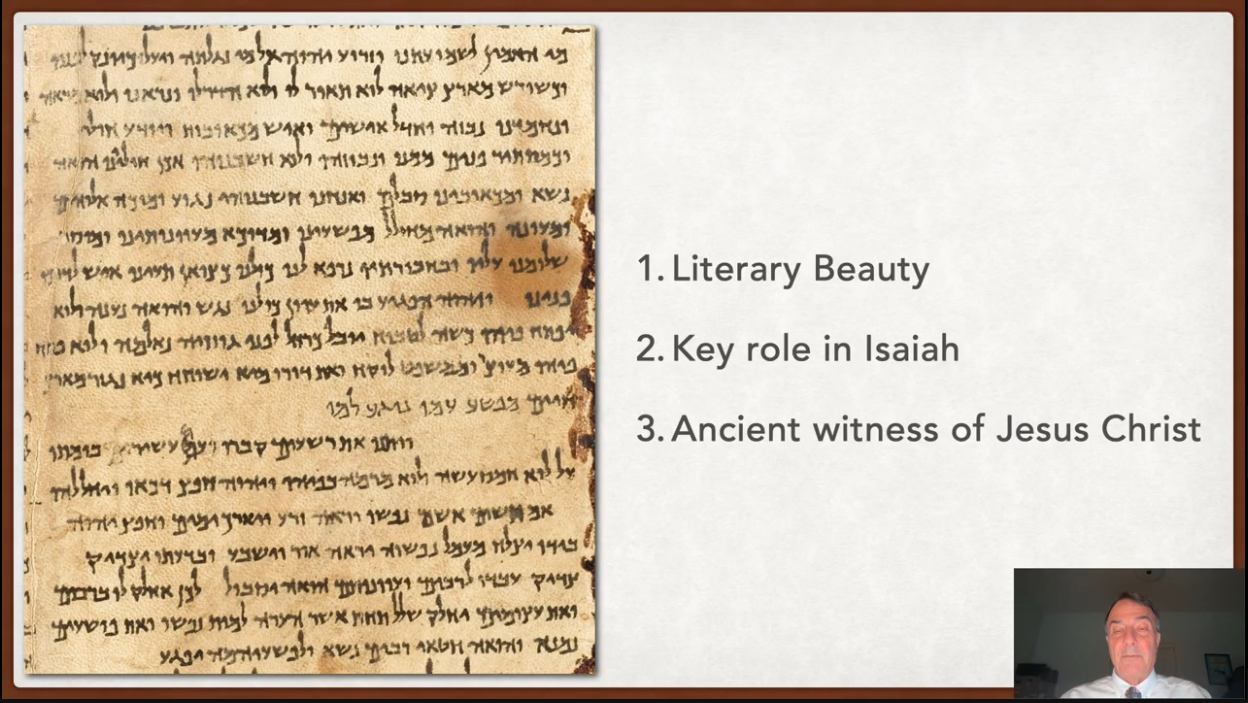
 Isaiah 53 manuscript from the Great Isaiah Scroll beside three themes: literary beauty, its key role in Isaiah, and ancient witness of Jesus Christ.

The Crown Jewel of the Old Testament

At left is the column of the manuscript of Isaiah 53 from the Great Isaiah Scroll that is housed at the Shrine of the Book, which is part of the Israel Museum in Jerusalem. Since I was a young boy, I have loved this chapter. There are three reasons I used to call it the crown jewel of the Old Testament.

One, its literary beauty, both in the original, sometimes obscure Hebrew text and in its magnificent King James Bible English translation. The latter best experienced musically in listening to Handel’s Messiah.

Two, its key role within the writings of Isaiah, the most important and widely cited prophet in the Old Testament, New Testament, and in modern scripture, as the last of his four servant songs. And most important, three, its unparalleled clarity and poignancy as an ancient witness of Jesus Christ long before his birth, a truth frequently affirmed in modern revelation.
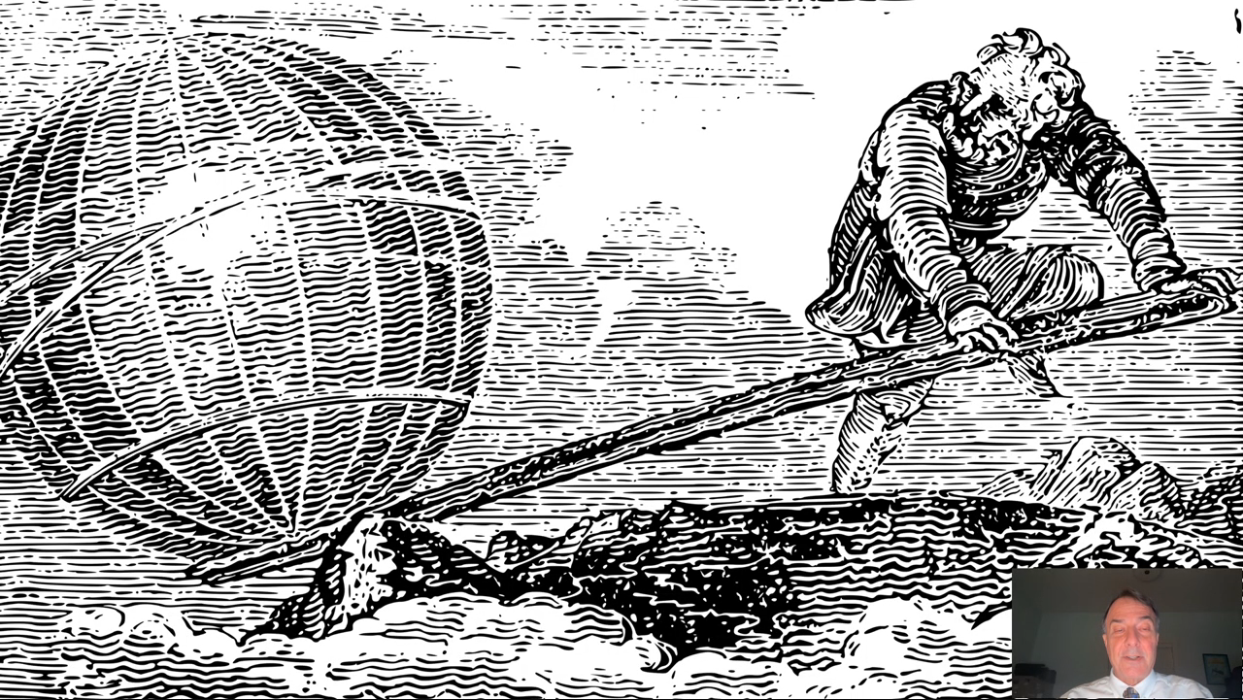
Black-and-white engraving of Archimedes using a long lever and fulcrum to lift a globe.

The Fulcrum of the Plan of Happiness

As I have reflected since, I think there is a better image for Isaiah 53 than being merely a crown jewel of the Old Testament. In fact, its worth is much more crucial than all the crown jewels of the world put together.

Archimedes, the reputed inventor of the lever, is claimed to have said, “Give me a lever long enough and a fulcrum strong enough, and I will move the earth.” For him, of course, this was hyperbole. To do so, he would have also required a base for his lever’s fulcrum that was outside the cosmos.

By way of contrast, Jesus, being both human and divine, did something that neither Archimedes nor any other mortal could do. On the fulcrum of his atonement, he leveraged all that he was as a God and a man to lift the fallen world from sin and death and make real the possibility of immortality and eternal life.

Thus, in this vivid, detailed description of the atonement of Jesus Christ, we might best call Isaiah 53 a witness of the very fulcrum and base of the plan of happiness.
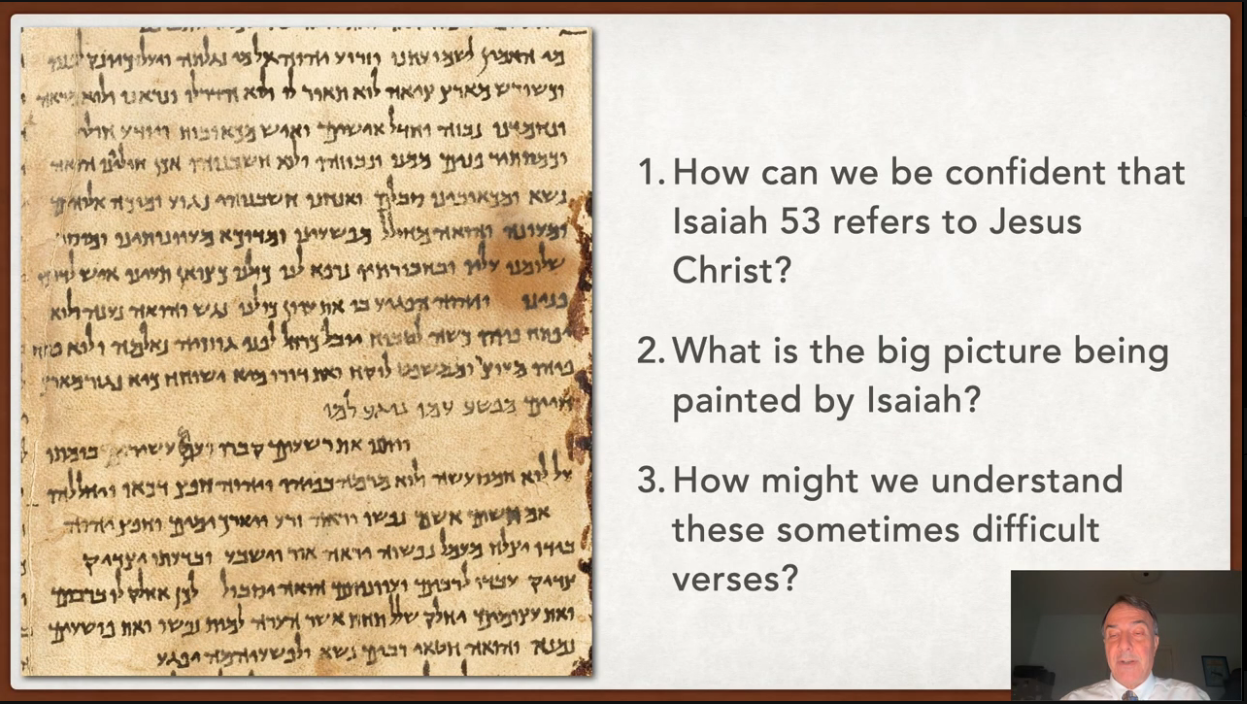
Great Isaiah Scroll manuscript beside three questions about Isaiah 53: its connection to Jesus Christ, its overall message, and difficult verses.

Three Questions About Isaiah 53

So much has been written and so much can be said about Isaiah 53 that I’ll need to be selective in this presentation. So, I will focus on just three questions.

One, why, in contrast to many who study this chapter, can Latter-day Saints be confident that Isaiah’s description of the righteous servant refers to Jesus Christ? Two, what is the big picture being painted by Isaiah? And three, how might we understand these sometimes difficult verses?

Of course, no one can prove that Jesus Christ was the righteous servant that Isaiah had in mind when he wrote these revelatory verses. But for those who believe that prophecy can reveal things far in the future, I think it can be safely argued that in light of ancient and modern scripture and teachings, the Latter-day Saint and Christian interpretation of these verses is not unreasonable. In fact, the preaching of Isaiah 53 was an important element in the conversion of many Jewish people to Christianity during and after the life of Christ.

Why Can Latter-day Saints Be Confident the Servant Refers to Jesus Christ?

So to our first question, why can Latter-day Saints be confident that Isaiah’s description of the righteous servant refers to Jesus Christ?

John W. Welch has mentioned some of the reasons that readers differ on the identity of the righteous servant in Isaiah 53. His thoughts on these difficulties can be summarized in the following three points.
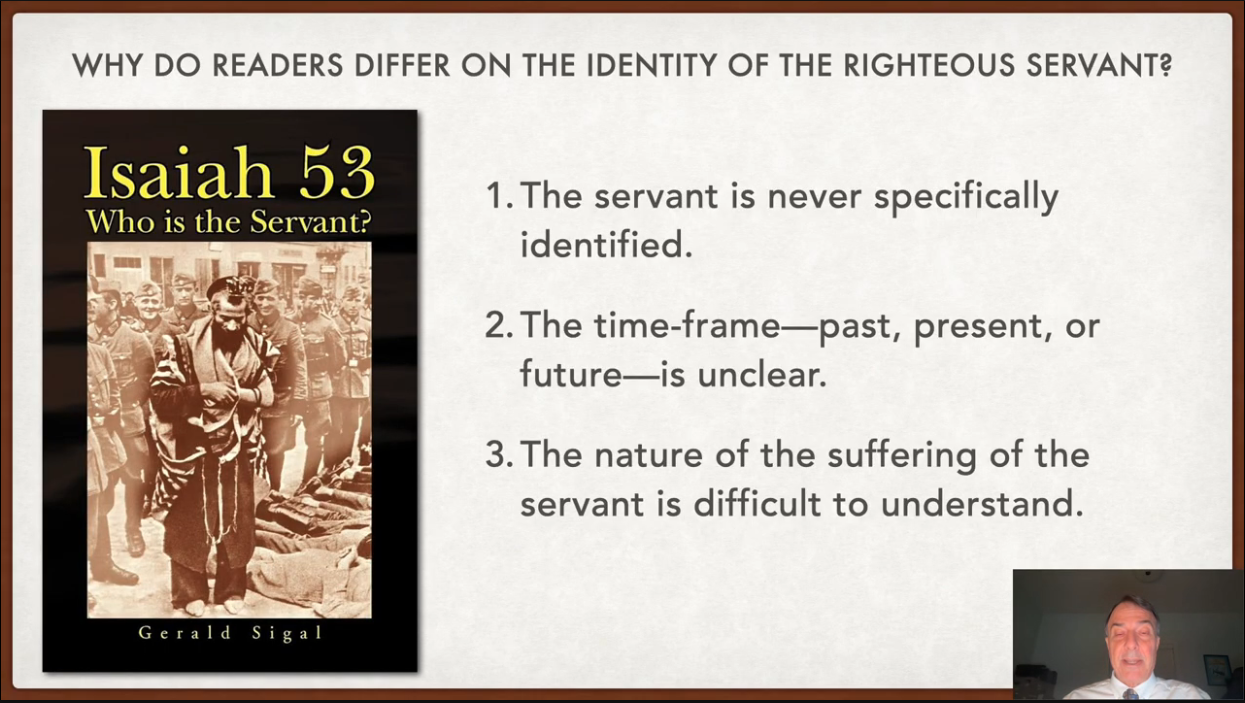
Gerald Sigal’s book “Isaiah 53: Who Is the Servant?” beside three interpretive difficulties: the servant’s identity, time frame, and suffering.

  1. One, the servant is never specifically identified. The pronoun he, as well as the we and our and thou, have all been variously interpreted. Fortunately, the Book of Mormon makes it clear that he refers to Christ. Abinadi says plainly, “I would that ye should understand that God himself shall come down among the children of men and shall redeem his people.”
  2. Two, the time frame, past, present, or future, is unclear. Again, the Book of Mormon helps us out, making it clear that the passage is written in the prophetic past tense. In other words, it is speaking of things to come as though they have already come.
  3. Three, the nature of the suffering of the servant is difficult to understand. At first, the people despise him, but later they conclude that he has borne their griefs.

Uncertainty About Prophetic Figures in the Time of JesusPainting of John the Baptist preaching to a large crowd gathered among trees, with some listeners perched in branches.
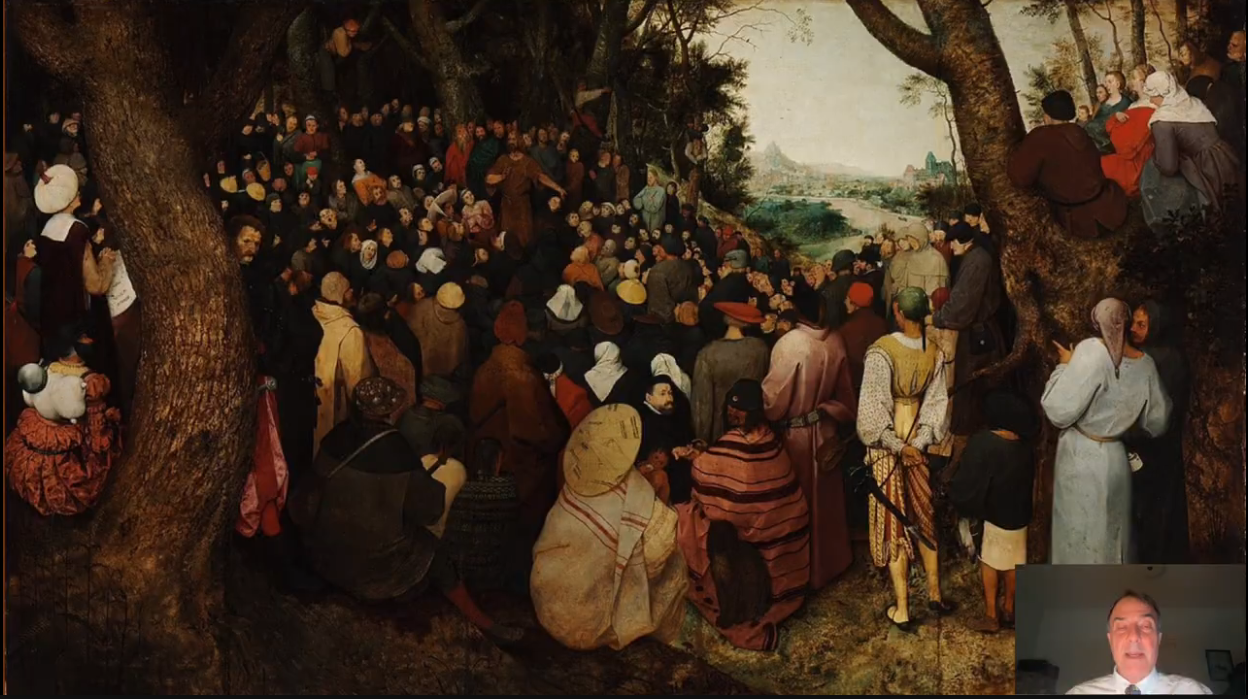
It may be surprising to some to learn that the New Testament itself attests a climate of uncertainty and speculation at the time of Jesus regarding several prophetic figures whose comings were anticipated by his people.

For example, the Gospel of John reported that, “priests and Levites from Jerusalem were sent to ask John the Baptist which one of three such figures he was: the Messiah, Elijah, or ‘that prophet,’ the latter usually associated with the prophet like unto Moses mentioned in Deuteronomy 18:15, or else with Moses himself.”
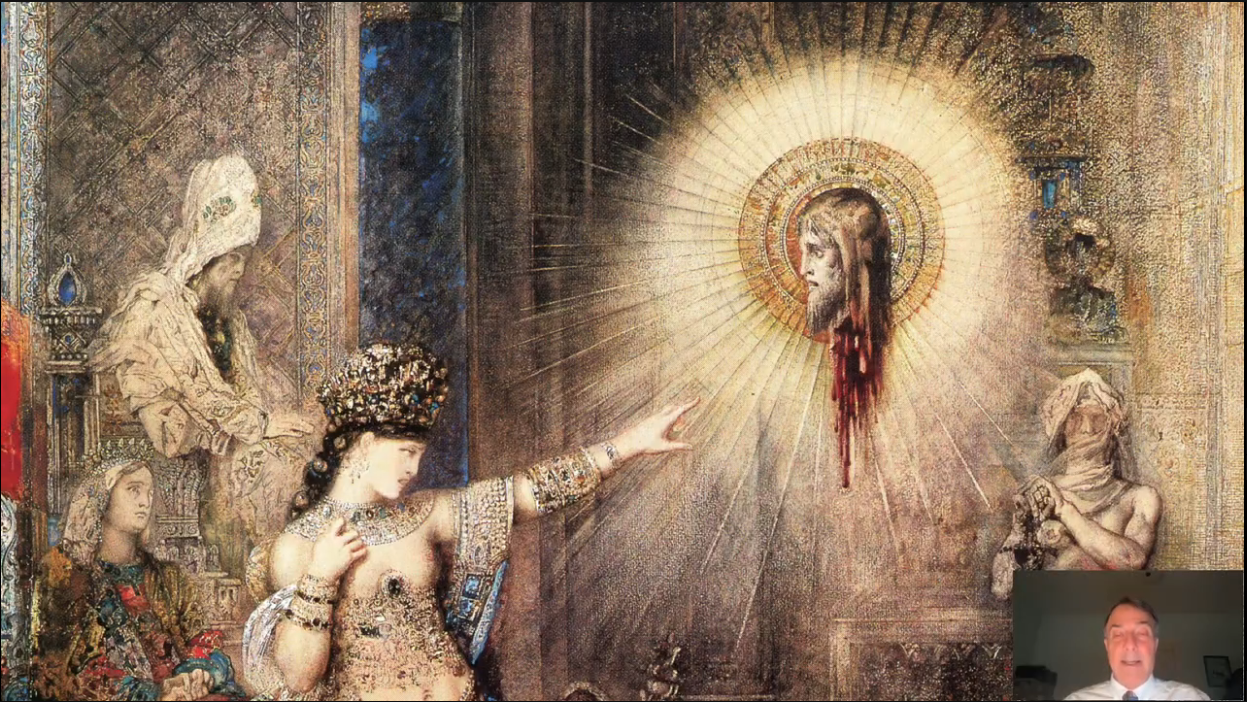
Painting of Salome reaching toward a vision of John the Baptist’s severed head, surrounded by radiant light.

In another example, after Herod beheaded John the Baptist, he feared that Jesus might be John risen from the dead. Then, as now, mapping biblical prophecy to precise time frames, circumstances, and individuals is a notoriously risky business. As a Danish parliamentarian once obtusely opined, it is difficult to make predictions, especially about the future.
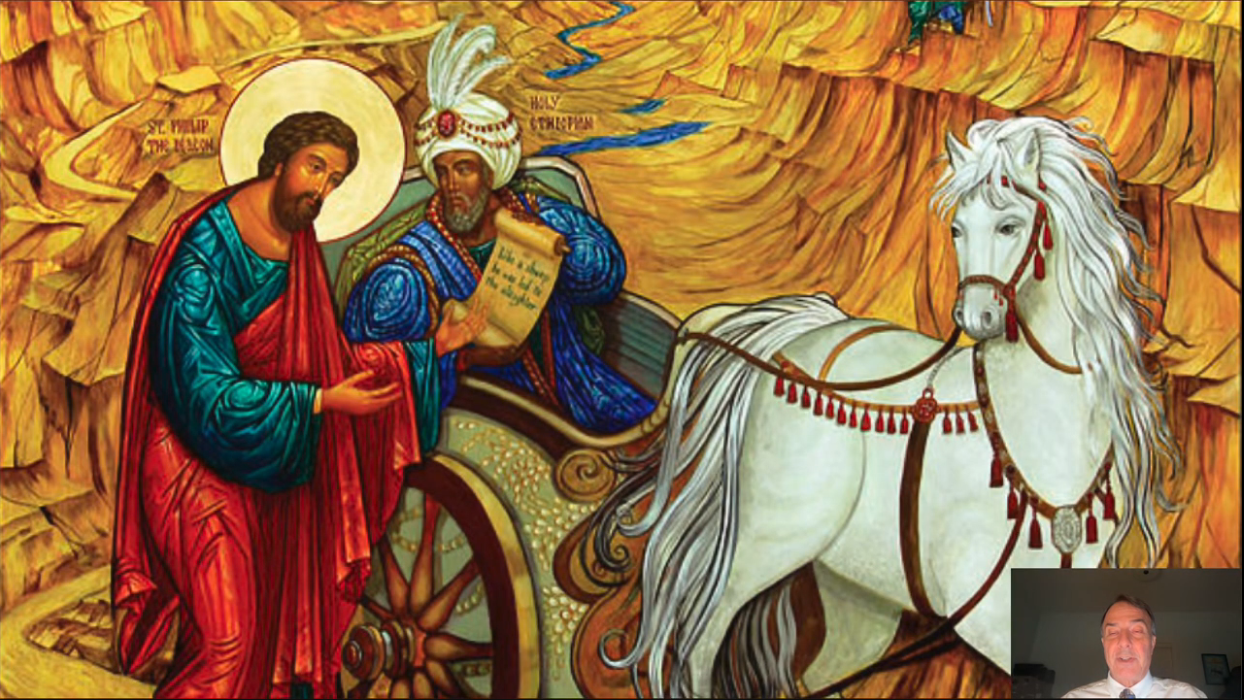
Icon of Philip beside the Ethiopian eunuch, who holds a written passage while seated in a chariot drawn by white horses.

Who Is the Servant of Isaiah 53?

With specific respect to Isaiah 53, the lack of a settled interpretation at the time of Jesus for the identity of the righteous servant is witnessed in the question the Ethiopian eunuch asked Philip. “I pray thee, of whom speaketh the prophet this, of himself or some other man?”

Even Jesus’ disciples, to whom he explained that he must needs suffer many things and be killed and be raised again on the third day, failed to recognize these events as messianic necessities. When a horrified Peter rebuked Jesus, saying, “Be it far from thee, Lord. This shall not be unto thee,” the Lord was obliged to forcefully disavow his chief apostle’s error with these words, “Get thee behind me, Satan. Thou art an offense unto me.”

What were the different guesses about the identity of the servant of Isaiah 53 in Jesus’ day and afterward? Let’s summarize some of the common identifications from four perspectives.

First, the perspective of Judaism before and after the time of Jesus, who understood Isaiah’s servant in Isaiah 53 as the Messiah. Scholars have brought forth impressive pre-Christian evidence about his suffering and atoning Messiah.

Jewish Messianic Interpretations of Isaiah 53

However, the most impressive examples of the servant of Isaiah 53 being understood in Jewish tradition messianically come from the Targum, the Talmud, and the later rabbinic literature.

Targum of Jonathan ben Uzziel

Some examples include the Targum of Jonathan ben Uzziel, composed between 70 and 135 A.D., for Isaiah 52:13 reads, “Behold, my servant Messiah shall prosper. He shall be high and increase and be exceedingly strong.”
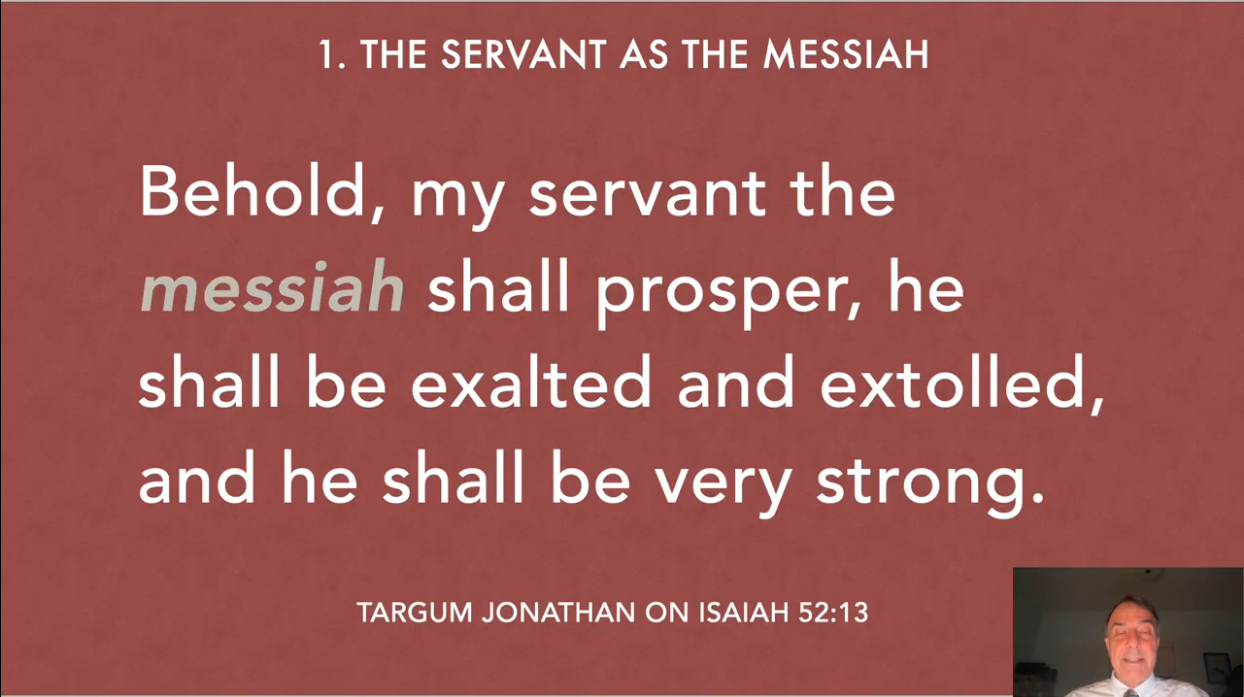
Quotation from Targum Jonathan on Isaiah 52:13 identifying the servant as the Messiah who will prosper and be exalted.

Babylonian Talmud

The Babylonian Talmud, codified in the sixth century A.D., asks, “The Messiah, what is his name?” The rabbis say, “The leprous one.” Those of the house of the rabbis say, “The sick one, as it is said, surely he hath borne our sickness.” Quoting Isaiah, of course.

The Midrash Rabbah

Midrash Rabbah, speaking with reference to Ruth 2:14, explains, “He is speaking of King Messiah. Come hither, draw near unto the throne and eat the bread, that is the bread of the kingdom, and dip thy morsel in the vinegar. This refers to his chastisements, as it is said, ‘But he was wounded for our transgressions, bruised for our iniquities.’”

Tanhuma Midrash

Midrash Tanhuma applies Isaiah 52:13 and 53:3 to the Messiah. And in the Yalkut Shimoni, a 13th-century compilation of earlier commentary, it reads, “Who art thou, O great mountain? This refers to the King Messiah. And why does he call him the great mountain? Because he is greater than the patriarchs. As it is said, ‘My servant shall be high and lifted up and lofty exceedingly.’ He will be higher than Abraham, who says, ‘I raise my hand high unto the Lord,’ lifted above Moses, to whom it is said, ‘Lift up to thy bosom,’ loftier than the ministering angels of whom it is written, ‘Their wheels were lofty and terrible.’”

These rabbinic teachings clearly identify the servant described in Isaiah 52 and 53 as the Messiah, the anointed one. What was not settled among all Jewish believers anciently and is still not settled today is the nature and role of this prophesied Messiah.
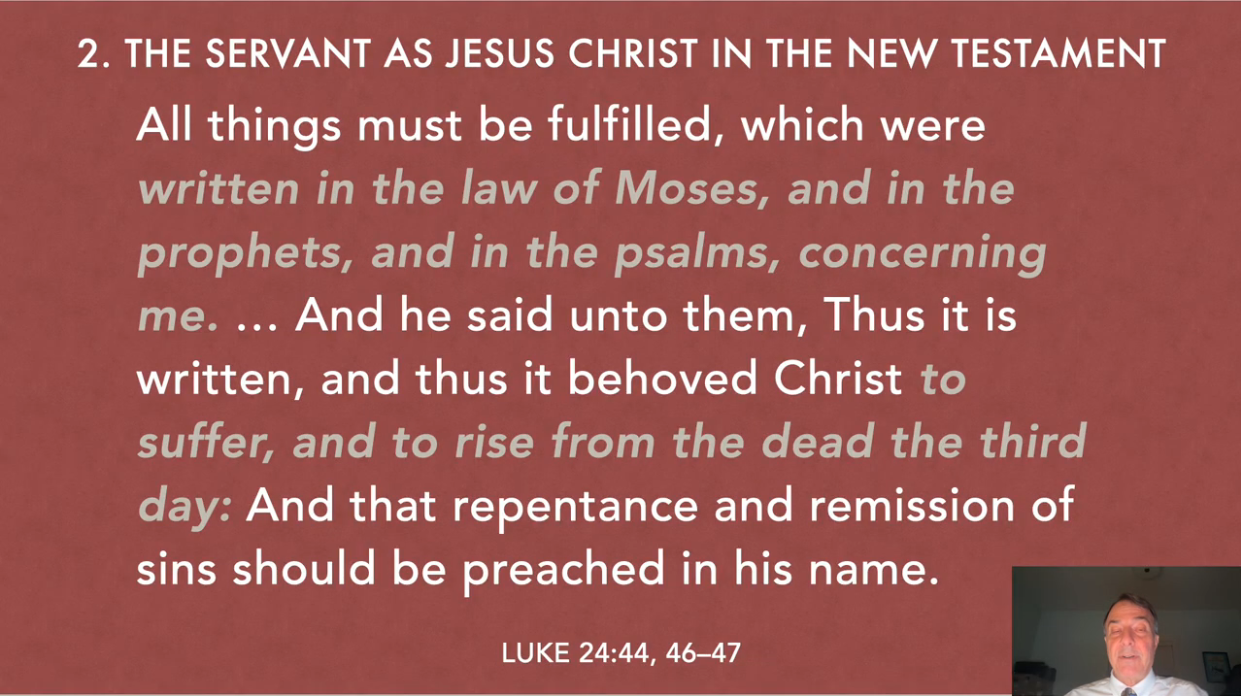
Luke 24:44, 46–47 quotation connecting scripture with Christ’s suffering, resurrection, and the preaching of repentance and forgiveness.

The Servant as Jesus Christ in the New Testament

Second perspective, the servant as Jesus Christ in the New Testament.

Though, as mentioned previously, mapping scriptural prophecies to specific events typically carries risks, both ancient and modern Christians have affirmed with confidence that Jesus Christ is the servant of Isaiah 53.

When the Ethiopian eunuch asked Philip, “Of whom speaketh the prophet?” the reply was unequivocal. Philip began at the same scripture and preached unto him Jesus.

Moreover, as Michael Parsons insightfully argued, Luke’s account of Philip’s reply to the eunuch in Acts 8 is given content by the precursor text in Luke 24. When the resurrected Jesus spoke to the disciples on the road to Emmaus, he was doubtless alluding in part to Isaiah 53 when he said, “O fools, and slow of heart to believe all that the prophets have spoken. Ought not Christ to have suffered these things and to enter into his glory?”

Likewise, when the Lord spoke to his apostles, he said, “All things must be fulfilled which were written in the law of Moses and in the prophets and in the Psalms concerning me.” And he said unto them, “Thus it is written, and thus it behooved Christ to suffer and to rise from the dead the third day, and that repentance and remission of sins should be preached in his name.”
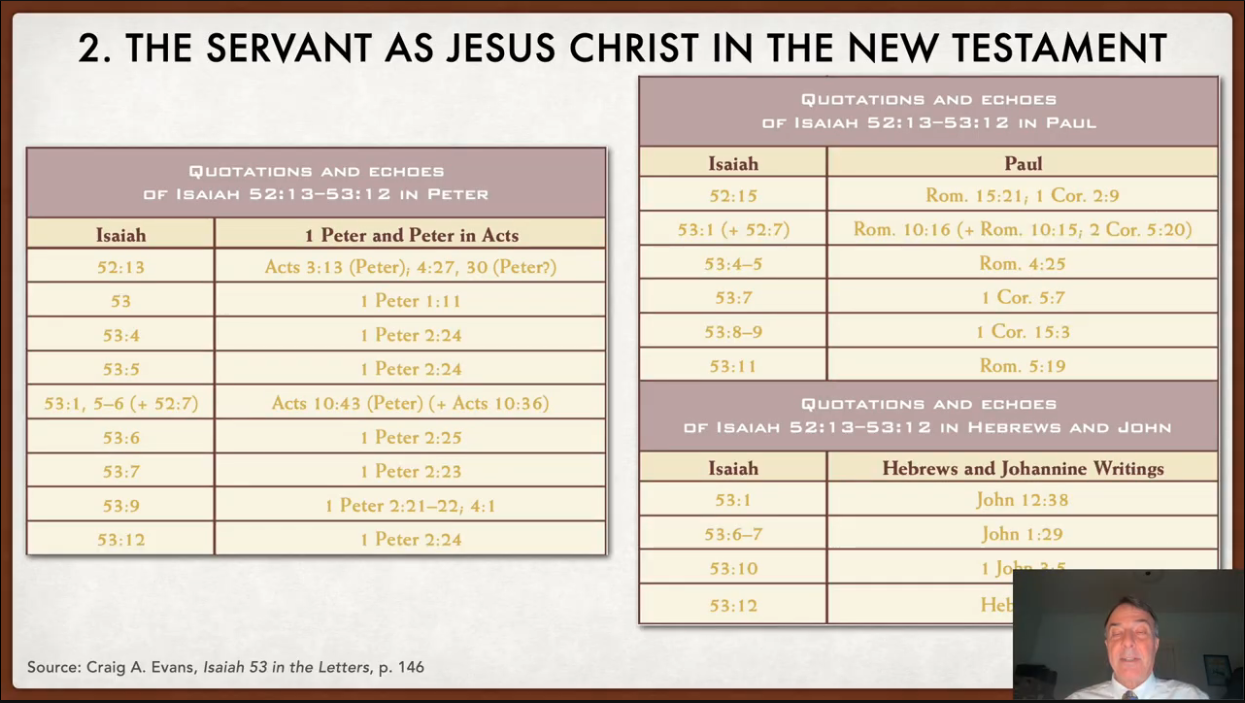
Three tables pairing Isaiah 52–53 passages with quotations and echoes in Peter, Paul, Hebrews, and John.

This figure from Craig A. Evans shows how Luke, Peter, John, and Paul also understood various verses of Isaiah 53 as applying to Jesus Christ.

The Servant in the Book of Mormon

Third perspective, the servant in the Book of Mormon.
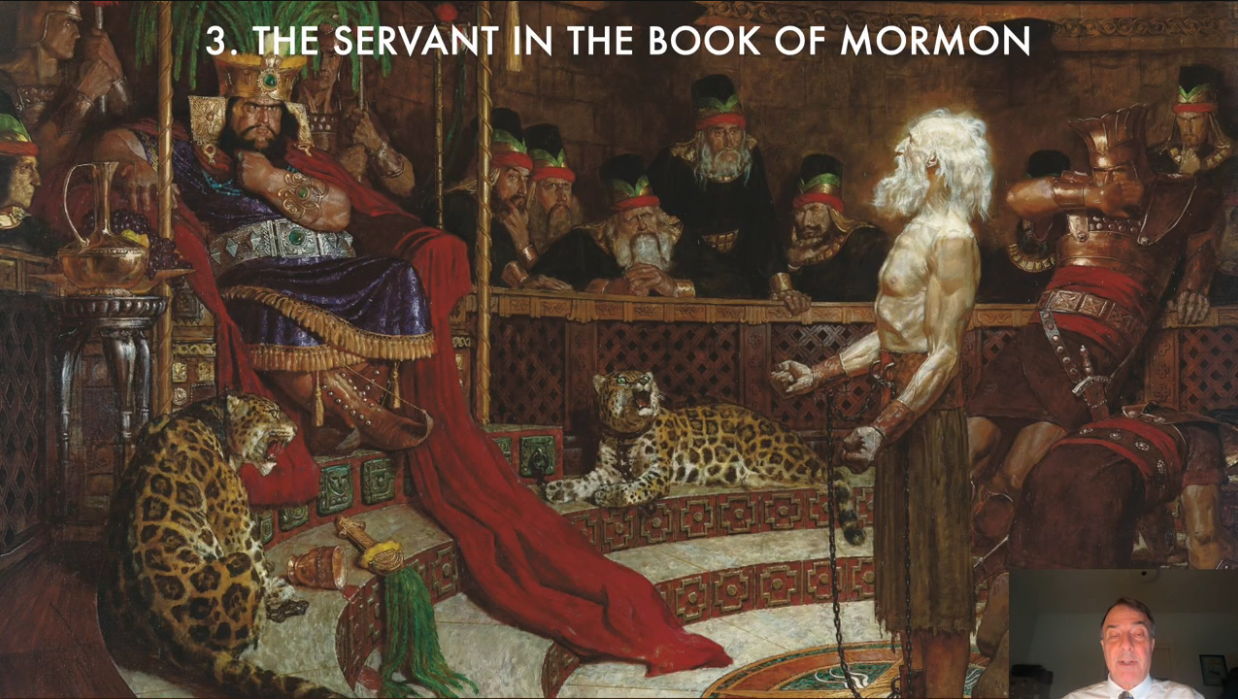
Painting of Abinadi addressing King Noah and his court beneath the heading “The Servant in the Book of Mormon.”

Abinadi’s exposition and commentary on Isaiah 53 in Mosiah 14 and 15 is one of the clearest witnesses that this prophecy refers to the life and atoning mission of Jesus Christ.

However, as Matthew Bowen argues, “The Jews, as the Messiah’s own people, described to Nephi as ‘my ancient covenant people,’ also fit the typology of Isaiah’s suffering servant.”

Going further, Bowen notes that, “Abinadi and his people’s fulfillment of the messianic suffering servant typology of Isaiah 53, Mosiah 14, which gave them experiential knowledge to stand as witnesses, helps us better appreciate how covenant Israel at other times fulfills this typology as well.”
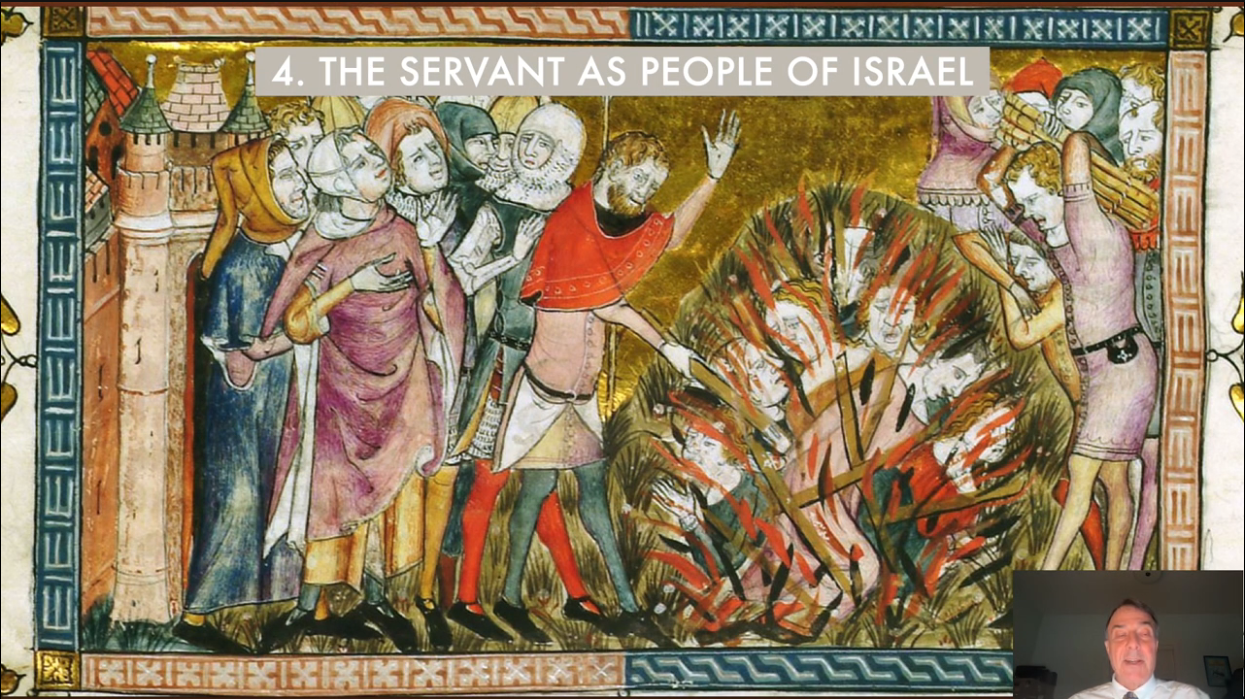
Medieval illustration of people being burned as onlookers surround them, beneath the heading “The Servant as People of Israel.”

The Servant as the People of Israel in Rabbinic Judaism

Fourth perspective, the servant is the people of Israel in rabbinic Judaism.

Although the identification of the servant as the people of Israel is attested in one account from the early third century, there’s currently no evidence outside the Book of Mormon that this identification took hold firmly and eventually decisively among authoritative commentators until much later.

Indeed, Walter Zimmerli and Joachim Jeremias go so far as to say that:

“There is not to be found a definitively non-messianic exegesis of Isaiah 53 in the rabbinic literature of the whole first millennium.”

A Corporate Identity

Victor Buksbazen explains the historical context for the change from an individual, typically messianic, identity to a corporate identity of the servant in Isaiah 53 as follows:

“Behind this change lies the tragic Jewish experience during the Crusades. During the First Crusade in A.D. 1096, when the Crusaders in their misguided zeal attempted to wrest the Holy Sepulchre from the Muslims, they became aware that the infidels were not only the pagan Muslims in faraway Palestine, but also the so-called Christ-killing Jews who were living in their very midst in Christian Europe.

“Encouraged by their fanatical leaders and frequently incited by high-ranking clerics, the Crusaders committed massacres of the Jews, especially of those who lived in France, Italy, and Germany. Thousands were butchered, their synagogues burned, and their possessions pillaged.

“This horrible experience, which lasted for almost two centuries, left a traumatic impact on the Jews, comparable only to their later experience under Hitler. From that time on, their revulsion against everything that the Christians believed or represented became more violent and hostile than ever before.

“Since that time, the question of Isaiah 53 took on a heated polemical and emotional character. And since the Christians, in their frequent disputes with the Jews, used Isaiah 53 as one of their main arguments for the Messiahship of Jesus, the Jews felt impelled to reinterpret this prophecy in such a way as to blunt the Christian argument.

“Since that time, the question of Isaiah 53 took on a heated polemical and emotional character.”
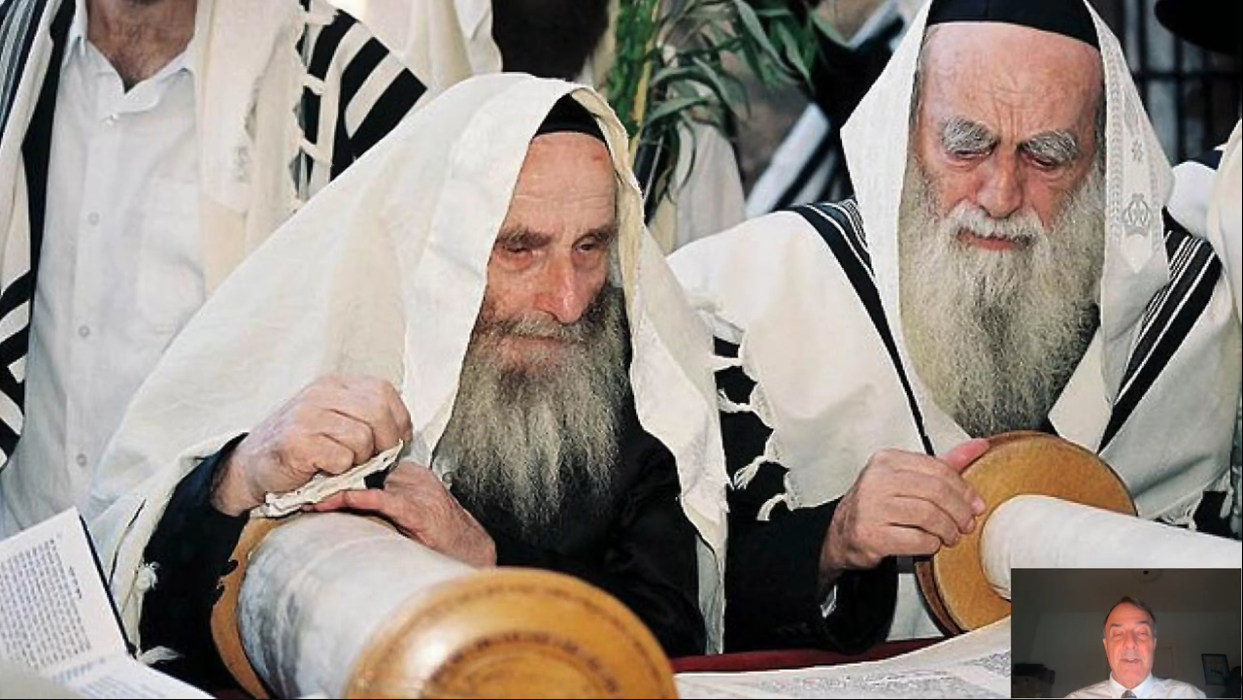
Photograph of two bearded Jewish men wearing prayer shawls and reading an open Torah scroll.

The Jewish Exegetical Tradition

Of course, the brief overview and identifications of the servant of Isaiah 53 I’ve presented, with its overly sharp demarcations of Jewish historical interpretive trends, does not do justice to the spirit of the Jewish exegetical tradition.

Unlike traditional ways of Western thinking with which most members of The Church of Jesus Christ of Latter-day Saints are most familiar and comfortable, ways that usually hunger to find single, correct, unambiguous, and authoritative answers for complex doctrinal questions, generations of Jewish scholars are usually not troubled by multiplicity of rabbinic views on central theological questions.

On the contrary, they’re pleased to find differing viewpoints. It would mischaracterize the rabbinic tradition to say merely that such differences, including details of debates on questions such as the interpretation of Isaiah, are carefully documented, when the more complete truth is that they are, in addition, lovingly cherished and preserved so that future generations can wrestle as much with the results.

Jewish and Christian Dialogue About the Messiah

Sadly, the confluences and divergences of Jewish and Christian beliefs about the Messiah sometimes continue to lead to contentious misunderstandings.

In this regard, the scholarship of Shirley Lucass provides a helpful perspective on why the ideas discussed in this presentation may offer a path to continued respectful dialogue.

“If Jesus’ first coming is accepted as the inauguration of the messianic era based on the acceptance that his messiahship was authentically Jewish, and if at his second coming all the expected conditions of the age to come were to prevail, then there is nothing in this proposition that would jeopardize the integrity of Judaism as it now stands.

“Effectively, therefore, this invalidates the statement of Jacob Neusner: ‘Is Jesus the Christ? If so, then Judaism falls. If not, then Christianity fails.’ We hope that our broader conception of the issue will allow a move away from the assertion and denial that has plagued dialogue from the parting of the ways about 70 C.E., opening up fresh possibilities and a new foundation on which dialogue can be built.

“Admittedly, however plausible this may be, it cannot wipe out 2,000 years of persecution, mistrust, and hatred. Even so, if this premise is accepted, namely that the messiahship of Jesus as portrayed in the New Testament can be rooted in antecedent Jewish tradition, then I believe that this will provide a bridge to dialogue that has hitherto not existed.”

What Is the Big Picture Being Painted by Isaiah?

Now, let’s talk about the second question. What is the big picture being painted by Isaiah?

Zooming out to understand the context of chapter 53, we should understand it is only one part of the four passages in Isaiah that are classed by scholars as a part of the servant songs. As Kurt Nielsen has described the larger rhetorical structure that both surrounds and is found within Isaiah 53.

Using the theme from the preceding 49–52 block, which in turn is built upon the themes from chapters 40–48, Isaiah now summarizes and terminates the line of thought and symbolism of the intercessory servant with a block of four chapters which forcefully present the Lord as the epitome of Israel’s Savior and describe what he will do to redeem Israel.
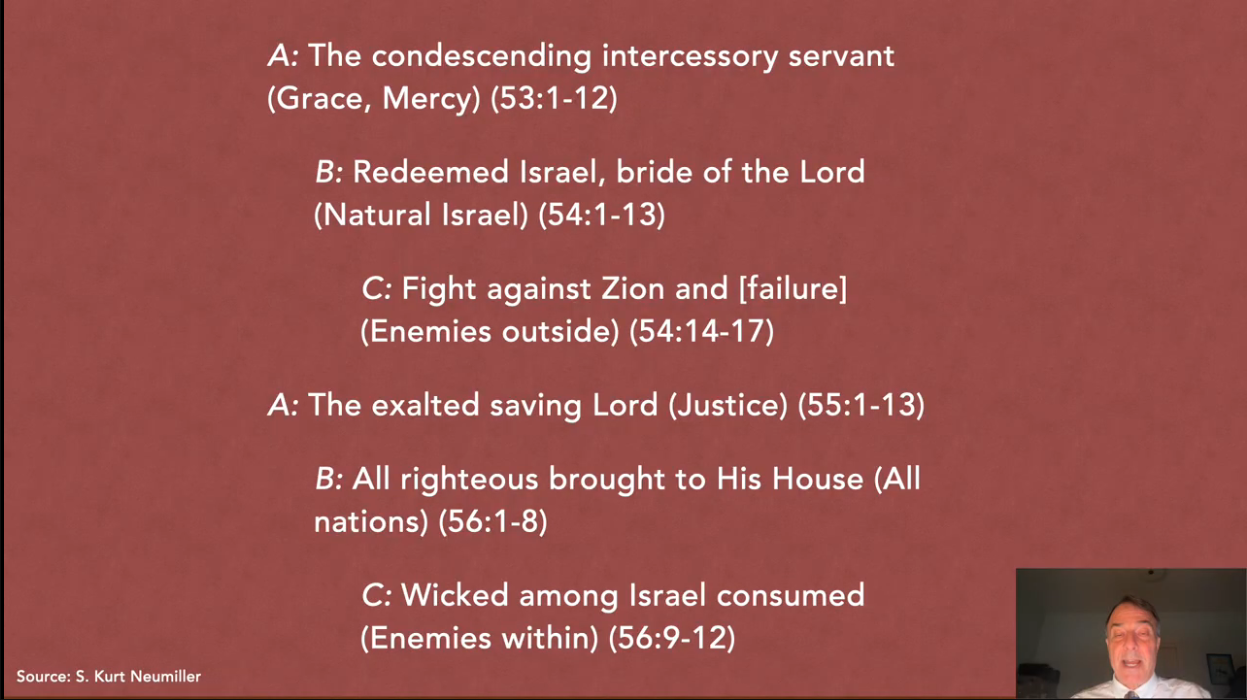
 Indented outline of Isaiah 53–56 showing two parallel sequences: the saving servant or Lord, redeemed people, and defeated enemies.

The four-chapter block is presented in an alternating ABC fashion based upon general subject, as shown here. The parallelism informs us of the unity of the Lord’s experience and mission, as well as the planning that took place long before. He is both the lowly suffering servant and the exalted powerful Lord. He saves both Israel and the Gentiles who worship him, and he destroys his enemies both inside and outside of Zion.
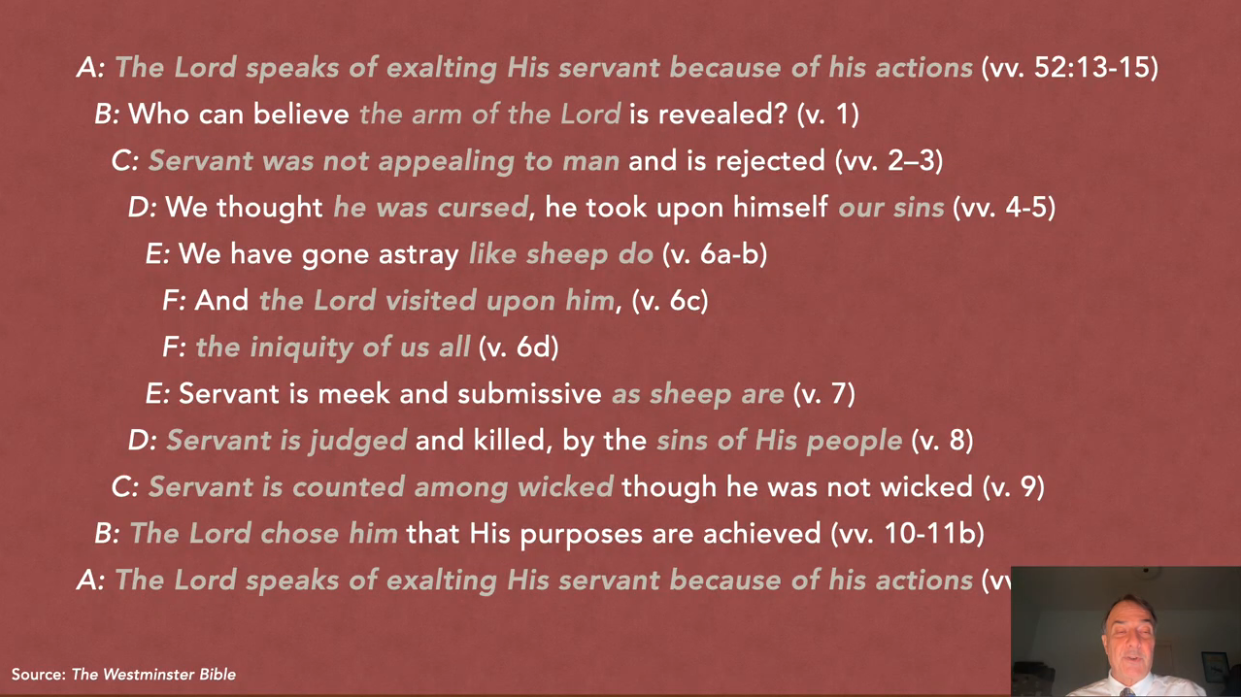
Mirrored A–F outline of Isaiah 52:13–53:12, centering on the Lord placing everyone’s iniquity upon the servant.

The Structure of Isaiah 53

The textual structure of this chapter can be structured as a chiasm, starting with the last three verses from the preceding chapter. The structure is robust enough to be spotted and commented on by the author of the Westminster Bible Commentary, which normally does not give much regard to rhetorical structures.
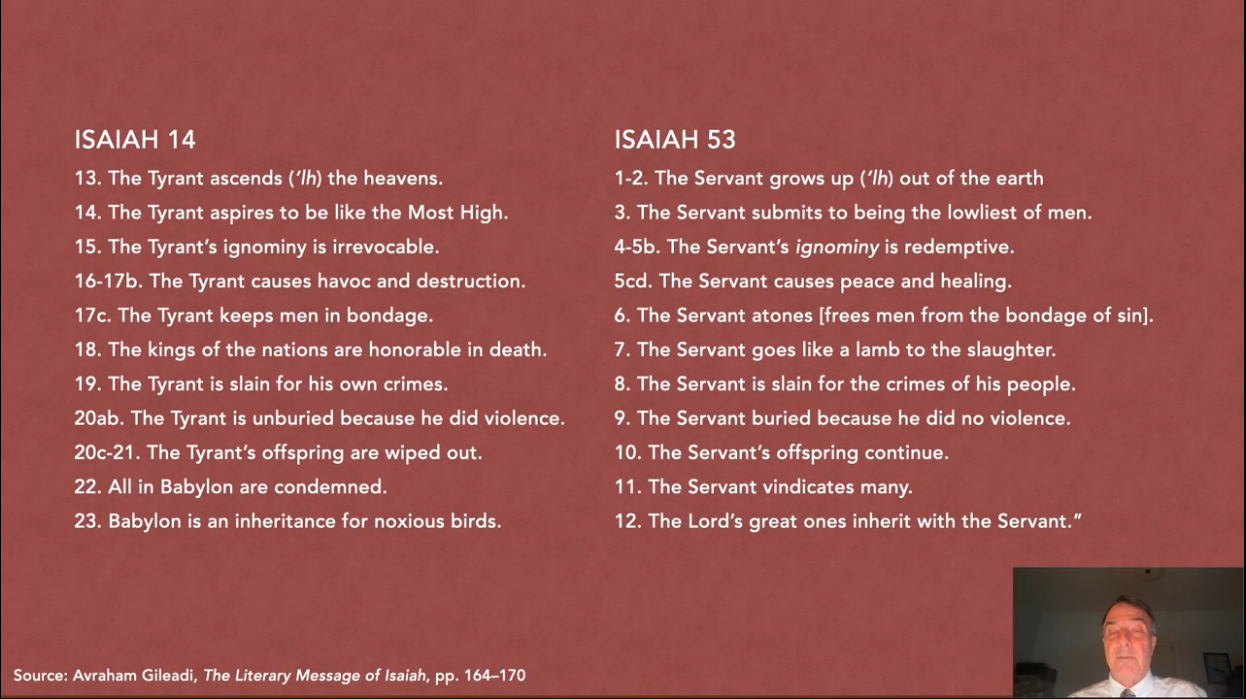
Side-by-side comparison of Isaiah 14’s tyrant and Isaiah 53’s servant, contrasting their actions, suffering, deaths, and posterity.

Also of interest are the specific parallels and contrasts that Avraham Gileadi found between Isaiah’s descriptions of the righteous servant in chapter 53 and the wicked servant in chapter 14. While Isaiah 53 traces a path from humiliation to exaltation, Isaiah 14 follows precisely the opposite course, from exaltation to humiliation.

Readers should keep these three structural aspects of the chapter just presented in mind for further study. However, for the purposes of examining the meaning of these verses in more detail, the four-part breakdown of Kurt Nielsen will be useful background.

As mentioned previously, Isaiah 52:13–15, which contains God’s proclamation of the servant’s exaltation, is of a piece with the chapter that follows. Here are the four parts of the big picture.
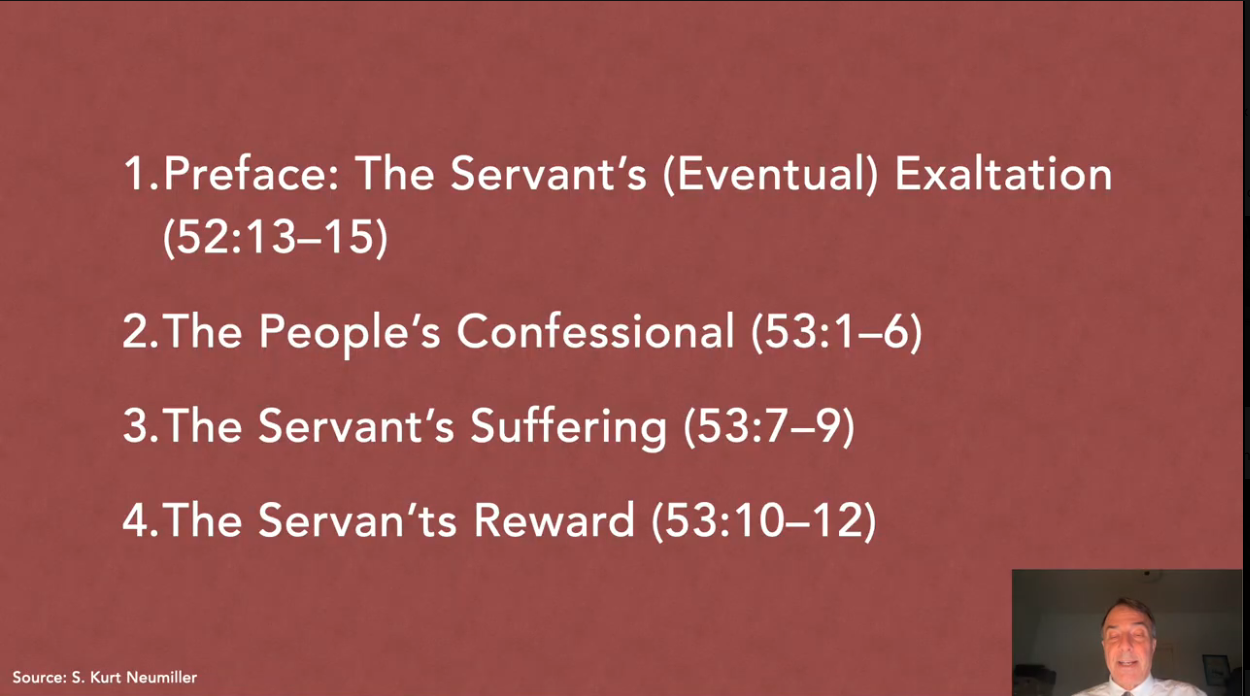
Four-part outline: the servant’s eventual exaltation, the people’s confession, the servant’s suffering, and the servant’s reward.

1. The Servant’s Success and Eventual Exaltation

One, the servant’s success and eventual exaltation. A summarizing preface to chapter 53 consisting of chapter 52:13–15.

These verses assure the reader upfront that God’s intent from the beginning is to end the suffering of the servant with a glorious finish. From the Book of Mormon, we learn that these verses apply not only to Jesus Christ, but also to the Lord’s prophetic servants. In other words, types of Christ, with their vindication being concurrent with the Second Advent.

Specifically, Moses is both a type of the Messiah and also of Joseph Smith. Some argue that the Book of Mormon is also personified as the servant described in these verses by Jesus Christ in 3 Nephi 21.

2. The People’s Confessional

Two, the people’s confessional, describing the events of Christ’s mortal life and atonement, verses 1–6.

Here, Israel is speaking in something of a confessional. They admit they wrongfully judged the servant and rebelled against God’s will. Now sorrowful for having despised and rejected the servant, they openly declare that his sufferings included not only their derision, but also, more poignantly, his atoning sacrifice on their behalf.

3. The Servant’s Suffering

Three, the servant’s suffering, describing Christ’s trial and crucifixion, verses 7–9.

The suffering that leads to the servant’s death is here described in a poignant series of images. He was oppressed and afflicted and at last brought as a lamb to the slaughter and cut off from the land of the living in company with the wicked.

Notwithstanding all this, and in pointed contrast to the evil tyrant, God assures the righteous servant a burial and the ultimate preservation of his spiritual offspring.

4. The Servant’s Reward

Four, the servant’s reward, describes Christ’s post-mortal glory in verses 10–12.

These verses present an answer to the question of why God would allow an innocent servant to be mercilessly and unjustly killed at the hands of oppressors. We learn that the Lord chose to bruise the servant as an offering for sin to redeem his offspring, grant life, and ultimately prosper the servant, thus revealing the arm of the Lord in the act of salvation.

Difficulties in the Text

Now, let’s look at some of the difficulties in these verses. We’ll only have time for a brief discussion of some of these difficulties. For a more extensive discussion, see the published paper.
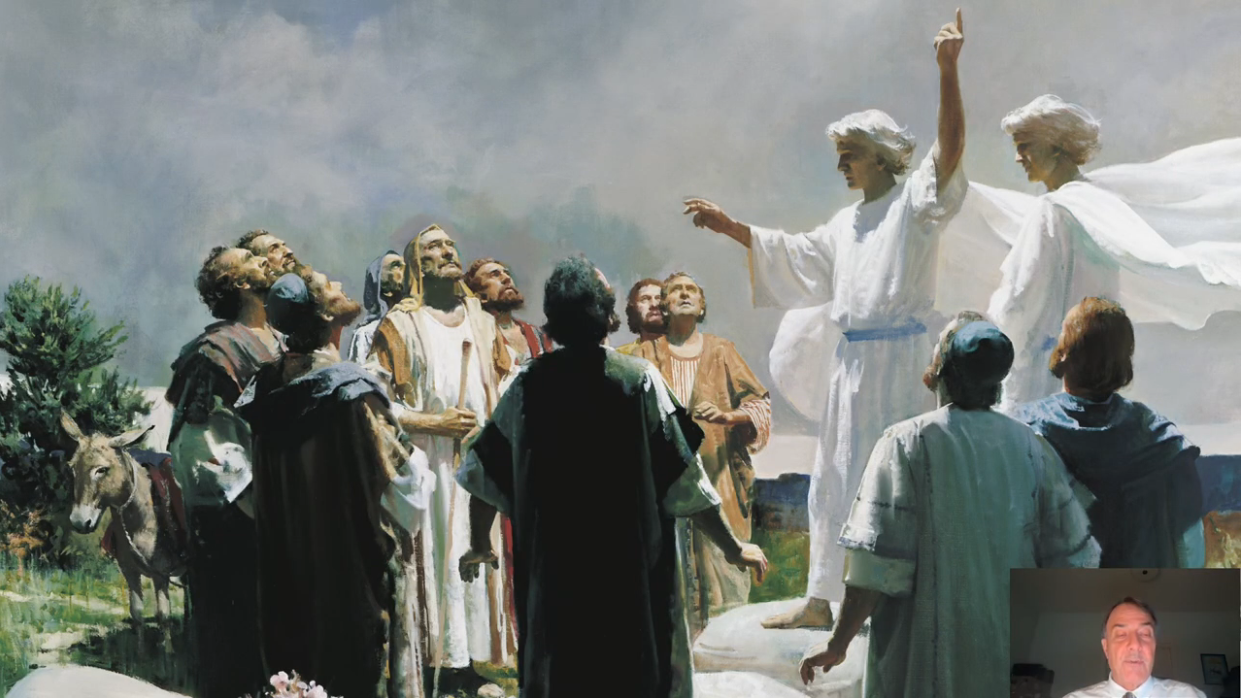
Painting of two white-robed angels addressing disciples after Jesus’s ascension; one angel points toward heaven.

First, the description of the servant’s eventual success and exaltation in Isaiah 52:13–15.

“Behold, my servant shall deal prudently. He shall be exalted and extolled and be very high. As many as were astonished at thee, his visage or appearance was so marred more than any man, so shall he sprinkle or gather many nations.”

In verses 13 and 14, Isaiah describes both the suffering and exaltation of Jesus Christ. In addition, however, in the Book of Mormon, the resurrected Jesus Christ himself applies Isaiah’s description of a suffering servant to the Prophet Joseph Smith. And the Book of Moses applies similar language to Enoch.

Moreover, Moses is both a type of the Messiah and also of Joseph Smith. These examples make it evident that others, in addition to Jesus Christ, can also be lifted up, becoming sons of man and receiving everlasting life through unwavering faithfulness in the trial of their faith. As discussed previously, these verses can also apply generally to God’s covenant people.

“Many Were Astonished at Thee”

Many were astonished at thee. The people would gape in astonishment and disdain at the servant, just as the crowd had been filled with wonder and amazement and with anger at Abinadi.

His visage was so marred. Intriguingly, the Dead Sea Great Isaiah Scroll has a variant reading for this phrase, namely, “I have anointed him.”

Though there seems to be no disagreement that the transcription of this phrase of the scroll is correct, most scholars reject this variant and instead translate it as if it were identical to the Masoretic Text.

However, if the literal translation were to be accepted as a possibility, it would be consistent with the Targum Jonathan Isaiah’s reference in 52:13 to “my servant the Messiah,” that is, the anointed one, and to the description of his brightness as a holy brightness, that is, a brightness due to his divine anointing, the oil which would help his skin to shine.

The verse then would describe not a human being unrecognizable because he has been disfigured, but one whose appearance has changed because he has been exalted and made wise and the Lord has anointed him. This fits the context of the previous verses, where the theme is exaltation, not ruination.

Demonstrating that this interpretation is neither outlandish nor—Peter J. Gentry not only cogently argues for it on the basis of several considerations, but also cites the work of Dominique Barthélemy. Barthélemy discusses five Jewish interpreters from the 12th to 19th centuries who adopted anointing as the best interpretation, and two Christian interpreters in the 16th to 17th centuries who also held such a view.

“So Shall He Sprinkle Many Nations”

So shall he sprinkle many nations.

Margaret Barker observes that many versions of the Bible have substituted another word for “sprinkle” because they did not understand the context of the passage, and so they’ve obscured the meaning from all their readers. So what is the correct context for the puzzling phrase “sprinkle many nations”?

Remember that the atonement blood that was sprinkled was the blood sprinkled on the Day of Atonement to cleanse and consecrate, and also the blood sprinkled by the servant on many nations so that they would be able to see and understand.

Gentry also concludes that the priestly function of the term is plausible in context and convincingly addresses grammatical objections to the use of “sprinkle” and argues against alternative readings of “startle,” “astonish,” or “astound.”
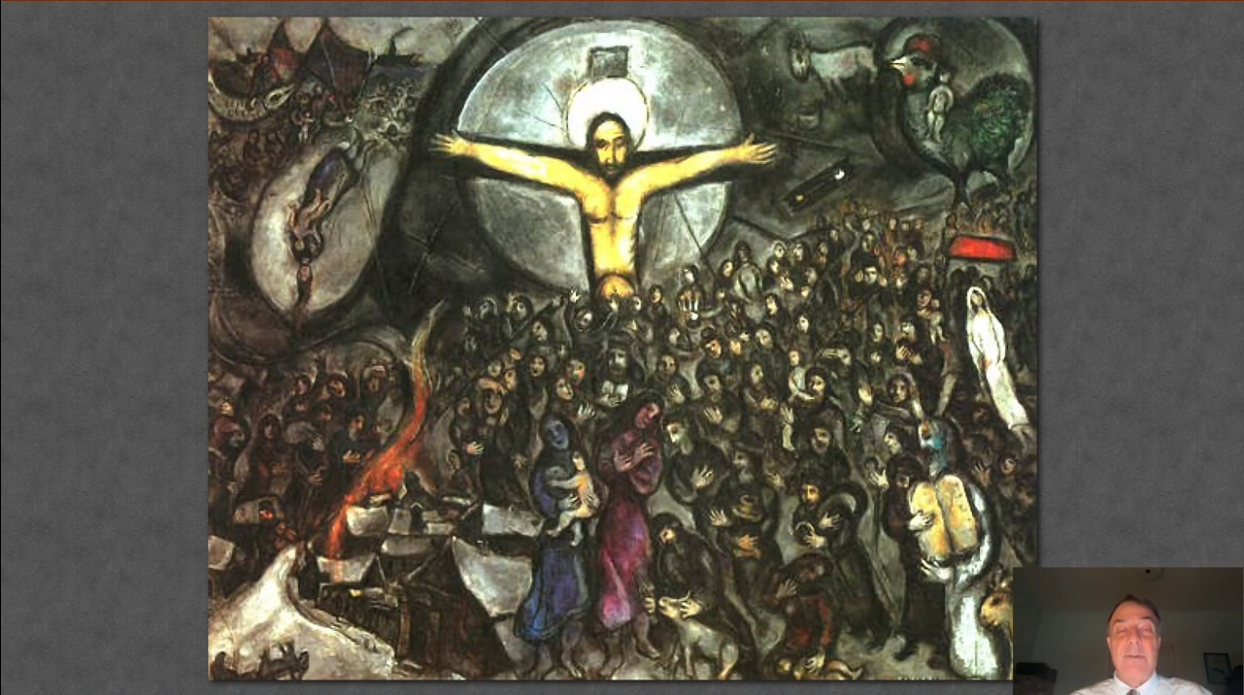
Painting of Jesus on the cross above a dense crowd, with surrounding scenes and figures.

“So He Shall Gather Many Nations”

So he shall gather many nations.

As an alternative to “sprinkle,” the Joseph Smith Translation of this verse changes the phrase to

read, “So shall he gather many nations.” The Prophet’s translation is fitting in light of both Targum Jonathan, Isaiah 52:12, “The God of Israel is about to gather your exiles,” and John 12:32,“And I, if I be lifted up from the earth, will draw all men unto me.”

Bruce D. Chilton understands the Targum to mean that, “The gathering of exiles is associated with the victorious Messiah.”

While there is no obvious etymological connection between “sprinkle” and “gather” that would suggest the scribal error could have confused these terms, perhaps there is another kind of connection between them. Since the Messiah’s victory is spiritual as much as temporal, the gathering to the kingdom of God is accomplished by the sprinkling of atoning blood, is as real and essential as the literal gathering of Israel. I suggest that these two unrelated terms may be, in fact, telling us two different dimensions of one unified idea.

“The Kings Shall Shut Their Mouth at Him”

The kings shall shut their mouth at him. For that which they had not been told they shall see, and that which they had not heard shall they consider.

Both appalled by the servant’s debasement and astonished at his eventual vindication and exaltation, kings shall purse their mouths closed, left speechless in wonderment.
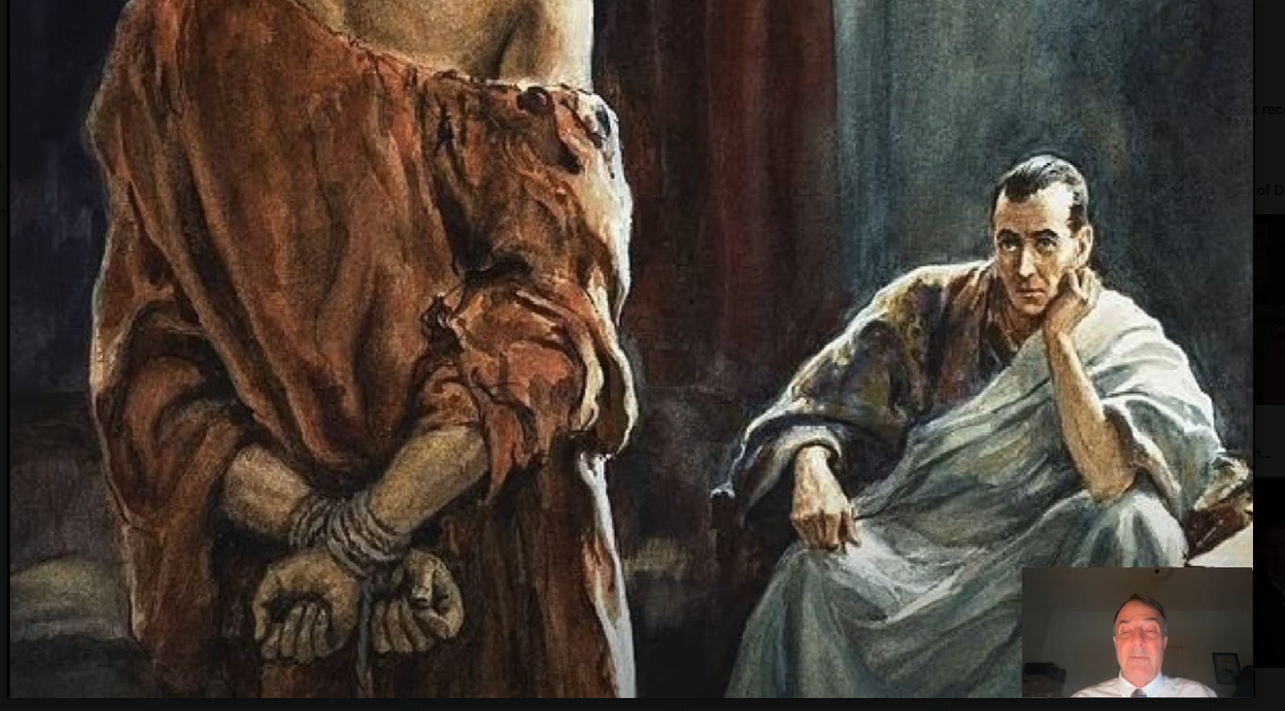
Painting of bound Jesus standing before a seated Roman ruler, who rests his chin on his hand.

That which had not been told them, they shall see. The end of this verse introduces the theme of the unexpected humiliation of the servant described in verses 1–3. With closed mouths and opened eyes, the earthly elite will see a truth they had never learned.

How could they have imagined that the greatest of all would come as a servant, that he who would ascend up on high must first descend below all things?

The People’s Confessional

Now to the people’s confessional, verses 1–6.

“Who hath believed our report? And to whom is the arm of the Lord revealed?”

Who hath believed our report? The JPS version gives an alternate reading: “Who can believe what we have heard?” Like the kings and nations referred to in 52:15, the surprising form in which the Lord’s arm is revealed through Christ’s ministry results in general astonishment and unbelief.

“Behold, here is the agency of man, and here is the condemnation of man, because that which was from the beginning is plainly manifest unto them, and they receive not the light.”

“And the light shineth in darkness, and the darkness comprehendeth it not.”

The Arm of the Lord

The arm of the Lord. The faithful and observant among God’s people will recognize the arm of the Lord revealed in the report of his servants. The arm of the Lord is previously mentioned in 51:9 and 52:10 as the agent of salvation.

See also John 3:7 and 12:37–38 as reference to this prophecy’s fulfillment in Jesus’ mortal ministry, and in 1 Nephi 22:10–11 and Doctrine and Covenants 45:47 regarding its ultimate fulfillment in the Second Coming.

A green plant grows from cracked, dry ground beneath a dark sky, with a small figure walking in the distance.

Margaret Barker notes that “arm” and “seed” or “son” are similar in Hebrew. Therefore, the phrase might be better read as, “To whom has the seed or son of the Lord been revealed?” This makes better sense of Isaiah 53:2, literally “sucking child,” not “young plant.”

“Despised and Rejected of Men”

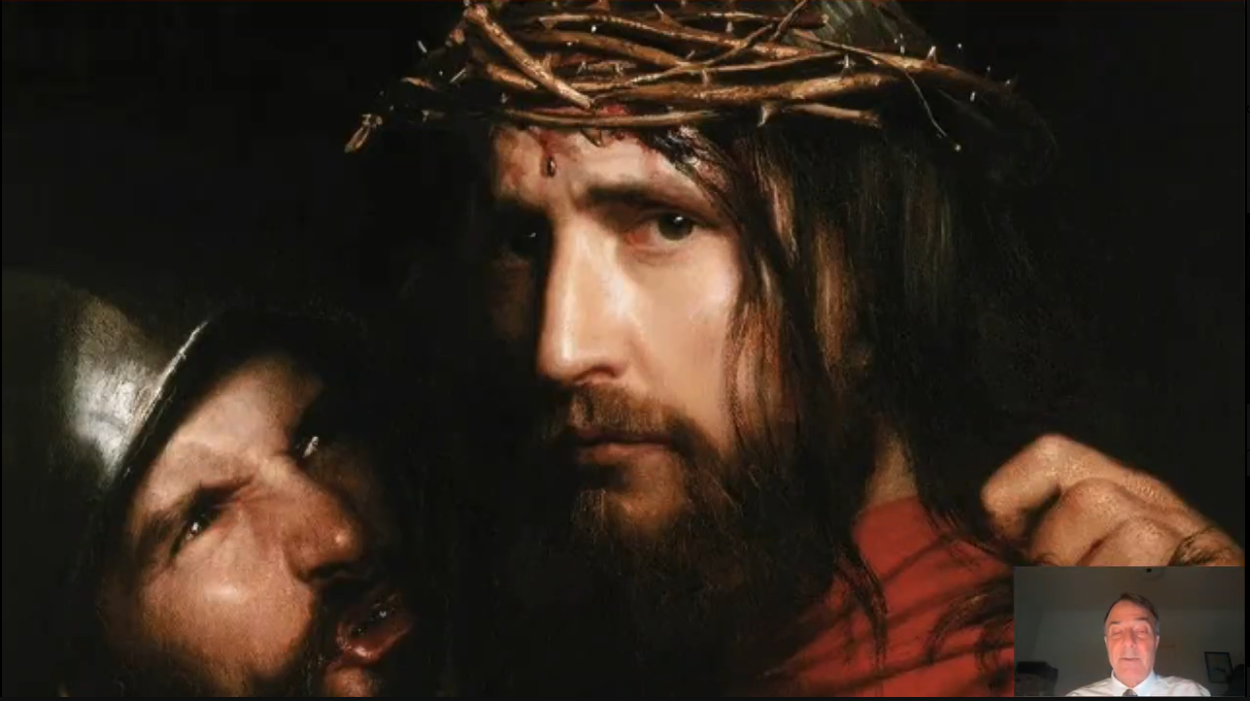
“He is despised and rejected of men, a man of sorrows and acquainted with grief. We hid as it were our faces from him. He was despised, and we esteemed him not.”

He is despised and rejected of men. Compare John 1:11: “He came unto his own, and his own received him not.” See also Isaiah 49:7.

We hid as it were our faces from him. The concept is the Semitic custom of not showing your face, that is, turning away from those whom you despise or reject. Not only did people refuse to follow him, they shunned him. The servant will be viewed with the same disdain as the Jews viewed a leper.
Close-up painting of Jesus wearing a crown of thorns as another man leans toward him and grips his shoulder.

“Surely He Hath Borne Our Griefs”

“Surely he hath borne our griefs and carried our sorrows. Yet we did esteem him as stricken, smitten of God, and afflicted.”

Surely he hath borne our griefs and carried our sorrows. Matthew 8:16–17 applies this reference to Jesus’ healing of the sick. First Peter 2:24 applies it to the bearing of our sins.

Yet we did esteem him stricken. This statement recalls the story of Job, where the innocent man is afflicted and his friends consider him cursed by God. In that case, as in this one, the people judge him unrighteously.

Peter describes the situation in its true light. “For Christ also hath once suffered for sins, the just for the unjust, that he might bring us to God.”
 Close-up painting of Jesus’s outstretched hand, palm upward, with a wound visible in the palm.

“Wounded for Our Transgressions”

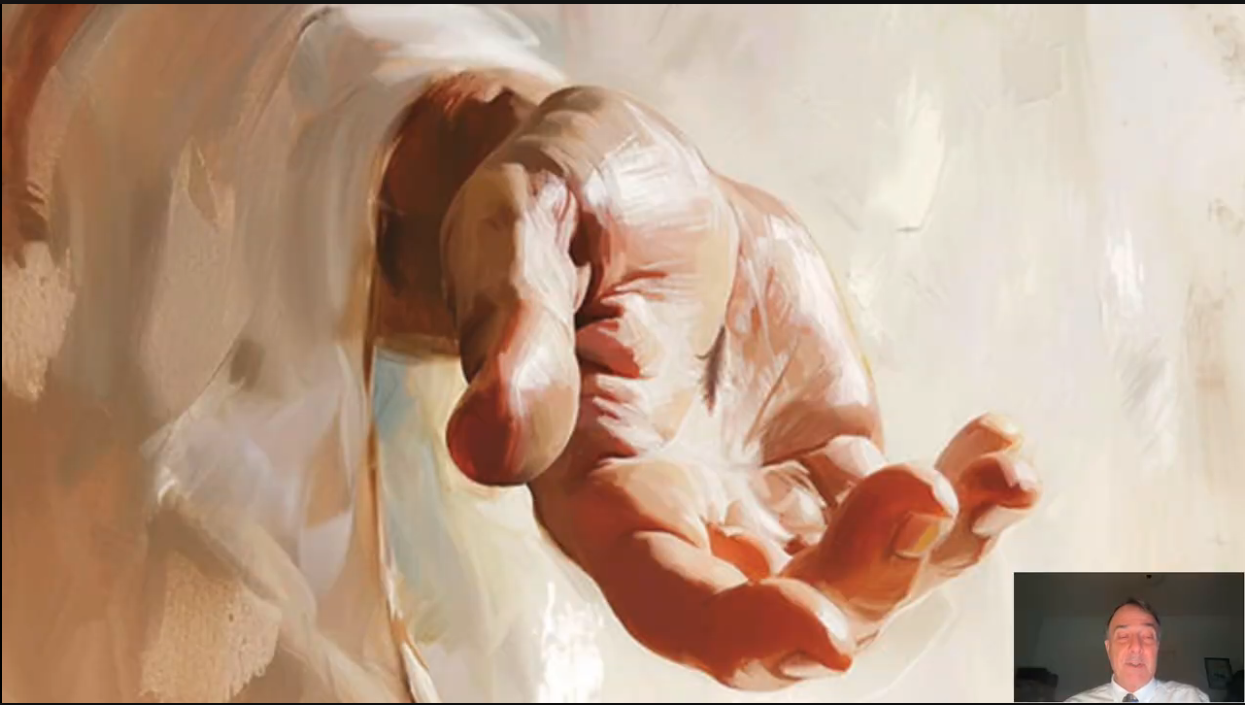
“But he was wounded for our transgressions. He was bruised for our iniquities. The chastisement of our peace was upon him. And with his stripes we are healed.”

He was wounded for our transgressions. Verses 5 and 6 are a clear reference to the intercessory act of vicarious atonement. Here we have a righteous one who delivers salvation to those who cannot save themselves, a type of all God’s servants whose mission it is to carry his message and his love to all nations.

In the Old Testament, we see prophets such as Moses, who pled on Israel’s behalf many times, and Abraham, who appealed for mercy on behalf of the possible righteous in Sodom and Gomorrah.

At the same time, though they were afflicted by the wicked and suffered as a result of them, none of these preceding intercessors actually participated in a vicarious expiation of sins. In this respect, Christ’s atonement was unique.

“With His Stripes We Are Healed”

With his stripes, we are healed. When Jesus was scourged by Pilate’s men, the whips left stripes on his back.

Paradoxically, we are healed by wounds, and our garments are made white by red blood. Blood ordinarily produces stains, even indelible stains. But acceptance of the blood of Christ symbolically and actually does just the opposite.

Our garments may be made white in the blood of the Lamb. As we learn from the Book of Moses, “By the blood of Christ, ye are sanctified.”

 Photograph of a lone lamb standing amid tall grass.

“All We Like Sheep Have Gone Astray”

All we like sheep have gone astray. The image of scattering sheep, each going his own way, shows how foolish the people were in rejecting the servant.

This depiction of the straying sheep is also meant to recall the wandering that preceded the entrance of the children of Israel into the promised land. This wandering about and failing to heed the law of the Lord was specifically warned of by Moses.

As Jesus was the incarnation of the law, the rejection of Jesus would be the ultimate rejection of the law.
Painting of a priest placing his hands on a goat’s head near the tabernacle while a group watches.

“The Lord Hath Laid Upon Him the Iniquities of Us All”

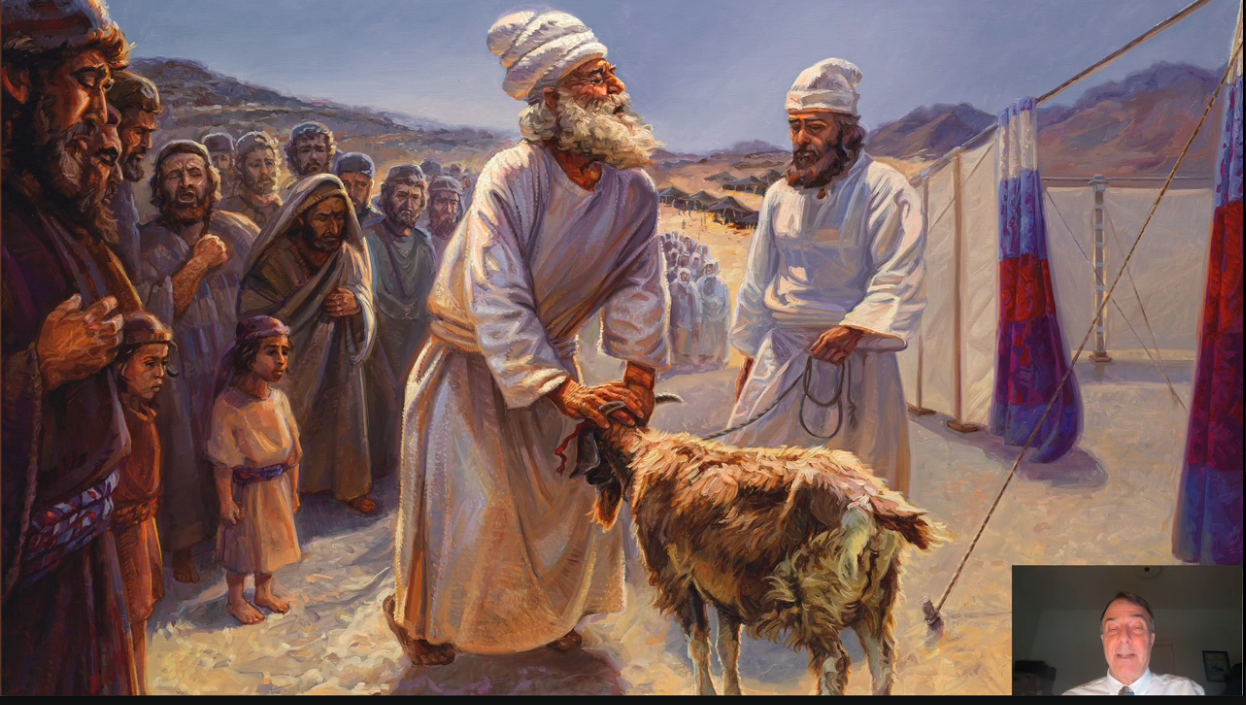
The Lord hath laid upon him the iniquities of us all. This passage harks back to the meaning of the ritual of the Day of Atonement in Leviticus 16, when the high priest laid his hand on the head of the victim and, in essence, transferred to him the sins of the people.

This phrase is the emotional center of the chapter and leaves no doubt that the subject here is the vicarious expiation of sins. Especially note the singular “him” and the very inclusive guilt of “all of us.”

Attempting to arrive at an interpretation that takes “him” as referring to anyone else besides Jesus Christ is most difficult, since no other single intercessor has suffered for all of us. Compare this with Isaiah 43:24 and 25, where it is stated that the Lord is forced into the position of servant because of Israel’s sins, and he must expiate them himself in order to vindicate his name.
Painting of Jesus surrounded by soldiers and a crowd, with a cloth draped over his head and shoulders.

“He Was Oppressed and He Was Afflicted”

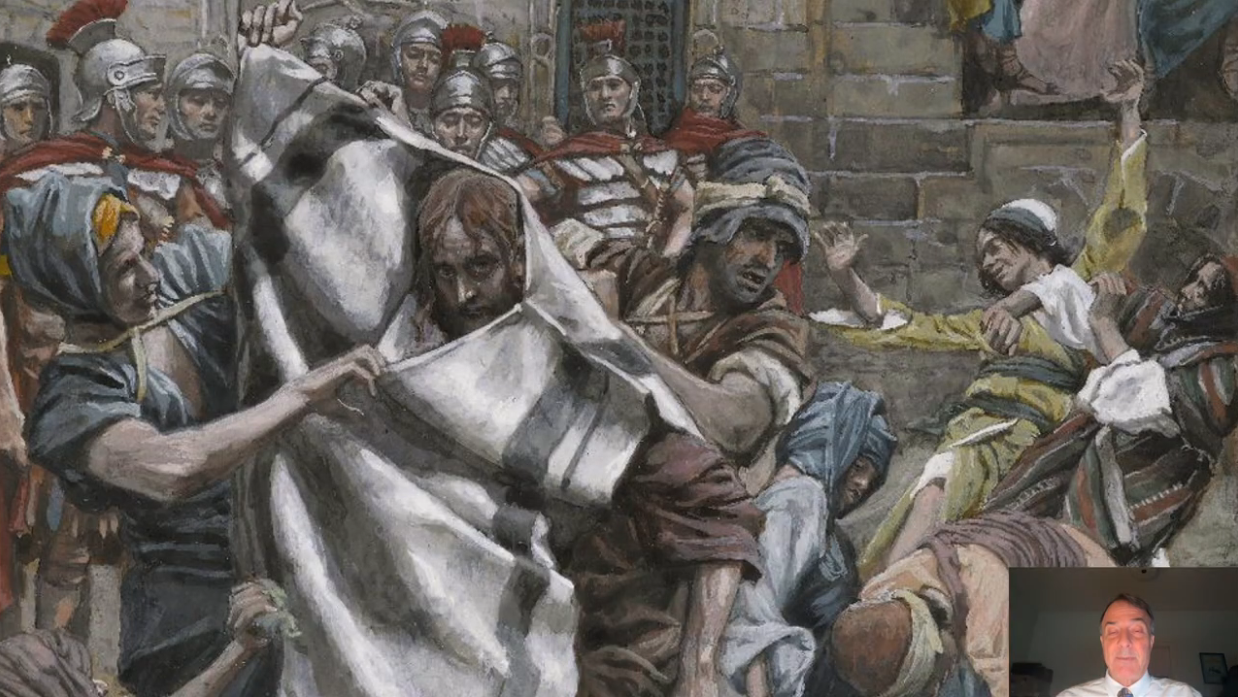
He was oppressed and he was afflicted. Jesus, of course, was oppressed and afflicted throughout his ministry. But this passage seems to refer particularly to the legal trials he suffered immediately before his crucifixion. The Hebrew nagas employed here implies the use of physical violence.

Yet he opened not his mouth. More than just a prophecy of the Lord’s refusal to speak to Herod, the phrase indicates the meek and submissive nature of the servant to the task he is to perform.

The servant does not return railing for railing to his oppressors. Nor does he submit to the temptation to curse God and die.
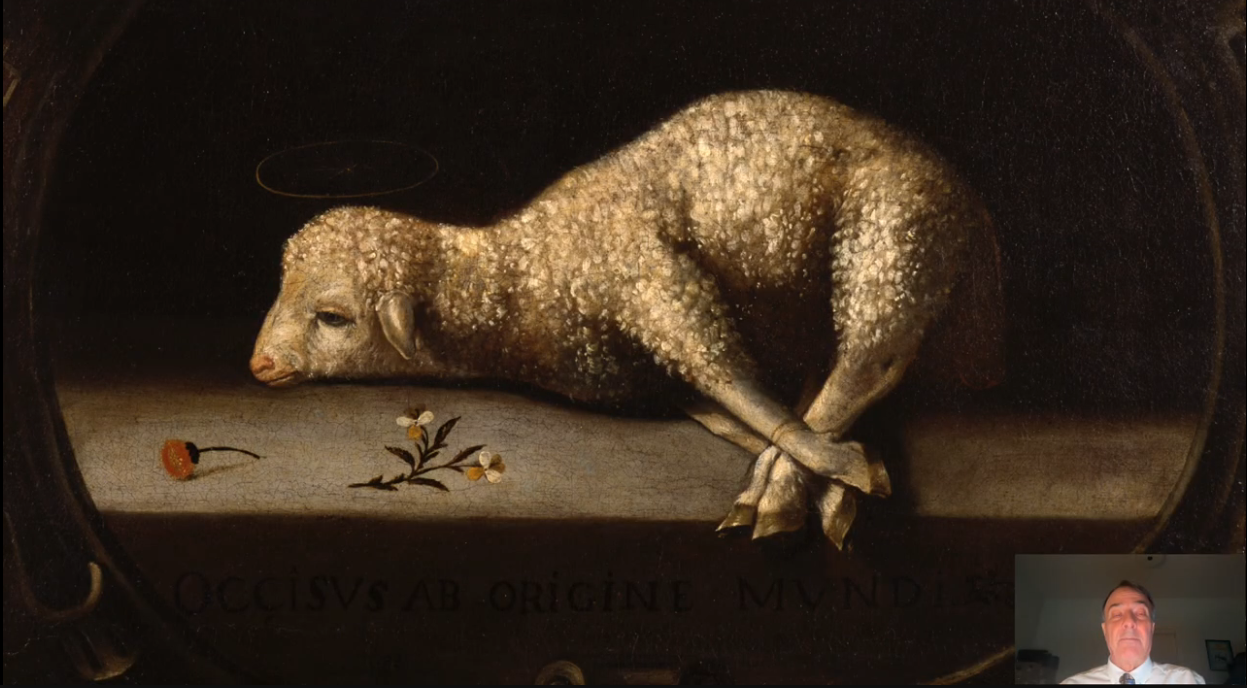
Painting of a lamb lying on a stone slab with its legs bound together and a faint halo above its head.

“He is brought as a lamb to the slaughter and as a sheep before her shearers is dumb. So he opened not his mouth.”

The sheep theme is altered from verse 6. Rather than a group of shepherdless, wandering sheep, we have here a single docile sheep that submits silently to its shearing and slaughter as a literal offering for sin.
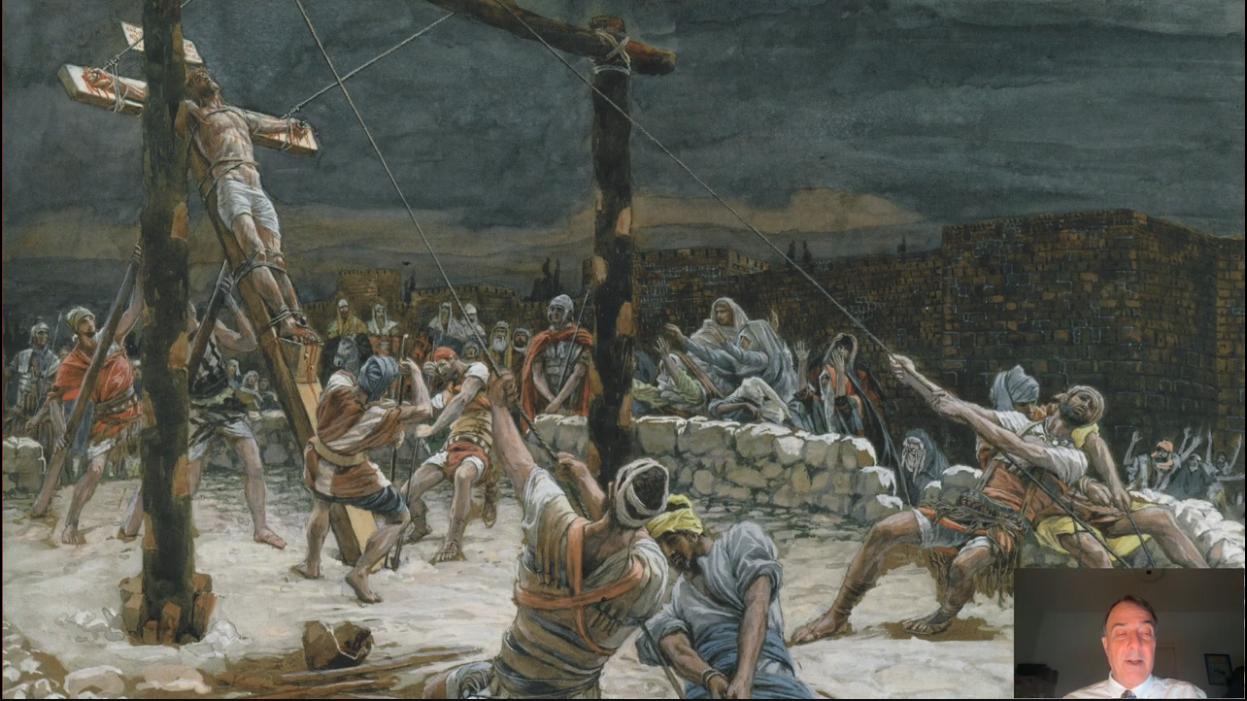
Painting of men using ropes to raise a cross bearing Jesus, with soldiers and onlookers nearby.

“He Was Taken from Prison and from Judgment”

“He was taken from prison and from judgment. And who shall declare his generation, for he was cut off from the land of the living. For the transgression of my people he was stricken.”

He was taken from prison and from judgment. A plainer translation would be, “He was taken by force and without justice.” Hebrew mishpat.

Who shall declare his generation? The New International Version renders this phrase as, “Who can speak of his descendants?” implying that because he was cut off from the land of the living, he had none.

For the transgressions of my people, he was stricken. A version of Isaiah found in the Dead Sea Scrolls renders the term “of my people” as “his people.” Such a rendering would favor the servant as being the condescending Lord, as it would say, “The servant was stricken for his own people.”

Note the irony in the fact that the servant was killed as a result of the people’s sinning, and he was also killed for the people’s sins. The idea that the servant was not merely stricken, but rather stricken to death, is evident not only from the parallel to the slaughtered lamb in verse 7, but also is attested in the Septuagint, arguably the best extant textual witness for the meaning of this verse, according to John Day.
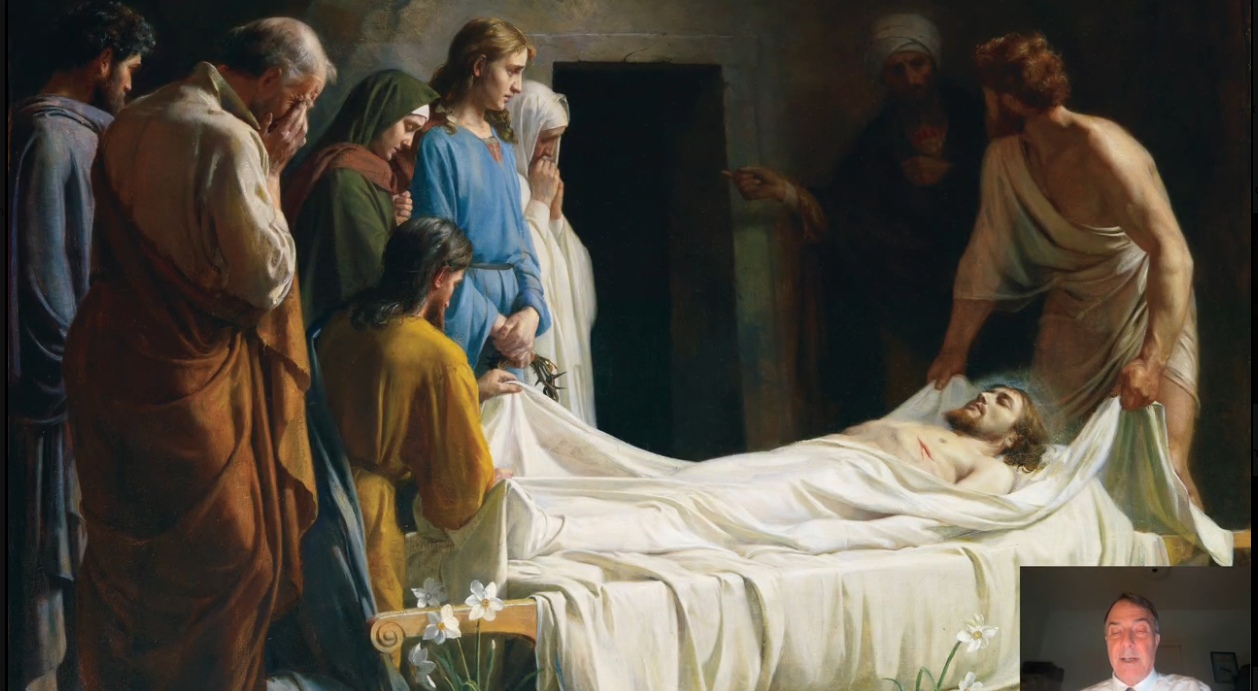
Painting of mourners gathered around Jesus’s body, wrapped in a white burial cloth beside a dark tomb entrance.

“He Made His Grave with the Wicked”

“And he made his grave with the wicked and with the rich in his death, because he had done no violence or evil, neither was there any deceit in his mouth.”

He made his grave with the wicked and with the rich in his death. In 1 Corinthians 15:3 and 4, Paul avers that Jesus Christ died and was buried according to the scriptures. No doubt Isaiah 53:9 was one of the scriptures he had in mind.

However, the King James Version wording of this verse is the reverse of what is expected: “His grave with the wicked and with the rich in his death.”

According to the New Testament, he was crucified in his death between two thieves, the wicked, and buried, his grave, in Joseph of Arimathea’s tomb with the rich, not vice versa. Avraham Gileadi gives additional arguments for this reading.

“Yet It Pleased the Lord to Bruise Him”

“Yet it pleased the Lord to bruise him. He hath put him to grief. When thou shalt make his soul an offering for sin, he shall see his seed. He shall prolong his days and the pleasure of the Lord shall prosper in his hand.”

Yet it pleased the Lord to bruise him. The term “please” can be interpreted simply to signify that the servant’s suffering was consistent with the Lord’s will. The JPS translation is, “But the Lord chose to crush him.” And the AB reads, “Yahweh decided to crush him.”
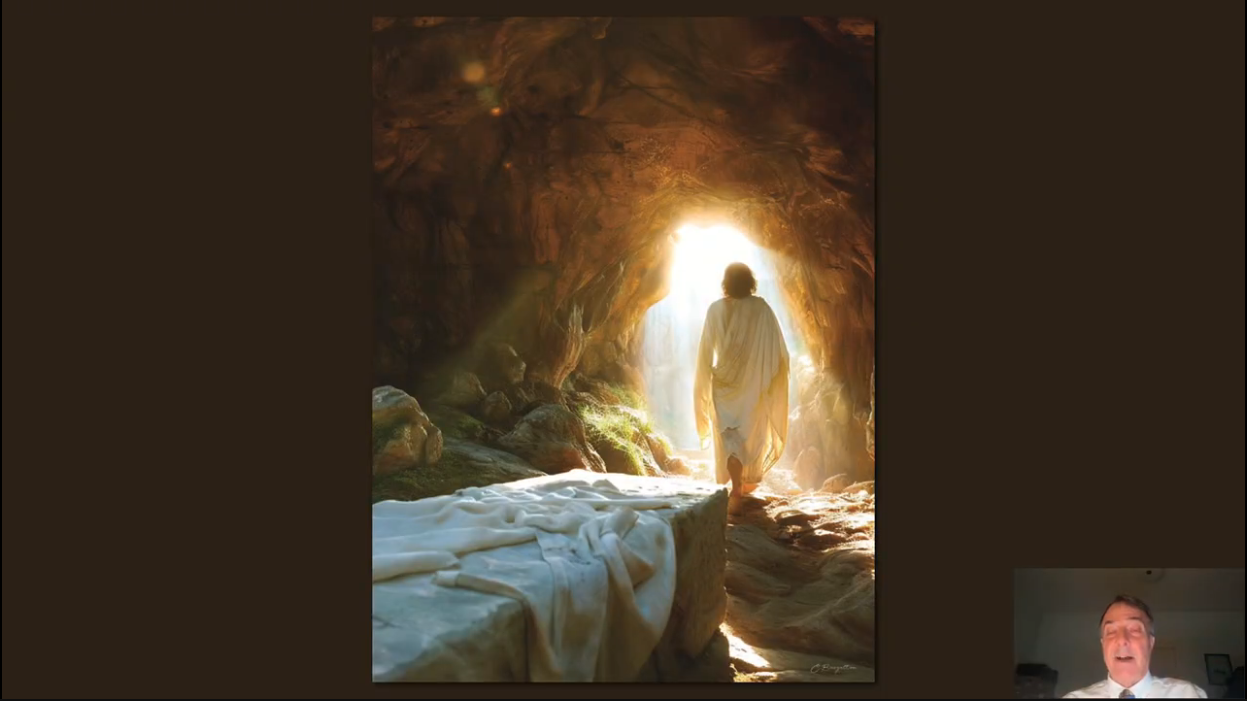
Painting of the risen Jesus walking toward a bright tomb entrance, leaving white burial cloths on a stone slab.

Certainly the Father took no pleasure in the suffering of his Son. But the Father was pleased that his Son would obediently offer such a sacrifice, meaning that the sacrifice was according to the Father’s wishes and his will. The Father was pleased further because of the love manifest by his Son, and also because of the blessings that would come to the rest of his children.

He hath put him to grief. The Dead Sea Scroll versions of Isaiah offer the reading that “he pierced him,” consistent with the piercing of his hand, side, and feet described in the Gospels and anticipated in the Psalms.

When thou shalt make his soul an offering for sin, one translation comments, “The guilt offering of Leviticus is a type of sacrifice intended to atone for involuntary ritual offenses.” The use of the term here has no particular reference to the rite of the guilt offering. The servant is compared to the victim of an atonement sacrifice.

“He Shall See His Seed”

He shall see his seed. Rather than being bereft of descendants, as it says in verse 8, “Who shall declare his generation?” the servant will enjoy a spiritual posterity without number.

Abinadi interpreted this expression in Mosiah 15:10–13, saying that the seed of Christ are the righteous who have heard the good word of salvation and believed and obeyed.

“These are his seed, or they are the heirs of the kingdom of God. For these are they whose sins he has borne. These are they for whom he has died to redeem them from their transgressions.”

Elsewhere, we learn that the seed of Christ are those who are spiritually begotten as his sons and daughters. Mosiah 5:7, born of water and the Spirit. Moses 6:64–68.

Beginning with this expression, we move from Isaiah’s prophecy of the Lord’s suffering to his prophecy of the Lord’s triumph.

“He Shall Prolong His Days”

He shall prolong his days. In a second unexpected reversal of fortune, the servant who is prematurely cut off from the land of the living will actually have his life lengthened as he exercises his power to break the bands of death.

The blessings of immortality through the resurrection and eternal lives through sealings to posterity, which are here promised to the righteous servant, are also extended to all the faithful who follow him.
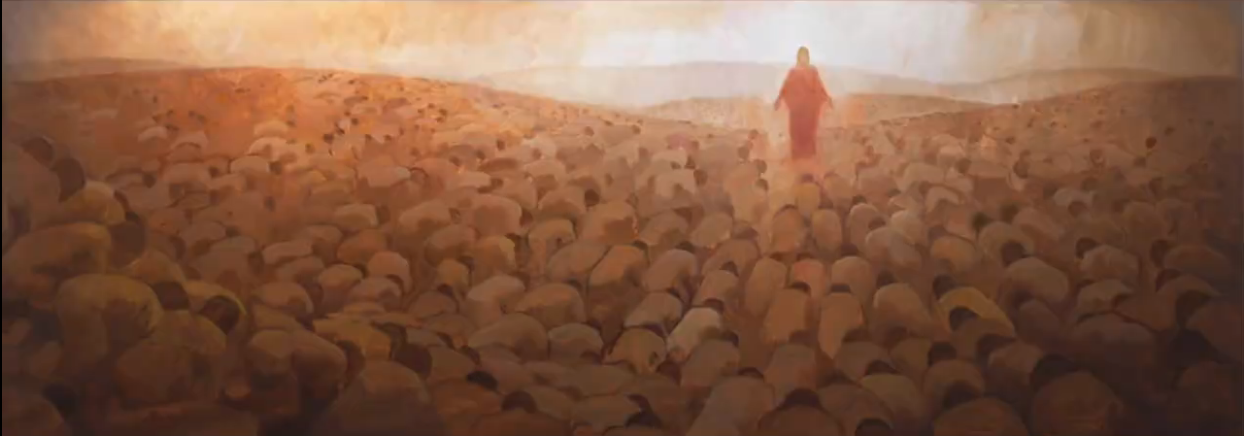
Painting of a shepherd in a red robe amid a vast flock of sheep stretching across a sunlit landscape.

“He Shall See the Travail of His Soul”

“He shall see the travail of his soul and shall be satisfied. By his knowledge shall my righteous servant justify many, for he shall bear their iniquities.”

He shall see the travail of his soul and shall be satisfied. The Prophet Joseph Smith promised, “All your losses will be made up to you in the resurrection, provided you continue faithful to Christ. By the vision of the Almighty, I have seen it.”

For the servant, as well as for all the righteous, the day will come when the sufferings of life and the pain of death shall be sweet unto them. Whereas for the unrepentant, not only death, but also the memory of life’s pleasures will be tainted with deep sorrow and bitterness.

Wrote C. S. Lewis:

Both good and evil, when they are full grown, become retrospective… Not only this heavenly valley, but all the earthly past will have been heaven to those who are saved.

“Not only the twilight in (the spirit prison), but all their life on earth too, will then be seen by the damned to have been hell. That is what mortals misunderstand. They say of some temporal suffering, ‘No future bliss can make up for it,’ not knowing that Heaven, once attained, will work backwards and turn even that agony into glory.

“And of some sinful pleasure, they say, ‘Let me but have this, and I’ll take the consequences,’ little dreaming how damnation will spread back into their past and contaminate the pleasure of the sin.

“Both processes begin even before death. The good man’s past begins to change so that his forgiven sins and remembered sorrows take on the quality of Heaven. The bad man’s past already conforms to his badness and is filled only with dreariness. And that is why, at the end of all things, when the sun rises here in the place of God’s glory and the twilight turns to blackness down there where Satan reigns, the blessed will say, ‘We have never lived anywhere except in Heaven.’ And the lost, ‘We were always in Hell.’ And both will speak truly.”

“He Shall See Light”

He shall see the travail of his soul.

According to Anthony Ferguson, the best textual witnesses to this phrase add the term “light” to the phrase. For example, “From the anguish of his soul, he shall see light and he shall be satisfied.”

In light of the servant’s death, the small addition is significant. This is because the Hebrew phrase “see light” is an idiom for describing life or the revival of life, while the phrase “not seeing light” is the idiom of death. Jesus Christ overcame death in his resurrection.

“He Made Intercession for the Transgressors”

“Therefore will I divide him a portion with the great, and he shall divide the spoil with the strong, because he hath poured out his soul unto death, and he was numbered with transgressors, and he bare the sin of many, and made intercession for the transgressors.”

In this context, the Hebrew verb denoting the process of intercession means “to intervene,” as in Isaiah 59:16.

Thus, this phrase does not mean, as some editors imagine, that he made prayers of intercession for the transgressors, but that with his life, his suffering, and his death, he took their place and underwent punishment in their stead.

Isaiah 53 and the Sacrament

That concludes our brief discussion of this incomparable chapter. For Latter-day Saints, reflecting on the redeeming sacrifice of Jesus Christ brings life-changing renewal each week when we take the sacrament.

Including Isaiah 53 as part of that reflection can enrich our understanding of his love and example. Indeed, my dear wife Kathleen silently repeats portions of Isaiah 53 in her mind, along with other verses and portions of the ordinances, each Sunday as part of her sacrament devotional, as well as at other times.

George Herbert, a Welsh poet, orator, and priest, has beautifully captured the unstinting invitation of the Lord that repeatedly calls us back to the sacrament table to feel his forgiveness and taste his goodness.

The central character in the verse below is Love, a profound personified virtue who, of course, represents the Savior. It has been set to moving music by Ralph Vaughan Williams.
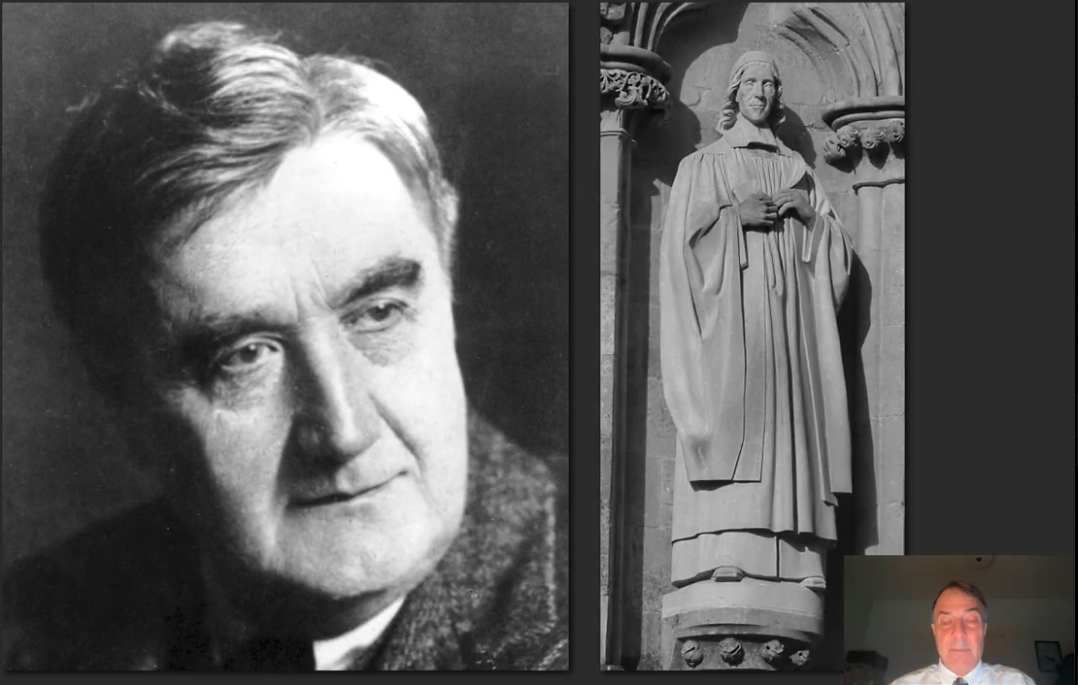
Black-and-white portrait of composer Ralph Vaughan Williams beside a photograph of a statue of poet George Herbert.

Christopher Palmer comments on the song as follows.

Both what Herbert said and the way he said it appealed to the Christian agnostic or disappointed theist in Vaughan Williams. ‘Love Bade Me Welcome’ looks both more inward and far further than the other songs. The rapt stillness at its center, at which point, in the traditionally Eden key of E, wordless voices intone the O sacrum convivium in the Latin liturgy on the sacrament of the Lord’s Supper, is one of the great moments in Vaughan Williams.”

Here is the poem, which invites us to think about the invitation to accept the atonement of Jesus Christ generally and specifically when we are given the privilege of taking the sacrament.
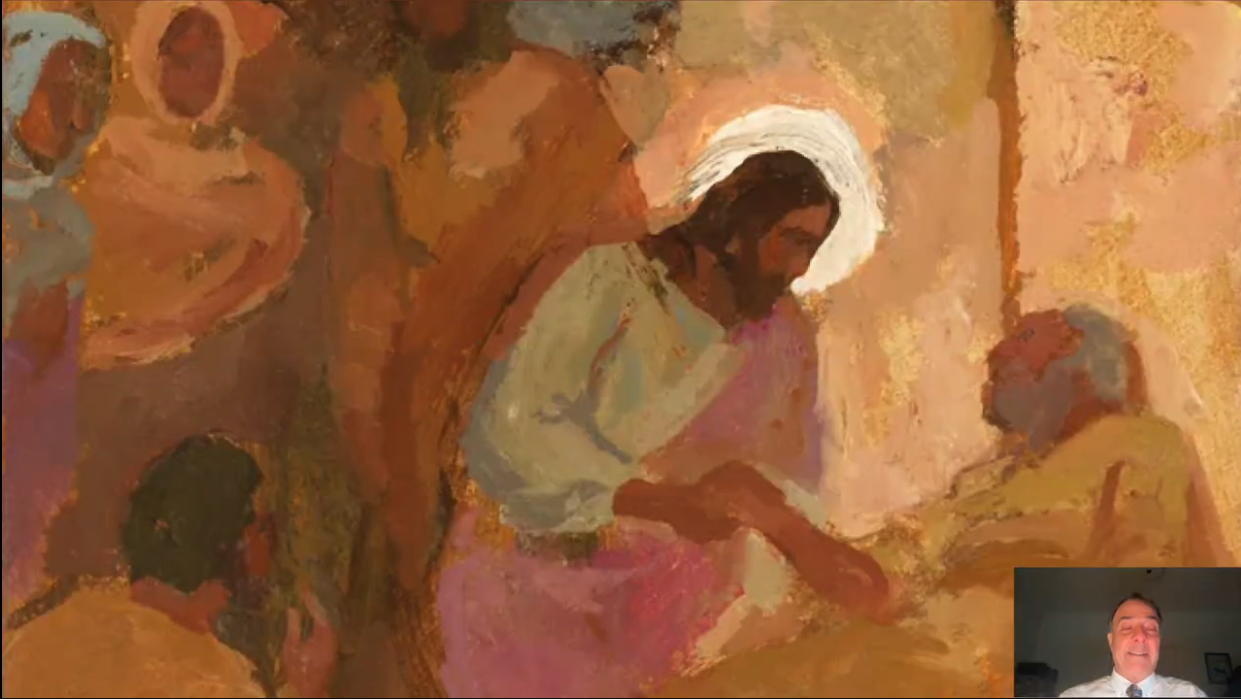
Painting of Jesus leaning toward a reclining man and holding his hand, with other figures nearby.

“Love Bade Me Welcome”

“Love bade me welcome, yet my soul drew back,
Guilty of dust and sin.
But quick-eyed Love, observing me grow slack
From my first entrance in,
Drew nearer to me, sweetly questioning
If I lacked anything.

“A guest,” I answered, “worthy to be here.”
Love said, “You shall be he.”
“I, the unkind, ungrateful? Oh, my dear,
I cannot look on thee.”

Love took my hand and smilingly did reply,
“Who made the eyes but I?”

“Truth, Lord, but I have marred them.
Let my shame go where it deserve.”

“And know you not,” says Love, “who bore the blame?”

“My dear, then I will serve.”

“You must sit down,” says Love, “and taste my meat.”

So I did sit and eat.

In the name of Jesus Christ, amen.
 

Search topics

Isaiah 53 suffering servant; Isaiah 53 Jesus Christ; suffering servant prophecy; messianic interpretation of Isaiah 53; Jewish interpretations of Isaiah 53; Christian interpretations of Isaiah 53; Targum Jonathan Isaiah 53; Dead Sea Scrolls Isaiah 53; Great Isaiah Scroll; Abinadi Isaiah 53; Mosiah 14 and 15; Isaiah servant songs; vicarious atonement in Isaiah; Day of Atonement imagery; Messiah in Jewish tradition; Jesus Christ in Isaiah; sprinkling many nations; Isaiah 52:13–53:12; Jeffrey M. Bradshaw Isaiah

Does Isaiah 53 predict Jesus; Jewish objections to Christian interpretation of Isaiah 53; Israel as the suffering servant; Christianity and Isaiah 53; Book of Mormon Isaiah interpretation; Book of Mormon and biblical scholarship; Latter-day Saint interpretation of Isaiah; Mormon beliefs about Jesus Christ; Mormon beliefs about the Atonement

Understanding the Faith Crisis Industry – How Doubt is Monetized

Start Here

Question

What is the faith crisis industry, and how does Ron Rhodes argue that religious doubt is monetized?

Short Answer

Ron Rhodes uses the term “faith crisis industry” to describe an ecosystem of organizations and online creators producing critical content about The Church of Jesus Christ of Latter-day Saints. He argues that social media content can lead people experiencing religious doubt into communities where organizations generate revenue through advertising, paid services, coaching, and especially donations. Rhodes says financial incentives do not automatically make critical claims false, but argues that those incentives should be considered when evaluating the information being presented.

Key Takeaways
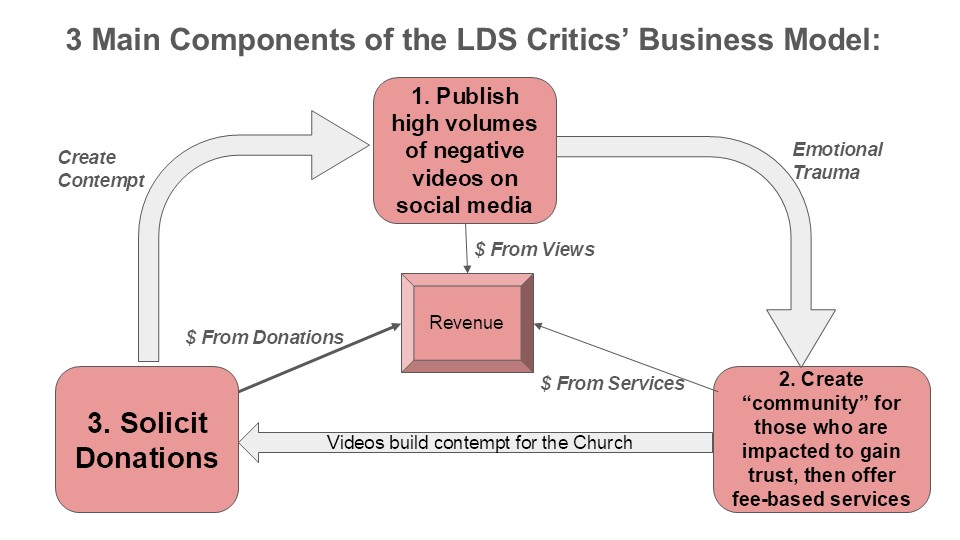
  • Rhodes describes a three-part model: critical content attracts attention, people experiencing faith crises find community, and that community can generate revenue through donations and services.
  • Social media is central to the model. Rhodes argues that algorithms can repeatedly expose viewers to similar critical content and amplify its reach.
  • Donations are a major focus of his financial analysis. He uses publicly available IRS filings to examine revenue, contributions, program-service income, and executive compensation at critical nonprofit organizations.
  • Financial incentives do not prove a claim is false. Rhodes explicitly acknowledges that making money from religious criticism does not automatically mean someone is lying about the Church.
  • Rhodes sees increased faithful online content as an important response. He argues that people encountering critical claims should be able to find accurate information just as easily.
  • His ultimate prescription is relational rather than financial. Rhodes urges Latter-day Saints to listen to people experiencing faith crises and respond with truth, kindness, compassion, and love: “People in faith crises are not projects to fix. They are people to love.”

Summary

Summary

In Understanding the Faith Crisis Industry – How Doubt Is Monetized, Ron Rhodes examines the economics surrounding online criticism of The Church of Jesus Christ of Latter-day Saints. He describes a three-part model in which critical content attracts viewers experiencing religious doubt, online communities provide belonging during a faith crisis, and donations and paid services generate revenue. Rhodes draws on IRS filings and social media metrics to discuss nonprofit revenue, executive compensation, donations, YouTube views, subscriber growth, and changes in the reach of prominent critical organizations.

Rhodes ultimately moves beyond financial analysis to the question of how Latter-day Saints should respond to people experiencing religious doubt. He argues that faithful resources must be easier to find online, but emphasizes that people in faith crises should be treated with compassion rather than as problems to solve. His concluding message calls on disciples of Jesus Christ to answer criticism with truth and clarity while creating communities characterized by listening, kindness, and love.

TL;DR

TL;DR (Too Long; Didn’t Read)

Ron Rhodes argues that online criticism of the Church operates within an ecosystem where attention, faith-crisis communities, donations, paid services, and social-media reach can create financial incentives. He examines financial and social-media data from prominent critical organizations while urging Latter-day Saints to make accurate information easier to find and to respond to people experiencing faith crises with compassion and love.

Introduction

I have the pleasure of introducing Ron Rhodes. In today’s digital world, the criticism of religion is no longer limited to books or classrooms. It reaches millions of people through videos, podcasts, and social media. Our next speaker has spent years studying this landscape. Ron Rhodes is the creator of answering LDS critics and has contributed to both fair and The Interpreter Foundation. His research examines how organizations critical of the church communicate. His research examines how organizations critical of the church communicate, and how faithful members can respond with both discernment and charity. Please welcome Ron Rhodes.

Ron Rhodes | 2026 FAIR Conference

Understanding the Faith Crisis Industry

Thank you, Jan. It’s great to be with you today to address a topic that I think is important to every member of the church, that is, understanding the faith crisis industry and how doubt is monetized.

Imagine for a moment a faithful member of the church scrolling through YouTube one evening. He watches one video disparaging Joseph Smith, then another, then another. Three hours later, he’s convinced that there are things the church never told him. Six months later, he stopped attending church altogether.

Now, most people would assume that this is primarily a story about church history or doctrine. But today I’d like to suggest it’s really a story about economics and financial incentives.

Applying Mormon’s Test

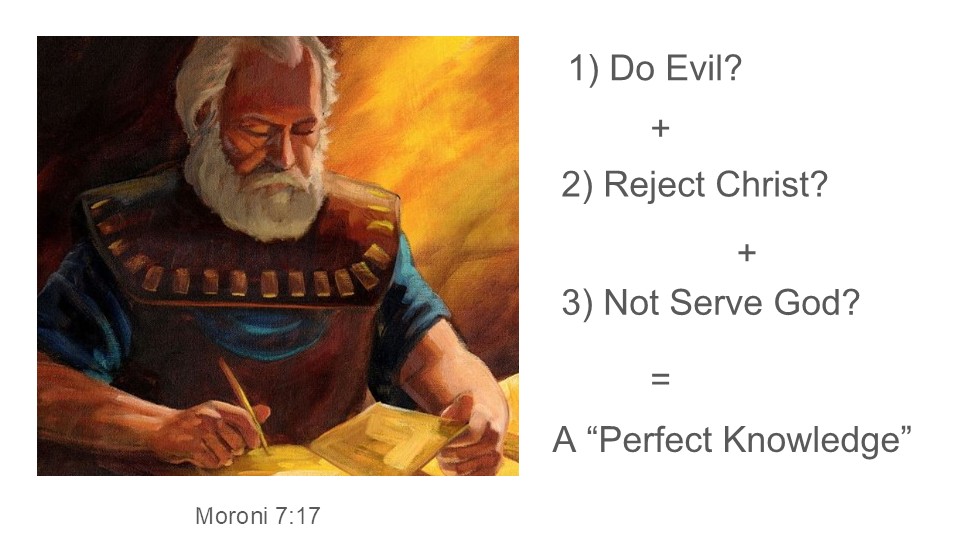
Before jumping in, though, the prophet Mormon taught that if something or someone tries to persuade us to do evil or to reject Jesus Christ, or turn away from serving God, then we can know with a perfect knowledge that it is of the devil.

That’s a pretty straightforward test. So do organizations that are critical of our faith try to persuade us to do evil, to reject Christ, or stop serving God? Well, today we’re going to examine exactly that.

We’ll look at key facts using publicly available data: not rumors, not speculation, but verifiable financial and social media metrics for some of the more prominent critical organizations.

I won’t be disclosing the names of people or entities. This isn’t about ad hominem attacks. But if we are going to apply Mormon’s criteria, then we need to know something about these critical organizations and what they do. We’ll circle back at the end and see how they stack up.

The Faith Crisis Industry as a Business Model

So let’s jump in. The faith crisis industry is, in fact, just that. It’s an industry. It includes observable business models with verifiable revenues, expenses, and key metrics that drive the success or failure of the company.

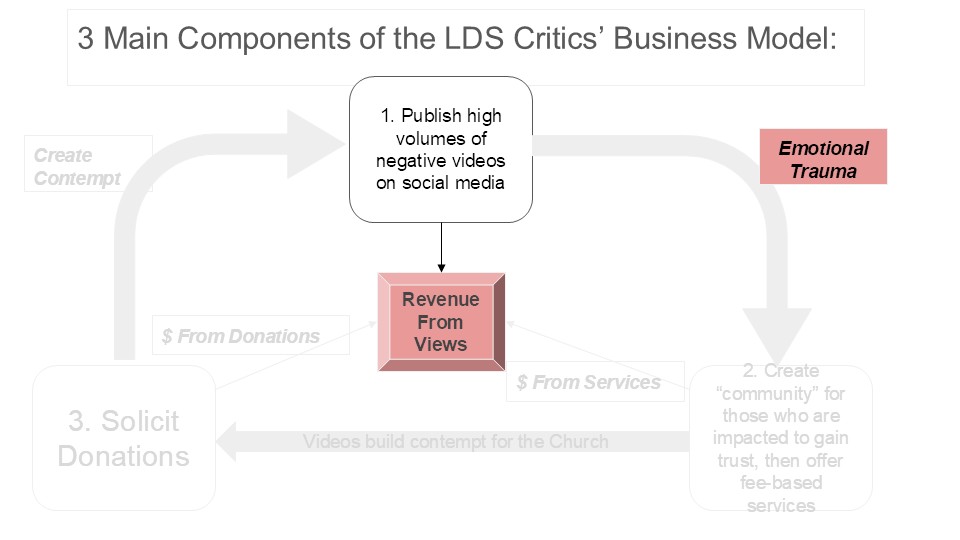
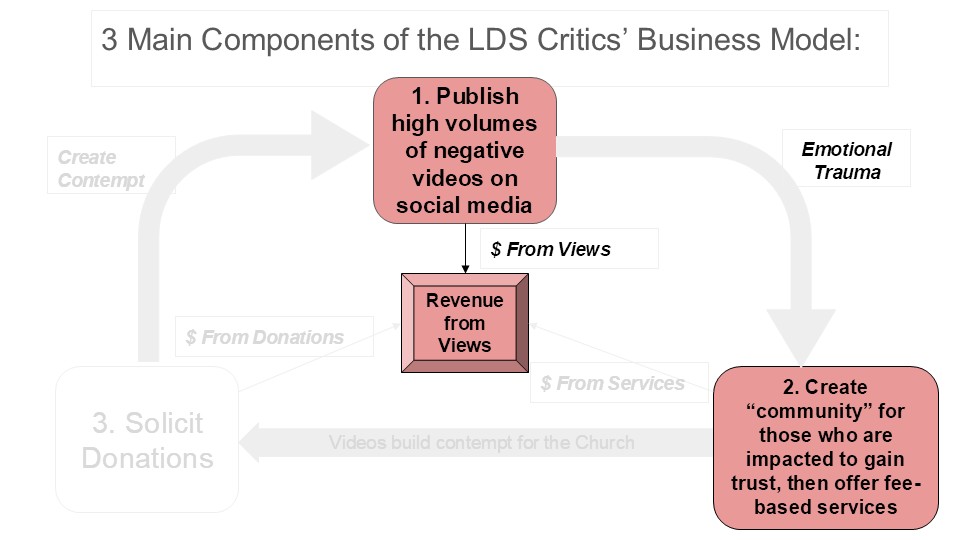
But when you step back and look at how critical organizations conduct business, a pattern emerges. The most financially successful critical organizations tend to follow a three-part business model.

Part One: Publishing High Volumes of Negative Content

Part one is to publish high volumes of negative content toward the church.

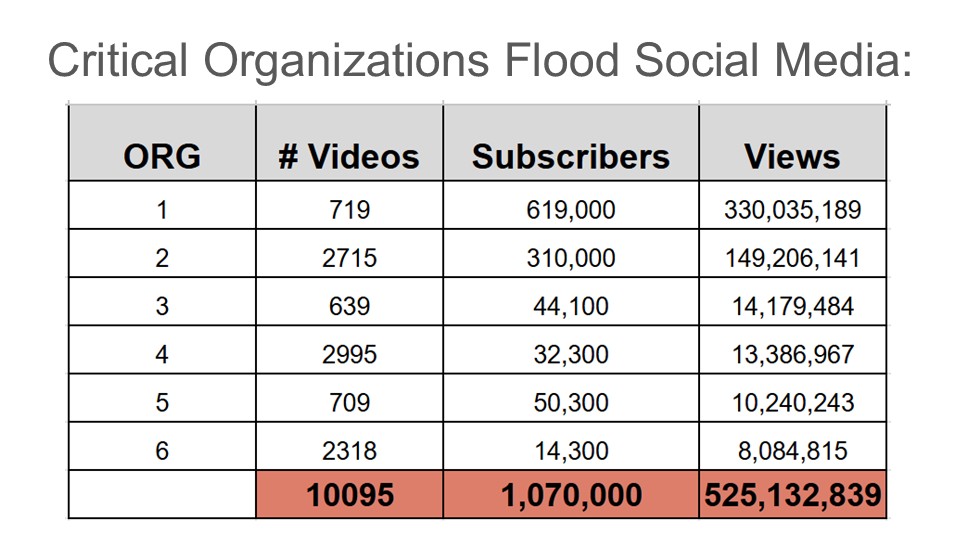
For example, just the top six most prominent critical organizations have published a combined total of over 10,000 videos on YouTube alone, generating more than 525 million views. That’s more than the entire population of the United States. Those are staggering numbers.

But remember, that’s just YouTube. That doesn’t include Instagram, Facebook, TikTok and others. Social media provides an ideal distribution channel for critical organizations because their message spreads exponentially through algorithms.

If you watch one video, then the platform algorithm serves you ten more. Add to that a strong word-of-mouth element through family and friends, and you don’t even have to be on social media to be impacted by critics’ information.

So the saturation effect of these negative videos is really powerful.

Part Two: Creating Community Around a Faith Crisis

Now, like most faithful sites, critical channels earn revenue from YouTube for each view they receive, and most people assume this is where they get the bulk of their revenue.

But revenue from views is minor compared to the future payoff in donations. So the short-term goal of their videos is simply to produce shock, betrayal, confusion, even anger.

And that emotional trauma is a key element because it facilitates component number two, that is, creating community for those impacted by their videos.

A faith crisis is deeply painful, so critical organizations lean into that moment with a powerful message: We understand you’re not alone, and we’ve been there.

In fact, this slide is the homepage of the number one critical organization’s website. Note that their message is really clear. You’re not alone, and you have a built-in community of people you can trust who understand your feelings.

That sense of belonging is real and it’s meaningful. Community is powerful. And in many cases, members who have been impacted by critics’ content sincerely feel helped by these organizations.

Financial Incentives and Faith Crisis Services

Now, there’s nothing wrong with providing community. But when critics use misinformation (which is well documented on the FAIR website) to help fuel a faith crisis, then charge for services to help deal with the trauma of that crisis, it raises legitimate questions about incentives.

It’s like a doctor intentionally infecting a patient with a disease, so that they can then charge that patient for treatment.

This slide demonstrates just a few examples of the top critic offering coaching services on their website for significant fees to help people navigate the trauma of a faith crisis, which, ironically, their own videos helped cause.

Now, obviously, fees from these services also result in revenue, but once again, that revenue pales in comparison to the revenue generated by the third component: the solicitation of donations.

Part Three: Donations as the Financial Engine

Donations are the financial engine for LDS critical organizations. For the top critic, donations accounted for 74% of their overall revenue, and the second was 87%.

Donations are clearly their primary source of revenue, and although there may be some exceptions, it’s reasonable to conclude that many donors are individuals who come to believe they were betrayed by the church (which is a central theme in many critics’ videos) and then who donate after finding community in those same organizations.

So the critic’s business model is very simple:

  1. Videos produce trauma.
  2. Trauma becomes community, and
  3. Community becomes revenue.

And that is how doubt is monetized.

How Much Money Does the Faith Crisis Industry Generate?

So how much money do they make?

Well, the largest organization grew from roughly $150,000 in revenue in 2013 to a peak of $1.2 million in 2023, then back to 1.1 million in 2024.

Now, here’s the uncomfortable reality regarding revenue.

Since critics’ revenue depends primarily on donations from people experiencing a faith crisis, in order to continue making money, they have to expand the population of members in a faith crisis.

Hence, they produce tens of thousands of videos specifically designed to do exactly that.

Very literally, brothers and sisters, the more faith they shake, the more money they make.

It’s a simple cause-and-effect model.

Examining IRS Financial Filings

Now, I promised there would be no speculation. The revenue we just discussed is based on actual data from the IRS.

What you see here are the IRS filings for the top critical nonprofit organization.

So you can see on line 12, their total revenue in 2024 was $1.1 million. Line eight shows that 828,000 of that, or 74%, came from contributions.

The remaining 289,000 on line nine came from program services, which were the fee-based services we talked about earlier, and it includes their revenue from YouTube as well.

Financial Compensation in Critical Nonprofit Organizations

Now, this is a good time to point out that the term nonprofit is something of a misnomer. While a nonprofit organization is not set up to make money for its shareholders, the CEO can make as much money as their board of directors allows.

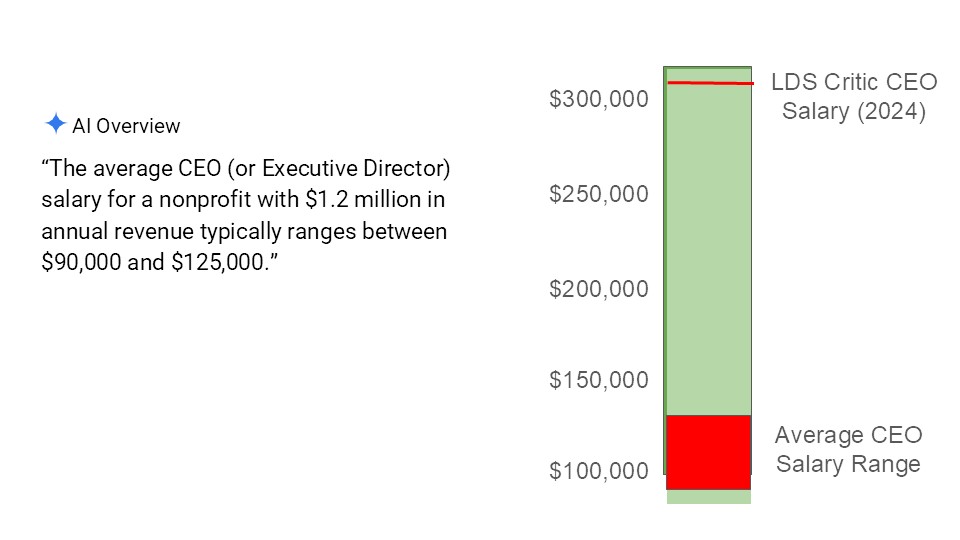
This slide demonstrates that in the case of this largest organization, the CEO and his wife made over $308,000 in 2024, according to the IRS.

I included the wife’s salary to demonstrate a nuance this organization used in 2024. If you recall from a revenue perspective, this company actually did slightly worse in 2024, and the CEO salary alone, which is in blue, reflects that drop, which is appropriate.

But by doubling the wife’s salary that same year, their household revenue continued to climb by over $21,000, even though the company itself did worse.

Comparing Nonprofit CEO Compensation

By contrast, I don’t blame them. By contrast, the average CEO salary for this size nonprofit entity across the nation ranges anywhere from 90 to $125,000.

Also, by contrast, the CEOs for both FAIR and the Interpreter Foundation have a salary of exactly zero, according to the IRS. They didn’t ask me to say that. I looked it up on their IRS filings.

They do it because they want to help people. So if you see them walking around today, be sure to thank them for everything they do.

And yes, there are faithful nonprofit organizations where the CEO does make money. But these two directly address critics’ claims.

Revenue and Salaries at a Second Critical Organization

The second most wealthy critical organization is a distant second in terms of overall revenue. But they’ve also been in business less time by about 14 years.

They started in 2019 at 80,000. They grew quickly but peaked at roughly 350,000 in 2024, with around 87% of that in donations.

The CEO salary here has been at $100,000 since 2022, so not nearly as financially rewarding as the first business. But still, he makes $100,000 a year making videos that disparage the church.

Financial Incentives and the Question of Trust

Now, to be clear, making money doesn’t automatically mean they are lying about the church.

But the reality is salaries are directly connected to the organization’s revenue, and revenue is directly tied to how many people they can persuade to enter a faith crisis and ultimately donate.

So the question each member of the church must answer for themselves is this:

Since prominent LDS critics personally profit from members experiencing a faith crisis, can you and I really trust that their videos present accurate and unbiased information about our church?

I’ll let you draw your own conclusions.

Examining Social Media Growth and Decline

Now let’s leave the financial statements for a moment and look at something I found even more interesting. I will confess, the data nerd came out in me when I built these graphs, but their message is important.

Social Blade is an independent website not affiliated with the church, that provides key metrics on social media channels.

These charts show the subscribers gained and views gained trends for the wealthiest critical organization on YouTube.

YouTube, TikTok, and Instagram Metrics

In 2024 this organization experienced a 51% decline in subscribers and new subscribers compared to the previous year, followed by another 53% decline in 2025.

Views gained told a similar story, dropping 25% in 2024, an additional 40% in 2025. That is a significant decline.

The same organization’s TikTok and Instagram metrics didn’t fare much better, losing followers gained by 58% and 19%, respectively.

Bottom line: This is not good news for this company.

Trademark Litigation and Financial Incentives

In April of this year, this organization was sued by the church for trademark infringement. Before filing suit, the church proposed a very easy solution that would have avoided litigation, but the organization declined.

I believe the data we just reviewed is a plausible reason why they rejected that fix. Had they accepted it, this downward trend in subscribers and views would likely have continued. And ultimately they may go out of business.

But by allowing the suit to proceed, the organization gained an opportunity to publicly portray itself as being targeted by the church, (which, by the way, they have done widely on social media) and by making that claim, they receive an infusion of donations from their sympathizers.

Public conflict often generates attention, engagement and financial support in ways that cooperation may not do.

Declining Growth Across Critical Organizations

So what about the remaining organizations?

Well, for the first time ever, all six of the top organizations critical of our faith saw a decline in subscribers gain growth in 2025, ranging from 7% all the way to 83%, and half of them saw a reduction in views gained.

This is a significant recent shift within the faith crisis industry.

So the obvious question becomes, why are these companies losing ground on social media?

Well, the data points us to three plausible reasons. And note that the actual reason is likely a combination of all three.

The Growth of Faithful Social Media Channels

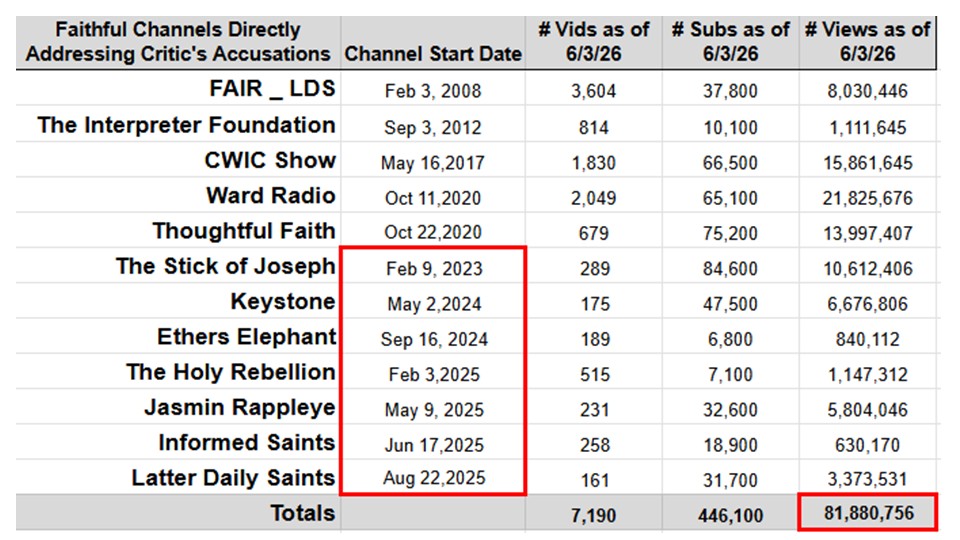
First, there has been a significant increase in the number of faithful channels that directly address critics’ claims. Made by critical organizations.

This slide identifies 12 of those channels. Seven of those 12 didn’t exist two years ago.

And that growth closely parallels the declines we’re seeing for the critics.

All of these faithful channels make finding answers to critics’ claims far more available on social media than they have been in the past.

That said, we still need more. As you can see, these channels make up 81.8 million views compared to the 525 million views on our critics’ channels.

Now, it’s not a contest, of course, but we need to ensure that our brothers and sisters who are impacted by critics’ videos can just as easily find accurate information.

Content Saturation and Repetitive Criticism

The second plausible reason critics’ metrics are declining is simply that there are a finite number of reasonable accusations our critics can make before their topics become redundant.

So critics must turn to topics that are increasingly insignificant.

For example, based on these video titles, there are now videos that talk about how The Bachelorette show mentions garments, how someone apparently drove 112mph to get to church or something to do with Utah hair.

I’m not even sure what that is.

The point is, when criticism expands to increasingly minor or unimportant grievances, credibility tends to erode.

Now, on this topic, just a personal pet peeve.

Criticism of the Church’s Giving Machines

This critical organization has published no less than eight videos that criticize the giving machines the church puts out at Christmas.

Maybe it’s just me, but I don’t know how you find fault with the Christmas giving machines. I love those machines. Where else can I buy a chicken to help someone support their family?

If there were ever a prime example of trying to persuade us to not serve God by serving our fellow man, this might be it.

And I think even for these channel supporters, things like this chip away at the credibility of these critical organizations.

The Behavior of Critical Organizations

Now, the third plausible reason critics’ metrics are declining is the critical organization’s own behavior.

Now, I want to preface this with a reminder that critics are children of God, so we need to give them grace. But grace for our critics and clarity about what they do and say can coexist.

Since these organizations have published over 10,000 negative videos about our church, as members of that church, we have the right to determine if they are coming from a place of honesty and integrity.

And the fact is, they have published some highly questionable content that brings that into question. And it also is likely influencing their subscriber rates.

So let’s consider just a few of those behaviors.

Examples of Content That Raises Questions

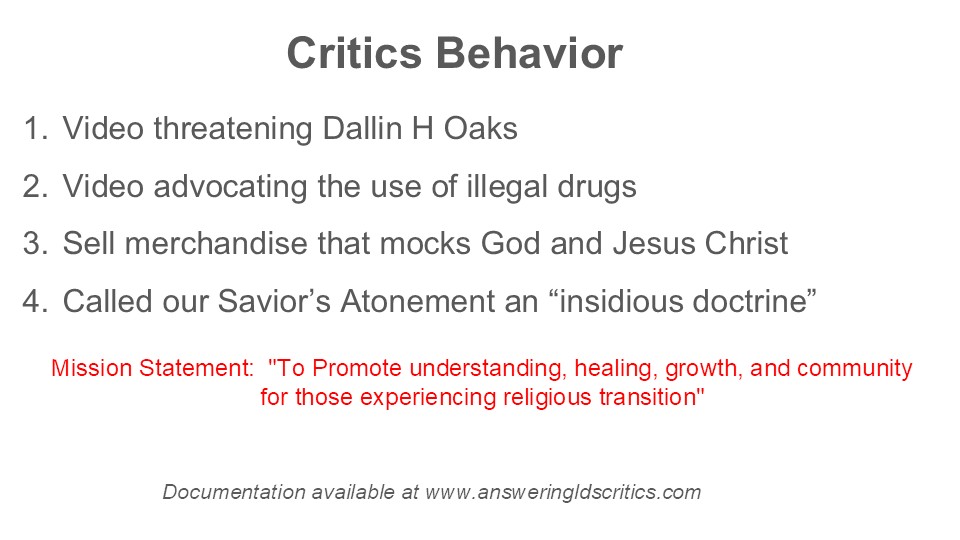
One organization released a video featuring a guest who threatened physical violence against Dallin H. Oaks. He threatened to punch him.

Another published a YouTube video advocating the use of illegal drugs. I mean, we have these recordings.

Another organization sells vile merchandise that openly mocks God, mocks Jesus Christ, and mocks our sacred temple ceremony.

In yet another case, the CEO published a video describing our Savior’s atonement as an insidious doctrine.

These behaviors and dozens, dozens more, stand in stark contrast to their own mission statements, which claim that they, “promote understanding, healing, growth and community for those experiencing religious transition.”

It’s unclear to me how releasing a video where a guest threatens to punch Dallin H. Oaks is promoting healing or understanding.

These behaviors matter because they help us understand two important realities.

The Importance of Healthy Communities During a Faith Crisis

First, they call into question the ability of organizations that are demonstrating this level of hate to provide objective, unbiased information about the church.

Second, and by far the most important, these are the organizations that many of our brothers and sisters are turning to to find community.

That’s not a healthy environment. When someone is hurting spiritually, hate doesn’t heal.

It only deepens the wound. And if the first people that offer them community are people promoting hate, then you and I, as disciples of Jesus Christ, have some work to do.

Responding to Religious Criticism With Love

So when we feel hate coming from comments on social media, from critics’ followers, we now have a reference as to where it comes from. And we only make it worse if we respond with additional hate.

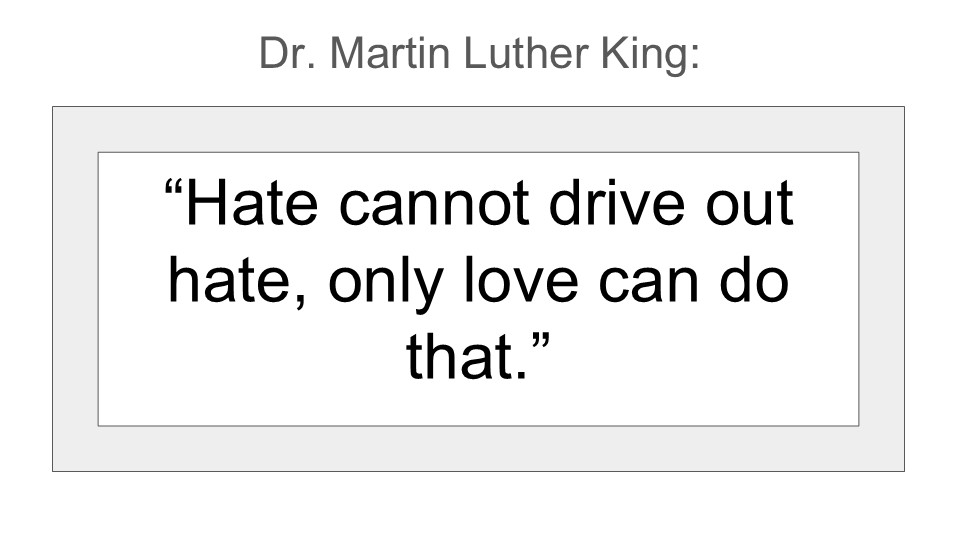
Doctor Martin Luther King said “Hate cannot drive out hate. Only love can do that.”

And of course, the Savior himself invited us to love one another as he loves us.

Brothers and sisters, let’s instead respond with love. We start by offering to listen to them. We give them a voice. We let them express their feelings.

Then we can respond with truth, kindness, and love.

If we need help with the answers, the FAIR website is a great resource.

The real issue isn’t whether critics create community. The real issue is whether disciples of Christ create a better one.

People in faith crises are not projects to fix. They are people to love. With this understanding, I’ve had to repent and change the way I respond to people online.

And I’m far from perfect at it.

Applying Mormon’s Test to Religious Criticism

So let’s circle back and see how our critics stack up against the warning given to us by the prophet Mormon.

Remember, he was speaking to members of the church in our day. He was speaking to us, and he said,

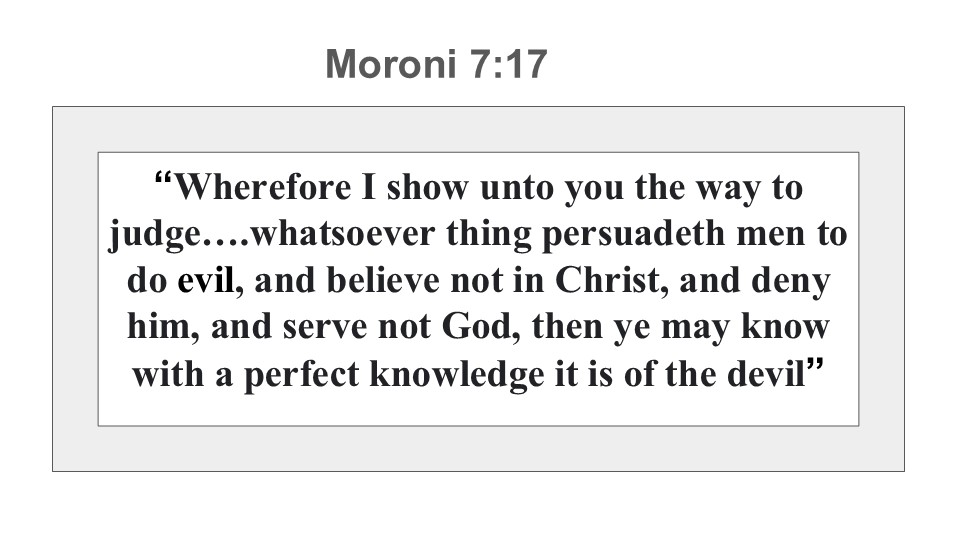
“Wherefore, I show to you the way to judge;… whatsoever thing persuadeth men to do evil”

– And I would add, like publishing videos that threaten violence or promote illegal drugs,

“and believe not in Christ, and deny him,”

– like calling our Savior’s atonement and insidious doctrine and sowing vile products that directly mock our Savior–

“and serve not God,”

–Like criticizing the giving machines and other philanthropic work that the church does–

“then ye may know with a perfect knowledge it is of the devil.”

A perfect knowledge.

Recognizing Deception and Drawing Closer to Christ

Notice that Mormon did not say we would need a PhD in church history to recognize deception. He said we could judge by what critics try to persuade us to become.

  • Do they point us toward Jesus Christ or away from him?

By their own admission, it’s away from him.

Is it any wonder, then, that President Oaks just recently invited members of the church to overcome doubts and uncertainties by drawing closer to our Savior?

Conclusion: Clarity, Charity, and Compassion

In summary, then, understanding that critics are financially motivated to destroy our faith helps us

  • look more critically at their claims,
  • knowing their channel metrics are declining, helps us understand their aggressive attacks and most importantly,
  • understanding they are persuading men to reject Jesus Christ and His atonement

gives us the perfect knowledge that we need to avoid deception by their claims and instead reach out in compassion and love.

Mormon knew exactly what he was talking about.

So my testimony is simple.

Truth does not need sensationalism. Christ does not need algorithm manipulation.

And you and I, as disciples of Jesus Christ, need not fear claims made by critics who no longer follow him.

If we respond with clarity, charity and compassion, we can strengthen testimonies, including our own, and still extend love and kindness to our brothers and sisters who have become victims of the faith crisis industry.

In the name of Jesus Christ, Amen.

Questions About the Faith Crisis Industry

What does Ron Rhodes mean by the “faith crisis industry”?

Rhodes uses the term “faith crisis industry” to describe an ecosystem of organizations and online creators producing critical content about The Church of Jesus Christ of Latter-day Saints. He argues that some prominent organizations operate through a combination of high-volume critical content, community-building for people experiencing faith crises, paid services, and donation revenue.

How can religious doubt be monetized?

Rhodes identifies several ways organizations producing religious-critical content can generate revenue, including social-media advertising, paid services, coaching, and donations. He argues that donations are particularly important to some nonprofit organizations he examines and raises questions about whether financial incentives can influence the production of faith-critical content.

Does making money from religious criticism mean the criticism is false?

No. Rhodes explicitly states, “making money doesn’t automatically mean they are lying about the church.” His argument is instead that financial incentives are relevant information readers should consider alongside the evidence supporting individual claims.

What role does social media play in a Latter-day Saint faith crisis?

Rhodes argues that social-media algorithms can repeatedly expose viewers to similar critical content after they engage with an initial video. He also examines YouTube views, subscriber trends, TikTok and Instagram metrics, and the growing number of faithful channels responding to critical claims.

How should Latter-day Saints respond to someone experiencing a faith crisis?

Rhodes argues that people experiencing faith crises should be met with listening, truth, kindness, and love. He summarizes this principle by saying, “People in faith crises are not projects to fix. They are people to love.”

Search topics

faith crisis industry; monetization of religious doubt; financial incentives in religious criticism; faith crisis nonprofits; social media and religious doubt; YouTube religious criticism; social media algorithms and faith; religious deconstruction; faith crisis communities; nonprofit donations and religious criticism; online apologetics; responding to faith crises; media literacy and religion

Mormon faith crisis; LDS faith crisis; leaving the Mormon Church; ex-Mormon content; ex-Mormon YouTube; criticism of the LDS Church; Mormon deconstruction; anti-Mormon claims; CES Letter; Mormon Stories; LDS Church criticism; Church of Jesus Christ faith crisis

Some Puzzles from the Joseph Smith Papyri

Start Here

Question

What do we know about the Joseph Smith Papyri and their relationship to the Book of Abraham?

Short Answer

John Gee argues that the surviving Joseph Smith Papyri are only part of the collection Joseph Smith possessed and that substantial portions of at least some scrolls are missing. Because those portions no longer survive, he concludes that Egyptology cannot determine whether the missing papyri contained the Book of Abraham.

Key Takeaways
  • The surviving Joseph Smith Papyri came from a larger collection acquired by Joseph Smith in 1835.
  • Nineteenth-century eyewitnesses described rolls and papyrus material that do not correspond completely with the surviving fragments.
  • Gee uses scroll winding measurements to argue that substantial portions of some papyri are missing.
  • He examines Horus, the ancient owner of one scroll, and Horus’s connections with Egyptian priesthood and temple traditions.
  • Egyptian lion-couch imagery and accompanying texts can include sacrifice, punishment, and the destruction of enemies.
  • Gee distinguishes between what surviving evidence can establish and what remains unknowable because portions of the papyri are lost.

Summary

Summary

John Gee examines historical and Egyptological puzzles surrounding the Joseph Smith Papyri, including their provenance, surviving fragments, original length, ancient owners, and relationship to the Book of Abraham. He argues that significant portions of the papyri are missing and explores what surviving evidence can—and cannot—establish about their original contents.

TL;DR

TL;DR (Too Long; Didn’t Read)

The surviving Joseph Smith Papyri represent only part of the collection Joseph Smith possessed, and John Gee argues that historical eyewitness accounts and scroll measurements indicate substantial material is missing. He also examines the ancient owner Horus, Egyptian temple practices, and Facsimile 1, while emphasizing that scholarship cannot determine what the missing portions contained.

Introduction of John Gee

So with that, I’m very pleased to introduce our next speaker.

John Gee received an M.A. from the University of California, Berkeley, and a Ph.D. from Yale University. He is the William “Bill” Gay Associate Research Professor of Egyptology at the Neal A. Maxwell Institute for Religious Scholarship at Brigham Young University.

I forgot to tell you, John, I was in Bill Gay’s ward for a while, so he’s a very nice man. He’s very good.

He’s the author of more than 80 publications dealing with Mormon subjects, Egyptology, and the ancient Near East. His writings have been published by publishers such as American University in Cairo Press, [East?] Foundation—and I can’t read it because it’s in French, I think, or I’m not sure—[unintelligible], anyway, [unintelligible], the Carsten Niebuhr Institute for Near Eastern Studies, another one I can’t read, [unintelligible], and I’m skipping down these other ones I can’t read, a number of other publishers.

His work has appeared in journals and series like the Bulletin [unintelligible]. I should have gone on a French-speaking mission, I can tell. So here’s one I can read, the [unintelligible]. I went German-speaking mission. That’s good. Journal of the American Research Center in Egypt and the Journal of the Society for the Study of Egyptian Antiquities, Oriens Antiquus, another one I can’t read, and a few more.

Of course, he has been in the Journal of Book of Mormon Studies, the FARMS Review. His work has been vetted by numerous Egyptologists, including James Allen, Jan Assmann, Burkhard Backes, Laurent Bavay, Jean Bingen, Michel Broze, Christine Cardin, Michel Chauveau, Eugene [unintelligible], and a whole bunch more. Forgive me, John, because there’s a long list of Egyptologists and other people who vetted his work.

He is on the Board of Trustees for the Study of Egyptian Antiquities. He’s given Egyptological presentations at conferences at Atlanta, Brown University, Cambridge, Massachusetts, Hawaii, Jersey City, Johns Hopkins University, San Antonio, Tucson, University of California, Berkeley, University of Kansas, Washington, D.C., Yale University, Budapest, Cairo, [unintelligible], the [unintelligible], the Rheinische Friedrich-Wilhelms-Universität Bonn, the Royal Ontario Museum, the Université Libre de Bruxelles, University of Copenhagen, and the University of Toronto.

With that, with a partial introduction, I will introduce John.

[Applause]

[Music]

The Book of Abraham and the Pre-Existence

It is an honor to follow the ever-eloquent Terryl Givens. Terryl has discussed the Western views of the pre-existence.

Although the concept of the pre-existence is alluded to in various places in Latter-day Saint scriptures, the clearest discussion comes from the Book of Abraham, and it is almost the only reason that Latter-day Saints use the Book of Abraham.

Of the 378 quotations of the Book of Abraham in general conference since 1942, 238, or 63 percent, come from the section on the pre-existence in Abraham 3:18–28. The next most commonly cited passage is the section on the Abrahamic covenant in Abraham 2:6–11, which is cited 42 times, for 11 percent of the citations.

The Book of Abraham in Church Curriculum

The situation is mirrored in the Church’s Sunday curriculum materials, where the Book of Abraham is cited 206 times. Again, the section on the pre-existence is the most commonly cited, and the Abrahamic covenant is second.

Whatever else the Book of Abraham says is of comparative minor importance to Latter-day Saints. My topic, therefore, is irrelevant to the doctrine of Christ. It is a mere mote in our eyes, but a beam in the eyes of the critics.

Now, some of you here are so intimately acquainted with the discussions about the Book of Abraham and the Joseph Smith Papyri that you are inseparably wedded to them. Some of you are somewhat acquainted with the arguments, but perhaps not yet on a first-name basis. Others of you are vaguely aware that some discussion exists, but have not yet been introduced to it.

I hope I will have something for all of you.

The “Mess” of the Joseph Smith Papyri

For those of you who are new, allow me to introduce you to what I have affectionately referred to as the mess of the Joseph Smith Papyri.

The fullest discussion of the origins of the Joseph Smith Papyri in the Church’s Sunday curriculum is in the Gospel Doctrine manual for the Old Testament. It says, quote, “The book of Abraham is a translation that the Prophet Joseph Smith made from some Egyptian papyri.”

That is it.

The Church’s Official Position

The Church of Jesus Christ of Latter-day Saints has no official position on how the Book of Abraham was translated or from what papyrus.

Now, just because the Church has no official position does not mean that individual members do not have some opinions on the subject.

Church members tend to divide into four opinions about the translation of the Book of Abraham.

Four Views of the Book of Abraham Translation

The smallest group, comprising about one-half of one percent of Mormons, according to my informal, admittedly unscientific surveys, think that Joseph Smith translated the Book of Abraham from the existing fragments that were in the Metropolitan Museum of Art.

The next largest group think that Joseph Smith translated the Book of Abraham from papyrus fragments that are no longer in existence.

About one-third of Mormons think that there is, or was, no connection between the Book of Abraham and any papyrus fragments.

The largest group, more than half of Mormons, do not care where the Book of Abraham came from.

Critics routinely assert that the Mormon position is the one that is actually the least popular of all Mormon positions. They want it to be the Mormon position because it is the most convenient straw man.

Warren Parrish on the Translation Process

The only eyewitness to the translation process to describe it was Joseph Smith’s scribe Warren Parrish, who, after he left the Church, claimed, quote, “I have set by his side and penned down the translation of the Egyptian hieroglyphics as he claimed to receive it by direct inspiration of Heaven.”

The majority of Church members are probably comfortable leaving the discussion of the translation of the Book of Abraham at that, and on this occasion I will leave it at that too, except to say that so far no theory about the translation of the papyri accounts for all the evidence.

The Saga of the Joseph Smith Papyri

Today, however, I would like to take a look at the papyri themselves and some of the puzzles surrounding them, namely: What papyri did Joseph Smith have, and what do we know about the ancient owners of the papyri?

And we may not be able to cover all of this here, and certainly can’t cover all of the possible topics on either the papyri or the Book of Abraham. I’m not even going to try.

Now, the saga of the Joseph Smith Papyri begins in the early part of the 19th century, during the pillaging of Egypt that at that time passed for archaeology.

One of those involved in the plunder and pillage of Egypt was Antonio Lebolo. He exhumed one of the most spectacular caches of mummies and papyri from Thebes that Egyptology has ever known. I used to think that the accounts of several hundred mummies were vastly exaggerated. I am no longer so sure.

Lebolo was acting as an agent procuring antiquities for Drovetti, but kept a few for himself. These were sent via Albano Oblasser to America, paraded around the country, and sold off piecemeal until the remainder were sold by Michael Chandler to the Church in July of 1835.

The Church got four mummies and at least five papyri.

From Joseph Smith to the Metropolitan Museum

After Joseph Smith’s mother’s death in 1856, the papyri were sold to Abel Combs, who sold part of the collection to a museum in St. Louis, which eventually moved to Chicago and burned to the ground in the Chicago Fire of 1871. And he kept part of the collection for himself.

Combs’s collection passed through various hands until it was acquired by the Metropolitan Museum of Art in 1947.

The Metropolitan Museum of Art knew that they had acquired, quote, “Papyrus fragments of hieratic Books of the Dead, once the property of the Mormon leader Joseph Smith.”

The Metropolitan Museum was fully aware of what the papyri were when they first saw them in 1918, and they knew what they were doing when they acquired them.

Rediscovery of the Papyri

Klaus Baer recalled, “I saw photographs of them for the first time in 1963, I believe, and was asked at that time, on my honor, not to tell anyone where they were and to keep the whole thing confidential.”

The guard had changed at the museum, and the new curators were not as keen to have the papyri as the previous curators had been.

Henry Fischer, curator of the Department of Egyptian Art at the Metropolitan Museum of Art in the late 1960s, explained how the museum decided to deal with their religious hot potato:

“We knew, since Atiya worked in Salt Lake City and was acquainted with leaders of the Mormon Church, that he might very tactfully find out how they felt about it. So we simply informed him about this in confidence, and I think he handled the matter very nicely.”

The newspapers garbled the story by wrongly making Atiya the discoverer of the documents, which disturbed Fischer. He wrote to Atiya as follows:

“Although I was already aware that your version of the discovery of these documents had caused considerable confusion, it was startling to read that you had informed me of their existence. While I have taken pains to avoid any outright contradictions of what you said, I do not see why either I or the other members of my department, past and present, should be put in the position of being ignorant about facts we could not fail to have known.”

What Survives Today

The Metropolitan Museum of Art gave the papyri back to the Church in 1967, 40 years ago this November.

The papyri have now remained in one set of hands for the longest time since their excavation.

The papyri we currently have are 11 groups of fragments from three different papyri, containing two partial copies of what is usually misnamed the Book of the Dead, and part of a copy of what is usually misnamed the Document of Breathings Made by Isis.

The extant fragments do not contain any text from the Book of Abraham.

We know what we currently have, but how much papyri did Joseph Smith have?

How Much Papyri Did Joseph Smith Have?

Critics want to minimize the amount of papyri originally owned by Joseph Smith, preferably to an amount not much more than what we currently have, because they do not want a Book of Abraham to have ever existed.

As Richard Bushman has noted, people who have broken away from Mormonism have to justify their decision to leave. They cannot countenance evidence of divine inspiration in Joseph Smith’s teaching without catching themselves in a disastrous error.

So critics who have left the Church cannot allow Joseph Smith to have gotten anything right, even by a guess or by accident. They will go to extreme lengths and propound convoluted theories to have something else, anything else, to believe in.

Dale Morgan on Joseph Smith

The critic Dale Morgan, in a moment of candor, wrote:

“With my point of view on God, I am incapable of accepting the claims of Joseph Smith and the Mormons, be they however so convincing. If God does not exist, how can Joseph Smith’s story have any possible validity? I will look everywhere for explanation except to the one explanation that is the position of the Church.”

So the critics cannot allow themselves to say, as Latter-day Saints can say, whether or not there was a Book of Abraham actually contained on the proportion of papyri that did not survive is something that cannot be determined by scholarly means.

Faith and Unanswered Questions

A Latter-day Saint who has faith—that is, trust in God—can examine such issues without being bothered or without having to know all the answers to all the questions we might have.

In fact, insisting on the answers to all our little questions is a sign of lack of faith or trust.

For example, if we insist that our spouse or employees must account for every moment out of our presence, it is a sign that we do not have faith or trust in them.

Faith, Study, and the Book of Abraham

Abraham, for example, was able to say, “Thy servant has sought thee earnestly. Now I have found thee. Thou didst send thine angel to deliver me from the gods of Elkenah, and I will do well to hearken unto thy voice.”

He trusted God on the basis of one past experience without having to know all the details about how the Lord was going to fulfill his promises.

Likewise, a Latter-day Saint who trusts God and his prophets—that is, spokesmen—does not need to see the actual Egyptian characters on the papyrus or know any of the details about the translation of the Book of Abraham in order to accept it and act with confidence that this life is a time of testing, when God will “prove us herewith, to see if we will do all things whatsoever the Lord our God shall command us.”

This is the reason why, for the vast majority of Latter-day Saints, the particulars of the translation of the Book of Mormon are not an issue.

Still, as all have not faith, and most of you are here either for a want of faith or a desire to help those who want faith, we are commanded to “seek learning, even by study and also by faith.”

Learning is a partial substitute for and an aid to faith.

What Papyri Did Joseph Smith Have?

So what do we know about the papyri Joseph Smith had?

Between the current fragments and some very bad copies of characters from the papyri, we know that Joseph Smith had papyri or portions of papyri from at least five individuals: Horos, the son of Osoroeris; and [unintelligible]; [unintelligible], the son of [unintelligible]; a woman with the unique name of Neferirnub; and a man named Sesonchis.

Comparing the copies of the papyri with the fragments indicates that in no case do we have a complete record of what Joseph Smith had from these two sources alone.

Eyewitnesses from the Nauvoo period describe a quantity of records written on papyrus and Egyptian hieroglyphs, including: one, some papyri preserved under glass, described as “a number of glazed slides, like picture frames, containing sheets of papyrus with Egyptian inscriptions and hieroglyphics”; two, a long roll of manuscript that contained the Book of Abraham; three, another roll; four, and two or three other small pieces of papyrus with astronomical calculations, epitaphs, etc.

Only the mounted fragments ended up in the Metropolitan Museum of Art and were subsequently given back to The Church of Jesus Christ.

Eyewitness Descriptions of the Papyri

The eyewitnesses not only describe the papyri, but they describe specific vignettes, or pictures, on the papyri.

When eyewitnesses describe the vignettes as being on the papyri mounted under glass, they can be matched with fragments from the Metropolitan Museum of Art.

On the other hand, when the vignettes are described as being on the rolls, the descriptions do not match any of the currently surviving fragments.

Gustav Seyffarth’s 1856 catalog of the Wood Museum in St. Louis indicates that some of the Joseph Smith Papyri were there. Those papyri moved with the Wood Museum to Chicago and were burned in the Chicago Fire of 1871.

Whatever we conjecture their contents to be is only that: conjecture.

Both Mormon and non-Mormon eyewitnesses from the 19th century agree that it was a, quote, “long roll of papyrus” from which our Prophet translated the Book of Abraham, meaning the long roll of manuscript and not one of the mounted fragments that eventually ended up in the Metropolitan Museum of Art.

So the intellectual position that some members follow, and which the critics would have us adopt as the position of the Church, is not in accord with the historical evidence.

How Big Were the Rolls?

So how big were the rolls?

One way to answer that question is to take the standard size for a papyrus roll and just use that. In the Ptolemaic period, a roll was usually about 320 centimeters long and about 32 centimeters high.

I have used such estimates before, but those figures are not entirely satisfactory. As Mark Depauw has pointed out in a later study, the measurements of papyri vary throughout the Ptolemaic period, with different standards applying at different times.

Now, one can take a more scientific—that is, mathematical—approach, because the circumference of a scroll limits the amount of scroll that can be contained inside it.

Thus, we can determine by the size of the circumference and the tightness of the winding how much papyrus can be missing at the interior end of a papyrus roll.

Calculating the Missing Portion of a Scroll

Friedhelm Hoffmann has already developed such a formula in calculating the amount of material missing from the end of Papyrus Spiegelberg, from which he was able to determine that there were five columns missing from the text.

Now, I won’t bore you with the derivation of the formula. It’s up there. It’s been in print for over a decade.

But it boils down to this: if S is the average difference between the winding measurement, and E is the last length—the length of the last, that is, the interior winding—then the theoretical length of the missing portion is Z, so that Z is approximately E squared minus 6.25 over 2S minus E.

We can apply this to the Joseph Smith Papyri and can obtain some usable results.

The Scroll of Neferirnub

For the scroll of Neferirnub, the final winding length is 7.8 centimeters, and the difference is .33 centimeters. The formula says that there is 64 centimeters missing, which is just over two feet.

Thus, this vignette was at the very end of the roll it was on.

Unfortunately, there’s no way of knowing how much is missing off the beginning of the scroll.

The Scroll of Sesonchis

For the Sesonchis scroll, the final winding length is 14 centimeters, and the difference is .25 centimeters.

Thus, there were 365.5 centimeters left on the scroll, and this is the equivalent of 143.5 inches, or nearly 12 feet.

The vignette on Joseph Smith Papyrus II, shown here, is the furthest vignette into the Sesonchis scroll and normally occurs about halfway through the Book of the Dead, which means that the total scroll would be about 20 to 24 feet long.

And this is longer than some scrolls, but shorter than others.

Edit

The Scroll of Horus

For the scroll of Horus, the initial winding length is 9.7 centimeters, the last winding is 9.5 centimeters, and there are seven windings in total. This leaves us with an average value of .0333 for S. E is, as already stated, 9.5 centimeters.

Plugging this into the equation gives 1,250.5 centimeters of missing papyrus. This is the equivalent of 492 inches, or 41 feet of missing papyrus.

Would such a thing be unusual?

Papyrus Turin 1791 is 57 feet 3 inches long. That’s a 1,745-centimeter papyrus. Papyrus Nesmin is 1,280 centimeters long, and the ritual roll of Imuthes in the Metropolitan Museum of Art is 1,088 centimeters long, or 35 feet 8 inches long, while his Book of the Dead is longer still.

So such a length is not out of the question.

Could the Scroll Have Contained Additional Text?

While we know that the scroll of Horus has a Document of Breathings Made by Isis, about one in four of those documents contain additional texts. So the presence of additional text would not be unusual.

Now, the size of Horus’s scroll at first seems excessive, even though it is not unheard of. When I first plugged in the numbers a few years ago and got the result, I checked the measurements and then checked them again. Then I checked the formula again. Then I rechecked the formula’s derivation. Then I rechecked the assumptions behind the formula. Then I simply dismissed them and went back to the standard scroll length.

I had always assumed that the Sesonchis scroll would be the longer one, since the Book of the Dead is a much longer composition than the Document of Breathings Made by Isis, and my initial estimates of the length of the Sesonchis scroll, based on the length of text preserved and the percentage of the Book of the Dead preserved, had been almost 20 feet.

It was only after plugging in the numbers from the other Joseph Smith Papyri into the formula that I realized that the formula does give reasonable results.

The Nineteenth-Century Eyewitnesses

I have since realized that having a long roll of Horus brings all the 19th-century eyewitnesses into agreement.

If we look at the 19th-century eyewitnesses and ask the question, Which of the five known rolls that Joseph Smith had do the eyewitnesses identify as the source of the Book of Abraham? we come up with some useful information.

Charlotte Haven and Jerusha Blanchard identify the long roll as being the source of the Book of Abraham. On the other hand, William Appleby identifies the Book of Abraham as being written by the poor scribe, which matches the Horus roll.

Only if the Horus roll is longer than the Sesonchis roll do the 19th-century eyewitnesses agree. And for that to be the case, the unmounted portion of the Horus roll has to be longer than the 12 feet left on the Sesonchis roll.

Now, one could take an average of S for only the last four windings on the Horus, in which you get .05 centimeters, and still come up with a value for Z of 830.5 centimeters, or 27 feet 3 inches, for Horus’s roll. And it would still be longer than Sesonchis and well within the range of comparable Ptolemaic rolls.

Gustav Seyffarth and Facsimile 3

Furthermore, a lengthy Horus roll accommodates the otherwise problematic testimony of Gustav Seyffarth.

Seyffarth describes Facsimile 3, which is on the roll of Horus, and claims that a portion of the text he saw was an invocation to Osiris.

If all there was on the Horus roll was the Document of Breathings Made by Isis, then the problem is that there is no invocation to Osiris in the portion of text that Seyffarth would have seen, or anywhere in the document, for that matter.

With a longer roll, Seyffarth’s testimony can be accounted for, as there would certainly be room for an invocation to Osiris on the roll, if Seyffarth is even accurate in his interpretation, and who knows what else would be on the roll.

Who Was Horus?

Now, although scholarship is unable to tell us whether or not there was a Book of Abraham on the roll of Horus, perhaps we can tell something about the individual who owned the papyrus and the likelihood that the Book of Abraham might have interested him.

To do so requires moving from the size of the Joseph Smith Papyri to their message.

The puzzle that is before us is to determine what we can know about Horus.

The beginning of the roll of Horus lists Horus’s names, titles, and parents. Horus bore three titles, as in the first line, which are high-ranking positions that he held at some time in his life, perhaps concurrently, perhaps sequentially.

These titles are Prophet of Amonrasonther, Prophet of Min Who Massacres His Enemies, and Prophet of Chespis.

The last two titles are rare, the second one being extremely rare. Only four men are known to have borne it.

Dating Horus and His Family

Horus’s names and titles allow him to be linked with a number of other documents, such as a statue of his father, now in the Walters Art Gallery in Baltimore.

These documents yield a family tree covering eight generations, from Horus’s grandfather to his great-great-great-grandsons.

Thanks to a graffito from the Small Temple of Medinet Habu, shown here, we can date the family.

Horus’s third great-grandson is alive in 37 B.C. under the reign of Cleopatra VII, and he mentions there his—Horus’s son died before 157 or 153 B.C., and two of his grandsons died between 146 and 124 B.C.

This would place Horus roughly contemporary with Ptolemy V, which means that this roll from the Joseph Smith Papyri was contemporary with the Rosetta Stone.

Horus probably lived through the revolt of Haronnophris and Chaonnophris, and the priests of Amonrasonther seem to have some special connection with the revolt.

Horus was also probably well acquainted with all three of the languages of the Rosetta Stone. Two of them, hieroglyphs and Demotic, he probably knew better than any Egyptologist alive.

Horus’s Connections to the Temples at Karnak

Horus’s titles link him directly with three of the temples at Karnak.

Prophet of Amonrasonther links him as prophet with the main temple at Karnak. This one—well, not that one. I’ll show it later. But that’s Karnak.

Prophet of Min Who Massacres His Enemies links him with the Min temple north of the main temple, and Prophet of Chespis links him with the small temple of Chespis southwest of the main temple.

Let’s look at these titles in order.

Prophet of Amonrasonther

The first title is the Prophet of Amonrasonther, which means that he’s employed in the Great Temple of Karnak. We know a considerable amount about this temple, the largest surviving one in Egypt.

As prophet, he would have been initiated in the Festival Hall shown here, and he would have had—we have two of the Karnak Temple’s daily rituals preserved. In the first of them, shown here, at least the beginning shown here, the prophet lights a lamp and an incense burner and chants his way into the Holy of Holies through the hypostyle hall.

Holy of Holies, which is now largely destroyed back here. There he sees God and worships him face to face.

The other daily ritual is the execration ritual, where a wax figure of an enemy, on which the enemy’s name is written in fresh ink, was spat upon, trampled under the left foot, smitten with a spear, bound, and placed on the fire.

Any priest or prophet at Karnak would have been intimately acquainted with both of these rituals.

The Temple Library

The temple also had a library, which would have had king lists, annals, prophecies and chronicles, compendia of each nome, medical texts, wisdom and ethical teachings, books of lucky days, dream interpretation manuals, astrological and astronomical texts, lexical texts, geographies, festival books, ritual books, glorification texts, hymns, cult prescriptions, construction manuals, manuals of painting and relief, manuals of purification, offering manuals, calendars of feasts, manuals of cultic receipts, inventories, property lists, instructions, oracle texts, priestly correspondence, temple daybooks, and accounts.

It is from the library in Thebes that the earlier Greek writer Hecataeus wrote an account of Abraham.

Min Who Massacres His Enemies

Horus was also Prophet of Min Who Massacres His Enemies.

The term for “massacre,” “slay,” is also the verb used of slaughtering and sacrificing animals and can be used as a term for the sacrificial offering.

The texts specify that this is done by the knife held in the right hand and the foe in the left, or with a harpoon. The sacrifice is dismembered, and portions of him are put into the brazier as offerings.

The term for enemy, kheru, can also mean sacrificial victim.

The only place where representations of the rituals associated with Min Who Massacres His Enemies appear is on the interior portions of the Bab el-Abd, the gate of the enclosure wall of the Min temple north of the Great Temple of Amon at Karnak.

The gate was built by Ptolemy III Euergetes, the contemporary of Horus’s grandfather, Harsiesis, who was the first prophet of this deity, and the decoration was finished by Ptolemy’s son, Ptolemy IV Philopator.

Subduing Sinners and Burning Enemies

Unlike most of the deities featured on the gateway, Min Who Massacres His Enemies did not have his own temple in the Min complex because his rituals were performed in the courtyard of the Min temple.

Two rituals are associated with him. One of them is labeled “Subduing Sinners,” and the other is “The Burning of Enemies.” Both scenes come from the execration ritual, such as I described from Karnak.

The first scene identifies Min Who Massacres His Enemies with Reshep, a foreign deity imported into Egypt much earlier, and like many non-Egyptian deities imported into Egypt, he is given a different Egyptian name.

The second scene says that he, quote, “smites his enemies in the temple of burning,” and then burns them on the altar of burnt offerings. The gods also “overthrow your enemies in the slaughterhouse,” and they “sacrifice the enemy on your altar.”

The Altar of Burnt Offerings

The term for this altar, which is shown here on the bottom of the slide, of burnt offerings, akh, is described in a number of contemporary texts.

Papyrus Ankhsheshonq tells the story of a rebellion against Pharaoh led by Harsiesis, Pharaoh’s chief physician. The plot is unsuccessful, and the conspirators are rounded up.

Pharaoh “caused an altar of earth to be built at the gate of Pharaoh’s palace. He caused Harsiesis, son of Ramose, to be placed on the altar akh of copper with all the men whom he had and all the men who were in the plot against Pharaoh.”

Papyrus Vandier tells a story of a group of priests who are jealous of Merire and have him put to death so that the Pharaoh can live longer and Pharaoh can marry Merire’s wife.

But Merire appears to Pharaoh in a vision and reproves him. As a consequence, Pharaoh, quote, “caused all the priests to be brought outside the prison. Pharaoh went with them to Heliopolis. He caused them to be killed. He caused them to be placed on the altar before Mut, who carries her brother in Heliopolis.”

Accounts of Enemies Placed on an Altar

In Papyrus Rylands 9, the cry goes forth against one set of enemies, quote, “Let our lord bring these young men who have abandoned our ways, and let them be placed on an altar, akh.”

Papyrus P. Saqqara 2, published just last year, begins with the following fragmentary text, quote, “Necho caused to be set up an altar [broken] you yourself, they would have placed on the altar,” and then unfortunately breaks off again.

Thus, stories about slaughtering and then burning people on an altar were common in the time of the Joseph Smith Papyri, and Horus, the owner of Papyrus Joseph Smith I, had a professional interest in such things.

The Temple of Chespisichis

The Temple of Chespisichis is first mentioned by Lepsius, where it is listed as Temple V. Lepsius is a very early Egyptologist, 1840s.

By 1885, when Wiedemann visited the site, he found it, quote, “almost entirely in ruins.” The temple walls had been disassembled and used to fence a garden, and the inscriptions, quote, “almost entirely destroyed.”

But he found some probably reused blocks of the 18th Dynasty king Thutmose III, as well as fragments of 29th Dynasty king Nepherites I, as well as Ptolemaic materials, and some fragments he thought belonged to the 26th Dynasty king Psammetichus.

Later work indicates that the cult of Chespisichis seems only to have existed since the 19th Dynasty, about the time of Moses, where he is particularly known as a healer.

He is said to be one who, quote, “publishes the book of death and life.”

He is a savior god who rescues from all manner of sickness, death, and catastrophe.

Chespisichis at Tod and Karnak

Two other places depict him: the Temple of Tod, located a few miles south of Thebes, and on the Ptolemaic gateway of the main Khonsu Temple at Karnak.

There he is at Tod, and there’s his images at the Khonsu Temple in Karnak.

At the Tod Temple, the inscription refers to “subduing the weaklings,” a betu, a derogatory term for foreigners, and depicts, under the name of Chespisichis, a jackal-headed figure wielding knives.

The only inscription that really remains of the Temple of Chespisichis is a single stela now in the Louvre, more commonly known as the Bentresh Stela.

The Bentresh Stela

Stylistically, the Bentresh Stela most closely matches the Ptolemaic style of Ptolemy IV, although Ptolemy III has also been argued.

Lanny Bell reported the discovery of another copy of this text back in 1979, but he never published it.

The Bentresh Stela tells the story of an otherwise unattested king named Ramesses, whose names are a mixture of those of Ramesses II, IV, and one of the Thutmoses, who made his annual trip to Mesopotamia to collect tribute.

He marries a princess of Bakhtan, perhaps a corruption of the Egyptian word for Hittite, rather than a reference to Bactria, modern Afghanistan.

When the princess’s sister, Bentresh, gets sick, first a priest is sent, then the god Chespisichis to heal her of her illness. She had been possessed by an angel.

Finally, after many years, Chespisichis appears to the ruler of Bakhtan in a dream and requests that he be sent back to Egypt, and much tribute comes with him.

As Prophet of Chespisichis, we can be fairly confident that Horus would have read this text at some point in his life.

The god appearing in visions and dreams, Egyptian presence in Syria and Mesopotamia, angels interfering in human affairs, sicknesses caused by spiritual beings, and a savior—all of these are elements shared between the world of Horus and the Book of Abraham.

Facsimile 1

Next on the roll of Horus is a vignette which we know as Facsimile 1.

The facsimiles from the Book of Abraham interest people as three illustrations floating like islands in the sea of thousands of pages of words in our scripture.

Despite the interest in the facsimiles, there is no emphasis put on them in the Church or the current curriculum material.

Facsimile 1 is mentioned only once, in an optional enrichment activity in a lesson for 8- through 11-year-olds. Facsimile 2 has been mentioned only once in general conference in the last 65 years.

I cannot help but wonder if the critics attack the facsimiles because they are relatively insignificant in the Church.

Challenges in Interpreting Egyptian Vignettes

The facsimiles, like all vignettes, present a number of challenges, and it is worth remembering a few things about the placement of vignettes, the drawing of vignettes, and the identifications of figures on vignettes.

With regard to the placement of vignettes, I will read a number of quotes from Egyptologists about Late Period documents in general and Ptolemaic texts in particular.

The list is lengthy because it is a common thing, but everyone seems to want to treat the Joseph Smith Papyri as a special exception to a general rule, and I do not think we should do so.

From Malcolm Mosher, who specializes in Late Period religious texts, quote:

“In documents from the 21st Dynasty on, misalignment of the text and vignette of a spell can occur, with the text preceding the vignette or vice versa. While this type of problem can be observed sporadically from the late New Kingdom on, it is more common in the Late Period.

“The problem is particularly acute when more spells are textually represented for such a group than there are vignettes. It can be difficult to determine which spells have a vignette and which do not.

“A similar problem of misalignment frequently encountered in late documents is where the vignette for a particular spell is [with] the wrong text, and the correct text is not found in the document.”

Difficulties in Vignette Research

From Henk Milde, probably the foremost authority on papyrus vignettes, quote:

“Unfortunately, the connection between text and pictures is not always clear-cut. One has to take into account at least the following difficulties in vignette research that are here placed in eight categories:

“One, spatial discrepancy between text and vignette.” That means that the vignettes and the texts are far apart.

“Two, incorrect combination of text and vignette in the original.

“Three, incorrect combination of text and vignette in studies and editions of the Book of the Dead.

“Four, unclear relation between the text and vignette.

“Five, transfer or omission of pictorial elements.

“Six, inundation of the picture.

“Seven, combination and contamination of pictorial elements of different vignettes.

“And eight, conglomeration of texts under a vignette.”

Text and Vignette Do Not Always Correspond

From Marc Étienne of the Louvre, the vignettes, quote, “often do not have but a very distant connection with the discussion written beneath.”

From Jean-Claude Goyon, who has published so many Late Period papyri, quote, “The vignettes do not always correspond to the chapters which the text prescribes.”

This is particularly the case in Documents of Breathings Made by Isis, as discussed by Mark Coenen, probably the foremost expert on these texts, quote:

“The relation between the text and the vignettes in the text is not straightforward. The vignettes are not meant to illustrate the contents of the composition.”

In other words, the vignettes in the Document of Breathings Made by Isis usually do not match the text and may not even belong to it.

This would explain why, quote, “the vignette of Papyrus Joseph Smith I represents new themes and contains a variety of unique features.”

The Unique Vignette of Papyrus Joseph Smith I

The vignette in Papyrus Joseph Smith I is, in fact, unique.

After looking at vignettes in thousands of documents from the Saite Period on, I have not found any exact match or anything really very close.

Furthermore, in vignettes from the Ptolemaic Period, quote, “the genders of the various figures are often incorrect. The genders of priests and deities are occasionally confused.”

And we have a nice example on this papyrus, where, as you can see, successive vignettes depict the owner as both male in the top and female in the bottom.

The Perils of Identifying Iconography

Finally, I wish to mention something about the perils of identifying iconography in the vignettes.

The bulk of iconographic study in Egyptology is based on New Kingdom material, and there is a danger in applying such iconographic experience to Ptolemaic materials from a millennium later.

For instance, in the New Kingdom, a jackal-headed figure might be Anubis, but in the Ptolemaic period, jackal-headed figures might be Osiris or Chespisichis or Isdes or Duamutef, while Anubis might have a human or a lion head.

The Dendera Temple Roof Chapels

Egyptologists and many others point to parallels on the roof chapels of the Dendera Temple as parallels for Facsimile 1.

There are over 40 lion couch scenes in these chapels. Eleven are depicted in this wall just right here.

What the critics do not do, however, is read the inscriptions in the Dendera texts.

The word for the lion couch, nmỉt, is either homophonous or identical with the word nmt, abattoir, slaughterhouse, as well as a term for offerings. This is picked up in the inscriptions.

Let’s take the center one here. In the central scene of the innermost eastern chapel, we read, quote:

“He will not exist, nor will his name exist, since you will destroy his town, cast down the walls of his house, and everyone who is in it will be set on fire. You will demolish his district. You will stab his confederates, his flesh being ashes, the evil conspirator consigned to the lion couch so that he will no longer exist.”

In this one, Bastet, who is not pictured, quote, “is your protection every day. She has commanded her messengers to slaughter your enemies.”

Symmetrical with this scene, we have another scene with a broken inscription that mentions ashes and continues, quote, “to burn his flesh with fire.”

So here we have both a scene and descriptions that parallel the Book of Abraham.

Anubis and the Four Sons of Horus

Furthermore, in the same chapels we have depictions of Anubis and the four sons of Horus, who are presumably the figures under the lion couch in Facsimile 1.

They’re all holding knives.

Anubis here is identified as the one, quote, “who smites the adversaries with his might, since the knife is in his hand to expel the one who treads in transgression. I am the violent one who came forth from God after having cut off the heads of the confederates of him whose name is evil.”

The human-headed son of Horus is identified above his head as, quote, “the one who repulses enemies and who comes tearing out the enemies, who butchers the sinners.”

The baboon-headed son of Horus says, “I have slaughtered those who create injuries in the house of God in his presence. I have taken away the breath from his nostrils.”

The jackal-headed son of Horus says, quote, “I caused the hostile foreigners to retreat.”

And finally, the falcon-headed son of Horus says, “I have removed rebellion.”

Sacrifice and Lion Couch Scenes

So the inscriptions from Dendera associate the lion couch scene with the sacrificial slaughter of enemies.

Nor are they the only depictions of lion couch scenes to do so.

This one, for example, contains instructions that it is, quote, “to stab or cut your disobedient ones, to sacrifice your apostates, to overthrow your enemies every day. May your flames shoot out against your enemies each and every day, so that you remain while your adversaries are overthrown.”

This frequently occurring lion couch scene contains the description, “The lords of truth cause the sacrifice of the evildoers.”

This is interpreted as being either Shesmu, a knife-wielding jackal-headed deity, or Sobek, who is in his water, crocodile deity.

Imsety, Duamutef, and Qebehsenuef, the sons of Horus, are described as forming, quote, “the council behind Osiris, who cause the sacrifice of the evildoers by placing knives into the evildoers and incinerating the souls of the evildoers.”

They are said to be put in place by Anubis.

Excluding a sacrificial dimension to lion couch scenes is un-Egyptian, even if we cannot come up with one definitive reading at this time.

The Document of Breathings Made by Isis

Now, the next thing that we know for certain was on the roll of Horus is the misnamed Document of Breathings Made by Isis.

As I’m down to four minutes, um, and we’ll just have to skip over the Document of Breathings and Facsimile 3.

What Can Scholarship Prove?

Now, um, have we proven anything here?

No.

You cannot prove that the Joseph Smith Papyri contained the Book of Abraham, and you cannot prove that they do not.

And since, for the most part, Latter-day Saints and Egyptologists agree that the preserved portions of the Joseph Smith Papyri do not contain the Book of Abraham, there is the possibility of détente between the two.

As scholarship cannot tell what was or what was not on the missing papyri, Egyptologists could stick to what is knowable from the remains, and Latter-day Saints could trust God about the origins of the Book of Abraham.

Faith and Things Unseen

Our trust, or faith, in God becomes, for those fortunate enough to possess it, the basis of what we hope for, the evidence of things unseen.

Those who have it require no other proof.

Those who have chosen not to trust God will not be persuaded though one rose from the dead.

If we had the papyrus from which the Book of Abraham was translated—and I testify that we do not—the critics would not believe it, and most of them could not read it anyway.

The Irony of the Joseph Smith Papyri

One of the ironies of the Joseph Smith Papyri is that the Egyptologists who are quick to point out what the papyri are not are otherwise uninterested in what they contain.

They could be a laundry list, a get-well card, or the greatest piece of literature ever written. It does not matter, so long as they were not the Book of Abraham, so long as they are not scripture, so long as they do not contain the words of God, so long as they are not conveyed by a prophet of God.

Here, though, is another great irony.

The Rosetta Stone ends with a passage that directs that it be written, quote, “on a stone stela in the writings of words of gods”—that is, hieroglyphs—“the writing of letters”—that is, Demotic—“and the script of the foreigners”—that is, Greek.

For the Egyptians, hieroglyphs are literally the words of God.

The Words of God

The Joseph Smith Papyri contain the words of God conveyed by a prophet of God, just as, for the Latter-day Saints, the Book of Abraham contains the words of God conveyed by a prophet of God.

Watching the efforts to criticize the Book of Abraham, one is impressed with both the secularist and the sectarian search for a savior.

Secularists are not interested in being saved, for example, from their 32 percent illegitimacy rate, their higher-than-average failure rate in school, their double-average smoking—both tobacco and marijuana—and alcoholic drinking rates, their double national average of pornography.

Sectarians are not interested in being saved, for example, from their 50 percent higher-than-average divorce rates, their 88 percent promiscuity rates, their rapid increase in cohabitation, their involvement in pornography, or their double-average racism.

No, both these groups are looking for a savior to save them from the Mormons.

Some of the proposed saviors loudly proclaim, “Here am I, send me, and surely I will do it. Wherefore, give me thine honor.”

Knowing something of these proposed saviors, I cannot say that I have much faith in them.

The truth is, we all need a Savior, if for no other reason than to save us from ourselves. But that Savior is Jesus Christ.

In the name of Jesus Christ, amen.
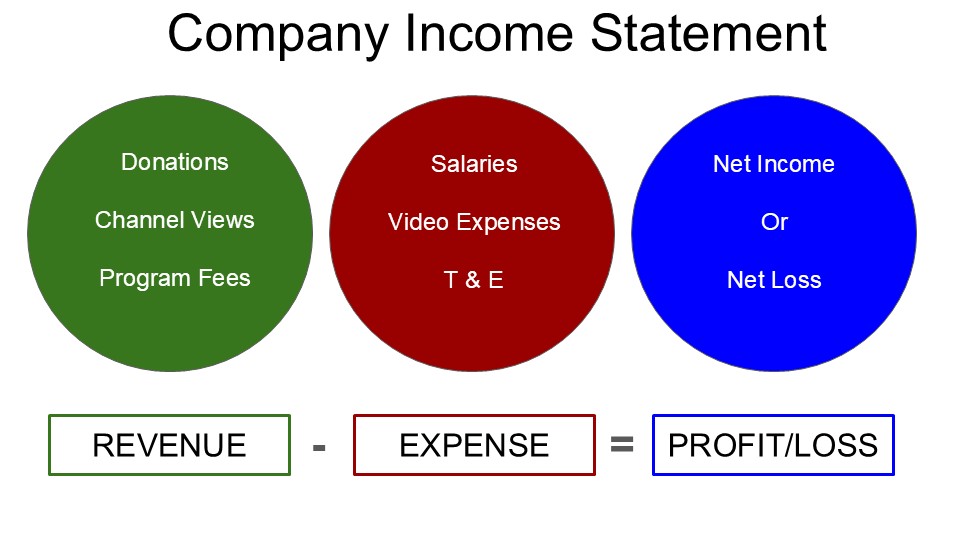
Questions and Answers

Let’s see.

Do Any Non-Mormon Egyptologists Give Credence to the Book of Abraham as Ancient History?

Okay. Do you know of many non-Mormon Egyptologists who give credence to the Book of Abraham as ancient history?

Who will do so publicly? No.

Who will do so privately? It depends on who asks them.

Are You Bothered by the Contempt of Church Antagonists?

Are you bothered or puzzled by the strident contempt towards you by many Church antagonists?

Well, if they call the Master of the house Beelzebub, how much more will they call his servants?

It goes with the territory.

The “Abraham Upon” Inscription

Can you address the source of the inscription “Abraham upon”? Where did this papyrus come from, date, etc.?

Well, yeah, it’s a broken inscription. We only have half the line of the papyrus.

It’s Papyrus Leiden I 384. It comes from Thebes. It’s paleographically dated to the third or fourth century. I’m not sure I trust paleographic dates from that time.

But, I mean, it’s been published several times. I’ve even published a couple of notes on it myself and discussed the provenance.

It comes from the same town as the Joseph Smith Papyri. It comes from a priestly milieu like the Joseph Smith Papyri.

And there are all kinds of other interesting things we could say about it, but I guess we’ll get to some of the other—

Oh, this is the same question in more detail.

Why Were the Facsimiles Included?

Why were the facsimiles included in the current text of the Book of Abraham?

I don’t know. I’m not a very good mind reader.

What connection do they have to the text?

Well, Facsimile 2 and Facsimile 3 have no connection to the text.

Facsimile 1 has a very interesting connection to the text, and it’s worth reading it carefully and reading Abraham chapter 1.

The interesting thing is, only in Facsimile 1 do we have a clue of what’s going on in the facsimiles.

But even the facsimile itself and the explanations don’t tell you important things that are contained in the text.

For instance, if you just read the text, you wouldn’t know that the angel kills the Egyptian priest. Nothing in the picture depicts that.

And the facsimiles also contain other elements that don’t show up in the text.

And exactly what significance those have, we can debate till the cows come home, because we have no evidence.

How Well Do We Understand the Facsimiles?

So, for the most part, the facsimiles don’t connect with the text. And if they did, we might have a better chance of knowing what’s going on with them.

You take Facsimile 2, for example. Ask around all your Mormon friends and see if anyone has any clue what’s going on in that facsimile, and no one does.

And if you go read through the Egyptological literature, you’ll find that no one knows what’s going on from an ancient Egyptian point of view.

So we want to compare what Joseph Smith said about this facsimile, which we don’t understand, and what the ancient Egyptians said about the facsimile, which we also don’t understand.

And we want to say, are they the same?

Well, how would we know, since we don’t understand either one?

How Accurate Are Joseph Smith’s Explanations?

So it says—this follows straight on that one—Joseph Smith gives explanations for many of the characters in the facsimile. How accurate are his descriptions?

Well, do we know what the ancient Egyptians thought they meant?

It turns out that earlier this week, the latest edition of the FARMS Review came out, and I have a little article in there that addresses this particular issue.

But the main question is, if you want to compare what the ancient Egyptians say and what did Joseph Smith say, you have to figure out what is Joseph Smith saying.

And, for example, Facsimile 2, we don’t know. And for Facsimile 3, we don’t really know.

And then you want to compare what the ancient Egyptians said about them, and we actually don’t know as much as we think we do about that.

And in the meantime, somebody—they—so you want to know, say, is X equal Y, and in the meantime someone introduces Z.

So it’s a bait and switch.

Rather than getting what the ancient Egyptians said about the facsimiles, we get what the modern Egyptologists say about the facsimiles.

I actually have an article in the Egyptological literature that shows that, for the most part, when you look at what the modern Egyptologists say about the facsimiles and what the ancient Egyptians say about them, they don’t match.

So, for the most part, there’s no connection there at all.

So you’re really given bait and switch.

And so, no, the modern Egyptologist descriptions don’t match Joseph Smith’s, but then they don’t match the ancient Egyptians either.

What Would Hugh Nibley Say?

So now this is a really—this is a two-part question. One part is mind reading.

And it says, did you know Hugh Nibley?

Yes, I did.

About as well as anybody who is outside of his family and younger than his youngest child could be expected to know him, which is probably not all that well.

And then he says, and what would he say about this topic?

He’d probably say all kinds of things.

He would probably say them much better than I can, or I did.

He is actually quite eloquent, very insightful, somewhat out of date.

You know, somebody once told me that the true measure of a classic is if your work is still read more than a hundred years after you published it.

In that sense, the Book of Mormon is a classic.

It’s too early to tell if Nibley is a classic, and I probably won’t be one.

I have no delusions about—nobody ever has the last word on this topic. That’s an important thing to remember.

And those of you who are on the message boards get this ad nauseam, even if the last word isn’t worth saying.

So I’m not really going to try to guess what Nibley would say about this topic. He’s published quite a bit about it. You can look at it there, and from his perspective now, he probably knows a whole lot more about it than I do and probably would like to rewrite, revise everything he wrote.

Oops.

All right.

Robert Ritner’s Translation

Okay, so this is one that I missed. It was tucked away on the side.

Oh, I’ve already addressed that one.

It says, I received some anti- material that says that Dr. Robert Ritner trained you, and his translation of the Book of Abraham papyrus contradicts yours. Is this true, and how do you explain this?

Well, actually, it’s hard to say that it contradicts mine because I haven’t published mine yet.

So how would we know?

And let’s see, how do I explain this?

Well, I can explain it because I haven’t published one yet.

So I can see now I’m in the position where I can make a deliberate choice to either follow the line that he has set or deliberately shun it.

Actually, I’ve addressed some of this in an article that’s in press.

There are some places where I don’t know Professor Ritner is relevant. Ought to just leave him alone.

You pity the poor guy. He doesn’t know what he’s gotten himself into.

But, you know, at this point anybody who says that is acting problematically because I haven’t published a translation.

Usually the argument is made that if you look at Klaus Baer and Robert Ritner’s and Hugh Nibley and Michael Rhodes’s translations, they don’t differ that much.

So this is a little bit puzzling.

But be that as it may, thank you all for your attendance.

Have a good lunch.

Introduction of John Gee

So with that, I’m very pleased to introduce our next speaker.

John Gee received an M.A. from the University of California, Berkeley, and a Ph.D. from Yale University. He is the William “Bill” Gay Associate Research Professor of Egyptology at the Neal A. Maxwell Institute for Religious Scholarship at Brigham Young University.

I forgot to tell you, John, I was in Bill Gay’s ward for a while, so he’s a very nice man. He’s very good.

He’s the author of more than 80 publications dealing with Mormon subjects, Egyptology, and the ancient Near East. His writings have been published by publishers such as American University in Cairo Press, [East?] Foundation—and I can’t read it because it’s in French, I think, or I’m not sure—[unintelligible], anyway, [unintelligible], the Carsten Niebuhr Institute for Near Eastern Studies, another one I can’t read, [unintelligible], and I’m skipping down these other ones I can’t read, a number of other publishers.

His work has appeared in journals and series like the Bulletin [unintelligible]. I should have gone on a French-speaking mission, I can tell. So here’s one I can read, the [unintelligible]. I went German-speaking mission. That’s good. Journal of the American Research Center in Egypt and the Journal of the Society for the Study of Egyptian Antiquities, Oriens Antiquus, another one I can’t read, and a few more.

Of course, he has been in the Journal of Book of Mormon Studies, the FARMS Review. His work has been vetted by numerous Egyptologists, including James Allen, Jan Assmann, Burkhard Backes, Laurent Bavay, Jean Bingen, Michel Broze, Christine Cardin, Michel Chauveau, Eugene [unintelligible], and a whole bunch more. Forgive me, John, because there’s a long list of Egyptologists and other people who vetted his work.

He is on the Board of Trustees for the Study of Egyptian Antiquities. He’s given Egyptological presentations at conferences at Atlanta, Brown University, Cambridge, Massachusetts, Hawaii, Jersey City, Johns Hopkins University, San Antonio, Tucson, University of California, Berkeley, University of Kansas, Washington, D.C., Yale University, Budapest, Cairo, [unintelligible], the [unintelligible], the Rheinische Friedrich-Wilhelms-Universität Bonn, the Royal Ontario Museum, the Université Libre de Bruxelles, University of Copenhagen, and the University of Toronto.

With that, with a partial introduction, I will introduce John.

[Applause]

[Music]

The Book of Abraham and the Pre-Existence

It is an honor to follow the ever-eloquent Terryl Givens. Terryl has discussed the Western views of the pre-existence.

Although the concept of the pre-existence is alluded to in various places in Latter-day Saint scriptures, the clearest discussion comes from the Book of Abraham, and it is almost the only reason that Latter-day Saints use the Book of Abraham.

Of the 378 quotations of the Book of Abraham in general conference since 1942, 238, or 63 percent, come from the section on the pre-existence in Abraham 3:18–28. The next most commonly cited passage is the section on the Abrahamic covenant in Abraham 2:6–11, which is cited 42 times, for 11 percent of the citations.

The Book of Abraham in Church Curriculum

The situation is mirrored in the Church’s Sunday curriculum materials, where the Book of Abraham is cited 206 times. Again, the section on the pre-existence is the most commonly cited, and the Abrahamic covenant is second.

Whatever else the Book of Abraham says is of comparative minor importance to Latter-day Saints. My topic, therefore, is irrelevant to the doctrine of Christ. It is a mere mote in our eyes, but a beam in the eyes of the critics.

Now, some of you here are so intimately acquainted with the discussions about the Book of Abraham and the Joseph Smith Papyri that you are inseparably wedded to them. Some of you are somewhat acquainted with the arguments, but perhaps not yet on a first-name basis. Others of you are vaguely aware that some discussion exists, but have not yet been introduced to it.

I hope I will have something for all of you.

The “Mess” of the Joseph Smith Papyri

For those of you who are new, allow me to introduce you to what I have affectionately referred to as the mess of the Joseph Smith Papyri.

The fullest discussion of the origins of the Joseph Smith Papyri in the Church’s Sunday curriculum is in the Gospel Doctrine manual for the Old Testament. It says, quote, “The book of Abraham is a translation that the Prophet Joseph Smith made from some Egyptian papyri.”

That is it.

The Church’s Official Position

The Church of Jesus Christ of Latter-day Saints has no official position on how the Book of Abraham was translated or from what papyrus.

Now, just because the Church has no official position does not mean that individual members do not have some opinions on the subject.

Church members tend to divide into four opinions about the translation of the Book of Abraham.

Four Views of the Book of Abraham Translation

The smallest group, comprising about one-half of one percent of Mormons, according to my informal, admittedly unscientific surveys, think that Joseph Smith translated the Book of Abraham from the existing fragments that were in the Metropolitan Museum of Art.

The next largest group think that Joseph Smith translated the Book of Abraham from papyrus fragments that are no longer in existence.

About one-third of Mormons think that there is, or was, no connection between the Book of Abraham and any papyrus fragments.

The largest group, more than half of Mormons, do not care where the Book of Abraham came from.

Critics routinely assert that the Mormon position is the one that is actually the least popular of all Mormon positions. They want it to be the Mormon position because it is the most convenient straw man.

Warren Parrish on the Translation Process

The only eyewitness to the translation process to describe it was Joseph Smith’s scribe Warren Parrish, who, after he left the Church, claimed, quote, “I have set by his side and penned down the translation of the Egyptian hieroglyphics as he claimed to receive it by direct inspiration of Heaven.”

The majority of Church members are probably comfortable leaving the discussion of the translation of the Book of Abraham at that, and on this occasion I will leave it at that too, except to say that so far no theory about the translation of the papyri accounts for all the evidence.

The Saga of the Joseph Smith Papyri

Today, however, I would like to take a look at the papyri themselves and some of the puzzles surrounding them, namely: What papyri did Joseph Smith have, and what do we know about the ancient owners of the papyri?

And we may not be able to cover all of this here, and certainly can’t cover all of the possible topics on either the papyri or the Book of Abraham. I’m not even going to try.

Now, the saga of the Joseph Smith Papyri begins in the early part of the 19th century, during the pillaging of Egypt that at that time passed for archaeology.

One of those involved in the plunder and pillage of Egypt was Antonio Lebolo. He exhumed one of the most spectacular caches of mummies and papyri from Thebes that Egyptology has ever known. I used to think that the accounts of several hundred mummies were vastly exaggerated. I am no longer so sure.

Lebolo was acting as an agent procuring antiquities for Drovetti, but kept a few for himself. These were sent via Albano Oblasser to America, paraded around the country, and sold off piecemeal until the remainder were sold by Michael Chandler to the Church in July of 1835.

The Church got four mummies and at least five papyri.

From Joseph Smith to the Metropolitan Museum

After Joseph Smith’s mother’s death in 1856, the papyri were sold to Abel Combs, who sold part of the collection to a museum in St. Louis, which eventually moved to Chicago and burned to the ground in the Chicago Fire of 1871. And he kept part of the collection for himself.

Combs’s collection passed through various hands until it was acquired by the Metropolitan Museum of Art in 1947.

The Metropolitan Museum of Art knew that they had acquired, quote, “Papyrus fragments of hieratic Books of the Dead, once the property of the Mormon leader Joseph Smith.”

The Metropolitan Museum was fully aware of what the papyri were when they first saw them in 1918, and they knew what they were doing when they acquired them.

Rediscovery of the Papyri

Klaus Baer recalled, “I saw photographs of them for the first time in 1963, I believe, and was asked at that time, on my honor, not to tell anyone where they were and to keep the whole thing confidential.”

The guard had changed at the museum, and the new curators were not as keen to have the papyri as the previous curators had been.

Henry Fischer, curator of the Department of Egyptian Art at the Metropolitan Museum of Art in the late 1960s, explained how the museum decided to deal with their religious hot potato:

“We knew, since Atiya worked in Salt Lake City and was acquainted with leaders of the Mormon Church, that he might very tactfully find out how they felt about it. So we simply informed him about this in confidence, and I think he handled the matter very nicely.”

The newspapers garbled the story by wrongly making Atiya the discoverer of the documents, which disturbed Fischer. He wrote to Atiya as follows:

“Although I was already aware that your version of the discovery of these documents had caused considerable confusion, it was startling to read that you had informed me of their existence. While I have taken pains to avoid any outright contradictions of what you said, I do not see why either I or the other members of my department, past and present, should be put in the position of being ignorant about facts we could not fail to have known.”

What Survives Today

The Metropolitan Museum of Art gave the papyri back to the Church in 1967, 40 years ago this November.

The papyri have now remained in one set of hands for the longest time since their excavation.

The papyri we currently have are 11 groups of fragments from three different papyri, containing two partial copies of what is usually misnamed the Book of the Dead, and part of a copy of what is usually misnamed the Document of Breathings Made by Isis.

The extant fragments do not contain any text from the Book of Abraham.

We know what we currently have, but how much papyri did Joseph Smith have?

How Much Papyri Did Joseph Smith Have?

Critics want to minimize the amount of papyri originally owned by Joseph Smith, preferably to an amount not much more than what we currently have, because they do not want a Book of Abraham to have ever existed.

As Richard Bushman has noted, people who have broken away from Mormonism have to justify their decision to leave. They cannot countenance evidence of divine inspiration in Joseph Smith’s teaching without catching themselves in a disastrous error.

So critics who have left the Church cannot allow Joseph Smith to have gotten anything right, even by a guess or by accident. They will go to extreme lengths and propound convoluted theories to have something else, anything else, to believe in.

Dale Morgan on Joseph Smith

The critic Dale Morgan, in a moment of candor, wrote:

“With my point of view on God, I am incapable of accepting the claims of Joseph Smith and the Mormons, be they however so convincing. If God does not exist, how can Joseph Smith’s story have any possible validity? I will look everywhere for explanation except to the one explanation that is the position of the Church.”

So the critics cannot allow themselves to say, as Latter-day Saints can say, whether or not there was a Book of Abraham actually contained on the proportion of papyri that did not survive is something that cannot be determined by scholarly means.

Faith and Unanswered Questions

A Latter-day Saint who has faith—that is, trust in God—can examine such issues without being bothered or without having to know all the answers to all the questions we might have.

In fact, insisting on the answers to all our little questions is a sign of lack of faith or trust.

For example, if we insist that our spouse or employees must account for every moment out of our presence, it is a sign that we do not have faith or trust in them.

Faith, Study, and the Book of Abraham

Abraham, for example, was able to say, “Thy servant has sought thee earnestly. Now I have found thee. Thou didst send thine angel to deliver me from the gods of Elkenah, and I will do well to hearken unto thy voice.”

He trusted God on the basis of one past experience without having to know all the details about how the Lord was going to fulfill his promises.

Likewise, a Latter-day Saint who trusts God and his prophets—that is, spokesmen—does not need to see the actual Egyptian characters on the papyrus or know any of the details about the translation of the Book of Abraham in order to accept it and act with confidence that this life is a time of testing, when God will “prove us herewith, to see if we will do all things whatsoever the Lord our God shall command us.”

This is the reason why, for the vast majority of Latter-day Saints, the particulars of the translation of the Book of Mormon are not an issue.

Still, as all have not faith, and most of you are here either for a want of faith or a desire to help those who want faith, we are commanded to “seek learning, even by study and also by faith.”

Learning is a partial substitute for and an aid to faith.

What Papyri Did Joseph Smith Have?

So what do we know about the papyri Joseph Smith had?

Between the current fragments and some very bad copies of characters from the papyri, we know that Joseph Smith had papyri or portions of papyri from at least five individuals: Horos, the son of Osoroeris; and [unintelligible]; [unintelligible], the son of [unintelligible]; a woman with the unique name of Neferirnub; and a man named Sesonchis.

Comparing the copies of the papyri with the fragments indicates that in no case do we have a complete record of what Joseph Smith had from these two sources alone.

Eyewitnesses from the Nauvoo period describe a quantity of records written on papyrus and Egyptian hieroglyphs, including: one, some papyri preserved under glass, described as “a number of glazed slides, like picture frames, containing sheets of papyrus with Egyptian inscriptions and hieroglyphics”; two, a long roll of manuscript that contained the Book of Abraham; three, another roll; four, and two or three other small pieces of papyrus with astronomical calculations, epitaphs, etc.

Only the mounted fragments ended up in the Metropolitan Museum of Art and were subsequently given back to The Church of Jesus Christ.

Eyewitness Descriptions of the Papyri

The eyewitnesses not only describe the papyri, but they describe specific vignettes, or pictures, on the papyri.

When eyewitnesses describe the vignettes as being on the papyri mounted under glass, they can be matched with fragments from the Metropolitan Museum of Art.

On the other hand, when the vignettes are described as being on the rolls, the descriptions do not match any of the currently surviving fragments.

Gustav Seyffarth’s 1856 catalog of the Wood Museum in St. Louis indicates that some of the Joseph Smith Papyri were there. Those papyri moved with the Wood Museum to Chicago and were burned in the Chicago Fire of 1871.

Whatever we conjecture their contents to be is only that: conjecture.

Both Mormon and non-Mormon eyewitnesses from the 19th century agree that it was a, quote, “long roll of papyrus” from which our Prophet translated the Book of Abraham, meaning the long roll of manuscript and not one of the mounted fragments that eventually ended up in the Metropolitan Museum of Art.

So the intellectual position that some members follow, and which the critics would have us adopt as the position of the Church, is not in accord with the historical evidence.

How Big Were the Rolls?

So how big were the rolls?

One way to answer that question is to take the standard size for a papyrus roll and just use that. In the Ptolemaic period, a roll was usually about 320 centimeters long and about 32 centimeters high.

I have used such estimates before, but those figures are not entirely satisfactory. As Mark Depauw has pointed out in a later study, the measurements of papyri vary throughout the Ptolemaic period, with different standards applying at different times.

Now, one can take a more scientific—that is, mathematical—approach, because the circumference of a scroll limits the amount of scroll that can be contained inside it.

Thus, we can determine by the size of the circumference and the tightness of the winding how much papyrus can be missing at the interior end of a papyrus roll.

Calculating the Missing Portion of a Scroll

Friedhelm Hoffmann has already developed such a formula in calculating the amount of material missing from the end of Papyrus Spiegelberg, from which he was able to determine that there were five columns missing from the text.

Now, I won’t bore you with the derivation of the formula. It’s up there. It’s been in print for over a decade.

But it boils down to this: if S is the average difference between the winding measurement, and E is the last length—the length of the last, that is, the interior winding—then the theoretical length of the missing portion is Z, so that Z is approximately E squared minus 6.25 over 2S minus E.

We can apply this to the Joseph Smith Papyri and can obtain some usable results.

The Scroll of Neferirnub

For the scroll of Neferirnub, the final winding length is 7.8 centimeters, and the difference is .33 centimeters. The formula says that there is 64 centimeters missing, which is just over two feet.

Thus, this vignette was at the very end of the roll it was on.

Unfortunately, there’s no way of knowing how much is missing off the beginning of the scroll.

The Scroll of Sesonchis

For the Sesonchis scroll, the final winding length is 14 centimeters, and the difference is .25 centimeters.

Thus, there were 365.5 centimeters left on the scroll, and this is the equivalent of 143.5 inches, or nearly 12 feet.

The vignette on Joseph Smith Papyrus II, shown here, is the furthest vignette into the Sesonchis scroll and normally occurs about halfway through the Book of the Dead, which means that the total scroll would be about 20 to 24 feet long.

And this is longer than some scrolls, but shorter than others.

Edit

The Scroll of Horus

For the scroll of Horus, the initial winding length is 9.7 centimeters, the last winding is 9.5 centimeters, and there are seven windings in total. This leaves us with an average value of .0333 for S. E is, as already stated, 9.5 centimeters.

Plugging this into the equation gives 1,250.5 centimeters of missing papyrus. This is the equivalent of 492 inches, or 41 feet of missing papyrus.

Would such a thing be unusual?

Papyrus Turin 1791 is 57 feet 3 inches long. That’s a 1,745-centimeter papyrus. Papyrus Nesmin is 1,280 centimeters long, and the ritual roll of Imuthes in the Metropolitan Museum of Art is 1,088 centimeters long, or 35 feet 8 inches long, while his Book of the Dead is longer still.

So such a length is not out of the question.

Could the Scroll Have Contained Additional Text?

While we know that the scroll of Horus has a Document of Breathings Made by Isis, about one in four of those documents contain additional texts. So the presence of additional text would not be unusual.

Now, the size of Horus’s scroll at first seems excessive, even though it is not unheard of. When I first plugged in the numbers a few years ago and got the result, I checked the measurements and then checked them again. Then I checked the formula again. Then I rechecked the formula’s derivation. Then I rechecked the assumptions behind the formula. Then I simply dismissed them and went back to the standard scroll length.

I had always assumed that the Sesonchis scroll would be the longer one, since the Book of the Dead is a much longer composition than the Document of Breathings Made by Isis, and my initial estimates of the length of the Sesonchis scroll, based on the length of text preserved and the percentage of the Book of the Dead preserved, had been almost 20 feet.

It was only after plugging in the numbers from the other Joseph Smith Papyri into the formula that I realized that the formula does give reasonable results.

The Nineteenth-Century Eyewitnesses

I have since realized that having a long roll of Horus brings all the 19th-century eyewitnesses into agreement.

If we look at the 19th-century eyewitnesses and ask the question, Which of the five known rolls that Joseph Smith had do the eyewitnesses identify as the source of the Book of Abraham? we come up with some useful information.

Charlotte Haven and Jerusha Blanchard identify the long roll as being the source of the Book of Abraham. On the other hand, William Appleby identifies the Book of Abraham as being written by the poor scribe, which matches the Horus roll.

Only if the Horus roll is longer than the Sesonchis roll do the 19th-century eyewitnesses agree. And for that to be the case, the unmounted portion of the Horus roll has to be longer than the 12 feet left on the Sesonchis roll.

Now, one could take an average of S for only the last four windings on the Horus, in which you get .05 centimeters, and still come up with a value for Z of 830.5 centimeters, or 27 feet 3 inches, for Horus’s roll. And it would still be longer than Sesonchis and well within the range of comparable Ptolemaic rolls.

Gustav Seyffarth and Facsimile 3

Furthermore, a lengthy Horus roll accommodates the otherwise problematic testimony of Gustav Seyffarth.

Seyffarth describes Facsimile 3, which is on the roll of Horus, and claims that a portion of the text he saw was an invocation to Osiris.

If all there was on the Horus roll was the Document of Breathings Made by Isis, then the problem is that there is no invocation to Osiris in the portion of text that Seyffarth would have seen, or anywhere in the document, for that matter.

With a longer roll, Seyffarth’s testimony can be accounted for, as there would certainly be room for an invocation to Osiris on the roll, if Seyffarth is even accurate in his interpretation, and who knows what else would be on the roll.

Who Was Horus?

Now, although scholarship is unable to tell us whether or not there was a Book of Abraham on the roll of Horus, perhaps we can tell something about the individual who owned the papyrus and the likelihood that the Book of Abraham might have interested him.

To do so requires moving from the size of the Joseph Smith Papyri to their message.

The puzzle that is before us is to determine what we can know about Horus.

The beginning of the roll of Horus lists Horus’s names, titles, and parents. Horus bore three titles, as in the first line, which are high-ranking positions that he held at some time in his life, perhaps concurrently, perhaps sequentially.

These titles are Prophet of Amonrasonther, Prophet of Min Who Massacres His Enemies, and Prophet of Chespis.

The last two titles are rare, the second one being extremely rare. Only four men are known to have borne it.

Dating Horus and His Family

Horus’s names and titles allow him to be linked with a number of other documents, such as a statue of his father, now in the Walters Art Gallery in Baltimore.

These documents yield a family tree covering eight generations, from Horus’s grandfather to his great-great-great-grandsons.

Thanks to a graffito from the Small Temple of Medinet Habu, shown here, we can date the family.

Horus’s third great-grandson is alive in 37 B.C. under the reign of Cleopatra VII, and he mentions there his—Horus’s son died before 157 or 153 B.C., and two of his grandsons died between 146 and 124 B.C.

This would place Horus roughly contemporary with Ptolemy V, which means that this roll from the Joseph Smith Papyri was contemporary with the Rosetta Stone.

Horus probably lived through the revolt of Haronnophris and Chaonnophris, and the priests of Amonrasonther seem to have some special connection with the revolt.

Horus was also probably well acquainted with all three of the languages of the Rosetta Stone. Two of them, hieroglyphs and Demotic, he probably knew better than any Egyptologist alive.

Horus’s Connections to the Temples at Karnak

Horus’s titles link him directly with three of the temples at Karnak.

Prophet of Amonrasonther links him as prophet with the main temple at Karnak. This one—well, not that one. I’ll show it later. But that’s Karnak.

Prophet of Min Who Massacres His Enemies links him with the Min temple north of the main temple, and Prophet of Chespis links him with the small temple of Chespis southwest of the main temple.

Let’s look at these titles in order.

Prophet of Amonrasonther

The first title is the Prophet of Amonrasonther, which means that he’s employed in the Great Temple of Karnak. We know a considerable amount about this temple, the largest surviving one in Egypt.

As prophet, he would have been initiated in the Festival Hall shown here, and he would have had—we have two of the Karnak Temple’s daily rituals preserved. In the first of them, shown here, at least the beginning shown here, the prophet lights a lamp and an incense burner and chants his way into the Holy of Holies through the hypostyle hall.

Holy of Holies, which is now largely destroyed back here. There he sees God and worships him face to face.

The other daily ritual is the execration ritual, where a wax figure of an enemy, on which the enemy’s name is written in fresh ink, was spat upon, trampled under the left foot, smitten with a spear, bound, and placed on the fire.

Any priest or prophet at Karnak would have been intimately acquainted with both of these rituals.

The Temple Library

The temple also had a library, which would have had king lists, annals, prophecies and chronicles, compendia of each nome, medical texts, wisdom and ethical teachings, books of lucky days, dream interpretation manuals, astrological and astronomical texts, lexical texts, geographies, festival books, ritual books, glorification texts, hymns, cult prescriptions, construction manuals, manuals of painting and relief, manuals of purification, offering manuals, calendars of feasts, manuals of cultic receipts, inventories, property lists, instructions, oracle texts, priestly correspondence, temple daybooks, and accounts.

It is from the library in Thebes that the earlier Greek writer Hecataeus wrote an account of Abraham.

Min Who Massacres His Enemies

Horus was also Prophet of Min Who Massacres His Enemies.

The term for “massacre,” “slay,” is also the verb used of slaughtering and sacrificing animals and can be used as a term for the sacrificial offering.

The texts specify that this is done by the knife held in the right hand and the foe in the left, or with a harpoon. The sacrifice is dismembered, and portions of him are put into the brazier as offerings.

The term for enemy, kheru, can also mean sacrificial victim.

The only place where representations of the rituals associated with Min Who Massacres His Enemies appear is on the interior portions of the Bab el-Abd, the gate of the enclosure wall of the Min temple north of the Great Temple of Amon at Karnak.

The gate was built by Ptolemy III Euergetes, the contemporary of Horus’s grandfather, Harsiesis, who was the first prophet of this deity, and the decoration was finished by Ptolemy’s son, Ptolemy IV Philopator.

Subduing Sinners and Burning Enemies

Unlike most of the deities featured on the gateway, Min Who Massacres His Enemies did not have his own temple in the Min complex because his rituals were performed in the courtyard of the Min temple.

Two rituals are associated with him. One of them is labeled “Subduing Sinners,” and the other is “The Burning of Enemies.” Both scenes come from the execration ritual, such as I described from Karnak.

The first scene identifies Min Who Massacres His Enemies with Reshep, a foreign deity imported into Egypt much earlier, and like many non-Egyptian deities imported into Egypt, he is given a different Egyptian name.

The second scene says that he, quote, “smites his enemies in the temple of burning,” and then burns them on the altar of burnt offerings. The gods also “overthrow your enemies in the slaughterhouse,” and they “sacrifice the enemy on your altar.”

The Altar of Burnt Offerings

The term for this altar, which is shown here on the bottom of the slide, of burnt offerings, akh, is described in a number of contemporary texts.

Papyrus Ankhsheshonq tells the story of a rebellion against Pharaoh led by Harsiesis, Pharaoh’s chief physician. The plot is unsuccessful, and the conspirators are rounded up.

Pharaoh “caused an altar of earth to be built at the gate of Pharaoh’s palace. He caused Harsiesis, son of Ramose, to be placed on the altar akh of copper with all the men whom he had and all the men who were in the plot against Pharaoh.”

Papyrus Vandier tells a story of a group of priests who are jealous of Merire and have him put to death so that the Pharaoh can live longer and Pharaoh can marry Merire’s wife.

But Merire appears to Pharaoh in a vision and reproves him. As a consequence, Pharaoh, quote, “caused all the priests to be brought outside the prison. Pharaoh went with them to Heliopolis. He caused them to be killed. He caused them to be placed on the altar before Mut, who carries her brother in Heliopolis.”

Accounts of Enemies Placed on an Altar

In Papyrus Rylands 9, the cry goes forth against one set of enemies, quote, “Let our lord bring these young men who have abandoned our ways, and let them be placed on an altar, akh.”

Papyrus P. Saqqara 2, published just last year, begins with the following fragmentary text, quote, “Necho caused to be set up an altar [broken] you yourself, they would have placed on the altar,” and then unfortunately breaks off again.

Thus, stories about slaughtering and then burning people on an altar were common in the time of the Joseph Smith Papyri, and Horus, the owner of Papyrus Joseph Smith I, had a professional interest in such things.

The Temple of Chespisichis

The Temple of Chespisichis is first mentioned by Lepsius, where it is listed as Temple V. Lepsius is a very early Egyptologist, 1840s.

By 1885, when Wiedemann visited the site, he found it, quote, “almost entirely in ruins.” The temple walls had been disassembled and used to fence a garden, and the inscriptions, quote, “almost entirely destroyed.”

But he found some probably reused blocks of the 18th Dynasty king Thutmose III, as well as fragments of 29th Dynasty king Nepherites I, as well as Ptolemaic materials, and some fragments he thought belonged to the 26th Dynasty king Psammetichus.

Later work indicates that the cult of Chespisichis seems only to have existed since the 19th Dynasty, about the time of Moses, where he is particularly known as a healer.

He is said to be one who, quote, “publishes the book of death and life.”

He is a savior god who rescues from all manner of sickness, death, and catastrophe.

Chespisichis at Tod and Karnak

Two other places depict him: the Temple of Tod, located a few miles south of Thebes, and on the Ptolemaic gateway of the main Khonsu Temple at Karnak.

There he is at Tod, and there’s his images at the Khonsu Temple in Karnak.

At the Tod Temple, the inscription refers to “subduing the weaklings,” a betu, a derogatory term for foreigners, and depicts, under the name of Chespisichis, a jackal-headed figure wielding knives.

The only inscription that really remains of the Temple of Chespisichis is a single stela now in the Louvre, more commonly known as the Bentresh Stela.

The Bentresh Stela

Stylistically, the Bentresh Stela most closely matches the Ptolemaic style of Ptolemy IV, although Ptolemy III has also been argued.

Lanny Bell reported the discovery of another copy of this text back in 1979, but he never published it.

The Bentresh Stela tells the story of an otherwise unattested king named Ramesses, whose names are a mixture of those of Ramesses II, IV, and one of the Thutmoses, who made his annual trip to Mesopotamia to collect tribute.

He marries a princess of Bakhtan, perhaps a corruption of the Egyptian word for Hittite, rather than a reference to Bactria, modern Afghanistan.

When the princess’s sister, Bentresh, gets sick, first a priest is sent, then the god Chespisichis to heal her of her illness. She had been possessed by an angel.

Finally, after many years, Chespisichis appears to the ruler of Bakhtan in a dream and requests that he be sent back to Egypt, and much tribute comes with him.

As Prophet of Chespisichis, we can be fairly confident that Horus would have read this text at some point in his life.

The god appearing in visions and dreams, Egyptian presence in Syria and Mesopotamia, angels interfering in human affairs, sicknesses caused by spiritual beings, and a savior—all of these are elements shared between the world of Horus and the Book of Abraham.

Facsimile 1

Next on the roll of Horus is a vignette which we know as Facsimile 1.

The facsimiles from the Book of Abraham interest people as three illustrations floating like islands in the sea of thousands of pages of words in our scripture.

Despite the interest in the facsimiles, there is no emphasis put on them in the Church or the current curriculum material.

Facsimile 1 is mentioned only once, in an optional enrichment activity in a lesson for 8- through 11-year-olds. Facsimile 2 has been mentioned only once in general conference in the last 65 years.

I cannot help but wonder if the critics attack the facsimiles because they are relatively insignificant in the Church.

Challenges in Interpreting Egyptian Vignettes

The facsimiles, like all vignettes, present a number of challenges, and it is worth remembering a few things about the placement of vignettes, the drawing of vignettes, and the identifications of figures on vignettes.

With regard to the placement of vignettes, I will read a number of quotes from Egyptologists about Late Period documents in general and Ptolemaic texts in particular.

The list is lengthy because it is a common thing, but everyone seems to want to treat the Joseph Smith Papyri as a special exception to a general rule, and I do not think we should do so.

From Malcolm Mosher, who specializes in Late Period religious texts, quote:

“In documents from the 21st Dynasty on, misalignment of the text and vignette of a spell can occur, with the text preceding the vignette or vice versa. While this type of problem can be observed sporadically from the late New Kingdom on, it is more common in the Late Period.

“The problem is particularly acute when more spells are textually represented for such a group than there are vignettes. It can be difficult to determine which spells have a vignette and which do not.

“A similar problem of misalignment frequently encountered in late documents is where the vignette for a particular spell is [with] the wrong text, and the correct text is not found in the document.”

Difficulties in Vignette Research

From Henk Milde, probably the foremost authority on papyrus vignettes, quote:

“Unfortunately, the connection between text and pictures is not always clear-cut. One has to take into account at least the following difficulties in vignette research that are here placed in eight categories:

“One, spatial discrepancy between text and vignette.” That means that the vignettes and the texts are far apart.

“Two, incorrect combination of text and vignette in the original.

“Three, incorrect combination of text and vignette in studies and editions of the Book of the Dead.

“Four, unclear relation between the text and vignette.

“Five, transfer or omission of pictorial elements.

“Six, inundation of the picture.

“Seven, combination and contamination of pictorial elements of different vignettes.

“And eight, conglomeration of texts under a vignette.”

Text and Vignette Do Not Always Correspond

From Marc Étienne of the Louvre, the vignettes, quote, “often do not have but a very distant connection with the discussion written beneath.”

From Jean-Claude Goyon, who has published so many Late Period papyri, quote, “The vignettes do not always correspond to the chapters which the text prescribes.”

This is particularly the case in Documents of Breathings Made by Isis, as discussed by Mark Coenen, probably the foremost expert on these texts, quote:

“The relation between the text and the vignettes in the text is not straightforward. The vignettes are not meant to illustrate the contents of the composition.”

In other words, the vignettes in the Document of Breathings Made by Isis usually do not match the text and may not even belong to it.

This would explain why, quote, “the vignette of Papyrus Joseph Smith I represents new themes and contains a variety of unique features.”

The Unique Vignette of Papyrus Joseph Smith I

The vignette in Papyrus Joseph Smith I is, in fact, unique.

After looking at vignettes in thousands of documents from the Saite Period on, I have not found any exact match or anything really very close.

Furthermore, in vignettes from the Ptolemaic Period, quote, “the genders of the various figures are often incorrect. The genders of priests and deities are occasionally confused.”

And we have a nice example on this papyrus, where, as you can see, successive vignettes depict the owner as both male in the top and female in the bottom.

The Perils of Identifying Iconography

Finally, I wish to mention something about the perils of identifying iconography in the vignettes.

The bulk of iconographic study in Egyptology is based on New Kingdom material, and there is a danger in applying such iconographic experience to Ptolemaic materials from a millennium later.

For instance, in the New Kingdom, a jackal-headed figure might be Anubis, but in the Ptolemaic period, jackal-headed figures might be Osiris or Chespisichis or Isdes or Duamutef, while Anubis might have a human or a lion head.

The Dendera Temple Roof Chapels

Egyptologists and many others point to parallels on the roof chapels of the Dendera Temple as parallels for Facsimile 1.

There are over 40 lion couch scenes in these chapels. Eleven are depicted in this wall just right here.

What the critics do not do, however, is read the inscriptions in the Dendera texts.

The word for the lion couch, nmỉt, is either homophonous or identical with the word nmt, abattoir, slaughterhouse, as well as a term for offerings. This is picked up in the inscriptions.

Let’s take the center one here. In the central scene of the innermost eastern chapel, we read, quote:

“He will not exist, nor will his name exist, since you will destroy his town, cast down the walls of his house, and everyone who is in it will be set on fire. You will demolish his district. You will stab his confederates, his flesh being ashes, the evil conspirator consigned to the lion couch so that he will no longer exist.”

In this one, Bastet, who is not pictured, quote, “is your protection every day. She has commanded her messengers to slaughter your enemies.”

Symmetrical with this scene, we have another scene with a broken inscription that mentions ashes and continues, quote, “to burn his flesh with fire.”

So here we have both a scene and descriptions that parallel the Book of Abraham.

Anubis and the Four Sons of Horus

Furthermore, in the same chapels we have depictions of Anubis and the four sons of Horus, who are presumably the figures under the lion couch in Facsimile 1.

They’re all holding knives.

Anubis here is identified as the one, quote, “who smites the adversaries with his might, since the knife is in his hand to expel the one who treads in transgression. I am the violent one who came forth from God after having cut off the heads of the confederates of him whose name is evil.”

The human-headed son of Horus is identified above his head as, quote, “the one who repulses enemies and who comes tearing out the enemies, who butchers the sinners.”

The baboon-headed son of Horus says, “I have slaughtered those who create injuries in the house of God in his presence. I have taken away the breath from his nostrils.”

The jackal-headed son of Horus says, quote, “I caused the hostile foreigners to retreat.”

And finally, the falcon-headed son of Horus says, “I have removed rebellion.”

Sacrifice and Lion Couch Scenes

So the inscriptions from Dendera associate the lion couch scene with the sacrificial slaughter of enemies.

Nor are they the only depictions of lion couch scenes to do so.

This one, for example, contains instructions that it is, quote, “to stab or cut your disobedient ones, to sacrifice your apostates, to overthrow your enemies every day. May your flames shoot out against your enemies each and every day, so that you remain while your adversaries are overthrown.”

This frequently occurring lion couch scene contains the description, “The lords of truth cause the sacrifice of the evildoers.”

This is interpreted as being either Shesmu, a knife-wielding jackal-headed deity, or Sobek, who is in his water, crocodile deity.

Imsety, Duamutef, and Qebehsenuef, the sons of Horus, are described as forming, quote, “the council behind Osiris, who cause the sacrifice of the evildoers by placing knives into the evildoers and incinerating the souls of the evildoers.”

They are said to be put in place by Anubis.

Excluding a sacrificial dimension to lion couch scenes is un-Egyptian, even if we cannot come up with one definitive reading at this time.

The Document of Breathings Made by Isis

Now, the next thing that we know for certain was on the roll of Horus is the misnamed Document of Breathings Made by Isis.

As I’m down to four minutes, um, and we’ll just have to skip over the Document of Breathings and Facsimile 3.

What Can Scholarship Prove?

Now, um, have we proven anything here?

No.

You cannot prove that the Joseph Smith Papyri contained the Book of Abraham, and you cannot prove that they do not.

And since, for the most part, Latter-day Saints and Egyptologists agree that the preserved portions of the Joseph Smith Papyri do not contain the Book of Abraham, there is the possibility of détente between the two.

As scholarship cannot tell what was or what was not on the missing papyri, Egyptologists could stick to what is knowable from the remains, and Latter-day Saints could trust God about the origins of the Book of Abraham.

Faith and Things Unseen

Our trust, or faith, in God becomes, for those fortunate enough to possess it, the basis of what we hope for, the evidence of things unseen.

Those who have it require no other proof.

Those who have chosen not to trust God will not be persuaded though one rose from the dead.

If we had the papyrus from which the Book of Abraham was translated—and I testify that we do not—the critics would not believe it, and most of them could not read it anyway.

The Irony of the Joseph Smith Papyri

One of the ironies of the Joseph Smith Papyri is that the Egyptologists who are quick to point out what the papyri are not are otherwise uninterested in what they contain.

They could be a laundry list, a get-well card, or the greatest piece of literature ever written. It does not matter, so long as they were not the Book of Abraham, so long as they are not scripture, so long as they do not contain the words of God, so long as they are not conveyed by a prophet of God.

Here, though, is another great irony.

The Rosetta Stone ends with a passage that directs that it be written, quote, “on a stone stela in the writings of words of gods”—that is, hieroglyphs—“the writing of letters”—that is, Demotic—“and the script of the foreigners”—that is, Greek.

For the Egyptians, hieroglyphs are literally the words of God.

The Words of God

The Joseph Smith Papyri contain the words of God conveyed by a prophet of God, just as, for the Latter-day Saints, the Book of Abraham contains the words of God conveyed by a prophet of God.

Watching the efforts to criticize the Book of Abraham, one is impressed with both the secularist and the sectarian search for a savior.

Secularists are not interested in being saved, for example, from their 32 percent illegitimacy rate, their higher-than-average failure rate in school, their double-average smoking—both tobacco and marijuana—and alcoholic drinking rates, their double national average of pornography.

Sectarians are not interested in being saved, for example, from their 50 percent higher-than-average divorce rates, their 88 percent promiscuity rates, their rapid increase in cohabitation, their involvement in pornography, or their double-average racism.

No, both these groups are looking for a savior to save them from the Mormons.

Some of the proposed saviors loudly proclaim, “Here am I, send me, and surely I will do it. Wherefore, give me thine honor.”

Knowing something of these proposed saviors, I cannot say that I have much faith in them.

The truth is, we all need a Savior, if for no other reason than to save us from ourselves. But that Savior is Jesus Christ.

In the name of Jesus Christ, amen.
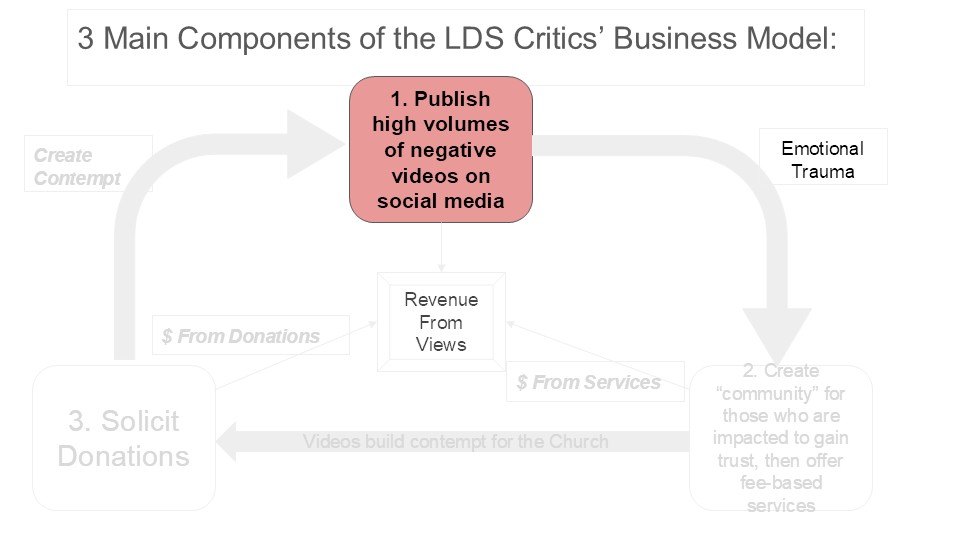
Questions and Answers

Let’s see.

Do Any Non-Mormon Egyptologists Give Credence to the Book of Abraham as Ancient History?

Okay. Do you know of many non-Mormon Egyptologists who give credence to the Book of Abraham as ancient history?

Who will do so publicly? No.

Who will do so privately? It depends on who asks them.

Are You Bothered by the Contempt of Church Antagonists?

Are you bothered or puzzled by the strident contempt towards you by many Church antagonists?

Well, if they call the Master of the house Beelzebub, how much more will they call his servants?

It goes with the territory.

The “Abraham Upon” Inscription

Can you address the source of the inscription “Abraham upon”? Where did this papyrus come from, date, etc.?

Well, yeah, it’s a broken inscription. We only have half the line of the papyrus.

It’s Papyrus Leiden I 384. It comes from Thebes. It’s paleographically dated to the third or fourth century. I’m not sure I trust paleographic dates from that time.

But, I mean, it’s been published several times. I’ve even published a couple of notes on it myself and discussed the provenance.

It comes from the same town as the Joseph Smith Papyri. It comes from a priestly milieu like the Joseph Smith Papyri.

And there are all kinds of other interesting things we could say about it, but I guess we’ll get to some of the other—

Oh, this is the same question in more detail.

Why Were the Facsimiles Included?

Why were the facsimiles included in the current text of the Book of Abraham?

I don’t know. I’m not a very good mind reader.

What connection do they have to the text?

Well, Facsimile 2 and Facsimile 3 have no connection to the text.

Facsimile 1 has a very interesting connection to the text, and it’s worth reading it carefully and reading Abraham chapter 1.

The interesting thing is, only in Facsimile 1 do we have a clue of what’s going on in the facsimiles.

But even the facsimile itself and the explanations don’t tell you important things that are contained in the text.

For instance, if you just read the text, you wouldn’t know that the angel kills the Egyptian priest. Nothing in the picture depicts that.

And the facsimiles also contain other elements that don’t show up in the text.

And exactly what significance those have, we can debate till the cows come home, because we have no evidence.

How Well Do We Understand the Facsimiles?

So, for the most part, the facsimiles don’t connect with the text. And if they did, we might have a better chance of knowing what’s going on with them.

You take Facsimile 2, for example. Ask around all your Mormon friends and see if anyone has any clue what’s going on in that facsimile, and no one does.

And if you go read through the Egyptological literature, you’ll find that no one knows what’s going on from an ancient Egyptian point of view.

So we want to compare what Joseph Smith said about this facsimile, which we don’t understand, and what the ancient Egyptians said about the facsimile, which we also don’t understand.

And we want to say, are they the same?

Well, how would we know, since we don’t understand either one?

How Accurate Are Joseph Smith’s Explanations?

So it says—this follows straight on that one—Joseph Smith gives explanations for many of the characters in the facsimile. How accurate are his descriptions?

Well, do we know what the ancient Egyptians thought they meant?

It turns out that earlier this week, the latest edition of the FARMS Review came out, and I have a little article in there that addresses this particular issue.

But the main question is, if you want to compare what the ancient Egyptians say and what did Joseph Smith say, you have to figure out what is Joseph Smith saying.

And, for example, Facsimile 2, we don’t know. And for Facsimile 3, we don’t really know.

And then you want to compare what the ancient Egyptians said about them, and we actually don’t know as much as we think we do about that.

And in the meantime, somebody—they—so you want to know, say, is X equal Y, and in the meantime someone introduces Z.

So it’s a bait and switch.

Rather than getting what the ancient Egyptians said about the facsimiles, we get what the modern Egyptologists say about the facsimiles.

I actually have an article in the Egyptological literature that shows that, for the most part, when you look at what the modern Egyptologists say about the facsimiles and what the ancient Egyptians say about them, they don’t match.

So, for the most part, there’s no connection there at all.

So you’re really given bait and switch.

And so, no, the modern Egyptologist descriptions don’t match Joseph Smith’s, but then they don’t match the ancient Egyptians either.

What Would Hugh Nibley Say?

So now this is a really—this is a two-part question. One part is mind reading.

And it says, did you know Hugh Nibley?

Yes, I did.

About as well as anybody who is outside of his family and younger than his youngest child could be expected to know him, which is probably not all that well.

And then he says, and what would he say about this topic?

He’d probably say all kinds of things.

He would probably say them much better than I can, or I did.

He is actually quite eloquent, very insightful, somewhat out of date.

You know, somebody once told me that the true measure of a classic is if your work is still read more than a hundred years after you published it.

In that sense, the Book of Mormon is a classic.

It’s too early to tell if Nibley is a classic, and I probably won’t be one.

I have no delusions about—nobody ever has the last word on this topic. That’s an important thing to remember.

And those of you who are on the message boards get this ad nauseam, even if the last word isn’t worth saying.

So I’m not really going to try to guess what Nibley would say about this topic. He’s published quite a bit about it. You can look at it there, and from his perspective now, he probably knows a whole lot more about it than I do and probably would like to rewrite, revise everything he wrote.

Oops.

All right.

Robert Ritner’s Translation

Okay, so this is one that I missed. It was tucked away on the side.

Oh, I’ve already addressed that one.

It says, I received some anti- material that says that Dr. Robert Ritner trained you, and his translation of the Book of Abraham papyrus contradicts yours. Is this true, and how do you explain this?

Well, actually, it’s hard to say that it contradicts mine because I haven’t published mine yet.

So how would we know?

And let’s see, how do I explain this?

Well, I can explain it because I haven’t published one yet.

So I can see now I’m in the position where I can make a deliberate choice to either follow the line that he has set or deliberately shun it.

Actually, I’ve addressed some of this in an article that’s in press.

There are some places where I don’t know Professor Ritner is relevant. Ought to just leave him alone.

You pity the poor guy. He doesn’t know what he’s gotten himself into.

But, you know, at this point anybody who says that is acting problematically because I haven’t published a translation.

Usually the argument is made that if you look at Klaus Baer and Robert Ritner’s and Hugh Nibley and Michael Rhodes’s translations, they don’t differ that much.

So this is a little bit puzzling.

But be that as it may, thank you all for your attendance.

Have a good lunch.


Search topics Joseph Smith Papyri; Book of Abraham papyri; missing Joseph Smith papyri; Joseph Smith Egyptian papyri; Horus papyrus; scroll of Horus; length of Joseph Smith Papyri; Book of Abraham facsimiles; Facsimile 1; lion couch scenes; Egyptian sacrifice imagery; Document of Breathings Made by Isis; Ptolemaic papyri; ancient Egyptian temple rituals; Book of Abraham Egyptology Book of Abraham criticism; Joseph Smith Papyri controversy; Book of Abraham translation criticism; Book of Abraham historicity; Joseph Smith translation claims; Book of Abraham facsimile criticism; Mormon Egyptology; LDS Book of Abraham apologetics

Tangible Restoration: The Witnesses and What They Experienced – Daniel C. Peterson (2006)

Start Here

Question

Were the Book of Mormon witnesses describing physical experiences with the gold plates?

Short Answer

Daniel C. Peterson argues that the historical accounts of the Book of Mormon witnesses describe experiences with strongly tangible elements. The Three Witnesses described seeing the plates in a miraculous setting, while the Eight Witnesses reported physically seeing, handling, turning, and “hefting” the plates.

Key Takeaways
  • The Three Witnesses described seeing the plates in the presence of an angel.

  • Their experience included miraculous light and the voice of God.

  • The Eight Witnesses described a separate, much more ordinary encounter.

  • They said they handled and “hefted” the plates themselves.

  • Peterson argues that the contrasting character of the two experiences strengthens their combined testimony.

Summary

Summary

Daniel C. Peterson examines the testimonies of the Three and Eight Witnesses to the Book of Mormon, emphasizing the strikingly tangible nature of their accounts. Their differing experiences—one miraculous, the other deliberately ordinary and physical—provide complementary testimony concerning the gold plates.

TL;DR

TL;DR (Too Long; Didn’t Read)

Daniel C. Peterson argues that the Book of Mormon witnesses described experiences that were not merely inward or mystical. The Three Witnesses reported a miraculous encounter involving an angel and divine testimony, while the Eight described seeing, handling, and “hefting” the plates in an ordinary physical setting.

Tangible Restoration: The Witnesses and What They Experienced By Daniel C. Peterson

2006 FAIR Conference

Joseph Smith’s claims regarding the Book of Mormon seem, at least on the surface, to be very detailed and utterly tangible. They are not mystical claims, but, at least in principle, can be tested in the real world of everyday, physical objects.

And critics have not been reluctant to meet the claim head on. “As for the golden plates,” wrote the evangelical Protestant polemicist G.H. Fraser, “we will say simply that there were not any.”

But the historical evidence suggests—no, it shouts—the contrary.

A representative statement is that given by David Whitmer during an 1878 interview with Orson Pratt and Joseph F. Smith:

It was in June, 1829, the latter part of the month . . . Martin Harris was not with us at this time; he obtained a view of [the plates] afterwards (the same day). Joseph, Oliver, and myself were together when I saw them. We not only saw the plates of the Book of Mormon, but also the brass plates [a set of records mentioned early in the Book of Mormon has having been carried by Lehi from Jerusalem to the New World], the plates of the book of Ether, the plates containing the record of the wickedness and secret combinations of the people of the world down to the time of their being engraved, and many other plates. The fact is, it was just as though Joseph, Oliver and I were sitting just here on a log, when we were overshadowed by a light. It was not like the light of the sun nor like that of a fire, but more glorious and beautiful. It extended away round us, I cannot tell how far, but in the midst of this light about as far off as he sits (pointing to John C. Whitmer, sitting a few feet from him), there appeared, as it were, a table with many records or plates upon it, besides the plates of the Book of Mormon, also the sword of Laban, the directors [i.e. the ball with spindles which Lehi had, and the interpreters].

Lucy Mack Smith, who had seen the chosen witnesses leave for their encounter with the angel and the plates, recalled, many years later, the scene that ensued at their return:

When they returned to the house, it was between three and four o’clock P. M. Mrs. Whitmer, Mr. Smith, and myself, were sitting in a bedroom at the time. On coming in, Joseph threw himself down beside me, and exclaimed, “Father, mother, you do not know how happy I am: the Lord has now caused the plates to be shown to three more besides myself. They have seen an angel, who has testified to them, and they will have to bear witness to the truth of what I have said, for now they now for themselves, that I do not go about to deceive the people, and I feel as if I was relieved of a burden which was almost too heavy for me to bear, and it rejoices my soul, that I am not any longer to be entirely alone in the world.” Upon this, Martin Harris came in: he seemed almost overcome with joy, and testified boldly to what he had both seen and heard. And so did David and Oliver, adding, that no tongue could express the joy of their hearts, and the greatness of the things which they had both seen and heard.

Ultimately, each of the Three Witnesses—Martin Harris, Oliver Cowdery, and David Whitmer—signed his name to a statement that has appeared in every edition of the Book of Mormon from the beginning.

Be it known unto all nations, kindreds, tongues, and people, unto whom this work shall come: That we, through the grace of God the Father, and our Lord Jesus Christ, have seen the plates which contain this record, which is a record of the people of Nephi, and also of the Lamanites, their brethren, and also of the people of Jared, who came from the tower of which hath been spoken. And we also know that they have been translated by the gift and power of God, for his voice hath declared it unto us; wherefore we know of a surety that the work is true. And we also testify that we have seen the engravings which are upon the plates; and they have been shown unto us by the power of God, and not of man. And we declare with words of soberness, than an angel of God came down from heaven, and he brought and laid before our eyes, that we beheld and saw the plates, and the engravings thereon; and we know that it is by the grace of God the Father, and our Lord Jesus Christ, that we beheld and bear record that these things are true. And it is marvelous in our eyes. Nevertheless, the voice of the Lord commanded us that we should bear record of it; wherefore, to be obedient unto the commandments of God, we bear testimony of these things. And we know that if we are faithful in Christ, we shall rid our garments of the blood of all men, and be found spotless before the judgment-seat of Christ, and shall dwell with him eternally in the heavens. And the honor be to the Father, and to the Son, and to the Holy Ghost, which is one God. Amen.

According to David Whitmer, the quite distinct experience of the Eight Witnesses to the Book of Mormon occurred one or two days after the experience of the Three.

Soon thereafter, all of the Eight signed their names to a statement that has accompanied the testimony of the Three in every printed version of the Book of Mormon.

Be it known unto all nations, kindreds, tongues, and people, unto whom this work shall come; That Joseph Smith, Jun., the translator of this work, has shown unto us the plates of which hath been spoken, which have the appearance of gold; and as many of the leaves as the said Smith has translated we did handle with our hands; and we also saw the engravings thereon, all of which has the appearance of ancient work, and of curious workmanship. And this we bear record with words of soberness, that the said Smith has shown unto us, for we have seen and hefted, and know of a surety that the said Smith has got the plates of which we have spoken. And we give our names unto the world, to witness unto the world that which we have seen. And we lie not, God bearing witness of it.

It is worth examining the contrasting character of the experiences reported by the Three Witnesses and the Eight, since, I believe, their very difference reinforces them. First of all, the experience of the Three, as they report it, was suffused with the glory and power of God. In a brilliant light, an angel came down and showed them the plates. They heard the voice of God testifying that the translation had been accomplished “by the gift and power of God.” Their written testimony is characterized by a marked religious or spiritual tone. It might be termed a supernatural or miraculous testimony.

By contrast, the experience of the Eight involves no glory, nothing miraculous. It is as mundane as anything can be. No angel shows the plates to them; Joseph Smith does. There is no miraculous light. Unlike the Three, who seem simply to have observed the plates in the hands of the angel, the Eight handled the plates and turned their pages. They “hefted” them. The language of their official account is cool and even formal or legalistic to the point of emotional distance (“the said Smith”). God figures in their testimony only as witness to their concluding oath. His voice does not testify to the correctness of the translation.

The Eight Witnesses are manifestly in full possession of their senses and mental faculties. Theirs might be labeled an ordinary or natural testimony.

Why the differences? In order, I think, for the task of skeptics to be rendered more difficult. One might be tempted to dismiss the testimony of the Three, with its spectacular divine accompaniments, as hallucinatory (however untenable that dismissal would be) or mere superstition. By contrast, there is absolutely nothing in the testimony of the Eight that points to superstition or hallucination. It is the most matter-of-fact kind of experience—nine men in the woods in the early afternoon—except for the object at the center of it.

On the other hand, if one were to approach the Witnesses first by way of the Eight and one were inclined to skepticism, one might be tempted to write their experience off as deception by Joseph Smith or by some other conspirator or group of conspirators. There must really have been plates—fabricated to deceive. But this doesn’t account for the testimony of the Three, which goes beyond fabrication and involves a number of additional objects. In other words, a single explanation seems unable to account for the two very different kinds of experience.

This means that skeptics who wish to explain the two testimonies away must resort to some unlikely combination of sincere hallucination, already unlikely in and of itself, and deliberate, insincere fabrication. Or, as we shall see, they must attempt to collapse the difference between the two.

Let us examine a case that critics often cite as a parallel to Joseph Smith and his Witnesses:

Forgery is the virtually certain explanation for the two sets of inscribed metal plates that James Jesse Strang said he had found in Wisconsin and Michigan (between 1845 and 1849) and translated. Strang, who claimed to have a letter of appointment from Joseph Smith, announced himself as Joseph Smith’s successor and was clearly seeking to imitate the Prophet. That his plates really existed is beyond serious dispute. The first set, the three “Voree” or “Rajah Manchou” plates, were dug up by four “witnesses” whom Strang had brought to the appropriate site. Inscribed on both sides with illustrations and “writing,” the Rajah Manchou plates were roughly 1.5 by 2.75 inches in size—small enough to fit in the palm of a hand or to carry in a pocket. Among the many who saw them was Stephen Post, who reported that they were brass and, indeed, that they resembled the French brass used in familiar kitchen kettles.

“With all the faith & confidence that I could exercise,” he wrote, “all that I could realize was that Strang made the plates himself, or at least that it was possible that he made them.”

One not altogether reliable source reports that most of the four witnesses to the Rajah Manchou plates ultimately repudiated their testimonies.

The eighteen “Plates of Laban,” likewise of brass and each about 7 3/8 by 9 inches, were first mentioned in 1849 and, in 1851, were seen by seven witnesses. Their testimony appeared at the front of The Book of the Law of the Lord, which Strang said he translated from the “Plates of Laban.” (Work on the translation seems to have begun at least as early as April 1849. An 84-page version appeared in 1851; by 1856, it had reached 350 pages.)

The statement of Strang’s witnesses speaks of seeing the plates, but mentions nothing of any miraculous character. Nor did Strang supply any second set of corroborating testimony comparable to that of the Three Witnesses to the Book of Mormon. One of the witnesses to the “Plates of Laban,” Samuel P. Bacon, eventually denied the inspiration of Strang’s movement and denounced it as mere “human invention.” Another, Samuel Graham, later claimed that he had assisted Strang in the fabrication of the “Plates of Laban.” The well-read Strang had

been an editor and lawyer before his brief affiliation with the Church of Jesus Christ of Latter-day Saints and his subsequent career as a schismatic leader.1 Thus, Strang’s plates were much less numerous than those associated with Joseph Smith, his witnesses saw nothing supernatural, his translation required the better part of a decade rather than a little more than two months, and, unlike the Witnesses to the Book of Mormon, Strang’s witnesses did not remain faithful to their testimonies. Milo Quaife, in his early, standard biography of Strang, reflected that

“It is quite conceivable that Strang’s angelic visitations may have had only a subjective existence in the brain of the man who reported them. But the metallic plates possessed a very material objective reality.” If we are unwilling to accept The Book of the Law of the Lord as authentically divine, he says, “we can hardly escape the conclusion . . . that Strang knowingly fabricated and ‘planted’ them for the purpose of duping his credulous followers” and, accordingly, that “Strang’s prophetic career was a false and impudent imposture.”2

Roger Van Noord, Strang’s most recent biographer, concludes that,

“Based on the evidence, it is probable that Strang—or someone under his direction—manufactured the letter of appointment and the brass plates to support his claim to be a prophet and to sell land at Voree. If this scenario is correct, Strang’s advocacy of himself as a prophet was more than suspect, but no psychological delusion.”3

1 See Roger Van Noord, King of Beaver Island: The Life and Assassination of James Jesse Strang (Urbana: University of Illinois Press, 1988), 33-35, 97, 102, 163, 219; Doyle C. Fitzpatrick, The King Strang Story: A Vindication of James J. Strang, the Beaver Island Mormon [sic] King (Lansing, MI: National Heritage, 1970), 34-38; Milo M. Quaife, The Kingdom of Saint James: A Narrative of the Mormons [sic] (New Haven: Yale University Press, 1930), 2-8, 16-19, 92-93, 185-189.

2 Quaife, The Kingdom of Saint James, 17-18.

3 Van Noord, King of Beaver Island, 274.

It seems that virtually every reputable writer on the subject now grants the sincerity and honesty of all or most of the Book of Mormon Witnesses. A few critics argue that the printed testimonies don’t really represent what the Witnesses said. “I want Non-LDS to know,” wrote one recent poster on an internet message board,

that regardless of the three witnesses of the Book of Mormon and the eight witnesses of the Book of Mormon—not a single witness ever touched the plates with their own hands and never saw the plates with their own eyes. When Martin Harris and Oliver Cowdrey supposedly had visions of the Book of Mormon for their testimony – only Joseph Smith wrote their testimony down in the Book of Mormon.

But the testimonies of have been published with the Book of Mormon ever since that first edition in 1830, which, since it was prepared under the careful supervision of Oliver Cowdery (one of the Three) and Hyrum Smith (one of the Eight), seems to imply their endorsement of those statements. Consistent with this, a correspondent for the Salem [Massachusetts] Advertiser and Argus reported in 1843 having heard Hyrum “declare, in this city in public, that what is recorded about the plates, &c. &c. is God’s solemn truth.”4 Moreover, there are far too many recorded testimonies from the other Witnesses for

this to be a plausible escape. For example, E. C. Brand visited John Whitmer, one of the Eight, in 1875, and recorded that Whitmer “declared that his testimony, as found in the ‘Testimony of Eight Witnesses,” in the Book of Mormon, is strictly true.”5 In 1876, Whitmer told Mark Forscutt, “I have never heard that any one of the three, or eight witnesses ever denied the testimony that they have borne to the Book as published in the first edition of the Book of Mormon.”6 And, later that same year, referring to the published testimony, he told Heman C. Smith, “That testimony was, is, and will be true, henceforth and forever.” 7 And, finally, in 1877, the year prior to his death, he wrote “concerning my testimony as recorded in the Book of Mormon” that “It is the Same as it was from the beginning, and it is true.” 8

Today’s attack on the Witnesses focuses, instead, on the alleged non-literalness of their experience. Dan Vogel is the principal source for this newly popular way of dismissing their testimony. For example, in his 2002 essay on “The Validity of the Witnesses’ Testimonies,” he attempts to discredit the witnesses by portraying them as alienated from empirical reality and as having merely imagined the plates of the Book of Mormon, or seen them in a subjective hallucination.

I’ve commented elsewhere on how bizarre it is to me that the witnesses, a group of early nineteenth-century farmers who spent their lives rising at sunrise, pulling up stumps, clearing rocks, plowing fields, sowing seeds, carefully nurturing crops, raising livestock, milking cows, digging wells, building cabins, raising barns, harvesting their own food, bartering (in an often cashless economy) for what they could not produce themselves, wearing clothes made from plant fibers and skins, anxiously watching the seasons, and walking or riding animals out under the weather until they retired to their beds shortly after sunset in “a world lit only by fire,” are being portrayed as estranged from everyday empirical reality by people whose lives, like mine, consist to a large extent of staring at computer and television screens in artificially air-conditioned and artificially lit homes and offices, clothed in synthetic fibers, commuting between the two in enclosed and air-conditioned mechanical vehicles while they listen to the radio, chat on their cell phones, and fiddle with their iPods—all of whose inner workings are largely mysterious to them—who buy their prepackaged food (with little or no regard for the time or the season) by means of plastic cards and electronic financial transfers from artificially illuminated and air-conditioned supermarkets enmeshed in international distribution networks of which they know virtually nothing, the rhythms of whose daily lives are largely unaffected by the rising and setting of the sun.

Yet Dan Vogel’s view of the Witnesses has recently been given wider currency in an article published by the non-Mormon biblical scholar Lester Grabbe, who commendably seeks to show that Joseph Smith’s story can illuminate ancient Hebrew prophecy. Unfortunately, Professor Grabbe’s discussion is totally dependent upon Vogel and wholly uninformed by any exposure to the work of the leading authority on the Witnesses, Richard Lloyd Anderson. Grabbe readily grants the sincerity of Martin Harris and David Whitmer, but also declares that “it seems that no one saw the plates uncovered except Smith himself.”9 “Both Martin Harris and David Whitmer of the Three Witnesses,” he writes,

while continuing to affirm their belief in the Book of Mormon, also stated that they had seen the plates “in spirit” or with “spiritual eyes” or in vision. As far as they were concerned, this was no less real than seeing them with ordinary eyes, but to non-Mormons this distinction is likely to be important. 10

Professor Grabbe cites the Rev. John A. Clark’s recollection of an unnamed attorney’s alleged recollection of an alleged statement from Martin Harris:

A gentleman in Palmyra, bred to the law, a professor of religion, and of undoubted veracity told me that on one occasion, he appealed to Harris and asked him directly,–“Did you see those plates?” Harris replied, he did. “Did you see the plates, and the engraving on them with your bodily eyes?” Harris replied, “Yes, I saw them with my eyes,–they were shown unto me by the power of God and not of man.” “But did you see them with your natural,–your bodily eyes, just as you see this pencil-case in my hand? Now say no or yes to this.” Harris replied,–“Why I did not see them as I do that pencil- case, yet I saw them with the eye of faith; I saw them just as distinctly as I see any thing around me,–though at the time they were covered over with a cloth. 11

And yet, Professor Grabbe acknowledges,

The situation with the Eight Witnesses is more complex, and some continue to assert that these members of the Whitmer family and others saw and handled the plates in a purely physical context. Some of the testimony certainly gives this impression, but we have a few later interviews with most of the Eight Witnesses. There is some evidence that their experience was also “spiritual” or “visionary” or whatever one might wish to call it. 12

How did the Witnesses come to “see” the plates? Thomas Ford, the former governor of Illinois, “who,” Grabbe assures us, actually “knew many Mormons,” explains it all by means an account of the experience of the Eight Witnesses. “Unfortunately,” as Grabbe concedes “he does not give his sources and he has some of the names slightly wrong.” 13

He [Joseph Smith] set them to continual prayer, and other spiritual exercises, to acquire this lively faith by means of which the hidden things of God could be spiritually discerned; and, at last, when he could delay them no longer, he assembled them in a room [Lucy Mack Smith says it was a grove near their house], and produced a box, which he said contained the precious treasure. The lid was opened; the witnesses peeped into it, but making no discovery, for the box was empty, they said, “Brother Joseph, we do not see the plates.” The prophet answered them, “O ye of little faith! how long will God bear with this wicked and perverse generation? down on your knees, brethren, every one of you, and pray God for the forgiveness of your sins, and for a holy and living faith which cometh down from heaven.” The disciples dropped to their knees, and began to pray in the fervency of their spirit, supplicating God for more than two hours with fanatical earnestness, at the end of which time, looking again into the box, they were now persuaded that they saw the plates. I leave it to philosophers to determine whether the fumes of an enthusiastic and fanatical imagination are thus capable of blinding the mind and deceiving the senses by so absurd a delusion.14

An even more entertaining version of this theory appeared on an ex-Mormon message board just a few days ago:

I used to tease my kids………………..

I would take my coat or a towel or a blanket and gather it up in the crook of my arm. Then I would stick my face down into it and make a whimpering sound like a puppy. Then I would make a petting motion. My little kids would see what was going on and GUESS what? they wanted to see the puppy! Of course I refused to let them see the puppy because there was not one. Then I would walk into another room and the kids would follow demanding to see the puppy. I would run into another room, the kids would follow, but by then the puppy was gone! I would claim to have hidden the puppy.

The kids would go crazy trying to find the puppy. it was great fun, but as my kids got a little older they finally caught on. The trick no longer worked. When I tried it on their younger cousins my kids would scoff and give away the secret right off to any youngster who would listen!

Why was it a puppy? because A. I said so B. Because I could make the sound of a puppy, C. Kids like puppies. D. A puppy would fit under the cover.

I never claimed to have a rabid grizzly bear or adult crocodle under the wrap for the inverse of all the reasons stated above How convenient that THE Gold plates were “Gold” instead of wood or zinc or stone. How convenient that they were a certain size and that they dissappeared and that only Joe could read them! How convenient for the blood sucking scum that currently runs the Mormon corporation today that so many TBM adults are dumb as preschoolers about certian things . . .

Professor Grabbe cites a passage from Vogel that cites an account of an encounter between Theodore Turley and John Whitmer:

Whitmer asked, “do you hint at me?” [Turley replied], “if the caps fits you, wear it.” all I know, you have published to the world that an angel did present those plates to Joseph Smith.” [Whitmer replied] “I now say I handled those plates. there was fine engravings on both sides. I handled them.” and he described how they were hung, “and they were shown to me by a supernatural power.” he acknowledged all.15

Then he cites Vogel’s introduction to that account, which declares that “it seem [sic] to imply that while Whitmer’s handling of the plaes [sic] (perhaps in a box or through a covering) was physical, his seeing the plates was visionary.” 16

But I am a loss to understand how Whitmer’s alleged statement that the plates were “shown to [him] by a supernatural power” (which, incidentally, is difficult to reconcile with the numerous other accounts from John Whitmer), even if taken at face value, can be translated so easily into the idea that “his seeing of the plates was visionary.”

Grabbe also cites the notorious testimony of the disaffected nineteenth century Mormon Stephen Burnett, which makes an even bigger leap:

I have reflected long and deliberately upon the history of this church & weighed the evidence for & against it—loth to give it up—but when I came to hear Martin Harris state in a public [sic] that he never saw the plates with his natural eyes only in vision or imagination, neither Oliver [Cowdery] nor David [Whitmer] & also that the eight witnesses never saw them & hesitated to sign that instrument for that reason, but were persuaded to do it, the last pedestal gave way, in my view our foundations was sapped & the entire superstructure fell a heap of ruins.17

Professor Grabbe swallows Dan Vogel’s line without no reservation whatever. “In the end,” he says, “it appears that the only one who saw the plates directly was Joseph Smith himself. Even this situation could be doubted.”18

My wife fears that I have nothing original to say today, and she’s probably right.

Richard Lloyd Anderson, the foremost authority on this subject and the author of, among other things, the classic Investigating the Book of Mormon Witnesses, has addressed this topic in an important recent article in the FARMS Journal of Book of Mormon Studies entitled, straightforwardly enough, “Attempts to Redefine the Experience of the Eight Witnesses.” But, frankly, originality doesn’t much matter to me on this matter. I wish, at the least, to register a vigorous protest against what seems to me to have become unquestioned but baseless orthodoxy, in certain quarters, about the Witnesses.

They are often portrayed, now, by critics, as gullible fools, unable to distinguish reality from fantasy, easily duped. And Martin Harris is their parade example.

But this falsifies and misrepresents the facts.

True to his reputation as a careful, prudent man, Martin Harris initially approached the claims of Joseph Smith with hope but also with cautious skepticism. It was Harris who took a transcript of characters from the plates to New York City, for the evaluation of Professor Charles Anthon of Columbia University, and others. And, while he was serving as Joseph’s first scribe for the translation, he once surreptitiously substituted a similar-looking stone for the seerstone that the Prophet was using, in order to see if it made any difference. (It did.) At one point, he lifted the box in which the plates were allegedly concealed, to see what he could determine. “I knew from the heft,” he recalled, “that they were lead or gold, and I knew that Joseph had not credit enough to buy so much lead.” He cross-examined “Joseph, his wife, brothers, sisters, his father and mother. I talked with them separately, that I might get the truth of the matter.” One day, he arrived when Joseph was away from home. “I was glad he was absent,” Harris reminisced, “for that gave me an opportunity of talking with his wife and the family about the plates. I talked with them separately, to see if their stories agreed, and I found they did agree.”

Did Martin Harris think his experience as a Witness was real?

The twenty-five-year old Edward Moroni Thurman ran into Martin Harris at a blacksmith shop, and asked him whether the Book of Mormon was true. Harris responded by asking whether the young man could see an apple tree nearby. His vision of the angel, the plates, and the other objects, he told Thurman, had been as real and factual as the sight of the apple tree. When a group of teenagers posed the same question to him, he pointed to a chopping block and asked if they could see it. “Well, just as plain as you see that chopping block, I saw the plates; and sooner than I would deny it I would lay my head upon that chopping block and let you chop it off.”

To William Pilkington, he said,

Just as sure as You see the Sunshining. Just as sure am I that I stood in The presence of an Angel of God, with Joseph Smith and saw him hold the Gold Plates in his Hands. I also saw the Urim and Thummin [sic], The Breastplate and the Sword of Laban I saw the Angel descend from Heaven. The Heavens were then opened and I heard the voice of God declare, that every thing the Angel had told us was True, and that the Book of Mormon was Translated correct. I was commanded by God’s Voice to testify to the whole world what I had seen and heard.

Joseph Homer Snow recalled the time that Martin Harris came to have dinner with his family:

Mother asked him these questions: “Did you actually see an angel and hear him speak?”

He said, “Just as much so as I see you and hear you speak.” “Will you describe how he stood?” Mother asked.

He said, “He stood at least twenty inches off the ground, and he had records in his hand—The Book of Mormon. He turned the leaves and declared that it was the work of the Lord and that it was true. He commanded us to bear that testimony to the world.”

Stephen Burnett plainly misrepresented Martin Harris’s testimony about his own experience: Harris would never have gone along with Burnett’s “only in vision,” let alone with the notion that his experience was merely “imaginary.” So why should we trust Burnett’s account of Harris’s alleged account of the experience of the other Witnesses? After all, Harris’s supposed claim that the other Witnesses were reluctant to endorse their published testimony is, on the basis of evidence to which we’ve already alluded, extremely suspect.

In a notarized statement dated 29 October 1921, George Godfrey, who prepared Martin Harris’s grave in Clarkston, Utah, summarized his lengthy acquaintance with the Witness. Then he offered this interesting statement:

Prior to his death and in his last sickness I sat up nights with him upon many an occasion, in connection with my Brothers, John E. Godfrey and Thomas Godfrey, both of whom now reside at Clarkston, aforesaid, and who can make affidavit to the things I am herein stating: that many times I have heard the said Martin Harris bear witness to the truthfulness and genuineness of the Book of Mormon, at times when he was enjoying good health and spirits and when he was on his deathbed; that his testimony never varied; that I have seen others and that I myself have tried to entrap him relative to the testimony which he bore, by cros [sic] questioning him relative to the scenes and events which are Church History in connection with the bringing forth of the Book of Mormon; that upon all of these questions his mind was clear as it is possible for the human mind to be, and that his testimonies have left no tract [sic] in my mind that he actually converse with an angel who bore testimony to him of the truthfulness of the records contained in the Book of Mormon; that he saw and handled the gold plates from which the said records were taken; that a few hours before his death, and when he was so weak and enfeebled that he was unable to recognize me or anyone, and knew not to whom he was speaking, I asked him if he did not feel that there was an element, at least, of fraudulence and deception in the things that were written and told of the coming forth of the Book of Mormon, and he replied as he had always done, and many, many times in my hearing, and with the same spirit that he always manifested when enjoying health and vigor: “The Book of Mormon is no fake. I know what I know. I have seen what I have seen, and I have heard what I have heard. I have seen and handled the gold plates from which the Book of Mormon is written. An angel appeared to me and others and testified to the truthfulness of the record, and had I been willing to have perjured myself and sworn falsely to the testimony I now bear, I could have been a rich man, but I could not have testified other than I have done and am now doing, for these things are true.”

Martin Harris was buried with a copy of the Book of Mormon in his right hand, and a copy of the Doctrine and Covenants in his left. In a patriarchal blessing given to him by Joseph Smith, Sr., Harris was promised that thy testimony shall yet convince its thousands and its tens of thousands; yea it shall shine like the sun, and though the wicked seek to overthrow it, it shall be in vain, for the Lord God shall bear it off victorious.

In 1848, the year before he died, Oliver Cowdery received rebaptism into the Church of Jesus Christ of Latter-day Saints at Kanesville, Iowa. Before an audience of approximately two thousand, including non-members of the Church, Cowdery bore witness of the coming forth of the Book of Mormon, the restoration of the Aaronic and Melchizedek priesthoods, and the divine calling of Joseph Smith. “I beheld with my eye and handled with my hands the gold plates from which it was translated. I also beheld the Interpreters. That book is true.”

Cowdery was bedridden for most of 1849, probably as a result of chronic pulmonary tuberculosis, and died at Richmond, Missouri, on 3 March 1850. A few months before his death, Cowdery was visited by Jacob Gates, a Latter-day Saint traveling eastward on a mission to England who had been a friend since before Cowdery’s 1838 excommunication. In the course of conversation, Gates asked him about his experience as one of the Witnesses to the Book of Mormon. Had it been a dream? Was it imagination, or illusion, or mere mythology? Cowdery rose from the place where he was resting, retrieved a first edition copy of the Book of Mormon, and read aloud the Testimony of the Three Witnesses. Then, turning to face Gates, he said,

Jacob, I want you to remember what I say to you. I am a dying man, and what would it profit me to tell you a lie? I know . . . that this Book

of Mormon was translated by the gift and power of God. My eyes saw, my ears heard, and my understanding was touched, and I know that whereof I testified is true. It was no dream, no vain imagination of the mind—it was real.

David Whitmer lived until 1888, the last of the Witnesses to the Book of Mormon.

Consequently, he was the most interviewed of all of them.

“Each witness of the Book of Mormon,” Richard Lloyd Anderson justly observes, was an individualist. In David Whitmer, this quality verged on the stubborn. Whether in Mormon society or not, he stood like a rock for his principles. This outspoken and utterly honest personality would have been the first to detect fraud and expose it.

Whitmer was excommunicated from the Church on 13 April 1838 after a period of doctrinal disagreement, financial stress, persecution, and upheaval. Yet when, in 1886, the Omaha Herald asked him whether he “still believed that Joseph Smith was a divinely inspired prophet,” David Whitmer replied, “I know he was, it is not a matter of belief.”

The young James Henry Moyle, who had just received his law degree from the University of Michigan and was returning home to Utah, took a detour to Richmond, Missouri, for the sole purpose of interviewing David Whitmer. When he saw the Witness, he implored him to tell the truth. He told Whitmer of the sacrifices that his family had made for the gospel’s sake, driven from state to state and finally pulling a handcart all the way to the arid desert of the Great Basin.

I said to him: “I was born and reared in the Church and I do pray of you to let me know if there is any possibility of your having been deceived. I am just commencing life as you are preparing to lay it down, and I beg of you to tell me if there is anything connected with the testimony which you have borne to the world that could possibly have been deceptive or misunderstood.” I further said, in an earnest youthful appeal, that I didn’t want to go through life believing in a falsehood, that it was in his power to make known the truth to me. His answer was unequivocal. There was no question about its truthfulness. The angel had stood in a little clear place in the woods with nothing between them but a fallen log—the angel on one side and the witnesses on the other. It had all occurred in broad, clear daylight. He saw the plates and heard the angel with unmistakable clearness.

“He was the first witness I ever attempted to cross examine,” Moyle wrote many years later, “and I did so with all the intensity of my impelling desire to know the truth. The interview lasted two and one-half hours.” The young lawyer, who subsequently served as assistant secretary of the treasury in two federal administrations, came away utterly convinced of David Whitmer’s sincerity.

Throughout his life, Whitmer insisted that the experience was literal, and physical, not merely imaginary or “spiritual.” Joseph Smith III, for example, recalled an 1884 exchange between the Witness and a non-Mormon identified as Colonel Giles:

Rather suggestively he asked if it might not have been possible that he, Mr. Whitmer, had been mistaken and had simply been moved upon by some mental disturbance, or hallucination, which had deceived them into thinking he saw the Personage, the Angel, the plates, the Urim and Thummim, and the sword of Laban. How well and distinctly I remember the manner in which Elder Whitmer arose and drew himself up to his full height — a little over six feet — and said, in solemn and impressive tones: “No, sir! I was not under any hallucination, nor was I deceived! I saw with these eyes and I heard with these ears! I know whereof I speak!’”

In a letter to Anthony Metcalf dated 2 April 1887, Whitmer again insisted on the literal reality of what he had seen: “Of course we were in the spirit when we had the view, for no man can behold the face of an angel, except in a spiritual view, but we were in the body also, and everything was as natural to us, as it is at any time.” To Orson Pratt and Joseph F. Smith, nearly a decade earlier, he testified:

I saw [the plates, the Sword of Laban, the Urim and Thummim, and other artifacts] just as plain as I see this bed (striking his hand upon the bed beside him), and I heard the voice of the Lord, as distinctly as I ever heard anything in my life, declaring that the records of the plates of the Book of Mormon were translated by the gift and power of God.”

“I saw them as plain as I see you now,” he told a reporter from the Kansas City Journal in 1881. He frequently emphasized that the angel and the table on which the plates and other objects rested was very close to him and the other Witnesses, within about three to six feet. “Mr. Whitmer describes every detail of the ‘vision’ with great precision,” reported the Omaha Herald in 1886, “and much fervency.”

P. Wilhelm Poulson interviewed David Whitmer in 1878. When Poulson asked him if the Eight Witnesses did not “handle the plates,” Whitmer replied, “We did not, but they did.”19

The 26 January 1888 issue of the Richmond Conservator reported on the last days of David Whitmer in memorable detail:

On Sunday evening before his death he called the family and his attending physician, Dr. George W. Buchanan, to his bedside, and said “Doctor do you consider that I am in my right mind?” to which the Doctor replied, “Yes, you are in your right mind, I have just had a conversation with you.” He then addressed himself to all present and said: “I want to give my dying testimony. You must be faithful in Christ. I want to say to you all that the Bible and the record of the Nephites, (The Book of Mormon) are true, so you can say that you have heard me bear my testimony on my death bed. All be faithful in Christ and your reward will be according to your works. God bless you all. My trust is in Christ forever, worlds without end. Amen.

“I have been visited by thousands of people,” David Whitmer told James H. Hart in 1883, believers and unbelievers, men and ladies of all degrees, sometimes as many as 15 in one day, and have never failed in my testimony. And they will know some day that my testimony is true.

As Richard Anderson points out, ten of the forty-two surviving testimonies from the Eight Witnesses mention handling the plates. Lucy Mack Smith, who knew the Witnesses well and was there that day, says that they “looked upon the plates and handled them.”20 William Smith, son and brother to several of the Eight, said that all of them testified “that they not only Saw with their eyes but handled with their hands the said record.” 21

Perhaps already responding to suggestions that the experience of the Eight Witnesses was merely “spiritual” and visionary, Hyrum Smith insisted during an 1838 speech that it was entirely real. “He said that he had but two hands and two eyes,” Sally Parker remembered in a letter written in August of that year. “He said he had seen the plates with his eyes and handled them with his hands.” The year previously, Hyrum married Mary Fielding. Shortly thereafter, her brother, Joseph Fielding, wrote, “My sister bears testimony that her husband has seen and handled the plates.”22 And Hyrum himself wrote, in December 1839, of his sufferings in Missouri, where he had been arrested in the fall of 1838 and then imprisoned in the ironically named Liberty Jail from the beginning of December to the beginning of April:

I had been abused and thrust into a dungeon, and confined for months on account of my faith, and the “testimony of Jesus Christ.” However I thank God that I felt a determination to die rather than deny the things which my eyes had seen, which my hands had handled, and which I had borne testimony to, wherever my lot had been cast. And I can assure my beloved brethren that I was enabled to bear as strong a testimony, when nothing but death presented itself, as ever I did in my life.

Samuel Smith, Hyrum’s brother and another of the Eight Witnesses, bore his testimony in the presence of fifteen-year-old Daniel Tyler, who summarized it as simply “He knew his brother Joseph had the plates, for the prophet had shown them to him, and he had handled them and seen the engravings thereon.”23

In an 1836 editorial in the Church newspaper, John Whitmer bore strong testimony of his experience as one of the Witnesses:

I desire to testify to all that will come to the knowledge of this address, that I have most assuredly seen the plates from whence the Book of Mormon is translated, and that I have handled these plates, and know of a surety that Joseph Smith, Jr., has translated the Book of Mormon by the gift and power of God. . . Therefore, know ye, O ye inhabitants of the earth, wherever this address may come, that I have in this thing freed my garments of your blood, whether you believe or disbelieve.

But John Whitmer was excommunicated on 10 March 1838, one month before his brother David, and never returned to the Church.

For a brief period, it even appears that John’s spiritual confidence in the Book of Mormon had been shaken by his separation from his former associates and by his bitterness over economic and other issues raised by the Church’s sojourn in Missouri. He was sorrowful and dejected about his excommunication, but also, for at least a time, quite angry at the Church in general and Joseph Smith in particular. Of all the Witnesses, he comes the closest, in a sense, to denying his testimony. During the 1839 exchange with Theodore Turley that we’ve already mentioned, Whitmer confessed to doubts about whether the Book of Mormon was true. Speaking of the original text on the plates, he said, “I cannot read it, and I do not know whether it is true or not.” Nonetheless, he insisted, “I handled those plates; there were fine engravings on both sides. I handled them.”

This is highly impressive. Unlike the Three Witnesses, who heard a divine voice testify to the truth of the translation of the plates, the Eight Witnesses simply saw the plates under quite matter-of-fact conditions. Yet, even in the depths of his alienation and bitterness, even when he was most inclined to doubt what he could not see for himself, even living, as he did, in the area of the worst anti-Mormon persecutions, John Whitmer could not deny that he had “lifted and handled a metal object of substantial weight.”

Moreover, the bitterness, or at least the skepticism, was short-lived. After 1856, John Whitmer was the last survivor of the Eight Witnesses. In 1861, Jacob Gates spoke

with him for more than four hours. Gates then wrote of John Whitmer in his journal: “[H]e still testified that the Book of Mormon is true and that Joseph Smith was a Prophet of the Lord.”

Myron Bond reported in 1878 that old Father John Whitmer told me last winter, with tears in his eyes, that he knew as well as he knew he had an existence that Joseph translated the ancient writing which was upon the plates, which he “saw and handled,” and which, as one of the scribes, he helped to copy, as the words fell from Joseph’s lips, by supernatural or almighty power.

P. Wilhelm Poulson interviewed him that same year:

I said: I am aware that your name is affixed to the testimony in the Book of Mormon, that you saw the plates? He—It is so, and that testimony is true. I—Did you handle the plates with your hands? He—I did so! I—Then they were a material substance? He—Yes, as material as anything can be. I—They were heavy to lift? He—Yes, and you know gold is a heavy metal, they were very heavy. I—How big were the leaves? He—So far as I recollect, 8 by 6 or 7 inches. I— Were the leaves thick? He—Yes, just so thick, that characters could be engraven on both sides. I—How were the leaves joined together? He—In three rings, each one in the shape of a D with the straight line towards the centre I—Did you see them covered with a cloth?

He—No. He handed them uncovered into our hands, and we turned the leaves sufficient to satisfy us.24

Finally, six months before his death, John Whitmer spoke at a public Sunday service. His remarks were reported in the Kingston Sentinel, as follows:

Mr. Whitmer is considered a truthful, honest and law abiding citizen by this community, and consequently, his appointment drew out a large audience. Mr. Whitmer stated that he had often handled the identical golden plates which Mr. Smith received from the hand of the angel. He said it was of pure gold; part of the book was sealed up solid, the other part was open, and it was this part which was translated.”

Were there real plates? Yes, there were. If anything in early Mormon history is well established, surely the existence of the plates is. Let’s consider the testimonies of several unofficial witnesses.

The sixteen-year-old William Smith always remembered the night when his older brother, Joseph, outran pursues and brought the plates into the Smith home. William lifted the plates that night, and estimated their weight at about sixty pounds.25 Joseph Smith’s sister Katharine hefted the covered plates on several different occasions. She too recalled his arrival home with the plates and remembered that they were “wrapped . . . up in his frock”:

When he got to the door he said:

“Father, I have been followed; look and see if you can see any one.” He then threw himself on the bed and fainted, and when he came to he told us the circumstances; he had his thumb put out of place and his arm was very lame.

Her grandson, Herbert Salisbury, remembered Katharine relating that “When [Joseph] came in the house . . . he was completely out of breath. She took the plates from him and laid them on the table temporarily, and helped revive him until he got breathing properly, and also examined his hand, and treated it for the bruises on his knuckles.”

She said he entered the house running and threw himself on a couch, panting from his extraordinary exertion. She told me Joseph allowed her to “heft” the package but not to see the gold plates, as the angel had forbidden him to show them at that period. She said they were very heavy.

Martin Harris says that he and his family lifted the plates in a box when they were first looking into Joseph’s claims, and that he held the plates on his knee for a time while he and Joseph were preparing to hide them in the woods. He said that “he had hefted the plates repeatedly.” 26 Harris put their weight at between forty and fifty, or forty and sixty, pounds.27 Like his fellow Witness David Whitmer, Harris gave the dimensions of the plates as seven by eight inches.28

William could feel the shape of the plates through the cloth that covered them. “They were not quite as large as this Bible,” he said. “Could tell whether they were round or square. Could raise the leaves this way (raising a few leaves of the Bible before him). One could easily tell that they were not stone, hewn out to deceive, or even a block of wood. Being a mixture of gold and copper, they were much heavier than stone, and very much heavier than wood.” 29

28 Joseph Smith recalled them as being six by eight inches; Orson Pratt, who had spoken with all of the principal figures, agreed with Harris and Whitmer that they were seven by eight inches. See Henrichsen, JBMS, 18.

“I could tell,” said William Smith, “they were plates of some kind and that they were fastened together by rings running through the back.”30 The rings are a striking feature. We’ve already heard John Whitmer’s testimony that there were three of them, shaped like a capital D. Based on his interviews with two of the Three Witnesses and especially with Hyrum Smith, William McClellin also knew of connecting “rings in the shape of the letter D, which,” he says, “facilitated the opening and shutting of the book” (in the manner of modern three-ring binders).31 David Whitmer also described the three D- shaped rings. It’s difficult to imagine this degree of consensus regarding such an unusual detail if the plates were only imaginary or never uncovered. A brief article by Warren Aston, forthcoming in the FARMS Insights newsletter, will examine the significance of these rings and (this is still under discussion) may point out a striking ancient parallel to them.

Emma Smith, two months before her death, told her eldest son that

The plates often lay on the table without any attempt at concealment, wrapped in a small linen table cloth, which I had given him to fold them in. I once felt of the plates as they thus lay on the table, tracing their outline and shape. They seemed to be pliable like thick paper, and would rustle with a metallic sound when the edges were moved by the thumb, as one sometimes thumb the edges of a book. [I] moved them from place to place on the table as it was necessary on doing my housework.”

One striking and often unnoticed aspect of the experience of the Three Witnesses is the fact that they did not see only the golden plates. The vision was considerably more complex than that, making deception (via the fabrication of fake ancient artifacts) an even more remote possibility. According to repeated testimony, besides the plates of the Book of Mormon and the angel, both the sealed and the unsealed portion, they saw the Urim and Thummim and the accompanying breastplate, the “Ball” or “Director” (called the “Liahona” in the Book of Mormon), the Sword of Laban, the brass plates, and “many other plates.”

“The Urim and Thummim were two white stones,” David Whitmer told P. Wilhelm Poulson in 1878, “each of them cased in as spectacles are, in a kind of silver casing, but the bow between the stones was more heavy, and longer apart between the stones, than we usually find it in spectacles.”

Lucy Mack Smith “examined” the Urim and Thummim and “found that it consisted of two smooth three-cornered diamonds set in glass, and the glasses were set in silver bows, which were connected with each other in much the same way as old fashioned spectacles.”

Lucy Mack Smith on the breastplate

It was wrapped in a thin muslin handkerchief, so thin that I could see the glistening metal, and ascertain its proportions without any difficulty.

It was concave on one side and convex on the other, and extended from the neck downwards, as far as the centre of the stomach of a man of extraordinary size. It had four straps of the same material, for the purpose of fastening it to the breast, two of which ran back to go over the shoulders, and the other two were designed to fasten to the hips. They were just the width of two of my fingers, (for I measured them,) and they had holes in the ends of them, to be convenient in fastening.

David Whitmer, saw the receptacle in which the plates had lain in the Hill Cumorah. “It was a stone box,” he told P. Wilhelm Poulson in 1878, “and the stones looked to me as if they were cemented together. That was on the side of the hill, and a little down from the top.” According to a reporter for the Chicago Times, who interviewed Whitmer in August 1875, “Three times has he been at the hill Cumorah and seen the casket that contained the tablets, and the seer-stone. Eventually the casket had been washed down to the foot of the hill, but it was to be seen when he last visited the historic place.” Both the Chicago Tribune in December 1885 and the Chicago Times in January 1888 reported his testimony that he and Oliver Cowdery had been guided to the Hill Cumorah by Joseph Smith on one occasion, during which they had seen the receptacle together.

Accordingly, in order to save his unbelief, Vogel must invent elaborate metallurgical fraud as well as invoke complex collective hallucination. He suddenly suggests, without even a trace of supporting evidence, that Joseph Smith might perhaps, conceivably, have faked a set of tin plates in order to deceive his friends. This unevidenced and rather implausible pseudofact is, however, a topic for another occasion, when we will also need to consider how the poor farmboy Joseph Smith also managed, it seems, to create a forged sword of Laban, a bogus Liahona, a fake breastplate, and a stage-prop Urim and Thummim, and then somehow lost them without a trace.

“Secular historians are . . . more inclined than Mormons to suppress source material from Joseph’s closest associates,” remarks the distinguished Columbia University historian Richard L. Bushman. Since, he says, quoting extensively from the reminiscences of those closest to the events would tend to suffuse a modern narrative with their own faith, and would turn readers’ attention to Joseph’s transparently sincere desire to obey God, “believing historians are more inclined to be true to the basic sources than unbelieving ones.”32

Watch this lecture on our Youtube site at:

Pt. 1- http://www.youtube.com/watch?v=5acjjXygMJg

Pt. 2- http://www.youtube.com/watch?v=eO0nqle7NEo

Pt. 3- http://www.youtube.com/watch?v=9yQqc2CL4YE

Pt. 4- http://www.youtube.com/watch?v=_k6HwbyGcwE

Pt. 5- http://www.youtube.com/watch?v=G1YfhW_NTc8

32 Bushman, “The Recovery of the Book of Mormon,” 24, 26.


Search topics Book of Mormon witnesses; Three Witnesses; Eight Witnesses; gold plates; physical evidence for the Book of Mormon; David Whitmer testimony; Martin Harris testimony; Oliver Cowdery testimony; witnesses handling the gold plates; tangible evidence for the Restoration CES Letter Book of Mormon witnesses; criticism of the Book of Mormon witnesses; were the Book of Mormon witnesses reliable; did the witnesses really see the gold plates; Book of Mormon witness testimony; Joseph Smith gold plates criticism

Investigating the Kirtland Egyptian Papers

Summary

Summary

Brian Hauglid examines the complex collection commonly known as the Kirtland Egyptian Papers, distinguishing the Abraham manuscripts from the Egyptian manuscripts and tracing their scribes, dates, and documentary history.

TL;DR

TL;DR (Too Long; Didn’t Read)

Brian Hauglid examines the complex collection known as the Kirtland Egyptian Papers, distinguishing between manuscripts containing Book of Abraham text and documents dealing with Egyptian characters, alphabets, and grammar. He focuses on the manuscripts’ scribes, dating, organization, and relationships, emphasizing that the documents are more complicated—and less easily categorized—than the traditional name suggests.

Start Here

Question

What are the Kirtland Egyptian Papers, and how do they relate to the Book of Abraham?

Short Answer

The Kirtland Egyptian Papers are a collection of nineteenth-century manuscripts associated with Joseph Smith and his associates, including copies of Book of Abraham text and documents dealing with Egyptian characters, alphabets, and grammar. In this 2006 FAIR Conference presentation, Brian Hauglid examines the manuscripts as a complex documentary collection, focusing on their dating, scribes, organization, and relationships rather than treating them as a single uniform document.

Key Takeaways
  • The “Kirtland Egyptian Papers” are actually several different manuscripts rather than one document.

  • Hauglid distinguishes Abraham manuscripts containing Book of Abraham text from Egyptian manuscripts containing alphabet, counting, and grammar material.

  • The documents were produced by several scribes, including W. W. Phelps, Warren Parrish, Frederick G. Williams, and Willard Richards.

  • Some of the documents date outside the Kirtland period, making the traditional name somewhat misleading.

  • Hauglid emphasizes the complexity of establishing the manuscripts’ dates, handwriting, relationships, and sequence.

Editorial Note: This presentation reflects Brian Hauglid’s scholarship and views at the time it was delivered in 2006. His personal religious views have since changed. FAIR preserves this presentation as part of its historical conference archive and for the scholarly value of the material presented.

Investigating the Kirtland Egyptian Papers—by Brian Hauglid FAIR Conference 2006

I have to admit I was a little—I had a disturbing event yesterday. I met our cameraman—I don’t know if you met Will Schryver yet and he kept telling me, he thought he had seen me somewhere and finally right around lunch time he came up and he said, “I finally figured out where I’ve seen you.”

I said, “Where?”

He said, “You look like Mark Hofmann.”

I would rather be Dan Peterson with the Krispy Kremes than Mark Hofmann!

You know I have to tell you one more little thing here. You know I have been kind of messing around little bit on the FAIR boards, and we keep getting this elephant in the room thing—some of you know it what I am talking about. You know, the Book of Abraham controversy. “The elephant in the room” is, “It’s so obvious; why doesn’t everybody just see that and leave the church?”

Bias and Belief

It reminded me of this cartoon thing that I saw one time. It was a two fleas on a Cocker Spaniel, looking up into the stars, and one flea says to the other, “Do you really believe in a dog?” [Laughter] It’s just that obvious, isn’t it? Things are just that obvious.

Well it’s a pleasure to be with you today. I think this is my first FAIR conference, I believe, and I’ve watched your work, I’ve been an admirer from afar and so I am kind of glad that I finally broke the ice and got to know you a little bit more, and I am with you now. I hope that I can become among you as we move along here.

For many years I’ve had a really deep interest in the Book of Abraham. I’ve researched it, I’ve written about it, as you know. And the main thing that I guess I want to start out with: I am totally biased that the Book of Abraham is the word of God, totally biased. I believe with all my heart that this is the word of God.

Now, if that offends anybody, good—because that’s the way it is. Because that it’s the Holy Spirit that’s totally that is true.

So everything that I tell you today—whether it’s all those evidence and all those technical stuff—really doesn’t convince me one way or the other because if its what the critics say I still believe the Book of Abraham is true. That’s not ever going to change, because I have that witness. And I think I have some people on here that feel that too—I know I do—that it doesn’t matter what they say, we still know what’s true all the way.

Now if keeping my solemn covenant—and I say solemn covenant—to sustain and defend the kingdom of God upon this earth makes me an “apologist,” so be it. Then you can call me an apologist all day long because I am going to keep that covenant.

The Kirtland Egyptian Papers (KEP)

Well the KEP, Kirtland Egyptian Papers. It’s not uncommon for academics—in my field anyway—to run up against questions and problems that have tough solutions to them or even no solutions. You run into conundrums and paradoxes all the time and with the KEP they are around every turn—every turn there is a question looming there, a question mark for this, a question mark for that, and you are just about pulling your hair out trying to figure things out.

And so, for the past couple of years I have devoted my life to try to figure out the Kirtland Egyptian Papers and I am happy to tell you that I’ve got it all figured out now. Okay? Somebody will give you the word today.

What did I have to do to learn about the KEP? Well I did have to kind of figure out that since I am a Islamist and I can’t be an expert in this, I decided that I would draw on some other people like Royal Skousen Kent Jackson. People have done some textual study and I’ve actually learnt some things along the way. So I’ve gotten out of my Islamic barrier there and I have learned new things, isn’t that amazing that we can do that? We don’t have to be I mean Kevin Barney sitting right here. He is a lawyer plus he is a great scholar, okay. And I think those two are mutually exclusive sometimes, but I am just kidding Kevin. All right.

So I spend a lot of time trying to figure out what I need to know in order to evaluate these documents and so I am not going to be able to give you all of the answers. I am not going to able to talk about all of the Abraham and Egyptian manuscripts but I am going to give it a try at least to give you some things to think about here.

Now you know that they are called Kirkland Egyptian Papers, and as I have worked with some of the church historians as I’ve had an opportunity to look at the originals they just have a very basic identification system (we have them catalogued) so they made me memorize these numbers here: they said, “Well you go by is those numbers there, okay? Manuscript 1294 Folders one through five,” and I said, “Okay.” “And now the Egyptian stuff Manuscript 1295, Folders one through nine.” “Okay.”

And it’s really interesting because they keep them in a box, the top flips up, and then there are all these folders in there and they are marked just like what it says here—you just open it up and there are all your folders and they try to keep it between these nice plastic sheets, of course, that stop any deterioration, I suppose.

I suppose they will do some conservation in the future to seal them in Mylar, like they did with the papyri, which is all nicely taken care about this time.

So what I would like to do is to help all of us look at these papers a little bit differently. First of all, they are not really Kirtland Egyptian Papers because not all of them are from Kirtland. And so, I am going to refer to them as either Abraham Manuscripts or Egyptian Manuscripts. Now the Abraham Manuscripts are the ones that have the Book of Abraham text on them. The Egyptian Manuscripts are different. They have the alphabet and they have the counting, and they have the grammar.

But I want to give you a little background of these manuscripts first before we talk about them, because I would assume that not everybody here knows all these manuscripts and so let me see if I can show this—I know it’s a big chart here.

There is something like this on the FAIR Wiki, or something like this, this is just for the Abraham Manuscripts and I’ll show you the Egyptian one in a minute.

Abraham Manuscript #1

Going across it’s dated sometime in 1835, it has five leaves: that means there is writing on both sides. And so there are ten pages to it, and the first part of it on page one and that would be Abraham one through three—it’s in the hand of W. W. Phelps. And then the next part in all the way to the end of the manuscript is in the hand of Warren Parrish and Warren’s a very nice writer. Easy, pretty easy to read. So that’s manuscript number one.

Now this one here was discovered by Wilford Wood, who lived around the turn of the century. I think he died in 1950-something or 1960-something. He was a furrier. He made fur coats and (I think it was in 1916) he kind of had a spiritual calling to spend his life trying to find everything that he could, all the artifacts that he could: papers, documents, things that belonged to Joseph Smith. He tried to collect as much of these materials as he could. And in 1936–37 especially he was in touch with the man named Charles Bidaman.

Now Charles Bidaman is the son of Lewis Bidaman, who was the second husband of Emma Smith, and that’s where that manuscript comes from. Wilford Wood bought it from him for $100 and a fur coat for Charles’ wife. That’s how we got the manuscript and that was in 1937. Then Brother Wood was very concerned that manuscript papers be given to the Church, so he donated it to the Church and it’s been with the Church Historical Department ever since.

Abraham Manuscript #2

Now, manuscript number two. That’s another 1835 document I think. It is two leaves—that means it’s two sheets of paper written on both sides. It’s in the hand of Frederick G. Williams.

Now, Dean Jesse, had originally assigned W. W. Phelps to that but we’ve figured out in recent months that it’s in the handwriting of Frederick G. Williams. There is just pretty much no question about it, and that covers the Book of Abraham chapter one starting at verse four and then goes to Abraham 2:6.

Abraham Manuscript #3

Manuscript number three is dated sometime after October 29th, and it has three leaves. Again three pages or three sheets on each side in the handwriting of Warren Parrish and that goes from Abraham 1:4 to 2:6.

Abraham Manuscript #4

Then I had to kind of split up manuscript four okay because it’s all in the same folder but they are three things. So the first one here is 13 leaves, it’s written only on one side in the handwriting of Willard Richards, probably in 1841, and that’s Abraham 1:1 to 2:18.

And then 4a are two separate sheets, pages 7 and 8—they are in the handwriting of Willard Richards and contains Abraham 3:18–26.

And, finally, 4b is after 1841, and again it’s only one page, written by Willard Richards and it’s the Facsimile one interpretation, but that’s on the reverse of page two of this one. Is it getting complicated yet? You know, these actually are quite complicated!

Abraham Manuscript #5

Then manuscript number five is three leaves okay and that’s Facsimile two explanation.

There is a man name Stephen Emmel, a Coptic papyrologist from Harvard, I believe, who looked at these materials, their relationship to each other, and said, “The Mormons don’t realize how complex these documents are.”

So these are all very complicated things, but I am a simple guy so I tried to simplify as best as I can for myself, anyway.

Now two of the manuscripts, manuscript two and manuscript three, have the strange phrase at the very top of the manuscript, “sign of the fifth degree of the first” is crossed out, second is put up there and it says “part.” And then the next one says the same thing and it’s crossed out the same way and they are identical that way.

Now that has caused no small stir among both apologists and critics, as both try to figure out what in the world that is about.

And so of course I’ll tell you exactly what it’s about in just a few minutes, right? Not.

Egyptian Manuscripts

Now here’s the Egyptian ones. We talk about getting more complicated here. And this stuff is not easy to figure out: first of all you have nine folders or manuscripts here and we’ve got some dates that we have tentatively figured out and the handwriting and these are the names over here: “grammar and alphabet” and “Egyptian counting.”

Three “Egyptian alphabet” manuscripts—one in the handwriting of Joseph Smith. There’s also one notebook that says “valuable discovery” on it, with Joseph Smith’s signature and a couple columns of the Book of Tchemmin, which Michael Rhodes identified.

Now that’s a lot of stuff. This is a lot of material here. It’s not going to be easy to figure out what all this is about. But I am going to give you some things to think about here as we go along. Let me give you what I call the Book of Abraham stemma—now what this means is the kind of the genealogical relationship between these manuscripts.

Manuscript two would be the earliest. Then manuscript three could have been copied from manuscript two, but it’s later. Manuscript one is definitely copied from manuscript three and manuscript four is probably copied from manuscript one. That’s what that means it’s just kind of a stemma here to help us understand what the relationship is between these particular manuscripts.

The critics and their approaches

Now interestingly, manuscripts one through three have hieratic characters lined up on the left hand margin with English text on the right. And these characters are taken from the Joseph Smith papyri number 11. If you don’t know what that is, it’s the papyri that supposedly comes right after Facsimile number one in the papyri collection.

So manuscripts two and three obviously connect to some of this Egyptian material okay but manuscript one doesn’t have the “sign of the fifth degree” and all that on there but it still has those characters on there and so the critics have concluded (with the sound of a slamming iron door by the way) that these characters represent the translation process of the Book of Abraham. That’s kind of the long and the short of it.

Of course the characters themselves come from the Hor “Book of Breathings” as I said, and they immediately follow Facsimile number one, and so the way the critics think about the matter is they look at Abraham 1:12 and it reads “I will refer you to the representation [meaning Facsimile Number one] at the commencement of this record.” And they say, “Well that means that the Book of Abraham ought to come right after Facsimile number one.” I am just summarizing the critics’ point here.

And we know that the Book of Abraham does not come from the Hor Book of Breathings. In fact, it is not even close. How do we know that? Because it’s been translated a number of times. The most recent is

by Mike Rhodes. He translated all that material and you cannot find any Book of Abraham material in there.1

Now here’s just a thought—and I appreciate Kevin Barney on this one on his adaptation thesis that J Red, a Jewish redactor may have put that particular statement in to help the reader refer back to a picture. Or it could have been Joseph Smith himself putting in that particular explanation. We don’t know for sure. It almost doesn’t sound like Abraham, but such things are called glosses or explanations. I’ve found those in the Book of Moses, even—there are glosses in which things are being explained [by the translator or a redactor]. It’s still part of the scriptures, but it’s a kind of explanation to help us move through the text.

And so the critics really do have some good questions about this, if they would be a little bit more open, but what I think really it’s going to take to at least start to answer these questions is to really carefully analyze these manuscripts, manuscript by manuscript, page by page, line by line, and even word by word in some instances. And when we investigate these manuscripts that closely we may come to some conclusions that the critics come to, and we may (and likely will) come to other conclusions that they do not.

The only one I know so far that has studied the manuscripts as much as or maybe more than me is Brent Metcalfe. He is the only one that I know of, and why is that? Because nobody else has the pictures.

Some others of the critics do, of course, but they don’t know how to interpret them. I have to talked to Brent and actually we have come to the same conclusions on some things, we’ve already determined that. And, yeah, we depart radically on some other things. So just understand that when I say that he is one that I know has studied the manuscripts quite carefully.

So now on the FAIR Wiki—which I was very impressed to learn about—there is a discussion of the critics’ approach to the Book of Abraham and the Egyptian Manuscripts. So, let’s just review that really quickly here because this is going to help us figure out where we are going.

Translation documents for the Book of Abraham?

The critics argue that the Book of Abraham Manuscripts represent the translation working papers for the Book of Abraham. So those characters over on the left side are being translated on the right side with the text. That’s what the critics say is going on.

And then they go to this one—the Egyptian Manuscripts—demonstrate that Joseph did not understand Egyptian. [They insist that] number three of the Book of Abraham Manuscripts demonstrates that the Sensen papyrus (the Papyrus the Book of Hor) was believed to be the source for the Book of Abraham. The Sensen Papyrus—since it’s in fact not the Book of Abraham, but an Egyptian Book of Breathings, whatever else the Book of Abraham may be, it is not an accurate translation of an ancient Egyptian text. [This is the basis of the critics’ case.]

1 Michael D. Rhodes, The Hor Book of Breathings: A Translation and Commentary (Foundation for Ancient Research and Mormon Studies, Provo, Utah, 2002).

So this last one now is the final damming piece of incontrovertible evidence, and it has to be founded on those first three assumptions, of course—and if you accept number four, then that is supposed to lead us to the inescapable conclusion that this whole Book of Abraham thing is a gigantic fiasco for Joseph Smith and the Latter-day Saints. [It is supposed to] bring into question the very veracity and legitimacy of the church and shakes it to its very foundation, right? And so we all leave the church, go home and watch TV and something like that, but it’s over. Not so easily though, no.

No, if it was that easy we wouldn’t be easy. It be a nice package if everything on there were true, but the one part that’s on there that is absolute true is number four (the Sensen Papyru is not the text of the Book of Abraham). We all accept that.

Challenging the critics’ assumptions

What I want to work on today is [assumption] number one. I can’t prove whether Joseph Smith knew Egyptian or not. I can do some dabbling there. I can’t prove what the early brethren believed about the translation process because there is not really anything written about it that much.

But I can work on number one—if those are translation working papers then the manuscripts are going to give us clues that they are translation working papers.

So let me give the bottom line here before we even start. The portion of the Book of Abraham represented in these manuscripts was translated as early as July of 1835. We know that because there is a reference to it that there was a translation actually going on in July of 1835 and if you know anything about Joseph Smith’s translation abilities with the Book of Mormon or the JST you know he can do a lot in a little time with his translations. Okay, so keep that in mind.

Secondly, manuscripts one, two and three do not show the marks of a dictated text. Now why is that important? Because if they were dictated then that would say again that they are part of the translation process—you would conclude that Joseph Smith is right there dictating these documents, and then you’d have to explain those hieratic characters on the margin.

Well, now, when you define an hieratic character over here with 100 English words, it doesn’t make any sense. Can you get a hundred words out of one little character? Of course not. And so, [if these are translation documents,] it makes Joseph and the brethren look like idiots. It’s okay to say that, because we know that’s not what those hieratic characters mean.

And so what we have to determine is whether or not the manuscripts were dictated: was Joseph right there getting the inspiration or telling them what to do with those characters there? If so, the manuscripts will, I think, tell us that’s the case.

Now the third thing we need to keep in mind here. Joseph Smith in my view was a seer and a scholar. He was a seer and a scholar. And I believe that Joseph Smith worked with his scribes to bring about the revelatory Book of Abraham that we have, the divine Book of Abraham. But I also believe that they— including Joseph Smith and his scribes or whoever else—made serious intellectual attempts to understand things, to learn things, languages and such, and I think we need to keep those [ideas or

roles] separate: Joseph the seer and Joseph the scholar. He is both, [but they are a separate roles], I think.

And we can’t pigeonhole Joseph into just saying that he is a seer, therefore this stuff doesn’t make sense. If he is a scholar, oh now we’ve got him working, trying to figure things out just like the rest of us. “Oh, he wasn’t given everything,” we might say. “Okay. That’s fair, that’s all right.”

Myths and realities of the manuscripts

So let me give you a few what I think anyway are myths and realities here about the Abraham manuscripts and also about the photos. I want to talk about the photos too. When I talk about the photos I should let you know that Steven Christiansen is the man who was killed, by Mark Hofmann, not by me. I am not Mark Hofmann, or any incarnation of him, but Steve worked with the church to produce some high resolution photographs. And after Christiansen was murdered Mr. Metcalfe was able to get negatives from, you’ll have to help me out here, but I think it was from Steve Christiansen.

And so he got the negatives and he’s had those negatives for quite a few years and he’s done lots of studies on those and shared them with some folks and on the internet as well. And so these are photos I will be talking about.

Myth #1: High resolution photos provide an accurate portrayal of the manuscripts So let’s start with myth number one. Not everybody believes these myths so I am just saying a kind of myth because I have seen this as I monitored the discussion boards and as I have heard from different people these kinds of things here. So myth number one is the high resolution photos provide an accurate portrayal of the Book of Abraham manuscripts—that’s a myth to me. And we’ll talk about that. Now I don’t know how well you can see this. This is a photo of the Book of Abraham manuscript one, page one. And this is the one that comes from the Christiansen collection. And so this is something like what Mr. Metcalfe would have.

You know here’s another one that I procured more recently. This is a digital image of the same page. Now you see a difference there. There are differences that you can’t really see it on this too well but there is a lot more red at least—this color correction is actually beautiful. I’ve seen the originals enough to know that this one here looks a lot more like the original than this one over here [the Metcalfe version]. Now let me just run you through a couple more here.

Here is Book of Abraham manuscript two page three okay and this is one of the ones I have to pull my hair out on a little bit, with the Christiansen photos, and here is the new one—a lot nicer. A nice digitized image there. Another one: this is the Book of Abraham manuscripts three page five. By the way this one here is used quite a bit on the web, there may be some be recognize that. And here is the newer one here. Again you can’t see quite as clearly on this [older] one compared to this [newly digitzed] one?

This is manuscript number four, page two—this is a Willard Richards one and here is the new [digitized image] right here. So you can see that there is some differences between the digitized images and the

earlier photos that were done over two decades ago. And it’s been more helpful for me even with these nice digitized images to go up to the church and look at the originals, because with your eyes you have more of the 3D viewpoint of things and it’s a lot better even that way. And so I just want you to know that there is progress being made on trying to make these kinds of things more accessible to scholars, to understand these manuscripts better.

Myth #2a: Ink analysis can give us complete and accurate information Now myth number two—this one here I’ve seen a lot on the discussion board (and by the way this is not Mr. Metcalfe). Mr. Metcalfe agrees that this is an absolute myth: that ink analysis on photos can give complete and accurate information. Okay well that can’t be true. Why? Because how can you do ink analysis on a photo? It’s kind of hard to do that, isn’t it? And I haven’t tried it, and I don’t want to, because if you go to the originals and use a binocular microscope or if you need to some day do a chemical analysis it would have to be on the originals, wouldn’t it? In order to see the right ink and to see things magnified or whatever you’d use the proper tools.

So the reality is you have to use the originals on this [type of analysis] with the microscope or chemical analysis and that’s just the way it is folks. You cannot come to a real, solid conclusion about ink with photos, you just can’t, it doesn’t work. All right.

Now here’s the most over-used one I’ve seen on the web.

Myth #2b: There are two kinds of ink on manuscript three This the one I have seen on the web. Book of Abraham manuscript three, page five, and here is the new digitized image there. Well it does look the same, doesn’t it? It does look the same and I bet you’re waiting for me to say it’s different but it’s not. I did look at this under magnification and made sure that these two inks with the same thing. Now let me just throw out something to you here that John Gee wants me to tell you, and he wants you to spread it around, all right, and that is that he was arguing for a two ink analysis, two ink theory, that many of you know about.

And the two ink theory says that the characters were in a different ink than the text therefore the characters put on the paper after the text was already there, that was the way kind of John was thinking about that. And when he was thinking through that he did not have access to the originals. He did not have access to the newly digitized images he only had what basically everybody else has. And so he just made judgment call there.

Well John and I have been working together on some of this and he is totally convinced now that the two ink theory on manuscript three is dead. There are no two inks, aren’t you sad?

You shouldn’t be sad, because this particular manuscript here is used as an example to shoot down the two ink theory when in reality there is other three manuscripts still, two others with hieratic characters on them that are not analyzed on the web with these critiques here.

And when we get to manuscript two, you’ll see that the two ink theory is not dead all the way yet. If somebody will try to kill it, I am sure, but here is Book of Abraham manuscript two so you see the characters over here you’ll notice there is no margin line on this one and there is lots of space between the text and the characters there. And we have to figure out why that is. There are several conclusions one could come to about that—and here is the newly digitized image.

Now I have done enough looking at this under a microscope to determine with absolute certainty that these characters here are in a different ink than the text. I know that. I can magnify things from 6 times to 50 times and look at the fibers even and I can see that there are different inks there and you can see a correction rate here with the same ink as this over here. And I’ll show you some more of that. And so yeah the two ink theory is dead with manuscript three, but manuscript two is yet to be dead. I guess the critics will have a go, which I am sure they’ll do somehow. So let’s go on myth number [four].

Myth #3: Manuscript one contains Phelps’ transcription of Joseph Smith’s dictation Book of Abraham manuscript number one, page one, and I want to focus just on the Phelps section—that’s that top section there. And many of the critics argue that this is dictated text: that is, Joseph Smith is standing there dedicating this to W. W. Phelps. [This is important to the critics,] of course, because they’re “translation papers”— remember they don’t want us to lose that thought.

And here’s the text straight here, and you can see there are some characters over here and some numbers here that will talk about in just a minute. It’s in a darker ink than the Parrish writing. The reality here is that this is not dictated text—I am going to show you why. Here are some reasons”

#1) First of all, with these number characters here okay we got number one that goes with this one and this one and we have number two that goes with this one so and by the way you can find these in the grammar book of the Egyptian manuscripts here. Some of this kind of material looks just a bit too deliberate for me for dictated text. Okay to put numbers on there, Joseph Smith would have to be saying, “Okay, now put number one….” He is dictating number one, and then you write there so can I put number two and then dictate it—doesn’t make sense to me. And so it appears very deliberate, but if that were the only evidence I had, I probably wouldn’t told you this one.

#2) How about punctuation? This one here Will Schryver actually got the message board going on this one a little bit. You can see a lot of semicolons in here and colons and commas. And generally speaking with dictated text you almost have zero punctuation. You go to the Book of Mormon manuscripts or the JST manuscripts—there’s very little punctuation on those dictated manuscripts.

Well so what do you? You look at Phelps’ contemporary letters to his wife Sally and lo and behold, the punctuation that he uses here is very similar to the punctuation that he is using in these letters, which were composed right along that same time period. He punctuates it more. And so to me that tells us that this particular part, anyway, is not dictated—it’s too clean there.

#3) There is a phenomenon called dittography where a scribe will be coping something from another manuscript and accidentally write a word twice. You see it all the time in scribal errors.

And so you can see “be” over here and he’s got little equal sign and then he writes beginning again, the whole thing. Okay. We’re supposed to just write beginning there not beginning and so his eye is moving back and forth between two manuscripts there. And so let’s see.

#4) Now this I know this is a big word it’s called homeoteleuton. I’ll tell you what that is. So you walk up to the room here and I think I am swearing at you or something—I am not!

You can read there “a high priest holding the right belonging to the fathers” and that’s where we are ending right here from the beginning of time. So that’s Abraham one, two, and three. But notice what’s missing here. Well we have the error right here this is what we have now. “It was conferred upon me from the fathers it came down from the fathers.” Now you notice you got fathers here and fathers there. This was a very common type of mistake made by scribes from Old Testament, New Testament times, all the way up to the 19th century scribes. Even today, when you see two words like this, you see fathers all over the place it’s so easy to take this “fathers,” this “fathers” and just omit what’s in between. It’s simple to do that and you see it all the time; it’s a common scribal error.

And that is just to say that Phelps’ eye was looking at “fathers” and just missed it up to the next “fathers.” Phelps also has seven omissions in the Phelps section here which are puzzling.

When you think about dictation, to me you need to realize that when Joseph Smith did dictation, he did go back with his scribes and fixed things, of course he did, but this is a lot of stuff that that’s different from our manuscripts. So I don’t know what Phelps was copying from, how accurate the manuscript was or how hurried he was or whatever it was, but he is missing a lot of things in this particular passage or this part here.

So my conclusions: the reality, for me anyway, is that he is copying from an earlier manuscript. Perhaps it’s an unrevised one that the prophet is letting him copy from, I don’t know. Or he is just in a rush, but the point in my view is that this could not have been dictated.

So what am I doing, I am separating the manuscript from the translation here. I am separating it from the translation saying it’s not a working translation paper, that’s what I am saying.

Myth #4: Manuscripts two and three were simultaneously dictated So, now myth number [five]: manuscripts two and three were simultaneously dictated. Now, Mr. Metcalfe already knows that he and I part ways on this one, majorly—we do not agree on this one. And I get to hear his evidence, but here we go

What is normally used on this particular point—for the critics anyway, and I am not lumping Brent [Metcalfe] into that, by the way, yet. But we’ve got this strange sense here at the beginning and because it’s so exact on both manuscripts. It looks like Joseph Smith just dictated that to them and then told them to correct that and they both made the exact same corrections on it because this correction up here is in the handwriting of Williams just like it’s supposed to be and this correction here is in the handwriting of Parrish just like it’s supposed to be. You can even just tell by the s here—it’s very easy.

But number one, why would Joseph Smith dictate such a strange sentence that’s not even in our scriptures? It doesn’t make any sense. That part doesn’t, to me anyway.

What we have in our scriptures is what we have in our scriptures. I just don’t see where he is coming from on this. So the reality for me is that if you put the two manuscripts together (manuscript two and manuscript three) those are the two earliest ones, you are going to notice some big differences there and I would want to have these explained to me. If I were going to be swayed over to the dictation side [of the debate.]

Problem #1: Unusual names will not be the same with dictation And so, first of all the copying of names that should not be as consistent with dictation. Dittography is in these manuscripts again. You got another homeoteleuton in there, you’ve got way too much punctuation again, probably, for dictation purposes. They didn’t waste time on punctuation when things were dictated, they just wrote down what Joseph Smith told them to write down and then they went back later and punctuated things—that was the practice with the Book of Mormon and JST, and so why would we see it any differently here?

If you put these two manuscripts together again you get exact cross outs (the individual letters separated by hyphens are cross outs here; I couldn’t figure out how to do them on PowerPoint, so those are cross outs).

Problem #2: Errors characteristic of copying, not dictation And this is an addition here, and so again that is exact between the two. If you want to go along with the dictation simultaneous dictation theory but notice some of the differences here. You’ve got “their dumb idols” from Williams (#2, left side), while Parrish (#3, right side) has “these dumb idols.”

William’s here is Elk-Keenah, Parrish has Elkkener. Williams adds “that is,” Parrish removes “that is lying before you.” Now for a dictation you’d think Joseph Smith would keep them straight on that.

Again on the names here you have “is called by the Chaldeans, Rahleenos” and here Parrish has “was called by the Egyptians Chaldeans.” Now Williams didn’t hear “Egyptians” but Parrish did. Do you see where I’m going with this? The ears aren’t the same. Okay I am growing old, and I know I have selective hearing, but this isn’t in that category here. Williams hears unrightly, and Parrish does not.

And so to me it’s strange. This would have to be explained to me—why are there these big differences between these manuscripts? And then the dittography here again this is a perfect dittography for copying from another manuscript. You can’t see it very well from where you are sitting, I know, because this isn’t great but “the gods of the land” is right up here and here I try to get it out there a little bit, but it was really tough to do it and then you’ll notice that this underlined portion here is “gods of the land” and it crosses it out.

So again his eye is overlooking [text in copying] this parent manuscript, he sees “gods of the land,” he writes it down, he puts his eyes back there again, sees “gods of the land” again, writes it down. It’s a common thing that occurs and he crosses it out when he sees that he has done it twice. That’s a common scribal error.

Here’s another one with manuscript three “and my”. This is at the bottom of the page and the next page starts with “any my” again. So, he crosses this one out because he goes back and realizes that he had put it twice. Another homeoteleuton. Now this one here I will grant could have been added later by Joseph Smith but it also could be an easy homeoteleuton because when you reading “the god of,” “the god of,” “the god of,” “the god of,” it’s easy to miss one of the “god of,” okay?

And when you’re copying things over but it is weird that they both would miss it. It is weird with that, but if this manuscript is copied from this one that means he is just perpetuating his mistake. Does that make sense?

So we’re just talking about scribal errors here.

Problem #3: Over-punctuation for a dictated text Now let’s go to the dictation question for just a minute here, with Robert J. Matthews on OT1. Now OT1 is the Old Testament manuscript for the JST. He says there is little punctuation. Old Testament two which is the revised one has practically no punctuation. And then New Testament one manuscript, likewise has very little punctuation. New Testament Two has some punctuation added much later—the ink is much darker.

And so what you are seeing there is that Matthews thinks that there was a lot more punctuation after the dictation and somebody went back and put it in, in a different ink. And then of course Royal Skousen, in his book on the original manuscripts, says it without any punctuation at all. Okay. So punctuations is an important issue with this question about whether these are working translation papers or not. And so here is manuscript three and you have look at all the punctuation. This is a lot more than you would see in a dictated text.

I would have to have that explained to me why is there so much punctuation going on there. Same thing with manuscript two. You get some that look like it had already been punctuated, but notice how dark these punctuation marks are—that means that somebody went back later and punctuated this. If there is going to be any argument for a dictated text, it would have be based on manuscript two, because manuscript three fails the test and manuscript one fails the test completely. Number two is the only one you could possibly argue for it.

But notice here the ink is very dark and it matches the characters. Now what that tells me —and again I had to look at this under a microscope to figure this out— is that somebody went back and put these marks in here and at the same time put in some characters because the inks match; it’s a later ink. Okay. And that’s why to me the two ink theory is not totally dead yet.

Myth #5: Hugh Nibley was always wrong, or always right. And myth number [six]. Did Nibley ever make any errors? Of course not. Or was he completely wrong? Of course not. By the way, Nibley gets hammered a lot on the discussion boards— it’s just sad to see that because he did so much good work and just to throw it out completely (and by the way John Gee has totally been discredited, by the same reasoning, because of his little mistake which he admits to now on the two ink thing and <00:07:03> manuscript number three—he has, in the critics’ telling, been totally discredited because of that one mistake. He doesn’t know what he is doing anymore because he made a mistake? So we can’t make any mistakes as apologist, is that it? What a cry and shame to be looked at that way, Of course we are going to make mistakes.

We are not perfect apologists, we are just trying to do the best that we can with the material that we have, and so Nibley was no different. He made mistakes as well. He wasn’t perfect and he wasn’t an idiot either. I think he was very good. In fact, he believed also that these were all copies that we don’t have the original dictated manuscripts of the Book of Abraham, period—that’s what he said. We don’t have them and I am inclined to agree with him about that.

He believed that manuscript one was the parent copy to manuscript two and three, which we know now is not right, but that’s not a huge error. We know that because Warren Parrish copied manuscript one from manuscript three. What we find with these manuscripts is that the earlier manuscripts generally will have a lot more problems to it. These will be more problematic, to try to figure out. There is a lot more variance in there, and lot more mistakes and these kinds of things, and then the next manuscript will be a little bit more fleshed out, a little bit smoother. The next manuscript will be a little bit smoother until finally you get to the manuscript four which is a lot smoother and looks pretty much like the Times and Seasons [published version of the Book of Abraham text]. It’s very smoothed out.

And manuscript two, being the earliest, has the hardest readings in it, with the most variance in it, and so by the time you get to manuscript one it is working out a lot of things like you get this “regulus” in these two manuscripts that gets taken out—”regulus” whatever that is. And you get out “that is lying before you” out of these manuscripts.

By the way, John Gee is going to have something kind of new out on this called the Egyptianisms in the Book of Abraham manuscripts where he has found, and this is one of them here “their hearts are turned”—he’s found that the part that’s crossed out, “the hearts are turned” is the passive Egyptian of the Ptolemaic time period. And he feels that that’s pretty good evidence that Joseph Smith knew what he is talking about. He was seeing something Egyptian going on, and that still needs to be kind of explained I guess.

External evidence for the Book of Abraham manuscripts

Myth #6: The external evidence for the claim that the Book of Abraham manuscripts are copies is not very strong. Well we know that the scribes’ external evidence certainly describes the historical atmosphere in the early nineteenth-century Church.

We know that W. W. Phelps was called as a scribe in July 1835. We know Frederick G. Williams was acting as scribe as early as October 3rd, and we know that Warren Parrish is called as scribe on October 29th. So we know that the manuscripts that we have don’t predate these dates. They are later than that, anyway, and maybe much later—we don’t know for sure.

We also want to taking this consideration some historical matters here: what’s going on between 1835 and 1842? Tons of things are going on in the Church. How busy is Joseph Smith? It’s amazing he has time to breathe. Literally there is so much happening with him. Joseph Smith during this time period gives more rein to the leaders of the Church, gives them more independence to do things. There is an increase in secular learning, learning languages, history, ancient things—the members are very interested in that kind of thing during this time period.

I don’t want to read all of this, but look at some of the things going on in those 7 years: with the preparation and acceptance of the doctrine covenants 1835 edition, I need to give you a little clue here on the how far along the translation was by August 17th, 1835. You know the term “Shinehah” it’s in Abraham 3:13—remember that it got some saviors with “Olea.” Well that word gets adopted into the heading of an March 1833 revelations in the 1835 D&C in August.

And how was it adopted into the Doctrine and Covenants? Well it’s put in there as a code name. Remember the code names that were used by the prophet? Some of you are too young maybe. Our scriptures used to have those in there; they don’t any more. But Shinehah was in the 1835 edition of the Doctrine and Covenants. It was accepted in August 17th, 1835 which seems to suggest that the translation was at least up to Abraham 3:13 by August of 1835—does that make sense to you? I mean if he is pulling out that word.

There is also more going on with the Kirtland Safety Society, the bank closes, there is <00:02:45>, the Far West problems, the extermination order, the Liberty Jail experiences and all that, building Nauvoo, all of this, there is so much going on. So it’s no wonder really why between 1835 and 1842 Joseph Smith was not able to publish the Book of Abraham at that time.

Well I like this one. Joseph loosens the reins, he really does. He goes to Michigan and lets the brethren go ahead and hold a major conference for the Church. He lets the Missouri and Kirtland leaders just go ahead and run things, for years really. Richard Bushman’s book Rough Stone Rolling makes it pretty clear that Joseph had allowed a lot of autonomy to these leaders and D&C 134 was credited to W. W. Phelps. Some think it’s Oliver Cowdery, but should also be W. W. Phelps as well.

And so there is a lot going on—the reins are loosened, and what I am trying to do is help you see that it’s not out of the realm of reason to expect that these brethren may have been doing some things on their own. From Bushman’s book:

Joseph was not always in charge of the councils he attended—the group itself chose the moderator, shifting the responsibility from one to another of the more experienced men like Sidney Rigdon or Oliver Cowdery, but sometimes turning to new converts like William E. McLellin….Joseph could absent himself from these meetings without crippling business. He left Kirtland for months at a time and the councils carried on in his absence. The men in the Missouri managed their affairs without him for years.2

And so he is not tightly reined there to the brethren. There is also that interest in secular learning I mentioned and as you know Oliver Cowdery goes to New York I believe, it is, and a rabbi Joshua Seixas is found, and he comes back and he begins the school in January of 1836 for the brethren to learn Hebrew.

And Joseph was interested in that, and so were some of the early brethren—they were in an AP class. I don’t have any problem with that but they had to learn from the teacher and Joseph says on Wednesday the 17th February 1836:

2 Richard L. Bushman with Jed Woodruff, Joseph Smith: Rough Stone Rolling (New York, Alfred A. Knopf, 2005), 252.

“attend[ed] the school and read and translated with my class as usual, and my soul delights in the reading and reading of the word of the Lord in the original, and I am determined to pursue the study of languages untill I shall become master of them.”3

And I was talking to Alexander Baugh who is on the Joseph Smith Papers Project and he shared this with me. He has a letter from Joshua Seixas to Joseph Smith. And it reads,

3 Dean C. Jessee, The Personal Writings of Joseph Smith (Salt Lake City: Deseret Book, 1984), 161.

“Mr. Joseph Smith Jun has attended a full course of Hebrew under my tuition and has been indefatigable in acquiring the principals of the sacred language of the Old Testament Scriptures in the original tongue. He has so far accomplished a knowledge of that he is able to translate to my entire satisfaction and by prosecuting the study he will be able to become a proficient in Hebrew. I take this opportunity of thanking him for his industry and his marked kindness toward me.”

And this was in Kirtland in March of 1836 and that tells me two things:

Number one: Joseph Smith is not bad at Hebrew. Number two, he had to work at it. Why didn’t the Lord just give it to him, you know, with all his revelations? Because Joseph is a seer and he is a scholar. He has to work through the books just like you and me. And I think this to me this is just another indication that he is trying to do the best that he can to become the scholar that he wants to be.

I have a couple quotes here, let’s see here we go. The Lord and Joseph Smith were open to allowing some of the early brethren to participate in the bringing forth of scripture. As early as 1829, Oliver Cowdery was given the opportunity to translate the Book of Mormon and failed (see D&C 8–9).

On November 14th, 1835 Warren Parrish was told he “shall see much of my ancient records and shall know of the hidden things and shall be endowed with a knowledge of hidden languages and if he desires and shall seek it out my hand he shall be privileged with writing much of my word as a scribe un to me for the benefit of my people.”4 W. W. Phelps was promised in a blessing, “behold he shall have understanding in all sciences, even languages and with his brother Oliver shall write and arrange many good books for the good of the church with the young may grow up in wisdom.”5

Now I don’t know about you, but it appears to me that it was put into the minds of these early brethren that they could learn some things on their own. Even the Lord in March of 1833 encouraged Joseph Smith and the early brethren to study and learn and become acquainted with all good books and with languages, tongues and people as a revelation March 1833 [D&C 90:10].

Now that would put a thought in my mind to see what I could do to learn some languages.

And so I am just trying to help build an idea of what the climate was at this time when these papers come out. Okay. It’s not unreasonable to suggest that these papers were study papers, not translation papers but study papers. And as I read these papers more and as I go over and over them it just becomes clear to me that that’s exactly what we’re talking about here.

Well this investigation has led me to believe that the Book of Abraham manuscripts and the translation process are two very different things. As far as the translation process goes, we really know little about

4 Joseph Smith blessing to Warren Parrish, given 14 November 1835; see History of the Church 2:311.

5 Blessing given by Joseph Smith on 22 September 1835, recorded 3 October 1835 on page 14 of Church record; presumed to be from the W.W. Phelps diary, 30–34.

how it worked. How much do we know about the Book of Mormon translation process, really, when you get right down to it? What is Joseph Smith experiencing? Or the JST experience?

From Joseph Smith’s previous experience with the Book of Mormon and JST, it is not likely that he used his intellect alone as suggested by these Book of Abraham manuscripts. Now that’s an important point. Just because there are a lot of characters over there, and you’ve got the English on the text on the right side, does not mean that that’s the translation process that he used. And it’s not borne out in the Book of Abraham or Book of Mormon anyway, or in the JST manuscripts, that he would put characters on one side and text on the other side. We don’t have any evidence of him using that process for anything else that he was translating, and if something comes out I sure like to see it.

This would put Joseph Smith more in the realm of an [academic] translator as we would now define it if these are translation papers trying to match the characters [to English equivalents] but when we are referring to Joseph as a translator and a seer it is an entirely different thing. This is the area of revelation about which we know very little.

Conclusion

I do not believe that the Book of Abraham manuscripts represent a goofing around approach. Warren Parrish, Frederick G Williams and W. W. Phelps knew no more about how Joseph Smith received the Book of Abraham than all of do concerning the Book of Mormon when it comes to the divine revelation part.

I think they may have made a serious attempt to try and understand how or if Joseph Smith’s translation matched the hieratic characters. As Nibley first suggested, they may perhaps also have attempted to use Joseph Smith’s translation to learn the Egyptian language. They may also have used the characters simply as paragraph markers, because if you go to manuscripts then you have one for each paragraph, just about. Maybe they are illustrations, maybe they are markers for the paper, I don’t know—but I do know it’s not translation going on there.

What is clear is that the translation process of the Book of Abraham is not represented in these manuscripts. These are two very separate events. The revelatory process is as enigmatic here as Joseph’s other revelation experiences with the Book of Mormon, JST and D&C—however these manuscripts do represent a desire that fits the climate of 1835–1836 to study and learn languages. Thus this demonstrates that Joseph Smith was both a seer and a scholar and that the early brethren were interested in learning languages as well.

Now despite all the evidence that I suggested to you, I believe that the Book of Abraham carries within itself the divine stamp of its own authenticity. I believe that with all my heart that we don’t need this. We don’t need to have this as some sort of supporting evidence. Just as the Savior told his critics that they would not “be persuaded though one rose from the dead” (Luke 16:31), so the Lord in Joseph’s time warns, “Behold, if they will not believe my words, they would not believe you, my servant Joseph, if it were possible that you should show them all things which I have committed unto you” (D&C 5:7). Isn’t that the truth? It’s exactly the way it is.

So I testify that the Book of Abraham is the word of God. I don’t need this evidence to prove that, but if that’s not how it works it’s because the Holy Spirit of God has witnessed to me the truthfulness of the prophetic calling of Joseph Smith and all he brought forth by the gift and power of God. This I know, and testify, in the name of the Lord Jesus Christ, amen.
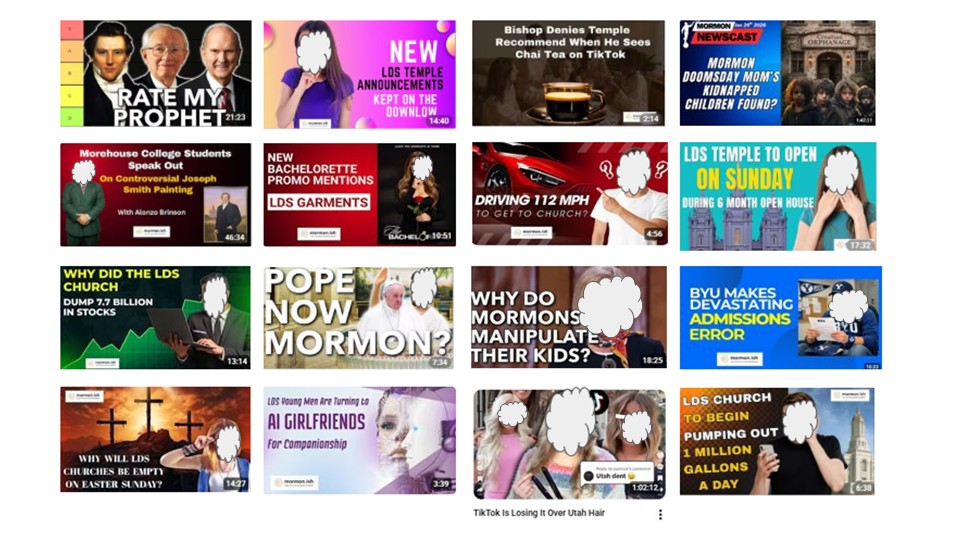
Search topics Kirtland Egyptian Papers; Book of Abraham manuscripts; Abraham manuscripts; Egyptian manuscripts; Book of Abraham translation; Joseph Smith Egyptian papers; Kirtland Egyptian Alphabet; Egyptian grammar documents; Book of Abraham scribes; W. W. Phelps; Warren Parrish; Frederick G. Williams; Willard Richards; Book of Abraham papyri Book of Abraham criticism; Joseph Smith translation criticism; Book of Abraham authenticity; Joseph Smith papyri; CES Letter Book of Abraham; Mormon Book of Abraham; LDS Egyptology; Book of Abraham apologetics

Authentic Ancient Names and Words in the Book of Abraham and Related Kirtland Egyptian Papers

2005 FAIR Conference

Authentic Ancient Names and Words in the Book of Abraham

and Related Kirtland Egyptian Papers

John Tvedtnes 5 August 2005

John Tvedtnes is senior resident scholar at the BYU Institute for the Study and Preservation of Ancient Religious Texts. He earned a BA in anthropology, a graduate certificate in Middle East area studies, an MA in linguistics, and an MA in Hebrew at the University of Utah and did postgraduate work at the University of California (Berkeley) and the Hebrew University in Jerusalem. He taught for seventeen years at the University of Utah and the Salt Lake and Jerusalem centers of Brigham Young University. He has published nine books and more than 200 articles. While many of his writings have appeared in books, magazines, and journals for a Latter-day Saint audience, some of his works have been published by the University of Utah, the Hebrew University in Jerusalem, the Pontifical Biblical Institute, and the Journal of Near Eastern Studies. He is a convert to The Church of Jesus Christ of Latter-day Saints and has served in numerous positions, including a full-time mission in France and Switzerland and stake and district missions in Utah and Israel.

[This was a graphics rich presentation. This transcript does not include slides from the presentation. They can be viewed in the video of this lecture on our Youtube site. Links provided at the end of the text.]

JOHN TVEDTNES: Over the last century a number of scholars have looked at names and other transliterated words in the Book of Abraham and in the Kirtland Egyptian Papers in an attempt to determine their authenticity. In some cases it can be demonstrated that the name is actually attested in Ancient Near Eastern documents. For unattested names it is sometimes possible to postulate an etymology based on known words in Egyptian and other ancient languages in use in the time of Abraham.

While I can claim credit for some of the work contained in my presentation today, it is appropriate to acknowledge that I’ve drawn upon research by various others such as Hugh Nibley, A. Richards Durham, Robert F. Smith, John Gee and John

M. Lundquist. Indeed one of the most thorough researchers of the Book of Abraham onomasticon is Robert F. Smith most of whose contribution is embodied in a series of unpublished manuscripts that he shared with me during the 1960s and ‘70s. I’ve mentioned some of his research in previous publications. I must

acknowledge however that I’ve added my own contributions and I’m the only one who can really be faulted for any mistakes here.

One of the primary sources of the names used in this study is of course the Book of Abraham as published in our Pearl of Great Price. These names have been carefully compared with the forms as found in the four extant handwritten manuscripts of the Book of Abraham, one of which you see on the left here, that’s held in the LDS Church Archives.

Joseph Smith’s explanation to the Facsimiles, published with the Book of Abraham though not part of the text itself, are another source of names. The third source comprises various handwritten documents prepared in Joseph Smith’s day and known collectively as the Kirtland Egyptian Papers. There are ten such documents and some of them are multi-page, this includes the notebook entitled Grammar and Alphabet of the Egyptian Language; a smaller handmade notebook called Valuable Discovery of Hidden Records; and another notebook entitled

F.G.W. and William standing evidently for Frederick G. Williams and probably William Lyon Phelps; along with other loose sheets a few of which comprise Egyptian texts copied by one or more of the scribes but with no English commentary at all. This is something that John Gee loves because he can work with those. Some of the latter include material copied from papyri that are not currently extant. Because they provide no information on names they are excluded from this present study.

Some of the names that interest us relate to ancient Egypt itself and to people who were among the earliest rulers thereof.

Abraham 1:23 and 25 notes that the founder of Egypt was the daughter of Noah’s son Ham named Egyptus. It has long been noted that in the earliest handwritten manuscripts the name is written Zeptah which you can see here. As A. Richards Durham noted some years ago both forms derive from one of the Egyptian names for the capital city of Lower Egypt Memphis which was ît-kA-Ptaú ‘ (if you don’t put in the right vowels) meaning the “Residence of the spirit of Ptaú”—the name appears even in that form on a Ugaritic tablet.

When the Greeks came to Egypt in the time of Alexander the Great, they had to modify the name in order to pronounce it in their own language. Greek had no ‘h’ sound so they simply dropped the consonant at the beginning and the end of the name itself.

The ‘t’ had already been dropped from the end of the word for ‘residence’ which is how it is in Coptic—it’s ‘a’—often the feminine ending dropped off of those in later forms of the Egyptian language. Instead of unvoiced ‘k’ the Greeks used its

voiced equivalent the ‘g’ sound. Finally they added the masculine singular suffix ‘os’, this gave them the form Aigyptos which became Aegyptus in Latin. And this is the origin of course of the name Egyptus as used in the printed versions of the Book of Abraham and the English form of the name of the country itself Egypt.

Ptaú whose name appears as the last element in the Egyptian form was the creator god in the story told of the ancient city of Memphis. Zeptah, the form used originally by Joseph Smith, likely means “Son or daughter of Ptaú.” The Egyptian has it as, here I’ve written it as the masculine on the upper left hand side there you can see, (inaudible) which would be the feminine. The feminine however later on dropped the ‘t’ so it’s easier to pronounce it and they both look alike or both sound alike in later forms of Egyptian. But the Hebrew- if it has a Hebrew meaning it would’ve been understood as Zeh Ptaú “This is Ptaú”—in other words this is the god Ptaú or the discoverer of Egypt.

Indeed earlier Egyptologists translated the ‘s’ as a ‘z’ and so if we pronounce this as the Egyptian, ‘zeh’ instead of ‘sa’ that would fit with the way they used to transliterate it.

As in most Hebrew words, the feminine suffix was often dropped in later forms of Egyptian. In the Egyptian text known as Astarte and the Sea the goddess Astarte, corresponding to the Egyptian goddess Isis or Isis(?), is actually called (inaudible) in other words “the daughter of Ptaú” so she has that very title.

The Semitic verb Ptah means to open, to discover. The Egyptians held that the Temple at Memphis was constructed on the first piece of land rising from the floodwaters and the same tradition was attached to various other spots where temples were built along the Nile.

An Armenian text attributed to the 4th century A.D. Christian historian Eusebius declares that ‘Egypt is called Mizraim(?) by the Hebrews’—which is close, in Hebrew it’s Mitzraim but he came close considering that it was Greek translated into Armenian—‘and Mizraim lived not long after the flood for after the flood, Ham son of Noah begat Egyptus or Mizraim who was the first to set out to establish himself in Egypt at the time when the tribes began to disperse this way and that.’ Here we have Egyptus then being a man.

A similar account is found in Abraham 1:23-24 except that here it’s a woman:

      1. The land of Egypt being first discovered by a woman, who was the daughter of Ham, and the daughter of Egyptus, which in the Chaldean signifies Egypt, which signifies that which is forbidden;
      2. When this woman discovered the land it was under water, who afterward settled her sons in it; and thus, from Ham, sprang that race.

So, I should make one point here before we move on though because somebody is probably going to look at this and then say, ‘Well why is it that you said then- why does the Book of Abraham say that it means ‘forbidden’ in Chaldean? Well my guess is that it’s analogous to what happens in Russia. Does anybody know how the word ‘Mormon’ is used in Russia? They heard about the Mormons in the United States and these were bad people because all the books they ever had on it were anti-Mormon. We start sending missionaries to Russia, the Soviet Union almost- after 1989. These missionaries come in and they said, ‘We’re Mormons’ and people say, ‘Oh you’re those awful people.’ But other people in Russia have been called Mormons for some time, it’s a group of evil-doers they say and so they’ve used the term ‘Mormon’ meaning evil-doers instead of more good if some of you like that better explanation.

Hugh Nibley has dealt with the Egyptian traditions about the goddess who discovered Egypt rising out of the floodwaters. In one text she is called ‘the daughter of Ptaú’ which, as noted above, is one possible meaning of the name ‘Zeptah’. In some accounts she is Isis, sister-wife to Osiris—both sister and wife—and mother of Horus the first king of Egypt making one wonder if Egyptus married her own brother, Mizraim who is the son of Ham mentioned in the Bible and after whom Egypt takes its name in Hebrew.

Nibley draws attention to the account of Herakleides, which was unavailable to Joseph Smith, who wrote “It was first a woman named Aegyptia who established her son and introduced weaving. Because of her, the Egyptians set up an image of Athena,” the Greek goddess, “as Ephorus says in his work on Europa.”1

About 440 B.C. the Greek historian Herodotus wrote that the Egyptian priests “told me that the first man who ruled over Egypt was Min, and that in his time all Egypt, except the Thebaic canton,” that’s Thebes, “was a marsh, none of the land below Lake Moeris then showing itself above the surface of the water.”2

In his Chronicle, the 6th century A.D. Christian historian John Malalas wrote that, “the first king of Egypt belonged to the tribe of Ham, Noah’s son, he was pharaoh who was called Neko.” While Malalas evidently confused the pharaoh of Abraham’s time with the pharaoh Neko of the 6th century B.C.—the time of King Josiah—it is interesting that Abraham 1:20-21 notes that “Pharaoh signifies king by royal blood. Now this king of Egypt was a descendant from the loins of Ham, and was a partaker of the blood of the Canaanites by birth.”

One of the Kirtland Egyptian Papsers notes that Abraham “was forewarned of God to go down into Ahmehstrah, or Egypt, and preach the gospel unto the Ahmehstrahans.” The word may be related to the Hebrew Mizraim—it sounds a

bit like it. The name for Egypt and for one of Ham’s sons who is the eponymous ancestor of the Egyptians in Genesis 10 and 1 Chronicles 1.

The Hebrew is actually a dual form, as reflected by the suffix ‘aim’—so Mizraim really means two Egypts if you will due to the fact that ancient Egypt was considered to be comprised of two parts—Upper and Lower Egypt—that were subsequently united.

Eusebius declared that Mizraim was indeed the founder of the Egyptian race and from him the first Egyptian dynasty must be held to spring.

As noted earlier, Eusebius also identified Egyptus with Mizraim. If, as the Book of Abraham says, Egyptus was a daughter of Ham rather than a son, it is possible that she married her brother just as the Egyptian traditions have. Isis marries her brother Osiris; and from them would derive the Hebrew name of Egypt. This would explain the Egyptian myths about Osiris the god who actually ruled Egypt anciently marrying his sister and that was followed by some of the pharaohs.

In fact some of the pharaohs in order to make sure that they were marrying into the royal line married not only their sisters but sometimes their daughters and I know of at least one case where one married his mother. It’s really a strange idea from our point of view but it was perfectly normal in their days, they wanted to preserve this particular line.

The term ‘Rahleenos’ is found in Abraham 1:14 and indicates that it means ‘hieroglyphics’ referring to one of the writing systems used in ancient Egypt. The word ‘hierogluphikos’ is Greek and means sacred or priestly writing. Perhaps it equates to Egyptian ‘Ra-nes’ which would mean the “tongue/language or speech of Ra”—Ra being the Egyptian sun god and head of the pantheon in the city of On or Heliopolis ‘Sun city’ (not Arizona—Egypt). (Laughter)

(I should apologize for those who know how Egyptian is written but the fonts I use will not let me stack these properly so you have to read it all the way across the line.)

The Egyptian ‘n’ often corresponds to the Semitic ‘l’. The same is true also of the ‘r’; the Egyptian ‘r’ is sometimes used for the Semitic ‘l’ when it transliterates Semitic words, Hebrew, Canaanite, whatever. And, in fact, sometimes the two are used together to denote an ‘l’.

So when we look at ‘nes’ here from the Egyptian it could easily be ‘las’ ‘ras’ any of those, lāšōn (Hebrew), lisān (Arabic), I believe to be cognate with the Egyptian word. On the surface this Egyptian explanation does seem to fail because

Abraham 1:14 says that the system of Egyptian characters called ‘figures’ in that passage “is called by the Chaldeans Rahleenos, which signifies hieroglyphics.” So according to the Book of Abraham these are actually Chaldean, this is a Chaldean name not the Egyptian name but one of the manuscripts of the Book of Abraham says it was called that by the Egyptians and then the word Egyptian is crossed out and Chaldean is written above it. So it seems to me that originally it was perhaps intended to denote Egyptian.

A number of Latter-day Saint scholars have taken in hand to provide ancient etymologies for the names of the Egyptian gods inscribed in the Book of Abraham. The earliest was Hugh Nibley followed—actually there were some who did it before him—followed in the late 1960s and early 1970s by Robert F. Smith, whose work though mostly unpublished has, in my opinion, stood the test of time.

John Gee and others have more recently reexamined the names and come to similar conclusions. John M. Lundquist also noted that each of the gods or idols mentioned in Abraham 1:17 appears in the compilation of some 3,800 Mesopotamian deities published in 1950 by Anton Deimel.3 Many of these names are Akkadian a Semitic language related to Hebrew and more distantly to Egyptian.

Critics often dismiss the four gods depicted below the lion couch in Facsimile 1 of the Book of Abraham as mere canopic jars in which the viscera of a diseased person were placed during the mummification process. They put the heart and the viscera in there; the only part of the body they threw away and did not mummify was the brain. They didn’t know that’s what made you think, in fact they extracted the brain—they had a little hooked instrument they put up through the nostril and they’d pull the brain out piece by piece. The procedure is very similar to abortion by the way. Scary huh? Well at least if you’re dead you don’t feel it.

While it’s true that these were canopic jars and that the various body parts were placed in them, these do depict the four gods known as the sons of Horus though one text calls them the sons of Osiris and indeed in Facsimile 2, Fig. 6, which I have here in an insert, Joseph Smith describes them as representing “this earth in its four quarters.” Some of the sons of Horus were in fact associated with the cardinal directions and we’ll see this in our description of each of them.

There was a kind of a strange thing going on in 1912 with the Reverend Spalding who asked several Egyptologists to comment on this and Samuel A.B. Mercer came back and he said, ‘Oh he doesn’t know what he’s talking about this Joseph Smith. These aren’t the four quarters of the earth; these are the four cardinal directions not quarters. It’s a real difference.’ However another Egyptologist

Budge whom some of you have heard of also he used- he translated it as quarters- “four quarters” instead of four cardinal directions.

Well let’s look at each of them. The god whose name is rendered ‘Elkenah’ in the published versions of Abraham 1:6-7, 13, 17, 20 and 29 appears with variant spellings in the Kirtland Egyptian Papers. In two of the manuscripts it is always spelled ‘Elkkene’. This is also the spelling in another of the manuscripts where it was changed later to ‘Elkenah’, that was mss 4 just prior to publication it was changed from ‘Elkkene’ to ‘Elkenah’ and that was the version that was published.

This to me suggests that ‘Elkkene’ more closely approximates the way Joseph Smith intended to transliterate it. Robert F. Smith noted that the form ‘Elkkene’ seems to correspond with the form of El-kuni-ir§a “El, the maker of the of the earth” which is found in the Hittite text. It’s actually a Canaanite title of the God El; it’s in the text about Asherah. It’s also known in the Phoenician title ‘l qen `r§ “El, creator of the earth” together with the name baalshemayon(sp?) which means “the lord of heaven”, so it parallels that in an eighth century manuscript from the Phoenician king Azzitawatah. The title clearly corresponds to the Hebrew El- Elyon konei shamayim va-aretz which msseans “El the most high God, creator of heaven and earth.” It’s translated “Possessor” in the King James Version, that’s from Genesis 14:19, 22; and so, the title has been around for a long time.

The Hebrew name Elkanah is found in the Bible (1 Samuel 1:1), it’s a hypocoristic form of the same name that we just mentioned dropping off the ending element of it, the God El, head of the Canaanite pantheon, was identified by the Egyptians with the hawk-headed sun god Ra in their myth of Ra and Isis where he is also called Iry pt tA “Maker of heaven and earth” the same title. The depiction labeled the idolatrous god of Elkenah in Abraham Facsimile 1, Fig. 5, is the Egyptian jackal-headed god who is associated with the East where the sun rises. Indeed the verb denoting the rising of the sun derives from this same root.

John Lundquist has suggested another potential source of the name Elkenah, the Akkadian dIl-gi-na. The d part is just what we call a determinative, it derives from Sumerian and it refers to divine names. You don’t pronounce it though actually but it is written. So here we have the same kind of name that (inaudible) at the beginning is the same as El, it means god also and so his suggestion was that this was the origin of it, this Akkadian name.

Nibley noted the report from Bar-Hebraeus, a medieval Jewish scholar who became a Christian, that in the days of Abraham’s father, Terah, the Egyptians adopted Chaldeism and made an image in honor of Kenos(sp?). Kenos may very well be related here to Elkenah.

The god Libnah is mentioned in Abraham 1:6, 13 and 17. The god identified by this name in Abraham Facsimile 1, Fig. 6, is the falcon-headed Egyptian god who is identified with the West.

Another Egyptian god, the jackal-headed (inaudible), we usually call him Anubis in English. Anubis, who is the jackal god who is called ‘the lord of the west’ and also ‘lord of the white land’—probably “white” because this word lebānāh comes from a word meaning “white”. The jackal is a nocturnal prowler; he goes out by moonlight to find his prey and so is often associated with the moon. One of the Hebrew terms for moon, as we see here, is found in several Bible passages, three of them, it’s lbanah, the feminine form of laban, which you normally read as Laban, the brother of Rebekah in the Bible. The same term lebānāh, meaning “white, or moon”, is used in the medieval Hebrew story of Abraham to denote the moon that Abraham studied in his youth. In the Bible, Laban is one of Abraham’s great nephews while the form Luban from the same root is a place name in records found at Ebla near Abraham’s homeland. The Bible also mentions a Canaanite city named Libnah which is also mentioned on a list of cities conquered by the Egyptian King Thutmose III. So it’s well attested that we have here a moon god if you will.

Deriving from the same root is the name Lebannon, Lbanown in Hebrew, which means “white place”; probably so-called because of the snow that’s atop Mt.

Lebanon. In the Zohar, a medieval Jewish text citing the Song of Solomon in the Old Testament, says of Lebanon that it should be reworded Lbanah thou moon who receivest thy light from the sun. Julius Levy considered Lebanon to derive from the Canaanite moon-god Laban while John Lundquist drew attention, again, to an Akkadian god dLaban, same name—these gods didn’t change much from one country to the other when they spoke similar languages, languages that were related—(inaudible) noted the variant forms of the name of Lebanon: Lbanown in Hebrew, Libnah in Phoenician, Libnana in Assyrian and (inaudible) in Hittite.

The god called Mahmackrah, in the published version of the Book of Abraham, is depicted in Abraham facsimile 1, fig. 7. He’s the baboon-headed god who represented the North—an element perhaps found in his name because the word mútt means “north”. Is it possible that that’s what we have at the beginning of this name? It is possible. The name used in the Book of Abraham however may be related to a Hebrew word, the word mimkār which means “merchandise” since Egypt’s principal trading partners were to the north. Closer in pronunciation however is the Akkadian divine name dMa-mi-hi-rat which is in Deimel’s list again as quoted by Lundquist. A. Richards Durham has actually proposed two possible etymologies that I had not included in this and since I’m saying that now maybe I should add that there are other possibilities that are not included in

today’s presentation, I just didn’t have enough time to get them all together. I expect I’ll do that sometime in the near future.

The god called Korash in the Book of Abraham and depicted in Facsimile 1, Fig. 8, is a human-headed god who represents the South. It is possible that Korash in fact is from the Egyptian kA-rsy which would means “spirit of the south”. Nibley noted that the Egyptian goddess Hathor was worshipped in Saba. Today we call it Yemen, which in fact is a good Arabic-Hebrew name meaning south; and that she was worshipped by the people of Quraish. The Quraish tribe is the tribe that gave birth to the prophet Mohammed and in fact there is one tradition that the person who wanted to kill Abraham, the one who wanted him to be actually slain for not worshipping the pagan gods, was a fellow named Korash. John Lundquist draws attention to another possibility, the Akkadian divine name dKur-ra-su-ur-ur and John Gee has noted also that KArs (and I’m not sure if I spelled that one correctly because I don’t have it written down but I remember you mentioning it) that this is attested in New Kingdom Egypt.

Here’s one of my favorites, funny guy, funny name. The god Shagreel is mentioned only in Abraham 1:9 where he is said to be “the sun.” In this connection, one may perhaps compare the Egyptian hawk-headed god Sokar who is a form of the sun as depicted in fig. 4, facsimile 2, with the addition of the Semitic term El at the end—El meaning of course “God.” More likely, in my opinion, is Robert F. Smith’s identification with the Canaanite (inaudible) “the gates of El” “the gates of God”, a title of the Canaanite god (inaudible) who in the Ugaritic text is called in fact “gate of the sun.” An Akkadian seal impression has Shamash, the sun god, rising between two mountains on each side of which are hinged doors mounted by lions. The Egyptian Sokar is sometimes accompanied by a pair of lion guards and it’s (inaudible), we see them here, that’s the sun god rising between the mountains- between these two- actually they look more like, to me, they look more like cheetahs because they have spots but the face is more like a lion. I think they have a lion’s mane there. Anyway the name (inaudible) means “twin lions” or “twin gates.” The twin lions guarding city gates were known amongst other Ancient Near Eastern peoples including the Hittites who did a lot of that and these later made their way into Western Europe and even into the United States where today they flank the entrances of libraries, museums and other public buildings and of course in Salt Lake City, the human-headed lions that guard the entrance to the Masonic Temple.

We should also compare the title Shagreel with the name Sheariah which in fact means the “gates of Jehovah” ‘yah’ in this case where ‘yah’ is substituted for ‘El.’ Sheariah is in fact found in the Bible, in 1 Chronicles 8:38 and 9:44. So the Hebrew form of the plural, which is not in those two passages, it has the singular

there, would be Sheariel. The Semitic name for ‘gate’ is also known in Egypt by the way in later text because it was borrowed from Canaanite.

The names of celestial bodies are found in the third chapter of Abraham, in the explanation of Facsimile 2 and in the Egyptian Alphabet and Grammar and other Kirtland Egyptian Papers.

The star named Kolob, and it’s called a star, I know that there are some websites that say the Mormons are crazy they think God lives on a planet called Kolob. The passage never says it’s a planet and never says God lives there either; it says it’s closest to where he lives. Anyway the star named Kolob is so-called “because it is near unto me” (Abr. 3:3) or near “the residence” (Fac. 2, Fig. 1) or “throne of God” (Abr. 3:9). Facsimile 2, Fig. 1 describes it as “nearest to the celestial.” This explanation is attractive because it creates a wordplay in the Book of Abraham; a feature known from the underlying Hebrew of both the Old Testament and the Book of Mormon. The wordplay being between “near” and “Kolob” because in fact the word for Kolob can mean near; there are several possibilities to explain and I’m going to talk about those now.

Janne Sjodahl was the first to compare the name with the Arabic qalb “core, marrow, heart, intelligence”, however because ‘l’ and ‘r’ often interchange in Semitic languages, one should also note Arabic QRB “proximity, near, midst” which is cognate to Hebrew qārōb “near” or “close.” Robert F. Smith prefers the latter and notes that it appears in the sense of “near one” as a title of God in Psalm 119:151 where it parallels the word qedem which means the “primeval one” or the “ancient one” (that’s in verse 152). Smith notes that the cognate Ugaritic qurb often refers to the dwelling place of El, the chief God, in the Canaanite pantheon in the expression “midst of the source of the two deeps” where the word rendered “midst” is in fact this same word qurb meaning “near”.

Another possible Hebrew etymology is the Hebrew KLB “dog” originally pronounced kalb just as it is in Arabic. This is used to denote the star Regulus in Arabic while the Syriac, which is also kalb denotes the star Sirius, the brightest star in the heavens. There’s a wonderful article that Dan Peterson, and John Gee, and Matt Roper (I think), were the three who (if I left something off that you can fill it in later) but they wrote a really nice article on Kolob and its place in the sky and what it meant for Abraham.4

In Arabic, this term KLB “dog” also denotes the constellation of Canis Major which is Latin meaning “Great Dog”, we call it the Big Dipper but that’s not what is was called anciently, as the brightest star in the constellation of the Big Dipper, Sirius is called Alpha Canis Majoris which is “number one big dog” or top dog I guess. Another name for the star is Canicula, a Latin word for ‘Little Dog’.

Akkadian sources call Sirius (inaudible) the “dog of the sun”. In ancient Egypt the Nile began to rise at the helical rising of Sirius, that is when it came up just before the sun and bringing the annual torrent of Nile water laden with rich volcanic soil from the south and depositing it on the cultivated land.

I should mention by the way you notice how the one has a ‘q’ the other has a ‘k’? That’s very important, at least in Arabic, it’s not as important in Hebrew but I always try to get my Hebrew students to pronounce the two differently. In Israel they pronounce the two ‘k’ just that- it’s just like a regular ‘k’ in English. But in ancient times they were pronounced quite differently. One is pronounced way in the back of the throat, the other is pronounced farther up and in Arabic they make a big distinction and my reasoning with my students was, if you don’t make the distinction and you speak in Arabic and you want to tell a girl, “I love you with all of my heart” which is the word that’s coming up next, you don’t want to end up saying “I love you with all of my dog.” (Laughter) I think that struck a note with most of them.

So, this is the other one I want to have QLB which is “heart” in Arabic. There are some Egyptian equivalents to that, I didn’t put them up here. There’s a couple of cognates that are related directly to that. In the Sumerian text known as the Descent of Inanna, one of the more ancient texts from the Middle East, the goddess Inana goes down into the Underworld to free her husband Dumuzi who is the god who brings rain during the season of rain, and on the way back to heaven she stops at a place called Kulab which is designated as a tree of some sort. We don’t know why this happens there but there Dumuzi gets to sit on his throne and puts on his royal apparel which he has not been wearing while he’s been in prison.

The term Olea is used to denote the moon in Abraham 3:13. It resembles the Hebrew term yārēaú which is just one of two words meaning “moon” or “month.” Even in English month comes from the word moon by the way, as does Monday— Moon’s Day. The Egyptian word for moon is Iah which is cognate to the Semitic term. In Facsimile 2, Fig. 1, the moon’s name is given differently however, it’s called Floeese. This name is similar to the Kli-flos-is-es that we find in some of the Kirtland Egyptian Papers. Kli makes a lot of sense. Kli is a good Hebrew word, it means a vessel in the sense of a plate or a bowl or even a spoon or a tool, a tool of any kind, a hammer or whatever. The word looks like it is finishing in the name of the Greek goddess, or the Greek form I should say, of the Egyptian goddess Isis; and I have no clue what flos is supposed to mean unless any (inaudible) here could explain that to us. (Laughter) The second one as well, I don’t have a clue on that one but we’ve got some starts here, somebody research that one and give us a report next year.

Shinehah is an interesting one (Abr. 3:13) calls the sun Shinehah which seems to be related to the Hebrew word šānāh which means “year.” The year is defined by the annual circuit of the earth about the sun and to the ancients was determined by where the sun rose each day during the year. The Semitic verbal form means “to change,” that is to change seasons and other changes, or “to repeat” and is the source of the numeral two because you start over—once you finish a cycle you start over again so it’s the second cycle. The Egyptian cognate is the verb šni which is “to encircle, enclose or surround” and the noun from that is šnw which means “circuit or circumference”. From this also we get the name of the ring (inaudible) which is depicted with the little (I don’t think I did that one up there did I? No, I didn’t. Sorry you won’t see that one.) Hugh Nibley followed by Robert F. Smith and Kerry Shirts have suggested that the name Shinehah derives from the Egyptian term plus the Egyptian word ‘heh’ or ‘nhh’ meaning “eternity, or eternal” and so that would be then the “eternal circuit” or as Nibley put it “one eternal round” which book we hope to see soon.

Janne Sjodahl suggested that the name Olaha Shinehah mentioned in Doctrine and Covenants 117:8, from July 8, 1838, is related to the terms for “moon” Olea which we saw a moment ago and Shinehah for the “sun.” These were used as code words in early days of the Church beginning with the first Doctrine and Covenants in 1835.

There are several other terms that are related to the sun in the Book of Abraham materials, I just don’t have time to go into all those and they are not as certain as some of these that I’m looking at.

The explanation to Facsimile 1, Fig. 12 reads (and I’m going to pronounce this correctly) Raukeeyang, the spelling there came from Joseph Smith’s association with his Hebrew teacher Joshua Seixas who transliterated things in this way but anybody who knows that transliteration method knows how the Hebrew word is actually spelled. Anyways the explanation reads, “Raukeeyang, signifying expanse, or the firmament over our heads; but in this case, in relation to this subject, the Egyptians meant it to signify Shaumau, to be high, or the heavens, answering to the Hebrew word, Shaumahyeem.” Which is a dual form—two heavens. This Hebrew word rāqīa does in fact mean expanse. We get the term firmament by a mistake that was made by St. Jerome when he was translating the Bible into Latin, he spelled it- he translated it firmamentum and so it came across that way in later times too. It’s true that the verb raqa(?) can mean to hammer out a sheet of metal like gold and make it a thin sheet but it can mean actually to expand in other ways as well.

The normal Hebrew word for heaven or sky is actually a dual form shemayim

which Joseph Smith here transliterated as you can see. The Arabic cognate is in

the singular, it’s samā as is the Akkadian šāmū, it’s in the singular. Hebrew is the only one that has it in this dual, as far as I know. Mitchell Dahood, a very well- known scholar now deceased from the Pontifical Biblical Institute, probably the only Arab who ever was associated with that group, actually proposed that for Palm 68:4 that instead of reading shemo, which would mean “his name”, the word should read shameh which would be “the heaven” in a singular form.

Abraham 3:13 defines Kokob as “star” and Kokaubeam as “stars, or all the great lights, which were in the firmament of heaven.” When first published in the Times & Seasons, the passage read “Kolob” in error. They’d written Kolob so many times that the typesetter thought that’s what belonged here. The manuscripts however have Kokob corresponding to the Hebrew word that we have written here kōkāb and denotes in the one singular and the other in the plural. The plural is also found two other times in the Book of Abraham and it’s called in Facsimile 2, Fig. 5 and also Abraham 3:16 it lists Kokaubeam or kōkābīm in Hebrew. The correct pronunciation (inaudible) means “the” so it’s “the stars.” Lundquist noted that one of the deities in Deimel’s list was dKakob meaning “star”. Similar, Kakkab is the name of one of the god’s mentioned in the Ebla records discovered in northwestern Syria.

Kae-e-vanrash there’s an interesting one, I’m still scratching my head over parts of this. In Facsimile 2, Fig. 5, we read about Kae-e-vanrash “which is the grand Key, or, in other words, the governing power, which governs fifteen other fixed planets or stars, as also Floeese or the Moon, the Earth and the Sun in their annual revolutions.” The element Kae may here be the Egyptian word kA which we saw earlier meaning “spirit” and the element rash at the end looks very much to me like it’s a Semitic term. In Hebrew rō’š but in Arabic Rās and ra’as (it doesn’t have the should, it has a (inaudible) sound for the cognates in Arabic) and that word means “head, or chief” and so I’m suspecting that that’s what is going on here. Now if I can only figure out what this is in the middle, so if any of you have suggestions send me email.

The Book of Abraham and associated Egyptian Papers mention the names of specific individuals whom Abraham evidently encountered during his brief sojourn in Egypt. Some of them such as Shulem and Olimlah are listed in the explanation of Facsimile 3 while others are found in the Abraham text or other texts associated therewith. I’m not going to go into all those names however.

I’d like to give some ideas on this one, Abraham 1:11 describes Onitah as “one of the royal descent directly from the loins of Ham” whose three daughters were sacrificed because they would not worship the Egyptian gods. The name may be the same as Onitos and Onitas in the Valuable Discovery notebook where there is an ‘s’ at the end instead of the ‘h.’ there he is said to have been king of Egypt

while the chapter 1 of Abraham says he was of the “royal descent.” It may correspond to the name Wenis (or usually pronounced Unas by those who transliterate it from the Egyptian). He was a pharaoh of the 5th dynasty of Egypt. He is not our man however because Unas lived long before Abraham’s time, he lived a few centuries before that, but there is an Egyptian text that indicates that the pharaoh Unas ate the boiled body parts of gods by which most Egyptologists have assumed that it means he was a cannibal—he was eating not gods, but humans and if that be the case it does make it look a little suspicious if this is the guy in whose day his daughters are being offered in sacrifice.

Two related Egyptian terms may give us clues about the meaning of the name Unas. The first is wnwt meaning “priesthood” and the second wnwty meaning “astronomer” both of which play an important role in the Book of Abraham which describes Abraham’s teachings of astronomy to the Egyptians and the rival claims of Abraham and Pharaoh to patriarchal priesthood authority.

The name Katumin also appears in the Valuable Discovery notebook, and the first passage reads, “Katumin, Princess, daughter of On-i-tas [Pharaoh] King of Egypt, who began to reign in the year of the World 2962.” The second reads, “Katumin was born in the 30th year of the reign of her father, and died when she was 28 years old, which was the year 3020.” I’m presuming she was sacrificed but the text doesn’t say that. It also appears in the form of Kah tou mun as an alternative. It may derive from the Egyptian KA-tA-Mn which would be the “spirit of the land of Min.” Min was one of the Egyptian gods; he was a fertility god in fact, who is closely associated with the land. Various classical writers claim that the first king of Egypt was named Mēnēs and that name has often been tied in with the name of the god Min.

A few specific places are named in the Book of Abraham and associated Kirtland Egyptian Papers. Of these, Egypt and Ur of the Chaldees are also known from the biblical account of the life of Abraham.

Here, we’ll look at two important place names associated with Abraham that are not in the Bible because neither place is in Egypt, these names are not derived from the Egyptian language. The plain of Olishem is named in the Abraham 1:10 as the place in Ur of the Chaldees where the Egyptians had erected an altar on which they sacrificed human beings. John L. Lundquist has noted that the name is attested in a record of Naram Sin, a 23rd century B.C. king of Akkad as Ulisum and is listed with the (inaudible) mountains and the city Ebla in northwest Syria not far from Abraham’s homeland.

Akkadian and Hebrew are both part of the Semitic language family by the way and the exchange between the ‘o’ and ‘u’ is well attested in Semitic languages.

Here’s one I kind of like- Kalsiduniash. The name Kalsiduniash is spelled in various ways in the Kirtland Egyptian Papers. In one it appears as chalsidon hish(sp?) and is identified as the land of the Chaldeans. This meaning is also given in another of the text where it is spelled as Za Ki-oan hiash, and also chalsidon hiash(sp?). It appears in other spelling forms as well in those documents.

The ending ‘iash’ is interesting to me. It is known from the name of the Cassite (inaudible) and the names of the Cassite kings of Babylon (inaudible). The Cassites controlled Mesopotamia during the 17th century B.C. This of course post- dates the time of Abraham—he was 20th century B.C.—but it’s hard to ignore the fact that the Cassites called Mesopotamia Kar-Duniash which closely resembles the name found in the Kirtland Egyptian Papers with the interchange of the ‘l’ and the ‘r’ again which are common between Semitic languages and those in the broader language family which includes Egyptian called Afro-asiatic.

A Falasha text called Teezaza Sanbat (Commandment of the Sabbath), Falasha by the way, those are the Black Jews of Ethiopia, in describing Nimrod’s attempt to kill Abraham because he would not worship the idols noted regarding the furnace into which he was tossed, ‘From that day until today it is called (inaudible)’ (which sounds very much like these two- not identical but it’s similar. The name is evidently to be tied to the Akkadian term (inaudible), a people identified with the biblical Chaldeans, or Kasidim in Hebrew, in whose land Abraham lived at the time he was brought for sacrifice. According to the conflict of Adam and Eve, and early Christian texts, among the magi who came to visit the newborn Jesus, one account names Karsundas, king of the East. I have his name at the bottom of the list but look how closely it corresponds to the others. There’s something below the surface here and I’m not quite sure what it is but we’ll continue to work on it.

As we have seen many of the names associated with the Book of Abraham and related documents have valid ancient etymologies. To be sure, there remain unanswered questions particularly about the so-called Alphabet and Grammar but it is hard to ignore the hits in the Book of Abraham. The number of names that are authentically ancient far outnumber those for which we cannot at present establish an etymology making coincidence and improbable explanation. That holds for the names, not necessarily for the words that are found, for example, in the Grammar materials.

Q: Is Rahleenos an authentic Chaldean word and if so does it mean hieroglyphics?

TVEDTNES: As far as I know it is not Chaldean. The term Chaldean is rather confusing anyway. In Joseph Smith’s day the term Chaldean usually referred to

Aramaic. Some of the books of the Old Testament are in Aramaic rather than in Hebrew and some are part Hebrew and part Aramaic.

Daniel, for example, beginning with chapter 2:5 (I think it is) and all the way through to the end of chapter 6 is all in Aramaic. The rest of it is in Hebrew. So does it mean ‘that’ Chaldean? Or does it mean Chaldean the language that was spoken by the people we call Chaldeans? Hard to say because those people spoke Akkadian; that’s what we call it at least. I don’t know what they called it.

But the question isn’t phrased in such a way to really give it a good answer, but as I did mention, the original manuscript does say (inaudible) in Egyptian and as I said, I don’t think it has anything to do with it meaning specifically that in Chaldean whatever that is, but it does make sense if it is the language of god, which would be hieroglyphics—the language of the priests.

*****

Watch this presentation, including all of the slides, on our Youtube site. Pt. 1- http://www.youtube.com/watch?v=HUbp04NFCl0

Pt. 2- http://www.youtube.com/watch?v=KJk_cNFqE_E

Pt. 3- http://www.youtube.com/watch?v=kff_q7lW5wM&playnext=1&list=PL324F03A81448DE56

Pt. 4- http://www.youtube.com/watch?v=imTI8vqbwcA&feature=watch_response_rev

Pt. 5- http://www.youtube.com/watch?v=JMykjwISwCo&feature=watch_response_rev

Pt. 6- http://www.youtube.com/watch?v=fFp4CgASwOc&feature=watch_response_rev

[Transcriber’s endnotes.]

1 Hugh Nibley, Abraham in Egypt [Salt Lake City: Deseret Book Co., 1981], 193 – 194.

2 The Persian Wars by Herodotus, Book 2 – EUTERPE.

3 John Lundquist, “Was Abraham in Ebla?” in Studies in Scripture II: The Pearl of Great Price, ed. Robert

L. Millet and Kent Jackson (Salt Lake City: Randall, 1985).

4 See Astronomy, Papyrus, and Covenant, ed. John Gee and Brian M. Hauglid. Foundation for Ancient Research and Mormon Studies, Provo, Utah, 2005.


Defending Zion: George Q. Cannon and the California Mormon Newspaper Wars of 1856–1857

Roger Ekins, a fifth-generation member of the Church of Jesus Christ of Latter-day Saints, was born in Salt Lake City, Utah. After serving a mission in Argentina and a four-year hitch in the U. S. Army Reserves, he graduated Phi Beta Kappa from the University of Utah in 1970 with an Honors Baccalaureate of Arts in English and in 1972 with a Master’s in Creative Writing. In 1976 he earned his Ph.D. in Higher Education from the Union Graduate School (Union Institute and University). Dr. Ekins has served in a series of administrative and teaching positions. These include Director of the Open Community Learning Center and Assistant Professor of English at Staten Island Community College, City University of New York; Dean of Student life and Faculty Fellow in English and Education at Johnston College, University of Redlands; Dean of Student Development and Director of the Honors Program at the University of Maine at Augusta; and Dean of Instruction at Butte College in Oroville, California, where he is currently chair of the Honors Program and teaches literature, writing and the history of ideas. Ecclesiastical responsibilities in the Church have included callings as bishop, gospel doctrine teacher and stake seminary supervisor. He is currently serving as a member of the Chico California Stake high council.

A President Emeritus of the California Humanities Association, which awarded him the Charles D. Perlee Award, Ekins serves on the National Honors Advisory Committee of the University of Utah and on the editorial board of his local newspaper, the Paradise Post. His previous publications include poetry, fiction, and essays. Defending Zion: George Q. Cannon and the California Mormon Newspaper Wars of 1856- 1857 marks his first book-length venture as well as his first publication in Mormon Studies, long a topic of deep interest. He lives and fly-fishes in Paradise, California, with his wife, the former Helen Kaye Leonard, also a graduate of the University of Utah. (She will be assisting him in his presentation.) They are the parents of three children: Sarah, Adam, and Rachael.

ROGER EKINS: Following years of secret practice and public denial the Church of Jesus Christ of Latter-day Saints finally admitted to the practice of polygamy in 1852. Following that public acknowledgement increasingly vehement criticism of the Utah Mormons became a significant preoccupation of the national press.

In an effort to defend the Church against such criticism, while also helping to provide additional organs for proselyting the Gentile world, Brigham Young established four new periodicals. Apostle Orson Pratt was sent to Washington, D.C., to publish The Seer, a journal specifically designed to advocate and defend polygamy. Apostle and future president of the Church John Taylor was selected as the publisher-editor of The Mormon based in New York City. Apostle Erastus Snow was assigned to the St. Louis Luminary and George Q. Cannon, destined to serve as First Counselor to four Church presidents and the man who arguably would become the most powerful voice for 19th century Mormonism after Joseph

Smith and Brigham Young, was assigned at the tender age of 28 to edit and publish a newspaper in San Francisco, California.

By the way I can’t prove it but I suspect that George Q. Cannon may have been the first person to coin the phrase ‘the Sodom of the Pacific’ for San Francisco— he used that phrase a lot.

Of these four periodicals The Western Standard was clearly the most interesting. Cannon pulled no punches as he played the role of LDS apologist taking on one journalistic enemy after another. Perhaps it was the courage and even recklessness that comes with youth that made Cannon so bold in his attacks. Perhaps it was because he had not yet been saddled with the sober responsibilities of the apostleship that made him more feisty than Pratt, Snow or even his uncle John Taylor.

Whatever the reason George Q. Cannon successfully started and more often than not ended a number of newspaper wars that are still fascinating to read or hear today.

This presentation is extracted from my book Defending Zion: George Q. Cannon and the California Mormon Newspaper Wars of 1856-1857. It was published about six months ago by the Arthur H. Clark Company as vol. 5 in its “Kingdom in the West” series.

Actually Scott suggested I not do this but I’m going to go into it anyway because I know what’s going to happen; some of you are going to pick this book up and you’re going to see a certain name connected with this book and it will have basically the same effect as garlic to vampires—that name of course is none other than Will Bagley.

Will is the general editor of this series and certainly Will and I disagree on a lot of things, most emphatically some of the conclusions he drew in his recent book on the [Mountain Meadows] Massacre. But I want to just say this on behalf of Will, that throughout this editorial process he continually reminded me that this was my book not his and that the final editorial decisions were mine, the final interpretations were mine. And I want to thank Will for that approach that he took to this book and I must acknowledge that it’s a much more interesting book than it would have been without his contributions so don’t let his association with this series scare you away.

This paper will focus on some especially engaging exchanges between Cannon’s Western Standard and two other California newspapers. The first will be The Pacific—a self-proclaimed weekly journal devoted to religion, education and

useful intelligence. The second combatant will be The Daily California American, the precursor to today’s very prominent Sacrament Bee.

As the presentation proceeds I’ll be reading the righteously indignant editorials written by Cannon as my wife Helen, without whom this book would never have been possible, gives morally superior voice to the editors of The Pacific and The Daily California American both of which so often found themselves under unrelenting fire by the young Cannon.

“Hang ’em up – like pirates: the Mormons, saints or sinners?”

Though they call themselves Saints, the Mormons never thought of themselves as perfect. Many of Joseph Smith’s revelations reminded them of their individual and collective shortcomings. Nonetheless they considered themselves God’s chosen people and firmly believed it would be through their efforts that the Lord’s Second Coming would soon become reality.

Their enemies old as well as new accused the Latter-day Saints of every foul deed imaginable. There was nothing new about the crimes attributed to the Mormons by the California newspapers. Witness the following list compiled by the infamous John C. Bennett, formerly mayor of Nauvoo, major general of the Nauvoo Legion and assistant president of the Church in his 1842 attack on his erstwhile brethren:

HELEN EKINS (Narrator):

John C. Bennett, History of the Saints: “It appears from the mass of evidence in this Exposé, that the Mormon Hierarchy are guilty of infidelity, deism, atheism; lying, deception, blasphemy; debauchery, lasciviousness, bestiality; madness, fraud, plunder; larceny, burglary, robbery, perjury; fornication, adultery, rape, incest; arson, treason, and murder; and they have out-heroded Herod, and out-deviled the devil.”

ROGER EKINS: Given his own questionable character, Bennett’s charges are highly suspect. Whether a fallen believer or a conniving opportunist, Bennett had been excommunicated for many of the moral lapses he denounced and his objections to Joseph Smith’s polygamous relations were less the result of moral outrage than of personal jealousy.

Still the depredations allegedly committed by Joseph Smith’s Danites and Brigham Young’s Destroying Angels provided plenty of smoke if not fire to blacken the name of early Mormonism.

By 1856, there was no lack of controversial topics useful in attacking the young religion as the voice of the LDS Church in California, Cannon had to fend off charges involving the character of Joseph Smith; Utah theocracy under Brigham Young; the Willie and Martin handcart disaster; and of course scandalous tales of young women abducted into sexual slavery by the crafty elders of Salt Lake.

When the San Francisco Pacific reprinted the richly imaginative story about the crimes of moral degeneracy reigning in Utah Territory, George Q. Cannon immediately responded launching a lengthy newspaper battle that eventually drew in The Daily California American. The episode affords a glimpse into the psyche of Americans in general and Californians in particular at they tried to make sense of the theocratic, communalistic and polygamic system known as Mormonism.

Westerners, especially those living on the borders of Utah Territory, perceived this encounter with the “other” as a clear and present danger as is obvious from the unrelenting editorial (inaudible) California newspapers hurled at the Saints.

Whether Cannon truly believed he could deflect such criticism by pointing out the logical fallacies of his opponents while often returning their vituperation is an open question but he did not shrink from his mission as a Church apologist to portray his people as more sinned against than sinning.

HELEN EKINS:

“Mormonism”

The Pacific. 6 November 1856.

Among a party of 900 Mormons who recently left comfortable homes in England to surrender to the sway of Brigham Young and his hopeful associates came two girls whose transfer to the Utah land of abominations has very much the character of a kidnapping. The story of their flight as related in the English papers is as follows:

Their father was a man in middle life well to do and industrious. His labors had placed his family, consisting of a wife and several children, in a state of decent competence and happiness. Satan came among them in the guise of a Mormon emissary and beguiled the eldest son who made a pilgrimage to the land of rogues. True to their instinct the crafty elders of Salt Lake made Mormonism so delightful to the neophyte and advanced him so very rapidly in their fraternity that he returned to England as a preacher of the delusion. The father, whose employment took him away from his family for periods of a week at a time, returned to the house one

Saturday from a business excursion to find it deserted. His whole family had disappeared with whatever portables they could lay their hands upon and his wife had stolen his money to no inconsiderable amount, all that she collect or pilfer. He traced the fugitives to Liverpool and reached that place to discover that they had embarked under the persuasions of his Mormon son in an immigrant ship the “Enoch Train.” The distracted father chartered a steam tug and taking with him a police officer overtook the vessel. After an infinite deal of persuasion aided by the Master of the Ship and opposed by the Mormon leaders, he succeeded in inducing his wife to go back with him. He also, as a matter of great favor, obtained the surrender of his infant children but his two eldest daughters refused to return with their parents and the heartbroken father went without them.

Their fate going thus unprotected to Utah may well cause a shudder.

A community thus replenished is maturing measures to apply for admission as one of the states of this Confederacy. We were never among those who calculated the value of the union or who dreamed that the possibility of its being sundered was among contingencies to be considered in any case. But the possibility that our fathers may have fought to establish a shield for a community of adulterers and bigamists and their progeny makes us pause; that all which we hold sacred in religion or virtuous in social and family relations may be trampled under foot by a state represented on equal terms with those founded by pen and the pilgrims, by Oglethorpe and the cavaliers that the old Dominion and the land of the Puritans may be allied with a fraternity of licentious and debauched rogues. These possibilities, should they become facts, will leave no value to the Union for anybody to calculate. Nothing has cast so great a doubt over the future of this country as the Mormon plague spot and if the state of Utah is to be admitted into our constellation the sign will lose its present proud significance and stand as stars sometimes do in equivoque the representatives of something too foul to be spoken or written and all this evil, if it be consummated, will be fairly chargeable upon the absurdity of squatter sovereignty, a demagogue’s figment to serve a party purpose carried to its legitimate deductions by knaves operating through the instrumentality of zealots, fanatics, fools and lechers. We have no patience with the Mormons and as little with temporizers who leave the evil to increase until at last literal and bloody war may be forced upon us to crush what common sense and a just idea of the power of the general government might have averted. The contact with the Mormons of such settlers of the West as have just ideas of purity and decency will be terrible whenever the tide of immigration reaches

them and if the descendants of the wretches now wallowing in Mormonism, modern vermin perpetuating their kind in a disgusting ratio of other loathsome creatures, if we say these children of such paternity do not form a pariah race in our country it will be because this bad leaven taints the whole moral mass.

Extremes meet. We have enjoyed a high order of social virtue in this Republican country because no corrupt royalty and nobility have made illegitimacy tolerable and recommended the Bend Sinister as a badge of honor provided that the blood, no matter by what questionable vein it descends, be honorable. But if squatter sovereignty and liberty deteriorating into licentiousness produce the same results we have only FitzYoungs and FitzMormons for Fitzjames’ and Fitzclarence’s and certainly have not gained much by the exchange.

ROGER EKINS: Apparently that editor disliked Mormons almost as much as he disliked the Irish.

Pacific, Post and “Mormonism”

Western Standard. 15 November 1856.

The Pacific of last week and the Pathfinder and Post of the 12th instant contain an article on “Mormonism” extracted from the Philadelphia American which exceeds in bitterness, vituperation and filthy epithets anything we have seen upon the subject for a long time and which exhibits the deep corruption of the heart and brain of the writer. The language it contains would be much more becoming frequenters of the Five Points in New York or Billingsgate in London than the mouth of an American editor and we are surprised to see any paper in the state disgrace its columns by its insertion. We can only account for its appearance on the supposition that some of the California editorial fraternity, being destitute of the necessary amount of brains to concoct stories about the “Mormons”, have been compelled to have recourse to foreign aid and in order to gratify their malicious propensities towards us. We do not profess to be so expert in the use of slang phrases and low vulgarisms as the editor of the American nor do we wish to degrade ourselves to his level by adopting his course for says the wise man, “Answer not a fool according to his folly, lest thou also be like unto him.” (Proverbs 26:4)

There is one thing however which we would remind gentlemen of and that is that selecting all the scurrilous and abusive words from a dictionary and arranging them in consecutive order

though it may exhibit a certain degree of smartness is not argument. And though it may pander to and please the passions of the vulgar unthinking crowd it will not only fail to convince but will disgust every sensible and reflecting man and woman. There is not an objection raised in the article to which we allude but what could be easily and satisfactorily answered but we do not consider it worthy of a reply for it carries its own refutation on its face and the only reason we notice it is because it shows the mean, cowardly, underhanded course which certain editors in this city are determined to pursue towards us and our principles and because it is also a tolerably correct criterion of their taste—crows flock to carrion but its very scent is sufficient to drive away birds of cleaner tastes and purer instincts.

Why is it gentlemen that you are compelled to resort to such means to sustain your position? We are here to debate with you the principles of “Mormonism” on their own merits and to answer your objections against them if you have any. We invite discussion. We court inquiry. Bring forth your strong arguments. Show us our errors. Prove “Mormonism” to be false either from the Bible or nature. We are willing to meet you on these grounds. But no. Instead of pursuing this manly, consistent, straightforward course, you sneak away behind the invincible barrier of some absurd story that’s been hatched up by charitable disinterested man as the editor of the American from three to 10,000 miles away and about which neither of us know as much as a monkey does of algebra and then you valiantly stick your heads out of your hiding places and then call upon us to refute these ridiculous offshoots of a diseased brain when you well know that it’s impossible for us to obtain the necessary proof to do so. Shame on such a contemptible subterfuge.

We ask again why is it that you pursue such a course? We are compelled to conclude that it’s either because you have learned by past experience that reason is not a weapon that can be used against “Mormonism”, that no sound argument can be brought to bear against it, or else that you really do not know enough to conduct an argument on the subject. If the latter is the case we advise you not to open your mouths again until you have something to say but to remember the fable of the ass who when attired in the skin of a lion passed very well for that noble animal until he attempted to imitate his roar when his bray betrayed his true nature.

As one of the first propagators of Mormonism on the Sandwich Islands, the term then generally used for Hawaii, it’s hardly surprising that Cannon responded

forcefully when the California press attacked Mormon missionary efforts in that island paradise.

As he often would, Cannon used an eloquent defense of American liberties to decry his opponents’ ill-considered call to “Hang ’em up – like pirates” and to point out the unfortunate effects Protestant missionary efforts had on Polynesian culture and morals.

Taking the bait the editor of the California American tried to defend his somewhat exaggerated language providing Cannon with another opportunity to blast this intemperate burst of indignation.

HELEN EKINS:

“Mormonism” in the Sandwich Islands

Western Standard. 6 December 1856.

“The Mormons are preaching their accursed doctrines in the Sandwich Islands, of all places in the world needing the prevalence of just the opposite principles of social conduct. The great obstacle in the way of civilization in that quarter has always been the strong tendency of the people to licentiousness. It has been in some measure surmounted, and might soon be fully overcome, but for the advent of this new ism into that region. The propagators of such a monstrous evil as Mormonism . . . ought to be hung up, like pirates.”

ROGER EKINS:

The above is an editorial item from the columns of a Sacramento paper, (the California American) of Saturday last, and is strikingly indicative of the spirit of murder and bloodshed which dwells in the breasts of many who hold themselves up as guides of public opinion, and teachers of virtue, good order and peace. Every honest, peaceable and upright man must be disgusted with such sentiments, and cannot but execrate the spirit that would dictate their utterance. Men that will permit themselves to be actuated by such feelings, are unworthy of the society of their fellow-men, and should be shunned as enemies of their race. Had they lived in the days of Christ they would have been in the crowd who cried, “crucify him, crucify him;” or, had they been present at the execution of Stephen, they would doubtless have rubbed their hands in glee, should they have lacked the courage to throw the stones. Such men filled the cells of the Inquisition with victims, and caused the streets of Paris to flow with the blood of those who dared to think differently from

themselves; and, had they the power to-day, they would have another St. Bartholomew and the Latter-day Saints as their victims. If the Latter-day Saints are preaching “accursed doctrines” on the Sandwich Islands, they are preaching “accursed doctrines” in California; for we preach but the one doctrine wherever we go. And as, in the opinion of the editors of the California American, the penalty for propagating “Mormonism” there should be “to be hung up like pirates,” if they would but express their feelings, they would advocate the visitation of the same penalty upon its propagators here; and, as its believers all become propagators the moment they become acquainted with it, the hanging process would have to be extended to every member of the society throughout the earth! Are the editors of the California American prepared for such a consummation?

We had the honor to be one of the first propagators of “Mormonism” on the Sandwich Islands, and we were the first individual who preached, what the editors of the California American are pleased to term, the “accursed doctrines” of “Mormonism” to those Islanders in their own language; before they go, therefore, to those lands to execute the sanguinary vengeance they have decreed against the “Mormons,” they had better commence with us, as we have not only been “guilty” of propagating “Mormonism” there, but are also engaged in the same delightful occupation here, and, the Lord being our helper, intend to follow the business for the remainder of our life and throughout the endless ages of eternity. Before they commence, however, they had better weigh well the consequences of such a movement, and be prepared to meet them, as the shedding of the blood of one Latter-day Saint will be the seed from which such an abundant harvest will be raised that the extirpation of their system would be impossible. We know that the doctrines taught, both on the Islands and here, and, in fact, throughout the world by the “Mormons,” are not “accursed,” only in the estimation of Satan and his agents; neither is their system “a monstrous evil.” As we have been a propagator of these doctrines there, it is but reasonable to suppose that we have a little knowledge on this subject. The people were, and are now, being taught to believe on Jesus Christ, the Son of God, with all their hearts; do the editors of the California American think this an accursed doctrine?

They have been taught to repent of their sins and forsake them; do they imagine this to be an accursed doctrine? They have been shown that baptism for the remission of sins was necessary; is this what they would phrase an accursed doctrine? They have also been exhorted to walk uprightly, to deal justly and to forsake and abhor

everything licentious or corrupt; do they term these doctrines accursed? These are the doctrines taught by the Latter-day Saints to the Sandwich Islanders, Californians and people of every land for their obedience, and every doctrine antagonistic to these is not “Mormonism.”

It is a poor plan, and a very great evidence of weakness for men to recommend the hangman’s rope as an argument to arrest the progress of “Mormonism.” Though very potent in its way, it is not very apt to show men their errors, or to cause men of firmness to abjure them. Such an argument in the hands of tyrants and despots may be a terror to slaves and sycophants; but when used by an American editor towards freemen, the only feelings it gives rise to, are those of pity and contempt for the man who would so far forget himself as to use them.

HELEN EKINS:

“Mormonism”

Daily California American. 9 December 1856.

The idea of hanging the Mormons up like pirates appeared in the editorial columns of this paper a week or 10 days ago and was the result of a momentary burst of indignation upon reading, as an item of news from the Sandwich Islands, that the monstrosity of Mormonism was gaining a foothold in that region. The language is somewhat exaggerated it is true for we could hardly be supposed to be literally in favor of publicly executing Mormon preachers— detestable as they all undoubtedly are, and however well deserving the fate of common felons, for however beneficial it might be to the intentions of humanity to extirpate by law so monstrous an evil as Mormonism from the face of the earth yet it would be dangerous to the rights of man and the greater doctrine of liberty of conscience to establish in this government or any other such a precedent. A departure from the great Republican principle of free toleration of religious opinions in a solitary instance would endanger the principle itself and tend to revive in its full force a policy, which the past experience of civilized nations has shown, had better be allowed to slumber among the things that were.

For the Mormons themselves we have no respect—we mean the leaders of the sect—but we do respect the great principle under which they seek shelter, which like the rain from heaven that falls upon the just as well as the unjust, is for them as well as for any other class of men. Had we the power to control our national
legislation we would restrain the hand of destruction aimed at the Mormons, odious as they are and repugnant to every sentiment of decency within us, not for their sake but for the sake of the country. We would not strike them down for the same reasons that we would not tear down a splendid monument to the genius of architecture whose massive pillars and sky-reaching dome the labor of a century had reared for the purpose of extracting or putting to death a miserable reptile that had hid within its walls. No. Rather let it live on though it should issue forth at times to hiss and stink and strike at all it met. So much we would not do and so far do we qualify the language of the paragraph above quoted. But we do not hesitate to say that could it be done, with safety to the principle of which we have spoken, the propagators of a general system of licentiousness like that of Mormonism—so open, shameless, indecent in its everyday workings, so destructive of every quality that most ennobles man and distinguishes him from the brutes ought to be hung up, every one of them, as the common enemies of mankind.

We have thus taken the pains to explain our precise meaning in the paragraph in question because it has been taken up as a text by the Mormon Standard at San Francisco of Saturday’s issue upon which to write a long article denouncing us for the expression of such a sentiment. The editor of that sheet affects to suppose that we are literally in favor of hanging up Mormons or of making it the policy of the country to do so and intimates that if such a course is to be pursued we had better begin with him as he has preached Mormonism both in the Sandwich Islands and in California. Now we do not deny that were we engaged in such a business we should consider the editor a standard fit subject for our attention and we take occasion to say to him, since he seems to desire our notice, that while we pity a poor miserable fanatic who knows no better than to be led by the nose into the filthy slough of the most foul and monstrous superstition we scorn with every feeling of manhood that is in us, the lying hypocrite who knows what he preaches is false and not only false but destructive of the very best interest of society as it is the deadliest blight upon virtue and morality.

We know well enough that the Mormons’ leaders expect to thrive upon what they call persecution and that they would delight in getting into controversies with respectable newspapers but we will nevertheless so far humor them on this occasion as to tell them in plain terms what they are at any rate how they are seen by decent people. They are considered hypocrites and imposters, a foul blot upon humanity which ought at once to be wiped out and that they are tolerated at all is owing not to any regard for them but for the

principles of religious tolerance under which, with all their loathsome vileness, they have enough sense to know they can be protected. The sledgehammer, which is to knockout their brains, is not legislation but public opinion and we are satisfied to let it do its work.

ROGER EKINS:

California American on “Mormonism”

Western Standard. 20 December 1856.

The editor of the American, in another article on this subject [of hanging up Mormons like pirates] in last week’s paper, states that the item in question was the result of a momentary burst of indignation, and that he would not wish to be understood as being literally in favor of publicly executing Mormon preachers. He then delivers his opinion on the benefits of free toleration of religious opinions etc., and what he would do for the “Mormons” had he the power to control “our national legislation”—that he would restrain the hand of destruction aimed at the Latter-day Saints, not for their sake, but for the sake of the country. So far he attempts to qualify the language of the paragraph in question. But he has no sooner finished his qualifying remarks than he says that, could it be done with safety to the principle of free toleration, the propagators of a system like that of “Mormonism,” “ought to be hung up, every one of them, as the common enemies of mankind.” And again, he says that they are “a foul blot upon humanity which ought at once to be wiped out.” Was it another “burst of indignation” that called forth these last sentiments? We suppose that we must set it down as such, and consider the “language somewhat exaggerated,” as there is so little difference between these sentiments and the sentiments of the paragraph which he has attempted to qualify, and which he says was the result of a momentary burst of indignation and contained language somewhat exaggerated, that we can scarcely detect any difference. We are pleased that the editor has informed us that he is subject to such fits when he reads anything about the progress of “Mormonism,” as we shall be able, hereafter, to overlook any “exaggerated language” that he may indulge in when treating upon this subject.

Still under the influence of this “burst of indignation,” however, he goes on indulging in some very vulgar and ungentlemanly language towards ourself, giving us his opinion of “Mormons” in general and ourself in particular, informing us what

he would do with us were he hangman—that if that were his business, he would consider us a fit subject for his attention—all of which, after the explanation he has given, we conclude to be the unmeaning, exaggerated ravings of a man who has a strange habit, whenever the progress of “Mormonism” is alluded to, of writing about hanging men up like pirates, when in reality he does not wish to be so understood! Not being subject to “momentary bursts of indignation,” nor being in the habit of dealing in “exaggeration,” we confess that we cannot compete with the editor of the American in the use of low, abusive and ungentlemanly epithets. In this he excels us. His past education and experience have given him such ready command of ribaldry that we must for ever despair of being able to emulate him. Our sense of self-respect and neighborly courtesy, if nothing else, would forbid the attempt. But as the editor of the American is probably not aware of the fact, that slang and abuse do not pass among sensible and well bred people for argument and ability, we take the pains to enlighten him, and to inform him, also, that the use of such terms as lying hypocrite—miserable fanatic— impostor—filthy monstrosity—foul superstition, etc., only betrays a mean and ignoble spirit that, by its proficiency in vulgarity, would endeavor to hide its lack of sense. He is of the opinion that the Latter-day Saints expect to thrive on persecution, and that they would delight in getting into controversies with respectable newspapers; insinuating, of course, that he is respectable! and that we ought to submit quietly and resignedly to any insults or abuse to which he may give vent whenever he is seized with one of his “bursts of indignation.” That is the idea conveyed throughout his whole article. He has said the “Mormons ought to be hung up like pirates.” We have had the temerity to condemn the sentiment,

though uttered by the editor of the California American! and because we have done this we must be bespattered by the filthy emanations of the brain and pen of a man who calls himself respectable. Now, we wish the editor of the American to distinctly understand that, whenever he shall so far forget himself as to give utterance to a sentiment similar to that with which we found fault, and which he attempted to qualify, we shall unhesitatingly condemn and expose it. We do not seek either persecution or controversy; but if they are to be the consequences of our condemning odious, tyrannical and unrighteous sentiments, let them come, and we will do our best to prepare for them. We have been educated to believe that we have an equal right, with every other citizen of this Republic, to express our dissent to everything arbitrary and intolerant, and the fact that we are a Latter-day Saint will never hinder us from exercising it. The

religious tolerance of which he speaks, and under which he says we have sought protection, is not a privilege granted unto us, neither is it anything for which we should be thankful to him or any other man; it is our inalienable right—our birthright—bestowed upon us by the Deity himself, and though we may be deprived of it by despots, it is still a right for which we shall ever contend.

HELEN EKINS:

“Mormons” Again

Daily California American. 22 December 1856.

The editor of the Standard accuses us of using “low, abusive and ungentlemanly epithets” and says something about our “past education and experience” fitting us for ribaldry. Those who know us and not strangers are the best judges of our past education and experience and they will at least bear us out when we say that our past education and experience never led us into any such vile and shameless conduct as is the everyday practice of Mormonism whatever may have been our past education and experience and of that as we have just intimated we will leave to those who know to speak for us.

In regard to our using “abusive and ungentlemanly epithets” we can only say that we generally call things by their right names. We consider the Mormon leaders lying hypocrites and can find no fitter words to convey our meaning. We look upon the actual believers in Mormonism as the dupes of imposters and regard their faith as a foul and monstrous superstition and must so express ourselves. If there is a more elegant and gentlemanly way of signifying the same thing we have no objection to adopting it but a skunk is a skunk and it could not change the nature of the animal were we call it an odoriferous digitigrade carnivorous mammal.

ROGER EKINS:

The “California American” Again

Western Standard. 3 January 1857.

Our article headed the “California American on Mormonism,” published in the Western Standard of the 20th ultimo, has called forth a rejoinder from the editor of that paper, which we feel disposed to notice, though at the risk of being again charged by him with a desire to covet his attention. We have an aversion to

newspaper warfare, but when assailed in the manner we have been by the American we should be, in our opinion, recreant to the cause with which we are identified and to every duty incumbent upon us, were we to allow it to pass unnoticed.

Gentlemanly courtesy will never prompt a man to call another a liar, and publish it abroad, unsupported by anything but assertion; much less will it influence him to denounce a whole community as lying hypocrites, impostors and dupes without advancing the slightest shadow of proof, other than his bare opinion, to support the charge. What would the editor of the American think were we to call him a driveler, a political trickster, a man who would advocate any measure or support any candidate, if he should only be paid enough? Were we to make such statements and publish them upon no other evidence than our mere say so, the mildest terms men could use to us would be that we were low, abusive and ungentlemanly, and the plea, that we “generally called things by their right names,” would avail us but little. Yet this would be equally as consistent and honorable a course as the one he has taken towards us in his articles. We have, for nearly a year past, been disseminating and advocating “Mormonism” through the columns of this paper; this is the only object we had in view in publishing it. It may be presumed, therefore, that a tolerably correct idea of our doctrines can be gathered from its contents. Now, we defy the editor of the American to bring forward a single instance from it, or indeed from any of our publications or teachings, where licentiousness or immorality is taught and sanctioned. If “Mormonism” be such a system as he represents it to be, so vile and shameless in its everyday workings, he surely will have no difficulty in proving it be such from our writings; but we wish him to bear in mind that his idea of what is vile, shameless and fanatical will not be the standard by which we must be measured—that standard must be God’s word and not man’s opinion. We hope our cotemporary will not run away this time with the idea, because we have noticed him again, that we covet his attention; we want him to be undeceived on this point. We have lived thus far without the attention of so “respectable” a paper as the California American, and we are not yet quite so low as to be under the necessity of resorting to it. The editor of that paper may rest assured, however, that whenever he gives vent to such sentiments as he has lately advanced regarding “Mormonism” and the “Mormons,” we shall never hesitate, by the assistance of that Being to whom “Mormonism” owes its origin, to expose and condemn them.

There were no more rejoinders! Cannon wore him down on that one. Well were the Mormons of mid-nineteenth century America saints or sinners? The answer would have to be an unqualified “both”. Like any people the Mormons had plenty of the good and the bad among them but to judge the entire religion either for good or for bad on the basis of a single individual or on the basis of a single tenet of the religion such as the little understood principle of polygamy would be completely unjust. Nonetheless that’s exactly what happened in the frontier west. Far too often those who did the judging did so on the basis of second or third-hand information often from those who had once been members of the Church but who had left with hurt feelings and personal grudges.

For a number of reasons there is probably no need for polemical apologists such as the young George Q. Cannon in today’s Church nor is he likely to be remembered by many for his early years as the editor of the Western Standard overshadowed as they were by a subsequent career as a business executive, political catalyst and Church leader. But Cannon’s fiery editorials of 1856 and 1857 are worthy of historical memory. If nothing else we must acknowledge the value of good writing and sound reasoning. Cannon, one of Mormonism’s most effective defenders of the faith, was not without error but the worst of his writing was infinitely superior to much of what passes for reasoned argument today.

Perhaps just as importantly he wrote with a flair and faithful sense of purpose rarely encountered at the beginning of the 21st century. The power and mastery of the early writings of George Q. Cannon reveal that something quite extraordinary was lost with the passing of the editor of the Western Standard and the feisty little San Francisco newspaper through which he took on his role(?).

Time has only permitted us a brief glance at the many inflammatory editorials that made up the California Mormon newspaper wars of 1856-7 but to give you an idea of the various issues that fed those wars all of which contributed to the general question of whether the Mormons were saints or sinners the following are the titles of the other chapters in my book:

  • Two wrongs never will make a right: Sam Brannan and the vigilantes
  • The pusillanimous railings of an apostate Mormon: the strange case of Elder Cannon and Mr. Hyde
  • The bandits of the plains: red Indians, white Indians, Lamanites, and Danites
  • The grossest form of human depravity: polygamy and the relics of barbarism
  • The best news from this place is the reformation: the reality of rhetoric
  • The kingdom that Daniel saw: autocracy, theocracy, and theo-democracy in Deseret
  • The villainous, wholesale calumniator: Judge Drummond and the friends of the Court
  • The hoary-headed Reverend seducer: the assassination of Parley P. Pratt
  • The Mormons must be crushed out: War and rumors of war
  • A horrible massacre of emigrants: vengeance at Mountain Meadows
  • Faithfully warning the people: Cannon’s parting shots

All appearing now at a bookstore near you! Thank you very much.

SCOTT GORDON (President, FAIR): Are there questions for this gentleman?

Q: This interchange ended in January of 1857. That summer Johnson’s Army arrived in Utah, what’s the relationship?

ROGER EKINS: That’s why it ended. George Q. was called back along with everybody else and that’s what brought an end to it all.

*****


Egyptian Influence in Ancient Israel

Summary

Summary

John Gee explores archaeological and iconographic evidence of Egyptian cultural influence in ancient Israel, particularly during the time of Lehi, as described in the Book of Mormon. While he clarifies that the evidence presented does not prove the Book of Mormon, it provides historical context for the Egyptian influence mentioned within its text, reinforcing the plausibility of its cultural and linguistic backdrop.

TL;DR

TL;DR (Too Long; Didn’t Read)

John Gee argues that archaeological evidence demonstrates significant Egyptian cultural influence in ancient Israel, including during the eighth and seventh centuries BC. Drawing on Egyptian and Egyptianizing artifacts found at sites throughout Syria-Palestine, he places the Book of Mormon’s references to Egyptian language and culture within the broader historical setting of Lehi’s Jerusalem.

Presentation

The Book of Mormon mentions Egypt in its background. It’s used in part of its writing and forms a background in language. In the past, many people have criticized this notion that ancient Israel was ever mixed up with the Egyptians, so I am going to talk about some of the evidence. I am going to start with the quotation from the massive 4000 page doctoral dissertation by Greg Mumford which he completed at the University of Toronto in 1998.

His dissertation, which for obvious logistical reasons has not been published, is entitled “International Relations between Egypt, Sinai, and Syria-Palestine during the late Bronze-age into Early Persian Period Dynasties 18 to 26 about 1550 to 525 BC,” and I’ll leave out the sub-title.

He looked at about 34 different sites throughout Syria, Palestine and Sinai. He looked at all the Egyptian and Egyptianizing artifacts, dividing his time period into about 19 to 20 different intervals, roughly about every 50 years, and looked through archaeological reports and did extensive analysis. This is from his conclusions. If you ever get a chance to look at the dissertation, it is on page 3986.

He says “Examination of the overall Egyptian/Egyptianizing artifact proportions from cultic mortuary occupation and combined the context at Syria- Palestine’s sites yields clear peak in Egyptian activity during late-Bronze 1B 1450 to 1400 BC, late-Bronze 2B to Iron 1A, 1200 to 1150 BC, early-Iron 2B 925 to 850 BC, and late-Iron 2B-2C, 750 to 600 BC.” So that’s precisely a peak during the time of Lehi.

We actually have a certain chart that shows you, from selected sites, where there are peaks in the percentage of Egyptian artifacts. Unfortunately these are only percentages and don’t tell you the numbers, so 3% may represent 8,000 artifacts in the site.

Iconographic Evidence

I would like to show you some iconographic evidence. I just brought some slides to show you, which show some of the Egyptian influence in Israel in the 7th and 8th centuries BC. So this is roughly from the time of Isaiah to Lehi. All of these artifacts are Israelite artifacts that come from that time, so we will consider them one by one.

These are Israelite seals, and we’ll start off with the ones showing scarabs. The first one here shows a very nice Egyptian scarab beetle with the wings out pushing the solar disc across the sky, with a nice Hebrew inscription saying “belonging to the ruler.”

It was bought in the antiquities market in Jerusalem, and is supposed to be from the area of Hebron, and is currently in Tel Aviv. This is just the impression of it, which lets Hebrew be read in the correct direction. These seals were designed to stamp on letters and let you know who owned them, or wrote them.

And the next one is currently in France, location is not known. It’s a human-headed Egyptian scarab with wings. This actually represents one of the 4 winds, with a nice Hebrew inscription and saying “this belongs to Wilcah.”

Next one is a royal seal, and according to the inscription belonged to Manassah the son of the king, and later became king himself. Again the Egyptian scarab beetle with the solar disc.

Our next one belongs to a man named Aukeymelek, and he was the son of the man named Samack. You notice on the slide that his father’s name is worked around the scarab on the top, his own name is on the bottom. Again, clear Egyptian influence, nice little ankh on your left.

This one is not a scarab but an actual seal impression. The back of this would be put on some papyrus. For whatever reason the papyrus is gone, and this is on a lump of clay. From what we can read of it, a man by the name of something like Domlah. This was also found in the antiquities market around Hebron.

Next one is a fellow by the name of Kamenjahu, son of Emet, which is the Hebrew word for truth. And this one is flanked by two birds. It’s a little unusual in that way. It is late 8th century in date. And the next one I have here belongs to a man by the name of Sayid Yahu. This one is a very nice because we have a lion drawing beside it. As you can see this is a fairly common motif during this time period. Same with the next one here. This is a man by the name of Shaffat, son of Yennah Yakub. And we have two bullae that have the same stamp on the impression. We are quite fortunate in that regard, in some cases we have as many as three.

The next one actually comes from the royal seal of King Hezekiah with a beautiful scarab beetle and solar disc. And the last one we have is found on a jar handle. Somebody stamped it in while still making this clay pot, and this belongs to Shemanjahu, son of a King. Unfortunately we don’t know which king.

Now moving from the stamped seals depicting scarabs, we also have a whole whole series of them that show winged uraei, or winged cobras, which are native to Egypt, with wings, shown in classic Egyptian style. The first one is the one of three bullae, which was found at Lachish. This one apparently got around because the next one here is the impression made by the same seal, but it was found in Jerusalem. The third one here is from Tele Judaida. We only have a drawing of this one. It was found in the Tele Judaida expeditions back in 1900, its present location is unknown.

Next one here belongs to a man by the name of Yakamoh Yajuh son of Mosseh Yajuh. You will see a nice Egyptian uraeus. The next one belongs to a man by the name of Saadha, and I noticed a little ankh sign over here. Somebody punched a hole and drew a little “T” shape under it making the ankh sign. And this one also has nice winged solar discs at the bottom.

The next one belongs to Elishama who is the son of a king. This fellow is known from the Book of Jeremiah. So here we are in Lehi’s day, with a good Egyptian uraeus sporting the crown of upper and lower Egypt. This is sporting a royal Egyptian crown as well.

The next one was found in the antiquities market in Beirut; it is now in Oxford. They took this scarab, most of these seals are actually shaped like Egyptians scarabs following Egyptian prototypes. Someone carved out the bottom, so we get the nice letters here “belonging to the son of” and someone carved out the rest of it and it is probably in some rubbish heap somewhere.

The next one here belonged to a fellow by the name of Eljahu, son of Geljahu. This also should remind you of the Exodus account of those fiery flying serpents. This one belongs to a man by the name of Jeremiah. It’s not the one from the Bible, this is the son of Asah. These things are also quite small. This one for example, which is typical, is 19 millimeters in height. So just about 2 centimeters long. And the writing on there is very small, but they do tell us something about the carvings in Lehi’s day.

The next one here belongs to a man by the name of Shaufat, and has this winged uraeus sitting on a lotus flower. We have another one with the ankh sign put on its side, and was found in Jerusalem and belongs to a fellow by the name of [Abuyao?].

We have another one here–this one is two sided. So this one is the inscription from the one side, and the other is the inscription from the other side. It belongs to the man by the name of Sadok, and he is the son of Lechad. Then it was re-used by a man by the name of Zacharyu. It says that he is the Priest of Dor. So here we have a man with a clear Yaju name, so it seems at least his parents worshipped Jehovah, and he seems to have followed suit. But he is a Priest at Dor. There is no biblical record or archaeological record of a sanctuary to the Lord ever being there, but there was apparently one there at this time. Because Dor was conquered by the Assyrians in 733 BC, we can gauge this one pretty clearly to be from the 8th century.

This is Shecenyaju son of Elasa, and another winged scarab belonging to Yeddayaju. Now in some cases we don’t get the nice winged scarabs, instead we get the side view as in this one. You get the scarab with a solar disc on his head, and an ankh sign with an extra bar on it. This one belongs to Cheppetyaju, son of Osayaju. Most of what we get out of these are the names.

This one here is another unusual one because the uraeus is looped over the solar disc, the solar disc is winged. There is another solar disc on the serpent’s head, there is an ankh sign with a fish. There are a number of these scarabs with fish.

This motif with the winged scarab became very common much later in Egyptian history, but it is a testament of their presence at this time. This one here shows no wings whatsoever on the snake, although this one does. What would really be interesting is to have the papyrus which these seals attached. If we had two or three of these instead of just the bullae, it would probably rewrite our history of Israel.

The next type we have has Egyptian sphinx’s on it. So the first one here, there are only a couple of these, belongs to a man by the name of Sholomet. If you notice the carving style, the lines are much thicker and deeper than they are on most of these other scarabs and this has led some people to wonder if this one is actually authentic. While that one may not be authentic, this one belonging to Hannah, is.

Now here again we have the Egyptian crown on the sphinx. What is unclear on this particular seal is Hannah is usually a woman’s name, although most of these seal impressions belong to men. And Egypt not only has human sphinx’s, but also what are called cryo sphinx’s, sometimes called griffins. They have a falcon’s head rather than a human head on them. First one here belongs to a man and by the name of Giki, strangely enough it sounds similar to the name of a Bishop I’ve been working with recently.
This next one was found at Ashkelan. A lot of these were found during illicit digs, when there were only about 2 centimeters left. One could easily skip over them. They are also easily secreted off a dig. This one is a very nice one with a nice double Egyptian crown with the white crown of upper Egypt and the red crown of lower Egypt. We also have an almost identical one here belonging to Yohokim, and another one here belonging to Hosea. We are not sure if it is the same Hosea of the Bible.

This one is really unusual because it has a cricket at the bottom, and is attested on other seals. This one belonged to Asaf, and has the ankh sign, while this one here belonged to someone possibly named Pechab. Oddly enough there is a Was-scepter staff sticking up out of the griffin’s head. At least, that is what I take it as. It might be a representation of the double crown but it looks much more like a jackal-headed Was-scepter.

This one provides an example of the certain bakeries of pre-Israelite script, something that we may not have appreciated when The Book of Mormon talks about difficulty of writing in Hebrew. Those two letters look like they might have a tick or might not. If they don’t have a tick they’re read as “p’s” if they do that the tick they are read as “n’s”.

This one has the name of Allah, and this one’s name is almost Ezekial, it’s just missing the “l” on the end. This one, his name is Jonathan. It’s a little bit late to be the prince with that name. This one belongs to the son of Hosea. I don’t know if that is the prophet, it’s probably just a common name.

Then we come to seals that have human figures emerging out of a lotus. In an Egyptian motif, there is a wonderful example of this from the tomb of Tutankhamun, where Tutankhamun’s head is seen coming out of a lotus blossom. This is equated with the Egyptian God Nepertune, as well as the god Horus. So this is a nice one here belonging to Abigow, servant of Uzziah. There is a king by that name.

We have others that are just Egyptians solar discs, you’ve already seen a couple of these. This one is one of those inspired by two sides except this one does not have two different names, it is not re-used. It is the same name on both, he just flips it over. This is a nice Egyptian figure standing and his name is Shebanjayu and the bottom is identified as Shebanjayu, servant of Uzziah.

This one has a wonderful elaborate Egyptian crown with the solar disc and uraeus hanging off of it, a wonderful late period motif. I don’t have it in color, but it is a beautiful, glowing orange.

This one here is a combination of motifs. You see two uraei hanging off an ankh sign, with a winged solar disc at the top, a scarab pushing the sun on the one side and a fish on the other, with a very odd mask in the middle. And the inscription on the back side says it belongs to Uzza.

Now in some of these cases they decided to go for a very elaborate type of seal. These are based on earlier second intermediate period scarabs that were used by Egyptian officials and often contained cartouches of kings. This one, which belongs to Shmaryahu, at least the lower cartouche is a badly done imitation of the cartouche of Tuthmose III. I am not quite sure how to read the cartouche on the top. Shmaryahu actually stuck his name in the cartouche, which is a little unusual because Egyptian cartouches are reserved for the names of kings. Everyone else isn’t allowed to cartouche.

There is this other one belonging to Palty. He doesn’t bother to put his name in a cartouche, but again, a rather garbled version of the name of Thutmose III at the bottom. This is actually much later than Thutmose III. The style, with all the fancy work, is more like the second intermediate period scarabs.

We had one miscellaneous one. You can tell it is Egyptian by the ankh sign, but it had to be reconstructed from two different seals of the same person. You can see in this one you get the legs, and this one you get the ankh sign. You get a little bit of the inscription on the second one over, and you are able to come up with a composite line drawing. It belongs to Thotunyahu’s son, Huni.

And finally, I thought I’d just go over some of these seals that are connected with royalty because these have a secure date, and from them we can get a feel for the time period when this was used. So the first one of these belongs to a servant of Uzziah, and Uzziah reigns from 783-742 BC.

The next one belongs to the servant of Ahaz, who is Uzziah’s grandson. This one belongs to Ahaz’s son, Hezzekiah. And this one to Hezzekiah’s son, Manassah. Note the similarity in the motifs. This one here belongs to a son of the king during Jeremiah’s time period. I am not sure exactly which king it is. And finally this one just tacked on the end of a jar handle, tells us he is the son of a king, but does not tell us which one.

Conclusion

So if you look at the time periods this is covering, we have Uzziah 783-742 BC, Ahaz 735-715 BC, Hezzekiah 715-687 BC, Manassah 687-643 BC, and then the time period of Jeremiah around 600 BC. This period of using the royal seals with Egyptian iconography happens to match the time period where there is a peak in Egyptianizing materials found in Israelite settings. This helps form some of the backdrop for Lehi’s time in Jerusalem. It gives us some background which Lehi came out of, that we read about in the beginning of The Book of Mormon, about having Egyptian influence there, which is repeated again in the end of The Book of Mormon.

All of this doesn’t necessarily prove anything about The Book of Mormon. It is not one of those things that give sufficient proof, but provides a backdrop for Lehi’s day, and a background from which The Book of Mormon comes.

TOPICS

Book of Mormon

Egyptian in The Book of Mormon

Book of Mormon Evidence in Mesoamerica

Start Here

Question

Is there historical and cultural evidence for the Book of Mormon in Mesoamerica?

Short Answer

Brant Gardner argues that no single archaeological or cultural parallel proves the Book of Mormon. Instead, he identifies multiple geographic, chronological, cultural, political, and textual convergences that he believes collectively support reading the Book of Mormon as an ancient text situated in Mesoamerica.

Key Takeaways
  • Gardner distinguishes isolated parallels from multiple independent lines of converging evidence.

  • Proposed Mesoamerican geography must match not only locations but also chronology, populations, cultural patterns, and relationships between places.

  • Gardner identifies potential convergences involving warfare, political organization, kinship, social change, literacy, and material culture.

  • Ancient cultural context can sometimes help explain Book of Mormon narratives that seem strange from a modern perspective.

  • Gardner does not equate the Jaredites directly with the Olmec or the Nephites and Lamanites directly with the Maya.

Summary

Summary

Brant Gardner proposes convergence as a more rigorous way to evaluate evidence for Book of Mormon historicity than simply identifying parallels. Using his image of a Dalmatian hidden among apparently random spots—“seeing the dog”—he argues that no individual point of correspondence is sufficient, but multiple independent pieces of evidence can combine to reveal a coherent historical pattern.

Gardner surveys proposed convergences involving Book of Mormon geography, Mesoamerican chronology, population movements, political organization, kinship, warfare, material culture, and literary conventions. He also examines passages that can seem puzzling to modern readers—including Limhi’s expedition and the Anti-Nephi-Lehies—and argues that a Mesoamerican cultural context may help explain them. Gardner distinguishes this historical argument from spiritual confirmation, maintaining that prayer and revelation remain the means of knowing the Book of Mormon is true.

TL;DR

TL;DR (Too Long; Didn’t Read)

Brant Gardner argues that the strongest historical case for the Book of Mormon does not depend on one archaeological discovery or isolated parallel. Instead, geographic, chronological, cultural, political, and textual evidence can converge like individual dots forming a recognizable picture—what Gardner calls “seeing the dog.”

 From Quetzalcoatl to Mesoamerican Studies

When I was on my mission and even before that time, I was very fascinated with archaeology, particularly with Mesoamerica. I had read some of the LDS scholars who had correlated things in the Book of Mormon to things in history and particularly in Mesoamerica, and I believed it—so on my mission I’m telling everybody—and I had one advantage when I got back from my mission that I had not had before: I went to Spain, and when I was in Spain, oddly enough, I learned Spanish!

It just so happens that a very large number of the documents that come out of Mesoamerica are written by Spanish-speaking people, and knowing that I actually had the language to be able to read some of the documents in their original, I decided that it was my duty to read some of them.

So that when someone says to me, for instance, this particular question that I was really interested in, “When you tell me that the Book of Mormon talks about Jesus Christ coming to the Americas, and you say that that’s related to the Aztec Great White God,” I can say to them, “Yes, I know that’s true because I’ve read it.” I thought this was a good idea.

What the Documentary Evidence Showed

And so, I started reading the information, and I read every LDS author on the subject. I read every document I could find on the subject.

I eventually became addicted to the subject and probably spent way too long on it, although it did foster my love for the anthropology and ethnohistory of that area of the world, and it kind of took me in a completely different direction. But the end result of that particular study was that I found out that what we as LDS had written on that topic was simply wrong—we just got it wrong. 1

From the documentary evidence, there was no way that I could say that the legendary information from Quetzalcoatl had anything at all to do with the appearance of Jesus Christ in the Book of Mormon.

I published an article on that, and thereafter, became probably one of the darlings of the anti-Mormon community. In fact, I suspect that I am probably one of the most often quoted pro-Mormons that is favorably cited in anti-Mormon literature because I wrote this article.

It just so happens that if you look at the comments about the various things that I have written and talked about, it turns out that at that particular point in my life, I was probably very open minded, quite intellectual, very astute and very logical, because I looked at the evidence and found out it didn’t support something that was supposed to support the Book of Mormon.

Following the Evidence in Both Directions

Now, since that time, I’ve looked at the Book of Mormon and I’ve compared it to Mesoamerica, and I’ve found all kinds of reasons why I believe that the Book of Mormon took place in that area of the world. I have gone from darling to dunce.

All of a sudden, everything that I used to know that made me so good when I talked about Quetzalcoatl, all of the sudden seems to have flown out the window, and I really know absolutely nothing at all, what I’m talk about, and certainly my methodology must have changed dramatically—this is all a surprise to me because it hasn’t.

In part of the time that I spent learning about Mesoamerican topics, I have probably spent as much time complaining about the quality of the correlations that we as LDS have made to a particular area of the world as I’ve ever done doing anything else, but nobody is interested in hearing that.

My Role as a Curmudgeon

I had at one point in time decided that I was destined to be the curmudgeon in the LDS community and my sole function would be to try to keep other people on the right track by telling them when they had gone off.

I was reasonably certain from looking at all of the materials that had been published through probably the 1970s that the typical way that the LDS would approach Mesoamerica is to go through and say, “If this is a pretty ruin, it was Nephite. If it’s an ugly ruin it was Lamanite.” (Laughter)

You will find wonderful pictures, gorgeous photographs of Palenque, which was way too late and had absolutely nothing to do with the Book of Mormon. When you get to the places where the Book of Mormon probably took place, you will probably find out that they are really ugly. It turns out they’re really probably backwards—but the fact is that they are there.

Understanding Rather Than Simply Proving the Book of Mormon

Now what we’d like to do is spend some time talking about the New World, the kind of information that is out there, and why the information that is there is starting to tell us more about the Book of Mormon.

Now I do have to kind of give you one other little piece of background, this is a very strange kind of thing for me because I have been forced into this position: My interest in the Book of Mormon is to explain it—I love the Book of Mormon and I want to learn more about it, I want to learn what it is telling me, I want to learn what the people think, I want to learn how they act, I want to learn why they did the things that they did. I really want to comprehend them.

I already believe, I really don’t need to prove it to myself—been there done that, had the inspiration that tells me, even when I didn’t have some of the rest of the information that I’ve got, that this is a true book. But that isn’t what people want to hear.

Mormons want to hear proof of the Book of Mormon. So anytime I’ve ever said anything about it, the basic question has been, “How can you prove the Book of Mormon, how can you show me that it is true?” We’re going to try to talk a little about that.

Moving Beyond Simple Parallels

Now there is a paper being passed around; most of what I’d like to do today is talk about bits and pieces that are on there, but I want to tell you why you’ve got the whole list.

You have the whole list because it’s absolutely impossible for me in a 40-minute presentation to talk about everything that is on there, but everything that’s on there makes a difference, and here is the reason that it makes a difference:

What we are looking at when we’re trying to find a way to explain the Book of Mormon, is we are trying to find a methodological process that is going to help us to understand when we have actually found something that makes sense, as opposed to the time when we are simply making wishful guesses, and we have made a lot of wishful guesses in the past. We need to know the difference between the two of them.

A Parallel Doesn’t Equal a Connection

One of the problems we’ve had in the way we present information is it will create something that’s called a parallel. We’ll say, “Okay, there is a piece of information in the Old World, there is a piece of information in the New World, those two things are parallel, therefore there must be some connection.” That isn’t enough.

One of the wonderful parallels that I remembered was that in the Old World they had adobe bricks, and in the New World, they had adobe bricks. Well okay, that’s true.

Sun-dried mud is probably something that can come about by independent invention. I really don’t see a lot of reason why someone has to import the idea of making something out of sun-dried mud. It’s going to happen, people are going to understand that, people are going to find it. The fact that those two things are parallel is virtually meaningless.

When a Parallel Looks Better Than It Really Is

The other problem with parallels is that when you create a parallel, very frequently you will make the thing that you are talking about appear to be more parallel than it really is simply by the way that you state it.

Going through some of the material on Quetzalcoatl and knowing the legends behind it, I would look at people putting the parallels down, and I’d look at them and say, “Well yes, if you just read that, that is really comparable, but if you actually talk about what the information is that lies behind the way they said it, it doesn’t say that. And the parallel really is not there.”

So parallels are really not going to help us, but there is something that does, and the problem is we need a vocabulary to do it and what I’m to do is borrow a vocabulary term that William Dever, a biblical archaeologist in Old World Israel, that he came up with to try to solve the same kind of riddle, to be able to say that there is something that helps us create a point of evidence that is better than a parallel even though it seems to be similar.

Convergence

He calls it a convergence so rather than a parallel, we are going to talk about a convergence. 2

His comment, “Whenever the two sources or ‘witnesses’ [text and archaeology] happen to converge in their testimony, a historical ‘datum’ (or given) may be said to have been established beyond reasonable doubt. To ignore or to deny the implications of such convergent testimony is irresponsible scholarship, since it impeaches the testimony of one witness without reasonable cause by suppressing other vital evidence.” (William G. Dever, What Did the Biblical Writers Know and When Did They Know it? 107)

What he is talking about in that case is the text of the Bible and the dirt archaeology to which it is being compared. The difference is, when he is creating a convergence rather than a parallel, he is taking a large quantity of material and he is saying, “Here are things that come together in a similar description.”

And we have to have location, we have to have time, we have to have the content of the information and in essence what he is saying is the more pieces of information that interrelate with each other and all depend upon the same location, same place, same time, same people, same concept; the more of those you get, the more you are converging the two types of testimonies of information, and the more chance then you have that one of these datums is now going to be something you can establish.

Seeing the Dog: How Convergence Works

So that is what I want to talk about: a convergence. To give you an idea of how a convergence works, here is my favorite example.

First impression, you look at this, and what you really should see is just a bunch of dots. Okay. Your first impression should be a bunch of dots. Now, after that you should see something. What are you seeing? You’re seeing a dog. I can actually see a few hands out here, so how many people don’t see a dog? That happens every once in a while because there are so many dots on there that you don’t see it.

That’s an important piece of information to remember because even though there is a whole bunch of us that see a dog there, it isn’t as absolutely clear as it might be if it were cleanly defined lines. Nevertheless, the location, the placement of the spots, all of the information, there is a dog standing over there. So for those of you who aren’t seeing it—that’s the head of the dog. You’re looking at a Dalmatian that’s drinking something from the ground. Foreleg, left hind leg, right hind leg, body—there’s even kind of a tail hooked around here.

When the Mind Creates Patterns

We, as human beings, have minds that are capable of creating cohesive patterns out of incoherent information. How many of you have stared at a tree, a cloud, a carpet and seen a face in it? Is the face there? Absolutely not. The reason that we see it is because we have a mind that creates things and it tends to create faces because we are so chemically wired to see the face. It is so important for us that we tend to create faces.

The difference is, if you blink two or three times, sometimes you look back and you can’t find it. Once you’ve seen the dog, you cannot “unsee the dog.” It actually is there. It may be difficult; we may not have all the data that we need to be able to clearly define it. But once you see the dog, that dog is there and you cannot “unsee the dog.”

That is the kind of evidence that we’re going to be talking about. We will not have a complete picture. We will not have a jigsaw puzzle where every single piece of the puzzle is there and there will not be any gaps, but what we will have is a sufficient picture that we can “see the dog.”

And I will tell you that having been through the Book of Mormon in detail over the last several years that it is now impossible for me to “unsee the dog.” This is a text that took place with real people in a real time and there is no way I can see it any other way, because I have “seen the dog” and I understand that it’s there.

Why One Piece of Evidence Is Not Enough

Now here is the next problem we have with seeing the dog, we will start talking about the evidence for the dog and someone will say,

“That spot. There is no reason why that spot is unique to this dog. I’ve seen things that have had a spot like that that weren’t a dog.”

Well, yes.

Which is why when you look at all this kind of evidence, you can’t take one piece and say, well this one thing is going to prove it. It isn’t a single thing. In any good historical argument, you are not going to find the one single thing where you say, okay here is the smoking gun; this is the one thing that does it.

We only have one way of coming up with a single action that we could take that will prove the Book of Mormon and that is prayer and revelation. You pray and get revelation. That is the only single thing that will demonstrate it.

If you are looking at an historical argument, you need to have an argument that has a lot of pieces together, not worrying about the single thing. Now, we do have to make sure that that really is a dot and not something that we’re not looking at. It really does have to be real information. So that’s where we are: trying to move on from that.

Surveying the New World Evidence for Book of Mormon Historicity

So here is the kind of thing that we would like to take a look at, I’m going to run through a lot of this stuff pretty quick. Some of the stuff I’m not even going to mention hardly at all and then I’ll try to end up with some of the things that I kind of find most fascinating about “seeing the dog” in the Book of Mormon.

Geopolitical Convergences

Geopolitical Convergences: This is where we are talking about the fact that we have to have it on the map somewhere and then even more complicated than putting it on the map is we need to know something about the peoples that were there so converging that type of information.

Chronological Convergences

Chronological Convergences: One of the best arguments that I’ve heard for understanding that the Book of Mormon could not have taken place in the Great Lakes area is because people did not live there at the right time. Anytime you see a theory that is positing people that don’t live somewhere, that are supposed to be there and they are not there—it’s not a real strong theory.

Anytime one of the theories of Book of Mormon geography posits that you must have an area of the world under water at a time when people were living there, probably not a very good thing, even if they were under water some other time in geological history. Chronology makes the difference; you have to match the right time periods. You can have absolutely the right thing happening, and if it’s a thousand years too late, it doesn’t count, it isn’t a convergence, and it isn’t even close.

Cultural and Productive Convergences

Cultural Convergences: Once we get those first two done, then we need to look at the culture of the area and whether or not that converges and the descriptions match the kinds of things we find in the Book of Mormon.

Productive Convergences: Which is where understanding the context of the Book of Mormon, or the place where it would have taken place, actually teaches us something about the Book of Mormon that we would not understand otherwise. In other words, it becomes a way to elucidate the text, particularly in places where the text might be a little bit confusing or a little strange.

Geopolitical Convergences

  • Internal geography corresponds to a specific region in Mesoamerica
  • Book of Mormon has over 400 geographic references that are consistent in their interrelationships, both spatial and topological.
  • Sorenson’s correlation is best known. Poulsen’s is an important alternative using the same basic area, but resolving directional issues.
  • One set of references in Helaman may combine to point specifically to Teotihuacán. 3
  • Relative relationships of Jaredite, Nephite and Lamanite territories.
  • The meeting of Mulekites and Nephites in the Grijalva River Valley is convergent with archaeological evidence of the movement of Zoquean speakers up to the Grijalva and meeting with Maya influences.

There are two correlations I’d like to put up here.

  • I am not a geographer.
  • I cannot tell for what reason, I simply don’t comprehend this stuff.
  • I understand people and
  • I understand archaeology and ethnohistory

But I just don’t seem to do geography very well, so I will rely on other people for geography.

But here is the problem that you have in geography—what you must do is you must create a convergence between the descriptions in the text and a place in the world. There are two of them I’m going to show you. Both of these are converging in the same general area of the world, they simply interpret the data slightly differently and I don’t know how to distinguish between the two as of yet. But, for the purposes I have, they agree in the places where I need them to agree, so I’m not too worried about it—the rest of it will work out.

Matching the Text to a Real Geography

But here is the problem you have, you have to take the text and the descriptions of geography in the text and you have to find a way to match it up in the real world. This is an incredibly difficult proposition.

John Sorenson has discovered at least 400 different kinds of textual correlations in the Book of Mormon, which, if you were going to have a convergence between the text of the Book of Mormon and a geography in the real world, you’ve got 400 things that have to match. This is not an easy process. If you are matching 400 locations in relative distance from each other, in topography where you go up and down and it’s consistent in the right way, you know this is simply difficult to do.

There is a recent article that attempted to say that Book of Mormon geography is so vague that you could probably put it anywhere including the Malaysian Peninsula. It was an interesting idea. Some of the things actually worked out.

One of the problems, however, is that based on that particular geography, all of the Lamanites had to be in the very, very bottom tip. And the problem is:

  • you have all this area that’s Nephite and based on the Nephite geography
  • but all of the Lamanites (that the text tells us are more numerous than the Nephites) are in this little tiny area

And it just doesn’t work, you just don’t have that kind of population distribution.

On top of that, the next thing I’ll talk about is the other reason why the Malaysian geography (model) won’t work, but to start off, we’ve got to get a geography.

Mesoamerican Models of Book of Mormon Geography

You are looking at the Yucatan Peninsula, Isthmus of Tehuantepec. And basically, this is the correlation of how John Sorenson would lay out the Book of Mormon in this land. Larry Paulsen, who is a member of FAIR, has another idea of how to do it, slightly different. What he does is kind of fascinating because in one way we have to make sure that we understand it.

What you’ll see at the top is this North-South axis. And that really looks familiar to us because as modern Americans we conceptualize directions and cardinal directions as a plus sign. What we miss is that Mesoamerica did not. Mesoamerica did not use the concept of a plus sign whenever they described the world and the four quarters of the world. They used an “X”.

So for them this is North, not that single line that we think of, but that pie, that whole piece of direction is North. It changes concepts dramatically when we have a quadrant that is Northwest, and they kind of tilt it and say ‘that whole thing is North’. So the concept of what “North” is was probably very different in the Mesoamerican world.

Adding People and Chronology to the Map

Now, here is why that doesn’t bother me that there are two different ones, and secondly, why when you take the next layer of information and you put it on the map that things like the Malaysian hypothesis fall to pieces.

In addition to being able to take the text and have some sort of a convergence with a geography we now have to put people on and in addition to putting people on the map, the Book of Mormon very clearly tells us that there is a chronological relationship among these people; and we need to find that same chronological correlation.

For instance, the Book of Mormon tells us that in the North, we are supposed to find the oldest culture and we’re supposed to find people who would have been there, let’s say, 2,000 BC. We are supposed to be able to find maybe a newer culture down along here and there better be people there around 600 BC.

We are also told in the Book of Mormon that people move out of this lower area and start moving towards the North, end up in the city of Zarahemla, where they meet up with some people who have come down from the North, the Mulekites, and they all meet in this area of Zarahemla along the river Sidon. That’s a lot of information. That is very difficult to guess.

Matching Book of Mormon Peoples to Mesoamerican Chronology

What would happen if we look at this map of Mesoamerica and the oldest people were down here and the youngest people were up there? It would be disqualified. But it isn’t. That’s where the old people are. That’s the Olmec culture up in that area; had been in that area for an awful long time.

This is the Maya region. Interestingly enough one of the things that happens is if you look at the linguistics of the area, the Olmec are—the best evidence anyway—is that they’re speaking a language that has been reconstructed and labelled Mixe-Zoque. 4

The Mixe-Zoquean speakers, which is kind of a combination of two languages, later Mixe, and later Zoque. What happened was the Zoquean group moved up that river. And this area has a connection to the people up there, and they were Zoquean speakers that moved out and historical data tell us that there is this movement of people from the North to the South along that river.

It also indicates that there is information about some of these speakers that move up this area, and meet up there, and some of the cultural data from here is starting to come into here somewhere around 200 BC. Now that just so happens to be a time period when the Book of Mormon is saying that something is happening.

Jaredites, Olmec Culture, Nephites, and Maya Culture

The Book of Mormon says that we have to have Jaredites in the North that happen to have a time depth and geographical correlation that match up very nicely with the Jaredites. Now please understand that I will not, and do not ever say that the Olmec and the Jaredites were exactly the same. I think that the most logical thing that you can say is that the Jaredites participated in Olmec culture.

Similarly, when we talk about the Maya, I do not think that either Nephites or Lamanites were Maya, but that they participated in that culture and may or may not have learned to speak that language. But there were Olmec who were not Jaredites, there were Maya who were not referenced in the Book of Mormon.

But what’s fascinating is that the history of this area tells us that there is a people who is coming from this area and merging here; ending up with a cultural influence from people this way going in that direction and that just so happens to be what the Book of Mormon tells us is supposed to happen at the same time.

Population Movement around 200 BC

There is another piece of information about this area down in here which is the area of the Land of Nephi, one of the cities that Dr. Sorenson suggests might have been the city of Nephi, Kaminaljuyu, in Guatemala. 5 I have just recently read that there is documented evidence of Cholun speakers moving into that area in about 200 BC.

Think of what that means for Book of Mormon history. Right in 200 BC we don’t know exactly what is happening, but according to the text, all of the pressures on the Nephite people are increasing right around this particular period of time, and increasing so severely that Mosiah has to take all the people who will go with him and flee and leave.

What is changing things so dramatically that all of a sudden at this point somewhere around 200 BC, they have to leave this area? Well, history tells us that there is a new People that is moving in. Perhaps that is creating some pressure.

Chronological Convergences

Again, if we have the wrong people in the wrong place it doesn’t really help us. One of the ways in which you get a convergence with the Book of Mormon and things that are happening in Mesoamerica is not just in this gross location of where the people are, but the kinds of things that are happening at the same time. For instance, having kings and warfare. It’s nice to say that they are there, but that is a piece of the puzzle rather than one that’s particularly interesting.

One of the things I did when I was looking at the Jaredite chronology, is I tried to rebuild the chronology in the Book of Mormon based on king lists and run backwards from times rather than make up an assumption of when I thought it might start, and based on this Jaredite king list chronology, I started laying out when these things might possibly have taken place.

One of the things that happened after that was put together is I find that in the city of San Lorenzo, they’ve got a decline and the city is being abandoned right at a time when the Book of Mormon is talking about a severe drought in the land.

San Lorenzo and the Jaredite Drought

Now, are those two exactly the same? Don’t know. But it is kind of fascinating that you’re going to have in the historical record, a decline of a population that in many cases and other instances have been tied to droughts happening at the time when the Book of Mormon is indicating that there is a severe drought in the area.

Then we get into this next time period where we have changes occurring down in the Maya world and what’s happening is you are moving from smaller populations to larger populations, you are moving from villages to cities, and the political structures are beginning to change.

So the social pressure in Mesoamerica is one that is developing this push towards what will become the classic Maya model of kingship. Those pressures are happening quite early and there are several mechanisms that have been used to try to describe how people moved from the small village into the situation where they are getting more social stratification.

Aggrandizers, Trade, and Social Inequality

One of the two people who wrote the article that I think makes the most sense on this was John Clark and he talked about a process of aggrandizers where one of the things that they would do is you’d get some ambitious people who would start trading and then they would get more trade goods, and this was going to increase their status in the community, and because they are increasing their status in the community it’s going to get some differential in what they have and what somebody else has, the kind of trade goods you have. You will get some sort of social inequality there.

One of the things that absolutely struck me is that this is first of all an economic argument in that you’ve got people who are looking to better themselves through trade and look at wealth, money, etc. And the second thing is the mechanism that they used was that they would have plural wives.

The reason? They’d have more people to work. You get more wives, so you get a bigger family, you have a cottage industry and now you’ve got more workers, you’ve got a built-in workforce, you create more items, you get more trade.

Costly Apparel and Multiple Wives

It has always been fascinating to me that this is the exactly the time period where Jacob is complaining about something that is happening in his community, and he complains about two things that you would not suspect are connected which are costly apparel and multiple wives. He is telling people why this is terrible.

Why is it those two things? How do those go together? Why are they related? Because that’s what is happening at that time period.

Next kinds of things happen, you get these increasing pressures to have kings; you get fortified cities; the Book of Mormon talks about the time of Christ. The best information about what’s happening when Christ comes is that there is this massive volcanic activity.

There are lots of indications that at least around this time period, within 100 years before and after, there are a lot of very active volcanoes. We are not at the point where we can say this is the volcano that erupted and is being described in the Book of Mormon. But what you can say is that around that time period, it is pretty obvious that there was some heavy volcanic activity. So again you are getting a convergence in time and place and in description.

Warfare and Chronological Convergence

This one is brand new—Mark where are you? Stand up and say hello to everybody. This is Mark Wright he’s a Mesoamericanist getting his Ph.D at UC Irvine. It’s been a heck of a lot of fun talking to him because we actually talk shop and I can say things and he knows what I’m talking about.

This is one that he pointed out to me, this is from David Stewart in a recent discussion at the Texas Maya meetings where he was just happening to mention that there are no Maya text dealing with warfare prior to 200-250 AD, and then after that we get it all the time. Why? There is a really kind of odd convergence and frankly one that I wasn’t expecting to see.

Next kind of thing that we’re getting, militarily, we know that down in the area where the Book of Mormon would have taken place, around the time that the closing events are occurring in the Book of Mormon, the people of Teotihuacán are coming down, they are bringing with them a new style of warfare, they change the rules.

There are all kinds of indications that things are dramatically different when all these Teotihuacános come down, and then you read the Book of Mormon text and right at the same time that historical documents are talking about the Teotihuacános coming down and changing the nature of warfare, we have Mormon who is first of all complaining about the Gadiantons, and secondly complaining that the nature of warfare has changed and complaining it just isn’t the way it used to be.

So the Book of Mormon is one more time, chronologically reflecting the same kinds of pressures that we know to have been occurring at that time period.

How Many Correlations Can Happen by Accident?

To this point in time, we are still at one of those things where you look at it and you say, how can this kind of a correlation happen by accident? How do you hit that many things and that carefully?

Somewhere along the line we should have the chronology getting mixed up if we were in the wrong place. If we were in the Great Lakes region this would have blown up a long time ago. If we were in Malaysia it would have blown up a long time ago at the time when we’re looking for just the older populations—there are not populations and peoples in the right places at the right time in Malaysia. There is a good reason why that doesn’t work. Way past geography the rest of the geopolitical situation does not work.

But the Book of Mormon just keeps getting better, and including things that I found out yesterday, make it look better than I’d seen.

The Israelite Background of the Book of Mormon

Another one that is fascinating and I’ll just mention it, because it’s not my research but I find it absolutely amazing. People have really complained about the Book of Mormon because it is the wrong kind of document. You are talking about Christianity way too early. There are just all kinds of things that are supposed to be wrong against an Israelite background.

The problem is, they are wrong against an Israelite background only (inaudible) pre-exilic Israel. The more that Israelite religion is being reconstructed prior to the time that Lehi took off, the more the Book of Mormon’s theology and the things that it’s concerned with fit right in. It’s not nearly as problematic as they thought.

What’s wrong are the expectations that were brought to the text—not the text itself.

Cultural Convergences

  • Anthropological
  • 1 and 2 Nephi parallel established patterns of ethnogenesis 6
  • “Getting the right things wrong” – when the text makes a “mistake,” it make the “correct” mistake
  • Insider/outsider vocabulary
  • Pejorative stereotyping
  • White/dark as metaphor rather than skin color
  • Mormon’s presentism
  • Mormon’s description of wealth in Alma 1
  • Lamanites learning literacy from the Nephites
  • Literate society
  • Monument stones – stelae and Coriantumr’s story-stone 7
  • Annals format
  • Book of Mormon literary parallelism including chiasmus, Mesoamerican emphasis on parallelism and evidence of chiasmus in the Popol Vuh.
  • Dynasty emphasis – Book of Mormon book-name changes
  • Indications of vigesimal system 8
  • 400-year prophecies
  • Suggestive structures in counts and estimates.

“Getting the Right Things Wrong”

There are things that people will say about the Book of Mormon, they will say, “You know they got this wrong, this is wrong, you shouldn’t do it this way”. The problem is, you really don’t want and should not find a historical text that is perfect according to our modern perceptions what a history ought to be.

The Book of Mormon should not look like a modern history; if it does, it’s a forgery. It should look like an ancient text, that’s where it came from.

In ancient texts there are lots of things that people get wrong and the Book of Mormon happens to get a whole bunch of things wrong. For instance, it uses insider/outsider terminology. It tends to say, as most people do when they are first creating their societies, there is “us” and “them.” There is this big wall around us, and anybody who is not us is them and we don’t like them. It’s wrong for modern history but it’s exactly right for ancient history.

When the Book of Mormon Gets Things “Wrong”

Mormon makes a mistake when he is talking about some of the historical conditions of Teotihuacán 250 years earlier. Well, is that wrong? For an ancient historian no, actually it’s exactly right. He should not have known what happened in a city that is that far away 250 years earlier.

What he should have done is what he did. He assumed that what he knew about the city at that time had always existed. That’s the way people thought at that point in time. So oddly enough, in a lot of cases some of the things that the Book of Mormon gets wrong—from an anthropological standpoint—it is getting exactly right.

Kinship

  • Kinship
  • Emphasis on kin as organizational principle
  • Declarations of genealogy upon meeting a stranger
  • Consistent use of kin inheritance in both political and religious leadership roles
  • Amulek’s description of his household fits a Mesoamerican home compound, including multi-generations and collateral kin

This is actually very important—the kinship structure inside the Book of Mormon and the way kin function in the Book of Mormon matches a kin-based society. By the time of Joseph Smith we had lost a lot of that and certainly by our time we’ve lost even more of it. But the Book of Mormon tends to operate like a kin society would have, which again is something that it ought to do. Contrary to what our expectation would be from somebody who is writing in the 1830s.

Political Convergences

  • Political
  • Description of site visits in Lamanite cities (part of the story of Ammon) converge with descriptions of site visits from the epigraphy. 9
  • The Book of Mormon description of a “King over kings” in Ammon’s story converges with the political organization described in the epigraphy.
  • Relationships of cities in a hegemony parallel the loose confederation of Zarahamla. 10
  • Fraternal succession of rulers
  • Alam 60:6–7 – multiple people on “thrones” corresponds to the use of the Mesoamerican “seat,” or “throne.”
  • Judges and regional authority.
  • The desire of the Kingmen to allow Lamanite conquerors has parallels in Maya politics.
  • “Voice of the people” and the Popol Nah (council house). 11

Is the Book of Mormon Describing Democracy?

In general, one of the things that people will say about the Book of Mormon is that it’s got to be modern because it talks about voting. The voice of the people has to be a vote. Anybody who has said that has not examined the text on the voice of the people.

Anybody who thinks

  • that the Book of Mormon is a democracy and
  • that the Book of Mormon promotes democracy

has not studied it. It does not. It is a very complicated system. I am sure that somewhere in the world there is another system that’s just like that. But the only one I happen to know of is in the Maya world where down at the bottom here in the Popol Nah, or the community house, where the elders gather together to hear the cases and discuss them.

The “voice of the people” being literally that. And if you read one of the sections in the Book of Mormon where it is talking about it, you can actually see in your mind’s eye these people just talking. And somewhere in talking it out, changing their minds and coming to whatever the consensus opinion is. It has nothing to do with votes.

The political system in the Book of Mormon simply doesn’t look modern at all. What it does look like is the things that I’ve seen in Mesoamerica.

Warfare

  • Warfare
  • The seasons of warfare match with the types of seasonality in Mesoamerica
  • Relationship of timing of war and famines
  • Militia style – no standing army
  • Defensive armament is correctly described
  • helmets
  • slings
  • breastplates
  • shields
  • “thick clothing” as armor
  • wounds on the legs – ie. no greaves 12
  • Descriptions of the deployment and types of weapons
  • Tactics
  • Rarity and surprise of right movements
  • Scouting a walled city, using ladders if not other way
  • Hiding in foxholes
  • Battle between champions
  • Defeat of the king is the defeat of the army
  • Battle by appointment
  • War on a tribute model rather than a conquest model
  • Fortifications described that fit with developing Mesoamerican fortifications – appearing at approximately the same time period.
  • Lineage succession of the general

What is fascinating about this is that not only does he mention certain weapons, but the Book of Mormon is very accurate in the way those weapons are used in an attack. I am not a military man, but there is a certain way that you would do things and I’ve consulted with a couple of military men—the Book of Mormon actually makes military sense.

People who do war for a living can look at the text and say, they’re doing the right kinds of things with the right weapons the right way.

None of these are the way war was fought when Joseph Smith was thinking of things and the tactics are entirely different.

Aztec Warfare and Book of Mormon Tactics

One of the ones that I found very fascinating, Ross Hassig has book out called “Aztec Warfare” and the longer I read that, and the more I read the Book of Mormon, the more I start seeing the same tactics being used in several occasions.

There are textual witnesses of the Aztecs doing some of the very same things that we have seen in the Book of Mormon. So obviously they are effective tactics. We don’t know who came up with them, but it is kind of curious that that area of the world knew about them and used them including hiding in foxholes, popping up and attacking your enemy as they come by.

Productive Convergences

  • Productive Convergences
  • Geography as explanation
  • Limhi’s expedition gets lost because they follow the wrong river.
  • Tactics depending upon topographic relationships.
  • Culture as explanation
  • Jacob’s use of Isaiah
  • Ammon and Lamoni
  • Why Lamoni thought Ammon was “more than a man”
  • Clan struggles as background for Ammon at Waters of Sebus
  • Anti-Nephi-Lehies
  • Mesoamerican caches and the Book of Mormon burying of weapons 13
  • Captive sacrifice and the seating of kings
  • Seating of kings and the raid on Ammonihah

If the text of the Book of Mormon is an authentic text it should be written by someone who assumed that we knew as much about his world as he did; that’s the way the ancient people tend to write. That’s the way the Biblical writers wrote.

They simply assumed that they did not have to explain a lot of things to us because they assumed that we were part of the culture and that we would understand things. So, the only things that you get told are the things that you need to know because you’re supposed to know everything else.

That works really well until:

  • the world has changed and
  • we don’t know everything else and
  • all of a sudden things become kind of confusing and
  • they look strange and
  • you get these odd questions about the Book of Mormon text where it tells a story
  • where in our hearts of faith we know that it’s a darn good story but
  • as soon as we step back from the view of faith and we look at it kind of cold and calculated it becomes a stupid story

I’ve got two of them for you. One of them is thanks to Larry Poulsen.

How Do You Lose a City?

How do you lose a city?

Zarahemla might not have been the biggest city around and frankly was not, should not have been. When they get to Zarahemla they’re actually very homesick for where they came from probably because they’ve now gone to the backwater 14 after coming out of a real nice place which is probably why the people of Limhi want to go back and inherit that land—so they do—and they go down and after a long period of time with King Noah and everybody else they get dominated by the Lamanites, things really aren’t very good and so they’re hoping for Zarahemla to come help them out and somehow rescue them.

So they send a party to go back to Zarahemla—and they can’t find it! This is only a generation later. I’m not even that bad with directions. How do you lose a city when the instructions are ‘go to these mountains, find the river and follow the river until you hit the city’?

Follow…Which River?

There are two rivers. This is the Grijalva and the Usumacinta. It doesn’t quite show you there but one of the things that Larry Poulsen noted when he was doing some research on this is that the headwaters of those two rivers are only a mile apart in the same mountains.

They followed the wrong river. They did exactly what their parents told them to do—go to the river, follow it. Wrong river. How did they lose Zarahemla? It wasn’t on that river.

However, when you get up here, what’s up there? Jaredites. It’s exactly what they were supposed to find.

How do you do that if you don’t know this geography? How do you make that mistake so right? That is a convergence. If it were the only convergence it would be a curiosity but it isn’t.

The Strange Anti-Nephi-Lehies

Two years ago I was here and I talked about the strange case of Ammon at the Waters of Sebus and talked about that being a weird story. I’ve told that a couple of times and people really get nervous when I talk about weird stories in the Book of Mormon and they think I’m basically disrespectful or don’t like it.

That, first of all is not true, I love the Book of Mormon. Secondly, this is really a weird story! This one’s probably the strangest story in the Book of Mormon because it makes absolutely no sense whatsoever so forget about the fact that this is a faith-promoting story, take your faith hat off and listen to the stupid story!

First of all the people of Anti-Nephi decide that they are going to lay down their weapons and not fight because they claim they were all murderers. Now think about that—when did the women and children murder anybody?

Even if the men were off murdering in war, and by the way you never define murder in war—soldiers never murder. We would have to redefine it differently so that we could go ahead and do it. But when did the women and children do it? And they’re saying they’re all “murderers” and this is a terrible thing. (Alma 24:11–12)

Burying the “Weapons of Rebellion”

Next one. They bury their “weapons of rebellion.” (Alma 23:7, Alma 24:15–18)

That sounds interesting—they’re going to bury their weapons. Now, how many of you out there if you had a million dollars and you buried it in your background and you thought you needed some of it might go dig it up? You know if I buried the darn thing I know where it is.

That doesn’t really prevent me from doing much with it. Why is burying this thing—first of all why do it in the first place and secondly, why do I think that’s going to do anything? If I want my sword I’ll go dig the darn thing up.

Extreme Pacifism and the Anti-Nephi-Lehies

Now, they are extreme pacifists, they are so pacifistic that they are not going to take up a weapon in their own defense and they are going to allow someone to kill them rather than to fight back. That’s pacifism. That’s really remarkable and these same people sent their 12 to 14-year-old sons off to war and said, see you later I’m not going. I’m not going to fight. But you, good luck. That’s weird. That’s a dumb story. It just doesn’t happen.

We’ve got the next two: the Lamanites when they finish killing all these people they decide that they still want to kill someone. They’ve got this bloodlust so they take a two or three-day hike off to a city and go attack them. You know somewhere along the second day of marching I would probably say, I don’t feel like killing anybody anymore. Can I go home? Can I have a hot meal? Why do you go that far away to go kill somebody? You had people right there.

Next, this is the only story in the Book of Mormon where we talk about a Lamanite attack where the Lamanites don’t try to dominate the city and set up a tribute relationship so that they can get an economic benefit from having conquered that city. These guys go in, they just kill people and leave but it’s the only time we ever get a mention in the Book of Mormon that they take prisoners. Why toss that odd little piece in?

Solving the Riddle with Cultural Information: The Cult of War

Human sacrifice

This is where Mesoamerica comes to our help to tell us why this particular story sounds so dumb to us but works in the context of this part of the world. The religion of most Mesoamericans can be summed into the cult of war—where war is a sacred thing and war is part and parcel of your religion.

Part of this is not only killing people in warfare but bringing people back and then sacrificing them. Now think about the people who have claimed that they are murderers. When do they murder? Well, they probably didn’t. But if:

  1. they have been converted to the gospel and
  2. they have learned that human sacrifice is probably not something that they ought to do

Those people who have participated in, condoned and experienced the religion that did condone human sacrifice might have a different view of how their participation would be viewed.

Caches

Secondly, if their participation in the human sacrifices were distinctly related to war, and all of the feelings about that ancient religion were stirred up when they went to war, that will tell you:

  • why they didn’t want to go to war;
  • why they did not want to pick up any weapons;
  • why that was, for them, the hardest thing that they were going to do.

There were so many connections that were made between those actions and what they were trying to do.

In Mesoamerica it is a known procedure that people at the beginnings of new things and at the endings of certain things would cache objects—which means they would bury them. They would dig a pit and they would drop them in.

The Book of Mormon does not tell us this particular detail (probably, again, because it doesn’t need to), but most of the things that were cached were ritually broken. It is highly likely, given the context and the culture of that area, that we are talking about a cache. The reason they couldn’t go dig it up again is because they ritually broke, as an offering to God, all of their weapons as they offered their weapons to God in the earth. Which was a standard practice in that area.

War to obtain captives

Next, we have a war and part of the idea of war is to obtain captives so that’s, again, part of what we’re doing, we’re going off to Ammonihah to get prisoners.

Accession of the king linked to captives in battle and their sacrifice 15

Then the very last thing that we have to know is how do you seat a new king? Well I’ll pop the slide up. I won’t read it. (Just so you get at least one Mayan picture while we’re here!) The people who are coming into the city of Anti-Nephi-Lehi to take it over were doing so with the express purpose of:

  1. capturing the city,
  2. removing the previous king, Anti-Nephi-Lehi,
  3. and setting up their own king.

They succeeded. They did not have any opposition therefore they must have been able to take over the city and set up their new rule.

When you have a new king how do you install that new king? And in the Mayan world, you seat them on their throne. But one of the things that you must do in order to properly seat a Maya king is you must sacrifice a prisoner captured in battle.

The Anti-Nephi-Lehies didn’t fight back, didn’t count. So you had to do what other texts have told us that other kings did, you go off to some unsuspecting city that’s probably going to be easy pickings 16 but who will fight back, fight them, get your captives, come back, install your king.

When the “Stupid” Story Makes Sense

In the context of Mesoamerica, this “stupid” story all of a sudden makes perfect sense. Of course it happened that way. But the only way we know why it happened the way the text tells us that it happened is by:

  • knowing where the Book of Mormon took place;
  • having a convergence not only of the geography into a place, but of the time, of the location, of the people, of all of these events and cultures where the text of the Book of Mormon converges with the information that we get out of Mesoamerica.

And not only tells us that the Book of Mormon took place there, but knowing that tells us more about the Book of Mormon than we might possibly have known otherwise.

We Can’t Unsee the Dog

Having been through the Book of Mormon for a long time, this is the “dog”. We are still in the process of

  • putting pieces together,
  • drawing in the outlines,
  • making sure that we have the details right.

Someday, perhaps, we’ll get to draw in the hair! But the “dog” is there.

Having been through the text, having looked as carefully as I possibly can—and, believe it or not, with the exact same rigor that I used in the paper where I came up with the idea that I didn’t like the Quetzalcoatl correlation, using those same tools, those same rigors—the “dog” is there, and I cannot for the life of me “unsee the dog.”

This is a different book than I read 20-30 years ago. But boy is it fascinating, and is it interesting! I get more and more interested in it the more I learn and the more I see. And it’s a much better book than I’d ever thought it was going to be. Though, it is still the one thing that I thought it was – which is *true*. And I bear you that testimony in Jesus’ name, Amen.

Questions and Answers

Have there been any cities, ruins, etc. believed to be the Book of Mormon peoples rather than Mesoamerican peoples?

Q: Have there been any cities, ruins, etc. believed to be the Book of Mormon peoples rather than Mesoamerican peoples?

GARDNER: Let me give you the real quick answer to that, my answer is no because I can’t tell you the difference between Book of Mormon peoples and Mesoamerican peoples. We’re in the wrong state to ask this question but if I were in New Mexico I would actually ask you how many of you had a neighbor who wasn’t a Mormon?

Up here that’s a little bit more difficult to do, but I suppose that you’ve all been to a state where there isn’t one. What does a Mormon car look like? I realize it looks like a minivan! (Laughter) But you know, there are actually other people who drive them. What does a Mormon house look like that’s different?

The material culture that we have is the material culture that everybody else has. 17 In my neighborhood you go up and down the street and there is no way from looking at the outside of the house, from looking at the cars, if you went inside from looking at my pots and pans and plates—there’s no way you could tell what my religion was.

Material culture does not tend to do that. So, as John Clark has said, we’ve probably found Nephite ruins and Nephite artifacts. We just can’t tell the difference because they look like everybody else’s.

Does the Book of Mormon ever suggest or imply mingling with indigenous peoples? Or why would the Book of Mormon peoples choose to include that?

Q: Does the Book of Mormon ever suggest or imply mingling with indigenous peoples, or why would the Book of Mormon peoples choose to include that?

GARDNER: I do believe that it certainly implies that. There’s only one text I know of where the implication is as explicit as we’re going to get it. Which is when Nephi and his brothers are leaving after the split.

And Nephi is taking all the people to go up to the Land of Nephi. He goes through and he names names, and he says

  • this person went with me, and
  • this person went me and
  • this person went with me and t
  • his person . . .

And he doesn’t name Laman or Lemuel. We’re pretty sure we know why they didn’t go with Nephi—since they were trying to kill him. We’re reasonably certain that Laman and Lemuel’s wives and children would remain with them. But other than that, Nephi seems to have named everybody we’ve ever known about that we’re not pretty sure has died by the time you get to this separation of people. And yet at the end of this time, when he’s named just about everybody there is to name he says, “and all others who would go with me.” Well, who the heck were these others?

The Others Nephi Talks About

The next thing that happens, if you’re looking at the text, as you go through and you say, well if there were others there does the text give us that hint? And I won’t go into the reasons but there’s several reasons to believe that the text simply doesn’t work without others there.

There’s also a speech that Jacob gives at Nephi’s behest specifically talking about a passage in Isaiah that makes absolutely no sense whatsoever unless there are others with the group at the time. So then the next question is, why don’t they mention that?

A complicated issue and if you remember what Matthew Brown was talking about in texts, what you have as a text may or may not represent all of the rest of the information that you might have had. You’ve got a text and you have to do deal with.

But we have a text to and we don’t have either the text that Nephi wrote about the more mundane things nor do we have what Mormon abridged to that text; all we have is the secondary text Nephi explicitly tells us that he’s writing it for entirely different reasons and if you look at 1st Nephi it is an incredibly well crafted document. 2nd Nephi falls apart frankly, we are like disappointed in my boy Nephi because 1 Nephi is great and 2 Nephi kind of fades but he planned it.

Ethnogenesis and the “Others”

Now, one of the things that I’ve just learned recently is that there some patterns of ethnogenesis when you’re trying to explain how you get a new people and there are several things that happen there but one of them is that you create these dichotomies between the insider and the outsider.

Why doesn’t he mention the others? They’re not relevant to his story of ethnogenesis. What’s relevant is that there’s a split and he’s trying to define who the Nephites. These others are now part of the Nephites, he doesn’t need to define them as separate—it is his intent to define them as part of the group and is opposed to everybody else.

Since the whole face of the land was altered at Christ’s death why should today’s geography correspond to pre-Christ geography?

Q: Since the whole face of the land was altered at Christ’s death why should today’s geography correspond to pre-Christ geography?

GARDNER: How many of you remember Mount St. Helens? I have a little bottle of ash that somebody collected for me. Mount St. Helens really looks different. The whole face of Mount St. Helens is really quite different but I know where Mount St. Helens is. It hasn’t moved.

Although the face of the land changed, that is a literary reference to the degree of change in the land. It’s not a change that says,

“by golly I could not find my way home because all the roads were backwards.”

That simply doesn’t happen.

If you are going to look at the Book of Mormon and say that it happened as a real text, you have to assume that there’s a real world behind it. And the real world simply doesn’t change so dramatically that we would not be able to recognize it. Certain things are going to change, but not that many.

Answers in this Presentation

What does Brant Gardner mean by “convergence” in Book of Mormon studies?
He means multiple independent pieces of historical evidence that fit together rather than a single similarity or parallel being treated as proof.

Does Brant Gardner claim the Nephites were Maya?
No. Gardner explicitly says he does not believe the Nephites or Lamanites were simply “Maya,” but proposes that Book of Mormon peoples participated in broader Mesoamerican cultures.

Does Gardner identify the Jaredites as the Olmec?
No. He specifically cautions against equating them, suggesting instead that the Jaredites may have participated in Olmec culture.

Why does Gardner compare Book of Mormon evidence to “seeing the dog”?
He uses an image of a Dalmatian formed by scattered spots to illustrate cumulative evidence: individual dots may mean little, but together they can form a recognizable pattern.

How does Mesoamerican culture help explain the Anti-Nephi-Lehies?
Gardner proposes that Mesoamerican practices involving ritual caches, warfare, captives, sacrifice, and royal accession provide a cultural context for details in the Anti-Nephi-Lehi narrative that can otherwise seem puzzling.

Search topics

Book of Mormon evidence in Mesoamerica; Book of Mormon historicity; Book of Mormon archaeology; Book of Mormon geography; Mesoamerican geography; archaeological evidence for the Book of Mormon; Brant Gardner convergence; Book of Mormon cultural convergence; Book of Mormon chronological convergence; Book of Mormon warfare; Nephites and Maya; Jaredites and Olmec; Mulekites; Zarahemla; Anti-Nephi-Lehies; Waters of Sebus; Mesoamerican political systems; Mesoamerican kinship; ancient American cultures

Book of Mormon anachronisms; archaeological criticism of the Book of Mormon; Book of Mormon geography criticism; Book of Mormon historicity criticism; CES Letter Book of Mormon archaeology; CES Letter Book of Mormon evidence; Book of Mormon evidence criticism; Joseph Smith and Book of Mormon authorship; Book of Mormon ancient origins

  • Page 1
  • Page 2
  • Page 3
  • Interim pages omitted …
  • Page 5
  • Go to Next Page »

Primary Sidebar

Faithful Study Resources for Come, Follow Me

Subscribe to Blog

Enter your email address:

Subscribe to Podcast

Podcast icon
Subscribe to podcast in iTunes
Subscribe to podcast elsewhere
Listen with FAIR app
Android app on Google Play Download on the App Store

Pages

  • Blog Guidelines

FAIR Latest

  • Come, Follow Me with FAIR – Isaiah 58–66 – Jennifer Roach Lees
  • Come, Follow Me with FAIR – Isaiah 58–66 – Part 1 – Autumn Dickson
  • Jesus Lives to Lift
  • Come, Follow Me with FAIR – Isaiah 50–57 – Part 2 – Autumn Dickson
  • Come, Follow Me with FAIR – Isaiah 50–57 – Jennifer Roach Lees

Blog Categories

Recent Comments

  • Willie Louise Truitt on The Joy of a Covenant Relationship with God
  • Katrina on In memory of Chandler “Chuck” Hendry
  • Nancy Farmer on Come, Follow Me with FAIR – Psalms 49–51; 61–66; 69–72; 77–78; 85–86 – Part 1 – Autumn Dickson
  • Nicko De Leon on In memory of Chandler “Chuck” Hendry
  • Becky Matson on In memory of Chandler “Chuck” Hendry

Archives

Follow Us

  • Facebook
  • Twitter
  • iTunes
  • YouTube
Android app on Google Play Download on the App Store

Footer

FairMormon Logo

FAIR is a non-profit organization dedicated to providing well-documented answers to criticisms of the doctrine, practice, and history of The Church of Jesus Christ of Latter-day Saints.

Donate to FAIR

We are a volunteer organization. We invite you to give back.

Donate Now

Site Footer

The use of the temple in past and current logos and the name "Mormon" are licensed for use by The Church of Jesus Christ of Latter-day Saints.