
In his April 2026 General Conference address, Elder Ulisses Soares taught that Jesus Christ is not simply one helpful voice among many. He is the True Vine—the essential source of spiritual nourishment, strength, truth, and redemption. As branches depend upon a vine for life, disciples depend upon Christ to grow spiritually and bring forth good fruit.
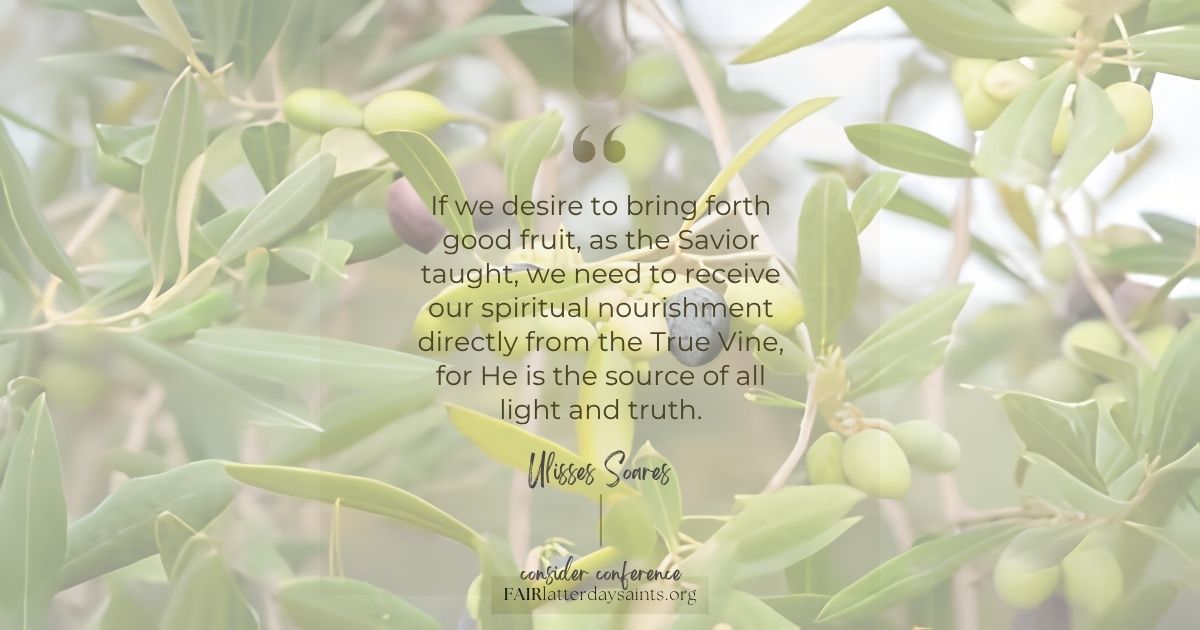
If we desire to bring forth good fruit, as the Savior taught, we need to receive our spiritual nourishment directly from the True Vine, for He is the source of all light and truth.
But that claim can be difficult in a world filled with competing philosophies and sincere people who find meaning, wisdom, and goodness in many different places. Why insist that Jesus Christ is uniquely necessary? Does believing in the True Vine require us to dismiss everything good that grows elsewhere?
Elder Soares’s message offers an important distinction: recognizing goodness in other places is not the same as believing every source can provide what only Jesus Christ can give.
Common Criticism: Christianity’s Claim About Christ Is Too Exclusive
Some question Christianity’s insistence that salvation comes through Jesus Christ. There are good people in many religions and cultures, and wisdom can be found in philosophy, literature, science, and the experiences of people who do not share Christian beliefs. Why, then, claim that Christ is uniquely necessary?
Fallacy at Work: False Equivalence
False Equivalence occurs when two things that share some characteristics are treated as though they are equal in all the ways that matter.
A philosophy can teach a true principle. A thoughtful person can offer wise counsel. Another religious tradition can encourage goodness, compassion, sacrifice, and service. Recognizing those similarities, however, does not establish that every source has the same spiritual authority, purpose, or power.
Doctrine: Christ Is More Than a Source of Good Advice
The Savior Himself taught, “I am the true vine. … Ye are the branches” (John 15:1, 5). His metaphor does more than describe Jesus as a teacher whose ideas we admire. A branch receives its very life from the vine.
That distinction matters.
Latter-day Saints need not believe that every idea outside the Church is false in order to testify that Jesus Christ is the source of salvation. Elder Soares even acknowledged that some of the many voices surrounding us “are well intentioned in their desire to promote goodness.” The danger comes when another voice begins to occupy the place that belongs to Christ.
Elder Soares’s Correction: Only Christ Can Redeem
Elder Soares distilled this distinction into a remarkably simple statement:
Only our Redeemer can truly redeem us.
Other sources may educate us. They may inspire us to become kinder, wiser, healthier, or more compassionate. We can gratefully recognize truth wherever we encounter it.
But none of those things performed the Atonement. None conquered sin and death. None can reconcile us to God.
Solution
We do not need to disparage every other voice in order to remain firmly rooted in Jesus Christ. We can recognize truth and goodness wherever they appear while refusing to confuse a helpful branch of knowledge with the source of eternal life. Christ’s claim is unique because His role is unique.
Living Apologetics: What Is Nourishing You?
 For most of us, the challenge is not choosing between Jesus Christ and something obviously evil. The competing voices Elder Soares described are often much subtler.
Some are eloquent. Some are attractive. Some promote genuinely good things. Some may even appear consistent with Christ and His gospel. Elder Soares warned, however, that over time competing voices can become “tangled vines” that promise happiness, security, or authenticity while gradually weakening our connection to Christ.
In a world of many voices, remaining connected to the True Vine is not merely desirable; it is essential to our spiritual survival.
That makes spiritual discernment particularly important in a digital world. The question does not always need to be, “Is this voice bad?” A more revealing question may be, “What place is this voice beginning to occupy in my life?”
Is an influencer shaping my understanding of happiness more than Christ is? Is a political philosophy becoming the lens through which I judge the gospel? Do I instinctively turn to social media, podcasts, commentators, or online communities to tell me what is true before turning to scripture, prayer, and revelation?
Good things can still become substitutes when we ask them to provide what only the True Vine can give.
Practical Apologetic Use
- If someone says: “Christians act like they have a monopoly on truth. There are good teachings in lots of religions and philosophies.”
- You can respond: “I agree that truth and goodness can be found in many places. Christianity’s claim isn’t that no one else can say anything true or good. It’s that Jesus Christ does something no philosophy or teacher can do: He redeems us. We can appreciate truth wherever we find it without treating every source as spiritually interchangeable with the Savior.”
Ways to Apply Today
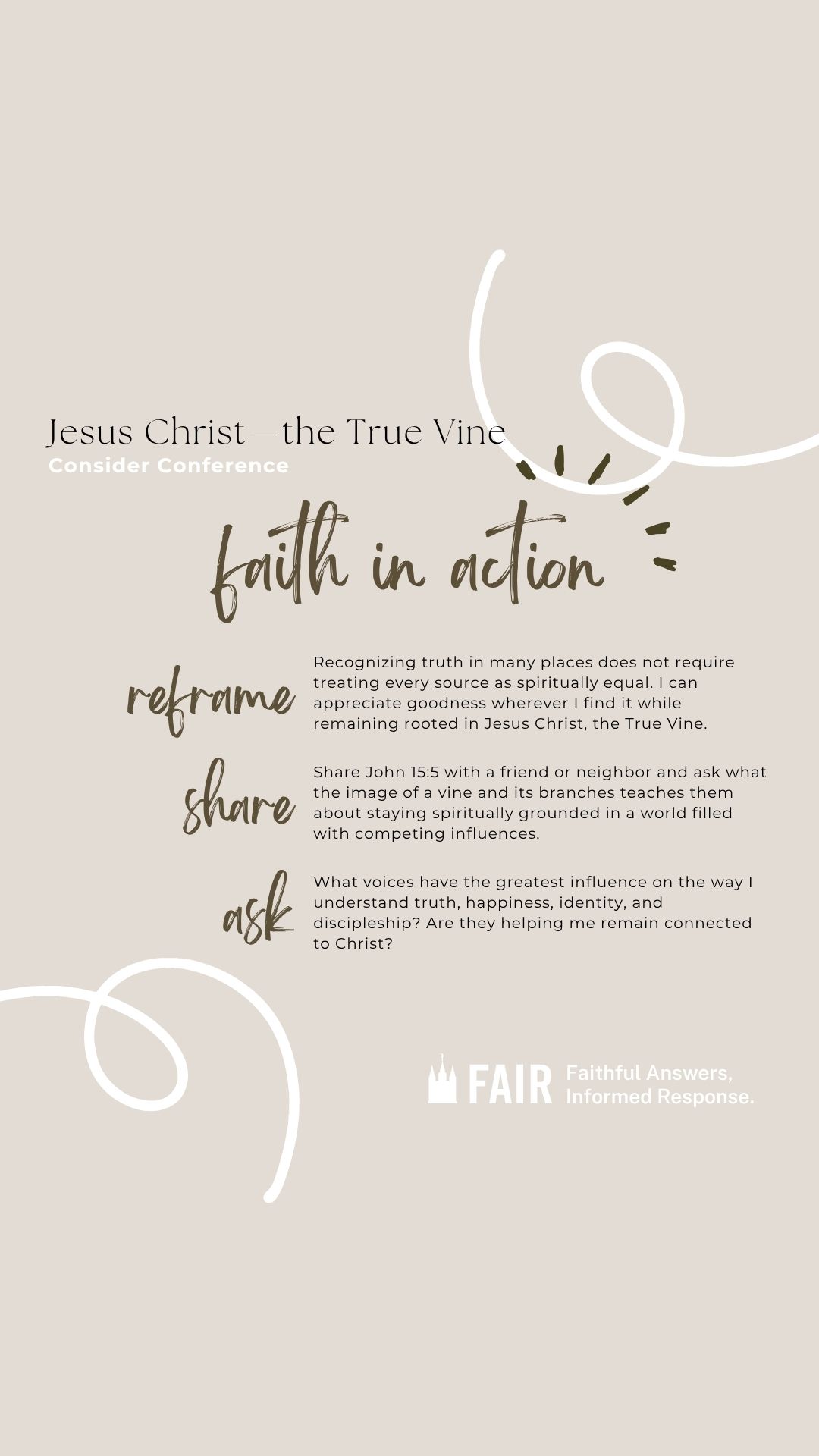
1️⃣ Identify your loudest voices. Think about what you read, watch, or listen to most often. Ask yourself whether those voices are helping you draw closer to Christ or slowly becoming substitutes for His voice.
2️⃣ Trace good fruit back to its source. When you encounter something true or beautiful outside familiar gospel settings, appreciate it—and consider how that truth ultimately points toward principles taught by the Savior.
3️⃣ Nourish the connection deliberately. Spend meaningful time this week in scripture, prayer, temple worship, or another practice that allows Christ’s teachings to shape your thoughts before the world’s competing voices do.
Keep This Talk With You
Elder Soares’s image of the True Vine offers something deeper than a warning to be careful about outside influences. It invites us to examine where we are actually drawing our spiritual life.
We live surrounded by voices competing to define happiness, identity, morality, success, and truth. Some will be wrong. Others will contain genuine insight. Discipleship does not require us to fear every unfamiliar idea or reject goodness simply because of where we found it. It requires us to remember the difference between appreciating truth and replacing its ultimate Source.
Jesus Christ does not ask merely to be one influence among many. He invites us to abide in Him.
As Elder Soares taught:
Abiding in Christ is not an occasional or casual act; it is a constant, conscious, and sacred choice.
Remaining connected to the True Vine therefore happens in ordinary decisions: what voices we repeatedly seek, whose teachings govern our choices, where we turn when confused, and whom we trust when the messages around us conflict.
This week, try one small step:
- Notice what nourishes you. At the end of the day, consider which voices occupied most of your attention and what kind of fruit they produced in your thoughts and actions.
- Give Christ the first voice. Before scrolling, searching, or asking someone else what to think about an important question, begin with prayer and the words of Christ.
- Practice discernment instead of fear. When you encounter an unfamiliar idea, don’t immediately accept or reject it. Ask whether what is true within it leads you toward the light, truth, and life found in Jesus Christ.
What is one choice you can make this week to let Jesus Christ become not merely one of the voices you hear, but the source from which you draw your spiritual life?
The Consider Conference series by FAIR offers an in-depth look at recent General Conference talks to help members of the Church of Jesus Christ of Latter-day Saints navigate common questions, misunderstandings, and criticisms. Each post provides doctrinal insights, historical context, and practical ways to apply gospel principles in everyday conversations. Through this series, we hope to equip readers with faith-promoting resources that encourage thoughtful reflection, respectful dialogue, and a stronger foundation in gospel truths, fostering both personal conviction and meaningful discussions with others.

Leave a Reply