
In his October 2026 General Conference address, “Jesus Lives to Lift,” Elder Patrick Kearon used his experiences learning to fly gliders to teach a powerful truth about our relationship with Jesus Christ. Just as a glider depends on invisible currents of rising air to climb, we depend on the Savior’s grace to lift us spiritually. We cannot create that lifting power ourselves, but we can learn to recognize it, turn toward it, and remain within its influence.
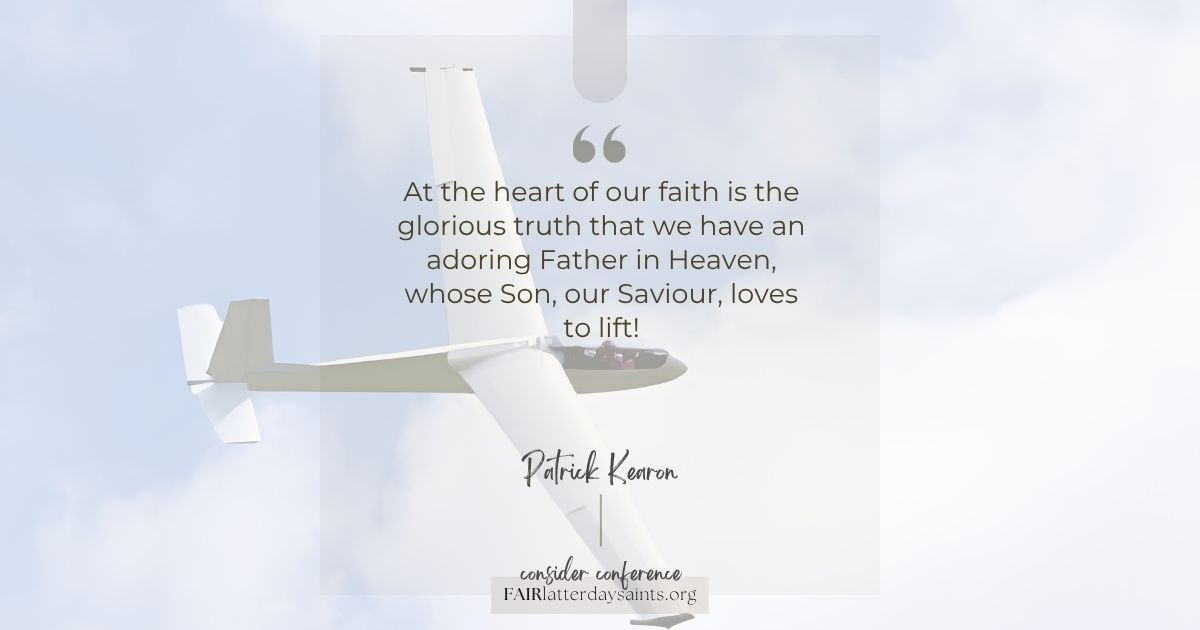
At the heart of our faith is the glorious truth that we have an adoring Father in Heaven, whose Son, our Saviour, loves to lift!
Yet the Latter-day Saint emphasis on obedience, covenants, and consistent spiritual practices sometimes raises questions. If Christ’s grace is sufficient to save us, why must we continually work to strengthen our relationship with Him? Doesn’t emphasizing our own efforts diminish His saving power?
Elder Kearon’s message offers a beautiful clarification: We do not create the power that lifts us. We choose whether to turn toward the One who does.
Common Criticism: Latter-day Saints Believe They Must Earn Salvation
Some critics interpret the Church’s emphasis on commandments, ordinances, and covenant keeping as evidence that Latter-day Saints believe salvation must be earned through personal righteousness. From this perspective, religious practices can appear to be a spiritual checklist—a collection of requirements we must complete before becoming worthy of God’s love.
This concern is understandable when obedience is discussed without also emphasizing the grace that makes salvation possible. But it overlooks an essential distinction between earning salvation and faithfully responding to the Savior who offers it.
Fallacy at Work: False Dichotomy
A False Dichotomy occurs when two ideas are presented as mutually exclusive even though both can be true.
In this case, the assumption is that salvation must come either through Christ’s grace or through our faithful response to Him. If grace saves us, obedience must be unnecessary; if obedience matters, grace must somehow be insufficient.
But these principles are not competitors. Christ provides the saving power, while our faith and obedience express our willingness to receive and follow Him.
Doctrine: Grace Is the Source of Spiritual Lift
The Book of Mormon teaches that “it is by grace that we are saved, after all we can do” (2 Nephi 25:23). This does not mean we must first exhaust our own abilities before Christ will help us. Rather, even our greatest efforts cannot accomplish what only His Atonement makes possible.
In Ether 12:27, the Lord promises that His grace is sufficient for those who humble themselves before Him. Our weakness is not an obstacle too great for His power; it is an opportunity to recognize our dependence on Him.
The Savior likewise taught, “I am the vine, ye are the branches” (John 15:5). A branch does not produce life independently of the vine. Its ability to bear fruit comes from remaining connected to its source.
Our spiritual practices serve a similar purpose. Prayer, scripture study, repentance, worship, and covenant keeping do not manufacture divine power. They help us remain connected to the Savior, who alone can redeem and transform us.
Elder Kearon’s Correction: Turn Toward the Lift
Elder Kearon explained that a glider has no engine. It cannot propel itself upward through sheer determination. Instead, the pilot must recognize rising air, turn toward it, and learn to remain within its lifting influence.
Through the amazing grace of Jesus Christ, we can avoid spiritual sink and find spiritual lift.
The analogy beautifully illustrates the relationship between grace and agency. The pilot’s skill does not create the rising air, just as our obedience does not create Christ’s grace. But recognizing and responding to that power makes a meaningful difference.
Elder Kearon also warned that spiritual descent can occur gradually, almost imperceptibly. We may sincerely desire the blessings of discipleship while neglecting the habits that help us remain receptive to the Holy Spirit.
Importantly, however, not every season of spiritual difficulty results from neglect or disobedience. Faithful people experience grief, illness, exhaustion, doubt, and circumstances that make God’s presence difficult to recognize. Feeling spiritually low does not necessarily mean someone has turned away from Christ.
The Savior’s invitation remains the same in every circumstance. Elder Kearon reminds us that when we sink, our gentle Savior is there to lift us as we turn to Him.
Solution: Discipleship Is a Response to Grace, Not a Replacement for It
The restored gospel does not teach that we must climb high enough to earn the Savior’s attention. It teaches that Jesus Christ has already provided the power through which we can rise. Our responsibility is not to save ourselves, but to exercise faith in the One who can save us.
Seen this way, commandments and covenants are not evidence of an insufficient Savior. They are opportunities to build a living relationship with Him, to recognize His influence, and to become increasingly transformed through His grace.
The goal of discipleship is not to prove that we can rise without Christ, but to learn how completely we depend upon Him.
Living Apologetics: Recognizing the Grace That Lifts Us
It can be easy to measure spiritual progress by visible accomplishments: how consistently we pray, how much scripture we read, how faithfully we fulfill our responsibilities, or how well we meet our own expectations.
These practices matter, but their ultimate purpose is not performance. It is connection.
Elder Kearon invites us to pay attention to the subtle impressions of the Holy Spirit and recognize the experiences that draw us closer to the Savior. Sometimes spiritual lift comes through scripture study or prayer. Other times it comes through a quiet act of service, a reassuring conversation, or the simple decision to turn toward God during a difficult day.
And as we learn to recognize that lifting power in our own lives, we become better prepared to help others experience it.
Elder Kearon taught that as children of the covenant, we have the privilege and responsibility of assisting the Lord in fulfilling His promises to His children. Spiritual lift is not meant to be experienced alone. Like glider pilots joining one another in rising currents of air, we can encourage, strengthen, and help each other rise toward Christ.
 Practical Apologetic Use:
- If someone says:“Latter-day Saints focus so much on rules and obedience that it seems like they believe they have to earn God’s love.”
- You can respond: “We believe God’s love and Christ’s grace are gifts we could never earn. Our obedience isn’t an attempt to create that grace or make ourselves worthy of being loved. It’s how we choose to respond to the Savior and remain connected to His transforming power. Just as a glider depends on rising air to climb, we depend entirely on Jesus Christ to lift us.”
Ways to Apply Today:
1️⃣Recognize your source of strength. When you pray, study the scriptures, or participate in worship, remember that these practices are opportunities to draw closer to Christ—not accomplishments that earn His love.
2️⃣Notice the subtle signs of spiritual lift. Pay attention to moments of peace, hope, clarity, or increased love. Consider what helps you recognize the influence of the Holy Spirit, even when those impressions are quiet.
3️⃣Help someone else rise. Reach out to someone who may be struggling or feeling spiritually discouraged. Sometimes the most meaningful way to share Christ’s lifting power is through patient listening, genuine friendship, and compassionate encouragement.
Keep This Talk With You
Elder Kearon’s message reminds us that spiritual growth is not about how high we can climb through our own strength. It is about learning to recognize and rely upon the Savior’s power to lift us.
The demands of everyday life can gradually distract us from the practices that nourish our relationship with God. We may not deliberately choose to move away from Him, but we can become less attentive to the quiet impressions that once helped us feel His presence.
Yet the answer is not to approach discipleship with greater anxiety or to measure ourselves against an impossible standard of spiritual perfection. It is to turn toward Jesus Christ with renewed trust, remembering that His grace is sufficient and His love is constant.
None of this is complicated; we simply need to keep turning toward the Saviour, into the source of lift, and keep choosing to rise into the light rather than drift imperceptibly into the shadow.
This week, consider one small way to become more receptive to the Savior’s lifting power. Perhaps that means making time for sincere prayer, returning to a neglected spiritual habit, or simply recognizing His goodness in the middle of an ordinary day.
And remember that the invitation to rise is also an invitation to lift. We do not have to wait until our own spiritual lives feel perfectly steady before offering encouragement to someone else. We can turn toward Christ together, trusting that His grace is sufficient for each of us.
Jesus Christ does not stand at the summit waiting to see whether we can reach Him. He is the source of the power that makes our ascent possible.
Am I approaching my discipleship as a list of things I must accomplish, or as a relationship with the Savior whose grace makes my spiritual growth possible?
The Consider Conference series by FAIR offers an in-depth look at recent General Conference talks to help members of the Church of Jesus Christ of Latter-day Saints navigate common questions, misunderstandings, and criticisms. Each post provides doctrinal insights, historical context, and practical ways to apply gospel principles in everyday conversations. Through this series, we hope to equip readers with faith-promoting resources that encourage thoughtful reflection, respectful dialogue, and a stronger foundation in gospel truths, fostering both personal conviction and meaningful discussions with others.

Leave a Reply