
In his April 2026 General Conference address, President Henry B. Eyring taught that prayer is more than something we turn to when life falls apart. Continual prayer creates a relationship with Heavenly Father that brings peace and spiritual strength through every circumstance of life.
President Eyring pointed to the sons of Mosiah, whose spiritual strength was developed long before their moments of greatest need:
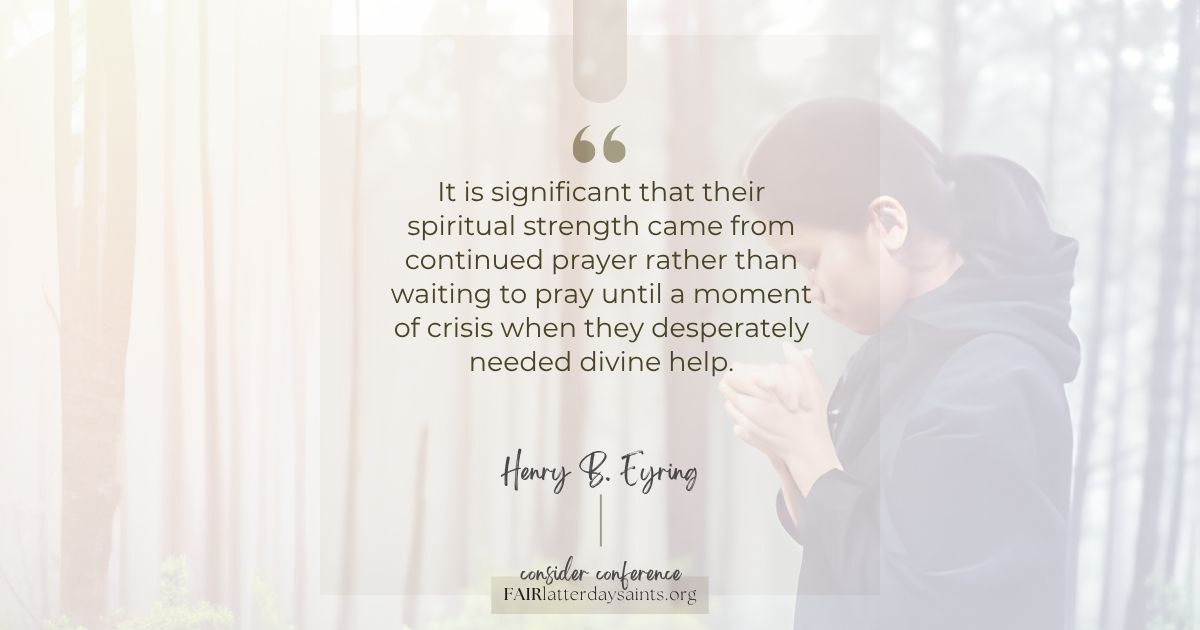
It is significant that their spiritual strength came from continued prayer rather than waiting to pray until a moment of crisis when they desperately needed divine help.
But it can be difficult to keep praying when answers seem delayed, circumstances remain unchanged, or God already knows what we need. If He knows us perfectly, why do we need to keep asking? And if the situation does not change, did the prayer accomplish anything?
President Eyring’s message offers a different way to understand prayer: prayer is not merely an emergency transaction with God. It is an ongoing relationship with Him.
Common Criticism: Why Pray If Nothing Changes?
For some, prayer can begin to feel transactional: we have a problem, we ask God for help, and then we wait to see whether He fixes it.
When the hoped-for answer comes, it can feel like prayer worked. When circumstances remain painful or confusing, we may wonder whether God heard us at all.
Fallacy at Work: Outcome Bias
Outcome Bias is the tendency to judge a decision or action primarily by the outcome it produces.
Applied to prayer, we might evaluate whether prayer “worked” according to whether we received the answer we wanted. If the illness remains, the relationship does not heal, the opportunity never comes, or the grief does not disappear, we may conclude that prayer failed.
But that assumes the only purpose of prayer is to change our circumstances.
Doctrine: God Knows, Hears, and Strengthens
Scripture presents prayer as something much deeper. Alma taught that our hearts should be “drawn out in prayer unto him continually” (Alma 34:27). The Savior likewise taught that Heavenly Father knows what we need even before we ask Him (Matthew 6:8).
Prayer, then, cannot simply be about informing God of our needs.
It is an act of turning toward Him.
President Eyring testified:
In moments of pain, loneliness, or confusion, we know that our Heavenly Father and His Beloved Son are aware of our circumstances and that They yearn to bless us.
God’s awareness does not guarantee that every painful circumstance will immediately disappear. It does assure us that we do not face those circumstances unnoticed or alone.
Elder Soares’s Correction: Pray Before the Crisis
President Eyring points to the sons of Mosiah, who “had given themselves to much prayer, and fasting” and consequently had “the spirit of prophecy, and the spirit of revelation” (Alma 17:3).
Their prayers were not simply reactions to emergencies. Prayer had become part of who they were.
That distinction matters. If we think of prayer only as something to use when we desperately need divine intervention, we can miss one of its greatest purposes: continual prayer prepares us spiritually before difficulty arrives.
President Eyring’s own experience illustrates this principle. At the funeral of his wife of 61 years, he described feeling unexpected peace and “almost joy.” His loss had not been reversed. Instead, the Lord answered his prayer with an assurance from the Holy Ghost that allowed him to look forward with hope to a future reunion.
The answer did not remove the grief. God gave him peace within it.
Solution: Measure Prayer by Relationship, Not Just Results
Instead of asking only, “Did God give me what I asked for?” we can also ask:
Did prayer draw me closer to Him?
Did I receive peace?
Was I strengthened to carry something I could not remove?
Did inspiration come?
Did hope return?
The people of Alma experienced exactly this. Their captivity did not immediately end when they poured out their hearts to God. Instead, the Lord first strengthened them until “the burdens which were laid upon Alma and his brethren were made light” (Mosiah 24:15).
Sometimes God removes the burden. Sometimes He strengthens the person carrying it. Both can be answers to prayer.
Living Apologetics: Prayer as Relationship, Not Performance
Another misconception about prayer is that perhaps we are doing it incorrectly. We do not know what to say. Our thoughts wander. Our prayers sound repetitive. Someone else seems able to pray with beautiful language while ours feels simple.
President Eyring removes that pressure:
Opening the windows of heaven through fervent prayer does not require the use of many words or flowery language.
The people of Alma could not even pray aloud without putting themselves in danger. Instead, “they did pour out their hearts to him; and he did know the thoughts of their hearts” (Mosiah 24:12).
 God did not require eloquence. He required their hearts.
That means prayer remains available in the hospital room, in the car, during a sleepless night, in a joyful moment, or in a season when we cannot find words at all. Continual prayer is less about always speaking and more about continually turning our hearts toward God.
Practical Apologetic Use
- If someone says: “I’ve prayed and nothing changed, so I don’t see what prayer accomplished.”
- You can respond: “Prayer isn’t only about getting God to change our circumstances. Sometimes His answer is to change what we are able to carry within those circumstances—to give peace, strength, direction, or hope. Continual prayer builds a relationship with Him that prepares us to recognize and receive those answers.”
Ways to Apply Today
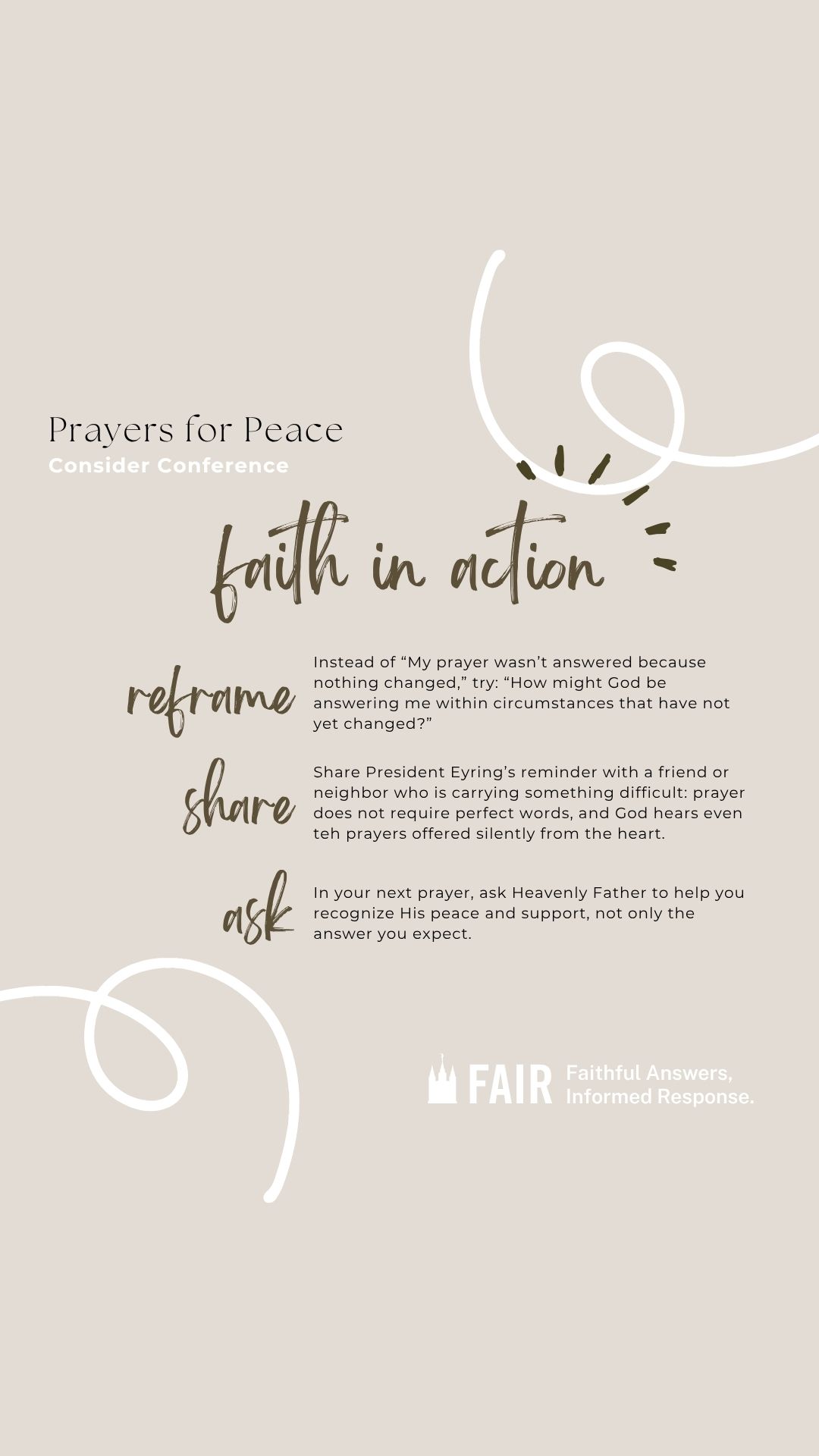
1️⃣ Pray before you need something. Offer a prayer during an ordinary or joyful moment simply to thank Heavenly Father and draw near to Him.
2️⃣ Notice answers beyond changed circumstances. When you pray about something difficult, watch for peace, strength, insight, patience, or reassurance—not only the outcome you requested.
3️⃣ Pray without worrying about the words. When you do not know what to say, simply turn your heart toward Heavenly Father. A sincere prayer does not need to be long or eloquent to reach Him.
Keep This Talk With You
President Eyring’s invitation is not simply to pray harder when life becomes difficult. It is to pray continually, no matter the circumstances of life.
There will be moments when prayer seems to bring a clear answer. There will be others when circumstances remain painfully unchanged. And there may be times when we cannot find words at all.
But none of those experiences mean God is absent.
The Savior promised His disciples, “Peace I leave with you, my peace I give unto you: not as the world giveth” (John 14:27). President Eyring’s message reminds us that this peace is not necessarily the absence of trouble. It is the presence and support of Christ within it.
Continual prayer prepares us to receive that peace. The sons of Mosiah did not wait for crisis to build their relationship with God. Their spiritual strength came because prayer had already become part of their lives.
This week, try one small step:
- Pray when everything is going well. Let gratitude, not just need, draw you toward Heavenly Father.
- Look differently for an answer. If a circumstance has not changed, ask whether God is giving you strength, peace, patience, direction, or hope within it.
- Practice a prayer of the heart. During an ordinary part of your day, quietly turn your thoughts toward Heavenly Father—even if you say nothing aloud.
Prayer does not promise a life without grief, confusion, or difficulty. It promises that in every one of those circumstances, we can continually turn toward a Father who already knows us, hears us, and yearns to bless us.
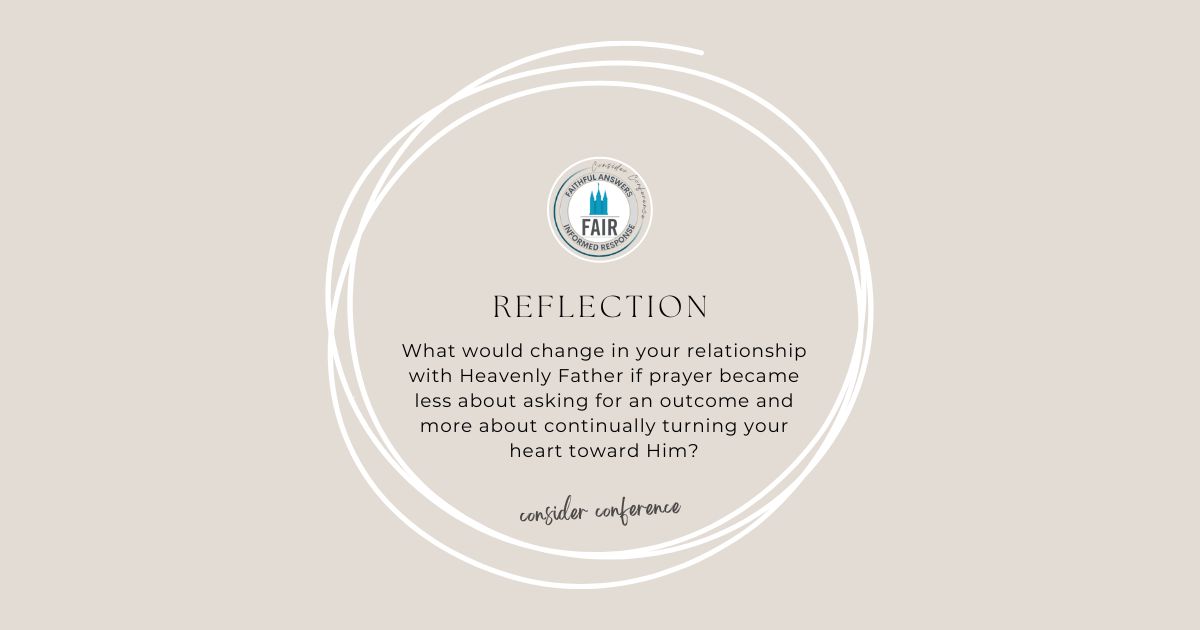
What would change in your relationship with Heavenly Father if prayer became less about asking for an outcome and more about continually turning your heart toward Him?
The Consider Conference series by FAIR offers an in-depth look at recent General Conference talks to help members of the Church of Jesus Christ of Latter-day Saints navigate common questions, misunderstandings, and criticisms. Each post provides doctrinal insights, historical context, and practical ways to apply gospel principles in everyday conversations. Through this series, we hope to equip readers with faith-promoting resources that encourage thoughtful reflection, respectful dialogue, and a stronger foundation in gospel truths, fostering both personal conviction and meaningful discussions with others.

Leave a Reply