
In his October 2025 General Conference address, “The Family Proclamation—Words from God,” Elder Ronald A. Rasband testified that The Family: A Proclamation to the World is not merely a cultural statement or institutional guideline, but revealed doctrine given by God through His prophets. He explained how the proclamation came forth through prayer, prophetic councils, and spiritual unanimity—and why its teachings deserve reverence in every generation.
Yet its clarity has also made it controversial. As social views on family, marriage, and gender continue to shift, many struggle with how the proclamation fits in a changing world.
This raises a common and sincere question:
Should Church leaders be more open to current social views rather than asserting fixed doctrine about the family?
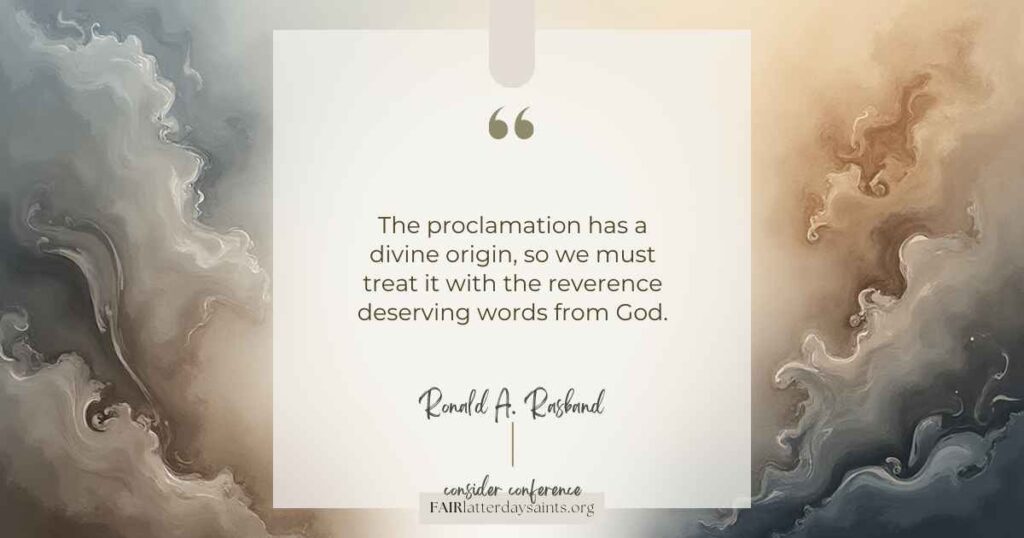
The proclamation has a divine origin, so we must treat it with the reverence deserving words from God.
Common Criticism: “Church leaders should be more open to current social views on family, marriage, and gender, rather than asserting fixed doctrine.”
Some feel that doctrinal clarity on the family appears rigid or exclusionary in a world that values personal identity, evolving norms, and individual experience. They wonder whether prophetic leaders should adapt their teachings to better reflect modern perspectives, especially when current doctrine feels misaligned with personal circumstances or societal consensus.
Fallacy at Work: Cultural Relativism
Cultural relativism assumes that truth must evolve alongside social consensus—that what is right or authoritative today should adjust as norms change.
Applied here, it suggests that revealed doctrine should be reshaped to reflect cultural acceptance. But this assumption overlooks the difference between compassionate ministry and doctrinal authority. It treats prophetic teaching as opinion rather than revelation and equates discomfort with error.
Elder Rasband’s Correction: Doctrine Comes from God, Not Culture
Elder Rasband teaches that the Family Proclamation originated through revelation, prophetic councils, and unity—not as a reaction to social trends, but as guidance given ahead of them. Its authority rests in God’s eternal perspective, not in human approval.
He explains that prophets are stewards, not authors, of doctrine. Their responsibility is not to mirror society, but to declare God’s truths—even when those truths are countercultural. At the same time, Elder Rasband affirms the dignity, worth, and belonging of every individual, regardless of circumstance.
Resolving this Fallacy: The tension many feel dissolves when we understand the role of prophets. God’s doctrine is not designed to validate every cultural moment; it is meant to anchor His children across all of them. The Family Proclamation provides clarity about eternal identity and divine purpose while leaving room for compassion, patience, and Christlike love. Upholding doctrine does not negate empathy—it grounds it.
Living Apologetics: Holding to Doctrine with Christlike Compassion
In a world that often frames disagreement as hostility, faithful members may feel unsure how to speak about the Family Proclamation without sounding harsh—or how to remain loyal to doctrine without appearing unkind.
Elder Rasband models a better way. He shows that it is possible to speak with doctrinal clarity and genuine love. Defending revealed truth does not require diminishing others’ experiences, and compassion does not require abandoning eternal principles.
Practical Apologetic Use:
- If someone says: “The Church just needs to catch up with the times.”
- You can respond: “The Church believes families are central to God’s eternal plan. Prophets don’t create doctrine based on culture—they share what God reveals. At the same time, everyone belongs and deserves compassion and respect.”
Ways to Apply Today:
1️⃣ Study the proclamation prayerfully, seeking to understand not just what it says, but why it matters eternally.
2️⃣ Speak with clarity and kindness when the doctrine is questioned.
3️⃣ Create belonging without compromise by extending Christlike love while remaining anchored to revealed truth.
Keep This Talk With You
Elder Rasband’s testimony reminds us that God’s truths do not lose their authority simply because the world changes. The Family Proclamation stands as a divine anchor—offering clarity about eternal identity, purpose, and belonging in a time of confusion.
Choosing to trust revealed doctrine does not mean ignoring pain or complexity. It means believing that God sees further than we do and that His love extends to every soul. As we hold firmly to truth while reaching outward in compassion, we become better disciples of Jesus Christ.
How do I balance loyalty to revealed doctrine with Christlike compassion when cultural views differ from gospel teachings?
The Consider Conference series by FAIR offers an in-depth look at recent General Conference talks to help members of the Church of Jesus Christ of Latter-day Saints navigate common questions, misunderstandings, and criticisms. Each post provides doctrinal insights, historical context, and practical ways to apply gospel principles in everyday conversations. Through this series, we hope to equip readers with faith-promoting resources that encourage thoughtful reflection, respectful dialogue, and a stronger foundation in gospel truths, fostering both personal conviction and meaningful discussions with others.
