
In his October 2026 General Conference address, Elder David A. Bednar taught that sacred covenants are essential spiritual credentials on our journey back to Heavenly Father. Through ordinances, covenant faithfulness, and the ratifying power of the Holy Spirit of Promise, disciples of Jesus Christ can receive the eternal blessings God has promised.
But what happens when circumstances beyond our control seem to threaten those promises? What if someone else’s choices disrupt a covenant relationship, fracture a family, or change the future we faithfully anticipated?
Elder Bednar offers this powerful reassurance:
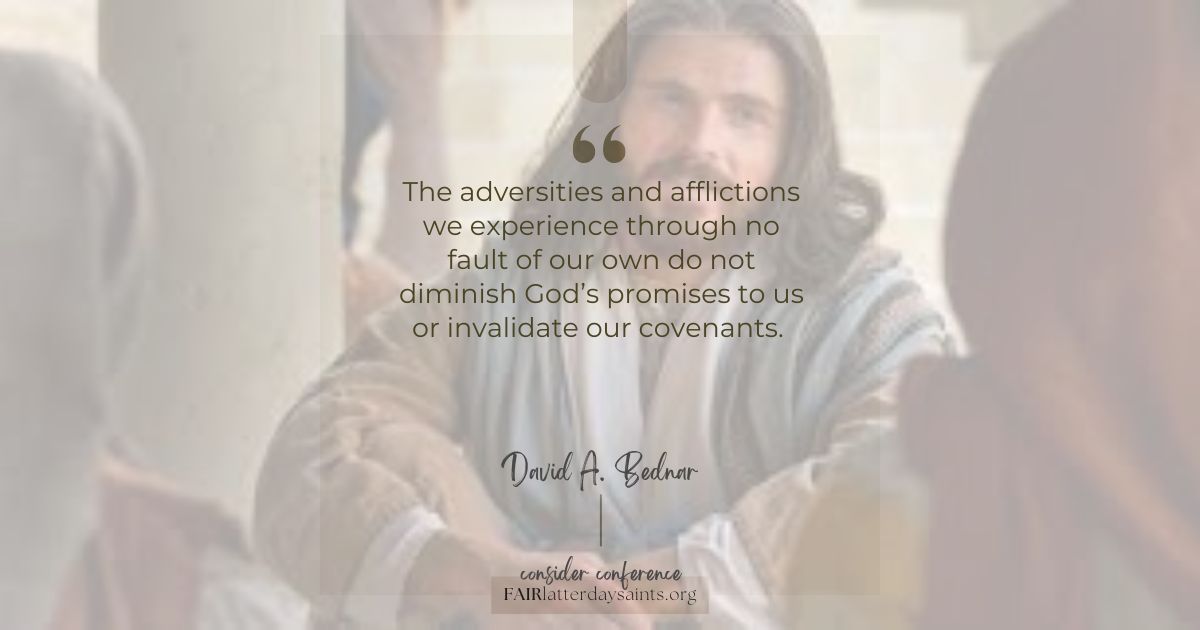
The adversities and afflictions we experience through no fault of our own do not diminish God’s promises to us or invalidate our covenants.
This distinction matters. Our circumstances may change dramatically, but God’s faithfulness does not. His promises are not dependent upon the righteousness of everyone around us, and His power to bless His children is not limited by the decisions of others.
Common Criticism: Can God’s Promises Really Be Trusted?
One difficult question surrounding eternal marriage and temple covenants is whether another person’s choices can permanently deprive a faithful individual of promised blessings. If eternal marriage requires the faithfulness of both spouses, what happens when one abandons those commitments? Does a faithful spouse lose the possibility of eternal blessings because someone else chose a different path?
These are not merely theoretical questions. They reflect genuine concerns experienced by individuals facing divorce, infidelity, estrangement, or other painful disruptions to covenant relationships.
Fallacy at Work: False Dilemma
A False Dilemma occurs when we assume only two possible outcomes exist, overlooking other possibilities.
In this case, someone may believe that either their marriage and family relationships unfold exactly as hoped, or the eternal blessings associated with those relationships are permanently lost.
But this assumption places limits on God’s ability to fulfill His promises. It confuses our understanding of how blessings might be received with God’s actual power to provide them.
Doctrine: Covenants Are Spiritual Credentials
Elder Bednar defines a covenant as:
“A covenant is a solemn promise—an enduring commitment between God and His sons and daughters.”
He illustrates this principle through a parable about a traveler whose damaged passport prevents him from entering another country. Although the passport was validly issued, its condition prevented it from serving its intended purpose. Likewise, receiving ordinances and entering covenants are essential steps toward eternal life, but they do not eliminate the need for continued faithfulness.
Elder Bednar explains that gospel ordinances and covenants are spiritual credentials that open opportunities for divine purpose, direction, and strength. Their promised blessings are connected to honoring the commitments we make with God.
Doctrine and Covenants 82:10 reminds us that the Lord is bound when we do what He says. God’s promises are certain, but our responsibility to remain faithful is real.
Elder Bednar’s Correction: The Holy Spirit of Promise
Elder Bednar teaches that receiving a covenant ordinance is not the final step in obtaining its eternal blessings.
“Ultimately, all gospel ordinances and covenants must be sealed by the Holy Spirit of Promise.”
The Holy Spirit of Promise is the Holy Ghost acting in His role of ratifying or confirming righteous acts and covenants as acceptable to God (Doctrine and Covenants 132:7).
This ratification is not simply an automatic consequence of participating in an ordinance. Elder Bednar explains that it typically comes over time as we sincerely repent, honor our covenants, and yield our hearts to God. This becomes especially important when considering temple marriage.
Elder Bednar distinguishes between two related aspects of the sealing ordinance: the lateral sealing, which unites husband and wife in eternal marriage, and the vertical sealing, which connects them to God’s eternal family.
When one spouse violates sacred covenants and does not repent, that person forfeits the opportunity to receive the ratifying seal associated with those covenants. But a faithful spouse remains worthy to receive the promised individual blessings associated with the vertical sealing.
“No faithful disciple will ultimately be deprived of any eternal blessing God has promised because of another individual’s unrighteous exercise of moral agency.”
Solution: Christ’s Atonement Is Greater Than Human Limitations
The solution is not found in pretending that broken covenants or damaged relationships have no consequences. They can bring tremendous heartache, and the choices of others can profoundly affect our mortal experiences.
Rather, the answer rests in the infinite power and perfect justice of Jesus Christ.
As Elder Bednar testifies:
“The power of the Lord’s infinite and eternal Atonement can overcome all things, all the time, everywhere, for every person who holds fast to their covenants with Him.”
We do not know precisely how every promised blessing will be fulfilled. Elder Bednar openly acknowledges that revealed doctrine does not answer every question about eternal relationships. But uncertainty about the details is not evidence that God’s promises will fail.
The Savior’s power extends beyond our present circumstances, and His eternal perspective reaches beyond what mortality allows us to understand.
Living Apologetics: Faithfulness When Others Choose Differently
For someone experiencing the consequences of another person’s unrighteous decisions, the doctrine of eternal covenants can sometimes feel more complicated than comforting. A faithful spouse may wonder whether years of devotion have been wasted. Someone whose family relationships have changed may question whether their eternal hopes are still possible.
Elder Bednar’s teaching provides a different perspective: Covenant faithfulness is never wasted, even when the outcomes we hoped for do not materialize. God honors the faithful choices of His children. We are accountable for our own decisions, not for controlling the agency of others.
Practical Apologetic Use:
- If someone says: “My spouse broke our temple covenants. Does that mean I’ve lost my chance at an eternal family?”
- You can respond: “Elder Bednar teaches that another person’s unrighteous choices cannot ultimately deprive you of the eternal blessings God has promised. While we don’t know exactly how every eternal relationship will be resolved, we can trust that the Savior’s Atonement and God’s perfect justice are sufficient to fulfill His promises to those who remain faithful.”
Ways to Apply Today: 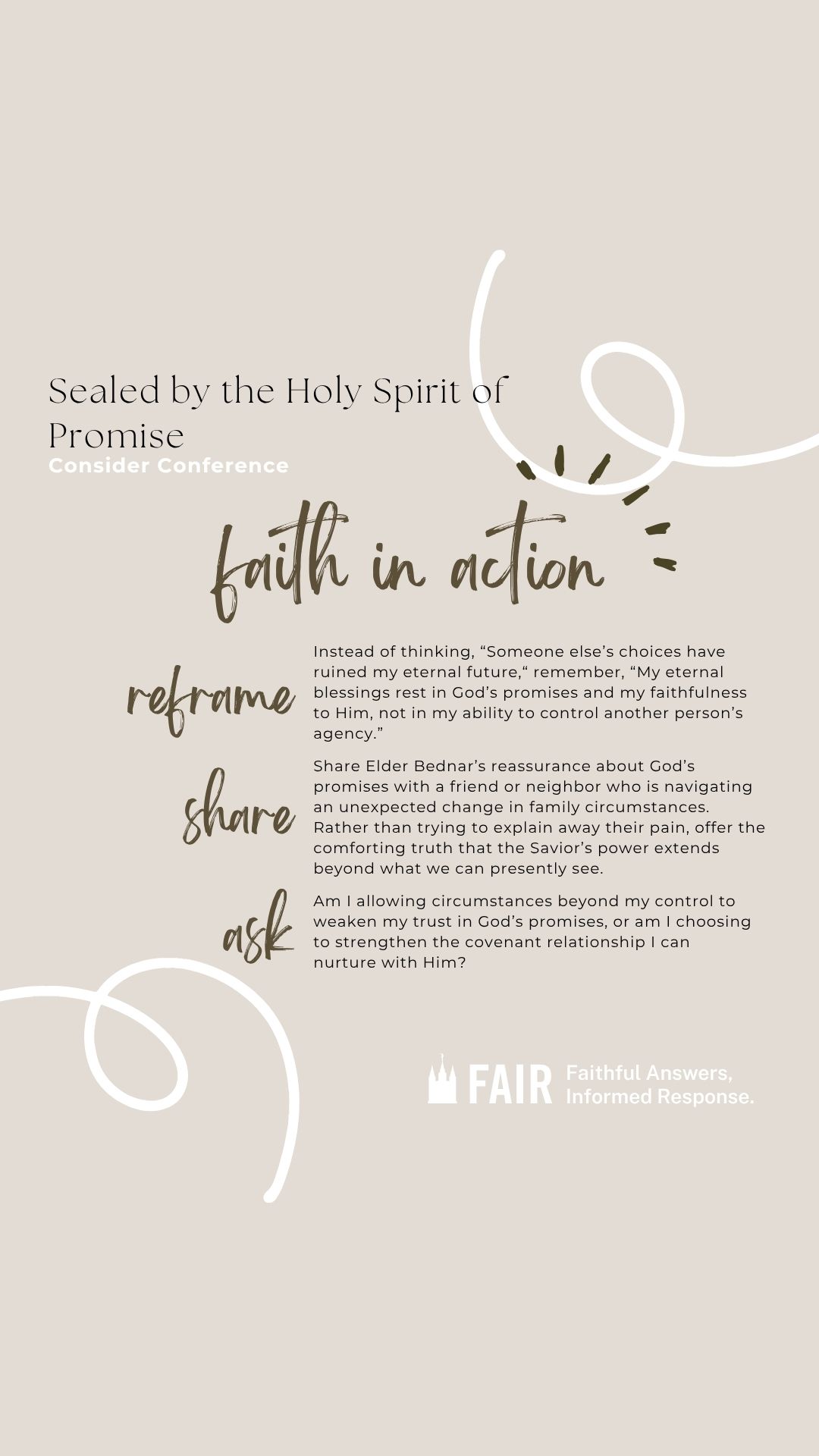
1️⃣Separate God’s promises from your expectations. Consider whether you’ve assumed that a particular blessing must come in a specific way or within a particular timeframe. Trusting God includes allowing Him to fulfill His promises according to His wisdom.
2️⃣Focus on the covenants you can keep. We cannot control another person’s choices, but we can continue to repent, seek the Holy Ghost, and honor our commitments to Heavenly Father.
3️⃣Offer reassurance without minimizing pain. When someone struggles with broken relationships or uncertain eternal blessings, listen with compassion. Remind them of God’s promises without claiming to know precisely how their circumstances will be resolved.
Keep This Talk With You
Elder Bednar’s message reminds us that covenant discipleship is a lifelong journey of becoming more closely aligned with Heavenly Father’s will. Sacred ordinances are not simply milestones we complete; they are part of an enduring relationship with God that requires faithfulness, repentance, and the sanctifying influence of the Holy Ghost. That relationship can sustain us even when life unfolds differently than we hoped.
The choices of others may alter our circumstances, but they cannot ultimately determine our eternal destiny. God’s promises remain grounded in His perfect love, justice, and mercy, and Jesus Christ possesses the power to fulfill them.
This week, consider one small step toward strengthening your trust in those promises:
- Study the Holy Spirit of Promise. Read Doctrine and Covenants 132:7 and reflect on why covenant faithfulness matters beyond the moment an ordinance is performed.
- Remember a promise. Identify a gospel blessing that gives you hope and consider how you can continue preparing to receive it, even when the timing remains uncertain.
- Strengthen someone else’s hope. Reach out to someone experiencing disappointment or family difficulties. Sometimes the most meaningful reassurance begins with simply listening.
Elder Bednar acknowledges that he cannot explain precisely how or when every promised blessing will be received. Nevertheless, he testifies with confidence that God’s promises will be fulfilled. That assurance is rooted in the Savior, whose infinite Atonement can accomplish what mortal limitations cannot.
As King Benjamin taught, those who keep God’s commandments and endure faithfully will ultimately dwell with Him in a state of never-ending happiness (Mosiah 2:41). Our responsibility is to remain faithful. We can trust God to remain true to His promises.
When circumstances beyond your control leave your future uncertain, what can you do today to strengthen your trust in the Savior’s ability to fulfill His promises?
The Consider Conference series by FAIR offers an in-depth look at recent General Conference talks to help members of the Church of Jesus Christ of Latter-day Saints navigate common questions, misunderstandings, and criticisms. Each post provides doctrinal insights, historical context, and practical ways to apply gospel principles in everyday conversations. Through this series, we hope to equip readers with faith-promoting resources that encourage thoughtful reflection, respectful dialogue, and a stronger foundation in gospel truths, fostering both personal conviction and meaningful discussions with others.
Leave a Reply