• Skip to primary navigation
  • Skip to main content
  • Skip to primary sidebar
  • Skip to footer

FAIR

  • Find Answers
  • Blog
  • Media & Apps
  • Conference
  • Bookstore
  • Archive
  • About
  • Get Involved
  • Search

Atheism

Fair Issues 75: How did Noah’s ark and Jaredite barges get light and air?

December 14, 2014 by Ned Scarisbrick

https://media.blubrry.com/mormonfaircast/www.fairlatterdaysaints.org/wp-content/uploads/2014/12/Fair-Issues-75-Pod.mp3

Podcast: Download (10.7MB)

Subscribe: RSS

MAThe story of Noah, or some equivalent figure, is found in a wide array of ancient non-biblical literature and could have easily have been known to the ancient Jaredites.  Some of these traditions about the Ark – or “deluge boat” – contain details and oddities not found in the Bible.

In this podcast brother Ash talks about how the Jaredite barges along with Noah’s ark may have been built to not only withstand the strong winds of sea travel but to also allow proper ventilation and light during their voyages.

The full text of this article can be found at Deseret News online.

Brother Ash is author of the book Shaken Faith Syndrome: Strengthening One’s Testimony in the Face of Criticism and Doubt, as well as the book, of Faith and Reason: 80 Evidences Supporting the Prophet Joseph Smith. Both books are available for purchase online through the FairMormon Bookstore. Tell your friends about the Mormon Fair-Cast. Share a link on your Facebook page and help increase the popularity of the Mormon Fair-Cast by subscribing to this podcast in iTunes, and by rating it and writing a review.

The views and opinions expressed in the podcast may not reflect those of the Church of Jesus Christ of Latter-day Saints or that of FairMormon


Filed Under: Anti-Mormon critics, Atheism, Book of Mormon, Evidences, Faith Crisis, General, Hosts, Joseph Smith, Michael R. Ash, Mormon Voices, Ned Scarisbrick, Podcast

A Mormon Reads a REAL Atheist’s Blog Post

October 24, 2014 by Neal Rappleye

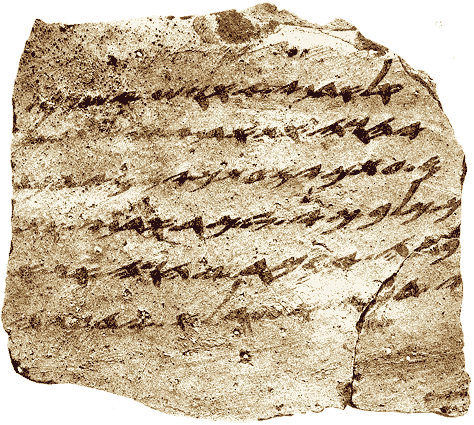
"An ostracon from the end of the eight century BCE. In the first line we have the ciphers 50 + 7 in Egyptian hieroglyphic forms used widely in Israel and Judah." (Shmuel Ahituv, Echoes from the Past, 36.)
“An ostracon from the end of the eight century BCE. In the first line we have the ciphers 50 + 7 in Egyptian hieroglyphic forms used widely in Israel and Judah.” (Shmuel Aḥituv, Echoes from the Past, 36.)

[Cross posted from Studio et Quoque Fide.]

Many have probably already seen the post, “An Atheist’s Response to the First 31 Pages of The Book of Mormon.” I am going to guess that fewer people have seen “A REAL Atheist’s Response to the First 31 Pages of the Book of Mormon.” This “real atheist” appears to be an ex-Mormon named Benjamin V. (or else a Benjamin posted this on behalf the atheist). In any case, this “real atheist” (RA from here on out) is much less flattering than the first, providing a critique of the historicity of the Book of Mormon. (In keeping with RA’s own practice, I will not link to either of these blog posts.)

RA was respectful in his critique, no snarky remarks or sarcastic jabs, which I appreciate. I nonetheless found his critique to be somewhat naïve not only of LDS scholarship, but of biblical scholarship more generally. In RA’s defense, he (I am assuming gender here) does admit, “I’m not an expert on Christian theology or the Bible, and I certainly don’t believe in much of either, but I do have a passing familiarity with them.” In the spirit of promoting a more informed discussion, I would just like provide an informed Mormon’s opinions of RA’s objections.

  1. Pre-Exilic Jews: RA thinks Nephi’s frequent reference to “Jews” is anachronistic. He writes, “the term ‘Jew’ wasn’t coined until after the Israelites returned from captivity under the reign of the Persians.” RA then tries to predict the apologetic response:

Knowing a bit about Mormon apologetics, I’m sure some would like to explain this away by appealing to Joseph Smith’s imperfect translation skills. Perhaps Nephi used a word like “Israelite,” and Joseph Smith translated it as “Jew.” But there are clues in the text that would argue against this explanation. For example, in 1 Nephi 15:17 (on page 31, as it happens), Nephi refers to “…the Jews, or… the House of Israel.” Clearly Nephi was familiar with both terms, when only one would have been invented at the time of his writing.

Actually, a more simple solution is that Nephi used yehudi (יהודי); plural yehudim (יהודים), which is translated as “Jew” (or in the plural, “Jews”) in the KJV, and even in some instances in modern translations like the NIV and the NASB. In fact, it appears at a rather high frequency in the writings of Jeremiah, Nephi’s contemporary (e.g., Jeremiah 32:12; 34:9; 38:19; 40:11, 12, 15: 41:3; 44:1; 52:28, 30). Though it more properly means “Judean” or “Judeans,” the distinction was not made in 1830. So, there is really no problem with Nephi’s use of the term. In fact, there are arguably a number of wordplays in the underlying text on the Hebrew meaning of the word.[1] An interesting point to consider, since Joseph Smith did not know Hebrew.

  1. Egyptian Writing: RA’s next comments, “It’s hard to understand why someone who was born and raised in Jerusalem ‘in all his days’ would have known Egyptian at all.” This is not really a serious conundrum. Stefen Wimmer has documented several instances of what he calls “Palestinian hieratic,” an Egyptian script being used by Israelites in ancient times (cf. 1 Nephi 1:2).[2] According to Wimmer, this script was used in Palestine “probably over several centuries,” and its usage peaks in the late-7th century bc, coming to an abrupt end “after the Babylonian captivity.”[3] This is the very time period of Lehi, Nephi’s father (it probably would not have been his primary language, but nothing in the text requires it to be). Given that RA says he knows “a bit about Mormon apologetics,” I am little surprised he does not know about this, since it has frequently been commented on by LDS scholars.[4]

The idea that Lehi’s “children write their diaries in Egyptian,” is not really in the Book of Mormon. Nephi is not writing a “diary,” but an official record of his people, replete with an origin story meant to give them a sense of identity and meaning. Under such circumstances, Nephi was probably following the pattern of the Brass Plates, which were actually written in Egyptian (Mosiah 1:4). This resolves the contradiction RA creates by saying, “This document seems to have been written in Hebrew, but it is taken, in part, ‘that we may preserve unto our children the language of our fathers.’ So is the language (always singular) of their fathers Egyptian or Hebrew?”

  1. Clarity About the Messiah: The next strange thing, according to RA is “their portrayal of the Messiah.” RA goes on to explain that there are few explicit prophecies of Christ in the Old Testament, and the prophecies of the Messiah that do exist provide a very different picture than the Christian version. He states that most Messianic prophecies are taken out of context.

if you read the Old Testament and 1 Nephi back-to-back, 1 Nephi’s Messianic prophecies are wildly out of place. The Old Testament contains a few scant clues that (even if read the way Christians traditionally understand them) are so vague that they could only be understood in hindsight. Meanwhile, Nephi is receiving incredibly specific prophecies that could only apply to Jesus. The Jewish conqueror-Messiah of the Old Testament is nowhere to be found in 1 Nephi. In his place is a Jesus precisely described, right down to the time and place of his birth, his name, his mother’s name, and a description of John the Baptist. It also specifically refers to this Messiah as God, which would never have occurred to any Old Testament prophet. If anything like this had appeared in the Old Testament, it’s hard to imagine that anyone would have questioned Jesus’ divine identity.(emphasis added)

Frankly, I think that RA answers his own question here. The prophecies are only “wildly out of place” if one rejects the idea of genuine prophecy. If we accept that God can, in fact, reveal the future, then there is no real barrier to believe that God could reveal even highly specific prophecies; nor can there be a reasonable objection to God revealing more specific prophecies to one group of people, and less specific prophecies to others. Within Mormon theology, agency is an all-important principle: people need to have the ability to choose. Thus, since highly specific prophecies like those in the Book of Mormon make it “hard to imagine that anyone would have questioned Jesus’ divine identity,” such specificity could not be revealed to those who would be there for his mortal ministry; otherwise it would be so obvious their agency would be compromised. Meanwhile, those who would not be there could have more specific details.

I get that this answer can come across as a bit of a cop-out. But the purpose of the Book of Mormon is to provide evidence that revelation is real. As such, it seems inappropriate, to me, to judge its historicity on grounds which rule prophecy and revelation out a priori. For what it is worth, some non-LDS scholars would dispute RA’s points entirely. Margaret Barker, for instance, has argued that Christianity was based on deep roots of pre-Exilic (i.e., before the Babylonian captivity) Israelite religion. When she commented on the Book of Mormon, she wrote:

The original temple tradition was that Yahweh, the Lord, was the Son of God Most High, and present on earth as the Messiah. This means that the older religion in Israel would have taught about the Messiah. Thus finding Christ in the Old Testament is exactly what we should expect, though obscured by incorrect reading of the scriptures. This is, I suggest, one aspect of the restoration of “the plain and precious things, which have been taken away from them” (1 Nephi 13:40).[5]

Daniel Boyarin, a Jewish scholar, has made a similar argument.[6] I have not yet read Boyarin’s book, but Daniel C. Peterson quotes him as saying, “The theology of the Gospels, far from being a radical innovation within Israelite religious tradition, is a highly conservative return to the very most ancient moments within that tradition, moments that had been largely suppressed in the meantime — but not entirely.”[7]

Nephi’s prophecies still might seem much too specific for those who refuse to believe in revelation, but in light of work by the likes of Barker and Boyarin, they really are not quite so “wildly out of place” after all.

  1. Law of Moses: RA states that, “upon a cursory analysis of the text, I could find very little evidence that these people even knew what the Law of Moses was, let alone that they lived it.” Many who have given the text more than a cursory reading, however, have found that the law of Moses permeates the text. John W. Welch, who is an attorney and a scholar of ancient Jewish and Israelite law, has provided numerous studies of the law and the Book of Mormon. Welch has shown that the text describing Nephi’s “particularly grizzly murder,” of Laban, as RA calls it, was in fact consciously written with an understanding of the Mosiac law as it existed and was interpreted in 600 bc.[8] Welch has also thoroughly examined 7 legal cases in the Book of Mormon, finding them consistent with the ancient law of Moses.[9]What about the “holidays or festivals that play such an important role in Jewish life,” which RA says, are never “mentioned in the Book of Mormon”? Several scholars have shown that major sermons like those of Jacob in 2 Nephi 6–10 and Benjamin in Mosiah 1–6 are examples of just such festivals.[10] Several other aspects of the law of Moses have also been found in the Book of Mormon.[11]

Then there is the fact that, “the moment Lehi and his (non-Levite) family leave Jerusalem, they immediately set up altars and sacrifice animals in the wilderness, which would have scandalized a family of Israelites raised in the Deuteronomistic Mosaic tradition.” This actually finds an interesting solution in the Dead Sea Scrolls, where the Temple Scroll allows such sacrifices if you are beyond a three-day journey from the temple.[12] It also worth pointing out that some have argued that Lehi was not fully on board with the Deuteronomistic reforms going on in his day, and in fact spoke out against them; in which case, his not being in full compliance with the Deuteronomistic tradition is not a serious defect.[13]

  1. Miscellaneous Topics: RA states that, “there are so many other oddities that it would be ponderous to give an exhaustive list.” In that same spirit, I note that there are so many other responses, both to the topics I have chosen to respond to, and the ones I have not, that it would be a rather tedious task to keep going. He notes that, “structures that seem to be natively English,” and “phrases copied from the New Testament” which are, in my opinion, not surprising for an English translation made ca. 1830. He also notes “a pattern of prophecy that is highly unusual, consisting of uncharacteristically specific predictions from the time of Nephi to the time of Joseph Smith … followed by absolute silence about anything that’s happened since the early 19th Century, which would have been most useful to the stated audience of the book.” This, like the prophecies of Christ, are really a matter of accepting prophecy or not, and agency could again be invoked for the lack of specificity on details after Joseph Smith’s time—highly specific prophecy of events after its publication would have simply made it’s truth to obvious, and thus interfered with the exercise of true agency (which requires that competing explanations have seemingly approximately equal merit). I could go on with the issues I have skipped over, but will refrain.

Closing Comments

I appreciate that RA was willing to read and comment on the Book of Mormon, and his professional tone. I hope I have successfully engaged him with just as much professionalism. I realize that little of what I have to say is going to convince RA or any other atheist that the Book of Mormon is true. And, it is certainly correct that none of the above proves the Book of Mormon true. I have merely sought to add to the conversation, as I said before, with some reflections from a Mormon who considers himself well-informed. I hope that, at the least, I have shown some that the Book of Mormon merits a more serious reading. Much of what initially seems odd and out of place turns out to fit more comfortably than one would expect, and certainly more comfortably than what was known in 1830.

[1] Matt Bowen, “‘What Thank They the Jews’? (2 Nephi 29:4): A Note on the Name ‘Judah’ and Antisemitism,” Interpreter: A Journal of Mormon Scripture 12 (2014): 111–125.

[2] Stefen Wimmer, Palästiniches Hieratisch: Die Zahl- und Sonderzeichen in der althebräishen Schrift  (Wiesbaden: Harraossowitz, 2008).

[3] An English summary of Wimmer’s work, from which I have quoted, is  William J. Hamblin, “Palestinian Hieratic,” at Interpreter (blog), September 1, 2012, online at http://www.mormoninterpreter.com/palestinian-hieratic/ (accessed September 25, 2014).

[4] For example, Stephen D. Ricks and John A. Tvedtnes, “Notes and Communications—Jewish and Other Semitic Texts Written in Egyptian Characters,” Journal of Book of Mormon Studies 5/2 (1996): 156–163; John S. Thompson, “Lehi and Egypt,” in Glimpses of Lehi’s Jerusalem, ed. John W. Welch, David Rolph Seely, and Jo Ann H. Seely (Provo, Utah: FARMS, 2004), 266–267; Aaron P. Schade, “The Kingdom of Judah: Politics, Prophets, and Scribes in the Late Preexilic Period,” in Glimpses of Lehi’s Jerusalem, 315–319; William J. Hamblin, “Reformed Egyptian,” FARMS Review 19/1 (2007): 31–35.

[5] Margaret Barker, “Joseph Smith and Preexilic Israelite Religion,” in The Worlds of Joseph Smith: A Bicentennial Conference at the Library of Congress, ed. John W. Welch (Provo, Utah: BYU Press, 2006), 79.

[6] Daniel Boyarin, The Jewish Gospels: The Story of the Jewish Christ (New York: The New Press, 2012).

[7] Daniel C. Peterson, “Messianic Ideas in Judaism,” Deseret News, June 14, 2012, online at: http://www.deseretnews.com/article/765582991/Messianic-ideas-in-Judaism.html?pg=all (accessed October 23, 2014).

[8] John W. Welch, “Legal Perspectives on the Slaying of Laban,” Journal of Book of Mormon Studies 1 (1992): 119–141.

[9] John W. Welch, Legal Cases in the Book of Mormon (Provo, Utah: BYU Press and Neal A. Maxwell Institute of Religious Scholarship, 2008).

[10] John S. Thompson, “Isaiah 50–51, the Israelite Autumn Feastivals, and the Covenant Speech of Jacob in 2 Nephi 6–10,” in Isaiah in the Book of Mormon, ed. Donald W. Parry and John W. Welch (Provo, Utah: FARMS, 1998), 123–150; John W. Welch and Stephen D. Ricks, eds., King Benjamin’s Speech: “That Ye May Learn Wisdom” (Provo, Utah: FARMS, 1998).

[11] For example, John W. Welch, ed., Reexploring the Book of Mormon: A Decade of New Research (Provo, Utah: FARMS, 1992), chaps. 16, 18, 24, 38, 39, 44, 50, 54, 56, 70, 72, 73.

[12] David Rolph Seely, “Lehi’s Altar and Sacrifice in the Wilderness,” Journal of Book of Mormon Studies 10/1 (2001): 62–69.

[13] Margaret Barker and Kevin Christensen, “Seeking the Face of the Lord: Joseph Smith and the First Temple Tradition,” in Joseph Smith Jr.: Reappraisals after Two Centuries (New York: Oxford University Press, 2009), 143–172; Kevin Christensen, “The Temple, the Monarchy, and Wisdom: Lehi’s World and the Scholarship of Margaret Barker,” in Glimpses of Lehi’s Jerusalem, 449–522; Kevin Christensen, “Paradigms Regained: A Survey of Margaret Barker’s Scholarship and Its Significance for Mormon Studies,” FARMS Occasional Papers 2 (2001).

Filed Under: Apologetics, Atheism, Book of Mormon

The God-Science Conundrum (Part 1)

August 23, 2014 by Nancy Browne

OLYMPUS DIGITAL CAMERAIt would be so easy if science could prove religion in our quest for truth, and vice versa. Many people hold tenaciously to one or the other and won’t allow for even the slightest deviation in what they believe. Sadly, by doing so, they miss out on incredible possibilities that could broaden their understanding and illuminate truths that are right at their fingertips. The more study we put into this God-science conundrum, the more we discover that the two really do go hand in hand. They provide more harmony than dissonance and in those areas where it may appear that neither side has a conclusive answer, there is enough agreement to maintain a working symbiosis.

The Savior said, “Ask, and it shall be given you; seek, and ye shall find; knock, and it shall be opened unto you” (Matthew 7:7). Science and religion can actually harmonize because both involve a spirit of inquiry that seeks out truth. Since the gospel welcomes and incorporates all truth, both science and religion have important roles in separating fact from fantasy.

God’s counsel to Joseph Smith opened a world of resources for learning truth: “Teach ye diligently and my grace shall attend you, that you may be instructed more perfectly in theory, in principle, in doctrine, in the law of the gospel, in all things that pertain unto the kingdom of God, that are expedient for you to understand; of things both in heaven and in the earth and under the earth; things which have been, things which are, things which must shortly come to pass; things which are at home, things which are abroad; the wars and the perplexities of the nations, and the judgments which are upon the land; and a knowledge also of countries and of kingdoms” (D&C 88:78-79).

Other prophets also have taught this principle. Brigham Young said, “All wisdom, and all the arts and sciences in the world are from God, and are designed for the good of his people.”[i] He also reminded us that we are obligated and indebted to God for the benefits that flow to us from the truths He has revealed, whether “scientific or religious.”[ii] President Harold B. Lee stated, “All truths, whether called science or religion, or philosophy, come from a divine source.”[iii] President Spencer W. Kimball said modern scientific findings “harmonize with revelation through the ages.”[iv] He also said, “No conflict exists between the gospel and any truth … All true principles are a part of the gospel of Jesus Christ. There is no principle that we need to fear.”[v] President Ezra Taft Benson once stated that Mormons “have no fear that any discovery of new truths will ever be in conflict with … any fundamental basic principle which we advocate in the Gospel.” He affirmed his comfort with “any new truths, whether discovered in the laboratory, through the research of the scientist, or whether revealed from heaven through prophets of God.”[vi]

It is clear that God sees no conflict in putting science and scholarship right alongside revelation and spirituality in establishing truth. It is also clear that mankind has assimilated elements of science over time in a kind of evolution of belief.

History shows us that flanking even the most rudimentary discoveries in science since early man, is evidence of various cultures in worship of a deity. Ancient Egyptians held such strong belief in their gods that they built massive pyramids to honor them. Ancient Greeks worshipped Zeus, early Romans worshipped Jupiter, and the Aztecs in Mexico offered human sacrifice to keep their god happy. Today, Hindus believe in the triad of Brahma, Vishnu, and Shiva; Islamic theology espouses Allah as being above all comprehension; and of course, Christians worship the God of Abraham, Isaac, and Jacob, and view him as the only true God.

Though only a few are mentioned here, the list of deities today and throughout history is enormous, to say the least. Why is that? What is it that pushes humans to seek out and ultimately devote their lives to a supreme being they can’t even see? Some argue that the ancients believed in a God because their limited world view and sometimes barbaric lifestyles easily led them to Pagan-type ideologies. In today’s modern world with its ever accelerating technological advances and scientific breakthroughs, some find it ludicrous that people still believe in a Supreme Being.

Those who adopt science as their main purveyor of truth simply can’t understand why any intelligent, rationally thinking person would continually look to the supernatural for answers to their existence. They can’t grasp why people so tenaciously hope that things they can’t see are nevertheless true. Could it be that we humans have always gravitated toward God because we are connected to him as his children? Could it be that as God’s literal offspring, we have a spark of the divine that makes us long for the filial connection we once had and a desire to find our way back home? Could it be that the longing, yearning, all-consuming need to know God is not because we are delusional people who need some outside support to get through life, but because we are connected like an umbilical cord to a Heavenly Father who loves us?

Atheists often suggest that belief in God exists to bridge the gap between what we can understand about life and what we can’t. They purport our use of religion is a crutch to help us limp through life, buoy ourselves up, and give our lives meaning. Science, they say, can now explain what has historically been inexplicable. Those gaps in information and evidence that supported the need for a belief in God in times past have now been filled, making a belief in God superfluous. And while this argument may seem logical on its face, scientists are usually the first to say they don’t know everything.

Historically, many scientists actually held a strong belief in God because they grew to acknowledge a spiritual element to the universe. Even Albert Einstein, one of the greatest minds of all time, couldn’t completely disavow the notion of God. While developing his general theory of relativity, his calculations led him to draw only one conclusion—there had to be a beginning. (Later, Hubble discovered the universe was expanding, which further verified this requirement for a beginning). This troubled Einstein because it meant the universe and all that it holds must have been created by a deity, something he had always rejected. Ultimately, he became a deist—a believer in an impersonal creator God, who “did not concern himself with fates and actions of human beings.”[vii]

The atheist, or just the simple Doubting Thomas who would like to believe in his heart of hearts, is sometimes duped into thinking the scientific method is the only way to investigate, research, and find truth. They limit their quest to only what they can see and touch. We can’t see and touch gravity. We can’t see and touch thoughts. We can’t see and touch atoms, yet we know through evidence that each of these things is real.

Think about it. For God to create the vast expanse of the universe, he, himself, would have had to exist far beyond the limitations of his creation and the science associated with it. Therefore, in our efforts to find him, we would likewise need to look beyond the laws of physics for more cosmic measuring devices that could lead to his doorstep.

Consider the account of Korihor in Alma 30, who antagonistically argued against the existence of God in the Book of Mormon. Gerald Lund, LDS author (Work and the Glory series), Church Education System director, and former General Authority, put it this way:

Korihor will consider only evidence that can be gathered through the senses. In such a system, it is much easier to prove there is a God than to prove there is not a God. To prove there is a God, all it takes is for one person to see, hear, or otherwise have an experience with God, and thereafter the existence of God cannot be disproved. But here is what it would take to prove there is no God:

“Since God is not confined to this earth, we would have to search throughout the universe for him. We assume God is able to move about, so it would not be enough to start at point A in the universe and search through to point Z. What if after we leave point A, God moves there and stays there for the rest of the search? In other words, for Korihor to say that there is no God, based on the very criteria he himself has established, he would have to perceive every cubic meter of the universe simultaneously. This creates a paradox: In order for Korihor to prove there is no God, he would have to be a god himself! Therefore, in declaring there is no God, he is acting on faith, the very thing for which he so sharply derides the religious leaders!”[viii]

It’s an astoundingly complex topic and one in which volumes of literature have barely scratched the surface. After pouring through these volumes, it’s easy to conclude there is no way to prove or disprove the existence of God using empirical scientific methods. This methodology excludes anything that cannot be tested with our five senses. But while there is no scientific proof of God’s existence, there certainly is an abundance of evidence—evidence that can create fertile ground for a seed of faith to be planted and nourished (see Alma 32).

From a biblical perspective, God has not left us alone and without verification of his divine signature all around us. In fact, we learn that the world is replete with evidence of God, so much so that we are “without excuse” if we reject him (Romans 1:19-20). Paul said to “prove all things,” (1 Thessalonians. 5:21), and to use reasoning instead of blind faith in matters of God and his plan of salvation (Acts 18:4, 19). In essence, though we can’t see God, he is evident in every facet of life. In any court of law when there is no smoking gun, a preponderance of evidence will provide a conviction every time. It is that kind of evidence that helps establish the groundwork for the existence of God and the restored gospel.

As we explore the evidence of creation, we should understand that it is not only acceptable, but also beneficial, to look at science as a way of adding beauty and clarity to gospel doctrine. Evidence is always a great defender of truth by pointing out error, and provides broader meaning and perspective for the honest seeker of truth. Elder Neal A. Maxwell counseled that learning through discoveries would help “make plain and plausible what the modern prophets have been saying all along.”[ix] President Gordon B. Hinckley said that evidence derived from scientific and historical research can “be helpful to some” and “confirmatory.”[x]

It’s the melding of research with revelation that provides the confirmatory weight so many of us need for faith to flourish. Until we accept how interlocked science and theology are, even the explosion of information we enjoy today as compared with the ancients, will not be enough to provide sufficient answers to many of our questions. It’s amazing what we know, but equally amazing what we don’t know. As predicted by Paul, we are truly “ever learning and never able to come to the knowledge of the truth” (2 Timothy 3:7).

In our quest to meld what we know through science with the restored gospel, it’s important to acknowledge scholars are continually learning about our world. What was once considered truth in science in the past is often disproved as new information is discovered. As Christians, and Mormons in particular, we are instructed to seek out and embrace truth wherever we find it. But if scientists go beyond or fall short of what they can actually prove, we are not obligated to buy into their theories.

Some Church members may have no interest in what these secular experts have to say because their faith is sufficient the way it is. But others who grapple with the very existence of God will be keenly attentive to scientific and historical findings because their faith may require the added value of physical evidence. There’s nothing wrong with this, and in fact, great blessings will surely come to anyone who sincerely seeks out God and Christ wherever they may be found.

–Notes–

[i] Brigham Young, Discourses of Brigham Young, John A. Widtsoe (Salt Lake City: Deseret Book, 1966), 247.

[ii] Brigham Young, Teachings of Presidents of the Church: Brigham Young (Salt Lake City: The Church of Jesus Christ of Latter-day Saints, 1997), 17.

[iii] Harold B. Lee, Life under Control, Brigham Young University commencement speech, June 4, 1951, L. Tom Perry Special Collections, Harold B. Lee Library, Brigham Young University, Provo, Utah, 19.

[iv] Spencer W. Kimball, Modern Scientific Findings Harmonize with Revelation through the Ages (Salt Lake City: Deseret Book, 1962).

[v] Edward L. Kimball, ed., The Teachings of Spencer W. Kimball (Salt Lake City: Bookcraft, 1982), 391.

[vi] Ezra Taft Benson, Conference Report, April 1958, 60.

[vii] Walter Isaacson, Einstein: His Life and Universe. (New York: Simon and Schuster, 2008), 388-389.

[viii] Gerald Lund, “Countering Korihor’s Philosophies,” Ensign, July 1992, online at https://www.lds.org/ensign/1992/07/countering-korihors-philosophy?lang=eng.

[ix] Neal A. Maxwell, Deposition of a Disciple (Salt Lake City: Deseret Book, 1976), 16.

[x] Gordon B. Hinckley, Faith: The Essence of True Religion (Salt Lake City: Deseret Book, 1989), 10.

Filed Under: Atheism, Science

Archaic Hebrew in the Old Testament (And What It Means for the Book of Mormon)

January 2, 2014 by Stephen Smoot

One of the Lachish ostraca (7th century BCE), written in paleo-Hebrew script.

Some time ago I posted a blog entry at Interpreter on the atheist polemicist Richard Dawkins’ argument that the Book of Mormon is a fraud because Joseph Smith rendered his translation into Jacobean English. Dawkins’ argument is (and I’m not making this up) that “[the Book of Mormon] was a 19th century book written in 16th century English. That’s not the way people talked in the 19th century – it’s a fake. So it’s not beautiful, it’s a work of charlatanry.” [Read more…] about Archaic Hebrew in the Old Testament (And What It Means for the Book of Mormon)

Filed Under: Anti-Mormon critics, Atheism, Book of Mormon, Joseph Smith, LDS Scriptures

Joseph Smith, Richard Dawkins, and the Language of Translation

August 28, 2013 by Stephen Smoot

The atheist controversialist Richard Dawkins has, on a few occasions, centered Joseph Smith and the Book of Mormon in his polemical crosshairs. When he does speak about Mormonism, Mr. Dawkins typically brings up the Jacobean English of the Book of Mormon as evidence against its authenticity. In his aggressively anti-religious bookThe God Delusion, for example, Mr. Dawkins dismisses Joseph Smith as the “enterprisingly mendacious inventor” of the Book of Mormon, which Mr. Dawkins sneeringly writes off as “a whole new bogus American history, written in bogus seventeenth-century English.”1

This line of argumentation has been repeated by Mr. Dawkins on a number of occasions. When he ambushed the Latter-day Saint rock star Brandon Flowers on Swedish television, Mr. Dawkins once again repeated his favorite criticism against the Book of Mormon. “I have to say that when I read the book of Mormon recently, what impressed me was that this was an obvious fake,” he informed an unsuspecting Flowers. But what made it as such an obvious fake to Mr. Dawkins? “This was a 19th century book written in 16th century English. That’s not the way people talked in the 19th century – it’s a fake. So it’s not beautiful, it’s a work of charlatanry.”2

Finally, as he addressed a group of unknown size, Mr. Dawkins, who could hardly contain his bewildered disdain, exhaustedly complained that people in this day and age still believe the “mountebank” Joseph Smith, “who wrote a bogus book–––the Book of Mormon–––[and] although he was writing in the 19th century chose to write it in 17th century English.” “Why don’t people see through that?” Mr. Dawkins asked in perplexity.3

Thus, for Mr. Dawkins, the King James idiom in the Book of Mormon somehow disproves it’s a translation of an ancient document.4 Although Mr. Dawkins has not afforded us a thorough explanation backed with evidence and logic as to why he subscribes to this belief, and has offered nothing more than dogmatic assertions, he’s made his opinions very clear.5

I’ve always found this criticism amusing, if for no other reason than it betrays the fact that Mr. Dawkins doesn’t seem to have much experience translating languages (if he has, I’d be happy to be corrected). There is a very simple explanation for why Joseph Smith would have rendered his translation of the Book of Mormon into Jacobean English, which has been discussed elsewhere.6 But all amusement aside, and instead of focusing on the question of why the Book of Mormon was translated into early modern English, which has been more than adequately explained by others, I want instead to draw attention to biblical scholar E. A. Speiser’s translation of the celebrated Akkadian creation myth Enuma Elish, and ask Mr. Dawkins a few questions.

Speiser, who has also provided us a valuable translation of the book of Genesis,7published his translation of the Enuma Elish in 1958 with Princeton University Press.8 What follows are a few pertinent excerpts.9

Speiser’s translation contained in Pritchard’s abridgement begins at the call of the god Marduk to be the champion of the divine council against the evil chaos monster Tiamat.

Thou art the most honored of the great gods,

Thy decree is unrivaled, thy command is Anu.

Thou, Marduk, art the most honored of the great gods,

Thy decree is unrivaled, thy word is Anu.

…

O Marduk, thou art indeed our avenger.

We have granted thee kingship over the universe entire.

When in the Assembly thou sittest, thy word shall be supreme.

When the gods praise Marduk, they speak as follows.

Lord, truly thy decree is first among gods.

Say but to wreck or create; it shall be.

Open thy mouth: the cloth will vanish.

Later we read of the terrible battle between Marduk and Tiamat, wherein the angry chaos goddess lets forth a cry.

Too important art thou for the lord of the gods

to rise up against thee!

Is it in their place that they have gathered, or in thy place?

An impatient Marduk returns Tiamat’s insult with his own.

Why art thou risen, art haughtily exalted,

Thou hast charged thine own heart to stir up conflict,

. . .  sons reject their own fathers,

Whilst thou, who has born them,

hast foresworn love!

…

Stand thou up, that I and thou meet in single combat!

Marduk eventually defeats Tiamat and from her spoiled carcass fashions the cosmos. Addressing the moon, Marduk gives his orders to the heavens.

Thou shalt have luminous horns to signify six days,

. . .

When the sun overtakes thee at the base of heaven,

Diminish thy crown and retrogress to light.

At the time of disappearance approach thou the course of the sun,

And on the twenty-ninth thou shalt again stand in opposition to the sun.

The myth concludes with Marduk being exalted and praised in the divine council for his majesty and power in defeating Tiamat and establishing the cosmos.

With the preceding in mind, my questions for Mr. Dawkins are as follows:

1. If we’re to reject the Book of Mormon as a fabrication because it’s a purported translation that reads in Jacobean English, what are we to do with Speiser’s translation of the Enuma Elish?

2. Does Speiser’s Jacobean English translation of the Enuma Elish bring into doubt the antiquity of the text, as Joseph Smith’s Jacobean English translation of the Book of Mormon supposedly does? Indeed, is Speiser’s translation “a work of charlatanry” because he produced it in the 20th century and yet wrote it in 17th century English, which is “not the way people talk” these days?10 (Incidentally, as it turns out people actually did “talk like that” in the 19th century, both in religious and non-religious discourse.)11

3. Why would Princeton University publish a translation of an ancient text rendered in Jacobean English if such was an illegitimate maneuver?

4. Do you allow Speiser to utilize Jacobean English in his translation because he’s translating an indisputably ancient text, whereas you do not grant Joseph Smith the same courtesy because he claimed to translate a text of disputed authenticity? If so, why? On what rational grounds do you create this exception?

There are more questions that come to mind, but these four should be sufficient for now. I hope the point of this brief article is clear. If we’re to allow Speiser to render his translation of an ancient text into King James idiom in the 1950s (!), then surely we must also allow Joseph Smith to do such in the 19th century. Not to do so is to employ a tremendous double standard.

There are legitimate questions one can raise about the provenance of the Book of Mormon, including questions about Joseph Smith’s method of translation, but Mr. Dawkins’ naïve and uninformed criticism on this point is not one of them.12 Those looking for a rigorous analysis of the translation and language of the Book of Mormon would do well to look elsewhere.13

*This entry also appears at Interpreter.

  1. Richard Dawkins, The God Delusion, 2nd. ed. (Great Britain: Mariner Books, 2008), 234. [↩]
  2. Katherine Weber, “Brandon Flowers of ‘The Killers’ Defends Mormon Faith Against Richard Dawkins,” online at http://www.christianpost.com/news/rock-star-brandon-flowers-defends-mormon-faith-to-richard-dawkins-81826/.
  3. See “Richard Dawkins talking about Mormonism and Joseph Smith,” online at http://www.youtube.com/watch?v=d95M8jk3mv0.
  4. Actually, I genuinely wonder if Mr. Dawkins is aware of the fact that the Book of Mormon purports to be a translation. His routinely slip-shod comments on the book have only shown he’s aware that it was published in the 19th century, but not much more.
  5. That Mr. Dawkins would hold to such dogmatism is odd, considering how much he esteems himself to be a man of science and reason.
  6. See generally Brant Gardner, The Gift and Power: Translating the Book of Mormon (Salt Lake City, Utah: Greg Kofford Books, 2011), passim, but especially 302 (available here); Hugh Nibley, The Prophetic Book of Mormon (Provo, Utah: Foundation for Ancient Research and Mormon Studies, 1989), 212–218 (available here); Daniel L. Belnap, “The Kind James Bible and the Book of Mormon,” in The King James Bible and the Restoration, ed. Kent P. Jackson (Provo, Utah: Religious Studies Center, Brigham Young University, 2011), 162–81. On the English of the Book of Mormon, see also Royal Skousen, “The Archaic Vocabulary of the Book of Mormon,” Insights: A Window on the Ancient World 25, no. 5 (2005): 2–6. If Mr. Dawkins wants to be taken seriously, I’d advise he quickly brush up on this literature.
  7. E. A. Speiser, The Anchor Bible: Genesis (Garden City, N.Y.: Doubleday, 1964).
  8. James B. Pritchard, ed., The Ancient Near East: Volume 1, An Anthology of Texts and Pictures (Princeton, N. J.: Princeton University Press, 1958), 31-39. As the copyright page indicates, Speiser’s translation in this volume is an abridgement found in another Princeton publication, Ancient Near Eastern Texts Relating to the Old Testament, published in 1950.
  9. I have, for the sake of readability, silently omitted Speiser’s critical notations of the text.
  10. Incidentally, Speiser is not the only modern translator to render his translation of an ancient text into Jacobean English. See Matthew Roper, “A Black Hole That’s Not So Black,” Review of Books on the Book of Mormon 6/2 (1994): 165–67; John A. Tvedtnes and Matthew Roper, “Joseph Smith’s Use of the Apocrypha: Shadow or Reality?” FARMS Review of Books 8/2 (1996): 334–37; Nibley, Prophetic Book of Mormon, 217–218. John A. Tvedtnes, “Answering Mormon Scholars,”Review of Books on the Book of Mormon 6/2 (1994): 235–37, also shows how the language of Abraham Lincoln’s Gettysburg Address was influenced by Jacobean (KJV) English. We might ask Mr. Dawkins if he considers Abraham Lincoln a faker because “people didn’t talk like that” in the 19th century.
  11. Eran Shalev, “‘Written in the Style of Antiquity’: Pseudo-Biblicism and the Early American Republic, 1770–1830,” Church History 79/4 (2010): 800–826. Shalev devotes a few words on the Book of Mormon. “The tradition of writing in biblical style [in the early 19th century] paved the way for the Book of Mormon by conditioning Americans to reading American texts, and texts about America, in biblical language. Yet the Book of Mormon, an American narrative told in the English of the King James Bible, has thrived long after Americans abandoned the practice of recounting their affairs in biblical language. It has thus been able to survive and flourish for almost two centuries, not because, but in spite of the literary ecology of the mid-nineteenth century and after. The Book of Mormon became a testament to a widespread cultural practice of writing in biblical English that could not accommodate to the monumental transformations America endured in the first half of nineteenth century.” Shalev, “‘Written in the Style of Antiquity’,” 826, footnotes silently removed.
  12. The careful reader will note that Mr. Dawkins is not claiming the Book of Mormon is false because of apparent textual dependency on the KJV for the Book of Mormon’s biblical citations. (I’d be surprised if his understanding of the Book of Mormon was informed enough to even recognize such.) Rather, he’s arguing that it’s false by the mere fact that it’s imitating KJV language. There is a world of difference between these two criticisms. One is legitimate and worthy of careful analysis. The other is bogus, and is perpetuated only by those who are ignorant of how translations work.
  13. I suggest that the reader begin (but not end) with the work of Royal Skousen, which can be conveniently accessed online here: http://maxwellinstitute.byu.edu/authors/?authorID=57. Other useful material by Skousen can be accessed here: http://www.mormoninterpreter.com/25-years-of-research-what-we-have-learned-about-the-book-of-mormon-text/. Since he has made himself a commentator on the language of the Book of Mormon, I am particularly interested if Mr. Dawkins could address the information uncovered in Skousen’s research concerning non-English Hebraisms. See Royal Skousen, “The Original Language of the Book of Mormon: Upstate New York Dialect, King James English, or Hebrew?” Journal of Book of Mormon Studies 3/1 (1994): 38. “What is important here is to realize that the original text of the Book of Mormon apparently contains expressions that are not characteristic of English at any place or time, in particular neither Joseph Smith’s upstate New York dialect nor the King James Bible. . . . [T]he potential Hebraisms found in the original text are consistent with the belief, but do not prove, that the source text is related to the language of the Hebrew Bible.”

Filed Under: Anti-Mormon critics, Apologetics, Atheism, Book of Mormon

Superman and the Myth of the Dying God

June 18, 2013 by SteveDensleyJr

As we sit in church and hear many of the same ideas and stories repeated again and again, we can begin to lose sight of the significance and beauty of these ideas and stories as they become overly-familiar. Fantasy and science fiction can sometimes help us to appreciate timeless truths for which we have lost appreciation through frequent repetition. C.S. Lewis expressed the idea in this way: “The value of myth is that it takes all the things you know and restores to them the rich significance which has been hidden by the veil of familiarity.”

I saw the new Superman movie over the weekend, Man of Steel, and found it to be one of those stories through which we are reminded of greater truths than those which are literally represented in the movie itself. While Man of Steel was not a perfect movie, I enjoyed the way in which the producers unapologetically drew parallels between Superman and Christ. Some that I noticed (though there are probably more) were: a miraculous birth, competing pre-earth plans for predetermination vs. free agency (ironically, so far as I am aware, only a Mormon concept), being raised by a step-father, being rejected by the people of his home town, having a step-father who is gone by the time he started his ministry, spending time in the “wilderness” and then with his real father before setting out to save mankind at age 33, visiting with a “father” with a scene of Gethsemane in the background while asking if he had any options but to sacrifice himself, being held out as a symbol of hope and an ideal that we should strive for, but will be unable to attain, as well as frequent crucifixion imagery.

An interesting aspect of the Superman story that goes back to the earliest years of Superman is that the names of Superman and his father, Kal-El and Jor-El, respectively, both contain the Hebrew name for God: “El.” This word can also refer to might, strength or power. While I am not a Hebrew scholar, it is my understanding that in Hebrew the word Jor-El means “God will uplift” and Kal-El means “voice of God.”

Parallels and symbols pointing us toward God, and Christ in particular, can be found in stories from around the world. Some of these include stories of Adonis, Osiris, Dionysus, Baldr, and Quetzalcoatl. The fact that many such stories pre-date the birth of Christ is unsettling to some people. They have wondered if the story of Christ itself is no more than another retelling of a popular myth: the one in which a god dies in order to bring his people happiness and prosperity.

The young atheist C.S. Lewis started from this perspective, but later became a theist, and later still, a Christian as he came to see pagan myths as a retelling of the one, true “myth.” He came to see the story of Christ as the myth that is also a fact.

Professor Michael Nelson explained the thinking of C.S. Lewis as follows:

[T]he gospel story was mythic and should be appreciated as such, “but with this tremendous difference that it really happened. … The dying god really appears—as a historical person, living in a definite time and place.” As Lewis later wrote, “By becoming fact [the dying god story] does not cease to be myth: that is the miracle.” But “it is God’s myth where the others are men’s myths: i.e. the Pagan stories are God expressing Himself through the minds of poets, using such images as He found there, while Christianity is God expressing Himself through what we call ‘real things.” “The Christian story of the dying god, in other words, lay at the exact intersection of myth and history.”

Micheal Nelson, “One Mythology Among Many”: The Spiritual Odyssey of C. S. Lewis. The Virginia Quarterly Review. Autumn 1996, pp. 619-33.

Through classic myths and even through popular stories such as Superman, we can find our thoughts are drawn upward. We can feel the motivation to become better people and even the inspiration to become more Christ-like. Through stories of service and self-sacrifice, we can be reminded of Christ’s life of service and of His atoning sacrifice. These stories are retold throughout history because they are powerful. The power comes not through that which is imaginary, but through that which is true. The fact that we can see the story of Christ being retold in cultures all over the world, and even in myths that pre-date the birth of Christ, does not need to be seen as evidence that the story of Christ itself is a fantastical tale concocted merely to make sense of an otherwise meaningless and absurd existence. Rather, the fact that we can find the story of Christ being told again and again, throughout history, can be seen as evidence that the story of Christ is true, and that other stories serve to point us toward Christ. As the Savior himself, proclaimed, “all things bear record of me” (Moses 6:63).

Filed Under: Atheism

  • « Go to Previous Page
  • Go to page 1
  • Go to page 2

Primary Sidebar

Faithful Study Resources for Come, Follow Me

Subscribe to Blog

Enter your email address:

Subscribe to Podcast

Podcast icon
Subscribe to podcast in iTunes
Subscribe to podcast elsewhere
Listen with FAIR app
Android app on Google Play Download on the App Store

Pages

  • Blog Guidelines

FAIR Latest

  • Come, Follow Me with FAIR – Doctrine and Covenants 137–138 – Part 2 – Autumn Dickson
  • Come, Follow Me with FAIR – Doctrine and Covenants 137–138 – Mike Parker
  • FAIR December Newsletter
  • Come, Follow Me with FAIR – Doctrine and Covenants 137–138 – Part 1 – Autumn Dickson
  • Prophets of God 

Blog Categories

Recent Comments

  • LHL on Come, Follow Me with FAIR – Doctrine and Covenants 132 – Mike Parker
  • Stephen Johnsen on Come, Follow Me with FAIR – Doctrine and Covenants 132 – Mike Parker
  • Bruce B Hill on Come, Follow Me with FAIR – Doctrine and Covenants 124 – Part 1 – Autumn Dickson
  • Gabriel Hess on Join us Oct 9–11 for our FREE virtual conference on the Old Testament
  • JC on When the Gospel “Doesn’t Work”

Archives

Follow Us

  • Facebook
  • Twitter
  • iTunes
  • YouTube
Android app on Google Play Download on the App Store

Footer

FairMormon Logo

FAIR is a non-profit organization dedicated to providing well-documented answers to criticisms of the doctrine, practice, and history of The Church of Jesus Christ of Latter-day Saints.

Donate to FAIR

We are a volunteer organization. We invite you to give back.

Donate Now

Site Footer