• Skip to primary navigation
  • Skip to main content
  • Skip to primary sidebar
  • Skip to footer

FAIR

  • Find Answers
  • Blog
  • Media & Apps
  • Conference
  • Bookstore
  • Archive
  • About
  • Get Involved
  • Search

News stories

Review: BYU Studies 48:3 (2009)

November 2, 2009 by bhodges

The latest BYU Studies is a phenomenal a “special feature” issue with a series of articles discussing the latest Joseph Smith Papers volume. In September, the first volume of the “Revelations and Translations” series of the Joseph Smith Papers was published. This landmark volume contains the Book of Commandments and Revelations (BCR) which includes the earliest surviving manuscript versions of many of Joseph Smith’s revelations and the only prepublication manuscript copies of some of them. Seven of these revelations were never canonized.

John W. Welch, the issue’s editor, can hardly contain his enthusiasm:

Imagine!…having the BCR is something akin to uncovering a discarded draft of the Declaration of Independence or some of the missing records used by Luke in preparing his gospel (p. 5).

This issue of BYU Studies includes four enjoyable papers on BCR that were presented in a plenary session of the 2009 Mormon History Association meeting in May 2009. These articles, written by members of the Joseph Smith Papers editorial team, provide details not included in the Revelations and Translations volume itself.

Robert J. Woodford, “Introducing A Book of Commandments and Revelations, A Major New Documentary ‘Discovery,'” (pp. 7-17).

Woodford gives a brief overview BCR and its provenance, and identifies those (including himself) who worked on its publication preparation. He describes how researchers identified the way BCR was referenced for publishing the 1835 edition of the Doctrine and Covenants. He concludes with some suggestions for future research based on BCR. For example, analyzing alterations in the revelations raises historical and theological implications. The so-called Book of Mormon copyright revelation and a piece on the “pure language” are of interest. The dates revelations were received and the historical setting can be reevaluated. “Each researcher will find his own area of particular interest” now that the BCR has been published and made available (p. 16).

Robin Scott Jensen, “From Manuscript to Printed Page: An Analysis of the History of the Book of Commandments and Revelations,” (pp. 19-52).

In this highly technical article Jensen more fully traces the provenance, context, and content of the BCR. He meticulously describes the physical makeup of the book as well as its significance to scholars. “When scholars approach newly discovered documents, several important questions arise. When and why was it created? Who created it? What was it used for?” (p. 21). For Jensen, reading the words on the page alone only yields half an answer to these questions. Only by studying the internal and external evidence, the manuscript words as well as the history of Mormonism and the nature of archival record keeping, can we fully appreciate the document in question. Jensen explains how “forensic paleography” helps researchers find out when a document was created, how it was used, and what it might have meant to the people involved in its creation. In other words, Jensen is asking questions about what the BCR can teach us about the very process of revelation itself.

Steven C. Harper, “Historical Headnotes and the Index of Contents in the Book of Commandments and Revelations,” (pp. 53- 66).

John Whitmer, the principle scribe for the BCR, included interesting date and header information for many of the revelations, allowing researchers to reassess the date and context of many early revelations. Clues will help reassess timing of aspects of the Book of Mormon translation, the location of the organization of the Church, the date when section 20 was revealed (calling into question speculation about Christ’s birthday being the 6th of April), the timing of the “parchment of John” revelation, the identity of James Covill, the circumstances surrounding a meeting where men were asked to testify to the truthfulness of Joseph Smith’s revelations, and how early members understood the imperfect revelations from a 24-year-old ploughboy prophet. Harper notes his essay does not finish much historical reassessment, but is meant to encourage it by describing how the BCR’s index of contents and historical headnotes can be examined by scholars.

Grant Underwood, “Revelation, Text, and Revision: Insight From the Book of Commandments and Revelations,” (pp. 67-84).

Underwood explores how textual revisions shed “important light on the process by which Joseph Smith received, recorded, and published his revelations” (p. 67). What is revelation? A direct word-for-word message from God, or the human articulation of the message? Something in between? Tracking some changes between the BCR and later published versions of the revelations allows us to see how Joseph Smith and his contemporaries understood the process. For the most part Underwood says pre-July 1833 revisions were mostly grammatical and stylistic, or clarified meaning. After that point in preparation for publishing the 1835 Doctrine and Covenants changes were made to update, amplify, and incorporate newly revealed polity or doctrine (p. 68). He tracks who made most of the corrections, surprisingly few in the hand of Joseph Smith himself, who was the one called to make such changes. Underwood explains a “latitudinarian” view of the revelations, where Joseph trusted associates to make changes so long as the general sense was not adjusted. Thus, divine communication has a human component which needs to be taken into account, or as Jeffrey R. Holland stated: “The scriptures are not the ultimate source of knowledge for Latter-day Saints. They are manifestations of the ultimate source. The ultimate source of knowledge and authority for a Latter-day Saint is the living God” (p. 81). Underwood deftly utilizes scholarship on revelation from several different faith traditions and non-LDS scholars to help readers better understand revelation and the written word.

Ronald E. Romig provides a brief response to these papers and a short historical overview from the perspective of the Community of Christ (pp. 85-91). In the Book Review section Thomas Coens, an associate editor of the Papers of Andrew Jackson series gives a non-Mormon scholar’s perspective on the landmark inaugural installment of the Joseph Smith Papers. He tips his cap to the rigorous scholarship involved in the Journals volume and provides a few personal thoughts on the volume. James B. Allen also reviews the Journals volume.

In addition to these special articles, the issue includes a piece on Eliza R. Snow’s poetry, LDS athletic tournaments from 1950-1971, and book reviews of the Twighlight series, Bushman’s Very Short Introduction to Mormonism and a few other selections. A paperback copy of this issue is available for $9.95, or a digital copy can be downloaded for $7.00. See byustudies.byu.edu for more. This is a highly recommended issue.
Filed Under: Book reviews, LDS History, News stories

Living One’s Religion: An External Analysis

July 24, 2009 by awyatt

In celebration of Pioneer Day, the Pew Forum on Religion and Public Life released a new study that focuses on Mormons. This study is fascinating, and has many tidbits that could be highlighted.

For instance, did you know that the LDS Church, in America, has more racial diversity than several other religious traditions who routinely criticize us for our “racism.” Mormons are 86% white, compared with other predominantly white faiths, such as “Jews (95% white), members of mainline Protestant churches (91% white) and Orthodox Christians (87% white).” The diversity among Mormons is growing, as well, as only 72% of converts are white—a statistic that would have been unthinkable only a generation ago.
[Read more…] about Living One’s Religion: An External Analysis

Filed Under: News stories

Does the Church Control Members?

November 24, 2008 by awyatt

One of the perennial debates that springs is how much control the Church exercises over its members. Ever since the early days of the Church, critics have charged that the Church exercises an inordinate amount of control over its members in their daily lives. Even today we hear resurgent claims that “when the prophet has spoken, the thinking is done” (which sentiment has been roundly denounced by—of all things—a prophet over 60 years ago) and the concept that Mormons are somehow brainwashed. (This last charge is particularly prevalent among those who need, for whatever reason, to classify Mormonism as a cult.)
[Read more…] about Does the Church Control Members?

Filed Under: General, News stories

Post Prop 8 election blues

November 8, 2008 by Scott Gordon

It is interesting to see the reaction against Mormons now that the election is over. There are protests at the Temples, a chapel in Orangevale was vandalized, and a boycott on Utah has been called.

During the election, there was even an anti-Mormon commercial that shows Mormon Missionaries invading a home and pawing through women’s underwear to find a marriage certificate to tear up.

Some have commented that the ex-Mormon community has used the cover of the election to strike some blows against the Church.

On the positive side, Church Leaders in other faiths have come out in our defense.

I thought one of the more interesting ant-Mormon rants came from actress-comedian Rosanne Barr.

[Read more…] about Post Prop 8 election blues

Filed Under: Anti-Mormon critics, News stories, Politics Tagged With: Add new tag

Identifying Mormons for Proposition 8

October 27, 2008 by awyatt

Only 8 days left until election day in the United States, and some of us will be very happy when the posturing, spinning, campaigning, and criticizing will be over.

The Church has taken quite a bit of heat in some quarters regarding its stance relative to Proposition 8 in California. I know and support the call from the Church for members to help pass the proposition. I also know several faithful members who take exception to the Church making such a call. (Of course, a few other faithful members may take exception to characterizing those exception-taking members as “faithful.” So be it; that’s a nit I am not willing or worthy to pick.)

[Read more…] about Identifying Mormons for Proposition 8

Filed Under: News stories, Politics

Remember the Missionaries

October 24, 2008 by Keller

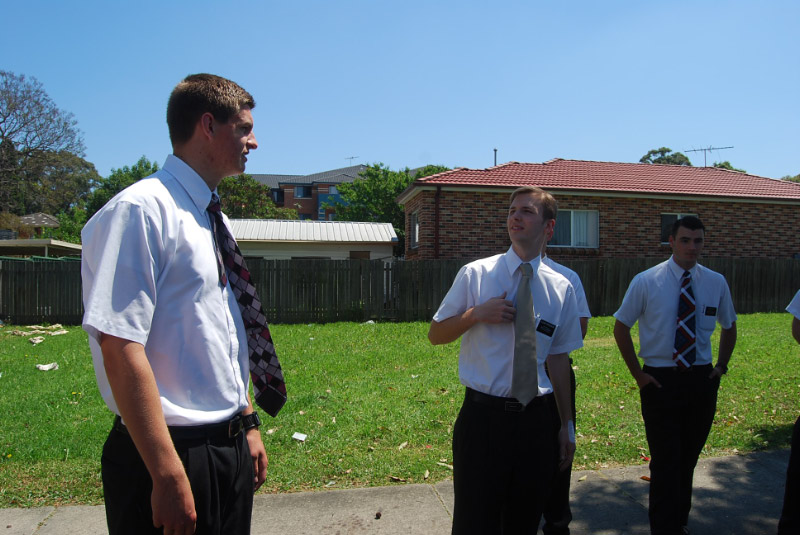
Elder Ferguson (middle) speaks as Elder Collinsworth (left) looks on. Photo courtesy of President and Sister Scruggs (10-18-'08).
Though bandaged and bruised, Elder Ferguson (middle) and Elder Collinsworth (left) survived a knife attack. Photo courtesy of President and Sister Scruggs (10-18-'08)

In a letter distributed to the families of the missionaries of the Australia Sydney North mission President Scruggs recounts the events of Tuesday, October 14: [Read more…] about Remember the Missionaries

Filed Under: News stories

All the News that’s Fit

July 10, 2008 by awyatt

An interesting “news” piece has appeared on the Signature Books website in the last few days. The undated piece, entitled Fair-weather Friends at FARMS and FAIR,” is interesting and somewhat amusing. Most interesting is why it would even appear as “news” on the website of a book publisher. It is not about one of their books or one of their authors; it is not about any of their employees; it is not about the company; it is not about the company’s financiers. What, then, makes a mention about FAIR’s analysis of a recent Book of Mormon geography publication news worthy?

[Read more…] about All the News that’s Fit

Filed Under: General, News stories

Same Sex Marriage, Equality, and California Mormons: A Response to Jeffrey S. Nielsen

June 27, 2008 by Lance Starr

As almost anyone not living in a cave is aware, the California Supreme Court recently ruled that the statute which limited “marriage” to a man and a woman was in violation of the state’s constitution, thus opening the door for thousands of gay people to enter into legally sanctioned marriages.

Even more recently, a voter petition to amend the California constitution was approved in California and will be on the ballot this fall. If approved, the constitution will be amended to state that marriage in California is between a man and woman. It would effectively override the ruling of the California Supreme Court.

The LDS Church has issued a letter to the Saints in California, seeking their active participation in getting the amendment approved by the voters. The letter represents a real threat to supporters of same sex marriage in California because, as was the case a few years back when a similar voter initiative was on the ballot, LDS members in California are numerous, organized, and have to the potential to swing the vote in favor of the amendment.

[Read more…] about Same Sex Marriage, Equality, and California Mormons: A Response to Jeffrey S. Nielsen

Filed Under: News stories, Politics

Jeff Lindsay reels in a big one

May 6, 2008 by Mike Parker

Over on Jeff Lindsay’s blog, Mormanity, he examines Gary Swank’s confusion about the differences between LDS and FLDS beliefs, and Swank’s serious use of Jeff’s satirical web site MormonCult.org as a source.

Check it out:

http://mormanity.blogspot.com/2008/05/hilarious-anti-mormon-attack-from.html

Filed Under: Anti-Mormon critics, News stories, Polygamy

Where the Lost Boys Go

April 27, 2008 by Keller

A recurrent criticism cropping up in the discussion on Egan’s New York Times article is that polygamy inevitably creates “Lost Boys.” These are young men that get kicked out of a polygamous community to reduce competition for a resource in short supply –that of marriage partners. One commenter put it this way:

A simple polygamous example involves 6 people:
one man has 3 wives
two men have none

In this model, one man’s gain is another man’s loss. I would like to explore, through some preliminary statistical analysis, why this isn’t an adequate model for 19th century Mormonism, but it may be relevant to contemporary FLDS. I say “may” because I do not have enough data about the FLDS to make a judgment. I can, however, address whether the criticisms lobbied at them apply to 19th century Mormonism.

[Read more…] about Where the Lost Boys Go

Filed Under: News stories, Polygamy

  • « Go to Previous Page
  • Page 1
  • Interim pages omitted …
  • Page 5
  • Page 6
  • Page 7
  • Page 8
  • Go to Next Page »

Primary Sidebar

Faithful Study Resources for Come, Follow Me

Subscribe to Blog

Enter your email address:

Subscribe to Podcast

Podcast icon
Subscribe to podcast in iTunes
Subscribe to podcast elsewhere
Listen with FAIR app
Android app on Google Play Download on the App Store

Pages

  • Blog Guidelines

FAIR Latest

  • Come, Follow Me with FAIR – Psalms 49–51; 61–66; 69–72; 77–78; 85–86 – Part 2 – Autumn Dickson
  • Come, Follow Me with FAIR – Psalms 49–51; 61–66; 69–72; 77–78; 85–86 – Jennifer Roach Lees
  • Come, Follow Me with FAIR – Psalms 49–51; 61–66; 69–72; 77–78; 85–86 – Part 1 – Autumn Dickson
  • Ministering— “That Ye Love One Another; as I Have Loved You”
  • Come, Follow Me with FAIR – Psalms 1–2; 8; 19–33; 40; 46 – Part 2 – Autumn Dickson

Blog Categories

Recent Comments

  • Nancy Farmer on Come, Follow Me with FAIR – Psalms 49–51; 61–66; 69–72; 77–78; 85–86 – Part 1 – Autumn Dickson
  • Nicko De Leon on In memory of Chandler “Chuck” Hendry
  • Becky Matson on In memory of Chandler “Chuck” Hendry
  • Dianna Powell on No One Walks Alone 
  • Ray on Come, Follow Me with FAIR – 2 Kings 2–7 – Part 1 – Autumn Dickson

Archives

Follow Us

  • Facebook
  • Twitter
  • iTunes
  • YouTube
Android app on Google Play Download on the App Store

Footer

FairMormon Logo

FAIR is a non-profit organization dedicated to providing well-documented answers to criticisms of the doctrine, practice, and history of The Church of Jesus Christ of Latter-day Saints.

Donate to FAIR

We are a volunteer organization. We invite you to give back.

Donate Now

Site Footer
