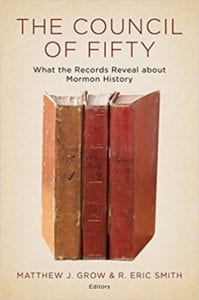
[For more information on the Council of Fifty, see Matthew J. Grow’s 2016 FairMormon Conference presentation.]
In September 2013, it was announced that the minutes from the Council of Fifty would be published as part of the Joseph Smith Papers project. This was significant because they had not been available for research, and so most of what was known of the council had been gleaned from journal entries of members and rumors spread by publications such as the Nauvoo Expositor, which were repeated over the years by each generation of critics. Besides being able to put these hyperbolic claims to rest, we now have new information about what happened during the Nauvoo period, and some new statements made by Joseph Smith and other early members of the Church.
The Council of Fifty was a secret organization formed in Nauvoo, made up of the leaders of the Church, as well as other men, including some nonmembers, with Joseph Smith at the head. Their purpose was to do civil business, separate from the ecclesiastical business done elsewhere. Under Joseph Smith, the three major functions involved Joseph’s presidential campaign, planning a “theodemocracy [that] would protect liberty and freedom ‘for the benefit of ALL’” [page xxxvi], and to find a place of refuge away from the government of the United States, which had failed them.
After the death of Joseph Smith the council was reconvened under Brigham Young, and dealt with the repeal of the Nauvoo charter, completing the temple, and finding a new place to settle. It was later reconvened in 1848, after settling in Salt Lake City, and functioned off and on until 1885. This book contains the minutes through January, 1846, and there are currently no plans to publish the rest, which would be beyond the scope of the Joseph Smith Papers. [Read more…] about The Joseph Smith Papers: Administrative Records: Council of Fifty, Minutes, March 1844-January 1846


The most sacred structure to Latter-day Saints is the Temple. Of course, what makes the Temple sacred has nothing to do with the building; it is because of the holy ordinances that are performed inside. The Church teaches that only through those ordinances are the greatest blessings available through the Atonement to be had1. The Church also teaches that Temple ordinances have been around since the time of Adam2. By contrast, most anti-Mormons believe that they are a modern invention, a mixture of Joseph Smiths imagination and plagiarized Freemason ritual. This is simply not true. Although not a comprehensive analysis, I hope to give throughout this post a glimpse of the plentiful evidences that these ordinances were practiced anciently, and that divine revelation to Joseph Smith is a much better explanation for their genesis than pretending he made it up.

Title: A Refuge from the Storm: The Priesthood, the Family, the Church