• Skip to primary navigation
  • Skip to main content
  • Skip to primary sidebar
  • Skip to footer

FAIR

  • Find Answers
  • Blog
  • Media & Apps
  • Conference
  • Bookstore
  • Archive
  • About
  • Get Involved
  • Search

Mormon history

Mythmaking and The Mark Hofmann Case

Start Here

Question
Did the LDS Church hide Mark Hofmann documents?
 
Short Answer
According to Steve Mayfield and document examiner George Throckmorton, many popular claims surrounding the Mark Hofmann case have become legends that are not supported by the historical record. The speakers argue that many alleged “cover-up” narratives arose from misunderstandings, incomplete information, or repeated retellings rather than documented evidence.
Key Takeaways
  • Many widely repeated stories about the Hofmann case originated from secondhand information.
  • Several claims about the Church purchasing documents to suppress them are challenged with documented ownership histories.
  • George Throckmorton explains that forensic document examination is complex and often cannot be reduced to simple tests like “cracked ink.”
  • The speakers encourage readers to evaluate sources carefully and distinguish documented evidence from speculation.

Summary

Summary

In this presentation, Steve Mayfield explores how many of the most common stories surrounding the Mark Hofmann case have evolved into accepted narratives despite lacking strong historical support. Using examples from books, articles, and online discussions, he examines claims that the Church created doctrine in response to the White Salamander Letter, secretly purchased controversial documents to suppress them, or influenced prosecutors to avoid a public trial. Drawing on his own research and conversations with key participants, Mayfield argues that these claims often grew through repeated retellings, incomplete information, or misunderstandings rather than documented evidence.

Mayfield emphasizes the importance of evaluating sources carefully, recognizing how misinformation can spread, and distinguishing firsthand evidence from speculation. He illustrates this principle with examples from his own research, acknowledging occasions when he himself repeated inaccurate information before discovering better documentation.

The presentation then transitions to forensic document examiner George Throckmorton, who offers firsthand perspectives from his sixteen months on the Hofmann investigation. Throckmorton discusses the complexity of authenticating forged historical documents, explaining that identifying a Hofmann forgery required extensive forensic analysis rather than simple visual clues. During a question-and-answer session, he addresses common questions about Hofmann’s techniques, the White Salamander Letter, the John D. Lee Scroll, and other controversial documents, while emphasizing the importance of careful scholarship, documented evidence, and professional forensic examination when evaluating historical claims.

TL;DR

TL;DR (Too Long; Didn’t Read)

Steve Mayfield examines several persistent myths surrounding the Mark Hofmann forgeries, including claims that the Church created doctrine around the Salamander Letter, forced a plea bargain, or secretly purchased documents to hide them. Using personal experiences and conversations with participants in the investigation, he argues that many of these stories grew through repetition rather than evidence.

George Throckmorton, one of the principal forensic document examiners on the Hofmann investigation, follows by discussing his role in the case, the challenges of authenticating forged documents, and answering audience questions about Hofmann’s techniques and later discoveries.

Note About the Slides in this Presentation

Note on Visuals:

The original slides from Steven Mayfield’s presentation are not available. 

Download the Paper

Click to Download

The Legend Becomes Fact

It says up here, “Smile, have fun, play nice.“

Not in my profession.

I had a paper planned, a great big paper planned for today, and then I noticed an article in the Salt Lake Tribune last Saturday about the FAIR conference in which Scott mentioned that we don’t attack people personally. We don’t deal with personal attacks. So you’re safe, George. I can’t give that talk, so I had to do something different.

My topic—and I’m going to go through some of these things very quickly because I think the more interesting part of this presentation is hearing from the man himself, George Throckmorton.

The Man Who Shot Liberty Valance

Over the years, George and I have had interesting conversations that we’ve talked about in reference to the Hoffman case and others. We like to quote statements out of movies, and our favorite one that relates to Hoffman, and what I think leads out in the mythmaking of the Hoffman case, is a statement made at the end of a movie called The Man Who Shot Liberty Valance, starring John Wayne and Jimmy Stewart. In my opinion, the greatest western of all time.

For those who don’t remember this movie, I’ll run through it very quickly.

The movie starts with Jimmy Stewart and his wife returning to a little town in the West called Shinbone. He has been a U.S. senator and an ambassador, and he’s returning with his wife to this little town to bury an old friend named Tom Doniphon, played by John Wayne.

As they come into town, the local reporter sees him, grabs the editor, and they come over and say, “What is this great statesman, this senator, doing in our little town of Shinbone?”

They said, “We’re here to bury a friend.”

The editor pushed the issue. “We need to talk to you. Who is this Tom Doniphon?”

The Story of Tom Doniphon

So Jimmy Stewart agrees to talk with them and be interviewed, and he relays the story about how, as a young lawyer, he came to town, got involved in the local politics, and came into conflict with a local outlaw named Liberty Valance, played marvelously by Lee Marvin.

During the conflict and the fight over becoming a state from a territory, he is challenged to a duel by Liberty Valance. At the same time, he’s in competition with John Wayne over the girl.

After the election for delegates, he meets Liberty Valance on the street and shoots and kills him. He now becomes a hero and is known as the man who shot Liberty Valance.

They go to the territorial convention, and he decides to leave when he’s pressured or accused of being a murderer. As he’s about to leave, John Wayne pulls him aside and explains to him, “You did not shoot Liberty Valance because during that shooting I was in the alley and I shot and killed him, not you.”

They reenact that scene.

He then proceeds to go back, becomes the delegate, they get statehood, and he becomes governor, senator, and wins the girl.

Well, after he’s explained this whole story and the reporter is writing all the notes, the editor takes these notes, tears them up, and throws them in the fire.

He’s asked, “Well, Mr. Editor, why did you do that?”

He got up, turned, looked at Jimmy Stewart, and said, “This is the West, sir. When the legend becomes fact, print the legend.”

This fits in perfectly for Mark Hoffman.

Early Examples of Hoffman Myths

Let me share quickly some of the examples I believe exist. Some of these are kind of fun. Some of these we’ve all heard.

First one is our friend Ed Decker from Saints Alive in Jesus. This is on his webpage. He has a book called Bearing Testimony of Truth, compiled and edited by Derek S. Harden. It’s been on there for a few years, and this morning it still was.

This is a personal manuscript written by this gentleman, and there’s some editorial notes that Ed Decker wrote at the beginning:

“This manuscript was completed and submitted during the brief time that the Mormon Church had accepted as true a fraudulent work generally called the White Salamander Letter by the infamous forger of Mormon manuscripts, Mark Hoffman. We have notified the author that this needs to be cleaned up and removed from the book and will make the correction as soon as we receive the corrected copy.”

Okay. It still is.

Interesting that the LDS Church created new doctrine to explain that a white salamander was really an angel, and when the hoax was revealed, just as suddenly undid the doctrine—all without an apology or a blush.

Wow.

That’s kind of—you know—to eliminate something that never was really there. But I find that kind of humorous, that we had a doctrine as such.

I must have missed that meeting.

The Jerald and Sandra Tanner Narrative

Next one is an article out of the Salt Lake City Weekly from March of 2003. It’s a story about Jerald and Sandra Tanner and Utah Lighthouse Ministry.

Reviewing the Hoffman case, it says here:

“While many were taken by the notorious document forger and bomber Mark Hoffman, Jerald, with typical uncompromising accuracy, was not bamboozled. Collectors of historical documents from the LDS Church to the Library of Congress and Sotheby’s were buying Hoffman documents as fast as he could manufacture them. Hoffman sold forged letters of famous Americana, and his major focus was forging early Mormon historical documents that were extremely damaging to LDS doctrine and early Church leaders. All the while, only Jerald Tanner remained unimpressed and unconvinced of their authenticity. In 1984, he publicly announced his misgivings, calling Hoffman a forger.”

Now we’re talking about 1984. This is a year before the homicides.

I wondered about this. Now, it’s pretty clear that Jerald and Sandra had some serious doubts and problems with the Salamander Letter, but not all of them.

Not too long after this article came out, I visited with Sandra Tanner at their home in their bookstore, and I asked her, “Is this a misprint? Is this a misunderstanding by the Weekly?”

This is what Sandra told me:

“No. No. Jerald did have doubts about all the documents and really believed that Mark was a forger, but he had no solid proof.”

Okay, this is eighteen years after the fact.

Now this is being revealed in this article, but I have some serious problems with that in the fact that, in some of the writings of the Tanners following the homicides—and let me make a little side note here because they made reference to the bombings and the forgeries of Hoffman.

Call Him What He Is

One thing that has amazed me over the years is that we always refer to Hoffman as a bomber, or the bomber-forger. We seem to be afraid to say what he is.

He’s a murderer.

The forgeries and the bombings are secondary to the fact that he killed two people.

So if I had my preference, we’d call him what he is—a murderer.

More Myths Surrounding the Hoffman Case

But anyway, I asked Sandra that, and she just said, “Well, he just didn’t have any proof.”

Following the homicides, in some of the writings they suggested that Mark wasn’t that good of a forger or writer, that he must have had help. They suggested there was another individual who was forging the documents, and Mark was the middleman. When this person either died or stopped doing the forgeries, Mark started doing them all himself. That’s when they became sloppy and so forth.

Even as of last October, at a conference sponsored by an organization George belongs to—the Southwest Association of Forensic Document Examiners—Sandra and Jerald were there, and she was even asking people if they had any ideas whether anybody was helping Mark.

So I’m getting two different stories here.

But the significance of this is the fact that you read a lot of the webpages and some of the chat rooms, and they always say Jerald was the only one who knew that Mark was a forger. Everybody else believed him.

That isn’t true at all. There were others who had doubts too, but I find that to be one of the myths that has started.

The Myth of the Hoffman Plea Bargain

Another one of the myths that is frequently read about is the idea that there was going to be no trial of Mark Hoffman because the Church did not want information passed out, and the fact that the leadership of the Church—whoever they are—forced a plea bargain.

The man that will be preceding me here, Mr. Throckmorton, has explained to me that on the day he was asked to leave employment from the Salt Lake County DA’s office investigating the case, he was there when District Attorney Yokum instructed Bob Stott, the lead prosecutor, that he would plea bargain the case.

I’ve also heard from the mouths of Jerry Doria, Dave Briggs, and a few other people involved with the case that the Church had nothing to do with the plea bargain.

This came strictly from Mr. Yokum.

Yet this is another story that you will read on webpages and chat rooms—that the Church forced the plea bargain because they didn’t want President Hinckley to testify, or have to, or any other General Authority.

The Solomon Spalding–Sidney Rigdon Document

Now another fun one that I found interesting is this document here.

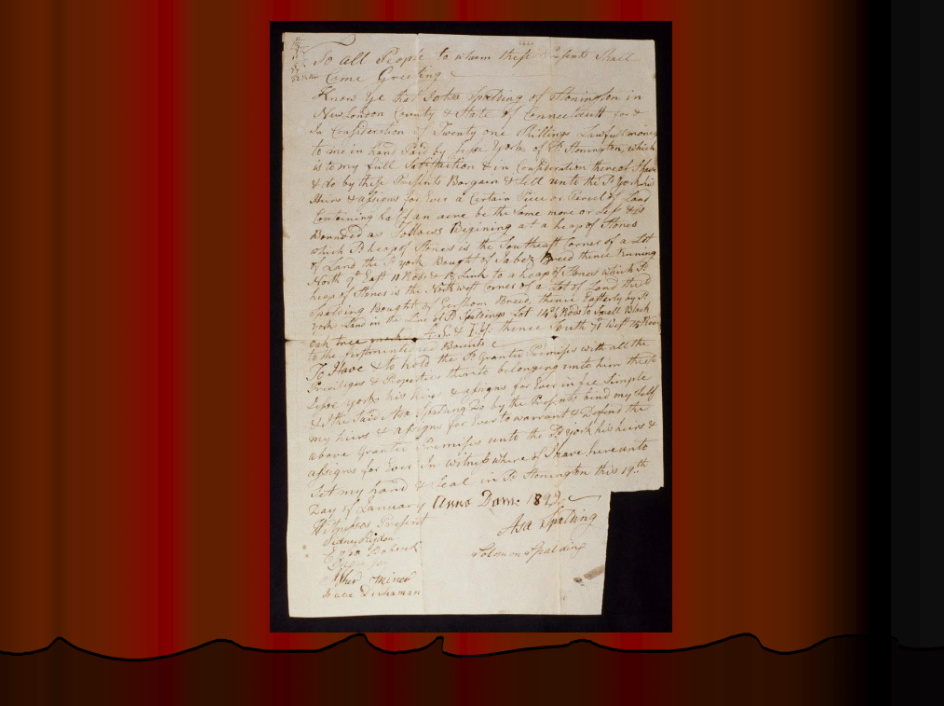
Here we go. This is the infamous Solomon Spalding–Sidney Rigdon land deed document that Mark came across.

Actually, it’s a legitimate old land deed where a gentleman named Asa Spalding is selling some land to his wife’s cousin, Jesse York. Well, Mark somehow got ahold of it.

Where? We don’t know.

But he proceeded to make some changes. Here you see, down at the bottom, the name Solomon Spalding. Over here you see the name Sidney Rigdon.

Now this is an interesting document because for years, on that Spalding issue, the claim was they didn’t know each other, and here would be some proof that they knew each other.

But it turns out these were added names. As you see over here on the date, it says 1822.

Well, the actual date is 1792.

Mark added the date at the top—1822.

This was a document that he showed Elder Oaks, and to where Elder Oaks went and signed for the $185,000 loan to possibly purchase the McLellin Collection.

In fact, Mark claimed this was part of the McLellin Collection.

A few weeks after showing it to Elder Oaks, he decided he needed some quick cash, so he took it down to Cosmic Airplane and sold it for $400.

Even though the guy who bought it, Steve Barnett, said, “There’s a problem with the dates because Spalding died in 1816.”

And if you went to the original date, 1792, Sidney Rigdon hadn’t been born yet.

But Mark convinced him.

He said, “Well, that’s not the same Solomon Spalding, but will you buy it for the Rigdon autograph?”

He paid the $400 for it.

Claims That the Church Purchased the Document

Now, a few years ago a book came out—I don’t know if you can see it—but it’s called Mormon Conspiracy by Charles Wood.

I got it at the Utah Lighthouse Ministry. 1

This is what he writes:

“The First Presidency was so impressed with Hoffman’s discovery of the Anton Transcript that they called the press conference at which they announced the new discovery and commended Hoffman for his efforts. Hoffman followed the Anton Transcript with several non-faith-promoting forged documents, which were quickly bought up by the First Presidency and hidden from the membership and the public. One of these forged documents included one that linked Sidney Rigdon, second to Commander Joseph Smith, to Solomon Spalding.”

Okay.

Provenance of the Spalding-Rigdon Land Deed

2

This document here.

Now in 2002, when I was reading this book, I had to read it a number of times.

I had to wash my eyes out to make sure I was actually reading it because, at that particular time, as I read this in my apartment, this document that you see in front of you was sitting on my table in my apartment.

See, because I owned it.

The Church never owned it.

At the time:

  1. It went from Cosmic Airplane,
  2. Was used and examined by George as part of the investigation,
  3. Then returned to Cosmic Airplane, at which time the owner, Bruce Roberts, sold it to Ken Sanders in 2000.
  4. I bought it from Ken Sanders in August of 2000.
  5. Right now—in October of 2004—I donated it to BYU so it’s preserved down there.

But here is a myth that this man is saying: the Church bought it as one of the documents they bought to hide.

The Church never owned it.

Correcting the Record

I again asked Sandra Tanner.

In fact, it was funny because not too long after that, I was on an airplane to Pasadena to speak at a Sunstone Symposium, again with George, and happened to get on the same flight with Jerald and Sandra Tanner and sat next to them on the plane.

So I asked them about this, since I bought the book from them.

I mentioned, “Well, you know, there’s an error in the book.”

Sandra said, “Oh, really?”

I showed it to her and said, “You know, this is wrong.”

“Well, how’s that?”

“You know who owns that document?”

Sandra says, “Who?”

I said, “Me.”

There was that long pause as she and Jerald looked at me, and she quickly recovered and said, “Well, you know, there’s so much information and material out there that he could have been mistaken or gotten bad information.”

Now think about it.

That is a very true statement.

Over the last twenty-one years now, that has been exactly the problem we’ve had with this case.

We have this idea that the Church was buying these documents to hide them.

Yet a book here by Dean Jessee, The Personal Writings of Joseph Smith, published in 1984—not 1884, 1984—has six of the documents listed in here. 
The majority of the documents that Mark forged were not controversial. They were not testimony-shaking. They were simple little things.

There was no reason to hide them. No reason to suppress them.

Were the Documents Really Hidden?

Yet today you can read on some webpages, like our friends from Recovery from Mormonism, who have these great theories that the Church was buying these things to hide them, spending millions of dollars so that no one would ever see the light of day. 3

Now I’m thinking, okay, all these other documents were being bought by the Church and other collectors, very publicized in a lot of cases, but we do have two that could be questioned as having been hidden.

One being the Josiah Stowell letter, and the other one was the letter from Bullock to Brigham Young, referencing the Joseph Smith blessing.

There might—if you read Victims—be explanations on why these things were not immediately released.

But now we have people talking about the Church hiding these things.

I’m saying, well, if the Church is as evil and satanic as you make it, why would the Church buy documents at high prices just to hide them? That’s why man invented matches and paper shredders.

Yet they’re kept. Why is that?

I mean, if you’re going to give them credit… If we’re going to be sinister, let’s go all the way.

But we still have them. In fact, last year—or actually it’s been a few years—Kenny Sanders had a symposium in 2002 on it, and they had found another document in the Church archives that they realized had come from Hoffman.

These things are still out there.

So it’s, again, a myth that has just taken on a life of its own.

Evaluating Claims About the Hoffman Case

Let me give you some pointers on what to do when you hear various things and read them.

A lot of people here, if you’re like me, kind of browse the Internet and Recovery from Mormonism and all these places. The spiritual arm-twisting—that one claim this week they did on prominent rich Mormons buying these documents for them…

  1. First of all, consider the source. Consider the source of the person writing these things.
  2. Number two, realize that during this whole time, a lot of people were getting information about these documents and material, but the person they were getting it from was Mark. And Mark was very good at lying and telling stories. Just because you may have two persons who were closely involved with him and they tell different stories doesn’t mean these people are lying.

You’ve got to find out where they got their information. The same thing goes for other people who had information. Sometimes they got it from friends or acquaintances who got it from Mark.

The same thing happened during the police investigation. They were hearing stories from people who had talked to Mark, and they were passing them on, and they were confused sometimes because the stories weren’t clicking.

Or these people were told one thing, but other people, like the Church authorities, weren’t telling us the same story.

Be very careful about that.

Why Bad Information Spreads

Also, because of the nature of the case—the homicide—it made a lot of people nervous. And a lot of people didn’t know how to handle themselves or how to deal with it because you don’t usually, in your life, come across being involved in a homicide case. Sometimes people’s initial reactions weren’t what the police liked.

But, as George can tell you, after he was able to get in there, the Church became very cooperative. Although the story goes that the Church was not cooperative, and some people have claimed that even President Hinckley led a stalling of the case—that he was interfering with the investigation. George can probably give us some highlights on his feelings about that.

But be very careful about people who might take a story and embellish it.

An Example of a Story that was Embellished

I have a great one that relates here to FAIR—of people taking information and getting it misconstrued.

A few months ago, Scott and FAIR were kind enough to publish a letter that I wrote to Scott regarding some items on the Dead Sea Scroll—or rather, the Deadly Scroll—the lead plate that was found down in Page, Arizona, at Lee’s Ferry a few years ago.

I made a comment that I had thought was true about a document—I may even have it here someplace.

Here we go.

This was written by Mark Hoffman in prison, listing the forgeries that he had done. Now, I had always thought, and been told, that it was following a suicide attempt. When he was up at the hospital, that this is when they found it during a search of his cell. Well, rereading some of the books, I discovered that didn’t happen after his suicide attempt.

That happened a few months earlier. When he was being interviewed regarding some threats that he had made against George and some members of the Board of Pardons, they did a cell search and came up with this list.

So even I had bad information. I wrote a letter to the Deseret News on that, and I put it in the article. Now I’m going to have to change it.

It happens. I’ve seen this happen all the time. Bad information. No one intends to be deceiving, but:

  • you just hear something, and
  • your own mind regurgitates it, and
  • it comes out differently.

So we have to be careful of that.

Oh, by the way… You’ll notice down here at the bottom the name John D. Lee. Okay…

Just a thought.

Anonymous Sources and “Secret” Information

Also be careful when people talk about the Hoffman case where they have information but they give you no names or sources. This is one of the things that Mark liked to play, and people were willing to go along with it.

“Keep secrets.”

We still have it. I got this all the time from George.

“I can’t tell you.”

Then I’d threaten to break his legs…

…and he still wouldn’t tell me.

Introducing George Throckmorton

So anyway, I’m going to turn the time over now to George so we can hear what he has to say.

But before I turn it over to him, I want to make some personal comments about Mr. Throckmorton. And these are nice things. So you don’t have to worry, Scott.

Back in 1991, I came over from Colorado because my career was going down the tube and my love life wasn’t there anymore. Through my good friend Van Hale, I worked in his business for a while. Then in 1994, I hired on to work in the crime lab with the Salt Lake City Police Department and got back into my chosen career.

A year later they changed the supervision of the crime lab from an officer or sergeant to a civilian, and they brought in George Throckmorton.

The thrill that I have had for the last ten years of working under his direction—literally sitting at his feet, hearing stories and information about the Hoffman case—has been one that has not only enriched my professional career, but also my avocation of things Mormon.

He has been kind enough to invite me into his life and his research and included me on things, even though he sometimes would play games like with the John D. Lee scroll. But that’s another story.

George Throckmorton as a Valued Friend

I want to tell you how much I have appreciated the opportunity to get to know him as a friend.

I care about him dearly. He is a dear friend, and I love him dearly. I hope that he’s here with us a long time because there is so much to share with us.

I want to close with this. As George comes up, I have a question for him regarding a statement that I read here in Mormon Murders, one of the greatest books on the case, I’m sure.

This is during the time that George and his associate Bill Flynn were examining the documents down at the Church archives.

It says:

“On the day Flynn left for Arizona”—Bill Flynn is from Phoenix, Arizona—”a Church delegation led by Gordon Hinckley visited the conference room. They looked suspiciously at all the equipment while Throckmorton and Flynn explained the process. They asked some questions, but, to Flynn’s astonishment, never asked the most obvious question of all: Are the documents genuine?“

George, as you come up here, I’d be very interested to hear about this experience.

What is it like to be in the middle of this—to have the leader of the Church, although at the time he was a counselor, but the man leading the Church who became the prophet? What was that experience like?

Maybe you can share with us, and what do you think? Why didn’t he ask that question when he was there and you were there in his presence?

George Throckmorton Responds

If I can respond to Mr. Mayfield’s question…

As I advance in age, I have a tendency not to remember certain things, and to remember other things even more than they actually happened, I guess.

But as President Hinckley came in to visit us that day…

I don’t remember it at all. Because it just never happened.

In fact, the closest association—and some of you may have heard this story, I’ve told it once before—the closest association I ever had with President Hinckley was because of my friends.

I’ve been in law enforcement, as was mentioned, almost forty years. My son used to work at the Church Office Building. It was his job to get the cars ready for the General Authorities to take to their various assignments. This is the story that I heard about President Hinckley, which took place several years ago.

A Story About President Hinckley

He liked to hot rod. Is that the right expression?

As he came to pick up a new car—they always have a chauffeur to drive around the First Presidency and some of the Apostles that can’t drive too well—but as he came and saw the new car, and his chauffeur was ready for him, he looked at it and said,

“I’ve always wanted to drive a new car. Is it all right if I drive?”

Well… What’s the chauffeur going to say? “No” ?

But the chauffeur said,

“Well, you know, I’ve always wanted to sit in the back seat, too.”

So they started driving down to Provo. President Hinckley’s foot got a little bit heavy. They were going a little too fast. As he looked in the mirror after hearing kind of an unusual noise, he saw some red and blue lights flashing behind him.

He pulled over to the right, and the highway patrolman came up and looked in the car. He went back, got on the radio, and called his dispatcher.

“I need to speak with my supervisor.”

The supervisor got on and said,

“What’s wrong?”

He says,

“I just pulled over a very important person.”

The supervisor said,

“Well, who is it? Is it Mayor Rocky?”

He says,

“No, more important than him.”

“Well, is it the governor?”

“No, more important than him.”

“Is it the President of the United States?”

The policeman says,

“No, more important than him.”

He said,

“Well, who is it?”

The policeman says,

“I really don’t know, but President Hinckley is his chauffeur.”

That’s the only story I know of President Hinckley. That’s the closest I’ve ever come to him.

George’s Role in the Hoffman Investigation

But I can say this. My involvement in this case, again, lasted for sixteen months. I entered the case about six weeks after the bombings took place.

I was working for the Attorney General’s office at the time as an investigator of white-collar crime with a background in forensic examination of documents.

There are many, many stories.

The one thing I learned, relating to what Steve said, is that even the investigators have different theories on what happened. There were eleven of us for sixteen months. If you talk to one investigator, he will say one thing. You talk to another one, he will say something else.

The reason being is we did different interviews. We spoke to different people. About every morning we would meet together as a group and discuss what had happened. I heard a lot of stories from the other investigators.

Then we would get our assignments, and we would go out to conduct our investigation. There are a lot of things that I heard and that I experienced firsthand that contradict so many things that are in the various books that are out there.

A Brief Overview Instead of a Full Presentation

What I have done today—I understand we’ve only got about twenty minutes left, if I understand how much time I have. There’s supposed to be some cards being passed around. Are those questions?

Okay.

I’m not going to tell you a whole lot about my involvement other than I’m going to answer questions that may be here. If anybody else has any, raise your hand now and do it because in about ten minutes I’ll be answering them.

Most of you know a lot about this case. As I’ve given talks in the past, I talk about the elementary things that happened, and I’m not going to do that today.

I’ll be happy to answer any questions. But what I have is a brief overview of many things. I took over seven hundred slides of different documents. I’ve never shown them. I never will be able to show them.

We spent three days once in our professional organization in Palm Springs, California, several years ago going over them, and I was unable to show them all then. What I have done is put a montage of slides together which will give you a brief—but more or less thorough—overview of the case itself.

I’m going to need some help up here on how to turn this light off so we can start the others going. Then, when we’re through, I’ll try and answer these questions.

You’ll just have to read these. I’m not going to say a whole lot.
Audience Questions

There’s three questions up here… Oops. Four… Five questions. That gives me about a minute each.

“In your opinion, what do you think caused Mark to turn to the dark side?”

  • I have no idea.
  • I don’t know him.
  • I don’t know anything about him.

All I know is the documents.

How Can You Identify a Hoffman Forgery?

“How does anyone tell a Hoffman forgery?”

I don’t know.

Myself and Bill Flynn did research for six months before we finally figured out how he did his forgeries because they were so unique and used techniques that we had never seen before.

As I get documents now asking if there is…

For instance, one of the things I’m sure a lot of you have heard is about the cracked ink. Well, realize it’s not always cracking, and it only shows at a particular degree of magnification.

So if you see cracked ink, that doesn’t mean it’s forged. All that means is it’s cracked.

It’s difficult to tell, and that’s one of the reasons why he was successful. It takes so long to do an examination.

On the Salamander Letter, for instance, I spent 120 hours on that one page. Who can afford to pay my fee to get a document examined if I’m going to spend 120 hours on it? Of course, I don’t spend that long on all of them.

And the Anonymous Employee?

“Do you know who the anonymous Park Service employee who discovered the scroll was?”

Yes, I do.

What Book Covers This Story Best?

“In your opinion, which book most accurately reflects the events surrounding the case?”

Obviously the one I wrote that’s sitting in the back.

The Mormon Will

“Any possibility Mark forged the Mormon Will?”

Is that Howard Hughes’ will? This was before his time. It was found in 1976.

So I don’t think so.

The Neely Bills

“I’ve been told by someone at Church Archives that Mark Hoffman had been poking around Norwich, New York, prior to Wesley Walters’s discovery of the Neely bills for the 1826 trial. How far-fetched would a Hoffman connection to these documents be?”

I went back to New York in April to look at that document. I don’t know when the Church is going to release…

They’re hiding it again.

[laughter]

I don’t know when they’re going to release the results of it. I don’t know whether the people in Norwich have released it. The historian back there…

I don’t feel free to discuss that at this particular time. When they hire me, I do it confidentially. Secret. Yeah. Secret, as Steve said. I do it secretly.

But anyway, the question does not ask whether the document is genuine or not.

The question says, “Did Mark Hoffman…”

Was he back there? Well, he was back there, but not at the time this document was found.

Steve has some things he wants to elaborate on.

All I can say is thank you very much for allowing me to be here. If anybody has any special questions, I’d be happy to answer them if I can. Thank you very much.

[Applause]

Mayfield’s Final Comments

Quickly… He skipped this.

The John D. Lee Scroll

Do we know the name of the anonymous Park Service employee?

Well, he’s not anonymous. His name is Al Malquist. He’s been down there for forty-some years.

The best way I can describe Allan is that he’s the man with the keys. He’s the one that, when George and I went down there to tour Lee’s Ferry, got us in. He’s been a very helpful person, and as we’ve examined the scroll, he’s been a great supporter.

This past spring I went with a tour down with Weber State University to Lee’s Ferry, and he was more than glad, on his day off, to come and give a tour.

  • Very congenial.
  • Very friendly.
  • Very open.

Both George and I are very impressed with him.

The John D. Lee Scroll

“Are we fairly certain that the John D. Lee scroll was a Hoffman forgery?”

Everybody kind of assumes that.

The best answer I can give you is I have a $100 answer and a ten-cent answer.

The $100 answer is that there’s no hard-core proof or evidence that Mark had anything to do with it. But there is circumstantial evidence that may connect him to it or may show it might be part of his work.

I am not willing to excuse him, to use a legal term, as a suspect in manufacturing or producing the Deadly Scroll. That’s my $100 answer.

The ten-cent answer? I don’t know.

Search topics

Mark Hofmann; Hofmann forgeries; White Salamander Letter; Salamander Letter; George Throckmorton; Steve Mayfield; forensic document examination; forged Mormon documents; McLellin Collection; Solomon Spalding; Sidney Rigdon; Anton Transcript; Church history documents; document authentication; historical forgery; Mormon Murders; Dean Jessee; Gordon B. Hinckley; plea bargain; Hofmann investigation; Church archives; forensic document analysis; Salamander Letter authentication; John D. Lee Scroll; Deadly Scroll; Lee's Ferry; Bill Flynn; Mark Hofmann investigation; historical manuscripts

CES Letter; Mormon Church history; Mormon Church criticism; Mormon apologetics; LDS Church documents; LDS history controversies; Mormon document fraud; White Salamander controversy; Mormon historical documents; Church cover-up claims; LDS Church evidence; Mormon forgery claims; anti-Mormon claims; Mormon myths; LDS apologetics; Restoration history; Book of Mormon criticism

Frequently Asked Questions

Did the LDS Church invent doctrine because of the Salamander Letter?

The speaker argues that this claim is a myth and points to its repeated circulation despite lacking supporting evidence.

Did the Church force prosecutors to accept a plea bargain?

According to individuals directly involved with the investigation, including George Throckmorton, Steve Mayfield states that the decision to pursue a plea bargain originated with the district attorney rather than Church leaders.

Did the Church secretly buy Hofmann documents to hide them?

The presentation argues that many Hofmann documents were publicly known and published, and that several items frequently cited as "hidden" were never owned by the Church at all.

How difficult is it to identify a Mark Hofmann forgery?

George Throckmorton explains that authenticating Hofmann's work required extensive forensic examination. He notes that a single page of the Salamander Letter required approximately 120 hours of analysis.

Does cracked ink prove a document is forged?

No. Throckmorton explains that cracked ink alone is not evidence of forgery. It appears only under certain conditions and magnification and must be evaluated as part of a complete forensic examination.

Putting Together an Awful Story

May 21, 2014 by Stephen Smoot

picard-facepalm2An anonymous author* writing at the MorningStar Post blog “had an awful time putting [a] story together” on “the number of Latter Day Saints [sic] that are actually considered active,” and that Mormons are, per the title of the post, allegedly “leaving their religion in record numbers around the world.” (Link) What is the cause of this dire situation for the Church, and why was it so awful for the author to write on it? According to the article, which quotes an unnamed “high-ranking leader in Salt Lake City,” it is because “of unprecedented scrutiny of our doctrines and beliefs and stemming from the white washing of our own history, and the rise of social media sites where members and potential converts can learn of our hidden problems.”

This claim has been made before on many websites critical of The Church of Jesus Christ of Latter-day Saints. It is a common trope for critics to say that the Church is nearing extinction because of the supposedly damning real history of Mormonism it has been hiding from its unsuspecting members. Instead of revisiting these claims in general, I want to focus specifically on the content of the blog post published by the MorningStar Post. To put it bluntly, and very charitably, the article is highly problematic. The author’s use of anonymous sources is extremely questionable, and both factual errors and blatant plagiarism also plague the article. In short, the article makes totally dubious and unsubstantiated claims about both LDS Church hierarchy and Mormon history. [Read more…] about Putting Together an Awful Story

Filed Under: Anti-Mormon critics Tagged With: Faith Crisis, Gospel topics, Joseph Smith, magic, Marlin K. Jensen, Mormon history, seer stones, Steven E. Snow

Coping with the “Big List” of Attacks on the LDS Faith

May 20, 2014 by Jeff Lindsay

One of the challenges in defending one’s faith is coping with critics who use the “Big List” technique in their attack. This involves throwing out numerous arguments to create the impression of an overwhelming barrage that decimates the faith in question (see the related post, “If Only 10% of These Charges Are True…“). The Big List is loaded with barbed questions that weren’t written in search of a real answer. If there is a good defense to the arguments raised at first, never mind, there are many more to be launched in different directions.

As with many topics in fields like history, science, and religion, the issues raised in Big List attacks are often complex and may require exploring abundant details to answer questions properly. Even for those who are prepared to answer questions on a wide variety of topics, the time it takes to lay a foundation and properly answer a question can be taken by the instantly impatient critics as an admission of weakness and confirmation that they are right, and then it’s time to move on to the next attack and the next. If reasonable answers are promptly provided for some attacks, or if the alleged weakness on further examination actually proves to be evidence in favor of the faithful position, the response can be ignored as new attacks from the Big List are hurled out.

This doesn’t just happen in anti-Mormon attacks. Attacks on many other faiths use the same approach. Interesting, attacks on some aspects of modern science by religious fundamentalists or young earth Creationists also may rely on the Big List approach, much to the exasperation of scientists who know there are good answers to the attacks, but often may not be able to adequately deal with the barrage of questions from critics not really interested in the answers. Some scientists call the tactic the “Gish Gallop” after Duane Gish, a Creationist noted for hurling numerous brief arguments to overwhelm opponents in debates on evolution.

One interesting recent example is discussed by famous science blogger PZ Myers in the post, “No! Not the list of stumpers again!” at Pharyngula. Myers writes:

There’s a common tactic used by creationists, and I’ve encountered it over and over again. It’s a form of the Gish Gallop: present the wicked evolutionist with a long list of assertions, questions, and non sequiturs, and if they answer with “I don’t know” to any of them, declare victory. It’s easy. We say “I don’t know” a lot.

Jack Chick’s Big Daddy tract is a version of the creationist list, and contains a fair amount of fantasy as well. You know what they believe will happen: they’ll ask that one question that the scientist can’t answer, and then they’ll have an epiphany, a revelation, and realize that all their science is a lie, at which time they’ll resign from their university position and join a good bible-believin’ church.

It happens to me all the time, too. At one talk I gave, there was a woman at the door who had printed a 5-page, single-spaced list of questions, and she was telling everyone going in to ask me to answer them — I invited her to come in and listen to the talk and ask them herself, and she ran away. I’ve had a Canadian creationist do the same thing, and then I talked to him for several hours in the hallway after the talk. He seemed stunned and angry that I actually had answers for most of his questions. I have been confronted by people with questions (more like ignorant assertions) about biology, who once I’ve answered them and reveal that I’m a biologist, switch to asking me about geology and the Big Bang, to get me into a corner where I’d have to say, “I don’t know.”

This approach, often launched by some of the same religious folks who like to denounce The Church of Jesus Christ of Latter-day Saints, is painfully familiar to me.

By the way, for the record, I believe in God and believe that He is the Creator, yet believe that science and religion will ultimately be compatible when properly understood. I have no problem with the earth being billions of years old and with evolutionary tools being part of God’s toolkit for preparing a planet like ours for the miraculous spectrum of life that we have here. While I disagree with the arguments used by many Creationists, as one who loves science, I definitely believe that the majesty of the cosmos and the many intricacies of life cannot be reasonably explained as mere accidents, but are evidences of a remarkably clever and artistic Creator. So while I do not share some of PZ Myers views, I can relate well to the frustration of being hit with Big List attacks from religious critics not really interested in understanding or dialog.

One of my first experiences in helping to teach the Gospel after graduating from school and taking my first job in Appleton, Wisconsin involved a young college student, a new LDS convert, who had been given volumes of anti-Mormon literature by her former pastor. She came in with a stack of books, relying especially upon a thick tome published by a popular anti-Mormon organization. She asked one pointed question after another, all of which turned out to have reasonable answers, in my opinion, that we were able to offer on the spot. We dealt with them one at a time, turning to answers from the scriptures, when appropriate, or making points based on logic or other sources of information.

After about 40 minutes of this, she grew impatient and said something like, “Look, maybe you’ve got answers for the questions I’ve raised, but there are hundreds more arguments in this book. How can the Church be true when there are so many arguments against it?”

I said that it’s easy to make arguments against anything. I reminded her of the days of early Christianity when there were numerous false witnesses against Christ, when there were paid witnesses who said that the tomb had been raided by Christians to fake the Resurrection, when all the elite religious leaders of the Jews spoke against Christ, and when the whole Roman world seemed to speak against Christ and the Christians. There were volumes and volumes of arguments against the Church back then, too. “If you were living them, how could you see past the massive arguments and recognize the divinity of the Son of God and the truth of Christianity?”

Unwilling to acknowledge the importance of a spiritual witness, she returned to her anti-Mormon books. I pointed out that while we had examined only a few of the arguments, the ones she had raised had reasonable answers, and some even demonstrated a lack of integrity on the part of the authors. Her answer surprised me: “I don’t care. Even if only 10% of that book is true, that’s enough to prove the Church is false.”

Ah, the fallacy of the Big List, a key tool in the Adversary’s arsenal. Impress them with shear volume, wear them out with endless attacks, and many will succumb, overwhelmed by the image and impression of strength.

A few years ago I received a letter from a former LDS member explaining why he and his wife were leaving the Church. In that letter, he acknowledged that there may be “excuses” to deal with each anti-Mormon argument when taken individually, but that taken together as a whole, the case against the Church is overwhelming. He then listed a barrage of arguments, mentioning DNA and the Book of Mormon, anachronisms, 4,000 changes in the Book of Mormon, racism, polygamy, the Temple and masonry, etc. — problems that each can be dealt with if one takes the time to understand the issues and examines the assumptions behind them. Even then, one must be willing to recognize that there always will be some gaps in our understanding and that no amount of evidence and study will remove the need for faith or replace the power of a witness from the Holy Ghost. But in many cases, there are answers, sometimes powerful answers that turn apparent weaknesses in the Book of Mormon, for example, into strong evidence for authenticity. Such insights do not come from a superficial glance at the text and related literature. Sadly, he became another victim of the fallacy of the Big List.

There are tough arguments, indeed. DNA and the Book of Mormon is an example of this. For a meaningful understanding of the issues, one must identify assumptions and evaluate information from a variety of perspectives. In so doing, one can come away with a better understanding of what the Book of Mormon is and what it is not. But the Adversary would have us just fold based upon a superficial examination: “Wow, there’s no obvious Jewish DNA in the Americas. End of story!”

To help those coping with Big List issues, I’ve begin compiling my own list of recommended reading for students of the LDS religion. I hope it will be helpful to some. I’m not saying that you have to read this list before you leave the Church (or join it), but if you’re willing to look at answers and evidences, it might be a great place to start.

The Gospel is true, and the Book of Mormon is a divine, authentic book of scripture, in spite of whatever mountains of books and brochures against it the enemy can mount. And Jesus is the Son of God, no matter how many false witnesses and PhD’s and celebrities take a stand against Him. It’s not about who can shout the loudest and longest, but Whose gentle voice we listen for amidst the senseless shouting of men.

*Cross posted from Mormanity.

Filed Under: Anti-Mormon critics, Apologetics Tagged With: anti-Mormonism, DNA and the Book of Mormon, Mormon history

Revised or Unaltered? Joseph Smith’s Foundational Stories

Jump to Transcript

Start Here

Question
Did Joseph Smith revise the First Vision story over time?

Short Answer
Critics sometimes claim that Joseph Smith changed his account of the First Vision and the coming forth of the Book of Mormon over time. This presentation argues that the historical evidence instead shows a consistent core narrative from the earliest accounts onward, while later retellings often expanded details or emphasized different aspects for different audiences.
Key Takeaways
  • Early eyewitness reports from Joseph Smith’s family and associates consistently describe an angelic visitation connected to golden plates and divine revelation.
  • Hostile newspaper accounts and critical sources often preserved authentic elements of Joseph Smith’s story even while attempting to reinterpret or ridicule it.
  • The presentation compares the 1832 and 1838 histories and argues that differences between them reflect incomplete narratives and differing purposes rather than fabrication.
  • Accusations involving money digging, folk magic, and Luman Walter are examined in historical context using eyewitness documents.
  • The speaker argues that many claims of “revisionism” are based on selective readings, incomplete documents, hostile reinterpretations, or natural variations in retelling.
  • The talk explores the multiple First Vision accounts and argues that they preserve a stable underlying narrative.
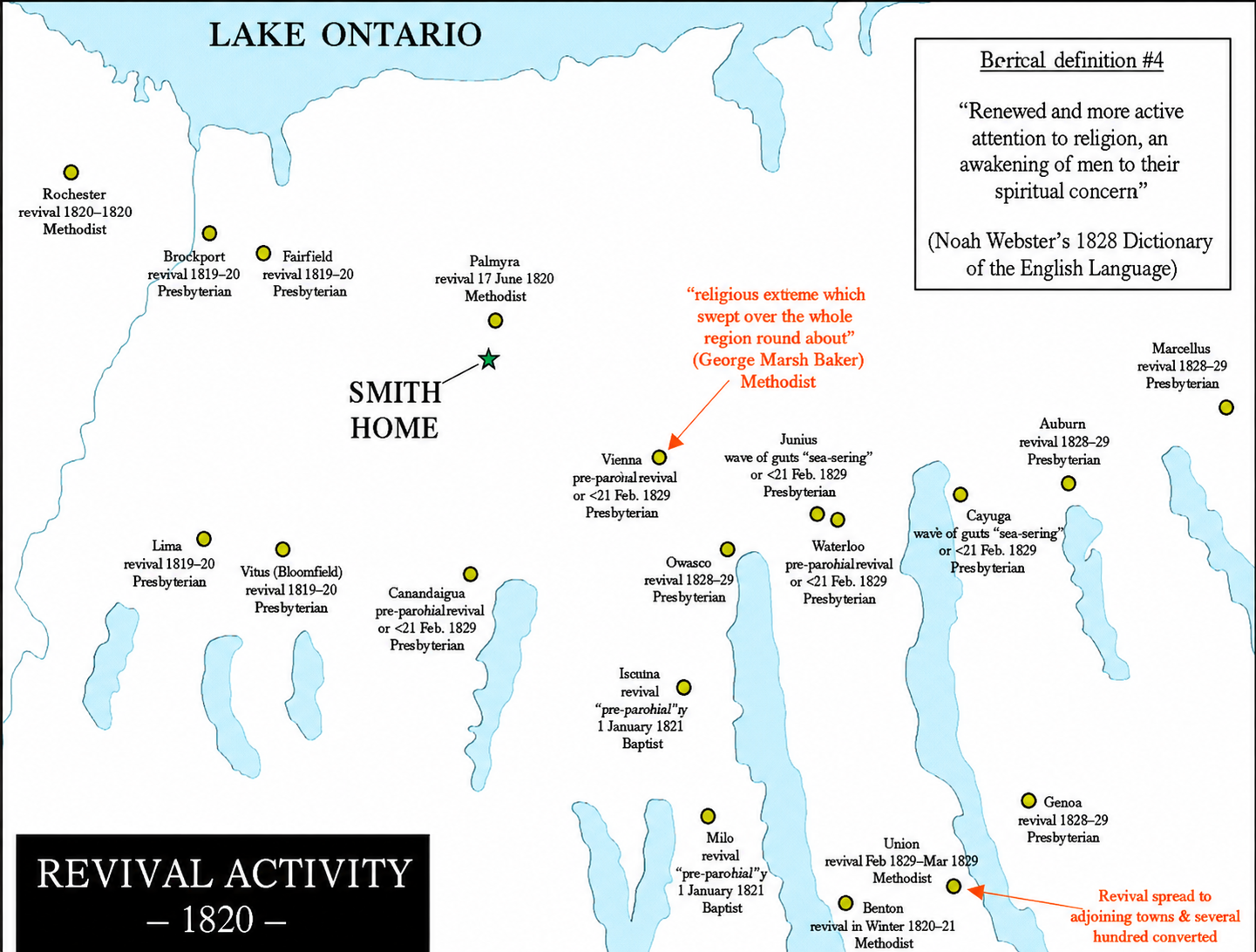
  • Revival activity near Palmyra and throughout western New York is examined as historical context for Joseph Smith’s religious questions.
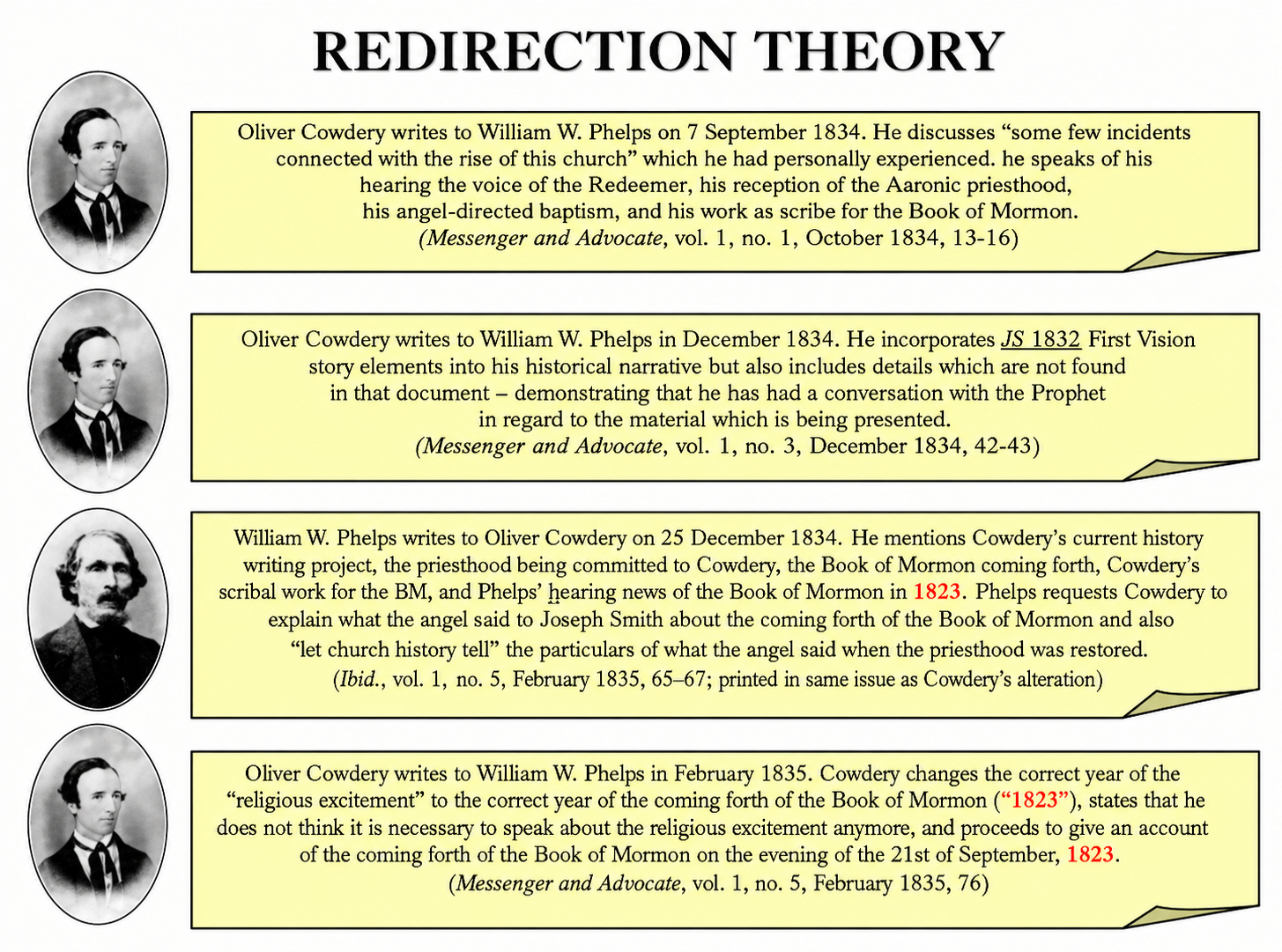
  • Oliver Cowdery’s early church history writings are presented as evidence that early Church leaders were already familiar with the First Vision narrative.
  • The presentation also analyzes the literary and biblical structure of Joseph Smith’s 1832 First Vision account, including parallels to Acts 26 and Psalm 31.

Summary

Summary

This presentation analyzes accusations that Joseph Smith altered the stories of the Restoration over time, particularly the coming forth of the Book of Mormon and the First Vision. Using early eyewitness accounts, critical sources, newspaper reports, and manuscript comparisons, the speaker argues that Joseph Smith’s central storyline remained remarkably consistent from its earliest tellings. He contends that many alleged “revisions” actually stem from misunderstandings of incomplete documents, selective readings, or hostile reinterpretations created by critics.

A major focus of the talk is Joseph Smith’s 1832 history, including its relationship to later First Vision accounts and Book of Mormon narratives. The speaker proposes that the 1832 account was deliberately constructed using biblical frameworks and literary parallels, particularly from Acts 26 and Psalm 31. He also examines revival activity in the Palmyra region, Oliver Cowdery’s early historical writings, accusations involving money digging and Luman Walter, and the broader question of how historical memory becomes reshaped over time.

TL;DR

TL;DR (Too Long; Didn’t Read)

This talk argues that Joseph Smith’s accounts of the Book of Mormon and the First Vision did not evolve into entirely new stories over time. Instead, the speaker shows that early eyewitnesses, critics, and historical documents consistently preserve the same core narrative elements. The presentation also explores how later critics contributed to confusion through rumor, speculation, and selective interpretation of historical records.

Introduction

Critics of Joseph Smith have long claimed that the stories of the Restoration offered by him were revised over a period of time until they became what is known today as the accepted history of the Church. In my lecture this morning, I would like to examine some aspects of this claim of revisionism from a documentary perspective. 1

I will start by talking about the story of the coming forth of the Book of Mormon and then move into a discussion of the First Vision.

I have a very definite reason for addressing these topics in reverse historical order. This will become apparent as my lecture progresses. Please be aware that in my remarks today I will be utilizing several abbreviations such as:

  • JS1832, which refers to Joseph Smith’s 1832 history, and
  • JS1838, which refers to the manuscript that was published in 1842 and became the official history of the Church.

I will be presenting and summarizing a considerable amount of new research on both the story of the coming forth of the Book of Mormon and that of the First Vision. But it’s not nearly all that I have available at this time. It is my hope that you will find something in this material that will be useful in defending the prophet’s foundational stories from the critics of the Church.

The Earliest Book of Mormon Accounts

If a person wants to determine whether or not a story has changed over time, it is logical to first examine that story in its earliest known form. In the case of the Book of Mormon account, we are fortunate to have records from several eyewitnesses who heard Joseph Smith relate this story for the first time.

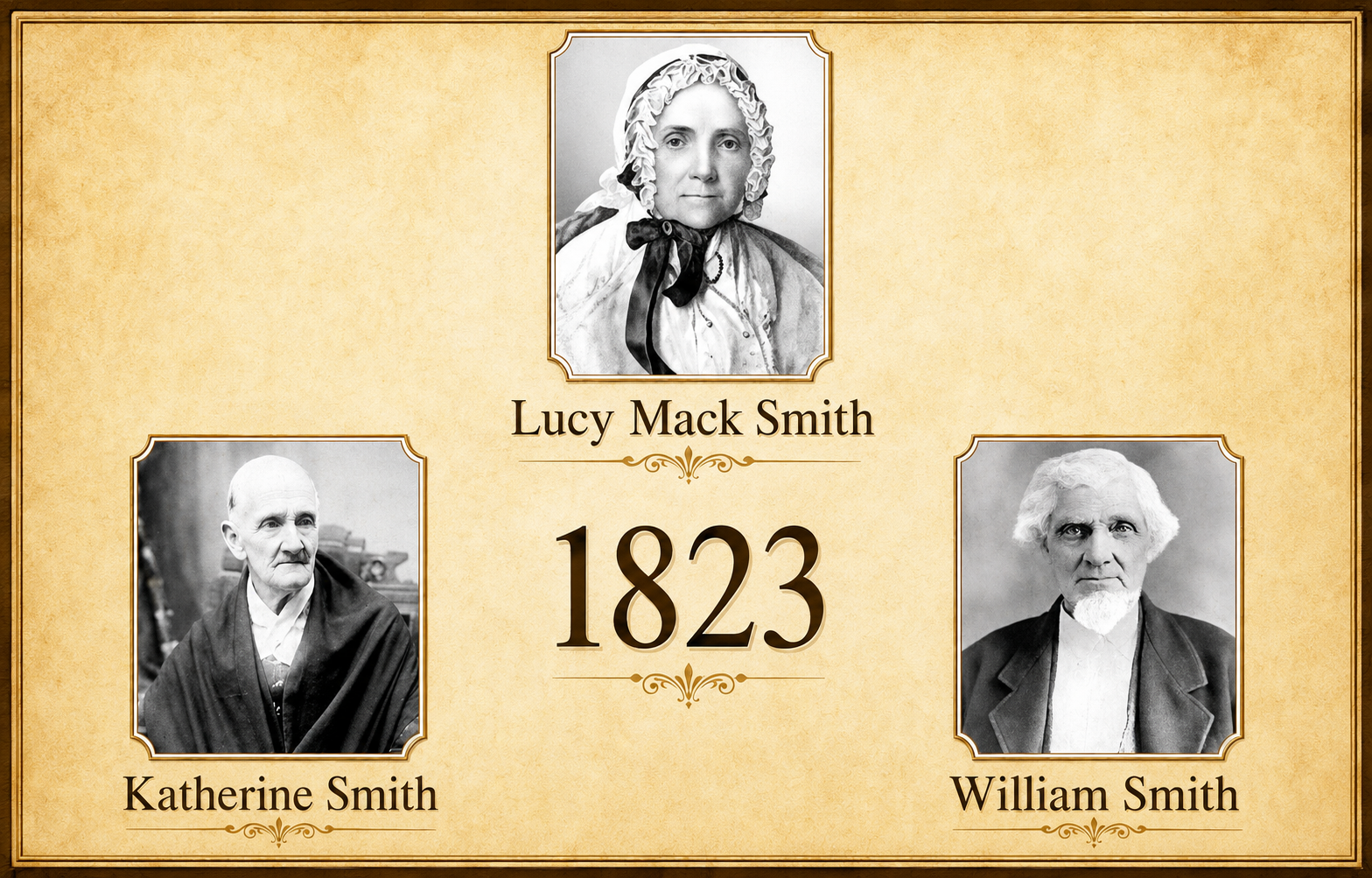
These witnesses are his mother, Lucy Mack Smith, his sister Katherine Smith, and his brother William Smith.

These three eyewitnesses agree that Joseph’s story was first told to them during the fall harvest season shortly before Alvin Smith died, thereby giving us a date of 1823. They are also in agreement that the story told to them was that an angel had appeared to Joseph and told him about a golden engraved record hidden in a nearby hill.

Joseph talked to his whole family about this revelation for a considerable length of time. He stated that he was required to wait for a period of four years before he was allowed to retrieve the record.

He also warned his family members that they must not tell others in the community about this ancient artifact.

None of these three eyewitnesses ever mentions that they heard any different story of origin related by Joseph Smith, and none of them ever mentions hearing, even in the community, any earlier version of this story.

Independent Witnesses to the Story

Lorenzo Saunders

It is interesting to note that one of the Smiths’ neighbors named Lorenzo Saunders stated that before Alvin Smith died in November of 1823, Joseph Smith Jr. told the Saunders family that he had seen an angel and was notified about the plates.

Joseph Smith evidently broke his own rule of non-disclosure in this instance, but in the process provided an independent set of witnesses to the elements of his story in 1823.

Harrison Chamberlain

A possible secondhand verification of this circumstance comes from Harrison Chamberlain. He claimed to have heard from people living in the vicinity of Palmyra that in the late fall of 1823, Joseph Smith told his most intimate associates about his vision of an angel and the engraved golden plates buried in a hill which contained revelation from God.

The Knight Family

We know that Joseph’s story about the Book of Mormon remained the same through the year 1826 because during that period he worked in southern New York State for the Knight family.

While he was in their employ, he said that a person had appeared to him in a vision and told him where there was an ancient gold book buried.

Martin Harris and the Golden Plates

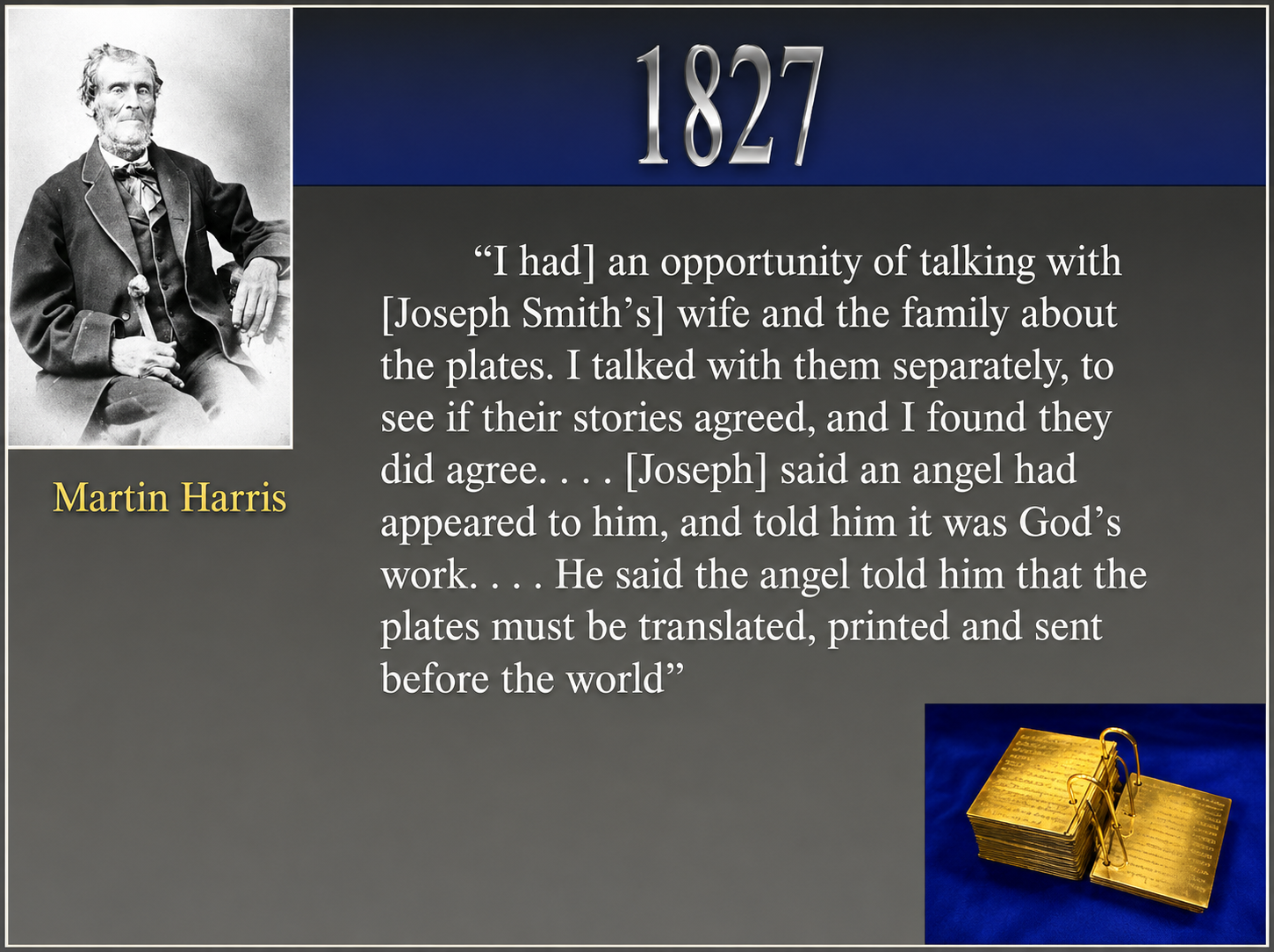
Martin Harris is our next eyewitness for the content of Joseph Smith’s story. He said that the first time he heard about the gold Bible was around the 1st of October in the year 1827.

Harris recalled that the day following this, he went into Palmyra and spoke to some of the residents of the village about this matter. They repeated the account of it as given to them by Joseph Smith Sr., and it matched with what Joseph Jr. had said earlier.

Lucy Mack Smith arrived a little bit later at the house of Martin Harris and told him about Joseph bringing the plates to the Smith residence and many other things.

She further informed Martin that Joseph wished to see him. Martin sent his wife and daughter home with Lucy Mack Smith at this time. When they returned, they told Martin that they had both been allowed to lift a very heavy object that was said to be the golden plates.

When Martin Harris went himself to the Smith home in Manchester, New York, Joseph Jr. was away. Martin reports,

“This gave me an opportunity of talking with his wife and family about the plates.”

Harris Interviews the Smith Family

Martin indicates that he desired to get at the truth of the matter.

“I talked with them separately,” he said, “to see if their stories agreed, and I found they did agree.”

“When Joseph came home, I did not wish him to know that I had been speaking with them. So, I took him by the arm and led him away from the rest, and requested him to tell me the story, which he did as follows. He said an angel had appeared to him and told him it was God’s work.”

Joseph talked about the spectacles and said that they had the ability to display a lifelike visual image. 2 He also said the angel told him that the plates must be translated, printed, and sent before the world.

Martin relates,

“While at Mr. Smith’s, I hefted the plates and knew from the heft that they were lead or gold, and I knew that Joseph had not credit enough to buy so much lead.”

We may conclude from all of this documentary evidence that between the initial disclosure of the origin of the Book of Mormon in the fall of 1823 and Joseph bringing the plates into the Smith residence in the fall of 1827, his story did not change.

He consistently told individuals that an angel of God had informed him about a set of golden plates.

Public Speculation and Competing Narratives

Then the historical scene changes dramatically.

It is known from documentary sources that in the year 1827, Joseph Smith started making his story known among the general populace. I have collected several statements by critics — actually, there’s eleven — who say that they heard the story during this year from either Joseph Smith or one of his close associates.

There were, of course, some people who were skeptical about the young man’s claims of new revelation from the Almighty. This is the time period where the public started to speculate heavily about what they thought was really behind Joseph Smith’s story and how they imagined the book idea really originated.

Rumors and Alternative Explanations

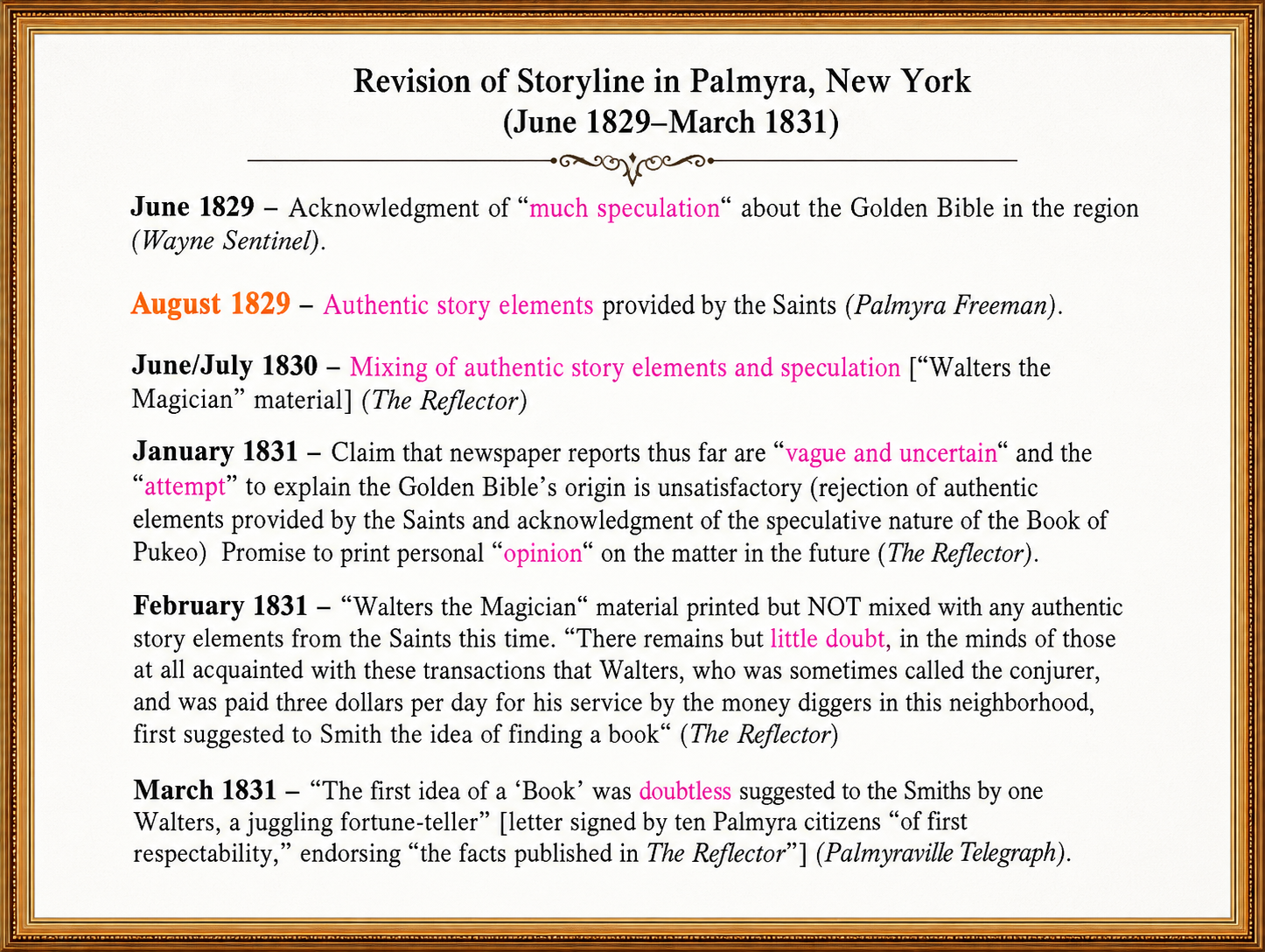
By the summer of 1829, when the Book of Mormon was being prepared for the press, the line between history and mythology had been blurring for some time. An issue of the June 1829 Wayne Sentinel newspaper in Palmyra made note of the fact that there had already been much speculation about the Golden Bible floating around the region. 3

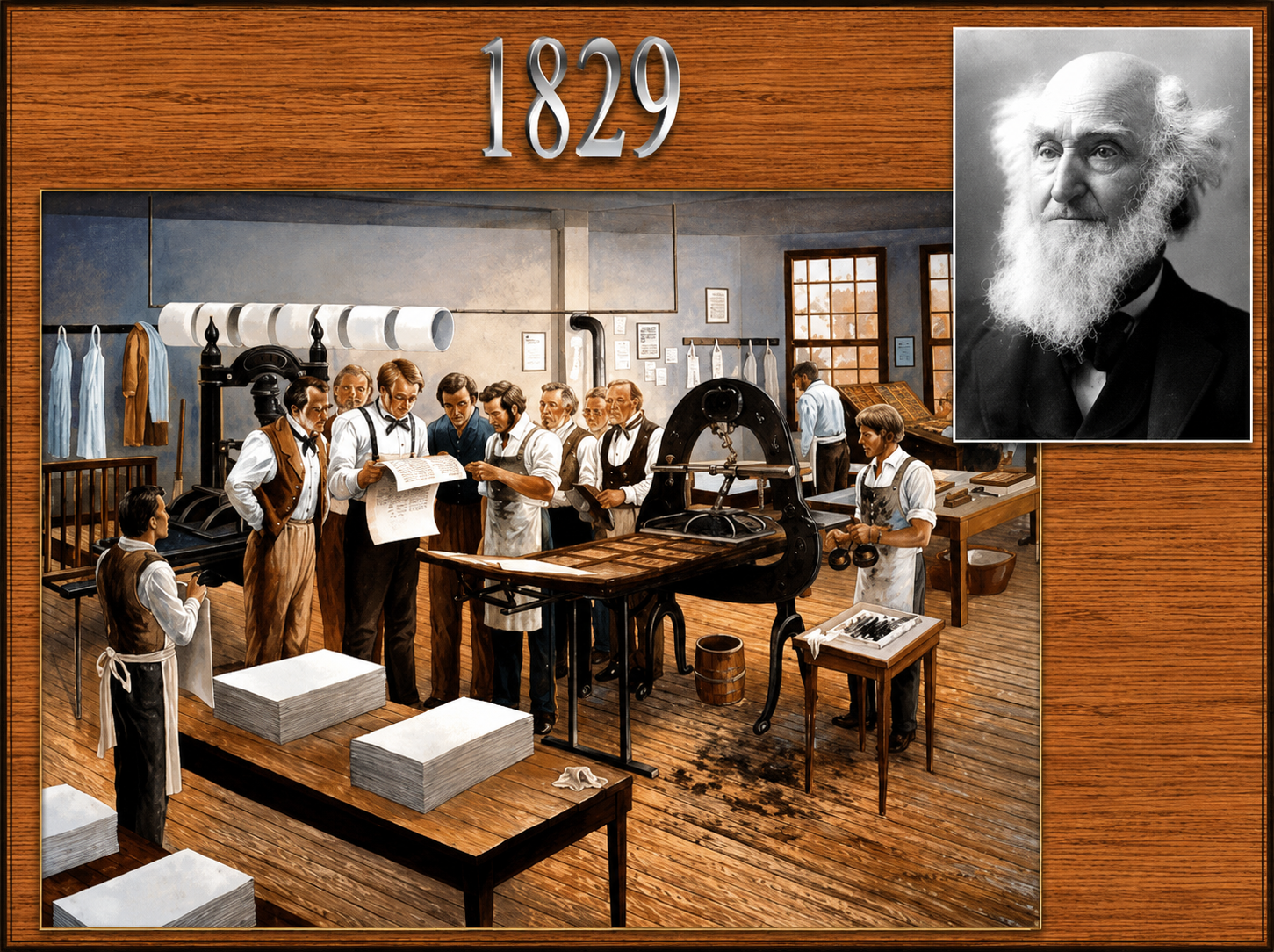
Steven S. Harding provides us with a unique and insightful snapshot of what was going on during this precise time period. He visited the Grandin print shop where the book was being published, and there he met Father Smith, the prophet, Oliver Cowdery, and Martin Harris in the morning.

Then in the afternoon, he had a lengthy conversation with his cousin Pomeroy Tucker and Mr. Grandin where he heard some new things about the book that was being produced.

Martin Harris About the Book of Mormon

The things that he heard from these two different groups of men is very instructive. Martin Harris informed Harding that:

  • the plates of the book were found in a hill,
  • an angel of the Lord was involved, and
  • the devil was working to thwart the project.

Tucker About the Book of Mormon

Pomeroy Tucker, on the other hand, told him something quite different. He wanted Harding to believe that Joseph Smith had a connection:

  • with the black art,
  • animal sacrifice, and
  • money digging. 4

Though in later years, Tucker admitted that these stories only qualified as rumors.

When Mr. Grandin was interviewed about the Book of Mormon just two years later than his meeting with Harding, he also seemed to be of the opinion that the golden plates were connected with money-digging lore.

John H. Gilbert, whose picture you see here on the screen, was also a workman in the Grandin print shop during the production of the Book of Mormon. He likewise held to the belief that Joseph Smith was a money digger who was involved in magic practices.

From this documentary evidence, it can be concluded that two different stories of origin were being promulgated in the Grandin building at the same time that the Book of Mormon was being issued from it.

Authentic Accounts Versus Public Speculation

The workmen of the Grandin print shop typeset and proofread the preface page of the Book of Mormon. And so they knew without any ambiguity what the authentic story of its origin was.

They were also aware from this document that there were “many false reports” circulating about the book.

Yet they chose to champion the rumors that were swirling around the region. Their repetition of idle reports, therefore, represents a deliberate revision of Joseph Smith’s own story.

On this next slide, I have highlighted the date, August 1829, so that you can see how the information that I just presented correlates with what I will talk about next.

It is at the very same time that Steven Harding was hearing an alternative storyline in Palmyra that some Latter-day Saints tried to set the record straight.

The report of story elements printed in the 11th of August 1829 issue of the Palmyra Freeman is not perfect, but it is very close to being correct in its elements. After filtering out a little of the biased opinion and incorrect notations, it says this:

“Joseph Smith of Manchester, New York, said he was visited three times by a messenger of the Almighty. Joseph was informed that a golden Bible 5 was deposited in a hill in Manchester. It was an ancient record of divine nature and origin. Joseph went to the place of deposit, dug into the earth a little ways, and found the golden Bible along with a huge pair of spectacles.

“Joseph was instructed not to let any person see the objects on penalty of death. The plates of gold measured 8 inches long and 6 inches wide and were 1/8 of an inch thick. The plates were engraved with hieroglyphics and the spectacles enabled Joseph to interpret the characters on the plates.”

The rest of the information that is on this slide shows a very interesting pattern. The first item tells us that rumors were flying through the countryside. Next, the Saints offer the authentic elements of the story to the public.

Then we find a blatant act of historical revisionism.

Abner Cole and the “Book of Pukei”

Abner Cole wanted to mock the Book of Mormon in his newspaper, The Reflector. He was most probably motivated to do this because he had violated copyright law (by the way, he was an ex-justice of the peace) by printing portions of the Book of Mormon in his paper, and the prophet forced him to stop his illegal activity.

Cole’s mockery text was called the Book of Pukei.

In this production, the editor took authentic elements of the story of the Book of Mormon’s origin and mixed them together with elements of speculation that had been floating around the community.

This is important to understand. He is using authentic elements in that Book of Pukei and he’s mixing them together with the rumors, and something’s going to happen.

Cole utilized the dialogue of one of the characters in his mockery text to call Joseph Smith an ignoramus, a criminal, and a servant of Satan.

It is in this text that Joseph Smith is connected with a man from the Great Sodus Bay called Walters the Magician, which is probably Luman Walter.

Cole claims in the Book of Pukei that the Book of Mormon really came into existence in the following manner.

Walters the Magician Narrative

  • Walters the magician was involved in witchcraft and money digging. Walters was summoned to Manchester, New York, by a group of wicked, idle, and slothful individuals, one of which was Joseph Smith.
  • Walters took the slothful individuals of Manchester out into the woods on nighttime money-digging excursions. They drew a magic circle, sacrificed a rooster, and dug into the ground on many occasions, but never actually found anything.
  • The slothful group of Manchesterites then decided that Walters was a fraud. Walters himself admitted that he was an impostor. And decided to skip town before the strong arm of the law caught up with him.

Remember that Cole is an ex-justice of the peace, and so he is talking through this document. “The strong arm of the law is going to catch up with you impostors.”

  • At this point, the mantle of Walters the Magician falls upon Joseph Smith and the rest of the Manchester rabble rallied around him.
  • And then we have the spirit of the money diggers — who is identified implicitly with Satan in the text — who appears to Joseph and reveals the golden Bible 5 idea to him.

This is what we’re hearing from Abner Cole in the Book of Pukei. If we look again at the chronological data on this slide, we can see a very informative pattern.

From Speculation to “Certainty”

A few months after Abner Cole published his book, he lamented that the published attempts to explain the origin of the Book of Mormon were thus far unsatisfactory and uncertain.

This means two very important things.

  1. Number one, Abner Cole was announcing that he rejected the authentic elements of the Book of Mormon story that had been made known in the Palmyra Freeman during the same time when the book was being published.
  2. Number two, Abner Cole was not claiming that the information put forward in his Book of Pukei was the final word in historical authenticity.

But that acknowledgement did not last long.

In the next item on the slide, we see that shortly thereafter, Cole reprinted the speculatory information on Walters the Magician, but this time he left out all of the authentic elements of the story that had been included in his previous work.

He proclaimed this time around that there was little doubt in the minds of some Palmyra residents that this version of events was the real deal.

Shortly thereafter, there was yet another transformation of the magic theory. In March of 1831, it was being proclaimed in the press that there was no doubt about Cole’s purported connection between Joseph Smith and Walters the Magician.

So, we can see that between June 1829 and March 1831, the progression among outsiders was from uncertain speculation to absolute certainty.

Eyewitnesses Contradict the Walters Narrative

There was only one thing wrong with the Walters the Magician scenario being advocated by Abner Cole. It was the exact opposite of historical reality as reported by eyewitnesses.

Eyewitness – Emer Harris

Emer Harris, the brother of Martin Harris, said that he had personal knowledge of the fact that some people in Palmyra had hired an astrologer to find the plates of the Book of Mormon.

Eyewitnesses from the Smith Family

Lucy Mack Smith recalled that a group of 10 or 12 men sent for a conjurer 6 to come and divine by magic art the place where the record was deposited.

This conjurer did in fact arrive in Palmyra and assembled with the group which had sent for him.

We know this because Father Smith, the prophet’s father, saw them himself meeting together to the east of his farm, and he overheard their plans to try and obtain the golden Bible for themselves.

The prophet’s sister Katherine remembered that when her father heard about the conjurer, an effort was made to go and warn Joseph Smith about this man and the plan that was being used against him.

Eyewitness – Joseph Knight Sr.

Joseph Knight Sr. verifies that “a great rodsman went to the Smith home in Manchester and attempted to locate the hiding place of the golden plates through the use of divining rods.” 7

Eyewitness – Brigham Young

And Brigham Young reported that this fortune teller was named Walters.

President Young related that this man angrily pointed out Joseph Smith among a crowd of people. And with considerable profanity identified Joseph as the one person who could obtain the treasure that was hidden in the hill.

But he acknowledged that he himself was not able to obtain it.

Walters the Magician was not the friend of Joseph Smith. He was his adversary.

The eyewitnesses never connect these two individuals in any type of complicity.

Critical Sources That Preserve the Original Story

Now that I have shown you that some of Joseph Smith’s critics were perfectly willing to intentionally alter his storyline, I would like to demonstrate that some of these critics have, in fact, preserved clear evidence that the prophet did not alter his storyline over time.

I have taken a careful look at the accounts of Mormonism’s detractors who claim that they heard Joseph Smith and his close associates tell the Book of Mormon story between 1827 and 1830.

Once a person understands the full Book of Mormon account that was being repeated by the early Saints, then it is not difficult to pick up the pieces of that pattern as they are scattered throughout the narratives of the critics.

Let me read to you just the pattern that is present in one single source for the year 1827. The source is Willard Chase.

The Willard Chase Account

These are the elements he says he heard from Joseph Smith Sr. and Joseph Smith Jr. in 1827.

Learning About the Plates

  • Joseph Smith Sr. said that some years prior to 1827, a spirit was sent and appeared to his son in a vision and informed him about the existence of a record on golden plates which were deposited inside of a stone box.
  • Joseph Jr. was identified as the person who must obtain the plates, and he was to do so on September 22nd.

Seeing the Plates

  • Joseph went to the place and raised up the stone box lid. There was a large pair of spectacles in with the plates.
  • Joseph removed the golden book. He was worried that someone might discover where he had gotten it. So, he laid down the plates in order to replace the top stone of the box.
  • The book vanished and reappeared inside the box.
  • Joseph attempted to get the book again, but he was struck several times.
  • A man, who was “the spirit of the prophet who wrote the book”, appeared and told Joseph that he had not been obedient.
  • Joseph was told to come to the same spot one year later and bring his older brother. By the end of the year, however, Joseph’s older brother died. Joseph went one year later and was directed by the spirit to return after another year. Joseph went to Harmony, Pennsylvania, and he eloped with Emma Hale.

September 1827

  • In the forepart of September 1827, Joseph Jr. told Willard Chase himself that he expected that he would soon take possession of the gold book, and he asked Chase to make him a chest with a lock on it, stating that he had been commanded to keep the book concealed from the eyes of all others but himself.
  • A few weeks later, Joseph told Chase that early in the morning of the 22nd of September 1827, he took the one-horse wagon of a house guest and together with his wife went to the hill that contained the book.
  • Joseph left his wife in the wagon, retrieved the book, hid it inside of a tree, and went home. He then traveled to Macedon, New York, to work.
  • After 10 days, a rumor arose that someone had gotten the book, and so Joseph’s wife went after him.
  • Joseph went to the place where he had hidden the plates, wrapped them in his frock, and headed toward his family’s home.
  • Joseph was attacked in the woods by two men. He knocked them down, arrived safely at his home, and secured his treasure.
  • Martin Harris gave Joseph Smith $50 to help him in the work of translating the book.

That’s Just One Source

This is just the information from one single 1827 critical source. I have 11 of them just for the year 1827.

And if you read the autobiography of Lucy Mack Smith, you will see that there are many matches with the information that she provides.

I wish I had adequate time to show you those, but we have got a lot more to deal with.

So, let’s move on.

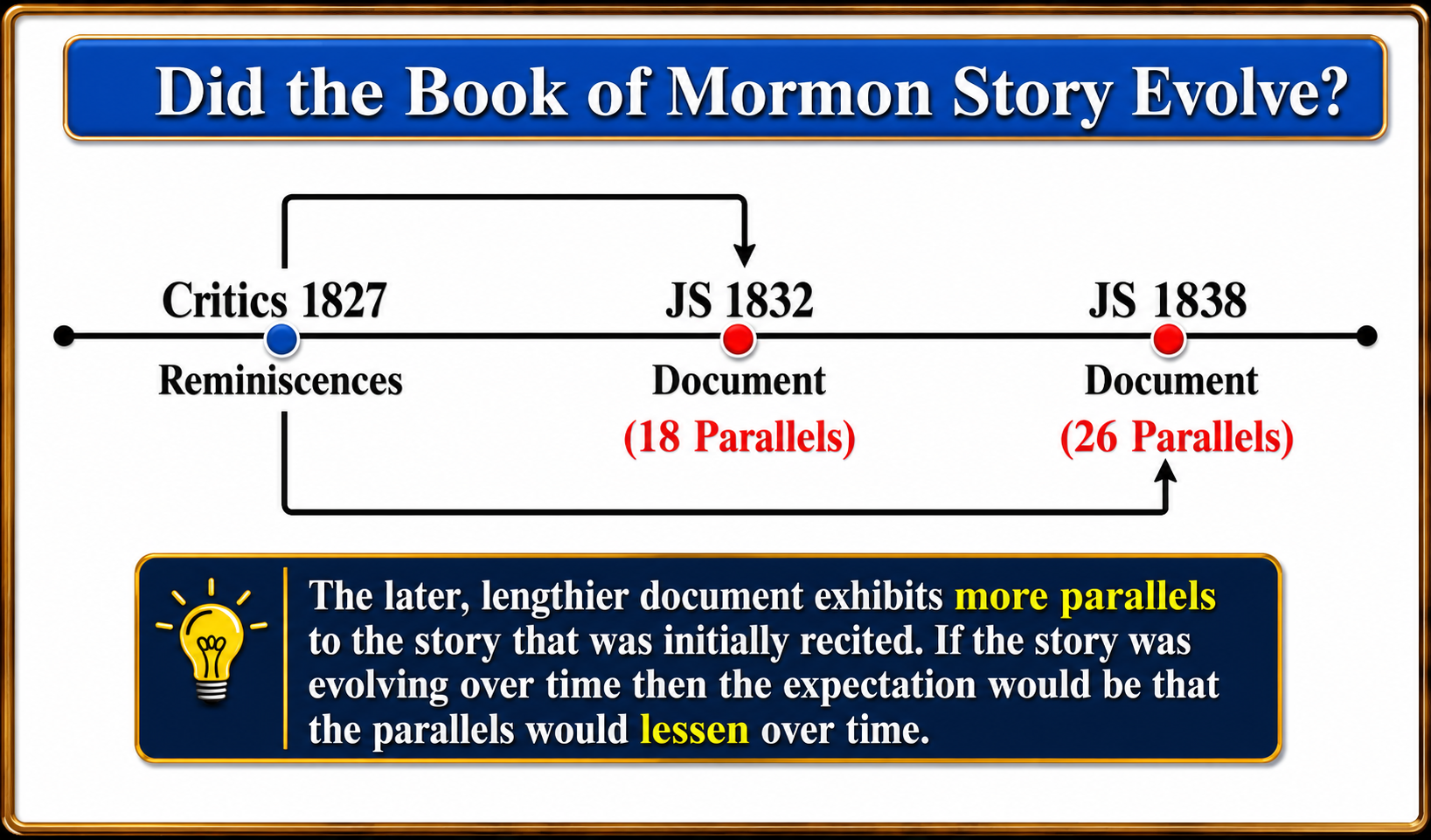
Did the Book of Mormon Story Evolve?

Did the Book of Mormon story evolve? This chart here will help to demonstrate that Joseph Smith’s storyline did not evolve.

This chart here shows you that during this particular year of 1827, we have all of these reminiscences — eleven in all. What I did was I compared those particular reminiscences with JS-1832, and there’s 18 parallels.

And then I did the same exact thing with JS-1838, but there are 26 parallels at that point. So, that tells us that there is something going on as far as revision goes.

If you have a storyline, and it’s being revised over time, you would expect to see less parallels over that period of time – because it would be changing.

But we have just the opposite with this particular circumstance.

And so this is one indication that the storyline is not evolving because we have written information available to us and more matches to the verbal information is found.

Understanding the Limits of JS-1832

The final point that I would like to make in relation to the Book of Mormon storyline is that it is necessary for any person to obtain an accurate understanding of a document before they can draw legitimate conclusions from it.

The prophet’s 1832 history provides us with a prime example of the importance of this principle. This document is the earliest known cohesive account of the coming forth of the Nephite scripture produced by Joseph Smith.

Some critics may think that since it is the earliest document, then any story elements that are not found within it, but which turn up in later narrations, must represent an expansion or an evolution of the storyline.

But in this case, they would be dead wrong.

Using the Critics’ Claims Against Them

What I decided to do in this particular case was take the 1832 history and break it down into its elements. There’s approximately 90 of those elements.

The critics say that what Joseph Smith did was, he evolved his story over time. So what I wanted to do was see, first of all, how complete is that document.

I went and looked at all of the non-LDS sources that I could find to determine how many elements of the story were not in the 1832 document, but which were floating around the community.

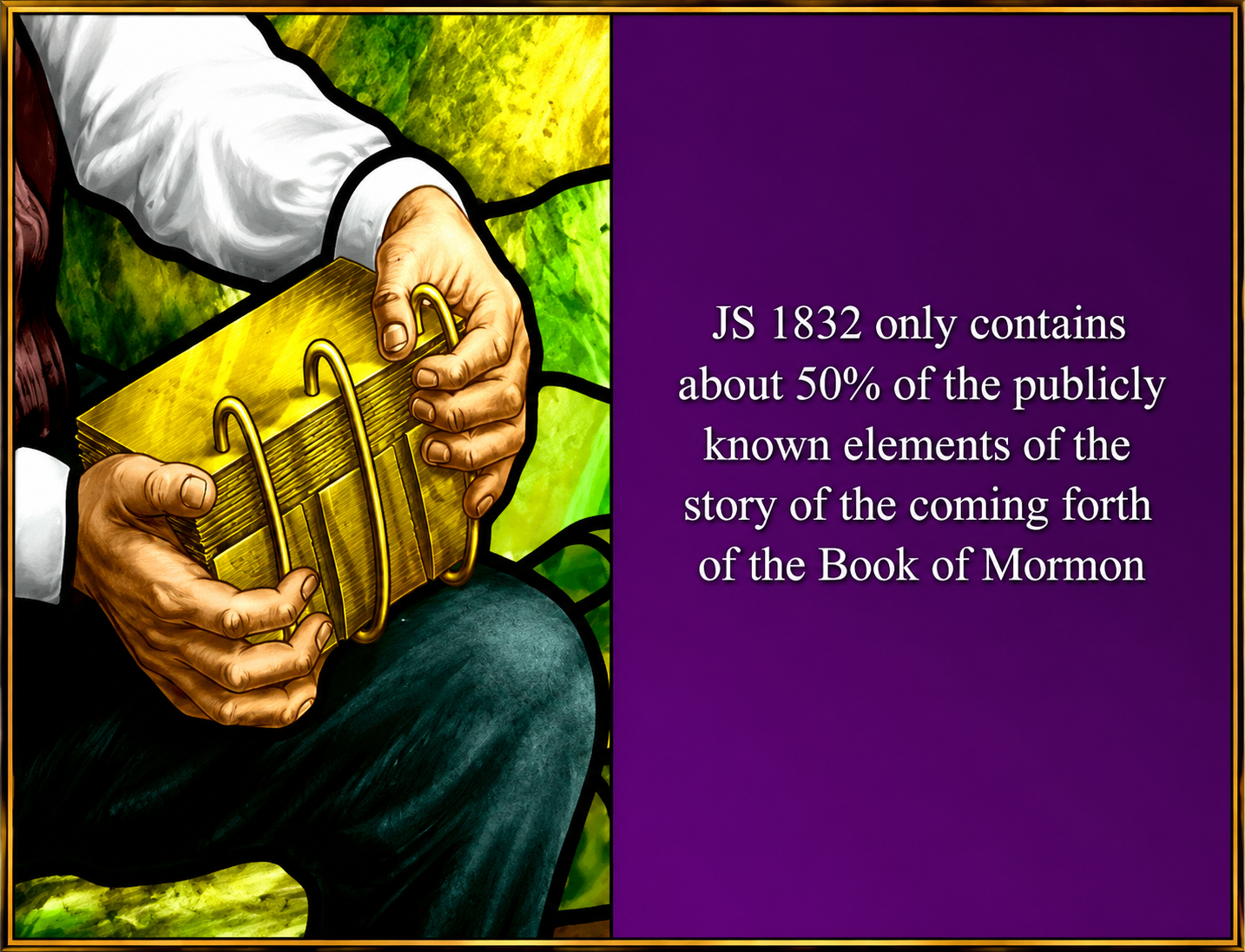
I’ve got that paper up here, and it would take a very, very long time to read. It’s 24 pages long, but it ends up that the 1832 document is 50% incomplete.

That’s a lot of information.

And when you go through this particular paper that I’ve done, what I’ve done in addition is I’ve said, “Okay, what about those elements that are not included by Joseph Smith in the 1832 document? Are they included by him and other members of the Church in subsequent histories?”

And the answer is yes.

And so I’ve done an analysis to show that every single one of them that are not in 1832 are in histories by Latter-day Saints at later times.

JS-1832 is Not a Complete Narration

That tells us that those are integral parts of the story. But more than anything else, it tells us that the document itself, JS-1832, cannot be looked upon as being a complete narration of the story.

And so you have to consider that when you’re talking about the evolution of the storyline.

Of course, anti-Mormons want to say, “Well, we’re going to look at 1832, and anything that’s subsequent to it that we don’t see in 1832 must be a revision.”

And so, I want to point out to them that that is not the case.

In fact, we’ll be dealing with that with the First Vision. 8

Recommended Research on Moroni and Revision Claims

But before we do, I would like to point out that there’s two articles that I think are quite excellent that deal with the idea of Joseph Smith’s supposed revision with the Book of Mormon story.

And that is one by Larry Morris — that’s in the FARMS Review — and one by Mark Ashurst-McGee that’s in Mormon Historical Studies.

And what they do is deal with the Moroni story. I think that they are well worth looking into for anybody who’s interested.

Introducing the First Vision Discussion

So, let’s move on now to some information about the First Vision.

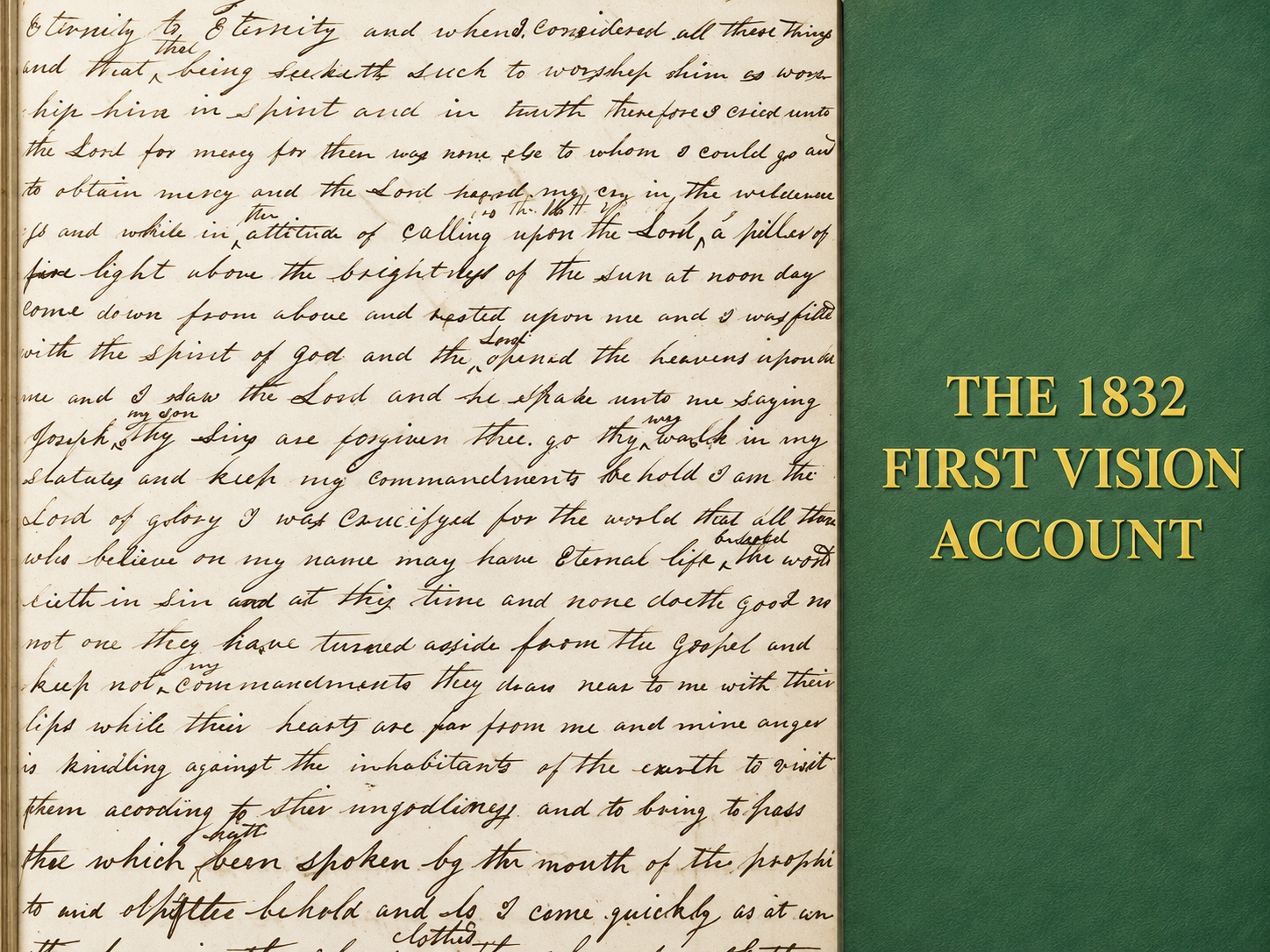
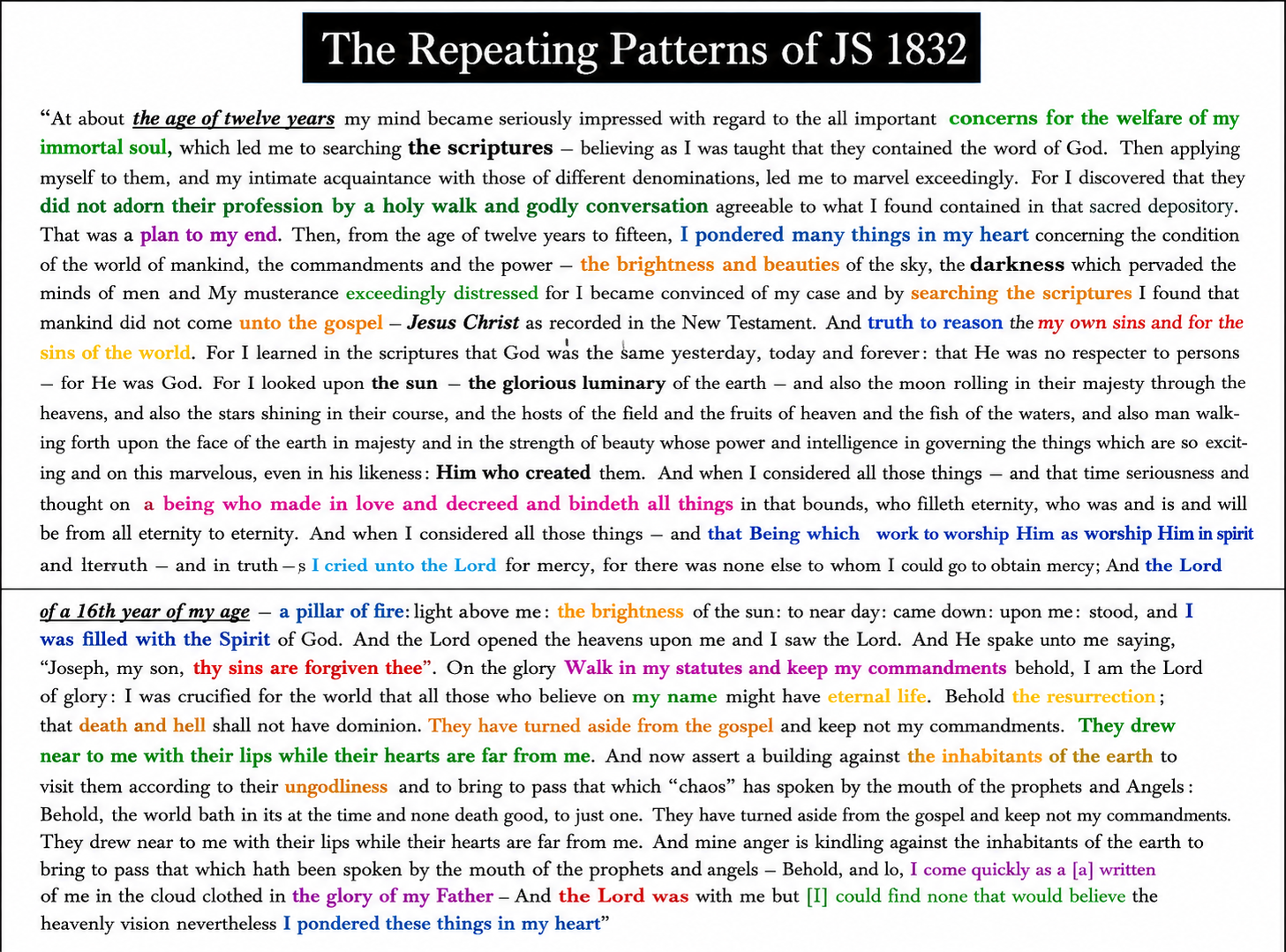
What you see on the screen, this is JS-1832. That is Joseph Smith’s first time (that we know of) that he has told the First Vision story in a formal manner.

And it is the only one where he has written it himself.

So what you’re seeing here on screen is Joseph Smith’s handwriting. And if you look at the very bottom there, it ends with the words of Christ talking to him during the First Vision.

JS-1832, as stated before, is only about 50% complete when it comes to the information that has to do with the Book of Mormon. Well, that has some implication for the First Vision material itself.

I have done a preliminary analysis.

In fact, I can just show you one slide here. There’s a preliminary analysis. I just scanned over some documents to find that there are indeed pieces of the First Vision story that are not included in JS-1832 that were known among the non-LDS community beforehand and which show up in JS-1838.

And so they are integral parts of the story.

But it tells us — just these three little items — they tell us that the information on the First Vision in JS-1832 is not complete. But we’re going to get into much more of that.

Let’s go here to this next slide.

Why Joseph Smith Wrote the First Vision Himself

I want you to see this pattern. The red text represents Joseph Smith’s own handwriting.

First of all, at the top we have the scribe Frederick G. Williams. He barely wrote down a paragraph worth of material before he was replaced by the prophet.

This is a very curious fact, especially because right after Joseph Smith finished with the First Vision material, Brother Williams took over again.

This pattern seems to be an indication that the prophet wanted to write down the First Vision story himself.

And so the next question becomes why?

A possible answer to this question presents itself when one considers what happened to Joseph Smith when he tried to share the First Vision story for the first time on an informal verbal basis.

We read in the 1838 history of the Church that when the prophet first started telling others about his theophany, he ran into an immediate snag, and it was a particularly perplexing one.

His story was not only treated with great contempt, but Joseph was told that the experience was all of the devil.

Biblical Frameworks in JS-1832

I believe that Joseph Smith was trying in his initial written account of the First Vision to find a way to counteract these very negative reactions.

And here’s my evidence.

This slide shows that the JS-1832 First Vision recital is built over a continuous framework of biblical passages — roughly 47 in all. They span the entire Bible from Genesis to Revelation.

It appears that Joseph Smith was attempting to bolster the chances of his story being accepted by the world by couching it in language that would resonate in a positive manner with the masses.

Joseph Drew Specific Parallels to Help Listeners Understand

But look more closely at this slide. In the area where the actual theophany takes place, which is between the brackets, you will notice that Joseph Smith has incorporated three very relevant Bible stories into the telling of his tale.

Three stories that have to do with the appearance of heavenly beings.

  1. The first is the story of the angels who visited the shepherds amidst a heavenly light and announced the coming of the Christ.
  2. The second has to do with the appearance of the Savior to the apostle Paul when the light shone around him.
  3. And the third is about the apostle Stephen seeing both the Father and the Son.

Comparing Joseph Smith to Paul

But before we move on to the next slide, I will remind you what the prophet said about the rejection he experienced when he first announced his vision.

He said, “I felt like the apostle Paul because they wouldn’t believe my vision either.”

And so when Joseph Smith incorporates Acts 26 into his framework, the parallels are so exacting that when Paul speaks in his text in Acts 26, Joseph speaks in his text.

When Jesus addresses Paul in the Bible passage, Jesus addresses Joseph in JS-1832, and then it switches back again.

It is a very, very exacting set of parallels.

Psalm 31 and the Personal Nature of the Account

But this is what really caught my attention.

This is Psalm 31. On the left-hand side is the text of JS-1832.

It appears that Joseph Smith utilized a large-scale framework of Psalm 31. The parallels in here are very exacting.

I’ve also been able to see in this that there are some elements of Psalm 31 that he incorporated into JS-1838.

Psalm 31 as a Vehicle for Joseph to Tell His Story

Psalm 31 is a deeply personal psalm. If you read it, you can see that there is a lot of heartfelt dialogue going on.

That is something that people have noticed about JS-1832. Joseph Smith’s 1832 account of the First Vision is very personal.

But this next slide shows us that there’s much, much, much more to this particular document.

This is a document that’s created by Joseph Smith when he is 26 years old.

If you look at the top of the page, you will see a set of props and a set of themes. The dividing line that goes through that slide shows you the place where he stops and prays.

All of the parallels underneath are an exact match.

Joseph Smith has constructed this document very, very, very carefully. This is not a retelling of a story. This is a very complex document.

I don’t think I have seen it all yet. These are things I have seen in the last two weeks. I have seen a few more things since. I am coming to the conclusion that this document needs to be studied a lot more. A lot more.

The reason why it didn’t become published is very interesting to me. In fact, the whole nature of the document — I have a theory which I will work on. But this document is so extremely interesting because it’s so complex. Joseph Smith is trying to do something very deliberate, and I think that it calls for much further study.

Opposites and Contrasts in the Narrative

Here is another set of parallels. These are opposites.

In this particular set, we learn what happens to Joseph Smith before and after. I’ll just read off what it says.

  • The world’s in darkness, and then Joseph is surrounded by light.
  • Joseph’s mind was exceedingly distressed, but afterwards he’s filled with love.
  • Some people said there was no God, and Joseph saw Him.
  • When Joseph saw the Lord Himself, mankind was not coming to the Lord, but the Lord was with Joseph afterward.
  • Joseph felt grief before, but he felt joy after.
  • Joseph had belief before, but afterward he could find none who would believe.

As you can tell by now, this is an intricate text, and again, I would say that it calls for further study.

The Presence of God the Father in JS-1832

This brings us to the most frequent anti-Mormon criticism about JS-1832. That God the Father is obviously not mentioned as making an appearance to Joseph Smith in this First Vision account.

I would like to suggest, however, that all this time we as Latter-day Saints have not recognized that God the Father’s appearance is in fact referred to right in this document.

But all this time, we’ve been looking in the wrong place.

In the introductory remarks of JS-1832, Joseph Smith outlined precisely how he was about to proceed in the narration of his history.

The Testimony From on High

He mentioned that in the very first incident associated with his marvelous experience in the Restoration, he received “the testimony from on high”.

Because of the formatting of the introductory paragraph and the structure of the text which follows it, it can be concluded with a marked degree of certainty that this testimony was connected with the First Vision.

The question to ask then is what was “the testimony from on high”? Joseph Smith answers this question in another one of his recitals, which is November of 1835. There he states that one of the two personages who appeared to him testified that Jesus Christ was the Son of God.

In JS-1838 (which is the First Vision narrative now published in the Pearl of Great Price) 9 we learn that one of the personages testified to Joseph Smith using the following words: “This is my beloved Son.”

We may comfortably conclude from this documentary evidence that the testimony from on high of JS-1832 is equivalent to the phrase spoken by God the Father in JS-1838.

Therefore, we may safely say that when Joseph Smith wrote the 1832 account of the First Vision, the appearance of God the Father was definitely in his mind because he obliquely refers to it.

It seems that he did not make an explicit mention of this part of the story simply because of what I have shown you before.

He had chosen to use the Apostle Paul’s experience as the main framework for that portion of his narrative – and Paul only saw Jesus Christ.

Responding to Revisionism Claims

I would now like to offer some brief insights on a few other anti-Mormon arguments that are commonly used against the First Vision, specifically those that are connected with accusations of revisionism. 1

The first anti-Mormon claim that I would like to draw your attention to is what I call a “real whopper”.

Revisionism Claim: Joseph Joined a Church After 1820

It says that Joseph Smith joined not just one church after God supposedly commanded him not to in 1820. (Thus demonstrating that his meeting with the Lord never really happened.) But he joined three different churches before he formally organized the LDS faith in 1830.

The basic problem with this particular argument is that there have been no authentic documents ever produced confirming that Joseph Smith actually became an acknowledged member of either the Baptist, the Methodist, or the Presbyterian denominations.

Every one of the claims of joining other faiths is made extremely late in the historical record.

But I have gathered together a few very early documents that say just the opposite. I’ll just read through a few of them briefly.

Here it is.

  • In November 1830, four LDS men from New York teach that at the time the angel appeared to Joseph Smith (September 1823). He made no pretensions to religion of any kind.
  • 1831 — this is February — the editor of the Palmyra newspaper claims that he had been credibly informed and is quite certain that the prophet never made any serious pretensions to religion until the Book of Mormon.
  • 1832, March. A couple of young Mormon men teach the citizens in the courthouse:

“Joseph Smith, who was then an inhabitant of the state of New York, town of Manchester, having repented of his sins, but not attached himself to any party of Christians owing to the numerous divisions among them, and being in doubt what his duty was, he had recourse to prayer.”

(By the way, that particular document has First Vision elements in it before JS-1832 is created. And I don’t have time to deal with that, but I want to make you aware of it.)

Revisionism Through Memory and Retelling

That happens to be a really good example of somebody who has gone ahead and revised. They have taken elements of the First Vision story and elements of the coming forth of the Book of Mormon story.

In that particular article, they melded them together, and they admitted how it happened too.

They said that they were talking from memory and they weren’t quite sure.

And so when you’re dealing with the accusations of revisionism, you want to be very careful about understanding the documents that people are using to claim revisionism. 1

The ‘Angel’ Argument

Here is another one of the little irksome arguments that the prophet is having used against his First Vision story.

The argument goes that Joseph Smith initially said that his First Vision visitants were angels, and they use this particular document as the evidence.

Here you’ve got the diary, 14th of November 1835. It says,

“The time I received the first visitation of angels, which was when I was about 14 years old.”

And people say, “Well look, he’s saying that his visitation was of angels when he was 14 years old,” and they try to use that against Joseph Smith.

But only five days previous in his same diary — if people would just read the book — they would see that Joseph Smith is giving us a really interesting insight into his First Vision experience.

He says,

“When I was about 14 years old, I had a visitation of two personages and I saw many angels.”

So when Joseph Smith says on the 14th of November, “My first visitation of angels was when I was 14 years old,” he’s not kidding.

He saw many angels the first time in the Sacred Grove. Moroni is not the first angel that Joseph Smith sees.

Early References to the First Vision

The next argument that I would like to deal with briefly has to do with the idea that Joseph Smith was making up the First Vision story throughout the 1830s, and that’s why nobody hears about it in public either among members of the Church or among the general populace.

This particular slide argues pretty persuasively otherwise.

In fact, if you look at the far left-hand side of the slide, you’ll see that in approximately 1829, or somewhere before December of 1829, we have a possible statement by somebody whose name is Green.

And what he says is that Joseph Smith was preaching in Victor, New York, that he had been met by God. And in fact, the title that this person uses is “the Almighty.”

What he does is he is met by God and his experience is like what happened to Paul on the road to Damascus.

So there we have a connection with — this is a vision of theophany — but most important, look there at the bottom. It says that he was converted to true doctrine.

So this is an idea that’s floating around in 1829.

Now, I’ve got another instance that I am leaning heavily towards that has to do with 1829 and Joseph Smith talking about the First Vision, but I haven’t quite developed that enough to my satisfaction.

So, I’ll leave that out for now.

Edward Stevenson & Joseph Curtis

But you can see that all the way through that particular time period — this is all just 1830s — people who are anti-Mormons like to pick on Edward Stevenson.

They say, “Oh well, Edward Stevenson’s memory — oh, his reminiscence is so far gone in the very last part of the 19th century. So he’s probably just misremembering.”

I saw that in a book just published recently by somebody who has been to this conference.

But you have a second witness, and that is Joseph Curtis. He was there too.

But other than that, we have all these other people who are hearing the First Vision story being related. And these are people who are not members of the Church as well as members of the Church.

And I’ll be giving a little appeal for this information at the end of my talk. Let’s go to the next slide.

Oliver Cowdery and the “Missing” First Vision

This other claim is quite fascinating. It also has to do with a little bit of what we talked about before.

In the 1830s — we’re talking about 1834, 35, and 36 — Oliver Cowdery prints the history of the Church for the first time. That particular document has got a gaping hole in it. He does not talk about the First Vision. At least that’s what some anti-Mormons want you to believe.

But if you look at the document very carefully, you can see what Oliver Cowdery does.

He starts talking about the First Vision narrative. He starts talking about the revivals, and then something happens. This is what I want to point out with this slide.

The Redirection Theory

I’ll just summarize what’s on the slide.

Richard L. Anderson also noted this Theory

In fact, I have to mention this because Dr. Anderson told me not to. I had done an independent analysis myself, and I had come to the conclusion that Oliver Cowdery was using JS-1832 to create his history of the Church in 1834.

And I was so excited about this. I had written it up in detail. I went to Dr. Richard Anderson’s office and said, “Look at this. This is so interesting.”

“Oh yeah. I knew that back in 1969.”

And he actually did publish a few sentences on the idea that if you would look at the two, you would find a connection. But he didn’t write it up in detail.

And so I’m going to publish it in detail because I think it’s so important.

Oliver Cowdery had Source Documents

The point is that Oliver Cowdery did know the First Vision story because he says, “I was not only having the prophet as an assistant in creating my history, but I also had authentic documents at my disposal.”

In fact, he says, “They’re in my possession.”

And so the “authentic documents” that he is talking about is most probably JS-1832. When you see the parallels, they’re unmistakable.

So Oliver Cowdery knows about the First Vision. He does not include it in OCJS-1834. And I think that this is the reason why. I’ll call it the redirection theory.

What happens is he starts into the First Vision narrative. It’s very clear parallels to what Joseph Smith says later. And then he receives a letter from William W. Phelps.

William W. Phelps says, “I want to hear about the Book of Mormon story.” And he specifically mentions the year 1823.

And then lo and behold, in the next piece of the church history that’s printed, Oliver Cowdery says, “I got your letter. I don’t want to talk about the revival anymore. I’m going to change the date to 1823.”

And then he tells the Book of Mormon story. I think that that is something that should also be looked into.

Joseph Smith and the Revivals

The next thing that I would like to talk about is Joseph Smith and the revivals. This is a big thing with anti-Mormons.

I would like to point out — and several people have done this before — but I would like to go into a little bit more detail about the spatial terms in JS-1838.

Joseph Smith says the revival activity, as far as I interpret the document, is happening in three different zones.

And that is: the place where we lived, so the general vicinity of Palmyra; that region of country; and the whole district of country.

I interpret that as three different places, and I’ll show you why I think that way.

Revival Activity in Joseph Smith’s Region

Here on this next slide, we have a whole lot of confirmed revival activity going around Joseph Smith’s area in 1819 and 1820.

An awful lot of it.

In fact, if you look down there on the bottom right-hand corner of this slide, you’ll see that it says that there are several hundred people being converted in that particular region.

This is the Finger Lakes region. And I would say that you could safely compare that to Joseph’s “region of country.”

It’s nearby. This is not a lot of space.

I think that the farthest I decided to go on this was approximately 60 miles out. In fact, Rochester is approximately 24 miles. Out there at Marcellus, it’s getting around the 60-mile range.

I didn’t include Ithaca because it ran out on the bottom of the slide.

And I’m not done yet. I’ve got a whole bunch of other revivals that I have collected that I haven’t put on there because I have not yet looked at the documents myself and confirmed them in my own mind.

But safely, as preliminary information, this is revival activity going around the Smith cabin around this general time period.

Newspaper Reports and the Third Zone

There are some other things about revivals that I want to point out, and I think that this is something that’s connected with Joseph Smith’s narrative in JS-1838.

We know that Joseph Smith is reading the newspaper. He’s picking it up. In fact, I’m pretty sure he’s reading it, but he’s picking it up every single week. At least we’ve got a non-LDS eyewitness saying so.

This particular newspaper has a whole bunch of information in it during the year 1820 about revivals.

Look at where it starts. It starts in June on the left-hand side. So, we’re starting around the summertime.

But going to the end of the year, Joseph Smith’s newspaper is telling him about five straight months worth of revival information.

All three denominations mentioned by Joseph Smith in JS-1838 are being represented, and great multitudes are being converted.

This is occurring in the third zone.

So that slide that I showed you before had to do with zone number two. Zone number three has got a whole lot more conversion activity going on.

And so I would think that it would be a wise thing to consider that when Joseph Smith is talking in JS-1838 about all this revival and conversion activity, that some of it’s possibly coming from his newspaper.

It doesn’t necessarily say that he is an eyewitness to all of the activity that he is describing. And so that’s something that we should look into.

Lucy Mack Smith and Revival Activity

The last one that I’d like to talk about today has to do with another argument that is used a lot by anti-Mormons that has to do with revival activity.

Again, they try to use Lucy Mack Smith’s autobiography against him by saying,

“Look, Lucy Mack Smith says in her own autobiography that after Alvin Smith dies, there is a revival of religion in the area.”

I want you to see the comparisons on this chart very carefully. On the left-hand side, you’ll see that this is the crossed-out portion of the autobiography. But look at the match. What does that tell you about this revival activity? On the left-hand side, it says that there is a direct connection between the revival of religion in that neighborhood and Alvin Smith’s death.

And there’s a whole big block of text that is marked out in that document.

So, she says that:

We had all this grief in our hearts. We went to this revival so that we could have relief for our overcharged grief or our overcharged feelings. We could not be comforted.

We went there to this revival to be comforted.

The point I want to make is that there is a definite connection in this text. I think it should be explored. I think that we should consider what it is exactly that Lucy Mack Smith is saying because this other information should cause us to say, “Wait a minute.”

Lucy Mack Smith and Church Affiliation

And that is this. What anti-Mormons want you to think is that Lucy Mack Smith said that she joined a church during this so-called revival period. And I say, where does it say that? And when did it occur?

We know from historical documents — this is verified — there is a Palmyra revival going on in 1823 and 1824. But I want to point out to you when it occurs. In fact, if you want to get into this really good, go get what George Lane said about this revival activity in Palmyra. When does he say it really got going?

It’s not in the spring of 1824. It’s December. So Lucy Mack Smith is possibly talking about something that is separate by a large amount of time.

Next question you should ask yourself is here we’ve got Lucy Mack Smith talking about this group that gets together. Well, what is this group that’s getting together in her autobiography? What was the point of the group? It was that they wanted to bring all denominations together.

Well, who was in charge of this group? One guy. And he’s not identified, and his affiliation with a religion is not identified.

And here is the other thing that you have to consider, and that is that in Lucy Mack Smith’s autobiography, she says herself that she was a baptized person, but she did not formally join herself to any denomination until when? She says right in her autobiography it was when her son Alvin attained his 22nd year. And guess when that was? 11th of February 1820.

So here we have some clues to look at.

Questions About the Timing of Revival Activity

In fact, I’m working on some of this material right now.

If we take that literally — February of 1820 — and we’re talking about revivals. There’s a paper that’s floating around the community right now that has to do with revivals. They’re trying to push the date towards summer of 1820.

But you’ve got Lucy Mack Smith with an indication that she possibly joined the church of her choice in February of 1820. Another question arises from that. And that is, “well, when in the world is the revival activity occurring that Joseph Smith is talking about in JS-1838?”

A clue seems to come from William Smith. He talks about the fact that in that particular time period the revival activity was taking place in schoolhouses and private dwellings. And my first question was why? Why isn’t it out in the woods at the Methodist campground?

The possibility is that we are talking about cold weather revivals. In fact, in this paper that’s floating around right now, it is acknowledged that revivals are going on during the wintertime, during the cold months. In fact, I have two instances that I know of where there are verified revivals going on in Palmyra in wintertime.

So, it’s a definite possibility. I am starting to wonder when exactly is the revival activity that Joseph Smith is talking about in JS-1838, even though he went into the woods in the spring of 1820.

Dating the First Vision

And I’ve got to tell you this before I stop.  Because this is my goal marker boundaries:

  • I’m trying to stick with revival activity at the beginning of 1820 because of reasons from the text.

But my outside boundary is different than another paper that’s floating around. Because I’m talking about what Orson Pratt said.

  • Orson Pratt had access to Joseph Smith.
  • Orson Pratt was the first person to publish the First Vision story.
  • Orson Pratt said that the First Vision took place when Joseph Smith was 14 years and 4 months old. About that time.

That gives us a date of approximately 23rd of April 1820. So, we don’t know.

I do know that the revival activity described by Joseph Smith takes a period of time. We don’t know how much time he spent considering things. But we do know that before that midpoint. Mid-spring is 5th of May 1820.  Orson Pratt points us towards around 23rd of April.

So those are the goalposts. I hope that particular piece of information could be explored also further.

There’s a lot that we still don’t know about the First Vision. In fact, I have 65 computer files on my computer right now of material. I have just been looking at it in my spare time. And seeing that there’s a lot more to this story that could and should be explored.

Final Appeal and Invitation to Study

But before I stop, I would like to make an appeal and an announcement.

An Appeal

If there is anybody who ever sees anywhere:

  • in family histories,
  • in journals,
  • in diaries

that:

  1. talk about Joseph Smith reciting the First Vision
  2. especially if it’s during his lifetime

I would like to hear from you. Please contact me at my publisher. 10 I want to fill in the gaps.

An Announcement

I have created a 70-page timeline. It has to do with First Vision recitals from the beginning all the way up through canonization. 11 But it’s that particular early time period that I’m interested in.

There’s a man sitting right in front of me. He pointed out a tiny little piece of information that is brand new to me. He showed me that Joseph Smith is reciting the First Vision story. In Nauvoo during times that we don’t expect. And so I’m very interested in gathering more material. If you ever hear or see those things, let me know.

The final thing I’d like to say is that:

  • If you want to learn more about the First Vision, I would encourage you to read.
  • If you want to learn more about the coming forth of the Book of Mormon. I would encourage you to read.

On this website here, josephsmithstudies.com, I have provided bibliographies. (No commentary, because I’m sure you couldn’t care less what I think.) I have pointed out and connected a whole lot of material. They are

  • linked articles
  • that will take you straight to material that you can read. 12

An Invitation to Study

I would encourage you to continue to study the Restoration in detail. And I thank you for your time today.

Search topics

Joseph Smith First Vision; multiple First Vision accounts; JS-1832; JS-1838; Book of Mormon origins; Martin Harris; Lucy Mack Smith; Oliver Cowdery; Moroni appearances; Palmyra revival; revival activity in 1820; religious excitement in western New York; restoration narratives; eyewitness accounts.

Anti-Mormon revisionism claims; historical revisionism; documentary evidence; Orson Pratt First Vision; William Smith revival accounts; Acts 26 parallels; Psalm 31 in JS-1832; theophany; seer stones; interpreters; golden plates; translation of the Book of Mormon; Grandin print shop; Willard Chase; early Restoration history; historical memory; Palmyra newspapers; folk magic in early America.

CES Letter; Mormon Church history; Mormon Church criticism; Mormon apologetics; Mormonism and folk magic; Mormon money digging; LDS First Vision; Book of Mormon criticism; Mormon origins; Mormon historical controversy; Mormon restoration claims; Mormon scripture origins.

LDS Church history evidence; Joseph Smith criticism; anti-Mormon claims; Mormon truth claims; Mormon historical documents; Mormon eyewitnesses; LDS apologetics; Mormon religious experience.

Primary Sidebar

Faithful Study Resources for Come, Follow Me

Subscribe to Blog

Enter your email address:

Subscribe to Podcast

Podcast icon
Subscribe to podcast in iTunes
Subscribe to podcast elsewhere
Listen with FAIR app
Android app on Google Play Download on the App Store

Pages

  • Blog Guidelines

FAIR Latest

  • Come, Follow Me with FAIR – 2 Chronicles 14–20; 26; 30 – Part 1 – Autumn Dickson
  • Glorying in Jesus Christ
  • Come, Follow Me with FAIR – 2 Kings 16–25 – Part 2 – Autumn Dickson
  • Come, Follow Me with FAIR – 2 Kings 16–25 – Jennifer Roach Lees
  • Come, Follow Me with FAIR – 2 Kings 16–25 – Part 1 – Autumn Dickson

Blog Categories

Recent Comments

  • Ray on Come, Follow Me with FAIR – 2 Kings 2–7 – Part 1 – Autumn Dickson
  • David on Come, Follow Me with FAIR – 1 Kings 12–13; 17–22 – Part 1 – Autumn Dickson
  • Kayla S. on Come, Follow Me with FAIR – 1 Kings 12–13; 17–22 – Part 1 – Autumn Dickson
  • Caleb on Come, Follow Me with FAIR – 1 Kings 12–13; 17–22 – Part 1 – Autumn Dickson
  • Dawn on Come, Follow Me with FAIR – 1 Kings 12–13; 17–22 – Part 1 – Autumn Dickson

Archives

Follow Us

  • Facebook
  • Twitter
  • iTunes
  • YouTube
Android app on Google Play Download on the App Store

Footer

FairMormon Logo

FAIR is a non-profit organization dedicated to providing well-documented answers to criticisms of the doctrine, practice, and history of The Church of Jesus Christ of Latter-day Saints.

Donate to FAIR

We are a volunteer organization. We invite you to give back.

Donate Now

Site Footer