• Skip to primary navigation
  • Skip to main content
  • Skip to primary sidebar
  • Skip to footer

FAIR

My Account Search
  • Start Here
  • Find Answers
  • Scripture Study
  • Blog
  • Events
    • FAIR Conference
    • Virtual Conferences
    • Special Events
  • All Presentations
  • FAIR Books
  • About
    • Media & Apps
  • Get Involved

Apologetics

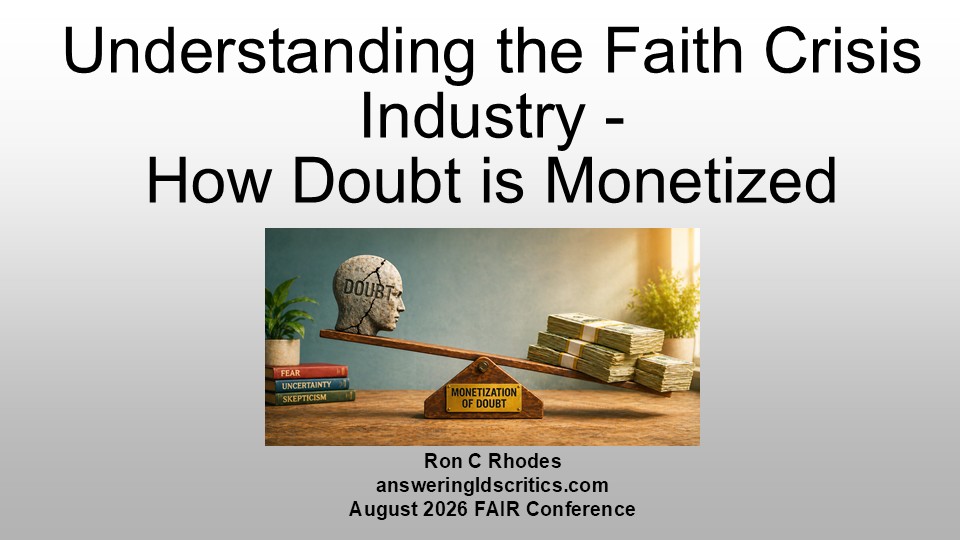
Understanding the Faith Crisis Industry – How Doubt is Monetized

Start Here

Question

What is the faith crisis industry, and how does Ron Rhodes argue that religious doubt is monetized?

Short Answer

Ron Rhodes uses the term “faith crisis industry” to describe an ecosystem of organizations and online creators producing critical content about The Church of Jesus Christ of Latter-day Saints. He argues that social media content can lead people experiencing religious doubt into communities where organizations generate revenue through advertising, paid services, coaching, and especially donations. Rhodes says financial incentives do not automatically make critical claims false, but argues that those incentives should be considered when evaluating the information being presented.

Key Takeaways
  • Rhodes describes a three-part model: critical content attracts attention, people experiencing faith crises find community, and that community can generate revenue through donations and services.
  • Social media is central to the model. Rhodes argues that algorithms can repeatedly expose viewers to similar critical content and amplify its reach.
  • Donations are a major focus of his financial analysis. He uses publicly available IRS filings to examine revenue, contributions, program-service income, and executive compensation at critical nonprofit organizations.
  • Financial incentives do not prove a claim is false. Rhodes explicitly acknowledges that making money from religious criticism does not automatically mean someone is lying about the Church.
  • Rhodes sees increased faithful online content as an important response. He argues that people encountering critical claims should be able to find accurate information just as easily.
  • His ultimate prescription is relational rather than financial. Rhodes urges Latter-day Saints to listen to people experiencing faith crises and respond with truth, kindness, compassion, and love: “People in faith crises are not projects to fix. They are people to love.”

Summary

Summary

In Understanding the Faith Crisis Industry – How Doubt Is Monetized, Ron Rhodes examines the economics surrounding online criticism of The Church of Jesus Christ of Latter-day Saints. He describes a three-part model in which critical content attracts viewers experiencing religious doubt, online communities provide belonging during a faith crisis, and donations and paid services generate revenue. Rhodes draws on IRS filings and social media metrics to discuss nonprofit revenue, executive compensation, donations, YouTube views, subscriber growth, and changes in the reach of prominent critical organizations.

Rhodes ultimately moves beyond financial analysis to the question of how Latter-day Saints should respond to people experiencing religious doubt. He argues that faithful resources must be easier to find online, but emphasizes that people in faith crises should be treated with compassion rather than as problems to solve. His concluding message calls on disciples of Jesus Christ to answer criticism with truth and clarity while creating communities characterized by listening, kindness, and love.

TL;DR

TL;DR (Too Long; Didn’t Read)

Ron Rhodes argues that online criticism of the Church operates within an ecosystem where attention, faith-crisis communities, donations, paid services, and social-media reach can create financial incentives. He examines financial and social-media data from prominent critical organizations while urging Latter-day Saints to make accurate information easier to find and to respond to people experiencing faith crises with compassion and love.

Introduction

I have the pleasure of introducing Ron Rhodes. In today’s digital world, the criticism of religion is no longer limited to books or classrooms. It reaches millions of people through videos, podcasts, and social media. Our next speaker has spent years studying this landscape. Ron Rhodes is the creator of answering LDS critics and has contributed to both fair and The Interpreter Foundation. His research examines how organizations critical of the church communicate. His research examines how organizations critical of the church communicate, and how faithful members can respond with both discernment and charity. Please welcome Ron Rhodes.

Ron Rhodes | 2026 FAIR Conference

Understanding the Faith Crisis Industry

Thank you, Jan. It’s great to be with you today to address a topic that I think is important to every member of the church, that is, understanding the faith crisis industry and how doubt is monetized.

Imagine for a moment a faithful member of the church scrolling through YouTube one evening. He watches one video disparaging Joseph Smith, then another, then another. Three hours later, he’s convinced that there are things the church never told him. Six months later, he stopped attending church altogether.

Now, most people would assume that this is primarily a story about church history or doctrine. But today I’d like to suggest it’s really a story about economics and financial incentives.
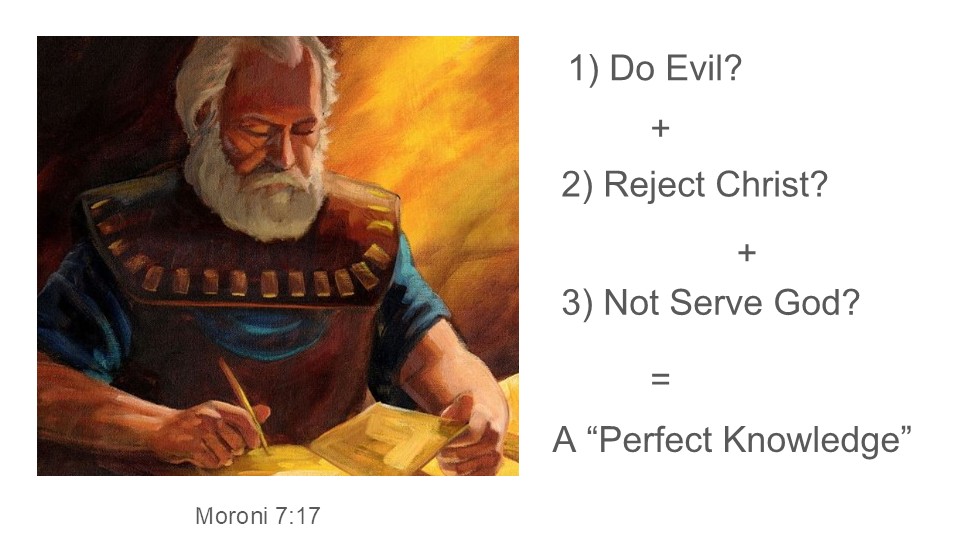
Applying Mormon’s Test

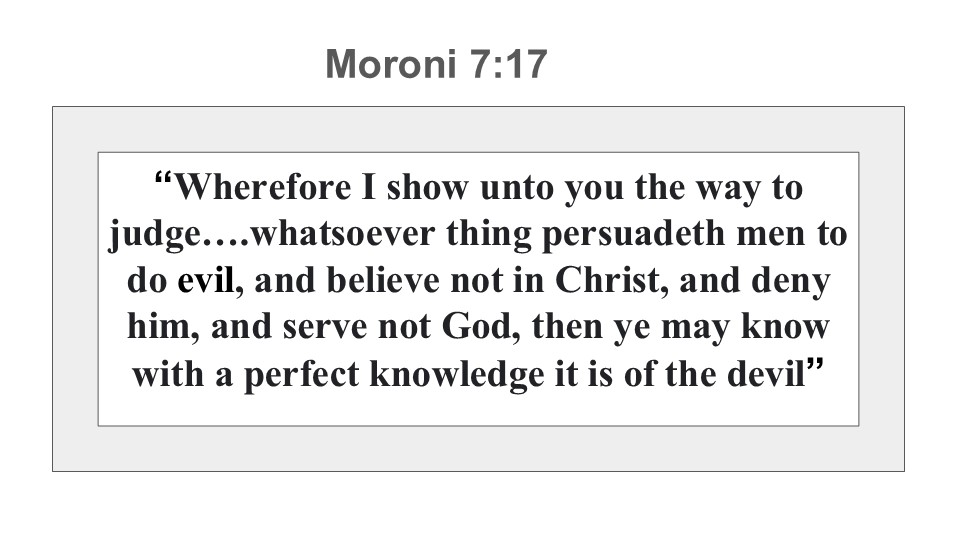
Before jumping in, though, the prophet Mormon taught that if something or someone tries to persuade us to do evil or to reject Jesus Christ, or turn away from serving God, then we can know with a perfect knowledge that it is of the devil.

That’s a pretty straightforward test. So do organizations that are critical of our faith try to persuade us to do evil, to reject Christ, or stop serving God? Well, today we’re going to examine exactly that.

We’ll look at key facts using publicly available data: not rumors, not speculation, but verifiable financial and social media metrics for some of the more prominent critical organizations.

I won’t be disclosing the names of people or entities. This isn’t about ad hominem attacks. But if we are going to apply Mormon’s criteria, then we need to know something about these critical organizations and what they do. We’ll circle back at the end and see how they stack up.
The Faith Crisis Industry as a Business Model

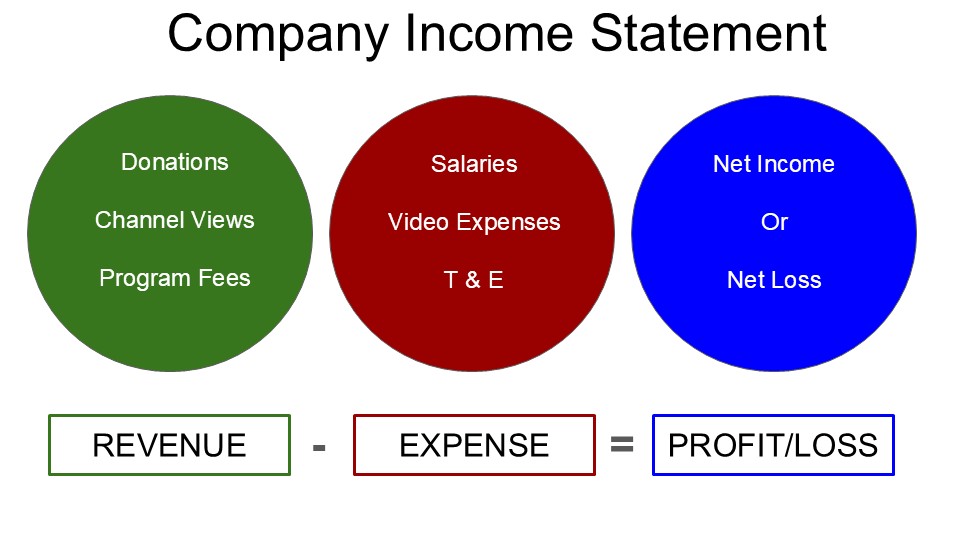
So let’s jump in. The faith crisis industry is, in fact, just that. It’s an industry. It includes observable business models with verifiable revenues, expenses, and key metrics that drive the success or failure of the company.
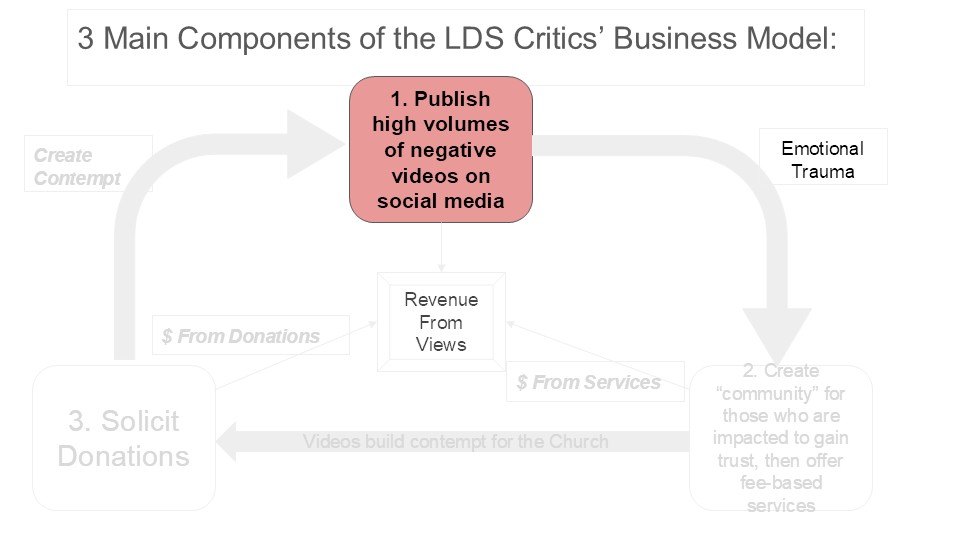
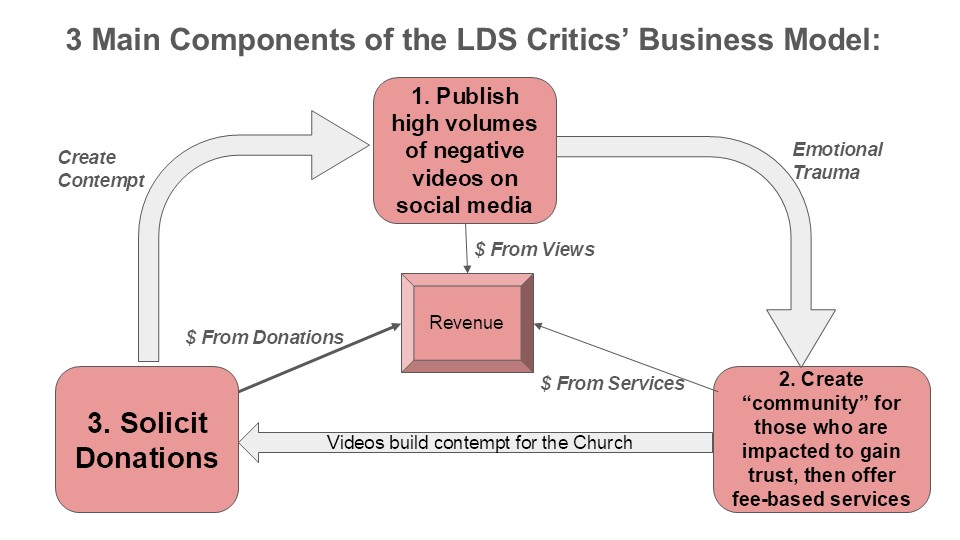
But when you step back and look at how critical organizations conduct business, a pattern emerges. The most financially successful critical organizations tend to follow a three-part business model.

Part One: Publishing High Volumes of Negative Content

Part one is to publish high volumes of negative content toward the church.
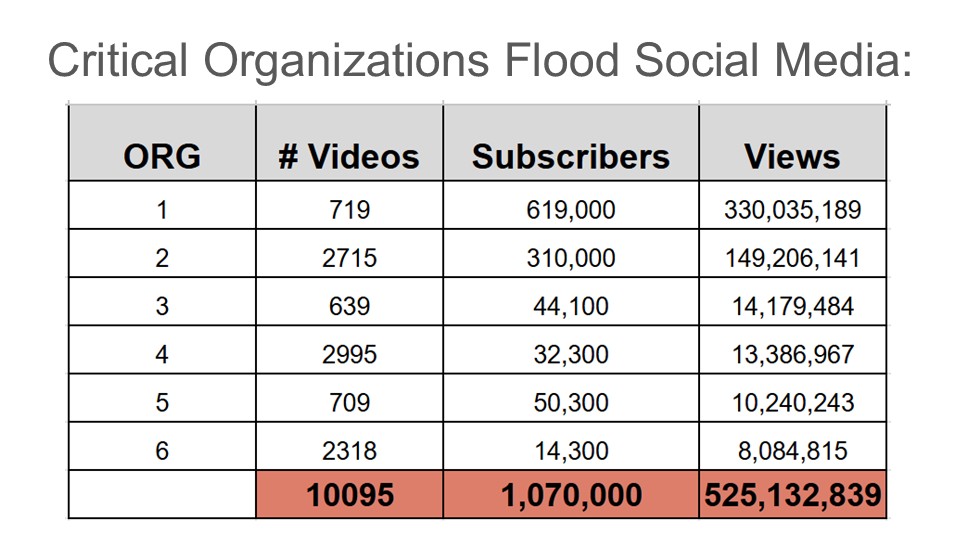
For example, just the top six most prominent critical organizations have published a combined total of over 10,000 videos on YouTube alone, generating more than 525 million views. That’s more than the entire population of the United States. Those are staggering numbers.

But remember, that’s just YouTube. That doesn’t include Instagram, Facebook, TikTok and others. Social media provides an ideal distribution channel for critical organizations because their message spreads exponentially through algorithms.

If you watch one video, then the platform algorithm serves you ten more. Add to that a strong word-of-mouth element through family and friends, and you don’t even have to be on social media to be impacted by critics’ information.

So the saturation effect of these negative videos is really powerful.
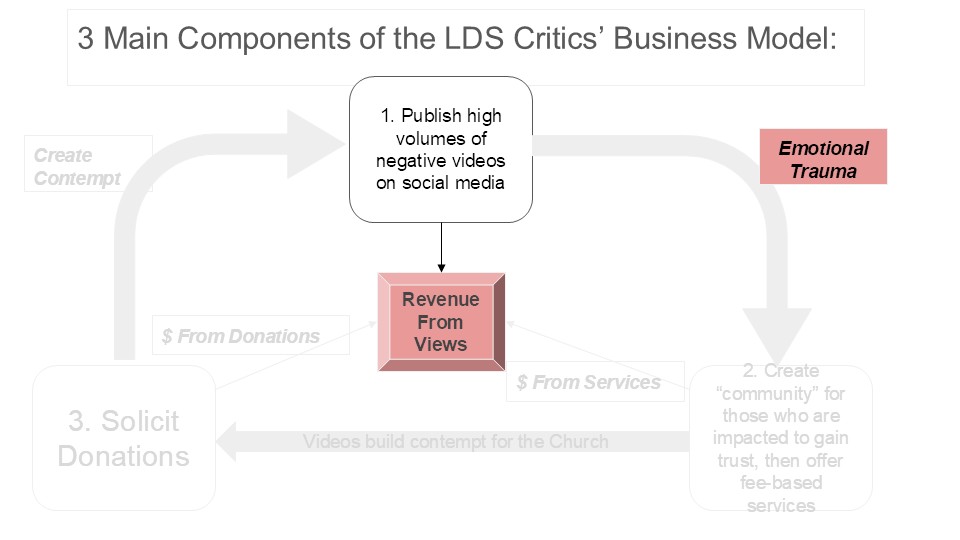
Part Two: Creating Community Around a Faith Crisis

Now, like most faithful sites, critical channels earn revenue from YouTube for each view they receive, and most people assume this is where they get the bulk of their revenue.

But revenue from views is minor compared to the future payoff in donations. So the short-term goal of their videos is simply to produce shock, betrayal, confusion, even anger.
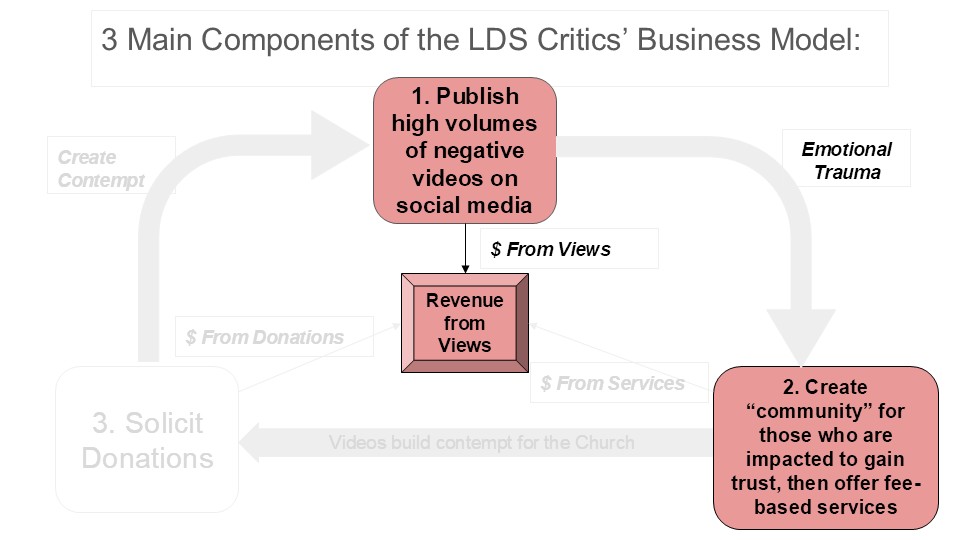
And that emotional trauma is a key element because it facilitates component number two, that is, creating community for those impacted by their videos.

A faith crisis is deeply painful, so critical organizations lean into that moment with a powerful message: We understand you’re not alone, and we’ve been there.

In fact, this slide is the homepage of the number one critical organization’s website. Note that their message is really clear. You’re not alone, and you have a built-in community of people you can trust who understand your feelings.

That sense of belonging is real and it’s meaningful. Community is powerful. And in many cases, members who have been impacted by critics’ content sincerely feel helped by these organizations.

Financial Incentives and Faith Crisis Services

Now, there’s nothing wrong with providing community. But when critics use misinformation (which is well documented on the FAIR website) to help fuel a faith crisis, then charge for services to help deal with the trauma of that crisis, it raises legitimate questions about incentives.

It’s like a doctor intentionally infecting a patient with a disease, so that they can then charge that patient for treatment.

This slide demonstrates just a few examples of the top critic offering coaching services on their website for significant fees to help people navigate the trauma of a faith crisis, which, ironically, their own videos helped cause.

Now, obviously, fees from these services also result in revenue, but once again, that revenue pales in comparison to the revenue generated by the third component: the solicitation of donations.
Part Three: Donations as the Financial Engine

Donations are the financial engine for LDS critical organizations. For the top critic, donations accounted for 74% of their overall revenue, and the second was 87%.

Donations are clearly their primary source of revenue, and although there may be some exceptions, it’s reasonable to conclude that many donors are individuals who come to believe they were betrayed by the church (which is a central theme in many critics’ videos) and then who donate after finding community in those same organizations.

So the critic’s business model is very simple:

  1. Videos produce trauma.
  2. Trauma becomes community, and
  3. Community becomes revenue.

And that is how doubt is monetized.

How Much Money Does the Faith Crisis Industry Generate?

So how much money do they make?

Well, the largest organization grew from roughly $150,000 in revenue in 2013 to a peak of $1.2 million in 2023, then back to 1.1 million in 2024.

Now, here’s the uncomfortable reality regarding revenue.

Since critics’ revenue depends primarily on donations from people experiencing a faith crisis, in order to continue making money, they have to expand the population of members in a faith crisis.

Hence, they produce tens of thousands of videos specifically designed to do exactly that.

Very literally, brothers and sisters, the more faith they shake, the more money they make.

It’s a simple cause-and-effect model.

Examining IRS Financial Filings

Now, I promised there would be no speculation. The revenue we just discussed is based on actual data from the IRS.

What you see here are the IRS filings for the top critical nonprofit organization.

So you can see on line 12, their total revenue in 2024 was $1.1 million. Line eight shows that 828,000 of that, or 74%, came from contributions.

The remaining 289,000 on line nine came from program services, which were the fee-based services we talked about earlier, and it includes their revenue from YouTube as well.

Financial Compensation in Critical Nonprofit Organizations

Now, this is a good time to point out that the term nonprofit is something of a misnomer. While a nonprofit organization is not set up to make money for its shareholders, the CEO can make as much money as their board of directors allows.

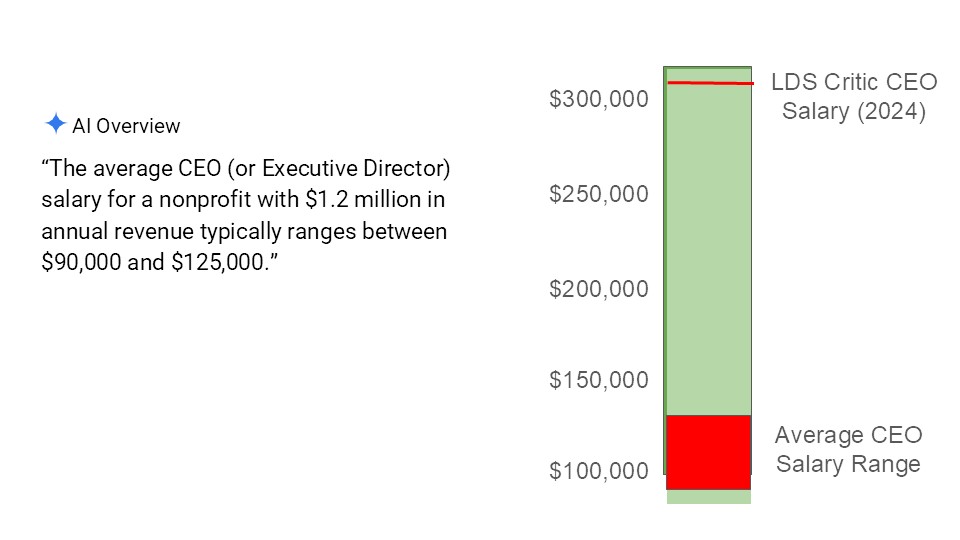
This slide demonstrates that in the case of this largest organization, the CEO and his wife made over $308,000 in 2024, according to the IRS.

I included the wife’s salary to demonstrate a nuance this organization used in 2024. If you recall from a revenue perspective, this company actually did slightly worse in 2024, and the CEO salary alone, which is in blue, reflects that drop, which is appropriate.

But by doubling the wife’s salary that same year, their household revenue continued to climb by over $21,000, even though the company itself did worse.
Comparing Nonprofit CEO Compensation

By contrast, I don’t blame them. By contrast, the average CEO salary for this size nonprofit entity across the nation ranges anywhere from 90 to $125,000.

Also, by contrast, the CEOs for both FAIR and the Interpreter Foundation have a salary of exactly zero, according to the IRS. They didn’t ask me to say that. I looked it up on their IRS filings.

They do it because they want to help people. So if you see them walking around today, be sure to thank them for everything they do.

And yes, there are faithful nonprofit organizations where the CEO does make money. But these two directly address critics’ claims.

Revenue and Salaries at a Second Critical Organization

The second most wealthy critical organization is a distant second in terms of overall revenue. But they’ve also been in business less time by about 14 years.

They started in 2019 at 80,000. They grew quickly but peaked at roughly 350,000 in 2024, with around 87% of that in donations.

The CEO salary here has been at $100,000 since 2022, so not nearly as financially rewarding as the first business. But still, he makes $100,000 a year making videos that disparage the church.

Financial Incentives and the Question of Trust

Now, to be clear, making money doesn’t automatically mean they are lying about the church.

But the reality is salaries are directly connected to the organization’s revenue, and revenue is directly tied to how many people they can persuade to enter a faith crisis and ultimately donate.

So the question each member of the church must answer for themselves is this:

Since prominent LDS critics personally profit from members experiencing a faith crisis, can you and I really trust that their videos present accurate and unbiased information about our church?

I’ll let you draw your own conclusions.

Examining Social Media Growth and Decline

Now let’s leave the financial statements for a moment and look at something I found even more interesting. I will confess, the data nerd came out in me when I built these graphs, but their message is important.

Social Blade is an independent website not affiliated with the church, that provides key metrics on social media channels.

These charts show the subscribers gained and views gained trends for the wealthiest critical organization on YouTube.

YouTube, TikTok, and Instagram Metrics

In 2024 this organization experienced a 51% decline in subscribers and new subscribers compared to the previous year, followed by another 53% decline in 2025.

Views gained told a similar story, dropping 25% in 2024, an additional 40% in 2025. That is a significant decline.

The same organization’s TikTok and Instagram metrics didn’t fare much better, losing followers gained by 58% and 19%, respectively.

Bottom line: This is not good news for this company.

Trademark Litigation and Financial Incentives

In April of this year, this organization was sued by the church for trademark infringement. Before filing suit, the church proposed a very easy solution that would have avoided litigation, but the organization declined.

I believe the data we just reviewed is a plausible reason why they rejected that fix. Had they accepted it, this downward trend in subscribers and views would likely have continued. And ultimately they may go out of business.

But by allowing the suit to proceed, the organization gained an opportunity to publicly portray itself as being targeted by the church, (which, by the way, they have done widely on social media) and by making that claim, they receive an infusion of donations from their sympathizers.

Public conflict often generates attention, engagement and financial support in ways that cooperation may not do.

Declining Growth Across Critical Organizations

So what about the remaining organizations?

Well, for the first time ever, all six of the top organizations critical of our faith saw a decline in subscribers gain growth in 2025, ranging from 7% all the way to 83%, and half of them saw a reduction in views gained.

This is a significant recent shift within the faith crisis industry.

So the obvious question becomes, why are these companies losing ground on social media?

Well, the data points us to three plausible reasons. And note that the actual reason is likely a combination of all three.
The Growth of Faithful Social Media Channels

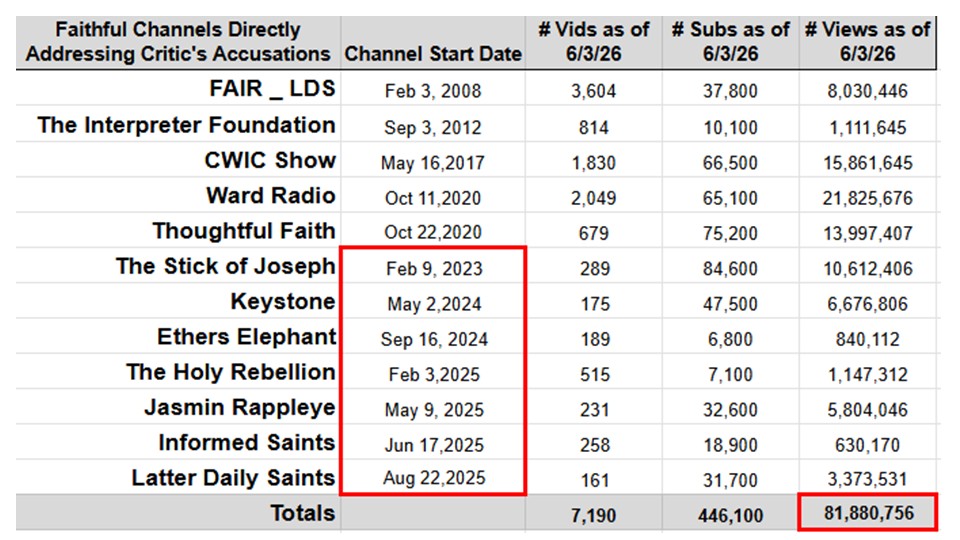
First, there has been a significant increase in the number of faithful channels that directly address critics’ claims. Made by critical organizations.

This slide identifies 12 of those channels. Seven of those 12 didn’t exist two years ago.

And that growth closely parallels the declines we’re seeing for the critics.

All of these faithful channels make finding answers to critics’ claims far more available on social media than they have been in the past.

That said, we still need more. As you can see, these channels make up 81.8 million views compared to the 525 million views on our critics’ channels.

Now, it’s not a contest, of course, but we need to ensure that our brothers and sisters who are impacted by critics’ videos can just as easily find accurate information.
Content Saturation and Repetitive Criticism

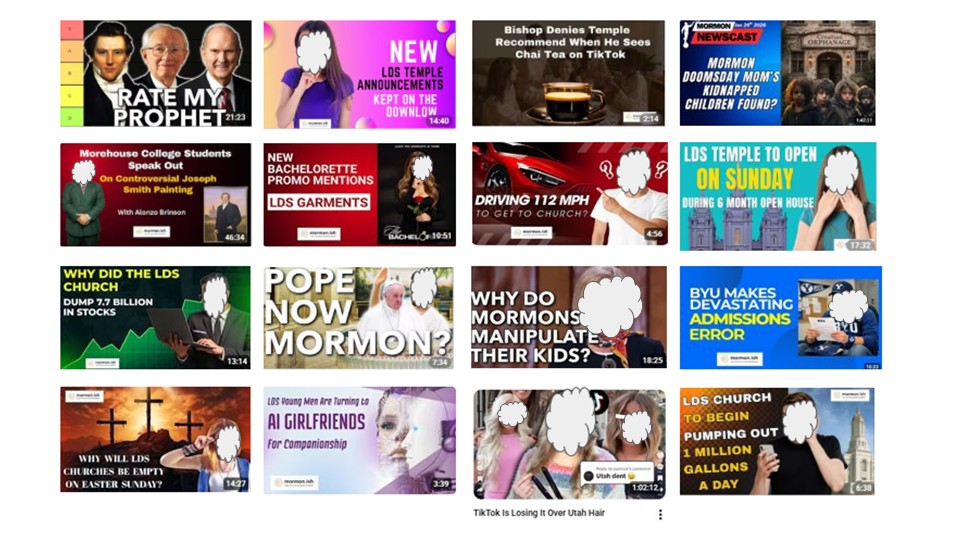
The second plausible reason critics’ metrics are declining is simply that there are a finite number of reasonable accusations our critics can make before their topics become redundant.

So critics must turn to topics that are increasingly insignificant.

For example, based on these video titles, there are now videos that talk about how The Bachelorette show mentions garments, how someone apparently drove 112mph to get to church or something to do with Utah hair.

I’m not even sure what that is.

The point is, when criticism expands to increasingly minor or unimportant grievances, credibility tends to erode.

Now, on this topic, just a personal pet peeve.

Criticism of the Church’s Giving Machines

This critical organization has published no less than eight videos that criticize the giving machines the church puts out at Christmas.

Maybe it’s just me, but I don’t know how you find fault with the Christmas giving machines. I love those machines. Where else can I buy a chicken to help someone support their family?

If there were ever a prime example of trying to persuade us to not serve God by serving our fellow man, this might be it.

And I think even for these channel supporters, things like this chip away at the credibility of these critical organizations.

The Behavior of Critical Organizations

Now, the third plausible reason critics’ metrics are declining is the critical organization’s own behavior.

Now, I want to preface this with a reminder that critics are children of God, so we need to give them grace. But grace for our critics and clarity about what they do and say can coexist.

Since these organizations have published over 10,000 negative videos about our church, as members of that church, we have the right to determine if they are coming from a place of honesty and integrity.

And the fact is, they have published some highly questionable content that brings that into question. And it also is likely influencing their subscriber rates.

So let’s consider just a few of those behaviors.
Examples of Content That Raises Questions

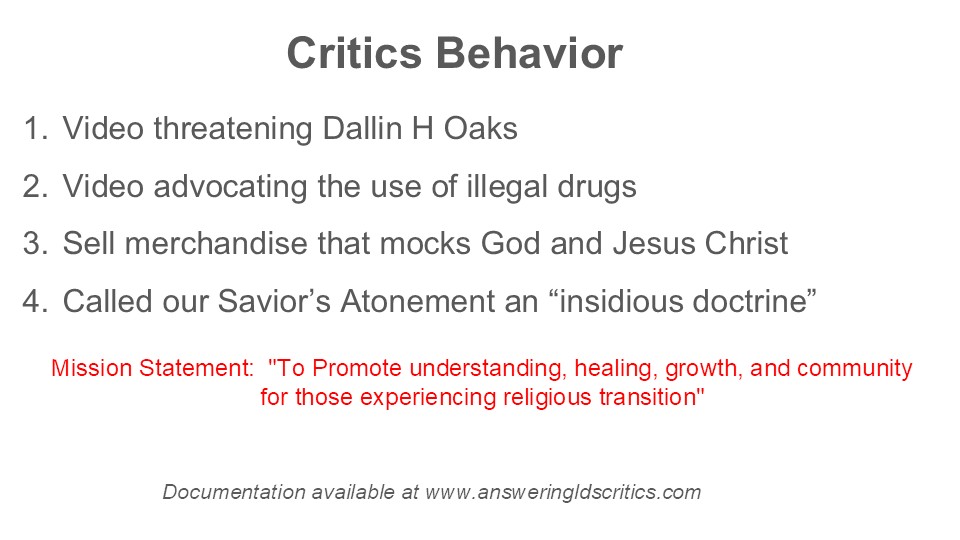
One organization released a video featuring a guest who threatened physical violence against Dallin H. Oaks. He threatened to punch him.

Another published a YouTube video advocating the use of illegal drugs. I mean, we have these recordings.

Another organization sells vile merchandise that openly mocks God, mocks Jesus Christ, and mocks our sacred temple ceremony.

In yet another case, the CEO published a video describing our Savior’s atonement as an insidious doctrine.

These behaviors and dozens, dozens more, stand in stark contrast to their own mission statements, which claim that they, “promote understanding, healing, growth and community for those experiencing religious transition.”

It’s unclear to me how releasing a video where a guest threatens to punch Dallin H. Oaks is promoting healing or understanding.

These behaviors matter because they help us understand two important realities.

The Importance of Healthy Communities During a Faith Crisis

First, they call into question the ability of organizations that are demonstrating this level of hate to provide objective, unbiased information about the church.

Second, and by far the most important, these are the organizations that many of our brothers and sisters are turning to to find community.

That’s not a healthy environment. When someone is hurting spiritually, hate doesn’t heal.

It only deepens the wound. And if the first people that offer them community are people promoting hate, then you and I, as disciples of Jesus Christ, have some work to do.
Responding to Religious Criticism With Love

So when we feel hate coming from comments on social media, from critics’ followers, we now have a reference as to where it comes from. And we only make it worse if we respond with additional hate.

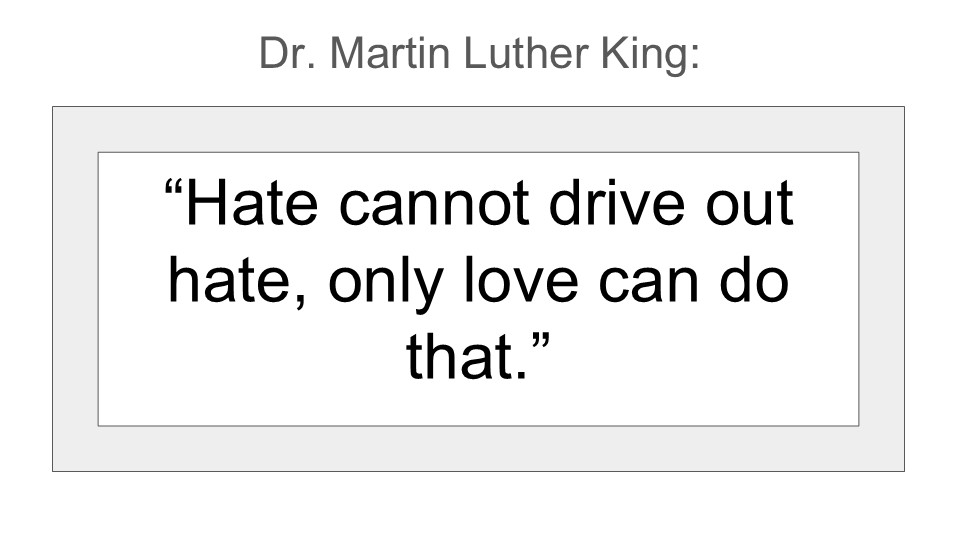
Doctor Martin Luther King said “Hate cannot drive out hate. Only love can do that.”

And of course, the Savior himself invited us to love one another as he loves us.

Brothers and sisters, let’s instead respond with love. We start by offering to listen to them. We give them a voice. We let them express their feelings.

Then we can respond with truth, kindness, and love.

If we need help with the answers, the FAIR website is a great resource.

The real issue isn’t whether critics create community. The real issue is whether disciples of Christ create a better one.

People in faith crises are not projects to fix. They are people to love. With this understanding, I’ve had to repent and change the way I respond to people online.

And I’m far from perfect at it.
Applying Mormon’s Test to Religious Criticism

So let’s circle back and see how our critics stack up against the warning given to us by the prophet Mormon.

Remember, he was speaking to members of the church in our day. He was speaking to us, and he said,

“Wherefore, I show to you the way to judge;… whatsoever thing persuadeth men to do evil”

– And I would add, like publishing videos that threaten violence or promote illegal drugs,

“and believe not in Christ, and deny him,”

– like calling our Savior’s atonement and insidious doctrine and sowing vile products that directly mock our Savior–

“and serve not God,”

–Like criticizing the giving machines and other philanthropic work that the church does–

“then ye may know with a perfect knowledge it is of the devil.”

A perfect knowledge.
Recognizing Deception and Drawing Closer to Christ

Notice that Mormon did not say we would need a PhD in church history to recognize deception. He said we could judge by what critics try to persuade us to become.

  • Do they point us toward Jesus Christ or away from him?

By their own admission, it’s away from him.

Is it any wonder, then, that President Oaks just recently invited members of the church to overcome doubts and uncertainties by drawing closer to our Savior?

Conclusion: Clarity, Charity, and Compassion

In summary, then, understanding that critics are financially motivated to destroy our faith helps us

  • look more critically at their claims,
  • knowing their channel metrics are declining, helps us understand their aggressive attacks and most importantly,
  • understanding they are persuading men to reject Jesus Christ and His atonement

gives us the perfect knowledge that we need to avoid deception by their claims and instead reach out in compassion and love.

Mormon knew exactly what he was talking about.

So my testimony is simple.

Truth does not need sensationalism. Christ does not need algorithm manipulation.

And you and I, as disciples of Jesus Christ, need not fear claims made by critics who no longer follow him.

If we respond with clarity, charity and compassion, we can strengthen testimonies, including our own, and still extend love and kindness to our brothers and sisters who have become victims of the faith crisis industry.

In the name of Jesus Christ, Amen.

Questions About the Faith Crisis Industry

What does Ron Rhodes mean by the “faith crisis industry”?

Rhodes uses the term “faith crisis industry” to describe an ecosystem of organizations and online creators producing critical content about The Church of Jesus Christ of Latter-day Saints. He argues that some prominent organizations operate through a combination of high-volume critical content, community-building for people experiencing faith crises, paid services, and donation revenue.

How can religious doubt be monetized?

Rhodes identifies several ways organizations producing religious-critical content can generate revenue, including social-media advertising, paid services, coaching, and donations. He argues that donations are particularly important to some nonprofit organizations he examines and raises questions about whether financial incentives can influence the production of faith-critical content.

Does making money from religious criticism mean the criticism is false?

No. Rhodes explicitly states, “making money doesn’t automatically mean they are lying about the church.” His argument is instead that financial incentives are relevant information readers should consider alongside the evidence supporting individual claims.

What role does social media play in a Latter-day Saint faith crisis?

Rhodes argues that social-media algorithms can repeatedly expose viewers to similar critical content after they engage with an initial video. He also examines YouTube views, subscriber trends, TikTok and Instagram metrics, and the growing number of faithful channels responding to critical claims.

How should Latter-day Saints respond to someone experiencing a faith crisis?

Rhodes argues that people experiencing faith crises should be met with listening, truth, kindness, and love. He summarizes this principle by saying, “People in faith crises are not projects to fix. They are people to love.”

Search topics

faith crisis industry; monetization of religious doubt; financial incentives in religious criticism; faith crisis nonprofits; social media and religious doubt; YouTube religious criticism; social media algorithms and faith; religious deconstruction; faith crisis communities; nonprofit donations and religious criticism; online apologetics; responding to faith crises; media literacy and religion

Mormon faith crisis; LDS faith crisis; leaving the Mormon Church; ex-Mormon content; ex-Mormon YouTube; criticism of the LDS Church; Mormon deconstruction; anti-Mormon claims; CES Letter; Mormon Stories; LDS Church criticism; Church of Jesus Christ faith crisis

Christ—Author and Finisher of Our Faith

September 27, 2026 by FAIR Staff Leave a Comment

In his April 2026 General Conference address, Elder Eduardo F. Ortega taught that becoming a lifelong disciple of Jesus Christ requires more than inheriting the faith and traditions of those who came before us. Faithful parents, grandparents, and generations of disciples can point us toward Christ; but eventually, each of us must choose to follow Him for ourselves. [Read more…] about Christ—Author and Finisher of Our Faith

Filed Under: Apologetics, Consider Conference, General Conference, Jesus Christ, Revelation, Testimonies

Mormonism in the Early Jewish Christian Milieu

Barry R. Bickmore

Roman Catholic apologist Patrick Madrid recently posed a challenging question for Latter-day Saints. That is, if Mormonism is essentially a “restoration” of primitive Christianity, where can we find historical evidence for some ancient Christian group that “was identical to the Mormon Church of today”? He goes on, “We have records of many controversies that raged in the early days of the ChurchÖ, and there just is no evidence-none at all-that Mormonism existed prior to the 1830s.”1 Whether Mr. Madrid is adequately informed about LDS claims and the state of the evidence concerning them, is beside the point. If Latter-day Saints want to make a rigorous historical case for our faith, we need to demonstrate at least some probability that a group of “Former-day Saints” really existed. What evidence for such a group should we expect to find, and what evidence is there? In this paper I attempt to answer these questions, at least in part, and show a high probability for the proposition that a group of “Former-day Saints” existed within the early Jewish Christian milieu.

The Spectrum of Early Christian Belief

What was the “early Jewish Christian milieu” and what was its relationship to other forms of Christianity? It is an irrefutable fact that the first Christians were Jewish Christians, and consequently their theology made use of Jewish thought-forms and Jewish categories. Since the discovery of the Dead Sea Scrolls, it has become increasingly apparent that the Christianity of the New Testament had clear ties to the kind of Apocalyptic Judaism2 represented by the Essenes of Qumran.3 In his landmark study of Jewish Christian theology, Jean DaniÈlou writes, “The thesis is that there was a first form of Christian theology expressed in Jewish-Semitic terms.”4 And with reference to the first Christians, J.N.D. Kelly writes that their theology “was taking shape in predominantly Judaistic moulds.”5

The Jews of the diaspora “provided the initial basis for church growth during the first and early second centuries.”6 However, by the mid-second century we can speak of three major movements within Christianity-Jewish Christianity, Hellenistic or “Gentile” Christianity, and Gnosticism. It must be remembered that these are artificial categories, and in reality there was a spectrum of belief. That is, there were Jewish Gnostic Christians, Gentile Christians with Gnostic tendencies, Gentile Christians who retained many Jewish Christian traditions, etc. In Latter-day Saint belief, all of these groups participated in or fell victim to the general apostasy. How did this happen?

The Apostasy in Jewish Christianity

The New Testament gives evidence that certain factions within Jewish Christianity rebelled against the authority of the Apostles, and refused to accept the fact that Christ had fulfilled the Law of Moses. As the missionary efforts of the Church moved beyond Palestine, the question came up as to whether Gentile converts should be circumcised and be subject to the Law of Moses. Acts 15 describes a council in Jerusalem where the “Apostles and elders” considered the matter and decided that the converts did not have to keep the ritual requirements of the Law. However, many of those who had originally insisted on the continuity of the Law would not accept this decision, and insisted on preaching their views to the churches. For instance, Paul complained that the Galatians had turned to “another Gospel” (Galatians 1:6), and specifically censured those who desired “to be under the law.” (Galatians 4:21) Paul also dealt with this issue in other letters, such as his Epistle to the Romans, and he further warned Titus against “giving heed to Jewish fables.” (Titus 1:14) It is clear that New Testament Christianity grew from the soil of Apocalyptic Judaism, but there were a great number of competing and contradictory apocalyptic traditions which some Jewish Christians may have inherited and been unwilling to give up.

DaniÈlou7 describes a host of Jewish Christian heretical sects, including the Ebionites, Elkesaites, Cerinthians, and others. These ranged from strictly Jewish groups who merely believed in Jesus as the greatest of the prophets-the son of Joseph and Mary8, to quasi-Gnostic speculations that drew heavily on miscellaneous Jewish apocalyptic traditions. Apart from these were more moderate strains of Jewish Christianity known to us from the New Testament, miscellaneous apocryphal texts, as well as such writings as Barnabas, the Pastor of Hermas,9 and miscellaneous traditions scattered throughout the writings of more Hellenized Christians. Gradually, these groups lost their vitality and were melded into the Hellenized congregations.10

The Gnostic Heretics

For a few centuries there existed alongside the Catholic Christian tradition various heretical groups categorized as “Gnostic.”11 This name comes from gnosis, the Greek word for “knowledge.” Hans Jonas explains that Gnostics believed they were saved by knowledge, specifically the knowledge of God, or that knowledge was the form of salvation itself.12

While it may be tempting to equate this sentiment to Jesus ‘statement: “Ye shall know the truth, and the truth shall make you free” (John 8:32) or to Joseph Smith’s that “a man is saved no faster than he gets knowledge,”13 upon further reflection it becomes obvious that the Gnostic belief was very different from the original Christian teaching. Knowledge itself cannot save without the atonement of Jesus Christ. On the other hand, in Gnostic circles Christ’s incarnation and atonement were thought to have been illusory, since Gnosticism radicalized the common Hellenistic notion that matter is a lesser reality into the doctrine that matter is evil. (If matter is evil, how could a divine being associate himself with it?) And while true Christians viewed the physical body as necessary, the Gnostics thought of it as a prison into which the pre-existent spirit had fallen and from which it must escape.14 In order to promote their reputations as masters of hidden knowledge, the Gnostic teachers put together a bewildering array of eclectic theologies utilizing a hodgepodge of “oriental mythologies, astrological doctrines, Iranian theology, elements of Jewish tradition,ÖChristian salvation-eschatology, [and] Platonic terms and concepts.”15

The birth of the Gnostic Christian movement took place during the Apostolic period, but Gnostics probably never became terribly prevalent at that time because the Apostles actively combated this heresy, calling it the “knowledge falsely so called.” (1 Timothy 6:20) John condemned these “docetists” (from the Greek dokein = “to seem”) who claimed Jesus only “seemed” to come in the flesh as antichrists. “And every spirit that confesseth not that Jesus Christ is come in the flesh is not of God: and this is that spirit of antichristÖ.” (1 John 4:3) But according to Eusebius (a fourth century Catholic historian), Gnostic teachers came out of the woodwork in great profusion after the Apostles were all gone.16

The “Hellenization” of Christianity

Hellenized Christianity grew out of the original Jewish Christianity as the faith moved more and more into a Gentile world saturated by Greek, or “Hellenistic” culture and thought. As Adolf von Harnack observed, this move catalyzed “the greatest transformation which the new religion ever experienced.”17

Certainly the entire Mediterranean world was touched to one degree or another by Hellenistic culture and thought, and Israel was no exception, but the Palestinian Jews proved to be a particularly resistant group, and in large part retained their own distinctive thought-forms and traditions.18 Therefore, when Gentiles and Hellenized Jews outside of Palestine came to form the majority of the Christians, it was natural that some would attempt to make the Christian message more palatable to the Greek mind by building bridges with the popular philosophy of the day, which was an amalgamation of the thought of various Greek philosophical schools, especially the Middle Platonists and the Stoics.

At first, Christian thought was quite foreign to Greek philosophy, although there were certainly important points of contact upon which the Christian missionaries capitalized.19 As Harnack notes, “Yet we cannot say that the earliest Christian writings, let alone the gospel, show, to any considerable extent, the presence of a Greek element.”20 For instance, Paul warned, “Beware lest any man spoil you through philosophy and vain deceit, after the tradition of men, after the rudiments of the world, and not after Christ.” (Colossians 2:8) Referring to this passage, James Shiel of the University of Sussex writes, “Saint Paul’s letters [contain] a severe warning against Greek philosophy as a dangerous deception”21 Cardinal DaniÈlou writes that “If we now examine the forms of thought and philosophical systems current at the time when Christianity first made its appearance in the world, it is clear that they were by no means ready to assimilate this Christian conception: on the contrary, they were wholly antagonistic thereto.”22 However, Shiel notes that a few generations after the Apostles, one “comes upon a reversed situation. The religious message is now framed in philosopher’s language, reminiscent at every turn of Heraclitus or Plato or Aristotle or Cleanthes or Epictetus. Indeed, the Christian religion is now occasionally called a philosophy and its founder described as a philosopher.”23

Beginning in the mid-second century, this shift in attitude was accomplished thanks to the efforts of a class of Christian writers later historians have dubbed the “Apologists.” These included Aristides, Justin, Tatian, Athenagoras, and others. Intellectuals themselves, they sought to express their faith in intellectually respectable terms, but the net result of their labors was not just to translate Christian ideas into a Hellenistic idiom. Rather, they imported philosophical ideas into their thought that had been anathema to the original Christians.24 One can certainly understand the temptation to make such accommodations, since the Greeks normally saw the Christians as intellectually feeble barbarians, but in the end Rebecca Lyman notes that “the efforts of the apologists succeeded in enabling Christianity to be labeled a third-rate philosophy rather than a first-rate superstition.”25

The philosophical assumptions and definitions these early Apologists adopted have profoundly affected Christian theology to this day. Edwin Hatch summarizes:

A large part of what are sometimes called Christian doctrines, and many usages which have prevailed and continue to prevail in the Christian Church, are in reality Greek theories and Greek usages changed in form and colour by the influence of primitive Christianity, but in their essence Greek still.26

It should be clear from the foregoing discussion that the various branches of early Christianity based their thinking upon fundamentally different sets of axioms, and each branch was not entirely homogenous. However, if Joseph Smith was correct in his claim to restore the original Christian theology, we must look for historical confirmation among the specifically Jewish Christian documents and traditions. As DaniÈlou stated, Jewish Christian teaching was the “first form of Christian theology”.

Limitations of This Study

There are certianly limitations to our inquiry. Few Jewish Christian documents have survived, and those that have are from a range of different groups within that milieu. In any case Joseph Smith said that things would be revealed in this dispensation which have been “kept hid from before the foundation of the world,” (D&C 124:41) so some LDS doctrines may not have been taught by the ancient Saints. We should also expect some cultural differences to affect some matters of interpretation and practice. The prophet Alma wrote, “For behold, the Lord doth grant unto all nations, of their own nation and tongue, to teach his word, yea, in wisdom, all that he seeth fit that they should have; therefore we see that the Lord doth counsel in wisdom, according to that which is just and true.” (Alma 29:8) Nevertheless, it is clear that in most of the basics, at least, our hypothetical “Former-day Saints” would have to have been very much like the Latter-day Saints, so we can expect to find a good deal of Latter-day Saint doctrine and practice within the ancient documents. The balance of this paper will demonstrate that this is, indeed, the case.

Jewish Christian and LDS Theology/Anthropology

W.D. Davies of Duke University observed that “Mormonism is the Jewish-Christian tradition in an American keyÖ. What it did was to re-Judaize a Christianity that had been too much Hellenized.”27 This is true with respect to any number of issues, but in order to keep this study to an acceptable length, we will restrict ourselves to matters of theology and anthropology. It is our doctrines regarding the nature of God, the nature of man, and the relationship between the two, that differentiate LDS thought most strikingly from mainstream Christianity. While there are many important commonalities, close analysis reveals a chasm between the two worldviews that profoundly affects many other areas of doctrine. And yet, nearly every major tenet of LDS theology and anthropology can be found within the early Jewish Christian milieu.

The Anthropomorphic God

What kind of being is God? How can He be described? Joseph Smith preached that “if you were to see [God] today, you would see him like a man in form,”28 and that “the Father has a body of flesh and bones as tangible as man’s; the Son also.” (D&C 130:22)

On the other hand, mainstream Christians generally accept definitions such as that promulgated by the Vatican Council, where God was said to be “eternal, immense, incomprehensible, Öwho, being a unique spiritual substance by nature, absolutely simple and unchangeable, must be declared distinct from the world in fact and by essence.”29 This sort of definition was readily accepted among second-century Gentile Christians because it exactly coincided with those being taught by the contemporary Greek philosophers. For instance, the Middle Platonist philosopher Plutarch wrote the following:

Socrates and Plato held that (God is) the One, the single self-existent nature, the monadic, the real Being, the good: and all this variety of names points immediately to mind. God therefore is mind, a separate species, that is to say what is purely immaterial and unconnected with anything passible.30

Gentile Christian thinkers frankly admitted this correspondence, and in fact promoted the doctrine as a ready defense against the attacks of pagan critics. Tertullian wrote, “Whatever attributes therefore you require as worthy of God, must be found in the Father, who is invisible and unapproachable, and placid, and (so to speak) the God of the philosophers.”31

This was not, however, the case for the Jews or the Jewish Christians, except insofar as they had been influenced by Hellenistic thought. Thus, even in the third century Origen could say, “The Jews indeed, but also some of our people, supposed that God should be understood as a man, that is, adorned with human members and human appearance. But the philosophers despise these stories as fabulous and formed in the likeness of poetic fictions.”32 Notice that Origen did not appeal to unanimous Christian tradition to establish his doctrine of the incorporeality of God, but to the philosophers. Indeed, in another passage Origen admitted this was the subject of some confusion among Christians. “For it is also to be a subject of investigation how God himself is to be understood-whether as corporeal, and formed according to some shape, or of a different nature from bodies-a point which is not clearly indicated in our teaching.”33

A second-century Jewish Christian document, the Clementine Homilies, explicitly taught anthropomorphism. The following is part of a conversation that is said to have occurred between Simon Magus and Peter. “And Simon said: ‘I should like to know, Peter, if you really believe that the shape of man has been moulded after the shape of God.’ And Peter said: ‘I am really quite certain, Simon, that this is the caseÖ. It is the shape of the just God.'”34

The anthropomorphic teaching of the Jews and Jewish Christians was based upon a literal interpretation of the Bible. Many examples of anthropomorphic Bible passages could be cited, but for now a few explicit statements will suffice. Ezekiel’s vision of the heavenly throne is described thus: “Above the vault over their heads there appeared, as it were, a sapphire in the shape of a throne, and high above all, upon the throne, a form in human likeness.” (Ezekiel 1:26 NEB) Just prior to his martyrdom, Stephen said, “Behold, I see the heavens opened, and the Son of man standing on the right hand of God.” (Acts 7:56) John reported a similar vision of God. “And immediately I was in the spirit: and, behold, a throne was set in heaven, and one sat on the throne.” (Revelation 4:2) Edmond LaB. Cherbonnier of Trinity College summarizes this phenomenon as follows: “In short, to use the forbidden word, the biblical God is clearly anthropomorphic-not apologetically so, but proudly, even militantly.”35 Christopher Stead of the Cambridge Divinity School agrees that, “The HebrewsÖpictured the God whom they worshipped as having a body and mind like our own, though transcending humanity in the splendour of his appearance, in his power, his wisdom, and the constancy of his care for his creatures.”36

Mainstream Christians usually interpret the Biblical statements allegorically, and offer two major points of scriptural evidence. First, they cite John 4:24, “God is Spirit” or “God is a Spirit.” If God is a Spirit, they say, He cannot have a body. However, John’s statement “God is Spirit” is parallel to two passages in his first epistle, “God is light” (1 John 1:5) and “God is love” (1 John 4:8) In context, all of these passages seem to be referring to God’s activity toward men rather than to the nature of His “Being”. Furthermore, Christopher Stead explains how such statements would have been interpreted within ancient Judaism. “By saying that God is spiritual, we do not mean that he has no bodyÖbut rather that he is the source of a mysterious life-giving power and energy that animates the human body, and himself possesses this energy in the fullest measure.”37

Second, mainstream Christians appeal to passages like John 1:18. “No man hath seen God at any time.” Latter-day Saints can harmonize these passages with those that describe visions of the Father by referring to Moses’ vision of God, as described in the Pearl of Great Price. “And he saw God face to face, and he talked with him, and the glory of God was upon Moses; therefore Moses could endure his presenceÖ. [Moses said] For behold, I could not look upon God, except his glory should come upon me, and I were transfigured before him.” (Moses 1:2, 14) An identical solution is offered by Peter in the Jewish Christian Clementine Homilies.

For I maintain that the eyes of mortals cannot see the incorporeal form of the Father or Son, because it is illumined by exceeding great light.ÖFor he who sees God cannot live. For the excess of light dissolves the flesh of him who sees; unless by the secret power of God the flesh be changed into the nature of light, so that it can see light.38

The point of these passages is not that no one has or will have a vision of God’s person, but rather that men cannot see God as He is. We must be changed and protected by the grace of God to withstand His presence. However, this will not always be the case. As John further wrote, “Beloved, now are we the sons of God, and it doth not yet appear what we shall be: but we know that, when he shall appear, we shall be like him; for we shall see him as he is.” (1 John 3:2, emphasis added)

The Unity of the Godhead

One feature of the New Testament all Christians must come to terms with is the fact that in some passages the Father is represented as “the only true God” (John 17:3), while in others the Son and Holy Spirit are also called “God” (John 1:1; John 14:26; Acts 13:2). How can this apparent contradiction be resolved? It can readily be seen that the two disparate definitions of God discussed above must lead to different conclusions regarding this question.

In harmony with their definition of God as an indivisible, eternal, unchanging spiritual “essence”, mainstream Christians say that the members of the Trinity are separate “persons” who share a single “Divine Being”. All three persons have always existed in the same relationship to one another, and there is no hierarchy within the Trinity. That is, the Father, Son, and Holy Spirit do not differ in rank or glory. On the other hand, Latter-day Saints believe the members of the Godhead are separate beings, and so in a sense we believe in more than one God. However, Latter-day Saints also speak of “one God” in two senses. First, the Godhead is “one” in will, purpose, love, and covenant. Second, the Father is the absolute monarch of the known Universe, and all others are subject to Him.

In order to find a historical basis for the Latter-day Saint doctrine of the Divine Unity, we need not look exclusively among the Jewish Christians, because it was almost universally accepted among Christians before the Nicene Council of 325 A.D. that the Father, Son, and Holy Ghost were united in will, but separate in rank and glory. J.N.D. Kelly of Oxford University notes that even at the Council of Nicea the majority party believed “that there are three divine hypostases [or “persons”], separate in rank and glory but united in harmony of will.”39 This doctrine is called “subordinationism”, and R.P.C. Hansen writes, “Indeed, until Athanasius began writing, every single theologian, East and West, had postulated some form of Subordinationism. It could, about the year 300, have been described as a fixed part of catholic theology.”40 Henry Bettenson writes that “‘subordinationism’Öwas pre-Nicene orthodoxy.”41 Paul wrote that the Father is “the God and Father of our Lord Jesus Christ” (Romans 15:6, NEB), and revealed that after the resurrection Jesus will “be subject unto him [the Father] that put all things under him, that God may be all in all.” (1 Corinthians 15:24-28) Indeed, Jesus Himself said, “My Father is greater than I.” (John 14:28)

This doctrine took various forms, depending on the particular concept of God involved. Within Jewish Christianity, where God was often conceived of as having a body in human form, Jesus and the Holy Spirit were described both as gods, worthy of worship, and the chief among the archangels.42 While Latter-day Saints generally do not refer to the Son and Spirit as “angels”, such a designation is consistent with our belief that Jesus, the Holy Spirit, and all angels and men are “sons of God” (Job 38:7), differing in degree and power, but not in essential nature. This belief is graphically illustrated in the Jewish Christian apocryphal text, The Ascension of Isaiah:

Then the angel who conducted me said to me, “Worship this one”; so I worshiped and praised. And the angel said to me, “This is the Lord of all glory whom you have seen”.ÖAnd while the angel was still speaking, I saw another glorious one, like to him, and the righteous drew near to him, worshiped, and sang praise.ÖAnd I saw the Lord and the second angel, and they were standing; but the second one whom I saw was on the left of my Lord. And I asked, “Who is this?” and he said to me, “Worship him, for this is the angel of the Holy Spirit”.ÖSo my Lord drew near to me, and the angel of the Spirit and said, “Behold, now it is granted to you to behold God, and on your account is power given to the angel with you.” And I saw how my Lord worshiped, and the angel of the Holy Spirit, and how both together praised God.43

An early second century Jewish Christian document, the Shepherd of Hermas spoke of “the angel of the prophetic Spirit”44 and Jesus as the “‘gloriousÖangel’ or ‘most venerableÖangel’Ö.”45 Justin Martyr, a converted philosopher who lived in Rome in the mid-second century, was no Jewish Christian, but Robert M. Grant suggests that in passages like the following, he was influenced by the Jewish Christian writings of Hermas, who lived in the same congregation.46 Justin Martyr wrote that the “first-begotten,” the Logos, is the “first force after the Father:” he is “a second God, second numerically but not in will,” doing only the Father’s pleasure.47 He designated the Son as “this power which the prophetic word calls GodÖand Angel”48, and in the same vein stated the following. “We reverence and worship Him and the Son who came forth from Him and taught us these things, and the host of other good angels who are about Him and are made quite like Him, and the Prophetic Spirit.”49 He also maintained that the Son is “in the second place, and the prophetic Spirit in the third.”50 Finally, the Jewish Christian Clementine Recognitions had this to say regarding Jesus’ status:

For the Most High God, who alone holds the power of all things, has divided all the nations of the earth into seventy-two parts, and over these He hath appointed angels as princes. But to the one among the archangels who is greatest, was committed the government of those who, before all others, received the worship and knowledge of the Most High GodÖ. Thus the princes of the several nations are called gods. But Christ is God of princes, who is Judge of all.51

The Names of God

The above-mentioned text from the Clementine Recognitions brings up the issue of how Latter-day Saints use the names of God in the Bible. Four names or titles are commonly used to connote God in the Old Testament-El (“God”), Elohim (“God” or “gods”), Elyon (“Most High”), and Yahweh (equivalent to “Jehovah”).52 Most mainline Christians see all these designations as referring to one divine being. However, the Latter-day Saint usage is much more complicated. On one hand, the Divine names can refer to specific Persons, i.e. El or Elohim usually refers to the Father, and “Yahweh” usually refers to the Son. On the other hand, they have also been used as titles in reference to more than one Divine Person. Both the Father and the Son have been called “Jehovah” or Yahweh (D&C 109:34, 42, 68; D&C 110:3)53, and it is believed that the Bible passages which link Yahweh with Elohim or Elyon (e.g. Isaiah 43:12-13; Isaiah 45:21-22 NEB) refer to a “divine investiture of authority”, where the Son is allowed to speak in the first person as the Father.54

When one examines the context of passages such as the foregoing reference to the Clementine Recognitions, it becomes clear that the usage of the Divine Names/Titles was similarly complicated in the Jewish Apocalyptic and Jewish Christian traditions. The Recognitions was referring to a particular passage which occurs in both the Septuagint and Dead Sea Scrolls manuscripts of Deuteronomy. “When the Most High parcelled out the nations, when he dispersed all mankind, he laid down the boundaries of every people according to the number of the sons of God; but the LORD’s [Yahweh’s] share was his own people, Jacob was his allotted portion.” (Deuteronomy 32:8-9 NEB) Based on this and other passages, some Biblical scholars now conclude that the Israelites originally believed El to be the high God, and Yahweh to be the chief among the “sons of El”-the second God and chief archangel who had special responsibility for Israel.55

Certainly this is a debated point, and beyond the scope of this paper, but it is beyond debate that this was a standard early Christian interpretation of the passage. As late as the fourth century, the great historian and bishop, Eusebius of Caesarea, could write:

In these words [Deut. 32:8] surely he names first the Most High God, the Supreme God of the Universe, and then as Lord His Word, Whom we call Lord in the second degree after the God of the Universe. And their import is that all the nations and the sons of men, here called sons of Adam, were distributed among the invisible guardians of the nations, that is the angels, by the decision of the Most High God, and His secret counsel unknown to us. Whereas to One beyond comparison with them, the Head and King of the Universe, I mean to Christ Himself, as being the Only-begotten Son, was handed over that part of humanity denominated Jacob and Israel, that is to say, the whole division which has vision and piety.56

According to Alan Segal, in a number of Jewish Apocalyptic texts there were actually two Yahwehs. Both the High God and principal angel were so designated.57 Similarly, in the Jewish Christian Apocalypse of Abraham, preserved only in the Slavonic language, God is designated both as El and “Jaoil”, and in some manuscripts the angel accompanying Abraham is also named “Jaoil”.58 Indeed, Segal notes that during the first Christian centuries, the rabbis engaged in debates with various sects, including the Christians, who all seem to have claimed there was a second God, in many cases identifying him with Yahweh or “the bearer of the divine name.”59 Significantly, Jean DaniÈlou writes that “the Name of God” was one of the principal designations of the Son within Jewish Christianity.60

Creation from Unformed Matter

The idea that there are multiple Divine Beings who have material bodies with human form is sharply at odds with the axiom of the theologians that God’s “Essence” is “wholly other” than the rest of the universe. This assumption on the part of mainstream Christians is based on the doctrine of creatio ex nihilo – creation from nothing. In his 1990 Presidential address to the British Association for Jewish Studies, Peter Hayman asserted the following:

Nearly all recent studies on the origin of the doctrine of creatio ex nihilo have come to the conclusion that this doctrine is not native to Judaism, is nowhere attested in the Hebrew Bible, and probably arose in Christianity in the second century C.E. in the course of its fierce battle with Gnosticism. The one scholar who continues to maintain that the doctrine is native to Judaism, namely Jonathan Goldstein, thinks that it first appears at the end of the first century C.E., but has recently conceded the weakness of his position in the course of debate with David Winston.61

The Apostle Peter was quite explicit about his belief in creation from a watery chaos, rather than from nothingness. He wrote, “There were heavens and earth long ago, created by God’s word out of water and with water.” (2 Peter 3:5 NEB) The background for this passage is the first two verses of Genesis: “In the beginning of creationÖthe earth was without form and void, with darkness over the face of the abyss, and a mighty wind that swept over the surface of the waters.” (Genesis 1:1-2 NEB) David Winston writes that the Rabbis presupposed the same watery chaos. For instance, he notes that Mekilta, Shirta 8 states that “to make a roof man requires wood, stones, dirt, and water, whereas God has made a roof for his world out of water. God’s first act of creation thus presupposes the existence of water.”62 Similarly, the Sefer Yesira states, “He formed substance from chaos and made it with fire and it exists, and he hewed out great columns from intangible air.”63 In the Bereshit Rabba we find, “R. Huna said,Ö’If it were not written explicitly in Scripture, it would not be possible to say it: God created the heaven and the earth. From the earth was chaos, etc.'”64

However, the interpretation of some of the early texts can be confusing, and indeed, a few seemingly contradict creation from chaos. In the Apocrypha, 2 Maccabees asserts that “God made [the sky and the earth] out of nothing, andÖman comes into being in the same way.” (2 Maccabees 7:28 NEB) On the other hand, the Wisdom of Solomon says, “For thy almighty hand, which created the world out of formless matter, was not without further resource.” (Wisdom of Solomon 11:17 NEB) Paul seemed to imply creation out of nothing: “GodÖsummons things that are not yet in existence as if they already were” (Romans 4:17 NEB), and yet we saw that Peter’s language recalled the Genesis account of creation from a watery chaos. Indeed, in the very same verse Paul wrote that God “fashioned” (Greek katertisthai = “adjusted, put in order again, restored, repaired”) the universe, but in such a way that “the visible came forth from the invisible.” (Hebrews 11:3 NEB) The second-century Pastor of Hermas asserted that God “made out of nothing the things that exist,”65 but in another passage clearly presupposed creation from a watery chaos: “By His strong word [He] has fixed the heavens and laid the foundations of the earth upon the waters.”66

Gerhard May has convincingly shown that where these early texts say God created out of “nothing” or “non-being”, etc., they were using a common ancient idiom to say that “something new, something that was not there before, comes into being; whether this something new comes through a change in something that was already there, or whether it is something absolutely new, is beside the question.”67 For instance, the Greek writer Xenophon wrote that parents “bring forth their children out of non-being’.68 Philo of Alexandria wrote that Moses and Plato were in agreement in accepting a pre-existent material, but also that God brings things “out of nothing into being” or “out of non-being”.69 Therefore, in view of this common usage, and the many explicit statements by ancient authors regarding the pre-existent matter, we must rule out a belief in creatio ex nihilo unless it is explicitly stated otherwise.

We do not find such explicit statements anywhere until the mid-second century with the Gnostic teacher Basilides and later the Christian apologists Tatian and Theophilus of Antioch.70 Even as late as the turn of the third century, Tertullian had to take the more ancient usage into account when arguing for the new doctrine. “And even if they were made out of some (previous) matter, as some will have it, they are even thus out of nothing, because they were not what they are.”71

Given the state of the evidence, we can be fairly certain that when Joseph Smith said matter is eternal, and that God fashioned the earth from pre-existent matter72, he was restoring the earliest Jewish Christian belief.

The Pre-Mortal Existence of Souls

Latter-day Saints not only reject the notion that the material world was created from nothing, but that the spiritual world was so created. Joseph Smith taught that the “intelligence” of man is eternal, and at some point God organized this “intelligence” into the spirits of men. (Abraham 3:22-23) Thus, the spirits of men pre-existed their bodies.

R.G. Hammerton-Kelly, professor of New Testament at McCormick Theological Seminary, reports that “the idea that certain things pre-exist in the mind of God or in heaven has a long history in the Biblical and early Jewish traditions.”73 For instance, “in Job 15:8 the primal man is pictured in the council of the gods before the world was madeÖ.”74 David Winston reports that the Bereshith Rabba and Ruth Rabba tell of God consulting the souls of the righteous before deciding to create the world.75 The Wisdom of Solomon, in the Apocrypha, states: “As a child I was born to excellence, and a noble soul fell to my lot; or rather, I myself was noble; and I entered into an unblemished body.” (Wisdom of Solomon 8:19-20 NEB) The Midrash Kee Tov says that all the souls of the righteous, including Adam, Noah, Abraham, Moses, etc. “were with God before the creation of the world.”76 And an important Jewish theologian at about the time of Christ, Philo, taught that “the heavenly man is God’s offspringÖwhile the earthly man is merely the work of an artificer.”77

Origen quoted a Jewish apocryphal document called the Prayer of Joseph, which asserted that Jacob was one of the archangels in his premortal existence:

Thus Jacob says: “I, Jacob, who speak to you, arid Israel, I am an angel of God, a ruling spirit, and Abraham and Isaac were created before every work of God; and I am Jacob, called Jacob by men, but my name is Israel, called Israel by God, a man seeing God, because I am the first-born of every creature which God caused to live.”78

The Enoch texts also contain the common element of the pre-existence. (This is significant, since the early Christians apparently took at least one of these documents very seriously. Indeed, Jude referred to one of them in his general epistle. (See Jude 1:14) 2 Enoch states that, “all souls are prepared to eternity, before the formation of the world,”79 and cites Adam as the prime example:

And I placed on the earth, a second angel, honorable, great and glorious, and I appointed him as ruler to rule on earth and to have my wisdom, and there was none like him of earth of all my existing creaturesÖ. I called his name Adam.80

1 Enoch relates that before God created the world he held a consultation with the souls of the righteous.81

Clearly the pre-existence of souls, and even their identification with the angels of God, was a commonplace in the soil of Apocalyptic Judaism from which Christianity sprang. But did the Jewish Christians continue this tradition? Certainly the pre-existence of Christ is explicitly taught in the New Testament (John 1:1; 1 Peter 1:19-20; Colossians 1:12-15), but what about the rest of us? Hammerton-Kelly writes that the pre-existence of the Church, at least, is everywhere presupposed in the New Testament.82 For instance, Paul wrote to Titus, “In hope of eternal life, which God, that cannot lie, promised before the world began.” (Titus 1:2) Similarly, two of the earliest Jewish Christian writings, the Shepherd of Hermas and 2 Clement say the following about the Church. “She was created first of allÖand for her sake was the world made.”83 “Moreover, the books and the Apostles declare that the Church belongs not to the present, but existed from the beginning.”84 However, it must be remembered that some of the ancients believed the creation pre-existed in the mind of God, rather than as a number of distinct entities. Which concept formed the background of the New Testament anthropology? Commenting on Paul’s doctrine of foreordination as expounded in Romans 8:28-30, Hammerton-Kelly explains that the Greek verb for “foreknow” used in the passage means “‘to take note of’, ‘to fix regard upon’ something, preliminary to selecting it for some special purpose.” But when did this selection occur? “Most commentators believe that it took place in the eternal counsels of God, before the creation of the world.”85 Thus, it is clear that, according to Paul, in the eternal counsels of God we existed as specific entities.

This belief continued within Jewish Christianity even after the Apostolic age. For instance, in the Jewish Christian Clementine Recognitions Peter states, “after all these things He made man, on whose account He had prepared all things, whose internal species is older, and for whose sake all things that are were made.”86 Regarding the “internal species” of man mentioned here, the Presbyterian translators of this passage declare in the footnote: “That is, his soul, according to the doctrine of the pre-existence of souls.” Even more striking, from a Latter-day Saint point of view, is Abraham’s vision of the pre-existent host as reported in the Jewish Christian Apocalypse of Abraham, also called the Book of Abraham in some manuscripts. Compare the following to Abraham’s vision of the pre-existent host in the Pearl of Great Price, Abraham 3.

And everything I had planned to be came into being: it was already pre-figured in this, for all the things and all the people you have seen stood before me before they were created. And I said, Mighty and Eternal Ruler, who then are the people in this picture on this side and on that? And he said to me, Those on the left side are the many peoples which have existed in the past, and after you are appointed, some for judgement and restoration, some for vengeance and perdition, until the end of the age. And those on the right side of the picture, they are the people set apart for me from the people with Azazil [Satan]. These are the people who are going to spring from you and will be called my people.87

The Deification of Man

At this point it should be clear that within both Jewish Christianity and Mormonism, men are thought to be more than some “rational animal”, brought into existence out of nothing by God. Joseph Smith went on to teach that those who fully keep God’s law will “be gods, because they have no end; therefore shall they be from everlasting to everlasting, because they continue; then shall they be above all, because all things are subject unto them.” (D&C 132:20) For the Prophet, this went hand in hand with the doctrine of pre-existence. Humans are the same species as God, and hence have the potential to become like Him.

When we search for similar deification doctrines within early Christianity, we are deluged with examples. Within Gentile Christianity, we find numerous texts like the following from Justin Martyr (ca. 150 A.D.), who wrote that “all men are deemed worthy of becoming ‘gods,’ and of having power to become sons of the Highest.”88 Hans Jonas writes that the ultimate object of the Gnostics was to obtain the knowledge of God, and become a partaker in the divine essence.89 One text states, “This is the good end of those who have attained gnosis: to become God.”90 There is also considerable support for this doctrine in the New Testament. For example, John wrote, “Beloved, now are we the sons of God, and it doth not yet appear what we shall be: but we know that, when he shall appear, we shall be like him; for we shall see him as he is.” (1 John 3:2.) And Jesus Christ told John that, “To him that overcometh will I grant to sit with me in my throne, even as I also overcame, and am set down with my Father in his throne.” (Revelation 3:21) Also, “He that overcometh shall inherit all things; and I will be his God, and he shall be my son.” (Revelation 21:7) Paul wrote to the Romans, “The Spirit itself beareth witness with our spirit, that we are the children of God: And if children, then heirs; heirs of God, and joint-heirs with Christ.” (Romans 8:16-17) Such statements would not have been out of place in Apocalyptic Judaism, for in the Dead Sea Scrolls we find the appelations “el” and “elohim” applied to Melchizedek. “A godlike being has taken his place in the council of God; in the midst of the divine beings [elohim] he holds judgment.”91 Similarly, the War Scroll says that God will “exalt the authority of Michael among the gods and the dominion of Israel among all flesh.”92

The question, therefore, is not whether the primitive Church believed men could become gods, but what that meant to them. The fourth century theologian Gregory of Nazianzus gave us an interpretive key: “I too might be made God so far as He is made Man.”93 Within early Christianity there were any number of views about who Christ was in relation to the Father, and with respect to men. However, given the Hellenistic assumptions of the Gentile Christians, it was usually thought that men could become “gods” in a different sense than the Father, though not necessarily in a different sense than the Son. The idea was that there are two classes of beings – God, who is an eternal, unchangeable, simple, spiritual “essence”, and everything else, which is created out of nothing. And those who are created out of nothing can only approach the status of the Eternal God, but never reach it.

We have already seen, however, that within the Jewish Christian milieu, the following precepts were taught: 1) the Father has a body in human form; 2) there is more than one Divine Being, though they are united in will under the monarchy of the “only true God”, the Father; 3) creation out of pre-existent materials; 4) the pre-existence of the human soul, and the identification of human souls, the Son, and the Spirit with the angels of God. But are humans really “the offspring of God” (Acts 17:28), as Paul put it, in the sense that we are the same “species”? Christopher Stead writes, “In a Palestinian milieu it was still possible to picture the heavenly Father in human form and to see the contrast between heaven and earth as one of light and glory against relative darkness and indignity.”94 Thus, among the Jews God was thought to be above every other being, but still fundamentally akin to mankind. This concept is brought out clearly in a fascinating passage in the Jewish Christian Clementine Homilies.

Learn this also: The bodies of men have immortal souls, which have been clothed with the breath of God; and having come forth from God, they are of the same substance, but they are not gods. But if they are gods, then in this way the souls of all men, both those who have died, and those who are alive, and those who shall come into being, are gods. But if in a spirit of controversy you maintain that these also are gods, what great matter is it, then, for Christ to be called God? for He has only what all have.95

Several things should be noted about this passage. First, it is maintained that the Father is “the only true God”. (John 17:3) All others, including Jesus, can be called gods in a subsidiary sense. Second, the “immortal souls” of men are said to “come forth from God” and are “of the same substance” as God. Prior to the fourth century, phrases such as “of one substance” or “of the same substance” implied a generic unity of species, meaning something like “made of the same kind of stuff”. 96 Finally, Jesus is said to have exactly the same kind of soul as the rest of humanity.

On the other hand, why is Jesus called God’s “only begotten Son” in the New Testament (John 1:18; 3:16; 3:18; Hebrews 11:17; 1 John 4:9) if we are all the children of God? The answer lies in what was meant by the word “begotten”. Within modern mainstream Christianity, it has been held that the Son was eternally generated, or “begotten”, from the Father since before the beginning of time, hence there was never a time when the Father was not a Father, and the Son was not a Son. However, Jean DaniÈlou points out that Origen (early third century) was the first Catholic Christian to explicitly state a doctrine of eternal generation, although some Gnostics had expressed a similar view in the second century.97 Commenting on a passage from the writings of Ignatius of Antioch (ca. 110 A.D.), J.N.D. Kelly notes the following:

His divine Sonship dates from the incarnation…. In tracing His divine Sonship to His conception in Mary’s womb, he was simply reproducing a commonplace of pre-Origenist theology; the idea did not convey, and was not intended to convey, any denial of His pre-existence. So far as Ignatius is concerned, he definitely states that He “existed with the Father before the ages”, and that He “came forth from the unique Father, was with Him and has returned to Him”.98

This is completely in harmony with the LDS teaching that all are the spiritual children of God, but Jesus is the only one begotten by God in the flesh. Given all this, it is also clear that in the early Jewish Christian milieu, deified men would have been considered subordinate to the Father, but not fundamentally different than Him in nature.

Eternal Marriage

In Latter-day Saint thought, deification is intimately related to marriage. That is, in order to obtain the highest degree of heaven and be deified, “a man must enter into this order of the priesthood [meaning the new and everlasting covenant of marriage].” (D&C 131:2) Men and women are deified together, and their marriage, performed in an LDS Temple, is an eternal covenant. (D&C 132:15-17) This principle is not clearly taught in the New Testament, but as we shall see, it is not incompatible with it. Consider the following account of a conversation Jesus had with some of his detractors:

The same day came to him the Sadducees, which say that there is no resurrection, and asked him… Now there were with us seven brethren: and the first, when he had married a wife, deceased, and, having no issue, left his wife unto his brother: Likewise the second also, and the third, unto the seventh. And last of all the woman died also. Therefore in the resurrection whose wife shall she be of the seven? for they all had her. Jesus answered and said unto them, Ye do err, not knowing the scriptures, nor the power of God. For in the resurrection they neither marry, nor are given in marriage, but are as the angels of God in heaven. (Matthew 22:23-30)

At first glance, this passage seems to contradict the LDS doctrine, but several points can be made to show that this is not necessarily so. First, Latter-day Saints believe Jesus’ answer was strictly true, since the apostate Sadducees said the seven brothers “were with us”.

If a man marry him a wife in the world, and he marry her not by me nor by my word,Öwhen they are out of the world they neither marry nor are given in marriage; but are appointed angels in heaven, which angels are ministering servants, to minister for those who are worthy of a far more, and an exceeding, and an eternal weight of glory. (D&C 132:15-16)

But why didn’t Jesus, or at least the writers of the New Testament, explain the doctrine in its entirety? In fact, it was common practice within early Christianity and Judaism to preserve the highest and holiest doctrines for the ears of mature disciples.99 Jesus commanded, “Give not that which is holy unto the dogs, neither cast ye your pearls before swine, lest they trample them under their feet, and turn again and rend you.” (Matthew 7:6) Paul told the Corinthians, who had been Christians for years, “I have fed you with milk, and not with meat: for hitherto ye were not able to bear it, neither yet now are ye able.” (1 Corinthians 3:2) Peter explained the same principle to the apostate Simon Magus in the Clementine Homilies:

And Peter said: “We remember that our Lord and Teacher, commanding us, said, ‘Keep the mysteries for me and the sons of my house.’ Wherefore also He explained to His disciples privately the mysteries of the kingdom of heaven. But to you who do battle with us, and examine into nothing else but our statements, whether they be true or false, it would be impious to state the hidden truths.”100

Robert M. Grant notes that, “In Ephesians 5:22-33 the prophecy of Genesis 2:24 {‘the two shall become one flesh.’} is described as “a great mystery” and is referred not only to Christ and the church but also to Christian marriage in general.”101 And Paul may have hinted at this mystery when he said, “Neither is the man without the woman, neither the woman without the man, in the Lord.” (1 Corinthians 11:11) Thus, it seems doubtful that Jesus would have explained His doctrine of marriage in full to the Sadducees.

Second, we must ask what Jesus was referring to when he said, “Ye do err, not knowing the scriptures.” Which scriptures? John Tvedtnes argues that Jesus was referring to a passage in the book of Tobit, in the Apocrypha.

In the Apocrypha… we read of a young woman, Sarah, who had been married to seven husbands (all brothers), each of whom was killed on the wedding night by a demon. But in the story (Tobit 6:10-8:9), Sara ultimately marries an eighth husband, Tobias, son of Tobit, who, following instructions from the archangel Raphael, manages to chase the demon away and is therefore not slain. Of special interest is the fact that the archangel (who, according to Tobit 3:17, had been sent to arrange the marriage) tells the young man that his wife had been appointed to him “from the beginning” (Tobit 6:17). This implies that she had not been sealed to any of her earlier husbands, which would explain why none of them would claim her in the resurrection, as Jesus explained. But if she were sealed to Tobias, the situation changes. Assuming that the Sadducees (whose real issue was one of resurrection, not of eternal marriage) were alluding to this story but left off part of it, this would explain why Jesus told them, “Ye do err, not knowing the scriptures, nor the power of God” 102

Finally, many Jewish Christians did practice a form of celestial marriage, and this can be traced back to the first century. The Christian philosopher Origen complained in the third century about the Jewish Christians and others who believed in a literal millennial reign of Christ, and he added this:

Certain personsÖare of the opinion that the fulfillment of the promises of the future are to be looked for in bodily pleasure and luxuryÖ. And consequently they say, that after the resurrection there will be marriages, and the begetting of childrenÖ. Such are the views of those who, while believing in Christ, understand the divine Scriptures in a sort of Jewish sense, drawing from them nothing worthy of the divine promises. 103

Cardinal DaniÈlou infers a similar interpretation from an enigmatic passage in the Didache, a first-century Jewish Christian document, where prophets are mentioned as performing something called “the cosmic mystery of the Church”.104 DaniÈlou links this mystery to the type of “spiritual marriages” some Gnostic groups practiced:

The expression “cosmic mystery of the Church” seems to stand in opposition to a “heavenly mystery of the church”. This heavenly mystery is the celestial marriage of Christ to the Church, which also finds its expression in this world. The allusion in this passage would therefore seem to be to those spiritual unions which existed in Jewish Christianity between prophet-apostles and a sister. . . The relation of these unions to their heavenly ideal is explicitly stated by the Gnostics: “Some of them prepare a nuptial couch and perform a sort of mystic rite (mystagogia)Öaffirming that what is performed by them is a spiritual marriage after the likeness of the unionsÖabove” (Adv. haer. I, 21:3). 105

The Gnostic rite is described in the Gospel of Philip as being performed in “the mirrored bridal chamber”,106 and “those who have united in the bridal chamber will no longer be separated.”107 Stuart George Hall writes that Melito, Bishop of Sardis in the late second century, may have preserved a fragment of the ancient bridal chamber ceremony in his writings, as well.108

Heavenly Mother

If men and women are deified together as husband and wife, the question naturally arises, “Does God the Father have a wife?” Latter-day Saints believe this to be the case, and it was also the case among the ancient Israelites and Jewish Christians.

It is well known that the Israelites worshipped a goddess, from time to time, who was believed to be the consort of “Yahweh” or Jehovah. Theodore Robinson explains:

From our Old Testament alone we should never have guessed that Israel associated a goddess with Yahweh, even popularly, but the conclusion is irresistible, and we are justified in assuming that she played her part in the mythology and ritual of Israel.109

Widengren also reports that in Jeremiah’s day a goddess called the “Queen of Heaven” received officially sanctioned worship in Jerusalem. He sees this as connected to the year-rites, in which a sacred marriage was performed for the god and goddess, who then gave birth to a Savior-King:

In much later times there was a goddess called the Queen of Heaven(s), to whom official sacrifices were offered by kings and princes, both in Jerusalem and in other cities of Judah, [Jer. 44:17]Ö. That the sacred marriage should bring as its fruit the birth of the Savior-King is in accordance with the general myth and ritual patternÖ.110

The worship of the Queen of Heaven was forbidden by Jeremiah, but this also is consistent with LDS practice, since Mother-worship is not permitted for Mormons, either.111

All of this is consistent with the creation account in Genesis. “And God said, Let us make man in our image, after our likenessÖ. So God created man in his image, in the image of God created he him; male and female created he them.” (Genesis 1:26-27) Given the fact that the Israelites and the earliest Christians believed in an anthropomorphic God, it is significant that God said “Let us make man in our image,” and that the image of God is defined as “male and female”.

Origen quoted a lost Jewish Christian Gospel According to the Hebrews, where the Savior Himself says, “My mother, the Holy Spirit took me just now by one of my hairs and carried me off to the great mount Tabor,”112 Melito of Sardis (late second century), who was not a Jewish Christian, but believed the Jewish Christian doctrine of an anthropomorphic deity, preserves this fragment, which may have come from the liturgy of the bridal chamber ritual. “Hymn the Father, you holy ones; sing to your Mother, virgins.” 113 In many Gnostic documents, as well, there is a Trinity of Father, Mother, and Son. For instance, the Secret Book of John speaks of “the three: the Father, the Mother, and the Son, the perfect power.”114

Certainly there are differences in detail here with the LDS belief, but it is perfectly clear that a Heavenly Mother played a role in ancient Israelite and Jewish Christian thought.

God as a Deified Man

At the end of his prophetic career, Joseph Smith revealed one final point that sheds brilliant light on all the other doctrines we have examined here. Namely, “God himself was once as we are now, and is an exalted man, and sits enthroned in yonder heavens!”115 Unfortunately, the above quotation summarizes essentially all we know about this truth. We do not necessarily expect this doctrine to have been known among the ancient Christians, since Joseph Smith taught that “things that have not been before revealed” would be known in this dispensation. (D&C 124:41) This marvelous key lies at the pinnacle of the Prophet’s teaching, and at the very outskirts of our knowledge about God. Two questions must be answered in this context, however. That is, does the doctrine contradict previously revealed scripture, and did anyone hold such a view among the ancient Jewish Christians?

Our detractors constantly point out Bible verses concerning God’s unchanging and eternal nature to show that the scriptures do contradict the Prophets teachings. Even the Book of Mormon states, “I know that God is not a partial God, neither a changeable being; but he is unchangeable from all eternity to all eternity.” (Moroni 8:18) However, it can easily be shown that the LDS interpretation of the scriptures is in harmony with the mindset of the ancient Hebrews, while mainstream Christians apply Hellenistic assumptions to the text.

The ancient Greeks were absolutely enamored with metaphysics-with “being,” “essence,” “eternity,” etc. The Greek philosophers pondered incessantly about how the material world relates to the true reality, whereas for the Hebrews the material world was reality. When they wrote about God, they didn’t obsess about his “being” or “essence,” but rather focused on His relationship to men and the world. Likewise, when they spoke of God’s nature and eternity, they used relative terms — relative, that is, to them. For example, many of the Biblical passages which speak of God’s immutability do so in terms of His honesty, justice, mercy, and constancy. (See Titus 1:2; Numbers 23:19; 1 Samuel 15:29; Hebrews 6:18; Genesis 18:25; Ezekiel 18:14-32; Isaiah 46:10-11; Mark 13:31; Matt. 24:35; Luke 1:20; James 1:17; Daniel 6:26: Hebrews 6:18-19) Christopher Stead explains, “The Old Testament writers sometimes speak of God as unchangingÖ. In Christian writers influenced by Greek philosophy this doctrine is developed in an absolute metaphysical sense. Hebrew writers are more concrete, and their thinking includes two main points: (1) God has the dignity appropriate to old age, but without its disabilitiesÖ; and (2) God is faithful to his covenant promises, even though men break theirsÖ.”116 (Cf. Isaiah 40:28; Exodus 34:9-10) When God is described as “From everlasting to everlasting” (Psalm 41:13 NEB), the word translated as “everlasting” is the Hebrew olam, which means “(practically) eternity” or “time out of mind.”117 Another Psalm (104:5 NASB) says that God “established the earth upon its foundations, so that it will not totter forever and ever.” And yet Isaiah (24:20 NEB) saw a future time when “the earth reels to and fro like a drunken manÖ.” To the Hebrew mind these passages were not contradictory, because terms like “everlasting” and “forever” were relative terms, and they had no conception of “eternity” and “infinity” as modern people see them.

So it is with the Latter-day Saints. We see such scriptural statements about the “everlasting” and “unchanging” God as an indication of God’s perfect and unchanging moral character, as well as God’s eternity relative to men. God is spoken of as the “only true God,” because in relation to us this is perfectly true. Given this Hebrew mindset, it is easy to see how Latter-day Saints can accept the biblical statements about God and also believe that God was once a man, having a Father Himself. And as it turns out, some early Christians may have believed the same type of doctrine. Consider the reasoning of Irenaeus of Lyons (ca. 180 A.D.) while arguing against the Gnostic belief that the Creator was only a secondary God.118 Irenaeus pounded home the fact that the true God is the Creator, but what about the possibility that there is a God above God? And what was God doing before the creation of the world? Irenaeus cited Matthew 24:36, where Christ indicates that only the Father knows the time of the Second Coming, and asserted that since even Jesus doesn’t know everything, we ought to leave such unrevealed questions to God.

If, for instance, any one asks, “What was God doing before He made the world?” we reply that the answer to such a question lies with God Himself. For that this world was formed perfect by God, receiving a beginning in time, the Scriptures teach us; but no Scripture reveals to us what God was employed about before this eventÖ. The Father, therefore, has been declared by our Lord to excel with respect to knowledge; for this reason, that we, too, as long as we are connected with the scheme of things in this world, should leave perfect knowledge, and such questions [as have been mentioned], to God, and should not by any chance, while we seek to investigate the sublime nature of the Father, fall into the danger of starting the question whether there is another God above God.

Certainly Irenaeus, as a Gentile Christian with a philosophical viewpoint, believed no such thing. Irenaeus was not shy at all about labeling the Gnostic heresies as damnable and ridiculous falsehoods, yet in this case his language was strangely subdued. It is not clear whether this particular doctrine had been revealed to the early Christians, but certainly the Hebrew conception of God had not died out in all quarters of the Church, and in this mindset these “speculations” could be seen as a distinct possibility. There were some Christians – probably Jewish Christians — who were “speculating” about these things, or Irenaeus would have said things differently.

Conclusions

In the preface to his book, On First Principles, the early Christian theologian Origen listed several questions for which he said there was no uniform answer in the Church of his time. These included the origin of the Holy Spirit, the origin of the soul and of angels, what existed before the creation of the world and what will exist after, whether God has a body, and some others also of interest to Latter-day Saints. Robert M. Grant comments on Origen’s list, “If one takes all these questions together, it is obvious that they are concerned with the basic question as to what kind of philosophical-theological framework is to be provided for the apostolic preaching.”119 It should be clear from the information presented here that one of the competing philosophical frameworks was very similar to that taught by the Prophet Joseph Smith.

What are we to make of this fact? Detractors often point to various disparate sources contemporary with Joseph Smith as the inspiration for this or that doctrine. But wherever he got his ideas, Joseph Smith put them together in a coherent and complete system, which can be found almost in its entirety within ancient Jewish Christianity. Finally, he went beyond what we now find in the ancient documents with striking insight and clarity. How did he accomplish this amazing feat at a time when very little was known about the Jewish origins of the Church? Personally, I can think of no other reasonable explanation than the one Joseph Smith gave, and to which the Holy Spirit testifies. The Church of Jesus Christ of Latter-day Saints is a divinely ordained Restoration of the ancient Apostolic Church.

Notes

11 Patrick Madrid, “In Search of ‘The Great Apostasy,'” Catholic Answers tract.

2 “The term ‘apocalyptic literature’ is taken to refer to a body of revelatory writing produced in Jewish circles between 250 BCE and 200 CE and subsequently taken up and perpetuated by Christianity. It includes not only the genre ‘apocalypse’ but may also include other related types of literature, such as testaments, hymns, and prayers, which share some of its more important characteristics and motifs; that is, it does not have a common literary form but is diverse and even hybrid in its literary expression. The apocalypse type of writing, which forms the core of this literature, is a record of divine disclosures made known through the agency of angels, dreams, and visions. These may take different forms: an otherworldly journey in which the ‘secrets’ of the cosmos are made knownÖ, or a survey of history often leading to an eschatological crisis in which the cosmic powers of evil are destroyed, the cosmos is restored, and Israel (or ‘the righteous’) is redeemedÖ.” Bruce M. Metzger and Michael D. Coogan, eds., The Oxford Companion to the Bible (Oxford: Oxford University Press, 1993), 34.

3 For a good summary of much of the evidence, see Jean DaniÈlou, The Dead Sea Scrolls and Primitive Christianity, translated by Salvator Attanasio (Westport, CT: Greenwood Press, 1979).

4 Jean DaniÈlou, The Theology of Jewish Christianity, translated by John A. Baker (Philadelphia: The Westminster Press, 1973), 10, emphasis in original; cf. Adolf von Harnack, History of Dogma, 7 vols., translated by Neil Buchanan (New York: Dover, 1961), 1:287.

5 J.N.D. Kelly, Early Christian Doctrines, Revised ed. (San Francisco: Harper Collins, 1978), 6.

6 Rodney Stark, The Rise of Christianity: A Sociologist Reconsiders History (Princeton, NJ: Princeton University Press, 1996), 49.

7 DaniÈlou, The Theology of Jewish Christianity, 55-85.

8 Some have suggested that these anti-Pauline, Judaizing sects represented the most primitive form of Christianity. E.g. Hans-Joachim Schoeps, Jewish Christianity: Factional Disputes in the Early Church, translated by Douglas R.A. Hare (Philadelphia: Fortress Press, 1969). However, this interpretation is based on the assertion that there was a major rift between the Hellenizing Christians, led by Paul, and the original Church, led by Peter and James the Lord’s brother. While Latter-day Saints can recognize the tensions that must have existed within the Church as it moved beyond the borders of Palestine, we see no reason to discount the portrayal of the relationship between Paul and the rest of the Apostles in the New Testament, as we have received it.

9 Hermas was an early Christian prophet who lived in Rome during the early second century, and was the brother of bishop Pius. DaniÈlou believes that Hermas was a converted Essene. Jean DaniÈlou, The Dead Sea Scrolls and Primitive Christianity, 125-128.

10 DaniÈlou, The Theology of Jewish Christianity, 8.

11 Kelly (Early Christian Doctrines, 26) points out that Gnosticism was not really a movement, as such, since although there were a multitude of Gnostic teachers, there was no single Gnostic organization or church.

12 Hans Jonas, The Gnostic Religion (Boston: Beacon Press, 1963), 32, 34.

13 Joseph Smith, in Joseph Fielding Smith, ed., Teachings of the Prophet Joseph Smith (Salt Lake City: Deseret Book, 1976), 217. Hereafter cited as TPJS.

14 Jonas, The Gnostic Religion, 49-51.

15 Jonas, The Gnostic Religion, 25.

16 Eusebius, Ecclesiastical History 3:32, in Philip Schaff and Henry Wace, eds. The Nicene and Post-Nicene Fathers, Series 2, 14 vols. (New York: The Christian Literature Publishing Company, 1890-1900), 1:164. Hereafter cited as NPNF Series 2.

17 Adolf von Harnack, What is Christianity?, tr. Thomas B. Saunders (Philadelphia: Fortress Press, 1957), 191-192.

18 In reality the interaction between Judaism and Hellenism was quite complex. Martin Hengel, Judaism and Hellenism: Studies in their Encounter in Palestine during the Early Hellenistic Period, 2 vols. (Philadelphia: Fortress Press, 1974). On the other hand, consider how classicist James Shiel describes the reaction of the student of Greek thought to the Greek New Testament. “Yet when he attempts to read this document of the ancient mind he is surprised. Its style of expression is not that of the Greek he knows. It feels rather like a veneer of Greek over a Semitic mode of expression.” James Shiel, Greek Thought and the Rise of Christianity (New York: Barnes and Noble, 1968), 1.

19 Harry A. Wolfson, The Philosophy of the Church Fathers, vol. 1 (Cambridge, Mass.: Harvard University Press, 1964), 1:9-10.

20 Harnack, What is Christianity?, 200.

21 James Shiel, Greek Thought and the Rise of Christianity, 1.

22 DaniÈlou, J., The Lord of History: Reflections on the Inner Meaning of History, translated by N. Abercrombie (Chicago: Henry Regnery, 1958), 1.

23 Shiel, Greek Thought and the Rise of Christianity, 1.

24 Harry Wolfson of Harvard University gives three reasons for the rise of this “philosophized Christianity.”

First, it came about through the conversion to Christianity of pagans who had been trained in philosophy.ÖSecond, philosophy was used by Christians as a help in their defense against accusations brought against them [by the pagans].ÖThird, philosophyÖwas found to be of still greater usefulness as an immunization or an antidote against the heresy of Gnosticism. The Gnostics happened to have done what Paul said he was not going to do: they adorned the faith of the New Testament with ‘persuasive words of wisdom’.Ö[Therefore, some of the Fathers] undertook to set up a new Christian philosophy in opposition to that of the GnosticsÖWolfson, The Philosophy of the Church Fathers, 1:11-14.

25 J. Rebecca Lyman, Christology and Cosmology: Models of Divine Activity in Origen, Eusebius, and Athanasius (Oxford: Clarendon Press, 1993), 10.

26 Edwin Hatch, The Influence of Greek Ideas and Usages upon the Christian Church (London: Williams and Norgate, 1914), 350.

27 W.D. Davies, “Israel, the Mormons and the Land,” in Truman G. Madsen, ed., Reflections on Mormonism: Judaeo-Christian Parallels (Provo, UT: Religious Studies Center, Brigham Young University, 1978), 91.

28 Joseph Smith, in TPJS 345.

29 George Brantl, Catholicism (New York: George Braziller, 1962), 41.

30 Plutarch, quoted in Eusebius, Preparation for the Gospel 14:16, translated by E.H. Gifford (Oxford: The Clarendon Press, 1903), 812.

31 Tertullian, Against Marcion 2:27, in Alexander Roberts and James Donaldson, eds. The Ante-Nicene Fathers, 10 vols. (Buffalo: The Christian Literature Publishing Company, 1885-1896), 3:319. Hereafter cited as ANF.

32 Origen, Homilies on Genesis 3:1, translated by Ronald E. Heine (Washington D.C.: The Catholic University of America Press, 1982), 89.

33 Origen, De Principiis Preface 9, in ANF 4:241.

34 Clementine Homilies 16:19, in ANF 8:316. The Clementine Recognitions also seem to imply that God is cognizable only through the senses:

Then said Peter: “Give us then, as I have often said, as being yourself a new God, or as having yourself come down from him, some new sense, by means of which we may know that new God of whom you speak; for those five senses, which God our Creator has given us, keep faith to their own Creator, and do not perceive that there is any other God, for so their nature necessitates them.” Peter, in Clementine Recognitions 2:60, in ANF 8:114.

The so-called “Pseudo-Clementine” literature, including the Homilies and Recognitions, were likely put into their present form during the third and fourth centuries, but trace their roots to a common second-century source. R.M. Grant calls the Recognitions “a favourite piece of ‘Sunday afternoon literature'” of the second century. Robert M. Grant, Second-Century Christianity (London: Society for Promoting Christian Knowledge, 1946), 10. Many scholars consider them to be a product of a widespread branch of Jewish-Christianity of which we have no other witness. Fergusen, ed., Encyclopedia of Early Christianity (New York: Garland Publishing, 1990), 768-769.

35 Cherbonnier, E. LaB., “In Defense of Anthropomorphism,” in Madsen, ed., Reflections on Mormonism: Judaeo-Christian Parallels, 162; cf. G.E. Wright, God Who Acts (London: SCM Press, 1952), 49-50.

36 Christopher Stead, Philosophy in Christian Antiquity (Cambridge: Cambridge University Press, 1994), 120.

37 Stead, Philosophy in Christian Antiquity, 98.

38 Clementine Homilies 17:16, in ANF 8:322-323.

39 Kelly, Early Christian Doctrines, 247-248.

40 Hansen, R., “The Achievement of Orthodoxy in the Fourth Century AD,” in Rowan Williams, ed., The Making of Orthodoxy: Essays in honour of Henry Chadwick (New York: Cambridge University Press, 1989), 153.

41 Henry Bettenson, The Early Christian Fathers (London: Oxford University Press, 1956), 330. See also Linwood Urban, A Short History of Christian Thought (Oxford: Oxford University Press, 1995), 54.

42 DaniÈlou, The Theology of Jewish Christianity, 146.

43 The Ascension of Isaiah, in Willis Barnstone, ed., The Other Bible (San Francisco: Harper and Row, 1984), 528.

44 The Pastor of Hermas, Commandment 11, in ANF 2:27-28.

45 Specifically, Hermas seems to have identified Jesus with Michael. DaniÈlou, The Theology of Jewish Christianity, 123-124. However, this may not be particularly significant, since other Jewish Christian texts speak of Jesus appearing to mortals disguised as one of the archangels. DaniÈlou, The Theology of Jewish Christianity, 131.

46 Robert M. Grant, The Early Christian Doctrine of God (Charlottesville, Virginia: University Press of Virginia, 1966), 81.

47 Hatch, The Influence of Greek Ideas and Usages upon the Christian Church, 268.

Then I replied, “I shall attempt to persuade you, since you have understood the Scriptures,[of the truth] of what I say, that there is, and that there is said to be, another God and Lord subject to the Maker of all things; who is also called an Angel, because He announces to men whatsoever the Maker of all things–above whom there is no other God–wishes to announce to them…. I shall endeavour to persuade you, that He who is said to have appeared to Abraham, and to Jacob, and to Moses, and who is called God, is distinct from Him who made all things,–numerically, I mean, not[distinct] in will.” Justin Martyr, Dialogue with Trypho 56, in ANF 1:223, brackets in original.

48 Justin Martyr, Dialogue With Trypho 127, in ANF 1:263.

49 Justin Martyr, First Apology 6, in William A. Jurgens, The Faith of the Early Fathers (Collegeville, MN: The Liturgical Press, 1970), 1:51. Father Jurgens insists that this is the correct translation of Justin ‘s statement, and admits that here Justin “apparently [made] insufficient distinction between Christ and the created Angels.” Father Jurgens continues, “There are theological difficulties in the above passage, no doubt. But we wonder if those who make a great deal of these difficulties do not demand of Justin a theological sophistication which a man of his time and background could not rightly be expected to have.” Jurgens, The Faith of the Early Fathers, 1:56, n. 1. “This passage presents us with considerable difficulties. The word ‘other,’ used in relation to the angels, suggests that Jesus himself is an angel.” Grant, The Early Christian Doctrine of God, 81.

50 Justin Martyr, First Apology 13, ANF 1:167.

51 Peter, in Clementine Recognitions 2:42, in ANF 8:109.

52 Metzger and Coogan, eds., The Oxford Companion to the Bible, 548-549.

53 “Let us plead the justice of our cause; trusting in the arm of Jehovah, the Eloheim, who sits enthroned in the heavens.” Joseph Smith, History of the Church of Jesus Christ of Latter-day Saints (Salt Lake City, Utah: Deseret Book, 1980), 5:94. Likewise, Brigham Young spoke the following with reference to the Father, “We obey the Lord, Him who is called Jehovah, the Great I Am, I am a man of war, Elohim, etc.” Brigham Young, in J. Watt, ed., Journal of Discourses, 26 vols. (Liverpool: 1854-1886), 12:99.

54 See “The Father and the Son: A Doctrinal Exposition by the First Presidency and the Twelve”, in James E. Talmage, The Articles of Faith (Salt Lake City, Utah: Deseret Book, 1984), 420-426.

55 Otto Eissfeldt, “El and Yahweh,” Journal of Semitic Studies 1 (1956): 25-30; Margaret Barker, The Great Angel: A Study of Israel’s Second God (Louisville, KY: Westminster/John Knox Press, 1992). For a good summary of the current scholarly debate, see Larry W. Hurtado, “What Do We Mean by ‘First-Century Jewish Monotheism’?,” in E.H. Lovering, Jr., ed. Society of Biblical Literature 1993 Seminar Papers (Atlanta: Scholars Press, 1993), 348-368.

56 Eusebius, The Proof of the Gospel 4:7, tr. W.J. Ferrar (New York: The Macmillan Company, 1920), 1:176.

57 Barker, The Great Angel, 81.

58 See Apocalypse of Abraham 17:11 and 13:1 (footnoted alternate reading), in H.F.D. Sparks, ed., The Apocryphal Old Testament (Oxford: Clarendon Press, 1984), 381, 378.

59 Alan F. Segal, Two Powers in Heaven: Early Rabbinic Reports About Christianity and Gnosticism (Leiden: E.J. Brill, 1977), 262, 149.

60 DaniÈlou, The Theology of Jewish Christianity, 147-163.

61 Peter Hayman, “Monotheism – A Misused Word in Jewish Studies?”, Journal of Jewish Studies 42 (1991), 1-15. See also Jonathan Goldstein, “The Origins of the Doctrine of Creation Ex Nihilo”, Journal of Jewish Studies 35 (1984), 127-135; Jonathan Goldstein, “Creation Ex Nihilo: Recantations and Restatements”, Journal of Jewish Studies f38 (1987), 187-194; David Winston, “Creation Ex Nihilo Revisited: A Reply to Jonathan Goldstein”, Journal of Jewish Studies 37 (1986), 88-91.

62 Winston, “Creation Ex Nihilo Revisited: A Reply to Jonathan Goldstein”,

63 Sefer Yesira 20, quoted in Hayman, “Monotheism – A misused Word in Jewish Studies?”, 2.

64 Bereshit Rabba, quoted in Hayman, “Monotheism – A misused Word in Jewish Studies?”, 2, emphasis in original.

65 Pastor of Hermas, Vision 1:1, in ANF 2:9, brackets in original.

66 Pastor of Hermas, Vision 1:3, in ANF 2:10.

67 Gerhard May, Creatio Ex Nihilo: The Doctrine of ‘Creation out of Nothing’ in Early Christian Thought, tr. A.S. Worrall, (Edinburgh: T&T Clark, 1994), 8.

68 Xenophon, quoted in May, Creatio Ex Nihilo, 8.

69 May, Creatio Ex Nihilo, 9-22.

70 Young, F., “‘Creatio ex Nihilo’: A Context for the Emergence of the Christian Doctrine of Creation,” Scottish Journal of Theology 44 (1991), 141. The one text that might bear negatively on this view is from Rabban Gamaliel II (ca. 90/110 A.D.) A philosopher challenged him by stating that God was indeed a great artist, but he had also found pre-existent material to help him. To this Gamaliel responds that all this primitive material is created by God. May, Creatio Ex Nihilo, 23. However, David Winston has pointed out that Gamaliel likely reacted negatively to the philosopher’s statement because he used the verb sy’ to imply that God was “actively assisted” in the creation. Winston also provides prima facie evidence that the Rabbis did not hold to any doctrine of creatio ex nihilo. Winston, “Creation Ex Nihilo Revisited: A Reply to Jonathan Goldstein”, 91.

Recently a graduate student at Marquette University, Paul Copan, has challenged the notion that creatio ex nihilo is a post-Biblical invention in an Evangelical scholarly forum. Paul Copan, “Is Creatio Ex Nihilo a Post-Biblical Invention? An Examination of Gerhard May’s Proposal”, Trinity Journal 17NS (1996), 77-93. However, Copan does not deal with May’s primary evidence – the description by ancient authors of creation as “out of nothing” where pre-existent matter is clearly presupposed. And while he cites Jonathan Goldstein’s views, he nowhere mentions the fact that Goldstein has conceded the weakness of his position in debate with David Winston.

71 Tertullian, Against Marcion 2:5, in ANF 3:301.

72 TPJS 350-352.

73 Robert G. Hammerton-Kelly, Pre-Existence, Wisdom, and the Son of Man (Cambridge: Cambridge University Press, 1973), 15.

74 Hammerton-Kelly, Pre-Existence, Wisdom, and the Son of Man, 28.

75 David Winston, “The Iranian Component in the Bible, Apocrypha and Qumran,” History of Religions 5 (1965): 212.

76 Sefer Haparshiyot, Midrash Kee Tov, “Alef” Machon Lehotzaat Sefarim, 31, quoted in Nissim Wernick, “A Critical Analysis of the Book of Abraham in the Light of Extra-Canonical Jewish Writings” (Ph.D. diss., Brigham Young University, 1968), 22.

77 Hammerton-Kelly, Pre-Existence, Wisdom, and the Son of Man, 138.

78 Origen, Commentary on John 2:25, in ANF 10:341.

79 Secrets of Enoch 23:2, in Rutherford H. Platt, Jr. , ed., The Forgotten Books of Eden (New York: Random House, 1980), 89.

80 Secrets of Enoch 30:12-13, in Platt, ed., The Forgotten Books of Eden, 92.

81 1 Enoch 39:4-7, 40:5, 61:12. Quoted in Wernick, “A Critical Analysis of the Book of Abraham in the Light of Extra-Canonical Jewish Writings,” 23.

82 Hammerton-Kelly, Pre-Existence, Wisdom, and the Son of Man, 22, 134, 224, 270.

83 The Pastor of Hermas, Vis. 2:4, in ANF 2:12.

84 2 Clement 14:2, in Robert M. Grant, ed., The Apostolic Fathers, (New York: Thomas Nelson & Sons, 1964-1968), 2:126.

85 Hammerton-Kelly, Pre-Existence, Wisdom, and the Son of Man, , 154.

86 Clementine Recognitions 1:28, in ANF 8:85.

87 The Apocalypse of Abraham 22, in H.F.D. Sparks, ed., The Apocryphal Old Testament, 384.

88 Justin Martyr, Dialogue With Trypho 124, in ANF 1:262.

89 Jonas, The Gnostic Religion, 35.

90 The Poimandres of Hermes Trismegistus, quoted in Jonas, The Gnostic Religion, 153.

91 11Q13, in Michael Wise, Martin Abegg, Jr., and Edward Cook, The Dead Sea Scrolls: A New Translation (San Francisco: HarperSanFrancisco, 1996), 456.

92 War Scroll 17, in Wise, Abegg, and Cook, The Dead Sea Scrolls: A New Translation, 165.

93 Gregory of Nazianzus, Oration 29:19, in NPNF Series 2, 7:308.

94 Stead, Philosophy in Christian Antiquity, 188.

95 Peter , in Clementine Homilies 16:16, in ANF 8:316.

96 Kelly, Early Christian Doctrines, 234-235; Christopher Stead, Divine Substance (Oxford: Clarendon Press, 1977); Stead, Philosophy in Christian Antiquity, 160-172.

97 Jean DaniÈlou, Gospel Message and Hellenistic Culture, tr. John Austin Baker, (Philadelphia: The Westminster Press, 1973), 376-378.

98 Kelly, Early Christian Doctrines, 92-93.

99 Joachim Jeremias, The Eucharistic Words of Jesus (Philadelphia: Fortress Press), 125-130; Morton Smith, The Secret Gospel (New York: Harper and Row, 1973), 84; Ernst M¸eller, A History of Jewish Mysticism (New York: Barnes and Noble, 1995), 44; Stroumsa, G. G., Hidden Wisdom: Esoteric Traditions and the Roots of Christian Mysticism, (New York: E.J. Brill, 1996); also Cardinal DaniÈlou’s The Theology of Jewish Christianity.

100 Clementine Homilies 19:20, in ANF 8:336. “For the most sublime truths are best honoured by means of silence.” Peter, in Clementine Recognitions 1:23, in ANF 8:83.

But if he remains wrapped up and polluted in those sins which are manifestly such, it does not become me to speak to him at all of the more secret and sacred things of divine knowledge, but rather to protest and confront him, that he cease from sin, and cleanse his actions from vice. Peter, in Clementine Recognitions 2:4, in ANF 8:98.

101 Robert M. Grant, After the New Testament (Philadelphia: Fortress Press, 1967), 184.

102 John Tvedtnes, “A Much-Needed Book That Needs Much”, FARMS Review of Books 9 (1997): 33-42, see p. 41.

103 Origen, De Principiis 2:11:2, in ANF 4:297. Even where eternal marriage was not necessarily implied, many Jewish Christian groups regarded marriage as a requirement for those of marriageable age. A.F.J. Klijn and G.J. Reinink, Patristic Evidence for Jewish-Christian Sects (Leiden: Brill, 1973), 33, 79.

104 Didache 11, in ANF 7:380-381.

105 DaniÈlou, The Theology of Jewish Christianity, p. 351.

106 The Gospel of Philip, in James M. Robinson, ed., The Nag Hammadi Library in English (San Francisco: Harper and Row, 1977), 139.

107 The Gospel of Philip, in Robinson, ed., The Nag Hammadi Library in English, 142.

108 Stuart George Hall, ed., Melito of Sardis On Pascha and Fragments (Oxford: Clarendon Press, 1979), xxxviii.

109 Robinson, T., “Hebrew Myths,” in Samuel H. Hooke, ed., Myth and Ritual (Oxford: Oxford University Press, 1933), 185. Some have seen the Hebrew Goddess as a foreign importation, but Margaret Barker notes that there is not complete correspondence between the goddess of Israel and those of other nations, and concludes that she was not a foreign goddess at all. Barker, The Great Angel, 52, 57.

110 Widengren, G., “Early Hebrew Myths and Their Interpretation,” in Samuel H. Hooke, ed., Myth, Ritual, and Kingship (Oxford: Clarendon Press, 1958), 183.

111 Gordon B. Hinckley, in R. Clayton Brough, Teachings of the Prophets (Bountiful, UT: Horizon Publishers, 1993), 121.

112 Origen, Commentary on John 2:6, in ANF 10:329-330.

113 Melito, Fragment 17, in Hall, ed., Melito of Sardis On Pascha and Fragments, 85.

114 The Apocryphon of John, in Robinson, ed., The Nag Hammadi Library in English, 103.

115 Joseph Smith, in TPJS 345.

116 Stead, Philosophy in Christian Antiquity, 102. Stead uses the example of Revelation 1:4: “‘From Him who Is and who Was and who Is to Come’ expresses God’s perpetuity within and throughout all ages.” However, he points out that when Christianity became Hellenized, “This doctrine came to be developed in an absolute sense which goes well beyond anything that we find in the Bible.” Stead, Philosophy in Christian Antiquity, 128, emphasis in original. For an excellent discussion of the scriptural evidence for this point, see Richard R. Hopkins, How Greek Philosophy Corrupted the Christian Concept of God (Bountiful, UT: Horizon Publishers & Distributors, Inc., 1998), 345-370.

117 James Strong, The New Strong’s Complete Dictionary of Bible Words (Nashville: Thomas Nelson Publishers, 1996), 470.

118 Irenaeus, Against Heresies 2:27:1-9, in ANF 1:399-402.

119 Grant, The Early Christian Doctrine of God, 124.

Joshua the High Priest and the Council of the Gods in the Book of Zechariah: A Post-exilic Jew in King Yahweh’s Court

Roger D. Cook

One of the fundamental beliefs of the LDS Church is that there is a council of the gods over which God the Father presides.1 A related belief is that men, through their faith and good works, and by the instrumentality of the grace of God, may become like God our Father; literally transformed to become gods and dwell in God’s presence.2 One obscure and difficult to understand chapter in the Book of Zechariah shows that similar doctrines existed in post-exilic Judaism. Chapter 3 of Zechariah makes it clear that a righteous mortal man may be invited to enter into God’s presence, participate in the proceedings of the heavenly council, and actually become a member of that body. This paper will use the trial of Joshua the High Priest as a foundation to show that there is an established belief in Judaic and early Christian thought of a Heavenly council, or council of the gods, that men can be invited to participate in this assembly, and that they may actually become permanent members of God’s Heavenly court.

In chapter 3 of the Book of Zechariah, Joshua the High Priest of Israel finds himself in what could be described as the most uncomfortable circumstance imagined; namely, standing trial as a accused criminal before God and his heavenly tribunal. This trial takes place in the holy of holies of the heavenly temple where God sits in majestic glory.3 Members of the heavenly council of the gods are seated to the right and the left of God, acting as advisors to God and subordinates who carry out his final judgments. Two other figures are in attendance at the proceedings, a powerful officer of the court called “the angel of the LORD” (mal’ak Yahweh) and Satan (has satan, “the accuser” or “adversary”), who acts as the ancient equivalent of a prosecuting attorney. The angel of the Lord is the foremost official of the heavenly court, acting as the herald and mediator of God’s decisions.4 Satan’s presence in the heavenly court is as Joshua’s “accuser,” also an office in the heavenly tribunal.

The heavenly tribunal is one of the more important functions of the heavenly council. A scene similar to Zechariah chapter 3 is found in Psalms 82:1-8, when members of the heavenly council are judged by God and the assembled member of the heavenly court:

God standeth in the congregation of the mighty (adat ‘el); he judgeth among the gods (‘elohim)… I have said, Ye are gods (‘elohim); and all of you are children of the most High. But ye shall die like men, and fall like one of the princes.5

E. Theodore Mullen suggests that Psalms 82 portrays God as he “presides in the adat el, the divine council of the gods.”6 The members of the heavenly council, referred to in Psalms 82, have sinned and are to be punished. The New Testament writers interpret the actions and” condemnation of the members of the council as, “God spared not the angels that sinned.”7 Thus, both gods and men can be judged before the heavenly council. God with his council judges the affairs of the universe, seeing that equity and justice prevail.8

The trial of Joshua begins as he is presented before God and the assembled members of the heavenly tribunal. Zechariah’s angelic guide takes him to a vantage point in the heavenly holy of holies where Joshua’s trial can be seen:9 “And he shewed me Joshua the high priest standing before the angel of the LORD, and Satan standing at his right hand to resist him.” (3:1). Carol and Eric Meyers suggest that the verb ‘md, translated as “standing,” is “technical language” which “reveals the setting of the prophetic vision, the Heavenly Court over which Yahweh presides as chief judge.”10

The trial proceeds as Satan, standing to the right of Joshua as his accuser, claims that Joshua is guilty of misdeeds. God, however, exonerates Joshua from all guilt and condemns Satan: “And the LORD said unto Satan, The LORD rebuke thee, 0 Satan; even the LORD that hath chosen Jerusalem rebuke thee: is not this a brand plucked out of the fire?” (3:2). The imagery of a brand being plucked from a fire could be interpreted in several different ways. It could refer to a great test that Joshua has passed, or it could means the effectiveness of a red-hot fire for accomplishing work in the ancient world. Joshua, in the second interpretation, would be compared to a glowing brand drawn from the center of a fire. Intense heat, such as that found in the glowing coals of a fire, could be applied to some work such as the smelting of ore. Regardless of the reason, Joshua’s righteousness and ability to faithfully serve in his priestly office is vindicated. Instead of being in the most uncomfortable spot in the celestial world, Joshua now finds himself commended for his righteous stewardship.

One might expect that Joshua would now find himself dismissed from the council setting and returned to finish his ministry on the earth, but he first undergoes a rite of initiation. Having been found innocent of offenses, Joshua now finds himself the center of a renewed focus of the divine assembly. Joshua, by the command of the angel of the Lord, receives purification in the form of clean clothing, replacing the filthy articles of earthly clothing originally worn before the court, including a mitre (turban or cap). The contrast between the earthly clothing stripped from Joshua and the sacred heavenly raiment he is furnished with should be noted, as the gods themselves clothe Joshua:

Now Joshua was clothed with filthy garments, and stood before the angel. And he answered and spake unto those that stood before him, saying, Take away the filthy garments from him. And unto him he said, Behold, I have caused thine iniquity to pass from thee, and I will clothe thee with change of raiment. And I said, Let them set a fair mitre upon his head. So they set a fair mitre upon his head, and clothed him with garments. And the angel of the LORD stood by. (3:3-5)

Being clothed in heavenly clothing is a theme common to post-exilic Judaism and early Christian thought. Celestial beings are seen as wearing white shining clothing,11 the faithful saints are told that in the hereafter they will shine in the presence of God12 wearing white clothing,13 and at the Mount of transfiguration Christ’s face and raiment shone “white as the light.”14 In addition, other early Pseudepigraphal materials portray God as enthroned in the holy of holies of the heavenly temple, dressed in white raiment and shining brilliantly. In 1 Enoch (circa 200 B.C.), Enoch is brought into the highest heaven to look upon God:

And I observed and saw inside it a lofty throne-its appearance was like crystal… It was difficult to look at it. And the Great Glory was sitting upon it-as for his gown, which was shining more brightly than the sun, it was whiter than any snow. None of the angels were able to come in and see the face of the Excellent and the Glorious One; and no one ” of the flesh can see him-the flaming fire was round about him, and a great fire stood before him.(14: 18-22)15

White clothing is clearly indicative of celestial status. In similar fashion, then, Joshua’s clean clothing is an indication that he has been purified and is now worthy to stand in the presence of God and the members of the council. Similar cleansing motifs are found in Isaiah 6:6-7, where a “live coal” is placed by a seraphim on Isaiah’s lips and his “iniquity is taken away” and” sin purged,” and Revelations 1: 17, where John is cleansed as Christ lays his “right hand” on the Revelator before he is allowed to enter God’s presence. A similar cleansing motif is found in the Testament of Levi (second century B.C.). In this text, Levi sees seven angels in vision who cleanse and clothe him in the elaborate vestments usually worn by the high priest:

And I saw seven men in white clothing, who were saying to me, ‘Arise, put on the vestments of the priesthood, the crown of righteousness, the oracle of understanding, the robe of truth, the breastplate of faith, the miter for the head, and the apron for prophetic power.’ Each carried one of these and put them on me and said, ‘From now on be a priest, you and all your posterity.’ The first anointed me with holy oil and gave me a staff. The second washed me with pure water, fed me by hand with bread and holy wine, and put on me a holy and glorious vestment. The third put on something made of linen, like an ephod. The fourth placed… around me a girdle which was like purple. The fifth gave me a branch of rich olive wood. The sixth placed a wreath on my head. The seventh placed the priestly diadem on me and filled my hands with incense, in order that I might serve as priest for the Lord God.16

The clothing now worn by Joshua is different from that usually worn by the high priest when officiating in his office. The high priest usually garbed himself in the elaborate ritual clothing required by the law; including a tunic, drawers, and sash-each of these articles of clothing being white-coat, robe, ephod, breastplate-on which twelve stones were placed representing the tribes of Israel-a white mitre (turban or cap), and a frontlet attached to the front of the mitre which is engraved with the words “Holiness to the Lord.”17 Each of these articles of clothing were made out of linen, the finest material known in the ancient world. The high priest would then perform various sacrifices, but with the majority of them taking place outside of the temple where those not of the priestly lineage could witness the various rituals as they took place.

On Yom Kippur, the Day of Atonement, however, the dress of the high priest was entirely unassuming when compared to the elaborate raiment usually worn. The high priest would wear a simple white outfit consisting of a tunic, drawers, sash, and cap.18 The high priest would then offer up various sacrifices and enter the Holy of Holies wearing this modest outfit. Only the high priest could enter the holy of holies, and this could be done only once a year on Yom Kippur. There he would utter the sacred name of Yahweh (Jehovah) and perform the highest rituals that absolved Israel as a people of their sins. Entering the Holy of Holies was thought to be equivalent to entering into the very presence of God.19 The text of Zechariah 3 seems to indicate that Joshua has been clothed in the same sacred clothing that would be worn by the high priest when entering the holy of holies in the earthly temple. It seems altogether fitting that the high priest, who alone enters the holy of holies on the most sacred day of the year to atone for the sins of Israel, would stand in the presence of God in the heavenly holy of holies, clothed in the simple but most sacred garments of his priestly office. As Joshua is now dressed in the garb of the high priest of Israel he is prepared to officiate in the heavenly holy of holies as he would in the holy of holies on the earth.

Members of the court that “stood before” the angel of the Lord and clothed Joshua (3:4-5) are the gods who sit on the heavenly council.20 In addition to Psalms 82 previously cited, other Old Testament passages mention the council and it function. Psalms 89:6-9 clearly speaks of both the council and various titles of its members, including that of ‘gods’:

In the heavens they praise your promise, Yahweh, and your fidelity in the congregation of the holy ones (qedosim).21 For who in the skies can compare with Yahweh? Who resembles Yahweh among the gods? An EI too dreadful for the council of the holy ones, too great and awesome for all around him. Yahweh God of Hosts, who is like you? Mighty Yah, your faithful ones surround you.22

Psalms 29:1 also refers to the gods of the heavenly council: “Ascribe to the Lord, you gods (bene ‘elim), ascribe to the Lord glory and might.”23 In 1 Kings 22:19-38 the prophet Micaiah views a meeting of the heavenly assembly concerning the inevitable invasion of Ramoth Gilead by the kings of Israel and Judah. God asks members of the council how Ahab should be punished and lured into a battle that, because of a misaligned allegiance to foreign gods, they would not authorize first with God’s anointed prophet. A discussion takes place among the members of the council, a plan is presented to the assembly, God authorizes this plan, and a spirit is directed to proceed with the decision of the council. It should be seen in each of these proceedings that the gods are not yes-men; they are not mere decorations who have no legitimate function on the court. They are seen as having vital roles and make substantial contributions toward the purposes of God. Thus, the existence of the heavenly council and the role given to its members are clearly understood in the ancient world.

Joshua next receives a divine commission to continue his righteous ministry in the temple on the earth. God covenants with Joshua that if he will conform to the will of God and dutifully perform his role as the high priest of Israel, then he will be allowed to control the temple and its precincts on the earth:

And the angel of the LORD protested unto Joshua, saying, Thus saith the LORD of hosts; If thou wilt walk in my ways, and if thou wilt keep my charge, then thou shalt also judge my house, and shalt also keep my courts.24

Joshua then receives a further promise of continued access to the heavenly holy of holies, to God, and to the council of the gods in the heavenly temple. The text continues:

and I will give thee places to walk among these that stand by. Hear now, 0 Joshua the high priest, thou, and thy fellows (reya) that sit before thee…25

Those who “stand by” are, again, members of the council.26 Joshua is to be allowed to have “access,”27 or “to come and go”28 among the council of the gods as a member of the assembly. Joshua is told that the members of the divine assembly are his “fellows.” This is the Hebrew noun reya meaning “friends,”29 but the better translation, used by King James translators, is “fellows.” This is a near archaic term related to “associates” and “colleagues,” modern translations of reya in Zechariah 3:8 found respectively in the Anchor and NEV versions. Mark Smith, an authority on Hebrew, Canaanite, and other early Semitic cultures, suggests that Zechariah “includes the high priest in the ranks of the celestial courts.”30 Joshua has literally been accepted as a member of the council of the gods.

Joshua is not merely given a token place on the council of the gods, but the text seems to imply that a transformation takes place that brings him to the level of deification had by his newly acquired peers. It also seems that Joshua’s transformation is to be temporary, as he is be returned to the earth to finish his ministry. Joshua, in this interpretation, would be welcomed from time to time into the heavenly assembly, experiencing a transformation each time he enters the presence of God.31 Joshua’s special status is again illustrated in Zecariah 6:11-13, where he is given a crown and is promised that he will to rule at the side of the proto-messianic figure “Branch.”32

This is an astonishing promise to be given to any man. To receive the right to walk among the gods in the heavenly temple is a great honor, but even more so if that man is yet a mortal. That he is allowed permanent access to the heavenly assembly and a seat on its council is additionally astonishing. Joshua’s acceptance into the assembly illustrates how much man is like God and the other members of the council. The ancient Hebrew poet expressed this by comparing mortal man to the members of the council:

What is man that you should think of him, or the son of man that you should care for him? Yet you have made him a little less than the gods (‘elohim), with honor and glory you crowned him.33

If man is only a little lower than the gods, and carries with him the image of God and the members of the council (the “us” of Genesis 1:26), then the differences between a righteous and glorified man and members of the council, including God, virtually disappear.

Some may argue that Joshua’s experience with the heavenly council is not a true theosis,34 that Joshua has not truly become a god. Other extant texts, however, show that theosis is a firmly fixed feature in Judaeo-Christian thought. These texts include an idea of transformation that the righteous experience when they are brought into the presence of God. 2 Baruch (circa 200 B.C.), for example, deals with the transformation the elect will experience at the resurrection:

Also, as for the glory of those who proved to be righteous on account of my law, those who possessed intelligence in their life, and those who planted the root of wisdom in their heart-their splendor will then be glorified by transformations, and the shape of their face will be changed into the light of their beauty so that they may acquire and receive the undying world which is promised to them. Therefore, especially they who will then come will be sad, because they despised my Law and stopped their ears lest they hear wisdom and receive intelligence. When they, therefore, will see that those over whom they are exalted now will then be more exalted and glorified than they, then both these and those will be changed, these into the splendor of angels and those into startling visions and horrible shapes. Miracles, however, will appear at their own time to those who are saved because of their works and for whom the Law is now a hope, and intelligence, expectation, and wisdom a trust. For they shall see that world which is now invisible to them, and they will see a time which is now hidden to them. And time will no longer make them older. For they will live in the heights of that world and they will be like the angels and be equal to the stars.35

Note the suggestion that the righteous will changed to “the splendor of angels” and be’ “like the angels” and “equal to the stars,” a theme common to the New Testament (Luke 20:36, 1 Cor 6:3). Another Pseudepigraphal account called the Ascension of Isaiah (200 B.C.-400 A.D.) records the increase of glory the prophet Isaiah experiences as he ascends to the highest heaven. Isaiah is told that he will see God after his transformation is complete and matches the appearance and likeness of God. The angel escorting him also tells Isaiah he has a throne, robes, and a crown waiting for him in the highest heaven:

For above all the heavens and their angels is placed your throne, and also your robes and your crown which you are to see.”… And I [Isaiah] said to the angel who (was) with me, for the glory of my face was being transformed as I went up from heaven to heaven… And he said unto me… “and (that) you may see the LORD of all these heavens and of these thrones being transformed until he resembles your appearance and your likeness… Hear then this also from your companion… you will receive the robe which you will see, and also other numbered robes placed (there) you will see, and then you will be equal to the angels who (are) in the seventh heaven… He who is to be in the corruptible world [Christ] has not (yet) been revealed, nor the robes, nor the thrones, nor the crowns which are placed (there) for the righteous…36

Isaiah also describes the faithful who have been accepted into the highest heaven:

And he took me up into the seventh heaven, and there I saw a wonderful light, and also angels without number. And there I saw all the righteous from the time of Adam onwards. And there I saw the holy Abel and all the righteous. And there I saw Enoch all who (were) with him, stripped of (their) robes of the flesh; and I saw them in their robes of above, and they were like the angels who stand there in great glory.37

2 Enoch describes the full process of exaltation as the prophet Enoch is deified. Enoch is lifted up to the highest heaven where he is brought face to face with God. He is glorified and admitted as a member of the council of the gods:

And Michael, the LORD’s archistratig,38 lifted me up and brought me in front of the face of the LORD. And the LORD said to his servants, sounding them out, “Let Enoch join in and stand in front of my face forever!” And the LORDS’s glorious ones did obeisance and said, “Let Enoch yield in accordance with your word, a LORD!”. And the glorious ones did obeisance and said, “Let him come up!” And the LORD said to Michael, “Go, and extract Enoch from [his] earthly clothing. And anoint him with my delightful oil, and put him into the clothes of my glory.” And so Michael did, just as the LORD had said to him. He anointed me and he clothed me. And the appearance of that oil is greater than the greatest light, and its ointment is like sweet dew, and it fragrance myrrh; and it is like the rays of the glittering sun. And I looked at myself, and I had become like one of his glorious ones, and there was no observable difference.39

In like manner the Dead Sea Scrolls show that Jews living at the time of Christ understood their future to be a part of the heavenly assembly. Smith translates the fragment 4Q491 as follows:

[EI Elyon gave me a seat among] those perfect forever, a mighty throne in the congregation of the gods. None of the kings of the east shall sit in it and their nobles shall not [come near it]. No Edomite shall be like me in glory, and none shall be exalted save me, nor shall come against me. For I have taken my seat in the [congregation] in the heavens And none [find fault with me]. I shall be reckoned with gods <‘elim> and established in the holy congregation. I do not desire [gold,] as would a man of flesh; everything precious to me is in the glory of [my God]. [The status of a holy temple,] not to be violated, has been attributed to me, and who can compare with me in glory? What voyager will return and tell [of my equivalent]. Who [laughs] at griefs as I do? And who is like me [in bearing] evil? Moreover, if I lay down the law in a lecture [my instruction] is beyond comparison [with any mans’]. And who will attack me for my utterances? And who will contain the flow of my speech? And who will call me into court and be my equal? In my legal judgment [none will stand against] me. I shall be reckoned with gods. And my glory, with [that of] the king’s sons. Neither refined gold, nor gold of Ophir [can match my wisdom].40

Thus Joshua’s is only the first deification to be described in detail. All the major prophets and other righteous figures, those who have stood before God’s throne in the heavenly temple, are to be exalted. Even the righteous faithful are understood to be eventual inheritors of the highest honor that can be conveyed to man

The trial of Joshua shows that there is a council of the gods over which God the Father presides. This council was not thought to be closed, as righteous women and men can be invited to participate in the assembly. These people will experience deification, actually becoming gods who will rule with God as a member of his council. Mormon doctrine, which likewise stresses a council of the gods and theosis, thus finds comfortable companionship in the virtually identical doctrine in the Judaeo/Christian tradition.

Notes

1 Joseph Fielding Smith, comp, Teachings of the Prophet Joseph Smith, (Salt Lake, Deseret Book, 1976) 348.

2 Ibid, 369-375.

3 For a brief treatment of the heavenly temple see: Roger Cook, The Hellenization of Christianity: Classical Christianity’s Headlong Rush to Reject its Own Heritage, Part 1: The Heavenly Temple, God’s Physical Location in the Heavens, also Jay and Donald Parry, “The Temple in Heaven: Its Description and Significance,” Temples of the Ancient World, edited by Donald Perry (Salt Lake City: Deseret Book and FARMS, 1994), 515-532.

4 Frank Moore Cross, “Canaanite Myth and Hebrew Epic,” Essays in the History of the Religion of Israel (Cambridge, Massachusetts: Harvard University Press, 1973), 187; Carol and Eric Meyers, The Anchor Bible: Haggai, Zechariah 1-8, A New Translation with Introduction and Commentary (Garden City, New York: Doubleday, 1987), 183. The angel of the Lord is most likely the captain of the heavenly host encountered by Joshua in the Joshua 5:14. He also appears in Genesis 16:7-11, 22:11-15; Exodus 3:2; Numbers 22:22-35; Judges 6:12,13:3-21; 2 Samuel 24:16; 2 Kings 1:3, 15, 19:25; 1 Chronicles 12:21-30; Isaiah 37:36; Zechariah 1:11-14, 12:8; Matthew 1:20, 24; 2:13, 28:2; Luke 2:9; Acts 5:19, 8:26, 12:7, 11, 23. 2 Enoch 22:6 identifies the angel of the Lord as Michael.

5 Psalms 82:1, 6-7.

6 E. Theodore Mullen, Jr., “The Assembly of the Gods; The Divine Council in Canaanite and Early Hebrew Literature,” Harvard Semitic Monographs 24 (Chico, California: Scholars Press, 1980), 118.

7 2 Peter 2:4, Jude 6.

8 The Book of Job also describes a meeting of the heavenly council. “The day came when the members of the court of heaven (bene ‘elim) took their places in the presence of the LORD, and Satan was there among them.” [Job 1 :6, The New English Bible, Oxford Study Edition, edited by Sandmel, Suggs, and Tkacik (New York, Oxford Press, 1976).] Bene ‘elim, literally translated as “sons of God,” is a title that simply means ‘gods’ [Patrick D. Miller, Jr., “The Divine Warrior in Early Israel,” Harvard Semitic Monographs, vol. 5, (Cambridge, Massachusetts, Harvard, 1973), 66-67; Michael Dahood, The Anchor Bible, Psalms I 1-50 (Garden City, New York: Doubleday, 1966), 175-176; Mullen, 15, 119, 192-193; Emanuel Tov, Textual Criticism of the Hebrew Bible (Minneapolis, Minnesota: Fortress Press, 1992), 269; Arvid S. Kapelrud, “The Ras Sharnra,” translated by G.W. Anderson, Discoveries and the Old Testament (Norman, Oklahoma: University of Oklahoma Press, 1963), 52, 58; Mark S. Smith, The Early History of God, Yahweh and the Other Ancient Deities in Ancient Israel (San Francisco, California: Harper and Row, 1990), 101; Intemreter’s Bible, Vol. 1, edited by G. Ernest Wright (New York: Abingdon Press, 1951), 360; Tryggve N.D. Mettinger, In Search of God, translated by Frederick H. Cryer (Philadelphia, Pennsylvania: Fortress, 1988), 134.]

9 Mullen has the understanding that prophets are also participants in the heavenly council. He writes: “It is also clear from the prophetic material that the prophet was more than simply the mouthpiece of Yahweh. He was Yahweh’s messenger. The very designation nabi’, ‘one who is called’ … implies the background of the council, for the prophet was called to proclaim the will of the deity which was issued from the assembly… The prophet is the herald of the divine council. He delivers the decree of Yahweh, which is the decree of the council. The authority of the prophet as the herald/messenger of the assembly is that of the power which sent him. He is the vocal manifestation of the deity who dispatched him” (Mullen, 216, 226, see also 215, 218-220). B.W. Anderson writes about Isaiah’s call before the heavenly assembly: “Yahweh’s speech employs the plural ‘us’ (Is. 6:8), for he is surrounded by his Council, his heavenly host, to whom and for whom he speaks. Isaiah, then, is drawn into Yahweh’s Heavenly Council where the divine decrees are announced and where messengers are sent forth to execute them. In an ecstatic moment he is permitted to behold what is veiled to the sight of mortal man (see Ex. 33:20), for he exclaims that with his own eyes he has seen the King… no sooner is [Isaiah] ‘consecrated’-that is, made holy or cleansed for God’s service-than Yahweh, speaking in a manner which includes the whole Heavenly Council, says: ‘Whom shall I send, and who will go for us?'” [B.W. Anderson, Understanding the Old Testament (Englewood Cliffs, New Jersey: Prentice-Hall, 1986), 263; see also Miller, 68-69; G. Ernest Wright, The Old Testament Against its Environment (Chicago: H. Regnery, 1962), 36.].

10 Meyers, 182.

11 Daniel 7:9; Matthew 28:3; Mark 16:5; Luke 9:29; 24:4; John 20:12; Acts 1:10; Revelation 15:6; 19:14.

12 Daniel 12:3; Matthew 13:43.

13 Revelation 3:4-5; 4:4; 6:11; 7:9, 13, 14; 19:8.

14 Matthew 17:2, Mark 9:3, Luke 24:4. See also 2 Esdras 2:35-48, Testament of Levi 8:2-10, 4Q405, 23 II.

15 Old Testament Pseudepigrapha, Vol. 1, edited by James H. Charlesworth (New York: Doubleday, 1983).

16 Ibid., Testament of Levi 8:2-10.

17 Exodus 28, 39.

18 Leviticus 16:4, Ezekiel 44:17-19.

19 Exodus 25:22; Numbers 7:89; Leviticus 16:2; 1 Kings 8:10-28.

20 Carol and Eric Meyers explain that “those standing” are “the other members of the Divine Council or the other divine or angelic beings present in Yahweh’s court” (Meyers, 188).

21 Dahood explain that qedosim, translated as ‘holy ones,’ is another title of the gods who sit on the heavenly council. [Mitchell Dahood, The Anchor Bible, Psalms II 51-100 (Garden City, New York: Doubleday, 1968), 313 n 6.]

22 The Anchor Bible.

23 NEV. Mullen, page 200, concurs with this translation.

24 Zechariah 3:6-8.

25 Zechariah 3:7-8.

26 Meyers, 197.

27 The Anchor Bible and Revised Standard Version (RSV).

28 NEV.

29 Revised Standard Version.

30 Smith, 102.

31 The transformation of the prophet Enoch, for example, is temporarily taken from him as he is returned to the Earth to relate his experiences to his children: “And the LORD called one of the senior angels… and his hands like ice… And he chilled my face… And the LORD said to me, “Enoch, if your face had not been chilled here, no human being would be able to look at your face” (2 Enoch J 37). After thirty days his transformation is to be reversed (2 Enoch J 36) and he will again be taken into the highest heaven. In like manner Christ’s glorification is lessened as he descends through each of the lower levels of heaven to the Earth, but his ascension and return to full glory is also anticipated (Ascension of Isaiah 10:7-9, 11, 14-15, 17-18, 20-25, 27-28, 30).

32 Some commentators are surprised that Joshua rules to the side of Branch, expecting that this originally refers to Zerubbable (for example see fts to the NEV and RSV), but Meyers suggests that Joshua is expected to rule with Zerubbable in a newly expanded priestly role (340-357).

33 The Anchor Bible, Psalm 8:4-6.

34 Theosis or apotheosis is the belief that righteous man can gain a divine nature, literally gaining salvation by becoming a god.

35 Old Testament Pseudepigrapha, Vol. 1, 2, Baruch 51:1-10.

36 Old Testament Pseudepigrapha, Vol 2, Ascension of Isaiah 7:22, 25, 8:7, 10, 14-15, 26

37 Ibid, 9:6-10.

38 Archistratig is a military term, analogous to the title of archangel in Jude 1:9; see Pseudepigrapha, Vol. 1, 138 n I.

39 2 Enoch J 22.6-10.

40 4Q491 (4QMa) 11, I, 11-24. “Ascent to the Heavens,:Studies in the Cult of Yahweh. Volume 2, New Testament. Early Christianity and Magic, edited by Morton Smith, Shaye J. D. Cohen (New York: Brill, 1996), 58.

Primary Sidebar

Faithful Study Resources for Come, Follow Me

Subscribe to Blog

Enter your email address:

Subscribe to Podcast

Podcast icon
Subscribe to podcast in iTunes
Subscribe to podcast elsewhere
Listen with FAIR app
Android app on Google Play Download on the App Store

Pages

  • Blog Guidelines

FAIR Latest

  • Come, Follow Me with FAIR – Isaiah 58–66 – Jennifer Roach Lees
  • Come, Follow Me with FAIR – Isaiah 58–66 – Part 1 – Autumn Dickson
  • Jesus Lives to Lift
  • Come, Follow Me with FAIR – Isaiah 50–57 – Part 2 – Autumn Dickson
  • Come, Follow Me with FAIR – Isaiah 50–57 – Jennifer Roach Lees

Blog Categories

Recent Comments

  • Willie Louise Truitt on The Joy of a Covenant Relationship with God
  • Katrina on In memory of Chandler “Chuck” Hendry
  • Nancy Farmer on Come, Follow Me with FAIR – Psalms 49–51; 61–66; 69–72; 77–78; 85–86 – Part 1 – Autumn Dickson
  • Nicko De Leon on In memory of Chandler “Chuck” Hendry
  • Becky Matson on In memory of Chandler “Chuck” Hendry

Archives

Follow Us

  • Facebook
  • Twitter
  • iTunes
  • YouTube
Android app on Google Play Download on the App Store

Footer

FairMormon Logo

FAIR is a non-profit organization dedicated to providing well-documented answers to criticisms of the doctrine, practice, and history of The Church of Jesus Christ of Latter-day Saints.

Donate to FAIR

We are a volunteer organization. We invite you to give back.

Donate Now

Site Footer

The use of the temple in past and current logos and the name "Mormon" are licensed for use by The Church of Jesus Christ of Latter-day Saints.
