• Skip to primary navigation
  • Skip to main content
  • Skip to primary sidebar
  • Skip to footer

FAIR

My Account Search
  • Start Here
  • Find Answers
  • Scripture Study
  • Blog
  • Events
    • FAIR Conference
    • Virtual Conferences
    • Special Events
  • All Presentations
  • FAIR Books
  • About
    • Media & Apps
  • Get Involved

Presentation

Tangible Restoration: The Witnesses and What They Experienced

Opening Remarks

It’s a privilege to be here again. I’m really impressed with what Scott and the other leaders of FAIR have been able to do—for example, to get the previous speaker here. I’m astonished at their influence with the parole board.

Brian told a joke that reminded me of another joke, and probably you’ve heard this one, about the dyslexic, insomniac atheist who stays awake all night wondering if there’s a dog.

I’d like to welcome Claudia Bushman to the ranks of the apologists.

Do Apologists Ever Make Mistakes?

Brian raised the question of whether or not apologists ever make mistakes. I would have disagreed with him until about a week ago, when I made my first. I mistakenly used the obsolete term brontosaurus instead of apatosaurus and was promptly jumped on for it. But I can take it.

Now, I lead off with some jokes because this is going to be an incredibly boring presentation. There are no jokes in it, no insults. But the question you have to ask yourself as you listen is: Is there an acrostic?

So listen very, very carefully.

Reading the Paper

I’d like to thank Mike Ash for helping me out with the PowerPoint. I wasn’t planning to have any, but he decided that I needed it, which is probably true. And so I’m able to look technically—or technologically—literate with his help just today.

I’m going to read this paper, which I normally don’t do, and I apologize for that. I was intimidated by the performance earlier today, so I set about at first to memorize it. And then I thought that I would try to go one better by reciting it to you backwards. But I think I’ll just do it in the orthodox fashion.

There’s just a lot of stuff here, and I want to make sure I don’t leave it out. I feel very strongly about the topic I’m going to be talking about, so please bear with me. I’ll try to make it lively.

My wife said, “Keep me awake,” which may suggest an impossible standard, but I will try.

The Tangible Claims of the Book of Mormon

Joseph Smith’s claims regarding the Book of Mormon seem, at least on the surface, to be very detailed and utterly tangible. They are not mystical claims, but, at least in principle, can be tested in the real world of everyday, physical objects.

And critics have not been reluctant to meet the claim head on. “As for the golden plates,” wrote the evangelical Protestant polemicist G.H. Fraser, “we will say simply that there were not any.”

But the historical evidence suggests—no, it shouts—the contrary.

David Whitmer’s Account of Seeing the Plates

A representative statement is that given by David Whitmer during an 1878 interview with Orson Pratt and Joseph F. Smith:

It was in June, 1829, the latter part of the month . . . Martin Harris was not with us at this time; he obtained a view of [the plates] afterwards (the same day). Joseph, Oliver, and myself were together when I saw them. We not only saw the plates of the Book of Mormon, but also the brass plates [a set of records mentioned early in the Book of Mormon as having been carried by Lehi from Jerusalem to the New World], the plates of the book of Ether, the plates containing the record of the wickedness and secret combinations of the people of the world down to the time of their being engraved, and many other plates.

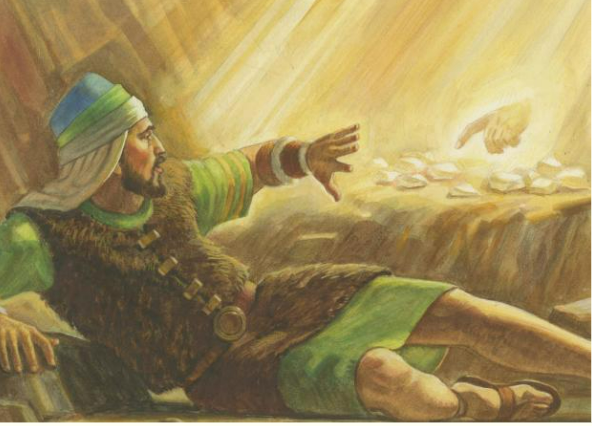
The fact is, it was just as though Joseph, Oliver and I were sitting just here on a log, when we were overshadowed by a light. It was not like the light of the sun nor like that of a fire, but more glorious and beautiful. It extended away round us, I cannot tell how far, but in the midst of this light about as far off as he sits (pointing to John C. Whitmer, sitting a few feet from him), there appeared, as it were, a table with many records or plates upon it, besides the plates of the Book of Mormon, also the sword of Laban, the directors [i.e. the ball with spindles which Lehi had, and the interpreters].

Joseph Smith’s Reaction to the Three Witnesses

Lucy Mack Smith, who had seen the chosen witnesses leave for their encounter with the angel and the plates, recalled, many years later, the scene that ensued at their return:

When they returned to the house, it was between three and four o’clock P. M. Mrs. Whitmer, Mr. Smith, and myself, were sitting in a bedroom at the time. On coming in, Joseph threw himself down beside me, and exclaimed, “Father, mother, you do not know how happy I am: the Lord has now caused the plates to be shown to three more besides myself. They have seen an angel, who has testified to them, and they will have to bear witness to the truth of what I have said, for now they know for themselves, that I do not go about to deceive the people, and I feel as if I was relieved of a burden which was almost too heavy for me to bear, and it rejoices my soul, that I am not any longer to be entirely alone in the world.”

Upon this, Martin Harris came in: he seemed almost overcome with joy, and testified boldly to what he had both seen and heard. And so did David and Oliver, adding, that no tongue could express the joy of their hearts, and the greatness of the things which they had both seen and heard.

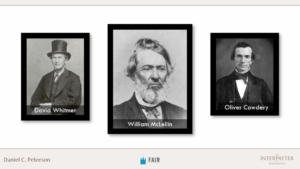
Ultimately, each of the Three Witnesses—Martin Harris, Oliver Cowdery, and David Whitmer—signed his name to a statement that has appeared in every edition of the Book of Mormon from the beginning.

The Testimony of the Three Witnesses

Be it known unto all nations, kindreds, tongues, and people, unto whom this work shall come: That we, through the grace of God the Father, and our Lord Jesus Christ, have seen the plates which contain this record, which is a record of the people of Nephi, and also of the Lamanites, their brethren, and also of the people of Jared, who came from the tower of which hath been spoken.

And we also know that they have been translated by the gift and power of God, for his voice hath declared it unto us; wherefore we know of a surety that the work is true. And we also testify that we have seen the engravings which are upon the plates; and they have been shown unto us by the power of God, and not of man.

And we declare with words of soberness, that an angel of God came down from heaven, and he brought and laid before our eyes, that we beheld and saw the plates, and the engravings thereon; and we know that it is by the grace of God the Father, and our Lord Jesus Christ, that we beheld and bear record that these things are true. And it is marvelous in our eyes.

Nevertheless, the voice of the Lord commanded us that we should bear record of it; wherefore, to be obedient unto the commandments of God, we bear testimony of these things. And we know that if we are faithful in Christ, we shall rid our garments of the blood of all men, and be found spotless before the judgment-seat of Christ, and shall dwell with him eternally in the heavens.

And the honor be to the Father, and to the Son, and to the Holy Ghost, which is one God. Amen.

The Testimony of the Eight Witnesses

According to David Whitmer, the quite distinct experience of the Eight Witnesses to the Book of Mormon occurred one or two days after the experience of the Three. Soon thereafter, all of the Eight signed their names to a statement that has accompanied the testimony of the Three in every printed version of the Book of Mormon.

Be it known unto all nations, kindreds, tongues, and people, unto whom this work shall come; That Joseph Smith, Jun., the translator of this work, has shown unto us the plates of which hath been spoken, which have the appearance of gold; and as many of the leaves as the said Smith has translated we did handle with our hands; and we also saw the engravings thereon, all of which has the appearance of ancient work, and of curious workmanship.

And this we bear record with words of soberness, that the said Smith has shown unto us, for we have seen and hefted, and know of a surety that the said Smith has got the plates of which we have spoken.

And we give our names unto the world, to witness unto the world that which we have seen. And we lie not, God bearing witness of it.

The Contrasting Experiences of the Witnesses

It is worth examining the contrasting character of the experiences reported by the Three Witnesses and the Eight, since, I believe, their very difference reinforces them.

First of all, the experience of the Three, as they report it, was suffused with the glory and power of God. In a brilliant light, an angel came down and showed them the plates. They heard the voice of God testifying that the translation had been accomplished “by the gift and power of God.”

Their written testimony is characterized by a marked religious or spiritual tone. It might be termed a supernatural or miraculous testimony.

The Ordinary Testimony of the Eight Witnesses

By contrast, the experience of the Eight involves no glory, nothing miraculous. It is as mundane as anything can be. No angel shows the plates to them; Joseph Smith does.

There is no miraculous light. Unlike the Three, who seem simply to have observed the plates in the hands of the angel, the Eight handled the plates and turned their pages. They “hefted” them.

The language of their official account is cool and even formal or legalistic to the point of emotional distance (“the said Smith”). God figures in their testimony only as witness to their concluding oath. His voice does not testify to the correctness of the translation.

The Eight Witnesses are manifestly in full possession of their senses and mental faculties. Theirs might be labeled an ordinary or natural testimony.

Why the Differences?

Why the differences? In order, I think, for the task of skeptics to be rendered more difficult.

One might be tempted to dismiss the testimony of the Three, with its spectacular divine accompaniments, as hallucinatory (however untenable that dismissal would be) or mere superstition. By contrast, there is absolutely nothing in the testimony of the Eight that points to superstition or hallucination. It is the most matter-of-fact kind of experience—nine men in the woods in the early afternoon—except for the object at the center of it.

On the other hand, if one were to approach the Witnesses first by way of the Eight and one were inclined to skepticism, one might be tempted to write their experience off as deception by Joseph Smith or by some other conspirator or group of conspirators. There must really have been plates—fabricated to deceive.

But this doesn’t account for the testimony of the Three, which goes beyond fabrication and involves a number of additional objects.

In other words, a single explanation seems unable to account for the two very different kinds of experience. This means that skeptics who wish to explain the two testimonies away must resort to some unlikely combination of sincere hallucination, already unlikely in and of itself, and deliberate, insincere fabrication. Or, as we shall see, they must attempt to collapse the difference between the two.

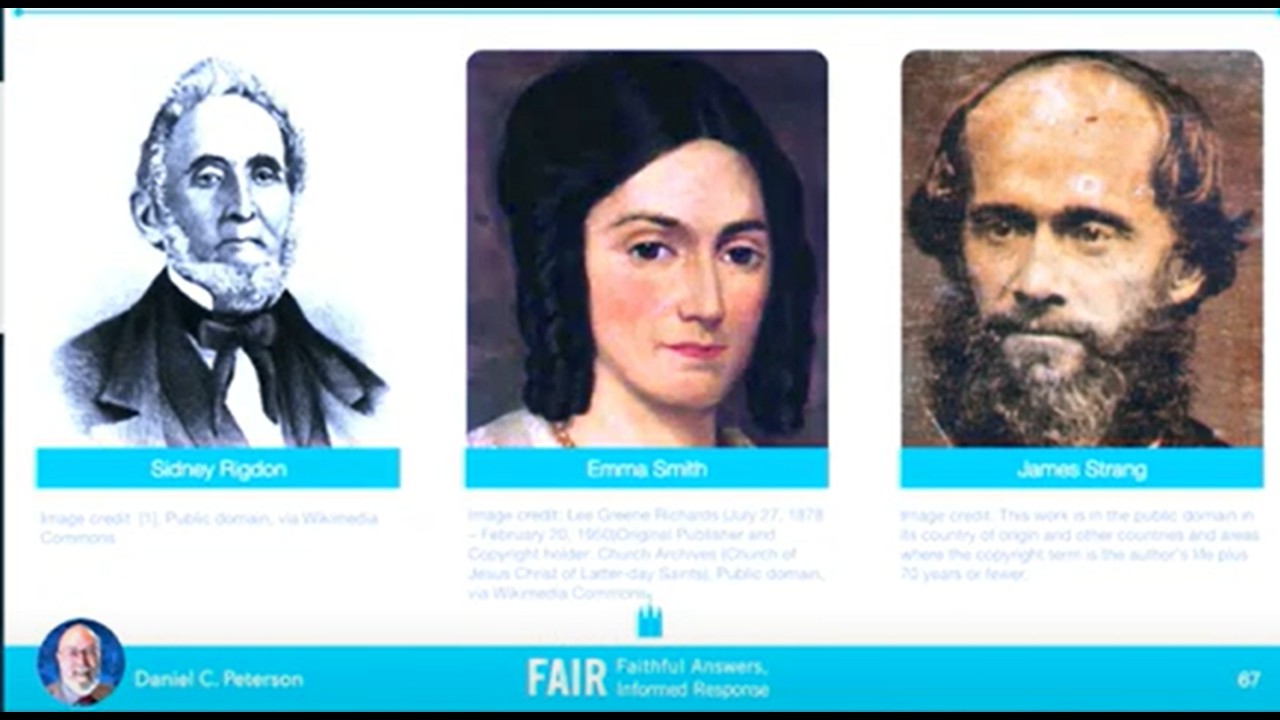
James Jesse Strang and His Witnesses

Let us examine a case that critics often cite as a parallel to Joseph Smith and his Witnesses:

Forgery is the virtually certain explanation for the two sets of inscribed metal plates that James Jesse Strang said he had found in Wisconsin and Michigan (between 1845 and 1849) and translated. Strang, who claimed to have a letter of appointment from Joseph Smith, announced himself as Joseph Smith’s successor and was clearly seeking to imitate the Prophet.

That his plates really existed is beyond serious dispute. The first set, the three “Voree” or “Rajah Manchou” plates, were dug up by four “witnesses” whom Strang had brought to the appropriate site. Inscribed on both sides with illustrations and “writing,” the Rajah Manchou plates were roughly 1.5 by 2.75 inches in size—small enough to fit in the palm of a hand or to carry in a pocket.

Among the many who saw them was Stephen Post, who reported that they were brass and, indeed, that they resembled the French brass used in familiar kitchen kettles.

“With all the faith & confidence that I could exercise,” he wrote, “all that I could realize was that Strang made the plates himself, or at least that it was possible that he made them.”

One not altogether reliable source reports that most of the four witnesses to the Rajah Manchou plates ultimately repudiated their testimonies.

The “Plates of Laban”

The eighteen “Plates of Laban,” likewise of brass and each about 7 3/8 by 9 inches, were first mentioned in 1849 and, in 1851, were seen by seven witnesses.

Their testimony appeared at the front of The Book of the Law of the Lord, which Strang said he translated from the “Plates of Laban.” (Work on the translation seems to have begun at least as early as April 1849. An 84-page version appeared in 1851; by 1856, it had reached 350 pages.)

The statement of Strang’s witnesses speaks of seeing the plates, but mentions nothing of any miraculous character. Nor did Strang supply any second set of corroborating testimony comparable to that of the Three Witnesses to the Book of Mormon.

One of the witnesses to the “Plates of Laban,” Samuel P. Bacon, eventually denied the inspiration of Strang’s movement and denounced it as mere “human invention.” Another, Samuel Graham, later claimed that he had assisted Strang in the fabrication of the “Plates of Laban.”

The well-read Strang had been an editor and lawyer before his brief affiliation with the Church of Jesus Christ of Latter-day Saints and his subsequent career as a schismatic leader.¹

Strang’s Plates Compared with the Book of Mormon Witnesses

Thus, Strang’s plates were much less numerous than those associated with Joseph Smith, his witnesses saw nothing supernatural, his translation required the better part of a decade rather than a little more than two months, and, unlike the Witnesses to the Book of Mormon, Strang’s witnesses did not remain faithful to their testimonies.

Milo Quaife, in his early, standard biography of Strang, reflected that “It is quite conceivable that Strang’s angelic visitations may have had only a subjective existence in the brain of the man who reported them. But the metallic plates possessed a very material objective reality.”

If we are unwilling to accept The Book of the Law of the Lord as authentically divine, he says, “we can hardly escape the conclusion . . . that Strang knowingly fabricated and ‘planted’ them for the purpose of duping his credulous followers” and, accordingly, that “Strang’s prophetic career was a false and impudent imposture.”²

Roger Van Noord, Strang’s most recent biographer, concludes that, “Based on the evidence, it is probable that Strang—or someone under his direction—manufactured the letter of appointment and the brass plates to support his claim to be a prophet and to sell land at Voree. If this scenario is correct, Strang’s advocacy of himself as a prophet was more than suspect, but no psychological delusion.”

The Sincerity of the Book of Mormon Witnesses

It seems that virtually every reputable writer on the subject now grants the sincerity and honesty of all or most of the Book of Mormon Witnesses.

A few critics argue that the printed testimonies don’t really represent what the Witnesses said. “I want Non-LDS to know,” wrote one recent poster on an internet message board,

that regardless of the three witnesses of the Book of Mormon and the eight witnesses of the Book of Mormon—not a single witness ever touched the plates with their own hands and never saw the plates with their own eyes. When Martin Harris and Oliver Cowdrey supposedly had visions of the Book of Mormon for their testimony – only Joseph Smith wrote their testimony down in the Book of Mormon.

But the testimonies have been published with the Book of Mormon ever since that first edition in 1830, which, since it was prepared under the careful supervision of Oliver Cowdery (one of the Three) and Hyrum Smith (one of the Eight), seems to imply their endorsement of those statements.

Consistent with this, a correspondent for the Salem [Massachusetts] Advertiser and Argus reported in 1843 having heard Hyrum “declare, in this city in public, that what is recorded about the plates, &c. &c. is God’s solemn truth.”⁴

The Witnesses Reaffirm Their Published Testimonies

Moreover, there are far too many recorded testimonies from the other Witnesses for this to be a plausible escape.

For example, E. C. Brand visited John Whitmer, one of the Eight, in 1875, and recorded that Whitmer “declared that his testimony, as found in the ‘Testimony of Eight Witnesses,’ in the Book of Mormon, is strictly true.”⁵

In 1876, Whitmer told Mark Forscutt, “I have never heard that any one of the three, or eight witnesses ever denied the testimony that they have borne to the Book as published in the first edition of the Book of Mormon.”⁶

And, later that same year, referring to the published testimony, he told Heman C. Smith, “That testimony was, is, and will be true, henceforth and forever.”⁷

And, finally, in 1877, the year prior to his death, he wrote “concerning my testimony as recorded in the Book of Mormon” that “It is the Same as it was from the beginning, and it is true.”⁸

Were the Witnesses’ Experiences Non-Literal?

Today’s attack on the Witnesses focuses, instead, on the alleged non-literalness of their experience. Dan Vogel is the principal source for this newly popular way of dismissing their testimony.

For example, in his 2002 essay on “The Validity of the Witnesses’ Testimonies,” he attempts to discredit the witnesses by portraying them as alienated from empirical reality and as having merely imagined the plates of the Book of Mormon, or seen them in a subjective hallucination.

The ‘Literal’ Nature of the Lives of the Witnesses

I’ve commented elsewhere on how bizarre it is to me that the witnesses, a group of early nineteenth-century farmers who spent their lives:

  • rising at sunrise,
  • pulling up stumps,
  • clearing rocks,
  • plowing fields,
  • sowing seeds,
  • carefully nurturing crops,
  • raising livestock,
  • milking cows,
  • digging wells,
  • building cabins,
  • raising barns,
  • harvesting their own food,
  • bartering (in an often cashless economy) for what they could not produce themselves,
  • wearing clothes made from plant fibers and skins,
  • anxiously watching the seasons, and
  • walking or riding animals out under the weather until they retired to their beds shortly after sunset in “a world lit only by fire,”

The Disconnect of Modern People to ‘Reality’

are being portrayed as estranged from everyday empirical reality by people whose lives, like mine, consist to a large extent of:

  • staring at computer and television screens in artificially air-conditioned and artificially lit homes and offices,
  • clothed in synthetic fibers,
  • commuting between the two in enclosed and air-conditioned mechanical vehicles
  • while they listen to the radio,
  • chat on their cell phones, and
  • fiddle with their iPods—all of whose inner workings are largely mysterious to them—
  • who buy their prepackaged food (with little or no regard for the time or the season)
  • by means of plastic cards and electronic financial transfers
  • from artificially illuminated and air-conditioned supermarkets
  • enmeshed in international distribution networks of which they know virtually nothing,

the rhythms of whose daily lives are largely unaffected by the rising and setting of the sun.

Lester Grabbe and the “Spiritual Eyes” Argument

Yet Dan Vogel’s view of the Witnesses has recently been given wider currency in an article published by the non-Mormon biblical scholar Lester Grabbe, who commendably seeks to show that Joseph Smith’s story can illuminate ancient Hebrew prophecy.

Unfortunately, Professor Grabbe’s discussion is totally dependent upon Vogel and wholly uninformed by any exposure to the work of the leading authority on the Witnesses, Richard Lloyd Anderson.

Grabbe readily grants the sincerity of Martin Harris and David Whitmer, but also declares that “it seems that no one saw the plates uncovered except Smith himself.”⁹

“Both Martin Harris and David Whitmer of the Three Witnesses,” he writes,

while continuing to affirm their belief in the Book of Mormon, also stated that they had seen the plates “in spirit” or with “spiritual eyes” or in vision. As far as they were concerned, this was no less real than seeing them with ordinary eyes, but to non-Mormons this distinction is likely to be important.¹⁰

Did Martin Harris See the Plates With His Bodily Eyes?

Professor Grabbe cites the Rev. John A. Clark’s recollection of an unnamed attorney’s alleged recollection of an alleged statement from Martin Harris:

A gentleman in Palmyra, bred to the law, a professor of religion, and of undoubted veracity told me that on one occasion, he appealed to Harris and asked him directly,–“Did you see those plates?” Harris replied, he did.

“Did you see the plates, and the engraving on them with your bodily eyes?” Harris replied, “Yes, I saw them with my eyes,–they were shown unto me by the power of God and not of man.”

“But did you see them with your natural,–your bodily eyes, just as you see this pencil-case in my hand? Now say no or yes to this.”

Harris replied,–“Why I did not see them as I do that pencilcase, yet I saw them with the eye of faith; I saw them just as distinctly as I see any thing around me,–though at the time they were covered over with a cloth.

The Eight Witnesses and a “Spiritual” Experience

And yet, Professor Grabbe acknowledges,

The situation with the Eight Witnesses is more complex, and some continue to assert that these members of the Whitmer family and others saw and handled the plates in a purely physical context. Some of the testimony certainly gives this impression, but we have a few later interviews with most of the Eight Witnesses. There is some evidence that their experience was also “spiritual” or “visionary” or whatever one might wish to call it.¹²

How did the Witnesses come to “see” the plates?

Thomas Ford, the former governor of Illinois, “who,” Grabbe assures us, actually “knew many Mormons,” explains it all by means of an account of the experience of the Eight Witnesses. “Unfortunately,” as Grabbe concedes, “he does not give his sources and he has some of the names slightly wrong.”¹³

He [Joseph Smith] set them to continual prayer, and other spiritual exercises, to acquire this lively faith by means of which the hidden things of God could be spiritually discerned; and, at last, when he could delay them no longer, he assembled them in a room [Lucy Mack Smith says it was a grove near their house], and produced a box, which he said contained the precious treasure.

The lid was opened; the witnesses peeped into it, but making no discovery, for the box was empty, they said, “Brother Joseph, we do not see the plates.”

The prophet answered them, “O ye of little faith! how long will God bear with this wicked and perverse generation? down on your knees, brethren, every one of you, and pray God for the forgiveness of your sins, and for a holy and living faith which cometh down from heaven.”

The disciples dropped to their knees, and began to pray in the fervency of their spirit, supplicating God for more than two hours with fanatical earnestness, at the end of which time, looking again into the box, they were now persuaded that they saw the plates.

I leave it to philosophers to determine whether the fumes of an enthusiastic and fanatical imagination are thus capable of blinding the mind and deceiving the senses by so absurd a delusion.¹⁴

An Ex-Mormon Message Board Explanation

An even more entertaining version of this theory appeared on an ex-Mormon message board just a few days ago:

I used to tease my kids……………….. I would take my coat or a towel or a blanket and gather it up in the crook of my arm. Then I would stick my face down into it and make a whimpering sound like a puppy. Then I would make a petting motion. My little kids would see what was going on and GUESS what? they wanted to see the puppy!

Of course I refused to let them see the puppy because there was not one. Then I would walk into another room and the kids would follow demanding to see the puppy. I would run into another room, the kids would follow, but by then the puppy was gone! I would claim to have hidden the puppy.

The kids would go crazy trying to find the puppy. it was great fun, but as my kids got a little older they finally caught on. The trick no longer worked. When I tried it on their younger cousins my kids would scoff and give away the secret right off……. to any youngster who would listen!

Why was it a puppy? Because

  • A. I said so
  • B. Because I could make the sound of a puppy,
  • C. Kids like puppies.
  • D. A puppy would fit under the cover.

I never claimed to have a rabid grizzly bear or adult crocodle under the wrap for the inverse of all the reasons stated above.

…………How convenient that THE Gold plates were “Gold” instead of wood or zinc or stone. How convenient that they were a certain size and that they dissappeared and that only Joe could read them! How convenient for the blood sucking scum that currently runs the Mormon corporation today that so many TBM adults are dumb as preschoolers about certian things . . .

John Whitmer and the Physical Plates

Professor Grabbe cites a passage from Vogel that cites an account of an encounter between Theodore Turley and John Whitmer:

Whitmer asked, “do you hint at me?” [Turley replied], “if the caps fits you, wear it.” all I know, you have published to the world that an angel did present those plates to Joseph Smith.”

[Whitmer replied] “I now say I handled those plates. there was fine engravings on both sides. I handled them.” and he described how they were hung, “and they were shown to me by a supernatural power.” he acknowledged all.¹⁵

Then he cites Vogel’s introduction to that account, which declares that “it seem [sic] to imply that while Whitmer’s handling of the plaes [sic] (perhaps in a box or through a covering) was physical, his seeing the plates was visionary.”¹⁶

But I am at a loss to understand how Whitmer’s alleged statement that the plates were “shown to [him] by a supernatural power” (which, incidentally, is difficult to reconcile with the numerous other accounts from John Whitmer), even if taken at face value, can be translated so easily into the idea that “his seeing of the plates was visionary.”

Stephen Burnett’s Account

Grabbe also cites the notorious testimony of the disaffected nineteenth-century Mormon Stephen Burnett, which makes an even bigger leap:

I have reflected long and deliberately upon the history of this church & weighed the evidence for & against it—loth to give it up—but when I came to hear Martin Harris state in a public [sic] that he never saw the plates with his natural eyes only in vision or imagination, neither Oliver [Cowdery] nor David [Whitmer] & also that the eight witnesses never saw them & hesitated to sign that instrument for that reason, but were persuaded to do it, the last pedestal gave way, in my view our foundations was sapped & the entire superstructure fell a heap of ruins.

Professor Grabbe’s Conclusion

Professor Grabbe swallows Dan Vogel’s line without no reservation whatever. “In the end,” he says, “it appears that the only one who saw the plates directly was Joseph Smith himself. Even this situation could be doubted.”¹⁸

My wife fears that I have nothing original to say today, and she’s probably right. Richard Lloyd Anderson, the foremost authority on this subject and the author of, among other things, the classic Investigating the Book of Mormon Witnesses, has addressed this topic in an important recent article in the FARMS Journal of Book of Mormon Studies entitled, straightforwardly enough, “Attempts to Redefine the Experience of the Eight Witnesses.”

But, frankly, originality doesn’t much matter to me on this matter. I wish, at the least, to register a vigorous protest against what seems to me to have become unquestioned but baseless orthodoxy, in certain quarters, about the Witnesses.

Were the Witnesses Gullible?

They are often portrayed, now, by critics, as gullible fools, unable to distinguish reality from fantasy, easily duped. And Martin Harris is their parade example. But this falsifies and misrepresents the facts.

True to his reputation as a careful, prudent man, Martin Harris initially approached the claims of Joseph Smith with hope but also with cautious skepticism. It was Harris who took a transcript of characters from the plates to New York City, for the evaluation of Professor Charles Anthon of Columbia University, and others.

And, while he was serving as Joseph’s first scribe for the translation, he once surreptitiously substituted a similar-looking stone for the seerstone that the Prophet was using, in order to see if it made any difference. (It did.)

At one point, he lifted the box in which the plates were allegedly concealed, to see what he could determine. “I knew from the heft,” he recalled, “that they were lead or gold, and I knew that Joseph had not credit enough to buy so much lead.”

Martin Harris Investigates Joseph Smith’s Claims

He cross-examined “Joseph, his wife, brothers, sisters, his father and mother. I talked with them separately, that I might get the truth of the matter.”

One day, he arrived when Joseph was away from home.

“I was glad he was absent,” Harris reminisced, “for that gave me an opportunity of talking with his wife and the family about the plates. I talked with them separately, to see if their stories agreed, and I found they did agree.”

Did Martin Harris think his experience as a Witness was real?

The twenty-five-year old Edward Moroni Thurman ran into Martin Harris at a blacksmith shop, and asked him whether the Book of Mormon was true. Harris responded by asking whether the young man could see an apple tree nearby. His vision of the angel, the plates, and the other objects, he told Thurman, had been as real and factual as the sight of the apple tree.

“Just as Plain as You See That Chopping Block”

When a group of teenagers posed the same question to him, he pointed to a chopping block and asked if they could see it.

“Well, just as plain as you see that chopping block, I saw the plates; and sooner than I would deny it I would lay my head upon that chopping block and let you chop it off.”

To William Pilkington, he said,

Just as sure as You see the Sunshining. Just as sure am I that I stood in The presence of an Angel of God, with Joseph Smith and saw him hold the Gold Plates in his Hands. I also saw the Urim and Thummin [sic], The Breastplate and the Sword of Laban I saw the Angel descend from Heaven. The Heavens were then opened and I heard the voice of God declare, that every thing the Angel had told us was True, and that the Book of Mormon was Translated correct. I was commanded by God’s Voice to testify to the whole world what I had seen and heard.

“Just as Much So as I See You”

Joseph Homer Snow recalled the time that Martin Harris came to have dinner with his family:

Mother asked him these questions: “Did you actually see an angel and hear him speak?”

He said, “Just as much so as I see you and hear you speak.”

“Will you describe how he stood?” Mother asked.

He said, “He stood at least twenty inches off the ground, and he had records in his hand—The Book of Mormon. He turned the leaves and declared that it was the work of the Lord and that it was true. He commanded us to bear that testimony to the world.”

Stephen Burnett plainly misrepresented Martin Harris’s testimony about his own experience: Harris would never have gone along with Burnett’s “only in vision,” let alone with the notion that his experience was merely “imaginary.”

So why should we trust Burnett’s account of Harris’s alleged account of the experience of the other Witnesses? After all, Harris’s supposed claim that the other Witnesses were reluctant to endorse their published testimony is, on the basis of evidence to which we’ve already alluded, extremely suspect.

Martin Harris’s Final Testimony

In a notarized statement dated 29 October 1921, George Godfrey, who prepared Martin Harris’s grave in Clarkston, Utah, summarized his lengthy acquaintance with the Witness. Then he offered this interesting statement:

Prior to his death and in his last sickness I sat up nights with him upon many an occasion, in connection with my Brothers, John E. Godfrey and Thomas Godfrey, both of whom now reside at Clarkston, aforesaid, and who can make affidavit to the things I am herein stating: that many times I have heard the said Martin Harris bear witness to the truthfulness and genuineness of the Book of Mormon, at times when he was enjoying good health and spirits and when he was on his deathbed; that his testimony never varied;

that I have seen others and that I myself have tried to entrap him relative to the testimony which he bore, by cros [sic] questioning him relative to the scenes and events which are Church History in connection with the bringing forth of the Book of Mormon; that upon all of these questions his mind was clear as it is possible for the human mind to be, and that his testimonies have left no tract [sic] in my mind that he actually converse with an angel who bore testimony to him of the truthfulness of the records contained in the Book of Mormon;

that he saw and handled the gold plates from which the said records were taken; that a few hours before his death, and when he was so weak and enfeebled that he was unable to recognize me or anyone, and knew not to whom he was speaking, I asked him if he did not feel that there was an element, at least, of fraudulence and deception in the things that were written and told of the coming forth of the Book of Mormon, and he replied as he had always done, and many, many times in my hearing, and with the same spirit that he always manifested when enjoying health and vigor:

“The Book of Mormon is no fake. I know what I know. I have seen what I have seen, and I have heard what I have heard. I have seen and handled the gold plates from which the Book of Mormon is written. An angel appeared to me and others and testified to the truthfulness of the record, and had I been willing to have perjured myself and sworn falsely to the testimony I now bear, I could have been a rich man, but I could not have testified other than I have done and am now doing, for these things are true.”

Martin Harris’s Testimony

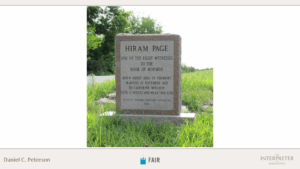
Martin Harris was buried with a copy of the Book of Mormon in his right hand, and a copy of the Doctrine and Covenants in his left.

In a patriarchal blessing given to him by Joseph Smith, Sr., Harris was promised that

thy testimony shall yet convince its thousands and its tens of thousands; yea it shall shine like the sun, and though the wicked seek to overthrow it, it shall be in vain, for the Lord God shall bear it off victorious.

Oliver Cowdery’s Testimony

In 1848, the year before he died, Oliver Cowdery received rebaptism into the Church of Jesus Christ of Latter-day Saints at Kanesville, Iowa.

Before an audience of approximately two thousand, including non-members of the Church, Cowdery bore witness of the coming forth of the Book of Mormon, the restoration of the Aaronic and Melchizedek priesthoods, and the divine calling of Joseph Smith.

“I beheld with my eye and handled with my hands the gold plates from which it was translated. I also beheld the Interpreters. That book is true.”

Cowdery was bedridden for most of 1849, probably as a result of chronic pulmonary tuberculosis, and died at Richmond, Missouri, on 3 March 1850.

“It Was No Dream”

A few months before his death, Cowdery was visited by Jacob Gates, a Latter-day Saint traveling eastward on a mission to England who had been a friend since before Cowdery’s 1838 excommunication.

In the course of conversation, Gates asked him about his experience as one of the Witnesses to the Book of Mormon. Had it been a dream? Was it imagination, or illusion, or mere mythology?

Cowdery rose from the place where he was resting, retrieved a first edition copy of the Book of Mormon, and read aloud the Testimony of the Three Witnesses. Then, turning to face Gates, he said,

Jacob, I want you to remember what I say to you. I am a dying man, and what would it profit me to tell you a lie? I know . . . that this Book of Mormon was translated by the gift and power of God. My eyes saw, my ears heard, and my understanding was touched, and I know that whereof I testified is true. It was no dream, no vain imagination of the mind—it was real.

David Whitmer’s Testimony

David Whitmer lived until 1888, the last of the Witnesses to the Book of Mormon. Consequently, he was the most interviewed of all of them.

“Each witness of the Book of Mormon,” Richard Lloyd Anderson justly observes,

was an individualist. In David Whitmer, this quality verged on the stubborn. Whether in Mormon society or not, he stood like a rock for his principles. This outspoken and utterly honest personality would have been the first to detect fraud and expose it.

Whitmer was excommunicated from the Church on 13 April 1838 after a period of doctrinal disagreement, financial stress, persecution, and upheaval.

Yet when, in 1886, the Omaha Herald asked him whether he “still believed that Joseph Smith was a divinely inspired prophet,” David Whitmer replied, “I know he was, it is not a matter of belief.”

James Henry Moyle Cross-Examines David Whitmer

The young James Henry Moyle, who had just received his law degree from the University of Michigan and was returning home to Utah, took a detour to Richmond, Missouri, for the sole purpose of interviewing David Whitmer.

When he saw the Witness, he implored him to tell the truth. He told Whitmer of the sacrifices that his family had made for the gospel’s sake, driven from state to state and finally pulling a handcart all the way to the arid desert of the Great Basin.

I said to him: “I was born and reared in the Church and I do pray of you to let me know if there is any possibility of your having been deceived. I am just commencing life as you are preparing to lay it down, and I beg of you to tell me if there is anything connected with the testimony which you have borne to the world that could possibly have been deceptive or misunderstood.”

I further said, in an earnest youthful appeal, that I didn’t want to go through life believing in a falsehood, that it was in his power to make known the truth to me.

His answer was unequivocal. There was no question about its truthfulness.

The angel had stood in a little clear place in the woods with nothing between them but a fallen log—the angel on one side and the witnesses on the other. It had all occurred in broad, clear daylight. He saw the plates and heard the angel with unmistakable clearness.

“He was the first witness I ever attempted to cross examine,” Moyle wrote many years later, “and I did so with all the intensity of my impelling desire to know the truth. The interview lasted two and one-half hours.”

The young lawyer, who subsequently served as assistant secretary of the treasury in two federal administrations, came away utterly convinced of David Whitmer’s sincerity.

“I Saw With These Eyes”

Throughout his life, Whitmer insisted that the experience was literal, and physical, not merely imaginary or “spiritual.”

Joseph Smith III, for example, recalled an 1884 exchange between the Witness and a non-Mormon identified as Colonel Giles:

Rather suggestively he asked if it might not have been possible that he, Mr. Whitmer, had been mistaken and had simply been moved upon by some mental disturbance, or hallucination, which had deceived them into thinking he saw the Personage, the Angel, the plates, the Urim and Thummim, and the sword of Laban.

How well and distinctly I remember the manner in which Elder Whitmer arose and drew himself up to his full height — a little over six feet — and said, in solemn and impressive tones: “No, sir! I was not under any hallucination, nor was I deceived! I saw with these eyes and I heard with these ears! I know whereof I speak!’”

“Everything Was as Natural to Us”

In a letter to Anthony Metcalf dated 2 April 1887, Whitmer again insisted on the literal reality of what he had seen:

“Of course we were in the spirit when we had the view, for no man can behold the face of an angel, except in a spiritual view, but we were in the body also, and everything was as natural to us, as it is at any time.”

To Orson Pratt and Joseph F. Smith, nearly a decade earlier, he testified:

I saw [the plates, the Sword of Laban, the Urim and Thummim, and other artifacts] just as plain as I see this bed (striking his hand upon the bed beside him), and I heard the voice of the Lord, as distinctly as I ever heard anything in my life, declaring that the records of the plates of the Book of Mormon were translated by the gift and power of God.”

“I saw them as plain as I see you now,” he told a reporter from the Kansas City Journal in 1881.

He frequently emphasized that the angel and the table on which the plates and other objects rested was very close to him and the other Witnesses, within about three to six feet.

“Mr. Whitmer describes every detail of the ‘vision’ with great precision,” reported the Omaha Herald in 1886, “and much fervency.”

  1. Wilhelm Poulson interviewed David Whitmer in 1878. When Poulson asked him if the Eight Witnesses did not “handle the plates,” Whitmer replied, **“We did not, but they did.”**¹⁹

David Whitmer’s Dying Testimony

The 26 January 1888 issue of the Richmond Conservator reported on the last days of David Whitmer in memorable detail:

On Sunday evening before his death he called the family and his attending physician, Dr. George W. Buchanan, to his bedside, and said “Doctor do you consider that I am in my right mind?” to which the Doctor replied, “Yes, you are in your right mind, I have just had a conversation with you.”

He then addressed himself to all present and said: “I want to give my dying testimony. You must be faithful in Christ. I want to say to you all that the Bible and the record of the Nephites, (The Book of Mormon) are true, so you can say that you have heard me bear my testimony on my death bed. All be faithful in Christ and your reward will be according to your works. God bless you all. My trust is in Christ forever, worlds without end. Amen.”

David Whitmer’s Unwavering Testimony

“I have been visited by thousands of people,” David Whitmer told James H. Hart in 1883,

believers and unbelievers, men and ladies of all degrees, sometimes as many as 15 in one day, and have never failed in my testimony. And they will know some day that my testimony is true.

As Richard Anderson points out, ten of the forty-two surviving testimonies from the Eight Witnesses mention handling the plates.

Lucy Mack Smith, who knew the Witnesses well and was there that day, says that they “looked upon the plates and handled them.”²⁰

William Smith, son and brother to several of the Eight, said that all of them testified “that they not only Saw with their eyes but handled with their hands the said record.”²¹

Hyrum Smith: “Seen the Plates With His Eyes”

Perhaps already responding to suggestions that the experience of the Eight Witnesses was merely “spiritual” and visionary, Hyrum Smith insisted during an 1838 speech that it was entirely real.

“He said that he had but two hands and two eyes,” Sally Parker remembered in a letter written in August of that year. “He said he had seen the plates with his eyes and handled them with his hands.”

The year previously, Hyrum married Mary Fielding. Shortly thereafter, her brother, Joseph Fielding, wrote, “My sister bears testimony that her husband has seen and handled the plates.”²²

And Hyrum himself wrote, in December 1839, of his sufferings in Missouri, where he had been arrested in the fall of 1838 and then imprisoned in the ironically named Liberty Jail from the beginning of December to the beginning of April:

I had been abused and thrust into a dungeon, and confined for months on account of my faith, and the “testimony of Jesus Christ.” However I thank God that I felt a determination to die rather than deny the things which my eyes had seen, which my hands had handled, and which I had borne testimony to, wherever my lot had been cast.

And I can assure my beloved brethren that I was enabled to bear as strong a testimony, when nothing but death presented itself, as ever I did in my life.

Samuel Smith’s Testimony

Samuel Smith, Hyrum’s brother and another of the Eight Witnesses, bore his testimony in the presence of fifteen-year-old Daniel Tyler, who summarized it as simply “He knew his brother Joseph had the plates, for the prophet had shown them to him, and he had handled them and seen the engravings thereon.”²³

In an 1836 editorial in the Church newspaper, John Whitmer bore strong testimony of his experience as one of the Witnesses:

I desire to testify to all that will come to the knowledge of this address, that I have most assuredly seen the plates from whence the Book of Mormon is translated, and that I have handled these plates, and know of a surety that Joseph Smith, Jr., has translated the Book of Mormon by the gift and power of God. . .

Therefore, know ye, O ye inhabitants of the earth, wherever this address may come, that I have in this thing freed my garments of your blood, whether you believe or disbelieve.

John Whitmer After His Excommunication

But John Whitmer was excommunicated on 10 March 1838, one month before his brother David, and never returned to the Church.

For a brief period, it even appears that John’s spiritual confidence in the Book of Mormon had been shaken by his separation from his former associates and by his bitterness over economic and other issues raised by the Church’s sojourn in Missouri. He was sorrowful and dejected about his excommunication, but also, for at least a time, quite angry at the Church in general and Joseph Smith in particular.

Of all the Witnesses, he comes the closest, in a sense, to denying his testimony.

During the 1839 exchange with Theodore Turley that we’ve already mentioned, Whitmer confessed to doubts about whether the Book of Mormon was true. Speaking of the original text on the plates, he said, “I cannot read it, and I do not know whether it is true or not.”

Nonetheless, he insisted, “I handled those plates; there were fine engravings on both sides. I handled them.”

What John Whitmer Could Not Deny

This is highly impressive. Unlike the Three Witnesses, who heard a divine voice testify to the truth of the translation of the plates, the Eight Witnesses simply saw the plates under quite matter-of-fact conditions.

Yet, even in the depths of his alienation and bitterness, even when he was most inclined to doubt what he could not see for himself, even living, as he did, in the area of the worst anti-Mormon persecutions, John Whitmer could not deny that he had “lifted and handled a metal object of substantial weight.”

Moreover, the bitterness, or at least the skepticism, was short-lived.

After 1856, John Whitmer was the last survivor of the Eight Witnesses. In 1861, Jacob Gates spoke with him for more than four hours. Gates then wrote of John Whitmer in his journal: “[H]e still testified that the Book of Mormon is true and that Joseph Smith was a Prophet of the Lord.”

“As Material as Anything Can Be”

Myron Bond reported in 1878 that

old Father John Whitmer told me last winter, with tears in his eyes, that he knew as well as he knew he had an existence that Joseph translated the ancient writing which was upon the plates, which he “saw and handled,” and which, as one of the scribes, he helped to copy, as the words fell from Joseph’s lips, by supernatural or almighty power.

P. Wilhelm Poulson interviewed him that same year:

I said: I am aware that your name is affixed to the testimony in the Book of Mormon, that you saw the plates?

He—It is so, and that testimony is true.

I—Did you handle the plates with your hands?

He—I did so!

I—Then they were a material substance?

He—Yes, as material as anything can be.

I—They were heavy to lift?

He—Yes, and you know gold is a heavy metal, they were very heavy.

I—How big were the leaves?

He—So far as I recollect, 8 by 6 or 7 inches.

I— Were the leaves thick?

He—Yes, just so thick, that characters could be engraven on both sides.

I—How were the leaves joined together?

He—In three rings, each one in the shape of a D with the straight line towards the centre. . . .

I—Did you see them covered with a cloth?

He—No. He handed them uncovered into our hands, and we turned the leaves sufficient to satisfy us.²⁴

John Whitmer’s Final Public Testimony

Finally, six months before his death, John Whitmer spoke at a public Sunday service. His remarks were reported in the Kingston Sentinel, as follows:

Mr. Whitmer is considered a truthful, honest and law abiding citizen by this community, and consequently, his appointment drew out a large audience.

Mr. Whitmer stated that he had often handled the identical golden plates which Mr. Smith received from the hand of the angel. He said it was of pure gold; part of the book was sealed up solid, the other part was open, and it was this part which was translated.”

Were There Real Plates?

Were there real plates? Yes, there were. If anything in early Mormon history is well established, surely the existence of the plates is.

Let’s consider the testimonies of several unofficial witnesses.

The sixteen-year-old William Smith always remembered the night when his older brother, Joseph, outran pursuers and brought the plates into the Smith home. William lifted the plates that night, and estimated their weight at about sixty pounds.²⁵

Joseph Smith’s sister Katharine hefted the covered plates on several different occasions. She too recalled his arrival home with the plates and remembered that they were “wrapped . . . up in his frock”:

When he got to the door he said: “Father, I have been followed; look and see if you can see any one.”

He then threw himself on the bed and fainted, and when he came to he told us the circumstances; he had his thumb put out of place and his arm was very lame.

Katharine Smith’s Experience With the Plates

Her grandson, Herbert Salisbury, remembered Katharine relating that “When [Joseph] came in the house . . . he was completely out of breath. She took the plates from him and laid them on the table temporarily, and helped revive him until he got breathing properly, and also examined his hand, and treated it for the bruises on his knuckles.”

She said he entered the house running and threw himself on a couch, panting from his extraordinary exertion.

She told me Joseph allowed her to “heft” the package but not to see the gold plates, as the angel had forbidden him to show them at that period. She said they were very heavy.

The Weight and Dimensions of the Plates

Martin Harris says that he and his family lifted the plates in a box when they were first looking into Joseph’s claims, and that he held the plates on his knee for a time while he and Joseph were preparing to hide them in the woods. He said that “he had hefted the plates repeatedly.”²⁶

Harris put their weight at between forty and fifty, or forty and sixty, pounds.²⁷ Like his fellow Witness David Whitmer, Harris gave the dimensions of the plates as seven by eight inches.²⁸

William could feel the shape of the plates through the cloth that covered them.

“They were not quite as large as this Bible,” he said. “Could tell whether they were round or square. Could raise the leaves this way (raising a few leaves of the Bible before him). One could easily tell that they were not stone, hewn out to deceive, or even a block of wood. Being a mixture of gold and copper, they were much heavier than stone, and very much heavier than wood.”²⁹

“I could tell,” said William Smith, “they were plates of some kind and that they were fastened together by rings running through the back.”³⁰

The Rings That Fastened the Plates

The rings are a striking feature. We’ve already heard John Whitmer’s testimony that there were three of them, shaped like a capital D.

Based on his interviews with two of the Three Witnesses and especially with Hyrum Smith, William McClellin also knew of connecting “rings in the shape of the letter D, which,” he says, “facilitated the opening and shutting of the book” (in the manner of modern three-ring binders).³¹

David Whitmer also described the three D-shaped rings. It’s difficult to imagine this degree of consensus regarding such an unusual detail if the plates were only imaginary or never uncovered.

A brief article by Warren Aston, forthcoming in the FARMS Insights newsletter, will examine the significance of these rings and (this is still under discussion) may point out a striking ancient parallel to them.

Emma Smith and the Physical Plates

Emma Smith, two months before her death, told her eldest son that

The plates often lay on the table without any attempt at concealment, wrapped in a small linen table cloth, which I had given him to fold them in. I once felt of the plates as they thus lay on the table, tracing their outline and shape.

They seemed to be pliable like thick paper, and would rustle with a metallic sound when the edges were moved by the thumb, as one sometimes thumb the edges of a book. [I] moved them from place to place on the table as it was necessary on doing my housework.”

The Other Objects Seen by the Three Witnesses

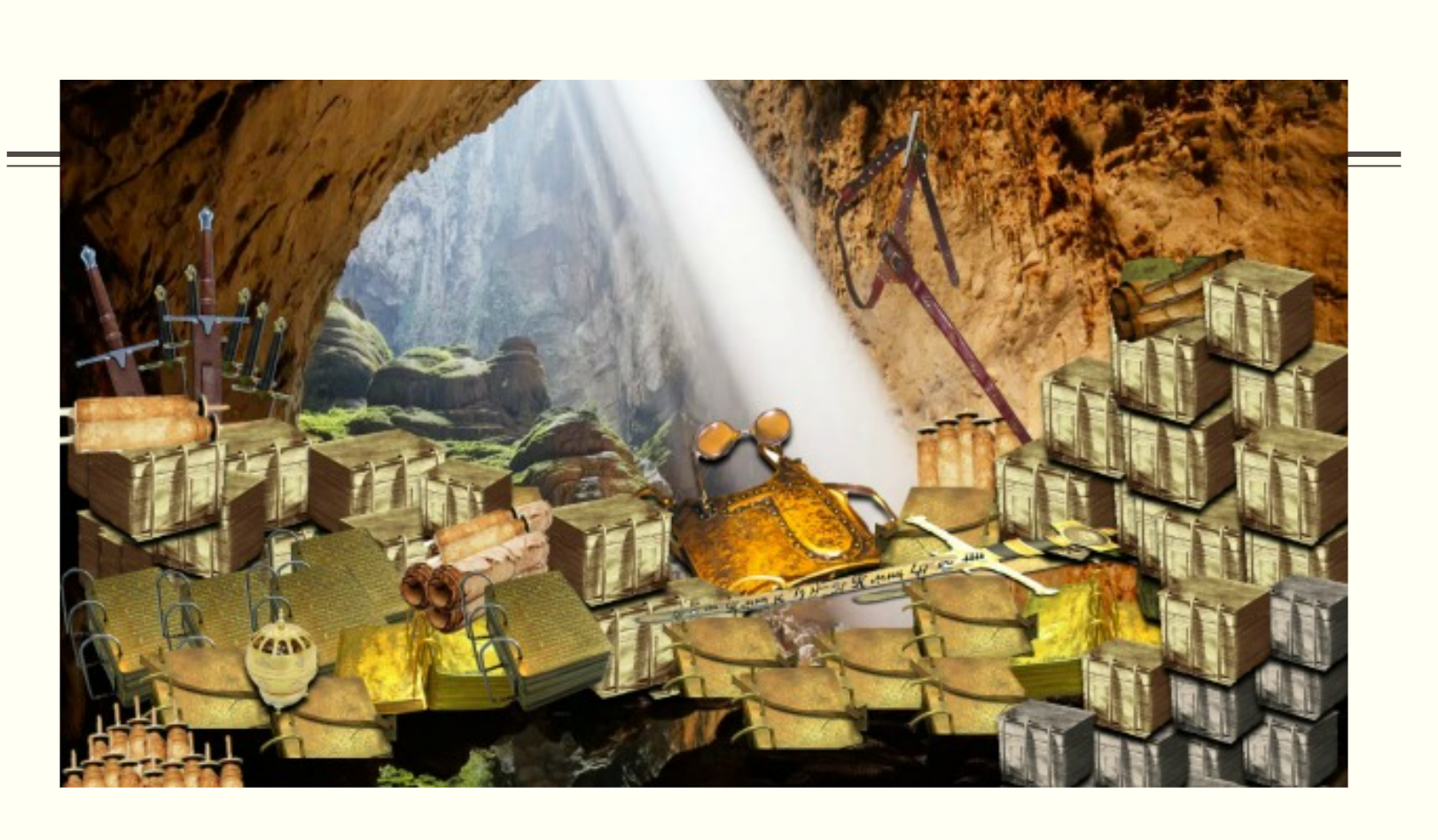
One striking and often unnoticed aspect of the experience of the Three Witnesses is the fact that they did not see only the golden plates. The vision was considerably more complex than that, making deception (via the fabrication of fake ancient artifacts) an even more remote possibility.

According to repeated testimony, besides the plates of the Book of Mormon and the angel, both the sealed and the unsealed portion, they saw

  • the Urim and Thummim and
  • the accompanying breastplate,
  • the “Ball” or “Director” (called the “Liahona” in the Book of Mormon),
  • the Sword of Laban,
  • the brass plates, and
  • “many other plates.”

“The Urim and Thummim were two white stones,” David Whitmer told P. Wilhelm Poulson in 1878.

“Each of them cased in as spectacles are, in a kind of silver casing, but the bow between the stones was more heavy, and longer apart between the stones, than we usually find it in spectacles.”

Lucy Mack Smith “examined” the Urim and Thummim and

“found that it consisted of two smooth three-cornered diamonds set in glass, and the glasses were set in silver bows, which were connected with each other in much the same way as old fashioned spectacles.”

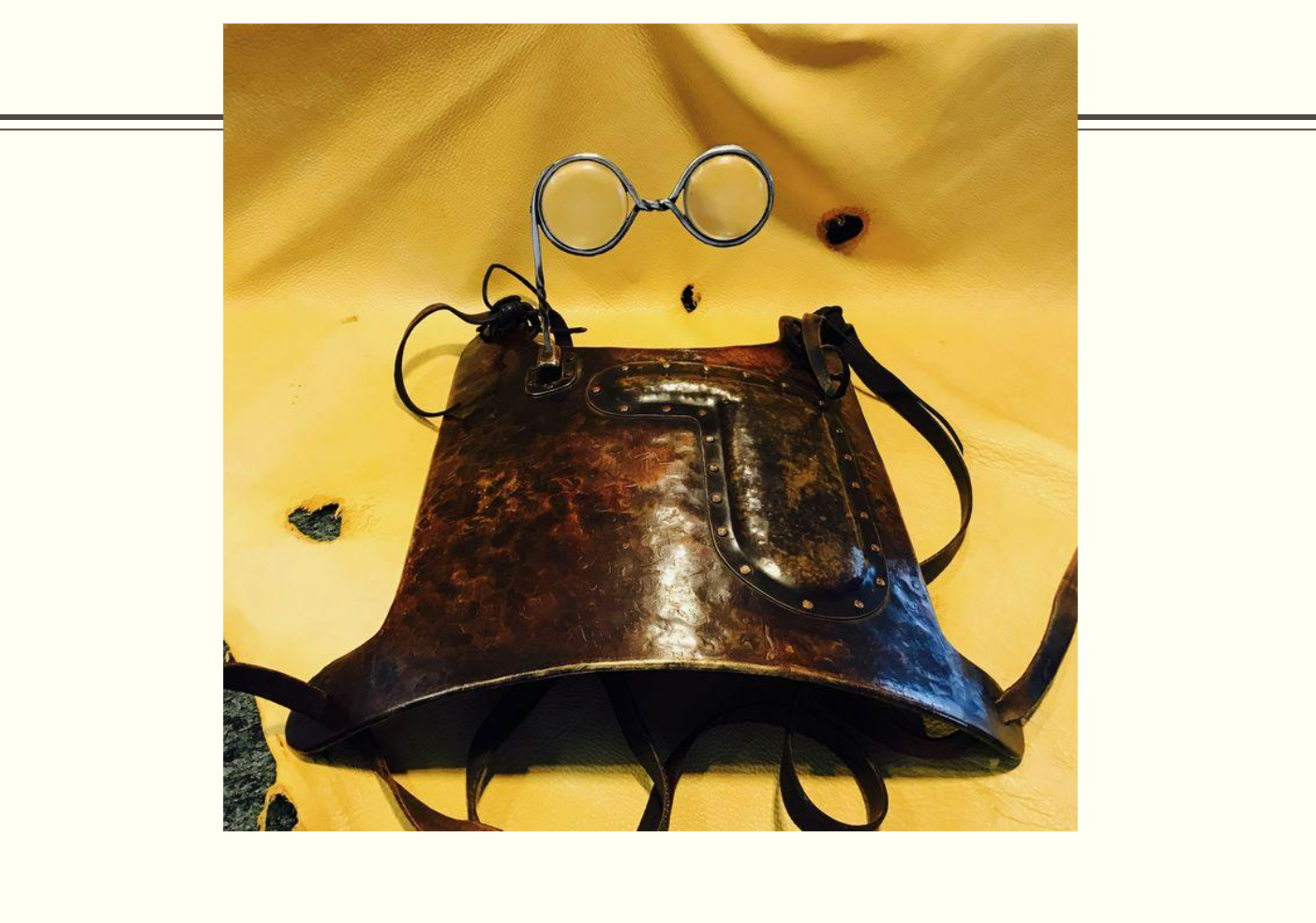
Lucy Mack Smith on the Breastplate

It was wrapped in a thin muslin handkerchief, so thin that I could see the glistening metal, and ascertain its proportions without any difficulty.

It was concave on one side and convex on the other, and extended from the neck downwards, as far as the centre of the stomach of a man of extraordinary size.

It had four straps of the same material, for the purpose of fastening it to the breast, two of which ran back to go over the shoulders, and the other two were designed to fasten to the hips. They were just the width of two of my fingers, (for I measured them,) and they had holes in the ends of them, to be convenient in fastening.

The Stone Box at the Hill Cumorah

David Whitmer, saw the receptacle in which the plates had lain in the Hill Cumorah.

“It was a stone box,” he told P. Wilhelm Poulson in 1878, “and the stones looked to me as if they were cemented together. That was on the side of the hill, and a little down from the top.”

According to a reporter for the Chicago Times, who interviewed Whitmer in August 1875,

“Three times has he been at the hill Cumorah and seen the casket that contained the tablets, and the seer-stone. Eventually the casket had been washed down to the foot of the hill, but it was to be seen when he last visited the historic place.”

Both the Chicago Tribune in December 1885 and the Chicago Times in January 1888 reported his testimony. That he and Oliver Cowdery had been guided to the Hill Cumorah by Joseph Smith on one occasion, during which they had seen the receptacle together.

The Problem of Explaining the Physical Evidence Away

Accordingly, in order to save his unbelief, Vogel must invent elaborate metallurgical fraud as well as invoke complex collective hallucination.

He suddenly suggests, without even a trace of supporting evidence, that Joseph Smith might perhaps, conceivably, have faked a set of tin plates in order to deceive his friends.

This unevidenced and rather implausible pseudofact is, however, a topic for another occasion. Then we will also need to consider how the poor farmboy Joseph Smith also managed, it seems:

  • to create a forged sword of Laban,
  • a bogus Liahona,
  • a fake breastplate, and
  • a stage-prop Urim and Thummim,

and then somehow lost them without a trace.

“True to the Basic Sources”

“Secular historians are . . . more inclined than Mormons to suppress source material from Joseph’s closest associates,” remarks the distinguished Columbia University historian Richard L. Bushman.

Since, he says, quoting extensively from the reminiscences of those closest to the events would tend to suffuse a modern narrative with their own faith, and would turn readers’ attention to Joseph’s transparently sincere desire to obey God, “believing historians are more inclined to be true to the basic sources than unbelieving ones.”

Conclusion

Those who wish to redefine the experiences of the Witnesses clearly illustrate Professor Bushman’s point. They

  • quarrel with,
  • disbelieve, and
  • seek to explain away the principal sources for the very story they claim to illuminate,

without compelling evidentiary reason to do so.

It’s an exceedingly odd approach to history.

Thank you.
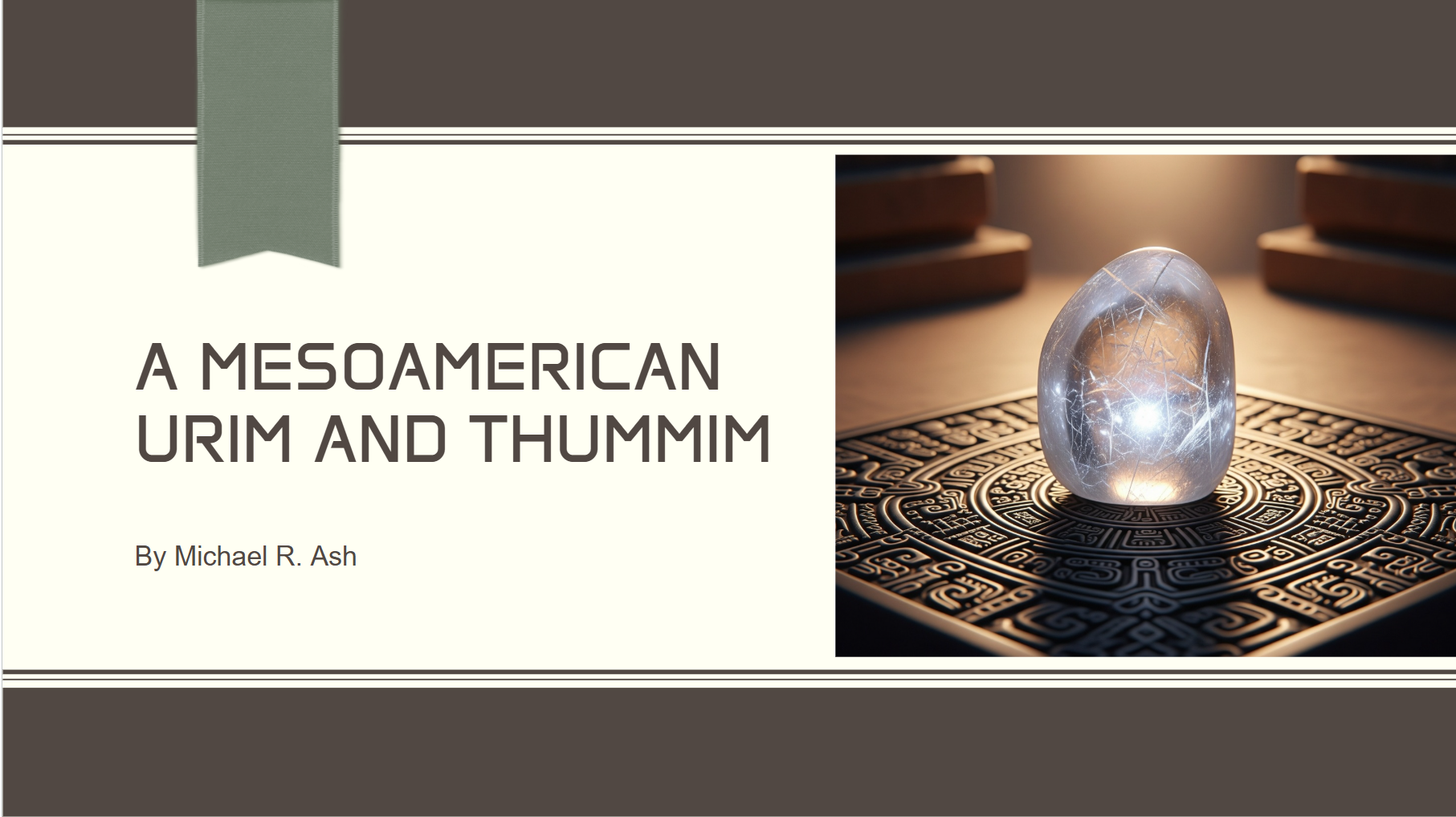
 

A Mesoamerican Urim and Thummim

Summary

TL;DR

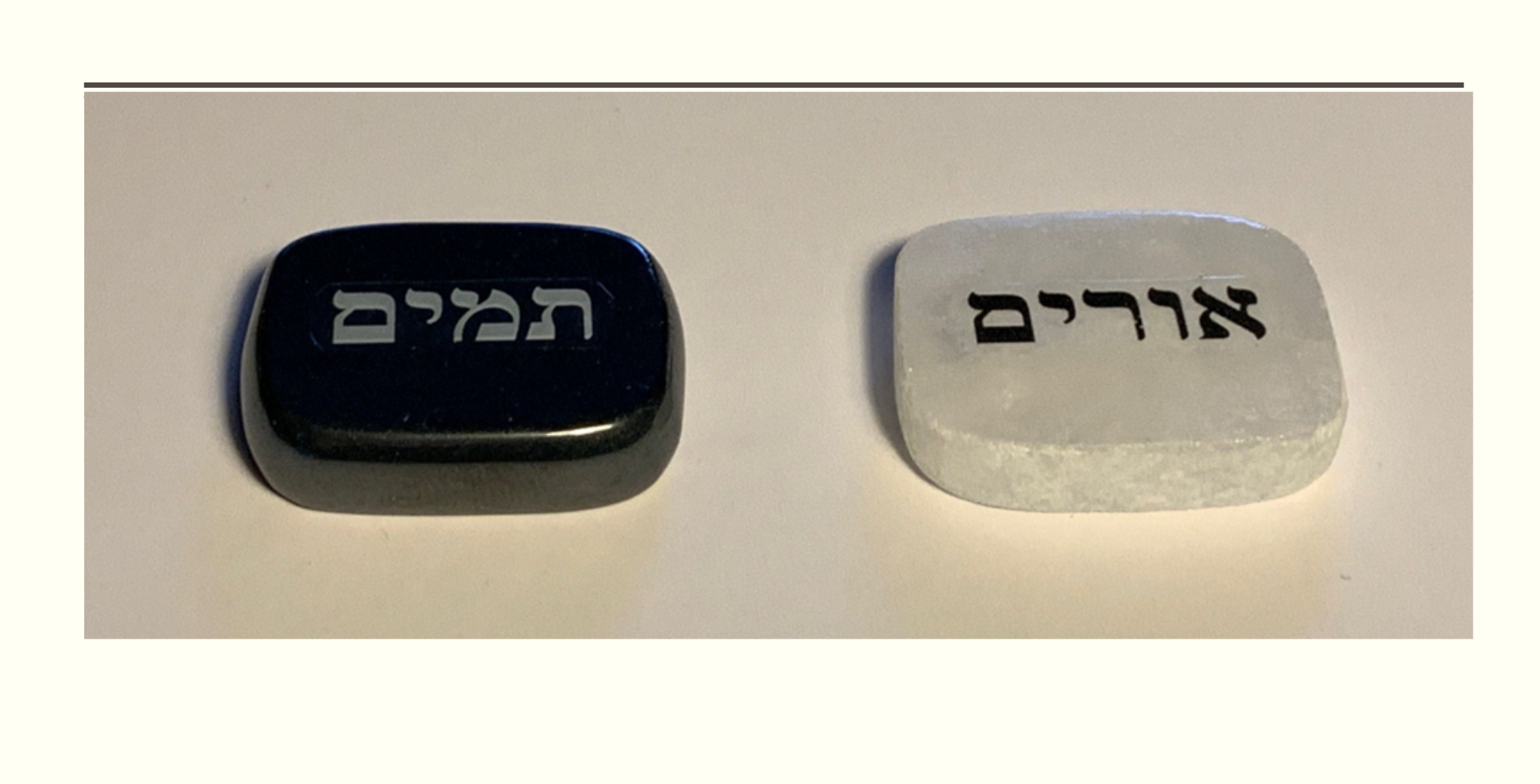
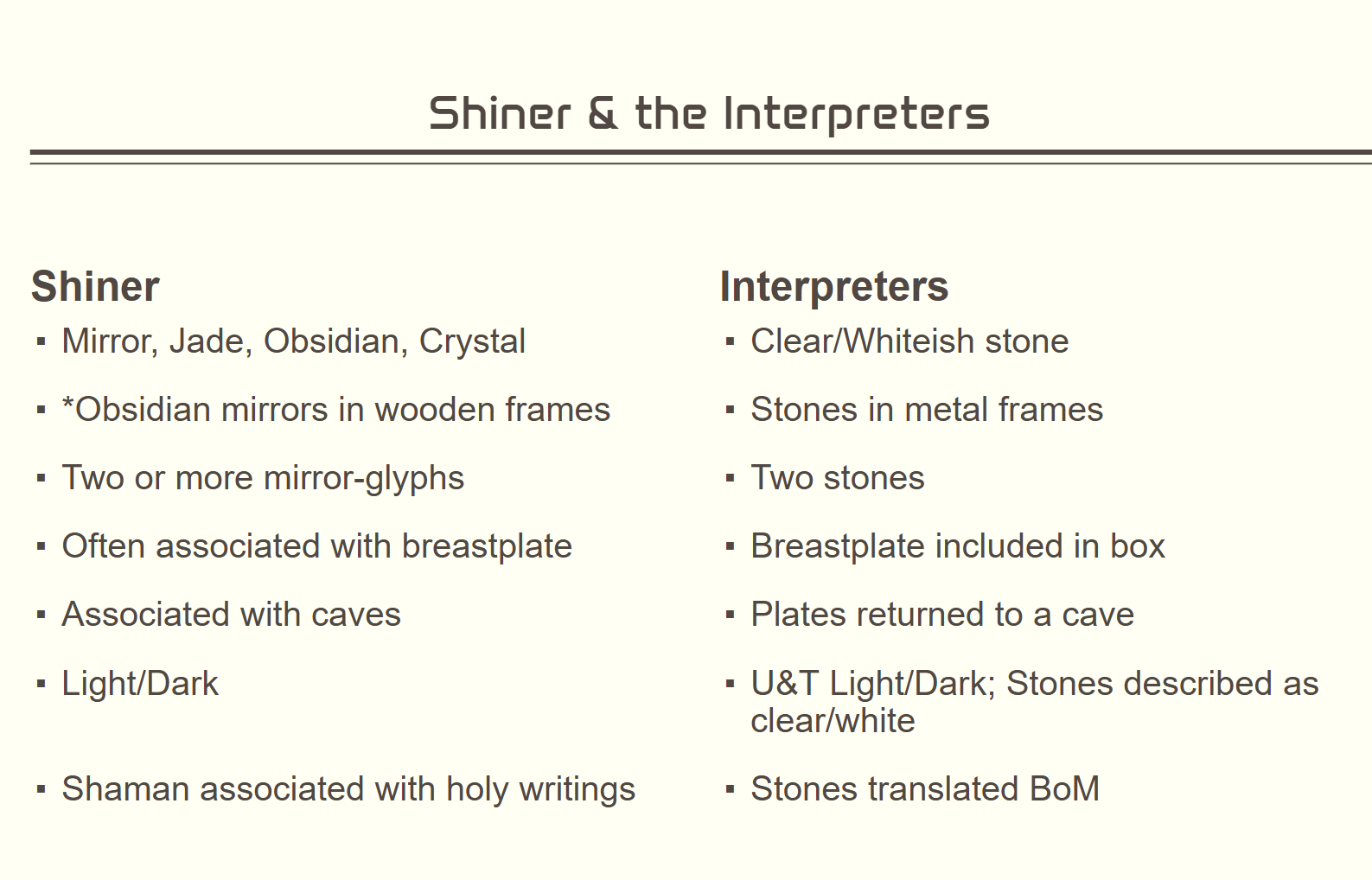
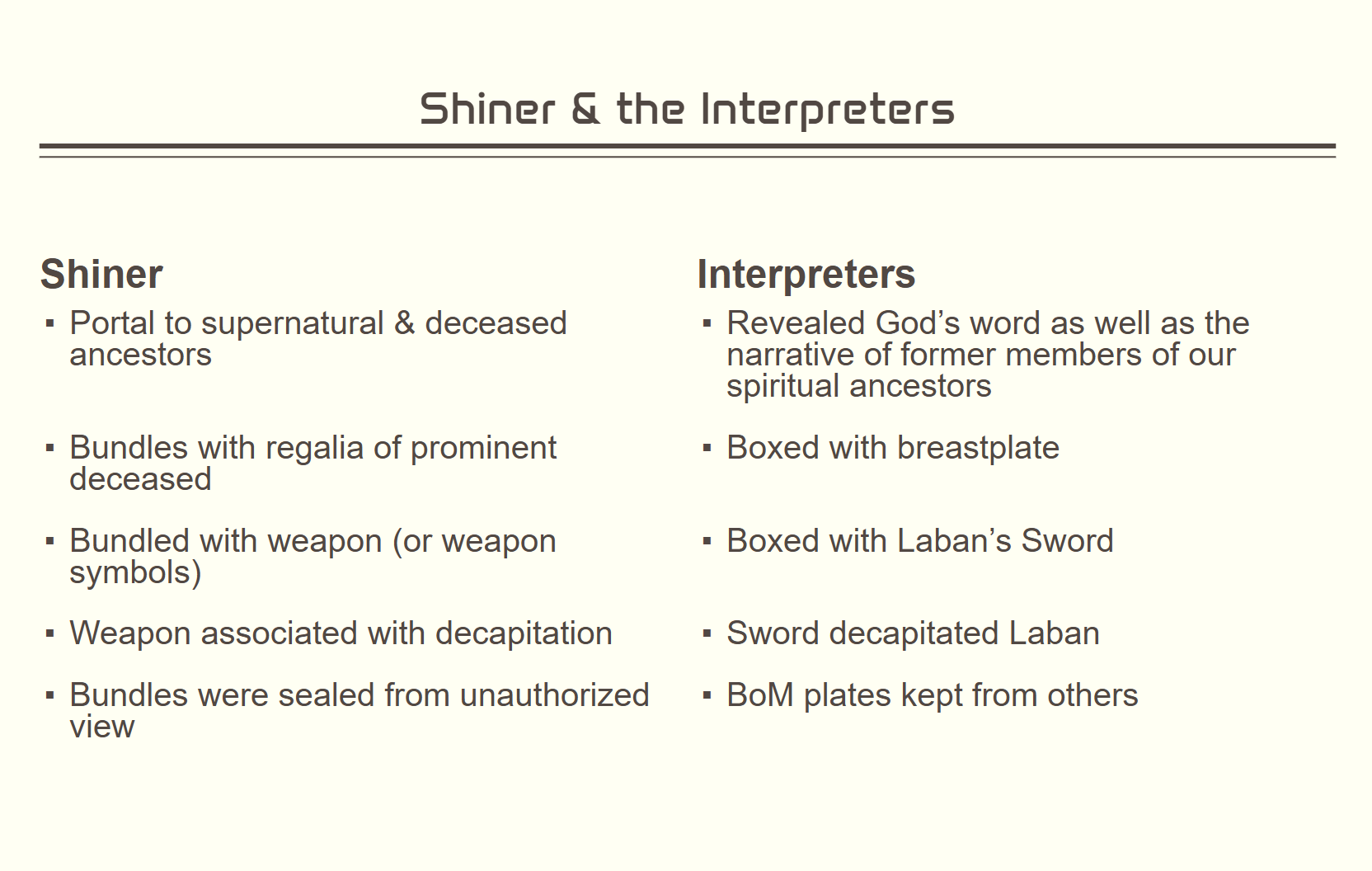
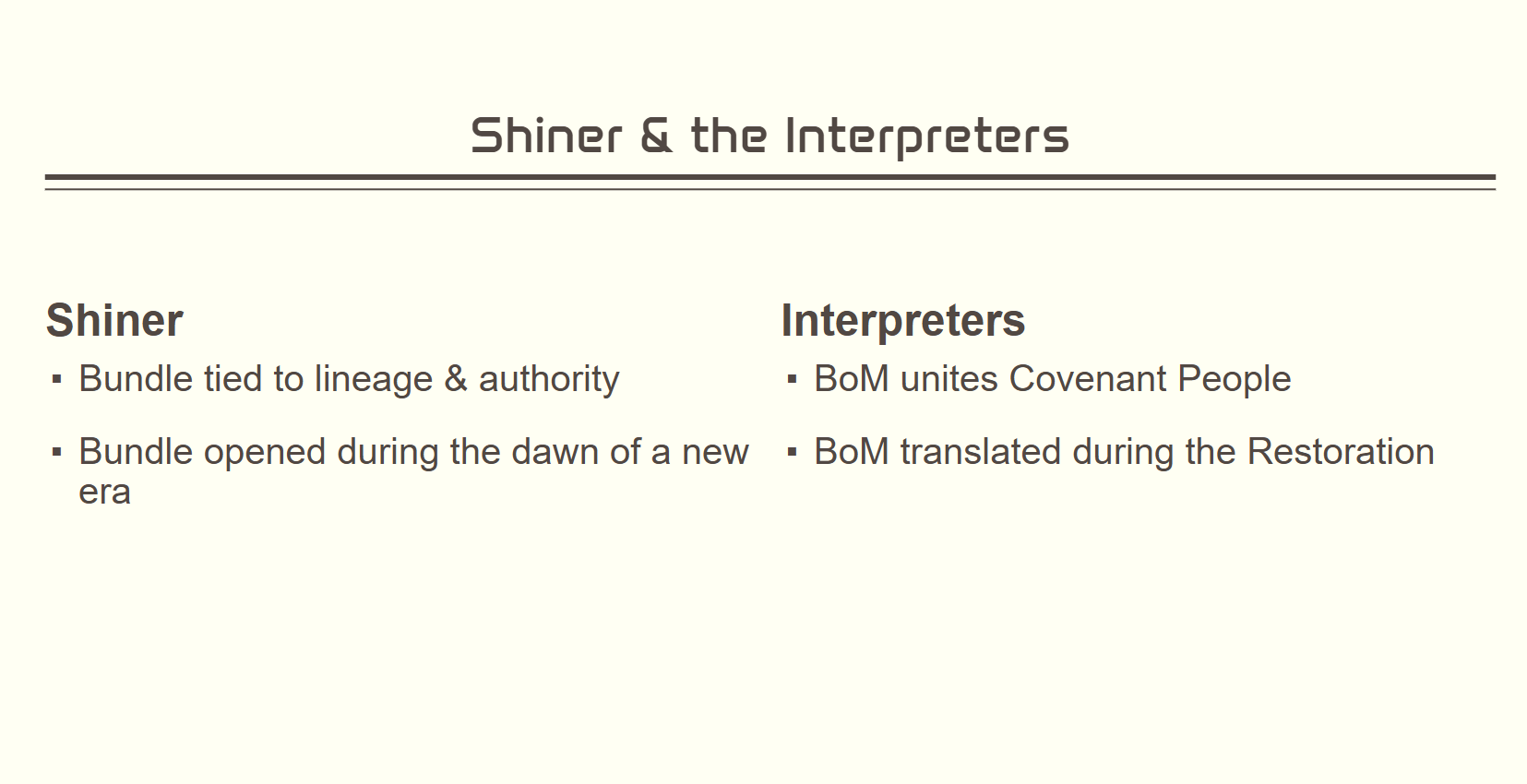
The Nephite “interpreters” described in the Book of Mormon—later called the Urim and Thummim—may not have functioned as literal spectacles at all. Drawing on archaeological and linguistic evidence, Mike Ash argues that they fit naturally within ancient Mesoamerican traditions of ritual “shiners”: reflective stones used in sacred divination, often mounted in breastplates, associated with caves, sealed bundles, and complementary light/dark symbolism.

Rather than being an odd anomaly, Joseph Smith’s translation instruments—including the stone in the hat—intersect meaningfully with both Israelite temple symbolism and Mesoamerican ritual culture. The interpreters reflect covenant continuity across cultures, not contradiction.


Why This Matters

Questions about the Book of Mormon interpreters—and Joseph Smith’s use of a stone in a hat—often arise because the details do not neatly match common biblical assumptions.

Ancient cultures, including those in Mesoamerica, used reflective stones, mirrors, and sacred regalia in ritual contexts associated with divine communication. When viewed within that broader historical framework, the Nephite interpreters align with established traditions involving “shiners,” breastplates, sacred bundles, caves, and complementary light/dark symbolism.

This approach situates the Book of Mormon translation within recognizable ancient patterns rather than isolating it from them. It highlights intersections between Israelite temple concepts, Mesoamerican ritual practice, and Restoration scripture.

For Latter-day Saints exploring questions about the translation, this framework provides historical and cultural context for understanding the interpreters and their role in bringing forth the Book of Mormon.

Introduction

Introduction

Mike Ash has been a member of Fair for more than 20 years. He’s been featured in nearly 90 podcasts, 30 videos, and has more than two decades of writing LDS themed material. You’ll find some of his material in our bookstore. He has written for Ensign, Sunstone, Neil A. Maxwell Institute’s Farm Review, Dialogue, Journal of Mormon Thought, and of course, he’s well known to us at FAIR because he’s been a volunteer for a long time and answered lots of questions online.

Presentation

Mike Ash: It’s an honor to be here again today. It was 25 years ago, a quarter of a century ago, that I attended the first FAIR conference. And other than the Covid shut down where everything was electronic. I haven’t missed one since. And I think this is my 10th presentation for FAIR. So almost batting one out of three. So it’s exciting to be here and see the familiar faces.

Assumption of a Mesoamerican Geographic Model for the Book of Mormon

The title of my presentation is The Mesoamerican Urim and Thummim. And as the title suggests, I assume a Mesoamerican geographic model for the Book of Mormon. So get that out of the way already.

The Finding of the the Plates and Interpreters

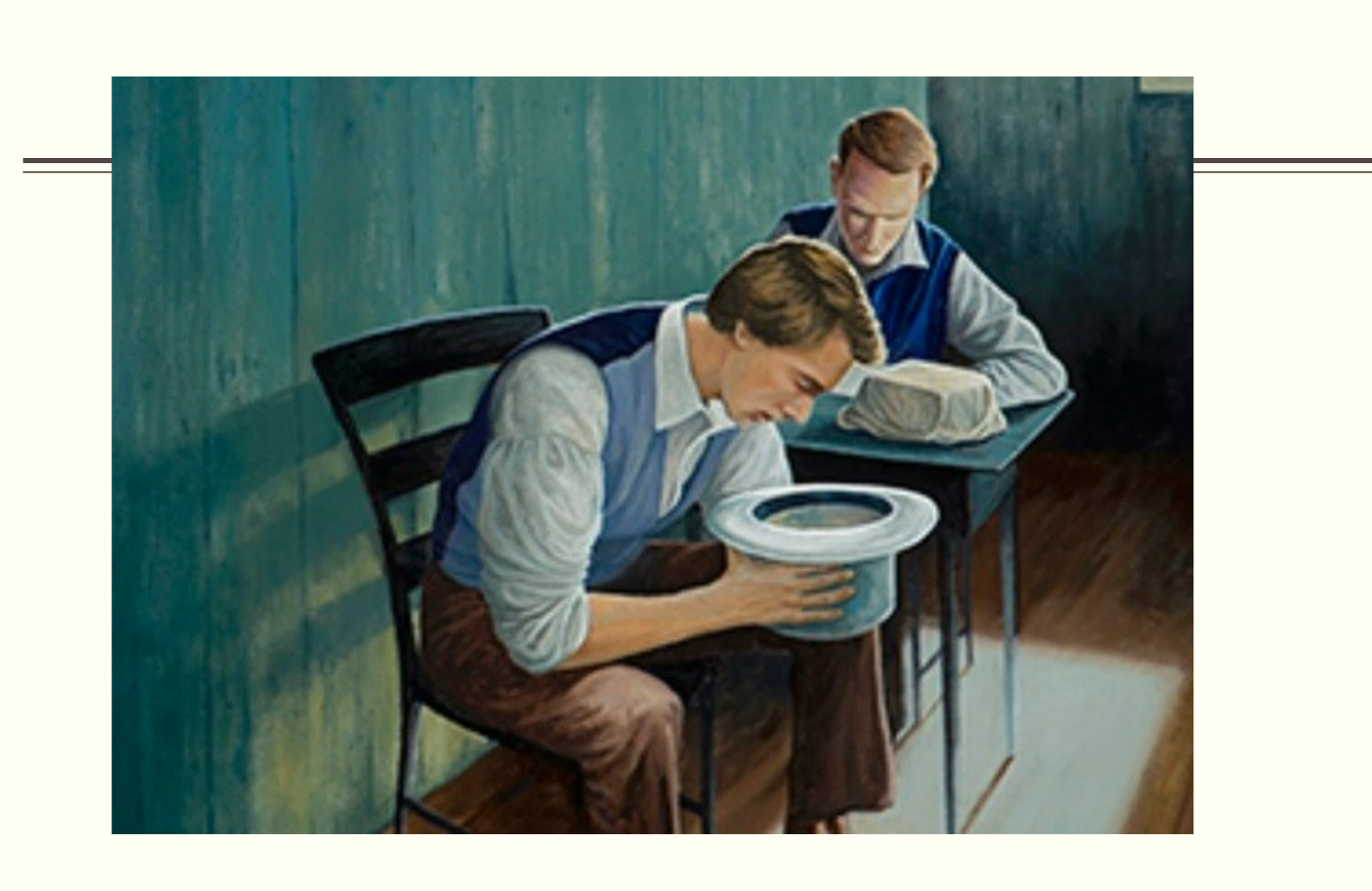
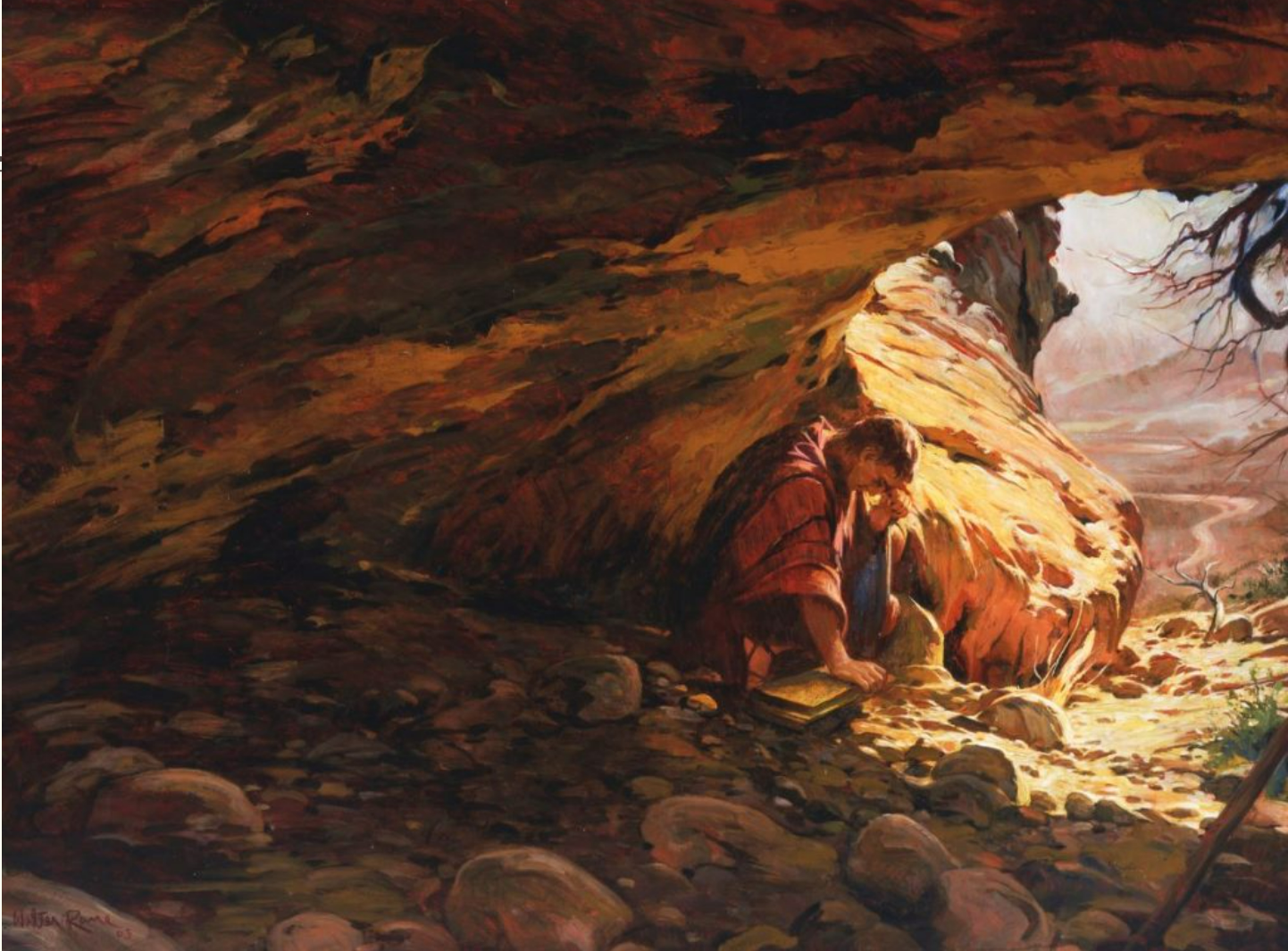
Joseph Smith, when he opened the stone box, what he found inside, obviously, was the plates, the breastplate, and what was called by the Nephites as the interpreters, and the early latter day Saints referred to sometimes as spectacles. And this was the device that Joseph Smith used to translate the Book of Mormon plates before he started using his seer stone.

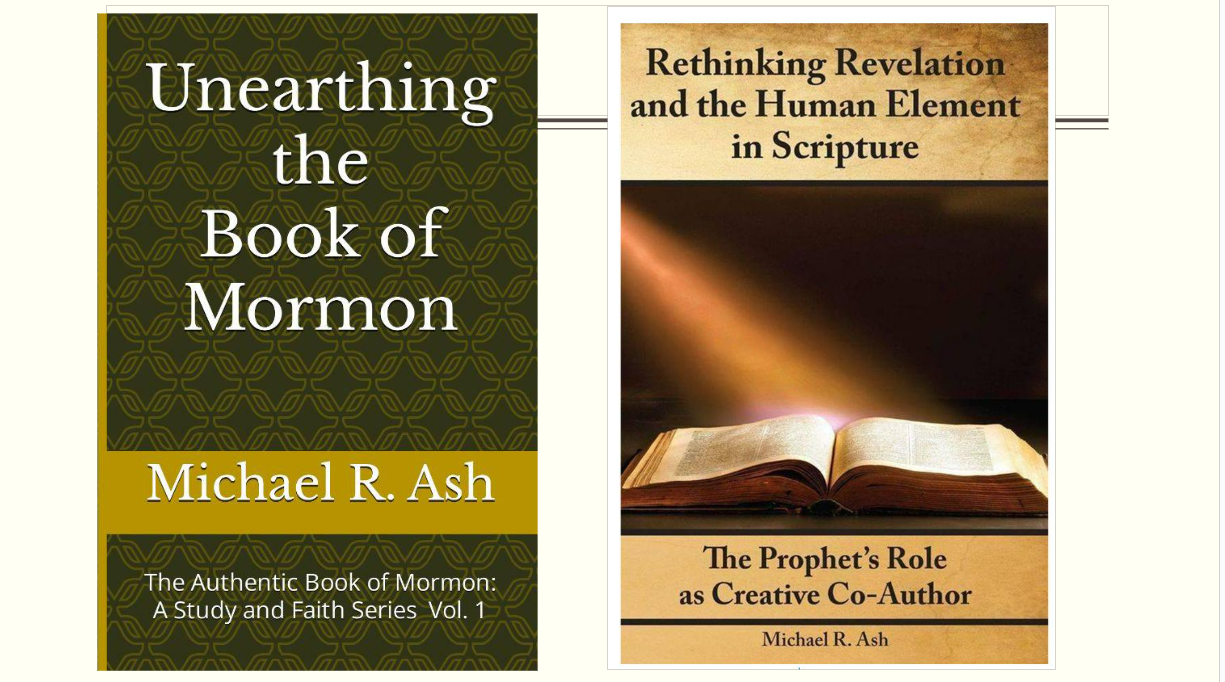
The arguments I’m about to present were originally part of a chapter in my book Rethinking Revelation, and the Human Element in Scripture.

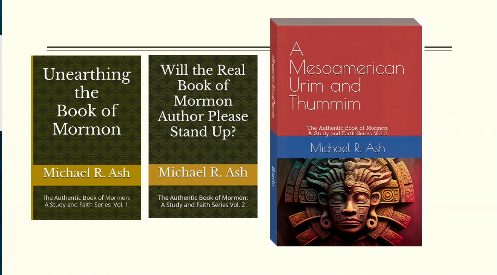
And then I distilled this down into a booklet form for those people that didn’t want to read through the entire book and just get it. And so I put it all into a book called A Mesoamerican Urim and Thummim, which was a volume in the little three part series that I’m working on, just on the book of Mormon.

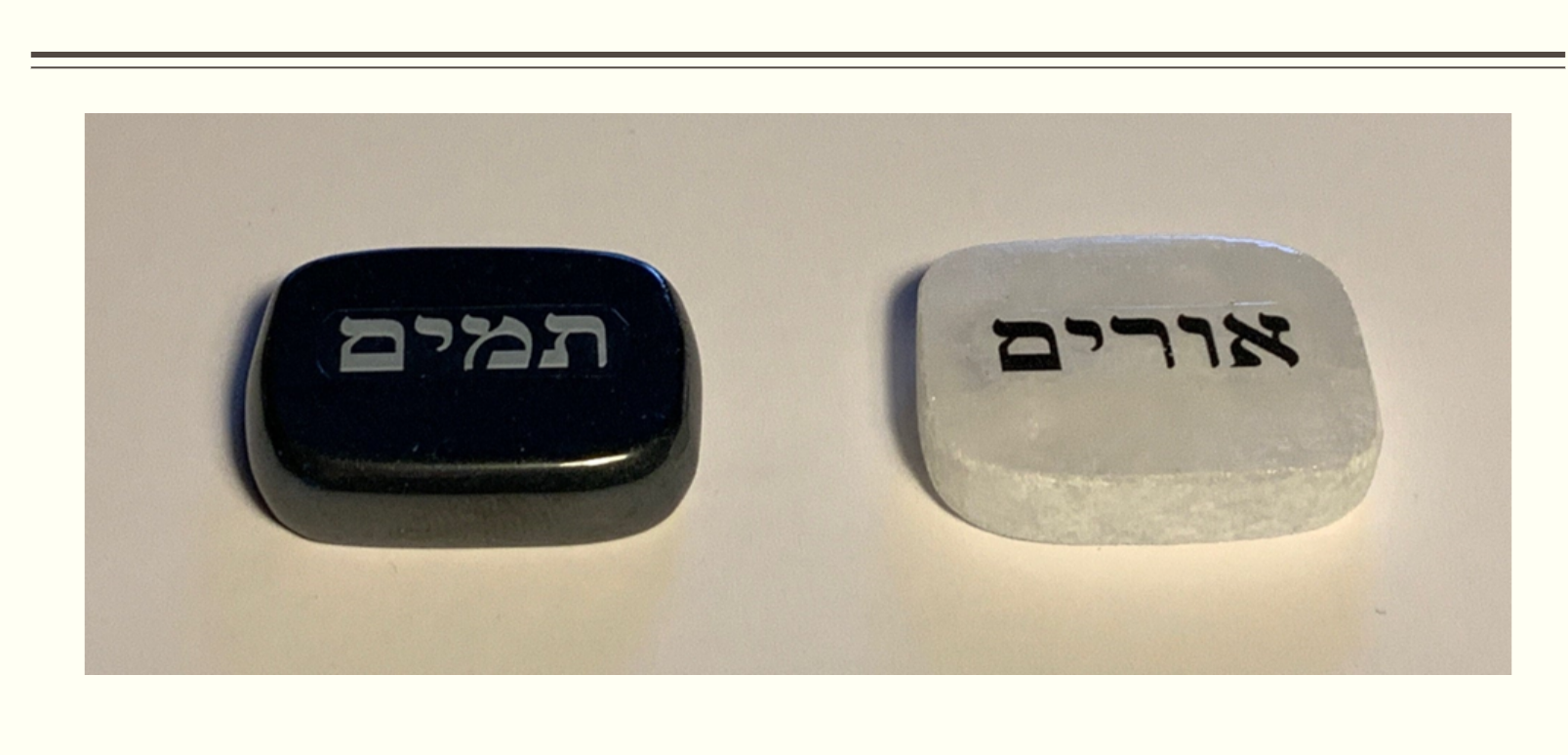
I will argue in this presentation that the Nephite interpreters, which, like I said, were known as the urim and thummim to some to the early Latter-day Saints, originated from ritual scrying traditions consistent with those found among ancient New World shamans.

What Did the Interpreters Look Like?

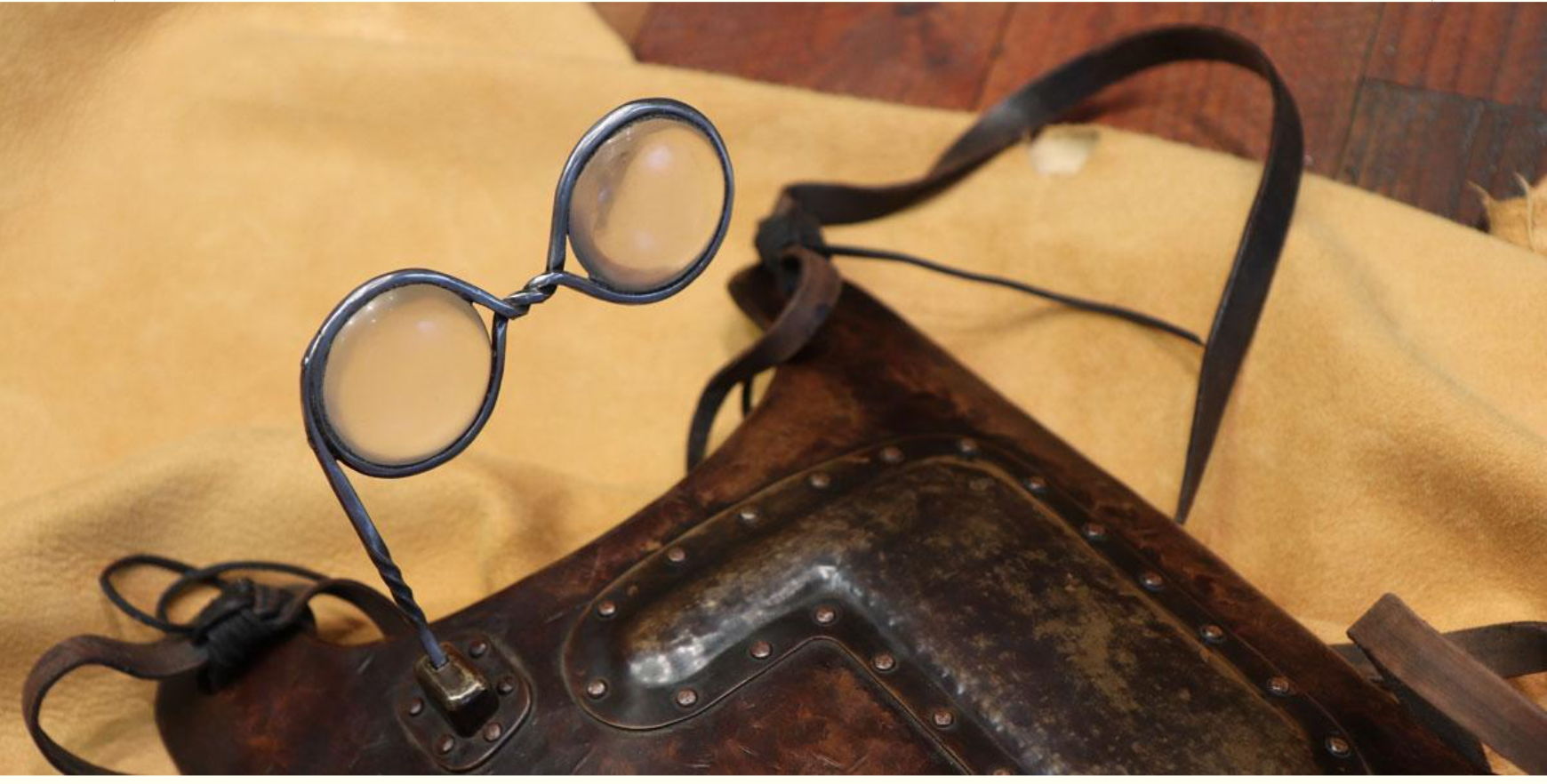
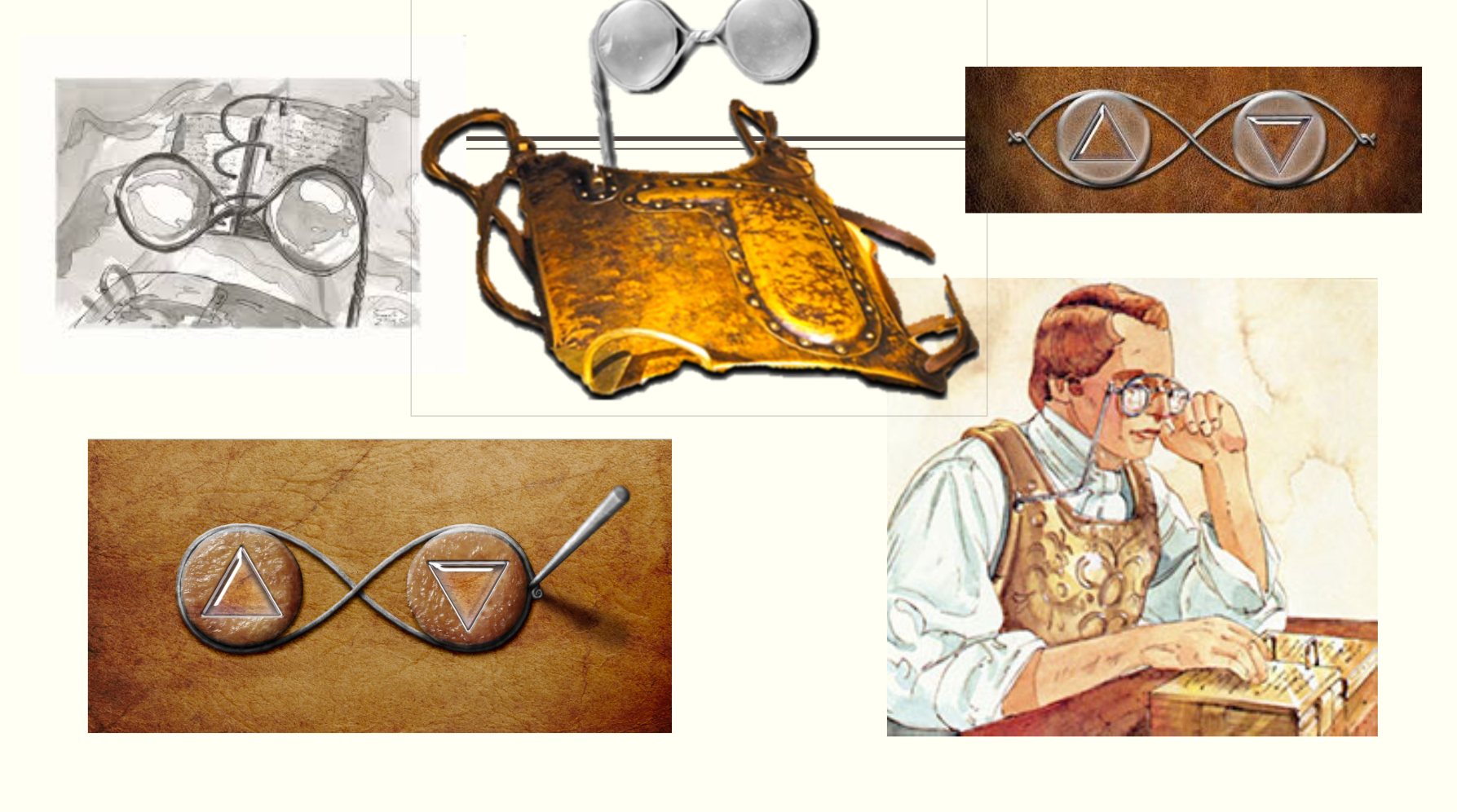
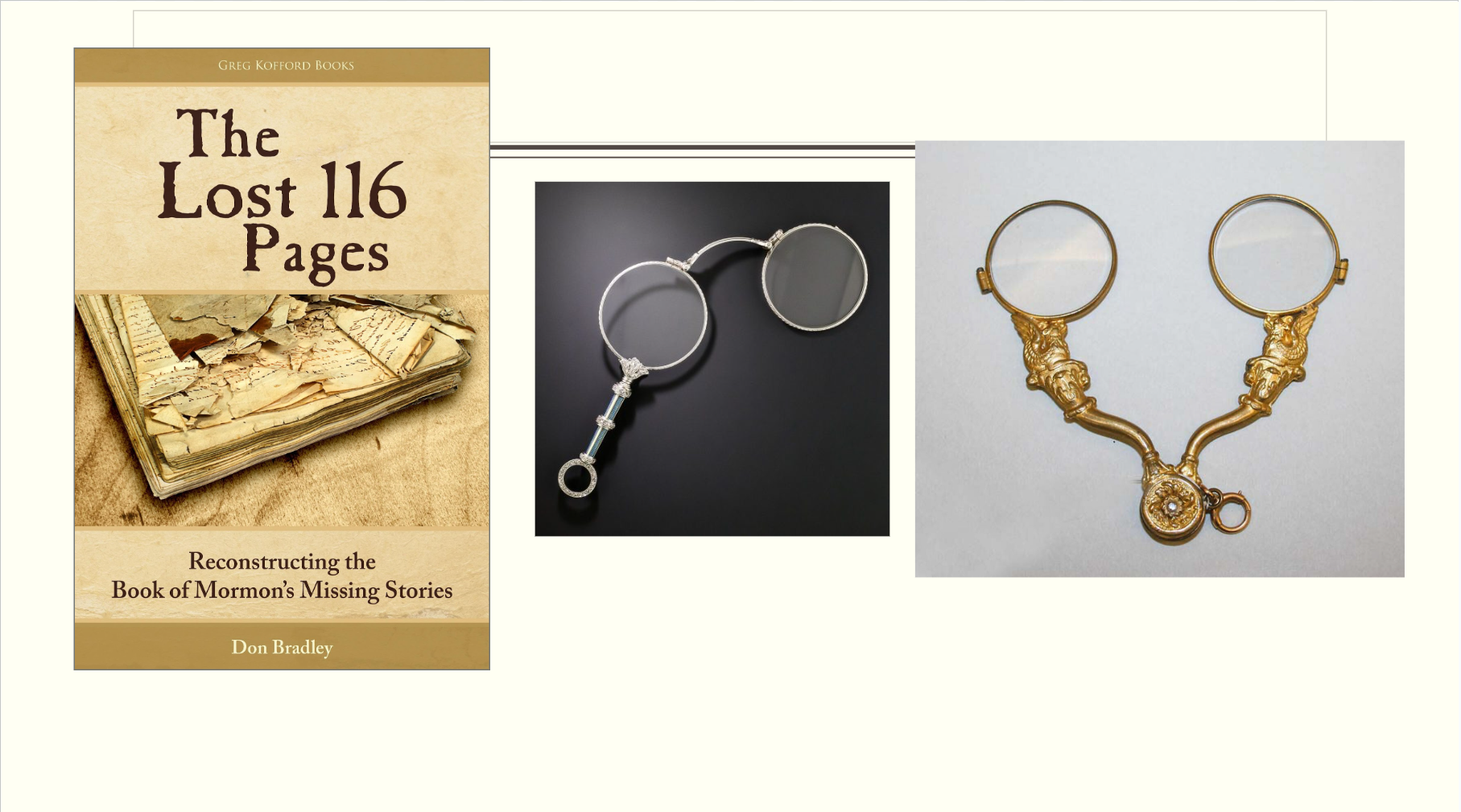
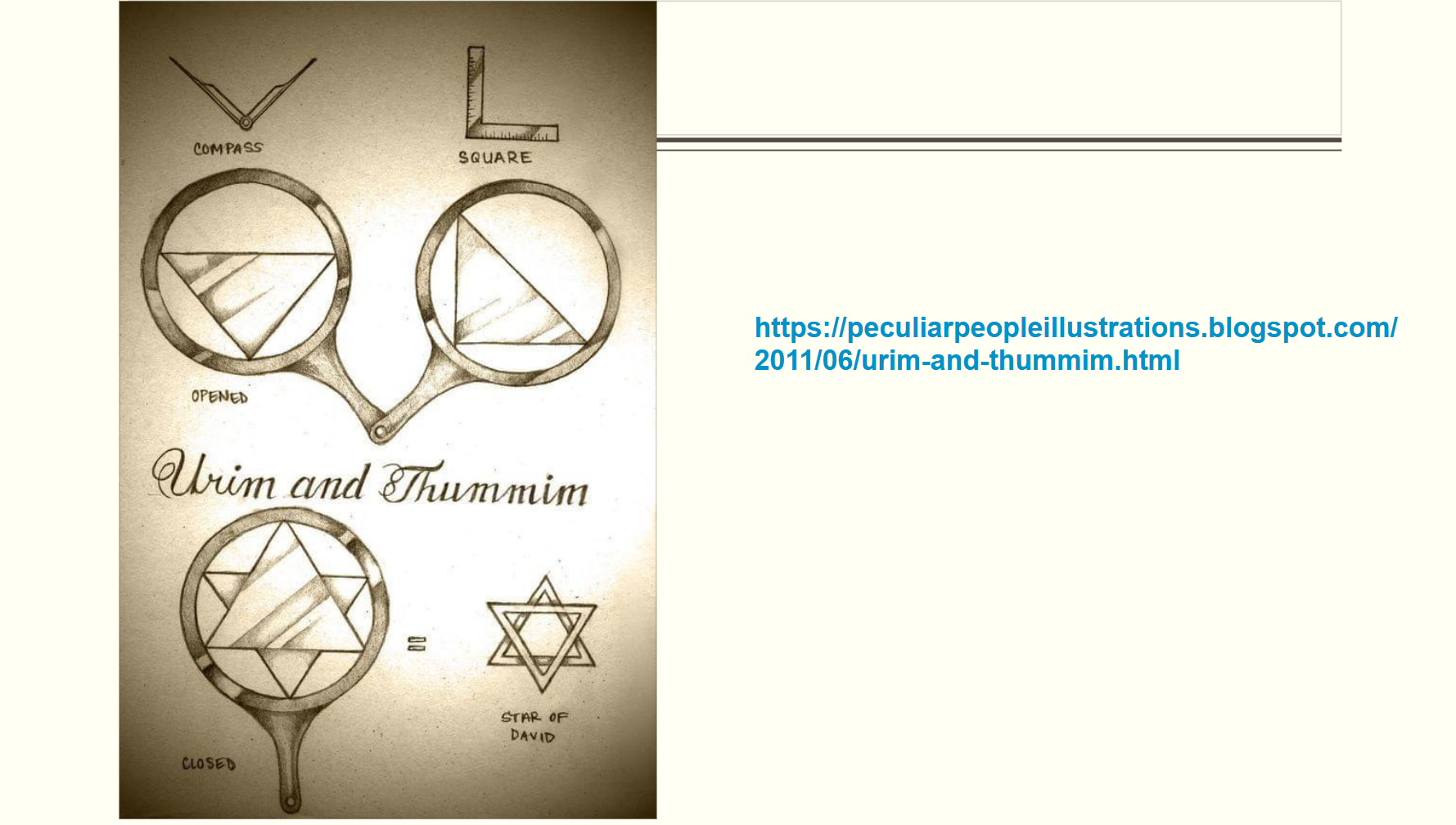
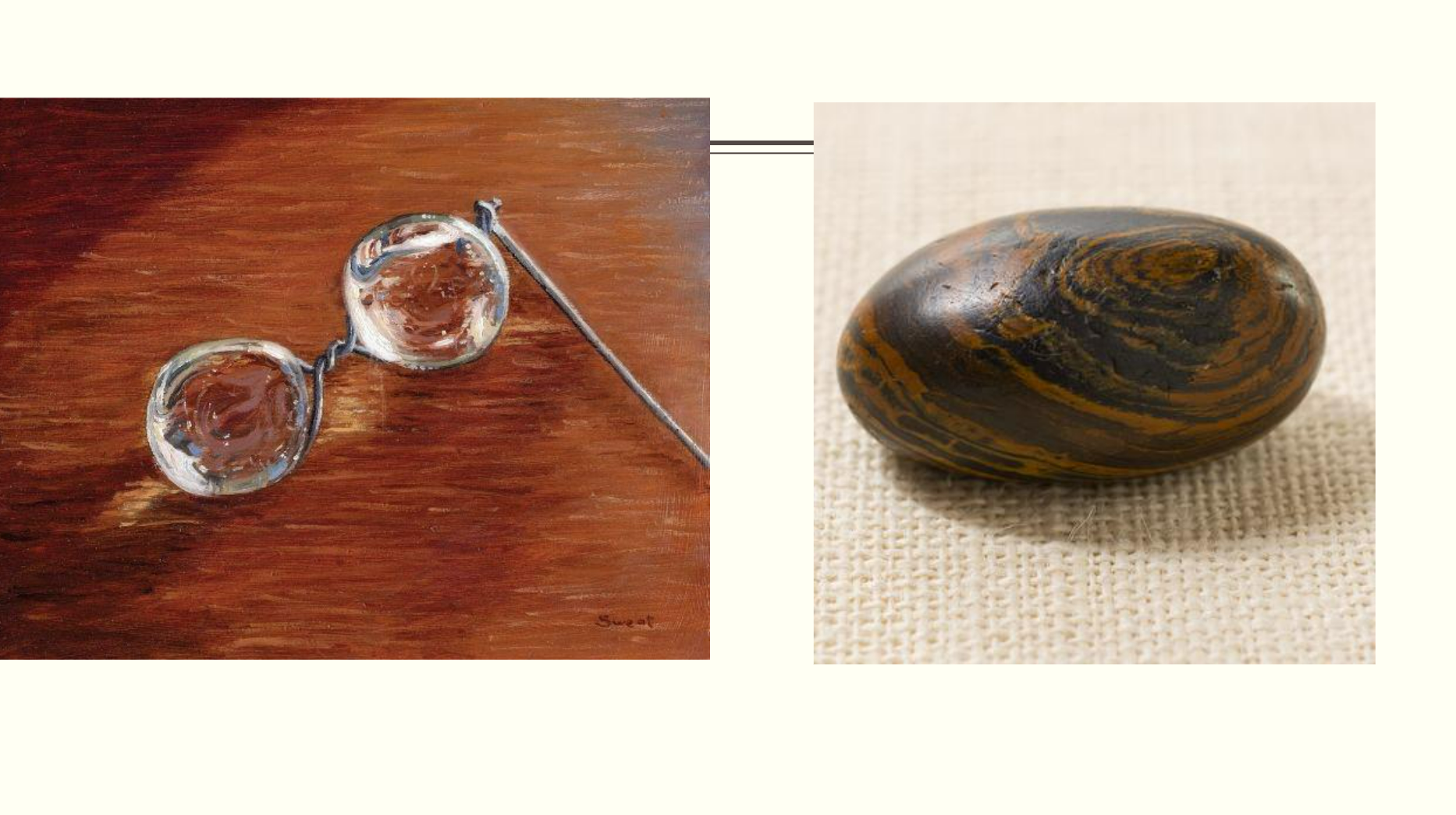
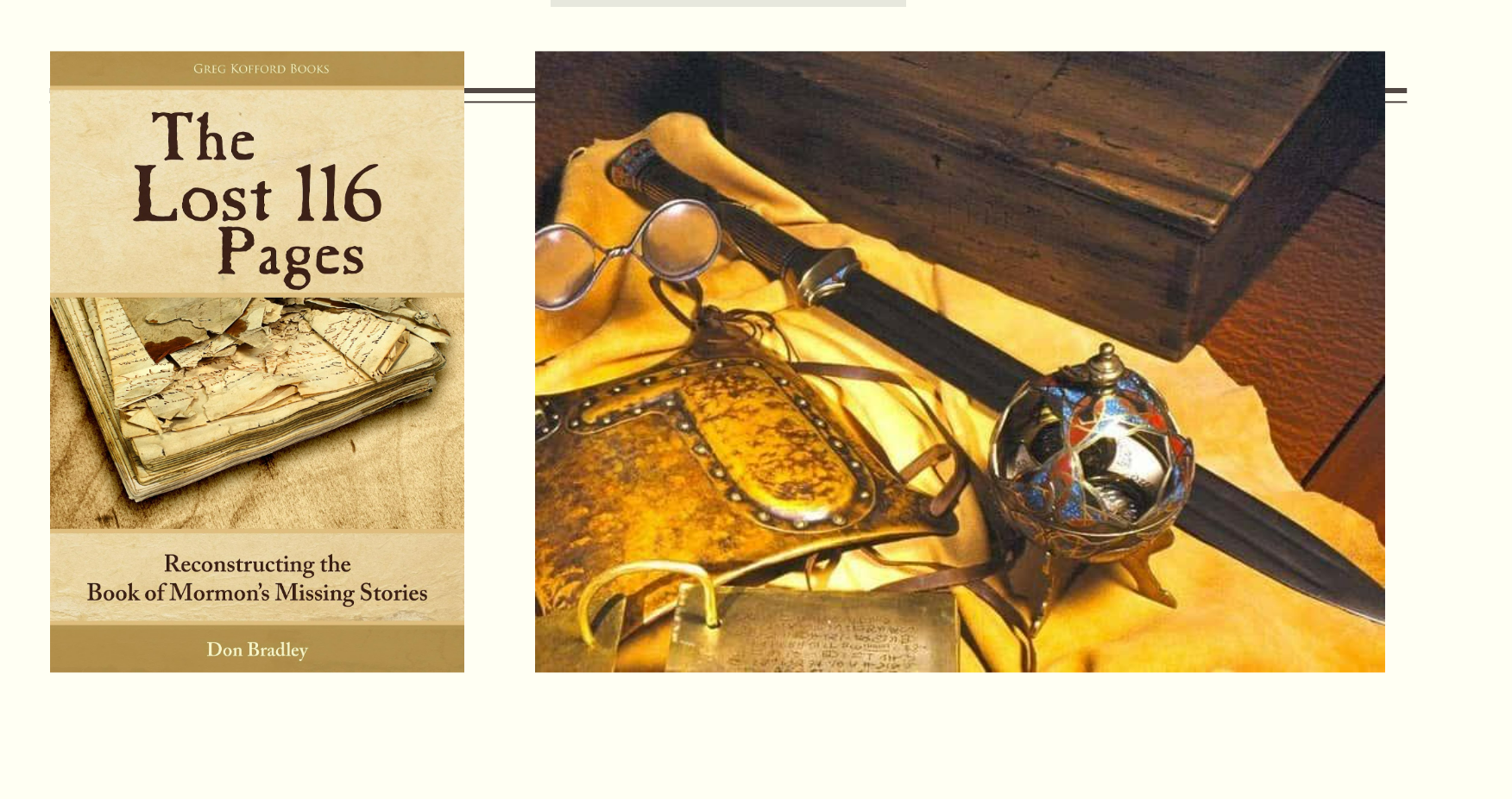
Now, what did the interpreters look like? There’s been a lot of speculation. We don’t really know. There’s been some interesting theories and possibilities. Don Bradley, in his wonderful book, The Lost 116 Pages (I highly recommend it), suggests that perhaps because they were referred to as looking like old fashioned spectacles, that they looked like lorgnettes, which are the eyeglasses from, earlier times, that were even older probably than Joseph Smith’s day. And perhaps even folding ones.

He gives an argument how they might have been shaped like this, and, it’s possible that’s how it is. In respect to Don, I disagree with how these might have looked and work this way. And Don might have a rebuttal to my position on it.

But in both my book, Unearthing the Book of Mormon, and my book Rethinking Revelation, I present arguments why I think that that doesn’t account for how the spectacles would have looked.

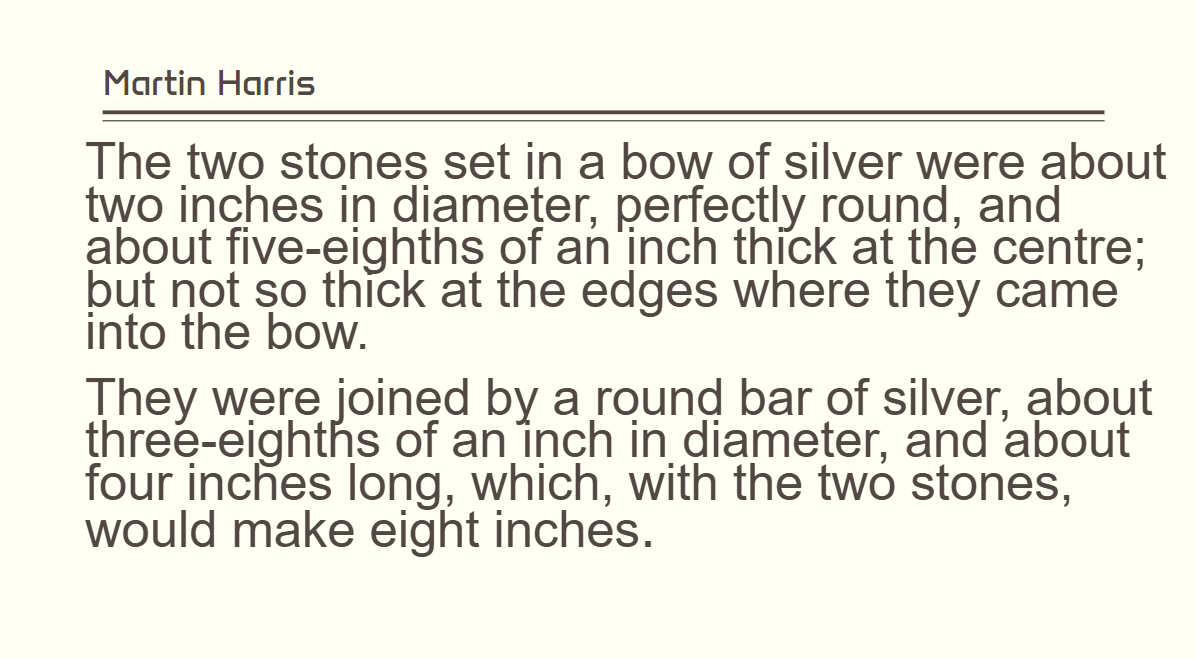
Martin Harris described the interpreters. He said:

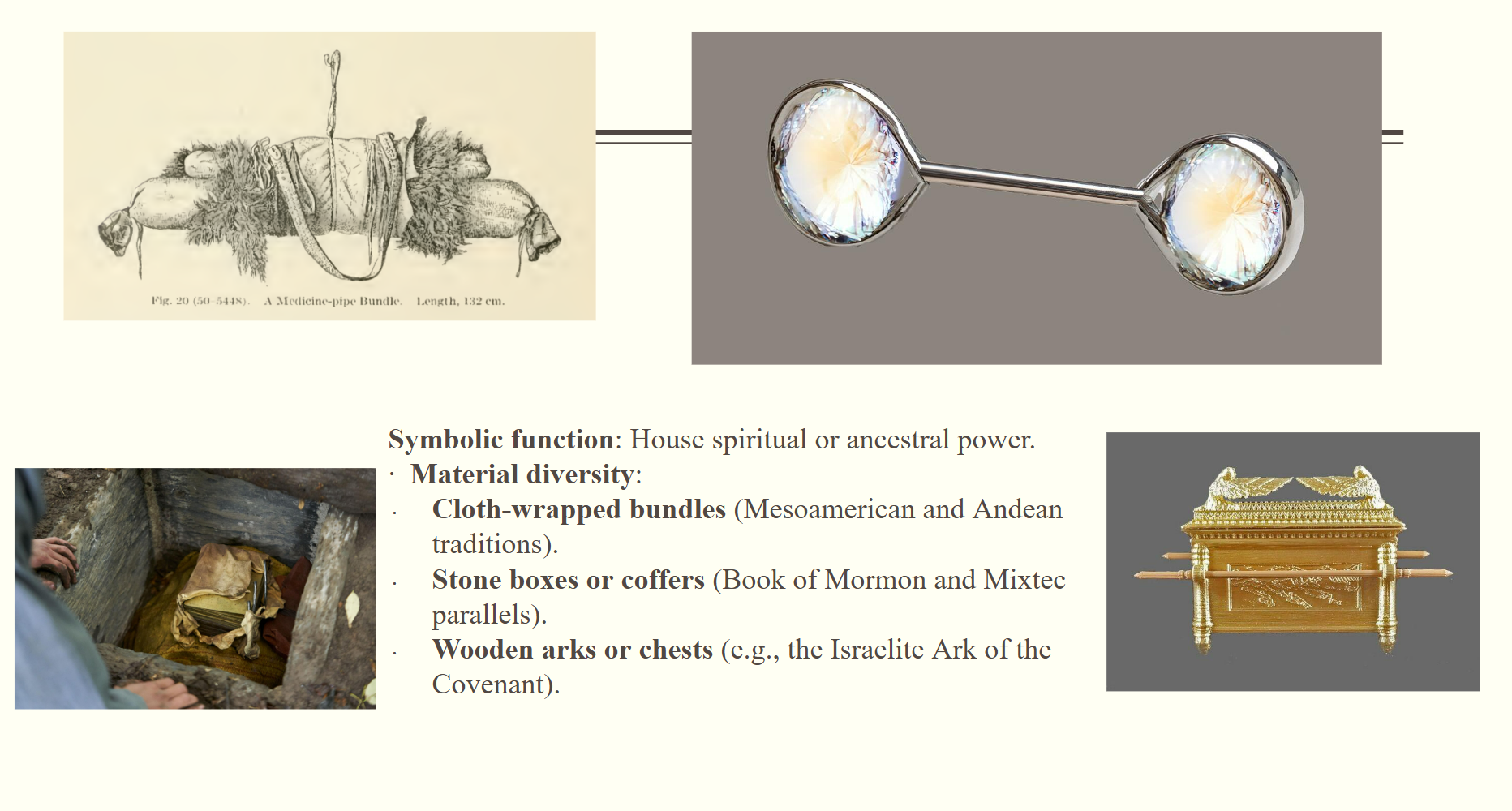
The two stones set in a bow of silver were about two inches in diameter, perfectly round and about 5/8 of an inch thick at the center, but not so thick at the edges where they came into the bow.

They were joined by a round bar of silver, about 3/8 of an inch in diameter and about four inches long, which with the two stones would make eight inches.

What Did the Interpreters Look Like?

Here’s kind of an AI Photoshop creation I made of how they might have looked, not including the rod that might have extended to the breastplate.That would have been a little bit harder to create in my quick rendition of this. But I think that that’s, in a real rough context, how they might have actually worked. They still would have looked like spectacles to some degree to the early Latter- day Saints in the overall shape, and that’s the way they referred to them. But they couldn’t have been worn on the face, and that’s why Joseph Smith struggled with them. In fact, he didn’t use them that way. He disassembled them and put them into his hat.

Scrying–Divining with Reflective Surfaces

So it’s possible that the root of that design or type might have been found in some of the practices of early scrying techniques. The practice of scryer divining with reflective surfaces was widespread in antiquity and persisted into Joseph Smith’s cultural milieu.

Among Mesoamerican and southwestern indigenous groups, diviners often gazed into water filled bowls to access the spiritual realms. And similar techniques were used across various nations, including ancient Egypt.

The earliest and most enduring form of scrying involved observing the surface of still water in natural basins, such as ponds or lakes. However, because of the practical limitations of accessing water, more portable alternatives, scrying mirrors, emerged.

These devices, dating back to 6200 BC, were also utilized by the Sumerians, Egyptians, Olmecs, Mayan, Greeks, Chinese, and others. In Mesoamerica, divining mirrors were not only widespread but ritually significant.

The Use of Mirrors in Scrying

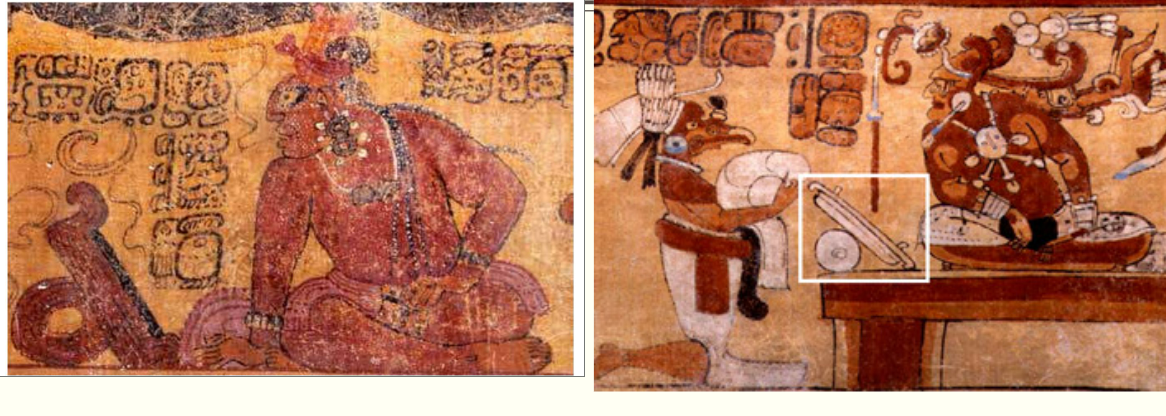
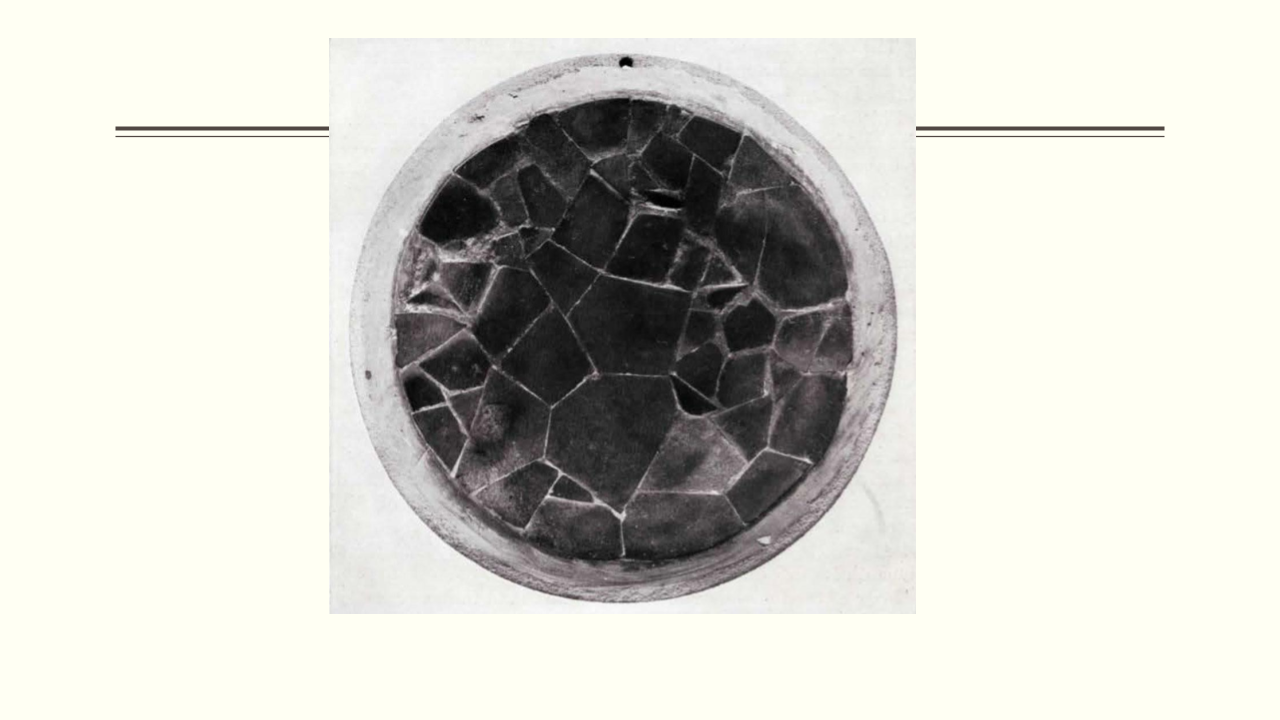
At many classic Mayan sites, mirrors were often placed in bowls to mimic luminous water pools. These reflective devices were believed to reveal past and future events, and served as tools of spiritual visions for shamans. In Mesoamerican practice, shiners were viewed from a distance, often propped on stands or held by attendants. Shamans would gaze into these reflective devices at arm’s length. Again, not wearing the spectacles on the eyes.

Mesoamerican mirrors were typically crafted from pyrite or obsidian mosaics set in circular wooden frames, sometimes reinforced with copper, gold or tumbaga. And if you’re familiar with that, that’s what some scholars theorize the Book of Mormon plates might have been made out of, or something similar to that.

The Use of Other Reflective Media in Scrying

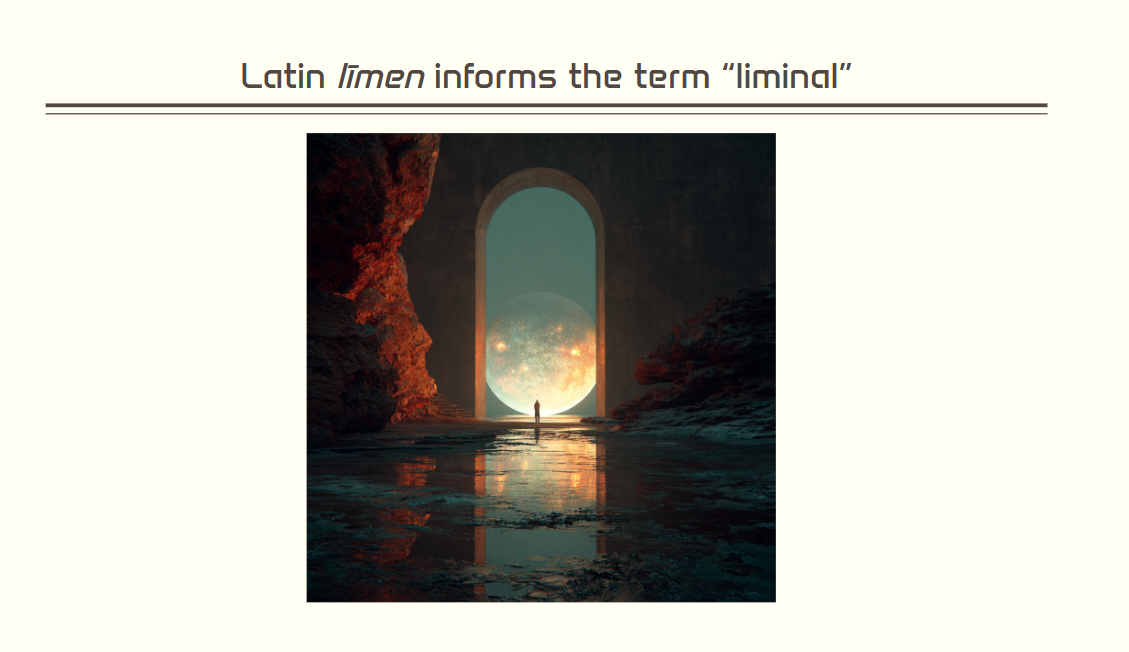
Beyond mirrors, mesoamericans revered a broader category of reflective media, in what one scholar describes as the reflective surface complex. In this worldview, many luminous surfaces symbolized the liminal threshold between the natural and supernatural realms.

The Latin root limen informs the term liminal, meaning threshold and denotes a space that straddles ordinary perception and sacred revelation. A liminal portal would then refer to a bridge or gateway that straddles the world of mortality, as well as the supernatural. In the Maya worldview, the mirror represented an archetype or broader domain of shiny surfaces that had the potential to access the liminal or supernatural worlds.

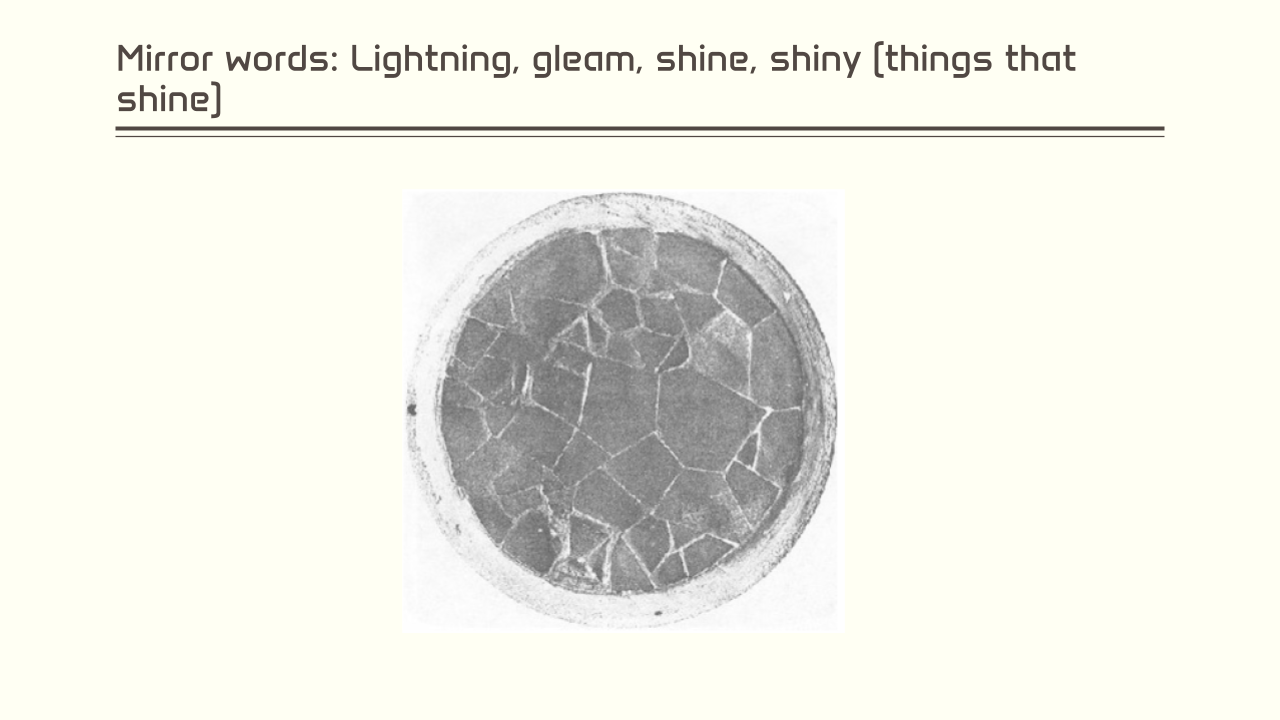
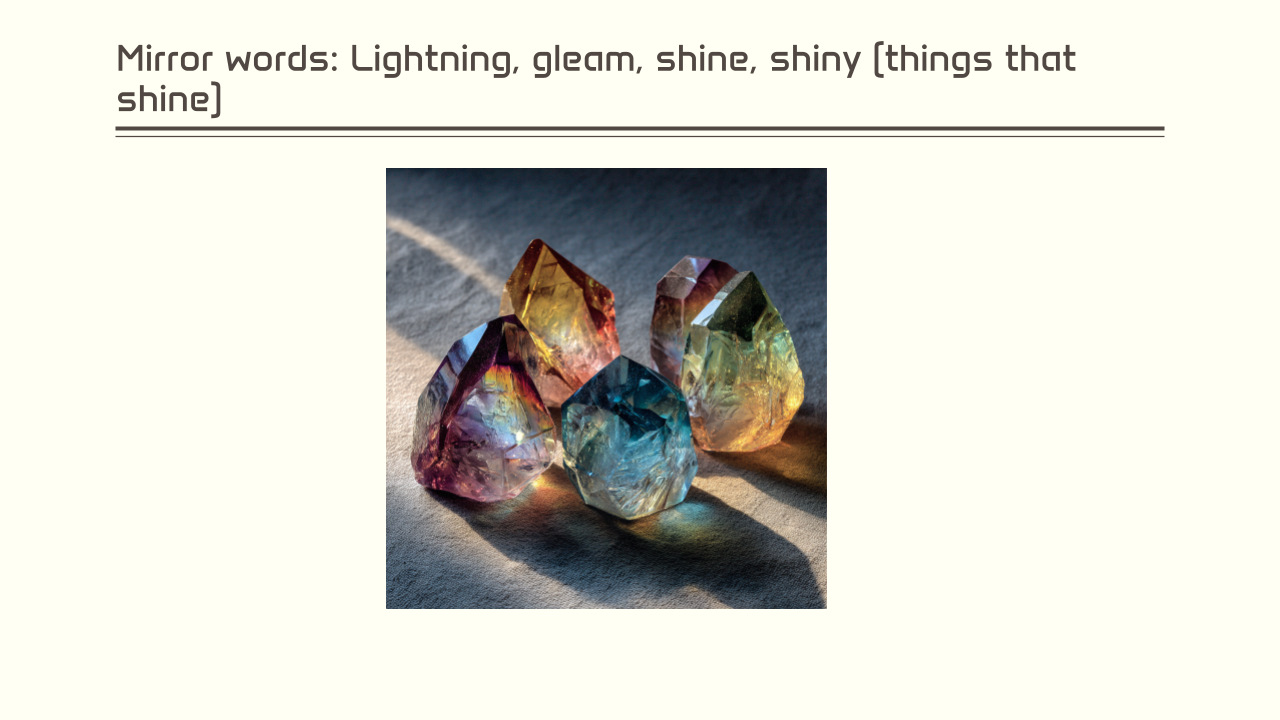
Mirror words for modern and conquest period Mayan dialects, for instance, are rooted in expressions such as lightning, glean and shine. One translation for mirror glyphs at a Mayan archeological site is shiner.

It refers to something shiny, resplendent. Modern Native American shamans also refer to the divinatory mirrors with the word that means “things that shine”, a word that includes crystal, water and glass, as well as various types of shiny stone such as jade, obsidian, and crystal.

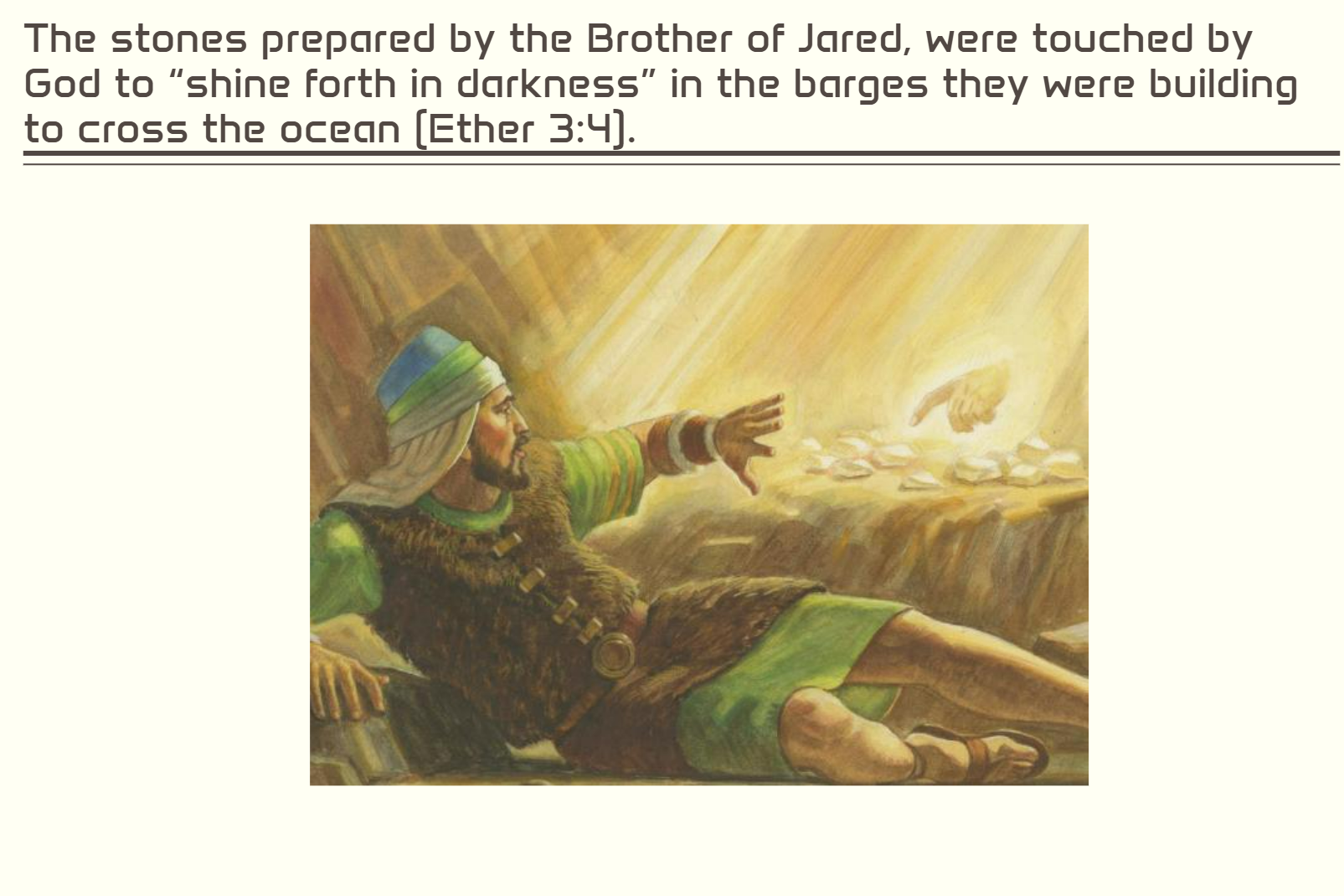
We recall that those stones prepared by the brother of Jared were touched by God to shine forth in the darkness in the barges when they were building the barges to cross the ocean.

Early Descriptions of the Interpreter Stones

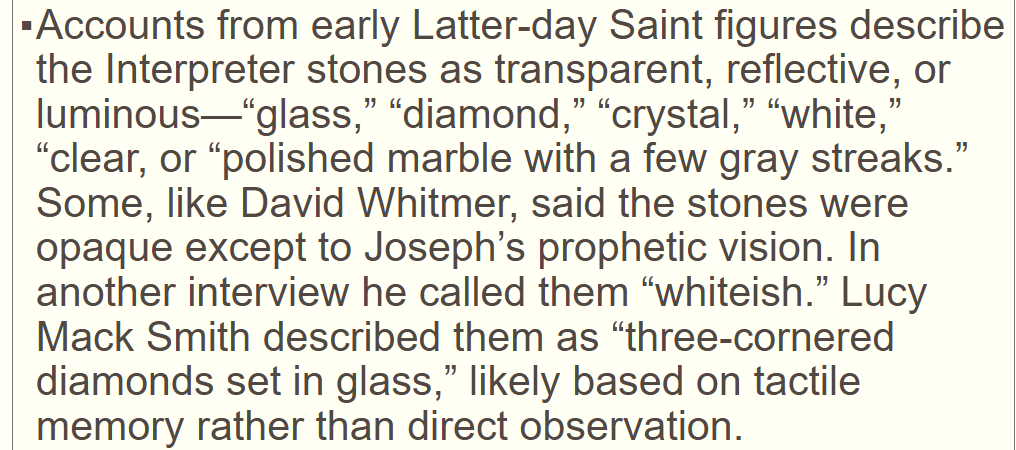
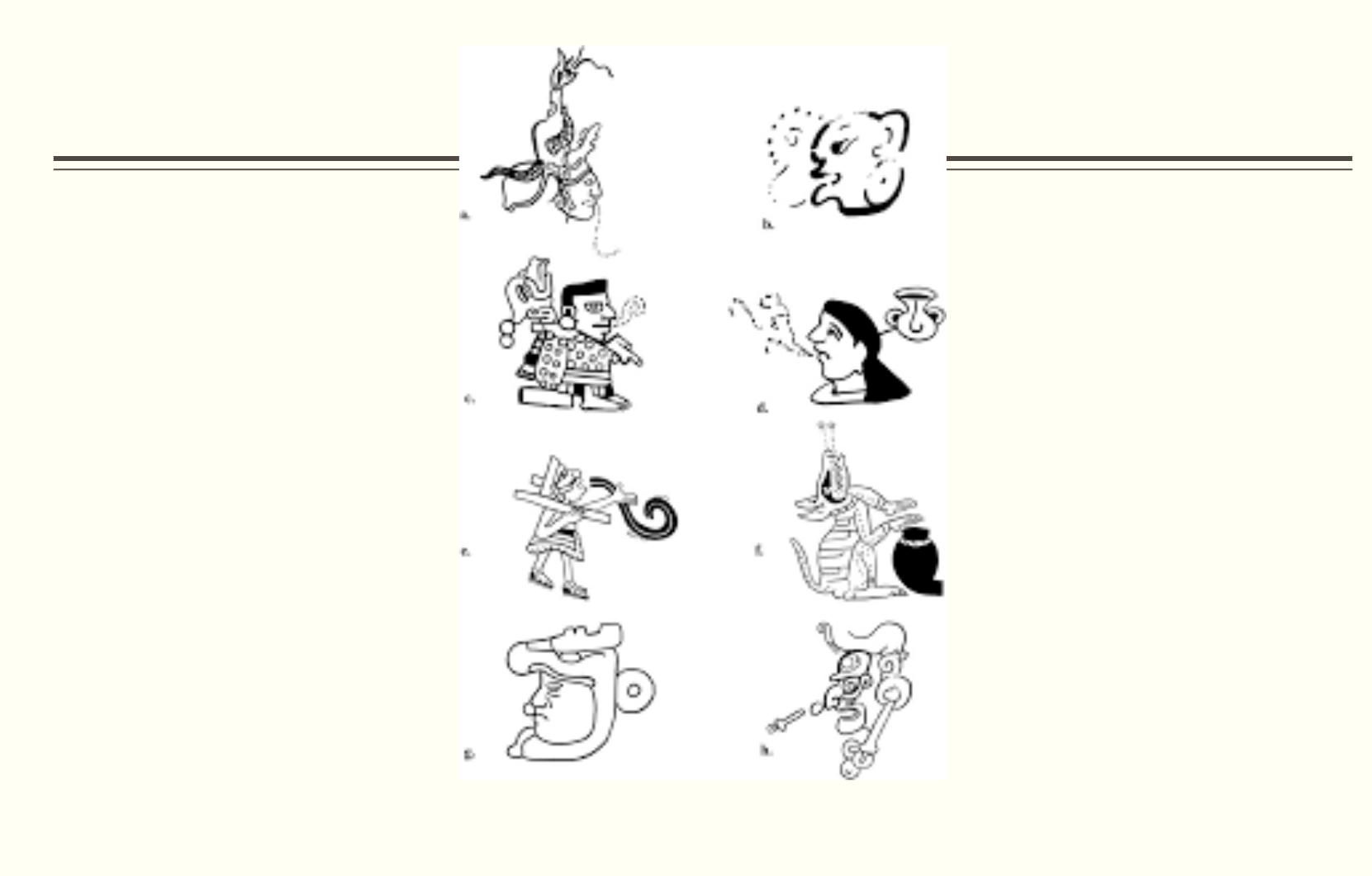
“Accounts from early Latter-day Saint figures describe the interpreter stones as transparent, reflective, or luminous–”glass,” “diamond,” crystal,” “white,” “clear,” or “polished marble with a brief few gray streaks.” Some, like David Whitmer, said the stones were “opaque except to Joseph’s prophetic vision.” In another interview, he called them “whitish.” Lucy Mack Smith described them as “three-cornered diamonds set in glass,” likely based on a tactile memory rather than direct observation.

Despite inconsistencies, a consensus emerges: the stones were probably smooth, excluding Lucy Mack Smith’s statement, were probably smooth, shiny and semi opaque to transparent. Their sacred character likely stemmed from both their appearance and function. While I suspect the stones were roundish and smooth, and that Lucy was misremembering what she felt, (she didn’t see the stones) it’s possible that, per Lucy’s description, the stones were triangular shaped, or they were topped with triangular shapes, or that they had facets.

Possible Minerals Used for the Interpreter Stones

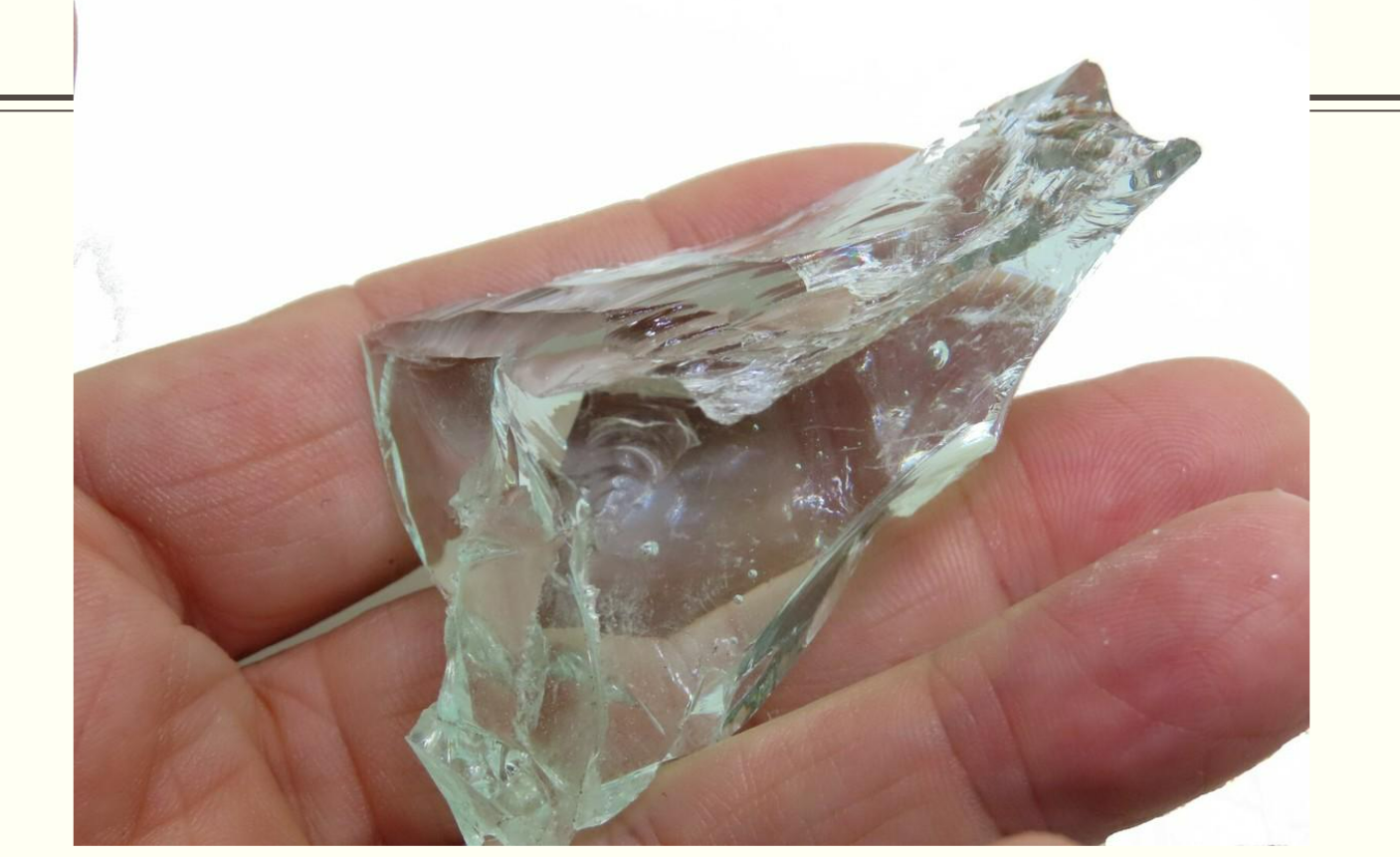
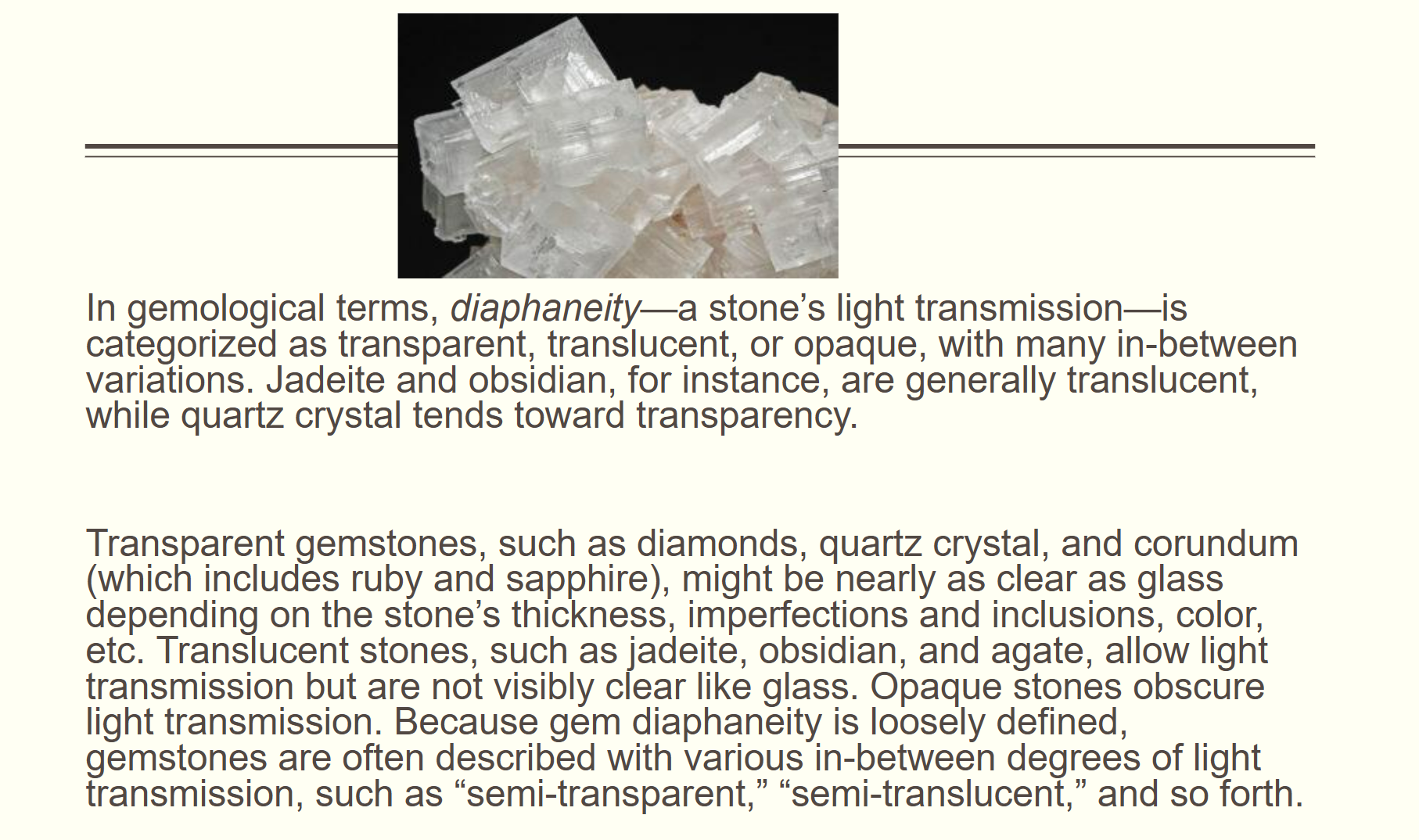
Potential candidates for the Nephite interpreters include jade, obsidian and quartz crystal, and they fit these descriptions. They were often rare, sacred, or imported in Mesoamerican trade, further elevating the ritual value. Things that were brought in from the outside were seen to have not only more value, but maybe more sacred value. They were exotic and had otherworldly characteristics to them.

Jade

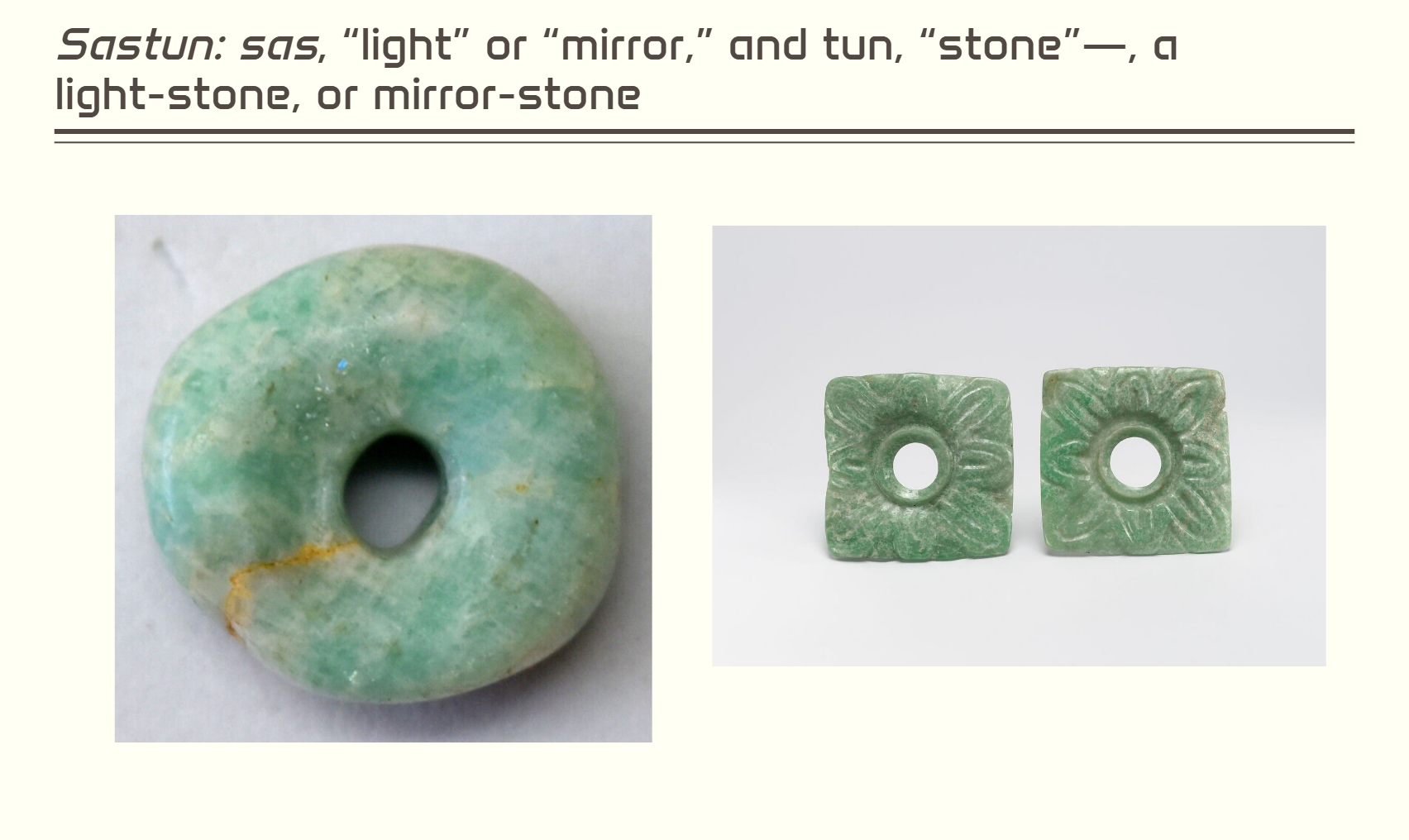
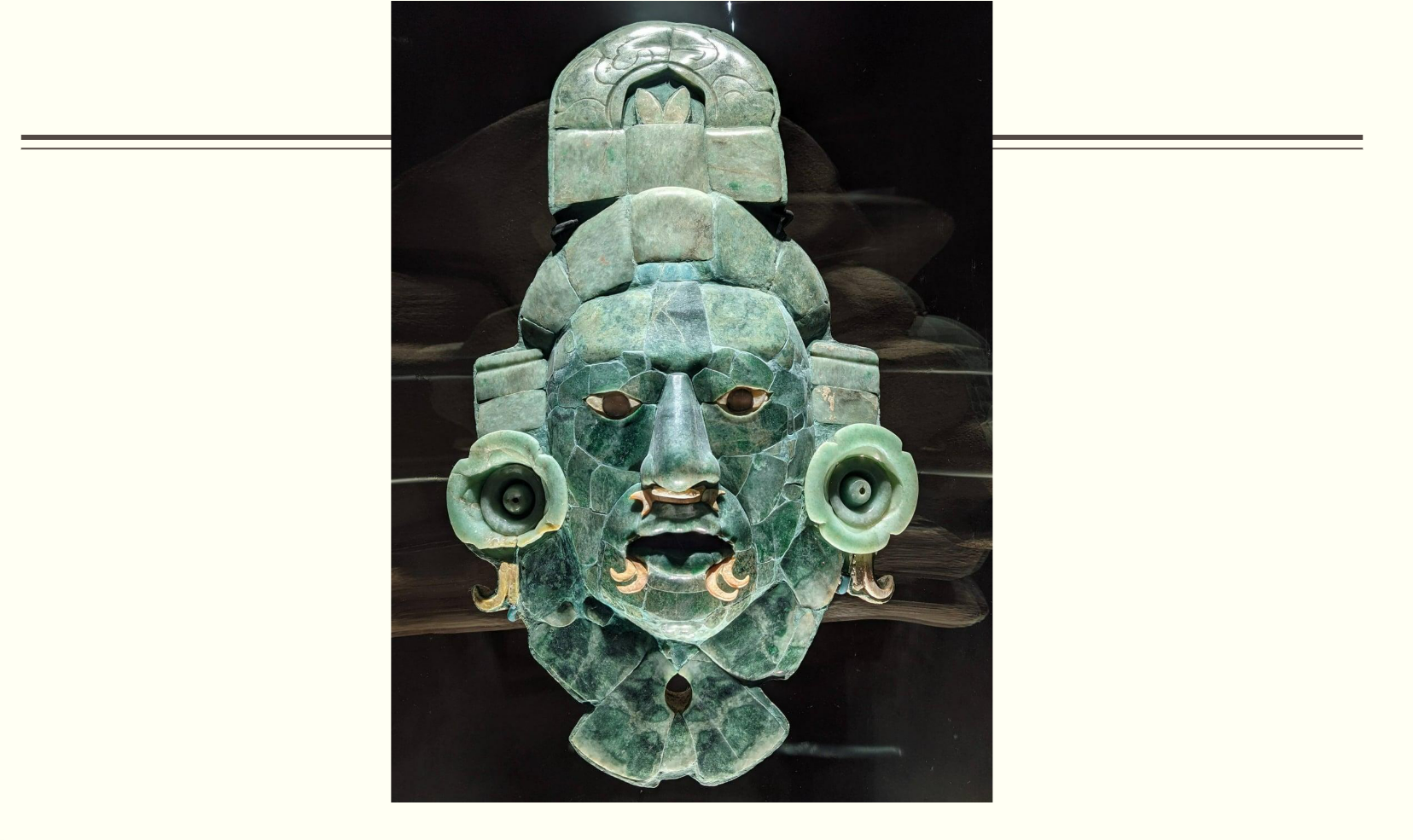
So let’s start with jade. Jadeite, a rare mineral that’s only found in perhaps eight locations in the world, including Guatemala, which is right in the proposed Book of Mormon setting for the Mesoamerican, model, and it was deeply symbolic in Mesoamerica. The Maya, for instance, associated jade with water, divination, and sacred value. Their glyph for water was a jade bead. Though often green, jade can also be blue, white, or grayish, and when polished it gains translucency and glass-like luster. For the Maya, translucent jade mirrored the depths of still water, evoking introspective and spiritual reflection. Jade was frequently associated with shiners and divination, and jade was often found alongside mirrors and burials.

Some pieces of jade were prized for their divinatory powers. Thus jade spheres found in one ancient Mayan temple was immediately identified as the divinatory sastun. The word sastun comes from sas, meaning light or mirror, and tun, meaning stone. So, a light stone or mirror stone. Mayan shamans use them as divination tools.

Jade was often used during ceremonies held to commemorate deified ancestors, and in the ritual conjuring of supernatural forces and gods. Identified at times as “the breath of life,” jade was used to form ornaments, and in ritual ceremonies, and often played a crucial role in mediating between humans, gods, and ancestors att the Mesoamerican axis mundi.

Axis Mundi–Connecting Heaven and Earth

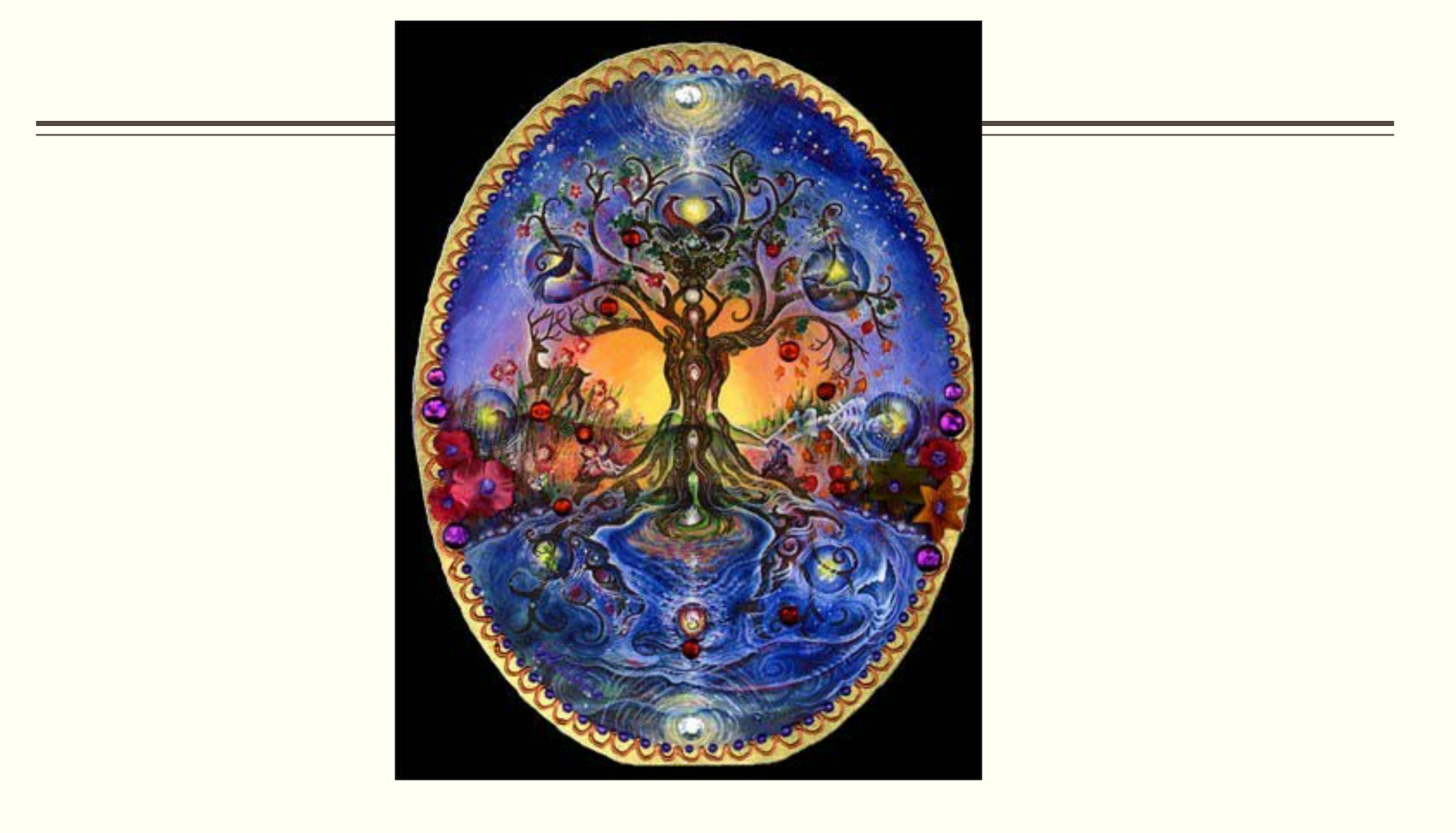
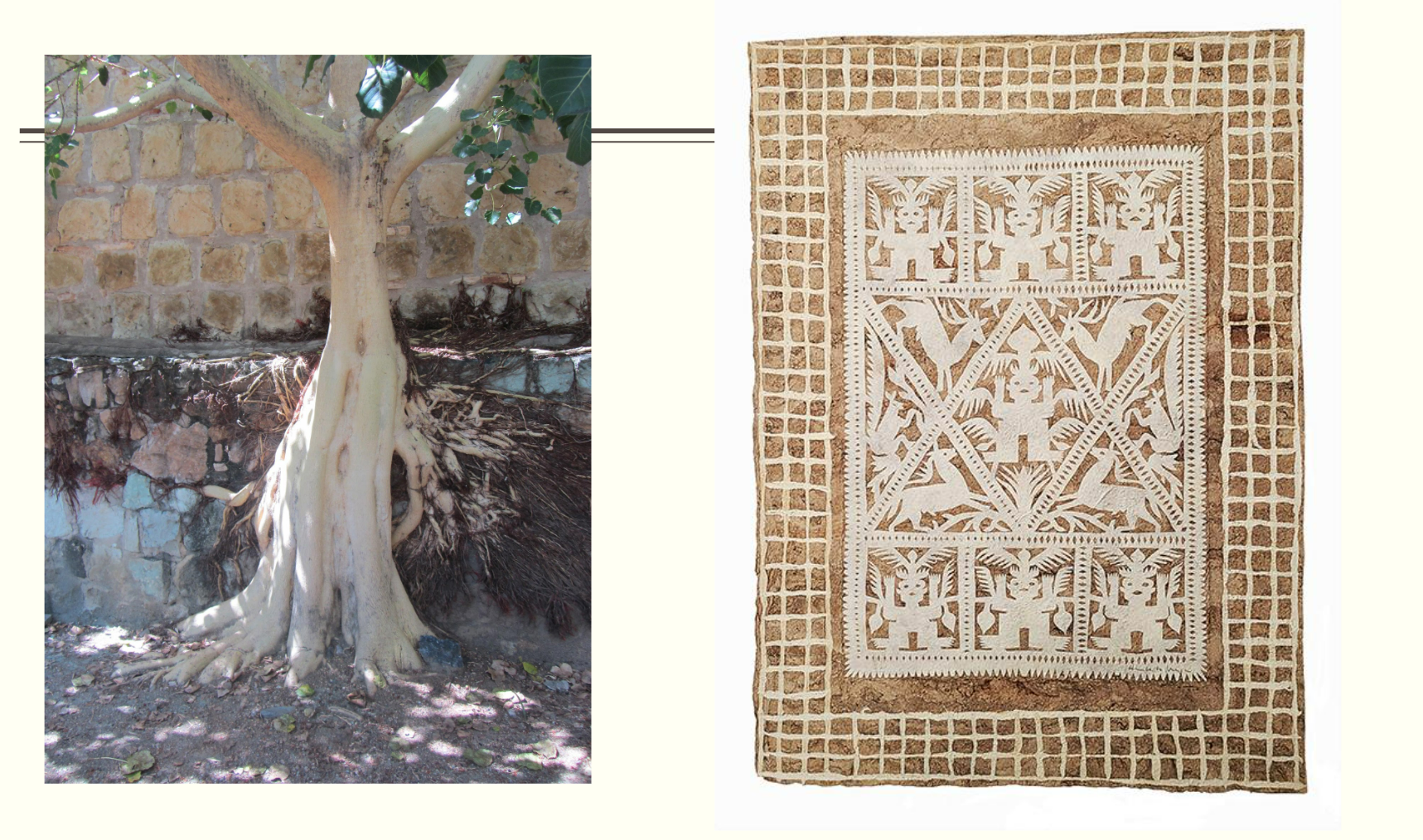
The axis mundi, and this is something we find pretty much throughout the world, is basically a point where heaven and earth come together, is often symbolized by a tree that goes down to the underworld of the dead, and then up to the, world, the living, then up to the sky, that ties in the heavens. So this was seen as a possible axis mundi. In other words, connecting heaven and earth with mortals and the deceased and everything else. This has some interesting temple symbolism going on.

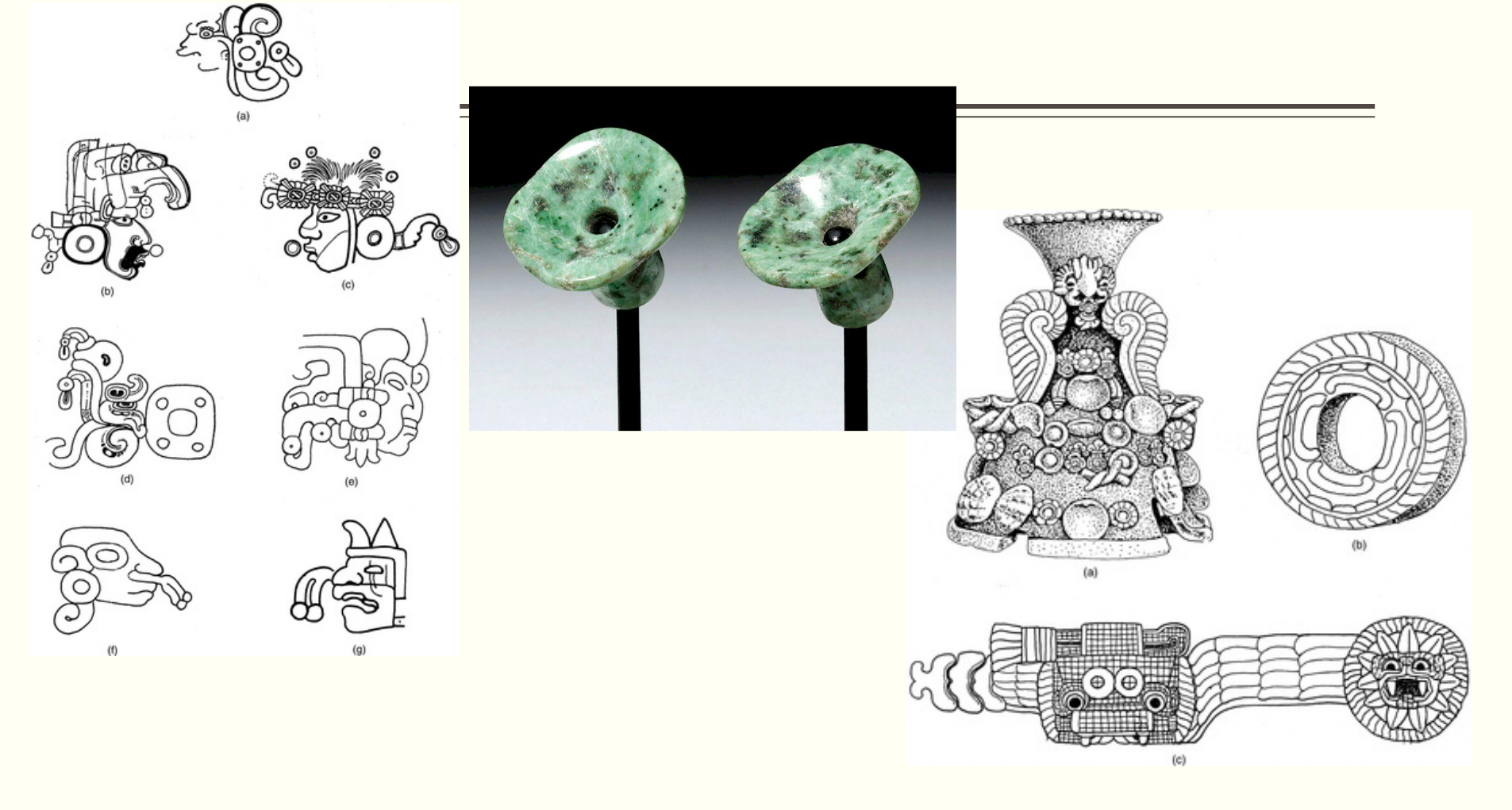
Artistic depictions show serpents, symbols of wind and breath, emerging from jade ear spools, emphasizing the idea of conjured spirit through speech breath. Speech and breath are closely related phenomena in Mesoamerican thought, and denote the conjuring of supernatural beings and ancestors. In classic Mayan rituals of conjuring, gods and ancestors were symbolically exhaled and conjured from pairs of massive ear spools placed at the end of ceremonial bars. Sometimes easier spools were worn on other parts of the body, such the chest or abdomen.

Now I should note that there have not been any of these found where jade is encompassed in metal, separated by a ceremonial bar. But there’s a symbolism that’s going on here, which we’ll talk about later on that could tie in to that earlier depiction that I propose of what the interpreters might have looked like.

Obsidian

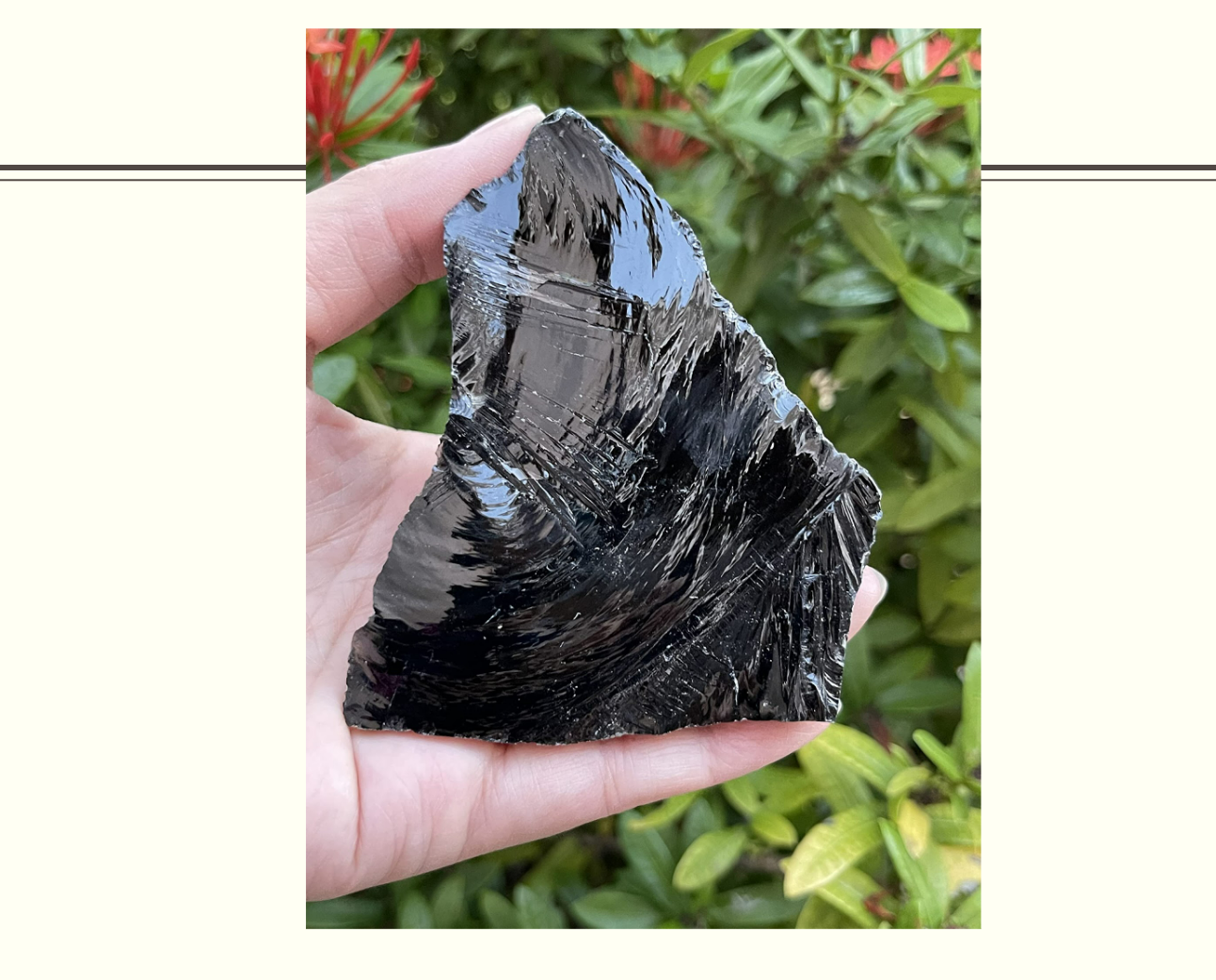
So let’s skip to obsidian and obsidian-like. Another likely material was also widely revered and traded across Mesoamerica. Like jade, it was fashioned into jewelry and religious objects, including mirrors composed of dark obsidian shards mounted to wooden bases. Obsidian was also sometimes mounted into ear spools. Though typically black or brown, obsidian can appear red, gray, or even translucent, depending on its source.

The obsidian in one deposit in El Salvador, again, Book of Mormon lands and geography that I accept, is translucent or transparent. Colorless or near colorless obsidian has been found in deposits in Peru, New Mexico, and Mexico.It’s possible the interpreters were made of clear, translucent obsidian.

Quartz Crystal

Then lastly, you have quartz crystal. It’s another strong candidate. Their dazzling characteristics have long attracted ritual use across cultures.

Given the association between water and divination, it’s notable that the word crystal derives from the Greek term for frozen water or ice. Crystals have served as tools for scrying and spirit contact, and are found in Mesoamerican archeological contexts. Modern Maya shamans still use them, referring them to saqabaj, which are basically white or clear stones.

Although Lucy Mack Smith described the interpreters as three cornered diamonds, she likely never saw them directly and was recalling their shape from memory many years later. Crystals are typically transparent or translucent, and possess naturally occurring hexagonal geometries, not three sided, but hexagonal. But if Lucy’s description was accurate, the stones could have been cut into angular forms for symbolic purposes.

In Maya cosmology, a three cornered jade stone is associated with a primordial maize spirit, an element of creation mythology. While such a connection might be fanciful, it is not unreasonable to assume that if Lucy was correct about the interpreter stones being three cornered, they might have been intentionally cut in a shape to symbolize a larger Mesoamerican construct.

Using Two “Shiners” or Interpreter Stones

One of the possibly unique aspects of the Nephite interpreters is that the device consists of two shiners, which is part of the reason they resemble spectacles. Well, there were two stones in the Nephite spectacles. Joseph disassembled them and put one in a darkened hat, as he would with his treasure digging stone. So while Joseph and his contemporaries originally contextualized interpreters for spectacles because they looked somewhat like them, Joseph eventually recontextualized them to fit his treasure digging seer stones which were not utilized like spectacles.

It is typically assumed that Mesoamerican shamans used a single mirror or shiner during the rituals. However, this is not something we can say definitively because the archeology can’t tell us if more than one shiner was used. Iconographic evidence often shows figures with multiple shiners. Many ancient Mayan stelae, for example, depict figures who are wearing or otherwise associated with two or more mirror glyph-like elements. As noted earlier, you have the jade ear spools connected by a ceremonial bar.

Complementary Opposites

The theme of complementary opposites is common in Mesoamerican mythology.

Examples in archeology and ethnographic record, myths of twins and sibling pairs are common. Although represented as twins or siblings, they are almost always utilized in iconography and mythology to represent connected opposites. The idea of contrasting duality, where the two halves of each pairing are independent and yet connected to one another, is vital to the Mesoamerican way of thinking. Twin or sibling figures in Mesoamerican mythology symbolize opposing but complementary forces.

Mirrors associated with deities reflect this opposition.

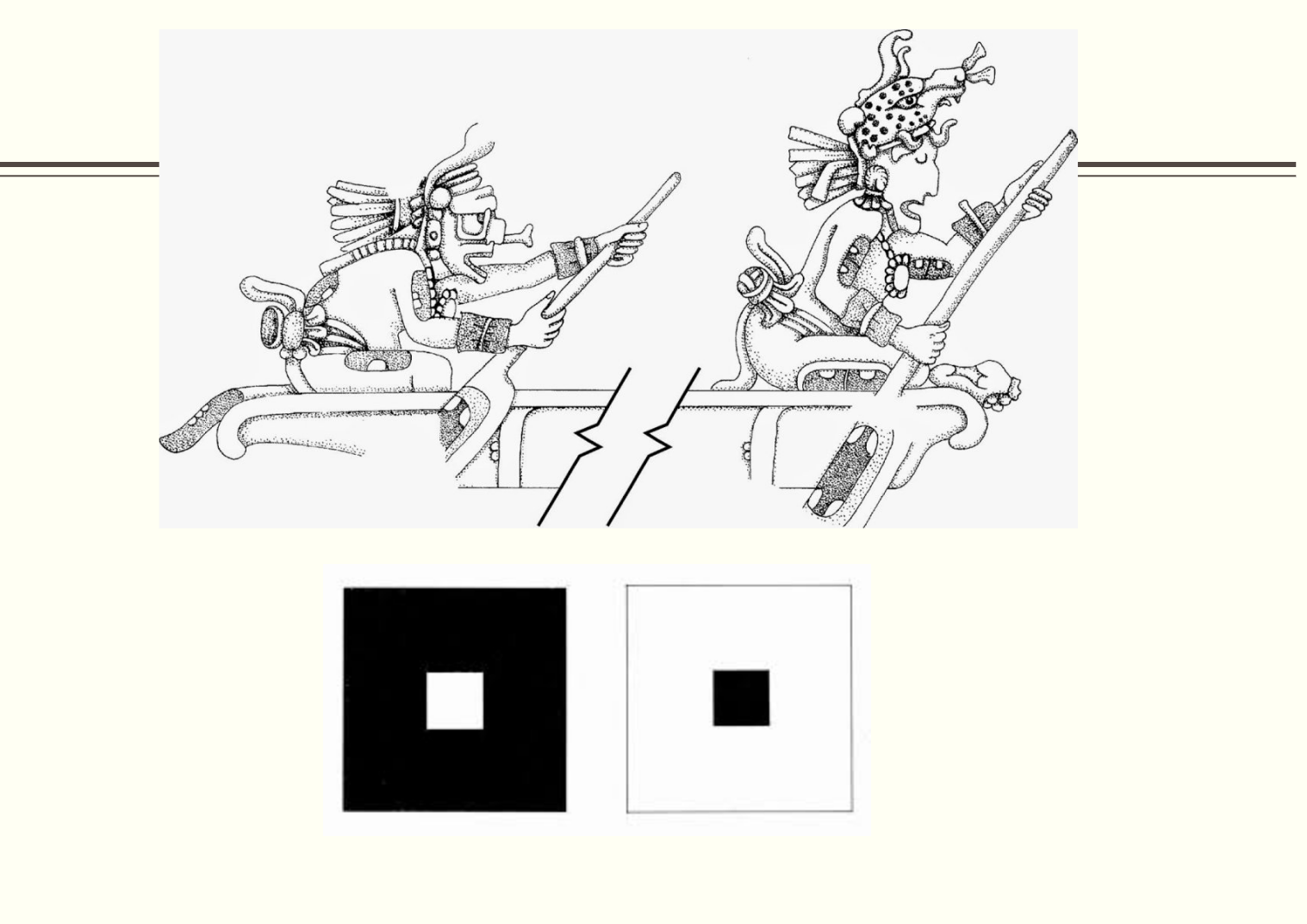
The jester god linked to kingship was often symbolized by a light mirror, possibly pyrite, while God K, tied to lineage, was represented by a dark mirror. So we had a light and dark mirror–the opposites–possibly obsidian.

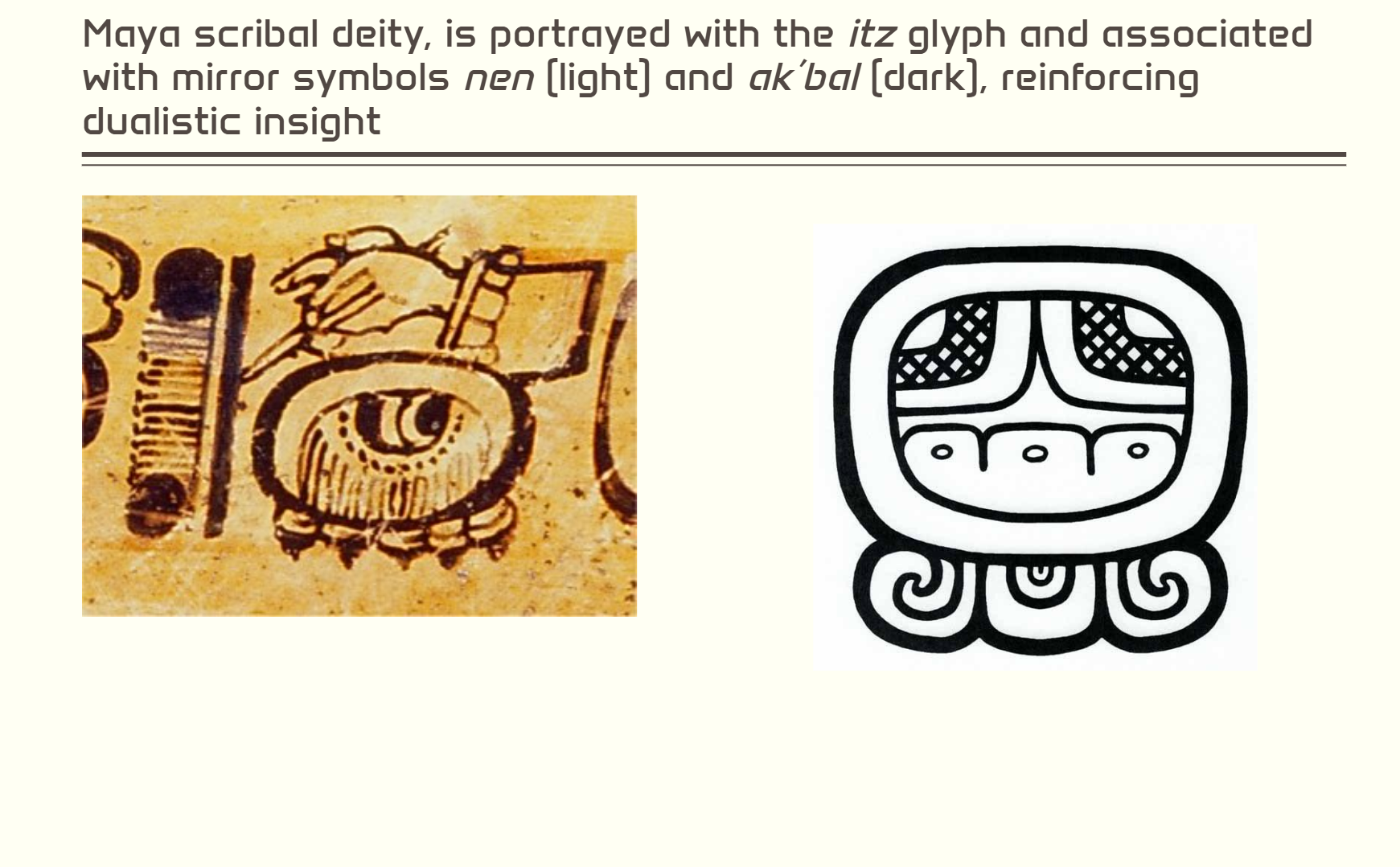
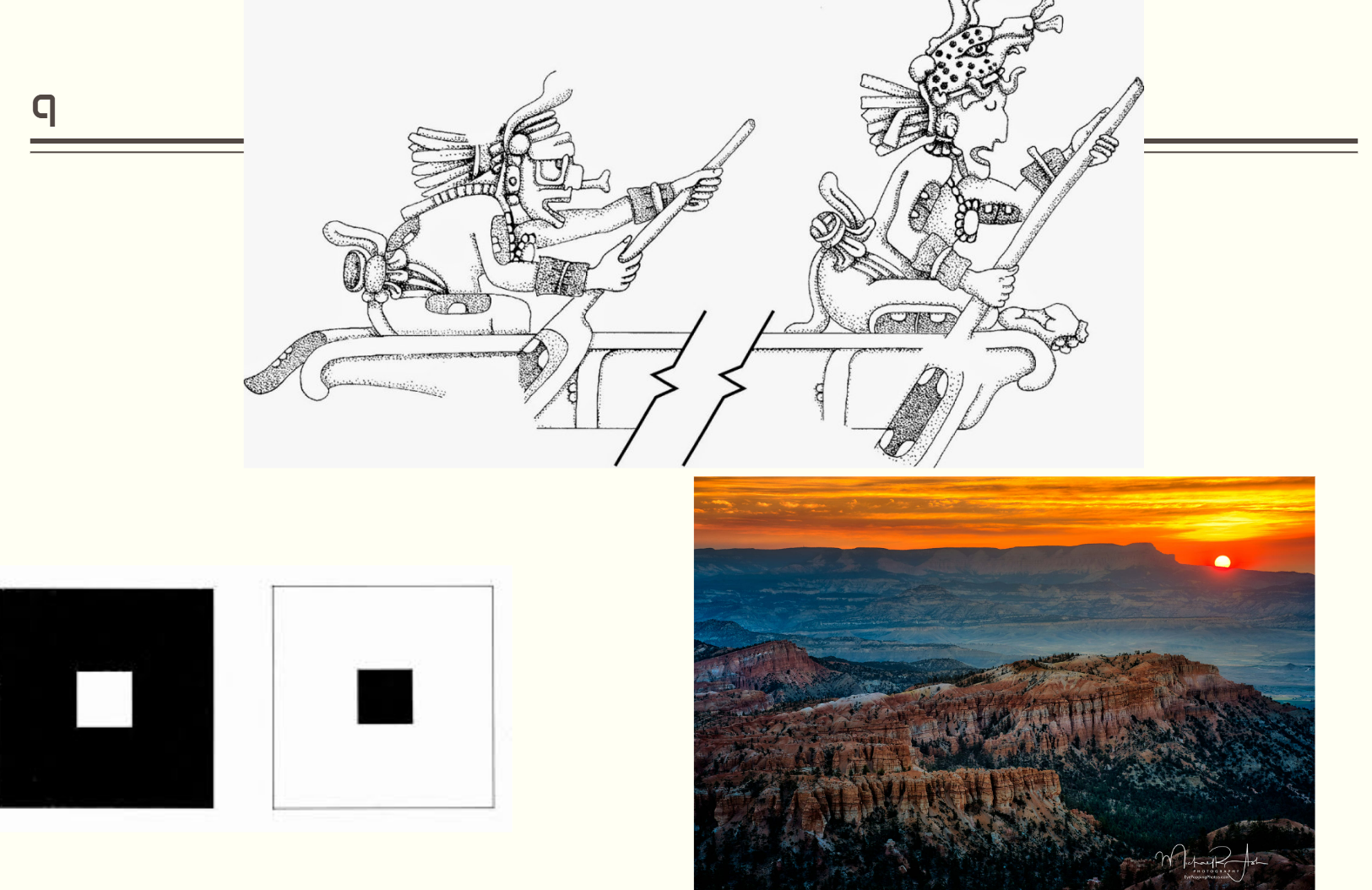
Similarly, the paddler God, its varying entities, personify the sun’s journey through day and night. Glyphs like nin, the brightness of the day, the sun, which is the light shiner, and akbal, the brightness of the sun, and is the dark shiner, reinforce this symbolic binary. So we see that in these twins and these gods, there’s this binary source of light and dark going on there. We’re going to come back to that.

Breastplates

Let’s talk for a minute about the breastplate. Mesoamerican shiners were both portable and wearable. Mirrors often had holes to allow suspension from the neck, chest, back or head. Artistic depictions show shiners incorporated into headdresses. Breastplates were worn on the abdomen. Those worn on the forehead likely signified divine authority or kingship, while those on the torso symbolized the womb-like center of the cosmos, and they’re often symbolized by caves–another note we’re going to come back to.

Given this, the Nephite interpreters were likely not intended as facial wear, like spectacles, but as part of a sacred dress mounted on the head, chest, or abdomen. This possibility is reinforced by reports that the interpreters were attached to a breastplate.

Early Latter-day Saints sources, including William Smith, claimed that interpreters were affixed to a rod which attached to a breastplate worn over the heart. The pocket configuration allowed the device to be stored and used in a specific ritual posture. Such design parallels Mesoamerican depictions of breastplates, often adorned with reflective elements and may draw upon Old World parallels, like the Israelite High priest breastplate, which held the Urim and Thummim near the heart for revelatory purposes.

Breastplates in Mesoamerica

Breastplates were widespread in ancient Mesoamerica, crafted from various materials, including jade, turtle shell, and gold. Shiners were often worn on the chest or abdomen, and in Maya iconography, frequently depict reflective breastplate devices.

Scholars categorize Mayan iconography by various named elements as a method to help translate the meaning of the symbols.

The meaning for the element that means mirror and shiner was the same and was explicitly linked to a breastplate device in the artwork of one Maya lord. Likewise, the fact that Moroni included the breastplate with the interpreter stones suggests some meaningful connection between the Nephite shiners and the breastplate.

Breastplates in Ancient Israelite Worship

In ancient Israelite practice, the Urim and Thummim were worn over the heart and housed in a pouch beneath a high priest breastplate. This was more than a practical placement. It symbolized revelation penetrating the heart, the seed of divine understanding. Revelation was sought only when the device was worn near the heart. Mesoamerican shamans also wore pictorial shiners suspended by the neck and were attached to a larger breastplate.

Lucy Mack Smith described the Nephite breastplate as extending from the neck to the stomach, consistent with Mesoamerican tunic adornments. Thus, the interpreter stones, jade, obsidian, or crystal may have been part of an elaborate pictorial assembly designed for revelatory ritual.

Caves as Ports Between Man and the Divine–Association with Shiners

Ancient Mesoamericans typically associated caves with ports that would bridge the space between humans and the divine. Almost like we find in modern temples. These openings into the Earth supposedly served as gateways to the Earth’s womb or navel, and the world of the dead or divine. Here, shamans could open a portal to the underworld, linking the living community simultaneously with the ancestors and with the earth.

This is an important topic I talk a lot about in my book, Rethinking Revelation: us being linked backwards in time to the covenant people and forwards in time as well.

Because caves were understood to be a gateway to the other world, it’s not surprising to see caves linked with shiners or mirrors. By representing a world that can be looked through but not passed through, mirrors and shiners were often understood as caves or passageways for the supernatural.

The brother of Jared’s vision on Mount Shelem, where the Lord touched lumen stones and the veil was lifted, resonates with Mesoamerican concepts of sacred space, liminality, and divine contact through shining media. The similarities between the sacred space shiners and a portal through which the dark past finds a familiar home in general Mesoamerican religious concepts.

Cultural Recontextualization through Time

Although the Brother of Jared’s narrative was rooted in the Old World, I believe the account was reinterpreted within a Nephite Mesoamerican framework, by subsequent Nephite generations. So what I argue, and again, I do this in my book Rethinking Revelation mostly, is that by the time the Book of Mormon was written, things had changed. We’ve gone through thousands of years of Mesoamerican life.

  • And we recontextualize things,
  • Joseph Smith would have recontextualized things,
  • the Nephites would have recontextualized things according to the world that they knew.

So I think that they were describing the world that they knew. And of course, we read into it (and I think Joseph Smith read into it when he translated it) more of a biblical setting than maybe it would have come out if a scholar had done. It would have been the same story, but it might have a different flavor.

It is noteworthy that multiple second hand accounts claim Joseph Smith returned the plates to a cave in the Hill Cumorah, where he and Oliver reportedly saw piles of metal records and precious stones. Whether literary or visionary, the cave, as an archive, reflects ancient ritual sensibilities.

Scribes/Books and Shiners

Mesoamerican iconography often links scribes to the number tree, a cosmological symbol that represented the amate tree, which was the source of paper bark codices where they got the book.

The Itzamna, which is God D, was a Mayan scribal deity, and he’s portrayed with its glyph and associated with the mirror symbols for light and dark. So we have a Mayan god who’s a scribe, making books, that’s tied to some sort of mirror that’s light and dark. Again, this dualistic or complementary opposition. Mayan scribes held prestigious titles, including Ah ts’ib, which means artist wise or keeper of the Holy book. As a detail in Rethinking Revelation, sacred texts were frequently transmitted orally. Performers memorized elaborate narratives using repetition and parallelism.

Mesoamerican art depicts speech scrolls emerging from the mouths of speakers, often shown alongside shiners. These visual pairings suggest shiner served as medium for divine communication, bridging human and other world voices.

Joseph Smith Looking into a Hat with a Rock (Shiner)

We recall that the Book of Mormon was dictated orally from Joseph to Oliver, while Joseph looked into the shiner.

Some studies suggest fascinating relationships between Maya would-be-kings, scribes, caves, and shiners. Mayan scribes’ workshops were imagined as caves, a place of creation and transformation. And of course the cave is symbolic of, again, the entry in the other world. Well, it’s interesting that Ether was writing in the “cavity of a rock,” which maybe ties to this archetype.

Maya scribes who recorded the history of the rulers of people were often shamans who utilized ritual shiners. They functioned as priests, historians, and artists, and occasionally rose to kingship. Nephi and Mosiah I similarly embody both prophetic and royal authority, linking scribe and spiritual roles.

Maya rulers were seen as divinely sanctioned intermediaries who possessed ritual artifacts, often reflective, and validating their power. As I argue in my book Rethinking Revelation and in volume two of my Book of Mormon series, Will the real Book of Mormon Author Please Stand Up, King Mosiah I was likely the first Nephite king to acquire the brother of Jared’s interpreter stones. Or at least as I argue, and I won’t go into this, there may be a Mesoamerican likening of those archetypal stones. The acquisition of shiners likely symbolized divine approval and validated his authoritative position as king.

Scribes not only transmitted myth, but often restructured narratives during cultural crises in order to reinforce social cohesion and political legitimacy. As creators of a collective memory, they acted as sacred mediators. Scribes were often not only mediums for other world powers, but could help codify and validate elite lineages during a time of cultural chaos.

Light and Dark–Urim and Thummim

So let’s talk about the light and dark here again. Mesoamerican glyphs often depict mirrors as symbols of complementary opposites, bright and dark, night and day. And this is identified in the paddler gods and in many other areas of Mesoamerican symbology.

This binary symbol aligns intriguingly with the Israelite Urim and Thummim, which scholars traditionally translate as “light and perfection.”

Urim–Light

The term Urim derives from the Hebrew root meaning light, fire, illumination. Some traditions hold that the Urim glowed in response to divine affirmation. Similarly, Mesoamerican shiners were linked to fire and spiritual insight, serving as metaphorical flames through which divine answers emerged.

Thummim–Dark, Opaque, Sealed Up

Thummim is a more enigmatic word. While often translated as perfection or completeness, linguistic analysts suggest that the root tmm is associated with sealed, obscured, veiled, or dark. While we typically think of darkness as lacking enough illumination to see clearly, darkness could refer to the opaqueness of a stone or its inability to allow light transmission.

Some related stems likewise signified “to be clogged up,” “to extract,” or “to make opaque.” The stem frequently suggests an action that prevents, blocks, obstructs, or even hides something, such as an opaqueness which prevents access to a vision.

It’s interesting, therefore, to note that the Hebrew word contained the Hebrew stem

tmm includes verbs that translate as “sealed up” or “impede access,” particularly to maintain purity or sacredness. In this light, Thummim might indicate not just perfection, but a protective concealment–an intentional opaqueness or barrier to unauthorized vision.

Sealed things, as explained in one of my other papers, are secured away not only from unauthorized inspection, but to ensure their purity and integrity. The Nephite interpreters were given to Joseph so he could unseal the record.

Without the interpreters or a seer stone, the translation plates would have remained hidden or obstructed from unauthorized viewing.

Two Stones with Different Qualities

Given the opposing meaning of Urim and Thummim, several scholars argue that the term referred to a set of contrasting divinatory stones, possibly black and white, and which produce binary responses, like yes or no. These stones functioned as ancient lots. So you had a desirable stone, undesirable stone.

In gemological terms, a stone’s light transmission is categorized by whether it’s transparent, translucent, or opaque, and variations between. Jadeite and obsidian, for instance, are generally translucent, while quartz crystal tends to be more transparent. Transparent stones such as diamonds, quartz, gems, and corundum (like ruby and sapphire) might be nearly as clear as glass, depending on the stone’s thickness, imperfections, inclusions, color.

Translucent stones like jadeite, obsidian, agate, allow light transmission, but not visibly clear, like glass. Opaque stones obscure light transmission because they don’t have the right properties to allow as much transmission through.

Some scholars argue that one of the 12 stones in the Hebrew Urim and Thummim was known as soham, a word possibly derived from a word that means “darker, cloudy,” and could indicate whether the stone was clear or cloudy.

And as noted, more than one scholar also suggested the Hebrew tmm is a root that means to be shut up or sealed. So it could refer to a stone’s light transmission. Doesn’t necessarily mean it’s black and white.

Possibilities: Interpreting Stones

Descriptions of the interpreter stones varied among early witnesses, likely because of the differences in lighting, circumstance, and individual perception. A stones’ brilliance, its shine, depends on both transmitted and reflected light; meaning the stone might appear more or less transparent, translucent or opaque, depending on its context. This could explain why some described the interpreters as clear, light or white–which white could actually mean dark in this sense, because white would be opaque. It wouldn’t let light transmission through. It’s dark, it’s sealing up the light.

The Jaredite stones were described as white and clear, a phrasing that appears at odds with light and dark. Yet both refer to levels of translucency. Usually, we will not refer to white stone as dark, but a white stone would be dark if it lacked translucency. Our English opaque, for instance, comes from the Latin opacus, which means dark, obscure, or impervious to the rays of light. Symbolically, and even descriptively, in terms of light transmission, clear and white stones could be called light and dark stones. The slight visual difference, which might only be fully perceivable in the right light, may not have been nuanced enough to warrant a different description upon cursory inspection.

It’s also possible the interpreter stones were distinctly different gems. Maybe one was near translucent jadeite and the other was nearly transparent quartz crystal. While some witnesses to the interpreter stones may have seen them with more or less shine than others, the difference between stone one and two might actually mean difference in translucency. The difference may not have been immediately noticeable under superficial examination, and so maybe they weren’t compelled to describe a mismatch.

Dark and Light at Once

Some Mesoamerican shiners were intentionally made from iridescent materials that appear dark and light at once. This duality resonates with early Jewish traditions, where the Urim and Thummim changed appearance in response to divine questions; shining brightly for affirmation or dulling when negative.

A stone’s luster, the degree of surface reflectivity, also affects how it is perceived. The luster indicates how shiny a brilliant stone is. A stone’s luster can also affect the perception of transparency. So the top four gemstones that have luster, with adamantine, pearl, they have a breakdown in different jewelry grades. And of course, none of this would have been known, probably to Joseph Smith. But all of these types of luster would have fit the three stones that I’m talking about.

Possible Symbolic Meaning of “Urim and Thummim”

Perhaps the translation of Urim and Thummim as “white and black” or “illuminating dark” meant something else, perhaps something symbolic. This has been suggested for Mesoamerican mirrors as well.

The Mayan paddler gods, for instance, were associated with the symbol. It’s light, dark as well as sunrise, sunset; sunrise begins the day and sunset begins the night.

So likewise Urim refers to light, fire, illumination, perhaps the bright shiners of ancient Mesoamerica, while some of them appear to be associated with darkness, like dark shiners. It’s possible, therefore, that Urim might signify beginning, morning sunrise, where Thummim, night or perfection, finishing the cycle. Evidence suggests that the Urim and Thummim represented two sets of complementary objects, or elements that were light and dark. And like I said, perfection.

It’s worth remembering, though, that Jesus, the most perfect being referred to himself as the Alpha and Omega, the beginning and end, so we can have that completion from one to the other.

Some scholars claim that the Chinese yin–yang is similar to the Urim and Thummim, and that the Israelite divining rods represented light and dark. And some arguments dispute that, but nevertheless, we see some interesting similarities there.

Sacred Bundles

Okay, let’s talk about one more aspect, and that’s sacred bundles. In Mesoamerican cultures, sacred artifacts were often bundled or wrapped in cloth or bark and bound with knotted cords, symbolically representing states of potentiality such as a child within a womb. This bundling imbued items with sanctity, transforming them from ordinary objects into vessels of divine presence. So it was the bundling act that made them sacred. And what do you do when something’s bundled? You’re sealing it up.

Gold Plates in a Stone Box and with D-Shaped Rings

The D-shaped rings around the Nephite plates may mirror these symbolic cords. Securing sacred knowledge within classic Mayan art depicts bundles of wrap cloth, but sometimes include chests, or wooden boxes, covered in textiles.

The Book of Mormon, similarly enclosed in a buried stone box, echoed this motif. Though a stone box and a cave differ, both reflect a Mesoamerican tradition of interring sacred relics underground, and in the Mixtec practice of storing royal bundles in caves believed to be portals to the divine.

When we recall the possibility that the Nephite interpreters were constructed of jade, it’s interesting to note the following: In Mayan, ikatz, which often translates as “cargo bundle” or” burden,” it is often denoted by iconography that depicts cloth bundles that hold jade tributes. In fact, Kerry Hull, LDS archeologist, Mesoamerican specialist, suggests that ikatz bundles are linked directly to jade holders.

Another account refers to the contents of sacred bundles that contain the heart of God the Father, a bead of precious stone. Sometimes the bundles are described as wrapped fireness of heat or bundles of flames. An interesting description, since both the Israelite Urim and Thummim and Mesoamerican mirrors were sometimes equated with fire.

Ark of the Covenant as a Bundle

Then we cannot overlook the possible parallel to the Old Testament Ark of the Covenant. We don’t know if the Nephite prophets were familiar with the Israelite ark, it’s not mentioned in the Book of Mormon, however, it seems logical that Lehi might have known about this when they fled Jerusalem. If Lehi was familiar with their Ark, and if he passed that knowledge on to his progeny, subsequent Nephite prophets might have recontextualized the ark according to the binding rituals of Mesoamerican culture.

One Spanish writer, Fray Diego Duran, of the 16th century wrote of three important books of the history religion calendar of the pre-Hispanic Aztecs, describing a cloth covered wooden coffer that contains some small items. Duran characterized the sacred bundle as very much like the Ark of the Covenant.

So likewise, one 20th Century scholar describes a Popol Vuh bundle of flames as sort of a cloth covered ark with mysterious contents. To the Nephites, the ark might have served as a bundle to encase the Word of God as written on the stone tablets.

Don Bradley convincingly argues that the Nephites, as the New Israelites, possessed their own ark, which housed the parallel relics to the biblical heirlooms, such as the Liahona, the Jaredite breastplate, the interpreters, the sword of Laban.

Other Items in Sacred Bundles

Weapons

So there were other things included in this bundle of various things. Weapons were sometimes associated with this bundle. It depicts sacrificial axes. And sometimes they were symbolic, but real axes have been found in some of the bundles. And, they’re often a symbol of authority and power and connected to deity.

In at least a few instances, the axes are tied to decapitation rituals, which brings back memories. So we’ve got the sword of Laban with a decapitation that’s maybe connected to Moroni’s bundle.

It’s also important to understand that the Maya often viewed their leaders as gods or demigods. Bundling, explains two scholars, extended to the mortuary practices and were conceptually linked to themes of lineage, continuity, and ancestor worship.

Ritual Attire

Many members have probably wondered why Moroni included the breastplate in the stone box. As far as we know, Joseph never used the breastplate, even though he might have thought it worked somehow like the Urim and Thummim breastplate of Israelite priests. But I suggest there’s more going on there. Sacred bundles often contain the ritual attire of gods and divine kings, garments and regalia worn by shamans impersonating deities during ceremonies. Since kings and shamans often impersonate deities and sacred rituals, deity bundles contained costumes and adornments which could be worn by the mortals who perform the sacred rituals.

In early Mesoamerican cultural practice, wearing the proper attire was seen as requisite to opening the supernatural portal. Ritual dress was essential for accessing the divine. In this light, the Nephite breastplate is part of the ritual attire. So it is with the shiners. It was more than symbolic, it was required to open the portal, a sacred axis mundi connecting the prophets to God.

I believe that Moroni included the breastplate in the stone box. Because in his worldview the article of clothing was a necessary element in the bundle’s contents. In Nephite Mesoamerican thought, a proper ritual attire might have been required by any future prophet. So he included it in there because he thought he’d probably need it.

Opening Seals

I’m going to quickly jump on one other thing that I think is important here, and that’s breaking the seal. Closing up the bundle seal was a ritual experience for the Mayan; opening was ritual to the Mayan as well. In fact, they would sometimes wrap stelae that were engraved with things to keep them holy, to make them sacred. That’s why they sealed it up. He was to identify and ratify this as important property. They were tied to lineage.

And, of course, you know, Laman and Lemuel were outraged when Nephi had possession of the brass plates and stuff from the lineage.

The sacred bundles tend to be open in states of transition. So very important things that were going on in the world. The bundles were understood to protect the sacred. And while the unwrapping ceremony was often calculated to denote political or religious control, in ancient Mesoamerica they were not at liberty to unwrap the bundle any time they wanted. The ritualized opening of bundles was a major ritual event that offered the only possible access to the bundle’s contents.

Mesoamerican art depicted the opening of some of these bundles.

And this is showing other bundles throughout the world. I mean, why do they put scrolls in jars and so forth?

That the bundles appeared to explode when opened up, that’s how important this was. It was like, life changing.

Mesoamerican Bundles as Axis Mundi

Mesoamerican bundles served as portable axis mundi. They existed between the realm of the Otherworld and the modern world, connecting the worlds together.

There’s again, maybe some examples of the bundles. We have the wrapping of the metal around the interpreter stones that would have served as a bundle as well. So it falls into theme with that.

Comparisons Between Shiners and the Interpreters

But there’s some of the comparisons between the shiners and the interpreters. A couple of pages on that.

Joseph Smith’s Reception of the Plates

And then just lastly, Joseph Smith’s reception of the plates from Moroni. A celestial ancestor follows this tradition. Moroni, a founding patriarch of the Nephites civilization, becomes the transmitter of divine knowledge to modern Israel. Through divinely appointed means, Joseph broke the seal, unbundled the sacred artifacts, and opened a revelatory portal. This act restored the lost narratives and reconnected scattered remnants of God’s covenant people.

Breaking the Seal of the New Covenant

D&C 84 talks about how the early Latter-day Saints were under condemnation of not taking the covenant seriously. And that’s exactly what happened with the Book of Mormon, it was breaking that seal.

God’s people share a sanctified narrative that binds them to each other and God. The translation of the Book of Mormon richly opened, sanctified, and shared that divine narrative. Modern members of God’s covenant people are given the opportunity to ritually remember the divine covenant narrative by reading, studying, and internalizing the Book of Mormon. The book, in turn, has the power to change the receiver’s heart to align with Christ. I say this in Jesus’ name, Amen.

TOPICS

  • Book of Mormon Interpreters
  • Mesoamerican Shiners
  • Sealed Bundles or Documents
  • Urim and Thummim
  • Book of Mormon Translation
  • Rock in a Hat
Search topics

Book of Mormon interpreters; Urim and Thummim; Nephite spectacles; Joseph Smith seer stone; rock in a hat; Book of Mormon translation; Martin Harris description; Lucy Mack Smith account; Mesoamerican shiners; ritual mirrors; scrying traditions; jade divination; obsidian mirrors; quartz crystal; Maya cosmology; light and dark symbolism; Israelite high priest breastplate; sacred bundles; sealed records; gold plates; D-shaped rings; cave symbolism; axis mundi; Mesoamerican geography model; Restoration scripture; Book of Mormon; LDS temple ordinances; CES Letter; are Mormons Christian

The Book of Abraham for Dummies

https://www.youtube.com/watch?v=KWA2M-DrS2s

The ABCs of The Book of Abraham . . . or, The Book of Abraham for Dummies

Mike Ash and Kevin Barney

August 2004

Summary

Ash and Barney offer an “issues matrix” to organize the debate over confusing aspects of the Book of Abraham. They then sketch how the papyri likely traveled from early 19th-century excavations and collectors to Joseph Smith in 1835, what happened to the collection afterward, and point readers to key resources on both critical and faithful sides of the question of its origin.

Presentation

MIKE ASH:

Of the uniquely LDS scriptures, it seems that the Book of Abraham is one of the more difficult ones for lay members to get a scholarly hold of. And so today we’re going to be dealing with the issues involving the Book of Abraham. What’s it all about?

Why is the Book of Abraham so Tough?

Why is it so tough? What makes it difficult for lay members to grasp or get their hands on the scholarly material?

Well, there are several reasons.

  • We have a challenging set of facts—and sometimes those facts contradict traditions or pre-conceived thoughts.
  • We have a complex web of issues.
  • We have an extensive bibliography of writings about the Book of Abraham—articles, papers and books—unfortunately a lot of this is polemically charged.
  • Much of the material that’s available on the Book of Abraham is either written by anti-Mormons trying to prove that it’s fiction, or defenders trying to prove that it’s not.
  • There seems to be at least very little that just kind of lays out the facts for people to do their own research on.
  • The stuff that is available is often difficult to find or out-of-print.
  • Much of it is highly technical.

Egyptology is Exciting

Now the Book of Abraham is something that of course involves Egyptology. And Egyptology is fun and exciting! So the study of the Book of Abraham should be fun and exciting as well.

And we’re hoping that we can make this fun and exciting for everybody—to learn a little bit about what’s going on.

Study Requires an Open Mind

Now, a couple of things to keep in mind.

Because there are challenging issues—and it’s going to maybe conflict with some of the traditions that we’ve been taught—

  • This is not for the faint of heart (Laughter);
  • and it’s not for those that have fundamentalist leanings about scripture.
  • It is, however, for the open-minded and those who have scholarly humility.

Now, we’re not going to try to advance the ball today.

Rather, we’re going to try to kind of lay out what the issues are.

We’re going to survey the field—and perhaps point to some existing literature so that you can get in the game if you like.

A Book of Abraham Matrix

KEVIN BARNEY:

When I was in law school (I’m a lawyer) and:

  • you’re faced with a huge complex area of law—
  • and especially when you’re a young law student—
  • and somehow you have to wrap your mind around it—

And so, quickly what you learn to do is you learn to outline.

You can even go to a bookstore and buy commercially prepared outlines of contracts or torts or whatever.

So, what we want to start with is an “issues matrix.”

We don’t have a lot of time to do a detailed outline—but a fairly simple outline of the categories of issues that come up in Book of Abraham polemics.

This way you’ll be able to see the big picture a little bit—and you’ll also kind of have an organized set of pigeon holes so as you learn new information you’ll have a slot to put that in.

And so if you have that kind of framework in your mind, you’ll be able to grasp things much better.

Four Matrix Categories

So everything we talk about is going to fit into one of these categories.

And the way I see it, there are four large categories—and I’m going to break each of those down into two or three sub-categories.

Historical Issues

The first large category I want to talk about—or just identify (we’re not going to talk about these in detail)—is historical issues.

And here there are three sub-categories.

  1. First of all, there’s the history of the Joseph Smith collection of Egyptian antiquities—and in particular the papyri—and we’re going to talk about that a little bit later in this presentation.
  2. There’s the history of the translation of the English Book of Abraham and;
  3. The intellectual history—and by that we mean the give and take and the debates and the yin and yang of this whole area.

Joseph Smith Papyri (JSP)

The second large category of issues is the Joseph Smith Papyri—and I divide this up into three sub-categories.

The first is the three facsimiles—which are the papyri that were published together with the Book of Abraham initially in 1842 in the Times & Seasons; as we’ll describe in more detail later.

Now there are three of these facsimiles.

Facsimile 1 we often refer to as a “lion couch scene” because this bier or altar or whatever it is the figure is lying on is—as you can see—in the shape of a lion.

Facsimile 2, in the literature, is referred to as a “hypocephalus.”

And if you’re going to get involved in Book of Abraham studies, you need to become familiar with that word.

It was coined by Champollion, based on a Greek expression hypo ton kephalon which means “under the head.”

This was a circular disk that was placed under the head of the mummy to provide heat to the deceased in the afterlife.

And Facsimile 3 is often referred to as a “throne scene.”

And I’m using neutral terms for these that everyone can agree on—because everyone agrees that figure is sitting on a throne.

Facsimiles: Two Types of Issues

When we talk about the facsimiles, there are typically two types of issues that come up.

The first is, to what extent were the restorations of the facsimiles for publication correct?

And then the second (which didn’t make it onto the slide) is, to what extent were the explanations of numbered figures in the facsimiles that are printed with them— to what extent are those correct?

And these issues raise all sorts of issues about who gets to sit as judge and jury on that question. Who gets to decide? What standards are we going to apply? And so forth.

Extant Joseph Smith Papyri

(2) Now under the Joseph Smith Papyri, the second category, are what I call the extant papyri.

“Extant” is a scholar’s term for that which is known to be physically existing in the world today.

And there are 11 papyrus fragments from Joseph Smith’s collection that we do have—and they still exist—you can take a short drive to the north to the LDS Archives and that’s where they are.

And again, I’m going to kind of divide this up into three categories:

JSP I

First is JSP I, and you may recognize this as the source from which Facsimile 1 was derived—you can see the lion couch scene again.

JSP X and XI — The Sensen Text

Second are JSP X and XI, and this is often referred to as the “Sensen” text.

Sensen is again one of those words you have to get used to in Book of Abraham studies. It’s the Egyptian word for breathing—and this is what’s called a Book of Breathings.

A Book of Breathings is kind of a late-summary—it has an analogous purpose to the Book of the Dead.

It’s instructions to help people negotiate the afterlife.

Now, the JSP I matches up with JSP XI and then number X, and then there are columns missing, and then the original of Facsimile 3 would have been on that same scroll.

So that’s how those texts would have lined up originally.

Book of the Dead Fragments

Lastly in the Joseph Smith Papyri, under the extant fragments of papyrus, are fragments from two different copies of the Egyptian Book of the Dead.

So these are the remaining fragments from the Joseph Smith collection of Egyptian papyri.

Non-Extant Papyri

(3) The third sub-category is the non-extant papyri—so in other words we have 11 pieces that physically exist, but those 11 are a minority of the original collection.

What Joseph originally had was more—substantially more—than those pieces.

So what can we decide, or learn, or infer, about the not extant pieces from those which are extant and the published facsimiles and a couple of historical allusions?

Kirtland Egyptian Papers (KEP)

The third large category of issues is the Kirtland Egyptian Papers.

This is a collection of documents which is extant. Again, it’s in the LDS Church Archives and dates to the Kirtland period of Church history.

And these documents are there without context—so they’re without explanation as to what they are.

They have something to do with the Book of Abraham but we have to infer from the documents themselves, you know, what they are, who created them, when, and for what purpose.

And these are very controversial questions.

We typically divide these documents into two types or categories.

Egyptian Alphabet and Grammar Manuscripts

(1) First, are Egyptian alphabet and grammar manuscripts, which are manuscripts which purport to, or attempt to decipher Egyptian language.

Book of Abraham Manuscripts

(2) And then secondly, there are Book of Abraham manuscripts.

There are three or four of these, and they have text from the first two chapters of the Book of Abraham, written out in flowing longhand.

And then in the left-hand margin there are symbols—Egyptian symbols—which derive from JSP XI.

English Text of the Book of Abraham

The fourth and final category I’m going to mention is the English text of the Book of Abraham, and this tends to get short shrift in the discussion.

Polemicists don’t want to talk about the actual Book of Abraham—they want to talk about all the Egyptian stuff. This is actually an important area that needs more attention rather than less.

And there are typically two ways to go at it.

One is to look and see whether there are indirect indications of antiquity in the English text.

And then, conversely, are there historical anachronisms—and if so, how do we deal with those?

And that is our Book of Abraham issues matrix.

History of the Papyri

Now we’re going to turn to the history of the papyri.

ASH:

Okay so we know we have these Egyptian documents that were in the possession of Joseph Smith. How did he come by these?

Our story starts in Egypt in the city of Thebes, which is modern-day Luxor.

Napoleon’s Expedition to Egypt

In 1798, Napoleon invaded Egypt.

And accompanying Napoleon were several scholars and scientists that began exploring the antiquities of Egypt.

And these scholars and scientists were more like gravediggers or grave robbers, I guess, is how we’d view them today—almost like the Indiana Jones type—and they began looking for all these ancient artifacts that they could find.

Bernardino Drovetti

Napoleon hired, or had brought in, several people, one of which was Bernardino Drovetti.

And he was the former consul general of France in Egypt.

And he had many people in his employ that would search for these Egyptian artifacts.

Giovanni Pietro Antonio Lebolo

One of the many men that was hired by Drovetti was Giovanni Pietro Antonio Lebolo.

And he was an Italian who was once enrolled in Napoleon’s service.

Now it’s possible that Lebolo’s family knew Drovetti’s family since they grew up in Italy in the same city.

Lebolo spent the years of 1817 through 1822 in Egypt excavating artifacts.

He may have been in charge of anywhere from two to 400 different diggers—and may have discovered several hundreds of mummies while working for Drovetti.

Much of Lebolo’s digging would have taken place in the Valley of the Kings, or the Valley of the Nobles, and this is where King Tut was found.

So there were a lot of mummies in this area and sure enough, Lebolo found several mummies in tombs.

The Origin of the Word “Mummy”

Now an interesting side note is the word mummy comes from the Arabic word mumiyah.

There is a black tarry substance found in the Middle East that they would call mumiyah.

And when the Arabs invaded Egypt, they found these mummies covered in black—which they thought was mumiyah, incorrectly—but nevertheless the term stuck.

And that’s where we get the word mummy from.

Tomb Speculation: Pit 32 or Tomb 33?

Now Ross T. Christensen, LDS scholar, speculated that Lebolo may have found the mummies in tomb 33—and that’s one possibility.

We know that H. Donl Peterson speculated that the mummies came from pit-tomb 32.

At pit-tomb 32 there’s a graffito with Lebolo’s name inscribed there, so we know that Lebolo was actually there—we don’t know for sure if the mummies came from there or from pit 33.

But we know Lebolo was there.

Where exactly the mummies were found is somewhat speculative.

From Egypt to Joseph Smith

So how did the mummies get from Egypt to Joseph Smith?

By 1822, Lebolo had returned to Europe, and on February 18th, 1830, he passed away at the age of 49.

The 11 mummies that he had were not initially catalogued in the inventory of his estate.

It was later discovered that Lebolo had given the mummies to Albano Oblasser to make arrangements to sell them.

Oblasser shipped them to New York in about March 1833, where they were purchased and picked up by one Michael Chandler—probably as an agent for interests in Philadelphia.

Now the History of the Church has an account where Chandler claims that he was Lebolo’s nephew and that Lebolo had willed him the artifacts, and it seems that that’s not true.

That’s perhaps a story that he made up about it.

Chandler’s Exhibitions

Michael Chandler exhibited the mummy antiquities—which of course contained the papyri—in the Masonic Hall in Philadelphia from April through July 1833.

And we can trace these activities and know how he was displaying these from newspaper advertisements.

Over time he began to sell the mummies—first five, then two more—and soon he was down to four.

Chandler had heard through his travels of showing these mummies that Joseph had the ability to translate ancient documents, and when he was in Ohio, he came to see Joseph.

This was the end of June 1835.

Chandler stayed for about a week, and Joseph was interested in the papyri, but he wasn’t interested in the mummies.

Chandler said, “I’m not going to break up the set; you’ve got to buy them all together.”

Finally, a group of Latter-day Saints purchased the collection of mummies for about $2,400.

This was between July 5th and 9th in 1835.

Joseph announced at this time that the papyri contained the writings of Abraham and Joseph who was sold into Egypt.

Book References on JSP History

BARNEY:

Just so you know how we’ve kind of broken this up.

Mike is kind of dealing more with the historical side and I’m dealing more with the bibliographical side.

We’re giving little historical vignettes and little bibliographical vignettes.

It seemed like the most efficient way to introduce you to this area as a whole.

Early Historical Works

So what are some of the main books you can look at if you’re interested in this history and fleshing out what Mike just gave you in a nutshell?

When the papyri fragments were recovered by the Church in 1967 there was a flurry of interest and activity and a lot of this history was written then.

First there’s James Clark, The Story of The Pearl of Great Price.

As you can see this book was published before the papyri were formally recovered.

And so if you read material from this early period of Book of Abraham studies, you’ll often see, like Nibley and stuff, citing Clark.

So this is an important book in the intellectual history.

However subsequent events have really made it obsolete, so it’s not so important for us to read today unless you’re concerned about the intellectual history of the time.

From the Dust of Decades

Another book—this one does come out the year after the papyri fragments were recovered—From the Dust of Decades.

Frankly, this is not that important of a volume (just to be blunt about it).

The Saga of the Book of Abraham

The third volume I want to mention is by Jay Todd, a long-time managing editor of the Ensign who had a fascination with this topic and wrote a book called The Saga of the Book of Abraham, published by Deseret Book in 1969.

Out of all these, this is probably my favorite, and so I recommend it.

However you should be aware of two problems.

Number one, it’s long out of print, so if you want to get a copy, you’ve got to go into the Mormon secondary book market.

And as always, in that market you have to pay a premium.

I bought my copy a few years ago for like $45.00, and over time that price is going to inch up.

The second problem is it is dated.

There have been significant developments since this book came out, and so you must update Todd with Donl Peterson.

This book was published posthumously, shortly after his death.

But Peterson really advanced the ball in terms of our understanding of Lebolo and how the papyri came into Joseph’s hands, so you simply must read Peterson and update Todd with that book.

Articles and Ongoing Research

There are also a couple of articles.

Most of the guts of what Peterson came up with is in this article from BYU Studies.

(When the conference is over, we plan on putting this PowerPoint up on the website so don’t feel like you have to jot it all down now. There’s going to be a lot of bibliography. You’ll be able to get it at your leisure off the website.)

So, this is The Story of the Book of Abraham: Mummies, Manuscripts, and Mormonism (a little “m” alliteration there).

And then we have Peterson’s BYU Studies article.

And then there’s also a paper by John Gee at FARMS (Foundation for Ancient Research and Mormon Studies).

Gee eventually will write a full-length history that will supersede a lot of this material, but in the meantime you have to kind of get it in bits and pieces.

History of the Translation

ASH:

Joseph recognized that there were some important things connected with these documents.

Obviously he was ready to start translating, and we find that in July 1835 he began translating these documents and a month later took a break from translating to visit the Saints in Michigan.

And in October of 1835 he resumed the study of the papyri.

We get this from his accounts in journals and in the History of the Church, other fragments of history that we have.

It’s at this point that he received revelation concerning Facsimile 2.

Completion of the Current Text

Then in November, the study of the papyri continued.

And it was in the Kirtland period that he also created the Kirtland Egyptian Papers which Kevin mentioned earlier—and will be brought up again.

The current text was finished—what we have now—by the end of July.

Now what we have for the Book of Abraham is probably only about one-fourth of what was produced.

We know that it took a lot longer, according to journalists, to read through the Book of Abraham than what it would take with what we have today.

So we know that they had much more that was translated than what we have.

And beyond that, the stuff that we don’t have in the Book of Abraham is lost.

We don’t know what happened to the rest of the translations that they had—it just doesn’t exist anymore, or we don’t have it anyhow.

History of the Publication

It was first published in three issues in the Times & Seasons in Nauvoo beginning in March 1842, and then it was reprinted in the Millennial Star in England in 1842.

And then in 1851, it was re-published by Franklin Richards in his British tract The Pearl of Great Price, which is where we get the title, of course, for our portion that we have in the scriptures now.

And then Orson Pratt edited an American edition in 1878, and it was canonized in 1880.

So it took a number of years to go from the translation to canonization.

Kirtland Egyptian Papers Bibliography

BARNEY:

Now we’ve mentioned the Kirtland Egyptian Papers—I’m going to give you a little bibliography on that.

You should understand the Kirtland Egyptian Papers have been understudied so far, and this is probably the area where there’s going to have to be a lot more study in the future.

So if you want to get involved in Book of Abraham studies, this is an area that needs work.

Foundational Article: Hugh Nibley

The kind of classic article on this subject is by Hugh Nibley—long article, like 50 pages long—in BYU Studies.

It’s called “The Meaning of the Kirtland Egyptian Papers.”

So if you’re interested in this topic, I think you’ve got to start there.

John Gee’s Contribution

Now this article by John Gee is not focused on the Kirtland Egyptian Papers, but it has a significant section devoted to it.

And there’s some updating of Nibley there that I think is important.

So I do think you need this chapter in one of the two volumes of the Richard L. Anderson festschrift—Brother Anderson being one of our speakers at this conference.

How to Actually Look at the Kirtland Egyptian Papers Themselves

Now, those are articles about the Kirtland Egyptian Papers—what if you want to actually look at the things?

Well that’s kind of a problem. There really isn’t a good edition of them available.

One way you can look at them is to get a set from the Tanners from their bookstore.

A somewhat better way is you can order a set from Michael Marquardt who has the same microfilm edition as the Tanners, but on facing pages.

And he has transcriptions that make it a little bit easier to follow.

This however is not a good edition; the pictures come from microfilm and so they’re black and white, they’re scratchy, they’re hard to see.

And so, if you want to kind of look at them and get a sense for them, go ahead and buy this. But it’s not something that a scholar can really use very well.

Scholars of course will want access to the originals—or failing them, decent color photographs—and there are color photographs that scholars at FARMS have and other people have.

Brent Metcalfe, who was unable to be here today (he usually attends our conferences), he’s preparing a critical edition of the Kirtland Egyptian Papers that will have a color plate on the left-hand side and a greatly improved transcription on the right-hand side with textual notes.

I hope he will do this as a neutral tool that anyone can use, and that should be out in a year or two.

So if you want to wait for that, that will probably be a better edition than what we have now.

History Around Book of Abraham Debates

Well, I’m going to do a little history.

In the intellectual history of the debates on the Book of Abraham in the 20th century, the first significant event is the Spalding pamphlet.

In 1912, Franklin Spalding, who was the Episcopal Bishop of Utah—and by the way not to be confused with Solomon Spaulding whose name gave rise to the dominant theory of Book of Mormon origins among anti-Mormons in the 19th century—but anyway, Franklin Spalding published a little pamphlet called “Joseph Smith, Jr. As a Translator.”

And this pamphlet was actually an attack on the Book of Mormon, not specifically the Book of Abraham.

However, he tried to kind of bootstrap his argument by attacking the Book of Abraham.

The Egyptologist Letters

The centerpiece of this pamphlet is he sent letters to eight Egyptologists—or they weren’t all Egyptologists, I would say Orientalists—giving them the facsimiles and Joseph’s explanations.

And he published the letters back from them—all saying, “Oh this is all wrong.”

And of course, five of the people he sent these letters to were his fellow Episcopalians.

In fact, looking back on it in hindsight, Spalding made a number of mistakes.

I mean he really had a good opportunity, and this was the right time to do this, and it was a good idea—but he could have executed it better in certain respects.

One thing I want to mention is he never would release the correspondence he used to solicit these letters from these scholars.

And it’s obvious from the letters he got back, he had poisoned the well.

We don’t know what he said, but he must’ve said, you know, “This is from Joseph Smith, and he’s a quack, so can you give me a letter to buttress that?”

If he had just done a blind solicitation he probably would’ve got pretty much the same letters back anyway—that wouldn’t have hurt him—but he just didn’t trust his position.

He probably should’ve trusted it, but he didn’t.

Bibliography on Book of Abraham Debates

And so, this leads us to the bibliography on this episode.

If you want to read this pamphlet you can get a copy from the Tanners (so I’m advertising for the Tanners today!).

At the time there was a massive LDS response to this pamphlet and at least two dozen articles appeared.

Mostly they would appear in the newspaper but then they would be republished in the Improvement Era.

So if you want to read these, one way to do it is to go to the BYU Library and start at 1912 and go to about 1918 and just flip through the issues and you’ll find them—they’re all over the place.

For kind of a summary view of this there is a paper by Samuel Mercer at the time, kind of summarizing this from the critics’ perspective.

And again this is available from the Tanners.

I think they package the Spalding pamphlet with Samuel Mercer’s paper.

And then for a summary, from the point of view of the Saints, Hugh Nibley’s two year serial in the Improvement Era, beginning in January of 1968, is a review of the whole Spalding incident.

And towards the end of that serial he starts to get into Facsimile 1.

But most of this is a review of Spalding and it’s a lot of fun if nothing else.

It’s a very fun read so I highly encourage you to read that.

Again, you can find these in the old Eras themselves or there’s an edited set of this in the FARMS (2000) edition of Abraham in Egypt.

What Happened to All the Original Papyri?

ASH:

What happened to these documents, the papyri, after Joseph Smith had them?

Well he gave them to his mother, Lucy Mack Smith, and she used to show them at her house.

People would come by and pay her in order to see the mummies and the papyri and she would make a little bit of extra money doing this.

Of course, Joseph had passed away, and so she kept possession of these.

Transfer to Emma Smith

In 1856, they were passed on to Emma Smith, who had remarried at this time to Lewis Bidamon, and they took possession of it.

Within two weeks, Emma, Lewis and Joseph III signed a bill of sale transferring them to Abel Coombs.

Now it’s possible that this may have confirmed a prior transaction in which William Smith may have pawned the antiquities for living expenses.

We don’t really know the relationship between William’s supposed sale to this—so that’s a little bit unclear.

Sale to the St. Louis Museum

Coombs promptly sold a portion of the collection containing two mummies and some papyri—which very probably included Facsimile 3—to the St. Louis Museum.

For a good article on this you can read Walter Whipple’s “The St. Louis Museum and the Two Egyptian Mummies and Papyri” which was in BYU Studies.

The Chicago Fire and the Assumed Loss of the Papyri

The St. Louis Museum was sold and moved to Chicago in 1863 and then sold again to Col. Joseph Wood in January of 1864, who included the collection in the Wood’s Museum on Randolph Street.

The Wood collection burned in the great Chicago fire of 1871, and it was long assumed that all the papyri, the entire Joseph Smith collection, burned up in the fire as well.

The Portion That Survived

In reality, a portion of the collection, which would later come into the possession of the Church, went to Coombs’ nurse, Charlotte Benecke Weaver Huntsman, after he died.

Charlotte’s daughter, Alice Coombs Weaver, later Heusser, brought the fragments to the Metropolitan Museum of Art in New York in 1918 for an evaluation, but the Museum did not purchase them at the time.

Ludlow Bull, associate curator of the Metropolitan Museum of Art, reached out to Alice to see about acquiring the papyri in 1946.

By that time Alice had died, but her widowed husband, Edward Heusser, who was now 80 years old, sold the pieces to the Museum for an undisclosed sum of money, together with the original bill of sale from Emma Smith.

Now because of the bill of sale, the Museum knew the connection with these papyri pieces to the Joseph Smith collection.

This was Emma Smith, the wife of Joseph Smith, and so they knew what they had there.

Return to the Church (1967)

In the 1960s the Church was made aware of the existence of this collection, and negotiations to bring them back to the Church eventually were successful.

The transfer took place in 1967.

Now there’s a story of a University of Utah Coptic scholar, a well-known Coptic scholar by the name of Aziz Atiya, and supposedly, the story goes that he found them in a drawer at the Metropolitan Museum of Art.

Most scholars think that there’re too many problems with that story—that this is probably not accurate.

Unsolved Mysteries

Now there’re several unsolved mysteries still regarding the missing papyri and the mummies that were not sold to the St. Louis Museum.

Two mummies remain unaccounted for—we don’t know what happened to them.

There is some evidence that Charlotte had Facsimile 2 as late as 1918.

Stan Kimball, in a Dialogue article entitled “New Light on Old Egyptiana: Mormon Mummies 1848–71,” has a good article about this fact.

The recovery of the Metropolitan Museum of Art’s pieces of the Joseph Smith Papyri and its aftermath is really the significant event in the basic history of the papyri, and it’s at this point that the intellectual history explodes. (Laughter)

Who Wrote the Papyri and When?

Who?

Now who wrote the papyri and when was it written?

Those are questions, and there is some confusion among Latter-day Saints of what was happening.

There were five papyri in the Joseph Smith collection.

Papyri in the Joseph Smith Collection

(1) Scroll of Hor

We have the scroll of Hor which contains Facsimiles 1 and 3 and the Sensen text.

That scroll of Hor is the most commonly analyzed portion of the Joseph Smith collection.

Hor was an Egyptian priest. He was the son of the great governor of Thebes.

And while some fragments of this text survived, much of the scroll was probably destroyed in the Chicago fire of 1871.

(2) Scroll of Semminis

Then we have the scroll of Semminis, which contains several chapters of the Book of the Dead as well as some unidentified text.

Semminis was the daughter of a wealthy Egyptian and she was apparently of priestly lineage.

While several fragments of her scroll survived, much of it was also lost, presumably in the 1871 fire.

(3) Scroll of Noufianoub

We have the scroll of Noufianoub, which contains a vignette, or summary, of one chapter of the Book of the Dead and several other unidentified texts.

Noufianoub was a wealthy Egyptian of Thebes, and the only place her name is attested is in JSP III.

Only one fragment of this survived and again the rest probably destroyed in the fire.

(4) Scroll of Amenofis

Then we have the scroll of Amenofis, which contains chapter 45 of the Book of the Dead and other unidentified text.

Amenofis was a son of Tanoub who was an Egyptian priest in Thebes.

No fragments of the scroll survived and it is presumed they were also destroyed in the fire.

(5) Hypocephalus of Sheshonq

Then we have the hypocephalus of Sheshonq which is the source for Facsimile 2.

The only thing we know about Sheshonq is that he was a wealthy member of an Egyptian priestly family.

And it’s uncertain whether this hypocephalus was destroyed in the fire—we don’t really know what happened there.

When Were the Papyri Written?

When were the papyri written?

Well there’re two issues: we have the date of the text and the date of the papyri.

Date of the Text

The date of the text is when the author wrote the text.

Such texts are often copied in different languages.

For instance, the Gospel of Matthew was written in the 1st century AD, but the earliest Matthean manuscript that we have is a copy written in the 3rd century AD by a copyist.

The text was written earlier than the document.

Now most Latter-day Saints believe that the text was written by Abraham.

Date of the Papyri

Then we have the date of the papyri which is a separate issue.

Many Latter-day Saints believe that the papyri date to Abraham’s time.

But scholars date it usually either to the Roman period between the 1st century BC and the 1st century AD; or, to the Ptolemaic period which is about the first half of the 2nd century BC or the 3rd century BC.

Bibliography on the Intellectual History

BARNEY:

Okay, we’re starting to run out of time so I’m going to go through the rest of this fairly quickly.

Again, this presentation will be on our website so don’t feel too bad.

We have a lot of bibliographical notes at the end here.

The second stage in the intellectual history begins with the recovery in 1967 of the Metropolitan Museum fragments.

In the summer of 1968 issue of Dialogue there’s a whole bunch of articles on this topic.

And one is an article pointing out that in these manuscripts of the Book of Abraham, the Egyptian symbols in the margin come from the Sensen text.

And also kind of pointing out the way that the Sensen text would have been organized, as we described before.

Early Egyptologist Translations of the Sensen Text

Then there were several articles by noted Egyptologists of the time—Richard Parker, John Wilson, and Klaus Baer—who translated the Sensen text.

And it was an Egyptian Book of Breathings; it didn’t appear to have anything to do with the Book of Abraham.

I give this cite to Charles Larson.

If you want to read the critical arguments about the Book of Abraham, this is one place where it’s kind of all together, and one place you can read it.

It’s available on the Internet—there’s the site—but if you write to Luke Wilson and tell him you’re a Latter-day Saint, he’ll probably send you one for free.

And that way you’ll get all the pictures.

It’s published by the Institute of Religious Research (IRR) in Michigan and Luke Wilson is the muckety-muck there.

Hugh Nibley’s Dominant Influence

Now in this early period, after the recovery of the papyri, you know the Book of Abraham studies from the faithful side is kind of dominated by Hugh Nibley.

He took a sabbatical year and came back to the University of Chicago and studied with Klaus Baer and John Wilson.

We already mentioned his two-year serial in the Improvement Era; a whole raft of articles in BYU Studies (at least a half dozen).

In 1976, he published his own translation of the Book of Breathings in a book called The Message of the Joseph Smith Papyri: An Egyptian Endowment.

And we put up here a copy of his methodology of illustrating this.

The top line is an actual photograph of a line of text from the papyrus, and then underneath it he has transcribed the hieratic script into hieroglyphic.

And then he took a tracing table and he flipped it so as to read from left to right instead of right to left.

If you look at the symbols you can see they’re the same symbols—they’re just going in a different direction.

Then immediately under that, he gives a transliteration into Roman characters.

And then there are textual notes at the bottom.

Elsewhere he gives a smooth English translation.

So, I bought this book on my mission. I didn’t even know what it was, but I flipped through it and I thought, “Wow this looks interesting,” so I bought it and I actually read it. I’m one of the twelve people in the Church that have actually read this book! (Laughter)

Abraham in Egypt

He followed that up with Abraham in Egypt, originally in 1981, re-issued recently by FARMS.

And his final work, One Eternal Round is in preparation by FARMS.

I understand that when the FARMS staff went to pick it up at his house there were stacks of paper all over his bedroom, and living room, and so they had to treat it like an archaeological dig, you know—“This is from level C,” and so on.

There’s probably a big vault somewhere on BYU that has all his manuscripts, so how they’ll ever sort through all that I don’t know, but I understand they’re making good progress.

Recent Key Figures and Publications

Now kind of in the footsteps of Nibley, there’s a younger generation—scholars that are interested in the problem but also have Egyptological training.

I’m just going to mention some of the key figures and key publications.

Ed Ashment’s article on the restoration of the facsimiles for publication in Sunstone is probably his most important contribution.

There’s an article by Stephen Thompson that’s kind of an update of Spalding, saying what modern Egyptology makes of the facsimiles.

A little book by John Gee called A Guide to the Joseph Smith Papyri.

Again, later there will be a bigger book, but for right now this is enough to get you started.

Absolutely essential to anyone who’s interested in Book of Abraham studies, a well constructed little book.

Michael Rhodes and the Hypocephalus

Michael Rhodes published a translation and commentary on Facsimile 2—remember that we call that the hypocephalus—in BYU Studies, and he keeps updating it and puts it on his website.

So it’s on his website.

You can go there and read it, print it off, and this is a model for Book of Abraham studies, so it’s a great article.

Since that first generation of Parker, Baer and Wilson, there have been other non-LDS Egyptologists who don’t really understand the Latter-day Saint side of things but who are interested in these documents as Egyptian documents.

And I’ve listed some of those here.

Translations of the Sensen Papyrus

Putting Dee Jay Nelson off to the side, there have been four.

First of all, Klaus Baer in Dialogue in 1968.

Nibley’s which we already mentioned—now these two are actually translations of Louvre Papyrus 3284 which is a longer version.

For an actual direct translation of the Joseph Smith Book of Breathings, there’s one by Robert Ritner published in Dialogue and republished in the Journal of Near Eastern Studies, and one by Michael Rhodes, The Hor Book of Breathings, published by FARMS.

Example of Scholarly Give and Take

I just want to mention this as an example of the give and take in Book of Abraham studies.

This is a papyrus—not from the Joseph Smith collection—that has a lion couch scene.

So you see the lion couch and Anubis figure behind it (and, do we have it circled?).

Okay, in the box is the name “Abraham” in Greek letters immediately underneath this illustration, showing that someone saw a connection between Abraham and this lion couch scene.

So this is a good example of the give and take.

John Gee publishes an article about this in Insights which is the FARMS newsletter and then a little later publishes another developed version of that article in the Ensign, and that’s obviously on lds.org if you want to read that.

Then Ed Ashment publishes a privately circulated critique of Gee’s work and says, you know, “You went too far with this and with that.”

And then John Gee published a rejoinder to Ashment with one of the all-time great titles in the history of the FARMS Review, “Abracadabra, Isaac and Jacob,” and it’s even funnier if you know what Ashment’s argument is.

So, I think this is good.

I’m a lawyer and lawyers are used to the adversarial system.

There’s give and take and people pound back and forth, and positions get refined that way.

I think if you read all four of these you’re going to be better off than if you just read the first one.

So I don’t feel bad about that at all.

FARMS and the Studies in the Book of Abraham Series

FARMS has been a major source of work on the Book of Abraham in recent years, and the flagship series is the Studies in the Book of Abraham.

This is going to be an encyclopedic set of volumes, large handsome volumes.

When they’re done there will be 15 or 20, or maybe more.

The first one was Traditions about the Early Life of Abraham—and this is that whole thing about taking the English text of the Book of Abraham seriously.

We already mentioned the Rhodes’ translation, which is a very well done book; it’s my favorite of all the translations.

This is the volume that is in preparation now—it’s not out yet.

I actually have a chapter in this volume so I’ll be curious to see that when it comes out.

And then there’s going to be translations of the other papyri in forthcoming volumes.

With that, we’ll close this portion and turn it over to questions.

Thank you.

Q&A

Q: What are some of the speculations on the fate of the lost part of the translation?

ASH:

I don’t know if maybe Kevin has any other thoughts, but I think that, I mean as a speculation, there’s lots of possibilities.

Either just destroyed in Joseph Smith’s time; you know shortly thereafter you would think they would have kept these things safe.

You know, of course, with the early Book of Commandments being burned and Book of Mormons being burned and people being driven from their homes, I mean there’s a lot of possibilities how these translations could have been lost.

I mean even the original dictated copy of the Book of Mormon that Oliver Cowdery wrote down was kept in what they thought was a safe place in a cornerstone, and water got in and destroyed it.

So, I think that that’s open to lots of possibilities.

Do you have any other thoughts on that?

BARNEY:

If you’re interested in that you need to read the Stan Kimball article in Dialogue.

I mean; he goes about as far as humanly possible being a detective trying to trace all this.

But someone could pick up the trail and try to find it.

Mark Hofmann was probably thinking about trying to forge a Facsimile 2 because there’s an argument that Facsimile 2 survived.

That would have taken a lot of chutzpah. I don’t think he could’ve pulled it off. Maybe that’s why he didn’t actually try and do it, but he was thinking about it.

He had some papyrus on consignment from Ken Rendell.

Q: Do you believe that Oliver’s description of the papyrus containing rubrics included the papyrus the Book of Abraham came from?

BARNEY:

This is referring to a letter that Oliver Cowdery wrote. In which he described—well, there’s some question about what he was describing.

But, whatever he described was written in black ink and a portion in red.

And those red portions are called rubrics.

Some of the Book of the Dead manuscripts have rubrics.

The Sensen papyrus has no trace of rubrics.

So, I think the question he’s asking is whether the Sensen papyrus has rubrics. The answer to that is no.

Q: Is there a better translation of the Book of the Dead than in Budge’s?

BARNEY:

Let me qualify this.  I am not an Egyptologist. If we had John Gee or Michael Rhodes or someone like that up here, he could give an authoritative answer to that.

<p>I do know enough to know that people like that, it’s a pet peeve of theirs that people continue to rely on Budge’s.<p>You know there are these paperback Dover publications, The Book of the Dead, and they’re—Budge’s is the early part of the 20th century.

This is very dated stuff.

And so yes, there are better translations available of the Book of the Dead than Budge’s.

I know there’s one by Joseph Allen that I have. But again, I’m not an Egyptologist so take whatever I say with a grain of salt.

Q: What evidence exists that the Book of Abraham is from God?</strong></strong></strong></strong></strong></strong></strong></strong></strong></strong></strong>

<p>While the presentation was a very helpful scan of various critical and historical issues dealing with the Book of Abraham, [you] did not give evidence of its divine origin.

BARNEY:

Well that wasn’t really our purpose.

Our purpose was to deal with the polemics of it.

We’re bracketing doctrine or devotional approaches. So yes, there’s much more that could be said. We’re just dealing with the anti-Mormon arguments in this presentation.

So what evidence is there?

Well, it’s like any other religious text.

I mean you have to come at it from a perspective of faith.

And there are lots of evidences.

If you want a place to start:

  • read the first volume in the FARMS’s Studies in the Book of Abraham series. (Traditions about the Early Life of Abraham)
  • compare that to the Book of Abraham

That will be a positive introduction of evidences for the Book of Abraham.

Q: Why do we care about the extant papyri if most were destroyed?

If 95% (and it’s more like 85%) of the Joseph Smith Papyri were destroyed in the Museum fire. This 95% contained that which was translated. Why do we care about the irrelevant amount remaining, at least from a Book of Abraham translation perspective?

BARNEY:&lt;/strong&gt;&lt;/strong&gt;&lt;/strong>

<p>This is assuming the missing papyrus theory, which is that the source for the Book of Abraham was among that which was lost, as part of the fire or otherwise.

<p>So why do we care about that which is extant?

  1. That which is extant is all we have
  2. The critical arguments against the Book of Abraham are trying to make an argument. That this material is the source for the Book of Abraham.

And so we have to deal with this material from that perspective.

But you’re right. If you take the missing papyrus view, then the rest of the material is kind of irrelevant. Except for JSP I, which is the original source for Facsimile 1</p>

FARMS is going to publish translations of the Book of the Dead manuscripts in the Joseph Smith collection.

They’re just like any other Book of the Dead manuscripts. But since they belonged to Joseph, they were part of the collection.

They were displayed by Lucy Mack Smith, you know.

I think we do have an historical interest.

Q: If some of the papyri were destroyed in the fire, how do we know we had them?</strong></strong></strong></strong></strong></strong></strong></strong></strong>&lt;/strong&gt;</strong&amp;gt;

<p>If some of the papyri were destroyed in the fire, such as the scroll of Semminis and others, how do we know we had them?&amp;amp;lt;/p&gt;

<h3>ASH:

We have fragments of all of them except for Amenofis.

<p>That one, which had chapter 45 of the Book of the Dead, is the only one that we don’t have anything left of. /p&gt;

<p>We have notes from, I believe, the Kirtland Egyptian Papers, so we can tie that to Amenofis.</p>

So that’s the only one that is completely missing.

The rest of them, we do have some fragments that have survived.

TOPICS

Book of Abraham

Kirtland Egyptian Papers

Missing Papyri

The Book of Abraham: Dealing with the Critics

Summary

TL:DR

Michael D. Rhodes responds to The Lost Book of Abraham by addressing key critical assumptions about the Joseph Smith papyri rather than the text of the Book of Abraham itself. He

  • explains why dating the surviving papyri to the second century B.C. does not disprove Abrahamic authorship,
  • clarifies Joseph Smith’s broader use of the word “translation,” and
  • shows that multiple texts on a single papyrus were common in antiquity.

Drawing on ancient Egyptian papyri and Jewish pseudepigraphical texts, Rhodes demonstrates that the Book of Abraham’s facsimiles were anciently associated with Abraham in ways unknown in Joseph Smith’s time. He concludes that the Book of Abraham’s doctrines:

  • preexistence,
  • eternal identity,
  • the council in heaven,
  • priesthood lineage, and
  • creation

remain powerful evidence of Joseph Smith’s prophetic calling.

Responding to The Lost Book of Abraham

Michael Rhodes: What we are going to be talking about is a response to the recent video, “The Lost Book of Abraham: Investigating a Remarkable Mormon Claim,” and my evaluation of the basic flaws in the scholarship in that.

This was a video that was produced in 2002 by the Institute for Religious Research in Grand Rapids, Michigan.

This is the same group who, back in 1985, published the book on the Joseph Smith Papyri, “By His Own Hand Upon Papyrus: A New Look at the Joseph Smith Papyri,” Charles M. Larson’s book.

Focus of Book of Abraham Critics

It’s interesting that critics of the Book of Abraham very rarely, if ever, deal with the text itself.

They deal with the perceived method by which it was produced, and try to prove it false on that basis, rather than looking at the text itself. That’s certainly what happens here.

In only one tiny instance at all do they even talk about the text itself in this video.

The test of Joseph Smith’s prophetic calling ought to be the fruit itself—“Wherefore by their fruits ye shall know them,” it says in Matthew (Matt. 7:15–16, 20)—and not the methodology he used in producing that text, which we indeed don’t know anyway.

So that’s just an observation to begin with here.

Book of Breathings Papyri Is the One Joseph Smith Translated From

The basic argument put forward by this DVD, and by that previous book, and ever since the papyri fragments became available, is that the Book of Breathings papyrus that forms part of these papyri is the papyrus that Joseph Smith used in translating the Book of Abraham.

  • Scholars have now translated this book. It is a Book of Breathings. It isn’t the Book of Abraham.
  • Moreover, it can be reliably dated to around the second century B.C.—nearly 2,000 years after Abraham.

Ergo, Joseph Smith was a false prophet.

Book of Breathings Papyrus Contains Facsimile 1

Let’s look at the flaws in that reasoning. I’m taking each of these arguments step by step.

The Book of Breathings papyrus that the Church now owns is the actual document that Joseph Smith had.

The reason they say that is because, first and foremost, facsimile number one is part of it.

It certainly is part of the collection of papyri that Joseph Smith had.

Here we have that particular portion from which facsimile number one was taken, and it’s beyond any shadow of doubt that’s exactly what it is.

Obviously, portions are missing, and were filled in by the engraver, but it’s obvious that this is the actual facsimile, and it does form the beginning of the Book of Breathings.

You can match up the papyri fragments quite nicely, and there is no doubt that this forms the beginning of the Book of Breathings.

The name of the author of the Book of Breathings is in the hieroglyphic text to the right of the facsimile, and that name is also found in hieratic text of the Book of Breathings.

Joseph Translated from the Kirtland Egyptian Papers

The video claims that some of the Kirtland Egyptian Papers are the actual documents that Joseph Smith used in the translation process.

This is on the basis of the fact that you have passages from the Book of Abraham and hieroglyphic characters that are demonstrably from the Book of Breathings there.

The problem with that is, as Hugh Nibley and others have definitely shown:

  • The English text was written in first, in a different ink.
  • The characters were copied afterwards.
  • In many cases, the characters actually overlap the original English text.

So what we have here is not the process of translation, but clearly someone trying to match up Joseph Smith’s translation with some characters on the papyri.

It seems to be the unsuccessful attempt of some of the brethren to figure out how Joseph Smith did what he did, so that it’s not the translation process at all.

No Mention of Abraham in the Papyrus Fragments

We translated the text. My most recent book is a translation and commentary of that text.

It doesn’t mention Abraham; there is no Book of Abraham in there.

How do we reconcile that with the fact that Facsimile 1 is right there at the beginning of it?

In fact, Facsimile 3, although we don’t have the original of that, would have come at the end of the text of the Book of Breathings.

Indeed, the fragments we do have contain no mention of Abraham, but they are only fragments, and that’s a key point here.

We only have a tiny bit of all of the papyri that Joseph Smith had. (We can come up with percentages if we want.)

The key point is, we only have fragments of the actual Book of Breathings.

There are probably 40 to 50 percent of the total text of the Book of Breathings found on the papyri.

Whether there were other texts on the papyri we don’t know, because we don’t have all of the papyrus.

There is no reason why a copy of the Book of Abraham couldn’t have been on there.

To say that there couldn’t have been is simply an argument from silence, and not good scholarship.

Two Texts on One Papyrus

In the video, Robert Ritner, who is a professor of Egyptology at Chicago, maintains that it is totally unprecedented to find two different texts on an Egyptian papyrus like that.

There are, in fact, numerous examples of just that.

Probably the one that has the greatest similarity is the Papyrus Vandier, which has a Book of the Dead, an Egyptian religious text like the Book of Breathings on one side, and a tale on the other about a man who was sacrificed—remarkable parallels with the Book of Abraham.

So there are, in fact, examples of ancient Egyptian papyri with multiple texts on them.

We simply don’t know what’s on the rest of the papyrus.

Papyrus Dated to the Second Century B.C.

How about the fact that it can be reliably dated to the second century B.C., rather than 2,000 B.C., the assumed date of Abraham?

“Written by His Own Hand”

They made a big deal about the fact that, in the introduction there, it says, “written by his own hand” upon papyrus.

That’s simply indicating the authorship of the original book, you know, like I can take a copy of Harry Potter and say, “This is written by J. K. Rowling.”

That doesn’t mean she wrote that one I am holding in my hand.

It is simply a copy of an original text.

All this says is that it was originally authored by Abraham, and what we have is a copy, and not the original one penned by him previously.

“Translation”

“Translation” is another important term for me to define here.

Joseph Smith used that term in a somewhat broader sense than we do today.

The thing that comes closest to what we think of as a translation is the translation of the Book of Mormon, where he had an ancient text in front of him, and translated into a modern language: English.

He did it a little bit differently, with the Urim and Thummim rather than with a knowledge of the grammar, a textbook, a dictionary, and so on, but that comes closest to our concept of the process of translation.

Translation of the Bible

The translation of the Bible proceeded totally differently.

He simply had a text of the King James Version of the Bible in front of him, and through direct revelation obtained divine commentary, corrections, and additions to that text in English without ever seeing the original documents.

D&C Section 7 as Translation

In D&C Section 7 is another example of a translation.

Here is a translation of an ancient parchment done by John, that Joseph Smith clearly did not have direct access to, but via revelation obtained a translation into modern English.

What Kind of Translation Was the Book of Abraham?

So what kind of translation was the Book of Abraham?

Which of those three does it fit into?

Well, two possibilities occur to me.

(The middle possibility is not possible, because he didn’t have an English translation of the Book of Abraham, which he then corrected.)

So the first and the third are the two possibilities:

  1. a translation of an ancient text just like the Book of Mormon, or
  2. a translation by direct revelation like the parchment of John.

Let’s look at each of those.

Translation from an Ancient Text

This seems to be supported, the idea of translation from an ancient text, by references in the diary of Joseph Smith translating ancient Egyptian records, and statements of some of his associates.

It is undeniably possible that a copy of the ancient Book of Abraham could have been somewhere on that papyrus.

To me, that is the most likely explanation, but I don’t eliminate the possibility of the second one, although it doesn’t feel as good to me—the idea that the Egyptian papyri simply stimulated Joseph Smith to thinking about Joseph in Egypt, and Abraham, and thus received by direct revelation.

If you adopt that stance, then you have to assume that the statements in Abraham 1:12 and 14 referring to the illustrations, are parenthetical remarks by Joseph Smith, inserted into the actual text of Abraham.

Either way, it works, but I prefer the first, and that is, for the moment, what I believe at this point.

The Facsimiles Problem

That brings us to what I call the “facsimiles problem.”

Facsimiles one and three, that are now associated with the Book of Abraham, are the beginning and ending of the text of the Book of Breathings on this particular papyrus.

Facsimile number two was totally elsewhere, and had no relationship even with the Book of Breathings, but was a separate document.

Why are they associated with this ancient pagan text?

Was somehow there a relationship with Abraham?

Ancient Origins of the Facsimiles

The answer, to me, is simply that these illustrations ultimately derive through a 2,000-year period from illustrations done by Abraham in that intervening period, and adapted for other uses.

What Joseph Smith simply did was to give the original interpretation of the illustrations as they had been done by Abraham, although they are in a very distorted form as they appear now.

The key to that is, is there evidence, then, that anciently, these illustrations were associated with Abraham?

That’s the real pivotal question, and the answer is, “Yes.”

This is really, to me, the bulk of the evidence that supports Joseph Smith’s association of these scenes with the Book of Abraham.

Facsimile #1

Let’s start with facsimile number one.

An ancient Egyptian papyrus dating roughly to the 1st or 2nd century A.D. (within a few hundred years of the Joseph Smith papyri) has a lion couch scene similar to that which we find in the Book of Abraham.

Let’s look at that.

Underneath there, in the circled portion, is the name Abraham, and it says, “Abraham, who upon,” and then the papyrus, as you can see, breaks off.

The key point here is that an ancient Egyptian papyrus that Joseph Smith didn’t know about, associates this scene with Abraham.

Comparing the Lion Couch Scenes

Let’s put these side by side.

Note that there are some similarities, and there are some differences.

First of all, the person is not actually lying on the lion couch. Right?

They are on another bier, reclining, with the standing figure; but the general similarity is obvious, and again, the association with the name Abraham is pivotal.

Facsimile #2

Let’s turn to facsimile two.

On the left is a copy from the Church historian’s office of facsimile number two, illustrating that apparently, at least when that drawing was made, there was a considerable amount of damage.

In fact, the areas that are shown damaged have text that has been taken from other papyri and placed into the drawing, which don’t belong there, are upside down, or have other problems.

That helps to understand some of the seeming incongruities with the facsimile drawing as we now have it.

Abraham and the Wedjat Eye

In an ancient Egyptian papyrus of roughly the 1st or 2nd century A.D., again, there is a phrase, “Abraham, the pupil of the eye of the Wedjat.”

The Wedjat was the special eye of Osiris.

Osiris was killed by his brother, chopped into pieces, and thrown all over the earth.

His wife’s sister, Isis, gathered them all together, and couldn’t find the other eye, and so that other eye was miraculously restored, and then he was resurrected.

So the eye, the Wedjat eye, the perfect whole eye, was symbolic of resurrection and eternal life.

And there it says that Abraham was that Wedjat eye.

The Hypocephalus and the Book of the Dead

In the 162nd chapter of the Book of the Dead, it contains the instructions for the making of what facsimile number two is, a hypocephalus.

It talks about the Wedjat eye, and then says that it represents another eye.

It’s a pupil, is what it is.

That’s one of the representations.

And so here we have Abraham called the Wedjat eye, and the text that talks about making hypocephali associated with Abraham.

Pseudepigraphical Texts

Pseudepigraphical texts are ancient texts that are of religious content, but never made into the Bible for various reasons, some of them fairly obvious.

When you look at the Gospel of Thomas, for example, at the end, Peter comes up to Christ and asks, “Are women going to be in the Celestial Kingdom?”

Pointing at Mary Jesus replies, “Don’t worry, Peter; their sex is going to be changed, we’ll all be men, and everything will work out.”

It’s fairly obvious why that one didn’t make it into the canon.

The Apocalypse of Abraham

Pseudepigraphical texts, though, clearly have some ancient roots that go back to traditions associated with the people that they claim to be talking about.

In the ancient pseudepigraphical text, the Apocalypse of Abraham, Abraham sees a vision, and in his vision he describes what is in the heavens, on the earth, in the sea, in the abyss, and in the lower depths.

In facsimile number two, these words are found: “O mighty God, Lord of heaven and earth, of the netherworld and of his great waters.”

Very similar terminology!

So we are finding even wording in these ancient texts associated with Abraham that are similar to wording found on this particular hypocephalus.

Creation Imagery and the Hypocephalus

Also in the Apocalypse of Abraham, Abraham sees “the fullness of the universe and its circles in all.”

He sees “a picture of creation” with two sides.

That is the hypocephalus.

To the Egyptians, besides being the eye, it was the world, that which the sun encompassed.

As you look at it, there is an upper and a lower portion.

The lower portion is inverted to the upper.

This is a description in this book about, purporting to come from Abraham, of the hypocephalus, where he’s seeing the creation portrayed, if you will, in this manner.

The Four Figures in Facsimile #2

Abraham sees what are clearly the four figures labeled number six in facsimile number two.

He describes these four beasts, one with the head of a man, one with the head of a hawk, one with head of a jackal, and so on, that are the same as those that are portrayed there in facsimile two.

He sees, and again, where it’s quoted, this is a direct translation from the original, “the host of stars and the orders they were commanded to carry out, and the elements of the earth obeying them.”

That resonates with the language we find in Abraham 4, verses 1, 12, 18, 21, and 25, where it talks about the elements of the earth “obeying.”

So we’re finding even that same language being used in this ancient text that purports to come from Abraham, and the Book of Abraham, and again, the association with the hypocephalus, and facsimile two.

Abraham and the Priesthood Promise

Abraham, in this document, is also promised the priesthood, and that his priesthood would continue in his posterity, an element of the Abrahamic covenant that is totally missing in the Bible.

But it’s the central truth of the Book of Abraham.

And that promise is associated with the temple (interesting again).

Facsimile #3

Let’s turn to facsimile three.

Again, facsimile three we don’t have the original of.

It clearly belongs with the Book of Breathings.

The name of the owner of that papyrus, Hor, is found there.

As it now stands, it is a portrayal of the man, Hor, who is right there [points to the slide] with the god Anubis, who leads the dead, standing behind him.

And the goddess of Truth, identified by the feather on her head, leading him into the presence of the god Osiris, whose wife, Isis, is standing behind him.

He has passed the judgment, and is worthy to enter into the presence of god, and in fact, become one of the gods.

That’s the essence of what that scene portrays from the Book of Breathings standpoint.

The Testament of Abraham and Judgment Imagery

The Testament of Abraham, another ancient pseudepigraphical text, describes Abraham seeing a vision of the Last Judgment.

In his vision of last judgment, he sees an angel with scales weighing the souls of men.

Scholars all agree that this is clearly a reference to the 125th chapter of the Book of the Dead.

The guy must have had this before his eyes as he was describing it.

This is an admixture, if you will, of Christian doctrine with ancient Egyptian concepts of the judgment of the dead.

The Judgment Scene and Facsimile #3

One of the Joseph Smith papyri fragments is, in fact, this 125th chapter.

I’ll show you that in a moment.

Facsimile three portrays, simply, the next step in that process.

After the weighing of the soul, or the heart in the case of Egyptians, you are brought into the presence of Osiris.

The Papyrus of Neferirnub

Let’s look at some illustrations.

You’re probably not going to see it all.

This is horrible.

This is an indication of the state of preservation of these papyri.

The god Osiris is seated there, the scales are down below, and the young lady is being brought into the presence of Osiris by the goddess, Truth.

Her name is Neferirnub.

This is one tiny fragment of a Book of the Dead that is among the Joseph Smith papyri.

A Better-Preserved Judgment Scene

Here is that actual scene from a better-preserved Egyptian papyrus.

Here we have the man Hunefer, being brought by the god Anubis before the scales.

His heart is being weighed against a feather, which has beautiful symbology in Egyptian because your heart is the center of your thoughts and your desires, and the feather is the Egyptian hieroglyph for truth and justice.

And so we have the balance with truth and justice.

The god Thoth is recording the results of that, and if you pass, then you are introduced into the presence of Osiris.

That’s the scene on the right that forms basically the similar scene that is facsimile number three.

Judgment and Outer Darkness

The animal standing underneath the scales there, with the head of a crocodile, the front body of a leopard, and the rear body of a hippopotamus, is a monster that, if your heart doesn’t balance, gobbles your heart up.

And then you are cast into outer darkness, where there is mud and snakes and sewage, which I think is a good personification of outer darkness.

Reversing the Hunefer Papyrus

What I’ve done here is reverse-mirrored the Hunefer papyrus so that it matches the same direction as the Joseph Smith one.

You can see that it’s simply portraying that final scene of that total judgment scene, and hence just such a scene in the Testament of the Abraham is being described.

Joseph Couldn’t Have Known These Things

Several ancient Near Eastern documents associate the scenes that we understand as being facsimile one, two, and three with Abraham. They are roughly contemporary with the Book of Abraham papyri.

Secondly, none of these documents were available at the time of Joseph Smith. He couldn’t have somehow sneaked into the library in Kirtland and seen these, and come up with this. They weren’t available anywhere in the world.

He couldn’t have known about them.

Not Lucky Guessing

You can’t dismiss this as just lucky guessing.

When I give exams, I give a lot of multiple choice, and if the students don’t know, they don’t do well on the exam. You flip a coin, with one out of four, you are not going to do well on the exam.

Joseph Smith hit the nail on the head three times with these representations being associated with Abraham anciently. How can that be just lucky guessing? I mean if so, he is the best guesser in the world, and we ought to listen to him anyway!

Are the Doctrines Worth Betting Our Lives On?

At the end of this video, Richard Mouw (head of the Fuller Theological Seminary in California) says:

“Are the doctrines taught in the Book of Abraham credible? Are they the sort of things we should bet our lives on?”

With the implicit answer, “Heck no!” because of all of this mountain of evidence they’ve shown us that it’s not true.

Well, yes they are!

They are certainly worth betting our lives on!

The Doctrines of the Book of Abraham

The Book of Abraham contains some of the most beautiful and poignant doctrines of the Restoration:

  • the preexistence,
  • our eternal nature as human beings,
  • the council in heaven,
  • a much better portrayal of the creation.

There is beautiful and wonderful doctrine there.

We might respond, “Do we want to bet our eternal lives on the opinions of scholars?”

I think that would be an apt question, and I would wonder what their response would be.

Closing Statement from Hugh Nibley

Let me close with this statement from Hugh Nibley. Which sums up nicely what I’ve been trying to put across here.

The words of the prophets cannot be held to the tentative and defective tests that men have devised for them. Science, philosophy, and common sense all have a right to their day in court. But the last word does not lie with them.

Every time men in their wisdom have come forth with the last word, other words have promptly followed. The last word is a testimony of the Gospel that comes only by direct revelation. Our Father in heaven speaks it, and if it were in perfect agreement with the science of today, it would surely be out of line with the science of tomorrow. [You might say scholarship, too.]

Let us not, therefore, seek to hold God to the learned opinions of the moment when he speaks the language of eternity.

Thank you.
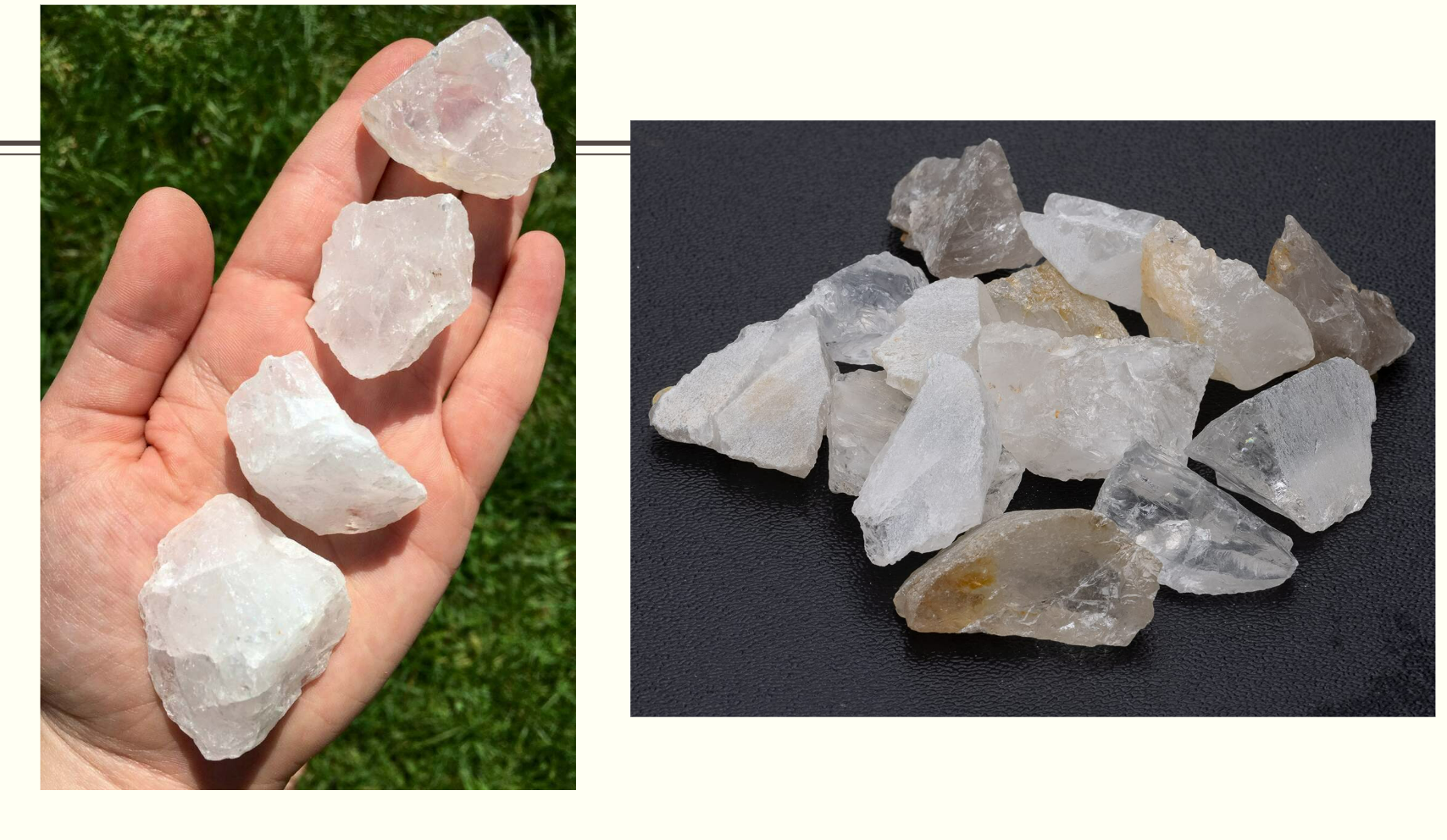
Q&A

Q&A

Question on Symbolism and Worldviews

Q. So, it seems part of what we’re learning here is that we have to be open to different worldviews in the way that symbols may have been interpreted at different times.

And I was interested by what you just mentioned parenthetically about the Gospel of Thomas, that dialogue at the end.

My thought was, because we’ve had preceding lectures about, you know, it’s not just biological, it’s inheritance. And possibly, could that text be related to, when saying women become men, is that they would have the inheritance in heaven that men have in relation to those blessings?

A. Michael: I suppose you could interpret it that way symbolically.

It certainly strikes against, you know, our belief in the eternal nature of gender.

Question on Layers of Meaning in Egyptian Symbols

Q. There’s apparently a concept in looking at Egyptian writings as layers of meaning. Particularly when you look at something like the hypocephalus. That you can interpret at one level and another level, and even maybe a third level.

Could you comment on that?

A. Michael: Well, first of all, I don’t know that I would call it levels.

I would simply say that Egyptian symbols have multiple ways of being interpreted. But not necessarily multiple levels, like, you know, there’s deeper levels or higher levels.

It’s simply, one thing can mean—let’s take for example the lotus flower.

The lotus flower:

  • can be symbolic of eternal life,
  • it can be symbolic of healing,
  • it can be symbolic of truth.

So, there are multiple meanings, but I don’t think that there’s the idea of multiple levels. Where you see kind of an outer level and then sink down deeper into a deeper level that you didn’t catch before.

That’s not, to my understanding, typical of Egyptian documents at all.

Question on the Hugh Nibley Quote

Q. A lot of people probably could this in the room, but what was the source on that Nibley quote?

A. Michael: Worldly Prophets is where that’s found.

Question on Facsimile #1 and the Book of Breathings

Q. Facsimile number one, as being part of the front of the Book of Breathings. Is it also not possible that a second facsimile one on a Book of Abraham scroll could have been there?

There could be two, where the one is extensively damaged and the other one was not?

A. The drawing matches up so perfectly that I don’t think there is any question that the facsimile number one that we have in the Pearl of Great Price came from the surviving portion of the papyrus.

I can’t imagine that another one would have matched up so perfectly. That just happened to be one from Abraham.

So, no, I don’t think so.

Question on Astronomy in Facsimile #2 and Abraham 3

Q. I have heard that a year or two ago, some of you were working on the matter of the astronomical depiction in facsimile number two in the third chapter. And that those were more representative of the Egyptian view of things.

And that, therefore, this was then a support for the inspiration given to Joseph.  Joseph might have tried to put in some modern astronomy or something, whereas this was a typical Egyptian view.

Would you comment on that?

A. Michael: Actually, I don’t espouse that view.

My colleague, John Gee, does think that the view portrayed in Abraham 3 is ancient geocentric point of view.

In a paper I gave a couple of years ago, and which will be published soon. I adopt a view that it, in fact, portrays a more modern point of view.

So, I almost suspect that it’s possible to look at it from both points of view, to some extent.

But to me, it more clearly portrays a modern point of view than an ancient one.

Follow-Up: How Modern?

Q. How modern?

A. Michael: Well, modern to the extent that it sees other stars as simply suns like our own.

That there are multiple planets.

That the Earth certainly isn’t the center of the universe.

It’s rather just one of a myriad of planets and stars that are part of God’s creation.

You know, look at the latest Hubble Space Telescope, and the galaxies, and whatnot.

To me, that’s the kind of thing that’s portrayed.

Closing

Scott Gordon: Thank you very much.

Search topics

Book of Abraham; Book of Abraham apologetics; Book of Abraham critics; Joseph Smith papyri; Book of Breathings; Egyptian papyri; translation by revelation; meaning of translation; Pearl of Great Price; Abraham facsimiles; Facsimile 1; Facsimile 2; hypocephalus; Facsimile 3; ancient Egyptian religion; pseudepigrapha; Apocalypse of Abraham; Testament of Abraham; preexistence; council in heaven; creation; priesthood lineage; prophetic calling; continuing revelation

CES Letter; Mormon Book of Abraham; is the Book of Abraham true; Mormon Church history; LDS scripture; Joseph Smith translation; Mormon apologetics; are Mormons Christian; Pearl of Great Price controversy

History of FAIR

History of FAIR

In 1997, I logged in to America Online Mormonism message board 1 expecting to find friends. Instead, I found critics. I was quickly surprised by the sheer volume of vitriol and criticism of The Church of Jesus Christ of Latter-day Saints.

Common claims included:

  • You can’t add to the Bible (referencing, of course, the Book of Revelation)
  • You preach a different gospel (quoting from Galatians),
  • You believe Jesus is the brother of Satan (I’m not sure where that comes from in the scriptures, but it was there)
  • You’re getting your own planets; and
  • Mormon women will be eternally pregnant.

Even baptism was weaponized, declaring that it was a work that can’t save you.

These arguments, of course, were unfair, misrepresentative, or flat out wrong. And yet, this year, some seminary students in my ward in Redding, California, reported hearing these same arguments at school.

Early Online Opposition

Occasionally on America Online, I encountered the truly bizarre – like the claim that the Salt Lake Temple has six spires pointed toward heaven to impale Jesus at His Second Coming. (Yes, really. It’s really sad.)

I eventually learned that this message board was hosted by a group called Christianity Online, which wasn’t intended to engage Latter-day Saints in dialogue, but to talk about us—and not kindly.

A few of us Latter-day Saints started responding, offering what I like to call a different perspective. We were effective—so effective that some of our evangelical posters lobbied America Online to restrict our participation, and they were partially successful. Eventually, we were told as Latter-day Saints, we could only post on the Mormonism board and not on any of the other religion forums.

The Birth of FAIR

So we started our own message board on that early World Wide Web, and drew many participants away from the AOL Mormonism board.

A few of those early defenders—Julian Reynolds, Tom Hickey, John Lynch, and others—formed a corporation to provide structure and legal protection for the website. On December 19th, 1997, the Foundation for Apologetic Information and Research was born, a 501(c)(3) nonprofit corporation in New York State.

Well, I observed this happening. I wasn’t actually part of FAIR’s creation. (You can know that’s true because I would never have picked that pretentious name.) I was busy being a bishop, a school board member, a husband, and a father. But I was invited to join the FAIR board one month later, in January 1998. Someone thought having a bishop involved might lend some credibility.

Critics on the message board would often claim we weren’t high enough up in the Church to know the “real truth” that had supposedly been hidden from the membership. Having a bishop involved made that argument harder to sustain, especially among people who didn’t know our structure.

First FAIR Conference

In 1999, we hosted our first FAIR conference in Ben Lomond, California. I think the scholars came more for the redwoods than for us, but they gave fantastic talks. The speakers also made up most of the audience.

Since then, we’ve hosted a conference every year. This conference marks our 26th. I became president in 2001, and with the help of professional editor Allen Wyatt, we set standards and improved our professionalism.

Our message board exploded in popularity—so much so that our internet provider called me on the phone and asked why we were so popular.

Shifting Away from Message Boards

Now, we have to remember this was before Reddit, before YouTube, before Twitter, and before Facebook. The popularity brought problems. Reporters looking for quotes on Church-related issues began citing posts from our message boards as if they represented FAIR.

Often they quoted critics by mistake, saying, “Well, the FAIR board says this” or “FAIR says this.” To prevent this, we divested ourselves from our message boards in 2006 and instead focused on building our Answers Wiki, led by volunteers like Roger Nicholson and Greg Smith.

The Sandra Tanner Lawsuit

A little before that time, in 2004, one volunteer created a parody of the Utah Lighthouse Ministry website, a well-known anti-Mormon outlet run by Jerald and Sandra Tanner. It was a private joke, shared only among a few close friends and volunteers.

In 2005, Sandra Tanner sued—personally naming me, of course, even though I had nothing to do with it. She demanded $50,000 and control of the FAIR website.

Our total assets at the time: $4,000. With pro bono help from attorneys Ron Dunn and Lance Starr, the case was dismissed in 2007. Two years later, Sandra Tanner appealed, and in 2008, the 10th Circuit Court of Appeals—where future Supreme Court Justice Neil Gorsuch sat—again ruled unanimously in our favor.

The case was important because it set guidelines on differentiating free speech and commercial speech on the internet.

Two additional attorneys, Steve Miles Holman and Ron Walker, helped us with the appeal. I mention these attorneys because I appreciate the time they donated to us for the case. During the appeal, Ron Walker leaned over to me and pointed to Dr. Miles Holman, saying, “You are lucky to have him. Even I can’t afford him.”

Increased Media Presence

Around this time, Mitt Romney ran for president. The Church likes to avoid politics, so the reporters came to us often. The suggestion was then known as Church Public Affairs.

We were quoted in The New York Times, The Los Angeles Times, The National Post of Canada, The Wall Street Journal, and other newspapers. I was also on several radio shows, including radio shows talking about the Church.

And I even appeared on the Fox News Alan Colmes radio show. I once had my college president (because I work at a community college. FAIR doesn’t pay me; I have a “real” job, I guess.) stop me in the hall and say, “Scott, was that you quoted in The New York Times?” and I just mumbled back, “Yeah, that was me.”

We even met with a few foreign consulates who wanted to understand what it meant to have a Latter-day Saint in the White House. We built a news feed service at that time that many news agencies subscribed to around the world. Though it is now retired, we were a central resource during a pivotal time.

Growth and Rebranding in the History of FAIR

In 2013, we rebranded as FairMormon. That is a much more searchable term. Then in 2021, following President Russell M. Nelson’s counsel, we once again became simply “FAIR” with a new tagline (Faithful Answers, Informed Response) and adopted the new website fairlatterdaysaints.org.

Current Reach and Activities

Today, we host an annual conference, maintain a website with over 12,000 pages, run a YouTube channel with more than 3,000 videos, publish blogs, respond to the latest television productions, produce Come, Follow Me activities, and have a growing international reach.

As the world moves towards AI, our material is one of the sources that feeds the AI models. So yes, ChatGPT, Grok, Copilot, and Perplexity all know who we are, and they use us as a resource for faith material on difficult questions.

We’re currently digitizing and transcribing past conference talks, updating old videos, creating shorts, and translating talks into other languages. We have even started publishing books based on our virtual conferences.

Funding and Support

But here’s the reality: much of this work requires more than volunteer time. We’ve had to hire a few workers, and with that modest investment, our output has been greatly increased. We’ve also been given some website technical help donations.

At one point, one of the probable alternatives we had ahead of us was to simply shut down FAIR because our website had so many problems. But thankfully, one donor gave us some significant technical help to update some of our old website infrastructure. Again, that was a significant donation.

For years, FAIR has operated on a shoestring budget—less than what one particular critical podcaster earns as his personal salary. Yet we provide the resources many current podcasters rely on.

We get calls and emails from people who say, “I stayed in the Church because of what I found on FAIR.” Others have told us, “I didn’t always agree, but you made me think.” And that’s a win in today’s noisy world.

Scott Gordon speaking at the 2025 FAIR Conference

Personal Encounters and the Call to Support FAIR

I was seated at the Sacramento airport waiting for a plane. A man walked up to me and asked, “Are you Scott Gordon?”. When I said yes, he said, “I want to thank you for helping me regain my testimony and come back to Church.”

So let me ask you: do we want…

  • a trusted place where faithful scholars and thinkers can talk about gospel issues?
  • AI to reflect faithful, informed answers?
  • Our children to find reliable content when they Google their questions?

If so, I invite you to support FAIR. I live in an outdoor recreation area, so I’d like to close with the comparison of FAIR with a canoe. We’ve been paddling this canoe through the rapids for over 25 years. With your help, we can keep paddling and help others stay afloat. Thank you.
The Book of Mormon Witnesses: Sincerity and Reality

lin”The Book of Mormon Witnesses: Sincerity and Reality” by Dan Peterson from the 2021 FAIR Conference

The Book of Mormon Witnesses: Sincerity and Reality

Dan Peterson

August 2021

Summary

Daniel C. Peterson defends the credibility of the Book of Mormon witnesses by comparing their unwavering testimonies—often given under persecution—to those of the early Christian apostles. He critiques naturalistic explanations arguing they fail to account for the witnesses’ consistency, sincerity, and transformative experiences.

Introduction

We’ll move on to our final speaker for our conference, Daniel C. Peterson. He has been a professor of Islamic studies and Arabic at Brigham Young University. Young is founder of the University’s Middle Eastern Text Initiative. He’s been a long-time friend of FAIR. He’s currently with the Interpreter Foundation, and he’s also now a major film producer. So, with that short introduction, we’re going to start first with a video clip. After that, we’ll listen to Daniel Peterson.

Presentation

“If Joseph just said he saw God, people would say, “We understand, all sorts of people have seen God.” When he says he has plates, then he becomes a charlatan.”

“A detractor can simply say, ‘Well, they’re all lying. Every one of them is lying.’

“You will see the plates; the Lord has declared it.”

“Even antagonists of Joseph Smith seem to believe that he has something.”

“And I have not denied my testimony, which is attached to the Book of Mormon, nor will I.”

“This guy is anything but a cynic.”

“Because it is true.”

“He’s a wholehearted believer, and that’s why he leaves.”

“I find that the witnesses are credible.”

“Of course, we were in the spirit when we had the view, but we were in the body also.”

“They were challenged time and time again to recant their testimonies, but they never did. That’s powerful stuff.”

“Never doubt it. You do so at your own peril.”

[Applause]

Witnesses Film

Dan Peterson: Some of you may know that I recently worked on a film project about the witnesses to the Book of Mormon. You just saw a preliminary trailer for the second part of that. A lot of people think that the theatrical film that is still playing in theaters, that that’s all there is, but it isn’t. In fact, the main part of it, as I always conceived it, is still to come. And that’s a two-part docudrama, which will include interviews with scholars—LDS and non-LDS. It will broaden its coverage beyond the three witnesses to the eight witnesses, and to the informal or unofficial witnesses.

COVID-19 considerably delayed this project. That was a preliminary bit of filming that we did.

Now, I need to announce something before I forget it. As I say, the second installment—the docudrama— is going to be called Undaunted: Witnesses of The Book of Mormon. It’ll likely go public in early October or thereabouts. But I want to say something that’s kind of important. It is news that just came to me in the forenoon today. The theatrical film—is beginning to run down. It’s showing in fewer and fewer theaters. Even Avatar and Titanic and Gone with the Wind eventually leave the theaters. So it’s naturally begun fading. It’s still out there. It’s in some theaters around here and some in Arizona and elsewhere—Idaho—at least last time I checked.

The Docudrama

But one really, really important thing is there are a lot of people who weren’t able to see the film because it wasn’t showing anywhere near them. We’ve just successfully arranged for the film to be shown in four theaters in the Provo-Orem area during Education Week. So if people are coming in from outlying areas on Education Week, I hope they’ll have a chance. And if you haven’t seen it, or if you know people who haven’t seen it but who wanted to but might be coming to Education Week, I hope you’ll mention that to them.

And we’re kind of pleased that we managed to work this out because a lot of big films are coming out. There are actually more films than screens right now. So for us to be able to get those screens for Witnesses during Education Week in the area around BYU is really a big deal for us.

So anyway, you just saw a one-minute ad for that docudrama.

You should supplement my remarks today with the companion presentation I gave at the 2020 FAIR Conference. Even together, they cover only a fragment of what I could say on this subject.

Apostolic Witnesses to the Resurrection

Okay, according to ancient traditions, the early apostolic witnesses to the resurrection of Jesus paid a heavy price for their testimonies. Let’s run through these. You may know all of this, but:

Peter was crucified in A.D. 66, at his request upside down, under the emperor Nero.

As it happens, the apostle Paul–though not one of the original Twelve–was also beheaded that same year, under Nero’s rule, in Rome. It was a bad year to be a General Authority.

Tradition holds that Andrew preached within the boundaries of today’s Ukraine and around the Black Sea. He also preached in Asia Minor (modern-day Turkey) and in Greece, where he was crucified.

Thomas served as a missionary east of Syria. Traditionally even into India, where four soldiers with spears killed him.

Philip taught in North Africa, in Carthage—within modern-day Tunisia—and also in Asia Minor, where authorities eventually put him to death.

According to tradition, Bartholomew spoke with Thomas in India, and also preached in Armenia, Ethiopia, and southern Arabia. Sources disagree on how or where he was martyred, but leading accounts say he was flayed alive and then beheaded–either in Armenia or India.

James, the son of Alphaeus, reportedly preached in Syria, where, according to Josephus, people stoned him and then clubbed him to death. Some traditions have him being crucified, though, in lower Egypt. That is, in the northern part of the country near modern Cairo or in the Nile Delta.

Apostolic Witnesses, cont.,

Supposedly, Simon the Zealot ministered in Persia and was killed when he refused to sacrifice to the sun god.

Reports say Matthias, who replaced Judas Iscariot after Judas had betrayed Jesus and committed suicide, was burned to death in Syria.

Matthew, traditionally credited as the author of the Gospel that bears his name, may have escaped martyrdom. Some sources say so. Others claim that people stabbed him to death in Ethiopia.

John was the leader in the Christian community in Ephesus—the major city in Asia Minor, again in modern-day western coastal Turkey. Roman authorities exiled him to the island of Patmos during Domitian’s persecution in the mid-90’s A.D. An early Latin tradition reports that Roman officials cast him into boiling oil at Rome but he escaped uninjured. No historical account reports his martyrdom. 

Tradition says that people dragged Mark the Evangelist by a rope through the streets of Alexandria, Egypt, in A. D. 68 until he was dead.

Comparison of Ancient Apostolic Witnesses to Latter-day Witnesses

At the 2001 annual meeting of the Evangelical Philosophical Society in Denver, Colorado, I participated in a debate between five Latter-day Saint academics. That’s including me, and five prominent evangelical Protestant philosophers and theologians. Richard Mouw, a committed Calvinist but a kind and fair-minded man who served as president of Fuller Theological Seminary in Pasadena, California, moderated the three-hour discussion.

It was, shall we say, a spirited and entertaining evening—at least for me. I thought the Latter-day Saint side did reasonably well and made a positive impression. For my purposes here, though, I want to mention just one small portion of that debate. It involves William Lane Craig.

That name may be familiar to a few of you. He certainly ranks among the most prominent evangelical Protestant philosophers in the English-speaking world. Indeed, among the most prominent philosophers of religion in the world generally. He’s a person for whom I have considerable respect. He’s a formidable and very experienced debater.

Mormonism

At one point, Craig purported to contrast the evidence for Christianity with the evidence for what he termed Mormonism. I’m paraphrasing, but I think I’m reasonably close to his actual words:

Christianity, he said, has eleven credible witnesses to its fundamental claim—the resurrection of Jesus. Mormonism has absolutely nothing that’s even remotely comparable.

I remember glancing at Richard Mouw, the moderator. He looked back at me and rolled his eyes. It was really as if Dr. Craig had fastened the debater’s equivalent of a “kick me” sign on his posterior.

Fortunately, I was assigned to respond to him, so I didn’t miss the opportunity. Because the Restoration does have credible witnesses. Whether coincidentally or by divine design, if one has in mind the official witnesses to the Book of Mormon. Even precisely eleven of them.

A few years thereafter, my wife and I drove around a bit in western Missouri. It’s an arguably weird interest of mine—this is, not western Missouri—but I was trying to track down the graves of the witnesses to the Book of Mormon in that part of the state near Independence. Most of them are located there.

The Holy Land

Driving through the countryside, we noticed church after church, festooned with signs and even banners inviting people to enroll for a tour of the Holy Land. Now, nobody’s a stronger advocate of touring the Holy Land than I am. Most of my Middle Eastern residency has been in Egypt, but I’ve lived in Israel or Palestine for about a year altogether. I’ve visited it more times than I can count. I’ve even led somewhere between, I don’t know, 15–20 such tours myself.

But I really wanted to be able to tell the residents of that part of Missouri that, while they were thinking about traveling to Israel in order to visit sacred sites connected with scriptural history, the landscape right around them was dotted with the graves of witnesses directly comparable to those described in the New Testament. Yet I’m betting they were entirely unaware of the fact.

It’s true that the witnesses to the Book of Mormon didn’t suffer violent death at the rate that the ancient apostles did. For all of its imperfections, life in the United States—even on the Missouri frontier—was more secure than under Nero. Even so, they suffered considerable hardship and persecution. Indeed, at least one of them, Hyrum Smith, was a martyr in the fullest sense of the word.

Words of Hyrum the Martyr

Perhaps responding to suggestions that the experience of the eight witnesses was merely spiritual and visionary, Hyrum insisted during an 1838 speech that it was entirely real.

“He said that he had but two hands and two eyes,” Sally Parker remembered in a letter written in August of that year. He said he had seen the plates with his eyes and handled them with his hands.

And Hyrum himself wrote in December 1839 of his sufferings in Missouri. Authorities arrested Hyrum, Joseph, and others in the fall of 1838. Authorities then imprisoned them in the ironically named Liberty Jail from the beginning of December to the beginning of April. At that point, weary of the cold misery and despair—and despairing in Missouri justice—the prisoners managed to escape.

A Stronger Testimony

This is what Hyrum said:

“Having given my testimony to the world of the truth of the Book of Mormon, the renewal of the everlasting covenant, and the establishment of the kingdom of heaven in these last days, and having been brought into great afflictions and distresses for the same, I thought that it might be strengthening to my beloved brethren to give them a short account of my sufferings for the truth’s sake, and the state of my mind and feelings while under circumstances of the most trying and afflicting nature.

“I had been abused and thrust into a dungeon and confined for months on account of my faith and the testimony of Jesus Christ.

“However, I thank God that I felt the determination to die rather than deny the things which my eyes had seen, which my hands had handled, and which I had borne testimony to wherever my lot had been cast.

“And I can assure my beloved brethren that I was enabled to bear a stronger testimony, when nothing but death presented itself, as ever I did in my life.”

Fellowship With Us

Now, Hyrum’s language plainly echoes the opening words of 1 John 1:

“That which was from the beginning, which we have heard, which we have seen with our eyes, which we have looked upon, and our hands have handled, of the Word of life; that which we have seen and heard declare we unto you, that ye also may have fellowship with us. And truly our fellowship is with the Father, and with his Son, Jesus Christ.”

Now, Hyrum’s words were not empty. He meant them.

On the 27th of June 1844, at the hands of an armed mob with painted faces, Hyrum Smith sealed his testimony with his blood.

Significantly, the Greek word martus means “witness.”

On the morning Hyrum left for Carthage Jail, with a very acute sense of the likely fatal outcome, he remained loyal to his little brother. Which is, in and of itself, worthy of note. He was loyal to his little brother.

John Taylor’s Testimony

According to the testimony of John Taylor, who was severely wounded in the same violent attack that took the lives of Joseph and Hyrum, Hyrum read the following verse in the Book of Mormon. Finishing, he turned down the leaf upon it.

“And it came to pass that I prayed unto the Lord that he would give unto the Gentiles grace, that they might have charity.

“And it came to pass that the Lord said unto me: If they have not charity, it mattereth not unto thee; thou hast been faithful; wherefore, thy garments are clean.

“And because thou hast seen thy weakness, thou shalt be made strong, even unto the sitting down in the place which I have prepared in the mansions of my Father.

“And now I bid farewell unto the Gentiles, yea, and also unto my brethren whom I love, until we shall meet again before the judgment-seat of Christ, where all men shall know that my garments are not spotted with your blood.”

The Night Prior to the Martyrdom

According to the accounts of those who were in the prison with Joseph and Hyrum just prior to the martyrdom, during the evening the patriarch Hyrum Smith read and commented upon extracts from the Book of Mormon on the imprisonments and deliverance of the servants of God for the gospel’s sake.

Joseph bore a powerful testimony to the guards of the divine authenticity of the Book of Mormon, the restoration of the gospel, the administration of angels, and that the kingdom of God was again established upon the earth—for the sake of which he was then incarcerated in that prison, and not because he had violated any law of God or man.

On the morning of their murder, both Joseph and Hyrum bore a faithful testimony to the latter-day work and the coming forth of the Book of Mormon. Before sunset that evening, the armed mob had done its work. “The testators are now dead,” wrote John Taylor, announcing their martyrdom, “and their testament is in force.”

I might add here that Elder Holland has spoken powerfully and eloquently on this very fact. It’s highly unlikely that men, knowing very confidently they were going to their deaths, would die with a lie on their lips like this, going before God.

Additional Testimonies From Witnesses

An account given in a recently published manuscript, originally written by William McLellin sometime between January 1871 and January 1872. McLellin was chosen as one of the Twelve Apostles in 1835, but he was excommunicated from the Church in 1838. However, he never abandoned his faith in the Book of Mormon. That faith rested, to a significant degree, upon his early searching interviews with the witnesses.

He was a highly intelligent man, and it seems a rather irascible one. He was very careful and intent upon getting at the truth. He left a number of statements on his investigations.

William McLellin Statement

Here’s one of them:

“In 1833, when mobbing reigned triumphant in Jackson County, Missouri, I and O. Cowdery fled from our homes for fear of personal violence on Saturday, the 20th day of July. The mob dispersed, agreeing to meet again on the next Tuesday. They offered eighty dollars reward for anyone who would deliver Cowdery or McLellin in Independence on Tuesday.

“On Monday, I slipped down into the Whitmer settlement, and there in the lonely woods I met with David Whitmer and Oliver Cowdery. I said to them, ‘Brethren, I have never seen an open vision in my life, but you men say you have, and therefore you positively know. Now you know that our lives are in danger every hour if the mob can only catch us.Tell me, in the fear of God, is that Book of Mormon true?'”

“Cowdery looked at me with solemnity depicted in his face and said: ‘Brother William, God sent his holy angel to declare the truth of the translation of it to us, and therefore we know. And though the mob kill us, yet we must die declaring its truth.’”

“And David said: ‘Oliver has told you the solemn truth, for we could not be deceived. I most truly declare to you its truth.’”

“Said I: ‘Boys, I believe you. I can see no object for you to tell me falsehood now when our lives are endangered.’

“‘Eight men testify also to handling that sacred pile of plates’, he continued, ‘from which Joseph Smith read off the translation of that heavenly book.’”

Hiram Page

One circumstance I’ll relate of one of these eight witnesses:

While the mob was raging in Jackson County, Missouri, in 1833, some young men ran down Hiram Page in the woods—one of the eight witnesses—and commenced beating and pounding him with whips and clubs. He begged, but there was no mercy. They said he was a “damned Mormon” and they meant to beat him to death. But finally one of them said to him:”If you’ll deny that damned book, we’ll let you go.”

Said he: “How can I deny what I know to be true?” Then they pounded him again.
When they thought he was about to breathe his last, they said to him: “Now, what do you think of your God when he don’t save you?”

“Well,” said he: “I believe in God.”

One of the most intelligent among them said: “I believe the damned fool will stick to it though we kill him. Let’s let him go.”

But his life was nearly run out. He remained confined to his bed for a length of time. .

So much for a man who knows for himself. Knowledge is beyond faith or doubt; it is positive certainty.

McLellin Continues

This is McLellin continuing:

“I, in company with a friend, I visited one of the eight witnesses in 1869—the only one who was now alive.”

(I think it was probably John Whitmer.)

“And he bore a very lucid and rational testimony and gave us many interesting particulars. He was a young man when he had these testimonies; he was then 68 years old, and still he is firm in his faith.

“Now, I would ask you: what will I do with such a cloud of faithful witnesses bearing such a rational and yet solemn testimony? These men, while in the prime of life, saw the vision of the angel and bore their testimony to all people.

“And eight men saw the plates and handled them; hence, these men all knew the things they declared to be positively true—and that too while they were young. And now, when old, they declare the same things.”

Now, I have to say: John Whitmer was bitter against the Latter-day Saints and against Joseph Smith. But these testimonies stayed with him—and convinced him.

Near the beginning end of the Interpreter Foundation’s Witnesses film is a dramatic scene that occurred in 1833. A mob in Independence, Missouri, tried to force David Whitmer and others to repudiate their faith and denounce the Book of Mormon. John P. Greene, a New York convert to the Church very soon after Whitmer himself, told the story as follows:

John P. Greene

“When the mob again assembled, they went to the houses of several of the leading Mormons, and, taking Isaac Morley, David Whitmer, and others, they told them to bid their families farewell, for they would never see them again.

“Then, driving them at the point of the bayonet to the public square, they stripped and tarred and feathered them amidst menaces and insults.”

We had decided in our film to forego the tarring and feathering. Turns out, it’s kind of difficult to do, and not very pleasant for the actors. Even if you don’t use real hot tar and real feathers. And there are budget limitations. Tar is cheap, but we couldn’t afford it.

“So, the commanding officer then called twelve of his men, and, ordering them to their guns, had them present them at the prisoners’ breasts and be ready to fire when he gave the word.

“He addressed the prisoners, threatening them with instant death unless they denied the Book of Mormon and confessed it to be a fraud. At the same time, adding:”If they did so, they might enjoy the privileges of citizens.”

“David Whitmer hereupon lifted up his hands and bore witness that the Book of Mormon was the word of God. The mob then let him go.

David Whitmer

And David Whitmer himself told M.C. Smith that when the mob commanded him to renounce his testimony, he instead reaffirmed it in the face of death. His most substantial known account recalls that:

“The testimony I gave to that mob made them fear and tremble, and I escaped from them.”

“One gentleman—a doctor—told him afterward that the bold and fearless testimony borne on that occasion, and the fear that seemed to take hold of the mob, had made him a believer in the Book of Mormon.”

Samuel Smith

Okay, Samuel Smith.

Samuel Smith might also be considered a kind of martyr.
A mob killed his brothers Joseph and Hyrum on June 27, 1844, while being held at Carthage Jail in Illinois. 

Just prior to their death, a mob attacked Samuel while traveling toward Carthage to help out. He is said to have developed some kind of pain in his side while trying to escape them. Some have argued this may have contributed to his death a month later.

After evading the mob, Samuel arrived at the jail and retrieved his brothers’ bodies. He may have been the first Latter-day Saint on the scene after the martyrdom.

Officially, Samuel died of “bilious fever”—an imprecise term that’s no longer in medical use.

Lucy Mack Smith had now lost three of her sons within a month.
She maintained afterward that Samuel became ill and died because of his fatigue and shock at the death of his brothers.

David Whitmer

David Whitmer had been out of the Church for 50 years when he died in Richmond, Missouri, on January 25th, 1888. It had been fully 60 years since his experience with the angel and the plates. But he wanted his testimony about the Book of Mormon to be heard even beyond his death.

Note the two books—presumably the Bible and the Book of Mormon—carved atop his grave marker. And the words carved into its side:

“The record of the Jews and the record of the Nephites are one.
Truth is eternal.”

Belief in Things That are Incorrect

At this point, a skeptic might well point out that people often believe things that are plainly incorrect. Not uncommonly they die or are willing to die for falsehoods. History is replete with martyrs for communist revolution, extremist Islam, and the like. So a willingness to die for it doesn’t prove a proposition or a belief system true.

But there’s a distinct difference, in my view, between lifelong devotion to a conclusion that one has mistakenly drawn—or to a worldview that one has embraced in error—and a readiness to endure persecution and even to die for a claimed experience.

The early disciples of Jesus hadn’t just reasoned their way into Christianity. They had, they firmly believed, seen the risen Christ—and that experience utterly transformed them. If they knew it to be false, if they were deceivers, would they have embraced martyrdom for it?

Mainstream modern Christian scholars and apologists make that argument regarding the resurrection of Jesus—and they’re right to do so. But the same argument can be made for the witnesses to the Book of Mormon.

Perhaps Sincere but Hallucinating?

Maybe, though, they were sincere but sincerely hallucinating?

To respond to that idea, I’m going to be drawing on the work of the evangelical Protestant philosopher Gary Habermas and the physician Joseph Bergeron regarding the resurrection of Christ. Their arguments seem entirely appropriate, in my judgment, to the Book of Mormon witnesses as well.

In an effort to maintain a naturalistic worldview, scholars have proposed three psychiatric explanations for the disciples’ claim of having seen and interacted with the resurrected Jesus: hallucinations, conversion, disorder, and bereavement experiences.

Now, neither conversion disorders nor bereavement experiences have any clear relevance to the Book of Mormon and to the witnesses, so we’ll concentrate here on hallucinations.

We use Bergeron and Habermas’s definition of hallucinations as:

“Perceived experiences of one or more physical senses without external stimulus or without physical referent.”

Which is to say, very importantly, that hallucinations are personal and subjective.

Gerd Lüdemann

The atheist German New Testament scholar Gerd Lüdemann will serve as an example of the hallucination thesis applied to the Easter story. Lüdemann suggests that Peter experienced a visual hallucination of Jesus due to his severe guilt and grief, and that Peter’s subjective vision was followed by similar hallucinations among the other disciples, which spread by a kind of contagious religious ecstasy. An incomparable chain reaction, he calls it.

“Incomparable” is right. Even resulting in group hallucinations. Tales of Christ’s resurrection appearances represent, “a shared hallucinatory fantasy.” He says the early Christian disciples were susceptible to such psychological phenomena owing to their lack of cultural and intellectual sophistication.

At this point, a critic of the restored Church might spring to sudden attention.
After all, nobody has ever accused the Book of Mormon witnesses of being cultural and intellectual sophisticates. Might they not have been, “susceptible to contagious religious ecstasy,” just like Lüdemann’s early Christian disciples?

However, Lüdemann’s incomparable chain reaction—vague but dismissive—is mere hand-waving. It explains nothing. It’s no better than Fawn Brodie’s brushing aside of Mary Whitmer’s unexpected experiences of the plates and the messenger out in the Whitmer barn.

“Joseph must have marveled at his ability to induce visions in others.”

Well, he should marvel at such a thing. Who can do that?

Hallucination is a Symptom

Non-medical writers primarily propose the hallucination hypothesis–a way of dismissing claims of Christ’s resurrection–in debates or theological books by New Testament scholars rather than being subjected to a more appropriate specialized medical readership. 

As a result, the analysis of potential medical causes for these hallucinatory symptoms is generally flawed—and often absent. Psychiatric hypotheses for the disciples’ post-crucifixion experiences of Jesus are not to be found in peer-reviewed medical literature. This is noteworthy, since these hypotheses propose hallucinatory symptoms which imply an underlying medical pathology.

A hallucination is a symptom, Bergeron and Habermas say—not a diagnosis. We must consider what caused the purported hallucination.

Causes of Hallucinations

There are basically three kinds of etiology—or causes—for hallucinations:

  1. Psychophysiologic — arising from alteration of brain structure and function.
  2. Psychobiochemical — due to neurotransmitter disturbances.
  3. Psychodynamic — arising from intrusion of the unconscious into the conscious mind.

Let me take these in turn:

Psychophysiological hallucinations can be caused by such things as structural injuries to the brain, including tumors, midbrain strokes, lesions, and seizures.

Now, what are the odds that all of the early witnesses to the resurrection of Christ were victims of structural brain injuries? What’s the probability that the three witnesses to the Book of Mormon, the eight witnesses, and the various unofficial or informal witnesses were all suffering from tumors, strokes, or lesions? Is there any evidence that any of them suffered seizures? No, there isn’t.

Psychobiochemical—biochemical derangement or delirium—can result from such things as toxicity, drug effects and drug withdrawal, infections, and of course specifically hallucinogenic drugs.

In his 1970 book The Sacred Mushroom and the Cross, the late Dead Sea Scrolls scholar John Allegro proposed the theory that no historical Jesus ever existed. That early Christianity was focused instead on the psychedelic mushroom Amanita muscaria. That the New Testament is a coded account of the early disciples’ adventures in an ancient sex and mushroom cult.

Scholars widely rejected Allegro’s proposal. His graduate mentor at Oxford denounced it. Another academic predicted—accurately, as it turned out—that he would never again be taken seriously as a scholar. He was forced to resign his academic position. His publisher eventually apologized formally for the book.

Philip Jenkins pronounced The Sacred Mushroom and the Cross, “possibly the single most ludicrous book on Jesus scholarship by a qualified academic.”

In 2019, an article appeared in the Journal of Psychedelic Studies arguing that Joseph Smith employed naturally occurring herbal chemicals to induce hallucinatory visions in his followers.

The Argument

There’s little, if anything, in the argument to take seriously. It might perhaps supply some context for Captain Kirk’s explanation to a puzzled 1986 earthling in Star Trek IV: The Voyage Home that Mr. Spock was harmless. Says Captain Kirk:

“Back in the sixties, he was part of the Free Speech movement at Berkeley. I think he did a little too much LDS in court.”

I wondered, learning of the thesis, whether we narrowly missed having a church named Sergeant Pepper’s Lonely Hearts Club Band. A friend suggests the theory be called Lucy Mack Smith in the Sky with Diamonds.

Now, Brian Hales recently reviewed the Journal of Psychedelic Studies article in Interpreter: A Journal of Latter-day Saint Faith and Scholarship. His review, which is available at no charge online, is entitled Visions, Mushrooms, Fungi, Cacti, and Toads. Anyway, it has not had much reception among scholars.

Psychodynamic—mental illness or psychosis, such as schizophrenia—can be associated with visual or auditory hallucinations.

Again  one has to ask: How likely was it that all of the witnesses to Christ’s resurrection were suffering from a severe psychosis? Or all of the many witnesses to the Book of Mormon, counting the unofficial ones? Probably what, at least 16 or 17?

Indeed, where’s the evidence that any of them did?

However, suggestions that the Book of Mormon witnesses hallucinated their experiences with the plates and the angel and the other artifacts are rarely, if ever, couched in such specific medical terms. More commonly, it’s simply vaguely insinuated that, as residents of the early 19th century, they lacked the close contact with the real world that we sophisticated moderns enjoy.

Seems implausible, though, to assume that the witnesses—early 19th-century farmers who spent their lives rising at sunrise, pulling up stumps, clearing rocks, plowing fields, sowing seeds, carefully nurturing crops, herding livestock, milking cows, digging wells, building cabins, raising barns, harvesting food, bartering in an often cashless economy for what they could not produce themselves, wearing clothes made from plant fibers and skins, anxiously watching the seasons, and walking or riding animals out under the weather until they retired to their beds shortly after sunset in a world lit only by fire—thad no disconnection from everyday reality.  

“Being Out of Touch”

It’s especially unbelievable when the claim is made by people whose lives—like mine—consist, to a large extent, of staring at digital screens in artificially air-conditioned and artificially lit homes and offices, clothed in synthetic fibers, commuting between the two in enclosed and air-conditioned mechanical vehicles while we listen to the radio, chat on our cell phones, and fiddle with our iPads, whose inner workings are largely mysterious to us, who buy our pre-packaged food with little or no regard for the time of the season, by means of plastic cards and electronic financial transfers from artificially illuminated and air-conditioned supermarkets, enmeshed in international distribution networks of which we know virtually nothing, the rhythms of whose daily lives are largely unaffected by the rising and setting of the sun.

Somehow, the current generation seems ill-positioned, to me anyway, to accuse the witnesses’ generation of being out of touch with nature and reality.

But there’s an even more fundamental reason to reject the notion that all of the Book of Mormon witnesses were hallucinating.

Hallucinations are Private Experiences

It’s noteworthy, write Bergeron and Habermas, that hallucinations are private experiences. Hallucination hypotheses therefore are unable to explain the disciples’ simultaneous group encounters with the resurrected Jesus.

While some may consider the disciples’ post-crucifixion group encounters with the resurrected Jesus as collective simultaneous hallucinations, mainstream clinical thinkers reject such an explanation.

What are the odds that separate individuals in a group could experience simultaneous and identical psychological phenomena mixed with hallucinations?
Peer-reviewed literature does not contain the concept of collective hallucination.

Dr. Gary Sibcy, a clinical psychologist based in Virginia, writes:

“I have surveyed the professional literature—peer-reviewed journal articles and books written by psychologists, psychiatrists, and other relevant healthcare professionals—during the past two decades, and have yet to find a single documented case of a group hallucination.”

Gary Habermas’s comment about Christ’s appearance to the eleven apostles is precisely relevant here—and worth repeating:

“Hallucinations are private events observed by one person alone.
Two people cannot see the same hallucination, let alone eleven.”

Gary Collins

In support of his position, he cites personal correspondence from the clinical psychologist Gary Collins, who writes:

“Hallucinations are individual occurrences. By their very nature, only one person can see a given hallucination at a time. They certainly are not something which can be seen by a group of people. Neither is it possible that one person could somehow induce a hallucination in somebody else.”

(Fawn Brodie notwithstanding.)

Since a hallucination exists only in this subjective personal sense, it is obvious that others cannot witness it.

“Hallucination is a solitary phenomenon,” agrees the Catholic writer Karl Keating.
In medical literature, there are no records of even two people having the same hallucination at the same time.

Now, if you want to test this fact experimentally, here’s a way to do it:

You ever wake up in the middle of the night from a dream about a blissful vacation in the South Pacific? Wake your spouse—or call a friend—and invite that other person to join you in your dream. Let us know how that works for you.

Shakespeare

Already Shakespeare, that unequaled observer of human nature, recognized the fact that subjective visions or dreams aren’t shared. A passage from his 1595 play A Midsummer Night’s Dream is apropos here. Theseus, the Duke of Athens, and his bride-to-be, Hippolyta, Queen of the Amazons, have just heard the tale told by the lovers Hermia, Lysander, Helena, and Demetrius. A tale of strange transformations and fairies in the woods. Hippolyta is impressed and puzzled by the story.

She says:

“’Tis strange, my Theseus, that these lovers speak of.”

Theseus, who’s a skeptic, says:

“More strange than true. I never may believe these antique fables nor these fairy toys.”

But Hippolyta responds wisely:

“But all the story of the night told over,

And all their minds transfigured so together,

More witnesses than fancies’ images,

And grows to something of great constancy.”

A Midsummer Night’s Dream is obviously fiction of the most fantastic kind.
Still, within the framework of the play, we know that the lovers’ story is completely true. That Oberon, Titania, Puck, and the others were, in fact, active realities.

Hippolyta’s point is an entirely sound one. The consistency of the tale told by various witnesses indicates that it rests upon more than mere imagination.

Bergeron and Habermas

The point deserves the most forceful possible emphasis.

Quoting Bergeron and Habermas again:

“Hallucinations are personal experiences, and the notion that separate individuals within a group could simultaneously experience identical hallucinations is inconsistent with current psychiatric understanding. Simultaneous, identical, collective hallucinations are not found in peer-reviewed medical literature. There’s no mention of such phenomena in the Diagnostic and Statistical Manual of Mental Disorders.

“As such, the concept of collective hallucination is not part of current psychiatric understanding or accepted pathogeny.”

Collective hallucination, as an explanation for the disciples’ post-crucifixion group experiences of Jesus, is indefensible. For the same reason, attempts to explain the experiences of the witnesses of the Book of Mormon as group hallucination are indefensible.

Now, Bergeron and Habermas do acknowledge three outlier views holding that group hallucinations, while extremely rare, can occur. Particularly when there is a heightened sense of group expectation. This could conceivably apply to such famous Marian apparitions as Fatima, Lourdes, and Guadalupe, for which pilgrims have often traveled for many hours or even days in a state of high religious enthusiasm.

I’m not saying that it necessarily does. It could even be argued—not very plausibly, I think—to be relevant to the Three and the Eight, who went out, though not very far, expecting an encounter with the plates of the Book of Mormon.

However, in group hallucinations—if such even occur—

“Not everyone in the group experiences a hallucination. Those that do see something have different hallucinations from one to another. And the apparitions do not carry on conversations.”

Mary Whitmer

But all the apostles after the first Easter saw and heard the same things. The accounts of the Three Witnesses and the Eight Witnesses are consistent among themselves. And neither the women at the tomb, nor the two disciples on the road to Emmaus, were expecting what they experienced. Nor the informal witnesses to the Book of Mormon. For example, Lucy Harris, Lucy Mack Smith, Catherine Smith, William Smith, Josiah Stowell, and Mary Musselman Whitmer, whom I discussed in my FAIR Mormon remarks last year. There was no heightened sense of group anticipation. There was no anticipation at all—and often no group.

Furthermore, Gary Habermas observes:

“The collective hallucination thesis is unfalsifiable. It could be applied to purely natural group sightings, simply calling them group hallucinations too. Concerning this thesis, crucial epistemic criteria seem to be missing. It can be used to explain away almost any unusual occurrence. How do we determine normal occurrences from group hallucinations?”

To me, the only criterion for many critics seems to be just this: If the witness claim doesn’t fit our preconceived worldview, it must have been a hallucination.

What are the Odds?

In the case of both the early Christian disciples and the Book of Mormon witnesses, those who want to dismiss them need visual hallucinations—which are rare. They need auditory hallucinations—which are also rare.
They need tactile hallucinations—which are perhaps even rarer.
And they need them all together, in a kind of hallucinatory trifecta.

What are the odds of this? Surely, they’re very, very low.

Furthermore, as Habermas points out, the wide variety of times and places that Jesus appeared, along with the differing mindsets of the witnesses, is another formidable obstacle.

The accounts of men and women—hard-headed and soft-hearted alike—all believing they saw Jesus, both indoors and outdoors, provide an insurmountable barrier for hallucinations.

The odds that each person would be in precisely the proper and same frame of mind to experience a hallucination—even individually—decrease exponentially.

Many Witnesses

The same reason applies to the Book of Mormon witnesses. The Three Witnesses had their experience separately from the Eight. Moreover, the Three Witnesses had their experience in two separate groups. One made up of Joseph Smith, Oliver Cowdery, and David Whitmer. The second composed of Joseph Smith and Martin Harris.

Even the Eight, according to one account, may have seen the plates in two distinct groups of four each.

Lucy Harris, Lucy Mack Smith, Catherine Smith, Mary Whitmer, Josiah Stowell, and William Smith all had their experiences quite separately. They were under different circumstances, and brought different attitudes to the encounter.

Do Hallucinations Transform Lives?

Here’s yet another consideration, pointed out by Habermas:

“Generally, hallucinations do not transform lives. Studies indicate that even those who do hallucinate often disavow the experiences when others present have not seen the same thing.”

Critics acknowledge that Jesus’s disciples were transformed—even to the point of being willing to die for their faith. No early text reports that any of them ever recanted. It is highly unlikely that this quality of conviction came about through false sensory perceptions—without anyone rejecting it later.

We can say the same of the witnesses to the Book of Mormon.

Illness Characterized by Hallucinations

In my judgment, the hallucination thesis fails completely for both the resurrection of Christ and the reality of the golden plates.

Bergeron and Habermas provide a good summary conclusion:

“The proposed hallucination hypotheses are naive in the light of medical and psychiatric pathonomic considerations. Those suffering illnesses characterized by hallucinations are sick. They require medical and psychosocial support, a structured environment, pharmacological support, and behavioral treatment.

“Persons suffering from psychosis in Jesus’s time, not having the benefit of modern medical treatment, might well have been considered lunatics or demon possessed. They would be unlikely candidates to organize as a group and implement the rapid and historic widespread expansion of the Christian religion during the first century.”

Clinically Implausible and Historically Unconvincing

In the end, hallucination is clinically implausible and historically unconvincing as an explanation for the claims of either the Lord’s ancient witnesses or His modern ones.

Nor would such mentally ill individuals go on to the career in journalism, politics, and the law that Oliver Cowdery enjoyed for his ten years out of the Church.

Nor were they likely to be able to manage the successful businesses that David Whitmer ran for many years in Richmond, Missouri—despite his connection with an extremely unpopular religious movement. Let alone to be elected mayor of the city, as he was.

In the end, to borrow language from Bergeron and Habermas again:

“Hallucination is clinically implausible and historically unconvincing as an explanation for the claims of either the Lord’s ancient witnesses or His modern ones.”

So, What are We Left With?

The Eight Witnesses

I focus on the official witnesses to the Book of Mormon at the close, quoting from a classic discussion by Elder B. H. Roberts.

“The testimony of the Eight Witnesses,” he wrote nearly a century ago, “differs from that of the Three Witnesses in that the view of the plates by the latter was attended by a remarkable display of the glory and power of God and the ministration of an angel. But no such remarkable display of God’s splendor and power was attendant upon the exhibition of the plates to the Eight Witnesses.

“On the contrary, it was just a plain matter-of-fact exhibition of the plates by the Prophet himself to his friends. They saw the plates, they handled them, they turned the leaves of the old Nephite record, and saw and marveled at its curious workmanship.

“No brilliant light illuminated the forest or dazzled their vision. No angel was there to awe them by the splendor of his presence. No soul-piercing voice of God from the midst of a glory to make them tremble by its power.

“All these supernatural circumstances present at the view of the plates by the Three Witnesses were absent at the time when the Eight Witnesses saw them.

“In this latter event all was natural, matter-of-fact, plain—nothing to inspire awe or fear or dread, nothing uncanny or overwhelming, but just a plain, straightforward proceeding that leaves men in possession of all their faculties and self-consciousness; all of which renders such a thing as deception or imposition entirely out of the question.

Elder B.H. Roberts, cont.,

“They could pass the plates from hand to hand, guess at their weight—doubtless considerable, that idea being conveyed in their testimony: ‘We have seen and hefted.’ ‘We know of a surety,’ said they, ‘that said Smith has got the plates.’

“They could look upon the engravings and observe calmly how different they were from everything modern in the way of record-making known to them, and hence the conclusion that the workmanship was not only curious but ancient.”

“But the testimony of the Three and the Eight Witnesses respectively stands or falls together. If the pure fabrication theory is adopted to explain away the testimony of the Eight Witnesses, there’s no reason why it should not be adopted to explain away the testimony of the Three. But every circumstance connected with the testimony of all these witnesses cries out against the theory of pure fabrication.

“It is in recognition of the evident honesty of the Three Witnesses that the theory of mental hallucination is invented to account for their testimony, as it is also the evident honesty of the Eight Witnesses that leads to the admission by many anti-Mormon writers that Joseph Smith must have had some kind of plates which he exhibited to the Eight Witnesses, though he may not have obtained them through supernatural means.

The Testimony of the Three and the Eight

“The hallucination theory breaks down under the force of the matter-of-fact testimony of the Eight Witnesses, from which all possible elements of hallucination are absent.

“The manifestation of divine power through which the Three Witnesses received their testimony destroys the theory of deception alleged to have been practiced by the Prophet on the credulity of the Eight Witnesses by exhibiting plates that he had either manufactured himself or some ancient plates accidentally discovered.

“Such then is the force of this direct testimony of the Eleven Witnesses to the truth of the Book of Mormon—the testimony of the Three and the Eight—when considered together.”

My Conclusion:

The witnesses were sincere. They were not hallucinating. There were plates. There was an angel. The voice of God confirmed the translation.

The implications of these simple facts are breathtaking. They confirm that God lives, that Jesus is the redeeming Christ, and that the Church and Gospel have been restored. That’s quite a bit. In the name of Jesus Christ, amen.

Q&A

Scott Gordon:

Okay, I just have a few questions here.

The first question — I kind of expected this one. Dan, is there any chance Witnesses will make it to a streaming service such as Netflix or Hulu?

Dan Peterson:

Well, I don’t know about Netflix or Hulu. But we will be eventually turning it into DVDs and streaming it in some fashion.

Scott Gordon:

Is there any way to watch Dan Peterson’s debate with William Craig?

Dan Peterson:

I don’t think anyone recorded it, which is really too bad. Even some of the evangelical theologians in the group came up and said afterward they thought we’d won. And I think that must have pained them terribly. So I wish it were preserved for posterity. But you know, the fact that it’s not allows me to make that claim — that we won.

Scott Gordon:

It’s nice to take the win. Next question. In the film, just before the mob relents and releases David, the ringleader falters because of the mention of Jesus Christ. He even repeats the name back. It’s a wonderful piece of writing for the film. How historically accurate were the actions and words of the ringleader? Was the mention of the Savior actually central in that incident?

Dan Peterson:

We don’t have the exact words of the ringleader, but we do know that something David said — something in his testimony — led the mob to disperse, where they were planning to kill them. And I mean, this was a time — there was a lot of violence. They weren’t averse to violence. But for some reason, the mob just disperses.

It’s always reminded me a little bit of that story of Jesus in Nazareth being taken out to the brow of the hill. Suddenly He just passes among them, and they kind of forget what they were there for.

So it had to be something like what is shown in the film — but we don’t know the exact dialogue.

Scott Gordon:

Do you foresee a time in the future when witnesses of the gospel will be similarly persecuted like the early Christians and early Restoration ones?

Dan Peterson:

Yeah, I do, actually. And I’m not happy to say that. I think with the shift in social values, I can see society turning against not only Latter-day Saints but conservative Christians, conservative Jews— for their stance on social issues and things of that kind.

It will be more and more difficult to get certain kinds of jobs, to be accepted to certain graduate schools. I’ve heard rumors of certain graduate schools who just say, “Well, you know, graduates of BYU. They come with these social issue attitudes, presumably fairly conservative, so we just won’t accept them anymore.”

And you can’t prove that because they don’t write it up and say to you, “You’ve been barred from graduate school because you come from a conservative religious tradition.” But I would be surprised, actually, if that’s not happening.

Scott Gordon:

Here’s the last question. Unofficial apologists often do most of the work in apologetics. While many of you are qualified to speak on the subject, how can we, who may not be formally trained in Near Eastern studies, stylometry, etc., engage in apologetics without being criticized on the basis of authority and credentials?

Dan Peterson:

Well, you know, in the long run, authority and credentials don’t matter at all if your argument’s good. If the facts are right, you’ve marshaled them with sound logic, then that’s all you need to do. And anyone can do that. And any person with credentials can fail at doing that—it happens all the time.

That’s a simplistic answer, I know. We must advance arguments based on their quality, not the credentials of the person advancing them. If it’s a silly argument, it doesn’t matter how many doctorates you have after your name—it’s a bad argument.

On the other hand, if you make a good argument. I could name a few people in academia who, for some reason or another, never got doctorates. There was one, Peter Brown, who taught at Princeton. I actually sat in on—it was odd, because it was a doctoral defense of one of his students—and I thought, “There’s something funny here.” Peter Brown doesn’t actually have a doctorate, but he’s conducting the investigation of one of his PhD candidates to grant him a doctorate.

Scholars widely recognized Peter Brown as the leading authority on the period of late antiquity. And I don’t know why, but he got an M.A. at Oxford and then quit and just turned to writing. But nobody would have dared to question his mastery of the subject.

Scott Gordon:

You have been the concluding speaker at FAIR conferences since 1999—every year. So we want to express our appreciation to you and all that you’ve done.

TOPICS

Book of Mormon Witnesses

Witnesses of Christ’s Resurrection

Not by Bread Alone: Faith and Growth of the LDS Church in the DR Congo

Introduction to the Session “Faith and Growth of the LDS Church in the DR Congo” – Dan Peterson

That’s fun to do this, because if you’re an academic, if you’re a professor, you talk for a living. So, you’re glib; you don’t have to know anything about what you’re talking about, but you can sound really convincing.

So that’s what I’m going to try to do here. I’ve been asked to chair this session, I guess because I’m the president of the Interpreter Foundation, and this project is really fascinating. The project that they’re going to be talking about is under the auspices of the Interpreter Foundation, so I’ll let them do that talking. Then we’ll see how this goes.

But I thought I would first introduce Jeff Bradshaw, who will then introduce Junior Bonza, and then we’ll get the ball rolling. I don’t know exactly what they have planned, but anyway, we’ll see.

Jeff Bradshaw is one of the vice presidents of the Interpreter Foundation. He has been a really productive member of our leadership, our board, and so on for years now. We’ve been just really thrilled to have him involved with us in our projects.

He has been responsible for many aspects of our work. He is by profession a cognitive scientist with a PhD from the University of Washington and is still involved with the Florida Institute for Human and Machine Cognition—whatever that is.

I think that’s all I really need to say, except that Jeff has served two senior missions in Francophone Africa, and that partly explains the background of this marvelous project.

So, I will let Jeff take over and do the further introduction. Then we’ll be on our way. [Applause]

The “Not by Bread Alone” Film Series

The real reason we have all these complex introductions here is we just love the applause. We don’t get that when we teach in the university very often.

It’s very nice to be here. And Dan, we’re very much honored that you can join us, as well as my colleague and friend, Junior Bonza.

We’ll talk a little bit more about that first. But first, I want to show you a 10-minute introduction to the film series that we’re working on for the Interpreter Foundation.

That’ll give you a better feel in pictures than you could ever get in words. Once you’ve seen this, we’ll say just a few words more.

Then we’re honored to have Junior tell some bits of his story. We’ll be able to take some questions from any of you if you want to submit them. Junior will answer all of them, and then Dan will fill in as needed.

Thank you. We hope you enjoy the film. (film begins here)
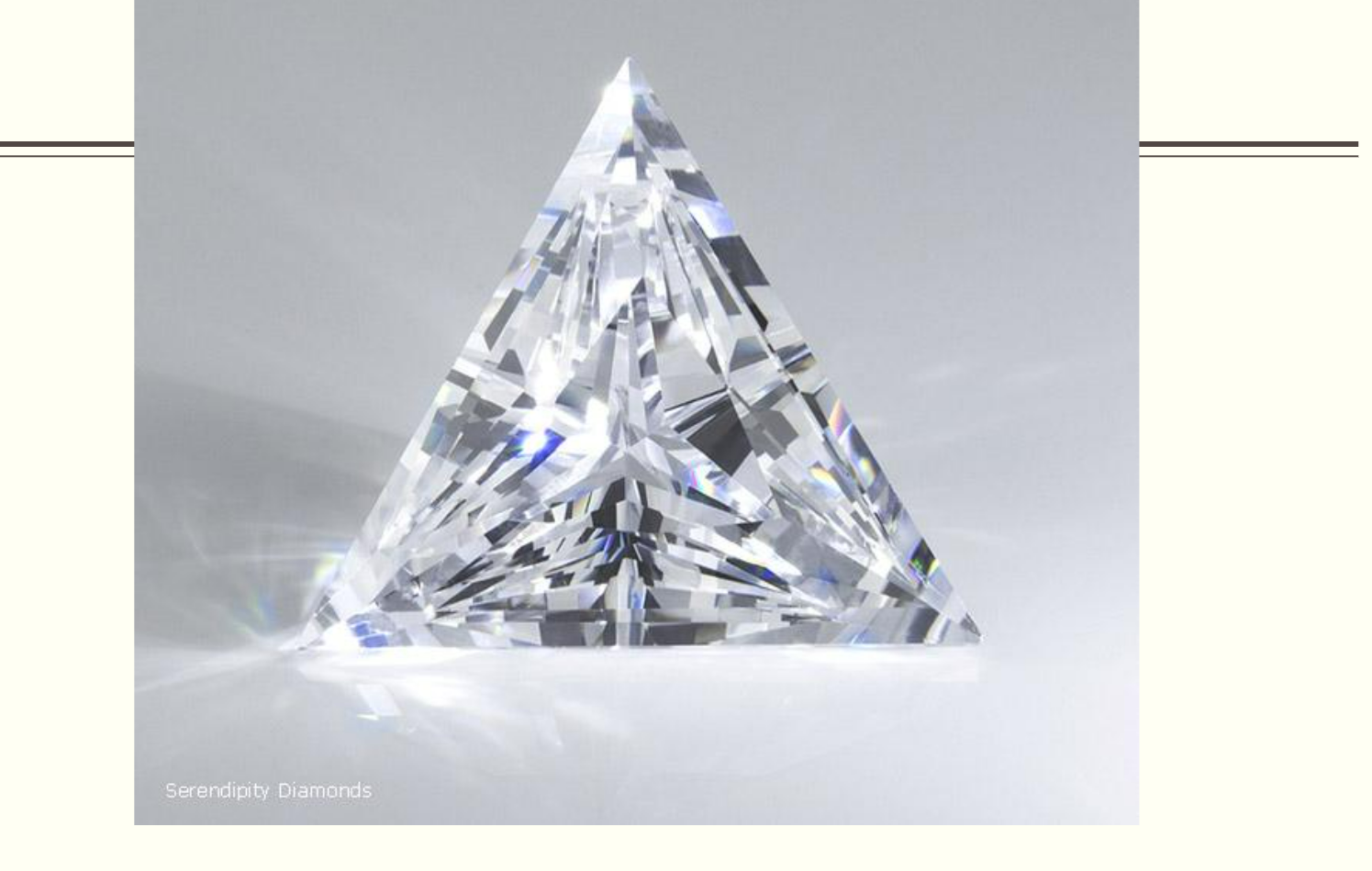
African Latter-day Saint Faith Stories

Hi, I’m Junior Bonza. I grew up in Kinshasa, singing songs like this with my family every night.

Our new film series, entitled Not by Bread Alone, includes the story of how my family joined the Church in Switzerland. But my family’s conversion story has a lot in common with those of others in the DR Congo and French-speaking Africa.

This is why we named the film series Not by Bread Alone. Of course, this phrase comes from Jesus when He said, “Man shall not live by bread alone, but by every word of God.”

These are words that speak to the heart of African Christians. When poverty deprives, disease sickens, war menaces, and human predators victimize for the sake of wealth and power, hundreds of millions of steadfast and resilient Christians in Africa are sustained in their trials by their faith in Christ as they work for a better future.

Congolese Saints are not reticent in sharing their faith and their gratitude.

The more you get to know them, the more you will see that the kind of peace they find in Christ is not best expressed as a contemplative solo—a small, trickling feeling from a single individual—but rather in Congolese fashion: as a soaring group of voices, boldly singing in a chorus of joyful, loving praise.

It is a thundering waterfall of power and emotion.

The Growth of the LDS Church in DR Congo

What is special about the DR Congo?

First, it is located in the very heart of Central Africa. The DR Congo is vast—the second largest country in Africa—about the size of the eastern United States. It features lush rainforests and unique wildlife such as the mountain gorilla, the okapi, the super-smart bonobo, and very light insects.

The country is bordered by the Congo River, the deepest and most powerful river in the world.

The country is blessed with beautiful, intelligent, and enthusiastic children. But for Latter-day Saints, the DR Congo is special for another reason: it is one of the fastest-growing areas of the Church.

French-Speaking Africa and Church Expansion

The historic boundaries of French-speaking Africa cover a surprisingly large and populous portion of the entire continent. In fact, the Church is growing so quickly in these countries that some people think French might eventually become the most common language in the Church.

The DR Congo already has the second-largest Church membership in Africa, and the rate of growth and retention is phenomenal—even when compared with other African countries.

The geography of Church growth is also a fascinating subject. Over the last decade, membership has spread out from five centers of strength to dozens of faraway locations, whose numbers continue to increase quickly.

Stories of Faith and Sacrifice in the DR Congo

Many of these outposts of faith are in incredibly remote places.

Places like Likasi, where as a missionary I used to meet on Sundays in a small room with a handful of members—today Likasi has multiple stakes.

Laputa, a small village where the first stake was formed before any full-time missionary had ever served there.

There are currently 112 full-time missionaries serving from Laputa’s two stakes.

The Bateke Plateau, where Church members have traveled to gather family history from tribal leaders.

Kisangani, the home of the fearless Wagenya fishermen. In just a few years, the Church in Kisangani expanded from a single branch to a district with six branches.

Not by Bread Alone Film Series

Not by Bread Alone is not a lesson in geography or statistics. Instead, it tells the stories of faithful members like these, who have joyfully embraced the gospel—sometimes at great personal cost.

For example, the episodes present stories of bright and dedicated missionaries, elders and sisters, whose devotion becomes clear when we begin to learn their backstories.

This is Cedric Chiamwe, who worked selling bananas, traveling from town to town on his bicycle to earn the $250 needed for his missionary passport. It took him four years.

And this is Matthew Kalume Abi Lua. His family received a testimony of the restored gospel in the 1970s along with hundreds of other nearby Saints. But the villages where they lived were so remote that missionaries could not go there.

Unbaptized Converts Staying Faithful

Wondering what had happened to these Saints, two recently returned missionaries braved a long and risky journey to find out if these groups of converts still existed.

After many difficulties, they learned that these unbaptized converts were still true to their testimonies and had continued to hold Sunday School and study the Book of Mormon in their villages for nearly 50 years—almost completely on their own.

Matthew’s mother pleaded with the two young men to find a way for the twelve children to be baptized, but they were not authorized to do so.

Finally, at the age of 25, Batu convinced his father and mother to let him travel alone to the city of Lubumbashi, 600 kilometers away. There he could be taught, baptized, receive the priesthood, and be called to serve a full-time mission.

Movingly, he tells of how sweet it was to be able to take the sacrament for the very first time in his life.

Ripple Effects of Faith and Service

In one episode, Elder Willie Binene Subwe—now an Area Seventy—tells the story of the life-threatening journey from ethnic persecution he made with his family and thousands of others.

His young life was a string of disappointments. Then everything took a major turn for the better when he met Lily, whom the Lord had shown him in a dream.

Together, they raised their family, built a school, and with the help of the Church mobilized the entire village, day in and day out for a period of three years, to dig an 18-mile trench by hand through the forest to bring clean water to their families.

The Power of Generosity and the Temple

Another episode illustrates what we like to call the ripple effect of generosity—people in need being helped and then going on to help other people.

For example, David and Josephine Windsor lived with their boys in a one-room home of a few square meters on a noisy street in Kinshasa. They had no electricity or plumbing.

In the middle of the room was a pedal-powered sewing machine where David earned a living as a tailor. He is completely blind in both eyes. His wife has a handicap.

After joining the Church, David and Josephine dreamed of starting a school where disabled people could learn to sew and earn a living. Through the help of kind friends, that dream became a reality.

Here, David—who has never seen a school or his students with his own eyes—deftly teaches his class how to measure, cut, and sew.

After years of preparation, David and Josephine Windsor were sealed in the Kinshasa Temple.

Since 2019, five temples have been dedicated or announced for the two Congos. The temple is an oasis of peace for families, for the young and the old, for jovial logistics experts, hardy construction workers, dedicated gardeners, and diligent guilders.

The time has come to tell the full story of the Saints. Now, in this special moment, while new temples rise to witness the faithfulness of these spiritually sensitive people, our film series will remind the rising generation worldwide that the core of the bright, beating heart of Africa—the source of light and life and love of its people—is not the daily bread, but rather the True Word of God, now restored in its fullness to the earth. (end of film)

Sharing the Stories of African Latter-day Saints

I’ve seen that film many times, but it still touches me. I feel the devotion and faith of the people who I’ve been privileged to know in the DR Congo for the last while.

Thanks to some generous donors, we were able to extend that to a few other countries in Africa that are close by in the heart of Africa.

I’m not going to say too much about the other things we’re doing in the film series. If you want to learn more, you can go to the website: NotByBreadAloneFilm.com. You can learn more there—it exists equally well in French, as do all the videos, short videos, and episodes of the history.

Junior Bonza: A Witness of Church Growth in DR Congo

Hello, everybody. Well, don’t believe everything you said about me. Some of it is not right. I’m just a simple guy, but it’s so good to be with you today.

When we talked about coming over and meeting with you tonight, I thought, What am I going to share with them?

The videos are probably going to tell you a lot about what’s going on. But then my mind started focusing a little bit, and I decided today I will come for those who already know this: I want to confirm one truth—that the Church is true.

For those who don’t know that yet, I’m letting you know that the Church is true.

The Fulfillment of Prophecy

We all know about the prophecy of Daniel, who saw the little stone cut off a mountain without the help of any hand that rolled and kept rolling until it filled the whole earth.

I’m here to let you know and to tell you a little bit about the fulfillment of that prophecy.

I was born in Kinshasa, as mentioned earlier, but I’ve been in America, particularly in Utah, for over 20 years—24 years.

As I’m looking at two worlds, it’s easy: if you live in Salt Lake or anywhere else in Utah, as you leave your home, there’s a chapel almost around every corner. It didn’t use to be this way. The pioneers didn’t have chapels around corners everywhere. They built them and they grew, and now we’re here and we reap the benefits of what they did.

I want to tell you about that same story, but on the other side of the world, in Central Africa—particularly in the Congo.

The Beginnings of the LDS Church in DR Congo

To help you understand my position, and why I can talk about it this way: I have witnessed the growth—the birth, actually—and the growth of the Church over there.

My family, my parents, joined the Church in Switzerland in 1979. I’m not going to go into the details for the sake of time, but they were there on a scholarship from a different church—the Presbyterian Church.

While they were there, they met the missionaries and joined the Church right away.

You see the picture? These are the two missionaries, and in the blue pajamas—that’s me. And that’s my brother, Phil.

As soon as they joined the Church, the scholarship was canceled, and we had to go home. So we went home.

This was October 1979. The Church was nowhere to be found in the Congo. In fact, at the time, the only countries in Africa that had some type of representation for the Church were South Africa, Nigeria, and Ghana. No French-speaking country on the continent had the Church.

So what were we going to do?

The First Baptisms in Central Africa

By the providence of God, in 1986 the Church was authorized to be established in the Congo.

Now, see the sixth person in the middle of the picture? That’s me, the little kid right there. I was being taught the missionary discussions because my brother and I did not get baptized in Switzerland. We were too young.

By 1986 we could be baptized. President and Sister Hutchings were the first missionaries to be assigned to the Congo, and my baptism was the very first baptism in the country.

As far as we’re trying to figure out, we haven’t found any record of another baptism anywhere in Central Africa before then. The Congo may have been the very first country in Central Africa to receive the gospel.

So, my baptism was probably the very first baptism in Central Africa.

Let me show you this. This is the day I was baptized. The kid in the blue shirt—that’s my brother. And I’m standing right next to that skinny little dude—that’s me.

This picture was taken maybe 20 minutes after I was baptized.

This was June 1986. Two baptisms: me and my brother.

The LDS Church Rolling Forth in Africa

Today, in 2024, we have about 30 stakes.

The Church has one temple in Kinshasa that’s dedicated. There is one being built in Lubumbashi. We have one where the site has been selected in Kananga. And we have one in Bukavu that’s been announced—not counting the one in Brazzaville, which is a different country but basically the same place because we used to be the same mission. It’s just across the Congo River.

Why am I telling you this?

So that you will receive confirmation that the Church is rolling forth. Africa is being blessed by the gospel of Jesus Christ. It is going everywhere.

The Church’s Rapid Growth and Missionary Efforts

I was speaking recently with Elder Thierry Mutombo. Elder Mutombo is the Africa Area President. He’s a very, very, very good friend—actually, family.

He was telling me that last year, if I were to ask you to guess: How many baptisms do you think they had in a year?

For the country, they had 18,000 new members.

A 20% Increase in Membership

That’s a 20% increase in one year.

There are now about 100,000 members, and the Congo is now the number one producer of full-time missionaries on the continent.

The other interesting thing is that those missionaries are coming mostly—60% of them—from Central Congo, the Kasai region.

That’s where Jeff was telling us, even in the video, where we had stakes organized without any full-time missionaries ever being there.

Stakes Organized Without Missionaries

Basically what happened was this: we had members who came from a different stake. Elder Binene, for example, and his family were kicked out.

They were refugees coming from Likasi and Kolwezi. From there, they went to Laputa—that’s the homeland. It was a place they had never been. These were kids and people who were born in Kolwezi.

Because of ethnic issues, they were told: Go home. Go home where your ancestors came from.

So they went back to Laputa, not knowing anything. But one thing they had was the gospel.

They kept it. Teaching continued. They taught the children and the neighbors.

Pretty soon you have congregations meeting under trees and in people’s homes.

When the report comes to Area Headquarters and they ask, What are we going to do with these people? The answer: Well, you are a stake now.

Just like that. And they keep going—growing and growing.

That little stone is filling the earth.

I believe now is the time for Africa.

Languages and Scripture Translation

We press for time, so I’m going to stop there.

We have ten minutes, right?

I was told you might have questions.

Stay up there, sir. Are there any questions?

English in the Congo is taught in language learning schools, but French is the official language. We have about 450 different dialects besides that.

By the way, the Book of Mormon is now translated in Lingala, and we just completed work in Chiluba.

Church Membership Across French-Speaking Africa

Oh, French-speaking members—yes, all of them are French-speaking.

Right now, we have probably about 118,000 members or so. That’s just for the DR Congo.

Now, the area includes countries that are not French-speaking. So the French-speaking countries include:

  • DR Congo
  • The Republic of Congo
  • Gabon
  • Cameroon

We also had Rwanda, but not anymore. So there are four countries that are specifically French-speaking.

I would assume, between all of them, probably around 150,000 members.

LDS Church Growth in West Africa

Then we have West Africa—places like Côte d’Ivoire. But that’s a different area.

The Cost of Missionary Work and Passports

When we talked about missionary passports, is it because they’re going to a different country?

Here’s the thing: many people are very, very poor. They cannot afford a mission.

So they use Church funds and help to go on a mission, but they are being asked to contribute something.

One thing they’re being asked to contribute is: at least get your own passport.

See if that’s possible, because you never know where you’ll be sent.

These missionaries are being sent to Ivory Coast and throughout Africa. They’re everywhere. In fact, recently we’ve had some of them come to the US and Europe.

So before your mission call comes, they want you to have your passport.

Challenges to Church Growth in DR Congo

Where’s the greatest source of opposition to the work?

Is it from the government? From other churches? From officials?

No, I think—not the government.

We are establishing very good relationships with the government.

In fact, the current Minister of Agriculture used to be a stake president.

So we’re establishing good relationships with them.

Personally—Jeff, I don’t know—but to me there’s no big opposition except maybe poverty.

Poverty pushes people to do things they wouldn’t do otherwise.

So to me personally, that might be the only thing.

Political Stability in the DR Congo

How stable is the political situation?

They’re working on it.

For the last five years, they’ve now had—for the first time in 2018—the first democratically elected president.

That’s trying to uproot systems that had been there for 60 years.

They’re working on making it a better way, but there are still a lot of problems. At least they’re on the right track.

Why the Congolese Are Open to the Gospel

What helped the people be prepared for such an expansion?

I’ve thought about that many times.

By nature, the Congolese people are Christian—98%, maybe 95%, I don’t know—Catholic, Presbyterian, Baptist, and so on.

But I would also say culturally, the beliefs and disposition of the Congolese people are very close to the Church.

Let me give you an example.

As missionaries, we’re teaching people about temple work—we’re doing temple work for our ancestors.

Many people might look at it like, What are you talking about? What are you doing with or for your ancestors?

But the Congolese people—that’s not unusual to them.

We believe that our ancestors are close to us. We believe they’re there, that they see us, that they’re close around us.

So when you tell them, I am going to be baptized for my grandpa, they say, Yeah, of course. Absolutely. Go ahead.

Also, their disposition is just believing.

No one says no to having the missionaries in their home.

That’s one thing. So many of us who have been on missions—we know the number one thing we want is to sit down with someone and bear testimony.

Now imagine a whole people who would never say, I’m not interested in having you sit down.

Once they sit down and you start talking to them, it makes sense.

The reason they never say no to having missionaries is because they believe in God.

If you are a representative of Christ, of course you’re welcome. Please, come and sit down and tell me what you have.

Even if, in the end, they don’t join, they at least want to give you the respect of listening to you.

The Pathway Program in the DR Congo

How’s Pathway working?

Pathway is working very well.

The Church educational system is working hard to put it together—even in places that are so remote they don’t have running water or internet connections.

Places like Bukavu still have issues, but in big cities like Lubumbashi and Kinshasa, a lot of people are enrolling.

It’s working and helping many people.

Retention Rates and Family History

In one of the stakes of Kinshasa—one of the 30 stakes there—I’ve heard they have 1,000 people enrolled in Pathway. About 50% are members and 50% are non-members.

Brother Mutombo said the retention rate is around 60–70% for the area. In the DR Congo, about 75%.

Family history?

In many places in the world, you don’t know who your ancestors are because there are no written records of who they were.

We have that problem in some areas too.

A lot of the history has been passed down orally.

The Church has established a program where contractors go into villages, recording these oral histories from all these villages and families.

That’s helping a lot because of the program they’ve implemented.

Translation and Vibrant Worship

Any current plan to translate more Church materials into Congolese languages?

Not right now.

The centers of strength are Lingala and Chiluba. Swahili already exists because of the Western and Eastern African countries like Kenya and Tanzania.

However, that Swahili is a little different, so I think last time I was talking to someone in Church translation, they may look into adapting it.

But right now, you have Lingala, Chiluba, and French, of course.

How Wards and Stakes Differ

How do the wards and stakes in DR Congo differ from here?

One big fact: the average age of those coming to Church and being baptized is 19.

That’s a major difference.

Most bishops I know are in their mid-20s to early 30s. The stake president might be 35.

Because they’re so new, they’re learning. There’s a lot of learning to be done.

One big challenge is: Where do we put them?

How do you build 10 stakes at once, quickly, in a place where you can’t even go by car?

That’s a big problem.

But when you go to Church, everybody is enthusiastic.

You should hear them sing. That’s one thing I miss a lot—singing in Church during sacrament meeting or otherwise.

You should see the choirs.

Every ward wants to have a choir. And that choir is a real choir.

The bishop doesn’t have to stand up and say, Those who want to come and be with Sister Peterson after Church in choir practice… No.

It’s very vibrant. Very, very vibrant.

Music in Church Services

Do we have traditional forms of music performed in Church that we don’t have here?

For official Church meetings—no.

The hymns are the same.

For other activities—yes. You may have African music being played.

But during Church services, it’s the exact same thing.

By the way, they’re also working on translating the hymns into Lingala.

Thank you so much. Thanks for your time. [Applause]


DNA vs the Book of Mormon

Summary

Mike Ash and Ugo Perego address claims that DNA evidence disproves the Book of Mormon’s historical authenticity by not finding Israelite DNA among Indigenous Americans. They propose that Lehite groups, described in the Book of Mormon, would likely have mixed with a larger existing population in the Americas, explaining why no identifiable Israelite DNA may be traceable today. They further argue that DNA analysis on this issue is limited by factors like genetic drift and admixture, which can obscure small groups’ DNA over generations, and advocate for a nuanced approach to scripture and science.

This talk was given at the 2023 FAIR Annual Conference at the Experience Event Center, Provo, Utah on August 2, 2023.

Transcript

Introduction by Scott Gordon

Our next speaker is Mike Ash. Mike Ash is a veteran member of FAIR. He’s been with us forever—at least as long as I can remember. He is a former weekly columnist for the Mormon Times in Salt Lake City’s Deseret News and has presented several papers at LDS-related symposiums. He is the author of Of Faith and Reason: 80 Evidences Supporting the Prophet Joseph Smith, Shaken Faith Syndrome: Strengthening One’s Testimony in the Face of Criticism and Doubt, Bamboozled by the CES Letter, and Rethinking Revelation. He has written hundreds of articles defending the faith, which have been published by FAIR, FARMS, Sunstone, Dialogue, and the Ensign.

His co-author on this talk is Ugo Perego. Ugo Perego is a native of Italy. He received a BS and MS in Science from BYU Provo and a PhD in Genetics and Biomolecular Sciences from the University of Pavia, Italy, under the mentorship of Professor Antonio Torroni. His PhD dissertation focused largely on the original migrations of Native American populations using different genetic markers. Ugo is currently a full-time biology instructor at Southwestern Community College in Iowa. He lives with his family in Nauvoo, Illinois.

So, with that, we’ll have Mike Ash come forward.


Presentation

Mike Ash:

Good morning. It’s exciting to be here today. Yes, I co-wrote this with Ugo, and it’s a topic that he obviously has all the technical background in. He’ll be here for the Q&A to answer any questions that go way over my head. But this is a paper we worked on together because I have an interest in assumptions and the human element that makes this a faith challenge for some people.

Theories Regarding Early Population of the Americas

When the Book of Mormon first came forth, there were several theories regarding how the Americas were first populated. The Book of Mormon seemed to provide some support to a common early American theory that the New World was originally populated by people from Old Testament days, perhaps even from the Lost Tribes.

Over time, however, newer scientific studies indicated that the ancient Americas were mostly, if not wholly, populated by Asiatic groups that came to the New World thousands of years before any Book of Mormon peoples might have arrived.

DNA studies, for instance, are among the scientific fields of research that have contributed to answering the question of New World population origins.

Members of the Church see mortality as a testing ground where we must live by faith. Deep down inside, however, most of us think it would be comforting to find secular evidence that would prove to the world that Joseph Smith was a prophet.

Individuals hostile to our theology, on the other hand, are typically convinced that Joseph Smith was a fraud and they are confident that science will eventually find a “silver bullet” to end his prophetic pretense.

DNA Studies and The Book of Mormon

DNA studies appeared to be the kind of scientific weapon that would either vindicate the Church or substantiate the critics’ attacks. This idea sounds good on the surface, but does not really hold up under scrutiny. As one vocal critic explained, even if modern DNA studies exhibited an Israelite presence in the ancient Americas, it would not in the slightest lend some credence to Mormon truth claims.

All such a find would do, he argued, was confirm what many people in Joseph Smith’s day already accepted—the common belief in the United States 175 years ago that the “Red Man” was a descendant of the Israelites.

This consideration, of course, is mostly accurate. While the discovery of Israelite DNA from ancient America would be consistent with the Book of Mormon story, it would not prove that the Book of Mormon was true or that the DNA belonged to Lehi and his descendants.

If, on the other hand, no Israelite DNA could be found in modern indigenous peoples of the Americas, it might again appear to be a victory for those arguing against the historicity of the Book of Mormon. And that is exactly what happened.

There is strong DNA support for the Asiatic origin of the indigenous peoples of the New World. This creates an apparent discrepancy between the Book of Mormon narrative and modern science. According to DNA data, the New World was not first populated by people from the Tower of Babel or Lehites from Jerusalem.

The scientific evidence regarding the origin of the Amerindians has been used by some critics as a favorite weapon with which to bludgeon Joseph’s prophetic abilities. The Book of Mormon, they argue, is of fictional nature and simply repeats a common 19th-century myth regarding the population of the Americas.

The Church of Jesus Christ of Latter-day Saints, as an institution, is a large canopy. It embraces a diversity of family members, some of whom have slightly different viewpoints on certain beliefs. The Book of Mormon has often been the topic of both under the canopy family disagreements as well as food fights.

Although some members believe that the Book of Mormon can be both sacred scripture as well as a fictional tale dictated by Joseph Smith, orthodox members traditionally accept the book as a record written by real ancient prophets about ancient New World Christians and pre-Christians.

Ugo and I accept the traditional narrative of Joseph Smith and the translation of the Golden Plates. We believe that Joseph Smith received real metal plates that contained records of real people who once lived in the ancient New World.

This record-keeping people, whom we know as the Nephites, recorded not only their religious history, but also their interactions with God and a visitation from the Savior.

For those of us who accept the traditional narrative, the DNA data—unless more closely examined—could present a stumbling block to faith. In the paper which Ugo and I wrote, we discussed the limitations of a generalized, all-or-none approach to the relationship between the Book of Mormon in its proper religious context and the genetic history of the ancestors of the Amerindians.

We also restate fundamental basic principles governing the field of population genetics within the proper historical context of the Book of Mormon narrative.

As we will show, the critics’ assumption that DNA studies prove the Book of Mormon to be fictional is erroneous because the DNA/Book of Mormon issue is more complex than simply looking for the presence or absence of Old World DNA in modern or even ancient Amerindians. It’s important, however, that we first examine common assumptions and expectations to determine if genetics can provide a reliable testing hypothesis for the truthfulness of the Book of Mormon record.

What does the Book of Mormon say, and what doesn’t it say? What should it say, and what shouldn’t it say?

The Book of Mormon’s Say About the Native American Population

The traditional folk interpretation of the Book of Mormon suggested that the Jaredites were the first people to come to the Americas and as their civilization was coming to an end, the Lehites and the Mulekites arrived in the New World.

These three groups, according to the traditional interpretation, were responsible for populating virtually all of the Americas. Such was the conclusion of most, if not all, early Latter-day Saints. This reading has been perpetuated as a tradition among members of the Church, although an official statement on this matter has never been made.

While the Church said little about the issue until recently, the hemispheric geographic model has been rejected by virtually all Latter-day Saint scholars.

The Church recently published two articles titled The Book of Mormon and DNA Studies and Book of Mormon Geography, assuming a limited rather than hemispheric geographic model. While the articles in question do not declare the issue to be doctrinally relevant, the fact that they are posted on the official Church website does suggest a quasi-official endorsement of the best current academic perspective regarding Book of Mormon geography.

In recent years, renewed emphasis on this subject sparked for a change the Church made in the introduction of the Book of Mormon.

The 1981 text read, “After thousands of years, all were destroyed except the Lamanites, and they are the principal ancestors of the American Indians.” (Emphasis added.)

In 2006, a minor change was introduced: “After thousands of years, all were destroyed except the Lamanites, and they are among the ancestors of the American Indians.” (Emphasis added.)

Since this introduction was not part of the original Book of Mormon manuscript, it was a modern addition to help prospective readers understand the book’s claims. This change seems intended to clarify, not modify, the Book of Mormon‘s narrative pertaining to population dynamics.

In fact, both terms implicitly acknowledge the existence of other populations at the same time as the Book of Mormon peoples. 

The logic of the early Latter-day Saints’ interpretation derives from the following assumptions, which were prevalent in Joseph Smith’s day:

  1. The Noachian flood wiped out all but a handful of humans who ended up in the Middle East.
  2. The peopling of the Americas had to come after the universal flood and was likely initiated by a group or groups of individuals who came to the Americas from the Middle East.
  3. The Ten Lost Tribes of Israel had been dispersed to remote regions of the world, including quite possibly the Americas.

While the Book of Mormon does not teach the Jaredites, Lehites, and Mulekites were part of the Lost Tribes, the story of the three Middle Eastern migrations meshed quite well with the popular early American view that the native peoples of the Americas were descendants of Israel.

Revelation vs Assumption

Without revelatory course corrections, Latter-day Saints—like all humans do—believed, defended, and promoted the ideas that made the most sense from their own paradigms. And this dynamic applies to prophets as much as it does to any other person. In the absence of revelation, every prophet—from Adam to Moses to Paul to Joseph Smith to Russell M. Nelson—has the freedom to voice their opinions and come to their own conclusions, even if those opinions and conclusions are incorrect.

Based on a 19th-century American paradigm, the plain reading of the Book of Mormon text generated an interpretation that, while blending comfortably with the assumptions of an earlier generation, did not accurately (from today’s academic perspective) account for how the text should read if it truly came from the ancient past. As most scholars understand today, there is no such thing as the “plain reading” of the text.

As Bruce Malina, a social scientist and American biblical scholar, explains, “Meaning does not come from the words; meaning invariably derives from the general social system of the speakers of a language.”

Malina’s colleague New Testament Richard Rohrbaugh, noted, because all readers “must interact with writings and ‘complete’ it if it is to make sense, every written document invites immediate participation on the part of the reader. Thus writings provide what is necessary, but cannot provide everything.” Everything we read is filtered through our thoughts, perspectives, and assumptions.

“The facts of the world,” notes science writer and historian of science Michael Shermer, “are filtered by our brains through the colored lenses of worldviews, paradigms, theories, hypotheses, conjectures, hunches, biases, and prejudices [which] we have accumulated through living. We then sort through the facts and select those that confirm what we already believe and ignore or rationalize away those that contradict our beliefs.”

For example, in 1963, more than a decade before Black Latter-day Saints were allowed to receive the blessings of the priesthood, the late Latter-day Saint scholar Eugene England met with the Apostle Joseph Fielding Smith (who later would become President of the Church) and discussed the common Latter-day Saint belief that Black members were less valiant in the premortal existence. 

England recalled,

I got an appointment with Joseph Fielding Smith and asked him directly if I must believe in the pre-existence hypothesis to have good Church standing. He replied, ‘Yes, because that is the teaching of the scriptures.’ I asked him to show me the teaching in the scriptures since I had not been able to find it there. President Smith patiently went through the sources with me, particularly the Pearl of Great Price, and then he said something quite remarkable: ‘You do not have to believe that Negroes are denied the priesthood because of the pre-existence. I have always assumed that because it was what I was taught, and it made sense, but you don’t have to believe it to be in good standing, because it is definitely not stated in the scriptures. And I have received no revelation on the matter.’” 

Assumptions drive our inferences about the things we encounter. Sometimes they’re right, sometimes they’re wrong. This gets more complicated when we try to interpret the writings of authors who lived in a time and culture far removed from our own.

As historian Sam Wineburg explains,

Because we more or less know what we are looking for before we enter this past, our encounter is unlikely to change us or cause us to rethink who we are. The past becomes clay in our hands. We are not called upon to stretch our understanding to learn from the past. Instead, we contort the past to fit the predetermined meanings we have already assigned it.”

Modern prophets have not received revelatory details needed to clarify our historical and geographical understanding of the Book of Mormon. Instead, they receive revelation on how the Book of Mormon works as a spiritual instrument.

Our human nature, however, leads us to demand responses for all unanswered questions. Therefore, assumptions about the earliest American populations and how they’re related to the Nephite scripture have emerged from supposition, as well as from the informed and uninformed opinions of both Latter-day Saint leaders and the general membership.

These speculations and opinions were shared—and are still shared—from the pulpit, as well as in religious classroom settings. The things one hears casually mentioned in Sunday School often acquire quasi-official status, and these unofficial “truths” become culturally entrenched until someone questions whether such interpretations are truly official, as was expressed in the story of Eugene England and Joseph Fielding Smith.

Science vs Religion

An analogist case is the apparent discrepancy between biological evolution and the biblical account of the Creation. Scientific evidence abounds when it comes to the evolutionary processes involved with the formation of the Earth and everything within and upon it.

Evolutionary theories, however, are often rejected by those who adopt what they believe is a plain, literal reading of the biblical text. So who is right—science or scripture?

As evangelical biologist Jeff Hardin explained to writer William Saletan,

when the two… don’t seem to match, the error might be in his own understanding of the Bible. Rather than reject what science has discovered, [Hardin] asks how scripture can be understood better so that it fits the scientific evidence.”

Even the Church recently suggested a more nuanced approach to the biblical account of the Creation, reminding us that many of the details surrounding this event have not yet been revealed. We should learn to take a similarly nuanced approach with the Book of Mormon text.

Just because most past and current members believe that the Lehites populated the entire New World does not mean that such a view is taught in the text.

In fact, thanks to science, we cannot deny the existence of perhaps millions of people in the Americas prior to the purported arrival of Book of Mormon immigrants, and this must be taken into consideration as we read and interpret the Nephite records, regardless of what anyone has said in the past about the contribution of Lehi’s party to the population.

So, to quick- I’m going to put in a shameless plug here to a book that FAIR published of mine a couple of years ago called Rethinking Revelation: The Human Element in Scripture/The Prophet’s Role as Creative Co-Author, ‘cause this ties to this topic that I’ve discussed so far, in how God speaks to all of us, including prophets, through the manner of our own language, and how cultural biases, and opinions, and so forth still affect the language in which revelation is given—it’s the “manner of our language.”

LDS Scholars’ Studies of Peoples in the Book of Mormon

Long before James Watson, Francis Crick, and Rosalind Franklin discovered the double helix structure of DNA, a number of Latter-day Saints were coming to realize that the Book of Mormon peoples might not have been the sole parties responsible for populating the entire Western Hemisphere.

Based on a close reading of what the text did and didn’t say about itself, these Latter-day Saints scholars concluded that the Lehites represented a small incursion into a larger existing American indigenous population.

This reminds us that this perspective is not a recent development cobbled together to save a “floundering Book of Mormon” from the threat of DNA science, but that it arose long before DNA science became a tool to criticize the Book of Mormon’s historicity.

Scholarly views of the Book of Mormon changed not because of DNA studies but because a growing number of Book of Mormon students were attempting to understand the text from within a larger framework.

This expanded view approaches the Nephite text not only with an acceptance of what modern science tells us but also with the understanding that the original text was written by ancient Old World and New World authors who had pre-scientific worldviews.

Because Latter-day Saint scholars have changed some of the ways we look at the Book of Mormon as history, some critics have accused believing scholars of making ad hoc alterations to salvage the book’s historicity.

Modifying paradigms, however, is a legitimate scientific approach for dealing with anomalies and should not simply be brushed aside.

For example, Daniel Little, a philosophy professor and chancellor at the University of Michigan-Dearborn, claims that when scientists encounter anomalies in their theories, they

must choose whether to abandon the theory altogether or to modify it to make it consistent with the contrary observations. If the theory has a wide range of supporting evidence (aside from the contrary experience), there is a powerful incentive in favor of salvaging the theory”

by modifying the original paradigm. These progressive modifications are integral to paradigm maintenance, and anomaly management is typical in science.

In line with these principles, Guy Consolmagno, director of the Vatican Observatory, summarized a similar concept for stating that science is not meant to prove anything but to describe what we humans observe. In his experience, what humans have seen for centuries needs continual reevaluation based on better technology and understanding.

The Book of Mormon text has changed very little over time. What has changed is our capability to understand its narrative from with an ever-growing body of evidence regarding the origins of America’s first inhabitants. 

John Charles Duffy, a former Latter-day Saint and current visiting assistant professor of religion at Miami University, carefully reviewed the arguments of Latter-day Saint critics and apologists.

Observing that the critics’ accusation that Latter-day Saint scholars resort to the ad hoc fallacy by modifying their Book of Mormon paradigm to accommodate non-Lehites in the New World, he wrote,

“I am not moved by revisionist complaints that the apologists invent ad hoc hypotheses to protect and maintain a crumbling central hypothesis.”

I am not moved by these complaints because the majority of tone aside,

they accurately describe what all scholars do. In the face of contrary evidence, all scholars invent hypotheses that will preserve the paradigm to which they are committed…”

unless extra-scientific forces prompt them to convert to a different paradigm.

“All scholars assign the greatest relevance to those facts for which their paradigm accounts. Facts they cannot explain, they set aside as problems for which solutions will later have to be found.”

Scholarship is a strenuous and devoted attempt to force nature into the conceptual boxes supplied by one’s paradigm.

“This is as true for orthodox scholars as it is for the revisionists.”

While Latter-day Saint scholars’ modifications directly impact the DNA argument, it should be pointed out that this reframing preceded the Book of Mormon DNA issue. Greater understanding of the Book of Mormon came and continues to come from more careful textual analysis, efforts to interpret the text from an ancient perspective, and other scientific and historical discoveries. 

Most Latter-day Saint scholars believe—and have believed for a while—that the Americas were inhabited thousands of years before any Book of Mormon civilizations arrived. Various clues from when the Book of Mormon itself, the text, as well as recognition that the text was written by a tribal dynasty in ancient times, suggest that the Lehites not only would have encountered these native populations but also would have been absorbed into these larger populations.

Unfortunately, we are not privy to the details regarding the text of these assimilations—how soon after the arrival of Lehi’s group the admixture took place, or even when this admixture happened.

Most of these events would have taken place during the first few generations after the arrival of the Book of Mormon migrants to the promised land. If these events were mentioned at all, details, encounters with local indigenous groups, degrees and timing of admixture (if any), and all related population events would have been contained in the 116 pages of the lost manuscript, which covered a period of nearly 450 years.

These difficulties play a fundamental role in determining what a valid hypothesis that could be tested through genetic evidence would look like. We simply do not know enough about the early population dynamics of Book of Mormon people to confidently infer what we should realistically expect to find (or not find).

In the DNA of modern and ancient Native Americans we will not here recite the many Book of Mormon textual evidences that suggest the presence of others in the New World or how the Book of Mormon groups retained the apparent dominant tribal identity even when they mixed with populations larger than themselves.

These issues have already been answered by many others. The resolution of most objections to historicity on genetic grounds hinges on setting realistic expectations about what genetic evidence could possibly be found to validate such arguments.

Cultural Identification vs Genealogical Identification

 First, however, we must address a few common questions that are asked by many critics and some members. If the Lamanites were a small group who left no DNA trace because they were absorbed into a larger population, then who are the Lamanites today? Why did Joseph Smith call Native Americans Lamanites? And to whom was the Book of Mormon written?

While DNA tests may be able to determine biological affiliation to past individuals, it is not the only way to recognize tribal descent. The other two major indicators for tribal pedigree are cultural and genealogical factors.

In most cultures, including ancient cultures, people use exonyms to refer to anyone outside of their group. An exonym is a foreign-applied label rather than the name that people give themselves.

Germans, for instance, do not typically call themselves Germans; they refer to themselves as “Deutsch.” Italians call Germans “Tedeschi,” while the French refer to the Germans as “Allemands.” The Hawaiians were known to others as “Kanakas,” and the Greeks referred to one of their neighbors, known as “Mizraim” to the Hebrews, as “Egyptians.” During the Old Kingdom, Egyptians referred to themselves as the “Remtju ni Kemet,” which meant “people of the black land.”

Likewise, many tribal groups in the Americas are known today by the names that have been given to them by European colonizers or other enemy tribes, and not by how they identified themselves culturally and traditionally through the centuries.

For example, the Navajo people call themselves “Diné,” which means “The People.” The name “Navajo” was introduced by the Spaniards in the 18th century. Similarly, while the term “Native American” is the current label for all groups whose ancestors lived in pre-Columbian America, these people were labeled in the near past with the term “Indian.” These native groups, however, were not known as either “Indians” or “Native Americans” to themselves until they were labeled as such by outside cultures.

We find in the Book of Mormon that the Nephite and Lamanite were also socio-political names. Book of Mormon writers and their followers were called Nephites, and virtually everyone else was called Lamanites. While Laman’s brother Lemuel was not a descendant of Laman, nevertheless, he and his children were called Lamanites because they joined with Laman. Any other Lehite or Nephite who joined the Lamanites would also have been called Lamanite.

People can join and leave cultural groups and their attached labels. Someone of any descent or ethnic background can be an American, African, Asian, or Latter-day Saint.

Jews in Utah can be termed as “Gentiles” because they are not Latter-day Saints. Even outside of Utah, the term “Jew” is applied to someone descended from Judah, as well as someone who adopts Jewish culture and religious life. Someone can be born a Jew or become a Jew through conversion.

Likewise, in 1 Nephi 14:2, we read that righteous Gentiles would be numbered among the House of Israel, as well as the seed of Lehi.

From Latter-day Saint point of view, whenever a dispensation of the fullness of the gospel has been on the earth, missionary work was priority to bring repentant souls back into the flock. These teachings were regularly found in the Book of Mormon narrative.

The term “Lamanite” meant different things to Nephi, Alma, Mormon, and even Joseph Smith. Like someone adopting the label “Jewish” or “Latter-day Saint,” we read in the Book of Mormon that someone could become a Lamanite.

After Christ’s visit to the New World, the Book of Mormon peoples lived in harmony for many decades. During this time, there were no Lamanites nor any manner of -ites, but they were all in one, children of Christ. We read of a small revolt several decades later by the people who had taken upon themselves the name of Lamanites. Therefore, there began to be Lamanites again in the land.

Genetic vs Genealogical Ancestry

Finally, it is important to differentiate between genetic ancestry and genealogical ancestry. As we fill the slots of a family tree, we find that as we go further back—from parents to grandparents to great-grandparents, and so forth—some of our ancestors will show up in more than one ancestral slot. Every person has two parents, four grandparents, eight great-grandparents, and so on.

As researcher Scott Heschberger explained, the number of slots grows exponentially. By the 33rd generation (about 800 to 1,000 years ago), we have more than eight billion of ancestral slots. That’s more than the number of people alive today and certainly a much larger figure than the world population a millennia ago. The reason this happens is that many of your ancestors occupy multiple slots in the family tree.

If we follow our ancestral tree back far enough, and as our ancestors appear in more slots, we eventually come to the “genetic isopoint”—the point in time at which every member of the entire historical population of a geographical area was an ancestor of the entire current population of that area.

The genetic isopoint for living Europeans, for instance, occurred just over 1,000 years ago. If there was a real Laman that had children and grandchildren in the New World, the chances are extremely likely that all modern Native Americans would be able to claim Laman on their family tree, assuming such a tree could be compiled, even if they did not retain any of his DNA. Let’s now see why.

Mathematical models of pedigree charts have shown how quickly these ancestral charts coalesce, thus supporting a much closer relationship between all humans than normally thought.

To start, every living individual has 1,024 ancestors at the 10th generation level. Each of these ancestors is essential for that one descendant to exist 10 generations later.

However, statistically, approximately 10 to 12 percent of these 1,024 ancestors would have contributed any DNA to the present time, 10 to 12 percent, with the rest of the ancestors’ DNA being lost due to chance. Therefore, while all 1,024 genealogical ancestors are absolutely needed for their one descendant to be alive, genetically, only a small fraction of them share any DNA with their posterity. As Heschberger points out, research indicates that we carry genes from fewer than half of our forebears from 11 generations back.

The process of genome inheritance is totally random, but plays a drastic role in the amount of genetic material that would be expected to survive to the present time—particularly if, in this case, admixture with local populations took place shortly after the Lehites’ arrival in the Americas, and if, as seems likely, the host population was millions of times larger than the Book of Mormon party.

Moreover, to add to the implausibility of any Lehite DNA surviving, let us consider that every Native American living today would have had more than 1 billion potential ancestors 30 generations back, or even 750 years ago, if we assume an average of 25 years per generation. Going back to the time of Lehi’s landing, that number would be in the range of 2 to the 100th power, or more than a nonillion (which is one followed by 30 zeros).

Of course, the actual number of Native Americans that lived approximately 2,500 years ago would have been a tiny fraction of that—perhaps in the order of a few tens of millions. What this means is that someone could genealogically be a descendant of an ancestor who lived hundreds or even thousands of years ago without carrying a single genetic marker from that progenitor.

While Native Americans may not retain DNA markers that tie them to the Book of Mormon Lamanites, it can certainly be argued that they have Lamanite ancestry based on genealogical and cultural affinity. In fact, from the Nephite perspective, it could be proper to refer to anyone in the Americas that lacked the knowledge of Christ from the time of Moroni to the days of Joseph Smith as a Lamanite.

If we read the Book of Mormon as an ancient text written by real ancient people with ancient perspectives and assumptions, we find evidence that merges with what we also learn from science—that Lehites were a small incursion of Israelites who joined the existing native population while continuing to write a book that tied them to their ancestral Israelite heritage. The DNA question then becomes not “Why do modern Native Americans not have Israelite DNA if ancient Middle Easterners were responsible for populating the Western Hemisphere?” but rather, “Is it possible to find Israelite DNA from a minor tribe who interbred with a larger existing population more than 2,500 years ago?”

When asked that question, several non-Latter-day Saint geneticists have confidently answered that it would be very difficult to find.

Quotes from those non-LDS scientists can be found in our paper, but to cite just one of these non-LDS geneticists, Daniel Hartl says, (and this is a paraphrase of a quote),

“If a number of Semitic-speaking people from the Middle East settled in North America about 2,500 years ago, and the indigenous population was large, ‘the probability’ that the DNA markers of the Semitic-speaking group would be lost ‘…is reasonably high.’”


DNA and Population Studies

Although some critics might view the arguments we present as apologetic dodges manufactured by believing Latter-day Saint scholars, the field of population genetics is rooted in the very principles we’ve described, and these stand at the very base of the DNA research discipline. Even when two populations have an equal start—same population size, same chance of survival, equal mating opportunities, and so forth—from the time of their admixture and onward, it’s expected that the genetic variation will inevitably change over time. The future gene pool resulting from the merging of these two different populations will include a greater genetic presentation from one group and less from the other. This natural process is called genetic drift and has been observed among many organisms, not just humans.

Simply stated, it is the probability of DNA to be selected and propagated when new offspring are conceived, generation after generation. There are several factors that can play a crucial role in the process of selection, and they have already been addressed elsewhere in light of the Book of Mormon and DNA studies. Obviously, if one of these two populations is disproportionately larger than the other—as in the case of the indigenous people of the Americas versus the colonizing group from Jerusalem—genetic drift will unsurprisingly work in favor of the host population’s gene pool and at a much faster rate.

Moreover, as Native American author Kim TallBear clearly and emphatically elaborated, outsiders should be very careful and particularly sensitive when defining individuals by their “blood” when describing Native American heritage. To Native Americans, their blood link is not as important as their cultural and traditional ties to the indigenous past.

Likewise, although the Book of Mormon peoples purportedly came from the Old World, their main objective was not to genetically colonize the Americas, but to find a haven in which to live their religious and cultural traditions. These were the values that they used to identify themselves. It was either acceptance or rejection of this system of beliefs that determined who was a Nephite and who was a Lamanite, regardless of biological issues.


We can look at similar issues to a similar issue; the lack of Roman DNA in the modern population of the United Kingdom as a model for our research of Lehite DNA. Population geneticist Jennifer Raff, for example, provided the following three postulates as explain of the lack of ancient Roman DNA in the modern population of the United Kingdom:

  1. Genetic drift may have erased their traces from the population.
  2. They may not have left numerous, or any, descendants in the population.
  3. They may simply not have been sampled yet.

Her article rings familiar if we attempt to discover genetic evidence for or against the Book of Mormon.


To be sure, DNA is a remarkable tool to answer questions about an individual population’s past. Through DNA testing, criminal cases are resolved, paternity is ascertained, and thousands of people are discovering their genealogical connections to their genetic cousins. DNA, however, is not the golden key that opens all doors. Certain questions will have conclusive answers, while others will provide diverse degrees of certainty.

Through DNA, we cannot prove, for example, the absolute existence or non-existence of famous historical figures unless we are able to find their remains and definitively recognize them as such. This does not mean that such people did not exist, and neither can we say that DNA is an inaccurate instrument. As one of the authors of this essay, Ugo, recently reported, “Uncertain tools work well for certain questions, and matching the tools to the proper question is both wise and productive, while applying a tool to a question it is not designed to address, brings confusion and dissatisfaction.” This also applies to the inability of using DNA testing to conclusively identify Israelite migrants potentially arriving to the American continent two and a half millennia ago.

Thank you.

Back to top
Audience Q&A

Q&A

Scott: I think we’re going to have Ugo with us in just a moment. I believe he’ll be on the screen at some point. So, I have a couple of questions here for you:

Q: In Third Nephi 5:20, Mormon declares, “I am Mormon, and a pure descendant of Lehi.” The fact that he claims to be a pure descendant of Lehi implies that there are people who are not descendants of Lehi; otherwise, everyone would be a pure descendant of Lehi. What other parts of the text of the Book of Mormon imply the presence of other peoples?

A (Mike): Boy, right off the top of my head, I’m not able to think of several verses. There have been several articles written on this. Brandt Gardner has written some, if I’m not mistaken. There’s some at the Interpreter Foundation, and even some earlier articles — this has been going on for a while. John Sorenson wrote about it. So, there are several verses that basically suggest the presence of others. And again, we have to remember these were pre-scientific people, so they’re not looking at bloodlines. It’s cultural affinity that’s important to them.

And, like I said in my book Rethinking Revelation, I have a large section that talks about the cultural aspects of how that’s really what being Latter-day Saints is all about — it’s what being a child of God is all about, what being a covenant people is all about. And that’s how it’s understood today in a gospel aspect, and it was, of course, understood even more so in a cultural aspect before people understood DNA or any kind of genetics.

So, off the top of my head, I can’t think of the verses immediately, but if you even go to FAIR’s website or Interpreter’s website, you’ll find several articles that give better information on that.

Scott: We’d also like to welcome Ugo Perego here, our DNA geneticist.

Ugo: Can I add something to that question?

Scott: Yes, please.

Ugo: One concept that we need to remember is that the Book of Mormon is a summary, and it’s not a full story, okay? We forget it is an abridgment. And that, Mormon, when he wrote it, made a selection of what he was going to include in those writings. We often forget that part, and that tells us that we don’t have the full narrative.

Second, the first 450 years of the history of the Nephites is the one that was found in the 116 pages that were lost in the manuscript. We think that the small plates replace their history, but they don’t. Nephi is very clear that he’s not going to include historical factors in the small plates. And so, we’re missing from the summary, from the narrative that Mormon made, we’re missing 450 years of history, which are the first 450 years where all the dynamics would have taken place. They would establish the interactions and the changes and the mixture that we’re trying to infer from the Book of Mormon, so we are missing the story. We’re recreating a story without having the story.

Adding to that, even with the huge gap — and it’s a huge gap — number one: The Book of Mormon does not tell us that there were no other people, first of all, okay? So, we might say, “Well, it doesn’t say that there are people,” but it also doesn’t say that there are no other people.

Second, there are verses that actually can be interpreted if you want in that direction. We have Second Nephi Chapter 5, which is basically the only chapter in the small plates that Nephi tells us anything about their arrival in the Americas and their interactions in the Americas. Nephi, in 2 Nephi Chapter 5, lists every single group of people that are going to be divided. It says, “Everyone, every Laman and Lemuel not following me,” and the family, and it says, “You know, Zoram is following me, and my brother Sam is following me, and my sister.” It lists every single one of them. And at the end of this list, which is a comprehensive list based on what we understand were the people on the boat that came with him, at the end of the list, it says, “And all others that wanted to follow me.” He had this thing about “all others” after he had exhausted the list of people that we know were with him. So, who else is “all others”?

And Sherem, in Jacob Chapter 7, looks like he’s an outsider. He’s familiar with the language; he’s familiar with the culture. Why do you have to say that about this individual when that individual should be part of your ethnic and language group? Why do you have to stress or emphasize or highlight that he knows about you guys, and that it took a long time for him to meet Jacob’s among the Nephites? How long would it take to meet someone in a group of 200–300 people, you know? So, he must have heard of him and found an opportunity to meet with him.

And there are plenty of others, you know, the concubine issues described by Jacob. The plural marriage, like how they were taking multiple wives and concubines. We know from the Bible that concubines are usually somebody not from your own family, tribe, or ethnic group. So, there are little hints here and there. I mean, we cannot, for sure, say, “Here it is, the evidence,” but it’s definitely not completely silent about this matter.

Scott: Thank you very much. That’s good. So, here’s the next question:

Q: Would the mixing of native populations account for the Lamanite curse of darker skin from Jacob 3:9?

A (Mike): Well, again, taking a scientific approach to what ancient people would have written, I mean, we understand the curse a lot differently today than the early Latter-day Saints did. Skins are represented, not skins like we see today. In fact, we actually see it even today. I mean, there are things that we learn as Latter-Day Saints — covenant Latter-Day Saints — that tie to skins and from Adam and Eve, that don’t necessarily apply to the physical touch skin. It has to do with a change of character, and that’s actually what’s been the case throughout ancient cultures. In most ancient cultures — and we still see it today — it’s always an “us and them” mentality. I mean, we’re the good guys, they’re the bad guys. The Book of Mormon is written by a group of people. We don’t have a book written by the Lamanites from their perspective, right? But, they’re the bad guys; they’re the outsiders. So, it was viewed culturally as that — a “skin of blackness” means that these people are loathsome. In fact, it’s mentioned in the Book of Mormon: “loathsome.” It’s because they’re the outsiders; they’re the bad people.

So, the curse is not anything to do with a physical change, but it has to do with being part of the covenant people. So, there’s a change in nature. When we’re baptized, we’re changed. We, in a sense, acquire a new skin as well. We become new creatures in Christ. Well, that’s, again, symbolically described many times as skins. This is a common theme throughout history and in the scriptures.

Scott: Thank you. Can you briefly describe the differing paradigms between DNA analysis that is used as evidence in a court of law versus DNA evidence that critics use to try to discredit the Book of Mormon? I’m not sure who that’s for.

Ugo: I can take that question. I do several courses for a forensic department at the University in New Haven, so I have come to learn very well about what constitutes genetic evidence versus what is maybe a genetic hint, or something that might point you in the right direction.

For something to be considered as an incriminating factor, you need to have an exact match with an individual or a relative, like the one you use for genealogical purposes, like ancestry, for example. They’re using that nowadays to actually find potential criminals in cold cases, but the reality is that’s only going to point to a suspect. Then, when you have the suspect, you need to collect an additional DNA sample from the suspect that exactly matches the DNA collected in the crime scene, and that’s what constitutes the evidence — not the fact that you’ve been able to reconstruct a potential link to the individual through DNA. You need the final DNA sample. 

So, in our case, if we find a grave that says “Lehi” on it and we test the bones of that person, you know, then we can probably see how well that DNA fits with the Israelite model of what the DNA looks like. But until we have the exact match or the exact identification, what we’re going to do is gonna be a statistical analysis. You know, you’re going to get some sort of idea, a general idea, but not enough to create and constitute incriminating evidence. You know, does that make sense, with it? So, we have to be very careful. They will not take in a court setting something that you think could be, but it has to be an absolute match.

Scott: Thank you. To go along with that, how would you answer the critics stating the Book of Mormon has large populations — 23,000 Nephites is a common number tossed around — and thusly challenge the idea that Nephites were just a small tribe?
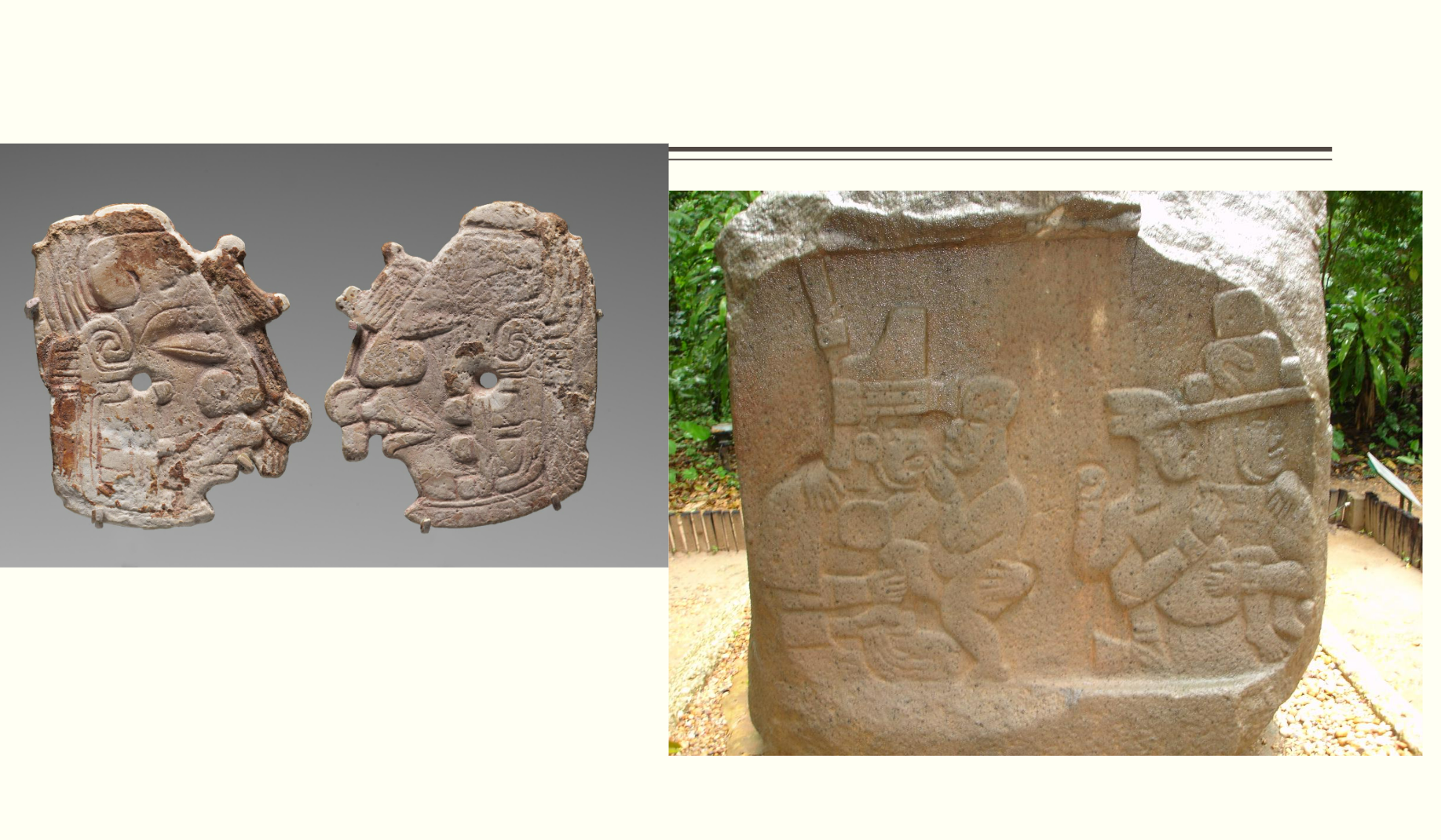
Mike: Well, they would have started off as a small tribe, but we know, you know, the whole point is that it was a small incursion into a larger population. That’s just it. How these numbers expand exponentially it’s because there were other populations there, so there was intermingling, there was admixture. And I mean, that’s actually, you know, a point in favor of the LDS scholarly approach — that they were a small incursion into this population. And again, if you become a Latter-day Saint and you were something else before, now you’re a Latter-day Saint; you’re part of that cultural population. You become a Nephite, you’re part of that. And so they can correctly claim thousands, or millions, or whatever numbers. You know, and even numbers, sometimes in ancient cultures — there were, you know, exaggerations and stuff. But nevertheless, the populations grew as people joined.

Ugo: Can I add one thing really quick?

I want to go back to the interpretation of skin color that was in the previous question. We as Europeans, with our classical model of understanding, which is what we inherited from the Greeks, we tend to interpret everything literally. When we say 1,000, we mean 1,000, one-to-one. When we refer to “skin,” we mean the skin, the organ of our body that we identify as skin. But that is a literal interpretation of writings. In the Semitic model those things had different meanings. There are several books that help you understand this. My good friend, sitting there in the audience, once gave me a book called Misreading Scripture with Western Eyes. It explains that, in reality, skin meant something different.

So skin, as Mike explained, is a symbol of the soul. You know, we still use words nowadays like “dark countenance” or “I have a bright idea.” These things identify positive and negative by using the imagery of light and shadows. The same thing goes with numbers, you know — “a thousand people” or “a million people” just means a lot of people to them. It was such a large number that it was hard to define or count. We tend to take that very literal, but that’s our problem interpreting the scriptures, not a problem with them writing these concepts.

Scott: Thank you. So, we’re out of time. I have one last question I’m going to blindside you with. Ready?
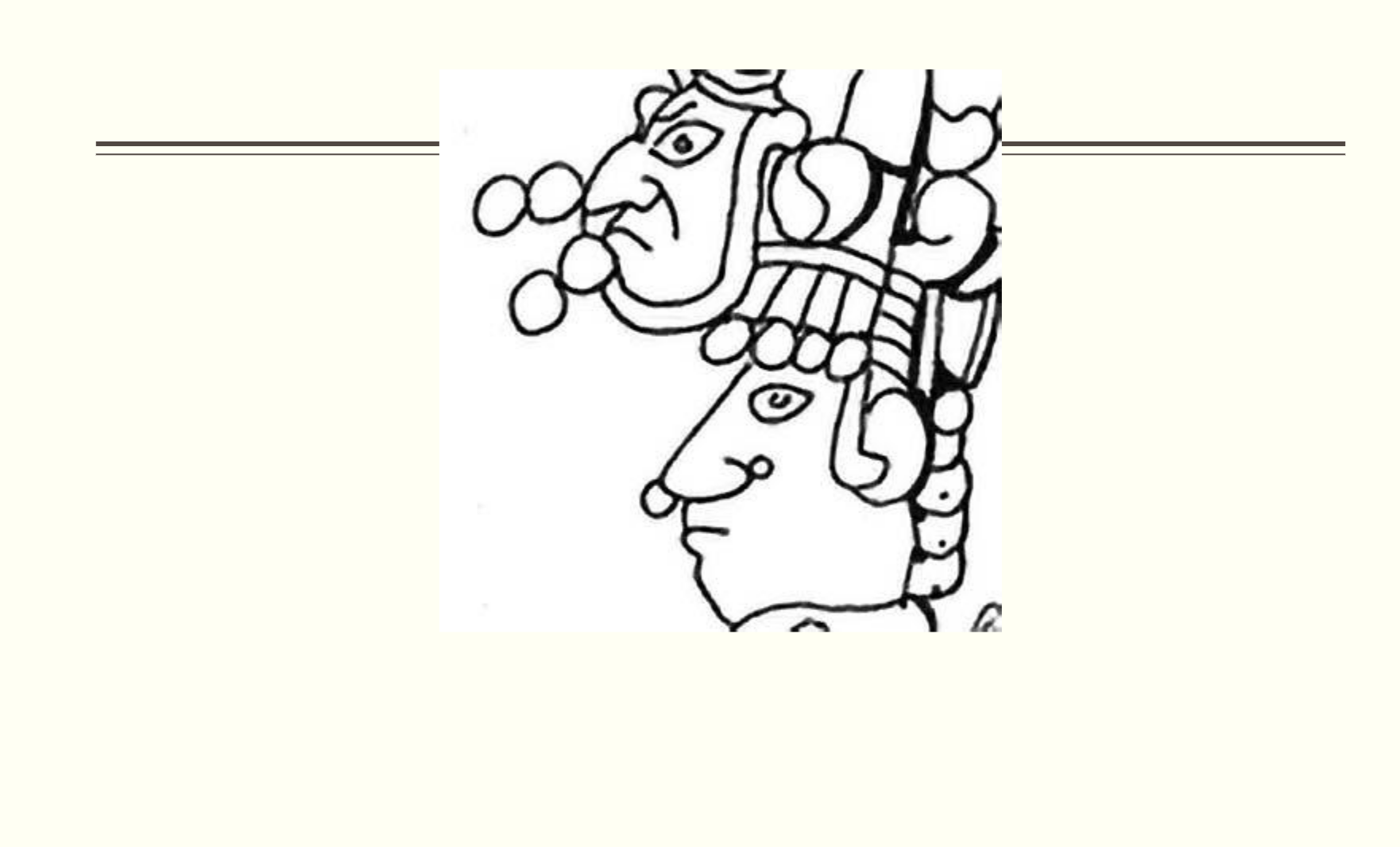
Has your uncle, Dieter Uchtdorf, read any of your books? [Laughter]

Mike: I know he’s read at least some of them.

Scott: Okay, thank you very much for your time, and Ugo, thank you for your time.

Endnotes & Summary

Summary: Genetic vs. Genealogical Ancestry and the Limits of DNA Evidence

In the concluding section, Ash and Perego explain the difference between genetic and genealogical ancestry, showing that one can be a descendant of a historical figure like Lehi without retaining any of that person’s DNA. Using concepts like the genetic isopoint and pedigree collapse, they demonstrate how DNA from small groups can disappear over time—especially when assimilated into much larger populations.

They emphasize that cultural identity, not genetic purity, defined who was considered a Nephite or Lamanite in the Book of Mormon. Just as terms like “Jew” or “Lamanite” can reflect affiliation more than biology, so too can ancestral claims in scripture be understood through a sociocultural lens.

The authors caution against misapplying modern forensic DNA standards to ancient population studies. Unlike courtroom evidence, ancient DNA research often deals in probabilities, not certainties. Citing scientists like Daniel Hartl and Jennifer Raff, they affirm that it would be statistically unlikely for Lehite DNA to survive detectably, and they stress that absence of evidence is not evidence of absence.

Ultimately, they advocate for a nuanced, informed approach to both science and scripture, reminding us that revelation operates within human language and understanding—and that the Book of Mormon should be read in light of both its ancient worldview and our modern scientific insights.

All Talks by This Speaker

coming soon…

Talk Details
  • Date Presented: August 2, 2023
  • Duration: 50:34 minutes
  • Event/Conference: 2023 FAIR Annual Conference
  • Topics Covered: DNA evidence, Book of Mormon historicity, population genetics, genetic drift, admixture, Israelite ancestry, Native American DNA, cultural identity, genealogical ancestry, scriptural interpretation, prophetic fallibility, revelation and assumption, ancient migration, lost 116 pages, Lehite assimilation, Lamanite identity, skin of blackness, forensic DNA standards, small vs. large population dynamics, limited geography model, paradigm shifts, scientific literacy, genetic isopoint, Nephite and Lamanite labels, ancient worldviews, cultural exonyms, Church statements on DNA and geography
Back to top

Share this article

Facebook
X
Email
Reddit

Understanding History Backwards

Summary

Dan Peterson explores how we often only grasp the significance of historical events in hindsight. He draws inspiration from Søren Kierkegaard’s idea that life can only be understood backwards, though it must be lived forwards. Peterson reflects on the idea of providence and divine patterns, using examples from history, including biblical figures and the early Latter-day Saints, to emphasize how events that seemed insignificant or chaotic at the time often reveal larger purposes later. He introduces his upcoming film project Six Days in August, which explores the leadership succession crisis following Joseph Smith’s death, and those experiences that prepared Brigham Young and the Twelve to lead the Church.

This talk was given at the 2023 FAIR Annual Conference at the Experience Event Center in Provo, Utah on August 2, 2023.

Daniel C. Peterson

Dr. Daniel C. Peterson is president of the Interpreter Foundation and a former professor of Islamic studies and Arabic at BYU. He has been a prominent voice in Latter-day Saint scholarship, producing films such as Witnesses and Undaunted and contributing extensively to apologetics, interfaith dialogue, and religious education. 

Transcript

Q&A

All Talks by Speaker

Common Concerns Addressed

Apologetic Focus

Explore Further

Transcript

Introduction by Scott Gordon

We’re doing something completely different this year, which may come as a bit of a shock. For the past 21 years, Dan Peterson has always been the final speaker at our conference. To shake things up, Dan is our first speaker this year.

Dan Peterson is the president of the Interpreter Foundation, which publishes the online periodical Interpreter: A Journal of Latter-day Saint Faith and Scholarship, produces books, convenes conferences, and sponsors a weekly radio program. He and his wife are executive producers of the 2021 theatrical film Witnesses and served in the same capacity for its 2022 docudrama sequel Undaunted: Witnesses of the Book of Mormon. There’s much more to his bio, which you can read on the website fairlatterdaysaints.org. And with that, I’m going to turn the time over to Daniel C. Peterson.

Presentation by Dan Peterson

Well, it’s good to be here, although it’s a little weird to be speaking at this time. I’m usually not awake before noon! Despite the appearance of the title slide, I’m not going to be giving this pa-Ruski, so let’s just move ahead.

A Recap of Theatrical Endeavors

As was mentioned, I was involved in the film project Witnesses, which is almost finished. I hope many of you have seen the theatrical film Witnesses, and if not, I hope you’ll watch the docudrama Undaunted.

Originally, we intended to produce the docudrama first, and the theatrical film came as a bit of an afterthought. The film was designed to build up to the documentary or docudrama, which involves interviews and additional footage, covering not just the Three Witnesses but also the Eight Witnesses and unofficial witnesses.

I hope some of you have also seen the short features we’ve made available online, including on The Interpreter website. These “Insights” videos are typically 7 to 12 minutes long and are free to watch. They address questions about the witnesses and respond to issues raised  by them.

But today, I want to talk about something a little different. It’s related to another film project, and the theme is inspired by the Danish philosopher Søren Kierkegaard. He said,

Life can only be understood backwards, but it must be lived forwards.”

I think that’s true. We often understand the significance of events only in retrospect, which is why we are encouraged to keep journals and write autobiographies. When we look back, we see how things that seemed small at the time had a major impact on our lives.

That’s a little of what I want to talk about today, in connection with our new film project. I like to explore the origin stories of things, how we got to where we are today. I’ll give four quick examples that show this and try to be quick.

Personal Examples of Understanding Life Backwards

While I was at UCLA, I remember one day noticing—actually, I noticed several days in a row on my commute up to campus —that there were a group of day laborers gathering in a really posh area of West L.A., among the skyscrapers.

I remember thinking to myself, probably a little bit negatively—I shouldn’t confess this, my online critics will have a field day with this one—but I thought, “Well, the area is kind of going downhill a little bit. You’ve got all these people gathered out there, hiring themselves out for day labor.” 

Shortly thereafter, I learned something really interesting: they had been gathering there since a century before, when that area, which is now West Los Angeles, was bean fields.

There were agricultural laborers who would meet on that very spot, and they just kept meeting there as the skyscrapers went up around them. So now, the nature of their day labor had changed—they were working in houses, gardens, and lawns, not in bean fields.

Another one I was told while we were staying there—I’m not sure if this is true—but growing up in Southern California, I noticed there were a lot of places where tall palm trees were lined up in double rows, or a row on each side of a street, going down for a block or two.

Someone told me, “You know what those are? In many cases, those were once the entryways to haciendas. The carriageway is no longer there, the hacienda is long forgotten, and it’s now a suburban area. But those palm trees outdate all of that.” That was very interesting to me.

Now, here’s a question. Why are railroads the width they are? It’s purely arbitrary. Carriage makers made carriages of a certain width, and when they began making railroad carriages, they began to make the rails that distance apart because that was the length of the axles they normally used.

Or, another one that interests me as an Arabist: the origin of the letter “X” as a symbol for unknown quantities. You know, “solve for x,” “x marks the spot,” or “Brand X,” or whatever it is.

It turns out that’s an artifact of translation from Arabic to Spanish in the Middle Ages. The letter “X” used to represent the sound “sha” in Spanish, which represented the Arabic word “shai,” which means “thing” or “something.” Now, nobody remembers that today for the most part, but there’s a story behind “X.” You know, why isn’t it “Z”? Why isn’t it “B”? Why not “A” or “Alpha” or something like that?

So, you can often understand things in retrospect when you look back and think, “Ah, that’s how we got here.”

Scriptural Example of Understanding Life Backwards

Now, a really good example of understanding life backwards is Joseph of Egypt

Joseph had a really rough life, and I’m sure there were times when he wondered,

God, why? Why is this happening to me? I’ve tried to live a good life, but why is this happening to me?”

All sorts of things happened to him, and he must have asked that question from time to time. But it was only in retrospect that he could understand it.

This is what he says: “I am Joseph, your brother.”

Remember, he’s introducing himself to his brothers who don’t know who he is. He’s a ruler of Egypt, right?

“Whom ye sold into Egypt. Now therefore be not grieved nor angry with yourselves that ye sold me hither, for God did send me before you to preserve life. And God sent me before you to preserve your posterity in the earth, and to save your lives by a great deliverance. So now it was not you that sent me hither, but God.”

It’s a very ironic, very kind way of putting it, because they did not mean to serve the purposes of God in selling Joseph into slavery. But nevertheless, that was the impact. And we can often see that either God is the great master chess player, making things work out to our benefit, or He actually plans them in advance. 

You think of the Joseph Smith Senior family, being moved by disaster after disaster after disaster, to get them close to what we now know is the repository of the plates. Had they been in Pennsylvania still, or Vermont, or who knows where, the story might have looked very, very different than it did.

Succession in the Presidency–Looking Backwards

Okay, now I’m saying this to sort of introduce the thought processes that, for me, are going into our next film project.

This won’t be about the film project, but sort of outlining some of the ideas that I have for it. We’re calling it Six Days in August. 

This refers to the time in Nauvoo when you have a confrontation between Sidney Rigdon and the Twelve about the future leadership of the Church. They’d just gone through this terrible crisis of the assassination of Joseph Smith.

Now, there are people today—and I’m hearing them, even members of the Church—and this disturbs me. It disturbs me a great deal. Members of the Church have come to me and said, “You know, my wife and I have concluded”—I’m thinking of a returned mission president in this case—“that Brigham Young was not the Lord’s choice to lead the Church, that it was a kind of apostolic coup, that the Twelve took over the Church, but it shouldn’t have been them.” And I’m wondering, so who do you think it should have been?

Do you think it should have been James Strang? Some of you know that my hope in the movie was to have Pee-wee Herman play James Strang. My hopes have now been dashed.

So, I’m not a big James Strang fan, but the idea is that the Twelve were legitimate. Now, I’ve asked some of those people, “Think about the implications. Do you know what you’re saying here? You’re saying the leadership of the Church ever since the death of Joseph Smith has been illegitimate. I don’t know what candidate you favor, but the ones that took over the Church, you say, were not legitimate.”

You might like Russell M. Nelson—I hope you do—but do you not realize you’ve just cut off the branch upon which he sits? Every president of the Church has been illegitimate since 1844.

Every Temple presidency, every Temple ordinance, every Apostle called—the whole system—has been illegitimate, done under authority that was not divinely approved. Now, I’ve gotten to talk with some of them, and I think, “Okay, now I understand a little bit more.” For some of them, at least, this is not a bug; it’s a feature. They don’t like the current leadership of the Church and want to get rid of them. They don’t like Brigham Young—things that he said, things that he did. Now, just chuck him; he was the wrong guy anyway.

And I say, “Well, okay, so what about President Nelson?”

“Well, he’s a communist,” they say. “He’s involved with the United Nations, and he got the shot.”

So, you know, he’s not the legitimate president of the Church. He’s the prophet who tells lies, the lies that Isaiah foretold. He’s a real prophet, they say, but basically, he tells lies.

This is a Serious Issue

Well, I began to think, “This is a really serious issue.” So, here’s the thought process that I’m going through in a project that, for me at least, is designed not only to entertain and tell a story—which is a really important story and helps people to understand it better—but to outline a case, implicitly in the narrative and more explicitly in the docudrama, for the legitimacy of the succession of the Twelve.

I start off by trying to show how the Twelve were prepared for the role that they would play.

Zion’s Camp

For example, one of the first places we see this preparation as a factor is in Zion’s Camp, which was originally not called Zion’s Camp, but the Camp of Israel. It served as a proving ground, a testing ground for future Church leaders. Here again, life can only be understood backwards. The Quorum of the Twelve was chosen by the Three Witnesses after Zion’s Camp.

Here’s a way of linking the two film projects too. By the way, the Three Witnesses chose the Twelve, all right? When the Quorum of the Twelve Apostles was formed in February of 1835, eight of the original twelve had marched with the Camp of Israel.

All of the people who were called to the Seventy in February of 1835 were members of the camp. I don’t think that is coincidental.

Saints’ Evacuation from Missouri

Another place where the preparation of the Twelve comes into play, I think, is in the evacuation of the Saints from Missouri to Illinois in the winter of 1838–39. Up to this point, the Quorum of the Twelve had been a fairly unstable body. If you read the history, men had been called, they’d fallen away, and it just hadn’t come together as a quorum yet.

Thomas Marsh

In fact, crucially, Thomas Marsh withdrew from his involvement in the Quorum of the Twelve and the Church in October of 1838—a very crucial time when the Church needed leadership. So, what happened? Well, this is significant. On January 16, 1839, in the depth of winter, the First Presidency, who were in Liberty Jail, sent instructions to Heber C. Kimball and Brigham Young that read:

Quorum’s Management of Church Affairs

“Inasmuch as we are in prison, the management of the affairs of the Church devolves on you”—that is, the Twelve. “Appoint the oldest of those of the Twelve who were first appointed to be the president of your quorum.” This is how Brigham Young ends up as the president after Thomas Marsh’s departure.

Now, this doesn’t seem like a big thing, maybe, but it is. When the Quorum of the Twelve was first established, it was a traveling High Council—a missionary High Council with its focus outside the Church. There was a High Council, and only one, inside the Church that ran the domestic internal affairs of the Church. Here, you have the Twelve stepping into a role to manage the emigration of the Saints from Missouri to Illinois.

That, I think, is crucial. And, boy, now it’s really sensitive. I didn’t even mean to change it, but I think that’s crucial. You see the Twelve beginning to change their function, and we’ll see that more as we move on.

Missions to England

Then, another crucial thing is Heber C. Kimball’s mission to England and the subsequent mission of the entire Twelve to England. He went in 1837, arrived at the port of Liverpool, but his first successes were in Preston. Some of you have been there; it’s a spectacularly important Church site. The area around Preston and the Market Square, where they preached—and where, by the way, President Hinckley also preached—is still intact there.

But one of the most interesting things that’s still intact in Preston is a house, this lodging house on the corner of Fox Street and Saint Wilfred Street. It’s amazing that it’s still there. It was there in 1837—I don’t know how old it was then—and it’s kind of derelict now. It’s been up for sale on various occasions.

I am one of those who really wish that somebody would buy this house and preserve it. I don’t want it to be destroyed, but you’ll see why the Church is reluctant to buy this house. 

Encounters With Darkness

I’ll read to you the account of what happened there, which I’m spending more time on than I probably should, but I like it. I’m using a collation of materials by a British Latter-day Saint guide and historian by the name of Peter Fagg, whom I really, really like.

This is Heber C. Kimball: “Sunday, July 30th, about daybreak, Elder Isaac Russell came up to the third story where Elder Hyde and myself were sleeping and called out, ‘Brother Kimball, I want you to get up and pray for me that I may be delivered from the evil spirits that are tormenting me to such a degree that I feel I cannot live long unless I attain relief.'”

“I had been sleeping on the back of the bed. I immediately rose, slipped off at the foot of the bed, and passed around to where he was. Elder Hyde threw his feet out and sat up in the bed, and we laid hands on him—I being mouth—and prayed that the Lord would have mercy on him and rebuke the devil. While thus engaged, I was struck with great force by some invisible power and fell senseless on the floor.”

Okay, Orson Hyde says: “Heber’s voice faltered, and his mouth was shut. He began to tremble and reel to and fro and fell on the floor like a dead man and added a deep groan. I immediately seized him by the shoulder and lifted him up, being satisfied that the devils were exceedingly angry because we attempted to cast them out of Brother Russell, and they made a powerful attempt upon Elder Kimball, as if to dispatch him at once. They struck him senseless, and he fell to the floor.”

So, back to Heber C. Kimball and his account. To me, this is interesting because you have multiple witnesses to this event.

The first thing I recollected was being supported by Elders Hyde and Richards, who were praying for me, Elder Richards having followed Russell up to my room. Elder Hyde and Richards then assisted me to get on the bed, but my agony was so great I could not endure it, and I rose, bowed my knees, and prayed. I then arose and sat up on the bed when a vision was opened to our minds—our minds, by the way—and we could distinctly see the evil spirits who foamed and gnashed their teeth at us.

Nearly two decades later, Heber told the congregation in Salt Lake, in the Tabernacle,

I saw their hands, their eyes, and every feature of their faces—the hair on their heads and their ears. In short, they had fully formed bodies.”

He continues his account:

We gazed upon them for about an hour and a half by Willard’s watch.” So this is not a slight, fleeting thing. “We were not looking towards the window, but towards the wall. Space appeared before us, and we saw the devils coming in legions with their leaders, who came within a few feet of us. They came towards us like armies rushing to battle. They appeared to be men of full stature, possessing every form and feature of men in the flesh, who were angry and desperate. And I,” that is, Heber C. Kimball, “shall never forget the vindictive malignity depicted on their countenances as they looked me in the eye. Any attempt to paint the scene that presented itself, or portray their malice and enmity, would be vain. I perspired exceedingly, my clothes becoming as wet as if I had been taken out of the river. I felt excessive pain and was in the greatest distress for some time.”

 Immediately Heber recovered his strength in part, enough to get up. The sweat began to roll from him most powerfully, and it was almost as if he had been taken out of the river.”

“We distinctly heard those spirits talk and express their wrath and hellish designs against us.”

“We could very sensibly hear the evil spirits rage and foam out their shame.”

Then Joseph Fielding, who was not there but heard the story shortly thereafter, said

They could hear a sound from them—that is, the evil spirits—like the grating of teeth quite plainly.”

Orson Hyde, addressing Heber C. Kimball—

(I’m going on at length on this because I find this a very interesting story, as it’s not a theophany or an angelophany; it’s a diabolophony or a satanophony or something like that. But that has implications.

If there is an unseen world with these sorts of beings, then there’s evidence there for something else, it seems to me. It’s much more positive.)

After you were overcome by them and had fallen. Their awful rush upon me, with knives, threats, imprecations, and hellish grins, amply convinced me that they were no friends of mine. While you were apparently senseless and lifeless on the floor and upon the bed after we had laid you there, I, [Orson,] stood between you, Heber, and the devils, and fought them and contended with them face to face until they began to diminish in number and to retreat from the room. The last imp that left turned around to me as he was going out and said, as if to apologize and appease my determined opposition to them, ‘I never said anything against you.’

I replied to him thus: ‘It matters not to me whether you have or have not; you’re a liar from the beginning. In the name of Jesus Christ, depart.’ He immediately left, and the room was clear. That closed the scene of devils for the time.”

Joseph Fielding comments on that:

They, however, kept their distance, but turned their heads toward Brother Hyde. One, looking at him, said distinctly, but with a murmuring tone, slowly and demurely, ‘I never spoke against you.’ He said there seemed to be a legion of them. He was alone, very much disgusted. He could scarcely bear to speak of them. However, the Lord delivered us from them and blessed us exceedingly that day.”

So one of the very first to hear about it, so there is a contemporary witness for this, was Vilate Kimball. Heber wrote a few words to his wife about the matter, and Brother Joseph called upon her for the letter and said

It was a choice jewel, and a testimony that the gospel was planted in a strange land.”

Back to Joseph Fielding—who wasn’t, as I say, present, but he wrote in his journal, “Upon the whole, we got considerable instruction from the maneuvers of the devil. The spirit of the devil produces confusion, disorder, and misery. The spirit of God produces calmness, order, and happiness. If we never before knew that there were evil spirits, we did now.”

And I think that’s a really important thing for them to know. C.S. Lewis said at one point that the devil welcomes an agnostic and a magician with equal enthusiasm. Someone who doesn’t believe there’s a devil, and someone who’s unhealthily obsessed with the devil—either one can be turned to his purposes.

Later on, Joseph Smith responded to this, but first, I want to make a little side commentary about a Gallup poll that was recently taken. It turns out that faith, or belief, in the devil is very tightly linked with belief in God. People who cease to believe in God obviously begin to disbelieve in the devil, and vice versa.

These are related ideas: if you know there’s a devil, you have good reason to believe there’s a God. If you once grant that there is a kind of supernatural or beyond-natural realm beyond this world, then that opens it all up.

Now, when Joseph Smith heard about the missionaries’ experiences, he was surprisingly positive about it. At that time, he said, “You are nigh unto the Lord; there was only a veil between you and Him, but you could not see Him. When I heard of it, it gave me great joy, for I then knew that the work of God had taken root in that land. It was this that caused the devil to make a struggle to kill you.”

And I would say that that really is true. Think about the opening of every dispensation: Adam in the garden, Adam and Eve in the garden, Joseph Smith in the Sacred Grove, Jesus being tempted in the wilderness, Moses in the book of Moses. When a dispensation starts, when something big is about to happen, the devil shows up—either in person or by his emissaries.

Encounters With the Spirit

Alright, so nearby, near that house, is Avenham Park, which is a really beautiful area of green trees and so on. It borders the River Ribble, where the very first Latter-day Saint baptisms were performed in England. This is a really important place, and people like William Clayton and George Watt—other really important early Latter-day Saints—come from this area. There are plaques and monuments around the area dedicated to those early Latter-day Saints, and it’s recognized by the city administration there.

Up the river valley are several towns that are important: Chatburn and Downham, shown here. This is the best picture we could find. There are better pictures from up by the church.

Some of you have been there, looked down the road, and it’s a beautiful village that looks much the same way it must have looked in the days of Heber C. Kimball, who was told by the people in Preston, “Don’t bother going there; they’re all godless.” He baptized almost everybody in the town.

They were godless in the sense that they did not like the Church of England, and they weren’t going to the other churches. They weren’t satisfied by them, but they loved the gospel as preached by Brother Kimball. In the background there, you can see Pendle Hill—just a little bit of it. We’ll see that in the next slide.

I want to tell the story a little bit in the docudrama portion of the “Six Days in August” project. For now, though, I want to concentrate on a particular aspect of this episode in Downham, and it’ll be the sort of good counterpart to the satanic thing I’ve already told you.

In April 1838, when he’s about to leave and go home to America, Brother Kimball went back for a farewell visit to Downham and Chatburn. Now, this hill looms over Downham. It’s just outside the town, and the response of the people there moved him deeply. He said,

When I left them, my feelings were such as I cannot describe. As I walked down the street, I was followed by numbers. The doors were crowded by the inmates of the houses to bid me farewell, who could only give vent to their grief in sobs and broken accents.

While contemplating the scene, I was constrained to take off my hat, for I felt as if the place was holy ground. The Spirit of the Lord rested down upon me, and I was constrained to bless that whole region of country.”

He had tremendous success in that area. Joseph Fielding was also there with Elder Kimball, and he said,

It was very affecting to witness our parting with them. The streets were almost lined with them, weeping and looking after us. Brother Kimball left his blessing on them, the whole place, walking with his hat off. They all followed us with their eyes as far as they could see, many of those even that had not been baptized.”

Orson Hyde talks about this in 1853 in general conference:

What were our feelings? We fell to the ground upon which we stood—it was most sacred—and Brother Kimball took off his hat, walked the streets, and blessed the country and the people, and let his peace come upon it. Why? Because the people were ready to receive the word of our testimony, and us for Christ’s sake.”

In 1857, Elder Kimball remembered that visit and said this:

I went through the streets of that town feeling as I never before felt in my life. My hair would rise on my head.” (This image was obviously taken after that.)

As I walked through the streets, I did not then know what was the matter with me. I felt as if my whole system was alive. I felt quickened by some unseen power.”

When he came back to America in 1838, he related his experience in Downham and Chatburn to the Prophet Joseph Smith. His response was again intriguing.

“Did you not understand it?” the prophet asked. “That is a place where some of the old prophets traveled and dedicated that land, and their blessing fell upon you now.”

So I want to come back to Pendle Hill. One day, I think in 1652, as far as I can tell, George Fox, the founder of the Quaker movement (the Society of Friends), climbed up Pendle Hill, and he saw what seems to have been a vision. He said it was of people in white raiment coming to the Lord—a great people to be gathered. This event and his reaction to it led to the founding of the Quaker movement. 

Then John Wesley, in the 18th century, came to the area, the founder of Methodism (which he never intended to be a distinct denomination), and he said he visited Pendle Hill and felt himself exceptionally moved spiritually. There was something different about this place as he worked in the villages and among the people at its base.

I’ll give you a couple of other examples. There actually is a witch story associated with the Pendle witches from earlier than Fox or Wesley. There’s something uncanny about this hill.

I’ll say something else: I was told on one visit there that when Elder Holland was the area president—there was no temple in Preston yet—he would go to Downham when he had a particularly difficult issue to wrestle with, and he would pray in the woods there near Downham at the base of Pendle Hill because he felt that was a temple-like place.

Once, he was there praying about something and heard a rustle in the bushes a little bit away. It was the local stake president, who was also there praying about a very difficult issue. It was a place they felt was very different, and when Elder Holland was asked to choose the site for the Preston Temple, that’s where he went to receive confirmation from the Lord that it was the place for it to be.

So it’s a really interesting place. Heber C. Kimball may not have been wrong in imagining things when he thought that this was holy ground.

I want to draw on a famous song for that—William Blake’s Jerusalem. William Blake wrote this in 1808, and it was set to music in 1916 by Sir Hubert Parry. I was actually going to try to include music here for you, but I thought it might mess up the online version, or we might run into copyright issues. Then I thought of singing it, but I’m not going to.

But this song, Jerusalem, is like the unofficial national anthem of England. George VI actually said at one point (and he had an interest in this question) that he preferred Jerusalem as a national anthem to God Save the King. Kind of interesting for a king to say that!

This is a song you may be familiar with—I hope you are. If you’re not, look it up and listen to it; it’s a really beautiful song. Everybody in England knows this song. It has to do with Elijah and his chariots of fire.

In fact, it shows up and is sung at the end of the film Chariots of Fire. If you’ve ever seen that movie, watch it again and see that. Here are the lyrics, and they’re about Christianity having been in England in ancient times:

And did those feet in ancient time
Walk upon England’s mountains green?
And was the holy Lamb of God
On England’s pleasant pastures seen?
And did the Countenance Divine
Shine forth upon our clouded hills?
And was Jerusalem builded here
Among these dark Satanic mills?

Bring me my bow of burning gold!
Bring me my arrows of desire!
Bring me my spear! O clouds, unfold!
Bring me my chariot of fire!
I will not cease from mental fight,
Nor shall my sword sleep in my hand,
Till we have built Jerusalem
In England’s green and pleasant land.

More Missions in England

Well, that was Heber C. Kimball’s first mission to England—the first arrival of the Saints in England. Now I want to talk about the second mission. There’s a wonderful book written about these two missions that I recommend to you, called Men with a Mission by Jim Allen, Ron Esplin, and David Whitaker.

It’s wonderfully done, and this is a really important thing. It’s crucial, again, to my argument that the Twelve were being prepared for their role. Eight members of the Twelve went to England, to the British Isles, on their mission, and Orson Hyde spent some time there en route to and from Jerusalem.

During that time, there’s a book by Eugene England that I also recommend called Brother Brigham, which is a very sympathetic portrayal of Brigham Young. He notes, reading the journals of the Brethren who served there, that Brigham had become president simply because he was the oldest.

Thomas Marsh had been excommunicated, and Brigham Young succeeded him because he was the senior Apostle. But gradually, in England, they began to refer to him as the President. He became the President—he already was, in fact—and now, by rule de jure, I guess I should say, and de facto, he really became the president. They recognized his unique leadership qualities, and that, I think, is important.

They had a great deal of success there. I have a scene here coming up from the John Benbow Farm. Some of you know that story about the remarkable success of Wilford Woodruff there, converting the United Brethren.

 If we go to the Gadfield Elm Chapel next—this is one of the oldest buildings in the Church, not built by us; it belonged to the United Brethren and was taken over by the Latter-day Saints. It is still owned by the Church.

To get in, there’s no one there, but you have to work a little combination. The clues are all questions from scripture and LDS history, so if you haven’t kept up on your scriptures and Church history, you won’t get into that building.

And then there’s this statue on the Royal Albert Docks in Liverpool, dedicated to the memory of the Latter-day Saint emigrants who went through that port, not only from England but from Scandinavia and the rest of Europe.

Change in the Status of the Twelve

Now, crucially, there’s a change in the status of the Twelve thereafter. At a conference held on August 16, 1841, in Nauvoo, the Prophet said,

The time has come when the Twelve should be called upon to stand in their place next to the First Presidency and attend to the settling of immigrants and the business of the Church at the stakes—that is, within the Church—and to assist to bear off the Kingdom victoriously to the nations.”

This is crucial. Joseph recognized, I think, that there’s something different now about the Quorum of the Twelve. They really are ready to take their position as the Quorum second in authority to the Quorum of the First Presidency.

Interestingly enough, Smith and Swedal, in their commentary on the Doctrine and Covenants, say that Brigham Young was a missionary. He had gone on a mission to Canada and traveled as a missionary twice to the eastern states. He was among those who labored in Great Britain.

But in Section 126, the Lord commends him for his labors and affirms, “It is no more required at your hand to leave your family as in times past, for your offering is acceptable to me.” His role is changing. He will be at Church headquarters now as the leader of the Twelve, and that’s his role thereafter.

I think you see a really distinct thing going on here. We do understand that Brigham Young began to be asked by the Prophet, when the Prophet was unavailable, to lead meetings, preside over gatherings, and so on. He had never done that before, as far as I know.

Conferral of the Keys

Then, a really important moment is the conferral of the keys.

And I think a really valuable contribution on this issue has been the book that has recently been produced by Jeffrey Bradshaw, which is about Emer Harris, the brother of Martin Harris and Dennis and Lot Harris. One of the important things about that is that Denison Lot Harris remembered the day when the Prophet Joseph Smith conferred the keys on the Twelve, and he gives it a probable date: the 26th of March, 1844.

It’s interesting because the other testimonials have all come from the men who were in that meeting, members of the Twelve. But they could be accused of being self-interested, right? “The Prophet gave us the authority to lead the Church.” Well, if you believe it was an apostolic coup, of course, they would say that, right?

But Denison Harris, who was there, remembered Joseph saying, “This day I’m going to roll this kingdom off my shoulders onto the shoulders of these, my brethren, for them to preach the gospel and gather Israel, and build up the kingdom upon the foundation which I have laid.”

And then, at that important meeting, Wilford Woodruff says later—this is what he said:

I, Wilford Woodruff, being the last man living in the flesh who was present upon that occasion, feel it a duty I owe to the Church of Jesus Christ of Latter-day Saints, to the house of Israel, and to the whole world to bear this, my last testimony to all nations. That in the winter of 1843-44, (in fact, the spring of 1844, I think,) Joseph Smith, the Prophet of God, called the Twelve Apostles together in the city of Nauvoo and spent many days with us in giving our endowments”

—so he’s talking about a lengthier period—

“and teaching us those glorious principles which God had revealed to him. And upon one occasion, he stood upon his feet in our midst for nearly three hours, declaring unto us the great and last dispensation which God had set His hand to perform upon the earth in these last days. The room was filled as with consuming fire, the Prophet was clothed upon with much of the power of God, and his face shone and was transparently clear. He closed that speech—never to be forgotten in time or in eternity—with the following language.”

(Remember, Wilford was a great journal keeper.)

Brethren, I have had great sorrow of heart for fear that I might be taken from the earth with the keys of the Kingdom of God upon me without sealing them upon the heads of other men. God has sealed upon my head all of the keys of the Kingdom of God necessary for organizing and building up the Church, Zion, and the Kingdom of God upon the earth, and to prepare the Saints for the coming of the Son of Man.

Now, brethren, I thank God I have lived to see the day that I’ve been able to give you your endowments. I have now sealed upon your heads all the powers of the Aaronic and Melchizedek priesthoods and apostleship, with all the keys and powers thereof, which God has sealed upon me.

I now roll off the labor, burden, and care of this Church and Kingdom of God upon your shoulders. I now commend you, in the name of the Lord Jesus Christ, to round up your shoulders and bear off this Church and Kingdom of God before heaven and earth, and before God, angels, and men. And if you don’t do it, you will be damned.”

“The same Spirit that filled the room at that time burns my bosom while I record this testimony,”

President Woodruff says.

And the Prophet of God appointed no one else but the Twelve Apostles to stand at the head of the Church and direct its affairs.”

Richard Holtzapfel comments on this:

There is another important source about this monumental gathering. We’re not yet to Leonard Arrington, which may be the earliest written document describing the meeting, although it is unknown exactly when it was composed. It could have been written as early as September 1844. Speaking of that meeting, the Twelve recalled, “Joseph Smith seemed somewhat depressed in spirit and took the liberty to open his heart to us concerning his presentiments of the future.” 

The document then records what the Prophet said on that occasion:

Joseph told the Twelve, ‘The Lord bids me hasten the work in which we are engaged.’ The Prophet did not want the keys and powers to be lost upon the earth, so he placed them upon the heads of the Twelve. Upon the shoulders of the Twelve must the responsibility of leading this Church henceforth rest until you shall appoint others to succeed you.

Your enemies cannot kill you all at once, and should any of you be killed, you can lay your hands upon others and fill up the Quorum. Thus, can this power on these keys be perpetuated on the earth.”

Leonard Arrington had this to say: “As if he had a foreboding of his impending death, Smith gave them a dramatic charge to bear off the Kingdom. As they recounted the moving experience, the Prophet seemed pressed and opened his heart about his presentiments of the future.

He explained that some important scene is near to take place—that perhaps he would be killed—and that as a precaution, the Twelve had received all the keys and powers that he held.

Then, if God wills, I can go with all pleasure and satisfaction, knowing that my work is done and the foundation laid on which the Kingdom of God is to be reared.”

He counseled them about what lay ahead, then continued, saying while he walked about the floor,


I rolled the burden and responsibility of leading this Church off from my shoulders onto yours. Now round up your shoulders and stand under it like men, for the Lord is going to let me rest a while.” After he thus spoke, he continued to walk the floor, saying, “Since I’ve rolled the burden off from my shoulders, I feel as light as a cork. I feel that I’m free. I thank my God for this deliverance.”

Three months later, Joseph Smith and Hyrum Smith were killed at Carthage Jail—two of the three members of the First Presidency.

Cases for Succession

In response to this, the Twelve returned to Nauvoo. Sidney Rigdon, who had been off in Pittsburgh, returned to Nauvoo, and there is the famous meeting of the Saints in Nauvoo where Sidney Rigdon gives his case for himself as the guardian of the Church.

And then the Twelve, represented by Brigham Young, give their case. You know many of you about the miraculous event that many reported later seeing there, by which they knew that Brigham Young was the successor.

Now I want to close with just a couple of quick comments, because I’m actually in negative 56 seconds. I have one person that I know and have had some encounters with online, who is a kind of “Strangite,” I think—very, very vocal. He is convinced that Six Days in August is going to be an anti-Strang film. Well, it isn’t going to be. Strang won’t even show up in it because he’s not important in those six days in August; he shows up later, so he’s not a factor. So, no Pee-wee Herman there.

In the docudrama, we probably will have to talk about him, but it’s not going to be an overtly anti-Strang film. I’ll let you in on a secret: I’m a member of The Church of Jesus Christ of Latter-day Saints. I believe that the Twelve were the legitimate successors of Joseph Smith. I’m not going to hide that. When I say the proper sum of two plus two is four, and you have five, I’m not against you—I’m just saying it actually is four, okay?

So, I believe that the Twelve were the proper successors of Joseph Smith, and we’re going to try to illustrate that without being propagandistic about it—just by telling the story as it happened. It’s not going to be an anti-Emma film either, and I want that to be clear. I grew up—maybe some of you did too—hearing Emma really bad-mouthed. I don’t think it’s fair. Emma went through a lot, and she did what she did. I think she was wrong, but she was trying to serve her family, and so on and so forth. And she was tired. She was just tired.

So, we’re not going to attack Emma Smith. We’re not going to attack the Reorganized Church or the Community of Christ either. But yes, I do think they’re wrong. I don’t hide that. We’re not neutral on this. None of the people I’m working with are neutral on this question. Is it anti-RLDS? Only in the most trivial sense, that we think they got the sum wrong, okay? But that’s all.

Conclusion

I do believe that Brigham Young was the divinely chosen leader, and the Twelve were the divinely chosen leaders. It took about three years for Brigham to actually be sustained, for a new First Presidency to be organized.

In the old days, prior to Lorenzo Snow, they didn’t do it immediately—they always waited for a while. But Brigham Young eventually did become president, and I think the question to be asked in this case, looking back—understanding history backwards—is the question that is asked in Esther 4:14 about Esther, who showed up in the Royal Court of Persia at a time when the Jews were under threat. She was Jewish, and the question is put to her: “Who knoweth whether thou art come to the kingdom for such a time as this?”

I think Brigham Young was put in the kingdom for such a time as the one he found himself in. And that’s the story we’re going to tell.

Thank you.
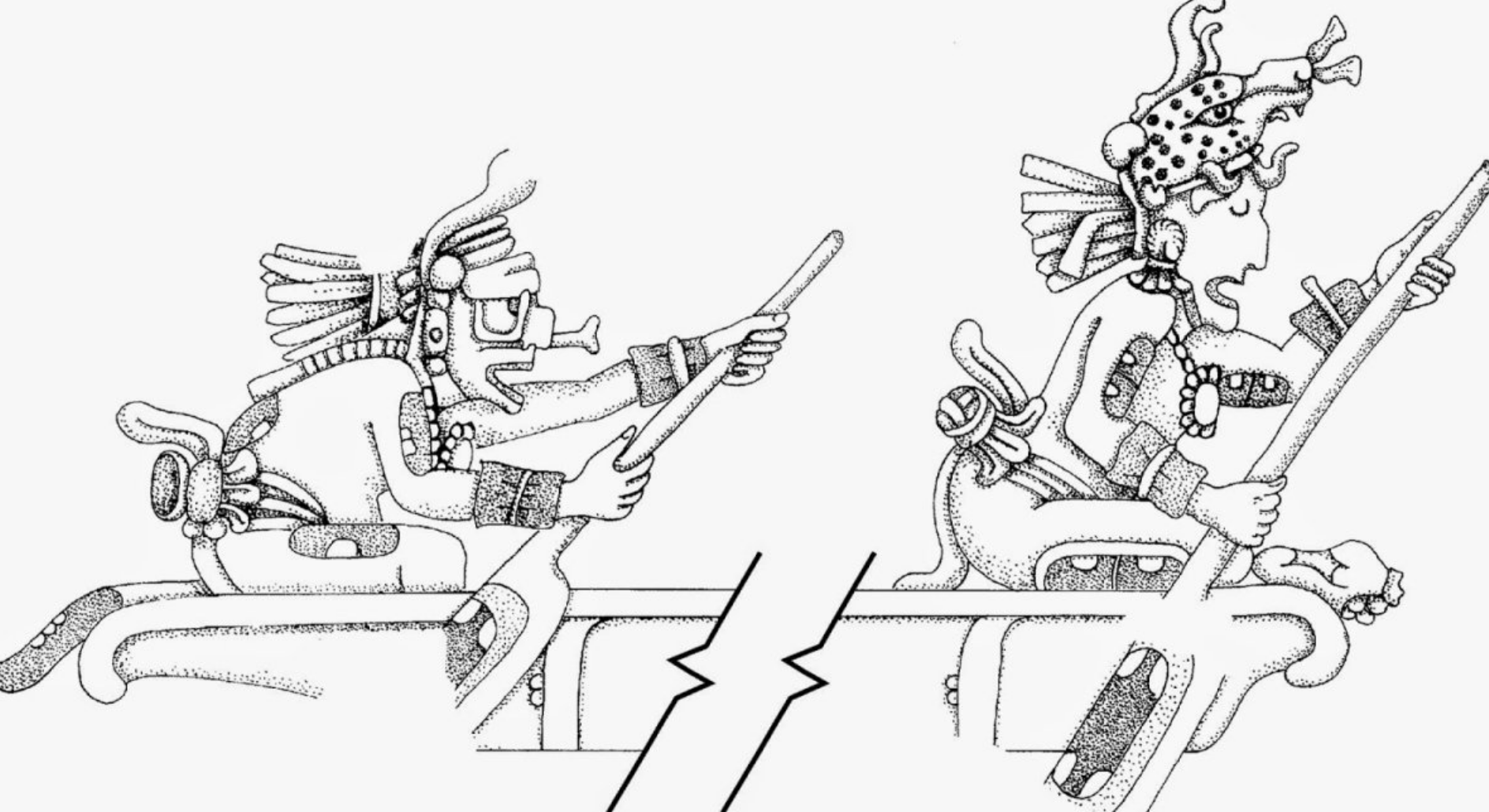
Back to top
Audience Q&A

No Q&A was offered.

Endnotes & Summary

coming soon…

All Talks by This Speaker

coming soon…

Talk Details
  • Date Presented: August 2, 2023
  • Duration: 48:45 minutes
  • Event/Conference: 2023 FAIR Annual Conference
  • Topics Covered: 
Common Concerns Addressed

coming soon…

Apologetic Focus

coming soon…

Explore Further

coming soon…

Back to top

Share this article

Facebook
X
Email
Reddit

Since Hugh Nibley: Remarkable New Findings on Enoch and the Gathering of Zion

Summary

Jeff Bradshaw’s presentation honors Hugh Nibley’s groundbreaking work on ancient Enoch texts, particularly the Book of Moses and the Book of Giants (BG), and highlights significant new findings since Nibley’s time. Bradshaw discusses the striking thematic and narrative similarities between the Book of Moses and BG, emphasizing the shared elements that strengthen the case for the antiquity of the Restoration scripture. He concludes by urging continued exploration of ancient sources to deepen understanding of modern revelation

This talk was given at the 2021 FAIR Conference on August 4, 2021.

2021 Jeffrey Bradshaw

Jeffrey Bradshaw, holds a Ph.D. in Cognitive Science, is an award-winning researcher, and is best known in the Church for his detailed commentaries on the Book of Moses, Genesis 1–11, and temple themes throughout the scriptures.

Transcript

Q&A

All Talks by Speaker

Common Concerns Addressed

Apologetic Focus

Explore Further

Transcript

Introduction:

The title of my presentation is Since Hugh Nibley: Remarkable New Findings on Enoch and the Gathering of Zion.

Honoring Hugh Nibley in Word

Like the wonderful presentation we heard this morning from Kirk Magleby, my purpose is to commemorate Hugh Nibley on the occasion of the 111th year since his birth. First, I will share some of the ways he is being commemorated in word by making his life and work better known to a new generation. Then, I will talk at greater length about our efforts to remember him in deed by building on lines of research that he began.

2021 is a landmark year for book publishing at the Interpreter Foundation, with four new books in print so far this year and four more to come. We hope you will take a look at all of them at the Interpreter display table and in the FAIR bookstore. We’re grateful for our longstanding partnership with Bret Eborn at Eborn Books.

We’re especially proud of the joint work with Book of Mormon Central and FAIR on the landmark volume entitled Hugh Nibley Observed, an in-depth look at the story behind the scholarship and the man behind the legend.

Media Resources

As an even easier introduction to Hugh Nibley for a new generation, we have created a series of blog posts, podcasts, and twenty-three YouTube videos on his life and work. We have also posted a new version of the wonderful biographical film The Faith of an Observer, including, for the first time, complete subtitles.

All these media resources, along with details on Hugh Nibley Observed, are available at the link shown here.

Today, we are pleased to announce the public launch of the Complete Bibliography of Hugh Nibley (CBHN), another collaboration with Book of Mormon Central. It contains over 1,400 references to published and unpublished writings by Hugh Nibley and others, many with freely downloadable content and others with links to bookstores where physical items can be purchased.

It is still a work in progress, with hundreds of additional references—including PDF, video, and audio files—to be added in the future. Please excuse our growing pains as the software and content are gradually improved.

Honoring Hugh Nibley in Deed

The most meaningful way to honor Hugh Nibley, of course, is to do so “in deed,” building on the many research leads where he pointed the way.

Nibley wrote profusely in response to critics of the Prophet Joseph Smith, so we decided to sponsor a series of virtual firesides this year, featuring new research on misunderstood and sometimes controversial events and teachings from the last few years of Joseph Smith’s life.

An introduction to each of the firesides will be provided by former Assistant Church Historian, Richard Turley.

In partnership with BYU Religious Education, FAIR, and Book of Mormon Central, we have worked to remedy the past neglect of serious study on the Book of Moses.

The Book of Moses

Nibley said that if we really understood the treasures it contains, it would “put to rest the silly arguments about who really wrote the Book of Mormon, for whoever produced the Book of Moses would have been an even greater genius.”

In honor of Hugh Nibley, we have sponsored two conferences applying serious scholarship to evidence of “ancient threads in the Book of Moses.” We have now published a two-volume work of more than 1,300 pages with our results, available in inexpensive digital and softcover editions, as well as in online videos.

Elder Bruce C. Hafen, pictured here with his companion Marie, who provided the keynote for the first conference, beautifully summarized our consensus when he said:

The Book of Moses is an ancient temple text as well as the ideal scriptural context for a modern temple preparation course.”

Readers of this book will find ample evidence for this truth.

The First Days and the Last Days

Two other books on the Book of Moses will be released this fall in time for the 2022 Come, Follow Me curriculum.

This scripture commentary, titled The First Days and the Last Days, not only has a meaningful title but also features a beautiful cover—with angels as bookends looking both forward and backward to Christ’s mission in the meridian of time.

This imagery attests to Nibley’s view that both the story of Enoch and the “little apocalypse” of Joseph Smith—Matthew “belong together in the same book.”

Enoch and the Gathering of Zion

Finally, we come to the book that best fits today’s topic: Enoch and the Gathering of Zion.

Here, we will see the full context of what we now know about the culture, geography, and characters of Enoch’s time and story—assembled for the first time from ancient sources and modern scripture into a single unified story.

I like to think of it as adopting the spirit of Nibley’s wonderful book, Lehi in the Desert, but now applied to Enoch and his people.

And, we might add, applied to ourselves, for as we will get a small glimpse of later in this presentation, Enoch’s story of the first days is also our story, the story of the last days.

So let’s now open the subject by asking:

“What is Nibley’s best-known discovery about the Book of Moses and ancient Enoch texts?”

The answer to this question can be found in an ancient Enoch text called The Book of Giants.

Book of Giants

The photo shows a fragment of BG written in Aramaic, found among the Dead Sea Scrolls.

Besides being the most popular Enoch book at Qumran—even more popular than the better-known 1 Enoch—BG also appears to be the oldest extant Enoch manuscript found anywhere.

It was first discovered in 1948 and first published in English in 1976.

Other fragments, in six different languages, have been found among the writings of Mani, founder of a religious sect called Manichaeism, and were published in English in 1943.

Thus, both these books were not available in the time of Joseph Smith.

I want to mention two important things that you should know about BG.

Mighty Men

First of all, there are no actual “giants” in the Book of Giants. The word translated as “giants” is gibborim, which means something like “mighty men.”

According to Ida Fröhlich, among others:

There is no sign that these beings had a mixed—human and animal—nature. The name gibborim refers to their state (armed, mighty men). … The term … does not involve the idea of a superhuman or gigantic stature. It was the Greek translation that introduced a term (gigantes) involving the notion of superhuman stature.”

This is important to know because the Book of Giants, like the Book of Moses, is mainly concerned with Enoch’s dealings with wicked people—the all-too-human gibborim.

Both books differ from 1 Enoch’s Book of Watchers, which relates Enoch’s dealings with wicked superhumans—fallen angels with a fantastical physical form.

A second important thing to know is that BG is somewhat of a critique of Mesopotamian civilization—a parody of the near neighbors of the Israelites in the east.

While Mesopotamian legends tell stories of the mighty deeds of their great sages and cultural heroes, BG paints a different picture. It describes the gibborim as arrogant warriors, obsessed with their hunting prowess and human bloodshed.

Enoch

Ronald Hendel writes:

According to the Hebrew Bible, history comes out of Mesopotamia, but it was a dubious and shameful history. … The ancient past in these stories offers implicit commentary on Mesopotamian civilization and empire in the present, colored by transgression, hubris, and a desire to rebel.”

Hendel’s brief description of the culture of the people to whom Enoch preached gives us the key context needed to understand the story of Enoch in BG and the Book of Moses.

In 1976-77, Hugh Nibley rapidly produced one long, heavily footnoted article after another each month for a series about ancient Enoch manuscripts and Moses 6–7 in the Church’s Ensign magazine.

As he was finishing the last article in the series, he received—just in time—a long-awaited volume describing fragments of the Book of Giants.

If you look closely at the pages in his personal copy, you will see that he circled the Aramaic version of the name “Mahaway.”

This unusual name matched the only other named character in Moses 6–7 besides Enoch himself.

Though different scholars render the English version of the names with different vowels, most agree that the names are equivalent.

For example, non-Latter-day Saint scholar Salvatore Cirillo concluded:

The name Mahawai in BG and the names Mahujah and Mahijah in the Book of Moses represent the strongest similarity between the Latter-day Saint revelations on Enoch and the pseudepigraphal books of Enoch (specifically BG).”

This important discovery caught the attention not only of Cirillo, but also of at least one other non-Latter-day Saint scholar, Matthew Black—a co-editor of the first English translation of BG.

The full story of Matthew Black’s impromptu visit to BYU to learn more about the Book of Moses is told for the first time in full in the book Hugh Nibley Observed.

Nibley’s Findings

How have Nibley’s findings stood the test of time? Very well overall.

Scholars of the Book of Moses continue to draw on new texts and discoveries, building on essentially the same lines of research that Nibley began.

What additional discoveries have been made?

We will only have time for a small sampling of details in today’s presentation, but let me give an overview of these exciting findings in three parts.

First, Nibley’s analysis of the similar names Mahaway in BG and Mahijah in the Book of Moses has been extended to include the other major classes of names found in BG.

This table summarizes the results. Prominent names with similar characteristics are grouped together in each row.

To begin, remember that there are only two names mentioned in Moses 6–7: Enoch and Mahijah/Mahujah.

As for BG, scholars have observed that it is unique among contemporary Jewish apocalyptic literature because it actually provides names for some of the gibborim.

In the full chapter of the conference proceedings, it is argued that Enoch and Mahaway—the same two names that appear in the Book of Moses—are the best candidates for historicity when compared with the others.

Next, let’s examine thematic resemblances between BG and the Book of Moses Enoch account.

Nibley found some very interesting parallels, but new textual discoveries have now led to many more.

Thematic Resemblances

Now let’s examine the thematic resemblances between the Book of Giants and the Book of Moses’ Enoch account—and it only gets better and better.

Nibley was really on to something. He identified a few key parallels and pointed them out, some from other ancient Enoch books.

But with new textual discoveries, we are finding more and more connections specifically in the Book of Giants.

Let me show you eighteen major thematic resemblances between the Book of Moses and the Book of Giants. Each one is sourced in multiple ways from different fragments and different copies of the BG text.

The eighteen parallels are displayed here in tiny print, arranged in the same order as they appear in the Book of Moses.

In the rightmost column, you can see the results of BG scholar Loren Stuckenbruck’s detailed analysis, where he worked to reconstruct the story sequence of the surviving fragments of BG.

What’s most fascinating is that not only do we see these eighteen specific thematic parallels between BG and Moses 6–7, but they also appear in practically the same sequence.

Resemblances

Let’s take a moment to discuss the number of resemblances.

A first question might be: “What proportion of the identified thematic resemblances in Moses 6–7 come from BG versus other ancient Enoch texts?”

The answer? 18 out of 30—that’s nearly two-thirds of all identified parallels—are found in the Book of Giants.

Beyond the high density of these resemblances in BG, it’s also crucial to remember that they appear in almost identical sequence to the Book of Moses.

This provides a strong comparative indicator, significantly reducing the likelihood that these similarities are just coincidence.

Of course, some of the thematic resemblances between Moses 6–7 and ancient Enoch texts are stronger and more specific than others.

To assess this, we needed to determine how many of these parallels could also be found in the Bible or other ancient Jewish texts, versus how many were unique to Enoch texts.

The results? Impressive.

Out of the 30 identified thematic resemblances, a striking 20 were rare or entirely absent outside of Enoch literature.

The Significance

This tells us something significant:
The Book of Moses is not merely drawing from common biblical or Second Temple themes—it is deeply tuned into motifs that are specifically Enoch-related.

This further strengthens the case that the Moses account of Enoch aligns with authentic ancient Enoch traditions rather than being a product of later interpolation.

We have already seen that Moses 6–7 contains more thematic resemblances to the Book of Giants (BG) than to all other ancient Enoch literature combined.

But here’s the next question: How many of these resemblances are unique to BG?

The answer: 7 out of BG’s 18 resemblances are found only in BG.

This means that while the Book of Moses aligns with other ancient Enoch texts in many ways, it has a particularly strong and unique connection to the themes of BG.

This deepens the case that Moses 6–7 is not just loosely connected to ancient Enoch traditions but is especially aligned with the themes found in the oldest known Enoch manuscript, reinforcing its antiquity and authenticity.

Storyline

An investigation was undertaken to determine which major elements of the storyline in the Book of Moses are also found in BG and other ancient Enoch literature.

This is an important step in understanding how Moses 6–7 fits within the broader tradition of ancient Enoch texts. By comparing key narrative elements, we can see how BG and the Book of Moses align not just in themes, but also in structure and plot progression.

The table summarizing the results of this investigation reveals some interesting patterns:

  1. Core Narrative Elements (Black)
    • These are the essential story components in the Book of Moses, and they are always present in some form within BG.
  2. Sacred Teachings, Heavenly Encounters, and Rituals (Blue)
    • These are completely missing from BG, even though they are found in other ancient Enoch texts.
  3. BG-Unique Themes (Red)
    • These are nowhere else in Enoch literature, mostly involving the antics of the twins ‘Ohyah and Hahyah’, which seem like embellishments added to make the story more engaging.

Key Observations

  • BG = All Black and Red, No Blue
    • BG retains core narrative elements from the Book of Moses but omits all sacred elements.
    • The sacred stories missing from BG do appear in other ancient Enoch texts, suggesting they were intentionally removed from BG.
  • Possible Explanation
    • BG may have originated from the same Enoch tradition as the Book of Moses, but over time, it was edited to remove sacred material.
    • Early Christian precedents show that new initiates were sometimes given shortened versions of sacred texts, with deeper teachings reserved for the initiated.

Now, let’s dive into two key storyline examples, starting with Mahijah’s two encounters with Enoch.

Manichaean Cosmology

One of the exciting discoveries in recent years is the Manichaean Cosmology painting, a 14th or 15th-century wall painting that traces back to Manichaean traditions from around the turn of the first millennium. What’s fascinating is that most of the themes in this painting are actually related to the story of Enoch. This means we can now use an ancient Chinese painting—one that connects back to the time of Christ—to help illustrate Enoch’s story. It’s fun to see how they depicted Enoch and how these paintings were used for teaching in the Manichaean tradition. In some cases, they even help fill in gaps in what we know.

Most of what I’ll talk about today comes from this bottom-most section of the painting. You can see the four continents of the earth below a large tree-like mountain—in East Indian tradition, this is called Mount Sumeru, a sacred center place. The plane below represents the earthly realm, while the area above symbolizes a heavenly plane.

And here’s what Enoch was thought to look like. He’s surrounded by four angels, though they’re a bit hard to see in this image—it’s not the best resolution.

The Story

Now, let’s talk about the story. In the Book of Moses, Enoch preaches repentance to the people from a “book of remembrance” in which their wicked deeds were recorded. In ancient Enoch literature, the equivalent record is written on two tablets.

The Book of Moses tells us that Mahijah was present for Enoch’s teaching—that’s Moses 6:40. We don’t really know who Mahijah was or what he was doing there, but he asked Enoch a direct question: “Tell us plainly who thou art and from whence thou comest.”

Although there’s no explicit record of Mahijah’s first visit in the Book of Giants, some fragments refer to either a first or second journey to see Enoch. So, it’s clear he visited twice.

This is where the Book of Giants fills in the gaps. It says that Mahijah was sent to Enoch by the prominent gibborim to find out what was going on. His role is hinted at in his very name.

His Name

Prominent biblical scholars suggest his name could be linked to the Akkadian word mahu—though there are other possibilities, this is the one I prefer. In Old Babylonian texts, mahu refers to a certain class of priests and seers. Their role? Among other things, the royal archives of Mari describe mahu (or Mahuja/Mahaja) as intermediaries and messengers, bringing warnings from the gods to the king.

That description perfectly matches Mahijah in the Book of Giants—some scholars have even called him “the messenger par excellence” of the gibborim.

What’s fascinating is that Hugh Nibley pointed this out back in 1976—without knowing about this specific derivation. Yet, he still recognized that in the Book of Moses, Mahijah serves in one role only: as a messenger. A perfect match.

So there we are. Here are some of Enoch’s listeners, likely some of the gibborim, based on other commentary on this painting. And some of them are converted.

The Book of Moses tells us: “As Enoch spake forth the words of God, the people trembled and could not stand in his presence” (Moses 6:47). The Book of Giants gives a parallel account, saying that “they prostrated and wept” before Enoch when he read to them from the two tablets.

The Lone Figure

Now, in another part of the painting, a lone figure kneels repentantly on what appears to be the only other mountain in the scene. It resembles the sacred mountain, and it’s positioned closer to the center than the others who are also kneeling in repentance in the upper right-hand corner.

As far as I know, no BG scholar has yet attempted to identify this unique and highly prominent figure. But to me, it seems evident that the best candidate is Mahijah/Mahaway.

And why would a repentant Mahijah/Mahaway be alone on a mountaintop? Well, the missing pieces of the story come from the Book of Moses.

To answer this question, we need to look at Mahijah/Mahaway’s second encounter with Enoch. Unfortunately, we can only give a brief “fly by” version of the story.

Second Encounter

From the Book of Giants, we learn that Mahaway had to mount up “in the air like strong winds” and “fly like an eagle” to reach a distant paradisiacal place where he met Enoch.

The Book of Moses describes this moment in a similarly intriguing way. It tells us that Enoch “stood upon the place” when God spoke to him. Kent Brown has pointed out that in a biblical context, references to “the place” (Hebrew maqōm, Greek topos) often describe a special or sacred location.

Now, in an attempt to argue that Joseph Smith borrowed this story from BG, non-LDS scholar Salvatore Cirillo claimed: “The emphasis that [Joseph] Smith places on Mahijah’s travel to Enoch is eerily similar to the account of Mahaway to Enoch in [BG].”

However, Cirillo missed a critical detail—the Book of Giants wasn’t discovered until 1948, more than a century after the Book of Moses was published. So, the idea that Joseph Smith could have copied from BG is simply impossible.

In the canonized version of the Book of Moses, we read that “the place” is called “Mahujah”, which is generally considered a variant of the name “Mahijah.”

However, in Joseph Smith’s original dictation manuscript (OT1), “Mahujah” was not a place name but a personal name. The original manuscript suggests that Mahujah and Enoch prayed together in “the place” before Enoch ascended to Mount Simeon to be transfigured. In this earliest version, the verse reads: “Mahujah and I cried unto the Lord”, implying that Mahujah actively participated in the events.

Interestingly, there’s also the idea that Mahijah received a new name, becoming Mahujah, in that sacred place—just as Abram was renamed Abraham in a covenant-making event.

Mount Simeon

Here we have the first portrait of Mahijah.

The Book of Moses makes it clear that both Enoch and Mahijah were commanded to ascend Mount Simeon—the phrase “Turn ye” uses a plural pronoun. However, it seems that only Enoch responded immediately: “I turned and went up on the mount” (Moses 7:3).

As Enoch stood upon the mount, the heavens opened, and he was “clothed upon with glory.” The process of Enoch’s transformation is described in greater detail in 2 Enoch and 3 Enoch. These texts outline a two-step initiatory procedure, where Enoch was first initiated by angels and then by the Lord Himself.

In 2 Enoch, God commands His angels: “Extract Enoch from (his) earthly clothing. And anoint him with my delightful oil, and put him into the clothes of my glory.”

In 3 Enoch, after this transformation, Enoch so closely resembled God that he was even mistaken for Him.

Mahaway’s Final Decision and Tragic End

Unlike Enoch, Mahaway does not follow as he departs. In the Book of Giants, Enoch seems sad about this. Many scholars note that Enoch’s final plea to persuade Mahaway includes a pointed reference to his parentage: “I call you, oh son of Virogdad, I know [th]is: you are like some of them.”

This warning suggests: “You are too much like some of them.” In other words, Mahaway’s hesitation to fully embrace Enoch’s call made him dangerously similar to the wicked gibborim.

If we allow some speculation, Mahaway’s story in BG can be seen as a parable—similar to Jesus’ encounter with the rich young ruler. Just as Christ invited the rich young ruler to forsake all and follow Him, Mahujah/Mahaway may have been offered eternal life if he had followed Enoch’s path completely. However, he ultimately refused to take the final step.

The original manuscript of the Book of Moses describes Enoch and Mahujah crying together in a sacred place. Enoch affectionately warns him, but Mahujah/Mahaway ultimately sides with the wicked and perishes.

The Book of Giants records a lament for his death:
“Slain, slain was that angel who was great, that messenger whom they had. Dead were those who were joined with flesh.”

Earthly Work

Reflecting on Mahaway’s story, one thought stands out: One never wants to leave this life without accomplishing their work on the earth.

This reminds me of Hugh Nibley, who was given a patriarchal blessing stating that he would live to complete his work. As he labored for decades on his final magnum opus, One Eternal Round, he would joke that his delays were keeping him alive.

Then one day, unexpectedly, he allowed friends to take dozens of boxes of overlapping manuscripts. It seemed he had finally realized that this was not the unfinished work he had been kept alive to complete—that work was something else, something very different.

Hugh Nibley’s Final Lesson

This photo captures Hugh Nibley with his son Alex and a granddaughter during a period when he was spending significant time in the hospital.

Around this time, his friend Louis Midgley shared a touching experience:

Phyllis, Hugh’s wife, called Midgley and urged him to visit. When he arrived, Hugh was lying in a hospital bed, barely able to speak. He would mumble, and they would talk back and forth as best as they could.

Then, two Relief Society sisters knocked on the door. They had brought Hugh dinner. As soon as they saw him, they rushed over, hugged him, and kissed him. Hugh wept.

After they left, Phyllis turned to Midgley and asked, “Did you notice that?”

Midgley replied, “Yes, I did.”

Phyllis continued, “Have you ever seen my husband show emotion?”

Midgley answered, “No, never.”

She explained: “He couldn’t.” Hugh had grown up in a strict Victorian home, where showing emotion was not allowed.

Yet in his final days, reduced to lying in bed, unable to talk, he told Phyllis:

“Phyllis, I have been kept after school by the Lord so I could learn a lesson that I needed to learn before I pass away.”

Joy

That was the lesson he learned.

Many of you will recall the life-changing near-death experience Nibley had as a young man. But in his final months, he had a second visit to the other side—one that prepared him to let go of unfinished projects and embrace whatever the Lord had in store for him next.

In a newly released video, Brent Hall recounts this experience, and Shirley Ricks shares Hugh’s own words about what he learned:

Brother Nibley said he didn’t sleep a wink last night. He knew where he was going and what the purpose of everything was.

Brent Hall asked, “So, Brother Nibley, can you share with us what that purpose is?”

Nibley paused and then simply replied:

“Joy.”

He went on to explain that the glory of God is intelligence—that when we pass on, we have great intelligence, which allows us to solve problems. And solving problems brings joy.

Then, with confidence, he reassured them:

“Don’t worry a minute about what’s going to happen after this life.”

He was actually looking forward to it. At one point, he even said:

“I could go this evening, or even tomorrow.”

And he sounded very pleased with the prospect.

Enoch’s People

We have time today for only a glimpse of one more scene from the epic story of Enoch—one of the most remarkable and awe-inspiring moments in all of scripture:

The gathering and ascent of Enoch’s people.

You will recall from the Book of Moses that the righteous were brought to a place of safety, where “the Lord came and dwelt with his people. … And the Lord called his people ZION.”

According to the Book of Giants, four angels ultimately led the wicked away from the sacred center to their destruction in the east, while the righteous journeyed westward to inhabit cities near the holy mountain:

“One half of them eastwards, and the other half westwards … towards the foot of the Sumeru mountain, into thirty-two towns which the Living Spirit had prepared for them in the beginning.”

The mention of divinely prepared “towns” in BG recalls descriptions of the City of Enoch in the Book of Moses.

Additionally, BG describes the righteous dwelling “on the skirts of four huge mountains.” This imagery significantly parallels Moses 7:17, which states:

“They were blessed upon the mountains, and upon the high places, and did flourish.”

Divine Association

Book of Giants scholar Gábor Kósa identifies the thirty-two palaces at the top of the tree-like Mount Sumeru as having a divine association. This is reinforced by the presence of three divine figures in front of a larger thirty-third palace, where:

The central figure is seated on a lotus throne, with two acolytes standing on either side.

Kósa suggests that this imagery confirms the purely divine nature of the Manichaean Mount Sumēru.

Additionally, Kósa notes that the mountain’s tree-like iconography echoes descriptions of the mountain of God and the Tree of Life.

While Kósa acknowledges the existence of thirty-two towns at the base of the mountain, he does not explicitly connect them to the thirty-two palaces at the top. He observes that no text currently explains how this relationship came to be

To make sense of these anomalies, we should remember that the Book of Moses describes how earthly Zion, symbolically located at the foot of the mountain of the Lord, was transformed into a heavenly Zion.

Redemptive Descensus

This process represents a redemptive descensus—a descent initiated by Jared and his brethren—that ultimately led to the glorious ascensus under Enoch.

As recorded in Moses 7:69:

Enoch and all the people walked with God, and he dwelt in the midst of Zion; and it came to pass that Zion was not, for God received it up into his own bosom; and from thence went forth the saying, Zion is fled.”

This transformation mirrors the heavenly ascent represented in the Book of Giants, further reinforcing the idea of a divinely guided journey from the earthly realm to the heavenly presence of God.

Earlier in the presentation, I mentioned my conjecture that Enoch’s story of the first days is also our story—the story of the last days. Whether by sheer coincidence or divine design, the symbolic geography shared by the Manichaean Book of Giants and the Manichaean Cosmology Painting appears to be mirrored in the itinerary of the gathering and layout of Joseph Smith’s City of Zion in Missouri.

This latter-day city is described in modern scripture in direct connection with descriptions of Enoch’s ancient city. Just as the righteous of Enoch’s day were remembered in BG as being divinely led westward, so too were the early Saints commanded by the Lord:

“Gather ye out from the eastern lands” and “go ye forth into the western countries”
(Doctrine and Covenants 45:64, 66)

A Hierocentric Place

This destination, in the middle of the continent, is identified as a sacred, central location—a hierocentric place.

  • For Enoch’s people, this sacred center was Mount Sumeru, the mythical mountain in the middle of the world map.
  • For the early Saints, the sacred center was “Mount Zion, which shall be the city of New Jerusalem”, a central location in North America.
  • In revelation, this city of New Jerusalem is explicitly called “the center place” or “center stake.”

Thus, in the Manichaean depiction of the Book of Giants, in the Book of Moses, and in the Latter-day vision of Zion, God dwelt in the midst—both literally and symbolically central in the eyes of His people.

Where in all the ancient Enoch traditions do we find anything resembling Enoch’s gathering of repentant converts to cities in the mountains—preparing as a people for an eventual ascension to the bosom of God?

Only in BG and the Book of Moses.

It does not seem unreasonable to conclude that an Enoch book, which was buried until 1948, and an Enoch book, which was independently translated in 1830, may be related—despite their differences in province, perspective, and contents.

It is my hope that scholars interested in the origins of the Book of Moses will take into serious account the literary affinities between Moses 6–7 and the ancient Enoch literature as they continue their work.

In Closing

In closing, I want to express my love for the Book of Moses. It is a joy and a privilege to live in a day where this sacred text is widely available, allowing us to immerse ourselves in its inspiring stories and eternal truths. Just as prophets have spoken of God’s hand in modern technological advancements, I believe He is equally involved in the discovery and elucidation of ancient documents—ones that strengthen our testimony and increase our understanding of Restoration scripture.

I firmly believe that many more discoveries about ancient scripture are yet to come. Moreover, I believe that the Lord expects us to seek them out diligently, since only the Latter-day Saints hold the keys to fully understanding and applying them.

Hugh Nibley once wrote that discoveries in ancient digs and ancient texts, tangible artifacts that sometimes provide striking witnesses of the truths restored in our day, serve as a:

“Reminder to the Saints that they are still expected to do their homework and may claim no special revelation or convenient handout as long as they ignore the vast treasure-house of materials that God has placed within their reach.”

May we all resolve to search, study, and understand with greater diligence the “vast treasure house” of knowledge that the Lord has placed within our reach.

Thank you.
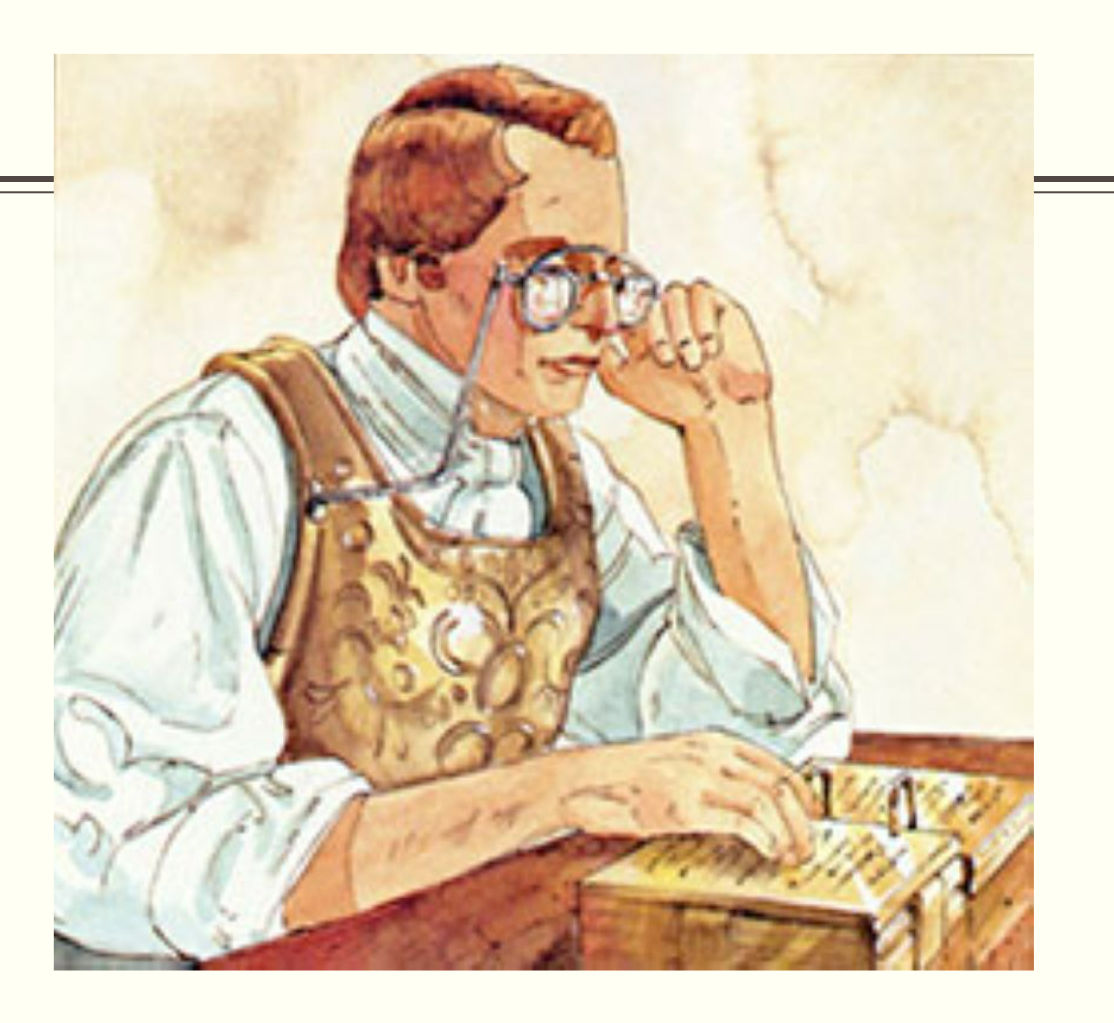
Back to top
Audience Q&A

Scott Gordon:

So, there’s a lot in the book of Moses. There’s a lot in the Book of Giants. What is the one thing—if you could just summarize everything—what’s the one thing you wish all Latter-day Saints knew about the Enoch material in the book of Moses?

Jeff Bradshaw:

I am still very much impressed by the fact that Enoch seems to be the culminating story for a temple text. It’s no coincidence that we start with Adam and Eve in chapter five being obedient to the commandments of the Lord, having their posterity as they were commanded in the earlier chapters, and performing sacrifice—obedience and sacrifice—and ending, after having traversed all the other principles, with the law of consecration in Enoch. I think if we read the book of Moses, including the story of Enoch, as a temple text, it would be a wonderful thing. 

Scott Gordon:

Are there any onomastic word plays with the book of Moses and the name Enoch?

Jeff Bradshaw:

Oh, wow. We should have Matthew Bowen here to talk about that. What I recall that he taught me is that it has a lot to do with teaching the word. The roots for “Enoch” and “initiatory” are tied together, and in many ancient texts where they’re doing plays on their name, he’s a hierophant. That means someone who initiates others—who kind of passes through the veil and has others follow him.

Scott Gordon:

So, I happen to have this book on my lap that you also have in front of you. Could you tell the crowd what that is again? Go ahead and tell us—what is it?
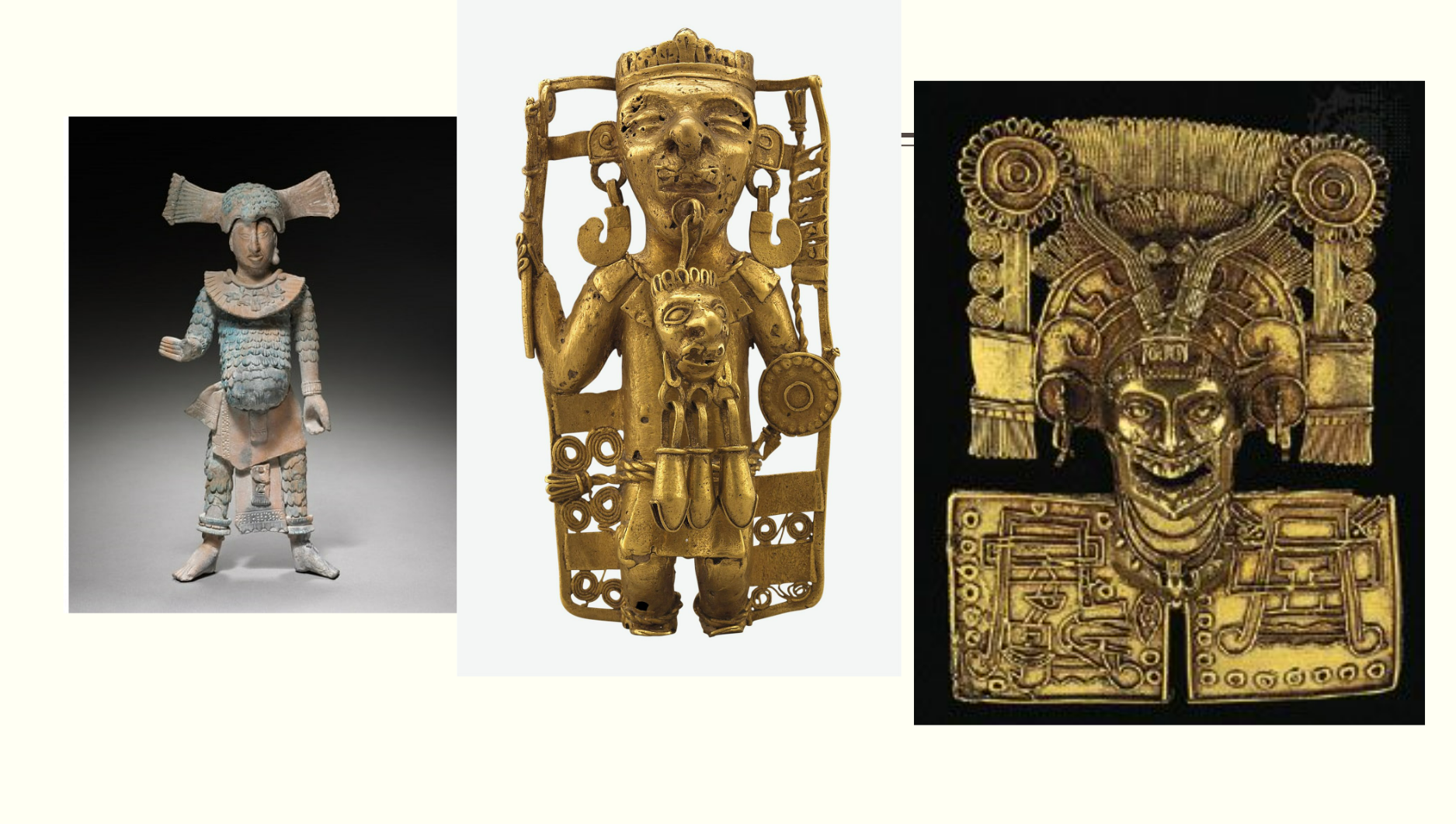
Jeff Bradshaw:

Yes, okay. So, this is the result of two conferences—I don’t know if there’ll be more or not, there might be—but it’s talking about why those of us who contributed, including editors such as Scott, believe that the book of Moses is an ancient text. It’s not okay to just think, “Joseph Smith made it up with a lot of nice stories.” There’s evidence from everything, from detailed textual work by people like John Carmack to Elder Hafen’s wonderful work in there from a temple text perspective. There’s Richard Bushman’s talk comparing it to the work of Eric Auerbach, Mimesis, and all kinds of perspectives. I think you’ll enjoy it.

Scott Gordon:

I really enjoyed, as I was looking at the manuscripts and such, how it talks about how the Book of Mormon is such a literary, historical book where you have stories and histories. Then, shortly after—almost no time at all—Joseph Smith does the book of Moses, and it is certainly not that kind of story. It’s much more heavenly, you know?

Jeff Bradshaw:

Yeah, apocalyptic.

Scott Gordon:

Apocalyptic, yes. It’s really fascinating.

Jeff Bradshaw:

I was going to say that this goes with what Nibley said: that whoever wrote the Book of Moses would have had to be an even greater genius than the writer of the Book of Mormon. So, I guess God in both cases.

Scott Gordon:

Yeah, and I think it’s interesting when people say, “Joseph Smith made this whole thing up.” You look at the Book of Mormon—that gives you one element. Then look at the Book of Moses—that is a completely different element. Then you look at the Book of Abraham, which gives, again, a completely different element. And then you look at the Doctrine and Covenants, which is different again. I think people who dismiss Joseph Smith—it makes it very difficult to dismiss him just out of hand.

Jeff Bradshaw:

I wish it was more difficult to dismiss him. Yes, but it’s hard for me to dismiss it.

Scott Gordon:

So, I wish we had this book in the bookstore. We don’t yet. Do we know when it might be coming out?

Jeff Bradshaw:

So, I was just waiting to see these physical copies—which I got yesterday—to order them because sometimes the cover gets a little funny or whatever. But I just have to—well, Delayna can get with me after the event, and we can actually go ahead and order them today, as many as she wants. The Kindle versions are already up on Amazon, and the PDFs—she already has a copy.

Scott Gordon:

I was just going to say, we do have the PDF version up in our bookstore online. So, if you want to download this book in PDF format, you can just go to the FAIR Latter-day Saints bookstore and download it—as of about 10 minutes ago. We just got it up there.

Jeff Bradshaw:

Thank you, Scott. Thank you, DeLayna, and everybody. 

Scott Gordon:

So, we look forward to having this. We’ll make sure we let everyone know when it’s available in our bookstore so that people can order it. Thank you for all that you do. I know you do a lot with Interpreter and a lot with this. I think your leadership on the Book of Moses scholarship has been outstanding. So, thank you so much.

Jeff Bradshaw:

Thank you. Nice to have you as a friend, Scott.
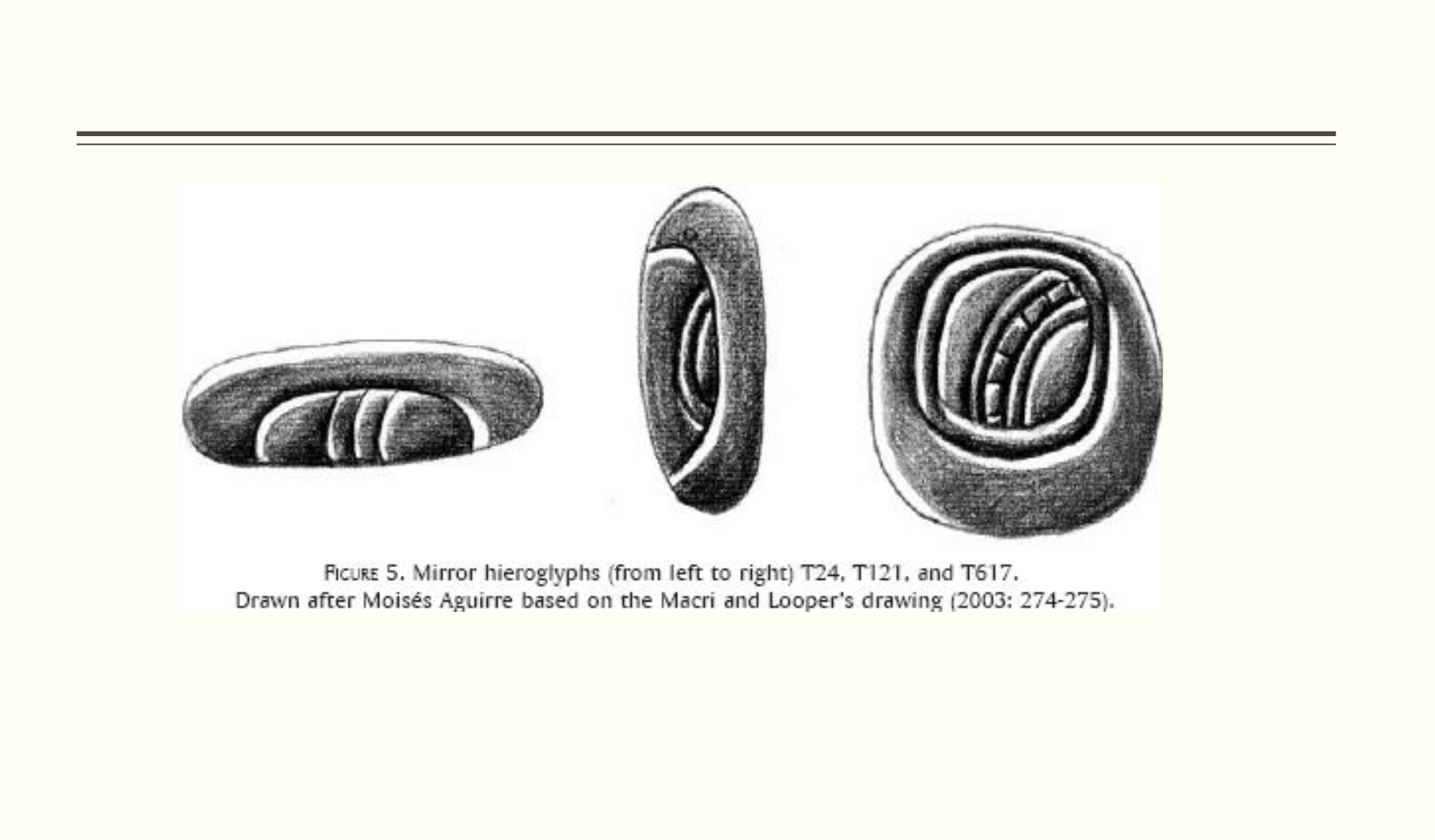
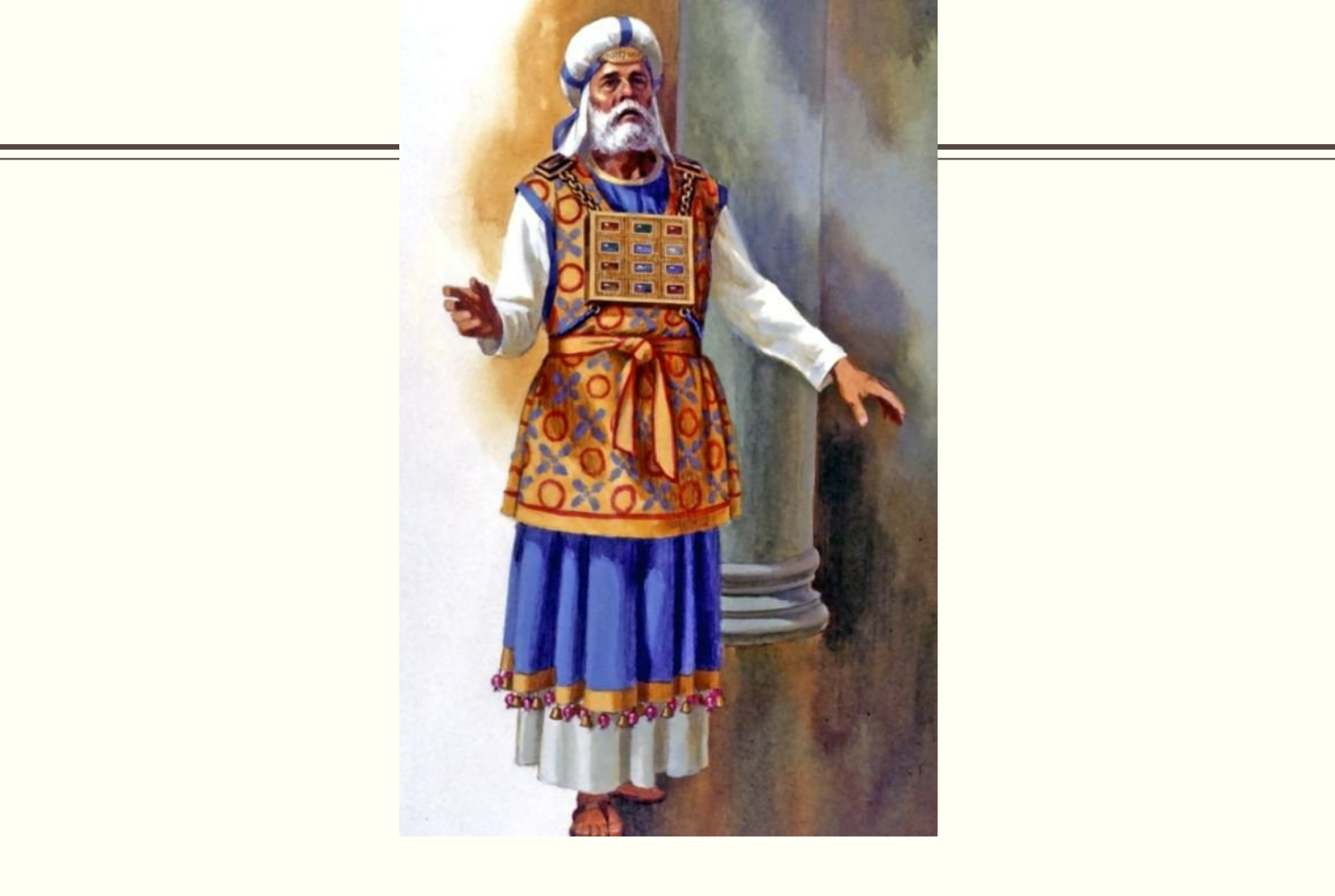
All Talks by This Speaker

coming soon…

Back to top
Common Concerns Addressed

Are the Enoch parallels coincidental?

The sequence, specificity, and frequency of these similarities make them highly improbable as mere coincidence.
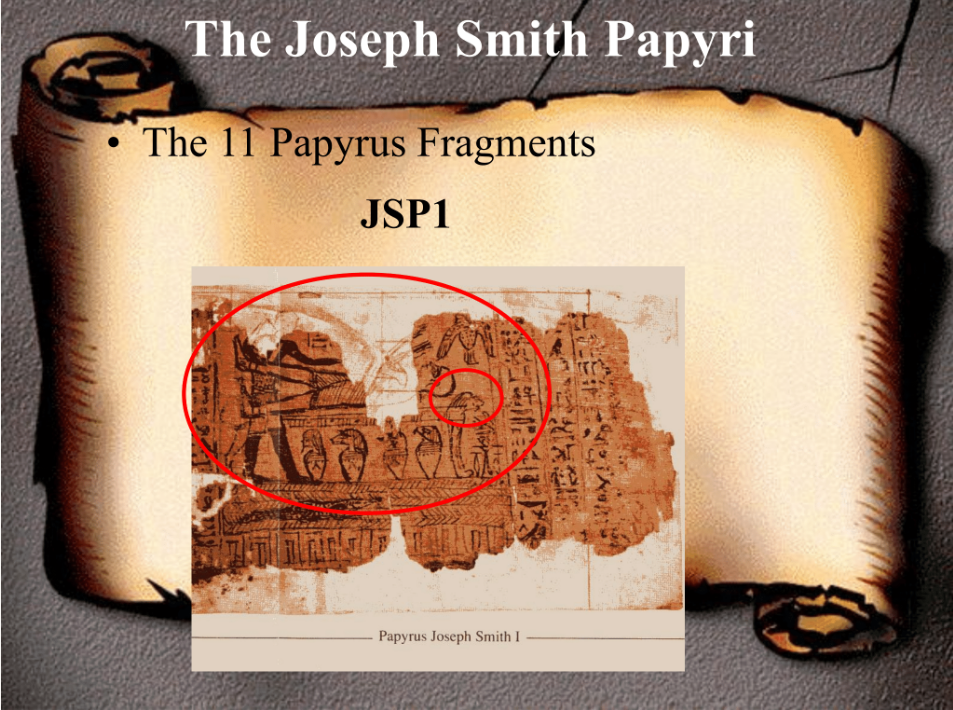
How could Joseph Smith have known about these ancient texts?

The Book of Giants was discovered in 1948—over a century after the Book of Moses was revealed—making textual dependence impossible.

Apologetic Focus

The antiquity of the Book of Moses.

Strengthening faith through historical and textual scholarship.

The enduring relevance of Enoch’s teachings in modern times.

Explore Further
Back to top
Jeff Bradshaw FAIR Conference talk, Hugh Nibley Enoch scholarship, ancient Enoch texts and Mormonism, Book of Moses ancient text evidence, Pearl of Great Price apologetics, temple themes in the Book of Moses, Latter-day Saints Enoch traditions, Book of Giants Dead Sea Scrolls, Mormon apologetics Pearl of Great Price, did Joseph Smith write the Book of Moses?, Book of Moses and ancient scripture parallels, Restoration scripture antiquity, FAIR Mormon apologetics, LDS temple text Enoch, Mormonism and Dead Sea Scrolls, evidence for ancient Enoch texts, critics of Joseph Smith Book of Moses, Book of Moses vs pseudepigrapha, Book of Moses as a temple text, Hugh Nibley legacy Mormonism, FAIR Latter-day Saints apologetics

Share this article

Facebook
X
Email
Reddit
  • « Go to Previous Page
  • Page 1
  • Page 2
  • Page 3
  • Page 4
  • Page 5
  • Go to Next Page »

Primary Sidebar

Faithful Study Resources for Come, Follow Me

Subscribe to Blog

Enter your email address:

Subscribe to Podcast

Podcast icon
Subscribe to podcast in iTunes
Subscribe to podcast elsewhere
Listen with FAIR app
Android app on Google Play Download on the App Store

Pages

  • Blog Guidelines

FAIR Latest

  • Come, Follow Me with FAIR – Isaiah 58–66 – Jennifer Roach Lees
  • Come, Follow Me with FAIR – Isaiah 58–66 – Part 1 – Autumn Dickson
  • Jesus Lives to Lift
  • Come, Follow Me with FAIR – Isaiah 50–57 – Part 2 – Autumn Dickson
  • Come, Follow Me with FAIR – Isaiah 50–57 – Jennifer Roach Lees

Blog Categories

Recent Comments

  • Willie Louise Truitt on The Joy of a Covenant Relationship with God
  • Katrina on In memory of Chandler “Chuck” Hendry
  • Nancy Farmer on Come, Follow Me with FAIR – Psalms 49–51; 61–66; 69–72; 77–78; 85–86 – Part 1 – Autumn Dickson
  • Nicko De Leon on In memory of Chandler “Chuck” Hendry
  • Becky Matson on In memory of Chandler “Chuck” Hendry

Archives

Follow Us

  • Facebook
  • Twitter
  • iTunes
  • YouTube
Android app on Google Play Download on the App Store

Footer

FairMormon Logo

FAIR is a non-profit organization dedicated to providing well-documented answers to criticisms of the doctrine, practice, and history of The Church of Jesus Christ of Latter-day Saints.

Donate to FAIR

We are a volunteer organization. We invite you to give back.

Donate Now

Site Footer

The use of the temple in past and current logos and the name "Mormon" are licensed for use by The Church of Jesus Christ of Latter-day Saints.