
In his October 2025 General Conference address, “The Good News Recipe,” Elder John D. Amos uses a familiar metaphor to teach a deeply personal gospel truth: when life feels off balance, incomplete, or discouraging, the solution is not abandoning the recipe—it is adding more Jesus Christ.
Drawing on both culinary imagery and pastoral experience, Elder Amos teaches that discipleship is not about flawless execution. It is about recognizing what is missing and intentionally inviting the Savior more fully into our lives.
What’s the remedy? It’s simply to add more of what invites Jesus Christ into your life.

This simple counsel reframes how we approach weakness, mistakes, and spiritual frustration.
Common Criticism: “If I’m struggling, it must mean I’m doing the gospel wrong.”
Many faithful disciples quietly assume that difficulty, inconsistency, or discouragement signals personal failure. When spiritual life feels messy or progress feels slow, they may conclude that something is fundamentally broken—or that they are.
Fallacy at Work: Perfection as Proof
This belief treats discipleship like a rigid formula where correct inputs guarantee immediate success. When outcomes fall short, confidence erodes. The gospel becomes a test of performance rather than a relationship with the Savior.
Elder Amos’s Correction: Christ Compensates for Imperfection
Elder Amos teaches that imperfection is not evidence of gospel failure—it is the very reason Jesus Christ is central to the plan. Just as a recipe may need adjustment, discipleship invites ongoing evaluation and recommitment.
When something feels missing, the answer is not to discard faith or start over entirely. It is to add more of what invites Christ: prayer, scripture, charity, humility, and trust in His Atonement.
Resolving this Fallacy:
The gospel was never designed to eliminate struggle. It was designed to teach us where—and to whom—to turn when struggle arises.
Living Apologetics: When the Recipe Feels Off
Elder Amos’s teaching speaks powerfully to those who feel spiritually inadequate or overwhelmed. Instead of asking, “What am I doing wrong?” he invites disciples to ask, “How can I add more of Christ?”
This perspective responds to concerns such as:
- “Why isn’t this working for me?”
- “If the gospel is true, why do I still struggle?”
The answer is not found in harsher self-judgment, but in deeper reliance on the Savior.
Practical Apologetic Use
- If someone says: “I’ve tried the gospel, and it doesn’t seem to help.”
- You can respond: “Elder Amos teaches that when something feels missing, the answer is to add more of what invites Jesus Christ—not to give up.”
 Ways to Apply Today
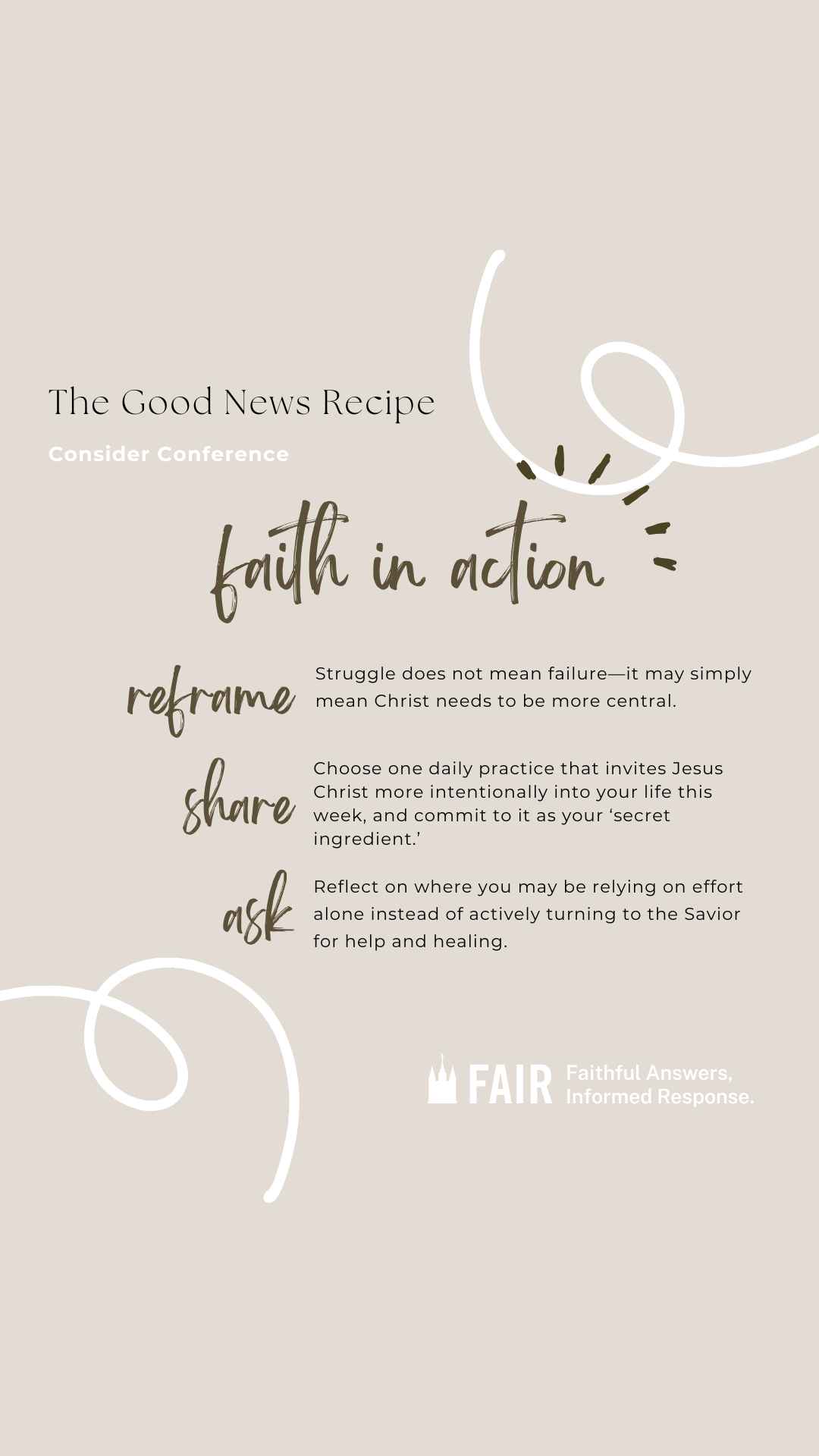
1️⃣ Identify one area where discipleship feels strained or discouraging.
2️⃣ Ask what might invite Christ more fully into that space.
3️⃣ Act in small, simple ways, trusting the Savior to magnify effort.
Keep This Talk With You
Elder Amos reminds us that the gospel of Jesus Christ is not fragile. It is resilient, adaptive, and deeply merciful. When life feels out of balance, the solution is not self-condemnation—it is recommitment.
The Good News Recipe does not promise perfection. It promises that Jesus Christ can compensate for what we lack and transform sincere effort into lasting joy.
Where in my life might I need to intentionally add more of Jesus Christ right now?
The Consider Conference series by FAIR offers an in-depth look at recent General Conference talks to help members of the Church of Jesus Christ of Latter-day Saints navigate common questions, misunderstandings, and criticisms. Each post provides doctrinal insights, historical context, and practical ways to apply gospel principles in everyday conversations. Through this series, we hope to equip readers with faith-promoting resources that encourage thoughtful reflection, respectful dialogue, and a stronger foundation in gospel truths, fostering both personal conviction and meaningful discussions with others.
