
In his April 2026 General Conference address, Elder Patrick Kearon taught that Church callings are much more than assignments to fill vacancies or keep a congregation functioning. They are inspired invitations to join Jesus Christ in His redeeming work while allowing Him to refine our own hearts through service. Looking back on his first calling as a newly baptized member, Elder Kearon recognized that what once seemed unexpected became one of the Lord’s greatest tools for his growth.
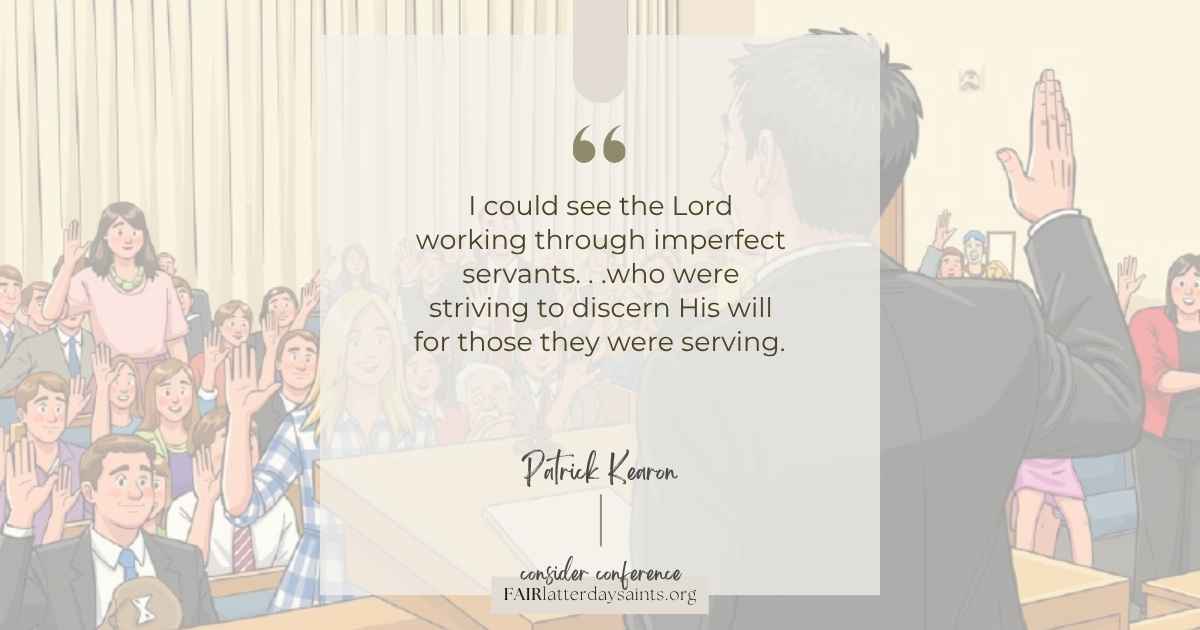
I could see the Lord working through imperfect servants. . .who were striving to discern His will for those they were serving.
Many people struggle with Church callings. Others struggle with the fact that the Church itself is led and served by imperfect people. If leaders make mistakes or members fall short, does that mean the Church cannot be guided by God?
Elder Kearon’s answer is both honest and hopeful: God has always accomplished His work through imperfect servants who are sincerely striving to follow Him. Rather than being discouraged by human weakness, we can recognize it as evidence of the Savior’s power to accomplish divine purposes through ordinary disciples.
Common Criticism: The Church Can’t Be True Because Its Leaders and Members Are Imperfect
One of the most common criticisms of religion is that if a church truly represents God, its leaders and members should consistently reflect His perfection. When mistakes are made, people sometimes conclude that the Church’s claims to divine guidance must therefore be false.
Elder Kearon responds by shifting our focus from human perfection to divine partnership. God has never waited for perfect people before accomplishing His work.
Fallacy at Work: Perfectionism (The Nirvana Fallacy)
The Nirvana Fallacy occurs when we reject something good because it falls short of an unrealistic ideal.
Instead of comparing the restored Church with real-world alternatives, critics sometimes compare it to an imagined community without weakness, mistakes, or growing disciples. But throughout scripture, the Lord repeatedly entrusted His work to imperfect people—from Moses and Peter to Joseph Smith and the early Saints.
Expecting flawless disciples before believing in divine guidance misunderstands the way God has always worked.
Doctrine
The Lord has consistently called ordinary men and women to accomplish extraordinary purposes. King Benjamin taught that “when ye are in the service of your fellow beings ye are only in the service of your God” (Mosiah 2:17), reminding us that service itself is one of God’s principal means of shaping His covenant people.
Likewise, Paul described the Church as the “body of Christ,” where every member contributes according to the gifts God has given (Romans 12:4–5). The strength of the body comes not from the perfection of each individual member, but from Christ, who is its Head.
Elder Kearon reminds us that callings are “tailor-made for our growth” and that “it really isn’t where we serve but how that matters to the Lord.” God is not looking for flawless servants. He is looking for willing ones.
It really isn’t where we serve but how that matters to the Lord.
Elder Kearon’s Correction
Elder Kearon does not pretend that Church leaders always make perfect decisions or that every member serves flawlessly. Instead, he invites us to recognize something more remarkable: Christ patiently works through imperfect people who are striving to discern His will.
That perspective changes how we view callings, ward members, bishops, Relief Society presidents, youth leaders, and even ourselves. Rather than asking whether God’s servants are perfect, we begin asking whether they are honestly seeking to follow Him.
The answer, more often than not, is yes.
And that is exactly how the Lord has always built His kingdom.
Solution
The existence of imperfect servants is not evidence against God’s Church—it is evidence of God’s grace.
If God only worked through perfect people, no one could participate in His work. Instead, He invites imperfect disciples into His service, knowing that as they bless others, He will also sanctify them.
That is one reason Church callings matter so deeply. They are not merely responsibilities; they are one of God’s primary classrooms for discipleship.
Living Apologetics: Looking Beyond Human Weakness
It is easy to become discouraged when we notice mistakes in Church leaders or fellow members. It is equally easy to become discouraged by our own shortcomings when serving in a calling.
Elder Kearon invites us to remember that Christ’s work has never depended on perfect servants. It depends on willing hearts.
Practical Apologetic Use 
If someone says: “If the Church were really true, its leaders wouldn’t make mistakes.”
You can respond: “God has always worked through imperfect people. The real miracle isn’t that His servants never make mistakes—it’s that Christ consistently accomplishes His work through disciples who are humbly striving to follow Him.”
Ways to Apply Today
1️⃣ Extend grace. When someone serving in your ward falls short, remember that they are learning discipleship just as you are.
2️⃣ Support those you sustain. Pray regularly for your leaders and teachers rather than assuming they carry their responsibilities alone.
3️⃣ Embrace your own calling. Don’t wait until you feel perfectly qualified before giving Christ your willing heart.
Keep This Talk With You
Elder Kearon’s invitation extends far beyond accepting a Church calling. It invites us to see God’s kingdom through the eyes of Christ. The Savior has never built His Church with perfect people. He has always built it with covenant disciples who are willing to follow Him, repent, learn, and keep serving.
That truth should fill us with both humility and hope. Humility because we recognize our own imperfections. Hope because Christ is not waiting for perfection before inviting us into His work. As we accept opportunities to serve, sustain one another, and trust the Lord’s guiding hand, we discover that He is shaping us even as He blesses others through us.
This week, try one small step:
- Thank someone who quietly serves in your ward or branch. Your encouragement may remind them that their efforts matter more than they know.
- Pray for someone whose calling seems especially demanding, asking the Lord to strengthen and guide them.
- Look for one opportunity outside your formal calling to be “about His Father’s business” through an act of Christlike service.
Then we can learn to see one another the way the Savior does: not as finished disciples, but as willing ones.
How can you better support those the Lord has called, knowing that He accomplishes His work through willing—not perfect—disciples?

The Consider Conference series by FAIR offers an in-depth look at recent General Conference talks to help members of the Church of Jesus Christ of Latter-day Saints navigate common questions, misunderstandings, and criticisms. Each post provides doctrinal insights, historical context, and practical ways to apply gospel principles in everyday conversations. Through this series, we hope to equip readers with faith-promoting resources that encourage thoughtful reflection, respectful dialogue, and a stronger foundation in gospel truths, fostering both personal conviction and meaningful discussions with others.
