• Skip to primary navigation
  • Skip to main content
  • Skip to primary sidebar
  • Skip to footer

FAIR

  • Find Answers
  • Blog
  • Media & Apps
  • Conference
  • Bookstore
  • Archive
  • About
  • Get Involved
  • Search

Church History

Keys, Covenants, and Easter

July 12, 2026 by FAIR Staff Leave a Comment

In his April 2026 General Conference address, “Keys, Covenants, and Easter,” Elder Quentin L. Cook connected the Savior’s Resurrection with one of the most significant events of the Restoration: the appearance of Jesus Christ, Moses, Elias, and Elijah in the Kirtland Temple. Elder Cook taught that the priesthood keys restored there are central to God’s plan to unite His children and families eternally.

But some people wonder why priesthood keys and temple sealing ordinances matter at all. Aren’t they simply later additions to Christianity? Elder Cook’s message offers a powerful answer: these restored keys are not peripheral doctrines—they are part of the Savior’s work to bring God’s children back into His presence. [Read more…] about Keys, Covenants, and Easter

Filed Under: Church History, Consider Conference, General Conference, Jesus Christ, Joseph Smith, Temples

Mythmaking and The Mark Hofmann Case

Start Here

Question
Did the LDS Church hide Mark Hofmann documents?
 
Short Answer
According to Steve Mayfield and document examiner George Throckmorton, many popular claims surrounding the Mark Hofmann case have become legends that are not supported by the historical record. The speakers argue that many alleged “cover-up” narratives arose from misunderstandings, incomplete information, or repeated retellings rather than documented evidence.
Key Takeaways
  • Many widely repeated stories about the Hofmann case originated from secondhand information.
  • Several claims about the Church purchasing documents to suppress them are challenged with documented ownership histories.
  • George Throckmorton explains that forensic document examination is complex and often cannot be reduced to simple tests like “cracked ink.”
  • The speakers encourage readers to evaluate sources carefully and distinguish documented evidence from speculation.

Summary

Summary

In this presentation, Steve Mayfield explores how many of the most common stories surrounding the Mark Hofmann case have evolved into accepted narratives despite lacking strong historical support. Using examples from books, articles, and online discussions, he examines claims that the Church created doctrine in response to the White Salamander Letter, secretly purchased controversial documents to suppress them, or influenced prosecutors to avoid a public trial. Drawing on his own research and conversations with key participants, Mayfield argues that these claims often grew through repeated retellings, incomplete information, or misunderstandings rather than documented evidence.

Mayfield emphasizes the importance of evaluating sources carefully, recognizing how misinformation can spread, and distinguishing firsthand evidence from speculation. He illustrates this principle with examples from his own research, acknowledging occasions when he himself repeated inaccurate information before discovering better documentation.

The presentation then transitions to forensic document examiner George Throckmorton, who offers firsthand perspectives from his sixteen months on the Hofmann investigation. Throckmorton discusses the complexity of authenticating forged historical documents, explaining that identifying a Hofmann forgery required extensive forensic analysis rather than simple visual clues. During a question-and-answer session, he addresses common questions about Hofmann’s techniques, the White Salamander Letter, the John D. Lee Scroll, and other controversial documents, while emphasizing the importance of careful scholarship, documented evidence, and professional forensic examination when evaluating historical claims.

TL;DR

TL;DR (Too Long; Didn’t Read)

Steve Mayfield examines several persistent myths surrounding the Mark Hofmann forgeries, including claims that the Church created doctrine around the Salamander Letter, forced a plea bargain, or secretly purchased documents to hide them. Using personal experiences and conversations with participants in the investigation, he argues that many of these stories grew through repetition rather than evidence.

George Throckmorton, one of the principal forensic document examiners on the Hofmann investigation, follows by discussing his role in the case, the challenges of authenticating forged documents, and answering audience questions about Hofmann’s techniques and later discoveries.

Note About the Slides in this Presentation

Note on Visuals:

The original slides from Steven Mayfield’s presentation are not available. 

Download the Paper

Click to Download

The Legend Becomes Fact

It says up here, “Smile, have fun, play nice.“

Not in my profession.

I had a paper planned, a great big paper planned for today, and then I noticed an article in the Salt Lake Tribune last Saturday about the FAIR conference in which Scott mentioned that we don’t attack people personally. We don’t deal with personal attacks. So you’re safe, George. I can’t give that talk, so I had to do something different.

My topic—and I’m going to go through some of these things very quickly because I think the more interesting part of this presentation is hearing from the man himself, George Throckmorton.

The Man Who Shot Liberty Valance

Over the years, George and I have had interesting conversations that we’ve talked about in reference to the Hoffman case and others. We like to quote statements out of movies, and our favorite one that relates to Hoffman, and what I think leads out in the mythmaking of the Hoffman case, is a statement made at the end of a movie called The Man Who Shot Liberty Valance, starring John Wayne and Jimmy Stewart. In my opinion, the greatest western of all time.

For those who don’t remember this movie, I’ll run through it very quickly.

The movie starts with Jimmy Stewart and his wife returning to a little town in the West called Shinbone. He has been a U.S. senator and an ambassador, and he’s returning with his wife to this little town to bury an old friend named Tom Doniphon, played by John Wayne.

As they come into town, the local reporter sees him, grabs the editor, and they come over and say, “What is this great statesman, this senator, doing in our little town of Shinbone?”

They said, “We’re here to bury a friend.”

The editor pushed the issue. “We need to talk to you. Who is this Tom Doniphon?”

The Story of Tom Doniphon

So Jimmy Stewart agrees to talk with them and be interviewed, and he relays the story about how, as a young lawyer, he came to town, got involved in the local politics, and came into conflict with a local outlaw named Liberty Valance, played marvelously by Lee Marvin.

During the conflict and the fight over becoming a state from a territory, he is challenged to a duel by Liberty Valance. At the same time, he’s in competition with John Wayne over the girl.

After the election for delegates, he meets Liberty Valance on the street and shoots and kills him. He now becomes a hero and is known as the man who shot Liberty Valance.

They go to the territorial convention, and he decides to leave when he’s pressured or accused of being a murderer. As he’s about to leave, John Wayne pulls him aside and explains to him, “You did not shoot Liberty Valance because during that shooting I was in the alley and I shot and killed him, not you.”

They reenact that scene.

He then proceeds to go back, becomes the delegate, they get statehood, and he becomes governor, senator, and wins the girl.

Well, after he’s explained this whole story and the reporter is writing all the notes, the editor takes these notes, tears them up, and throws them in the fire.

He’s asked, “Well, Mr. Editor, why did you do that?”

He got up, turned, looked at Jimmy Stewart, and said, “This is the West, sir. When the legend becomes fact, print the legend.”

This fits in perfectly for Mark Hoffman.

Early Examples of Hoffman Myths

Let me share quickly some of the examples I believe exist. Some of these are kind of fun. Some of these we’ve all heard.

First one is our friend Ed Decker from Saints Alive in Jesus. This is on his webpage. He has a book called Bearing Testimony of Truth, compiled and edited by Derek S. Harden. It’s been on there for a few years, and this morning it still was.

This is a personal manuscript written by this gentleman, and there’s some editorial notes that Ed Decker wrote at the beginning:

“This manuscript was completed and submitted during the brief time that the Mormon Church had accepted as true a fraudulent work generally called the White Salamander Letter by the infamous forger of Mormon manuscripts, Mark Hoffman. We have notified the author that this needs to be cleaned up and removed from the book and will make the correction as soon as we receive the corrected copy.”

Okay. It still is.

Interesting that the LDS Church created new doctrine to explain that a white salamander was really an angel, and when the hoax was revealed, just as suddenly undid the doctrine—all without an apology or a blush.

Wow.

That’s kind of—you know—to eliminate something that never was really there. But I find that kind of humorous, that we had a doctrine as such.

I must have missed that meeting.

The Jerald and Sandra Tanner Narrative

Next one is an article out of the Salt Lake City Weekly from March of 2003. It’s a story about Jerald and Sandra Tanner and Utah Lighthouse Ministry.

Reviewing the Hoffman case, it says here:

“While many were taken by the notorious document forger and bomber Mark Hoffman, Jerald, with typical uncompromising accuracy, was not bamboozled. Collectors of historical documents from the LDS Church to the Library of Congress and Sotheby’s were buying Hoffman documents as fast as he could manufacture them. Hoffman sold forged letters of famous Americana, and his major focus was forging early Mormon historical documents that were extremely damaging to LDS doctrine and early Church leaders. All the while, only Jerald Tanner remained unimpressed and unconvinced of their authenticity. In 1984, he publicly announced his misgivings, calling Hoffman a forger.”

Now we’re talking about 1984. This is a year before the homicides.

I wondered about this. Now, it’s pretty clear that Jerald and Sandra had some serious doubts and problems with the Salamander Letter, but not all of them.

Not too long after this article came out, I visited with Sandra Tanner at their home in their bookstore, and I asked her, “Is this a misprint? Is this a misunderstanding by the Weekly?”

This is what Sandra told me:

“No. No. Jerald did have doubts about all the documents and really believed that Mark was a forger, but he had no solid proof.”

Okay, this is eighteen years after the fact.

Now this is being revealed in this article, but I have some serious problems with that in the fact that, in some of the writings of the Tanners following the homicides—and let me make a little side note here because they made reference to the bombings and the forgeries of Hoffman.

Call Him What He Is

One thing that has amazed me over the years is that we always refer to Hoffman as a bomber, or the bomber-forger. We seem to be afraid to say what he is.

He’s a murderer.

The forgeries and the bombings are secondary to the fact that he killed two people.

So if I had my preference, we’d call him what he is—a murderer.

More Myths Surrounding the Hoffman Case

But anyway, I asked Sandra that, and she just said, “Well, he just didn’t have any proof.”

Following the homicides, in some of the writings they suggested that Mark wasn’t that good of a forger or writer, that he must have had help. They suggested there was another individual who was forging the documents, and Mark was the middleman. When this person either died or stopped doing the forgeries, Mark started doing them all himself. That’s when they became sloppy and so forth.

Even as of last October, at a conference sponsored by an organization George belongs to—the Southwest Association of Forensic Document Examiners—Sandra and Jerald were there, and she was even asking people if they had any ideas whether anybody was helping Mark.

So I’m getting two different stories here.

But the significance of this is the fact that you read a lot of the webpages and some of the chat rooms, and they always say Jerald was the only one who knew that Mark was a forger. Everybody else believed him.

That isn’t true at all. There were others who had doubts too, but I find that to be one of the myths that has started.

The Myth of the Hoffman Plea Bargain

Another one of the myths that is frequently read about is the idea that there was going to be no trial of Mark Hoffman because the Church did not want information passed out, and the fact that the leadership of the Church—whoever they are—forced a plea bargain.

The man that will be preceding me here, Mr. Throckmorton, has explained to me that on the day he was asked to leave employment from the Salt Lake County DA’s office investigating the case, he was there when District Attorney Yokum instructed Bob Stott, the lead prosecutor, that he would plea bargain the case.

I’ve also heard from the mouths of Jerry Doria, Dave Briggs, and a few other people involved with the case that the Church had nothing to do with the plea bargain.

This came strictly from Mr. Yokum.

Yet this is another story that you will read on webpages and chat rooms—that the Church forced the plea bargain because they didn’t want President Hinckley to testify, or have to, or any other General Authority.

The Solomon Spalding–Sidney Rigdon Document

Now another fun one that I found interesting is this document here.

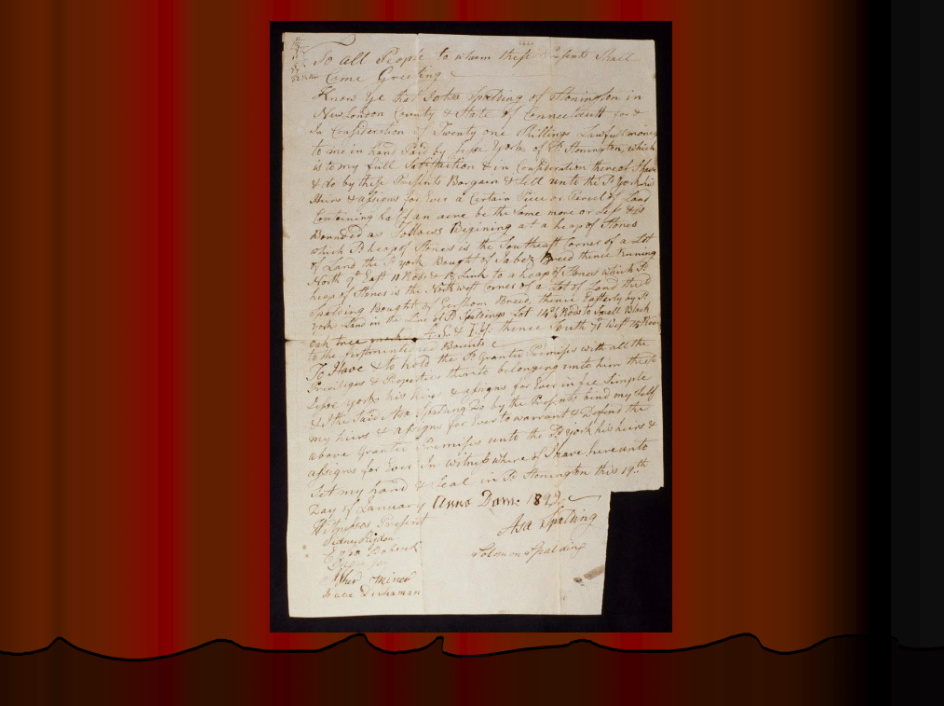
Here we go. This is the infamous Solomon Spalding–Sidney Rigdon land deed document that Mark came across.

Actually, it’s a legitimate old land deed where a gentleman named Asa Spalding is selling some land to his wife’s cousin, Jesse York. Well, Mark somehow got ahold of it.

Where? We don’t know.

But he proceeded to make some changes. Here you see, down at the bottom, the name Solomon Spalding. Over here you see the name Sidney Rigdon.

Now this is an interesting document because for years, on that Spalding issue, the claim was they didn’t know each other, and here would be some proof that they knew each other.

But it turns out these were added names. As you see over here on the date, it says 1822.

Well, the actual date is 1792.

Mark added the date at the top—1822.

This was a document that he showed Elder Oaks, and to where Elder Oaks went and signed for the $185,000 loan to possibly purchase the McLellin Collection.

In fact, Mark claimed this was part of the McLellin Collection.

A few weeks after showing it to Elder Oaks, he decided he needed some quick cash, so he took it down to Cosmic Airplane and sold it for $400.

Even though the guy who bought it, Steve Barnett, said, “There’s a problem with the dates because Spalding died in 1816.”

And if you went to the original date, 1792, Sidney Rigdon hadn’t been born yet.

But Mark convinced him.

He said, “Well, that’s not the same Solomon Spalding, but will you buy it for the Rigdon autograph?”

He paid the $400 for it.

Claims That the Church Purchased the Document

Now, a few years ago a book came out—I don’t know if you can see it—but it’s called Mormon Conspiracy by Charles Wood.

I got it at the Utah Lighthouse Ministry. 1

This is what he writes:

“The First Presidency was so impressed with Hoffman’s discovery of the Anton Transcript that they called the press conference at which they announced the new discovery and commended Hoffman for his efforts. Hoffman followed the Anton Transcript with several non-faith-promoting forged documents, which were quickly bought up by the First Presidency and hidden from the membership and the public. One of these forged documents included one that linked Sidney Rigdon, second to Commander Joseph Smith, to Solomon Spalding.”

Okay.

Provenance of the Spalding-Rigdon Land Deed

2

This document here.

Now in 2002, when I was reading this book, I had to read it a number of times.

I had to wash my eyes out to make sure I was actually reading it because, at that particular time, as I read this in my apartment, this document that you see in front of you was sitting on my table in my apartment.

See, because I owned it.

The Church never owned it.

At the time:

  1. It went from Cosmic Airplane,
  2. Was used and examined by George as part of the investigation,
  3. Then returned to Cosmic Airplane, at which time the owner, Bruce Roberts, sold it to Ken Sanders in 2000.
  4. I bought it from Ken Sanders in August of 2000.
  5. Right now—in October of 2004—I donated it to BYU so it’s preserved down there.

But here is a myth that this man is saying: the Church bought it as one of the documents they bought to hide.

The Church never owned it.

Correcting the Record

I again asked Sandra Tanner.

In fact, it was funny because not too long after that, I was on an airplane to Pasadena to speak at a Sunstone Symposium, again with George, and happened to get on the same flight with Jerald and Sandra Tanner and sat next to them on the plane.

So I asked them about this, since I bought the book from them.

I mentioned, “Well, you know, there’s an error in the book.”

Sandra said, “Oh, really?”

I showed it to her and said, “You know, this is wrong.”

“Well, how’s that?”

“You know who owns that document?”

Sandra says, “Who?”

I said, “Me.”

There was that long pause as she and Jerald looked at me, and she quickly recovered and said, “Well, you know, there’s so much information and material out there that he could have been mistaken or gotten bad information.”

Now think about it.

That is a very true statement.

Over the last twenty-one years now, that has been exactly the problem we’ve had with this case.

We have this idea that the Church was buying these documents to hide them.

Yet a book here by Dean Jessee, The Personal Writings of Joseph Smith, published in 1984—not 1884, 1984—has six of the documents listed in here. 

The majority of the documents that Mark forged were not controversial. They were not testimony-shaking. They were simple little things.

There was no reason to hide them. No reason to suppress them.

Were the Documents Really Hidden?

Yet today you can read on some webpages, like our friends from Recovery from Mormonism, who have these great theories that the Church was buying these things to hide them, spending millions of dollars so that no one would ever see the light of day. 3

Now I’m thinking, okay, all these other documents were being bought by the Church and other collectors, very publicized in a lot of cases, but we do have two that could be questioned as having been hidden.

One being the Josiah Stowell letter, and the other one was the letter from Bullock to Brigham Young, referencing the Joseph Smith blessing.

There might—if you read Victims—be explanations on why these things were not immediately released.

But now we have people talking about the Church hiding these things.

I’m saying, well, if the Church is as evil and satanic as you make it, why would the Church buy documents at high prices just to hide them? That’s why man invented matches and paper shredders.

Yet they’re kept. Why is that?

I mean, if you’re going to give them credit… If we’re going to be sinister, let’s go all the way.

But we still have them. In fact, last year—or actually it’s been a few years—Kenny Sanders had a symposium in 2002 on it, and they had found another document in the Church archives that they realized had come from Hoffman.

These things are still out there.

So it’s, again, a myth that has just taken on a life of its own.

Evaluating Claims About the Hoffman Case

Let me give you some pointers on what to do when you hear various things and read them.

A lot of people here, if you’re like me, kind of browse the Internet and Recovery from Mormonism and all these places. The spiritual arm-twisting—that one claim this week they did on prominent rich Mormons buying these documents for them…

  1. First of all, consider the source. Consider the source of the person writing these things.
  2. Number two, realize that during this whole time, a lot of people were getting information about these documents and material, but the person they were getting it from was Mark. And Mark was very good at lying and telling stories. Just because you may have two persons who were closely involved with him and they tell different stories doesn’t mean these people are lying.

You’ve got to find out where they got their information. The same thing goes for other people who had information. Sometimes they got it from friends or acquaintances who got it from Mark.

The same thing happened during the police investigation. They were hearing stories from people who had talked to Mark, and they were passing them on, and they were confused sometimes because the stories weren’t clicking.

Or these people were told one thing, but other people, like the Church authorities, weren’t telling us the same story.

Be very careful about that.

Why Bad Information Spreads

Also, because of the nature of the case—the homicide—it made a lot of people nervous. And a lot of people didn’t know how to handle themselves or how to deal with it because you don’t usually, in your life, come across being involved in a homicide case. Sometimes people’s initial reactions weren’t what the police liked.

But, as George can tell you, after he was able to get in there, the Church became very cooperative. Although the story goes that the Church was not cooperative, and some people have claimed that even President Hinckley led a stalling of the case—that he was interfering with the investigation. George can probably give us some highlights on his feelings about that.

But be very careful about people who might take a story and embellish it.

An Example of a Story that was Embellished

I have a great one that relates here to FAIR—of people taking information and getting it misconstrued.

A few months ago, Scott and FAIR were kind enough to publish a letter that I wrote to Scott regarding some items on the Dead Sea Scroll—or rather, the Deadly Scroll—the lead plate that was found down in Page, Arizona, at Lee’s Ferry a few years ago.

I made a comment that I had thought was true about a document—I may even have it here someplace.

Here we go.

This was written by Mark Hoffman in prison, listing the forgeries that he had done. Now, I had always thought, and been told, that it was following a suicide attempt. When he was up at the hospital, that this is when they found it during a search of his cell. Well, rereading some of the books, I discovered that didn’t happen after his suicide attempt.

That happened a few months earlier. When he was being interviewed regarding some threats that he had made against George and some members of the Board of Pardons, they did a cell search and came up with this list.

So even I had bad information. I wrote a letter to the Deseret News on that, and I put it in the article. Now I’m going to have to change it.

It happens. I’ve seen this happen all the time. Bad information. No one intends to be deceiving, but:

  • you just hear something, and
  • your own mind regurgitates it, and
  • it comes out differently.

So we have to be careful of that.

Oh, by the way… You’ll notice down here at the bottom the name John D. Lee. Okay…

Just a thought.

Anonymous Sources and “Secret” Information

Also be careful when people talk about the Hoffman case where they have information but they give you no names or sources. This is one of the things that Mark liked to play, and people were willing to go along with it.

“Keep secrets.”

We still have it. I got this all the time from George.

“I can’t tell you.”

Then I’d threaten to break his legs…

…and he still wouldn’t tell me.

Introducing George Throckmorton

So anyway, I’m going to turn the time over now to George so we can hear what he has to say.

But before I turn it over to him, I want to make some personal comments about Mr. Throckmorton. And these are nice things. So you don’t have to worry, Scott.

Back in 1991, I came over from Colorado because my career was going down the tube and my love life wasn’t there anymore. Through my good friend Van Hale, I worked in his business for a while. Then in 1994, I hired on to work in the crime lab with the Salt Lake City Police Department and got back into my chosen career.

A year later they changed the supervision of the crime lab from an officer or sergeant to a civilian, and they brought in George Throckmorton.

The thrill that I have had for the last ten years of working under his direction—literally sitting at his feet, hearing stories and information about the Hoffman case—has been one that has not only enriched my professional career, but also my avocation of things Mormon.

He has been kind enough to invite me into his life and his research and included me on things, even though he sometimes would play games like with the John D. Lee scroll. But that’s another story.

George Throckmorton as a Valued Friend

I want to tell you how much I have appreciated the opportunity to get to know him as a friend.

I care about him dearly. He is a dear friend, and I love him dearly. I hope that he’s here with us a long time because there is so much to share with us.

I want to close with this. As George comes up, I have a question for him regarding a statement that I read here in Mormon Murders, one of the greatest books on the case, I’m sure.

This is during the time that George and his associate Bill Flynn were examining the documents down at the Church archives.

It says:

“On the day Flynn left for Arizona”—Bill Flynn is from Phoenix, Arizona—”a Church delegation led by Gordon Hinckley visited the conference room. They looked suspiciously at all the equipment while Throckmorton and Flynn explained the process. They asked some questions, but, to Flynn’s astonishment, never asked the most obvious question of all: Are the documents genuine?“

George, as you come up here, I’d be very interested to hear about this experience.

What is it like to be in the middle of this—to have the leader of the Church, although at the time he was a counselor, but the man leading the Church who became the prophet? What was that experience like?

Maybe you can share with us, and what do you think? Why didn’t he ask that question when he was there and you were there in his presence?

George Throckmorton Responds

If I can respond to Mr. Mayfield’s question…

As I advance in age, I have a tendency not to remember certain things, and to remember other things even more than they actually happened, I guess.

But as President Hinckley came in to visit us that day…

I don’t remember it at all. Because it just never happened.

In fact, the closest association—and some of you may have heard this story, I’ve told it once before—the closest association I ever had with President Hinckley was because of my friends.

I’ve been in law enforcement, as was mentioned, almost forty years. My son used to work at the Church Office Building. It was his job to get the cars ready for the General Authorities to take to their various assignments. This is the story that I heard about President Hinckley, which took place several years ago.

A Story About President Hinckley

He liked to hot rod. Is that the right expression?

As he came to pick up a new car—they always have a chauffeur to drive around the First Presidency and some of the Apostles that can’t drive too well—but as he came and saw the new car, and his chauffeur was ready for him, he looked at it and said,

“I’ve always wanted to drive a new car. Is it all right if I drive?”

Well… What’s the chauffeur going to say? “No” ?

But the chauffeur said,

“Well, you know, I’ve always wanted to sit in the back seat, too.”

So they started driving down to Provo. President Hinckley’s foot got a little bit heavy. They were going a little too fast. As he looked in the mirror after hearing kind of an unusual noise, he saw some red and blue lights flashing behind him.

He pulled over to the right, and the highway patrolman came up and looked in the car. He went back, got on the radio, and called his dispatcher.

“I need to speak with my supervisor.”

The supervisor got on and said,

“What’s wrong?”

He says,

“I just pulled over a very important person.”

The supervisor said,

“Well, who is it? Is it Mayor Rocky?”

He says,

“No, more important than him.”

“Well, is it the governor?”

“No, more important than him.”

“Is it the President of the United States?”

The policeman says,

“No, more important than him.”

He said,

“Well, who is it?”

The policeman says,

“I really don’t know, but President Hinckley is his chauffeur.”

That’s the only story I know of President Hinckley. That’s the closest I’ve ever come to him.

George’s Role in the Hoffman Investigation

But I can say this. My involvement in this case, again, lasted for sixteen months. I entered the case about six weeks after the bombings took place.

I was working for the Attorney General’s office at the time as an investigator of white-collar crime with a background in forensic examination of documents.

There are many, many stories.

The one thing I learned, relating to what Steve said, is that even the investigators have different theories on what happened. There were eleven of us for sixteen months. If you talk to one investigator, he will say one thing. You talk to another one, he will say something else.

The reason being is we did different interviews. We spoke to different people. About every morning we would meet together as a group and discuss what had happened. I heard a lot of stories from the other investigators.

Then we would get our assignments, and we would go out to conduct our investigation. There are a lot of things that I heard and that I experienced firsthand that contradict so many things that are in the various books that are out there.

A Brief Overview Instead of a Full Presentation

What I have done today—I understand we’ve only got about twenty minutes left, if I understand how much time I have. There’s supposed to be some cards being passed around. Are those questions?

Okay.

I’m not going to tell you a whole lot about my involvement other than I’m going to answer questions that may be here. If anybody else has any, raise your hand now and do it because in about ten minutes I’ll be answering them.

Most of you know a lot about this case. As I’ve given talks in the past, I talk about the elementary things that happened, and I’m not going to do that today.

I’ll be happy to answer any questions. But what I have is a brief overview of many things. I took over seven hundred slides of different documents. I’ve never shown them. I never will be able to show them.

We spent three days once in our professional organization in Palm Springs, California, several years ago going over them, and I was unable to show them all then. What I have done is put a montage of slides together which will give you a brief—but more or less thorough—overview of the case itself.

I’m going to need some help up here on how to turn this light off so we can start the others going. Then, when we’re through, I’ll try and answer these questions.

You’ll just have to read these. I’m not going to say a whole lot.

Audience Questions

There’s three questions up here… Oops. Four… Five questions. That gives me about a minute each.

“In your opinion, what do you think caused Mark to turn to the dark side?”

  • I have no idea.
  • I don’t know him.
  • I don’t know anything about him.

All I know is the documents.

How Can You Identify a Hoffman Forgery?

“How does anyone tell a Hoffman forgery?”

I don’t know.

Myself and Bill Flynn did research for six months before we finally figured out how he did his forgeries because they were so unique and used techniques that we had never seen before.

As I get documents now asking if there is…

For instance, one of the things I’m sure a lot of you have heard is about the cracked ink. Well, realize it’s not always cracking, and it only shows at a particular degree of magnification.

So if you see cracked ink, that doesn’t mean it’s forged. All that means is it’s cracked.

It’s difficult to tell, and that’s one of the reasons why he was successful. It takes so long to do an examination.

On the Salamander Letter, for instance, I spent 120 hours on that one page. Who can afford to pay my fee to get a document examined if I’m going to spend 120 hours on it? Of course, I don’t spend that long on all of them.

And the Anonymous Employee?

“Do you know who the anonymous Park Service employee who discovered the scroll was?”

Yes, I do.

What Book Covers This Story Best?

“In your opinion, which book most accurately reflects the events surrounding the case?”

Obviously the one I wrote that’s sitting in the back.

The Mormon Will

“Any possibility Mark forged the Mormon Will?”

Is that Howard Hughes’ will? This was before his time. It was found in 1976.

So I don’t think so.

The Neely Bills

“I’ve been told by someone at Church Archives that Mark Hoffman had been poking around Norwich, New York, prior to Wesley Walters’s discovery of the Neely bills for the 1826 trial. How far-fetched would a Hoffman connection to these documents be?”

I went back to New York in April to look at that document. I don’t know when the Church is going to release…

They’re hiding it again.

[laughter]

I don’t know when they’re going to release the results of it. I don’t know whether the people in Norwich have released it. The historian back there…

I don’t feel free to discuss that at this particular time. When they hire me, I do it confidentially. Secret. Yeah. Secret, as Steve said. I do it secretly.

But anyway, the question does not ask whether the document is genuine or not.

The question says, “Did Mark Hoffman…”

Was he back there? Well, he was back there, but not at the time this document was found.

Steve has some things he wants to elaborate on.

All I can say is thank you very much for allowing me to be here. If anybody has any special questions, I’d be happy to answer them if I can. Thank you very much.

[Applause]

Mayfield’s Final Comments

Quickly… He skipped this.

The John D. Lee Scroll

Do we know the name of the anonymous Park Service employee?

Well, he’s not anonymous. His name is Al Malquist. He’s been down there for forty-some years.

The best way I can describe Allan is that he’s the man with the keys. He’s the one that, when George and I went down there to tour Lee’s Ferry, got us in. He’s been a very helpful person, and as we’ve examined the scroll, he’s been a great supporter.

This past spring I went with a tour down with Weber State University to Lee’s Ferry, and he was more than glad, on his day off, to come and give a tour.

  • Very congenial.
  • Very friendly.
  • Very open.

Both George and I are very impressed with him.

The John D. Lee Scroll

“Are we fairly certain that the John D. Lee scroll was a Hoffman forgery?”

Everybody kind of assumes that.

The best answer I can give you is I have a $100 answer and a ten-cent answer.

The $100 answer is that there’s no hard-core proof or evidence that Mark had anything to do with it. But there is circumstantial evidence that may connect him to it or may show it might be part of his work.

I am not willing to excuse him, to use a legal term, as a suspect in manufacturing or producing the Deadly Scroll. That’s my $100 answer.

The ten-cent answer? I don’t know.

Search topics

Mark Hofmann; Hofmann forgeries; White Salamander Letter; Salamander Letter; George Throckmorton; Steve Mayfield; forensic document examination; forged Mormon documents; McLellin Collection; Solomon Spalding; Sidney Rigdon; Anton Transcript; Church history documents; document authentication; historical forgery; Mormon Murders; Dean Jessee; Gordon B. Hinckley; plea bargain; Hofmann investigation; Church archives; forensic document analysis; Salamander Letter authentication; John D. Lee Scroll; Deadly Scroll; Lee's Ferry; Bill Flynn; Mark Hofmann investigation; historical manuscripts

CES Letter; Mormon Church history; Mormon Church criticism; Mormon apologetics; LDS Church documents; LDS history controversies; Mormon document fraud; White Salamander controversy; Mormon historical documents; Church cover-up claims; LDS Church evidence; Mormon forgery claims; anti-Mormon claims; Mormon myths; LDS apologetics; Restoration history; Book of Mormon criticism

Frequently Asked Questions

Did the LDS Church invent doctrine because of the Salamander Letter?

The speaker argues that this claim is a myth and points to its repeated circulation despite lacking supporting evidence.

Did the Church force prosecutors to accept a plea bargain?

According to individuals directly involved with the investigation, including George Throckmorton, Steve Mayfield states that the decision to pursue a plea bargain originated with the district attorney rather than Church leaders.

Did the Church secretly buy Hofmann documents to hide them?

The presentation argues that many Hofmann documents were publicly known and published, and that several items frequently cited as "hidden" were never owned by the Church at all.

How difficult is it to identify a Mark Hofmann forgery?

George Throckmorton explains that authenticating Hofmann's work required extensive forensic examination. He notes that a single page of the Salamander Letter required approximately 120 hours of analysis.

Does cracked ink prove a document is forged?

No. Throckmorton explains that cracked ink alone is not evidence of forgery. It appears only under certain conditions and magnification and must be evaluated as part of a complete forensic examination.

Legal Trials of the Prophet: Joseph Smith’s Life in Court

Start Here

Question
Did Joseph Smith face many lawsuits and criminal charges?
 
Short Answer
Yes. During his lifetime, Joseph Smith was involved in approximately 175 legal proceedings, including civil lawsuits, criminal prosecutions, extradition attempts, bankruptcy proceedings, property disputes, and cases connected to the growth of the Church. According to Joseph Smith Papers research discussed by Joseph I. Bentley, roughly 50 of those cases involved criminal charges that could have threatened Joseph’s liberty or even his life.
Key Takeaways
  • Joseph Smith’s prophetic ministry was marked by continual legal opposition, with approximately 175 legal proceedings documented during his lifetime.
  • Many of the legal cases reflected broader religious, political, and social conflicts rather than ordinary criminal activity.
  • Early court proceedings, including the 1826 “glass looker” hearing and the 1830 New York trials, ended with Joseph Smith being discharged or acquitted according to the evidence presented.
  • Bentley argues that Joseph Smith’s life cannot be fully understood without recognizing how deeply legal conflict shaped his ministry, leadership, and ultimate sacrifice.

Summary

Summary

In “Legal Trials of the Prophet: Joseph Smith’s Life in Court,” Joseph I. Bentley examines the legal history of Joseph Smith’s ministry, arguing that the Prophet’s life cannot be understood apart from the nearly constant legal challenges he faced. Drawing on research from the Joseph Smith Papers Project and decades of legal scholarship, Bentley surveys approximately 175 legal proceedings involving Joseph Smith, including criminal prosecutions, civil lawsuits, extradition attempts, financial disputes, and municipal legal controversies. He demonstrates that these cases consumed enormous amounts of Joseph’s time and resources while often reflecting the growing religious, political, and social tensions surrounding the Restoration.

Chronological Legal Journey

The presentation follows Joseph Smith’s legal journey chronologically, beginning with the 1826 “glass looker” hearing and continuing through the New York trials, the Kirtland Safety Society litigation, the breakdown of law in Missouri, Liberty Jail, the Nauvoo Charter, multiple extradition attempts, and the legal controversy surrounding the Nauvoo Expositor. Bentley highlights how legal institutions sometimes protected Joseph through acquittals and successful habeas corpus proceedings, while at other times failed to restrain mob violence and political hostility.

Law + Faith

Bentley also explores the intersection of law and faith. He shows how Joseph Smith continued to build the Church, receive revelation, and press forward with temple work despite repeated arrests, financial hardship, imprisonment, and threats on his life. The revelations received in Liberty Jail stand as a powerful example of how profound spiritual insight emerged from periods of intense legal persecution.

Ultimately, Bentley concludes that Joseph Smith’s legal experiences were not merely historical footnotes but central to understanding his prophetic mission and martyrdom. By placing the Prophet’s court cases within their historical and legal context, the presentation illustrates both the extraordinary pressures Joseph endured and the resilience with which he continued to lead the Restoration despite persistent opposition.

TL;DR

TL;DR (Too Long; Didn’t Read)

Joseph I. Bentley examines the major legal challenges Joseph Smith faced throughout his life, from his 1826 hearing in New York to the events leading to his martyrdom in 1844. Drawing on research from the Joseph Smith Papers Project, Bentley argues that legal conflict was a constant feature of Joseph’s ministry and often reflected broader religious, political, and social tensions.

The presentation explores early court cases, Missouri persecutions, Liberty Jail, the Nauvoo Charter, extradition attempts, the Nauvoo Expositor, and the final legal events preceding Carthage. Bentley concludes that Joseph Smith’s life cannot be understood without understanding the extraordinary legal pressures he endured.

Note About the Slides in this Presentation

Note on Visuals:

The original slides from Brother Bentley’s presentation were not not good quality. The visuals included here were sharpened using AI. Every effort has been made to accurately reflect the speaker’s intent; however, any errors or oversimplifications are our own.

Download the Paper

Click to Download

 Introduction: Joseph Smith and the Legal Trials of His Life

Well, have you learned enough about Adam? I don’t believe I’ve heard that much in my whole life. And I’m looking forward to reading it again.

But we also need to know more and think more about the spiritual father of our own time. And so I hope you’re not tired of hearing about Joseph Smith. We’ll have some unique aspects here today that we can consider.

But first we look back on last year and we see that it was really quite a time for Joseph. Before 2005, I suspect that Brigham Young was far better known than Joseph Smith, certainly to historians and to those who read western books.

But 2005 changed all of that. Starting with a series of seminars, the Library of Congress being most notable, studies of Joseph went around the world literally. He made the cover of Time and Newsweek magazines. Wonderful books were written during the year.

Claudia Bushman, who’s been here throughout the day, actually was one of those responsible for mounting a heroic bronze statue in a very prominent place in a park in Manhattan, of all places.

So he is now being known for good and evil throughout the world as he never has been before.

Well, from my years of research, as you’ve just heard, I’ve gained a new and deeper appreciation for what he had to endure despite years of unrelenting legal proceedings.

A Life Shadowed by Legal Proceedings

Let’s do this.

Now he, as you know, faced many tribulations throughout his life and, in fact, his ministry was shadowed the entire time through a series of legal proceedings which resulted in his incarceration and ultimately his death.

The team that I’m on with the Joseph Smith Papers, and some of the members are here in our group, have identified approximately 175 lawsuits that he was involved in in one way or another—suits brought against him, or that he had to bring against others, or that he was a witness in some cases, or as judge.

Yes, in Nauvoo he was the presiding judge of the municipal court and was the justice of the peace for the mayor’s court.

So all of these took time and assets and a great deal of attention. Any of you who have ever been involved in a lawsuit, or have friends or family who have been, know that it is draining, totally all-consuming.

Lawyers spend night and day preparing for their cases. And while it was different 150 years ago—you could have a charge brought one day and the case heard the same day or the next day—still, it was a very demanding process.

We’ll focus just a little bit. Now, this is a panoramic survey. Really, we don’t have time to spend a lot of detail on any of these cases.

But there were approximately 50 cases which he had to defend that were brought against him as criminal charges that could have taken his liberty or his life and actually finally did.

Early Warnings and Afflictions

From the very beginning, the Lord warned Joseph when he was called to the ministry that he would need to be patient in his afflictions, for he would have many, and that he should keep the commandments and he would be glorified even if he should be slain.

And finally, “even if they should do unto you as they have done unto me, blessed are you, for you will be crowned with glory.”

Now, that’s quite a way to start your mission.

He said he got used to swimming in deep water, and that was certainly true from the legal aspect.

The 1826 “Glass Looker” Case

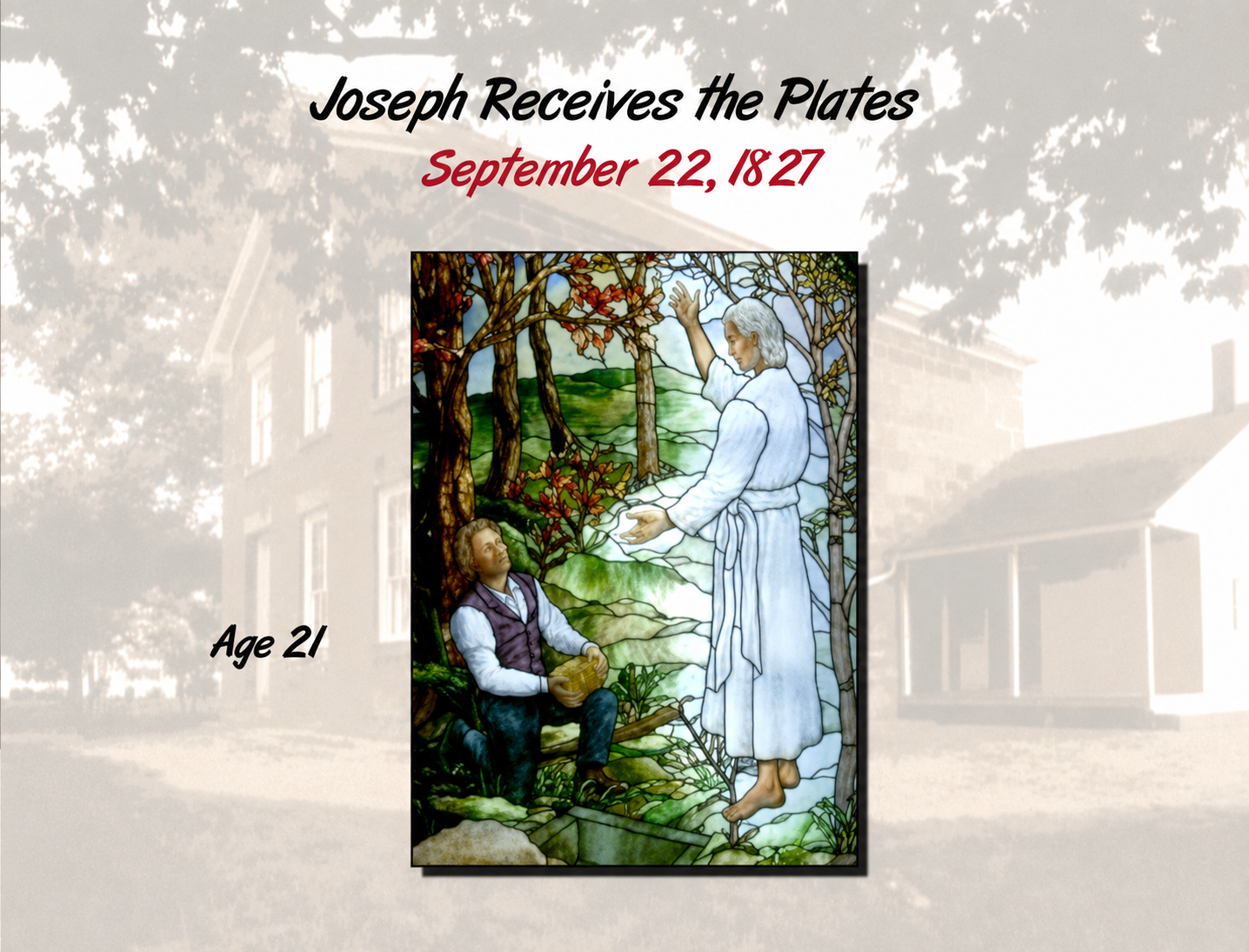
The first of the cases brought against Joseph actually started the year before his ministry. You might say his ministry actually began when Moroni visited and then brought the plates.

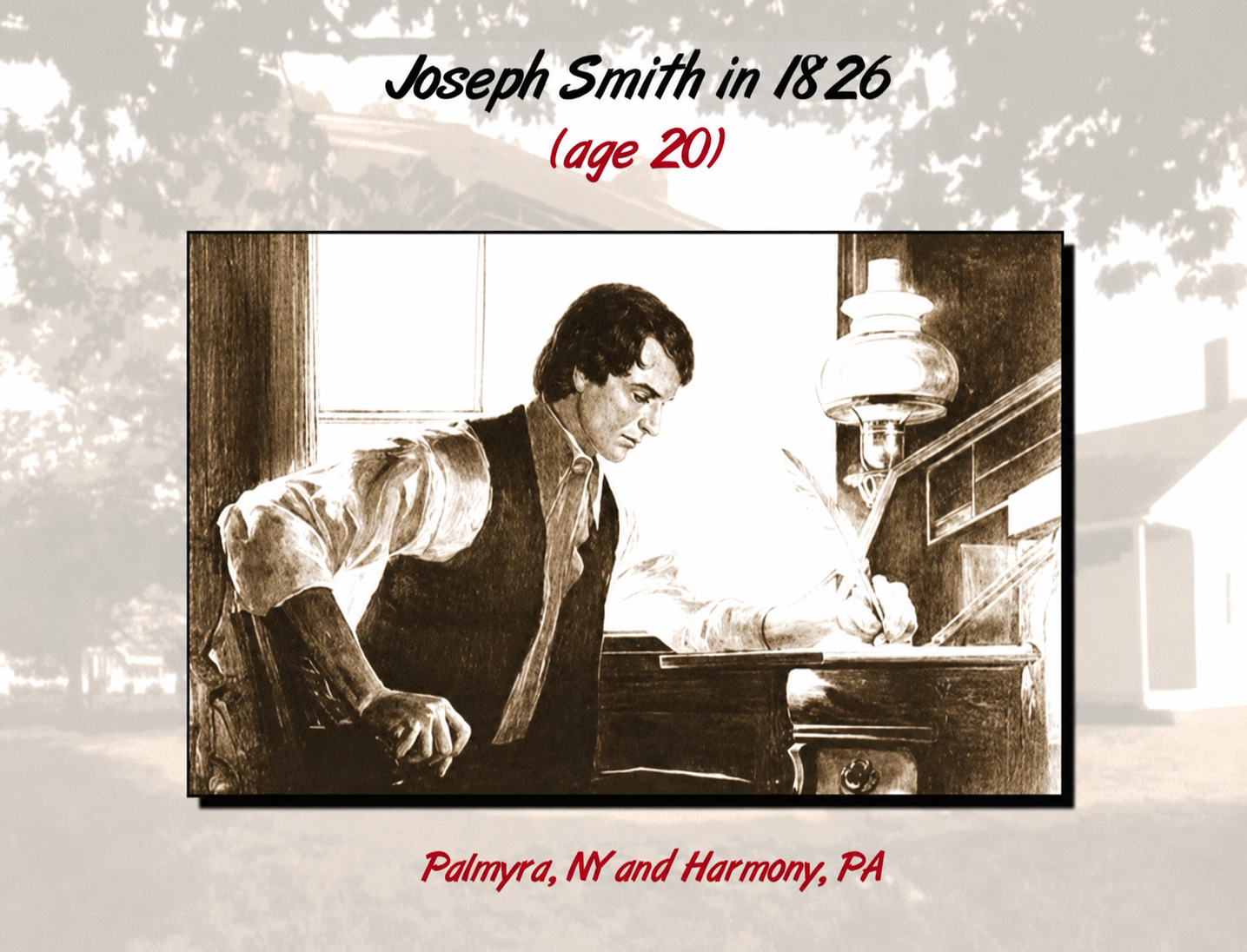
Here he is at age 20 in 1826. And this is a rather notable case. A lot of print has been spilled on this case, and it’s thought by some even today that it turned out badly for Joseph.

There are three accounts of this case, and two of them were by medical doctors who were bystanders, and one was by the justice himself, the justice of the peace who kept some notes.

His niece inherited those, and they were finally published about 50 years later during the peak of the polygamy persecutions.

This case came in Harmony when he was living in Harmony, Pennsylvania. That’s one of several oxymorons that I’ll mention here.

And earlier someone mentioned the cases, the documents that have been found in a basement in a New York jail.

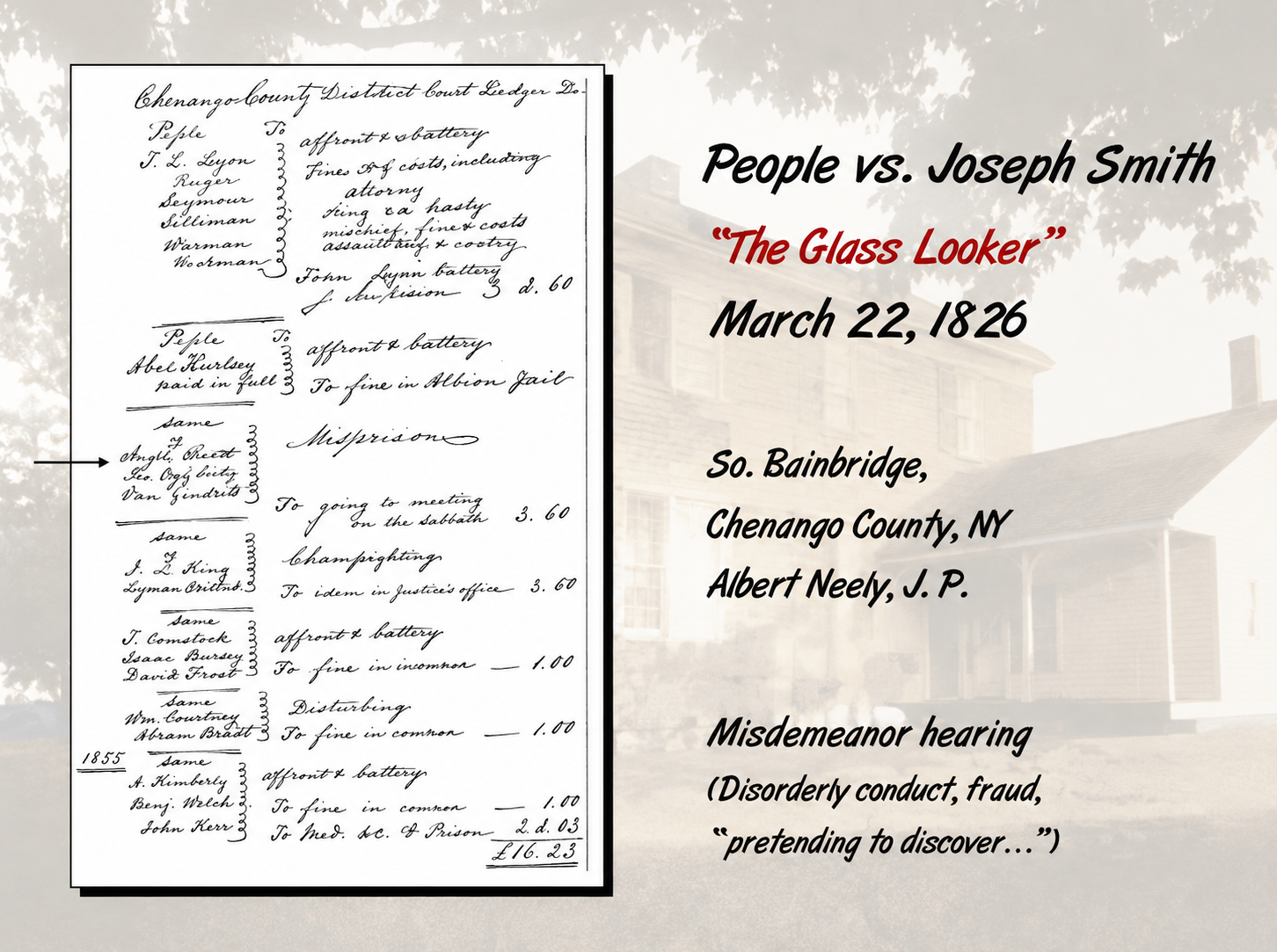
A justice of the peace named Neely first made a record of People versus Joseph Smith and described him as the “glass looker.”

Now, that was not the criminal charge, but actually it was a form of disorderly conduct, a misdemeanor under the statute of the time. It was for falsely pretending to discover lost goods.

Now, in one of the versions, actually the one that the niece inherited from the justice, the way it supposedly comes out is that he was arrested, posted bail, jumped bail, had to be rearrested, brought back, was convicted, and then either exiled or allowed to escape.

Treasure Digging for Spanish Gold

Joseph himself, before we get to Constable DeZeng, kept an account saying that for some period during this winter of 1826, he and his father were hired by Josiah Stowell, who had an old Spanish treasure map and knew that these men were good hard workers, but also heard that Joseph had some supernatural gifts—the ability to discover things that had been lost.

After about a month of working hard looking for this treasure, Joseph, according to his mother’s history, finally discouraged Josiah Stowell and he gave the whole thing up.

While they didn’t discover that buried treasure, he discovered his greatest treasure in life, which was his wife Emma. He was then living with the Hales.

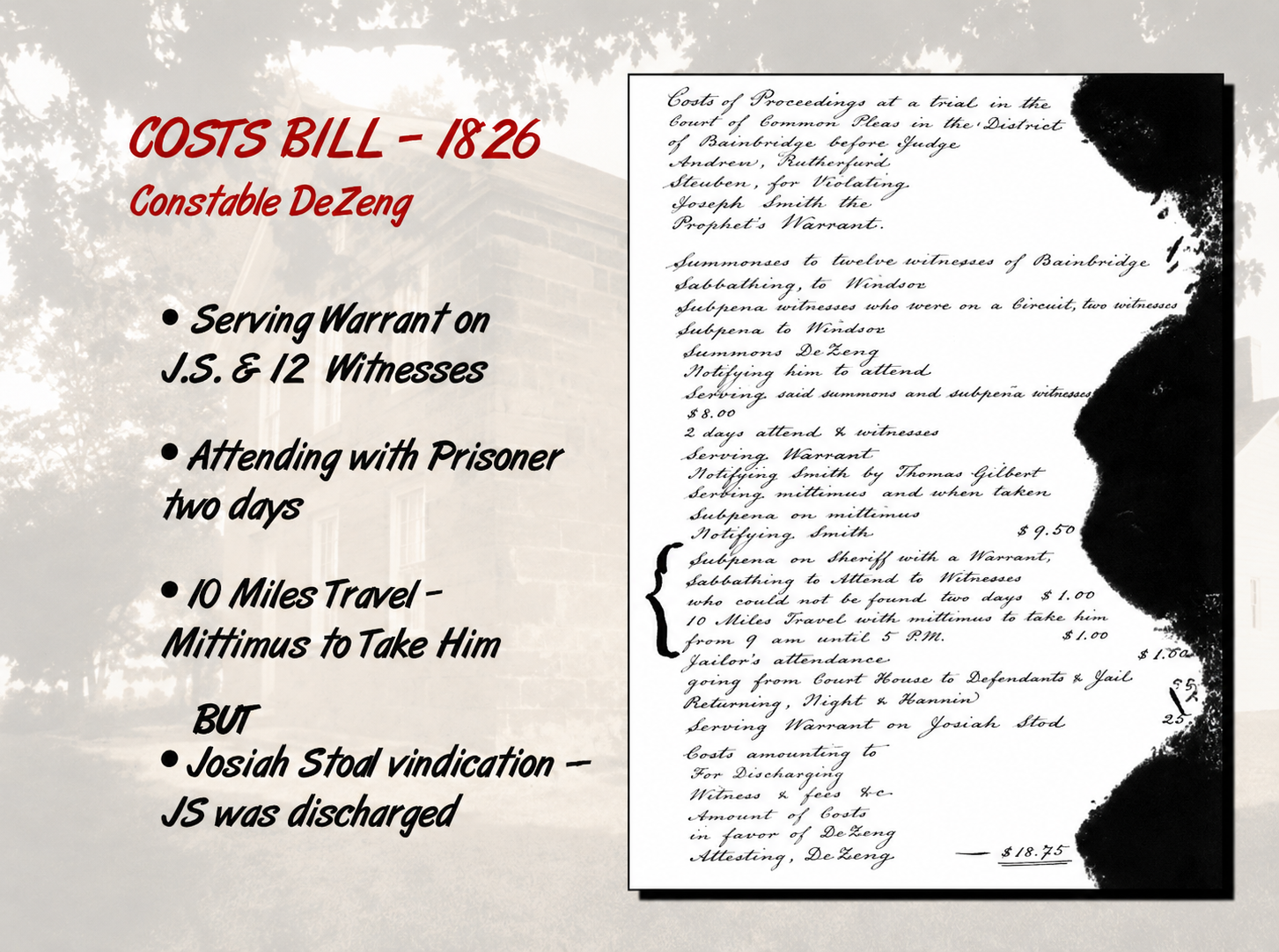
Now, according to Dr. Purple, one of the two medical doctors who also published his version of this, what Constable DeZeng actually meant by what he said here—serving a warrant on Joseph and 12 witnesses and then attending with the prisoner for two days and then 10 miles of travel with a mittimus to take him—wasn’t to take him out of the jurisdiction and exile or expel him, but to take him to the hearing. 1

Now, the result of this, according to Dr. Purple, is that these 12 witnesses testified, including Joseph and his father and Josiah Stowell and several others.

Josiah Stowell’s Testimony

Stowell was the last witness, and he was supposed to clinch the case for the one who brought the charges, a disgruntled nephew who thought that Joseph was cheating his uncle.

But Josiah Stowell turned the tables and came to Joseph’s defense, vindicated him as a hard worker who never did what he wasn’t paid to do.

And so he was discharged according to Dr. Purple.

We think that he was vindicated and discharged. Gordon Madsen has spent a lot of time studying this case, and he has 10 other reasons why he thinks he was acquitted and not convicted.

This was the first case and the closest call, you might say, to a criminal conviction.

The 1830 Arrests Following the First Baptisms

The next year, Joseph received the plates. The ministry begins at age 21, and the next case is the following year.

There is not time to discuss the intricacies of that case, a very interesting case. We know that the first 116 pages were lost. They were taken by Martin Harris to show people that had to be convinced that he was not wasting his time or money.

One of those was his wife, Lucy Harris. And as it turns out, she’s the one who sues Joseph for cheating her husband. But I won’t get into that one.

The Church is now restored in April of 1830, and just two months later—and we have the priesthood restored and the first baptisms, which did not include Emma, as she was still back at Disharmony, or Harmony, Pennsylvania.

And so Joseph goes down to baptize her and the Joseph Knight family and several others in the same area.

So this next case comes when they had just completed the baptisms. The mob, about 50 vigilantes, had torn out a dam where they had performed the baptisms, and they were successful in disrupting the confirmations.

Joseph once said that you might as well baptize a bale of hay as to baptize a person without the confirmation for the gift of the Holy Ghost.

Now a constable came with a writ to arrest Joseph for, again, disorderly conduct, disturbing the peace, and this time it includes setting the countryside in an uproar by preaching the Book of Mormon.

A Courageous Constable

Now the constable was part of a plan to do some harm to Joseph. He was supposed to get Joseph away from his friends and put him in a wagon. Then, as they got out of sight around a bend, he was to slow down. So, those who were lying in wait could come out and ambush him.

But as so often happened, the constable was impressed by Joseph. He actually came to like him and was impressed that he was not at all what he had been told.

So, instead of slowing the wagon down as they came around that bend, he whipped the horses into a faster pace. They were making good time as they ran away from the mob, who were now saddling up and trying to come in hot pursuit.

The wagon loses a wheel just at this moment, though. I’m not making this up.

So Joseph is propping up the wagon while the constable is putting the wheel back on, and here comes the mob riding as fast as they can.

They get back in the wagon. These must have been really good horses because they outran the mob, and they get to the end where the court will be held the next day.

Lack of Formal Courthouses

Back in those days they didn’t have really formal courthouses for the most part. They were held in justice of the peace parlors. Or, if it needed a larger place, then in a tavern or an inn. And that’s where they went this time.

I mentioned that this constable was quite courageous because he not only ran away from the mob, but he told Joseph:

“Now there’s only one bed in this room. You take the bed. I’ll lie here on the floor with my musket beside me, and I’ll prop my feet against the door so they can’t get in and you can try to get a good night’s sleep.”

The First Trial

The court started the next morning at 10:00 a.m. This is about midnight now. Okay, you hadn’t prepared your case. You hardly know what the case is. But Joseph Smith so often relied on others to finance these defenses and to bring these lawsuits.

Two farmer friends of the Knight family, John Reid and James Davidson, who also happened to be lawyers, were impressed into duty.

So at 10:00 the next morning, the court begins. And again, twelve witnesses, similar charges to what he had before. And it had nothing to do with treasure seeking this time. It was just:

  • general disorderly conduct,
  • vagrancy statutes,
  • lack of visible means of support.

This went on till about midnight, and Justice Chamberlain uttered those words that they waited to hear:

“Not guilty.”

Immediately as they walked out the front door of the courthouse—or the little tavern—John Reid, the attorney, said that they were seized by some fiends from hell from the next county over.

So the case is not over. Now it’s time to go to Colesville, Broome County.

The Second Trial in Colesville

Well, this constable is not nearly as considerate as the last one. He actually chained himself to Joseph. He fed him bread and water, and that’s all he had.

And as they tried to rest, whenever Joseph would move, he would jerk him to make sure he wasn’t trying to get away.

Now this time the charges are very similar. Except they added to it “casting out a devil” as a version of disorderly conduct.

Newel Knight was the recipient of that benefit.

And one of the questions that was put to Knight as they had this exchange was:

“Well, Mr. Knight, is it true that the devil was cast out of you?”

And he said, “Well, that’s correct.”

“Well then, did you see the devil?”

“Yes, sir, I did.”

“Well, would you please describe the devil to this court?”

He said, “Well, maybe I could first ask you a question.”

There’s objection, of course, and, “You need to answer the question.”

He says,

“I’ll answer the question if you’ll first answer my question. Do you believe in spiritual things that cannot be seen with a visible eye?”

And he said,

“Well, of course not. I’m a lawyer.”

And so he said,

“Well, then it would do no good to describe the devil to you because it would only be discerned by those who can see things spiritually.”

So they changed the subject and went on with 40 other witnesses.

Josiah Stowell came back, and many others.

Forty Hours of Testimony

And this went on for 18 hours. So it’s now been a total of 40 hours in a period of two days. And again, the result this time from a three-judge panel was “Not guilty.”

So this time the disgruntled participants decided that they needed to administer their own version of rough justice.

So they’re out front fashioning something to apply their own version to Joseph. And the two lawyers, and by now the repentant constable and the judge, hatch a plan.

So what they’ll do: one lawyer will go out front with the constable and detain the mob, while the other lawyer and the judge will go to the back room, open the window, and let Joseph and Oliver out through the woods.

And so they run the rest of the night, arriving home the remaining 15 miles, totally exhausted and ready to get out of New York.

Leaving New York

I guess although Joseph was exonerated in both trials, malicious rumors came to Emma’s parents, and they invited them to leave.

They basically disowned Emma and Joseph, and she never saw her parents again.

So here is where all of this happened. Harmony is the lower dot, and then just across the border is South Bainbridge, and Colesville is right next to it.

Palmyra is upstate, as you know.

The Move to Ohio

I didn’t mean to hit that one quite yet.

So it’s now time to start the westward movement. On New Year’s Day of 1831, the Lord told Joseph it’s time to go to Ohio, and there He will endow him with power and reveal the law of the Lord.

So now we’re in Ohio, and how did things go there?

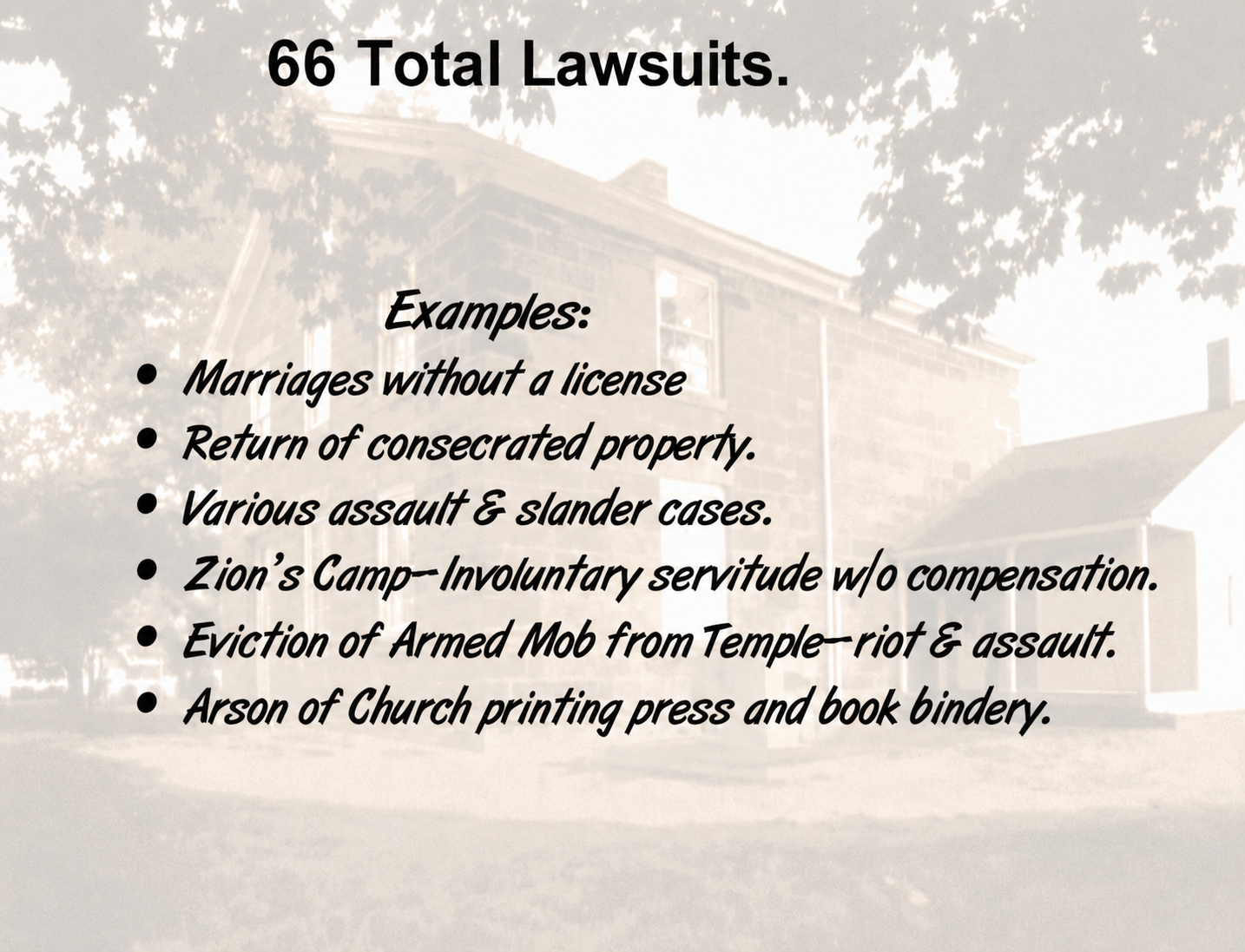
During the seven years that Joseph and most of the Saints lived in Ohio, things went very well. The lawsuits that they brought and defended were done very successfully, but there were more suits there than anywhere during Joseph’s life.

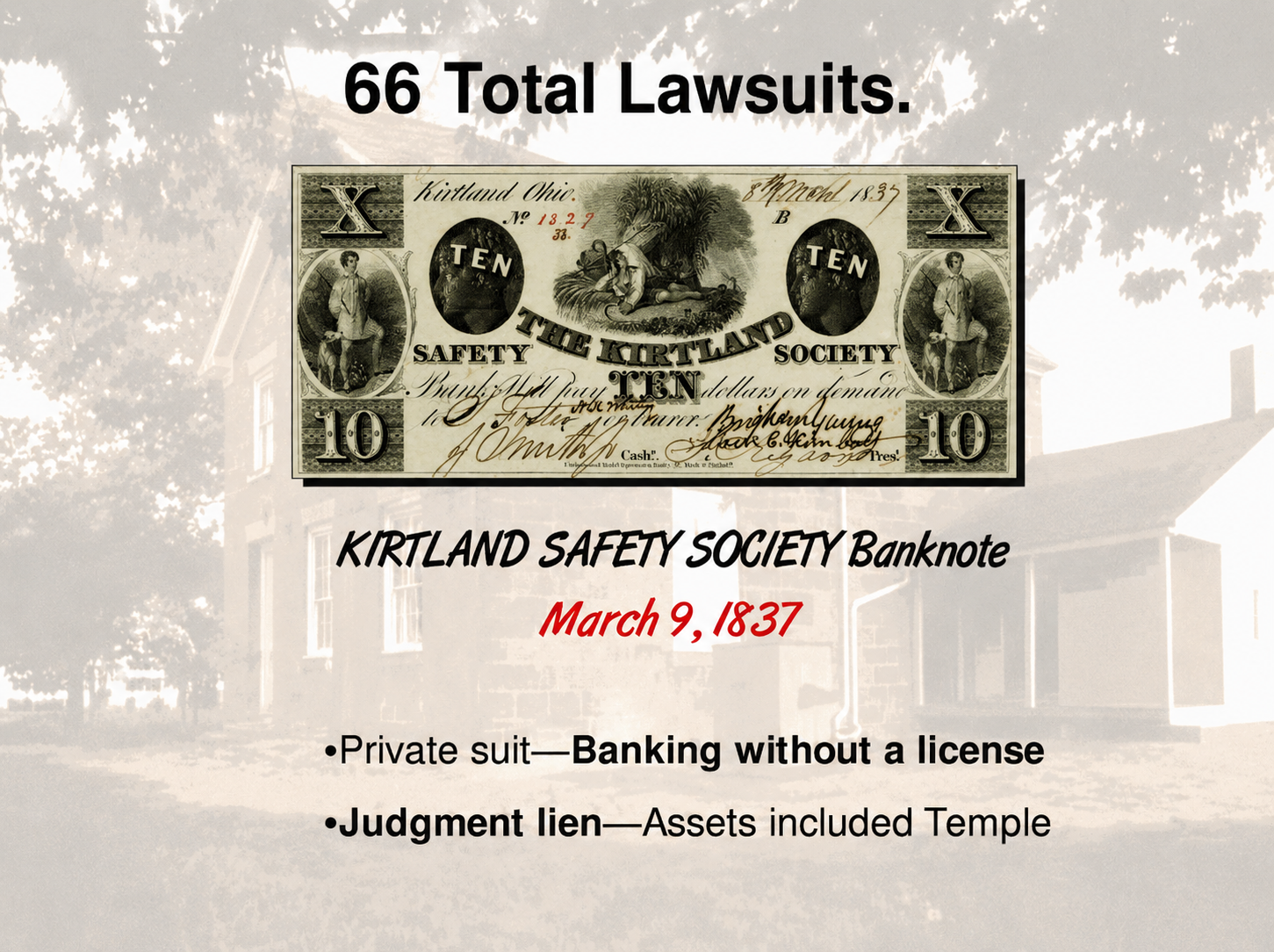
A total of 66 if you count all the suits against the Kirtland Temple Committee.

Legal Successes in Kirtland

And these are just a few examples, ranging from performing marriages without a license to having to evict an armed mob from the temple.

They were charged with riot and assault. This is Joseph Sr. and some of the other family members, and they were acquitted by a justice of the peace named Oliver CCowdery, which was helpful.

The next week there was an arson of the printing press and the bookbindery next door.

Some mob was brought in, and not all cases were brought successfully. They did not have sufficient evidence to convict those five men.

The Kirtland Safety Society

The most serious case, though—the business disaster of Joseph’s life—involved another oxymoron: the Kirtland Safety Society. 2

This is a copy of the bank note that I have in my possession, March 9, 1837.

Now, this resulted from very difficult times on the western frontier. Credit was tight. Many banks were being formed that could issue their own bank notes so that there was more currency.

And like the others, the Saints got their own bank and got their press and started printing their notes. But unlike the others, they did not get a license. It was denied to them at the very last minute.

So they just stamped “Anti-Banking Safety Society,” and that was not quite sufficient.

A private suit was brought against them for banking without a license.

Six Lawsuits in a Single Day

And before I get to this, I need to tell you about while they were waiting for the case to be heard.

On the 27th of July, six suits were brought the same day against Joseph. And four of the six were actually heard that same day.

Here’s how he described the last thing that happened during the day as they were leaving town, having disposed of five of these:

“At sunset, I got into my son’s carriage to return home. At this moment, the sheriff sprang into our carriage, seized my lines, and served another writ on me, sworn out by a man who just a few weeks previous had brought a new-fashioned cooking stove to Kirtland and wished me to test it for him.”

That man thought that now would be a good time to get paid for it.

“I had to give my watch up to the officer for security, and then we all returned home.”

And as far as we know, he did not go through Painesville again. He found a way to circumvent Painesville, having endured that much harassment.

The Aftermath of the Safety Society Case

Now the next October is when this Safety Society case was heard.

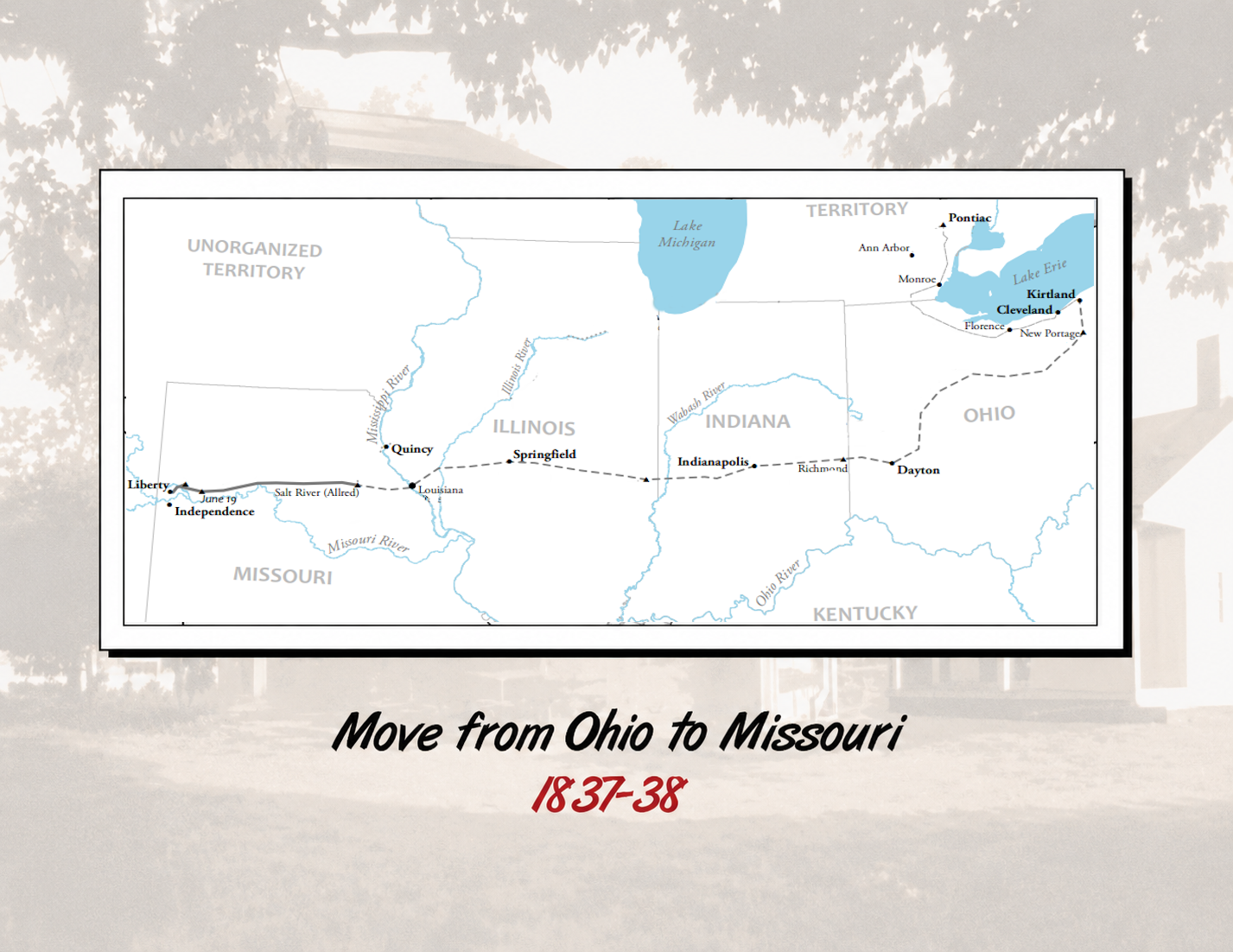
It was apparently resolved against Joseph and some of the other officers, but they appealed the case. And while it was still pending, they moved from Ohio to Missouri.

It finally ended up in a default judgment against the assets of the Church that remained at that time. Through a various sequence of things, that included the Kirtland Temple. And some 25 years later, through this suit, it actually passed hands to the present owners in possession of the temple.

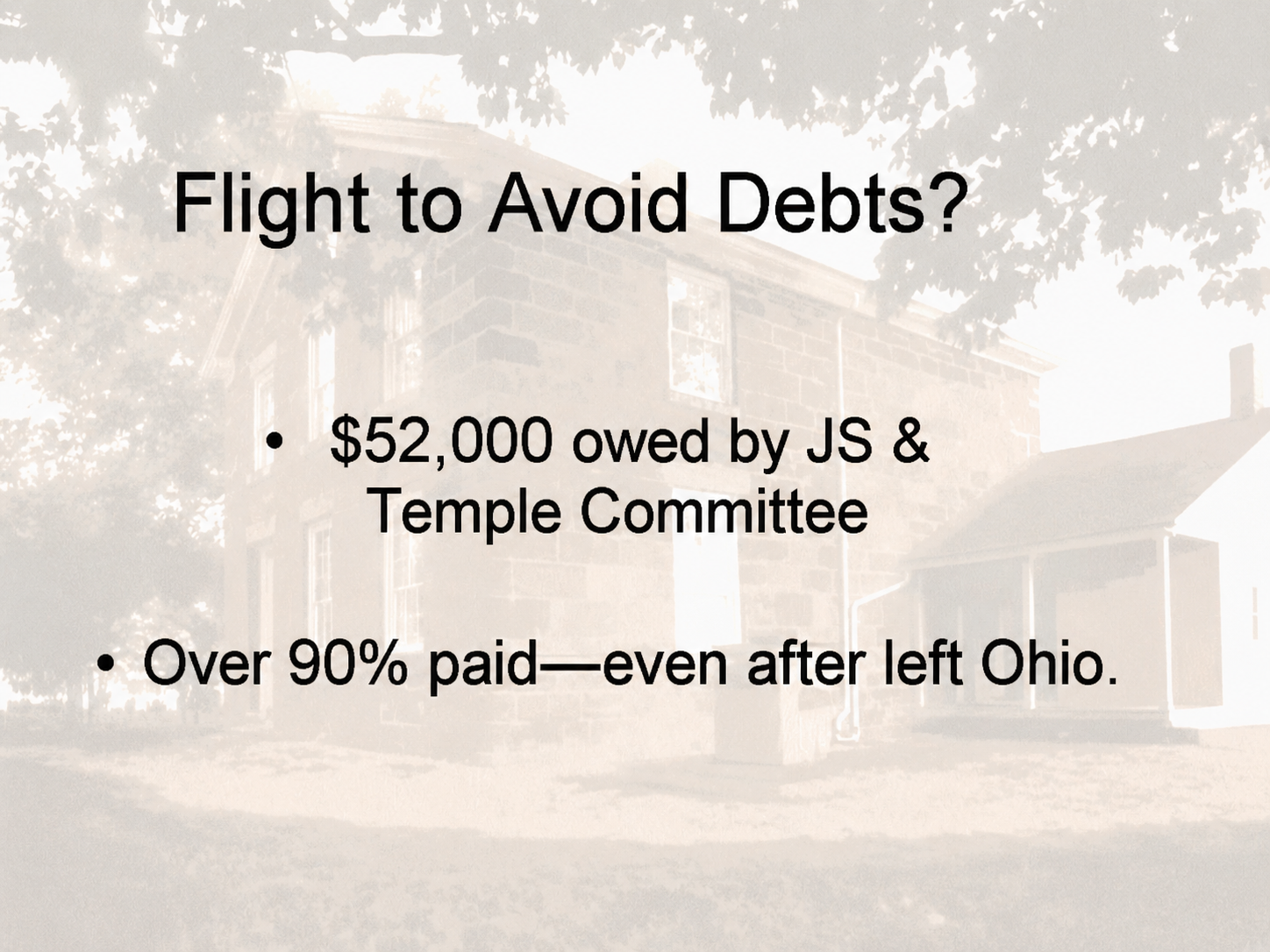
Often a charge that’s made against Joseph and the Saints is that the reason they fled out of Kirtland the way they did was to avoid their debts.

And it’s true that they were huge. $52,000 back then was a huge amount. 3

But Gordon Madsen and Jeff Walker, who work on our team, have determined that over 90% of that was paid, much of it long after they had left Ohio and their beloved temple.

Missouri: From Courts to Mob Rule

So now it’s on to Missouri. And you can see that this is a sweep across six states. How did things go in Missouri? Well, not very well.

We call it mob rule. They called it people in action, popular sovereignty.

The Mormons were very unpopular for a lot of reasons in Missouri.

  • They were considered religious fanatics.
  • They were taking the place over, coming in very large numbers.
  • They felt threatened in every possible way.
  • But the last straw was probably the fact that they were Northerners in a slave state.

The Destruction of the Morning and Evening Star

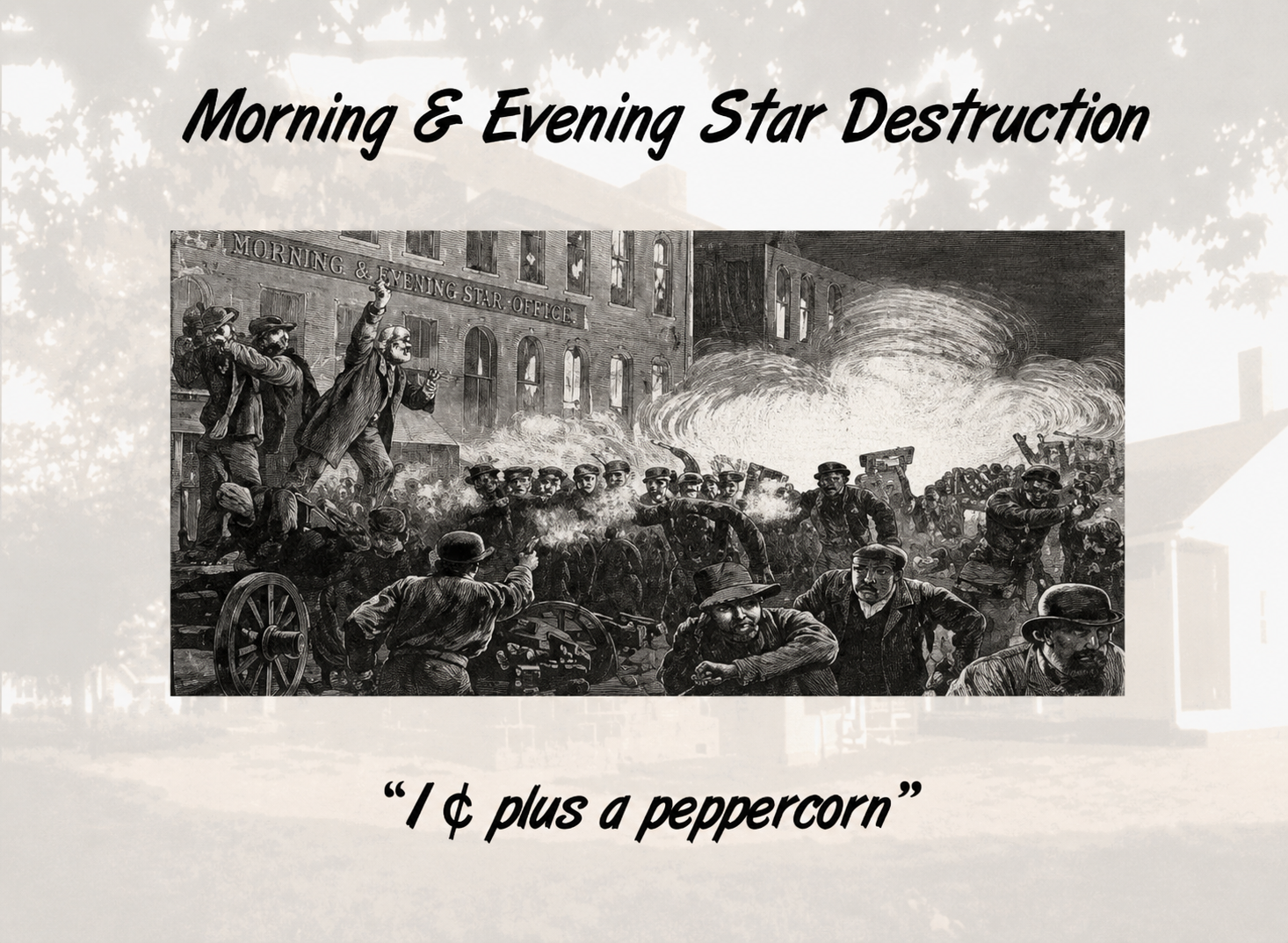
And in July of 1833, the publisher of the Morning and Evening Star published an issue describing the requirements for bringing freed-state slaves into Missouri.

The Missourians did not take kindly to that. This was an affront to their culture. It was certainly not illegal to bring freed slaves there, but they did not take well to that.

And so they took some matters into their own hands and decided that they would do this to the press and to the entire building. They dragged Bishop Partridge around. They tarred and feathered him, dragged him around the town square.

A Hollow Court Victory

So, the closest that the Church came to any success in court while they were in Missouri the entire time—and they brought many cases.

None were ever brought against them, by the way. There was no need. They simply took things into their own hands.

But the closest the Church came was when Bishop Partridge and W. W. Phelps sued the perpetrators of this civic action. And they went to court. And as usual, the defendants claimed self-defense.

The lawyers properly pointed out that there were two men against about 200. And that’s not much of a self-defense. So the judge had to agree that that’s correct.

And on the merits, then, they were upheld on their arguments. But they were awarded a total of one penny plus a peppercorn, which is the legal equivalent of an insult.

In other words, “We agree with you. You’re right on the law and on the merits, but get out. We don’t like you.”

Expulsion from Missouri

So from Jackson County they were expelled that same year. Actually, they were expelled twice from Missouri:

  • once from Jackson County,
  • and then later from the entire state.

These other locations were all really quite friendly to them.

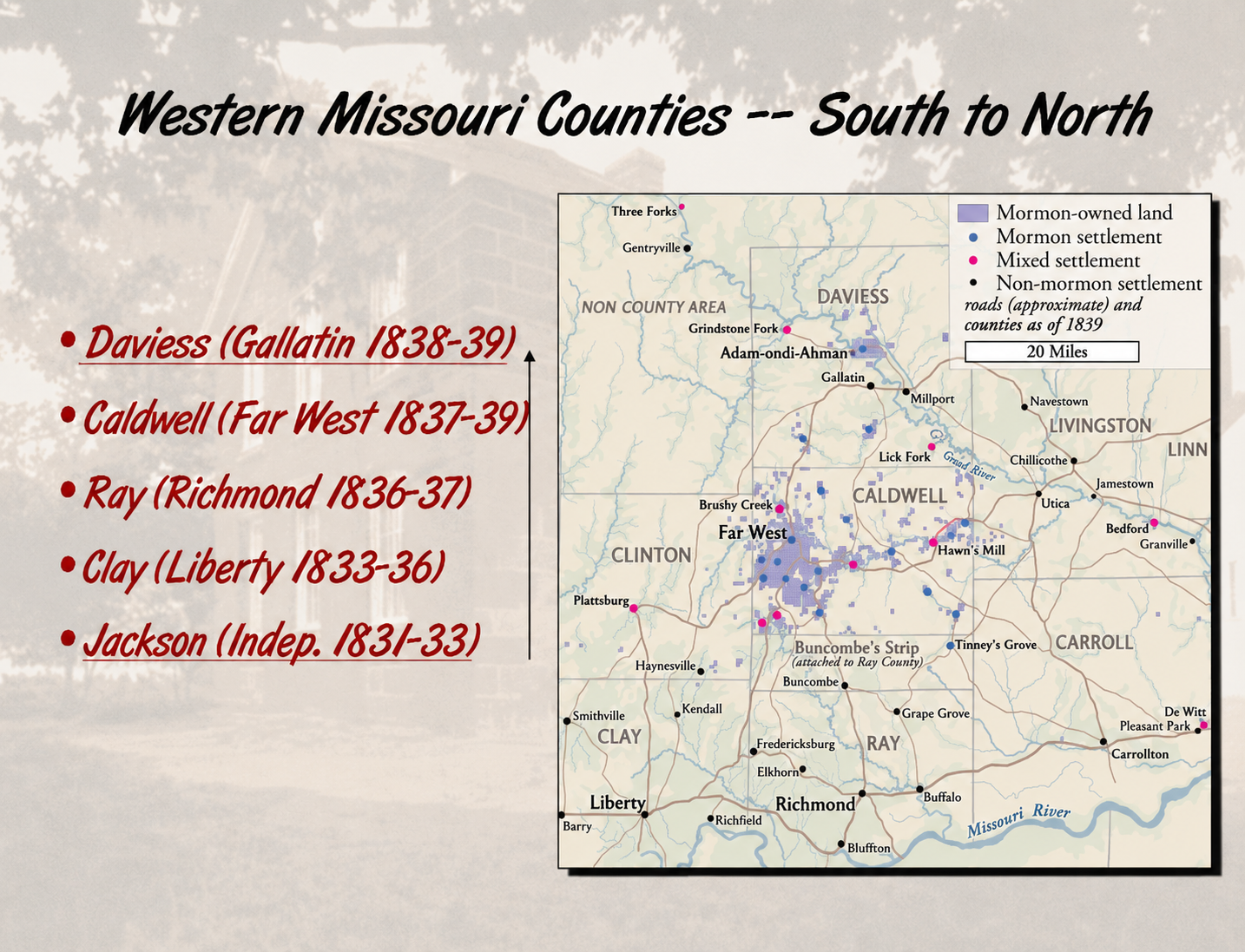
Clay County, Ray County, Caldwell County was a county formed for themselves. It was a quarantine for the Mormons. Go there and maybe people won’t bother you if you stay put.

But they kept going, and many settled in Daviess County. So that was formed in that territory.

The Road to Liberty Jail

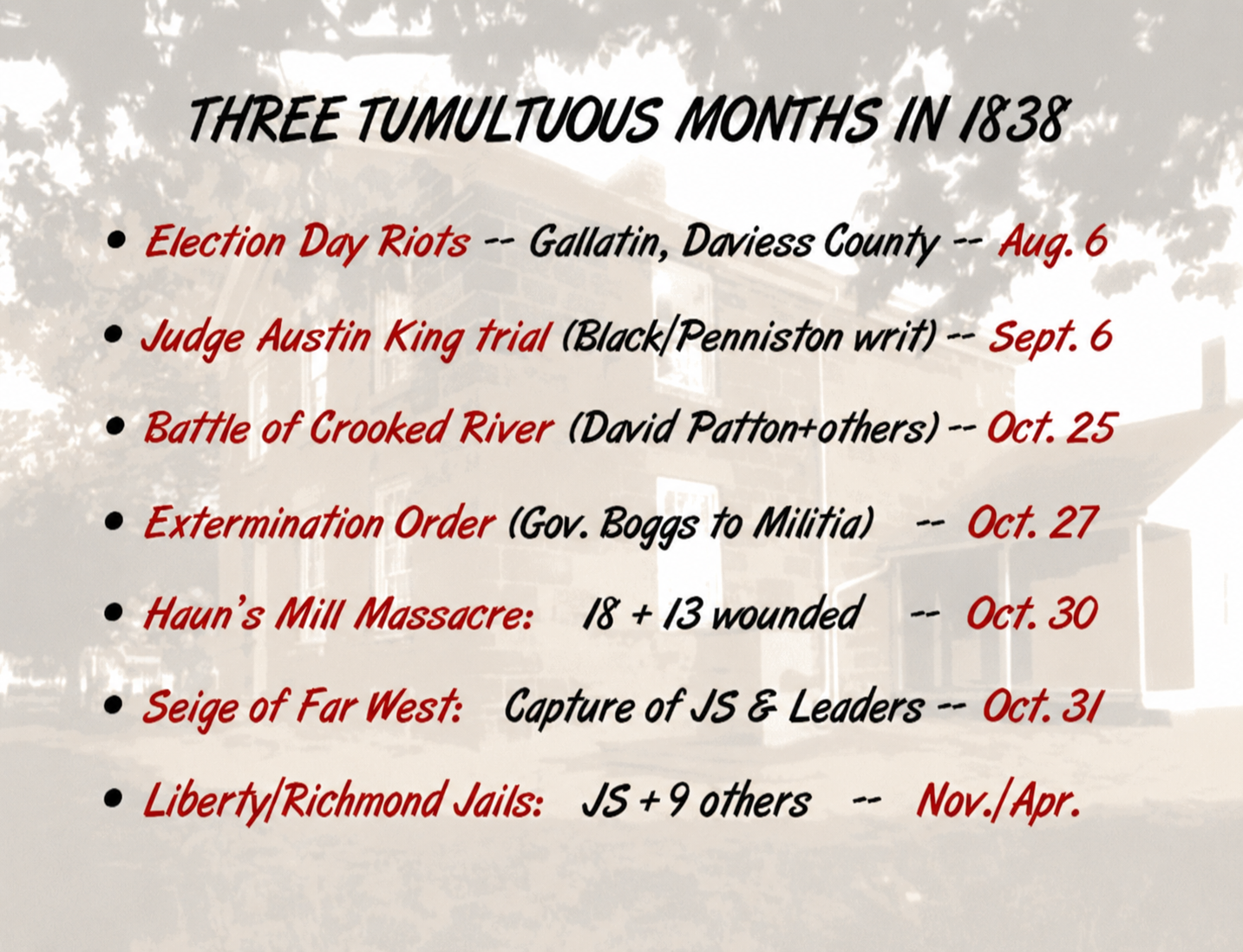
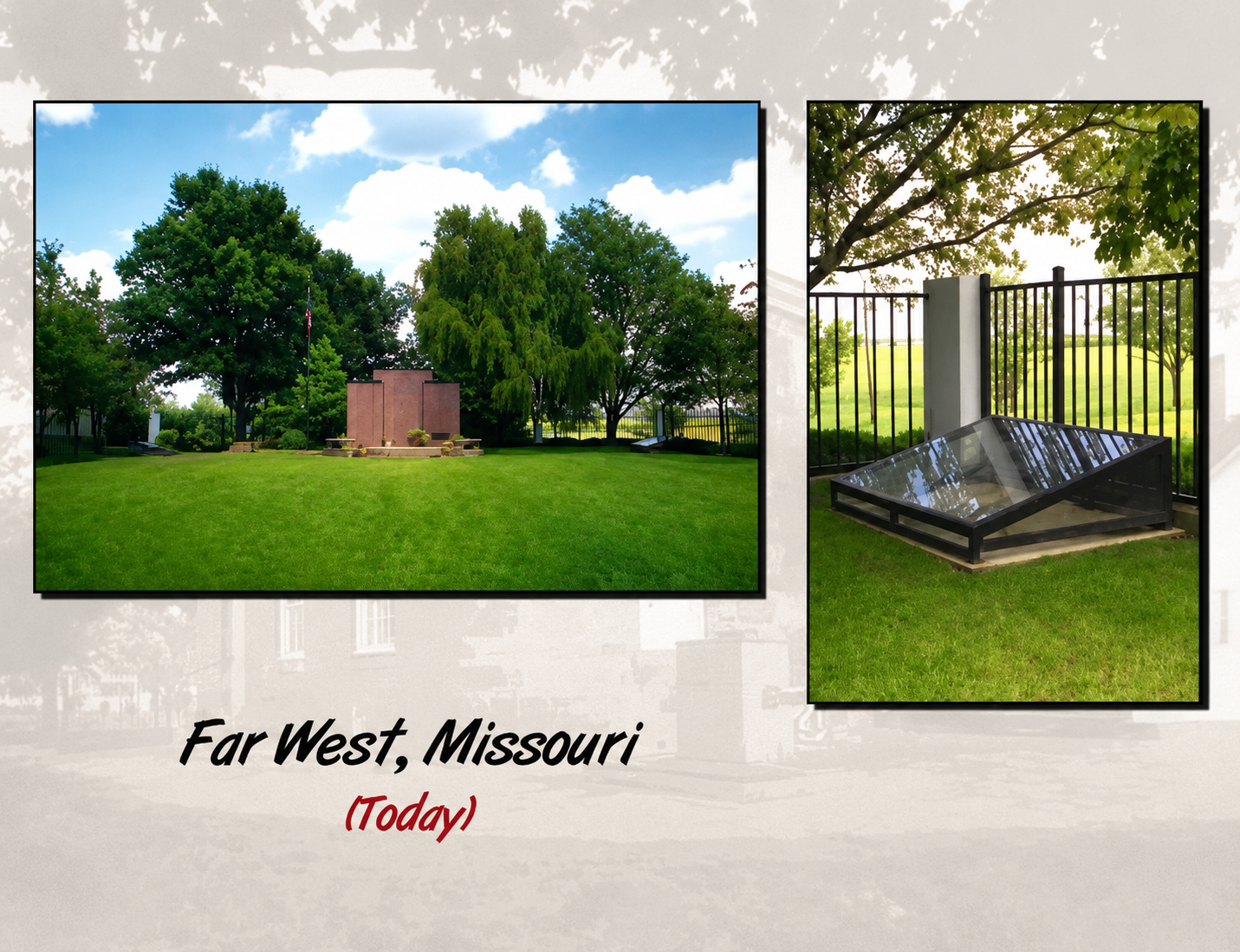
They formed Daviess County. And the real trouble that put Joseph in Liberty Jail (there’s another oxymoron) was Election Day in Daviess County. The first election in Gallatin. We won’t go through all of the details there.

But the short of it was Joseph and about 15 others had heard that after the Election Day riots, some of the Mormons were killed and left to rot, and no one could move the bodies. They would be picked clean by the buzzards.

And they did not take well to that. So they retaliated in a form that was peaceable, all parties thought. And yet they were sued and brought before an old enemy of theirs named Austin A. King from Jackson County.

And this was the beginning, really, of the so-called Mormon War of 1838.

The 1838 Mormon War and the Extermination Order

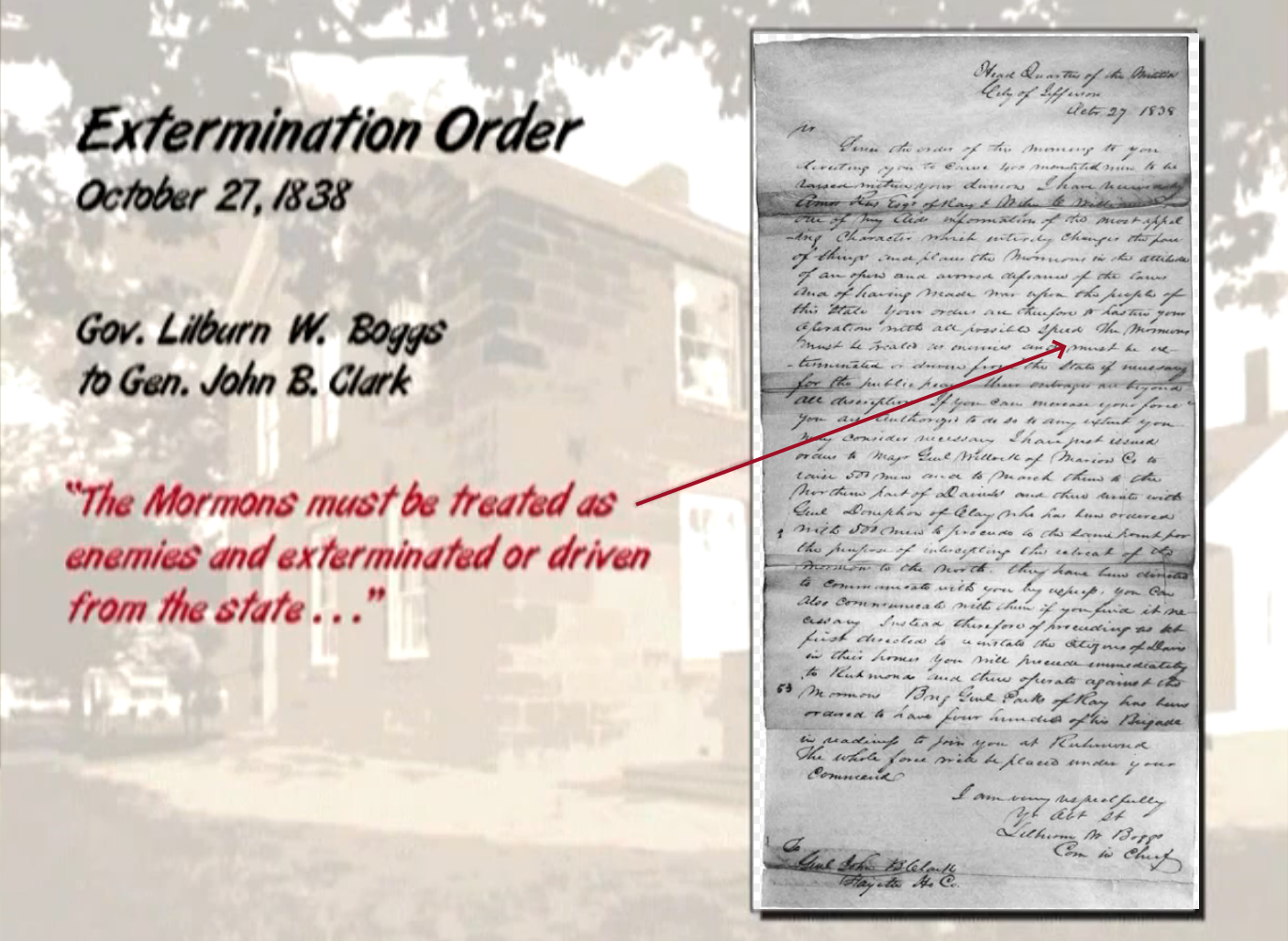
Through a series of events, this then resulted in the Extermination Order of October 27th. Almost everything really bad after Jackson County happened in a three-month period in 1838.

Here is Governor Boggs’s order to the commander of the Northern Militia after several hearings and false affidavits from disaffected leaders of the Church.

And here’s the famous statement:

“The Mormons must be treated as enemies and exterminated or driven from the state.”

That was rescinded, by the way, in 1976, exactly 30 years ago, by Governor Bond.

Haun’s Mill and the Fall of Far West

Now, just three days later, we had the Haun’s Mill Massacre. Then we had the siege of Far West on Halloween Day, appropriately, just the next day.

It wasn’t enough to have the Haun’s Mill Massacre. Now we need to surround the city and threaten total destruction of the entire city and everyone in it unless peace could be made.

And through various means, Joseph was captured with Hyrum and several of the leaders. They were ordered to be shot the next day.

Their former lawyer, who defended them in some of this action there in Missouri, Alexander Doniphan, was the one commanded to shoot them at the town square at noon the next day.

His answer was:

“What you have ordered is cold-blooded murder, and I will not perform it. And should you do that, I will see you brought before the judgment bar of God. So help me God.”

And so he backed down and remanded everyone over to that same Austin King. He then saw that they had a comfortable lodging in Richmond and then in Liberty.

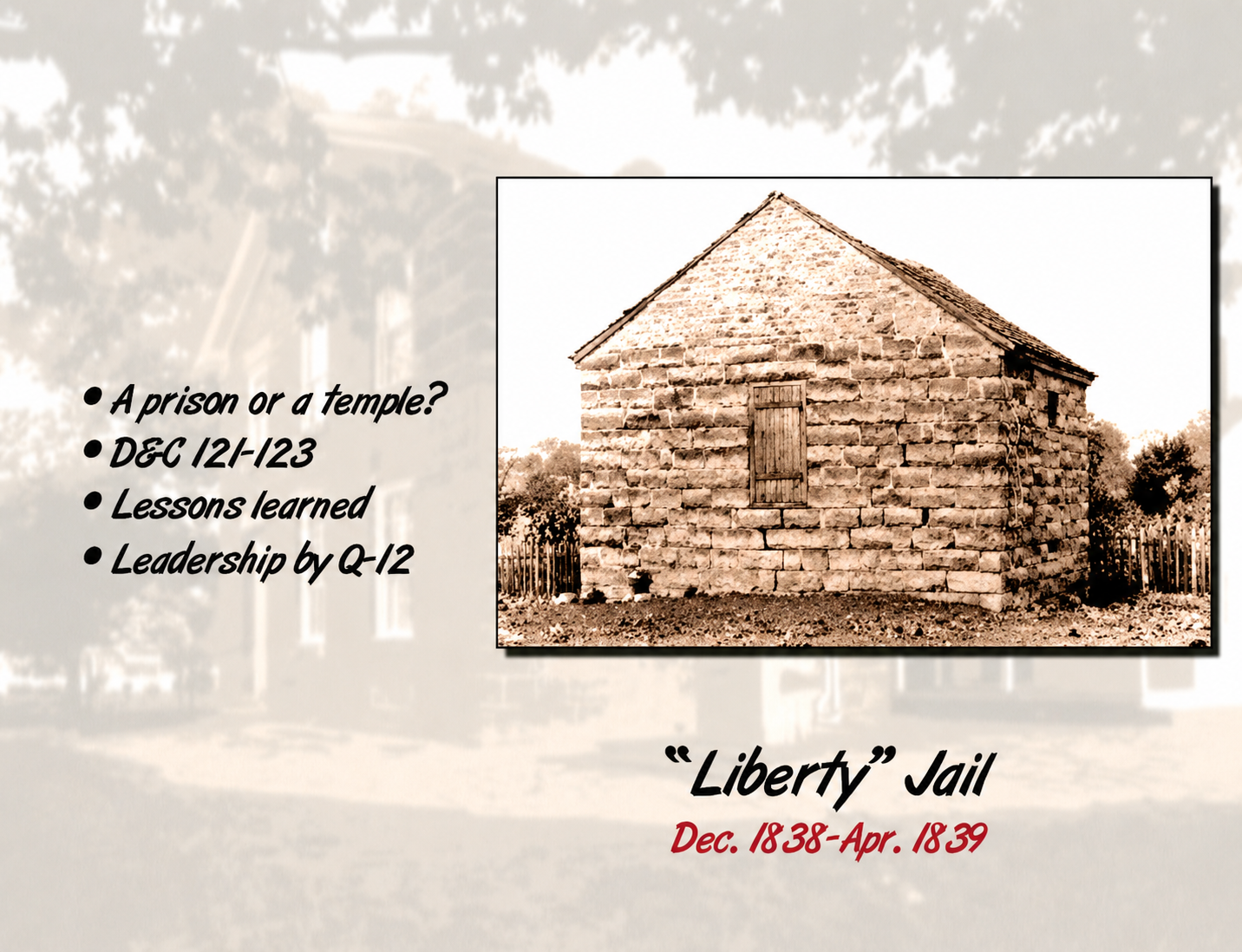
Liberty Jail

Now, Liberty, of course, was a horrible place. But it was a bigger jail than they had anywhere else in Missouri at that time.

And so that’s where they spent almost six months. The worst six months of Joseph’s life, I would say, the longest time he was incarcerated. The entire First Presidency of the Church was in jail.

And why wasn’t the Twelve in jail? Well, because they were considered irrelevant.

A Prison and a Sacred Place

While Joseph was there, though, in this horrible prison, a dungeon of a prison, he also considered it a sacred place. And some of the most inspiring revelations came while he was there.

He wrote a 16-page letter home that became Sections 121, 122, and 123 of the Doctrine and Covenants.

And if you ever feel sorry for yourself:

  • feel like life is not fair
  • and it’s not treating you right
  • and it should do you better

read any of those sections and you’ll have a second thought.

Many of the lessons Joseph learned endured through the end and sustained him in Illinois.

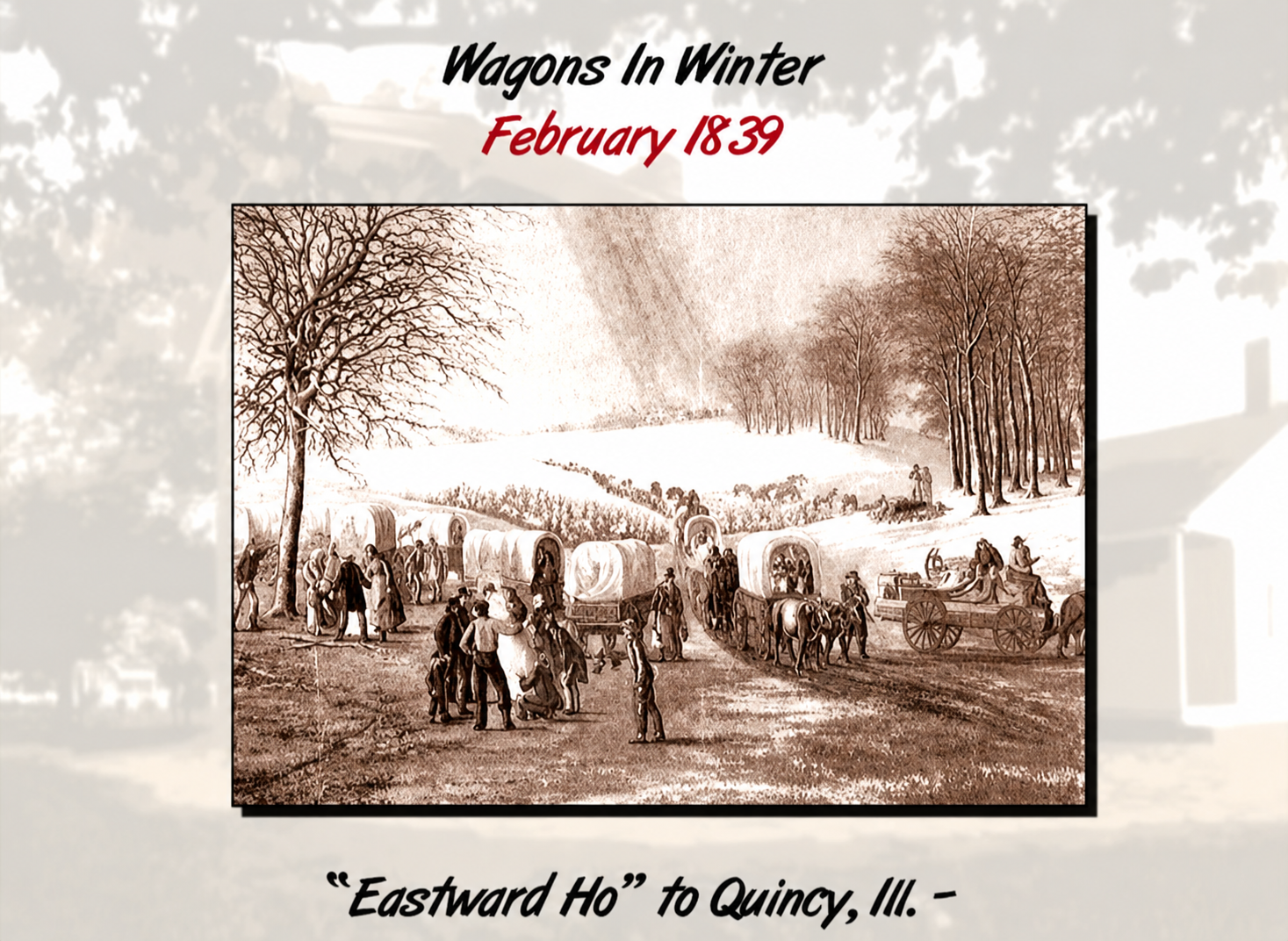
The Saints Flee Missouri

Now, leadership, such as it was, was being provided by the Twelve. And who was the head of the Twelve after Thomas B. Marsh was gone?

Well, Brigham Young. And he had the experience of the first mass evacuation of the Saints. He was in charge, and they went east.

The thought was always to go west, but circumstances did not allow that. Joseph had talked about it. Brigham had planned for it. It was not to be. They went east, back across the river to Quincy, where again kind people received them.

Joseph Escapes and Rejoins the Saints

Well, now Joseph gets to escape during a change of venue from Liberty up to Boone County.

He finally gets to this new settlement that had been arranged by Brigham and Joseph and several others, this bend in the river.

And we know much about that. It’s not so much legal as physical and spiritual.

Nauvoo and a New Beginning

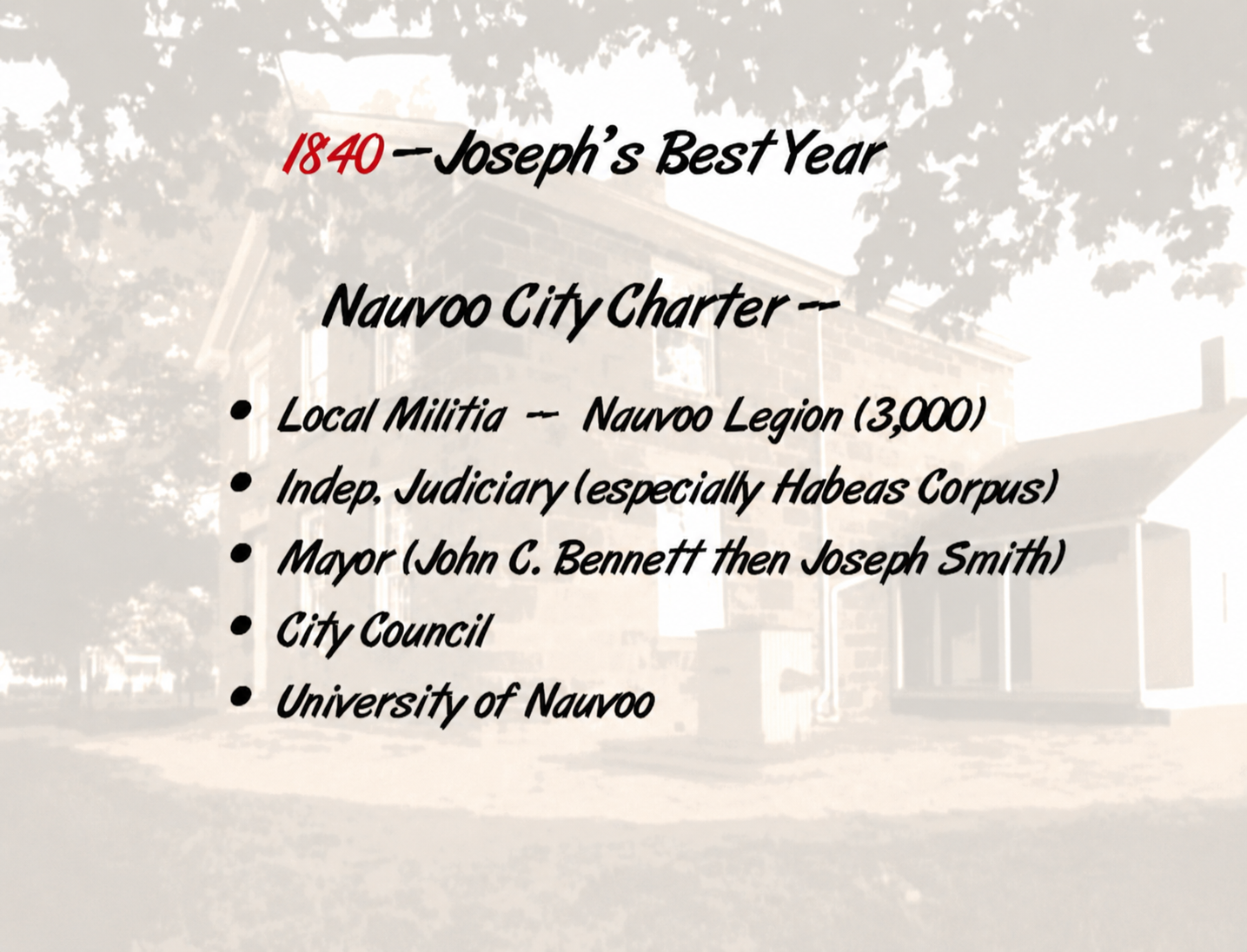
The next year, 1840, was probably Joseph’s best year of his life. He didn’t have a single lawsuit all year. He was out of jail.

They did not have a lot of success going to D.C. to get some redress from the federal government. But they got the Nauvoo Charter before the end of that year. And this was an amazing thing.

Three other cities had similar charters. But none of them implemented it quite as effectively as Nauvoo did.

They were basically given their own army, a local militia 3,000 strong. The Nauvoo Legion was the terror of southern Illinois. Now, it was never utilized except for ceremonial things, but it was always armed and dangerous, ready for action. Joseph saw to that, and this was well known.

The Power of Habeas Corpus

They were given their own independent judiciary.

And legally speaking, this is probably the most important thing in the city charter. Because they had the power of habeas corpus, which simply means if you’re arrested by somebody that you think is going to kill you or do you some serious harm, you send word.

You have one of your colleagues go to the nearest court that has this power. And that court can issue a writ of habeas corpus, which means stop everything. “Bring the body here”. We want to talk to this prisoner to see if he’s been falsely arrested and see what this is all about.

So, it’s a chance to have a second examination.

And this was used effectively over and over by Joseph, much to the chagrin of the neighbors, and was the main reason they wanted to repeal the Nauvoo Charter.

A City-State on the Mississippi

They were given their own mayor, John C. Bennett. (That’s another story.)

We have a city council. We even had a University of Nauvoo. This was really a very complete program. A little city-state is what we had in Nauvoo.

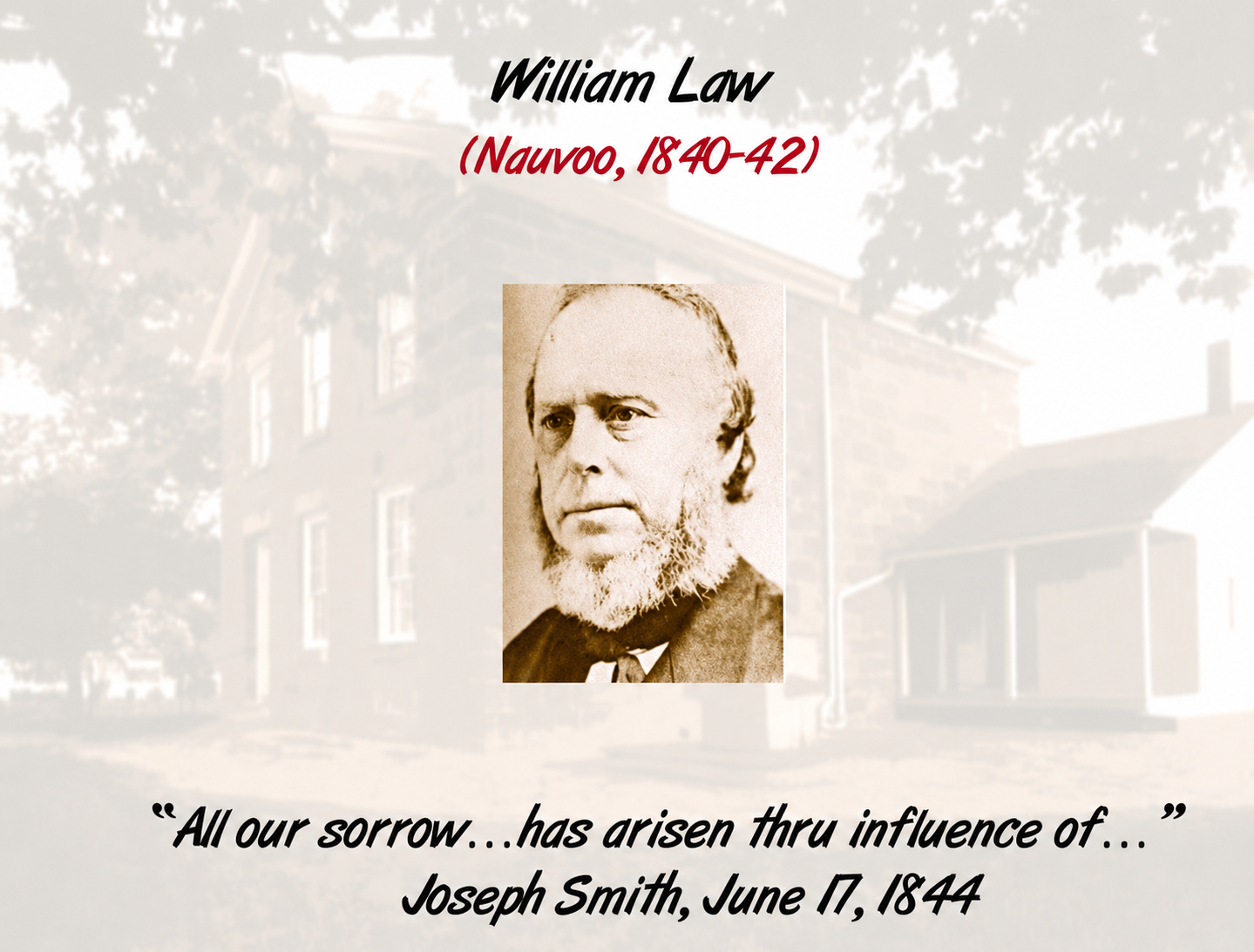
John C. Bennett and William Law

And legally things went very, very well. Starting with this man, John C. Bennett, who started off quite well. He was given some great promises in Section 124, but all of them were highly conditional.

And as it turns out, he was a saintly scoundrel. He was Joseph’s Judas.

Now, he was companioned with this man, who went to the First Presidency the very same week that John C. Bennett became the mayor. These two were kindred spirits.

And Joseph later, one week before he died, said that “all of our sorrows as a family have arisen through the influence of that one man.”

I had always attributed more to John C. Bennett than I had to William Law.

The man was converted to the gospel by John Taylor, who later said he was one of the most calculating and deceptive, but gracious and courteous, men that you would ever meet.

Internal Corrosion in Nauvoo

So we’ll put him out of the picture for now. Back to better things.

Those two were the start of the internal corrosion that finally brought the end of the Saints, Joseph, and Nauvoo.

But they were successful in electing their own man for governor. A good-looking man, very fair Supreme Court justice, far better than any governor they’d had before, Tom Ford.

Stephen A. Douglas and the First Extradition Case

They also were treated well judicially. Here’s Stephen A. Douglas. He’s the one on your right, not the left. This habeas corpus was not only used in Nauvoo, but it was also effectively applied when they were outside of Nauvoo.

On one occasion, Joseph was seized on the old writs that I told you about when they were still in Missouri. He left under the cover of night and got back across the river. So now they wanted him extradited back to Missouri.

Joseph had good legal counsel that made an effective case before Judge Douglas, and he acquitted Joseph. Joseph thanked him and then later blessed him and prophesied some famous things.

He said:

“Judge, you’re a good man. You’ve been a friend of the Saints. The day will come that you will aspire to the presidency of the United States. But if you should ever lift your hand against me or the Latter-day Saint people, the Almighty, you will feel the weight of the hand of the Almighty upon you, and you will remember this conversation to your final days.”

This was the first extradition case, and it did happen just that way when, in 1860, he ran against Lincoln. He was highly favored. Lincoln was a nobody, and Douglas finished fourth in a field of four.

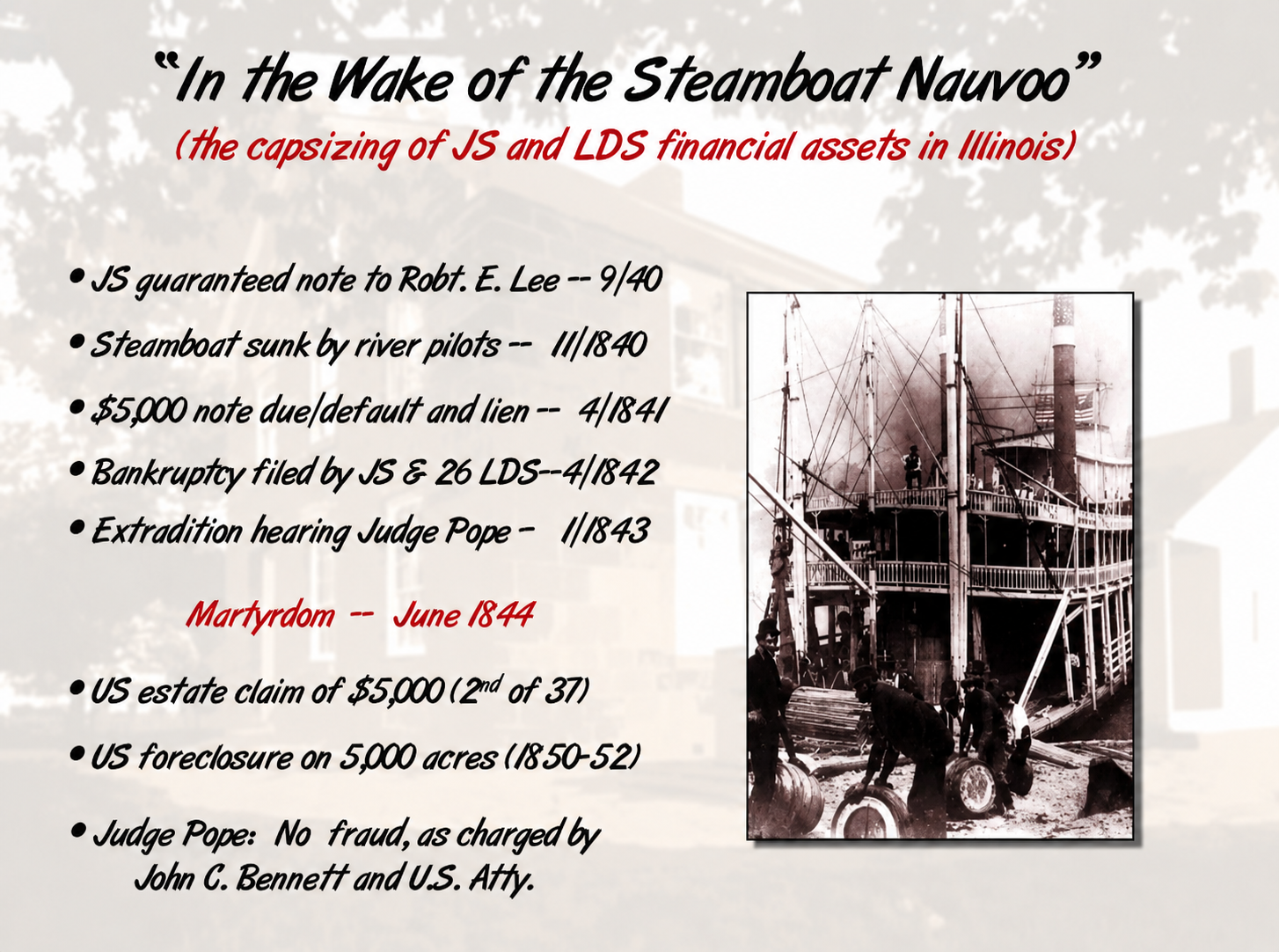
The Steamboat Case and Joseph’s Bankruptcy

Now, not all the cases turned out well. The one that Elder Oaks and I researched for 10 years, starting when I was a third-year student at the University of Chicago Law School, started off harmlessly enough.

It was a simple business transaction in 1840 at Commerce.

Joseph and Hyrum and two others, including the Presiding Bishop, cosigned as guarantors for a businessman’s obligation to buy a steamboat.

The one who sold the steamboat was Robert E. Lee, who was then in charge of the river engineers to dredge the Mississippi.

With tensions growing over the war with Mexico, Lee was sent east to West Point and to New York Harbor, I should say. And he was told to auction off all of his equipment.

So the Mormons bought it. This was to be the first Mormon enterprise.

Unfortunately, before the note for $5,000 came due the next spring, the steamboat was sunk, and with it sank the fortunes of Joseph Smith financially.

The Bankruptcy Proceedings

About the same time that note came due, a bankruptcy law was passed. The first bankruptcy law in the history of the world where a person could go in and voluntarily rid himself of his own debts. And Joseph was amazed.

But the lawyer said, “It’s true. Everyone’s doing it. All of the people that owe you money are getting discharged. So you need to do this to protect yourself.”

So Joseph and about 26 others went to Springfield and they filed for bankruptcy. And all the others were released. Joseph was the only one that was singled out to not receive a discharge in bankruptcy.

And the reason was this same obligation.

By now, Robert E. Lee is writing letters saying, “I’m a little embarrassed. The note wasn’t paid. I thought it was well secured. The only one left now is Joseph Smith, who is thought to have the most assets. So, hold him back.”

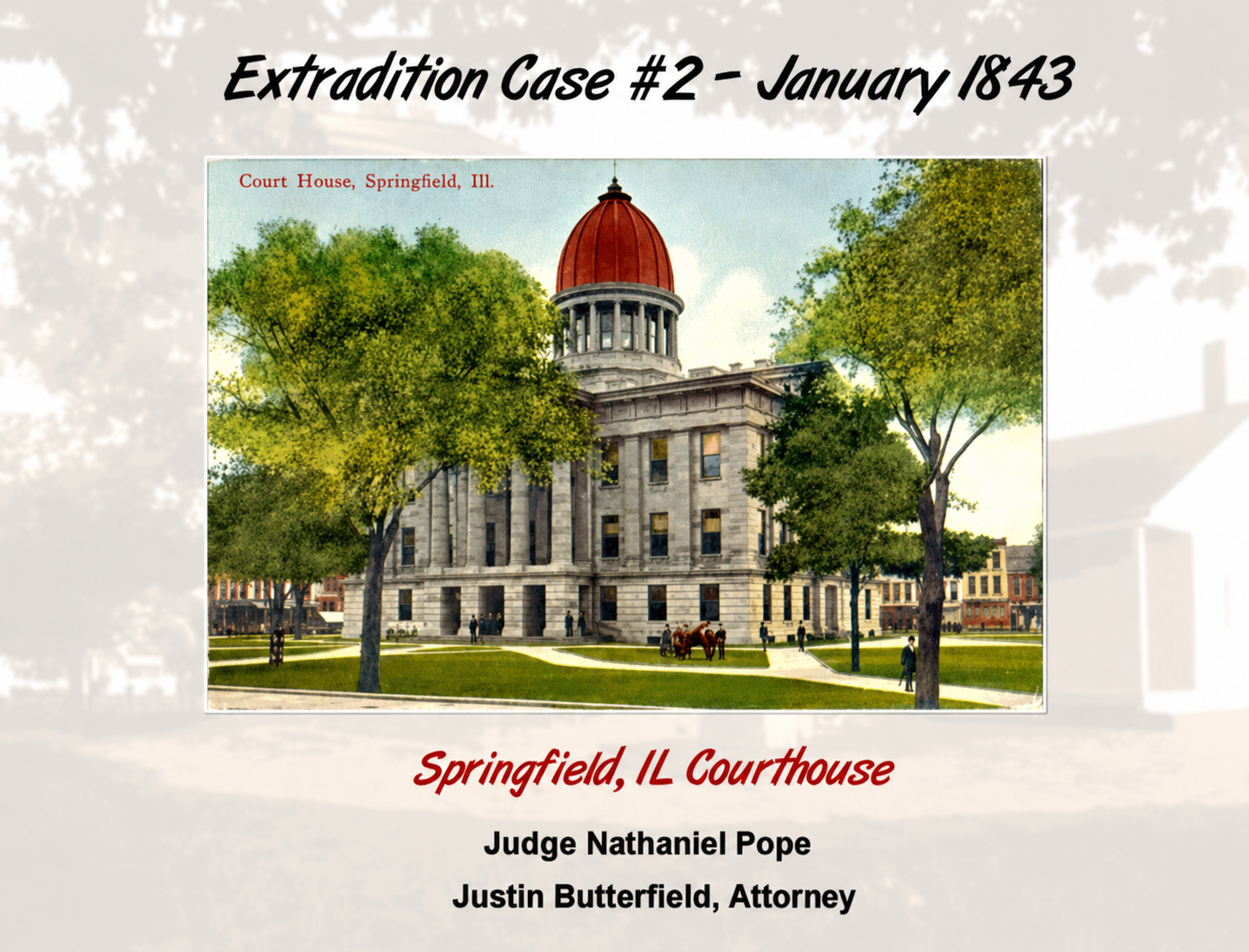
The one who did that was the U.S. Attorney in Illinois, Justin Butterfield.

And I’ll tell you something about the second extradition case in just a minute that involved Butterfield and the judge who had jurisdiction over bankruptcy, Judge Pope, who was thought to be the best federal judge in Illinois.

The Second Extradition Case

That case came up at the end of 1842. All through May of 1842, a fellow named Boggs was shot in Missouri, and Orin Porter Rockwell was seized and put in jail.

They asked him later if he’s the one who shot Boggs, and he said, “He’s still alive. How could I be the one that shot him? He wouldn’t be alive if I had anything to do with it.”

So writs went out at Boggs’s request.

John C. Bennett was involved. Joseph was to be arrested and hauled back to Missouri as an accomplice before the fact, and Rockwell being the one who pulled the trigger.

It was never proved, but he was in hiding most of that year.

And finally, at the end of the year, he and Governor Ford arranged something where he could go before Judge Pope in the second extradition case and be heard.

And his lawyer, as I say, was Justin Butterfield.

Justin Butterfield’s Defense

Now, Butterfield was quite an effective advocate, as we’ll see. Judge Pope was a good, fair judge, and this was the most notorious case up to then in the history of Illinois.

This was the case to send the Mormon prophet back to Missouri, and everyone knew if he went back, he would be killed. So the town turned out for this show. The courtroom was absolutely packed.

And so the judge said, “I’ll invite all the women in the room to come up and sit by me.” So there were chairs up front in this big, beautiful courthouse. And so all the women are up front, including Mary Todd Lincoln.

So Butterfield, in his opening remarks, steps forward and addresses Judge Pope in this way:

“Your Honor, I come before the judge in the presence of these angels to defend the prophet of the Lord,”

which he did.

And that was a very successful case.

The Third Attempted Extradition

Not quite as happy was the third attempted extradition. Boggs was no longer able to do anything. That was decided by Judge Pope. But now they get a reindictment for those old Missouri charges.

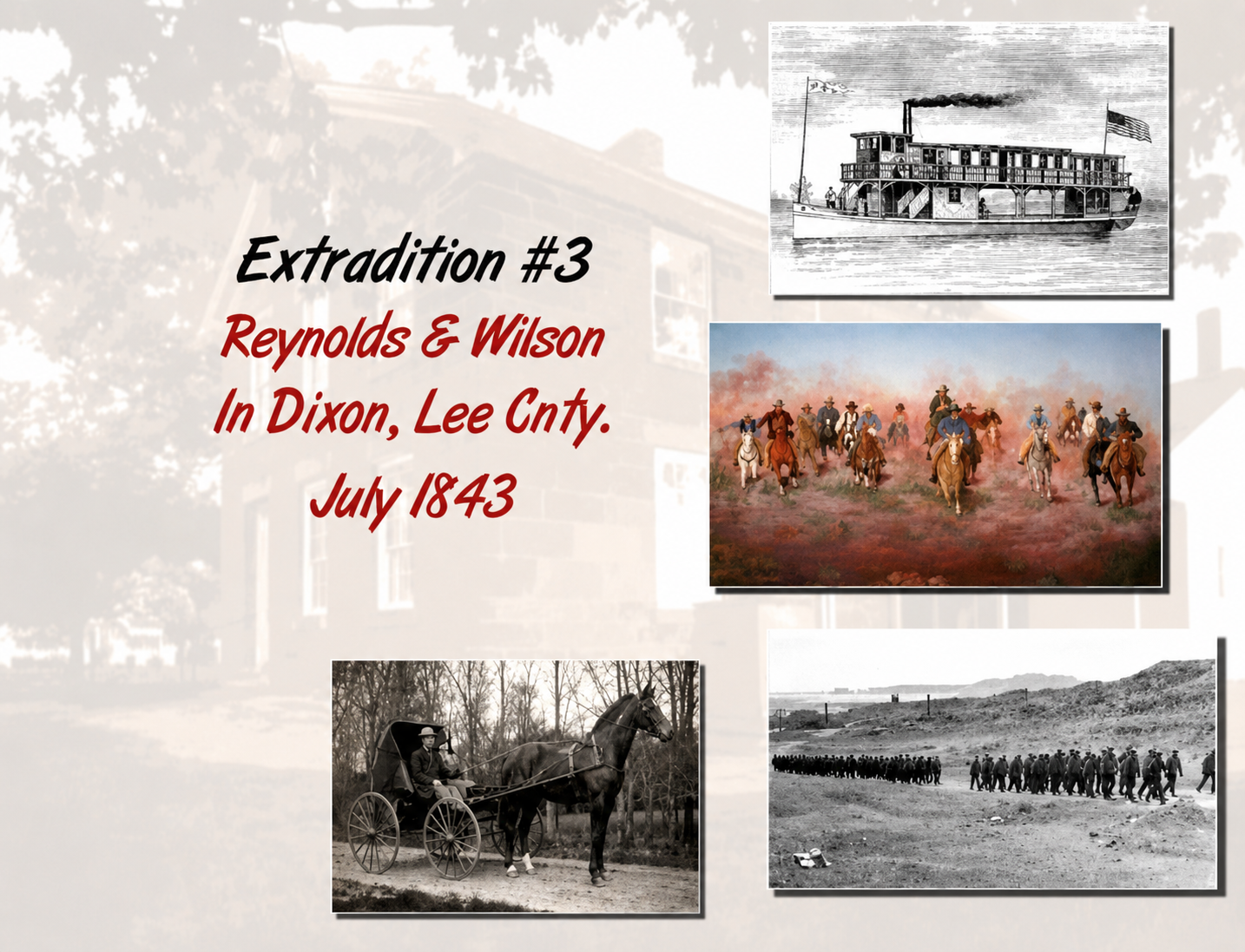
And now Governor Ford agrees that Constable Wilson from Carthage can join with Constable Reynolds from Missouri, and they can take care of Joseph in their own way.

So they happened to seize Joseph while he’s out of his safe harbor in Nauvoo, up visiting family in Dixon in July of 1843.

The word came back in a very hurried way that Joseph had been seized and he was being bundled off to Missouri, and he may even be kidnapped and bound and gagged and on the river as they spoke.

So they sent the Maid of Iowa up and down the river to stop all the boats and search them to see if he was already on board.

And others went by land, out scurrying around.

The Nauvoo Legion Responds

But it was Hyrum who got the Nauvoo Legion mobilized, and they came out in force.

And so what we have here is these two constables who have Joseph in their custody, and the constables are in the custody of the Nauvoo Legion.

So the prisoners are prisoners of the prisoners.

And they all go marching back to Nauvoo except Joseph and Emma, who get to have a nice carriage ride. And when they reach Nauvoo, he goes to court. Of course, the habeas corpus does the usual job, and he is exonerated.

So that’s the third attempt. But at this point, things are really boiling over.

This is July 1843. This is when the word goes out that the Mormons are beyond the law. There is no way that you could ever get Joseph to answer for all his crimes and his past misbehavior as long as that city charter is protecting them.

Building the Temple Amid Increasing Opposition

Now, the other side of Joseph’s spiritual life, though, was focused primarily on the temple.

With all of these other escapades going on in the background, and fearing for his own safety and his well-being, he still pressed ahead with all that he had to build the temple.

And this was a five-year process.

He did not see it through to conclusion.

The King Follett Discourse

But his last general conference was the first week in April 1844. And this is when he preached his monumental King Follett Discourse and had so many spiritual experiences.

It was a beautiful, gorgeous spring day. They were out of doors on the banks of the river. The flowers were budding and the birds were singing.

And Joseph called this “the best and most glorious five consecutive days ever enjoyed by this generation.”

But then later, as he passed the temple on his way to Carthage, he said:

“This is the loveliest place and the best people on earth. Little do they know the trials that await them.”

The Nauvoo Expositor and the Road to Carthage

Well, here are the trials.

Just within days, a trio of brothers were excommunicated. Some already were out, actually.

And this was the Laws, two brothers, the Higbees, who were sons of one of Joseph’s dearest friends, Judge Elias Higbee, who was a revered and honorable man, and then two others, the Fosters.

And right now, one of the projects I have with the Joseph Smith Papers team is to trace a series of suits that these and other disaffected members brought against Joseph that whole year of 1844.

The Reformed Church and the Printing Press

But in April, just after general conference, they, now being cut off from the Church, met and organized their own reformed church with William Law as the president, Wilson as a counselor, and the Fosters were apostles—or one of the Higbees, one of the Fosters.

The next thing they did was to acquire a printing press.

And Francis Higbee said, “We’ll do this so that we’ll cause its own destruction. We want the press destroyed because the moment they lay a hand on the press”—this is his quote—”that will mark the downfall of Joseph Smith and all of Nauvoo.”

Very prophetic.

Now, this was the culmination, as I say, of this series of harassing suits. There were a dozen suits in 1844, all for the purpose of hauling Joseph out of Nauvoo to Carthage, where he could be killed in one way or another.

Joseph in Carthage One Month Earlier

So exactly one month to the day before he was killed, he was in Carthage answering some of these suits.

There were two grand jury indictments, and Francis Higbee had two other cases going, and three other disaffected members you wouldn’t even recognize had suits all going against Joseph at the same time.

So here he is at this Hamilton House, and we’ll get back to that in a little minute here. This is the only hotel in town.

The proprietor at first was thought to be unfriendly to the Mormons because, well, this is Carthage and everyone hates the Mormons here, and he had the patronage of his own people as well as those from out of town.

As we’ll see, though, he was a bit of a hero in his own right, Mr. Hamilton.

On the 27th of May, Joseph was there with Hyrum and others answering these charges, and he was warned that there was a conspiracy afoot to kill him.

The next day he would go to court, and either before or during or afterwards, Joseph Jackson was there with his arms and ammunition, and there were others that were prepared to kill him.

So now Samuel Smith, a member of the city council, gets into action with Hyrum, and they gather the friendly troops, well armed, and they escort Joseph to court.

The case is put over for lack of a witness, and they go back peaceably to Nauvoo.

But they learned, and their enemies learned, some key lessons from that experience.

One month later, of course, he’s back here again, and this house became not only an inn but also a mortuary for Joseph and Hyrum.

The Nauvoo Expositor Crisis

Now, I mentioned that the printing press came. And it was for the purpose of printing as many newspapers as necessary to cause its own destruction. And this didn’t take long.

On June 7th, the one and only issue was printed. The publishers were named right in the paper: the two Laws, the two Fosters, the two Higbees.

The editor was Sylvester Emmons, who actually was a non-member, and he was part of the city council. And Charles Ivins, who’s a distant relative of mine. My middle name is Ivins.

In any case, the city council took this very seriously.

  • They called their best legal counsel.
  • They consulted the legal authorities of the time.
  • They reviewed the cases.
  • They reviewed their own statutes, the State of Illinois, the First Amendment, Blackstone on Law from the Laws of England, the common law.

And their advice was that if they did not suppress the Expositor, there would be a riot, and there would be bloodshed, and there would be commotion. The whole town would be in turmoil. They took it very seriously.

And this issue, while we would read it today and say, “Well, this isn’t so bad,” they thought it was. So the best course, they thought, based on their legal advice, was to suppress it as a public nuisance. And this was done four days later, on the 11th of June.

Arrest Warrants and Habeas Corpus

Now, it didn’t take long to get a warrant for the arrest of Joseph and Hyrum and the entire city council. This writ was sworn out by Francis Higbee in Carthage, and a constable from Carthage, who Joseph called a very wrathful person, came.

And he was wrathful because Joseph said, “Well, we’ll go to our favorite court and have a habeas corpus hearing.”

And so that’s what they did, and the usual result occurred.

At this point, the editor of the Warsaw Signal—now we always think of Carthage because that’s where he was killed. But the real trouble came out of Warsaw, and it was largely because of the editor of the Warsaw Signal.

The same day that they had this habeas corpus hearing where everyone was exonerated, he called for the extermination of all Mormon leaders.

So this is bad.

Judge Jesse Thomas and the Final Hearing

The presiding judge of Illinois for that area at the time was a very great man, as Joseph described him, named Jesse Thomas.

And he said, “Now you’ve gone through your habeas corpus motions, and you see where it got you. I strongly urge you to have a full trial on the merits with witnesses, the whole nine yards, before a non-Mormon outside of Nauvoo.”

And he recommended Daniel H. Wells, who was a very prominent jurist and lived just outside of Nauvoo. And so at his rather stately home, a hearing was held.

He later did join the Church and went with the pioneers west and became Brigham Young’s counselor for 30 years.

But at the end of a very long day, the same decision was reached, and the entire city council was exonerated.

Now the Signal calls for the extermination of all Mormons everywhere in Illinois.

Forces Gathering Against Nauvoo

So here are the principal groups that are bringing this about.

It all starts and, in some ways, ultimately finishes with these three sets of brothers and others, the apostate group. Then we’ve got the media under the charge of this friendly fellow, Thomas Sharp, the Warsaw Signal.

What did he have against Joseph and the Mormons?

Well, I’m indebted to Brother Bushman for this little note in his book. We’re not really sure. He has no great history of this. He bought a losing newspaper, and I’m sure he felt that selling papers was his first charge.

And if you turn people against the Mormons and stir things up, that’ll sell a lot of newspapers. It always does.

Bad news will do that.

Joseph Smith and Thomas Sharp

But here’s something that Bushman put in his book. This is Joseph’s letter to him. He first invites Sharp to the groundbreaking of the Nauvoo Temple. They have a grand ceremony. Everybody’s very excited, and Joseph expects a wonderful column in the Warsaw Signal.

There’s Sharp right on the front row, grandstand seats. He’s wined and dined, literally, at the Smith home.

And then he goes back the next day and prints a very tame column.

He says,

“Well, they had a nice event, but I’m going to keep my eyes on those Mormons because they’re talking political things now. And if church and state are combined, I’m going to see that I can do all in my power to prevent that.”

So reading that, Joseph sends him this letter:

“Sir, you will discontinue my paper. Its contents are calculated to pollute me. To patronize your filthy sheet, that tissue of lies, that sink of iniquity, is disgraceful to any moral man. Yours with utter contempt, Joseph Smith.”

“P.S. Please publish the above in your contemptible paper.”

Well, he did.

Now, do you know anyone that ever won a name-calling contest with a newspaper editor?

So Sharp has his own revelation to give, and he says, “Yes, I will reveal that Joseph Smith has failed to pay for his subscription, the last that he has just cancelled.”

And so it went. The war was declared, and that’s Mr. Sharp.

The Final Days

Then, of course, we have the ever-lurking Missouri enemies.

Boggs is still there, and Bennett’s over there, and they’re stirring things up every way they know how, and they’re starting to come across the river.

Several ministers were very unhappy about the loss of some of their adherents to the Mormons. Actually, one of those who was tried for the murder was a very prominent Baptist minister.

Some politicians were also unhappy with the Mormons. Two of those were tried for the murder. They had been losing votes to the Mormons.

And then you had two businessmen who lost money to the Mormons in various ways. I won’t go into that.

So now things are reaching the end. The winding-up scene is near. Missourians are coming across in a big way, bringing arms, ammunition. Several large cannons seem to have been crossing the river. And then attacks are starting on the outlying settlements.

Joseph Appeals to Governor Ford

So now it’s time to get some help. And Joseph does two things.

One is to write a letter to Governor Ford saying, “You’ve never been to Nauvoo. You need to come and see this place for yourself and help me keep the peace.”

The second thing that he did as an interim measure was to declare martial law, which means it’s now under the charge of the Nauvoo Legion. They’ll keep an eye on everything that’s happening.

Everybody goes to bed at an early hour, off the streets, curfews, the whole thing. That turned out to be a very prudent but fateful move on Joseph’s part.

Conclusion

I cannot go there without emotion, and neither can you.

Well, today, as we go back to Nauvoo, we see that there are better times. That gorgeous temple has been rebuilt and was dedicated in 2002.

And we should all join where President Hinckley went back for that, as he has done so many other things, in saying:

“God be thanked for Joseph Smith and the greatest instrument of our restoration.” 4

The martyrs are in a place where “traitors and tyrants now fight them in vain.”5

Thank you.

Search topics

Joseph Smith legal trials; Joseph Smith lawsuits; Joseph Smith court cases; Joseph Smith criminal charges; Joseph Smith Papers Project; Legal Trials of the Prophet; Joseph I Bentley; glass looker trial; 1826 hearing; Josiah Stowell; South Bainbridge trial; Colesville trial; Newel Knight; Kirtland Safety Society; Kirtland legal cases; Missouri Mormon War; Liberty Jail; Missouri Extermination Order; Haun's Mill Massacre; Alexander Doniphan; Nauvoo Charter; habeas corpus Nauvoo; Nauvoo Legion; Stephen A Douglas and Joseph Smith; extradition cases; Judge Pope; Justin Butterfield; Robert E Lee steamboat case; bankruptcy proceedings; Nauvoo Expositor; Warsaw Signal; Thomas Sharp; Daniel H Wells; Jesse Thomas; Carthage Jail; Joseph Smith martyrdom; legal history of the Restoration

CES Letter; Mormon Church history; Mormon legal controversies; Joseph Smith criticism; anti-Mormon claims; Mormon origins criticism; LDS historical evidence; Mormon apologetics; Joseph Smith court records; Mormon persecution; Mormon Missouri conflict; Mormon Extermination Order; Joseph Smith arrest history; Mormon truth claims; Mormon historical documents; LDS Church history evidence; Mormon restoration claims; Mormon leadership controversies; Carthage conspiracy claims; Mormon historical criticism

FAQ / Common Questions
How many lawsuits was Joseph Smith involved in?

According to research cited by Joseph I. Bentley, Joseph Smith was involved in approximately 175 legal proceedings during his lifetime.

Was Joseph Smith ever convicted of a serious crime?

Bentley argues that Joseph Smith was acquitted, discharged, or otherwise cleared in many of the major criminal proceedings brought against him. The presentation discusses several early cases in New York and later extradition attempts that did not result in criminal convictions.

What was the 1826 "glass looker" case?

The 1826 hearing involved allegations related to treasure seeking and claims that Joseph Smith falsely pretended to discover lost goods. Bentley discusses evidence suggesting Joseph was discharged rather than convicted.

What was the Missouri Extermination Order?

Governor Lilburn W. Boggs issued Missouri Executive Order 44 on October 27, 1838, directing that Mormons be treated as enemies and driven from the state or exterminated. The order remained officially in effect until it was rescinded in 1976.

Why was Joseph Smith imprisoned in Liberty Jail?

Following the 1838 Missouri conflict, Joseph Smith and other Church leaders were arrested and held in Liberty Jail for nearly six months while awaiting legal proceedings.

What was the Nauvoo Charter?

The Nauvoo Charter granted the city significant municipal authority, including a local court system and the ability to issue writs of habeas corpus. These powers became a source of controversy among Nauvoo's opponents.

What was the Nauvoo Expositor?

The Nauvoo Expositor was a newspaper published by former Church members in June 1844. Its suppression by order of the Nauvoo City Council became a major factor in the events leading to Joseph Smith's arrest and death.

Why was Joseph Smith taken to Carthage Jail?

After charges connected to the destruction of the Nauvoo Expositor and subsequent accusations of treason, Joseph Smith surrendered to authorities and was confined in Carthage Jail, where he was killed by a mob on June 27, 1844.

Shining New Light on the Mountain Meadows Massacre

Gene Sessions
August 2003

Editor’s note: This is a transcription of a FAIR Conference presentation by Gene Sessions. As with most transcriptions, this one includes artifacts of speech that are not always included in written material. There are also a couple of places where the original recording was inaudible; those have been marked as such.

This is a very serious subject, I’m charged with talking to you a little bit about the Mountain Meadows Massacre and what’s happening these days with the literature on the subject.

I think most of you have seen, if not all of you, have seen a tremendous upsurge in publications on this atrocity. Hard to tell exactly why that has happened. I think there are a number of ways to understand that. One is that increasing attention came upon the state of Utah because of the Olympics; there were numerous mainstream national publications that paid much more attention to Utah and Mormonism than normally do. You may have seen some of the articles that appeared pretending to be balanced views of the state and Mormonism.

Some of you may have noticed in magazines like The New Yorker that, in that particular case as I recall, an 11-page article on the state–six pages devoted to the Mountain Meadows Massacre, and two pages to polygamy, the rest about the state of Utah and its wonders.

This event has become in recent years something that a lot of people know about who didn’t know about it before. Part of the reason for that is President Hinckley who, in 1998, decided to build a new monument at the Meadows on the spot of the original army cairn that held the partial remains of 34 victims buried there by the army in May of 1859; and I want to get back to that story in a minute but I’m trying to outline for you a few reasons in my mind that this has gained so much attention recently.

Another reason of course is the publication of Will Bagley’s book. Will began work on his book well before the Hinckley initiative on the Meadows. He was employed by a former Mormon in California who, frankly, wanted to pin the Massacre on Brigham Young. He put an ad in the Salt Lake Tribune asking for applicants to write a new history of the Mountain Meadows Massacre and in the course of interviewing several who applied (inaudible) except for Br. Bagley. Will was, by his own words to me–this is first hand words–the only one who said that he could and would pin it on Brigham Young. So Will was hired, he quit his job at Evans and went to work full-time writing a new history which was published by the University of Oklahoma Press last year.

I must tell you up front (you can throw tomatoes or whatever you want at me) that I was one of the readers that the University of Oklahoma Press sent a manuscript and I recommended publication because I believed very strongly and still do that Br. Bagley had done intense research and that it was fairly exhaustive. He solved whatever he could see and looked very deeply, plumbed very deeply, to find much information that Juanita Brooks did not have when she published her landmark book in 1950. And so I was impressed with that and recommended that the Oklahoma Press publish the book but I cautioned the Press that it was an anti-Mormon polemic and that I did not agree with Will’s conclusions and we’ll talk more about that some more here if time allows.

His book did very well in the first printing, it was very quickly into a second printing, and then shortly after all the hoopla over his book which ascribes the motivation of the murderers to Brigham Young ordering these people killed to avenge not only Joseph and Hyrum but also Parley P. Pratt who had been murdered in Arkansas the May before the Mountain Meadows Massacre occurred in September–by the way on September 11. The anti-Mormons on the web are making a whole lot out of that right now–the two atrocities happening on the same day and so on all committed by mad fanatics, religious fanatics.

In any case, we could probably waste the whole time here talking about why there is so much interest today in the Mountain Meadows Massacre. I grew up in Ogden, Utah. The first time I heard about it was from a Catholic classmate who was feeling pressure at having to take Utah history in the seventh grade which really turned out to be half a year of Sunday School (laughter) and his parents who to immunize him against Utah history told him about the Mountain Meadows Massacre and I was told about that when I was in the 7th grade and I dismissed it and later in high school heard about it again, went to my seminary teacher who said, ‘It’s a lie, it didn’t happen,’ and pretty much forgot about it until I was a history student and found out that it did indeed occur.

So I think there’s been a long period since the execution of John D. Lee in 1877 where Mormons would just as soon not talk about this and successfully did not. But beginning in 1990 when President Hinckley supported the building of the monument up on the hill there, if you’ve been there, the Dan Sill Hill monument which has all the names of the people we know were killed there; and then in 1999 when a second monument was built at the bottom of the draw on Church property with Church funds suddenly it became alright to talk about that and so there’s much discussion in Mormon circles about the Mountain Meadows Massacre.

I’ve been invited to speak in stake priesthood meetings on the subject. I’ll never forget one evening, a chapel packed as full as this room and more, I was supposed to speak for forty-five minutes and was there with them for an hour and forty-five minutes; and finally had to say that I was tired and wanted to go home! The Institute director at Weber called his staff together and had me give them a two-hour presentation on this so they’d know about it.

So it’s okay now to talk about this but let’s be honest, for years and years, this was a subject that we just didn’t talk about and when we did we either said, ‘Well that was John D. Lee and a bunch of renegade Indians,’ or we’d try to ascribe it to some external force rather than to face the fact that some 50 Mormons taking orders from local ecclesiastical leaders actually went out and tricked these 120 people out of their encampment with a white flag and then proceeded to murder them in cold blood with the exception of 17 small children.

So it’s a very, very hard thing to discuss especially if you’re a Mormon and especially as I know some of you are descended from people who were involved in this.

But anyways, we could talk about the history–I’ve got my own perspective on this. I think most of you know the great historian Carl Becker said (this was pre-feminist days) “every man is his own historian,” I guess we could say ‘every person is his or her own historian.’ And we all have to make up our own minds about what happened there that week.

It’s an awful story, you can’t put a smilie face on it. This was cold-blooded murder of innocent people. Occasionally someone will come up to me and say, ‘Well don’t you think they deserved it?’ And, no I don’t think they deserved it. I don’t care how many of the stories you believe about whatever the immigrants did to get killed, nothing they did came anywhere close to justifying the murder of little children and the oldest child saved was six-years and 11 months old. Everyone older than that was murdered. In fact most of the murdered people were women and children. So there’s no justification. Even if you wanted to make some justification for killing the men, it breaks down pretty fast. It’s just- there’s no justification for the murder of these people.

So it’s an ugly, ugly story.

Then we get to the place where, alright what are we faced with today in 2003 as non-Mormons and ex-Mormons and anti-Mormons and others take a look at this story and try to make sense out of it? I think you also, in this group are much more aware than I am, there are a lot of people out there who find not only Mormonism to be abhorrent but find religion itself to be not healthy at all, in fact not benign but dangerous.

I have not had a chance to read Krakauer’s book Under the Banner of Heaven but it’s getting lots and lots of attention. It’s selling like hotcakes, particularly in the east and California where people are more aware of Mormons and it is a sensational story about the Lafferty case. The message seems to be there, as I’ve talked with friends who have read it and read the reviews, that religion–organized religion, in this case Mormonism–can and too often is dangerous and a bad thing rather than just something that if you’re not religious you might want to ignore.

So we’ve got a big problem here as historians and in your case, if you want to defend Mormonism. I’m a practicing Mormon, I don’t smoke, drink or chew or go with girls who do (laughter). I give of my excess income once a month to the guy with the suit on at Church and so forth. So I’m with you to a point.

But as a historian, our job is to let the chips fall where they may and I’ve looked at this story for many years, long before I became involved in the Mountain Meadows Association in 1998 so I’ve been involved in this whole mess for the last five years and I think I know what happened there.

I don’t agree with Will Bagley. I certainly don’t agree with Sally Denton. Her book outsold Bagley’s book in a couple of weeks; I’m sure Will’s hurting over that. Denton’s book is just trash frankly. The first chapter is about stuff that I know about first hand and I barely got through it with my stomach contents intact. But, it sells well and I’m getting e-mail from people all over the country because I’m on our website linklist, all the e-mail that people write into the Mountain Meadows Association’s website I get their message and dozens and dozens of people writing in and saying, ‘I just finished Sally Denton’s book.’ One man said, ‘I hope that the American people within the next ten years wake up and drive the Mormon Church out of existence.’ Two sentences in his message: ‘I just finished Sally Denton’s book’ and then ‘let’s drive them out of existence.’

It’s pretty hard to look at this story without having revulsion against the men who did it. I don’t have ancestors who were there. Mine were here in Utah but they were all up north, and some of you who have ancestors who were there, it’s awful! And, I must tell you that I become very angry when people want to excuse what these men did.

Do I understand why they did it? I think I do. But I still don’t excuse it and I’ve got a friend with whom I spent hours and hours and hours discussing the Mountain Meadows Massacre–he’s a non-Mormon who has read voluminously on the subject and it’s interesting to get his perspective. And he doesn’t agree with Bagley or Denton.

We have a similar view of what happened but… I don’t know, I’m trying to make you see this is just not fun. It just isn’t fun. I’ve told my wife who was about to divorce me over it sometimes, ‘I wish (a) that it had never happened, and (b) that since it did I don’t know about it.’ I mean I really wish ignorance on myself which being a college professor makes me something of a sinner! Ignorance is bliss (the old clichÈ).

What I’d like to do for a few minutes and then we’ll open this up to questions is refer you to a particular incident that occurred–well two instances that occurred–that I think puts a perspective on how the non-Mormon/anti-Mormon quote/unquote or slash/slash–whatever you want to call people–how they view this.

In October 1998 I was invited with the rest of the Mountain Meadows Board–including descendants of the Bakers and the Fanchers and the Dunlaps and others–to visit with President Hinckley in the Church office building. President Hinckley was with us for about fifty-five minutes. It was an amazing event. He talked about his history with the mass graves, taken to the Meadows the first time in 1947 by his father; they walked the ground silently, shed tears. President Hinckley said he walked away knowing that this was a sacred place and so he had a feeling for the incident.

And then in 1998, President Hinckley was at Dixie College to dedicate the pioneer camping ground there on the campus, asked his folks to take him up to the Meadows, was ashamed at the condition of the Church property there. Called us together to say, ‘What do you want to do?’ and the result was we built this beautiful monument down there that some of you I’m sure have seen and I hope most of you have seen. It is a replica of the original cairn that the army constructed over the rifle pit where 34 partial remains were chucked in May of ’59.

In the course of preparing to put that new monument there, we made every effort in the Association to discover where the remains were because we knew that cairn had migrated a bit over the years–farmers had knocked it down, vandals had carried off rocks and so forth. Brigham Young ordered it knocked down once according to Dudley Leavitt, he was there with a party in the 1860s and they came up to it and he ordered it destroyed.

So we were worried that there were bones that we might discover and the descendants of the Bakers and the Fanchers and others had made it very clear that they did not want that to happen. So we did a lot of cores. We had an archaeologist from BYU, Shane Baker, come down and do some cores to try to find the- whatever graves might be there. Long story made short, he missed. He (inaudible) the grave by six inches and the second scoop of the backhoe dug them up. That was on August 3, 1999.

This resulted in a firestorm of activities. The remains, and all kinds of confusion about what state law had to say about these things, the sheriff came immediately and pronounced it was not a recent murder site, so it was an archaeological site and et cetera.

Eventually the remains wound up in BYU. I saw them just a few days after they were brought to BYU for the public archaeology folks to try to make some sense out of what they had. The partial remains, they found 29 individuals. We’ve known for years that some of that grave had washed away and we’ve had accounts of farmers seeing bones sticking out of the ground and so forth.

So anyway, eventually because the BYU people didn’t have the people to take care of it they transferred the cranial matter to the University of Utah where an archaeology graduate student (now has her Ph.D.) Shannon Novak was commissioned to take a hard look at the cranial material to see what she could determine from the cranial matter.

In the meantime, the descendants in Arkansas became very angry. They wanted them reburied immediately and enormous pressure began to come upon us in the Association to try and keep this whole thing afloat–to get the Church and the state and whoever else we could to get those bones back in the ground–so we worked hard to get that done.

And finally, the week before the dedication of the new monument which was to take place on September 11, a Saturday, 1999, a man in Harrison, Arkansas named J.K. Fancher who is friends with Dixie Leavitt the governor’s father, got on the phone and called Dixie and said, ‘Your son’s got to intervene.’ So the governor called the state archaeologist and within a few hours the bones had been removed from the University of Utah and brought altogether and on Friday morning, the day of the funeral that had been scheduled for the bones, they were brought to St. George and brought to a funeral parlor where they were placed in four small little caskets and buried that afternoon in a Baptist funeral.

You should’ve heard all the Mormons there trying to sing “Amazing Grace.” Then the next day you should’ve heard all the non-Mormons trying to sing “We Thank Thee O God for a Prophet.” There was some humor.

Anyway and the end of that story is; then the story is that in March of 2000, a yellow journalist by the name of Chris Smith at the Salt Lake Tribune (he’s not; his skin’s not yellow it’s what he does) published a three-part series in which he announced rather bald-faced (he knew better) that the bones were full of secrets that would have been revealed if the archaeologists had been allowed more time with them and that the Mormon Church conspired with the governor, who was a descendant of one of the killers. (Although the governor’s ancestor claims that he was just a picket rider, most of the people who were there were just there. Picket riders, eh? Didn’t do anything!) That the bones were then, under this conspiracy, quickly replanted.

The Associated Press and every other wire service in the world picked that up and here’s the message that went out to the world and which is now in all these books (Krakauer’s book, Denton’s book, et cetera): The bones came out of the ground, they were revealing the nasty truth that the Mormon Church didn’t want out there and so the Mormon Church conspired to get them buried quickly so those truths could not be revealed.

That bit of misinformation has been enormously damaging. It is one of those myths that all of you who understand history know how these things happen shows up in one book and pretty soon a graduate student puts it in his dissertation and pretty soon it’s in ten other books and pretty soon it’s the truth.

So the “truth” is, my friends, that we had twenty-nine partial remains that were going to tell us the Mormons–not Indians–killed these people and because the Mormon Church didn’t want that information out it conspired to get those bones buried quickly in order to hide the truth. That is the “truth” now.

And if you want to stand up in front of a crowd like I’ve done over and over again and try to persuade folks that isn’t the truth–you’re wasting your time. But let me tell you in just a couple of sentences how you don’t have to take my word that it’s not the truth.

In 1859 of May of that year, Major Carleton came up out of California with a bunch of guys. They’d met some other guys from Camp Floyd who were already there. And Carleton, surveyed the remains that were strewn all over the Meadows by wolves and wolverines or badgers or whatever they are. Major Carleton said this; it’s on our website,1 it’s everywhere. It’s been public record for 144 years: “…nearly every skull I saw had been shot through with rifle or revolver bullets.”

So what truths were there in the bones? Well were they smokers? Did they; were they malnourished? What did they eat? It didn’t tell us who killed them any better than we already knew. Who killed them? Who had guns in Iron County in 1857? Who? The Mormons. Did Carleton’s sentence tell how they were killed? Yes, a coup de gr‚ce, they were shot in the head. So the idea that there was a new truth here, that the Church had to be afraid of is just hogwash.

And secondly, it is also hogwash there’s (in 10 minutes on the phone you can demonstrate this) J.K. Fancher is not a Mormon. He’s a distinguished citizen of Harrison. He has no sympathy for the Mormon Church. He’s a lateral descent of Alexander Fancher. He’ll tell you, ‘I called Dixie and said, you better get your son to bury those bones or there’s going to be hell to pay.’ That’s how it happened. And Mike Leavitt called the state archaeologist and said, ‘Turn them over to those people so they can bury them or there’s going to be trouble.’

But the truth is not the truth anymore because Chris Smith said otherwise and so forth.

Let me get to the last incident. I was not in favor of the Olympics. You say, ‘So what?’ Well what the ‘so what’ is, is as soon as I saw everybody celebrating about the Olympics and as soon as I heard from my president at the University that we would be dismissing classes so they could use the ice sheet there for something called curling my wife and I began to save our money and our sky miles and planned a trip to Maui for twenty-two days (laughter) figuring that, ‘Hey it’s the last chance I’ll ever have to go to Maui in February in my racket unless I take a sabbatical and even then I probably won’t be able to.

So we were in Maui, and the second day before we came home, the Olympics were over. We were coming home on Tuesday, it was a Monday, I think the closing ceremonies were on Sunday. I’m sitting on the beach and this very piece of–whatever it is–rings. (Laughter) It rings and it’s John Hollenhorst, Channel 5 News, and he says, ‘Hey what do you think of this lead sheet they found down at Lee’s Ferry?’ I said, ‘What lead sheet?’ He says, ‘Where have you been man?’ I say, ‘In Maui, I’m still in Maui.’

Well you’re all familiar with the lead sheet and my friend Steve Mayfield here and I have had a lot of conversations. I don’t know if you’ll be able to see this. You’ve probably seen this and some of you may not be able to see this real well, but here’s a pretty poor rendition of what this–but anyways here’s what the thing looks like and a park service worker at Lee’s Ferry before the Olympics found this thing in a building at an old fort there. Steve tells me they’re pretty sure it was put where they found it in about 1998 or ’99, something like that. Right Steve?

It’s an old piece of lead; recent metallurgical studies have shown that it was mined in the (inaudible) Ozark Plateau in southern Missouri not far from the homeland of the massacred people before 1865. The script on it, in case you haven’t seen it, and I–this is my own attempt to try to copy it (Steve’s done better work) and his friends, George Throckmorton and others, says that basically, ‘Lee’s at the Paria River. It’s January of 1872, he’s sick, he’s tired, he knows he’s going to be taken pretty soon but he doesn’t really care–he’ll take the blame, he doesn’t fear death. Brigham Young through George A. Smith ordered this done.’

Well of course this created an enormous media frenzy, ‘smoking gun,’ ‘boy this is it, now we know for sure, Lee admits it’ and so on. Well somebody right away, one of my friends, wrote and said, ‘Well didn’t Lee say that in the Confessions of John D. Lee/Mormonism Unveiled?’ and the answer is yes but nobody paid any attention because everybody knew his lawyer wrote that book. Got any lawyers in here? We won’t go further with that. (Laughter) But we’ll say this, I think you know that Lee’s lawyer was working pro bono ‘almost.’ The second trial, his deal with Lee was, ‘I’ll defend you but I get your book and the rights to your book.’ And then he had the book for several months after Lee’s death and no one doubts that he manufactured much of what’s in the latter part of it because it’s so inconsistent with the rest of his work.

Anyway, long story made short, I jumped in really quickly and said, ‘It’s a hoax.’ And my reasons were (inaudible) handwriting analysis, my reasons were that the message is inconsistent with Lee’s diary at the same time. He was at the Paria but he was not saying stuff like this. In fact the day after this was supposed to be written Lee went on a five-day horse-packing trip with one of his sons looking for the location for a new ranch and was really looking forward to it. He’d just finished two houses, he put a (inaudible) in one of them and he had everything going for him at that moment–he really thought he was out of the woods and he was okay.

And if you read the rest of his diary, and six months on either side, he’s very defensive about Mountain Meadows. If anybody suggests Brigham Young does it he calls them a damn liar, I could tell you some specific incidents but I read very carefully the whole journal and six months on either side when I finally got home. I told Hollenhorst from Maui that I thought it was a hoax and he read it to me over the phone, I said, ‘That’s not Lee. It just isn’t Lee.’

Well later on–misspellings are another issue–later on, Steve and his friends in the criminal justice/criminology racket did handwriting analysis and so on and found it entirely inconsistent with Lee not only when he wrote on paper but when he writes things scratched into rocks and things like that–it’s just completely different.

He used ampersands instead of the word “and;” he didn’t use the dashes. This hoaxster tried to imitate his double line of capital letters, didn’t notice that Lee only did it on the verticals instead of; and did not do it on the horizontal so it’s a clumsy hoax.

Well, I bring this to your attention because to this day more than a year later people like Sally Denton and numerous others are still blowing this all over the place as the ‘smoking gun’ despite the fact that I think people like Steve and his associates and people in my end of things, historians like the late Dean May, he and I talked this a lot, are just utterly bemused that anyone with a brain in his head could continue to think that this is a genuine historical document. And there’s always the chance that it is, but if it is, boy there’s an awful lot of things we’ve got to explain to believe that it is.

Now why is this? And I’m going to conclude with this. I find it enormously amusing that people who hate Mormons and who hate Mormonism believe that the best way to attack Mormonism is to attack somebody like Brigham Young. This may not be a popular thing to say but I think one could very easily look at what happened at Mountain Meadows–what really happened at Mountain Meadows. It wasn’t a conspiracy; there was no order from Salt Lake to kill these people. What really happened at Mountain Meadows may call into question some other flaws that existed in the nineteenth-century Mormon Church; other flaws that exist in the way decision-making took place and so forth and make criticism that way. But for some reason people from Bagley to Denton to Krakauer and whoever else- Chris Smith; the web is full of this invective. The only thing they can do to satisfy their bloodlust is to go after Brigham Young on this. It seems to me stupid. If I were one of those people, so what? A conspiracy manipulated by a rotten guy like Brigham Young, it seems to me much less damning than if you try to call attention to some other things that may have been going on in Mormonism at the time that will allow ordinarily decent men to commit such a crime.

Anyway the point is I think for you folks and your interest, this is a good example it seems to me of how people can pick up a piece of history, some of it accurate–much of it inaccurate–twist it, turn it just a little bit. It becomes a powerful tool and there are literally thousands of people out there now who reading these books think they now understand the real nature of nineteenth-century Mormonism and nothing could be further from the truth.

And by the way Steve has a whole bunch of photographs where the Lee lead sheet was found and pictures of the location, the man who found it, better pictures of it other than I showed you, so Steve I’m sure you wouldn’t mind afterwards if people want to come up and ask you questions about it.

The information just continues to come in–Steve nod your head or shake it if I’m right or wrong–is that this is a very, very bad clumsy hoax but nobody wants to believe that outside of Mormonism. Everybody wants desperately for this to be. We’ve got a former Mormon who is now a born-again Christian secretary down the hall from me and I was preparing some materials a year ago to give a talk and she came in and she saw that and she said, ‘Oh wow that’s great can I have copies of all that?’ I said, ‘Well, I’m sorry Carol; it’s a hoax.’ And she said, ‘You’re kidding.’ That brought her down to tears!

I don’t know what else you’d like me to say about that except that, and my own belief is, let me summarize this way–that looking at incriminating statements, corroborating those incriminating statements the participants made for years afterwards, looking at other evidence that is incontrovertible–this was a bad decision made by local leaders. One bad decision followed by another. It’s like you teach your kids: you tell a lie, you’ve got to tell another lie to cover up the lie you just told and another lie to cover up the lie that you told to cover up the first lie. It goes on and on and on and that’s what happened that week in September of 1857 in Cedar City.

But I’ll also mention to you that the Glenn Leonard, Richard Turley and Ron Walker book is as I understand it finished. Some of you may have better information on that? Glenn Leonard, the Church Museum Director; Ron Walker from BYU; and Richard Turley, the Director of the Archives of the Church–they have had full access to everything the Church has including the Jenson papers, including the Morris affidavits and so on that neither Bagley nor Brooks were allowed to see and Denton didn’t even come to Salt Lake to ask if she could see.

And those materials, by their promise in public, will be available for the public to peruse when their book has been published will actually mean (inaudible) and I’ve had the privilege of seeing much of that manuscript and I’m enormously impressed with what those men are doing. I think it’s going to be an honest, painfully accurate depiction of what happened there and the cascading series of bad decisions and events that led to this horrible atrocity committed by Mormons with the help of the Paiutes.

I also believe without any question, even though the Paiutes might deny loudly that they were involved, that there indeed were. At the beginning of the attack; at the beginning of the week somewhere in the neighborhood of three hundred Paiutes–there may have been only a handful left by the end of the week when the actual murders took place–but they were involved from the beginning and anyone who suggests otherwise is just missing enormous amounts of evidence.

So that’s my view; and I also believe, when I was reading Will’s manuscript, that if you accept his thesis then you have to deny that just about everything we know about what happened down there. It doesn’t make any sense in light of what we know happened that week: the decision-making process, the people who were involved, all that has to be just entirely ignored if you believe that it was a conspiracy hatched in Salt Lake and conveyed there by George A. Smith.

So that’s my own personal view on it. I hope this is the kind of presentation you were hoping for, I wasn’t really sure exactly what you wanted from me today but I think that summarized it pretty well.

Q: I’m sorry but I’ve come to this discussion very late and I just want to know what is the evidence or non-evidence that there were rapes, that there were women and children who were seriously harmed before they were murdered?

SESSIONS: Okay most scholars I respect don’t think there were such events occurred, unless there were Paiutes who took people away from the scenes of the killings. And the main reason that we don’t believe any of those stories is because it happened so fast. One scholar–Robb Briggs from California who has done a really fine study of this from the point of view of an attorney–made this statement which is kind of chilling. He said, ‘Whatever you say about the Mountain Meadows Massacre it was really carried out well. It was timed beautifully, it was carried out with precision, there was correlation. They wiped them out in just a few minutes and there wasn’t time for any of that to happen.’ So those who suggest that I think they’re going to have to revisit their thinking. I don’t accept the accounts of those kinds of events for me are specious. That doesn’t say they didn’t happen, but it doesn’t seem to be likely at all.

Q: My question relates to Brigham Young’s involvement. Is there any; does the historical evidence vague enough that the connections to Brigham Young are based primarily on your bias? I mean just taking those vague events and if you’re against Mormonism well okay then maybe we can jump to this conclusion, or is it pretty much just bad research?

SESSIONS: Some of all of that. In the case of Will Bagley, he started with the premise that Brigham Young ordered it done and that’s been suggested for years.

Let me tell you this, if you go to Arkansas today and talk to the descendants–and I know dozens of them now–they all believe Brigham Young ordered it done. They all do and they’re; when you say well why did he order it done? They almost all of them believe it was done for greed. That Brigham Young was in a tough spot, and the Mormons were poor and this train comes through with all this money and cattle (inaudible) killed for their money.

So if you decide that at the beginning obviously, and then you can go back and find–‘Oh aha! See, oh yeah, see?’ And that’s what, in my view, Bagley did. And I tried to change his mind about that for years as he was working on the book, I was pretty good friends with him and we took a couple of trips to the Meadows together, and we had a lot of time to sit in the car together. And I could see him making that very mistake you decide upon.

As far as evidence, again, on the first of September Brigham Young met with a bunch of Paiutes; sub-chiefs brought up to Salt Lake by Jacob Hamblin. Dimick Huntington wrote in this journal (he was in the meeting) that Brigham Young said, ‘You can have the cattle on the California road.’ And Bagley makes a lot of that as a smoking gun kind of thing. In fact at one time he thought that was going to make his book. But as it turns out he also told the Utes that, he also told the Shoshone that. He was trying to get the Indians on his side in the coming Utah War; he thought there was going to be a big fight. Other than that, I don’t know of any verifiable evidence at all that Brigham Young ordered that.

The only other piece of the story that might suggest that he did is that just before the massacre happened, George A. Smith was sent on a long speech-making trip through Southern Utah. We don’t know a lot of what he said in his speeches. We know about some of what he said but they were tough speeches about standing up to the army and the Americans and it was incendiary. And so, there are those who think that Smith was sent down there with that kind of invective and then when he got done with his speech, he’d pull a stake president or a few bishops aside and say, ‘And by the way don’t hesitate to kill anybody you can.’ But that’s all speculation.

I think most scholars who are honest about this, the trail doesn’t lead to Brigham Young–it just doesn’t in my view at all.

Q: For anyone who is interested in the context that this all took place, read Gene’s book on his biography of Jedediah Grant.2 It’s an excellent background to all of this.

SESSIONS: It’s out of print.

Q: Go find it. I certainly agree with your assessment of Bagley’s book. As I read it I found it is all this prodigious research but Will just can’t seem to say probable, I mean, he always says probable when he should say possible if not definite. His bias would get in the way.

What would your advice be to a roomful of LDS apologists when they are confronted with the argument that, okay, and this is argument certainly Brooks made and certainly Bagley made that, whether or not Brigham Young ordered it done, he was involved in the cover-up. What’s your advice?

SESSIONS: I don’t think there’s a way to apologize for that because frankly, he was. And I think if you want to apologize for it, the only thing you can do is say, well let’s figure out why he committed the cover-up–and he did.

In my view if the Civil War hadn’t happened, you and I might not be here today and the Cougars might not be playing football because the momentum generating in Arkansas in 1860 for example, to come out here and do a full scale investigation was getting really intense. Then the Civil War happened and the whole thing just went away and it wasn’t until the early ’70s that it kicks back up again and by that time the crime is 15 years old and so yeah, there was a cover-up and it was done well.

In fact some people like Will like to point to statements Brigham Young made in the aftermath, like it had to be done and, when Dudley Leavitt in his diary described the tearing down of the monument there was a cross on it that quoted the Bible that, “Vengeance is mine…saith the Lord”3 and Brigham Young said, according to Leavitt, ‘It should read, “Vengeance is mine, and I have taken some.” Bagley makes a big thing out of that as well.

Now that’s all part, in my view, of the cover-up. He had to put forth this rhetoric that said, ‘Keep your mouths shut. This had to happen.’ But, it’s clear to me from other accounts that we have of Brigham Young in late ’57-early ’58 that he was furious about it. As you know he knew how to swear and he used a lot of nasty words to describe how mad he was that this had occurred.

The Lee family tradition on… (I’m positive some of you are in the Lee family. They’re everywhere.) The Lee family tradition is that when Lee went to tell Brigham about the event, Brigham already had some inkling that his worst fears were true and that it had been done by Mormons and not the Indians.

But he was very, very angry. And then in the aftermath of that meeting with Lee, he was despondent for days. We’ve got solid evidence for that. Then his reaction was, and to answer your question, well we’ve got to keep under- this would kill the Church. This is going to set the Church back, this could destroy it. So, surely, he did an excellent cover-up. The only thing he could do was say was there a good reason for it and if you were a practicing Mormon well, to save the Church. I guess that’s the best-

Q: Why did the massacre happen?

SESSIONS: In my view there’s one word that tells you why and the word is fear; these guys were scared. All the settlements had been pulled back, Cedar City was ordered to stand. It was the last major settlement between here and California going on the southern route. There were a couple of little, you know, Harmony and there were a few people living down in Washington down that way–but Cedar was it. There were six hundred people in all of Iron County between Parowan and Cedar City. These people were absolutely scared to death. They had been hearing for years the wind over the passes that the Californians were going to come and wipe them out.

You want to have a great (inaudible) if you’re interested in this. You want to see how blessed you are to just get the anti-Mormon stuff that’s out there now. Pick up the Sacramento Bee for the 1850s–hardly a week goes by that in that paper, there isn’t an editorial saying, ‘We need to raise an army and go wipe the Mormons off the face of the earth.’ And the folks in Cedar were scared, in my view, out of their minds that that was exactly what was going to happen.

On Wednesday, some militiamen who were coming out–the massacre happened on Friday–on Wednesday night some militiamen were coming out to- they were told when they were rounded up they were going to go out and bury some people that got killed by the Indians and some of them were coming out and near Pinto Junction they came upon three people from the party making their way back to Cedar City for help.

And not knowing what’s going on, they killed them. They fired on these people. They killed young William Aiden who was, had been a Mormon and was leaving with the party to come to California. Two of these guys, there are various accounts, some say two got away there- or one got away, anyway at least one got away. They killed all three of them eventually. But on Wednesday when only one got away they were just convinced that he made it back to the wagon circle and were telling them, ‘This is not Indians, this is Mormons.’

And I don’t doubt at all that that was the final straw that broke the camel’s back. The decision was made the next day to kill them and it was made out at the Meadows; and Major Higby reported in various accounts, ‘Kill everyone who is old enough to tell the tale.’ And Mormons interpreted that as people at the age of accountability so they tried to pick the kids who looked like they were under eight to save, and killed the rest.

So in my view it was naked fear–they were just scared to death that these guys were going to go on to California and report that Mormons had attacked them and this would bring them in a mob out of California. That’s my view and the view of many other historians as well.

Q: First of all who do they think did the lead sheet, is that still linked to Hofmann?

SESSIONS: Steve? You can come up here. Steve’s done a lot more work on that than I have.

STEVE MAYFIELD: First of all, it’s alright. As Scott mentioned, at Sunstone this next week on Thursday morning, the forensic examination that was done on the scroll and the background will be presented by George Throckmorton and myself. So that’s okay. First of all, does anybody not recognize George Throckmorton? George Throckmorton is a trained forensic document examiner; he’s presently the manager of the Salt Lake City Police Crime Lab where I work. He is also one of the two forensic document examiners that exposed the Mark Hofmann forgeries and he was invited by the Park Service to look at the scroll.

Now back to your question, who did it and if it’s a forgery which to get to the end–yes it is. I can give you a hundred dollar answer or the ten-cent answer and they’re both the same!

Who did it? I don’t know. Like Brother Keller said, ‘I don’t know. We don’t know.’ Part of my presentation next Thursday will be discussing the possibilities that Hofmann did it or not. After the discovery of the document last year, KSL TV and Deseret News asked Jack Ford down at the State Prison to, ‘Ask Mark.’ And so Jack Ford who is the PR man for the State Prison system, and who says he does this on a monthly basis where he’ll go over and ask Mark, ‘Will you talk to the press.’ And he says, ‘No,’ and he comes back and says, ‘Sorry.’

So he, on behalf of the press went and asked Mark, ‘Did you have anything to do with the scroll? Yes or no question.’ And Mark’s answer was, ‘I have nothing to say about it at this time.’ That’s where it stands. I wrote a letter two weeks ago to Mark asking him the same question and it came back to me with a stamp on it. We cannot deliver without his full booking name and number, like you know, this famous guy in prison and they don’t know where he is (laughter). The letter came back okay so. Come to Sunstone and we’ll discuss the matter.

SESSIONS: Linda Sillitoe who did the book Salamander: The Story of the Mormon Forgery Murders and now works at Weber in our library and I had a long chat. I asked her what she thought and she initially thought it could very likely be Mark. You may ask, ‘Well gosh he’s been in the slammer since ’86-7, but there was, Steve right? The possibility that it was put there…

MAYFIELD: What I have here is a photocopy. In 1988-89, Mark Hofmann attempted suicide–this is the second one which they took him out to the hospital. At that time he was in the hospital in Salt Lake they did a shakedown in his cell. That’s basically where they search for things. They came across a one-page piece of paper on stationary from the prison in which Mark had listed: ‘Mormon and Mormon-related autographs I have forged’ and on the other side was ‘Non-Mormon forgeries’ and down near the bottom he has listed ‘John D. Lee.’

You start asking anybody who have dealt with the forgeries says, ‘We have nothing that we are aware of that–John D. Lee.’

This was in ’89. So when this comes up, the right reaction is, when you find something like this where was Mark and has he ever been down there? Now the problem you have down there at the Fort, down there at Page, one of the investigators, Farnsworth, says, ‘In their investigations, the background- his whereabouts, (inaudible) information that he was ever down in that area.’ I’ve even asked Mark’s ex-wife Doralee the same thing, she said, ‘No, he’s never been down there.’ So if he had anything to do with it he did not most likely did not put it down there.

SESSIONS: Okay. Thanks Steve. The point that I was going to make was that Linda said, ‘Well if they ask him, he’ll say I don’t have any comment about that.’ And I said, ‘Well that’s too bad.’ Which is what he said. And then she said, ‘But it wouldn’t matter if he said yes or no, you still wouldn’t know! (Laughter) So that’s the fix we’re in with Hofmann.

I don’t think…somebody said, ‘Oh it was probably done by Will Bagley.’ (Laughter) We disagree about a lot of things, in fact we’re not really very close anymore because he got angry because I was telling the story about, ‘I can pin it on Brigham Young’ I guess. But I don’t think…I really don’t think so.

Q: I’m just wondering how well Will Bagley’s book has been received in the historical community?

SESSIONS: Depends on who the historical person is. Dave Bigler who is a former Mormon, born-again Christian thinks it’s the best thing that’s ever been done or will be done. Dean May, who died a few months ago who was the Dean of Utah History in the state I believe (inaudible) Thomas Alexander, the two of them probably share that title, have little regard for it. Tom’s comment to me was, ‘This is history by rumor.’ And so it depends who you talk to about it.

Q: You said that it was fear basically that caused the September 11 executions. They were afraid the wagon trains would get back to California and say it was the Mormons. But what caused the initial attack that started off the whole thing?

SESSIONS: Good question. As I was answering the other question I realized I was skipping past that.

There was a meeting held on Sunday, the High Council met, and the initial decision was not to attack and there had been a lot of trouble with these folks coming down the road and the same motivation, it seems to me, was involved: ‘If they get to California and tell the Californians how weak we are and how poorly defended we are, we’re in big trouble.’

I think that also provoked the initial attack. There was a sense of anger at these folks for what they’d done but there was also this sense of, ‘Gosh, if they get out of here and tell the folks in California, ‘Yeah we went through there and we can do whatever we want. We think they’re poorly armed, they’re poor, they’re living in 10×10 dugouts–no problem.”

See Brigham Young’s gamble was, and you know this in the Utah War, that he could bluff his way through to a good conclusion. Will (inaudible) he thinks Brigham Young thought that Christ was going to come and save us from the mob and that’s part of his thesis but most historians think he was trying to bluff his way by convincing people that the Indians were with us; that we had…we were well armed. That anybody who comes in here we’re going to use them up and the Fancher party knew that was all a lie and if they got to California, same thing.

Q: You mentioned about a book that is just completed and will be coming out very soon on this and, by Greg Turley? I mean he’s-

SESSIONS: There are three scholars.

UNIDENTIFIED: It’s going to be awhile.

SESSIONS: Is it?

UNIDENTIFIED: From what I understand the final manuscript will be in the spring so it will be some time after that.

SESSIONS: Okay, for those of you who can’t hear, that the final manuscript appears to be still being done.

I met with those guys and did a commentary at Kirtland in May at the Mormon History Association–they were predicting then (inaudible) summer and I assumed it was done. I think they were finding more material and wanted to make sure they were very complete in what they’re doing.

Q: I haven’t finished my question- because you know, I had briefly stopped (inaudible) Turley and some information, wanted to make sure that it was being utilized. Can you tell us who had, (inaudible) writing this book?

SESSIONS: It’s defensive. The Church came to the conclusion with Bagley’s book that there had to be another version of the story that the Church brought forth. My advice to them was to bring in a non-Mormon scholar, for example, (inaudible) a highly respected historian in Arkansas. They chose not to do that. I think that was a (inaudible) mistake but, to make up for that they have announced rather loudly that, ‘Here’s our book, once you’ve read it, everything we looked at is available.’ It will be really hard for those guys to tell any lies even if they were inclined to do so.

Q: Don’t you think there will be a lot of good information and, like, for us that are here now to not really form any conclusions until we–if we have a sincere interest in wanting to know what really is happening–to get a hold of that book and read it?

SESSIONS: I’m telling everyone–friend or foe alike–hold your judgment until you read their book and it’s going to tell, I think, a very close story to the truth.

Q: What were the three authors again?

SESSIONS: [Glen] Leonard, [Richard] Turley, and [Ronald] Walker.

Thank you.

Update

Editor’s note: The following information was provided by Gene Sessions on February 6, 2007:

When I spoke at the FAIR Conference some time ago on the Mountain Meadows
Massacre, I talked about a good friend from Arkansas named J.K.
Fancher. J.K. read the transcript of my speech on the FAIR Web site
and contacted me to correct a couple of statements I made about his
role in the 1999 reburial of remains at the Meadows. I indicated in
my remarks that J.K. “is no friend of the Mormons.” I only meant by
that remark that he is not a Mormon apologist and on the other hand is
certainly a concerned member of the victims’ family. J.K. definitely
is a friend to the Mormon people and has spent his life kindly and
positively relating to Mormons and participating in bridging the gap
between Mormons and descendants of the victims of the Massacre.

I also reported false information I had received that J.K. had been
involved directly in getting Governor Leavitt to release victims’
remains for reburial at the Meadow on September 10, 1999. J.K. tells
me categorically that he was not involved in that fashion at all and
asked me to post a correction on the FAIR site that would fix this bit
of mythmaking I had unwittingly perpetuated.

In spite of this
correction to that detail of the story, I stand by my contention that
the bones were reburied quickly to satisfy the wishes of their kin and
not to hide the truths they might reveal about the Massacre.
Anti-Mormons continue to report that the Church conspired with the
State and the Mountain Meadows Association to get the bones quickly
back into the ground because they threatened to tell a more damaging
version of what happened. This is a blatant falsehood that has become
accepted history. Thank you for allowing me to correct these
statements.

—Gene Sessions

Notes

1 Brevet Major J.H. Carleton, Special Report on the Mountain Meadow Massacre, U.S.A. May 25, 1859. <http://www.mtn-meadows-assoc.com/Carelton/maj.htm> (last accessed on 9 December 2005).

2 Gene Allred Sessions, Mormon Thunder: A Documentary History of Jedediah Morgan Grant (University of Illinois Press) 1982.

3 Romans 12:19.

Primary Sidebar

Faithful Study Resources for Come, Follow Me

Subscribe to Blog

Enter your email address:

Subscribe to Podcast

Podcast icon
Subscribe to podcast in iTunes
Subscribe to podcast elsewhere
Listen with FAIR app
Android app on Google Play Download on the App Store

Pages

  • Blog Guidelines

FAIR Latest

  • Come, Follow Me with FAIR – 2 Kings 16–25 – Part 1 – Autumn Dickson
  • Keys, Covenants, and Easter
  • Come, Follow Me with FAIR – 2 Kings 2–7 – Part 2 – Autumn Dickson
  • Come, Follow Me with FAIR – 2 Kings 2–7 – Jennifer Roach Lees
  • Come, Follow Me with FAIR – 2 Kings 2–7 – Part 1 – Autumn Dickson

Blog Categories

Recent Comments

  • Ray on Come, Follow Me with FAIR – 2 Kings 2–7 – Part 1 – Autumn Dickson
  • David on Come, Follow Me with FAIR – 1 Kings 12–13; 17–22 – Part 1 – Autumn Dickson
  • Kayla S. on Come, Follow Me with FAIR – 1 Kings 12–13; 17–22 – Part 1 – Autumn Dickson
  • Caleb on Come, Follow Me with FAIR – 1 Kings 12–13; 17–22 – Part 1 – Autumn Dickson
  • Dawn on Come, Follow Me with FAIR – 1 Kings 12–13; 17–22 – Part 1 – Autumn Dickson

Archives

Follow Us

  • Facebook
  • Twitter
  • iTunes
  • YouTube
Android app on Google Play Download on the App Store

Footer

FairMormon Logo

FAIR is a non-profit organization dedicated to providing well-documented answers to criticisms of the doctrine, practice, and history of The Church of Jesus Christ of Latter-day Saints.

Donate to FAIR

We are a volunteer organization. We invite you to give back.

Donate Now

Site Footer