• Skip to primary navigation
  • Skip to main content
  • Skip to primary sidebar
  • Skip to footer

FAIR

  • Find Answers
  • Blog
  • Media & Apps
  • Conference
  • Bookstore
  • Archive
  • About
  • Get Involved
  • Search

Book of Mormon

Does the Historicity of the Book of Mormon Matter?

May 2, 2015 by Neal Rappleye

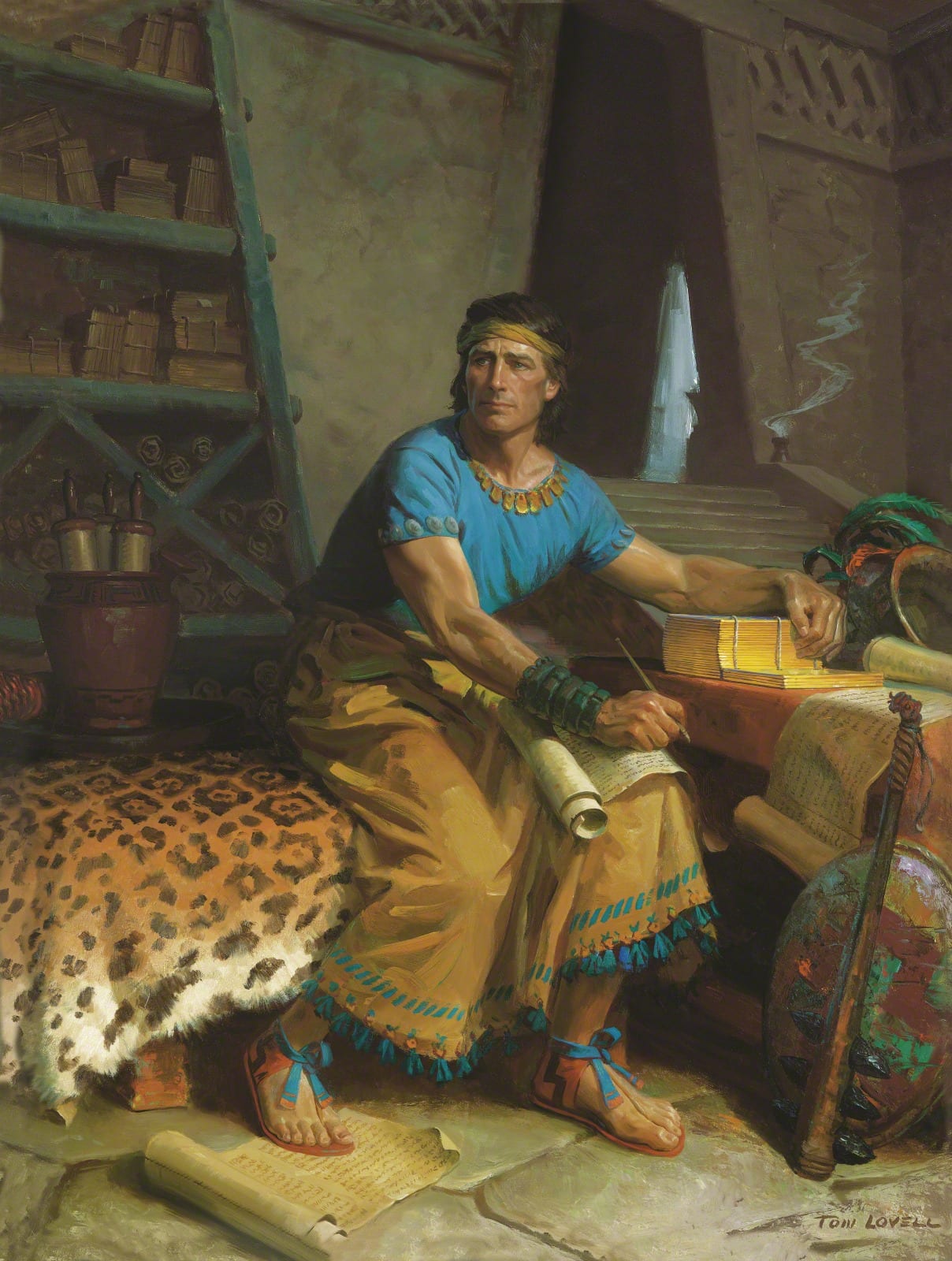
Mormon Abridging the Plates

[This post originally appeared at Studio et Quoque Fide and is reposted here with permission.]

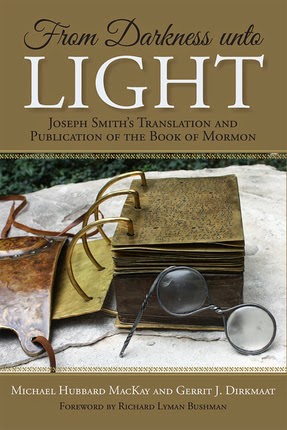
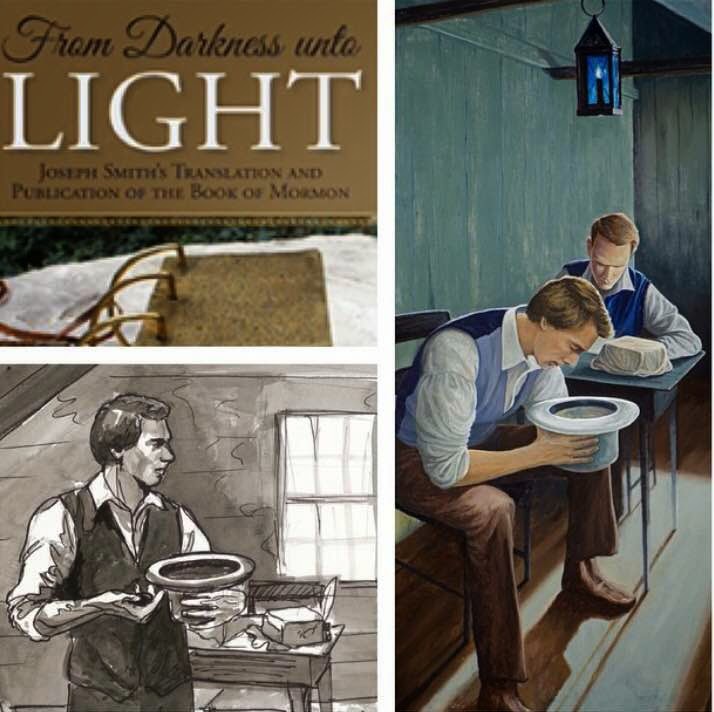
The “historicity wars” of the bloggernacle have died down, and I am reticent to start them back up again. Since I am generally ignored by the bloggernacle, however, that is unlikely to happen. I have long pondered over the relevance of historicity for the Book of Mormon—if it matters, and if so, why it matters. As I have been reading about the experiences of Joseph Smith and others with the plates and other artifacts in the newly released From Darkness unto Light: The Translation and Publication of the Book of Mormon, by Michael Hubbard MacKay and Gerrit Dirkmaat, I have once again begun to ponder the question of historicity.

For me, I think it helps to realize that what we are talking about when we discuss history and historicity is the experiences of other people, and whether they existed or not. When I share personal experiences with other people, it matters to me that the things I experienced really happened. It matters that these are not just stories I am making up, but that they reflect real things that I have personally been through and witnessed. I glean things from real experiences that I don’t gain from “fishing stories.”

Likewise, it matters to me if you believe my experiences are real when I share them with you. I’m assuming I am not the only one who would feel hurt if someone told me, after I shared a deeply personal experience, “That is a nice story. And I think there is a lot we all can learn from it. But I just don’t believe that really happened to you.” Express skepticism that things are not exactly as I perceive them? OK (maybe the all the people driving 3 under the speed limit when I am in a hurry aren’t actually out to get me after all). Believe that there might be other perspectives to consider? Sure. But think I am just making my own life experiences up? Ouch. That hurts just to imagine someone discounting the very things that have made me who I am.

The reverse is, I think, also true. It matters to me if the experiences you claim as your own are real. It matters if the things you tell me happened to you actually happened. I would feel betrayed if, in fact, I found out you were lying to me about them. Granted I might be a little more sympathetic if I knew you were a habitual liar, or had some kind of mental instability, or for some other reason really believe your stories to be your real experiences, but my sympathy would not necessarily mitigate the feeling that I can’t really trust you when you claim to be talking about your own personal experiences. The sense of betrayal would be magnified if the stories you told as if they were your own personal experiences had galvanized me to provide you with monetary support, or in some other way make sacrifices on your behalf. And, again, I am guessing I am not alone in any of this. Most others would feel the same way. It is human nature.

So getting back to the question about whether historicity of the Book of Mormon matters, I would like to ask, matters to whom? Perhaps we should think about that.

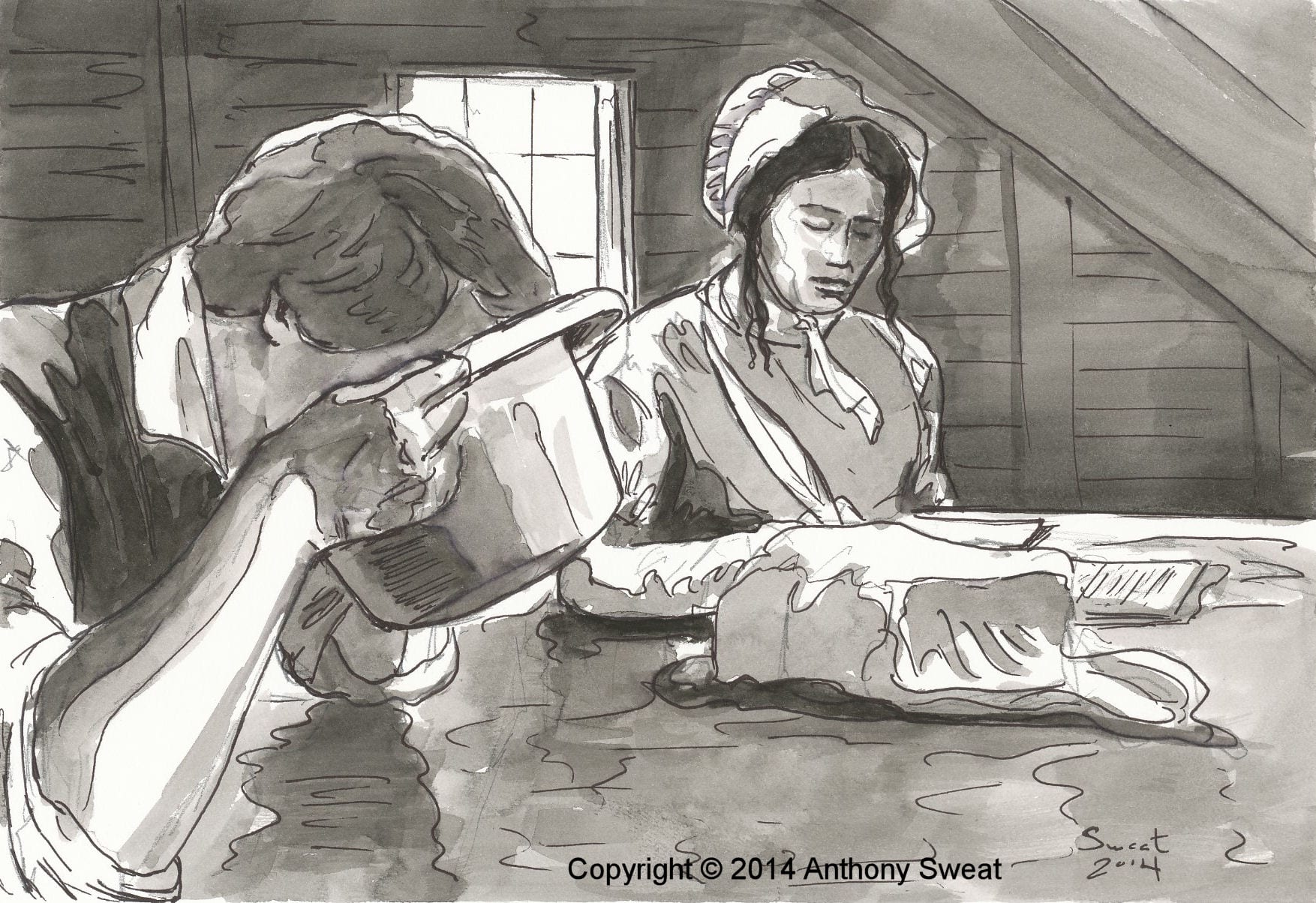
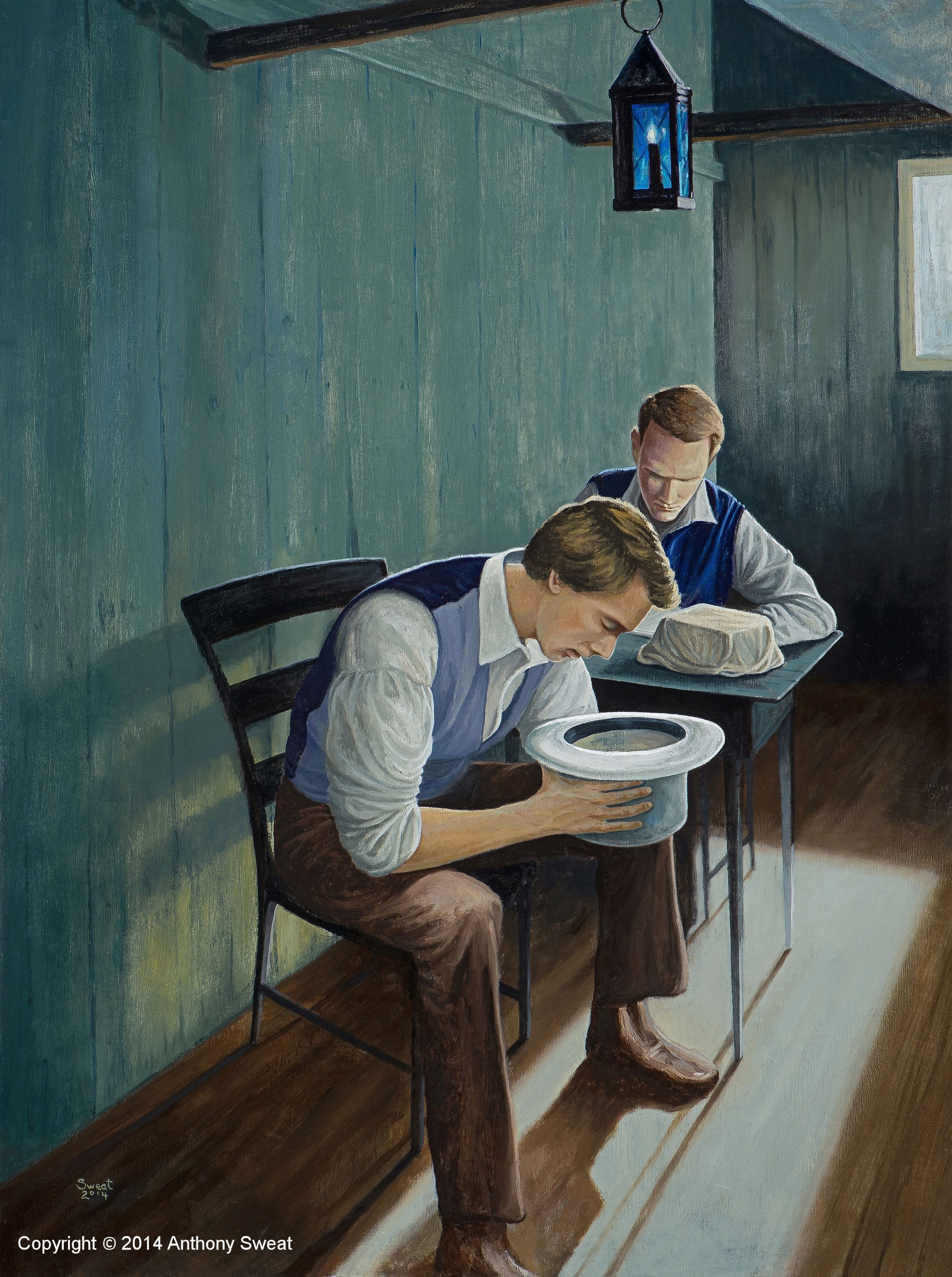
Do you think it matters to say, Emma, Joseph’s wife, if the object wrapped in the linen cloth that sat on the table as she transcribed Joseph’s dictation, was really a set of metal plates containing a record of ancient prophets, whose words Joseph was dictating in translated form? Emma suffered estrangement from her parents and family over Joseph’s refusal to show this object to any of them. She saw her house torn apart by a crazed Lucy Harris, wife of Martin, who was determined to find and see that object. And she generally endured all kinds of hardships due to the events that unfolded from the translation of that record. Yet through it all, she dutifully chose not to look under the linen cloth. Tell me, do you think it matters toher, if her husband’s claims about angels and plates and ancient peoples are true? I think the historicity of the Book of Mormon matters to Emma.

Speaking of Martin Harris, let’s talk about him for a minute. Do you think the historicity of the Book of Mormon matters to him? This is the man who took copies of ‘caractors’, ostensibly from the plates, to scholars back east in New York City (and, probably, Philadelphia), at great personal expense, to see if the writings could be verified. The man who experience severe strain on, and the eventual failure of, his marriage due to his efforts to assist in the work of getting the record translated and published, who mortgaged the bulk of his farm to that end. The man who carefully investigated the members of the Smith family upon first hearing the stories of the angel and plates, who cautiously hefted the box containing the plates, until he was satisfied that the object within was either lead or gold, and who practically begged to be one of the witnesses when word got out that a select few would get to see the plates. Do you think it matters to that man—Martin Harris—if Joseph’s stories about angels and plates and ancient peoples are true? Do you think it matters to him if his own experience seeing an angel holding the plates, and hearing a voice declaring that the translation of those plates is correct really happened? That is wasn’t something just in his head, or some kind of deception on Joseph Smith’s part (or, worse, of God’s part)? I think the historicity of the Book of Mormon matters to Martin.

How about Mary Whitmer? The women who carried the brunt of the burden of having long term house guests stay with her family as Joseph Smith and Oliver Cowdery finished the translation there. The women who at one point was so exhausted by the extra labor and sacrifice required of her at this time that she was granted—or believed she was—a view of the plates, shown to her by some stranger who then miraculously disappeared; an experience that gave her the strength endure the hardship until the translation was complete. Do you think it matters to her if she really saw a man with the plates that day? That is matters that those really were the same plates that contained a record that Joseph was translating from? I think the historicity of the Book of Mormon matters to Mary Whitmer.

What about the many others close to Joseph Smith? His father, mother, and siblings, whose lives were put at risk assisting Joseph in hiding and protecting this object that he told them was an ancient record engraved on gold plates. Whose very lives were disrupted and uprooted time and time again for the sake of the movement that started after the text was published. Do you think it matters to them if Joseph was just spinning old money diggers yarns or telling fanciful stories? Or if he himself was somehow convinced of these stories, but they nonetheless were not really happening? No real angel, no real plates, no real Nephites or Lamanites? I think the historicity of the Book of Mormon matters to them.

Let’s even consider Joseph Smith himself. Everything the translation and publication of the Book of Mormon set in motion ultimately cost him his life. Do you think it matters to him if the plates were objectively real? And if those plates really contained an ancient text? And if the words he was dictating to his scribes really were a translation of that record? He endured mobs trying to take the object he kept in that box. Lucy Harris ransacking his home. The enmity of his in-laws. And widespread mockery for the text he published and stories he told about its origins. In his 1838 history he poignantly told about the ridicule he endured for visions he claimed to have. Do you think it matters to him if the revelations he had were more than merely the product of his own mind? If the history he believed he was revealing actually is history? I think the historicity of the Book of Mormon matters to Joseph Smith.

I think it is clear that to all of these people, the historicity of the Book of Mormon most certainly matters. And I think it matters to all of them—but especially Joseph—if we believe their stories. Just like it would to you and me if we shared our personal experiences with someone else. We can see how much it mattered to them in the many tellings and retellings of their experiences that we have on record. The historicity of the Book of Mormon mattered to them, and it mattered to them if others believed in it too. I think it matters to them if we believe it now. Likewise, just as it would matter to us if someone today told us bogus stories as personal experiences, it should matter to us if these stories are historically true. We are, after all, giving our lives to those stories.

Those are the people who are indisputably real, and others (like David Whitmer, Oliver Cowdery, etc.) could be added to that list. But what if we take this a little further? Do think the historicity of the Book of Mormon matters to say, Mormon? To the man who so very carefully sifted through a thousand years of history and meticulously engraved his well crafted narrative history onto metallic sheets. Do you think the veracity of that history matters to him? Do you think he cares if we believe that he is a real person who actually went through that painstaking effort? Or what about Moroni, who promised to see us before the bar of God on judgment day? The man who diligently finished what his father started. And then spent 35 lonely years protecting that record as he wondered. And who came back from the dead to see to it that we would have the record today. Do you really think it wouldn’t matter to him if you believe he is real? That he just shrugs his shoulders and thinks, “Well, at least you still think its inspired.” What about Nephi, the man who started the record (who also promises to see us at the judgment bar)? The man who endured 8 years of hardship in the Arabian desert, who not only spent years laboring to build a sea worthy vessel, but also had to navigate it across thousands of miles of oceans, who had to lead and organize a new colony. A man who spilt blood for the sake of providing records to his own people. Do you think it matters to him if we believe the stories he told about his family’s journey and hardships?

How about the multitude who saw and felt the risen Lord, Jesus Christ? Who deemed the event of utmost importance to bear witness of it collectively? Do you think it matters to them if you or I believe their witness? If we really believe that event happened, as they testified? While we are on the topic, how about the Savior himself? Do you really think he does not care what we believe about the things he said and did in front of that multitude? That as he carefully and lovingly ministered to the sick and infirm among them, and blessed their children, he simply didn’t care if others would believe those things happened? I think historicity of the Book of Mormon matters to the Savior. I am sure there are things that matter more to him than that, but I nonetheless suspect this is not something he feels is completely irrelevant.

So, does the historicity of the Book of Mormon matter? It certainly mattered to the people—both ancient and modern—who contributed to our having it today, as is evident in the sacrifices they endured to make that possible. It should matter us, too.
Filed Under: Book of Mormon

Artwork of Joseph Smith Translating the Book of Mormon

April 30, 2015 by Stephen Smoot

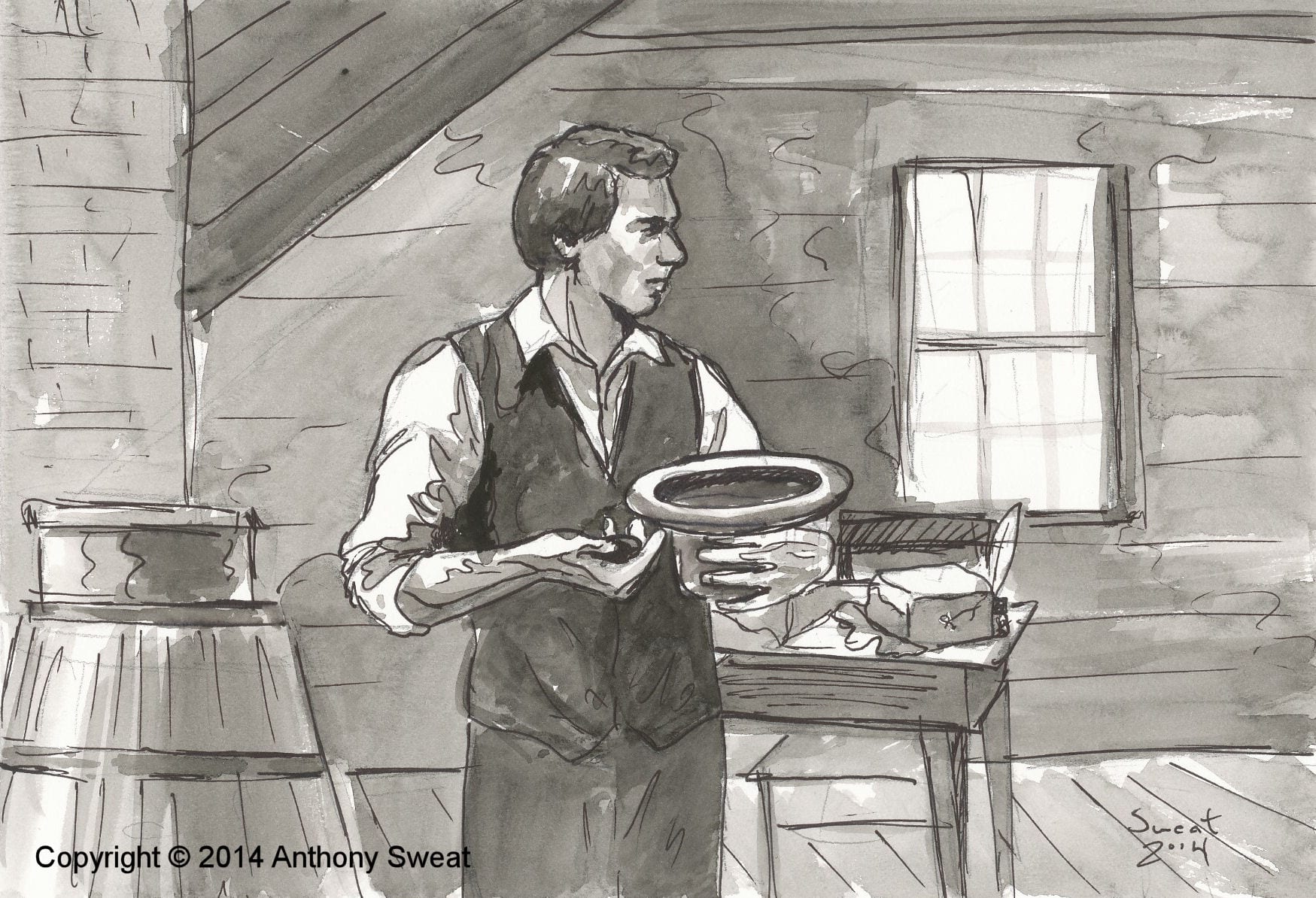
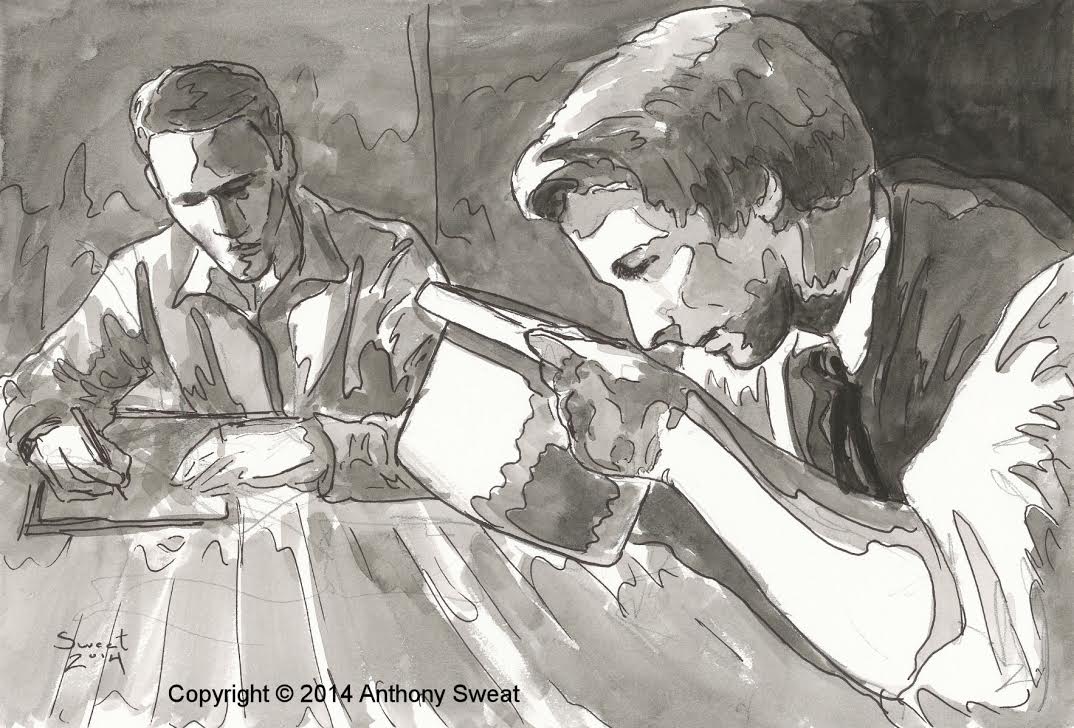
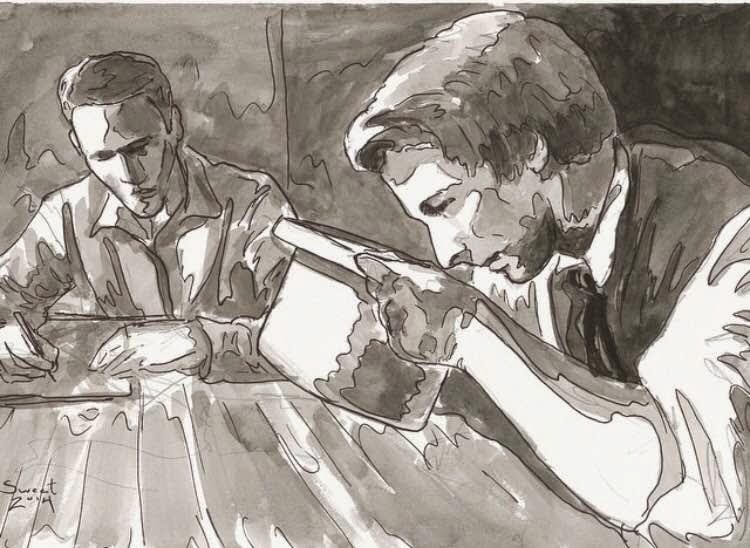
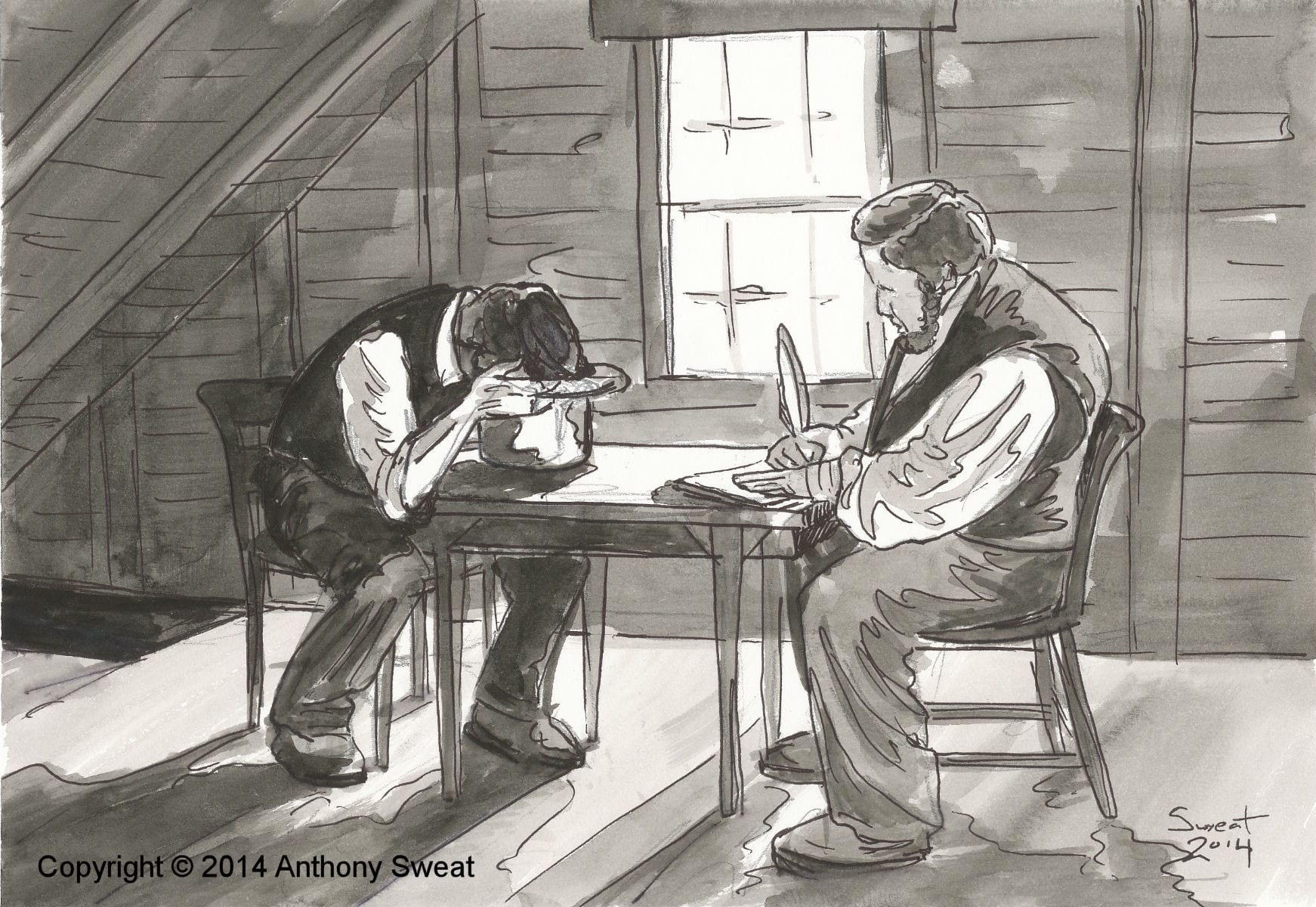
Early this week I posted a brief notice for the book From Darkness unto Light: Joseph Smith’s Translation and Publication of the Book of Mormon. With permission from professor Anthony Sweat, the artist behind the new artwork depicting Joseph Smith’s translation of the Book of Mormon, the new pieces from the book are posted below.

Anthony_Sweat_Gift_and_Power_of_God_Scan_4mb

Anthony_Sweat_Translating_with_Martin

Anthony_Sweat_Translating_with_Emma

Anthony_Sweat_The_Seer_Stone

unnamed


Filed Under: Apologetics, Book of Mormon, LDS History

Book Notice: “From Darkness unto Light: Joseph Smith’s Translation and Publication of the Book of Mormon”

April 27, 2015 by Stephen Smoot

[This post originally appeared at Ploni Almoni.]
The Religious Studies Center at Brigham Young University and Deseret Book have co-published a new book titled From Darkness unto Light: Joseph Smith’s Translation and Publication of the Book of Mormon. I have picked up a copy just today, and have been able to quickly skim through the contents of the book. Co-authored by Michael Hubbard MacKay and Gerrit J. Dirkmaat of the Joseph Smith Papers (and both assistant professors of Church history and doctrine at BYU) and with original artwork by Anthony Sweat, the book looks closely at the history of the translation and publication of the Book of Mormon in the years 1827–1830. MacKay and Dirkmaat draw from the cutting-edge research of the Joseph Smith Papers Project in their reconstruction of the Book of Mormon’s translation and publication, including some heretofore unknown or underutilized historical sources. Topics touched on in the book include:

  • The retrieval of the plates.
  • Martin Harris’ visit with Charles Anthon and other savants.
  • Early reactions to and accounts of Joseph Smith’s finding of a “Gold Bible.”
  • The method and instruments of the translation.
  • Attempts to secure a copyright for the publication of the Book of Mormon, including the attempt to secure a copyright in Canada.
  • The 3 and 8 Witnesses.

But perhaps one of the most exciting aspects of the new book is the artwork of Anthony Sweat, an assistant professor of Church history and doctrine at BYU. The book includes a number of original pieces by Sweat depicting Joseph Smith’s translation of the Book of Mormon by peering into a seer stone at the bottom of a hat. Below are three of the new pieces, taken from Sweat’s public Instagram page.

Sweat also includes an appendix (“By the Gift and Power of Art”) explaining his artwork and artistic representations of the past in general.

Students of early Mormon history and the Book of Mormon should absolutely pick up a copy of this book! I’ve only skimmed it so far, but what I’ve seen is fantastic, and just what the doctor ordered when it comes to good, solid, reliable, and faith-promoting scholarship on the early days of the Restoration and the coming forth of the Book of Mormon. I am excited to sink my teeth into this new volume, and hope you’ll do the same.

Filed Under: Book of Mormon, Book reviews

Fair Issues 83: Great Lakes Book of Mormon geography

April 27, 2015 by Ned Scarisbrick

https://media.blubrry.com/mormonfaircast/www.fairlatterdaysaints.org/wp-content/uploads/2015/04/Fair-Issues-83-Pod.mp3

Podcast: Download (11.5MB)

Subscribe: RSS

MAIn this article brother Ash discusses several authors and the arguments they make for a Great Lakes model for the Book of Mormon geography.

The full text of this article can be found at Deseret News online.

Brother Ash is author of the book Shaken Faith Syndrome: Strengthening One’s Testimony in the Face of Criticism and Doubt, as well as the book, of Faith and Reason: 80 Evidences Supporting the Prophet Joseph Smith. Both books are available for purchase online through the FairMormon Bookstore. Tell your friends about the Mormon Fair-Cast. Share a link on your Facebook page and help increase the popularity of the Mormon Fair-Cast by subscribing to this podcast in iTunes, and by rating it and writing a review.

The views and opinions expressed in the podcast may not reflect those of the Church of Jesus Christ of Latter-day Saints or that of FairMormon


Filed Under: Anti-Mormon critics, Apologetics, Book of Mormon, Evidences, Fair Issues, General, Geography, Hosts, Joseph Smith, LDS Culture, Michael R. Ash, Ned Scarisbrick, Podcast, Science Tagged With: Book of Mormon Geography

Articles of Faith Podcast: Syntax and Book of Mormon Authorship – Interview with Stanford Carmack

March 30, 2015 by NickGalieti

https://media.blubrry.com/mormonfaircast/www.fairlatterdaysaints.org/wp-content/uploads/2015/03/AOF-StanfordCarmack-BOM-Syntax.mp3

Podcast: Download (55.9MB)

Subscribe: RSS

stanford-carmackStanford Carmack has a linguistics and a law degree from Stanford University, as well as a doctorate in Hispanic Languages and Literature from the University of California, Santa Barbara, specializing in historical syntax. In the past he has had articles published on Georgian verb morphology and object–participle agreement in Old Spanish and Old Catalan. He currently researches Book of Mormon syntax as it relates to Early Modern English and contributes, by means of textual analysis, to volume 3 of Royal Skousen’s Book of Mormon critical text project.

Articles referenced in this interview:

The Implications of Past-Tense Syntax in the Book of Mormon

A Look at Some “Nonstandard” Book of Mormon Grammar

What Command Syntax Tells Us About Book of Mormon Authorship

Questions addressed in this interview:

The work that you do feels like forensic work, like something a coroner is doing to look back on the evidence that is before them and come to certain conclusions about what took place. Like a coroner would be able to tell the difference in the type of cut on a body and come to some conclusion about the type of blade that was used, or the skill with which the individual that made the cut demonstrated in the wound, etc. You seem to have the ability to look at an ancient text and see more than simply a group of letters that form a word, but the skill and education of the person that used it, the origins of the word, and from that you can come to certain conclusions. Is that an appropriate comparison?

You have written three articles in The Interpreter, to date, I am sure there will be more to come, but they all have to do with this rich analysis of the grammar and syntax of the Book of Mormon text. There are some criticisms of the Book of Mormon text that have been used by critics for years, what are some of those criticisms?

Did your effort in this regard come from wanting to give answers to the critics, or did you want to find answers for yourself to the critics questions and figured you would share your findings with others?

In your most recent article you make the statement that “Syntax resists manipulation” Meaning what with respect to its use in Book of Mormon authorship?

Let’s start with the first one that you did entitled A Look at Some “Nonstandard” Book of Mormon Grammar.” What were your findings with respect to what specific criticisms?

The next article was “What Command Syntax Tells Us About Book of Mormon Authorship.” This paper focuses on the use of one verb, COMMAND. It might seem a bit pf an overstatment to some, but how can the use of one word contribute to so as to either condemn or vindicate the claims to divine authorship of the Book of Mormon?

Your latest article is a bit of a heavy read, but it is quite impressive in that regard. The article is entitled, “The Implications of Past-Tense Syntax in the Book of Mormon.” Here again is an analysis of the text with respect to assumptions that the Book of Mormon simply copies or borrows from Biblical Texts.

Filed Under: Articles of Faith, Book of Mormon, Hosts, Joseph Smith, LDS Scriptures, Nick Galieti, Podcast Tagged With: Book of Mormon Critical Text Project, syntax

1 and 2 Nephi as a Temple Text

March 25, 2015 by Neal Rappleye

Screen Shot 2015-03-25 at 12.21.44 PM

[This post originally appeared at Studio et Quoque Fide and is reposted here with the author’s permission.]

A common criticism I used to hear on my mission was that, as one counter-cult ministry put it in 2009, “there is NO evidence to suggest that the peoples in the Book of Mormon practiced ANY of the temple ceremonies that modern day Mormons practice.”[1] Personally, I always thought this criticism was pretty silly. The Book of Mormon mentions the presence of temples in virtually every major city, and of course they don’t describe the ceremonies—like us, they would have held them too scared to share in a text they knew would be public!

Nonetheless, this kind of criticism persists, at least in some corners of the anti-Mormon world. I thus find the intersection of Book of Mormon studies and temple studies that has emerged and gotten quite popular over the last few years rather fascinating. Turns out the temple really permeates the Book of Mormon record in ways few of us ever could have guessed. And, for those who have been to the LDS temple, the patterns found in the text are suspiciously familiar. This starts with the very first writer in the book—Nephi, son of Lehi.

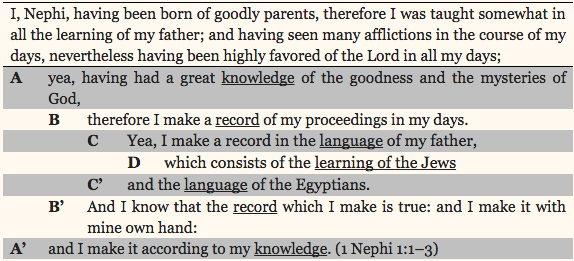
Donald W. Parry has identified a chiasm right at the beginning of 1 Nephi,[2] as Nephi is introducing himself:

Screen Shot 2015-03-25 at 12.21.34 PM

There is a lot of interesting things that can be commented on in this chiasm, but for my present purposes I want to point out what he does with “knowledge” in lines A and A’. By arranging the passage chiasticly, Nephi connects his “knowledge of the goodness and the mysteries of God,” with the “knowledge” he is basing his record on. As Andrew Miller explains in a recent publication from FairMormon, the Greekμύστηριον (mystērion), or plural μύστηρια (mystēria) originally referred to esoteric rituals connected with temple worship.[3] That Nephi connects his making a record with his knowledge of the mysteries merges with a common ancient practice that,

At the end of the mysteries, you were required to record this before you could leave the cave, or the temple or whatever it was. You would leave a record of your experiences in the mysteries—whatever visions it was you had.[4]

So we see that it starts to become pretty interesting that Nephi connects his knowledge of the mysteries with his making a record. But we are really only getting to the tip of the ice-burg here (and, regrettably, we won’t be able to explore too much in  this little blog post). Joseph Spencer, in his volume An Other Testament (a must read, seriously—it will completely change the way you read the Book of Mormon, I promise!), notices a structural pattern that bridges across 1 and 2 Nephi:

These structural divisions order Nephi’s record as a four-part progression, from (1) the journey to the New World (1 Nephi 1–18) through (2) a series of theological sermons (1 Nephi 19–2 Nephi 5) to (3) the culminating, commanded heart of Nephi’s record (2 Nephi 6–30) and (4) a brief conclusion (2 Nephi 31–33).[5]

Having identified the four-part progression, Spencer then identifies the theological pattern embedded within this structure.

The basic theological pattern at work is relatively straightforward: (1) 1 Nephi 1–18 recounts the founding of the Lehite colony in the New World; (2) 1 Nephi 19–2 Nephi 5 relates the breaking up of this colony into two rival factions, one of which is cut off from the presence of the Lord; (3) 2 Nephi 6–30 consists of prophecies and sermons focused on the eventual return of that cut-off faction to the Lord’s favor; and (4) 2 Nephi 31–33 offers summary reflections on baptism as a crossing of a limit.[6]

From here, Spencer categorizes the four sections as Foundation (1 Nephi 1–18); Division (1 Nephi 19–2 Nephi 5); Redemption (2 Nephi 6–30); and Conclusion (2 Nephi 31–33).[7] Using only a little imagination, Spencer quickly recasts these categories into a pattern readily identifiable with the temple:

  • Creation (1 Nephi 1–18)
  • Fall (1 Nephi 19–2 Nephi 5)
  • Atonement (2 Nephi 6–30)
  • Veil (2 Nephi 31–33)[8]

This dovetails nicely with the theological pattern that Margaret Barker has sketched out for the pre-exilic temple: (1) creation; (2) covenant; (3) atonement; and (4) wisdom.[9] Though (2) and (4) might seem different at first, they are quite connected. Covenant and fall go hand-in-hand. The fall can only come through thebreaking of the covenant (no covenant, nothing to “fall” from), and it is the breaking of the covenant that necessitates the third stage, atonement. And in the mysteries, wisdom is what is imparted to the initiate at the veil.

Thus, we see that Nephi really does craft his record in accordance with his knowledge of the mysteries, even embedding them into the very structure of his narrative. Really, though, since Nephi states that he had his people build a temple around the same time he started crafting his text (see 2 Nephi 5:16, 28–32), it should come as no surprise that temple theology permeates the text.[10] It is perhaps even possible that Nephi made this record as a temple text—that is, as the liturgy to used during the performance of the mysteries at his newly built temple. Regardless of whether that is the case, though (and I am not sure it is, though it is interesting to contemplate), it certainly puts to rest the assertion that there is “no evidence” for anything like the temple ceremonies in the text. The book is literally littered with allusions to the temple drama, it just requires astute reading, and awareness of what you are looking for, to notice.

[1] “The Bible and LDS Temple Ceremonies,” online article from concernedchristians.com, no longer available; screenshot in my possession.

[2] See Donald W. Parry, ed., Poetic Parallelisms in the Book of Mormon: The Complete Text Reformatted (Provo, Utah: Neal A. Maxwell Institute for Religious Scholarship, 2007), 1.

[3] Andrew I. Miller, “‘Able to Know Heavenly Things’: The Anti-Nicene Mysteries and their New Tesament Sources,” FairMormon Papers and Reviews 2 (2015), online at http://blog.fairmormon.org/2015/03/23/able-to-know-heavenly-things-the-ante-nicene-mysteries-and-their-new-testament-sources/ (accessed March 23, 2015).

[4] Hugh W. Nibley, Teachings of the Book of Mormon: Transcripts of Lectures Presented to an Honors Book of Mormon Class at Brigham Young University, 1988–1990, 4 vols. (American Fork, Utah: Covenant Communications and FARMS, 2004), 1:13.

[5] Joseph M. Spencer, An Other Testament (Salem, Oregon: Salt Press, 2012),  36.

[6] Spencer, An Other Testament, 41–42.

[7] Spencer, An Other Testament, 42.

[8] Spencer, An Other Testament, 42.

[9] See Margaret Barker, Temple Theology: An Introduction (London, Eng.: Society for Promoting Christian Knowledge, 2004).

[10] See John W. Welch, “When Did Nephi Write the Small Plates?” in Pressing Forward with the Book of Mormon: The FARMS Updates of the 1990s, ed. John W. Welch and Melvin J. Thorne (Provo, Utah: FARMS, 1999), 75–77.

Filed Under: Book of Mormon

Fair Issues 82: The errors of Holley’s map

March 8, 2015 by Ned Scarisbrick

https://media.blubrry.com/mormonfaircast/www.fairlatterdaysaints.org/wp-content/uploads/2015/03/Fair-Issues-82-Pod.mp3

Podcast: Download (11.7MB)

Subscribe: RSS

MAIn this podcast brother Ash talks about the basic Great Lakes model for the Book of Mormon geography as proposed by Vernal Holley, an LDS critic.

The full text of this article can be found at Deseret News online.

Brother Ash is author of the book Shaken Faith Syndrome: Strengthening One’s Testimony in the Face of Criticism and Doubt, as well as the book, of Faith and Reason: 80 Evidences Supporting the Prophet Joseph Smith. Both books are available for purchase online through the FairMormon Bookstore. Tell your friends about the Mormon Fair-Cast. Share a link on your Facebook page and help increase the popularity of the Mormon Fair-Cast by subscribing to this podcast in iTunes, and by rating it and writing a review.

The views and opinions expressed in the podcast may not reflect those of the Church of Jesus Christ of Latter-day Saints or that of FairMormon


Filed Under: Anti-Mormon critics, Apologetics, Book of Mormon, Evidences, Fair Issues, First Vision, General, Geography, Hosts, Joseph Smith, Michael R. Ash, Ned Scarisbrick, Podcast Tagged With: Book of Mormon Geography

Fair Issues 81: The Baja model of Book of Mormon geography

March 1, 2015 by Ned Scarisbrick

https://media.blubrry.com/mormonfaircast/www.fairlatterdaysaints.org/wp-content/uploads/2015/03/Fair-Issues-81-Pod.mp3

Podcast: Download (10.9MB)

Subscribe: RSS

MAIn this podcast brother Ash discusses the Rosenvall’s model for the Book of Mormon geography in the Baja peninsula of Mexico.

The full text of this article can be found at Deseret News online.

Brother Ash is author of the book Shaken Faith Syndrome: Strengthening One’s Testimony in the Face of Criticism and Doubt, as well as the book, of Faith and Reason: 80 Evidences Supporting the Prophet Joseph Smith. Both books are available for purchase online through the FairMormon Bookstore. Tell your friends about the Mormon Fair-Cast. Share a link on your Facebook page and help increase the popularity of the Mormon Fair-Cast by subscribing to this podcast in iTunes, and by rating it and writing a review.

The views and opinions expressed in the podcast may not reflect those of the Church of Jesus Christ of Latter-day Saints or that of FairMormon


Filed Under: Book of Mormon, Evidences, Fair Issues, General, Geography, Hosts, Michael R. Ash, Ned Scarisbrick, Podcast Tagged With: Book of Mormon Geography

Fair Issues 80: What is the Peruvian model?

February 22, 2015 by Ned Scarisbrick

https://media.blubrry.com/mormonfaircast/www.fairlatterdaysaints.org/wp-content/uploads/2015/02/Fair-Issues-80-Pod.mp3

Podcast: Download (11.3MB)

Subscribe: RSS

MAIn this podcast brother Ash explains the basics of the Peruvian model for the Book of Mormon lands.

The full text of this article can be found at Deseret News online.

Brother Ash is author of the book Shaken Faith Syndrome: Strengthening One’s Testimony in the Face of Criticism and Doubt, as well as the book, of Faith and Reason: 80 Evidences Supporting the Prophet Joseph Smith. Both books are available for purchase online through the FairMormon Bookstore. Tell your friends about the Mormon Fair-Cast. Share a link on your Facebook page and help increase the popularity of the Mormon Fair-Cast by subscribing to this podcast in iTunes, and by rating it and writing a review.

The views and opinions expressed in the podcast may not reflect those of the Church of Jesus Christ of Latter-day Saints or that of FairMormon


Filed Under: Apologetics, Book of Mormon, Evidences, Fair Issues, Faith Crisis, General, Geography, Hosts, Joseph Smith, Michael R. Ash, Ned Scarisbrick, Podcast Tagged With: Book of Mormon Geography

Fair Issues 79: A consistent Book of Mormon map

February 8, 2015 by Ned Scarisbrick

https://media.blubrry.com/mormonfaircast/www.fairlatterdaysaints.org/wp-content/uploads/2015/02/Fair-Issues-79-Pod.mp3

Podcast: Download (11.1MB)

Subscribe: RSS

MAIn this podcast brother Ash relates how the work of Dr. John Sorenson and Randall Spackman come together to approach the textual elements of Book of Mormon geography in three main areas of scholarly assumptions.  Simplicity, consistency and uniformity.

The full text of this article can be found at Deseret News online.

Brother Ash is author of the book Shaken Faith Syndrome: Strengthening One’s Testimony in the Face of Criticism and Doubt, as well as the book, of Faith and Reason: 80 Evidences Supporting the Prophet Joseph Smith. Both books are available for purchase online through the FairMormon Bookstore. Tell your friends about the Mormon Fair-Cast. Share a link on your Facebook page and help increase the popularity of the Mormon Fair-Cast by subscribing to this podcast in iTunes, and by rating it and writing a review.

The views and opinions expressed in the podcast may not reflect those of the Church of Jesus Christ of Latter-day Saints or that of FairMormon


Filed Under: Anti-Mormon critics, Apologetics, Book of Mormon, Evidences, Fair Issues, Faith Crisis, General, Geography, Hosts, LDS Culture, Michael R. Ash, Ned Scarisbrick, Podcast, Power of Testimony Tagged With: Book of Mormon Geography

  • « Go to Previous Page
  • Page 1
  • Interim pages omitted …
  • Page 31
  • Page 32
  • Page 33
  • Page 34
  • Page 35
  • Interim pages omitted …
  • Page 50
  • Go to Next Page »

Primary Sidebar

Faithful Study Resources for Come, Follow Me

Subscribe to Blog

Enter your email address:

Subscribe to Podcast

Podcast icon
Subscribe to podcast in iTunes
Subscribe to podcast elsewhere
Listen with FAIR app
Android app on Google Play Download on the App Store

Pages

  • Blog Guidelines

FAIR Latest

  • Come, Follow Me with FAIR – Exodus 7–13 – Part 1 – Autumn Dickson
  • Taking on the Name of Jesus Christ
  • Come, Follow Me with FAIR – Easter – Part 2 – Autumn Dickson
  • Procedural Developments in the Solemn Assembly
  • The Solemn Assembly

Blog Categories

Recent Comments

  • Antonio Moreno on Taking on the Name of Jesus Christ
  • productx ai vedio ads maker on Come, Follow Me with FAIR – Easter – Part 2 – Autumn Dickson
  • Sister Truelove on Humble Souls at Altars Kneel
  • Antonio Moreno on Forsake Not Your Own Mercy
  • Wayne on Come, Follow Me with FAIR – Genesis 12–17; Abraham 1–2 – Part 1 – Autumn Dickson

Archives

Follow Us

  • Facebook
  • Twitter
  • iTunes
  • YouTube
Android app on Google Play Download on the App Store

Footer

FairMormon Logo

FAIR is a non-profit organization dedicated to providing well-documented answers to criticisms of the doctrine, practice, and history of The Church of Jesus Christ of Latter-day Saints.

Donate to FAIR

We are a volunteer organization. We invite you to give back.

Donate Now

Site Footer