For some critics, the story of the lost 116 pages in the coming forth of the Book of Mormon is utterly ridiculous. Some say it shows Joseph was just making things up on the fly and would have all sorts of accidental changes as he went through the fabrication process a second time, so for safety, he just punted with the first part of the record and concocted the story of the small plates. This is the “Joseph was an idiot with bad memory” theory. The story of the 116 pages from that perspective directly challenges the popular theory of “Joseph got help from Sidney Rigdon or some other very smart person” to create the impressive and remarkably self-consistent text of the Book of Mormon. These theories based on plagiarism and texts from the likes of Solomon Spaulding or Sidney Rigdon or both assume that there was some text that had been prepared and carefully edited over many months or even years in preparation for the grand Book of Mormon scheme. When Joseph was dictating the Book of Mormon to his scribes, he must have been reading from the pre-written manuscript. If such a manuscript existed, then it would have been no trouble reading it again exactly as read before.
[Read more…] about A New Twist on the Spalding Theory–And Sidney’s Amazing Voice Trick
Book reviews
Is God a Moral Monster?
 Many people — seekers, believing Christians, even some Latter-day Saints — have problems with the portrayal of God in the Old Testament.
Probably even more people just have problems with the Old Testament itself, because they find it hard to follow. This is, I think, very unfortunate, both because the Old Testament is at the foundation of all Judeo-Christian faith and because, among other things, it’s a rich treasure house of history, moral lessons, inspirational stories, and literature. But that’s a topic for another day.
They’re bothered because, sometimes, the Old Testament God seems to be arrogant, petty, “jealous,” harsh, and violent. The Old Testament seems to tolerate or even endorse slavery, the oppression of women, and mass murder (effectively, ethnic cleansing).
The problem is that, for Christian believers (unless, perhaps, they follow the ancient heretic Marcion), the God of the Old Testament is also the God of the New. How can the loving Jesus be reconciled with the often vengeful and fierce Jehovah? (For Latter-day Saints, Jesus is Jehovah.) [Read more…] about Is God a Moral Monster?
Review of Stephen Taysom, The Patheos Guide to Mormonism
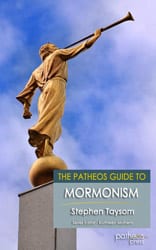
Stephen Taysom, The Patheos Guide to Mormonism (Series Editor Kathleen Mulhern), available in e-book formats for $2.99. For details, see this website: http://www.patheos.com/Books/Patheos-Press/The-Patheos-Guide-to-Mormonism.html
Remember when you were in high school, and you were assigned a five-page paper? Oh, how you struggled to reach that goal of five pages! If you got desperate enough, perhaps you played with fonts, margins and line spacing in an effort to cross the finish line with some hopefully-not-too-obvious space padding techniques made possible by the computer age. What a relief it was when you finally achieved the assigned length. Maybe you would even add an extra paragraph, so it wouldn’t look too obvious how much you were straining to get to five pages of text.
Those were the days, weren’t they? Stephen Taysom, an Assistant Professor of Religious Studies at Cleveland State University (and a blogger at the Juvenile Instructor http://www.juvenileinstructor.org/), was recently faced with a grown up’s inverse of this problem: He had to try to give a coherent introduction to Mormonism, a very complicated topic, in what has amounted to a mere 77 pages. I would venture a guess that there were times during his work on this project that he sincerely wished for 500 pages to play with, rather than 77. But the brevity of the text is a large part of its appeal (and I freely acknowledge I was much more willing to undertake a review of a 77-pager than I would have been the 500-pager), so what must have been a very challenging exercise in pruning had to be undertaken.
Does it work? I decided before reading it that my standard would be whether I thought I could have done a better job. It is conceivable that I might have done a better job if I had 500 pages to play with, but it is highly doubtful that I could have improved upon this effort if I were limited to less than 100 pages. So yes, as a very concise summary of and introduction to Mormonism, especially for those with limited prior exposure to the religion, it does indeed work, and I highly recommend it.
All Patheos Guides follow the same basic structure of five chapters, each with five standardized subsections. This is done purposefully to allow easy comparison of different religions using the respective Guides for those faiths. Below is the Table of Contents to the Mormon Guide:
CHAPTER ONE: ORIGINS
Beginnings: First Vision
Influences: Awakening and Restoration
Founders: Smith and Young
Sacred Texts: The Standard Works and an Open Canon
Historical Perspectives: Apologists and Critics
CHAPTER TWO: HISTORY
Early Developments: Mobs, Murder, and Moving West
Schisms and Sects: Challenges to Polygamy
Missions and Expansion: From New York to the World
Exploration and Conquest: Migration, Deseret, and Utah
The Modern Age: A Manifesto and Statehood
CHAPTER THREE: BELIEFS
Sacred Narratives: From Michael to Lehi
Ultimate Reality and Divine Beings: From Man to God
Human Nature and the Purpose of Existence: A Training Ground
Suffering and the Problem of Evil: War in Heaven, Choice on Earth
Afterlife and Salvation: A Hierarchy of Kingdoms
CHAPTER FOUR: RITUALS AND WORSHIP
Sacred Time: From the Second Coming to Eternity
Sacred Space: Chapels and Temples
Rites and Ceremonies: Fathers and Priests
Worship and Devotion in Daily Life: Sacrament, Family, and Temple
Symbolism: Signs of Hope and Promise
CHAPTER FIVE: ETHICS AND COMMUNITY
Community Organization: Wards and Common Care
Leadership: Presidency, Quorums, and Bishops
Principles of Moral Thought and Action: Avoiding Sin and Practicing Charity
Vision for Society: Politics, Protests, and the Apocalypse
Gender and Sexuality: Patriarchy and Heterosexuality
One consequence of this standardized format is a fair amount of duplication, since each chapter needs to stand on its own for comparative purposes with other Guides. I read the book straight through, like a novel, so the duplicated explanations of things like the First Vision or visits of Moroni stuck out to me. But that is simply an unavoidable consequence of the desired series structure, and once one gets beyond the early chapters the duplicative material quickly becomes much less common. (One duplication that was probably unintentional was the repetition of the precise sentence “In addition, Mormons set aside Monday evenings as a period of family togetherness” a mere two paragraphs from each other in the first section of Chapter Four.)
A couple of illustrations will show Taysom’s skill at conveying complex information in a succinct and understandable way. First is this explanation of the First Vision from the first section of Chapter One:
In 1820, at age 14, his prayer for guidance led to an experience that became the founding event of Mormonism and gave rise to his career as a prophet. In his accounts of this event, recorded many years later, Joseph wrote of being nearly overwhelmed by darkness and then seeing a pillar of light encircling two beings, God the Father and Jesus. He was told that he was forgiven of his sins and that he was not to join any church, since none embodied the true faith; all had gone astray.
Second, from the first section of Chapter Three, is this explanation of the Mormon concept of Jesus Christ as Jehovah:
Mormons take a slightly different approach to some of these stories than many other traditions, however. For example, in the Mormon version of the sacred creation narrative, Jesus Christ, who before his birth was the Jehovah of the Hebrew Bible, created the earth and all things in it at the direction of God the Father. Jehovah was assisted in this by other “noble and great” spirits, most notably the angel Michael. Michael, according to the Mormon narrative, was born on earth as Adam, the first mortal man.
Taysom has skillfully conveyed the gist of these ideas, which normally would require pages of explanation, in but a single paragraph each.
I liked the way Taysom put the origins of Mormonism into the broader religious context of the Second Great Awakening, and the specific revivalism of the burned over district. I also appreciated how he easily and straightforwardly broached topics that some might consider controversial, such as treasure searching. For instance, see how he discloses post-Manifesto polygamy in a very just-the-facts-ma’am, matter of fact way: “After years of attempting to establish their constitutional right to practice polygamy, the Mormons finally disavowed the practice in 1890, although it would continue to be practiced in some quarters until the second decade of the 20th century.” Now, that wasn’t so hard, was it?
I personally have an interest in Joseph Smith’s use of Hebrew, and twice Taysom seems to reflect a certain doubt as to whether Joseph’s explanation of the origin of the place name Nauvoo as a Hebrew word was really correct. (The applicable quotations are as follows: “named Nauvoo [after the Hebrew word for beautiful, he claimed]” and “Joseph Smith re-christened the town Nauvoo, which Smith suggested was a Hebrew name denoting a place of rest or refreshing.”) This was not merely a claim or suggestion of the Prophet, but a demonstrable fact. It is true that the word nauvoo is obscure, and if you ask your Hebrew-speaking friend what the Hebrew word for “beautiful” is, he surely will not say nauvoo. But although the word is rare, it is also quite real. In the beginning of Isaiah 52:7, “How beautiful upon the mountains are the feet of him that bringeth good tidings,” the Hebrew word rendered “beautiful” is (in modern transliteration) na’wu, the pilel form of the verb na’ah. Joseph gives the word as nauvoo, using the Sephardic transliteration method he learned at the Kirtland Hebrew School, where au represents the vowel qamets, the v is the letter waw, and the oo represents the vowel shureq. Indeed, the word nauvoo actually appears on p. 28 of the Joshua Seixas grammar that was used at the Kirtland Hebrew School, as one can see at this page: http://www.fairlds.org/authors/barney-kevin/is-nauvoo-a-hebrew-word .
Near the end of Chapter Two we read “In 2008, Mitt Romney became the first Mormon contender for the presidential nomination for a major political party,” but as written that cannot be correct, since Mitt’s own father, George, preceded him as a one-time contender for the Republican nomination.
The very tight space requirements do not allow much space for a discussion of nuance or development of Mormon ideas over time. In the section on Ultimate Reality and Divine Beings: From Man to God, Taysom simply assumes the B.H. Roberts tripartite theory of the nature of man (intelligence, soul, body). Now, if I were in his shoes I would have done the same thing, as to my eye that is the most common understanding today, but it is not something that has been universally held throughout the history of the Church. I think it is proper to use things like this that historically have been majority views, but I do lament the lack of space for putting these ideas into a little bit more context in terms of their development over time.
Taysom is very careful not to overwhelm the reader with in-house vocabulary that a non-Mormon would not understand, which is I think absolutely essential in a project such as this. One small lapse in this area was in his discussion of tithing: “Mormons also pay 10 percent of their annual ‘increase’ as tithing to the Church.” He put the word increase in quotation marks, but gives the reader no clue what it means. Something like a bracketed “i.e., income” would have been helpful here. But in the context of the book as a whole, these things are mere trifles.
Believe it or not, I actually had a dream about the first section of Chapter Four, in which Mormon worship services are described. (How is that for my commitment as a book reviewer!) In the dream, I was serving a mission to the Philippines (doubtless because my former bishop’s son just received his own call to that area). I realized that we were asking people to come to Church, but we weren’t explaining to them carefully what they could expect to happen there, and no one wants to go into a strange situation without a sense of what to expect. As they say, “If ye are prepared, ye shall not fear.” So my companion and I put together a pamphlet that we had printed, that included our pictures, something about us such as where we’re from, and how to contact us. We also put in there a picture of the local ward building, both external and internal maps, times of the different services, and then we actually explained what they could expect to happen in, say, sacrament meeting, much along the lines of Taysom’s own explanation. (For instance, we should explain that there is no offertory; one simply cannot assume that people will know about something like that.) I think we also threw some of our basic beliefs in there, maybe a copy of the Articles of Faith. And of course we had great missionary success based on our little pamphlet (I did say it was a dream, didn’t I?).
In this current Mormon Moment, when college students are taking classes in Mormonism, journalists are struggling to wrap their arms around the faith, ordinary voters are trying to figure out what it all means for their voting decision, and on and on, this book is just what the doctor ordered to give people a much needed overview of what Mormonism is all about. I congratulate Professor Taysom on a job well done, and hope the book receives a wide audience.
Review: No Weapon Shall Prosper: New Light on Sensitive Issues
 Review of No Weapon Shall Prosper: New Light on Sensitive Issues
Edited by Robert L. Millett
Published by BYU Religious Studies Center and Deseret Book, 2011
Rather than focusing primarily on the methods commonly used by critics as other recent books of this genre do (such as Michael Ash’s Shaken Faith Syndrome, which I also highly recommend), this book contains essays that address some of the most common issues that are used to attack the faith of members of The Church of Jesus Christ of Latter-day Saints. It is intended to help the reader gain a better understanding of these topics in a faith-promoting, but scholarly and honest environment, against the flood of misinformation available online today. Indeed, the editor notes that “The Internet is filled with thousands of pages of anti-Mormon polemic, and it is extremely difficult for people to receive an honest and fair appraisal of Mormonism without significant effort on their part” (page viii).
Besides those by the editor, Robert L. Millett, the book contains contributions by Daniel L. Belnap, J. Spencer Fluhman, Steven C. Harper, Brian M. Hauglid, Daniel K. Judd, Kerry Muhlestein, Ugo A. Perego, Brent L. Top, and John W. Welch. They are split into four categories: Restored Christianity, Latter-day Saint Church History, Scriptural Perspectives, and Doctrinal Teachings. The topics include what it means to be a Christian, the various accounts of the First Vision, the Smiths’ involvement in money-digging and the supernatural, the Kinderhook plates, Joseph Smith’s youngest plural wife, DNA and the Book of Mormon, the Book of Abraham, and Jesus Christ and salvation, among many others. Many of the topics are written by experts in the area – for example, a population geneticist discusses DNA and the Book of Mormon, two Egyptologists discuss the Book of Abraham, and an editor of the Joseph Smith Papers tackles the subject of multiple versions of the First Vision. I would like to concentrate on a few topics of particular interest to me in order to give an idea of the overall book.
Kent P. Jackson’s cleverly titled “Are Christians Christians?” discusses what it means to be a Christian from the point of view of mainstream Christianity and where it came from. He examines statements from the Presbyterian and Methodist churches that declare us to be unchristian. He explains why their definition is unbiblical, and happily admits that we should not be included in it. “We, of all people, should not be offended that other churches consider our baptisms invalid and do not recognize the authority of our priesthood holders to officiate in their ordinances. Since the first days of our church’s history, we have denied the validity of the authority and ordinances of all other churches (see D&C 22). We concede that we are not members of the historic Christian church that includes our Catholic, Orthodox, and Protestant brothers and sisters. But to consider us not Christians on issues of belief is another matter” (page 55). He then goes on to explain that our definition of the word Christian is scriptural (although we have no official statement of such), and that by that definition we would also include those of other faiths previously mentioned.
Steven C. Harper, an editor of the Joseph Smith Papers, wrote about the accounts of Joseph Smith’s First Vision, saying it “may be the best documented theophany (vision of God) in history.” He finds the five different known accounts in eight statements (plus contemporary hearsay) to be “rich documentation” and “a good reason to believe him” rather than being evidence of an inconsistent and evolving story as others contend. (Page 63.) He describes how Fawn Brodie and Wesley Walters shaped the criticisms that are popular today, and did not reconsider their interpretations even when new evidence against them came to light. He points out that “those who share the skeptics’ assumptions will likely arrive at the same conclusions as the skeptics. But those who are open to the possibility that Joseph told the truth can discover other meanings from the same facts” (page 71).
Ugo A. Perego, who holds a PhD in genetics and biomolecular sciences, handles the question of whether DNA proves or disproves the Book of Mormon. He goes into great detail explaining how DNA is used in research, the current theories about migrations into the Americas, and describes the various theories for and against the Book of Mormon based on available DNA evidence. He points out the problems with each of these theories (such as evidence showing up in the wrong time period, wrong assumptions being used, and misunderstandings of the limitations of DNA research) and arrives at the conclusion that DNA evidence can neither be used to prove nor disprove that the people in the Book of Mormon actually existed. (In fact, he points out that it can’t even be used to prove that Jesus existed.) He says that “I find no difficulties in reconciling my scientific passion about Native American history with my religious beliefs. I am not looking for a personal testimony of the Book of Mormon in the double helix. …Anyone using DNA to ascertain the accuracy of historical events of a religious nature – which require instead a component of faith – will be sorely disappointed” (page 208).
One of the essays on the Book of Abraham is by Kerry Muhlestein, who has a PhD in Egyptology from UCLA. He begins by explaining how he got interested in the Book of Abraham, and why Egyptologists outside the church dismiss it. He also found that many members of the church who struggle with the issues involved with the Book of Abraham aren’t looking for an excuse to leave the church, but have “encountered well-written (though not necessarily well-documented or researched) arguments…and did not know how to answer the questions posed by these arguments.” He found that those publishing critical information are generally unaware that it is “based on incorrect information and bad assumptions. They are misled by the mistakes, lies, and trash put out by a few, and they unwittingly pass the information along without really looking into their sources” (page 219).
He then goes on to debunk some of the misinformation, such as the idea that there was no human sacrifice in ancient Egypt. He also found that one of the words supposedly made up by Joseph Smith (Olishem) has been discovered in two ancient texts. He discovered that Egyptians had access to biblical stories by 200 BC (which was the right time period for the papyri), and were particularly interested in Abraham. He presented this information to a conference put on by the Russian Academy of Science and received positive reviews. He talks about evidence that what we actually have possession of today was a very small part of what Joseph had, and gives reasons why it likely was not the source of the Book of Abraham, other than Facsimile 1. He also briefly discusses the mystery of the Kirtland Egyptian Papers, which were not likely to have been used in the translation process, as some critics have claimed. Another important point he makes is that “written by his own hand, upon papyrus” does not mean that the actual papyrus we have was written by the hand of Abraham, but that it is a copy of the original that Abraham would have written on much earlier. He also devotes several pages to Facsimile 1, pointing out many evidences (and some possible theories) for the authenticity of the interpretations provided by Joseph Smith.
Overall, I thought the book was quite good, although some essays were better than others. Some of the more doctrinal ones, in particular, presented a few points as given that not all members would agree on. But such is the nature of Mormonism. The book could be used to answer questions for oneself, to help a member friend or an investigator, or for inoculation against misinformation and half-truths encountered in a hostile environment. It would be useful reading for those preparing to serve a mission, for families, and for any individual interested in learning more about these issues or defending the church.
This book is available at the FAIR bookstore here.
Review: The Joseph Smith Papers: Television Documentary Series, Season 2 (DVD Set)
 Season 2 of The Joseph Smith Papers Television Documentary Series contains 42 episodes on 6 DVDs. It takes a closer look at some of the areas covered in Season 1, such as the First Vision. It contains episodes devoted to things like the production of modern scripture, a tour of church history sites, a look at Joseph’s family, the early music of Mormonism, and brief biographies of other early members, such as Hyrum Smith, the Pratt brothers, the Snows, and others. There are also some episodes devoted to the books published so far as part of the Project. The final episode is a tribute to Larry H. Miller, who provided financial support for the Joseph Smith Papers Project.
Viewers who use closed captioning will be happy to learn that it’s been employed for Season 2 (although it’s a little rough in places). And I’m very happy to see that the list of episodes also says which disc they’re on this time. (Both of these things were missing for Season 1.)
There are 2 episodes about the manual containing the teachings of Joseph Smith that was used recently in priesthood and Relief Society. It begins by recounting a history of publications of his teachings, and then spends the rest of the time talking about the preparation of the new manual. It was intended not to be a comprehensive source of known teachings, but rather to be selected teachings that apply to our day. They were very careful in what was included, and the standards for determining such, which depended on the sources, were explained.
The Word of Wisdom episode was particularly interesting to me, since this topic can often be a stumbling block for people who assume that it has always been followed and enforced the way it is today. It is pointed out that the first 3 verses of D&C Section 89 were not actually part of the revelation, but were originally a preface. It is explained what the restrictions on hot drinks, alcohol, and meat meant at the time it was given. A history of the Word of Wisdom from moderation to abstinence is recounted. Unfortunately, here I feel the episode falls short. The groundwork is laid to mention that not just church members but also church leaders had difficulty with it at first, but then it doesn’t quite go that far. It can be confusing for someone that was taught that Joseph refused alcohol for his leg operation to learn that he did not always abstain (see, for instance, History of the Church, vol. 7, page 101), and I thought this episode could have done a little better towards inoculating against that.
Another interesting episode is about D&C section 76, which outlines the different degrees of glory available after this life. It was referred to originally as “The Vision,” since it was the first vision to be published (accounts of the “First Vision” were not published until later). It was one of just a few visions that had a witness – Sidney Rigdon participated in it along with Joseph Smith. Until then, the understanding of the afterlife was black and white. Those who didn’t like it considered it to be universalist. It was written down immediately by Smith and Rigdon, and because they were commanded to write it down, copies were allowed to be made freely. Joseph was probably tarred and feathered for it.
This DVD series should be of interest to anyone that enjoys church history or is interested in learning about it. There is some that is glossed over – such is the nature of the medium – but this is the most in-depth and accurate treatment of Joseph Smith and the early history of the church that has been made available for viewing, and it could even lead those that don’t particularly like non-fiction reading to do further research.
Review: The Joseph Smith Papers Television Documentary Series, Season 1 (DVD Set)
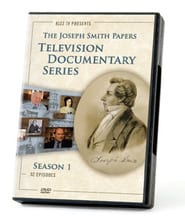 Those of us in Utah were treated, beginning near the end of 2007, to a TV series created by and aired on Larry H. Miller-owned KJZZ TV about the Joseph Smith Papers Project. It began with a pilot episode (“A Television Forward”), followed by a regular weekly schedule that started in early 2008, showing a new episode each Sunday night followed by a repeat of the previous week’s episode.
People outside of Utah, upon hearing about it, immediately began wondering when (or even if) they would have a chance to see the series. It was quickly ascertained that KJZZ would not be providing it for viewing on their web site as some hoped, but eventually BYUTV picked it up. Today, season 1 can be watched on BYUTV and Utah viewers can see season 2 (now in reruns) on KJZZ. And now (as of 2009), season 1 is available on a 7 disc DVD set from Deseret Book.
The set contains 52 episodes, numbered from 0 to 51, which are about one half hour each, except for number 0 which was the longer pilot that was aired ahead of time. A booklet is included that gives a brief summary of each episode and lists the contributing scholars, along with an index. Unfortunately, it does not state which DVDs contain which episodes, so I ended up noting that myself in my copy. Each DVD contains a message at the beginning apologizing that the sound and video quality are not always perfect, but the one big drawback of this set is a total lack of closed captions. Anyone that can’t hear will not be able to watch it, and even for those of us who are able to hear, it would have been nice to be able to read what is being said at times, particularly when trying to take notes.
Season 1 is filmed at historic sites as well as in a studio, using visual aids ranging from photographs, to paintings, to the actual writings of Joseph Smith and others. It includes interviews with scholars such as Ronald Barney, Richard Bushman, Steven Harper, Richard Turley, Richard Anderson, Larry Porter, Milton Backman, Robin Jensen, Jeffrey Walker, Jill Derr, Royal Skousen, Mark Staker, Dean Jessee, Carol Madsen, and many others.
In the pilot episode, Ronald Esplin (managing editor of The Joseph Smith Papers) said, “I think in today’s world, every Latter-day Saint will encounter things about Joseph Smith they didn’t know before. We have an informational overload – informational access – that has never been available before, and to the degree that Latter-day Saints are left only with what they learn at Pioneer Day, they are going to be vulnerable, because there is so much more to learn. And I think it’s very important that we come to a true understanding of our history, and of our people, that involves dealing with all the issues, and dealing with all the personalities, and doing it broadly so that we understand our own heritage, and then we will not be overturned by some new little fact that we didn’t have room for in our scheme, because we prepared ourselves to look at the whole picture.”
Many of the other episodes in the series are spent giving us this understanding, beginning with familiarizing us with early 19th century America and Joseph Smith’s heritage and local environment, and then going through many of the events in Joseph’s life and the history of the church, and then his death and the aftermath. A good job was done in many areas where the church has been accused by critics of hiding information. For example, the different versions of the First Vision are discussed, and there is a very good history and explanation given of the Book of Abraham and associated papyri.
However, one weakness that stuck out to me was that the discussion of plural marriage was not as thorough as it might have been. The host, Glenn Rawson, was kind enough to answer my question about that: “Our discussion of Plural marriage was limited of necessity. We could only say what we could prove by reliable documentation and only a small portion of that. It was the first in-depth broadcast statement on the subject of plural marriage that had been done under Church auspices. We tried to be careful and circumspect.” Indeed, it is significant that plural marriage was discussed to the depth that it was.
There are a couple of episodes devoted to a roundtable discussion featuring members of the Papers staff explaining what the project is all about, and the significance for members and nonmembers alike. There is an episode about the medical aspects of Joseph’s leg operation. Separate episodes are devoted to the revelations and sermons of Joseph Smith, respectively. There are also episodes covering Joseph’s encounters with the law.
To give an example of some interesting points covered in a typical episode, in episode 7 (“The Coming Forth of the Book of Mormon”) we are told that in the early 20th century, a farmer filled in the depression on the hill where the plates had been stored, because he was tired of people coming on his land to see it. It is pointed out that those who knew Joseph best believed him the most. And we are told that Joseph said he could see anything through seer stones.
There is much to learn about the history of the Church up through the 1840s, and this DVD set does a good job of helping to provide a foundation for more in-depth learning, and “to look at the whole picture.” It also helps the viewer have a better understanding of some of what is being published as part of the Joseph Smith Papers. This set would be excellent for use in Family Home Evening, as well as for personal study. Season 2 will also be out on DVD shortly, which Rawson told me covers some of the potentially troubling issues more thoroughly, and he also mentioned that season 3, entitled “History of the Saints: Gathering to the West” will begin airing on KSL and KIDK (Idaho Falls) TV the weekend of General Conference in October.
Review: Joseph Smith, The Prophet (Illustrated Edition)
 Title: Joseph Smith, The Prophet (Illustrated Edition)
Author: Truman G. Madsen
Publisher: Deseret Book
Genre: Non-fiction
Year Published: 2010
Number of Pages: 248
Binding: Hardcover
ISBN13: 978-1-60641-224-4
Price: $49.99
Reviewed by Trevor Holyoak
As a youth, I got to know Joseph Smith a little through reading things such as Joseph Smith History in The Pearl of Great Price, Truth Restored, and parts of the Documentary History of the Church. I then got to know the prophet better as a missionary by listening to bootleg tapes of Joseph Smith the Prophet by Truman Madsen that were passed around the mission. I enjoyed them so much that when I returned home, I bought a legitimate set of the tapes.
[Read more…] about Review: Joseph Smith, The Prophet (Illustrated Edition)
Jehovah and the World of the Old Testament
Lightning Strikes Twice: Review of Jehovah and the World of the Old Testament[1] by TB Spackman
In 2006, Deseret Book published Jesus Christ and the World of the New Testament to widespread approval.[2] Jehovah and the World of the Old Testament (or WOT), a sequel of sorts, has appeared recently, a few fortuitous months before the Gospel Doctrine calendar changes over to the Old Testament as the course of study. WOT is clearly meant to parallel World of the New Testament, from the title to the layout and organization. However, the Old Testament is not the New, and the three authors of WOT faced a much tougher assignment. [Read more…] about Jehovah and the World of the Old Testament
Review: BYU Studies 48:3 (2009)
The latest BYU Studies is a phenomenal a “special feature” issue with a series of articles discussing the latest Joseph Smith Papers volume. In September, the first volume of the “Revelations and Translations” series of the Joseph Smith Papers was published. This landmark volume contains the Book of Commandments and Revelations (BCR) which includes the earliest surviving manuscript versions of many of Joseph Smith’s revelations and the only prepublication manuscript copies of some of them. Seven of these revelations were never canonized.
John W. Welch, the issue’s editor, can hardly contain his enthusiasm:
Imagine!…having the BCR is something akin to uncovering a discarded draft of the Declaration of Independence or some of the missing records used by Luke in preparing his gospel (p. 5).
This issue of BYU Studies includes four enjoyable papers on BCR that were presented in a plenary session of the 2009 Mormon History Association meeting in May 2009. These articles, written by members of the Joseph Smith Papers editorial team, provide details not included in the Revelations and Translations volume itself.
Robert J. Woodford, “Introducing A Book of Commandments and Revelations, A Major New Documentary ‘Discovery,'” (pp. 7-17).
Woodford gives a brief overview BCR and its provenance, and identifies those (including himself) who worked on its publication preparation. He describes how researchers identified the way BCR was referenced for publishing the 1835 edition of the Doctrine and Covenants. He concludes with some suggestions for future research based on BCR. For example, analyzing alterations in the revelations raises historical and theological implications. The so-called Book of Mormon copyright revelation and a piece on the “pure language” are of interest. The dates revelations were received and the historical setting can be reevaluated. “Each researcher will find his own area of particular interest” now that the BCR has been published and made available (p. 16).
Robin Scott Jensen, “From Manuscript to Printed Page: An Analysis of the History of the Book of Commandments and Revelations,” (pp. 19-52).
In this highly technical article Jensen more fully traces the provenance, context, and content of the BCR. He meticulously describes the physical makeup of the book as well as its significance to scholars. “When scholars approach newly discovered documents, several important questions arise. When and why was it created? Who created it? What was it used for?” (p. 21). For Jensen, reading the words on the page alone only yields half an answer to these questions. Only by studying the internal and external evidence, the manuscript words as well as the history of Mormonism and the nature of archival record keeping, can we fully appreciate the document in question. Jensen explains how “forensic paleography” helps researchers find out when a document was created, how it was used, and what it might have meant to the people involved in its creation. In other words, Jensen is asking questions about what the BCR can teach us about the very process of revelation itself.
Steven C. Harper, “Historical Headnotes and the Index of Contents in the Book of Commandments and Revelations,” (pp. 53- 66).
John Whitmer, the principle scribe for the BCR, included interesting date and header information for many of the revelations, allowing researchers to reassess the date and context of many early revelations. Clues will help reassess timing of aspects of the Book of Mormon translation, the location of the organization of the Church, the date when section 20 was revealed (calling into question speculation about Christ’s birthday being the 6th of April), the timing of the “parchment of John” revelation, the identity of James Covill, the circumstances surrounding a meeting where men were asked to testify to the truthfulness of Joseph Smith’s revelations, and how early members understood the imperfect revelations from a 24-year-old ploughboy prophet. Harper notes his essay does not finish much historical reassessment, but is meant to encourage it by describing how the BCR’s index of contents and historical headnotes can be examined by scholars.
Grant Underwood, “Revelation, Text, and Revision: Insight From the Book of Commandments and Revelations,” (pp. 67-84).
Underwood explores how textual revisions shed “important light on the process by which Joseph Smith received, recorded, and published his revelations” (p. 67). What is revelation? A direct word-for-word message from God, or the human articulation of the message? Something in between? Tracking some changes between the BCR and later published versions of the revelations allows us to see how Joseph Smith and his contemporaries understood the process. For the most part Underwood says pre-July 1833 revisions were mostly grammatical and stylistic, or clarified meaning. After that point in preparation for publishing the 1835 Doctrine and Covenants changes were made to update, amplify, and incorporate newly revealed polity or doctrine (p. 68). He tracks who made most of the corrections, surprisingly few in the hand of Joseph Smith himself, who was the one called to make such changes. Underwood explains a “latitudinarian” view of the revelations, where Joseph trusted associates to make changes so long as the general sense was not adjusted. Thus, divine communication has a human component which needs to be taken into account, or as Jeffrey R. Holland stated: “The scriptures are not the ultimate source of knowledge for Latter-day Saints. They are manifestations of the ultimate source. The ultimate source of knowledge and authority for a Latter-day Saint is the living God” (p. 81). Underwood deftly utilizes scholarship on revelation from several different faith traditions and non-LDS scholars to help readers better understand revelation and the written word.
Ronald E. Romig provides a brief response to these papers and a short historical overview from the perspective of the Community of Christ (pp. 85-91). In the Book Review section Thomas Coens, an associate editor of the Papers of Andrew Jackson series gives a non-Mormon scholar’s perspective on the landmark inaugural installment of the Joseph Smith Papers. He tips his cap to the rigorous scholarship involved in the Journals volume and provides a few personal thoughts on the volume. James B. Allen also reviews the Journals volume.
In addition to these special articles, the issue includes a piece on Eliza R. Snow’s poetry, LDS athletic tournaments from 1950-1971, and book reviews of the Twighlight series, Bushman’s Very Short Introduction to Mormonism and a few other selections. A paperback copy of this issue is available for $9.95, or a digital copy can be downloaded for $7.00. See byustudies.byu.edu for more. This is a highly recommended issue.
Equity: The Proverbial Achilles Heel
In an excellent tome, which has been criticized far too much for an inaccurate quotation of Irenaeus, LDS scholar Stephen E. Robinson wrote:
It is not my purpose in these pages to prove, or even to argue, that the LDS church is true or that its doctrines are correct, even though I believe both of those propositions. Rather, I will attempt to show why the arguments used to exclude Latter-day Saints from the “Christian” world are flawed. The operating principle behind most of my arguments will not be rectitude but equity—what is sauce for the goose is sauce for the gander. That is, if Augustine or Luther or John Paul II can express opinions or insist on beliefs that differ from the Christian mainstream and yet still be considered Christians, then Joseph Smith and Brigham Young cannot be disqualified from bearing that title when they express the same or similar opinions. If theological or ecclesiastical diversity can be tolerated among mainstream Christian churches without charges of their being “non-Christian,” then diversity of a similar kind, or to a similar degree, ought to be tolerated in the Latter-day Saints. This is simply an issue of playing on a level field. (Stephen E. Robinson, Are Mormons Christians? (Salt Lake City, UT: Bookcraft, 1991), p. viii.)
In my conversations with those critical of LDS beliefs I have come to the realization that Professor Robinson’s approach is really the Achilles heel of most detractors. Philosophically it is quite sound, for it is logically fallacious to accept an idea or criticism when applied to an opponent’s argument but reject it when applied to one’s own argument. Yet more to the point the clear demonstration of a double-standard demonstrates a fundamental weakness within arguments meant to undermine the faith of the Saints. [Read more…] about Equity: The Proverbial Achilles Heel
