• Skip to primary navigation
  • Skip to main content
  • Skip to primary sidebar
  • Skip to footer

FAIR

  • Find Answers
  • Blog
  • Media & Apps
  • Conference
  • Bookstore
  • Archive
  • About
  • Get Involved
  • Search

Book reviews

Books to Build Faith

January 25, 2014 by Daniel C. Peterson

DanPetersonI’m sometimes contacted by people who’re experiencing doubts about the claims of Mormonism or whose spouse or father or daughter has lost faith.  I always ask what the specific issues might be, and I then try to address those or to locate colleagues or printed resources that might help resolve their concerns.

I think that such efforts are extraordinarily important.  Elder Neal A. Maxwell, for whom the Maxwell Institute was named, was fond of Austin Farrer’s praise of the great C. S. Lewis: “Though argument does not create conviction,” Farrer wrote, “lack of it destroys belief. What seems to be proved may not be embraced; but what no one shows the ability to defend is quickly abandoned. Rational argument does not create belief, but it maintains a climate in which belief may flourish.”  (See Austin Farrer, “Grete Clerk,” in Jocelyn Gibb, comp., Light on C. S. Lewis [New York: Harcourt and Brace, 1965], 26.)  

Farrer’s words  long served as a kind of unofficial motto for several of those who were associated with the Foundation for Ancient Research and Mormon Studies (FARMS), which later became the Neal A. Maxwell Institute for Religious Scholarship.  I think that motto was entirely appropriate.

I don’t, however, like to play only defense.  I don’t want to spend all my time putting out brushfires, playing catch-up, responding to crises. To use a very popular modern buzzword, I much prefer to be proactive.  I want to build faith to such a strength that crises will be less common, to create conditions under which such brushfires will be much more difficult to kindle.  Back to the sports metaphor:  If the defense is always out on the field, it may be able to keep the opposing team from scoring.  But if the offense doesn’t eventually come out to play, the prospects of victory will be very low.  A single error by the defense, one moment of inattention or poor execution, will be enough to lose the game.

One way that I choose to be proactive is to suggest a basic packet of books that I would like as many Latter-day Saints to read as possible, a set that I especially wish faltering members to be familiar with. I offer a few nominations here:

Richard Lloyd Anderson, Investigating the Book of Mormon Witnesses (Salt Lake City: Deseret Book, 1981).  I was once, I confess, sitting at the back of a rather unexciting church class, rereading Investigating the Book of Mormon Witnesses, when an academic colleague of mine from BYU sat down beside me. “Next to the scriptures,” he commented, “that’s the most faith-promoting book I’ve ever read.”

I’m inclined to agree with him. Richard Anderson, who earned a law degree from Harvard before receiving a doctorate in ancient history from the University of California at Berkeley, is one of the finest scholars the church has ever produced.  In this book, he subjects the Book of Mormon witnesses to meticulous examination.  They emerge from the process as sane, lucid, honest, reliable men—a fact of perfectly enormous importance because of the way their testimony directly corroborates central claims of Joseph Smith and Mormonism.

Brother Anderson has written many other very important articles on the witnesses—and on other relevant topics—since his book was published.  These are available online at the Maxwell Institute website, including but not limited to “Attempts to Redefine the Experience of the Eight Witnesses,” Journal of Book of Mormon Studies 14/1 (2005): 18–31; “Personal Writings of the Book of Mormon Witnesses,” in Book of Mormon Authorship Revisited: The Evidence for Ancient Origins, ed. Noel B. Reynolds (Provo, UT: FARMS, 1997), 39–60; and “The Credibility of the Book of the Mormon Translators,” in Book of Mormon Authorship: New Light on Ancient Origins, ed. Noel B. Reynolds and Charles D. Tate (Provo, UT: BYU Religious Studies Center, 1982), 213–37.  But Investigating the Book of Mormon Witnesses remains, I think, the place to start on this vital subject.

John W. Welch, ed., Opening the Heavens: Accounts of Divine Manifestations, 1820–1844 (Provo, UT: Brigham Young University Press, 2005).  In this book, the prolific polymath John W. Welch has assembled an impressive collection of original documents relating to six foundational topics in Mormon history: (1) the first vision, (2) the coming forth of the Book of Mormon, (3) the restoration of the priesthood, (4) Joseph Smith’s visionary experiences generally, (5) the restoration of temple keys, and (6) succession in the presidency (specifically the “transfiguration” of Brigham Young in Nauvoo).

Mark McConkie, ed., Remembering Joseph: Personal Recollections of Those Who Knew the Prophet Joseph Smith (Salt Lake City: Deseret Book, 2003).  Mark McConkie, a professor in the School of Public Affairs at the University of Colorado at Colorado Springs, has created a vast treasury in this book and in the accompanying bonus CD of intimate views of the Prophet Joseph Smith.  The sheer volume of material is deeply impressive. (The CD includes 2,000 pages of primary-source testimonials. The book alone includes statements from many scores of Joseph Smith’s contemporaries.)  Most of the accounts included—from Joseph’s family, friends, and acquaintances, and even from his enemies—have never been published before or are, practically speaking, inaccessible to ordinary people.  But they’re very much worth the time.  Joseph Smith, as described by those who knew him, comes across as an honest, good, and sincere man.  And once again, because of the nature of his claims, that’s something very important to know and understand.

Grant Hardy, Understanding the Book of Mormon: A Reader’s Guide (New York: Oxford University Press, 2010).  This is a somewhat more difficult book than the others I’ve recommended above, but, in my opinion, it’s a book that will abundantly reward the effort invested in it.

Grant Hardy, who holds an undergraduate degree from Brigham Young University in classical Greek and a PhD from Yale University in Chinese history, has published impressively on the history of historical writing from his perch at the University of North Carolina at Asheville, where he’s served as the chairman of the History Department.

In Understanding the Book of Mormon, he turns his highly trained eye on the historical writings of Nephi, Mormon, and Moroni, treating them as distinct personalities with very different approaches to their material.  Although he himself is an active and committed member of the Church of Jesus Christ of Latter-day Saints, for the purposes of this study he “brackets” the question of whether or not they were real individuals.  Nevertheless, the extraordinarily fruitful results of his study demonstrate that the writings of Nephi, Mormon, and Moroni are indeed quite distinct—and by far the most reasonable explanation for this, in my opinion, is that they represent three real, historically different men.

I believe that serious and fair-minded engagement with the four books I’ve recommended is virtually certain to strengthen faith in readers who’re even slightly open to the possibility that Mormonism is true.  Mark McConkie’s compilation will build confidence in the character of Joseph Smith.  Richard Anderson’s book and John Welch’s anthology provide powerful corroboration of Joseph’s claims to revelation.  Grant Hardy’s book demonstrates, at least in one area, how very complex, rich, and internally consistent the Book of Mormon is.

When people contact me with doubts and problems, I don’t want merely to try to allay their concerns.  I want to build their faith so that their areas of uncertainty will shrink relative to their areas of confidence. These books—and, of course, there are others—are well suited to do just that.

Filed Under: Apologetics, Book reviews

Exclusive Book Excerpt: Letters to a Young Mormon, Chapter 3

January 16, 2014 by SteveDensleyJr

Excerpt from Adam S. Miller, Letters to a Young Mormon (Provo, UT: Neal A. Maxwell for Religious Scholarship, 2014), 17-23.

Used by Permission of the Neal A. Maxwell Institute. For FairMormon blog only. Not to be redistributed or copied.

3. Sin

Dear S.,

Being a good person doesn’t mean you’re not a sinner. Sin goes deeper. Being good will save you a lot of trouble, but it won’t solve the problem of sin. Only God can do this. Fill your basket with good apples rather than bad ones, but, in the end, sin has as much to do with the basket as with the apples. Sin depends not just on your actions but on the story you use those actions to tell.

Like everyone, you have a story you want your life to tell. You have your own way of doing things and your own way of thinking about things. But “my thoughts are not your thoughts, neither are your ways my ways, saith the Lord. For as the heavens are higher than the earth, so are my ways higher than your ways and my thoughts than your thoughts” (Isaiah 55:8–9). As the heavens are higher than the earth, God’s work in your life is bigger than the story you’d like that life to tell. His life is bigger than your plans, goals, or fears. To save your life, you’ll have to lay down your stories and, minute by minute, day by day, give your life back to him. Preferring your stories to his life is sin.

Sin is endemic to the story you’re always telling yourself about yourself. This story shows up in that spool of judgmental chitchat—sometimes fair, sometimes foul—that, like an off-stage voice-over, endlessly loops in your head. This narration follows you around like a shadow. It mimes you, measures you, sometimes mocks you, and pretends, in its flat, black simplicity, to be the truth about you. This story is seductive. It seems so weightless and bulletproof and ideal. But as a shadow it hides as much as it reveals. You are not your shadow. No matter how carefully you line up the light, your body will never fit that profile. Sin is what happens when we choose our shadows over the lives that cast them. Life is full of stories, but life is not a story. God doesn’t love your story, he loves you.

Your story, like everyone’s, is a bit of a Frankenstein. Without your hardly noticing or choosing, it gets sewn together, on the fly, out of whatever borrowed scraps are at hand. You may have borrowed a bit from your mother, a bit from a movie you liked, and a bit from a lesson at church. You may have stitched these pieces together with a comment overheard at lunch, a glossy image from a magazine, and a second-grade test score. Whatever sticks. More stuff is always getting added as other stuff is discarded. Your story’s projection of what you should be is always getting adjusted. Your idea of your shadow’s optimal shape gets tailored and tailored again.

Like most people, you’ll lavish attention on this story until, almost unwittingly, it becomes your blueprint for how things ought to be. As you persist in measuring life against it, this Franken-bible of the self will become a substitute for God, an idol. This is sin. And this idolatrous story is all the more ironic when, as a true believer, you religiously assign God a starring role in your story as the one who, with some cajoling and obedience, can make things go the way you’ve plotted. But faith isn’t about getting God to play a more and more central part in your story. Faith is about sacrificing your story on his altar.

Everyone knows that little blush of pleasure that comes when you feel like your life and your story match. And I’m sure you know the pinch of disappointment that follows when you feel like your life hasn’t measured up. These blushes and pinches tend to rule our daily lives. They push and pull and bully us from one plot point to the next. “Now I should be this,” we say, “now I should have this, now I should do this. . . .” Meanwhile, the pedestrian substance of life gets shuffled offstage in favor of epic shadows.

Think about what it’s like when you buy a new shirt. You slip, hopeful, into the dressing room. Backed by doubled mirrors, you model it and ask, “Does this fit my story, does this match my shadow?” As a teenager, I never had much luck with this. In junior high, I grew fast, we didn’t have much money, and my clothes never seemed to fit. My sleeves were short and my pants were flooded. I was always yanking at my cuffs, trying to make them longer. Late one fall, my mother took me to buy a new coat. I picked a kind of knockoff ski jacket, bright blue and trimmed with red and green. We even bought it a size too big. When we got home, I put it on and went out for a long, cold walk along our empty country road. For a long time I walked back and forth, back and forth, on a half-mile stretch, imagining with great pleasure what a stranger might say if they saw me, what they might imagine about who I was or were I was going in that new jacket. I was buttoned up safe. The coat seemed like exactly the kind of prop I needed to tell myself a more convincing story. And a more convincing story seemed like exactly what I needed to better protect me. That coat was just one of the many, many stories in which I’ve tried to hide.

But even if you can get a story to work for a while, you’ll still be afraid. And when it fails to meet the measure of life, as all stories do, you’ll feel ashamed and your shame and guilt will manifest once again in that familiar pinch of disappointment.

Shame and guilt are life’s way of protesting against the constriction of the too-tight story you’re busy telling about it. The twist is that shame and guilt, manifest in this pinch, end up siding with your story and blaming life. Guilt doubles down on the self-important story you’re telling about yourself. Guilt is sin seen from the perspective of your sinfulness. Even if you feel guilty about how you’ve hurt others, that guilt remains problematic because your guilt is about you and about how you didn’t measure up to your story. Guilt recognizes your story’s poor fit and then still demands that life measure up. It recognizes that your shoes are too small and too tight and then blames your feet for their size. Repentance is not about shaving down your toes, it’s about taking off your shoes.

Jesus is not asking you to tell a better story or live your story more successfully, he’s asking you to lose that story. “Those who find their life will lose it, and those who lose their life for my sake will find it” (Matthew 10:39). Hell is when your story succeeds, not when it fails. Your suffocating story is the problem, not the solution. Surrender it and find your life. Your story is heavy and hard to bear. “Come to me,” Jesus says, “all you that are weary and are carrying heavy burdens, and I will give you rest. Take my yoke upon you, and learn from me; for I am gentle and humble in heart, and you will find rest for your souls. For my yoke is easy, and my burden is light” (Matthew 11:28–30). Put down the millstone of your story and take up the yoke of life instead. You will find Jesus’ rest only in the work of caring for life. Let his life manifest itself in yours rather than trying to impose your story on the life he gives.

Obedience is important but this isn’t just about obedience. For sinners like us, the problem is not just that sin follows when we break the law. The problem is that sin severs God’s law from life and then, rather than discarding it, cleverly repurposes it. In sin, the law, rather than rooting us in life, gets pressed into playing a leading role in the story you’re trying to tell. Maybe in your story the law plays the role of an accuser: “You can’t measure up, you’re worthless!” Or, maybe in your story the law plays the role of an admirer: “You’re so great, you keep the law, you do measure up!” But either way, reduced to the role of an extra in your story, the law kills you because it abets your preference for tidy stories over living bodies.

Keeping the law doesn’t earn you heavenly merits and breaking the law doesn’t earn you hellish demerits. Both merits and demerits are about you. The purpose of the law is to point you away from yourself, free you from the self-obsessed burden of your own story, and center you on Christ. You don’t need to generate merit in order to be saved, you need instead to come unto Christ and “rely wholly upon the merits of him who is mighty to save” (2 Nephi 31:19). The law points wholly to Christ and his grace. Keeping the law is the work of relying on Christ’s merit, not the work of generating your own. This is still hard work, but it is work of an entirely different kind.

When you sin, you sin not because you’ve failed to measure up to your story but because you’ve privileged your story in the first place. Privileging your story, you don’t treat others or yourself with the care life requires. By freeing you from your story, Christ frees you from your guilt. He saves you by revealing that even your own life was never about you. Bought-back and story-poor, Christ frees space in your head to pay attention to someone other than yourself. You don’t need rigid rules and expectations, you need Spirit. You need to be sensitive and responsive. Rather than filtering other people’s voices through the shame-making screen of your story, you must learn to be responsible for the work of caring for what you share with them.

Jesus doesn’t want you to feel guilty, he wants you to be responsible. Your stories aren’t the truth, life is. And only the truth can set you free.

Love,

A.

Filed Under: Book reviews

“Until the Heart Betrays”: Life, Letters, and the Stories We Tell

January 16, 2014 by Neal Rappleye

Review of Adam S. Miller. Letters to a Young Mormon. Provo, Utah: Neal A. Maxwell Institute for Religious Scholarship, 2014. 78 pp. $9.95.

An exclusive excerpt from Letters to a Young Mormon is posted here on the FairMormon Blog.

On their 1993 album Edge of Thorns, hard rock group Savatage included a piano ballad about a person and a letter:

Someone got themselves a letter, in the mail the other day

It’s already worn and tattered, and I guess it gives away

All the things we keep inside, all the things that really matter

The face puts on its best disguise, and all is well… until the heart betrays[1]


Adam S. Miller’s new book is composed of a series of “letters” which, like the one in the song, contain both “the things we [tend to] keep inside,” and “the things that really matter.” Like the song, Miller talks about the disguises we wear—though he calls them our “stories,” which is his way of labeling self-justifications or self-deceptions for our deeds and hence way of living. And he talks about how our hearts should “betray” our rationalizing stories and turn to God, who sees us and loves us for what we can be or who we potentially really are all along.

“Like everyone,” he writes to his young “friend,” “you have a story you want your life to tell” (p. 17). This “story” becomes a self-imposed standard that one feels one must live up to, and as such, it haunts us. “This narration follows you around like a shadow. It mimes you, measures you, sometimes mocks you, and pretends, in its flat, black simplicity, to be the truth about you” (p. 18). We tend to think, or at least we try to convince ourselves, that this is the same story everyone else sees us living. As such, we often live in fear of what happens when we fail to live up to this “story” we have fashioned. Miller talks about how we may even give God “a starring role” as the one who can make our story come true, “with some cajoling and obedience” on our part (p. 19).

Of course, life isn’t a story, and so we naturally fail to measure up. When this happens, an unhealthy guilt and shame try to force us into making life fit the story anyway; we rationalize, justify and engage in self-deception. Miller tells us that with God it is different: “As the heavens are higher than the earth, God’s work in your life is bigger than the story you’d like that life to tell” (p. 17). Miller lectures his young and troubled Mormon in the following way:

Jesus is not asking you to tell a better story or live your story more successfully, he’s asking you to lose that story. “Those who find their life will lose it, and those who lose their life for my sake will find it” (Matthew 10:39 NRSV). Hell is when your story succeeds, not when it fails. Your suffocating story is the problem, not the solution. Surrender it and find your life. Your story is heavy and hard to bear. “Come to me,” Jesus says, “all you that are weary and are carrying heavy burdens, and I will give you rest. Take my yoke upon you, and learn from me; for I am gentle and humble in heart, and you will find rest for your souls. For my yoke is easy, and my burden is light” (Matthew 11:28–30 NRSV). Put down the millstone of your story and take up the yoke of life instead…. Let his life manifest itself in yours rather than trying to impose your story on the life he gives. (p. 21.)

But how do we abandon our deceptive, rationalizing stories, including our visions of grandeur or our narratives of self-deprecation, and let God into our lives? This is a question that Miller never explicitly asks, but it seems to me it is one that is constantly being probed throughout the book, which consists of chapters on faith (pp. 25–29), scripture (pp. 31–35), prayer (pp. 37–41), history (pp. 43–49), science (p. 51–56) and so on, all of which explore, in some way or any other, how to stay true to the life and work God has for us, rather than fabricate and then capitulate to the stories that we try to impose upon ourselves.

One “story” that can be told—we can tell it to ourselves, or others may try to convince us of it—pits science and religion against each other. But Miller urges young Latter-day Saints to embrace what is found in the sciences as “revelations.” He suggests that they “are among the most commanding God has ever given” (pp. 55–56).[2]

Miller holds that another false “story” we tell ourselves might be that the Mormon past is filled with heroes of epic proportion, veritable giants among men, “quasi-angels” (p. 46) who did no wrong and always accomplished great things with an eye single to the glory of God. As with the story we might tell about our own lives, this is a story that eventually fails, and when it does it can generate a crisis. But, also like the stories we tell about our lives, God’s work is bigger than our stories. Miller argues that

It’s a false dilemma to claim that either God works through practically flawless people or God doesn’t work at all. The gospel isn’t a celebration of God’s power to work with flawless people. The gospel is a celebration of God’s willingness to work today, in our world, in our lives, with people who clearly aren’t [flawless?]. To demand that church leaders, past and present, show us only a mask of angelic pseudo-perfection is to deny the gospel’s most basic claim: that God’s grace works through our weakness. We need prophets, not idols. (p. 47, brackets mine.)

Miller argues that, if we are going to reject the stories we and others tell about ourselves and about the world, then we are going to need to know something of the stories God has told us about ourselves and his relationship to us. This is where Miller believes that our scriptures come in. How can this happen? Careful study of our scriptures makes it possible for us to “put down our stories and take up theirs” (p. 32). Miller urges his young correspondent to “Get close to the scriptures. … God is in there” (p. 31). Our scriptures tell us about such things as the restoration, and the revelation of new scripture. As Miller explains it, Joseph Smith “always expected more revelations, and ‘translation’ was one vital name for the hard work of receiving them” (p. 32).  But “translation” is for Miller not merely the task of the prophet or scholar, nor is it merely the transferring of the text from one language to another. Translation is for Miller “a way, day by day, of holding life open for God’s word” (p. 32), which is his way of adopting and modifying the metaphor used by Joseph Smith to identify the process of reading, and then interpreting what we have read in ways most applicable to our lives, and as such it is pictured as a crucial task for everyone. Miller can be read as saying that we must make our own stories match the stories found in our scriptures. He argues that

Joseph produced, as God required, the first public translations of the scriptures we now share. But that work, open-ended all along, is unfinished. Now the task is ours. When you read the scriptures, don’t just lay your eyes like stones on the pages. Roll up your sleeves and translate them again…. Word by word, line by line, verse by verse, chapter by chapter, God wants the whole thing translated once more, and this time he wants it translated into your native tongue, inflected by your native concerns, and written in your native flesh. (pp. 32–33.)

Miller’s “translation” is something like Nephi’s “likening” (see 1 Nephi 19:23; 2 Nephi 6:5; 11:8). In this sense it involves, among other things, prayer, study, meditation, and also consultation of the “best books.” These are all part of what is necessary to successfully re-translate the scriptures by making them the ground for our own stories. It is something that will require faith, “You’ll have to trust that the books can withstand your scrutiny and you’ll have to trust that God, despite their antiquity, can be contemporary in them” (p. 34). What Miller means by “faith” is to “practice faithfully attending to the difficult, disturbing, and resistant truths God sets knocking at your door” (p. 27) and to trust “that the life God offers you doesn’t need your stories to dress it up,” (p. 25), hence “trust[ing] God enough to let your stories die.”

Miller explains that, like all translation, this will not be an easy task. It will take work, and, drawing on D&C 88:118, he stresses the importance of using the “best books” to help us in our efforts to believe and understand, and thereby be able to “translate” the scriptures anew so that we have the life offered by God. He tells his young Mormon that

Your ability to translate with power will depend on your faith and it will be amplified by your familiarity with the world’s best books. … The more familiar you are with Israelite histories, Near Eastern [and also, I believe, Mesoamerican] archaeologies, and secular biblical scholarship, the richer your translations will be rendered. Don’t be afraid for scripture and don’t be afraid of these other books. … Doubtless, the world’s best books have their flaws, but this just means that they too must be translated. You’ll need to translate them so that they can contribute to your own translations. (p. 34, brackets mine)

But in this process, there are inherent dangers: how can we be sure that when we “translate” the scriptures, we don’t read our false, rationalizing story into them? How can we be sure we are not fooling ourselves, or soothing our conscience by making the scriptures say what we want them to say? Miller answers:

You’ll know you’ve done it right if, as a result of the work, you repent. “Say nothing but repentance unto this generation,” the Lord told Oliver Cowdery when he came to help Joseph translate the Book of Mormon (D&C 6:9). This is your charge too: translate nothing but repentance. When you’re reading them right, the scriptures will bring you up short. They’ll call you into question. They’ll challenge your stories and deflate your pretensions. They’ll show you how you’ve been wrong and they’ll show you how to make things right. (pp. 33–34)

The proper scripture study will not reinforce the old self-deceptive stories you have been telling. Instead, it will assist you to “lay down your stories and, minute by minute, day by day, give your life back to him [i.e., God]” (pp. 17–18).

Miller’s book is not perfect. The chapter on “hunger,” for example (pp. 57–60), is confusing. He works with clever metaphors, but sometimes they are unclear. He carries his “hunger” metaphor over into the chapter on sex (pp. 61–66), creating some ambiguity where most parents of “young Mormons” would insist that blunt clarity is preferable. For parents who have open and frank discussions with their adolescent children, such ambiguity is easily remedied, but books like Miller’s cannot do the talking for them. Nonetheless, concerned parents may want to find a different book to help them deal with this particular issue.

Another point where the ambiguity is a concern is the chapter on eternal life (pp. 73–78). While I liked the idea that eternal life is “a certain way of being alive” (p.75), it is never clear in the chapter whether Miller genuinely believes in a life after death. While this might not be a concern for most readers, for any “young Mormon” struggling to believe, the lack of explicit reaffirmation in a hereafter could be disconcerting.

A recent press release from the Maxwell Institute indicates that a new Living Faith series, of which this is the initial book, “will commend and defend the faith more explicitly than our other [current Maxwell Institute] publications, while still maintaining the highest academic standards.”[3] Defending the faith is an admirable aim, part of our temple covenants, and something our leaders have admonished us to do. We sometimes call doing this “apologetics,” and Miller’s little book can be read as his effort to do such.

At the beginning of the first “letter,” he makes a straightforward declaration: “I don’t know” (p. 9). Presumably, young S., as Miller refers to his hypothetical correspondent, has asked him some tough questions. Miller then makes an  important point: “But it’s also true that even if I knew what to say and how to say it, you’d still have to work out the answers yourself” (p. 9). In defending the faith, we often provide answers to questions that are frankly quite peripheral and tangential to the gospel of Jesus Christ. This is not to suggest that scholars should cease seeking to provide answers to all the tough questions people are bound to ask—such endeavors are both necessary and important. In so doing, however, we are generally treating symptoms, and not the problem itself. But what more can we really do? A Latter-day Saint must come to his or her own faith. Miller points out that the working out of answers is ultimately a personal journey, and only the individual (along with God) can do it. The well-worked-out answers of others can be a valuable aid in that process, which justifies Miller’s effort to provide a little guidance to the “working out” process. Others, such as Mike Ash,[4] have provided some guidance for this often difficult process of sorting out issues that arise, and Miller’s book makes for an excellent addition to such tools and resources.

Overall, Miller’s book is quite good; it is an easy, subtle and an enjoyable read, which is ideal for a book targeting youth. Miller is also very articulate; some passages are quite “quotable.” For those interested, it could provide good fodder for sacrament meeting talks, devotional addresses, Family Home Evening lessons, and so on.

The “letters” in this book do not, of course, contain “all the things that really matter,” but those who want a little extra guidance (which can be all of us, at times) may find their copy “already worn and tattered” as they frequently read and reflect on Miller’s words while they endeavor to figure out, with God’s help, “what it means to live in a way that refuses to abandon either life or Mormonism” (unnumbered page in front matter, would be p. 7).


[1] Savatage, “All That I Bleed,” Edge of Thorns (New York: Atlantic Records, 1993), track 10; ellipses included to represent the dramatic pause in the song, not the omission of material.

[2] Certainly Latter-day Saints struggle with the current findings of several sciences. The Interpreter Foundation’s recent symposium on Science, Earth, and Man, held on November 9, 2013 in Provo, Utah, provided answers to those who feel a need to see a harmony between faith and scientific endeavors. The proceedings of this conference are being prepared for publication. The videos are available online at http://www.mormoninterpreter.com/events/2013-symposium-science-mormonism-cosmos-earth-man/conference-videos/ (accessed January 3, 2014).

[3] “Announcing the ‘Living Faith’ book series,” Maxwell Institute Blog, January 3, 2014, http://maxwellinstitute.byu.edu/living-faith-books/ (accessed January 3, 2014), brackets mine.

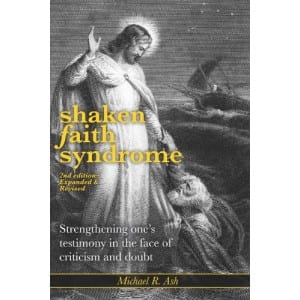
[4] Michael R. Ash, Shaken Faith Syndrome: Strengthening One’s Testimony in the Face of Criticism and Doubt, 2nd edition (Redding: FairMormon, 2013). Part 1 offers useful guidance for navigating a faith crisis, while Part 2 then provides some answers to difficult issues.

Filed Under: Book reviews

Book Review: Letters to a Young Mormon

January 9, 2014 by Trevor Holyoak

Title: Letters to a Young Mormon
Author: Adam S. Miller
Publisher: Neal A. Maxwell Institute for Religious Scholarship
Genre: Religion – Faith
Year Published: 2014
Number of Pages: 78 pages
Binding: Paperback
ISBN-10: 0842528563
ISBN-13: 978-0842528566
Price: $9.95

Reviewed by Trevor Holyoak

This is the first book in a new “Living Faith” series from the Maxwell Institute. While reading it, I struggled to determine just who the “young Mormon” is that the book is aimed at. Is it for teenagers, or perhaps for 20-somethings? I think I actually understand it much better as a 40 year old father than I would have at a younger age, mostly due to the knowledge and experience I have since gained. Then I discovered, thanks to Amazon, that there has been a whole crop recently of books entitled “Letters to a Young XXXXX” (for example, Letters to a Young Contrarian by the late atheist Christopher Hitchens). Briefly looking at some of them, it appears that this book may have been loosely modeled after them. However I still question exactly who the intended audience is.

The book covers a wide range of topics of interest to Mormons, including agency, work, sin, faith, scripture, prayer, history, science, hunger, sex, temples, and eternal life. While I did find some new insights in some of these letters, much of what is contained is vague enough that any parent who shares the book with their teenage child may want to read it themselves so they can discuss it together. The chapter on sex, in particular, warrants this, as the only thing really clear in it is an admonition to avoid pornography, and then only for some of what I consider to be the right reasons.

I asked my two teenage daughters to read a couple chapters each. My 17 year old chose the chapters on history and hunger and thought they were too vague and wished the author had connected the dots. She is probably more familiar with some of the things mentioned (but not explained) in the history letter – such as “Joseph Smith’s clandestine practice of polygamy, Brigham Young’s strong-armed experiments in theocracy, or George Albert Smith’s mental illness” (page 48) – than many young LDS people her age because I have tried to teach her about some of the more difficult topics, yet she had questions about the usage of the word “clandestine” and about George Albert Smith. In fact, with that kind of loaded wording, someone picking it up off the shelf and glancing casually at the page might get the initial impression that it is anti-Mormon material. This chapter may provide an opportunity for a parent to teach their child how to find trustworthy answers for any questions that are raised.

On the other hand, my 16 year old (who doesn’t like to read and appreciated the shortness of the sections) read the prayer and the temple sections, and found she could actually relate to some of it. I think the temple chapter is one of the better ones in the book, and it was particularly timely for her because the material in it complemented what I told her in a discussion we recently had after she stumbled upon a critical video on YouTube.

There are a few other places in the book where I feel good answers are given to common issues. One example is an explanation for the seemingly unscientific account of the creation found in Genesis. The author begins by explaining that the Hebrews “thought the world was basically a giant snow globe. When God wanted to reveal his hand in the creation of their world, he borrowed and repurposed the commonsense cosmology they already had. He wasn’t worried about its inaccuracies, he was worried about showing his hand at work in shaping their world as they knew it” (page 53). Miller continues through the creation sequence as the Hebrews would have understood it, and then follows up by relating his experience in changing his point of view from a literal one that he retained beyond his mission to one that allows more for the scientific explanations of today.

In regard to some of the struggles we might have when learning about church history, he points out that “it’s a false dilemma to claim that either God works through practically flawless people or God doesn’t work at all…. To demand that church leaders, past and present, show us only a mask of angelic pseudo-perfection is to deny the gospel’s most basic claim: that God’s grace works through our weakness. We need prophets, not idols” (page 47).

Where Miller is clear on things, he excels by providing much food for thought and discussion. And in spite of its weaknesses, the bright spots in this book make it a worthwhile read for people who will not be troubled by its overwhelming vagueness, although I do believe a parental advisory may be in order.

Filed Under: Apologetics, Book reviews, LDS Culture, LDS History, LDS Scriptures, pornography, Science, Temples

Greg Smith reviews John Pontius’ book ‘Visions of Glory’

May 31, 2013 by Gregory Smith

Review of: John Pontius, Visions of Glory: One Man’s Astonishing Account of the Last Days (Springville UT: Cedar Fort, 2012). 268 pages. ISBN 978 1462111183.

Visions of Glory is written by John Pontius and recounts several visions and spiritual manifestations. Their recipient is an anonymous informant called “Spencer” in the book. It includes an account of visions of the spirit world, a series of vignettes of apocalyptic last-days scenarios, and describes Spencer’s foretold role in preparing the world for the second coming of Christ. It concludes with an appendix containing other visions which may provide parallels or points of comparison to Spencer’s claims.

The Saints should always be seeking for further light and knowledge. Experience has shown, however, that an anxious interest in such light and knowledge can lead to being deceived, misled, and manipulated if we are not sufficiently grounded in true principles relating to revelation and learning. Prior to teaching the endowment, Joseph Smith warned the Saints: “Let us be faithful and silent, brethren, and if God gives you a manifestation, keep it to yourselves.” Of this remark, Elder Dallin H. Oaks wrote:

By and large, Latter-day Saints observe this direction. They do not speak publicly of their most sacred experiences. They seldom mention miracles in bearing their testimonies, and they rarely preach from the pulpit about signs that the gospel is true. They usually affirm their testimony of the truthfulness of the restored gospel by asserting the conclusion, not by giving details on how it was obtained.

The purpose of this review is not to cast doubt on the sincerity of those who have believed these visionary accounts. It is important, however, to take note of several factors:

  1. Visions of Glory’s portrayal of Jesus Christ and His method of interacting with the Saints is not consistent with scripture.
  2. Visions of Glory teaches doctrines that contradict LDS scripture and prophets.
  3. Prophets and apostles have repeatedly taught that it is inappropriate for members to publicize such material without permission from the President of the Church.
  4. Spencer claims he will receive authority independent of the Church and its leaders.
  5. Anonymous accounts cannot be verified.

Readers of Visions of Glory may wish to compare LDS teachings and doctrines that differ from the book’s teachings.

Continue reading on the FAIR web site→


Filed Under: Book reviews

Mormon FAIR-Cast 144: Mormon Book Review–Shaken Faith Syndrome

April 24, 2013 by SteveDensleyJr

https://media.blubrry.com/mormonfaircast/www.fairlatterdaysaints.org/wp-content/uploads/2013/04/MBR_Ash.mp3

Podcast: Download (25.2MB)

Subscribe: RSS

10-1706-largeIn this episode of the Mormon Book Review, host Kirk Caudle talks to Mike Ash about the second edition of Shaken Faith Syndrome. They  talk about what it means to doubt, the declining lack of literacy, how to stay a member of the church, and what it might mean for one to leave faithfully.

This episode was originally posted at the Mormon Book Review on April 20, 2013 and is re-posted here by permission.

Shaken Faith Syndrome can be purchased at the FAIR Bookstore. Tickets to the 2013 FAIR Conference can be purchased here.

Filed Under: Book reviews

Book Review: Shaken Faith Syndrome

November 23, 2012 by Stephen Smoot

https://media.blubrry.com/mormonfaircast/www.fairlatterdaysaints.org/wp-content/uploads/2012/11/Shaken-Faith-Syndrome-and-the-Case-f.mp3

Podcast: Download (12.4MB)

Subscribe: RSS

Shaken Faith Syndrome and the Case for Faith

Stephen O. Smoot

Abstract: Michael R. Ash is a Mormon apologist who has written two thoughtful books and a number of insightful articles exploring a wide range of controversial issues within Mormonism. His recent book Shaken Faith Syndrome: Strengthening One’s Testimony in the Face of Criticism and Doubt is an outstanding apologetic resource for individuals searching for faith-promoting answers that directly confront anti-Mormon allegations and criticisms. Ash does an excellent job in both succinctly explaining many of the criticisms leveled against The Church of Jesus Christ of Latter-day Saints and articulating compelling answers to these criticisms.

Review of Michael R. Ash. Shaken Faith Syndrome: Strengthening One’s Testimony in the Face of Criticism and Doubt. Redding, CA: Foundation for Apologetic Information and Research, 2008. x + 301 pp., with index. $19.95 (paperback).

“Wherefore Didst Thou Doubt?”
(Matthew 14:31)

A favorite scripture of Latter-day Saint scholars is Doctrine and Covenants 88:118: “And as all have not faith, seek ye diligently and teach one another words of wisdom; yea, seek ye out of the best books words of wisdom; seek learning, even by study and also by faith.” While it is usually the last phrase (“seek [Page 106]learning, even by study and also by faith”) of this scripture that resonates with LDS scholars, the first part of this passage is equally profound. As “all have not faith,” or, one might say, have had their faith challenged or shaken, we are to teach each other words of wisdom from the best books. This scripture is a mandate to bolster each other’s faith as much as it is an invitation to pursue truth. [Read more…] about Book Review: Shaken Faith Syndrome

Filed Under: Anti-Mormon critics, Apologetics, Book of Mormon, Book reviews

The Mormon Moment: A Religion News Service Guide – Review

November 4, 2012 by Stephen Smoot

Much has been said in popular media about the so-called “Mormon Moment”. The accuracy and fairness of recent media coverage of Mormonism has been a mixed bag, to say the least. It is sad to admit that there are plenty of media personalities who know next to nothing about Mormonism, and yet feel unconstrained to opine on this or that subject relating to Mormon doctrine or history. Unsurprisingly, those who are the most ignorant of Mormonism usually choose to write about the most complex and controversial aspects of Mormonism, such as polygamy, Mormon racial history, and esoteric aspects of Mormon belief and practice best left untouched by non-Mormon novices of Mormon history and doctrine. (Andrew Sullivan, I’m looking at you.)

[Read more…] about The Mormon Moment: A Religion News Service Guide – Review

Filed Under: Book reviews, Interfaith Dialogue, LDS Culture, News stories, Politics, Racial Issues Tagged With: Mitt Romney, Mormon Moment

A New Twist on the Spalding Theory–And Sidney’s Amazing Voice Trick

September 23, 2012 by Jeff Lindsay

For some critics, the story of the lost 116 pages in the coming forth of the Book of Mormon is utterly ridiculous. Some say it shows Joseph was just making things up on the fly and would have all sorts of accidental changes as he went through the fabrication process a second time, so for safety, he just punted with the first part of the record and concocted the story of the small plates. This is the “Joseph was an idiot with bad memory” theory. The story of the 116 pages from that perspective directly challenges the popular theory of “Joseph got help from Sidney Rigdon or some other very smart person” to create the impressive and remarkably self-consistent text of the Book of Mormon. These theories based on plagiarism and texts from the likes of Solomon Spaulding or Sidney Rigdon or both assume that there was some text that had been prepared and carefully edited over many months or even years in preparation for the grand Book of Mormon scheme. When Joseph was dictating the Book of Mormon to his scribes, he must have been reading from the pre-written manuscript. If such a manuscript existed, then it would have been no trouble reading it again exactly as read before.
[Read more…] about A New Twist on the Spalding Theory–And Sidney’s Amazing Voice Trick

Filed Under: Anti-Mormon critics, Book of Mormon, Book reviews

Is God a Moral Monster?

July 28, 2012 by Daniel C. Peterson

Many people — seekers, believing Christians, even some Latter-day Saints — have problems with the portrayal of God in the Old Testament.

Probably even more people just have problems with the Old Testament itself, because they find it hard to follow.  This is, I think, very unfortunate, both because the Old Testament is at the foundation of all Judeo-Christian faith and because, among other things, it’s a rich treasure house of history, moral lessons, inspirational stories, and literature.  But that’s a topic for another day.

They’re bothered because, sometimes, the Old Testament God seems to be arrogant, petty, “jealous,” harsh, and violent.  The Old Testament seems to tolerate or even endorse slavery, the oppression of women, and mass murder (effectively, ethnic cleansing).

The problem is that, for Christian believers (unless, perhaps, they follow the ancient heretic Marcion), the God of the Old Testament is also the God of the New.  How can the loving Jesus be reconciled with the often vengeful and fierce Jehovah?  (For Latter-day Saints, Jesus is Jehovah.) [Read more…] about Is God a Moral Monster?

Filed Under: Apologetics, Book reviews

  • « Go to Previous Page
  • Go to page 1
  • Interim pages omitted …
  • Go to page 6
  • Go to page 7
  • Go to page 8
  • Go to page 9
  • Go to Next Page »

Primary Sidebar

Faithful Study Resources for Come, Follow Me

Subscribe to Blog

Enter your email address:

Subscribe to Podcast

Podcast icon
Subscribe to podcast in iTunes
Subscribe to podcast elsewhere
Listen with FAIR app
Android app on Google Play Download on the App Store

Pages

  • Blog Guidelines

FAIR Latest

  • Come, Follow Me with FAIR – Doctrine and Covenants 137–138 – Part 2 – Autumn Dickson
  • Come, Follow Me with FAIR – Doctrine and Covenants 137–138 – Mike Parker
  • FAIR December Newsletter
  • Come, Follow Me with FAIR – Doctrine and Covenants 137–138 – Part 1 – Autumn Dickson
  • Prophets of God 

Blog Categories

Recent Comments

  • LHL on Come, Follow Me with FAIR – Doctrine and Covenants 132 – Mike Parker
  • Stephen Johnsen on Come, Follow Me with FAIR – Doctrine and Covenants 132 – Mike Parker
  • Bruce B Hill on Come, Follow Me with FAIR – Doctrine and Covenants 124 – Part 1 – Autumn Dickson
  • Gabriel Hess on Join us Oct 9–11 for our FREE virtual conference on the Old Testament
  • JC on When the Gospel “Doesn’t Work”

Archives

Follow Us

  • Facebook
  • Twitter
  • iTunes
  • YouTube
Android app on Google Play Download on the App Store

Footer

FairMormon Logo

FAIR is a non-profit organization dedicated to providing well-documented answers to criticisms of the doctrine, practice, and history of The Church of Jesus Christ of Latter-day Saints.

Donate to FAIR

We are a volunteer organization. We invite you to give back.

Donate Now

Site Footer