• Skip to primary navigation
  • Skip to main content
  • Skip to primary sidebar
  • Skip to footer

FAIR

  • Find Answers
  • Blog
  • Media & Apps
  • Conference
  • Bookstore
  • Archive
  • About
  • Get Involved
  • Search

Book reviews

Mormon Fair cast 264: Letters to a Young Mormon

August 14, 2014 by Ned Scarisbrick

https://media.blubrry.com/mormonfaircast/www.fairlatterdaysaints.org/wp-content/uploads/2014/08/Adam-Miller.mp3

Podcast: Download (20.2MB)

Subscribe: RSS

Adam S. MillerAdam S. Miller who is a professor of philosophy at Collin College in McKinney, Texas and associated with the Maxwell Institute of the Brigham Young University is the author the book “Letters to a Young Mormon.”  In this podcast Ned Scarisbrick interviews Adam Miller about this book and the impact it has on the rising generation.

“Letters to a Young Mormon frustrated me. Not that I didn’t like it, because I enjoyed it immensely. No, it frustrated me because I only wish I had had such a book to read when I was a 1960s teenager with racing mind and hormones. And perhaps more poignantly, I wish it had been available when my children were passing through those difficult and impressionable years. Letters to a Young Mormon is both tender and gentle, and at the same time provocative and intellectually stimulating. Its disarming honesty is only surpassed by the significance of its messages. I recommend it wholeheartedly, for young and old.”
–Robert L. Millet, Professor of Religious Education, Brigham Young University

This book is available at the FairMormon bookstore here.

The views and opinions expressed in the podcast may not reflect those of the Church of Jesus Christ of Latter-day Saints or that of FairMormon.

Filed Under: Apologetics, Book reviews, Doctrine, Evidences, Faith Crisis, General, Hosts, LDS Culture, Mormon Voices, Ned Scarisbrick, Podcast, Power of Testimony

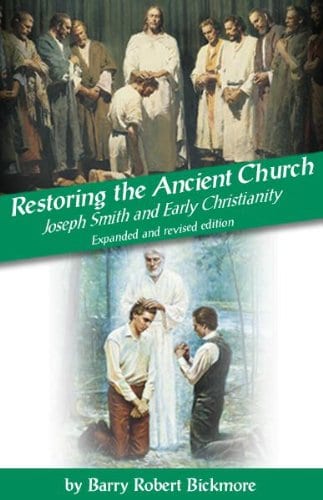
Mormon Fair-Cast 243: Barry R. Bickmore, “Restoring the Ancient Church”

July 6, 2014 by Ned Scarisbrick

https://media.blubrry.com/mormonfaircast/www.fairlatterdaysaints.org/wp-content/uploads/2014/07/Martin-Tanner-Craig-Foster-30214.mp3

Podcast: Download (17.2MB)

Subscribe: RSS

Barry R. BickmoreBarry R. Bickmore Restoring the Ancient Church 2nd EditionMartin Tanner who is the host of “Religion Today” on KSL FM 102.7 and AM 1160 interviews  Barry R. Bickmore  about his book “Restoring the Ancient Church: Joseph Smith and Early Christianity.”  In this interview brother Bickmore relates how the teachings of the early Church are reflected in the Church of Jesus Christ of Latter-day Saints.

Professor Bickmore will be appearing at this year’s FairMormon Conference on August 7 & 8 at the Utah Valley Convention Center in Provo, Utah. For more information and to purchase tickets, click here.

In the second half of his show Martin Tanner interviews Craig Foster about his second book on Mormon polygamy.  “The Persistence of Polygamy: From Joseph Smith Martyrdom to the First Manifesto, 1844 – 1890.

Both book are available from the FairMormon Bookstore:

Restoring the Ancient Church: Joseph Smith and Early Christianity.

The Persistence of Polygamy From Joseph Smith Martyrdom to the First Manifesto 1844 – 1890

This broadcast originally aired on the 2nd of March 2014.

The views and opinions expressed in this podcast may not represent those of the Church of Jesus Christ of Latter-day Saints or that of FairMormon.

Filed Under: Anti-Mormon critics, Apologetics, Bible, Book reviews, Doctrine, Early Christianity, Evidences, FAIR Conference, Faith Crisis, General, LDS History, Mormon Voices, Podcast, Polygamy, Power of Testimony

Book Review: “Sustaining the Law: Joseph Smith’s Legal Encounters”

June 17, 2014 by FAIR Staff

Book Review: Gordon A. Madsen, Jeffrey N. Walker, and John W. Welch (eds.), Sustaining the Law: Joseph Smith’s Legal Encounters (Provo, UT: BYU Studies, 2014.)

By James W. McConkie II

Even seasoned Mormon history buffs may be surprised by the kinds of details about Joseph Smith’s encounters with the legal system of his day that are now available in this useful one-volume collection of essays on Joseph Smith and the law edited by Gordon Madsen, Jeffrey Walker and John Welch. For example, the total number of suits – from simple collection matters to more sophisticated civil and criminal cases – is about 220. Or this: We would expect that Joseph Smith was most often the defendant in these suits; but he was also occasionally the plaintiff, or a witness, and even a judge. And this: As far as historians know, despite the number, he was never convicted of any criminal offense. His attorneys used the Writ of Habeas Corpus artfully to keep Joseph out of jail and in the company of the Saints. And finally: Most would agree that his and the Nauvoo City Council’s involvement with the decision in 1844 to order the destruction of the Nauvoo Expositor – a newspaper critical of Joseph – led to his death. However, one of the essays argues that although the order and the act may have been ill advised, in the context of his times, it was defensible.

In Sustaining the Law: Joseph Smith’s Legal Encounters, the editors have pulled together 18 articles, all but four of which have been published elsewhere. They have simplified and shortened the works to make the book more accessible to the general reading public. Nevertheless, in many places, it often reads more like material from a legal textbook rather than a group of historical essays. Still, for those interested in Joseph Smith and Mormon history, the book is worth purchasing for the Appendix alone. In it the editors have organized a “Legal Chronology of Joseph Smith” that lists and briefly summarizes all of the known cases he was involved in. It also includes sections entitled “Lawyers and Judges in the Legal Cases of Joseph Smith” and a “Glossary of Early Nineteenth-Century Legal Terms” that explain some of the unique aspects of American law in the 19th Century. The book’s index is, however, curiously scant and not very helpful. In my judgment, the book’s value comes from its function as a starting point for amateur and professional historians who wish to explore the legal context of Joseph Smith’s trials and tribulations.

The book considers questions such as, was he really found guilty of being a disorderly person in New York? And, did he act financially irresponsibly when the Kirtland Bank failed? It takes up the legal implications of the Nauvoo Charter, what it means to be charged with treason in Missouri and Illinois in the early 19th Century, and whether or not Joseph and his brethren violated the U. S. Constitution when he ordered the Nauvoo Expositor press destroyed. No doubt the legal materials gathered together in this book and the ever-expanding Joseph Smith Papers project will add insights to the work of historians as well as give them and the more casual reader a more accurate understanding of Joseph’s legal problems.

The book’s weakness is suggested in the first part of its title, Sustaining the Law. That phrase announces the tone generally as well as the content of several arguments specifically that oversimplify Joseph Smith’s attitudes on “honoring, sustaining, and obeying the law.” I think the book would have been enhanced if someone the likes of Richard Bushman had been asked to write an essay on evidence that suggests how Joseph Smith resolved conflicts when the laws of God disagreed with the laws of the land. In a church with a long history of civil disobedience – issues swirling around Joseph Smith and the practice of plural marriage, for example – so many conflicts are at their roots based on that complicated relationship between civil and religious authority.

While no one would suggest that Joseph Smith did not have a strong commitment to obeying the laws of the land, that obligation was not an absolute one. In Section 98, one concerning the “laws of the land”, the Lord commanded that the Saints “should observe to do all things whatsoever I command them” and that only laws that are “constitutional, supporting that principle of freedom in maintaining rights and privileges … [are] justifiable before [God]. (D&C 98:3-4) Lest there be any misunderstanding, the Section says that any law that is “more or less than this cometh of evil.” (D&C 98:11) Therefore, it continues, “I [God] give you a commandment, that ye shall forsake all evil and cleave unto all good, that ye live by every word which proceedeth forth out of the mouth of God.” (D&C 98:11) In other words, there were justifiable limits to obedience when it came to supporting the laws of civil governments, especially in a situation where religious liberty was at stake.

Without question then, in situations where an important conflict arose on a question of man’s law or God’s law, Joseph would not have hesitated to choose obedience to God’s law. Nevertheless, the editors and contributors of Sustaining the Law turn to two other Church-approved statements to suggest otherwise: Doctrine and Covenants 134:5and Article of Faith 12. Section 134 states that “… all men are bound to sustain and uphold the respective government in which they reside”. Article of Faith 12 states that the Church believes in “honoring, and sustaining the law.” While these verses come from books in the LDS canon that described well the general and accepted rule for the membership, it must be remembered that both of these proclamations were written in the early life of the church in order to re-assure outsiders that the Mormons were no threat to their neighbors in fledgling Mormon gathering places in Ohio and Missouri. They, the members of the new church, would submit to the laws of the land and live peaceably in the community. However, a more careful consideration of this issue leads to the conclusion that Joseph Smith’s thinking was more in line with the Apostle Peter’s: “We ought to obey God rather than men.” (Acts 5:29)

The tendency of this book and some of its authors is that it/they go several steps too far in one direction in order to show that Joseph Smith was a “law abiding citizen”. Perhaps the best illustration of this claim is in M. Scott Bradshaw’s article, “Performing Legal Marriages in Ohio in 1835.” The word “legal” in the title is the give-away. In the paper, Bradshaw argues that Joseph and his associates were not in contravention of the 1824 Ohio Statute on Marriage when they performed marriages without the required valid license.

Bradshaw makes his case by relying on two sections of 1824 Ohio Statute on Marriage. He claims that Joseph Smith fit under an exception to the general rule articulated in Section 3 of the statute. The general rule stated that a “regularly ordained minister” was entitled to obtain a license to marry from a local court. Mormons had previously been turned down under that Section 3 rule. But Bradshaw’s argument, that Joseph lawfully performed marriages, relies on Section 2 of the statute, one that carved out an exception. It provided that it “shall be lawful” for an “ordained minister” of “any religion” to marry without having obtained a state license if the “rules and regulations of their respective churches” authorized it.

In my opinion, the courts would not have applied the Section 2 exception to the general rule. Here’s why: Bradshaw leaves out the critical fact that in 1803, when the statute was first enacted, this so-called Section 2 exception granting permission for some “ministers” to marry without a license was meant specifically and only for Quakers (“The Society of Friends”) and Mennonites, two faiths without regularly ordained clergy. The Ohio Legislature’s unstated reason for the exception was that officiators for Quaker and Mennonite marriages were not the same as ministers and/or priests in other denominations that had regularly ordained clergy. Therefore, without providing an exemption for those faiths, the statute would have made all the children born to devout Quakers and Mennonites illegitimate.

Although the language of the 1803 statute explaining the need for an exemption had been redacted by 1824, some eleven years before Joseph supposedly relied on the exemption in his situation, given the history of the statute and the intended exempted denominations, it is doubtful that it would have been interpreted broadly to apply to the laying-on-of-hands type of ordained (with certificates) Mormon priesthood bearers. That is to say, since a strict reading of the language granting the exception eviscerates the part of the statute prohibiting a minister from marrying without a license, the court would likely have read the exception to apply very narrowly to those originally intended as meriting special attention in light its legislative history. Mormon Priesthood simply did not qualify. Thus, I think Bradshaw mistakenly claims that Ohio’s marriage laws allowed Mormons to ignore the statute’s clearly stated requirement for regularly ordained ministers to obtain licenses to marry, when in actuality Ohio’s laws made such exemption for only those “religious societies” (like Quakers and Mennonites) that did not have regularly ordained ministers.

A second problem with Bradshaw’s argument involves another omission of the history. When Joseph Smith married Newel Knight and Lydia Bailey in November 1835, he (Joseph) admitted that he was not relying on the authority of the Marriage Statute when he told the couple, “The Lord God of Israel has given me authority to unite the people in the holy bonds of matrimony … and the enemies of the Church shall never have power of the law against me.” Bradshaw acknowledges this diary entry; but he argues that Joseph did not mean to say he married this couple contrary to law because he was relying on the Quaker/Mennonite exception.

Again, I think the interpretation of Joseph’s language is doubtful. Joseph made this bold and provocative declaration on his source of authority just nine months after Sidney Rigdon’s application for a license to perform marriages had been turned down in March 1835. And, just one month prior to the Knight/Bailey marriage, Rigdon had been prosecuted for marring a couple without a license. The only reason Rigdon had escaped conviction was that he had produced a license of the Court granted him several years earlier when he was a minister for the Campbellites. Under these circumstances, Joseph surely would have known that if he had applied for a license he would also have been turned down. Hence, Joseph’s statement on the source of his authority is more a statement of insubordination to state law.

Ultimately, Joseph Smith’s willingness to defy Ohio’s marriage license laws is evident in light of the fact he was secretly practicing polygamy at this time. Todd D. Compton and other well-known Mormon historians believe that in early 1833 Joseph married his first plural wife, Fanny Alger. In support, Compton cites Mosiah Hancock’s handwritten report of his father Levi’s account of the marriage ceremony of Smith and Alger. When Joseph Smith said, “The Lord God of Israel has given me authority … and the enemies of the Church shall never have power of the law against me,” he meant it.

It is for these reasons that Bradshaw is, in my mind, more a good defense lawyer – a better apologist for Joseph – than a careful historian evaluating all of the evidence. Nevertheless, Bradshaw’s brief is a valuable contribution because it made me, and undoubtedly others, wonder what might have happened had these matters been appealed or more fully adjudicated by an impartial court. Surely the Mormons qualified as “regularly ordained ministers” and should have been granted licenses to marry under Section 3 of the Ohio statute. Simple prejudice is the only plausible explanation for why the court did not issue a license for Sidney Rigdon to marry others.

This book’s look at the legal encounters of Joseph Smith demonstrates how the courts and legal system significantly impacted his life and the life of the Church. The law and court battles influenced everything from how the Saints were allowed to practice their communal living orders in Kirtland to where the Mormons lived. Ultimately the law played a pivotal role in the events leading up to the Prophet’s martyrdom. One cannot fully appreciate Joseph Smith without considering how he dealt with the unremitting legal barrage that complicated his life and the life of the Church. This book not only opens the door to a better understanding of our history but also gives us a better appreciation for how the Prophet dealt with and endured the travails of the legal system.

Filed Under: Book reviews

Mormon’s Codex: Rich Support for Book of Mormon Plausibility

April 23, 2014 by Jeff Lindsay

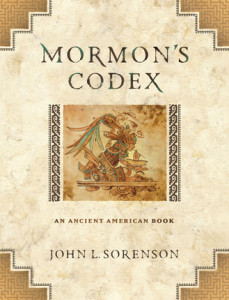
Mormon_s_CodexI just finished John L. Sorenson’s monumental work, Mormon’s Codex (Provo: Neal A. Maxwell Institute, 2013). The reading took longer than I expected, but it was worth it. I will have more to say about it in the near future, but here’s an initial review.

Sorenson’s work will be viewed by many as an attempt to prove and defend the Book of Mormon using numerous random parallels and weak threads. This view both fails to grasp the value of exploring many dimensions of a physical and cultural setting when trying to evaluate a fragmentary record from an allegedly ancient source. Sorenson’s work does directly support Book of Mormon plausibility, but it also helps us to better understand the Book of Mormon and its peoples. It helps us understand the region they lived in and the many dramatic as well as subtle influences on their lives from the climate, the landscape, the surrounding peoples, the cultural setting, the plants and animals, the horticulture, the religions and languages, the patterns of war, infrastructure and social economy, political practices, and so on. Sorenson explores these in terms of what we scholars have learned about Mesoamerica and what we can draw from the Book of Mormon text, and then examines the correspondences and implications. The result is increased granularity and plausibility for the Book of Mormon record, and more informed questions for the future and new hypotheses to test. Along the way, some former objections to the Book of Mormon are soundly shelved.

Those wanting a quick and easy tool to defend the Book of Mormon will be disappointed, at least initially, for Sorenson takes over a hundred pages just laying some foundation regarding ancient Mesoamerica as well as the Book of Mormon, without providing any jaw-dropping arguments to win over converts. What he does, though, is provide new ways of looking at the text, informed by the skills of a professional anthropologist. Over the 800 pages of the text, he provides extensive evidence that the Book of Mormon fits numerous aspects of ancient Mesoamerica, ranging from issues of language, political society, practices of trade and war, the impact of natural disasters, and so forth. Some of the most interesting New World evidences known to date for the authenticity of the Book of Mormon can be found in this tome (see also my Book of Mormon Evidences pages for further information).

Why the Setting Matters

One quickly learns from Sorenson how much physical geography affects a society. The physical location of a place determines climate, available raw materials, opportunities for agriculture and other economic activities, and practical modes of transportation. It shapes political boundaries and influences strategies and tactics for warfare. Geographical barriers and isolating features like the terrain of the central depression of Chiapas can allow a region to experience reduced influence from other cultures in the area and develop its own ways more easily. These factors play major roles in the story of a people, even if those details are briefly mentioned or merely implied.

Mormons limit their ability to fully grasp the Book of Mormon when they dismiss its geographical setting as something unimportant. True, the Church has no official position on geography, and it is certainly secondary to the teachings about Christ, but its authors felt physical details were important enough to riddle their text with references to them. It’s a gritty text, linked to physical details, not just theoretical platitudes and lofty doctrine. Book of Mormon authors bothered to cite specific hills, valleys, rivers, cities, and lands with names and real physical locations carefully and accurately woven into the story. There are temples, thrones, prisons, fortifications, markets, and social structures to match: priests, kings, lawyers and judges, soldiers, and merchants. In some cases, these details matter a great deal and are part of the message for our day. Such things are not the trappings of Native American life Joseph Smith could have gleaned from his upstate New York environment, but they are elements of authentic Mesoamerican culture in the only place that offers hope of plausibly locating the places built into the text of the Book of Mormon. They matter not just for validating or defending the text, but for better understanding what happened, to whom, and why, sometimes with added understanding in drawing lessons for our day and our lives.

Aligning Details

The reasons why Mesoamerica is clearly the most reasonable setting have been discussed elsewhere and are again touched upon in Mormon’s Codex: the requirement for an ancient tradition of written language, the existence of many elements of civilization found in the Book of Mormon (armies, kings, temples, taxation, and complex social structures), the narrow neck of land, and many other details with major implications such as the apparent volcanism and seismic activity described in the text. These broad issues force us to consider Mesoamerica as the most reasonable candidate for the setting of the Book of Mormon, but if so, can the details of the text correspond in any degree with the details of Mesoamerica? This is the issue tackled by Mormon’s Codex. Literally hundreds of “correspondences” between Mesoamerica and the Book of Mormon are identified that create a powerful case that the Book of Mormon really does have its origins in Mesoamerica, so much so that scholars would be wise to reconsider the Book of Mormon as the most extensive surviving document from the ancient New World, a precious ancient codex that can teach us much outside of its spiritual message.

One can accuse Sorenson of “parallelomania,” straining to find parallels that really aren’t significant. Parallelomania is often seen in attempts to find plagiarism in the Book of Mormon. Sometimes seemingly impressive parallels can be piled up that, upon closer inspection, are contrived and can be simply due to chance or situations that naturally involve common phenomena. For example, in a written description of war in texts from Joseph Smith’s day, one should not be surprised to find descriptions of battles, prisoners taken, casualties suffered, defenses built, weapons stored, and so forth. These are common to war. It is in the uncommon details where we can see elements that may be meaningful parallels. Chance can always account for some intriguing finds, so we must be careful not to make too much of any one factor. What makes Sorenson’s work so interesting is the abundance of intricate correspondences coupled with insights from the proposed physical setting that repeatedly enhance our understanding of the text.

I was continually intrigued with the way Sorensen extracts and examines numerous social and physical details from the text of the Book of Mormon and from modern knowledge regarding Mesoamerica. His analysis based on his proposed setting helps to fill in missing details in the Book of Mormon, adding to our understanding of Book of Mormon peoples while also challenging lazy assumptions and stereotypes we sometimes import into the text.

A Mix of Broad and Narrow Details

The relationship between the Olmecs and later Mesoamerican peoples is one of the broad issues that fits the Book of Mormon remarkably well, with the rise and fall of the Jaredites and the subsequent remnants of Jaredite culture found in the Book of Mormon corresponding well in numerous ways with Mesoamerica. It’s an area that challenges unwarranted assumptions we have long made about the destruction of the Jaredites. A more informed approach must recognize, however, that in the midst of the civil war and chaos the ended the Jaredites in the Book of Mormon, that many people would have fled and survived. Since the Book of Mormon itself provides abundant internal evidences of an ongoing Jaredite tradition, with Jaredite names like Corihor/Korihor (Ether 7, 13, & 14 and Alma 30) and Nehor (Ether 7:9 and Alma 1) cropping up among the Nephites, generally associated with dissenters who had not fully bought into Nephite traditions. The remnants of Jaredite society among Nephites and Lamanites fit in well with the ways Olmec culture continued to influence Mesoamerica after their fall.

The rise and fall of the Olmecs has many parallels that can relate to the record we have of the Jaredites, and the rise of Mesoamerican cultures after the Jaredites can also accommodate the information we have regarding the Nephites and Lamanites, with numerous parallels that we can extract from the limited information we have today. Even the final destruction of the Nephites in the widespread warfare (ca. AD 350) toward the end of the Nephite record coincides remarkably well with the Early Classic depopulation in the Central Depression of Chiapas that Sorensen documents in Chapter 25.

What I found especially in Mormon’s Codex were the specific details of individual sites fit with the Book of Mormon. For example, Sorenson proposes a Mesoamerican archaeological site known as Santa Rosa as the city of Zarahemla. The archaeology of that region can accommodate the text effectively. Santa Rosa was a small chiefdom in the 3rd century BC with evidence of Olmec influence in its past, similar to what we might expect if it had been occupied by the Mulekites that had taken on the Olmec influence of their region when they arrived. From 75 BC to 50 AD, Santa Rosa saw a huge burst of activity, reaching its peak of socioeconomic activity at the time Zarahemla was experiencing its peak under the reign of judges. “Like the Central Depression [of Chiapas] as a whole, Santa Rosa was abandoned from about ad 350, very near to when the Nephites at last fled from the land of Zarahemla” (p. 586).

Analysis of the terrain around Santa Rosa helps shed light on troop movements and crop destruction from battles near Zarahemla, and helps to readily explain how travelers sent from the City of Nephi seeking for Zarahemla could have missed it and wandered into the land northward instead (see pp. 581-594).

The two key centers of cultural development in southern Mesoameria in the Central Depression of Chiapas and in the Valley of Guatemala in the first century B.C. correspond well with the land of Zarahemla (Nephites) and the land of Nephi (Lamanites) in the Book of Mormon (see p. 602-604), with detailed correspondences on many fronts. In the field of warfare, for example, the correspondences are especially interesting since just a few decades ago, there was a huge gap between expert opinion about Mesoamerica and the record of warfare in the Book of Mormon. The Mayans were viewed as having been peaceful for many centuries, quite unlike the constant warfare in the Book of Mormon text. But recent scholarship has completely reversed that view, showing that Mesoamerica was a scene of armed conflict from Olmec times and beyond, consistent with the Book of Mormon record (p. 606-7).

Understanding Mesoamerican warfare helps us recognize, for example, that Onitah, the “place of arms” mentioned in Alma 47:5 where rebellious Lamanite soldiers fled, was likely an obsidian outcropping used to produce the dominant weapons in the area, near the Lamanite heartland in the land of Nephi. Remarkably, we now know that for the people of Chiapas, the vital mineral obsidian mostly came from El Chayal, a big volcanic outcrop near Guatemala City, the prime candidate for the city of Lehi-Nephi (which became a Lamanite capital after it was abandoned by the Zeniffites; see Alma 22:1), where the archaeological site known as Kaminaljuyu is largely covered by the modern city. El Chayal qualifies well as Onitah in the Book of Mormon (p. 608). Further, lines of confrontation between Mayan groups and Mixe-Zoqueans in the region, as identified by modern scholars, also may correspond with Nephite and Lamanite boundaries in the Book of Mormon (p. 609).

Many other specific locations are discussed in depth. The results to me were somewhat overwhelming, usually interesting, and occasionally quite surprising. Dr. Sorenson has put a great deal of thought into his proposals, and while some sections are speculative and one of several possibilities, some of his proposals are difficult to dismiss.

Society

Sorenson explores numerous social issues, including the role of secret societies in Mesoamerica. He finds parallels with merchant guilds among the Aztecs and others in Mesoamerica. There were also predatory secrecy-based groups in other forms (e.g., the nahualistas) that could correspond with Book of Mormon descriptions. (See pp. 274-277.)

Natural Disasters

One of the most impressive series of correspondences is the large number of natural disasters that struck parts of Mesoamerica around 50 A.D., including volcanic activity and associated fires that can be see in geological and archaeological records. These disasters may account for some of the dramatic changes in Mesoamerica at that time, including large shifts in population and also major shifts in economics and religion. The changes included an abandonment of many long-standing cultic practices, offering an abundance of correspondences with the record at the climax of the Book of Mormon beginning around 3 Nephi 8 and beyond, when there was great destruction followed by the visit of the Resurrected Messiah, ushering in widespread changes that persisted for many decades before the region fell into widespread apostasy and warfare again, culminating in the destruction of Nephite society.

Arch Support for the Book of Mormon

As an example of the many fields of knowledge touched upon in Mormon’s Codex, Sorenson also considers evidence related to architecture. In Chapter 16, he states:

Friar Torquemada observed, “It is also worth noting the division of this [Aztec] temple; because we find that it has an interior room, like that of Solomon, in Jerusalem, in which the room was not entered by anyone but the priests.” Moreover, the floor plans of various Mexican temples are shown with “two [nonstructural] pillars at the entrance, at Tenayuca, Malinalco, Tepoztlan, Tetitla, Palenque, Yaxchilan, [and] Piedras Negras,” and in Late Pre-Classic Oaxaca. Since the temple in the city of Nephi was specifically patterned after the first Israelite temple (2 Nephi 5:16), it would have incorporated the two-pillar feature discussed by, for example, Meyers. It could have in turn modeled the feature for subsequent Mesoamerican temples.
Another architectural feature of note might or might not have been incorporated in temples: the true arch. For years it was assumed that Mesoamericans lacked knowledge of the true (keystone) arch. Over the years, reported finds have demonstrated the contrary, but only very recently has a comprehensive survey of those cases definitely shown that the principle was widely known, though little used. Hohmann now states unequivocally that “the principle of the true arch was already known amongst the Maya in the preclassic period.” He adds that the principle was also used at Monte Albán by around ad 600 and still later at Chichen Itza. The arch was, of course, widely known in some Old World centers much earlier. If the concept was not imported by transoceanic migrants, we would have to accept the somewhat questionable idea that it was invented independently on opposite sides of the earth. In light of the extensive evidence of cross-oceanic voyaging presented in chapter 9, it is more plausible that knowledge of this architectural feature was imported to Mesoamerica, whether by a group reported in the Book of Mormon or by others. The arch principle may or may not have been used in Nephite sacred buildings in this hemisphere (it was not used in Solomon’s temple), but the probability that the keystone arch came to Mesoamerica from the Old World supports the Nephite record’s historical assertion about the Near Eastern origin of the founders of its tradition. (p. 327)

These architectural details are issues I had not previously considered.

Transoceanic Diffusion: Plants, Animals, Disease, Cultural Practices, Architecture, and More

One of Sorenson’s strengths is his vast body of knowledge regarding evidences for ancient contact between the New and Old Words. Primarily in Chapter 9, “Transoceanic Voyages,” and also in Chapter 12, “Human Biology,” he provides conclusive evidence that there were episodes of transoceanic contact between the Old and New World before Columbus, consistent with general Book of Mormon claims. He delves into several topics with rich examples and references, especially for plants and diseases. One of the most interesting discussions, in my opinion, involves the hookworm (pp. 159-160). The hookworm points to ancient human contact via oceanic crossing, not wandering along the Bering Strait, because the life cycle of the parasite requires warm soil. A people moving through the Bering Straight would become hookworm free by the time they reached the Americas. The pre-Columbian presence of this southeast Asian parasite in a Peruvian mummy dating to AD 900 and in much older Brazilian remains (ca. 5000 BC) seems to require one or more ancient transoceanic voyages by human hosts from the Old World to the Americas. This is one of an abundance of evidences Sorenson provides for ancient transoceanic contact between the Old and New Worlds. It is not central to his thesis relating to the Book of Mormon, but is supporting evidence for the plausibility of the kind of migrations described by the Book of Mormon.

Future Work

Sorenson repeatedly explains how little is known about many key regions and specific sites, many of which have not had extensive digs. Some, of course, cannot be explored adequately because they may be covered by modern cities or, in some cases, by lava flows. Others are in difficult terrain, often coupled with political and security risks, making exploration difficult and dangerous. But we hope much further exploration will take place. Sorenson offers many hints about regions in need of more research, and even offers what may be taken as tentative predictions of some things to look for. For example, Laguna Mecoacan is identified as a good candidate for the City of Moroni (Alma 50:13) which would sink into “the depths of sea” (3 Nephi 9:4), possibly into the lagoon. This would be an intriguing find, though the city was probably small, having been built primarily for defensive purposes in a war. But finding a sunken city there dating to around 50 A.D. would be interesting.

A more important place to investigate might be the candidate Sorenson offers for the Nephite city of Bountiful. He feels it should be at the mouth of the Tonala River, about 6 miles downstream from La Venta. The modern community of Tonala is built over a large archaeological site overlooking the mouth of the river. There is a large pyramid there, and it is in its debris where the town’s cemetery is located. Sorenson states that as far as he known no trained archaeologist has even visited the region, much less conducted detailed investigation. If future work there shows that it was inhabited during the Late Pre-Classic era, corresponding with the Book of Mormon description, this could be another interesting correspondence.

Much remains to be understood and future exploration and research is sorely needed. But what we do know does provide an abundance of evidences and insights that can be of great value to students of the Book of Mormon. I highly recommend this complex and, yes, heavy volume.

*Cross-posted from Mormanity. See also John Sorenson’s 2012 FairMormon Conference presentation “Reading Mormon’s Codex.” Mormon’s Codex can be purchased at the FairMormon Bookstore.

Filed Under: Book of Mormon, Book reviews Tagged With: Book of Mormon, Book of Mormon evidences, John Sorenson, Mesoamerica

Book Review: Mormon’s Codex: An Ancient American Book

April 6, 2014 by Trevor Holyoak

Title: Mormon’s Codex: An Ancient American BookMormon's Codex
Author: John L. Sorenson
Publisher: Deseret Book
Genre: Nonfiction
Year Published: 2013
Number of Pages: 826 pages
Binding: Hardcover
ISBN13: 978-1609073992
List Price: $59.99 (currently available from FairMormon bookstore for $50.99)

Reviewed by Trevor Holyoak

John L. Sorenson has been studying the relationship of the Book of Mormon to Mesoamerica for over 60 years. He received an MA in archaeology from BYU and a PhD in anthropology from UCLA. His best known book prior to this was “An Ancient American Setting for the Book of Mormon,” published in 1985.

“Mormon’s Codex” is the culmination of his studies. It begins with a Foreword by Terryl Givens and then has three main sections followed by an appendix. At the center of the book are colorful maps and photographs of places and artifacts. There are also black and white photos interspersed throughout the text.

Part 1 is called “Orientation.” It introduces the Book of Mormon and its orgins and tells us about problems with archaeology. One way archaeologists have been able to base the Bible in reality is through finding convergences where the text agrees with archaeological findings. This book investigates the same type of convergences between the Book of Mormon and Mesoamerica. This is not easy, because “only a fraction of the material that was left behind by ancient peoples has been preserved and is waiting to be found” (page 11). There is also the problem that only a fraction of what has been discovered has been excavated, and only a fraction of the items found have been studied and published. In spite of this, there is a tendency among archaeologists to “speak as if their data were complete and their inferences were facts” (page 12).

Sorenson lists key places from the Book of Mormon text and then places them on the map. He has found that a limited Mesoamerican geography is the best fit, specifically around Guatemala. He has gone as far as to identify plausible locations for many places, such as the narrow neck of land, the east and west seas, the river Sidon, the city of Nephi, and the final Nephite and Jaredite battleground (this is the only Jaredite place that he is very certain about). He concludes that the text of the Book of Mormon fits this area so well that it only could have been produced by people living in that place and time.

The histories of the Jaredites and Nephites are laid out, followed by a parallel history of Mesoamerica. It is also pointed out that there is a limited amount of history to go on from the Book of Mormon (three centuries are covered in a mere four pages, for instance).

Part 2 covers “Correspondences by Topic.” It first lays out geographical correspondences, such as distances and characteristics of the land. This is where a possible site for Jerusalem is first mentioned, a submerged city called Samabaj that was discovered recently in Lake Atitlan.

Evidence for transoceanic voyages is laid out, with a list of some of the plants that have been found in both hemispheres. This is followed by a similar list of diseases, as well as a discussion of languages, records, and writing systems. Also covered are human biology, political economy, society, population and distribution, material culture, government and political processes, warfare, knowledge systems, and ideology and religion.

Part 3 has “Correspondences from Archaeology and History.” I found this part to be the most interesting. It is split up into four time periods: before 600 BC, between 600 and 1 BC, between AD 1 and 200, and between AD 200 and 400. One of the things discussed is the apparent absence of fortifications, since they are a common part of the war chapters. There have actually been more found than is commonly recognized. Sorenson has tabulated 75 named sites that date before AD 400. (It hasn’t been published because the project kept expanding.) He tells how it took generations of work at Tikal before they realized an embankment was actually a wall. It took over 30 years to trace the miles of wall found, and it may not yet be fully revealed.

A possible location for Bountiful has been identified, based on geography, but it has not yet been studied, so Sorenson still considers such correspondence to be premature. However, Santa Rosa is a good candidate for Zarahemla, all the way down to evidence of destruction from the right time period preceding Christ’s visit in 3rd Nephi. In fact, corresponding evidence such as volcanic ash has been found in the same time period in many places in the area. This also includes the city of Jerusalem being covered with water as mentioned previously. In addition, there is evidence of significant cultural and religious
upheaval at that time which corresponds with the Book of Mormon text.

Sorenson explains how the codex (the plates) may have been transported to New York from Mesoamerica by relating the story of English sailors who trekked 3,000 miles from Mexico to Nova Scotia in 1589 over a period of nine months. And near the end of the 20th century, an adventurer named David Ingram walked 4,000 miles from Maine to Tampico in 11 months.

In the appendix, Sorenson explains how he has modified his views of the Jaredites since the publication of “An Ancient American Setting for the Book of Mormon.” He now sets them in Veracruz, with the three main lands in Jalapa, Cordoba, and Tuxtepec. And he has changed his mind to an Atlantic Ocean crossing instead of the North Pacific. However, he notes that all this still remains tentative.

I would have preferred if the book were laid out a bit differently – he tends to explain Book of Mormon history and Mesoamerican history separately and then gives a summary conclusion. He explains that “to recapitulate detailed parallels would be tedious; an alert reader can identify further general and specific correspondences” (page 665). While this may be the case, I believe it would better suit the purpose of the book to combine the parallel information, pointing out correspondences in more detail as it goes. On the other hand, I appreciate that in places where the evidence is weak or still lacking, he is quick to point it out.

This book is a treasure trove of information about New World archaeology and how it may relate to the Book of Mormon. It probably won’t convince critics (although it will be harder for them to say there is no evidence), but as a believer in the Book of Mormon as scripture and as real history, it helped me better visualize the events and people it contains. I highly recommend it to anyone interested in physical evidence for the Book of Mormon and placing it on the map.

Filed Under: Apologetics, Book of Mormon, Book reviews, Evidences, Geography, Science

Mormon Fair-Cast 215: The First Vision

March 31, 2014 by Ned Scarisbrick

https://media.blubrry.com/mormonfaircast/www.fairlatterdaysaints.org/wp-content/uploads/2014/03/MHG-Number7-FirstVision.mp3

Podcast: Download (49.1MB)

Subscribe: RSS

RussellStevensonIt is the foundational event of Mormonism–or at least that is what it became. Beginning in 1832, Joseph Smith began to publicly talk about a visionary experience he had in a grove of trees nearby his home in upstate New York. However, what he told audiences differed from year-to-year in what feels to be substantial detail. Is this evidence of rank fraud? Or, as his supporters say, does it indicate the natural human tendency to emphasize/omit details of a story based on one’s audience or perhaps his own changing understanding of the importance of certain theological principles. Brittany Nielson and I speak with LDS Church Historian Dr. Stephen Harper about his book, Joseph Smith’s First Vision: A Guide to the Historical Accounts.  Harper currently works on the Joseph Smith Papers Project production team for the LDS Church.

This podcast interview was provided courtesy of Russell Stevenson.

Russell Stevenson is the “Mormon History Guy” and the views expressed are his own may not reflect those of the Church of Jesus Christ of Latter-day Saints or that of FairMormon.

Filed Under: Anti-Mormon critics, Apologetics, Book reviews, Doctrine, Evidences, Faith Crisis, First Vision, General, Hosts, Joseph Smith, Mormon Voices, Ned Scarisbrick, Podcast, Power of Testimony

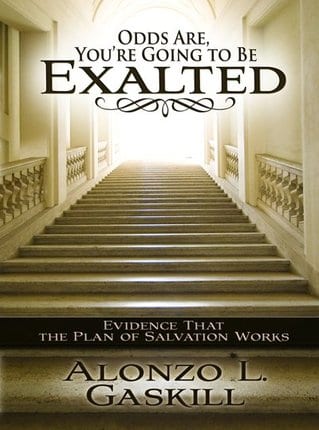
Mormon Fair-Cast 203: Odds are you are Going to be Exalted

February 27, 2014 by Ned Scarisbrick

https://media.blubrry.com/mormonfaircast/www.fairlatterdaysaints.org/wp-content/uploads/2014/02/Alonzo-Gaskill-Odds-are1.mp3

Podcast: Download (43.7MB)

Subscribe: RSS

Odds_Are___Exalted_detailAlonzo GaskillMany Latter-day Saints worry whether they’re capable of reaching the celestial kingdom. Are these anxieties born of a sense of unworthiness, or is it that we just don’t think we can “do it all?” Author Alonzo L. Gaskill believes that such pessimism results from misunderstanding God’s great plan of happiness and what it is that the Lord actually requires of us. In this hope-filled book, he reviews the teachings of the scriptures and modern prophets to instill in readers a greater sense of God’s unfailing love and mercy and of His power and desire to exalt His children. Exaltation may be not only possible but probable!

Dr. Alonzo L. Gaskill was reared near Indepence, Missouri, and joined the Church in the fall of 1984. One year later, he served a mission to England. He has attended several schools and universities, earning a master’s degree in theology and a Ph.D. in biblical studies.

He has taught graduate and undergraduate religious education courses at the University of California (at both Berkeley and Santa Cruz) and Idaho State University. He was the director of the LDS institute of religion adjacent to Stanford University, and is an assistant professor of Church history and doctrine at Brigham Young University. He is a frequent presenter at BYU’s Campus Education Week and Know Your Religion seminars.

Dr. Gaskill and his wife, Lori, are the parents of four children and reside in Payson, Utah.

This book is available through the FairMormon Bookstore here.

You may also be interested in his blog here.

The views and opinions expressed in this podcast may not reflect those of the Church of Jesus Christ of Latter-day Saints or that of FairMormon.

Filed Under: Anti-Mormon critics, Apologetics, Book reviews, Conversion, Doctrine, Early Christianity, Evidences, Faith Crisis, General, Hosts, LDS Culture, LDS History, Mormon Voices, Ned Scarisbrick, Podcast, Power of Testimony

Mormon Fair-Cast 202: Barry R. Bickmore, “Restoring the Ancient Church”

February 24, 2014 by Ned Scarisbrick

https://media.blubrry.com/mormonfaircast/www.fairlatterdaysaints.org/wp-content/uploads/2014/02/Barry-Bickmore-Pod.mp3

Podcast: Download (38.0MB)

Subscribe: RSS

Barry R. Bickmore Restoring the Ancient Church 2nd EditionBarry R. BickmoreMills Chrenshaw who is the host of the program “Drive Time Live” on K-Talk AM 630 radio in Salt Lake City Utah interviews Barry Robert Bickmore about his book “Restoring the Ancient Church: Joseph Smith and Early Christianity.”  In this interview brother Bickmore relates how the teachings of the early Church are reflected in the Church of Jesus Christ of Latter-day Saints.

This book meticulously examines the earliest teachings of Christianity and how some of those teachings were modified, abandoned, or forgotten in the centuries following the death of the Apostles. By exploring the writings of early Christian leaders, Dr. Bickmore is able to recover those early teachings while illustrating the significance they played in the theology and Christology of the pristine Christian Church. Most importantly for Latter-day Saints, Dr. Bickmore demonstrates that many of forgotten early Christian teachings were restored through the prophet Joseph Smith.

This 2nd edition is enlarged and revised.  This book is available through the FairMormon bookstore here .

A written review of Barry R. Bickmore’s first edition from a non-LDS perspective is also available at FairMormon here.

This interview was used by permission of Mills Crenshaw and K-TALK radio. The opinions expressed in this interview do not necessarily represent the views of the Church of Jesus Christ of Latter-day Saints or of FairMormon.


Filed Under: Anti-Mormon critics, Apologetics, Book reviews, Conversion, Doctrine, Early Christianity, Evidences, Faith Crisis, General, Joseph Smith, LDS History, News stories, Podcast, Power of Testimony

A New Church History Seminary Manual

February 5, 2014 by Stephen Smoot

Screen Shot 2014-02-05 at 11.17.54 PM
The cover page of the new edition of the Doctrine and Covenants and Church History seminary manual.

[Cross-posted from Ploni Almoni: Mr. So-and-So’s Mormon Blog.]

The Church has released a new edition of the Doctrine and Covenants and Church History manual for seminary students. One of the remarkable aspects of the new manual is that it includes a discussion of several sensitive topics in church history. These topics include the following.

1. The various accounts of the First Vision are highlighted in the new manual. “There are nine known accounts of the First Vision—four written or dictated by Joseph Smith and five written by others retelling his experience,” the manual states (p. 20).

The multiple accounts of the First Vision were prepared at different times and for different audiences. In these accounts, Joseph Smith emphasized different aspects of his experience of the First Vision, but the accounts all agree in the essential truth that Joseph Smith did indeed have the heavens opened to him and see divine messengers, including God the Father and the Lord Jesus Christ. Because the 1838 account was part of Joseph Smith’s official history and testimony to the world, it was included in the Pearl of Great Price as scripture. (p. 20)

The manual then recommends students to read articles by Milton Backman and Richard Lloyd Anderson published in the Ensign discussing the various accounts of the First Vision (pp. 20, 22).

2. There is an entire chapter devoted to the Mountain Meadows Massacre and the Utah War (Lesson 151). The manual gives a brief historical overview of the events leading up to the massacre and acknowledges the participation of “Latter-day Saint leaders and settlers” in the crime (p. 523). Besides citing an article on the Mountain Meadows Massacre published in theEnsign, the manual also reproduces this quote given by President Henry B. Eyring at the 150 year anniversary of the massacre.

The gospel of Jesus Christ that we espouse, abhors the cold-blooded killing of men, women, and children. Indeed, it advocates peace and forgiveness. What was done [at the Mountain Meadows] long ago by members of our Church represents a terrible and inexcusable departure from Christian teaching and conduct.

3. In a chapter on the history of the Pearl of Great Price there is a brief overview of the history of the Book of Abraham, including the loss and recovery of several papyrus fragments once in the possession of Joseph Smith (pp. 524–526). Included in the discussion about the Book of Abraham is this (which is actually reprinted from the Church’s Pearl of Great Price Student Manual).

In 1966 eleven fragments of papyri once possessed by the Prophet Joseph Smith were discovered in the Metropolitan Museum of Art in New York City. They were given to the Church and have been analyzed by scholars who date them between about 100 B.C. and A.D. 100. A common objection to the authenticity of the book of Abraham is that the manuscripts are not old enough to have been written by Abraham, who lived almost two thousand years before Christ. Joseph Smith never claimed that the papyri were autographic (written by Abraham himself), nor that they dated from the time of Abraham. It is common to refer to an author’s works as ‘his’ writings, whether he penned them himself, dictated them to others, or others copied his writings later. (p. 525)

(Incidentally, yours truly has written a thing or two on this subject over at the Interpreter blog, which you can access here.) The manual also states, “Although we do not know the exact method Joseph Smith used to translate the writings, we do know that he translated the book of Abraham by the gift and power of God” (p. 525).

4. The new manual has material covering the practice of plural marriage, including an entire chapter on Joseph Smith’s plural marriage (Lesson 140) and a mentioning of Post-Manifesto plural marriage. Below are a few pertinent excerpts from the manual.

In this dispensation the Lord commanded some of the early Saints to practice plural marriage. The Prophet Joseph Smith and many other Church leaders found this commandment difficult, but they obeyed it. After receiving revelation, President Wilford Woodruff issued the Manifesto, which was accepted by the Church as authoritative and binding on October 6, 1890. This led to the end of the practice of plural marriage in the Church (see Official Declaration 1). (p. 204)

While Joseph Smith was working on the inspired translation of the Old Testament in 1831, he read about some of the ancient prophets practicing plural marriage (also called polygamy). Under this practice, one man is married to more than one living wife. The Prophet studied the scriptures, pondered what he learned, and eventually took his questions about plural marriage to Heavenly Father in prayer. . . . the Prophet Joseph Smith was reluctant to begin the practice of plural marriage. He stated that he did not begin the practice until he was warned that he would be destroyed if he did not obey. . . . Because of a lack of historical documentation, we do not know about Joseph Smith’s early attempts to comply with the commandment. However, by 1841 the Prophet had begun to obey the commandment and to teach it to some members of the Church, and over the next three years he married additional wives in accordance with the Lord’s commands. The Prophet Joseph Smith’s obedience to the Lord’s commandment to practice plural marriage was a trial of faith for him and his wife Emma, whom he loved dearly. (pp. 477–478)

Practicing plural marriage brought additional challenges. Because the practice was initially kept very quiet, rumors began to spread about Church leaders marrying additional wives. These rumors greatly distorted the truth, slandered the names of the Prophet and other Church leaders, and contributed to increased persecution against the Saints. (p. 479)

A small number of Latter-day Saints continued to enter into new plural marriages after the Manifesto was given. In 1904, President Joseph F. Smith announced “that all [plural] marriages are prohibited, and if any officer or member of the Church shall assume to solemnize or enter into any such marriage he will be . . . excommunicated”. . . . This policy continues today. (p. 530)

Towards the end of the chapter on Joseph Smith’s plural marriage, the manual warns, “Much unreliable information pertaining to plural marriage exists on the Internet and in many print sources. Be cautious and wise with such information. Some authors who write about the Church and its history present information out of context or include partial truths that can be misleading. The intent of some of these writings is to destroy faith” (p. 479). I myself have raised a similar point in this post. The manual then concludes by recommending, “Reliable historical research concerning the practice of plural marriage can be found at josephsmithpapers.org and byustudies.byu.edu” (p. 480).

5. On describing the nature of the Joseph Smith Translation, the manual says the following.

Around the fall of 1830, Joseph Smith was commanded by the Lord to translate the Bible. He did not translate the Bible from one language to another; nor did he have an original biblical manuscript to work from. Instead, Joseph would read and study passages from the King James Version of the Bible and then make corrections and additions as inspired by the Holy Ghost. Thus, the translation was more of an inspired revision than a traditional translation.The Joseph Smith Translation is estimated to have affected at least 3,400 verses in the King James Version of the Bible. These differences include additions (to clarify meaning or context), deletions, rearranged verses, and complete restructurings of certain chapters. The Joseph Smith Translation clarified doctrinal content, especially the mission of Jesus Christ, the nature of God, the nature of man, the Abrahamic covenant, the priesthood, and the Restoration of the gospel. (pp. 180–181)

6. The historical circumstances surrounding the priesthood ban and President Spencer W. Kimball’s 1978 revelation are discussed in a chapter on Official Declaration 2 (Lesson 157). As part of this discussion, the manual reprints the introductory material to OD 2 printed in the 2013 edition of the scriptures.

The Book of Mormon teaches that ‘all are alike unto God,’ including ‘black and white, bond and free, male and female’ (2 Nephi 26:33). Throughout the history of the Church, people of every race and ethnicity in many countries have been baptized and have lived as faithful members of the Church. During Joseph Smith’s lifetime, a few black male members of the Church were ordained to the priesthood. Early in its history, Church leaders stopped conferring the priesthood on black males of African descent. Church records offer no clear insights into the origins of this practice.

There is also the recommendation at the end of the chapter for students to “go to Gospel Topics on LDS.org and search for ‘race and the priesthood'” to learn more about the priesthood ban (p. 545).

7. Finally, in discussing section 77 of the Doctrine and Covenants, the manual straightforwardly says, “The 7,000 years [in vv. 6–7]  refers to the time since the Fall of Adam and Eve. It is not referring to the actual age of the earth including the periods of creation” (p. 280).

I am sure there is more that could be said about the new manual, but suffice it to say from the above examples that the Church is implementing productive measures towards introducing these sort of issues in a faith-promoting, safe, and positive environment (seminary). This will hopefully serve to “inoculate,” to use the popular metaphor, seminary students against the often highly debatable claims and negative information one can currently find on the Internet. While one might perhaps quibble over how certain issues are addressed in the new manual, that there is even a discussion at all in Church curriculum is, in my estimation, a step in the right direction.

Filed Under: Apologetics, Book of Abraham, Book reviews, Faith Crisis, First Vision, Joseph Smith, LDS History, LDS Scriptures, Polygamy, Racial Issues, Science Tagged With: Blacks and the Priesthood, Book of Abraham, Church History, Doctrine and Covenants, First Vision, Joseph Smith Translation, Plural Marriage, seminary

“Taking the Stories of Primeval History Seriously”: A Review of In God’s Image and Likeness 2

January 26, 2014 by Stephen Smoot

giml2
You’re just a few clicks away from owning this excellent book! So what are you waiting for?

[Cross posted from Ploni Almoni: Mr. So-and-So’s Mormon Blog.]

The Book of Moses in the Pearl of Great Price has been the attention of considerable Latter-day Saint scholarship. Beginning with the pioneering work of Hugh Nibley, much work has been done on understanding the history, nature, and teachings of the Book of Moses.[1] Next to Nibley, Jeffrey M. Bradshaw stands out as one of the giants among Latter-day Saint scholars who have looked carefully at the Book of Moses. In his excellent 2010 commentary In God’s Image and Likeness Bradshaw delved deep into the text of the first half of the Book of Moses to unlock fresh insights and provide intriguing links between the Book of Moses with the temple and other ancient Near Eastern texts and traditions.[2]

However, Bradshaw’s first book only covered up to Moses 6. So then what about the rest of the Book of Moses, including the accounts of Enoch and Noah? With David J. Larsen as a co-author, Bradshaw has now completed his commentary on the Book of Moses with In God’s Image and Likeness 2: Enoch, Noah, and the Tower of Babel, co-published by the Interpreter Foundation and Eborn Books.

If one could summarize the purpose of this sequel, it would have to be that Bradshaw and Larsen are “taking the stories of the primeval history seriously” (p. 4) and attempting to show the richness, beauty, and power of these accounts.

Given their status as targets of humor and caricature, the well-worn stories of Adam, Eve, and Noah are sometimes difficult to take seriously. However, a thoughtful examination of the scriptural record of these characters will reveal not simply tales of “piety or inspiring adventures” but rather carefully crafted narratives from a highly sophisticated culture that preserve “deep memories” of revealed understanding. We do an injustice both to these marvelous records and to ourselves when we fail to pursue an appreciation of scripture beyond the initial level of cartoon cut-outs inculcated upon the minds of young children. (pp. 4–5, internal notes removed)

Bradshaw and Larsen pick up exactly where In God’s Image and Likeness finished. They begin by discussing how the Book of Moses presents the prophet Enoch, and compare the Book of Moses’ depiction of Enoch with the depiction of him found in a corpus of pseudepigraphal Enochic literature. Their discussion of Enoch both compares and contrasts the Book of Moses with the pseudepigraphal texts that bear Enoch’s name, and Bradshaw and Larsen are careful not to engage in the sort of parallelomania that one could easily fall into when comparing the Book of Moses with this literature.[3] 

After their discussion of Enoch, Bradshaw and Larsen then comment on Noah, the ark, and the flood. They discuss the events preceding and following the flood, in addition to the flood itself. Besides doctrinal discussions, their commentary on the flood also tactfully includes a brief discussion of how to reconcile the flood account with evidence from geological science that strongly contradicts belief in a global catastrophic flood. Instead, Bradshaw and Larsen posit the likelihood of a local flood that was possibly mythologized in the Genesis account to carry specific theological significance and symbolism (esp. pp. 267–271). This symbolism is actually quite interesting, as Bradshaw and Larsen point out that the Genesis flood symbolically throws the earth back into its pre-created chaotic state, when the waters of chaos reigned before the formation of the earth (see Genesis 1:1–3; cf. Abraham 4:1–2). With the emergence of a new earth from out of the waters of the flood, the account presents Noah as a type of Adam (pp. 256–259, 267, 277–279).

Finally, Bradshaw and Larsen include a discussion of the Tower of Babel. Bradshaw and Larsen begin by helpfully providing the Mesopotamian background to the Tower of Babel pericope (pp. 382–388). They also (rightly) urge caution about reading too much into the account of the confounding of languages that contradicts scriptural and scientific evidence (pp. 398–402).

Of course, as might be expected in a tome covering the Book of Moses and Genesis, Bradshaw and Larsen make no small effort to draw our attention to the many links between these stories and the temple. There are simply too many wonderful insights concerning the temple in this book for me to fully describe in this review. Suffice it to say that nobody can walk away from reading this book without coming to more fully appreciate the importance and centrality of the temple and temple symbolism in the scriptures, including in the stories of Enoch, Noah, and the Tower of Babel.

In addition to their commentary on the text, Bradshaw and Larsen include what they term “Gleanings,” or reproductions of quotes by various General Authorities or scholars on topics relating to the subject being discussed in each chapter. Bradshaw and Larsen also provide numerous paintings, photos, and charts to help the reader visualize the stories they’re reading. In this regard, In God’s Image and Likeness 2 follows in the steps of its predecessor, which also stands out for its wonderful artistic reproductions.

There wasn’t much that I found in this book to criticize, and there was only one part that I really disagreed with. In their commentary on the story involving Noah and his sons in Genesis 9, Bradshaw and Larsen speculate that Noah didn’t actually get drunk from the wine that he made from a vineyard he had planted (Genesis 9:20–21), but had participated in “a ritual drinking of wine” that preceded a vision (p. 300). They base this argument on a statement attributed to Joseph Smith and an excerpt from the Genesis Apocryphon. The evidence presented by Bradshaw and Larsen is, however, tenuous. First, the statement attributed to Joseph Smith that Noah “was not drunk, but in a vision” is late and thirdhand.[4] A contemporary (and preferably firsthand) statement on this by the Prophet would be stronger evidence for their claim. Second, their appeal to the Genesis Apocryphon, while interesting, doesn’t do much to mitigate against the plain reading of the text in Genesis–––Noah got a little too carried away with his wine. It would seem that the author of the Genesis Apocryphon was trying to do the same thing that Bradshaw and Larsen are doing, that is, exonerate Noah from any wrongdoing.

Likewise, Bradshaw and Larsen’s speculation that the “sin of Ham” was that Noah’s son “was neither qualified nor authorized to enter a place of divine glory” (p. 305) is also tenuous. Their evidence, while also interesting, is not definitive, and is also derived in part from their reading of later biblical and pseudepigraphal texts and drawing parallels with the pericope in Genesis 9. While they’re reading of Genesis 9 is plausible, it is far from certain.

But my hesitancy to agree with Bradshaw and Larsen on this point doesn’t severely detract from my overall appreciation for the effort and thoughtfulness that they put into this marvelous book. In the end, I wholeheartedly agree with this statement made by Bradshaw and Larsen at the beginning of their impressive volume.

The acceptance of the book of Moses as part of the LDS scriptural canon and, more generally, the premise that the Joseph Smith Translation of the Bible may contain something more than naïve personal speculations on passages that perplexed the Prophet has not only been grounds for amusement for many non-Mormons but also has drawn criticism from some within the tradition of the Restoration. . . . It is our firm witness that the book of Moses is a priceless prophetic reworking of the book of Genesis, made with painstaking effort under divine direction. Although neither “complete” nor “inerrant,” it is a text of inestimable value that should be one of the centerpieces of our gospel study. (pp. 17–18)

To that end, any Latter-day Saint interested in an informative and engaging scriptural commentary on the Book of Moses would greatly benefit from both volumes 1 and 2 of In God’s Image and Likeness.

[The book can be purchased at the FairMormon Bookstore or amazon.com.]

Addendum: Jeffrey Bradshaw has responded to my brief comments on Genesis 9. My review here was meant to be quick and limited, so I may not have done justice to Bradshaw and Larsen’s argument. Below are Bradshaw’s comments.

David and I qualify our explorations of an alternative interpretation of Genesis 9 as an “admittedly tentative” effort to “account for its many anomalies.” Many other respected scholars have remarked on the odd inconsistency of the Noah portrayed in Genesis 8 and Genesis 9, leading to conclusions such as that of Gordon Wenham that “the two traditions are completely incompatible and must be of independent origin.” In addition, it might be helpful to readers if you could note that the purported statement of Joseph Smith is not a completely isolated phenomenon. For example, drawing their conclusions from the Hebrew text of Genesis 9 alone (i.e., not considering the Genesis Apocryphon), Koler and Greenspahn concur with the opinion that Noah was enwrapped in a vision while in the tent, and that Ham’s sin was looking at Noah while the latter was in the course of revelation.[5]

Notes

[1]: See Hugh Nibley, Enoch the Prophet, The Collected Works of Hugh Nibley: Volume 2 (Provo, Utah: Foundation for Ancient Research and Mormon Studies, 1986).

[2]: Jeffrey M. Bradshaw, In God’s Image and Likeness: Ancient and Modern Perspectives on the Book of Moses (Salt Lake City, Utah: Eborn Books, 2010). See also Jeffrey M. Bradshaw, Temple Themes in the Book of Moses (Salt Lake City, Utah: Eborn Books, 2010); Temple Themes in the Oath and Covenant of the Priesthood (Salt Lake City, Utah: Eborn Books, 2012). Bradshaw has published numerous articles and has presented at a number of symposia on various Latter-day Saint scriptural topics. For a complete look at his publications and presentations, see here.

[3]: For those unaware of or otherwise unfamiliar with the corpus of Enochic pseudepigrapha, my good friend Colby Townsend provides an overview of this literature in an appendix.

[4]: Bradshaw and Larsen (p. 300, n. 35) cite Charles Walker’s 1881 diary entry of a conversation he had with William Allen where Allen attributed the quote to Joseph Smith.

[5]: E-mail from Jeffrey Bradshaw to Stephen Smoot, sent on January 27, 2014.

Filed Under: Book of Moses, Book reviews, LDS Scriptures Tagged With: Book of Moses, David J. Larsen, Enoch, In God's Image and Likeness, In God's Image and Likeness 2, Jeffrey M. Bradshaw, Noah, Pearl of Great Price, Tower of Babel

  • « Go to Previous Page
  • Go to page 1
  • Interim pages omitted …
  • Go to page 5
  • Go to page 6
  • Go to page 7
  • Go to page 8
  • Go to page 9
  • Go to Next Page »

Primary Sidebar

Faithful Study Resources for Come, Follow Me

Subscribe to Blog

Enter your email address:

Subscribe to Podcast

Podcast icon
Subscribe to podcast in iTunes
Subscribe to podcast elsewhere
Listen with FAIR app
Android app on Google Play Download on the App Store

Pages

  • Blog Guidelines

FAIR Latest

  • Come, Follow Me with FAIR – Doctrine and Covenants 137–138 – Part 2 – Autumn Dickson
  • Come, Follow Me with FAIR – Doctrine and Covenants 137–138 – Mike Parker
  • FAIR December Newsletter
  • Come, Follow Me with FAIR – Doctrine and Covenants 137–138 – Part 1 – Autumn Dickson
  • Prophets of God 

Blog Categories

Recent Comments

  • LHL on Come, Follow Me with FAIR – Doctrine and Covenants 132 – Mike Parker
  • Stephen Johnsen on Come, Follow Me with FAIR – Doctrine and Covenants 132 – Mike Parker
  • Bruce B Hill on Come, Follow Me with FAIR – Doctrine and Covenants 124 – Part 1 – Autumn Dickson
  • Gabriel Hess on Join us Oct 9–11 for our FREE virtual conference on the Old Testament
  • JC on When the Gospel “Doesn’t Work”

Archives

Follow Us

  • Facebook
  • Twitter
  • iTunes
  • YouTube
Android app on Google Play Download on the App Store

Footer

FairMormon Logo

FAIR is a non-profit organization dedicated to providing well-documented answers to criticisms of the doctrine, practice, and history of The Church of Jesus Christ of Latter-day Saints.

Donate to FAIR

We are a volunteer organization. We invite you to give back.

Donate Now

Site Footer