• Skip to primary navigation
  • Skip to main content
  • Skip to primary sidebar
  • Skip to footer

FAIR

  • Start Here
  • Find Answers
  • Scripture Study
  • Blog
  • Events
    • FAIR Conference
    • Virtual Conferences
    • Special Events
  • FAIR Books
  • About
    • Media & Apps
  • Get Involved
  • Search

Blog

Mormon’s Codex: Rich Support for Book of Mormon Plausibility

April 23, 2014 by Jeff Lindsay

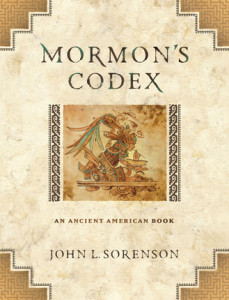
Mormon_s_CodexI just finished John L. Sorenson’s monumental work, Mormon’s Codex (Provo: Neal A. Maxwell Institute, 2013). The reading took longer than I expected, but it was worth it. I will have more to say about it in the near future, but here’s an initial review.

Sorenson’s work will be viewed by many as an attempt to prove and defend the Book of Mormon using numerous random parallels and weak threads. This view both fails to grasp the value of exploring many dimensions of a physical and cultural setting when trying to evaluate a fragmentary record from an allegedly ancient source. Sorenson’s work does directly support Book of Mormon plausibility, but it also helps us to better understand the Book of Mormon and its peoples. It helps us understand the region they lived in and the many dramatic as well as subtle influences on their lives from the climate, the landscape, the surrounding peoples, the cultural setting, the plants and animals, the horticulture, the religions and languages, the patterns of war, infrastructure and social economy, political practices, and so on. Sorenson explores these in terms of what we scholars have learned about Mesoamerica and what we can draw from the Book of Mormon text, and then examines the correspondences and implications. The result is increased granularity and plausibility for the Book of Mormon record, and more informed questions for the future and new hypotheses to test. Along the way, some former objections to the Book of Mormon are soundly shelved.

Those wanting a quick and easy tool to defend the Book of Mormon will be disappointed, at least initially, for Sorenson takes over a hundred pages just laying some foundation regarding ancient Mesoamerica as well as the Book of Mormon, without providing any jaw-dropping arguments to win over converts. What he does, though, is provide new ways of looking at the text, informed by the skills of a professional anthropologist. Over the 800 pages of the text, he provides extensive evidence that the Book of Mormon fits numerous aspects of ancient Mesoamerica, ranging from issues of language, political society, practices of trade and war, the impact of natural disasters, and so forth. Some of the most interesting New World evidences known to date for the authenticity of the Book of Mormon can be found in this tome (see also my Book of Mormon Evidences pages for further information).

Why the Setting Matters

One quickly learns from Sorenson how much physical geography affects a society. The physical location of a place determines climate, available raw materials, opportunities for agriculture and other economic activities, and practical modes of transportation. It shapes political boundaries and influences strategies and tactics for warfare. Geographical barriers and isolating features like the terrain of the central depression of Chiapas can allow a region to experience reduced influence from other cultures in the area and develop its own ways more easily. These factors play major roles in the story of a people, even if those details are briefly mentioned or merely implied.

Mormons limit their ability to fully grasp the Book of Mormon when they dismiss its geographical setting as something unimportant. True, the Church has no official position on geography, and it is certainly secondary to the teachings about Christ, but its authors felt physical details were important enough to riddle their text with references to them. It’s a gritty text, linked to physical details, not just theoretical platitudes and lofty doctrine. Book of Mormon authors bothered to cite specific hills, valleys, rivers, cities, and lands with names and real physical locations carefully and accurately woven into the story. There are temples, thrones, prisons, fortifications, markets, and social structures to match: priests, kings, lawyers and judges, soldiers, and merchants. In some cases, these details matter a great deal and are part of the message for our day. Such things are not the trappings of Native American life Joseph Smith could have gleaned from his upstate New York environment, but they are elements of authentic Mesoamerican culture in the only place that offers hope of plausibly locating the places built into the text of the Book of Mormon. They matter not just for validating or defending the text, but for better understanding what happened, to whom, and why, sometimes with added understanding in drawing lessons for our day and our lives.

Aligning Details

The reasons why Mesoamerica is clearly the most reasonable setting have been discussed elsewhere and are again touched upon in Mormon’s Codex: the requirement for an ancient tradition of written language, the existence of many elements of civilization found in the Book of Mormon (armies, kings, temples, taxation, and complex social structures), the narrow neck of land, and many other details with major implications such as the apparent volcanism and seismic activity described in the text. These broad issues force us to consider Mesoamerica as the most reasonable candidate for the setting of the Book of Mormon, but if so, can the details of the text correspond in any degree with the details of Mesoamerica? This is the issue tackled by Mormon’s Codex. Literally hundreds of “correspondences” between Mesoamerica and the Book of Mormon are identified that create a powerful case that the Book of Mormon really does have its origins in Mesoamerica, so much so that scholars would be wise to reconsider the Book of Mormon as the most extensive surviving document from the ancient New World, a precious ancient codex that can teach us much outside of its spiritual message.

One can accuse Sorenson of “parallelomania,” straining to find parallels that really aren’t significant. Parallelomania is often seen in attempts to find plagiarism in the Book of Mormon. Sometimes seemingly impressive parallels can be piled up that, upon closer inspection, are contrived and can be simply due to chance or situations that naturally involve common phenomena. For example, in a written description of war in texts from Joseph Smith’s day, one should not be surprised to find descriptions of battles, prisoners taken, casualties suffered, defenses built, weapons stored, and so forth. These are common to war. It is in the uncommon details where we can see elements that may be meaningful parallels. Chance can always account for some intriguing finds, so we must be careful not to make too much of any one factor. What makes Sorenson’s work so interesting is the abundance of intricate correspondences coupled with insights from the proposed physical setting that repeatedly enhance our understanding of the text.

I was continually intrigued with the way Sorensen extracts and examines numerous social and physical details from the text of the Book of Mormon and from modern knowledge regarding Mesoamerica. His analysis based on his proposed setting helps to fill in missing details in the Book of Mormon, adding to our understanding of Book of Mormon peoples while also challenging lazy assumptions and stereotypes we sometimes import into the text.

A Mix of Broad and Narrow Details

The relationship between the Olmecs and later Mesoamerican peoples is one of the broad issues that fits the Book of Mormon remarkably well, with the rise and fall of the Jaredites and the subsequent remnants of Jaredite culture found in the Book of Mormon corresponding well in numerous ways with Mesoamerica. It’s an area that challenges unwarranted assumptions we have long made about the destruction of the Jaredites. A more informed approach must recognize, however, that in the midst of the civil war and chaos the ended the Jaredites in the Book of Mormon, that many people would have fled and survived. Since the Book of Mormon itself provides abundant internal evidences of an ongoing Jaredite tradition, with Jaredite names like Corihor/Korihor (Ether 7, 13, & 14 and Alma 30) and Nehor (Ether 7:9 and Alma 1) cropping up among the Nephites, generally associated with dissenters who had not fully bought into Nephite traditions. The remnants of Jaredite society among Nephites and Lamanites fit in well with the ways Olmec culture continued to influence Mesoamerica after their fall.

The rise and fall of the Olmecs has many parallels that can relate to the record we have of the Jaredites, and the rise of Mesoamerican cultures after the Jaredites can also accommodate the information we have regarding the Nephites and Lamanites, with numerous parallels that we can extract from the limited information we have today. Even the final destruction of the Nephites in the widespread warfare (ca. AD 350) toward the end of the Nephite record coincides remarkably well with the Early Classic depopulation in the Central Depression of Chiapas that Sorensen documents in Chapter 25.

What I found especially in Mormon’s Codex were the specific details of individual sites fit with the Book of Mormon. For example, Sorenson proposes a Mesoamerican archaeological site known as Santa Rosa as the city of Zarahemla. The archaeology of that region can accommodate the text effectively. Santa Rosa was a small chiefdom in the 3rd century BC with evidence of Olmec influence in its past, similar to what we might expect if it had been occupied by the Mulekites that had taken on the Olmec influence of their region when they arrived. From 75 BC to 50 AD, Santa Rosa saw a huge burst of activity, reaching its peak of socioeconomic activity at the time Zarahemla was experiencing its peak under the reign of judges. “Like the Central Depression [of Chiapas] as a whole, Santa Rosa was abandoned from about ad 350, very near to when the Nephites at last fled from the land of Zarahemla” (p. 586).

Analysis of the terrain around Santa Rosa helps shed light on troop movements and crop destruction from battles near Zarahemla, and helps to readily explain how travelers sent from the City of Nephi seeking for Zarahemla could have missed it and wandered into the land northward instead (see pp. 581-594).

The two key centers of cultural development in southern Mesoameria in the Central Depression of Chiapas and in the Valley of Guatemala in the first century B.C. correspond well with the land of Zarahemla (Nephites) and the land of Nephi (Lamanites) in the Book of Mormon (see p. 602-604), with detailed correspondences on many fronts. In the field of warfare, for example, the correspondences are especially interesting since just a few decades ago, there was a huge gap between expert opinion about Mesoamerica and the record of warfare in the Book of Mormon. The Mayans were viewed as having been peaceful for many centuries, quite unlike the constant warfare in the Book of Mormon text. But recent scholarship has completely reversed that view, showing that Mesoamerica was a scene of armed conflict from Olmec times and beyond, consistent with the Book of Mormon record (p. 606-7).

Understanding Mesoamerican warfare helps us recognize, for example, that Onitah, the “place of arms” mentioned in Alma 47:5 where rebellious Lamanite soldiers fled, was likely an obsidian outcropping used to produce the dominant weapons in the area, near the Lamanite heartland in the land of Nephi. Remarkably, we now know that for the people of Chiapas, the vital mineral obsidian mostly came from El Chayal, a big volcanic outcrop near Guatemala City, the prime candidate for the city of Lehi-Nephi (which became a Lamanite capital after it was abandoned by the Zeniffites; see Alma 22:1), where the archaeological site known as Kaminaljuyu is largely covered by the modern city. El Chayal qualifies well as Onitah in the Book of Mormon (p. 608). Further, lines of confrontation between Mayan groups and Mixe-Zoqueans in the region, as identified by modern scholars, also may correspond with Nephite and Lamanite boundaries in the Book of Mormon (p. 609).

Many other specific locations are discussed in depth. The results to me were somewhat overwhelming, usually interesting, and occasionally quite surprising. Dr. Sorenson has put a great deal of thought into his proposals, and while some sections are speculative and one of several possibilities, some of his proposals are difficult to dismiss.

Society

Sorenson explores numerous social issues, including the role of secret societies in Mesoamerica. He finds parallels with merchant guilds among the Aztecs and others in Mesoamerica. There were also predatory secrecy-based groups in other forms (e.g., the nahualistas) that could correspond with Book of Mormon descriptions. (See pp. 274-277.)

Natural Disasters

One of the most impressive series of correspondences is the large number of natural disasters that struck parts of Mesoamerica around 50 A.D., including volcanic activity and associated fires that can be see in geological and archaeological records. These disasters may account for some of the dramatic changes in Mesoamerica at that time, including large shifts in population and also major shifts in economics and religion. The changes included an abandonment of many long-standing cultic practices, offering an abundance of correspondences with the record at the climax of the Book of Mormon beginning around 3 Nephi 8 and beyond, when there was great destruction followed by the visit of the Resurrected Messiah, ushering in widespread changes that persisted for many decades before the region fell into widespread apostasy and warfare again, culminating in the destruction of Nephite society.

Arch Support for the Book of Mormon

As an example of the many fields of knowledge touched upon in Mormon’s Codex, Sorenson also considers evidence related to architecture. In Chapter 16, he states:

Friar Torquemada observed, “It is also worth noting the division of this [Aztec] temple; because we find that it has an interior room, like that of Solomon, in Jerusalem, in which the room was not entered by anyone but the priests.” Moreover, the floor plans of various Mexican temples are shown with “two [nonstructural] pillars at the entrance, at Tenayuca, Malinalco, Tepoztlan, Tetitla, Palenque, Yaxchilan, [and] Piedras Negras,” and in Late Pre-Classic Oaxaca. Since the temple in the city of Nephi was specifically patterned after the first Israelite temple (2 Nephi 5:16), it would have incorporated the two-pillar feature discussed by, for example, Meyers. It could have in turn modeled the feature for subsequent Mesoamerican temples.
Another architectural feature of note might or might not have been incorporated in temples: the true arch. For years it was assumed that Mesoamericans lacked knowledge of the true (keystone) arch. Over the years, reported finds have demonstrated the contrary, but only very recently has a comprehensive survey of those cases definitely shown that the principle was widely known, though little used. Hohmann now states unequivocally that “the principle of the true arch was already known amongst the Maya in the preclassic period.” He adds that the principle was also used at Monte Albán by around ad 600 and still later at Chichen Itza. The arch was, of course, widely known in some Old World centers much earlier. If the concept was not imported by transoceanic migrants, we would have to accept the somewhat questionable idea that it was invented independently on opposite sides of the earth. In light of the extensive evidence of cross-oceanic voyaging presented in chapter 9, it is more plausible that knowledge of this architectural feature was imported to Mesoamerica, whether by a group reported in the Book of Mormon or by others. The arch principle may or may not have been used in Nephite sacred buildings in this hemisphere (it was not used in Solomon’s temple), but the probability that the keystone arch came to Mesoamerica from the Old World supports the Nephite record’s historical assertion about the Near Eastern origin of the founders of its tradition. (p. 327)

These architectural details are issues I had not previously considered.

Transoceanic Diffusion: Plants, Animals, Disease, Cultural Practices, Architecture, and More

One of Sorenson’s strengths is his vast body of knowledge regarding evidences for ancient contact between the New and Old Words. Primarily in Chapter 9, “Transoceanic Voyages,” and also in Chapter 12, “Human Biology,” he provides conclusive evidence that there were episodes of transoceanic contact between the Old and New World before Columbus, consistent with general Book of Mormon claims. He delves into several topics with rich examples and references, especially for plants and diseases. One of the most interesting discussions, in my opinion, involves the hookworm (pp. 159-160). The hookworm points to ancient human contact via oceanic crossing, not wandering along the Bering Strait, because the life cycle of the parasite requires warm soil. A people moving through the Bering Straight would become hookworm free by the time they reached the Americas. The pre-Columbian presence of this southeast Asian parasite in a Peruvian mummy dating to AD 900 and in much older Brazilian remains (ca. 5000 BC) seems to require one or more ancient transoceanic voyages by human hosts from the Old World to the Americas. This is one of an abundance of evidences Sorenson provides for ancient transoceanic contact between the Old and New Worlds. It is not central to his thesis relating to the Book of Mormon, but is supporting evidence for the plausibility of the kind of migrations described by the Book of Mormon.

Future Work

Sorenson repeatedly explains how little is known about many key regions and specific sites, many of which have not had extensive digs. Some, of course, cannot be explored adequately because they may be covered by modern cities or, in some cases, by lava flows. Others are in difficult terrain, often coupled with political and security risks, making exploration difficult and dangerous. But we hope much further exploration will take place. Sorenson offers many hints about regions in need of more research, and even offers what may be taken as tentative predictions of some things to look for. For example, Laguna Mecoacan is identified as a good candidate for the City of Moroni (Alma 50:13) which would sink into “the depths of sea” (3 Nephi 9:4), possibly into the lagoon. This would be an intriguing find, though the city was probably small, having been built primarily for defensive purposes in a war. But finding a sunken city there dating to around 50 A.D. would be interesting.

A more important place to investigate might be the candidate Sorenson offers for the Nephite city of Bountiful. He feels it should be at the mouth of the Tonala River, about 6 miles downstream from La Venta. The modern community of Tonala is built over a large archaeological site overlooking the mouth of the river. There is a large pyramid there, and it is in its debris where the town’s cemetery is located. Sorenson states that as far as he known no trained archaeologist has even visited the region, much less conducted detailed investigation. If future work there shows that it was inhabited during the Late Pre-Classic era, corresponding with the Book of Mormon description, this could be another interesting correspondence.

Much remains to be understood and future exploration and research is sorely needed. But what we do know does provide an abundance of evidences and insights that can be of great value to students of the Book of Mormon. I highly recommend this complex and, yes, heavy volume.

*Cross-posted from Mormanity. See also John Sorenson’s 2012 FairMormon Conference presentation “Reading Mormon’s Codex.” Mormon’s Codex can be purchased at the FairMormon Bookstore.

Filed Under: Book of Mormon, Book reviews Tagged With: Book of Mormon, Book of Mormon evidences, John Sorenson, Mesoamerica

Fair Issues 51: The double meaning of the word “Lamanite”

April 18, 2014 by Ned Scarisbrick

https://media.blubrry.com/mormonfaircast/www.fairlatterdaysaints.org/wp-content/uploads/2014/04/Fair-Issues-51-Pod.mp3

Podcast: Download (7.6MB)

Subscribe: RSS

Ash (newer) PictureIn this podcast Michael R. Ash relates how cultural identification and genealogy can create a common ancestry in the Book of Mormon peoples even though there may be no genetic link between Native Americans and Lamanites, LDS scriptures and prophets are justified in referring to them as “Lamanites” due to the likelihood of these cultural and genealogical affiliations.

The full text of this article can be found at Deseret News online.

Brother Ash is author of the book Shaken Faith Syndrome: Strengthening One’s Testimony in the Face of Criticism and Doubt, as well as the book, of Faith and Reason: 80 Evidences Supporting the Prophet Joseph Smith. Both books are available for purchase online through the FairMormon Bookstore.

Tell your friends about the Mormon Fair-Cast. Share a link on your Facebook page and help increase the popularity of the Mormon Fair-Cast by subscribing to this podcast in iTunes, and by rating it and writing a review.

The view and opinions expressed in the podcast may not reflect those of the Church of Jesus Christ of Latter-day Saints or that of FairMormon.

Filed Under: Uncategorized

Rethinking Mormons and Porn: Utah 40th in US in New Porn Data

April 17, 2014 by Stephen Smoot

*This post was originally written by Tom Stringham at his blog Virtuous Society. It has been slightly modified with the author’s permission.

Statistics tell stories, and this is something that Mormons know well. While many demographic indicators speak to the social health of Mormon culture, there are some that do not.

A well-known example: in 2009, a study found that Utah had the highest rate of online porn subscriptions of any state in the US. Latter-day Saints, who form a majority of Utah’s population, profess a belief in avoiding pornography.

New data, however, offer a conclusion opposite to the findings of the 2009 study, suggesting that Utah and other states with high Mormon populations have abnormally low rates of porn use.

Background

The Mormon blogosphere (or “Bloggernacle”) lit up with commentary after the release of the famous original study, and the conclusions of the paper became a focal point of the growing discourse about sexuality among Mormons online. Many major blogs addressed the issue head on, as in posts here and here.

After a few months, the Utah porn statistic became entrenched in conventional wisdom. Blogs would make reference to the statistic, and having drawn their conclusions, move on to provide explanations and accusations regarding the phenomenon, as represented here, here, here, here and here. The popular narrative of the shamed, porn-watching Mormon is well-represented by the views of Joanna Brooks, a well-known observer of Mormon religious practices and culture, who believes some of the religion’s teachings:

We all know LDS Church leaders have been emphasizing the dangers of pornography, especially to young men. And yet, the statistics have shown that Utah has the highest rate of home online porn subscription.

Still, this seemingly contradictory pair of facts seems to suggest that there’s something compulsive going on with porn in the world of Mormonism. Mormon communities are emphatic about chastity—because it is a commandment. But Mormonism’s emphasis on chastity can impact the way Mormons feel about healthy sexuality, tinging it with shame, mystery, guilt, and unrealistic expectations. [link]

For five years the conversation on Mormonism and porn has been defined by this single data point, and psychological and sociological analyses of Mormon culture, like Brooks’, have rested upon it.

The paper’s accompanying fact that Idaho (25% Latter-day Saints) had the lowest rate of porn subscriptions per thousand broadband users in the US has only very rarely been cited. Also seldom reported is the fact that the data in the 2009 study was from an unnamed vendor, whose users may or may not be representative of the US population.

The New Data

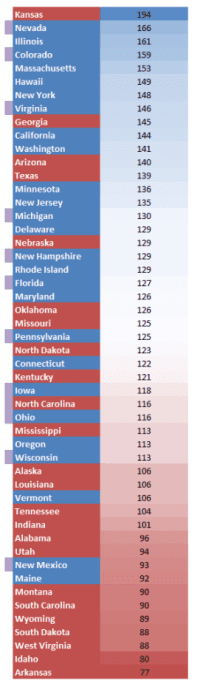
Last week, the third largest pornography website in the United States released data on its annual pageviews per capita by state. A chart of pageviews by state is shown at right.

pageviews
Annual pageviews per capita by state, Pornhub.com.

The chart as presented by the website is limited in its applicability, because relevant demographic variables are left uncontrolled for, but the conclusion nevertheless appears favorable for Mormons. Utah’s pageviews per capita in 2013 were 40th in the US. Idaho and Wyoming, the other states with large Mormon populations, are even lower on the list, at 49th and 46th respectively.

In order to find a more meaningful interpretation of the data that would adjust for possible confounding variables, I went to the trouble of gathering the most recent demographic data I could find for each state, so I could perform a controlled regression. I included variables for GDP per capita, internet penetration per capita, male/female ratio, age distribution, race and each state’s marriage rate.

Using ordinary linear regression methods, I generated a difference between a state’s actual views per capita and the views that would be predicted based on demographic variables. In this analysis, Utah’s deviation from the views predicted by demographics was 45th in the United States, while Wyoming was 46th and Idaho came 50th.

In other words, when controlling for other variables, there is an even stronger suggestion than before that Mormon populations do not have abnormally high rates of porn use (at least as represented by the website). We might even suggest that their rates of use are especially low.

I also decided to directly analyze the relationship between Mormonism and porn use (again, as measured by this particular metric). This is something the author of the 2009 study did not do. I included a variable for the percentage of a state’s population that is LDS, as measured by official LDS membership statistics and the most recent population projections based on census data.

The regression finds, roughly speaking, when controlling for the variables already mentioned, that a 10 percentage point increase in a state’s LDS population is associated with an approximate 16% decrease in the amount of porn consumption.

This result is highly significant, even at the 0.001 level. In fact, “percentage of Latter-day Saints in population” had a higher statistical significance than any other single variable I included in the regression (the next most significant variable was internet penetration). The proportion of overall explained variation in the regression is 66%, and a test for overall significance is highly conclusive, suggesting that the model as estimated is meaningful and significant.

Why do the results appear so different for these two sets of data? It’s almost impossible to know. The author of the 2009 study did not reveal the identity of the “top ten” porn vendor who gave him credit card data, and he admitted that there was no way to evaluate whether the users of that vendor were representative of the porn industry in general. His data, which was gathered from 2006 to 2008, also did not measure consumption, but rather paid subscriptions. A possible explanation of the discrepancy is that Utah’s porn use is skewed toward paid pornography.

In fairness, we cannot be sure that the website’s users are representative of the industry overall. However, in this case we are aware of the identity of the provider, which provides both paid and unpaid content.

Statistics tell stories, and the famous “Utah porn statistic” has told far more stories than it is worth. If critics of Mormon teachings on porn and sexuality would like to continue promoting the idea that a conservative sexual culture has backfired on itself, then they will have to confront a less convenient set of data.

Here is another narrative, that perhaps time and further analysis will prove: Mormons view less porn than others, and those conservative sexual teachings are working.

EDIT: In response to a request, I obtained recent Gallup data on religiosity by state, and added these variables to my regression, in order to separate the effects of religiosity in general and religious engagement by Mormons. The same general results persist: a 10 percentage point increase in a state’s LDS population is associated with an approximate 17% decrease in porn pageviews. The p-value is once again very low, at 0.002. In deviations from projections including religiosity, Utah is ranked 38th, Idaho 50th, and Wyoming 46th. The differences from the earlier analysis are small and require no changes to the conclusions I suggested above.

Technical notes: I used Stata to perform the regressions mentioned. Data were collected from government sources wherever possible. The results were consistent even when using logarithmic variables for pageviews and GDP. I learned the relevant statistical methods as part of the completion of the econometric portion of my Honours economics degree.

Filed Under: pornography Tagged With: law of chastity, Pornography

Poignant Bumper Sticker Memes

April 15, 2014 by Stephen Smoot

[This post was originally written by Allen Wyatt on his blog Ruminatio. It is reposted here with his permission.]

I enjoyed general conference earlier this month, and in fact wrote a good deal about it and the goings-on by other groups at conference time. One of those groups is Ordain Women, which sponsored an event designed to heighten awareness of those who would like to see women be ordained to the priesthood.

[Read more…] about Poignant Bumper Sticker Memes

Filed Under: Women Tagged With: Dallin H. Oaks, N. Eldon Tanner, Ordain Women, priesthood, women and the priesthood

Fair Issues 50: Book of Mormon DNA issue one of science, not theology

April 11, 2014 by Ned Scarisbrick

https://media.blubrry.com/mormonfaircast/www.fairlatterdaysaints.org/wp-content/uploads/2014/04/Fair-Issues-50-Pod.mp3

Podcast: Download (7.4MB)

Subscribe: RSS

Ash (newer) PictureLDS critics with training in genetics acknowledge that if a small group of Israelites came to the New World and intermixed with a larger Native American population, their DNA could have disappeared as well…the DNA issue is one of science.  The question as to who lived in the Americas in addition to Book of Mormon peoples is not one of doctrine or revelation, but is one of personal opinion based on research and evidence, including textual evidence from the Book of Mormon

The full text of this article can be found at Deseret News online.

Brother Ash is author of the book Shaken Faith Syndrome: Strengthening One’s Testimony in the Face of Criticism and Doubt, as well as the book, of Faith and Reason: 80 Evidences Supporting the Prophet Joseph Smith. Both books are available for purchase online through the FairMormon Bookstore.

Tell your friends about the Mormon Fair-Cast. Share a link on your Facebook page and help increase the popularity of the Mormon Fair-Cast by subscribing to this podcast in iTunes, and by rating it and writing a review.

The view and opinions expressed in the podcast may not reflect those of the Church of Jesus Christ of Latter-day Saints or that of FairMormon.


Filed Under: Anti-Mormon critics, Book of Mormon, DNA, Evidences, Faith Crisis, General, Hosts, Joseph Smith, LDS History, Mormon Voices, Ned Scarisbrick, Podcast, Science

4th Watch 14: True Doctrine

April 9, 2014 by Ned Scarisbrick

https://media.blubrry.com/mormonfaircast/www.fairlatterdaysaints.org/wp-content/uploads/2014/04/4th-Watch-14-Pod.mp3

Podcast: Download (19.2MB)

Subscribe: RSS

4thWatch SmallBrother Ned Scarisbrick and Nick Galieti discuss some of the core doctrines of the Church of Jesus Christ of Latter-day Saints and how we understand them from a general member perspective.

Future podcasts in this series will be geared toward the practical application of gospel principles based on truth and transparency of past and present Church teachings and leaders. Critics of the Church and those who have concerns about their faith may find this approach appealing from previous generations who may have had difficulty dealing with what some consider conflicting viewpoints of official Church doctrine.

The view and opinions expressed in this podcast may not represent those of the Church of Jesus Christ of Latter-day Saints or that of FairMormon.

Filed Under: Anti-Mormon critics, Apologetics, Bible, Doctrine, Evidences, Faith Crisis, General, Hosts, Interfaith Dialogue, Joseph Smith, LDS Culture, LDS History, Mormon Voices, Ned Scarisbrick, Podcast, Power of Testimony

Book Review: Mormon’s Codex: An Ancient American Book

April 6, 2014 by Trevor Holyoak

Title: Mormon’s Codex: An Ancient American BookMormon's Codex
Author: John L. Sorenson
Publisher: Deseret Book
Genre: Nonfiction
Year Published: 2013
Number of Pages: 826 pages
Binding: Hardcover
ISBN13: 978-1609073992
List Price: $59.99 (currently available from FairMormon bookstore for $50.99)

Reviewed by Trevor Holyoak

John L. Sorenson has been studying the relationship of the Book of Mormon to Mesoamerica for over 60 years. He received an MA in archaeology from BYU and a PhD in anthropology from UCLA. His best known book prior to this was “An Ancient American Setting for the Book of Mormon,” published in 1985.

“Mormon’s Codex” is the culmination of his studies. It begins with a Foreword by Terryl Givens and then has three main sections followed by an appendix. At the center of the book are colorful maps and photographs of places and artifacts. There are also black and white photos interspersed throughout the text.

Part 1 is called “Orientation.” It introduces the Book of Mormon and its orgins and tells us about problems with archaeology. One way archaeologists have been able to base the Bible in reality is through finding convergences where the text agrees with archaeological findings. This book investigates the same type of convergences between the Book of Mormon and Mesoamerica. This is not easy, because “only a fraction of the material that was left behind by ancient peoples has been preserved and is waiting to be found” (page 11). There is also the problem that only a fraction of what has been discovered has been excavated, and only a fraction of the items found have been studied and published. In spite of this, there is a tendency among archaeologists to “speak as if their data were complete and their inferences were facts” (page 12).

Sorenson lists key places from the Book of Mormon text and then places them on the map. He has found that a limited Mesoamerican geography is the best fit, specifically around Guatemala. He has gone as far as to identify plausible locations for many places, such as the narrow neck of land, the east and west seas, the river Sidon, the city of Nephi, and the final Nephite and Jaredite battleground (this is the only Jaredite place that he is very certain about). He concludes that the text of the Book of Mormon fits this area so well that it only could have been produced by people living in that place and time.

The histories of the Jaredites and Nephites are laid out, followed by a parallel history of Mesoamerica. It is also pointed out that there is a limited amount of history to go on from the Book of Mormon (three centuries are covered in a mere four pages, for instance).

Part 2 covers “Correspondences by Topic.” It first lays out geographical correspondences, such as distances and characteristics of the land. This is where a possible site for Jerusalem is first mentioned, a submerged city called Samabaj that was discovered recently in Lake Atitlan.

Evidence for transoceanic voyages is laid out, with a list of some of the plants that have been found in both hemispheres. This is followed by a similar list of diseases, as well as a discussion of languages, records, and writing systems. Also covered are human biology, political economy, society, population and distribution, material culture, government and political processes, warfare, knowledge systems, and ideology and religion.

Part 3 has “Correspondences from Archaeology and History.” I found this part to be the most interesting. It is split up into four time periods: before 600 BC, between 600 and 1 BC, between AD 1 and 200, and between AD 200 and 400. One of the things discussed is the apparent absence of fortifications, since they are a common part of the war chapters. There have actually been more found than is commonly recognized. Sorenson has tabulated 75 named sites that date before AD 400. (It hasn’t been published because the project kept expanding.) He tells how it took generations of work at Tikal before they realized an embankment was actually a wall. It took over 30 years to trace the miles of wall found, and it may not yet be fully revealed.

A possible location for Bountiful has been identified, based on geography, but it has not yet been studied, so Sorenson still considers such correspondence to be premature. However, Santa Rosa is a good candidate for Zarahemla, all the way down to evidence of destruction from the right time period preceding Christ’s visit in 3rd Nephi. In fact, corresponding evidence such as volcanic ash has been found in the same time period in many places in the area. This also includes the city of Jerusalem being covered with water as mentioned previously. In addition, there is evidence of significant cultural and religious
upheaval at that time which corresponds with the Book of Mormon text.

Sorenson explains how the codex (the plates) may have been transported to New York from Mesoamerica by relating the story of English sailors who trekked 3,000 miles from Mexico to Nova Scotia in 1589 over a period of nine months. And near the end of the 20th century, an adventurer named David Ingram walked 4,000 miles from Maine to Tampico in 11 months.

In the appendix, Sorenson explains how he has modified his views of the Jaredites since the publication of “An Ancient American Setting for the Book of Mormon.” He now sets them in Veracruz, with the three main lands in Jalapa, Cordoba, and Tuxtepec. And he has changed his mind to an Atlantic Ocean crossing instead of the North Pacific. However, he notes that all this still remains tentative.

I would have preferred if the book were laid out a bit differently – he tends to explain Book of Mormon history and Mesoamerican history separately and then gives a summary conclusion. He explains that “to recapitulate detailed parallels would be tedious; an alert reader can identify further general and specific correspondences” (page 665). While this may be the case, I believe it would better suit the purpose of the book to combine the parallel information, pointing out correspondences in more detail as it goes. On the other hand, I appreciate that in places where the evidence is weak or still lacking, he is quick to point it out.

This book is a treasure trove of information about New World archaeology and how it may relate to the Book of Mormon. It probably won’t convince critics (although it will be harder for them to say there is no evidence), but as a believer in the Book of Mormon as scripture and as real history, it helped me better visualize the events and people it contains. I highly recommend it to anyone interested in physical evidence for the Book of Mormon and placing it on the map.

Filed Under: Apologetics, Book of Mormon, Book reviews, Evidences, Geography, Science

Mormon Fair-Cast 215: The First Vision

March 31, 2014 by Ned Scarisbrick

https://media.blubrry.com/mormonfaircast/www.fairlatterdaysaints.org/wp-content/uploads/2014/03/MHG-Number7-FirstVision.mp3

Podcast: Download (49.1MB)

Subscribe: RSS

RussellStevensonIt is the foundational event of Mormonism–or at least that is what it became. Beginning in 1832, Joseph Smith began to publicly talk about a visionary experience he had in a grove of trees nearby his home in upstate New York. However, what he told audiences differed from year-to-year in what feels to be substantial detail. Is this evidence of rank fraud? Or, as his supporters say, does it indicate the natural human tendency to emphasize/omit details of a story based on one’s audience or perhaps his own changing understanding of the importance of certain theological principles. Brittany Nielson and I speak with LDS Church Historian Dr. Stephen Harper about his book, Joseph Smith’s First Vision: A Guide to the Historical Accounts.  Harper currently works on the Joseph Smith Papers Project production team for the LDS Church.

This podcast interview was provided courtesy of Russell Stevenson.

Russell Stevenson is the “Mormon History Guy” and the views expressed are his own may not reflect those of the Church of Jesus Christ of Latter-day Saints or that of FairMormon.

Filed Under: Anti-Mormon critics, Apologetics, Book reviews, Doctrine, Evidences, Faith Crisis, First Vision, General, Hosts, Joseph Smith, Mormon Voices, Ned Scarisbrick, Podcast, Power of Testimony

Fair Issues 49: More Limitations in Book of Mormon DNA study

March 28, 2014 by Ned Scarisbrick

https://media.blubrry.com/mormonfaircast/www.fairlatterdaysaints.org/wp-content/uploads/2014/03/Fair-Issues-49-Pod.mp3

Podcast: Download (7.5MB)

Subscribe: RSS

Ash (newer) PictureIn this podcast brother Ash explains how DNA studies are inconclusive to establish a direct link between Book of Mormon peoples and there ancestry because of the “molecular clock” of mtDNA and the Y chromosome Cohen marker.

The full text of this article can be found at Deseret News online.

Brother Ash is author of the book Shaken Faith Syndrome: Strengthening One’s Testimony in the Face of Criticism and Doubt, as well as the book, of Faith and Reason: 80 Evidences Supporting the Prophet Joseph Smith. Both books are available for purchase online through the FairMormon Bookstore.

Tell your friends about the Mormon Fair-Cast. Share a link on your Facebook page and help increase the popularity of the Mormon Fair-Cast by subscribing to this podcast in iTunes, and by rating it and writing a review.

The view and opinions expressed in the podcast may not reflect those of the Church of Jesus Christ of Latter-day Saints or that of FairMormon.

Filed Under: Anti-Mormon critics, Apologetics, Book of Mormon, DNA, Evidences, Faith Crisis, General, Hosts, Joseph Smith, Mormon Voices, Ned Scarisbrick, Podcast, Power of Testimony, Science

These Are Our Sisters

March 26, 2014 by RNicholson

Just stop it

By Cal Robinson and Juliann Reynolds

The internet is buzzing in response to the March 17th news release written by Jessica Moody of Public Affairs to the leaders of Ordain Women (OW) on “behalf of the Church of Jesus Christ of Latter-day Saints”:
Women in the Church, by a very large majority, do not share your advocacy for priesthood ordination for women and consider that position to be extreme. Declaring such an objective to be non-negotiable, as you have done, actually detracts from the helpful discussions that Church leaders have held as they seek to listen to the thoughts, concerns, and hopes of women inside and outside of Church leadership. Ordination of women to the priesthood is a matter of doctrine that is contrary to the Lord’s revealed organization for His Church.
The point here is not to reiterate the Church’s position. It is made very clear in the statement above. Rather, the purpose is to address how best to help members have a more respectful dialogue. A recent Trib Talk provides an excellent discussion by three dynamic women with differing viewpoints. Jennifer Napier-Pearce questioned Kate Kelly (the spokesperson for Ordain Women [1]), Neylan McBaine (editor of the Mormon Women Project [2]), and Julie Smith (blogger on Times and Season [3]).

McBaine and Smith take issue with the need for priesthood ordination and the methods being used by Ordain Women to achieve it. However, all three women look forward to more inclusion and recognition of women, echoing a sentiment of President Linda K. Burton of the General Relief Society that the church would benefit as “men’s vision of the capacity of women becomes more complete.” [4] But most striking was that all three were in complete agreement that the insults and ridicule directed at OW and its members from some of those defending the Church is “horrific.” [5]

Rather than engaging in a respectful and compassionate discussion of what is obviously an extremely divisive topic, many participants have responded with derogatory and dismissive remarks.  Often we are unaware of how our comments are viewed by others. By always responding with kindness in our disagreement, we will be better able to create a safe space for all, without pushing those who feel marginalized to the more extreme positions.  President Uchtdorf explains, “[W]hen it comes to our own prejudices and grievances, we too often justify our anger as righteous and our judgment as reliable and exclusively appropriate. Though we cannot look into another’s heart, we assume that we know a bad motive or even a bad person when we see one. We make exceptions when it comes to our own bitterness because we feel that, in our case, we have all the information we need to hold someone else in contempt.” [6]
Of equal concern are those well-intentioned counter arguments to women’s ordination that not only diminish women in general, but the priesthood itself.  Any defense that involves a refusal of the priesthood as if it was just one more thing to add to an already full schedule is no defense. Likewise, declaring that its primary purpose is to force men to be responsible is not consistent with statements by church leaders that describe the role of the Priesthood with utmost reverence. For example, Elder John H. Groberg said in the April 2001 Priesthood Session, “I hope we appreciate the priceless privilege of holding the priesthood of God. Its value is unfathomable. ” [7] Comparing the authority and power of God to everyday tasks in an effort to convince women they shouldn’t want the priesthood certainly does not elevate or show respect for such a priceless privilege.

Actual comments found on blogs and message boards, such as those shown below, provide examples of what not to say when discussing the priesthood:

1.  Questioning or dismissing women’s worthiness or faithfulness.

“[H]ow tainted by the “philosophies of men” have some women become.”
“These are not faithful women in our church! If so, you would not be questioning The Lord.”

2.  Questioning women’s motives.

“If I trusted that these agitating sisters were approaching things out of sincere and pure motives, I’d be the first to  sympathize…I see no indication that they are seeking it, wanting it, or even expecting it. They really are living beneath their privileges.”
“Why would women want the priesthood other than mortal pride or self satisfaction?”

3.  Questioning women’s knowledge or understanding.

“What I believe is happening is a group of uninformed women are fighting for something that they don’t even understand completely…They do not even understand what they are asking for!”
“I think that women who are seeking for the Priesthood, do not fully understand the nature of men, and how the Priesthood helps them.”

4.  Discounting men and/or the priesthood.

“[W]hy do you want the priesthood?…I feel like I have enough responsibilities in the church already. And I have never felt oppressed in those responsibilities.”
“Honestly, what earthly need would we have for men if the women should be ordained? Why would a father need to bless his children with the priesthood? Why have men run the organization of the church?”

5. Misrepresenting and mischaracterizing.

“Giving women the priesthood outside of their connection to the priesthood through their husbands would be the same as removing men altogether from the plan of salvation. At least it would be equivalent to removing women’s role as child bearers and nurturers.”
“If women received the priesthood, relief society would need to be disbanded and all would be in the elder’s quorum.”

6. Inviting them to leave the church.

“If these women are so unhappy there are plenty of other churches out there that [might] be more in line with [their] views about ordaining women into the priesthood…why would a person want to worship in a church they don’t agree with? Other than to advance some modern feminist agenda.”
“May I suggest that it would be a simple thing to find a church who ordains women to the priesthood?”

 7. Calling out Satan to finish the job.

“I have seen many parallels to anti-Christs in the Book of Mormon. That does not mean that I am judging all of these individuals as anti-Christ; but, they indeed appear to be pawns in Lucifer’s hands.”

These are only a few examples of common sentiments and may leave some wondering what would be a better response. Church leadership has provided a number of examples of Christlike approaches, particularly that of Ruth M. Todd (Church Public Affairs) in her interaction with OW last October as they attempted to gain admission to the Priesthood session of General Conference. [8]

First, Sister Todd was clear in stating the Church’s position. She said, “This meeting is all about strengthening the men of our church, so this is no surprise to you, that we won’t be able to offer you a ticket or a place to see it…Millions of women in this church do not share the views of this small group that has come and organized this
protest today…And some of the members feel this is very divisive as well.”

Sister Todd then reached out with charity, saying, “Even so, these are our sisters, and we want them in our church. And we hope they find the peace and joy we all seek in the gospel of Jesus Christ.” She spoke directly with everyone she could, going down the line and taking them by the hand. She engaged them as individuals rather than as opponents or outsiders with the assurance, “I am so happy to know you…”

Why does the way we speak to each other matter? The gospel is supposed to be a refuge for all. It welcomes all, and so must we as church members. A quick look at the Mormon Women Project website or the member profiles on mormon.org shows the dazzling array of cultures, opinions and personalities that have found a haven in the church. It’s completely acceptable to voice disagreement with OW’s purpose; what is not acceptable is to deny these women, our sisters in the church, the same attempt at love and reconciliation that we would extend to others whose viewpoints are more in line with our own.
If Neylan McBaine, Julie Smith, and Kate Kelly can have a heartfelt discussion despite their fundamental disagreement over the ordination of women, so can we. For those of us who reject the belief that ordination is a necessary step in spiritual progression for women and for the church, and as we support our leaders, we should remember President Uchtdorf’s counsel against contributing to a soul-breaking rift in our Church family when he said, “If you are tempted to give up: Stay yet a little longer. There is room for you here.” [9]

We can share his message not only those who have left the faith, but also with members who may wonder if they are even still welcome.  We can stop the rejection, insults, and condemnation and make a place on the pew for all who want to follow Christ.

Note: “This topic of judging others could actually be taught in a two-word sermon. When it comes to hating, gossiping, ignoring, ridiculing, holding grudges, or wanting to cause harm, please apply the following:

Stop it!

It’s that simple. We simply have to stop judging others and replace judgmental thoughts and feelings with a heart full of love for God and His children. God is our Father. We are His children. We are all brothers and sisters. I don’t know exactly how to articulate this point of not judging others with sufficient eloquence, passion, and persuasion to make it stick. I can quote scripture, I can try to expound doctrine, and I will even quote a bumper sticker I recently saw. It was attached to the back of a car whose driver appeared to be a little rough around the edges, but the words on the sticker taught an insightful lesson. It read, ‘Don’t judge me because I sin differently than you.’”   “The Merciful Obtain Mercy”, President Dieter F. Uchtdorf, Second Counselor of the First Presidency, April 2012 General Conference, https://www.lds.org/…-mercy?lang=eng

Footnotes

1: http://ordainwomen.org/ Kate Kelly is also an international human rights attorney.  Kelly has stated that the goal of OrdainWomen is “[t]o improve the situation of women in the church and to achieve fundamental equality. . . we want to not only be consulted about decisions but we want to be part of the decision making  process. We want to bless the lives of others and we want to be transformed by what we know is the power of God.”  She adds, “We believe in the priesthood and we believe it is the power of God. Otherwise, none of this would be worth it.” See http://www.sltrib.co…church.html.csp

2: http://www.mormonwomen.com/ Neylan McBaine works for Bonneville Communications as a brand strategist, including on the “I am a Mormon” project. McBaine states her stance on women’s roles in the Church as “There are many things that we could be and should be doing in the church to increase the way we see, hear, and use women in our local administration and the general administration.  I think where we diverge is the root cause of the problem…I don’t believe that the doctrine of the priesthood is the root cause of that.” See http://www.sltrib.co…church.html.csp

3: http://www.timesands…JulieIntro.html Julie M. Smith is also the author of the book Search, Ponder, and Pray: A Guide to the Gospels.  Smith sees the core of the contention to be “[t]he methods OW uses [which] are alienating to a lot of people, I think they provoke a backlash and I think they are fundamentally foreign to Mormonism.” See http://www.sltrib.co…church.html.csp

4:   http://www.nytimes.c…tw-nytimes&_r=2

5: Julie M. Smith:  “I have to say I find it largely disheartening, while I don’t support OW, a lot of the response has been horrible.  I have heard comments about being burned at the stake and vitriol along those lines.”

Neylan McBaine:  “The response has been horrific. One of the things I hope that we are modeling here, and what I have tried to do throughout my entire time in this conversation, is model the Christlike respectful conversation that makes our points very clear but also is understanding and respectful of the other point of view.  So I would just add my plea to all of us to bridge the conversations that are happening online with what we know is right and with what we are enacting in our Sunday experiences.”

6: “The Merciful Obtain Mercy”, President Dieter F. Uchtdorf, Second Counselor of the First Presidency, April 2012 General Conference, https://www.lds.org/…-mercy?lang=eng

7: “Priesthood Power”, Elder John H. Groberg, April 2001 General Conference, https://www.lds.org/general-conference/sessions/2001/04?lang=eng

8:  Ruth Todd’s comments were reported in numerous articles and videos.  In our opinion, the fullest treatment with all the included quotes is available in the video at: http://fox13now.com/…for-that-right/

9:  “Come, Join with Us”, President Dieter F. Uchtdorf, October 2013 General Conference, https://www.lds.org/…ith-us?lang=eng


Filed Under: Women

  • « Go to Previous Page
  • Page 1
  • Interim pages omitted …
  • Page 161
  • Page 162
  • Page 163
  • Page 164
  • Page 165
  • Interim pages omitted …
  • Page 220
  • Go to Next Page »

Primary Sidebar

Faithful Study Resources for Come, Follow Me

Subscribe to Blog

Enter your email address:

Subscribe to Podcast

Podcast icon
Subscribe to podcast in iTunes
Subscribe to podcast elsewhere
Listen with FAIR app
Android app on Google Play Download on the App Store

Pages

  • Blog Guidelines

FAIR Latest

  • Come, Follow Me with FAIR – Isaiah 50–57 – Part 2 – Autumn Dickson
  • Come, Follow Me with FAIR – Isaiah 50–57 – Jennifer Roach Lees
  • Come, Follow Me with FAIR – Isaiah 50–57 – Part 1 – Autumn Dickson
  • Prayers for Peace
  • Come, Follow Me with FAIR – Isaiah 40–49 – Part 2 – Autumn Dickson

Blog Categories

Recent Comments

  • Willie Louise Truitt on The Joy of a Covenant Relationship with God
  • Katrina on In memory of Chandler “Chuck” Hendry
  • Nancy Farmer on Come, Follow Me with FAIR – Psalms 49–51; 61–66; 69–72; 77–78; 85–86 – Part 1 – Autumn Dickson
  • Nicko De Leon on In memory of Chandler “Chuck” Hendry
  • Becky Matson on In memory of Chandler “Chuck” Hendry

Archives

Follow Us

  • Facebook
  • Twitter
  • iTunes
  • YouTube
Android app on Google Play Download on the App Store

Footer

FairMormon Logo

FAIR is a non-profit organization dedicated to providing well-documented answers to criticisms of the doctrine, practice, and history of The Church of Jesus Christ of Latter-day Saints.

Donate to FAIR

We are a volunteer organization. We invite you to give back.

Donate Now

Site Footer

The use of the temple in past and current logos and the name "Mormon" are licensed for use by The Church of Jesus Christ of Latter-day Saints.