I recently listened to a podcast by John Dehlin where he interviewed Richard Packham. According to John’s write-up of the podcast, part of his purpose is to “explore 3 ways in which the LDS Church creates unnecessary enemies.” The second episode focuses on how the Church makes by “breaking up families (when one no longer believes).” It is this particular point of John’s (and many who are critical of the Church) that I wanted to comment upon, although I will also provide a few comments on the podcast episodes with Richard as a whole.
[Read more…] about The Church Breaks Up Families
Blog
Land of Promise in The Book of Mormon
A popular argument among Great Lake theorists, is the Promised Land theory. The Book of Mormon states several times that the land which they were led to, was the “promised land”, or a “choice land”. According to The Book of Mormon, the Promised Land shall be a land of liberty, with no kings upon the land [1], and be discovered by a Gentile whom the Spirit of God wrought, to cross “many waters” [2] in order to find, among many others.
The “Gentile” who discovered the Americas is generally thought to be Christopher Columbus. In the 1879 Book of Mormon, Orson Pratt added the footnote to 1 Nephi 13:12 which named this “gentile” as Christopher Columbus. Columbus began writing a book called “Book of Prophecies” and in this book
“set forth views on himself as the fulfiller of biblical prophecies! Columbus saw himself as fulfilling the ‘islands of the sea’ passages from Isaiah and another group of verses concerning the conversion of the heathen. Watts reports that Columbus was preoccupied with ‘the final conversion of all races on the eve of the end of the world,’ paying particular attention to John 10:16: ‘And other sheep I have, which are not of this fold’ (see also 3 Nephi 16:3). He took his mission of spreading the gospel of Christ seriously. ‘made me the messenger of the new heaven and the new earth. . . . He showed me the spot where to find it,’ Columbus wrote in 1500.” [3]
As the scripture says, the Spirit led the gentile to the Promised land, the Spirit also led Columbus to the Americas.
Weather in relation to Book of Mormon geography
Snow is only mentioned once in The Book of Mormon, and that is only when the Lehites were still in the Old World 1. This is very indicative of where The Book of Mormon took place. If they lived in an area that was cold, such as the area around the Great Lakes, surely the bitter winters known in that area would have been mentioned. Other than the one reference , there is no mention of snow at all where the primary events of The Book of Mormon took place. John Lund states “The pilgrims of Plymouth, Massachusetts in 1620 often referenced the cold and the snow. If the major events of The Book of Mormon all happened around the New York Hill Cumorah, one would expect to hear about snow.” 2
However, the cold is not what we hear about. Instead, we hear phrases like “heat of the day” 3, without any indication of a cold climate one would expect to see if The Book of Mormon took place in the North Eastern United States. The Lehites came from the Middle East, travelled years through the vast Saudi Arabian deserts, and then we only hear about the heat of the new land. If it were a new, colder climate, it would most certainly be mentioned.
There are several events in The Book of Mormon that just could not have happened in the Great Lakes region. In Alma14, Alma and Amulek were stripped naked and suffered “many days” 4. It has been stated that Amulek set the date as the ‘fourth day of the seventh month’ 5. The 7th month and the 4th day on a lunar calendar of twenty-nine or thirty days per month would be around September 27th. The day they were delivered from prison was ‘on the twelfth day of the tenth month’ 6. This would have been approximately ninety-six days later. This date corresponds to around the first week of January. The minimum amount of time they would have spent in that condition would have been five days 7. The average temperature in Hamilton, Ontario, Canada, the area where some place Zarahemla which is by the Genesee and Niagra rivers, two rivers some interpret to be the river Sidon, has an average temperature of 31 degrees F during the day, with a nighttime average of 19 degrees F. This is hardly an area that would sustain life for someone cast into a cold prison without any clothing or blankets for “many days”. However, the average temperature in the Mesoamerican lowlands is in the mid-sixties. This temperature would make it much more plausible for someone to survive in extreme conditions. 8
Also, the clothing mentioned in The Book of Mormon is not consistent with the climate of North America. To the contrary, we read about them wearing “loincloths”, “leathern girdles”, etc… This kind of clothing would not be conducive to the cold climate of the Great Lakes region. The Lamanites would not have survived, or even thought about wearing a loincloth in battle, in an area that is known for it’s freezing winters, and copious amounts of snow. Enos describes the Lamanites as “wandering about the wilderness with a short girdle about their loins.” 9 Zeniff portrayed the Lamanites as having “their heads shaved and they were naked; and they were girded with a leathern girdle about their loins.”10 Alma said the Amlicites “had not shorn their heads like unto the Lamanites. Now the heads of the Lamanites were shorn; and they were naked, save it were skin which was girded about their loins.” 11. Zarahemnahs army is described as being “naked, save it were a skin which was girded about their loins, yea all were naked save it were the Zoramites and the Amalekites.” 12
Because of this “nakedness”, the Lamanites were exposed and had a higher death rate than the Nephites 13. Moroni said this of speaking about the Nephites:
“Behold, their naked skins and their bare heads were exposed to the sharp swords of the Nephites.” 14
Giddianhi, the leader of the Gadianton robbers, and his army wore “…lamb-skin about their loins, and they were dyed in blood, and their heads were shorn…” 15
These wars were not seasonal, but sometimes lasted for years as one continuous war 16. In one particular war, the Lamanites came to war in the sixth month 17, in the commencement of the year 18, and at the end of the year 19. In the “second month”, the fathers of the stripling warriors brought them provisions 20 before a commencement of a battle in the “seventh month” 21.
The only mention of heavier clothing is as a form of armor in battle. Alma calls this “thick clothing” 22, and “very thick garments” 23. However, this is not common clothing worn by the Nephites and Lamanites, and is only mentioned in context of warfare as a protection. This may seem out of place in a warm climate, but “thick clothing” was used as a type of armor among the Mayan 24, and matches The Book of Mormons definition.
1. 1 Nephi 11:8 , “It should be noted too that many Old Testament scriptures which pre-date the Lehi colony’s departure also use the term “snow,” (the Hebrew word sheleg appears 20 times in our Old Testament” This means it is not surprising that Lehi and Nephi (who knew Israelite scripture well) would use the term.” http://en.fairmormon.org/Book_of_Mormon_anachronisms/Snow accessed May 20, 2009)
2. John L. Lund, Mesoamerica and The Book of Mormon: Is This the Place?, (The Communication Company 2007) pg 205
3. Alma 51:33
4. Alma 14:21,23
5. Alma 10:6
6. Alma 14:23
7. Alma 14:18, 20, 23-28
8. John L. Lund, Mesoamerica and The Book of Mormon: Is This the Place?, (The Communication Company 2007), pg 207
9. Enos 1:20
10. Mosiah 10:8
11. Alma 3:4-5
12. Alma 43:20
13. Alma 43:37
14. Alma 44:18
15. 3 Nephi 4:7
16. Alma 51-62
17. 3 Nephi 4:7, September according to the Hebrew calendar
18. 3 Nephi 2:17 April according to the Hebrew calendar
19. 3 Nephi 4:1; 3 Nephi 2:17; Alma 56:20; March, according to the Hebrew calendar
20. Alma 56:27
21. Alma 56:42
22. Alma 43:19
23. Alma 49:6
24. William J. Hamblin, “Armor in the Book of Mormon”, p. 413; in Warfare in the Book of Mormon, edited by Stephen D. Ricks & William J. Hamblin, (Provo, Utah: Deseret Book Co. and FARMS, 1990); This article can be read online at: http://www.farmsresearch.com/publications/books/?bookid=66&chapid=738 accessed 5/25/09
Gospel Principles Chapter 16: The Church of Jesus Christ in Former Times
Chapter 16 discusses the church set up by Jesus both in the New Testament and the Book of Mormon, and the apostasy that followed. Here are some related resources:
How does one respond to the statement: “Churches don’t save; Jesus saves”?
What does the Bible teach about priesthood in the Church of Jesus Christ?
Christians don’t need a mediating priesthood?
Gospel Principles Chapter 15: The Lord’s Covenant People
The only attacks I could think of that we receive from anti-Mormons on the material covered by chapter 15 have to do with the temple.
Important note: Members of FAIR take their temple covenants seriously. We consider the temple teachings to be sacred, and will not discuss their specifics in a public forum.
Here are the resources available from FAIR that I thought were most relevant:
Feel free to leave a comment about anything else that might come up that is related to this chapter.
2010 FAIR Conference Review
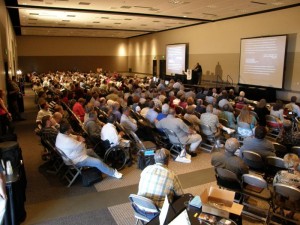
We had another great conference this year, with 350 people attending in person, and about 50 listening online. We were treated to 15 presentations and also had the opportunity to socialize, browse the bookstore, and bid in a silent auction. Tanya Spackman received the John Taylor Defender of the Faith award for her work on Mormon Scholars Testify. You can view photos of the conference at the FAIR Facebook page.
William Schryver’s presentation on the Kirtland Egyptian Papers received some press before the conference, and did not disappoint. You can view it here. (A browser plug-in may be required.)
There have been articles about many of the presentations published in Mormon Times, Deseret News, and LDS Church News:
- FAIR conference: Same-sex marriage and the role of religion
- FAIR conference: Secret Mormon codes and Egyptian papers
- FAIR conference: LDS doctrine clear on divinity of one God
- FAIR conference: ‘Gender equality is the brick of Zion,’ speaker says
- FAIR conference: What if the U.S. president were a Mormon?
- FAIR conference: Joseph Smith’s discovery of ancient patterns
- FAIR Conference: Roper’s take on Book of Mormon geography
- Mormons need to work to increase favor
- FAIR conference: Defend the Book of Mormon by studying names, origins
- Nibley editor says scholar was bolstered by research
- ‘Be Ready’ to Defend Faith
Transcripts will be posted at http://www.fairlds.org when they are ready. MP3s and DVDs will be made available for purchase at the FAIR bookstore.
2010 FAIR Conference Internet Streaming
The 2010 FAIR Conference is only a few days away. We have many interesting topics lined up (for a preview of one, see this Deseret News article). However, I have seen many comments in various places online from people who do not live anywhere near Salt Lake City and are not interested in traveling, but otherwise might have attended.
As it turns out, we have a solution for people in just such a situation. We will be providing online streaming of the conference, so you can listen to it anywhere that you have a computer and an Internet connection – it may even work on your iPhone or Android phone, although we have had limited success in testing (please have a computer available to use as a backup in case it doesn’t work for you).
This service will cost $15 for both days combined. We will be providing audio, and if all goes well there may also be some video and/or slideshows available. You can order the service at http://bookstore.fairlds.org/product.php?id_product=1085
Instructions regarding access and feedback will be emailed to all participants shortly before the conference begins. A high-speed Internet connection and PC or Mac are recommended.
Urban legends among the Mormons: No one is immune
Urban legends have always existed. The Internet has multiplied and accelerated them, but human beings have always been susceptible to falling for the oft-told tale that’s too fantastic not to believe.
Among the Saints we have our regulars: The Three Nephites picked up as hitch-hikers. Comedian and actor Steven Martin seen wearing a CTR ring. A prophecy of the Restoration by an 18th-century Catholic priest.
Perhaps the best-known of these has the imprimatur of a modern apostle: The idea that Cain, son of Adam and Eve and the first murderer, still walks the earth today. [Read more…] about Urban legends among the Mormons: No one is immune
FAIR blog and politics
The FAIR blog is an occasional blog staffed by volunteers. Posts are typically driven by current events in Mormon apologetics and culture.
Sometimes Mormonism intersects with politics. During these times, the FAIR board and management wish to be sensitive to the political feelings of all Latter-day Saints. We expect posts to reflect even-handedness and a direct application to defending the Church.
This is not the place to discuss controversial political events that have only a marginal tie to Mormon culture and The Church of Jesus Christ of Latter-day Saints. There are other blogs that cater to that need.
With that in mind, FAIR managers have removed a recent post on the Arizona immigration law. We apologize to anyone who felt that post was not in keeping with the highest standards of FAIR, and commit to elevating the level of discourse here.
Gospel Principles Chapter 14: Priesthood Organization
Once again, this week’s lesson on Priesthood Organization is basically another look at last week’s topic in more detail. Since links have already been given to the resources FAIR has on the priesthood, I thought it might be helpful to provide links to a couple of items from sources other than FAIR.
At the priesthood session of the most recent General Conference, Elder Dallin H. Oaks gave a very practical talk on Healing the Sick that I believe is worth reading by everyone.
And in 1996, the Journal of Mormon History published an interesting article by William G. Hartley about the historical development of the duties of the Aaronic priesthood: From Men to Boys: LDS Aaronic Priesthood Offices, 1829-1996.