• Skip to primary navigation
  • Skip to main content
  • Skip to primary sidebar
  • Skip to footer

FAIR

  • Start Here
  • Find Answers
  • Scripture Study
  • Blog
  • Events
    • FAIR Conference
    • Virtual Conferences
    • Special Events
  • FAIR Books
  • About
    • Media & Apps
  • Get Involved
  • Search

archaeology

Matthew Roper

Book of Mormon Scholar · Historian · Researcher

Matthew Roper, Book of Mormon scholar and longtime FAIR contributor

Matthew Roper is a Book of Mormon scholar and historian whose research focuses on the historical setting, interpretation, and reception of the Book of Mormon. His work has addressed questions of Book of Mormon geography, warfare, material culture, authorship, and the historical interpretation of Latter-day Saint scripture.

Roper earned a BA in history and an MA in sociology from Brigham Young University. He has been associated with Book of Mormon research at BYU’s Neal A. Maxwell Institute for Religious Scholarship and the Laura F. Willes Center for Book of Mormon Studies.

His scholarship has explored subjects including Lehite social structure, pre-Columbian populations, Mesoamerican weapons and warfare, Book of Mormon geography, ancient names and cultural practices, and the relationship between archaeological evidence and claims about the Book of Mormon. He has also researched historical approaches to Book of Mormon geography and the ways early Latter-day Saints—including Joseph Smith and his contemporaries—understood the book’s ancient setting.

Roper compiled the Harold B. Lee Library’s electronic collection of nineteenth-century publications about the Book of Mormon from 1829 to 1844. His research has also examined questions of Book of Mormon authorship, historical and contemporary interpretations of the text, and the intellectual history of Latter-day Saint scripture.

A longtime contributor to FAIR, Roper has presented at FAIR conferences on Book of Mormon evidence, archaeology, geography, ancient populations, and warfare. His work combines close attention to the Book of Mormon text with historical and comparative research into the ancient cultures and settings that may illuminate it.

Bio last reviewed:

Contributions at FAIR

Statement of Faith

I grew up in a Latter-day Saint home in southern California, where at an early age with the help of kind parents I cultivated love for Jesus Christ and for the Scriptures. I read the Bible as a child and through prayer I came to an understanding of God as a loving Heavenly Father, whom I could trust and go to in times and fear and difficulty and find peace. I felt then and I am now certain that God heard me and comforted me. Those early experiences were a touchstone against which I have subsequently measured experiences. My faith in God has provided meaning and direction to me life. My faith, or what I today call my testimony, did not arise from any one experience alone, but has grown out of and been nurtured by a series of personally significant “recognitions” or “realizations” of that same influence in my life which early in my life brought me joy and peace. These have brought me greater understanding and thereby strengthened my faith in Jesus Christ. One of these came to me when I first read the Book of Mormon through and asked God if it was true. While spending two years serving as a missionary in Argentina, I found among my most joyous experiences were those instances when others were able to recognize that same divine influence for themselves.

I have subsequently studied the life of the Prophet Joseph Smith and the history of the Church of Jesus Christ all of my adult life. As I have done so I have developed a deep appreciation for what Joseph did and what it cost him and those who followed him. I believe he was a mighty Prophet of God. I do not believe he was perfect person, but I am confident that he was what exactly what he claimed to be. More than Joseph, I am profoundly impressed by the revelations he brought forth, including especially the Book of Mormon. Joseph Smith’s account of its remarkable origin is, in my view, much more plausible and consonant with the historical data than any of the several counter-explanations that have been offered by his critics. On an intellectual level I cannot explain it away. On another and more fundamental level, Joseph Smith’s story simply rings true to me.

I have made and continue to make the Book of Mormon an object of lifelong study and have found this to be tremendously fulfilling. It has been a useful guide to me in my life and has given me comfort in challenging times. Its teachings, when followed, have always brought me hope and light. I have found the Lord’s promise true that those who genuinely “believeth these things which I have spoken, him will I visit with the manifestations of my Spirit, and he shall know and bear record. For because of my Spirit he shall know that these things are true; for it persuadeth men to do good” (Ether 4:11).


June 2011

Kerry Muhlestein

Egyptologist · Ancient Scripture Scholar · Author

Kerry Muhlestein, Egyptologist and professor of ancient scripture at Brigham Young University

Kerry Muhlestein is a professor of ancient scripture and ancient Near Eastern studies at Brigham Young University and director of the BYU Egypt Excavation Project. An Egyptologist and scholar of the ancient Near East, his research and writing explore ancient Egypt, the Hebrew Bible and Old Testament, covenant theology, and the Book of Abraham.

Muhlestein earned a BS in psychology with a Hebrew minor and an MA in ancient Near Eastern studies from Brigham Young University, followed by a PhD in Egyptology from UCLA. His first full-time academic appointment was a joint position in religion and history at BYU–Hawaii. He later joined the faculty at BYU and has directed its Egypt excavation project since 2011.

His scholarly work includes extensive research on Egyptological subjects and the Book of Abraham. He has also written for Latter-day Saint audiences on the Old Testament, Isaiah, ancient covenants, the gathering of Israel, and Joseph Smith’s First Vision. His books include Let’s Talk about the Book of Abraham, Learning to Love Isaiah, God Will Prevail, and The Essential Old Testament Companion.

Muhlestein has served in professional Egyptological organizations and was a visiting fellow at the University of Oxford during the 2016–17 academic year. He has taught in Jerusalem on multiple occasions and brings together archaeological, historical, linguistic, and Restoration perspectives in his study of scripture.

Bio last reviewed:

Contributions at FAIR

Statement of Faith

While the development of my testimony is too multifaceted and encompassing to relate in its entirety here, I am very pleased to be able to talk about my testimony in relation to my academic work. In the end, they are really both the result of my desire to search for truth. Because I want so much to be able to continue learning and to acquire as much truth as I can, I seek it via every avenue I can. I cannot imagine that the Lord does not expect us to employ every means available to us as we seek for enlightenment. Would he expect us to do anything less than bring everything we have to the table, every bit of emotional, social, intellectual, and spiritual capacity we possess?

Because of this conviction, I have sought to find God with all of my mind, with all of my soul, and with all of my heart. I have found him in all of these ways. Having done so, I also know the variations of reliability between these differing sources of knowledge. Epistemologically, spiritual revelation is a more reliable source than intellectual investigation. Simply put, experience has shown me that we are ever learning in our intellectual pursuits, learning today that what we taught yesterday was incorrect, but that this is never the case with that which I have learned through revelation.

I have had too many experiences confirming the truth of the existence of God, the atoning power of His Son, and the restoration of His gospel through Joseph Smith to be able to retell them all in any setting. Some of these epistemological experiences have been large and powerful. They have come in the way of direct answers to prayers via powerful communication. They have come in unsought-for moments when I have been engaged in work associated with the Gospel. They have at times come unexpectedly when I have been about the tasks of daily life, but have let my thoughts be drawn out to pondering all manner of ideas. They have come in moments of first waking and in hours of exhaustion. These communications have sometimes been so tangible that I have wondered if there were physical and tangible beings or objects nearby.

Yet more often I have experienced quiet confirming nudges of spiritual communication. These are not typically overwhelming or awe-inspiring, yet they are real and recognizable as reminders that those things I have already learned continue to be unchangeable and steadfast truths. It takes familiarity with the language of the spirit to come to recognize these frequent bolsterings of the soul, but in my view they are more important and wonderfully welcome than the ostensibly larger events of life

I know there are those who have not had these experiences, and so they either do not understand them, they doubt them, or they stubbornly refuse to acknowledge that they are possible. In this they are wrong, for I have experienced them and know them to be real. While I have no intent of condescension, I honestly feel sorry for those who have either not experienced or recognized spiritual communications. They have never developed a vital, important, and exhilarating sensory ability. Like someone who insists that ultra-violet does not exist on the color spectrum because he himself has not experienced it, they limit their acknowledgment of reality because of their limited sensory ability. My pity for those who have not taken advantage of the opportunity to develop other avenues of learning does not cause me to value this venue of knowledge less. While it may take away opportunities for open discussion, it does not detract from a more sure form of knowledge.

With hope I warmly welcome all to seek out this form of learning. Study the words of ancient and modern prophets to learn how to experience spiritual communication. It is real, and is readily available to all who sincerely seek it.

Anyone with any experience in academia is aware that we are continually developing both better tools and skills for learning, and a better store of knowledge. This is exactly what we should be about. Yet inherent in such a system is the fact that things we hold to be true today may no longer be accepted as truth tomorrow. Even in studies such as physics we often have to unlearn certain principles as further evidence demonstrates that our former belief/knowledge was incorrect. This is certainly true of my own discipline, Egyptology. I have taught many things in the past that I can no longer teach today because we have learned now that they are not correct. I have often uncovered data myself which contradicts things which I had championed in the past. This is the nature of my profession, and any honest and good academician will operate with this understanding in view.

Yet this is certainly not the case with knowledge revealed from God. Truths learned from Him, via inspiration and revelation, never change. Thus it would be quite foolish of me to discard truth I have learned from God in favor of truths I have learned from even the most vigorous inquiries of my discipline. Having learned countless times in numerous, undeniable, unmistakable, and powerful ways that Joseph Smith is a prophet, I would be ill advised to discard this truth because of information that seemed to contradict it in my discipline. Thus I value knowledge learned from God more highly than knowledge acquired by my flawed intellect.

Even so, I relish the opportunity to apply all of my limited mental facilities to try to find out both the things of God and of this world. I am enthralled with the pursuit of truth that I undertake in my Egyptological endeavors. Moreover, I have found that when I do my best intellectual discovering, my findings align with my spiritual discoveries. To me this confirms that I am on the right track academically.

I would like to be clear that I have not set about trying to verify my spiritual knowledge with academic knowledge. I have not felt the need to defend the prophetic abilities of Joseph Smith—that defense is best left to the spirit. Yet I have always felt an almost siren-like call to apply my research skills towards better understanding the things of the scriptures and of Joseph Smith’s revelatory abilities. I have also developed a passion for helping others with honest questions find those answers. This has not been done in an apologetic way, but rather rises out of a real thirst for knowledge and a sincere desire to help other honest seekers of truth. This line of investigation has been enticing and addicting to me. I have continually found that when I apply my best efforts to learning more, those efforts confirm the truth of what I had already learned via revelation.

Let me provide a few examples. Early in my graduate career I encountered the writings of Latter-day Saints who argued that the story about the near-sacrifice of Abraham in the Book of Abraham was supported by evidence that the Egyptians engaged in this kind of sacrifice. I was somewhat repulsed by this argument for two reasons. First, as I read the Book of Abraham, it was clear that the near-sacrifice of Abraham consisted of an amalgamation of ritual trappings stemming from Canaan, Mesopotamia, and Egypt. I did not see why some would insist that the human sacrifice element had to have come from Egypt (and am still not convinced that the text dictates such a reading). Second, as an Egyptologist I had been taught that the Egyptians did not do this sort of thing. I took it upon myself to ask a few respected colleagues, who assured me this was the case. Thus I taught in classes and other settings that the Egyptians did not engage in human sacrifice, and I made light of attempts to show otherwise.

One day a colleague of mine suggested I might be mistaken in this, and suggested I look into a particular incident archaeologically attested at the Nubian fortress of Mirgissa. As I looked into this I not only saw that I might be wrong, but I found myself intrigued by how such an incident fit into a larger concept of Egyptian culture. I decided to do my dissertation on the larger concept, hoping to come to a clearer understanding of the apparent human sacrifice at Mirgissa and how it fit into Egyptian religion and culture in general. This was partially inspired by a desire to set right anything incorrect I had taught, and partially by an innate curiosity that had seen a gap in knowledge that was fascinating to me. Thus I studied the role of religious violence in Egypt, with special attention to sanctioned killing. As I studied this larger phenomenon I came to recognize many examples of ritual human sacrifice in Egypt, and to understand the kinds of circumstances that would lead to it. As the picture more fully developed, I was surprised to one day realize that the settings I was describing matched perfectly with those set out by the Book of Abraham.

Without having set out to justify that Abrahamic story, I found that I understood him and his time better, and simultaneously I unexpectedly found my intellectual learnings aligning with my spiritual knowledge. I have since taught extensively, in the United States and internationally, about ritual slaying in ancient Egypt. I have been asked by other Egyptologists to speak and write about this topic for other Egyptologists. My findings have been widely accepted. It also provided the smallest nudge of confirmation that my spiritual sensitivities were correct. This spiritual knowledge needed no such nudge, but often such bolstering confirmations come when unsolicited.

This was neither the first nor the last time that my academic undertakings paralleled my revelatory experiences. I will share just one more. I once had a well spoken and well intentioned friend of another faith correspond with me about some questions he had regarding the Book of Abraham. He asked me if there were any known examples of Egyptian priests possessing texts which spoke of biblical figures. I realized that I did not know much about this, and was not sure if anyone did. I knew that the owner of the papyrus from which the Book of Abraham was most likely translated was a priest from Thebes around 200 BC. But I did not know much about what priests from this or other periods knew concerning Jewish beliefs. I was aware that this was a time of real internationalization in Egypt, and that among Hellenistic and Egyptian elites there was a vigorous search for intercultural knowledge. The Septuagint, the Greek translation of the Hebrew Bible that came from Egypt, arose at least partially from this cultural phenomenon. I was also aware of other phenomena which suggested that Egyptians had a knowledge of things biblical. But I was sure there was more to be learned about this. Both Latter-day Saints and people interested in Judaism, Early Christianity, and Egypt in general would be interested in this topic. Furthermore, I had recently become involved in a project that was investigating the rise of Christianity in Egypt, and I felt that a greater understanding of what Egyptians knew of the Bible would be important background knowledge for understanding the advent of Christianity in that country. And so I set about finding some answers. It seemed to me that I would better understand a great number of things important to Egyptology and Latter-day Saints much better if I knew more about the spread of biblical knowledge in Egypt.

I found that my good friend and colleague John Gee had already done work on this (as he typically has with anything Egyptological that is in any way connected with the Book of Abraham). I started with what John had done, and attempted to go a step or two further. It was a fun and invigorating project, requiring me to stretch my academic abilities and to acquire a great deal more knowledge on some key subjects than I already had. This was exciting. Careful research yielded more and more, until I decided that the project was really something that I would have to break down into a few separate studies and papers. Work on some of these continues forward even as I write this.

It became very clear that Egyptian priests had an extensive knowledge of stories about biblical characters, both those that were in the Bible and stories that went beyond the canon. While I don’t think we can generalize this statement to all priests in Egypt, it is inescapable that at least a number of priests in Thebes had such knowledge, and hence presumably had texts which conveyed this knowledge. What was surprising to me was the way the evidence forced me to a conclusion about the timing of this. As I attempted to determine when the latest date could be for these Theban priests to have gained access to such texts, the evidence led me to positing that it was certainly by 150 BC, and almost surely by 200 BC. This was astonishing. Since it appears, from examining the Joseph Smith Papyri, that the Book of Abraham was owned by a Theban priest about 200 BC, it was almost too serendipitous to find evidence that Theban priests in 200 BC had texts about biblical characters, both canonical and non-canonical, and especially about Abraham. I have never based my testimony on such evidences, and would never think that something like this demonstrates the truth of this scriptural record. Yet it is always exciting to find one avenue of pursuing truth that matches another. I still remember when I was first able to put a finger on the date 200 BC and the city of Thebes that I sat in my office and experienced a wash of both emotions and spiritual inflows. It was another small reminder of things I had already learned more powerfully and more surely earlier. Yet I am grateful for these reminders.

These are only a few of the examples I could share. Most of the learning experiences I have had are too personal to share in such an open forum.

I am grateful for all of the learning experiences I have had, for all of the various avenues of learning which I have experienced. I am awash in real revelations regarding the existence of God, His overwhelming love for us, the supernal gift of His Son, the incomparable power of the atonement, and the gracious gift of the restoration of the Gospel through Joseph Smith. I look forward to more and more opportunities to learn about these truths, and to understand them in ever expanding ways. I trust that I am only at the beginning, and that there is more growth and learning in store via more avenues than I have guessed. While I have some questions that have not yet been answered, all of my past experiences assure me that there is an abundance of answers that will come in an endless variety of ways. My past knowledge gives me great hope for the future. Not just hope, but an assurance of those things which have already come and which are yet to come.

March 2010

John Gee

Egyptologist • Ancient Scripture Scholar • FAIR Conference Speaker

John Gee

John Gee is the William (Bill) Gay Research Professor at Brigham Young University, where his teaching and research bring together history, archaeology, ancient languages, and the study of scripture.

As holder of the William (Bill) Gay Research Chair, Gee conducts scholarship in fields related to ancient scripture, including Egyptology and other ancient languages. His work explores connections between the ancient world and sacred texts, drawing on multiple disciplines to deepen understanding of the scriptural heritage of The Church of Jesus Christ of Latter-day Saints.

In his teaching, Gee emphasizes connecting the gospel of Jesus Christ and the scriptures with students’ existing knowledge and experiences.

Bio last reviewed:

Contributions at FAIR

Statement of Faith

Only a few of my colleagues have asked me how I can be a believing member of the Church of Jesus Christ of Latter-day Saints and an Egyptologist at the same time. I suppose that more have simply not dared to ask me. I write this for them, and for any others who might benefit from it.

Egyptology as a Discipline

Egyptology likes to think of itself as an empirical discipline, restricting itself only to things that can be seen and measured. Some Egyptologists even imagine that they are engaged in science, even though in theory and substance what we do is not remotely like what science does.

We do not think like scientists. We do not and cannot do experiments and there is often no way to test between alternate hypotheses. Because we cannot decide between various hypotheses based on the available evidence, we must take some things on faith. Even in the texts that we read, we are at the mercy of others who have looked at the texts and decided what is written.

Some of my colleagues insist that they take nothing on faith and will not believe what someone else’s printed edition of the text says; they then ironically and presumptuously turn around and ask everyone else to take their word for the readings they provide.

Though I have the training to collate the texts, I am usually satisfied to take other’s word for their readings since I may never have the opportunity to examine the text for myself in this life. I went through almost my entire graduate studies in Egyptology without ever having been to Egypt. I still have never been able to visit some of the sites I am most interested in. I have been willing to take a great deal on faith, and that is just in Egyptology.

In that regard, I do not consider studying Egyptology all that much different than studying my own religion, which has its own means of verification.

A Foundation for Faith

Such experiences provide me with a background to have faith—that is, trust—in God, but Latter-day Saints believe that God has told us to “seek ye out of the best books words of wisdom; seek learning” because “all have not faith” (Doctrine and Covenants 88:118). Learning thus becomes an adjunct to our faith or trust in God.

Because learning does not necessarily presume a background of faith, Latter-day Saints sometimes attempt to express in the language of learning (as ill-suited as that usually is) the reasons for the hope that is in us. Egypt, I am convinced, can play a role in this endeavor.

Egypt is one of two places on the earth with continuous contemporary historical documentation dating back five thousand years. It has some of the oldest books on earth, and we Egyptologists are the ones who study them. The Christian writer C. S. Lewis voiced the thought through his devil Screwtape: “Only the learned read old books, and we [the devils] have now so dealt with the learned that they are of all men the least likely to acquire wisdom by doing so.”

This thought, written over half a century ago, is still as true today. As eminent an Egyptologist as Jan Assmann astutely ends his survey of Egyptian history remarking,

“Today we know infinitely more about Egypt than did the experts of the eighteenth century. But we are also infinitely less sure of what to do with that knowledge.”

Making Use of Knowledge

Egyptology itself provides no framework for making use of the knowledge of ancient Egypt that our discipline provides. Grounding in the teachings of the Church of Jesus Christ of Latter-day Saints, however, provides precisely such a framework. That framework led me to the field of study and without it there seems little point in looking back thousands of years if they have nothing to offer. I am an Egyptologist because I am a Latter-day Saint, not despite being one.

Being a Latter-day Saint changes the way I look at the Egyptological record both consciously and unconsciously.

Consciously, I have looked at the invariably inaccurate way in which almost all non-Mormons depict Latter-day Saints and have asked what in their approach made them get even basic things incorrect and what could they have done to rectify their work. Their methods have obviously failed them. If a method does not work examining something I know well, should I have faith in it when examining a subject I do not know as well? The answers to those sorts of questions then become the basis for looking at Egyptian religion. I thus attempt to look at practices that were done all the time and texts that are frequently found and often repeated. I also look for assumptions made about ancient Egyptian religion and society that may not necessarily be so.

For example, the Church of Jesus Christ of Latter-day Saints has no theology—that is, no systematic setting forth of propositions about God based on human reasoning alone; in that sense it may even be said to be anti-theological.

Because I come from a religious background that is atheological, I see no reason to assume that the ancient Egyptians had a theology either, and they also seem to have no systematic setting forth of propositions about God or anything else in their religion.

Two scriptural texts inform my view of ancient Egypt and its religion and provide a means of fitting it into a larger picture. The first is in the Book of Mormon: “the Lord doth grant unto all nations, of their own nation and tongue, to teach his word, yea, in wisdom, all that he seeth fit that they should have” (Alma 29:8).

So from a Latter-day Saint perspective, God allows truth to be taught by all nations, including the ancient Egyptians. Not only am I not surprised to find truth among the Egyptians, I expect it.

The second scriptural text is from the Book of Abraham. Speaking specifically of the Egyptians, it says that

“Pharaoh, being a righteous man, . . . judged his people wisely and justly all his days, seeking earnestly to imitate that order established by the fathers in the first generation” (Abraham 1:26).

This tells me that I should expect to see an imitation of the truth among the Egyptians. Like the Ptolemaic restorations of Thutmoside reliefs in the Karnak temple, the imitations are not real and will contain a mixture of the true and false, but they will contain some truth. There is thus the opportunity to gain both truth and wisdom by studying the ancient Egyptians.

Gods Talk to Men

One of the persistent phenomena found among the Egyptians is their insistence that the gods talked to men. We Egyptologists term examples of this phenomenon oracles: A group of priests carried around a boat on poles that contained a shrouded image of the deity. Individuals approached the deity and asked it questions and received answers. We have recorded instances of individuals asking who stole items from them and receiving the correct answer (even telling the exact location of the stolen item). The Egyptians said that the god gave the answer.

Our explanations of the events invariably contradicts the account of the ancient texts. The “texts specifically say the gods speaks, but modern scholars have with reason preferred not to take them at their word.” This statement by a colleague is extremely telling. This is an example of where our empiricism can blind us to the evidence from ancient Egypt. Not believing the historical record left by the Egyptians is the preference of modern Egyptologists. The unstated “reason” for this preference is that we prefer to believe myths of our own construction.

Reconstructing the Past

When we Egyptologists try to reconstruct Egyptian history, we reconstruct not what really happened, which we may never know, but what we think may have happened in conformity to our own biases, theories, and prejudices.

If our assumption is that there is no God and, thus, that no god could have talked to the Egyptians, then it simply does not matter what evidence like an ancient text tells us, we will ignore it.

If our assumption is that there is a God, but the Egyptians only had false ones, then for all practical purposes, our theories of the past will look like the atheist ones.

That God might have talked to the Egyptians or that he might talk to us today does not seem strange to me. I know it can be real. I have experienced it and I am willing to allow that the Egyptians could have experienced it as well.

Some of my colleagues may think that my faith contains what they see as contradictions. Some of those contradictions they see because they assume me to think things that I do not think; they would do well to inform themselves on what Latter-day Saints actually believe.

For example, I—along with many, if not most, Latter-day Saints—do not think that the Book of Abraham was derived from the currently remaining fragments of the Joseph Smith Papyri. After a quarter of a century of looking at the issue very carefully, I am unimpressed by colleagues who clearly have not carefully studied the Joseph Smith Papyri trying to tell me what they do or do not say.

Many of the other contradictions and dilemmas my colleagues might see in the Church of Jesus Christ find close parallels in the discipline of Egyptology. For example, we currently possess direct archaeological confirmation for the location neither of Zarahemla nor of Punt. That does not seem to me to be a reason to deny the ancient authenticity of either one. We do, however, have records from both places.

If I am asked to give up my faith because of some perceived contradiction then I am asked to give up my profession as well, since it has the same sorts of contradictions. A discipline with so many unresolved issues has no business pointing fingers at others for having some. Usually, in Egyptology, we think of an unresolved issue as an opportunity for further inquiry.

From my perspective as a Latter-day Saint, I do not worry about whether my studies will provide evidence to refute my faith. So far, any time that

  1. there has been sufficient evidence,
  2. I have looked through the relevant available evidence, and
  3. done the Egyptology correctly,

it has always supported my faith. In many cases, the evidence that would decide the issue one way or another simply does not exist. In other cases, our theories may be flawed and need to be reexamined. I do not mean to say that all my questions have been completely answered, but I can put my trust in God for the present because I have proved him in days that are past. I have enough experience for myself to know that God is real, even if I cannot prove him to others.

What if the Church of Jesus Christ is not true?

If “life’s but a walking shadow, a poor player, that struts and frets his hour upon the stage, and then is heard no more, . . . a tale told by an idiot, full of sound and fury, signifying nothing,” then Egyptology is a waste of time. Since Egyptology every year produces far more written material than anyone can keep up with, most of what we write now is hardly read. Who will care about our research in twenty, or two hundred, or two thousand years?

If, on the other hand, the gospel is true, then death is not the end and the research I do can have an eternal aspect to it. These people whom I study now I may meet one day. What will they think about what I have written about them? I will need to be not just fair to them, but I need to strive to actually get it right.

I know my colleagues well enough to know that many if not most of them will not follow me in my belief that God exists. If you do not believe the Egyptians, why should I think you will believe me?

(We are back to what C. S. Lewis said, again.) The way is open to you to find out for yourselves; God is perfectly willing to answer you as he has me. But the veracity of a proposition is not dependent on its popularity, and what I know for myself is not dependent on whether or not anyone else accepts it.

It is still true.

Date of Statement of Faith

Egyptian Influence in Ancient Israel

Summary

Summary

John Gee explores archaeological and iconographic evidence of Egyptian cultural influence in ancient Israel, particularly during the time of Lehi, as described in the Book of Mormon. While he clarifies that the evidence presented does not prove the Book of Mormon, it provides historical context for the Egyptian influence mentioned within its text, reinforcing the plausibility of its cultural and linguistic backdrop.

TL;DR

TL;DR (Too Long; Didn’t Read)

John Gee argues that archaeological evidence demonstrates significant Egyptian cultural influence in ancient Israel, including during the eighth and seventh centuries BC. Drawing on Egyptian and Egyptianizing artifacts found at sites throughout Syria-Palestine, he places the Book of Mormon’s references to Egyptian language and culture within the broader historical setting of Lehi’s Jerusalem.

Presentation

The Book of Mormon mentions Egypt in its background. It’s used in part of its writing and forms a background in language. In the past, many people have criticized this notion that ancient Israel was ever mixed up with the Egyptians, so I am going to talk about some of the evidence. I am going to start with the quotation from the massive 4000 page doctoral dissertation by Greg Mumford which he completed at the University of Toronto in 1998.

His dissertation, which for obvious logistical reasons has not been published, is entitled “International Relations between Egypt, Sinai, and Syria-Palestine during the late Bronze-age into Early Persian Period Dynasties 18 to 26 about 1550 to 525 BC,” and I’ll leave out the sub-title.

He looked at about 34 different sites throughout Syria, Palestine and Sinai. He looked at all the Egyptian and Egyptianizing artifacts, dividing his time period into about 19 to 20 different intervals, roughly about every 50 years, and looked through archaeological reports and did extensive analysis. This is from his conclusions. If you ever get a chance to look at the dissertation, it is on page 3986.

He says “Examination of the overall Egyptian/Egyptianizing artifact proportions from cultic mortuary occupation and combined the context at Syria- Palestine’s sites yields clear peak in Egyptian activity during late-Bronze 1B 1450 to 1400 BC, late-Bronze 2B to Iron 1A, 1200 to 1150 BC, early-Iron 2B 925 to 850 BC, and late-Iron 2B-2C, 750 to 600 BC.” So that’s precisely a peak during the time of Lehi.

We actually have a certain chart that shows you, from selected sites, where there are peaks in the percentage of Egyptian artifacts. Unfortunately these are only percentages and don’t tell you the numbers, so 3% may represent 8,000 artifacts in the site.

Iconographic Evidence

I would like to show you some iconographic evidence. I just brought some slides to show you, which show some of the Egyptian influence in Israel in the 7th and 8th centuries BC. So this is roughly from the time of Isaiah to Lehi. All of these artifacts are Israelite artifacts that come from that time, so we will consider them one by one.

These are Israelite seals, and we’ll start off with the ones showing scarabs. The first one here shows a very nice Egyptian scarab beetle with the wings out pushing the solar disc across the sky, with a nice Hebrew inscription saying “belonging to the ruler.”

It was bought in the antiquities market in Jerusalem, and is supposed to be from the area of Hebron, and is currently in Tel Aviv. This is just the impression of it, which lets Hebrew be read in the correct direction. These seals were designed to stamp on letters and let you know who owned them, or wrote them.

And the next one is currently in France, location is not known. It’s a human-headed Egyptian scarab with wings. This actually represents one of the 4 winds, with a nice Hebrew inscription and saying “this belongs to Wilcah.”

Next one is a royal seal, and according to the inscription belonged to Manassah the son of the king, and later became king himself. Again the Egyptian scarab beetle with the solar disc.

Our next one belongs to a man named Aukeymelek, and he was the son of the man named Samack. You notice on the slide that his father’s name is worked around the scarab on the top, his own name is on the bottom. Again, clear Egyptian influence, nice little ankh on your left.

This one is not a scarab but an actual seal impression. The back of this would be put on some papyrus. For whatever reason the papyrus is gone, and this is on a lump of clay. From what we can read of it, a man by the name of something like Domlah. This was also found in the antiquities market around Hebron.

Next one is a fellow by the name of Kamenjahu, son of Emet, which is the Hebrew word for truth. And this one is flanked by two birds. It’s a little unusual in that way. It is late 8th century in date. And the next one I have here belongs to a man by the name of Sayid Yahu. This one is a very nice because we have a lion drawing beside it. As you can see this is a fairly common motif during this time period. Same with the next one here. This is a man by the name of Shaffat, son of Yennah Yakub. And we have two bullae that have the same stamp on the impression. We are quite fortunate in that regard, in some cases we have as many as three.

The next one actually comes from the royal seal of King Hezekiah with a beautiful scarab beetle and solar disc. And the last one we have is found on a jar handle. Somebody stamped it in while still making this clay pot, and this belongs to Shemanjahu, son of a King. Unfortunately we don’t know which king.

Now moving from the stamped seals depicting scarabs, we also have a whole whole series of them that show winged uraei, or winged cobras, which are native to Egypt, with wings, shown in classic Egyptian style. The first one is the one of three bullae, which was found at Lachish. This one apparently got around because the next one here is the impression made by the same seal, but it was found in Jerusalem. The third one here is from Tele Judaida. We only have a drawing of this one. It was found in the Tele Judaida expeditions back in 1900, its present location is unknown.

Next one here belongs to a man by the name of Yakamoh Yajuh son of Mosseh Yajuh. You will see a nice Egyptian uraeus. The next one belongs to a man by the name of Saadha, and I noticed a little ankh sign over here. Somebody punched a hole and drew a little “T” shape under it making the ankh sign. And this one also has nice winged solar discs at the bottom.

The next one belongs to Elishama who is the son of a king. This fellow is known from the Book of Jeremiah. So here we are in Lehi’s day, with a good Egyptian uraeus sporting the crown of upper and lower Egypt. This is sporting a royal Egyptian crown as well.

The next one was found in the antiquities market in Beirut; it is now in Oxford. They took this scarab, most of these seals are actually shaped like Egyptians scarabs following Egyptian prototypes. Someone carved out the bottom, so we get the nice letters here “belonging to the son of” and someone carved out the rest of it and it is probably in some rubbish heap somewhere.

The next one here belonged to a fellow by the name of Eljahu, son of Geljahu. This also should remind you of the Exodus account of those fiery flying serpents. This one belongs to a man by the name of Jeremiah. It’s not the one from the Bible, this is the son of Asah. These things are also quite small. This one for example, which is typical, is 19 millimeters in height. So just about 2 centimeters long. And the writing on there is very small, but they do tell us something about the carvings in Lehi’s day.

The next one here belongs to a man by the name of Shaufat, and has this winged uraeus sitting on a lotus flower. We have another one with the ankh sign put on its side, and was found in Jerusalem and belongs to a fellow by the name of [Abuyao?].

We have another one here–this one is two sided. So this one is the inscription from the one side, and the other is the inscription from the other side. It belongs to the man by the name of Sadok, and he is the son of Lechad. Then it was re-used by a man by the name of Zacharyu. It says that he is the Priest of Dor. So here we have a man with a clear Yaju name, so it seems at least his parents worshipped Jehovah, and he seems to have followed suit. But he is a Priest at Dor. There is no biblical record or archaeological record of a sanctuary to the Lord ever being there, but there was apparently one there at this time. Because Dor was conquered by the Assyrians in 733 BC, we can gauge this one pretty clearly to be from the 8th century.

This is Shecenyaju son of Elasa, and another winged scarab belonging to Yeddayaju. Now in some cases we don’t get the nice winged scarabs, instead we get the side view as in this one. You get the scarab with a solar disc on his head, and an ankh sign with an extra bar on it. This one belongs to Cheppetyaju, son of Osayaju. Most of what we get out of these are the names.

This one here is another unusual one because the uraeus is looped over the solar disc, the solar disc is winged. There is another solar disc on the serpent’s head, there is an ankh sign with a fish. There are a number of these scarabs with fish.

This motif with the winged scarab became very common much later in Egyptian history, but it is a testament of their presence at this time. This one here shows no wings whatsoever on the snake, although this one does. What would really be interesting is to have the papyrus which these seals attached. If we had two or three of these instead of just the bullae, it would probably rewrite our history of Israel.

The next type we have has Egyptian sphinx’s on it. So the first one here, there are only a couple of these, belongs to a man by the name of Sholomet. If you notice the carving style, the lines are much thicker and deeper than they are on most of these other scarabs and this has led some people to wonder if this one is actually authentic. While that one may not be authentic, this one belonging to Hannah, is.

Now here again we have the Egyptian crown on the sphinx. What is unclear on this particular seal is Hannah is usually a woman’s name, although most of these seal impressions belong to men. And Egypt not only has human sphinx’s, but also what are called cryo sphinx’s, sometimes called griffins. They have a falcon’s head rather than a human head on them. First one here belongs to a man and by the name of Giki, strangely enough it sounds similar to the name of a Bishop I’ve been working with recently.

This next one was found at Ashkelan. A lot of these were found during illicit digs, when there were only about 2 centimeters left. One could easily skip over them. They are also easily secreted off a dig. This one is a very nice one with a nice double Egyptian crown with the white crown of upper Egypt and the red crown of lower Egypt. We also have an almost identical one here belonging to Yohokim, and another one here belonging to Hosea. We are not sure if it is the same Hosea of the Bible.

This one is really unusual because it has a cricket at the bottom, and is attested on other seals. This one belonged to Asaf, and has the ankh sign, while this one here belonged to someone possibly named Pechab. Oddly enough there is a Was-scepter staff sticking up out of the griffin’s head. At least, that is what I take it as. It might be a representation of the double crown but it looks much more like a jackal-headed Was-scepter.

This one provides an example of the certain bakeries of pre-Israelite script, something that we may not have appreciated when The Book of Mormon talks about difficulty of writing in Hebrew. Those two letters look like they might have a tick or might not. If they don’t have a tick they’re read as “p’s” if they do that the tick they are read as “n’s”.

This one has the name of Allah, and this one’s name is almost Ezekial, it’s just missing the “l” on the end. This one, his name is Jonathan. It’s a little bit late to be the prince with that name. This one belongs to the son of Hosea. I don’t know if that is the prophet, it’s probably just a common name.

Then we come to seals that have human figures emerging out of a lotus. In an Egyptian motif, there is a wonderful example of this from the tomb of Tutankhamun, where Tutankhamun’s head is seen coming out of a lotus blossom. This is equated with the Egyptian God Nepertune, as well as the god Horus. So this is a nice one here belonging to Abigow, servant of Uzziah. There is a king by that name.

We have others that are just Egyptians solar discs, you’ve already seen a couple of these. This one is one of those inspired by two sides except this one does not have two different names, it is not re-used. It is the same name on both, he just flips it over. This is a nice Egyptian figure standing and his name is Shebanjayu and the bottom is identified as Shebanjayu, servant of Uzziah.

This one has a wonderful elaborate Egyptian crown with the solar disc and uraeus hanging off of it, a wonderful late period motif. I don’t have it in color, but it is a beautiful, glowing orange.

This one here is a combination of motifs. You see two uraei hanging off an ankh sign, with a winged solar disc at the top, a scarab pushing the sun on the one side and a fish on the other, with a very odd mask in the middle. And the inscription on the back side says it belongs to Uzza.

Now in some of these cases they decided to go for a very elaborate type of seal. These are based on earlier second intermediate period scarabs that were used by Egyptian officials and often contained cartouches of kings. This one, which belongs to Shmaryahu, at least the lower cartouche is a badly done imitation of the cartouche of Tuthmose III. I am not quite sure how to read the cartouche on the top. Shmaryahu actually stuck his name in the cartouche, which is a little unusual because Egyptian cartouches are reserved for the names of kings. Everyone else isn’t allowed to cartouche.

There is this other one belonging to Palty. He doesn’t bother to put his name in a cartouche, but again, a rather garbled version of the name of Thutmose III at the bottom. This is actually much later than Thutmose III. The style, with all the fancy work, is more like the second intermediate period scarabs.

We had one miscellaneous one. You can tell it is Egyptian by the ankh sign, but it had to be reconstructed from two different seals of the same person. You can see in this one you get the legs, and this one you get the ankh sign. You get a little bit of the inscription on the second one over, and you are able to come up with a composite line drawing. It belongs to Thotunyahu’s son, Huni.

And finally, I thought I’d just go over some of these seals that are connected with royalty because these have a secure date, and from them we can get a feel for the time period when this was used. So the first one of these belongs to a servant of Uzziah, and Uzziah reigns from 783-742 BC.

The next one belongs to the servant of Ahaz, who is Uzziah’s grandson. This one belongs to Ahaz’s son, Hezzekiah. And this one to Hezzekiah’s son, Manassah. Note the similarity in the motifs. This one here belongs to a son of the king during Jeremiah’s time period. I am not sure exactly which king it is. And finally this one just tacked on the end of a jar handle, tells us he is the son of a king, but does not tell us which one.

Conclusion

So if you look at the time periods this is covering, we have Uzziah 783-742 BC, Ahaz 735-715 BC, Hezzekiah 715-687 BC, Manassah 687-643 BC, and then the time period of Jeremiah around 600 BC. This period of using the royal seals with Egyptian iconography happens to match the time period where there is a peak in Egyptianizing materials found in Israelite settings. This helps form some of the backdrop for Lehi’s time in Jerusalem. It gives us some background which Lehi came out of, that we read about in the beginning of The Book of Mormon, about having Egyptian influence there, which is repeated again in the end of The Book of Mormon.

All of this doesn’t necessarily prove anything about The Book of Mormon. It is not one of those things that give sufficient proof, but provides a backdrop for Lehi’s day, and a background from which The Book of Mormon comes.

TOPICS

Book of Mormon

Egyptian in The Book of Mormon

Book of Mormon Evidence in Mesoamerica

Start Here

Question

Is there historical and cultural evidence for the Book of Mormon in Mesoamerica?

Short Answer

Brant Gardner argues that no single archaeological or cultural parallel proves the Book of Mormon. Instead, he identifies multiple geographic, chronological, cultural, political, and textual convergences that he believes collectively support reading the Book of Mormon as an ancient text situated in Mesoamerica.

Key Takeaways
  • Gardner distinguishes isolated parallels from multiple independent lines of converging evidence.

  • Proposed Mesoamerican geography must match not only locations but also chronology, populations, cultural patterns, and relationships between places.

  • Gardner identifies potential convergences involving warfare, political organization, kinship, social change, literacy, and material culture.

  • Ancient cultural context can sometimes help explain Book of Mormon narratives that seem strange from a modern perspective.

  • Gardner does not equate the Jaredites directly with the Olmec or the Nephites and Lamanites directly with the Maya.

Summary

Summary

Brant Gardner proposes convergence as a more rigorous way to evaluate evidence for Book of Mormon historicity than simply identifying parallels. Using his image of a Dalmatian hidden among apparently random spots—“seeing the dog”—he argues that no individual point of correspondence is sufficient, but multiple independent pieces of evidence can combine to reveal a coherent historical pattern.

Gardner surveys proposed convergences involving Book of Mormon geography, Mesoamerican chronology, population movements, political organization, kinship, warfare, material culture, and literary conventions. He also examines passages that can seem puzzling to modern readers—including Limhi’s expedition and the Anti-Nephi-Lehies—and argues that a Mesoamerican cultural context may help explain them. Gardner distinguishes this historical argument from spiritual confirmation, maintaining that prayer and revelation remain the means of knowing the Book of Mormon is true.

TL;DR

TL;DR (Too Long; Didn’t Read)

Brant Gardner argues that the strongest historical case for the Book of Mormon does not depend on one archaeological discovery or isolated parallel. Instead, geographic, chronological, cultural, political, and textual evidence can converge like individual dots forming a recognizable picture—what Gardner calls “seeing the dog.”

 From Quetzalcoatl to Mesoamerican Studies

When I was on my mission and even before that time, I was very fascinated with archaeology, particularly with Mesoamerica. I had read some of the LDS scholars who had correlated things in the Book of Mormon to things in history and particularly in Mesoamerica, and I believed it—so on my mission I’m telling everybody—and I had one advantage when I got back from my mission that I had not had before: I went to Spain, and when I was in Spain, oddly enough, I learned Spanish!

It just so happens that a very large number of the documents that come out of Mesoamerica are written by Spanish-speaking people, and knowing that I actually had the language to be able to read some of the documents in their original, I decided that it was my duty to read some of them.

So that when someone says to me, for instance, this particular question that I was really interested in, “When you tell me that the Book of Mormon talks about Jesus Christ coming to the Americas, and you say that that’s related to the Aztec Great White God,” I can say to them, “Yes, I know that’s true because I’ve read it.” I thought this was a good idea.

What the Documentary Evidence Showed

And so, I started reading the information, and I read every LDS author on the subject. I read every document I could find on the subject.

I eventually became addicted to the subject and probably spent way too long on it, although it did foster my love for the anthropology and ethnohistory of that area of the world, and it kind of took me in a completely different direction. But the end result of that particular study was that I found out that what we as LDS had written on that topic was simply wrong—we just got it wrong. 1

From the documentary evidence, there was no way that I could say that the legendary information from Quetzalcoatl had anything at all to do with the appearance of Jesus Christ in the Book of Mormon.

I published an article on that, and thereafter, became probably one of the darlings of the anti-Mormon community. In fact, I suspect that I am probably one of the most often quoted pro-Mormons that is favorably cited in anti-Mormon literature because I wrote this article.

It just so happens that if you look at the comments about the various things that I have written and talked about, it turns out that at that particular point in my life, I was probably very open minded, quite intellectual, very astute and very logical, because I looked at the evidence and found out it didn’t support something that was supposed to support the Book of Mormon.

Following the Evidence in Both Directions

Now, since that time, I’ve looked at the Book of Mormon and I’ve compared it to Mesoamerica, and I’ve found all kinds of reasons why I believe that the Book of Mormon took place in that area of the world. I have gone from darling to dunce.

All of a sudden, everything that I used to know that made me so good when I talked about Quetzalcoatl, all of the sudden seems to have flown out the window, and I really know absolutely nothing at all, what I’m talk about, and certainly my methodology must have changed dramatically—this is all a surprise to me because it hasn’t.

In part of the time that I spent learning about Mesoamerican topics, I have probably spent as much time complaining about the quality of the correlations that we as LDS have made to a particular area of the world as I’ve ever done doing anything else, but nobody is interested in hearing that.

My Role as a Curmudgeon

I had at one point in time decided that I was destined to be the curmudgeon in the LDS community and my sole function would be to try to keep other people on the right track by telling them when they had gone off.

I was reasonably certain from looking at all of the materials that had been published through probably the 1970s that the typical way that the LDS would approach Mesoamerica is to go through and say, “If this is a pretty ruin, it was Nephite. If it’s an ugly ruin it was Lamanite.” (Laughter)

You will find wonderful pictures, gorgeous photographs of Palenque, which was way too late and had absolutely nothing to do with the Book of Mormon. When you get to the places where the Book of Mormon probably took place, you will probably find out that they are really ugly. It turns out they’re really probably backwards—but the fact is that they are there.

Understanding Rather Than Simply Proving the Book of Mormon

Now what we’d like to do is spend some time talking about the New World, the kind of information that is out there, and why the information that is there is starting to tell us more about the Book of Mormon.

Now I do have to kind of give you one other little piece of background, this is a very strange kind of thing for me because I have been forced into this position: My interest in the Book of Mormon is to explain it—I love the Book of Mormon and I want to learn more about it, I want to learn what it is telling me, I want to learn what the people think, I want to learn how they act, I want to learn why they did the things that they did. I really want to comprehend them.

I already believe, I really don’t need to prove it to myself—been there done that, had the inspiration that tells me, even when I didn’t have some of the rest of the information that I’ve got, that this is a true book. But that isn’t what people want to hear.

Mormons want to hear proof of the Book of Mormon. So anytime I’ve ever said anything about it, the basic question has been, “How can you prove the Book of Mormon, how can you show me that it is true?” We’re going to try to talk a little about that.

Moving Beyond Simple Parallels

Now there is a paper being passed around; most of what I’d like to do today is talk about bits and pieces that are on there, but I want to tell you why you’ve got the whole list.

You have the whole list because it’s absolutely impossible for me in a 40-minute presentation to talk about everything that is on there, but everything that’s on there makes a difference, and here is the reason that it makes a difference:

What we are looking at when we’re trying to find a way to explain the Book of Mormon, is we are trying to find a methodological process that is going to help us to understand when we have actually found something that makes sense, as opposed to the time when we are simply making wishful guesses, and we have made a lot of wishful guesses in the past. We need to know the difference between the two of them.

A Parallel Doesn’t Equal a Connection

One of the problems we’ve had in the way we present information is it will create something that’s called a parallel. We’ll say, “Okay, there is a piece of information in the Old World, there is a piece of information in the New World, those two things are parallel, therefore there must be some connection.” That isn’t enough.

One of the wonderful parallels that I remembered was that in the Old World they had adobe bricks, and in the New World, they had adobe bricks. Well okay, that’s true.

Sun-dried mud is probably something that can come about by independent invention. I really don’t see a lot of reason why someone has to import the idea of making something out of sun-dried mud. It’s going to happen, people are going to understand that, people are going to find it. The fact that those two things are parallel is virtually meaningless.

When a Parallel Looks Better Than It Really Is

The other problem with parallels is that when you create a parallel, very frequently you will make the thing that you are talking about appear to be more parallel than it really is simply by the way that you state it.

Going through some of the material on Quetzalcoatl and knowing the legends behind it, I would look at people putting the parallels down, and I’d look at them and say, “Well yes, if you just read that, that is really comparable, but if you actually talk about what the information is that lies behind the way they said it, it doesn’t say that. And the parallel really is not there.”

So parallels are really not going to help us, but there is something that does, and the problem is we need a vocabulary to do it and what I’m to do is borrow a vocabulary term that William Dever, a biblical archaeologist in Old World Israel, that he came up with to try to solve the same kind of riddle, to be able to say that there is something that helps us create a point of evidence that is better than a parallel even though it seems to be similar.

Convergence

He calls it a convergence so rather than a parallel, we are going to talk about a convergence. 2

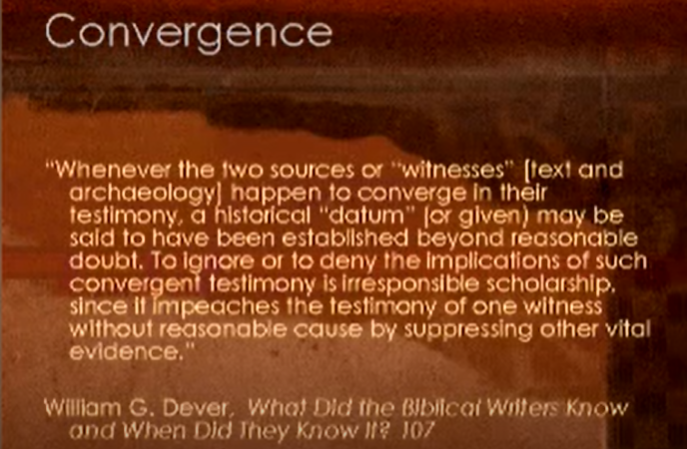
His comment, “Whenever the two sources or ‘witnesses’ [text and archaeology] happen to converge in their testimony, a historical ‘datum’ (or given) may be said to have been established beyond reasonable doubt. To ignore or to deny the implications of such convergent testimony is irresponsible scholarship, since it impeaches the testimony of one witness without reasonable cause by suppressing other vital evidence.” (William G. Dever, What Did the Biblical Writers Know and When Did They Know it? 107)

What he is talking about in that case is the text of the Bible and the dirt archaeology to which it is being compared. The difference is, when he is creating a convergence rather than a parallel, he is taking a large quantity of material and he is saying, “Here are things that come together in a similar description.”

And we have to have location, we have to have time, we have to have the content of the information and in essence what he is saying is the more pieces of information that interrelate with each other and all depend upon the same location, same place, same time, same people, same concept; the more of those you get, the more you are converging the two types of testimonies of information, and the more chance then you have that one of these datums is now going to be something you can establish.

Seeing the Dog: How Convergence Works

So that is what I want to talk about: a convergence. To give you an idea of how a convergence works, here is my favorite example.

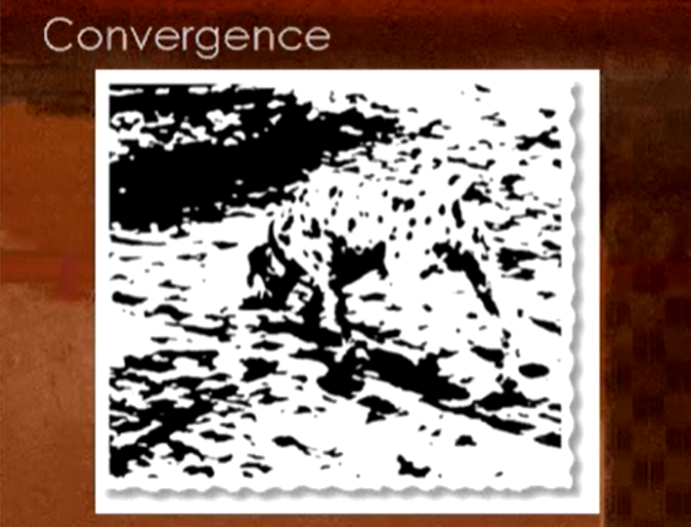
First impression, you look at this, and what you really should see is just a bunch of dots. Okay. Your first impression should be a bunch of dots. Now, after that you should see something. What are you seeing? You’re seeing a dog. I can actually see a few hands out here, so how many people don’t see a dog? That happens every once in a while because there are so many dots on there that you don’t see it.

That’s an important piece of information to remember because even though there is a whole bunch of us that see a dog there, it isn’t as absolutely clear as it might be if it were cleanly defined lines. Nevertheless, the location, the placement of the spots, all of the information, there is a dog standing over there. So for those of you who aren’t seeing it—that’s the head of the dog. You’re looking at a Dalmatian that’s drinking something from the ground. Foreleg, left hind leg, right hind leg, body—there’s even kind of a tail hooked around here.

When the Mind Creates Patterns

We, as human beings, have minds that are capable of creating cohesive patterns out of incoherent information. How many of you have stared at a tree, a cloud, a carpet and seen a face in it? Is the face there? Absolutely not. The reason that we see it is because we have a mind that creates things and it tends to create faces because we are so chemically wired to see the face. It is so important for us that we tend to create faces.

The difference is, if you blink two or three times, sometimes you look back and you can’t find it. Once you’ve seen the dog, you cannot “unsee the dog.” It actually is there. It may be difficult; we may not have all the data that we need to be able to clearly define it. But once you see the dog, that dog is there and you cannot “unsee the dog.”

That is the kind of evidence that we’re going to be talking about. We will not have a complete picture. We will not have a jigsaw puzzle where every single piece of the puzzle is there and there will not be any gaps, but what we will have is a sufficient picture that we can “see the dog.”

And I will tell you that having been through the Book of Mormon in detail over the last several years that it is now impossible for me to “unsee the dog.” This is a text that took place with real people in a real time and there is no way I can see it any other way, because I have “seen the dog” and I understand that it’s there.

Why One Piece of Evidence Is Not Enough

Now here is the next problem we have with seeing the dog, we will start talking about the evidence for the dog and someone will say,

“That spot. There is no reason why that spot is unique to this dog. I’ve seen things that have had a spot like that that weren’t a dog.”

Well, yes.

Which is why when you look at all this kind of evidence, you can’t take one piece and say, well this one thing is going to prove it. It isn’t a single thing. In any good historical argument, you are not going to find the one single thing where you say, okay here is the smoking gun; this is the one thing that does it.

We only have one way of coming up with a single action that we could take that will prove the Book of Mormon and that is prayer and revelation. You pray and get revelation. That is the only single thing that will demonstrate it.

If you are looking at an historical argument, you need to have an argument that has a lot of pieces together, not worrying about the single thing. Now, we do have to make sure that that really is a dot and not something that we’re not looking at. It really does have to be real information. So that’s where we are: trying to move on from that.

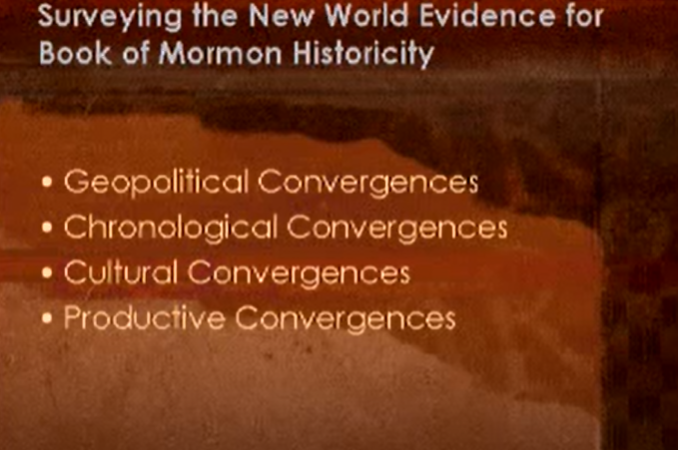
Surveying the New World Evidence for Book of Mormon Historicity

So here is the kind of thing that we would like to take a look at, I’m going to run through a lot of this stuff pretty quick. Some of the stuff I’m not even going to mention hardly at all and then I’ll try to end up with some of the things that I kind of find most fascinating about “seeing the dog” in the Book of Mormon.

Geopolitical Convergences

Geopolitical Convergences: This is where we are talking about the fact that we have to have it on the map somewhere and then even more complicated than putting it on the map is we need to know something about the peoples that were there so converging that type of information.

Chronological Convergences

Chronological Convergences: One of the best arguments that I’ve heard for understanding that the Book of Mormon could not have taken place in the Great Lakes area is because people did not live there at the right time. Anytime you see a theory that is positing people that don’t live somewhere, that are supposed to be there and they are not there—it’s not a real strong theory.

Anytime one of the theories of Book of Mormon geography posits that you must have an area of the world under water at a time when people were living there, probably not a very good thing, even if they were under water some other time in geological history. Chronology makes the difference; you have to match the right time periods. You can have absolutely the right thing happening, and if it’s a thousand years too late, it doesn’t count, it isn’t a convergence, and it isn’t even close.

Cultural and Productive Convergences

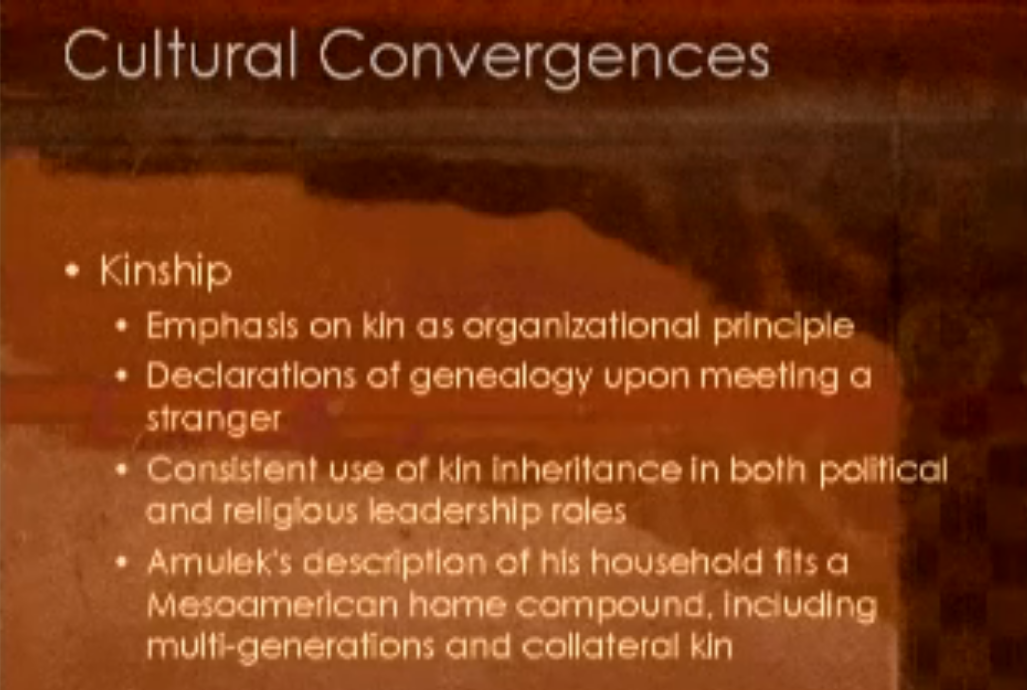
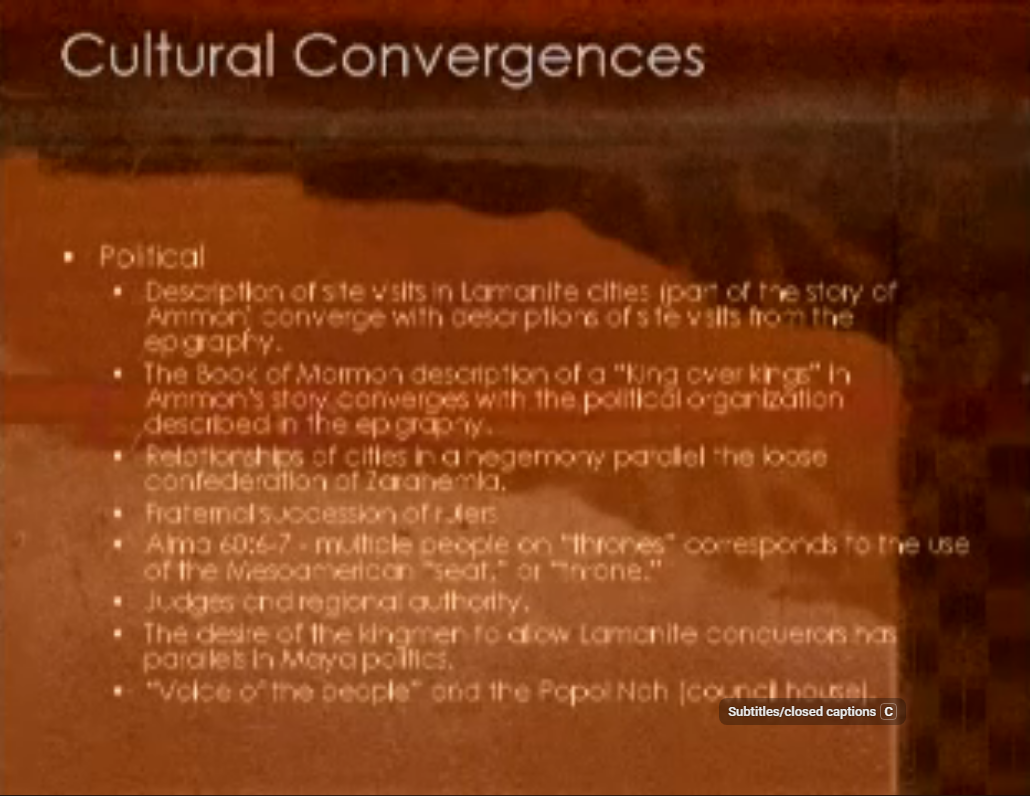
Cultural Convergences: Once we get those first two done, then we need to look at the culture of the area and whether or not that converges and the descriptions match the kinds of things we find in the Book of Mormon.

Productive Convergences: Which is where understanding the context of the Book of Mormon, or the place where it would have taken place, actually teaches us something about the Book of Mormon that we would not understand otherwise. In other words, it becomes a way to elucidate the text, particularly in places where the text might be a little bit confusing or a little strange.

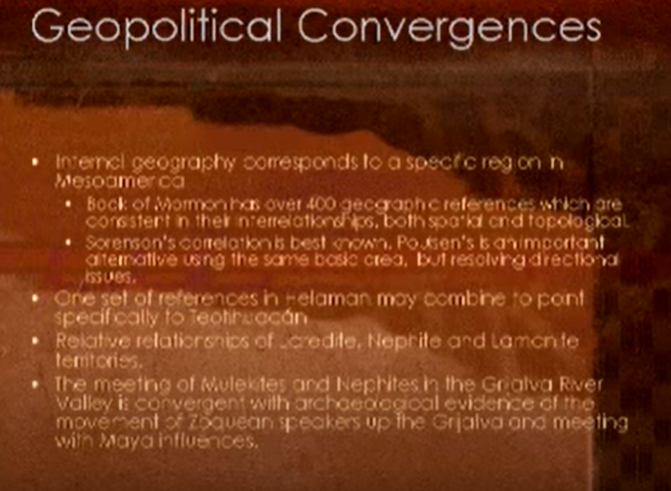
Geopolitical Convergences

  • Internal geography corresponds to a specific region in Mesoamerica
  • Book of Mormon has over 400 geographic references that are consistent in their interrelationships, both spatial and topological.
  • Sorenson’s correlation is best known. Poulsen’s is an important alternative using the same basic area, but resolving directional issues.
  • One set of references in Helaman may combine to point specifically to Teotihuacán. 3
  • Relative relationships of Jaredite, Nephite and Lamanite territories.
  • The meeting of Mulekites and Nephites in the Grijalva River Valley is convergent with archaeological evidence of the movement of Zoquean speakers up to the Grijalva and meeting with Maya influences.

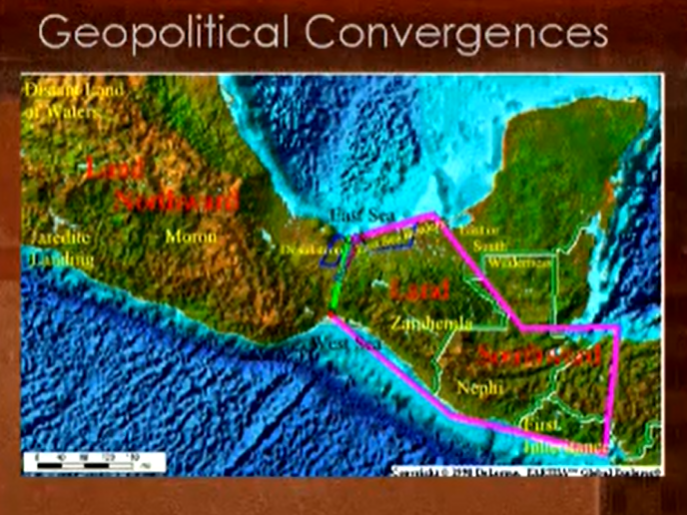
There are two correlations I’d like to put up here.

  • I am not a geographer.
  • I cannot tell for what reason, I simply don’t comprehend this stuff.
  • I understand people and
  • I understand archaeology and ethnohistory

But I just don’t seem to do geography very well, so I will rely on other people for geography.

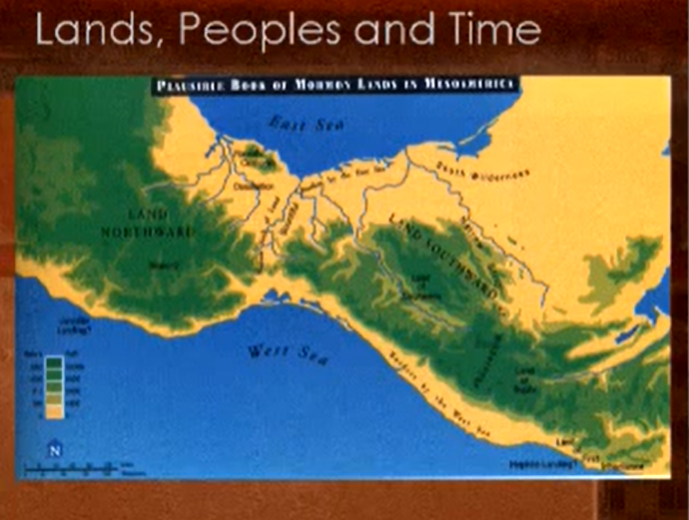
But here is the problem that you have in geography—what you must do is you must create a convergence between the descriptions in the text and a place in the world. There are two of them I’m going to show you. Both of these are converging in the same general area of the world, they simply interpret the data slightly differently and I don’t know how to distinguish between the two as of yet. But, for the purposes I have, they agree in the places where I need them to agree, so I’m not too worried about it—the rest of it will work out.

Matching the Text to a Real Geography

But here is the problem you have, you have to take the text and the descriptions of geography in the text and you have to find a way to match it up in the real world. This is an incredibly difficult proposition.

John Sorenson has discovered at least 400 different kinds of textual correlations in the Book of Mormon, which, if you were going to have a convergence between the text of the Book of Mormon and a geography in the real world, you’ve got 400 things that have to match. This is not an easy process. If you are matching 400 locations in relative distance from each other, in topography where you go up and down and it’s consistent in the right way, you know this is simply difficult to do.

There is a recent article that attempted to say that Book of Mormon geography is so vague that you could probably put it anywhere including the Malaysian Peninsula. It was an interesting idea. Some of the things actually worked out.

One of the problems, however, is that based on that particular geography, all of the Lamanites had to be in the very, very bottom tip. And the problem is:

  • you have all this area that’s Nephite and based on the Nephite geography
  • but all of the Lamanites (that the text tells us are more numerous than the Nephites) are in this little tiny area

And it just doesn’t work, you just don’t have that kind of population distribution.

On top of that, the next thing I’ll talk about is the other reason why the Malaysian geography (model) won’t work, but to start off, we’ve got to get a geography.

Mesoamerican Models of Book of Mormon Geography

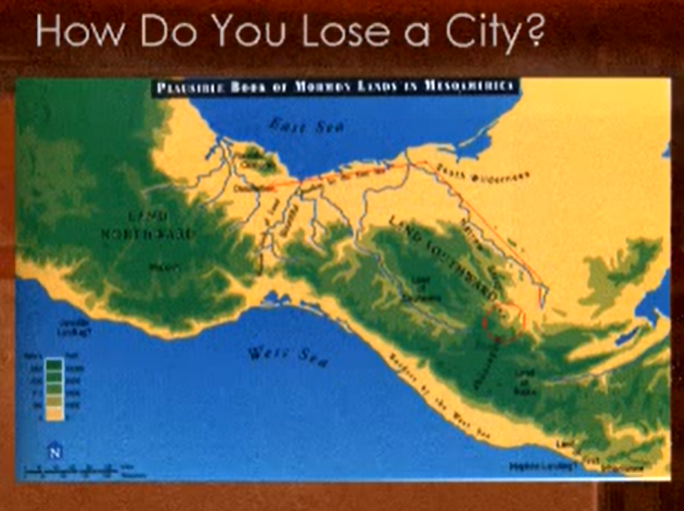
You are looking at the Yucatan Peninsula, Isthmus of Tehuantepec. And basically, this is the correlation of how John Sorenson would lay out the Book of Mormon in this land. Larry Paulsen, who is a member of FAIR, has another idea of how to do it, slightly different. What he does is kind of fascinating because in one way we have to make sure that we understand it.

What you’ll see at the top is this North-South axis. And that really looks familiar to us because as modern Americans we conceptualize directions and cardinal directions as a plus sign. What we miss is that Mesoamerica did not. Mesoamerica did not use the concept of a plus sign whenever they described the world and the four quarters of the world. They used an “X”.

So for them this is North, not that single line that we think of, but that pie, that whole piece of direction is North. It changes concepts dramatically when we have a quadrant that is Northwest, and they kind of tilt it and say ‘that whole thing is North’. So the concept of what “North” is was probably very different in the Mesoamerican world.

Adding People and Chronology to the Map

Now, here is why that doesn’t bother me that there are two different ones, and secondly, why when you take the next layer of information and you put it on the map that things like the Malaysian hypothesis fall to pieces.

In addition to being able to take the text and have some sort of a convergence with a geography we now have to put people on and in addition to putting people on the map, the Book of Mormon very clearly tells us that there is a chronological relationship among these people; and we need to find that same chronological correlation.

For instance, the Book of Mormon tells us that in the North, we are supposed to find the oldest culture and we’re supposed to find people who would have been there, let’s say, 2,000 BC. We are supposed to be able to find maybe a newer culture down along here and there better be people there around 600 BC.

We are also told in the Book of Mormon that people move out of this lower area and start moving towards the North, end up in the city of Zarahemla, where they meet up with some people who have come down from the North, the Mulekites, and they all meet in this area of Zarahemla along the river Sidon. That’s a lot of information. That is very difficult to guess.

Matching Book of Mormon Peoples to Mesoamerican Chronology

What would happen if we look at this map of Mesoamerica and the oldest people were down here and the youngest people were up there? It would be disqualified. But it isn’t. That’s where the old people are. That’s the Olmec culture up in that area; had been in that area for an awful long time.

This is the Maya region. Interestingly enough one of the things that happens is if you look at the linguistics of the area, the Olmec are—the best evidence anyway—is that they’re speaking a language that has been reconstructed and labelled Mixe-Zoque. 4

The Mixe-Zoquean speakers, which is kind of a combination of two languages, later Mixe, and later Zoque. What happened was the Zoquean group moved up that river. And this area has a connection to the people up there, and they were Zoquean speakers that moved out and historical data tell us that there is this movement of people from the North to the South along that river.

It also indicates that there is information about some of these speakers that move up this area, and meet up there, and some of the cultural data from here is starting to come into here somewhere around 200 BC. Now that just so happens to be a time period when the Book of Mormon is saying that something is happening.

Jaredites, Olmec Culture, Nephites, and Maya Culture

The Book of Mormon says that we have to have Jaredites in the North that happen to have a time depth and geographical correlation that match up very nicely with the Jaredites. Now please understand that I will not, and do not ever say that the Olmec and the Jaredites were exactly the same. I think that the most logical thing that you can say is that the Jaredites participated in Olmec culture.

Similarly, when we talk about the Maya, I do not think that either Nephites or Lamanites were Maya, but that they participated in that culture and may or may not have learned to speak that language. But there were Olmec who were not Jaredites, there were Maya who were not referenced in the Book of Mormon.

But what’s fascinating is that the history of this area tells us that there is a people who is coming from this area and merging here; ending up with a cultural influence from people this way going in that direction and that just so happens to be what the Book of Mormon tells us is supposed to happen at the same time.

Population Movement around 200 BC

There is another piece of information about this area down in here which is the area of the Land of Nephi, one of the cities that Dr. Sorenson suggests might have been the city of Nephi, Kaminaljuyu, in Guatemala. 5 I have just recently read that there is documented evidence of Cholun speakers moving into that area in about 200 BC.

Think of what that means for Book of Mormon history. Right in 200 BC we don’t know exactly what is happening, but according to the text, all of the pressures on the Nephite people are increasing right around this particular period of time, and increasing so severely that Mosiah has to take all the people who will go with him and flee and leave.

What is changing things so dramatically that all of a sudden at this point somewhere around 200 BC, they have to leave this area? Well, history tells us that there is a new People that is moving in. Perhaps that is creating some pressure.

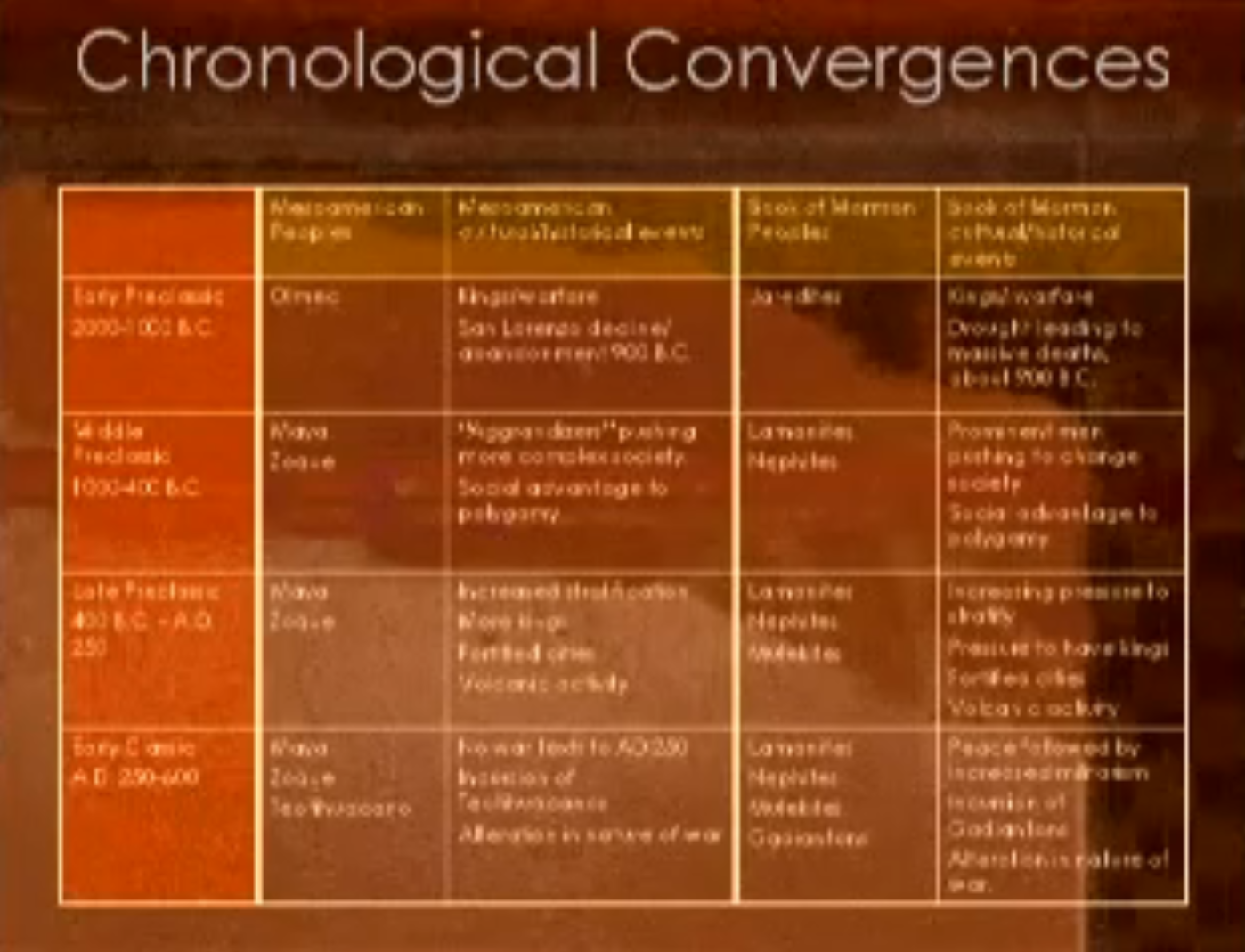
Chronological Convergences

Again, if we have the wrong people in the wrong place it doesn’t really help us. One of the ways in which you get a convergence with the Book of Mormon and things that are happening in Mesoamerica is not just in this gross location of where the people are, but the kinds of things that are happening at the same time. For instance, having kings and warfare. It’s nice to say that they are there, but that is a piece of the puzzle rather than one that’s particularly interesting.

One of the things I did when I was looking at the Jaredite chronology, is I tried to rebuild the chronology in the Book of Mormon based on king lists and run backwards from times rather than make up an assumption of when I thought it might start, and based on this Jaredite king list chronology, I started laying out when these things might possibly have taken place.

One of the things that happened after that was put together is I find that in the city of San Lorenzo, they’ve got a decline and the city is being abandoned right at a time when the Book of Mormon is talking about a severe drought in the land.

San Lorenzo and the Jaredite Drought

Now, are those two exactly the same? Don’t know. But it is kind of fascinating that you’re going to have in the historical record, a decline of a population that in many cases and other instances have been tied to droughts happening at the time when the Book of Mormon is indicating that there is a severe drought in the area.

Then we get into this next time period where we have changes occurring down in the Maya world and what’s happening is you are moving from smaller populations to larger populations, you are moving from villages to cities, and the political structures are beginning to change.

So the social pressure in Mesoamerica is one that is developing this push towards what will become the classic Maya model of kingship. Those pressures are happening quite early and there are several mechanisms that have been used to try to describe how people moved from the small village into the situation where they are getting more social stratification.

Aggrandizers, Trade, and Social Inequality

One of the two people who wrote the article that I think makes the most sense on this was John Clark and he talked about a process of aggrandizers where one of the things that they would do is you’d get some ambitious people who would start trading and then they would get more trade goods, and this was going to increase their status in the community, and because they are increasing their status in the community it’s going to get some differential in what they have and what somebody else has, the kind of trade goods you have. You will get some sort of social inequality there.

One of the things that absolutely struck me is that this is first of all an economic argument in that you’ve got people who are looking to better themselves through trade and look at wealth, money, etc. And the second thing is the mechanism that they used was that they would have plural wives.

The reason? They’d have more people to work. You get more wives, so you get a bigger family, you have a cottage industry and now you’ve got more workers, you’ve got a built-in workforce, you create more items, you get more trade.

Costly Apparel and Multiple Wives

It has always been fascinating to me that this is the exactly the time period where Jacob is complaining about something that is happening in his community, and he complains about two things that you would not suspect are connected which are costly apparel and multiple wives. He is telling people why this is terrible.

Why is it those two things? How do those go together? Why are they related? Because that’s what is happening at that time period.

Next kinds of things happen, you get these increasing pressures to have kings; you get fortified cities; the Book of Mormon talks about the time of Christ. The best information about what’s happening when Christ comes is that there is this massive volcanic activity.

There are lots of indications that at least around this time period, within 100 years before and after, there are a lot of very active volcanoes. We are not at the point where we can say this is the volcano that erupted and is being described in the Book of Mormon. But what you can say is that around that time period, it is pretty obvious that there was some heavy volcanic activity. So again you are getting a convergence in time and place and in description.

Warfare and Chronological Convergence

This one is brand new—Mark where are you? Stand up and say hello to everybody. This is Mark Wright he’s a Mesoamericanist getting his Ph.D at UC Irvine. It’s been a heck of a lot of fun talking to him because we actually talk shop and I can say things and he knows what I’m talking about.

This is one that he pointed out to me, this is from David Stewart in a recent discussion at the Texas Maya meetings where he was just happening to mention that there are no Maya text dealing with warfare prior to 200-250 AD, and then after that we get it all the time. Why? There is a really kind of odd convergence and frankly one that I wasn’t expecting to see.

Next kind of thing that we’re getting, militarily, we know that down in the area where the Book of Mormon would have taken place, around the time that the closing events are occurring in the Book of Mormon, the people of Teotihuacán are coming down, they are bringing with them a new style of warfare, they change the rules.

There are all kinds of indications that things are dramatically different when all these Teotihuacános come down, and then you read the Book of Mormon text and right at the same time that historical documents are talking about the Teotihuacános coming down and changing the nature of warfare, we have Mormon who is first of all complaining about the Gadiantons, and secondly complaining that the nature of warfare has changed and complaining it just isn’t the way it used to be.

So the Book of Mormon is one more time, chronologically reflecting the same kinds of pressures that we know to have been occurring at that time period.

How Many Correlations Can Happen by Accident?

To this point in time, we are still at one of those things where you look at it and you say, how can this kind of a correlation happen by accident? How do you hit that many things and that carefully?

Somewhere along the line we should have the chronology getting mixed up if we were in the wrong place. If we were in the Great Lakes region this would have blown up a long time ago. If we were in Malaysia it would have blown up a long time ago at the time when we’re looking for just the older populations—there are not populations and peoples in the right places at the right time in Malaysia. There is a good reason why that doesn’t work. Way past geography the rest of the geopolitical situation does not work.

But the Book of Mormon just keeps getting better, and including things that I found out yesterday, make it look better than I’d seen.

The Israelite Background of the Book of Mormon

Another one that is fascinating and I’ll just mention it, because it’s not my research but I find it absolutely amazing. People have really complained about the Book of Mormon because it is the wrong kind of document. You are talking about Christianity way too early. There are just all kinds of things that are supposed to be wrong against an Israelite background.

The problem is, they are wrong against an Israelite background only (inaudible) pre-exilic Israel. The more that Israelite religion is being reconstructed prior to the time that Lehi took off, the more the Book of Mormon’s theology and the things that it’s concerned with fit right in. It’s not nearly as problematic as they thought.

What’s wrong are the expectations that were brought to the text—not the text itself.

Cultural Convergences

  • Anthropological
  • 1 and 2 Nephi parallel established patterns of ethnogenesis 6
  • “Getting the right things wrong” – when the text makes a “mistake,” it make the “correct” mistake
  • Insider/outsider vocabulary
  • Pejorative stereotyping
  • White/dark as metaphor rather than skin color
  • Mormon’s presentism
  • Mormon’s description of wealth in Alma 1
  • Lamanites learning literacy from the Nephites
  • Literate society
  • Monument stones – stelae and Coriantumr’s story-stone 7
  • Annals format
  • Book of Mormon literary parallelism including chiasmus, Mesoamerican emphasis on parallelism and evidence of chiasmus in the Popol Vuh.
  • Dynasty emphasis – Book of Mormon book-name changes
  • Indications of vigesimal system 8
  • 400-year prophecies
  • Suggestive structures in counts and estimates.

“Getting the Right Things Wrong”

There are things that people will say about the Book of Mormon, they will say, “You know they got this wrong, this is wrong, you shouldn’t do it this way”. The problem is, you really don’t want and should not find a historical text that is perfect according to our modern perceptions what a history ought to be.

The Book of Mormon should not look like a modern history; if it does, it’s a forgery. It should look like an ancient text, that’s where it came from.

In ancient texts there are lots of things that people get wrong and the Book of Mormon happens to get a whole bunch of things wrong. For instance, it uses insider/outsider terminology. It tends to say, as most people do when they are first creating their societies, there is “us” and “them.” There is this big wall around us, and anybody who is not us is them and we don’t like them. It’s wrong for modern history but it’s exactly right for ancient history.

When the Book of Mormon Gets Things “Wrong”

Mormon makes a mistake when he is talking about some of the historical conditions of Teotihuacán 250 years earlier. Well, is that wrong? For an ancient historian no, actually it’s exactly right. He should not have known what happened in a city that is that far away 250 years earlier.

What he should have done is what he did. He assumed that what he knew about the city at that time had always existed. That’s the way people thought at that point in time. So oddly enough, in a lot of cases some of the things that the Book of Mormon gets wrong—from an anthropological standpoint—it is getting exactly right.

Kinship

  • Kinship
  • Emphasis on kin as organizational principle
  • Declarations of genealogy upon meeting a stranger
  • Consistent use of kin inheritance in both political and religious leadership roles
  • Amulek’s description of his household fits a Mesoamerican home compound, including multi-generations and collateral kin

This is actually very important—the kinship structure inside the Book of Mormon and the way kin function in the Book of Mormon matches a kin-based society. By the time of Joseph Smith we had lost a lot of that and certainly by our time we’ve lost even more of it. But the Book of Mormon tends to operate like a kin society would have, which again is something that it ought to do. Contrary to what our expectation would be from somebody who is writing in the 1830s.

Political Convergences

  • Political
  • Description of site visits in Lamanite cities (part of the story of Ammon) converge with descriptions of site visits from the epigraphy. 9
  • The Book of Mormon description of a “King over kings” in Ammon’s story converges with the political organization described in the epigraphy.
  • Relationships of cities in a hegemony parallel the loose confederation of Zarahamla. 10
  • Fraternal succession of rulers
  • Alam 60:6–7 – multiple people on “thrones” corresponds to the use of the Mesoamerican “seat,” or “throne.”
  • Judges and regional authority.
  • The desire of the Kingmen to allow Lamanite conquerors has parallels in Maya politics.
  • “Voice of the people” and the Popol Nah (council house). 11

Is the Book of Mormon Describing Democracy?

In general, one of the things that people will say about the Book of Mormon is that it’s got to be modern because it talks about voting. The voice of the people has to be a vote. Anybody who has said that has not examined the text on the voice of the people.

Anybody who thinks

  • that the Book of Mormon is a democracy and
  • that the Book of Mormon promotes democracy

has not studied it. It does not. It is a very complicated system. I am sure that somewhere in the world there is another system that’s just like that. But the only one I happen to know of is in the Maya world where down at the bottom here in the Popol Nah, or the community house, where the elders gather together to hear the cases and discuss them.

The “voice of the people” being literally that. And if you read one of the sections in the Book of Mormon where it is talking about it, you can actually see in your mind’s eye these people just talking. And somewhere in talking it out, changing their minds and coming to whatever the consensus opinion is. It has nothing to do with votes.

The political system in the Book of Mormon simply doesn’t look modern at all. What it does look like is the things that I’ve seen in Mesoamerica.

Warfare

  • Warfare
  • The seasons of warfare match with the types of seasonality in Mesoamerica
  • Relationship of timing of war and famines
  • Militia style – no standing army
  • Defensive armament is correctly described
  • helmets
  • slings
  • breastplates
  • shields
  • “thick clothing” as armor
  • wounds on the legs – ie. no greaves 12
  • Descriptions of the deployment and types of weapons
  • Tactics
  • Rarity and surprise of right movements
  • Scouting a walled city, using ladders if not other way
  • Hiding in foxholes
  • Battle between champions
  • Defeat of the king is the defeat of the army
  • Battle by appointment
  • War on a tribute model rather than a conquest model
  • Fortifications described that fit with developing Mesoamerican fortifications – appearing at approximately the same time period.
  • Lineage succession of the general

What is fascinating about this is that not only does he mention certain weapons, but the Book of Mormon is very accurate in the way those weapons are used in an attack. I am not a military man, but there is a certain way that you would do things and I’ve consulted with a couple of military men—the Book of Mormon actually makes military sense.

People who do war for a living can look at the text and say, they’re doing the right kinds of things with the right weapons the right way.

None of these are the way war was fought when Joseph Smith was thinking of things and the tactics are entirely different.

Aztec Warfare and Book of Mormon Tactics

One of the ones that I found very fascinating, Ross Hassig has book out called “Aztec Warfare” and the longer I read that, and the more I read the Book of Mormon, the more I start seeing the same tactics being used in several occasions.

There are textual witnesses of the Aztecs doing some of the very same things that we have seen in the Book of Mormon. So obviously they are effective tactics. We don’t know who came up with them, but it is kind of curious that that area of the world knew about them and used them including hiding in foxholes, popping up and attacking your enemy as they come by.

Productive Convergences

  • Productive Convergences
  • Geography as explanation
  • Limhi’s expedition gets lost because they follow the wrong river.
  • Tactics depending upon topographic relationships.
  • Culture as explanation
  • Jacob’s use of Isaiah
  • Ammon and Lamoni
  • Why Lamoni thought Ammon was “more than a man”
  • Clan struggles as background for Ammon at Waters of Sebus
  • Anti-Nephi-Lehies
  • Mesoamerican caches and the Book of Mormon burying of weapons 13
  • Captive sacrifice and the seating of kings
  • Seating of kings and the raid on Ammonihah

If the text of the Book of Mormon is an authentic text it should be written by someone who assumed that we knew as much about his world as he did; that’s the way the ancient people tend to write. That’s the way the Biblical writers wrote.

They simply assumed that they did not have to explain a lot of things to us because they assumed that we were part of the culture and that we would understand things. So, the only things that you get told are the things that you need to know because you’re supposed to know everything else.

That works really well until:

  • the world has changed and
  • we don’t know everything else and
  • all of a sudden things become kind of confusing and
  • they look strange and
  • you get these odd questions about the Book of Mormon text where it tells a story
  • where in our hearts of faith we know that it’s a darn good story but
  • as soon as we step back from the view of faith and we look at it kind of cold and calculated it becomes a stupid story

I’ve got two of them for you. One of them is thanks to Larry Poulsen.

How Do You Lose a City?

How do you lose a city?

Zarahemla might not have been the biggest city around and frankly was not, should not have been. When they get to Zarahemla they’re actually very homesick for where they came from probably because they’ve now gone to the backwater 14 after coming out of a real nice place which is probably why the people of Limhi want to go back and inherit that land—so they do—and they go down and after a long period of time with King Noah and everybody else they get dominated by the Lamanites, things really aren’t very good and so they’re hoping for Zarahemla to come help them out and somehow rescue them.

So they send a party to go back to Zarahemla—and they can’t find it! This is only a generation later. I’m not even that bad with directions. How do you lose a city when the instructions are ‘go to these mountains, find the river and follow the river until you hit the city’?

Follow…Which River?

There are two rivers. This is the Grijalva and the Usumacinta. It doesn’t quite show you there but one of the things that Larry Poulsen noted when he was doing some research on this is that the headwaters of those two rivers are only a mile apart in the same mountains.

They followed the wrong river. They did exactly what their parents told them to do—go to the river, follow it. Wrong river. How did they lose Zarahemla? It wasn’t on that river.

However, when you get up here, what’s up there? Jaredites. It’s exactly what they were supposed to find.

How do you do that if you don’t know this geography? How do you make that mistake so right? That is a convergence. If it were the only convergence it would be a curiosity but it isn’t.

The Strange Anti-Nephi-Lehies

Two years ago I was here and I talked about the strange case of Ammon at the Waters of Sebus and talked about that being a weird story. I’ve told that a couple of times and people really get nervous when I talk about weird stories in the Book of Mormon and they think I’m basically disrespectful or don’t like it.

That, first of all is not true, I love the Book of Mormon. Secondly, this is really a weird story! This one’s probably the strangest story in the Book of Mormon because it makes absolutely no sense whatsoever so forget about the fact that this is a faith-promoting story, take your faith hat off and listen to the stupid story!

First of all the people of Anti-Nephi decide that they are going to lay down their weapons and not fight because they claim they were all murderers. Now think about that—when did the women and children murder anybody?

Even if the men were off murdering in war, and by the way you never define murder in war—soldiers never murder. We would have to redefine it differently so that we could go ahead and do it. But when did the women and children do it? And they’re saying they’re all “murderers” and this is a terrible thing. (Alma 24:11–12)

Burying the “Weapons of Rebellion”

Next one. They bury their “weapons of rebellion.” (Alma 23:7, Alma 24:15–18)

That sounds interesting—they’re going to bury their weapons. Now, how many of you out there if you had a million dollars and you buried it in your background and you thought you needed some of it might go dig it up? You know if I buried the darn thing I know where it is.

That doesn’t really prevent me from doing much with it. Why is burying this thing—first of all why do it in the first place and secondly, why do I think that’s going to do anything? If I want my sword I’ll go dig the darn thing up.

Extreme Pacifism and the Anti-Nephi-Lehies

Now, they are extreme pacifists, they are so pacifistic that they are not going to take up a weapon in their own defense and they are going to allow someone to kill them rather than to fight back. That’s pacifism. That’s really remarkable and these same people sent their 12 to 14-year-old sons off to war and said, see you later I’m not going. I’m not going to fight. But you, good luck. That’s weird. That’s a dumb story. It just doesn’t happen.

We’ve got the next two: the Lamanites when they finish killing all these people they decide that they still want to kill someone. They’ve got this bloodlust so they take a two or three-day hike off to a city and go attack them. You know somewhere along the second day of marching I would probably say, I don’t feel like killing anybody anymore. Can I go home? Can I have a hot meal? Why do you go that far away to go kill somebody? You had people right there.

Next, this is the only story in the Book of Mormon where we talk about a Lamanite attack where the Lamanites don’t try to dominate the city and set up a tribute relationship so that they can get an economic benefit from having conquered that city. These guys go in, they just kill people and leave but it’s the only time we ever get a mention in the Book of Mormon that they take prisoners. Why toss that odd little piece in?

Solving the Riddle with Cultural Information: The Cult of War

Human sacrifice

This is where Mesoamerica comes to our help to tell us why this particular story sounds so dumb to us but works in the context of this part of the world. The religion of most Mesoamericans can be summed into the cult of war—where war is a sacred thing and war is part and parcel of your religion.

Part of this is not only killing people in warfare but bringing people back and then sacrificing them. Now think about the people who have claimed that they are murderers. When do they murder? Well, they probably didn’t. But if:

  1. they have been converted to the gospel and
  2. they have learned that human sacrifice is probably not something that they ought to do

Those people who have participated in, condoned and experienced the religion that did condone human sacrifice might have a different view of how their participation would be viewed.

Caches

Secondly, if their participation in the human sacrifices were distinctly related to war, and all of the feelings about that ancient religion were stirred up when they went to war, that will tell you:

  • why they didn’t want to go to war;
  • why they did not want to pick up any weapons;
  • why that was, for them, the hardest thing that they were going to do.

There were so many connections that were made between those actions and what they were trying to do.

In Mesoamerica it is a known procedure that people at the beginnings of new things and at the endings of certain things would cache objects—which means they would bury them. They would dig a pit and they would drop them in.

The Book of Mormon does not tell us this particular detail (probably, again, because it doesn’t need to), but most of the things that were cached were ritually broken. It is highly likely, given the context and the culture of that area, that we are talking about a cache. The reason they couldn’t go dig it up again is because they ritually broke, as an offering to God, all of their weapons as they offered their weapons to God in the earth. Which was a standard practice in that area.

War to obtain captives

Next, we have a war and part of the idea of war is to obtain captives so that’s, again, part of what we’re doing, we’re going off to Ammonihah to get prisoners.

Accession of the king linked to captives in battle and their sacrifice 15

Then the very last thing that we have to know is how do you seat a new king? Well I’ll pop the slide up. I won’t read it. (Just so you get at least one Mayan picture while we’re here!) The people who are coming into the city of Anti-Nephi-Lehi to take it over were doing so with the express purpose of:

  1. capturing the city,
  2. removing the previous king, Anti-Nephi-Lehi,
  3. and setting up their own king.

They succeeded. They did not have any opposition therefore they must have been able to take over the city and set up their new rule.

When you have a new king how do you install that new king? And in the Mayan world, you seat them on their throne. But one of the things that you must do in order to properly seat a Maya king is you must sacrifice a prisoner captured in battle.

The Anti-Nephi-Lehies didn’t fight back, didn’t count. So you had to do what other texts have told us that other kings did, you go off to some unsuspecting city that’s probably going to be easy pickings 16 but who will fight back, fight them, get your captives, come back, install your king.

When the “Stupid” Story Makes Sense

In the context of Mesoamerica, this “stupid” story all of a sudden makes perfect sense. Of course it happened that way. But the only way we know why it happened the way the text tells us that it happened is by:

  • knowing where the Book of Mormon took place;
  • having a convergence not only of the geography into a place, but of the time, of the location, of the people, of all of these events and cultures where the text of the Book of Mormon converges with the information that we get out of Mesoamerica.

And not only tells us that the Book of Mormon took place there, but knowing that tells us more about the Book of Mormon than we might possibly have known otherwise.

We Can’t Unsee the Dog

Having been through the Book of Mormon for a long time, this is the “dog”. We are still in the process of

  • putting pieces together,
  • drawing in the outlines,
  • making sure that we have the details right.

Someday, perhaps, we’ll get to draw in the hair! But the “dog” is there.

Having been through the text, having looked as carefully as I possibly can—and, believe it or not, with the exact same rigor that I used in the paper where I came up with the idea that I didn’t like the Quetzalcoatl correlation, using those same tools, those same rigors—the “dog” is there, and I cannot for the life of me “unsee the dog.”

This is a different book than I read 20-30 years ago. But boy is it fascinating, and is it interesting! I get more and more interested in it the more I learn and the more I see. And it’s a much better book than I’d ever thought it was going to be. Though, it is still the one thing that I thought it was – which is *true*. And I bear you that testimony in Jesus’ name, Amen.

Questions and Answers

Have there been any cities, ruins, etc. believed to be the Book of Mormon peoples rather than Mesoamerican peoples?

Q: Have there been any cities, ruins, etc. believed to be the Book of Mormon peoples rather than Mesoamerican peoples?

GARDNER: Let me give you the real quick answer to that, my answer is no because I can’t tell you the difference between Book of Mormon peoples and Mesoamerican peoples. We’re in the wrong state to ask this question but if I were in New Mexico I would actually ask you how many of you had a neighbor who wasn’t a Mormon?

Up here that’s a little bit more difficult to do, but I suppose that you’ve all been to a state where there isn’t one. What does a Mormon car look like? I realize it looks like a minivan! (Laughter) But you know, there are actually other people who drive them. What does a Mormon house look like that’s different?

The material culture that we have is the material culture that everybody else has. 17 In my neighborhood you go up and down the street and there is no way from looking at the outside of the house, from looking at the cars, if you went inside from looking at my pots and pans and plates—there’s no way you could tell what my religion was.

Material culture does not tend to do that. So, as John Clark has said, we’ve probably found Nephite ruins and Nephite artifacts. We just can’t tell the difference because they look like everybody else’s.

Does the Book of Mormon ever suggest or imply mingling with indigenous peoples? Or why would the Book of Mormon peoples choose to include that?

Q: Does the Book of Mormon ever suggest or imply mingling with indigenous peoples, or why would the Book of Mormon peoples choose to include that?

GARDNER: I do believe that it certainly implies that. There’s only one text I know of where the implication is as explicit as we’re going to get it. Which is when Nephi and his brothers are leaving after the split.

And Nephi is taking all the people to go up to the Land of Nephi. He goes through and he names names, and he says

  • this person went with me, and
  • this person went me and
  • this person went with me and t
  • his person . . .

And he doesn’t name Laman or Lemuel. We’re pretty sure we know why they didn’t go with Nephi—since they were trying to kill him. We’re reasonably certain that Laman and Lemuel’s wives and children would remain with them. But other than that, Nephi seems to have named everybody we’ve ever known about that we’re not pretty sure has died by the time you get to this separation of people. And yet at the end of this time, when he’s named just about everybody there is to name he says, “and all others who would go with me.” Well, who the heck were these others?

The Others Nephi Talks About

The next thing that happens, if you’re looking at the text, as you go through and you say, well if there were others there does the text give us that hint? And I won’t go into the reasons but there’s several reasons to believe that the text simply doesn’t work without others there.

There’s also a speech that Jacob gives at Nephi’s behest specifically talking about a passage in Isaiah that makes absolutely no sense whatsoever unless there are others with the group at the time. So then the next question is, why don’t they mention that?

A complicated issue and if you remember what Matthew Brown was talking about in texts, what you have as a text may or may not represent all of the rest of the information that you might have had. You’ve got a text and you have to do deal with.

But we have a text to and we don’t have either the text that Nephi wrote about the more mundane things nor do we have what Mormon abridged to that text; all we have is the secondary text Nephi explicitly tells us that he’s writing it for entirely different reasons and if you look at 1st Nephi it is an incredibly well crafted document. 2nd Nephi falls apart frankly, we are like disappointed in my boy Nephi because 1 Nephi is great and 2 Nephi kind of fades but he planned it.

Ethnogenesis and the “Others”

Now, one of the things that I’ve just learned recently is that there some patterns of ethnogenesis when you’re trying to explain how you get a new people and there are several things that happen there but one of them is that you create these dichotomies between the insider and the outsider.

Why doesn’t he mention the others? They’re not relevant to his story of ethnogenesis. What’s relevant is that there’s a split and he’s trying to define who the Nephites. These others are now part of the Nephites, he doesn’t need to define them as separate—it is his intent to define them as part of the group and is opposed to everybody else.

Since the whole face of the land was altered at Christ’s death why should today’s geography correspond to pre-Christ geography?

Q: Since the whole face of the land was altered at Christ’s death why should today’s geography correspond to pre-Christ geography?

GARDNER: How many of you remember Mount St. Helens? I have a little bottle of ash that somebody collected for me. Mount St. Helens really looks different. The whole face of Mount St. Helens is really quite different but I know where Mount St. Helens is. It hasn’t moved.

Although the face of the land changed, that is a literary reference to the degree of change in the land. It’s not a change that says,

“by golly I could not find my way home because all the roads were backwards.”

That simply doesn’t happen.

If you are going to look at the Book of Mormon and say that it happened as a real text, you have to assume that there’s a real world behind it. And the real world simply doesn’t change so dramatically that we would not be able to recognize it. Certain things are going to change, but not that many.

Answers in this Presentation

What does Brant Gardner mean by “convergence” in Book of Mormon studies?
He means multiple independent pieces of historical evidence that fit together rather than a single similarity or parallel being treated as proof.

Does Brant Gardner claim the Nephites were Maya?
No. Gardner explicitly says he does not believe the Nephites or Lamanites were simply “Maya,” but proposes that Book of Mormon peoples participated in broader Mesoamerican cultures.

Does Gardner identify the Jaredites as the Olmec?
No. He specifically cautions against equating them, suggesting instead that the Jaredites may have participated in Olmec culture.

Why does Gardner compare Book of Mormon evidence to “seeing the dog”?
He uses an image of a Dalmatian formed by scattered spots to illustrate cumulative evidence: individual dots may mean little, but together they can form a recognizable pattern.

How does Mesoamerican culture help explain the Anti-Nephi-Lehies?
Gardner proposes that Mesoamerican practices involving ritual caches, warfare, captives, sacrifice, and royal accession provide a cultural context for details in the Anti-Nephi-Lehi narrative that can otherwise seem puzzling.

Search topics

Book of Mormon evidence in Mesoamerica; Book of Mormon historicity; Book of Mormon archaeology; Book of Mormon geography; Mesoamerican geography; archaeological evidence for the Book of Mormon; Brant Gardner convergence; Book of Mormon cultural convergence; Book of Mormon chronological convergence; Book of Mormon warfare; Nephites and Maya; Jaredites and Olmec; Mulekites; Zarahemla; Anti-Nephi-Lehies; Waters of Sebus; Mesoamerican political systems; Mesoamerican kinship; ancient American cultures

Book of Mormon anachronisms; archaeological criticism of the Book of Mormon; Book of Mormon geography criticism; Book of Mormon historicity criticism; CES Letter Book of Mormon archaeology; CES Letter Book of Mormon evidence; Book of Mormon evidence criticism; Joseph Smith and Book of Mormon authorship; Book of Mormon ancient origins

What New Archaeological Discoveries in Jerusalem Relate to Hezekiah? (Gospel Doctrine Lesson 30A)

October 1, 2018 by Jeffrey M. Bradshaw

Shukron in room with markings

An Old Testament KnoWhy relating to the reading assignment for Gospel Doctrine Lesson 30: “Come to the House of the Lord” (2 Chronicles 29-30; 32; 34) (JBOTL30A)

Question: Hezekiah is known as being, after David, the greatest king in Israelite times. Are there any archaeological remains of his reign in Jerusalem?

Summary:Recent discoveries at the Ophel and Gihon Spring sites relating to Hezekiah are providing new insights into the history of ancient Jerusalem and its temple.

The full article may be found at the Interpreter Foundation website: KnoWhy OTL30A — What New Archaeological Discoveries in Jerusalem Relate to Hezekiah?

Filed Under: Bible, Evidences, Lesson Aids, Prophets, Questions, Resources, Temples Tagged With: 2 Chronicles, 2 Kings, archaeology, Benjamin Mazar, Eilat Mazar, Eli Shukron, Gihon, Gospel Doctrine: Old Testament, Hezekiah, Hezekiah's Tunnel, Isaiah, Israel, Matzevah, Ophel, Ronny Reich, Siloam, Silwan, Solomon

Why and How Should We Study the Old Testament? (Gospel Doctrine Lesson 19A)

May 15, 2018 by Jeffrey M. Bradshaw

Details of Saturn’s atmosphere and rings

An Old Testament KnoWhy relating to the reading assignment for Gospel Doctrine Lesson 19: The Reign of the Judges (Judges 2; 4; 6-7; 13-16) (JBOTL19A)

Question: The Bible account of Creation explains very little about the formation of the solar system or the biological origin of life. Archaeological evidence sometimes directly contradicts it, its laws of diet and purity seem irrelevant, and its prophecies are largely unintelligible. Why should I spend my time studying the Old Testament when I could be focusing my attention instead on up-to-date history and science or on the practical, ethical teachings of Jesus that teach us how we should live.

Summary: Having most recently discussed archaeological findings that relate to the books of Joshua and Judges, and having written prior to that on the historical context of the Exodus, I would now like to consider the larger question of why and how one might study the Old Testament. Specifically, in this article, I will explain why I think it is important to counterbalance the study of scripture in its historical and scientific context with traditional forms of scripture reading. First, it should not be forgotten that the Old Testament provides essential background not only for Jesus’ teachings on how we should live from day to day but also on His words about the meaning and purpose of life from an eternal perspective. Relatively little of the rest of scripture — whether ancient or modern — can be adequately understood without reference to its Old Testament backdrop. Sadly, given the common tendency today to treat the stories of the Old Testament as targets of humor and caricature (when they are not ignored altogether), it is difficult for some people to take them seriously. However, serious study of the Old Testament will reveal not merely tales of “piety or … inspiring adventures” but in addition carefully crafted narratives from a highly sophisticated culture that frequently preserve “deep memories” of doctrinal understanding. We do an injustice both to these marvelous records and to ourselves when we treat them merely as pseudo-science, botched history, or careless editorial paste-up jobs. A doctrinal perspective on the Old Testament should always remain central to our efforts to appreciate and understand it, even while acknowledging the significant enrichment that historical, scientific, and textual studies can provide in a secondary role.

The full article may be found at the Interpreter Foundation website: KnoWhy OTL19A — Why and How Should We Study the Old Testament?

See https://www.youtube.com/watch?v=aXiVXmUBqn0 for a 15-minute excerpt from the 1960’s church film “The Search for Truth” posted on the Interpreter channel. It contains an opening statement by President David O. McKay on the value of science and the search for truth, followed by perspectives from prominent scientists, including Henry Eyring.

Filed Under: Bible, Doctrine, Lesson Aids, Questions, Resources, Science, Temples Tagged With: archaeology, Creation, Gospel Doctrine: Old Testament, Historicity, origin of life, Scriptures

The Book of Mormon, The Doctrine and Covenants, and the Archaeology Question

November 2, 2011 by Stephen Smoot

The authenticity of the Book of Mormon has been repeatedly assailed by critics of the LDS Church on the grounds that is lacks any confirmatory archaeological evidence that supports its claimed historicity as an ancient record. Countless books, articles, DVDs and internet websites have ceaselessly repeated the following cacophonous refrain:

[Read more…] about The Book of Mormon, The Doctrine and Covenants, and the Archaeology Question

Filed Under: Anti-Mormon critics, Apologetics, Book of Mormon Tagged With: anti-Mormon, archaeology, Book of Mormon, Doctrine and Covenants, evidence

Primary Sidebar

Faithful Study Resources for Come, Follow Me

Subscribe to Blog

Enter your email address:

Subscribe to Podcast

Podcast icon
Subscribe to podcast in iTunes
Subscribe to podcast elsewhere
Listen with FAIR app
Android app on Google Play Download on the App Store

Pages

  • Blog Guidelines

FAIR Latest

  • Come, Follow Me with FAIR – Isaiah 50–57 – Part 2 – Autumn Dickson
  • Come, Follow Me with FAIR – Isaiah 50–57 – Jennifer Roach Lees
  • Come, Follow Me with FAIR – Isaiah 50–57 – Part 1 – Autumn Dickson
  • Prayers for Peace
  • Come, Follow Me with FAIR – Isaiah 40–49 – Part 2 – Autumn Dickson

Blog Categories

Recent Comments

  • Willie Louise Truitt on The Joy of a Covenant Relationship with God
  • Katrina on In memory of Chandler “Chuck” Hendry
  • Nancy Farmer on Come, Follow Me with FAIR – Psalms 49–51; 61–66; 69–72; 77–78; 85–86 – Part 1 – Autumn Dickson
  • Nicko De Leon on In memory of Chandler “Chuck” Hendry
  • Becky Matson on In memory of Chandler “Chuck” Hendry

Archives

Follow Us

  • Facebook
  • Twitter
  • iTunes
  • YouTube
Android app on Google Play Download on the App Store

Footer

FairMormon Logo

FAIR is a non-profit organization dedicated to providing well-documented answers to criticisms of the doctrine, practice, and history of The Church of Jesus Christ of Latter-day Saints.

Donate to FAIR

We are a volunteer organization. We invite you to give back.

Donate Now

Site Footer

The use of the temple in past and current logos and the name "Mormon" are licensed for use by The Church of Jesus Christ of Latter-day Saints.