
In her October 2026 General Conference address, “The Sculpting of Our Souls,” Sister Tamara W. Runia taught that life’s most difficult experiences do not mean God has forgotten us. Rather, through Jesus Christ, even our deepest sorrows can become part of the process of becoming more like our Heavenly Father.
Drawing from the heartbreaking loss of her son, Sister Runia addressed a question that has troubled believers for generations: If God is loving and all-powerful, why does He allow His children to suffer?
Her message offers a perspective that challenges the assumption that God’s love should always mean protection from pain.
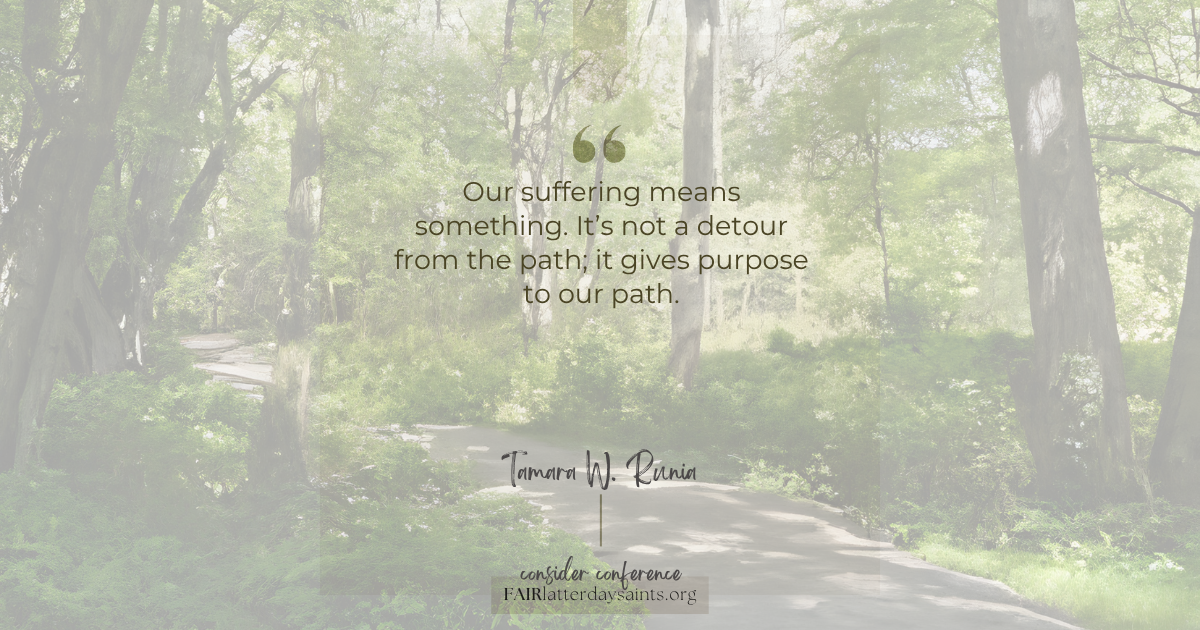
Our suffering means something. It’s not a detour from the path; it gives purpose to our path.
Sister Runia reminds us that God’s plan is not simply about making life comfortable. It is about helping us become something we could never become on our own.
Common Criticism: A Loving God Would Prevent Suffering
One of the most persistent challenges to faith is the problem of suffering. If God loves His children, why do faithful people experience devastating losses, unanswered prayers, and circumstances they cannot change?
For some, suffering seems to contradict the promise of divine love. If obedience brings blessings, shouldn’t righteousness protect us from life’s most painful experiences?
Fallacy at Work: False Dilemma
A false dilemma occurs when only two possibilities are presented, even though other explanations may exist.
In this case, the assumption is that either God loves us and prevents suffering, or He allows suffering and therefore cannot truly love us.
This reasoning overlooks another possibility: a loving God can allow His children to experience a mortal world where genuine agency, adversity, and growth exist, while offering divine help through those experiences.
Doctrine: Experience Is Part of God’s Eternal Plan
In Doctrine and Covenants 122:7, the Lord tells Joseph Smith that his trials will give him experience and be for his good. This does not mean every tragedy is deliberately sent by God or that every hardship will make sense during mortality. It does mean that our experiences are not beyond His power to redeem.
Sister Runia explains:
It is precisely because He loves us that we’re having these tempering, refining experiences. God knows, and we are here to learn, that we must become like Him so we can live with Him!
Sister Runia’s Correction: The Gospel Is a Foundation, Not an Umbrella
Sister Runia describes once imagining the gospel as an umbrella that could protect her from life’s storms. Through experience, she came to understand that even faithful disciples will face hardship.
The gospel does not promise that the rain will never fall. Instead, it provides a sure foundation upon which we can stand when storms arrive (Helaman 5:12).
Her experience also reflects Nephi’s declaration in 1 Nephi 11:17 that he knew God loved His children, even though he did not understand the meaning of all things.
Solution
God’s love is not measured by how little we suffer, but by His enduring commitment to our eternal welfare. Through Jesus Christ, we can find strength, healing, and purpose even when our circumstances remain unresolved.
Faith does not require us to understand every experience. It invites us to trust the Savior who understands them all.
Living Apologetics: Trusting the Master Sculptor
Suffering becomes especially difficult when life no longer resembles the future we imagined. We may wonder why someone else’s prayers seem answered while our own righteous desires remain unfulfilled.
Sister Runia reminds us:
Your story is personal. So you don’t need to look sideways and ask, ‘How come my life doesn’t look like theirs?’
Our circumstances are not a reliable measurement of God’s love. Each person’s mortal experience is different, and outward appearances rarely reveal the full story of another’s struggles or spiritual growth.
At her son’s funeral, Sister Runia expressed a principle that beautifully illustrates faithful uncertainty:
Not understanding is not the same as not believing.
Faith does not eliminate grief, disappointment, or unanswered questions. It allows us to bring those experiences to Christ rather than assuming they disprove His love.
Sister Runia shares a touching account of her young grandson, who compared God’s plan to building with Lego bricks. Even without seeing the finished picture, he believed he could follow the instructions because he trusted the designer.
Likewise, we may not recognize how every piece of our lives fits together. Some pieces seem entirely out of place.
But as Sister Runia teaches:
It will take your finest faith in Christ to keep putting together the pieces—the ones that make sense but also the ones that don’t.
Trusting God does not mean pretending that painful experiences are good. It means believing that Christ’s power to heal and redeem is greater than the pain we currently see.
Practical Apologetic Use:
- If someone says: “I’ve tried to do everything right, so why is God allowing my life to fall apart?”
- You can respond: “I don’t know why you’re facing this particular trial, and I wouldn’t pretend that your pain is easy to explain. But the gospel doesn’t teach that righteousness prevents every hardship. It teaches that Jesus Christ will not abandon us in our suffering. Even when we cannot understand what is happening, we can trust Him to help us through it.”
Ways to Apply Today:
1️⃣Stop measuring your journey against someone else’s. When comparison begins to weaken your faith, remember that God knows your individual circumstances, righteous desires, and eternal potential.
2️⃣Make room for unanswered questions. Instead of assuming uncertainty means your faith is failing, consider how Nephi’s example allows belief and incomplete understanding to coexist.
3️⃣Invite the Savior into what feels unfinished. Identify one burden, disappointment, or fear you have been trying to manage alone. Ask Christ for the strength, perspective, or healing you need today.
Keep This Talk With You
Sister Runia concludes with an image of a sculptor struggling to create a likeness of himself. Despite his efforts, he could not make the sculpture’s eyes look right. Eventually, he humbled himself and asked his instructor for help.
The instructor began carving more deeply and aggressively than the student expected. But what initially seemed startling produced something the student could not accomplish alone. The finished work remained uniquely his, yet it had unmistakably been shaped by a master’s hand.
Our lives can feel much the same.
We may resist experiences that challenge our expectations, reveal our weaknesses, or require us to surrender control. Yet the Savior sees more than our present circumstances. He sees who we are capable of becoming.
His work does not erase our individuality or diminish the reality of our pain. Rather, through His grace, He can help us become more fully who our Heavenly Father knows we can be.
As Sister Runia testifies:
Christ’s work in your life and His love for you are bigger than your present story. And He can fix what feels badly broken.
We do not need to understand every stroke of the Master’s hand to trust His love. Nor do we need to pretend that the sculpting process is painless. We can acknowledge the difficulty of mortality while believing that the Savior’s redeeming work extends beyond everything we currently understand.
This week, try one small step:
- Recognize the foundation beneath you. When a difficulty feels overwhelming, identify one gospel truth that remains constant even when your circumstances change.
- Look for evidence of the Savior’s sustaining influence. Consider recording a moment when you received strength, comfort, or unexpected help during a difficult experience.
- Extend compassion rather than explanations. When someone is suffering, resist the urge to tell them why their trial is happening. Listen, acknowledge their pain, and remind them through your actions that they are not alone.
God is shaping us into something only He knows we can become. As we continue to choose Christ, we can trust that His work in our lives is not limited by what we can presently see.
What part of your life are you still trying to make sense of on your own, and what might change if you invited the Savior to help you carry it?
 Faith in Action
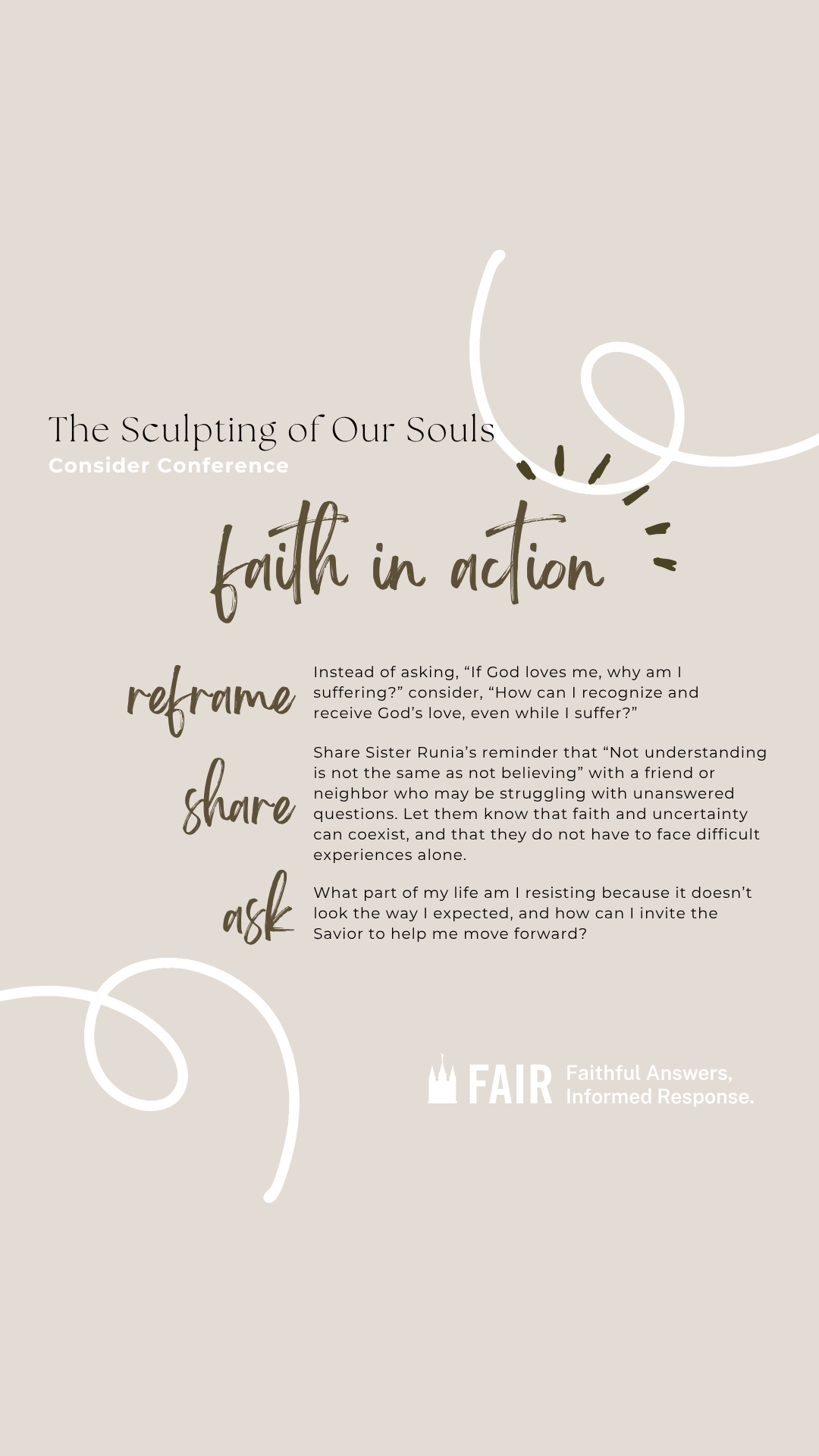
💬 Reframe: Instead of asking, “If God loves me, why am I suffering?” consider, “How can I recognize and receive God’s love, even while I suffer?”
📖 Share: Share Sister Runia’s reminder that “Not understanding is not the same as not believing” with a friend or neighbor who may be struggling with unanswered questions. Let them know that faith and uncertainty can coexist, and that they do not have to face difficult experiences alone.
🙏 Ask: What part of my life am I resisting because it doesn’t look the way I expected, and how can I invite the Savior to help me move forward?
Reflection Question
What part of your life are you still trying to make sense of on your own, and what might change if you invited the Savior to help you carry it?
The Consider Conference series by FAIR offers an in-depth look at recent General Conference talks to help members of the Church of Jesus Christ of Latter-day Saints navigate common questions, misunderstandings, and criticisms. Each post provides doctrinal insights, historical context, and practical ways to apply gospel principles in everyday conversations. Through this series, we hope to equip readers with faith-promoting resources that encourage thoughtful reflection, respectful dialogue, and a stronger foundation in gospel truths, fostering both personal conviction and meaningful discussions with others.
Leave a Reply