• Skip to primary navigation
  • Skip to main content
  • Skip to primary sidebar
  • Skip to footer

FAIR

  • Find Answers
  • Blog
  • Media & Apps
  • Conference
  • Bookstore
  • Archive
  • About
  • Get Involved
  • Search

Anti-Mormon critics

Fair Issues 42: Dismissing Book of Mormon Geography Inaccuracies

February 7, 2014 by Ned Scarisbrick

https://media.blubrry.com/mormonfaircast/www.fairlatterdaysaints.org/wp-content/uploads/2014/02/Fair-Issue-42-Pod.mp3

Podcast: Download (6.8MB)

Subscribe: RSS

Ash (newer) PictureThe traditional LDS folk-belief asserts that the Lehites arrived to a nearly vacant New World,…this assumption – like many other assumptions about the about the Book of Mormon – comes from a naïve reading of the text that was filtered through the 19th century misunderstanding of the human migrations that populated the ancient New World.

In this article brother Ash explains this common error and extends our understanding of this important issue.

The full text of this article can be found at Deseret News online.

Brother Ash is author of the book Shaken Faith Syndrome: Strengthening One’s Testimony in the Face of Criticism and Doubt, as well as the book, of Faith and Reason: 80 Evidences Supporting the Prophet Joseph Smith. Both books are available for purchase online through the FairMormon Bookstore.

Tell your friends about the Mormon Fair-Cast. Share a link on your Facebook page and help increase the popularity of the Mormon Fair-Cast by subscribing to this podcast in iTunes, and by rating it and writing a review.


Filed Under: Anti-Mormon critics, Apologetics, Book of Mormon, Evidences, FAIR Conference, Faith Crisis, Geography, Hosts, Ned Scarisbrick, Podcast, Science

4th Watch 12: Too Serious or not Serious Enough

January 29, 2014 by Ned Scarisbrick

https://media.blubrry.com/mormonfaircast/www.fairlatterdaysaints.org/wp-content/uploads/2014/01/4th_Watach_12-pod.mp3

Podcast: Download (11.3MB)

Subscribe: RSS

4thWatch SmallHow serious do we take the gospel of Jesus Christ?  How serious do we take ourselves in relation to the gospel of our Savior?  Sometimes we can get caught up in the thick of thin things and overlook the weightier matters.

In this podcast brother Scarisbrick reviews a article done by Robert Kirby, a columnist for the Salt Lake Tribune newspaper.  The article is entitled “Is it worse to be too serious or not serious enough?”  Brother Kirby was also a speaker at the FairMormon conference this past August 2013.  You may read his article from the Salt Lake Tribune  here.

The “Kirb” is somewhat of a colorful character compared to your standard and average Mormon.  His rating for “light-minded” refers to lack of seriousness regarding sacred things.  It’s a class C Church misdemeanor in modern Mormonism.  Light-mindedness was probably a felony during Brigham’s Young’s day.  Brother Ned explores how we see this gospel principle from several perspectives

Filed Under: Anti-Mormon critics, Apologetics, FAIR Conference, Faith Crisis, Hosts, LDS Culture, LDS History, Mormon Voices, Ned Scarisbrick, Podcast

Fair Issues 39: Countering subversive attacks

January 17, 2014 by Ned Scarisbrick

https://media.blubrry.com/mormonfaircast/www.fairlatterdaysaints.org/wp-content/uploads/2014/01/Fair-Issues-39-pod.mp3

Podcast: Download (7.5MB)

Subscribe: RSS

Ash (newer) PictureIn this article, brother Michael R. Ash counters subversive attacks on Mormon scholarship.  Critics frequently state, or imply that 1.  LDS scholars are not real scholars; 2.  “Real” scholars (by which they mean, “non-LDS” scholars) reject LDS scholarship; and 3.  LDS scholarship is biased.  By casting doubt on Mormon scholarship from the start, critics hope to dissuade people from listening to LDS scholars or giving credence to their arguments  This appears to be effective among critics themselves , many of whom totally dismiss LDS scholarship without giving it a fair hearing.

The full text of this article can be found at Deseret News online.

Brother Ash is author of the book Shaken Faith Syndrome: Strengthening One’s Testimony in the Face of Criticism and Doubt, as well as the book, of Faith and Reason: 80 Evidences Supporting the Prophet Joseph Smith. Both books are available for purchase online through the FairMormon Bookstore.

Tell your friends about the Mormon Fair-Cast. Share a link on your Facebook page and help increase the popularity of the Mormon Fair-Cast by subscribing to this podcast in iTunes, and by rating it and writing a review.

Filed Under: Anti-Mormon critics, Apologetics, Book of Mormon, Evidences, Hosts, Mormon Voices, Ned Scarisbrick, Podcast

Fair Issues 37: Ambiguity in Book of Mormon translation

January 3, 2014 by Ned Scarisbrick

https://media.blubrry.com/mormonfaircast/www.fairlatterdaysaints.org/wp-content/uploads/2013/12/Fair-Issue-37-Pod.mp3

Podcast: Download (6.1MB)

Subscribe: RSS

Ash (newer) PictureAs noted several times in this series, words only have meaning in a context, and documents are written not only from within a context but they are also written to a specific audience as well.

Mike Ash relates how  Dr. William Hamblin, an expert on the ancient Near East, says that there are two primary rules to follow when trying to understand any text that has been translated from a foreign Language.  The first is to accurately understand what the text has to say.  Second, the reader must contextualize the text in its original setting – that is to say, read it in the context of the culture, history, values, science and social norms of it’s day.


The full text of this article can be found at Deseret News online.

Brother Ash is author of the book Shaken Faith Syndrome: Strengthening One’s Testimony in the Face of Criticism and Doubt, as well as the book, of Faith and Reason: 80 Evidences Supporting the Prophet Joseph Smith. Both books are available for purchase online through the FairMormon Bookstore.

Tell your friends about the Mormon Fair-Cast. Share a link on your Facebook page and help increase the popularity of the Mormon Fair-Cast by subscribing to this podcast in iTunes, and by rating it and writing a review.

Filed Under: Anti-Mormon critics, Apologetics, Book of Mormon, Evidences, Hosts, Ned Scarisbrick, Podcast

Archaic Hebrew in the Old Testament (And What It Means for the Book of Mormon)

January 2, 2014 by Stephen Smoot

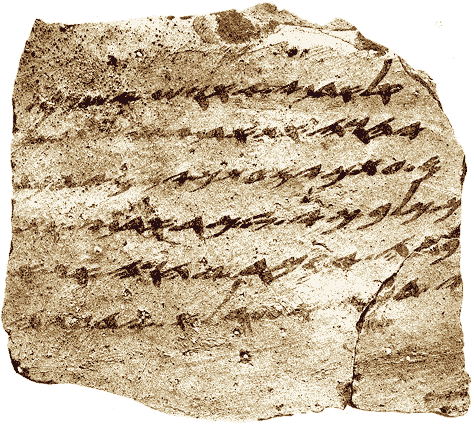
One of the Lachish ostraca (7th century BCE), written in paleo-Hebrew script.

Some time ago I posted a blog entry at Interpreter on the atheist polemicist Richard Dawkins’ argument that the Book of Mormon is a fraud because Joseph Smith rendered his translation into Jacobean English. Dawkins’ argument is (and I’m not making this up) that “[the Book of Mormon] was a 19th century book written in 16th century English. That’s not the way people talked in the 19th century – it’s a fake. So it’s not beautiful, it’s a work of charlatanry.” [Read more…] about Archaic Hebrew in the Old Testament (And What It Means for the Book of Mormon)

Filed Under: Anti-Mormon critics, Atheism, Book of Mormon, Joseph Smith, LDS Scriptures

Isis and Maat in Facsimile 3 of the Book of Abraham: A Horrific Blunder by Joseph Smith?

December 29, 2013 by Jeff Lindsay

A recent post at Mormanity, “Shulem in the Book of Abraham: Possible Plausibility?,” suggested that the name Shulem given by Joseph Smith in Facsimile 3 might be more interesting than just a blunder or random guess. In response, one critic raised a reasonable question, but with a rather dismissive tone:

Wow. I look forward to your equally convoluted explanations of how “Isis, the great god’s mother” (what the characters above figure 2 actually mean) really means “King Pharaoh,” and how “Maat, mistress of the gods” (characters above figure 4) really means “Prince of Pharaoh.” This just goes to show how infinitely facile apologists can be with the facts.

While anything we say regarding any aspect of Mormonism will be dismissed as “infinitely facile” by critics not interested in dialog, the question does deserve a response. In spite of many evidences for the Book of Abraham as an ancient document, there are definitely some trouble spots, and the most problematic in my opinion are the names given in Facsimile 3. Figures 2 and 4 in that drawing are identified by Joseph as Pharaoh and the prince, respectively, but they are obviously female. Is he blind? Further, he dares to refer to the written text above the characters and states that these identities are “given,” “written,” or “represented” there. But now that scholars can read Egyptian, they have pointed out that Joseph wasn’t even close. The characters above those Figures 2 and 4 state that they are “Isis the great, the god’s mother” and “Maat, mistress of the gods,” definitely not “King Pharaoh, whose name is given in the characters above his head” and “Prince of Pharaoh, King of Egypt, as written above the hand.” As the critics say, here we have a simple test of his ability to read Egyptian, and it would have been easy here for God to simply prove to the world that his prophet could read Egyptian by inspiring him to write something like “The goddess Isis” and “The goddess Maat” for these figures. Instead, we have a “translation” that not only misreads the literal text, but also totally misses the obvious gender of the drawings. Any ordinary farmboy could at least have gotten the gender right, but not Joseph. End of story?

If you’re looking for a reason to reject Joseph and the Book of Abraham, this is the perfect place to start. Yes, he failed to render the names Isis and Maat. He even got the genders wrong. Regarding the gender problem, Hugh Nibley has writtenthat ritual dramas in which a man dressed as a female deity are known in Egyptian lore, but even if we accept that a gender-transforming lens can be applied in some kind of Egyptian role playing scenario, is there any reason to believe that Isis could somehow represent Pharaoh and Maat could represent the prince? Joseph gave us specifics that don’t make sense, at least not at a literal level.

Latter-day Saints recognize the possibility of human error whenever mortals are involved, and understand that Joseph and other prophets make mistakes. Is that the case here? Perhaps. But there may be something more interesting. Perhaps Joseph’s exercise was not about the literal representation of these figures, otherwise he surely would have said something about women rather than men. Perhaps he is seeking to understand what Facsimile 3 symbolized rather than its literal meaning.

Isis and Pharaoh: Any Connections?

Could Isis be linked to Pharaoh? Wikipedia’s article on Isis provides our first clue:

The name Isis means “Throne”. Her headdress is a throne. As the personification of the throne, she was an important representation of the pharaoh’s power. The pharaoh was depicted as her child, who sat on the throne she provided.

Suddenly, the guffawing of critics seems a little less embarrassing for Joseph. The word “Isis” written above Figure 2’s head can, without delicate mental gymnastics, be rather directly linked to Pharaoh–rather precisely as stated by Joseph. Again, not literally–obviously not literally, because she is female, of course–but in a rather direct and simple metaphorical link. Isis = throne = symbol of Pharaoh. Not too tricky.

In the Turin Papyrus, Isis learns the secret name of Ra and gains power over him (see R.A. Ritner, “The Legend of Isis and the Name of Re: P. Turin 1993.”) This is a powerful goddess well suited to personify the Pharaoh and his power.

AncientEgyptOnline.co.uk offers this commentary on Isis:

Isis was a member of the Helioploitan Ennead, as the daughter of Geb (Earth) and Nut (Sky) and the sister and wife of Osiris and the sister of Set, Nephthys and (sometimes) Horus the Elder. However, because of her association with the throne Isis was sometimes considered to be the wife of Horus the Elder- the patron of the living Pharaoh. Ra and Horus were closely associated during early Egyptian history, while Isis was closely associated with Hathor (who was described as the mother or the wife of Horus or Ra) and so Isis could also be considered to be the wife of Ra or Horus.

However, when Ra and Atum (the Ennead of Helipolis) merged, Isis became both the daughter of Atum(-Ra) and the wife of (Atum-)Ra. This situation was clarified by crediting Isis as the granddaughter of Ra-Atum, the mother of Horus (the child) and the wife of Osiris.

Here is more about Isis and her complex roles, also from Wikipedia:

During the Old Kingdom period, Isis was represented as the wife or assistant to the deceased pharaoh. Thus she had a funerary association, her name appearing over eighty times in the pharaoh’s funeral texts (the Pyramid Texts). This association with the pharaoh’s wife is consistent with the role of Isis as the spouse of Horus, the god associated with the pharaoh as his protector, and then later as the deification of the pharaoh himself.

But in addition, Isis was also represented as the mother of the “four sons of Horus”, the four deities who protected the canopic jars containing the pharaoh’s internal organs. More specifically, Isis was viewed as the protector of the liver-jar-deity, Imsety. By the Middle Kingdom period, as the funeral texts began to be used by members of Egyptian society other than the royal family, the role of Isis as protector also grew, to include the protection of nobles and even commoners.

By the New Kingdom period, in many places, Isis was more prominent than her spouse. She was seen as the mother of the pharaoh, and was often depicted breastfeeding the pharaoh. It is theorized that this displacement happened through the merging of cults from the various cult centers as Egyptian religion became more standardized. When the cult of Ra rose to prominence, with its cult center at Heliopolis, Ra was identified with the similar deity, Horus. But Hathor had been paired with Ra in some regions, as the mother of the god. Since Isis was paired with Horus, and Horus was identified with Ra, Isis began to be merged with Hathor as Isis-Hathor. By merging with Hathor, Isis became the mother of Horus, as well as his wife. Eventually the mother role displaced the role of spouse. Thus, the role of spouse to Isis was open and in the Heliopolis pantheon, Isis became the wife of Osiris and the mother of Horus/Ra. This reconciliation of themes led to the evolution of the myth of Isis and Osiris.

Her role was complex and shifted over time, but her association with the throne and the Pharaoh, either directly or through her connection to Horus, again points to a plausible symbolic meaning that an Egyptian/Semitic editor could see between the female Isis and Pharaoh. Could it be that Joseph recognized the symbolism here and saw that the deeper meaning of Pharaoh was symbolically given in the characters that mention “She of the Throne,” Isis? I think that possibility needs to be considered.

Maat and the Prince of Pharaoh

If a female deity can represent Pharaoh, can another represent a prince? Does Maat have associations that could make sense of Joseph’s statement? To me, this is not as clearcut and remains a fair question. Here is what Wikipedia says about Maat:

Maat or ma’at … was the ancient Egyptian concept of truth, balance, order, law, morality, and justice. Maat was also personified as a goddess regulating the stars, seasons, and the actions of both mortals and the deities, who set the order of the universe from chaos at the moment of creation. Her (ideological) counterpart was Isfet.

The earliest surviving records indicating Maat is the norm for nature and society, in this world and the next, were recorded during the Old Kingdom, the earliest substantial surviving examples being found in the Pyramid Texts of Unas (ca. 2375 BCE and 2345 BCE).

Later, as a goddess in other traditions of the Egyptian pantheon, where most goddesses were paired with a male aspect, her masculine counterpart was Thoth and their attributes are the same. After the rise of Ra they were depicted together in the Solar Barque.

After her role in creation and continuously preventing the universe from returning to chaos, her primary role in Egyptian mythology dealt with the weighing of souls that took place in the underworld, Duat. Her feather was the measure that determined whether the souls (considered to reside in the heart) of the departed would reach the paradise of afterlife successfully.

Pharaohs are often depicted with the emblems of Maat to emphasise their role in upholding the laws of the Creator….

The sun-god Ra came from the primaeval mound of creation only after he set his daughter Maat in place of Isfet (chaos). Kings inherited the duty to ensure Maat remained in place and they with Ra are said to “live on Maat”, with Akhenaten (r. 1372-1355 BCE) in particular emphasising the concept to a degree that, John D. Ray asserts, the kings contemporaries viewed as intolerance and fanaticism. Some kings incorporated Maat into their names, being referred to as Lords of Maat, or Meri-Maat (Beloved of Maat). When beliefs about Thoth arose in the Egyptian pantheon and started to consume the earlier beliefs at Hermopolis about the Ogdoad, it was said that she was the mother of the Ogdoad and Thoth the father.

Perhaps I’m grasping at straws here, but I find it interesting that Maat is the daughter of the great sun-god Ra and that some kings incorporated Maat into their names. And not just kings: there was also an Egyptian prince, Nefermaat, whose name was based on Maat’s.

What I find more interesting is her role in renewal and preserving cosmic order, a topic that brings us to the issue of coronation of new kings (the former prince). On this issue, Ernst Wurthwein in “Egyptian Wisdom and the Old Testament” inEssential Papers on Israel and the Ancient Near East, ed. Frederick E. Greenspahn (New York: New York University, 1991), p. 134, cites H. Brunner, Handbuch der Oreintalistik I, 2 (1952), pp. 96ff:

As a goddess, Maat belonged to the Heliopolitan religious system, where she appeared as the daughter of the sun-god. She came down to men in the beginning as the proper order of all things. Through the evil assaults of Seth and his comrades, this order was upset, but restored through the victory of Horus. As the embodiment of Horus, each new king renews this right order through his coronation: a new state of Maat, i.e., of peace and righteousness, dawns. [emphasis added]

Maat’s role in coronation to renew the authority of the kingdom naturally points to the man who will serve as successor to Pharaoh, the prince. It is also interesting that the name of Maat was often used in special coronation names given to new kings at their coronation. One reference on this point is Emily Teeter, “Egypt,” inThe Cambridge Companion to Ancient Mediterranean Religions, ed. by Barbette Stanley Spaeth (New York: Cambridge University Press, 2013), pp. 24-25:

One of the king’s main obligations to the god was to rule the land in accordance with maat, the interconnected concept of cosmic balance and truth that was personified by the goddess Maat. The commitment to maat is illustrated by offering scenes where the king presents a figure of the goddess Maat to the deities as a visible affirmation of his just rule and the acknowledgement that he will uphold the tenets inherent inmaat. In the New Kingdom, the king’s coronation name was often compounded with Maat, another indication of the association of the king and principle of truth. Some New Kingdom kings are shown presenting a rebus of their name captioned “presenting Maat,” suggesting that the king himself was imbued with or personified, Truth.

David Leeming, The Oxford Companion to World Mythology (Oxford: Oxford University Press, 2005), offers this information about Maat (p. 243):

Maat in Egyptian mythology, the goddess Maat (Ua Zit), the wife of Thoth, a god associated with wisdom, and daughter or aspect of the high god Atum, is at once a goddess and an idea, the personification of moral and cosmic order, truth, and justice . . . that was as basic to life as breath itself, which in the Coffin Texts Maat also seems to personify. Pharaohs held small models of Maat to signify their association with her attributes. Maat gives breath itself–life–to the kings, and so is depicted holding the symbol of life, the ankh, to their noses. Maat represents the proper relationship between the cosmic and the earthly, the divine and the human, the earth, the heavens, and the underworld. It is she who personifies the meaningful order of life as opposed to the entropic chaos into which it might easily fall. It some stories it is the sun god Re who displaces Chaos with Maat. . . .

Maat was essentially in all Egyptian gods and goddesses as the principle of divinity itself. The goddess Isis acknowledges the qualities of Maat, as signified by the maat (ostrich feather) she wears behind the crowns of upper and lower Egypt.

Maat might be seen as a principle analogous to the Logos, divine reason and order. As Christians are told “In the beginning was the Word [Logos] already was” (John 1:1). Atum announces that before creation, “when the heavens were asleep, my daughter Maat lived within me and around me.”

If Maat is the daughter of the great god and is a parallel to the Christian Logos and the son of God, then could this child could be considered a princess and thus again a symbol of a prince?

Wikipedia, as quoted above, indicates that Maat is paired with Thoth, having the same attributes. Regarding Thoth, Claas Jouco Bleeker in Hathor and Thoth: Two Key Figures of the Ancient Egyptian Religion (Leiden, Netherlands: E.J. Brill, 1973), p. 119, writes:

There was a close connection between Thoth and Re. In the previous section we became acquainted with him as son of Re. The sun-god placed so much confidence in the capacities of Thoth that he appointed him his deputy, his vizier. The pertinent text relates how Re sent for Thoth and gave him a place of honour next himself. Thereupon Re spoke: “Thou shalt be writer in the nether-world…. Thous shalt take my place as deputy, thou shalt be called Thoth substitute of Re.”

Another text adds that he was even appointed successor to Re. Thoth fulfilled his task so well that he was given the epithet “the one with whose word Atum (the primeval god at Heliopolis who later acquired solar significance) is content.”

In his office Thoth performs invaluable services for the sun-god. He is “the perfect secretary.” is said that his pen protects Re. Just what this expression implies is made clear in a hymn to Re which runs: “Daily Thoth writes Ma-a-t for thee.” [emphasis added]

Thoth, the escort of Maat, may be a symbol of a successor to the throne, again pointing to the role of a prince at a symbolic level.

Regarding Thoth, Maat’s husband, Leeming writes (p. 381):

Thoth was the moon god as well as the god of wisdom in Egypt. . . . In Hermopolis he might sometimes have been seen as a creator god. For some, Thoth was the son of Re, Re in this case being the sun, the right eye of Horus, whose moon eye had been ripped out by Seth. His consort was Maat. . . .

Maat, Thoth, son/daughter of the great god, and successor: if Isis can be a symbol for Pharaoh, could these associations allow an Semitic editor to also use Maat as a symbol for a prince? This doesn’t answer all the questions or objections to the identities offered by Joseph Smith on Facs. 3, but may suggest that there is “something interesting going on” besides random guessing coupled with gross inability to recognize a female in a drawing.

I could be way off and welcome your feedback. I know little about Egyptology and have just relied on easily found sources here that may be inadequate in many ways. It’s still possible to accept that some egregious errors were made, but the theory that Joseph’s comments are based on symbolic meanings would be fairly consistent with some of the more interesting hits in the Book of Abraham, and consistent with the principle of God not removing the need for faith in accepting scripture. God could have provided manuscripts and literal interpretations capable of gaining peer-reviewed acceptance from the scholarly community with no need for faith. But that’s not how He does things. Faith will always be required.

* This entry was also posted at Mormanity.

Filed Under: Anti-Mormon critics, Book of Abraham, Joseph Smith

The Exaggerated Death of Apologetics

December 9, 2013 by SteveDensleyJr

In 1897, Mark Twain’s cousin became seriously ill. Some people confused the two men, leading Mark Twain to remark a few weeks later, “The report of my death was an exaggeration.” Similarly, it may be that as long as people have been calling themselves “anti-Mormons,” critics of the Church have been predicting the demise of the Church and have been pronouncing efforts to defend it as futile. All such declarations of impending doom have proven, at the very least, to be exaggerated.

One such example is in the occasional rumblings from some quarters that “the Brethren” or the institutional Church is at odds with lay members who engage in a reasoned defense of the faith, or “apologetics.” Over the past year, the Neal A. Maxwell Institute (formerly known as FARMS) has adopted a more secular approach to the academic discipline of Mormon Studies, and has moved away from an overt defense of the Church. Some have wondered if this indicates that the “institutional Church” is distancing itself from a reasoned defense of the faith. Indeed, there are some who argue that “the brethren” want nothing to do with apologetics and surmise that President Uchtdorf’s talk in this year’s October General Conference must have come as a severe blow to Mormon apologists.

While it is true that what was once known as the FARMS Review has morphed into an annual journal with a secular focus, rather than a faith-building focus, the Interpreter: A Journal of Mormon Scripture has taken its place and is accessible, technologically advanced, and prolific. It seems that the changes at the Maxwell Institute have simultaneously created a new base for the emerging secular discipline of “Mormon Studies” while at the same time serving as the impetus for revitalized interest in publishing works in a peer-reviewed, academic journal that provide a reasoned defense of the faith.

With regard to whether or not “the Brethren” are distancing themselves from efforts to directly defend the Church against charges of its critics, Elder D. Todd Christofferson spoke in September at BYU-Idaho and not only bore his testimony of Joseph Smith, but also offered many reason-based responses to attacks against the Church. In doing so, he cited publications by FairMormon twice.

When President Uchtdorf spoke in General Conference the next month, all of the defenders of the faith that I know were thrilled to hear his words and saw them as consistent and supportive of efforts we have been making for years. Nevertheless, some people have wondered aloud whether apologists have been left disheartened and confused by President Uchtdorf’s remarks. It is hard to imagine why defenders of the faith would be at all disturbed by President Uchtdorf’s words. These people seem to assume that defenders of the Church must have been surprised to hear President Uchtdorf say that ex-Mormons aren’t simply lazy or sinful. They further seem to assume that those who defend the Church all believe that the only reason people leave the Church is because they are lazy or sinful. However, I don’t know of anyone at FairMormon who has ever said that. Unfortunately, some rank-and-file members do say such things, and, rather than support that view, I argued against it on the FairMormon Blog some time ago.

The other problem is that some people are misinterpreting what President Uchtdorf actually said. He did not say that ex-Mormons are never lazy or sinful. (Every conceivable group, including Mormons, ex-Mormons and non-Mormons includes people who are lazy or sinful.) He simply said that being lazy or sinful are not the only reasons people leave the Church. Here is the exact quote: “Sometimes we assume it is because they have been offended or lazy or sinful. Actually, it is not that simple. In fact, there is not just one reason that applies to the variety of situations.” Far from an indictment of those who defend the Church, the fact that a member of the First Presidency has publicly declared that people sometimes leave the Church for reasons other than mere laziness or sin signals a greater need for a rational defense of the faith. To the extent that some of those other reasons involve Church history or doctrine, defenders of the faith are well-equipped to address those concerns.

Finally, in addition to the efforts the Church has made through the Joseph Smith Papers Project to illuminate its history, the most clear example that the institutional Church has not abandoned or disavowed a reasoned defense of the faith is the simple fact that the Church has been providing reasoned responses to critical arguments for the past year on its main webpage, LDS.org.

While the Sunday School curriculum has focused this year on Church history, the Church has been posting articles that directly address issues that have sometimes been confusing to members and a target for critics. Two examples are this article about Oliver Cowdery’s apparent use of a divining rod, and this article putting the apostasy of Thomas B. Marsh into context.

More recently, the Church has published articles addressing the question of whether Mormons are Christians, exploring the differences in the various accounts of the First Vision, and setting forth the history of blacks and the priesthood, in which it is explicitly stated “Today, the Church disavows the theories advanced in the past that black skin is a sign of divine disfavor or curse, or that it reflects actions in a premortal life; that mixed-race marriages are a sin; or that blacks or people of any other race or ethnicity are inferior in any way to anyone else.”

Rather than being shocked and dismayed by recent actions of the institutional Church, now more than ever, faithful believers and scholars have concluded that it is an even more exciting and important time to stand up in defense of the Church and the gospel of Jesus Christ.

Filed Under: Anti-Mormon critics, Apologetics, First Vision, Racial Issues

4th Watch 11: What does it mean to be saved?

December 4, 2013 by Ned Scarisbrick

https://media.blubrry.com/mormonfaircast/www.fairlatterdaysaints.org/wp-content/uploads/2013/11/4th_Watch_11.mp3

Podcast: Download (22.4MB)

Subscribe: RSS

4thWatch Small

The term “salvation” or “being saved” has long been discussed and debated by scholars of many faith traditions.  In this podcast Bobby Gilpin of the anti-Mormon blog Mormonism Investigated UK is interviewed by Ned Scarisbrick in relationship to the gospel doctrine of salvation.

Mr. Gilpen comes from the evangelical Calvinist tradition of Christianity and the term ‘anti’ may come across as disrespectful to those who are actually kind to members of the LDS Church.  The term anti in this discussion is used to represent those who are against or openly opposed to the teachings of the Church of Jesus Christ of Latter-day Saints, much as the term “pro” could be used for those who agree with or openly promote the teachings of the LDS Church.

The dialogue between Mr. Scarisbrick and Mr. Gilpin teaches us that it is possible to have a religious discussion about serious gospel topics in a kind and respectful manner.  They illustrate how to earnestly contend for the faith without being contentious. As always, the views and opinions expressed in this podcast may not reflect those of the Church of Jesus Christ of Latter-day Saints or that of Fair Mormon.


Filed Under: Anti-Mormon critics, Apologetics, General, Hosts, Ned Scarisbrick, Podcast

Mormon Fair-Cast 170: The Interpreter Foundation and FairMormon

October 6, 2013 by SteveDensleyJr

https://media.blubrry.com/mormonfaircast/www.fairlatterdaysaints.org/wp-content/uploads/2013/10/Religion-Today-for-Sunday-October-0.mp3

Podcast: Download (8.2MB)

Subscribe: RSS


10-1706-large

Shaken Faith Syndrome Available for a Limited Time at a Discount at Costco

Has a member of your family lost their faith? Buy “Shaken Faith Syndrome” now at Costco locations throughout Utah. Meet the author, Mike Ash, at the following Utah Costco locations:

  • The Ogden Costco on Wednesday, October 9, from 12 to 3.
  • The Sandy Costco on Wednesday, October 16, from 12 to 3.
  • The West Valley Costco on Wednesday, October 23 from 12 to 3.
  • The Murray Costco on Wednesday, October 30, from 12 to 3.

Costco will only schedule book signings when a book is selling well, and will only continue to carry a book so long as it is selling well. It also sells books at a significant discount. This would be the perfect time to buy multiple copies to share with friends and family members as Christmas presents.

In this episode of Religion Today, which originally aired on KSL Radio on October 6, 2013, Martin Tanner speaks with Dan Peterson of the Interpreter Foundation and Steve Densley, Jr. of FairMormon to discuss the activities of these respective organizations and the book, Shaken Faith Syndrome, which can also be purchased here at the FairMormon Bookstore.

This recording was used by permission of KSL Radio and does not necessarily represent the views of The Church of Jesus Christ of Latter-day Saints or of FAIR.

Filed Under: Anti-Mormon critics, Apologetics, News from FAIR, Podcast

Apostles and Apologetics: Doers of the Word

October 2, 2013 by Neal Rappleye

Devotional-Elder ChristoffersonBack in April, I did a blog post on some of the apologetically relevant statements from General Conference, including the instruction, from Elder Robert D. Hales, to “protect and defend the kingdom of God.” Well, as with most things our leaders teach us to do, they are also doers of the word who practice what they preach.

In a recent devotional address at Brigham Young University-Idaho, Elder D. Todd Christofferson of the Quorum of the Twelve Apostles, addressed some criticisms of the Church and made other apologetically relevant comments. Elder Christofferson opens up by briefly relating the visit of Moroni to Joseph Smith, and noting how Moroni told Joseph Smith that both good and evil would be spoken of him throughout the world (see Joseph Smith—History 1:33). This is an appropriate way to start, not only because it allows for the discussion of the good and the evil said about Joseph Smith and the Restoration today, but because Elder Christofferson was giving his address just days after the 190th anniversary of Moroni’s first visit to Joseph Smith. What an appropriate occasion to discuss the fulfillment of that prophecy! As Elder Christofferson remarks,

to think that this boy growing up in a poor family, in the smallest of small towns, in a country of limited influence and prestige in the world should come to such prominence that his name would be had for good or ill among all nations, kindreds, and people—it was truly (to use an overused word) incredible. Nevertheless, it is a prophecy that has been fulfilled in significant measure and that is more fully realized year by year.

Elder Christofferson talks about the monumental Joseph Smith Papers Project, as research initiative by the Church Historical Department intent on publishing every document written or commissioned by Joseph Smith. He notes that this “expanding access we enjoy to the Prophet’s work and teachings fills previous voids in our knowledge, confirms some things we already knew or thought, and supplies answers to questions we might have had. The information also raises new questions and highlights new areas of inquiry to pursue.” He also stresses that, “we ought not to expect in this life to know all the answers (or for that matter, all the questions).” This wide access to information of Joseph Smith, however, facilitates both aspects of Moroni’s prophecy – both the good and the evil to be spoken of Joseph Smith. Elder Christofferson reminds his audience of this, and offers three important principles to be applied when encountering the “evil” that is spoken of the prophet, his work, and his teachings.

You know, of course, that as prophesied by Moroni, there are those whose research relating to Joseph Smith is not for the purpose of gaining added light and knowledge but to undermine his character, magnify his flaws, and if possible destroy his influence. Their work product can sometimes be jarring, and so can issues raised at times by honest historians and researchers with no “axe to grind.” But I would offer you this advice in your own study: Be patient, don’t be superficial, and don’t ignore the Spirit.

First, be patient. Under this heading, Elder Christofferson reminds us that “while some answers come quickly or with little effort, others are simply not available for the moment because information or evidence is lacking. Don’t suppose, however, that a lack of evidence about something today means that evidence doesn’t exist or that it will not be forthcoming in the future. The absence of evidence is not proof.” John E. Clark, a professional archaeologist, is in agreement, as he once wrote:

Given current means of verification, positive evidence is here to stay, but negative items may prove to be positive ones in hiding. “Missing” evidence focuses further research, but it lacks the compelling logical force in arguments because it represents the absence of information rather than secure evidence.

As an example of this, Elder Christofferson cites a FairMormon blogpost by Book of Mormon scholar Matt Roper, which deals with steel in ancient Israel and the Book of Mormon. While no evidence supported the idea of a sword of “most precious steel” existing in 600 BC Jerusalem at the time the Book of Mormon was published (a lack of evidence that persisted for more than a century), it is now an accepted fact that the steeling of iron was known to Israelites well before Nephi’s time, and steel swords contemporary to the Book of Mormon account have been unearthed in the area. This is but one of many examples that could be given.

John E. Clark has collected sixty examples of alleged anachronisms that have been used against the Book of Mormon since 1829 and found that about sixty percent of them have now been verified by archaeology, while suggestive evidence has emerged for another ten (of the sixty) criticisms, though this evidence remains inconclusive. All in all, this means that evidence is more favorable to some degreenow than it was in 1830 in seventy-five percent of the sixty cases. Researcher Kevin Christensen recently reevaluated a Book of Mormon critique from 1982 to make the same point: with time (and research), many claims made against the Book of Mormon begin to look out-dated as new evidence offers support.

In a footnote to his address, Elder Christofferson also addressed the claim some critics have raised that Joseph Smith was wrong when he said there were religious revivals in the area of Palmyra in 1820. Elder Christofferson cited this FairMormon article and explained that greater access to original sources has revealed not only that revivals were common, but “that revivals were common enough that often they garnered no coverage in the newspapers unless something out of the ordinary occurred such as a death.” As with the Book of Mormon, historian Steven C. Harper has shown that criticisms of the First Vision have faded with time.These and the many similar examples underscore Elder Christofferson’s message of patience: “Where answers are incomplete or lacking altogether, patient study and patient waiting for new information and discoveries to unfold will often be rewarded with understanding.”

This leads well into Elder Christofferson’s second point, to not be superficial. Accepting the claims of critics or, as Elder Christofferson calls them, “insincere seekers,” at face value can be ill advised. Drawing on the words poet Alexander Pope, Elder Christofferson advises us to “drink deep” from the fountain of knowledge. Serious inquiry requires the time and patience mentioned above, and it rarely, if ever, assumes the “obvious” from quick and superficial study.

As a part of this, Elder Christofferson urges us to check our assumptions about the Church and it’s leaders. “When I say don’t be superficial, I mean don’t form conclusions based on unexamined assertions or incomplete research,” he says, and notes that, “We should be careful not to claim for Joseph Smith perfections he did not claim for himself. He need not have been superhuman to be the instrument in God’s hands that we know him to be.” Elder Christofferson quotes some of the many times in which Joseph Smith himself acknowledged his imperfections. Elder Christofferson then helps provide some of the big picture that critics often fail to see as they wade in the minutia of Church history: “Joseph Smith was a mortal man striving to fulfill an overwhelming, divinely- appointed mission against all odds. The wonder is not that he ever displayed human failings, but that he succeeded in his mission. His fruits are undeniable and undeniably good.”

In his address, Elder Christofferson contrasts this patient, deep mode of seeking with the tactics of those whom he terms “insincere seekers,” and distinguishes them from the honest researchers who may also raise serious, even if troubling, questions. He says:

While some honestly pursue truth and real understanding, others are intent on finding or creating doubts. Their interpretations may come from projecting 21st Century concepts and culture backward onto 19th Century people. If there are differing interpretations possible, they will pick the most negative. They sometimes accuse the Church of hiding something because they only recently found or heard about it—an interesting accusation for a Church that’s publishing 24 volumes of all it can find of Joseph Smith’s papers. They may share their assumptions and speculations with some glee, but either can’t or won’t search further to find contradictory information.

Most importantly, however, Elder Christofferson advises that as we seek answers to historical puzzles, we do not neglect the Spirit:

Finally, don’t neglect the Spirit. As regards Joseph Smith, we seek learning both by study and by faith. Both are fruitful paths of inquiry. A complete understanding can never be attained by scholarly research alone, especially since much of what is needed is either lost or never existed. There is no benefit in imposing artificial limits on ourselves that cut off the light of Christ and the revelations of the Holy Spirit.

The Spirit has an important role in the process discussed above of exercising patience and “drinking deeply.” It is by the assurance of the Spirit that we can proceed to act in faith as we patiently seek answers about this or that historical issue. Elder Christofferson uses the example of the Mark Hoffman forgeries, and then stresses:

In matters of faith, a spiritual witness is essential if one is to avoid being “tossed to and fro, and carried about with every wind of doctrine, by the sleight of men, and cunning craftiness, whereby they lie in wait to deceive. [Eph. 4:14]”  With a Spirit-derived assurance in place, you can go forward in the Lord’s work and continue deepening your relationship with your Heavenly Father while pursuing or awaiting answers. If you determine to sit still, paralyzed until every question is answered and every whisper of doubt resolved, you will never move because in this life there will always be some issue pending or something yet unexplained.

Ultimately, some answers will never come in this life. Faith is a principle of action, and it is in the acting that we often gain our testimonies. We must not let unanswered questions keep us from exercising our faith.

After discussing how to approach historical issues, Elder Christofferson goes on to remind us of what it most important:

Joseph Smith’s prophetic calling is key to our religion. Without his commission from the Father and the Son, without his priesthood ordinations and the keys he received at the hands of duly appointed heavenly messengers, without the fullness of the gospel restored through his visions and revelations and his translations of the Book of Mormon and the Bible, what we would have is something much less than true Christianity. It is critical that we gain a witness of these things by study and above all, by the teaching of the Holy Ghost.

He also adds that, “Despite all this, however, I remind you that Joseph Smith is not our foundation—it is Jesus Christ and Him crucified and resurrected. Joseph Smith, Jr. was called of God ‘to be a translator, a revelator, a seer, and a prophet.’ [D&C 124:125]” While Elder Christofferson may seem, to some, to have departed from apologetics, I think here Elder Christofferson actually does something that is an important part of good apologetics: rather than just respond to objections, or talk about how to handle criticisms, Elder Christofferson also seeks to build faith. He does this by discussing the important things Joseph Smith accomplished as a prophet of the Lord Jesus Christ, and bearing testimony of those things. In apologetics, we must do more than simply address the negative. We must also provide the positive. We must give people reasons to believe. This can be done in a number of ways; bearing testimony, sharing evidences, or telling personal experiences of how the gospel and the Church have blessed you are only some examples. The exact method (or combination of methods) should probably be adapted based on circumstances, but it is always important to try and give the person who is doubting something positive to build on.

As an apostle of the Lord Jesus Christ speaking in a devotional setting, it is appropriate that Elder Christofferson used his own and Joseph Smith’s testimony of the Savior, the witness of Christ in the Book of Mormon, and the martyrdom of the prophet to serve as faith promoting points to build on. As the apostles often do, Elder Christofferson closes with his own testimony of the Prophet Joseph Smith:

I bear witness of Joseph Smith’s prophetic calling, and to his magnificent revelation of Jesus, I reverently add my own testimony of the Christ. I too know that Jesus of Nazareth is the Son of God and the Savior of the world. He stands at the head of The Church of Jesus Christ of Latter-day Saints. He is the Redeemer, and His grace is sufficient. I pray that all may receive the testimony of Joseph Smith and come unto Christ, in the name of Jesus Christ, amen.

Filed Under: Anti-Mormon critics, Apologetics, Joseph Smith, LDS History

  • « Go to Previous Page
  • Go to page 1
  • Interim pages omitted …
  • Go to page 22
  • Go to page 23
  • Go to page 24
  • Go to page 25
  • Go to page 26
  • Interim pages omitted …
  • Go to page 32
  • Go to Next Page »

Primary Sidebar

Faithful Study Resources for Come, Follow Me

Subscribe to Blog

Enter your email address:

Subscribe to Podcast

Podcast icon
Subscribe to podcast in iTunes
Subscribe to podcast elsewhere
Listen with FAIR app
Android app on Google Play Download on the App Store

Pages

  • Blog Guidelines

FAIR Latest

  • Come, Follow Me with FAIR – Doctrine and Covenants 137–138 – Part 2 – Autumn Dickson
  • Come, Follow Me with FAIR – Doctrine and Covenants 137–138 – Mike Parker
  • FAIR December Newsletter
  • Come, Follow Me with FAIR – Doctrine and Covenants 137–138 – Part 1 – Autumn Dickson
  • Prophets of God 

Blog Categories

Recent Comments

  • LHL on Come, Follow Me with FAIR – Doctrine and Covenants 132 – Mike Parker
  • Stephen Johnsen on Come, Follow Me with FAIR – Doctrine and Covenants 132 – Mike Parker
  • Bruce B Hill on Come, Follow Me with FAIR – Doctrine and Covenants 124 – Part 1 – Autumn Dickson
  • Gabriel Hess on Join us Oct 9–11 for our FREE virtual conference on the Old Testament
  • JC on When the Gospel “Doesn’t Work”

Archives

Follow Us

  • Facebook
  • Twitter
  • iTunes
  • YouTube
Android app on Google Play Download on the App Store

Footer

FairMormon Logo

FAIR is a non-profit organization dedicated to providing well-documented answers to criticisms of the doctrine, practice, and history of The Church of Jesus Christ of Latter-day Saints.

Donate to FAIR

We are a volunteer organization. We invite you to give back.

Donate Now

Site Footer