• Skip to primary navigation
  • Skip to main content
  • Skip to primary sidebar
  • Skip to footer

FAIR

  • Find Answers
  • Blog
  • Media & Apps
  • Conference
  • Bookstore
  • Archive
  • About
  • Get Involved
  • Search

Book reviews

Book Review: “The Coming Forth of the Book of Mormon: A Marvelous Work and a Wonder”

January 19, 2016 by Trevor Holyoak

The Coming Forth of the Book of Mormon: A Marvelous Work and a Wonder
Available from the FairMormon Bookstore at 15% off
This book contains the papers from the 44th Annual Brigham Young University Sidney B. Sperry Symposium, held in October, 2015. The Sperry Symposium is held annually, and draws most of its speakers from the Church Educational System. Each year’s theme is usually based on the book of scripture that will be studied by LDS adults in the coming year, and this volume fits right in with this year’s Gospel Doctrine study of the Book of Mormon.

The first paper in the book is by Elder Merrill J. Bateman. He gave the keynote speech on “The Coming Forth of Plain and Precious Truths.” He describes many aspects of the gospel that may be only vaguely mentioned in the Bible, but for which we learn much more from the Book of Mormon. Some examples are the plan of salvation, the premortal life, the fall of Adam, the atonement and resurrection, and specific doctrines taught by Christ.

[Read more…] about Book Review: “The Coming Forth of the Book of Mormon: A Marvelous Work and a Wonder”

Filed Under: Apologetics, Book of Mormon, Book reviews, Doctrine, Evidences, Joseph Smith, LDS History, LDS Scriptures, Lesson Aids, Prophets

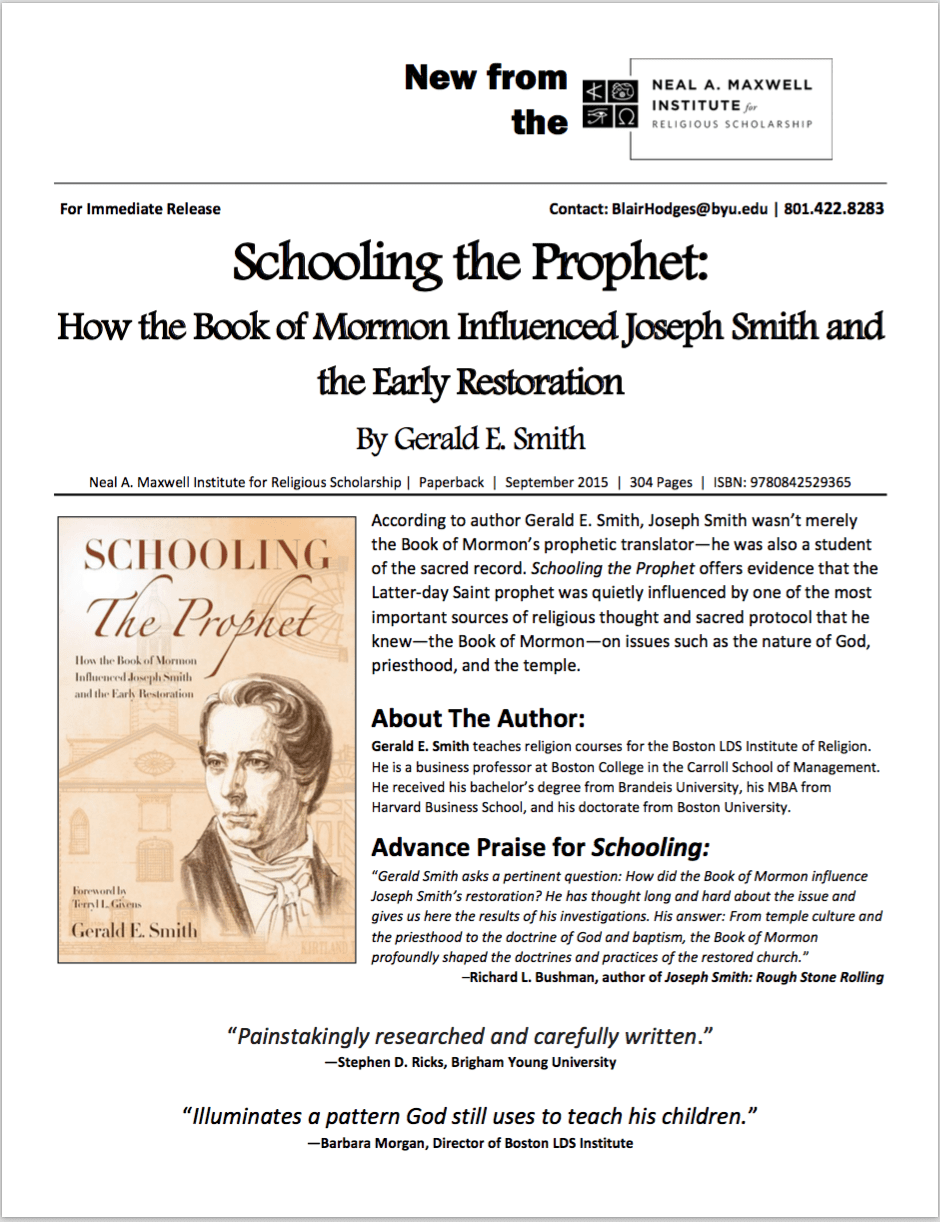
Book Review: “Schooling the Prophet: How the Book of Mormon Influenced Joseph Smith and the Early Restoration”

August 31, 2015 by Stephen Smoot

Screen Shot 2015-08-20 at 2.29.37 PM
Click to enlarge

A number of writers from both naturalistic and faithful backgrounds (Fawn Brodie and Terryl Givens serve as two immediate examples that represent the competing paradigms) have asked what, if any, environmental factors (e.g. contemporary writers, movements, intellectual currents, etc.) influenced the Prophet’s theology. Methodism, Campbellism, Freemasonry, Republicanism, Swedenborgianism, Romanticism, American lore about Indian origins, folk magic, and other intellectual and theological systems have all been invoked as either directly or circumstantially influencing Joseph Smith’s theology. In Schooling the Prophet: How the Book of Mormon Influenced Joseph Smith and the Early Restoration, a new book published by the Neal A. Maxwell Institute for Religious Scholarship, author Gerald E. Smith tackles this question by investigating what has, somewhat surprisingly and counterintuitively, been generally overlooked by historians as an influence on Joseph’s theology: the Book of Mormon.

Smith begins his treatment with a (semi-rhetorical) question that he sets out to answer in the course of six chapters (some two hundred pages of text): “Could it be that the Book of Mormon had a formative influence on Joseph Smith and the founders of the Mormon restoration?” (11) The evidence Smith provides for his answer to this question (a resounding yes: “It is my thesis that the Book of Mormon had a profound formative influence on Joseph Smith’s doctrinal and institutional development during the nascent days of the nineteenth-century Mormon restoration” [3]) is convincing. “[The practices of the restoration] evolved over time, of course, but in the beginning, in the early restoration, we must see Smith quietly looking to one of the most important sources of religious thought and sacred protocol that he knew: the Book of Mormon” (11). This can be seen, as Smith explores, in the following ways: the formation of the Church and the early revelations received in 1828–1830 (13–44), the influence of the Book of Mormon on such doctrinal subjects as soteriology, Christology, and the Fall (45–86), Mormon sacraments such as baptism and the eucharist (87–128), Latter-day Saint temple theology (129–164), priesthood and ecclesiology (165–206), and the role of the Book of Mormon in shaping a unique early Mormon religious identity (207–218). In his discussion of these categories Smith ably demonstrates the important and central role the Book of Mormon played in fashioning the doctrines of the Restoration.

Smith is quick to anticipate critics of his thesis who insist that, being a product of Joseph Smith’s lucid imagination, of course the Book of Mormon would influence early Mormonism. “The very question of the Book of Mormon’s influence on the Prophet calls for an explanation since one might fittingly dismiss that influence simply because it was derived from Smith himself,” our author notes. “Yet such an assumption is a heuristic one and prematurely precludes further exploration of the Book of Mormon as an original source document” (2). Indeed, Smith’s thesis is strengthened and enriched when one operates within a paradigm of the Book of Mormon being an ancient text, as Smith himself explains. “Rituals, theologies, and doctrines of the early restoration seem to stem directly from Book of Mormon worship forms,” Smith writes, “which in turn seem to have clear correlations with ancient Old Testament rites, rituals, forms, and meanings. The problem of a nineteenth-century explanation of the Book of Mormon text in which Smith wrote the Book of Mormon as his own repository of religious ideas, innovations, and writings . . . is that it ignores the work’s historic origins. . . . Provenance is evidence of historic origin, authenticity, and timeless value in a work” (211–212). This is a keen insight that shouldn’t be missed by either readers of Smith’s treatment or the Book of Mormon itself. The Book of Mormon’s historicity does indeed significantly influence the “timeless value” of the text as a religious work, a point I myself have argued elsewhere. Those (even those who accept the book’s historicity) who insist on reading the Book of Mormon strictly as a modern American religious or literary work are at risk of missing the robust convergences the Nephite record has with ancient Israelite religion and culture. This may in turn blind such a reader to the continuity between ancient biblical practices and modern Mormonism; a continuity that was preserved and perpetuated by the Book of Mormon’s influence on Joseph Smith’s restoration project.

Another valuable insight comes from Smith’s analysis of the Book of Mormon’s influence on the Prophet’s temple theology. No sensible historian of Mormonism denies evolution over the course of Joseph Smith’s prophetic ministry. Doctrinal and ecclesiological development in early Mormonism is clearly discerned from even a cursory glance at Mormon history. That being said, Smith pushes back against historians who insist on a sort of radical departure from early Mormonism during the Nauvoo period of Joseph Smith’s life (1839–1844). The common assumption among historians, Smith explains, is “that Nauvoo doctrines and theologies were distinctly later-period revelations to the Prophet emerging spontaneously in the Nauvoo era.” Although “widely held among both Mormons and non-Mormons,” Smith insists this view is “incorrect” (72–73). Smith argues that the seeds of Joseph’s Nauvoo temple endowment (with its attending doctrines of theosis and ascending into the presence of God, or what Smith calls the “Eden ascension narrative” [78]) are found within the pages of the Book of Mormon (as well as the opening chapters of the Book of Moses, revealed to Joseph Smith in 1830). Smith not only argues for the Eden ascension narrative being located in the pages of the printed Book of Mormon, but also draws on the intriguing work of Don Bradley to suggest that the now lost Book of Lehi contained temple imagery and other overtures to Joseph’s later Nauvoo theology. Although Smith does not deny evolution in Joseph’s teachings, he critiques the common notion of a radical departure from Book of Mormon theology in Nauvoo. “Rather than persisting with the prevailing notion that the fall of Adam was the origin of evil and death,” Smith clarifies, “the Book of Mormon reframed Adam as a divine son of God, showing the faithful the ascension path to return to the presence of God through symbols, rituals, and narratives that appeared similar to the earliest Wisdom traditions enshrined anciently in the Israelite temple. In this the Book of Mormon completely bypassed traditional nineteenth-century theologies, pointing Joseph Smith toward a different path to doctrinal development that ultimately was enshrined in the theology of the Mormon temple” (86).

In addition to his convincingly argued thesis, Smith is to be commended for his use of original sources drawn from the Joseph Smith Papers Project, his engagement with important secondary literature on the Book of Mormon (including the work of Hugh Nibley and the Interpreter Foundation), and the readability of his prose. Illustrations and pictures of Mormon personalities and sites compliment the text, and although I would have personally preferred footnotes, endnotes are employed judiciously and do not overwhelm the reader.

For these and other reasons I highly recommend Smith’s Schooling the Prophet. It is an important contribution to Latter-day Saint scholarship on the Book of Mormon that deserves careful attention by laymen and academics alike who share a common interest in the history and doctrines of the early Restoration.

Filed Under: Book of Mormon, Book reviews

Book Review: “First Principles and Ordinances: The Fourth Article of Faith in Light of the Temple”

June 19, 2015 by russellwades

Brown-First-Principles-Cover-Final-Web-HiresBy Russell Stevenson

Note: The parenthetical citations reflect the enumeration found in the Kindle eBook version of this volume

Mormonism has never been merely a set of philosophical tenets, alienated from the material world. It is a religion of the here, the now, a religion that collapses the space between man and the cosmos, between the other-worldly and the earthly, and above all, between human beings. “This is my work and my glory,” the Christ of Mormonism declares, “to bring to pass the immortality and eternal life of man.” The stated purpose of Mormon project is more practical than ideological. Its success, the God of Mormonism declared, depends not on the propagation of tenets but upon the salvation of souls.

In First Principles and Ordinances: The Fourth Article of Faith in Light of the Temple, Samuel M. Brown offers up a doctrinal exegesis of Joseph Smith’s fourth article of faith as stated in his 1842 letter to John Wentworth. Primary children the world over can recite the article by memory: “We believe that the first principles and ordinances of the gospel are: first, Faith in the Lord Jesus Christ; second, Repentance; third, Baptism by Immersion for the Remission of Sins; and fourth, Laying on of hands for the Gift of the Holy Ghost.” Primarily intended as a devotional text, the book could find a comfortable home in a church service, or a family home evening. [Read more…] about Book Review: “First Principles and Ordinances: The Fourth Article of Faith in Light of the Temple”

Filed Under: Book reviews

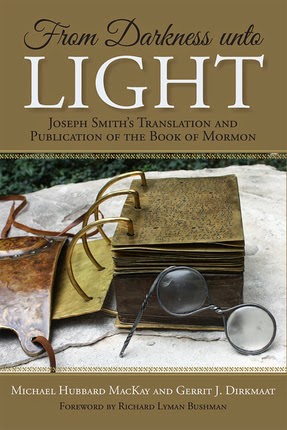
Book Notice: “From Darkness unto Light: Joseph Smith’s Translation and Publication of the Book of Mormon”

April 27, 2015 by Stephen Smoot

[This post originally appeared at Ploni Almoni.]
The Religious Studies Center at Brigham Young University and Deseret Book have co-published a new book titled From Darkness unto Light: Joseph Smith’s Translation and Publication of the Book of Mormon. I have picked up a copy just today, and have been able to quickly skim through the contents of the book. Co-authored by Michael Hubbard MacKay and Gerrit J. Dirkmaat of the Joseph Smith Papers (and both assistant professors of Church history and doctrine at BYU) and with original artwork by Anthony Sweat, the book looks closely at the history of the translation and publication of the Book of Mormon in the years 1827–1830. MacKay and Dirkmaat draw from the cutting-edge research of the Joseph Smith Papers Project in their reconstruction of the Book of Mormon’s translation and publication, including some heretofore unknown or underutilized historical sources. Topics touched on in the book include:

  • The retrieval of the plates.
  • Martin Harris’ visit with Charles Anthon and other savants.
  • Early reactions to and accounts of Joseph Smith’s finding of a “Gold Bible.”
  • The method and instruments of the translation.
  • Attempts to secure a copyright for the publication of the Book of Mormon, including the attempt to secure a copyright in Canada.
  • The 3 and 8 Witnesses.

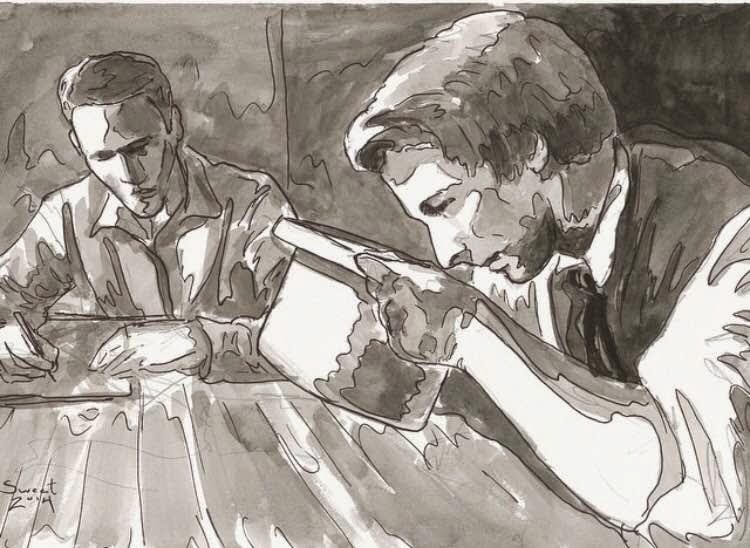
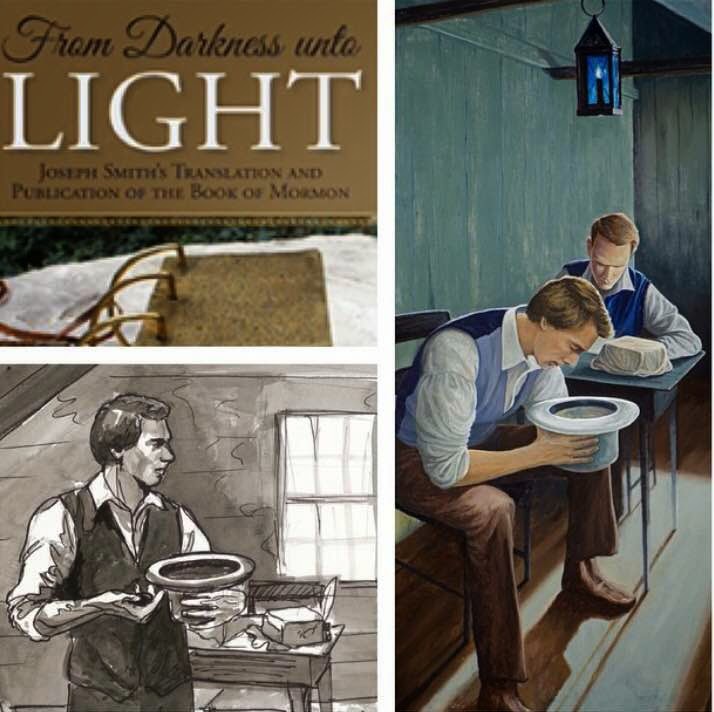
But perhaps one of the most exciting aspects of the new book is the artwork of Anthony Sweat, an assistant professor of Church history and doctrine at BYU. The book includes a number of original pieces by Sweat depicting Joseph Smith’s translation of the Book of Mormon by peering into a seer stone at the bottom of a hat. Below are three of the new pieces, taken from Sweat’s public Instagram page.

Sweat also includes an appendix (“By the Gift and Power of Art”) explaining his artwork and artistic representations of the past in general.

Students of early Mormon history and the Book of Mormon should absolutely pick up a copy of this book! I’ve only skimmed it so far, but what I’ve seen is fantastic, and just what the doctor ordered when it comes to good, solid, reliable, and faith-promoting scholarship on the early days of the Restoration and the coming forth of the Book of Mormon. I am excited to sink my teeth into this new volume, and hope you’ll do the same.

Filed Under: Book of Mormon, Book reviews

Book Review: A Refuge from the Storm: The Priesthood, the Family, the Church
October 28, 2014 by Trevor Holyoak

A Refuge from the StormTitle: A Refuge from the Storm: The Priesthood, the Family, the Church

Author: Boyd K. Packer
Publisher: Deseret Book Company
Genre: Nonfiction
Year Published: 2014
Number of Pages: 224
Binding: Hardcover and Deseret Bookshelf eBook
ISBN13: 978-1609079833
Price: $25.99

Reviewed by Trevor Holyoak

Boyd K. Packer is, of course, the president of the Quorum of the Twelve Apostles of The Church of Jesus Christ of Latter-day Saints. As a general authority in the church for over 50 years, he has given many talks on the priesthood, the family, and the Church. This book is a collection of 24 of them. Many of the talks are from General Conference, but there are also some from other meetings, such as Worldwide Leadership Training, firesides, BYU Women’s Conference, and a seminar for new mission presidents. While most of the talks are available online, there are a few that are not readily available outside this book.

I was initially a little disappointed to find that this was a collection of talks and not something newly written (other than perhaps the introduction) like many other books by general authorities. But as I began to look through it, I realized that the talks (even those given decades ago) apply more to the situation the world is in today than they did when they were given. They were prophetic.

The book begins by explaining its purpose: “The gospel of Jesus Christ enables individuals to become exalted by being part of eternal families. The gospel contains the purpose, the doctrine, and the plan. The priesthood is the power and the authority. The Church has the means and the organization. The exalted, eternal family is the end of the gospel plan. In this book, we will discuss those three interconnected elements of the gospel: the priesthood, the family, and the Church” (pages ix-x). The remainder of the book is divided into three parts along those elements, with the repeating underlying message that “The ultimate end of all activity in the Church is that a man and his wife and their children might be happy at home, protected by the principles and laws of the gospel, sealed safely in the covenants of the everlasting priesthood” (page 25).

I will give an example from each section, and let the book speak for itself. In 1992, he gave some instruction that is particularly relevant today regarding the priesthood: “There are some things about the priesthood that every elder should know if he is to understand how the Church is governed to have things right before the Lord. There are principles and precepts and rules which are often overlooked and seldom taught. Some of these principles are found in the scriptures, others in the handbooks. Some of them are not found in either. They are found in the Church. You might call them traditions, but they are more than that. They are revelations which came when the Brethren of the past assembled themselves, agreed upon His word, and offered their prayers of faith. The Lord then showed them what to do. They received by revelation…These are things we do to have things right before the Lord” (pages 3-4).

He said this about The Proclamation on the Family in a Worldwide Leadership Training Broadcast in 2008: “A proclamation in the Church is a significant, major announcement. Very few of them have been issued from the beginning of the Church. They are significant; they are revelatory…It is scripturelike in its power. When you wonder why we are the way we are and why we do the things we do and why we will not do some of the things that we will not do, you can find the authority for that in this proclamation on the family. There are times when we are accused of being intolerant because we won’t accept and do the things that are supposed to be the norm in society. Well, the things we won’t do, we won’t do. And the things we won’t do, we can’t do, because the standard we follow is given of Him. As we examine this proclamation more closely, see if you don’t see in it the issues that are foremost in society, in politics, in government, in religion now that are causing the most concern and difficulty. You’ll find answers there – and they are the answers of the Church” (page 87).

In General Conference, October, 2006, he explained part of the role of the Church: “The principles of the gospel life we follow are based on doctrine, and the standards accord with the principles. We are bound to the standards by covenant, as administered through the ordinances of the gospel by those who have received priesthood and the keys of authority. Those faithful Brethren were not free, and we are not free, to alter the standards or to ignore them. We must live by them…If we are doing the best we can, we should not become discouraged. When we fall short, as we do, or stumble, which we might, there is always the remedy of repentance and forgiveness…Some suppose that our high standards will repel growth. It is just the opposite. High standards are a magnet. We are all children of God, drawn to the truth and to good…Those who come out of the world into the Church, keep the commandments, honor the priesthood, and enter into activity have found the refuge” (pages 150-153).

As I read this book, my testimony of Boyd K. Packer as a prophet, seer, and revelator has grown, as has my conviction that this is God’s church, and my understanding of the things I need to improve on as a priesthood holder, husband, and father. I highly recommend it to anyone that seeks a better understanding of their place within God’s plan and wishes to find their “refuge from the storm.”

Filed Under: Book reviews, Chastity, Doctrine, Politics, Temples

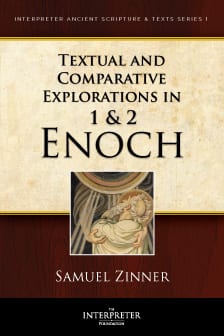
Book Review: Textual and Comparative Explorations in 1 & 2 Enoch

October 25, 2014 by FAIR Staff

Textual-and-Comparative-Explorations2-small[The following review was written by Allen Hansen.]

If you are looking for something that discusses the parallels between ancient Enoch texts and the Book of Moses, then Samuel Zinner’s book might not be for you. It is not Nibley’s Enoch the Prophet. Zinner, who is not a member, does not even discuss Joseph Smith and the Restoration until the final chapter. Instead, what Zinner has given us is a very erudite exploration of the two groups of text known as 1 and 2 Enoch. He is conversant with current scholarship on a variety of topics, and is a pleasure to read.

In the past, Zinner has produced sensitive translations of Anna Akhmatova and Osip Mandelstam, two of the most elegant and powerful voices in Russian poetry. I’ve dabbled in translating Russian poetry just for fun, so I can speak to how difficult an undertaking it is. Translation requires not only a grasp of the bigger picture, but also of the incidental details, and how the words paint images. These are important skills to have when dealing with ancient texts which are often cryptic and confusing. Zinner is well-prepared to dig deep into these texts.

The chapters are generally fairly short. The topics cover a variety of issues. There is discussion of the meaning of the phrases “Son of Man,” and “Ancient of Days,” the relationship between 1 Enoch and the Book of Daniel, Gnosticism, Iranian religions, Mandaeism, the Quran, and medieval Jewish mysticism. There are plenty of charts showing the parallels being discussed, and despite this book primarily consisting of textual studies, no languages other than English are required in order to enjoy it. When foreign terms are used, they are always rendered in English as well, so non-specialists will benefit.

One of the highlights for me is the chapter discussing a parallel between 2 Enoch and the writings of Rabbi Isaac of Acre, a highly important transmitter of Enochic lore. I’ve presented a paper co-authored with Walker Wright on a different teaching of Rabbi Isaac’s on Enoch’s love for God, so it was nice to encounter the somewhat obscure rabbi in this context. Zinner suggests that Rabbi Isaac’s teaching on how God revealed to Enoch that sacrifice unites God and man (or superior and inferior worlds) is ultimately derived from 2 Enoch. This illustrates just how far-reaching of an impact ancient texts can have, even when they are not explicitly mentioned in medieval writings.

I don’t find all of Zinner’s logical steps persuasive, but even then he often suggests brilliant solutions. A good case in point is the chapter dealing with a curious term in 2 Enoch- “their clothing was various singing.” Zinner presents a Mandaean parallel to demonstrate that ‘foaming’- a variant reading preserved in a Bulgarian manuscript- should be preferred to the standard rendition ‘singing.’ Zinner then shows how it A minor detail? 2 Enoch is full of odd and uncertain readings. The minor details can make or break our understanding of the book’s message. Zinner is not the only scholar to look to Mandaean texts. Nathaniel Deutsch, for example, has successfully shed light on puzzling passages in Jewish mystical texts by drawing upon Mandaean insights and concepts. Mandaeism is among the only living religions engaging in ritualized ascents of the soul, and has a long textual history, so its importance for studying things like 1 and 2 Enoch is obvious.

Zinner’s speculation over deluge traditions, or which book preceded which, does not materially affect the conclusion in this case. Zinner is not afraid to go out on a limb, so the results are frequently illuminating. This book is less a compendium of definitive answers, and more of an intelligent discussion partner sounding out various possibilities and inviting us to dig deeper. This opens the door to further questions and research.

Chapter 19, dealing with some Latter-day scriptures, is the most speculative. I personally find it the weakest, too. Zinner looks at the concept of Zion in Joseph Smith’s revelations and connects it to Lady Wisdom and Asherah, seeing Zion as a divine hypostasis.

Despite my reservations, Zinner raises some very important points in this chapter. He very pertinently observes that Joseph Smith’s prophecies of Zion are “simultaneous[ly] temporal-eternal,” pointing to a teaching of the Zohar on how the world to come is not just a future event, but is present now, too. One needn’t accept the Zohar as the genuine teachings of Rabbi Shimeon bar Yohai in order to appreciate how useful of a concept this can be for understanding Joseph’s revelations. It might seem odd to some readers that Zinner insists upon reading God’s wings in 1 Enoch seriously, given how central an anthropomorphic god is to our teachings. Zinner, though, has a point. I found the quoted Arapaho Ghost Dance song particularly moving. It helps move past simplistic dichotomies such as literal versus symbolic/allegorical. 1 Enoch, after all, is not a Mormon text.

Because this book has been published by Interpreter, I hope that this will whet the appetite of LDS readers for closer engagement with the riches to be found in these kinds of sources.

Forget what I said at the beginning. If you have an interest in ancient and medieval texts and thought, as well as possible affinities with our scripture and doctrine, this book is for you. Zinner is worth hearing out. The Interpreter Foundation is to be commended for publishing such an intriguing work by a non-LDS author.

Filed Under: Book reviews

Review of Temple Insights: Proceedings of the Interpreter Matthew B. Brown Memorial Conference

October 23, 2014 by FAIR Staff

Temple-Insights2-small

[This review was written by FairMormon volunteer Rene Krywult.]

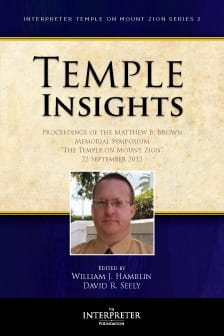
On Saturday, 25 October 2014, the Interpreter Foundation will host a conference on the topic of “Temple on the Mount Zion”, and it is only fitting that on this day, Interpreter Foundation will publish their proceedings of the 2012 conference which also had the temple as a main theme: Temple Insights.

At a size of 288 pages, the book Temple Insights contains 14 essays showing a continuous link of temple mysticism through the Old Testament and the Ancient Near Eastern context, the Book of Mormon and the ancient New World context, and modern day temples.

The conference was initially organized by Matthew Brown, who was an author and historian whose emphasis was on the history and doctrine of Joseph Smith and Brigham Young, and wrote several nonfiction books and research-based articles for the Neal A. Maxwell Institute of Religious Scholarship at BYU. He worked as compiler and editor of the Journal for the Foundation for Apologetic Information and Research (FAIR; now FairMormon). Unfortunately he died in 2011, leaving behind his wife Jamie. Matthew “loved the temple and thirsted for the knowledge of heaven found therein.”

As this book is a set of thirteen very different essays, I find it bit difficult to write about, because of its diversity. I therefore decided to not deal with the essays in the order given in the book, but rather I want to organize them by topics. The first one is that of the ancient and historic context of the temple.

Temples and Ritual in History

Brown’s previously unpublished essay “The Handclasp, the Temple, and the King” starts the book, by analyzing OT verses describing the king as God’s anointed, whom God grasps by the hand, and how anointing and the handclasp between the Heavenly King and the mortal king of Israel was likely part of the coronation rite, which was held in the temple.

This topic is then expanded by David Calabro (“The Divine Handclasp in the Hebrew Bible”), who starts out with descriptions and analysis of ritual handclasps in the Old Testament and in Near Eastern Iconography, with examples from Egyptian, Hittite and Phoenician art, before then trying to find possible meanings of the gesture, linking it also to the ritual raising the hand as gestures accompanying oaths and covenants.

In “Edfu and Exodus”, John Gee (who is William [Bill] Gay Research Professor in the Neal A. Maxwell Institute for Religious Scholarship at Brigham Young University and chair of the Egyptology and Ancient Israel section of the Society for Biblical Literature. He has published articles on a variety of subjects, including the Egyptian temple) draws a connection between the Egyptian “Book of the Temple” and the book of Exodus, both in structure and topic, describing the temple from inside out. Gee concludes that both probably go back to a common source older than the both of them.

David Rolph and Jo Ann H. Seely ’s essay “The Crown of Creation” discusses the well known concept of the universe as a temple, links the creation story to the temple drama, shows how God, in creating the universe has the same roles the temple drama gives to Adam and Eve as archetype of each man and woman (that of king, priest and artisan), and how man, by participating in the temple drama, is raised to be the image of God, thus becoming the real crown of creation, participating in God’s creation by procreation. David Seely is a professor of ancient scripture at Brigham Young University. He is a member of the international team of scholars that translated the Dead Sea Scrolls and published, together with Moshe Weinfeld, the Barkhi Nafshi hymns from Qumran in the Oxford series Discoveries in the Judaean Desert. Jo Ann is adjunct faculty in ancient scripture at Brigham Young University and has published articles in the The Book of Mormon Reference Companion, Anchor Bible Dictionary, BYU Studies, and the Studies in Scriptures series.

“From Dust to Exalted Crown: Royal and Temple Themes Common to the Psalms and the Dead Sea Scrolls” is the title David J. Larsen chose for his paper. Larsen, who holds a PhD in biblical theology from Andrews University and a bachelor’s degree in Near East studies from BYU, has research interests including Jewish and Christian apocalyptic and mysticism, pseudepigrapha and apocryphal literature, royal/Messianic themes in the Bible and in the Dead Sea Scrolls, and “ascent to heaven” traditions. And though this one is one of the shortest in the collection (a mere 11 pages including footnotes), it is an important one. Larsen, after showing how many of the Qumran texts rely on the “Royal Psalms” in the Bible (which, as can be seen in the papers by Brown, Calabro and the Seelys in this book, have a vital connection to the temple drama), then goes on to exaltation in the views of the Qumran community. How Adam and Eve are archetypal for Israelite temple ritual, which makes humans kings and priests, bringing the participant into the presence of God by a journey accompanied with covenants, making him part of the Divine Council. Bestowed with knowledge of the divine mysteries, one then becomes a teacher helping others on the way through divine mysteries, who then, as a group are raised to the same end. It is, Larsen shows, a journey where one is dressed in royal and priestly robes and receives a crown of righteousness, in a ritual setting.

Ancient temple rituals are also central to Donald W. Parry’s “Ancient Sacred Vestments: Scriptural Symbols and Meanings.” Parry, professor of the Hebrew Bible, Abraham O. Smoot Professorship, and a member of the International Team of Translators of the Dead Sea Scrolls, starts with the symbology of ritual vestments, and then discusses in detail how the ancient clothing worn in OT temples are part of the rituals and religious gestures that are conducted by those who occupy the path that leads from the profane to the sacred. The profane is removed, one is ritually washed, anointed, invested with special clothing, offers sacrifices, is ordained (hands are filled), and offers incense at the altar, before entering the veil. Putting on clothes, in a Christian context, is often seen as symbol of putting on Christ, as witnessed by the apostle Paul using the word “enduo,” when talking about putting on Christ, a word mainly used in the Septuagint for donning sacred vestments (symbols also for salvation, righteousness, glory, strength and resurrection) in order to be prepared to stand before God. Parry then goes on explaining how priestly officiants wearing sacred vestments, emulated celestial persons who wear sacred vestments, making one an image of those celestial persons. He concludes with showing how the ancient garbs of the High Priest point to Christ.

The last essay about the ancient context of the temple is Mark Alan Wright’s “The Axis Mundi: Ritual Complexes in Mesoamerica and the Book of Mormon.” Wright (Assistant Professor of Ancient Scripture at Brigham Young University and Associate Editor of the Journal of Book of Mormon Studies at the Maxwell Institute, BA in Anthropology at UCLA and his MA and PhD in Anthropology [with a subfield of specialization in Mesoamerican Archaeology] from UC Riverside) introduces us to the fascinating parallels between Book of Mormon and Mayan temples as centers of the world, where rituals took place, kings were crowned, religious instruction was given, and as places of sacrifices and of men meeting God. In doing so, he is careful to point out that Mayan civilization was diverse enough that “the Mayans” would not have described themselves as belonging to the same culture. Each city was very much its own world. Nephites would surely have stuck out on some issues, but there was equally surely enough overlap that they could fit right in.

“Latter-day Houses of the Lord” by Richard O. Cowan, who was part of the religion faculty at BYU for more than 50 years and has chaired the committee producing Gospel Doctrine Sunday School manuals for the Church for more than a decade, traces the modern-day usage and understanding of temples from the Kirtland Temple to Nauvoo and the SLC temple. Architecture was used to teach principles. While the Kirtland Temple was preparatory (think of the vision of Christ and the conference of keys by Abraham, Moses, Abraham, Elias, and finally Elijah), the Nauvoo temple was dedicated to ritual usage. In 1879, the church reduced temple usage to rituals, and thus assembly rooms are missing from later temples. Through his paper, Cowan shows how temples have changed according to revelation, and how prophets have seen models in vision that then have been incorporated in the temples God’s people built.

Temple Mysticism and Scripture

Jeffrey M. Bradshaw (“The Ark and the Tent: Temple Symbolism in the Story of Noah”), Vice President of The Interpreter Foundation and a member of the Academy for Temple Studies Advisory Board, compares Moses’ tabernacle and Noah’s ark, and then identifies the story of Noah as a temple related drama, drawing of temple mysticism and symbols. After examining structural similarities between ark and tabernacle and bringing into the discussion further information about the Mesopotamian flood story, he shows how Noah’s ark is a beginning of a new creation, pointing out the central point of Day One in the Noah story. When Noah leaves the ark, they find themselves in a garden, not unlike the Garden of Eden in the way the Bible speaks about it. A covenant is established in signs and tokens. Noah is the new Adam. This is then followed by a fall/Judgement scene story, even though it is Ham who is judged, not Noah. In accordance with mostly non-Mormon sources quoted, Bradshaw points out, how Noah was not in “his” tent, but in the tent of the Shekhina, the presence of God, how being drunk was seen by the ancients as a synonym to “being caught up in a vision of God,” and how his “nakedness” was rather referring to garments God had made for Adam and Eve.

Mack C. Stirling follows a similar course in “Job: An LDS Reading.” The well known story of Job, one of the literary books of the Bible and part of the Wisdom literature (which is heavy in temple mysticism and symbols), he proposes, follows the temple endowment to the T. Following Hugh Nibley’s lead in “The Message of the Joseph Smith Papyri,” the temple endowment is not discussed, though. Stirling focuses only on Job’s story, drawing on analysis of literary genres and literary tools, like chiasms, focusing on the existential questions asked by the ancient author. Doing this, he concludes that Job’s is a story about a spiritual journey, in which the two main questions are answered: “(1) Is it worthwhile to worship God for His own sake apart from material gain? (2) Can man, by coming to earth and worshipping God, enter into a process of becoming that allows him to participate in God’s life and being?” What follows is an easy to read and follow exegesis of the Book of Job with the above questions in mind, culminating with Job at the veil, speaking with God. Stirling then discusses Job’s journey in terms of Adam’s journey, beginning in a situation of security, going through tribulations, finding the way to God and being admitted into His presence, and shows how this journey is paralleled in Lehi’s dream in the Book of Mormon (which journey ends at a tree of life). This journey also is what each of us faces, from out premortal home with God, to the tribulations of this telestial world, and back to the eternal bliss of Celestial Kingdom, the presence of God, through Christ. In this way, the stories of Adam and Eve, of Job and of Lehi’s dream provide a framework for every human being’s existence.

In “Psalm 105: Chiasmus, Credo, Covenant, and Temple,” Stephen D. Ricks, professor of Hebrew and cognate learning at BYU, takes a close look at the literary structure of a psalm, reintroducing us to chiasmus both in modern and ancient texts, including the Book of Mormon, then uses this literary structure to not only show how the psalm contains the basic historic credo of the Israelites, as also seen in Deuteronomy and mirrored in 1Ne 17, and then goes on to show how an essential part of the psalm is a covenant (“a binding agreement between man and God, with sanctions in the event of the violation of the agreement”) between God and His people, which ties it back to the temple. Ricks shows this by pointing out the points of covenant: Preamble, Review of God’s relations with Israel, Terms of the Covenant, Formal witnesses, blessings and curses and reciting the covenant and depositing the text. This form is maintained in Exodus 19,20 23 and 24, and in the Book of Mormon in Mosiah 1-6. Psalm 105 follows this form, too. The sacrament, which in Mormon understanding is a covenant, points 1 to 5 are also present.

David Bokovoy (“Ancient Temple Imagery in the Sermons of Jacob”), who holds a Ph.D. in Hebrew Bible and the Ancient Near East from Brandeis University, makes a compelling argument for Jacob, brother of Nephi, having deep knowledge of ancient Israelite temple ritual, concepts and imagery, for instance of the duty of the priest to expiate sin and make atonement before the Lord, of entering God’s presence. Jacob quotes temple related verses from the OT, like Psalm 95. The allusions to the temple are not forced, but very subtle. Of course, Jacob’s central topic, the atonement, is a temple topic itself, and it’s opposite, impurity is also expressed by Jacob in terms familiar and central to an ancient temple priest. The temple is also shown as a gate to heaven.

In Lisle G. Brown’s “Zacharaias and the Second Temple“ we follow Zacharias’ biography from entering the priesthood till the day the angel Gabriel appeared to him in Herod’s temple. Brown, author of ”Nauvoo Sealings, Adoptions, and Anointings: A Comprehensive Register of Persons Receiving LDS Temple Ordinances, 1841–1846,” after recounting the procedures to become a priest, focuses on the day when Zacharias prepared to bring one of the two central standing offerings. He points out that likely, a priest would only have a once in a life time chance to partake in the core of this ceremony, entering the Holy Room and burning incense on the Inner Altar. Brown paints a very visual picture of this day, immersing us in the ritual of the time, a ritual that became even more significant for Zacharias by seeing an angel in the temple, something that has not happened before nor after in the Second Temple.

Conclusion

Easy to read and well documented, this book is a treasure trove for those who want to get a better knowledge and understanding of temple ritual and mysticism, a guide line to help find new and richer meaning in scripture study and a comprehensive bibliography to further one’s own intellectual study of temples, ancient and modern.

Filed Under: Book reviews

Analysis of Textual Variants Now Available Online FREE

October 20, 2014 by Neal Rappleye

[Cross-posted from Studio et Quoque Fide.]

I was born in Colorado Springs, Colorado in May of 1987. A year later, in Provo, Utah, Royal Skousen took over the FARMS-sponsored Book of Mormon Critical Text Project (CTP from this point on). For the last quarter-century and some change, Skousen has been dedicated to that project, while I have just been living a rather ordinary and unaccomplished life. Frankly, I cannot personally imagine what it would be like to spend what is essentially my entire lifetime (up to this point) with a dedicated focus to a single topic of study. Yet that is exactly what Skousen has done. And anyone who has even lightly pursued the fruits of his labors can only stand in appreciative awe at the breadth and depth of Skousen’s work.

Skousen himself has given the background history to the project. The fruits of the CTP finally began to published in 2001, starting with the ultra-violate photographs and transcriptions of the extent fragments of the original manuscript (plus relevant background commentary on the history of the OM, paper type and size, parts of the Book of Mormon extant, the scribes based on handwriting analysis, etc.), and a two-volume set of the same for the printer’s manuscript. These were already important and significant contributions to Book of Mormon scholarship. Never before had the two earliest extent versions of the Book of Mormon been both published in full and studied so thoroughly. But that was only the tip of the iceberg.

The next step was the monumental effort to study each and every variant in the text from these two manuscripts and 20 different print editions from 1830 to 1981. Between all these editions, Skousen documented over 100,000 changes, which he then analyzed carefully to determine which reading is most likely the original. (Unsurprisingly, earlier readings tend to be favored over later ones.) This analysis was published between 2004–2009, and spanned across 6 different volumes of 650–720 pages each, for a total of 4060 pages! Called Analysis of Textual Variants of the Book of Mormon (ATV), it was indeed a monumental effort.

To some, this might all seem pretty over-the-top—who needs such extensive study of every change in the Book of Mormon? I would argue, and I think Skousen would agree, that as the foundational text of our faith—the “keystone of our religion,” in the words of Joseph Smith—knowing the precise language of the text in its original form is of utmost importance. It is, after all, declared the word of God in Article of Faith 8.  Still, I can imagine that most people do not need all the thorough analysis involved here. So can Skounsen, which is why he made the ultimate fruit of his analysis—simply the text of the Book of Mormon in what is most likely its earliest form—available in a single volume, without all the extra analysis, called The Book of Mormon: The Earliest Text, published by Yale University Press in 2009.

While Yale’s Earliest Text edition of the Book of Mormon will serve most needs, anyone who wishes to engage serious study of the Book of Mormon—academic or otherwise—will no doubt find that at times, having the extend analysis would be helpful. This is especially so if one is making academic arguments, or even merely personal meditations on the text, which hinge on specifics of vocabulary and grammar. Yet, the monumental size of the ATV has naturally made it costly—$300 for the whole set—and difficult to access to. Until now. As of October 7, 2014, the entire ATV was made freely available online via the Interpreter Foundation.

Dr. Skousen and Interpreter are to be commended for making this landmark in Book of Mormon scholarship widely accessible any and all Book of Mormon students, from the most erudite scholars of the text, to average members of the church who would simply like to get closer to the text of the Book of Mormon as God revealed it to Joseph Smith. In doing so, they have rendered for the Latter-day Saints and the community of scholars who study Mormonism a great service. I would encourage every Latter-day Saint to explore it and get familiar with the ATV and learn to use it, at least occasionally, in their study of the Book of Mormon.

Filed Under: Book of Mormon, Book reviews

Does God Authorize His Prophets to Make Mistakes?

October 7, 2014 by SteveDensleyJr

Crucible_of_Doubt

[The Crucible of Doubt can be purchased from the FairMormon Bookstore.]

Within the past year, the Church published an article addressing the fact that for a long period in the Church’s history, black men were not allowed to be ordained to the priesthood.[i] The article acknowledged that leaders of the Church gave explanations for the ban that we now recognize as being incorrect. For some people, this article has raised as many questions as it answered. While many have experienced a sense of relief in seeing the Church disavow explanations for the ban that denigrated those of African descent, others have experienced a new sense of anxiety over the question of the extent to which we can rely on the teachings of the prophets and apostles. And to what extent can we be confident that the policies adopted by the Church are ordained of God?

Terryl and Fiona Givens directly addressed the question of prophetic infallibility in their book Crucible of Doubt: Reflections on the Quest for Faith. Terryl Givens has earlier, if only briefly, addressed this question, in his “Letter to a Doubter.”[ii] In their new book, the Givenses expand on this issue. The “Letter to a Doubter” essentially limited itself to a discussion of the fact that prophets are human, and humans make mistakes. However, chapter six of The Crucible of Doubt goes into more depth regarding the principles of delegation of authority and prophets as agents for God.

The concept of God delegating his authority to men on Earth and making them His agents, who act on His behalf, is not a new one. However, the Givenses discuss the concept in a way that may help illuminate the mechanism by which prophets act on God’s behalf and why doing so does not ensure that mistakes will not be made by God’s agents.

The title of chapter six is “On Delegation and Discipleship: The Ring of Pharaoh.” This title is a reference to the story of Joseph of Egypt:

When Joseph of the many-colored coat had gained Pharaoh’s complete trust and confidence, “Pharaoh took off his ring from his hand, and put it upon Joseph’s hand.” With this gesture, Pharaoh transferred his own power and authority to the former Hebrew slave. “Without your consent,” the Pharaoh told him, “no one shall lift up hand or foot in all the land of Egypt.”[iii]

Of course, when authority is delegated, it does not mean that the agent will always do precisely what is intended by the one delegating authority. This is obvious in the context of human interactions. However, we sometimes may hope and expect that when God delegates authority to a prophet, that the human in this scenario will somehow rise to the level of perfection inhabited by the one who has delegated the authority; that if one is acting for God, one will act like God. However, the scriptures do not give us this assurance.

In fact, the scriptures provide plenty of examples of prophets making mistakes and acting in ways that could be considered ungodly. For example, Moses disobeyed God’s instruction to speak to the rock and instead hit it. He then attributed the miracle to himself and Aaron, saying, “Must we fetch you water out of this rock?” He was chastised by the Lord afterward. (Numbers 20.) Nathan told David that the Lord approved of his desire to build a temple, and that he should commence the project. The Lord later told Nathan that such was not His desire, and that he was to tell David that the temple would be built by another. (2 Samuel 7.) And Jonah felt some personal prejudices against Assyrians, to the point of expecting the Lord to give them fewer blessings than to Jews. (Jonah 4.)

So prophets can guide us and direct us, but they can also test our faith, not just in calling us to live on a higher plane, but also in demonstrating that they do not always reach a higher plane themselves. In light of this, the Givenses note:

And if delegation is a real principle—if God really does endow mortals with the authority to act in His place and with His authority, even while He knows they will not act with infallible judgment—then it becomes clearer why God is asking us to receive the words of the prophet “as if from mine own mouth, in all patience and faith.”[iv]

Of course, most of us are familiar with the observation made by Joseph Smith that “a prophet [is] a prophet only when he [is] acting as such” (HC 5:265). We also often hear repeated the scripture, “whether by mine own voice or by the voice of my servants, it is the same.” (D&C 1:38.) When these two statements are considered at once, we may tend to think that if we can just determine whether or not a prophet is acting as a prophet, or as God’s “servant,” we will know whether or not we can consider his words to be the infallible words of God. It may seem that if the president of the Church makes a statement that we later learn to be untrue, or enacts a policy that seems to have been mistaken, we can find comfort in the notion that the man may not have been acting on behalf of God on those occasions. This becomes more difficult, however, when a statement is made, or a policy announced, in General Conference, or on Church letterhead along with the signatures or other members of the First Presidency.

But perhaps in thinking this, we have misunderstood the principle of delegation of authority. For example, while there are statements that have been understood to mean that prophets, or God’s servants, cannot err when acting as God’s servants, the scriptures themselves undercut this interpretation. For example, while D&C Section 1 says “whether by mine own voice or by the voice of my servants, it is the same,” a few verses earlier, we read:

Behold, I am God and have spoken it; these commandments are of me, and were given unto my servants in their weakness, after the manner of their language, that they might come to understanding. And inasmuch as they erred it might be made known; And inasmuch as they sought wisdom they might be instructed; And inasmuch as they sinned they might be chastened, that they might repent; And inasmuch as they were humble they might be made strong, and blessed from on high, and receive knowledge from time to time.

(D&C 1:24-28; emphasis added).

Another commonly quoted statement in support of the concept of prophetic inerrancy is that of Wilford Woodruff, when, speaking of abandoning the practice of polygamy, he said:

The Lord will never permit me or any other man who stands as President of this Church to lead you astray. It is not in the programme. It is not in the mind of God. If I were to attempt that, the Lord would remove me out of my place, and so He will any other man who attempts to lead the children of men astray from the oracles of God and from their duty. [v]

However, in addition to the aforementioned reasons to doubt that this statement supports the view that prophets cannot make mistakes, Elders Packer and Uchtdorf have given us additional reasons to doubt this conclusion. Elder Uchtdorf said, “This is the Church of Jesus Christ. God will not allow His Church to drift from its appointed course or fail to fulfill its divine destiny.”[vi] Elder Packer added that “…even with the best of intentions, it [the governance of the Church by mortal priesthood holders] does not always work the way it should. Human nature may express itself on occasion, but not to the permanent injury of the work.”[vii] In other words, while leaders can make mistakes, God will not allow the leaders to utterly destroy the work of the latter-day Church or cause the members to lose their opportunity to receive exaltation.

So when God says that the prophet is His agent on Earth, perhaps He is not saying that, when acting as the prophet, the man will always do exactly what God wants any more than by giving Joseph his ring, Pharaoh was assuring the people of Egypt that Joseph would always do exactly what Pharaoh would have done in his place. Right or wrong, the people of Egypt were to consider Joseph’s actions to be the actions of Pharaoh and were to be bound by Joseph’s words and actions as if they were the words and actions of Pharaoh.

Of course, this principle is not limited to the delegation of authority to a prophet. The Givenses ask “If a bishop makes a decision without inspiration, are we bound to sustain the decision?” And what if an apostle makes a mistake in calling a stake president?

The story is told of a Church official who returned from installing a new stake presidency. “Dad, do you Brethren feel confident when you call a man as the stake president that he is the Lord’s man?” the official’s son asked upon his father’s return home. “No, not always,” he replied. “But once we call him, he becomes the Lord’s man.” The answer disconcerts initially. Is this not hubris, to expect God’s sanction for a decision made in error? Perhaps. It is also possible that the reply reveals the only understanding of delegation that is viable.[viii]

The Givenses continue by observing:

If God honored only those decisions made in perfect accord with His perfect wisdom, then His purposes would require leaders who were utterly incapable of misconstruing His intention, who never missed hearing the still small voice, who were unerringly and unfailingly a perfect conduit for heaven’s inspiration. And it would render the principle of delegation inoperative. The Pharaoh didn’t say to Joseph, your authority extends as far as you anticipate perfectly what I would do in every instance. He gave Joseph his ring…. And after calling Joseph Smith to his mission, the Lord didn’t say, I will stand by you as long as you never err in judgment. He said, “Thou wast called and chosen. . . . Devote all thy service in Zion; and . . . lo, I am with thee, even unto the end.”[ix]

In light of all this, what are we to believe, ask the Givenses, when confronted by “faith-wrenching practices (polygamy), missteps and errors (Adam-God), and teachings that the Church has abandoned but not fully explained (the priesthood ban).”[x] In response, they quote the Anglican churchman Austin Farrer, who said “Facts are not determined by authority. Authority can make law to be law; authority cannot make facts to be facts.”[xi] To this, they add the words of Henry Eyring, who once quoted his father as saying, “in this church you don’t have to believe anything that isn’t true.”[xii]

Of course, while we may harbor misgivings in our minds regarding some policy, teaching or practice, how are we to act when confronted with doubts about whether or not an agent of God is actually doing God’s will? In response to this issue, Farrer is again quoted: “If Peter and his colleagues make law in applying the Lord’s precepts, . . . their law is the law of Christ’s Church, the best (if you will) that God’s Spirit can make with human instruments there and then, and, as such, to be obeyed as the will of God Himself. But to call Peter infallible in this connection is to misplace an epithet.”[xiii]

To carry the metaphor of agency and delegation further, we can consider the legal realm. What recourse exists against a principle when the agent causes some harm? Under the doctrine of agency law, if a person is injured by an agent who is acting under the authority of the principle, the principle will be liable for the harm and is required to set things right. Of course, while all wrongs and injustices have not yet been set right in this imperfect world, Christ has already paid the price for such wrongs. In other words, the miracle of delegation of divine authority does not ensure that the agent will always act according to God’s will. Rather, it ensures that God will guarantee the actions of the agent, and if the actions are wrong, through Christ’s atonement, all will be made right in the end. Indeed, even those things that can cause fear, doubt and pain can be made to benefit us in the end:

One comfort is to be found in a God whose power is in His magnanimity as well as His wisdom. These two traits mean that His divine energies are spent not in precluding chaos but in reordering it, not in preventing suffering but in alchemizing it, not in disallowing error but in transmuting it into goodness.[xiv]

Even the agents of God, even when acting as God’s agents, can cause fear, pain and confusion in this world. Although this may frustrate us, it does not frustrate God’s plan. In closing, we are reminded that the words of God’s servants can provide comfort and direction, even when counseling us regarding the imperfect words and actions of God’s servants themselves:

“Imperfect people are all God has ever had to work with,” reminds Elder Jeffrey Holland. “That must be terribly frustrating to Him, but He deals with it. So should we.” Generosity with our own inept attempts to serve and minister to each other in a lay church, charity toward those in leadership who, as President Dieter Uchtdorf noted, have “said or done [things] that were not in harmony with our values, principles, or doctrine,” and faith in Christ’s Atonement that makes up the human deficit—these could be the balm of Gilead for which both wounded disciples and striving leaders seek.[xv]

[i] Race and the Priesthood.

[ii] Terryl L. Givens, “Letter to a Doubter,” Interpreter: A Journal of Mormon Scripture 4 (2013): 131-146. An audio version was published on FairMormon Blog.

[iii] Terryl Givens & Fiona Givens, The Crucible of Doubt (Salt Lake City: Deseret Book, 2014), 73, citing Genesis 41:42 & 44, NRSV.

[iv] Givens & Givens, 75, citing D&C 21:5 (emphasis added).

[v] Sixty-first Semiannual General Conference of the Church, Monday, 6 October 1890, Salt Lake City, Utah. Reported in Deseret Evening News (11 October 1890): 2; cited in LDS scriptures after Official Declaration 1.

[vi] Dieter F. Uchtdorf, “Come Join With Us,” general conference, October 2013.

[vii] Boyd K. Packer, “”I Say unto You, Be One,'” in BYU Devotional and Fireside Speeches, 1990–1991 (Provo, Utah: University Publications, 1991), 84, emphasis added.

[viii] Givens & Givens, 75-76, citing a personal conversation reported to authors by Robert L. Millet.

[ix] Ibid., 76, quoting D&C 24:1, 7, 8.

[x] Ibid., 74.

[xi] Ibid., 74, quoting Austin Farrer, “Infallibility and Historical Tradition,” in The Truth-Seeking Heart, ed. Ann Loades and Robert MacSwain (Norwich: Canterbury Press, 2006), 83.

[xii] Ibid., 74, quoting Henry J. Eyring, Mormon Scientist: The Life and Faith of Henry Eyring (Salt Lake City: Deseret Book, 2007), 4.

[xiii] Ibid., 74-75, quoting Farrer, “Infallibility,” 83–84.

[xiv] Ibid., 78.

[xv] Ibid., 82, quoting Jeffrey R. Holland, “Lord, I Believe,” Ensign, May 2013, 94 and Dieter F. Uchtdorf, “Come, Join with Us,” Ensign, November 2013, 22.

Filed Under: Apologetics, Book reviews, Doctrine, Racial Issues

Continuing the conversation begun by Neylan McBaine’s “Women at Church”

August 28, 2014 by Chris Taber

At the recent 2014 FairMormon Conference, I picked up a pre-release copy of Neylan McBaine’s new book “Women at Church: Magnifying LDS Women’s Local Impact”, which is being released publically today. I started reading it on the airplane ride home on Saturday and couldn’t put it down and I finished it the next day after Church. It was amazing. Since it is officially being released today, I thought I would share my thoughts about the book and about the message that I think Neylan is trying to convey concerning how we can improve our Church culture and our rhetoric to match our doctrine.

This is not a book about doctrine, nor does Neylan intend for it to be. Instead, it is written for men and women, Church leaders and fill-the-pews-every-week Church members. First, it illustrates how some Church culture, rhetoric, and practices unnecessarily make some women (and in many cases the men who love and support those women) feel less-than, and then it provides several suggestions for how we might change our culture, rhetoric, and practices without requiring any changes in doctrine or official policy.

Both the descriptions of “the problem” and the suggestions for “solutions” are backed up by anecdotes from a wide range of sources that Neylan collected after considering some of the reactions to her 2012 FairMormon Conference address and being encouraged to expand her work there into a larger project. She sought for stories and suggestions from Church members across the belief and political spectrum. She then pulled them together to illustrate how, when we talk about gender balance in the Church, we are not only dealing with doctrine – we are dealing with emotions, culture, public relations, and long-standing group dynamics, many of which have little or nothing to do with the gospel of Jesus Christ.

Neylan’s message was full of “a-ha” moments for me. One occurred when I listened to her 2012 FairMormon Conference talk and heard her describe why language matters, both internal and external to the Church, when we talk about things like “equality”. For example, When we use the words “equal”, “alike”, or “equality” in a gospel setting:

“…and he denieth none that come unto him, black and white, bond and free, male and female; and he remembereth the heathen; and all are alike [or equal] unto God, both Jew and Gentile.” (2 Ne 26:33),

we have developed a good internal (as in, inside the Church) understanding of what “alike” or “equal” means and looks like: God loves everyone without regard to race, color, gender, occupation, etc., and we, as disciples of Christ should seek to emulate that same principle.

Where we run into trouble is when we try to pass off this internal definition or understanding of “equal” in our external public relations messaging as a Church. The rest of the world uses a measuring stick that is vastly different to measure “equality”, and our rhetoric will fall on deaf ears if we do not recognize this fact and adapt our message accordingly.

When I say “vastly different” from the rest of the world, I mean we are different by almost every criteria the world uses to gauge these sorts of things: prominence of women’s events compared with men’s, prominence of women leaders compared with men, emphasis on women’s public teaching and influence compared with men’s, opportunities for institutional or organizational “span-of-control” and “span-of-influence” positions for women compared with men, etc. All of these are simple, basic, easy-to-calculate, easy-to-see, measuring sticks by which the rest of the world gauges the word “equality”. We have to consider what the rest of the world hears when we put out our public relations messaging or our social media posts about media stories regarding gender-related issues in the Church. We need to realize that when we talk about “equality” between men and women within the Church, but then the world sees something totally different when they look at our organization, their reaction will be to discount or dismiss our comments and messaging as not credible or misleading. When we try to pass off our internal definition of “equality” as equivalent to the world’s definition of “equality,” we will fail every time. And when we fail in the public relations space, we lose credibility.

“But who cares?” we might ask. “Since when are we concerned with what the rest of the world thinks of us? Shouldn’t we be more concerned with what God thinks of us?” Sure. Absolutely. But if that were the only consideration, we would have no need for a Church Public Affairs function! It seems like at least one of those reasons should have something to do with aligning our internal and external rhetoric. As long as we want to maintain our ability to appeal to the rest of the world through our missionary efforts, we would do well to listen to people with the experience and expertise to help us at least reduce the number of “unforced errors” on this subject.

This is where I think McBaine’s approach is so valuable. By challenging us to refine our rhetoric first, and not agitating for changes in doctrine, she is reinforcing the point that it is not only important what we say, but how we say it.

One of my favorite parts in “Women at Church” is where Neylan points out the strong and empowering message that we could send to the world about the importance of women’s contributions in the Church by making those contributions more visible. We live in a visual world, and while words are important, so are images. The recent changes in seating assignments during General Conference, for example, where Relief Society, Young Women, and Primary General Presidencies have been invited to take a more central position on the rostrum, and the addition of these women’s portraits in the lobby of the Conference Center and in the center page of the Conference issue of the Ensign and Liahona alongside the General Authorities are some examples of this being put into practice. One of Neylan’s suggestions is that we consider inviting ward or stake Relief Society, Young Women, and/or Primary presidencies to sit on the stand during Ward or Stake Conferences.

Some may consider this an example of tokenism or window dressing, since these women do not preside over the meeting. But whereas changing who presides would require a change in doctrine (as Elder Oaks’ April 2014 General Conference address made clear), the change suggested by Neylan would require no change in doctrine, nor any change in official church policy. And the benefits could be great: both men and women, old and young, would see women as well as men recognized on the stand for the important work that they do in the Church. Our doctrine is clear on this: the work that Priesthood brethren do in the Church is no more nor less valuable than the work that sisters do in their Relief Society, Young Women, Primary, and other callings. So how can it hurt us to have a visible representation of the equal value of those contributions on the stand? Making women’s roles and responsibilities more visible to both the men and the women in the ward by having RS, YW and/or Primary leaders sit on the stand, even if only for Ward and Stake Conference, does not fly in the face of anything more than our traditions and customs (and perhaps in some cases our prejudices). And if it removes a potential hurdle for our youth or other members struggling because of the imbalance in the visibility of women’s contributions, all of whom are growing up and living in a world where the world’s definition and visual depiction of equality is what they live and experience every day at school, at work, and in their other non-Church associations, and if it can remove that hurdle without changing doctrine or policy, then indeed, why not!?

We ignore or minimize the distinction between our “gospel” understanding of these terms and concepts and the “worldly” understanding to our great detriment, as it undermines our ability to be “in the world but not of the world.”  We need to be not only multi-lingual in our missionary training centers as we teach the various languages of the world, but also multi-lingual in our cultural rhetoric and understanding. This will help us guide those who would welcome such empowering and ennobling doctrines if they could see them through a gospel lens, unburdened of the rhetorical baggage that otherwise prevents them from seeing the beauty of our doctrine.

Filed Under: Book reviews, FAIR Conference, Gender Issues, LDS Culture, Women Tagged With: #womenatchurch, Women

  • « Go to Previous Page
  • Go to page 1
  • Interim pages omitted …
  • Go to page 4
  • Go to page 5
  • Go to page 6
  • Go to page 7
  • Go to page 8
  • Go to page 9
  • Go to Next Page »

Primary Sidebar

Faithful Study Resources for Come, Follow Me

Subscribe to Blog

Enter your email address:

Subscribe to Podcast

Podcast icon
Subscribe to podcast in iTunes
Subscribe to podcast elsewhere
Listen with FAIR app
Android app on Google Play Download on the App Store

Pages

  • Blog Guidelines

FAIR Latest

  • Come, Follow Me with FAIR – Doctrine and Covenants 137–138 – Part 2 – Autumn Dickson
  • Come, Follow Me with FAIR – Doctrine and Covenants 137–138 – Mike Parker
  • FAIR December Newsletter
  • Come, Follow Me with FAIR – Doctrine and Covenants 137–138 – Part 1 – Autumn Dickson
  • Prophets of God 

Blog Categories

Recent Comments

  • LHL on Come, Follow Me with FAIR – Doctrine and Covenants 132 – Mike Parker
  • Stephen Johnsen on Come, Follow Me with FAIR – Doctrine and Covenants 132 – Mike Parker
  • Bruce B Hill on Come, Follow Me with FAIR – Doctrine and Covenants 124 – Part 1 – Autumn Dickson
  • Gabriel Hess on Join us Oct 9–11 for our FREE virtual conference on the Old Testament
  • JC on When the Gospel “Doesn’t Work”

Archives

Follow Us

  • Facebook
  • Twitter
  • iTunes
  • YouTube
Android app on Google Play Download on the App Store

Footer

FairMormon Logo

FAIR is a non-profit organization dedicated to providing well-documented answers to criticisms of the doctrine, practice, and history of The Church of Jesus Christ of Latter-day Saints.

Donate to FAIR

We are a volunteer organization. We invite you to give back.

Donate Now

Site Footer