• Skip to primary navigation
  • Skip to main content
  • Skip to primary sidebar
  • Skip to footer

FAIR

  • Find Answers
  • Blog
  • Media & Apps
  • Conference
  • Bookstore
  • Archive
  • About
  • Get Involved
  • Search

Book of Abraham

How Joseph Smith Translated the Book of Abraham

August 21, 2014 by FAIR Staff

photo1

By Kerry Muhlestein

For most people, the idea of translating is fairly straightforward. Conventionally, when someone translates, he reads a document in one language he understands and renders it into another language he understands. The difficulty in assessing the Book of Abraham is that while Joseph Smith says he translated the Book of Abraham from papyrus, he never uses that word in the conventional way. It will be helpful to first look at the other ways Joseph Smith used the word “translate.”

Joseph Smith’s first translation project was the Book of Mormon. It was written in a language he clearly did not know. He never claimed to understand the language it was written in. Instead, he said he was given the ability to translate by the gift and power of God. We don’t know a lot about the Book of Mormon translation process. We know that the Prophet used the seer stones we call the Urim and Thummim, as well as another seer stone he often used. While we cannot nail down the exact details, it seems he often was not looking at the gold plates at all during much of this process. What we can be sure of is that Joseph Smith provided us with a translation of a language he did not know, frequently without referring to the physical text he had. His translation came from God.

To read this article in its entirety, please visit the Meridian Magazine website.

Filed Under: Book of Abraham

Faulty Assumptions about the Book of Abraham

August 7, 2014 by FAIR Staff

Abraham

[Written by Kerry Muhlestein]

As was mentioned in the last column (link to column here), it was almost universally assumed that all of the papyri Joseph Smith had once owned had been destroyed in the Great Chicago Fire of 1871. Thus many were surprised when the papyri surfaced in 1967. One of the papyri fragments contained the drawing which was the original source of Facsimile One. This papyrus drew the most immediate interest.[i]

Part of the reason this fragment drew so much attention was because of the possibilities it suggested. It seemed that perhaps we could now test Joseph Smith’s revelatory abilities. Many members of the LDS Church assumed that the text on the papyri which surrounded the original of Facsimile One was the source of the Book of Abraham.

This may give them to chance to demonstrate Joseph Smith’s prophetic abilities. Anti-Mormons also assumed that the text adjacent to that drawing was the source of the Book of Abraham and were excited about the opportunity to disprove Joseph Smith’s prophetic abilities.[ii] Sadly, neither of these groups took the time to carefully and rigorously examine their assumptions. Thus, when the text was translated and we learned that it was a fairly common Egyptian funerary document called the Book of Breathings, many felt that they could now demonstrate that Joseph Smith was not an inspired translator.

[To continue reading this article, please visit the Meridian Magazine website by following this link.]

Filed Under: Book of Abraham, LDS Scriptures

How we got the Book of Abraham

July 31, 2014 by FAIR Staff

Papyrus Joseph Smith I, containing the original illustration of facsimile 1 from the Book of Abraham.

[This article was written by Kerry Muhlestein and originally posted at Meridian Magazine. An excerpt is reposted here with permission.]

When Napoleon invaded Egypt he opened it up to a wave of Western exploration that the country had never known. Soon after his defeat there, many European countries sent consuls to Egypt with one major goal: bring back amazing antiquities—and that is exactly what they did.

The man who oversaw Egypt on behalf of the Ottoman Empire, Mohammed Ali, was eager to seek Western European help in modernizing his country. He, and most Muslims of the time, also viewed the ancient Egyptian monuments as relics of abominable paganism. So he was happy to trade monuments for modernization, and a flood of artifacts flowed from Egypt into European museums, creating the foundation for some of the greatest museums of the world, such as the British Museum, the Louvre, and the Berlin Museum.[i] In one of the most interesting twists of history, this movement of artifacts would bring the Book of Abraham to Joseph Smith.

Many people have questions about the Book of Abraham. It is an interesting, yet complex subject.[ii] In order to help people find answers to these questions, I will write a series of columns, each addressing a separate subject. In these essays I will attempt to be fully forthcoming and transparent, honestly talking about the answers we have, the mistakes we have made, the incorrect assumptions people have long believed, and the answers we don’t have.

This first column will only be a history of the papyri. Other subjects, such as the source of the Book of Abraham, the interpretations of the Facsimiles, the Kirtland Egyptian Papers, etc., will follow in future columns. These columns will not be heavily footnoted. They are instead designed to be read quickly by the lay reader, the honest seeker for truth, and to have just enough notes to point people who want more to places where they can read further. The story is interesting and complex enough to fill more than one volume of books, but here we give a more condensed version.[iii]

[To continue reading this article, please visit the Meridian Magazine website link above.]

Filed Under: Book of Abraham

New Gospel Topics Essay: “Translation and Historicity of the Book of Abraham”

July 8, 2014 by Stephen Smoot

Papyrus Joseph Smith I, containing the original illustration of facsimile 1 from the Book of Abraham.

A new essay has been posted on the Church’s Gospel Topics website, this time addressing the subject of the translation of the Book of Abraham. The article begins by affirming, “The Church of Jesus Christ of Latter-day Saints embraces the book of Abraham as scripture.” What follows is an overview of what’s known about the translation and publication of the Book of Abraham, in addition to a look at the history of the Joseph Smith Papyri and evidences for the antiquity of the Book of Abraham. The essay is divided into a number of sections, including “The Book of Abraham as Scripture,” “Origin of the Book of Abraham,” “Translation and the Book of Abraham,” “The Papyri,” and “The Book of Abraham and the Ancient World.” Each section is devoted to addressing the different aspects of the controversy surrounding the Book of Abraham, which is complex and multi-faceted.

“The Book of Abraham as Scripture”

After an introduction to the subject as a whole, the essay points out the importance of the Book of Abraham as modern scripture. “Thousands of years ago, the prophet Nephi learned that one purpose of the Book of Mormon was to ‘establish the truth’ of the Bible. In a similar way, the book of Abraham supports, expands, and clarifies the biblical account of Abraham’s life.” Accordingly, we read in the Book of Abraham important details about the life of the great patriarch that augment and compliment the biblical account. This includes details about the life of Abraham, the Abrahamic covenant, the pre-mortal existence, and the creation. “Nowhere in the Bible is the purpose and potential of earth life stated so clearly as in the book of Abraham,” which makes the Book of Abraham such a valuable book of scripture.

“Origin of the Book of Abraham”

In this brief section the article explains the history of the coming forth of the Egyptian papyri that was eventually purchased by Joseph Smith and the Church in 1835.

“Translation and the Book of Abraham”

Besides noting simply the history of the translation of the Book of Abraham, the essay also explores possible methods of translation. “Joseph Smith worked on the translation of the book of Abraham during the summer and fall of 1835, by which time he completed at least the first chapter and part of the second chapter,” the essay observes. “His journal next speaks of translating the papyri in the spring of 1842, after the Saints had relocated to Nauvoo, Illinois. All five chapters of the book of Abraham, along with three illustrations (now known as facsimiles 1, 2, and 3), were published in the Times and Seasons, the Church’s newspaper in Nauvoo, between March and May 1842.” However, the essay takes care to note that “Joseph’s translations [of scriptural texts] took a variety of forms. Some of his translations, like that of the Book of Mormon, utilized ancient documents in his possession. Other times, his translations were not based on any known physical records. Joseph’s translation of portions of the Bible, for example, included restoration of original text, harmonization of contradictions within the Bible itself, and inspired commentary.” This is important to remember as one approaches the translation of the Book of Abraham, as it is not entirely clear precisely how Joseph translated or revealed the English text of the book. This is explored more fully in the next section.

“The Papyri”

The debate around the relationship between the Joseph Smith Papyri and the Book of Abraham text has proven extremely controversial. At one point it was thought that Joseph Smith’s entire collection of papyri perished in the Chicago fire of 1871. However, “Ten papyrus fragments once in Joseph Smith’s possession ended up in the Metropolitan Museum of Art in New York City. In 1967, the museum transferred these fragments to the Church, which subsequently published them in the Church’s magazine, the Improvement Era.” The significance of this discovery is noted by the essay.

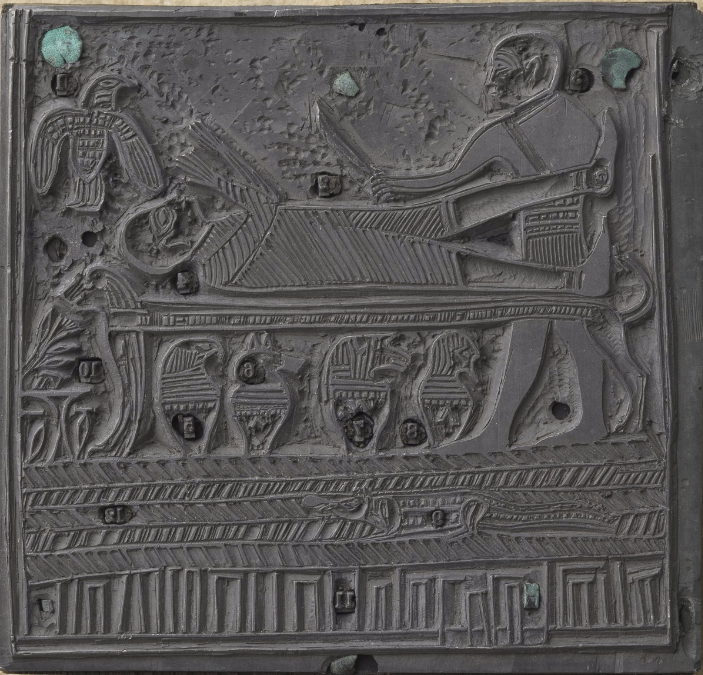
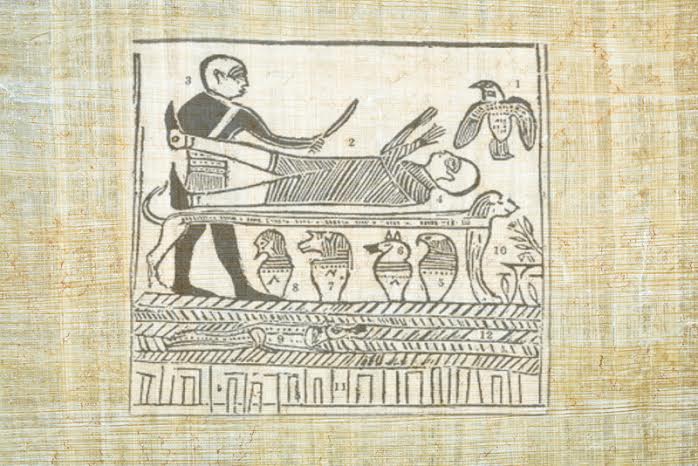
The discovery of the papyrus fragments renewed debate about Joseph Smith’s translation. The fragments included one vignette, or illustration, that appears in the book of Abraham as facsimile 1. Long before the fragments were published by the Church, some Egyptologists had said that Joseph Smith’s explanations of the various elements of these facsimiles did not match their own interpretations of these drawings. Joseph Smith had published the facsimiles as freestanding drawings, cut off from the hieroglyphs or hieratic characters that originally surrounded the vignettes. The discovery of the fragments meant that readers could now see the hieroglyphs and characters immediately surrounding the vignette that became facsimile 1. None of the characters on the papyrus fragments mentioned Abraham’s name or any of the events recorded in the book of Abraham. Mormon and non-Mormon Egyptologists agree that the characters on the fragments do not match the translation given in the book of Abraham, though there is not unanimity, even among non-Mormon scholars, about the proper interpretation of the vignettes on these fragments. Scholars have identified the papyrus fragments as parts of standard funerary texts that were deposited with mummified bodies. These fragments date to between the third century B.C.E. and the first century C.E., long after Abraham lived.

What does this mean for the Book of Abraham, or at least for understanding how Joseph Smith revealed or translated the text? The essay lists two possibilities.

It is likely futile to assess Joseph’s ability to translate papyri when we now have only a fraction of the papyri he had in his possession. Eyewitnesses spoke of “a long roll” or multiple “rolls” of papyrus. Since only fragments survive, it is likely that much of the papyri accessible to Joseph when he translated the book of Abraham is not among these fragments. The loss of a significant portion of the papyri means the relationship of the papyri to the published text cannot be settled conclusively by reference to the papyri. Alternatively, Joseph’s study of the papyri may have led to a revelation about key events and teachings in the life of Abraham, much as he had earlier received a revelation about the life of Moses while studying the Bible. This view assumes a broader definition of the words translator and translation. According to this view, Joseph’s translation was not a literal rendering of the papyri as a conventional translation would be. Rather, the physical artifacts provided an occasion for meditation, reflection, and revelation. They catalyzed a process whereby God gave to Joseph Smith a revelation about the life of Abraham, even if that revelation did not directly correlate to the characters on the papyri.

These two theories or explanations are conventionally called the “missing papyrus theory” and the “catalyst theory,” respectively, and have been the two major theories put forth by scholars investigating the Book of Abraham. Each theory has its own evidence, but neither theory can account for all of the evidence, which is why it’s wise that the essay addressed both and why it’s important to keep an open mind when approaching this topic.

“The Book of Abraham and the Ancient World”

Here the essay enumerates evidences linking the Book of Abraham with the ancient world. “A careful study of the book of Abraham provides a better measure of the book’s merits than any hypothesis that treats the text as a conventional translation,” the essay explains. “Evidence suggests that elements of the book of Abraham fit comfortably in the ancient world and supports the claim that the book of Abraham is an authentic record.” This evidence includes the following:

1. The archaeological verification of the practice of human sacrifice in Egypt and Canaan during the time of Abraham and later.

2. The potential identification of “the plain of Olishem” (Abraham 1:10) with a cite in northwestern Syria.

3. Elements of Joseph Smith’s explanations of the facsimiles that find accord with ancient understandings.

4. Narrative details about the life of Abraham found in the Book of Abraham that are also found in other extra-biblical books from antiquity. This includes details of Abraham almost being sacrificed and Abraham teaching the Egyptians astronomy.

Additional evidence for the antiquity of the Book of Abraham not mentioned in the essay includes the astronomy and cosmology of the Book of Abraham fitting nicely in an ancient Near Eastern context (see here and here), in addition to other elements of Joseph Smith’s explanations of the facsimiles finding confirmation in the ancient world (see here and here).

The essay concludes with this reminder.

The veracity and value of the book of Abraham cannot be settled by scholarly debate concerning the book’s translation and historicity. The book’s status as scripture lies in the eternal truths it teaches and the powerful spirit it conveys. The book of Abraham imparts profound truths about the nature of God, His relationship to us as His children, and the purpose of this mortal life. The truth of the book of Abraham is ultimately found through careful study of its teachings, sincere prayer, and the confirmation of the Spirit.

There are several things in this essay that are useful from an apologetic perspective.

1. There is useful clarification of what Joseph Smith may have meant by the term “translation.” According to the essay,

The word translation typically assumes an expert knowledge of multiple languages. Joseph Smith claimed no expertise in any language. He readily acknowledged that he was one of the “weak things of the world,” called to speak words sent “from heaven.” Speaking of the translation of the Book of Mormon, the Lord said, “You cannot write that which is sacred save it be given you from me.” The same principle can be applied to the book of Abraham. The Lord did not require Joseph Smith to have knowledge of Egyptian. By the gift and power of God, Joseph received knowledge about the life and teachings of Abraham.

This is reiterated later in the essay.

Joseph’s translations took a variety of forms. Some of his translations, like that of the Book of Mormon, utilized ancient documents in his possession. Other times, his translations were not based on any known physical records. Joseph’s translation of portions of the Bible, for example, included restoration of original text, harmonization of contradictions within the Bible itself, and inspired commentary.

2. The essay explains why one should be careful in assuming that the hieratic text surrounding the vignette in P. Joseph Smith I (the original illustration of facsimile 1) must be connected with the vignette. “Some have assumed that the hieroglyphs adjacent to and surrounding facsimile 1 must be a source for the text of the book of Abraham. But this claim rests on the assumption that a vignette and its adjacent text must be associated in meaning. In fact, it was not uncommon for ancient Egyptian vignettes to be placed some distance from their associated commentary.”

3. The essay provides an explanation for why the phrase “written by his own hand, upon papyrus” that appears along with the Book of Abraham isn’t necessarily problematic for its historicity, despite the papyri dating much later than Abraham. “Of course, the fragments do not have to be as old as Abraham for the book of Abraham and its illustrations to be authentic. Ancient records are often transmitted as copies or as copies of copies. The record of Abraham could have been edited or redacted by later writers much as the Book of Mormon prophet-historians Mormon and Moroni revised the writings of earlier peoples.” (For more on this topic, see my article on the Interpreter Foundation website here.)

(As an aside, I also find it significant that this essay cited material from both “classic FARMS” publications, such as Hugh Nibley’s The Message of the Joseph Smith Papyri: An Egyptian Endowment, as well as Interpreter: A Journal of Mormon Scripture. This would seem to indicate, I believe, that the claim, made by some, that the Church is trying to distance itself from these materials should be accepted with a bit of skepticism.)

In addition to the essay from Gospel Topics, the following video (“A Most Remarkable Book: Evidence for the Divine Authenticity of the Book of Abraham”) produced by FairMormon may be helpful to those with additional questions about this subject.

Filed Under: Book of Abraham, LDS Scriptures

Articles of Faith 5: Kevin Christensen on Inevitable Consequences of the Different Investigative Approaches of Jeremy Runnells and Jeff Lindsay

June 2, 2014 by NickGalieti

https://media.blubrry.com/mormonfaircast/www.fairlatterdaysaints.org/wp-content/uploads/2014/06/AOF-Episode5-KevinChristensen.mp3

Podcast: Download (56.3MB)

Subscribe: RSS

kevin-christensenKevin Christensen has been a technical writer since 1984, He has a Bachelors in English from San Jose State University.  He has published articles in Dialogue, Sunstone, the FARMS Review of Books, the Journal of Book of Mormon Studies, Insights, the Meridian Magazine, including his article in the Interpreter: A Journal of Mormon Scripture entitled Eye of the Beholder, Law of the Harvest: Observations on the Inevitable Consequences of the Different Investigative Approaches of Jeremy Runnells and Jeff Lindsay. Kevin comes to us today by phone to discuss that article. (The article is not yet public-visit The Interpreter website to find the text when available.)

Some questions from the interview:

Some of your prior articles for the Interpreter have been dealing with Temple Mysticism and temple theology with an emphasis on the works of Margret Barker, a Methodist who seems to be making her way into the minds of some LDS scholars. This article that you have coming out in the Interpreter has very little if anything to do with such a topic; what brought about the shift in topic?

The title of the article is perhaps a bit verbose so I guess it serves as both the abstract and the title, it is Eye of the Beholder, Law of the Harvest: Observations on the Inevitable Consequences of the Different Investigative Approaches of Jeremy Runnells and Jeff Lindsay. Without knowing the two individuals Jeremy Runnels and Jeff Lindsay the article might be of a diminished value. Why don’t you give a summary of who these two men are and why they are the subjects or case studies of your article?

In a recent devotional at BYU Idaho, Elder D. Todd Christoferson invited the audience to have patience when doing investigation of the history of the church, and its teachings. In some ways it seems as if the subtext of that statement is that if you stop half way you will inevitably find yourself in a faith crisis. The only way to a faithful conclusion is to be diligent in learning by study and by faith. You insert a theory on just such a thing with your article, what is that hypothesis?

You put on a sort of spiritual doctor or maybe even a spiritual mathematician kind of hat as you write this article. I won’t call it an autopsy or audit of Jeremy Runnells spiritual journey, but rather an analysis or a diagnosis of how one comes to negative conclusions about the LDS faith. There is even an equation that you employ to describe this process, can you explain those two, let’s call them, equations?

I want to read a paragraph from your article as an introduction to my next question: “The familiar fable of Henny Penny (also known as Chicken Little) makes a related point. In the fable, a chicken interprets the fall of an acorn as evidence that “The sky is falling!” Another interpretation of exactly the same event would be that “The sky is not falling, but just an acorn. No big deal. No crisis. Acorns fall from oak trees all the time. It’s natural and to be expected.” Another character in the more cautionary versions of the fable, Foxy Loxy, sees not a crisis, or a non-event, but an opportunity to exploit fear and ignorance for his own gain. Same data. Different interpretation. The information does not speak for itself, but must be interpreted within an informational context and a conceptual framework.” This echo’s your title, the Eye of the Beholder. How we see things greatly informs our decisions. This is perhaps not that new a concept for some, but what is happening in the subtext of that statement is putting the onus on one’s spirituality and the way they take their spiritual path is their own fault. In other words Chicken Little’s interpretation of the sky falling is not the acorns fault. Nor is it the tree’s fault. These things just happen naturally. How them does this play into viewing the Jeremy Runnels of the world? For that matter, the Jeff Lindsay’s as well?

You pose the question or the situation, “what are we to do with the issue of perfection, meaning perfection of translation, etc.” That was an opening critique of the CES Letter, and that ends up being a pivotal start in determining Runnells mindset. How so?

When it comes to some of the arguments against latter-day Saint teachings, there is often a complaint about a given topic, such as prophets, but rarely offers an alternative definition. It is not so much that these individuals think that they are right, but that others are wrong.

You continue to go down the row, not necessarily point by point, but you do give some feedback on the faults of the Runnels argument. We don’t need to go into details about each one, but perhaps you could give a listing of some of the other topics that you address in Runnells argument.

You have a phrase in this article that is mentioned with respect to concerns that are raised about scientific issues, here is the quote, “I learned long ago to pay as much attention to the networks of assumptions involved as to the observations which are then fitted into that network.” Expand on that for a minute if you could.

I want to give an encapsulated example of the many issues you address and how you address them. So, I wanted to take on an issue that I am becoming more and more confused by, and that is the issues surrounding the Book of Abraham as a Smoking Gun argument. Let’s consider for a moment that I know nothing of this issue, take me from the beginning of this segment of the article and walk me through how you approach it. You start off by giving Runnell’s claims, “Of all of the issues, the Book of Abraham is the issue that has both fascinated and disturbed me the most. It is the issue that I’ve spent the most time researching on because it offers a real insight into Joseph’s modus operandi as well as Joseph’s claim of being a translator. It is the smoking gun that has completely obliterated my testimony of Joseph Smith and his claims.” That is a heavy indictment indeed. But why is this statement in and of itself quite telling as to what has gone into his research?

There is so much that this over 30 page article goes into, but the end goal of the article is to raise the question, “Why is it that when Jeff Lindsay studied these issues does his faith expand, and Runnells faith shatter? How can two individuals study the same issues and come to complete opposite conclusions?

If you could give one or two pieces of advice for the individual who is approaching various gospel subjects and is facing the junction of heading towards the Runnells conclusion or the Lindsay conclusions? Why is your approach the best approach?

Filed Under: Anti-Mormon critics, Apologetics, Articles of Faith, Book of Abraham, Hosts, Nick Galieti, Podcast Tagged With: anti-Mormonism, Book of Abraham, CES Letter, Jeremy Runnells

A Yankee Lawyer’s Guide to the “Mormon Apocalypse”

February 17, 2014 by SteveDensleyJr

A British man named Tom Philips has filed a fraud action in England against President Thomas Monson and is claiming that it will bring on the “Mormon Apocalypse.” However, rather than inciting fear and panic among the faithful, if they know about the case at all, the most common response is one of bewilderment among Mormons and non-Mormons alike. That is due partly to the fact that it seems quite odd that someone would pursue a case for fraud that is based on faith claims and personal opinions. But, at least for Americans, the odd nature by which the claim has arisen procedurally is equally puzzling.

As an American civil defense lawyer, I think I have been as befuddled by this case as anyone. So I’ve consulted British lawyers and legal sources and come up with the following guide to what Phillips has called, the “Mormon Apocalypse.”

1. Private prosecution of a criminal matter in England

First, let’s consider how this matter was initiated. Under English law, a member of the public may, with some exceptions, act as a private prosecutor of a criminal matter. In order to do so, a person must first do what is called “laying an information” at a magistrate’s court. This is simply a written statement that clearly describes the offense with a citation to the pertinent criminal statute. Once this is done, a magistrate or clerk may issue a summons. Before doing so, the magistrate or clerk tries to verify that the statement actually alleges some criminal wrongdoing, it has not been filed too late, it has been filed in the correct location, and the person filing the statement is the proper person to be making the claim. The magistrate or clerk is not required to make any inquiries into the facts before issuing a summons. However, the court must at least be satisfied that at least some evidence exists to support the claim, which is the purpose in this case of the statements of Bloor and Ralph. Therefore, any assumption that the magistrate in this particular case must have already weighed the facts and found the evidence supporting the claim to be well-founded is incorrect. Furthermore, since a summons requires the defendant to come to court either in person or to appear through an attorney, President Monson will not be required to appear in person.

The reason why English Law allows a private party to proceed with a criminal prosecution in this manner is that until 1986 there was no professional prosecution service in England and the majority of prosecutions were commenced by police officers “laying information” and applying for either a warrant or summons.  Since the 1984 Police and Criminal Evidence Act however, English Police have been given extensive powers to arrest, charge and require bail of individuals suspected of criminal offences thus reducing their need to apply for warrants of arrest. In 1986, a national Crown Prosecution Service (“CPS”) headed by the Director of Public Prosecutions, has been given the responsibility for almost all criminal prosecutions in England. In Scotland, the legal position is different from that which exists in England. There has always been a professional prosecution service in Scotland and private prosecutions are not allowed. The same is now true of most countries in the former British Empire.  Today, private prosecutions, such as that initiated by Philips are very rare in England and are increasingly regarded by many lawyers and judges as an unnecessary and undesirable historical anomaly.

In this case, “information was laid” by Tom Phillips on behalf of Stephen Colin Bloor and Christopher Denis Ralph, and a summons was issued on behalf of each of them summoning President Monson to appear (though he may do so through an attorney) before the court on March 14. In this case, one summons names Stephen Colin Bloor (an ex-Mormon dissident), as an alleged victim and another names Christopher Denis Ralph (another ex-Mormon dissident) as another alleged victim. Each summons states as follows:

That between 3rd February 2008 and 31st December 2013 dishonestly and intending thereby to make a gain for himself or another or a loss or risk of loss to another made or caused to be made representations to [Stephen Colin Bloor/Christopher Denis Ralph], which were and which you knew were or might be untrue or misleading and thereby induce the said [Stephen Colin Bloor/Christopher Denis Ralph] to pay an annual tithe to The Church of Jesus Christ of Latter-day Saints, namely that:

  1. The Book of Abraham is a literal translation of Egyptian papyri by Joseph Smith.
  2. The Book of Mormon was translated from ancient gold plates by Joseph Smith, is the most correct book on earth and is an ancient historical record.
  3. Native Americans are descended from an Israelite family which left Jerusalem in 600 B.C.
  4. Joseph and Hyrum Smith were killed as martyrs in 1844 because they would not deny their testimony of the Book of Mormon.
  5. The Illinois newspaper called the Nauvoo Expositor had to be destroyed because it printed lies about Joseph Smith.
  6. There was no death on this planet prior to 6,000 years ago.
  7. All humans alive today are descended from just two people who lived approximately 6,000 years ago.

Contrary to section 1 of the Fraud Act 2006.

You are therefore summoned to appear before Westminster Magistrates’ Court 181 Marylebone Road, London, NW15BR on 14/03 2014 at 10AM in Courtroom 6 to answer the said information.

Failure to attend may result in a warrant being issued for your arrest.

Of course, the significance of February 3, 2008, is that this is when Thomas S. Monson became President of the Church.

It should also be noted that despite the reference to the possibility of an arrest warrant being issued if President Monson does not attend court, there is no legal requirement for him to physically attend.  Under § 122 of the Magistrates Courts Act 1980, found here, a defendant who is represented by a lawyer is deemed to be present at Court and § 23 of the same Act allows all preliminary matters prior to trial itself to be dealt with by lawyers representing a defendant if “the Court is satisfied that there is good reason for proceeding in the absence of the accused.” Good reason would of course include the distance between London and Salt Lake City.

The purpose of the hearing on March 14 is merely administrative in nature, and nothing substantial is likely to occur. For example, President Monson (or his attorney on his behalf) will be asked to enter a plea of guilty or not guilty, and it will be determined whether the case should be heard in the higher level “Crown Court.” Since these allegations involve criminal fraud, and a high-profile defendant, the case would presumably be transferred to Crown Court. That is where all preliminary legal arguments will take place, and, if the case is not dismissed beforehand on a pre-trial motion, a trial by jury would occur there.

However, this is an unusual situation. So it is possible that at the first hearing the court will agree to consider a motion to dismiss.  It is also possible that the CPS will take over the case and discontinue it, which is something the CPS is entitled to do with any private prosecution. Of course, the case is not likely to be taken over unless CPS has already decided to discontinue it.

Also, it is possible for the defense to ask for more time before entering a plea and thus the case may simply be adjourned, perhaps with a direction to Phillips that he should serve his evidence on the defense.  There are a broad variety of possibilities at this preliminary stage. But basically, either the case will be concluded by a dismissal, or it will more likely be adjourned to proceed on another date, likely at the Crown Court.

Although some seem to imagine that a media circus will ensue in which President Monson is hauled into court in front of flashing cameras and shouting reporters, even an entire trial can proceed without a defendant being physically present if he is instead present through video link. Providing evidence through video link is increasingly common in English Courts.

However, lawyers for the Church will almost certainly seek to have the charges dismissed as a nullity at an early stage.  First, English law does not allow courts to adjudicate on issues of religious belief, (see e.g., Khaira v Shergill, [2012] EWCA Civ 983). The Church could also argue for a dismissal on the basis that the case is vexatious, malicious and an abuse of process. And if the case were to proceed to trial, there are other issues that undermine the viability of this case that are noted in more detail below.

It should also be noted that if Phillips does not prevail against the Church, he may[i] be required to pay the legal fees incurred by the Church in defending against this claim.

2. The Fraud Act of 2006

The statutory basis for the claim against President Monson lies in the Fraud Act of 2006, found here. Specifically, Subsection 2 of the Act explains that “Fraud by false representation” occurs when:

1. A person dishonestly makes an untrue or misleading statement (in a way that is either express or implied),

2. That the person knows is, or might be, untrue or misleading,

3. Intending that by making the statement, he will make a gain for himself or another, or cause a loss to another or expose another to a risk of loss.

Section 12 of the Act further provides that where an offence against the Act was committed by a “body corporate,” but was carried out with the “consent or connivance” of any director, manager, secretary or officer of the body corporate, then that person, as well as the body itself, is liable.

The penalty under the statute is imprisonment of not more than 12 months and/or a fine of an undetermined amount, but which could be ordered up to the amount of tithing paid by Bloor and Ralph in reliance on the alleged statements.

From this, it seems that the primary questions raised are:

  • Did President Monson or the Church as a “body corporate” make the representations that are listed in the warrant?
  • Did he or the Church do so “dishonestly?”
  • Are the representations untrue or misleading?
  • Did President Monson know they are false or misleading?
  • Did he do any or all of these things with the intent of making gain for himself or the Church or with the intent to cause Bloor or Ralph to incur a loss?
  • Did Bloor and Ralph pay their tithing because of these statements?

What this all boils down to is this: Assuming the case is not dismissed at a preliminary stage, the question will be, can Phillips as prosecutor of this action prove beyond a reasonable doubt that President Monson knows the Church is false and has nevertheless used his position as President of the Church to publish false statements that are intended to cause Bloor and Ralph to pay tithing, and did Bloor and Ralph pay tithing because of those statements?

3. Analysis of the claims

It is unclear whether Phillips is claiming that President Monson made fraudulent statements to Bloor and Ralph in person, or if these are statements that President Monson allegedly made, or caused to be made on the internet among the publications of the Church.[ii] It is possible that the court might hold that Phillips must prove that these statements were made directly to Bloor and Ralph, and that it is not enough that any statements were published to the world in general on the Church’s website. However, the law on this point may be unsettled. Assuming that publications on the internet are sufficient, we can then examine the various questions in light of statements published by President Monson or the Church within the past few years that appear on the Church’s website.

The first question is, did President Monson make, or cause to be made, any of these statements since becoming president of the Church? Clearly, many of these statements appear on the Church’s website. However, it is somewhat unclear with others. For example, I am not aware of any unambiguous statement from the Church or from President Monson since he became President that there was no death on the planet before 6,000 years ago. Furthermore, it is somewhat unclear whether Phillips will need to prove that the alleged statements originated after President Monson assumed leadership of the Church, or whether statements that were made previously, and only perpetually republished on the internet or in written publications can form a viable cause of action.

Did he or the Church make these statements “dishonestly?” The English Court of Appeal in Regina v Ghosh [1982] QB 1053 established a two-part legal test that applies to all charges involving “dishonesty.” The first question is “whether according to the ordinary standards of reasonable and honest people what was done was dishonest. If it was not dishonest by those standards, that is the end of the matter and the prosecution fails.”  If (but only if) the defendant’s conduct was dishonest by those standards, the jury must consider the second question, which is “whether the defendant himself must have realised that what he was doing was [by the standards of reasonable and honest people] dishonest.” From all of the public information available about President Monson, it is hard to imagine what evidence Phillips could present that would convince a jury both that reasonable and honest people would think that he had been dishonest and that he realized that what he has taught as President of the Church would be considered to be dishonest.

Are all of these statements demonstrably false or misleading? No. Rather, nearly all of them are matters of faith and not demonstrably false. Many of the statements are simply matters of opinion. (E.g., the Book of Mormon is the most correct on Earth.) Those which are statements of faith or opinion cannot be disproven. It should be also be noted that, contrary to what some critics of the Church have claimed, President Monson will not be required to prove that each of the alleged statements is true. Rather, Phillips will be required to prove, beyond reasonable doubt, that these statements are false, that President Monson knew they were false, and that he made them with the intent to defraud Bloor and Ralph and that they paid tithing in reliance on these statements.

Did President Monson know these statements are false? There is no evidence that President Monson thinks that what he and the Church have been teaching is false. While some critics have claimed that he does not really believe the Church is true, and has not testified of the foundational doctrines of the Church for many years, he has, in fact, done so as evidenced here.

Did he do any or all of these things with the intent of making gain for himself or the Church or with the intent to cause Bloor or Ralph to incur a loss? I am aware of no evidence to support this element of the claim and it seems impossible to prove that President Monson had any such intent.

Did Bloor and Ralph pay their tithing because of these statements? While it seems plausible that a reason that Bloor and Ralph paid their tithing, at least in part, because of faith in the general idea that the Book of Mormon is the word of God, it would seem strange if they felt induced to pay tithing on the basis of each of the particular statements that are alleged to have been made, such as the statement: “There was no death on this planet prior to 6,000 years ago.”

In summary, this case may be dismissed within the next few months on the simple basis that English law does not allow courts to adjudicate on issues of religious belief. If it proceeds beyond that stage, even if it can be proven that President Monson and the Church made all of the alleged statements, those that have been made are not demonstrably false but are matters of faith, or opinion, and there is every indication that President Monson believes the Church is true, so cannot be held to have knowingly misled anyone regarding the truth claims of the Church.


[i] In the original version of this post, I said the Phillips “will” be required to pay fees if he does not prevail. However, I have since learned that this particular issue may be more complicated than originally thought due to the fact that this is a private prosecution of a criminal matter.

[ii] With respect to the substance of the statements, FairMormon has written a large number of articles that address the various topics that are raised in these allegations. Regarding the translation of the Book of Abraham, see here and here. Regarding whether Abraham himself wrote on the papyrus owned by Joseph Smith, see here. For evidences that the text of the Book of Abraham is of ancient origin, see here. For a general list of articles regarding the Book of Abraham, see here.

For a general list of articles regarding the Book of Mormon, including articles related to the translation process, the historicity of the Book of Mormon, DNA evidence regarding Native Americans, as well as the comment that the Book of Mormon “is the most correct book on earth,” see here.

On whether or not Joseph and Hyrum Smith may properly be considered martyrs, see here and here. On the destruction of the Nauvoo Expositor, see here.

On the question of whether there was death on the planet prior to the Fall of Adam, see here. For a list of articles discussing evolution and related issues, see here.

Filed Under: Anti-Mormon critics, Apologetics, Book of Abraham, Book of Mormon, DNA, Joseph Smith

A New Church History Seminary Manual

February 5, 2014 by Stephen Smoot

Screen Shot 2014-02-05 at 11.17.54 PM
The cover page of the new edition of the Doctrine and Covenants and Church History seminary manual.

[Cross-posted from Ploni Almoni: Mr. So-and-So’s Mormon Blog.]

The Church has released a new edition of the Doctrine and Covenants and Church History manual for seminary students. One of the remarkable aspects of the new manual is that it includes a discussion of several sensitive topics in church history. These topics include the following.

1. The various accounts of the First Vision are highlighted in the new manual. “There are nine known accounts of the First Vision—four written or dictated by Joseph Smith and five written by others retelling his experience,” the manual states (p. 20).

The multiple accounts of the First Vision were prepared at different times and for different audiences. In these accounts, Joseph Smith emphasized different aspects of his experience of the First Vision, but the accounts all agree in the essential truth that Joseph Smith did indeed have the heavens opened to him and see divine messengers, including God the Father and the Lord Jesus Christ. Because the 1838 account was part of Joseph Smith’s official history and testimony to the world, it was included in the Pearl of Great Price as scripture. (p. 20)

The manual then recommends students to read articles by Milton Backman and Richard Lloyd Anderson published in the Ensign discussing the various accounts of the First Vision (pp. 20, 22).

2. There is an entire chapter devoted to the Mountain Meadows Massacre and the Utah War (Lesson 151). The manual gives a brief historical overview of the events leading up to the massacre and acknowledges the participation of “Latter-day Saint leaders and settlers” in the crime (p. 523). Besides citing an article on the Mountain Meadows Massacre published in theEnsign, the manual also reproduces this quote given by President Henry B. Eyring at the 150 year anniversary of the massacre.

The gospel of Jesus Christ that we espouse, abhors the cold-blooded killing of men, women, and children. Indeed, it advocates peace and forgiveness. What was done [at the Mountain Meadows] long ago by members of our Church represents a terrible and inexcusable departure from Christian teaching and conduct.

3. In a chapter on the history of the Pearl of Great Price there is a brief overview of the history of the Book of Abraham, including the loss and recovery of several papyrus fragments once in the possession of Joseph Smith (pp. 524–526). Included in the discussion about the Book of Abraham is this (which is actually reprinted from the Church’s Pearl of Great Price Student Manual).

In 1966 eleven fragments of papyri once possessed by the Prophet Joseph Smith were discovered in the Metropolitan Museum of Art in New York City. They were given to the Church and have been analyzed by scholars who date them between about 100 B.C. and A.D. 100. A common objection to the authenticity of the book of Abraham is that the manuscripts are not old enough to have been written by Abraham, who lived almost two thousand years before Christ. Joseph Smith never claimed that the papyri were autographic (written by Abraham himself), nor that they dated from the time of Abraham. It is common to refer to an author’s works as ‘his’ writings, whether he penned them himself, dictated them to others, or others copied his writings later. (p. 525)

(Incidentally, yours truly has written a thing or two on this subject over at the Interpreter blog, which you can access here.) The manual also states, “Although we do not know the exact method Joseph Smith used to translate the writings, we do know that he translated the book of Abraham by the gift and power of God” (p. 525).

4. The new manual has material covering the practice of plural marriage, including an entire chapter on Joseph Smith’s plural marriage (Lesson 140) and a mentioning of Post-Manifesto plural marriage. Below are a few pertinent excerpts from the manual.

In this dispensation the Lord commanded some of the early Saints to practice plural marriage. The Prophet Joseph Smith and many other Church leaders found this commandment difficult, but they obeyed it. After receiving revelation, President Wilford Woodruff issued the Manifesto, which was accepted by the Church as authoritative and binding on October 6, 1890. This led to the end of the practice of plural marriage in the Church (see Official Declaration 1). (p. 204)

While Joseph Smith was working on the inspired translation of the Old Testament in 1831, he read about some of the ancient prophets practicing plural marriage (also called polygamy). Under this practice, one man is married to more than one living wife. The Prophet studied the scriptures, pondered what he learned, and eventually took his questions about plural marriage to Heavenly Father in prayer. . . . the Prophet Joseph Smith was reluctant to begin the practice of plural marriage. He stated that he did not begin the practice until he was warned that he would be destroyed if he did not obey. . . . Because of a lack of historical documentation, we do not know about Joseph Smith’s early attempts to comply with the commandment. However, by 1841 the Prophet had begun to obey the commandment and to teach it to some members of the Church, and over the next three years he married additional wives in accordance with the Lord’s commands. The Prophet Joseph Smith’s obedience to the Lord’s commandment to practice plural marriage was a trial of faith for him and his wife Emma, whom he loved dearly. (pp. 477–478)

Practicing plural marriage brought additional challenges. Because the practice was initially kept very quiet, rumors began to spread about Church leaders marrying additional wives. These rumors greatly distorted the truth, slandered the names of the Prophet and other Church leaders, and contributed to increased persecution against the Saints. (p. 479)

A small number of Latter-day Saints continued to enter into new plural marriages after the Manifesto was given. In 1904, President Joseph F. Smith announced “that all [plural] marriages are prohibited, and if any officer or member of the Church shall assume to solemnize or enter into any such marriage he will be . . . excommunicated”. . . . This policy continues today. (p. 530)

Towards the end of the chapter on Joseph Smith’s plural marriage, the manual warns, “Much unreliable information pertaining to plural marriage exists on the Internet and in many print sources. Be cautious and wise with such information. Some authors who write about the Church and its history present information out of context or include partial truths that can be misleading. The intent of some of these writings is to destroy faith” (p. 479). I myself have raised a similar point in this post. The manual then concludes by recommending, “Reliable historical research concerning the practice of plural marriage can be found at josephsmithpapers.org and byustudies.byu.edu” (p. 480).

5. On describing the nature of the Joseph Smith Translation, the manual says the following.

Around the fall of 1830, Joseph Smith was commanded by the Lord to translate the Bible. He did not translate the Bible from one language to another; nor did he have an original biblical manuscript to work from. Instead, Joseph would read and study passages from the King James Version of the Bible and then make corrections and additions as inspired by the Holy Ghost. Thus, the translation was more of an inspired revision than a traditional translation.The Joseph Smith Translation is estimated to have affected at least 3,400 verses in the King James Version of the Bible. These differences include additions (to clarify meaning or context), deletions, rearranged verses, and complete restructurings of certain chapters. The Joseph Smith Translation clarified doctrinal content, especially the mission of Jesus Christ, the nature of God, the nature of man, the Abrahamic covenant, the priesthood, and the Restoration of the gospel. (pp. 180–181)

6. The historical circumstances surrounding the priesthood ban and President Spencer W. Kimball’s 1978 revelation are discussed in a chapter on Official Declaration 2 (Lesson 157). As part of this discussion, the manual reprints the introductory material to OD 2 printed in the 2013 edition of the scriptures.

The Book of Mormon teaches that ‘all are alike unto God,’ including ‘black and white, bond and free, male and female’ (2 Nephi 26:33). Throughout the history of the Church, people of every race and ethnicity in many countries have been baptized and have lived as faithful members of the Church. During Joseph Smith’s lifetime, a few black male members of the Church were ordained to the priesthood. Early in its history, Church leaders stopped conferring the priesthood on black males of African descent. Church records offer no clear insights into the origins of this practice.

There is also the recommendation at the end of the chapter for students to “go to Gospel Topics on LDS.org and search for ‘race and the priesthood'” to learn more about the priesthood ban (p. 545).

7. Finally, in discussing section 77 of the Doctrine and Covenants, the manual straightforwardly says, “The 7,000 years [in vv. 6–7]  refers to the time since the Fall of Adam and Eve. It is not referring to the actual age of the earth including the periods of creation” (p. 280).

I am sure there is more that could be said about the new manual, but suffice it to say from the above examples that the Church is implementing productive measures towards introducing these sort of issues in a faith-promoting, safe, and positive environment (seminary). This will hopefully serve to “inoculate,” to use the popular metaphor, seminary students against the often highly debatable claims and negative information one can currently find on the Internet. While one might perhaps quibble over how certain issues are addressed in the new manual, that there is even a discussion at all in Church curriculum is, in my estimation, a step in the right direction.

Filed Under: Apologetics, Book of Abraham, Book reviews, Faith Crisis, First Vision, Joseph Smith, LDS History, LDS Scriptures, Polygamy, Racial Issues, Science Tagged With: Blacks and the Priesthood, Book of Abraham, Church History, Doctrine and Covenants, First Vision, Joseph Smith Translation, Plural Marriage, seminary

Isis and Maat in Facsimile 3 of the Book of Abraham: A Horrific Blunder by Joseph Smith?

December 29, 2013 by Jeff Lindsay

A recent post at Mormanity, “Shulem in the Book of Abraham: Possible Plausibility?,” suggested that the name Shulem given by Joseph Smith in Facsimile 3 might be more interesting than just a blunder or random guess. In response, one critic raised a reasonable question, but with a rather dismissive tone:

Wow. I look forward to your equally convoluted explanations of how “Isis, the great god’s mother” (what the characters above figure 2 actually mean) really means “King Pharaoh,” and how “Maat, mistress of the gods” (characters above figure 4) really means “Prince of Pharaoh.” This just goes to show how infinitely facile apologists can be with the facts.

While anything we say regarding any aspect of Mormonism will be dismissed as “infinitely facile” by critics not interested in dialog, the question does deserve a response. In spite of many evidences for the Book of Abraham as an ancient document, there are definitely some trouble spots, and the most problematic in my opinion are the names given in Facsimile 3. Figures 2 and 4 in that drawing are identified by Joseph as Pharaoh and the prince, respectively, but they are obviously female. Is he blind? Further, he dares to refer to the written text above the characters and states that these identities are “given,” “written,” or “represented” there. But now that scholars can read Egyptian, they have pointed out that Joseph wasn’t even close. The characters above those Figures 2 and 4 state that they are “Isis the great, the god’s mother” and “Maat, mistress of the gods,” definitely not “King Pharaoh, whose name is given in the characters above his head” and “Prince of Pharaoh, King of Egypt, as written above the hand.” As the critics say, here we have a simple test of his ability to read Egyptian, and it would have been easy here for God to simply prove to the world that his prophet could read Egyptian by inspiring him to write something like “The goddess Isis” and “The goddess Maat” for these figures. Instead, we have a “translation” that not only misreads the literal text, but also totally misses the obvious gender of the drawings. Any ordinary farmboy could at least have gotten the gender right, but not Joseph. End of story?

If you’re looking for a reason to reject Joseph and the Book of Abraham, this is the perfect place to start. Yes, he failed to render the names Isis and Maat. He even got the genders wrong. Regarding the gender problem, Hugh Nibley has writtenthat ritual dramas in which a man dressed as a female deity are known in Egyptian lore, but even if we accept that a gender-transforming lens can be applied in some kind of Egyptian role playing scenario, is there any reason to believe that Isis could somehow represent Pharaoh and Maat could represent the prince? Joseph gave us specifics that don’t make sense, at least not at a literal level.

Latter-day Saints recognize the possibility of human error whenever mortals are involved, and understand that Joseph and other prophets make mistakes. Is that the case here? Perhaps. But there may be something more interesting. Perhaps Joseph’s exercise was not about the literal representation of these figures, otherwise he surely would have said something about women rather than men. Perhaps he is seeking to understand what Facsimile 3 symbolized rather than its literal meaning.

Isis and Pharaoh: Any Connections?

Could Isis be linked to Pharaoh? Wikipedia’s article on Isis provides our first clue:

The name Isis means “Throne”. Her headdress is a throne. As the personification of the throne, she was an important representation of the pharaoh’s power. The pharaoh was depicted as her child, who sat on the throne she provided.

Suddenly, the guffawing of critics seems a little less embarrassing for Joseph. The word “Isis” written above Figure 2’s head can, without delicate mental gymnastics, be rather directly linked to Pharaoh–rather precisely as stated by Joseph. Again, not literally–obviously not literally, because she is female, of course–but in a rather direct and simple metaphorical link. Isis = throne = symbol of Pharaoh. Not too tricky.

In the Turin Papyrus, Isis learns the secret name of Ra and gains power over him (see R.A. Ritner, “The Legend of Isis and the Name of Re: P. Turin 1993.”) This is a powerful goddess well suited to personify the Pharaoh and his power.

AncientEgyptOnline.co.uk offers this commentary on Isis:

Isis was a member of the Helioploitan Ennead, as the daughter of Geb (Earth) and Nut (Sky) and the sister and wife of Osiris and the sister of Set, Nephthys and (sometimes) Horus the Elder. However, because of her association with the throne Isis was sometimes considered to be the wife of Horus the Elder- the patron of the living Pharaoh. Ra and Horus were closely associated during early Egyptian history, while Isis was closely associated with Hathor (who was described as the mother or the wife of Horus or Ra) and so Isis could also be considered to be the wife of Ra or Horus.

However, when Ra and Atum (the Ennead of Helipolis) merged, Isis became both the daughter of Atum(-Ra) and the wife of (Atum-)Ra. This situation was clarified by crediting Isis as the granddaughter of Ra-Atum, the mother of Horus (the child) and the wife of Osiris.

Here is more about Isis and her complex roles, also from Wikipedia:

During the Old Kingdom period, Isis was represented as the wife or assistant to the deceased pharaoh. Thus she had a funerary association, her name appearing over eighty times in the pharaoh’s funeral texts (the Pyramid Texts). This association with the pharaoh’s wife is consistent with the role of Isis as the spouse of Horus, the god associated with the pharaoh as his protector, and then later as the deification of the pharaoh himself.

But in addition, Isis was also represented as the mother of the “four sons of Horus”, the four deities who protected the canopic jars containing the pharaoh’s internal organs. More specifically, Isis was viewed as the protector of the liver-jar-deity, Imsety. By the Middle Kingdom period, as the funeral texts began to be used by members of Egyptian society other than the royal family, the role of Isis as protector also grew, to include the protection of nobles and even commoners.

By the New Kingdom period, in many places, Isis was more prominent than her spouse. She was seen as the mother of the pharaoh, and was often depicted breastfeeding the pharaoh. It is theorized that this displacement happened through the merging of cults from the various cult centers as Egyptian religion became more standardized. When the cult of Ra rose to prominence, with its cult center at Heliopolis, Ra was identified with the similar deity, Horus. But Hathor had been paired with Ra in some regions, as the mother of the god. Since Isis was paired with Horus, and Horus was identified with Ra, Isis began to be merged with Hathor as Isis-Hathor. By merging with Hathor, Isis became the mother of Horus, as well as his wife. Eventually the mother role displaced the role of spouse. Thus, the role of spouse to Isis was open and in the Heliopolis pantheon, Isis became the wife of Osiris and the mother of Horus/Ra. This reconciliation of themes led to the evolution of the myth of Isis and Osiris.

Her role was complex and shifted over time, but her association with the throne and the Pharaoh, either directly or through her connection to Horus, again points to a plausible symbolic meaning that an Egyptian/Semitic editor could see between the female Isis and Pharaoh. Could it be that Joseph recognized the symbolism here and saw that the deeper meaning of Pharaoh was symbolically given in the characters that mention “She of the Throne,” Isis? I think that possibility needs to be considered.

Maat and the Prince of Pharaoh

If a female deity can represent Pharaoh, can another represent a prince? Does Maat have associations that could make sense of Joseph’s statement? To me, this is not as clearcut and remains a fair question. Here is what Wikipedia says about Maat:

Maat or ma’at … was the ancient Egyptian concept of truth, balance, order, law, morality, and justice. Maat was also personified as a goddess regulating the stars, seasons, and the actions of both mortals and the deities, who set the order of the universe from chaos at the moment of creation. Her (ideological) counterpart was Isfet.

The earliest surviving records indicating Maat is the norm for nature and society, in this world and the next, were recorded during the Old Kingdom, the earliest substantial surviving examples being found in the Pyramid Texts of Unas (ca. 2375 BCE and 2345 BCE).

Later, as a goddess in other traditions of the Egyptian pantheon, where most goddesses were paired with a male aspect, her masculine counterpart was Thoth and their attributes are the same. After the rise of Ra they were depicted together in the Solar Barque.

After her role in creation and continuously preventing the universe from returning to chaos, her primary role in Egyptian mythology dealt with the weighing of souls that took place in the underworld, Duat. Her feather was the measure that determined whether the souls (considered to reside in the heart) of the departed would reach the paradise of afterlife successfully.

Pharaohs are often depicted with the emblems of Maat to emphasise their role in upholding the laws of the Creator….

The sun-god Ra came from the primaeval mound of creation only after he set his daughter Maat in place of Isfet (chaos). Kings inherited the duty to ensure Maat remained in place and they with Ra are said to “live on Maat”, with Akhenaten (r. 1372-1355 BCE) in particular emphasising the concept to a degree that, John D. Ray asserts, the kings contemporaries viewed as intolerance and fanaticism. Some kings incorporated Maat into their names, being referred to as Lords of Maat, or Meri-Maat (Beloved of Maat). When beliefs about Thoth arose in the Egyptian pantheon and started to consume the earlier beliefs at Hermopolis about the Ogdoad, it was said that she was the mother of the Ogdoad and Thoth the father.

Perhaps I’m grasping at straws here, but I find it interesting that Maat is the daughter of the great sun-god Ra and that some kings incorporated Maat into their names. And not just kings: there was also an Egyptian prince, Nefermaat, whose name was based on Maat’s.

What I find more interesting is her role in renewal and preserving cosmic order, a topic that brings us to the issue of coronation of new kings (the former prince). On this issue, Ernst Wurthwein in “Egyptian Wisdom and the Old Testament” inEssential Papers on Israel and the Ancient Near East, ed. Frederick E. Greenspahn (New York: New York University, 1991), p. 134, cites H. Brunner, Handbuch der Oreintalistik I, 2 (1952), pp. 96ff:

As a goddess, Maat belonged to the Heliopolitan religious system, where she appeared as the daughter of the sun-god. She came down to men in the beginning as the proper order of all things. Through the evil assaults of Seth and his comrades, this order was upset, but restored through the victory of Horus. As the embodiment of Horus, each new king renews this right order through his coronation: a new state of Maat, i.e., of peace and righteousness, dawns. [emphasis added]

Maat’s role in coronation to renew the authority of the kingdom naturally points to the man who will serve as successor to Pharaoh, the prince. It is also interesting that the name of Maat was often used in special coronation names given to new kings at their coronation. One reference on this point is Emily Teeter, “Egypt,” inThe Cambridge Companion to Ancient Mediterranean Religions, ed. by Barbette Stanley Spaeth (New York: Cambridge University Press, 2013), pp. 24-25:

One of the king’s main obligations to the god was to rule the land in accordance with maat, the interconnected concept of cosmic balance and truth that was personified by the goddess Maat. The commitment to maat is illustrated by offering scenes where the king presents a figure of the goddess Maat to the deities as a visible affirmation of his just rule and the acknowledgement that he will uphold the tenets inherent inmaat. In the New Kingdom, the king’s coronation name was often compounded with Maat, another indication of the association of the king and principle of truth. Some New Kingdom kings are shown presenting a rebus of their name captioned “presenting Maat,” suggesting that the king himself was imbued with or personified, Truth.

David Leeming, The Oxford Companion to World Mythology (Oxford: Oxford University Press, 2005), offers this information about Maat (p. 243):

Maat in Egyptian mythology, the goddess Maat (Ua Zit), the wife of Thoth, a god associated with wisdom, and daughter or aspect of the high god Atum, is at once a goddess and an idea, the personification of moral and cosmic order, truth, and justice . . . that was as basic to life as breath itself, which in the Coffin Texts Maat also seems to personify. Pharaohs held small models of Maat to signify their association with her attributes. Maat gives breath itself–life–to the kings, and so is depicted holding the symbol of life, the ankh, to their noses. Maat represents the proper relationship between the cosmic and the earthly, the divine and the human, the earth, the heavens, and the underworld. It is she who personifies the meaningful order of life as opposed to the entropic chaos into which it might easily fall. It some stories it is the sun god Re who displaces Chaos with Maat. . . .

Maat was essentially in all Egyptian gods and goddesses as the principle of divinity itself. The goddess Isis acknowledges the qualities of Maat, as signified by the maat (ostrich feather) she wears behind the crowns of upper and lower Egypt.

Maat might be seen as a principle analogous to the Logos, divine reason and order. As Christians are told “In the beginning was the Word [Logos] already was” (John 1:1). Atum announces that before creation, “when the heavens were asleep, my daughter Maat lived within me and around me.”

If Maat is the daughter of the great god and is a parallel to the Christian Logos and the son of God, then could this child could be considered a princess and thus again a symbol of a prince?

Wikipedia, as quoted above, indicates that Maat is paired with Thoth, having the same attributes. Regarding Thoth, Claas Jouco Bleeker in Hathor and Thoth: Two Key Figures of the Ancient Egyptian Religion (Leiden, Netherlands: E.J. Brill, 1973), p. 119, writes:

There was a close connection between Thoth and Re. In the previous section we became acquainted with him as son of Re. The sun-god placed so much confidence in the capacities of Thoth that he appointed him his deputy, his vizier. The pertinent text relates how Re sent for Thoth and gave him a place of honour next himself. Thereupon Re spoke: “Thou shalt be writer in the nether-world…. Thous shalt take my place as deputy, thou shalt be called Thoth substitute of Re.”

Another text adds that he was even appointed successor to Re. Thoth fulfilled his task so well that he was given the epithet “the one with whose word Atum (the primeval god at Heliopolis who later acquired solar significance) is content.”

In his office Thoth performs invaluable services for the sun-god. He is “the perfect secretary.” is said that his pen protects Re. Just what this expression implies is made clear in a hymn to Re which runs: “Daily Thoth writes Ma-a-t for thee.” [emphasis added]

Thoth, the escort of Maat, may be a symbol of a successor to the throne, again pointing to the role of a prince at a symbolic level.

Regarding Thoth, Maat’s husband, Leeming writes (p. 381):

Thoth was the moon god as well as the god of wisdom in Egypt. . . . In Hermopolis he might sometimes have been seen as a creator god. For some, Thoth was the son of Re, Re in this case being the sun, the right eye of Horus, whose moon eye had been ripped out by Seth. His consort was Maat. . . .

Maat, Thoth, son/daughter of the great god, and successor: if Isis can be a symbol for Pharaoh, could these associations allow an Semitic editor to also use Maat as a symbol for a prince? This doesn’t answer all the questions or objections to the identities offered by Joseph Smith on Facs. 3, but may suggest that there is “something interesting going on” besides random guessing coupled with gross inability to recognize a female in a drawing.

I could be way off and welcome your feedback. I know little about Egyptology and have just relied on easily found sources here that may be inadequate in many ways. It’s still possible to accept that some egregious errors were made, but the theory that Joseph’s comments are based on symbolic meanings would be fairly consistent with some of the more interesting hits in the Book of Abraham, and consistent with the principle of God not removing the need for faith in accepting scripture. God could have provided manuscripts and literal interpretations capable of gaining peer-reviewed acceptance from the scholarly community with no need for faith. But that’s not how He does things. Faith will always be required.

* This entry was also posted at Mormanity.

Filed Under: Anti-Mormon critics, Book of Abraham, Joseph Smith

“By His Own Hand, Upon Papyrus”: Another Look

November 17, 2013 by Stephen Smoot

Copy_of_Il_Guernico_hagar_ismael
Detail from “Abraham Casting Out Hagar and Ishmael” (1657) by Giovanni Francesco Barbieri.

 When the Book of Abraham was first published in March 1842, the title of the work, as it appeared in the Times and Seasons, read thusly: “A TRANSLATION Of some ancient Records that have fallen into our hands, from the Catecombs of Egypt, purporting to be the writings of Abraham, while he was in Egypt, called the BOOK OF ABRAHAM, written by his own hand, upon papyrus.”[1] A look at the manuscripts of the Book of Abraham shows that this explanatory “title,” as it were, for the Book of Abraham dates to the earliest stages of the book’s production. Our earliest (surviving) manuscript for the Book of Abraham, which Brian Hauglid designates Ab1, and which the scholars at the Joseph Smith Papers Project date to “Summer–Fall 1835,” reads: “Translation of the Book of Abraham written by his own hand upon papyrus and found in the CataCombs of Egypt.”[2] [Read more…] about “By His Own Hand, Upon Papyrus”: Another Look

Filed Under: Book of Abraham, LDS Scriptures Tagged With: Abraham, Book of Abraham, Joseph Smith Papyri

Egyptology and the Book of Abraham: An Interview with Egyptologist Kerry Muhlestein

November 14, 2013 by Stephen Smoot

photo1
Kerry Muhlestein, associate professor of ancient scripture at Brigham Young University.

Mormon fascination with the ancient world stems largely from an exotic corpus of writings found in the canon of The Church of Jesus Christ of Latter-day Saints. One book in the Church’s canon, the Book of Abraham, which Joseph Smith claimed to be an inspired translation of some ancient Egyptian papyri, has captured Mormon imagination with a vibrant narrative involving the eponymous biblical patriarch, human sacrifice, far-off lands, divine encounters and a grand cosmology.

One BYU professor, Kerry Muhlestein, has devoted a good portion of his academic career (over a decade) investigating the saga of the Book of Abraham. Muhlestein, who holds a PhD in Egyptology from UCLA, is an associate professor of ancient scripture at BYU. According to his faculty bio on the BYU Religious Education website, Muhlestein “is the director of the BYU Egypt Excavation Project,” which has led successful archaeological digs in Egypt, and has academic expertise in fields including “Ancient Egypt, Hebrew Bible, [and the] Pearl of Great Price.” [Read more…] about Egyptology and the Book of Abraham: An Interview with Egyptologist Kerry Muhlestein

Filed Under: Book of Abraham, LDS History, LDS Scriptures Tagged With: Book of Abraham, Joseph Smith Papyri, Kerry Muhlestein

  • « Go to Previous Page
  • Go to page 1
  • Interim pages omitted …
  • Go to page 4
  • Go to page 5
  • Go to page 6
  • Go to page 7
  • Go to page 8
  • Go to Next Page »

Primary Sidebar

Faithful Study Resources for Come, Follow Me

Subscribe to Blog

Enter your email address:

Subscribe to Podcast

Podcast icon
Subscribe to podcast in iTunes
Subscribe to podcast elsewhere
Listen with FAIR app
Android app on Google Play Download on the App Store

Pages

  • Blog Guidelines

FAIR Latest

  • Come, Follow Me with FAIR – Doctrine and Covenants 137–138 – Part 2 – Autumn Dickson
  • Come, Follow Me with FAIR – Doctrine and Covenants 137–138 – Mike Parker
  • FAIR December Newsletter
  • Come, Follow Me with FAIR – Doctrine and Covenants 137–138 – Part 1 – Autumn Dickson
  • Prophets of God 

Blog Categories

Recent Comments

  • LHL on Come, Follow Me with FAIR – Doctrine and Covenants 132 – Mike Parker
  • Stephen Johnsen on Come, Follow Me with FAIR – Doctrine and Covenants 132 – Mike Parker
  • Bruce B Hill on Come, Follow Me with FAIR – Doctrine and Covenants 124 – Part 1 – Autumn Dickson
  • Gabriel Hess on Join us Oct 9–11 for our FREE virtual conference on the Old Testament
  • JC on When the Gospel “Doesn’t Work”

Archives

Follow Us

  • Facebook
  • Twitter
  • iTunes
  • YouTube
Android app on Google Play Download on the App Store

Footer

FairMormon Logo

FAIR is a non-profit organization dedicated to providing well-documented answers to criticisms of the doctrine, practice, and history of The Church of Jesus Christ of Latter-day Saints.

Donate to FAIR

We are a volunteer organization. We invite you to give back.

Donate Now

Site Footer