
Nauvoo is getting busy. This volume contains 623 pages but covers only a four month timespan. Two of the biggest things that happened were the excommunication of John C. Bennett and rumors of Joseph Smith’s involvement in an assassination attempt on Lilburn W. Boggs. When Bennett left Nauvoo, Joseph became the mayor which made him even busier. For further context, this time period is covered in pages 453 – 477 of Saints, Voume. 1.
This volume features 105 documents out of nearly 400 available for this time period. Other documents are available at the Joseph Smith Papers website. However, as always, the footnotes and editorial information on each document make the book well worth having. Some of the items featured in the book are Nauvoo city scrip signed by Joseph Smith, a poem written by Eliza R. Snow for Joseph Smith, and the only known revelation giving instructions for performing a plural marriage. There are also notes from a number of sermons he gave. [Read more…] about Book Review: The Joseph Smith Papers, Documents, Vol. 10: May – August 1842
 Brian C. Hales is the author or co-author of seven books dealing with plural marriage—most notably the three-volume, Joseph Smith’s Polygamy: History and Theology (Greg Kofford Books, 2013) He and his wife Laura are the current webmasters of JosephSmithsPolygamy.org. Presently, Brian is working on two book-length manuscripts dealing with Joseph Smith’s treasure seeking and the authorship of the Book of Mormon. He served a mission to Venezuela for The Church of Jesus Christ of Latter-day Saints and sang with the Mormon Tabernacle Choir for fourteen years. Brian is also past president of the Utah Medical Association (2013) and the John Whitmer Historical Association (2015).
 Ben Spackman is a Latter-day Saint scholar who works in American religious history, history of science, and Biblical interpretation. He is writing a dissertation at Claremont on LDS creationism/evolution conflict in the 20th century, and has spoken at the FairMormon Conference in 2017 and 2019. This is cross-posted at his site,
  Matthew C. Godfrey is a general editor and the managing historian of the Joseph Smith Papers. He holds a PhD in American and public history from Washington State University. He has contributed to several Joseph Smith Papers volumes, including Documents, Volume 2; Documents, Volume 4; Documents, Volume 7, and the forthcoming Documents, Volume 10, and Documents, Volume 12. He is the author of Religion, Politics, and Sugar: The Mormon Church, the Federal Government, and the Utah-Idaho Sugar Company, 1907–1921 (2007), which was a co-winner of the Mormon History Association’s Smith-Petit Award for Best First Book. He is also the co-editor of The Earth Shall Appear as the Garden of Eden: Essays in Mormon Environmental History (2019). Matthew has published articles in Agricultural History, The Public Historian, Pacific Northwest Quarterly, Journal of Mormon History, BYU Studies Quarterly, Mormon Historical Studies, and various collections of essays. His research interests and expertise include environmental history, business and financial history, and the history of Zion’s Camp.
 John W. Welch is the Robert K. Thomas Professor of Law at the J. Reuben Clark Law School, Brigham Young University, where he teaches various courses, including Perspectives on Jewish, Greek, and Roman Law in the New Testament. Since 1991 he has also served as the editor in chief of BYU Studies. He studied history and classical languages at Brigham Young University, Greek philosophy at Oxford, and law at Duke University. As a founder of the Foundation for Ancient Research and Mormon Studies, one of the editors for Macmillan’s Encyclopedia of Mormonism, and co-director of the Masada and Dead Sea Scrolls exhibition at BYU, he has published widely on biblical, early Christian, and Latter-day Saint topics.
 Jeannie Welch graduated from BYU with an MA in French and Spanish, with her master’s thesis on comic theory in Moliere. For over 25 years she taught French, first in private schools and then on the faculty at BYU, where she was also the Director of the BYU Foreign Language Student Residence for 13 years. She has directed a BYU study abroad to Paris, and has traveled widely visiting numerous art museums in Europe. In addition to serving in leadership and teaching positions in church and public schools, she has organized European and Church History tours, has published in the Mormon Historical Studies journal and co-authored two books with her husband, John Welch, The Doctrine and Covenants by Themes, and The Parables of Jesus: Revealing the Plan of Salvation.
 Larry E. Morris, an independent writer and historian, is the author of A Documentary History of the Book of Mormon (Oxford University Press, 2019). He was previously an editor with both the Neal A. Maxwell Institute for Religious Scholarship and the Joseph Smith Papers. He is the co-editor, with John W. Welch, of Oliver Cowdery: Scribe, Elder, Witness (Maxwell Institute, 2006) and has published articles on Mormon history in BYU Studies, the FARMS Review, the Journal of Book of Mormon Studies, the Journal of Mormon History, the Ensign, and the New Era. He is also quite interested in early Western history and is the author of In the Wake of Lewis and Clark: The Expedition and the Making of Antebellum America (Rowman & Littlefield, 2019); The Perilous West: Seven Amazing Explorers and the Founding of the Oregon Trail (Rowman & Littlefield, 2012); and The Fate of the Corps: What Became of the Lewis and Clark Explorers After the Expedition (Yale University Press, 2004). Larry and his wife, Deborah, live in Salt Lake City and have four children and eight grandchildren.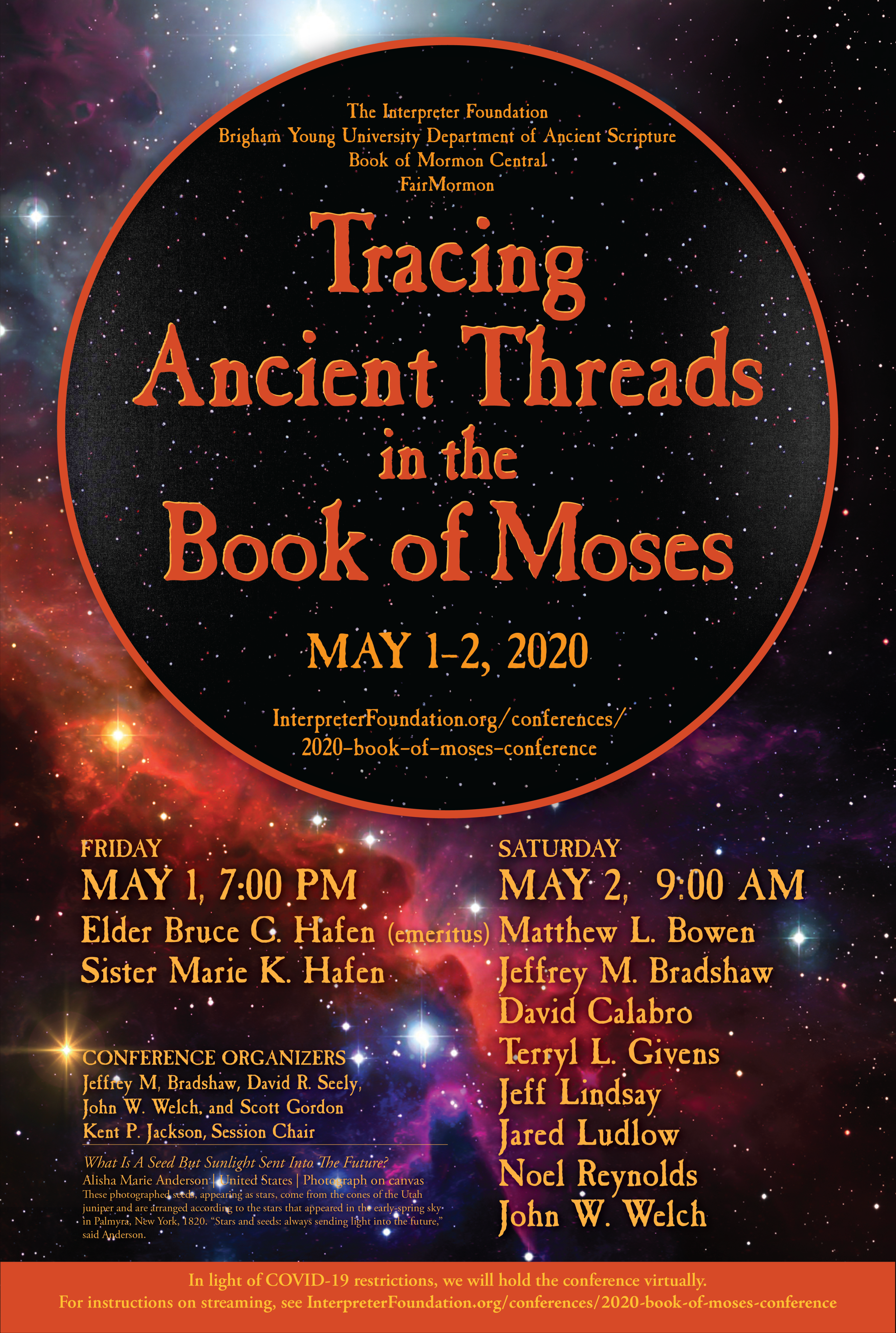
 Matthew L. Bowen is an assistant professor of Religious Education at Brigham Young University–Hawaii where he has taught since 2012. He holds a Ph.D. in Biblical Studies from the Catholic University of America in Washington, DC, where he also earned an M.A (Biblical Studies). He previously earned a B.A. in English with a minor in Classical Studies (Greek emphasis) from Brigham Young University (Provo) and subsequently pursued post-Baccalaureate studies in Semitic languages, Egyptian, and Latin there. In addition to having taught at Brigham Young University–Hawaii, he has previously taught at the Catholic University of America and at Brigham Young University. Bowen is the author of numerous peer-reviewed articles on scripture- and temple-related topics as well as the recent book Name as Key-Word: Collected Essays on Onomastic Wordplay and the Temple in Mormon Scripture. Bowen grew up in Orem, Utah, and served a two-year mission in the California Roseville Mission. He and his wife, the former Suzanne Blattberg, are the parents of three children, Zachariah, Nathan, and Adele.
 Elizabeth Kuehn received her Bachelor of Arts in History from Arizona State University and her Masters of Arts from Purdue University in History, with a focus on religious history and women and gender studies in early modern European history. She entered a doctoral program in History at the University of California, Irvine, and became a PhD candidate there in 2011.