Podcast: Download (36.5MB)
Subscribe: RSS
This is the second part of a four-part episode.
Podcast: Download (37.9MB)
Subscribe: RSS
 Don Bradley is a writer, editor, and researcher specializing in early Mormon history. In his early years as a historian, he found it difficult to understand and explain many of the actions of Joseph Smith. He found that he could make sense of much of the history if he assumed that Joseph Smith was a fraud who sought after money, sex and power. As he pursued this strategy of analysis, he drifted further and further away from the Church in which he had been raised. Along the way, he spent time as an agnostic and atheist, then back to theist, then Baha’i, then generic Protestant. As he continued his research into the history of Joseph Smith, he found that the Joseph-as-fraud approach proved increasingly inadequate to explain what he was finding. In this interview, Don talks about what eventually led him back to the Church, why he finally decided that Joseph Smith is truly a prophet of God, and how adopting this new interpretive model has helped him to understand Joseph Smith better than he ever did before.
Don recently performed an internship with the Joseph Smith Papers Project and is completing his thesis toward an M.A. in History at Utah State University. He has published on the translation of the Book of Mormon, plural marriage before Nauvoo, and Joseph Smith’s “grand fundamental principles of Mormonism” and plans to publish an extensive analysis, co-authored with Mark Ashurst-McGee, on the Kinderhook plates. Don’s first book, The Lost 116 Pages: Reconstructing the Missing Contents of the Book of Mormon,is slated to be published by Greg Kofford Books.
His 2012 FAIR Conference address can be read here: Piercing the Veil: Temple Worship in the Lost 116 Pages.
Podcast: Download (12.4MB)
Subscribe: RSS
Shaken Faith Syndrome and the Case for Faith
Abstract: Michael R. Ash is a Mormon apologist who has written two thoughtful books and a number of insightful articles exploring a wide range of controversial issues within Mormonism. His recent book Shaken Faith Syndrome: Strengthening One’s Testimony in the Face of Criticism and Doubt is an outstanding apologetic resource for individuals searching for faith-promoting answers that directly confront anti-Mormon allegations and criticisms. Ash does an excellent job in both succinctly explaining many of the criticisms leveled against The Church of Jesus Christ of Latter-day Saints and articulating compelling answers to these criticisms.
Review of Michael R. Ash. Shaken Faith Syndrome: Strengthening One’s Testimony in the Face of Criticism and Doubt. Redding, CA: Foundation for Apologetic Information and Research, 2008. x + 301 pp., with index. $19.95 (paperback).
“Wherefore Didst Thou Doubt?”
(Matthew 14:31)
A favorite scripture of Latter-day Saint scholars is Doctrine and Covenants 88:118: “And as all have not faith, seek ye diligently and teach one another words of wisdom; yea, seek ye out of the best books words of wisdom; seek learning, even by study and also by faith.” While it is usually the last phrase (“seek [Page 106]learning, even by study and also by faith”) of this scripture that resonates with LDS scholars, the first part of this passage is equally profound. As “all have not faith,” or, one might say, have had their faith challenged or shaken, we are to teach each other words of wisdom from the best books. This scripture is a mandate to bolster each other’s faith as much as it is an invitation to pursue truth. [Read more…] about Book Review: Shaken Faith Syndrome
Podcast: Download (29.4MB)
Subscribe: RSS
 A long-time member of FAIR, Mike Parker, addresses a variety of questions related to apologetics and gospel learning: Where should gospel teaching begin? To what extent should teachers bring up and address troubling historical or doctrinal issues? Should missionaries tell investigators about such issues before they are baptized? What should be the goal of a Gospel Doctrine teacher or missionary? How can a faithful member navigate the challenges that are posed by difficult doctrinal, historical or political issues? Mike provides his insight on this issues and many others.
Podcast: Download (27.0MB)
Subscribe: RSS
 Cody Anderson was an exemplary young member of the Church. As a teen, he was an Eagle Scout, a quorum president, and had experienced a spiritual conversion to the gospel of Jesus Christ. But as he began to encounter opposition and sin, he became discouraged and developed a sense of shame and unworthiness. He began to attend church less frequently and he gradually stopped reading the scriptures and praying. Eventually, he encountered anti-Mormon literature and found a rational justification for his disaffection from the Church. For a number of years, he pursued a lifestyle that was simply guided by his base desires. While some people like Cody never return to the Church, he instead returned to full activity, became sealed in the temple, and now volunteers for FAIR. In this interview, he explains what it was that brought him back into the Church and provides some insight into why some people leave the Church, and what friends and family members can do to help them return.
 If you would like to read FAIR’s Front Page without using the full FAIR app that was announced yesterday, there is also now an app just for that.
FAIR’s Front Page contains daily news clippings about how the Church of Jesus Christ of Latter-day Saints is represented in the media. It is also available by e-mail (you can sign up at http://www.fairlds.org).

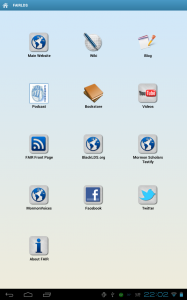 We are pleased to announce that we now have an app available for Android. It can be downloaded from Google Play. Listen to podcasts, watch YouTube videos, read the blog, and access other online FAIR content conveniently from your Android device. The ads contained in the app will help provide funds for FAIR.
Podcast: Download (20.6MB)
Subscribe: RSS
 As a young, faithful member of the Church, Mike Ash found his faith to be shaken by the anti-Mormon book The Kingdom of Cults. He worked through that experience and later found his faith to be challenged once more by the movie the God Makers, and later by Church historical documents that were being “discovered” by a man named Mark Hoffman. In this interview, Brother Ash discusses how he was able to overcome doubts that were created by his encounters with anti-Mormon material and the Hoffman forgeries. He talks about the role apologetics played in strengthening his faith, how he became involved in FAIR, and he offers advice for family members and friends of those who are struggling with their faith.
Michael R. Ash, is the author of the book Shaken Faith Syndrome: Strengthening One’s Testimony in the Face of Criticism and Doubt, as well as the book, Of Faith and Reason: 80 Evidences Supporting the Prophet Joseph Smith. Both books are available for purchase online through the FAIR Bookstore.
