• Skip to primary navigation
  • Skip to main content
  • Skip to primary sidebar
  • Skip to footer

FAIR

  • Find Answers
  • Blog
  • Media & Apps
  • Conference
  • Bookstore
  • Archive
  • About
  • Get Involved
  • Search

Book of Mormon

The Gadianton Robbers in Mormon’s Theological History: Their Structural Role and Plausible Identification

The Gadianton robbers are a specific instance of the larger set of events and concepts revolving around what the Book of Mormon calls secret combinations. These secret combinations show up in connection with the Jaredites, then they disappear. They reappear scant years prior to the arrival of the Savior in the New World, and then disappear for over two hundred years. Finally, they reappear to play a role in the final denouement of the Nephites. While the majority of the conflicts in the Book of Mormon occur with the Lamanites, the most destructive conflicts are those that come at the hands of the secret combinations, and specifically the Gadianton robbers. The Lamanites might be the Nephites’ most common enemy, but the Gadianton robbers are the most dangerous. This combination of longevity, sporadic appearance, and ultimate danger, make the Gadianton robbers and secret combinations an important study in understanding the message of the Book of Mormon. The elucidation of this complex interaction of time, text, and meaning must necessarily center on both Mormon’s text and the ancient cultural environment of that text.

The first question we will examine is the role of secret combinations in the narrative of the Book of Mormon. The second issue is the plausible identification of the secret combinations with some historical event or group. This phase of the investigation is complicated not only by known history, but also because this history must also integrate with the narrative purpose of the secret combinations in the text. What is told must also conform to how it is told.

Finally we must test the identification against the disparate appearances of the secret combinations in the text. Secret combinations make an appearance over nearly two thousand years of Book of Mormon history, but they have no consistent presence. They all seem to be related, but they are separated by hundreds, or perhaps thousands of years. They have similar characteristics, but they are associated with different cultures. The text ties them all together. We are looking for that binding thread.

The Narrative Role of Secret Combinations.

It is popular to describe Mormon as an abridger; some early predecessor of the editors of Reader’s Digest who take large texts and distill them into shorter versions. This is a seriously misleading conception. It is true that Mormon is an author with a stylistic penchant for including large citations from his source material, but we do him extreme discredit when we forget his very active role in selecting and structuring his account. Mormon is an historian, but he is unlike a modern historian in the way he perceives his task. Mormon does not write secular history, but rather sacred history. It is this overriding concern that absolutely dictates everything he includes and excludes from his text.

As we approach the Gadianton robbers from the perspective of Mormon’s construction of his text, we find that they and secret combinations are perhaps the most complex example of Mormon’s authorial art. Secret combinations are a meta-theme that function as both an organizational principle and historical moral. The meta-theme of the secret combinations is not present because history happened in just such a way and Mormon dispassionately recorded that history. Secret combinations are an interpretive layer that Mormon spreads over the events in order for those events to have a greater meaning. In creating this meta-theme, Mormon is following an Old World literary vision that sees history in a larger context of types and patterns.1 Robinson describes the effect of this conception on the way history was written:

The unifying principle [acted] like a magnet in evoking a pattern amongst iron filings. It created a pattern of history out of all its complexities, a pattern which disclosed the previously hidden purpose of God.2

Mormon is dealing in patterns. This patterning of history becomes evident when disparate events at widely separated times are described in ways that make those events obviously parallel. The repetition of the pattern is a marker of authorial formulation. For the secret combinations in the Book of Mormon, the patterning consists in a set of events and characteristics that always accompany the presence of a secret combination. The essential features are the presence of murders, a desire for wealth (frequently described as “robbings and plunderings”), and the destruction of political order. Mormon orders three historical periods with the presence of this set of events and traits of secret combinations:

  1. The earliest manifestation of the pattern in Book of Mormon history is in Jaredite times. The destruction of the Jaredites is explicitly laid at the feet of secret combinations, and all of the elements of the secret combinations are present.3
  2. The second occurrence in time is actually the first in the text, and it is the most textually complex. It occurs within a period of only about eighty years. In that eighty-year time period the Gadiantons make four separate appearances and four separate disappearances. The appearances and disappearances of this particular set of Gadianton robbers serve as a micro example of the general patterning of the larger meta-theme. In spite of the four phases, however, this set is textually treated as a virtual single appearance. The result of the rise of the Gadiantons is the fall of the Nephite government just before the arrival of the Savior in the New World.
  3. The final appearance of the Gadianton secret combination leads to the final demise of the Nephites.4

We have three instances that repeat this pattern, and we may be certain that it is no coincidence that all three appear to be so similar, a similarity that is even more apparent in the specific details than it appears in this brief summary. Of this intentional repetition in the Book of Mormon, Richard Rust notes:

Repetition appears purposefully within Book of Mormon narratives as a principle of reinforcement and confirmation. It seems that every important action, event, or character is repeated in the Book of Mormon. These repetitions emphasize the law of witnesses at work within the book … They link narratives together with what Robert Alter calls “type-scenes.” …Larger repeated narratives treat escape and travel to a promised land; repentance; and the nature, rise, and effect of secret combinations.5

Mormon creates a meta-narrative by the tight repetition of the structures of secret societies in relation to the end of political entities. The triple repetition creates a firm connection for the obvious reason that the pattern, the “type-scene,” is not a coincidence. The narrative sophistication of the use of secret combinations in the Book of Mormon suggests purposeful inclusion and careful planning; planning that is intended to point to the greater pattern that reveals the purposes of God.

The Gadiantons in Plausible History

The repetition of the patterns clearly shows the hand of the author. Now we must determine whether the author is inventing the patterns, or truly being the magnet that evokes the patterns in the historical iron filings.

We find our textual linkage between type-scene and historical event precisely where Mormon put it, in perhaps the most anomalous narrative sequence in all of his text. When Mormon introduces his historical Gadiantons, he is telling a fairly simple tale but elects to tell it in a most unusual and convoluted way.

Mormon’s history of the Gadiantons begins at the forty-second year of the reign of the judges, or about 50 BC. After the initial introduction to the Gadianton robbers in the body of Helaman 2, Mormon adds these comments to the end of the chapter:

And behold, in the end of this book ye shall see that this Gadianton did prove the overthrow, yea, almost the entire destruction of the people of Nephi. Behold I do not mean the end of the book of Helaman, but I mean the end of the book of Nephi, from which I have taken all the account which I have written.6

Notice that Mormon has been speaking of an historical event, and at this point makes a shift in narrative time to Mormon’s present. It is at this point that we have what must be the most confusing narrative interruption in the Book of Mormon. After this look forward in time, Mormon abruptly changes the subject. He has been talking about the Gadianton robbers. He has even created a foreshadowing link between those Gadiantons and his own time. Now he stops, makes a full chapter break, and begins the next chapter with what appears to be a completely unrelated topic.

Mormon inserts a discussion of migrations to the lands northward. Even more surprisingly, Mormon brackets this migration narrative on both ends with a shift in narrative time to his own day. After this recent shift in narrative time, even Mormon understands that he has interrupted his narrative, for at the end of this sequence he states: “And now I return again to mine account….”7 The account to which he returns is the Gadiantons, the very subject he interrupted.

As if understanding the now-you-see-them-now-you-don’t-Gadiantons were not sufficiently difficult, Mormon introduces these enigmatic figures with a narrative sequence that is equally enigmatic. However, none of this is in error. Each of these anomalies are intentionally placed by Mormon the author for his own narrative purposes. This sequence, awkward though it might appear, was carefully constructed to elaborate the meta-message of the secret combinations. In this anomalous text we have Mormon’s intentional identification of the historical Gadiantons as he sees them.

Mormon’s clue to historical events is this very text of the northward migration that is framed by references to the future. Both before he begins this narrative sequence, and immediately afterward, Mormon references his own time. This shift in narrative time is important because it tells us that the narrative in between is the focal point on which the time-shift is made. Mormon is doing more than denoting place; he is connecting time.

The inserted, out-of-place narrative describes a northward migration of the Nephites. Of course, Mormon has discussed northern migrations before, but this description is unique. For example, the northward migration of Hagoth received some notice, but the narrative emphasis was on the departure, not for the ultimate destination.8 In contrast, this inserted section emphasizes the land to which the people are presumed to travel. This textually unusual fixation on the land of destination is even more curious because there is no indication that any of these people came back to tell about the land northward. As historians, we must ask the serious question of how Mormon arrived at his description of the land northward, since he does not record any of these people coming back to describe where it was or its characteristics. Nevertheless, Mormon describes it in some detail:

And they did travel to an exceedingly great distance, insomuch that they came to large bodies of water and many rivers. Yea, and even they did spread forth into all parts of the land, into whatever parts it had not been rendered desolate and without timber, because of the many inhabitants who had before inherited the land. And now no part of the land was desolate, save it were for timber; but because of the greatness of the destruction of the people who had before inhabited the land it was called desolate. And there being but little timber upon the face of the land, nevertheless the people who went forth became exceedingly expert in the working of cement; therefore they did build houses of cement, in the which they did dwell.9

The detail of the description of the land northward is given in such a way that Mormon likely supposed that we should easily understand what he was describing. The passage of time has made this description a little less obvious than it would have been to Mormon, but still he gives us enough information to make an identification of the location to which he is referring. The essential elements that allow us to identify this area are:

  • It is northward of the Nephite lands
  • There are many waters
  • It is nearly desolate of trees
  • There are cement buildings

From perhaps 100 BC to 600 AD there is only one area in Mesoamerica that fits all of these descriptions, and that is the city known as Teotihuac·n. It is north of the Nephite lands. It is near the lake that at that time occupied the current site of Mexico City. It has buildings made of high quality cement.10 The lack of trees and the environmental imbalance created by denuding the land of trees is hypothesized as a major factor in creating the downfall of Teotihuac·n.11 We have several very specific requirements that must all converge at one point to fit Mormon’s description and there is only one area in Mesoamerica that fits this description well in the time period described. Mormon the author is pointing his finger at a specific location at a specific time because that location serves as the historical fulcrum on which his meta-narrative is leveraged.

In spite of the accuracy of this description of Teotihuac·n, there is nevertheless a major problem with the fit. That problem is one of timing. The particular conditions that require the area to be devoid of trees and dominated by buildings of cement, do not belong to the Teotihuac·n of 49 BC when the northward migration is described by Mormon, but rather the Teotihuac·n of 250AD and later.

It is at this point that we understand the nature of the references to the future that frame the northward migration narrative. Mormon does not have historical records that tell of the land to which these people went, but Mormon nevertheless gives us a particular location for them, a location they may or may not have reached. His understanding of that land is based upon his own current time period. What we have is Mormon describing the Teotihuac·n that he knows in his own time, and pushing that description earlier into history. This is not unusual for ancient historians.

However, it also doesn’t matter. It really is the Teotihuac·n of his own time that is his concern. Mormon intentionally links this migration northward to the land of Teotihuac·n, not because of historical accuracy, but precisely because he desires to tie the Gadiantons of Helaman’s time to the Gadiantons of his own day. Remember that both before and after the narrative insertion of the migration to the land northward Mormon has shifted the narrative focus to his own time period. Whether consciously or unconsciously, Mormon is notifying us that the concern for the land northward pertains to his own day, and that it has a link to the previous time. For Mormon, this migration northward is the bridge over which Helaman’s Gadiantons will walk through time and space to become Mormon’s Gadiantons.12 It is those newer Gadiantons who are causing the destruction of Mormon’s people that he uses as the historical backbone that will link all of the secret combinations together, a set of destructive combinations that are culminating in the final demise of the Nephites.

It is important that we recognize that this tie between the first Gadiantons and the last Gadiantons that Mormon makes through this bridge in time and space is an artificial construction. It is at this point that we see the author describing the patterns rather than the iron filings. There is very little chance that the iron filings are the same, even though Mormon makes a pattern of them.

A brief note on the narrative history of the Gadiantons should suffice to show the artificiality of this tie between the two Gadianton bands. After the first Gadianton secret combination accomplishes its fatalistic task of destroying the Nephite government just before the arrival of the Savior, they disappear from the land for over two hundred and sixty years.13 When they reappear they grow in power and importance until they can be said to have spread “over all the face of the land.”14 When Mormon reintroduces the secret combination, he does so by calling them Gadianton robbers. This is a different group in a different land and with a gap of two hundred and sixty years between them and their earlier namesakes. Seen with the dispassionate eye of modern historiography, it is highly unlikely that this latter group that appears to be prominent throughout most of the land would have remembered and honored an otherwise short-lived and obscure band of robbers from inside the Nephite polity.

Is there any history behind this narrative artifice? If there is, we will find it by looking where Mormon tells us to look. We must look at the land northward that has many waters, is devoid of trees, is made of cement, and is on his mind in his own day. We must look at how Teotihuac·n might explain the Gadianton robbers, because Mormon is telling us that they do. It is in Teotihuac·n that we must look to see if we can find the “iron filing-events” that underlay Mormon’s patterned history.

Finding a lot of documentation on a secret society in ancient history is almost a fool’s errand, since their very nature was to be secret. In Mesoamerica, this problem is exacerbated by the nature of the available sources. Very few pre-Conquest texts are available, and the vast majority of our information comes from post-Conquest sources. This means that we must do what has been termed “upstreaming.” That is, we must begin with the known and move “upstream” in time to the earlier period with which we are interested. In Mesoamerica, this virtually forces us to the world as it was at the time of the Conquest.

One of the most valuable sources of pre-contact cultural information is the Florentine Codex, which is the Nahuatl text written by the native informants of Fray Bernardino de Sahagun. From these Nahuatl texts father Sahagun created his Spanish-language opus on the history and culture of the Aztecs. The Nahuatl text has been translated into English, and there is a passage that is important to our understanding of pre-contact secret societies. This passage is cited as translated with the exception of one word that I have intentionally left in Nahuatl:

The [nonotzaleque] went about carrying its hide [jaguar]–the hide of its forehead and of its chest, and its tail, its nose, and its claws, and its heart, and its fangs, and its snout. It is said that when they went about their tasks with them–that they did daring deeds, that because of them they were feared; that with them they were daring. Truly they went about restored. The names of these are [nonotzaleque], guardians of tradition, debasers of people.15

The passage paints an unfavorable picture of these people, but we can sense a duality in the presentation of the information. Sahagun’s informants were trained in the religious schools, and they certainly understood the Spanish prejudices. It is therefore not surprising that these nonotzaleque should be called “debasers of people.” However, this pejorative description comes right after the indication that they were “guardians of tradition,” a trait that many would have considered admirable–many, that is, who were not Spanish, nor Spanish influenced. It would seem that these nonotzaleque were some kind of group that dealt with pre-Conquest ideas and traditions.

Anderson and Dibble had translated nonotzaleque as “conjurers,” no doubt because of the connection to the magically powerful jaguar pelt. The reason for leaving the word untranslated is that it is this very word that is important to our discussion, and “conjurers” is not an adequate translation of the concept.

The ending of the word, “-eque” indicates a collection of people who do something. It is analogous to the “-ers” ending we add to verbs in English. We take the verb work and get workers. The important information about the people who all do this thing is communicated by the meaning of the verb to which this stem is attached. In this case, we have the Nahuatl word nonotza, which has various meanings revolving around the idea of speaking together, consulting, or agreeing.16 Thus the nonotzaleque are “those who agree or consult among themselves” or, in a more sinister and contextually appropriate context, “conspirators.”

When Sahagun translated his native source into Spanish, he rendered nonotzaleque as “assassins.” The connection of this term to the ancient sect is appropriate, for there are two aspects of the conspiracy that are important: the secret agreement, and the intent on disruption of government through murder. Significantly, Sahagun notes that this is a group “accustomed to and daring to kill.”17

Sahagun presents these conspirators as a pre-Conquest group. Miguel Covarrubias links these nonotzaleque to the nahaulista movement after the Conquest. Covarrubias specifically uses the passage from Sahagun identifying them as “assassins”18 and applies that definition to the nahualistas. Perhaps even more important is the connection the original group had to the jaguar. That connection allowed Anderson and Dibble to translate nonotzaleque as “conjurors,” and it probably led directly to the name Covarrubias associated with them. Nahualista is a combination word that takes a Nahuatl noun and adds a Spanish ending. The Spanish ending denotes a group of people who hold in common whatever the root of the word would be. In this case, the root word is the Nahuatl word for a shaman.

The persistence of a group attempting to retain the old ways after the Conquest is aptly named for those practitioners of the old religion, and the association between the jaguar and the shaman provides another touchpoint between the description of the nonotzalque and the nahualistas. The nahualistas were a subversive organization after the conquest, and one may suppose that they intended to keep their identities secret. Similarly, the nonotzaleque appear to represent a group. Both groups have internal structure, and both are linked to the disruption of political entities. Both of these are at least grossly similar to the Book of Mormon descriptions of secret combinations.

We have a complex of information that we may use as a native set of characteristics of these “conspirators.” When we attempt to upstream this set of characteristics from the immediate post-Conquest to the immediate pre-Conquest, the connection between a group of people ready and willing to kill who wore the pelt of the jaguar at least suggests that we look at the various orders of the Aztec military. One of the Aztec military orders was the ocelomeh, or the “jaguar warriors,” whose battle attire consisted of pelts of the jaguar.19 The wearing of the pelts or other representations of the jaguar marked this particular military order from others. It was not the only identifiable order, but each was marked by particular clothing.

Of course wearing distinctive clothing is hardly the way to keep one’s group affiliation a secret, but it can keep a specific identity secret, as the Ku Klux Klan learned. In this case, however, it is not specifically the secrecy, but rather the conspiracy that links these groups. It is not the secret, but the combination. They have an internal allegiance and code, and may operate as a group outside of other structural influences.

So far we have a very tenuous description of a pre-Conquest conspiracy that might be described as a secret combination. We can identify some of the characteristics of that group that include the readiness to kill as well as sorcery in the use of the jaguar pelt. The task is now one of “upstreaming” to Mormon’s time. Is there any reason to connect this tenuous later military order from Central Mexico to the secret combinations that Mormon reports in the lands farther to the south?

In the greater context of Mesoamerican history, there is every reason to suppose that Mormon was concerned with militaristic influences coming from Teotihuac·n. The time period ascribed to Mormon’s last Gadianton robbers directly parallels the timeframe for the expansion of Teotihuac·n and their particular brand of militarism throughout the Mesoamerican region. The rise of the Gadianton influence beginning after 200 AD in the Book of Mormon is a direct parallel to the rise of Teotihuac·n’s expanding influence, and the time period that saw the construction of many of the cement buildings in that city, including the temple of the feathered serpent which is now understood as dedicated to the cult of war.20 This influence increased in geographic spread and physical presence from about this time until the time of Mormon, and continued after the close of the Book of Mormon.

The epigraphic record of Tikal records the installation of a new ruler, Siyaj K’ak’, who founds a new dynasty in 378 AD. By iconographic and epigraphic representation, it is absolutely certain that he came from Teotihuac·n, and his descendants thereafter ruled in Tikal.21 Many sites of the time witness either a change in ruling dynasties or an increase in militarism that is represented in new ways that clearly point to Teotihuac·n influence.22 When we place known Mesoamerican history side by side with Mormon’s spiritual history, we find in both accounts a militarism exacerbated by a small contingent of a foreign element from the lands northward. The Book of Mormon timing for this description corresponds directly to the secular history of the expansion of Teotihuac·n throughout all of Mesoamerica, but particularly the Maya region to their south.

In addition to the importation of militarism and political leadership from Central Mexico, the Teotihuac·n influence extended to the transmission of religious ideals that accompanied the political power structure from Central Mexico. Here we recall our touchpoint for a Mesoamerican secret combination, the nonotzaleque. The nonotzaleque were an association that was willing to advance their political ideas through murder, but were also associated with the powerful shamanic symbol of the jaguar. The modern world tends to forget that politics and religion were virtually inseparable in the ancient world. Where politics were involved, religion was involved. The incursion of Teotihuac·n into the Maya area also brought in new powerful symbols and a new religious perspective. It is in this connection that we see another of Mormon’s descriptions of the Gadiantons:

And these Gadianton robbers, who were among the Lamanites, did infest the land, insomuch that the inhabitants thereof began to hide up their treasures in the earth; and they became slippery, because the Lord had cursed the land, that they could not hold them, nor retain them again. And it came to pass that there were sorceries, and witchcrafts, and magics; and the power of the evil one was wrought upon all the face of the land, even unto the fulfilling of all the words of Abinadi, and also Samuel the Lamanite.23

While Mormon never describes the Gadiantons as a military caste, he does specifically note that they were “among the Lamanites,” implying that they were not the Lamanites. He also notes that at this time there is an increase in “sorceries, and witchcrafts, and magics.”

Another of the characteristic traits of Mormon’s secret societies parallels the invasion from Teotihuac·n:

And it came to pass that the robbers of Gadianton did spread over all the face of the land; and there were none that were righteous save it were the disciples of Jesus. And gold and silver did they lay up in store in abundance, and did traffic in all manner of traffic.24

Mormon’s particular experience with these Central Mexican invaders would have come near the height of their power when they were literally “spread over all the face of the land.” These Gadiantons, who are not Lamanites, but who are “among” the Lamanites, are actively interested in commerce and gain. While little is known of the specifics of tribute from the Maya area into the city-state of Teotihuac·n, we may readily assume that it existed. Thus we have a foreign presence, likely part of a military caste and bringing new religious ideas, who are “robbing” the land of goods to send to their foreign city–for their own gain, and not for the gain of those in the Lamanite or Nephite area. Assuming a Mesoamerican context, there is no better candidate for the Gadianton robbers who are contemporary with Mormon. A military association from Teotihuac·n that brought a new militaristic philosophy tied to a new emphasis on “sorceries, withcrafts, and magics” is a remarkably apt description of Mormon’s contemporary Gadiantons as well as the Teotihuacanos. The known history of that time period completely supports the nature of the description that Mormon gives for the Gadianton robbers with which he is personally familiar.

To this point in our process of historical upstreaming, we have a very likely candidate for the Gadiantons of Mormon’s day. Of course our problem, as was noted earlier, is that this Teotihuac·n influence is not known for the earlier periods. How do we continue upstream if we know that the stream wasn’t there?

Interestingly enough, we return to Mormon the author and his artificial patterning of secular history. We are not looking for the presence of Teotihuac·n in an earlier instance of the Gadianton robbers, we are looking for the thread that Mormon uses to draw them to the earlier period. As Mormon moves his understanding of the Gadiantons as a Central Mexican influence earlier in time, he brings with the concept some of the set of meanings associated with the Teotihuac·n Gadiantons. In particular, we have murder and plunder for gain. When we are introduced to the Gadiantons who gain control over the Nephite government in Helaman, we see them as a similarly separate entity carrying with them these traits of greed and murder:

For behold, the Lord had blessed them so long with the riches of the world that they had not been stirred up to anger, to wars, nor to bloodshed; therefore they began to set their hearts upon their riches; yea, they began to seek to get gain that they might be lifted up one above another; therefore they began to commit secret murders, and to rob and to plunder, that they might get gain. And now behold, those murderers and plunderers were a band who had been formed by Kishkumen and Gadianton. And now it had come to pass that there were many, even among the Nephites, of Gadianton’s band. But behold, they were more numerous among the more wicked part of the Lamanites. And they were called Gadianton’s robbers and murderers.25

We have a parallel description of a group of people who are among the Nephites, but are not Nephites. That same group is among the Lamanites, but they are not Lamanites. They are intent on seeking gain, and therefore they murder, rob and plunder. They are Gadiantons. These are the traits of the Central Mexicans of Mormon’s time, and Mormon clearly links the Gadiantons of his own time to this earlier time period, both by name and attributes. Of course the characteristics described, that of murder for political gain and robbings and plunderings, could easily fit with the developing cultural pressures among the Maya at this time period. There is no particular need to see this group as foreign, except in the construction of Mormon’s meta-theme. For Mormon, there is a characteristic of secret combinations that ties together all of the thousands of years of history, and that is a connection to the Jaredites.

A Millennium of Disappearing and Reappearing Secret Combinations

The final piece of the puzzle of Mormon’s Gadianton robbers is in the nature of this conceptual thread with which Mormon ties together nearly two thousand years of New World history. Both textually and conceptually, Mormon ties the secret combinations together based on the underlying inheritance from the Jaredites. Although Mormon takes pains to show that the secret combinations were not learned from the records of the Jaredites that the Nephite record-keepers preserved, he nevertheless takes equal pains to state that they had the same source as the Jaredite secret combinations: “that same being who did plot with Cain.”26

The connection between the Jaredites and the Gadianton robbers of Helaman’s time would have been an easy correlation. Jaredite names frequently appear in the Nephite faction that is associated with the pro-king separatists.27 Gadianton might be a name of Jaredite origin, but Kishkumen almost certainly comes from the Jaredite heritage among the Mulekites.

Mormon’s “problem” is the making the connection between the Gadianton’s of his own day and the Jaredites. If, as is proposed here, Mormon is seeing a Central Mexican, or Teotihuac·n influence and describing it as “the Gadiantons,” then he must have some reason to connect this completely foreign culture to the Jaredites.

Mormon makes his connection explicit by his insertion of the northward migration text. Since there were Nephites who went North, Mormon can conceptually have them “carry” the secret combinations with them. That is the mechanism Mormon uses, but what was there about the Teotihuac·n invasion that allowed him to justify it as being connected to the Jaredites? For this answer, we need more historical information about the Mesoamerican culture area.

The Olmec is the name used for the people who occupied the territory that the Book of Mormon knows as Jaredite.28 We should resist the temptation to equate the Olmec with the Jaredites, because that would imply that the Olmec began with the Jaredites. This is known to be incorrect. However, just as the Lehites entered a world with other people in it, so did the Jaredites. They happened to enter the precise area of the most highly evolved culture of their day. It would be accurate to say that they participated in Olmec culture. This participation would have extended to the language of the Olmec, and to the entire Olmec cultural catalog.

One of the mysteries about the Olmec that found its resolution in the late 70’s, was the reconstruction of their language. Kauffman and Campbell presented a ground-breaking paper that noted the large number of loan words coming from the Mixe-Zoque language. They also noted that Mixe-Zoque would have existed in precisely the location of the archaeological Olmec, and at the same time. Thus they suggested, and their suggestion has been widely accepted, that Mixe-Zoque was the language of the Olmec, a culture so influential that they lent both culture and vocabulary to many other groups in Mesoamerica. As the language of the Olmec, Mixe-Zoque would also have been the eventual language of the Jaredites.

The Mulekites would have participated in that cultural zone, and their historical move up the valley of the Grijalva parallels the movement of a daughter language of Mixe-Zoque into that same region. Based on the connection to the Olmec and the geographic distribution of Zoque, this daughter language would have been the language of the Mulekites, and likely the lingua franca of the Nephites. Thus the connection between the Jaredites and Mulekites was evidenced by language as well as historical and cultural ties.

Until recently, a similar understanding of the linguistic affiliation of Teotihuac·n has been among the greatest of Mesoamerican mysteries. This city might be called a Mesoamerican Rome because of its size and regional importance, but there was absolutely no trace of the language they spoke. It was a situation analogous to knowing about the Romans from their architecture and engineering feats, but never finding even a scrap of Latin, nor any Romance language.

This situation has recently been resolved. Although the results are currently unpublished, John Justeson has indicated the time-depth of many Mixe-Zoque loan words suggests that the language of Teotihuac·n was Mixe-Zoquean.29 This linguistic affiliation gives us the last tie that Mormon would have needed to connect the secret combination of his day to the Jaredite combination of old. For Mormon, Teotihuac·n would have come from the same source!

Mormon certainly knew the linguistic affiliation of the Mulekites, and knowing that same language affiliation for Teotihuac·n, a language different from the Maya languages that are spoken my most of the peoples Mormon would identify as Lamanite, Mormon would understand Teotihuac·n as having ties to the ancient Olmec, or to the Jaredites as Mormon knew them. To Mormon, these were yet another branch of the old Jaredites. For Mormon, the Gadianton secret combination continued to rise from its ancient Jaredite roots.

The Gadianton End Game

Mormon uses the literary concept of the type-scene to reinforce a spiritual pattern that emerges from historical events. This historical pattern consists of an internal secret combination that is interested in power, gain, and political ascendancy through murder. The moral of the type-scene is that the secret combination causes the destruction of a people, as defined by their religio-political structure. The quintessential type-scene to which all others refer is that of the Jaredites. Mormon links each of his parallel type-scenes back to this Jaredite level.

The second type-scene in historical order is that of the Gadiantons of Helaman’s time and just prior to the arrival of the Messiah in the New World. This secret society is the one that is most elaborately described, with multiple internal parallels that highlight the same characteristics as the secret combinations of the Jaredites. Mormon explicitly connects these Gadiantons to the Jaredites, and the correlation may have been heightened by the Jaredite names associated with the movement. This tie to the Jaredites would have come through the historical connection between the Mulekites and the remainder of the Jaredite civilization, a connection that not only lent ideas such as secret combinations, but also a language that was derived from that of the Jaredites. The result of this named secret combination is the destruction of the Nephite polity.

The third and final type-scene occurs in Mormon’s day. The secret combination is called the Gadianton robbers, and Mormon links the secret combination of his day to that of Helaman’s time by the northward migration narrative as well as the linguistic ties to the Jaredites or Olmecs.

Each of these type-scenes is built upon historical data, but the data are related in such a way to tell us more than history. They also tell us the future, for they form a predictable pattern. As complex as this meta-theme is in the Book of Mormon, it is expanded by yet one more meta-theme that Mormon saw, or at least hoped for. Not only is the presence of secret societies repetitive and predictive, Mormon likely saw the aftermath of the secret societies as repetitive and predictive.

Mormon’s text shows us that the Gadiantons of Helaman’s day ushered in the destruction of the Nephite polity. After that terrible end came a marvelous beginning. The Atoning Messiah came, and altered the world. To appreciate this fundamental alteration, we must understand the Book of Mormon conception of this Messiah. Even though the Book of Mormon prophets clearly understood the difference between the mortal mission of the Messiah and the final mission of the Messiah at the end of this world, they primarily preached the mortal Messiah and the mission of Atonement. Nevertheless, we give the Book of Mormon prophets little credit if we therefore presume that they did not also understand the Messiah of the end times–the Triumphant Messiah.

Mormon certainly understands that these two “comings” of the Messiah are the same person, but two different times. The Triumphant Messiah is he who will transform the world into a single political/religious entity, and who will usher in a complete and final peace. When the Atoning Messiah came, even though his mission was in mortality, he could not help but bring with him the influence of who he truly was. In different circumstances he was the one who would usher in a permanent peace. However, the mortal mission and the timing were different. So there are similarities, and there are differences. For Mormon, the difference is one of permanence.

The Messiah who appeared at Bountiful brought peace, just as he will at the end of the world. However, since this first time was related to a mortal ministry, it was not a permanent peace–it was a peace that lasted for two hundred years before it began to fade. Nevertheless, this peace was directly related, inexorably related, to the appearance of the person of the Messiah. His essence required that he bring peace, even though the particular mission did not yet allow that peace to be permanent.

Mormon would have seen the arrival of the Savior in Bountiful as connected to the future arrival of that same Messiah in new circumstances. We may suppose that Mormon’s naming of the Gadiantons in the two time periods tells us of his expectations of the parallels. Mormon is facing the decimation of his own people, yet he retains his optimism in the future. Mormon is saying that in the time of Helaman the destruction of the Nephites by Gadiantons was followed by the coming of the Messiah, a miracle that restored the Nephites. Mormon is expecting that after the destruction of his own people by the new Gadiantons, that the Messiah will come again, and will similarly restore the Nephites. His record will be the guide for that restoration. His optimism lives in his text, even though its fulfillment is taking longer than he would have hoped

.

Notes

1 Louis I.J. Stadelman, The Hebrew Conception of the World (Rome: Biblical Institute Press, 1970), 26.

2 H. Wheeler Robinson, Inspiration and Revelation in the Old Testament (Oxford: Clarendon Press, 1946), 129.

3 Alma 37:21; Ether 14:8-9 sets up the destruction of the Jaredites because of secret combinations.

4 Helaman 2:12-14.

5 Richard Dilworth Rust, “Recurrence in Book of Mormon Narratives,” FARMS Journal of Book of Mormon Studies, vol. 3, no. 1 (Spring 1994), 39.

6 Helaman 2:13-14.

7 Helaman 3:17

8 Alma 63:5-8.

9 Helaman 3:4-7.

10 “Concrete Evidence for the Book of Mormon,” Reexploring the Book of Mormon, edited by John W. Welch (Provo, Utah: FARMS, 1992), 213. Citation is to David S. Hyman, A Study of the Calcareous Cements in Prehispanic Mesoamerican Building Construction (Baltimore, Maryland: Johns Hopkins University, 1970), ii, sect. 6, p. 7.

11 George C. Vaillant. Aztecs of Mexico (New York: Penguin Books, 1966), 78-90.

12 Not only does this bridge occur in the passage describing the northward migration, but it is reinforced by an explicitly named migration of Gadiantons just prior to the destructions at the time of the death of the Jesus. See 3 Nephi 7:12-13.

13 4 Nephi 1:41-42.

14 4 Nephi 1:46.

15 Bernardino de Sahagun, Florentine Codex (Salt Lake City: The School of American Research and the University of Utah, 1963), 11:3.

16 Molina and Simeon.

17 Bernardino de Sahagun, Historia General de las Cosas de Nueva Espana, vol. 3 (Editorial Porrua, 1969), 222.

18 Miguel Covarrubias, Mexico South: The Isthmus of Tehuantepec (New York: Knopf, 1967), 77-78. Covarrubias is cited in both Sorenson (1985, 303) and Bruce W. Warren, “Secret Combinations, Warfare, and Sacrifice,” Warfare in the Book of Mormon (Provo, Utah: FARMS, 1990), 229.

19 Ross Hassig, Aztec Warfare (Norman, Oklahoma: University of Oklahoma Press, 1988), 45.

20 It may be one of the greatest ironies in LDS attempts to link the Book of Mormon to historical Mesoamerica that the feathered serpent symbol that has seen so much print as a representation of Christ may actually have been a representation of the Gadianton robbers.

21 Simon Martin and Nikolai Grube, Chronicle of the Maya Kings and Queens (London: Thames & Hudson, 2000), 29.

22 Rene Millon, “The Place Where Time Began: An Archaeologist’s Interpretation of What Happened in Teotihuacan History,” Teotihuacan: City Of The Gods, edited by Kathleen Berrin and Esther Pasztory (London: Thames & Hudson, 1993), 26.

23 Mormon 1:18-19, italics added.

24 4 Nephi 1:46.

25 Helaman 6:17-18.

26 Helaman 6: 25-29.

27 Sorenson has noted the Jaredite connection to the kingmen, see Sorenson (1985, 265).

28 The application of the designation Olmec to these people is actually the result of historical error. The Olmec were known historically, and their name was first associated with the archaeological finds before they were understood to be as old as they are. The name stuck. The group that lent their name to this ancient people is now referred to as the historical Olmec. We do not know what the ancient Olmec called themselves.

29 John Justeson, personal communication.

Changes in the Book of Mormon

I want to do several things today. I’m first going to describe the critical text project, some of its major findings. Then I would like to turn to the issue of changes in the text to the Book of Mormon.

Critical texts have previously been prepared for important historical and literary works but until fairly recently not for the Book of Mormon. The first critical text of the Book of Mormon was published by the Foundation for Ancient Research and Mormon Studies, or FARMS, in 1984-86. That first version, although preliminary helped to establish criteria for the current project, especially the need for direct access to the original and printer’s manuscripts as well as the clearest photographs of those manuscripts. A critical text shows all the substantive changes that a written work has undergone from its original version to its present editions.

The word critical is derived from the Greek word krites meaning judge. When referring to a critical text, the term means that notes accompany the text so that the reader can see how the work has changed over time and thus judge between alternative readings.

There are two main goals for a critical text to the Book of Mormon. The first is to determine to the extent possible the original English language text of the book, that is, the text that Joseph Smith received by means of the interpreters and the seer stone. The second purpose is to establish the history of the text, including both accidental errors and editorial changes that the book has undergone as it has been transmitted down through time in its many editions.

The current critical text project of the Book of Mormon began in 1988 with major support from FARMS. Initial work concentrated on studying the two manuscripts of the Book of Mormon, namely the original manuscript and the printer’s manuscript. The original manuscript, as we have it, was produced in the spring and early summer of 1829 by scribes who wrote down Joseph Smith’s dictation of the text. In 1841 the original manuscript was placed in the cornerstone of the Nauvoo house. When removed in 1882 most of the manuscript had been destroyed by mold and water seepage. Today only 28% of the original manuscript is extant. Most of the surviving leaves and fragments–25% of the 28%–are held by The Church of Jesus Christ of Latter-day Saints. The remaining 3% are fragments owned by the Wilford Wood Foundation, the University of Utah and various individuals.

The printer’s manuscript is the copy of the original manuscript that scribes produced from August 1829 to the early part of 1830. For the most part, the 1830 printer set the type from the printer’s manuscript. Although for 1/6 of the text–from Helaman 13 through the end of Mormon–the type was set from the original manuscript.

The printer’s manuscript is virtually 100% extant and is held by the Reorganized Church of Jesus Christ of Latter-day Saints, now renamed the Community of Christ.

As a part of the critical text project, a typographical facsimile has been prepared for each of the two manuscripts. This kind of transcription represents an exact reproduction of the text in typescript. The text is transcribed line for line and without any corrections or expansions. Original spellings and miswritings are retained, all scribal changes in the manuscripts whether cross outs, erasures, overwriting or insertions are reproduced.

In May 2001, the transcripts of the two manuscripts were officially published by FARMS, now a part of Brigham Young University. They are the original manuscript of the Book of Mormon typographical facsimile of the extant text. Out there, there are copies of it, they’re in shrink wrap, I brought some open ones if some of you wish later to look at a copy. This is the original manuscript, 28% of it is extant.

The second one is the printer’s manuscript of the Book of Mormon typographical facsimile of the entire text in two parts, so there are two volumes for that. These are fairly heavy, you don’t want to lug them to Church. (Laughter)

Both volumes contain introductions that present a brief history of the manuscripts, the symbols used in the transcription system and a physical description of the manuscripts. These two volumes present the earliest textual sources for the Book of Mormon; all known fragments of the original manuscript have been identified, interpreted and pieced together to the extent possible. A continuously running text for the extant portions has been provided with conjectured text placed sub linearly, or below the line.

The transcript of the original manuscript includes numerous fragments from the Wilford Wood Collection; these fragments from 58 pages of the original manuscript were discovered in 1991 and were conserved and photographed for the critical text project. In addition, minor fragments now held by others were also discovered as a part of this project. A number of forgeries were also identified and thus avoided in the transcript of the original manuscript.

With the publication of these two volumes all the legitimate manuscript sources for the Book of Mormon text are now accessible. Using the first three editions of the Book of Mormon along with these transcripts, scholars now have all the available information for studying the text of the Book of Mormon. This publication is intended for scholars of all faiths and persuasions, LDS, RLDS and all others interested in the text. Both LDS and RLDS versifications have been provided in the identification of manuscript pages and photographs.

The critical text project is a scholarly one; it has not involved any ecclesiastical approval or endorsement. The transcripts and the textual interpretations represent the editor’s own scholarly work but have involved peer review from other scholars.

The design and typesetting is the work of typographer Jonathan Saltzman, presents the text in an appealing form, one appropriate to the importance of the Book of Mormon.

Ultimately there will be four printed volumes and one electronic collation in the complete critical text. In addition to the two now published volumes there will be 3) The History of the Text of the Book of Mormon; 4) Analysis of Textual Variance of the Book of Mormon; 5) a complete electronic collation of the Book of Mormon.

The third volume will discuss the transmission of the text, from the manuscripts through the major editions. The fourth volume will discuss cases of textual variance and will attempt to determine the original English language reading of the text. The electronic collation will be a lined-up comparison of the important textual sources and will specify every textual variant in the Book of Mormon including punctuation, capitalization and spelling. The collation will include the readings of the two manuscripts and twenty editions of the Book of Mormon. The editor’s plan is to have volumes three and four and the electronic collation available within the next three years.

Now let us consider some of the more important findings of the project.

1. In copying from the original manuscript to the printer’s manuscript, Oliver Cowdery and other scribes made an average of two to three textual changes per manuscript page. The term textual change means an alteration in the wording, however minor, or a consistent change in the spelling of a name. In general these transmission errors have not been caught by later editors of the text except by reference to the manuscripts themselves.

2. As a part of this project the editor has completed a preliminary analysis of variation in the text of the Book of Mormon. This analysis provides evidence for about 1,500 potential changes to the current text. The large majority of these textual changes involve minor variation in phraseology. For instance (in the next overhead) in more than a few cases the indefinite article ‘a’ has accidentally been omitted, especially when the article is repeated in a coordinate construction.

In the following list we have eight examples involving a pair of coordinated adjectives followed by a noun. For each case, the addition in which the repeated ‘a’ was first dropped is listed in parentheses. So for example in the first one, Omni 1:28, the original text reads “…a strong and a mighty man,” the ‘a’ is repeated. This is not normal for English, it’s much more natural just to delete the second ‘a’ and this happens; it’s rather persistently occurring but randomly and occasionally. So in 1852 this was set by the typesetter as “…a strong and mighty man.”

In the next one we have one where ‘a’ dropped out in the 1840 edition, the next one 1837. And so currently in the text there are eight of these, in the LDS text there are a few more different ones in the RLDS where this repeated ‘a’ has accidentally dropped out. And this is… this represents eight of the 1,500. Most of the changes are like this.

In contrast to cases of minor variation, about 100 newly discovered changes are semantically significant. These proposed changes lead to differences in meaning, ones that would show up when translating the text.

3. Scribal corrections in the original manuscript supports statements made by witnesses of the translation that Joseph Smith sometimes spelled out the unfamiliar Book of Mormon names, at least on their first occurrence.

4. The original text is more consistent in phraseology and word usage. Many errors have led to various wrinkles in the text. One example is the phrase “…the word of the justice of the eternal God,” and if we could have the next one (overhead). This is found in 1 Nephi 12:18 which in the original manuscript read “…the sword of the justice of the eternal God,” and here (overhead) we have the two manuscripts in the writing as the scribes wrote them and the original has “And a great and a terrible gulf divideth them, yea, even the sword of the justice of the Eternal God”. When Oliver copied this, he accidentally misread the ‘s,’ it was difficult to actually read and he ended up replacing it by ‘word.’ Elsewhere the Book of Mormon refers only to the ‘sword’ of God’s justice never to the ‘word’ of God’s justice; and here we have eight examples… no seven, and the last one is particularly interesting. In Ether 8:23 it has the exact same phraseology as the original one in 1 Nephi 12:18: “the sword of the justice of the Eternal God.”

5. The original text that is the English language text that Joseph Smith saw is not fully recoverable by human effort. Textual errors are generally not found except by discovering the correct reading in the manuscripts. Unfortunately most of the original manuscript is not extant. Conjecture based on internal analysis of the Book of Mormon text has largely been unsuccessful in recovering the correct reading. Still some conjectures are probably correct as in the next (overhead)… maybe I don’t have that example, let me see… (pause) Okay.

6. Even if we had the entire original manuscript there could still be errors in the text namely because the original manuscript itself has some errors. For instance… in the next one (overhead), in 1 Nephi 7:5 the original manuscript reads “…Ishmael, and also his hole hole” an impossible reading. The correct reading must be something else, when copying into the printer’s manuscript Oliver Cowdery amended this phrase to “…Ishmael, and also his household,” and here (overhead) you have the two manuscripts as they were written. The original manuscript is not Oliver Cowdery, an unknown scribe; printer’s manuscript is Oliver Cowdery copying it.

Usage elsewhere in the text suggests the word household always occurs with a universal quantifier, either ‘all’ or ‘whole’ or ‘none at all’ in negative sentences and here (overhead) I give some examples. Note the last one Ether 13:22 is a universal quantifier which means that the whole family goes along: “…Coriantumr repented not, neither his household.” If you had written there neither ‘all’ of his household then it might imply that some of them maybe did but by the negative sentences you can’t have a quantifier to get the universal meaning.

The really interesting one here is the use of “…his whole household” in Alma 22:23, the fourth one down (overhead). This suggests that the original text for 1 Nephi 7:5 probably read “Ishmael, and also his whole household” where the first ‘hole’ in the original manuscript is a homophone for ‘whole’ and the second ‘hole’ stands for the ‘hold’ of ‘household’ with the loss of the final ‘d’ in pronunciation.

7. The systematic nature of the original text and the spelling out of Book of Mormon names support the theory that the text was revealed to Joseph Smith word for word and even letter for letter. On the other hand all subsequent transmissions of the text appeared to be subject to human error. At each stage the accuracy of the transmission is dependent upon the carefulness of the transmitter, whether Joseph Smith, his scribes or later editors and typesetters. This caveat of course equally applies to the critical text itself, although all have tried to do their best, every transmission of the text appears to have led to some mistakes, yet none of these errors significantly interfere with either the message of the book or its doctrine.

These textual errors have never prevented readers of the book from receiving their own personal witness of its truth.

Let me give one other point that… I might point out this just appeared… published this week by FARMS, it’s a history and the major findings of the critical text project and I’ve brought a few here and they’re available out here. FAIR is selling… I only brought a few copies but if they run out you can get them from FARMS next week.

But in this I want to read one other statement and this deals with the changes in the text. The editing of the text, including Joseph Smith’s for the 1837 edition, should in nearly all instances be viewed as translating the text into a more standard variety of English. Moreover, in his editing of the text Joseph acted as human editor, his 1837 and 1840 revisions do not represent any kind of final authorial intent since Joseph Smith is first of all not the author of the Book of Mormon. Nor is there any evidence that his editorial revisions represent inspired corrections to the text, especially since he left unchanged dozens of substantive errors that the scribes originally made when they copied from the original manuscript to the printer’s manuscript.

The main point that I’m making is there is only one revealed stage in the transmission of the text and that’s what Joseph Smith received from the Lord. All other transmissions show human transmission and apparently, as far as we can tell, no intervention from the Lord. My conclusion here, there has been a spiritual dimension also to my work although my own testimony of the Book of Mormon is not based on this work on the Critical Text Project but rather on my own personal witness of over twenty years ago that this book records events which really happened. Nonetheless, it has been a delight to have discovered evidence in the original manuscript to support what witnesses said about how Joseph Smith translated.

The Book of Mormon is truly a marvelous work and a wonder and there’s considerable textual evidence that it was a word for word revelation to Joseph Smith from the Lord. With that I would like to turn to, I think, one of the most astounding findings of the Critical Text Project. When I first worked on reading the manuscripts, there’s always this thrill when you find the occasional error. (Laughter) You know, textual critics have to prove their value and the way they do it is by finding errors, but as I studied these errors I discovered something much more important and ultimately I realized that by human means I wasn’t going to find all the errors, 28% of the text is extant, what about the rest of it? And there are even errors in the original manuscript. One of the really surprising things is that in many cases, over 100 I’ve discovered, the original text was without exception in its phraseology; that over time we’d had occasional errors, one or two in a given phrase, so that the current text has what I call wrinkles in it. They don’t prevent you from understanding and reading but if you look at these phrases you discover the original was astoundingly systematic. And I wanted to give a few examples of these.

In a sense this is… we have to be grateful for the mistakes people have been making because these mistakes then allow us to discover how systematic the text originally was. The next twelve or so (overheads) will just be examples that I’ll go over briefly.

In referring to the present time the Book of Mormon always says ‘this time,’ it’s in the singular, it is never in the plural, even though we say in these times: original text is 61 to 0, however the current text is 60 to 1. The one mistake in 1 Nephi 10:19 “as well in this time as in times of old, and as well in times of old as in times to come” notice the past and the future are in the plural and because of those occurrences of the plural nearby the 1830 printer accidentally set the present in the plural but the Book of Mormon never does this.

The next one, the word ‘whatever’ never occurs in the original text, it’s only ‘whatsoever’: original text 74 to 0, current text 72 to 2. We have them both; the 1830 printer put in ‘whatever,’ once in Jacob and elsewhere in Helaman. These are just accidental errors; notice he didn’t replace all 74, he just accidentally replaced two.

The next one, people in the Book of Mormon do ‘iniquity’ they never do ‘iniquities’ in the plural: the original text 22 to 0, now it’s 21 to 1. Jacob 2:35 “ye have done greater iniquity than the Lamanites” accidentally changed to the plural by the 1830 printer.

The next one, to have hope, the Book of Mormon in the original text has the main verb ‘have’ followed by the direct object ‘hope’–18 to 0, there is one occasion where this is actually due to editing by Joseph Smith, he changed it to ‘to have hoped’ he made the ‘have’ into what we call an auxiliary verb, the perfect, and he basically made the noun into a verb. He did this in Jacob 5:46 he left all the other examples. This is an example of his own editing showing that he is not the author of the text. He himself did not realize how systematic the original text was.

The next one, ‘if it so be that’: 38 to 0. Changed in two cases to ‘if it be so that’ mixing up the order, occurs in the 1852 and the 1849 editions.

The Nephites and the Lamanites, the ‘the’ is always repeated: 15 to 0. But, in the 1830 edition, in one place the additional ‘the’ was dropped so the current text reads “and I saw wars between the Nephites and Lamanites”. This is the kind of expression which we might expect.

The Book of Mormon only has, originally, ‘to observe to keep the commandments’ never ‘to observe the commandments’: 11 to 0. But, in the 1837 edition the words ‘to keep’ were accidentally dropped out in one case.

‘To set a mark upon’ someone, never ‘to set a mark on’ someone, that’s what we really expect in modern day English: 9 to 0 in the original, it’s now 8 to 1, an 1837 change.

‘Thus ended a period of time’, they are all in the past tense. We have four places now where it’s in the present ‘Thus endeth a period of time’ and these are in the accounts in Alma–one in the 1830, 1837 for another one, two of them in 1849. It gives a sort of immediate presence in the accounting but the actual text never does this.

In the Book of Mormon you only ‘meet’ people, you never ‘meet with,’ meeting with people sounds like a modern-day bureaucratic system. In any event this one accidentally occurred–1830 edition–Alma is traveling and he… the sons of Mosiah are coming back from their missionary labors with this difficult problem that the… their converts are being murdered. In any event he ‘met’ the sons of Mosiah on the road he didn’t ‘meet with’ them.

‘Conditions’ never ‘condition’, there is no singular condition in the original text, it’s always plural: 14 to 0. We have two in the current text: “and we will guard them from their enemies by our armies on conditions that they will give us a portion of their substance” this was changed in the 1920 edition, it was a conscious change, it is marked in the Committee copy. The other one in the 1830 is an accident. We in English expect the singular; it’s actually a tribute to the typesetters that they have kept 12 of them because it’s so unusual in English to have this plural use for us at least today.

And finally, ‘into’ one’s hands never ‘unto’ one’s hands: the original text was 56 to 0, the current one is 55 to 1. This is one that the 1920 Committee copy isn’t marked, it is a typo by the typesetters in Chicago. “Therefore they yielded up the city into our hands” is the original and it was misread as ‘unto’ so “therefore they yielded up the city unto our hands”. When you think about it, it is a little strange it’s just a misreading.

Well, these are twelve examples. There are over 90 more, probably over a hundred. I haven’t really counted them but it’s amazing to me how systematic the text was. And even Joseph Smith couldn’t understand how systematic it was.

Now we come to the big topic that so many people are exercised over: how many changes are there in the Book of Mormon text? I don’t know and I’ll tell you why it’s hard to count them. In my computerized collation of the two manuscripts and 20 significant editions of the Book of Mormon, I can count the number of places of variation. These are places where in some place in the text there’s a variant, whether it’s spelling, punctuation, words missing, added, grammatical change. There are 105,000 places of variation.

For your information there are 270,000 words or so in the Book of Mormon, but even this number of 105,000 is misleading. If you take an example… let’s see what we have (overhead)…

Suppose you have an example where the manuscripts have no punctuation and the 1830 put in a semi-colon and a later edition made it a colon and then it’s been made a period but later it was changed back to a semi-colon, this is all one variant, it’s a place of variation but maybe within it there could be 4-5 changes.

So the real issue, borrowing from Proverbs, is “with all thy counting get understanding.” (Laughter) Let us begin with the kinds of variants there are. The first one is with bookkeeping or referencing: chapters and verses. The chapters are actually… the word chapter and the numbers are not original to the text of the Book of Mormon. As Joseph Smith was dictating he apparently could see the end of a section and he would tell the scribe, ‘write the word chapter,’ which the scribe did. The ink level is the same. The numbers added are added later in heavier ink, sometimes the wrong number and in many places the word chapter is in the wrong place. It belongs where something ended but it may be the beginning of a new book and yet the word chapter is written at the beginning of a new book, right before the name of the book and these had to be corrected. So there are variations of course in chapters, the numbers assigned to them and there are five versification chapter systems in the text. The RLDS have three of them in their first, second and third editions. They kept… they had long ones and they broke up their verses more and broke them more even more.

In 1852, Franklin Richards and his brother Samuel numbered the paragraphs, they were long, it’s a kind of versification.

In 1879, Orson Pratt changed the chapter system and broke up the chapters, they were much longer originally and we have more than twice as many chapters than the original text had and then he put verses… verse numbers in. All of these are variants. Well, we won’t count those, okay?

Then there are accidentals. The term accidental is one that comes from Aristotle; it refers to distinctions which do not change the essence of something. In other words, they change the form but not the substance. Well what are some of these?

Paragraphing: Paragraphing was added in the 1830 edition. Paragraphs you can think of have been replaced by versification but even verses are little paragraphs, every one of them is a little paragraph and breaks up the ability to read the text in a flowing manner.

Punctuation: For the most part punctuation is an accidental. You can basically read the Book of Mormon text without punctuation. In the original manuscript we only find evidence for a few dashes in the book summaries, otherwise there is no punctuation. The original text itself probably had no punctuation at all. Most of it was added by the 1830 printer, it has been changed to… in some places it was probably wrong… in only a few places is there really any debate over whether the punctuation makes a difference in meaning. Those would not count as accidentals. If the punctuation makes a real difference in meaning then we put it under a different category, but the vast majority, and I would like to say those who wish to count punctuation changes as changes need to realize that every punctuation mark is a change because the original manuscript didn’t have any except for a few dashes and those have all been changed so every punctuation mark is a change. We are way beyond 4,000 and yet we haven’t got to one of any substance yet.

Spelling of common words: We have variant spellings in the editions and the manuscripts, labor versus labour. The ampersand, you use the ampersand that’s a change if you write it out. Etc. was always written as ‘ampersand s.’ Misspellings, these (overhead) are a couple of Oliver’s: ‘intrigue’ and ‘kept’. Slips of the pen: Nephi and pass, where the vowel just acts… these are generally found, and then of course there are lots of typos.

Capitalization: Most capitalizations, many of the names were not even capitalized in the manuscripts, depending on the scribe. So here we have ‘river sidon’ versus ‘river Sidon’ this was in the 1830 edition. Deseret, editors have debated whether this should be capitalized or not. And ‘i’ even ‘i’, one scribe just doesn’t like capitalizing his ‘i’s. Should something be in all caps or in regular capitalization? Jehovah is sometimes put in all capitalization in some editions.

These all clearly show that the transmission of the text is occurring through humans. It has all the signs of human transmission but the original revelation to Joseph Smith I would submit, because he could see the spellings… he could produce specific phraseology over and over, suggests that that is indeed what he received.

Well, in contrast to accidental changes we have substantive changes and here are a few. Changes in the words, forms of the words, phrases and sentences, spellings that make a difference in meaning, this includes names, here are four of them that the manuscripts are very clear should be: Gaddianton with two d’s, someone will have to change their talk, Morionton with all o’s, Zenock is ‘ch’ like Enoch it is not ‘ck’ this is Oliver Cowdery’s scribal error that he just has the darndest time trying to avoid and ultimately the editions have ended up with ‘ck’, however the list by the way at the back has ‘ch’. Don’t know what this means but the pronunciation list has the correct one for some reason and Kishkumen has a ‘c.’ Remember the city of ‘Cumeni’ or however it’s pronounced; it’s got a ‘c,’ sort of interesting.

Then there’s also spellings that deal with homophones, you have to figure out what word was intended. Is the word right ‘rite’, the ‘rites’ of their religion, the current text has it ‘rites’ is that correct? ‘Straight’ is one that’s caused considerable debate is it the one with the ‘gh’ or the one without? Does it mean narrow or not crooked? And ‘travel’ versus ‘travail,’ Oliver Cowdery apparently pronounced them ‘travel’ both, this is the common pronunciation for both words and we have to figure out which ones are ‘travel’ – the ‘travels’ of the Jews? Or the ‘travails’ of the Jews? And you can’t tell by the spellings of the scribes.

Okay, grammatical usage. The Book of Mormon has been edited basically from dialectal English into standard English, from Geneva-Rhodes English into BYU English. (Laughter) Yeah! Some of this editing is accidental, it occurred accidentally in… going between the manuscripts and into the 1830 edition, it wasn’t intended, but beginning with the 1837 edition this was consciously done, attempting to remove dialectal things that would be considered non-standard such as ‘they was’ to ‘they were,’ ‘them days’ to ‘those days.’

The most significant kind of grammatical change though, in the Book of Mormon text, has been to remove King James Version language. The most prominent is changing ‘which’ to ‘who’, “Our Father which art in heaven” was the original reading for the Lord’s prayer in 3 Nephi edited to “Our Father who art in heaven” which is what we would expect at least with respect to that relative pronoun. ‘Because that’ changed to ‘because’ “because that he came” this is not Standard English but it’s in the King James Bible and ‘he sayeth.’ In lots of narratives in the Bible, especially in the New Testament, it’s in the present, this gives an immediacy to it and these have been edited basically to ‘said’ and so when Amulek and Zeezrom are going at each other the original text says “and he sayeth, he sayeth, he sayeth” and these have been edited to “he said.”

There are examples of phraseology and these are more accidental and I gave some examples of the repeated ‘a.’ Note that the examples that we’ve… these examples, virtually all of these that I’ve been talking… well some of them, the grammatical at least, thus far would not show up in a translation for the most part. Most of these grammatical things, whether you use ‘which’ or ‘who’ if you’re translating another language that language will tell you which relative pronoun to use, so these things really aren’t that significant from a meaning point of view. But there are meaning ones and we saw some examples like ‘the sword of the justice of God’ being accidentally changed to ‘the word‘ and these clearly would show up in translating and these are about the highest level we’re going to get though in terms of meaning changes.

Finally, we have a group of items that we could call clarifications. Joseph Smith, in his editing, for the first 100 pages, every time he did it, 1837, 1840, we also know he was doing it a third time in about 1842. He works very assiduously and pretty carefully for about the first 100 pages and then the demands on his time make it so that he apparently cannot continue doing the editing at that level of detail and so he doesn’t continue. He does a more rapid and getting only the essential changes that he wanted, the grammatical ones that would be clearly non standard.

For example, in these two (overhead), these are 1837 changes made by Joseph Smith in his own hand and notice they’re really clarifications, perhaps, I mean we can… ‘he pitched his tent in a valley beside a river of water’, and he changed it to ‘by the side of a river of water’ even though ‘beside’ does mean ‘by the side of’ historically. Or in the account of the dream ‘methought I saw a dark and dreary wilderness’ and Joseph added ‘in my dream’. It’s really not necessary but it’s a clarification just in case you didn’t remember that he was describing the dream.

Finally we come to the five chestnuts, the ones that everyone seems to be exercised over. The point is there… first of all, aren’t too many and when you compare with other texts and people debating over what the text should read. The first one is one that was discussed yesterday… the example… the first one ‘the mother of God’ changed in the 1830 edition to ‘the mother of the Son of God.’ I view these myself as in the clarification mode. These kinds of changes are found only in the first part of the text. There are later ones that Joseph Smith could have changed, ‘God’ to ‘Son of God’ but he did not. I also added in the extra one here of ‘Jesus Christ’ being changed to the ‘Messiah.’ These are, I think, clarifications.

We can’t be really absolutely sure what was in Joseph Smith’s mind. A lot of people are speculating as to the theological reasons, or the attempts to make the text more consistent or something. Joseph Smith made the changes; he didn’t leave any notes or explanation. Maybe for example, he didn’t like the Catholic sounding ‘mother of God?’ In any event, these in my mind are clarifications.

The next one is one that’s probably a scribal error, the ‘Son of the Only Begotten of the Father.’ I suppose one could say if they really believed this that somehow this must mean Jesus had offspring. Well it is probably a scribal error, it occurs in the… we don’t have the original manuscript; it is in the hand of scribe two of the printer’s manuscript. Apparently, the scribe, hearing a lot of ‘ofs’ put in too many, put in an extra one ‘the Son of the Only Begotten of the Father’ ‘after the order of the Son of the Only Begotten of the Father’, we have these extra ‘ofs’ Joseph Smith removed them in the second edition and quite correctly. These probably are just simple scribal errors.

The third one is this ‘white and delightsome’ changed to ‘pure and delightsome.’ There has been more ink on this one than any one and it’s all about modes and it’s really, I think, an embarrassment. First of all the textual evidence, this change appears in the 1840 edition, we presume that it was made by Joseph Smith but we can’t be sure, it just appears. It is probably not a typo, a misreading, because ‘white’ and ‘pure’ look so different, it probably was consciously done.

In preparing the 1981 edition, the Committee at the Church considered this reading in the 1840 edition and they made the change based on the 1840 edition. It is in my mind quite clear that there was no political motivation; they were not trying to remove racism from the Book of Mormon text. The reason this is very clear is there are eight other passages they did not touch which quite clearly could be identified as making the same preference for white skin and those are not removed. The brethren, I presume, and they’ve never said why, but… looked at the actual text of the 1840, decided that it was Joseph Smith’s change–I think it probably was–and decided to follow that. It was a very conservative change and could not have really been motivated by political considerations. As far… we don’t have the original manuscript here, the internal evidence suggests that ‘white’ is the original reading and it is because the word ‘white’ co-occurs with ‘fair and delightsome’ and refers with reference to skin color six times in the text. ‘White’ co-occurs with ‘pure,’ but only when referring to a state of heavenly perfection like in the resurrection; that’s four times. So we don’t know why the change was made by Joseph Smith. The 1981 was probably made out of deference to that change that they assumed that Joseph had made.

We had some discussion yesterday about Benjamin in Mosiah… I will not repeat that I think John Tvedtnes really gave much of the evidence for what the slight problem might be in the chronology.

The last one, is was the brother of Jared a polygamist? This is one that is still in our current text, the original text reads basically that the brother of Jared had a family, Jared his brother had a family and they had… brother of Jared had his friends, more than one and each of them have a family, and Jared has friends and each of them have a family. The 1830 printer in reading one of the families apparently let his eye glance down to the next line and he caught one of the plurals and accidentally set it as ‘families’ this is just a typo by the 1830 editor. The really sort of sad thing about this is that when the Church changes this back to the singular there will be this outrage, this claim quite… absolutely falsely that the brethren are doing it to hide polygamy in the text. This is perhaps one advantage for having an independent scholarly approach, the evidence is very clear that it is in the singular.

Errors have crept into the text but no errors… I’m concluding… errors have crept into the text but no errors significantly interfere with either the message of the book or its doctrine. These textual errors have never prevented readers of the book from receiving their own personal witness of its truth–every sincere reader. In fact, as I pointed out, errors have been helpful in studying the Book of Mormon text. We have discovered the systematic nature of the text because of the occasional errors. How many other cases of systematic phraseology have not yet been discovered because the transmission has been error free? The errors in transmission help us find them… these systematic readings.

All of this worry over the number of changes is specious. There are many more variants per word in the New Testament text and many more highly debated variants. Does this variation mean that the New Testament is false? That it is not God’s word because humans have made errors in its transmission? The word of God still comes through both the New Testament and the Book of Mormon despite the occasional errors in transmission. Thank you.

Nephi and Goliath: A Reappraisal of the Use of the Old Testament in First Nephi

Start Here

Question
Did Nephi intentionally model parts of First Nephi on Old Testament narratives?

Short Answer
In this 2001 FAIR Conference presentation, Ben McGuire argues that Nephi deliberately drew upon Old Testament literary patterns when writing his record. He suggests that the account of obtaining the brass plates (1 Nephi 3–4) contains intentional parallels to both the story of David and Goliath and the Exodus narrative, inviting readers to recognize these scriptural connections.
Key Takeaways
  • McGuire argues that Nephi consciously used Old Testament literary patterns rather than accidentally echoing biblical stories.
  • The account of Nephi and Laban contains a sequence of parallels to David and Goliath, including:
    • A powerful adversary feared by others.
    • A faithful hero willing to act.
    • Divine deliverance into the hero’s hands.
    • The enemy being slain with his own sword.
  • Nephi’s narrative also reflects Exodus themes, portraying Lehi’s family as a covenant people journeying toward a promised land.
  • These parallels suggest that Nephi expected readers familiar with scripture to recognize and interpret these connections.
  • McGuire proposes that Nephi’s use of biblical patterns reinforces both his prophetic authority and his legitimacy as a ruler.
  • While literary parallels do not by themselves prove historicity, McGuire argues they demonstrate sophisticated scriptural awareness and intentional composition within the Book of Mormon text.

Summary

Summary

Ben McGuire explores how Nephi’s account of obtaining the brass plates may have been deliberately modeled after the biblical story of David and Goliath. By comparing narrative structure, language, and recurring themes, he identifies numerous parallels between the two stories, including the introduction of a powerful adversary, expressions of fear by others, divine deliverance, and the hero’s use of the enemy’s own sword.

The presentation also broadens the discussion to include Exodus imagery throughout First Nephi. McGuire argues that Nephi understood his family’s journey as part of a larger scriptural pattern and intentionally incorporated Old Testament motifs into his writings. These literary connections, he suggests, help explain Nephi’s emphasis on prophetic legitimacy, covenant identity, and kingship, while offering readers a deeper appreciation for the Book of Mormon’s engagement with biblical traditions.

TL;DR

TL;DR (Too Long; Didn’t Read)

Ben McGuire argues that Nephi intentionally patterned portions of First Nephi after Old Testament narratives, particularly David and Goliath and the Exodus. By comparing the account of obtaining the brass plates with biblical stories, McGuire identifies literary parallels that suggest Nephi expected readers to recognize and interpret these scriptural connections. The presentation explores how these patterns reinforce Nephi’s prophetic authority, kingship claims, and theological message.

Note About the Slides in this Presentation

Note on Visuals:

The original slides from Ben McGuire’s presentation were not available. The visuals included here were created with every effort to accurately reflect the speaker’s intent. However, any errors or oversimplifications are our own.

Download Ben McGuire's Paper

Download PDF

Introduction

Well, it’s a pleasure to be here. I’m actually a little bit nervous. There’s something different about talking in front of lots of people than there is about carefully crafting a response on the internet.

I actually started my foray into apologetics five or six years ago on the AOL discussion boards. 1

I don’t know how many of you participate in that. And I have done some stuff on the FAIR message boards. But not too much in the last year or so. I’ve been involved in a lot of other things which have taken a great deal of my time.

I kind of like to think of myself, not so much as going out finding lots of answers, but I do like to point out what I call “stupidity”. And sometimes people take offense. I’m not always wanting to jump into a discussion and pick a side. But when somebody comes up and says something that clearly is definitely wrong, I like to jump in.

Where This Topic Started

What I want to talk about today is some stuff that I’ve been working on for probably about two years now. And it came about in a funny kind of way. My dad and I were discussing some questions that he had about the death of Laban; in 1 Nephi, when Nephi kills him. Part of that was also because my mother is a big fan of Rene Girard. I don’t know how many of you have heard of him. He’s a philosopher who talks a lot about violence and social structures.

But my dad was asking me (about) when Nephi’s got Laban’s armor on. Nobody ever questions the fact that there probably should be a lot of blood because, you know, he’s just had his head chopped off. And then Nephi takes his armor off and puts it on.

So I got to thinking about it and I came up with just some unique ideas. And this has changed a lot. In my 50 minutes today I’m not going to have time to even get close to finishing all my notes in detail.

So for those of you who find this interesting, you know, I’ll put in a plug right now. You want to sign a sheet back there to receive your conference proceedings because the full paper will be in there.

Literary Forms in the Book of Mormon

Let me dig in. This is going to be something new for some of you. And if you do have questions, I don’t really have a problem with you getting up, even in the middle of my presentation, and asking them. A lot of times I’m going to make some leaps perhaps. So if you can’t follow it and you have some questions, just let me know.

This paper is about some of the literary forms of the Book of Mormon and about the Book of Mormon as literature. So I’m going to be talking about it in two perspectives. I don’t want you to take this to say that I don’t believe there isn’t a lot of historical detail and fact in the Book of Mormon. What I’m going to tell you is that these facts are being presented in a very specific way.

A number of years ago—well over the last, say, 20 years—we’ve got a number of new people writing about the literary aspects of the Book of Mormon. One of the big things that’s been a fun topic to read is this idea that we’re seeing all these very detailed parallels between the Exodus pattern in the Book of Mormon and the Exodus of ancient Israel out of Egypt.

As a base—and I’m not going to get too much into the works—I’m using as a foundation for this some of the writings of

  • S. Kent Brown,
  • George Tate,
  • Terry Szink, and
  • Noel Reynolds,

for those of you who read some of those. If you haven’t, look up some of their essays and stuff on the authorship of the Book of Mormon. They’re very fascinating.

The Exodus Pattern and Nephi

To begin with, Brown published an article entitled The Exodus Pattern of the Book of Mormon. In it he makes the following comment. He says:

“There is no fair statement indicating that the members of Lehi’s immediate family understood that their departure from Jerusalem was a reenactment of Israel’s flight for freedom. It is necessary, therefore, to sift through the evidence piece by piece.”

And a little bit later he continues and says:

“It was not Nephi or Jacob, members of Lehi’s immediate family, who made this connection explicitly, it was others who came 500 years later.”

I’m not sure whether he still stands by this viewpoint.

And I’m certain that he’s correct that the Exodus itself, that Lehi takes from Jerusalem, is not a conscious reenactment. However, I believe that his other assumption is incorrect.

My Goals for this Presentation

This first part of this paper is going to demonstrate that:

  1. Not only was Nephi aware of the parallels that existed between his exodus and that of Moses and the Israelites, but that
  2. He intentionally patterns his writings on the Old Testament text.

And this isn’t to say that he makes an explicit reference, because he doesn’t. But rather, that he expects us as his audience to draw these connections. Part of this is due to the fact of the revelation that he’s received about the nature of the Book of Mormon coming forth in the last days. And there can be no doubt that for us to see this connection was in his mind when he wrote it.

Tate similarly makes the determination that Nephi comes to realization on the Exodus pattern. He wrote this in his article, The Typology of the Exodus Pattern in the Book of Mormon:

“But at this point he cannot have known how apt the allusion really is. This is Nephi before he has the text in hand as a means of glossing his experience, before he realizes in what detail his own family will replicate the Exodus. As his awareness grows, he alludes with increasing frequency to the Exodus.”

And to that I respond that by focusing exclusively on these Exodus narratives in the Book of Mormon, Tate leaves behind a number of other indicators which demonstrate conclusively that there is not a growing awareness.

Extra-Exodus Parallels

In fact, Nephi begins his record by pulling heavily from the Old Testament as if he is assuming his work and the Old Testament will be read side by side. Because of this there are a number of earlier parallels in the Nephi material which Tate does not identify, particularly because they do not deal with the Exodus at all.

And once we see them for what they are in these passages, we see that Nephi was consistently relying on the brass plates.

The Brass Plates and Literary Dependence

I also want to make a quick mention of Szink’s work. He wrote To the Land of Promise, and it was really one of the first studies on the literary issues of the Book of Mormon that delved into language as an issue. Particularly, he talks about the use of the term murmuring and how the many times it is used in First and Second Nephi go back to the way that the Israelites murmured for Moses while traveling from Egypt to their promised land.

I’ve had to make a couple of the same assumptions that Szink makes when he does this. And clearly my paper here is not extensive enough—large enough in scope—to defend these assumptions. And I’ll mention this again in just a minute. But regardless, Szink adds to this growing evidence of text reliance.

One of the things, though, that he deals with is he speaks a lot of this verse in First Nephi 6:3–4. And he does it when he writes this. He says:

“The result does not represent a day-to-day or even a year-to-year account, but rather a highlight of main events with special emphasis on the things of God and a desire to persuade men to come to the God of Abraham, the God of Isaac, and the God of Jacob and be saved.”

Kingship and the Message of the Book of Mormon

One of the things that I’m going to point out is that for Nephi, there is no distinction between this concept that Jesus is the Christ and this concept that Nephi is a king and than Lehi is a prophet. All these things are represented as the same truth.

And so following Noel Reynolds in his Political Nephi, Nehi’s text has a number of very political elements and secular elements that don’t reflect the ministry at all, but instead deal with these issues of kingship and the right rule. He ties these together in such a way that the gospel then becomes the same message.

In fact, Noel Reynolds wrote this. He said:

“The two messages of the book are tied in such a way that whoever accepts the teachings of Christ accepts that Nephi was a legitimate ruler, and vice versa. Nephi carefully constructed what he wrote to convince his own later generations the Lord had selected him over his older brothers to be Lehi’s successor. Thus one interesting way to read the account is as a political tract produced to show that his rule was authoritative. What we tend to read as a story of flight from Jerusalem is really a carefully designed account showing to the successors why the religious faith of Christ and their political tradition—the kingship of Nephi—are both truly legitimate.”

And I think that some of the ideas I’m going to share may validate Brother Reynolds’ approach.

An Assumption About the King James Bible

Now before I jump into the text here in the Book of Mormon, I wanted to explore that one assumption that I mentioned is beyond the scope of this paper to defend.

Although I think that as this growing body of literature develops over the literary nature of the Book of Mormon, it’s going to have to be dealt with, and it will be invaluable to us when it does.

And that is just this: we all recognize that the language of the King James Version of the Bible is used extensively throughout the Book of Mormon.

The assumption that I make is that when the Book of Mormon uses similar phrases to the King James language of the Bible, that these passages are based on a language which is similar or identical in their original texts.

Now I admit that this assumption is pivotal to my work, but more than that it’s also very difficult if not impossible to prove conclusively simply because we don’t have the original text of the Book of Mormon to deal with.

The Four Elements of Scripture

I’m going to put some of the scripture references here. If you can’t read them, I’m sorry. I’m going to give you the references so that way you can look them up. The first one’s in 1 Nephi 5:11 through 1 Nephi 6:6.

And actually, we’re just going to read 5:11 to 5:14.

This deals with Nephi’s concept of history in terms of scriptural writings, and he tells us this. And you’re going to see as we continue that he’s very consistent in this viewpoint.

They get the brass plates back and Lehi goes through and reads them. And Lehi comes back and he tells his family what he found in them, and he covers four distinct areas.

The first, he says—and we’re going to start reading here in verse 11:

“And he beheld that it contained the five books of Moses, which gave an account of the creation of the world, and also of Adam and Eve, who were our first parents; and also a record of the Jews from the beginning even down to the commencement of the reign of Zedekiah, king of Judah; and also the prophecies of the holy prophets from the beginning even down to the commencement of the reign of Zedekiah; and also many prophecies which have been spoken by the mouth of Jeremiah.

And it came to pass that my father Lehi also found upon the plates of brass a genealogy of his fathers; wherefore he knew that he was a descendant of Joseph; yea, that Joseph who was the son of Jacob, who was sold into Egypt and who was preserved by the hand of the Lord, that he might preserve his father Jacob and all his household from perishing with famine.”

The Four Elements Explained

So now we’re going to notice that there are really four main elements that he discusses here.

  1. The first one is a creation account.
  2. The second one is a record of the people, which is a history—and more particularly a history of kings and the reign of people.
  3. The third part is a record of the prophecies, or as Nephi calls them in his own work, ‘the ministries’.
  4. And then fourth, we have a genealogy.

Nephi’s Own Record

Now it’s validated, this viewpoint, where Nephi discusses his own writings, which he clearly understands are going to be read as scripture.

All four of these parts are not included in the small plates of Nephi. And Nephi states specifically that he’s going to choose to include some of these components and not others.

Now let’s go ahead and move on. This is 1 Nephi 6:1.

And Nephi says this:

“And now I, Nephi, do not give the genealogy of my fathers in this part of my record; neither at any time shall I give it after upon these plates which I am writing, for it is given in the record which has been kept by my father; wherefore, I do not write it in this work.”

The Small Plates and the Large Plates

The Purpose of the Small Plates

The next one here is in 1 Nephi 9:2–4 and 10:1, and on this I’ll skip to the relevant verses there.

2 And now, as I have spoken concerning these plates, behold they are not the plates upon which I make a full account of the history of my people; for the plates upon which I make a full account of my people I have given the name of Nephi; wherefore, they are called the plates of Nephi, after mine own name; and these plates also are called the plates of Nephi.

3 Nevertheless, I have received a commandment of the Lord that I should make these plates, for the special purpose that there should be an account engraven of the ministry of my people.

4 Upon the other plates should be engraven an account of the reign of the kings, and the wars and contentions of my people; wherefore these plates are for the more part of the ministry; and the other plates are for the more part of the reign of the kings and the wars and contentions of my people.

1 And now I, Nephi, proceed to give an account upon these plates of my proceedings, and my reign and ministry; wherefore, to proceed with mine account, I must speak somewhat of the things of my father, and also of my brethren.

And then again in 1 Nephi 19:1–5:

1 And it came to pass that the Lord commanded me, wherefore I did make plates of ore that I might engraven upon them the record of my people. And upon the plates which I made I did engraven the record of my father, and also our journeyings in the wilderness, and the prophecies of my father; and also many of mine own prophecies have I engraven upon them.

2 And I knew not at the time when I made them that I should be commanded of the Lord to make these plates; wherefore, the record of my father, and the genealogy of his fathers, and the more part of all our proceedings in the wilderness are engraven upon those first plates of which I have spoken; wherefore, the things which transpired before I made these plates are, of a truth, more particularly made mention upon the first plates.

3 And after I had made these plates by way of commandment, I, Nephi, received a commandment that the ministry and the prophecies, the more plain and precious parts of them, should be written upon these plates; and that the things which were written should be kept for the instruction of my people, who should possess the land, and also for other wise purposes, which purposes are known unto the Lord.

The Purpose of the Large Plates

And then:

4 Wherefore, I, Nephi, did make a record upon the other plates, which gives an account, or which gives a greater account of the wars and contentions and destructions of my people.

Then finally in 2 Nephi 5:33 he goes over that again:

33 And if my people desire to know the more particular part of the history of my people they must search mine other plates.

Now if you take a look at this, with the exception of the first item in my list of four things—which is the creation account—the other three items are discussed a number of times relative to whether to include or exclude them in this record.

The Four Categories Revisited

The creation is a little different. It is referred to a number of times, and we are told that this narrative was included in the brass plates, that it was also recorded in the writings of the Jaredites and the twenty-four gold plates found by the people of King Limhi.

Nephi does not include it specifically, nor does any other writer in the Book of Mormon, but it is mentioned numerous times.

The second item, the history, Nephi tells us is recorded for the most part on his larger plates, but some parts are included in the small plates—specifically items that deal with the reign of Nephi, when he says that he wants to include things about his reign.

And I’m going to be getting into this quite a bit more in a few minutes because it has special relevance to the major passage that I’m presenting.

The third item listed is the ministry and revelations of the prophets, and this takes special consideration as the primary purpose of the small plates. This was by direct commandment and revelation.

And then finally, the fourth item: genealogy. He tells us consistently that he’s not going to include it because it’s already contained in the other scriptural records that are available to him.

Nephi’s Writings Alongside the Old Testament

I believe that clearly this is, in the case of the large plates, the objective: to make them “like unto the engravings which are on the plates of brass”. He’s kind of following the same pattern.

And here what I think you find is that on the small plates particularly, the historical pieces of information that he provides us to some extent deal with his reign and his ministry. And this is very significant.

I think it’s also true that Nephi, after his vision that he has very early in his life, sees his writings as being read alongside the writings which make up the Old Testament.

Nephi receives specific revelations to that effect, in 1 Nephi 13:41, where Nephi is told:

41 And they must come according to the words which shall be established by the mouth of the Lamb; and the words of the Lamb shall be made known in the records of thy seed, as well as in the records of the twelve apostles of the Lamb; wherefore they both shall be established in one; for there is one God and one Shepherd over all the earth.

And then a little later he says of John the Revelator:

21 Behold, he shall see and write the remainder of these things; yea, and also many things which have been.

Then, he also refers to the Old Testament that we have as being similar to the arrangement of the brass plates. As you recall, he also says “except that there are not so many”.

I think this idea—that the Book of Mormon writings that Nephi is preparing would stand alongside scripture—certainly affected their contents.

Nephi and the Old Testament

Now the historical narratives within the books of First and Second Nephi, I believe, contain elements which deal with these two themes that he discusses: his reign and his ministry, as I pointed out.

My objective is to show that the narratives presented by Nephi are often rooted in the stories of the Old Testament as found in the brass plates.

  1. We can identify specific parallels of the biblical texts.
  2. We have to use our traditional Bible to an extent because we don’t have a copy of the brass plates.
  3. We can then see that Nephi borrowed extensively, which would only be natural – but only from texts within his possession.

Introducing “Nephi and Goliath”

By now you’re probably wondering why I titled this paper Nephi and Goliath.

And my objective here is to show that Nephi, in writing this literary unit—that is, the story of his encounter with Laban and killing Laban—was actually patterned in very detailed fashion on the story of David killing Goliath in the Old Testament.

I’m going to start by using the story in the Book of Mormon as a primary source material, along with the King James Version. And I want to show that:

  • the form of the story,
  • the language,
  • the events that occur, and
  • the fact that these parallels occur in chronological order—

I’m going to build a case that there’s a great deal of literary reliance between the two texts.

Introducing the Parallel: Nephi and Goliath

And then when I get done, I want to point out some interesting details in relation to the text that Nephi used. Assuming that he’s using the brass plates, how it’s different from the traditional text that we have, and how this reflects back on the authenticity of the Book of Mormon.

Now, my paper here—I’ve actually got the entire stories printed out. So you’ll have to come and look at it. We’re not going to have time to read through it all, but I’m going to provide a summary of two stories.

Nephi Arranging the Narrative How He Wants Us to See It

Nephi and his brothers, of course, are sent back to Jerusalem to get these brass plates. The first couple of attempts fail. That’s very interesting. You know, sometimes we look at this and we get this perception the way that Nephi wants us to see it.

For all we know, the first time back they might have gone and taken Laban out to the bar and sat down, given him a few earrings and then asked, you know, for brass plates: “Hey, can you help us out here?”

So really we are going to get very much a first-person perspective—or a third-person perspective—depending on which part of the story we’re dealing with.

But after the first couple of attempts fail, including trying to trade all their wealth for the brass plates, we get to the point where Laman and Lemuel are basically beating their brothers into submission.

And then the angel shows up and tells them that God’s going to take care of it all. Then after the angel disappears, Laman and Lemuel begin their normal murmuring cycle. And Nephi says, “Well, let’s go do it.”

So Nephi heads back on his own, and he finds, of course, Laban laying there on the ground, passed out. (Nephi) chops off his head, takes his armor, and goes and retrieves the brass plates using Laban’s identity.

The Story of David and Goliath

We’re all probably also familiar with the story of David and Goliath, which is a pretty lengthy thing. We have this Goliath of Gath that gets up every morning and they’re in the middle of this war. He comes out to the field of battle and says, “If you send somebody out to fight me one-on-one, let’s decide this battle and we’ll be all set. Whoever wins, they’ll win the war.”

Of course everybody’s terrified of Goliath, who is a giant of a man, clearly very well trained in military arts.

“All of Israel” they say, “is afraid.” David shows up and says, “I’ll go and face down the Philistine.” He ends up going out there and killing him.

Now what we’re going to do is I’m going to be putting up here on the overhead projection a series of scriptural passages I’m going to talk about, and these are going to be my sequence of parallels. So we’ll quickly flip to the next one.

Parallel #1: The Mighty Man

The first parallel I want to talk about is the very beginning. I want to say that Nephi’s use of this Old Testament storyline begins in 1 Samuel 17.

In verses 4–11 (1 Samuel 17) talks really about the military might of Goliath. And I’m going to read it. I’m going to be skipping verses 8, 9 and 10.

“And there went out a champion out of the camp of the Philistines, named Goliath of Gath, whose height was six cubits and a span. And he had a helmet of brass upon his head, and he was armed with a coat of mail; and the weight of the coat was five thousand shekels of brass. And he had greaves of brass upon his legs, and a target of brass between his shoulders.

And the staff of his spear was like a weaver’s beam; and his spear’s head weighed six hundred shekels of iron: and one bearing a shield went before him.”

“When Saul and all Israel heard the words of the Philistine, they were dismayed, and greatly afraid.”

Then I’m putting that against 1 Nephi 3:31, the last verse of chapter 3:

“And after the angel had departed, Laman began to murmur, saying: How is it possible that the Lord will deliver Laban into our hands? Behold, he is a mighty man, and he can command fifty; yea, even he can slay fifty; then why not us?”

For lack of a better term, I’m going to use Nephi’s term here throughout the rest of this storyline. I call this the introduction of the mighty man.

In the Old Testament story, it’s Goliath. In 1 Nephi, it’s Laban.

Of course, we have the second set of cast members. In the Old Testament, we have Saul and all Israel. In the Book of Mormon, we have Laman and Lemuel.

And I think there’s a distinct parallel Nephi will continue to reinforce later on. We have this concept of faithless Israel, and we see it on both sides.

We have, on one hand, the Israelites who are ready to run at the drop of a hat. And here’s Laman and Lemuel, who don’t really want to be there in the first place, who are convinced that they’re all going to end up dead if they continue to pursue this course of action.

It’s also worthy of note that both of these mighty men are described in terms of military might and prowess:

  • Laban in terms of how many men he commands in the field;
  • Goliath in terms of his equipment. And it’s been pointed out often that this detailed description of his armor and weaponry really just serves to show that he was an experienced warrior.

Parallel #2: The Hero Appears

Let’s go ahead and continue now and we’re going to move to 1 Samuel 17:32 and 1 Nephi 4:1.

And David said to Saul:

“Let no man’s heart fail because of him; thy servant will go and fight with this Philistine.”

And then Nephi says:

“And it came to pass that I spake unto my brethren, saying: Let us go up again unto Jerusalem, and let us be faithful in keeping the commandments of the Lord; for behold he is mightier than all the earth, then why not mightier than Laban and his fifty, yea, or even than his tens of thousands?”

Now, this is the introduction of the hero.

David, of course, is the hero in the Old Testament text, while Nephi fills that role in his own account. And in his first appearance, the hero goes to faithless Israel and encourages them in their task, saying that there’s nothing to fear. The hero is willing to challenge the mighty man.

Parallel #3: Miracles as the Basis of Faith

Now let’s go ahead. Both heroes then cite, as the basis for their faith in their course of action, two miracles.

David cites two instances from his own life. Nephi cites one from the history of Israel and one from his own life.

Both of these miracles are significant from the hero’s point of view.

In both cases, the hero concludes by remarking that just as God performed these two miracles, God will then deliver them from the hands of the mighty man.

Miracles Revealed in the Narrative

So we read now from the Old Testament.

34 And David said unto Saul, Thy servant kept his father’s sheep, and there came a lion, and a bear, and took a lamb out of the flock:

35 And I went out after him, and smote him, and delivered it out of his mouth: and when he arose against me, I caught him by his beard, and smote him, and slew him.

36 Thy servant slew both the lion and the bear: and this uncircumcised Philistine shall be as one of them, seeing he hath defied the armies of the living God.

37 David said moreover, The Lord that delivered me out of the paw of the lion, and out of the paw of the bear, he will deliver me out of the hand of this Philistine. And Saul said unto David, Go, and the Lord be with thee.

And this is what Nephi says to his brothers. He says:

2 Therefore let us go up; let us be strong like unto Moses; for he truly spake unto the waters of the Red Sea and they divided hither and thither, and our fathers came through, out of captivity, on dry ground, and the armies of Pharaoh did follow and were drowned in the waters of the Red Sea.

3 Now behold ye know that this is true; and ye also know that an angel hath spoken unto you; wherefore can ye doubt? Let us go up; the Lord is able to deliver us, even as our fathers, and to destroy Laban, even as the Egyptians.

Now, David’s two miracles were being saved from two animals bent on killing him. Likewise he claims God would treat Goliath as merely one of these animals.

The two miracles for Nephi are:

  1. first, the destruction of the Egyptians when Moses parts the Red Sea; and
  2. second, the visitation of an angel. An angel, among other things, mentions that they will overcome Laban.

We’ll come back to the angel in a little bit, as he plays a larger role in explaining why Nephi includes this particular episode.

Exodus Imagery

The part you see is also significant as it serves to show God destroying the enemies of Israel while they’re leaving for their promised land. It’s coming back to the same Exodus topic that Nephi continues to use over and over again, particularly the further we go into the text.

And the other thing that we see is that the brothers have just mentioned Laban and his tens of thousands.

This is being subtly compared to by Nephi as the armies of the Egyptians. So now Laban becomes representative not necessarily only of the Philistines, but also this concept of the Egyptians and their armies chasing after Israel in the wilderness.

The idea that Laban is an obstacle that stands between Israel and their promised land—between Nephi and Lehi and their promised land—is quite clear. And just as in the Exodus, Nephi is claiming that God will fight the battles.

Parallel #4: God Delivers the Mighty Man

Now next we have remarks where the hero comes according to the will of God and that God delivers into the hero’s hands the mighty man.

So let’s move ahead. (I think this is the previous one. So let’s jump one more.)

Now I’m going to read through the First Samuel account, then we’ll jump into the First Nephi one. This is 1 Samuel 17:45–47.

45 Then said David to the Philistine, Thou comest to me with a sword, and with a spear, and with a shield: but I come to thee in the name of the Lord of hosts, the God of the armies of Israel, whom thou hast defied.

46 This day will the Lord deliver thee into mine hand; and I will smite thee, and take thine head from thee; and I will give the carcases of the host of the Philistines this day unto the fowls of the air, and to the wild beasts of the earth; that all the earth may know that there is a God in Israel.

47 And all this assembly shall know that the Lord saveth not with sword and spear: for the battle is the Lord’s, and he will give you into our hands.

And then in 1 Nephi—this is from chapter 4, verses 6–12 and 17:

6 And I was led by the Spirit, not knowing beforehand the things which I should do.

7 Nevertheless I went forth, and as I came near unto the house of Laban I beheld a man, and he had fallen to the earth before me, for he was drunken with wine.

8 And when I came to him I found that it was Laban.

9 And I beheld his sword, and I drew it forth from the sheath thereof; and the hilt thereof was of pure gold, and the workmanship thereof was exceedingly fine, and I saw that the blade thereof was of the most precious steel.

10 And it came to pass that I was constrained by the Spirit that I should kill Laban; but I said in my heart: Never at any time have I shed the blood of man. And I shrunk and would that I might not slay him.

11 And the Spirit said unto me again: Behold the Lord hath delivered him into thy hands. Yea, and I also knew that he had sought to take away mine own life; yea, and he would not hearken unto the commandments of the Lord; and he also had taken away our property.

12 And it came to pass that the Spirit said unto me again: Slay him, for the Lord hath delivered him into thy hands;

17 And again, I knew that the Lord had delivered Laban into my hands for this cause—that I might obtain the records according to his commandments.

Now, I find this especially significant.

Delivering the ‘Mighty’ Into the Hands of the Hero

This type of language is not uncommon in the Old Testament. It’s used rather regularly, actually. However, this is the only place in the Book of Mormon where this concept occurs.

Whenever we use this idea of deliverance in the Book of Mormon, it’s always that you’re being delivered from evil, or delivered from the grave, or from the hands of your enemy.

Here, in both stories, we have God delivering the mighty man into the hands of the hero.

It is possible, of course, that the phrasing in First Nephi is based somewhat in Exodus 21:13, especially given the context.

Exodus 21:13 deals with accidental death—the laws regarding revenge in dealing with accidental death, as you recall. It actually says:

“And if a man lie not in wait, but God deliver him into his hands; then I will appoint thee a place whither he shall flee.”

There is some appropriateness to this context here.

However, I believe that just as Szink pointed out phraseology and other parts of the Book of Mormon show this literary dependence on the Old Testament, that here it has a stronger argument and textual basis, especially given this list of parallel similarities.

Parallel #5: The Mighty Man Defies God

Lastly, in that last section—which we won’t have up, and I probably can’t go back to, but that’s okay—

You’ll notice that in both cases we have this concept that the mighty man has defied the will of God.

We have, in the one case, Goliath, who is standing in defiance of the armies of the God of Israel. And in First Nephi’s account, there in verse 11, it says that Laban “would not hearken unto the commandments of the Lord.”

So we also have this recognition that the mighty man is not a man of righteousness. There’s some deserving – this is divine retribution for his activities in his life.

Okay, we’re going to continue on to the last step here.

Parallel #6: The Hero Kills the Mighty Man with His Own Sword

First Samuel 17:51:

“Therefore David ran, and stood upon the Philistine, and took his sword, and drew it out of the sheath thereof, and slew him, and cut off his head therewith.”

And in 1 Nephi 4:18:

“Therefore I did obey the voice of the Spirit, and took Laban by the hair of the head, and I smote off his head with his own sword.”

These parallels in those two verses have been widely recognized. And a really neat additional comment is that the hero kills the mighty man with his own sword. He decapitates him in both cases.

Why Does Nephi Include This Story?

Now, the next direction I want to take this is this question of why Nephi includes this in the Book of Mormon. It seems kind of an odd scene.

This deals largely with Nephi’s authority as ruler and king of the Nephite peoples. And as was pointed out earlier—and any other groups that they’re with—clearly there’s something to be said for putting yourself in the role of King David as the preeminent king of all Israel, going through the same steps.

First, he’s chosen by a heavenly messenger in much the same way. You know, who cares about your brothers? You’re the chosen guy.

And then he’s following through in some of these similar actions.

The Question of Kingship

And I especially wanted to point out that, as recorded in 2 Nephi 5 (2 Nephi 5:1-5, 34), this whole issue of who has the right to rule is critical to Nephi at this point in time.

In verse 34 there he says:

“And it sufficeth me to say that forty years had passed away, and we had already had wars and contentions with our brethren.”

Over this right of rulership.

The third point I want to make here is that, following the second aspect of this inclusion, we realize that the story, rather than dealing with the ministry, deals with this reign and kingship.

I wanted to add this point: the stories of David and Solomon and other early Israelite leaders were well known to the Lehite peoples as part of the brass plates.

And I think this is significant. They often use examples. I mean, there’s that famous thing in Jacob where they’re dealing with the whole polygamy issue, where they justify it based on the activities of Solomon and David.

They are aware of the lives of these men, and so we can assume they have some familiarity.

Early and Late Sources in David and Goliath

Now let’s jump to something really fascinating here.

If we take a look at some of the higher criticism of the story of David and Goliath in the Old Testament, I believe it’s fair to say there is a scholarly consensus that there are, in fact, two different source materials: an early source and a later source.

The composite early source consists of:

  • 1 Samuel 16:14–23
  • 1 Samuel 17:1–11
  • 1 Samuel 17:32–40
  • 1 Samuel 17:42–48a
  • 1 Samuel 17:49
  • 1 Samuel 17:51–54

With the later source containing all the rest of the material.

This identification actually was not very difficult for scholars because the Septuagint actually omits most of that material, representing the former tradition.

If we go back to my list of sources that I use for the parallels, what you’re going to notice is that Nephi quotes chapter 17:4–11, which is the first part there.

He then jumps immediately to a parallel in 17:32, and then 17:34–37, and so on and so forth. And what you’ll notice is that every one of the references that he parallels is from that early source material. In fact, he doesn’t seem to recognize that any of the later source material exists, which is highly fascinating.

Structural Similarities Between the Texts

I put this here because I wanted to put something into perspective. And that is this. On the left side is the David and Goliath story of the Old Testament once the later source material is removed.

And you’ll notice that the stuff in the Book of Mormon is very similar in structure, both in length and item following item. He actually seems to be following this story in a very detailed fashion, as if he’s got one open in front of him while he’s writing the other.

And following that, going back to what I told you about Brother Brown, when he said that he sees this increasing frequency of parallels in the Exodus material, I believe it’s because Nephi is borrowing from other sources.

It gets into the Exodus as they really get into their journey. Before that, he doesn’t. I have a lot more material here that deals with some of the earlier stuff, and so I’m going to cover just one or two points. And then for the rest of it you’ll have to go out and buy the proceedings of this conference.

The Caiaphas Parallel

Going back to this, it does a couple of interesting things though.

One of the things I want to point out is this: there’s a long-standing anachronism claim in the Book of Mormon where we have this quote, apparently by Nephi when he’s getting ready to kill Laban:

“It is better that one man should perish than that a nation should dwindle and perish in unbelief.”

We’re all familiar with that.

And then that same passage is more or less quoted verbatim by Caiaphas regarding Jesus Christ in the New Testament.

If Nephi is borrowing here from an Old Testament tradition of David and Goliath, it stands to reason that there is the possibility that, in fact, Caiaphas is also borrowing from a tradition of David and Goliath in an environment in which a quote like this stands to make absolute sense.

How many people expected David to go out there and kill Goliath?

There was only one, as I recall, and that was David himself.

And so, in a sense, Israel is sending out one man to perish that the nation would not.

It’s an interesting tie-in.

Additional Implications of Textual Reliance

Second—and this is something else that’s interesting here, and I’m just going to make an aside. Here we have another evidence that the brass plates were slightly different.

Moses speaks, of course, to the Red Sea, he parts it. In the Old Testament, he doesn’t speak at all; he just waves his arms and the water goes through.

The point is that if we can assume textual reliance here, we can probably assume it elsewhere.

Lehi and the Call of Moses

So, we go back to the beginning of Lehi’s calling. I call this literary section “the call of Moses and the trip to Sinai” at the very beginning of First Nephi chapters 1 and 2.

It’s kind of funny. There’s this footnote in First Nephi dealing with a pillar of fire that comes before Lehi on a rock. Do you remember that? This pillar shows up on a rock. We have this little footnote at the bottom. It was added some years ago in our scriptures. It points us back to the pillar of fire that led the Israelites out of Egypt.

Well, the truth is that, according to my understanding, Lehi is in fact going through the same process that Moses went through when he became a prophet.

Remember, this goes back to recognizing Nephi and Lehi as legitimate prophets. He’s following the steps of Moses. And so this pillar of fire is actually the burning bush.

Numbers 12 and Prophetic Legitimacy

Now what’s interesting about this is that Nephi seems to be basing this part of the text on a passage in Numbers 12:6.

At one moment we have Moses, whose wife has passed, and he goes out and marries a new wife. It’s this Ethiopian woman, and his family—his brother and sister—immediately get all upset and offended at what he’s done.

And they come out and they say, “Well, clearly he’s not a prophet anymore. We’re all prophets, too. We can lead the people.”

And the Lord calls all three of them out from the tribes of Israel and chooses out Miriam and Aaron and says to them this. This is Numbers 12:6:

“Hear now my words: If there be a prophet among you, I the Lord will make myself known unto him in a vision, and will speak unto him in a dream.”

The Relevance of Lehi’s Vision

Of course, in First Nephi we have this passage, right?

Lehi goes home after seeing a pillar of fire on a rock. It says:

“And it came to pass that as he prayed unto the Lord, there came a pillar of fire and dwelt upon a rock before him; and he saw and heard much; and because of the things which he saw and heard he did quake and tremble exceedingly.”

He goes home and throws himself on his bed. And it says:

“And thus being overcome with the Spirit, he was carried away in a vision, even that he saw the heavens open, and he thought he saw God sitting upon his throne, surrounded with numberless concourses of angels in the attitude of singing and praising their God.”

Then I’m going to jump forward to 1 Nephi 2:1:

“For behold, it came to pass that the Lord spake unto my father, yea, even in a dream, and said unto him: Blessed art thou, Lehi, because of the things which thou hast done; and because thou hast been faithful and declared unto this people the things which I commanded thee, behold, they seek to take away thy life.”

Nephi here is following some very distinct Old Testament patterns to prove the legitimacy of his father’s prophetic calling.

The Three-Day Journey into the Wilderness

The last thing I want to mention just briefly is this—and this is kind of funny because this has come up a couple of times in this conference—and that is this three-day trip that they take into the wilderness.

It’s interesting. Eugene England—the quote that I had here—says this:

The route and times were quite specific, even somewhat mysteriously so: (and he quotes:) “He came down by the borders which are nearer the Red Sea and he traveled in the wilderness in the borders which are nearer the Red Sea; and he did travel in the wilderness with his family, which consisted of my mother, Sariah, and my elder brothers.” and then “when he had traveled three days in the wilderness, he pitched his tent in a valley by the side of a river of water …”.
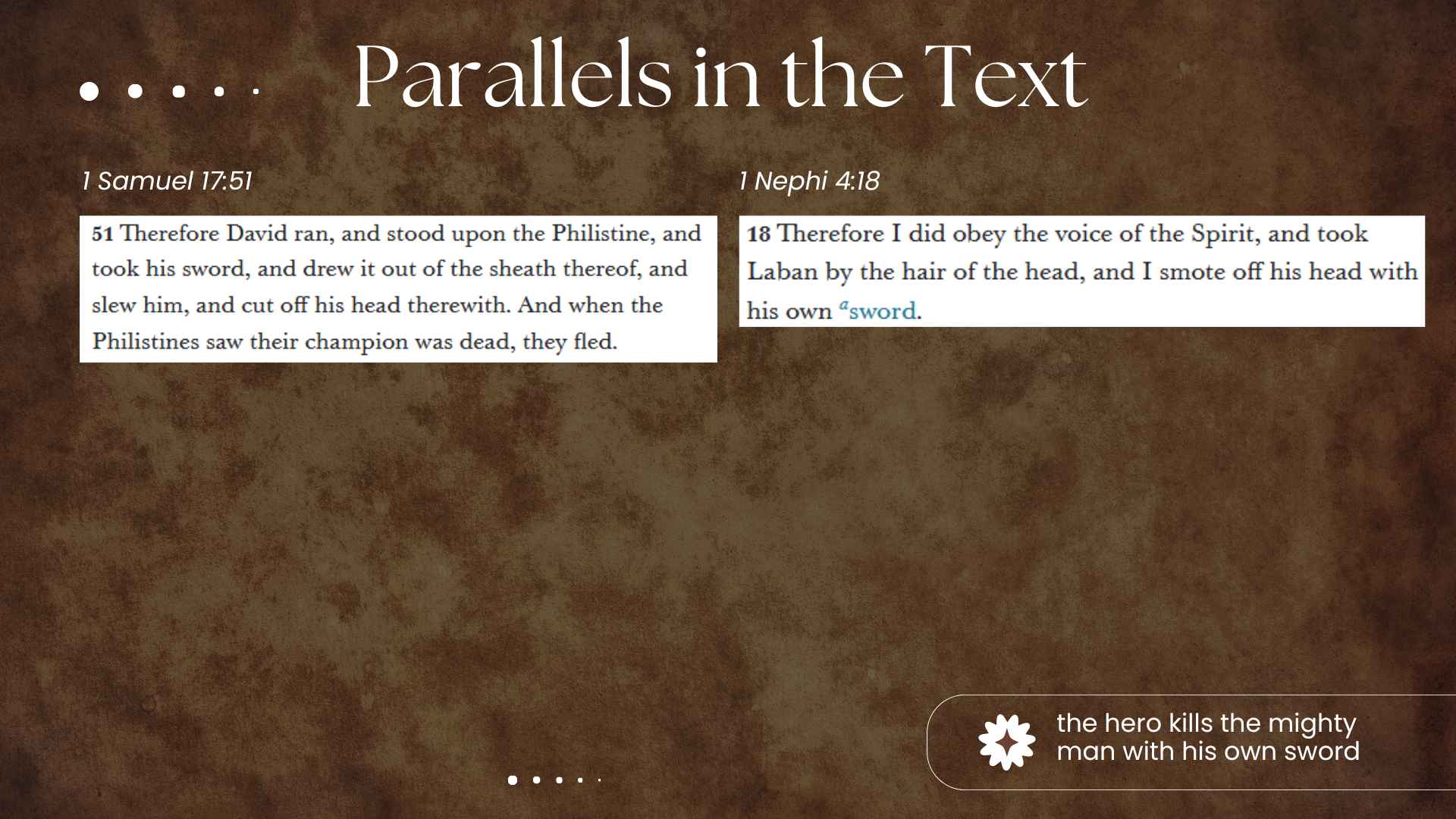
This literal interpretation of three days has long been accepted and understood in LDS circles as being a helpful tidbit in determining the geography of Lehi’s trek to the coast of the sea, where they then sail to the New World.

Instead of viewing this as a literal approach, what I like to look at is this three-day trip in Exodus 3:18 where, after Moses has been called as a prophet, his first command is to go back to Egypt, to the Israelites, and then to tell Pharaoh:

“The Lord God of the Hebrews hath met with us: and now let us go, we beseech thee, three days’ journey into the wilderness, that we may sacrifice to the Lord our God.”

Now, this is mentioned over and over again in the next several chapters in the Old Testament.

Egypt to Marah

This three-day journey actually occurred. It was a trip between Egypt and Marah, which is interesting—the fact that they have this body of water there, by which the place is named because the water was bitter. So they called the place bitterness.

And there were a number of other issues there.

Among them was the fact that when Pharaoh says, “Why do you have to go so far?” Moses responds, “Well, if we stay here and offer burnt offerings—which are an abomination to you Egyptians—you’ll kill us all because we’re inside your cultic holiness area.”

The same could be true of Lehi and Nephi.

For them to go out and offer burnt offerings and renew this new covenant they’re making with the Lord in downtown Jerusalem would certainly cause some significant difficulties for them.

Other Types Nephi Draws On

I’m going to close since I’ve pretty much expended my time.

The truth is I haven’t had enough time to take these ideas to a logical conclusion. And I think we can find dozens of additional details and parallels. It could be that these things all fall into that nebulous category of “typing” the Book of Mormon.

I think, however, that when Nephi tells us that he likens all scriptures unto himself, he actually is doing that. Not only with the scriptures he’s reading, but the scriptures he’s writing.

And we can find these parallels. We have several very distinct Noah parallels as he builds his boat.

There’s even more with the story of Joseph going into Egypt. We have the binding in the wilderness, the slaying of beasts. We have this whole concept of Nephi as an interpreter of dreams, which is very interesting.

He starts with his father’s dream. It’s just bits and pieces. “Whoops, we’re all done with this. Now, let’s talk about this.” And the first thing that happens: his brothers come up and say to him, “What’s the meaning of this?” And he explains it to them.
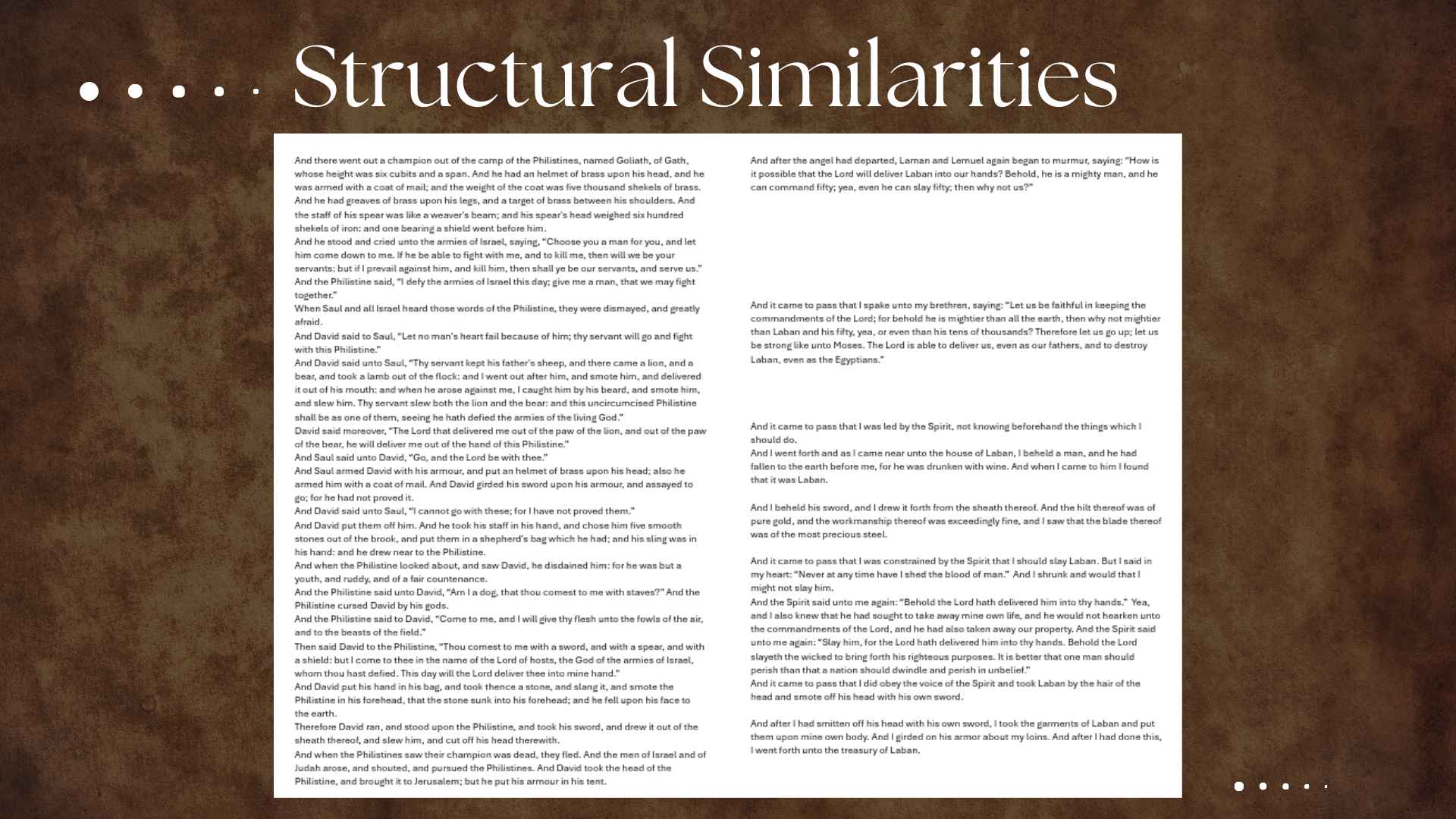
Concluding Reflections

I think perhaps that it may be difficult to reconstruct various textual reliance between the brass plates and the Book of Mormon. Because we don’t really have the brass plates to compare.

But the Book of Mormon can give us additional insight into the scriptures they carried with them. We can see that not only do they have more in some areas and less in others. But it can also give us a better understanding of the Bible. And where it’s at in terms of how it’s been preserved in that picture.

I’d like to close just by stating that this apologetics work that I’ve been involved in through FAIR has been a great source of joy and personal satisfaction. In dealing with the gospel in new ways and learning new ideas and ways of looking at things.

And I think that this is the type of stuff that we as Saints need to be doing. Building our own personal testimonies of the gospel and answering these questions for ourselves.

And I’ll close in the name of Jesus Christ, amen.

Question and Answer Session

We do have time for maybe one or two questions. If you want to ask me, then we’ll take our break.

Question: What About Blood on Laban’s Armor?

Question

Earlier you alluded to the fact that, yeah, there’d be blood all over Laban’s armor and so forth. But you never did explain that.

Answer

My personal ideas about that are quite a bit off the beaten track.

Based on the fact that he’s writing the story to prove a point. That means that he probably got some of the details out of chronological order as they actually occurred historically.

And that maybe it’s much more likely that

  1. Nephi finds Laban laying there, passed out drunk in the middle of the road,
  2. takes off his armor,
  3. gets ready to go back to the brass plates
  4. and that’s when the Spirit says, “No, wait a minute—you better go back and finish the job here.”
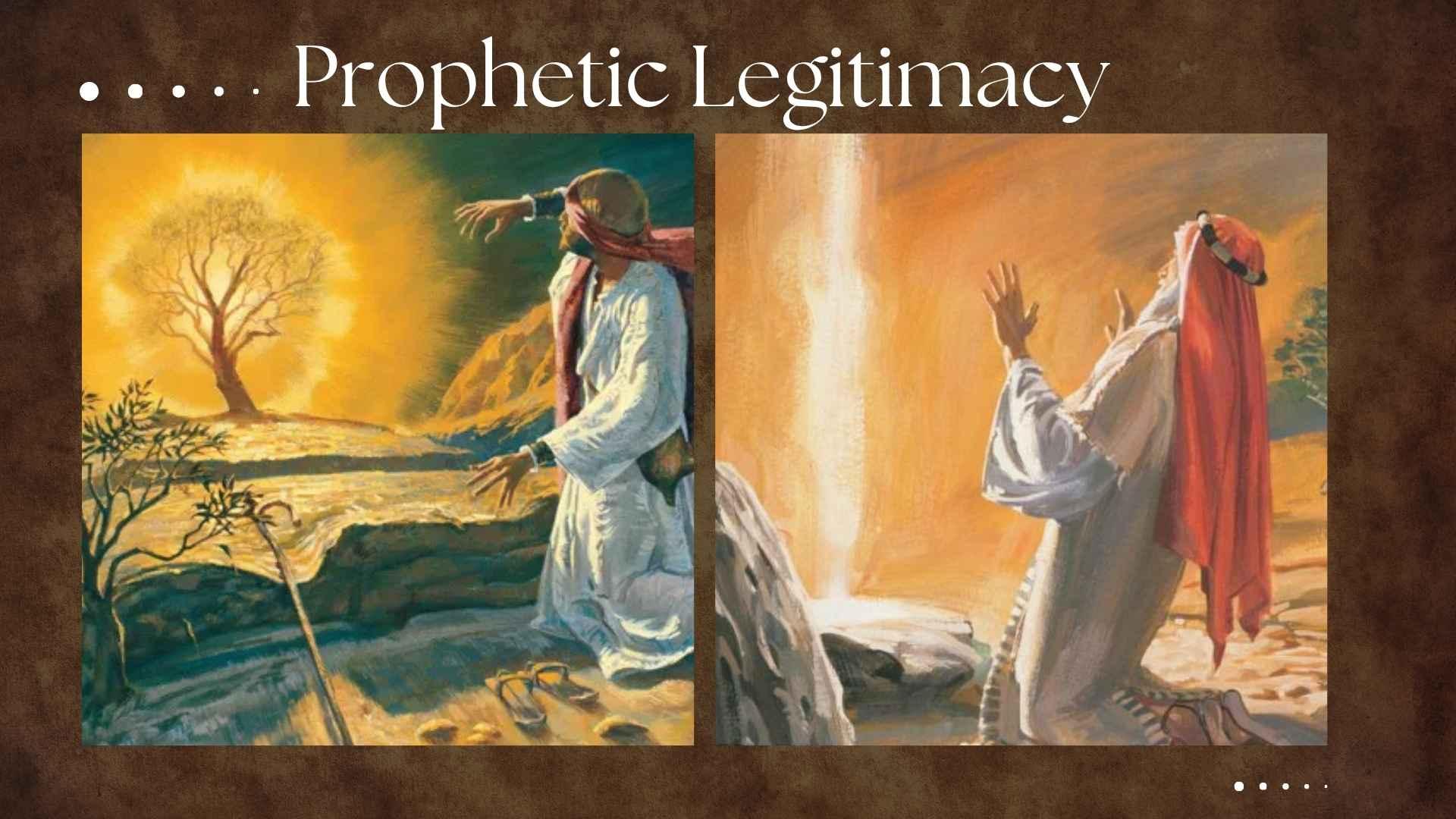
So I believe that that’s not really an issue. It only becomes an issue because these parts of the stories are right next to each other when in fact it’s not necessarily a chronological series.

That’s my own personal feeling. I’ll stop there.

Question: If Nephi Is Alluding to David and Goliath, Why Does He Do It This Way?

Question

If Nephi is alluding to the story of David and Goliath, why [indistinguishable]?

Answer

Well, it’s a good question.

I think that for starters, Nephi says that they’ve got the brass plates. The only time he ever really directly uses them is when he quotes all this Isaiah material.

And that’s another oddity. You would think that he and his descendants would have the brass plates right there. He wouldn’t need to put it all down.

I think there’s two reasons why he doesn’t directly allude to it.

Nephi’s Audience is Not 100% Israelites

One of them goes back to one of the other papers that was presented at this conference. Nephi’s audience is not 100% Israelites at the time that he’s writing.

  • There’s been some cultural merging.
  • There’s a larger group of people that they’re dealing with.
  • There’s no way that just Nephi and his family could split into two groups. Large enough to have had a number of wars and contentions over this rulership issue.

So I think rather than:

  • going back and
  • having to retell the story to everybody and
  • then saying, “And just like David and Goliath.”
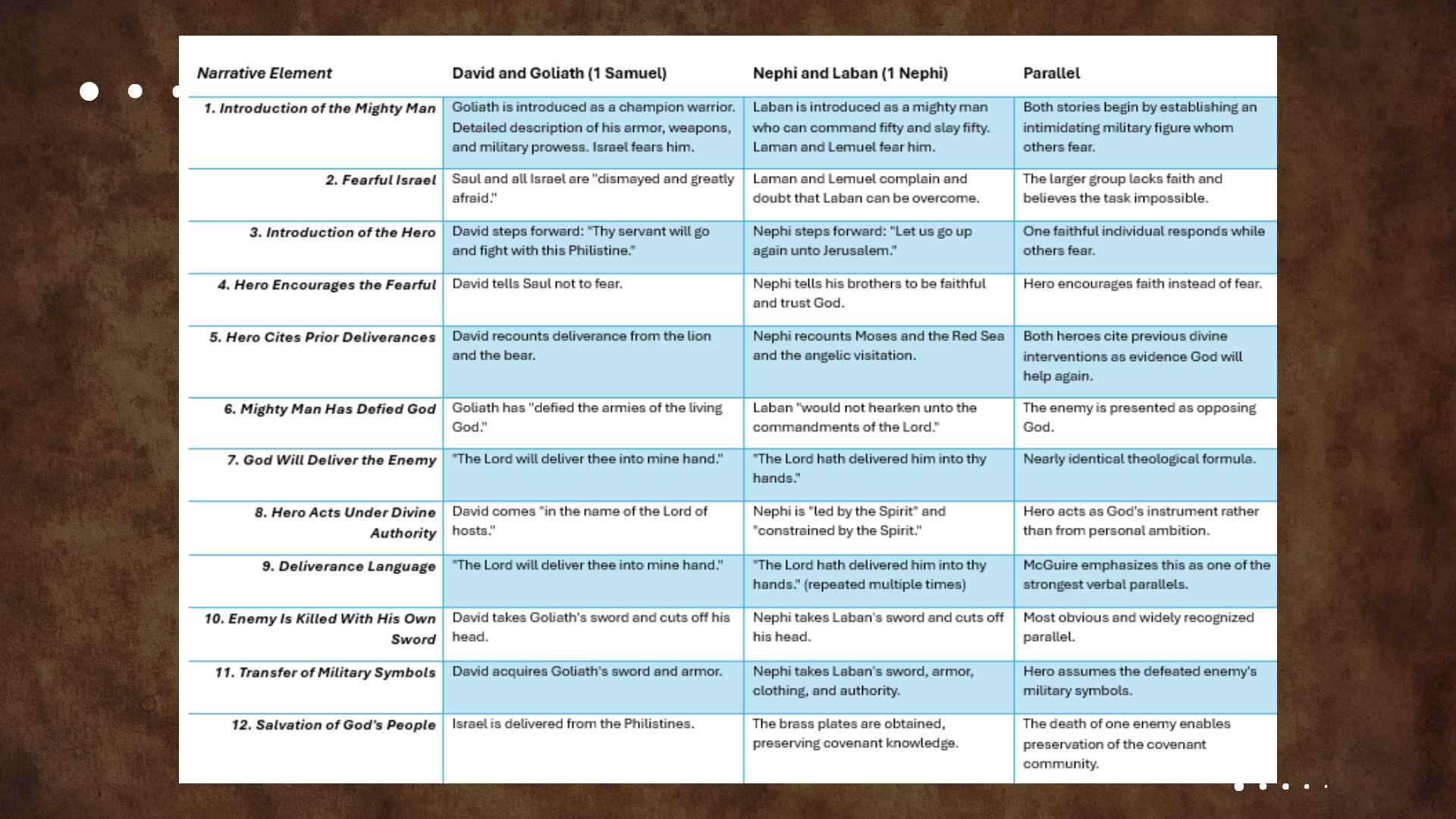
He’s putting his story out in a way that shows that there’s some stuff going on here.

Some of the group is going to immediately recognize these parallels, and some isn’t. It just depends on who you’re talking to.

The Brass Plates as a Type for the Spoils of Egypt

Another interesting thing that I didn’t bring up, that I think might also go along with this. Is this whole concept of the brass plates being worth more than all of their wealth.

Going back to the Exodus. It’s quite possible that Nephi saw his taking the brass plates as the spoiling of Egypt.

When they leave Egypt they take all this wealth with them. Though he’s leaving Jerusalem, he’s taking something that’s worth far more than anything he had. But he doesn’t see it as stealing. He’s taking the stuff that the Lord wants him to take.

Thank you.

FAQ / Common Questions

What is the main argument of this presentation?

Ben McGuire argues that Nephi intentionally incorporated Old Testament literary patterns into his record, especially parallels to David and Goliath and the Exodus.

Why does McGuire compare Nephi and Laban to David and Goliath?

He identifies a sequence of narrative similarities, including a powerful enemy, a faithful hero, divine deliverance, and the use of the enemy’s own sword.

Does the presentation claim Nephi copied the Bible?

No. McGuire argues that Nephi consciously drew upon scriptural traditions preserved on the brass plates and expected readers to recognize those connections.

How does the Exodus relate to First Nephi?

McGuire suggests that Lehi’s departure from Jerusalem and journey into the wilderness mirrors Israel’s Exodus from Egypt and that Nephi intentionally emphasizes these parallels.

Why is the brass plates narrative important?

According to McGuire, it serves multiple purposes: preserving sacred records, establishing Nephi’s legitimacy as a leader, and connecting his story to familiar scriptural patterns.

Search topics

Nephi and Goliath; Ben McGuire FAIR Conference 2001; First Nephi literary analysis; David and Goliath parallels; Nephi and Laban comparison; brass plates narrative; Old Testament in the Book of Mormon; Exodus typology in First Nephi; Lehi exodus from Jerusalem; literary patterns in scripture; Book of Mormon narrative structure; Nephi as king and prophet; brass plates traditions; biblical typology; scriptural allusions in the Book of Mormon; Nephi's authorship; prophetic legitimacy in First Nephi; kingship in the Book of Mormon; Davidic themes in Nephite writings; Lehi prophetic call; Book of Mormon literary studies; covenant themes in First Nephi; Moses and Nephi parallels; scriptural interpretation; Book of Mormon and Old Testament connections

CES Letter; Book of Mormon criticism; Book of Mormon historicity; Mormon apologetics; LDS apologetics; Mormon scripture origins; Book of Mormon evidence; Mormon truth claims; Mormon Church criticism; Joseph Smith and the Book of Mormon; Book of Mormon authorship; Book of Mormon literary complexity; criticism of Nephi and Laban; Mormon historical claims; LDS faith questions; evidence for the Book of Mormon; Mormon intellectual tradition; Book of Mormon scholarship; anti-Mormon claims; Restoration truth claims

  • « Go to Previous Page
  • Page 1
  • Page 2
  • Page 3
  • Page 4

Primary Sidebar

Faithful Study Resources for Come, Follow Me

Subscribe to Blog

Enter your email address:

Subscribe to Podcast

Podcast icon
Subscribe to podcast in iTunes
Subscribe to podcast elsewhere
Listen with FAIR app
Android app on Google Play Download on the App Store

Pages

  • Blog Guidelines

FAIR Latest

  • Come, Follow Me with FAIR – Isaiah 1–12 – Part 2 – Autumn Dickson
  • Come, Follow Me with FAIR – Isaiah 1-12 – Jennifer Roach Lees
  • Come, Follow Me with FAIR – Isaiah 1–12 – Part 1 – Autumn Dickson
  • Because of Jesus Christ
  • Come, Follow Me with FAIR – Proverbs 1–4; 15–16; 22; 31; Ecclesiastes 1–3; 11–12 – Part 2 – Autumn Dickson

Blog Categories

Recent Comments

  • Willie Louise Truitt on The Joy of a Covenant Relationship with God
  • Katrina on In memory of Chandler “Chuck” Hendry
  • Nancy Farmer on Come, Follow Me with FAIR – Psalms 49–51; 61–66; 69–72; 77–78; 85–86 – Part 1 – Autumn Dickson
  • Nicko De Leon on In memory of Chandler “Chuck” Hendry
  • Becky Matson on In memory of Chandler “Chuck” Hendry

Archives

Follow Us

  • Facebook
  • Twitter
  • iTunes
  • YouTube
Android app on Google Play Download on the App Store

Footer

FairMormon Logo

FAIR is a non-profit organization dedicated to providing well-documented answers to criticisms of the doctrine, practice, and history of The Church of Jesus Christ of Latter-day Saints.

Donate to FAIR

We are a volunteer organization. We invite you to give back.

Donate Now

Site Footer

The use of the temple in past and current logos and the name "Mormon" are licensed for use by The Church of Jesus Christ of Latter-day Saints.